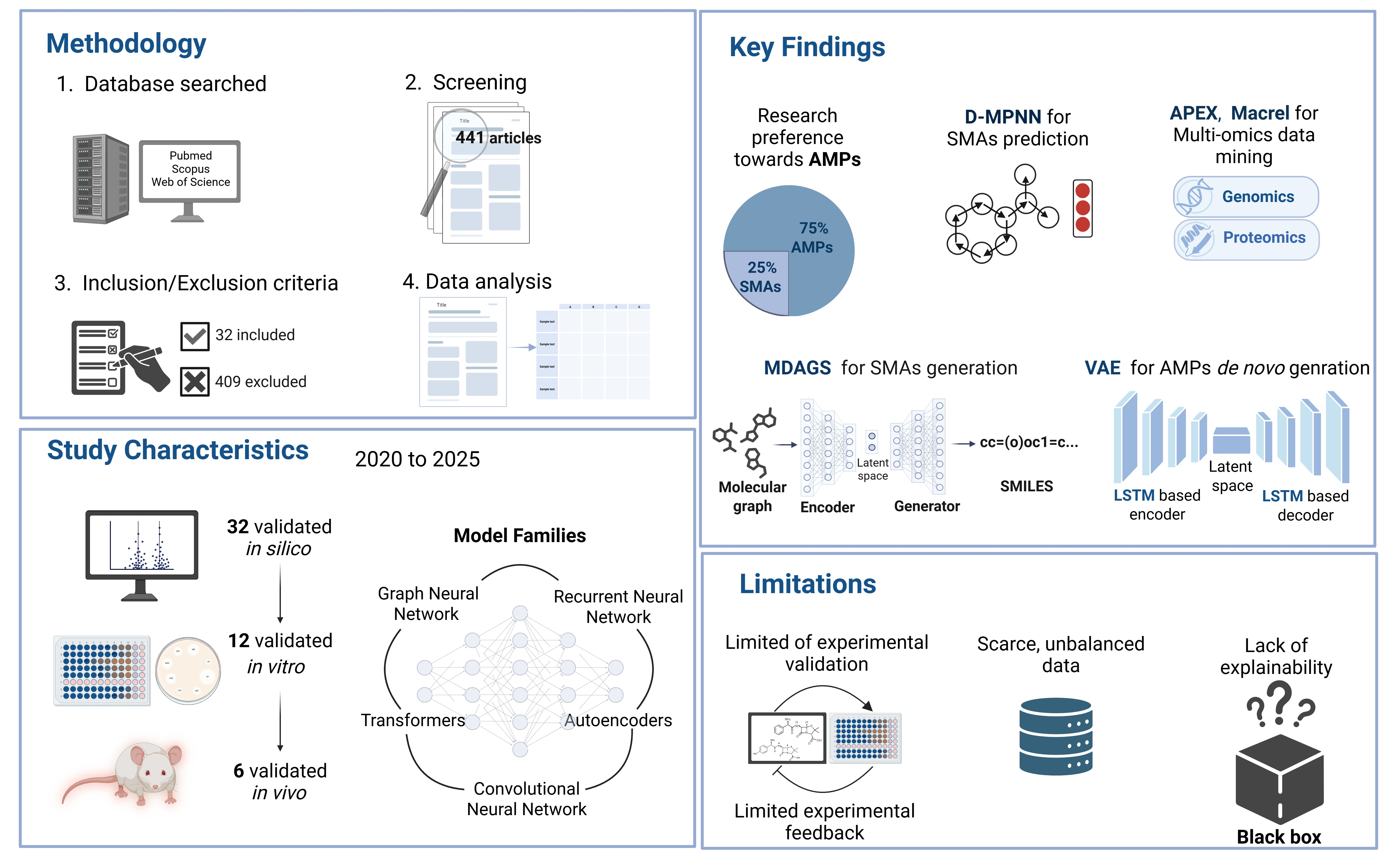
Artificial Intelligence as a Catalyst for Antimicrobial Discovery: From Predictive Models to De Novo Design

 , ,
, ,  ,
,  and
and 
Abstract
1. Introduction
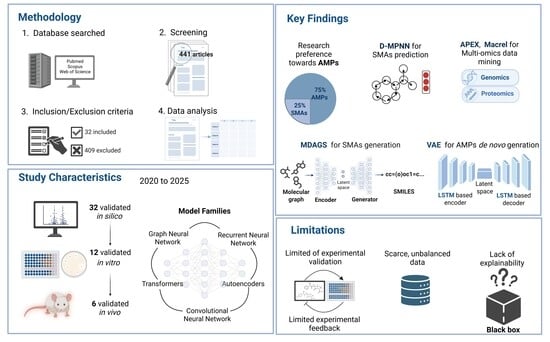
2. Scope and Review Strategy
2.1. Research Questions
- What artificial intelligence (AI) techniques are currently applied in antimicrobial discovery?
- Which AI algorithms demonstrate the highest effectiveness, and what factors contribute to their performance?
- What challenges limit the broader adoption of AI in antimicrobial discovery?
- How are generative AI frameworks used to design novel antibiotics and antimicrobial peptides (AMPs)?
- What AI-based tools exist for AMP prediction, and what are their accuracy, usability, and validation strategies?
2.2. Search Strategy
2.3. Selection of Records
2.4. Inclusion Criteria
- Articles related to antimicrobial resistance.
- Relevant content on artificial intelligence algorithms for developing novel antibiotics.
- Publications in peer-reviewed scientific journals.
- Research articles with full-text accessibility.
2.5. Exclusion Criteria
- Research papers published before 2020.
- Research papers not related to the application of AI in antibiotic discovery.
- Non-English publications.
- Review papers, conference abstracts, or book chapters.
2.6. Quality Assessment (QA)
- Relevance of the study: Does the paper’s topic connect to AI-based antibiotic discovery?
- Clarity of the methodology: Is the research methodology properly described?
- Presentation of results: Does the publication include the results?
- Experimental validation and biological relevance: Does the paper include in vitro validation, and where applicable, evidence of in vivo evaluation, toxicity assessment, or pharmacokinetic considerations?
2.7. Data Extraction and Qualitative Synthesis
3. AI Strategies for Antimicrobial Discovery
3.1. Distribution of Selected Studies
3.2. SMAs Discovery
3.2.1. Predictive Models
3.2.2. SMAs De Novo Design
3.3. Analysis of Models for SMA Discovery
3.3.1. Directed Message-Passing Neural Network (D-MPNN)
3.3.2. GPT Generator
3.3.3. Graph Attention–Variational Autoencoders
3.4. AMPs Discovery
3.4.1. AI in Multi-Omic Data Mining
3.4.2. AI in AMP Prediction
3.4.3. AMPs Prediction Softwares
3.4.4. AI in AMPs De Novo Generation
4. Discussion
Future Perspectives
5. Conclusions
6. Declaration of Generative AI and AI-Assisted Technologies in the Writing Process
Author Contributions
Funding
Institutional Review Board Statement
Informed Consent Statement
Data Availability Statement
Acknowledgments
Conflicts of Interest
References
- Hoyert, D.L.; Kochanek, K.D.; Murphy, S.L. Deaths: Final data for 1997. Natl. Vital Stat. Rep. 1999, 47, 1–104. [Google Scholar]
- Aminov, R.I. A brief history of the antibiotic era: Lessons learned and challenges for the future. Front. Microbiol. 2010, 1, 134. [Google Scholar] [CrossRef]
- Hata, S. Experimentelle Grundlage der Chemotherapie der Spirillosen. In Die Experimentelle Chemotherapie der Spirillosen: (Syphilis, Rückfallfieber, Hühnerspirillose, Frambösie); Ehrlich, P., Hata, S., Eds.; Springer: Berlin/Heidelberg, Germany, 1910; pp. 1–85. [Google Scholar] [CrossRef]
- Fleming, A. On the antibacterial action of cultures of a penicillium, with special reference to their use in the isolation of B. influenzae. Bull. World Health Organ. 2001, 79, 780–790. [Google Scholar] [CrossRef] [PubMed]
- Mahajan, G.B.; Balachandran, L. Antibacterial agents from Actinomycetes—A Review. Front. Biosci. 2012, 4, 240–253. [Google Scholar] [CrossRef]
- Bentley, R.; Bennett, J.W. What Is an Antibiotic? Revisited. In Advances in Applied Microbiology; Academic Press: Cambridge, MA, USA, 2003; Volume 52, pp. 303–331. [Google Scholar] [CrossRef]
- Ishak, A.; Mazonakis, N.; Spernovasilis, N.; Akinosoglou, K.; Tsioutis, C. Bactericidal versus bacteriostatic antibacterials: Clinical significance, differences and synergistic potential in clinical practice. J. Antimicrob. Chemother. 2024, 80, 1–17. [Google Scholar] [CrossRef] [PubMed]
- Cho, H.; Uehara, T.; Bernhardt, T.G. Beta-lactam antibiotics induce a lethal malfunctioning of the bacterial cell wall synthesis machinery. Cell 2014, 159, 1300–1311. [Google Scholar] [CrossRef]
- Andrade, F.F.; Silva, D.; Rodrigues, A.; Pina-Vaz, C. Colistin update on its mechanism of action and resistance, present and future challenges. Microorganisms 2020, 8, 1716. [Google Scholar] [CrossRef]
- Bush, N.G.; Diez-Santos, I.; Abbott, L.R.; Maxwell, A. Quinolones: Mechanism, Lethality and Their Contributions to Antibiotic Resistance. Molecules 2020, 25, 5662. [Google Scholar] [CrossRef]
- Jana, S.; Deb, J.K. Molecular understanding of aminoglycoside action and resistance. Appl. Microbiol. Biotechnol. 2006, 70, 140–150. [Google Scholar] [CrossRef]
- Sköld, O. Sulfonamide resistance: Mechanisms and trends. Drug Resist. Updat. 2000, 3, 155–160. [Google Scholar] [CrossRef]
- Davies, J.; Davies, D. Origins and evolution of antibiotic resistance. Microbiol. Mol. Biol. Rev. 2010, 74, 417–433. [Google Scholar] [CrossRef]
- Samreen, A.I.; Malak, H.A.; Abulreesh, H.H. Environmental antimicrobial resistance and its drivers: A potential threat to public health. J. Glob. Antimicrob. Resist. 2021, 27, 101–111. [Google Scholar] [CrossRef] [PubMed]
- Horton, J.S.; Taylor, T.B. Mutation bias and adaptation in bacteria. Microbiology 2023, 169, 001404. [Google Scholar] [CrossRef] [PubMed]
- Kolář, M.; Urbánek, K.; Látal, T. Antibiotic selective pressure and development of bacterial resistance. Int. J. Antimicrob. Agents 2001, 17, 357–363. [Google Scholar] [CrossRef] [PubMed]
- Bello-López, J.M.; Cabrero-Martínez, O.A.; Ibáñez-Cervantes, G.; Hernández-Cortez, C.; Pelcastre-Rodríguez, L.I.; Gonzalez-Avila, L.U.; Castro-Escarpulli, G. Horizontal Gene Transfer and Its Association with Antibiotic Resistance in the Genus Aeromonas spp. Microorganisms 2019, 7, 363. [Google Scholar] [CrossRef]
- Darby, E.M.; Trampari, E.; Siasat, P.; Gaya, M.S.; Alav, I.; Webber, M.A.; Blair, J.M.A. Molecular mechanisms of antibiotic resistance revisited. Nat. Rev. Microbiol. 2023, 21, 280–295, Correction in Nat. Rev. Microbiol. 2024, 22, 255. [Google Scholar] [CrossRef]
- Miller, W.R.; Arias, C.A. ESKAPE pathogens: Antimicrobial resistance, epidemiology, clinical impact and therapeutics. Nat. Rev. Microbiol. 2024, 22, 598–616. [Google Scholar] [CrossRef]
- GBD 2021 Antimicrobial Resistance Collaborators. Global burden of bacterial antimicrobial resistance 1990–2021: A systematic analysis with forecasts to 2050. Lancet 2024, 404, 1199–1226. [Google Scholar] [CrossRef]
- Uchil, R.R.; Kohli, G.S.; Katekhaye, V.M.; Swami, O.C. Strategies to combat antimicrobial resistance. J. Clin. Diagn. Res. 2014, 8, ME01–ME04. [Google Scholar] [CrossRef]
- de la Fuente-Nunez, C.; Cesaro, A.; Hancock, R.E.W. Antibiotic failure: Beyond antimicrobial resistance. Drug Resist. Updat. 2023, 71, 101012. [Google Scholar] [CrossRef]
- DiMasi, J.A.; Grabowski, H.G.; Hansen, R.W. Innovation in the pharmaceutical industry: New estimates of R&D costs. J. Health Econ. 2016, 47, 20–33. [Google Scholar] [CrossRef]
- Gargate, N.; Laws, M.; Rahman, K.M. Current economic and regulatory challenges in developing antibiotics for Gram-negative bacteria. npj Antimicrob. Resist. 2025, 3, 50. [Google Scholar] [CrossRef]
- Cesaro, A.; Hoffman, S.C.; Das, P.; de la Fuente-Nunez, C. Challenges and applications of artificial intelligence in infectious diseases and antimicrobial resistance. NPJ Antimicrob. Resist. 2025, 3, 2. [Google Scholar] [CrossRef]
- Rabaan, A.A.; Alhumaid, S.; Mutair, A.A.; Garout, M.; Abulhamayel, Y.; Halwani, M.A.; Alestad, J.H.; Bshabshe, A.A.; Sulaiman, T.; AlFonaisan, M.K.; et al. Application of Artificial Intelligence in Combating High Antimicrobial Resistance Rates. Antibiotics 2022, 11, 784. [Google Scholar] [CrossRef] [PubMed]
- Ali, T.; Ahmed, S.; Aslam, M. Artificial Intelligence for Antimicrobial Resistance Prediction: Challenges and Opportunities towards Practical Implementation. Antibiotics 2023, 12, 523. [Google Scholar] [CrossRef] [PubMed]
- David, L.; Brata, A.M.; Mogosan, C.; Pop, C.; Czako, Z.; Muresan, L.; Ismaiel, A.; Dumitrascu, D.I.; Leucuta, D.C.; Stanculete, M.F.; et al. Artificial Intelligence and Antibiotic Discovery. Antibiotics 2021, 10, 1376. [Google Scholar] [CrossRef]
- Ouzzani, M.; Hammady, H.; Fedorowicz, Z.; Elmagarmid, A. Rayyan-a web and mobile app for systematic reviews. Syst. Rev. 2016, 5, 210. [Google Scholar] [CrossRef]
- Stokes, J.M.; Yang, K.; Swanson, K.; Jin, W.; Cubillos-Ruiz, A.; Donghia, N.M.; MacNair, C.R.; French, S.; Carfrae, L.A.; Bloom-Ackermann, Z.; et al. A deep learning approach to antibiotic discovery. Cell 2020, 180, 688–702. [Google Scholar] [CrossRef] [PubMed]
- Liu, G.; Catacutan, D.B.; Rathod, K.; Swanson, K.; Jin, W.; Mohammed, J.C.; Chiappino-Pepe, A.; Syed, S.A.; Fragis, M.; Rachwalski, K.; et al. Deep learning-guided discovery of an antibiotic targeting Acinetobacter baumannii. Nat. Chem. Biol. 2023, 19, 1342–1350. [Google Scholar] [CrossRef]
- Rahman, A.S.M.Z.; Liu, C.; Sturm, H.; Hogan, A.M.; Davis, R.; Hu, P.; Cardona, S.T. A machine learning model trained on a high-throughput antibacterial screen increases the hit rate of drug discovery. PLoS Comput Biol. 2022, 13, e1010613. [Google Scholar] [CrossRef]
- Boulaamane, Y.; Molina Panadero, I.; Hmadcha, A.; Atalaya Rey, C.; Baammi, S.; El Allali, A.; Maurady, A.; Smani, Y. Antibiotic discovery with artificial intelligence for the treatment of Acinetobacter baumannii infections. mSystems 2024, 9, e0032524. [Google Scholar] [CrossRef]
- Wang, C.; Wu, Y.; Xue, Y.; Zou, L.; Huang, Y.; Zhang, P.; Ji, J. Combinatorial discovery of antibacterials via a feature-fusion based machine learning workflow. Chem. Sci. 2024, 15, 6044–6052. [Google Scholar] [CrossRef]
- Olayo-Alarcon, R.; Amstalden, M.K.; Zannoni, A.; Bajramovic, M.; Sharma, C.M.; Brochado, A.R.; Rezaei, M.; Müller, C.L. Pre-trained molecular representations enable antimicrobial discovery. Nat. Commun. 2025, 16, 3420. [Google Scholar] [CrossRef]
- Chen, L.; Yu, L.; Gao, L. Potent antibiotic design via guided search from antibacterial activity evaluations. Bioinformatics 2023, 39, btad059. [Google Scholar] [CrossRef]
- Krishnan, S.R.; Bung, N.; Padhi, S.; Bulusu, G.; Misra, P.; Pal, M.; Oruganti, S.; Srinivasan, R.; Roy, A. De novo design of anti-tuberculosis agents using a structure-based deep learning method. J. Mol. Graph. Model. 2023, 118, 108361. [Google Scholar] [CrossRef] [PubMed]
- Han, X.; Jia, M.; Chang, Y.; Li, Y.; Wu, S. Directed message passing neural network (D-MPNN) with graph edge attention (GEA) for property prediction of biofuel-relevant species. Energy AI 2022, 10, 100201. [Google Scholar] [CrossRef]
- Bagal, V.; Aggarwal, R.; Vinod, P.K.; Priyakumar, U.D. MolGPT: Molecular Generation Using a Transformer-Decoder Model. J. Chem. Inf. Model. 2022, 62, 2064–2076. [Google Scholar] [CrossRef] [PubMed]
- Duque-Salazar, G.; Mendez-Otalvaro, E.; Ceballos-Arroyo, A.M.; Orduz, S. Design of antimicrobial and cytolytic peptides by computational analysis of bacterial, algal, and invertebrate proteomes. Amino Acids 2020, 52, 1403–1412. [Google Scholar] [CrossRef]
- Santos-Júnior, C.D.; Torres, M.D.T.; Duan, Y.; Rodríguez Del Río, Á.; Schmidt, T.S.B.; Chong, H.; Fullam, A.; Kuhn, M.; Zhu, C.; Houseman, A.; et al. Discovery of antimicrobial peptides in the global microbiome with machine learning. Cell 2024, 187, 3761–3778.e16. [Google Scholar] [CrossRef]
- Wan, F.; Torres, M.D.T.; Peng, J.; de la Fuente-Nunez, C. Deep-learning-enabled antibiotic discovery through molecular de-extinction. Nat. Biomed. Eng. 2024, 8, 854–871. [Google Scholar] [CrossRef] [PubMed]
- Li, C.; Sutherland, D.; Salehi, A.; Richter, A.; Lin, D.; Aninta, S.I.; Ebrahimikondori, H.; Yanai, A.; Coombe, L.; Warren, R.L.; et al. Mining the UniProtKB/Swiss-Prot database for antimicrobial peptides. Protein Sci. 2025, 34, e70083. [Google Scholar] [CrossRef]
- Khabaz, H.; Rahimi-Nasrabadi, M.; Keihan, A.H. Hierarchical machine learning model predicts antimicrobial peptide activity against Staphylococcus aureus. Front. Mol. Biosci. 2023, 10, 1238509. [Google Scholar] [CrossRef]
- Cao, Q.; Ge, C.; Wang, X.; Harvey, P.J.; Zhang, Z.; Ma, Y.; Wang, X.; Jia, X.; Mobli, M.; Craik, D.J.; et al. Designing antimicrobial peptides using deep learning and molecular dynamic simulations. Brief. Bioinform. 2023, 24, bbad058. [Google Scholar] [CrossRef]
- Yao, L.; Pang, Y.; Wan, J.; Chung, C.-R.; Yu, J.; Guan, J.; Leung, C.; Chiang, Y.-C.; Lee, T.-Y. ABPCaps: A Novel Capsule Network-Based Method for the Prediction of Antibacterial Peptides. Appl. Sci. 2023, 13, 6965. [Google Scholar] [CrossRef]
- Oh, J.W.; Shin, M.K.; Park, H.R.; Kim, S.; Lee, B.; Yoo, J.S.; Chi, W.J.; Sung, J.S. PA-Win2: In Silico-Based Discovery of a Novel Peptide with Dual Antibacterial and Anti-Biofilm Activity. Antibiotics 2024, 13, 1113. [Google Scholar] [CrossRef] [PubMed]
- Lin, T.-T.; Yang, L.-Y.; Lu, I.-H.; Cheng, W.-C.; Hsu, Z.-R.; Chen, S.-H.; Lin, C.-Y. AI4AMP: An Antimicrobial Peptide Predictor Using Physicochemical Property-Based Encoding Method and Deep Learning. mSystems 2021, 6, e0029921. [Google Scholar] [CrossRef]
- Li, C.; Sutherland, D.; Hammond, S.A.; Yang, C.; Taho, F.; Bergman, L.; Houston, S.; Warren, R.L.; Wong, T.; Hoang, L.M.N.; et al. AMPlify: Attentive deep learning model for discovery of novel antimicrobial peptides effective against WHO priority pathogens. BMC Genom. 2022, 23, 77. [Google Scholar] [CrossRef]
- Jan, A.; Hayat, M.; Wedyan, M.; Alturki, R.; Gazzawe, F.; Ali, H.; Alarfaj, F.K. Target-AMP: Computational prediction of antimicrobial peptides by coupling sequential information with evolutionary profile. Comput. Biol. Med. 2022, 151, 106311. [Google Scholar] [CrossRef]
- Ruiz Puentes, P.; Henao, M.C.; Cifuentes, J.; Muñoz-Camargo, C.; Reyes, L.H.; Cruz, J.C.; Arbeláez, P. Rational. Rational Discovery of Antimicrobial Peptides by Means of Artificial Intelligence. Membranes 2022, 12, 708. [Google Scholar] [CrossRef]
- Lee, H.; Lee, S.; Lee, I.; Nam, H.A. AMP-BERT: Prediction of antimicrobial peptide function based on a BERT model. Protein Sci. 2023, 32, e4529. [Google Scholar] [CrossRef] [PubMed]
- Shaon, M.S.H.; Karim, T.; Sultan, M.F.; Ali, M.M.; Ahmed, K.; Hasan, M.Z.; Moustafa, A.; Bui, F.M.; Al-Zahrani, F.A. AMP-RNNpro: A two-stage approach for identification of antimicrobials using probabilistic features. Sci. Rep. 2024, 14, 12892. [Google Scholar] [CrossRef]
- Yao, L.; Guan, J.; Xie, P.; Chung, C.R.; Deng, J.; Huang, Y.; Chiang, Y.C.; Lee, T.Y. AMPActiPred: A three-stage framework for predicting antibacterial peptides and activity levels with deep forest. Protein Sci. 2024, 33, e5006. [Google Scholar] [CrossRef]
- Dean, S.N.; Alvarez, J.A.E.; Zabetakis, D.; Walper, S.A.; Malanoski, A.P. PepVAE: Variational Autoencoder Framework for Antimicrobial Peptide Generation and Activity Prediction. Front. Microbiol. 2021, 12, 725727. [Google Scholar] [CrossRef]
- Pandi, A.; Adam, D.; Zare, A.; Trinh, V.T.; Schaefer, S.L.; Burt, M.; Klabunde, B.; Bobkova, E.; Kushwaha, M.; Foroughijabbari, Y.; et al. Cell-free biosynthesis combined with deep learning accelerates de novo-development of antimicrobial peptides. Nat. Commun. 2023, 14, 7197. [Google Scholar] [CrossRef]
- Das, P.; Sercu, T.; Wadhawan, K.; Padhi, I.; Gehrmann, S.; Cipcigan, F.; Chenthamarakshan, V.; Strobelt, H.; dos Santos, C.; Chen, P.-Y.; et al. Accelerated antimicrobial discovery via deep generative models and molecular dynamics simulations. Nat. Biomed. Eng. 2021, 5, 613–623, Correction in Nat. Biomed. Eng. 2021, 5, 942. [Google Scholar] [CrossRef]
- Lin, T.-T.; Yang, L.-Y.; Lin, C.-Y.; Wang, C.-T.; Lai, C.-W.; Ko, C.-F.; Shih, Y.-H.; Chen, S.-H. Intelligent De Novo Design of Novel Antimicrobial Peptides against Antibiotic-Resistant Bacteria Strains. Int. J. Mol. Sci. 2023, 24, 6788. [Google Scholar] [CrossRef] [PubMed]
- Boone, K.; Wisdom, C.; Camarda, K.; Spencer, P.; Tamerler, C. Combining genetic algorithm with machine learning strategies for designing potent antimicrobial peptides. BMC Bioinform. 2021, 22, 239. [Google Scholar] [CrossRef] [PubMed]
- Wang, B.; Lin, P.; Zhong, Y.; Tan, X.; Shen, Y.; Huang, Y.; Jin, K.; Zhang, Y.; Zhan, Y.; Shen, D.; et al. Explainable deep learning and virtual evolution identifies antimicrobial peptides with activity against multidrug-resistant human pathogens. Nat. Microbiol. 2025, 10, 332–347. [Google Scholar] [CrossRef] [PubMed]
- Bobde, S.S.; Alsaab, F.M.; Wang, G.; Van Hoek, M.L. Ab initio Designed Antimicrobial Peptides Against Gram-Negative Bacteria. Front. Microbiol. 2021, 12, 715246. [Google Scholar] [CrossRef]
- Zervou, M.A.; Doutsi, E.; Pantazis, Y.; Tsakalides, P. De Novo Antimicrobial Peptide Design with Feedback Generative Adversarial Networks. Int. J. Mol. Sci. 2024, 25, 5506. [Google Scholar] [CrossRef]
- Cao, J.; Zhang, J.; Yu, Q.; Ji, J.; Li, J.; He, S.; Zhu, Z. TG-CDDPM: Text-guided antimicrobial peptides generation based on conditional denoising diffusion probabilistic model. Brief. Bioinform. 2024, 26, bbae644. [Google Scholar] [CrossRef] [PubMed]
- Vila, J.; Moreno-Morales, J.; Ballesté-Delpierre, C. Current landscape in the discovery of novel antibacterial agents. Clin. Microbiol. Infect. 2020, 26, 596–603. [Google Scholar] [CrossRef]
- Ageitos, J.M.; Sánchez-Pérez, A.; Calo-Mata, P.; Villa, T.G. Antimicrobial peptides (AMPs): Ancient compounds that represent novel weapons in the fight against bacteria. Biochem. Pharmacol. 2017, 133, 117–138. [Google Scholar] [CrossRef]
- Scannell, J.W.; Blanckley, A.; Boldon, H.; Warrington, B. Diagnosing the decline in pharmaceutical R&D efficiency. Nat. Rev. Drug Discov. 2012, 11, 191–200. [Google Scholar] [CrossRef] [PubMed]
- Schneider, G.; Clark, D.E. Automating drug discovery. Nat. Rev. Drug Discov. 2019, 18, 353–364. [Google Scholar] [CrossRef]
- Walters, W.P.; Murcko, M.A. Assessing the impact of generative AI on medicinal chemistry. Nat. Biotechnol. 2020, 38, 143–145. [Google Scholar] [CrossRef]
- Schneuing, A.; Harris, C.; Du, Y.; Didi, K.; Jamasb, A.; Igashov, I.; Du, W.; Gomes, C.; Blundell, T.L.; Lio, P.; et al. Structure-based drug design with equivariant diffusion models. Nat. Comput. Sci. 2024, 4, 899–909. [Google Scholar] [CrossRef]
- Jumper, J.; Evans, R.; Pritzel, A.; Green, T.; Figurnov, M.; Ronneberger, O.; Tunyasuvunakool, K.; Bates, R.; Žídek, A.; Potapenko, A.; et al. Highly accurate protein structure prediction with AlphaFold. Nature 2021, 596, 583–589. [Google Scholar] [CrossRef]
- Zhao, F.; Qiu, J.; Xiang, D.; Jiao, P.; Cao, Y.; Xu, Q.; Qiao, D.; Xu, H.; Cao, Y. deepAMPNet: A novel antimicrobial peptide predictor employing AlphaFold2 predicted structures and a bi-directional long short-term memory protein language model. PeerJ 2024, 12, e17729. [Google Scholar] [CrossRef]
- Tosh, C.; Tec, M.; White, J.B.; Quinn, J.F.; Ibanez Sanchez, G.; Calder, P.; Kung, A.L.; Dela Cruz, F.S.; Tansey, W. A Bayesian active learning platform for scalable combination drug screens. Nat. Commun. 2025, 16, 156. [Google Scholar] [CrossRef] [PubMed]
- Proietti, M.; Ragno, A.; La Rosa, B.; Ragno, R.; Capobianco, R. Explainable AI in drug discovery: Self-interpretable graph neural network for molecular property prediction using concept whitening. Mach. Learn. 2024, 113, 2013–2044. [Google Scholar] [CrossRef]



| Database | Search Strings |
|---|---|
| PubMed | ((((‘antimicrobial resistance’ [Title/Abstract] OR ‘resistant bacteria’ [Title/Abstract] OR ’Resistant microorganisms’ [Title/Abstract])) AND ((‘artificial intelligence’ [Title/Abstract] OR ‘deep learning’ [Title/Abstract] OR ‘machine learning’ [Title/Abstract] OR ‘generative AI’ [Title/Abstract] OR ‘explainable AI’ [Title/Abstract] OR ‘predictive AI’ [Title/Abstract]))) AND ((‘antibiotic discovery’ [Title/Abstract] OR ‘drug discovery’ [Title/Abstract] OR ’novel drug’ [Title/Abstract]))) |
| Scopus | TITLE-ABS-KEY (“antimicrobial resistance” OR “resistant bacteria” OR “resistant microorganisms”) AND (“artificial intelligence” OR “deep learning” OR “machine learning” OR “generative AI”) AND (“antibiotic discovery” OR “drug discovery” OR “novel drug”) AND PUBYEAR > 2019 AND PUBYEAR < 2026 |
| Web of Science | ((‘antimicrobial resistance’ OR ‘resistant bacteria’ OR ‘resistant microorganisms’) AND (‘artificial intelligence’ OR ‘deep learning’ OR ‘machine learning’ OR ‘generative AI’ OR ‘explainable AI’ OR ‘predictive AI’) AND (‘antibiotic discovery’ OR ‘drug discovery’ OR ‘novel drug’)) |
| Paper | Objective | Model | Dataset | Performance Metrics | Key Results |
|---|---|---|---|---|---|
| Stokes et al. (2020) [30] | Screen millions of molecules from large chemical libraries to identify new, structurally unique antibiotics effective against priority pathogens and resistant strains. | Directed–Message Passing Neural Network (D-MPNN) | Training: 2335 molecules (FDA-approved drug and natural product). Screening: 107 million molecules (ZINC15) | ROC-AUC = 0.896 | Halicin, a novel molecule with broad-spectrum activity against multidrug-resistant E. coli, tuberculosis, and carbapenem-resistant Enterobacteriaceae in vitro; treated A. baumannii infections in mouse models. |
| Rahman et al. (2022) [32] | Screen small-molecule libraries to identify antibacterial compounds against Burkholderia cenocepacia. | D-MPNN | Training: 29,537 molecules. Screening: 225,819 (FDA-approved drug and natural product) | ROC-AUC = 0.823; PRC-AUC = 0.241; F1 = 0.104; MCC = 0.167 | 21 FDA-predicted compounds and 5 natural products were active; two unreported antibacterials (STL558147, PHAR261659) showed broad activity. Limited chemical diversity and class imbalance constrained model generalization. |
| Liu et al. (2023) [31] | Discover structurally and functionally new molecules with activity against A. baumannii. | D-MPNN | Training: 7684 small molecules. Screening: 6680 molecules | ROC-AUC = 0.792; PR-AUC = 0.337 | Abaucin identified with narrow-spectrum antibacterial activity against A. baumannii. |
| Boulaamane et al. (2024) [33] | Screened a large library of natural products with potential activity against A. baumannii, focusing on OmpW. | CNN; SVM; Random Forest; k-NN; Gaussian Naïve Bayes | Training: 3196 bioactive compounds. Screening: 11,648 natural compounds | AUC (CNN) = 0.96 | Desmethoxycurcumin active against all A. baumannii strains in monotherapy and with colistin. |
| Wang et al. (2024) [34] | Develop a workflow combining machine learning and a combinatorial library to accelerate screening of antibacterials against MRSA. | UMAP + Latent Space Constraint Neural Network (LSCNN) | Full combinatorial library: 111,720 compounds. Initial training set: 360 synthesized | ; ; Hit rate = 60% | Compounds H4–H6 showed excellent activity (MIC = 12 µM) against MRSA with reduced resistance development. |
| Olayo-Alarcón et al. (2025) [35] | Construct a lightweight, data-efficient predictive framework (MolE) that prioritizes novel antimicrobial compounds using self-supervised molecular representations. | MolE and XGBoost | Pre-training: 100,000 unlabeled molecules. Testing: 100,000 molecules. Screening: 2320 molecules | ROC-AUC ≈ 92.85% | Discovered and confirmed three non-antibiotic drugs as effective inhibitors of Staphylococcus aureus; capable of predicting broad-spectrum antibiotics. |
| Paper | Objective | Model | Dataset | Performance Metrics | Key Results |
|---|---|---|---|---|---|
| Chen et al. (2023) [36] | Develop a generative approach combining attribute prediction models with an efficient guided search strategy to design potent antibiotic molecules exhibiting desired antibacterial activity. | Encoder–predictor (D-MPNN), Generator (GPT-based) | Main: 2334 molecules (FDA-approved + natural products). Pretraining: MOSES (1.6 M train), GuacaMol (1.3 M train). | Validity = 0.956; Novelty = 0.993; Uniqueness = 0.998; FCD = 0.874 | MDAGS generated novel molecules with better predicted antibacterial activity than existing antibiotics while preserving similarity to functional analogs. Limitations include lack of toxicity and PK considerations. |
| Krishnan et al. (2023) [37] | Generate novel anti-tuberculosis candidates targeting the Mtb chorismate mutase protein using a structure-based de novo design algorithm. | GAT-VAE, SMILES-VAE, DTA model | Training: 5981 binding site graphs; 1.6M drug-like molecules. | SMILES-VAE: Acc = 93.22%, Novelty = 96%; GAT-VAE: ROC = 0.89 | 4041 binding-compatible molecules generated; 75% showed high pharmacophore similarity. Limitation: no in vitro validation. |
| Task | Model | Strength | Limitations |
|---|---|---|---|
| Prediction, classification | D-MPNN [30] | Captures molecular representations directly from graph structure, uses directed messages. | Limited ability to extract molecule-level representations during message passing for large complex molecules. |
| CNN [33] | Extracts complex, non-linear relationships and patterns from molecular descriptors, molecular graphs/images. | Can overfit small or noisy datasets. | |
| LSCNN [34] | Imposing constraints (Euclidean or contrastive loss) in hidden layers stabilizes training, improves prediction accuracy. | Requires careful design of latent space constraints. | |
| XGBoost [35] | Employs regularization (L1, L2 penalties), tree pruning, and built-in cross-validation to reduce overfitting. | Performance depends on the quality and relevance of input features (MolE, ECFP4, chemical descriptors). | |
| De novo generation | GPT [36] | Generates novel antibiotic candidates with high structural diversity. | Lacks explicit knowledge of chemical constraints (valence, charge, stereochemistry). |
| GAT-VAE [37] | Captures complex interactions between amino acid residues of ligand’s binding sites. | Requires large, diverse, high-quality datasets. | |
| SMILES-VAE [37] | Effective for learning chemical syntax directly from SMILES. | Can generate invalid SMILES. |
| Software | Metrics | Link |
|---|---|---|
| AI4AMP [48] (2021) | Acc: 0.8850, Pre: 0.9035, Sen: 0.8620, Spe: 0.9080, F1 score: 0.8822, MCC: 0.7707 | http://symbiosis.iis.sinica.edu.tw/PC_6/ |
| AMPlify [49] (2022) | Acc: 93.71%, Sen: 92.93%, Spe: 94.49%, F1 score: 93.66%, AUROC: 98.37% | https://github.com/bcgsc/AMPlify |
| Target-AMP [50] (2022) | Acc: 97.07%, Sen: 91.68%, Spe: 98.79%, Pre: 93.82%, MCC: 0.91 | https://ars.els-cdn.com/content/image/1-s2.0-S0003269713000390-mmc1.pdf https://ars.els-cdn.com/content/image/1-s2.0-S0003269713000390-mmc2.pdf https://ars.els-cdn.com/content/image/1-s2.0-S0003269713000390-mmc3.pdf |
| AMPs-Net [51] (2022) | Acc: 89.81%, Pre: 95.76% | https://github.com/BCV-Uniandes/AMPs-Net |
| AMP-BERT [52] (2023) | Acc: 0.9280, AUROC: 0.9665, AUPR: 0.9653, Sen: 0.9262, Spe: 0.9303, F1 score: 0.9278 | https://github.com/GIST-CSBL/AMP-BERT |
| AMP-RNNpro [53] (2024) | Acc: 97.15%, Sen: 96.48%, Spe: 97.87% | https://github.com/Shazzad-Shaon3404/Antimicrobials_ |
| AMPActiPred [54] (2024) | Acc: 0.876, Spe: 0.910, Sen: 0.826, MCC: 0.742 | https://github.com/lantianyao/AMPActiPred |
| Paper | Objective | Model/Framework | Dataset | Performance Metrics/Key Results |
|---|---|---|---|---|
| Duque Salazar et al. (2020) [40] | Identify novel AMPs from nine organisms’ proteomes | PepMultiFinder algorithm, CAMPr3 | 63,343 proteins of nine species from UniProt | 10/11 peptides showed antimicrobial activity (MIC = 4–64 µM), Coco2: Best candidate (MIC = 4 µM vs. P. aeruginosa, no hemolysis, no cytotoxicity) |
| Boone et al. (2021) [59] | Design novel AMPs against S. epidermidis using transparent ML + genetic algorithms | Codon-Based GA (CB-GA) + Rough Set Theory (CLN-MLEM2) | Positive: 1274 AMPs, Negative: 1440 non-AMPs from iAMP-2L | Aggregation score = −0.02; AMP-2 showed strong activity (inhibition zone = 1.2 cm at 4 mg/mL); CB-GA enabled wider sequence diversity |
| Bobde et al. (2021) [61] | Design new AMPs against Gram-negative using ab initio | Database Filtering Technology (DFT) + Positional Analysis + ML predictors | APD3: 594 AMPs + 299 AMPs | Designed 8 PHNX peptides; PHNX-1 showed broad-spectrum activity |
| Dean et al. (2021) [55] | PepVAE: peptide-generation framework with AMP predictors | Variational Autoencoder + LSTM + regression-based MIC predictors (XGBoost, LightGBM, RF, GB) | GRAMPA: 6760 AMP sequences + 51,345 MIC values | t-SNE ARI = 0.62, AMI = 0.59; GB: R2 = 0.73, RMSE = 0.50; generated 38 novel AMPs; 6 experimentally validated |
| Das et al. (2021) [57] | Deep generative + physics-driven simulations for AMP design | Wasserstein Autoencoder, CLaSS, sequence-level LSTM | 1.7 M unlabelled + 9000 labelled peptides | AMP classification: WAE = 87.4%, LSTM = 88%; generated 90,000 candidates → 20 synthesized → 2 novel AMPs highly potent |
| Lin et al. (2021) [48] | Deep learning AMP predictor using PC6 physicochemical encoding | AI4AMP + Deep Learning | Training: 706 sequences; External test: 1130 sequences | Accuracy = 88.5%; precision = 90.35%; sensitivity = 86.2%; specificity = 90.8%; F1 = 88.2%; MCC = 0.77; outperformed previous predictors |
| Li et al. (2022) [49] | Discover novel AMPs targeting WHO-priority pathogens | Bi-LSTM + MHSDPA + Context Attention | 3061 AMPs from APD3, 1923 AMPs from DADP, 4173 non-AMPs | Accuracy = 93.71%; sensitivity = 92.93%; specificity = 94.49%; F1 = 93.66%; AUROC = 98.37%; predicted 16 top candidates—11 synthesized and 4 highly active |
| Jan et al. (2022) [50] | Efficient classification framework for AMP prediction | KNN, RF, SVM | Training: 3175 peptides; Independent: 1840 peptides | Accuracy = 97.07%; evolutionary + compositional features outperformed single descriptors |
| Ruiz Puentes et al. (2022) [51] | Deep learning to classify AMPs by functionality | Graph Convolutional Neural Network | 23,967 sequences (13,468 AMPs, 10,499 non-AMPs) | Average precision = 95.76%; accuracy = 89.81%. Discovered 2 novel AMPs and 2 novel motifs |
| Lin et al. (2023) [58] | Generate novel AMPs using deep convolutional GAN | Wasserstein GAN + gradient penalty | 3195 AMPs | Seven of eight active candidates; GAN-pep3 lowest MICs, potent vs. resistant strains |
| Lee et al. (2023) [52] | AMP classification via transformer architecture | NLP-based deep network, BERT | Fine-tuning: 1778 AMPs + 1778 non-AMPs; External test: 2065 AMPs + 1908 non-AMPs | ACC %; F1 ; sensitivity = %; specificity = %; AUROC = 0.818. Outperforms prior AMP predictors |
| Pandi et al. (2023) [56] | Integrated deep learning + cell-free synthesis for AMP design | Deep generative VAE, CNN, RNN | Pretraining: 1,552,476 sequences; 5319 AMPs, 10,612 non-AMPs | 12.6% hit rate; 30 de novo AMPs designed, 6 broad-spectrum |
Disclaimer/Publisher’s Note: The statements, opinions and data contained in all publications are solely those of the individual author(s) and contributor(s) and not of MDPI and/or the editor(s). MDPI and/or the editor(s) disclaim responsibility for any injury to people or property resulting from any ideas, methods, instructions or products referred to in the content. |
© 2026 by the authors. Licensee MDPI, Basel, Switzerland. This article is an open access article distributed under the terms and conditions of the Creative Commons Attribution (CC BY) license.
Share and Cite
Boudza, R.; Bounou, S.; Segura-Garcia, J.; Moukadiri, I.; Maicas, S. Artificial Intelligence as a Catalyst for Antimicrobial Discovery: From Predictive Models to De Novo Design. Microorganisms 2026, 14, 394. https://doi.org/10.3390/microorganisms14020394
Boudza R, Bounou S, Segura-Garcia J, Moukadiri I, Maicas S. Artificial Intelligence as a Catalyst for Antimicrobial Discovery: From Predictive Models to De Novo Design. Microorganisms. 2026; 14(2):394. https://doi.org/10.3390/microorganisms14020394
Chicago/Turabian StyleBoudza, Romaisaa, Salim Bounou, Jaume Segura-Garcia, Ismail Moukadiri, and Sergi Maicas. 2026. "Artificial Intelligence as a Catalyst for Antimicrobial Discovery: From Predictive Models to De Novo Design" Microorganisms 14, no. 2: 394. https://doi.org/10.3390/microorganisms14020394
APA StyleBoudza, R., Bounou, S., Segura-Garcia, J., Moukadiri, I., & Maicas, S. (2026). Artificial Intelligence as a Catalyst for Antimicrobial Discovery: From Predictive Models to De Novo Design. Microorganisms, 14(2), 394. https://doi.org/10.3390/microorganisms14020394