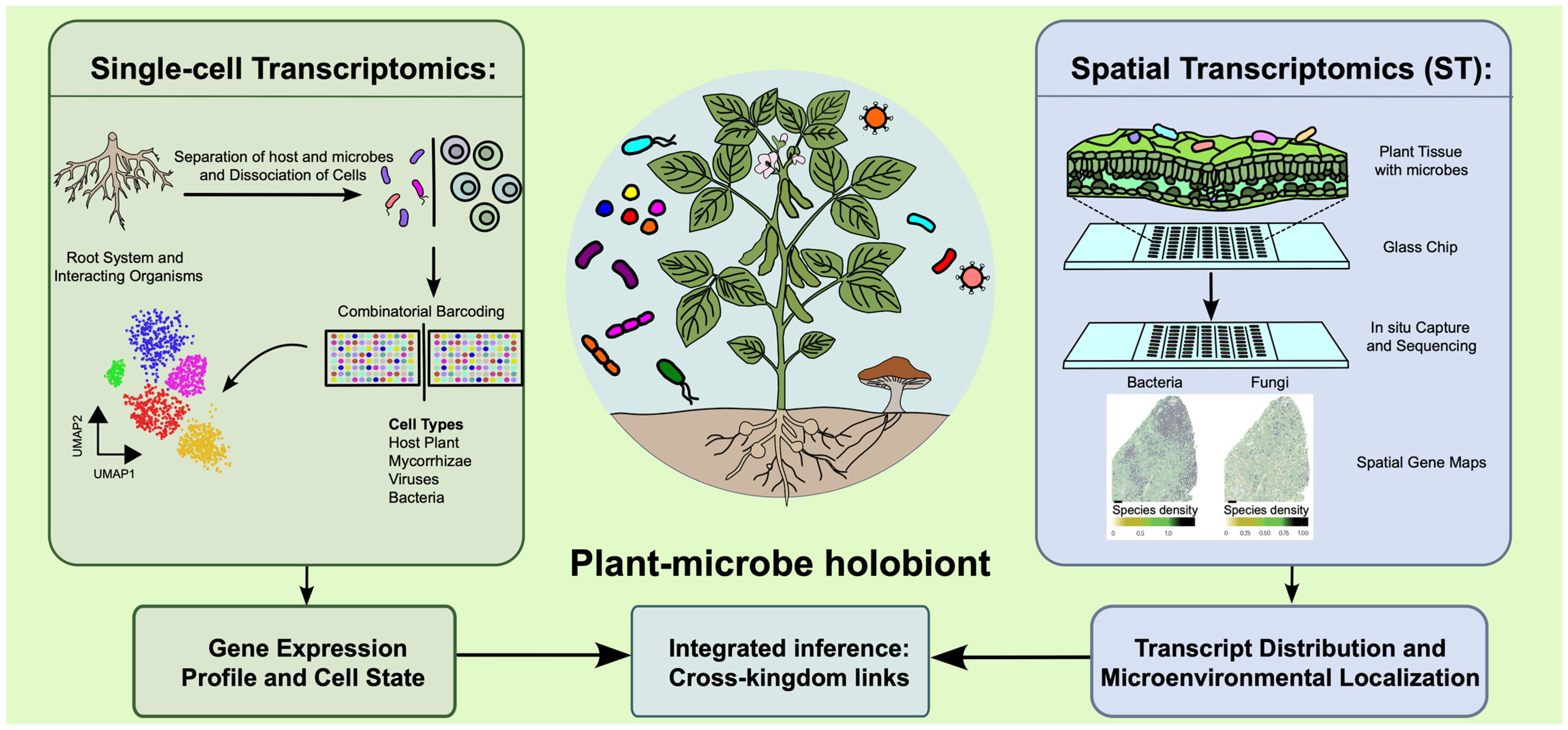
Integrating Single-Cell and Spatial Multi-Omics to Decode Plant–Microbe Interactions at Cellular Resolution

Abstract
1. Introduction
2. Plant Cell-Type-Resolved Immune and Symbiotic Responses
2.1. Legume Host Cell States in Symbiosis
2.2. The Advent of Bacterial Single-Cell Technologies
2.3. Understanding the Complex Holobiont Network and Its Interactions
2.4. Symbiosis Within the Holobiont
3. Spatial Signatures of Plant–Microbe Interactions
3.1. Spatial Zonation in Plant Immune Responses
3.2. Spatial Zonation in Plant–Microbe Symbioses
4. Integrating Multi-Omics to Reconstruct Interaction Networks
4.1. Single-Cell Multi-Omics Reveals Regulatory Complexity in Plant–Microbe Interactions
4.2. Reconstructing Cell-Type-Specific Regulatory Networks via scRNA-seq and scATAC-seq Integration
4.3. Advances in Single-Cell and Spatial Metabolomics for Plant Biology
4.4. Connecting Transcriptomes to Metabolomes at Single-Cell Resolution
5. Future Perspectives and Challenges
5.1. Technical Limitations in Single-Cell Plant–Microbe Studies
5.2. Standardizing Multi-Omics Integration and Developing Microbe-Compatible Spatial Methods
5.3. Mapping Plant–Microbe Interactions Across Developmental Stages and Environmental Contexts
5.4. Applications in Sustainable Agriculture: Precision Inoculant Design and Host Trait Engineering
Author Contributions
Funding
Institutional Review Board Statement
Informed Consent Statement
Data Availability Statement
Acknowledgments
Conflicts of Interest
References
- Zilber-Rosenberg, I.; Rosenberg, E. Role of microorganisms in the evolution of animals and plants: The hologenome theory of evolution. FEMS Microbiol. Rev. 2008, 32, 723–735. [Google Scholar] [CrossRef] [PubMed]
- Vandenkoornhuyse, P.; Quaiser, A.; Duhamel, M.; Le Van, A.; Dufresne, A. The importance of the microbiome of the plant holobiont. New Phytol. 2015, 206, 1196–1206. [Google Scholar] [CrossRef]
- Trivedi, P.; Batista, B.D.; Bazany, K.E.; Singh, B.K. Plant-microbiome interactions under a changing world: Responses, consequences and perspectives. New Phytol. 2022, 234, 1951–1959. [Google Scholar] [CrossRef]
- Mesny, F.; Hacquard, S.; Thomma, B.P. Co-evolution within the plant holobiont drives host performance. EMBO Rep. 2023, 24, e57455. [Google Scholar] [CrossRef]
- Choi, S.; Lee, H.-S. Interplay between Plants and Microbial Communities: Insights from Holobionts and Environmental Interactions. Phyton-Int. J. Exp. Bot. 2024, 93, 2519–2534. [Google Scholar] [CrossRef]
- Riva, V.; Mapelli, F.; Bagnasco, A.; Mengoni, A.; Borin, S. A Meta-Analysis Approach to Defining the Culturable Core of Plant Endophytic Bacterial Communities. Appl. Environ. Microbiol. 2022, 88, e0253721. [Google Scholar] [CrossRef]
- Sivaprakasam, N.; Vaithiyanathan, S.; Gandhi, K.; Narayanan, S.; Kavitha, P.S.; Rajasekaran, R.; Muthurajan, R. Metagenomics approaches in unveiling the dynamics of Plant Growth-Promoting Microorganisms (PGPM) vis-a-vis Phytophthora sp. suppression in various crop ecological systems. Res. Microbiol. 2024, 175, 104217. [Google Scholar] [CrossRef]
- Yousuf, S.; Wang, Y.; Yu, P.; Liu, Y.-X. Metagenomic Analysis for Unveiling Agricultural Microbiome—2nd Edition. Agronomy 2025, 15, 1419. [Google Scholar] [CrossRef]
- Fadiji, A.E.; Adeniji, A.; Lanrewaju, A.A.; Adedayo, A.A.; Chukwuneme, C.F.; Nwachukwu, B.C.; Aderibigbe, J.; Omomowo, I.O. Key Challenges in Plant Microbiome Research in the Next Decade. Microorganisms 2025, 13, 2546. [Google Scholar] [CrossRef] [PubMed]
- Somoza, S.C.; Bonfante, P.; Giovannetti, M. Breaking barriers: Improving time and space resolution of arbuscular mycorrhizal symbiosis with single-cell sequencing approaches. Biol. Direct 2024, 19, 67. [Google Scholar] [CrossRef] [PubMed]
- Serrano, K.; Tedeschi, F.; Andersen, S.U.; Scheller, H.V. Unraveling plant-microbe symbioses using single-cell and spatial transcriptomics. Trends Plant Sci. 2024, 29, 1356–1367. [Google Scholar] [CrossRef] [PubMed]
- Yu, X.; Liu, Z.; Sun, X. Single-cell and spatial multi-omics in the plant sciences: Technical advances, applications, and perspectives. Plant Commun. 2023, 4, 100508. [Google Scholar] [CrossRef]
- Nobori, T. Exploring the untapped potential of single-cell and spatial omics in plant biology. New Phytol. 2025, 247, 1098–1116. [Google Scholar] [CrossRef] [PubMed]
- Wang, L.; Zhou, Y.; Li, R.; Liang, J.; Tian, T.; Ji, J.; Chen, R.; Zhou, Y.; Fan, Q.; Ning, G.; et al. Single cell-type transcriptome profiling reveals genes that promote nitrogen fixation in the infected and uninfected cells of legume nodules. Plant Biotechnol. J. 2022, 20, 616–618. [Google Scholar] [CrossRef]
- Sun, Z.; Jiang, S.; Wang, D.; Li, L.; Liu, B.; Ran, Q.; Hu, L.; Xiong, J.; Tang, Y.; Gu, X.; et al. Single-cell RNA-seq of Lotus japonicus provide insights into identification and function of root cell types of legume. J. Integr. Plant Biol. 2023, 65, 1147–1152. [Google Scholar] [CrossRef]
- Liu, Z.; Yang, J.; Long, Y.; Zhang, C.; Wang, D.; Zhang, X.; Dong, W.; Zhao, L.; Liu, C.; Zhai, J.; et al. Single-nucleus transcriptomes reveal spatiotemporal symbiotic perception and early response in Medicago. Nat. Plants 2023, 9, 1734–1748. [Google Scholar] [CrossRef]
- Cervantes-Perez, S.A.; Zogli, P.; Amini, S.; Thibivilliers, S.; Tennant, S.; Hossain, M.S.; Xu, H.; Meyer, I.; Nooka, A.; Ma, P.; et al. Single-cell transcriptome atlases of soybean root and mature nodule reveal new regulatory programs that control the nodulation process. Plant Commun. 2024, 5, 100984. [Google Scholar] [CrossRef]
- Serrano, K.; Bezrutczyk, M.; Goudeau, D.; Dao, T.; O’Malley, R.; Malmstrom, R.R.; Visel, A.; Scheller, H.V.; Cole, B. Spatial co-transcriptomics reveals discrete stages of the arbuscular mycorrhizal symbiosis. Nat. Plants 2024, 10, 673–688. [Google Scholar] [CrossRef] [PubMed]
- Ferreras-Garrucho, G.; Chancellor, T.; Paszkowski, U. Integrating single-cell omic techniques to resolve the spatio-temporal complexity of arbuscular mycorrhizal symbiosis. J. Exp. Bot. 2025, 77, eraf404. [Google Scholar] [CrossRef]
- Han, X.; Tsuda, K. Divide and conquer: Spatiotemporal plant innate immunity at single-cell resolution. Cell Host Microbe 2023, 31, 1601–1603. [Google Scholar] [CrossRef]
- Nobori, T.; Monell, A.; Lee, T.A.; Sakata, Y.; Shirahama, S.; Zhou, J.; Nery, J.R.; Mine, A.; Ecker, J.R. A rare PRIMER cell state in plant immunity. Nature 2025, 638, 197–205. [Google Scholar] [CrossRef]
- Marand, A.P.; Chen, Z.; Gallavotti, A.; Schmitz, R.J. A cis-regulatory atlas in maize at single-cell resolution. Cell 2021, 184, 3041–3055.e21. [Google Scholar] [CrossRef]
- Yan, X.C.; Liu, Q.; Yang, Q.; Wang, K.L.; Zhai, X.Z.; Kou, M.Y.; Liu, J.L.; Li, S.T.; Deng, S.H.; Li, M.M.; et al. Single-cell transcriptomic profiling of maize cell heterogeneity and systemic immune responses against Puccinia polysora Underw. Plant Biotechnol. J. 2025, 23, 549–563. [Google Scholar] [CrossRef] [PubMed]
- Zhu, J.; Moreno-Perez, A.; Coaker, G. Understanding plant pathogen interactions using spatial and single-cell technologies. Commun. Biol. 2023, 6, 814. [Google Scholar] [CrossRef]
- Pereira, W.J.; Boyd, J.; Conde, D.; Triozzi, P.M.; Balmant, K.M.; Dervinis, C.; Schmidt, H.W.; Boaventura-Novaes, C.; Chakraborty, S.; Knaack, S.A.; et al. The single-cell transcriptome program of nodule development cellular lineages in Medicago truncatula. Cell Rep. 2024, 43, 113747. [Google Scholar] [CrossRef] [PubMed]
- Lepetit, M.; Brouquisse, R. Control of the rhizobium-legume symbiosis by the plant nitrogen demand is tightly integrated at the whole plant level and requires inter-organ systemic signaling. Front. Plant Sci. 2023, 14, 1114840. [Google Scholar] [CrossRef]
- Homberger, C.; Barquist, L.; Vogel, J. Ushering in a new era of single-cell transcriptomics in bacteria. Microlife 2022, 3, uqac020. [Google Scholar] [CrossRef]
- Furuichi, Y. Discovery of m(7)G-cap in eukaryotic mRNAs. Proc. Jpn. Acad. Ser. B Phys. Biol. Sci. 2015, 91, 394–409. [Google Scholar] [CrossRef]
- Balaban, N.Q.; Merrin, J.; Chait, R.; Kowalik, L.; Leibler, S. Bacterial persistence as a phenotypic switch. Science 2004, 305, 1622–1625. [Google Scholar] [CrossRef]
- Abisado, R.G.; Benomar, S.; Klaus, J.R.; Dandekar, A.A.; Chandler, J.R. Bacterial Quorum Sensing and Microbial Community Interactions. mBio 2018, 9, e02331-17, Erratum in mBio 2018, 9, e01749-18. [Google Scholar] [CrossRef]
- Koonin, E.V.; Makarova, K.S.; Aravind, L. Horizontal gene transfer in prokaryotes: Quantification and classification. Annu. Rev. Microbiol. 2001, 55, 709–742. [Google Scholar] [CrossRef]
- Kuchina, A.; Brettner, L.M.; Paleologu, L.; Roco, C.M.; Rosenberg, A.B.; Carignano, A.; Kibler, R.; Hirano, M.; DePaolo, R.W.; Seelig, G. Microbial single-cell RNA sequencing by split-pool barcoding. Science 2021, 371, eaba5257. [Google Scholar] [CrossRef] [PubMed]
- Imdahl, F.; Vafadarnejad, E.; Homberger, C.; Saliba, A.E.; Vogel, J. Single-cell RNA-sequencing reports growth-condition-specific global transcriptomes of individual bacteria. Nat. Microbiol. 2020, 5, 1202–1206. [Google Scholar] [CrossRef] [PubMed]
- Torsvik, V.; Goksoyr, J.; Daae, F.L. High diversity in DNA of soil bacteria. Appl. Environ. Microbiol. 1990, 56, 782–787. [Google Scholar] [CrossRef]
- Anthony, M.A.; Bender, S.F.; van der Heijden, M.G.A. Enumerating soil biodiversity. Proc. Natl. Acad. Sci. USA 2023, 120, e2304663120. [Google Scholar] [CrossRef]
- Lyu, D.; Zajonc, J.; Page, A.; Tanney, C.A.S.; Shah, A.; Monjezi, N.; Msimbira, L.A.; Antar, M.; Nazari, M.; Backer, R.; et al. Plant Holobiont Theory: The Phytomicrobiome Plays a Central Role in Evolution and Success. Microorganisms 2021, 9, 675. [Google Scholar] [CrossRef]
- Delannoy, E.; Batardiere, B.; Pateyron, S.; Soubigou-Taconnat, L.; Chiquet, J.; Colcombet, J.; Lang, J. Cell specialization and coordination in Arabidopsis leaves upon pathogenic attack revealed by scRNA-seq. Plant Commun. 2023, 4, 100676. [Google Scholar] [CrossRef] [PubMed]
- Hassani, M.A.; Duran, P.; Hacquard, S. Microbial interactions within the plant holobiont. Microbiome 2018, 6, 58. [Google Scholar] [CrossRef]
- Jiang, F.; Zhang, L.; Zhou, J.; George, T.S.; Feng, G. Arbuscular mycorrhizal fungi enhance mineralisation of organic phosphorus by carrying bacteria along their extraradical hyphae. New Phytol. 2021, 230, 304–315. [Google Scholar] [CrossRef]
- Pimprikar, P.; Gutjahr, C. Transcriptional Regulation of Arbuscular Mycorrhiza Development. Plant Cell Physiol. 2018, 59, 673–690, Erratum in Plant Cell Physiol. 2018, 59, 876. [Google Scholar] [CrossRef]
- Saarenpaa, S.; Shalev, O.; Ashkenazy, H.; Carlos, V.; Lundberg, D.S.; Weigel, D.; Giacomello, S. Spatial metatranscriptomics resolves host-bacteria-fungi interactomes. Nat. Biotechnol. 2024, 42, 1384–1393. [Google Scholar] [CrossRef] [PubMed]
- Jones, J.D.G.; Staskawicz, B.J.; Dangl, J.L. The plant immune system: From discovery to deployment. Cell 2024, 187, 2095–2116. [Google Scholar] [CrossRef]
- Millet, Y.A.; Danna, C.H.; Clay, N.K.; Songnuan, W.; Simon, M.D.; Werck-Reichhart, D.; Ausubel, F.M. Innate immune responses activated in Arabidopsis roots by microbe-associated molecular patterns. Plant Cell 2010, 22, 973–990. [Google Scholar] [CrossRef] [PubMed]
- Zhou, J.M.; Zhang, Y. Plant Immunity: Danger Perception and Signaling. Cell 2020, 181, 978–989. [Google Scholar] [CrossRef]
- Emonet, A.; Zhou, F.; Vacheron, J.; Heiman, C.M.; Denervaud Tendon, V.; Ma, K.W.; Schulze-Lefert, P.; Keel, C.; Geldner, N. Spatially Restricted Immune Responses Are Required for Maintaining Root Meristematic Activity upon Detection of Bacteria. Curr. Biol. 2021, 31, 1012–1028.e7. [Google Scholar] [CrossRef]
- Froschel, C.; Komorek, J.; Attard, A.; Marsell, A.; Lopez-Arboleda, W.A.; Le Berre, J.; Wolf, E.; Geldner, N.; Waller, F.; Korte, A.; et al. Plant roots employ cell-layer-specific programs to respond to pathogenic and beneficial microbes. Cell Host Microbe 2021, 29, 299–310.e7. [Google Scholar] [CrossRef] [PubMed]
- Hu, Y.; Schaefer, R.; Rendleman, M.; Slattery, A.; Cramer, A.; Nahiyan, A.; Breitweiser, L.A.; Shah, M.; Kaehler, E.; Yao, C.; et al. Spatial and single-cell transcriptomics capture two distinct cell states in soybean defense response to Phakopsora pachyrhizi infection. Front. Plant Sci. 2025, 16, 1637176. [Google Scholar] [CrossRef]
- Yang, Q.; Li, Z.; Guan, K.; Wang, Z.; Tang, X.; Hong, Y.; Liu, Z.; Zhai, J.; Huang, A.; Long, Y.; et al. Comparative single-nucleus RNA-seq analysis revealed localized and cell type-specific pathways governing root-microbiome interactions. Nat. Commun. 2025, 16, 3169. [Google Scholar] [CrossRef]
- Jacob, P.; Hige, J.; Dangl, J.L. Is localized acquired resistance the mechanism for effector-triggered disease resistance in plants? Nat. Plants 2023, 9, 1184–1190. [Google Scholar] [CrossRef]
- Jacob, P.; Hige, J.; Song, L.; Bayless, A.; Russ, D.; Bonardi, V.; El Kasmi, F.; Wunsch, L.; Yang, Y.; Fitzpatrick, C.R.; et al. Broader functions of TIR domains in Arabidopsis immunity. Proc. Natl. Acad. Sci. USA 2023, 120, e2220921120. [Google Scholar] [CrossRef]
- Zhu, J.; Lolle, S.; Tang, A.; Guel, B.; Kvitko, B.; Cole, B.; Coaker, G. Single-cell profiling of Arabidopsis leaves to Pseudomonas syringae infection. Cell Rep. 2023, 42, 112676. [Google Scholar] [CrossRef]
- Betsuyaku, S.; Katou, S.; Takebayashi, Y.; Sakakibara, H.; Nomura, N.; Fukuda, H. Salicylic Acid and Jasmonic Acid Pathways are Activated in Spatially Different Domains Around the Infection Site During Effector-Triggered Immunity in Arabidopsis thaliana. Plant Cell Physiol. 2018, 59, 439. [Google Scholar] [CrossRef] [PubMed]
- Beck, M.; Wyrsch, I.; Strutt, J.; Wimalasekera, R.; Webb, A.; Boller, T.; Robatzek, S. Expression patterns of flagellin sensing 2 map to bacterial entry sites in plant shoots and roots. J. Exp. Bot. 2014, 65, 6487–6498. [Google Scholar] [CrossRef] [PubMed]
- Tang, B.; Feng, L.; Hulin, M.T.; Ding, P.; Ma, W. Cell-type-specific responses to fungal infection in plants revealed by single-cell transcriptomics. Cell Host Microbe 2023, 31, 1732–1747.e5. [Google Scholar] [CrossRef]
- Wang, W.; Zhang, X.; Zhang, Y.; Zhang, Z.; Yang, C.; Cao, W.; Liang, Y.; Zhou, Q.; Hu, Q.; Zhang, Y.; et al. Single-Cell and Spatial Transcriptomics Reveals a Stereoscopic Response of Rice Leaf Cells to Magnaporthe oryzae Infection. Adv. Sci. 2025, 12, e2416846. [Google Scholar] [CrossRef]
- Vasse, J.; de Billy, F.; Camut, S.; Truchet, G. Correlation between ultrastructural differentiation of bacteroids and nitrogen fixation in alfalfa nodules. J. Bacteriol. 1990, 172, 4295–4306. [Google Scholar] [CrossRef]
- Ye, Q.Y.; Zhu, F.G.; Sun, F.H.; Wang, T.C.; Wu, J.L.; Liu, P.; Shen, C.; Dong, J.L.; Wang, T. Differentiation trajectories and biofunctions of symbiotic and un-symbiotic fate cells in root nodules of Medicago truncatula. Mol. Plant 2022, 15, 1852–1867. [Google Scholar] [CrossRef]
- Cervantes-Perez, S.A.; Thibivilliers, S.; Laffont, C.; Farmer, A.D.; Frugier, F.; Libault, M. Cell-specific pathways recruited for symbiotic nodulation in the Medicago truncatula legume. Mol. Plant 2022, 15, 1868–1888. [Google Scholar] [CrossRef]
- Kranawetter, C.; Zeng, S.; Joshi, T.; Sumner, L.W. A Medicago truncatula Metabolite Atlas Enables the Visualization of Differential Accumulation of Metabolites in Root Tissues. Metabolites 2021, 11, 238. [Google Scholar] [CrossRef]
- Udvardi, M.; Poole, P.S. Transport and metabolism in legume-rhizobia symbioses. Annu. Rev. Plant Biol. 2013, 64, 781–805. [Google Scholar] [CrossRef]
- Cao, M.; Platre, M.P.; Tsai, H.H.; Zhang, L.; Nobori, T.; Armengot, L.; Chen, Y.; He, W.; Brent, L.; Coll, N.S.; et al. Spatial IMA1 regulation restricts root iron acquisition on MAMP perception. Nature 2024, 625, 750–759. [Google Scholar] [CrossRef]
- Ustuner, S.; Schafer, P.; Eichmann, R. Development specifies, diversifies and empowers root immunity. EMBO Rep. 2022, 23, e55631. [Google Scholar] [CrossRef]
- Kawa, D.; Brady, S.M. Root cell types as an interface for biotic interactions. Trends Plant Sci. 2022, 27, 1173–1186. [Google Scholar] [CrossRef] [PubMed]
- Tsai, H.H.; Wang, J.C.; Geldner, N.; Zhou, F. Spatiotemporal control of root immune responses during microbial colonization. Curr. Opin. Plant Biol. 2023, 74, 102369. [Google Scholar] [CrossRef]
- Liu, Z.; Kong, X.; Long, Y.; Liu, S.; Zhang, H.; Jia, J.; Cui, W.; Zhang, Z.; Song, X.; Qiu, L.; et al. Integrated single-nucleus and spatial transcriptomics captures transitional states in soybean nodule maturation. Nat. Plants 2023, 9, 515–524. [Google Scholar] [CrossRef] [PubMed]
- Dorrity, M.W.; Alexandre, C.M.; Hamm, M.O.; Vigil, A.L.; Fields, S.; Queitsch, C.; Cuperus, J.T. The regulatory landscape of Arabidopsis thaliana roots at single-cell resolution. Nat. Commun. 2021, 12, 3334. [Google Scholar] [CrossRef] [PubMed]
- Wang, Q.; Yung, W.S.; Wang, Z.; Lam, H.M. The histone modification H3K4me3 marks functional genes in soybean nodules. Genomics 2020, 112, 5282–5294. [Google Scholar] [CrossRef]
- Shaw, R.; Tian, X.; Xu, J. Single-Cell Transcriptome Analysis in Plants: Advances and Challenges. Mol. Plant 2021, 14, 115–126. [Google Scholar] [CrossRef]
- Farmer, A.; Thibivilliers, S.; Ryu, K.H.; Schiefelbein, J.; Libault, M. Single-nucleus RNA and ATAC sequencing reveals the impact of chromatin accessibility on gene expression in Arabidopsis roots at the single-cell level. Mol. Plant 2021, 14, 372–383. [Google Scholar] [CrossRef]
- Yin, R.; Xia, K.; Xu, X. Spatial transcriptomics drives a new era in plant research. Plant J. 2023, 116, 1571–1581. [Google Scholar] [CrossRef]
- Li, R.; Wang, F.; Wang, J. Spatial Metabolomics and Its Application in Plant Research. Int. J. Mol. Sci. 2025, 26, 3043. [Google Scholar] [CrossRef]
- Guo, S.; Zhang, C.; Le, A. The limitless applications of single-cell metabolomics. Curr. Opin. Biotechnol. 2021, 71, 115–122. [Google Scholar] [CrossRef] [PubMed]
- Cui, M.; Shi, D.; Yamaji, M.; Kumaishi, K.; Ichihashi, Y.; Kawamura, A.; Sugimoto, K.; Yoshida, S. Integration of single nucleus RNA-seq and bulk RNA-seq reveals gene regulatory networks for vascular connection between parasitic plants and host plants. J. Plant Res. 2025, 138, 921–936. [Google Scholar] [CrossRef] [PubMed]
- Velickovic, D.; Agtuca, B.J.; Stopka, S.A.; Vertes, A.; Koppenaal, D.W.; Pasa-Tolic, L.; Stacey, G.; Anderton, C.R. Observed metabolic asymmetry within soybean root nodules reflects unexpected complexity in rhizobacteria-legume metabolite exchange. ISME J. 2018, 12, 2335–2338. [Google Scholar] [CrossRef] [PubMed]
- Yan, L.; Fan, G.; Li, X. Genome-wide analysis of three histone marks and gene expression in Paulownia fortunei with phytoplasma infection. BMC Genom. 2019, 20, 234. [Google Scholar] [CrossRef]
- Rompp, A.; Spengler, B. Mass spectrometry imaging with high resolution in mass and space. Histochem. Cell Biol. 2013, 139, 759–783. [Google Scholar] [CrossRef]
- Yamamoto, K.; Takahashi, K.; Mizuno, H.; Anegawa, A.; Ishizaki, K.; Fukaki, H.; Ohnishi, M.; Yamazaki, M.; Masujima, T.; Mimura, T. Cell-specific localization of alkaloids in Catharanthus roseus stem tissue measured with Imaging MS and Single-cell MS. Proc. Natl. Acad. Sci. USA 2016, 113, 3891–3896. [Google Scholar] [CrossRef]
- Yamamoto, K.; Takahashi, K.; Caputi, L.; Mizuno, H.; Rodriguez-Lopez, C.E.; Iwasaki, T.; Ishizaki, K.; Fukaki, H.; Ohnishi, M.; Yamazaki, M.; et al. The complexity of intercellular localisation of alkaloids revealed by single-cell metabolomics. New Phytol. 2019, 224, 848–859. [Google Scholar] [CrossRef]
- Peng, L.; Chen, H.G.; Zhou, X. Mass spectrometry imaging technology and its application in medicinal plants research. China J. Chin. Mater. Medica 2020, 45, 1023–1033. [Google Scholar] [CrossRef]
- Balasubramanian, V.K.; Velickovic, D.; Rubio Wilhelmi, M.D.M.; Anderton, C.R.; Stewart, C.N., Jr.; DiFazio, S.; Blumwald, E.; Ahkami, A.H. Spatiotemporal metabolic responses to water deficit stress in distinct leaf cell-types of poplar. Front. Plant Sci. 2024, 15, 1346853. [Google Scholar] [CrossRef]
- Liu, P.; Li, M.; Ma, P.; Yan, H.; Liu, C.; Hu, Z.; Yang, M.; Chen, Q.; Zhao, Y. Spatiotemporal transcriptomic and metabolomic landscapes of wild soybean seed development reveal regulatory mechanisms of nutrient accumulation. Plant Commun. 2025, 7, 101580. [Google Scholar] [CrossRef]
- Li, C.; Wood, J.C.; Vu, A.H.; Hamilton, J.P.; Rodriguez Lopez, C.E.; Payne, R.M.E.; Serna Guerrero, D.A.; Gase, K.; Yamamoto, K.; Vaillancourt, B.; et al. Single-cell multi-omics in the medicinal plant Catharanthus roseus. Nat. Chem. Biol. 2023, 19, 1031–1041. [Google Scholar] [CrossRef]
- de Souza, L.P.; Borghi, M.; Fernie, A. Plant Single-Cell Metabolomics-Challenges and Perspectives. Int. J. Mol. Sci. 2020, 21, 8987. [Google Scholar] [CrossRef]
- Kang, M.; Vu, A.H.; Casper, A.L.; Kim, R.; Wurlitzer, J.; Heinicke, S.; Yeroslaviz, A.; Caputi, L.; O’Connor, S.E. Single-cell metabolome and RNA-seq multiplexing on single plant cells. Proc. Natl. Acad. Sci. USA 2025, 122, e2512828122. [Google Scholar] [CrossRef]
- Bawa, G.; Liu, Z.; Yu, X.; Qin, A.; Sun, X. Single-Cell RNA Sequencing for Plant Research: Insights and Possible Benefits. Int. J. Mol. Sci. 2022, 23, 4497. [Google Scholar] [CrossRef]
- Cuperus, J.T. Single-cell genomics in plants: Current state, future directions, and hurdles to overcome. Plant Physiol. 2022, 188, 749–755. [Google Scholar] [CrossRef]
- Llorens-Rico, V.; Simcock, J.A.; Huys, G.R.B.; Raes, J. Single-cell approaches in human microbiome research. Cell 2022, 185, 2725–2738. [Google Scholar] [CrossRef]
- Ghaddar, B.; Blaser, M.J.; De, S. Denoising sparse microbial signals from single-cell sequencing of mammalian host tissues. Nat. Comput. Sci. 2023, 3, 741–747. [Google Scholar] [CrossRef]
- Hao, Y.; Hao, S.; Andersen-Nissen, E.; Mauck, W.M., 3rd; Zheng, S.; Butler, A.; Lee, M.J.; Wilk, A.J.; Darby, C.; Zager, M.; et al. Integrated analysis of multimodal single-cell data. Cell 2021, 184, 3573–3587.e29. [Google Scholar] [CrossRef]
- Luecken, M.D.; Buttner, M.; Chaichoompu, K.; Danese, A.; Interlandi, M.; Mueller, M.F.; Strobl, D.C.; Zappia, L.; Dugas, M.; Colome-Tatche, M.; et al. Benchmarking atlas-level data integration in single-cell genomics. Nat. Methods 2022, 19, 41–50. [Google Scholar] [CrossRef]
- Denyer, T.; Ma, X.; Klesen, S.; Scacchi, E.; Nieselt, K.; Timmermans, M.C.P. Spatiotemporal Developmental Trajectories in the Arabidopsis Root Revealed Using High-Throughput Single-Cell RNA Sequencing. Dev. Cell 2019, 48, 840–852.e5. [Google Scholar] [CrossRef]
- Xiong, C.; Singh, B.K.; He, J.Z.; Han, Y.L.; Li, P.P.; Wan, L.H.; Meng, G.Z.; Liu, S.Y.; Wang, J.T.; Wu, C.F.; et al. Plant developmental stage drives the differentiation in ecological role of the maize microbiome. Microbiome 2021, 9, 171. [Google Scholar] [CrossRef]
- Hu, L.; Kvitko, B.; Severns, P.M.; Yang, L. Shoot Maturation Strengthens FLS2-Mediated Resistance to Pseudomonas syringae. Mol. Plant Microbe Interact. 2023, 36, 796–804. [Google Scholar] [CrossRef]
- Saur, I.M.; Kadota, Y.; Sklenar, J.; Holton, N.J.; Smakowska, E.; Belkhadir, Y.; Zipfel, C.; Rathjen, J.P. NbCSPR underlies age-dependent immune responses to bacterial cold shock protein in Nicotiana benthamiana. Proc. Natl. Acad. Sci. USA 2016, 113, 3389–3394. [Google Scholar] [CrossRef]
- Mansfeld, B.N.; Colle, M.; Zhang, C.; Lin, Y.C.; Grumet, R. Developmentally regulated activation of defense allows for rapid inhibition of infection in age-related resistance to Phytophthora capsici in cucumber fruit. BMC Genom. 2020, 21, 628. [Google Scholar] [CrossRef]
- DeMell, A.; Alvarado, V.; Scholthof, H.B. Molecular perspectives on age-related resistance of plants to (viral) pathogens. New Phytol. 2023, 240, 80–91. [Google Scholar] [CrossRef]
- Saijo, Y.; Loo, E.P. Plant immunity in signal integration between biotic and abiotic stress responses. New Phytol. 2020, 225, 87–104. [Google Scholar] [CrossRef]
- Delplace, F.; Huard-Chauveau, C.; Berthome, R.; Roby, D. Network organization of the plant immune system: From pathogen perception to robust defense induction. Plant J. 2022, 109, 447–470. [Google Scholar] [CrossRef]
- Rivero, R.M.; Mittler, R.; Blumwald, E.; Zandalinas, S.I. Developing climate-resilient crops: Improving plant tolerance to stress combination. Plant J. 2022, 109, 373–389. [Google Scholar] [CrossRef]
- Singh, A.; Mazahar, S.; Chapadgaonkar, S.S.; Giri, P.; Shourie, A. Phyto-microbiome to mitigate abiotic stress in crop plants. Front. Microbiol. 2023, 14, 1210890. [Google Scholar] [CrossRef]
- DeFalco, T.A.; Anne, P.; James, S.R.; Willoughby, A.C.; Schwanke, F.; Johanndrees, O.; Genolet, Y.; Derbyshire, P.; Wang, Q.; Rana, S.; et al. A conserved module regulates receptor kinase signalling in immunity and development. Nat. Plants 2022, 8, 356–365. [Google Scholar] [CrossRef]
- Ma, Y.; Fluckiger, I.; Nicolet, J.; Pang, J.; Dickinson, J.B.; De Bellis, D.; Emonet, A.; Fujita, S.; Geldner, N. Comparisons of two receptor-MAPK pathways in a single cell-type reveal mechanisms of signalling specificity. Nat. Plants 2024, 10, 1343–1362. [Google Scholar] [CrossRef]
- Russ, D.; Fitzpatrick, C.R.; Teixeira, P.; Dangl, J.L. Deep discovery informs difficult deployment in plant microbiome science. Cell 2023, 186, 4496–4513. [Google Scholar] [CrossRef]
- Zhou, Y.; Liu, D.; Li, F.; Dong, Y.; Jin, Z.; Liao, Y.; Li, X.; Peng, S.; Delgado-Baquerizo, M.; Li, X. Superiority of native soil core microbiomes in supporting plant growth. Nat. Commun. 2024, 15, 6599. [Google Scholar] [CrossRef]
- Herath Dissanayakalage, S.S.; Kaur, J.; Li, T.; Dimech, A.M.; Sawbridge, T.I. Seed-Derived Synthetic Microbial Communities (SynComs) from Medicago Wild Relatives Modulate Early Plant Microbiome Assembly and Phenotypic Traits in Lucerne (Medicago sativa L.). Microorganisms 2025, 13, 2114. [Google Scholar] [CrossRef]
- Hett, J.; Döring, T.F.; Bevivino, A.; Neuhoff, D. Impact of microbial consortia on organic maize in a temperate climate varies with environment but not with fertilization. Eur. J. Agron. 2023, 144, 126743. [Google Scholar] [CrossRef]


| Method | Primary Readout | Sample/Prep Requirement | Spatial Resolution | Sensitivity/Capture Efficiency | Throughput | Best-Fit Biological Questions | Key Strengths | Key Limitations/Downsides (Explicit Trade-Offs) |
|---|---|---|---|---|---|---|---|---|
| scATAC-seq [66] | Chromatin accessibility per cell/nucleus | Usually, nuclei | None | Low–medium (sparse peaks) | High | Regulatory programs and TF motif activity underlying plant states; priming under stress/infection | Adds regulatory layer; integrates with RNA | Accessibility ≠ activity; sparse; prep-sensitive; interpretation requires integration |
| ChIP-seq/CUT&Tag/CUT&RUN [67] | TF binding/histone marks | Crosslinking or enzyme-tethering | None | Medium–high (target-dependent) | Low–medium | Validate regulatory mechanisms for plant responses (specific factors/marks) | Mechanistic regulatory evidence | Antibody dependence; often population-average; cost/complexity |
| Bulk RNA-seq [3] | Tissue-average gene expression | Bulk tissue RNA | None | High | High (samples) | Global plant response; pathway-level DE; treatment comparisons | Mature, cost-effective; high DE power | Masks heterogeneity; plant-dominant signal can obscure microbial transcripts; cannot link to cell types or niches |
| scRNA-seq [68] | Single-cell gene expression | Single-cell isolation | None | Medium (dropouts common) | High (cells) | Plant cell-type atlas; rare plant states; transcriptional programs under infection/stress | Highest plant cellular resolution; identifies rare cell types | Dissociation stress and cell-type bias; hard-to-dissociate tissues; costly; sparse matrices |
| snRNA-seq [69] | Nuclear RNA (incl. pre-mRNA) per nucleus | Nuclei isolation | None | Medium–low (nuclear bias) | High (nuclei) | Plant atlas when protoplasting is biased/impossible; developmental gradients; cell-state changes in rigid tissues | Works with frozen tissue; reduces dissociation artifacts | Lower sensitivity for cytosolic/low-abundance genes; pre-mRNA complicates quantification; still no spatial context |
| Sequencing-based spatial transcriptomics [70] | Spatially indexed plant transcripts | Tissue section + capture on slide | Medium (platform-dependent) | Medium–low (platform-dependent) | Medium (spots) | Where plant programs occur in tissue; spatial domains/niches (plant-defined); microenvironmental heterogeneity | Preserves architecture; links expression to location; integrates with histology | Trade-off: spatial context ↑ but capture efficiency/sensitivity often ↓; resolution may be below single cell; analysis complexity; cost |
| Image-based spatial transcriptomics [24] | Targeted transcripts with cellular/subcellular localization | Tissue section + probe design for selected genes | High (single cell/subcell) | Medium–high for targeted genes | Medium | Microbe localization; plant–microbe co-localization; niche mapping; marker-based interaction hypotheses | True spatial localization; interpretable; compatible with morphology | Trade-off: spatial resolution ↑↑ but transcriptome breadth ↓ (targeted panels); probe design burden; optical constraints in plant tissues |
| MSI/Spatial metabolomics [71] | Spatial metabolites/lipids/chemicals | Tissue section + instrument-specific prep | Medium (platform-dependent) | Low–medium (rare metabolites hard) | Medium–low | Metabolic niches; chemical gradients around infection/symbiosis; functional microenvironments | Functional molecules; broad chemistry; label-free | Quantification/ID ambiguity; cell/taxon attribution is indirect; cost/technical complexity |
| Single-cell mass spectrometry (SCMS) [72] | Metabolites/lipids/proteins per single cell | Isolated single cells | None | Low (rare analytes) | Low | Direct functional molecules at single-cell level | Direct chemistry; label-free | Very low throughput; destructive; limited coverage; plant cell isolation challenges |
| Microbial single-cell transcriptomics [27] | Microbial gene expression per cell | Microbe enrichment/isolation | None | Low–medium (tiny RNA; capture hard) | Low–medium | Microbial heterogeneity; state switching within a strain/consortium (when feasible) | Direct microbial state readout | Low RNA content; biases; community complexity; strain-level variation; mapping/annotation uncertainty |
Disclaimer/Publisher’s Note: The statements, opinions and data contained in all publications are solely those of the individual author(s) and contributor(s) and not of MDPI and/or the editor(s). MDPI and/or the editor(s) disclaim responsibility for any injury to people or property resulting from any ideas, methods, instructions or products referred to in the content. |
© 2026 by the authors. Licensee MDPI, Basel, Switzerland. This article is an open access article distributed under the terms and conditions of the Creative Commons Attribution (CC BY) license.
Share and Cite
Li, Y.; Vigil, J.; Pradhan, R.; Zhu, J.; Libault, M. Integrating Single-Cell and Spatial Multi-Omics to Decode Plant–Microbe Interactions at Cellular Resolution. Microorganisms 2026, 14, 380. https://doi.org/10.3390/microorganisms14020380
Li Y, Vigil J, Pradhan R, Zhu J, Libault M. Integrating Single-Cell and Spatial Multi-Omics to Decode Plant–Microbe Interactions at Cellular Resolution. Microorganisms. 2026; 14(2):380. https://doi.org/10.3390/microorganisms14020380
Chicago/Turabian StyleLi, Yaohua, Jared Vigil, Rajashree Pradhan, Jie Zhu, and Marc Libault. 2026. "Integrating Single-Cell and Spatial Multi-Omics to Decode Plant–Microbe Interactions at Cellular Resolution" Microorganisms 14, no. 2: 380. https://doi.org/10.3390/microorganisms14020380
APA StyleLi, Y., Vigil, J., Pradhan, R., Zhu, J., & Libault, M. (2026). Integrating Single-Cell and Spatial Multi-Omics to Decode Plant–Microbe Interactions at Cellular Resolution. Microorganisms, 14(2), 380. https://doi.org/10.3390/microorganisms14020380