
GWAS and Machine Learning Screening of Genomic Determinants Underlying Host Adaptation in Swine and Chicken Salmonella Typhimurium Isolates

 ,
,
Abstract
1. Introduction
2. Materials and Methods
2.1. Data Acquisition and Isolate Selection
2.2. Phylogenetic Analysis
2.3. Antimicrobial Resistance Gene (ARGs) and Virulence Factor (VFs) Analysis
2.4. Analysis of MGEs
2.5. GWAS
2.6. Functional Annotation and Enrichment Analysis
2.7. Random Forest Model Construction and Evaluation
2.7.1. Model Framework and Overall Strategy
2.7.2. Feature Selection and Hyperparameter Tuning
2.7.3. Model Evaluation
2.7.4. Feature Importance Analysis
3. Results
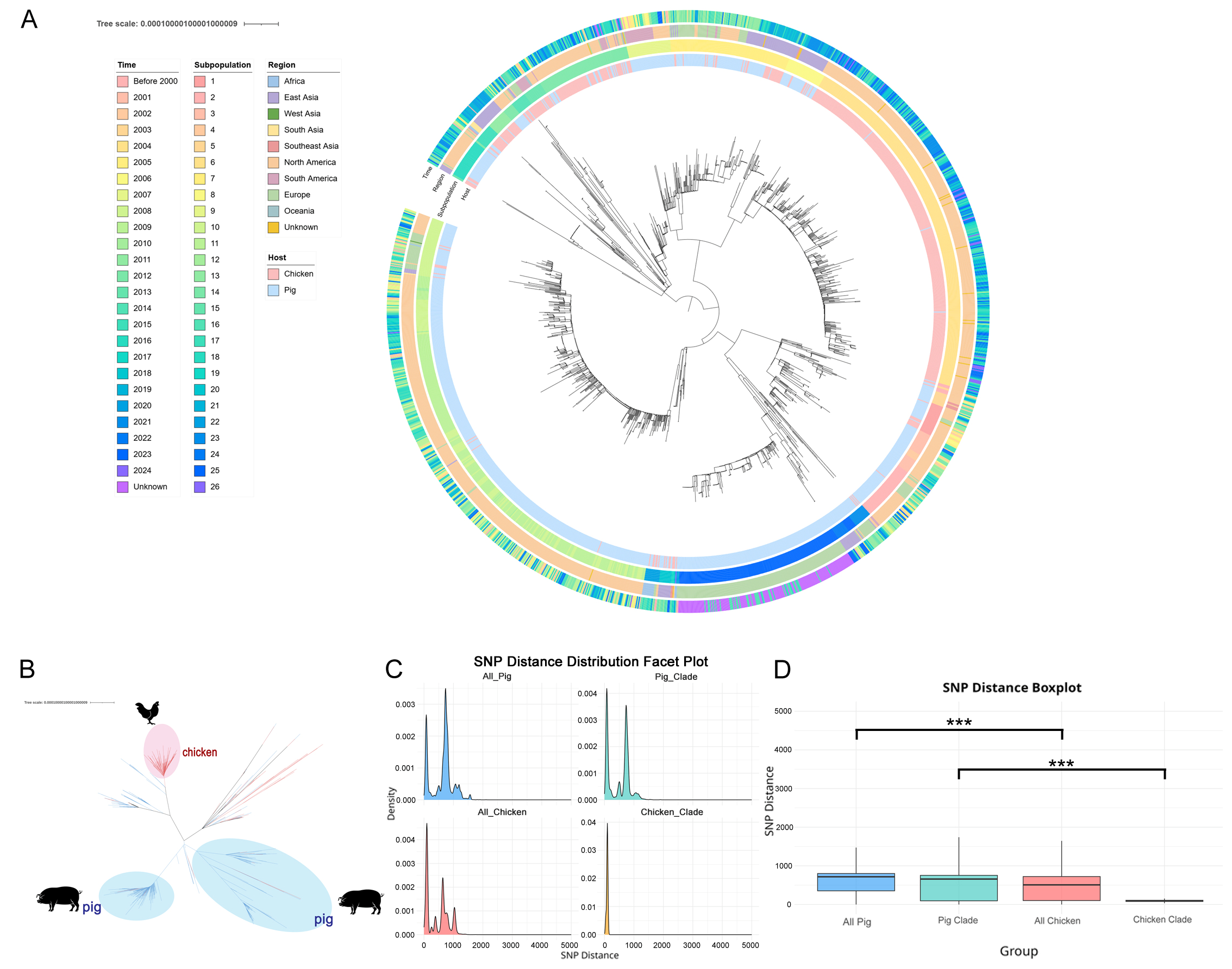
3.1. Population Structure and Phylogeny
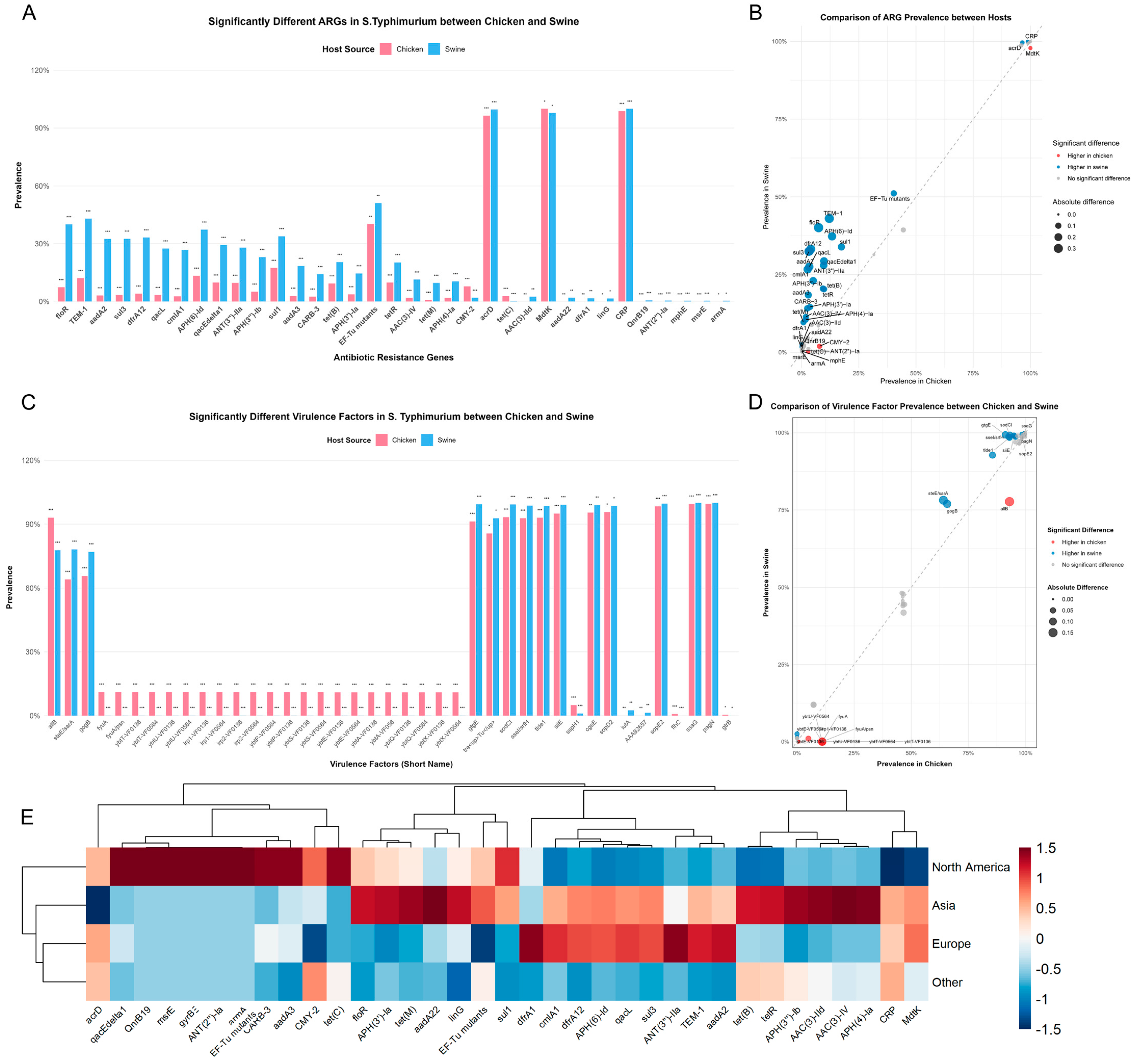
3.2. Analysis of Differences in ARGs
3.3. Analysis of Differences in Virulence Factor Profiles
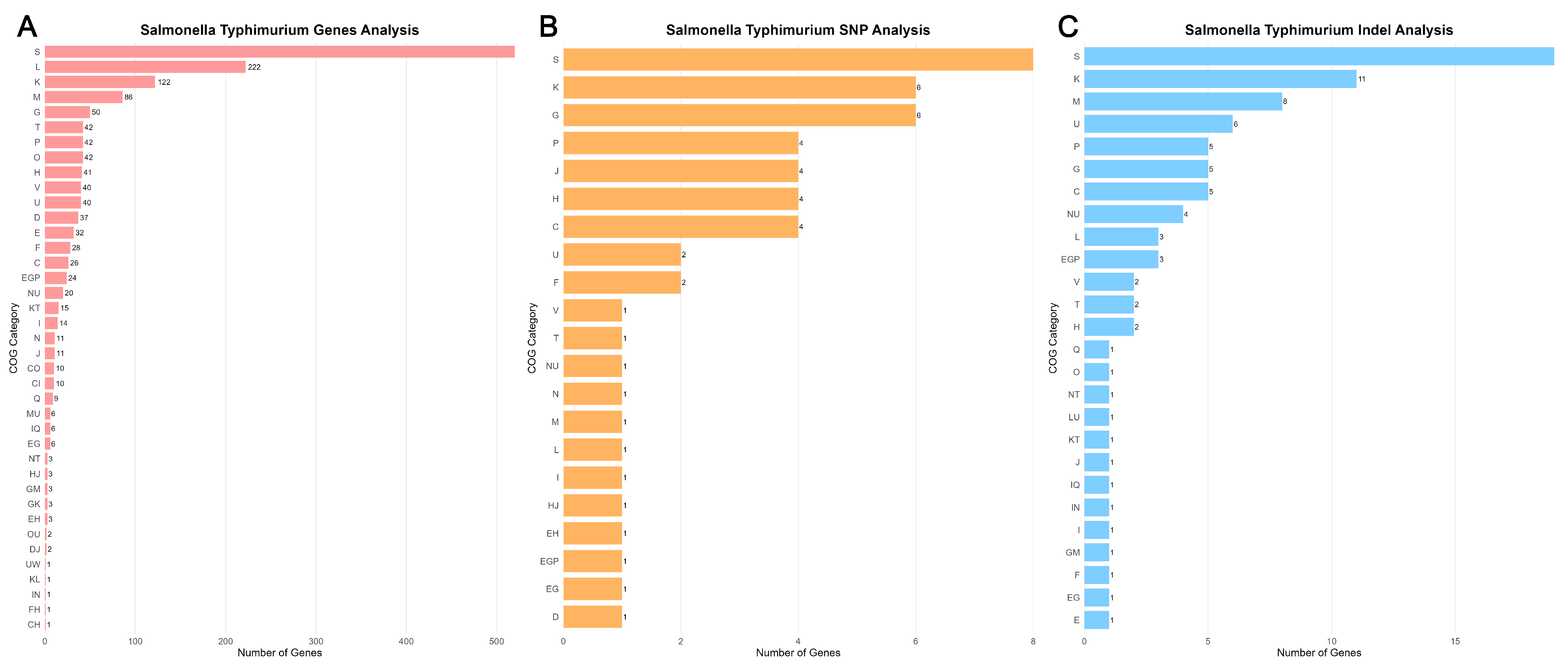
3.4. Host-Specific Genetic Markers Revealed by GWAS
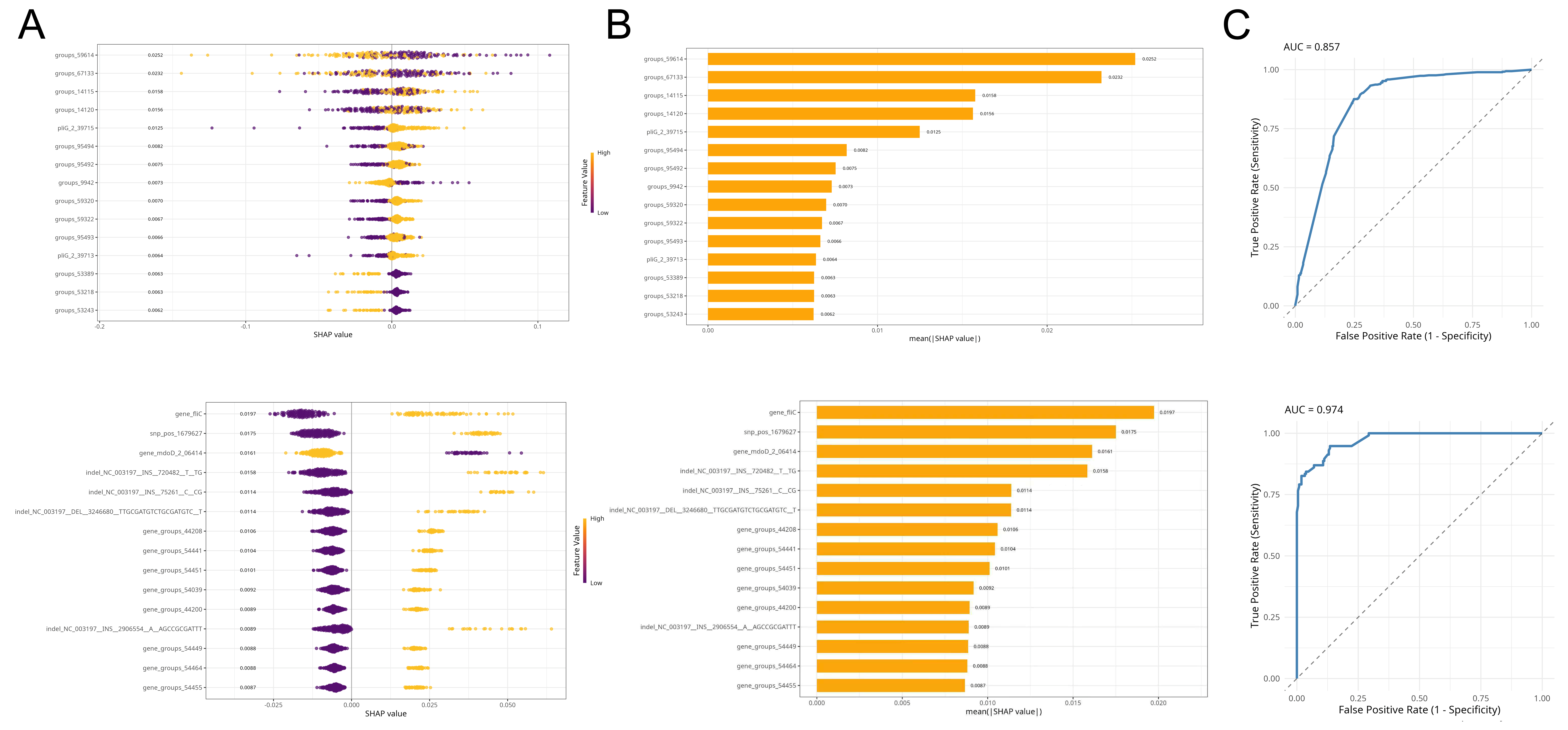
3.5. Random Forest Model for Predicting Chicken and Swine Host Sources of S. Typhimurium Based on Genome Characteristics

| Features | Type | SHAP Score | Function |
|---|---|---|---|
| fliC | gene | 0.0197 | FliC/FljB family flagellin |
| pos_1679627 | region | 0.0175 | / |
| mdoD_2_06414 | gene | 0.0161 | glucan biosynthesis protein D |
| INS_720482_T_TG | CDS | 0.0158 | putative cytoplasmic protein |
| INS_75261_C_CG | CDS | 0.0114 | putative viral protein |
| DEL_3246680_TTGCGATGTCTGCGATGTC_T | region | 0.0114 | / |
| groups_44208 | gene | 0.0106 | hypothetical protein |
| groups_54441 | gene | 0.0104 | hypothetical protein |
| groups_54451 | gene | 0.0101 | hypothetical protein |
| groups_54039 | gene | 0.0092 | hypothetical protein |
| groups_44200 | gene | 0.0089 | ParB/RepB/Spo0J family partition protein |
| INS_2906554_A_AGCCGCGATTT | CDS | 0.0089 | putative integrase core domain protein |
| groups_54449 | gene | 0.0088 | hypothetical protein |
| groups_54464 | gene | 0.0088 | hypothetical protein |
| groups_54455 | gene | 0.0087 | hypothetical protein |
4. Discussion
5. Conclusions
Supplementary Materials
Author Contributions
Funding
Institutional Review Board Statement
Informed Consent Statement
Data Availability Statement
Acknowledgments
Conflicts of Interest
References
- Hohmann, E.L. Nontyphoidal salmonellosis. Clin. Infect. Dis. 2001, 32, 263–269. [Google Scholar] [CrossRef]
- European Food Safety Authority; European Centre for Disease Prevention and Control. The European Union One Health 2024 Zoonoses Report. Efsa J. 2025, 23, e9759. [Google Scholar] [CrossRef]
- Get the Facts About Salmonella. U.S. Food and Drug Administration (FDA). Available online: https://www.fda.gov/animal-veterinary/animal-health-literacy/get-facts-about-salmonella (accessed on 25 December 2024).
- Hendriksen, R.S.; Vieira, A.R.; Karlsmose, S.; Wong, D.; Jensen, A.B.; Wegener, H.C.; Aarestrup, F.M. Global Monitoring of Salmonella Serovar Distribution from the World Health Organization Global Foodborne Infections Network Country Data Bank: Results of Quality Assured Laboratories from 2001 to 2007. Foodborne Pathog. Dis. 2011, 8, 887–900. [Google Scholar] [CrossRef]
- Stevens, M.P.; Kingsley, R.A. Salmonella pathogenesis and host-adaptation in farmed animals. Curr. Opin. Microbiol. 2021, 63, 52–58. [Google Scholar] [CrossRef]
- Perez-Sepulveda, B.M.; Hinton, J.C.D. Microbe Profile: Salmonella Typhimurium: The master of the art of adaptation. Microbiology 2025, 171, 001521. [Google Scholar] [CrossRef]
- Kingsley, R.A.; Kay, S.; Connor, T.; Barquist, L.; Sait, L.; Holt, K.E.; Sivaraman, K.; Wileman, T.; Goulding, D.; Clare, S.; et al. Genome and Transcriptome Adaptation Accompanying Emergence of the Definitive Type 2 Host-Restricted Salmonella enterica Serovar Typhimurium Pathovar. mBio 2013, 4, e00565-13. [Google Scholar] [CrossRef] [PubMed]
- Kirkwood, M.; Vohra, P.; Bawn, M.; Thilliez, G.; Pye, H.; Tanner, J.; Chintoan-Uta, C.; Branchu, P.; Petrovska, L.; Dallman, T.; et al. Ecological niche adaptation of Salmonella Typhimurium U288 is associated with altered pathogenicity and reduced zoonotic potential. Commun. Biol. 2021, 4, 498. [Google Scholar] [CrossRef]
- Chen, R.X.; Yang, L.H.; Pajor, M.S.; Wiedmann, M.; Orsi, R.H. Salmonella associated with agricultural animals exhibit diverse evolutionary rates and show evidence of recent clonal expansion. mBio 2024, 15, e01913-24. [Google Scholar] [CrossRef] [PubMed]
- Khan, S.B.; Khan, M.A.; Ahmad, I.; Rehman, T.U.; Ullah, S.; Dad, R.; Sultan, A.; Memon, A.M. Phentotypic, gentotypic antimicrobial resistance and pathogenicity of Salmonella enterica serovars Typimurium and Enteriditis in poultry and poultry products. Microb. Pathog. 2019, 129, 118–124. [Google Scholar] [CrossRef] [PubMed]
- Zhang, S.K.; Li, S.T.; Gu, W.D.; den Bakker, H.; Boxrud, D.; Taylor, A.; Roe, C.; Driebe, E.; Engelthaler, D.M.; Allard, M.; et al. Zoonotic Source Attribution of Salmonella enterica Serotype Typhimurium Using Genomic Surveillance Data, United States. Emerg. Infect. Dis 2019, 25, 82–91. [Google Scholar] [CrossRef]
- Wheeler, N.E.; Gardner, P.P.; Barquist, L. Machine learning identifies signatures of host adaptation in the bacterial pathogen Salmonella enterica. PLoS Genet. 2018, 14, e1007333. [Google Scholar] [CrossRef]
- Chalka, A.; Dallman, T.J.; Vohra, P.; Stevens, M.P.; Gally, D.L. The advantage of intergenic regions as genomic features for machine- learning- based host attribution of Salmonella Typhimurium from the USA. Microb. Genom. 2023, 9, 001116. [Google Scholar] [CrossRef] [PubMed]
- Wang, D.; Su, Y.T.; Gao, F.; Guo, S.Q.; Yang, J.T.; Wu, D.S.; Jiang, Q.; Chen, J.X.; Sun, J.; Fang, L.X.; et al. Comparison of ST19 Salmonella Typhimurium and ST34 Salmonella I,4,[5],12:i:-: A trade-off between plasmid-mediated antibiotic resistance and virulence. LWT 2025, 225, 117868. [Google Scholar] [CrossRef]
- Chen, J.Q.; Huang, L.L.; An, H.L.; Wang, Z.N.; Kang, X.M.; Yin, R.; Jia, C.H.; Jin, X.Y.; Yue, M. One Health approach probes zoonotic non- typhoidal Salmonella infections in China: A systematic review and meta-analysis. J. Glob. Health 2024, 14, 04256. [Google Scholar] [CrossRef]
- Kim, T.; Kim, Y.; Kim, H.; Moon, J.S.; Chon, J.; Song, K.Y.; Seo, K.H. Prevalence of Salmonella serotypes isolated from clinical samples in chicken farms and meat in slaughterhouses in South Korea. Poult. Sci. 2025, 104, 105147. [Google Scholar] [CrossRef]
- Chklovski, A.; Parks, D.H.; Woodcroft, B.J.; Tyson, G.W. CheckM2: A rapid, scalable and accurate tool for assessing microbial genome quality using machine learning. Nat. Methods 2023, 20, 1203–1212, Correction in Nat. Methods 2024, 21, 735. [Google Scholar] [CrossRef] [PubMed]
- Goris, J.; Konstantinidis, K.T.; Klappenbach, J.A.; Coenye, T.; Vandamme, P.; Tiedje, J.M. DNA-DNA hybridization values and their relationship to whole-genome sequence similarities. Int. J. Syst. Evol. Microbiol. 2007, 57, 81–91. [Google Scholar] [CrossRef]
- Gurevich, A.; Saveliev, V.; Vyahhi, N.; Tesler, G. QUAST: Quality assessment tool for genome assemblies. Bioinformatics 2013, 29, 1072–1075. [Google Scholar] [CrossRef] [PubMed]
- Yoshida, C.E.; Kruczkiewicz, P.; Laing, C.R.; Lingohr, E.J.; Gannon, V.P.J.; Nash, J.H.E.; Taboada, E.N. The Salmonella In Silico Typing Resource (SISTR): An Open Web-Accessible Tool for Rapidly Typing and Subtyping Draft Salmonella Genome Assemblies. PLoS ONE 2016, 11, e0147101. [Google Scholar] [CrossRef]
- Nguyen, L.T.; Schmidt, H.A.; von Haeseler, A.; Minh, B.Q. IQ-TREE: A Fast and Effective Stochastic Algorithm for Estimating Maximum-Likelihood Phylogenies. Mol. Biol. Evol. 2015, 32, 268–274. [Google Scholar] [CrossRef]
- Alcock, B.P.; Huynh, W.; Chalil, R.; Smith, K.W.; Raphenya, A.R.; Wlodarski, M.A.; Edalatmand, A.; Petkau, A.; Syed, S.A.; Tsang, K.K.; et al. CARD 2023: Expanded curation, support for machine learning, and resistome prediction at the Comprehensive Antibiotic Resistance Database. Nucleic Acids Res. 2023, 51, D690–D699. [Google Scholar] [CrossRef]
- Altschul, S.F.; Madden, T.L.; Schaffer, A.A.; Zhang, J.H.; Zhang, Z.; Miller, W.; Lipman, D.J. Gapped BLAST and PSI-BLAST: A new generation of protein database search programs. Nucleic Acids Res. 1997, 25, 3389–3402. [Google Scholar] [CrossRef]
- Liu, B.; Zheng, D.D.; Zhou, S.Y.; Chen, L.H.; Yang, J. VFDB 2022: A general classification scheme for bacterial virulence factors. Nucleic Acids Res. 2022, 50, D912–D917. [Google Scholar] [CrossRef]
- Hua, X.T.; Liang, Q.; Deng, M.; He, J.T.; Wang, M.X.; Hong, W.J.; Wu, J.; Lu, B.; Leptihn, S.; Yu, Y.S.; et al. BacAnt: A Combination Annotation Server for Bacterial DNA Sequences to Identify Antibiotic Resistance Genes, Integrons, and Transposable Elements. Front. Microbiol. 2021, 12, 649969. [Google Scholar] [CrossRef]
- Camargo, A.P.; Roux, S.; Schulz, F.; Babinski, M.; Xu, Y.; Hu, B.; Chain, P.S.G.; Nayfach, S.; Kyrpides, N.C. Identification of mobile genetic elements with geNomad. Nat. Biotechnol. 2024, 42, 1303–1312. [Google Scholar] [CrossRef] [PubMed]
- Seemann, T. Prokka: Rapid prokaryotic genome annotation. Bioinformatics 2014, 30, 2068–2069. [Google Scholar] [CrossRef]
- Le, D.Q.; Nguyen, T.A.; Nguyen, S.H.; Nguyen, T.T.; Nguyen, C.H.; Phung, H.T.; Ho, T.H.; Vo, N.S.; Nguyen, T.; Nguyen, H.A.; et al. Efficient inference of large prokaryotic pangenomes with PanTA. Genome Biol. 2024, 25, 209. [Google Scholar] [CrossRef]
- Brynildsrud, O.; Bohlin, J.; Scheffer, L.; Eldholm, V. Rapid scoring of genes in microbial pan-genome-wide association studies with Scoary. Genome Biol. 2016, 17, 238, Erratum in Genome Biol. 2016, 17, 262. [Google Scholar] [CrossRef]
- Cantalapiedra, C.P.; Hernández-Plaza, A.; Letunic, I.; Bork, P.; Huerta-Cepas, J. eggNOG-mapper v2: Functional Annotation, Orthology Assignments, and Domain Prediction at the Metagenomic Scale. Mol. Biol. Evol. 2021, 38, 5825–5829. [Google Scholar] [CrossRef] [PubMed]
- Murray, G.G.R.; Hossain, A.; Miller, E.L.; Bruchmann, S.; Balmer, A.J.; Matuszewska, M.; Herbert, J.; Hadjirin, N.F.; Mugabi, R.; Li, G.W.; et al. The emergence and diversification of a zoonotic pathogen from within the microbiota of intensively farmed pigs. Proc. Natl. Acad. Sci. USA 2023, 120, e2307773120. [Google Scholar] [CrossRef] [PubMed]
- Li, S.T.; He, Y.S.; Mann, D.A.; Deng, X.Y. Global spread of Salmonella Enteritidis via centralized sourcing and international trade of poultry breeding stocks. Nat. Commun. 2021, 12, 5109. [Google Scholar] [CrossRef]
- Meunier, D.; Boyd, D.; Mulvey, M.R.; Baucheron, S.; Mammina, C.; Nastasi, A.; Chaslus-Dancla, E.; Cloeckaert, A. Salmonella enterica serotype typhimurium DT 104 antihiotic resistance genomic island I in serotype Paratyphi B. Emerg. Infect. Dis 2002, 8, 430–433. [Google Scholar] [CrossRef]
- Frye, J.G.; Jackson, C.R. Genetic mechanisms of antimicrobial resistance identified in Salmonella enterica, Escherichia coli, and Enteroccocus spp. isolated from US food animals. Front. Microbiol. 2013, 4, 135. [Google Scholar] [CrossRef] [PubMed]
- Antunes, P.; Mourao, J.; Pestana, N.; Peixe, L. Leakage of emerging clinically relevant multidrug-resistant Salmonella clones from pig farms. J. Antimicrob. Chemother. 2011, 66, 2028–2032. [Google Scholar] [CrossRef]
- Hauser, E.; Tietze, E.; Helmuth, R.; Junker, E.; Blank, K.; Prager, R.; Rabsch, W.; Appel, B.; Fruth, A.; Malorny, B. Pork Contaminated with Salmonella enterica Serovar 4,[5],12:i:-, an Emerging Health Risk for Humans. Appl. Environ. Microbiol. 2010, 76, 4601–4610. [Google Scholar] [CrossRef] [PubMed]
- Lucarelli, C.; Dionisi, A.M.; Torpdahl, M.; Villa, L.; Graziani, C.; Hopkins, K.; Threlfall, J.; Caprioli, A.; Luzzi, I. Evidence for a Second Genomic Island Conferring Multidrug Resistance in a Clonal Group of Strains of Salmonella enterica Serovar Typhimurium and its Monophasic Variant Circulating in Italy, Denmark, and the United Kingdom. J. Clin. Microbiol. 2010, 48, 2103–2109. [Google Scholar] [CrossRef]
- Viana, C.; Grossi, J.L.; Sereno, M.J.; Yamatogi, R.S.; Bersot, L.D.; Call, D.R.; Nero, L.A. Phenotypic and genotypic characterization of non-typhoidal Salmonella isolated from a Brazilian pork production chain. Food Res. Int. 2020, 137, 109406. [Google Scholar] [CrossRef] [PubMed]
- Tiba-Casas, M.R.; Camargo, C.H.; Soares, F.B.; Doi, Y.; Fernandes, S.A. Emergence of CMY-2-Producing Salmonella Heidelberg Associated with IncI1 Plasmids Isolated from Poultry in Brazil. Microb. Drug Resist. 2019, 25, 271–276. [Google Scholar] [CrossRef]
- Shigemura, H.; Matsui, M.; Sekizuka, T.; Onozuka, D.; Noda, T.; Yamashita, A.; Kuroda, M.; Suzuki, S.; Kimura, H.; Fujimoto, S.; et al. Decrease in the prevalence of extended-spectrum cephalosporin-resistant Salmonella following cessation of ceftiofur use by the Japanese poultry industry. Int. J. Food Microbiol. 2018, 274, 45–51. [Google Scholar] [CrossRef]
- Kataoka, Y.; Murakami, K.; Torii, Y.; Kimura, H.; Maeda-Mitani, E.; Shigemura, H.; Fujimoto, S.; Murakami, S. Reduction in the prevalence of AmpC β-lactamase CMY-2 in Salmonella from chicken meat following cessation of the use of ceftiofur in Japan. J. Glob. Antimicrob. Resist. 2017, 10, 10–11. [Google Scholar] [CrossRef]
- Michael, G.B.; Butaye, P.; Cloeckaert, A.; Schwarz, S. Genes and mutations conferring antimicrobial resistance in Salmonella: An update. Microbes Infect. 2006, 8, 1898–1914. [Google Scholar] [CrossRef]
- Bersot, L.D.; Cavicchioli, V.Q.; Viana, C.; Burin, R.C.K.; Camargo, A.C.; Pinto, J.; Nero, L.A.; Destro, M.T. Prevalence, Antimicrobial Resistance, and Diversity of Salmonella along the Pig Production Chain in Southern Brazil. Pathogens 2019, 8, 204. [Google Scholar] [CrossRef]
- Bai, L.; Zhao, J.Y.; Gan, X.; Wang, J.; Zhang, X.L.; Cui, S.H.; Xia, S.L.; Hu, Y.J.; Yan, S.F.; Wang, J.H.; et al. Emergence and Diversity of Salmonella enterica Serovar Indiana Isolates with Concurrent Resistance to Ciprofloxacin and Cefotaxime from Patients and Food-Producing Animals in China. Antimicrob. Agents Chemother. 2016, 60, 3365–3371. [Google Scholar] [CrossRef] [PubMed]
- Matiasovicova, J.; Havlickova, H.; Sisak, F.; Pilousova, L.; Rychlik, I. allB, allantoin utilisation and Salmonella enterica serovar Enteritidis and Typhimurium colonisation of poultry and mice. Folia Microbiol. 2011, 56, 264–269. [Google Scholar] [CrossRef] [PubMed]
- Panagi, I.; Jennings, E.; Zeng, J.K.; Günster, R.A.; Stones, C.D.; Mak, H.; Jin, E.; Stapels, D.A.C.; Subari, N.Z.; Pham, T.H.M.; et al. Salmonella Effector SteE Converts the Mammalian Serine/Threonine Kinase GSK3 into a Tyrosine Kinase to Direct Macrophage Polarization. Cell Host Microbe 2020, 27, 41–53. [Google Scholar] [CrossRef] [PubMed]
- Gibbs, K.D.; Washington, E.J.; Jaslow, S.L.; Bourgeois, J.S.; Foster, M.W.; Guo, R.; Brennan, R.G.; Ko, D.C. The Salmonella Secreted Effector SarA/SteE Mimics Cytokine Receptor Signaling to Activate STAT3. Cell Host Microbe 2020, 27, 129–139. [Google Scholar] [CrossRef]
- Liu, Z.K.; Wang, L.; Yu, Y.; Fotin, A.; Wang, Q.X.; Gao, P.; Zhang, Y.H.; Fotina, T.; Ma, J.Y. SteE Enhances the Virulence of Salmonella Pullorum in Chickens by Regulating the Inflammation Response. Front. Vet. Sci. 2022, 9, 926505. [Google Scholar] [CrossRef]
- Raymond, K.N.; Dertz, E.A.; Kim, S.S. Enterobactin: An archetype for microbial iron transport. Proc. Natl. Acad. Sci. USA 2003, 100, 3584–3588. [Google Scholar] [CrossRef]
- Oladeinde, A.; Chung, T.J.; Mou, C.; Rothrock, M.J.; Li, G.M.; Adeli, A.; Looft, T.; Woyda, R.; Abdo, Z.; Lawrence, J.P.; et al. Broiler litter moisture and trace metals contribute to the persistence of Salmonella strains that harbor large plasmids carrying siderophores. Appl. Environ. Microbiol. 2025, 91, e01388-24. [Google Scholar] [CrossRef]
- Barilleau, E.; Védrine, M.; Koczerka, M.; Burlaud-Gaillard, J.; Kempf, F.; Grépinet, O.; Virlogeux-Payant, I.; Velge, P.; Wiedemann, A. Investigation of the invasion mechanism mediated by the outer membrane protein PagN of Salmonella Typhimurium. BMC Microbiol. 2021, 21, 153. [Google Scholar] [CrossRef]
- Osei-Owusu, P.; Condry, D.L.J.; Toosky, M.; Roughead, W.; Bradley, D.S.; Nilles, M.L. The N Terminus of Type III Secretion Needle Protein YscF from Yersinia pestis Functions To Modulate Innate Immune Responses. Infect. Immun. 2015, 83, 1507–1522. [Google Scholar] [CrossRef] [PubMed]
- Yonehara, R.; Yamashita, E.; Nakagawa, A. Crystal structures of OprN and OprJ, outer membrane factors of multidrug tripartite efflux pumps of Pseudomonas aeruginosa. Proteins-Struct. Funct. Bioinform. 2016, 84, 759–769. [Google Scholar] [CrossRef] [PubMed]
- Almagro-Moreno, S.; Boyd, E.F. Insights into the evolution of sialic acid catabolism among bacteria. BMC Evol. Biol. 2009, 9, 118. [Google Scholar] [CrossRef]
- Chang, D.E.; Smalley, D.J.; Tucker, D.L.; Leatham, M.P.; Norris, W.E.; Stevenson, S.J.; Anderson, A.B.; Grissom, J.E.; Laux, D.C.; Cohen, P.S.; et al. Carbon nutrition of Escherichia coli in the mouse intestine. Proc. Natl. Acad. Sci. USA 2004, 101, 7427–7432. [Google Scholar] [CrossRef] [PubMed]


Disclaimer/Publisher’s Note: The statements, opinions and data contained in all publications are solely those of the individual author(s) and contributor(s) and not of MDPI and/or the editor(s). MDPI and/or the editor(s) disclaim responsibility for any injury to people or property resulting from any ideas, methods, instructions or products referred to in the content. |
© 2026 by the authors. Licensee MDPI, Basel, Switzerland. This article is an open access article distributed under the terms and conditions of the Creative Commons Attribution (CC BY) license.
Share and Cite
Liu, Y.; Wang, Y.; Wang, Y.; Liu, X.; Wang, S.; Peng, Y.; Liu, Z.; Li, Z.; Lu, X.; Kan, B. GWAS and Machine Learning Screening of Genomic Determinants Underlying Host Adaptation in Swine and Chicken Salmonella Typhimurium Isolates. Microorganisms 2026, 14, 293. https://doi.org/10.3390/microorganisms14020293
Liu Y, Wang Y, Wang Y, Liu X, Wang S, Peng Y, Liu Z, Li Z, Lu X, Kan B. GWAS and Machine Learning Screening of Genomic Determinants Underlying Host Adaptation in Swine and Chicken Salmonella Typhimurium Isolates. Microorganisms. 2026; 14(2):293. https://doi.org/10.3390/microorganisms14020293
Chicago/Turabian StyleLiu, Yifan, Yuhao Wang, Yaxi Wang, Xiao Liu, Shuang Wang, Yao Peng, Ziyu Liu, Zhenpeng Li, Xin Lu, and Biao Kan. 2026. "GWAS and Machine Learning Screening of Genomic Determinants Underlying Host Adaptation in Swine and Chicken Salmonella Typhimurium Isolates" Microorganisms 14, no. 2: 293. https://doi.org/10.3390/microorganisms14020293
APA StyleLiu, Y., Wang, Y., Wang, Y., Liu, X., Wang, S., Peng, Y., Liu, Z., Li, Z., Lu, X., & Kan, B. (2026). GWAS and Machine Learning Screening of Genomic Determinants Underlying Host Adaptation in Swine and Chicken Salmonella Typhimurium Isolates. Microorganisms, 14(2), 293. https://doi.org/10.3390/microorganisms14020293