
Waterborne Protozoan Parasite and Thalassogenic Diseases in Marine Environment: Detection Techniques, Indicators and Public Health Implications


Abstract
1. Introduction
2. Bibliometric Analysis
3. Waterborne Parasite and Thalassogenic Disease
4. Methodological Approaches for the Detection of Waterborne Protozoan Parasites in Shellfish and Aquatic Environments
4.1. Sample Processing and Parasite Isolation
- •
- •
- •
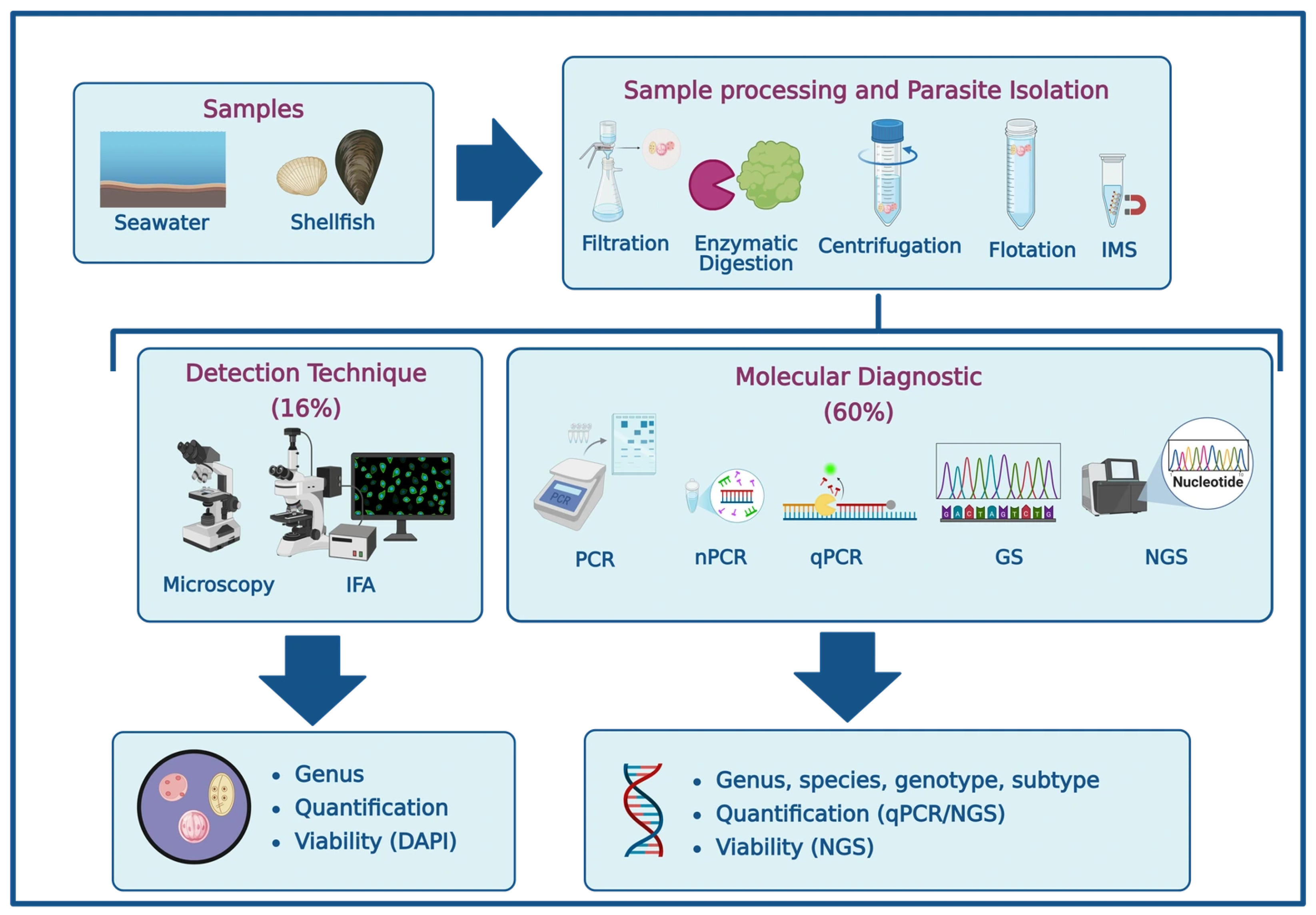
- Centrifugation and flotation: Cesium chloride gradients improve (oo)cyst recovery compared to sucrose, though both may coextract similar density particles [48].
- •
4.2. Detection Techniques
- •
- Microscopy: Techniques such as Ziehl–Neelsen staining, DAPI fluorescence, and differential interference contrast allow genus-level identification and viability assessment, though sensitivity is limited and influenced by sample quality [47].
- •
4.3. Molecular Diagnostics and Target Genes
- •
- Conventional PCR: Genus-level detection.
- •
- nPCR: Enhanced sensitivity for species/subtype identification.
- •
- qPCR: Real-time detection and quantification.
- •
- Target Gene Sequencing: Subtype confirmation.
4.4. Next-Generation Sequencing
5. Fecal Indicators in Seawater Associated with Waterborne Parasite
6. Waterborne Protozoan Parasites in Marine Environment
7. Conclusions and Future Perspective
Author Contributions
Funding
Institutional Review Board Statement
Informed Consent Statement
Data Availability Statement
Acknowledgments
Conflicts of Interest
References
- Mora, C.; McKenzie, T.; Gaw, I.; Dean, J.; von Hammerstein, H.; Knudson, T.; Setter, R.; Smith, C.; Webster, K.; Patz, J.; et al. Over half of known human pathogenic diseases can be aggravated by climate change. Nat. Clim. Change 2022, 12, 869–875. [Google Scholar] [CrossRef] [PubMed]
- Semenza, J.C.; Hess, J.J.; Provenzano, D. Climate change, marine pathogens and human health. JAMA 2025, 334, 79–80. [Google Scholar] [CrossRef]
- Bourli, P.; Eslahi, A.V.; Tzoraki, O.; Karanis, P. Waterborne transmission of protozoan parasite: A review of worldwide out-breaks—An update 2017–2022. J. Water Health 2023, 23, 1421–1447. [Google Scholar] [CrossRef]
- González-Saldía, R.R.; Pino-Maureira, N.L.; Muñoz, C.; Soto, L.; Durán, E.; Barra, M.J.; Gutiérrez, S.; Díaz, V.; Saavedra, A. Fecal pollution source tracking and thalassogenic diseases: The temporal spatial concordance between maximum concentration of human mitochondrial DNA in seawater and Hepatitis A outbreaks among a coastal population. Sci. Total Environ. 2019, 686, 158–170. [Google Scholar] [CrossRef]
- Shuval, H.I. Thalassogenic Diseases. UNEP Regional Reports and Studies 1986, N° 79. United Nations Environment Programme. Available online: https://www.unep.org/resources/report/thalassogenic-diseases (accessed on 5 December 2025).
- Shuval, H.I. Estimating the global burden of thalassogenic diseases: Human infectious diseases caused by wastewater pollution of the marine environment. J. Water Health 2003, 1, 53–64. [Google Scholar] [CrossRef] [PubMed]
- Ravenscroft, J.; Eftim, S.; Soller, J.; Jones, K.; Ichida, A.; Marion, J.; Lee, J. Appliyng epidemiology and quantitative microbial risk assessment to ambient water quality evaluation: Case study of fecal contaminated water in a US inland lake. Hum. Ecol. Risk Assess. 2025, 31, 3–4. [Google Scholar] [CrossRef]
- Graczyk, T.K.; Sunderland, D.; Awantang, D.N.; Mashinski, Y.; Lucy, F.E.; Graczyk, Z.; Chomicz, L.; Breysse, P.N. Relationships among bather density, levels of human waterborne pathogens, and fecal coliform counts in marine recreational beach water. Parasitol. Res. 2010, 106, 1103–1108. [Google Scholar] [CrossRef]
- Efstratiou, A.; Ongerth, J.E.; Karanis, P. Waterborne transmission of protozoan parasite: Review of worldwide outbreaks—An update 2011–2016. Water Res. 2017, 114, 14–22. [Google Scholar] [CrossRef]
- Ahmed, S.A.; Bughattas, S.; Mahmoudi, M.R.; Khan, H.; Mamedova, S.; Namboodiri, A.; Masangkay, F.R.; Karanis, P. Cryptosporidium and cryptosporidiosis: An update of Asian perspective in humans, water and food, 2015–2025. Curr. Res. Parasitol. Vector-Borne Dis. 2025, 8, 100311. [Google Scholar] [CrossRef] [PubMed]
- Einarsson, E.; Maayeh, S.; Svard, S.G. An up-date on Giardia and giardiasis. Curr. Opin. Microbiol. 2016, 34, 47–52. [Google Scholar] [CrossRef]
- Aykur, M.; Camyar, A.; Turk, B.G.; Sin, A.Z.; Dagci, H. Evaluation of association with subtypes and alleles of Blastocystis with chronic spontaneous urticaria. Acta Trop. 2022, 231, 106455. [Google Scholar] [CrossRef]
- World Health Organization (WHO). Guidelines for Drinking-Water Quality: Fourth Edition Incorporating the First Addendum; World Health Organization: Geneva, Switzerland, 2017. [Google Scholar]
- Supreme Decret 90 Laws, Chile N°1475. Diario Oficial, 7 March 2000. Available online: https://www.bcn.cl/leychile/navegar?idNorma=182637 (accessed on 18 September 2025).
- De la Peña, L.B.; Pago, E.J.; Rivera, W. Characterization of Cryptosporidium isolated from Asian Green mussels sold in wet markets of Quezon city, Philippines. Philipp. Agric. Sci. 2017, 100, S45–S54. [Google Scholar]
- Suarez, P.; Yánez, M.J.; Fernández, I.; Madrid, V. Detection of Cryptosporidium parvum (Apicomplexa: Cryptosporidiidae) oocyst in Aulacomya ater specimen, extracted from to the coast Biobío region, Chile. Rev. Chil. Infectol. 2020, 37, 243–248. [Google Scholar] [CrossRef]
- Srisuphanunt, M.; Wilairatana, P.; Kooltheat, N.; Damrongwatanapokin, T.; Karanis, P. Occurrence of Cryptosporidium oocyst in commercial oysters in southern Thailand. Food Waterborne Parasitol. 2023, 32, e00205. [Google Scholar] [CrossRef]
- Suarez, P.; Vallejos-Almirall, A.; Fernández, I.; González Chavarria, I.; Alonso, J.L.; Vidal, G. Identification of Cryptosporidium parvum and Blastocystis hominis subtype ST3 in Cholga mussel and treated sewage: Preliminary evidence of fecal contamination in harvesting area. Food Waterborne Parasitol. 2024, 34, e00214. [Google Scholar] [CrossRef]
- Oliveira, G.F.; Carvalho, M.; de Freitas, M.; Begramo, C. Mussels (Perna perna) as bioindicator of environmental contamination by Cryptosporidium species with zoonotic potential. Int. J. Parasitol. Parasite Wildl. 2016, 5, 28–33. [Google Scholar] [CrossRef]
- Tei, F.F.; Kowalyk, S.; Reid, J.A.; Presta, M.A.; Yesuda, R.; Mayer, D.C.G. Assessment and molecular characterization of human intestinal parasites in bivalve from Orchard beach, NY, USA. Int. J. Environ. Res. Public Health 2016, 13, 381. [Google Scholar] [CrossRef] [PubMed]
- Ghozzi, K.; Marangi, M.; Papini, R.; Lahmar, I.; Challouf, R.; Houas, N.; Dhiab, R.B.; Normanno, G.; Badda, H.; Giangaspero, A. First report of Tunisian coastal water contamination by protozoan parasites using mollusk bivalve as biological indicators. Mar. Pollut. Bull. 2017, 117, 197–202. [Google Scholar] [CrossRef] [PubMed]
- Coupe, A.; Howe, L.; Burrows, E.; Sine, A.; Pita, A.; Velathanthin, N.; Vallée, E.; Hayman, D.; Shapiro, K.; Roe, W.D. First report of Toxoplasma gondii sporulated oocyst and Giardia duodenalis in commercial green-lipped mussels (Perna canaliculus) in New Zealand. Parasitol. Res. 2018, 117, 1453–1463. [Google Scholar] [CrossRef] [PubMed]
- Tedde, T.; Marangi, M.; Papini, R.; Salza, S.; Normanno, G.; Virgilio, S.; Giangaspero, A. Toxoplasma gondii and other zoonotic protozoan in Mediterranean mussel (Mytilus galloprovincialis) and blue mussel (Mytilus edulis): A food safety concern? J. Food Prot. 2019, 82, S25–S42. [Google Scholar] [CrossRef]
- Manore, A.J.W.; Harper, S.L.; Sargeant, J.M.; Weese, J.S.; Cunsolo, A.; Bunce, A.; Shirley, J.; Sudlovenick, E.; Shapiro, K. Cryptosporidium and Giardia in locally harvested clams in Iqaluit, Nunavut. Zoonoses Public Health 2020, 67, 352–361. [Google Scholar] [CrossRef] [PubMed]
- Ligda, P.; Claerebout, E.; Casaert, S.; Robertson, L.; Sotiraki, S. Investigations from Northern Greece on mussels cultivated in areas proximal to wastewaters discharges as a potential source for human infections with Giardia and Cryptosporidium. Exp. Parasitol. 2020, 210, 107848. [Google Scholar] [CrossRef] [PubMed]
- Silva, C.M.; Pinto, A.L.; Cardoso, K.F.; Barreira, R.D.; Cutrim, D.; dos Santos, L.S.; Silva, V.C.; Pereira, H.; Chavez, N.P. Cryptosporidium sp. in cultivated oysters and the natural oyster stock of the state of Maranhao, Brazil. Cienc. Rural. 2023, 53, e20210014. [Google Scholar] [CrossRef]
- Merks, H.; Boone, R.; Janecko, N.; Viswanathan, M.; Dixon, B.R. Foodborne protozoan parasites in fresh mussels and oyster purchased at retail in Canada. Int. J. Food Microbiol. 2023, 399, 110248. [Google Scholar] [CrossRef]
- Staggs, S.E.; Keely, S.P.; Ware, M.W.; Schable, N.; See, M.J.; Gregorio, D.; Zou, X.; Su, C.; Dubey Villegas, E. The development and implementation of a method using blue mussels (Mytilus spp.) as biosentinels of Cryptosporidium spp. and Toxoplasma gondii contamination in marine aquatic environments. Parasitol. Res. 2015, 114, 4655–4667. [Google Scholar] [CrossRef]
- Pagoso, E.J.; Rivera, W. Cryptosporidium species from common edible bivalves in Manila Bay, Philippines. Mar. Pollut. Bull. 2017, 119, 31–39. [Google Scholar] [CrossRef]
- Pinto, K.C.; de Souza, M.; Navarro, M.I.; Zanoli, M.I.; Cássia, A.; Razzolini, M.T.P. Assessment of health risk from recreational exposure to Giardia and Cryptosporidium in coastal bathing waters. Environ. Sci. Pollut. Res. 2020, 27, 23129–23140. [Google Scholar] [CrossRef]
- González-Fernández, A.; Symonds, E.M.; Gallard-Gogora, J.F.; Mull, B.; Lukasic, J.O.; Rivera, P.; Badilla, A.; Peraud, J.; Brown, M.L.; Mora, D.; et al. Among microbial indicators of fecal pollution, microbial source tracking markers and pathogens in Costa Rica coastal waters. Water Res. 2021, 188, 116507. [Google Scholar] [CrossRef]
- Gholipour, S.; Nikaeen, M.; Rabbani, D.; Mohammadi, F.; Mohammadi, R.; Besharatipour, N.; Bina, B. Occurrence of enteric and non-enteric microorganisms in coastal waters impacted by anthropogenic activities: A multi-route QMRA for swimmers. Mar. Pollut. Bull. 2023, 188, 114716. [Google Scholar] [CrossRef]
- Guiguet-Leal, D.A.; Greinert Goulart, J.A.; Bonatti, T.R.; Araujo, R.S.; Juski, J.A.; Shimada, M.K.; Pereira, G.H.; Roratto, P.A.; Scherer, G.S. A two-year monitoring of Cryptosporidium spp. oocysts and Giardia spp. cysts in freshwater and seawater: A complementary strategy for measuring sanitary patterns of recreational tropical coastal areas from Brazil. Reg. Stud. Mar. Sci. 2024, 70, 1033956. [Google Scholar] [CrossRef]
- Suarez, P.; Fernández, I.; Alonso, J.L.; Vidal, G. Evidence of waterborne parasite in mussels for human consumption harvested from a recreational and highly productive bay. Microorganisms 2025, 13, 1971. [Google Scholar] [CrossRef] [PubMed]
- Ryckman, M.; Gantois, N.; García, R.; Desramaut, J.; Li, L.; Even, G.; Audebert, C.; Devos, D.; Chabé, M.; Certad, G.; et al. Molecular identification and subtype analysis of Blastocystis sp. isolates from wild mussels (Mytilus edulis) in Northern France. Microorganisms 2024, 12, 710. [Google Scholar] [CrossRef] [PubMed]
- Rodriguez-Fernández, V.; Andolf, R.; Palomba, M.; Aco-Albuquerque, R.; Santoro, M.; Protano, C.; Mattiucci, S. First molecular detection of Blastocystis sp. in Mediterranean mussels Mytilus galloprovincialis from the western coast of Italy: Seafood safety and environmental contamination implications. Food Control 2026, 181, 111730. [Google Scholar] [CrossRef]
- Kolorean, Z.; Gulabi, B.B.; Karanis, P. Molecular identification of Blastocystis sp. subtypes in water samples collected from black sea, Turkey. Acta Trop. 2018, 180, 56–68. [Google Scholar] [CrossRef]
- Gomes-Goncalves, S.; Machado, A.; Borlado, A.; Mesquita, J.R. Anthropogenic Blastocystis from drinking well and coastal water in Guinea-Bissau (West Africa). Microorganisms 2025, 13, 620. [Google Scholar] [CrossRef]
- Leiva, A.M.; Gómez, G.; González-Rocha, G.; Piña, B.; Vidal, G. Performance of full-scale rural wastewater treatment plants in the reduction of antibiotic-resistant bacteria and antibiotic resistance genes from small-city effluents. J. Environ. Chem. Eng. 2024, 12, 112322. [Google Scholar] [CrossRef]
- González, Y.; Salgado, P.; Vidal, G. Disinfection behavior of a UV-treated wastewater system using constructed wetlands and the rate of reactivation of pathogenic microorganisms. Water Sci. Technol. 2020, 80, 1870–1879. [Google Scholar] [CrossRef] [PubMed]
- Ryan, U.M.; Feng, Y.; Fayer, R.; Xiao, L. Taxonomy and molecular epidemiology of Cryptosporidium and Giardia—A 50 year perspective (1971–2021). Int. J. Parasitol. 2021, 51, 1099–1119. [Google Scholar] [CrossRef]
- Suarez, P.; Alonso, J.L.; Gómez, G.; Vidal, G. Performance of sewage treatment technologies for the removal of Cryptosporidium sp. and Giardia sp.: Toward water circularity. J. Environ. Manag. 2022, 324, 116320. [Google Scholar] [CrossRef]
- Zhao, W.; Sun, L.; Sun, Y.; Fu, X.; Ma, S.; Zhang, J.; Yan, B. Molecular identification and genotyping of Blastocystis in farmed cattle, goats and pigs from Zhejiang province, China. Food Waterborne Parasitol. 2025, 40, e00280. [Google Scholar] [CrossRef]
- Gopinathan, S.; Suthindhiran, K. Microbial contamination in the marine recreational sites and its impact on public health. Ocean Coast. Manage 2025, 267, 107757. [Google Scholar] [CrossRef]
- Gerace, E.; Di Marco, V.; Biondo, C. Cryptosporidium infection: Epidemiology, pathogenesis, and differential diagnosis. Eur. J. Microbiol. Immunol. 2019, 9, 119–123. [Google Scholar] [CrossRef]
- Belkessa, S.; Ait-Salem, E.; Laatamna, A.; Houali, K.; Wolff, U.; Hakem, A.; Bouchene, Z.; Ghalmi, F.; Stensvold, C.R. Prevalence and clinical manifestation of Giardia intestinalis and other intestinal parasite in children and adults in Algeria. Am. J. Trop. Med. Hyg. 2021, 104, 910–916. [Google Scholar] [CrossRef]
- Adeyemo, F.E.; Singh, G.; Reddy, P.; Stenstrom, T.A. Methods for the detection of Cryptosporidium and Giardia: From microscopy to nucleic acid based tools in clinical and environmental regimes. Acta Trop. 2018, 184, 15–28. [Google Scholar] [CrossRef]
- Hohweyer, J.; Dumetre, A.; Aubert, D.; Azas, N.; Villena, I. Tools and methods for detecting and characterizing Giardia, Cryptosporidium and Toxoplasma parasites in marine mollusks. J. Food Prot. 2013, 76, 1649–1657. [Google Scholar] [CrossRef] [PubMed]
- Ligda, P.; Claerebout, E.; Robertson, L.J.; Sotiraki, S. Protocol standardization for the detection of Giardia cyst and Cryptosporidium oocyst in Mediterranean mussels (Mytilus galloprovincialis). Int. J. Food Microbiol. 2019, 298, 31–38. [Google Scholar] [CrossRef] [PubMed]
- Bigot-Clivot, A.; La Carbona, S.; Cazeaun, C.; Durand, L.; Géba, E.; Le Foll, F.; Xuereb, B.; Chalghmi, H.; Dubey, J.P.; Bastien, F.; et al. Blue mussel (Mytilus edulis) a bioindicator of marine water contamination by protozoa: Laboratory and in situ approaches. J. Appl. Microbiol. 2020, 132, 736–746. [Google Scholar] [CrossRef] [PubMed]
- Kim, M.; Rueda, L.; Packham, A.; Moore, J.; Wuertz, S.; Shapiro, K. Molecular detection and viability discrimination of zoonotic protozoan pathogens in oysters and seawater. Int. J. Food Microbiol. 2023, 407, 110391. [Google Scholar] [CrossRef]
- Abreu-Silva, J.; Ribeirinho-Soares, S.; Oliveira-Inocencio, I.; Pedrosa, M.; Silva, A.M.T.; Nunes, O.C.; Manaia, C.M. Performance of polycarbonate, cellulose nitrate and polyethersulfone filtering membrane for culture-independent microbiota analysis of clean waters. J. Environ. Chem. Eng. 2023, 11, 109132. [Google Scholar] [CrossRef]
- Davies, M.; Hawkins, S.J. Mucus from Marine Mollusks. Adv. Mar. Biol. 1998, 34, 1–71. [Google Scholar] [CrossRef]
- Schenk, J.J.; Becklund, L.E.; Carey, L.E.; Carey, S.J.; Fabre, P. What is the "modified CTAB protocol"? Characterizing modifications to the CTAB DNA extraction protocol. Appl. Plant Sci. 2023, 11, e11517. [Google Scholar] [CrossRef]
- Hachimi, O.; Falender, R.; Davis, G.; Waffula, R.V.; Sutton, M.; Bancroft, J.; Cieslak, P.; Kelly, C.; Kaya, D.; Radniecki, T. Evaluation of molecular-based methods for the detection and quantification of Cryptosporidium spp. in wastewater. Sci. Total Environ. 2024, 947, 174219. [Google Scholar] [CrossRef]
- Stensvold, C.R.; Kumar, G.; Tan, K.S.W.; Thompson, R.C.A.; Traub, R.J.; Viscogliosi, E.; Yoshikawa, H.; Clark, C.G. Terminology for Blastocystis subtypes—A consensus. Trends Parasitol. 2006, 23, 93–96. [Google Scholar] [CrossRef]
- Oladele, D.; Swain, M.; Robinson, G.; Clare, A.; Chalmers, R. A review of recent Cryptosporidium hominis and Cryptosporidium parvum gp60 subtypes. Curr. Res. Parasitol. Vector-Borne Dis. 2025, 8, 100292. [Google Scholar] [CrossRef]
- Kumar, A.; Gupta, U.D. Next Generation Sequencing and its applications: Empowering in public health beyond reality. In Microbial Technology for Welfare of Society; Kumar, P., Ed.; Springer Nature: Singapore, 2019; Volume 17, pp. 313–341. [Google Scholar]
- DeMone, C.; McClure, J.T.; Greenwood, S.J.; Fung, R.; Hwang, M.H.; Feng, Z.; Shapiro, K. A metabarcording approach for detecting protozoan pathogens in wild oyster from Prince Edward Island, Canada. Int. J. Food Microbiol. 2021, 360, 109315. [Google Scholar] [CrossRef]
- Zahedi, A.; Gray, T.L.; Paparini, A.; Linge, K.L.; Joll, C.A.; Ryan, U.M. Identification of eukarytic microorganism with 18S rRNA next-generation sequencing in wastewater treatment plants, with a more target NGS approach required for Cryptosporidium detection more targeted NGS approach required for Cryptosporidium detection. Water Res. 2019, 158, 301–312. [Google Scholar] [CrossRef]
- Zahedi, A.; Gofton, A.W.; Greay, T.; Monis, P.; Oskam, C.; Ball, A.; Bath, A.; Watkinson, A.; Robertson, I.; Ryan, U. Profiling the diversity of Cryptosporidium species and genotype in wastewater treatment plants in Australia using next generation sequencing. Sci. Total Environ. 2018, 644, 635–648. [Google Scholar] [CrossRef]
- Mthethwa, N.; Amoah, I.D.; Gomez, A.; Davison, S.; Reddy, P.; Bux, F.; Kumari, S. Profiling pathogenic protozoan and their functional pathways in wastewater using 18rRNA and shotgun metagenomics. Sci. Total Environ. 2024, 912, 169602. [Google Scholar] [CrossRef] [PubMed]
- Payment, P.; Franco, E. Clostridium perfringens and somatic coliphages as indicators of the efficiency of drinking water treatment for viruses and protozoan cysts. Appl. Environ. Microbiol. 1993, 59, 2418–2424. [Google Scholar] [CrossRef] [PubMed]
- Hijnen, W.A.M.; Brouwer-Hanzens, A.J.; Charles, K.J.; Medema, G.J. Spores of sulphite-reducing clostridia: A surrogate parameter for assessing the effects of water treatment processes on protozoan oocysts. Water Sci. Tech. 1997, 35, 285–291. [Google Scholar]
- Agulló-Barceló, M.; Oliva, F.; Lucena, F. Alternative indicators for monitoring Cryptosporidium oocyst in reclaimed water. Environ. Sci. Pollut. Res. 2013, 20, 4448–4454. [Google Scholar] [CrossRef] [PubMed]
- Stelma, G. Use of bacterial spores in monitoring water quality and treatment. J. Water Health 2018, 16, 491–500. [Google Scholar] [CrossRef] [PubMed]
- Wielinga, C.; Williams, A.; Monis, P.; Thompson, R.C.A. Proposed taxonomic revision of Giardia duodenalis. Infect. Genet. Evol. 2023, 111, 105430. [Google Scholar] [CrossRef] [PubMed]
- Jimenez, P.; Muñoz, M.; Ramírez, J.D. An update on the distribution of Blastocystis subtype in the Americas. Heliyon 2023, 8, e2592. [Google Scholar] [CrossRef]
- Jimenez, P.A.; Jaimes, J.E.; Ramírez, J.D. A summary of Blastocystis subtypes in north and south America. Parasite Vec. 2019, 12, 376. [Google Scholar] [CrossRef] [PubMed]



| Fecal Indicator | Specie | Detection Technique | Association | Reference |
|---|---|---|---|---|
| Bacteria | Total coliform | C | N | [31] |
| Escherichia coli | C | N | [33] | |
| Enterococcus spp. | C | + | [31,33] | |
| N | [8] | |||
| Clostridium perfrigens | C | + | [63,64,65,66] | |
| Virus | Bacteriophages | C/qPCR | + | [31] |
| PMMoV * | RT-PCR | + | [31] |
| Waterborne Parasite | Type of Sample | Specie or Genotype or Suptype Detected | Concentration Reported | Detection Technique | Prevalence (%) | Reference |
|---|---|---|---|---|---|---|
| Cryptosporidium spp. | Shellfish (Mussel, Clams and Oyster) | C. hominis (IbA10G2R2, IfA19G1), C. parvum (IIaA15G2R1, IIaA11G2R2, IIaA15G2R2, IIaA16G3R1, IIaA17G2R1, IIaA19G2R2, IIaA20G2R2, IIaA20G3R2), C. meleagridis, C. andersoni | 5.5 × 101 * (0–1.3 × 101) | ZNS/IFA | 26 (14–40) | [15,16,17,18] |
| PCR/nPCR/RFLP/qPCR/GS | 13 (0–36) | [15,19,20,21,22,23,24,25,26,27,28,29] | ||||
| Seawater | C. parvum | 3.7 × 101 + (1.1 × 10⁻¹–2.8 × 10²) | ZNS/IFA | 19 (0–29) | [30,31,33] | |
| PCR | 10 (0–27) | [32,33] | ||||
| Giardia duodenalis | Shellfish (Mussel, Clams and Oyster) | AI, AII, B, C, D | 9.1 × 101 ** (0–3.9 × 10²) | IFA nPCR/RFLP/ qPCR | 7 (0–30) | [20,21,22,23,24,25,27,34] |
| Seawater | AII | 3.5 × 101 ++ (1.0 × 10⁻¹–1.1 × 10²) | IFA | 21 (6–38) | [30,31,33] | |
| PCR | - | [33] | ||||
| Blastocystis sp. | Shellfish (Mussel) | ST3, ST7, ST14, ST23, ST26, ST44 | N.D. | PCR/qPCR/GS | 34 (10–62) | [18,34,35,36] |
| Seawater | ST1, ST2, ST3, ST10a | N.D. | PCR/GS | 17 (0–50) | [37,38] |
Disclaimer/Publisher’s Note: The statements, opinions and data contained in all publications are solely those of the individual author(s) and contributor(s) and not of MDPI and/or the editor(s). MDPI and/or the editor(s) disclaim responsibility for any injury to people or property resulting from any ideas, methods, instructions or products referred to in the content. |
© 2026 by the authors. Licensee MDPI, Basel, Switzerland. This article is an open access article distributed under the terms and conditions of the Creative Commons Attribution (CC BY) license.
Share and Cite
Suarez, P.; Alonso, J.L.; Vidal, G. Waterborne Protozoan Parasite and Thalassogenic Diseases in Marine Environment: Detection Techniques, Indicators and Public Health Implications. Microorganisms 2026, 14, 98. https://doi.org/10.3390/microorganisms14010098
Suarez P, Alonso JL, Vidal G. Waterborne Protozoan Parasite and Thalassogenic Diseases in Marine Environment: Detection Techniques, Indicators and Public Health Implications. Microorganisms. 2026; 14(1):98. https://doi.org/10.3390/microorganisms14010098
Chicago/Turabian StyleSuarez, Pilar, José Luís Alonso, and Gladys Vidal. 2026. "Waterborne Protozoan Parasite and Thalassogenic Diseases in Marine Environment: Detection Techniques, Indicators and Public Health Implications" Microorganisms 14, no. 1: 98. https://doi.org/10.3390/microorganisms14010098
APA StyleSuarez, P., Alonso, J. L., & Vidal, G. (2026). Waterborne Protozoan Parasite and Thalassogenic Diseases in Marine Environment: Detection Techniques, Indicators and Public Health Implications. Microorganisms, 14(1), 98. https://doi.org/10.3390/microorganisms14010098