Article

Antimicrobial Resistance and Comparative Genome Analysis of High-Risk Escherichia coli Strains Isolated from Egyptian Children with Diarrhoea

by
Radwa Abdelwahab
1,2,
Munirah M. Alhammadi
3,
Muhammad Yasir
4,
Ehsan A. Hassan
2,
Entsar H. Ahmed
2,
Nagla H. Abu-Faddan
2,
Enas A. Daef
2,
Stephen J. W. Busby
1 and
Douglas F. Browning
5,*
1
Institute of Microbiology and Infection, School of Biosciences, University of Birmingham, Birmingham B15 2TT, UK
2
Faculty of Medicine, Assiut University, Assiut 71515, Egypt
3
Department of Biology, College of Science, Princess Nourah bint Abdulrahman University, P.O. Box 84428, Riyadh 11671, Saudi Arabia
4
Quadram Institute Bioscience, Norwich Research Park, Norwich NR4 7UQ, UK
5
College of Health and Life Sciences, Aston University, Aston Triangle, Birmingham B4 7ET, UK
*
Author to whom correspondence should be addressed.
Microorganisms 2026, 14(1), 247; https://doi.org/10.3390/microorganisms14010247
Submission received: 28 November 2025 / Revised: 14 January 2026 / Accepted: 16 January 2026 / Published: 21 January 2026
(This article belongs to the Special Issue Bacterial Infections in Clinical Settings, 2nd Edition)

Abstract

Escherichia coli is an important human pathogen that is able to cause a variety of infections, which can result in diarrhoea, urinary tract infections, sepsis, and even meningitis, depending on the pathotype of the infecting strain. Like many Gram-negative bacteria, E. coli is becoming increasingly resistant to many frontline antibiotics, including third-generation cephalosporins and carbapenems, which are often considered the antibiotics of last resort for these infections. This is particularly the case in Egypt, where multidrug-resistant (MDR) E. coli is highly prevalent. However, in spite of this, few Egyptian MDR E. coli strains have been fully characterised by genome sequencing. Here, we present the genome sequences of ten highly MDR E. coli strains, which were isolated from children who presented with diarrhoea at the Outpatients Clinic of Assiut University Children’s Hospital in Assiut, Egypt. We report that they carry multiple antimicrobial resistance genes, which includes extended spectrum β-lactamase genes, as well as blaNDM and blaOXA carbapenemase genes, likely encoded on IncX3 and IncF plasmids. Many of these strains were also found to be high-risk extra-intestinal pathogenic E. coli (ExPEC) clones belonging to sequence types ST167, ST410, and ST617. Thus, their presence in the Egyptian paediatric population is particularly worrying, and this highlights the need for increased surveillance of high-priority pathogens in this part of the world.

1. Introduction

The Gram-negative bacterium Escherichia coli is often considered part of the normal gut flora of warm-blooded vertebrate animals, where it acts as a commensal organism [1,2]. However, due to the acquisition of specific virulence genes, some E. coli strains can cause disease at various sites within the human body [1,2]. Diarrhoeagenic E. coli are important human pathogens, which result in considerable global morbidity and mortality, particularly amongst children in developing countries. These pathogenic strains are grouped into different pathotypes based on their disease characteristics, the toxins they secrete, and their specific adherence patterns, and they include pathotypes such as enteroaggregative E. coli (EAEC), enteropathogenic E. coli (EPEC), and enterohemorrhagic (EHEC) and enterotoxigenic E. coli (ETEC), amongst others [1,2]. Additionally, other E. coli strains have acquired specific virulence determinants that enable them to cause extra-intestinal infections, such as urinary tract infections (UTIs), sepsis, and meningitis; these are termed extra-intestinal pathogenic E. coli (ExPEC) [1,2]. Thus, pathogenic E. coli strains are able to cause a considerable spectrum of disease, depending on their particular genetic makeup.
Like many bacteria, both clinically and environmentally isolated E. coli strains are becoming increasingly resistant to many classes of antibiotics, resulting in the emergence of multidrug resistant (MDR) strains. This has led the World Health Organisation (WHO) to categorise antibiotic-resistant Gram-negative bacteria, such as E. coli, as high-priority pathogens [3]. In particular, this includes E. coli strains that are resistant to third-generation cephalosporin antibiotics (e.g., ceftriaxone) due to the presence of extended-spectrum β-lactamases (ESBLs), as well as strains resistant to carbapenem antibiotics (e.g., imipenem and meropenem), which are often the antibiotics of last resort for many bacterial infections [3,4,5]. Most Carbapenem-Resistant Enterobacteriaceae (CRE) carry Ambler class A, B, or D carbapenemases, which include the Klebsiella pneumoniae carbapenemase (KPC), the New Delhi metallo-β-lactamase (NDM), and oxacillin-hydrolysing enzymes (OXA-48-like), respectively [4,5]. These resistance genes are often encoded on mobile genetic elements, such as transposons, integrons, and conjugative plasmids, which facilitate their spread, frequently in conjunction with other antimicrobial resistance genes (ARGs). Thus, the global prevalence of CRE is causing a significant public health catastrophe as treatment options dwindle [3,4,5,6,7].
This is particularly the case in Egypt, where CRE are extremely prevalent, being detected at high rates [8,9]. For example, 10.5% of Egyptian isolates from the SMART Global Surveillance Program (2008 to 2014) were positive for carbapenemase carriage [8], whilst 16.1% of all carbapenemase-producing E. coli isolated from 36 countries (2015 to 2017) were Egyptian in origin [9]. However, despite this, comparatively few Egyptian carbapenem-resistant E. coli strains have been fully characterised by genome sequencing. Of those that have, it is clear that they often carry multiple ESBLs (e.g., blaCTX-M-15 and blaTEM-1B) and carbapenemase genes (e.g., blaNDM-1, blaNDM-5, blaOXA-48, and blaOXA-181), making them resistant to β-lactam antibiotics [9,10,11,12,13,14,15,16]. In many instances, carbapenemase genes are located on conjugative plasmids, co-localised with other ARGs, facilitating their transfer and spread [11,12]. In a previous study, we isolated 50 E. coli strains from children (aged from 2 months to 5 years old), who presented with diarrhoea at the Outpatients Clinic of Assiut University Children’s Hospital in 2016 [16]. In this study, we investigated two E. coli strains, E36 and E42, which were EAEC in character, using genome sequencing and gene expression analysis to examine virulence determinant regulation [16]. Troublingly, many of the other isolates were resistant to all tested antibiotics, including carbapenems [16]. As patients had not been previously admitted to hospital, this provided us with an opportunity to examine the E. coli strains circulating within the paediatric population in Assiut. Thus, to understand more about these strains and to identify the ARGs, plasmids, and virulence determinants they carry, we characterised 10 of these highly MDR isolates using whole genome sequencing and comparative genomic analysis.

2. Materials and Methods

2.1. Isolation and Characterisation of E. coli Strains

The current work is a retrospective study analysing E. coli strains collected in 2016 from infants and children (aged from 2 months to 5 years old) who presented with diarrhoea at the Outpatients Clinic of Assiut University Children’s Hospital [16]. Ethical approval was granted by the Medical School Ethical Review Board before sample collection proceeded [16]. Individuals from this study had frequent watery diarrhoea (>3 times/day), with or without blood or mucus, and participants who had received antibiotics within the last 72 h were excluded from the study. One E. coli strain was isolated per patient, and identification was carried out at the Medical Research Center, Faculty of Medicine, Assiut University. Note that due to the stipulations of our ethical approval, no identifiable data was collected to link patients or disease outcomes to any of the samples. In total, ten MDR isolates were chosen for further study, based on the results of the antibiotic susceptibility testing performed in [16].

2.2. Genome Sequencing

The draft genome sequencing of each E. coli strain was carried out using Illumina sequencing (San Diego, CA, USA) by Microbes NG (https://microbesng.com/ (accessed on 8 November 2025)) as detailed previously [16]. Note that long-read sequencing, such as Oxford Nanopore Technology (Oxford, UK), was not employed due to the limited funding available for this project. Illumina reads were adapter trimmed using Trimmomatic 0.30 with a sliding window quality cutoff of Q15 [17]. Genome assembly was performed using Unicycler v0.4.0 [18] and contigs were annotated using Prokka 1.11 [19]. This Whole Genome Shotgun project has been deposited at DDBJ/ENA/GenBank with the sequence data (BioProject: PRJNA1298299) under the accession numbers: E4: JBQGXB000000000, E15: JBQGXA000000000, E23: JBQGWZ000000000, E27: JBQGWY000000000, E28: JBQGWX000000000, E29: JBQGWW000000000, E30: JBQGWV000000000, E34: JBQGWU000000000, E35: JBQGWT000000000, and E43: JBQGWS000000000.

2.3. Bioinformatic Analysis of Genome Sequences

Sequence types were determined using MLST 2.0 [20], bacterial serotyping was determined using SerotypeFinder 2.0 [21], plasmids were identified by detecting plasmid replicons using PlasmidFinder 2.1 [22], and virulence gene analysis was performed using VirulenceFinder 2.0 [23,24] and PathogenFinder 1.1 and 2 [25,26] using software at the Center for Genomic Epidemiology (CGE) (http://www.genomicepidemiology.org/ (accessed on 8 January 2026)). Antibiotic resistance genes were detected using ResFinder version 4.7.2 also at CGE [27] (using ResFinder (22 March 2024) and PointFinder (8 March 2024) databases with settings of 98% and 60% for threshold and length ID, respectively). The phylotype of each strain was determined using the EzClermont in silico Clermont phylotyper version 0.7 (https://ezclermont.hutton.ac.uk/ (accessed on 8 January 2026)) [28]. Insertion sequences and bacteriophage were identified using ISfinder (https://www-is.biotoul.fr/index.php (version 21 November 2025) (accessed on 15 January 2026)) [29] and PHASTER (version 22 December 2020) (https://phaster.ca/ (accessed on 8 November 2025)) [30], respectively.
Draft genomes were visualized with Artemis [31], genomes were compared using the Proksee Server (https://proksee.ca/about (accessed on 8 January 2026)) [32], the Artemis Comparison Tool (ACT) [33], and the Basic Local Alignment Search Tool (BLAST) at NCBI (https://blast.ncbi.nlm.nih.gov/Blast.cgi (accessed on 8 January 2026)). Figures showing genome organization were drawn using ACT [33] and the Proksee Server [32].
The phylogenetic analysis of strains was carried out by recreating the phylogenetic tree from Abdelwahab et al. [16], using the genomes listed in Figure 1 of that study, and the draft genomes generated in this study. The tree was generated using the AutoMLST2.0 web server for microbial phylogeny (https://automlst2.ziemertlab.com/ (accessed on 8 November 2025)) using the standard Denovo Mode with default settings [34]. The phylogenetic tree was visualized, and the E. coli branches selected, using the NCBI Tree Viewer 1.19.0 (https://www.ncbi.nlm.nih.gov/tools/treeviewer/ (accessed on 8 November 2025)). The draft genome sequences of Egyptian E. coli strains were obtained by searching the Enterobase Database [35] and the NCBI Pathogen Detection Browser (https://www.ncbi.nlm.nih.gov/pathogens/ (accessed 9 November 2025)) [36]. Single nucleotide polymorphism (SNP) analysis and phylogenetic tree construction was carried out on Egyptian ST167 and ST410 isolates using the pipeline at Solu Genomics (https://www.solugenomics.com/ (accessed on 5 January 2026)) [37]. Briefly, genomes were aligned to the E. coli MG1655 reference genome (NC_000913) using Snippy v4.6.0 (https://github.com/tseemann/snippy (accessed on 5 January 2026)). Phylogenetic trees for each species were then inferred with the IQ-TREE v2.3.6 maximum-likelihood algorithm [38]. E. coli ST167 and ST410 reference genomes were included in the analysis to validate tree construction [39,40,41].

3. Results

3.1. Isolation and Genome Characterisation of E. coli Strains

Previously, we isolated 50 E. coli strains from children with diarrhoea at the Outpatients Clinic of Assiut University Children’s Hospital [16]. AMR profiling against a range of frontline antimicrobial agents, including carbapenems, indicated that ten of the E. coli strains possessed resistance to all agents tested, highlighting the MDR phenotype of these isolates [16,42] (Table 1 and Table S1). To understand more about the plasmids, ARGs, and virulence determinants that each strain possessed, the genomes of these strains were sequenced using short-read Illumina whole genome sequencing (Table 1). As is typical of MDR E. coli strains, most strains carried multiple plasmid replicons and, therefore, likely possessed a number of different plasmids (Table 2). Phylogenetic analysis of these MDR strains indicated that four isolates were sequence type ST167, three were ST410, and three were ST46, ST617, and ST361 (Figure 1 and Table 1). It is of note that ST167 and ST410 have now become global high-risk E. coli clones, harbouring multiple ARGs [40,43,44,45].

3.2. Analysis of Acquired AMR Genes and Chromosomal Point Mutations Associated with AMR

Consistent with their antimicrobial susceptibility pattern (Table 1 and Table S1), each strain carried multiple ARGs (Table 3). All strains possessed genes that would confer resistance to β-lactam antibiotics (e.g., blaCTX-M-15, blaCMY-2, blaCMY-42, blaOXA-1, blaOXA-9, and blaTEM-1B), with the ESBL genes blaCTX-M-15 and blaTEM-1B each found in 8/10 draft genomes (Table 3). Importantly, genes encoding carbapenemases (blaNDM-1, blaNDM-5, blaNDM-19, blaOXA-181, and blaOXA-244) were found in six isolates (i.e., E4, E15, E23, E27, E35, and E43), explaining these strains’ resistance to the carbapenem antibiotics imipenem and meropenem (Table 3 and Table S1). Furthermore, genes were detected that would result in resistance to fluoroquinolone (qnrS1 and aac(6′)-Ib-cr), aminoglycoside (aac(3)-IId, aac(6′)-Ib-cr, aadA1, aadA2, aadA5, aph(3′)-Ia, aph(3″)-Ib, aph(6)-Id and rmtB), macrolide (mphA), sulphonamide (sul1 and sul2), trimethoprim (dfrA1, dfrA12, dfrA14 and dfrA17), tetracycline (tetA and tetB), and chloramphenicol (catB3) antibiotics (Table 3) [27,46,47]. In addition, most strains possessed chromosomal point mutation in gyrA, parC, and parE that are associated quinolone resistance (i.e., resistance to nalidixic acid and ciprofloxacin) [27,46,47] (Supplementary Table S2). As 9/10 isolates also possess either qnrS1 and/or aac(6′)-Ib-cr genes, in addition to these chromosomal point mutations, this explains the resistance of all strains to ciprofloxacin [27,46,47]. Similarly, 9/10 strains possessed tet resistance genes, explaining the high level of tetracycline resistance observed (Table 1, Table 3 and Table S1). Thus, the identification of these resistance determinants correlates with the MDR phenotype observed for these 10 isolates.

3.3. Characterisation of IncX3 Plasmids Carrying Carbapenem Resistance Determinants

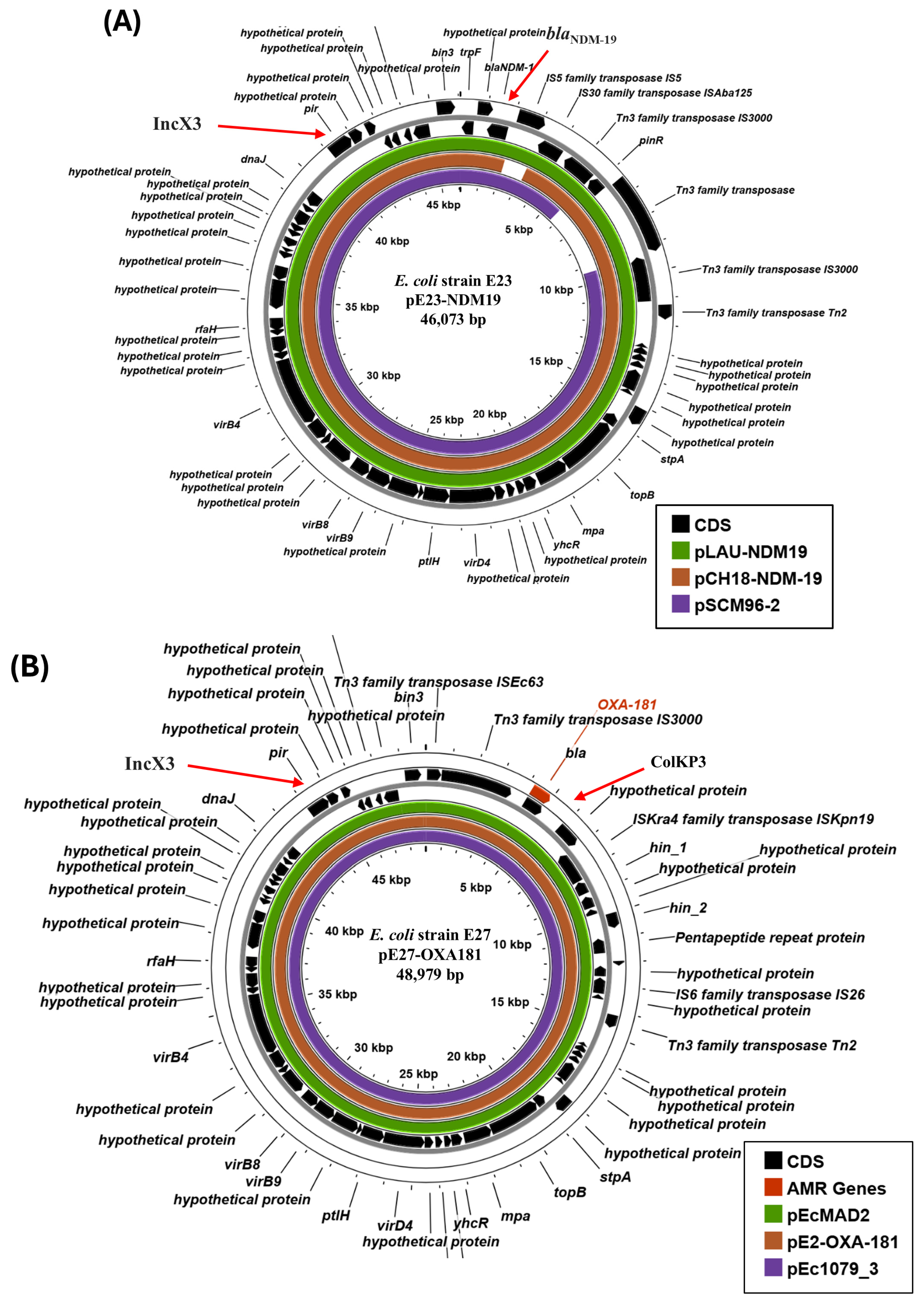
As carbapenem antibiotics are considered the last line of defence against many bacterial pathogens, we sought to understand more about the carbapenemase genes that our strains carry, in particular focusing on the plasmids that might harbour them and lead to their dissemination. Analysis indicated that isolate E23 carries both the blaNDM-19 carbapenemase gene and the IncX3 plasmid replicon on a single large contig (contig 27: 46,073 bp), suggesting that this might represent a complete plasmid (Table 2 and Table 3). BLAST analysis indicated that this contig was identical (100% coverage: 100% identity) to plasmid pLAU-NDM19 (CP074195.1: 47,332 bp: human isolate), which was isolated in Lebanon from E. coli strain EC20 in 2018 [48] (Figure 2A and Figure S1). Plasmid pLAU-NDM19 was shown to be conjugative and strain EC20 was also sequence type ST167. Thus, we propose that strain E23 carries a similar blaNDM-19-encoding IncX3 plasmid, which we have termed pE23-NDM19 (Figure 2A).
Out of all our strains, E27 carries the most plasmid replicons, possessing seven in total (Table 2). In this instance, the blaOXA-181 carbapenemase gene co-localises with the IncX3 and ColKP3 replicons on a single large contig (contig 22: 48,979 bp) (Figure 2B). Analysis indicated this contig was identical (100% coverage: 100% identity) to plasmid pE2-OXA-181 (CP048918.1: 51,479 bp: human isolate) isolated in Egypt (Giza) in 2015 [10], plasmid pEcMAD2 (LR595693.1: 51,479 bp: source unknown) isolated in France in 2013 [49], and pEc1079_3 (CP081309.1: 51,479 bp: human isolate) from Ghana in 2015 [50] (Figure 2B and Figure S2). Thus, we propose that strain E27 carries a similar blaOXA-181-encoding IncX3-ColKP3 plasmid, which we term pE27-OXA181 (Figure 2B). Interestingly, E. coli strains E2, EcMAD1, and Ec1079, from which these plasmids came, were sequence type ST410, like E27, and possessed very similar chromosomes with only a few minor regions of difference (Figure 1 and Figure S3 and Table 1) [10,49,50].

3.4. Characterisation of IncF Plasmids Potentially Carrying Carbapenem Resistance Genes

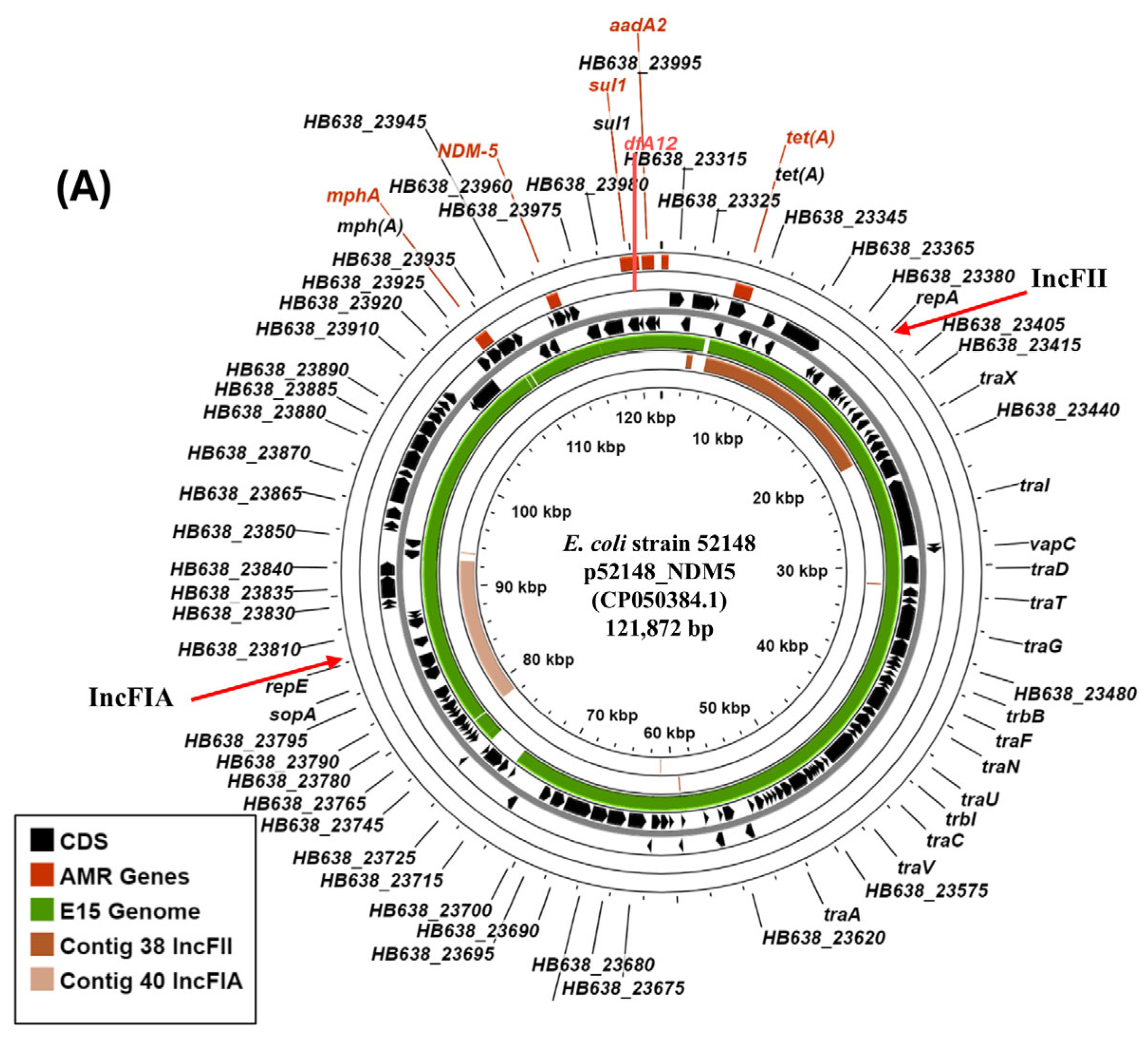
Due to the limitations of short-read sequencing, the carbapenemase genes carried by other strains were not co-localised on contigs that possessed plasmid replicons. However, in some instances, we are able to make inferences concerning the plasmids that might harbour these genes. Our analysis indicated that for isolate E15 (sequence type ST167), the blaNDM-5 gene was located on a small contig (contig 53: 3163 bp), whilst E15 carried three plasmid replicons (Table 2). BLASTn analysis of the IncFII (contig 38: 16,561 bp) and the IncFIA (contig 40: 14,118 bp) replicons indicated that they were very similar to sections of plasmid p52148_NDM5 (CP050384.1: 121,872 bp: human isolate), which also carries blaNDM-5 (Figure 3A) (100%/99% coverage: 99.99%/99.96% identity, respectively). Strain Eco52148 was isolated in 2019 from a patient who was repatriated from northern Africa to the Czech Republic and, like E15, was sequence type ST167 (Figure 1) [51]. As both p52148_NDM5 and E15 carry mphA, sul1, aadA2, dfrA12, and tetA ARGs (Table 3 and Figure 3A), we propose that E15 might carry a similar IncFII-IncFIA resistance plasmid.
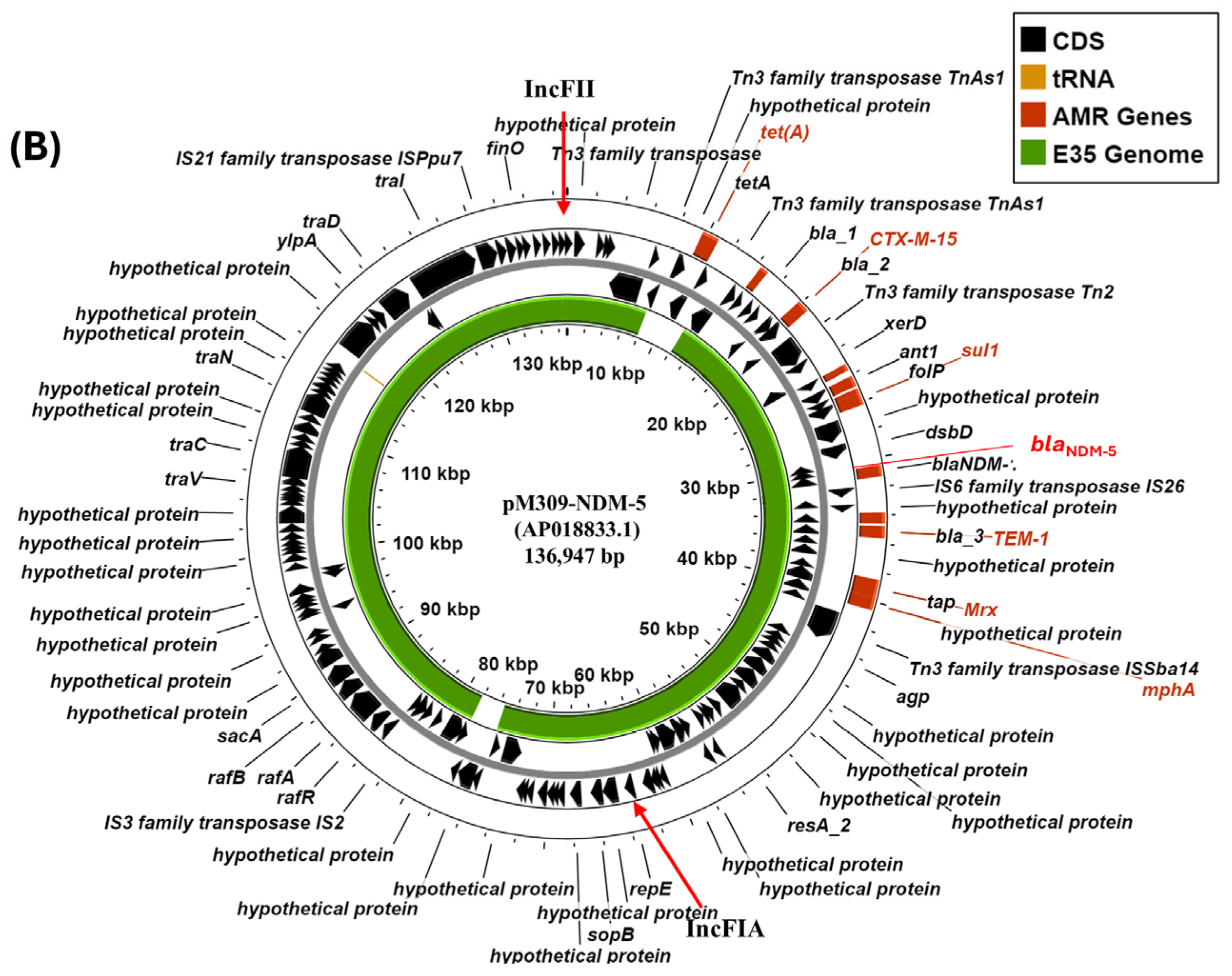
Strain E35 (also ST167) carries the blaNDM-5 carbapenemase gene on contig 38 (38,086 bp), which co-localises with blaCTX-M-15, blaTEM-1B, mphA, rmtB, aadA2, sul1, and dfrA12 ARGs. BLASTn analysis indicated that this contig was identical (100% coverage: 100% identity) to plasmid pM309-NDM5, carried by ST167 E. coli strain M309 (AP018833.1: 136,947 bp), isolated from a patient in Yangon, Myanmar in 2015 (Figure 3B and Figure S4) [52]. Furthermore, E35 contigs carrying the IncFIA (contig 45: 15,794 bp) and IncFII (contig 49: 11,728 bp) replicons were very similar to those carried by pM309-NDM5 (100%/98% coverage: 100%/100%, respectively) (Supplementary Figure S4). Thus, we propose that isolate E35 might carry a large dual IncFIA-IncFII plasmid, which likely encodes blaNDM-5.

3.5. Carriage of Virulence-Associated Genes in Egyptian E. coli Isolates

The analysis of each strain using PathogenFinder indicated that all were potential human pathogens carrying a number of characterised virulence determinants (Supplementary Table S3) [23,24,25,26]. However, none of our strains carried virulence determinants that are specifically associated with diarrhoeagenic Escherichia coli pathotypes, such as EAEC, EPEC, EHEC, or ETEC [1,2,53,54]. The virulence factors they did carry included glutamate decarboxylases genes (gadA/gadB) involved in acid resistance [55]; iss/bor, which encodes a lipoprotein involved in increased serum survival [56]; capU, a hexosyltransferase homologue [57]; hra heat-resistant agglutinin [58]; traT, an outer membrane protein involved in serum resistance [59]; and lpfA long polar fimbriae [58]. In addition, both E15 and E28 possess the yersiniabactin siderophore uptake system (ipr2/fyuA), with E28 carrying additional iron-scavenging systems (i.e., sitA iron transport protein and the iucC/iutA aerobactin system) [60]. It is of note that the carriage of specific virulence genes was sequence type-specific, with ST167 strains (E15, E23, E35, and E43) and ST410 strains (E27, E30, and E34) possessing similar respective virulence profiles (Supplementary Table S3). For ST167 strains, many of the virulence genes they carry (e.g., iss, hra, traT, and ipr2/fyuA) are associated with ExPEC [61,62,63] to which sequence type ST167 has been grouped [45]. Interestingly, for E28 (ExPEC sequence type ST617 [40,43,44,45]), sitABCD and the aerobactin siderophore gene cluster (iucABC-iutA) are located on contig 36 (43,206 bp), flanked by IncFIA and IncFIB replicons, suggesting they are plasmid borne (Supplementary Figure S5). Analysis of this contig and E28 contig 22 (75,303 bp) indicated that they were similar (100%/100% coverage: 100/99.96% identity, respectively) to sections of pEC22-OXA-1 (CP084902.1: 169,208 bp: human isolate) isolated from E. coli strain Ec20 in Jinhua, China in 2019. Like pEC22-OXA-1, contig 22 carries aac(6′)-Ib-cr, aadA5, blaCTX-M-15, blaOXA-1, dfrA17, two IncFII plasmid replicons, and numerous tra genes (Supplementary Figure S5), suggesting that E28 might also carry a hybrid virulence/AMR plasmid potentially capable of conjugative transfer.

3.6. SNP Analysis of ST167 and ST410 Egyptian E. coli Isolates

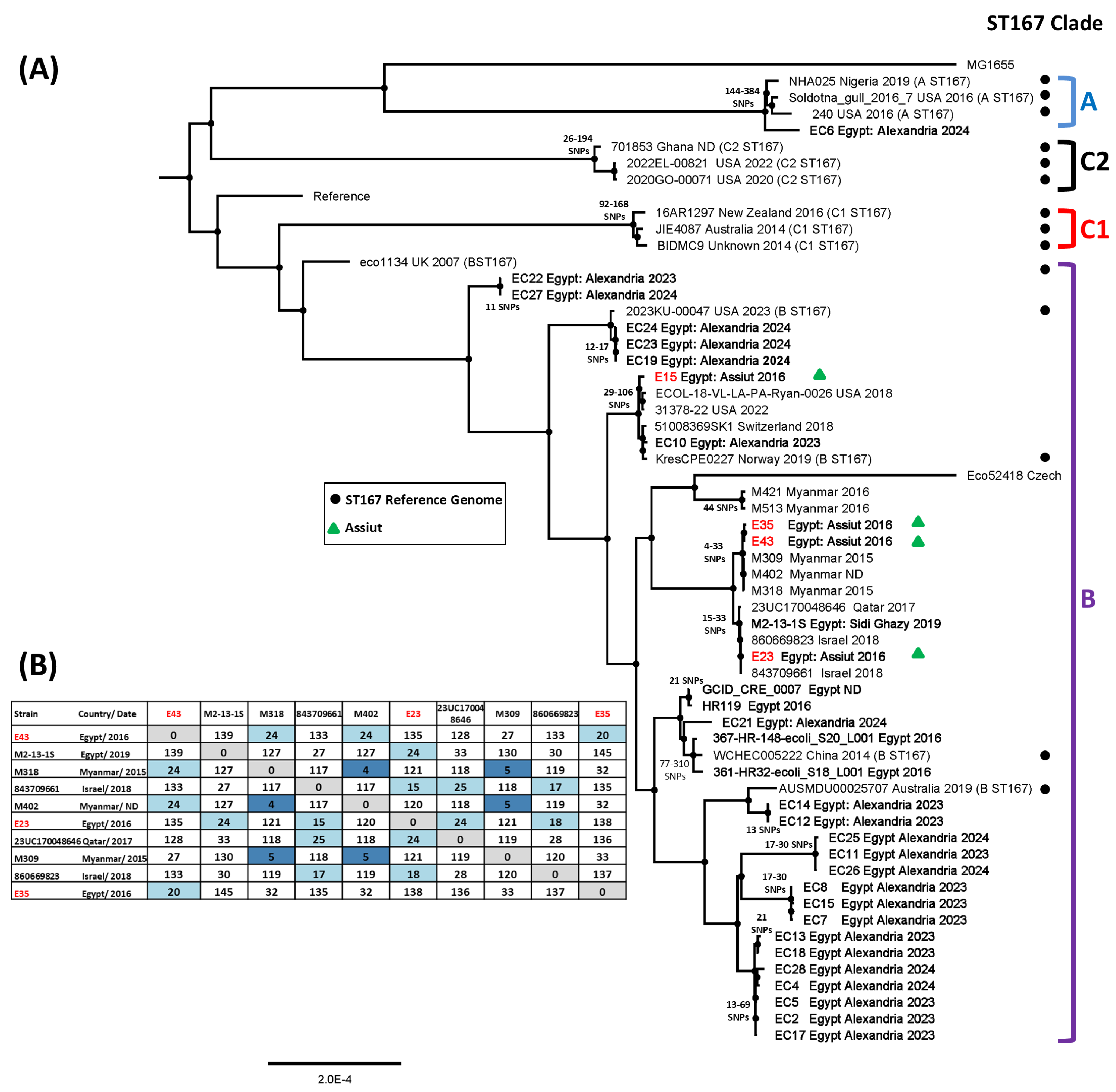
To understand more about E. coli strains isolated in Egypt, we consulted the Enterobase Database, which uses the NCBI Sequence Read Archive, to retrieve the draft genomes of sequenced Egyptian E. coli [35]. Using this approach, we identified 125 draft genomes, highlighting the limited genome sequencing of strains within Egypt. By combining this resource with data from published articles and the NCBI Pathogen Detection Browser [36], we were able to identify 32 ST167 and 8 ST410 Egyptian sequenced strains (Supplementary Tables S4 and S5, respectively). Recently, Walker et al. [39] proposed that E. coli ST167 could be classified into three major clades (A, B, and C), with clade C resolving into C1 and C2 subclades. SNP analysis, coupled with phylogenetic analysis, indicated that all but one Egyptian ST167 isolate belonged to clade B, clustering with previously identified clade B reference genomes [39] (Figure 4). SNP analysis also indicated that our ST167 isolates, E35 and E43, were closely related, being only separated by 20 SNPs (Figure 4B). Furthermore, isolate E23 was very similar to two Israeli E. coli (human isolates 843709661 and 860669823) isolated in Tel Aviv in 2015, differing by only 15 and 18 SNPs, respectively. It is of note that an SNP threshold of ≤25 SNPs has previously been suggested to be indicative of outbreak strains within hospital-based studies [41,64].
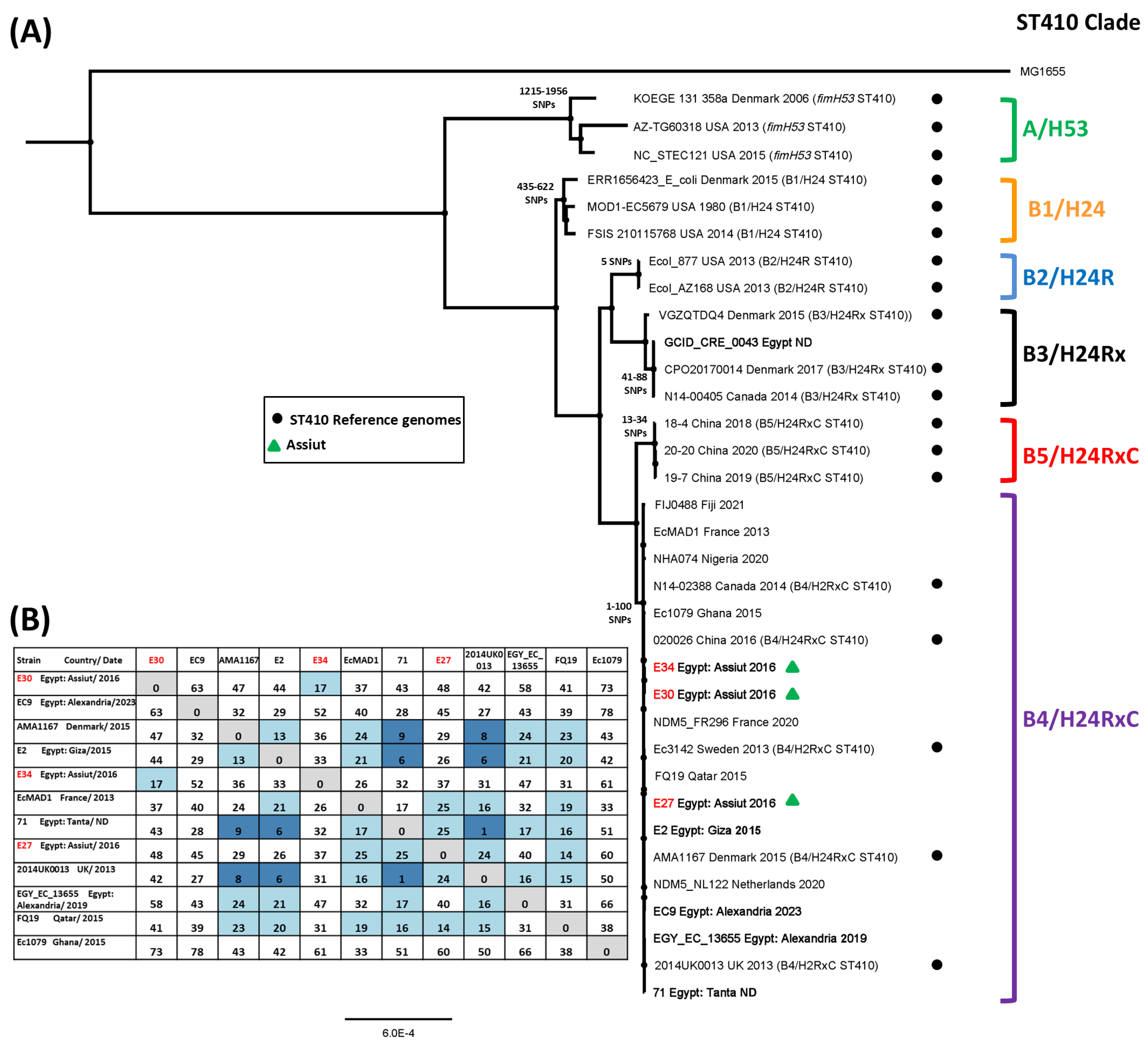
Sequence analysis of E. coli ST410 strains has indicted that the ST410 sequence type comprises two lineages: lineage A, carrying the fimH53 allele (i.e., A/H53), and lineage B, which possess fimH24 (B/H24) (Figure 5) [40,41]. Lineage B is divided into five subclades (i.e., clades B1/H24, B2/H24R, B3/H24Rx, B4/H24RxC, and B5/H24RxC), which are based on the sequential appearance of mutations in parC and gyrA, and the acquisition of various AMR genes (e.g., blaCTX-M-15 and blaOXA-181) and plasmids (e.g., IncX3) [40,41]. SNP analysis indicated that all but one Egyptian ST410 isolate belonged to the B4/H24RxC sub-lineage, clustering with previously identified B4/H24RxC reference genomes (Figure 5) [40]. Additionally, analysis indicated that ST410 isolates E30 and E34 were closely related, being separated by only 17 SNPs (Figure 5B). As previously suggested, isolate E27 was found to be very similar to French strain EcMAD1 (25 SNPs: source unknown) and Egyptian strain E2 (Giza: 26 SNPs: human isolate), as well as other human isolates from Egypt (e.g., strain 71 (Tanta): 25 SNPs), the UK (strain 2014UK0013: 24 SNPs), and Quatar (strain FQ19: 14 SNPs). Thus, our analysis supports our suggestion that some of our ST167 and ST410 isolates are very similar to other strains isolated in different countries.

4. Discussion

In this study, we characterised ten MDR E. coli strains isolated from infants and children with diarrhoea who were treated at the Outpatients Clinic of Assiut University Children’s Hospital in 2016 [16]. It is of note that none of our strains carried virulence determinants that are associated with diarrhoeagenic Escherichia coli pathotypes, such as EAEC, EPEC, EHEC, or ETEC [1,53,54]. Rather, they possessed virulence genes associated with the ExPEC pathotype (Supplementary Table S3), with many strains belonging to ExPEC-associated sequence types (i.e., ST167, ST410, and ST617) [40,43,44,45]. As ExPEC strains can colonize and persist in the human gastrointestinal tract without causing disease [65], it is unclear whether the strains we isolated are the cause of diarrhoea in these individuals. However, the human alimentary canal is considered the main reservoir for ExPEC infections [45,65,66]. In the case of UTIs, ExPEC transmission usually follows the faecal-to-perineal/vaginal-to-urethral route, with the possibility of bacteria crossing into the blood stream and causing bacteriemia and sepsis [65,66]. Thus, it is particularly alarming that carbapenem-resistant ExPEC strains were circulating in the paediatric population in Egypt at this time. Importantly, other ExPEC reservoirs include the environment (e.g., water, sewage, etc.), farm animals, meat products, and companion animals, and ExPEC ST167, ST410, and ST617 have all been isolated from such sources (Supplementary Tables S4 and S5) [15,67,68,69,70,71,72,73]. Thus, it is clear that a “One Health Approach”, which takes into consideration human/animal infection and environmental dissemination, is required for control of this pathotype [74].
Previously, we found that many of our original 50 isolates showed some resistance to a number of different classes of antibiotics; for example, 100% of isolates showed resistance to the cephalosporin ceftriaxone, 74% to the fluoroquinolone ciprofloxacin, and 98% to the aminoglycoside tobramycin [16]. In this study, we focused on the strains that possessed extreme MDR phenotypes, demonstrating that each isolate carried numerous ARGs (Table 1, Table 3 and Table S1), and that blaNDM or blaOXA carbapenemase genes were detected in six isolates. Thus, it is likely that treatment options for infections associated with these strains would be limited, though genome analysis suggests that they remain sensitive to fosfomycin, tigecycline, and colistin. Four of these CRE strains (i.e., E15, E23, E35, and E43) are high-risk ExPEC clones, being sequence type ST167, and all carried variants of the blaNDM carbapenemase (Figure 1 and Table 3) [43,44,45]. It is of note that the blaNDM-1 and blaNDM-5 alleles have been detected in Egyptian ST167 strains before [9,75]. In spite of the limitations of short-read genome sequencing, we propose that the blaNDM genes from strains E15 and E35 may be carried on large IncFIA-IncFII dual replicon plasmids, which is a common occurrence (Figure 3) [4,51,52,75]. Conversely, for strain E23, the blaNDM-19 carbapenemase gene was encoded on an IncX3 plasmid, pE23-NDM19 (Figure 2A). The NDM-19 carbapenemase was first characterised in 2019, differing from NDM-1 by three amino acid substitutions (i.e., D130N, M154L, and A233V) (Supplementary Figure S1) and conferring high-level resistance to third-generation cephalosporins and carbapenems under zinc-limited conditions, which are thought to prevail at infections sites [76,77]. Thus, its appearance is an important escalation in NDM evolution [77]. Like pE23-NDM19, early isolates carried the blaNDM-19 gene on conjugational IncX3 plasmids, e.g., pSCM96-2 (CP028718.1: 46,161 bp: human isolate), which was isolated in China in 2017, and pCH18-NDM-19 (MK091521: 48,737 bp: human isolate), which was isolated from an Egyptian patient in Switzerland in 2018 [76,77] (Figure 2A). As our strains predate the isolation of these first plasmids, it is clear that IncX3/blaNDM-19 plasmids were already present within the Egyptian population as early as 2016.
Three of our strains were sequence type ST410 (i.e., E27, E30, and E34), which is also considered a high-risk ExPEC clone [40,44,45]. Strain E27 carries the blaOXA-181 carbapenemase on a dual IncX3-ColKP3 plasmid pE27-OXA181, which was similar to plasmids isolated from ST410 strains in France, Egypt, and Ghana (i.e., pEcMAD2, pE2-OXA-181, and pEc1079_3) (Figure 2B and Figure S2) [10,49,50]. Additionally, the chromosomes of these strains (i.e., E2, EcMAD1, and Ec1079) are very similar to those of E27, E30, and E34, with only a few minor regions of difference (Supplementary Figure S3). Our analysis also suggests that these strains likely share additional plasmids. For example, both E27 and E34 carry a p0111 replicon (contigs 18: 92,130 bp and 16: 96,506 bp, respectively) (Table 2), which is also on plasmid pE2-2, carried by strain E2 (Giza/Egypt) (CP048917.1: 92,027 bp) [10] (Supplementary Figure S6). Furthermore, strains EcMAD1, E2, and Ec1079 also carry an IncFIA/IncFIB/IncFII multi-replicon plasmid (i.e., pEcMAD1, pE2-NDM-CTX-M, and pEc1079_1, respectively) that could be detected in the draft genomes of our three ST410 strains (Supplementary Figure S7). Thus, there seems to be a close relationship between these ST140 strains and the plasmids that they carry.
Although we were only able to identify a small number of Egyptian E. coli genomes during our database searches due to the limited genome sequencing that has taken place in Egypt, we were able to demonstrate that a considerable proportion of these strains were sequence type ST167 (Supplementary Table S4). SNP analysis indicated that the majority of Egyptian ST167 strains belonged to ST167 clade B (Figure 4), with many isolated in Alexandria between 2023 and 2024. Recently, Walker et al. [39] proposed that ST167 subclade C2 was a highly AMR resistant ST167 clone that was expanding in North America and had also been detected in Europe, Africa, and Asia. The absence of subclade C2 within Egyptian ST167 strains could indicate that this subclade has not established itself within the Egyptian population, or that it has not been detected due to the limited sample size of our study. Irrespective of this, SNP analysis indicated that Assiut strains E35 and E43 were closely related and E23 was very similar to a number of strains including two Israeli human isolates (843709661 and 860669823): strain 23UC170048646 from Qatar (human isolate) and strain M2-13-1, isolated from chicken faeces (Egypt: Sidi Ghazy) (Figure 4B and Table S6) [15]. Interestingly, these strains possess similar virulence and AMR profiles, and like E23, each harbours an IncX3 plasmid, likely carrying blaNDM-19 (Supplementary Table S6 and Figure S8). Thus, our analysis not only suggests that similar ST167 strains were circulating within Egypt and surrounding countries, but, as demonstrated by Soliman et al. [15], that they had entered the food chain, emphasising the need for a “One Health Approach” to combat AMR in Egypt [74].
With regard to the ST410 strains from our study, we were only able to identify eight Egyptian ST410, suggesting that ST410 is a lesser sequence type within Egypt (Supplementary Table S5). However, in spite of this, our analysis indicates that the majority of Egyptian ST410 strains fall within the ST410 B4/H24RxC sub-lineage and that Assiut strains E30 and E34 were closely related (Figure 5B). Additionally, strain E27 was highly similar to strains from Egypt (E2 (Giza) and 71 (Tanta)), France (EcMAD1), Quatar (FQ19), Denmark (AMA1167), and the UK (2014UK0013) (Figure 5). It is of note that the Danish strain AMA1167 is only separated from the Egyptian strains 71 and E2 by 9 and 14 SNPs, respectively. As AMA1167 was isolated from a patient that had travelled to Egypt, Roer et al. [40] postulated that its acquisition had taken place during that visit, though corroborating sequence data was lacking [78]. Our data lends credence to this hypothesis and their additional suggestion that a similar transition to the UK may have occurred [40,78].
Even though this study was limited by sequencing only a small number of our isolates and would have benefited by combining short-read sequencing with longer-read technologies to generate more complete genome assemblies [79,80], we have still been able to gain a snapshot of the MDR E. coli strains present in the paediatric population in Assiut in 2016. It is particularly concerning that, due to the lack of funding and routine sequencing in Egypt [81,82,83], it has taken considerable time for us to uncover that carbapenem-resistant high-risk ExPEC clones were present within the population during this time. Recently, the Egyptian government made considerable inroads into combating AMR with the release of various national guidelines for the rational use of antimicrobials (see [84,85] for examples). However, there is evidence that antibiotics can still be purchased in Egypt without a prescription [86,87,88], and there are cases of unnecessary prescribing, particularly of β-lactams [87,89]. Coupled with this, the increase in AMR resistance associated with humanitarian disasters in nearby places, such as Gaza, will likely continue to place a considerable burden on Egyptian resources [90,91,92]. Thus, it is clear that there is still a need for improved antimicrobial stewardship, infection control, and better surveillance of high-priority Gram-negative CREs to combat their spread in, and from, this geographical area.

Supplementary Materials

The following supporting information can be downloaded at: https://www.mdpi.com/article/10.3390/microorganisms14010247/s1, Figure S1: Comparison of E. coli plasmid pLAU-NDM19 with the draft genome of E. coli E23; Figure S2: Comparison of E. coli plasmid pEcMAD2 with the draft genome of E. coli E27; Figure S3: Comparison of E. coli EcMAD1 and E2 chromosomes with the draft genomes of E. coli E27, E30 and E34; Figure S4: Comparison of plasmid pM309-NDM5 with the draft genome of strain E35; Figure S5: Analysis of contigs 22 and 36 from E. coli strain E28; Figure S6: Comparison of E. coli plasmid pE2-2 with the draft genomes of E. coli E27 and E34; Figure S7: Analysis of plasmid pEcMAD1; Figure S8: Comparison of pE23-NDM19 with the genomes of E. coli strains 23UC170048646, 843709661, 860669823 and M2-13-1; Table S1: Antimicrobial susceptibility profile of the MDR E. coli strains isolated from children with diarrhoea at Assiut Children’s Hospital, Egypt; Table S2: Analysis of chromosomal point mutations associated with nalidixic acid and ciprofloxacin resistance carried by the E. coli strains used in this study; Table S3: Analysis of the potential virulence genes carried by the E. coli strains used in this study; Table S4: The E. coli ST167 genomes used for phylogenetic SNP analysis in this study; Table S5: E. coli ST410 genomes used for phylogenetic SNP analysis in this study; Table S6: Characterisation of E. coli ST167 strains related to Egyptian isolate E23. References [10,15,16,20,21,22,23,25,27,28,32,33,35,36,39,40,41,48,49,50,51,52,75,78,93,94,95,96] are cited in the supplementary materials.

Author Contributions

Conceptualization, E.A.H., E.H.A., N.H.A.-F., E.A.D., S.J.W.B. and D.F.B.; formal analysis, R.A., M.Y. and D.F.B.; investigation, R.A., M.M.A., M.Y. and D.F.B.; data curation, D.F.B.; writing—original draft preparation, D.F.B.; writing—review and editing, R.A., M.M.A., M.Y., E.A.H., E.H.A., N.H.A.-F., E.A.D., S.J.W.B. and D.F.B.; supervision, E.A.D., S.J.W.B. and D.F.B. All authors have read and agreed to the published version of the manuscript.

Funding

This work was generously supported by a studentship from the Egyptian Ministry of Higher Education (Cultural Affairs and Missions Sector) and the Grant Office from the Medical School, Assiut University to RA, and BBSRC research grants BB/R017689/1 (D.F.B. and S.J.W.B.) and BB/Y007603/1 (D.F.B.). M.M.A. was supported by a Princess Nourah bint Abdulrahman University Researchers Supporting Project (PNURSP2026R898), Princess Nourah bint Abdulrahman University, Riyadh, Saudi Arabia.

Institutional Review Board Statement

The study was conducted in accordance with the Declaration of Helsinki, and approved by the Assiut Faculty of Medicine Institutional Review Board of 04-2025-100401 (24 May 2016).

Informed Consent Statement

As stipulated by the Assiut Faculty of Medicine Institutional Review Board, Parental/Gurdian Consent was obtained for each sample, with elaboration that the stool sample be used to detect and isolate the causative organism, determine its antibiotic sensitivity, and investigate its properties was intended for research purposes only. No identifiable data was collected to link patients to any of the samples.

Data Availability Statement

This Whole Genome Shotgun project has been deposited at DDBJ/ENA/GenBank with the sequence data for E. coli strains (BioProject: PRJNA1298299) under the accession numbers: E4: JBQGXB000000000, E15: JBQGXA000000000, E23: JBQGWZ000000000, E27: JBQGWY000000000, E28: JBQGWX000000000, E29: JBQGWW000000000, E30: JBQGWV000000000, E34: JBQGWU000000000, E35: JBQGWT000000000 and E43: JBQGWS000000000.

Acknowledgments

We thank MicrobesNG for sequencing and genome annotation and Solu Genomics for advice on the phylogenetic analysis. M.M.A. is grateful to Princess Nourah bint Abdulrahman University Researchers Supporting Project (PNURSP2026R898), Princess Nourah bint Abdulrahman University, Riyadh, Saudi Arabia.

Conflicts of Interest

The authors declare no conflicts of interest.

References

  1. Kaper, J.B.; Nataro, J.P.; Mobley, H.L. Pathogenic Escherichia coli. Nat. Rev. Microbiol. 2004, 2, 123–140. [Google Scholar] [CrossRef]
  2. Riley, L.W. Distinguishing Pathovars from Nonpathovars: Escherichia coli. Microbiol. Spectr. 2020, 8, AME0014-2020. [Google Scholar] [CrossRef]
  3. Sati, H.; Carrara, E.; Savoldi, A.; Hansen, P.; Garlasco, J.; Campagnaro, E.; Boccia, S.; Castillo-Polo, J.A.; Magrini, E.; Garcia-Vello, P.; et al. The WHO Bacterial Priority Pathogens List 2024: A prioritisation study to guide research, development, and public health strategies against antimicrobial resistance. Lancet Infect. Dis. 2025, 25, 1033–1043. [Google Scholar] [CrossRef]
  4. Wu, W.; Feng, Y.; Tang, G.; Qiao, F.; McNally, A.; Zong, Z. NDM Metallo-β-Lactamases and Their Bacterial Producers in Health Care Settings. Clin. Microbiol. Rev. 2019, 32, e00115-18. [Google Scholar] [CrossRef] [PubMed]
  5. Kopotsa, K.; Osei Sekyere, J.; Mbelle, N.M. Plasmid evolution in carbapenemase-producing Enterobacteriaceae: A review. Ann. New York Acad. Sci. 2019, 1457, 61–91. [Google Scholar] [CrossRef] [PubMed]
  6. Tängdén, T.; Giske, C.G. Global dissemination of extensively drug-resistant carbapenemase-producing Enterobacteriaceae: Clinical perspectives on detection, treatment and infection control. J. Intern. Med. 2015, 277, 501–512. [Google Scholar] [CrossRef]
  7. Alkhudhairy, M.K.; Saki, M.; Seyed–Mohammadi, S.; Jomehzadeh, N.; Khoshnood, S.; Moradzadeh, M.; Yazdansetad, S. Integron frequency of Escherichia coli strains from patients with urinary tract infection in Southwest of Iran. J. Acute Dis. 2019, 8, 113–117. [Google Scholar] [CrossRef]
  8. Karlowsky, J.A.; Lob, S.H.; Kazmierczak, K.M.; Badal, R.E.; Young, K.; Motyl, M.R.; Sahm, D.F. In Vitro Activity of Imipenem against Carbapenemase-Positive Enterobacteriaceae Isolates Collected by the SMART Global Surveillance Program from 2008 to 2014. J. Clin. Microbiol. 2017, 55, 1638–1649. [Google Scholar] [CrossRef]
  9. Peirano, G.; Chen, L.; Nobrega, D.; Finn, T.J.; Kreiswirth, B.N.; DeVinney, R.; Pitout, J.D.D. Genomic Epidemiology of Global Carbapenemase-Producing Escherichia coli, 2015–2017. Emerg. Infect. Dis. 2022, 28, 924–931. [Google Scholar] [CrossRef] [PubMed]
  10. Gamal, D.; Fernández-Martínez, M.; El-Defrawy, I.; Ocampo-Sosa, A.A.; Martínez-Martínez, L. First identification of NDM-5 associated with OXA-181 in Escherichia coli from Egypt. Emerg. Microbes Infect. 2016, 5, e30. [Google Scholar] [CrossRef]
  11. Soliman, A.M.; Ramadan, H.; Sadek, M.; Nariya, H.; Shimamoto, T.; Hiott, L.M.; Frye, J.G.; Jackson, C.R.; Shimamoto, T. Draft genome sequence of a bla(NDM-1)- and bla(OXA-244)-carrying multidrug-resistant Escherichia coli D-ST69 clinical isolate from Egypt. J. Glob. Antimicrob. Resist. 2020, 22, 832–834. [Google Scholar] [CrossRef]
  12. Mohamed, N.M.; Zakaria, A.S.; Edward, E.A. Genomic Characterization of International High-Risk Clone ST410 Escherichia coli Co-Harboring ESBL-Encoding Genes and bla(NDM-5) on IncFIA/IncFIB/IncFII/IncQ1 Multireplicon Plasmid and Carrying a Chromosome-Borne bla(CMY-2) from Egypt. Antibiotics 2022, 11, 1031. [Google Scholar] [CrossRef]
  13. Braun, S.D.; Rezk, S.; Brandt, C.; Reinicke, M.; Diezel, C.; Müller, E.; Frankenfeld, K.; Krähmer, D.; Monecke, S.; Ehricht, R. Tracking Multidrug Resistance in Gram-Negative Bacteria in Alexandria, Egypt (2020-2023): An Integrated Analysis of Patient Data and Diagnostic Tools. Antibiotics 2024, 13, 1185. [Google Scholar] [CrossRef] [PubMed]
  14. Zakaria, A.S.; Edward, E.A.; Mohamed, N.M. Pathogenicity Islands in Uropathogenic Escherichia coli Clinical Isolate of the Globally Disseminated O25:H4-ST131 Pandemic Clonal Lineage: First Report from Egypt. Antibiotics 2022, 11, 1620. [Google Scholar] [CrossRef] [PubMed]
  15. Soliman, A.M.; Ramadan, H.; Shimamoto, T.; Komatsu, T.; Maruyama, F.; Shimamoto, T. Detection and Genomic Characteristics of NDM-19- and QnrS11-Producing O101:H5 Escherichia coli Strain Phylogroup A: ST167 from a Poultry Farm in Egypt. Microorganisms 2025, 13, 1769. [Google Scholar] [CrossRef]
  16. Abdelwahab, R.; Yasir, M.; Godfrey, R.E.; Christie, G.S.; Element, S.J.; Saville, F.; Hassan, E.A.; Ahmed, E.H.; Abu-Faddan, N.H.; Daef, E.A.; et al. Antimicrobial resistance and gene regulation in Enteroaggregative Escherichia coli from Egyptian children with diarrhoea: Similarities and differences. Virulence 2021, 12, 57–74. [Google Scholar] [CrossRef]
  17. Bolger, A.M.; Lohse, M.; Usadel, B. Trimmomatic: A flexible trimmer for Illumina sequence data. Bioinformatics 2014, 30, 2114–2120. [Google Scholar] [CrossRef]
  18. Wick, R.R.; Judd, L.M.; Gorrie, C.L.; Holt, K.E. Unicycler: Resolving bacterial genome assemblies from short and long sequencing reads. PLoS Comput. Biol. 2017, 13, e1005595. [Google Scholar] [CrossRef]
  19. Seemann, T. Prokka: Rapid prokaryotic genome annotation. Bioinformatics 2014, 30, 2068–2069. [Google Scholar] [CrossRef]
  20. Larsen, M.V.; Cosentino, S.; Rasmussen, S.; Friis, C.; Hasman, H.; Marvig, R.L.; Jelsbak, L.; Sicheritz-Ponten, T.; Ussery, D.W.; Aarestrup, F.M.; et al. Multilocus sequence typing of total-genome-sequenced bacteria. J. Clin. Microbiol. 2012, 50, 1355–1361. [Google Scholar] [CrossRef] [PubMed]
  21. Joensen, K.G.; Tetzschner, A.M.; Iguchi, A.; Aarestrup, F.M.; Scheutz, F. Rapid and Easy In Silico Serotyping of Escherichia coli Isolates by Use of Whole-Genome Sequencing Data. J. Clin. Microbiol. 2015, 53, 2410–2426. [Google Scholar] [CrossRef]
  22. Carattoli, A.; Zankari, E.; Garcia-Fernandez, A.; Voldby Larsen, M.; Lund, O.; Villa, L.; Moller Aarestrup, F.; Hasman, H. In silico detection and typing of plasmids using PlasmidFinder and plasmid multilocus sequence typing. Antimicrob. Agents Chemother. 2014, 58, 3895–3903. [Google Scholar] [CrossRef]
  23. Joensen, K.G.; Scheutz, F.; Lund, O.; Hasman, H.; Kaas, R.S.; Nielsen, E.M.; Aarestrup, F.M. Real-time whole-genome sequencing for routine typing, surveillance, and outbreak detection of verotoxigenic Escherichia coli. J. Clin. Microbiol. 2014, 52, 1501–1510. [Google Scholar] [CrossRef]
  24. Malberg Tetzschner, A.M.; Johnson, J.R.; Johnston, B.D.; Lund, O.; Scheutz, F. In Silico Genotyping of Escherichia coli Isolates for Extraintestinal Virulence Genes by Use of Whole-Genome Sequencing Data. J. Clin. Microbiol. 2020, 58, e01269-20. [Google Scholar] [CrossRef]
  25. Cosentino, S.; Voldby Larsen, M.; Møller Aarestrup, F.; Lund, O. PathogenFinder--distinguishing friend from foe using bacterial whole genome sequence data. PLoS ONE 2013, 8, e77302, Erratum in PLoS ONE. 2013, 8. [Google Scholar] [CrossRef]
  26. Ferrer Florensa, A.; Almagro Armenteros, J.J.; Kaas, R.S.; Conradsen Clausen, P.T.L.; Nielsen, H.; Rost, B.; Aarestrup, F.M. Whole-genome prediction of bacterial pathogenic capacity on novel bacteria using protein language models, with PathogenFinder2. bioRxiv 2025. [Google Scholar] [CrossRef]
  27. Bortolaia, V.; Kaas, R.S.; Ruppe, E.; Roberts, M.C.; Schwarz, S.; Cattoir, V.; Philippon, A.; Allesoe, R.L.; Rebelo, A.R.; Florensa, A.F.; et al. ResFinder 4.0 for predictions of phenotypes from genotypes. J. Antimicrob. Chemother. 2020, 75, 3491–3500. [Google Scholar] [CrossRef] [PubMed]
  28. Waters, N.R.; Abram, F.; Brennan, F.; Holmes, A.; Pritchard, L. Easy phylotyping of Escherichia coli via the EzClermont web app and command-line tool. Access Microbiol. 2020, 2, acmi000143. [Google Scholar] [CrossRef]
  29. Siguier, P.; Perochon, J.; Lestrade, L.; Mahillon, J.; Chandler, M. ISfinder: The reference centre for bacterial insertion sequences. Nucleic Acids Res. 2006, 34, D32–D36. [Google Scholar] [CrossRef]
  30. Arndt, D.; Grant, J.R.; Marcu, A.; Sajed, T.; Pon, A.; Liang, Y.; Wishart, D.S. PHASTER: A better, faster version of the PHAST phage search tool. Nucleic Acids Res. 2016, 44, W16–W21. [Google Scholar] [CrossRef] [PubMed]
  31. Rutherford, K.; Parkhill, J.; Crook, J.; Horsnell, T.; Rice, P.; Rajandream, M.A.; Barrell, B. Artemis: Sequence visualization and annotation. Bioinformatics 2000, 16, 944–945. [Google Scholar] [CrossRef] [PubMed]
  32. Grant, J.R.; Enns, E.; Marinier, E.; Mandal, A.; Herman, E.K.; Chen, C.Y.; Graham, M.; Van Domselaar, G.; Stothard, P. Proksee: In-depth characterization and visualization of bacterial genomes. Nucleic Acids Res. 2023, 51, W484–W492. [Google Scholar] [CrossRef] [PubMed]
  33. Carver, T.J.; Rutherford, K.M.; Berriman, M.; Rajandream, M.A.; Barrell, B.G.; Parkhill, J. ACT: The Artemis Comparison Tool. Bioinformatics 2005, 21, 3422–3423. [Google Scholar] [CrossRef]
  34. Pourmohsenin, B.; Wiese, A.; Ziemert, N. AutoMLST2: A web server for phylogeny and microbial taxonomy. Nucleic Acids Res 2025, 53, W45–W50. [Google Scholar] [CrossRef]
  35. Dyer, N.P.; Päuker, B.; Baxter, L.; Gupta, A.; Bunk, B.; Overmann, J.; Diricks, M.; Dreyer, V.; Niemann, S.; Holt, K.E.; et al. EnteroBase in 2025: Exploring the genomic epidemiology of bacterial pathogens. Nucleic Acids Res. 2025, 53, D757–D762. [Google Scholar] [CrossRef] [PubMed]
  36. The NCBI Pathogen Detection Project; National Center for Biotechnology Information: Bethesda, MD, USA; National Library of Medicine: Bethesda, MD, USA; National Institutes of Health: Bethesda, MD, USA, 2016. Available online: https://www.ncbi.nlm.nih.gov/pathogens/ (accessed on 9 November 2025).
  37. Saratto, T.; Visuri, K.; Lehtinen, J.; Ortega-Sanz, I.; Steenwyk, J.L.; Sihvonen, S. Solu: A cloud platform for real-time genomic pathogen surveillance. BMC Bioinform. 2025, 26, 12. [Google Scholar] [CrossRef]
  38. Minh, B.Q.; Schmidt, H.A.; Chernomor, O.; Schrempf, D.; Woodhams, M.D.; von Haeseler, A.; Lanfear, R. IQ-TREE 2: New Models and Efficient Methods for Phylogenetic Inference in the Genomic Era. Mol. Biol. Evol. 2020, 37, 1530–1534, Erratum in Mol. Biol. Evol. 2020, 37, 2461. [Google Scholar] [CrossRef]
  39. Walker, L.L.; Phan, M.D.; Permana, B.; Lian, Z.J.; Nhu, N.T.K.; Cuddihy, T.; Peters, K.M.; Ramsay, K.A.; Stewart, C.; Pfennigwerth, N.; et al. Emergence of a carbapenem-resistant atypical uropathogenic Escherichia coli clone as an increasing cause of urinary tract infection. Nat. Commun. 2025, 16, 8200. [Google Scholar] [CrossRef]
  40. Roer, L.; Overballe-Petersen, S.; Hansen, F.; Schønning, K.; Wang, M.; Røder, B.L.; Hansen, D.S.; Justesen, U.S.; Andersen, L.P.; Fulgsang-Damgaard, D.; et al. Escherichia coli Sequence Type 410 Is Causing New International High-Risk Clones. mSphere 2018, 3, e00337-18. [Google Scholar] [CrossRef]
  41. Ba, X.; Guo, Y.; Moran, R.A.; Doughty, E.L.; Liu, B.; Yao, L.; Li, J.; He, N.; Shen, S.; Li, Y.; et al. Global emergence of a hypervirulent carbapenem-resistant Escherichia coli ST410 clone. Nat. Commun. 2024, 15, 494. [Google Scholar] [CrossRef]
  42. Magiorakos, A.P.; Srinivasan, A.; Carey, R.B.; Carmeli, Y.; Falagas, M.E.; Giske, C.G.; Harbarth, S.; Hindler, J.F.; Kahlmeter, G.; Olsson-Liljequist, B.; et al. Multidrug-resistant, extensively drug-resistant and pandrug-resistant bacteria: An international expert proposal for interim standard definitions for acquired resistance. Clin. Microbiol. Infect. 2012, 18, 268–281. [Google Scholar] [CrossRef]
  43. Garcia-Fernandez, A.; Villa, L.; Bibbolino, G.; Bressan, A.; Trancassini, M.; Pietropaolo, V.; Venditti, M.; Antonelli, G.; Carattoli, A. Novel Insights and Features of the NDM-5-Producing Escherichia coli Sequence Type 167 High-Risk Clone. mSphere 2020, 5, e00269-20. [Google Scholar] [CrossRef] [PubMed]
  44. Huang, J.; Lv, C.; Li, M.; Rahman, T.; Chang, Y.F.; Guo, X.; Song, Z.; Zhao, Y.; Li, Q.; Ni, P.; et al. Carbapenem-resistant Escherichia coli exhibit diverse spatiotemporal epidemiological characteristics across the globe. Commun. Biol. 2024, 7, 51. [Google Scholar] [CrossRef] [PubMed]
  45. Manges, A.R.; Geum, H.M.; Guo, A.; Edens, T.J.; Fibke, C.D.; Pitout, J.D.D. Global Extraintestinal Pathogenic Escherichia coli (ExPEC) Lineages. Clin. Microbiol. Rev. 2019, 32, e00135-18. [Google Scholar] [CrossRef]
  46. Zankari, E.; Hasman, H.; Cosentino, S.; Vestergaard, M.; Rasmussen, S.; Lund, O.; Aarestrup, F.M.; Larsen, M.V. Identification of acquired antimicrobial resistance genes. J. Antimicrob. Chemother. 2012, 67, 2640–2644. [Google Scholar] [CrossRef]
  47. Machuca, J.; Ortiz, M.; Recacha, E.; Díaz-De-Alba, P.; Docobo-Perez, F.; Rodríguez-Martínez, J.M.; Pascual, Á. Impact of AAC(6′)-Ib-cr in combination with chromosomal-mediated mechanisms on clinical quinolone resistance in Escherichia coli. J. Antimicrob. Chemother. 2016, 71, 3066–3071. [Google Scholar] [CrossRef]
  48. Moussa, J.; Nassour, E.; Jisr, T.; El Chaar, M.; Tokajian, S. Characterization of bla(NDM-19)-producing IncX3 plasmid isolated from carbapenem-resistant Escherichia coli and Klebsiella pneumoniae. Heliyon 2024, 10, e29642. [Google Scholar] [CrossRef] [PubMed]
  49. Patiño-Navarrete, R.; Rosinski-Chupin, I.; Cabanel, N.; Gauthier, L.; Takissian, J.; Madec, J.Y.; Hamze, M.; Bonnin, R.A.; Naas, T.; Glaser, P. Stepwise evolution and convergent recombination underlie the global dissemination of carbapenemase-producing Escherichia coli. Genome Med. 2020, 12, 10. [Google Scholar] [CrossRef]
  50. Mahazu, S.; Prah, I.; Ayibieke, A.; Sato, W.; Hayashi, T.; Suzuki, T.; Iwanaga, S.; Ablordey, A.; Saito, R. Possible Dissemination of Escherichia coli Sequence Type 410 Closely Related to B4/H24RxC in Ghana. Front. Microbiol. 2021, 12, 770130. [Google Scholar] [CrossRef]
  51. Chudejova, K.; Kraftova, L.; Mattioni Marchetti, V.; Hrabak, J.; Papagiannitsis, C.C.; Bitar, I. Genetic Plurality of OXA/NDM-Encoding Features Characterized From Enterobacterales Recovered From Czech Hospitals. Front. Microbiol. 2021, 12, 641415. [Google Scholar] [CrossRef]
  52. Sugawara, Y.; Akeda, Y.; Hagiya, H.; Sakamoto, N.; Takeuchi, D.; Shanmugakani, R.K.; Motooka, D.; Nishi, I.; Zin, K.N.; Aye, M.M.; et al. Spreading Patterns of NDM-Producing Enterobacteriaceae in Clinical and Environmental Settings in Yangon, Myanmar. Antimicrob. Agents Chemother. 2019, 63, e01924-18. [Google Scholar] [CrossRef]
  53. Jomehzadeh, N.; Ahmadi, K.; Javaherizadeh, H.; Afzali, M. The first evaluation relationship of integron genes and the multidrug-resistance in class A ESBLs genes in enteropathogenic Escherichia coli strains isolated from children with diarrhea in Southwestern Iran. Mol. Biol. Rep. 2021, 48, 307–313. [Google Scholar] [CrossRef] [PubMed]
  54. Jomezadeh, N.; Farajzadeh Sheikh, A.; Khosravi, A.D.; Amin, M. Detection of Shiga Toxin Producing E. coli Strains Isolated from Stool Samples of Patients with Diarrhea in Abadan Hospitals, Iran. J. Biol. Sci. 2009, 9, 820–824. [Google Scholar] [CrossRef]
  55. Lund, P.; Tramonti, A.; De Biase, D. Coping with low pH: Molecular strategies in neutralophilic bacteria. FEMS Microbiol. Rev. 2014, 38, 1091–1125. [Google Scholar] [CrossRef]
  56. Johnson, T.J.; Wannemuehler, Y.M.; Nolan, L.K. Evolution of the iss gene in Escherichia coli. Appl. Environ. Microbiol. 2008, 74, 2360–2369. [Google Scholar] [CrossRef]
  57. Lima, I.F.N.; Boisen, N.; Silva, J.D.Q.; Havt, A.; de Carvalho, E.B.; Soares, A.M.; Lima, N.L.; Mota, R.M.S.; Nataro, J.P.; Guerrant, R.L.; et al. Prevalence of enteroaggregative Escherichia coli and its virulence-related genes in a case-control study among children from north-eastern Brazil. J. Med. Microbiol. 2013, 62, 683–693. [Google Scholar] [CrossRef]
  58. Ageorges, V.; Monteiro, R.; Leroy, S.; Burgess, C.M.; Pizza, M.; Chaucheyras-Durand, F.; Desvaux, M. Molecular determinants of surface colonisation in diarrhoeagenic Escherichia coli (DEC): From bacterial adhesion to biofilm formation. FEMS Microbiol. Rev. 2020, 44, 314–350. [Google Scholar] [CrossRef]
  59. Pramoonjago, P.; Kaneko, M.; Kinoshita, T.; Ohtsubo, E.; Takeda, J.; Hong, K.S.; Inagi, R.; Inoue, K. Role of TraT protein, an anticomplementary protein produced in Escherichia coli by R100 factor, in serum resistance. J. Immunol. 1992, 148, 827–836. [Google Scholar] [CrossRef] [PubMed]
  60. Garénaux, A.; Caza, M.; Dozois, C.M. The Ins and Outs of siderophore mediated iron uptake by extra-intestinal pathogenic Escherichia coli. Vet. Microbiol. 2011, 153, 89–98. [Google Scholar] [CrossRef]
  61. Boisen, N.; Østerlund, M.T.; Joensen, K.G.; Santiago, A.E.; Mandomando, I.; Cravioto, A.; Chattaway, M.A.; Gonyar, L.A.; Overballe-Petersen, S.; Stine, O.C.; et al. Redefining enteroaggregative Escherichia coli (EAEC): Genomic characterization of epidemiological EAEC strains. PLoS Neglected Trop. Dis. 2020, 14, e0008613. [Google Scholar] [CrossRef]
  62. Skjøt-Rasmussen, L.; Ejrnæs, K.; Lundgren, B.; Hammerum, A.M.; Frimodt-Møller, N. Virulence factors and phylogenetic grouping of Escherichia coli isolates from patients with bacteraemia of urinary tract origin relate to sex and hospital- vs. community-acquired origin. Int. J. Med. Microbiol. 2012, 302, 129–134. [Google Scholar] [CrossRef] [PubMed]
  63. Rodriguez-Siek, K.E.; Giddings, C.W.; Doetkott, C.; Johnson, T.J.; Fakhr, M.K.; Nolan, L.K. Comparison of Escherichia coli isolates implicated in human urinary tract infection and avian colibacillosis. Microbiology 2005, 151, 2097–2110. [Google Scholar] [CrossRef]
  64. Gorrie, C.L.; Da Silva, A.G.; Ingle, D.J.; Higgs, C.; Seemann, T.; Stinear, T.P.; Williamson, D.A.; Kwong, J.C.; Grayson, M.L.; Sherry, N.L.; et al. Key parameters for genomics-based real-time detection and tracking of multidrug-resistant bacteria: A systematic analysis. Lancet Microbe. 2021, 2, e575–e583. [Google Scholar] [CrossRef] [PubMed]
  65. Manges, A.R.; Johnson, J.R. Reservoirs of Extraintestinal Pathogenic Escherichia coli. Microbiol. Spectr. 2015, 3, UTI-0006-2012. [Google Scholar] [CrossRef]
  66. Yamamoto, S.; Tsukamoto, T.; Terai, A.; Kurazono, H.; Takeda, Y.; Yoshida, O. Genetic evidence supporting the fecal-perineal-urethral hypothesis in cystitis caused by Escherichia coli. J. Urol. 1997, 157, 1127–1129. [Google Scholar] [CrossRef]
  67. Tavares, R.D.S.; Tacão, M.; Figueiredo, A.S.; Duarte, A.S.; Esposito, F.; Lincopan, N.; Manaia, C.M.; Henriques, I. Genotypic and phenotypic traits of bla(CTX-M)-carrying Escherichia coli strains from an UV-C-treated wastewater effluent. Water Res. 2020, 184, 116079. [Google Scholar] [CrossRef]
  68. Magaña-Lizárraga, J.A.; Gómez-Gil, B.; Rendón-Maldonado, J.G.; Delgado-Vargas, F.; Vega-López, I.F.; Báez-Flores, M.E. Genomic Profiling of Antibiotic-Resistant Escherichia coli Isolates from Surface Water of Agricultural Drainage in North-Western Mexico: Detection of the International High-Risk Lineages ST410 and ST617. Microorganisms 2022, 10, 662. [Google Scholar] [CrossRef]
  69. Giufré, M.; Accogli, M.; Graziani, C.; Busani, L.; Cerquetti, M. Whole-Genome Sequences of Multidrug-Resistant Escherichia coli Strains Sharing the Same Sequence Type (ST410) and Isolated from Human and Avian Sources in Italy. Genome Announc. 2015, 3, e00757-15. [Google Scholar] [CrossRef]
  70. Hayer, S.S.; Lim, S.; Hong, S.; Elnekave, E.; Johnson, T.; Rovira, A.; Vannucci, F.; Clayton, J.B.; Perez, A.; Alvarez, J. Genetic Determinants of Resistance to Extended-Spectrum Cephalosporin and Fluoroquinolone in Escherichia coli Isolated from Diseased Pigs in the United States. mSphere 2020, 5, e00990-20. [Google Scholar] [CrossRef]
  71. Lee, S.; An, J.U.; Guk, J.H.; Song, H.; Yi, S.; Kim, W.H.; Cho, S. Prevalence, Characteristics and Clonal Distribution of Extended-Spectrum β-Lactamase- and AmpC β-Lactamase-Producing Escherichia coli Following the Swine Production Stages, and Potential Risks to Humans. Front. Microbiol. 2021, 12, 710747. [Google Scholar] [CrossRef]
  72. Haley, B.J.; Kim, S.W.; Salaheen, S.; Hovingh, E.; Van Kessel, J.A.S. Virulome and genome analyses identify associations between antimicrobial resistance genes and virulence factors in highly drug-resistant Escherichia coli isolated from veal calves. PLoS ONE 2022, 17, e0265445. [Google Scholar] [CrossRef] [PubMed]
  73. Nittayasut, N.; Yindee, J.; Boonkham, P.; Yata, T.; Suanpairintr, N.; Chanchaithong, P. Multiple and High-Risk Clones of Extended-Spectrum Cephalosporin-Resistant and bla(NDM-5)-Harbouring Uropathogenic Escherichia coli from Cats and Dogs in Thailand. Antibiotics 2021, 10, 1374. [Google Scholar] [CrossRef]
  74. Aslam, B.; Khurshid, M.; Arshad, M.I.; Muzammil, S.; Rasool, M.; Yasmeen, N.; Shah, T.; Chaudhry, T.H.; Rasool, M.H.; Shahid, A.; et al. Antibiotic Resistance: One Health One World Outlook. Front. Cell. Infect. Microbiol. 2021, 11, 771510, Erratum in Front. Cell. Infect. 2024, 14, 1488430. [Google Scholar] [CrossRef] [PubMed]
  75. Li, L.; Zhang, Y.; Guo, H.; Yang, J.; He, F. Genomic insights into a bla(NDM-5)-carrying Escherichia coli ST167 isolate recovered from faecal sample of a healthy individual in China. J. Glob. Antimicrob. Resist. 2024, 36, 240–243. [Google Scholar] [CrossRef]
  76. Liu, Y.; Zhang, H.; Zhang, X.; Jiang, N.; Zhang, Z.; Zhang, J.; Zhu, B.; Wang, G.; Zhao, K.; Zhou, Y. Characterization of an NDM-19-producing Klebsiella pneumoniae strain harboring 2 resistance plasmids from China. Diagn. Microbiol. Infect. Dis. 2019, 93, 355–361. [Google Scholar] [CrossRef]
  77. Mancini, S.; Keller, P.M.; Greiner, M.; Bruderer, V.; Imkamp, F. Detection of NDM-19, a novel variant of the New Delhi metallo-β-lactamase with increased carbapenemase activity under zinc-limited conditions, in Switzerland. Diagn. Microbiol. Infect. Dis. 2019, 95, 114851. [Google Scholar] [CrossRef]
  78. Overballe-Petersen, S.; Roer, L.; Ng, K.; Hansen, F.; Justesen, U.S.; Andersen, L.P.; Stegger, M.; Hammerum, A.M.; Hasman, H. Complete Nucleotide Sequence of an Escherichia coli Sequence Type 410 Strain Carrying bla(NDM-5) on an IncF Multidrug Resistance Plasmid and bla(OXA-181) on an IncX3 Plasmid. Genome Announc. 2018, 6, e01542-17. [Google Scholar] [CrossRef]
  79. Oh, S.; Nam, S.K.; Chang, H.E.; Park, K.U. Comparative Analysis of Short- and Long-Read Sequencing of Vancomycin-Resistant Enterococci for Application to Molecular Epidemiology. Front. Cell. Infect. Microbiol. 2022, 12, 857801. [Google Scholar] [CrossRef]
  80. Therrien, D.A.; Konganti, K.; Gill, J.J.; Davis, B.W.; Hillhouse, A.E.; Michalik, J.; Cross, H.R.; Smith, G.C.; Taylor, T.M.; Riggs, P.K. Complete Whole Genome Sequences of Escherichia coli Surrogate Strains and Comparison of Sequence Methods with Application to the Food Industry. Microorganisms 2021, 9, 608. [Google Scholar] [CrossRef]
  81. Hammad, H.A.; Abdelwahab, R.; Browning, D.F.; Aly, S.A. Genome Characterization of Carbapenem-Resistant Hypervirulent Klebsiella pneumoniae Strains, Carrying Hybrid Resistance-Virulence IncHI1B/FIB Plasmids, Isolated from an Egyptian Pediatric ICU. Microorganisms 2025, 13, 1058. [Google Scholar] [CrossRef]
  82. Bizri, A.R.; El-Fattah, A.A.; Bazaraa, H.M.; Al Ramahi, J.W.; Matar, M.; Ali, R.A.N.; El Masry, R.; Moussa, J.; Abbas, A.J.A.; Aziz, M.A. Antimicrobial resistance landscape and COVID-19 impact in Egypt, Iraq, Jordan, and Lebanon: A survey-based study and expert opinion. PLoS ONE 2023, 18, e0288550. [Google Scholar] [CrossRef]
  83. El-Kholy, A.; El-Mahallawy, H.A.; Elsharnouby, N.; Abdel Aziz, M.; Helmy, A.M.; Kotb, R. Landscape of Multidrug-Resistant Gram-Negative Infections in Egypt: Survey and Literature Review. Infect. Drug Resist. 2021, 14, 1905–1920. [Google Scholar] [CrossRef]
  84. Egyptian_Drug_Authority. National Guidance for the Rational Use of Duplicate Antimicrobial Therapy. Available online: https://www.edaegypt.gov.eg/media/yvsalsgc/national-guidance-for-the-rational-use-of-duplicate.pdf (accessed on 9 November 2025).
  85. Egyptian_Drug_Authority. National Guidelines for Preauthorization of Restricted Antimicrobials in Hospitals National Antimicrobial Rational Use Committee. Available online: https://www.edaegypt.gov.eg/media/0suhvkon/edrex-gl-cap-care-012-national-guidelines-for-preauthorization-of-restricted-antimicrobials-in-hospitals-2022-1-_.pdf (accessed on 9 November 2025).
  86. Scicluna, E.A.; Borg, M.A.; Gür, D.; Rasslan, O.; Taher, I.; Redjeb, S.B.; Elnassar, Z.; Bagatzouni, D.P.; Daoud, Z. Self-medication with antibiotics in the ambulatory care setting within the Euro-Mediterranean region; results from the ARMed project. J. Infect. Public Health 2009, 2, 189–197. [Google Scholar] [CrossRef]
  87. Hafez, H.; Rakab, M.S.; Elshehaby, A.; Gebreel, A.I.; Hany, M.; BaniAmer, M.; Sajed, M.; Yunis, S.; Mahmoud, S.; Hamed, M.; et al. Pharmacies and use of antibiotics: A cross sectional study in 19 Arab countries. Antimicrob. Resist. Infect. Control 2024, 13, 104. [Google Scholar] [CrossRef]
  88. Elkhadry, S.W.; Tahoon, M.A.H. Health literacy and its association with antibiotic use and knowledge of antibiotic among Egyptian population: Cross sectional study. BMC Public Health 2024, 24, 2508. [Google Scholar] [CrossRef]
  89. Dooling, K.L.; Kandeel, A.; Hicks, L.A.; El-Shoubary, W.; Fawzi, K.; Kandeel, Y.; Etman, A.; Lohiniva, A.L.; Talaat, M. Understanding Antibiotic Use in Minya District, Egypt: Physician and Pharmacist Prescribing and the Factors Influencing Their Practices. Antibiotics 2014, 3, 233–243. [Google Scholar] [CrossRef] [PubMed]
  90. Moussally, K.; Abu-Sittah, G.; Gomez, F.G.; Fayad, A.A.; Farra, A. Antimicrobial resistance in the ongoing Gaza war: A silent threat. Lancet 2023, 402, 1972–1973. [Google Scholar] [CrossRef]
  91. Kumar, R.; Tanous, O.; Mills, D.; Wispelwey, B.; Asi, Y.; Hammoudeh, W.; Dewachi, O. Antimicrobial resistance in a protracted war setting: A review of the literature from Palestine. mSystems 2025, 10, e0167924. [Google Scholar] [CrossRef]
  92. El Aila, N.A.; El Aish, K.I.A. Six-year antimicrobial resistance patterns of Escherichia coli isolates from different hospitals in Gaza, Palestine. BMC Microbiol. 2025, 25, 559. [Google Scholar] [CrossRef] [PubMed]
  93. CLSI Document M100-S24; Performance Standards for Antimicrobial Susceptibility Testing. Twenty-Fourth Informational Supplement. Clinical and Laboratory Standards Institute (CLSI): Wayne, PA, USA, 2014; Volume 34.
  94. Feng, Y.; Liu, L.; Lin, J.; Ma, K.; Long, H.; Wei, L.; Xie, Y.; McNally, A.; Zong, Z. Key evolutionary events in the emergence of a globally disseminated, carbapenem resistant clone in the Escherichia coli ST410 lineage. Commun. Biol. 2019, 2, 322. [Google Scholar] [CrossRef] [PubMed]
  95. Souvorov, A.; Agarwala, R.; Lipman, D.J. SKESA: Strategic k-mer extension for scrupulous assemblies. Genome Biol. 2018, 19, 153. [Google Scholar] [CrossRef]
  96. Hawkey, J.; Loftus, M.J.; Prasad, A.; Vakatawa, T.; Prasad, V.; Tudravu, L.; Pragastis, K.; Wisniewski, J.; Harshegyi-Hand, T.; Blakeway, L.; et al. Genomic diversity of clinically relevant bacterial pathogens from an acute care hospital in Suva, Fiji. JAC-Antimicrob. Resist. 2025, 7, dlaf058. [Google Scholar] [CrossRef] [PubMed]
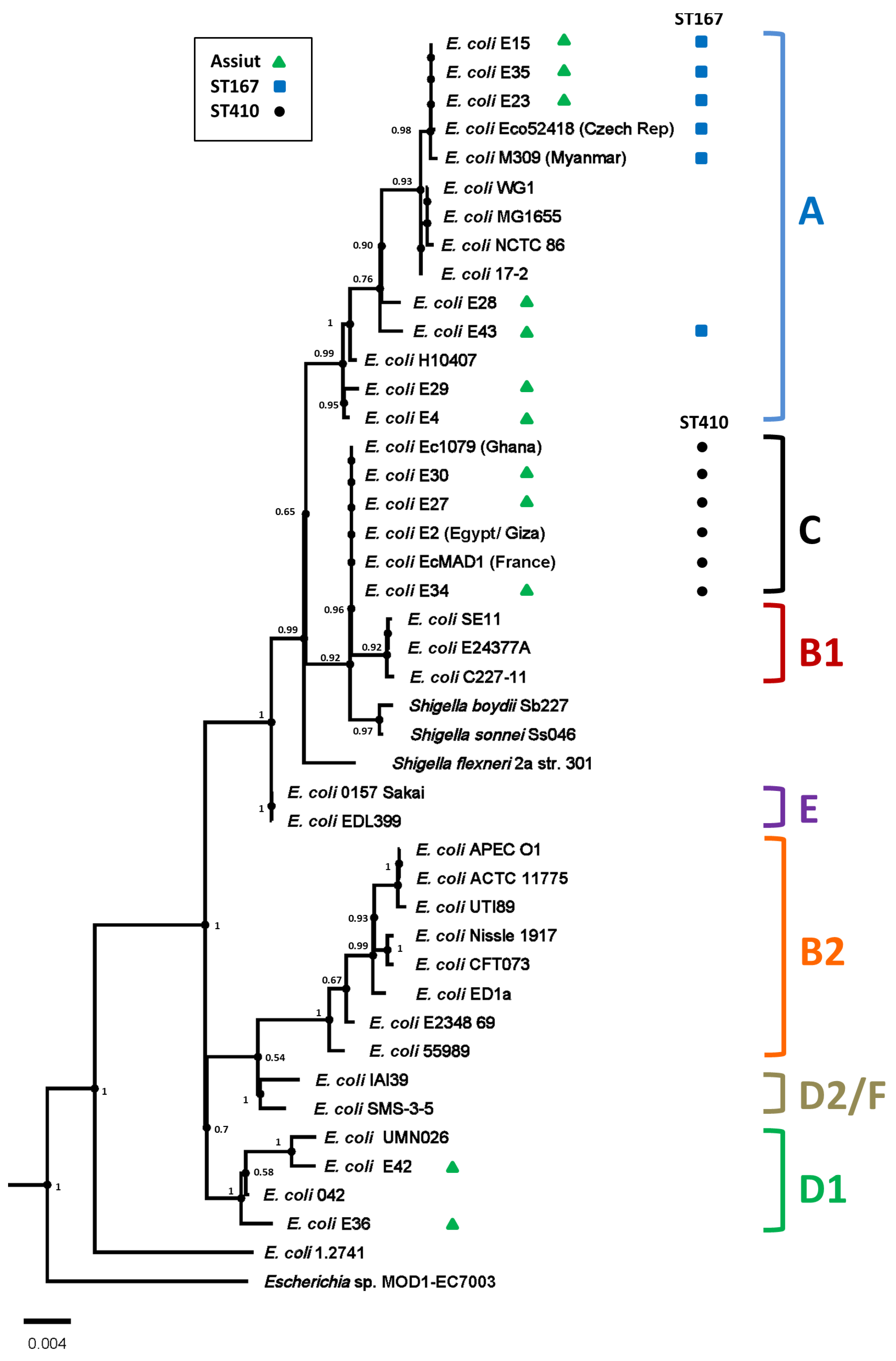
Figure 1. Phylogenetic analysis of the E. coli strains isolated in this study. The figure shows a phylogenetic tree of various E. coli strains, highlighting the position of the strains investigated in this study (green triangles). The tree was reconstructed from the strains in Abdelwahab et al. [16] using AutoMLST2.0 (https://automlst2.ziemertlab.com/ (accessed on 8 November 2025)) [34]. The various E. coli phylotypes are indicated, and sequence types ST167 and ST410 are indicated by blue squares and black dots, respectively. The probability of specific branch points, as defined by AutoMLST2, are also given.
Microorganisms 14 00247 g001
Figure 2. Analysis of the IncX3 plasmids carried by E. coli isolates E23 and E27. (A) The panel shows the comparison of pE23-NDM19 (E23 contig 27: 46,073 bp) with plasmids pLAU-NDM19 (CP074195.1; 47,332 bp: human isolate) [48], pCH18-NDM-19 (MK091521: 48,737 bp: human isolate) and pSCM96-2 (CP028718.1: 46,161 bp: human isolate) using ProkSee [32]. The genes (CDS) of pE23-NDM19 are displayed in the outer rings, with the location of blaNDM-19 and the IncX3 replicon indicated by arrows. The green, brown, and purple rings depict the BLAST results when the sequences of pLAU-NDM19, pCH18-NDM-19, and pSCM96-2 are compared with pE23-NDM19. (B) The panel shows the comparison of pE27-OXA181 (E27 contig 22: 48,979 bp) with plasmids pEcMAD2 (LR595693.1: 51,479 bp: source unknown) [49], pE2-OXA-181 (CP048918.1: 51,479 bp: human isolate) [10] and pEc1079_3 (CP081309.1: 51,479 bp: human isolate) [50] using ProkSee [32]. The genes (CDS) of pE27-OXA181 are displayed in the outer rings, with the location of blaOXA-181 and the IncX3 and ColKP3 replicons indicated by arrows. The green, brown, and purple rings depict the BLAST results when the sequences of pEcMAD2, pE2-OXA-181, and pEc1079_3 are compared with pE27-OXA181.
Microorganisms 14 00247 g002
Figure 3. Analysis of IncF plasmids carrying blaNDM-5 carbapenemase genes in E. coli isolates E15 and E35. (A) Comparison of E. coli Eco52148 plasmid p52148_NDM5 with the draft genome of E15. The panel shows the comparison of p52148_NDM5 (CP050384.1: 121,872 bp: human isolate) [51] with the draft genome of E15 and E15 contigs 38 (16,561 bp) and 40 (14,118 bp), using ProkSee [32]. The outer two rings display the genes of p52148_NDM5 (CDS) on both strands. The green, brown, and light brown rings illustrate the BLAST results when the E15 draft genome and contigs 38 and 40, respectively, are compared to p52148_NDM5. The location of the blaNDM-5, mphA, sul1, aadA2, dfrA12, and tetA AMR genes and the IncFII and IncFIA plasmid replicons are shown. (B) Comparison of plasmid pM309-NDM5 with the draft genome sequence of E. coli isolate E35. The figure shows the comparison of pM309-NDM5 (AP018833.1: 136,947 bp: human isolate) [52] with the draft genome of E35, using ProkSee [32]. The genes (CDS) of pM309-NDM5 are displayed in the outer rings, with the location of the various AMR genes (including blaNDM-5) and plasmid replicons (IncFIA and IncFII) indicated. The green ring depicts the BLAST results when the E35 draft genome is compared with pM309-NDM5.
Microorganisms 14 00247 g003aMicroorganisms 14 00247 g003b
Figure 4. SNP analysis of the E. coli ST167 strains isolated in this study. (A) The panel shows a phylogenetic tree of various ST167 E. coli strains, highlighting the position of the ST167 strains investigated in this study (green triangles). The tree was reconstructed from SNP analysis of the ST167 strains in Supplementary Table S4. The ST167 clades proposed by Walker et al. [39] are indicated, and reference genomes from that study are used to highlight the position of clades A, B, C1, and C2 (indicated by black dots). The names of the 31 Egyptian ST167 are in bold. The range of SNP differences is also given at selected branch points in the tree. ND: no date. (B) A SNP distance table showing the pairwise SNP differences for selected strains from (A). Light blue shading indicates SNP differences between 25 and 10, and dark blue shading denotes SNP differences below 10.
Microorganisms 14 00247 g004
Figure 5. SNP analysis of the E. coli ST410 strains isolated in this study. (A) The panel shows a phylogenetic tree of various ST410 E. coli strains, highlighting the position of the ST410 strains investigated in this study (green triangles). The tree was reconstructed from SNP analysis of the ST410 strains in Supplementary Table S5. The ST410 clades proposed by Roer et al. [40] and Ba et al. [41] are indicated, and reference genomes from these studies are used to highlight the position of clades B1/H24, B2/H24R, B3/H24Rx, B4/H24RxC, and B5/H24RxC) (indicated by black dots). The names of the eight Egyptian ST410 strains are in bold. The range of SNP differences is also given at selected branch points in the tree. ND: no date. (B) A SNP distance table showing the pairwise SNP differences for selected strains from (A). Light blue shading indicates SNP differences between 25 and 10, and dark blue shading denotes SNP differences below 10.
Microorganisms 14 00247 g005
Table 1. Analysis of the draft genomes and AMR profiles of the E. coli strains isolated in this study.
StrainGenome SizeNumber of Contigs Genes (CDS)Sequence Type a Serotype bPhylotype cAMR Profile d
E44,823,577 bp1074618ST46O8:H4A1, 2, 3, 4, 5 *, 6, 7
E155,004,224 bp1234669ST167O101:H9A1, 2, 3, 4, 5, 6, 7
E234,937,645 bp1374621ST167 O101:H5A1, 2, 3, 4, 5, 6, 7
E275,007,556 bp1094719ST410 O8:H9C1, 2, 3, 4, 5, 6, 7
E285,025,348 bp2094697ST617O101:H10A1, 2, 3, 4, 5, 6, 7
E294,959,121 bp1094676ST361O9:H30A1 *, 2, 3, 4, 5, 6, 7
E304,842,681 bp1054531ST410 O8:H9C1 *, 2, 3, 4, 5, 6, 7
E344,954,276 bp704648ST410 O8:H9C1 *, 2, 3, 4, 5, 6, 7
E355,039,562 bp1784717ST167O101:H5A1, 2, 3, 4, 5, 6, 7
E434,921,700 bp1544588ST167O101:H5A1 *, 2, 3, 4, 5, 6, 7
Software at CGE was used to identify: a the sequence type [20] and b the serotype [21] of each strain. c The phylotype of each strain was determined using the EzClermont in silico Clermont phylotyper [28]. d Key: 1, carbapenem resistance; 2, cephalosporin resistance; 3, penicillin resistance; 4, quinolone resistance; 5, aminoglycoside resistance; 6, tetracycline resistance; 7, trimethoprim sulfonamide resistance. * Intermediate resistance (see Supplementary Table S1). Data on the resistance profile of each strain was previously presented in Abdelwahab et al. [16].
Table 2. Analysis of plasmid replicons detected in the draft genomes of the E. coli strains isolated in this study.
Detected Plasmid Replicons a
StrainIncFIAIncFIBIncFIIIncIIncQ1IncYIncX3p0111Col440IICol(BS512)ColKP3Col(MG828)Number of Replicons
E4 1
E15 3
E23 4
E27 7
E28 b 6
E29 4
E30 4
E34 5
E35 4
E43 3
a Plasmid replicons were identified using PlasmidFinder software at CGE [22]. Black shading indicates the presence of that replicon. b Note that strain E28 possesses two IncFII replicons.
Table 3. Analysis of AMR genes detected in the draft genomes of E. coli strains isolated from children at Assiut Children’s Hospital Outpatients Clinic.
Detected AMR Resistance Genes a
blaCTX-M-15blaCMY-2blaCMY-42blaNDM-1blaNDM-5blaNDM-19blaOXA-1blaOXA-9blaOXA-181blaOXA-244blaTEM-1BqnrS1aac(3)-IIdaac(6′)-Ib-craadA1aadA2aadA5aph(3′)-Iaaph(3″)-Ibaph(6)-IdrmtBmph(A)sul1sul2dfrA1dfrA12dfrA14dfrA17tet(A)tet(B)catB3Total ARG
E4 9
E15 12
E23 8
E27 10
E28 8
E29 9
E30 12
E34 14
E35 11
E43 12
a The AMR genes carried by each strain were identified using ResFinderFG 4.7.2 software at CGE [27]. Carbapenemase genes are highlighted in red.
Disclaimer/Publisher’s Note: The statements, opinions and data contained in all publications are solely those of the individual author(s) and contributor(s) and not of MDPI and/or the editor(s). MDPI and/or the editor(s) disclaim responsibility for any injury to people or property resulting from any ideas, methods, instructions or products referred to in the content.