


Abstract
Biofilm formation represents a key survival strategy employed by Vibrio cholerae to adapt to the complex intestinal environment of the host. While most previous studies on V. cholerae biofilms have focused on genetic regulation and monospecies cultures, its ability to form dual-species biofilms with other intestinal pathogens is still poorly understood. In this study, using samples from both cholera patients and healthy individuals, Fusobacterium nucleatum was identified as a bacterium capable of co-aggregating with V. cholerae. Untargeted metabolomic analysis revealed that F. nucleatum-derived metabolites, specifically 6-hypoxanthine, enhance biofilm formation in V. cholerae. Further validation confirmed that these F. nucleatum-derived metabolites upregulate the biofilm-associated regulatory gene vpsT. In an adult mouse model, co-infection with F. nucleatum and V. cholerae significantly enhanced the intestinal adaptability of V. cholerae compared to infection with V. cholerae alone. Together, these findings elucidate the mechanism enabling the co-infection of F. nucleatum and V. cholerae in the host intestine, thereby shedding new light on how other pathogenic bacteria can assist in V. cholerae infection.
1. Introduction
Vibrio cholerae is a Gram-negative pathogen responsible for cholera in humans. It is transmitted through the ingestion of contaminated water or food, colonizes the small intestine, and secretes cholera toxin (CT), leading to severe watery diarrhea and dehydration [1]. Cholera, caused by V. cholerae, remains a major global public health concern. The World Health Organization (WHO) has reported a large number of cholera cases or outbreaks, from 44 countries in 2022 to 45 countries in 2023, and shown an increase in both the number of people who fell sick and died from the Cholera. Also, reported cholera cases rose by 5% and deaths by 50% in 2024 compared to 2023. It is responding with urgency to reduce deaths and outbreaks in countries around the world [2].
In recent years, the role of the gut microbiota in modulating pathogenic infections has gained increasing attention [3,4,5]. Studies indicated that commensal or pathogenic bacteria can influence the colonization efficiency of pathogens through metabolic cross-talk, spatial competition, or biofilm formation [6].
Biofilm formations, a critical factor complicating cholera management, are the dominant survival strategy for bacteria to tolerate a broad spectrum of intestinal stressors or aquatic reservoirs [6]. Our current understanding of V. cholerae biofilm formation, however, is largely derived from studies of single-species systems. Evidence from recent research indicates that flagellar-motility ΔfliC and ΔmotA mutants of Escherichia coli play an important role in the coaggregation formation between V. cholerae and E. coli [7]. In addition, Abriat et al. measured the mechanical properties of the pellicle formed at the air-liquid interface and compared the unique viscoelastic profile for each single-species organism to the dual-species biofilms between V. cholerae and E. coli [8].
Fusobacterium nucleatum, Gram-negative anaerobic bacterium that acts as a periodontal pathogen, being an important factor in linking Gram-positive and Gram-negative bacteria within oral biofilms. Beyond its role in oral disease, it has been extensively studied in the context of colorectal cancer [9]. In the gut, F. nucleatum acts as a potent coaggregation pathogen, employing a diverse array of adhesins to facilitate interspecies interactions and drive multispecies biofilm formation. The RadD adhesin plays a central role by mediating arginine-inhibitable adherence, critical for coaggregation with species such as Streptococcus mutans [10,11] and Clostridioides difficile [12], thereby promoting biofilm development in environments like intestinal mucus. Other surface molecules, including FomA, significantly enhance biofilm formation and metabolic activities in partnership with pathogens such as Porphyromonas gingivalis [13]. Additionally, regulatory proteins like CmpA [14], Aid1 [15], FAD-I [16], and Fap2 [17] modulate the specificity and expression of RadD, fine-tuning the binding capacity of Fusobacterium. Meanwhile, FadA mediates biofilm-associated antibiotic tolerance during interactions with Pseudomonas aeruginosa [18,19]. In addition, it has been reported that F. nucleatum can form dual-species biofilms with several other bacteria, including Parvimonas micra [20], Streptococcus gordonii [11], Limosilactobacillus reuteri [21], Prevotella species [22], and Capnocytophaga ochracea [23]. These mechanisms collectively enable F. nucleatum to function as a keystone orchestrator within polymicrobial communities.
Polymicrobial interactions are a major contributor to most clinical infections [24]. These infections, which often originate in healthcare settings or involve medical devices, arise from complex multi-species communities. A significant challenge in treating these infections stems from biofilms formed through co-aggregation, which enhance bacterial persistence and therapeutic resistance [24]. Current research focuses on interventions targeting various stages of the biofilm lifecycle or employing strategies like phage therapy to disrupt these structures [25,26]. Beyond oral health, F. nucleatum is now implicated in a spectrum of systemic conditions, including atherosclerosis, rheumatoid arthritis, inflammatory bowel disease (IBD), and adverse pregnancy outcomes [26,27]. This underscores its role as a common pathogen capable of influencing diverse disease processes. Given that F. nucleatum can colonize the gut, there exists a plausible spatial opportunity for interaction with other intestinal pathogens like V. cholerae [3,26]. However, whether and how F. nucleatum directly interacts with V. cholerae, particularly through mechanisms like joint biofilm formation to enhance intestinal colonization and adaptation, is still unknown and requires elucidation.
In this study, analysis of a cholera cohort revealed a significant difference in the abundance of F. nucleatum between stool samples from cholera patients and healthy controls. Consistent with this, comparison of isolates from our microbial bank also showed a marked difference in F. nucleatum abundance between the two groups. Further investigation demonstrated that while the metabolite supernatant of F. nucleatum inhibited the growth of V. cholerae, F. nucleatum enhanced coaggregation with the V. cholerae and dual-species biofilm formation. Mechanistically, untargeted metabolomic analysis revealed that metabolites derived from F. nucleatum, specifically 6-hypoxanthine, promote biofilm formation in V. cholerae by upregulating the expression of the biofilm-associated regulatory gene vpsT. Subsequent validation in an adult mouse infection model confirmed that F. nucleatum promotes the gut adaptability of V. cholerae. Together, these findings elucidate that F. nucleatum enhances intestinal adaptation of V. cholerae via interspecies biofilm formation. This provides a mechanistic basis for how interactions between pathogenic bacteria can affect host health.
2. Materials and Methods
2.1. Differential Abundance of Fusobacterium Genus in the Cholera Cohort
The six publicly available gut metagenomic datasets from cohort-based studies on cholera were accessed, with accession numbers PRJNA352220 [28], PRJNA668607 [29], PRJEB30604, PRJNA1035800, PRJEB11419, and PRJNA976726 [30] in the NCBI database. The raw data were filtered using fastp version 0.23.2 [31] and were assembled by metaWRAP version 1.3.2 [32]. The selection parameters for metagenome-assembled genomes (MAGs) were set at >50% completeness and <10% contamination. Then, all MAGs were annotated by GTDB-tk version 2.4.0 [33]. CoverM version 0.7.0 [34] was used to calculate the abundance differences in the Fusobacterium genus between healthy individuals and cholera patients. Additionally, the abundance of the Fusobacterium nucleatum CNBGCC 1850029 across multiple cohorts was evaluated based on 16S rRNA sequence analysis (parameter: --min-read-aligned-percent 80 --min-read-percent-identity 99 --min-read-aligned-length 80). Cohort-related information is presented in Supplementary Table S1. The codes for relative abundance analysis from cohort-based studies are openly available in Zenodo (ID: 17150950).
2.2. Bacterial Strains and Growth Conditions
V. cholerae C6706 colonies grown on Luria–Bertani (LB) broth with 1.5% (m/v) agar (Cat: A8190, Solarbio Life Sciences Co., Ltd., Beijing, China) were resuspended in LB broth (Cat: HB9305, Qingdao Haibo Biotechnology Co., Ltd., Qingdao, China), and the optical density at 600 nm (OD600) was adjusted to approximately 1.0. This suspension was diluted 1:100 in 2× LB broth containing 10 mM HEPES (4-(2-Hydroxyethyl) piperazine-1-ethanesulfonic acid) (Cat: C0215, Beyotime Biotechnology Co., Ltd., Shanghai, China) and then mixed at a 1:1 ratio with 0.22 µm membrane (Cat: FF372, Beyotime Biotechnology Co., Ltd., China) filter-sterilized culture collected from F. nucleatum CNBGCC 1850029. A 200 µL aliquot of the mixture was transferred to a 96-well plate (Cat: 3599, Corning, New York, NY, USA). Bacterial growth was monitored by measuring the OD600 every 30 min for 24 h using a Spark microplate reader (Spark, Tecan, Männedorf, Switzerland) under aerobic conditions. Separately, F. nucleatum strain CNBGCC 1850029 was cultured anaerobically in BGI104 medium (Cat# BGICC_Medium001, Beijing Genomics Institute, Shenzhen, China) within an atmosphere of 85% N2, 5% CO2, and 10% H2.
2.3. Coaggregation Assay
Bacteria were washed with PBS and resuspended in anaerobic aggregation buffer (150 mM NaCl, 1 mM Tris/HCl, 0.1 mM CaCl2, and 0.1 mM MgCl2, pH = 7) at OD600 = 1.5. Equal volumes (0.5 mL) of each bacterium were added to tubes, vortex mixed for 10 s, and read at OD600 (0 h). Samples were incubated for 1 h at 37 °C anaerobically, and OD600 was recorded (1 h). Aggregation was calculated using the following equation: 100% − ((OD600 at 0 h − OD600 at 1 h) × 100%) [12].
2.4. Bacterial Growth Curves and Biofilm Formation Assays
Monocultures of F. nucleatum CNBGCC 1850029 and V. cholerae C6706 were used for biofilm formation assays. After 48 h of anaerobic growth, the culture from F. nucleatum was collected, filtered through a 0.22 µm membrane, adjusted to pH 7.4, and mixed with or without 2X BGI104 broth at a 1:1 ratio. V. cholerae was then inoculated at a 1:1000 dilution with 10 mM HEPES. Biofilms were formed by static incubation at 37 °C for 24 h under aerobic conditions [7]. In addition, F. nucleatum and V. cholerae were co-cultured in BGI104 medium at a 1:1 ratio for 48 h for dual-species biofilm formation under anaerobic conditions. The cell suspension was removed, and the biofilms adhering to the tube walls were rinsed three times with PBS (Cat: E607008, Sangon Biotech (Shanghai) Co., Ltd., Shanghai, China). Subsequently, the biofilms were stained with crystal violet (Cat: G1062, Solarbio Life Sciences Co., Ltd., Beijing, China), resolved by DMSO (Cat: 30072418, Sinopharm Chemical Reagent Co., Ltd., Shanghai, China) and their density was quantified using a microplate reader (Spark, Tecan, Männedorf, Switzerland) at an absorbance wavelength of 570 nm.
2.5. Gene Expression of vpsT
F. nucleatum CNBGCC 1850029 and V. cholerae C6706were co-cultured at a 1:1 inoculation ratio and a 1:100 dilution in a trans-well system, with F. nucleatum in the upper chamber and V. cholerae in the lower chamber. Subsequently, the V. cholerae were collected by centrifugation under the following conditions: 12,000 rpm, 2 min, 4 °C. Then, RNA for real-time PCR (RT-PCR) was extracted using an RNA extraction kit. The RT-PCR reaction was performed using SYBR green fluorescent dye and the CFX Connect Real-time Detection System. The gene recA (recA-RT-F:3′-5′ GTGCTGTGGATGTCATCGTTGTTG; recA-RT-R:3′-5′ CCACCACTTCTTCGC CTTCTTTGA) was used for normalization. Relative expression levels were calculated using the 2−∆∆CT method. For reverse transcription, approximately 400 ng of RNA was extracted using the HiScript II 1st Strand cDNA Synthesis Kit. The primers of vpsT (VCA0952) for RT-PCR as follows: vpsT-RT-F: 5′-GAGTTACCGGCACGATAATG-3′; vpsT-RT-R: 5′-ACTGTCCGCAGGATATTG-3′.
The plasmid pBBR-Lux was linearized using restriction enzymes BamHI (Cat: R3136S New England Biolabs (Beijing) Ltd., Beijing, China). The sequence of the vpsT promoter was amplified by PCR using FastPfu DNA Polymerase (Cat: AP221, TransGen Biotech Co., Ltd., Beijing, China) (vpsT-pro-F: 5′-CTCACTATAGGGCGAATTGGAGCTCCTGCTTTCAAGGTGAAGTG-3′; vpsT-pro-R: 5′-TTTTGCGGCCGCAACTAGAGGATCGCATGCAAACATCAGAAAG C-3′). The purified PCR products were recovered using the GeneJET gel extraction kit (Cat: 0692, Thermo Scientific, Waltham, MA, USA), and the linearized vector was assembled using Gibson Assembly® Cloning Kit (Cat: E5510S, New England Biolabs (Beijing) Ltd., Beijing, China) according to the manufacturer’s instructions. The resulting construct was transformed into E. coli DH5α (Cat: CD201, TransGen Biotech Co., Ltd., Beijing, China). Positive clones were screened by PCR (pBBRlux-Check-F: 5′-TTCCATTCGCCATTCAGG-3′; pBBRlux-Check-R: 5′-TGTA TGTCCTGCGTCTTG-3′) and verified by sequencing. The confirmed plasmids were then introduced into V. cholerae C6706 via electroporation. To prepare electrocompetent cells, V. cholerae was washed twice with ice-cold 0.02 mM CaCl2 and once with 10% glycerol.
The V. cholerae with plasmid PvpsT-Lux were incubated overnight at 37 °C for 12 h. The culture from F. nucleatum CNBGCC 1850029 was collected according to the report above, then mixed with 2× LB broth at a 1:1 ratio. V. cholerae was then inoculated at a 1:100 dilution with 10 mM HEPES and challenged with 1% bile salt (Cat: T4009, MERCK, Darmstadt, Germany). Subsequently, 200 µL was transferred to a 96-well plate to measure the growth curve using a microplate reader combined with luminescence detection. Readouts were performed every 30 min for 3 h.
2.6. Competitive Colonization Dynamics of V. cholerae and F. nucleatum in the Gut of Adult Mice
A competitive colonization assay between V. cholerae C6706 and F. nucleatum CNBGCC 1850029 was performed in adult ICR female mice (4 weeks old, approximately 20 g in body weight, Jiangsu GemPharmatech Co., Ltd., Nanjing, China). F. nucleatum was rendered streptomycin-resistant via mutagenesis before administration by oral gavage [35]. Mice were pretreated with sterile water containing streptomycin (5 g/L) (Cat: A610494, Sangon Biotech (Shanghai) Co., Ltd., Shanghai, China) and sucralose (0.02 g/L) (Cat: A420074, Sangon Biotech (Shanghai) Co., Ltd., Shanghai, China) for 24 h. V. cholerae and F. nucleatum were recovered from −80 °C stocks by streaking on selective agar plates and incubated overnight or for 48 h. Fresh cultures were harvested, washed, and adjusted to OD600 = 1.0. For co-infection, V. cholerae and F. nucleatum were mixed at a 1:1 ratio, pelleted by centrifugation (8000 rpm, 2 min), and resuspended in anaerobic 2% NaHCO3. Monocultures of V. cholerae were processed similarly as controls. Bacterial counts of V. cholerae were quantified by plate counting prior to inoculation. Mice were fasted for 8 h and administered 100 μL of 10% NaHCO3 to neutralize gastric acid 15 min before oral gavage with 100 μL inoculum (5 × 10⁸ CFU/mice; control group received V. cholerae alone, n = 5/group). Fecal samples were collected on days 1, 3, 5, and 7 post-inoculation, homogenized with 2 mm steel beads (60 Hz, 120 s), serially diluted, and plated on LB agar supplemented with streptomycin and X-gal. Colony-forming units (CFU) per mg of feces were calculated to assess bacterial colonization dynamics [36]. All animal procedures were approved by the Institutional Animal Care and Use Committee of Huazhong University of Science and Technology.
2.7. Bacterial Quantification
The quantitative PCR (qPCR) reactions were performed in a final volume of 25 μL, containing 2 μL of template DNA (50 ng), 12.5 μL of SYBR Green Master Mix (Cat: 11201ES50, Yeasen Biotechnology (Shanghai) Co., Ltd., Shanghai, China), 10 μL of sterile, nuclease-free water, and 0.25 μL each of forward and reverse primers at a concentration of 10 μM. A standard curve was established to correlate the bacterial loads with qPCR detection (CFX connect real-time detection system, Bio-Rad, Hercules, CA, USA). DNA was extracted by QIAamp Fast DNA Stool Mini Kit (Cat: 51604, QIAGEN, Venlo, The Netherlands). F. nucleatum cultures were serially diluted, and the CFU/mL was determined. The logarithm of the CFU/mL values was then correlated with the measured Ct values using linear regression. The universal 16S rRNA gene-targeted primers used were as follows: Forward: 5′-TGGAGCATGTGGTTTAATTCGA-3′, Reverse: 5′-TGCGGGACTTAACCCAACA-3′ [37]. For F. nucleatum CNBGCC 1850029-specific detection, the following primers were employed: Forward: 5′-CAACCATTACTTTAACTCTACCATGTTCA-3′, Reverse: 5′-GTTGACTTTACAGAAGGAGATTATGTAAAAATC-3′ [12]. The thermal cycling protocol consisted of an initial denaturation at 95 °C for 3 min, followed by 39 cycles of amplification. Each cycle included denaturation at 95 °C for 10 s, annealing at 55 °C for 30 s, and a final dissociation step of 95 °C for 10 s, 65 °C for 5 s, and 95 °C for 5 s. The relative abundance of F. nucleatum was calculated as its colony-forming unit (CFU) count divided by the total bacterial load, represented by the 16S rRNA gene quantity.
2.8. Small-Molecule Extraction
To extract small molecules from F. nucleatum CNBGCC 1850029 metabolic supernatants, bacterial cultures were first inoculated in BGI104 medium and incubated anaerobically at 37 °C for 48 h. Following incubation, cells were pelleted by centrifugation (8000× g, 10 min), and the cell-free supernatant was collected. Ethyl acetate (Cat: 10009418, Sinopharm Chemical Reagent Co., Ltd., Shanghai, China) was added to the supernatant at a 1:1 (v/v) ratio, followed by vortexing for 5 min and sequential phase separation steps: the mixture was allowed to settle for 10 min, vigorously mixed again, and settled for an additional 10 min to maximize extraction efficiency. The organic phase was then isolated, dried, and stored at −20 °C until further use [38]. Parallel negative controls were processed identically using uninoculated BGI104 medium. Prior to experimentation, dried extracts were reconstituted in LB broth, filtered sequentially through 0.22 μm membranes to remove insoluble particles and ensure sterility, and adjusted to pH 7.4. Extracts were standardized to a 2× relative concentration to approximate physiological metabolite levels in bacterial supernatants. Heat inactivation was performed by incubation in a 100 °C water bath for 10 min. All experimental steps included corresponding uninoculated medium controls to validate specificity and exclude background interference.
2.9. Untargeted Metabolomics (LC-MS)
Metabolomic profiling of the ethyl acetate extracts was performed by Sanshu Biotech Co., Ltd. (Shanghai, China). The samples were added 200 μL 30% acetonitrile solution (Cat:360457, MERCK, Darmstadt, Germany) to be re-dissolved, homogenized, and centrifuged for 15 min at 14,000 rpm at 4 °C; afterwards, the supernatant was taken for computer detection [39]. All solvents were of LC-MS grade. And ultra-pure water in-house prepared using a Milli-Q water purification system (Millipore, Bedford, MA, USA). The sample extracts were analyzed using a UPLC-Orbitrap-MS system (UPLC, Vanquish; MS, HFX) (Thermo Fisher Scientific, Waltham, MA, USA). UPLC conditions: The analytical conditions were as follows, UPLC: column, Waters HSS T3 (100 × 2.1 mm, 1.8 μm); column temperature, 40 °C; flow rate, 0.3 mL/min; injection volume, 2 μL; solvent system, water (0.1% acetic acid, Cat:45754, MERCK, Darmstadt, Germany): acetonitrile (0.1% acetic acid); gradient program, 0 min phase A/phase B (100:0, v/v), 1 min phase A/phase B (100:0, v/v), 4 min phase A/phase B (40:60, v/v), 6.5 min phase A/phase B (5:95,v/v), 6.6 min phase A/phase B (100:0, v/v), 8.0 min phase A/phase B (100:0, v/v). MS conditions: HRMS data were recorded on a Q Exactive HFX Hybrid Quadrupole Orbitrap mass spectrometer equipped with a heated ESI source (Thermo Fisher Scientific, Waltham, MA, USA) utilizing the Full-ms-ddMS2/MS acquisition methods. The ESI source parameters were set as follows: spray voltage, −2.8 kV/+3.0 kV; sheath gas pressure, 40 arb; aux gas pressure, 10 arb; sweep gas pressure, 0 arb; capillary temperature, 320 °C; and aux gas heater temperature, 350 °C.
The obtained metabolites were annotated using Kyoto Encyclopedia of Genes and Genomes, followed by a quantitative analysis of the metabolites. The candidate compounds were purchased from Macklin Inc., Shanghai, China, and dissolved using DMSO solvent. Final concentrations of 100 μg/mL, 10 μg/mL, and 1 μg/mL were applied to evaluate their effects on the biofilm formation of V. cholerae in LB medium.
2.10. Statistical Analysis
The results are reported as means with their respective standard errors. The results were analyzed using a two-tailed Student’s t-test and One-way analysis of variance (ANOVA). Statistical analysis was performed using the software GraphPad Prism v.9 for Windows, and p < 0.05 was considered to indicate statistical significance. All experiments were conducted with three independent replicate experiments.
3. Results
3.1. The Abundance of Fusobacterium Genus in the Cholera Cohorts
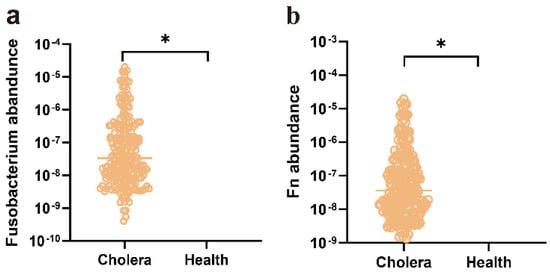
Studies in cetaceans revealed a gradient of decreasing microbial richness from the oral cavity to the hindgut. Concomitantly, the community composition shifted, with Fusobacterium-dominated niches in the oral cavity and esophagus transitioning to Vibrio-enriched assemblages in the gastrointestinal tract, which included the presence of V. cholerae [40]. Both F. nucleatum and V. cholerae are pathobionts residing in the human gut [4,26]. Their spatial co-localization provides an opportunity for coexistence and interaction. To investigate the role of the Fusobacterium genus in the cholera cohorts, we analyzed six publicly available gut metagenomic datasets from cohort-based studies on cholera obtained from the NCBI database. The significant difference was observed in the abundance of the Fusobacterium genus between fecal samples from healthy controls and cholera patients (Figure 1a, Supplementary Table S1).
Figure 1.
Differential abundance of Fusobacterium in the cholera cohorts. (a) The six publicly available gut metagenomic datasets from cohort-based studies on cholera were accessed in the NCBI database. They were divided into a healthy control group and a cholera group. The raw data were analyzed by fastp version 0.23.2, metaWRAP version 1.3.2, and GTDB-tk version 2.4.0. The coverM software (version 0.7.0) was used to calculate the abundance differences in the Fusobacterium genus between healthy individuals and cholera patients. (b) The abundance of the Fusobacterium nucleatum CNBGCC 1850029 across multiple cohorts was evaluated based on 16S rRNA sequence analysis. Fn, F. nucleatum CNBGCC 1850029. Significance was determined by two-tailed Student’s t-test; p-values: ns, not significant, *, p < 0.05.
In the Fusobacterium genus from the cholera cohorts, F. nucleatum strain CNBGCC 1850029 was isolated from our laboratory’s intestinal microbial bank, and other Fusobacterium strains were not present. Subsequently, to investigate the abundance of F. nucleatum CNBGCC 1850029 at the strain level within a cholera cohort, the coverM software (version 0.7.0) was employed for further analysis. In the cholera patients, the results showed Fusobacterium was present in a number of patients (n = 220), while it was undetectable in others (n = 504) (Figure 1a). Interestingly, F. nucleatum CNBGCC 1850029 was statistically significant compared to the healthy controls (Figure 1b). The underlying reason for this observation remains unknown.
3.2. The Supernatant of F. nucleatum Inhibits the Growth of V. cholerae but Promotes Its Biofilm Formation
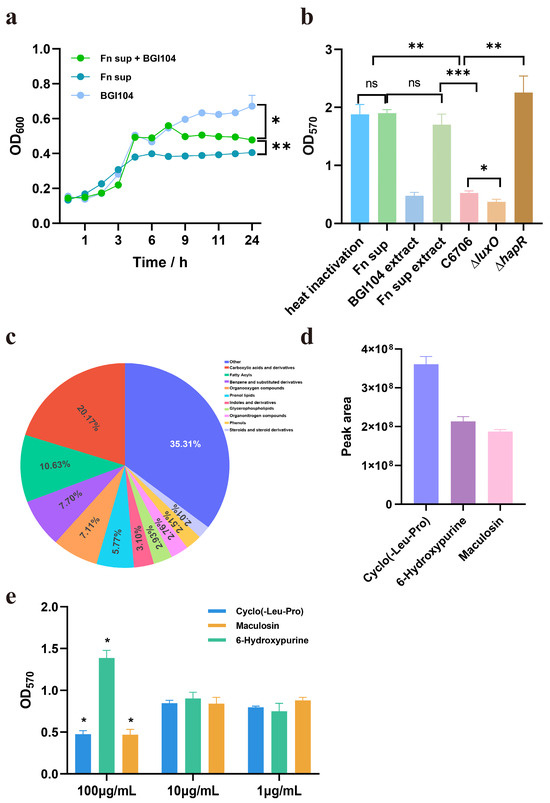
To investigate why F. nucleatum strain CNBGCC 1850029 is present in the feces of cholera patients and whether it interacts with V. cholerae, we first examined the effect of F. nucleatum CNBGCC 1850029 on V. cholerae C6706 growth. We cultured V. cholerae overnight in pH-neutralized (7.2), cell-free supernatant from a 24 h F. nucleatum CNBGCC 1850029 culture with or without 2X BGI104 medium. The results showed that compared to BGI104 medium alone, the growth of V. cholerae was significantly inhibited after 24 h in the supernatant of F. nucleatum CNBGCC 1850029 (Figure 2a). When cultured in a mixed medium containing both the supernatant of F. nucleatum CNBGCC 1850029 and BGI104, growth was significantly restored. However, it still differed significantly from that in BGI104 medium alone (Figure 2a). The underlying mechanism remains to be elucidated (Figure 2a).
Figure 2.
F. nucleatum supernatant inhibits the growth of V. cholerae but promotes biofilm formation. (a) Growth curve of V. cholerae with cell-free supernatant of F. nucleatum. (b) The metabolized supernatant by F. nucleatum with pH-neutralized (7.2) affects the biofilm formation of V. cholerae. (c) Composition of metabolites. An untargeted metabolomic analysis was performed on metabolites extracted from F. nucleatum CNBGCC 1850029 using ethyl acetate. The pie chart shows the distribution of the identified metabolite classes. (d) Top-ranked metabolites. Cyclo (Leu-Pro), 6-hypoxanthine, and maculosin were identified as the three most abundant metabolites. (e) Biofilm modulation by candidate metabolites. The impact of 6-hypoxanthine, cyclo (Leu-Pro), and maculosin, selected based on the metabolomic analysis on V. cholerae biofilm formation was assessed. Vc: V. cholerae C6706. Fn: F. nucleatum CNBGCC 1850029. Significance was determined by t-test; p-values: ns, not significant, *, p < 0.05, **, p < 0.01, ***, p < 0.001.
To investigate whether metabolic interactions between F. nucleatum and V. cholerae modulate biofilm formation in V. cholerae, V. cholerae was incubated with the processed supernatant. Using ∆luxO as the negative control and ∆hapR as the positive control, the results demonstrated that compared to the wild-type (WT), ∆luxO exhibited a significant reduction in biofilm formation, while ∆hapR showed a significant increase, which is consistent with previous reports [41]. In addition, a marked enhancement in biofilm formation was observed (Figure 2b). When the culture supernatant of F. nucleatum was heat-killed, it also increased the biofilm formation of V. cholerae (Figure 2b). To further characterize the bioactive components, we extracted F. nucleatum supernatant with ethyl acetate. Intriguingly, the ethyl acetate extracts similarly promoted biofilm formation in V. cholerae (Figure 2b). These results indicate that F. nucleatum metabolites promote V. cholerae biofilm formation, independent of growth and high-temperature conditions.
To further identify the specific metabolites involved, an untargeted metabolomic analysis was performed. The results indicated that these metabolites were primarily enriched in categories such as carboxylic acids and derivatives, fatty acyls, benzene and substituted derivatives, and organooxygen compounds (Figure 2c). The top three most abundant metabolites derived from F. nucleatum CNBGCC 1850029 were identified as cyclo (Leu-Pro), 6-hypoxanthine, and maculosin (Figure 2d). Further investigation revealed that 6-Hypoxanthine at a concentration of 100 µM enhanced biofilm formation in V. cholerae, while no significant effect was observed at other concentrations tested (Figure 2e). In the marine bacterium Halomonas titanicae KHS3, hypoxanthine can also promote biofilm formation [42]. However, both cyclo (Leu-Pro) and maculosin at a concentration of 100 µM inhibited biofilm formation in V. cholerae. These results confirm and extend prior literature reporting anti-biofilm functionality. For instance, cyclo (Leu-Pro) produced by Lactiplantibacillus plantarum CCFM8724 inhibits the growth of Streptococcus mutans and Candida albicans in mixed-species biofilm formation [43]. The cyclic dipeptide cyclo (Leu-Pro) produced by marine Bacillus amyloliquefaciens mitigates biofilm formation and virulence in Listeria monocytogenes [44]. Additionally, maculosin can inhibit biofilm formation in Pseudomonas aeruginosa PAO1 through quorum-sensing inhibition [45]. In conclusion, these findings underscore the complexity of the metabolic interaction between F. nucleatum CNBGCC 1850029 and V. cholerae C6706 and necessitate further investigation into targetable metabolites.
3.3. F. nucleatum and V. cholerae Co-Aggregate to Form Biofilms by Activating vpsT
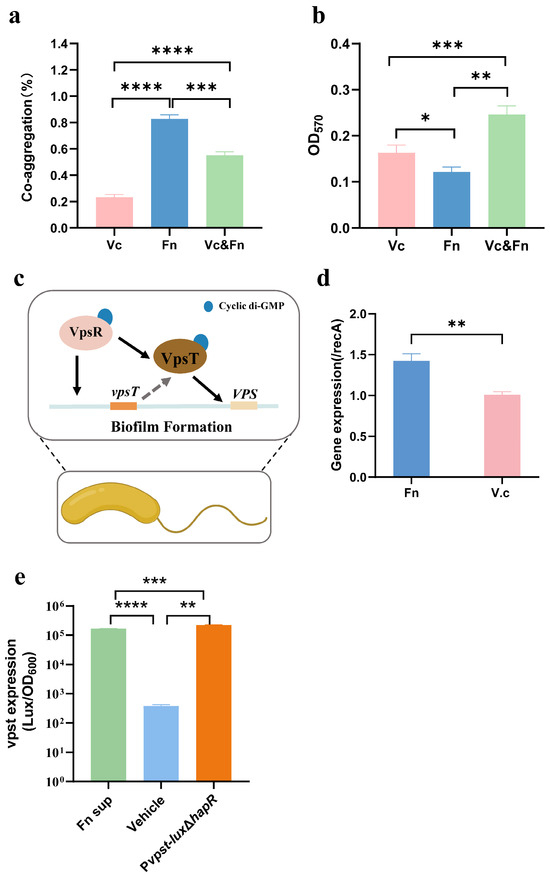
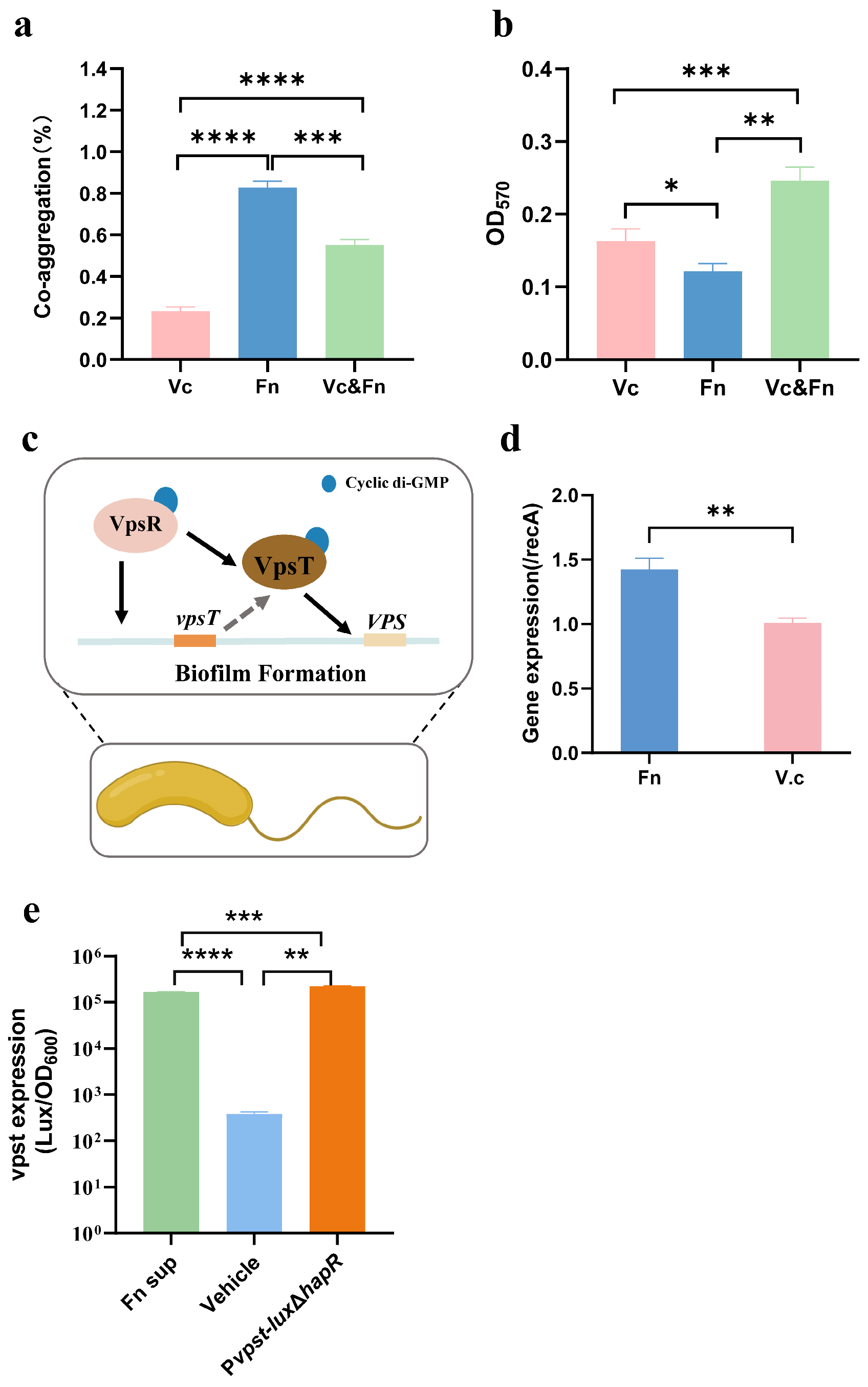
Coaggregation serves as a bridge for biofilm formation [9]. F. nucleatum, a bacterial species commonly recognized for its coaggregation capabilities, has not been previously investigated for its ability to form co-aggregates with V. cholerae. To evaluate whether their interaction involves coaggregation, we conducted in vitro coaggregation assays. The results demonstrated that while both F. nucleatum CNBGCC 1850029 and V. cholerae C6706 possess an intrinsic ability to auto-aggregate, their dual-species co-inoculation significantly enhanced interbacterial coaggregation compared to mono-species cultures (Figure 3a). Further co-culture of F. nucleatum CNBGCC 1850029 and V. cholerae C6706 significantly enhanced dual-species biofilm formation compared to their respective mono-species biofilms (Figure 3b).
Figure 3.
Co-aggregation and subsequent biofilm formation by F. nucleatum and V. cholerae operate via a VpsT-dependent mechanism. (a) aggregation. (b) biofilm formation between F. nucleatum and V. cholerae. (c) biofilm formation in V. cholerae is governed by a regulatory circuit in which VpsR and VpsT, both activated by the intracellular signal cyclic di-GMP, function as key regulators. Specifically, VpsT directly promotes the transcription of the VPS (Vibrio Polysaccharide) operons, ultimately driving the synthesis of the exopolysaccharide matrix required for biofilm assembly. (d) Expression of the vpsT gene was assessed using a trans-well system. (e) Lux reporter assays. The plasmid PvpsT-Lux was electro-transferred into the V. cholerae strain. OD600 and LuxCDABE were detected, and relative light units were normalized by OD600. Different colors indicate distinct genes, proteins, samples, or substances. Solid lines show the direction of the cascade reaction, while dashed lines represent the translation of genes into proteins. Vc: V. cholerae C6706. Fn: F. nucleatum CNBGCC1850029. Significance was determined by t-test; p-values: *, p < 0.01, **, p < 0.01, ***, p < 0.001, ****, p < 0.0001.
In V. cholerae, biofilm regulation involves transcriptional activators (e.g., VpsR, VpsT, AphA), repressors (e.g., HapR, H-NS), alternative sigma factors (RpoN, RpoS, RpoE), small regulatory RNAs, and signaling molecules [46]. As VpsT is a master regulator of biofilm formation [47] (Figure 3c), we utilized a trans-well system and lux reporter assays to confirm that its expression was significantly upregulated (Figure 3d,e). These findings collectively demonstrate that the supernatant of F. nucleatum CNBGCC1850029 enhances biofilm formation by activating vpsT-mediated pathways.
3.4. F. nucleatum Promotes the Adaptability of V. cholerae in the Gut of Adult Mice
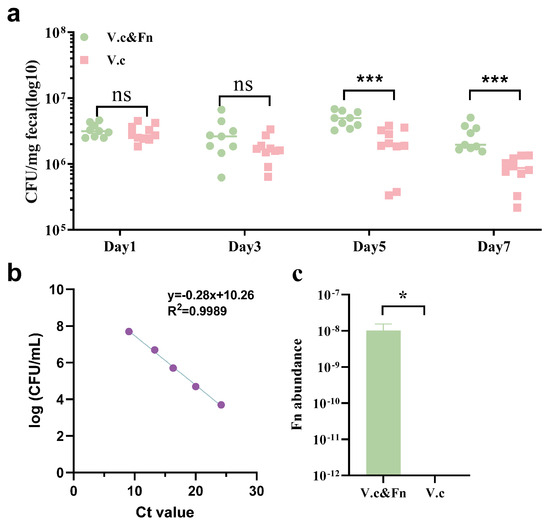
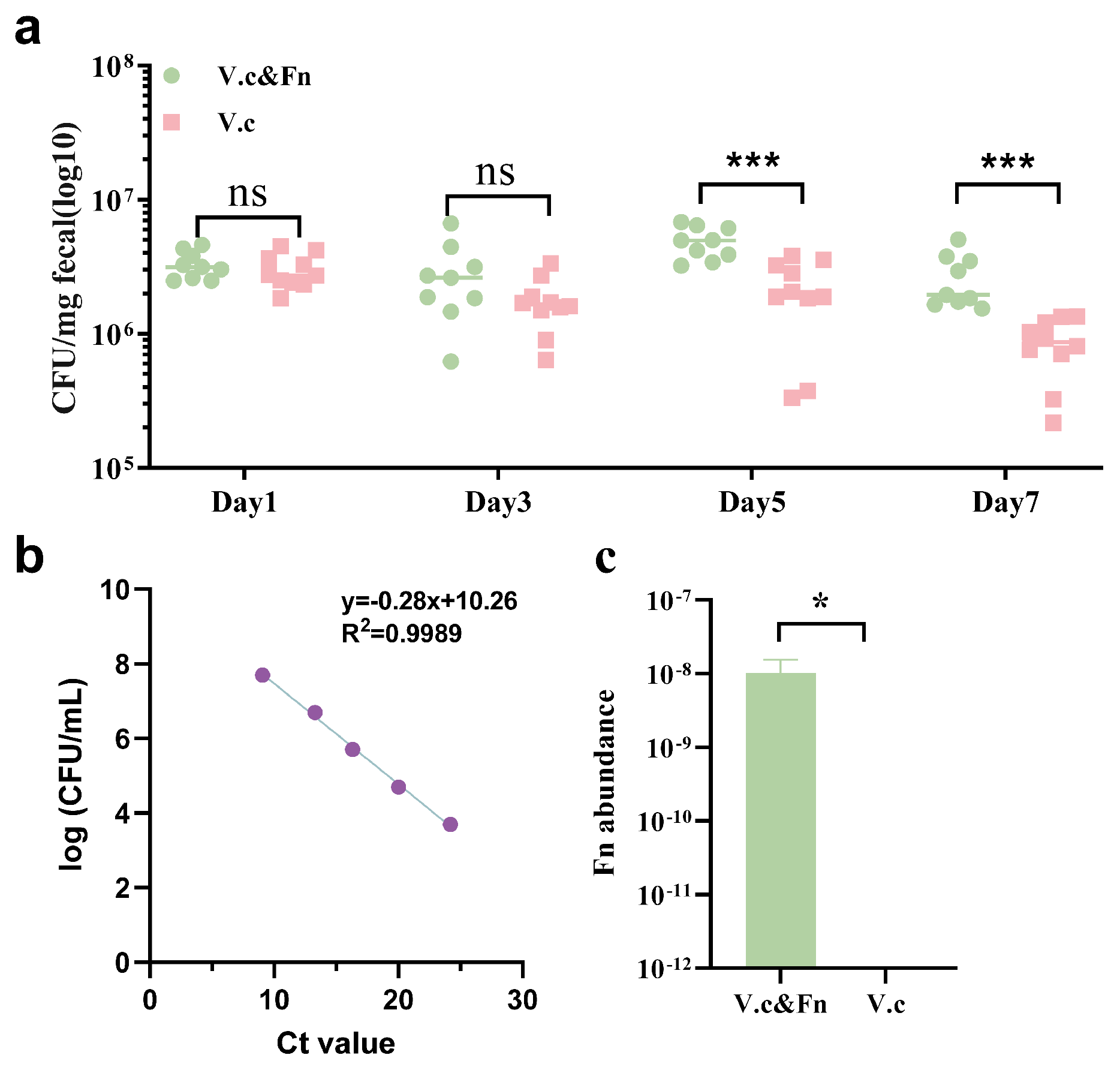
To investigate the role of F. nucleatum CNBGCC1850029 in the biofilm formation of V. cholerae C6706 in vivo, an adult mouse model was used with streptomycin treatment to test for the colonization of V. cholerae. It is worth noting that the adult mouse model has been established to study the mechanisms of V. cholerae in response to various intestinal stress environments, and it has been widely used by many groups [35,48]. Compared to infant mice, adult mice have a fully developed human immune system, Reactive Oxygen Species (ROS), and a mature gut microbiota, which provide advantages in studying the mechanisms by which V. cholerae responds to host stress during infection [48]. The intestinal adaptability of V. cholerae was evaluated by enumerating cultivatable bacteria from collected fecal pellets. After treatment with streptomycin for 24 h, the mice were inoculated with either V. cholerae alone or V. cholerae and F. nucleatum (SmR) at a 1:1 mixture (approximately 109 CFU) by oral gavage. The CFU counts of the V. cholerae recovered from the feces at day1 and day3 postinfection were not obviously different between the single and mixed species groups. At day5 and day7 postinfection, the V. cholerae number in the feces of mice infected with only V. cholerae was more than 3-fold higher than that in the feces of mice infected with the V. cholerae and F. nucleatum mixture (Figure 4a). For the quantitative assessment of F. nucleatum, a linear regression model was generated to define the relationship between the Ct values and the logarithmic CFU/mL (Figure 4b). At day7, the abundance of F. nucleatum in the feces of the co-infection group was about 10−8. However, F. nucleatum was not detected in the group administered V. cholerae alone (Figure 4c). These results suggest that coinfection with F. nucleatum helps the biofilm formation of V. cholerae, which can enhance its adaptability in the gut of adult mice.
Figure 4.
F. nucleatum promotes the adaptability of V. cholerae in adult mouse model. (a) The CFU values of V. cholerae post inoculation were shown. Adult mice were infected with F. nucleatum and V. cholerae at a ratio of 1:1 (n = 9) or V. cholerae alone (n = 10). Numbers of cultivable V. cholerae (CFU) recovered from mono-infection or co-garaged mice feces were calculated with standardization based on fecal weight and the input CFU. (b) A standard curve was established to correlate the bacterial load with qPCR detection. DNA was extracted from F. nucleatum cultures following serial dilution and precise enumeration of CFU/mL. The logarithm of the CFU/mL values was then correlated with the measured Ct values using linear regression. (c) F. nucleatum abundance or total bacterial load in fecal samples was determined by using real-time quantitative PCR. V.c: V. cholerae C6706. Fn: F. nucleatum CNBGCC1850029. Significance was determined by t-test; p-values: ns, not significant; *, p < 0.05; ***, p < 0.001.
4. Discussion
Based on the analysis of a cholera cohort and our microbial bank, F. nucleatum CNBGCC1850029 was found to be significantly more abundant in cholera patients than in healthy controls. Functionally, although F. nucleatum CNBGCC1850029 metabolites inhibited the growth of V. cholerae C6706, they promoted biofilm formation. Untargeted metabolomic analysis revealed that F. nucleatum-derived metabolites, specifically 6-hypoxanthine, enhance biofilm formation in V. cholerae. Furthermore, F. nucleatum enhanced bacterial coaggregation with V. cholerae and upregulated the biofilm-associated regulatory gene vpsT. These findings were further validated in an adult mouse model, confirming that F. nucleatum enhances the gut adaptability of V. cholerae, thereby elucidating a mechanism for their co-existence during infection.
Host-derived intestinal metabolites and bacterial proteins intricately regulate the formation and dispersal of V. cholerae biofilms. Primary bile salts, such as taurocholate, glycocholate, and deoxycholate, promote the dispersal of V. cholerae biofilms, thereby facilitating intestinal colonization [49]. Also, indole, a tryptophan degradation product that acts as a bacterial signaling molecule, may also modulate biofilm dynamics [50]. Additionally, exogenous para-aminobenzoic acid (pABA) is utilized in folate biosynthesis, which reduces bacterial stress and upregulates the expression of fimbrial adhesins, thereby enhancing bacterial colonization. However, pABA simultaneously suppresses extracellular polysaccharide production and attenuates virulence in vivo [51]. Collectively, these metabolites and proteins exert synergistic or antagonistic effects to shape the biofilm lifecycle and pathogenic progression of V. cholerae.
In this study, the extracts of F. nucleatum metabolites by ethyl acetate significantly promoted biofilm formation in V. cholerae. Untargeted metabolomic analysis revealed that 6-hypoxanthine enhances biofilm formation in V. cholerae, although the supernatant of F. nucleatum inhibits the growth of V. cholerae. This suggests that 6-hypoxanthine may function as a co-aggregation promoter. Beyond 6-hypoxanthine, this study verifies that metabolites like cyclo (Leu-Pro) and maculosin, commonly known for their antibacterial properties, can act as inhibitors of biofilm formation [43,44,45]. The presence of such antimicrobial substances in the metabolome might contribute to the observed growth inhibition of V. cholerae, although this hypothesis requires substantial experimental validation.
In polymicrobial communities, the close coexistence of different species significantly amplifies their interactions. These interactions include nutrient sharing, quorum sensing (QS), and coordinated gene expression [52]. It is precisely these complex dynamics that shape the community’s overall architecture, enhance its ability to evade host immune attacks, and lead to persistent, difficult-to-eradicate chronic infections, posing serious challenges for clinical treatment [24,25]. Therefore, researchers must not only decipher the mechanisms by which dual- or multi-species biofilms resist environmental stress but also develop advanced methodologies to track the dynamic evolution of species within these communities [53]. A key limitation of the present study is the lack of omics-based validation or novel tracking methods to analyze the composition and dynamic changes in the co-aggregated biofilm community. As reported in the literature, it is possible to successfully track all species within a nine-member mixed biofilm over 72 h [54]. Further research should employ such innovative methods to dissect the species dynamics in co-aggregation-derived biofilms. In the future, the work should also employ transposon mutant library screening to identify which F. nucleatum adhesins interact with which receptors on V. cholerae to scaffold biofilm formation [55,56].
Bacterial aggregation leads to the formation of multicellular aggregates enclosed by an extracellular matrix composed of polysaccharides, proteins, lipids, and DNA, ultimately resulting in a biofilm. This enhances the environmental adaptability of bacteria and enables their persistent survival across different ecological niches [57]. The synthesis of biofilm components in V. cholerae is primarily regulated by VpsT and VpsR. Proteins such as HapR, H-NS, AphA, and VqmA are also involved and interact with each other, forming a complex regulatory network. Additionally, small RNAs in V. cholerae participate in the regulation of biofilm development by degrading or stabilizing the mRNA of target genes [58]. To more comprehensively investigate the impact of the microbe-free supernatant of F. nucleatum CNBGCC1850029 on V. cholerae C6706 biofilm formation, transcriptomics should be employed to obtain gene transcription profiles, followed by verification.
Establishing effective infection models for V. cholerae remains a significant challenge, as existing animal models fail to fully replicate human infection conditions. After streptomycin treatment of the adult mouse intestine, the diversity and structure of the gut microbiota are disrupted, thereby freeing up ecological niches and enabling F. nucleatum CNBGCC1850029 and V. cholerae C6706 to interact within the murine intestinal environment [35]. In this model, antibiotic treatment disrupts the diversity and structure of the gut microbiota, thereby simplifying the interaction between F. nucleatum CNBGCC1850029 and V. cholerae. In reality, the gut microbiota serves as a critical factor in responding to pathogenic infections, and V. cholerae inevitably interacts with a wide range of intestinal bacteria beyond F. nucleatum CNBGCC1850029 [3,4]. Future research should therefore account for the influence of the gut microbiota on the interaction between F. nucleatum CNBGCC1850029 and V. cholerae C6706, employing multi-omics strategies to elucidate the underlying molecular mechanisms and colonization dynamics of their interplay.
5. Conclusions
In sum, this study reveals a “collaborative pathogenesis” model, in which F. nucleatum facilitates the intestinal adaptation of V. cholerae, thereby providing a theoretical foundation for understanding the infection dynamics of this pathogen.
Supplementary Materials
The following supporting information can be downloaded at https://www.mdpi.com/article/10.3390/microorganisms14010211/s1, Supplementary Table S1: Species abundance table; Supplementary Table S2: Analysis of ethyl acetate extracts of F. nucleatum CNBGCC1850029 metabolites.
Author Contributions
G.C.: conceptualization; methodology; investigation; writing—original draft; visualization; writing—review and editing; software; formal analysis; project administration; data curation; supervision; resources. J.C.: methodology. X.W.: investigation. D.G.: methodology. Z.L.: Conceptualization; writing—review and editing; formal analysis; project administration; supervision; resources. All authors have read and agreed to the published version of the manuscript.
Funding
This study was supported by the National Key Research and Development Program of China (2024YFA09185 to ZL), the Shandong Province Science Foundation for Youths (ZR2024QC312 to GZC), the National Natural Science Foundation of China (31770132 to ZL), the Major Science and Technology Special Plan of Yunnan Province (202402AA310011 to ZL).
Institutional Review Board Statement
All animal experiments were carried out in strict accordance with the animal protocols that were approved by the Ethical Committee of Huazhong University of Science and Technology (Permit Number: SYXK (E) 2017-0094, 12 June 2017).
Informed Consent Statement
Not applicable.
Data Availability Statement
The data presented in this study are openly available in Biomarkers analysis from Cholera cohort at https://doi.org/10.5281/zenodo.17150950, reference number [17150950].
Acknowledgments
We thank the Core Facilities for Life Science, Huazhong University of Science and Technology, for the technical support.
Conflicts of Interest
The authors declare no conflict of interest.
References
- Qin, Z.; Yang, X.; Chen, G.; Park, C.; Liu, Z. Crosstalks between gut microbiota and Vibrio cholerae. Front. Cell. Infect. Microbiol. 2020, 10, 582554. [Google Scholar] [CrossRef] [Scilit] [PubMed]
- World Health Organization. Cholera Kills More People for Second Consecutive Year, While Prevention and Treatment Available. 2025. Available online: https://www.who.int/news/item/12-09-2025-cholera-kills-more-people-for-second-consecutive-year-while-prevention-and-treatment-available (accessed on 12 September 2025).
- Hsiao, A.; Zhu, J. Pathogenicity and virulence regulation of Vibrio cholerae at the interface of host-gut microbiome interactions. Virulence 2020, 11, 1582–1599. [Google Scholar] [CrossRef] [Scilit]
- Cho, J.Y.; Liu, R.; Macbeth, J.C.; Hsiao, A. The interface of Vibrio cholerae and the gut microbiome. Gut Microbes 2021, 13, 1937015. [Google Scholar] [CrossRef] [Scilit]
- Midani, F.S.; Weil, A.A.; Chowdhury, F.; Begum, Y.A.; Khan, A.I.; Debela, M.D.; Durand, H.K.; Reese, A.T.; Nimmagadda, S.N.; Silverman, J.D.; et al. Human gut microbiota predicts susceptibility to Vibrio cholerae infection. J. Infect. Dis. 2018, 218, 645–653. [Google Scholar] [CrossRef] [Scilit]
- Ducarmon, Q.R.; Zwittink, R.D.; Hornung, B.V.H.; Van Schaik, W.; Young, V.B.; Kuijper, E.J. Gut microbiota and colonization resistance against bacterial enteric infection. Microbiol. Mol. Biol. Rev. 2019, 83, e00007-19. [Google Scholar] [CrossRef] [Scilit] [PubMed]
- Wang, H.; Li, F.; Xu, L.; Byun, H.; Fan, J.; Wang, M.; Li, M.; Zhu, J.; Li, B. Contributions of Escherichia coli and its motility to the formation of dual-species biofilms with Vibrio cholerae. Appl. Environ. Microbiol. 2021, 87, e0093821. [Google Scholar] [CrossRef] [Scilit] [PubMed]
- Abriat, C.; Enriquez, K.; Virgilio, N.; Cegelski, L.; Fuller, G.G.; Daigle, F.; Heuzey, M.-C. Mechanical and microstructural insights of Vibrio cholerae and Escherichia coli dual-species biofilm at the air-liquid interface. Colloids Surf. B Biointerfaces 2020, 188, 110786. [Google Scholar] [CrossRef] [Scilit]
- Jiang, S.; Chen, Y.; Fang, J.-Y. Fusobacterium nucleatum: Ecology, pathogenesis and clinical implications. Nat. Rev. Microbiol. 2025. [Google Scholar] [CrossRef] [Scilit]
- Yang, R.; Liu, T.; Pang, C.; Cai, Y.; Lin, Z.; Guo, L.; Wei, X. The regulatory effect of coaggregation between Fusobacterium nucleatum and Streptococcus gordonii on the synergistic virulence to human gingival epithelial cells. Front. Cell. Infect. Microbiol. 2022, 12, 879423. [Google Scholar] [CrossRef] [Scilit]
- Guo, L.; Shokeen, B.; He, X.; Shi, W.; Lux, R. Streptococcus mutans SpaP binds to RadD of Fusobacterium nucleatum ssp. polymorphum. Mol. Oral Microbiol. 2017, 32, 355–364. [Google Scholar] [CrossRef] [Scilit]
- Engevik, M.A.; Danhof, H.A.; Auchtung, J.; Endres, B.T.; Ruan, W.; Bassères, E.; Engevik, A.C.; Wu, Q.; Nicholson, M.; Luna, R.A.; et al. Fusobacterium nucleatum adheres to Clostridioides difficile via the RadD adhesin to enhance biofilm formation in intestinal mucus. Gastroenterology 2021, 160, 1301–1314. [Google Scholar] [CrossRef] [Scilit]
- Yamaguchi-Kuroda, Y.; Kikuchi, Y.; Kokubu, E.; Ishihara, K. Porphyromonas gingivalis diffusible signaling molecules enhance Fusobacterium nucleatum biofilm formation via gene expression modulation. J. Oral Microbiol. 2023, 15, 2165001. [Google Scholar] [CrossRef] [Scilit]
- Lima, B.P.; Shi, W.; Lux, R. Identification and characterization of a novel Fusobacterium nucleatum adhesin involved in physical interaction and biofilm formation with Streptococcus gordonii. Microbiologyopen 2017, 6, e00444. [Google Scholar] [CrossRef] [Scilit]
- Kaplan, A.; Kaplan, C.W.; He, X.; McHardy, I.; Shi, W.; Lux, R. Characterization of aid1, a novel gene involved in Fusobacterium nucleatum interspecies interactions. Microb. Ecol. 2014, 68, 379–387. [Google Scholar] [CrossRef] [Scilit] [PubMed]
- Gupta, S.; Ghosh, S.K.; Scott, M.E.; Bainbridge, B.; Jiang, B.; Lamont, R.J.; McCormick, T.S.; Weinberg, A. Fusobacterium nucleatum-associated β-defensin inducer (FAD-I): Identification, isolation, and functional evaluation. J. Biol. Chem. 2010, 285, 36523–36531. [Google Scholar] [CrossRef] [Scilit] [PubMed]
- Coppenhagen-Glazer, S.; Sol, A.; Abed, J.; Naor, R.; Zhang, X.; Han, Y.W.; Bachrach, G. Fap2 of Fusobacterium nucleatum is a galactose-inhibitable adhesin involved in coaggregation, cell adhesion, and preterm birth. Infect. Immun. 2015, 83, 1104–1113. [Google Scholar] [CrossRef] [Scilit]
- Wang, J.C.; Cordero, J.; Sun, Y.; Aranke, M.; Wolcott, R.; Colmer-Hamood, J.A.; Hamood, A.N. Planktonic growth of Pseudomonas aeruginosa around a dual-species biofilm supports the growth of Fusobacterium nucleatum within that biofilm. Int. J. Otolaryngol. 2017, 2017, 3037191. [Google Scholar] [CrossRef] [Scilit] [PubMed]
- Li, Q.; Tan, L.; Wang, H.; Kou, Y.; Shi, X.; Zhang, S.; Pan, Y. Fusobacterium nucleatum interaction with Pseudomonas aeruginosa induces biofilm-associated antibiotic tolerance via Fusobacterium adhesin A. ACS Infect. Dis. 2020, 6, 1686–1696. [Google Scholar] [CrossRef] [Scilit]
- Horiuchi, A.; Kokubu, E.; Warita, T.; Ishihara, K. Synergistic biofilm formation by Parvimonas micra and Fusobacterium nucleatum. Anaerobe 2020, 62, 102100. [Google Scholar] [CrossRef] [Scilit]
- Yang, L.; Sriram, G.; Chew, R.J.J.; Tan, K.S. Limosilactobacillus reuteri—Fusobacterium nucleatum interactions modulate biofilm composition and immunogenicity. J. Periodontal Res. 2025, 60, 1006–1017. [Google Scholar] [CrossRef] [Scilit]
- Okuda, T.; Kokubu, E.; Kawana, T.; Saito, A.; Okuda, K.; Ishihara, K. Synergy in biofilm formation between Fusobacterium nucleatum and Prevotella species. Anaerobe 2012, 18, 110–116. [Google Scholar] [CrossRef] [Scilit]
- Okuda, T.; Okuda, K.; Kokubu, E.; Kawana, T.; Saito, A.; Ishihara, K. Synergistic effect on biofilm formation between Fusobacterium nucleatum and Capnocytophaga ochracea. Anaerobe 2012, 18, 157–161. [Google Scholar] [CrossRef] [Scilit] [PubMed]
- Anju, V.T.; Busi, S.; Imchen, M.; Kumavath, R.; Mohan, M.S.; Salim, S.A.; Subhaswaraj, P.; Dyavaiah, M. Polymicrobial Infections and Biofilms: Clinical Significance and Eradication Strategies. Antibiotics 2022, 11, 1731. [Google Scholar] [CrossRef] [Scilit]
- Koo, H.; Allan, R.N.; Howlin, R.P.; Stoodley, P.; Hall-Stoodley, L. Targeting microbial biofilms: Current and prospective therapeutic strategies. Nat. Rev. Microbiol. 2017, 15, 740–755. [Google Scholar] [CrossRef] [Scilit]
- Yang, X.; Zhang, S.; Ning, T.; Wu, J. Fusobacterium nucleatum in Health and Disease. MedComm 2025, 11, e70465. [Google Scholar] [CrossRef] [Scilit] [PubMed]
- Hong, M.; Li, Z.; Liu, H.; Zheng, S.; Zhang, F.; Zhu, J.; Ye, H.; Chou, Z.; Gao, L.; Diao, J.; et al. Fusobacterium nucleatum aggravates rheumatoid arthritis through FadA-containing outer membrane vesicles. Cell Host Microbe 2023, 31, 798–810. [Google Scholar] [CrossRef] [Scilit]
- Yan, Q.; Li, S.; Yan, Q.; Huo, X.; Wang, C.; Wang, X.; Sun, Y.; Zhao, W.; Yu, Z.; Zhang, Y.; et al. A genomic compendium of cultivated human gut fungi characterizes the gut mycobiome and its relevance to common diseases. Cell 2024, 187, 2969–2989. [Google Scholar] [CrossRef] [Scilit]
- Levade, I.; Khan, A.I.; Chowdhury, F.; Calderwood, S.B.; Ryan, E.T.; Harris, J.B.; LaRocque, R.C.; Bhuiyan, T.R.; Qadri, F.; Weil, A.A.; et al. A combination of metagenomic and cultivation approaches reveals hypermutator phenotypes within Vibrio cholerae-Infected Patients. mSystems 2021, 6, e0088921. [Google Scholar] [CrossRef] [Scilit] [PubMed]
- Madi, N.; Cato, E.T.; Sayeed, M.A.; Creasy-Marrazzo, A.; Cuénod, A.; Islam, K.; Khabir, I.U.; Bhuiyan, T.R.; Begum, Y.A.; Freeman, E.; et al. Phage predation, disease severity, and pathogen genetic diversity in cholera patients. Science 2024, 384, eadj3166. [Google Scholar] [CrossRef] [Scilit]
- Chen, S. Ultrafast one-pass FASTQ data preprocessing, quality control, and deduplication using fastp. iMeta 2023, 2, e107. [Google Scholar] [CrossRef] [Scilit]
- Uritskiy, G.V.; DiRuggiero, J.; Taylor, J. MetaWRAP-a flexible pipeline for genome-resolved metagenomic data analysis. Microbiome 2018, 6, 158. [Google Scholar] [CrossRef] [Scilit]
- Chaumeil, P.A.; Mussig, A.J.; Hugenholtz, P.; Parks, D.H. GTDB-Tk v2: Memory friendly classification with the genome taxonomy database. Bioinformatics 2022, 38, 5315–5316. [Google Scholar] [CrossRef] [Scilit]
- Aroney, S.T.N.; Newell, R.J.P.; Nissen, J.N.; Camargo, A.P.; Tyson, G.W.; Woodcroft, B.J. CoverM: Read alignment statistics for metagenomics. Bioinformatics 2025, 41, 3–6. [Google Scholar] [CrossRef] [Scilit] [PubMed]
- Sit, B.; Fakoya, B.; Waldor, M.K. Animal models for dissecting Vibrio cholerae intestinal pathogenesis and immunity. Curr. Opin. Microbiol. 2022, 65, 1–7. [Google Scholar] [CrossRef] [Scilit]
- Liu, Z.; Wang, H.; Zhou, Z.G.; Sheng, Y.; Naseer, N.; Kan, B.; Zhu, J. Thiol-based switch mechanism of virulence regulator AphB modulates oxidative stress response in Vibrio cholerae. Mol. Microbiol. 2016, 102, 939–949. [Google Scholar] [CrossRef] [Scilit]
- Alavi, S.; Mitchell, J.D.; Cho, J.Y.; Liu, R.; Macbeth, J.C.; Hsiao, A. Interpersonal gut microbiome variation drives susceptibility and resistance to cholera infection. Cell 2020, 181, 1533–1546. [Google Scholar] [CrossRef] [Scilit]
- Pauer, H.; Teixeira, F.L.; Robinson, A.V.; Parente, T.E.; De Melo, M.A.F.; Lobo, L.A.; Domingues, R.M.C.P.; Allen-Vercoe, E.; Ferreira, R.B.R.; Antunes, L.C.M. Bioactive small molecules produced by the human gut microbiome modulate Vibrio cholerae sessile and planktonic lifestyles. Gut Microbes 2021, 13, 1–19. [Google Scholar] [CrossRef] [Scilit] [PubMed]
- Ghirardo, A.; Fochi, V.; Lange, B.; Witting, M.; Schnitzler, J.P.; Perotto, S.; Balestrini, R. Metabolomic adjustments in the orchid mycorrhizal fungus Tulasnella calospora during symbiosis with Serapias vomeracea. New Phytol. 2020, 6, 1939–1952. [Google Scholar] [CrossRef] [Scilit] [PubMed]
- Li, C.; Ji, Y.; Li, X.; Cai, J.; Ye, J.; Wu, Y.; Liao, Q.; Wang, Z.; Sanganyado, E.; Li, P.; et al. Vibrio spp.: A potential critical pathogen for mammals with implications beyond marine aquaculture. BMC Microbiol. 2025, 25, 598. [Google Scholar] [CrossRef] [Scilit]
- Zhu, J.; Mekalanos, J.J. Quorum sensing-dependent biofilms enhance colonization in Vibrio cholerae. Dev. Cell 2003, 5, 647–656. [Google Scholar] [CrossRef] [Scilit]
- Ramos Ricciuti, F.E.; Soldano, A.; Herrera Seitz, M.K.; Gasperotti, A.F.; Boyko, A.; Jung, K.; Bellinzoni, M.; Lisa, M.; Studdert, C.A. The chemoreceptor controlling the Wsp-like transduction pathway in Halomonas titanicae KHS3 binds and responds to purine derivatives. FEBS J. 2025, 292, 1034–1051. [Google Scholar] [CrossRef] [Scilit]
- Li, J.; Zhang, Q.; Zhao, J.; Zhang, H.; Chen, W. Streptococcus mutans and Candida albicans Biofilm Inhibitors Produced by Lactiplantibacillus plantarum CCFM8724. Curr. Microbiol. 2022, 79, 143. [Google Scholar] [CrossRef] [Scilit]
- Gowrishankar, S.; Sivaranjani, M.; Kamaladevi, A.; Ravi, A.V.; Balamurugan, K.; Karutha Pandian, S. Cyclic dipeptide cyclo(l-leucyl-l-prolyl) from marine Bacillus amyloliquefaciens mitigates biofilm formation and virulence in Listeria monocytogenes. Pathog. Dis. 2016, 74, ftw017. [Google Scholar] [CrossRef] [Scilit]
- Li, L.; Xu, Z.; Cao, R.; Li, J.; Wu, C.-J.; Wang, Y.; Zhu, H. Effects of hydroxyl group in cyclo (Pro-Tyr)-like cyclic dipeptides on their anti-QS activity and self-assembly. iScience 2023, 26, 107048. [Google Scholar] [CrossRef] [Scilit] [PubMed]
- Fernandez, N.L.; Waters, C.M. Cyclic di-GMP increases catalase production and hydrogen peroxide tolerance in Vibrio cholerae. Appl. Environ. Microbiol. 2019, 85, e01043-19. [Google Scholar] [CrossRef] [Scilit] [PubMed]
- Krasteva, P.; Fong, J.; Shikuma, N.; Beyhan, S.; Navarro, M.; Yildiz, F.; Sondermann, H. Vibrio cholerae VpsT regulates matrix production. Science 2010, 327, 866–868. [Google Scholar] [CrossRef] [Scilit]
- Luo, M.; Chen, G.; Yi, C.; Xue, B.; Yang, X.; Ma, Y.; Qin, Z.; Yan, J.; Liu, X.; Liu, Z. Dps-dependent in vivo mutation enhances long-term host adaptation in Vibrio cholerae. PLoS Pathog. 2023, 19, e1011250. [Google Scholar] [CrossRef] [Scilit]
- Hay, A.J.; Zhu, J. Host intestinal signal-promoted biofilm dispersal induces Vibrio cholerae colonization. Infect. Immun. 2015, 83, 317–323. [Google Scholar] [CrossRef] [Scilit]
- Howard, M.F.; Renee Bina, X.; Bina, J.E. Indole inhibits ToxR regulon expression in Vibrio cholerae. Infect. Immun. 2019, 87, e00776-18. [Google Scholar] [CrossRef] [Scilit] [PubMed]
- Kuboniwa, M.; Houser, J.R.; Hendrickson, E.L.; Wang, Q.; Alghamdi, S.A.; Sakanaka, A.; Miller, D.P.; Hutcherson, J.A.; Wang, T.; Beck, D.A.C.; et al. Metabolic crosstalk regulates Porphyromonas gingivalis colonization and virulence during oral polymicrobial infection. Nat. Microbiol. 2017, 2, 1493–1499. [Google Scholar] [CrossRef] [Scilit]
- Zupančič, J.; Raghupathi, P.K.; Houf, K.; Burmølle, M.; Sørensen, S.J.; Gunde-Cimerman, N. Synergistic interactions in microbial biofilms facilitate the establishment of opportunistic pathogenic fungi in household dishwashers. Front. Microbiol. 2018, 9, 21. [Google Scholar] [CrossRef] [Scilit]
- Makovcova, J.; Babak, V.; Kulich, P.; Masek, J.; Slany, M.; Cincarova, L. Dynamics of mono- and dual-species biofilm formation and interactions between Staphylococcus aureus and Gram-negative bacteria. Microb. Biotechnol. 2017, 10, 819–832. [Google Scholar] [CrossRef] [Scilit] [PubMed]
- Hassall, J.; Cheng, J.K.J.; Unnikrishnan, M. Dissecting individual interactions between pathogenic and commensal bacteria within a multispecies gut microbial community. mSphere 2021, 6, e00013-21. [Google Scholar] [CrossRef] [Scilit] [PubMed]
- Guan, Z.; Wang, H.; Feng, Q. Establishment and improvement of genetic manipulation tools for Fusobacterium nucleatum. Eng. Microbiol. 2025, 5, 100192. [Google Scholar] [CrossRef] [Scilit]
- Bourgeois, J.; Camilli, A. High-throughput mutant screening via transposon sequencing. Cold Spring Harb. Protoc. 2023, 2023, 707–709. [Google Scholar] [CrossRef] [Scilit] [PubMed]
- Flemming, H.C.; Wingender, J.; Szewzyk, U.; Steinberg, P.; Rice, S.A.; Kjelleberg, S. Biofilms: An emergent form of bacterial life. Nat. Rev. Microbiol. 2016, 14, 563–575. [Google Scholar] [CrossRef] [Scilit]
- Wang, Q.M.; Ma, Y.; Liu, L.J.; Zhu, J.; Liu, Z. Biofilm development and environmental determinants in Vibrio cholerae. Chin. J. Biotechnol. 2017, 33, 1533–1546. [Google Scholar]
Disclaimer/Publisher’s Note: The statements, opinions and data contained in all publications are solely those of the individual author(s) and contributor(s) and not of MDPI and/or the editor(s). MDPI and/or the editor(s) disclaim responsibility for any injury to people or property resulting from any ideas, methods, instructions or products referred to in the content. |
© 2026 by the authors. Licensee MDPI, Basel, Switzerland. This article is an open access article distributed under the terms and conditions of the Creative Commons Attribution (CC BY) license.