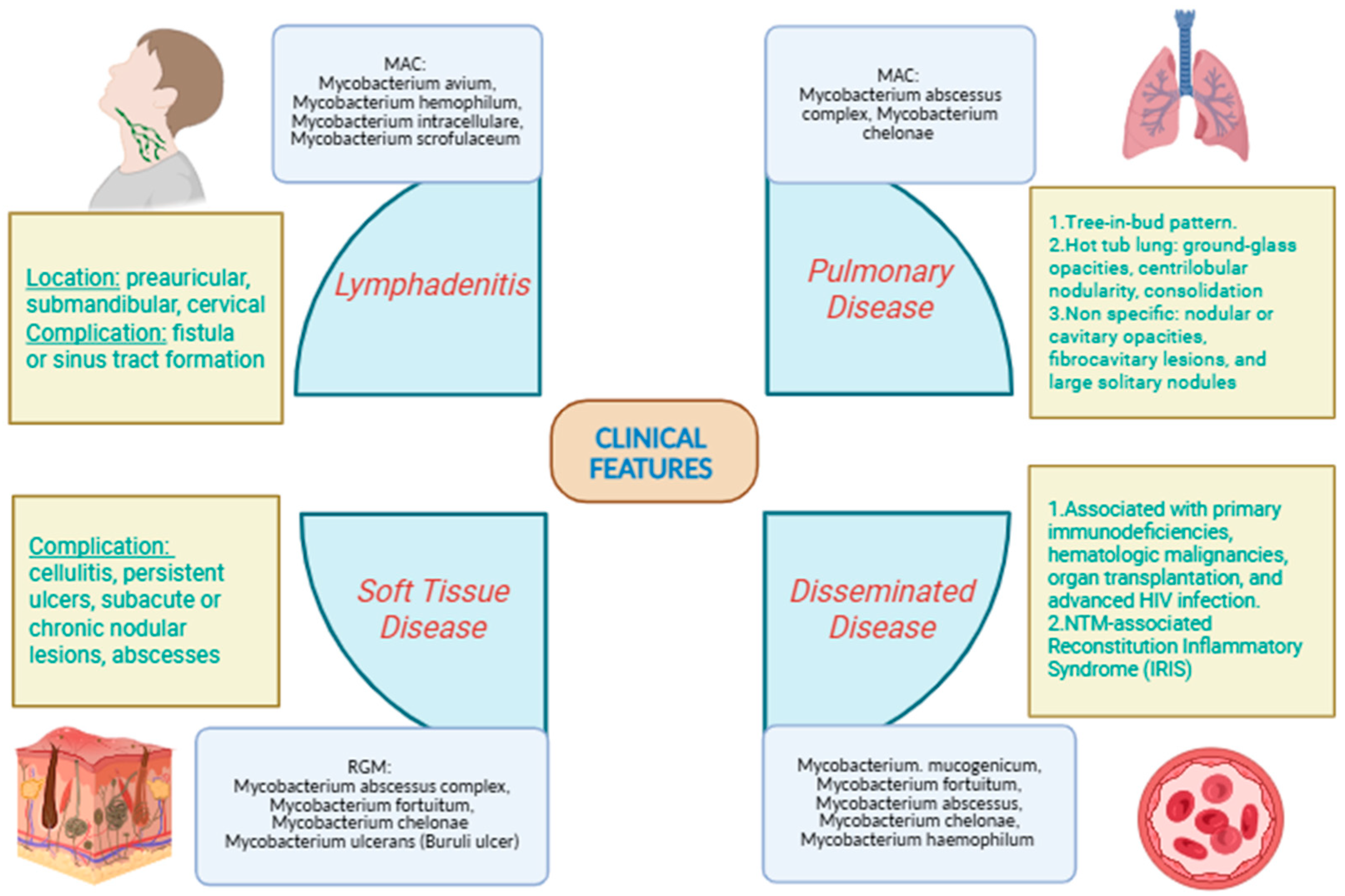
3.2. Microbiology and Epidemiology
There are more than 170 recognized species of NTM, of which approximately 100 have been implicated in human disease [
1,
2,
4]. Their ability to persist in the environment and cause opportunistic infections is largely attributable to distinctive microbiological features. In particular, their highly hydrophobic cell wall—rich in mycolic acids—confers acid-fastness and enables resistance to chemical disinfectants and antibiotics [
4]. NTM are ubiquitous environmental organisms, with a strong presence in soil and water, including natural water bodies, drinking water, and household plumbing. These microbes can become aerosolized within water droplets and persist in dust particles, which are abundant in high-moisture environments like sinks and showers. The lipid-rich outer membrane enhances adherence to surfaces and promotes survival in water systems and indwelling medical devices such as catheters. Moreover, NTM exhibit remarkable resilience under harsh environmental conditions, including high temperatures, acidic pH, and hypoxia [
4]. As a result, aerosol inhalation from municipal and private water sources is considered the primary route of transmission to humans [
5].
Based on their growth rate in culture, NTM species are widely divided into two groups: slow-growing mycobacteria (SGM), which need at least 8 days to create visible colonies, and rapid-growing mycobacteria (RGM), which usually grow in 3 to 7 days [
1,
4]. Certain species, like
Mycobacterium ulcerans and
Mycobacterium genavense, may need as long as 8 to 12 weeks to grow [
4]. While NTM infections are uncommon among immunocompetent hosts, paediatric patients may acquire the infection following environmental exposure, for example, to swimming pools or natural ponds [
3,
6]. In the hospital setting, nosocomial NTM outbreaks have been associated with hospital water systems, affecting paediatric patients, especially those undergoing hematopoietic stem cell or bone marrow transplantation [
7]. In addition, iatrogenic spread may be attributed to contaminated medical instruments or cosmetic procedures, including dental and surgical interventions [
3,
6]. A study demonstrated that children with cystic fibrosis (CF) living near aquatic environments had an elevated risk of NTM acquisition, with proximity within 500 m significantly increasing the likelihood of infection [
8]. As a further source, soil serves as a known reservoir for NTM, frequently introduced into indoor spaces via domestic animals and footwear [
3]. Despite these well-defined environmental sources, the specific transmission pathways for NTM are not yet completely elucidated [
3]. Significantly, direct transmission between humans or between animals is deemed exceptionally rare [
5].
The occurrence of NTM disease among children is rising globally [
9]. The exact geographical distribution of NTM infections is difficult to establish due to the absence of standardized national surveillance systems [
3,
6]. While studies conducted in adult populations from high-income countries have reported an increase in NTM diagnoses over recent decades, equivalent data for paediatric populations are lacking. Furthermore, large-scale epidemiological studies have demonstrated considerable variation in incidence and species distribution across different countries and regions [
3,
6]. The true prevalence of NTM infections is frequently underreported in low-resource settings. Here, diagnosis often happens as a secondary finding while investigating potential cases of tuberculosis, particularly when acid-fast bacilli are identified in respiratory specimens [
3,
6]. A recent review has described the prevalence of NTM disease ranging from 0.6 to 5.36 cases per 100,000 across countries, with Europe showing the highest rates [
9]. On the other hand, in a recent Spanish cohort study, case numbers stayed consistent throughout the initial prospective phase (2013–2020) but showed a marked decrease in 2021–2022. In 45.9% of cases, disease onset occurred in spring or in June. Moreover, a seasonal trend has been observed, with higher incidence reported in late winter and early spring [
4].
A recent systematic review and meta-analysis has evaluated data from studies conducted in mainland China between 2000 and 2019 on the prevalence, species distribution, and antimicrobial susceptibility of NTM [
10]. The crude isolation rate of NTM among patients suspected of tuberculosis ranged from 4.66% to 5.78%, accounting for 11.57% of all Mycobacterium isolates.
M. abscessus and the
M. avium complex (MAC) were the most frequent species, with
M. intracellulare later emerging as the predominant species. NTM displayed limited susceptibility, mainly to ethambutol, linezolid, clofazimine, amikacin, tobramycin, and clarithromycin. Overall, the prevalence of NTM showed a decreasing trend, with marked geographic variability in species distribution and highly heterogeneous resistance patterns, underscoring the need for cautious empirical therapy and the development of more structured surveillance systems [
10].
Similarly, an up-to-date review published in 2023 summarizes current evidence on the epidemiology, clinical features, diagnosis, and management of NTM infections in Africa [
11]. Most data originated from South Africa, Ethiopia, and Nigeria. Reported prevalence varied from 0.2% to 28%. The predominant NTM species were MAC,
M. fortuitum, and
M. abscessus. NTM infections were frequently reported among HIV-positive individuals, with additional risk factors including older age, chronic lung disease, and prior tuberculosis. The review underscores the substantial burden and frequent misdiagnosis of NTM due to their clinical similarity to tuberculosis, alongside limited diagnostic resources across the continent [
11].
Moreover, an observational study conducted in French Guiana investigated the epidemiology of pulmonary NTM involvement over the 2008–2018 decade, assessing the burden of these infections in the region [
12]. Among 178 patients with at least one positive respiratory culture, 147 were classified as having casual Pulmonary NTM isolation and 31 as having NTM pulmonary disease. The estimated annual incidence was 6.17 per 100,000 inhabitants for respiratory isolates and 1.07 per 100,000 for the disease. MAC was the most frequently isolated species (38%), followed by
M. fortuitum (19%) and
M. abscessus (6%), the latter two predominantly identified in the coastal central region. NTM pulmonary disease was mainly associated with MAC (81%) and
M. abscessus (16%). As the first epidemiological study on PNTM in French Guiana, it shows incidence rates comparable to other settings and underscores the need to consider NTM infections even in contexts with high tuberculosis prevalence [
12].
In general, the most frequently identified species are
Mycobacterium avium complex (MAC) (43.1%) and
Mycobacterium lentiflavum (39.9%) [
9,
13]. Specifically, in adults,
Mycobacterium avium is more prevalent than
Mycobacterium intracellular within MAC isolates [
9]. Unlike in the paediatrics population, MAC is the most commonly isolated pathogen [
9]. Recently, in Bulgaria, a new species has been identified [
14]. Following the SeqCode procedure, the designation
Mycobacterium bulgaricum sp. nov. was proposed. The shifting prevalence of NTM species in Bulgaria between 2011 and 2022 reflects the emergence of novel species and variations influenced by environmental and demographic factors. These findings emphasize the critical role of precise species identification and genotyping in advancing the understanding of NTM epidemiology, guiding public health interventions, and improving diagnostic precision and therapeutic approaches [
14]. Whether the observed rise in NTM disease represents a genuine increase in incidence or is instead the result of improved diagnostic capabilities remains unclear [
4]. The expanded use of molecular techniques, enhanced clinician awareness, and improved laboratory infrastructure may all contribute to higher detection rates. Additionally, the growing population of immunosuppressed children, particularly those receiving immunomodulatory or immunosuppressive therapies, may be contributing to the apparent increase in NTM cases [
4].
3.3. Immunology
In immunocompetent individuals, NTM are generally considered commensal or environmental organisms, as the host immune system is typically capable of containing and eradicating the infection through both innate and adaptive immune responses [
3]. Immune defense against NTM involves a collaborative action of T lymphocytes, natural killer (NK) cells, and macrophages. A recent molecular study conducted in China has highlighted the involvement of specific host proteins in the activation of macrophage-mediated immune responses against NTM [
15]. In this context, experimental evidence has shown that
M. abscessus and
M. smegmatis promote M1 macrophage polarization, characterized by enhanced nitric oxide production and pro-inflammatory cytokine expression. This study identified the non-histone nuclear protein HMGN2 as a key regulator of this process, acting as a negative modulator of M1 polarization through NF-κB and MAPK signaling pathways. Silencing HMGN2 enhanced macrophage antimicrobial activity and reduced intracellular NTM survival, supporting its role in the regulation of innate immune responses during NTM infection [
15].
Macrophages are pivotal in immune defense against NTM by producing interleukin IL-12, which stimulates the release of interferon-gamma (IFN-γ) from T cells and NK cells. IFN-γ, in turn, potently activates macrophages, bolstering their capacity to eliminate intracellular pathogens. Consequently, individuals—particularly in the paediatric population—with impairments in T cell immunity (e.g., Human Immunodeficiency Virus-HIV/Acquired Immune Deficiency Syndrome-AIDS) or the IL-12/IFN-γ signalling axis are at an elevated risk of severe or disseminated NTM infections [
4]. Fortunately, due to the widespread availability of antiretroviral therapy, children living with HIV and severely depressed CD4+ T-cell counts are now rare, resulting in a significant reduction in the incidence of disseminated NTM disease in this population [
3]. Among primary immunodeficiencies, Mendelian Susceptibility to Mycobacterial Disease (MSMD) is a rare genetic syndrome associated with impaired immunity against mycobacteria, and involving macrophage–T helper cell interactions. MSMD is caused by mutations in components of the IL-12/23–IFN-γ pathway, most commonly affecting the IL-12 receptor β1 subunit (IL12RB1) or the IFN-γ receptor 1 (IFNGR1) and resulting in a defective macrophage activation and inadequate clearance of mycobacteria [
3,
16]. Another mechanism contributing to susceptibility is the acquired development of autoantibodies against IFN-γ, which neutralize its activity and impair the host’s mycobacterial defense [
3]. In addition to immunodeficiencies, other non-immunological conditions are associated with increased NTM risk, including cystic fibrosis (CF), non-CF bronchiectasis, α1-antitrypsin deficiency, and structural lung abnormalities [
4]. Finally, iatrogenic factors, such as the use of central venous catheters, and patients undergoing solid organ or hematopoietic stem cell transplantation, are at increased risk of disseminated NTM infections due to their compromised immune status and repeated exposure to potential sources of infection [
3,
4].
3.5. Diagnosis of Atypical Mycobacteria Infection
Diagnosis of NTM disease requires clinical, microbiological, and radiological assessment [
3]. Confirmation is achieved by PCR or culture, ideally using both solid and liquid media at varied incubation temperatures [
20]. In recent years, several studies have investigated the use of PCR-based assays for the identification of NTM. A recent study conducted in Ecuador evaluated the performance of two commercial PCR kits for the identification of Mycobacterium tuberculosis complex and NTM in a high-burden setting [
23]. Both assays achieved 100% sensitivity for
M. tuberculosis, while one kit showed superior sensitivity for NTM detection (94.9%) compared with the other (77.1%), supporting its reliability for the rapid discrimination between
M. tuberculosis and NTM in clinical isolates [
23].
Culture identification distinguishes NTM from
Mycobacterium tuberculosis at low cost. Drug susceptibility testing remains limited, meaning that the ability to determine how effectively different drugs can treat a particular infection or disease is still restricted due to technological, logistical, or resource-related challenges [
3]. NTM lymphadenitis in children is usually paucibacillary and often diagnosed presumptively without microbiological confirmation. Bacterial culture has limited sensitivity (41–80%), whereas molecular detection in lymph node biopsies is more sensitive (up to 72%), particularly valuable for pathogens like
Mycobacterium haemophilum that are hard to culture or in settings limited to routine solid media at 37 °C. Fine needle aspirates outperform biopsies for microbiological diagnosis by PCR or culture, but excision biopsy can be both diagnostic and curative. Some NTM species grow best at ~30 °C, so cultures should be incubated at both 30 °C and 37 °C. For optimal detection of
Mycobacterium haemophilum, media must be enriched with an iron source such as hemin or ferric ammonium citrate [
3]. The preferred approach to the diagnosis of NTM adenitis is excision of the affected node, because incision and drainage can be complicated by fistula formation. Pathologic examination of affected tissue often reveals Acid-fast Bacillus (AFB) with caseating or noncaseating granulomas. However, staining and pathology studies do not distinguish between disease due to NTM and
Mycobacterium tuberculosis. In a 10-year review of NTM cases, the greatest diagnostic yield was observed with PCR testing of lymph node material (91.3% sensitivity), followed by culture (64.8% sensitivity) and microscopy for AFB (30.3% sensitivity) [
4].
Recent research has also focused on NTM as emerging pathogens in surgical wound infections [
24]. In this context, a changing microbial profile of surgical site infections has been reported, with NTM increasingly recognized as potential pathogens. A recent study analyzing 192 pus samples from SSI cases identified mycobacterial infections in a small proportion of patients, including both
M. tuberculosis and NTM. Species-level identification using matrix-assisted laser desorption ionization–time of flight (MALDI-TOF) mass spectrometry revealed several NTM species, whereas PCR-based microarray showed limited concordance. Although the prevalence of NTM was low, these findings emphasize the importance of considering NTM in surgical site infections diagnostics and support the use of advanced identification techniques to guide appropriate treatment [
24].
Moreover, a cross-sectional study conducted in Iran analyzed 45 sputum-derived mycobacterial isolates using molecular sequencing of the 16S rRNA and
rpoB genes to assess species diversity [
25]. NTM were identified in 83% of samples, with a wide range of species detected, including
M. simiae,
M. fortuitum, and
M. abscessus as the most prevalent. Sequencing of the
rpoB gene showed high discriminatory power, supporting the combined use of 16S rRNA and
rpoB sequencing as a reliable approach for accurate NTM identification in clinical samples [
25].
The diagnosis of NTM-associated pulmonary disease requires compatible clinical, radiologic, and microbiological evidence, with exclusion of alternative diagnoses [
3,
22]. In adults and older children, ≥3 early morning sputum cultures are recommended, while in patients with CF two positive cultures are generally required. Bronchoalveolar lavage or induced sputum may also be used in diagnosing. The disease is rare in children, and gastric aspirates are discouraged due to frequent clinically irrelevant isolates. Respiratory samples should be decontaminated with 1% N-acetyl-L-cysteine–sodium hydroxide, and in CF or Pseudomonas-colonized samples, an additional 5% oxalic acid step can improve sensitivity. Combining liquid and solid cultures increases yield from 66% and 51%, respectively, to 76% [
3]. Diagnosing pulmonary NTM disease remains challenging, especially in the pediatric population. It is often difficult to determine whether the isolated NTM represents true infection, colonization, or environmental contamination. To assist with diagnosis, consensus criteria incorporating clinical, microbiologic, and radiologic findings have been developed, though these have not been clinically validated in pediatric populations, especially in children with CF [
18]. A positive culture alone does not confirm disease, and prolonged follow-up with multiple confirmatory samples is often needed [
3,
4]. Diagnostic criteria—established for adults, especially with
Mycobacterium avium,
Mycobacterium kansasii, and
Mycobacterium abscessus—may not apply to children or other species. Differentiating NTM disease from tuberculosis is particularly challenging in high-TB-burden settings, where empirical TB treatment is rated while waiting for NTM identification. The clinical presentation included older age, fever, weight loss, reduced tuberculin reactivity, and fewer supportive radiographic findings compared with TB. Pediatric data are limited [
3].
Disseminated NTM disease is usually confirmed by positive AFB blood culture using bottles specifically intended for mycobacteria isolation, or by culture of bone marrow biopsy specimens, both offering similar sensitivities ranging from 60 to 80% [
3,
4]. Because bacteremia may be intermittent, multiple blood cultures should be obtained. Staining and culture of liver biopsy specimens can provide a faster and slightly more sensitive alternative to blood and bone marrow culture. Automated systems for mycobacterial blood culture—each with a sensitivity of about 80%—are preferred; in settings without such systems, lysed and centrifuged samples should be incubated in both liquid and solid media, as omission of one medium decreases sensitivity by 10–15%. Cultures from other sites, including lymph nodes, may also aid in diagnosis [
3,
22]. NTM bloodstream infection is mainly seen in oncologic patients with central venous catheter [
26]. Disseminated skin disease due to rapid-growing mycobacteria such as
Mycobacterium abscessus,
Mycobacterium chelonae, and
Mycobacterium haemophilum typically affects patients with haematological malignancies or solid organ transplants, but rarely those with HIV/AIDS [
4,
22]. Diagnosis is usually made by culture of skin biopsy specimens. Although sensitivities and specificities of bacterial culture and PCR for these samples have not been systematically studied, incubation at both 30 °C and 37 °C is advised—particularly for detecting
Mycobacterium haemophilum in tuberculosis-endemic areas and
Mycobacterium marinum [
3].
3.6. Treatment of Atypical Mycobacteria Infection
To provide both definitive treatment and an etiological diagnosis, through histopathological and microbiological examination, the standard therapeutic approach to NTM lymphadenitis in children was complete surgical excision of the selected lymph nodes for many years [
2,
20]. When complete excision was not feasible—due to anatomical constraints or risk of complications—antimicrobial therapy was considered the preferred alternative [
2,
20]. More recently, several studies have proposed a paradigm shift in the management of NTM lymphadenitis. Emerging evidence supports the use of antimycobacterial antibiotic therapy as first-line treatment, or even watchful waiting without intervention in selected cases, particularly when the disease is mild and self-limited [
26]. However, when relying solely on medical therapy, a definitive etiological diagnosis is often lacking, as PCR and other microbiological analyses typically needs surgical specimens for confirmation [
22]. Zimmermann et al. showed that fewer than 20% of pediatric patients were managed with antibiotic therapy or observation, with surgery remaining the most reported treatment modality [
17]. Among surgical interventions, complete excision was the most frequently employed and demonstrated an adjusted mean cure rate of 98%. However, the most notable complication was facial nerve palsy, reported in 10% of patients, although it was permanent in only 2% [
17]. In contrast, incision and drainage were associated with a lower pooled cure rate of 34%, a non-negligible recurrence rate, and complications such as fistula formation and poor cosmetic outcomes [
17]. Curettage and fine-needle aspiration are less commonly adopted in the management of NTM infections because these procedures often fail to achieve complete removal of infected tissue. As a result, they are associated with a higher risk of residual disease, persistent local swelling, and lower overall cure rates when compared with complete surgical excision, which remains the preferred approach in appropriately selected cases. Incomplete excision, described in only four publications, was linked to the persistence of skin sinuses for several months [
7]. On the other hand, clinical observation and antibiotic treatment showed similar mean cure rates of approximately 70% [
17]. Observation alone was reported in nine studies, with spontaneous resolution in approximately 90% of cases, suggesting that conservative management may be appropriate in selected patients with mild, non-progressive disease [
17]. However, the evidence base remains limited, due to the lack of well-designed RCTs in guiding therapeutic decision-making [
17]. In some cases, antibiotic treatment was used in combination with surgery, either preoperatively to reduce inflammation or postoperatively to prevent recurrence [
17].
The most used antibiotic regimen for NTM lymphadenitis includes clarithromycin, often in combination with rifampicin, rifabutin, or ethambutol. Macrolide monotherapy might be considered. The studies reviewed reported variable dosing of clarithromycin, dose range 15 to 30 mg/kg/day, with treatment durations ranging from 1 to 52 weeks, also reflecting significant heterogeneity in clinical practice. Medical therapy can be associated with adverse effects. The most frequently reported was reversible tooth discoloration, followed by fever and fatigue [
17].
Regarding skin and soft tissue disease, while uncomplicated cutaneous NTM infections may resolve spontaneously, treatment decisions should be based on the specific NTM species involved, the extent of disease, and the immune status of the host. Antimycobacterial therapy and/or surgical intervention are often recommended to accelerate resolution and prevent long-term sequelae [
4,
18]. Treatment usually involves surgery plus prolonged antibiotic therapy targeted to the isolated species [
3].
Mycobacterium abscessus infections are challenging due to resistance; depending on subspecies, clarithromycin, amikacin, and tigecycline show good in vitro activity [
3]. Suggested regimens include macrolide, amikacin, and cefoxitin or imipenem, together with surgical debridement [
3]. Therapy should last at least four months, with a minimum of two weeks of intravenous treatment [
3].
For pulmonary disease, treatment decisions are complex and must be personalized, balancing the uncertain benefits of therapy with the drug toxicity and burden of prolonged multidrug regimens. Therapy is based on species identification and macrolide susceptibility testing, since macrolides typically represent the cornerstone of treatment. Given the potential side effects and prolonged therapy duration, clinicians must carefully evaluate the clinical significance of the NTM isolate before initiating treatment [
18]. Given resistance and toxicity issues, treatment should be supervised by specialists in mycobacterial infections [
3,
4]. For MAC pulmonary disease, the standard regimen includes a macrolide, ethambutol, and a rifamycin, with streptomycin or amikacin added for severe cases, continued until sputum cultures are negative for at least one year [
3,
4,
27]. In infants, typical treatment regimens consisted of ethambutol combined with rifampin or clarithromycin, as well as clarithromycin paired with amikacin [
28].
Mycobacterium kansasii disease is treated with rifampicin, isoniazid, and ethambutol, usually for one year, regardless of sputum conversion timing [
3,
27]. MAC lung disease requires an individualized regimen based on susceptibility testing, typically starting with a macrolide plus two parenteral agents (amikacin, cefoxitin, imipenem, or tigecycline) for several months, followed by a continuation phase with 2–3 oral agents for a total of 12 months after sputum culture conversion [
3,
27]. Adjunctive surgery may be considered for localized disease with poor drug response [
3]. Clofazimine is increasingly explored as an oral option for pulmonary NTM [
3].
In children with HIV, first-line treatment for disseminated MAC includes initial rifabutin to improve bacteremia clearance and survival, followed by macrolide and ethambutol administration [
4]. Aminoglycosides may be used for breakthrough infections or suspected macrolide resistance [
4]. After clinical improvement, maintenance therapy with at least two active drugs should continue for life or until immune restoration is achieved [
4]. In other causes of cellular immunodeficiency, including Mendelian Susceptibility to Mycobacterial Disease (MSMD), the same regimens apply [
4]. Some patients with MSMD respond to subcutaneous INF-γ plus antibiotics, though this is ineffective in complete IFN-γ receptor or STAT1 defects [
4]. Hematopoietic stem cell transplantation has been attempted in severe MSMD with variable success [
4].
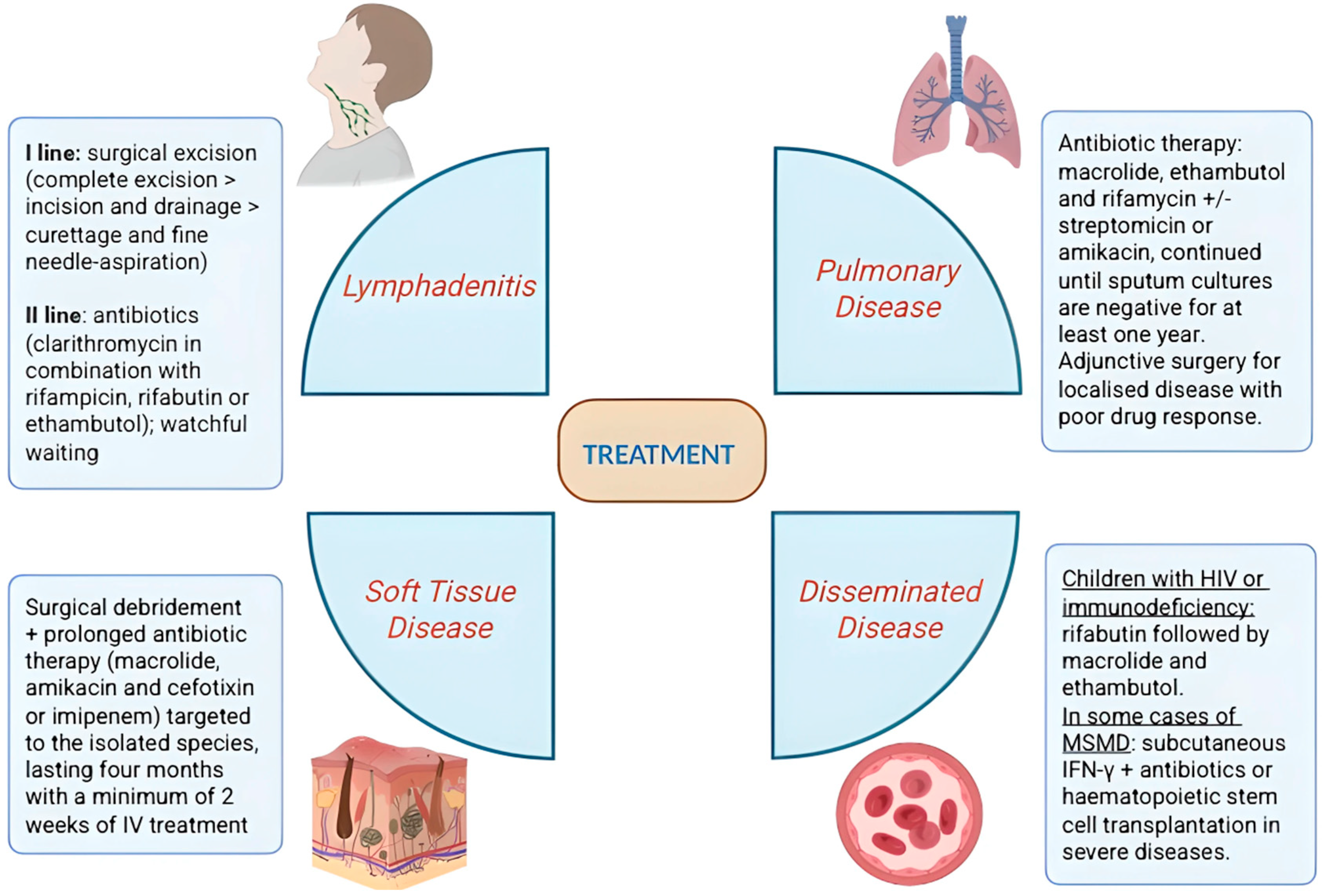
The main therapeutic approaches for NTM disease, categorized by the involved body site, are summarized in
Figure 2.



 ,
,