

Next Article in Journal
Integrative Transcriptomic and Systems Biology Analyses Identify TCB1 as a Calcium-Responsive Gene in Cryptococcus neoformans
Previous Article in Journal
Prokaryotic Microbial Diversity and Community Assembly in Reclaimed Coastal Agricultural Soils
error_outline You can access the new MDPI.com website here. Explore and share your feedback with us.
 
 
Article

Bacillus velezensis RF2 Rescued from Citrus Phyllosphere: Dual Mechanisms and Broad-Spectrum Activity for Controlling Citrus Bacterial Canker

1
Jiangxi Provincial Key Laboratory of Pest and Disease Control of Featured Horticultural Plants, Gannan Normal University, Ganzhou 341003, China
2
Joint International Research Laboratory of Agriculture and Agri-Product Safety of the Ministry of Education, Yangzhou University, Yangzhou 225009, China
*
Authors to whom correspondence should be addressed.
Microorganisms 2026, 14(1), 121; https://doi.org/10.3390/microorganisms14010121
Submission received: 2 December 2025 / Revised: 2 January 2026 / Accepted: 4 January 2026 / Published: 6 January 2026
(This article belongs to the Topic Applications of Biotechnology in Food and Agriculture)

Abstract

Citrus bacterial canker (CBC), caused by Xanthomonas citri subsp. citri (Xcc), threatens citrus production worldwide. Long-term dependence on copper-based bactericides not only poses environmental risks but also accelerates the emergence of copper-resistant Xcc strains. To develop safe and efficient alternative control strategies, 72 bacterial strains were isolated from the phyllosphere of citrus plants naturally infected by CBC and identified by 16S rRNA sequencing. Using an Xcc-GFP-based screening method, we systematically screened a highly effective strain, which was identified as Bacillus velezensis RF2 (Bv-RF2). Both inhibition zone assays and bioactivity tests of the crude methanolic extract of Bv-RF2 demonstrated stable antibacterial activity under UV irradiation, protease treatment, high temperature, and across a wide pH range. Whole-genome sequencing and antiSMASH analysis revealed multiple predicted NRPS/PKS-type biosynthetic gene clusters (BGCs). Together with metabolomic profiling, these data provide hypotheses for candidate metabolites that may contribute to antagonism. Bv-RF2 was associated with the induction of PR gene expression in immune-related pathways implicated in CBC responses. In sweet orange leaves, Bv-RF2 infiltration was associated with transient induction of defense-related (PR) genes, consistent with an ISR-like, priming-related response. In addition, Bv-RF2 inhibited the growth of fungal pathogens associated with citrus anthracnose and brown spot in vitro, indicating broad inhibitory potential under the tested conditions. Collectively, Bv-RF2 represents a promising candidate for developing environmentally friendly strategies against CBC and other citrus diseases.

1. Introduction

Citrus is one of the most widely cultivated and economically important fruit crops worldwide; however, its production is seriously constrained by diseases. Citrus bacterial canker (CBC), caused by Xanthomonas citri subsp. citri (Xcc), is particularly destructive in major citrus-producing regions [1,2,3]. Xcc infects leaves, shoots, and fruits, causing water-soaked lesions, corky eruptions, and tissue hyperplasia, which may lead to defoliation, premature fruit drop, yield losses, and reduced fruit quality [4,5,6]. CBC therefore represents a key bottleneck for sustainable citrus production.
Multiple pathogenic types are associated with citrus canker, including XccA, XccA*, XccAw, and X. fuscans subsp. aurantifolii B and C [7,8,9,10]. Among them, the highly virulent Asian type XccA is globally dominant. After entering through stomata or wounds, Xcc employs a type III secretion system (T3SS) to deliver transcription activator-like effectors (TALEs) into host nuclei [4,11]. The effector PthA4 activates the susceptibility gene CsLOB1, thereby promoting cell overproliferation and typical canker symptoms [12,13]. Additional virulence factors, including lipopolysaccharides, xanthan gum, and biofilms, promote colonization, stress tolerance, and pathogen spread [14,15,16].
Current CBC management still relies heavily on copper-based bactericides, which primarily act through copper-mediated damage to bacterial macromolecules [17,18]. However, long-term and intensive use has led to copper accumulation in soil and water, ecological concerns, and the emergence of copper-resistant Xcc strains [18,19,20]. Other approaches—such as breeding resistant cultivars, quarantine, and chemical inducers of resistance—are often limited by long breeding cycles, high costs, or inconsistent performance [21]. There is an urgent need for safe, effective, and environmentally friendly alternatives.
Biological control offers a promising strategy for greener CBC management. The “Cry for Help” hypothesis proposes that plants under pathogen stress can reshape their microbiomes by recruiting beneficial microorganisms that enhance disease resistance [22,23,24]. In citrus, Diaporthe citri infection enriches disease-suppressive taxa (e.g., Pantoea asv90, Methylobacterium asv41), increases microbial network complexity, and enhances functions such as siderophore production and pathogen cell wall degradation, resulting in disease inhibition rates up to 65.7–88.4% [22]. Citrus leaves infected with Xcc may undergo similar microbiome shifts, providing a rational reservoir for mining of candidate biocontrol strains.
Targeted isolation of biocontrol bacteria from Xcc-infected leaves has several advantages: (i) infection may increase the relative abundance of antagonistic bacteria, improving screening efficiency [25,26]; (ii) isolates may be pre-adapted to the citrus phyllosphere and to coexistence with Xcc, conferring niche compatibility and competitive fitness [25,27,28]; and (iii) this approach reduces randomness and prioritizes naturally selected candidates.
Among potential biocontrol agents, Bacillus velezensis has attracted particular interest. It is a Gram-positive member of the B. subtilis species complex and is widely distributed in soil and plant-associated habitats [29,30]. B. velezensis strains can suppress diverse fungi, including Colletotrichum capsici [31], and Xcc [32], and can enhance systemic resistance against Tobacco mosaic virus (TMV) [33]. Their biocontrol performance is often associated with: (i) production of diverse secondary metabolites, including lipopeptides (e.g., surfactin, iturin, and fengycin), polyketides (e.g., macrolactin and bacillaene), and volatile organic compounds (e.g., 2,3-butanediol) [34,35,36]; (ii) elicitation of SAR or ISR-like responses mediated mainly by jasmonic acid (JA), ethylene (ET), and NPR1-dependent signaling [37,38,39]; and (iii) plant growth promotion via phytohormones such as indole-3-acetic acid (IAA) [40]. In addition, Bacillus species form stress-resistant endospores and can colonize plant tissues efficiently, supporting survival under field conditions [41,42].
In this study, guided by a “microbiome distress response under citrus canker stress” framework and an Xcc-GFP-based high-throughput screening method, we mined the phyllosphere of Xcc-infected citrus to identify effective biocontrol bacteria. We identified B. velezensis RF2 as a core candidate and integrated whole-genome sequencing, biosynthetic gene cluster (BGC) prediction, metabolite/extract bioactivity assays, and host response analyses to investigate its potential modes of action and broad inhibitory activity. Notably, genome-predicted BGCs provide mechanistic hypotheses; therefore, we interpret genotype–phenotype links cautiously and highlight remaining limitations and future validation needs.

2. Materials and Methods

2.1. Pathogens and Plant Materials

Xanthomonas citri subsp. citri (Xcc) was isolated from citrus orchards in Jiangxi Province, China, and cultured at 28 °C on Nutrient Broth (NB) or Nutrient Agar (NA) (Landbridge, Beijing, China). Where required, 50 mg/L kanamycin (Macklin, Shanghai, China) was added.
Colletotrichum gloeosporioides and Alternaria alternata were cultured on Potato Dextrose Agar (PDA) prepared from a commercially available PDA powder (Hopebiol, Qingdao, China) according to the manufacturer’s instructions and incubated under a 16 h/8 h light/dark cycle at 28/26 °C and 80% relative humidity.
‘Hamlin’ sweet orange (Citrus sinensis (L.) Osbeck) plants were maintained in a greenhouse under a 16 h/8 h light/dark cycle at 28/26 °C and 80% relative humidity. Fully expanded leaves (approximately one month old) were used for all assays.

2.2. Isolation and Identification of Citrus Phyllosphere Bacteria

Citrus plants naturally infected with Xcc and showing similar growth status were selected in the orchard. Leaves from the four canopy quadrants were pooled and transferred into 50 mL tubes containing sterile PBS (137 mM NaCl, 2.7 mM KCl, 2 mM KH2PO4, 8 mM Na2HPO4·12 H2O, pH 7.2–7.4) (Sinopharm, Beijing, China). Samples were vortexed for 15 s, and the wash solution was collected, serially diluted (10-fold), and plated on NA. After incubation at 28 °C for 24–48 h, single colonies were purified. To isolate endophytic bacteria, leaves were surface-sterilized, ground, and the homogenate was serially diluted and plated. All isolates were stored in 15% (v/v) glycerol (Xilong, Shantou, China) at −80 °C.
Genomic DNA was extracted using the HeaPure Bacterial Genomic DNA Extraction Kit (Coolaber, Beijing, China). The 16S rRNA gene was amplified using primers 27F (5′-AGAGTTTGATCCTGGCTCAG-3′) and 1492R (5′-TACGACTTAACCCCAATCGC-3′). PCR products were verified by agarose gel electrophoresis and sequenced by Genewiz (Guangzhou, China). Assembled sequences were compared against the NCBI nucleotide database.

2.3. Identification and Characterization of Candidate Biocontrol Strains

Candidate biocontrol strains were screened using an Xcc-GFP-based method as described previously [18]. Selected isolates were streaked on NA and incubated at 28 °C for 24–48 h to examine colony morphology. Gram staining was performed for microscopic observation. Genomic DNA was extracted as described above. The 16S rRNA gene was amplified and cloned into a pEASY-Blunt Cloning Vector, followed by transformation into Trans1-T1 Phage Resistant Chemically competent cells (Transgen, Beijing, China). Positive transformants were identified using primers M13F (5′-GTAAAACGACGGCCAGT-3′) and M13R (5′-CAGGAAACAGCTATGAC-3′) and sequenced (Genewiz). Assembled 16S rRNA sequences were submitted to NCBI, and a phylogenetic tree was constructed using the Neighbor-Joining method in MEGA 11 (version 11.0.18, MEGA Software Team, Tempe, AZ, USA) with 1000 bootstrap replicates.

2.4. Methanol Extraction and Stability Evaluation of Bv-RF2 Fermentation Products

Antimicrobial metabolites from Bv-RF2 were prepared with minor modifications to Lin et al. [43]. Glycerol stocks were streaked on NA and incubated at 28 °C. A single colony was inoculated into 100 mL NB and cultured at 28 °C with shaking at 200 rpm for 16 h (seed culture). The seed culture (10%, v/v; initial OD600 = 0.2–0.3) was transferred into 800 mL NB and incubated at 28 °C with shaking at 200 rpm for 48 h. Cultures were centrifuged at 10,000 rpm for 15 min at 4 °C to obtain cell-free supernatant (CFS).
For acid precipitation, the pH of the CFS was adjusted to 2.0 with 6 N HCl (Xilong, Shantou, China) and incubated at 4 °C overnight. Precipitates were collected by centrifugation (10,000 rpm, 15 min, 4 °C), washed twice with ddH2O (pH 2.0), resuspended in ddH2O, and adjusted to pH 7.0. After centrifugation, the supernatant was evaporated to dryness at 60 °C. The residue was dissolved in methanol, insoluble material was removed, and the methanol phase was evaporated at 45 °C and weighed.
The crude methanolic extract was dissolved in sterile water to 20 mg/mL and further diluted to 10, 5, 2.5, and 1 mg/mL. Antagonistic activity against Xcc-GFP was assessed using an agar well diffusion (“cup”) assay. For stability assays, a 1 mg/mL solution was subjected to: (i) heat treatments at 30, 45, 60, 75, 90, or 100 °C for 30 min; (ii) UV irradiation (254 nm) for 5–50 min; (iii) protease treatment with 5 μg/mL trypsin or proteinase K at 37 °C for 2 h; and (iv) pH treatments (2, 4, 7, 10, or 12) for 24 h, followed by readjustment to pH 7.0 prior to testing. 50 μL were added per well. Each treatment included three technical replicates, and the entire experiment was independently repeated three times.

2.5. Effects of Bv-RF2 on Sweet Orange Immune Pathways and Defense Gene Expression

Bv-RF2 was grown overnight in NB at 28 °C with shaking. Cells were harvested (12,000 rpm, 3 min), washed, and resuspended in sterile water (OD600 = 1.0). Bacterial suspensions were infiltrated into fully expanded leaves using a needleless syringe, with ddH2O as the control. Three independent biological replicates were included.
Leaf samples were collected at 0, 1, 3, 5, 7, 9, 12, and 15 days post-inoculation (dpi) for RNA extraction. Defense-related gene expression was quantified by RT-qPCR using CsGAPDH as the reference gene. Primer sequences are listed in Table S1.
For Evans blue (Coolaber, Beijing, China) staining, leaves were immersed in ddH2O and shaken at 37 °C, 200 rpm for 12 h, then incubated in 0.25% (w/v) Evans blue for 24 h. Excess dye was removed with purified water, and leaves were photographed after blotting. To enhance contrast, leaves were decolorized in boiling ethanol:glycerol (9:1, v/v) for 30 min until chlorophyll was removed, then flattened and photographed.
For relative electrolyte leakage, clean leaves were rinsed three times with ddH2O and immersed in 30 mL ddH2O, followed by shaking at 37 °C (200 rpm) for 24 h. Initial conductivity (Lt) was measured. Samples were then heated at 90 °C for 2 h to obtain total conductivity (L0). Relative electrolyte leakage (L) was calculated as L = (Lt/L0) × 100%.

2.6. Biocontrol Assay on Sweet Orange Leaves

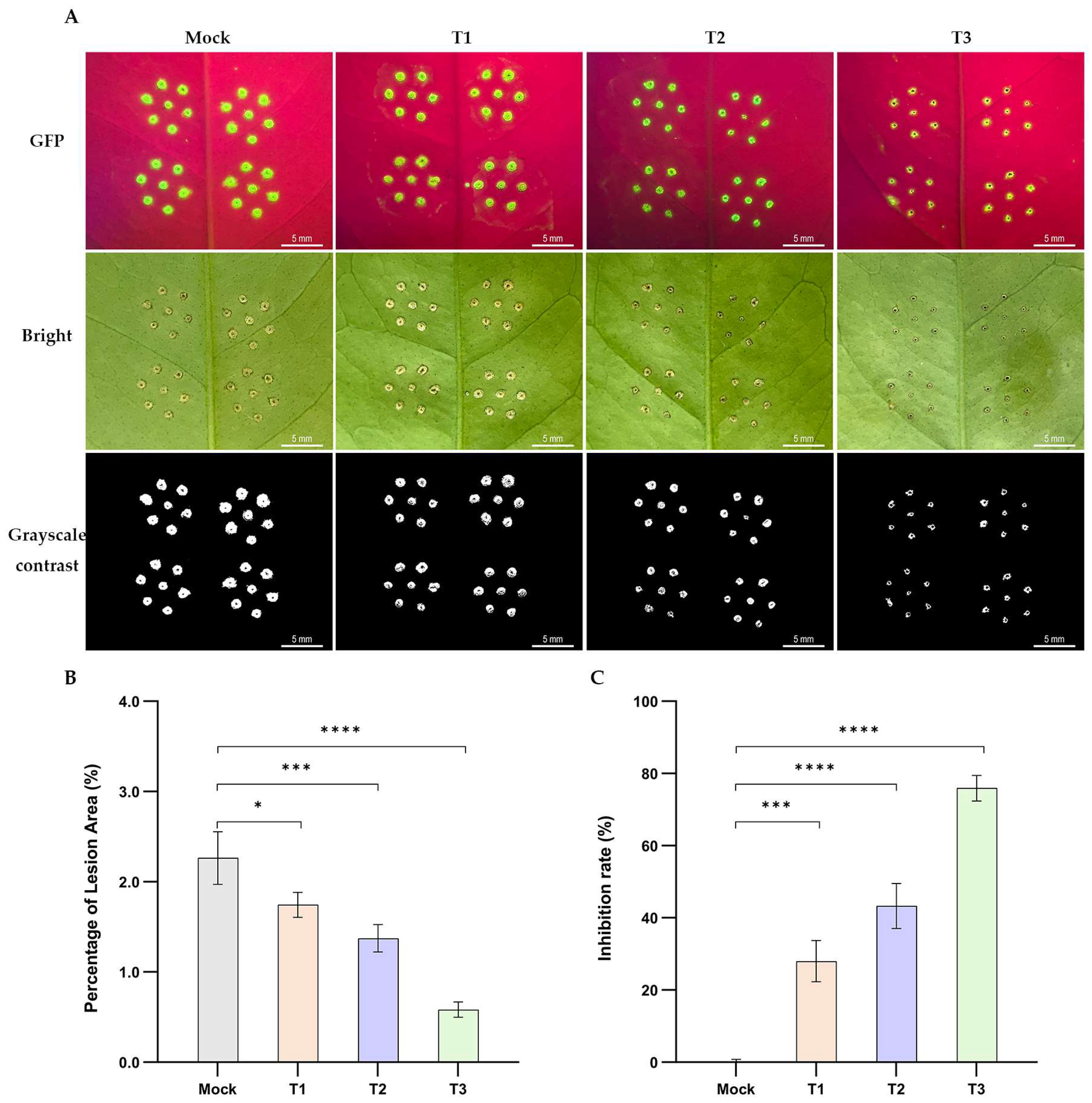
An Xcc-GFP suspension (OD600 = 0.6) was mixed (1:1, v/v) with Bv-RF2 crude methanol extract at 10, 5, or 1 mg/mL. The control consisted of Xcc-GFP mixed with ddH2O. Tween-20 (0.1%, v/v) was added, and the final Xcc-GFP concentration was approximately 5.0 × 10⁸ CFU/mL. On the abaxial side of ‘Hamlin’ leaves (2–3 weeks after flush) from 3–4-year-old trees, 28 wounds per leaf were made using a dissecting pin. Each wound was inoculated with 2 μL of the corresponding mixture, and inoculation sites were kept moist. Three leaves were used per treatment group. Disease development was monitored, and lesion areas were quantified at 7 dpi. Data were analyzed using GraphPad Prism 10. The experiment was independently repeated three times.

2.7. Whole-Genome Sequencing and Secondary Metabolite Gene Cluster Analysis of Bv-RF2

Bv-RF2 genomic DNA was sequenced by Megigene (Megigene, Guangzhou, China) using both Illumina (short-insert paired-end library) and Oxford Nanopore Technologies platforms. After quality control, hybrid de novo assembly was performed with Unicycler [44]. Coding sequences were predicted using Glimmer3 [45] or Prodigal [46] (for GC > 70%). tRNAs were predicted using tRNAscan-SE v1.4 [47], rRNAs using rRNAmmer v1.2 [48], and sRNAs by comparison against Rfam [49] followed by CMsearch filtering [50]. Repetitive and tandem repeats were identified using RepeatMasker v4.1.2-p1 and TRF v4.09 [51], respectively. Functional annotation was performed using BLAST (https://blast.ncbi.nlm.nih.gov/Blast.cgi) and DIAMOND (version 2.1.9, Buchfink B, Xie C, Huson DH, Tübingen, Germany). Secondary metabolite biosynthetic gene clusters (BGCs) were predicted using antiSMASH (https://antismash.secondarymetabolites.org/#!/start) under the strict “known cluster detection” setting to infer BGC types, genomic locations, and putative products.

2.8. Assessment of Representative Metabolite Activity

Log-phase Xcc-GFP cells were scraped from NA plates, washed three times with PBS, and resuspended to OD600 = 1.0. Aliquots (0.1 mL) were mixed with 10 mL of molten 1.2% NA, poured into Petri dishes, and allowed to solidify. Then, 5 μL of each test solution was spotted onto the surface: Bv-RF2 crude methanol extract (10 mg/mL), surfactin (10 μM, C53H93N7O13) (TargetMol, Boston, MA, USA), streptomycin sulfate (0.1 mg/mL), and PBS (control). Plates were incubated at 28 °C for 36–48 h, and inhibition zones were measured using ImageJ (version 1.54f, Wayne Rasband, NIH, Bethesda, MD, USA). Data were analyzed using GraphPad Prism (version 10.1.2, GraphPad Software, San Diego, CA, USA). The experiment was independently repeated three times.

2.9. Broad-Spectrum Antimicrobial Activity Assessment

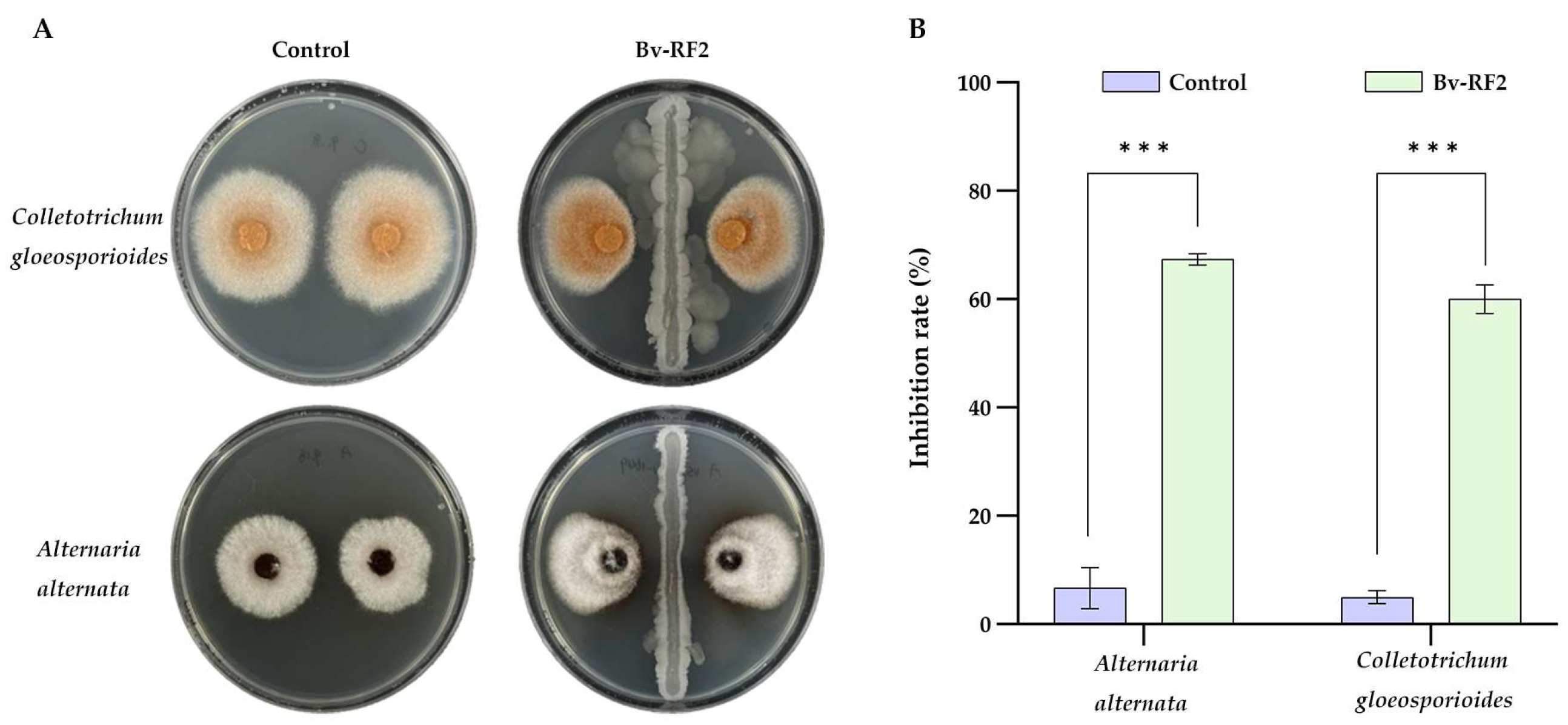
A 10 μL aliquot of Bv-RF2 suspension (OD600 = 1.0) was streaked in the center of PDA plates. Colletotrichum gloeosporioides or Alternaria alternata plugs (8 mm diameter) were placed 15 mm from both sides of the streak in a cross pattern. Control plates contained only fungal plugs. Each treatment included three technical replicates. The experiment was independently repeated three times. After 7 days, inhibition zones were measured, and inhibition rate was calculated as:
Inhibition rate = [(control colony radius − treatment colony radius)/(control colony radius − plug radius)] × 100%.

2.10. Statistical Analysis

For assays with technical replicates, technical measurements were first averaged to generate a single value per biological replicate. Data are presented as mean ± standard deviation (SD). Statistical analyses were performed using GraphPad Prism 10.1.2. Unpaired Welch’s t-test was used for comparisons between two groups, with Holm–Šidák correction for multiple comparisons. For comparisons involving multiple groups or factors, two-way or one-way analysis of variance (ANOVA) combined with the corresponding post hoc tests was performed. Detailed analytical methods are specified in the legend of each figure. Adjusted p values are reported as indicated.

3. Results

3.1. Isolation and Identification of Phyllosphere Biocontrol Microorganisms

A total of 72 bacterial isolates were recovered from canker-infected citrus leaves and preliminarily identified (Table 1). Using an Xcc-GFP-based screening method, strain Bv-RF2 exhibited strong antagonism toward Xcc. Under the screening conditions, the fermentation broth of Bv-RF2 achieved an inhibition rate of 78.89%.

3.2. Morphological and Phylogenetic Characterization of Bv-RF2

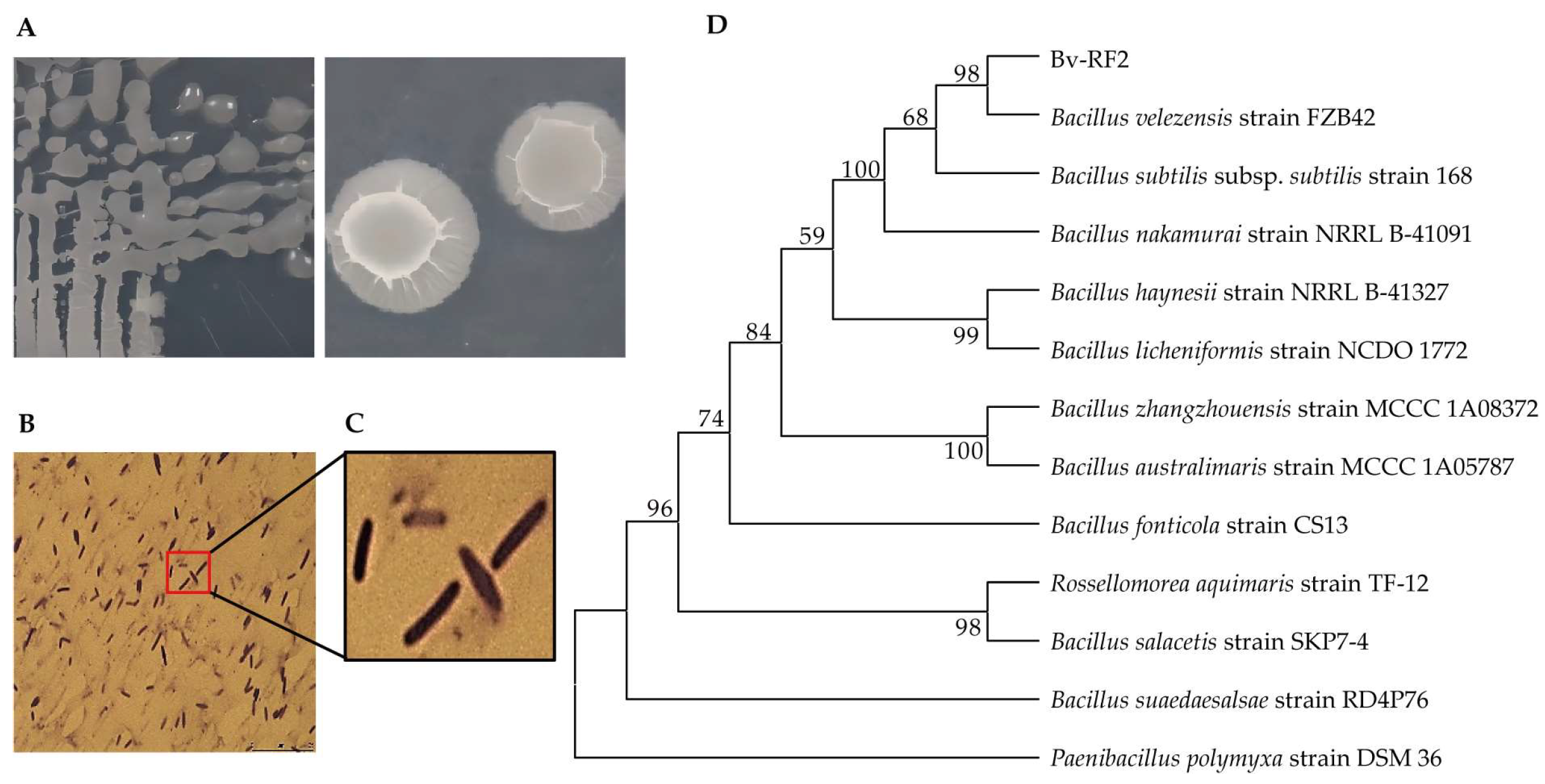
On NA plates, Bv-RF2 formed milky-white colonies with a composite texture, characterized by a dry surface, irregularly wrinkled margins, a viscous interior, and a raised center (Figure 1A). Gram staining revealed purple rod-shaped cells with endospore-like structures (Figure 1B,C), consistent with a Gram-positive Bacillus species. The 16S rRNA gene sequence of Bv-RF2 showed 99.8% identity to Bacillus velezensis FZB42. Phylogenetic analysis further placed Bv-RF2 within the B. velezensis clade with 98% bootstrap support and clearly separated it from Paenibacillus spp. (Figure 1D). Based on these results, the strain was designated Bacillus velezensis RF2 (Bv-RF2).

3.3. Activity and Stability of Bv-RF2 Fermentation Products

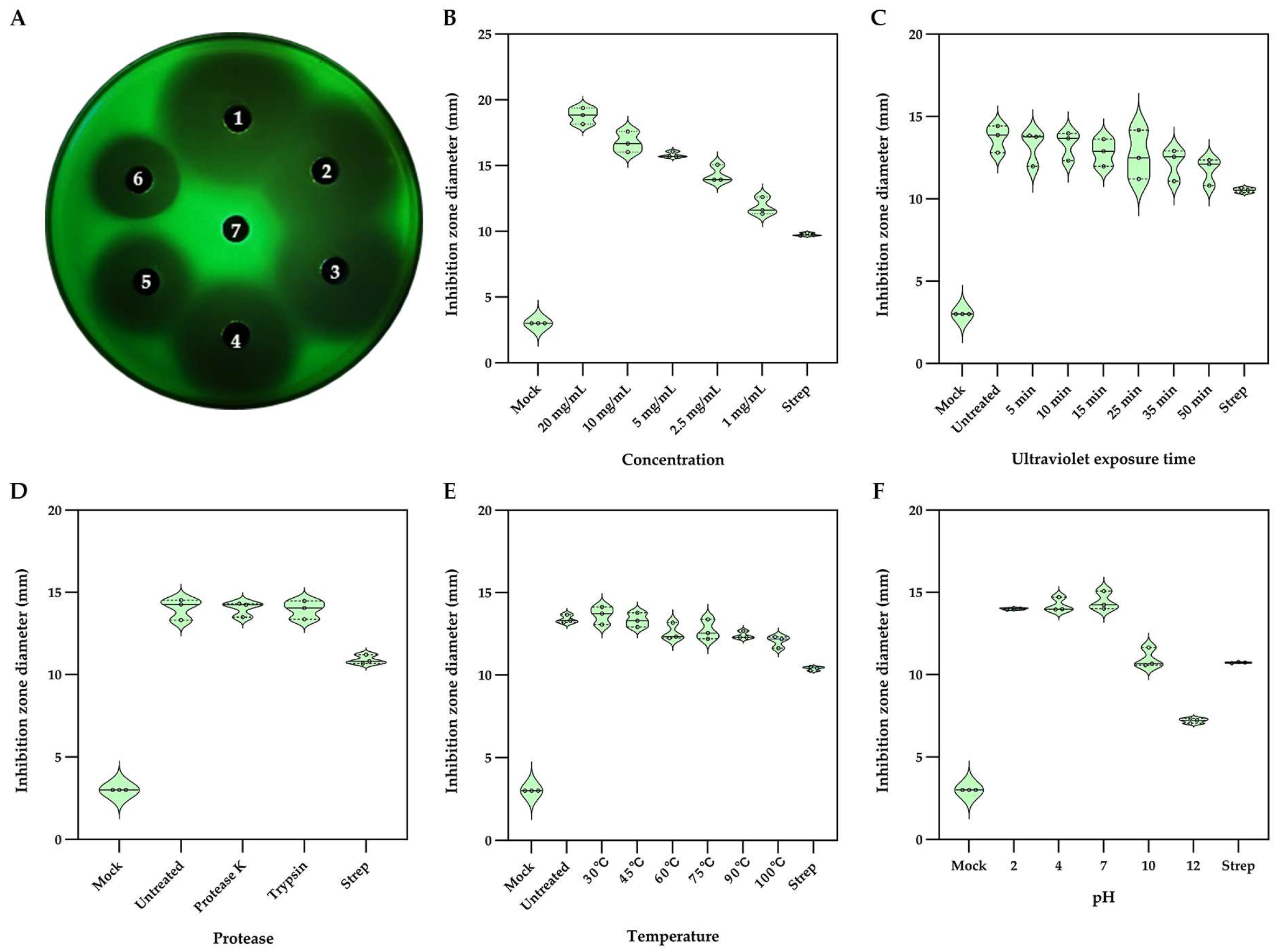
Agar well diffusion assay using the 24 h fermentation broth of Bv-RF2 produced clear inhibition zones against Xcc, suggesting that extracellular components in the culture supernatant contributed to the anti-Xcc activity. Following acid precipitation and methanol extraction, the crude extract inhibited Xcc on NA in a dose-dependent manner (Figure 2A). At 1 mg/mL, the inhibition zone diameter was 11.87 ± 0.55 mm, which was larger than that produced by 0.1 mg/mL streptomycin (9.76 ± 0.09 mm) (Figure 2B).
The antibacterial activity of the crude methanolic extract remained largely stable after UV exposure for 5–50 min, with inhibition zone diameters remaining around 11.76 ± 0.68 mm (Figure 2C). Protease treatment with proteinase K or trypsin did not reduce activity, with the resulting inhibition zone diameters measuring 14.01 ± 0.37 mm and 13.96 ± 0.45 mm, respectively (Figure 2D), and heating at 30–100 °C for 30 min also retained consistent activity, with inhibition zones ≥ 12.03 ± 0.29 mm (Figure 2E). These results are consistent with the involvement of one or more non-proteinaceous and heat-stable bioactive components. At pH 10 and 12, the diameters of the inhibition zones were 10.96 ± 0.49 mm and 7.20 ± 0.13 mm, respectively, compared with 14.45 ± 0.46 mm (untreated, pH 7.0) and 10.72 ± 0.02 mm (0.1 mg/mL streptomycin) (Figure 2F). Although activity decreased under extreme pH conditions, clear inhibition zones were still observed, indicating tolerance to acidic and alkaline conditions.

3.4. Genomic and Metabolomic Features of Bv-RF2

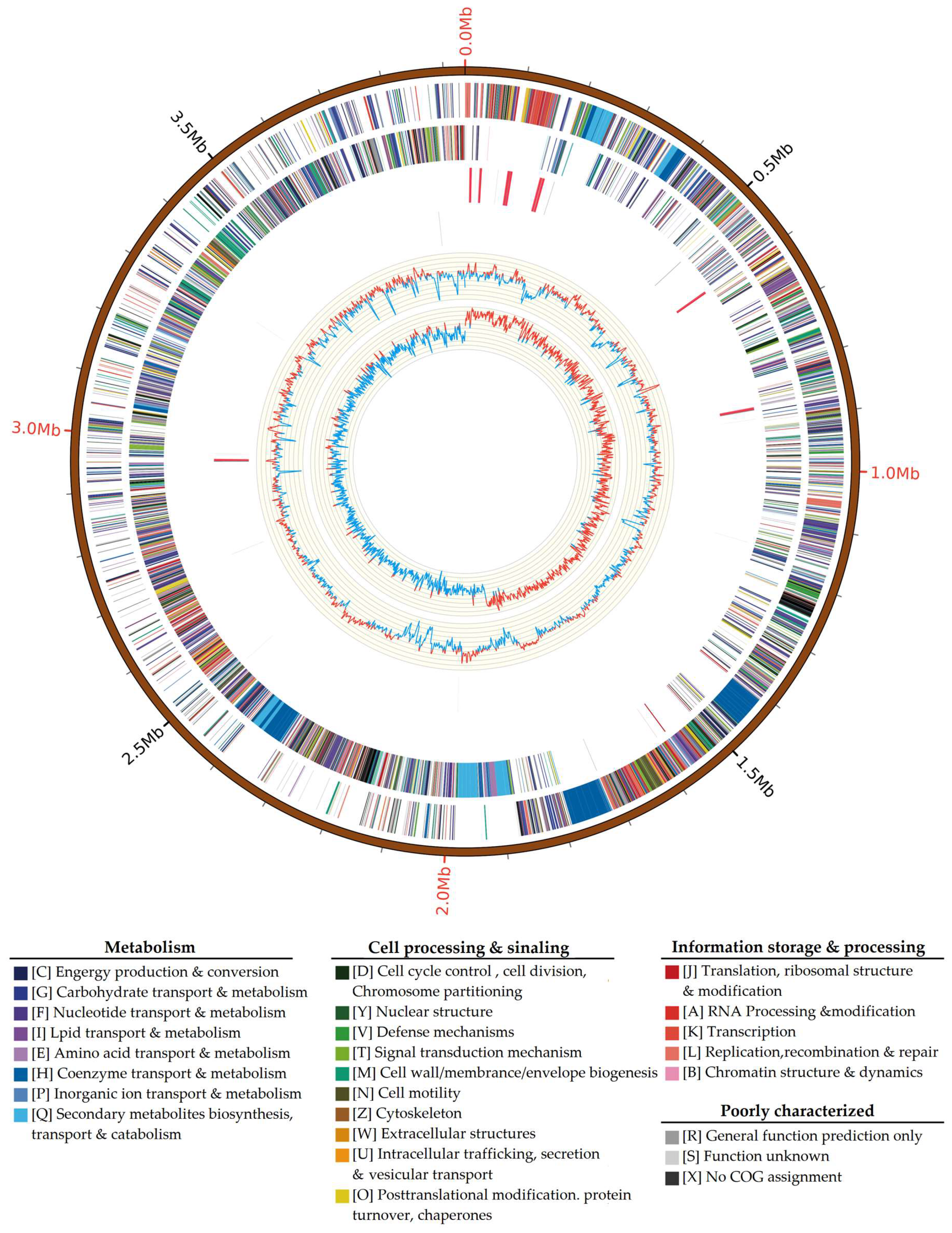
Whole-genome sequencing of Bv-RF2 (GenBank ID: GCA_053847225.1) (Figure 3) revealed a 3,935,256 bp genome containing 3840 predicted genes. antiSMASH analyses identified 12 putative biosynthetic gene clusters (BGCs), including NRPS, transAT-PKS, T3PKS, lanthipeptide, terpene, NRP-metallophore, and other small-molecule clusters. Eight clusters showed high similarity to previously characterized antibiotic or biosurfactant BGCs (e.g., surfactin, fengycin, bacillaene, difficidin, macrolactin H, bacillibactin, and bacilysin), and a locillomycin-like cluster with lower similarity was also predicted (Figure S1). Overall, the BGC repertoire was similar to that of B. velezensis FZB42 (GenBank ID: GCA_000015785.2). Notably, several BGCs associated with lipopeptide biosynthesis (e.g., surfactin) were present at the genomic level, whereas the corresponding metabolites were not detected in our untargeted metabolomic analysis, partly because their m/z values may fall outside the acquired mass range of the LC–MS/MS method used in this study (Table S2).
In addition to secondary metabolism, the genome encoded 162 carbohydrate-active enzymes, six putative resistance genes, 841 predicted transmembrane proteins, and 41 predicted secreted proteins, consistent with a capacity for nutrient acquisition, environmental adaptation, and secretion of extracellular factors.

3.5. Bv-RF2 Elicits Defense Priming in Sweet Orange

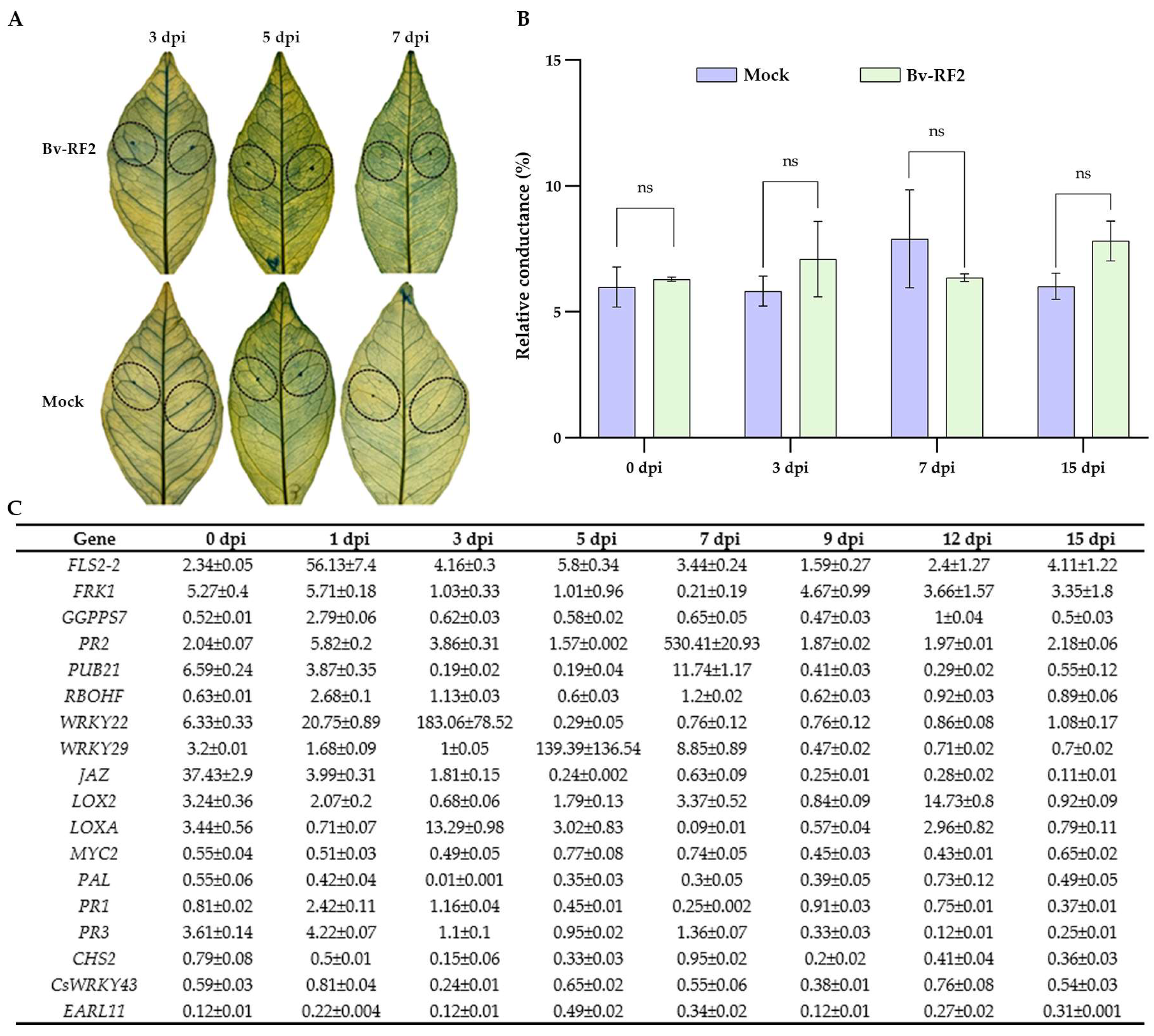
To assess plant responses to Bv-RF2, physiological changes and defense-related gene expression were monitored after leaf infiltration. Evans blue staining showed only slight color intensification between 3 and 15 dpi (Figure 4A), indicating limited cell death. Conductivity measurements revealed a transient increase followed by stabilization (Figure 4B), suggesting mild and reversible changes in membrane permeability.
RT-qPCR analysis revealed a transient induction pattern of several defense-related genes (Figure 4C), and statistical analyses of the corresponding adjusted p values are provided in Table S3. PR2 transcripts increased at 3 dpi, peaked at 7 dpi, and declined by 12 dpi. PR1 and PR3 were also upregulated at 3–7 dpi. Genes associated with PAMP-triggered immunity (PTI), including FLS2-2 and RBOHF, were upregulated by 56-fold and 2.7-fold, respectively, at 3 dpi, consistent with a modest PTI-like response. WRKY22 and WRKY29 were induced from 3 to 12 dpi but at levels lower than typically observed during infection with virulent pathogens, suggesting a priming-associated defense state rather than strong defense activation. Several JA pathway-associated genes (e.g., JAZ, LOX2, and LOXA) exhibited dynamic expression changes, and CHS2 and PAL were upregulated at 3–7 dpi, consistent with enhanced phenylpropanoid-related responses.

3.6. Biocontrol Efficacy of Bv-RF2 Against Citrus Canker

Needle-inoculation assays were performed to evaluate whether Bv-RF2 crude methanolic extracts could reduce canker development caused by Xcc on sweet orange leaves. Co-inoculation of Xcc with increasing concentrations of the extract resulted in a clear, dose-dependent reduction in lesion area (Figure 5A,B). Quantitatively, extracts at 10, 5, and 1 mg/mL reduced disease severity by 75.93%, 43.32%, and 27.98% (Figure 5C). These results indicate that Bv-RF2-derived soluble components possess in planta activity under our assay conditions.

3.7. Broad-Spectrum Antimicrobial Activity of Bv-RF2

Bv-RF2 also showed inhibitory activity against fungal pathogens in vitro. On PDA plates, Bv-RF2 effectively inhibited the mycelial growth of Colletotrichum gloeosporioides and Alternaria alternata (Figure 6A), with inhibition rates of 60.02% and 67.34% (Figure 6B). Together with the anti-Xcc results, these data suggest that Bv-RF2 exhibits broad inhibitory potential against multiple citrus-associated pathogens under the tested conditions.

4. Discussion

Guided by the “Cry for Help” hypothesis, we used the phyllosphere microbiome of Xcc-infected citrus as a targeted resource for biocontrol screening. Plants under biotic or abiotic stress can actively modulate their associated microbiota via changes in exudation patterns, thereby recruiting beneficial microbes that enhance stress tolerance and disease resistance [52,53]. As the phyllosphere is the primary infection site for CBC, pathogen-induced changes in leaf exudates and volatile organic compounds (VOCs) may reshape microbial communities and enrich stress-tolerant antagonists capable of producing inhibitory factors and/or competing for epiphytic niches [22,35,54]. Consistent with this framework, our Xcc-GFP-based screening enabled efficient identification of an adapted antagonist, Bv-RF2.
Bv-RF2 exhibited inhibitory activity against Xcc and suppressed the growth of Colletotrichum gloeosporioides and Alternaria alternata in vitro. Bacillus spp., and B. velezensis in particular, are known to produce a broad arsenal of antimicrobial metabolites, including lipopeptides, polyketides, and ribosomally and non-ribosomally synthesized peptides that contribute to biocontrol [55,56,57]. The crude extract displayed stability to heat, protease treatment, and a broad pH range (Figure 2), which is consistent with the involvement of non-proteinaceous, chemically stable bioactive components reported for B. velezensis [55,56,58]. Importantly, our in planta assays were conducted using crude methanolic extracts to primarily assess the contribution of soluble/secreted components while minimizing variability introduced by foliar colonization dynamics. We acknowledge that practical field-level biocontrol efficacy depends not only on antimicrobial metabolites but also on traits such as epiphytic colonization, persistence, and competitive fitness on leaf surfaces [59]. Our preliminary results indicate that this strain can be recruited into leaf tissues following pathogen challenge. Moreover, Evans blue staining further suggests good host compatibility and biocontrol potential, implying that the strain may be able to persist and/or stably colonize host leaf tissues. Therefore, the extract-based assays provide evidence for metabolite-associated activity but do not represent a complete evaluation of live-bacterium biocontrol performance. The practical efficacy under field-relevant conditions still needs to be validated through foliar application trials using live bacteria, together with quantitative assessments of leaf-surface attachment and colonization, persistence, and competitive fitness.
Genome mining revealed that Bv-RF2 harbors multiple predicted BGCs with similarity to clusters involved in the biosynthesis of lipopeptides and polyketides (e.g., surfactin, fengycin, difficidin, and macrolactin) [57]. However, several genome-predicted products were not detected in our untargeted metabolomic analysis, which may reflect limitations of the acquired m/z range and/or other dataset constraints (Table S2). Thus, BGC predictions should be interpreted as generating mechanistic hypotheses rather than direct proof that specific metabolites mediate the observed phenotypes. Establishing causal genotype-phenotype links will require targeted LC-MS/MS analyses, bioassay-guided fractionation, and genetic perturbation approaches [55,56].
Regarding host responses, Bv-RF2 infiltration caused limited cell death and mild, reversible membrane changes (Figure 4A,B). The transient induction of defense-related genes, together with moderate activation of PTI-associated markers and phenylpropanoid-related genes (Figure 4C), is more consistent with an ISR-like response and defense priming than with strong systemic defense activation typically induced by virulent pathogens [53,60,61]. Such priming may sensitize host defenses and contribute to reduced disease development upon pathogen challenge, while potentially avoiding severe fitness costs.
Overall, our data support two complementary and testable hypotheses for Bv-RF2-associated protection: (i) secretion of chemically stable bioactive components with antimicrobial activity, and (ii) elicitation of ISR-like priming in the host. These findings provide a foundation for further mechanistic validation and for developing environmentally friendly strategies for CBC management.

5. Conclusions

In conclusion, we identified Bacillus velezensis RF2 (Bv-RF2) from the phyllosphere of Xcc-infected citrus and demonstrated its inhibitory activity against Xcc as well as other citrus-associated pathogens under our experimental conditions. Crude methanolic extracts exhibited strong antibacterial activity in vitro and reduced canker development in a leaf assay, indicating that Bv-RF2-derived soluble components can contribute to disease suppression. Genome mining revealed a repertoire of predicted NRPS/PKS-type BGCs that is consistent with the capacity to produce diverse secondary metabolites; however, causal links between specific clusters/metabolites and antimicrobial activity require further targeted validation. Bv-RF2 infiltration was associated with an ISR-like, priming-related host response characterized by transient induction of defense-related genes. Future work should evaluate live-bacterium foliar biocontrol performance, including colonization and persistence, and apply targeted chemical and genetic approaches to strengthen genotype–phenotype relationships.

Supplementary Materials

The following supporting information can be downloaded at: https://www.mdpi.com/article/10.3390/microorganisms14010121/s1, Table S1. qPCR Primer Information. Table S2. Bv-RF2 untargeted metabolomics data. Table S3. RT-qPCR analysis of defense-related genes from 0 to 15 dpi. Figure S1. NRPS and PKS Biosynthetic Loci of the Bv-RF2 Genome. Biosynthetic loci identified by antiSMASH from the Bv-RF2 genome that contained NRPS and PKS of core biosynthetic genes. Predictions of the organization of the biosynthetic domains in each locus shown here were determined by MIBiG. Full names for the biosynthetic domains are given in the right table. References [62,63,64] are cited in the supplementary materials.

Author Contributions

Conceptualization, S.D. and M.L.; methodology, R.-F.L. and S.-Y.Z.; software, R.-F.L.; validation, R.-F.L., S.-Y.Z. and Y.-X.W.; formal analysis, R.-F.L. and Y.-T.L.; investigation, R.-F.L., Z.-Y.J. and R.-Y.Z.; resources, Y.-Z.Z. and M.-L.B.; data curation, R.-F.L. and T.-T.Z.; writing—original draft preparation, R.-F.L.; writing—review and editing, S.D. and M.L.; visualization, R.-F.L.; supervision, S.D.; project administration, S.D.; funding acquisition, S.D., M.L., A.Y. and R.-F.L. All authors have read and agreed to the published version of the manuscript.

Funding

This research was funded by the Natural Science Foundation of Jiangxi (20232ACB215007 and 20252BAC240592 to S.D.; JXSQ2020102132 to Y.Z.), the Open Project of Jiangxi Provincial Key Laboratory (PDP2025101 to A.Y.), the National Natural Science Foundation of China (32002021 to S.D.) and the Jiangxi Provincial Graduate Innovation Special Fund Project (YC2024-S798 to R.L.).

Institutional Review Board Statement

Not applicable.

Informed Consent Statement

Not applicable.

Data Availability Statement

The original contributions presented in this study are included in the article/Supplementary Materials. Further inquiries can be directed to the corresponding authors.

Acknowledgments

We thank Guiyan Huang at the University of Gannan Normal University for the training and use of microscopes in this study. The authors used ChatGPT 5.1 for the purposes of grammar corrections during the original draft preparation.

Conflicts of Interest

The authors declare no conflicts of interest.

References

  1. Gottwald, T.R.; Graham, J.H.; Schubert, T.S. Citrus Canker: The Pathogen and Its Impact. Plant Health Prog. 2002, 3, 15. [Google Scholar] [CrossRef]
  2. Angelotti-Mendonça, J.; de Oliveira, P.N.; Ansante, N.F.; Stipp, L.C.L.; Freitas-Astúa, J.; Hurtado, F.M.M.; Belasque, J.; Mourão Filho, F.d.A.A. Expression of the Citrus sinensis EDS5 gene, MATE family, in Solanum lycopersicum L. cv. Micro-Tom enhances resistance to tomato spot disease. Trop. Plant Pathol. 2022, 47, 287–297. [Google Scholar] [CrossRef]
  3. Nugroho, Y.A.; Suharjono, S.; Widyaningsih, S. Biological control of citrus canker pathogen Xanthomonas citri subsp. citri using Rangpur lime endophytic bacteria. Egypt. J. Biol. Pest Control 2022, 32, 63. [Google Scholar] [CrossRef]
  4. Brunings, A.M.; Gabriel, D.W. Xanthomonas citri: Breaking the surface. Mol Plant Pathol 2003, 4, 141–157. [Google Scholar] [CrossRef] [PubMed]
  5. Cernadas, R.A.; Benedetti, C.E. Role of auxin and gibberellin in citrus canker development and in the transcriptional control of cell-wall remodeling genes modulated by Xanthomonas axonopodis pv. citri. Plant Sci. 2009, 177, 190–195. [Google Scholar] [CrossRef]
  6. Giraldo—González, J.J.; de Souza Carvalho, F.M.; Ferro, J.A.; Herai, R.H.; Chaves Bedoya, G.; Rodas Mendoza, E.F. Transcriptional changes involved in kumquat (Fortunella spp) defense response to Xanthomonas citri subsp. citri in early stages of infection. Physiol. Mol. Plant Pathol. 2021, 116, 101729. [Google Scholar] [CrossRef]
  7. Hyun, J.W.; Kim, H.J.; Yi, P.H.; Hwang, R.Y.; Park, E.W. Mode of Action of Streptomycin Resistance in the Citrus Canker Pathogen (Xanthomonas smithii subsp. citri) in Jeju Island. Plant Pathol. J. 2012, 28, 207–211. [Google Scholar] [CrossRef]
  8. Fonseca, N.P.; Felestrino, É.B.; Caneschi, W.L.; Sanchez, A.B.; Cordeiro, I.F.; Lemes, C.G.C.; Assis, R.A.B.; Carvalho, F.M.S.; Ferro, J.A.; Varani, A.M.; et al. Detection and identification of Xanthomonas pathotypes associated with citrus diseases using comparative genomics and multiplex PCR. PeerJ 2019, 7, e7676. [Google Scholar] [CrossRef]
  9. Patané, J.S.L.; Martins, J.; Rangel, L.T.; Belasque, J.; Digiampietri, L.A.; Facincani, A.P.; Ferreira, R.M.; Jaciani, F.J.; Zhang, Y.; Varani, A.M.; et al. Origin and diversification of Xanthomonas citri subsp. citri pathotypes revealed by inclusive phylogenomic, dating, and biogeographic analyses. BMC Genom. 2019, 20, 700. [Google Scholar] [CrossRef]
  10. Licciardello, G.; Caruso, P.; Bella, P.; Boyer, C.; Smith, M.W.; Pruvost, O.; Robene, I.; Cubero, J.; Catara, V. Pathotyping Citrus Ornamental Relatives with Xanthomonas citri pv. citri and X. citri pv. aurantifolii Refines Our Understanding of Their Susceptibility to These Pathogens. Microorganisms 2022, 10, 986. [Google Scholar] [CrossRef]
  11. Ference, C.M.; Gochez, A.M.; Behlau, F.; Wang, N.; Graham, J.H.; Jones, J.B. Recent advances in the understanding of Xanthomonas citri ssp. citri pathogenesis and citrus canker disease management. Mol. Plant Pathol. 2018, 19, 1302–1318. [Google Scholar] [CrossRef]
  12. Jia, H.; Orbovic, V.; Jones, J.B.; Wang, N. Modification of the PthA4 effector binding elements in Type I CsLOB1 promoter using Cas9/sgRNA to produce transgenic Duncan grapefruit alleviating XccΔpthA4:dCsLOB1.3 infection. Plant Biotechnol. J. 2016, 14, 1291–1301. [Google Scholar] [CrossRef]
  13. Zou, X.; Du, M.; Liu, Y.; Wu, L.; Xu, L.; Long, Q.; Peng, A.; He, Y.; Andrade, M.; Chen, S. CsLOB1 regulates susceptibility to citrus canker through promoting cell proliferation in citrus. Plant J. 2021, 106, 1039–1057. [Google Scholar] [CrossRef] [PubMed]
  14. Guo, Y.; Sagaram Uma, S.; Kim, J.-S.; Wang, N. Requirement of the galU Gene for Polysaccharide Production by and Pathogenicity and Growth In Planta of Xanthomonas citri subsp. citri. Appl. Environ. Microbiol. 2010, 76, 2234–2242. [Google Scholar] [CrossRef]
  15. Sena-Vélez, M.; Graham, J.H.; Girón, J.A.; Redondo, C.; Cubero, J. Characterization of the extracellular matrix of biofilms formed by Xanthomonas citri subsp. citri strains with different host ranges. Trop. Plant Pathol. 2020, 45, 306–319. [Google Scholar] [CrossRef]
  16. Naqvi, S.A.; Wang, J.; Malik, M.T.; Umar, U.-U.-D.; Ateeq Ur, R.; Hasnain, A.; Sohail, M.A.; Shakeel, M.T.; Nauman, M.; Hafeezur, R.; et al. Citrus Canker—Distribution, Taxonomy, Epidemiology, Disease Cycle, Pathogen Biology, Detection, and Management: A Critical Review and Future Research Agenda. Agronomy 2022, 12, 1075. [Google Scholar] [CrossRef]
  17. Behlau, F.; Canteros, B.I.; Minsavage, G.V.; Jones, J.B.; Graham, J.H. Molecular characterization of copper resistance genes from Xanthomonas citri subsp. citri and Xanthomonas alfalfae subsp. citrumelonis. Appl Environ. Microbiol. 2011, 77, 4089–4096. [Google Scholar] [CrossRef]
  18. Long, Y.; Luo, R.; Xu, Z.; Cheng, S.; Li, L.; Ma, H.; Bao, M.; Li, M.; Ouyang, Z.; Wang, N.; et al. A Fluorescent Reporter-Based Evaluation Assay for Antibacterial Components Against Xanthomonas citri subsp. citri. Front. Microbiol. 2022, 13, 864963. [Google Scholar] [CrossRef]
  19. Zhang, M.; He, Z.; Calvert, D.V.; Stoffella, P.J.; Yang, X. Surface runoff losses of copper and zinc in sandy soils. J. Environ. Qual. 2003, 32, 909–915. [Google Scholar] [CrossRef]
  20. Zhou, X.; He, Z.; Liang, Z.; Stoffella, P.J.; Fan, J.; Yang, Y.; Powell, C.A. Long-Term Use of Copper-Containing Fungicide Affects Microbial Properties of Citrus Grove Soils. Soil Sci. Soc. Am. J. 2011, 75, 898–906. [Google Scholar] [CrossRef]
  21. Fu, H.; Zhao, M.; Xu, J.; Tan, L.; Han, J.; Li, D.; Wang, M.; Xiao, S.; Ma, X.; Deng, Z. Citron C-05 inhibits both the penetration and colonization of Xanthomonas citri subsp. citri to achieve resistance to citrus canker disease. Hortic Res. 2020, 7, 58. [Google Scholar] [CrossRef]
  22. Li, P.D.; Zhu, Z.R.; Zhang, Y.; Xu, J.; Wang, H.; Wang, Z.; Li, H. The phyllosphere microbiome shifts toward combating melanose pathogen. Microbiome 2022, 10, 56. [Google Scholar] [CrossRef]
  23. Liu, Y.; Zhang, H.; Wang, J.; Gao, W.; Sun, X.; Xiong, Q.; Shu, X.; Miao, Y.; Shen, Q.; Xun, W.; et al. Nonpathogenic Pseudomonas syringae derivatives and its metabolites trigger the plant “cry for help” response to assemble disease suppressing and growth promoting rhizomicrobiome. Nat. Commun. 2024, 15, 1907. [Google Scholar] [CrossRef] [PubMed]
  24. Tharp, C.L.; Custer, G.F.; Castrillo, G.; Dini-Andreote, F. Revisiting the cry-for-help hypothesis in plant–microbe interactions. Trends Plant Sci. 2025. [Google Scholar] [CrossRef]
  25. Vorholt, J.A. Microbial life in the phyllosphere. Nat. Rev. Microbiol. 2012, 10, 828–840. [Google Scholar] [CrossRef]
  26. Bulgarelli, D.; Schlaeppi, K.; Spaepen, S.; Ver Loren van Themaat, E.; Schulze-Lefert, P. Structure and functions of the bacterial microbiota of plants. Annu. Rev. Plant Biol. 2013, 64, 807–838. [Google Scholar] [CrossRef] [PubMed]
  27. Lindow, S.E.; Brandl, M.T. Microbiology of the phyllosphere. Appl. Environ. Microbiol. 2003, 69, 1875–1883. [Google Scholar] [CrossRef]
  28. Vacher, C.; Hampe, A.; Porté, A.J.; Sauer, U.; Compant, S.; Morris, C.E. The Phyllosphere: Microbial Jungle at the Plant–Climate Interface. Annu. Rev. Ecol. Evol. Syst. 2016, 47, 1–24. [Google Scholar] [CrossRef]
  29. Ruiz-García, C.; Béjar, V.; Martínez-Checa, F.; Llamas, I.; Quesada, E. Bacillus velezensis sp. nov., a surfactant-producing bacterium isolated from the river Vélez in Málaga, southern Spain. Int. J. Syst. Evol. Microbiol. 2005, 55, 191–195. [Google Scholar] [CrossRef]
  30. Lim Serene, B.Y.; Junqueira Ana Carolina, M.; Uchida, A.; Purbojati Rikky, W.; Houghton James, N.I.; Chénard, C.; Wong, A.; Kolundžija, S.; Clare Megan, E.; Kushwaha Kavita, K.; et al. Genome Sequence of Bacillus velezensis SGAir0473, Isolated from Tropical Air Collected in Singapore. Genome Announc. 2018, 6, e00642-18. [Google Scholar] [CrossRef]
  31. Peng, Y.; Zhou, C.; Qiu, F.; Peng, D.; Wang, X.; Li, X. Acid-resistant Bacillus velezensis effectively controls pathogenic Colletotrichum capsici and improves plant health through metabolic interactions. Appl. Environ. Microbiol. 2025, 91, e0034025. [Google Scholar] [CrossRef]
  32. Rabbee, M.F.; Islam, N.; Baek, K.-H. Biocontrol of citrus bacterial canker caused by Xanthomonas citri subsp. citri by Bacillus velezensis. Saudi J. Biol. Sci. 2022, 29, 2363–2371. [Google Scholar] [CrossRef]
  33. Abdelkhalek, A.; Behiry, S.I.; Al-Askar, A.A. Bacillus velezensis PEA1 Inhibits Fusarium oxysporum Growth and Induces Systemic Resistance to Cucumber Mosaic Virus. Agronomy 2020, 10, 1312. [Google Scholar] [CrossRef]
  34. Rabbee, M.F.; Ali, M.S.; Choi, J.; Hwang, B.S.; Jeong, S.C.; Baek, K.-h. Bacillus velezensis: A Valuable Member of Bioactive Molecules within Plant Microbiomes. Molecules 2019, 24, 1046. [Google Scholar] [CrossRef]
  35. Ling, L.; Luo, H.; Yang, C.; Wang, Y.; Cheng, W.; Pang, M.; Jiang, K. Volatile organic compounds produced by Bacillus velezensis L1 as a potential biocontrol agent against postharvest diseases of wolfberry. Front. Microbiol. 2022, 13, 987844. [Google Scholar] [CrossRef]
  36. Zhou, Q.; Tu, M.; Fu, X.; Chen, Y.; Wang, M.; Fang, Y.; Yan, Y.; Cheng, G.; Zhang, Y.; Zhu, Z.; et al. Antagonistic transcriptome profile reveals potential mechanisms of action on Xanthomonas oryzae pv. oryzicola by the cell-free supernatants of Bacillus velezensis 504, a versatile plant probiotic bacterium. Front. Cell. Infect. Microbiol. 2023, 13, 1175446. [Google Scholar] [CrossRef] [PubMed]
  37. Peng, G.; Zhao, X.; Li, Y.; Wang, R.; Huang, Y.; Qi, G. Engineering Bacillus velezensis with high production of acetoin primes strong induced systemic resistance in Arabidopsis thaliana. Microbiol. Res. 2019, 227, 126297. [Google Scholar] [CrossRef]
  38. Chen, L.; Wang, X.; Ma, Q.; Bian, L.; Liu, X.; Xu, Y.; Zhang, H.; Shao, J.; Liu, Y. Bacillus velezensis CLA178-Induced Systemic Resistance of Rosa multiflora Against Crown Gall Disease. Front. Microbiol. 2020, 11, 587667. [Google Scholar] [CrossRef] [PubMed]
  39. Martínez-Terrazas, E.; Aragón, W.; Ocampo, C.F.; Serrano-Carreón, L.; Galindo, E.; Serrano, M. Bacillus velezensis 83 protects Arabidopsis thaliana against Botrytis cinerea by triggering JA-, and SA-dependent induced systemic resistance. Pest Manag. Sci 2025. [Google Scholar] [CrossRef] [PubMed]
  40. Moon, J.H.; Won, S.J.; Maung, C.E.H.; Choi, J.H.; Choi, S.I.; Ajuna, H.B.; Ahn, Y.S. Bacillus velezensis CE 100 Inhibits Root Rot Diseases (Phytophthora spp.) and Promotes Growth of Japanese Cypress (Chamaecyparis obtusa Endlicher) Seedlings. Microorganisms 2021, 9, 821. [Google Scholar] [CrossRef]
  41. Cho, M.S.; Jin, Y.J.; Kang, B.K.; Park, Y.K.; Kim, C.; Park, D.S. Understanding the ontogeny and succession of Bacillus velezensis and B. subtilis subsp. subtilis by focusing on kimchi fermentation. Sci. Rep. 2018, 8, 7045. [Google Scholar] [CrossRef]
  42. Korangi Alleluya, V.; Argüelles Arias, A.; Ribeiro, B.; De Coninck, B.; Helmus, C.; Delaplace, P.; Ongena, M. Bacillus lipopeptide-mediated biocontrol of peanut stem rot caused by Athelia rolfsii. Front. Plant Sci. 2023, 14, 1069971. [Google Scholar] [CrossRef]
  43. Lin, L.Z.; Zheng, Q.W.; Wei, T.; Zhang, Z.Q.; Zhao, C.F.; Zhong, H.; Xu, Q.Y.; Lin, J.F.; Guo, L.Q. Isolation and Characterization of Fengycins Produced by Bacillus amyloliquefaciens JFL21 and Its Broad-Spectrum Antimicrobial Potential Against Multidrug-Resistant Foodborne Pathogens. Front. Microbiol. 2020, 11, 579621. [Google Scholar] [CrossRef]
  44. Wick, R.R.; Judd, L.M.; Gorrie, C.L.; Holt, K.E. Unicycler: Resolving bacterial genome assemblies from short and long sequencing reads. PLoS Comput. Biol. 2017, 13, e1005595. [Google Scholar] [CrossRef]
  45. Delcher, A.L.; Bratke, K.A.; Powers, E.C.; Salzberg, S.L. Identifying bacterial genes and endosymbiont DNA with Glimmer. Bioinformatics 2007, 23, 673–679. [Google Scholar] [CrossRef]
  46. Hyatt, D.; Chen, G.-L.; LoCascio, P.F.; Land, M.L.; Larimer, F.W.; Hauser, L.J. Prodigal: Prokaryotic gene recognition and translation initiation site identification. BMC Bioinform. 2010, 11, 119. [Google Scholar] [CrossRef]
  47. Lowe, T.M.; Eddy, S.R. tRNAscan-SE: A program for improved detection of transfer RNA genes in genomic sequence. Nucleic Acids Res. 1997, 25, 955–964. [Google Scholar] [CrossRef] [PubMed]
  48. Lagesen, K.; Hallin, P.; Rødland, E.A.; Staerfeldt, H.H.; Rognes, T.; Ussery, D.W. RNAmmer: Consistent and rapid annotation of ribosomal RNA genes. Nucleic Acids Res. 2007, 35, 3100–3108. [Google Scholar] [CrossRef] [PubMed]
  49. Griffiths-Jones, S.; Bateman, A.; Marshall, M.; Khanna, A.; Eddy, S.R. Rfam: An RNA family database. Nucleic Acids Res. 2003, 31, 439–441. [Google Scholar] [CrossRef]
  50. Cui, X.; Lu, Z.; Wang, S.; Jing-Yan Wang, J.; Gao, X. CMsearch: Simultaneous exploration of protein sequence space and structure space improves not only protein homology detection but also protein structure prediction. Bioinformatics 2016, 32, i332–i340. [Google Scholar] [CrossRef] [PubMed]
  51. Benson, G. Tandem repeats finder: A program to analyze DNA sequences. Nucleic Acids Res. 1999, 27, 573–580. [Google Scholar] [CrossRef]
  52. Berendsen, R.L.; Pieterse, C.M.J.; Bakker, P.A.H.M. The rhizosphere microbiome and plant health. Trends Plant Sci. 2012, 17, 478–486. [Google Scholar] [CrossRef]
  53. Pieterse, C.M.J.; Zamioudis, C.; Berendsen, R.L.; Weller, D.M.; Van Wees, S.C.M.; Bakker, P.A.H.M. Induced Systemic Resistance by Beneficial Microbes. Annu. Rev. Phytopathol. 2014, 52, 347–375. [Google Scholar] [CrossRef]
  54. Jin, J.; Zhao, M.; Jing, T.; Zhang, M.; Lu, M.; Yu, G.; Wang, J.; Guo, D.; Pan, Y.; Hoffmann, T.D.; et al. Volatile compound-mediated plant-plant interactions under stress with the tea plant as a model. Hortic Res. 2023, 10, uhad143. [Google Scholar] [CrossRef] [PubMed]
  55. Ongena, M.; Jacques, P. Bacillus lipopeptides: Versatile weapons for plant disease biocontrol. Trends Microbiol. 2008, 16, 115–125. [Google Scholar] [CrossRef]
  56. Jin, P.; Chu, L.; Xuan, Z.; Lin, Z.; Fang, Y.; Pan, X.; Wang, J.; Liu, W.; Miao, W. Bacillus velezensis, a new valuable source of bioactive molecules within plant microbiomes and natural weapons for the biocontrol of plant pathogens. Trop. Plants 2025, 4, e001. [Google Scholar] [CrossRef]
  57. Mažeikienė, I.; Frercks, B.; Kurgonaitė, M.; Rasiukevičiūtė, N.; Mačionienė, I. Genomic Insights into Vaccinium spp. Endophytes B. halotolerans and B. velezensis and Their Antimicrobial Potential. Int. J. Mol. Sci. 2025, 26, 6677. [Google Scholar] [CrossRef]
  58. Rabbee, M.F.; Baek, K.-H. Detection of Antagonistic Compounds Synthesized by Bacillus velezensis against Xanthomonas citri subsp. citri by Metabolome and RNA Sequencing. Microorganisms 2023, 11, 1523. [Google Scholar] [CrossRef] [PubMed]
  59. Pii, Y.; Mimmo, T.; Tomasi, N.; Terzano, R.; Cesco, S.; Crecchio, C. Microbial interactions in the rhizosphere: Beneficial influences of plant growth-promoting rhizobacteria on nutrient acquisition process. A review. Biol. Fertil. Soils 2015, 51, 403–415. [Google Scholar] [CrossRef]
  60. Zipfel, C.; Kunze, G.; Chinchilla, D.; Caniard, A.; Jones, J.D.G.; Boller, T.; Felix, G. Perception of the Bacterial PAMP EF-Tu by the Receptor EFR Restricts Agrobacterium-Mediated Transformation. Cell 2006, 125, 749–760. [Google Scholar] [CrossRef] [PubMed]
  61. Conrath, U. Molecular aspects of defence priming. Trends Plant Sci. 2011, 16, 524–531. [Google Scholar] [CrossRef] [PubMed]
  62. Pang, Z.Q.; Zhang, L.; Coaker, G.; Ma, W.B.; He, S.Y.; Wang, N. Citrus CsACD2 Is a Target of Candidatus Liberibacter asiaticus in Huanglongbing Disease. Plant Physiol. 2020, 184, 792–805. [Google Scholar] [CrossRef] [PubMed]
  63. Zhao, P.Z.; Yang, H.; Sun, Y.W.; Zhang, J.G.; Gao, K.X.; Wu, J.B.; Zhu, C.G.; Yin, C.C.; Chen, X.Y.; Liu, Q.; et al. Targeted MYC2 stabilization confers citrus Huanglongbing resistance. Science 2025, 388, 191–198. [Google Scholar] [CrossRef]
  64. Li, Q.; Qin, X.J.; Zhang, M.; Yu, Q.Y.; Jia, R.R.; Fan, J.; Huang, X.; Fu, J.; Zhang, C.X.; Xian, B.H.; et al. CsBZIP40 confers resistance against citrus bacterial canker by repressing CsWRKY43-CsPrx53/CsSOD13 cascade mediated ROS scavenging. Hortic. Res. 2023, 10, uhad138. [Google Scholar] [CrossRef] [PubMed]
Figure 1. Morphology and Phylogenetic identification of Bv-RF2. (A) Colony morphology of Bv-RF2 on NA medium. (B) Gram-stained cells observed under 100× objective (scale bar = 250 μm). (C) Magnified view of the area shown in (B). (D) Neighbor-Joining phylogenetic tree based on 16S rRNA gene sequences. The bootstrap consensus tree inferred from 1000 replicates is taken to represent the evolutionary history of the taxa analyzed. Branches corresponding to partitions reproduced in less than 50% bootstrap replicates are collapsed. The percentage of replicate trees in which the associated taxa clustered together in the bootstrap test (1000 replicates) are shown next to the branches. The evolutionary distances were computed using the Maximum Composite Likelihood method and are expressed in the number of base substitutions per site. This analysis involved 13 nucleotide sequences. All positions containing gaps and missing data were eliminated (complete deletion option). There were a total of 1366 positions in the final dataset. Evolutionary analyses were conducted in MEGA 11.
Microorganisms 14 00121 g001
Figure 2. Antagonistic Activity and Stability Analysis of Methanol Extracts of Bv-RF2 against Xcc in vitro. (A) Inhibition zones formed by methanol extracts at different concentrations against Xcc-GFP on NA medium were imaged under LUYOR-3145RG illumination. 1 to 6: the concentrations of the methanol extract: 20 mg/mL, 10 mg/mL, 5 mg/mL, 2.5 mg/mL, 1 mg/mL and streptomycin (Strep, as a positive control, with a working concentration of 0.1 mg/mL), 7: ddH2O. (B) The corresponding inhibition zone diameters measured by ImageJ. (C) Antibacterial stability of methanol extract under different UV lamp irradiation times. (D) Antibacterial stability of fermentation broth of methanol extracts treated with protease. (E) Antibacterial stability of methanol extracts under different temperature treatments. (F) Antibacterial stability of methanol extracts under different pH conditions. The diameter of the agar well is 3 mm. Given the small sample size (n = 3 independent biological replicates), all individual data points are shown; the solid line depicts the median of the three replicates, and the dashed lines denote the quartiles; the violin shape is used only for visualization and not to infer the underlying distribution.
Microorganisms 14 00121 g002
Figure 3. Circular genome map of Bv-RF2. From outer to inner rings: genome coordinates; protein-coding genes on the forward strand; protein-coding genes on the reverse strand; tRNA and rRNA genes on the forward strand; tRNA and rRNA genes on the reverse strand; GC content; and GC skew.
Microorganisms 14 00121 g003
Figure 4. Physiological responses and defense-related gene expression in sweet orange leaves after Bv-RF2 infiltration. (A) Evans blue staining at the indicated time points. The dashed circle indicates the infiltration area. (B) Relative electrolyte leakage at the indicated time points. Data are shown as mean ± SD (n = 3 independent biological replicates). Statistical significance between Mock and Bv-RF2 at each time point was assessed using ordinary two-way ANOVA followed by Sidak’s multiple comparisons test. Adjusted p values are reported. Statistical significance: ns, not significant (p > 0.05). (C) RT–qPCR analysis of defense-related genes from 0 to 15 dpi. Relative expression was calculated using the 2−ΔΔCt method, and data are shown as mean ± SD (n = 3 independent biological replicates).
Microorganisms 14 00121 g004
Figure 5. In planta activity of Bv-RF2 crude extracts against citrus canker. (A) Representative symptoms at 7 dpi on sweet orange leaves inoculated with Xcc-GFP mixed with Bv-RF2 extracts (1, 5, or 10 mg/mL). GFP fluorescence images were acquired using LUYOR-3145RG illumination. (B) Quantification of lesion area at 7 dpi. (C) Disease inhibition rate calculated from lesion area. Data are shown as mean ± SD (n = 3 independent biological replicates). Statistical analysis was performed using Ordinary one-way ANOVA followed by Dunnett’s multiple comparisons test, and adjusted p values are reported. Statistical significance: * p < 0.05, *** p < 0.001, **** p < 0.0001.
Microorganisms 14 00121 g005
Figure 6. Broad-spectrum inhibitory activity of Bv-RF2 against citrus fungal pathogens in vitro. (A) Representative images showing the inhibition of mycelial growth of Colletotrichum gloeosporioides and Alternaria alternata by Bv-RF2 on PDA plates. (B) Quantification of the inhibition rate of mycelial growth. Data are shown as mean ± SD (n = 3 independent biological replicates). Statistical analysis was performed using unpaired Welch’s t tests with Holm–Šidák correction for multiple comparisons, and adjusted p values are reported. Statistical significance: *** p < 0.001.
Microorganisms 14 00121 g006
Table 1. Information on Strain Isolation and Identification.
Strain No.Strain NameGenusSourceDistribution
1 (Bv-RF2)Bw-E1-2 1 LBacillusCitrus sinensisleaf endosphere
2Ae-5-2-3BurkholderiaCitrus sinensisphyllosphere
3Bw-E2-4 RXanthomonasCitrus sinensisleaf endosphere
4Bw-R2-4 RCurtobacteriumCitrus sinensisphyllosphere
5Bw-R2-3 RSphingomonasCitrus sinensisphyllosphere
6Bw-E-6 RAtlantibacterCitrus sinensisleaf endosphere
7Bw-R2-2 RSphingomonasCitrus sinensisphyllosphere
8Bw-E-3 RXanthomonasCitrus sinensisleaf endosphere
9Bw-E-1 RSphingomonasCitrus sinensisleaf endosphere
10Bw-E-2 RSphingomonasCitrus sinensisleaf endosphere
11Bw-R2-6 1 RCurtobacteriumCitrus sinensisphyllosphere
12Bv-E2-1 KPaenibacillusCitrus sinensisleaf endosphere
13Bw-R2-2 1 KBrevundimonasCitrus sinensisphyllosphere
14Bu-E2-3 KAtlantibacterCitrus sinensisleaf endosphere
15Bu-R2-1 TPseudomonasCitrus sinensisphyllosphere
16Bw-R1-2 TCurtobacteriumCitrus sinensisphyllosphere
17Bw-R2-2 TCurtobacteriumCitrus sinensisphyllosphere
18Bw-R2-3 TCurtobacteriumCitrus sinensisphyllosphere
19Bv-E1-2 2 KAtlantibacterCitrus sinensisleaf endosphere
20Bu-R1-2 tAtlantibacterCitrus sinensisphyllosphere
21Bv-E2-3 tPseudomonasCitrus sinensisleaf endosphere
22Bw-R2-1 tPseudomonasCitrus sinensisphyllosphere
23Bw-R2-2 tNialliaCitrus sinensisphyllosphere
24Bv-E1-3 tAtlantibacterCitrus sinensisphyllosphere
25Bu-R2-2-2 tAtlantibacterCitrus sinensisphyllosphere
26Bu-R1-1 tAtlantibacterCitrus sinensisphyllosphere
27Bu-E2-2 tPseudomonasCitrus sinensisleaf endosphere
28Bu-E2-5 tPseudomonasCitrus sinensisleaf endosphere
29Bu-E1-1 tAtlantibacterCitrus sinensisleaf endosphere
30Bu-E1-2 tAtlantibacterCitrus sinensisleaf endosphere
31Bu-R2-2-1 KPseudomonasCitrus sinensisphyllosphere
32Bu-R2-2-2 KAtlantibacterCitrus sinensisphyllosphere
33Bu-R2-3 KAtlantibacterCitrus sinensisphyllosphere
34Bw-R1-3 KStenotrophomonasCitrus sinensisphyllosphere
35Bu-E1-1 KPseudomonasCitrus sinensisleaf endosphere
36Bu-R2-1 KAtlantibacterCitrus sinensisphyllosphere
37Bw-R1-1 KMethylobacteriumCitrus sinensisphyllosphere
38Bv-E2-1 NAtlantibacterCitrus sinensisleaf endosphere
39Bw-R1-1 tCurtobacteriumCitrus sinensisphyllosphere
40Bu-E1-3 NAtlantibacterCitrus sinensisleaf endosphere
41Bw-R1-4 KAgrobacteriumCitrus sinensisphyllosphere
42Bu-R2-2 NPseudomonasCitrus sinensisphyllosphere
43Bw-R2-4 NStenotrophomonasCitrus sinensisphyllosphere
44Bu-E1-2 NPseudomonasCitrus sinensisleaf endosphere
45Bu-E1-2-1 TAtlantibacterCitrus sinensisleaf endosphere
46Bw-E1-3 KAllohumibacterCitrus sinensisleaf endosphere
47Bw-R1-4 2 KAgrobacteriumCitrus sinensisphyllosphere
48Bw-R2-3 NAchromobacterCitrus sinensisphyllosphere
49Bw-E1-1 1 LAtlantibacterCitrus sinensisleaf endosphere
50Bu-E2-1 LAtlantibacterCitrus sinensisleaf endosphere
51Bw-R2-1 LMammaliicoccusCitrus sinensisphyllosphere
52Bw-E1-2 2 LBurkholderiaCitrus sinensisleaf endosphere
53Bv-E2-2 LAtlantibacterCitrus sinensisleaf endosphere
54Bu-R2-3 LAtlantibacterCitrus sinensisphyllosphere
55Bw-R1-2 LMicrobacteriumCitrus sinensisphyllosphere
56Bv-E1-1 t-TPseudomonasCitrus sinensisleaf endosphere
57Bw-E2-2 LPriestia megateriumCitrus sinensisleaf endosphere
58Bw-R1-3-1 LStaphylococcusCitrus sinensisphyllosphere
59Bv-E2-1 TPseudomonasCitrus sinensisleaf endosphere
60Bw-R1-1 1 TStenotrophomonasCitrus sinensisphyllosphere
61Bv-E2-3 TStenotrophomonasCitrus sinensisleaf endosphere
62Bw-E-2 R-LSphingomonasCitrus sinensisleaf endosphere
63Bw-R2-6 R-LCurtobacteriumCitrus sinensisphyllosphere
64Bw-E-2 LSphingomonasCitrus sinensisleaf endosphere
65Bw-R2-6 LCurtobacteriumCitrus sinensisphyllosphere
66Bv-E2-2 TPseudomonasCitrus sinensisleaf endosphere
67Bu-E1-1 1 NPseudomonasCitrus sinensisleaf endosphere
68Bu-E2-1 NPseudomonasCitrus sinensisleaf endosphere
69Bu-E1-2 TAtlantibacterCitrus sinensisleaf endosphere
70Bw-R2-1 1 RRhodococcusCitrus sinensisphyllosphere
71Bw-E2-4 1 NXanthomonasCitrus sinensisleaf endosphere
72Bu-E1-2 KPseudomonasCitrus sinensisleaf endosphere
Note: All strains listed in the table were isolated from Citrus sinensis (L.) Osbeck leaves infected with Xcc. The sampling date was 14 July 2019, and the sampling location was Ganxian, Ganzhou, China.
Disclaimer/Publisher’s Note: The statements, opinions and data contained in all publications are solely those of the individual author(s) and contributor(s) and not of MDPI and/or the editor(s). MDPI and/or the editor(s) disclaim responsibility for any injury to people or property resulting from any ideas, methods, instructions or products referred to in the content.