


Abstract
Purpose of review: Corynebacterium striatum (C. striatum) has rapidly evolved into a virulent, multidrug-resistant pathogen in recent years. This review aims to summarize the pathogenesis, clinical characteristics, and treatment strategies associated with C. striatum-related infection. Recent findings: The recent advances in epidemiology, newly identified virulence and resistance determinants are highlighted. Therapeutic failure in affected patients has been associated with poor, and sometimes fatal, outcomes. Notably, clinical manifestations and therapeutic approaches vary depending on the site of infection. Potential therapeutic targets (including novel promising antibacterial agents, and combination therapy approaches), and the clinical characteristics associated with C. striatum infection are summarized. Summary: Given the rapid evolution of C. striatum, it is particularly important to recognize that clinical features and optimal treatment strategies may differ by infection site. Further research is needed to elucidate its clinical and genetic characteristics.
1. Introduction
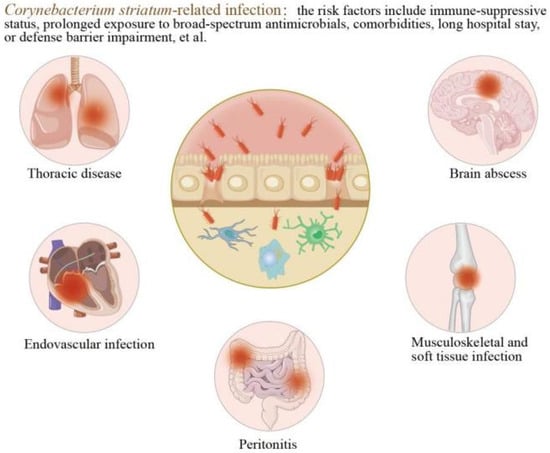
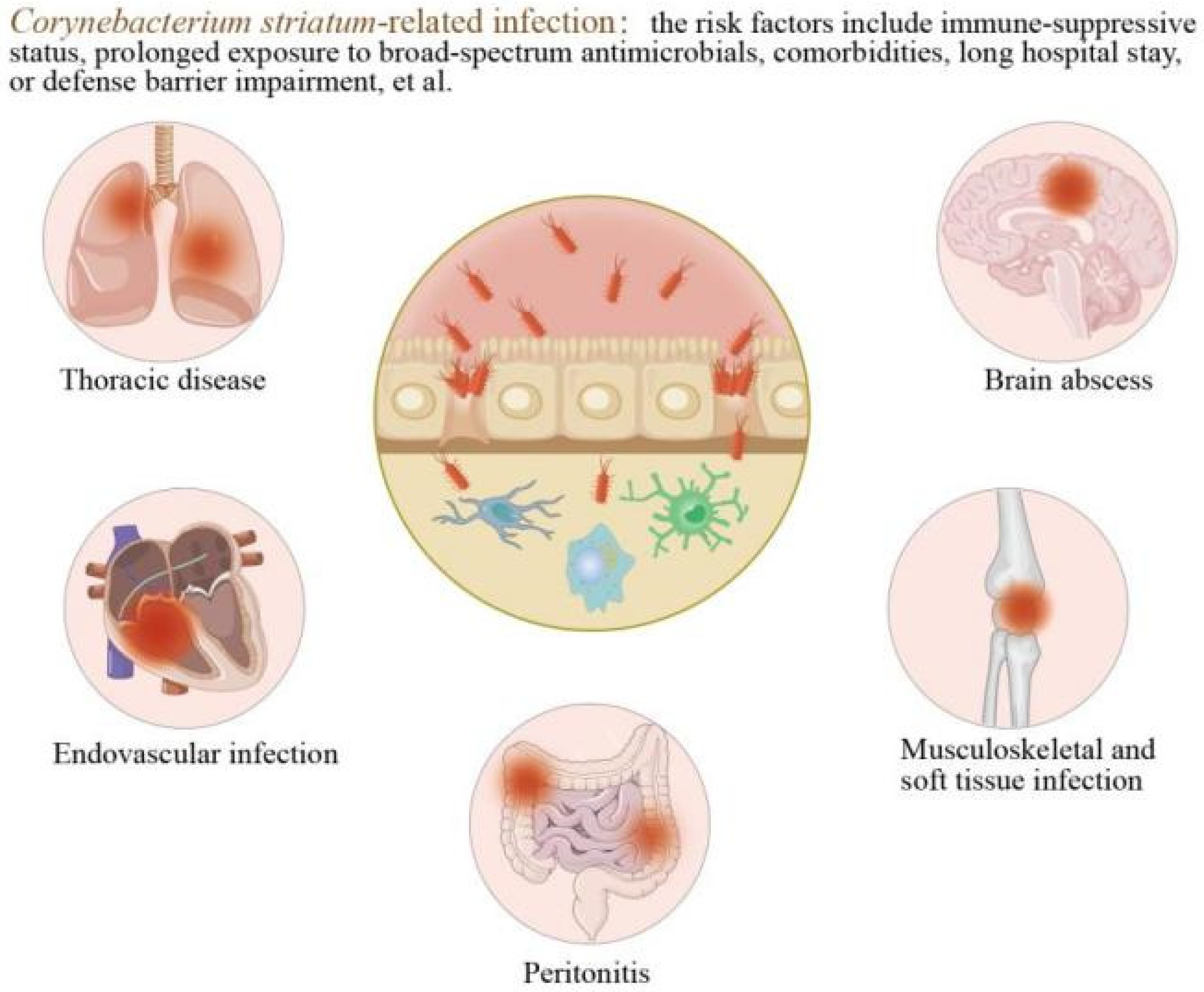
As a gram-positive, aerobic and facultatively anaerobic, and non-motile Bacillus, Corynebacterium striatum (C. striatum) was previously regarded as a commensal organism and a normal constituent of the skin and mucosal flora. However, its apparent virulence has evolved rapidly, and multidrug-resistant (MDR) strains are now increasingly reported worldwide [1]. Severe and sometimes fatal infections caused by this bacterium have been described with growing frequency, particularly among patients with chronic comorbidities, prolonged hospitalization, immunosuppression, extended exposure to broad-spectrum antimicrobials, or impaired barrier defenses, and have occasionally led to nosocomial outbreaks, as shown in Figure 1. Notably, an increasing number of cases have also been reported in immunocompetent individuals across all age groups, in some instances with catastrophic outcomes [2].
Figure 1.
Corynebacterium striatum-related infections and their risk factors (created by the authors).
Some infections have resulted in fatal outcomes and are associated with high mortality rates [3]. As reported, the mortality rates of C. striatum bacteremia and C. striatum-related pneumonia have reached 34% and 49%, respectively [4,5]. Given these high mortality rates, greater clinical attention to C. striatum infections appears warranted.
Even with the implementation of antimicrobial stewardship programs, the incidence of multidrug-resistant (MDR) microorganisms in intensive care units (ICU) remains high (for example, the production of extended-spectrum β-lactamases by gram-negative bacteria is as high as 72%) [6]. C. striatum strains, especially MDR clones, pose a significant challenge for infection control in both ICUs and general wards. Despite its growing clinical significance, comprehensive reviews that synthesize current knowledge on C. striatum—encompassing its pathogenesis, resistance mechanisms, clinical features and management strategies—remain limited. Therefore, it is imperative to highlight and summarize the emerging and clinically significant features of C. striatum.
2. History and Current Trend
In 1976, the first case of C. striatum-related pleuropulmonary infection was reported in a patient with chronic lymphocytic leukemia and resulted in a fatal outcome [7]. The first nosocomial outbreak of C. striatum was described in 2007 among patients with chronic obstructive pulmonary disease (COPD), and all isolates were identified as multidrug-resistant [8]. The detection of C. striatum infection, particularly the MDR strains, has increased globally and is often associated with nosocomial settings, in intensive care units (ICUs), and the use of invasive medical devices [3]. A recent survey from South Korea indicated that the proportion of C. striatum-infected critical hospital-acquired pneumonia (HAP) increased from 1.0% during 2014–2015 to 5.4% during 2018–2019 [9]. In Europe, China, and other regions, hospital outbreaks and nosocomial transmission have been reported much more frequently, primarily through contaminated surfaces, healthcare worker contact, or shared medical equipment [1,10]. Molecular tracing has shown that these outbreaks often involve a single clone and are accompanied by the dissemination of resistance genes such as ermX, tet, and others [10]. With regard to the C. striatum-related lower respiratory tract infections, most cases are hospital-acquired, including those associated with mechanical ventilation, while community-acquired infections remain uncommon [9].
3. Coinfection with Other Bacteria, Fungi, and Viruses
Reports of C. striatum co-infection with other bacteria, fungi, and viruses are not uncommon, including Acinetobacter baumannii, Aspergillus spp., or Pneumocystis jirovecii [11]. Polymicrobial infection involving other bacteria species has gained increasing attention in recent years, particularly in respiratory, wound, and bloodstream infections. Among patients with influenza, C. striatum has been identified as a major contributor to super-dominant secondary bacterial infections (SBIs) [12]. During the COVID-19 pandemic, the incidence of SBIs associated with multidrug-resistant C. striatum increased substantially. The antimicrobial resistance profile of this organism continues to evolve, raising significant concern, and even linezolid resistance has been reported [13].
When co-existing with other bacterial species, C. striatum may influence their virulence, leading to either attenuation or enhancement. Recent research progress and relevant clinical features are summarized in Table 1. The following sections outline several proposed mechanisms underlying these symbiotic interactions.
- (1)
- Biofilm Synergy: C. striatum can form multilayered biofilms on various material surfaces, including polyurethane and silicone. When coexisting with Staphylococcus aureus, bacteria may mutually enhance biofilm structural stability and increase antibiotic tolerance. Such synergistic interactions are strongly associated with the persistence of chronic infections and their therapeutic challenges [14,15].
- (2)
- Under selective pressure from broad-spectrum antibiotic therapy, susceptible bacteria are suppressed, creating an ecological niche that allows antibiotic-resistant organisms such as C. striatum to emerge as secondary dominant species [10]. Consequently, in patients receiving prolonged antimicrobial therapy, C. striatum frequently acts as a secondary pathogen within polymicrobial infections [16].
- (3)
- Immunosuppression and device dependence: Conditions such as prolonged mechanical ventilation, indwelling medical devices, dialysis, and chemotherapy for malignancy create environments that are highly conducive to biofilm formation and microbial colonization. Patients with these risk factors exhibit a significantly higher incidence of polymicrobial infections than the general hospitalized population.
- (4)
- Additional microbial interactions: Certain bacterial or fungal species may exert antagonistic activity against C. striatum, including tuberculosis and Corticoid Fungi [17,18].
Table 1.
Co-infection of C. striatum with Other Bacteria: Research Progress and Clinical features.
Significant regional variation has been reported in co-infection rates: the highest rates (>50%) occur in respiratory tract infections, particularly in ICU settings [22], whereas bloodstream infections exhibit comparatively lower rates (approximately 20–30%) [19]. C. striatum may contribute synergistically to pathogenicity and antimicrobial resistance within polymicrobial infections and should not be regarded merely as a contaminant. Patients with polymicrobial infections may experience prolonged mechanical ventilation, greater difficulty in infection control, and higher mortality [1,23].
4. Recent Identification of C. striatum in Clinical and Laboratory
Conventional bacterial culture remains the preferred method for initial screening of C. striatum, as it is accessible, cost-effective, and allows recovery of viable isolates for subsequent identification and antimicrobial susceptibility testing. However, colony morphology is highly variable and may be easily confused with other coryneform bacteria.
Currently, matrix-assisted laser desorption/ionization time-of-flight mass spectrometry (MALDI-TOF MS), which identifies organisms based on protein profile, has become a cornerstone for the rapid and accurate identification of C. striatum depending on mass-spectra database [24]. When database completeness is insufficient, 16S or rpoB sequencing is still required for confirmation [24], and these approaches remain among the “gold standards” for C. striatum identification.
High-resolution melting (HRM) analysis and other rapid molecular methods have been developed for the direct detection of C. striatum from specimens such as sputum, serving as complementary tools to culture and significantly reducing diagnostic turnaround time [25]. When rapid differentiation from related Corynebacterium species (e.g., C. propinquum) is required, HRM and species-specific PCR appear to hold promising clinical potential.
Other novel identification approaches, such as targeting the ftr1 gene for C. striatum-MCDA-VR assay and the ssrA gene for qPCR detection, have been verified as rapid and cost-effective methods for identifying C. striatum [19,23,24,25,26].
With the increasing prevalence of MDR strains, broth microdilution (BMD) and commercial microdilution panels have become the recommended susceptibility testing methods [27]. However, for Corynebacterium spp., interpretive breakpoints are not uniformly established by CLSI or EUCAST across all antibiotics. Ongoing discussions and standardization efforts related to CLSI document M45, which addresses testing of infrequently isolated or fastidious Gram-positive bacilli, are helping to promote greater harmonization in this area. Biofilm-forming ability of C. striatum contributes to its persistence and antimicrobial resistance [28]. Biofilm-related assays and in vitro biofilm susceptibility testing have been used in research settings to better explain clinical treatment challenges, although these methods have not yet been incorporated into routine clinical diagnostics [29].
5. Molecular Subtype of C. striatum
Molecular typing of C. striatum has important applications in clinical practice and infection control. including outbreak tracing, understanding the dissemination of resistance genes among different clones, and supporting surveillance efforts. Common molecular typing approaches include the following: (1) Pulsed-Field Gel Electrophoresis (PFGE): Widely used in early epidemiological studies to characterize clonal dissemination within hospitals [10,30]. (2) Multilocus Sequence Typing (MLST): Applied to define sequence types (STs) and clonal complexes (CCs) [31]. (3) cgMLST/WGS-SNP/Whole-Genome Sequencing (WGS): Currently considered the highest-resolution and most reliable methods for intra- and inter-hospital outbreak investigation. Also, cgMLST and core-SNP analyses appear suitable for large-scale surveillance [10]. (4) Single-Gene or Partial-Gene Sequencing (e.g., rpoB, gyrA, 16SrRNA): Provides lower resolution but serves as a useful supplementary identification tool when resources are limited [19,32].
Due to variations in study populations, infection control, sampling strategies, and detection methods, the predominant sequence types (STs) and clone groups (CGs) of C. striatum isolates show differences across different regions. In the study by Jin Woong Suh et al. [22], the most common STs in the Republic of Korea were ST2, ST3, ST6, and ST5. Margarita Gomila et al. reported that ST2, ST4, ST1, and ST11 were the most prevalent sequence types in Spain [23]. In China, C. striatum also showed high genetic diversity, with CC19 identified as the predominant clonal complex, while ST16 within this complex has been detected most frequently. CG4, CG5, CG26, CG28, and CG55 have been considered potentially hypervirulent and multidrug-resistant [24]. Two related MDR clones identified by PFGE indicated that PFGE type I was most common in ICUs, surgical wards, and among patients with hematogenic infections [19,30].
6. Virulent Agents
The genes involved in multiple biological functions in C. striatum (the main agents are shown in Table 2) include those related to adherence and biofilm formation, iron uptake and metabolism, stress responses, molecular chaperone activity (e.g., groEL), intracellular survival (e.g., sodA), and the two-component regulatory system (regX3). The team of Du, L employed whole-genome sequencing to construct a single-nucleotide polymorphism (SNP)-based phylogenetic tree of 27 C. striatum clinical isolates, which exhibited varying degrees of cytotoxicity. The genes humU, irp6B, regX3, groEL, sigA, sodA, and sigH were present in all tested isolates. In contrast, spaE, spaF, spaD, srtB, and srtC were detected in most isolates and are associated with adhesion [19]. Additional adherence-related virulence determinants include pilus proteins encoded by the spa operon.
A key characteristic of C. striatum is its ability to form biofilms, which is considered a major virulence factor that may facilitate nosocomial transmission and persistence in clinical settings. Biofilm formation also appears to enhance multidrug resistance and immune evasion of C. striatum strains [33]. All C. striatum isolates with strong biofilm-forming capacity expressed spaDEF, whereas those with moderate or weak biofilm formation did not [34]. The extracellular matrix has been shown to be essential for biofilm formation in both general and MDR C. striatum isolates [28,35].
Table 2.
Research Progress on Main Virulence Factors of C. striatum.
7. Multidrug Resistance
MDR C. striatum isolates commonly exhibit resistance to a broad spectrum of antibiotics directed against Gram-positive bacteria. The major categories of antimicrobial resistance mechanisms in C. striatum are summarized in Table 3. Similar resistance profiles have been reported in both infection-related and colonizing or contaminant clones, with minimal variation in antimicrobial susceptibility [39].
Table 3.
Categories of Antimicrobial Resistance Mechanisms in C. striatum.
Antimicrobial resistance in C. striatum may arise through two distinct mechanisms: endogenous and exogenous. The former typically involves chromosomal mutations, as described for fluoroquinolones and daptomycin. In contrast, resistance to macrolides, tetracyclines, phenicols, β-lactams, and aminoglycosides is largely attributed to exogenous resistance genes carried by mobile genetic elements, including insertion sequences (ISs), plasmids, transposons, and bacteriophages [40].
- (1)
- Endogenous multidrug resistance
Resistance to quinolones is mainly caused by mutations in the gyrA and parC genes. In C. striatum, two common mutations in codons 87 and 91, along with four novel mutations in the gyrA, have been identified as contributors to the quinolone resistance [41]. In contrast, the parC gene has not been successfully amplified in reported studies.
Daptomycin possesses potent activity against Gram-positive bacteria; however, even short-term exposure may lead to high-level daptomycin resistance (HLDR) in C. striatum [46]. A loss-of-function mutation in pgsA2, such as an IS30 insertion that disrupts pgsA2, has been shown to be necessary and sufficient for the development of HLDR [47].
- (2)
- Exogenous Multidrug Resistance
Exogenous multidrug resistance in C. striatum is mediated by a diverse set of mobilizable resistance genes, which may promote bacterial proliferation and contribute to outbreaks that are difficult to control. These mobilizable genetic elements include integrative and conjugative elements, plasmids, insertion sequences, transposons, prophages, integrons, and genomic islands.
Notably, the presence of resistant genes does not always translate into phenotypic resistance. For example, one C. striatum strain remained susceptible despite containing the erm(X) gene [48]. Similarly, another isolate carrying the vancomycin-resistant gene vanW was verified to be susceptible to vancomycin [44].
- (2.1)
- Insertion Sequences
Insertion Sequences (ISs) are small, simple, and autonomous mobile genetic elements that are widely distributed. In C. striatum, ISs, mainly belonging to the IS3 and IS256 families [41], are believed to contribute to the development of antibacterial resistance and virulence.
Several chromosomal genes, including dppD and cgrA/B, have been identified as hotspots for the insertion of mobile elements that may carry complex ISs and multiple integrases. Moreover, antimicrobial resistance genes such as erm(X), aac(3)-XI, and tet(W) have been reported in association with the insertion sequences IS1249, ISCg9a, and IS3504, respectively [49].
- (2.2)
- Plasmids
Plasmid-borne resistance genes have been detected in C. striatum. In Catherine Urrutia’s study [21], plasmid pJA144188 carried six resistance genes (ErmX, tet(W), cmx, sul1, aadA, aac(6′)-Ia), whereas plasmid pTP10 harbors five (ErmX, tetA, cmx, aph(6)-Id, aph(3′)-Ia). An additional unnamed plasmid contained only a single resistance gene, ErmX.
- (2.3)
- CRISPR-Cas
Cas proteins are products of bacterial CRISPR-Cas systems and facilitate the degradation of foreign nucleic acids, including phages and plasmids. The CRISPR-Cas system appears to show considerable diversity in C. striatum. In an analysis of 10 genomes from multidrug-resistant C. striatum clinical isolates collected at a public hospital in Rio de Janeiro, Brazil, type I-E gene arrangements were identified, along with three additional multidrug-resistant isolates, and alternative type I-E gene arrangements were identified [50]. Moreover, most CRISPR spacers in C. striatum clinical isolates are uncharacterized indicating that there is a substantial reservoir of unexplored corynebacteriophages and plasmids.
8. Clinical Features
The prevalence of C. striatum-associated diseases appears to be increasing. Reported conditions include endovascular infection, thoracic disease, musculoskeletal disease, soft tissue infection, abdominal disease, fatal brain abscesses [51], nosocomial urethritis [52], tubo-ovarian abscess [53], and others. These clinical presentations are summarized in Table 4.
Table 4.
The main clinical characteristics of C. striatum infection.
- (1)
- Endovascular infection
C. striatum-related endovascular infections appear in multiple forms, including native or prosthetic valve endocarditis, implantable device infection, thrombophlebitis, arteritis, and even artery rupture. Immune suppression, underlying comorbidities, and cardiovascular implantable devices may facilitate infection. C. striatum endocarditis has also been reported in patients without anatomic changes and immunosuppression [56]. The related clinical presentations are generally nonspecific, including arthralgia, back pain, fevers, chills, fatigue, sweats, dizziness, etc. Although C. striatum is often dismissed as a contaminant, it may cause true native valve endocarditis and warrants clinical consideration when clinical features are compatible. Also, the presentation of angiopathy may be confused by autoimmune vasculitis of non-infectious etiology, or the blood culture C. striatum as contaminants may be ignored. Prognosis in adults appears poor, with high mortality, particularly in patients with polyinfection, renal dysfunction, and absence of a central venous catheter [57]. By contrast, reported infections in children tend to present with milder symptoms and lower mortality [58].
- (2)
- Thoracic disease
C. striatum-related thoracic diseases present not only as pneumonia but also as intrapulmonary abscess, multiple pulmonary nodules, and even life-threatening mediastinitis. Patients with pneumonia often have severe or chronic underlying respiratory conditions that require frequent and prolonged hospitalizations, exposure to invasive procedures or immunosuppressive therapy. C. striatum infection may induce pronounced lung inflammation and pathological alterations, characterized by enhanced neutrophilic infiltration and significant upregulation of pro-inflammatory mediators, including interleukin (IL)-17, IL-6, and CXCL-8, accompanied by activation of the NF-κB signaling pathway [59].
Positive C. striatum cultures have been obtained from a wide range of respiratory specimens, and several outbreaks have been reported worldwide. Clinical outcomes in many affected patients have been poor. The clinical improvement of targeted antibiotic therapy against C. striatum in the lower respiratory tract may be limited [60]. The high mortality rates may be partly attributed to the underlying severity of respiratory disease, as well as to the aggravating effect of C. striatum infection [5].
- (3)
- Musculoskeletal and soft tissue infection
The aggressive strains of C. striatum may infect both immunocompetent and immunocompromised patients, leading to native or prosthetic joint infection (PJI) and, in some cases, osteomyelitis with concurrent empyema. Clinical manifestations are generally nonspecific and typically include swelling, erythema, tenderness, or a reduced range of motion.
Data from the Mayo Clinic Total Joint Registry indicate that C. striatum is the most frequently isolated species in monomicrobial Corynebacterium PJIs. Infection with C. striatum appears to substantially worsen wound severity and may impair healing. Nearly all patients with Corynebacterium PJI experience an indolent, chronic disease course characterized by delayed or late-onset infection, most commonly presenting with localized joint pain and swelling. In contrast, systemic symptoms and sinus tract formation are uncommon [54]. The median interval between the most recent arthroplasty and C. striatum-associated PJI is typically prolonged, underscoring the importance of biopsy and culture to establish an accurate diagnosis [61].
- (4)
- Abdominal disease
The patients who suffered C. striatum peritonitis typically have indwelling peritoneal catheters and underlying chronic renal failure. Clinical symptoms are generally mild and nonspecific. Some patients present without abdominal discomfort or fever, whereas others may experience abdominal pain or pyrexia accompanied by cloudy peritoneal effluent, in which neutrophils predominate on laboratory analysis [62].
Peritonitis associated with C. striatum in peritoneal dialysis patients may persist despite appropriate antimicrobial treatment. In such cases, and particularly among patients with recurrent episodes, peritoneal dialysis catheter removal should be strongly considered.
- (5)
- Recurrence
Multidrug resistance and biofilm formation appear to facilitate the recurrence of C. striatum infections [7]. The C. striatum-related PJIs are associated with high treatment failure rates, including substantial risks of reoperation and reinfection [54]. Recurrence may follow the initial C. striatum infection itself or emerge secondary to other bacterial infections. For example, C. striatum bacteriemia has been reported to reappear several weeks after apparent resolution of the initial C. striatum-related blood infection [63]. Similarly, therapy directed at vertebral osteomyelitis caused by other species may yield favorable outcomes, while the localized C. striatum infection subsequently relapses [64].
9. Treatment
In general, strict source control (e.g., removal of implant devices or surgery) together with adequate time and doses of antibiotic therapy remains essential for managing C. striatum-related disease [65]. Insufficient therapy may increase the bacterial burden with biofilms and facilitate detachment of organisms from the biofilm’s structure to neighboring tissues, even into the bloodstream [14]. Current literature and susceptibility data indicate that vancomycin or linezolid are the most suitable antimicrobial agents. Also, dalbavancin was reported to be another safe and attractive option for C. striatum-related infections [66,67,68].
Sometimes C. striatum infection is a nerve-racking dilemma for clinicians. When C. striatum cultured positively among respiratory infectious samples, true infection is more likely when patients present with compatible respiratory manifestations and new pulmonary infiltrates, accompanied by repeated or predominant isolation of C. striatum, particularly in high-risk or immunocompromised individuals. When the clinical condition worsens, it is difficult to confirm whether the severity of the condition was due to respiratory disease, C. striatum, or other pathogens’ assault [5]. When monotherapy fails, successful management, especially in polymicrobial or recurrent infections-typically requires targeted antimicrobial combination therapy in conjunction with appropriate source control measures, such as device removal or surgical debridement [19,54]. For adult patients with Corynebacterium-related PJI, management generally involves prolonged antibiotic treatment, debridement, and implant retention or surgical treatment [69]. In pediatric settings, antimicrobial therapy may be the preferred initial approach for epiphyseal or metaphyseal infection [70]. In some reported cases, catheter-related C. striatum peritonitis has been successfully treated with adequate antimicrobial therapy alone; however, due to frequent relapse and the organism’s biofilm-forming capacity, catheter removal or exchange is often required.
Several novel promising antibacterial strategies are emerging. Enzymatic degradative agents targeting the extracellular matrix, such as proteinase K, dispersin B, and DNase I, have demonstrated strong activity in disrupting biofilm-forming abilities of C. striatum [39]. Renewed anti-biofilm approaches, including Antimicrobial peptides (biofilm-AMPs), also show activity specifically directed against biofilm structures [71]. In addition, the anthelmintic drug niclosamide has been reported to degrade the biofilm viability and reduce cell viability drastically with concentration-dependent characteristics [72]. Other potential antibacterial options include bacteriophages targeting MDR C. striatum, locally administered lysins, and CXCL10 [73,74,75]. However, further evaluation is needed to determine whether these therapeutic methods are feasible for clinical application.
10. Conclusions
Increasing evidence highlights the pathogenic potential of C. striatum, particularly multidrug-resistant (MDR) strains. This review summarizes recent advances in epidemiology, newly identified virulence (such as biofilm formation, iron acquisition systems, and other genes contributing to pathogenicity) and resistance determinants (both intrinsic and acquired resistance are elaborated), potential therapeutic targets (including novel promising antibacterial agents, and combination therapy approaches), and the clinical characteristics associated with C. striatum infection. Given the rapid evolution and expanding resistance profile of C. striatum, further research is warranted to elucidate its clinical relevance and underlying genetic mechanisms.
Author Contributions
All authors made a significant contribution to the work reported. All of them not only took part in the conception, design, execution, acquisition of data, analysis, and interpretation of this review but also took part in drafting, revising, and critically reviewing the article. All authors have read and agreed to the published version of the manuscript.
Funding
This study was funded by the National Natural Science Foundation of China [grant numbers: 82302424].
Institutional Review Board Statement
Not applicable.
Informed Consent Statement
Not applicable.
Data Availability Statement
No new data were created or analyzed in this study. Data sharing is not applicable to this article.
Conflicts of Interest
The authors declare no conflict of interest.
Abbreviations
MDR: multidrug-resistant, C. Striatum: Corynebacterium striatum, ICU: intensive care units, COPD: chronic obstructive pulmonary disease, HAP: hospital-acquired pneumonia, SBIs: super-dominant secondary bacterial infections, STs: sequence types, CGs: clone groups, PFGE: pulsed-field gel electrophoresis, IS: insertion sequences, HLDR: high-level daptomycin resistance, MGEs: mobile genetic elements.
References
- Silva-Santana, G.; Silva, C.M.F.; Olivella, J.G.B.; Silva, I.F.; Fernandes, L.M.O.; Sued-Karam, B.R.; Santos, C.S.; Souza, C.; Mattos-Guaraldi, A.L. Worldwide survey of Corynebacterium striatum increasingly associated with human invasive infections, nosocomial outbreak, and antimicrobial multidrug-resistance, 1976–2020. Arch. Microbiol. 2021, 203, 1863–1880. [Google Scholar] [CrossRef] [Scilit]
- Hahn, W.O.; Werth, B.J.; Butler-Wu, S.M.; Rakita, R.M. Multidrug-Resistant Corynebacterium striatum Associated with Increased Use of Parenteral Antimicrobial Drugs. Emerg. Infect. Dis. 2016, 22, 1908–1914. [Google Scholar] [CrossRef] [Scilit]
- Li, W.; Gao, M.; Yu, J. Rising Prevalence and Drug Resistance of Corynebacterium striatum in Lower Respiratory Tract Infections. Front. Cell. Infect. Microbiol. 2025, 14, 1526312. [Google Scholar] [CrossRef] [Scilit] [PubMed]
- Yamamuro, R.; Hosokawa, N.; Otsuka, Y.; Osawa, R. Clinical Characteristics of Corynebacterium Bacteremia Caused by Different Species, Japan, 2014–2020. Emerg. Infect. Dis. 2021, 27, 2981–2987. [Google Scholar] [CrossRef] [Scilit]
- Renom, F.; Gomila, M.; Garau, M.; Gallegos, M.D.; Guerrero, D.; Lalucat, J.; Soriano, J.B. Respiratory Infection by Corynebacterium striatum: Epidemiological and Clinical Determinants. New Microbes New Infect. 2014, 2, 106–114. [Google Scholar] [CrossRef] [Scilit] [PubMed]
- Ture, Z.; Güner, R.; Alp, E. Antimicrobial Stewardship in the Intensive Care Unit. J. Intensive Med. 2022, 3, 244–253. [Google Scholar] [CrossRef] [Scilit]
- Bowstead, T.T.; Santiago, S.M. Pleuropulmonary Infection Due to Corynebacterium striatum. Br. J. Dis. Chest 1980, 74, 198–200. [Google Scholar] [CrossRef] [Scilit]
- Renom, F.; Garau, M.; Rubí, M.; Ramis, F.; Galmés, A.; Soriano, J.B. Nosocomial Outbreak of Corynebacterium striatum Infection in Patients with Chronic Obstructive Pulmonary Disease. J. Clin. Microbiol. 2007, 45, 2064–2067. [Google Scholar] [CrossRef] [Scilit] [PubMed]
- Lee, Y.W.; Huh, J.W.; Hong, S.B.; Jung, J.; Kim, M.J.; Chong, Y.P.; Kim, S.H.; Sung, H.; Do, K.H.; Lee, S.O.; et al. Severe Pneumonia Caused by Corynebacterium striatum in Adults, Seoul, South Korea, 2014–2019. Emerg. Infect. Dis. 2022, 28, 2147–2154. [Google Scholar] [CrossRef] [Scilit]
- Kang, Y.; Chen, S.; Zheng, B.; Du, X.; Li, Z.; Tan, Z.; Zhou, H.; Huang, J.; Tian, L.; Zhong, J.; et al. Epidemiological Investigation of Hospital Transmission of Corynebacterium striatum Infection by Core Genome Multilocus Sequence Typing Approach. Microbiol. Spectr. 2022, 11, e01490-22. [Google Scholar] [CrossRef] [Scilit]
- Wang, J.; Wang, Y.; Du, X.; Cui, J.; Wang, K.; Zhang, L.; Han, Y.Q. Rapid Transmission of Multidrug-Resistant Corynebacterium striatum among Susceptible Patients in a Tertiary Hospital in China. J. Infect. Dev. Ctries. 2016, 10, 1299–1305. [Google Scholar] [CrossRef] [Scilit] [PubMed]
- Qin, T.; Geng, T.; Zhou, H.; Han, Y.; Ren, H.; Qiu, Z.; Nie, X.; Du, T.; Liang, J.; Du, P.; et al. Super-Dominant Pathobiontic Bacteria in the Nasopharyngeal Microbiota as Causative Agents of Secondary Bacterial Infection in Influenza Patients. Emerg. Microbes Infect. 2020, 9, 605–615. [Google Scholar] [CrossRef] [Scilit]
- Mumcuoğlu, İ.; Çağlar, H.; Erdem, D.; Aypak, A.; Gün, P.; Kurşun, Ş.; Çakır, E.Y.; Aydoğan, S.; Kırca, F.; Dinç, B. Secondary Bacterial Infections of the Respiratory Tract in COVID-19 Patients. J. Infect. Dev. Ctries. 2022, 16, 1131–1137. [Google Scholar] [CrossRef] [Scilit]
- de Souza, C.; Faria, Y.V.; Sant’Anna, L.O.; Viana, V.G.; Seabra, S.H.; de Souza, M.C.; Vieira, V.V.; Hirata Júnior, R.; Moreira, L.O.; de Mattos-Guaraldi, A.L. Biofilm Production by Multiresistant Corynebacterium striatum Associated with Nosocomial Outbreak. Mem. Inst. Oswaldo Cruz 2015, 110, 242–248. [Google Scholar] [CrossRef] [Scilit]
- Ramsey, M.M.; Freire, M.O.; Gabrilska, R.A.; Rumbaugh, K.P.; Lemon, K.P. Staphylococcus aureus Shifts toward Commensalism in Response to Corynebacterium Species. Front. Microbiol. 2016, 7, 1230. [Google Scholar] [CrossRef] [Scilit]
- Trivedi, G.R.; Merchant, S.S. Corynebacterium striatum: A True Pathogen in Chronic Contiguous Osteomyelitis. Can. J. Infect. Dis. Med. Microbiol. 2024, 2024, 5020721. [Google Scholar] [CrossRef] [Scilit] [PubMed]
- Silva-Santana, G.; Baêta Júnior, E.S.; Conceição, G.M.S.; Aguiar-Alves, F.; Brandão, M.L.L.; Lopes-Torres, E.J.; Mattos-Guaraldi, A.L. Intervention of Corynebacterium striatum in the Sessile Lifestyle of Staphylococcus aureus Wild-Type and ica-Mutants in Polymicrobial Biofilms. Microb. Pathog. 2025, 204, 107577. [Google Scholar] [CrossRef] [Scilit] [PubMed]
- Terbtothakun, P.; Visedthorn, S.; Klomkliew, P.; Chanchaem, P.; Sawaswong, V.; Sivapornnukul, P.; Sunantawanit, S.; Khamwut, A.; Rotcheewaphan, S.; Kaewsapsak, P.; et al. Clinical Metagenomics Analysis of Bacterial and Fungal Microbiota from Sputum of Patients Suspected with Tuberculosis Infection. Sci. Rep. 2025, 15, 17772. [Google Scholar] [CrossRef] [Scilit]
- Ramos, J.N.; Souza, C.; Faria, Y.V.; Silva, E.C.; Veras, J.F.C.; Baio, P.V.P.; Seabra, S.H.; Moreira, L.O.; Hirata Júnior, R.; Mattos-Guaraldi, A.L.; et al. Bloodstream and Catheter-Related Infections Due to Clones of Multidrug-Resistant Corynebacterium striatum. BMC Infect. Dis. 2019, 19, 672. [Google Scholar] [CrossRef] [Scilit]
- Streifel, A.C.; Varley, C.D.; Ham, Y.; Sikka, M.K.; Lewis, J.S., 2nd. The Challenges of Antibiotic selection in Prosthetic Joint Infection Due to Corynebacterium striatum: A Case Report. BMC Infect. Dis. 2022, 22, 290. [Google Scholar] [CrossRef] [Scilit]
- Chen, Z.; Jiang, Y.; Wang, D.; Jiang, S. Rapid Plasmid-Mediated Acquisition of Erythromycin Resistance via ermX in Corynebacterium striatum: A 72-Hour Clinical Evolution. Infect. Drug Resist. 2025, 18, 3771–3777. [Google Scholar] [CrossRef] [Scilit]
- Li, Y.; Rong, J.; Gao, C. Phylogenetic Analyses of Antimicrobial-Resistant Corynebacterium striatum Strains in a Nosocomial Outbreak in China. Antonie Van Leeuwenhoek 2023, 116, 907–918. [Google Scholar] [CrossRef] [Scilit]
- Anawilkul, T.-T.; Chusri, S.; Kanchanasuwan, S.; Chittrakarn, S. Clinical characteristics, antimicrobial resistance patterns, and outcomes of Corynebacterium bacteremia: A 15-year retrospective study. BMC Infect Dis. 2025, 25, 1656. [Google Scholar] [CrossRef] [Scilit]
- UK Health Security Agency. UK Standards for Microbiology Investigations: ID 2—Identification of Corynebacterium Species; Issue 5.1; UK Health Security Agency: London, UK, 2025. [Google Scholar]
- Xu, S.; Qiu, X.; Hou, X.; Zhou, H.; Chen, D.; Wang, X.; Han, L.; Li, D.; Sun, L.; Ji, X.; et al. Direct Detection of C. striatum, C. propinquum, and C. simulans by High-Resolution Melt Analysis. BMC Infect. Dis. 2021, 21, 21. [Google Scholar] [CrossRef] [Scilit]
- Qiu, X.; Chen, D.; Wang, X.; Zhou, H.; Hou, X.; Zhang, J.; Li, M.; Li, Z.J. A Novel Isothermal Amplification Method for Detection of C. striatum. J. Microbiol. Methods 2019, 164, 105675. [Google Scholar] [CrossRef] [Scilit]
- Martínez-Martínez, L.; Pascual, A.; Bernard, K.; Suárez, A.I. Antimicrobial Susceptibility Pattern of C. striatum. Antimicrob. Agents Chemother. 1996, 40, 2671–2672. [Google Scholar]
- Özdemir, S.; Aydoğan, O.; Köksal Çakırlar, F. Biofilm Formation and Antimicrobial Susceptibility of Non-Diphtheriae Corynebacterium Strains. Medeniyet Med. J. 2021, 36, 123–129. [Google Scholar]
- Wen, J.; Wang, Z.; Du, X.; Liu, R.; Wang, J. Antibiofilm Effects of Extracellular Matrix-Degradative Agents on MDR C. striatum. Ann. Clin. Microbiol. Antimicrob. 2022, 21, 53. [Google Scholar] [CrossRef] [Scilit] [PubMed]
- Baio, P.V.P.; Mota, H.F.; Freitas, A.D.; Gomes, D.L.R.; Ramos, J.N.; Sant’Anna, L.O.; Souza, M.C.; Camello, T.C.F.; Hirata Júnior, R.; Vieira, V.V.; et al. Clonal Multidrug-Resistant Corynebacterium striatum within a Nosocomial Environment, Rio de Janeiro, Brazil. Mem. Inst. Oswaldo Cruz. 2013, 108, 23–29. [Google Scholar] [CrossRef] [Scilit] [PubMed]
- Suh, J.W.; Ju, Y.; Lee, C.K.; Sohn, J.W.; Kim, M.J.; Yoon, Y.K. Molecular epidemiology and clinical significance of Corynebacterium striatum isolated from clinical specimens. Infect. Drug Resist. 2019, 12, 161–171, Erratum in Infect. Drug Resist. 2019, 12, mmcmxv–mmcmxvi. [Google Scholar] [CrossRef] [Scilit]
- Gomila, M.; Renom, F.; Gallegos Mdel, C.; Garau, M.; Guerrero, D.; Soriano, J.B.; Lalucat, J. Identification and diversity of multiresistant Corynebacterium striatum clinical isolates by MALDI-TOF mass spectrometry and by a multigene sequencing approach. BMC Microbiol. 2012, 12, 52. [Google Scholar] [CrossRef] [Scilit]
- Alibi, S.; Ramos-Vivas, J.; Ben Selma, W.; Ben Mansour, H.; Boukadida, J.; Navas, J. Virulence of clinically relevant multidrug resistant Corynebacterium striatum strains and their ability to adhere to human epithelial cells and inert surfaces. Microb. Pathog. 2021, 155, 104887. [Google Scholar] [CrossRef] [Scilit]
- Silva-Santana, G.; Silva da Conceição, G.M.; Brandão, M.L.L.; Mattos-Guaraldi, A.L.; Hirata Júnior, R. Standardized method for quantifying colony-forming units in Corynebacterium striatum and Staphylococcus aureus biofilms on hydrophilic and hydrophobic surfaces. J. Microbiol. Methods 2025, 237, 107216. [Google Scholar] [CrossRef] [Scilit] [PubMed]
- Wang, H.Y.J.; Tatituri, R.V.V.; Goldner, N.K.; Dantas, G.; Hsu, F.F. Unveiling the biodiversity of lipid species in Corynebacteria—Characterization of the uncommon lipid families in C. glutamicum and pathogen C. striatum by mass spectrometry. Biochimie 2020, 178, 158–169. [Google Scholar] [CrossRef] [Scilit] [PubMed]
- Qiu, J.; Shi, Y.; Zhao, F.; Xu, Y.; Xu, H.; Dai, Y.; Cao, Y. The pan-genomic analysis of Corynebacterium striatum revealed its genetic characteristics as an emerging multidrug-resistant pathogen. Evol. Bioinform. Online 2023, 19, 11769343231191481. [Google Scholar] [CrossRef] [Scilit]
- Du, L.; Guo, B.; Wen, J.; Liu, H.; Wang, J. Intracellular invasion potential and pathogenic effects of Corynebacterium striatum clinical isolates in human airway epithelial cells. Front. Microbiol. 2025, 16, 1647771. [Google Scholar] [CrossRef] [Scilit] [PubMed]
- Sangal, V.; Marrs, E.C.L.; Nelson, A.; Perry, J.D. Phylogenomic analyzes of multidrug resistant Corynebacterium striatum strains isolated from patients in a tertiary care hospital in the UK. Eur. J. Clin. Microbiol. Infect. Dis. 2024, 43, 1495–1501. [Google Scholar] [CrossRef] [Scilit]
- Wang, X.; Zhou, H.; Chen, D.; Du, P.; Lan, R.; Qiu, X.; Hou, X.; Liu, Z.; Sun, L.; Xu, S.; et al. Whole-genome sequencing reveals a prolonged and persistent intrahospital transmission of Corynebacterium striatum, an emerging multidrug-resistant pathogen. J. Clin. Microbiol. 2019, 57, e00683-19. [Google Scholar] [CrossRef] [Scilit]
- Leyton, B.; Ramos, J.N.; Baio, P.V.P.; Veras, J.F.C.; Souza, C.; Burkovski, A.; Mattos-Guaraldi, A.L.; Vieira, V.V.; Marin, M.A. Treat me well or will resist: Uptake of mobile genetic elements determines the resistome of Corynebacterium striatum. Int. J. Mol. Sci. 2021, 22, 7499. [Google Scholar] [CrossRef] [Scilit]
- Wang, Y.; Shi, X.; Zhang, J.; Wang, Y.; Lv, Y.Y.; Du, X.; ChaoLuMen, Q.Q.G.; Wang, J.R. Widespread and diversity of mutation in the gyrA gene of quinolone-resistant Corynebacterium striatum strains isolated from three tertiary hospitals in China. Ann. Clin. Microbiol. Antimicrob. 2021, 20, 71. [Google Scholar] [CrossRef] [Scilit]
- Navas, J.; Fernández-Martínez, M.; Salas, C.; Cano, M.E.; Martínez-Martínez, L. Susceptibility to aminoglycosides and distribution of aph and aac(3)-XI genes among Corynebacterium striatum clinical isolates. PLoS ONE 2016, 11, e0167856. [Google Scholar] [CrossRef] [Scilit]
- Urrutia, C.; Leyton-Carcaman, B.; Abanto Marin, M. Contribution of the mobilome to the configuration of the resistome of Corynebacterium striatum. Int. J. Mol. Sci. 2024, 25, 10499. [Google Scholar] [CrossRef] [Scilit] [PubMed]
- Ramos, J.N.; Rodrigues, I.S.; Baio, P.V.P.; Veras, J.F.C.; Ramos, R.T.J.; Pacheco, L.G.C.; Azevedo, V.A.; Hirata Júnior, R.; Marín, M.A.; Mattos-Guaraldi, A.L.; et al. Genome sequence of a multidrug-resistant Corynebacterium striatum isolated from bloodstream infection from a nosocomial outbreak in Rio de Janeiro, Brazil. Mem. Inst. Oswaldo Cruz 2018, 113, e180051. [Google Scholar] [CrossRef] [Scilit]
- van Hoek, A.H.A.M.; Mayrhofer, S.; Domig, K.J.; Aarts, H.J.M. Resistance determinant erm(X) is borne by transposon Tn5432 in Bifidobacterium thermophilum and Bifidobacterium animalis subsp. lactis. Int. J. Antimicrob. Agents 2008, 31, 544–548. [Google Scholar] [CrossRef] [Scilit]
- Tran, T.T.; Jaijakul, S.; Lewis, C.T.; Diaz, L.; Panesso, D.; Kaplan, H.B.; Murray, B.E.; Wanger, A.; Arias, C.A. Native valve endocarditis caused by Corynebacterium striatum with heterogeneous high-level daptomycin resistance: Collateral damage from daptomycin therapy? Antimicrob. Agents Chemother. 2012, 56, 3461–3464. [Google Scholar] [CrossRef] [Scilit]
- Gotoh, K.; Mayura, I.P.B.; Enomoto, Y.; Iio, K.; Matsushita, O.; Otsuka, F.; Hagiya, H. Detection of in-frame mutation by IS30-family insertion sequence in the phospholipid phosphatidylglycerol synthase gene (pgsA2) of high-level daptomycin-resistant Corynebacterium striatum. Eur. J. Clin. Microbiol. Infect. Dis. 2022, 41, 331–333. [Google Scholar] [CrossRef] [Scilit]
- Ortiz-Pérez, A.; Martín-de-Hijas, N.Z.; Esteban, J.; Fernández-Natal, M.I.; García-Cía, J.I.; Fernández-Roblas, R. High frequency of macrolide resistance mechanisms in clinical isolates of Corynebacterium species. Microb. Drug Resist. 2010, 16, 273–277. [Google Scholar] [CrossRef] [Scilit] [PubMed]
- Nudel, K.; Zhao, X.; Basu, S.; Dong, X.; Hoffmann, M.; Feldgarden, M.; Allard, M.; Klompas, M.; Bry, L. Genomics of Corynebacterium striatum, an emerging multidrug-resistant pathogen of immunocompromised patients. Clin. Microbiol. Infect. 2018, 24, 1016.e7–1016.e13. [Google Scholar] [CrossRef] [Scilit]
- Ramos, J.N.; Baio, P.V.P.; Veras, J.F.C.; Vieira, É.M.D.; Mattos-Guaraldi, A.L.; Vieira, V.V. Novel Configurations of Type I-E CRISPR-Cas System in Corynebacterium striatum Clinical Isolates. Braz. J. Microbiol. 2023, 54, 69–80. [Google Scholar] [CrossRef] [Scilit]
- Zhang, M.J.; Cao, X.J.; Fan, J.; Yin, Z.G.; Yu, K. Corynebacterium striatum Meningitis Combined with Suspected Brain and Lung Abscesses: A Case Report and Review. BMC Infect. Dis. 2020, 20, 389. [Google Scholar] [CrossRef] [Scilit] [PubMed]
- Frikh, M.; El Yaagoubi, I.; Lemnouer, A.; Elouennass, M. Urethritis Due to Corynebacterium striatum: An Emerging Germ. Tunis. Med. 2015, 93, 43–44. [Google Scholar]
- Yamamoto, T.; Kenzaka, T.; Mizuki, S.; Nakashima, Y.; Kou, H.; Maruo, M.; Akita, H. An Extremely Rare Case of Tubo-Ovarian Abscesses Involving Corynebacterium striatum as Causative Agent. BMC Infect. Dis. 2016, 16, 527. [Google Scholar] [CrossRef] [Scilit] [PubMed]
- Seutz, Y.; Bäcker, H.; Akgün, D.; Adelhoefer, S.; Kriechling, P.; Gonzalez, M.R.; Karczewski, D. Corynebacterium Periprosthetic Joint Infection: A Systematic Review of 52 Cases at 2.5 Years Follow-Up. Arch. Orthop. Trauma Surg. 2023, 143, 5527–5538. [Google Scholar] [CrossRef] [Scilit] [PubMed]
- Zhao, X.; Liu, X.; Wang, Z.; Wei, S.; Wu, Z. Metagenomic Next-Generation Sequencing for the Diagnosis of Corynebacterium striatum Meningitis: Case Report and Literature Review. BMC Neurol. 2025, 25, 127. [Google Scholar] [CrossRef] [Scilit] [PubMed]
- Gandhi, R.; Balakrishnan, P.; Riordan, J.; Kelly, M.J.; Tan, P.C.; O’Meeghan, T. Native Triple-Valve Endocarditis Caused by Corynebacterium striatum Needing Urgent Surgery. JACC Case Rep. 2025, 30, 104150. [Google Scholar] [CrossRef] [Scilit]
- Kimura, S.I.; Gomyo, A.; Hayakawa, J.; Akahoshi, Y.; Harada, N.; Ugai, T.; Komiya, Y.; Kameda, K.; Wada, H.; Ishihara, Y.; et al. Clinical Characteristics and Predictive Factors for Mortality in Coryneform Bacteria Bloodstream Infection in Hematological Patients. J. Infect. Chemother. 2017, 23, 148–153. [Google Scholar] [CrossRef] [Scilit]
- Adderson, E.E.; Boudreaux, J.W.; Hayden, R.T. Infections caused by Coryneform bacteria in pediatric oncology patients. Pediatr Infect Dis J. 2008, 27, 136–141. [Google Scholar] [CrossRef] [Scilit]
- Yu, X.; Li, X.; Wang, Y.; Yu, X.; Guo, X.; Wang, C.; Wang, F. Corynebacterium striatum Drives Neutrophilic Asthma via IL-17 Signaling Activation. Int. Immunopharmacol. 2025, 163, 115255. [Google Scholar] [CrossRef] [Scilit]
- Zhang, H.; Tan, X.; Zhang, Z.; Yang, X.; Wang, L.; Li, M.; Shi, D.; Li, Y.; Li, J.; Li, Z.; et al. Targeted Antibiotics for Lower Respiratory Tract Infection with Corynebacterium striatum. Infect. Drug Resist. 2023, 16, 2019–2028. [Google Scholar] [CrossRef] [Scilit]
- Tabaja, H.; Tai, D.B.G.; Beam, E.; Abdel, M.P.; Tande, A.J. Clinical Profile of Monomicrobial Corynebacterium Hip and Knee Periprosthetic Joint Infections. Open Forum Infect. Dis. 2022, 9, ofac193. [Google Scholar] [CrossRef] [Scilit]
- Kitayama, S.; Saito, K.; Sato, Y. Peritoneal Dialysis-Related Peritonitis Due to Corynebacterium striatum: An Emerging Multidrug-Resistant Pathogen. Ther. Apher. Dial. 2021, 25, 254–255. [Google Scholar] [CrossRef] [Scilit]
- Serpa Pinto, L.; Dias Frias, A.; Franca, M. Corynebacterium striatum Cardiac Device-Related Infective Endocarditis: First Case Report in a CRT-D Patient and Literature Review. J. Med. Cases 2021, 12, 61–64. [Google Scholar] [CrossRef] [Scilit]
- de Nettancourt, A.; Derdevet, J.; Dahmane, L.; Jaffal, K.; Perronne, V.; Tordjman, M.; Noussair, L.; Dinh, A. A Vertebral Polymicrobial Osteomyelitis with Atypical Microorganisms: A Case Report. Case Rep. 2023, 44, 190–194. [Google Scholar]
- Milosavljevic, M.N.; Milosavljevic, J.Z.; Kocovic, A.G.; Stefanovic, S.M.; Jankovic, S.M.; Djesevic, M.; Milentijevic, M.N. Antimicrobial Treatment of Corynebacterium striatum Invasive Infections: A Systematic Review. Rev. Inst. Med. Trop. São Paulo 2021, 63, e49. [Google Scholar] [CrossRef] [Scilit]
- Mansoor, A.E.; Krekel, T.; Cabrera, N.L. Experience with Dalbavancin for Long-Term Antimicrobial Suppression of LVAD Infections. Transpl. Infect. Dis. 2023, 25, e14068. [Google Scholar] [CrossRef] [Scilit] [PubMed]
- Söderquist, B.; Henningsson, T.; Stegger, M. Corynebacterium striatum Prosthetic Joint Infection Successfully Treated with Long-Term Dalbavancin. Microorganisms 2023, 11, 550. [Google Scholar] [CrossRef] [Scilit]
- Navarro-Jiménez, G.; Fuentes-Santos, C.; Moreno-Núñez, L.; Alfayate-García, J.; Campelo-Gutierrez, C.; Sanz-Márquez, S.; Pérez-Fernández, E.; Velasco-Arribas, M.; Hervás-Gómez, R.; Martín-Segarra, O.; et al. Experience in the Use of Dalbavancin in Diabetic Foot Infection. Enferm. Infecc. Microbiol. Clin. 2022, 40, 296–301. [Google Scholar] [CrossRef] [Scilit]
- Pannu, T.S.; Villa, J.M.; Ozery, M.; Piuzzi, N.S.; Higuera, C.A.; Riesgo, A.M. The Fate of Periprosthetic Joint Infection with Corynebacterium striatum: A Rare but Catastrophic Organism. J. Arthroplast. 2022, 37, 142–149. [Google Scholar] [CrossRef] [Scilit]
- Bayram, S.; Bilgili, F.; Anarat, F.B.; Saka, E. Subacute Osteomyelitis of the Fibula Due to Corynebacterium striatum in an Immunocompetent Child: A Case Report. JBJS Case Connect. 2019, 9, e0220. [Google Scholar] [CrossRef] [Scilit] [PubMed]
- Ravichandran, S.; Avatapalli, S.; Narasimhan, Y.; Kaushik, K.S.; Yennamalli, R.M. “Targeting” the Search: An Updated Repository of Antimicrobial Peptides for Biofilm Studies (B-AMP v2.0). Front. Cell. Infect. Microbiol. 2022, 12, 1020391. [Google Scholar] [CrossRef] [Scilit]
- Folliero, V.; Dell’Annunziata, F.; Roscetto, E.; Cammarota, M.; De Filippis, A.; Schiraldi, C.; Catania, M.R.; Casolaro, V.; Perrella, A.; Galdiero, M.; et al. Niclosamide as a Repurposing Drug Against Corynebacterium striatum Multidrug-Resistant Infections. Antibiotics 2022, 11, 651. [Google Scholar] [CrossRef] [Scilit] [PubMed]
- Wang, J.; Zhang, M.; Pei, J.; Yi, W.; Fan, L.; Wang, C.; Xiao, X. Isolation and Identification of a Novel Phage Targeting Multidrug-Resistant Corynebacterium striatum. Front. Cell. Infect. Microbiol. 2024, 14, 1361045. [Google Scholar] [CrossRef] [Scilit]
- Choi, Y.J.; Kim, S.; Bae, S.; Kim, Y.; Chang, H.H.; Kim, J. Antibacterial Effects of Recombinant Endolysins in Disinfecting Medical Equipment: A Pilot Study. Front. Microbiol. 2022, 12, 773640. [Google Scholar] [CrossRef] [Scilit] [PubMed]
- Holdren, G.O.; Rosenthal, D.J.; Yang, J.; Bates, A.M.; Fischer, C.L.; Zhang, Y.; Brogden, N.K.; Brogden, K.A. Antimicrobial Activity of Chemokine CXCL10 for Dermal and Oral Microorganisms. Antibiotics 2014, 3, 527–539. [Google Scholar] [CrossRef] [Scilit] [PubMed]

Disclaimer/Publisher’s Note: The statements, opinions and data contained in all publications are solely those of the individual author(s) and contributor(s) and not of MDPI and/or the editor(s). MDPI and/or the editor(s) disclaim responsibility for any injury to people or property resulting from any ideas, methods, instructions or products referred to in the content. |
© 2026 by the authors. Licensee MDPI, Basel, Switzerland. This article is an open access article distributed under the terms and conditions of the Creative Commons Attribution (CC BY) license.