Article

Toxicity of 6:2 Chlorinated Polyfluorinated Ether Sulfonate (F-53B) to Escherichia coli: Growth Inhibition, Morphological Disruption, Oxidative Stress, and DNA Damage


by
Jun Di
1,2,
Zinian Li
1,
Lixia Yuan
1,
Jinxian Liu
2 and
Baofeng Chai
2,*
1
Department of Biological Science and Technology, Jinzhong University, Jinzhong 030619, China
2
Key Laboratory of Shanxi Province for Ecological Restoration of Loess Plateau, Institute of Loess Plateau, Shanxi University, Taiyuan 030006, China
*
Author to whom correspondence should be addressed.
Microorganisms 2025, 13(12), 2819; https://doi.org/10.3390/microorganisms13122819
Submission received: 29 October 2025 / Revised: 6 December 2025 / Accepted: 8 December 2025 / Published: 11 December 2025
(This article belongs to the Section Environmental Microbiology)

Abstract

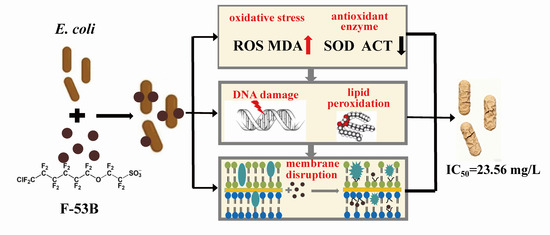
6:2 chlorinated polyfluoroalkyl ether sulfonic acid (F-53B), a substitute for perfluorooctane sulfonate (PFOS), is widely used as a mist suppressant in the electroplating industry. With the implementation of PFOS regulations, the use of F-53B has correspondingly increased, and it is now detected in various environmental matrices. However, toxicological information on F-53B remains incomplete and insufficient for environmental risk assessment. In this study, we systematically investigated, for the first time, the toxicity and underlying mechanisms of action of F-53B to Escherichia coli. The results showed that the 24 h half-maximal growth inhibition concentration (IC50) of F-53B was 23.56 mg/L, suggesting that F-53B may exhibit higher toxicity to E. coli than PFOS. Analyses of cell surface hydrophobicity, membrane permeability, membrane composition, and scanning electron microscopy (SEM) images showed that F-53B adsorbed onto the cell surface, altered membrane properties, and ultimately disrupted cell morphology. Increased intracellular levels of reactive oxygen species (ROS) and malondialdehyde (MDA), along with decreased activities of superoxide dismutase (SOD) and catalase (CAT), indicated enhanced oxidative stress induced by F-53B in E. coli. Furthermore, the alkaline comet assay demonstrated that F-53B exposure caused DNA damage. Taken together, the toxicity of F-53B to E. coli can be attributed to cell morphological disruption, oxidative stress, and DNA damage, ultimately leading to cellular inactivation or death. These findings advance our understanding of the cytotoxicity of F-53B in microorganisms.

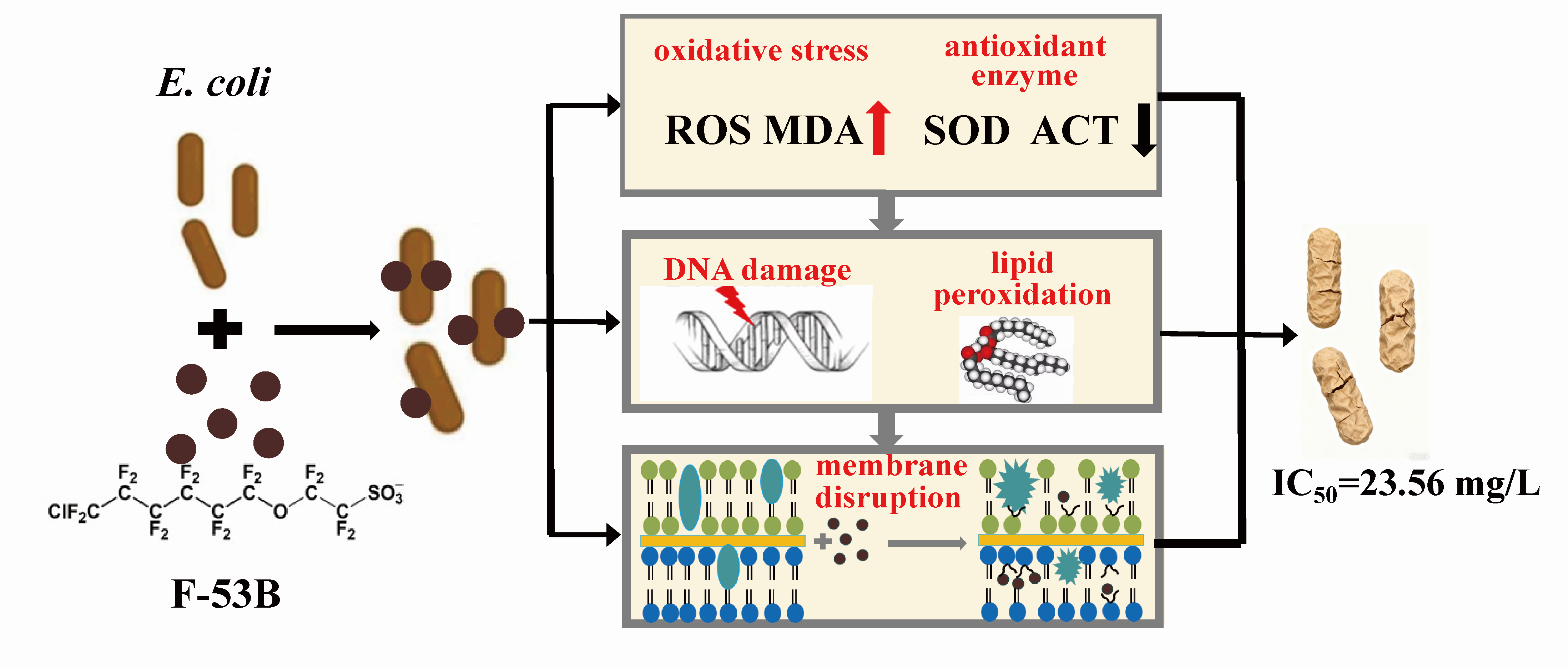
Graphical Abstract

1. Introduction

Perfluorooctane sulfonate (PFOS) is one of the most chemically stable per- and polyfluoroalkyl substances (PFASs) and has been widely used in industrial and manufacturing applications since the 1940s [1]. Increasing evidence has demonstrated that PFOS is environmentally persistent, bioaccumulative, and toxic to wildlife and humans [2]. In recognition of these risks, PFOS and related substances were listed under Annex B of the Stockholm Convention on Persistent Organic Pollutants (POPs) in 2009, restricting their production and use. Since then, a variety of alternatives have emerged and drawn widespread attention. As an important PFOS alternative, 6:2 chlorinated polyfluorinated ether sulfonate (6:2 Cl-PFESA, trade name F-53B) has been extensively used as an industrial chrome mist suppressant in China, with an annual production of 30–40 t [3]. The increasingly widespread application and unregulated emissions of F-53B have resulted in its release into the environment, particularly in aquatic systems [4,5,6]. The environmental occurrence of F-53B has recently been reported in industrial wastewater and river water at concentrations up to 112 μg/L and 7.6 μg/L, respectively [7,8]. EUSES calculations predicted that F-53B concentrations in freshwater systems in South China could approach 0.7 mg/L in 2015 and potentially exceed 2.3 mg/L near chromium-plating plants by 2020 [9]. Notably, F-53B exhibits a longer biological half-life than PFOS (up to 15.3 years) and long-range migration capacity [1,10]. These features underscore the need for systematic research on the toxicological effects and mechanisms of F-53B in aquatic ecosystems.
Previous studies have reported diverse adverse effects of F-53B in fish and mammals. In adult zebrafish (Brachydanio rerio), F-53B exhibited moderate acute toxicity with a 96 h LC50 of 24.7 mg/L [8] and caused reproductive toxicity [11], embryotoxicity [12], eye development disorders [13], hepatotoxicity [14], and thyroid endocrine disruption [15]. Oxidative stress is increasingly implicated as a key mechanism underlying F-53B-induced developmental toxicity in fish [8,16]. In mammals, F-53B has been associated with subchronic reproductive toxicity [17], neurotoxicity [18], nephrotoxicity [19], vascular toxicity [20], and osteoporosis [21]. Notably, F-53B also showed significantly higher acute toxicity than PFOS to earthworms (Eisenia fetida), with a 7 d LC50 of 1.43 mmol/kg dry soil [22].
Bacteria are ubiquitous in aquatic ecosystems and play crucial roles in microbial food webs and ecosystem functioning [23]. In addition, as single-cell organisms, bacteria serve as important models for evaluating ecotoxicity and investigating underlying mechanisms at the cellular level. Research has indicated that exposure to F-53B can cause significant shifts in bacterial community structure and diversity, leading to impaired nitrification functions [24]. However, the mechanisms underlying the effects of F-53B on bacteria remain unclear. The bacterial toxicity of PFASs has been investigated in only a few studies. For instance, Nobels et al. [25] employed a multiple-endpoint bacterial reporter assay to characterize the toxicological profiles of PFASs. Another study demonstrated that exposure to PFASs increases membrane permeability and induces a quorum-sensing response in Aliivibrio fischeri [26]. Furthermore, the bacterial toxicity of PFOS has been more extensively studied and is associated with membrane disruption, oxidative stress, and genetic damage [26,27,28]. Given the structural similarity between PFOS and F-53B, F-53B may exert comparable biotoxic effects. Nevertheless, information regarding the toxicity of F-53B to microorganisms and its underlying mechanisms has not yet been reported.
This study aimed to evaluate the toxicity and mechanisms of action of F-53B to bacteria. Escherichia coli was selected as the target organism due to its short growth cycle, ease of manipulation, and well-defined genetic background. Moreover, E. coli, as a key indicator of contamination and health risks in environmental waters, has been widely used for ecological risk assessment [28,29,30]. Therefore, the results of this study will help elucidate the toxicity mechanisms of F-53B at the cellular level and provide a basis for assessing its ecological risks.

2. Materials and Methods

2.1. Strain, Chemicals, and Reagents

E. coli (ATCC 9080) was obtained from the China General Microbiological Culture Collection Center (Beijing, China). F-53B (CAS no. 73606-19-6; purity ≥ 99%) was purchased from Maikun Chemical Co., Ltd. (Shanghai, China). A 1 g/L stock solution of F-53B was prepared in a mixture of dimethyl sulfoxide (DMSO) and ultrapure water for exposure experiments. Prior to use, the stock solution was filter-sterilized through a 0.22 μm membrane filter. The final concentration of DMSO in the assay medium was maintained below 0.6% (v/v), at which no significant effect on the growth of E. coli was observed. Assay kits for 4′, 6-diamidino-2-phenylindole dihydrochloride (DAPI), reactive oxygen species (ROS), superoxide dismutase (SOD), catalase (CAT), and malondialdehyde (MDA) were obtained from Beijing Solarbio Science & Technology Co., Ltd. (Beijing, China). All other chemicals were purchased from Beyotime Biotechnology (Shanghai, China).

2.2. Bacterial Toxicity Assessment

The exposure experiment followed a previously described method [27] with minor modifications. E. coli was cultured overnight at 37 °C with shaking (160 rpm) in BHI broth medium (proteose peptone 10 g/L, Na2HPO4·12H2O 2.5 g/L, beef heart infusion 17.5 g/L, NaCl 5 g/L, and dextrose 2 g/L; pH 7.4 ± 0.2) to obtain sufficient inoculum. Bacterial cultures in the exponential phase (OD600 = 0.3) were exposed to different concentrations of F-53B (0, 0.1, 1, 10, 50, 100, 200, and 300 mg/L). All cultures were incubated at 35 °C without shaking. Samples were collected at 0, 2, 4, 8, 12, 16, 20, 24, and 28 h post-exposure, respectively. Optical density at 600 nm (OD600) was measured using a microplate reader (Infinite® 200 Pro, TECAN, Männedorf, Switzerland) to generate growth curves. The growth inhibition rate was calculated using Equation (1) [31]. The 24 h IC50 was determined by non-linear regression analysis.
Inhibition rate (%) = [1 − (OD600 of treated cells/OD600 of control cells)] × 100

2.3. SEM Analysis

E. coli morphology and membrane integrity were examined by scanning electron microscopy (SEM) according to a previously described method [27]. After exposure to 0, 0.1, 10, and 50 mg/L F-53B for 24 h, cells were harvested by centrifugation (8000 rpm, 5 min), fixed with 2.5% glutaraldehyde, and washed three times with 0.2 M PBS (pH 7.0). Samples were gradually dehydrated with graded ethanol (30%, 50%, 70%, 85%, 95%, and 100%; 20 min each), treated with tert-butanol, dried in a CO2 critical-point desiccator, and coated with a thin layer of gold-palladium. Cell morphology was observed using an SEM (SU5000, Hitachi, Tokyo, Japan).

2.4. Measurement of Cell Surface Hydrophobicity

Cell surface hydrophobicity (CSH) was determined using the microbial adhesion to hydrocarbons (MATH) assay according to a recorded method [28]. After exposure to 0, 0.1, 10, and 50 mg/L F-53B for 24 h, E. coli cells were collected by centrifugation (4000 rpm, 5 min, 4 °C), washed twice with 0.9% NaCl (5000 rpm, 10 min), and resuspended in 0.9% NaCl to OD600 ≈ 1.0 (A0). Two milliliters of the suspension were mixed with 2 mL xylene, vortexed vigorously for 2 min, and allowed to phase-separate at room temperature for 30 min. The OD600 of the aqueous phase was measured and recorded as A. CSH (%) was calculated using Equation (2) [28].
CSH (%) = [1 − (A/A0)] × 100

2.5. Measurement of Membrane Permeability

Membrane permeability was evaluated using DAPI, a membrane-permeable DNA-binding dye whose fluorescence increases upon binding to DNA [27]. After 24 h exposure to 0, 0.1, 10, and 50 mg/L F-53B, cells were harvested by centrifugation (4000 rpm, 10 min, 4 °C), washed three times with 0.2 M PBS (pH 7.0), and resuspended in PBS containing DAPI (4 μg/mL). After 10 min incubation, fluorescence was measured (excitation/emission: 355/460 nm) and recorded as A. Cells were then lysed through five freeze–thaw cycles to release total DNA, incubated with DAPI for 10 min, and the maximum fluorescence was measured (excitation/emission: 355/460 nm) and recorded as A0. Membrane permeability (expressed as dye leakiness) was calculated using Equation (3) [27].
Dye leakiness (%) = (A/A0) × 100

2.6. ATR-FTIR Analysis

Attenuated total reflectance Fourier transform infrared spectroscopy (ATR-FTIR; Nicolet iS50, Thermo Fisher Scientific, Waltham, MA, USA) was used to analyze changes in cellular chemical composition according to a previously described method [32]. After 24 h exposure to 0, 0.1, 10, and 50 mg/L F-53B, cells were washed with 0.2 M PBS (pH 7.0) and freeze-dried to remove residual water. ATR-FTIR spectra were recorded in the range of 4000–500 cm−1 with 32 scans at a resolution of 4 cm−1. The spectra were processed using OMNIC 9.2 software with baseline correction.

2.7. Determination of Oxidative Stress

Intracellular ROS levels were determined using the fluorescent probe 2′,7′-dichlorofluorescein diacetate (DCFH-DA) after 24 h exposure to 0, 0.1, 10, and 50 mg/L F-53B, following a previously described method [28] with minor modifications. Cells were collected by centrifugation (4000 rpm, 5 min, 4 °C), washed three times with 0.2 M PBS (pH 7.0), resuspended in PBS, and incubated with 20 µM DCFH-DA at 37 °C for 60 min in the dark. After incubation, cells were washed three times with 0.2 M PBS (pH 7.0) and resuspended to approximately 1 × 10⁶ cells/mL. Fluorescence intensity (FI) was measured at excitation and emission wavelengths of 488 nm and 525 nm, respectively. Relative ROS levels were calculated using Equation (4) [33].
Relative ROS levels = FI of treated cells/FI of control cells
For antioxidant and lipid peroxidation biomarkers, cells were harvested by centrifugation (6000 rpm, 10 min), washed three times with 0.2 M PBS (pH 7.0), and resuspended to approximately 5 × 10⁶ cells/mL. Cell lysis was performed on ice using an ultrasonic cell disruptor (Scientz Biotechnology Co., Ltd., Ningbo, China; 200 W) for 30 cycles (3 s pulse, 10 s rest). Homogenates were centrifuged (8000 rpm, 10 min, 4 °C) and supernatants were collected for biochemical analysis. SOD and CAT activities and MDA content were measured using commercial assay kits in accordance with the manufacturer’s instructions, as described in the Table S1.

2.8. Alkaline Comet Assay

The alkaline comet assay was performed according to a method [29], with minor modifications. After 24 h exposure, cells were harvested by centrifugation (1500 rpm, 10 min), washed three times with 0.2 M PBS (pH 7.4), and resuspended to approximately 1 × 10⁵ cells/mL. A 50 µL aliquot of the cell suspension was incubated with lysozyme (1 mg/mL) and RNase A (100 μg/mL) at 37 °C for 30 min, mixed with 500 µL of 0.7% low-melting agarose, and immediately spread onto microscope slides pre-coated with a layer of 1% normal-melting agarose. After solidification, slides were immersed in lysis solution (2.5 M NaCl, 100 mM Na2EDTA, 10 mM Tris-HCl, and 1% Triton X-100; pH 10) overnight at 4 °C in the dark. Slides were then subjected to alkaline unwinding in an electrophoresis buffer (300 mM NaOH, 1.2 mM Na2EDTA) for 30 min and electrophoresed at 25 V (300 mA) for 20 min. After neutralization with 0.4 mM Tris-HCl (pH 7.5), slides were air-dried and stained with SYBR Green I. Comets were observed using an inverted fluorescence microscope (Axio Observer D1, Zeiss, Oberkochen, Germany) and analyzed with CASP 1.2.3 software. Tail DNA% (TDNA) and Olive tail moment (OTM) were recorded. The extent of DNA damage was further classified based on TDNA as follows [34]: <5% (no damage), 5–20% (mild damage), 21–40% (moderate damage), 41–95% (high damage), and >96% (severe damage).

2.9. Statistical Analyses

Experiments were performed in triplicate, and data are presented as means ± standard deviation (SD). Statistical analyses were conducted using SPSS 29.0. Significant differences were analyzed by one-way ANOVA followed by Dunnett’s test or the least significant difference (LSD) test. Differences were regarded as significant at p < 0.05.

3. Results

3.1. Effect of F-53B on the Growth Profile

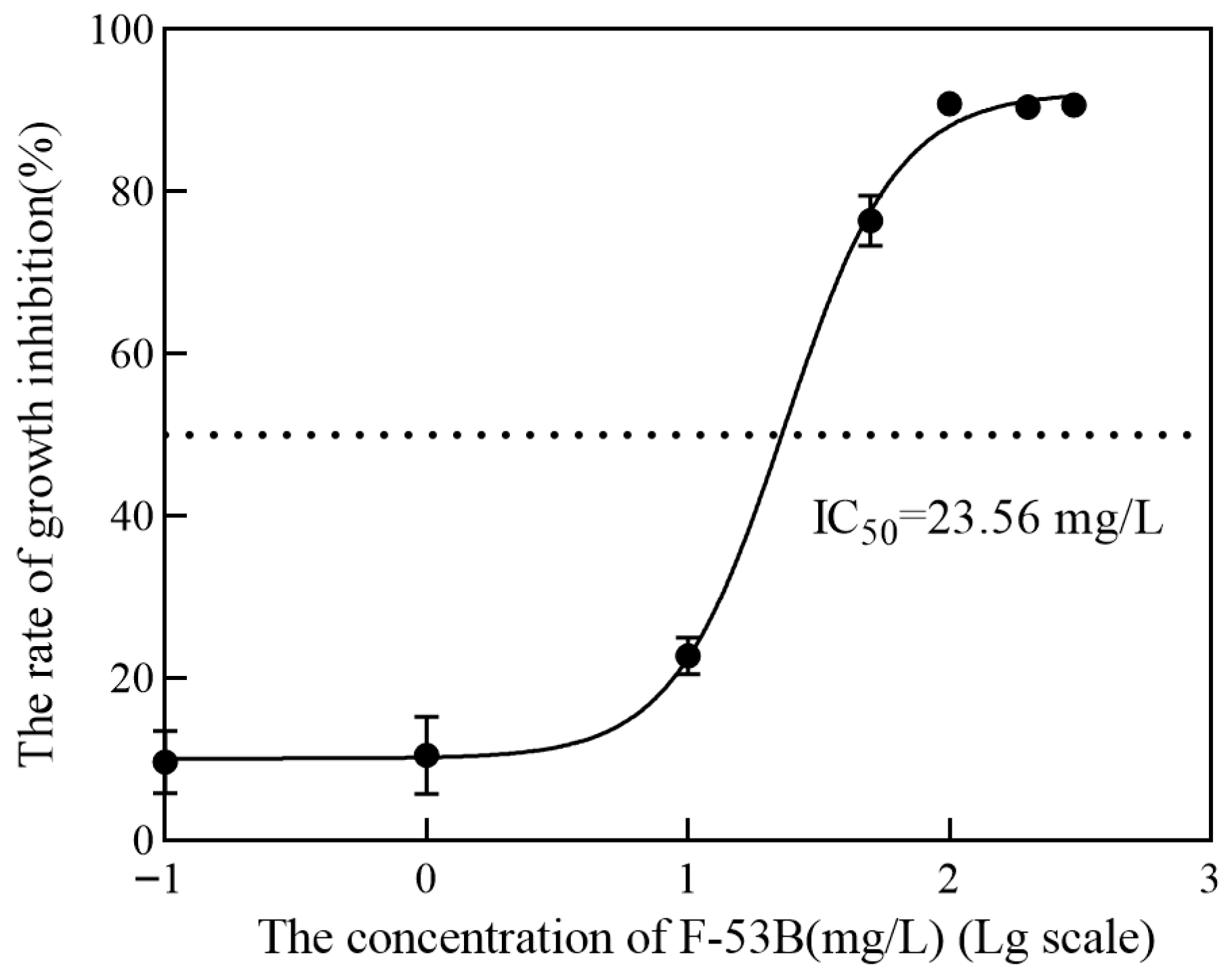
Bacterial toxicity was evaluated by analyzing the growth curve and growth inhibition rate of E. coli exposed to F-53B at concentrations of 0, 0.1, 1, 10, 50, 100, 200, and 300 mg/L. The growth curve was monitored by measuring OD600 at predetermined time intervals until the stationary phase. During the entire exposure period, F-53B exhibited dose-dependent growth inhibition at concentrations ranging from 0.1 to 300 mg/L (Figure 1). After 20 h, strong inhibition of E. coli growth (up to 90%) was observed at concentrations ≥ 100 mg/L. These results indicate that high doses of F-53B suppress E.coli cell division. The 24h IC50 for E. coli was determined to be 23.56 mg/L, with a 95% confidence interval of 20.49–27.05 mg/L (Figure 2).

3.2. Effect of F-53B on Cellular Morphology

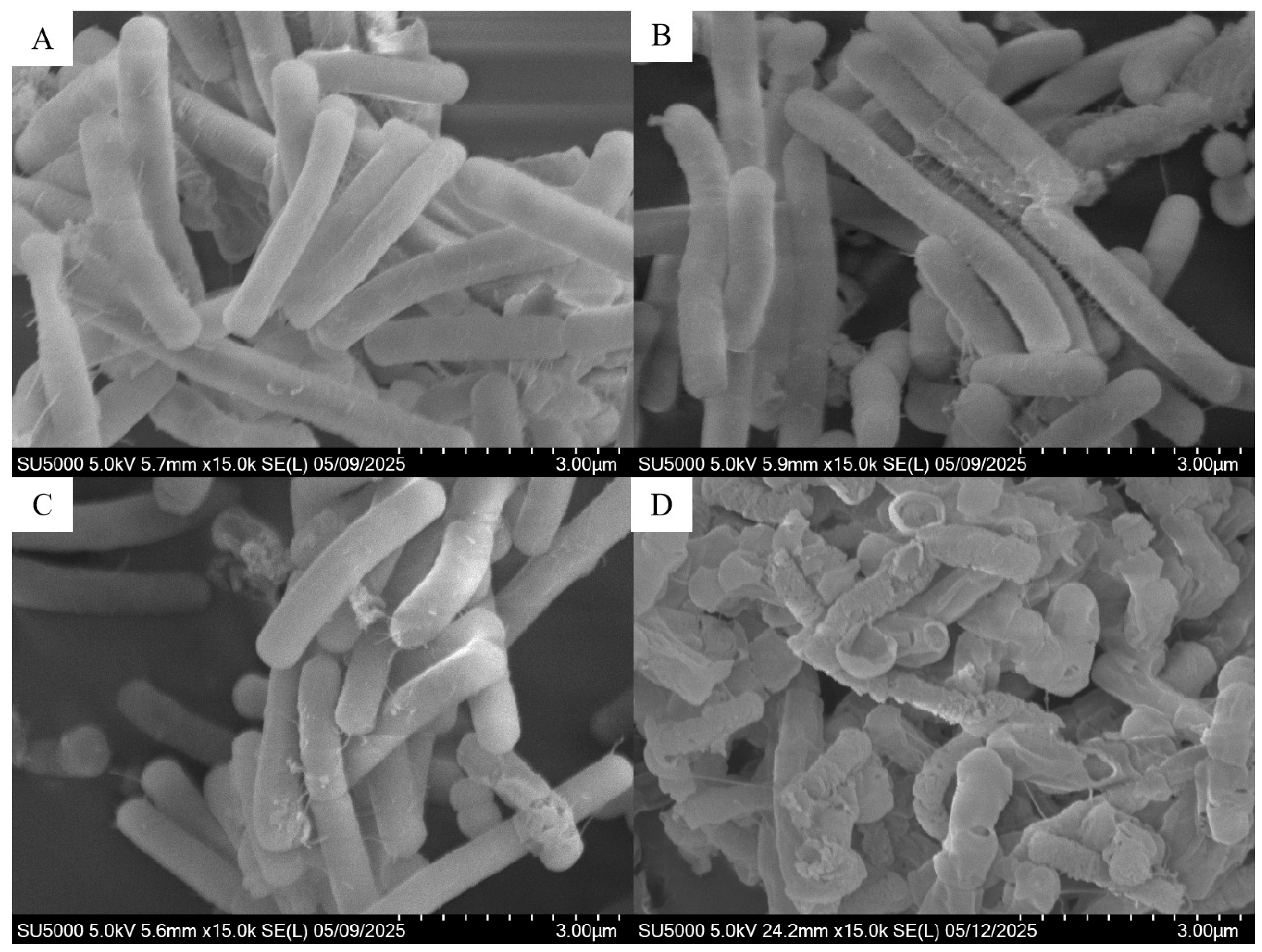
SEM images were used to reveal morphological changes in E. coli induced by F-53B (0, 0.1, 10, and 50 mg/L). Untreated cells displayed intact, rod-shaped morphology with a smooth surface (Figure 3A). At 0.1 mg/L F-53B, cellular morphology remained largely unchanged, indicating negligible effects on cell integrity at this low concentration (Figure 3B). When the concentration increased to 10 mg/L, noticeable disruptions appeared in a subset of cells (Figure 3C). At the highest concentration (50 mg/L), E. coli exhibited severe cellular damage, characterized by prevalent cell lysis and cytoplasmic leakage (Figure 3D). These findings demonstrate that F-53B induces concentration-dependent morphological changes in E. coli, with pronounced cellular damage occurring at higher concentrations.

3.3. Effect of F-53B on Cell Surface Properties

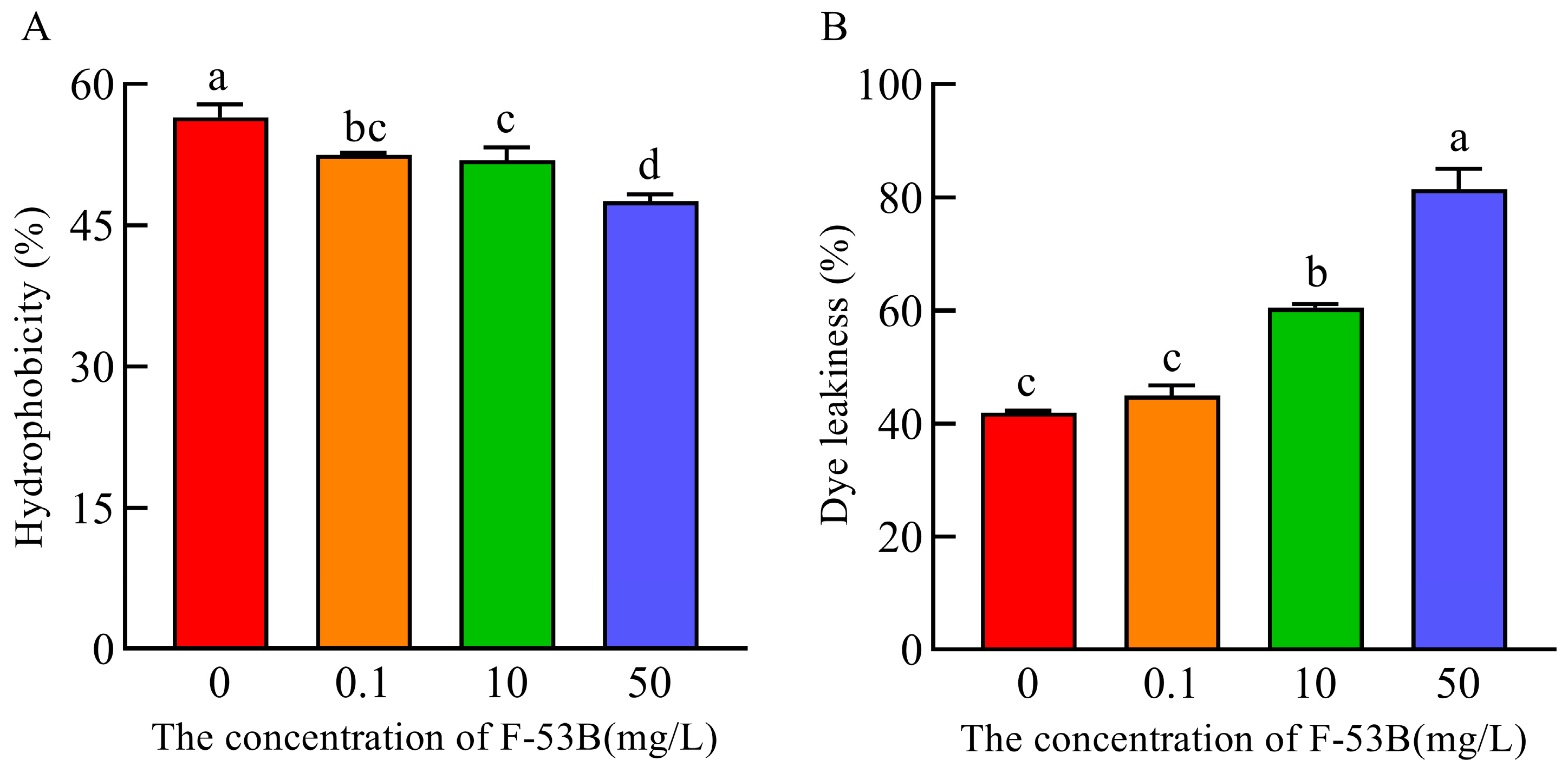
CSH of E. coli following 24 h of exposure to F-53B (0, 0.1, 10, and 50 mg/L) is shown in Figure 4A. CSH gradually decreased with increasing F-53B concentration. All F-53B-treated groups showed significantly lower CSH values (p < 0.05) than the control, indicating that even low-level exposure reduced CSH. Moreover, the 50 mg/L treatment group exhibited a further significant decrease (p < 0.05) compared with the 0.1 and 10 mg/L groups, whereas no significant difference was observed between the 0.1 and 10 mg/L groups. These results demonstrate a concentration-dependent decline in CSH, with the most pronounced reduction occurring at the highest F-53B level.
Membrane permeability of E. coli following 24 h of exposure to F-53B (0, 0.1, 10, and 50 mg/L) is shown in Figure 4B. Compared with the control, membrane permeability in the F-53B-exposed groups increased in a concentration-dependent manner. In particular, membrane permeability in the 10 and 50 mg/L F-53B treatment groups was significantly higher (p < 0.05) than that of the control, whereas no significant difference was observed between the control and the 0.1 mg/L group. These results indicate that marked disruption of membrane integrity occurs mainly at higher F-53B concentrations.

3.4. Effect of F-53B on Chemical Structures and Functional Groups

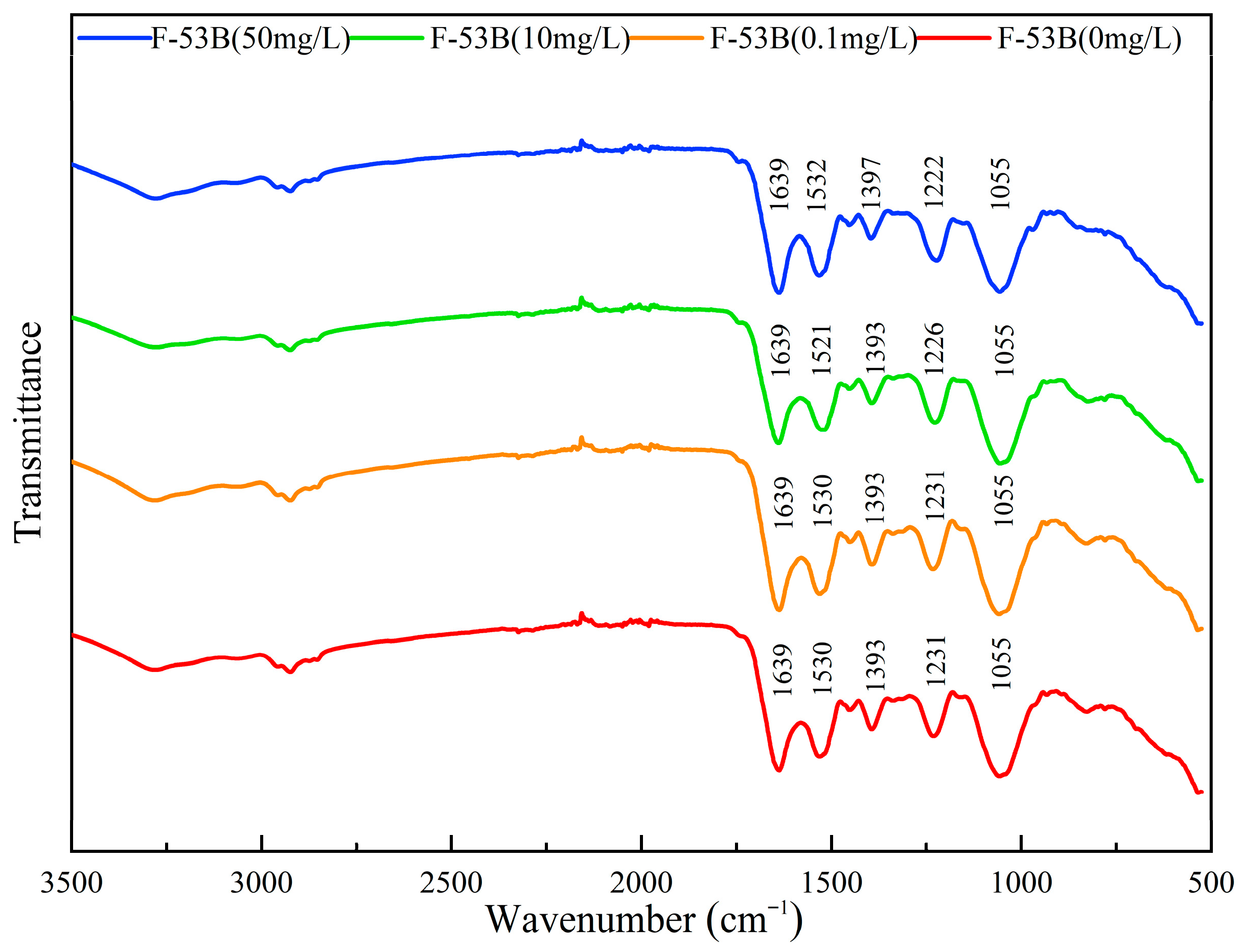
ATR-FTIR spectra of E. coli following 24 h of exposure to F-53B (0, 0.1, 10, and 50 mg/L) are shown in Figure 5. Compared with the control, cells exposed to high concentrations of F-53B (10 and 50 mg/L) exhibited red shifts in the nucleic acids region (1250–1080 cm−1) [35], with the characteristic peak at 1231 cm−1 shifting to 1226 cm−1or 1222 cm−1. This indicates that high concentrations of F-53B affect the structure of nucleic acids. In the fatty acid region (1480–1340 cm−1) [36], a peak shift at 1393 cm−1 was observed at 50 mg/L F-53B, suggesting conformational or structural changes in cellular fatty acids. Furthermore, shifts in the amide I and amide II regions (1760–1480 cm−1) of proteins [36] were observed at 1530 cm−1 following exposure to F-53B (10 and 50 mg/L), indicating structural changes in proteins at high F-53B concentrations.

3.5. Effect of F-53B on Oxidative Stress

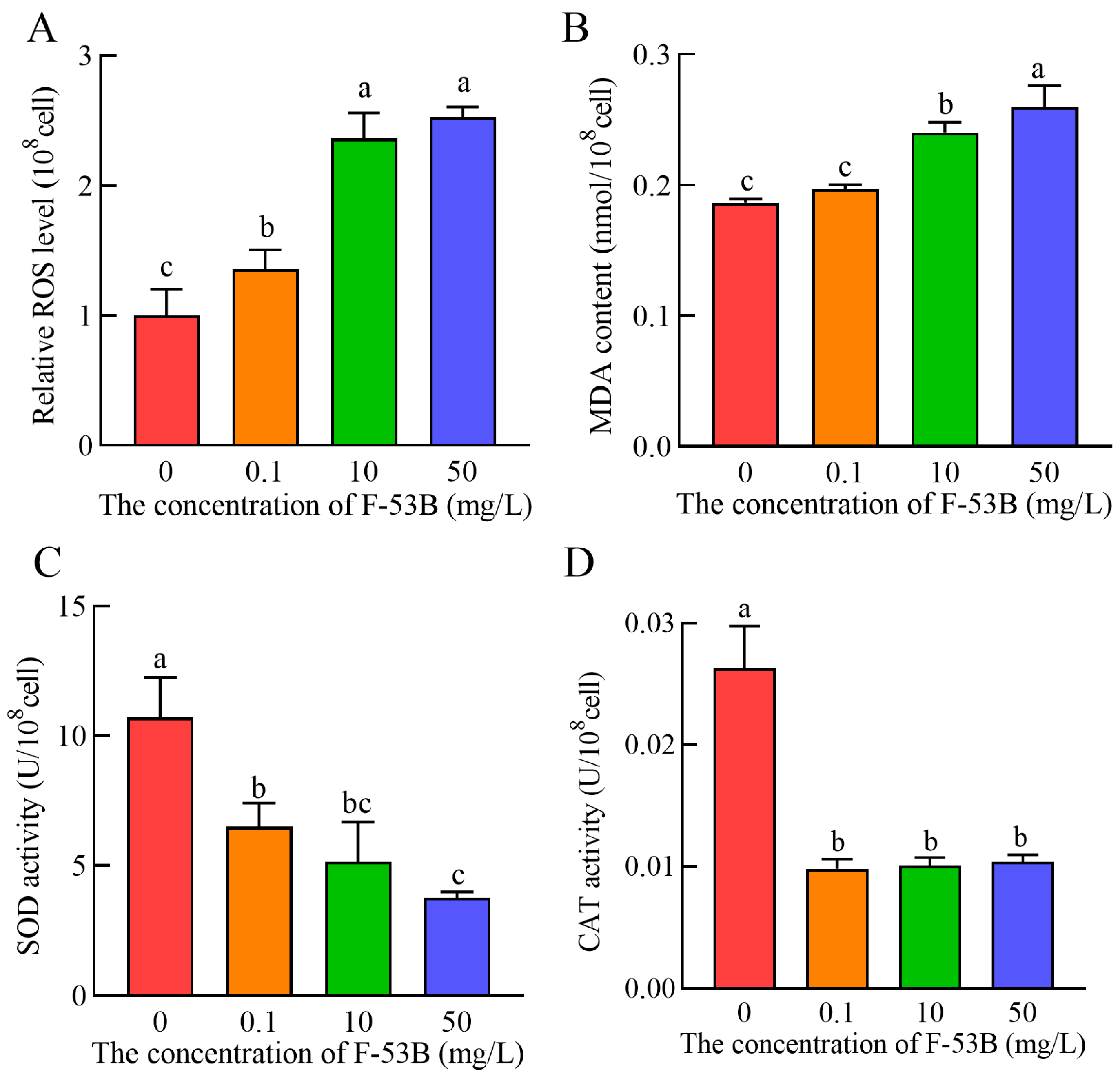
The potential of F-53B to induce oxidative stress in E. coli was evaluated by measuring intracellular levels of ROS, SOD, CAT, and MDA. Following F-53B exposure, ROS levels increased in a concentration-dependent manner, with all treatment groups (0.1, 10, and 50 mg/L) exhibiting significantly higher values (p < 0.05) than the control, while no significant difference was observed between the 10 and 50 mg/L groups (Figure 6A). Consistently, MDA content also rose with increasing F-53B concentration, with significant elevations (p < 0.05) detected in the 10 and 50 mg/L groups compared with the control, whereas the 0.1 mg/L group did not differ significantly from the control (Figure 6B). In contrast, SOD activity decreased in a concentration-dependent manner, and all F-53B-treated groups exhibited significantly reduced activity (p < 0.05) relative to the control, with no significant difference between the 10 and 50 mg/L groups (Figure 6C). Similarly, CAT activity was also significantly suppressed (p < 0.05) in all treatment groups compared with the control, with no significant difference observed among the treatment groups (Figure 6D). Overall, these results indicate that F-53B triggers oxidative stress in E. coli, characterized by enhanced ROS and lipid peroxidation accompanied by diminished antioxidant enzyme activities.

3.6. DNA Damage Induced by F-53B

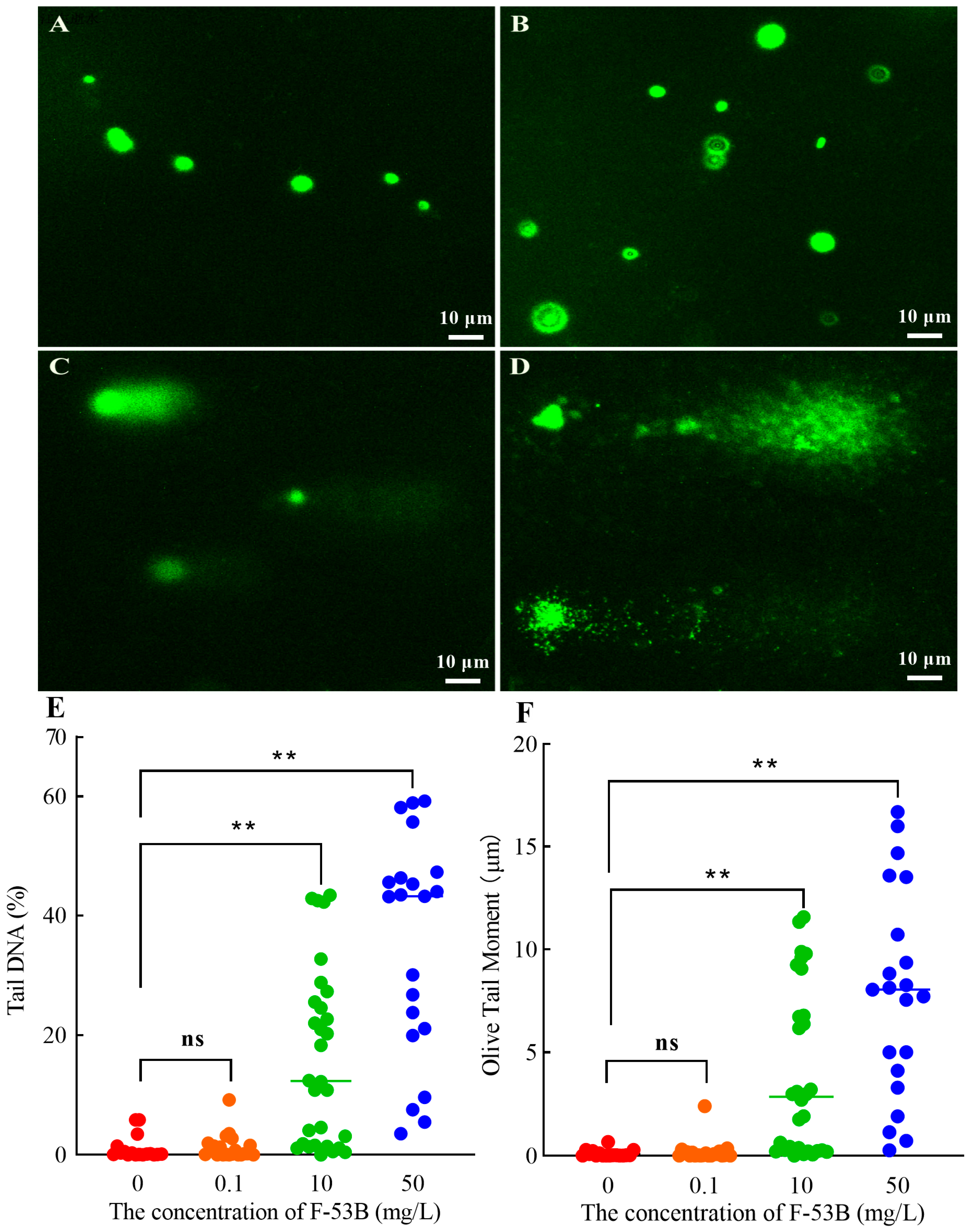
The alkaline comet assay revealed DNA damage in E. coli following 24 h of exposure to F-53B (0, 0.1, 10, and 50 mg/L). Cells in the control and 0.1 mg/L F-53B groups remained intact without observed comet tails, indicating negligible DNA damage (Figure 7A,B). In contrast, higher F-53B levels led to concentration-dependent increases in comet tail length at 10 and 50 mg/L, reflecting pronounced DNA fragmentation (Figure 7C,D). Consistently, quantitative analysis showed markedly elevated TDNA and OTM values (p < 0.01) in these higher-concentration groups compared with the control, while no significant difference was detected between the control and 0.1 mg/L groups (Figure 7E,F). As shown in Table S1, this corresponds to mild DNA damage at 10 mg/L and moderate DNA damage at 50 mg/L, demonstrating a clear concentration-dependent genotoxic effect of F-53B.

4. Discussion

Ecological risk assessment of contaminants requires the evaluation of toxicity across different trophic levels. As a model prokaryotic microorganism, E. coli was used to assess the bacterial toxicity of F-53B. In this study, we found that, with increasing F-53B concentrations exceeding the tolerance threshold of E. coli, significant growth inhibition occurred. The 4 h and 24 h IC50 values of F-53B were 73.22 mg/L and 23.56 mg/L, respectively. Notably, these values are substantially lower than the reported 3 h IC50 of PFOS (374 mg/L) in E. coli [28], indicating that F-53B may be more toxic than PFOS in this model organism. This is consistent with the higher toxicity of F-53B relative to PFOS reported in earthworms [22], adult zebrafish [7], human hepatic cells (HL-7702) [37], and human hepatocellular carcinoma cells (HepG2 and Hep3B) [38]. These differences may be related to the higher bioconcentration factor of F-53B compared with PFOS, potentially enhancing toxicity in exposed organisms [39,40]. Furthermore, the pronounced growth inhibition of E. coli observed in this study suggests that the cellular-level toxicity of F-53B may contribute to its potential to disrupt microbial diversity at the community level [24]. Field monitoring in the Fen River of China revealed that F-53B was detected at all 68 sampling sites, underscoring its widespread occurrence and environmental persistence [6]. Collectively, these findings suggest that the ecological risks of F-53B as a PFOS alternative warrant serious attention.
In this study, DMSO was used as the solvent to dissolve F-53B. To minimize potential solvent effects, the final DMSO concentration in the assay medium was standardized at 0.1% (v/v) in both the control and all exposure groups during the assessment of the mechanisms of action of F-53B to E. coli. Previous work has demonstrated that the minimum inhibitory concentration (MIC) of DMSO for E. coli is approximately 15% (v/v), and that 5% (v/v) has little effect on bacterial growth [41]. Wang et al. [42] further reported that DMSO is toxic to microorganisms only at relatively high concentrations and recommended that its concentration should be kept below 2% (v/v) when used as a solvent. Vertebrate studies also indicate that DMSO concentrations up to 1% (v/v) can be safely used in zebrafish embryo developmental toxicity assays [43]. Taken together, these data indicate that the 0.1% (v/v) DMSO used in the present study is well below thresholds associated with biological interference; therefore, the effects observed can be attributed to F-53B rather than to the solvent.
To further explore the mechanism underlying F-53B-induced growth inhibition, we characterized cellular injury patterns in E. coli. CSH modulates interactions between bacterial cells and environmental pollutants by influencing interfacial adhesion dynamics [27]. Our study demonstrated that F-53B exposure significantly reduced CSH, consistent with reports of CSH reduction after PFOS or perfluorooctanoic acid (PFOA) exposure in E. coli [28]. This hydrophobicity decrease may be attributed to the amphiphilic properties of PFASs, whereby hydrophobic fluorinated tails accumulate on cell surfaces and occupy hydrophobic sites, while hydrophilic head groups orient toward the aqueous phase, thereby reducing CSH [44]. In model membranes, PFASs accumulation alters phospholipid arrangement and membrane fluidity [26]. These structural changes could be responsible for the changes in membrane permeability observed in the present study. The increase in membrane permeability can compromise cellular integrity, as evidenced by cell lysis and cytoplasmic leakage observed in the SEM images. Furthermore, PFASs have been shown to increase membrane permeability to protons, leading to diminished ATPase and metabolic activities [26,45]. Therefore, at high concentrations (10 and 50 mg/L), F-53B is likely to bind to the membrane lipid bilayer, disrupt membrane integrity, and contribute to E. coli inactivation or death.
ATR-FTIR is highly sensitive to subtle alterations in molecular bonding configurations, enabling discrimination of structural and biochemical perturbations within E. coli exposed to F-53B. In this study, ATR-FTIR analysis revealed that F-53B exposure altered the structures or compositions of proteins, fatty acids, and nucleic acids in E. coli. Structurally, E. coli possesses an outer membrane composed primarily of porins and lipopolysaccharides, with a peptidoglycan layer located between the outer membrane and the cytoplasmic membrane. The observed ATR-FTIR changes in proteins and fatty acids suggest that F-53B may partition into cellular membranes and alter cell envelope properties. This mechanism aligns with documented interactions of PFASs with phospholipid bilayers, where they disrupt acyl-chain packing and alter membrane function [46]. The alterations in nucleic acid ATR-FTIR signatures at high concentrations of F-53B (10 and 50 mg/L) indicate potential DNA damage, as further discussed below.
Oxidative stress represents a primary mechanism by which contaminants induce toxicity. Excessive ROS production is a key indicator of oxidative stress. SOD and CAT are critical antioxidant enzymes that protect against contaminant-induced ROS by detoxifying superoxide anions (O2−•) and decomposing hydrogen peroxide (H2O2), respectively [47]. Cells can enhance antioxidant defenses through activation of these antioxidant enzymes, but oxidative damage occurs when the SOD or CAT systems fail to eliminate excess ROS, leading to reduced enzyme activities and potential degradation [48]. In this study, F-53B exposure significantly decreased SOD and CAT activities, indicating disruption of the antioxidant defense system in E. coli. These findings are consistent with reports that F-53B impairs the antioxidant defense system in Chinese rare minnow (Gobiocypris rarus) [48] and zebrafish [49]. In addition, accumulated ROS can induce cell membrane lipid peroxidation, with MDA serving as an end product of lipid peroxidation and a key oxidative stress biomarker [49]. Elevated MDA content was largely consistent with increased ROS after F-53B exposure, suggesting significantly increased oxidative stress in E. coli and further indicating compromised cell membrane integrity. Moreover, elevated oxidative stress may induce oxidative DNA damage, leading to cellular inactivation or death [50]. Consequently, oxidative stress may serve as a sensitive biomarker for assessing F-53B toxicity risks.
The alkaline comet assay has been used to assess DNA damage in organisms following exposure to PFASs. In vivo studies have generally reported moderate genotoxic effects induced by PFASs exposure [51]. For instance, significant genotoxicity has been observed in green mussels (Perna niridis) [52], earthworms [53], common carp (Cyprinus carpio) [54], and rat (Rattus norvegicus) [55]. It is noteworthy that existing research has predominantly focused on eukaryotes exposed to PFOS or PFOA, whereas investigations into the genotoxic effects of their alternatives on prokaryotes remain limited. Therefore, this study investigated the genotoxic potential of F-53B to bacterial cells using the alkaline comet assay. Our results demonstrated that exposure to 10 mg/L induced mild DNA damage, while 50 mg/L exposure caused moderate DNA damage. These findings are consistent with those of Qiu et al. [56], who observed DNA damage in mouse embryonic stem cells following F-53B exposure. Previous studies have concluded that PFASs are not directly genotoxic because their chemical structures lack typical genotoxic functional groups [57]. Meanwhile, extensive evidence indicates that ROS are a major cause of DNA damage, inducing lesions through mechanisms such as strand breakage, nucleotide excision, and base modifications [53,58]. Therefore, the genotoxic effects (DNA damage) observed in this study are likely attributable to indirect mechanisms mediated by oxidative stress, whereby intracellular ROS accumulation leads to DNA damage.
One limitation of the present study is that it evaluated the toxic effects of F-53B exposure on E. coli only after 24 h. Further studies should assess the toxicity of F-53B over different exposure durations, as well as its impact on E. coli at various growth stages.

5. Conclusions

This study systematically investigated the toxicity of F-53B to E. coli and elucidated its underlying mechanisms of action. The results showed that the 24 h IC50 value of F-53B was 23.56 mg/L, suggesting that F-53B may exhibit higher toxicity to E. coli than PFOS. The toxicity mechanisms of F-53B were attributed to cell morphological disruption, oxidative stress, and DNA damage, ultimately leading to cellular inactivation or death. The results of this study advance our understanding of F-53B cytotoxicity in microorganisms and provide mechanistic evidence to support ecological risk assessment of this emerging contaminant.

Supplementary Materials

The following supporting information can be downloaded at: https://www.mdpi.com/article/10.3390/microorganisms13122819/s1; Table S1: Tail DNA% and Olive tail moment obtained from comet assay and the corresponding classification of damage type. References [59,60,61] are cited in the supplementary materials.

Author Contributions

Conceptualization, B.C. and J.D.; Methodology, J.L. and J.D.; Software, L.Y.; Writing—Original Draft, Z.L. and J.D.; Visualization, Z.L. and L.Y.; Writing—Review and Editing, J.D.; Project Administration, B.C.; Funding Acquisition, B.C. and J.L. All authors have read and agreed to the published version of the manuscript.

Funding

This work was financially supported by the Scientific and Technological Innovation Programs of Higher Education Institutions in Shanxi (2023L322), the Key Project of the National Natural Science Foundation of China Joint Fund for Regional In-novation and Development (U23A20157), and the National Natural Science Foundation of China (32401491).

Institutional Review Board Statement

Not applicable.

Informed Consent Statement

Not applicable.

Data Availability Statement

The original contributions presented in this study are included in the article/Supplementary Materials. Further inquiries can be directed to the corresponding author.

Conflicts of Interest

The authors declare no competing interests.

Abbreviations

The following abbreviations are used in this manuscript:
F-53B6:2 chlorinated polyfluorinated ether sulfonate
PFOSPerfluorooctane sulfonate
IC50The half maximal growth inhibition concentration
ROSReactive oxygen species
MDAMalondialdehyde
SODSuperoxide dismutase
CATCatalase
PFASsPer- and polyfluoroalkyl substances
POPsPersistent organic pollutants
PFOAPerfluorooctanoic acid
DMSOdimethyl sulfoxide
OD600Optical density at 600 nm
SEMScanning electron microscope
CSHCell surface hydrophobicity
MATHMicrobial adhesion to hydrocarbons
ART-FTIRAttenuated total reflectance Fourier transform infrared spectroscopy
DCFH-DAFluorescent probe 2′, 7′-dichlorofluorescein diacetate
FIFluorescent intensity
TDNATail DNA%
OTMOlive tail moment
MICThe minimum inhibitory concentration
(O2−•)Superoxide anions
H2O2Hydrogen peroxide

References

  1. Brunn, H.; Arnold, G.; Körner, W.; Rippen, G.; Steinhäuser, K.G.; Valentin, I. PFAS: Forever chemicals-persistent, bioaccumulative and mobile. Reviewing the status and the need for their phase out and remediation of contaminated sites. Environ. Sci. Eur. 2023, 35, 30. [Google Scholar] [CrossRef]
  2. Suman, T.Y.; Kwak, I.S. Current understanding of human bioaccumulation patterns and health effects of exposure to perfluorooctane sulfonate (PFOS). J. Hazard. Mater. 2025, 487, 18. [Google Scholar] [CrossRef]
  3. Bao, Y.X.; Huang, J.; Cagnetta, G.; Yu, G. Removal of F-538 as PFOS alternative in chrome plating wastewater by UV/Sulfite reduction. Water Res. 2019, 163, 9. [Google Scholar] [CrossRef]
  4. Gao, L.J.; Liu, J.L.; Bao, K.; Chen, N.N.; Meng, B. Multicompartment occurrence and partitioning of alternative and legacy per- and polyfluoroalkyl substances in an impacted river in China. Sci. Total Environ. 2020, 729, 10. [Google Scholar] [CrossRef] [PubMed]
  5. Kalyn, M.; Lee, H.; Curry, J.; Tu, W.Q.; Ekker, M.; Mennigen, J.A. Effects of PFOS, F-53B and OBS on locomotor behaviour, the dopaminergic system and mitochondrial function in developing zebrafish (Danio rerio). Environ. Pollut. 2023, 326, 11. [Google Scholar] [CrossRef]
  6. Zhou, J.; Li, Z.; Guo, X.T.; Li, Y.; Wu, Z.H.; Zhu, L.Y. Evidences for replacing legacy per- and polyfluoroalkyl substances with emerging ones in Fen and Wei River basins in central and western China. J. Hazard. Mater. 2019, 377, 78–87. [Google Scholar] [CrossRef]
  7. Wang, S.W.; Huang, J.; Yang, Y.; Hui, Y.M.; Ge, Y.X.; Larssen, T.; Yu, G.; Deng, S.B.; Wang, B.; Harman, C. First report of a Chinese PFOS alternative overlooked for 30 years: Its toxicity, persistence, and presence in the environment. Environ. Sci. Technol. 2013, 47, 10163–10170. [Google Scholar] [CrossRef]
  8. Wang, X.F.; Zhao, Y.M.; Li, F.; Li, Z.L.; Liang, J.P.; Li, H.; Zhang, X.Y.; Zhang, M. Impact of the novel chlorinated polyfluorinated ether sulfonate, F-53B, on gill structure and reproductive toxicity in zebrafish. Aquat. Toxicol. 2024, 275, 10. [Google Scholar] [CrossRef]
  9. Ti, B.W.; Li, L.; Liu, J.G.; Chen, C.K. Global distribution potential and regional environmental risk of F-53B. Sci. Total Environ. 2018, 640, 1365–1371. [Google Scholar] [CrossRef]
  10. Shi, Y.L.; Vestergren, R.; Xu, L.; Zhou, Z.; Li, C.X.; Liang, Y.; Cai, Y.Q. Human exposure and elimination kinetics of chlorinated polyfluoroalkyl ether sulfonic acids (Cl-PFESAs). Environ. Sci. Technol. 2016, 50, 2396–2404. [Google Scholar] [CrossRef] [PubMed]
  11. Shi, G.H.; Guo, H.; Sheng, N.; Cui, Q.Q.; Pan, Y.T.; Wang, J.X.; Guo, Y.; Dai, J.Y. Two-generational reproductive toxicity assessment of 6:2 chlorinated polyfluorinated ether sulfonate (F-53B, a novel alternative to perfluorooctane sulfonate) in zebrafish. Environ. Pollut. 2018, 243, 1517–1527. [Google Scholar] [CrossRef]
  12. Shi, G.H.; Cui, Q.Q.; Pan, Y.T.; Sheng, N.; Sun, S.J.; Guo, Y.; Dai, J.Y. 6:2 Chlorinated polyfluorinated ether sulfonate, a PFOS alternative, induces embryotoxicity and disrupts cardiac development in zebrafish embryos. Aquat. Toxicol. 2017, 185, 67–75. [Google Scholar] [CrossRef]
  13. Wu, L.Y.; Zeeshan, M.; Dang, Y.; Liang, L.Y.; Gong, Y.C.; Li, Q.Q.; Tan, Y.W.; Fan, Y.Y.; Lin, L.Z.; Zhou, Y.; et al. Environmentally relevant concentrations of F-53B induce eye development disorders-mediated locomotor behavior in zebrafish larvae. Chemosphere 2022, 308, 8. [Google Scholar] [CrossRef]
  14. Shi, G.H.; Cui, Q.Q.; Wang, J.X.; Guo, H.; Pan, Y.T.; Sheng, N.; Guo, Y.; Dai, J.Y. Chronic exposure to 6:2 chlorinated polyfluorinated ether sulfonate acid (F-53B) induced hepatotoxic effects in adult zebrafish and disrupted the PPAR signaling pathway in their offspring. Environ. Pollut. 2019, 249, 550–559. [Google Scholar] [CrossRef]
  15. Deng, M.; Wu, Y.M.; Xu, C.; Jin, Y.X.; He, X.L.; Wan, J.B.; Yu, X.L.; Rao, H.M.; Tu, W.Q. Multiple approaches to assess the effects of F-53B, a Chinese PFOS alternative, on thyroid endocrine disruption at environmentally relevant concentrations. Sci. Total Environ. 2018, 624, 215–224. [Google Scholar] [CrossRef]
  16. Wu, Y.M.; Deng, M.; Jin, Y.X.; Mu, X.Y.; He, X.L.; Luu, N.T.; Yang, C.Y.; Tu, W.Q. Uptake and elimination of emerging polyfluoroalkyl substance F-53B in zebrafish larvae: Response of oxidative stress biomarkers. Chemosphere 2019, 215, 182–188. [Google Scholar] [CrossRef] [PubMed]
  17. Zhou, X.J.; Wang, J.S.; Sheng, N.; Cui, R.N.; Deng, Y.Q.; Dai, J.Y. Subchronic reproductive effects of 6:2 chlorinated polyfluorinated ether sulfonate (6:2 Cl-PFAES), an alternative to PFOS, on adult male mice. J. Hazard. Mater. 2018, 358, 256–264, Erratum in J. Hazard. Mater. 2019, 365, 972. [Google Scholar] [CrossRef] [PubMed]
  18. Li, S.P.; Wu, L.Y.; Zeng, H.X.; Zhang, J.; Qin, S.J.; Liang, L.X.; Andersson, J.; Meng, W.J.; Chen, X.Y.; Wu, Q.Z.; et al. Hepatic injury and ileitis associated with gut microbiota dysbiosis in mice upon F-53B exposure. Environ. Res. 2024, 248, 10. [Google Scholar] [CrossRef] [PubMed]
  19. Wu, H.; Feng, Y.Y.; Zhang, R.Y.; Xu, H.Y.; Fu, F. 6:2 chlorinated polyfluoroalkyl ether sulfonate (F-53B) induced nephrotoxicity associated with oxidative stress, inflammation and fibrosis in mice. Chem.-Biol. Interact. 2025, 405, 10. [Google Scholar] [CrossRef]
  20. Tan, Z.Z.; Lv, J.L.; Li, H.R.; An, Z.W.; Li, L.F.; Ke, Y.J.; Liu, Y.; Liu, X.H.; Wang, L.; Li, A.; et al. Angiotoxic effects of chlorinated polyfluorinated ether sulfonate, a novel perfluorooctane sulfonate substitute, in vivo and in vitro. J. Hazard. Mater. 2024, 469, 12. [Google Scholar] [CrossRef]
  21. Feng, L.H.; Lang, Y.Y.; Feng, Y.Y.; Tang, X.M.; Zhang, Q.Q.; Xu, H.Y.; Liu, Y. Maternal F-53B exposure during pregnancy and lactation affects bone growth and development in male offspring. Ecotoxicol. Environ. Saf. 2024, 279, 12. [Google Scholar] [CrossRef]
  22. Ge, Y.H.; Wang, Z.; Chen, X.L.; Wang, W.; Liu, Z.Y.; Sun, H.W.; Zhang, L.Y. Comparative toxicological effects of perfluorooctane sulfonate and its alternative 6:2 chlorinated polyfluorinated ether sulfonate on earthworms. Environ. Toxicol. Chem. 2024, 43, 170–181. [Google Scholar] [CrossRef]
  23. Kost, C.; Patil, K.R.; Friedman, J.; Garcia, S.L.; Ralser, M. Metabolic exchanges are ubiquitous in natural microbial communities. Nat. Microbiol. 2023, 8, 2244–2252. [Google Scholar] [CrossRef]
  24. Jiang, T.; Geisler, M.; Zhang, W.L.; Liang, Y.N. Fluoroalkylether compounds affect microbial community structures and abundance of nitrogen cycle-related genes in soil-microbe-plant systems. Ecotoxicol. Environ. Saf. 2021, 228, 8. [Google Scholar] [CrossRef]
  25. Nobels, I.; Dardenne, F.; De Coen, W.; Blust, R. Application of a multiple endpoint bacterial reporter assay to evaluate toxicological relevant endpoints of perfluorinated compounds with different functional groups and varying chain length. Toxicol. Vitro 2010, 24, 1768–1774. [Google Scholar] [CrossRef] [PubMed]
  26. Fitzgerald, N.J.M.; Simcik, M.F.; Novak, P.J. Perfluoroalkyl substances increase the membrane permeability and quorum sensing response in Aliivibrio fischeri. Environ. Sci. Technol. Lett. 2018, 5, 26–31. [Google Scholar] [CrossRef]
  27. Li, J.; Zheng, T.T.; Yuan, D.; Gao, C.Z.; Liu, C.G. Probing the single and combined toxicity of PFOS and Cr(VI) to soil bacteria and the interaction mechanisms. Chemosphere 2020, 249, 8. [Google Scholar] [CrossRef]
  28. Liu, G.S.; Zhang, S.; Yang, K.; Zhu, L.Z.; Lin, D.H. Toxicity of perfluorooctane sulfonate and perfluorooctanoic acid to Escherichia coli: Membrane disruption, oxidative stress, and DNA damage induced cell inactivation and/or death. Environ. Pollut. 2016, 214, 806–815. [Google Scholar] [CrossRef]
  29. Hieke, A.S.C.; Pillai, S.D. Escherichia coli cells exposed to lethal doses of electron beam irradiation retain their ability to propagate bacteriophages and are metabolically active. Front. Microbiol. 2018, 9, 11. [Google Scholar] [CrossRef]
  30. Espigares, M.; Roman, I.; Alonso, J.M.G.; Deluis, B.; Yeste, F.; Galvez, R. Proposal and application of an ecotoxicity biotest based on Escherichia coli. J. Appl. Toxicol. 1990, 10, 443–446. [Google Scholar] [CrossRef]
  31. Schmitt, M.; Gellert, G.; Ludwig, J.; Lichtenberg-Fraté, H. Phenotypic yeast growth analysis for chronic toxicity testing. Ecotoxicol. Environ. Saf. 2004, 59, 142–150. [Google Scholar] [CrossRef]
  32. Zheng, T.T.; Li, J.; Liu, C.G. Improvement of α-amylase to the metabolism adaptions of soil bacteria against PFOS exposure. Ecotoxicol. Environ. Saf. 2021, 208, 10. [Google Scholar] [CrossRef]
  33. Park, D.; Lim, J.W.; Kim, H. α-Lipoic acid inhibits apoptosis by suppressing the loss of ku proteins in Helicobacter pylori-infected human gastric epithelial cells. Nutrients 2022, 14, 13. [Google Scholar] [CrossRef] [PubMed]
  34. Liao, Y.; Wang, Q.; Jiang, X.; Li, M. Combined toxic effects of polystyrene microplastics and cadmium on earthworms. Asian J. Ecotoxicol. 2022, 17, 216–226. [Google Scholar]
  35. Gupta, A.D.; Sivakumaran, K. Individual and combined toxic effect of nickel and chromium on biochemical constituents in E. coli using FTIR spectroscopy and principle component analysis. Ecotoxicol. Environ. Saf. 2016, 130, 289–294. [Google Scholar] [CrossRef] [PubMed]
  36. Hu, X.J.; Liu, Z.X.; Wang, Y.D.; Li, X.L.; Hu, J.; Lü, J.H. Synchrotron FTIR spectroscopy reveals molecular changes in Escherichia coli upon Cu2+ exposure. Nucl. Sci. Tech. 2016, 27, 8. [Google Scholar] [CrossRef]
  37. Sheng, N.; Cui, R.N.; Wang, J.H.; Guo, Y.; Wang, J.S.; Dai, J.Y. Cytotoxicity of novel fluorinated alternatives to long-chain perfluoroalkyl substances to human liver cell line and their binding capacity to human liver fatty acid binding protein. Arch. Toxicol. 2018, 92, 359–369. [Google Scholar] [CrossRef]
  38. Zhao, F.; Yan, X.; He, M.; Wang, Y.; Kang, T.; Cai, F.; Zheng, J.; Xie, C. Cytotoxic effects of F-53B on human hepatoma cells HepG2 and Hep3B. Asian J. Ecotoxicol. 2024, 19, 232–241. [Google Scholar]
  39. Huang, J.; Liu, Y.; Wang, Q.Y.; Yi, J.F.; Lai, H.; Sun, L.W.; Mennigen, J.A.; Tu, W.Q. Concentration-dependent toxicokinetics of novel PFOS alternatives and their chronic combined toxicity in adult zebrafish. Sci. Total Environ. 2022, 839, 9. [Google Scholar] [CrossRef]
  40. Shi, Y.L.; Vestergren, R.; Zhou, Z.; Song, X.W.; Xu, L.; Liang, Y.; Cai, Y.Q. Tissue distribution and whole body burden of the chlorinated polyfluoroalkyl ether sulfonic acid F-53B in Crucian Carp (Carassius carassius): Evidence for a highly bioaccumulative contaminant of emerging concern. Environ. Sci. Technol. 2015, 49, 14156–14165. [Google Scholar] [CrossRef]
  41. Mi, H.F.; Wang, D.; Xue, Y.X.; Zhang, Z.; Niu, J.J.; Hong, Y.Z.; Drlica, K.; Zhao, X.L. Dimethyl sulfoxide protects Escherichia coli from rapid antimicrobial-mediated killing. Antimicrob. Agents Chemother. 2016, 60, 5054–5058. [Google Scholar] [CrossRef]
  42. Wang, Z.; Zhang, J.; Zhou, J.; Ismail, S.; Ahmad, H.A.; Awad, H.M.; Tawfik, A.; Ni, S.Q. Dosage-dependent toxicity of universal solvent dimethyl sulfoxide to the partial nitrification wastewater treatment process. ACS EST Water 2023, 3, 848–856. [Google Scholar] [CrossRef]
  43. Hoyberghs, J.; Bars, C.; Ayuso, M.; Van, G.C.; Foubert, K.; Van, C.S. DMSO Concentrations up to 1% are Safe to be used in the zebrafish embryo developmental toxicity assay. Front. Toxicol. 2021, 3, 804033. [Google Scholar] [CrossRef]
  44. Ruan, T.; Lin, Y.F.; Wang, T.; Liu, R.Z.; Jiang, G.B. Identification of novel polyfluorinated ether sulfonates as PFOS alternatives in municipal sewage sludge in China. Environ. Sci. Technol. 2015, 49, 6519–6527. [Google Scholar] [CrossRef]
  45. Fu, A.; Yang, M.; Ye, J.; Qin, H. Cytotoxicity of pentadecafluorooctanoic acid on Saccharomyces cerevisiae. Acta Scientiae Circumstantiae 2016, 36, 1486–1492. [Google Scholar]
  46. Bosch, A.; Serra, D.; Prieto, C.; Schmitt, J.; Naumann, D.; Yantorno, O. Characterization of Bordetella pertussis growing as biofilm by chemical analysis and FT-IR spectroscopy. Appl. Microbiol. Biotechnol. 2006, 71, 736–747. [Google Scholar] [CrossRef]
  47. Portune, K.J.; Cary, S.C.; Warner, M.E. Antioxidant enzyme response and reactive oxygen species production in marine raphidophytes. J. Phycol. 2010, 46, 1161–1171. [Google Scholar] [CrossRef]
  48. Yang, H.B.; Xu, C.; Song, J.Y.; Li, J.; Zhang, C.; Teng, C.L.; Ma, K.; Xie, F. Toxicokinetic and liver proteomic study of the Chinese rare minnow (Gobiocypris rarus) exposed to F-53B. Aquat. Toxicol. 2025, 282, 12. [Google Scholar] [CrossRef] [PubMed]
  49. Wu, Y.M.; Huang, J.; Deng, M.; Jin, Y.X.; Yang, H.L.; Liu, Y.; Cao, Q.Y.; Mennigen, J.A.; Tu, W.Q. Acute exposure to environmentally relevant concentrations of Chinese PFOS alternative F-53B induces oxidative stress in early developing zebrafish. Chemosphere 2019, 235, 945–951. [Google Scholar] [CrossRef] [PubMed]
  50. Valavanidis, A.; Vlahogianni, T.; Dassenakis, M.; Scoullos, M. Molecular biomarkers of oxidative stress in aquatic organisms in relation to toxic environmental pollutants. Ecotoxicol. Environ. Saf. 2006, 64, 178–189. [Google Scholar] [CrossRef] [PubMed]
  51. Ojo, A.F.; Peng, C.; Ng, J.C. Genotoxicity assessment of per- and polyfluoroalkyl substances mixtures in human liver cells (HepG2). Toxicology 2022, 482, 10. [Google Scholar] [CrossRef]
  52. Liu, C.H.; Chang, V.W.C.; Gin, K.Y.H.; Nguyen, V.T. Genotoxicity of perfluorinated chemicals (PFCs) to the green mussel (Perna viridis). Sci. Total Environ. 2014, 487, 117–122. [Google Scholar] [CrossRef]
  53. Xu, D.M.; Li, C.D.; Wen, Y.Z.; Liu, W.P. Antioxidant defense system responses and DNA damage of earthworms exposed to Perfluorooctane sulfonate (PFOS). Environ. Pollut. 2013, 174, 121–127. [Google Scholar] [CrossRef]
  54. Kim, W.K.; Lee, S.K.; Jung, J. Integrated assessment of biomarker responses in common carp (Cyprinus carpio) exposed to perfluorinated organic compounds. J. Hazard. Mater. 2010, 180, 395–400. [Google Scholar] [CrossRef]
  55. Çelik, A.; Eke, D.; Ekinci, S.Y.; Yildirim, S. The protective role of curcumin on perfluorooctane sulfonate-induced genotoxicity: Single cell gel electrophoresis and micronucleus test. Food Chem. Toxicol. 2013, 53, 249–255. [Google Scholar] [CrossRef]
  56. Qiu, Y.; Gao, M.; Cao, T.; Wang, J.; Luo, M.; Liu, S.; Zeng, X.; Huang, J. PFOS and F-53B disrupted inner cell mass development in mouse preimplantation embryo. Chemosphere 2024, 349, 140948. [Google Scholar] [CrossRef]
  57. Crebelli, R.; Caiola, S.; Conti, L.; Cordelli, E.; De Luca, G.; Dellatte, E.; Eleuteri, P.; Iacovella, N.; Leopardi, P.; Marcon, F.; et al. Can sustained exposure to PFAS trigger a genotoxic response? A comprehensive genotoxicity assessment in mice after subacute oral administration of PFOA and PFBA. Regul. Toxicol. Pharmacol. 2019, 106, 169–177. [Google Scholar] [CrossRef] [PubMed]
  58. Cooke, M.S.; Evans, M.D.; Dizdaroglu, M.; Lunec, J. Oxidative DNA damage: Mechanisms, mutation, and disease. FASEB J. 2003, 17, 1195–1214. [Google Scholar] [CrossRef] [PubMed]
  59. Hou, Z.; Zhao, L.; Wang, Y.; Liao, X. Purification and characterization of superoxide dismutases from sea buckthorn and chestnut rose. J. Food Sci. 2019, 84, 746–753. [Google Scholar] [CrossRef] [PubMed]
  60. Banerjee, G.; Pandey, S.; Ray, A.K.; Kumar, R. Bioremediation of heavy metals by a novel bacterial strain enterobacter cloacae and its antioxidant enzyme activity, flocculant production, and protein expression in presence of lead, cadmium, and nickel. Water Air Soil Pollut. 2015, 226, 91. [Google Scholar] [CrossRef]
  61. Zhang, W.X.; Tang, Y.; Han, Y.; Huang, L.; Zhou, W.; Zhou, C.; Hu, Y.; Lu, R.; Wang, F.; Shi, W.; et al. Immunotoxicity of pentachlorophenol to a marine bivalve species and potential toxification mechanisms underpinning. J. Hazard. Mater. 2022, 439, 129681. [Google Scholar] [CrossRef] [PubMed]
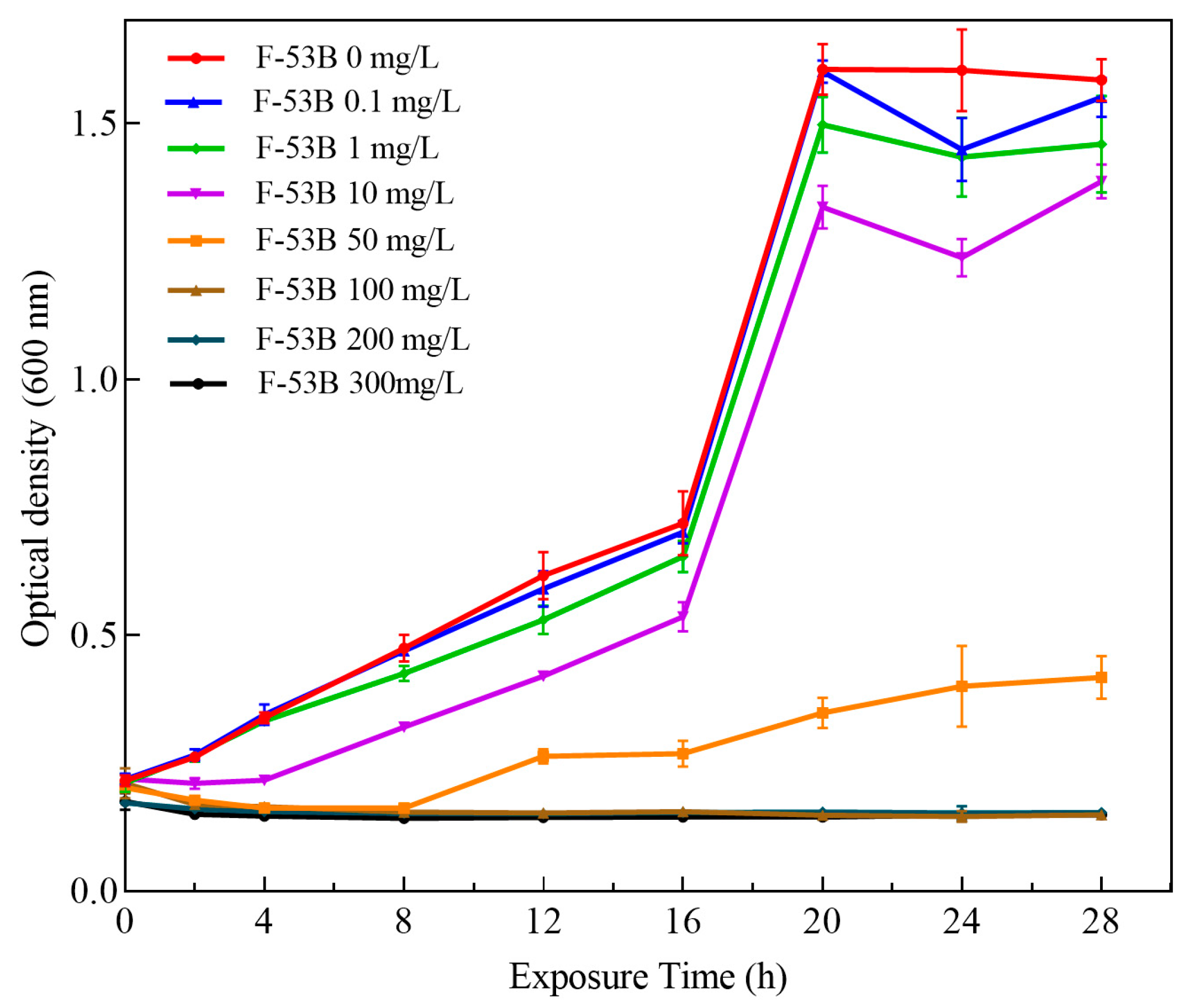
Figure 1. Growth curve of Escherichia coli exposed to different concentrations of F-53B for 28 h. Error bars represent standard deviations (n = 3).
Microorganisms 13 02819 g001
Figure 2. Dose–response curve of Escherichia coli after 24 h of exposure to F-53B at concentrations of 0, 0.1, 1, 10, 50, 100, 200, and 300 mg/L. Error bars represent standard deviations (n = 3).
Microorganisms 13 02819 g002
Figure 3. Scanning electron microscopy (SEM) images of Escherichia coli after 24 h of exposure to F-53B: 0 mg/L (A), 0.1 mg/L (B), 10 mg/L (C), and 50 mg/L (D).
Microorganisms 13 02819 g003
Figure 4. Cell surface hydrophobicity (A) and membrane permeability (B) of Escherichia coli after 24 h of exposure to different concentrations of F-53B (0, 0.1, 10, and 50 mg/L). Values with different letters (a–d) indicate statistically significant differences (p < 0.05). Error bars represent standard deviations (n = 3).
Microorganisms 13 02819 g004
Figure 5. Attenuated total reflectance Fourier transform infrared spectroscopy (ATR-FTIR) of Escherichia coli after 24 h of exposure to different concentrations of F-53B (0, 0.1, 10, and 50 mg/L).
Microorganisms 13 02819 g005
Figure 6. ROS levels (A), MDA content (B), SOD activity (C), and CAT activity (D) of Escherichia coli after 24 h of exposure to different concentrations of F-53B (0, 0.1, 10, and 50 mg/L). Values with different letters (a–c) indicate statistically significant differences (p < 0.05). Error bars represent standard deviations (n = 3).
Microorganisms 13 02819 g006
Figure 7. Comet assay of Escherichia coli exposed to F-53B for 24 h. (AD) Representative comet assay images of cells exposed to 0, 0.1, 10, and 50 mg/L, respectively; (E) Tail DNA% and (F) Olive tail moment. Middle bars represent medians. ** p  <  0.01; ns, not significant.
Microorganisms 13 02819 g007
Disclaimer/Publisher’s Note: The statements, opinions and data contained in all publications are solely those of the individual author(s) and contributor(s) and not of MDPI and/or the editor(s). MDPI and/or the editor(s) disclaim responsibility for any injury to people or property resulting from any ideas, methods, instructions or products referred to in the content.