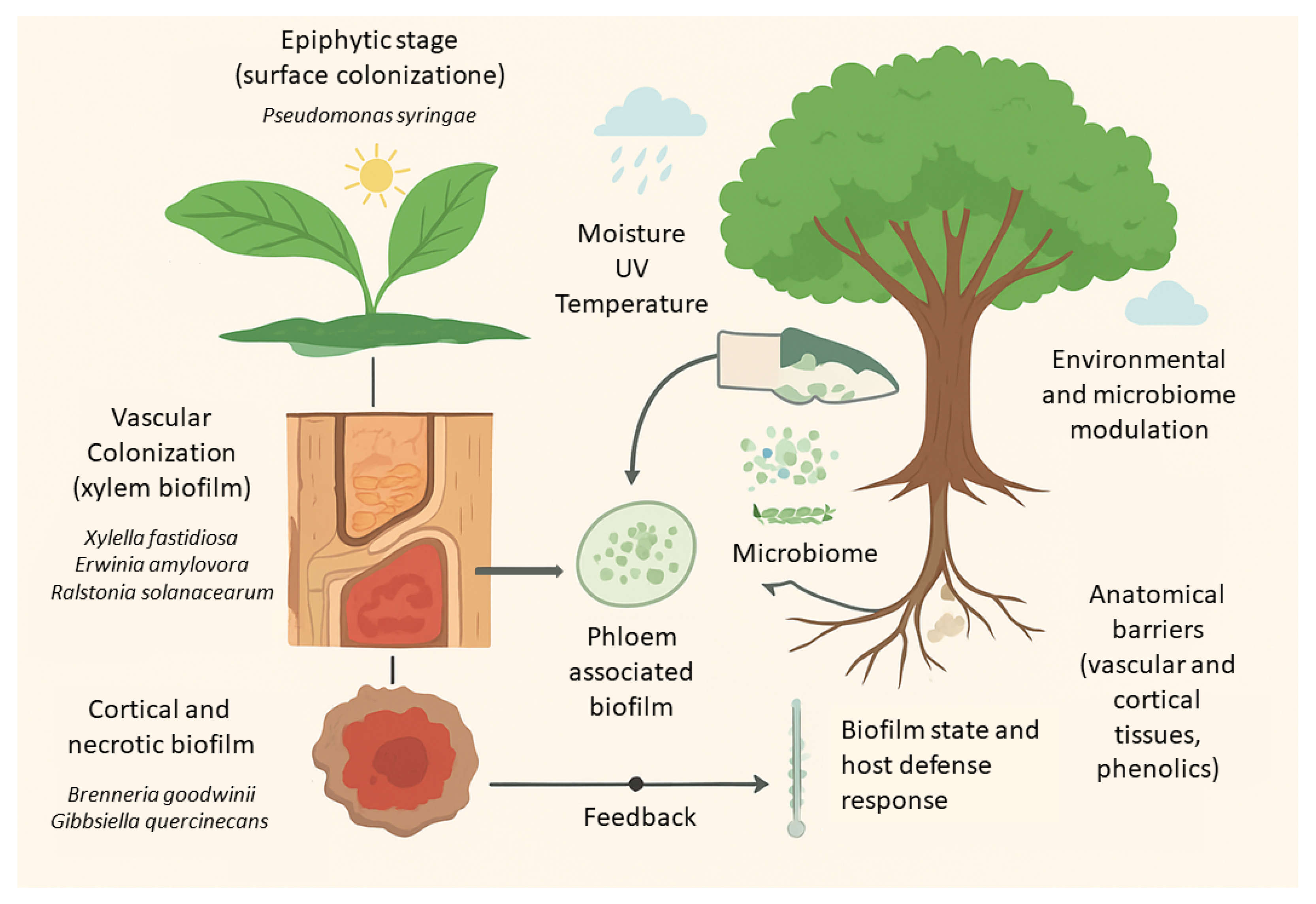
Biofilm as a Key Element in the Bacterial Pathogenesis of Forest Trees: A Review of Mechanisms and Ecological Implications


Abstract
1. Introduction
2. Biofilm Formation Mechanisms and Their Significance for Tree Pathogens
2.1. Adhesion, Microcolony Formation, and EPS Production
2.2. Adaptive Significance of Biofilm: Survival, Resistance, and Colonization
3. Biofilms in Specific Tree Pathogens
3.1. P. syringae—Epiphytic Biofilms on Leaves and Shoots
3.2. Erwinia spp.—Biofilm Formation in Vascular Tissues

| Pathogen | Common Hosts | Biofilm Location | Main Components | Regulation/Signaling | Functional Consequences | References |
|---|---|---|---|---|---|---|
| P. syringae | Deciduous and coniferous trees: Prunus, Aesculus, Betula, Populus, Acer, as well as Pinus and Larix. | Epiphytic biofilms on leaf cuticles, buds, bark; microcolonies on surfaces. | Cellulose-type polysaccharides/Psl-like/alginate analogs; type IV pili; adhesive proteins. | c-di-GMP, quorum sensing; multi-locus regulation of EPS operons dependent on environmental conditions. | Provision of water retention, UV protection, increased overwintering survival, higher likelihood of infection initiation after rainfall. | [55] |
| E. amylovora | Mainly Rosaceae: Malus, Pyrus, Crataegus, Sorbus, Amelanchier (also occurring in forested areas). | Biofilm in vascular tissues (xylem/phloem) and adjacent mesophyll; foci within the vessels. | Amylovoran (major), levan, cellulose; polysaccharide capsule. | Regulation of EPS biosynthesis by systems (including c-di-GMP; genetic regulators such as csrD, etc.). | Vessel occlusion, wilting, and necrosis; EPS acts as a barrier against host defenses and protective agents; EPS-deficient mutants lose virulence. | [15] |
| X. fastidiosa | Broad spectrum: olive, grapevine, citrus; numerous forest species (Quercus, Acer, Platanus, Ulmus). | Biofilm in xylem vessels (inner surface of the vessels). | Complex EPS (-1,4-endoglucanase and other polysaccharides); adhesive proteins; filamentous matrix elements. | DSF (diffusible signal factor) systems; EPS-modifying enzymes (e.g., -1,4-endoglucanase) regulating polymer length and biofilm dynamics. | Vessel occlusion—reduced sap and water flow, wilting/death; DSF regulation affects biofilm/dispersion balance and vector-mediated transmission. | [8] |
| AOD complex | Oaks—also widely distributed across Europe. | Biofilms in necrotic tissues under the bark and in necrotic cavities; potential foci in vessels. | Probable multi-species EPS consortium (various polysaccharides); indirect evidence from isolations and metagenomics. | Likely interspecies signaling; consortial interactions; detailed genetic characterization of EPS is lacking (knowledge gap). | Potential stabilization of infection foci in wounds/necroses; protection against host defenses; facilitation of tissue degradation by cooperating enzymes. | [59] |
| L. populi | Populus spp. (black poplar, hybrid poplars) | Cortical tissues, bark exudates, wound margins | EPS rich in polysaccharides and proteins; creamy extracellular matrix | Quorum sensing (AHL-like); EPS secretion genes | Protective barrier against desiccation; insect attraction; enhanced bark colonisation and spread | [60] |
| Other, e.g., Dickeya, Ralstonia, Xanthomonas | Various trees and plants; in forest contexts—mainly a reservoir in the understory and woodlands. | Epiphytic or vascular biofilm depending on the species. | Diverse EPS polysaccharides, eDNA, adhesive proteins—mechanistic community of biofilm traits. | QS (AHL, DSF, etc.), c-di-GMP; EPS-degrading enzymes regulate dispersion. | Facilitates survival, concealment from host defense mechanisms, and increased tolerance to biocides. | [22] |
3.3. X. fastidiosa—Biofilm in Xylem Vessels; DSF and the Adhesion–Dispersion Cycle
3.4. Brenneria goodwinii and Gibbsiella quercinecans—Acute Oak Decline (AOD) and the Biofilm Synergy Hypothesis
3.5. L. populi—Biofilm-Driven Pathogenesis in Poplar Trees
4. Biofilm as a Target in Tree Disease Management Strategies
4.1. Chemical Biofilm Inhibitors
4.2. Biological Approaches
4.3. Environmental Management
4.4. Management Tools for Established Xylem-Pathogens and Endophyte Inoculation
5. Perspectives and Challenges
6. Summary
Funding
Institutional Review Board Statement
Informed Consent Statement
Data Availability Statement
Acknowledgments
Conflicts of Interest
References
- Krishna, P.; Woodcock, S.; Pfeilmeier, S.; Bornemann, S.; Zipfel, C.; Malone, J. Pseudomonas syringae addresses distinct environmental challenges during plant infection through the coordinated deployment of polysaccharides. J. Exp. Bot. 2022, 73, 2206–2221. [Google Scholar] [CrossRef]
- Tkaczyk, M. Worldwide review of bacterial diseases of oaks (Quercus sp.) and their potential threat to trees in Central Europe. For. Int. J. Forest Res. 2022, 96, 425–433. [Google Scholar] [CrossRef]
- Walker, N.; White, S.; Ruiz, S.; Fletcher, D.; Saponari, M.; Roose, T. A mathematical model of biofilm growth and spread within plant xylem: Case study of Xylella fastidiosa in olive trees. J. Theor. Biol. 2024, 581, 111737. [Google Scholar] [CrossRef]
- Tóth, T.; Lakatos, T.; Koltay, A. Lonsdalea quercina subsp. populi subsp. nov., isolated from bark canker of poplar trees. Int. J. Syst. Evol. Microbiol. 2013, 63, 2309–2313. [Google Scholar] [CrossRef]
- Costerton, J.W.; Lewandowski, Z.; Caldwell, D.E.; Korber, D.R.; Lappin-Scott, H.M. Microbial biofilms. Annu. Rev. Microbiol. 1995, 49, 711–745. [Google Scholar] [CrossRef]
- Muhammad, M.; Idris, A.; Fan, X.; Guo, Y.; Yu, Y.; Jin, X.; Qiu, J.; Guan, X.; Huang, T. Beyond risk: Bacterial biofilms and their regulating approaches. Front. Microbiol. 2020, 11, 928. [Google Scholar] [CrossRef] [PubMed]
- Bhattacharyya, A.; Mavrodi, O.; Bhowmik, N.; Weller, D.; Thomashow, L.; Mavrodi, D. Bacterial biofilms as an essential component of rhizosphere plant-microbe interactions. Methods Microbiol. 2023, 53, 3–48. [Google Scholar] [CrossRef] [PubMed]
- Castro, C.; Ndukwe, I.; Heiss, C.; Black, I.; Ingel, B.M.; Guevara, M.; Sun, Y.; Azadi, P.; Sun, Q.; Roper, M.C. Role of quorum sensing in bacterial infections. mBio 2023, 14, e01395-23. [Google Scholar] [CrossRef]
- Yuan, X.; Eldred, L.; Sundin, G. Exopolysaccharides amylovoran and levan contribute to sliding motility in the fire blight pathogen Erwinia amylovora. Environ. Microbiol. 2022, 24, 4738–4754. [Google Scholar] [CrossRef]
- Huang, Y.; Chakraborty, S.; Liang, H. Methods to probe the formation of biofilms: Applications in foods and related surfaces. Comput. Struct. Biotechnol. J. 2020, 12, 416–432. [Google Scholar] [CrossRef]
- de Souza, A.A.; Takita, M.A.; Coletta-Filho, H.D.; Caldana, C.; Yanai, G.M.; Muto, N.H.; Oliveira, R.C.d.; Nunes, L.R.; Machado, M.A. Gene expression profile of the plant pathogen Xylella fastidiosa during biofilm formation in vitro. FEMS Microbiol. Lett. 2004, 237, 341–353. [Google Scholar] [CrossRef]
- Portaccio, L.; Vergine, M.; De Pascali, M.; De Bellis, L.; Luvisi, A. Diffusible Signal Factors and Xylella fastidiosa: A Crucial Mechanism Yet to Be Revealed. Biology 2025, 14, 303. [Google Scholar] [CrossRef]
- Anbumani, S.; da Silva, A.M.; Carvalho, I.G.; Fischer, E.R.; de Souza e Silva, M.; Von Zuben, A.A.G.; Carvalho, H.F.; de Souza, A.A.; Janissen, R.; Cotta, M.A. Controlled spatial organization of bacterial growth reveals key role of cell filamentation preceding Xylella fastidiosa biofilm formation. npj Biofilms Microbiomes 2021, 7, 86. [Google Scholar] [CrossRef]
- Piqué, N.; Miñana-Galbis, D.; Merino, S.; Tomás, J. Virulence factors of Erwinia amylovora: A review. Int. J. Mol. Sci. 2015, 16, 12836–12854. [Google Scholar] [CrossRef]
- Koczan, J.; Lenneman, B.; McGrath, M.; Sundin, G. Cell surface attachment structures contribute to biofilm formation and xylem colonization by Erwinia amylovora. Appl. Environ. Microbiol. 2011, 77, 7031–7039. [Google Scholar] [CrossRef]
- Barnard, A.; Bowden, S.; Burr, T.; Coulthurst, S.; Monson, R.; Salmond, G. Quorum sensing, virulence and secondary metabolite production in plant soft-rotting bacteria. Philos. Trans. R. Soc. B 2007, 362, 1165–1183. [Google Scholar] [CrossRef]
- Kharadi, R.R.; Schachterle, J.K.; Yuan, X.; Castiblanco, L.F.; Peng, J.; Slack, S.M.; Zeng, Q.; Sundin, G.W. Genetic dissection of the Erwinia amylovora disease cycle. Annu. Rev. Phytopathol. 2021, 59, 191–212. [Google Scholar] [CrossRef] [PubMed]
- Liu, F.; Hu, M.; Zhang, Z.; Xue, Y.; Chen, S.; Hu, A.; Zhang, L.-H.; Zhou, J. Dickeya manipulates multiple quorum sensing systems to control virulence and collective behaviors. Front. Plant Sci. 2022, 13, 838125. [Google Scholar] [CrossRef] [PubMed]
- Castiblanco, L.F.; Sundin, G.W. New insights on molecular regulation of biofilm formation in plant-associated bacteria. J. Integr. Plant Biol. 2016, 58, 362–372. [Google Scholar] [CrossRef] [PubMed]
- Xiong, Q.; Yang, J.; Ni, S. Microbiome-mediated protection against pathogens in woody plants. Int. J. Mol. Sci. 2023, 24, 16118. [Google Scholar] [CrossRef]
- Heindl, J.; Wang, Y.; Heckel, B.; Mohari, B.; Feirer, N.; Fuqua, C. Mechanisms and regulation of surface interactions and biofilm formation in Agrobacterium. Front. Plant Sci. 2014, 5, 176. [Google Scholar] [CrossRef]
- Carezzano, M.; Paletti Rovey, M.; Cappellari, L.; Gallarato, L.; Bogino, P.; Oliva, M.; Giordano, W. Biofilm-forming ability of phytopathogenic bacteria: A review of its involvement in plant stress. Plants 2023, 12, 2207. [Google Scholar] [CrossRef]
- Janissen, R.; Murillo, D.; Niza, B.; Sahoo, P.; Nobrega, M.; Cesar, C.; Temperini, M.L.A.; Carvalho, H.F.; de Souza, A.A. Spatiotemporal distribution of different extracellular polymeric substances and filamentation mediate Xylella fastidiosa adhesion and biofilm formation. Sci. Rep. 2015, 5, 9856. [Google Scholar] [CrossRef]
- Killiny, N.; Martinez, R.; Dumenyo, C.; Cooksey, D.; Almeida, R. The exopolysaccharide of Xylella fastidiosa is essential for biofilm formation, plant virulence, and vector transmission. Mol. Plant-Microbe Interact. 2013, 26, 1044–1053. [Google Scholar] [CrossRef]
- Patwardhan, S.B.; Pandit, C.; Pandit, S.; Verma, D.; Lahiri, D.; Nag, M.; Ray, R.R.; Jha, P.; Prasad, R. Illuminating the signalomics of microbial biofilm on plant surfaces. Biocatal. Agric. Biotechnol. 2023, 47, 102537. [Google Scholar] [CrossRef]
- Asiegbu, F.O.; Adomas, A.; Stenlid, J. Conifer root and butt rot caused by Heterobasidion annosum (Fr.) Bref. s.l. Mol. Plant Pathol. 2005, 6, 395–409. [Google Scholar] [CrossRef]
- Lundberg, D.S.; Lebeis, S.L.; Paredes, S.H.; Yourstone, S.; Gehring, J.; Malfatti, S.; Tremblay, J.; Engelbrektson, A.; Kunin, V.; del Rio, T.G.; et al. Defining the core Arabidopsis thaliana root microbiome. Nature 2012, 488, 86–90. [Google Scholar] [CrossRef]
- Compant, S.; Van Der Heijden, M.G.A.; Sessitsch, A. Climate change effects on beneficial plant–microorganism interactions. FEMS Microbiol. Ecol. 2010, 73, 197–214. [Google Scholar] [CrossRef] [PubMed]
- de Boer, W.; Folman, L.B.; Summerbell, R.C.; Boddy, L. Living in a fungal world: Impact of fungi on soil bacterial niche development. FEMS Microbiol. Rev. 2005, 29, 795–811. [Google Scholar] [CrossRef] [PubMed]
- Beckers, B.; Op De Beeck, M.; Weyens, N.; Boerjan, W.; Vangronsveld, J. Structural variability and niche differentiation in the rhizosphere and endosphere bacterial microbiome of field-grown poplar trees. Microbiome 2017, 5, 25. [Google Scholar] [CrossRef] [PubMed]
- Delgado-Baquerizo, M.; Oliverio, A.M.; Brewer, T.E.; Benavent-González, A.; Eldridge, D.J.; Bardgett, R.D.; Maestre, F.T.; Singh, B.K.; Fierer, N. A global atlas of the dominant bacteria found in soil. Science 2018, 359, 320–325. [Google Scholar] [CrossRef]
- Compant, S.; Clément, C.; Sessitsch, A. Plant growth-promoting bacteria in the rhizo- and endosphere of plants: Their role, colonization, mechanisms involved and prospects for utilization. Soil Biol. Biochem. 2010, 42, 669–678. [Google Scholar] [CrossRef]
- Mina, I.; Jara, N.; Criollo, J.; Castillo, J. The critical role of biofilms in bacterial vascular plant pathogenesis. Plant Pathol. 2019, 68, 1439–1447. [Google Scholar] [CrossRef]
- Rapicavoli, J.; Ingel, B.; Blanco-Ulate, B.; Cantu, D.; Roper, C. Xylella fastidiosa: An examination of a re-emerging plant pathogen. Mol. Plant Pathol. 2018, 19, 786–800. [Google Scholar] [CrossRef]
- Da Silva, A.M.; Murillo, D.M.; Anbumani, S.; von Zuben, A.A.; Cavalli, A.; Obata, H.T.; Fischer, E.R.; de Souza e Silva, M.; Bakkers, E.; Souza, A.A.; et al. N-acetylcysteine effects on extracellular polymeric substances of Xylella fastidiosa: A spatiotemporal investigation with implications for biofilm disruption. Int. J. Antimicrob. Agents 2024, 64, 107340. [Google Scholar] [CrossRef] [PubMed]
- Miller, M.; Bassler, B. Quorum sensing in bacteria. Annu. Rev. Microbiol. 2001, 55, 165–199. [Google Scholar] [CrossRef] [PubMed]
- Waters, C.; Bassler, B. Quorum sensing: Cell-to-cell communication in bacteria. Annu. Rev. Cell Dev. Biol. 2005, 21, 319–346. [Google Scholar] [CrossRef]
- Castillo-Juárez, I.; Maeda, T.; Mandujano-Tinoco, E.; Tomás, M.; Pérez-Eretza, B.; García-Contreras, S.; Wood, T.K.; García-Contreras, R. Role of quorum sensing in bacterial infections. World J. Clin. Cases 2015, 3, 575. [Google Scholar] [CrossRef] [PubMed]
- Carter, M.D.; Tran, T.M.; Cope-Arguello, M.L.; Weinstein, S.; Li, H.; Hendrich, C.G.; Prom, J.L.; Li, J.; Chu, L.T.; Bui, L.; et al. Lectins and polysaccharide EPS I have flow-responsive roles in the attachment and biofilm mechanics of plant pathogenic Ralstonia. PLoS Pathog. 2024, 20, e1012358. [Google Scholar] [CrossRef]
- D’Acunto, B.; Frunzo, L.; Luongo, V.; Mattei, M.; Tenore, A. Free boundary problem for the role of planktonic cells in biofilm formation and development. Z. Angew. Math. Phys. 2021, 72, 149. [Google Scholar] [CrossRef]
- Lattanzio, V.; Lattanzio, V.M.; Cardinali, A. Role of phenolics in the resistance mechanisms of plants against fungal pathogens and insects. In Phytochemistry: Advances in Research; Imperato, F., Ed.; Research Signpost: Kerala, India, 2006; pp. 23–67. [Google Scholar]
- Keeling, C.I.; Bohlmann, J. Genes, enzymes and chemicals of terpenoid diversity in the constitutive and induced defence of conifers against insects and pathogens. New Phytol. 2006, 170, 657–675. [Google Scholar] [CrossRef]
- Boerjan, W.; Ralph, J.; Baucher, M. Lignin biosynthesis. Annu. Rev. Plant Biol. 2003, 54, 519–546. [Google Scholar] [CrossRef] [PubMed]
- Scalbert, A. Antimicrobial properties of tannins. Phytochemistry 1991, 30, 3875–3883. [Google Scholar] [CrossRef]
- Celedon, J.M.; Bohlmann, J. Oleoresin defenses in conifers: Chemical diversity, terpene synthases and limitations of oleoresin defense under climate change. New Phytol. 2019, 224, 1444–1463. [Google Scholar] [CrossRef]
- Wajs-Bonikowska, A.; Sienkiewicz, M.; Stobiecka, A.; Maciąg, A.; Szoka, Ł.; Karna, E. Chemical composition and biological activity of Abies alba and A. koreana seed and cone essential oils and characterization of their seed hydrolates. Chem. Biodivers. 2015, 12, 407–418. [Google Scholar] [CrossRef]
- La Porta, N.; Hietala, A.M.; Baldi, P. Bacterial diseases in forest trees. In Forest Microbiology; Academic Press: London, UK, 2023; pp. 139–166. [Google Scholar] [CrossRef]
- Hirano, S.; Upper, C. Population biology and epidemiology of Pseudomonas syringae. Annu. Rev. Phytopathol. 1990, 28, 155–177. [Google Scholar] [CrossRef]
- Mansfield, J.; Genin, S.; Magori, S.; Citovsky, V.; Sriariyanum, M.; Ronald, P.; Dow, M.; Verdier, V.; Beer, S.V.; Machado, M.A.; et al. Top 10 plant pathogenic bacteria in molecular plant pathology. Mol. Plant Pathol. 2012, 13, 614–629. [Google Scholar] [CrossRef]
- Scortichini, M. Epidemiology and predisposing factors of some major bacterial diseases of stone and nut fruit trees species. J. Plant Pathol. 2010, 92, S73–S78. [Google Scholar]
- Meaden, S.; Koskella, B. Adaptation of the pathogen, Pseudomonas syringae, during experimental evolution on a native vs. alternative host plant. Mol. Ecol. 2017, 26, 1790–1801. [Google Scholar] [CrossRef] [PubMed]
- Xin, X.; Kvitko, B.; He, S. Pseudomonas syringae: What it takes to be a pathogen. Nat. Rev. Microbiol. 2018, 16, 316–328. [Google Scholar] [CrossRef]
- Huang, J.; Yao, C.; Sun, Y.; Ji, Q.; Deng, X. Virulence-related regulatory network of Pseudomonas syringae. Comput. Struct. Biotechnol. J. 2022, 20, 6259–6270. [Google Scholar] [CrossRef]
- Castiblanco, L.; Sundin, G. Cellulose production, activated by cyclic di-GMP through BcsA and BcsZ, is a virulence factor and an essential determinant of the three-dimensional architectures of biofilms formed by Erwinia amylovora Ea1189. Mol. Plant Pathol. 2018, 19, 90–103. [Google Scholar] [CrossRef]
- Thomas, G.; Kay, W.; Fones, H. Life on a leaf: The epiphyte to pathogen continuum and interplay in the phyllosphere. BMC Biol. 2024, 22, 168. [Google Scholar] [CrossRef]
- Budil, J.; Lišková, P. Current methods for monitoring Pseudomonas syringae biofilm development. Lett. Appl. Microbiol. 2024, 77, ovae013. [Google Scholar] [CrossRef]
- Donat, V.; Biosca, E.; Peñalver, J.; López, M. Exploring diversity among Spanish strains of Erwinia amylovora and possible infection sources. J. Appl. Microbiol. 2007, 103, 1639–1649. [Google Scholar] [CrossRef]
- Kharadi, R.; Castiblanco, L.; Waters, C.; Sundin, G. Phosphodiesterase genes regulate amylovoran production, biofilm formation, and virulence in Erwinia amylovora. Appl. Environ. Microbiol. 2019, 85, e02233-18. [Google Scholar] [CrossRef]
- Denman, S.; Doonan, J.; Ransom-Jones, E.; Broberg, M.; Plummer, S.; Kirk, S.; Scarlett, K.; Griffiths, A.; Kaczmarek, M.; Forster, J.; et al. Microbiome and infectivity studies reveal complex polyspecies tree disease in Acute Oak Decline. ISME J. 2018, 12, 386–399. [Google Scholar] [CrossRef] [PubMed]
- Yang, X.; Li, Y.; Yu, R.; Zhang, L.; Yang, Y.; Xiao, D.; Li, A.; Wang, Y. Integrated transcriptomic and metabolomic profiles reveal adaptive responses of three poplar varieties against the bacterial pathogen Lonsdalea populi. Plant Cell Environ. 2023, 46, 306–321. [Google Scholar] [CrossRef] [PubMed]
- Sebaihia, M.; Bocsanczy, A.M.; Biehl, B.S.; Quail, M.A.; Perna, N.T.; Glasner, J.D.; DeClerck, G.A.; Cartinhour, S.; Schneider, D.J.; Bentley, S.D.; et al. Complete genome sequence of the plant pathogen Erwinia amylovora strain ATCC 49946. J. Bacteriol. 2010, 192, 2020–2021. [Google Scholar] [CrossRef] [PubMed]
- Pedroncelli, A.; Puopolo, G. This tree is on fire: A review on the ecology of Erwinia amylovora, the causal agent of fire blight disease. J. Plant Pathol. 2024, 106, 823–837. [Google Scholar] [CrossRef]
- Pereira, P. Xylella fastidiosa–A new menace for Portuguese agriculture and forestry. Rev. Ciênc. Agrár. 2015, 38, 149–154. [Google Scholar] [CrossRef]
- Giampetruzzi, A.; Baptista, P.; Morelli, M.; Cameirão, C.; Lino Neto, T.; Costa, D.; D’Attoma, G.; Abou Kubaa, R.; Altamura, G.; Saponari, M.; et al. Differences in the endophytic microbiome of olive cultivars infected by Xylella fastidiosa across seasons. Pathogens 2020, 9, 723. [Google Scholar] [CrossRef]
- Morelli, M.; García-Madero, J.M.; Jos, Á.; Saldarelli, P.; Dongiovanni, C.; Kovacova, M.; Saponari, M.; Baños Arjona, A.; Hackl, E.; Webb, S.; et al. Xylella fastidiosa in olive: A review of control attempts and current management. Microorganisms 2021, 9, 1771. [Google Scholar] [CrossRef] [PubMed]
- Landa, B.; Saponari, M.; Feitosa-Junior, O.; Giampetruzzi, A.; Vieira, F.; Mor, E.; Robatzek, S. Xylella fastidiosa’s relationships: The bacterium, the host plants, and the plant microbiome. New Phytol. 2022, 234, 1598–1605. [Google Scholar] [CrossRef]
- Horgan, C.; Baccari, C.; O’Driscoll, M.; Lindow, S.; O’Sullivan, T. BDSF Analogues Inhibit Quorum Sensing-Regulated Biofilm Production in Xylella fastidiosa. Microorganisms 2024, 12, 2496. [Google Scholar] [CrossRef] [PubMed]
- Loureiro, T.; Mesquita, M.; Dapkevicius, M.; Serra, L.; Martins, Â.; Cortez, I.; Poeta, P. Xylella fastidiosa: An updated review. Preprints 2023. [Google Scholar] [CrossRef]
- Semeraro, T.; Gatto, E.; Buccolieri, R.; Vergine, M.; Gao, Z.; De Bellis, L.; Luvisi, A. Changes in olive urban forests infected by Xylella fastidiosa: Impact on microclimate and social health. Int. J. Environ. Res. Public Health 2019, 16, 2642. [Google Scholar] [CrossRef] [PubMed]
- Lladó, S.; López-Mondéjar, R.; Baldrian, P. Forest soil bacteria: Diversity, involvement in ecosystem processes, and response to global change. Microbiol. Mol. Biol. Rev. 2017, 81, 10–1128. [Google Scholar] [CrossRef]
- Valente, D.; Lovello, E.M.; Chirizzi, R.; Petrosillo, I. Multiscale Effects of Xylella fastidiosa on Landscape Services. Land 2024, 13, 2087. [Google Scholar] [CrossRef]
- Schafstall, N.; Dobor, L.; Baldo, M.; Liebhold, A.M.; Rammer, W.; Honkaniemi, J.; Hlásny, T. Assessing the effect of invasive organisms on forests under information uncertainty: The case of pine wood nematode in continental Europe. For. Ecosyst. 2024, 11, 100226. [Google Scholar] [CrossRef]
- Denman, S.; Brown, N.; Kirk, S.; Jeger, M.; Webber, J. A description of the symptoms of Acute Oak Decline in Britain and a comparative review on causes of similar disorders on oak in Europe. For. Int. J. Forest Res. 2014, 87, 535–551. [Google Scholar] [CrossRef]
- Brady, C.; Arnold, D.; McDonald, J.; Denman, S. Taxonomy and identification of bacteria associated with acute oak decline. World J. Microbiol. Biotechnol. 2017, 33, 143. [Google Scholar] [CrossRef] [PubMed]
- Bene, A.; Vergine, M.; Carluccio, G.; Portaccio, L.; Delle Donne, A.; De Bellis, L.; Luvisi, A. Acute Oak Decline-Associated Bacteria: An Emerging Worldwide Threat to Forests. Microorganisms 2025, 13, 1127. [Google Scholar] [CrossRef]
- Tkaczyk, M.; Sikora, K.; Galko, J. First Report of Bacteria Causing Acute Oak Decline on Quercus robur in Slovakia. Eur. J. Plant Pathol. 2024, 169, 113–120. [Google Scholar] [CrossRef]
- Tkaczyk, M.; Sikora, K.; Milenković, I. First Report of Bacteria Associated with Bleeding Cankers on Oak Trees in Serbia. For. Pathol. 2025, 55, e70010. [Google Scholar] [CrossRef]
- Carluccio, G.; Vergine, M.; De Pascali, M.; Bene, A.; Portaccio, L.; Delle Donne, A.; De Bellis, L.; Luvisi, A. Brenneria goodwinii and Gibbsiella quercinecans as a Threat to Quercus coccifera L. Forests 2025, 16, 789. [Google Scholar] [CrossRef]
- Maddock, D.; Brady, C.; Denman, S.; Arnold, D. Bacteria associated with acute oak decline: Where did they come from? We know where they go. Microorganisms 2023, 11, 2789. [Google Scholar] [CrossRef] [PubMed]
- Brady, C.; Orsi, M.; Doonan, J.M.; Denman, S.; Arnold, D. Brenneria goodwinii growth in vitro is improved by competitive interactions with other bacterial species associated with acute oak decline. Curr. Res. Microb. Sci. 2022, 3, 100102. [Google Scholar] [CrossRef]
- Doonan, J.; Denman, S.; Pachebat, J.A.; McDonald, J.E. Genomic analysis of bacteria in the Acute Oak Decline pathobiome. Microb. Genom. 2019, 5, e000240. [Google Scholar] [CrossRef]
- Zhou, B.; Luo, Y.; Bauchan, G.R.; Feng, H.; Stommel, J.R. Visualizing pathogen internalization pathways in fresh tomatoes using MicroCT and confocal laser scanning microscopy. Food Control 2018, 85, 276–282. [Google Scholar] [CrossRef]
- Carluccio, G.; Benigno, A.; Panzavolta, T.; Vergine, M.; De Bellis, L.; Luvisi, A.; Moricca, S. Understanding Oak Decline in Europe: Ecological Factors, Symptoms, Causative Agents, and Management Strategies. Plant Dis. 2025, 109, 1805–1823. [Google Scholar] [CrossRef]
- Berruete, I.M.; Cambra, M.A.; Collados, R.; Monterde, A.; López, M.M.; Cubero, J.; Palacio-Bielsa, A. First report of bark canker disease of poplar caused by Lonsdalea quercina subsp. populi in Spain. Plant Dis. 2016, 100, 2159. [Google Scholar] [CrossRef]
- Zlatković, M.; Tenorio-Baigorria, I.; Lakatos, T.; Tóth, T.; Koltay, A.; Pap, P.; Marković, M.; Orlović, S. Bacterial canker disease on Populus × euramericana caused by Lonsdalea populi in Serbia. Forests 2020, 11, 1080. [Google Scholar] [CrossRef]
- Abelleira, A.; Moura, L.; Aguín, O.; Salinero, C. First report of Lonsdalea populi causing bark canker disease on poplar in Portugal. Plant Dis. 2019, 103, 2121. [Google Scholar] [CrossRef]
- Li, A.; He, W. Molecular aspects of an emerging poplar canker caused by Lonsdalea populi. Front. Microbiol. 2019, 10, 2496. [Google Scholar] [CrossRef] [PubMed]
- Li, Y.; Xue, H.; Guo, L.; Koltay, A.; Palacio-Bielsa, A.; Chang, J.; Xie, S.; Yang, X. Elevation of three subspecies of Lonsdalea quercina to species level: Lonsdalea britannica sp. nov., Lonsdalea iberica sp. nov. and Lonsdalea populi sp. nov. Int. J. Syst. Evol. Microbiol. 2017, 67, 4680–4684. [Google Scholar] [CrossRef]
- Monier, J.-M.; Lindow, S.E. Differential survival of solitary and aggregated bacterial cells promotes aggregate formation on leaf surfaces. Proc. Natl. Acad. Sci. USA 2003, 100, 15977–15982. [Google Scholar] [CrossRef]
- Zheng, Z.; Deng, C.; He, W.; Qian, W.; Li, A. The two-component system DcuS–DcuR is involved in virulence and stress tolerance in the poplar canker bacterium Lonsdalea populi. Phytopathology 2020, 110, 1763–1772. [Google Scholar] [CrossRef]
- Sabuquillo, P.; Cubero, J. Biofilm formation in Xanthomonas arboricola pv. pruni: Structure and development. Agronomy 2021, 11, 546. [Google Scholar] [CrossRef]
- Flemming, H.; Wuertz, S. Bacteria and archaea on Earth and their abundance in biofilms. Nat. Rev. Microbiol. 2019, 17, 247–260. [Google Scholar] [CrossRef]
- Peña-González, M.; Muñoz-Cázares, N.; Peña-Rodríguez, L. Natural inhibitors of quorum-sensing factors: A novel strategy to control pathogenic bacteria. Rev. Bras. Farmacogn. 2020, 30, 743–755. [Google Scholar] [CrossRef]
- Venturi, V.; Keel, C. Signaling in the rhizosphere. Trends Plant Sci. 2016, 21, 187–198. [Google Scholar] [CrossRef]
- Loh, J.; Pierson, E.; Pierson III, L.; Stacey, G.; Chatterjee, A. Quorum sensing in plant-associated bacteria. Curr. Opin. Plant Biol. 2002, 5, 285–290. [Google Scholar] [CrossRef]
- Ude, J.; Tripathi, V.; Buyck, J.; Söderholm, S.; Cunrath, O.; Fanous, J.; Claudi, B.; Egli, A.; Schleberger, C.; Hiller, S.; et al. Outer membrane permeability: Antimicrobials and diverse nutrients bypass porins in Pseudomonas aeruginosa. Proc. Natl. Acad. Sci. USA 2021, 118, e2107644118. [Google Scholar] [CrossRef]
- Bais, H.; Fall, R.; Vivanco, J. Biocontrol of Bacillus subtilis against infection of Arabidopsis roots by Pseudomonas syringae is facilitated by biofilm formation and surfactin production. Plant Physiol. 2004, 134, 307–319. [Google Scholar] [CrossRef]
- Abdel-Razek, A.G.; Hassanein, M.M.M.; Moawad, S.; Farouk, A.; Badr, A.N.; Shehata, M.G.; Siger, A.; Grygier, A.; Rudzińska, M. Assessment of the Quality, Bioactive Compounds, and Antimicrobial Activity of Egyptian, Ethiopian, and Syrian Black Cumin Oils. Molecules 2024, 29, 4985. [Google Scholar] [CrossRef]
- Marchut-Mikołajczyk, O.; Drożdżyński, P.; Polewczyk, A.; Smułek, W.; Antczak, T. Biosurfactant from endophytic Bacillus pumilus 2A: Physicochemical characterization, production and optimization and potential for plant growth promotion. Microb. Cell Fact. 2021, 20, 40. [Google Scholar] [CrossRef] [PubMed]
- Wang, D.; Naqvi, S.; Lei, F.; Zhang, Z.; Yu, H.; Ma, L. Glycosyl hydrolase from Pseudomonas fluorescens inhibits the biofilm formation of Pseudomonads. Biofilm 2023, 6, 100155. [Google Scholar] [CrossRef] [PubMed]
- Newman, K.; Chatterjee, S.; Ho, K.; Lindow, S. Virulence of plant pathogenic bacteria attenuated by degradation of fatty acid cell-to-cell signaling factors. Mol. Plant-Microbe Interact. 2008, 21, 326–334. [Google Scholar] [CrossRef]
- Ueda, A.; Saneoka, H. Characterization of the ability to form biofilms by plant-associated Pseudomonas species. Curr. Microbiol. 2015, 70, 506–513. [Google Scholar] [CrossRef] [PubMed]
- Jinal, N.H.; Amaresan, N. Evaluation of biocontrol Bacillus species on plant growth promotion and systemic-induced resistance potential against bacterial and fungal wilt-causing pathogens. Arch. Microbiol. 2020, 202, 1785–1794. [Google Scholar] [CrossRef]
- Bulgarelli, D.; Schlaeppi, K.; Spaepen, S.; Van Themaat, E.; Schulze-Lefert, P. Structure and functions of the bacterial microbiota of plants. Annu. Rev. Plant Biol. 2013, 64, 807–838. [Google Scholar] [CrossRef] [PubMed]
- Rosa, D.S.; Oliveira, S.A.d.; Souza, R.d.F.S.; França, C.A.d.; Pires, I.C.; Tavares, M.R.S.; Oliveira, H.P.d.; Júnior, F.A.G.d.; Moreira, M.A.S.; Barros, M.d.; et al. Antimicrobial and antibiofilm activity of highly soluble polypyrrole against methicillin-resistant Staphylococcus aureus. J. Appl. Microbiol. 2024, 135, lxae072. [Google Scholar] [CrossRef]
- O’brien, R.; Lindow, S. Effect of plant species and environmental conditions on epiphytic population sizes of Pseudomonas syringae and other bacteria. Phytopathology 1989, 79, 619–627. [Google Scholar] [CrossRef]
- Puri, A.; Padda, K.P.; Chanway, C.P. Beneficial effects of bacterial endophytes on forest tree species. In Endophytes: Crop Productivity and Protection, Volume 2; Maheshwari, D.K., Annapurna, K., Eds.; Springer International Publishing: Cham, Switzerland, 2017; pp. 111–132. [Google Scholar]
- Kandel, S.L.; Joubert, P.M.; Doty, S.L. Bacterial endophyte colonization and distribution within plants. Microorganisms 2017, 5, 77. [Google Scholar] [CrossRef]
- Rabiey, M.; Hailey, L.E.; Roy, S.R.; Grenz, K.; Al-Zadjali, M.A.; Barrett, G.A.; Jackson, R.W. Endophytes vs tree pathogens and pests: Can they be used as biological control agents to improve tree health? Eur. J. Plant Pathol. 2019, 155, 711–729. [Google Scholar] [CrossRef]
- Terhonen, E.; Kovalchuk, A.; Zarsav, A.; Asiegbu, F.O. Biocontrol potential of forest tree endophytes. In Endophytes of Forest Trees: Biology and Applications; Pirttilä, A.M., Frank, A.C., Eds.; Springer International Publishing: Cham, Switzerland, 2018; pp. 283–318. [Google Scholar]
- Marques, L.; Ceri, H.; Manfio, G.; Reid, D.; Olson, M. Characterization of Biofilm Formation by Xylella fastidiosa In Vitro. Plant Dis. 2002, 86, 633–638. [Google Scholar] [CrossRef] [PubMed]
- Rudrappa, T.; Biedrzycki, M.; Bais, H. Causes and consequences of plant-associated biofilms. FEMS Microbiol. Ecol. 2008, 64, 153–166. [Google Scholar] [CrossRef]
- Zaini, P.; De La Fuente, L.; Hoch, H.; Burr, T. Grapevine xylem sap enhances biofilm development by Xylella fastidiosa. FEMS Microbiol. Lett. 2009, 295, 129–134. [Google Scholar] [CrossRef]
- Killiny, N.; Brodersen, C. Using x-ray micro-computed tomography to three-dimensionally visualize the foregut of the Glassy-Winged Sharpshooter (Homalodisca vitripennis). Insects 2022, 13, 710. [Google Scholar] [CrossRef]
- Costerton, J.W.; Stewart, P.S.; Greenberg, E.P. Bacterial biofilms: A common cause of persistent infections. Science 1999, 284, 1318–1322. [Google Scholar] [CrossRef] [PubMed]

| Pathogen | Types of Evidence (In Vitro/In Planta/In Situ) | Strength of Evidence (+++/++/+) | Key Knowledge Gaps | References |
|---|---|---|---|---|
| X. fastidiosa | Robust in vitro and in planta evidence; multiple in situ visualizations using CLSM and SEM; well-characterized genetic regulation (rpf, DSF) | +++ | Long-term field quantification of EPS and vessel occlusion in forest hosts | [23,24,34] |
| E. amylovora | Extensive in vitro and in planta biofilm assays; QS and c-di-GMP systems described; few in situ forest data (mostly orchards) | ++ | Field verification of biofilm formation in wild forest hosts | [15,54] |
| P. syringae | Strong in vitro and in planta assays; phyllosphere imaging; indirect in situ evidence of overwintering biofilms | ++ | Quantitative in situ microscopy on forest trees; biofilm dynamics under natural conditions | [89] |
| AOD complex | Several co-culture and metagenomic studies; indirect in situ support from microscopy and pathology correlations | +/++ | Direct visualization and EPS composition analyses in situ; confirmation of cooperative biofilm physiology | [59,74] |
| L. populi | Field observations and isolation data; limited in vitro and no in planta quantification yet; reports of EPS composition and QS signals emerging | + (emerging) | Controlled in planta infection and microscopy; biochemical characterization of EPS; demonstration of insect-mediated spread | [90] |
| Ralstonia solanacearum (tree-associated lineages) | In vitro and in planta vascular colonization studies; in situ micro-CT visualization in Eucalyptus | ++ | Long-term ecological dynamics in forest hosts; QS signaling variability | [49] |
| Xanthomonas spp. (e.g., X. arboricola, X. campestris) | Strong in vitro assays and crop data; limited in situ forest imaging | +/++ | Validation of host-specific biofilm mechanisms in natural forests | [91] |
Disclaimer/Publisher’s Note: The statements, opinions and data contained in all publications are solely those of the individual author(s) and contributor(s) and not of MDPI and/or the editor(s). MDPI and/or the editor(s) disclaim responsibility for any injury to people or property resulting from any ideas, methods, instructions or products referred to in the content. |
© 2025 by the author. Licensee MDPI, Basel, Switzerland. This article is an open access article distributed under the terms and conditions of the Creative Commons Attribution (CC BY) license (https://creativecommons.org/licenses/by/4.0/).
Share and Cite
Tkaczyk, M. Biofilm as a Key Element in the Bacterial Pathogenesis of Forest Trees: A Review of Mechanisms and Ecological Implications. Microorganisms 2025, 13, 2649. https://doi.org/10.3390/microorganisms13122649
Tkaczyk M. Biofilm as a Key Element in the Bacterial Pathogenesis of Forest Trees: A Review of Mechanisms and Ecological Implications. Microorganisms. 2025; 13(12):2649. https://doi.org/10.3390/microorganisms13122649
Chicago/Turabian StyleTkaczyk, Miłosz. 2025. "Biofilm as a Key Element in the Bacterial Pathogenesis of Forest Trees: A Review of Mechanisms and Ecological Implications" Microorganisms 13, no. 12: 2649. https://doi.org/10.3390/microorganisms13122649
APA StyleTkaczyk, M. (2025). Biofilm as a Key Element in the Bacterial Pathogenesis of Forest Trees: A Review of Mechanisms and Ecological Implications. Microorganisms, 13(12), 2649. https://doi.org/10.3390/microorganisms13122649