

Immune Suppression, Preexisting Immunity, and Mutation Tendency Shaped SARS-CoV-2 Evolution in Persistent Infection

 ,
,
Abstract
1. Introduction
2. Materials and Methods
2.1. Source of Cases
2.2. Whole-Genome Sequencing and Data Processing
2.3. Phylogenetic Reconstruction
2.4. Intra-Host Evolution and Diversity Analysis
2.5. Statistical Analysis
3. Results
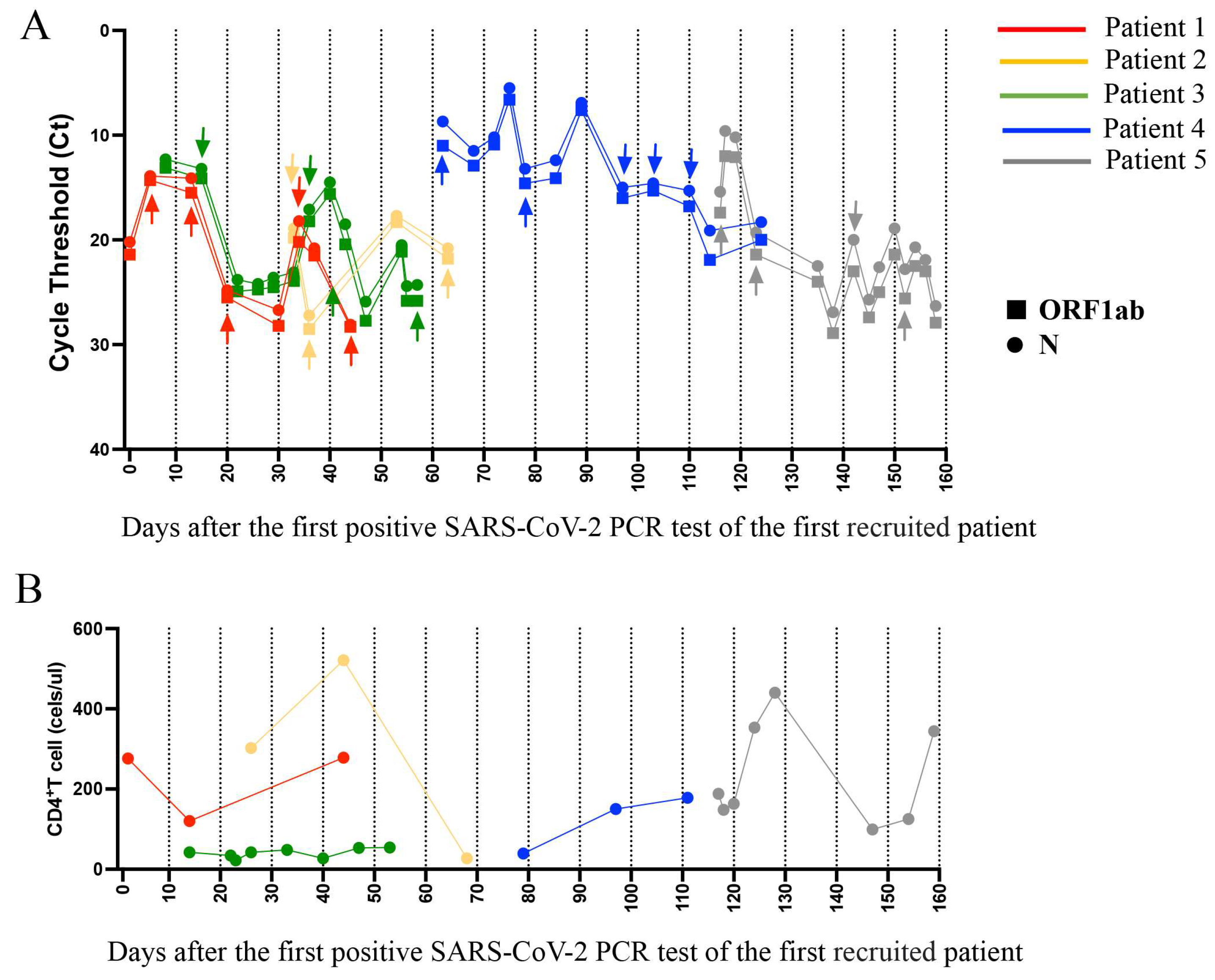
3.1. Description of Cases
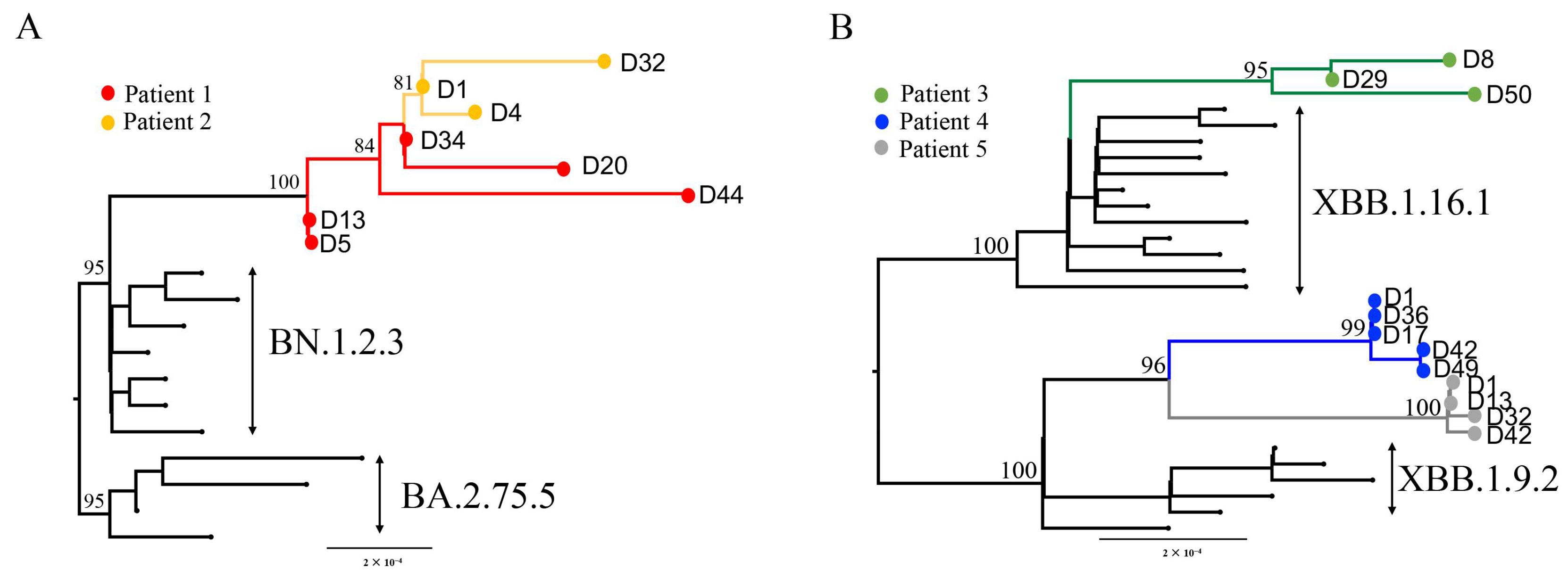
3.2. Rapid Intra-Host Evolution of SARS-CoV-2 Variants
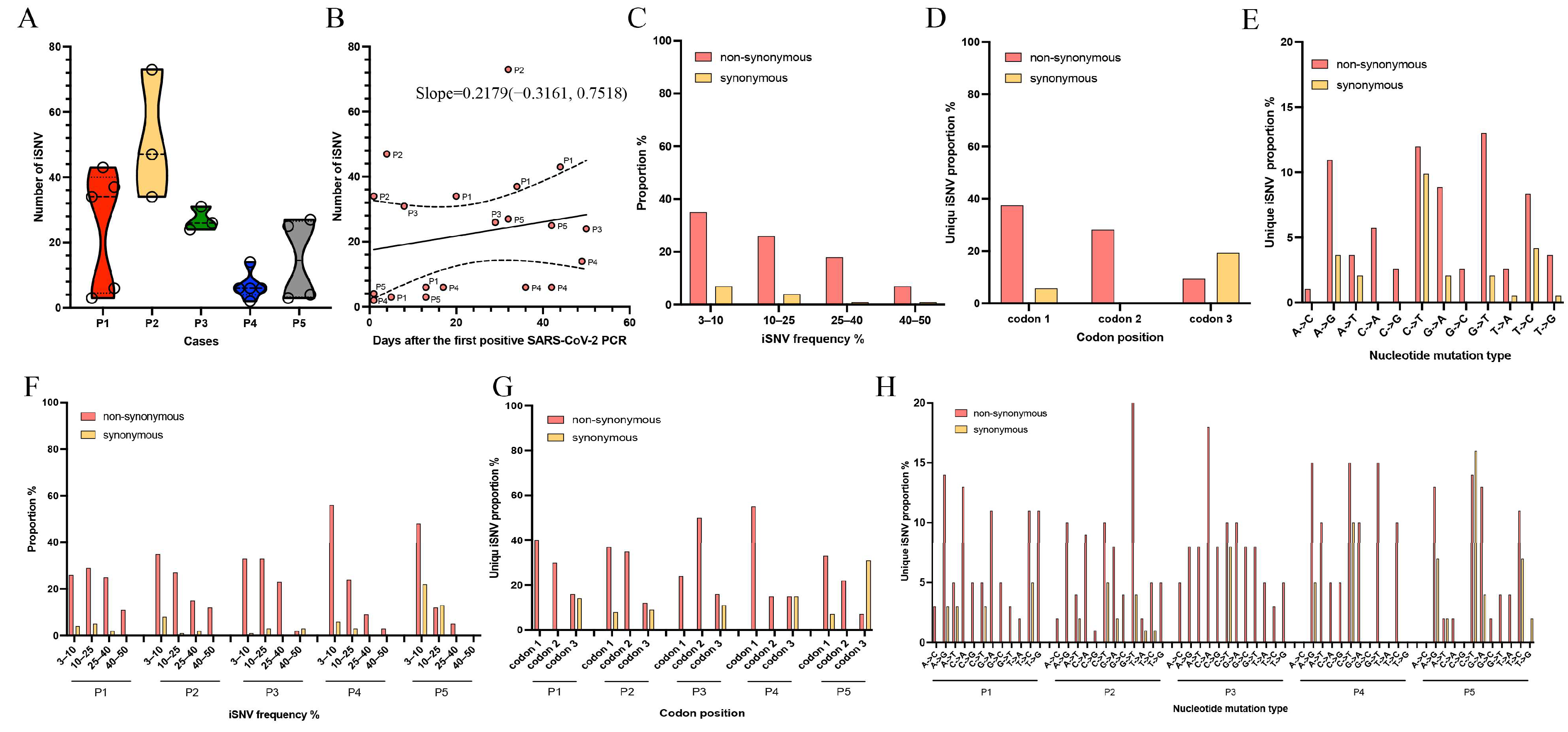
3.3. The Increased Virus Genetic Diversity and Variable iSNV Characteristics
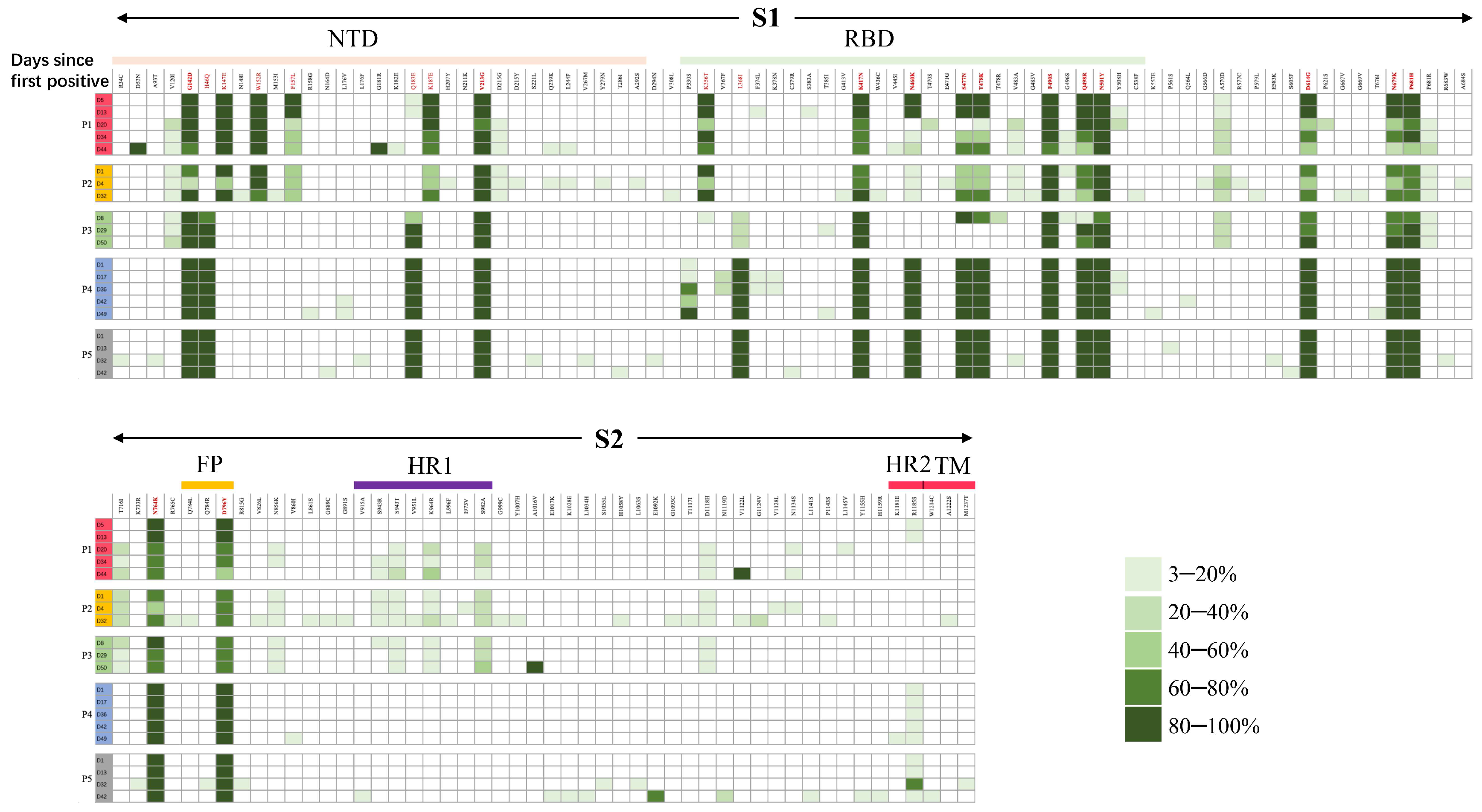
3.4. The Temporal Dynamics of iSNV Mutational Types Induced by Convergent Evolution and Negative Selection
3.5. Mutations Related to Antiviral Drugs
4. Discussion
5. Conclusions
Supplementary Materials
Author Contributions
Funding
Institutional Review Board Statement
Informed Consent Statement
Data Availability Statement
Acknowledgments
Conflicts of Interest
References
- Carabelli, A.M.; Peacock, T.P.; Thorne, L.G.; Harvey, W.T.; Hughes, J.; COVID-19 Genomics UK Consortium; Peacock, S.J.; Barclay, W.S.; de Silva, T.I.; Towers, G.J.; et al. SARS-CoV-2 variant biology: Immune escape, transmission and fitness. Nat. Rev. Microbiol. 2023, 21, 162–177. [Google Scholar] [CrossRef]
- Harari, S.; Tahor, M.; Rutsinsky, N.; Meijer, S.; Miller, D.; Henig, O.; Halutz, O.; Levytskyi, K.; Ben-Ami, R.; Adler, A.; et al. Drivers of adaptive evolution during chronic SARS-CoV-2 infections. Nat. Med. 2022, 28, 1501–1508. [Google Scholar] [CrossRef] [PubMed]
- Burki, T. The origin of SARS-CoV-2 variants of concern. Lancet Infect. Dis. 2022, 22, 174–175. [Google Scholar] [CrossRef]
- Weigang, S.; Fuchs, J.; Zimmer, G.; Schnepf, D.; Kern, L.; Beer, J.; Luxenburger, H.; Ankerhold, J.; Falcone, V.; Kemming, J.; et al. Within-host evolution of SARS-CoV-2 in an immunosuppressed COVID-19 patient as a source of immune escape variants. Nat. Commun. 2021, 12, 6405. [Google Scholar] [CrossRef]
- Choi, B.; Choudhary, M.C.; Regan, J.; Sparks, J.A.; Padera, R.F.; Qiu, X.; Solomon, I.H.; Kuo, H.-H.; Boucau, J.; Bowman, K.; et al. Persistence and Evolution of SARS-CoV-2 in an Immunocompromised Host. N. Engl. J. Med. 2020, 383, 2291–2293. [Google Scholar] [CrossRef]
- Machkovech, H.M.; Hahn, A.M.; Garonzik Wang, J.; Grubaugh, N.D.; Halfmann, P.J.; Johnson, M.C.; Lemieux, J.E.; O’Connor, D.H.; Piantadosi, A.; Wei, W.; et al. Persistent SARS-CoV-2 infection: Significance and implications. Lancet. Infect. Dis. 2024, 24, e453–e462. [Google Scholar] [CrossRef]
- Fountain-Jones, N.M.; Vanhaeften, R.; Williamson, J.; Maskell, J.; Chua, I.-L.J.; Charleston, M.; Cooley, L. Effect of molnupiravir on SARS-CoV-2 evolution in immunocompromised patients: A retrospective observational study. Lancet Microbe 2024, 5, e452–e458. [Google Scholar] [CrossRef]
- Li, Y.; Choudhary, M.C.; Regan, J.; Boucau, J.; Nathan, A.; Speidel, T.; Liew, M.Y.; Edelstein, G.E.; Kawano, Y.; Uddin, R.; et al. SARS-CoV-2 viral clearance and evolution varies by type and severity of immunodeficiency. Sci. Transl. Med. 2024, 16, eadk1599. [Google Scholar] [CrossRef]
- Li, G.; Hilgenfeld, R.; Whitley, R.; De Clercq, E. Therapeutic strategies for COVID-19: Progress and lessons learned. Nat. Rev. Drug Discov. 2023, 22, 449–475. [Google Scholar] [CrossRef]
- Ghafari, M.; Hall, M.; Golubchik, T.; Ayoubkhani, D.; House, T.; MacIntyre-Cockett, G.; Fryer, H.R.; Thomson, L.; Nurtay, A.; Kemp, S.A.; et al. Prevalence of persistent SARS-CoV-2 in a large community surveillance study. Nature 2024, 626, 1094–1101. [Google Scholar] [CrossRef]
- Davis, H.E.; McCorkell, L.; Vogel, J.M.; Topol, E.J. Long COVID: Major findings, mechanisms and recommendations. Nat. Rev. Microbiol. 2023, 21, 133–146, Erratum in Nat. Rev. Microbiol. 2023, 21, 408. [Google Scholar] [CrossRef]
- Dai, L.; Duan, H.; Liu, X.; Zhou, H.; Duan, M.; An, Y.; Yuan, L.; Zhao, X.; Xu, K.; Wu, Q.; et al. Omicron neutralisation: RBD-dimer booster versus BF.7 and BA.5.2 breakthrough infection. Lancet 2023, 402, 687–689. [Google Scholar] [CrossRef] [PubMed]
- Xu, K.; Fan, C.; Han, Y.; Dai, L.; Gao, G.F. Immunogenicity, efficacy and safety of COVID-19 vaccines: An update of data published by 31 December 2021. Int. Immunol. 2022, 34, 595–607. [Google Scholar] [CrossRef] [PubMed]
- Mathieu, E.; Ritchie, H.; Rodés-Guirao, L.; Appel, C.; Giattino, C.; Hasell, J.; Macdonald, B.; Dattani, S.; Beltekian, D.; Ortiz-Ospina, E.; et al. Coronavirus Pandemic (COVID-19). Our World in Data. 2020. Available online: https://ourworldindata.org/covid-vaccinations (accessed on 3 July 2024).
- Álvarez, H.; Ruiz-Mateos, E.; Juiz-González, P.M.; Vitallé, J.; Viéitez, I.; Vázquez-Friol, M.D.C.; Torres-Beceiro, I.; Pérez-Gómez, A.; Gallego-García, P.; Estévez-Gómez, N.; et al. SARS-CoV-2 Evolution and Spike-Specific CD4+ T-Cell Response in Persistent COVID-19 with Severe HIV Immune Suppression. Microorganisms 2022, 10, 143. [Google Scholar] [CrossRef] [PubMed]
- Chaguza, C.; Hahn, A.M.; Petrone, M.E.; Zhou, S.; Ferguson, D.; Breban, M.I.; Pham, K.; Peña-Hernández, M.A.; Castaldi, C.; Hill, V.; et al. Accelerated SARS-CoV-2 intrahost evolution leading to distinct genotypes during chronic infection. Cell Rep. Med. 2023, 4, 100943. [Google Scholar] [CrossRef]
- Landis, J.T.; Moorad, R.; Pluta, L.J.; Caro-Vegas, C.; McNamara, R.P.; Eason, A.B.; Bailey, A.; Villamor, F.C.S.; Juarez, A.; Wong, J.P.; et al. Intra-Host Evolution Provides for the Continuous Emergence of SARS-CoV-2 Variants. mBio 2023, 14, e0344822. [Google Scholar] [CrossRef]
- Iketani, S.; Mohri, H.; Culbertson, B.; Hong, S.J.; Duan, Y.; Luck, M.I.; Annavajhala, M.K.; Guo, Y.; Sheng, Z.; Uhlemann, A.-C.; et al. Multiple pathways for SARS-CoV-2 resistance to nirmatrelvir. Nature 2023, 613, 558–564. [Google Scholar] [CrossRef]
- Bouzidi, H.S.; Driouich, J.-S.; Klitting, R.; Bernadin, O.; Piorkowski, G.; Amaral, R.; Fraisse, L.; Mowbray, C.E.; Scandale, I.; Escudié, F.; et al. Generation and evaluation of protease inhibitor-resistant SARS-CoV-2 strains. Antivir. Res. 2024, 222, 105814. [Google Scholar] [CrossRef]
- Dai, L.; Gao, L.; Tao, L.; Hadinegoro, S.R.; Erkin, M.; Ying, Z.; He, P.; Girsang, R.T.; Vergara, H.; Akram, J.; et al. Efficacy and Safety of the RBD-Dimer-Based Covid-19 Vaccine ZF2001 in Adults. N. Engl. J. Med. 2022, 386, 2097–2111. [Google Scholar] [CrossRef]
- Sun, Y.; Wang, M.; Lin, W.; Dong, W.; Xu, J. Evolutionary analysis of Omicron variant BF.7 and BA.5.2 pandemic in China. J. Biosaf. Biosecurity 2023, 5, 14–20. [Google Scholar] [CrossRef]
- Wu, X.; Shan, K.-J.; Zan, F.; Tang, X.; Qian, Z.; Lu, J. Optimization and Deoptimization of Codons in SARS-CoV-2 and Related Implications for Vaccine Development. Adv. Sci. 2023, 10, e2205445. [Google Scholar] [CrossRef]
- Duffy, S.; Shackelton, L.A.; Holmes, E.C. Rates of evolutionary change in viruses: Patterns and determinants. Nat. Rev. Genet. 2008, 9, 267–276. [Google Scholar] [CrossRef] [PubMed]
- Shen, X.; Song, S.; Li, C.; Zhang, J. Synonymous mutations in representative yeast genes are mostly strongly non-neutral. Nature 2022, 606, 725–731. [Google Scholar] [CrossRef] [PubMed]
- Shan, K.-J.; Wei, C.; Wang, Y.; Huan, Q.; Qian, W. Host-specific asymmetric accumulation of mutation types reveals that the origin of SARS-CoV-2 is consistent with a natural process. Innovation 2021, 2, 100159. [Google Scholar] [CrossRef] [PubMed]
- Deng, S.; Xing, K.; He, X. Mutation signatures inform the natural host of SARS-CoV-2. Natl. Sci. Rev. 2022, 9, nwab220. [Google Scholar] [CrossRef]
- Kabinger, F.; Stiller, C.; Schmitzová, J.; Dienemann, C.; Kokic, G.; Hillen, H.S.; Höbartner, C.; Cramer, P. Mechanism of molnupiravir-induced SARS-CoV-2 mutagenesis. Nat. Struct. Mol. Biol. 2021, 28, 740–746. [Google Scholar] [CrossRef]
- Sanderson, T.; Hisner, R.; Donovan-Banfield, I.; Hartman, H.; Løchen, A.; Peacock, T.P.; Ruis, C. A molnupiravir-associated mutational signature in global SARS-CoV-2 genomes. Nature 2023, 623, 594–600. [Google Scholar] [CrossRef]
- Harvey, W.T.; Carabelli, A.M.; Jackson, B.; Gupta, R.K.; Thomson, E.C.; Harrison, E.M.; Ludden, C.; Reeve, R.; Rambaut, A.; COVID-19 Genomics UK (COG-UK) Consortium; et al. SARS-CoV-2 variants, spike mutations and immune escape. Nat. Rev. Microbiol. 2021, 19, 409–424. [Google Scholar] [CrossRef]
- Cao, Y.; Wang, J.; Jian, F.; Xiao, T.; Song, W.; Yisimayi, A.; Huang, W.; Li, Q.; Wang, P.; An, R.; et al. Omicron escapes the majority of existing SARS-CoV-2 neutralizing antibodies. Nature 2022, 602, 657–663. [Google Scholar] [CrossRef]
- Khan, A.; Khan, S.A.; Zia, K.; Altowyan, M.S.; Barakat, A.; Ul-Haq, Z. Deciphering the Impact of Mutations on the Binding Efficacy of SARS-CoV-2 Omicron and Delta Variants With Human ACE2 Receptor. Front. Chem. 2022, 10, 892093. [Google Scholar] [CrossRef]
- Peng, Q.; Zhou, R.; Liu, N.; Wang, H.; Xu, H.; Zhao, M.; Yang, D.; Au, K.-K.; Huang, H.; Liu, L.; et al. Naturally occurring spike mutations influence the infectivity and immunogenicity of SARS-CoV-2. Cell. Mol. Immunol. 2022, 19, 1302–1310. [Google Scholar] [CrossRef]



| Variant | Mutations per Week (s/week) | Mutations per Site per Year (s/s/y) | ||||
|---|---|---|---|---|---|---|
| Median | Lower 95% CI | Upper 95% CI | Median | Lower 95% CI | Upper 95% CI | |
| P1 | 5.92 | 4.00 | 8.14 | 1.05 × 10⁻² | 7.08 × 10⁻³ | 1.44 × 10⁻² |
| P2 | 4.42 | 1.87 | 7.12 | 7.81 × 10⁻³ | 3.31 × 10⁻³ | 1.26 × 10⁻² |
| P3 | 2.60 | 1.36 | 3.84 | 4.60 × 10⁻³ | 2.41 × 10⁻³ | 6.79 × 10⁻³ |
| P4 | 0.31 | 0.04 | 0.78 | 5.55 × 10⁻⁴ | 7.12 × 10⁻⁵ | 1.38 × 10⁻³ |
| P5 | 0.31 | 0.21 | 0.85 | 5.44 × 10⁻⁴ | 3.76 × 10⁻⁴ | 1.51 × 10⁻³ |
| CN-Alpha | 0.58 | 0.08 | 1.05 | 1.02 × 10⁻³ | 1.44 × 10⁻⁴ | 1.85 × 10⁻³ |
| CN-Beta | 0.33 | 0.00 | 1.05 | 5.81 × 10⁻⁴ | 2.23 × 10⁻⁶ | 1.39 × 10⁻³ |
| CN-Gamma | 0.51 | 0.00 | 2.22 | 9.00 × 10⁻⁴ | 3.12 × 10⁻⁶ | 3.92 × 10⁻³ |
| CN-Delta | 0.19 | 0.11 | 0.29 | 3.37 × 10⁻⁴ | 1.96 × 10⁻⁴ | 5.14 × 10⁻⁴ |
| CN-Omicron | 0.38 | 0.31 | 0.46 | 6.67 × 10⁻⁴ | 5.44 × 10⁻⁴ | 8.17 × 10⁻³ |
| CN-BA.2.86 | 0.81 | 0.11 | 1.54 | 1.43 × 10⁻³ | 1.89 × 10⁻⁴ | 2.72 × 10⁻³ |
| CN-JN.1 | 0.40 | 0.06 | 0.68 | 7.08 × 10⁻⁴ | 1.27 × 10⁻⁴ | 1.21 × 10⁻³ |
| CN-BA.2.75 | 0.49 | 0.33 | 0.66 | 8.61 × 10⁻⁴ | 5.80 × 10⁻⁴ | 1.17 × 10⁻³ |
| CN-XBB.1.16 | 0.60 | 0.01 | 1.48 | 1.06 × 10⁻³ | 8.72 × 10⁻⁶ | 2.62 × 10⁻³ |
| CN-XBB.1.19.2 | 0.41 | 0.07 | 1.00 | 7.26 × 10⁻⁴ | 1.31 × 10⁻⁴ | 1.76 × 10⁻³ |
| CN-EG.5 | 0.30 | 0.23 | 0.38 | 5.26 × 10⁻⁴ | 4.05 × 10⁻⁴ | 6.68 × 10⁻⁴ |
Disclaimer/Publisher’s Note: The statements, opinions and data contained in all publications are solely those of the individual author(s) and contributor(s) and not of MDPI and/or the editor(s). MDPI and/or the editor(s) disclaim responsibility for any injury to people or property resulting from any ideas, methods, instructions or products referred to in the content. |
© 2025 by the authors. Licensee MDPI, Basel, Switzerland. This article is an open access article distributed under the terms and conditions of the Creative Commons Attribution (CC BY) license (https://creativecommons.org/licenses/by/4.0/).
Share and Cite
An, M.; Dong, X.; Gao, Y.; Ouyang, J.; Ding, H.; Zhu, Z.; Bao, L.; Feng, Y.; Tian, W.; Wang, P.; et al. Immune Suppression, Preexisting Immunity, and Mutation Tendency Shaped SARS-CoV-2 Evolution in Persistent Infection. Microorganisms 2025, 13, 2613. https://doi.org/10.3390/microorganisms13112613
An M, Dong X, Gao Y, Ouyang J, Ding H, Zhu Z, Bao L, Feng Y, Tian W, Wang P, et al. Immune Suppression, Preexisting Immunity, and Mutation Tendency Shaped SARS-CoV-2 Evolution in Persistent Infection. Microorganisms. 2025; 13(11):2613. https://doi.org/10.3390/microorganisms13112613
Chicago/Turabian StyleAn, Minghui, Xiaolong Dong, Yang Gao, Jinming Ouyang, Haibo Ding, Zheming Zhu, Linan Bao, Yonghui Feng, Wen Tian, Pan Wang, and et al. 2025. "Immune Suppression, Preexisting Immunity, and Mutation Tendency Shaped SARS-CoV-2 Evolution in Persistent Infection" Microorganisms 13, no. 11: 2613. https://doi.org/10.3390/microorganisms13112613
APA StyleAn, M., Dong, X., Gao, Y., Ouyang, J., Ding, H., Zhu, Z., Bao, L., Feng, Y., Tian, W., Wang, P., Han, X., & Shang, H. (2025). Immune Suppression, Preexisting Immunity, and Mutation Tendency Shaped SARS-CoV-2 Evolution in Persistent Infection. Microorganisms, 13(11), 2613. https://doi.org/10.3390/microorganisms13112613