


Pulmonary Tuberculosis Diagnosis Using an Intelligent Microscopy Scanner and Image Recognition Model for Improved Acid-Fast Bacilli Detection in Smears



Abstract
1. Introduction
2. Materials and Methods
3. Results
4. Discussion
5. Conclusions
Author Contributions
Funding
Data Availability Statement
Acknowledgments
Conflicts of Interest
References
- Churchyard, G.; Kim, P.; Shah, N.S.; Rustomjee, R.; Gandhi, N.; Mathema, B.; Dowdy, D.; Kasmar, A.; Cardenas, V. What we know about tuberculosis transmission: An overview. J. Infect. Dis. 2017, 216 (Suppl. 6), S629–S635. [Google Scholar] [CrossRef] [Scilit]
- World Health Organization. Global Tuberculosis Report 2023; WTO: Geneva, Switzerland, 2023. [Google Scholar]
- Das, P.K.; Ganguly, S.B.; Mandal, B. Sputum smear microscopy in tuberculosis: It is still relevant in the era of molecular diagnosis when seen from the public health perspective. Biomed. Biotechnol. Res. J. (BBRJ) 2019, 3, 77–79. [Google Scholar] [CrossRef] [Scilit]
- Steingart, K.R.; Schiller, I.; Horne, D.J.; Pai, M.; Boehme, C.C.; Dendukuri, N. Xpert® MTB/RIF assay for pulmonary tuberculosis and rifampicin resistance in adults. Cochrane Database Syst. Rev. 2021, 1, CD012768. [Google Scholar] [CrossRef] [Scilit]
- UN High-Level Meeting on TB 2018. 2018. Available online: https://www.stoptb.org/un-high-level-meeting-tb/un-high-level-meeting-tb-2018 (accessed on 9 May 2024).
- World Health Organization. Automated Real-Time Nucleic Acid Amplification Technology for Rapid and Simultaneous Detection of Tuberculosis and Rifampicin Resistance: Xpert MTB; World Health Organization: Geneva, Switzerland, 2013. [Google Scholar]
- Figueredo, L.J.d.A.; Miranda, S.S.d.; Santos, L.B.d.; Manso, C.G.G.; Soares, V.M.; Alves, S.; Vater, M.C.; Kritski, A.L.; Carvalho, W.d.S.; Pádua, C.M.d. Cost analysis of smear microscopy and the Xpert assay for tuberculosis diagnosis: Average turnaround time. Rev. Soc. Bras. Med. Trop. 2020, 53, e20200314. [Google Scholar] [CrossRef] [Scilit] [PubMed]
- Lewis, J.J.; Chihota, V.N.; Van der Meulen, M.; Fourie, P.B.; Fielding, K.L.; Grant, A.D.; Dorman, S.E.; Churchyard, G.J. “Proof-of-concept” evaluation of an automated sputum smear microscopy system for tuberculosis diagnosis. PLoS ONE 2012, 7, e50173. [Google Scholar] [CrossRef] [Scilit]
- Panicker, R.O.; Soman, B.; Saini, G.; Rajan, J. A review of automatic methods based on image processing techniques for tuberculosis detection from microscopic sputum smear images. J. Med. Syst. 2016, 40, 17. [Google Scholar] [CrossRef] [Scilit] [PubMed]
- Xiong, Y.; Ba, X.; Hou, A.; Zhang, K.; Chen, L.; Li, T. Automatic detection of mycobacterium tuberculosis using artificial intelligence. J. Thorac. Dis. 2018, 10, 1936. [Google Scholar] [CrossRef] [Scilit]
- Zingue, D.; Weber, P.; Soltani, F.; Raoult, D.; Drancourt, M. Automatic microscopic detection of mycobacteria in sputum: A proof-of-concept. Sci. Rep. 2018, 8, 11308. [Google Scholar] [CrossRef] [Scilit]
- Lopez-Garnier, S.; Sheen, P.; Zimic, M. Automatic diagnostics of tuberculosis using convolutional neural networks analysis of MODS digital images. PLoS ONE 2019, 14, e0212094. [Google Scholar] [CrossRef] [Scilit]
- El-Melegy, M.; Mohamed, D.; ElMelegy, T.; Abdelrahman, M. Identification of tuberculosis bacilli in ZN-stained sputum smear images: A deep learning approach. In Proceedings of the IEEE/CVF Conference on Computer Vision and Pattern Recognition Workshops, Long Beach, CA, USA, 15–20 June 2019. [Google Scholar]
- Hu, M.; Liu, Y.; Zhang, Y.; Guan, T.; He, Y. Automatic detection of tuberculosis bacilli in sputum smear scans based on subgraph classification. In Proceedings of the 2019 International Conference on Medical Imaging Physics and Engineering (ICMIPE), Shenzhen, China, 22–24 September 2019; pp. 1–7. [Google Scholar]
- Ibrahim, A.U.; Guler, E.; Guvenir, M.; Suer, K.; Serte, S.; Ozsoz, M. Automated detection of Mycobacterium tuberculosis using transfer learning. J. Infect. Dev. Ctries. 2021, 15, 678–686. [Google Scholar] [CrossRef] [Scilit]
- Kuok, C.P.; Horng, M.H.; Liao, Y.M.; Chow, N.H.; Sun, Y.N. An effective and accurate identification system of Mycobacterium tuberculosis using convolution neural networks. Microsc. Res. Tech. 2019, 82, 709–719. [Google Scholar] [CrossRef] [Scilit]
- López, Y.P.; Costa Filho, C.; Aguilera, L.; Costa, M. Automatic classification of light field smear microscopy patches using Convolutional Neural Networks for identifying Mycobacterium Tuberculosis. In Proceedings of the 2017 CHILEAN Conference on Electrical, Electronics Engineering, Information and Communication Technologies (CHILECON), Pucon, Chile, 18–20 October 2017; pp. 1–5. [Google Scholar]
- Muyama, L.; Nakatumba-Nabende, J.; Mudali, D. Automated detection of tuberculosis from sputum smear microscopic images using transfer learning techniques. In Proceedings of the Intelligent Systems Design and Applications: 19th International Conference on Intelligent Systems Design and Applications (ISDA 2019), Auburn, WA, USA, 3–5 December 2019; Springer: Cham, Switzerland, 2021; pp. 59–68. [Google Scholar]
- Pitchumani Angayarkanni, S.; Vanitha, V.; Karan, V.; Sivant, M. A novel architecture for improving tuberculosis detection from microscopic sputum smear images. In International Conference on Image Processing and Capsule Networks; Springer: Cham, Switzerland, 2022; pp. 51–62. [Google Scholar]
- Serrão, M.; Costa, M.G.F.; Fujimoto, L.; Ogusku, M.M.; Costa Filho, C.F.F. Automatic bacillus detection in light field microscopy images using convolutional neural networks and mosaic imaging approach. In Proceedings of the 2020 42nd Annual International Conference of the IEEE Engineering in Medicine & Biology Society (EMBC), Montreal, QC, Canada, 20–24 July 2020; pp. 1903–1906. [Google Scholar]
- Udegova, E.; Shelomentseva, I.; Chentsov, S. Optimizing Convolutional Neural Network Architecture for Microscopy Image Recognition for Tuberculosis Diagnosis. In Advances in Neural Computation, Machine Learning, and Cognitive Research V: Selected Papers from the XXIII International Conference on Neuroinformatics, Moscow, Russia, 18–22 October 2021; Springer: Cham, Switzerland, 2022; pp. 204–209. [Google Scholar]
- Huang, H.-C.; Kuo, K.-L.; Lo, M.-H.; Chou, H.-Y.; Lin, Y.E. Novel TB smear microscopy automation system in detecting acid-fast bacilli for tuberculosis–A multi-center double blind study. Tuberculosis 2022, 135, 102212. [Google Scholar] [CrossRef] [Scilit] [PubMed]
- Fu, H.-T.; Tu, H.-Z.; Lee, H.-S.; Lin, Y.E.; Lin, C.-W. Evaluation of an AI-based TB AFB smear screening system for laboratory diagnosis on routine practice. Sensors 2022, 22, 8497. [Google Scholar] [CrossRef] [Scilit] [PubMed]
- Litjens, G.; Kooi, T.; Bejnordi, B.E.; Setio, A.A.A.; Ciompi, F.; Ghafoorian, M.; van der Laak, J.A.W.M.; van Ginneken, B.; Sánchez, C.I. A survey on deep learning in medical image analysis. Med. Image Anal. 2017, 42, 60–88. [Google Scholar] [CrossRef] [Scilit] [PubMed]
- Bejnordi, B.E.; Veta, M.; Van Diest, P.J.; Van Ginneken, B.; Karssemeijer, N.; Litjens, G. Diagnostic Assessment of Deep Learning Algorithms for Detection of Lymph Node Metastases in Women with Breast Cancer. JAMA 2017, 318, 2199–2210. [Google Scholar] [CrossRef] [Scilit]
- Steingart, K.R.; Henry, M.; Ng, V.; Hopewell, P.C.; Ramsay, A.; Cunningham, J.; Urbanczik, R.; Perkins, M.; Aziz, M.A.; Pai, M. Fluorescence versus conventional sputum smear microscopy for tuberculosis: A systematic review. Lancet Infect. Dis. 2006, 6, 570–581. [Google Scholar] [CrossRef] [Scilit]
- Nguyen, T.; Wells, C.; Binkin, N.; Pham, D.; Nguyen, V. The importance of quality control of sputum smear microscopy: The effect of reading errors on treatment decisions and outcomes. Int. J. Tuberc. Lung Dis. 1999, 3, 483–487. [Google Scholar] [PubMed]
- Van Deun, A.; Salim, A.H.; Cooreman, E.; Hossain, M.A.; Rema, A.; Chambugonj, N.; Hye, M.; Kawria, A.; Declercq, E. Optimal tuberculosis case detection by direct sputum smear microscopy: How much better is more? Int. J. Tuberc. Lung Dis. 2002, 6, 222–230. [Google Scholar]
- Liang, Q.; Jiang, X.; Jia, J.; Zhao, L.; Li, Y.; Wang, F.; Dong, L.; Xue, Y.; Jiang, G.; Huang, H. An early and trustable indicator suggestive of non-tuberculosis mycobacteria isolation in a high tuberculosis burden setting. J. Infect. 2024, 88, 106149. [Google Scholar] [CrossRef] [Scilit]
- Carvalho, T.F.M.; Santos, V.L.A.; Silva, J.C.F.; de Assis Figueredo, L.J.; de Miranda, S.S.; de Oliveira Duarte, R.; Guimarães, F.G. A systematic review and repeatability study on the use of deep learning for classifying and detecting tuberculosis bacilli in microscopic images. Prog. Biophys. Mol. Biol. 2023, 180–181, 1–18. [Google Scholar] [CrossRef] [Scilit]
- Islam, M.R.; Khatun, R.; Uddin, M.K.M.; Khan, M.S.R.; Rahman, M.T.; Ahmed, T.; Banu, S. Yield of two consecutive sputum specimens for the effective diagnosis of pulmonary tuberculosis. PLoS ONE 2013, 8, e67678. [Google Scholar] [CrossRef] [Scilit]
- Baliga, S.; Murphy, C.; Sharon, L.; Shenoy, S.; Biranthabail, D.; Weltman, H.; Miller, S.; Ramasamy, R.; Shah, J. Rapid method for detecting and differentiating Mycobacterium tuberculosis complex and non-tuberculous mycobacteria in sputum by fluorescence in situ hybridization with DNA probes. Int. J. Infect. Dis. 2018, 75, 1–7. [Google Scholar] [CrossRef] [Scilit]
- Prabhu, V.; Coelho, S.; Achappa, B.; Baliga, S.; Sharon, L.; Shah, J. Role of fluorescence in situ hybridization in detecting Mycobacterium avium complex presenting as fever in treatment failure HIV. J. Clin. Tuberc. Other Mycobact. Dis. 2020, 21, 100188. [Google Scholar] [CrossRef] [Scilit] [PubMed]
- Shah, J.S.; Ramasamy, R. Fluorescence In Situ Hybridization (FISH) Tests for Identifying Protozoan and Bacterial Pathogens in Infectious Diseases. Diagnostics 2022, 12, 1286. [Google Scholar] [CrossRef] [Scilit] [PubMed]
- Khan, S. The dark side of being a pathologist: Unravelling the health hazards. Indian J. Pathol. Microbiol. 2024, 67, 46–50. [Google Scholar] [CrossRef] [Scilit] [PubMed]
- Dervaux, A.; Vaysse, B.; Doutrellot-Philippon, C.; Couvreur, V.; Guilain, N.; Chatelain, D. Pathologist occupational hazards: Results of a survey for the French case. Ann. Pathol. 2020, 40, 2–11. [Google Scholar] [CrossRef] [Scilit] [PubMed]
- Fritzsche, F.R.; Ramach, C.; Soldini, D.; Caduff, R.; Tinguely, M.; Cassoly, E.; Moch, H.; Stewart, A. Occupational health risks of pathologists—Results from a nationwide online questionnaire in Switzerland. BMC Public Health 2012, 12, 1054. [Google Scholar] [CrossRef] [Scilit]
- Zhang, H.; Dai, X.; Hu, P.; Tian, L.; Li, C.; Ding, B.; Yang, X.; He, X. Comparison of targeted next-generation sequencing and the Xpert MTB/RIF assay for detection of Mycobacterium tuberculosis in clinical isolates and sputum specimens. Microbiol. Spectr. 2024, 12, e0409823. [Google Scholar] [CrossRef] [Scilit]
- Munn-Mace, G.; Parmar, D. Treatment of tuberculosis in complex emergencies in developing countries: A scoping review. Health Policy Plan. 2018, 33, 247–257. [Google Scholar] [CrossRef] [Scilit]
- Ngabonziza, J.C.S.; Ssengooba, W.; Mutua, F.; Torrea, G.; Dushime, A.; Gasana, M.; Andre, E.; Uwamungu, S.; Nyaruhirira, A.U.; Mwaengo, D.; et al. Diagnostic performance of smear microscopy and incremental yield of Xpert in detection of pulmonary tuberculosis in Rwanda. BMC Infect. Dis. 2016, 16, 660. [Google Scholar] [CrossRef] [Scilit]
- Reid, M.J.; Arinaminpathy, N.; Bloom, A.; Bloom, B.R.; Boehme, C.; Chaisson, R.; Chin, D.P.; Churchyard, G.; Cox, H.; Ditiu, L.; et al. Building a tuberculosis-free world: The Lancet Commission on tuberculosis. Lancet 2019, 393, 1331–1384. [Google Scholar] [CrossRef] [Scilit] [PubMed]
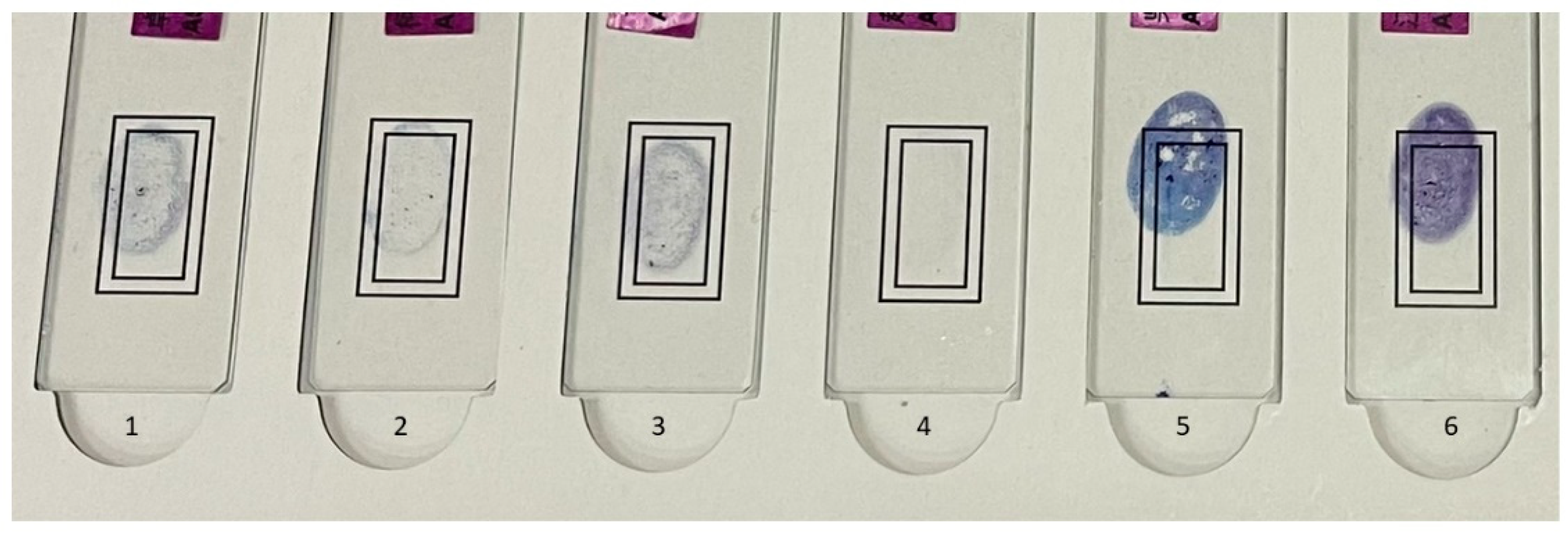
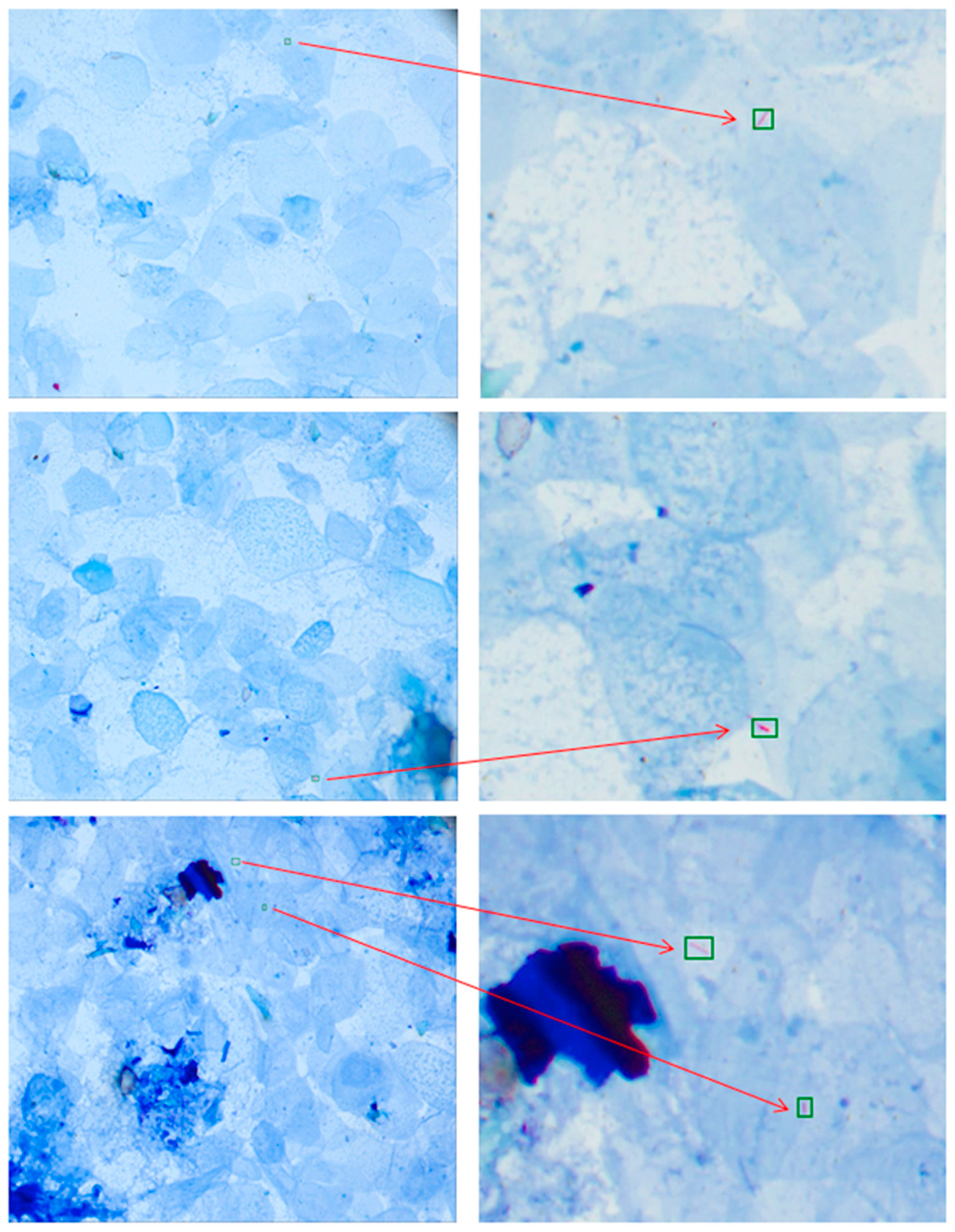

| Test Performance | AFB Record by Technicians | ||
|---|---|---|---|
| Positive | Negative | ||
| TB-Scan | Positive | 177 | 33 |
| Negative | 17 | 773 | |
| Test Performance | Gold Standard | ||
|---|---|---|---|
| Positive | Negative | ||
| TB-Scan | Positive | 194 | 16 |
| Negative | 17 | 773 | |
Disclaimer/Publisher’s Note: The statements, opinions and data contained in all publications are solely those of the individual author(s) and contributor(s) and not of MDPI and/or the editor(s). MDPI and/or the editor(s) disclaim responsibility for any injury to people or property resulting from any ideas, methods, instructions or products referred to in the content. |
© 2024 by the authors. Licensee MDPI, Basel, Switzerland. This article is an open access article distributed under the terms and conditions of the Creative Commons Attribution (CC BY) license (https://creativecommons.org/licenses/by/4.0/).
Share and Cite
Chen, W.-C.; Chang, C.-C.; Lin, Y.E. Pulmonary Tuberculosis Diagnosis Using an Intelligent Microscopy Scanner and Image Recognition Model for Improved Acid-Fast Bacilli Detection in Smears. Microorganisms 2024, 12, 1734. https://doi.org/10.3390/microorganisms12081734
Chen W-C, Chang C-C, Lin YE. Pulmonary Tuberculosis Diagnosis Using an Intelligent Microscopy Scanner and Image Recognition Model for Improved Acid-Fast Bacilli Detection in Smears. Microorganisms. 2024; 12(8):1734. https://doi.org/10.3390/microorganisms12081734
Chicago/Turabian StyleChen, Wei-Chuan, Chi-Chuan Chang, and Yusen Eason Lin. 2024. "Pulmonary Tuberculosis Diagnosis Using an Intelligent Microscopy Scanner and Image Recognition Model for Improved Acid-Fast Bacilli Detection in Smears" Microorganisms 12, no. 8: 1734. https://doi.org/10.3390/microorganisms12081734
APA StyleChen, W.-C., Chang, C.-C., & Lin, Y. E. (2024). Pulmonary Tuberculosis Diagnosis Using an Intelligent Microscopy Scanner and Image Recognition Model for Improved Acid-Fast Bacilli Detection in Smears. Microorganisms, 12(8), 1734. https://doi.org/10.3390/microorganisms12081734

