Review

Antibiotic Resistance in the Elderly: Mechanisms, Risk Factors, and Solutions

by
Nikolaos Theodorakis
1,2,
Georgios Feretzakis
3,
Christos Hitas
1,
Magdalini Kreouzi
4,
Sofia Kalantzi
4,
Aikaterini Spyridaki
4,
Iris Zoe Boufeas
5,
Aikaterini Sakagianni
6,
Evgenia Paxinou
3,
Vassilios S. Verykios
3,* and
Maria Nikolaou
1
1
Department of Cardiology, 65+ Clinic, Amalia Fleming General Hospital, 14, 25th Martiou Str., 15127 Melissia, Greece
2
School of Medicine, National and Kapodistrian University of Athens, 75 Mikras Asias, 11527 Athens, Greece
3
School of Science and Technology, Hellenic Open University, 18 Aristotelous Str., 26335 Patras, Greece
4
Department of Internal Medicine, 65+ Clinic, Amalia Fleming General Hospital, 14, 25th Martiou Str., 15127 Melissia, Greece
5
Barts and The London School of Medicine and Dentistry, Queen Mary University of London, 64 Turner Street, London E1 2AD, UK
6
Intensive Care Unit, Sismanogelio General Hospital, 37 Sismanogleiou Str., 15126 Marousi, Greece
*
Author to whom correspondence should be addressed.
Microorganisms 2024, 12(10), 1978; https://doi.org/10.3390/microorganisms12101978

Submission received: 22 September 2024 / Revised: 27 September 2024 / Accepted: 27 September 2024 / Published: 30 September 2024
(This article belongs to the Special Issue Combating Antimicrobial Resistance: Innovations and Strategies)

Abstract

Antibiotic resistance presents a critical challenge in healthcare, particularly among the elderly, where multidrug-resistant organisms (MDROs) contribute to increased morbidity, mortality, and healthcare costs. This review focuses on the mechanisms underlying resistance in key bacterial pathogens and highlights how aging-related factors like immunosenescence, frailty, and multimorbidity increase the burden of infections from MDROs in this population. Novel strategies to mitigate resistance include the development of next-generation antibiotics like teixobactin and cefiderocol, innovative therapies such as bacteriophage therapy and antivirulence treatments, and the implementation of antimicrobial stewardship programs to optimize antibiotic use. Furthermore, advanced molecular diagnostic techniques, including nucleic acid amplification tests and next-generation sequencing, allow for faster and more precise identification of resistant pathogens. Vaccine development, particularly through innovative approaches like multi-epitope vaccines and nanoparticle-based platforms, holds promise in preventing MDRO infections among the elderly. The role of machine learning (ML) in predicting resistance patterns and aiding in vaccine and antibiotic development is also explored, offering promising solutions for personalized treatment and prevention strategies in the elderly. By integrating cutting-edge diagnostics, therapeutic innovations, and ML-based approaches, this review underscores the importance of multidisciplinary efforts to address the global challenge of antibiotic resistance in aging populations.
Keywords: antibiotic resistance; immunosenescence; multidrug-resistant organisms; infectious diseases; antimicrobials; vaccinations; antimicrobial stewardship; machine learning; aging; elderly antibiotic resistance; immunosenescence; multidrug-resistant organisms; infectious diseases; antimicrobials; vaccinations; antimicrobial stewardship; machine learning; aging; elderly
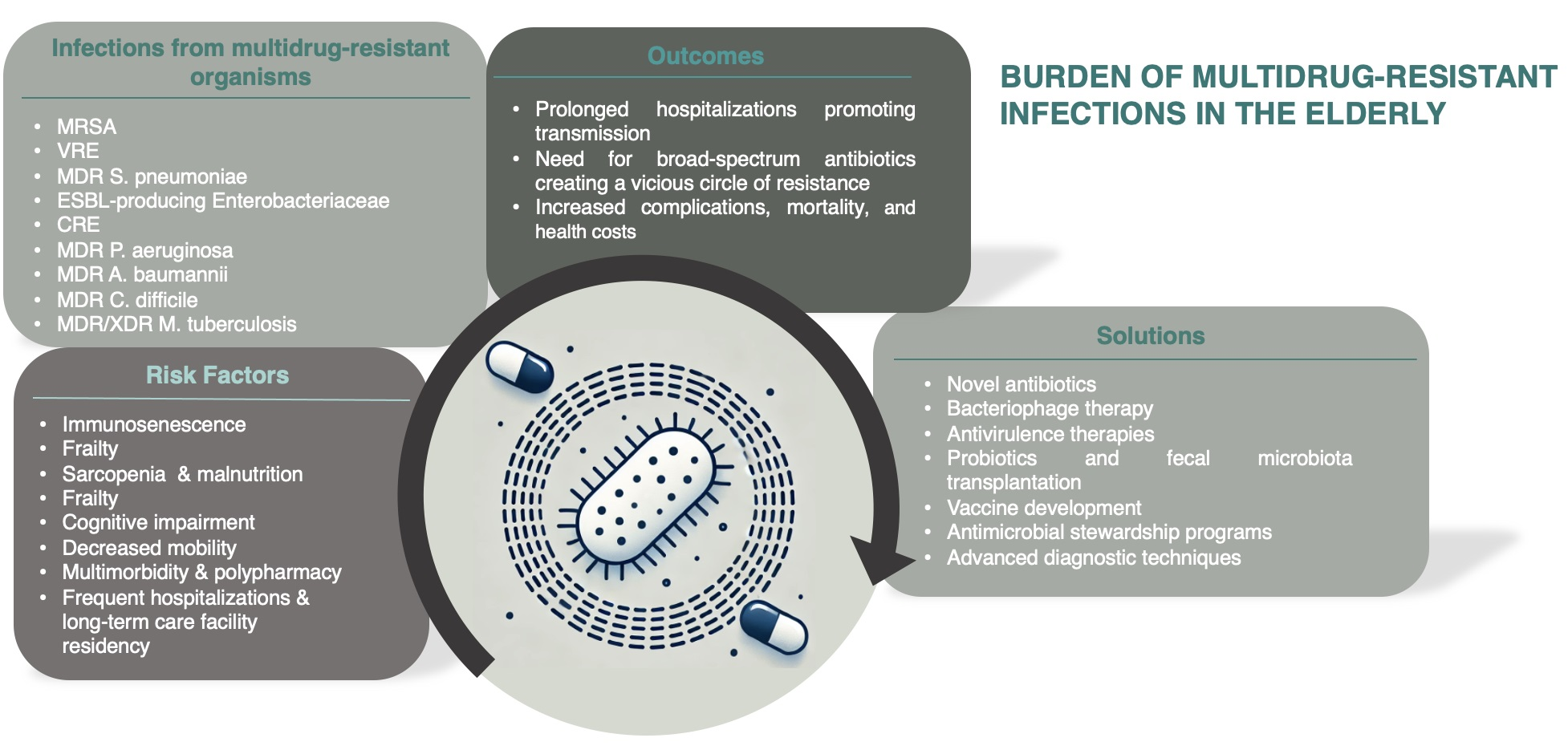
Graphical Abstract