
Article

Broadband Simulation-Based EMC Modeling and EMI Assessment of a GaN-Based Phase-Shift Full-Bridge Converter for EV DC Powertrains

1
LACoSERE Laboratory, University of Amar Telidji, Laghouat 03000, Algeria
2
ESTACA’Lab-Laval, École Supérieure des Techniques Aéronautiques et de Construction Automobile (ESTACA), F-53000 Laval, France
*
Authors to whom correspondence should be addressed.
Actuators 2026, 15(6), 340; https://doi.org/10.3390/act15060340 (registering DOI)
Submission received: 27 April 2026 / Revised: 8 June 2026 / Accepted: 9 June 2026 / Published: 13 June 2026

Abstract

Nowadays, numerical simulation methods are advanced and widely used in industry, enabling the modeling of complex systems from printed circuit boards (PCBs) to full power converters. Among many isolated topologies, the phase-shift full-bridge (PSFB) topology is a well-established solution for isolated DC–DC conversion in electric vehicles. Therefore, this paper proposes a broadband electromagnetic compatibility (EMC) modeling methodology for a custom-designed 1 kW gallium nitride (GaN)-based PSFB converter intended for an electric vehicle (EV) DC powertrain. Moreover, the approach combines full-wave electromagnetic simulation with circuit-level simulation, including parasitic effects from PCB layout, power harnesses, and discrete components. Thus, the virtual prototype is assessed within a complete virtual test bench compliant with the standard Comité International Spécial des Perturbations Radioélectriques (CISPR) 25 over the 150 kHz–108 MHz range to capture common-mode (CM) and differential-mode (DM) conducted electromagnetic interference (EMI). Results show that the converter achieves efficiencies of 97.26% in standalone mode and 97.03% when integrated into the full DC powertrain. However, the conducted EMI assessment reveals that both CM and DM emissions exceed CISPR 25 Class 2 limits across the entire spectrum, with excess levels reaching up to 72 dBµV. Therefore, power harnesses significantly increase EMI levels at low frequencies due to the distributed inductance and stray capacitance. Finally, this study demonstrates the value of virtual prototyping for simulation-based EMI prediction in early-stage power converter design.

1. Introduction

The increasing demand for commercial electric vehicles (EVs) has led to the introduction of new power ranges for automotive applications, enabling higher power capability and higher DC-link operating voltages (400 V to 800 V), with 400 V being the most prevalent EV battery architecture [1,2]. Several viable DC-DC converter topologies can be selected for EV powertrains. However, a small, reliable, parameterizable, lightweight, controllable, scalable, and efficient DC-DC converter is in high demand in the automotive industry [3,4,5,6,7,8,9]. In this context, energy efficiency has become one of the most important topics in power electronics. Wide-bandgap semiconductors, such as gallium nitride (GaN), can significantly increase efficiency and enable smaller volumes in power-conversion systems, making them particularly attractive for EV applications [10]. The DC powertrain of an electric vehicle is the core system that transfers the high-voltage (HV) electrical energy stored in the HV battery to the low-voltage (LV) auxiliary power supply and loads.
This system function is usually ensured by an isolated HV phase-shift full-bridge (PSFB) DC-DC converter. The PSFB topology is commonly adopted for applications ranging up to 5 kW [11]. On the other hand, high-voltage systems in EVs, such as the DC powertrain, infotainment system, and other electronic components, create a complex environment where electromagnetic interference (EMI) can easily occur and affect other electronic systems in the vehicle or nearby [12,13,14,15,16,17]. Therefore, careful assessment of electromagnetic compatibility (EMC) is essential for the safe and reliable operation of EVs. Thus, to ensure EMC in automotive applications, international standards such as CISPR 12, CISPR 25, and CISPR 36 define limits and measurement methods for both radiated and conducted emissions [18,19]. Among these, CISPR 25 is the most relevant for onboard equipment, as it specifies the protection of onboard receivers against conducted disturbances in the frequency range of 150 kHz to 108 MHz [20]. As different markets have regulations that require different designs, it is necessary to cope with a large variety of similar converter variants. By using effective modeling and simulation strategies, the effort required to build these variants can be reduced, and costly redesigns can be avoided. In this context, EMC simulation has emerged as a powerful tool to predict EMI early in the design cycle, enabling the identification of failure mechanisms and the exploration of mitigation strategies before hardware prototyping [21]. Over the past decades, numerical simulation methods have matured significantly and are now widely embedded in industrial workflows [22]. These techniques enable modeling of complex structures ranging from PCBs and power modules to full power-conversion systems [17,23,24,25,26,27,28,29,30,31,32,33,34,35]. Previous works have addressed specific aspects of EMI modeling and mitigation for isolated DC–DC converters, including experimental validation of inductive component models [36], common mode noise cancellation through impedance balancing [37], and techniques to suppress noise caused by transformer parasitic capacitances [38,39]. These contributions have helped advance research in this field. The PSFB topology is widely recognized as a robust isolated DC-DC converter solution for electric vehicles. Thus, in this work, this topology is chosen as a design application and an EMC analysis subject.
A GaN-based PSFB converter delivering 1 kW of output power was custom-designed for this study. A full numerical model of the measurement setup, along with a model of the device under test (DUT), i.e., the PSFB converter, is developed to obtain reproducible and reliable simulation results. The modeled test setup replicates the CISPR 25 standardized EMC automotive testing rig used for EMI quantification, which stipulates a test frequency range from 150 kHz to 108 MHz [20]. A combined approach leveraging PathWave Advanced Design System (ADS) for circuit-level simulation and CST Studio Suite for full-wave three-dimensional (3D) electromagnetic modeling is adopted to perform a comprehensive EMI assessment of the PSFB converter within this virtual test setup.
The remainder of this article is organized as follows. Section 2 presents the electromagnetic (EM) modeling and characterization of the DC powertrain within the CISPR 25 test setup, including the description of EMI sources and propagation paths, the modeling of the HV battery and an HV line impedance stabilization network (LISN), the characterization of HV power harnesses, and the design and EM modeling of the PSFB converter. Section 3 presents and discusses the converter performance and conducted EMI noise analysis. Finally, Section 4 concludes the article and outlines perspectives for future work.

2. Electromagnetic Modeling and Characterization of the DC Powertrain Within the EMC Test Setup

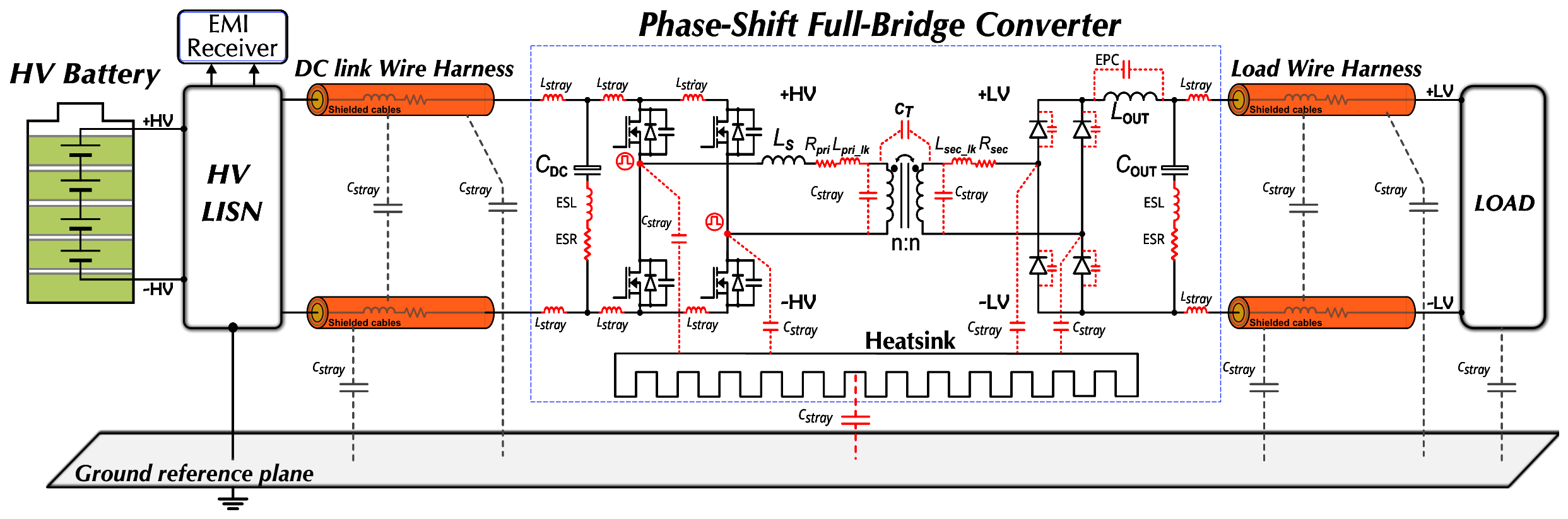
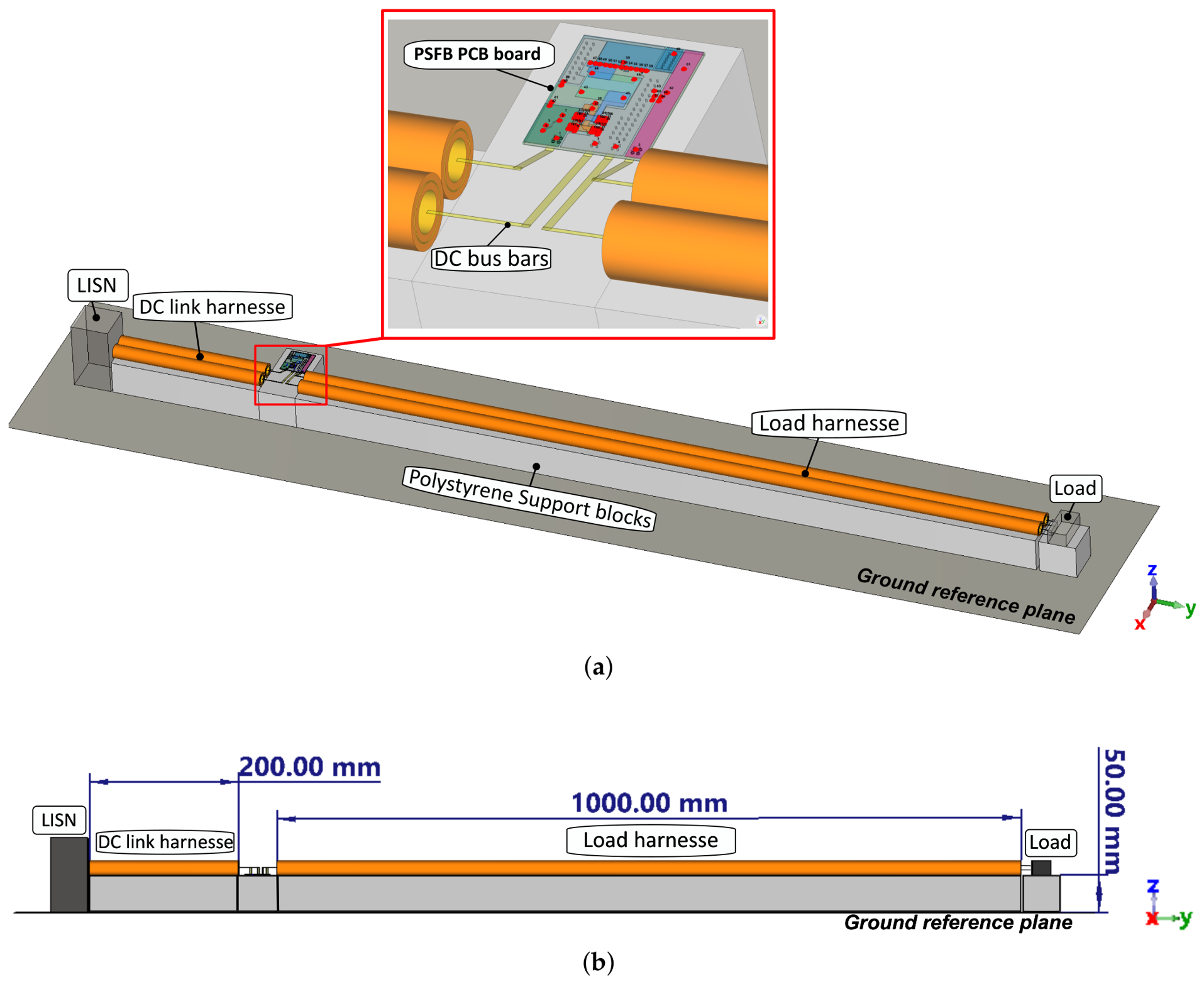
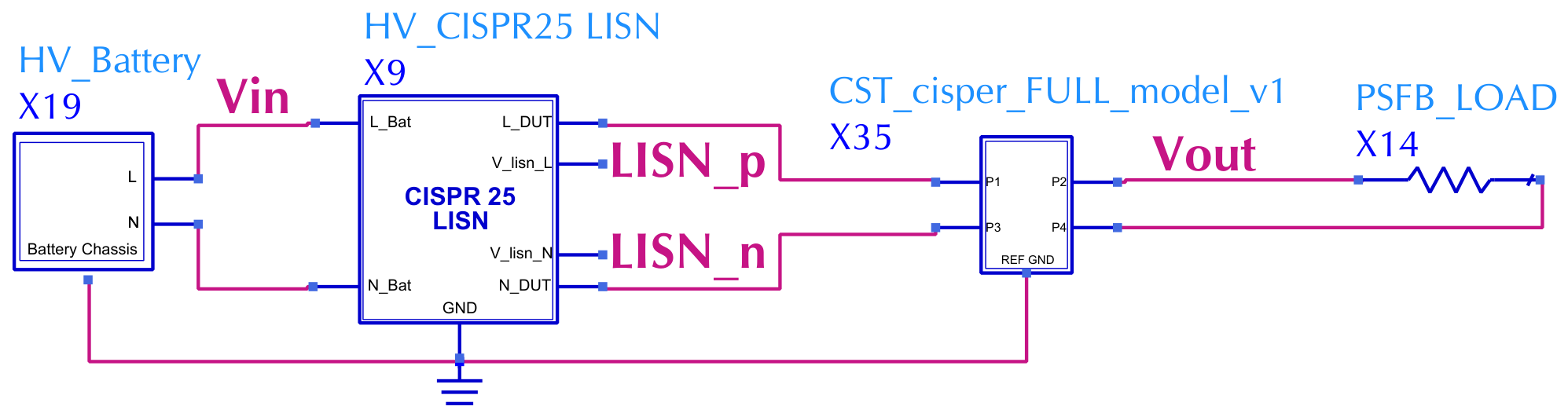
The DC powertrain of an electric vehicle is the core system that transfers the HV electrical energy stored in the HV battery to the LV auxiliary power supply and loads. This function is typically ensured by an isolated HV PSFB DC-DC converter, which constitutes the main source of EMI within the system. As illustrated in Figure 1 and Figure 2, the main functional units of the system include an HV battery, an HV LISN, the power harnesses of the conversion chain, a static load, and the PSFB power converter.
The adopted modeling approach accounts for high-frequency effects along the common-mode (CM) and differential-mode (DM) noise propagation paths, which are predominantly governed by inductive and capacitive parasitic couplings (see Figure 1). Inductive couplings arise from stray interconnect inductances of the wiring harnesses, PCB tracks, stray elements of active and passive components (e.g., equivalent series inductance (ESL) of the DC-link capacitor), and the leakage inductances of the PSFB transformer. Capacitive couplings, on the other hand, occur between the conversion chain components, such as power cables, the PSFB heatsink, and the load and the reference ground. To enable reproducible and reliable simulation results, the fully modeled test setup in this work replicates the standardized CISPR 25 automotive EMC test rig for conducted EMI quantification (see Figure 2), which specifies a test frequency range spanning from 150 kHz to 108 MHz [20]. The breakdown of the modeling of this system’s elements is given hereafter.

2.1. HV Battery and HV LISN Modeling

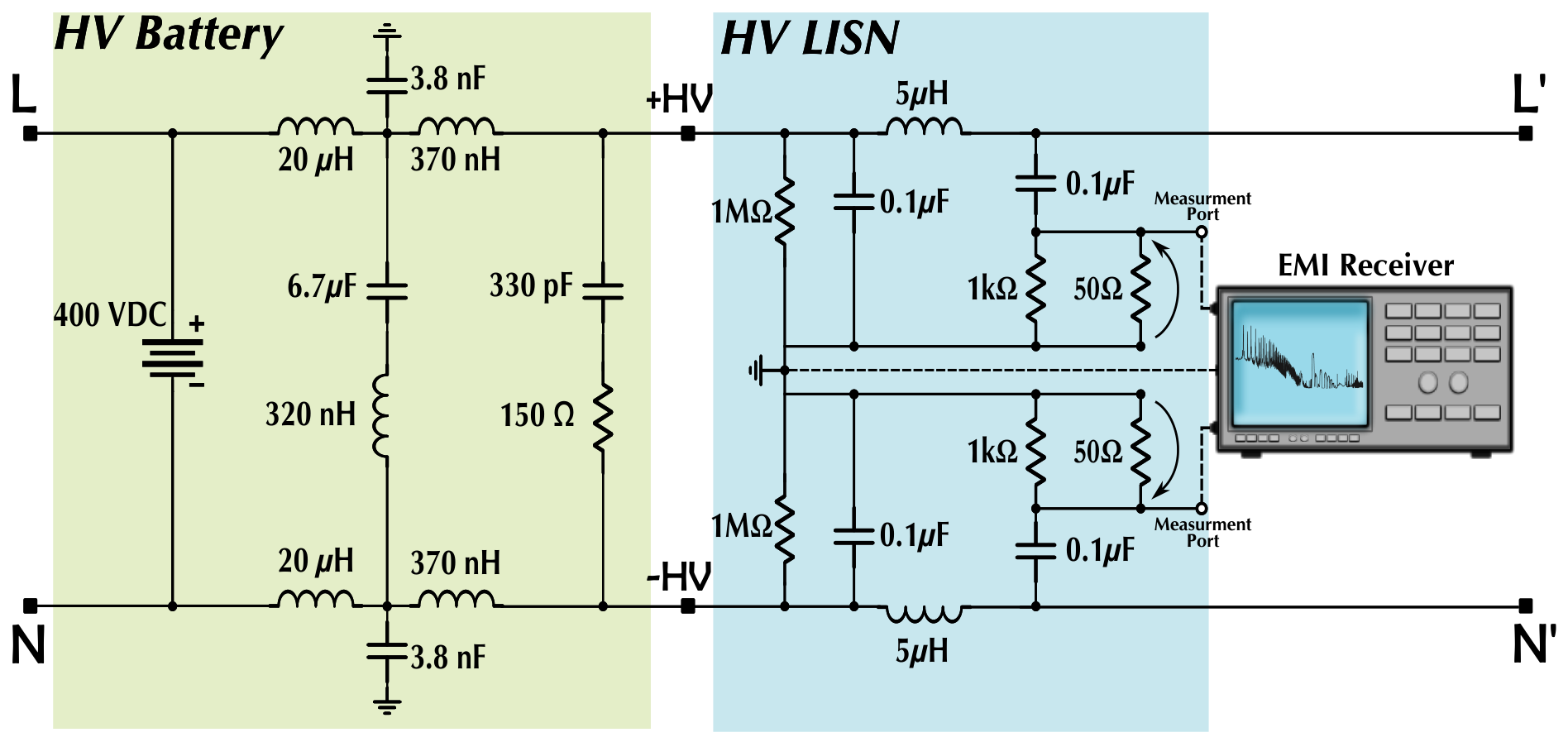
In this work, a high-frequency behavioral model of the HV Li-ion battery for automotive applications, developed in [40], is employed. It was developed for the construction of a battery emulator that mimics the real electrical behavior of an HV traction battery in test setups and was validated in the frequency range [30 kHz–200 MHz]. As illustrated in Figure 3, the battery simulation model comprises an ideal 400 V DC-voltage source and an impedance-emulating network used to characterize the HV traction battery. This model is adopted because it has proved extremely valuable for testing and designing filters, as well as analyzing the impact of power network impedance on conducted EMI levels. Additionally, as specified by CISPR 25 [20], an HV LISN is used to connect the HV battery to the input terminals of the DC powertrain.

2.2. Characterization of HV Power Harnesses

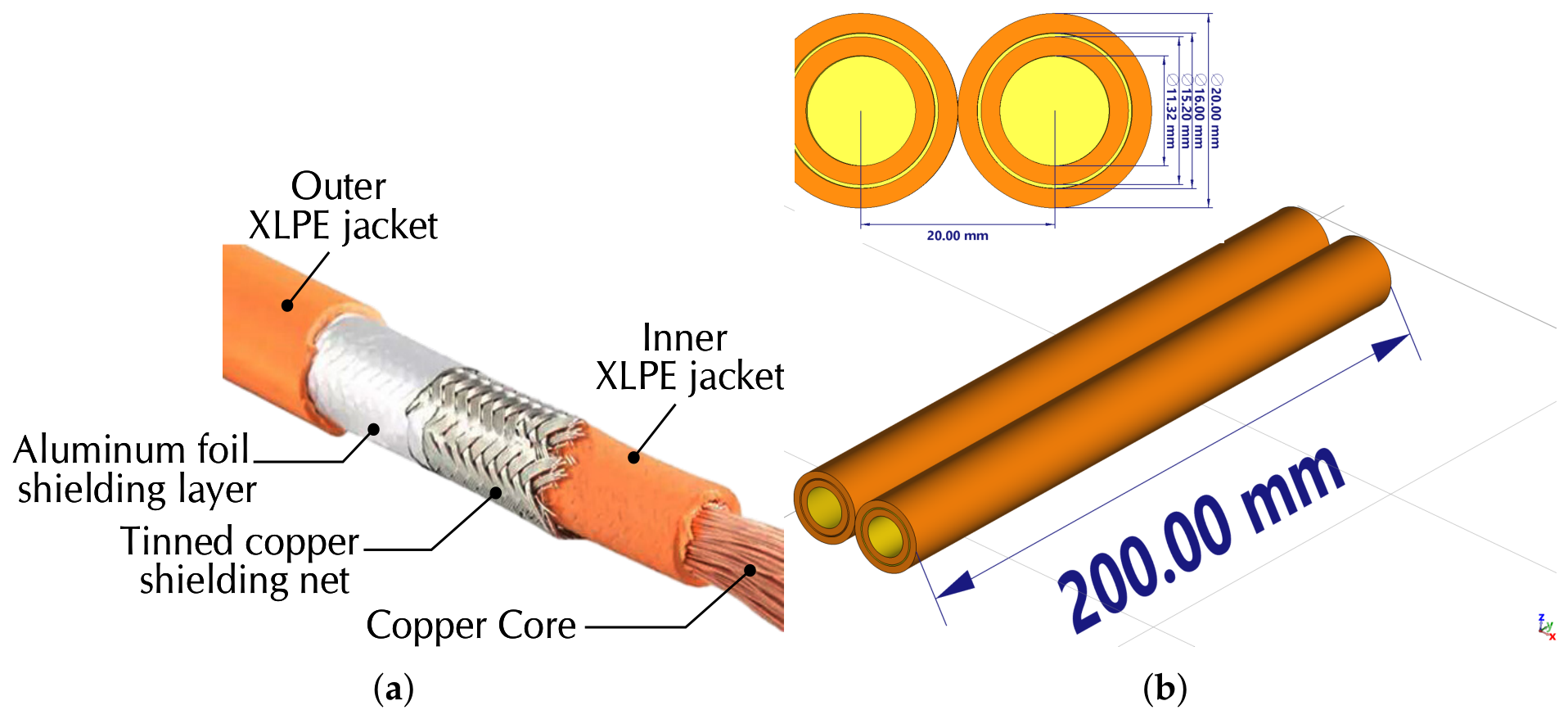
A trial-and-error approach in the design process of EMI filters can only be avoided if the impact of the network impedances within the HV power harness on conducted interferences is known. Thus, the proper assessment of the wiring harness is a crucial matter to address. According to the conducted EMI test rig arrangement specified by CISPR 25, the HV LISN is connected to the DUT (i.e., PSFB converter) through a 0.2-m HV shielded wiring harness, which is nearly one-fourteenth (i.e., λ / 14 ) of the electrical wavelength at the test limit frequency of 108 MHz. The load, in this case, is connected to the PSFB converter through a 1-m-long shielded wiring harness (full wavelength). The structure of the shielded cables with their dimensions is represented in Figure 4.
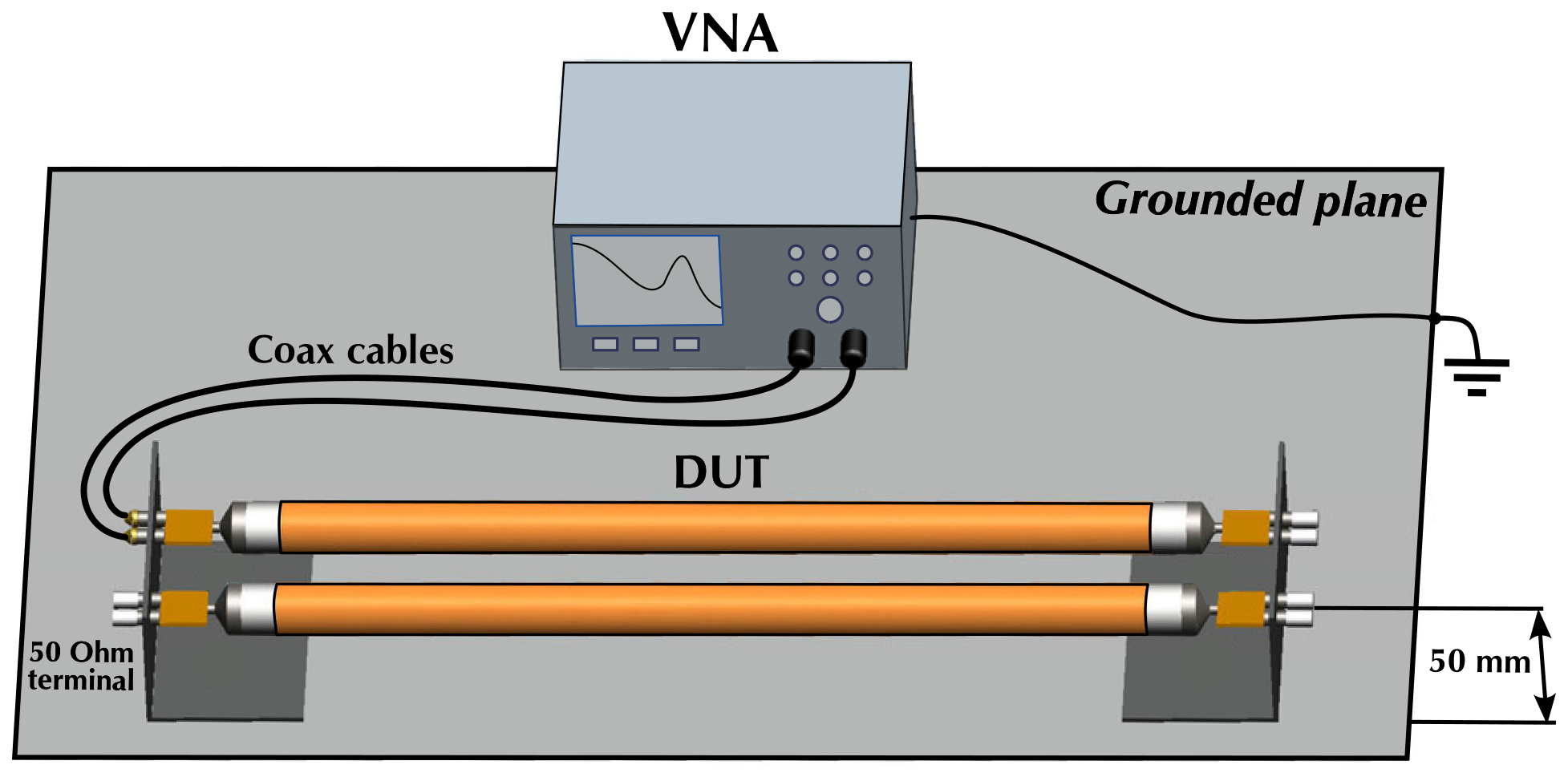
This structure comprises a copper core (bare copper conductors), inner and outer cross-linked polyethylene insulation jackets (XLPE), and a shielding screen. The shielding of the power cables on the DC link and the load side is used to contribute to the reduction in both conducted and radiated emissions. The characterization of the shielded wiring harnesses’ CM and DM impedances in open-circuit (OC) and short-circuit (SC) configurations is carried out to assess their high-frequency stray parameters. The shielded cables simulation in the CST Studio Suite is conducted according to their spatial disposition in the CISPR 25 measurement setup, as shown in Figure 5.
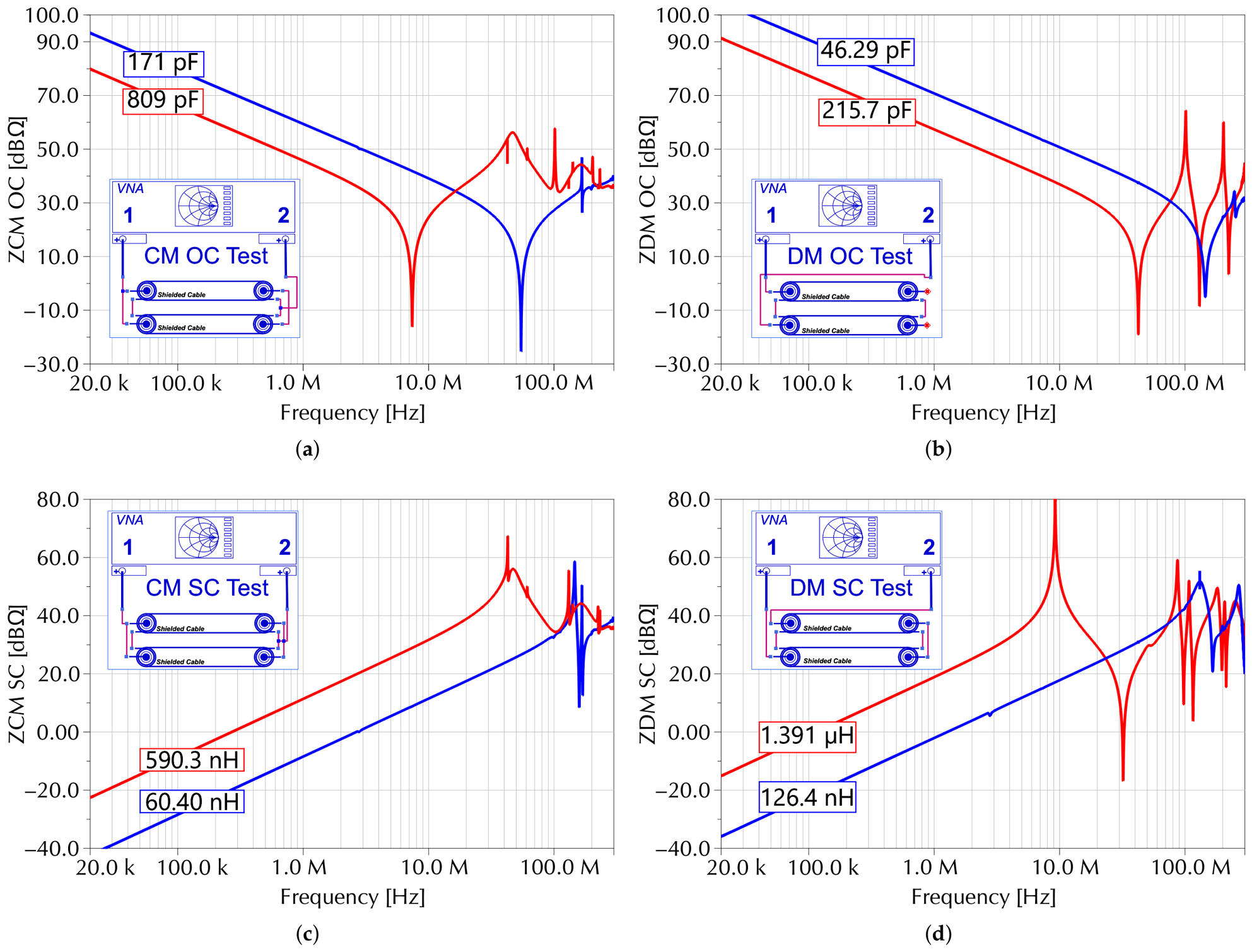
In contrast to [41], each cable bundle is modeled and characterized as a single unit using a vector network analyzer (VNA) in the test frequency range of 150 kHz to 108 MHz. Postprocessing of the characterization results is performed afterward in the ADS software environment. The OC and SC tests’ CM and DM impedances are depicted in Figure 6 for both the DC link wire harness (highlighted blue) and the load wire harness (highlighted red). These CM and DM impedances are much higher for the load’s wire harness due to its physical length, which induces greater parasitic effects. The CM OC impedance curves of the DC link cables shown in Figure 6a exhibit an equivalent stray capacitance of 171 pF between the pair of cables to the shield in the low-frequency range (below 10 MHz), which yields an equivalent parasitic capacitance of 85.5 pF for a single cable to the shield.
The DM OC impedance curves displayed in Figure 6b demonstrate an equivalent stray capacitance of 46.29 pF in the low frequency range between the harness wires, which is equivalent to the series connection of two 85.5 pF capacitors. The same analysis applies to the load wire harness. The value of the latter’s series parasitic inductance is halved when crossed by CM signals, as can be seen by comparing the impedance results of the DM SC test in Figure 6d to those of the CM SC test in Figure 6c. This inductance is higher by an order of magnitude compared to that of the DC link harness (more than ten times in the DM SC test).
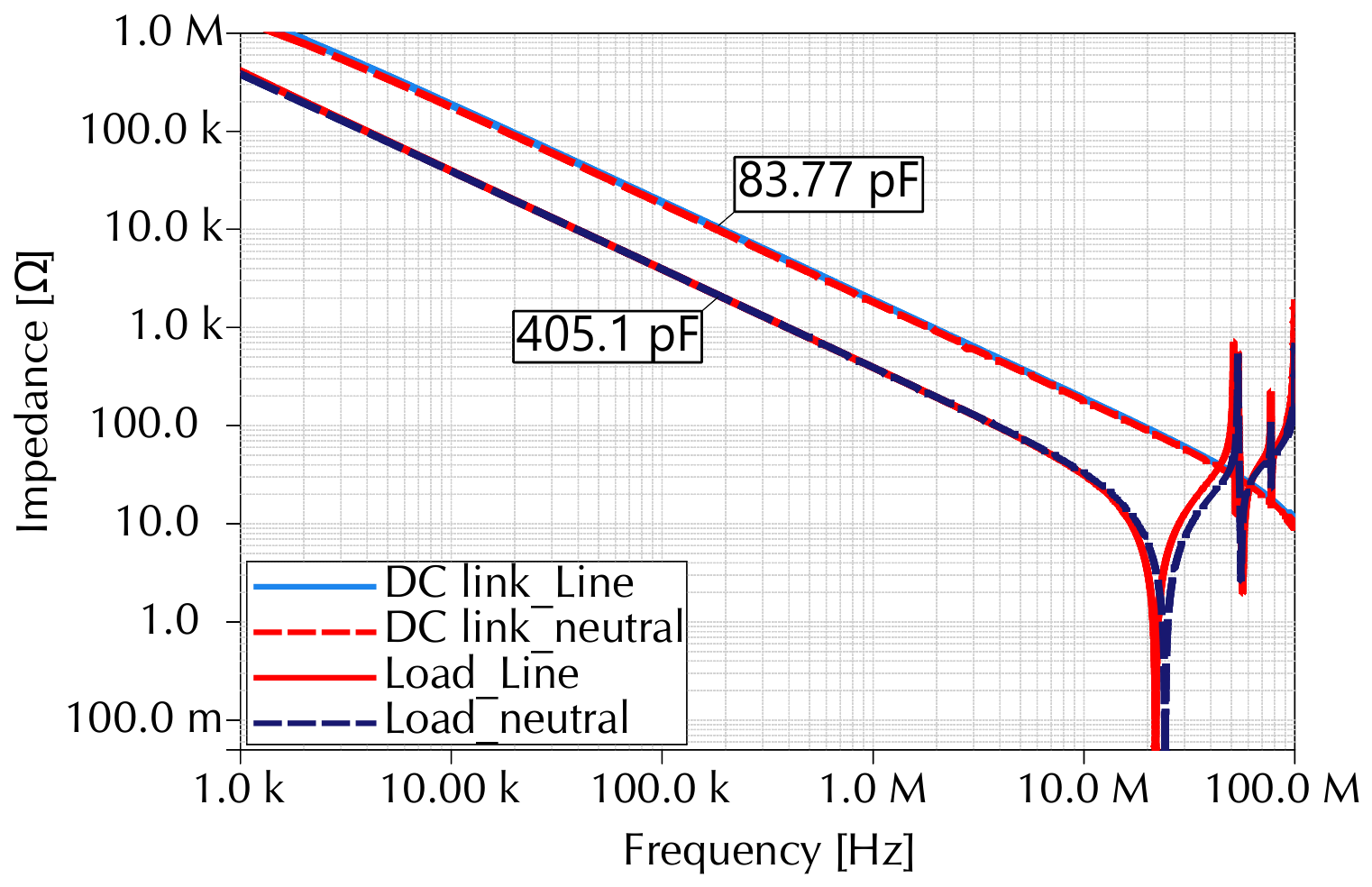
A final evaluation is carried out to assess the overall worst-case capacitive coupling of the cable bundles to the ground. The power harnesses are characterized separately in open-circuit mode, with their shields grounded and the VNA connected each time to one terminal. The resulting impedances, along with their total distributed stray capacitances, are depicted in Figure 7. The DC link cables exhibit the same capacitive impedance because they are identical and at the same height above the plane ground. This also applies to the load cables. In comparison to the DC link cables, the load cables exhibit a higher capacitive coupling to ground (405.1 pF per cable) with markedly pronounced self-resonances due to their lengthy structure.
These results showcase the contribution of the wire harnesses to the parasitic paths of the noise signals and provide insight into their impact on the system impedance and induced EMI levels.

2.3. Modeling of the PSFB DC-DC Converter

The PSFB power converter is designed and modeled to step down an input DC voltage of 400 V delivered by the HV battery of an EV into an output voltage of 48 V DC with high isolation and efficiency above 95% under full load conditions. The characteristics of the designed converter are listed in Table 1.
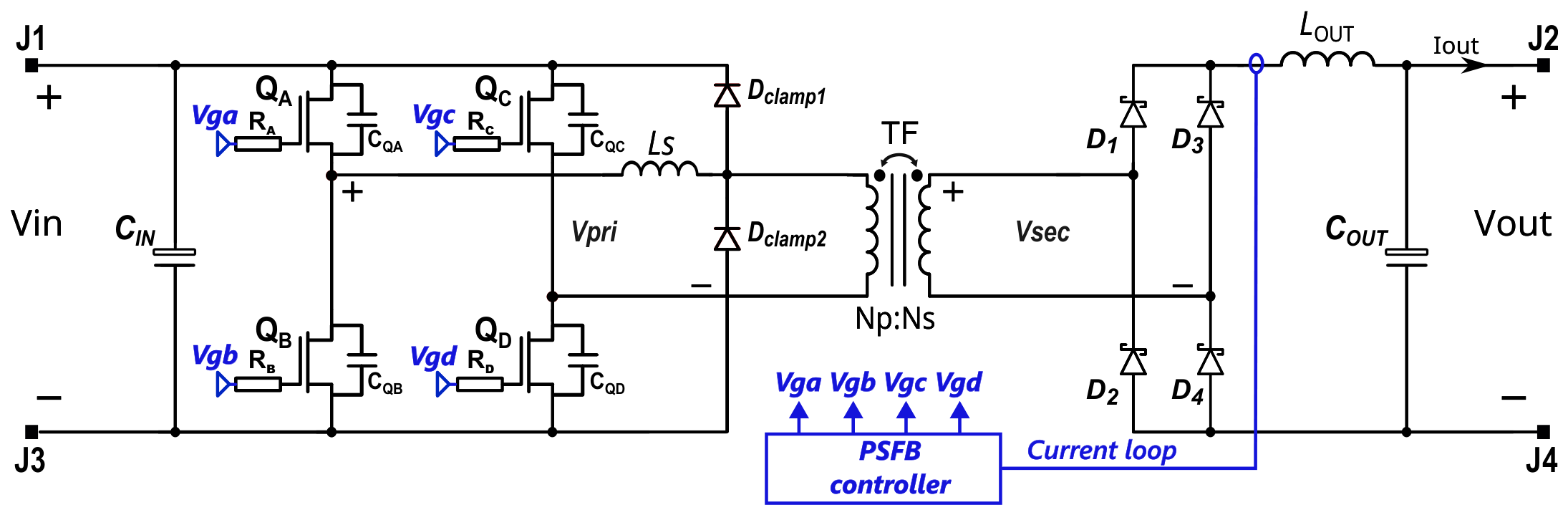
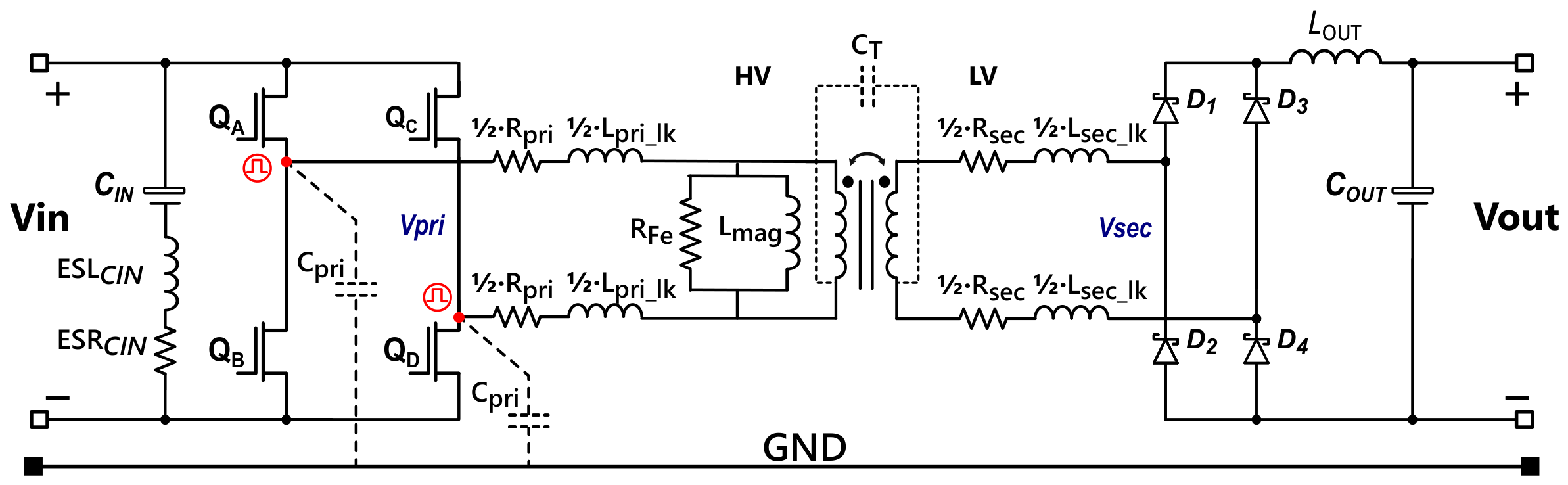
A full electromagnetic (EM) model of the PSFB converter is designed and implemented based on the specifications laid out in Table 1 to study its power-conversion performance and EMI signature. Figure 8 shows the circuit diagram of the actual designed power converter. The majority of discrete power components are provided by their respective manufacturers and vendors, when available, and implemented in simulations, either as high-fidelity Simulation Program with Integrated Circuit Emphasis (SPICE) models for active components or as measured Touchstone files for passive components. All critical components were modeled with their parasitic behavior (ESR, ESL, saturation, stray capacitance, etc.), not as ideal L/C.
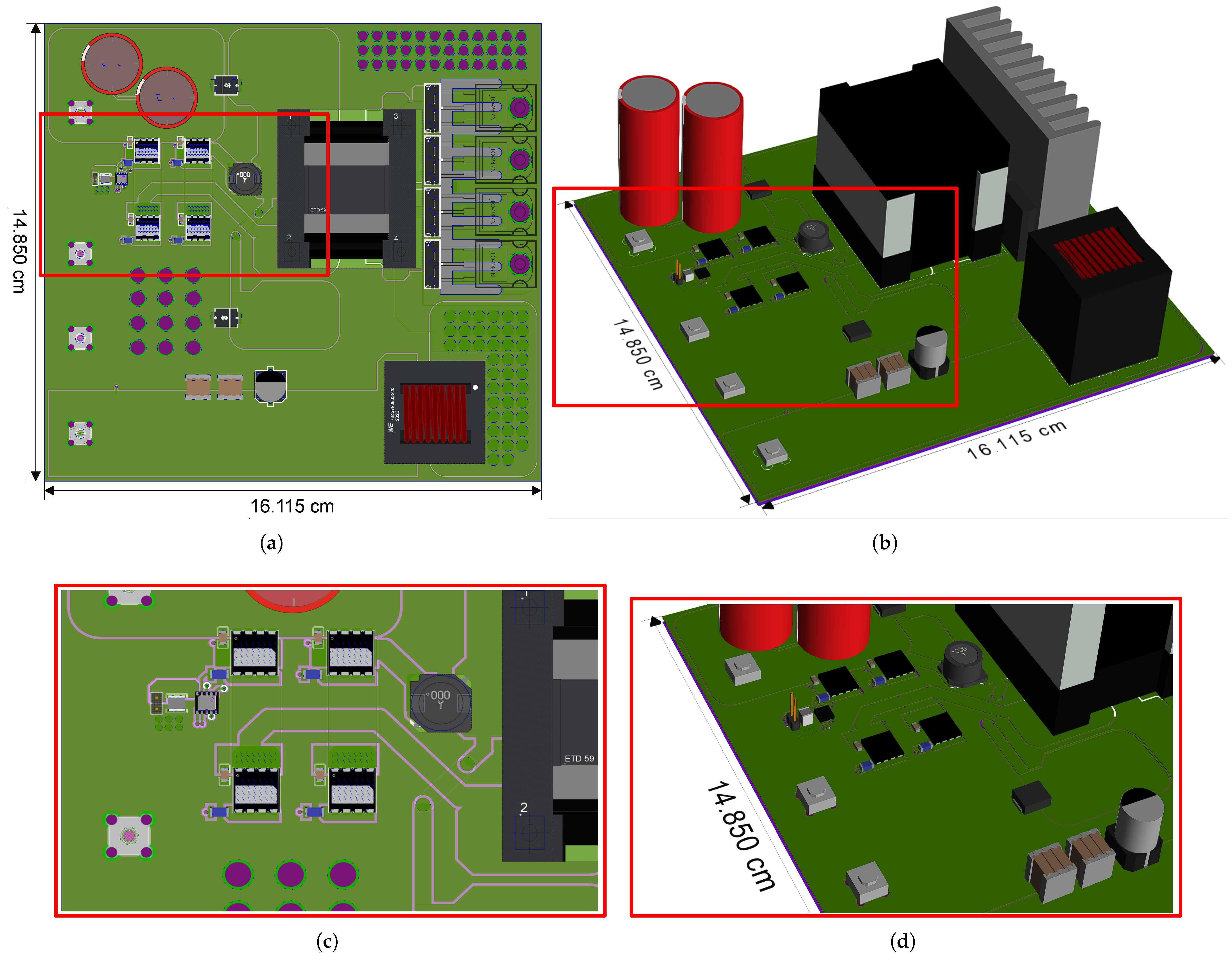
The converter PCB module was primarily designed in ADS software as an initial step to be then later exported into CST Studio Suite to be characterized within the CISPR 25 virtual test setup for conducted EMI as shown in Figure 2, following the same broadband modeling and simulation strategy for conducted emissions reported in [28]. A first draft of the PCB layout was initially designed on a four-layer board, including the power nets and the integrated circuit (IC) stage with its feeding network. To ensure a high degree of freedom, the PCB track patterns were smoothed and rounded, as seen in Figure 9.
Nonetheless, when exporting a complex multilayer structure to CST, lumped ports cannot be reliably assigned to internal nodes in the presence of inner power or ground planes. After numerous design iterations, the control stage portion was excluded from the 3D EM model and, instead, set as an external circuit command block in ADS.
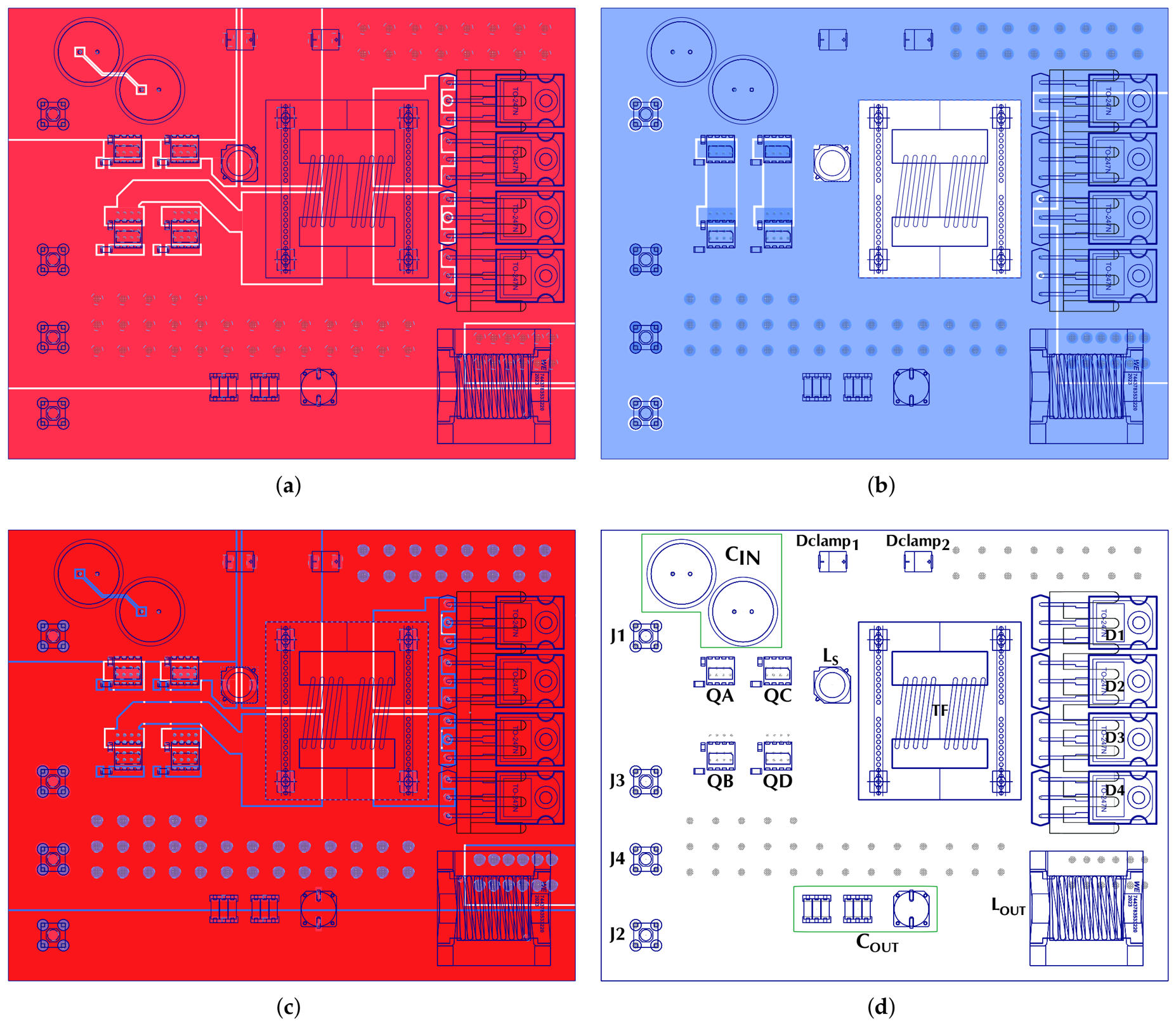
This was done to avoid simulation errors and to ensure a correct interface between the EM-extracted S-parameter model and the external IC controller stage. Consequently, the PCB layout was redesigned as a two-layer board, as shown in Figure 10. This simplified board retained the same dimensions, layout, routing, number of components, and their disposition, but utilized simplified tracks with polygon and square shapes to alleviate the meshing process of the power module, reducing computational effort and memory consumption. The power module’s PCB was modeled on a two-layer board with a copper thickness of 5.8 mil and a 28 mil thick FR4 substrate.
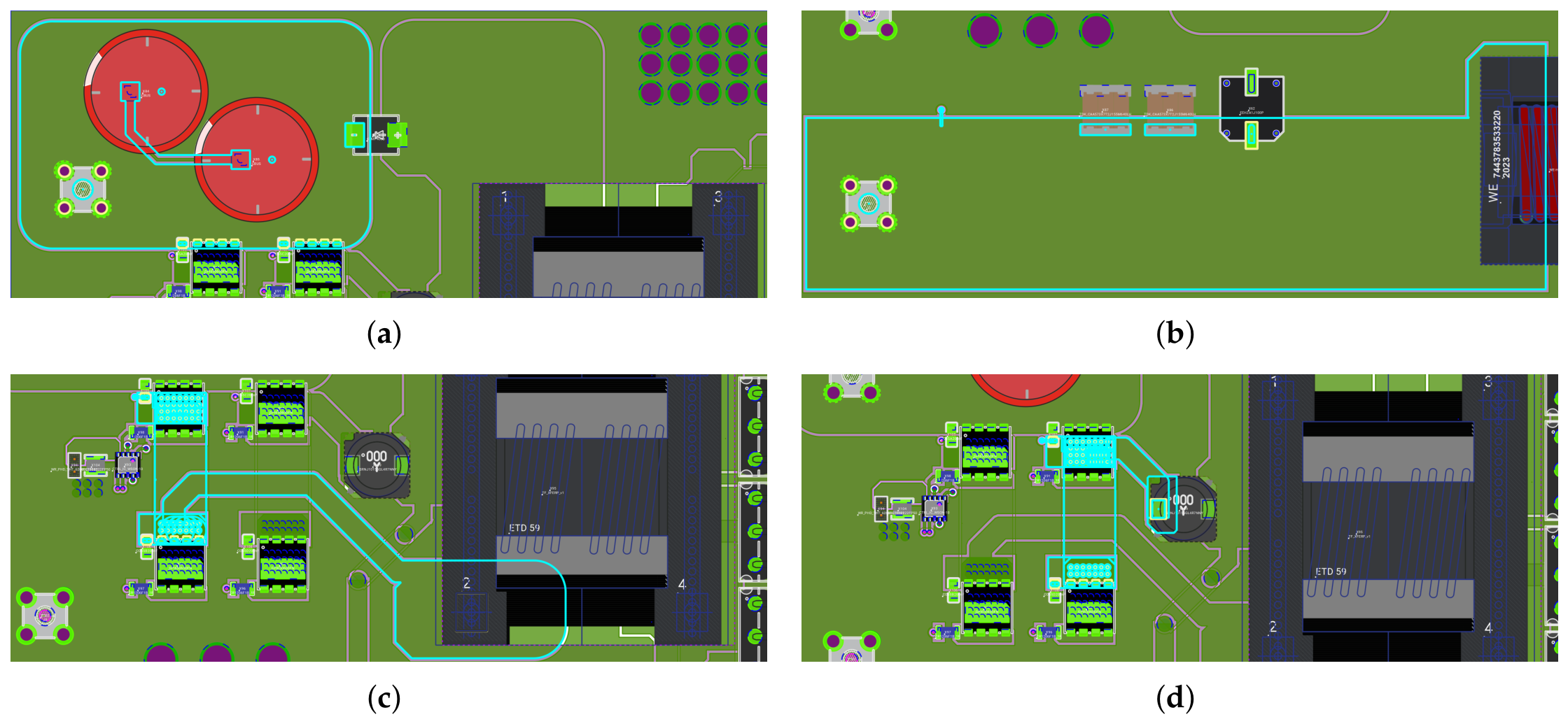
This simplification removes internal planes and allows clean port definition on top and bottom layers, reducing the port count from 87 to 77 due to the removal of the IC control stage, while preserving the dominant parasitic effects of the power stage. To quantify the impact of this modification, the S-parameters of the four-layer and two-layer PCB board models were compared over a broadband range covering the frequency band of interest. Instead of comparing all ports randomly and discriminately, the main power nets that carry the critical switching currents were selected, as highlighted in Figure 11.
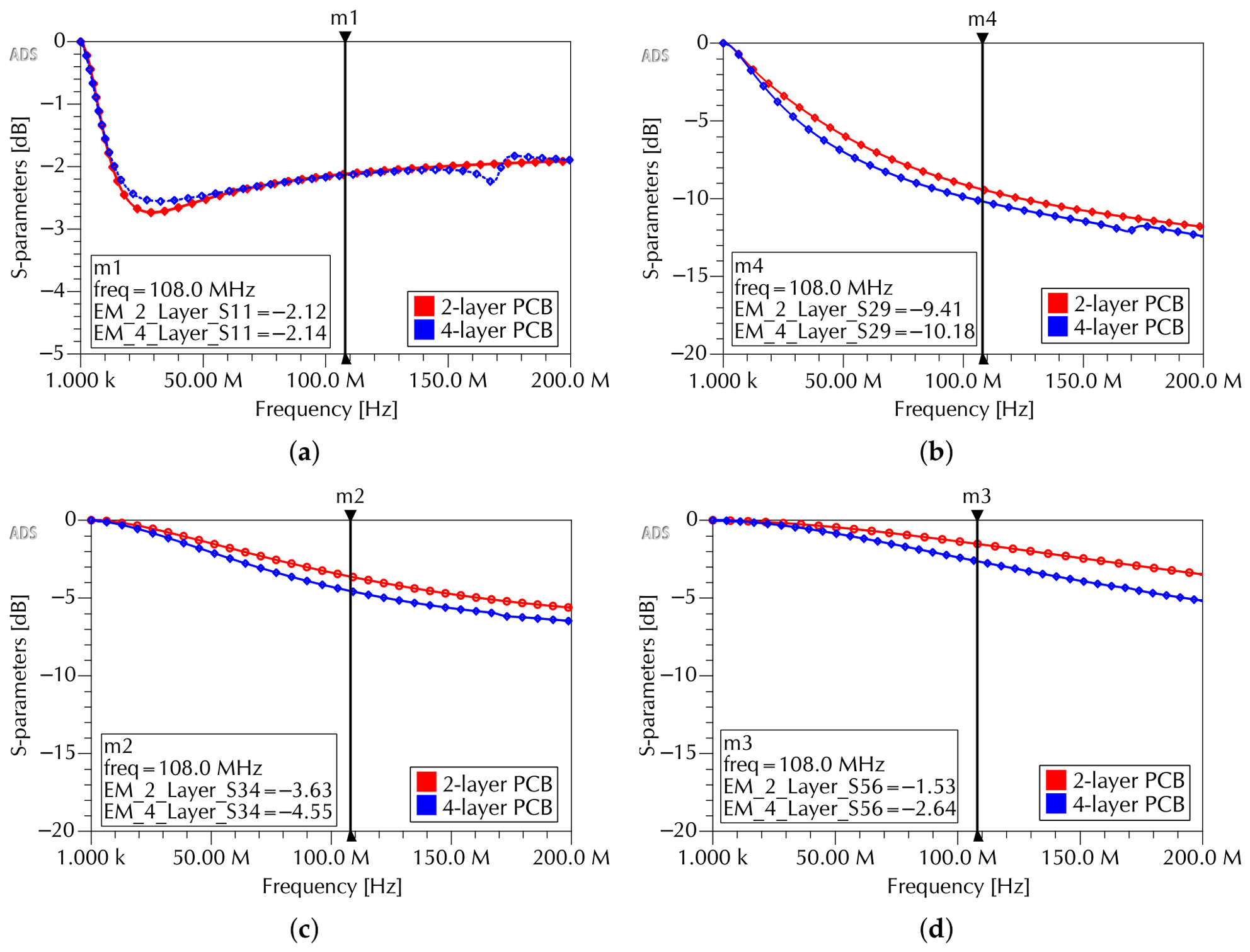
These include the input power rail via its reflection coefficient S 11 (Figure 11a), the output power rail via transmission coefficient S 29 (Figure 11b), and the nets connecting the leading and lagging legs to the power transformer via transmission coefficients S 34 and S 56 , as shown in Figure 11c and Figure 11d, respectively. The characterization results depicted in Figure 12 show very good agreement between the four-layer and two-layer models.
As shown in Figure 12, the differences observed at 108 MHz are: 0.02 dB for S 11 , 0.77 dB for S 29 , 0.92 dB for S 34 , and 1.11 dB for S 56 . All deviations are below 1.2 dB, and most are well under 1 dB. This demonstrates that the main electromagnetic effects, including current return paths, parasitic couplings, characteristic impedances, and high-frequency signatures, are faithfully preserved in the two-layer model. Thus, the two-layer simplified geometry does not compromise the essence of the electromagnetic behavior and, therefore, the accuracy of the conducted EMI predictions. Furthermore, such simplifications enabled the smallest possible time steps ( T step _ max < 1 ns ) to achieve very dense transient EM simulations with high precision, allowing for the capture of all fast transient EMI phenomena of the power-conversion system with full resolution in time and frequency, in conjunction with the fastest possible rate of reproducibility.
A cleanly designed PCB layout with minimal stray elements and parasitic coupling effects is crucial for achieving an optimized performance power converter with a low EMI signature and favorable thermal profile. Therefore, a set of basic techniques for EMI reduction was adopted within the designed power module. To begin with, the routing of the PCB was made with wide tracks to reduce their resistive and inductive elements, which in turn reduces voltage spikes, copper losses, and enhances efficiency. At the same time, the PCB was designed with a large copper pour ground plane connected to the top layer by an array of stitching vias to decrease the adverse capacitive coupling effect of wide tracks. To further diminish this effect, copper keepouts were established at the bottom layer within the copper pour underneath the shunt inductor L s and the power transformer to reduce the parasitic capacitances between their top layer terminals and the ground net. This overwhelming ground net allows for a short connection between the clamping diodes and the hot point on the primary side of the transformer. The leading leg (QA, QD) and lagging leg (QB, QC) were disposed close to each other to minimize the length of the switching loop, with their GaN power FETs connected from the top to the bottom layer using via arrays. Finally, the diodes on the bridge rectifier were connected next to each other for a compact and adequate connection of their base plate (case) to the heat sink mounted directly on the top-ground net. This overwhelming ground net allows for a short connection between the clamping diodes and the hot point on the primary side of the transformer.
The PCB board was exported into the CST Studio environment for evaluation within the CISPR 25 virtual test setup for conducted EMI, following the same broadband modeling and simulation strategy for conducted emissions reported in [28]. In this setup, the wiring harnesses are included to fully characterize the behavior of the investigated PSFB converter. The 3D model of the PCB board imported in ODB++ file format is characterized in CST Studio both without and with the inclusion of the input and output power harnesses. After the elements in the structure were redefined with their respective materials, discrete ports were assigned, and the problem boundaries were defined.
Full 3D numerical simulations were then conducted in the frequency domain with a tetrahedral mesh using the built-in Finite Element Method (FEM) solver in CST Studio. For this type of electromagnetic problem, a proper frequency range must be selected. Therefore, given that the EMC test analysis covers the range of 150 kHz to 108 MHz, an interpolating sweep from DC to 600 MHz was defined for analysis, providing sufficient margin with respect to the test range, while the solution frequency for which the mesh is calculated (solution frequency) was set to 1 GHz. The 3D simulation uses a direct equation system solver with second-order tetrahedral elements. To ensure deep numerical precision before exporting the multi-port Touchstone model, the linear solver accuracy threshold was tightened from the default 10 3 to 10 6 , and the low-frequency stabilization feature was enabled to manage the wide bandwidth.
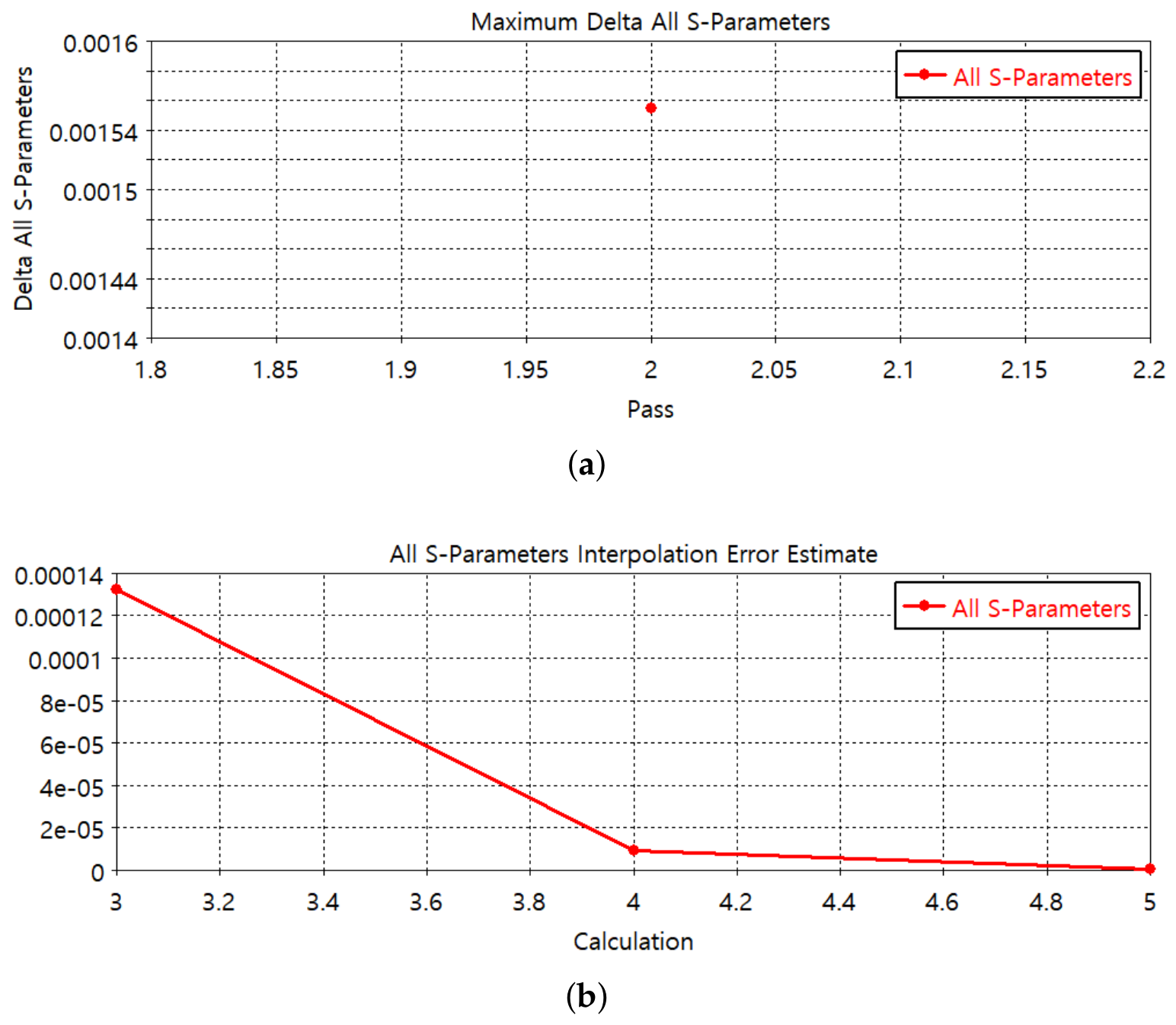
The relative residual norm of the algebraic solver was monitored across the frequency sweep and successfully reached the target threshold, guaranteeing a mathematically stable solution. Spatial discretization independence was verified using CST’s automated adaptive mesh refinement loop. The broadband convergence criterion was set to a maximum scattering matrix variation threshold of Δ S = 0.04 (4%) between successive mesh passes. As shown in the convergence metrics (Figure 13a), the adaptive meshing process converged, with the maximum S-parameter deviation dropping well below the 0.04 target threshold by the final pass. Additionally, the broadband interpolation error estimate remained minimal (Figure 13b). This confirms that the mesh density is sufficient to accurately capture the electromagnetic behavior of the test setup and that further mesh refinement does not alter the outcome. The resulting multi-port S-parameter model of the 3D simulation was generated in a Touchstone (.SnP) file format with 77 lumped ports that enable the interface connection between the output 3D FEM model and the SPICE simulation platform, in this case, the PathWave ADS environment.
The multi-port model is intended to represent with high accuracy the electromagnetic behavior of the test setup, including the PSFB converter’s PCB board and power cables, through the defined ports within the specified frequency range. After this S-parameter model was validated, it was exported to the ADS software environment, where each active and passive component (including the GaN FETs, clamping diodes, transformer, and output rectifier) is connected to its respective port, along with the HV battery, HV LISN circuit blocks, and the static load emulator according to the CISPR 25 conducted emission test configuration.
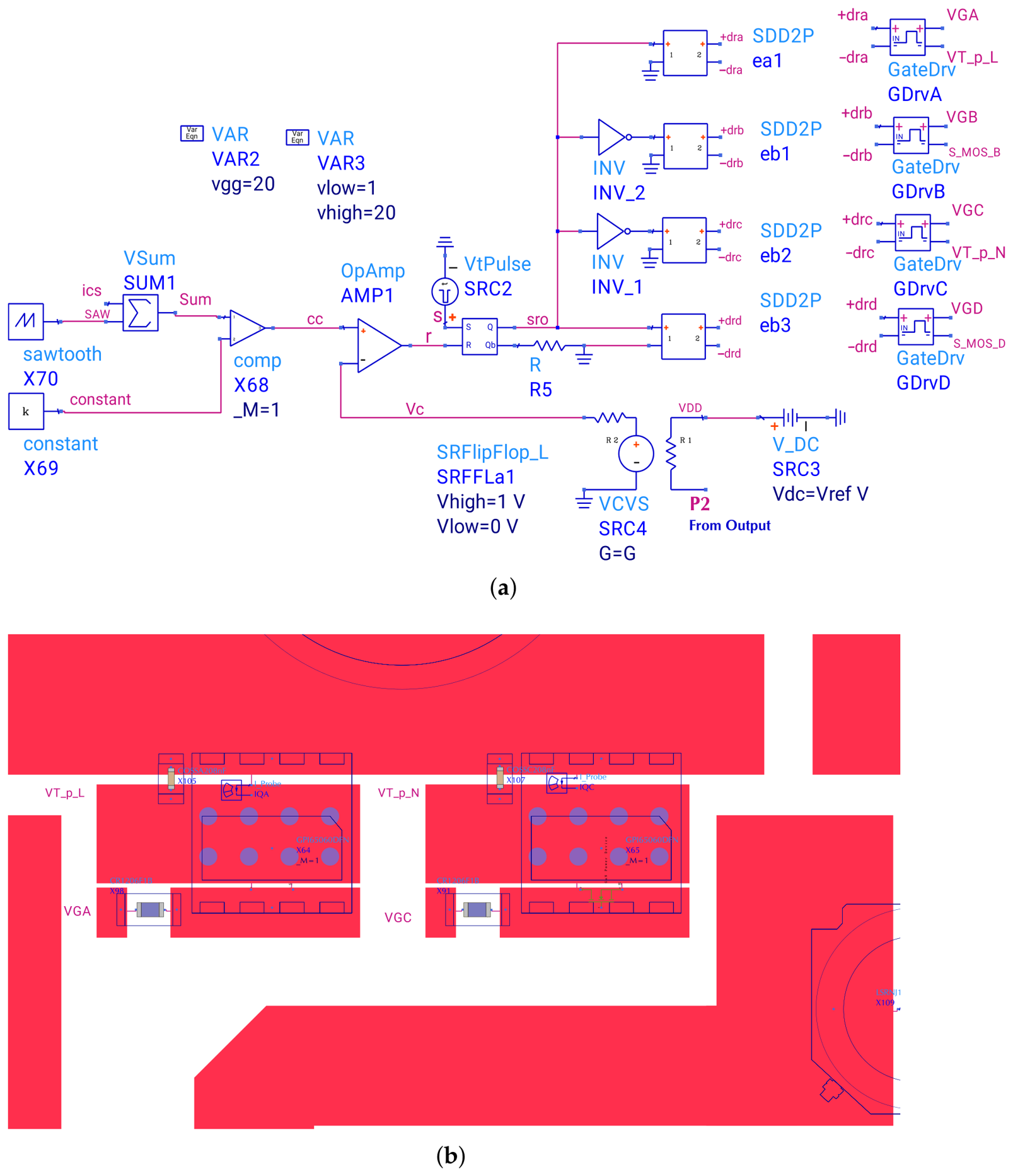
For example, Figure 14 shows the IC controller built in ADS. Figure 14a presents the complete controller schematic, while Figure 14b zooms in on the connections to the GaN FET pins. The controller is not included in the CST 3D EM model; it is linked in ADS to the ports of the power module. The co-simulation blocks are utilized to perform transient simulations, and EMI characterization of the DC powertrain is shown in Figure 15.
This co-simulation setup enables time-domain transient analysis over several switching cycles to capture both steady-state behavior and switching-induced transients. The voltage and current waveforms at the LISN measurement ports are subsequently processed via Fast Fourier Transform (FFT) to quantify the conducted EMI spectra through direct comparison with CISPR 25’s Class 2 limits.

3. Power-Conversion Performance and Conducted EMI Analysis

The results summary and analysis of the PSFB power converter performances before and after its inclusion in the DC powertrain (with the LISN connected in all cases and the clamping diodes either activated or deactivated) are discussed below.

3.1. Noise Source Impedance Analysis

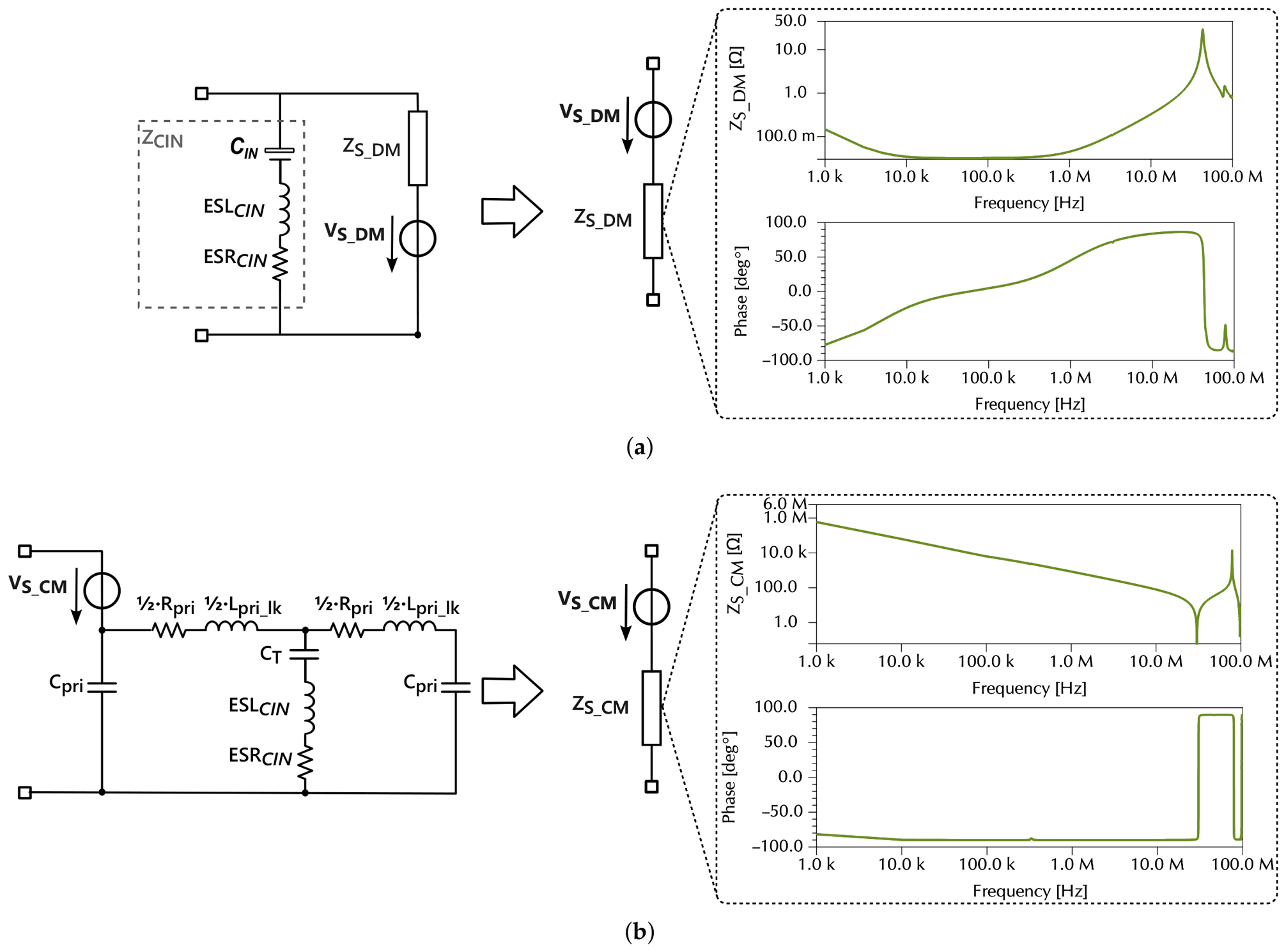
To evaluate the noise source impedance characteristics of the PSFB converter and the harness’s contribution to the dominant peaks in the induced EMI levels. The CM and DM impedances of the PSFB converter are extracted, both before and after the inclusion of the power harnesses. This analysis follows the modeling methodology described in [42], which is projected onto the PSFB topology based on the modeling work developed in [43]. The DM noise impedance is extracted between the input and output terminals of the converter board, and then between the input and output terminals of its power harnesses, without including the ground. The CM noise impedance is extracted between the converter input terminals and the ground reference plane. After adding the power harnesses, it is evaluated between the harness input and output terminals and the ground reference plane. These extractions were performed directly from the full co-simulation model of the CISPR 25 setup. Figure 16 shows the equivalent high-frequency model of the PSFB converter, while the corresponding stray parameter values extracted from the designed PSFB EM model and its power components are listed in Table 2. Figure 17 shows the equivalent differential-mode and common-mode noise source models of the PSFB converter in standalone mode, together with their respective impedances.
When analyzing the PSFB converter alone, the DM noise source impedance Z S _ D M is primarily determined by the DC-link capacitor as shown in Figure 17a. Thus, Z S _ D M is modeled in parallel with the DC-link capacitor impedance Z C IN using Thévenin’s theorem. Over the frequency range of interest, the impedance of the DC-link capacitor is very low; therefore, the contribution of the converter’s internal DM impedance is neglected. Consequently, Z S _ D M is effectively defined by the DC-link capacitor together with its parasitic elements (ESR and ESL).
The CM noise, generated by high-frequency pulsations of the power devices (GaN FETs) at the primary-side switching nodes, flows to ground through the parasitic capacitances ( C pri ) and through the transformer’s inter-winding capacitance ( C T ). The CM noise source impedance Z S _ C M is therefore derived from the equivalent converter model (Figure 16) by reducing the circuit to the equivalent shown in Figure 17b, assuming that a conducting diode is always present on the PSFB secondary side. The CM impedance Z S _ C M shown in Figure 17b can then be calculated using the parameter values listed in Table 2.
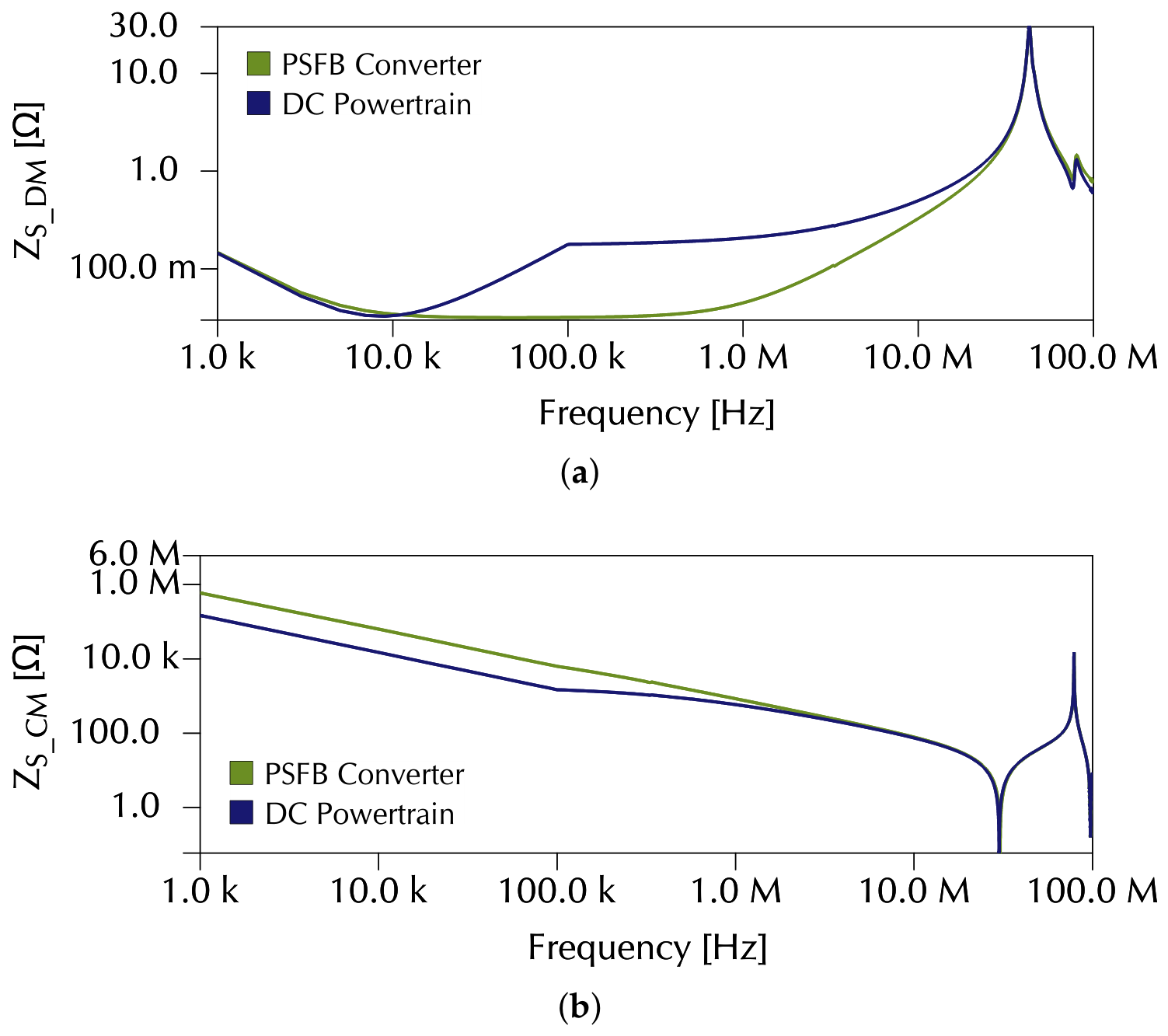
The DM and CM noise source impedances of the PSFB converter alone, and then within the DC powertrain (including power harnesses, HV battery, test setup, etc.), are depicted in Figure 18. The DM impedance is dominated by the DC-link capacitor ( C IN ) impedance at low frequencies (below 1 MHz). However, beyond 19 kHz, the PSFB converter exhibits an increase in DM impedance due to the stray inductive effect of the cables.
The CM noise impedance, on the other hand, drops to a lower level between 1 kHz and 1 MHz after the addition of the power harnesses, which accentuates the parasitic coupling to ground and raises the CM noise levels.

3.2. Effect of Harnesses and Clamping Diodes on Power-Conversion Efficiency and Noise Levels

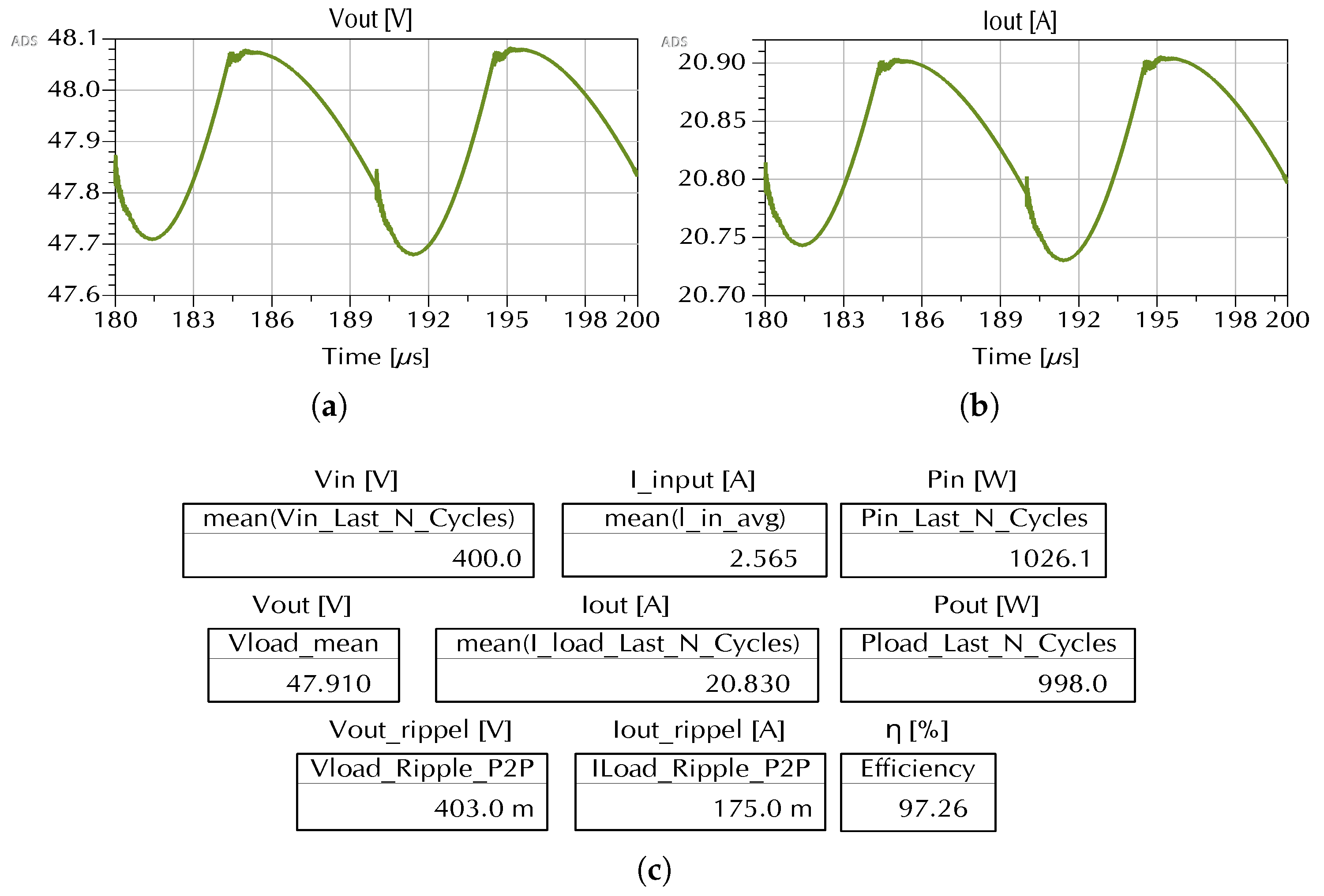
The switching waveforms of the designed PSFB power module operating at full load, directly connected without the inclusion of the HV battery and power harnesses, are presented in Figure 19. The converter achieves an efficiency of 97.26% under full load conditions. In this case, the clamping diodes D CLAMP 1 and D CLAMP 2 are deactivated (off-state). The last two cycles of the output voltage and current show clean waveforms with an output power slightly below the nominal values due to the power losses introduced by the PCB board and its discrete power components. In terms of noise ripple, the converter yields a peak-to-peak voltage ripple of 403 mV P P and a 175 mA P P ripple current.
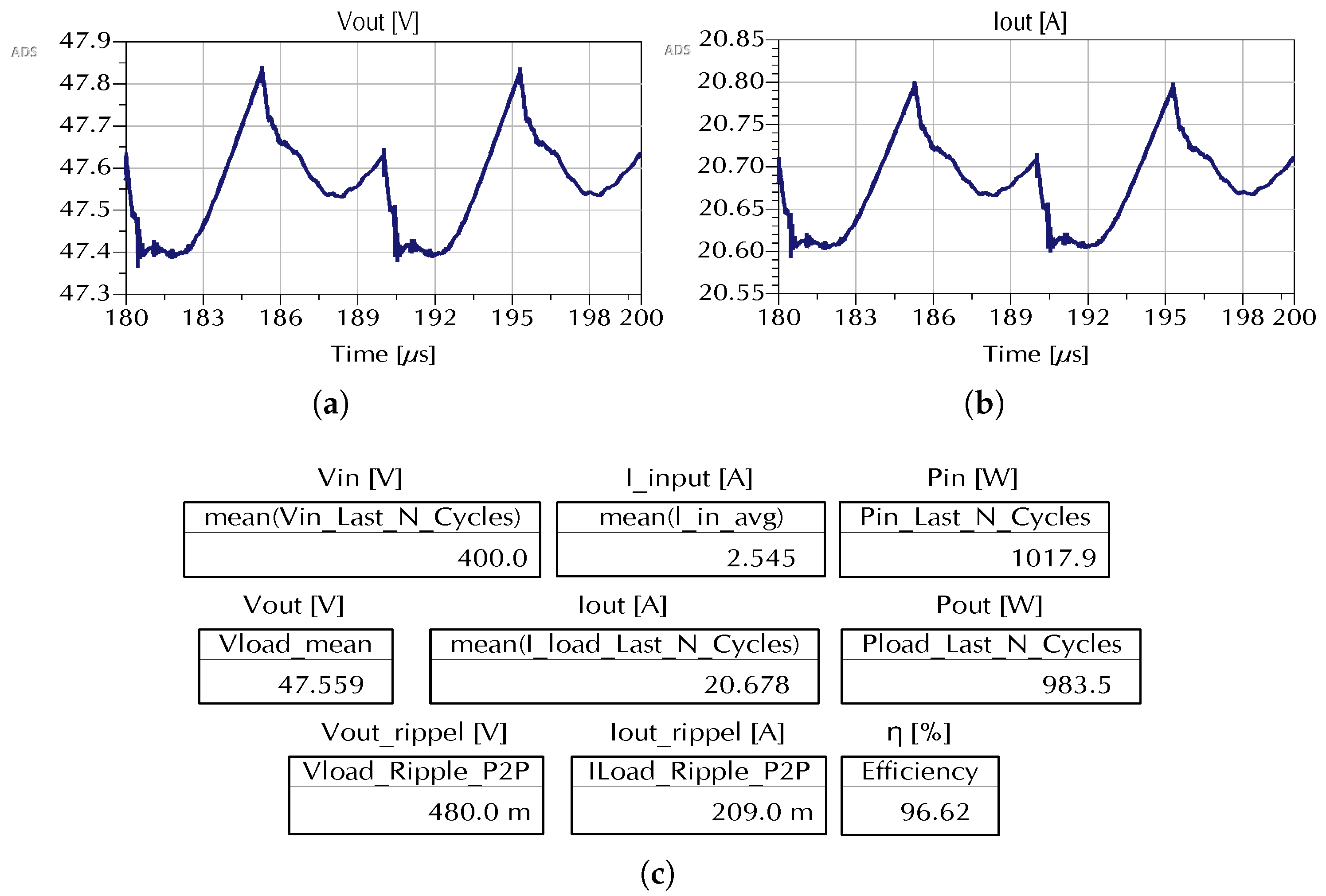
Figure 20 presents the switching waveforms of the designed PSFB power module after the inclusion of the HV battery and wiring power harnesses, which refers to the full DC powertrain setup. The efficiency of the converter drops to 96.62% after its inclusion in the test setup, and the ripple of the voltage and current output waveforms is accentuated by 77 mV P P and 34 mA P P , respectively, knowing that D CLAMP 1 and D CLAMP 2 are also deactivated in this case.
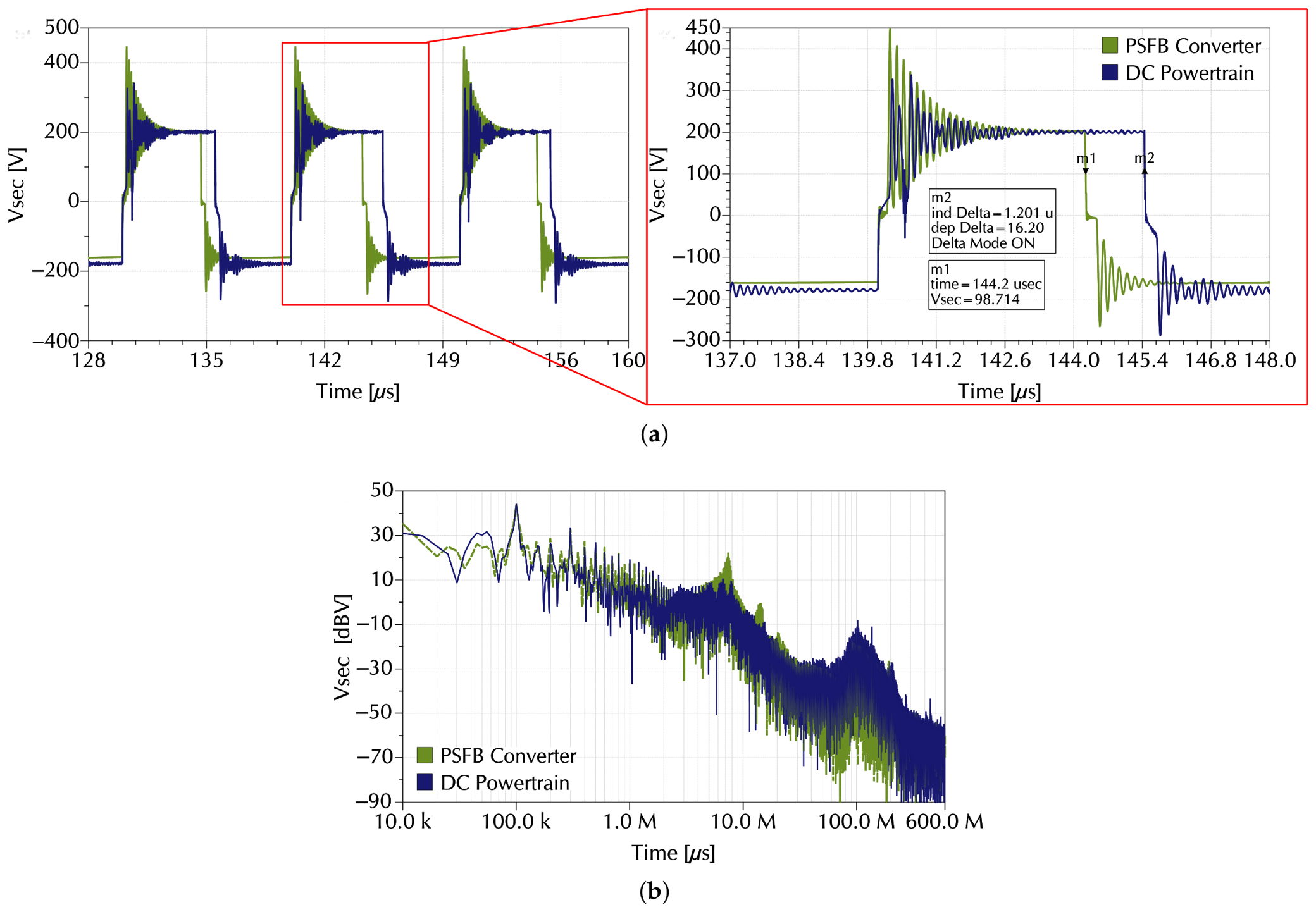
The power cables generate EMI noise, and their resistance causes substantial voltage drops at high current loads, especially in the absence of a form of closed-loop control, which affects the output voltage and overall efficiency of the converter. However, for the application at hand, this effect is limited as the PSFB converter’s closed-loop control circuit actively adjusts the duty cycle by effectively widening the on-time of the switching devices to compensate for the voltage drop occasioned by the inclusion of the power harnesses. This active adjustment is seen in the transformer secondary voltage V sec depicted in Figure 21a.
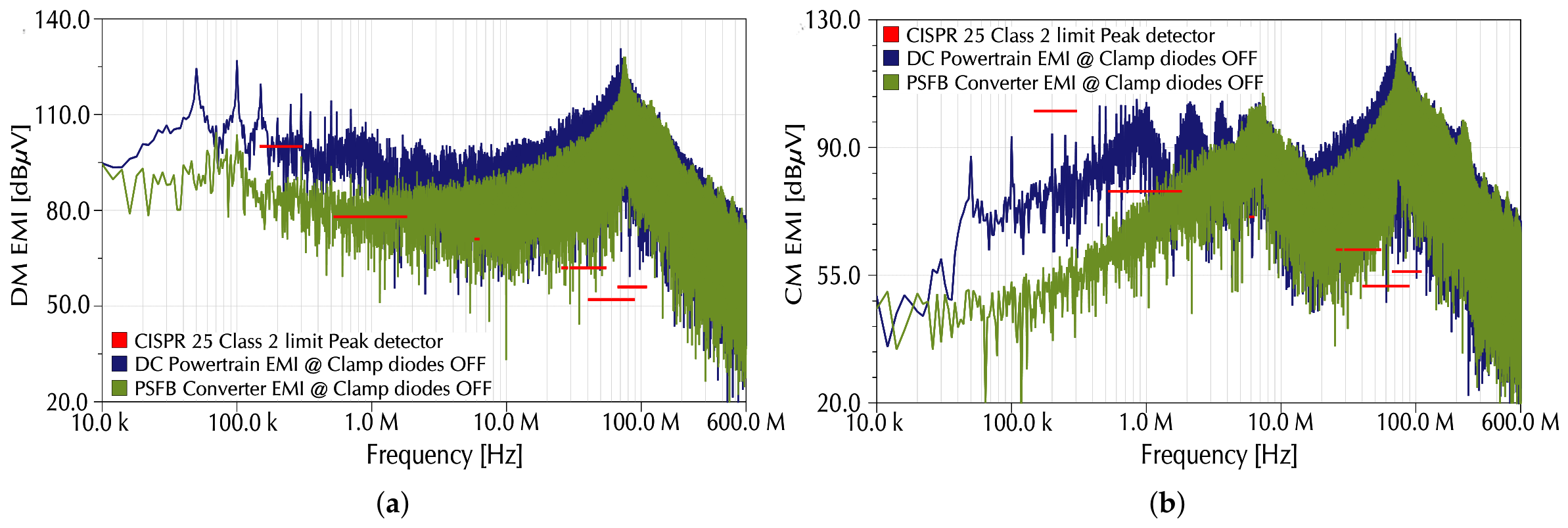
The FFT spectra of this secondary voltage before and after the inclusion of the PSFB converter within the DC powertrain have similar spectral profiles that showcase two noise peaks at nearly 7 MHz and 100 MHz, which are related to their transient turn-on and turn-off noise oscillations. The addition of the power harnesses, which exhibit an additional resistance, introduces a damping effect on the noise oscillations of V sec , which is reflected in the magnitude of its related mid-frequency spectral noise peaks. The conducted EMI spectra of the PSFB converter before and after its inclusion within the DC powertrain are shown in Figure 22. Their trend correlates with the noise source impedances in Figure 18.
The CM and DM noise levels of the PSFB converter in standalone mode and within the DC powertrain both exceed the Class 2 limit, causing the PSFB converter to fail to meet the CISPR 25 standard. The effect of the wiring harnesses on the levels of induced EMI is noticeable, as the CM and DM noise levels of the DC powertrain increase considerably in the frequency range below 100 MHz. For instance, a difference of 38.15 dBµV in magnitude is estimated for the DM noise at 50 kHz, which is apparently due to the distributed inductance and resistance of the cables.
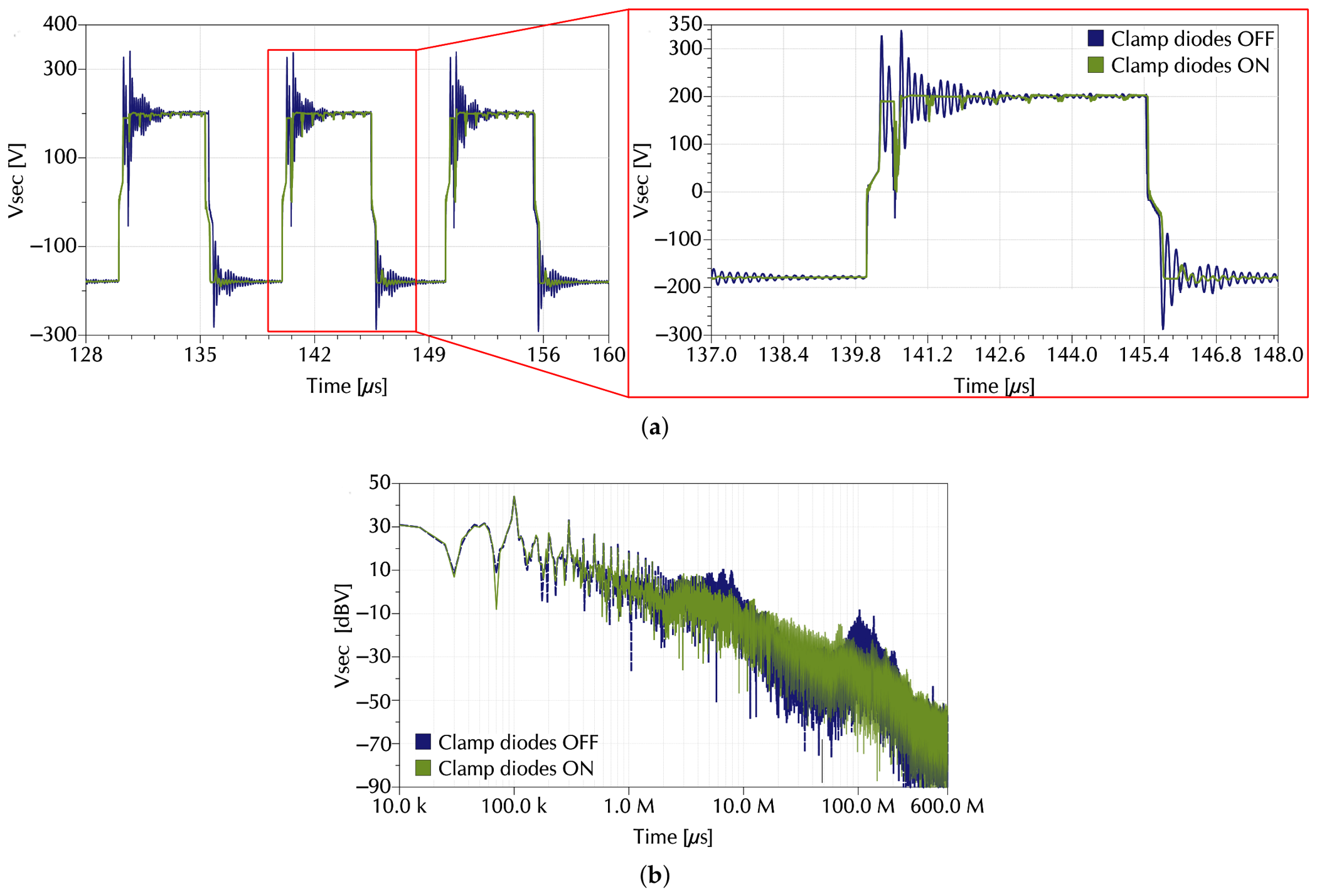
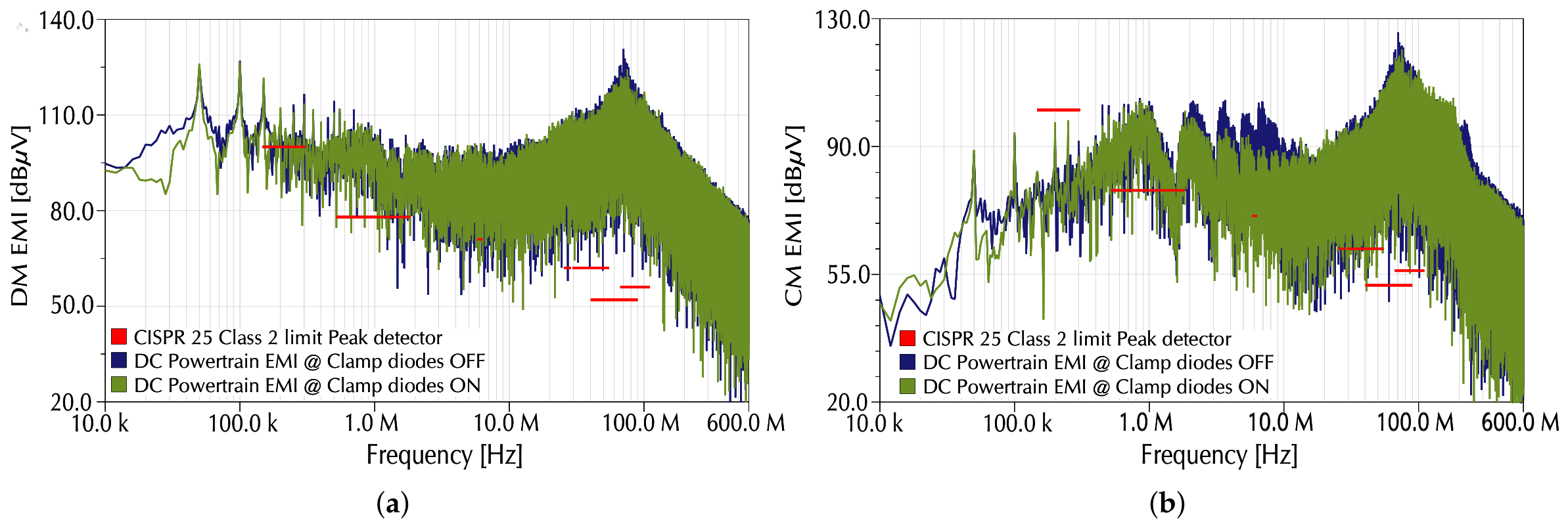
As for the CM noise, the difference observed is higher at low frequencies (e.g., 45.22 dBµV at 50 kHz), which is attributed to the low impedance path introduced by the inclusion of the wiring harnesses through stray capacitances, which heightens the amount of capacitive CM noise currents along the cables toward the reference ground. Figure 23 shows the transformer secondary voltage waveforms evaluated within the DC powertrain before and after the inclusion of clamping diodes D CLAMP 1 and D CLAMP 2 . Figure 24 shows the conducted CM and DM noise spectra before and after their inclusion.
The following quantitative correlations can be established with the parasitic values listed in Table 2. The DM impedance (Figure 17a) exhibits three distinct regions: capacitive below 10 kHz ( C IN _ total = 1120 μ F , i.e., 2 × C IN ), a resistive plateau between 10 kHz and 1 MHz corresponding to the equivalent parallel resistance E S R total = 31.5 m Ω , and inductive above 1 MHz corresponding to the equivalent parallel inductance E S L total = 4.9 nH . The highest DM emission peak at 75.21 MHz (Figure 24a, EMI with clamping diodes off) is caused by a resonance between the transformer inter-winding capacitance C T = 60.42 pF and the residual DM loop inductance L loop _ DM 74.2 nH , which includes the contribution of the power harnesses. This peak lies in the inductive region above 1 MHz, where E S L total and the harness inductance dominate the DM impedance.
The CM impedance (Figure 17b) is purely capacitive below 10 MHz, dominated by C CM _ eq = C pri + C T = 313.22 pF . A sharp series resonance dip occurs near 30.33 MHz, where the phase crosses 0°, corresponding to the cancellation between L pri _ lk and the equivalent series capacitance of the layout. The PSFB exhibits a first CM emission peak observed at 7 MHz (Figure 22b, green spectrum). This peak is caused by the resonance between L pri _ lk and the transformer inter-winding capacitance C T = 60.42 pF , which gives a theoretical resonant frequency of approximately 1 / ( 2 π 12.21 μ · 60.42 p ) 5.9 MHz , in good agreement with the peak observed near 7 MHz (slightly shifted by layout parasitics). The highest CM emission peak at 75.21 MHz lies in the inductive zone following the 30.33 MHz resonance dip and is attributed to a parasitic resonance between C CM _ eq and the residual high-frequency loop inductance of the PCB and harnesses ( L loop _ CM 14.3 nH ).
Going from the off-state to the on-state of D CLAMP 1 and D CLAMP 2 in Figure 23a, the overshoots and undershoots are greatly reduced by 136.1 V and 24.61 V, respectively. As for their spectra (Figure 23b), the two noise peaks observed near 7 MHz and 100 MHz in the off-state of D CLAMP 1 and D CLAMP 2 are remarkably damped when these latter are turned on (e.g., 12.35 dBV reduction at 6.7 MHz, and 19.44 dBV at 102.4 MHz). The utilization of a diode clamp at the primary stage of the PSFB converter (see Figure 8) enables the recycling of energy within the discrete commutating inductor L s , thus maintaining it on the primary side and ensuring that the parasitic capacitances of the output rectifiers resonate with only the primary leakage inductance, which is already substantial for the designed transformer ( L pri _ lk = 12.21 μ H ), thereby reducing the output rectifier voltage stress considerably.
Although the conducted CM and DM noise contribution of the full DC powertrain shown in Figure 24 remains high in terms of induced EMI levels after activating the clamping diodes, the effect of these latter is noticeable as it introduces some amount of damping on the CM and DM spectra. For instance, the DM noise spectrum exhibits a reduction of 3.6 dBμV at 500 kHz, and 12.69 dBμV is estimated at the main noise peak, which occurs at around 70.45 MHz. As for the CM noise spectrum, the damping is more pronounced, especially in the mid-frequency range from 2 MHz to 13.20 MHz, where a maximum decrease of 20.91 dBμV is reached at 3.658 MHz. At the high-frequency range, a 3.69 dBμV reduction is noted at 70.45 MHz. The summary of the main performances of the designed converter, evaluated under full-load conditions, along with its compliance status with the CISPR 25 standard, is presented in Table 3.
The PSFB converter achieves better efficiency and power density in standalone mode, but this is degraded within the full DC powertrain. In terms of EMC compliance, however, the PSFB converter fails to meet the CISPR 25 Class 2 limit in all cases. This noise quantification therefore provides a robust evaluation of the conducted EMI levels of the power system and establishes a clear baseline and a correct starting point for implementing a well-dimensioned noise mitigation strategy, such as a dedicated EMI filter.

4. Conclusions

This paper establishes a comprehensive broadband simulation-based EMC modeling and EMI assessment methodology for a 1 kW GaN-based phase-shift full-bridge converter in an EV DC powertrain. By combining full-wave electromagnetic and circuit-level simulations, the proposed approach accurately captures parasitic effects from PCB layout, power harnesses, and discrete components, enabling reliable system-level EMI prediction.
The virtual prototype was assessed within a CISPR 25-compliant setup over the 150 kHz–108 MHz range. Simulation results showed that the converter achieves high efficiency above 97% under full load conditions (97.26% standalone, 97.03% integrated). However, in the absence of proper input filtering, even with the integral clamping diodes activated, both common-mode and differential-mode conducted emissions exceed CISPR 25 Class 2 limits across the entire spectrum. Power harnesses were found to significantly increase EMI levels at low frequencies due to distributed inductance and stray capacitance.
The undamped conducted EMI levels presented in this study (with clamping diodes ON) serve as a baseline reference for future input EMI filter design. This work demonstrates the value of virtual prototyping for simulation-based EMI prediction, enabling designers to identify EMC compliance issues before physical prototyping and to size proper, dedicated filtering stages. Future work will also explore active common mode EMI cancellation techniques, such as impedance balancing and transformer parasitic capacitance compensation, to further improve the EMC performance of the GaN-based PSFB converter.
A full CISPR 25 compliance study through PCB or component optimization is left for future work. Furthermore, a comparative study of the EMI performance of different isolated topologies (LLC, DAB, etc.) and of Si versus GaN devices would be a valuable extension of this work and is planned for the future.

Author Contributions

Conceptualization, N.R.; methodology, N.R.; validation, N.R.; software, S.K.; investigation, S.K.; analysis, S.K.; writing—original draft preparation, S.K.; writing—review and editing, C.M.; supervision, A.H. All authors have read and agreed to the published version of the manuscript.

Funding

This research received no external funding.

Institutional Review Board Statement

Not applicable.

Informed Consent Statement

Not applicable.

Data Availability Statement

The data presented in this study are available on request from the corresponding author.

Conflicts of Interest

The authors declare no conflicts of interest.

Abbreviations

The following abbreviations are used in this manuscript:
ADSAdvanced Design System
CMCommon-mode
CISPRComité International Spécial des Perturbations Radioélectriques
DCDirect current
DMDifferential-mode
EMElectromagnetic
EMCElectromagnetic compatibility
EMIElectromagnetic interference
EVElectric vehicle
FEMFinite element method
FFTFast Fourier transform
GaNGallium nitride
HVHigh voltage
LISNLine impedance stabilization network
LVLow voltage
PCBPrinted circuit board
PSFBPhase-shift full-bridge
SPICESimulation Program with Integrated Circuit Emphasis

References

  1. Lyu, D.; Soeiro, T.B.; Bauer, P. Design and Implementation of a Reconfigurable Phase Shift Full-Bridge Converter for Wide Voltage Range EV Charging Application. IEEE Trans. Transp. Electrif. 2023, 9, 1200–1214. [Google Scholar] [CrossRef]
  2. Escudero, M.; Meneses, D.; Rodriguez, N.; Morales, D.P. Modulation Scheme for the Bidirectional Operation of the Phase-Shift Full-Bridge Power Converter. IEEE Trans. Power Electron. 2020, 35, 1377–1391. [Google Scholar] [CrossRef]
  3. Sakhare, A.; Mikkili, S. Advanced DC–DC Converter Topologies for Electric Vehicles: Wide Bandgap Technologies, Emerging Trends and Future Challenges. Electr. Mater. Appl. 2025, 2, e70023. [Google Scholar] [CrossRef]
  4. Chen, H.; Kim, H.; Erickson, R.; Maksimović, D. Electrified Automotive Powertrain Architecture Using Composite DC–DC Converters. IEEE Trans. Power Electron. 2017, 32, 98–116. [Google Scholar] [CrossRef]
  5. Adeloye, I.A.; Bhattacharya, I.; Ezugwu, E.O.; Antony Dhason, M.V. GaN Electric Vehicle Systems—A Comparative Review. Energies 2025, 18, 6020. [Google Scholar] [CrossRef]
  6. Dini, P.; Saponara, S.; Chakraborty, S.; Hegazy, O. Modeling, Control and Monitoring of Automotive Electric Drives. Electronics 2025, 14, 3950. [Google Scholar] [CrossRef]
  7. Arévalo, P.; Ochoa-Correa, D.; Villa-Ávila, E. Towards Energy Efficiency: Innovations in High-Frequency Converters for Renewable Energy Systems and Electric Vehicles. Vehicles 2025, 7, 1. [Google Scholar] [CrossRef]
  8. Lezcano, H.; Romero, R.; Nuñez, S.; Sanabria, B.; Palacios-Pereira, F.; Maqueda, E.; Toledo, S.; Pacher, J.; Caballero, D.; Gregor, R.; et al. A SiC-MOSFET Bidirectional Switch Solution for Direct Matrix Converter Topologies. Actuators 2026, 15, 40. [Google Scholar] [CrossRef]
  9. Yang, H.; Xu, K.; Qiu, S.; Liu, Q. Dynamic Response Control of Dual Active Bridge Converters Incorporating Current Stress Optimization. Actuators 2026, 15, 153. [Google Scholar] [CrossRef]
  10. Lai, Y.; Yang, Y.; Wang, S.; Luo, Z. Modeling of Low-Frequency Radiated EMI From the Inductors of Power Converters in Electric Vehicles. IEEE Trans. Transp. Electrif. 2025, 11, 6904–6915. [Google Scholar] [CrossRef]
  11. Escudero, M.; Kutschak, M.-A.; Meneses, D.; Rodriguez, N.; Morales, D.P. A Practical Approach to the Design of a Highly Efficient PSFB DC-DC Converter for Server Applications. Energies 2019, 12, 3723. [Google Scholar] [CrossRef]
  12. Jia, J.; Hu, X.; Xia, Y.; Chen, Q.; Wu, X.; Long, Y. Research on Modelling Method of Conducted EMI in the Electric Drive System on Motor-Load Conditions. In Proceedings of the 2024 International Symposium on Electromagnetic Compatibility—EMC Europe, Brugge, Belgium, 2–5 September 2024; pp. 804–809. [Google Scholar] [CrossRef]
  13. Li, H.; Liu, X.; Li, Y.; Su, W.; Zhao, Z. A Two-Stage Systematic Simulation Modeling Approach for Conducted Emissions in DC-DC Boost Converters. IEEE Trans. Transp. Electrif. 2025, 11, 14166–14176. [Google Scholar] [CrossRef]
  14. Gao, F.; Ye, C.; Wang, Z.; Li, X. Improvement of Low-Frequency Radiated Emission in Electric Vehicle by Numerical Analysis. J. Control Sci. Eng. 2018, 2018, 5956973. [Google Scholar] [CrossRef]
  15. Fürnschuß, M.; Herbst, D.; Reichel, P.; Auer, C.; Schmautzer, E.; Schürhuber, R. Electromagnetic interference and the effect of low-voltage protective measures at electric vehicle charging stations. Elektrotech. Inf. 2023, 140, 645–661. [Google Scholar] [CrossRef]
  16. Pliakostathis, K. Research on EMI from Modern Electric Vehicles and their Recharging Systems. In Proceedings of the 2020 International Symposium on Electromagnetic Compatibility—EMC EUROPE, Rome, Italy, 23–25 September 2020; pp. 1–6. [Google Scholar] [CrossRef]
  17. Ramya, K.; Gopalakrishnan, J.; Chokkalingam, B.; Verma, R.; Mihet-Popa, L. A Comprehensive Evaluation and Assessment Practices of Electromagnetic Interferences in Electric Vehicle. IEEE Access 2025, 13, 40520–40560. [Google Scholar] [CrossRef]
  18. Zanni, M.; Trentadue, G.; Scholz, H.; Martini, G. Applying Explorative the International Standard IEC CISPR36 to Electric Vehicles; Publications Office of the European Union: Luxembourg, 2023. [Google Scholar] [CrossRef]
  19. Sterniczuk, D.; Zaklika, W.; Kozłowski, M. Identification Tests of Modern Vehicles’ Electromagnetic Environment as Part of the Assessment of Their Functional Safety. Sensors 2025, 25, 7. [Google Scholar] [CrossRef] [PubMed]
  20. International Electrotechnical Commission (IEC). CISPR 25:2021 Vehicles, Boats and Internal Combustion Engines—Radio Disturbance Characteristics—Limits and Methods of Measurement for the Protection of on-Board Receivers; International Electrotechnical Commission (IEC): Geneva, Switzerland, 2021; p. 372. Available online: https://webstore.iec.ch/publication/64645 (accessed on 8 June 2026).
  21. Bruns, H.-D.; Schuster, C.; Singer, H. Numerical Electromagnetic Field Analysis for EMC Problems. IEEE Trans. Electromagn. Compat. 2007, 49, 253–262. [Google Scholar] [CrossRef]
  22. Brüns, H.-D.; Vogt, A.; Findeklee, C.; Schröder, A.; Magdowski, M.; Robinson, M.; Heidler, F.; Schuster, C. Modeling challenging EMC problems. IEEE Electromagn. Compat. Mag. 2017, 6, 45–54. [Google Scholar] [CrossRef]
  23. Rostamzadeh, C.; DeRoy, P.; Barchanski, A.; Abdolali, B. Investigation of electromagnetic field coupling from DC-DC buck converters to automobile AM/FM antennas. In Proceedings of the 2016 IEEE International Symposium on Electromagnetic Compatibility (EMC), Wroclaw, Poland, 5–9 September 2016; pp. 364–369. [Google Scholar] [CrossRef]
  24. DeRoy, P.; Dok, A.; Sreeperumbudur, H.; Koeller, N.; Pearson, A.; Mee, S.; Adamczyk, B. Using Full Wave 3D Simulation to Evaluate Buck SMPS EMC Emissions. In Proceedings of the 2023 IEEE Symposium on Electromagnetic Compatibility & Signal/Power Integrity (EMC+SIPI), Grand Rapids, MI, USA, 29 July–4 August 2023; pp. 535–541. [Google Scholar] [CrossRef]
  25. Santaella, J.J.; El-Amrani, S.; Illán, A.; Padilla, P.; Valenzuela, J.F.; Boudikian, D.; Pantoja, M.F. 3-D Simulation of Conducted EMI for Automotive Lighting Systems. IEEE Lett. Electromagn. Compat. Pract. Appl. 2024, 6, 160–165. [Google Scholar] [CrossRef]
  26. Zhang, P.; Wang, C.; Liu, W.; Chen, K.; Wu, Z.; Song, R.; Yang, Z. Analysis and Simulation Technology Research of RF Interference Characteristics in Electric Vehicles. In Proceedings of the 2025 12th International Forum on Electrical Engineering and Automation (IFEEA), Xi’an, China, 7–9 November 2025; pp. 1254–1267. [Google Scholar] [CrossRef]
  27. Dhar, S.; Upadhyaya, A.; Nayak, B.P.; Patra, K. Cable Simulation Modeling for CISPR based EMC Simulations. In Proceedings of the 2025 17th International Conference on Electromagnetic Interference and Compatibility (INCEMIC), Bengaluru, India, 10–14 November 2025; pp. 1–3. [Google Scholar] [CrossRef]
  28. Riener, C.; Hackl, H.; Hansen, J.; Barchanski, A.; Bauernfeind, T.; Pak, A.; Auinger, B. Broadband Modeling and Simulation Strategy for Conducted Emissions of Power Electronic Systems Up to 400 MHz. Electronics 2022, 11, 4217. [Google Scholar] [CrossRef]
  29. Gholizadeh, M.; Odreitz, K.; Riener, C.; Pak, A.; Pommerenke, D.; Hansen, J. Modeling a GaN Transistor and its Impact on Conducted Emission up to 300 MHz. In Proceedings of the 2023 International Symposium on Electromagnetic Compatibility—EMC Europe, Kraków, Poland, 4–8 September 2023; pp. 1–6. [Google Scholar] [CrossRef]
  30. Hillenbrand, P.; Böttcher, M.; Tenbohlen, S.; Hansen, J. Frequency domain EMI-simulation and resonance analysis of a DCDC-converter. In Proceedings of the 2016 International Symposium on Electromagnetic Compatibility—EMC EUROPE, Wroclaw, Poland, 5–9 September 2016; pp. 176–181. [Google Scholar] [CrossRef]
  31. Hillenbrand, P.; Beltle, M.; Tenbohlen, S.; Hansen, J. Transient co-simulation of electromagnetic emissions caused by a SiC traction inverter. In Proceedings of the 2017 International Symposium on Electromagnetic Compatibility—EMC EUROPE, Angers, France, 4–8 September 2017; pp. 1–6. [Google Scholar] [CrossRef]
  32. Chen, J.; Murugan, R.; Saw, S.; Lauzurique, F.; Broze, J.; Greenberg, C.; Triano, A.; Nayak, B.; Muniganti, H.; Sivaswamy, J.; et al. CISPR 25 Radiated Emission Simulation and Measurement Correlation of an Automotive Reinforced Isolated Switch Driver. In Proceedings of the 2022 IEEE 31st Conference on Electrical Performance of Electronic Packaging and Systems (EPEPS), San Jose, CA, USA, 9–12 October 2022; pp. 1–3. [Google Scholar] [CrossRef]
  33. Wunsch, B.; Skibin, S.; Forsström, V.; Stevanovic, I. EMC Component Modeling and System-Level Simulations of Power Converters: AC Motor Drives. Energies 2021, 14, 1568. [Google Scholar] [CrossRef]
  34. Murugan, R.; Chen, J.; Tripathi, A.; Nayak, B.P.; Muniganti, H.; Gope, D. Multiscale EMC Modeling, Simulation, and Validation of a Synchronous Step-Down DC-DC Converter. IEEE J. Multiscale Multiphys. Comput. Tech. 2023, 8, 269–280. [Google Scholar] [CrossRef]
  35. Khelladi, S.; Saci, K.; Hadjadj, A.; Ales, A. EMC Analysis of the PCB Layout effect at the switching node level of a GaN-Based Power converter. In Proceedings of the 2022 2nd International Conference on Advanced Electrical Engineering (ICAEE), Constantine, Algeria, 29–31 October 2022; pp. 1–5. [Google Scholar] [CrossRef]
  36. Phukan, R.; Chen, S.-Y.; Dong, D.; Burgos, R. Simplified Wide-Band Frequency Models for Single and Multi-Layered Boost Inductors. In Proceedings of the 2023 IEEE Energy Conversion Congress and Exposition (ECCE), Nashville, TN, USA, 29 October–2 November 2023. [Google Scholar] [CrossRef]
  37. Wang, T.; Chen, S.-Y.; Phukan, R.; Burgos, R.; Dong, D.; Mondal, G.; Krupp, H. Common-Mode EMI Noise Modeling and Cancellation with Impedance Balance Technique for Three-Phase Three-Level Back-to-Back Bridge Interconnection-Based Converter. In Proceedings of the 2024 IEEE Energy Conversion Congress and Exposition (ECCE), Phoenix, AZ, USA, 20–24 October 2024. [Google Scholar] [CrossRef]
  38. Phukan, R.; Beckemeyer, R.; Barbosa, P. GaN Based Ultra-High-Density Wide-Voltage-Range Auxiliary Power Module for Electric Vehicles. In Proceedings of the 2025 IEEE Energy Conversion Congress and Exposition (ECCE), Philadelphia, PA, USA, 19–23 October 2025. [Google Scholar] [CrossRef]
  39. Fu, D.; Wang, S.; Kong, P.; Lee, F.C.; Huang, D. Novel Techniques to Suppress the Common-Mode EMI Noise Caused by Transformer Parasitic Capacitances in DC–DC Converters. IEEE Trans. Ind. Electron. 2013, 60, 4968–4977. [Google Scholar] [CrossRef]
  40. Reuter, M.; Tenbohlen, S.; Köhler, W. The Influence of Network Impedance on Conducted Disturbances Within the High-Voltage Traction Harness of Electric Vehicles. IEEE Trans. Electromagn. Compat. 2014, 56, 35–43. [Google Scholar] [CrossRef]
  41. Qu, J.; Zhang, Q.; Wang, Y.; Cui, S. Conducted EMI Investigation of a SiC-Based Multiplexing Converter for EV/PHEV. IEEE Access 2021, 9, 58807–58823. [Google Scholar] [CrossRef]
  42. Vedde, A.; Neuburger, M.; Spanos, K.; Reuss, H.C. Optimization of EMI Filter with Consideration of the Noise Source Impedance for DC/DC Converter. In 21. Internationales Stuttgarter Symposium; Bargende, M., Reuss, H.C., Wagner, A., Eds.; Springer: Wiesbaden, Germany, 2021. [Google Scholar] [CrossRef]
  43. Kong, P.; Lee, F.C. Transformer structure and its effects on common mode EMI noise in isolated power converters. In Proceedings of the 2010 Twenty-Fifth Annual IEEE Applied Power Electronics Conference and Exposition (APEC), Palm Springs, CA, USA, 21–25 February 2010; pp. 1424–1429. [Google Scholar] [CrossRef]
Figure 1. EMC—investigated power-conversion system.
Actuators 15 00340 g001
Figure 2. Full model of the DC powertrain within the CISPR 25 virtual test setup in CST Studio Suite. (a) 3D view of test setup. (b) Front view of the test setup.
Actuators 15 00340 g002
Figure 3. Model of the HV traction battery linked to the HV LISN cell according to CISPR25 [20].
Actuators 15 00340 g003
Figure 4. (a) Structure of an EV shielded cable. (b) Model of the DC link shielded wire harness in CST Studio Suite.
Actuators 15 00340 g004
Figure 5. Measurement setup for the characterization of shielded cables of an EV.
Actuators 15 00340 g005
Figure 6. Impedance simulation results of the modeled DC link and load wiring harnesses. (a) CM OC impedances. (b) DM OC impedances. (c) CM SC impedances. (d) DM SC impedances.
Actuators 15 00340 g006
Figure 7. Input and output power harnesses coupling to the ground.
Actuators 15 00340 g007
Figure 8. Schematic of the designed PSFB converter with a primary clamp.
Actuators 15 00340 g008
Figure 9. PSFB converter initial PCB board prototype. (a) Top view. (b) 3D view. (c) Top 2D zoom at the power FETs and IC stage (upper packages denuded). (d) 3D zoom at the power FETs and IC stage.
Actuators 15 00340 g009
Figure 10. PCB board layout of the PSFB power converter. (a) Top layer. (b) Bottom layer. (c) Top and bottom layers. (d) Outlines and labels of the main components.
Actuators 15 00340 g010
Figure 11. Characterized power nets in the original four-layer PCB and the simplified two-layer geometry. (a) Input power rail net. (b) Output power rail net. (c) Leading leg to transformer connection net. (d) Lagging leg to transformer connection net.
Actuators 15 00340 g011
Figure 12. S-parameters comparison between the four-layer and two-layer PCB models for the selected power nets. (a) Input power rail ( S 11 ). (b) Output power rail ( S 29 ). (c) Leading leg to transformer ( S 34 ). (d) Lagging leg to transformer ( S 56 ).
Actuators 15 00340 g012
Figure 13. Convergence and interpolation error of the 3D EM model. (a) Maximum Delta of all S-parameters as a function of the adaptive mesh pass. (b) All S-parameters interpolation error estimate across the frequency sweep.
Actuators 15 00340 g013
Figure 14. (a) IC Controller schematic in ADS. (b) Zomm at the connection of the IC stage to the GaN FETs pins.
Actuators 15 00340 g014
Figure 15. Top-level co-simulation schematic of the DC powertrain within CISPR 25 test setup.
Actuators 15 00340 g015
Figure 16. Equivalent noise model of a PSFB converter as introduced in [42].
Actuators 15 00340 g016
Figure 17. PSFB converter noise source impedances. (a) DM impedance. (b) CM impedance.
Actuators 15 00340 g017
Figure 18. PSFB converter noise source impedances before and after inclusion of power harnesses. (a) DM impedance. (b) CM impedance.
Actuators 15 00340 g018
Figure 19. Overall performance of the PSFB converter with clamping diodes deactivated. (a) Output voltage. (b) Output current. (c) Rectangular plots at the last two switching cycles.
Actuators 15 00340 g019
Figure 20. Overall performance of the DC powertrain with clamping diodes deactivated. (a) Output voltage. (b) Output current. (c) Rectangular plots at the last two switching cycles.
Actuators 15 00340 g020
Figure 21. V sec of the PSFB converter alone and within the DC powertrain with D CLAMP 1 and D CLAMP 2 off. (a) Transient waveform. (b) Spectral content.
Actuators 15 00340 g021
Figure 22. EMI noise of the PSFB converter alone and within the DC powertrain. (a) DM noise. (b) CM noise.
Actuators 15 00340 g022
Figure 23. V sec of the DC Powertrainwith D CLAMP 1 and D CLAMP 2 in off-state and on-state. (a) Transient waveform. (b) Spectral.
Actuators 15 00340 g023
Figure 24. DC Powertrain EMI spectra with D CLAMP 1 and D CLAMP 2 in off-state and on-state. (a) DM noise. (b) CM noise.
Actuators 15 00340 g024
Table 1. Specifications of the designed PSFB DC-DC power converter.
DC link input voltage (Vin)400 V
Max Output Voltage (Vout)48 V
Max Output Power @ Full Load1 kW
Max DC Output current @ Full load≈20.83 A
Switching frequency ( f s w )100 kHz
Control TechniquePeak Current Mode Control
Table 2. Parameter values of the equivalent model of the PSFB.
ParameterValues
R pri 29.23 m Ω
L pri _ lk 12.21 μ H
R sec 1.44 m Ω
L sec _ lk 0.179 μ H
C pri 252.8 pF
C T 60.42 pF
C IN 2 × 560 μ F
ESL C IN 2 × 9.81 nH
ESR C IN 2 × 63 m Ω
Table 3. PSFB converter performance and EMI under full load (clamp diodes on-state).
ConfigurationEfficiency [%]CM NoiseDM Noise
PSFB converter alone97.26Exceeds CISPR 25 Class 2Exceeds CISPR 25 Class 2
Full DC powertrain97.03Exceeds CISPR 25 Class 2Exceeds CISPR 25 Class 2
Disclaimer/Publisher’s Note: The statements, opinions and data contained in all publications are solely those of the individual author(s) and contributor(s) and not of MDPI and/or the editor(s). MDPI and/or the editor(s) disclaim responsibility for any injury to people or property resulting from any ideas, methods, instructions or products referred to in the content.