
Article

Design of a Granular Media-Adaptable Bionic-Inspired Reconfigurable Foot Based on EDEM–Adams Coupling Simulation

1
School of Mechanical Engineering, Shandong University, Jingshi Road 17923, Jinan 250061, China
2
Key Laboratory of High-Efficiency and Clean Mechanical Manufacture, Shandong University, Ministry of Education, Jinan 250061, China
3
State Key Laboratory of Advanced Equipment and Technology for Metal Forming, Shandong University, Jinan 250061, China
4
Shandong Tuopu Hydraulic and Pneumatic Co., Ltd., Jingshi Road 73, Jinan 250100, China
*
Authors to whom correspondence should be addressed.
Actuators 2026, 15(6), 330; https://doi.org/10.3390/act15060330
Submission received: 21 April 2026 / Revised: 29 May 2026 / Accepted: 4 June 2026 / Published: 11 June 2026
(This article belongs to the Special Issue Cutting-Edge Advancements in Robotics and Control Systems)

Abstract

The foot structure plays a decisive role in the trafficability of legged robots on granular media. Traditional foot-ends (spherical, cylindrical, flat-bottomed) are prone to sinkage and slippage, resulting in unstable locomotion. To solve this problem, a novel bionic-inspired reconfigurable foot with active opening and closing adjustment capability is designed based on bionics, combining the stable phalangeal contour of goat hoof capsules and the high-adhesion feature of beetle foot-end spines. A coupled EDEM–Adams simulation model is established, and physical experiments combined with simulation inversion are used to calibrate contact parameters between particles and between particles and the foot, including the coefficient of restitution, static friction and rolling friction. A high-fidelity numerical platform for foot–ground dynamic interaction is thus constructed. By comparing and analyzing the differences in anti-sinkage and traction performance between the bionic-inspired foot and traditional foot-ends, this study systematically revealed the influence law of bionic morphology on the mechanical behavior of the foot, and clarified the intrinsic mechanism through which bionic design improves foot–ground interaction. The results demonstrate that the spine structures of the bionic-inspired foot reshape the mechanical constitutive relationship of granular media. By expanding the ground contact area and optimizing contact pressure distribution, the maximum reduction in foot sinkage depth reaches 70.11%, and the traction coefficient is increased by up to 37.13%.

1. Introduction

As an important branch of robotics, mobile robots rely on their autonomous navigation and environment interaction capabilities to effectively break through the constraints of physical space. They play a vital role in tasks such as logistics warehousing, space exploration, and emergency rescue, significantly improving operational efficiency and the intelligence level of systems, and demonstrating significant research value as well as broad application prospects [1,2,3,4,5]. According to their locomotion mechanisms, mobile robots are mainly classified into three categories: wheeled, tracked, and legged robots. In practical applications, although wheeled and tracked robots exhibit good stability, reliability, and energy efficiency in structured environments, their trafficability and adaptability are still significantly insufficient when facing rough, soft, or highly unstructured terrain, which severely restricts the application of such robots in extreme environments [6,7]. In contrast, legged robots mimic the locomotion mechanisms of humans or animals [8,9], enabling flexible selection of discrete footholds during walking. Meanwhile, multi-dimensional posture adjustment can ensure the stability of the robot body, thus exhibiting stronger environmental adaptability and application potential [10,11].
As the end-effector that directly interacts with the ground, the foot structure design is a core factor determining the trafficability of legged robots in complex uneven terrain. However, in the current research field of robot actuators, hand design [12] and grasping operations [13] have received extensive attention, while research on feet adaptable to complex terrain remains relatively weak. Most biped robots usually adopt a combination of electric actuators and flat feet to achieve ankle joint movement [14,15,16], whereas quadruped robots generally use simple spherical or cylindrical foot-ends [17,18,19]. These designs are typically based on ideal walking modes in laboratory environments, assuming rigid and slip-free contact between the foot and the ground. Nevertheless, in extremely complex scenarios, the ground is often covered with gravel, fallen leaves, sand, soil, snow, etc., which pose severe challenges to the stepping stability, joint coordinated movement, and overall posture control of robots. Among these scenarios, walking on granular media surfaces such as deserts is more challenging, because granular media exhibit fluid-like flow characteristics when the yield stress limit is exceeded [20,21], making it extremely easy for the foot to slip or sink due to the unpredictable deformation of the ground.
The mainstream design paradigm of current robot feet involves making compromises between terrain adaptability and locomotion flexibility to achieve structural simplification and control system optimization. However, the research community has developed a series of foot designs for complex terrain, aiming to enhance terrain adaptability while maintaining locomotion stability. The flexible locomotion ability of humans on uneven terrain mainly stems from the high compliance of the human foot to complex ground [22], and this biomechanical characteristic has attracted widespread attention from researchers. Zhang et al. [23] proposed an HTEC anthropomorphic foot, which constructs an arch structure through elastic hinges and tension springs. Combined with a rigid–flexible hybrid dynamic model and NOSM stiffness optimization, static self-stability and dynamic adaptation are realized. Yeom et al. [24] developed a Hi-SAFEST adaptive foot based on the tendon–bone mechanism of the human foot, achieving stability through a tensegrity structure.
In addition, multiple research teams have focused on tunable stiffness technology to enhance terrain adaptability. Qaiser et al. [25] designed a mechanical foot composed of a semicircular arch and a concentric spiral spring tunable stiffness mechanism (TSM), inspired by the synergistic working mechanism of the human foot arch and horizontal ligaments (including the plantar fascia and midfoot ligaments). By adjusting the effective working coil number and series-parallel configuration of the TSM, the mechanical foot achieves a 3.4-fold stiffness adjustment and dynamic optimization of potential energy storage capacity. Zang et al. [26] developed a pneumatic stiffness-tunable foot sole integrated with eight independent silicone airbag units, where the stiffness is regulated by controlling the air pressure of each airbag via solenoid valves. Lecomte et al. [27] designed a novel prosthetic foot with an integrated variable-stiffness ankle joint; the sagittal stiffness is adjusted by 50% through the translational movement of leaf spring supports driven by servo motors. Najmuddin et al. [28] proposed a stiffness-tunable foot sole based on the granular jamming effect, where the stiffness variation is realized by controlling the compactness of particles inside the sealed bag through air suction and inflation. Although the aforementioned methods have demonstrated excellent performance in specific experimental scenarios, most of their designs are based on the assumption of rigid ground. Moreover, their stiffness adjustment strategies are mostly static or predefined modes, lacking the ability to respond in real time to dynamic environmental changes and thus being prone to adjustment lag. Therefore, their adaptability in real variable terrain is still insufficient.
In recent years, many research teams have developed novel foot structures for variable terrain by introducing multi-joint rotation mechanisms and bionic structural designs. Zhang et al. [29] developed a bionic mechanical foot with adaptive posture adjustment, taking the third toe of an ostrich foot as the bionic prototype. The gradient spring module is used to simulate the energy storage and release as well as posture adjustment of the ostrich metatarsophalangeal joint. Combined with multi-hardness silicone buffer modules and a foot sole with biomimetic plantar grooves, the foot dynamically expands the ground contact area and reduces sand intrusion resistance in sandy environments. Catalano et al. [30] developed the Soft Foot-Q adaptive foot sole, which adopts a multi-joint arched linkage and deformable link structure to passively adapt to different terrain profiles and achieve high ground conformability; the foot sole is integrated with four distributed IMU sensors. Inspired by the tendon coupling mechanism of avian legs, Chatterjee et al. [31] designed single-segment and two-segment bionic feet, and systematically compared their anti-sinkage and anti-slip performance with those of traditional feet on substrates with different hardness levels. The results show that the two-segment bionic foot can effectively decouple leg rotation and ground support through mechanical adaptive deformation, and its anti-sinkage and anti-slip performance on sandy surfaces are superior to those of traditional feet. Aiming at the problems of high intrusion resistance and disordered particle disturbance of robots on sandy terrain, Han et al. [32] designed a bionic foot sole with plantar grooves based on the third toe of an ostrich. Experiments and discrete element simulations demonstrate that compared with ordinary rectangular foot soles, this bionic design reduces intrusion resistance by 25% and shrinks the particle disturbance zone by 30%. Meanwhile, the classical pressure-sinkage model is modified, providing a quantitative scheme for the design of mechanical feet in sandy environments.
Although existing novel foot structures have achieved certain breakthroughs in anti-sinkage and anti-slip performance, they still cannot completely solve the motion instability problem caused by the easy sinkage and slippage of traditional feet. The core limitations are mainly reflected in two aspects. First, most existing designs adopt passive adaptive architectures and lack active control capability. Second, the collaborative optimization of anti-sinkage and anti-slip performance is insufficient with limited improvement effects. In addition, most existing studies rely on experimental or finite element methods, which fail to truly reflect the dynamic behavior of granular media. The interaction mechanism between feet and granular media remains unclear, restricting the innovation and design of high-performance foot structures. To address the above problems, this paper takes the goat foot as the bionic prototype and proposes a novel bionic-inspired reconfigurable foot integrated with spine structures. This design achieves toe opening and closing movement via motor driving. This paper focuses on performance analysis under fixed opening angles and does not involve dynamic active control temporarily. In this study, an EDEM–Adams coupling simulation platform is constructed, key physical parameters are calibrated, and a high-fidelity foot–ground interaction model is established. On this basis, the performance improvement mechanism of the bionic-inspired foot in granular media is revealed from the micro-mechanical perspective. Notably, if this foot design concept is extended to micro-robots in future studies, the micro-origami self-assembly and monolithic integration strategy developed by Zhang et al. [33] can be applied to solve the problems of micro-driving and self-energy supply. Meanwhile, the design philosophy of reconfigurable electronic materials in Merces et al. [34] also offers a referential route for integrating sensing and adaptive deformation functions into intelligent feet.
The subsequent chapters of this paper are organized as follows: Chapter 2 elaborates on the structural design and contact mechanics model of the bionic-inspired foot, and expounds the experimental design method based on the Adams–EDEM coupling simulation platform; Chapter 3 systematically carries out the calibration of parameters for the discrete element model of sand, including the contact parameters between particles and those at the particle-material interface; Chapter 4 analyzes the function of spine structures, the performance differences between bionic-inspired foot and traditional foot, and the influence mechanism of toe opening angles on performance through simulation comparison; and Chapter 5 summarizes the research conclusions of the full paper.

2. Methodology

2.1. Bionic-Inspired Foot Design

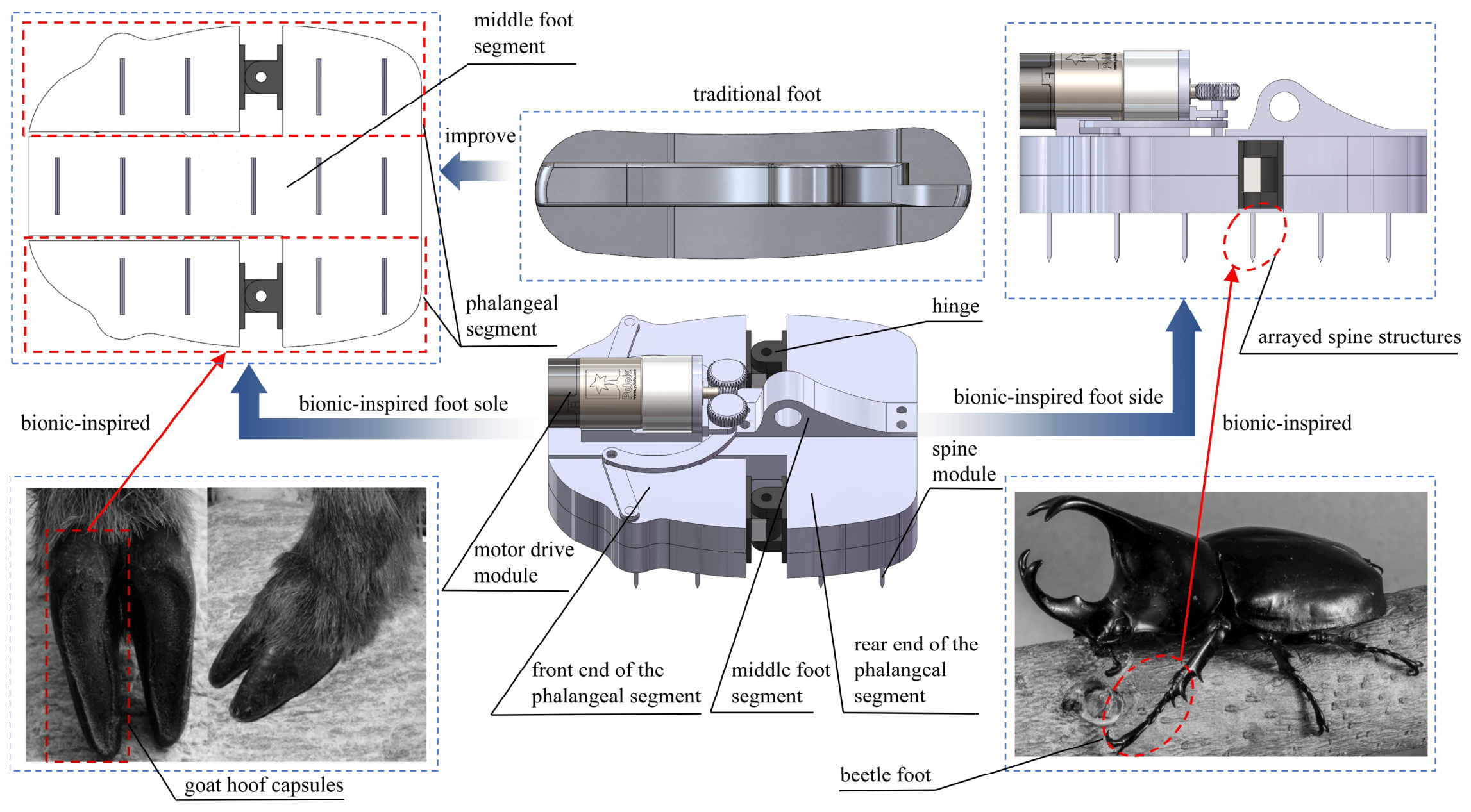
Goat feet possess excellent terrain adaptability. Their hoof lobes are digitated, and the hoof capsule presents an inverted V-shaped structure composed of hard keratin and soft toe pads, which significantly increases the contact area and enhances adhesion [35]. Inspired by the morphological characteristics and locomotion mechanisms of goat feet, this paper proposes a bionic-inspired foot structure for elongated basic foot bodies (e.g., the foot of the Cassie robot). The overall configuration is shown in Figure 1. The bionic-inspired foot is mainly composed of a middle foot segment, two lateral phalangeal segments, a detachable plantar spine module, and a motor drive module. Specifically, the middle foot segment and lateral phalangeal segments form the main load-bearing framework; the spine module can be flexibly configured according to terrain conditions; and the motor drive module can control the toe opening and closing angle and has the capability to dynamically adjust the ground contact state. This paper only carries out simulation under fixed opening angles. In the specific design, first, lateral phalangeal segments mimicking the contour of goat hoof capsules are added on both sides of the improved middle foot segment (as indicated by the rectangular box in the figure), expanding the lateral contact dimension to increase the ground contact area. Meanwhile, inspired by the digitated opening and closing characteristics of goat feet, an actively openable toe structure is designed, where the front ends of the lateral phalangeal segments are driven by a motor to rotate around hinges, further extending the contact range. To systematically evaluate the terrain trafficability of the foot, two core performance indicators, namely anti-sinkage performance and traction performance, are introduced, with their specific definitions and test methods elaborated in Section 2.3.2. Performance tests show that this initial prototype can effectively increase the ground contact area and reduce sinkage depth, but its traction performance remains insufficient. For this purpose, the hooked spine structure of a beetle foot-end is further introduced as marked by the circle in the figure. The penetration of spines into the ground surface improves interfacial shear force, enhances adhesion capacity and restrains slippage.

2.2. Contact Mechanics Model

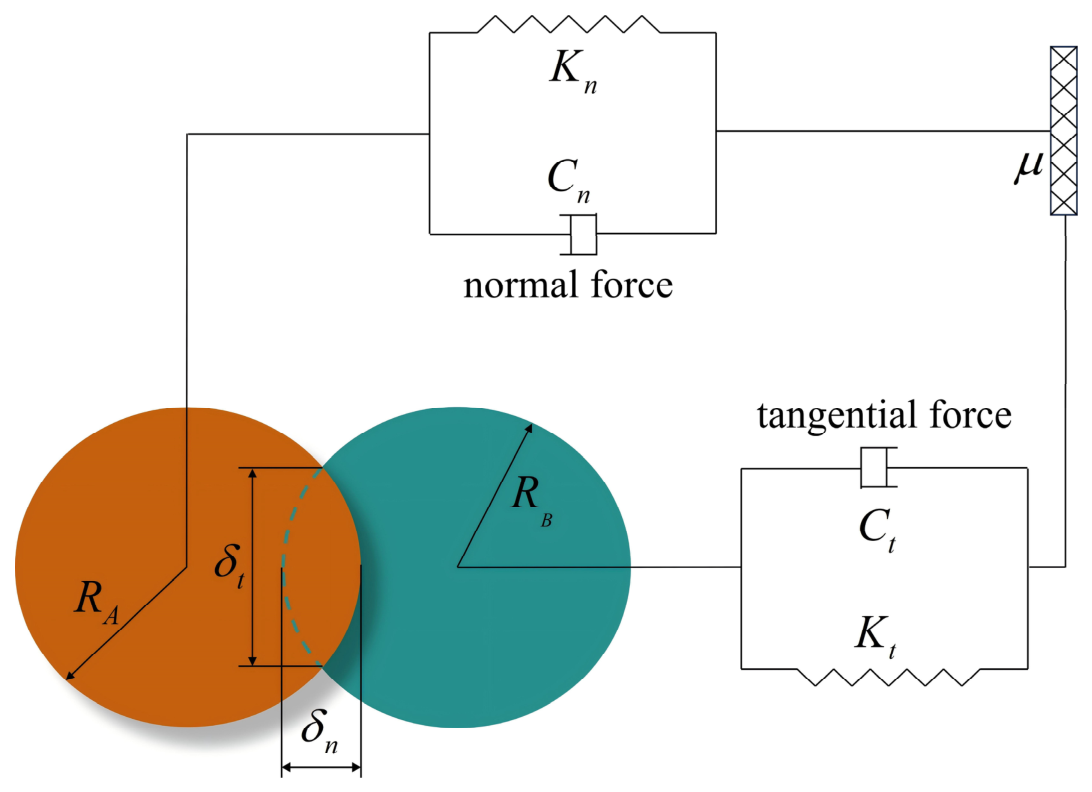
On the basis of completing the structural design of the bionic-inspired foot, it is necessary to establish a corresponding foot–ground contact mechanics model to accurately simulate its mechanical behavior in granular media. Given the mechanical properties of sand, including its unconsolidated structure, loose texture, and low cohesion, this paper selects a combination of the Hertz–Mindlin (no slip) model and the Standard Rolling Friction model to describe the interactions between particles as well as between particles and structural bodies. Figure 2 shows a schematic diagram of the basic principle of this contact mechanics model. In this model, the calculation of normal force is based on Hertz contact theory, while the solution of tangential force adopts Mindlin–Deresiewicz theory, with damping terms introduced for both forces. The Standard Rolling Friction model is used to calculate tangential friction force and rolling friction force, respectively. Since the same model is applied to both types of contact, this paper takes particle–particle contact as an example for analysis.
The normal force and tangential force between Particle A and Particle B can be further decomposed into normal elastic force F s n , normal damping force F d n , tangential elastic force F s t , and tangential damping force F d t . K n , K t , C n , C t , and μ are the normal spring stiffness coefficient, tangential spring stiffness coefficient, normal damping coefficient, tangential damping coefficient, and friction coefficient, respectively.
The normal elastic force F s n between particles can be expressed as [36]:
F s n = 4 3 E * R * δ n 3 2
where δ n is the normal overlap between particles, E * is the equivalent Young’s modulus, and R * is the equivalent radius, which are defined as follows:
1 E * = ( 1 υ A 2 ) E A + ( 1 υ B 2 ) E B
1 R * = 1 R A + 1 R B
where E A , E B , υ A , υ B , R A , and R B are the Young’s modulus, Poisson’s ratio, and radius of Particle A and Particle B, respectively.
The expression for the normal damping force F d n between particles is:
F d n = 2 5 6 β S n m * v n r e l
where m * is the equivalent mass, S n is the normal stiffness, v n r e l is the normal component of the relative velocity between particles, and β is the damping ratio, which are calculated as:
m * = ( 1 m A + 1 m B ) 1
S n = 2 E * R * δ n
β = ln e ln 2 e + π 2
where m A and m B are the masses of Particle A and Particle B, respectively, and e is the coefficient of restitution of particles.
The expression for the tangential elastic force F s t between particles is given by:
F s t = S t δ t
where S t is the tangential stiffness and δ t is the tangential overlap between particles, with S t defined as:
S t = 8 G * R * δ n
where G * is the equivalent shear modulus.
The expression for the tangential damping force F d t between particles is:
F d t = 2 5 6 β S t m * v t r e l
where v t rel is the tangential component of the relative velocity between particles.
For collisions between particles and the structural wall, the above formulas remain unchanged. However, the wall is assumed to have a radius of R w a l l = and a mass of m w a l l = , thus reducing the equivalent radius to R * = R p a r t i c l e and the equivalent mass to m * = m p a r t i c l e .
The tangential force is constrained by Coulomb friction f , and its expression is:
f = μ s F s n
where μ s is the coefficient of static friction.
The rolling friction between particles is calculated by applying a torque on the contact surface, with the expression:
τ i = μ r F s n R i ω i
where μ r is the coefficient of rolling friction, R i is the distance from the contact point to the center of mass, and ω i is the angular velocity vector of the particle at the contact point.

2.3. Experimental Design Based on Adams–EDEM Coupling Simulation

When Adams is used alone for multi-body dynamics simulation, the ground is often simplified as a rigid surface or a simple force field, which cannot accurately simulate the real mechanical behavior of the bionic-inspired foot in granular media. In contrast, although EDEM can finely simulate granular media when used independently, it is difficult to handle the motion and dynamic response of the multi-component system of the bionic-inspired foot. Through Adams–EDEM coupling simulation, the advantages of both pieces of software can be combined: Adams calculates the motion and mechanical state of the bionic-inspired foot and transmits the data to EDEM, while EDEM simulates the force exerted by the granular media on the foot and feeds it back to Adams, thus more realistically reflecting the dynamic behavior of the bionic-inspired foot on granular terrain. It should be noted that the software versions adopted in this study are EDEM 2022 and Adams 2020, respectively.

2.3.1. Coupling Principle

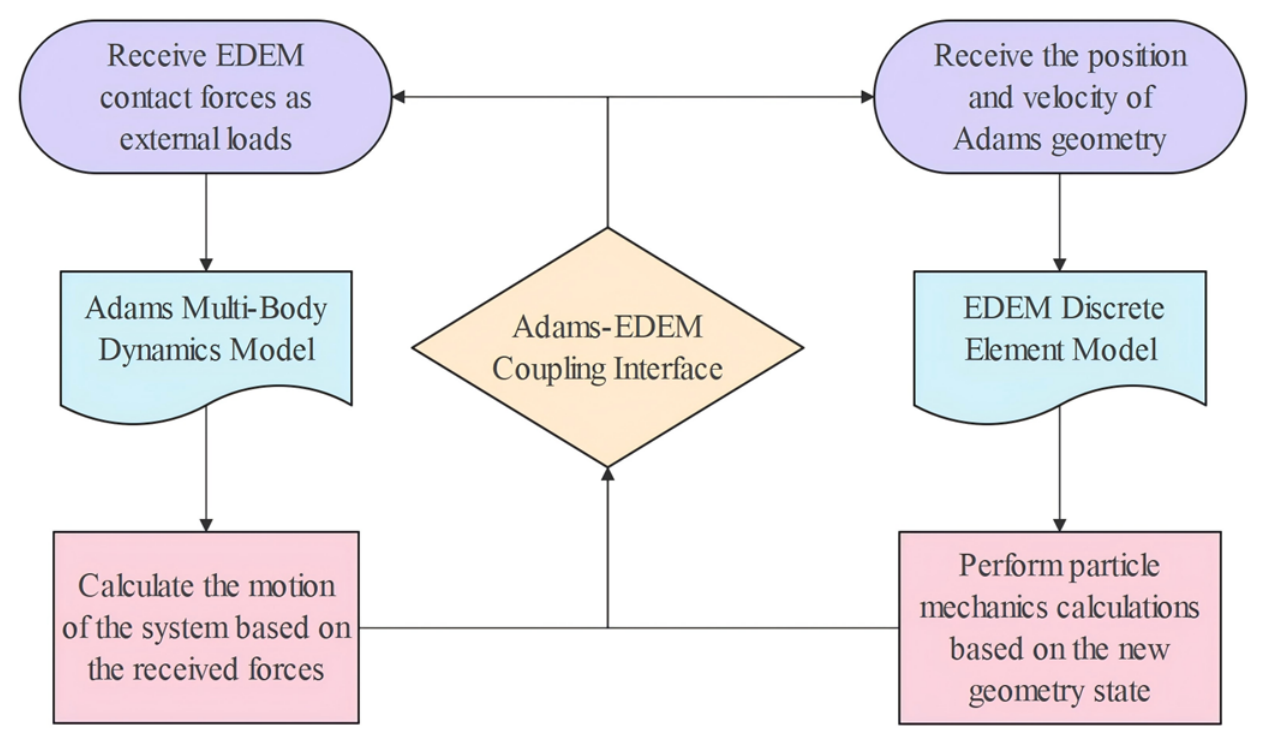
The core principle of coupling simulation lies in constructing a dynamic data closed-loop based on a force-displacement bidirectional transmission mechanism. This closed-loop performs synchronous iteration on a time-step basis: Adams transmits the motion state of each component in the multi-body dynamics model to EDEM through the coupling interface, which serves as the motion boundary condition for particle contact; EDEM then calculates the contact force of particles on the boundary in real time and feeds it back to Adams through the same interface, which acts as the external load of the dynamics model. In terms of time-step coordination, a master–slave synchronization strategy is adopted: Adams is set as the master solver, and EDEM as the slave solver. EDEM performs multiple sub-step iterations within each master step and outputs contact force data to the coupling interface once; Adams receives the contact force information from the coupling interface once per master step, thereby realizing bidirectional data exchange and coupled solution. The principle of coupling simulation is shown in Figure 3.

2.3.2. Boundary Conditions

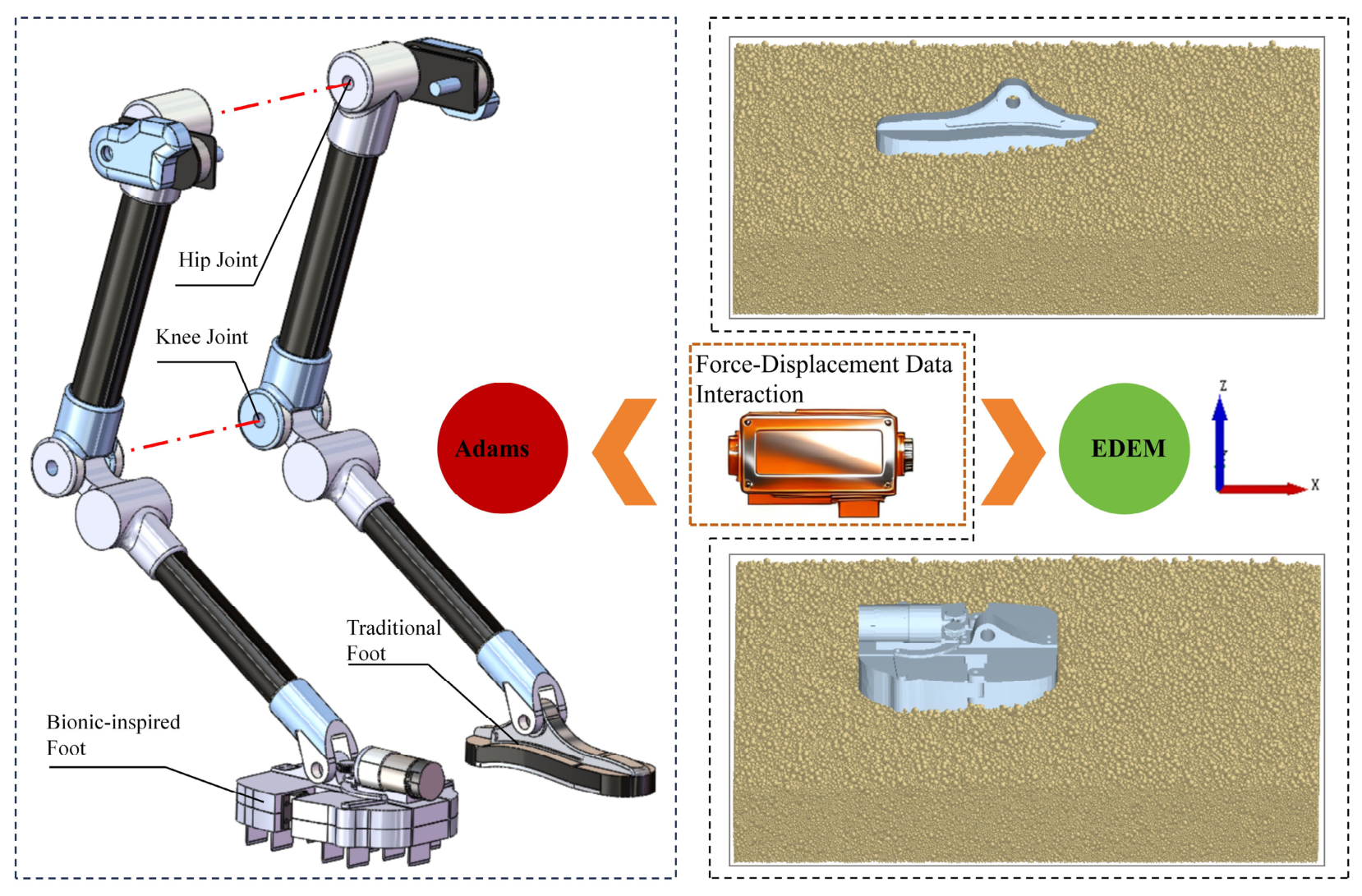
To systematically investigate the anti-sinkage and traction performance of the bionic-inspired foot, and to deeply analyze the influence mechanisms of physical spine characteristics (e.g., the presence or absence of spines), bionic-inspired foot opening angle, and structural differences between the bionic-inspired foot and traditional foot on the above performance, this study adopted the foot of the Cassie robot as the control sample of the traditional foot, and established a simulation test platform based on the coupling of Discrete Element Method (DEM) and Multi-Body Dynamics (MBD) (as shown in Figure 4). It should be noted that preformed fixed sand mass is adopted for foot–ground interaction simulation in this study to avoid the inherent randomness of discrete element simulation. The specific parameter settings and generation process of the sand model will be elaborated in detail in Section 3. In the anti-sinkage performance test, a vertical load was applied to the foot to simulate the body weight pressure borne by the robot during the single-leg support phase. The load range was set from 10 kg to 60 kg to cover the weight-bearing conditions under different working conditions. Meanwhile, to simulate the impact effect at the moment when the foot contacts the sand surface, an initial vertical velocity was assigned to the foot, which was set to 0.1 m/s (low-speed working condition) and 0.4 m/s (high-speed working condition), respectively. After the deformation of the sand surface reached a steady state, the maximum vertical displacement d of the foot sole after contacting the sand surface was recorded, which was used as the evaluation index for anti-sinkage performance.
In the traction performance test, the traction performance reflects the slip resistance capability of the foot–ground interface. To quantify the foot performance, the evaluation indexes are defined as follows: the horizontal traction force F x is the horizontal reaction force exerted by sand particles on the foot, which reflects the shear strength of the foot–ground interface; the vertical support force F z characterizes the embedding degree of the foot. This study is conducted in the XZ plane, where the X direction is the forward moving direction and the Z direction is the vertical direction, and the influence of the lateral Y direction is neglected. The XZ coordinate axes shown in Figure 4 mark the coordinate directions adopted in this study. To facilitate the calculation of the traction coefficient and unify the comparison criteria, the absolute values of F x and F z acting on the foot by sand particles are adopted in the subsequent analysis. The ratio of | F x | ( / ) | F z | was defined as the traction coefficient T, which represents the equivalent friction coefficient of the foot–ground interface. A higher T value indicates a stronger slip resistance capability. In the test, the foot is fixedly mounted at the end of the mechanical leg. The hip and knee joints are controlled to drive the foot to move along an elliptical trajectory to simulate the robot gait. The first half of the trajectory serves as the stance phase with foot–ground contact, and the second half serves as the swing phase without contact. Only the data obtained in the stance phase are used for analysis. Two working conditions are set, including the low-speed condition of 0.45 Hz and the high-speed condition of 1.12 Hz. The motion speed is regulated by adjusting the step frequency while keeping the trajectory unchanged. After the mechanical leg drives the foot to complete the interaction with the sand surface, the horizontal traction force F x and vertical support force F z exerted by sand particles on the foot in the motion plane are extracted, and the traction coefficient is calculated as the basis for performance evaluation.

2.4. Solver Settings and Time-Step Independence Verification

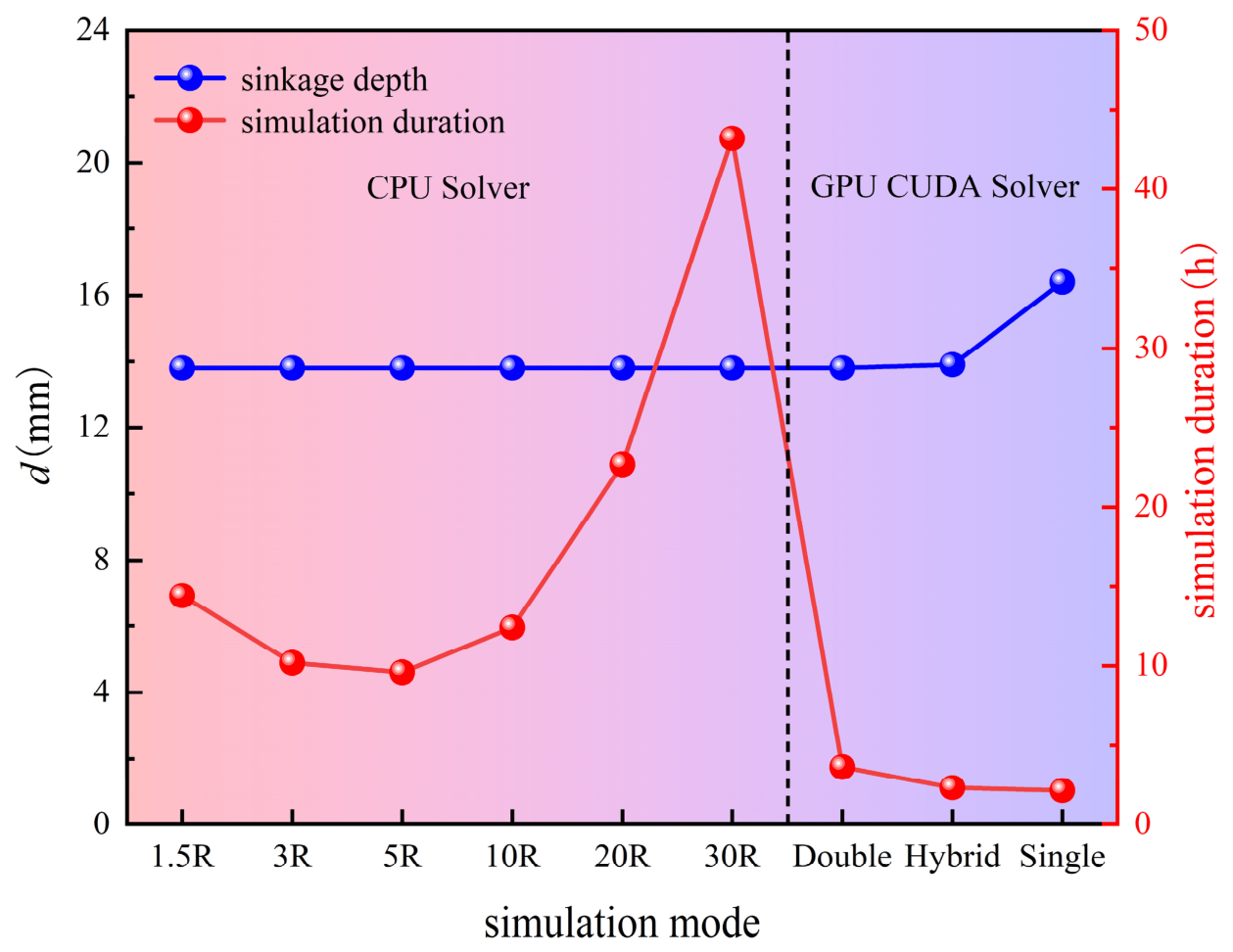
Figure 5 presents the influence of different solvers on sinkage depth and simulation duration, where two solution modes, namely the CPU Solver and GPU CUDA Solver, are compared in this paper. As can be seen from Figure 5, when the CPU Solver is used, the variation in mesh size (based on the minimum particle radius R) has no significant effect on the simulation results of sinkage depth, but it exerts a notable impact on computational efficiency. Among the tested mesh sizes, the computational efficiency is optimal when the mesh size is 5 R, corresponding to a sinkage depth of 13.8 mm and a simulation duration of 9.58 h. In contrast, the computational efficiency of the GPU CUDA Solver is significantly superior to that of the CPU Solver. The simulation results obtained under the Double and Hybrid precision settings of the GPU CUDA Solver are basically consistent with those of the CPU Solver, with sinkage depths of 13.8 mm and 13.9 mm, respectively. The Hybrid precision setting ensures the accuracy of results while consuming less time, with a simulation duration of only 2.34 h. Therefore, the Hybrid precision of the GPU CUDA Solver is selected in this paper for solution, to balance efficiency and accuracy.
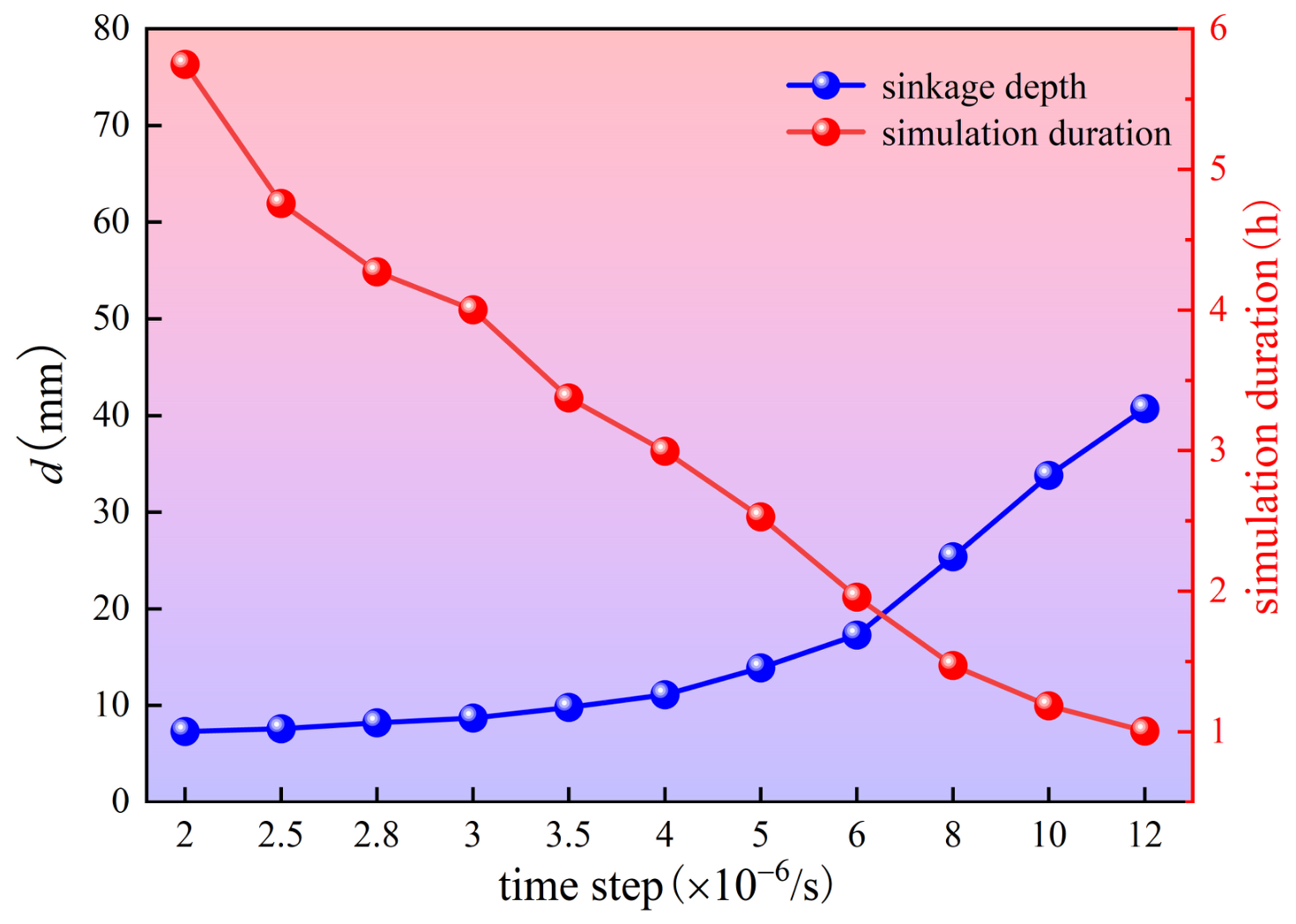
The core of the EDEM simulation time step is set as a proportion of the Rayleigh time step, and the software recommends a default value of 20% of the Rayleigh time step to balance accuracy and efficiency. Through calculation, 20% of the Rayleigh time step in the simulations involved in this paper is 4.17 × 10⁻⁶ s. To verify the independence of simulation results from the time step, different time steps in the range of 2 × 10⁻⁶ s to 12 × 10−6 s are selected for comparative analysis, with sinkage depth as the evaluation index. The results are shown in Figure 6. It can be observed that with the decrease in the time step, the variation in sinkage depth gradually tends to be stable. Considering both simulation efficiency and result reliability, 2.8 × 10⁻⁶ s is finally determined as the time step for subsequent simulations.

3. Calibration of Sand Discrete Element Method (DEM) Model Parameters

To accurately evaluate the anti-sinkage and traction performance of the bionic-inspired foot structure, it is necessary to construct a high-precision sand Discrete Element Method (DEM) numerical simulation model. The reliability of this model depends critically on the accuracy of contact parameters between particles as well as between particles and the foot. For this reason, this study adopted a strategy combining physical experiments and simulation inversion to systematically carry out the calibration contact parameters.

3.1. Calibration of Physical Parameters for Sand Particle Interactions

The simulation parameter system in EDEM is mainly divided into two categories: intrinsic parameters and contact parameters. Among them, the intrinsic parameters of sand particles (Poisson’s ratio, Young’s modulus, etc.) can be obtained through experiments. However, due to the tiny particle size of sand particles, it is difficult to obtain their inter-particle contact parameters (coefficient of restitution, coefficient of static friction, and coefficient of rolling friction) via experimental methods, thus requiring calibration of these parameters. Table 1 lists the intrinsic parameters of sand particles and ABS material adopted for the bionic-inspired foot.

3.1.1. Sand Particle Size Distribution

To determine the particle size distribution characteristics of standard sand, a sample was taken from the standard sand for sieve analysis test, with the total mass of the sample being 1230 g. Standard sieves were used to classify the sand sample, and an electronic balance was employed to measure the mass of sand particles in each particle size interval, so as to obtain the particle size distribution of sand and the corresponding mass fraction. The mass fraction ( ω i ) is defined as the ratio of the mass of sand particles in a certain particle size interval to the total mass of the sand sample, and its calculation formula is as follows:
ω i = m i m t o t a l · 100 %
where ω i is the mass fraction of sand particles in the i-th particle size interval (%); m i is the mass of sand particles in the i-th particle size interval (g); and m t o t a l is the total mass of the sand sample (g).
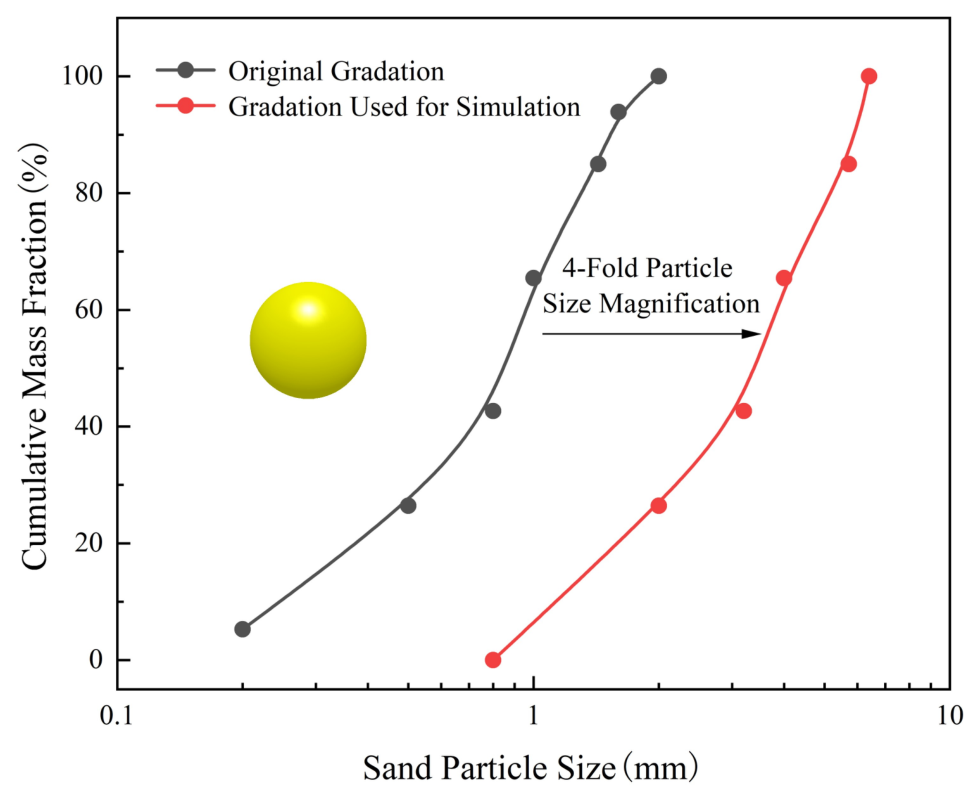
The test results are shown in Figure 7. The cumulative mass fractions of sand particles with particle sizes not greater than 0.2 mm, 0.5 mm, 1 mm, 1.6 mm, and 2 mm are 5.28%, 26.42%, 65.45%, 93.9%, and 100%, respectively. In numerical simulations based on the Discrete Element Method (DEM), if modeling is performed according to the actual particle size and real particle morphology of sand particles, the total number of sand particles will reach the order of millions. Restricted by computing power (GPU, CPU, and memory), such a large-scale calculation cannot be achieved. Therefore, to balance simulation computational efficiency and modeling accuracy, this paper adopted a spherical particle model as the basis, and simulated the characteristics of irregular sand particles by increasing the coefficient of rolling friction between spherical particles. Meanwhile, the sand particle size was magnified by 4 times. Tan et al. [37] have confirmed that when the particle size magnification factor does not exceed 4, it has a negligible effect on the mechanical properties of sand particles. In addition, extreme gradation particles were removed from the model, because extreme particle sizes (excessively fine or coarse particles) account for a low proportion, exerting little influence on the overall mechanical properties but increasing the complexity and computational cost of numerical simulations.

3.1.2. Calibration of Physical Parameters

The repose angle is a key macroscopic parameter that characterizes the frictional properties of granular materials. Repose angle testing is also a common parameter calibration method in the numerical simulation of granular systems [38]. In this study, physical repose angle tests are carried out with standard sand, and discrete element simulation is adopted for inverse calibration of model parameters. When the simulated repose angle is consistent with the physical test results, it indicates that the model parameters conform to the actual mechanical properties of standard sand.
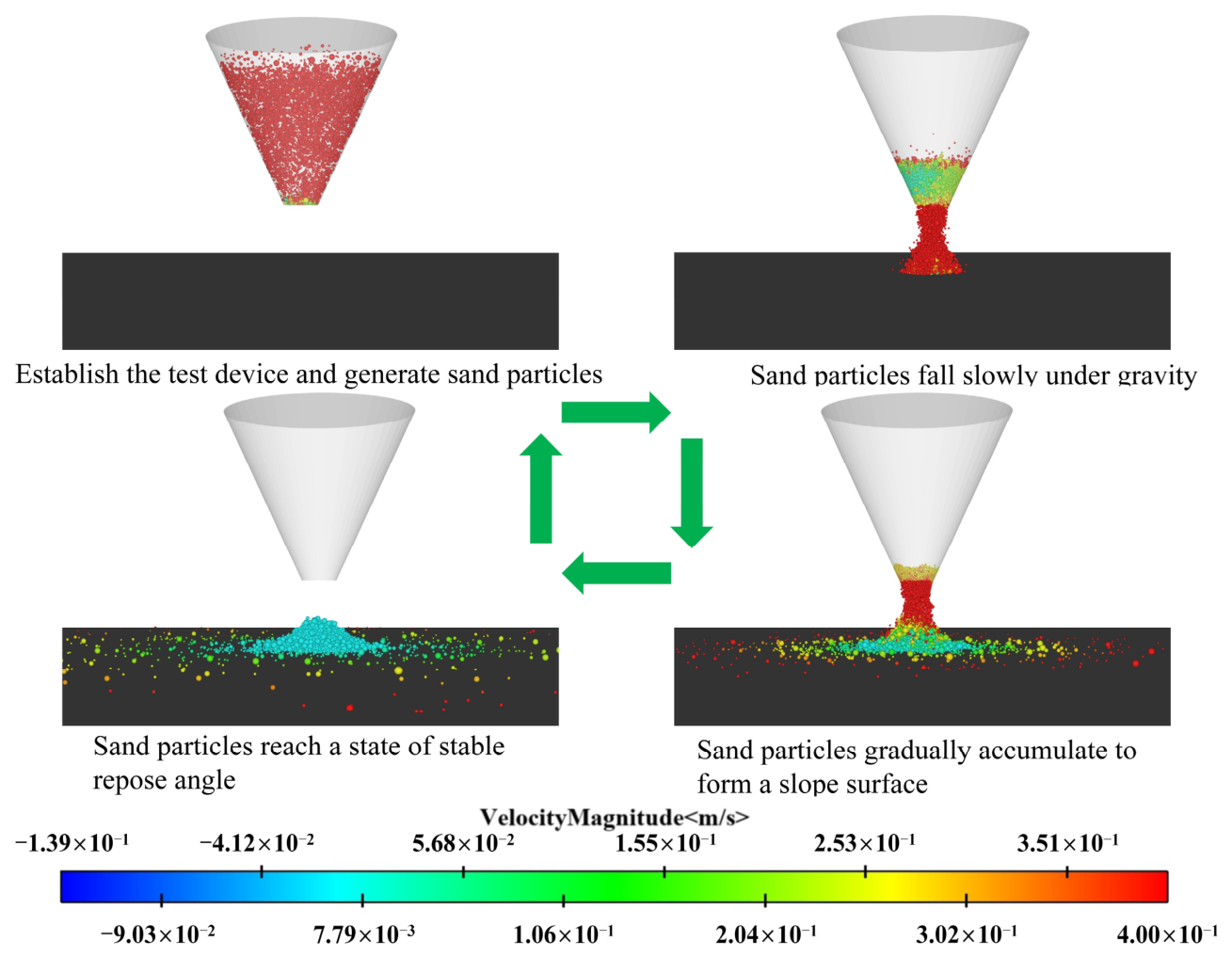
At present, the commonly used methods for repose angle testing include the funnel method, side plate method, cylinder lifting method, etc. The funnel method was adopted for the test in this paper, and the specific procedure is shown in Figure 8.
First, a funnel model was constructed in EDEM, and a horizontal ground was set below it as the accumulation reference surface. A particle factory was created inside the funnel to generate the particle model. Then, the particles were allowed to perform free-fall motion under gravity and accumulate naturally on the horizontal ground. After the particles stabilized and came to rest, the formed repose angle was measured. The reference value ranges of contact parameters between sand particles were obtained using the GEMM module in EDEM, where the value range of the coefficient of restitution (denoted as symbol A hereinafter) was 0.1–0.8, the value range of the coefficient of rolling friction (denoted as symbol B hereinafter) was 0.1–0.4, and the value range of the coefficient of static friction (denoted as symbol C hereinafter) was 0.2–0.9. Taking the repose angle as the evaluation index, the Box–Behnken central composite experimental design method was used to calibrate the contact parameters, and the measured value of the standard sand repose angle was taken as the reference to determine the optimal combination of contact parameters. Table 2 shows the design and results of the simulation test scheme.
The Design-Expert 8.0.6 software was used for systematic analysis of the repose angle test results. Through data fitting and significance testing, a quadratic polynomial regression model describing the relationship between the repose angle and the test variables was obtained, and the specific regression equation is as follows:
θ = 28.24 + 28.86 A + 116.45 B + 59.96 C + 11.86 A B 2.27 A C + 126 B C 35.33 A 2 175.56 B 2 50.08 C 2
Analysis of Variance (ANOVA) shows that the p-value of the regression model is less than 0.0001, which proves that the model can highly significantly reflect the correlation between independent and dependent variables. The p-value of the lack-of-fit term is greater than 0.05, indicating that the lack-of-fit of the model is not significant and the regression model has a high fitting degree. The influence differences among the test variables and interaction terms are significant; among them, the p-values of B, C, and BC are all less than 0.0001, while the p-value of A is greater than 0.05, which indicates that the coefficient of rolling friction and coefficient of static friction have extremely significant effects on the repose angle, whereas the coefficient of restitution has no significant effect. In addition, the coefficient of determination R2 of the regression model is 0.9988, and the adjusted coefficient of determination AdjR2 is 0.9974; both are close to 1, which further confirms that the regression model has high reliability.
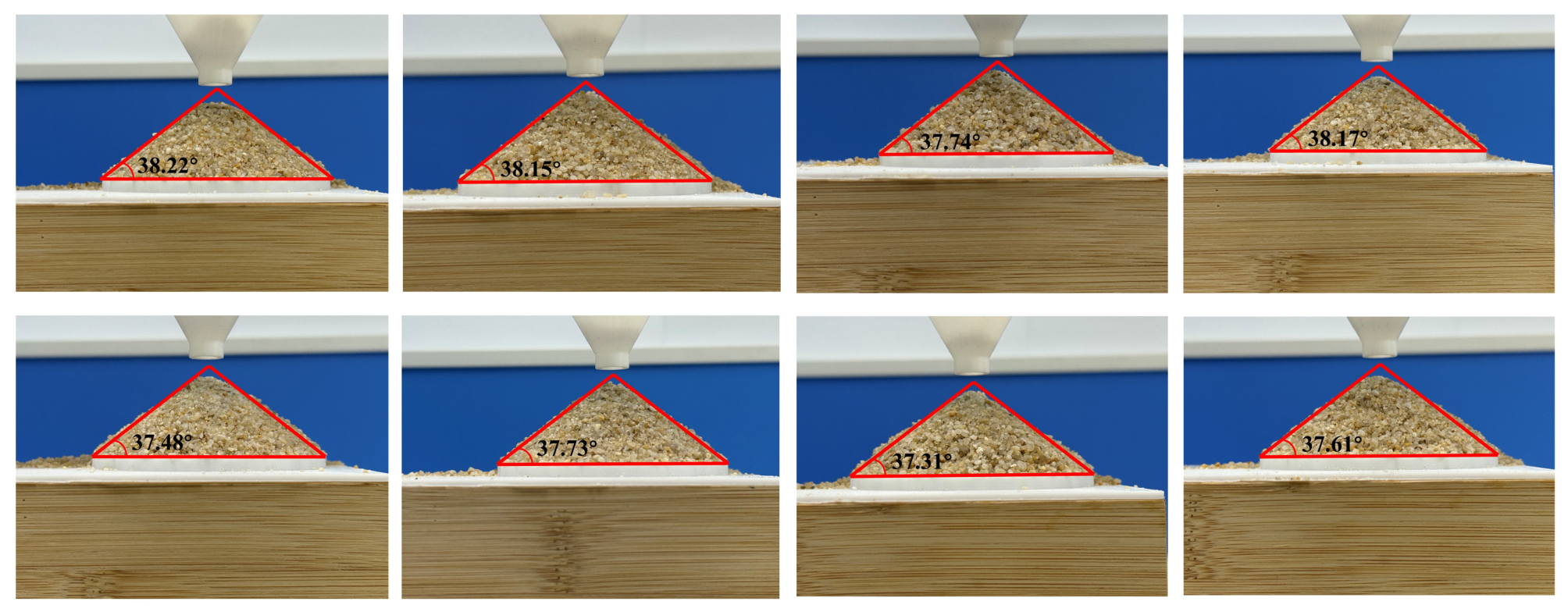
An appropriate amount of standard sand was weighed randomly and slowly poured into the funnel device. After the sand particles accumulated naturally and formed a stable cone, the repose angle was measured (as shown in Figure 9). To ensure data reliability, the above test operation was repeated eight times, and the arithmetic mean was calculated. The actual repose angle of the standard sand was finally determined to be 37.80°. By substituting this value into the above regression equation, a set of optimal parameters was obtained: A = 0.54, B = 0.34, C = 0.52. Based on this parameter set, the repose angle simulation test was completed in EDEM, and the simulated repose angle was measured to be 38.25°, with a relative error of 1.19% compared with the standard sand repose angle. The results show that this set of contact parameters can make the sand simulation model highly consistent with the characteristics of standard sand, accurately reflect the contact force and motion law between sand particles, and lay a foundation for the dynamic modeling of foot-sand interaction.

3.2. Calibration of Physical Parameters at the Interface Between Sand Particles and ABS Material

The physical parameters at the interface between sand particles and ABS material are the core for accurately simulating their interaction, which directly determines the reliability of simulation models such as the Discrete Element Method (DEM). To obtain practical physical parameters, a method combining physical experiments and numerical simulation tests was adopted. With the results of physical experiments as the reference target, inverse calibration of physical parameters was carried out based on numerical analysis, so as to ensure that these parameters can truly reflect the mechanical properties at the interface between sand particles and ABS material.

3.2.1. Calibration of Coefficient of Restitution

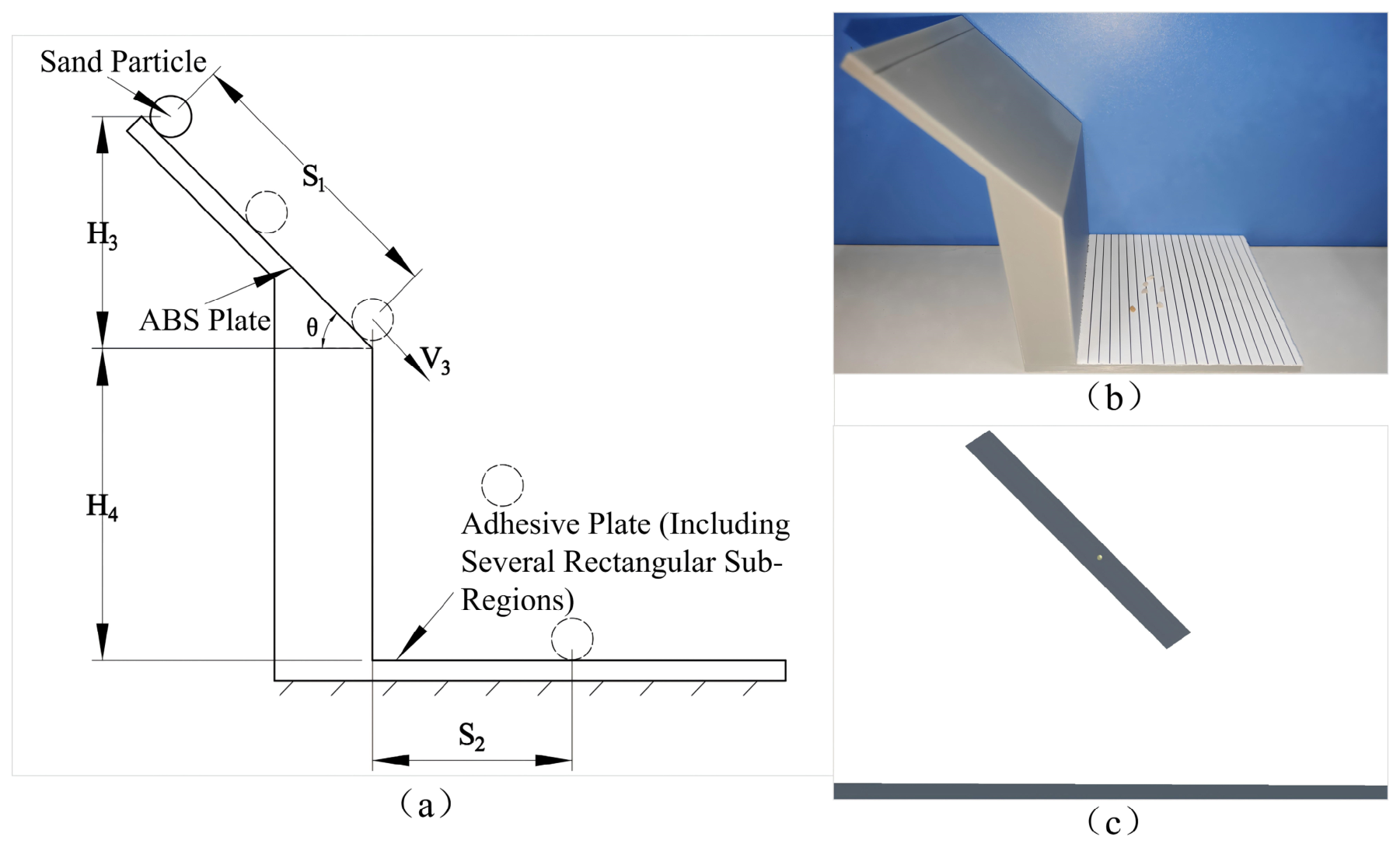
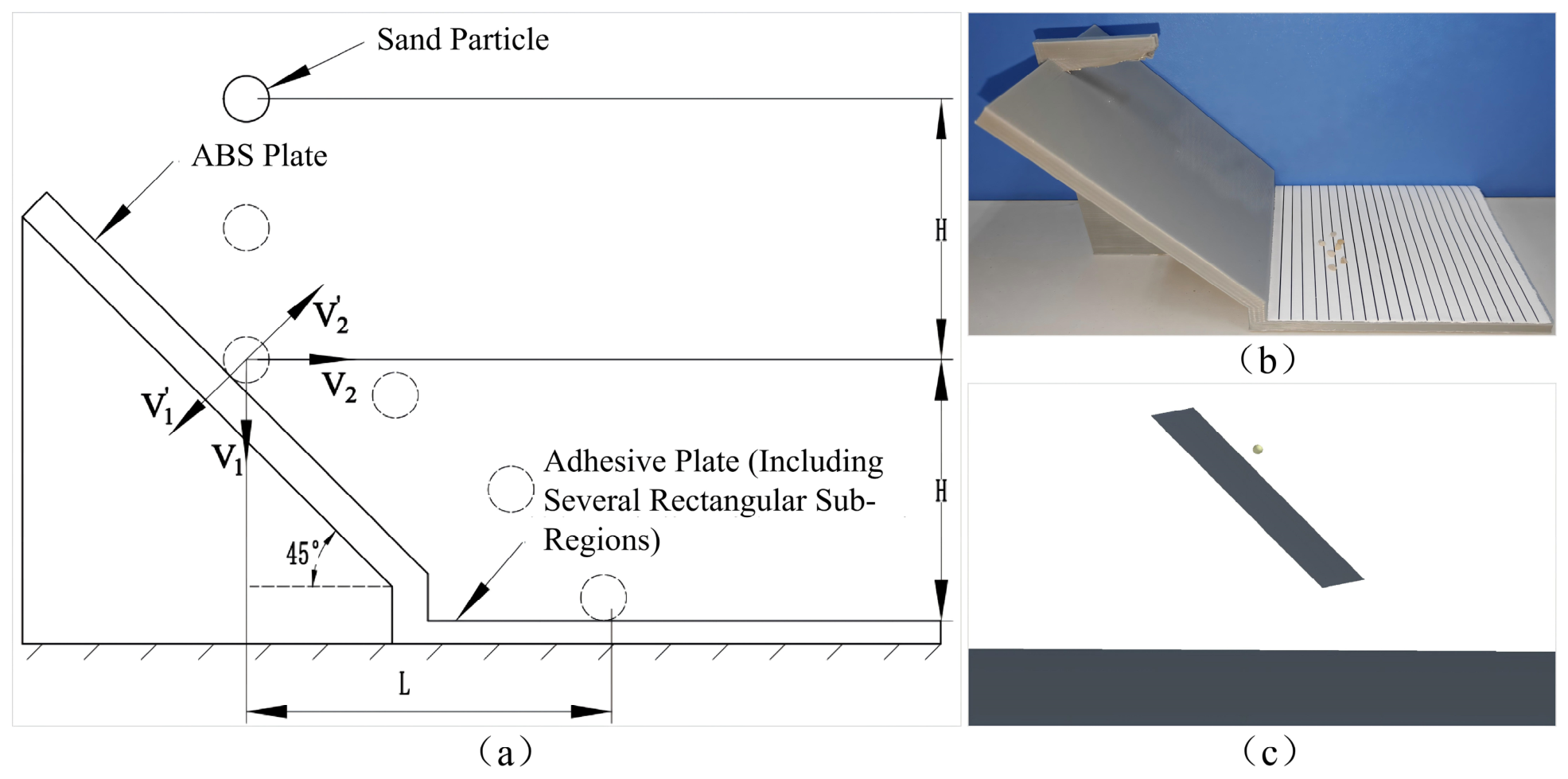
At present, when researchers measure the coefficient of restitution (denoted as symbol e), they often convert the ratio of velocities before and after collision into the ratio of heights, and then capture relevant data by high-speed cameras [39]. However, due to the tiny particle size of sand particles, it is difficult to accurately capture the height changes before and after collision, and the cost of the equipment used is relatively high. In this paper, the coefficient of restitution was calibrated by the following method, and its principle, physical test device and numerical simulation model are shown in Figure 10. Sand particles were released from rest at a height H directly above an ABS plate with an inclination angle of 45°, performing vertical free-fall motion, and collided with the ABS plate after time T1. Before collision, the approach velocity of sand particles was V1; after collision, their horizontal velocity was V2, and the vertical velocity was approximately 0. Then, the time taken for sand particles to move from the collision point to the landing point on the adhesive plate was T2, the vertical distance from the collision point to the horizontal ground was H, the horizontal distance from the landing point on the adhesive plate to the collision point was L, and the gravitational acceleration was g. According to the basic principles of kinematics:
T 1 = T 2 = 2 H g
V 1 = g T 1 = 2 g H
V 2 = L T 2 = L 2 H g
e = V 2 V 1 = V 2 sin 45 ° V 1 sin 45 ° = L 2 H
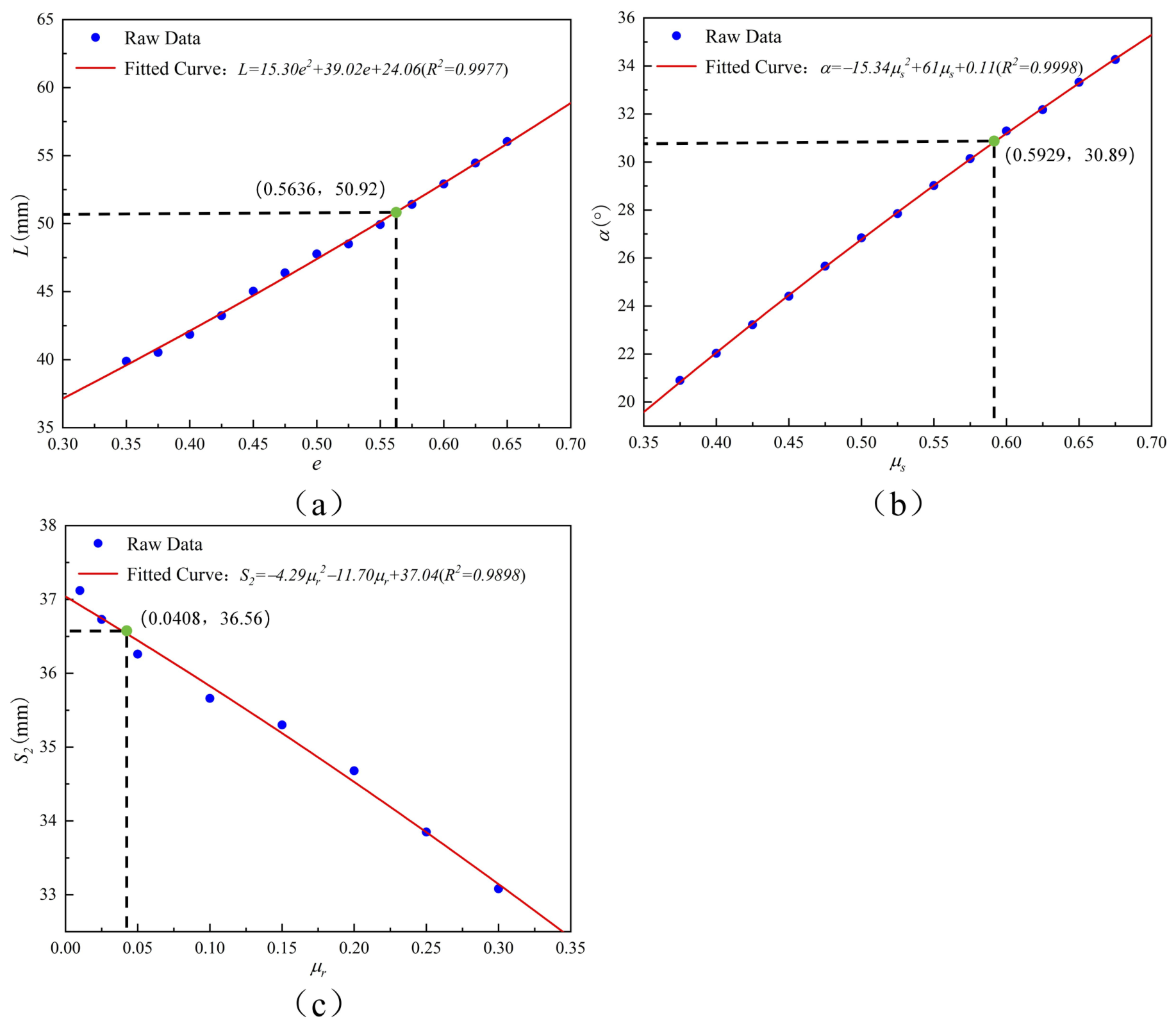
To improve the measurement accuracy of L and avoid reading errors caused by the small size of sand particles, the probability distribution analysis method was introduced in this study. The horizontal distribution area of sand particle landing points on the adhesive plate was divided into several rectangular sub-regions with a width of 4 mm along the measurement direction. By counting the frequency of sand particles falling into each rectangular sub-region in the test, the distribution probability of sand particles in each sub-region was calculated. Subsequently, the interval midpoint value of each rectangular sub-region was combined with the distribution probability of the corresponding sub-region for weighted calculation to obtain the statistical mean value of L, so as to reduce the influence of single measurement error on the results. A total of 75 standard sand particles were randomly selected from the sand sample to repeat the above physical test, and the mean value of L was obtained as 50.92 mm. A simulation model with the same conditions as the physical test was constructed in EDEM to numerically simulate the collision process between sand particles and the ABS plate, and the corresponding relationship between e and L was obtained, with the results shown in Table 3.
Quadratic polynomial fitting was performed on the data in Table 3 (as shown in Figure 13a), and the quadratic regression equation of L with respect to e was obtained as follows:
L = 15.30 e 2 + 39.02 e + 24.06 R 2 = 0.9977
The value of L = 50.92 measured in the physical test was substituted into the above equation, and the calculated value of e was 0.5636. This value of e was input into the numerical simulation model for verification, and the obtained L value was 50 mm, with a relative error of 1.81% compared with the physical test value. Therefore, in the subsequent simulation model, the coefficient of restitution at the interface between sand particles and ABS material was set to this value.

3.2.2. Calibration of Coefficient of Static Friction

In this paper, the inclined plane sliding method was adopted to measure the coefficient of static friction at the contact surface, denoted as symbol μ s , and its formula derivation is as follows:
μ s = f s max F n = m g sin α m g cos α = tan α
where f s max is the maximum static friction force, F n is the normal force, m is the mass of the sand particle to be measured, and α is the static friction angle.
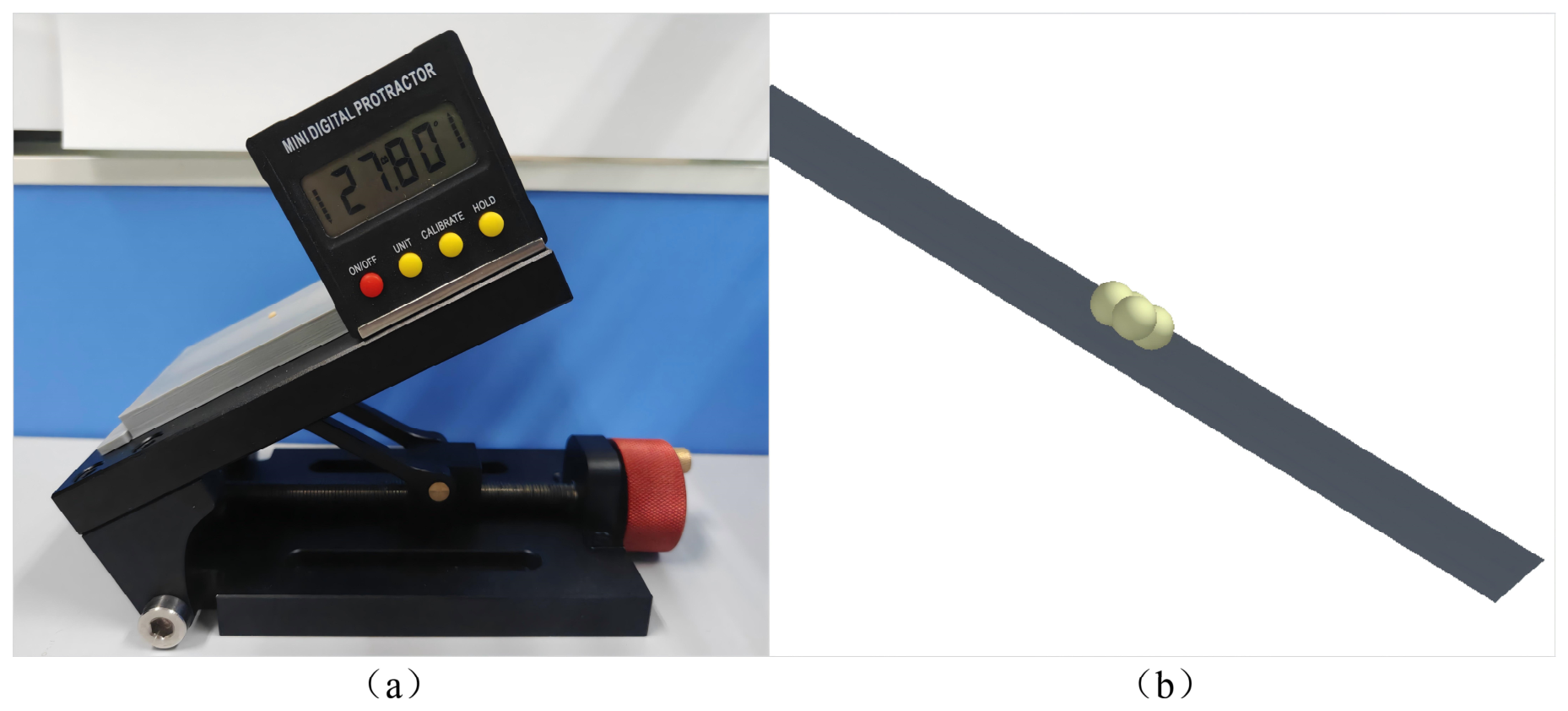
The physical test device and numerical simulation model for the calibration of coefficient of static friction are shown in Figure 11. Before the test, the adjustable inclination platform was adjusted to the horizontal position, the ABS plate was fixed on the platform surface, then the electronic digital inclinometer was attached to the platform by magnetic adsorption, and its reading was zeroed. During the test, the sand particle to be measured was placed on the ABS plate, and the platform inclination adjustment knob was rotated slowly to gradually increase the inclination angle of the platform. When the sand particle started to slide, the reading of the electronic digital inclinometer was recorded. A total of 75 standard sand particles were randomly selected for the test, and the average value was obtained through multiple tests, with the static friction angle α determined as 30.89°. A simulation model with the same conditions as the physical test was constructed in EDEM to numerically simulate the relative motion state of the contact surface between sand particles and the ABS plate, and the corresponding relationship between μ s and α was obtained, with the specific simulation results shown in Table 4.
Quadratic polynomial fitting was used to process the data in Table 4 (as shown in Figure 13b), and the quadratic regression equation of μ s with respect to α was obtained as follows:
α = 15.34 μ s 2 + 61 μ s + 0.11 R 2 = 0.9998
The measured value of α = 30.89 from the test was substituted into the above equation, and the calculated value of μ s was 0.5929. This value of μ s was input into the simulation model for verification, and the simulated value of α was 31.07°, with a relative error of 0.58% compared with the physical test value. Therefore, in the subsequent simulation model, the coefficient of static friction at the interface between sand particles and ABS material was set to this value.

3.2.3. Calibration of Coefficient of Rolling Friction

The coefficient of rolling friction, denoted as symbol μ r , is a physical quantity characterizing the strength of resistance experienced by an object during rolling. Li et al. [40] proposed the inclined plane rolling method to measure the coefficient of rolling friction, which specifically involves allowing sand particles to roll from rest on an inclined plane until they enter a horizontal plane and stop. Then, the expression is derived based on the law of conservation of energy to further determine the coefficient of rolling friction. However, this scheme has a limitation: sand particles tend to bounce when transitioning from the inclined plane to the horizontal plane, resulting in measurement errors. To address this issue, this study modified the method by allowing sand particles to perform oblique projectile motion after rolling off the inclined plane and land on an adhesive plate, thereby avoiding the aforementioned errors. The modified calibration principle, physical test device, and numerical simulation model are shown in Figure 12. The specific improvement method is as follows:
A sand particle with mass m was placed on an inclined plane with an inclination angle of θ , length of S1, and height of H3, and was allowed to roll along the inclined plane with an initial velocity of 0. When the sand particle detached from the inclined plane, its instantaneous velocity was V3. After detaching from the inclined plane, the sand particle performed oblique projectile motion, landed on the adhesive plate after time T3, and generated a horizontal displacement of S2 and a vertical displacement of H4 during this process. According to the law of conservation of energy:
m g H 3 μ r m g S 1 cos θ = 1 2 m V 3 2
S 2 = Τ 3 V 3 cos θ
H 4 = Τ 3 V 3 sin θ + 1 2 g T 3 2
Combining the above formulas, the following can be obtained:
μ r = H 3 S 2 2 ( H 4 S 2 tan θ ) 4 S 1 cos 3 θ
To avoid reading errors in measuring the horizontal displacement S2, the probability distribution analysis method described above was adopted. A total of 75 standard sand particles were randomly selected from the sand sample to repeat the above test, and the statistical mean value of S2 was obtained as 36.56 mm. A simulation model with the same conditions as the physical test was constructed in EDEM to numerically simulate the rolling process of sand particles on the ABS plate, and the corresponding relationship between μ r and S2 was obtained, with the results shown in Table 5.
Data in Table 5 were processed and analyzed via quadratic polynomial fitting (see Figure 13c), yielding the quadratic regression equation of S2 as a function of μ r below:
S 2 = 4.29 μ r 2 11.70 μ r + 37.04 R 2 = 0.9898
The measured value of S2 = 36.56 from the test was substituted into the above equation, and the calculated value of μ r was 0.0408. This value of μ r was input into the simulation model for verification, and the simulated value of S2 was 36.29 mm, with a relative error of 0.74% compared with the physical test value. Therefore, in the subsequent simulation model, the coefficient of rolling friction at the interface between sand particles and ABS material was set to this value.

3.3. Simulation Generation of Sand Body

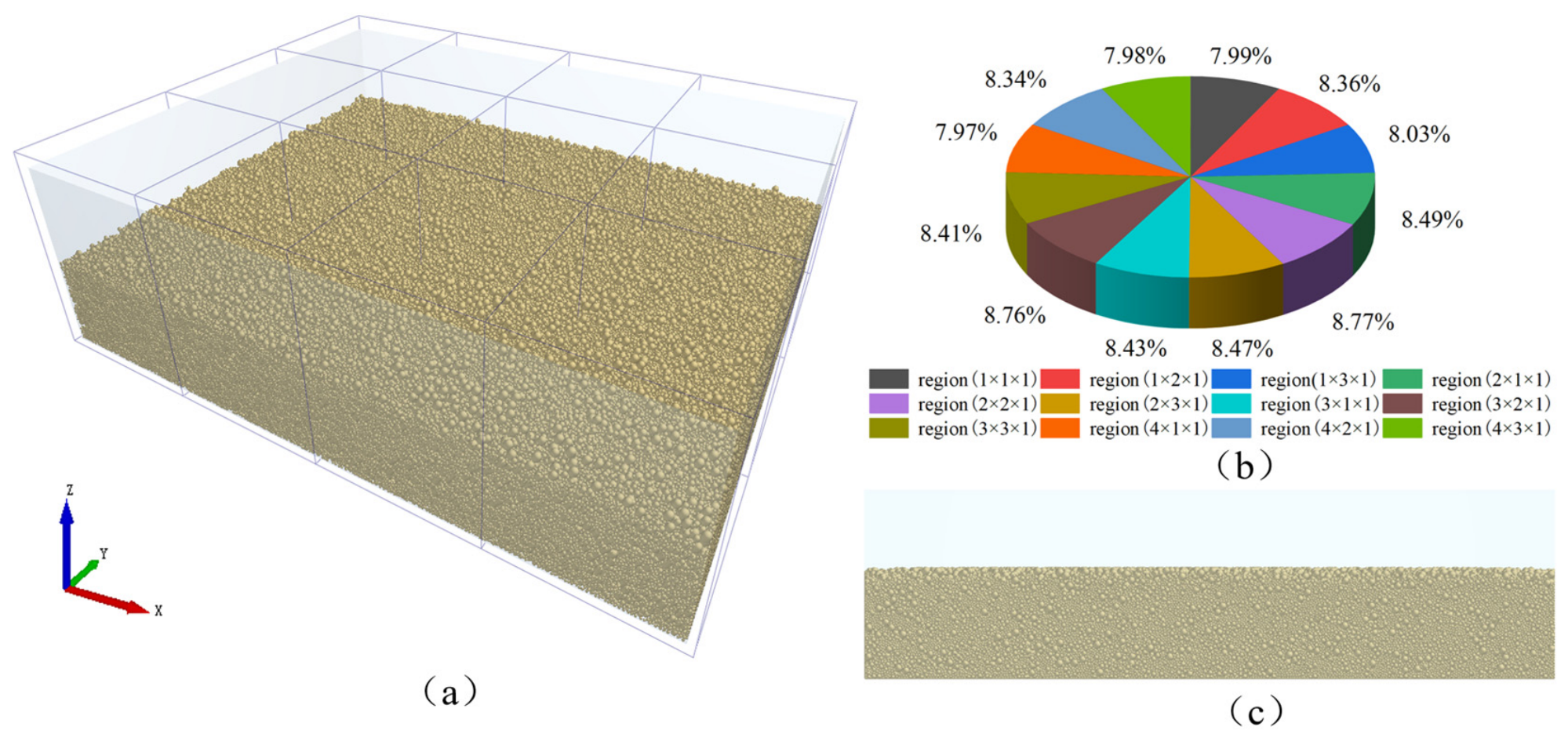
After completing the above physical parameter calibration, the digital generation of the sand body model was realized via EDEM. First, a sand particle bearing container (530 mm × 420 mm × 160 mm) was constructed, with rigid walls at the bottom and surrounding sides, and a free boundary at the top. The wall material was set to ABS to match the calibrated contact parameters. Then, based on the sand particle gradation curve mentioned above, a spherical particle model was adopted, and 933,059 sand particles were initially generated in static mode via the particle factory. The generation state of the sand body is shown in Figure 14a. To evaluate the uniformity of the generated sand body, the container was spatially divided into 4 × 3 × 1 sub-regions, and the mass fraction of each sub-region was counted. The results show that the deviation of the mass fraction of each sub-region relative to the average mass fraction (8.33%) is about 5%, indicating good uniformity of the sand body, as shown in Figure 14b. Finally, a scraper was used to level the surface of the sand body to ensure that its surface flatness meets the requirements of subsequent simulation analysis. The surface morphology of the treated sand body is shown in Figure 14c.

4. Results and Analysis

4.1. Effect of Spine Structure

Preliminary studies have shown that the spine structure is a key factor in improving the terrain trafficability (anti-sinkage and anti-slip performance) of the bionic-inspired foot. Focusing on this point, this section systematically analyzes the influence mechanism of the spine structure on the ground adaptability of the bionic-inspired foot through comparative experiments on anti-sinkage performance and dynamic traction performance between bionic-inspired feet with and without spine structures.

4.1.1. Anti-Sinkage Performance

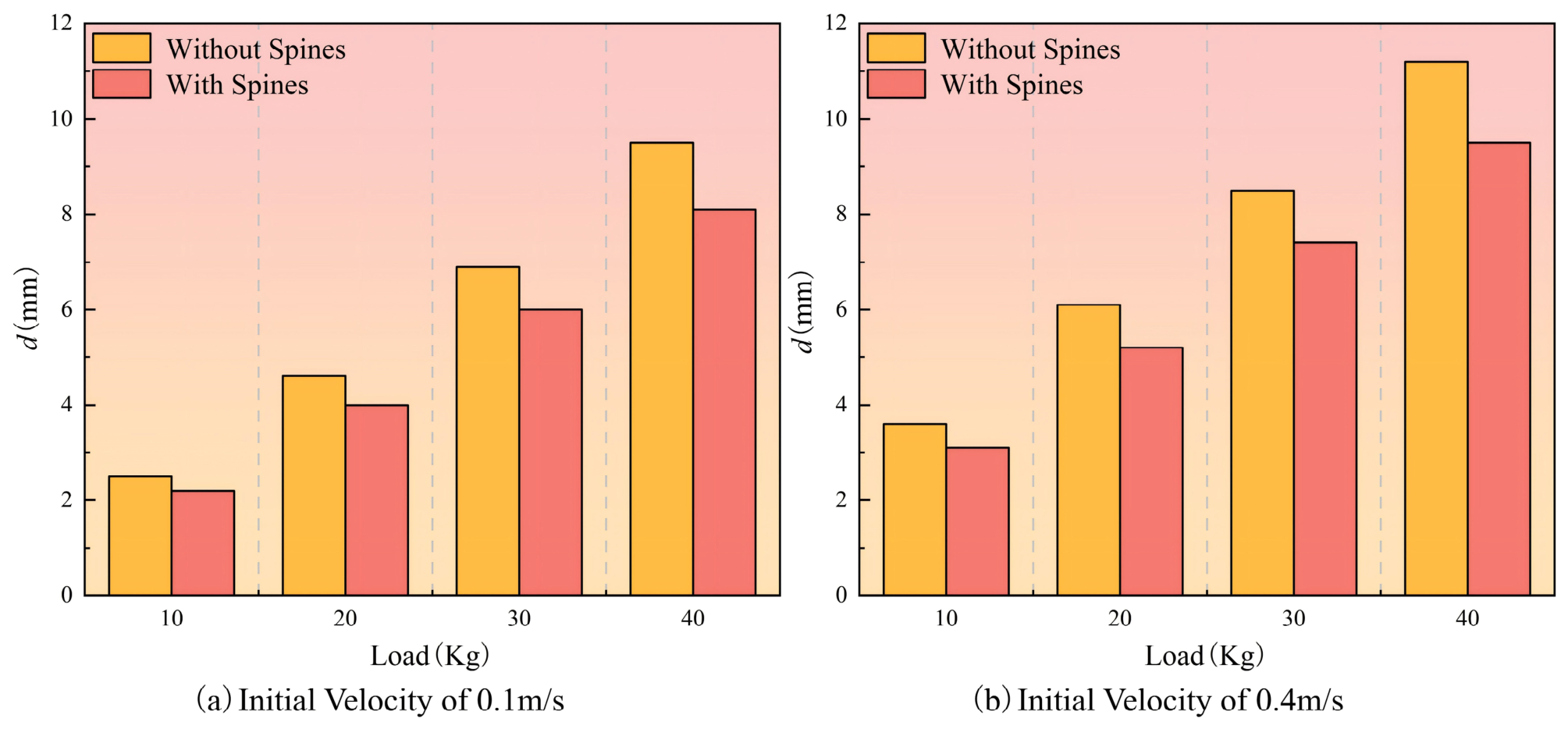
Figure 15 shows the variation in sinkage depth with load for bionic-inspired feet with and without spine structures under different working conditions, where Figure 15a corresponds to the working condition where the foot impacts the sand surface at an initial velocity of 0.1 m/s, and Figure 15b corresponds to the working condition with an initial impact velocity of 0.4 m/s. As can be seen from the figures, with the increase in load, the sinkage depth of both structures increases gradually under each working condition. Under the working condition corresponding to Figure 15a: at a load of 10 kg, the sinkage depth of the foot with spine structure is 12% lower than that without spine structure; at a load of 40 kg, the reduction amplitude increases to 14.74%, and the difference between the two shows a linear growth trend with increasing load. Under the working condition corresponding to Figure 15b, the anti-sinkage advantage of the spine structure is more prominent, with a sinkage depth reduction of 13.89% at a load of 10 kg. At a load of 40 kg, the sinkage depth of the foot without the spine structure is 11.2 mm, while that of the foot with the spine structure is only 9.5 mm, representing a reduction of 15.18%. In summary, although the ground contact areas of the two foot structures are basically the same, the spine structure can still effectively improve the anti-sinkage performance of the bionic-inspired foot.
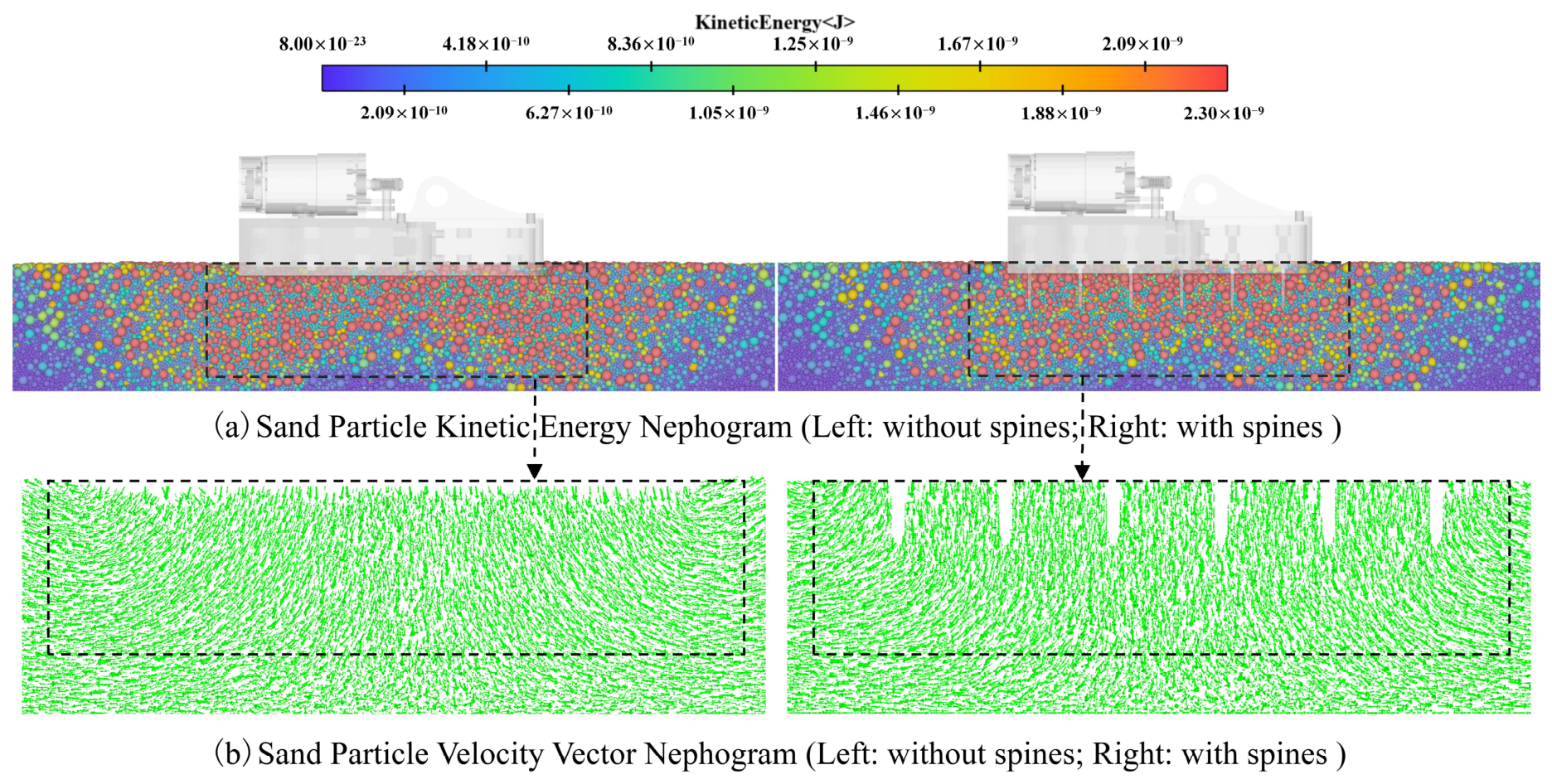
To further clarify the mechanism by which the spine structure enhances the anti-sinkage performance of the bionic-inspired foot, this paper conducts an analysis combined with the sand particle kinetic energy and velocity vector nephograms. Figure 16 shows the distributions of sand particle kinetic energy and velocity vectors corresponding to the two bionic-inspired foot structures, respectively. A comparison reveals significant differences in the sand particle movement patterns induced by the two structures. As indicated by the black boxed area in Figure 16b, the bottom surface of the bionic-inspired foot without the spine structure is smooth, and the force exerted on sand particles during sinkage is in the form of surface extrusion. The movement of sand particles (indicated by arrow distribution) shows large-scale overall flow and diffuses to the surrounding area. The impact energy of the foot is transmitted to deeper and wider areas; as shown in the sand particle kinetic energy nephogram in Figure 16a, compared with the foot with the spine structure, the high-kinetic-energy sand particles (red area) have a larger and wider distribution range. This forces more sand particles to be pushed away, destroying the original supporting structure of the sand body, and forcing the foot to sink deeper to obtain sufficient support. In contrast, as seen in the boxed area of Figure 16b, the spine structure forms local anchoring by inserting into the sand body, changing the original structure of the sand body. The spines exert mechanical constraints in the vertical direction, hindering the diffusion of sand particles to the surrounding area and forcing the sand particles between the spines to undergo downward compaction movement. In addition, the spine structure can effectively disperse the load, reduce the extrusion transmission to the underlying sand particles, weaken the degree of sand particle displacement, and enhance the interlocking effect between sand particles, enabling the foot to obtain more stable support and thus reducing the sinkage depth.

4.1.2. Dynamic Traction Performance

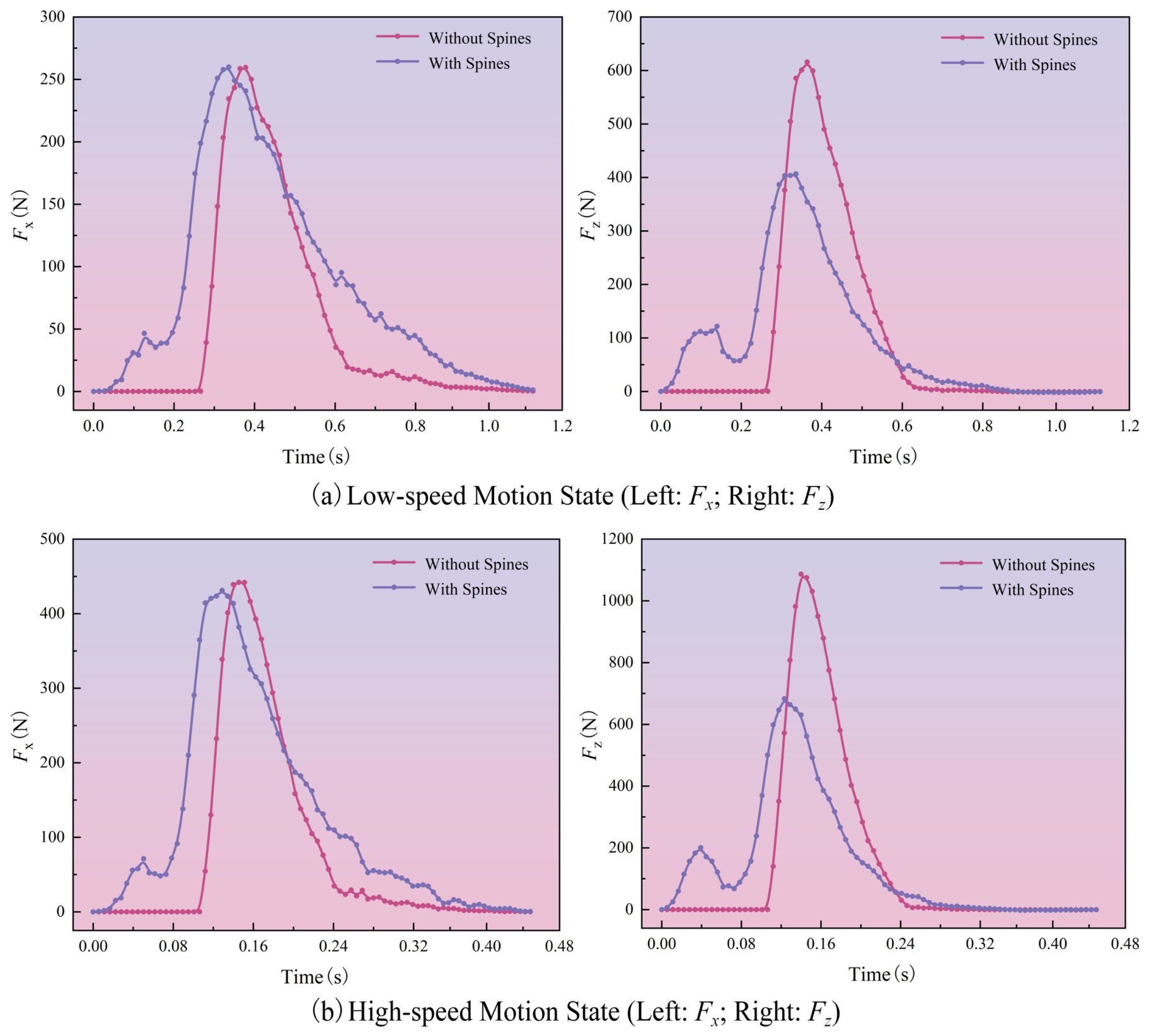
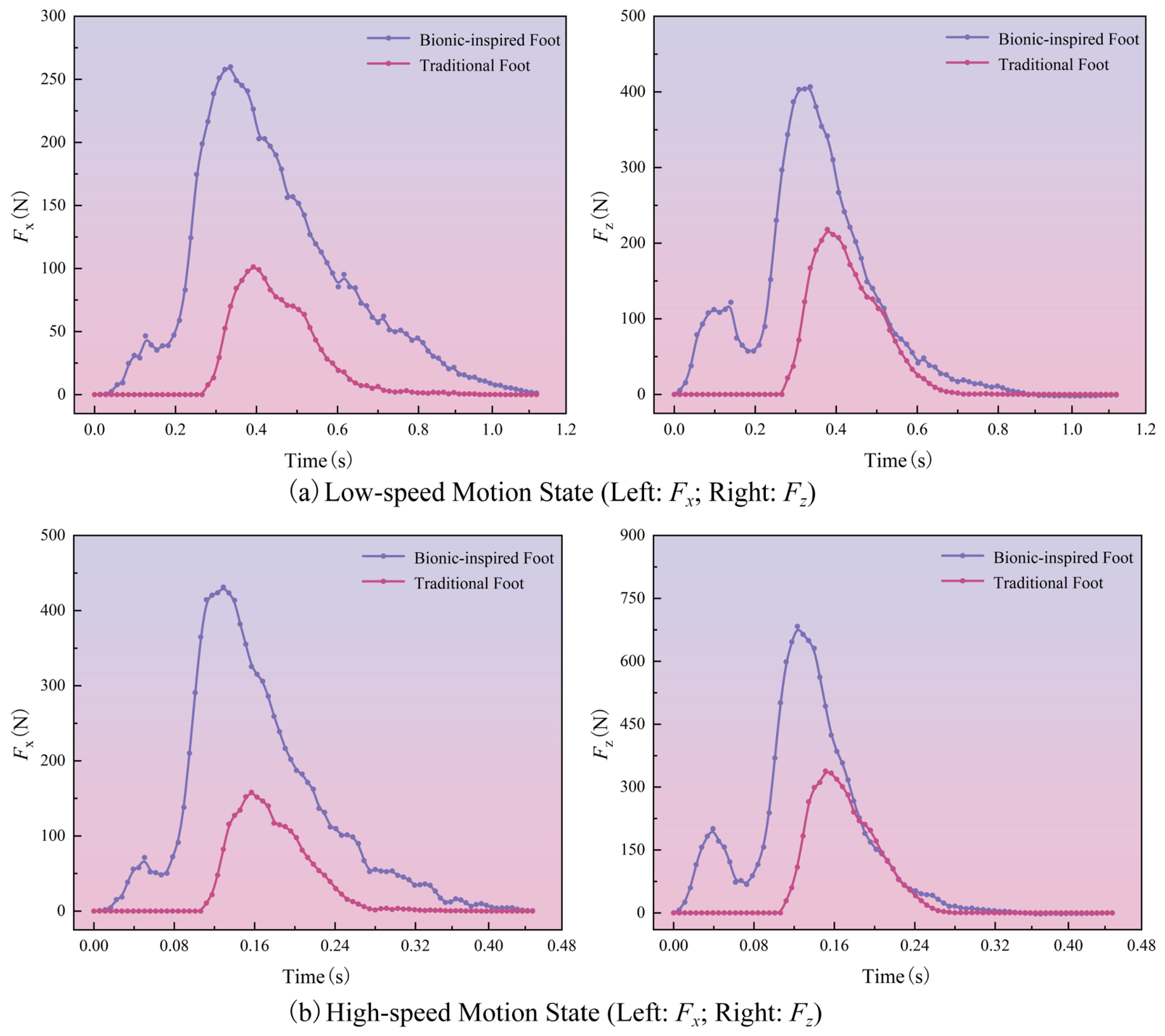
Figure 17 shows the variation in forces exerted by sand particles on the foot under different motion states, where Figure 17a,b are the force curves under low-speed (step frequency of 0.45 Hz) and high-speed (step frequency of 1.12 Hz) motion states, respectively. At the initial stage of motion, both the Fx and Fz curves of the foot with spine structure show small peaks, which is caused by the coupling interaction between the spine structure and sand particles during the process of penetrating the sand body. In contrast, the Fx and Fz curves of the foot without the spine structure remain horizontal, indicating that the foot has not yet made contact with the sand surface and no interaction force is generated at this stage. In the later stage of motion, the forces exerted by sand particles on both feet show a variation characteristic of increasing first and then decreasing, but the foot with the spine structure reaches the peak value earlier. Under the low-speed state, the peak Fx of the foot with the spine structure is 259.87 N, corresponding to an Fz of 406.76 N; the peak Fx of the foot without the spine structure is 259.58 N, while the corresponding Fz reaches 599.25 N. Under the high-speed state, the peak Fx of the foot with the spine structure is 431.20 N, corresponding to an Fz of 664.15 N; the peak Fx of the foot without the spine structure is 442.12 N, with the corresponding Fz as high as 1075.29 N.
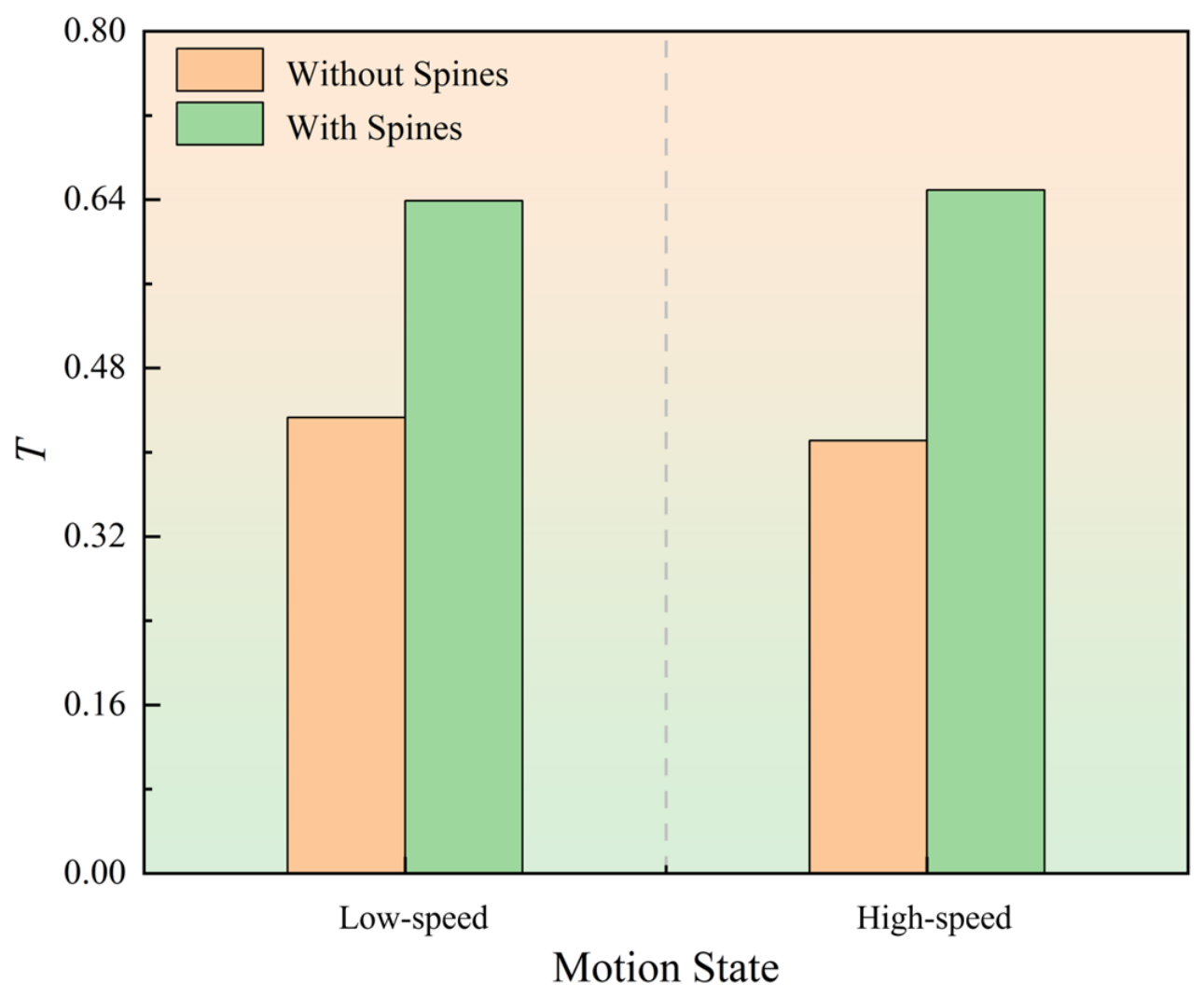
The above data indicate that although the peak Fx values of the two foot structures are similar under both motion states, the foot without spine structures needs larger vertical pressure Fz to achieve a similar horizontal traction effect. Therefore, the spine structure can significantly improve the traction performance of the foot, i.e., effectively reduce the demand for vertical pressure under the same traction effect. To further verify the enhancement effect of the spine structure on traction performance, Figure 18 compares the traction coefficients of the two structures under different motion states. Under the low-speed state, the peak traction coefficient of the foot with the spine structure is 0.639, while that of the foot without the spine structure is 0.433, representing a relative increase of 47.6%. Under the high-speed state, the value for the foot with the spine structure is 0.649, compared with 0.411 for the foot without the spine structure, a relative increase of 57.9%. This shows that the spine structure not only improves the vertical stability of the foot by suppressing sinkage but also effectively alleviates the slippage phenomenon of traditional foot-ends caused by insufficient adhesion during horizontal propulsion.

4.2. Performance Comparison Between Bionic-Inspired Foot and Traditional Foot

To verify the performance advantages of the bionic-inspired foot (with the spine structure) over the traditional foot on soft sandy ground, this section conducts a comparative analysis from two dimensions: anti-sinkage performance and dynamic traction performance.

4.2.1. Anti-Sinkage Performance

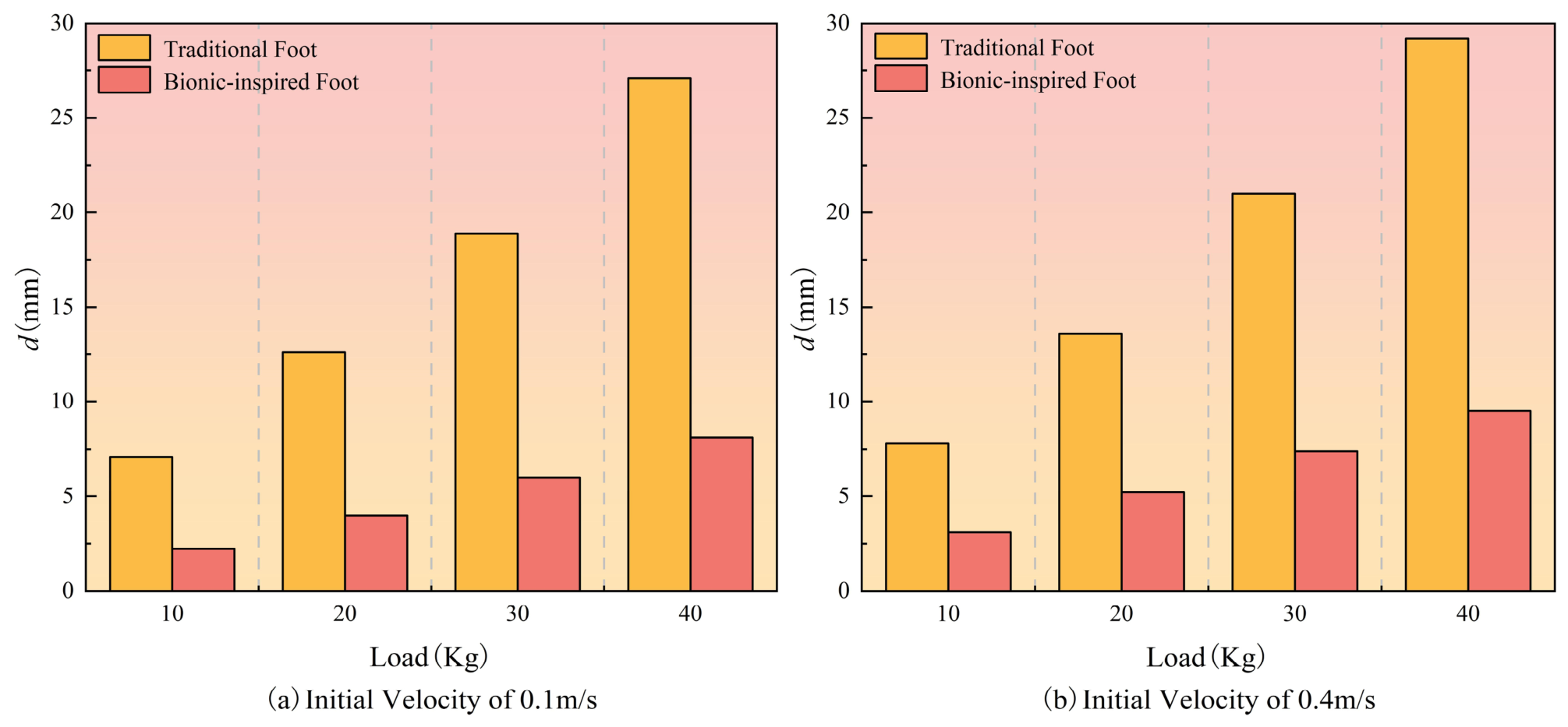
Figure 19 shows the variation trend of sinkage depth with load for the bionic-inspired foot and traditional foot under different working conditions, where Figure 19a corresponds to the working condition with an initial impact velocity of 0.1 m/s, and Figure 19b corresponds to the working condition with an initial impact velocity of 0.4 m/s. The variation trends under the two working conditions are consistent: the sinkage depth increases gradually with the increase in load. The initial impact velocity has a certain influence on the sinkage depth, but the anti-sinkage performance of the bionic-inspired foot is always superior to that of the traditional foot, with a significant performance improvement under high-speed impact and high load conditions. At a load of 10 kg, the sinkage depths of the bionic-inspired foot under the two working conditions are 2.2 mm and 3.1 mm, respectively, while those of the traditional foot are 7.1 mm and 7.8 mm, representing a reduction of 69.01% and 60.26% for the bionic-inspired foot compared with the traditional foot. At a load of 40 kg, the sinkage depths of the bionic-inspired foot under the two working conditions are 8.1 mm and 9.5 mm, respectively, and those of the traditional foot are 27.1 mm and 29.2 mm, with the bionic-inspired foot showing a reduction of 70.11% and 67.47% compared with the traditional foot.
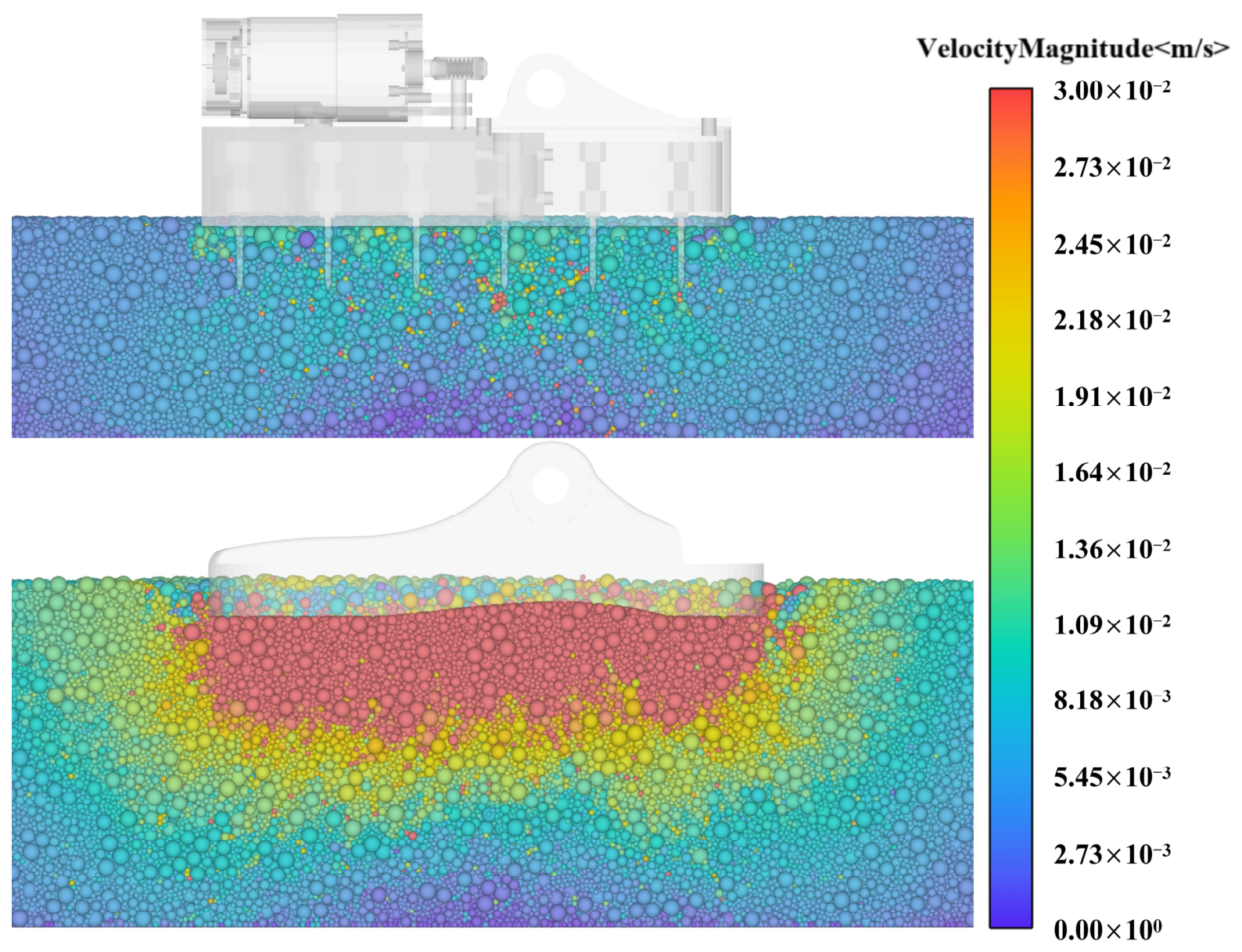
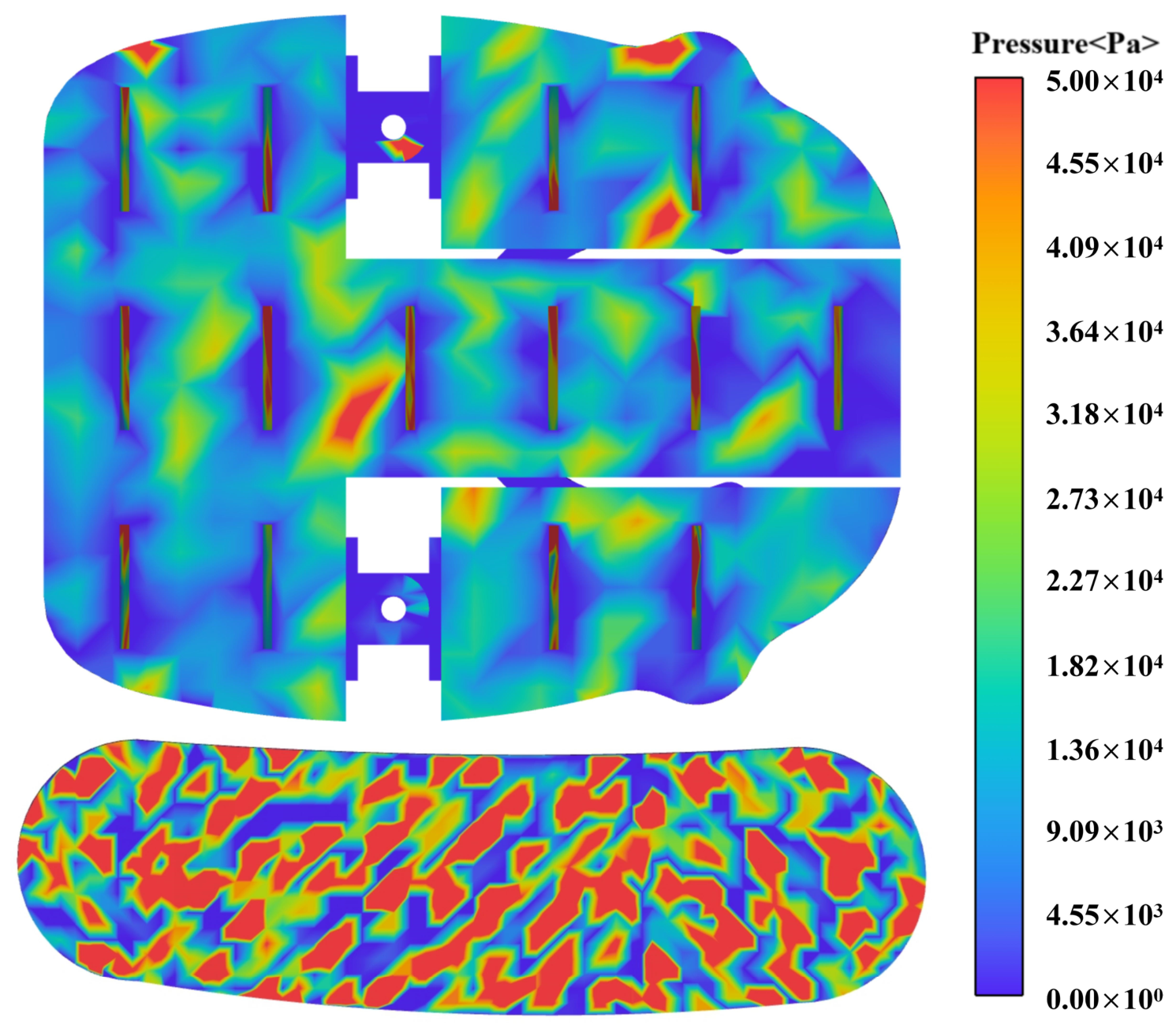
Figure 20 presents the distribution nephograms of sand particle motion velocity for the two types of feet under the working condition with an initial impact velocity of 0.4 m/s and a load of 40 kg. It can be seen from the sand particle velocity nephogram of the traditional foot that the sand particle velocity is distributed in a large concentrated area, mainly in high-speed regions such as red and yellow, and the sand particles diffuse over a wide range to the surroundings. This indicates that the sand particles are in a disordered flow state, leading to damage to the sand body’s supporting structure and thus making the foot prone to sinkage. In contrast, in the sand particle velocity nephogram of the bionic-inspired foot, the high-speed regions are distributed in small discrete areas, the sand particle velocity is mainly concentrated in the medium and low-speed regions (blue and green), and the diffusion range of sand particles is significantly smaller. This indicates that the displacement amplitude of sand particles is small, the supporting structure of the sand body is relatively stable, and the sinkage caused by the large-scale diffusion of sand particles is reduced. There are two reasons for the above phenomenon: first, under the same load, the bionic-inspired foot has a larger ground contact area, resulting in a lower plantar pressure than that of the traditional foot. As shown in the plantar pressure nephograms in Figure 21, the plantar pressure of the traditional foot is mainly concentrated in the high-pressure region (red area), while the plantar pressure of the bionic-inspired foot is distributed in the medium and low-pressure regions, with high pressure only occurring locally. Lower pressure is conducive to inhibiting the rapid flow of sand particles; second, as described in Section 4.1.1, the spine structure of the bionic-inspired foot can guide sand particles to perform orderly compaction movement, disperse the load, and maintain the stability of the sand body structure.

4.2.2. Dynamic Traction Performance

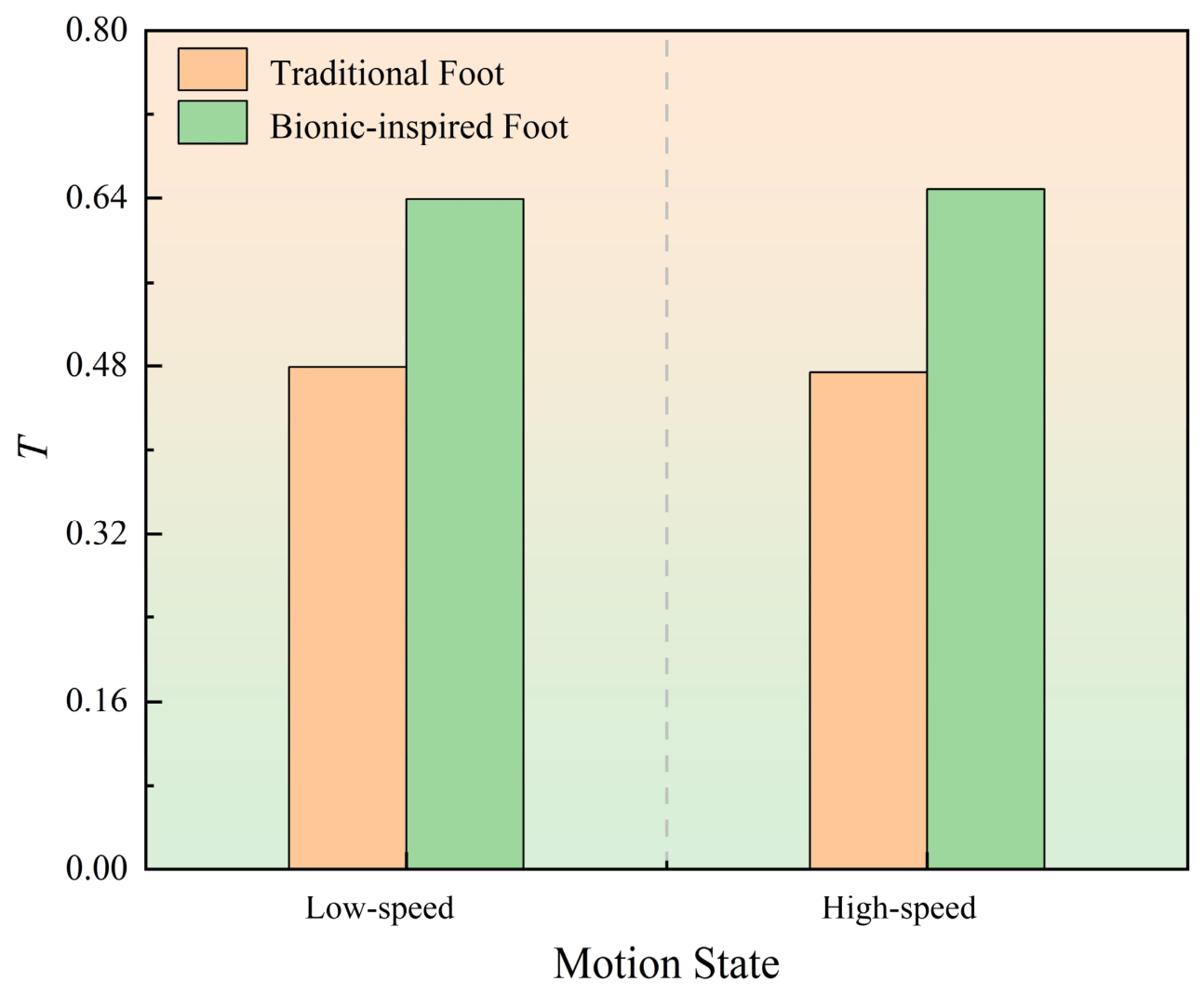
Figure 22 shows the variation law of forces exerted on the foot under different motion states in the sandy surface environment, where Figure 22a corresponds to the low-speed motion state (step frequency of 0.45 Hz) and Figure 22b corresponds to the high-speed motion state (step frequency of 1.12 Hz). The Fx and Fz curves of the two types of feet show similar trends, and the peak force of the bionic-inspired foot is greater than that of the traditional foot, with the time required to reach the peak force being earlier than that of the traditional foot. Under the low-speed motion state, the peak Fx of the traditional foot is 101.19 N, corresponding to an Fz of 211.35 N; the peak Fx of the bionic-inspired foot is 156.815% higher than that of the traditional foot, and the Fz is 92.46% higher. Under the high-speed motion state, the peak Fx of the traditional foot is 158.03 N, corresponding to an Fz of 333.5 N; the peak Fx of the bionic-inspired foot is 172.86% higher than that of the traditional foot, and the Fz is 99.15% higher. Under both motion states, the amplitude increase of Fx of the bionic-inspired foot is significantly larger than that of Fz, which indicates that the bionic-inspired foot can provide greater horizontal traction force under the same vertical pressure condition, with superior traction performance. To more intuitively demonstrate that the traction performance of the bionic-inspired foot is better than that of the traditional foot, Figure 23 shows the variation trend of the traction coefficient with motion state. Under the low-speed motion state, the peak traction coefficient of the traditional foot is 0.479, and that of the bionic-inspired foot is 33.61% higher than that of the traditional foot; under the high-speed motion state, the peak traction coefficient of the traditional foot is 0.474, and that of the bionic-inspired foot is 37.13% higher than that of the traditional foot.
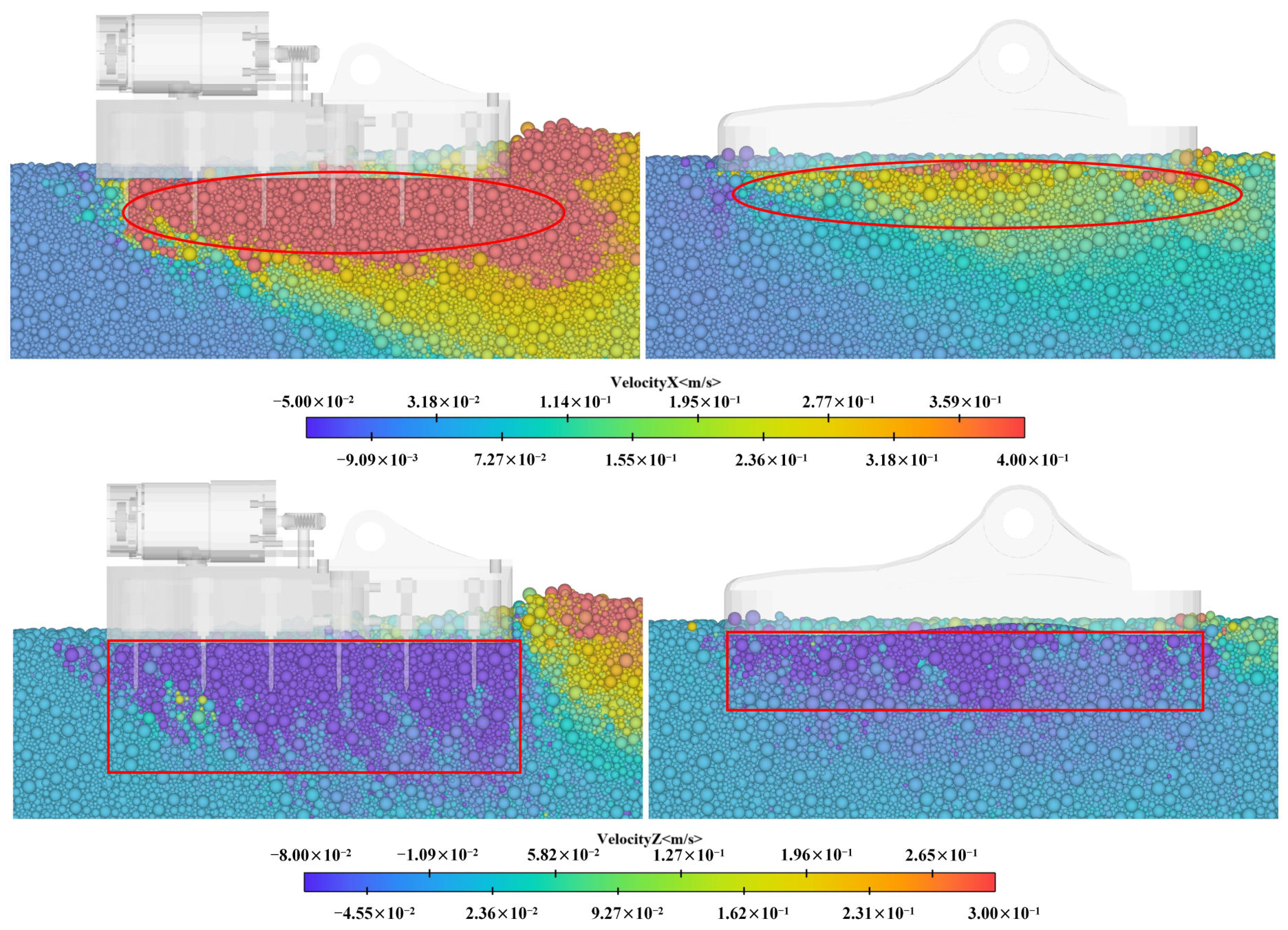
To further explain why the traction performance of the bionic-inspired foot is superior to that of the traditional foot, the velocity nephograms of sand particle motion are plotted as shown in Figure 24. Compared with the traditional foot, the spines of the bionic-inspired foot act as discrete force-bearing units, which generate multi-directional disturbance on the surrounding sand particles during the process of inserting into the sand body, making the velocity distribution of sand particles more directional in both horizontal and vertical directions. In the horizontal sand particle velocity nephogram, the sand particles at the rear end of the spines have a higher horizontal velocity component (consistent with the motion direction), showing as a wide-distributed red high-speed region as indicated by the red circle in the figure. This is because the spine structure changes the shear deformation mode of the sand body and enhances the interface shear strength and particle interlocking effect, thus enabling more sand particles to obtain greater horizontal momentum under the active pushing of the spines. According to the theorem of momentum, the reaction force (Fx) exerted by sand particles on the bionic-inspired foot is significantly improved. In the vertical velocity nephogram, the vertical velocity component of sand particles is mainly concentrated in the local area of the gaps between spines, with a large fluctuation range along the longitudinal direction as indicated by the red box in the figure. This indicates that the spines promote more sand particles to be effectively compacted and rearranged, enhance the interaction between sand particles, and facilitate the formation of a more stable load-bearing skeleton, thereby improving the vertical force (Fz) exerted on the bionic-inspired foot. In addition, due to the larger contact area between the bionic-inspired foot sole and sand particles and the more sufficient contact state, the peaks of both horizontal force and vertical force of the bionic-inspired foot are higher than those of the traditional foot. The traction coefficient is defined as the ratio of horizontal force to vertical force; since the increase amplitude of the horizontal force of the bionic-inspired foot is more significant than that of the vertical force, its traction coefficient is larger, and the overall traction performance is better.

4.3. Analysis of the Influence of Bionic-Inspired Foot Toe Opening Angle on Performance

The toe opening angle of the bionic-inspired foot is a key parameter affecting the mechanical characteristics of the interaction between the foot and the sand surface. By adjusting the toe opening angle to adapt to different terrains, the contact state between the foot and the ground can be optimized. This section explores the influence of the toe opening angle on anti-sinkage performance and dynamic traction performance.

4.3.1. Anti-Sinkage Performance

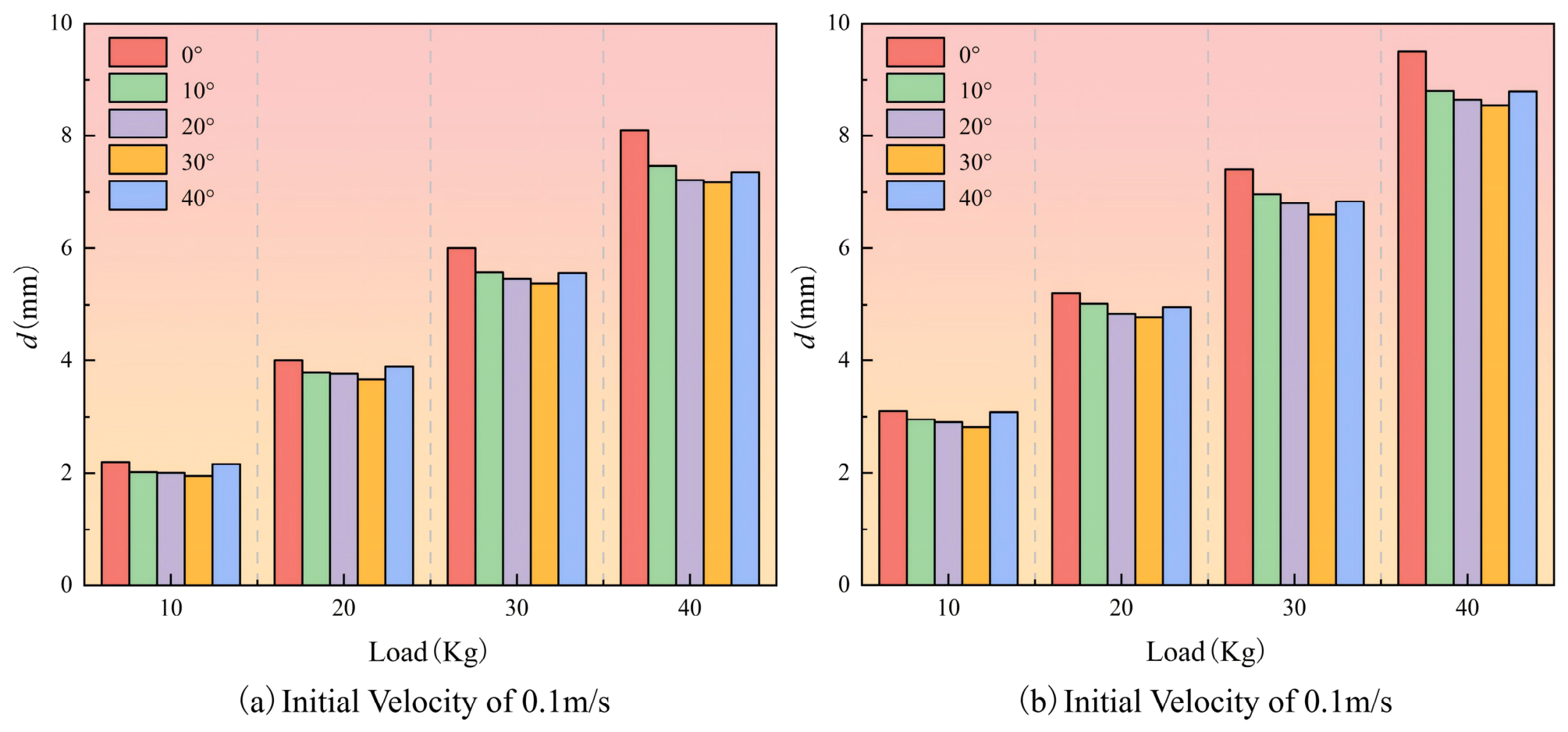
Figure 25 shows the variation law of sinkage depth with different toe opening angles under varying load conditions, where Figure 25a corresponds to the impact condition with an initial velocity of 0.1 m/s, and Figure 25b corresponds to the impact condition with an initial velocity of 0.4 m/s. It can be seen from the figures that under both working conditions, toe opening can effectively reduce the sinkage depth of the bionic-inspired foot and improve its anti-sinkage performance. Under different load conditions, with the change in toe opening angle, the sinkage depth shows a trend of first decreasing and then increasing. Specifically, when the toe opening angle is 30°, the sinkage depth reaches the minimum value, indicating the optimal anti-sinkage performance. It is worth noting that under the working condition of high-speed impact combined with high load, the differences in sinkage depth among different toe opening angles are more significant. Under the working condition with an initial impact velocity of 0.1 m/s: at a load of 10 kg, the sinkage depths corresponding to toe opening angles of 10°, 30° and 40° are 2.02 mm, 1.95 mm and 2.16 mm in sequence, representing a reduction of 8.18%, 11.36% and 1.82%, respectively, compared with that at 0°; when the load increases to 60 kg, the sinkage depths corresponding to the above angles are 11.73 mm, 11.25 mm and 11.65 mm, which are 9.77%, 13.46% and 10.38% lower than that at 0°, respectively. Under the working condition with an initial impact velocity of 0.4 m/s: at a load of 10 kg, the sinkage depths corresponding to toe opening angles of 10°, 30° and 40° are 2.95 mm, 2.81 mm and 3.08 mm, which are 4.84%, 9.35% and 0.65% lower than that at 0°, respectively; when the load is 60 kg, the sinkage depths corresponding to the above angles are 13.44 mm, 13.02 mm and 13.48 mm, showing a reduction of 8.82%, 11.67% and 8.55%, respectively, compared with that at 0°.
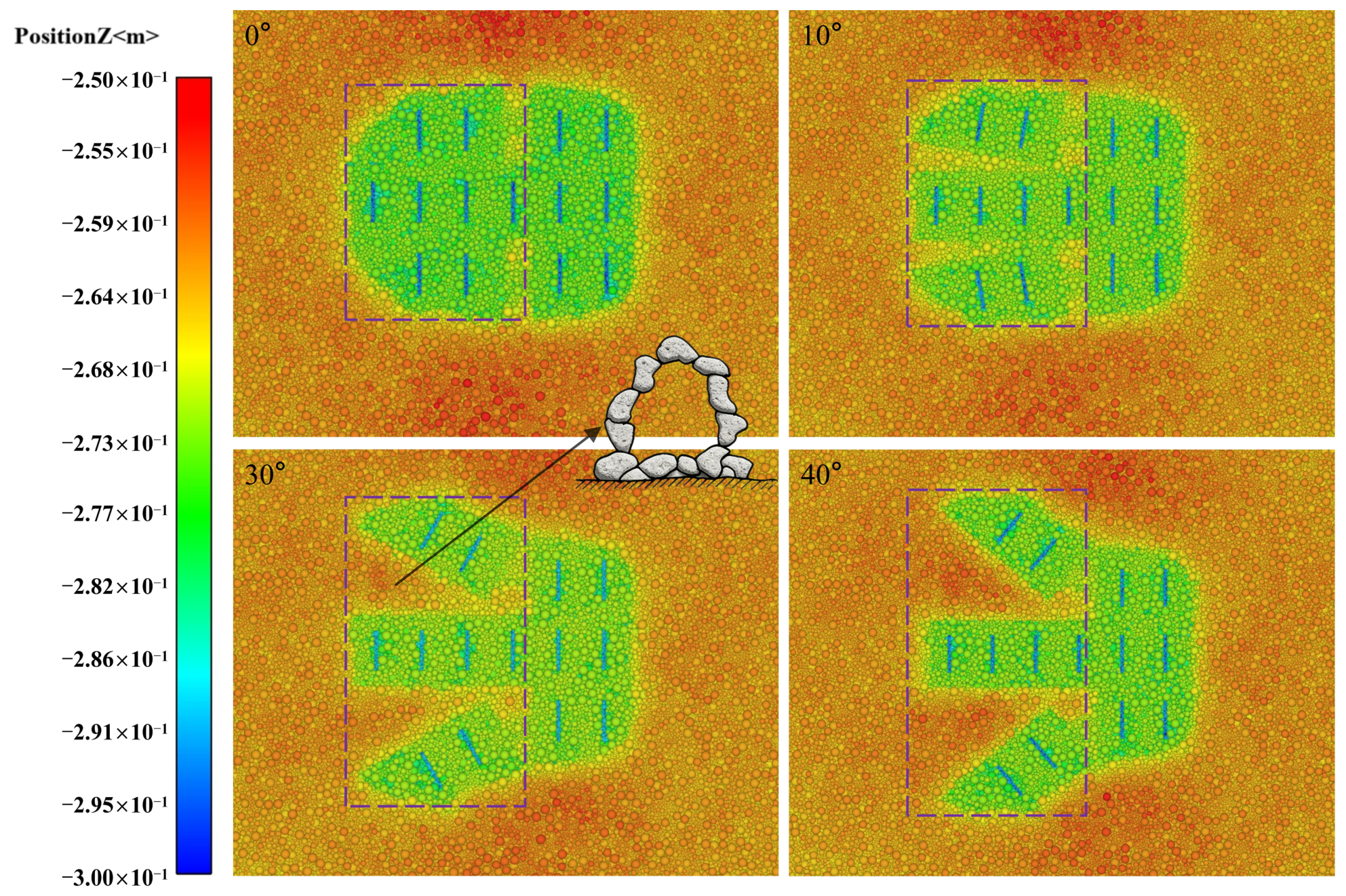
Figure 26 presents the nephograms of sand particle displacement distribution in the vertical direction under different toe opening angles. It can be seen from the figures that with the increase in opening angle, the deformation range of the sand surface gradually changes from “concentrated depression directly below the sole” to “dispersed load-bearing subsidence of multiple toes”. When the opening angle increases from 0° to 30°, toe opening expands the effective supporting area between the foot and the sand surface (see the area enclosed by the purple box). The effective supporting area here includes not only the physical contact area of the bionic-inspired foot, but also the load-bearing area formed by the sand particles between the toes through the arch bridge effect. The arch bridge effect is a unique mechanical phenomenon of granular media, referring to the formation of a continuous, arch bridge-like load-bearing structure by loose particles through friction and interlocking under external constraints or loads (as indicated by the arrows in Figure 26). When the toes of the bionic-inspired foot open and press into the sandy ground, the sand particles between the toes will not completely flow away like a fluid; instead, under the combined action of lateral extrusion from the toes and vertical load, the sand particles form a spanning “sand bridge” structure in the gaps between the toes. This expansion of the control area enclosed by the toe contour enables the load to be transmitted to a wider range of sand particles through the toe surfaces and the load-bearing sand particles between the toes. Meanwhile, the lateral shearing and extrusion of the surrounding sand particles by the toes enhance the friction and interlocking effect of the sand particles between the toes, inducing the sand body to form a local solidified supporting structure. Under the combined action of the above two factors, the plastic flow of sand particles is weakened, and the sinkage depth is reduced, which is reflected by the lighter color of the green area in the displacement nephogram of the sole region. When the opening angle increases to 40°, although the effective supporting area continues to expand, excessive opening leads to excessively high dispersion of load application points, making it difficult to effectively mobilize the shear strength of the sand body. The arch bridge effect of the sand particles between the toes is weakened, the stability of the sand body’s load-bearing skeleton is reduced, and the sinkage depth rises again.
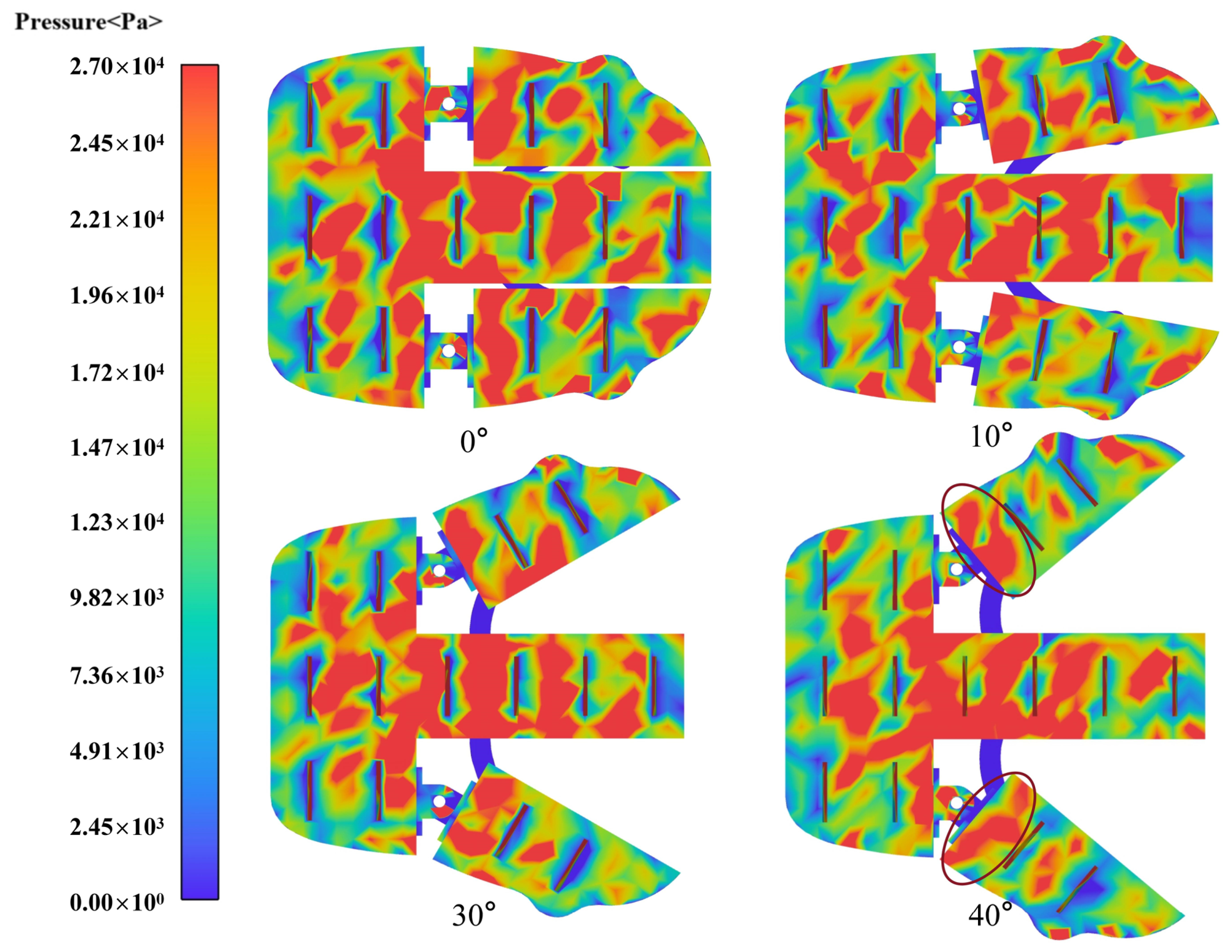
To further explore the mechanism by which the toe opening angle affects the anti-sinkage performance, Figure 27 provides the nephograms of plantar pressure distribution under different opening angles. It can be seen from the figures that as the opening angle increases from 0° to 30°, the plantar pressure shows a decentralized trend, gradually changing from “concentrated in the middle of the sole, forming a large-area continuous high-pressure zone (red area)” to “decreasing proportion of the high-pressure zone area, with the high-pressure zone dispersing toward the toe ends”. Quantitative analysis shows that when the opening angle is 0°, the area proportion of the red high-pressure zone is 32.48%; when the opening angle increases to 30°, this proportion drops to 23.77%. This indicates that the expansion of the effective supporting area effectively disperses the load, avoiding shear failure of the sand body caused by excessively high local pressure. When the opening angle increases to 40°, the pressure distribution characteristics change in the opposite direction: the high-pressure zone converges toward the center of the sole again, and local high-pressure points appear at the toe ends (as marked by the dark red circles), while the pressure in other toe surface areas decreases significantly. This phenomenon is consistent with the previous analysis: excessive toe opening leads to excessively high dispersion of load application points, which fails to effectively mobilize the shear strength of the sand body and the interlocking effect between particles. The arch bridge effect of the sand particles between the toes is weakened, especially at the front ends of the toes, resulting in a decrease in the stability of the sand body’s load-bearing skeleton and a subsequent rise in sinkage depth.

4.3.2. Dynamic Traction Performance

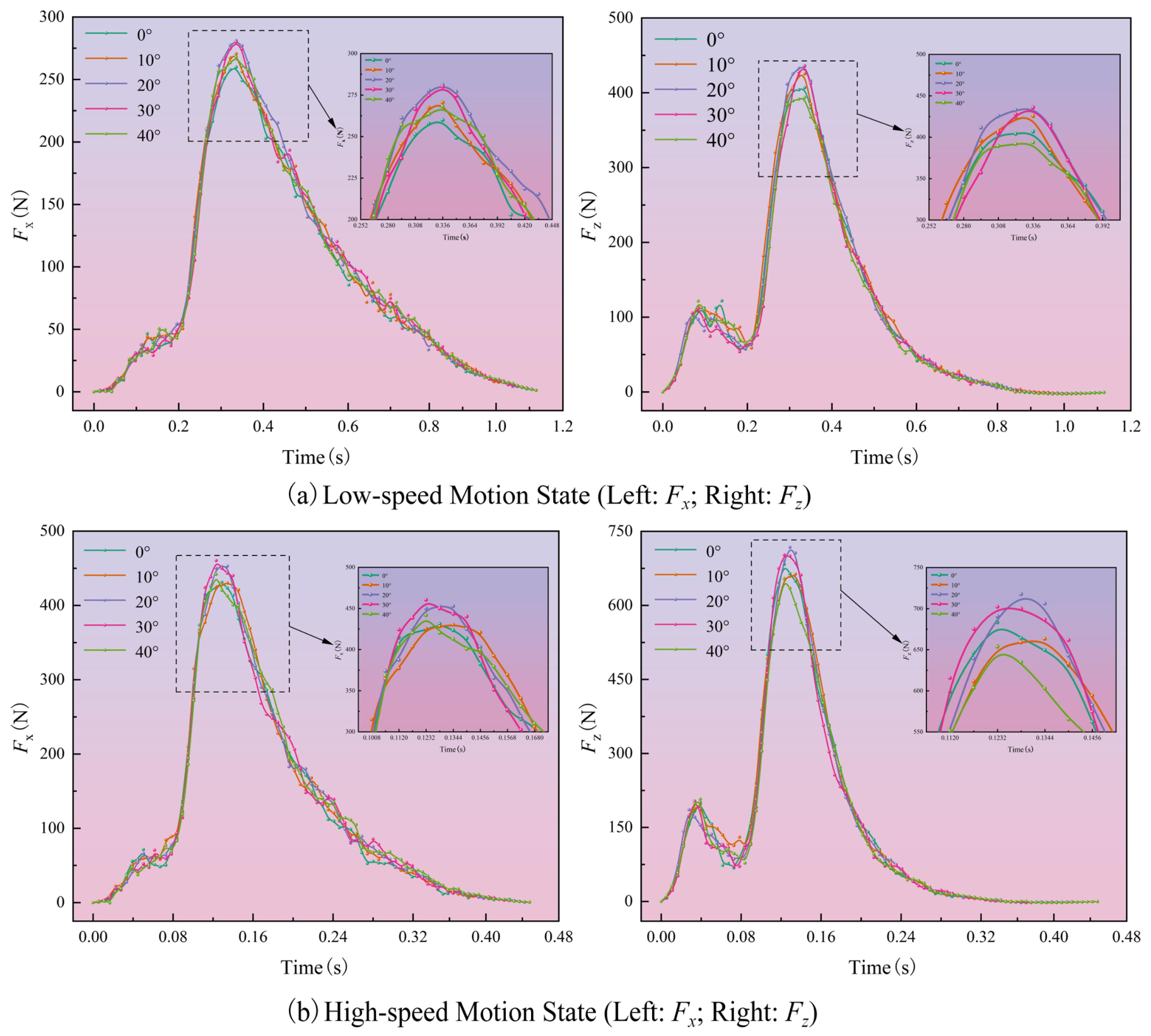
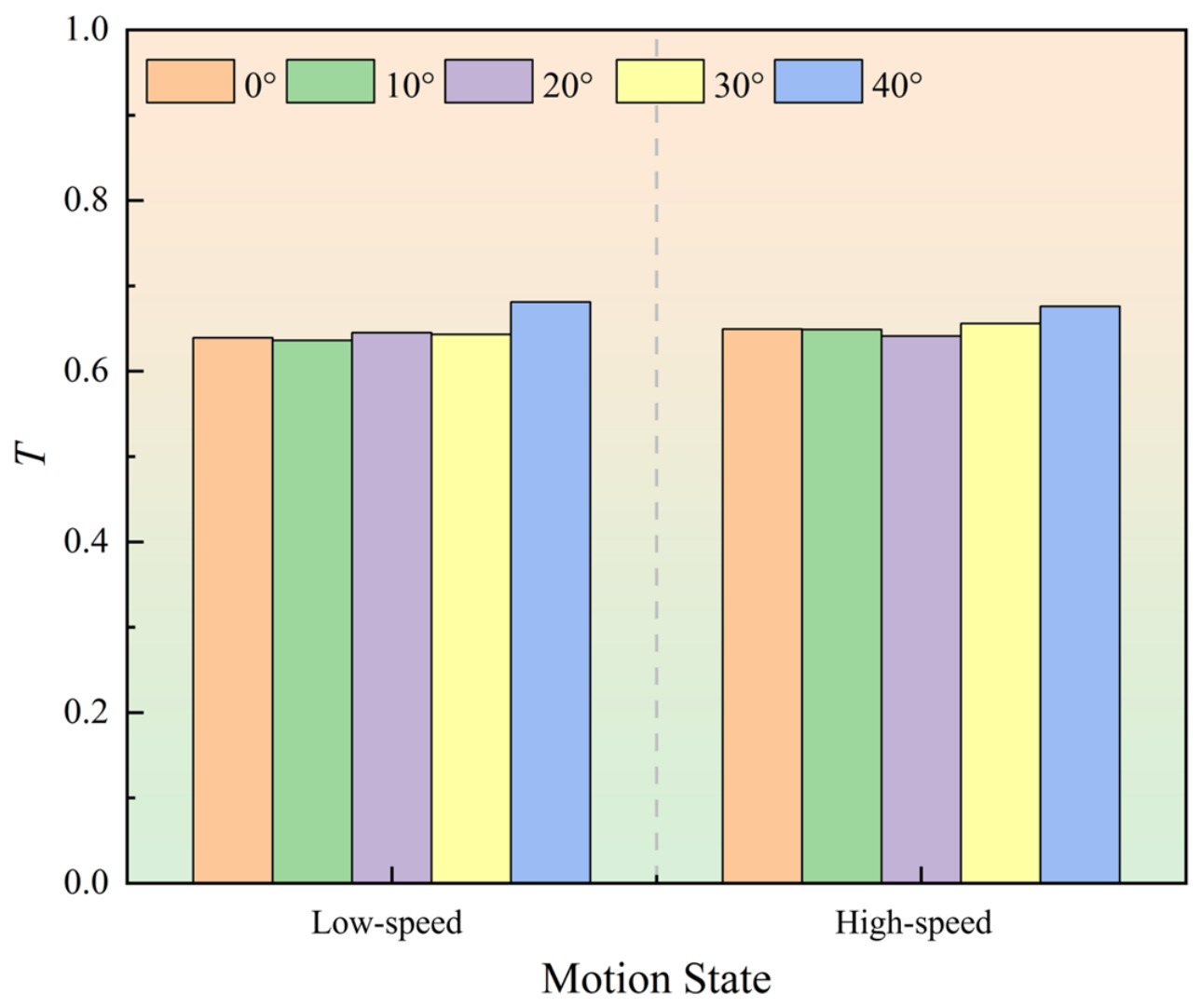
Figure 28 shows the variation law of the interaction force between the foot and the sand surface with time under different toe opening angles of the bionic-inspired foot, where Figure 28a corresponds to the low-speed motion state (step frequency of 0.45 Hz) and Figure 28b corresponds to the high-speed motion state (step frequency of 1.12 Hz). Under different opening angles, the overall variation trend of the force curves remains consistent, with only slight differences in peak values. Under both motion states, the force peaks are relatively high when the opening angles are 20° and 30°, while the force peaks at other angles are relatively low with little numerical difference. To more intuitively compare the influence of different toe opening angles on the foot’s traction performance, Figure 29 shows the variation trend of the traction coefficient with the opening angle. Under the low-speed motion state, as the opening angle increases from 0° to 40°, the peak traction coefficients are 0.639, 0.636, 0.645, 0.643 and 0.681 in sequence. Under the high-speed motion state, the peak traction coefficients corresponding to the above angles are 0.649, 0.648, 0.641, 0.656 and 0.676, respectively. Under both states, the peak traction coefficient shows a fluctuating upward trend with the increase in opening angle, but the numerical difference among different angles is small, indicating that the toe opening angle has a limited effect on improving the traction performance.

5. Conclusions

To address the trafficability challenges faced by legged robots on loose granular terrain, this paper proposes a novel bionic-inspired reconfigurable foot structure with active opening and closing capability. The performance improvement mechanism is revealed based on EDEM–Adams coupling simulation. The main conclusions are summarized as follows:
(1) A high-precision discrete element simulation model of sand was established. Combined with physical experiments and simulation inversion, the contact parameters between sand particles were calibrated, with the restitution coefficient, static friction coefficient, and rolling friction coefficient of 0.54, 0.52 and 0.34, respectively. The relative error of the repose angle was only 1.19%. Meanwhile, the interface contact parameters between sand particles and ABS material were calibrated to be 0.5636, 0.5929 and 0.0408, respectively.
(2) The comprehensive performance advantages of the bionic-inspired foot over traditional foot-ends were verified. Under different working conditions involving varying loads and impact velocities, the bionic-inspired foot outperforms traditional foot-ends in both anti-sinkage and traction performance. By increasing the effective support area, optimizing pressure distribution, and the intervention of spines, the bionic structure improves the anti-sinkage performance by no less than 60.26% and the traction performance by at least 33.61% compared with traditional feet.
(3) The regulatory mechanism of active toe opening on performance was clarified. Active adjustment of the toe opening angle can optimize foot–ground interaction. When the opening angle is set to 30°, the anti-sinkage performance reaches the optimum, which is 13.46% higher than that in the closed state. The mechanism lies in that moderate opening expands the effective support area, induces the “arch bridge effect” of sand, disperses the load, and stabilizes the bearing structure. The toe opening angle has a limited effect on improving traction performance, and excessive opening (e.g., 40°) will lead to a decline in anti-sinkage performance due to excessive load dispersion.
(4) The intrinsic mechanism of performance improvement was explained from the micro-mechanical perspective. The analysis of particle kinetic energy, velocity vector, displacement, and plantar pressure nephograms demonstrates that the bionic-inspired foot structure increases the contact area and optimizes the contact pressure distribution through the phalangeal segment. Meanwhile, the spine structures effectively constrain the disordered flow of sand particles, guide the directional compaction and orderly rearrangement of particles, and strengthen the inter-particle friction and interlocking effects. This fundamentally explains the mechanism of reduced sinkage and improved traction performance.
It should be noted that contact parameter calibration is completed by combining physical experiments and simulation inversion in this study, which preliminarily verifies the reliability of the EDEM–Adams coupled model. Nevertheless, physical experiments targeting core performance have not been conducted, and the conclusions lack direct experimental support. A foot–ground dynamic interaction test platform will be built in follow-up research, and prototype experiments will further consolidate the accuracy and reliability of the research conclusions.

Author Contributions

Conceptualization, Z.J., Y.X. and J.H.; methodology, Z.J., F.H. and Y.X.; writing—original draft preparation, Z.J.; writing—review and editing, Z.J., F.H., J.H., Y.Z. and Y.W.; formal analysis, Y.X. and Y.Z.; investigation, J.H. and Y.Z.; project administration, Y.X. and Y.W.; funding acquisition, Y.X., J.H. and Y.Z.; supervision, Y.X., Y.W. and Y.Z.; resources, Y.X., Y.W. and Y.Z. All authors have read and agreed to the published version of the manuscript.

Funding

This work was supported by the HaiYou Industrial Experts Program (Grant No. CYLJ20241901426), and the Key Laboratory of High-efficiency and Clean Mechanical Manufacture at Shandong University, Ministry of Education.

Institutional Review Board Statement

Not applicable.

Informed Consent Statement

Not applicable.

Data Availability Statement

The raw data supporting the conclusions of this article will be made available by the authors on request.

Conflicts of Interest

Author Yingying Zhang was employed by the company Shandong Tuopu Hydraulic and Pneumatic Co., Ltd. The remaining authors declare that the research was conducted in the absence of any commercial or financial relationships that could be construed as a potential conflict of interest.

References

  1. Tang, M.; Zhang, Y.; Yu, S.; Li, J.; Tang, K. Trajectory tracking model predictive control for mobile robot based on deep Koopman operator modeling. Robot. Auton. Syst. 2025, 194, 105152. [Google Scholar] [CrossRef]
  2. Hu, K.; Yang, Q.; Lian, B.; Kang, R.; Sun, T. Spatial multi-locomotion tensegrity mobile robot with modular design. Int. J. Mech. Sci. 2025, 302, 110501. [Google Scholar] [CrossRef]
  3. An, Z.; Li, C.; Han, Y.; Niu, M. Improved Bidirectional JPS Algorithm for Mobile Robot Path Planning in Complex Environments. Comput. Mater. Contin. 2025, 83, 1347–1366. [Google Scholar] [CrossRef]
  4. Liu, J.; Qian, Y.; Zhang, W.; Ji, M.; Xv, Q.; Song, H. High-safety path optimization for mobile robots using an improved ant colony algorithm with integrated repulsive field rules. Robot. Auton. Syst. 2025, 190, 104998. [Google Scholar] [CrossRef]
  5. Zhang, X.; Xie, Y.; Han, J.; Wang, Y. Design of control valve with low energy consumption based on Isight platform. Energy 2022, 239, 122328. [Google Scholar] [CrossRef]
  6. Wang, L.; Lu, Y.; Zhang, Y.; Chen, W.; Zhao, X.; Gao, F. Design and soft-landing control of underwater legged robot for active buffer landing on seabed. Ocean Eng. 2022, 266, 112764. [Google Scholar] [CrossRef]
  7. Wang, K.; Hou, J.; Zhou, S.; Wei, D.; Xu, W.; Wang, Y.; Chai, H.; Chen, L.; Zhu, Q.; Gao, L.; et al. Wheeled-legged robots for multi-terrain locomotion in plateau environments. Biomim. Intell. Robot. 2025, 5, 100256. [Google Scholar] [CrossRef]
  8. Yang, H.; Zhou, J.; Wu, J.; Yao, Y.-A. Research on high-smooth walking and adaptive obstacle-crossing of closed-chain multi-legged robot. Mech. Mach. Theory 2025, 214, 106123. [Google Scholar] [CrossRef]
  9. Wu, Z.; Zheng, K.; Ding, Z.; Gao, H. A survey on legged robots: Advances, technologies and applications. Eng. Appl. Artif. Intell. 2024, 138, 109418. [Google Scholar] [CrossRef]
  10. Yu, Z.; Duan, A.; Zhu, Z.; Zhang, W. Biomimetic soft-legged robotic locomotion, interactions and transitions in terrestrial, aquatic and multiple environments. Sustain. Mater. Technol. 2024, 40, e00930. [Google Scholar] [CrossRef]
  11. Yang, H.; Zhang, C.; Ding, L.; Wei, Q.; Gao, H.; Liu, G.; Ge, L.; Deng, Z. Comparative study of terramechanics properties of spherical and cylindrical feet for planetary legged robots on deformable terrain. J. Terramech. 2024, 113–114, 100968. [Google Scholar] [CrossRef]
  12. Zhang, Y.; He, W.; Wang, T. Design, modeling, and control of underwater stiffness-enhanced flexible manipulator. Ocean Eng. 2024, 308, 118302. [Google Scholar] [CrossRef]
  13. Hou, Q.; Fu, Y.; Luo, M.; Sun, Z.; Zhou, H.; Li, G. An FBG-based slip recognition and monitoring method for non-destructive grasping of flexible manipulator. Sens. Actuators A Phys. 2024, 379, 115954. [Google Scholar] [CrossRef]
  14. Djeha, M.; Gergondet, P.; Kheddar, A. Robust Task-Space Quadratic Programming for Kinematic-Controlled Robots. IEEE Trans. Robot. 2023, 39, 3857–3874. [Google Scholar] [CrossRef]
  15. Stasse, O.; Flayols, T.; Budhiraja, R.; Giraud-Esclasse, K.; Carpentier, J.; Mirabel, J.; Del Prete, A.; Soueres, P.; Mansard, N.; Lamiraux, F.; et al. TALOS: A new humanoid research platform targeted for industrial applications. In Proceedings of the 2017 IEEE-RAS 17th International Conference on Humanoid Robotics (Humanoids), Birmingham, UK; IEEE: New York, NY, USA, 2017. [Google Scholar]
  16. Negrello, F.; Garabini, M.; Catalano, M.; Kryczka, P.; Choi, W.; Caldwell, D.; Bicchi, A.; Tsagarakis, N. WALK-MAN humanoid lower body design optimization for enhanced physical performance. In Proceedings of the 2016 IEEE International Conference on Robotics and Automation (ICRA), Stockholm, Sweden; IEEE: New York, NY, USA, 2016. [Google Scholar]
  17. Bledt, G.; Powell, M.J.; Katz, B.; Di Carlo, J.; Wensing, P.M.; Kim, S. MIT Cheetah 3: Design and Control of a Robust, Dynamic Quadruped Robot. In Proceedings of the 2018 IEEE/RSJ International Conference on Intelligent Robots and Systems (IROS), Madrid, Spain; IEEE: New York, NY, USA, 2018. [Google Scholar]
  18. Guizzo, E. By leaps and bounds: An exclusive look at how Boston dynamics is redefining robot agility. IEEE Spectr. 2019, 56, 34–39. [Google Scholar] [CrossRef]
  19. Katz, B.; Di Carlo, J.; Kim, S. Mini Cheetah: A Platform for Pushing the Limits of Dynamic Quadruped Control. In Proceedings of the 2019 International Conference on Robotics and Automation (ICRA); IEEE: New York, NY, USA, 2019. [Google Scholar]
  20. Xiong, X.; Ames, A.D.; Goldman, D.I. A stability region criterion for flat-footed bipedal walking on deformable granular terrain. In Proceedings of the 2017 IEEE/RSJ International Conference on Intelligent Robots and Systems (IROS), Vancouver, BC, Canada; IEEE: New York, NY, USA, 2017. [Google Scholar]
  21. Chopra, S.; Tolley, M.T.; Gravish, N. Granular Jamming Feet Enable Improved Foot-Ground Interactions for Robot Mobility on Deformable Ground. IEEE Robot. Autom. Lett. 2020, 5, 3975–3981. [Google Scholar] [CrossRef]
  22. Xiu, H.; Han, Y.; Wang, X.; Zhang, Y.; Liang, W.; Wei, G.; Ren, L.; Ren, L. Design, development, and clinical validation of a two degrees of freedom compliant ankle-foot prosthesis based on a 4-4r parallel mechanism. Mech. Mach. Theory 2022, 172, 104818. [Google Scholar] [CrossRef]
  23. Zhang, J.; Chen, X.; Yu, Z.; Han, L.; Gao, Z.; Zhao, Q.; Huang, G.; Li, K.; Huang, Q. HTEC foot: A novel foot structure for humanoid robots combining static stability and dynamic adaptability. Def. Technol. 2025, 44, 30–51. [Google Scholar] [CrossRef]
  24. Yeom, H.; Park, G.; Bae, J. Design of a Human-Inspired Sensorized and Adaptive Foot That Enhances Stability Through Tensegrity (Hi-SAFEST). IEEE Robot. Autom. Lett. 2024, 9, 4305–4312. [Google Scholar] [CrossRef]
  25. Qaiser, Z.; Kang, L.; Johnson, S. Design of a bioinspired tunable stiffness robotic foot. Mech. Mach. Theory 2017, 110, 1–15. [Google Scholar] [CrossRef]
  26. Zang, X.; Li, W.; Liu, Y.; Lin, Z.; Zhao, J. The development of pneumatic stiffness-adjustable foot for bipedal robot. In Proceedings of the 2017 IEEE 2nd Advanced Information Technology, Electronic and Automation Control Conference (IAEAC), Chongqing, China, 25–26 March 2017. [Google Scholar]
  27. Lecomte, C.; Ármannsdóttir, A.L.; Starker, F.; Tryggvason, H.; Briem, K.; Brynjolfsson, S. Variable stiffness foot design and validation. J. Biomech. 2021, 122, 110440. [Google Scholar] [CrossRef] [PubMed]
  28. Najmuddin, A.; Fukuoka, Y.; Ochiai, S. Experimental development of stiffness adjustable foot sole for use by bipedal robots walking on uneven terrain. In Proceedings of the 2012 IEEE/SICE International Symposium on System Integration (SII), Fukuoka, Japan; IEEE: New York, NY, USA, 2012. [Google Scholar]
  29. Zhang, R.; Sun, X.; Han, D.; Zhang, H.; Ma, J.; Wen, L.; Zou, M. A bionic mechanical foot with adaptive variable postures travelling on sand. J. Terramech. 2023, 107, 61–74. [Google Scholar] [CrossRef]
  30. Catalano, M.G.; Pollayil, M.J.; Grioli, G.; Valsecchi, G.; Kolvenbach, H.; Hutter, M.; Bicchi, A.; Garabini, M. Adaptive Feet for Quadrupedal Walkers. IEEE Trans. Robot. 2022, 38, 302–316. [Google Scholar]
  31. Chatterjee, A.; Mo, A.; Kiss, B.; Gönen, E.C.; Badri-Spröwitz, A. Multi-segmented Adaptive Feet for Versatile Legged Locomotion in Natural Terrain. In Proceedings of the 2023 IEEE International Conference on Robotics and Automation (ICRA 2023), London, UK; IEEE: New York, NY, USA, 2023. [Google Scholar]
  32. Han, D.; Zhang, R.; Cao, Q.; Jiang, L.; Li, J. Research in mechanical model of bionic foot intruding into sands with different physical characteristics. J. Terramech. 2021, 98, 25–33. [Google Scholar] [CrossRef]
  33. Zhang, W.; Merces, L.; Ma, J.; Becker, C.; Karnaushenko, D.; Tang, H.; Qu, J.; Ferro, L.M.M.; Huang, Y.; Yan, Y.; et al. A bioinspired microdevice unifying energy storage and actuation through hydration control. Nat. Commun. 2026, 17, 2650. [Google Scholar] [CrossRef]
  34. Merces, L.; Ferro, L.M.M.; Thomas, A.; Karnaushenko, D.D.; Luo, Y.; Egunov, A.I.; Zhang, W.; Bandari, V.K.; Lee, Y.; McCaskill, J.S.; et al. Bio-Inspired Dynamically Morphing Microelectronics toward High-Density Energy Applications and Intelligent Biomedical Implants. Adv. Mater. 2024, 36, 2313327. [Google Scholar] [CrossRef]
  35. Ranjan, A.; Angelini, F.; Nanayakkara, T.; Garabini, M. Design Guidelines for Bioinspired Adaptive Foot for Stable Interaction with the Environment. IEEE/ASME Trans. Mechatron. 2024, 29, 843–855. [Google Scholar] [CrossRef]
  36. Luo, H.; Li, Y.; Yu, M.; Li, J.; Zhang, W.; Zhou, W. Attachment performance analysis and experimental study of lunar rock bionic attachment device based on DEM-MBD. Acta Astronaut. 2024, 219, 467–480. [Google Scholar] [CrossRef]
  37. Tan, X.; Gao, J.; Hu, C.; Song, X.; Zhang, M.; Zheng, P. Research on the Influence of Changes in Particle Sizes on Simulation Results in the Simulation Test Based on the Discrete Element Method; Springer International Publishing: Cham, Switzerland, 2023. [Google Scholar]
  38. Zhou, L.; Gao, J.; Hu, C.; Li, Q. Numerical simulation and testing verification of the interaction between track and sandy ground based on discrete element method. J. Terramech. 2021, 95, 73–88. [Google Scholar] [CrossRef]
  39. Wang, J.; Xu, C.; Xu, Y.; Wang, Z.; Qi, X.; Wang, J.; Zhou, W.; Tang, H.; Wang, Q. Influencing Factors Analysis and Simulation Calibration of Restitution Coefficient of Rice Grain. Appl. Sci. 2021, 11, 5884. [Google Scholar] [CrossRef]
  40. Li, J.W.; Tong, J.; Hu, B.; Wang, H.B.; Mao, C.Y.; Ma, Y.H. Calibration of parameters of interaction between clayey black soil with different moisture content and soil-engaging component in northeast China. Trans. Chin. Soc. Agric. Eng. (Trans. CSAE) 2019, 35, 130–140. [Google Scholar]
Figure 1. Bionic-inspired Foot Structural Design.
Actuators 15 00330 g001
Figure 2. Basic Principle of the Contact Mechanics Model.
Actuators 15 00330 g002
Figure 3. Coupling Simulation Principle.
Actuators 15 00330 g003
Figure 4. Coupling Simulation Test Platform.
Actuators 15 00330 g004
Figure 5. Solver Settings.
Actuators 15 00330 g005
Figure 6. Time-Step Independence Verification.
Actuators 15 00330 g006
Figure 7. Sand Gradation Curve.
Actuators 15 00330 g007
Figure 8. Simulation Procedure of Repose Angle.
Actuators 15 00330 g008
Figure 9. Repose Angle Test of Standard Sand.
Actuators 15 00330 g009
Figure 10. Calibration of Coefficient of Restitution: (a) Calibration Principle; (b) Physical Test Device; (c) Numerical Simulation Model.
Actuators 15 00330 g010
Figure 11. Calibration of Coefficient of Static Friction: (a) Physical Test Device; (b) Numerical Simulation Model.
Actuators 15 00330 g011
Figure 12. Calibration of Coefficient of Rolling Friction: (a) Calibration Principle; (b) Physical Test Device; (c) Numerical Simulation Model.
Actuators 15 00330 g012
Figure 13. Parameter Calibration: (a) Calibration of Coefficient of Restitution; (b) Calibration of Coefficient of Static Friction; (c) Calibration of Coefficient of Rolling Friction.
Actuators 15 00330 g013
Figure 14. Simulation Generation of Sand Body: (a) Axonometric View; (b) Uniformity Analysis; (c) Flatness Analysis.
Actuators 15 00330 g014
Figure 15. Variation in Sinkage Depth with Load Under Different Working Conditions.
Actuators 15 00330 g015
Figure 16. Comparison of Sand Particle Kinetic Energy and Velocity Vector Nephograms with and without Spine Structures.
Actuators 15 00330 g016
Figure 17. Comparison of Foot Forces with and without Spine Structures.
Actuators 15 00330 g017
Figure 18. Traction Coefficients of the Foot Under Different Motion States.
Actuators 15 00330 g018
Figure 19. Anti-sinkage Performance Comparison Between Bionic-inspired Foot and Traditional Foot.
Actuators 15 00330 g019
Figure 20. Comparison of Sand Particle Velocity Nephograms under Different Foot Types (Upper: bionic-inspired foot; Lower: traditional foot).
Actuators 15 00330 g020
Figure 21. Comparison of Plantar Pressure Nephograms between Bionic-inspired Foot and Traditional Foot (Upper: bionic-inspired foot; Lower: traditional foot).
Actuators 15 00330 g021
Figure 22. Comparison of Foot Forces between Bionic-inspired Foot and Traditional Foot at Different Motion Speeds.
Actuators 15 00330 g022
Figure 23. Variation Trend of Traction Coefficient with Motion State.
Actuators 15 00330 g023
Figure 24. Comparison of Sand Particle Velocity Nephograms under Bionic-inspired Foot and Traditional Foot.
Actuators 15 00330 g024
Figure 25. Variation in Sinkage Depth with Toe Opening Angle.
Actuators 15 00330 g025
Figure 26. Sand Particle Displacement Nephograms in the Vertical Direction.
Actuators 15 00330 g026
Figure 27. Plantar Pressure Nephograms.
Actuators 15 00330 g027
Figure 28. Comparison of Foot Forces of Bionic-inspired Foot at Different Toe Opening Angles.
Actuators 15 00330 g028
Figure 29. Variation Trend of Traction Coefficient with Motion State Under Different Opening Angles.
Actuators 15 00330 g029
Table 1. Intrinsic Parameters of Sand Particles and ABS Material.
Intrinsic ParameterSand ParticleABS Material
Poisson’s Ratio0.250.37
Density/(kg/m3)26501050
Young’s Modulus/(Pa)1.785 × 1082.02 × 109
Table 2. Box–Behnken Experimental Design and Results.
Serial NumberABCRepose Angle/(°)
10.800.400.5539.50
20.450.250.5531.08
30.450.400.2017.88
40.800.250.9033.30
50.100.400.5539.32
60.450.250.5531.86
70.450.250.5532.03
80.100.100.558.51
90.450.100.9012.04
100.450.100.201.18
110.450.400.9055.20
120.100.250.208.54
130.800.250.208.46
140.450.250.5532.18
150.800.100.556.20
160.450.250.5531.15
170.100.250.9034.49
Table 3. Simulation Design Scheme and Results of Coefficient of Restitution.
Group NumbereL/(mm)
10.3539.88
20.37540.54
30.441.85
40.42543.24
50.4545.03
60.47546.38
70.547.77
80.52548.51
90.5549.94
100.57551.41
110.652.92
120.62554.45
130.6556.03
Table 4. Simulation Design Scheme and Results of Coefficient of Static Friction.
Group Number μ s α /(°)
10.37520.9
20.422.03
30.42523.22
40.4524.41
50.47525.66
60.526.84
70.52527.85
80.5529.02
90.57530.14
100.631.29
110.62532.18
120.6533.32
130.67534.27
Table 5. Simulation Design Scheme and Results of Coefficient of Rolling Friction.
Group Number μ r S2/(mm)
10.0137.12
20.02536.73
30.0536.26
40.135.66
50.1535.3
60.234.68
70.2533.85
80.333.08
Disclaimer/Publisher’s Note: The statements, opinions and data contained in all publications are solely those of the individual author(s) and contributor(s) and not of MDPI and/or the editor(s). MDPI and/or the editor(s) disclaim responsibility for any injury to people or property resulting from any ideas, methods, instructions or products referred to in the content.