Article

Predefined-Time Prescribed Performance Neural Network Control for Asymmetric Hydraulic Cylinder Systems

1
Sino-French School of Engineering, Nanjing University of Science and Technology, Nanjing 210094, China
2
State Key Laboratory of Fluid Power and Mechatronic Systems, Zhejiang University, Hangzhou 310027, China
*
Author to whom correspondence should be addressed.
Actuators 2026, 15(6), 312; https://doi.org/10.3390/act15060312
Submission received: 30 March 2026 / Revised: 2 May 2026 / Accepted: 13 May 2026 / Published: 2 June 2026

Abstract

This paper investigates a class of electro-hydraulic servo systems with unknown nonlinear functions and parameters. To address the issues of modeling uncertainties and unmodeled dynamics, an adaptive robust nonlinear controller integrating neural networks and predefined-time prescribed performance is proposed. First, an exponential-type predefined-time prescribed performance function is designed to ensure that the system tracking error converges to a prescribed region within a predefined time. An adaptive law based on the discontinuous projection method is developed to estimate unknown parameters and compensate for them in the controller. The dynamic surface technique is introduced to overcome the “explosion of complexity” problem inherent in the traditional backstepping method. Meanwhile, neural networks are employed to approximate system nonlinearities, thereby reducing modeling errors. Finally, the stability of the closed-loop system is rigorously proved using Lyapunov theory, and numerical simulations validate the superiority of the designed controller over conventional control strategies.

1. Introduction

Electro-hydraulic servo systems are widely used in scientific research and engineering projects due to their fast response, high power density, excellent control accuracy, and strong load rigidity. As a typical configuration of such systems, the valve-controlled hydraulic cylinder exhibits broad application prospects [1,2,3]. However, these systems generally suffer from strong nonlinearities, large inertia, and significant time-varying parameters (e.g., the bulk modulus of oil varying with working conditions), as well as complex nonlinear friction and internal leakage [4]. These factors make it difficult for traditional mechanistic modeling based on idealized assumptions to accurately describe system dynamics, leading to considerable model mismatches [5,6]. Therefore, in the study of electro-hydraulic servo systems, it is essential to develop efficient and reliable control strategies that can accurately estimate and compensate for unmodeled dynamics and parameter perturbations [7].
In response to these challenges, considerable progress has been made in the field of advanced control over the past few decades, leading to the development of various nonlinear control strategies. Kumar et al. [8] proposed a reduced-rate adaptive sliding mode control (RRASMC) method that integrates sliding mode robustness with online adaptive gain tuning to suppress chattering, enabling high-precision position tracking for electro-hydraulic servo systems under significant uncertainties. Wang et al. [9] developed a sliding mode control strategy utilizing a proportional switching function, achieving robust speed regulation for secondary-regulated hydraulic systems in the presence of parameter perturbations. However, the inherent high-gain switching feedback in sliding mode control, while ensuring robustness, inevitably induces high-frequency chattering due to discontinuous control signals. Li et al. [10] proposed an adaptive backstepping control approach based on multi-model switching, where an auxiliary system was introduced to compensate for input saturation effects. This method enabled high-precision position tracking for rolling mill hydraulic servo systems under parameter jumps and input constraints. Gao et al. [11] proposed a nonlinear robust adaptive control method that combines a parameter adaptation law with nonlinear robust terms, achieving high-precision asymptotic tracking control for hydraulic manipulator systems in the presence of parameter uncertainties and unmodeled disturbances. Compared with the model-based control of manipulators, the maximum tracking errors of the three joints were reduced by 12%, 61%, and 53%, respectively. However, backstepping methods tend to rely on increased feedback gains to suppress disturbances, which may excite unmodeled high-frequency dynamics. Adaptive control [12,13,14] depends on the asymptotic convergence property of parameter estimation. In practical engineering applications, the fast convergence of parameter estimates is required to meet real-time demands, yet it is difficult to achieve a satisfactory balance between convergence speed and estimation accuracy. Moreover, due to the insufficient handling of uncertainties, these methods can result in deviations from the desired trajectory, system instability, and even compromised operational safety. Similarly, robust control tends to rely on increased feedback gains to suppress disturbances, which may excite unmodeled high-frequency dynamics.
To effectively handle lumped uncertainties without resorting to excessively high gains, high-performance controllers that can either actively suppress or proactively compensate for the influence of uncertainties on system performance are required. Nguyen et al. [15] developed a RISE-based robust control strategy for permanent magnet synchronous generators. The system model was decoupled into inner and outer subsystems within a cascade control architecture, with RISE controllers designed for each loop to actively estimate and compensate for uncertainties and disturbances. The stability and tracking effectiveness of the proposed approach were verified through theoretical analysis and numerical simulations. Guo et al. [16] proposed a backstepping control method based on an extended state observer (ESO). Under conditions where the plant dynamics of the electro-hydraulic system were largely unknown, they successfully suppressed unknown load disturbances and uncertain nonlinearities, achieving high-precision position tracking control for a two-degree-of-freedom manipulator. Nguyen et al. [17] designed an adaptive robust control strategy that combines radial basis function neural networks (RBFNN) with neural network-based disturbance observers (NNDOB), achieving high-precision position tracking for electro-hydraulic servo systems under completely unknown dynamics and substantial disturbances. However, the compensation performance of such methods is inherently limited by the observer bandwidth and convergence speed [18,19]. Fixed-parameter observers [20] often struggle to maintain accuracy under significant dynamic variations. Moreover, the performance of these nonlinear control methods is constrained by their reliance on accurate dynamic models, which inevitably degrades when facing strong nonlinearities, time-varying parameters, or unmodeled dynamics.
To address the “explosion of complexity” problem inherent in the recursive design process of traditional backstepping, Hu et al. [21] proposed an adaptive generalized backstepping control method based on an integral filter, achieving stable velocity and altitude tracking for hypersonic vehicles under uncertain aerodynamic parameters. To meet the practical engineering requirement of fast parameter convergence, Zhu et al. [22] developed a prescribed performance control method that transforms the system into an output-constrained form through error transformation and barrier Lyapunov functions. By incorporating a first-order filter to eliminate differential expansion in backstepping, they successfully enforced transient and steady-state performance constraints on the position tracking error of a medium-density fiberboard continuous hot-pressing hydraulic system. Li et al. [23] proposed a robust adaptive neural network control (RANNC) scheme that integrates an error transformation function with command-filtered backstepping to achieve prescribed performance dynamic positioning for ships under model uncertainties, disturbances, and input saturation. However, prescribed performance [24,25,26,27,28] control has a strong dependency on the initial error, requiring the initial tracking error to strictly lie within the prescribed bounds. Moreover, the controller design typically assumes the system has a well-defined relative degree and a feedback-linearizable structure, which limits its applicability to systems that are not in strict-feedback form or exhibit strong coupling. Additionally, the control input is prone to saturation when the tracking error approaches the prescribed boundary [29,30].
Based on the preceding analysis, this paper proposes an adaptive robust control strategy integrating predefined-time prescribed performance and neural networks for the position tracking control of valve-controlled hydraulic cylinder systems. The strategy first introduces the dynamic surface control [31] method by designing first-order low-pass filters to avoid the “explosion of complexity” problem [32,33,34] caused by repeated differentiations of virtual control laws in the traditional backstepping method, thereby reducing computational burden. Within the framework of predefined-time prescribed performance control, a performance function with fast convergence characteristics is designed to enforce the system tracking error to converge to a prescribed steady-state bound within a predefined time while guaranteeing satisfactory transient response performance. This overcomes the limitation of traditional asymptotic convergence methods where convergence speed is difficult to guarantee. Leveraging the function approximation capability of neural networks [20,23], complex unmodeled dynamics and nonlinear uncertainties existing in the system are learned online and compensated in real time, effectively reducing the dependence on accurate mathematical models. Recent research has further demonstrated the utility of neural networks in hydraulic systems, with applications ranging from optimizing BP neural networks for improved fault diagnosis accuracy [35] to leveraging simulation-based neural network methodologies for intelligent system-level fault detection in construction machinery [36]. Furthermore, an adaptive law based on the discontinuous projection method is developed to achieve bounded estimation and the online compensation of unknown parameters, enhancing the controller’s adaptability to parameter variations. Meanwhile, a robust control term [37,38] is introduced to suppress the influence of uncertainty factors such as external load disturbances [39] and uncompensated residuals [40,41] on system tracking performance, thereby improving the system’s disturbance rejection capability. Finally, the stability of the closed-loop system is rigorously proved using Lyapunov theory, and the effectiveness and superiority of the proposed control strategy are validated through simulations and comparative experiments.
The remainder of this paper is structured as follows. Section 2 establishes the mathematical model of the valve-controlled asymmetric hydraulic cylinder system. Section 3 details the controller design procedure, including prescribed performance function design, neural network-based unknown dynamics estimation, and nonlinear controller synthesis. Section 4 presents comparative simulation results to validate the effectiveness of the proposed control strategy. Section 5 concludes the paper with a summary of the main findings.

2. Modeling of Electro-Hydraulic Servo Systems

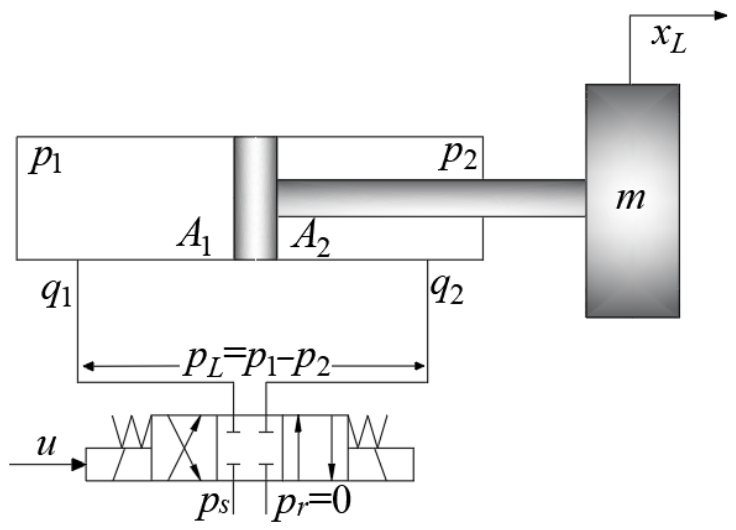
The schematic diagram of the proportional valve-controlled asymmetric hydraulic cylinder position control system studied in this paper is shown in Figure 1.
Owing to advancements in sealing technology, the external leakage coefficients are often treated as negligible in traditional modeling [9]. However, in practical heavy-duty hydraulic systems operating under high pressure and extended duty cycles, external leakage may still occur and vary with working conditions, seal wear, and temperature. Rather than simply neglecting these terms, this paper incorporates the external leakage effects, together with other unmodeled dynamics such as complex leakage characteristics, valve dead-zones, and valve dynamics, into the lumped uncertainties Q 1 x , t and Q 2 x , t . These lumped terms are then online approximated and compensated by the neural networks introduced in Section 3.3, eliminating the need for idealized assumptions that may compromise model fidelity under demanding operating conditions. Consequently, the flow dynamics equations for the two chambers of the hydraulic cylinder can be expressed as
V 1 β e p ˙ 1 = A 1 x ˙ L C i p 1 p 2 C e 1 p 1 + q 1 + Q 1 x , t V 2 β e p ˙ 2 = A 2 x ˙ L + C i p 1 p 2 C e 2 p 2 q 2 + Q 2 x , t
in which x L denotes the displacement of the hydraulic cylinder piston; β e denotes the effective bulk modulus of the hydraulic fluid; V 1 = V 01 + A 1 x L and V 2 = V 02 A 2 x L denote the effective areas of the piston in the non-rod chamber and the rod chamber, respectively; P 1 and P 2 are the pressures in the non-rod chamber and the rod chamber, respectively; C i is the internal leakage coefficient of the cylinder; C e 1 and C e 2 are the external leakage coefficients for the non-rod chamber and the rod chamber, respectively; owing to advancements in sealing technology, the external leakage coefficients can usually be neglected [2,3,4]; Q 1 x , t and Q 2 x , t represent the pressure dynamics modeling errors for the two chambers, which include unmodeled complex leakage characteristics, valve dead-zone characteristics, and valve dynamics, as well as the external leakage effects conventionally neglected in the literature. q 1 and q 2 denote the flow rates into and out of the non-rod chamber and the rod chamber, respectively, and can be expressed as [42,43,44]
q 1 = s u k q u p s p 1 + s u k q u p 1 p r q 2 = s u k q u p 2 p r + s u k q u p s p 2
where s ζ = 1 , ζ 0 0 , ζ < 0 , k q = C d ω x v 2 / ρ , C d and ω represent the flow coefficient of the proportional valve and the area gradient of the valve spool, respectively; x v is the spool displacement; ρ is the density of the hydraulic fluid; p s is the supply pressure; p r 0 , represents the return pressure.
Newton’s second law gives the force balance equation between the asymmetric hydraulic cylinder and the external load as
A 1 p 1 A 2 p 2 = m x ¨ L + b x ˙ L + f x , t
where m denotes the equivalent mass on the piston rod of the hydraulic cylinder; b is the viscous friction coefficient; f x , t is the unmodeled disturbance term, which includes unmodeled nonlinear friction, external load disturbances, and other uncertainties.
To represent the system in state-space form, by combining (1)–(3), the state variables can be defined as
x = x 1 x 2 x 3 T = x L x ˙ L A 1 p 1 A 2 p 2 m T
Meanwhile, the parameter vector is given by
θ = θ 1 θ 2 θ 3 θ 4 T
where θ 1 = b m , θ 2 = β e m , θ 3 = β e C i m , θ 4 = β e k q m . Then, the state-space representation of the system is defined as
x ˙ 1 = x 2 x ˙ 2 = x 3 θ 1 x 2 + d 1 x , t x ˙ 3 = θ 2 l 1 A 1 + l 2 A 2 x 2 θ 3 l 1 + l 2 p 1 p 2 + θ 4 l 1 g 1 + l 2 g 2 u + d 2 x , t
in which
l 1 = A 1 V 1 ,   l 2 = A 2 V 2
g 1 = s u p s p 1 + s u p 1 ,   g 2 = s u p 2 + s u p s p 2
d 1 x , t = f x , t m = f 1 X 1 + d 1 t
d 2 x , t = Q 1 x , t A 1 β e m V 1 Q 2 x , t A 2 β e m V 2 = f 2 X 2 + d 2 t
In this article, ξ ^ represents the estimated value of ξ , and ξ ˜ represents the estimated error of ξ , that is, ξ ˜ = ξ ^ ξ .
Assumption 1.
In the reference trajectory x 1 d t C 3 , there exists a known constant R d satisfying
x 1 d x ˙ 1 d x ¨ 1 d R d
in which x ˙ 1 d and x ¨ 1 d belong to the compact set U r ; z 1 , z 2 and z 3 belong to the compact set Ω z .
Assumption 2.
The function f X is smooth enough and d t is bounded and satisfies d 1 κ 1 , d 2 κ 2 , in which κ 1 and κ 2 are positive [15].
Assumption 3.
The system states x 1 , x 2 , and x 3 are available for real-time measurement.

3. Controller Design Procedure

3.1. Prescribed Performance Design

To quantitatively characterize the control objective, we define the physical position tracking error of the hydraulic actuator as
e t = x 1 t x 1 d t
where x 1 t denotes the actual piston displacement and x 1 d t represents the desired trajectory. The primary control objective is to ensure that the tracking error e t evolves strictly within a predefined envelope and converges to a small residual set within a finite, prescribed time T .
This section introduces an exponential-type predefined-time performance function ρ t , which is defined as
ρ t = ρ 0 ρ e k t / T t + ρ , ρ , 0 t < T t T
where ρ 0 and ρ respectively represent the initial value and the steady-state value of the performance function; T denotes the predefined convergence time; ρ 0 > ρ > 0 ; k represents the positive convergence rate coefficient, which determines the speed of error convergence.
According to the definition in (8), the following performance specifications are imposed on the tracking error e t
ρ t < e t < ρ t , t > 0
The condition in (9) guarantees that the overshoot and undershoot of the tracking error are bounded by ρ t , and the steady-state error satisfies e t ρ within the predefined time T .
To facilitate the controller synthesis, it is advantageous to transform the constrained inequality (9) into an equivalent unconstrained stabilization problem. To this end, we define a normalized error variable z 1 t and an auxiliary scaling function γ t as
z 1 t = e t ρ t
γ t = 1 ρ t
The time derivative of z 1 t is given by
z ˙ 1 t = e ˙ t ρ t e t ρ ˙ t ρ 2 t = γ t e ˙ t e t ρ ˙ t ρ t
Remark 1.
It is imperative to note that the error transformation defined in (10) imposes a strict feasibility condition on the initial system state. Specifically, to ensure that z 1 0 remains bounded, the initial tracking error must strictly satisfy e 0 < ρ 0 . In practical implementation, this condition can always be satisfied by selecting the design constant ρ 0 to be sufficiently large relative to the anticipated initial displacement deviation of the electro-hydraulic system.
Remark 2.
The performance function ρ t defined in (8) and its time derivative ρ ˙ t are continuously differentiable, ensuring the smoothness of the virtual control laws derived in the subsequent backstepping design procedure.

3.2. Projection Mapping

To estimate an unknown matrix θ ^ = θ 1 ; θ 2 ; ; θ n , a discontinuous projection is given by
p r o j θ ^ i = 0 θ ^ θ max , τ > 0 0 θ ^ θ max , τ < 0 i   o t h e r w i s e
The parameter adaptive law based on the discontinuous projection method can be expressed as [10]
θ ^ ˙ = p r o j θ ^ Γ τ   with   θ min θ ^ 0 θ max
where Γ denotes a non-negative diagonal matrix, for any adaptive function τ , the projection mapping (14) guarantees
θ ^ Ω θ ^ θ ^ : θ min θ ^ θ max θ ˜ T Γ 1 p r o j θ ^ Γ τ τ 0 , τ

3.3. Neural Network-Based Unknown Dynamics Estimation

To address the strong nonlinearities and modeling inaccuracies inherent in the electro-hydraulic system described by Equation (6), this paper employs a single-hidden-layer neural network (SLNN) [15], which is used to approximate the unknown nonlinear function f X . For system uncertainties, the neural network leverages its universal approximation theorem and online weight adjustment W ^ to make the network output W ^ T h X progressively approximate the true uncertainty values. This treats complex nonlinearities (e.g., dead-zone, leakage, friction) as a “black box” and uses the neural network to fit its input–output mapping.
Leveraging their universal function approximation capability, neural networks (NNs) can effectively model nonlinearities, thereby improving the stability and smoothness of electro-hydraulic servo systems.
The adopted SLNN is formulated as
f i X = W i T h X i + ε X i
where the input and output of the NN respectively denote X 1 = 1 ; x 1 d ; x ˙ 1 d ; x ¨ 1 d ; z 1 ; z 2 , X 2 = 1 ; x 1 d ; x ˙ 1 d ; x ¨ 1 d ; z 1 ; z 2 ; z 3 and W 1 T h X 1 , W 2 T h X 2 ; z 1 , z 2 , z 3 denote the error variable to be designed in the subsequent backstepping procedure; W i i = 1 , 2 denotes the unknown ideal NN weight matrix; the term ε X i i = 1 , 2 represents the approximate error of NN; and h · is a modified Sigmoid activation function.
Remark 3.
The SLNN in this paper adopts a modified Sigmoid activation function. Compared to the RBF used in [20] or the ReLU function which introduces non-smooth gradients at zero, the modified Sigmoid function is easier to design and possesses smooth, bounded derivatives. In contrast to multi-hidden-layer neural networks, the SLNN is more beneficial for practical implementation owing to its low computational cost.
Property 1.
Given the universal function approximation property of the NN, ε · is bounded. Hence, on the basis of Assumption 2, the following inequalities hold
ε X 1 + d 1 t δ 1 ,   ε X 2 + d 2 t δ 2
in which δ i i = 1 , 2 are non-negative constants.
The NN-based approximated value for f X is constructed by
f ^ X = W ^ T h X
where the term W ^ denotes the estimation of the weight matrix W .
The adaptive law for online weight updating is designed as
W ^ ˙ = Γ W π
where Γ w denotes a positive definite diagonal matrix; and π denotes an adaptive function, which is given as
π w 1 = h X 1 z 2 ,   π w 2 = h X 2 z 3

3.4. Nonlinear Controller Design

From the preceding derivation, the first error surface can be constructed as
z 1 = e ρ
The second error surface is defined as
z 2 = x 2 α 1
The first virtual controller α 1 can be designed as
α 1 = x ˙ 1 d + e ρ ˙ ρ k 1 z 1 γ
Substituting (23) into (22) and combining it with (12) yields
z 2 = z ˙ 1 + k 1 z 1 γ
where z 1 denotes the prescribed performance error, and the non-negative constant k 1 is the feedback gain.
Since G s = z 1 s / z 2 s = γ / s + k 1 represents a stable transfer function, z 1 necessarily converges to zero as z 2 tends to zero.
To process the designed virtual controller α 1 , a first-order filter is introduced as
η 2 α ˙ 1 f + α 1 f = α 1   with   α 1 f 0 = α 1 0
where η 2 is the time constant of the first-order filter. The filter can effectively avoid the complex “explosion of complexity” problem caused by the differentiation of the virtual controller α 1 .
With the filter introduced, the second error surface is updated to
z 2 = x 2 α 1 f
The filtering error of filter formulation (25) is defined as
y 2 = α 1 f α 1
The third error surface is defined as
z 3 = x 3 α 2
The second virtual controller α 2 can be designed as
α 2 = α 2 a + α 2 s α 2 a = θ ^ 1 x 2 W ^ 1 T h X 1 + α ˙ 1 f α 2 s 1 = k 2 z 2 α 2 s 2 = k s 2 z 2
where the non-negative constant k 2 denotes the linear feedback gain; k s 2 is the nonlinear feedback gain; and W 1 denotes the weight matrix of the first neural network, which is defined as W 1 = w 11 w 12 w 13 w 14 w 15 w 16 T .
Similarly, the second first-order filter can be designed as
η 3 α ˙ 2 f + α 2 f = α 2   with   α 2 f 0 = α 2 0
where η 3 is the time constant of the first-order filter.
With the filter introduced, the third error surface is updated to
z 3 = x 3 α 2 f
The filtering error of filter formulation (30) is defined as
y 3 = α 2 f α 2
Taking the time derivative of both sides of (26), and combining (6), (29), and (30), we obtain
z ˙ 2 = z 3 + y 3 k 2 z 2 + θ ˜ 1 x 2 W ˜ 1 T h X 1 + ε X 1 + d 1 t + α 2 s 2
A positive semi-definite Lyapunov function is defined as
V 2 = 1 2 z 2 2
Its time derivative is given by
V ˙ 2 = z 2 z 3 + y 3 k 2 z 2 + θ ˜ 1 x 2 W ˜ 1 T h X 1 + ε X 1 + d 1 t + α 2 s 2
The following conditions must be satisfied by the term α 2 s 2 to fulfill the control requirements
z 2 α 2 s 2 0 z 2 θ ˜ 1 x 2 W ˜ 1 T h X 1 + ε X 1 + d 1 t + α 2 s 2 σ 1
where σ 1 is a positive design parameter that can be arbitrarily small.
k s 2 is designed as
k s 2 = φ 2 4 σ 1
where φ 2 is any smooth function satisfying φ 2 θ ˜ 1 x 2 + W ˜ 1 h X 1 + δ 1 2 .
The control law u can be designed as
u = u a + u s u a = θ ^ 2 l 1 A 1 + l 2 A 2 x 2 + θ ^ 3 l 1 + l 2 p 1 p 2 + α ˙ 2 f W ^ 2 T h X 2 / θ ^ 4 l 1 g 1 + l 2 g 2 u s 1 = k 3 z 3 / l 1 g 1 + l 2 g 2 u s 2 = k s 3 z 3
where the non-negative constant k 3 denotes the linear feedback gain; k s 3 is the nonlinear feedback gain; W 2 denotes the weight matrix of the second neural network, which is given by W 2 = w 21 w 22 w 23 w 24 w 25 w 26 w 27 T .
Taking the time derivative of both sides of (31), and combining (6) and (38), we obtain
z ˙ 3 = θ 4 k 3 z 3 θ ˜ M T φ x W ˜ 2 T h X 2 + ε X 2 + d 2 t + θ 4 l 1 g 1 + l 2 g 2 u s 2
where θ M = θ 2 θ 3 θ 4 T , φ x = l 1 A 1 + l 2 A 2 x 2 l 1 + l 2 p 1 p 2 l 1 g 1 + l 2 g 2 u a T .
A positive semi-definite Lyapunov function is defined as
V 3 = 1 2 z 3 2
Then, its time derivative is given by
V ˙ 2 = z 3 θ 4 k 3 z 3 θ ˜ T φ x W ˜ 2 T h X 2 + ε X 2 + d 2 t + θ 4 l 1 g 1 + l 2 g 2 u s 2
To fulfill the control requirements, the term u s 2 designed in this paper must meet the following conditions
z 3 u s 2 0 z 3 θ ˜ M T φ x W ˜ 2 T h X 2 + ε X 2 + d 2 t + θ 4 l 1 g 1 + l 2 g 2 u s 2 σ 2
where σ 2 is a positive design parameter that can be arbitrarily small.
k s 3 is designed as
k s 3 = φ 3 4 θ 4 min σ 2 l 1 g 1 + l 2 g 2
where φ 3 is any smooth function satisfying φ 3 θ ˜ M φ x + W ˜ 2 h X 2 + δ 2 2 .
For the purpose of ensuring bounded estimation errors, the adaptive law is constructed as
τ = x 2 z 2 l 1 A 1 + l 2 A 2 x 2 l 1 + l 2 p 1 p 2 l 1 g 1 + l 2 g 2 u a
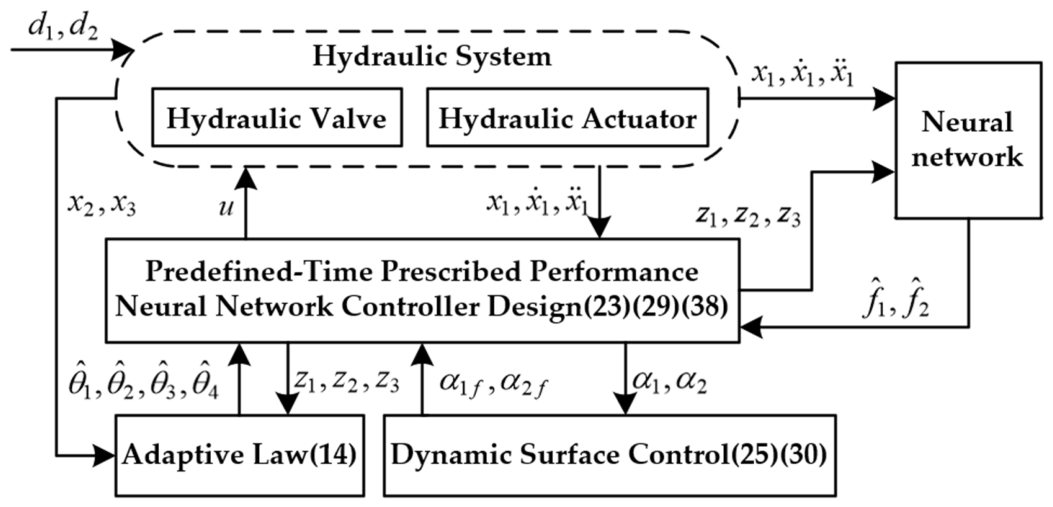
The structure of the proposed algorithm is illustrated in Figure 2.

3.5. Main Results and Stability Analysis

Theorem 1.
All signals remain bounded, and the uniformly bounded tracking performance of x 1 is ultimately achieved. The final tracking accuracy is quantified by
V a t V a 0 e 2 λ 0 t + ψ 2 λ 0 1 e 2 λ 0 t
where V a 0 is the initial value of the Lyapunov function V a t , ψ will be specified in the following proof, Λ is a negative definite matrix. Let λ 0 = λ max Λ .
Proof of Theorem 1.
The Lyapunov function is set as
V a = 1 2 z 1 2 + 1 2 z 2 2 + 1 2 z 3 2 + 1 2 i = 2 3 y i 2
According to the expression of α 1 , and utilizing the assumptions, it can be obtained as
α ˙ 1 B 1 x 1 , x ˙ 1 , x 1 d , x ˙ 1 d , x ¨ 1 d , ρ , ρ ˙
where B 1 · is a continuous and bounded function, and there exists a known constant M 2 > 0 such that B 1 · M 2 .
By following a similar line of reasoning, it can be shown that
α ˙ 2 M 3
where M 3 is a known positive constant.
According to Young’s inequality, we have
y 2 y ˙ 2 = y 2 2 η 2 α ˙ 1 y 2 y 2 2 η 2 + y 2 2 + M 2 2 4 y 3 y ˙ 3 = y 3 2 η 3 α ˙ 2 y 3 y 3 2 η 3 + y 3 2 + M 3 2 4
Combining (36), (42), (46), and (49), the time derivative of V a is obtained as
V ˙ a k 1 z 1 2 + γ z 1 z 2 + γ z 1 y 2 + z 2 z 3 + z 2 y 3 k 2 z 2 2 + z 2 α 2 s 2 + θ ˜ 1 x 2 W ˜ 1 T h 1 X 1 + ε X 1 + d 1 t θ 4 k 3 z 3 2 + z 3 θ 3 l 1 g 1 + l 2 g 2 u s 2 θ ˜ M T φ x W ˜ 2 T h 2 X 2 + ε X 2 + d 2 t y 2 2 η 2 + y 2 2 + M 2 2 4 y 3 2 η 3 + y 3 2 + M 3 2 4 k 1 z 1 2 + γ z 1 z 2 + z 2 z 3 k 2 z 2 2 θ 4 min k 3 z 3 2 y 2 2 η 2 + y 2 2 + M 2 2 4 y 3 2 η 3 + y 3 2 + M 3 2 4 + σ 1 + σ 2 = Z T Λ Z + ψ
where Z = z 1 z 2 z 3 y 2 y 3 , ψ = M 2 2 4 + M 3 2 4 + σ 1 + σ 2 .
The specific form of the matrix Λ is defined below with suitable gains k 1 , k 2 , k 3 to keep it negative definite.
Λ = k 1 γ / 2 0 γ / 2 0 γ / 2 k 2 1 / 2 0 1 / 2 0 1 / 2 θ 4 min k 3 0 0 γ / 2 0 0 1 / η 2 1 0 0 1 / 2 0 0 1 / η 3 1
So it can be proven that
V a t V a 0 e 2 λ 0 t + ψ 2 λ 0 1 e 2 λ 0 t
Hence, as t , V a t ψ 2 λ 0 , and Theorem 1 is proved. □

4. Simulation Verification

Numerical simulations are carried out on the electro-hydraulic servo system in Matlab R2023a/Simulink. To evaluate the performance of the presented controller, three simulation cases are performed. In these cases, the electro-hydraulic servo model presented in Section 2 is applied. The state equations are given by
x ˙ 1 = x 2 x ˙ 2 = x 3 θ 1 x 2 + f 1 X 1 + d 1 t x ˙ 3 = θ 2 l 1 A 1 + l 2 A 2 x 2 θ 3 l 1 + l 2 p 1 p 2 + θ 4 l 1 g 1 + l 2 g 2 u + f 2 X 2 + d 2 t
The model parameters are given in Table 1.
Based on the nominal values of the parameters in Table 1, the uncertain parameters of the position control system are bounded in Table 2 as follows:
Case 1: Based on the electro-hydraulic servo model above, the desired displacement trajectory x 1 d is set as
x 1 d = 0.02 cos π t
The objective of Case 1 is to evaluate the transient response capability of controllers in the presence of initial tracking errors, simulating scenarios in practical applications where the starting position of the system deviates from the origin of the desired trajectory. The system is subject to the mismatched disturbance d 1 ( t ) = 0.4 sin π t and the matched disturbance d 2 ( t ) = 0.1 sin 0.5 π t . The study is conducted with the following three controllers.
C1: The adaptive robust controller integrating prescribed performance and neural network proposed in this paper. This controller integrates a prescribed performance function to enforce predefined transient and steady-state tracking error bounds, a neural network to approximate unknown nonlinear dynamics online, and an adaptive robust control mechanism to compensate for parametric uncertainties and external disturbances. The control law of C1 is described as
e = x 1 x 1 d , z 1 = e / ρ , z 2 = x 2 α 1 f , z 3 = x 3 α 2 f , θ ^ ˙ = p r o j θ ^ Γ θ τ , W ^ ˙ i = Γ W i π w i , i = 1 , 2 ρ t = ρ 0 ρ e k t / T t + ρ , t 0 , T ; ρ t = ρ , t T , α 1 = x ˙ 1 d + e ρ ˙ / ρ k 1 z 1 / γ , η 2 α ˙ 1 f + α 1 f = α 1 , α 1 f 0 = α 1 0 α 2 = θ ^ 1 x 2 W ^ 1 T h X 1 + α ˙ 1 f k 2 z 2 k s 2 x , t z 2 , η 3 α ˙ 2 f + α 2 f = α 2 , α 2 f 0 = α 2 0 u a = θ ^ 2 l 1 A 1 + l 2 A 2 x 2 + θ ^ 3 l 1 + l 2 p 1 p 2 + α ˙ 2 f W ^ 2 T h X 2 / θ ^ 4 l 1 g 1 + l 2 g 2 u s = k 3 z 3 / l 1 g 1 + l 2 g 2 k s 3 z 3 , u = u a + u s k s 2 = φ 2 4 σ 1 , φ 2 θ ˜ 1 x 2 + W ˜ 1 h X 1 + δ 1 2 k s 3 = φ 3 4 θ 4 min σ 2 l 1 g 1 + l 2 g 2 , φ 3 θ ˜ M φ x + W ˜ 2 h X 2 + δ 2 2
where k 1 = 18 , k 2 = 50 , k 3 = 15 , k = 1 , ρ 0 = 0.01 , ρ = 0.0002 , T = 1 , δ 1 = 0.6 , δ 2 = 0.2 , η 2 = η 3 = 0.01 , θ ^ 1 0 = 0.1 , θ ^ 2 0 = 1 × 10 6 , θ ^ 3 0 = 0 , θ ^ 4 0 = 0.05 , w 1 i 0 i = 1 , , 6 = 0.05 , and w 2 i 0 i = 1 , , 7 = 0.05 .
The diagonal matrices employed in the parameter adaptation laws and the neural network weight updating are given by
Γ θ = d i a g 4.5 × 10 3 , 4 × 10 9 , 9 × 10 10 , 1 × 10 4
Γ W 1 = d i a g 14 , 14 , 14 , 14 , 14 , 14
Γ W 2 = d i a g 10 , 10 , 10 , 10 , 10 , 10 , 10
C2: The prescribed performance-based adaptive robust controller. This controller adopts the prescribed performance function to confine the tracking error within preset bounds, while unknown parameters are estimated online via adaptive laws. The neural network compensation module is excluded in C2 to evaluate its contribution in C1. Other control parameters of C2 remain the same as those of C1.
C3: The prescribed performance-based robust controller. This controller utilizes only the prescribed performance function to guarantee transient performance, without adaptive parameter estimation or neural network compensation. It relies solely on high-gain robust feedback to suppress uncertainties and disturbances. C3 is designed to validate the effectiveness of the adaptive parameter estimation module in C1. Other control parameters of C3 are kept consistent with those of C1.
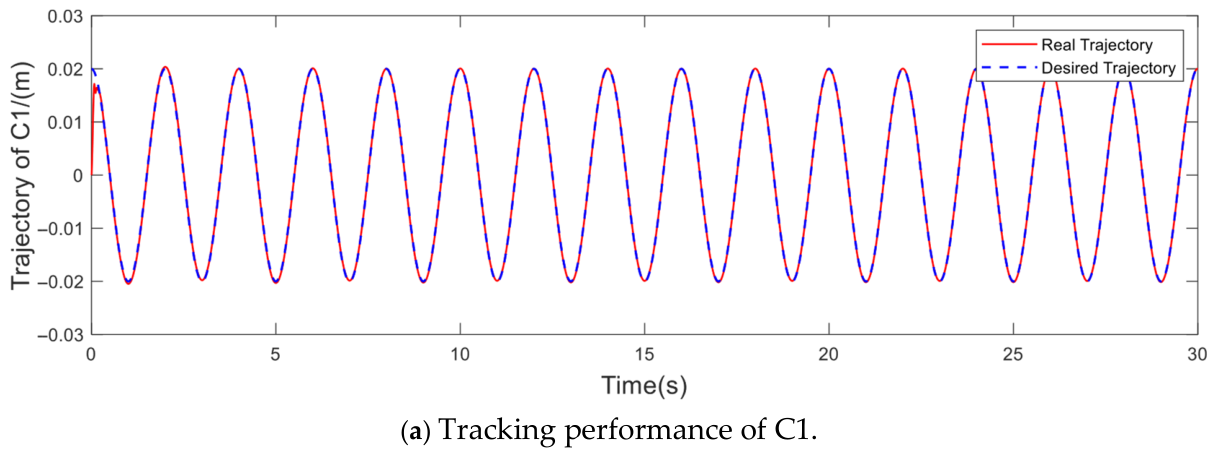
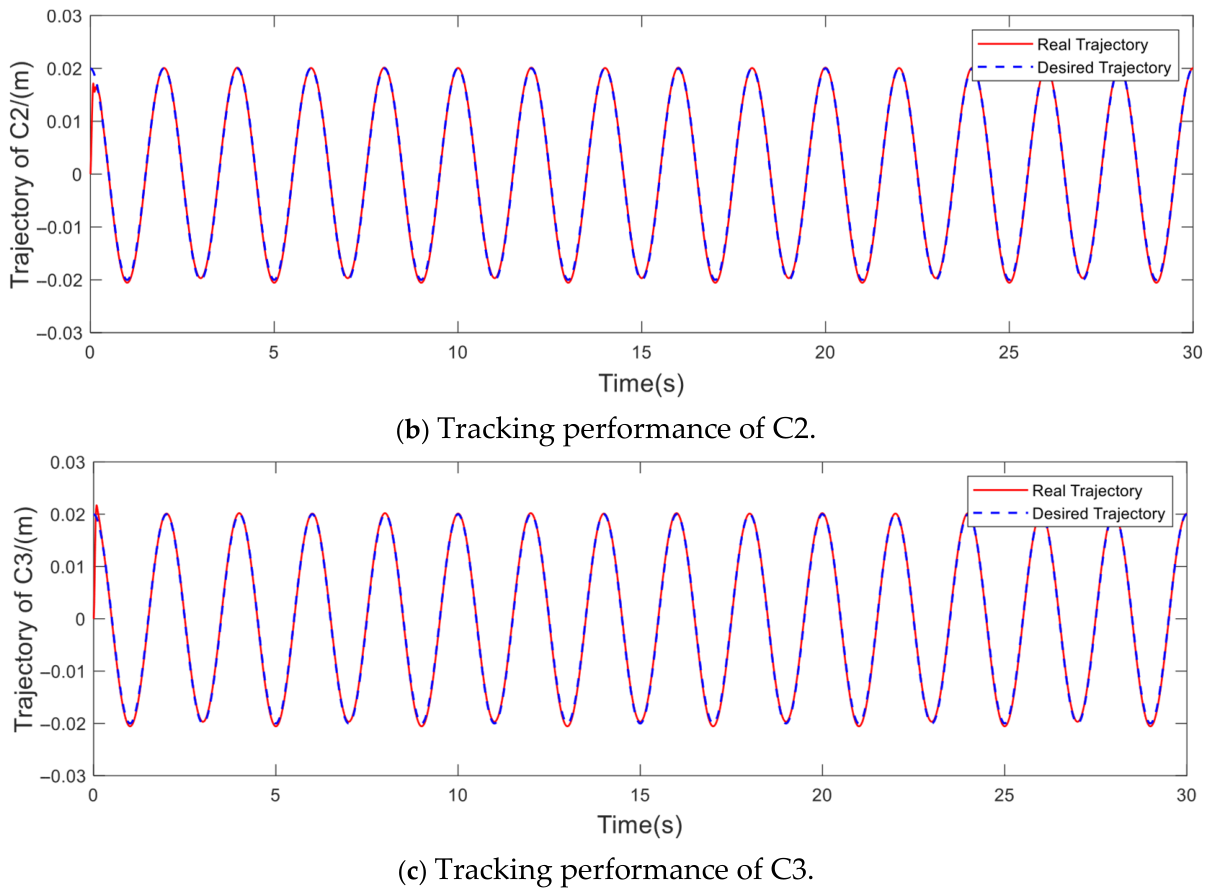
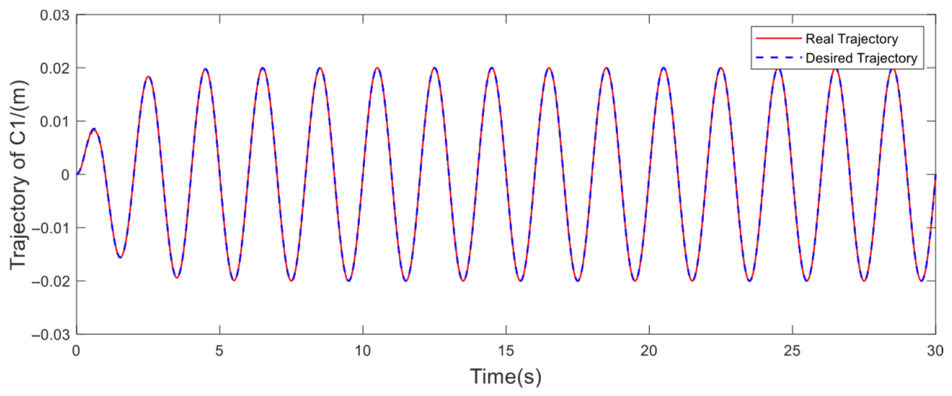
The displacement tracking performance of the three controllers is illustrated in Figure 3.
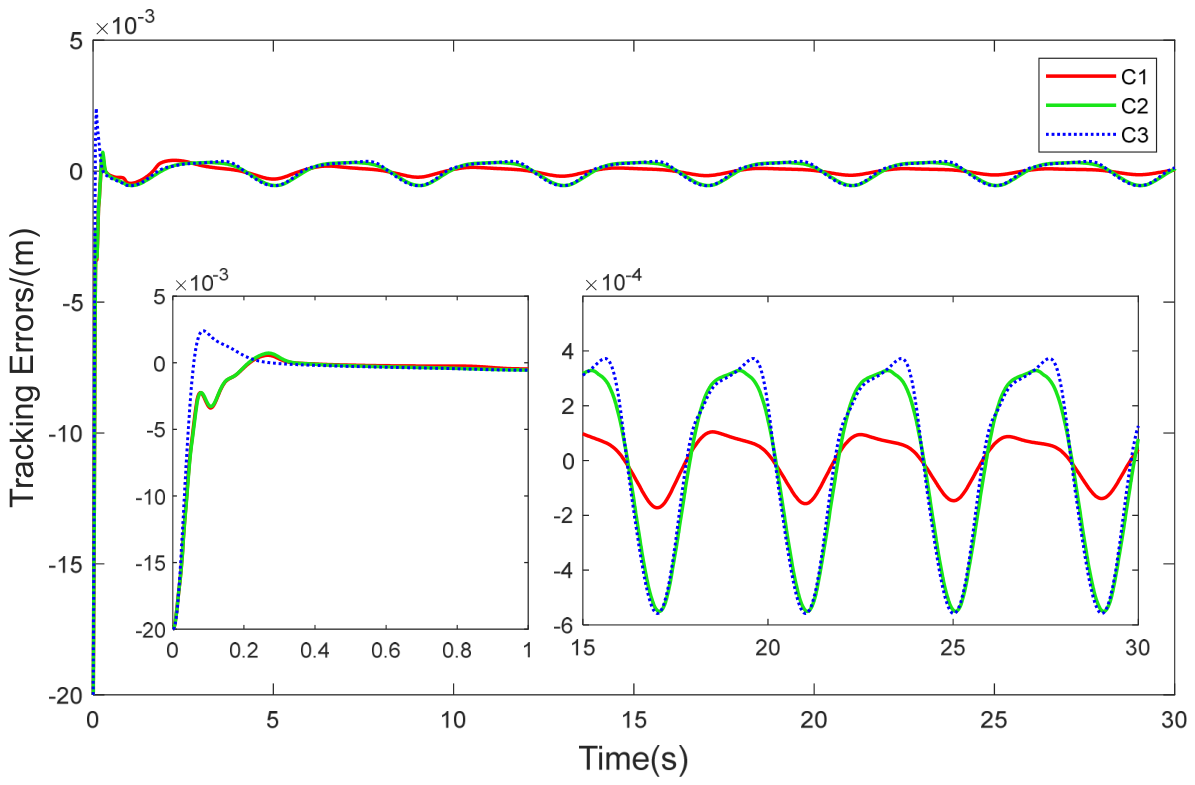
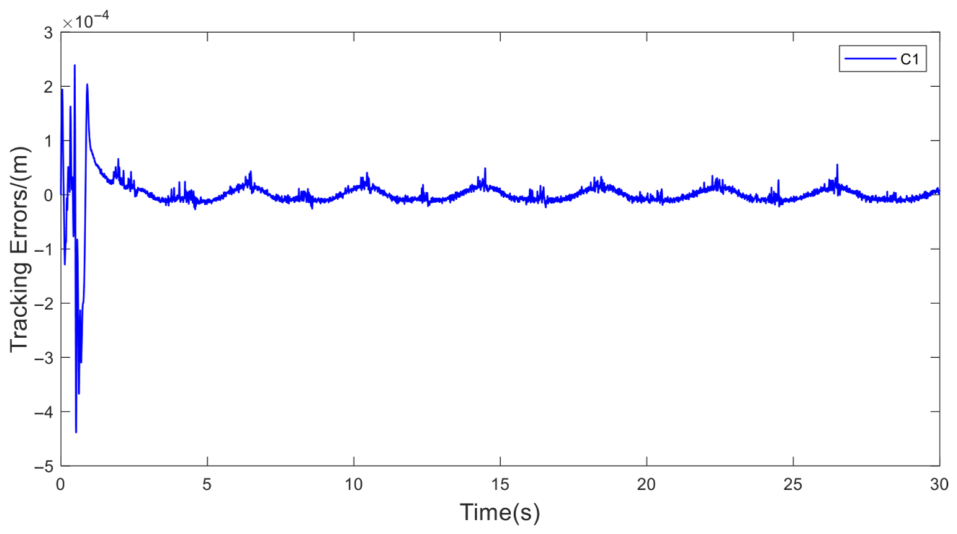
The tracking errors of the three controllers are presented in Figure 4. Meanwhile, the quantitative comparison is shown in Table 3 with all indices computed over the last 5 s of the simulation.
It can be seen that controller C1 provides significantly better tracking performance than other controllers. Over the last 5 s, it maintains lower steady-state errors and experiences markedly fewer oscillations.
When comparing C1 with the other two controllers, it can be observed that although C1 and C2 exhibit very similar transient response capabilities in the presence of initial deviations, C1 achieves smaller steady-state errors. This improvement stems from the integration of the neural network compensation module in C1, which actively learns and compensates for unmodeled dynamics and complex nonlinearities online, thereby reducing residual errors that cannot be fully eliminated by parameter adaptation alone.
Compared to C3, C1 demonstrates superior performance in both transient response and steady-state accuracy. The reason lies in the fact that C3 relies solely on high-gain robust feedback without any adaptive or learning components, which limits its ability to actively compensate for uncertainties. The enhanced performance of C1 is attributed to the synergistic combination of adaptive robust control and neural network compensation. The ARC mechanism handles parametric uncertainties through online parameter estimation, while the neural network module further compensates for unstructured nonlinearities, enabling faster convergence during transients and higher precision in the steady state.
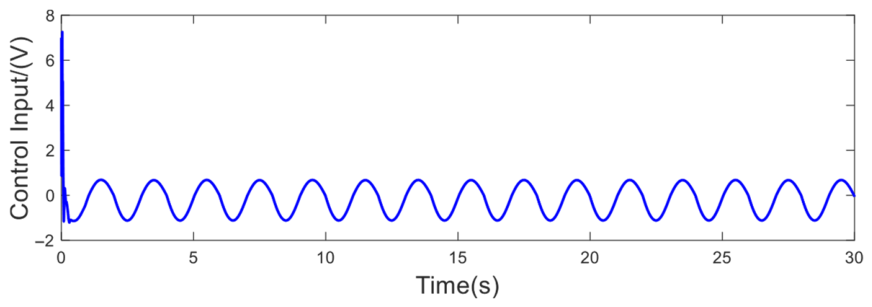
The corresponding control input of C1 is provided in Figure 5.
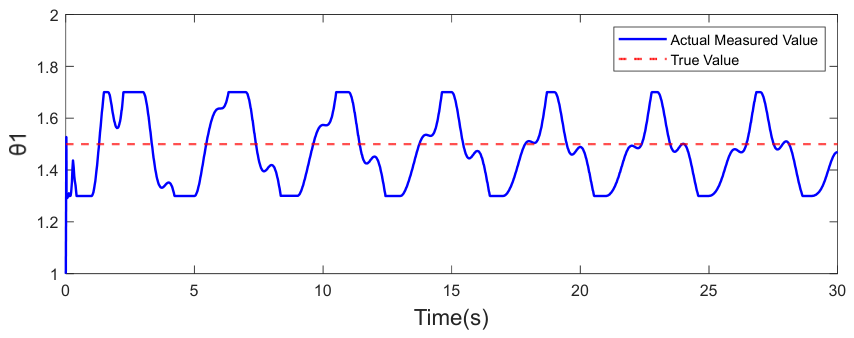
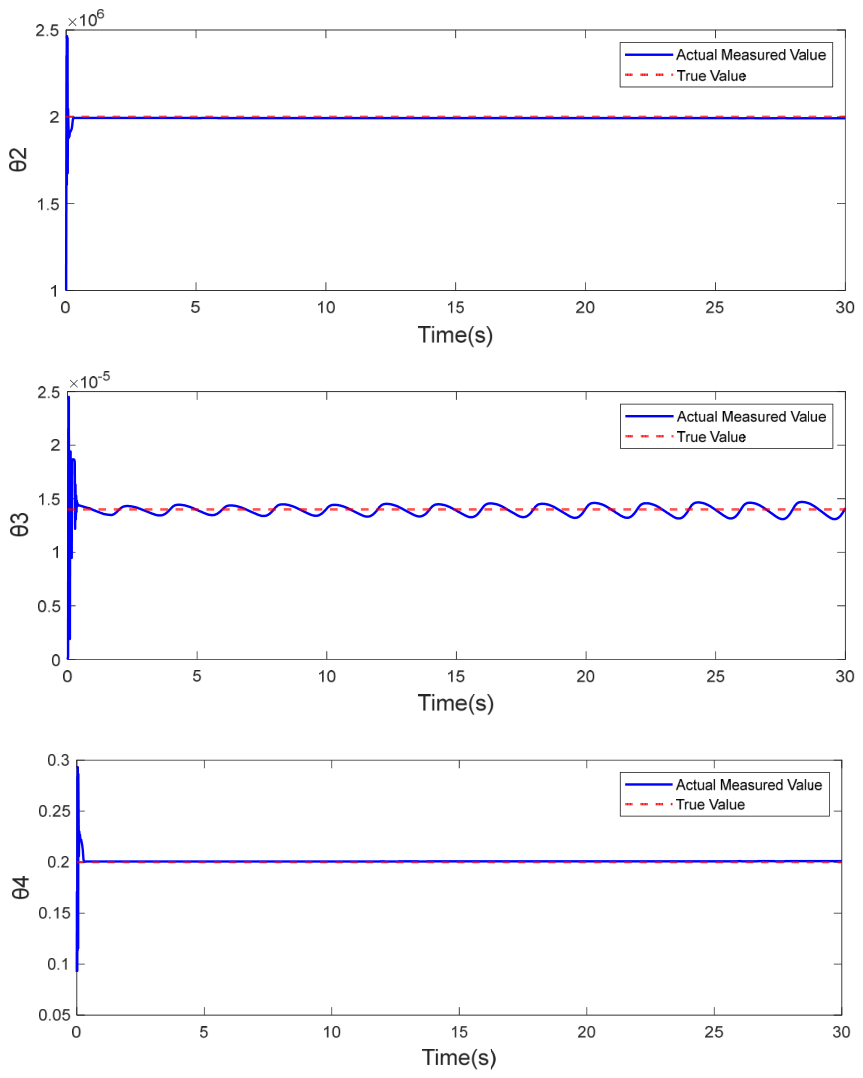
The estimation curves of the unknown parameters in Controller C1 are shown in Figure 6. The red dashed line indicates the true value, and the blue solid line represents the actual measured value.
As illustrated in the figure, all uncertain terms are effectively adapted to a convergent state, verifying the efficacy of the adaptive mechanism.
Case 2: Based on the electro-hydraulic servo model above, the desired displacement trajectory x 1 d is set as
x 1 d = 0.02 sin π t 1 e t
The objective of Case 2 is to verify the baseline tracking performance of the controller under ideal initial conditions, where the actual displacement coincides exactly with the desired trajectory at startup, meaning the initial tracking error is zero. The system is subject to the mismatched disturbance d 1 ( t ) = 0.5 sin π t and the matched disturbance d 2 ( t ) = 0.1 sin 0.5 π t . The study is conducted with the following four controllers.
C1: The adaptive robust controller integrating prescribed performance and neural network proposed in this paper. This controller is the same as C1 in Case 1. The control law of C1 is the same as that of Case 1.
In this case, k 1 = 90 , k 2 = 50 , k 3 = 40 , k = 2 , ρ 0 = 0.01 , ρ = 0.0002 , T = 1 , δ 1 = 0.5 , δ 2 = 0.2 , η 2 = η 3 = 0.0005 , θ ^ 1 0 = 0.9 , θ ^ 2 0 = 1 × 10 6 , θ ^ 3 0 = 0 , θ ^ 4 0 = 0.05 , w 1 i 0 i = 1 , , 6 = 0.1 , and w 2 i 0 i = 1 , , 7 = 0.1 .
The diagonal matrices employed in the parameter adaptation laws and the neural network weight updating are given by
Γ θ = d i a g 5 × 10 3 , 5.4 × 10 11 , 4.7 × 10 10 , 1.5 × 10 2
Γ W 1 = d i a g 200 , 200 , 200 , 200 , 200 , 200
Γ W 2 = d i a g 40 , 40 , 40 , 40 , 40 , 40 , 40
C2: The control strategy proposed in [20], which integrates adaptive robust control, an extended state observer, and a neural network. This controller compensates for actuator dead-zone nonlinearities using a neural network, estimates parametric uncertainties and external disturbances via the ESO, and handles parametric uncertainties by incorporating ARC. The control parameters of the ARC and neural network components are kept consistent with those of C1. The goal of setting C2 is to validate the superiority of C1. The control law of C2 is described as
z 1 = x 1 x 1 d , z 2 = x 2 α 1 , z 3 = x 3 α 2 , θ ^ ˙ = p r o j θ ^ Γ θ τ , W ^ ˙ i = Γ W i π w i , i = 1 , 2 x ^ ˙ 1 = x ^ 2 4 ω 0 x ^ 1 x 1 , x ^ ˙ 2 = x ^ 3 θ ^ 1 x 2 6 ω 0 2 x ^ 1 x 1 x ^ ˙ 3 = x ^ 4 θ ^ 2 l 1 A 1 + l 2 A 2 x 2 θ ^ 3 l 1 + l 2 p 1 p 2 + θ ^ 4 l 1 g 1 + l 2 g 2 u 4 ω 0 3 x ^ 1 x 1 x ^ ˙ 4 = ω 0 4 x ^ 1 x 1 α 1 = x ˙ 1 d k 1 z 1 α 2 = θ ^ 1 x 2 W ^ 1 T h X 1 + α ˙ 1 k 2 z 2 k s 2 z 2 u a = θ ^ 2 l 1 A 1 + l 2 A 2 x 2 + θ ^ 3 l 1 + l 2 p 1 p 2 + α ˙ 2 x ^ 4 W ^ 2 T h X 2 / θ ^ 4 l 1 g 1 + l 2 g 2 u s = k 3 z 3 / l 1 g 1 + l 2 g 2 k s 3 z 3 , u = u a + u s k s 2 = φ 2 4 σ 1 , φ 2 θ ˜ 1 x 2 + W ˜ 1 h X 1 + δ 1 2 k s 3 = φ 3 4 θ 4 min σ 2 l 1 g 1 + l 2 g 2 , φ 3 θ ˜ M φ x + W ˜ 2 h X 2 + δ 2 2
in which x ^ i ( i = 1 , 2 , 3 , 4 ) are the four estimated states of ESO and x ^ i ( 0 ) ( i = 1 , 2 , 3 , 4 ) = 0 ; x ^ 1 represents the estimated position of the actuator; x ^ 2 represents the estimated velocity of the actuator; x ^ 3 represents the estimated pressure-related dynamic state; x ^ 4 represents the estimated total disturbance; ω 0 represents the bandwidth of the observer, ω 0 = 20 . The other parameters are the same as those of C1.
C3: The prescribed performance-based adaptive robust controller. This controller is same as C2 in Case 1. Other control parameters of C3 remain the same as those of C1.
C4: The prescribed performance-based robust controller. This controller is the same as C3 in Case 1. Other control parameters of C4 are kept consistent with those of C1.
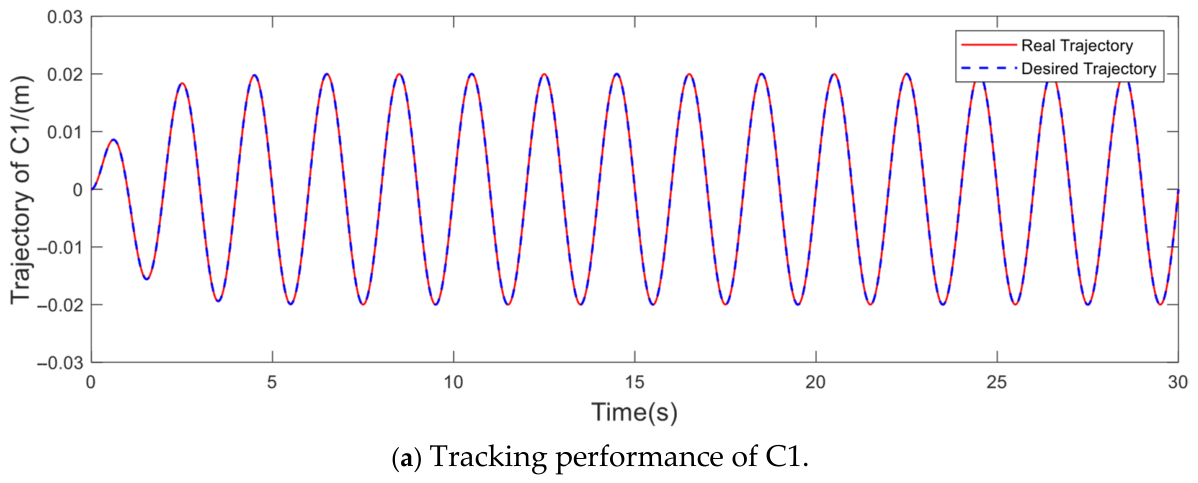
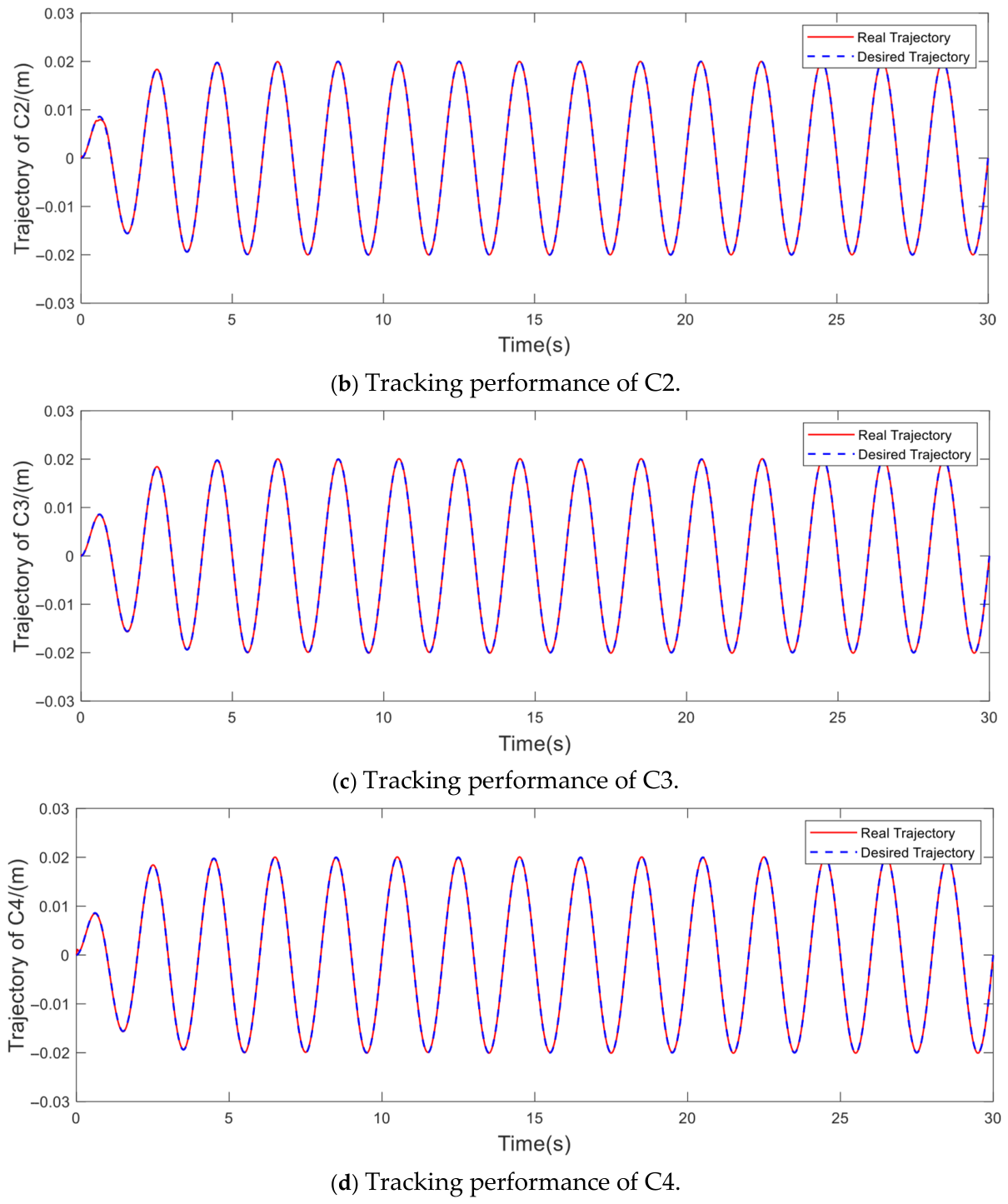
The displacement tracking performance of the four controllers is illustrated in Figure 7.
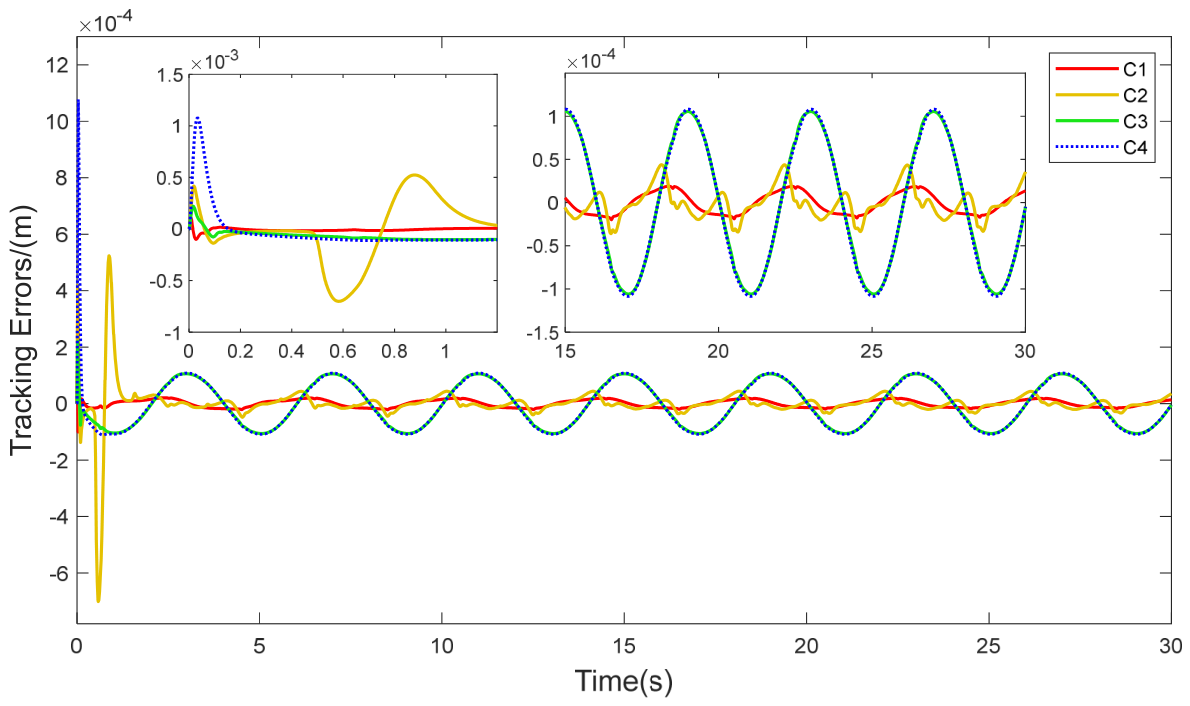
The tracking errors of the four controllers are presented in Figure 8. Meanwhile, the quantitative comparison is shown in Table 4 with all indices computed over the last 5 s of the simulation.
As illustrated, controller C1 offers considerably better tracking accuracy than C2, C3, and C4. Specifically, during the final 5 s, C1 yields smaller steady-state errors and exhibits less pronounced oscillations. Moreover, C1 exhibits better transient behavior during the initial seconds, with less instability and smoother error convergence.
The observed superiority is a result of the integrated control architecture in C1, incorporating prescribed performance control, adaptive robust control, and neural network compensation. In this architecture, PPC ensures the tracking error respects predefined transient and steady-state boundaries; ARC addresses parametric uncertainties and external disturbances via real-time parameter adaptation; and NN compensates for unmodeled dynamics online [24]. Although C2 achieves improved tracking performance over C3 and C4 due to its ARC+ESO+NN structure, its lack of PPC prevents it from matching the precision of C1. Without the prescribed performance function to provide explicit boundaries for the transient and steady-state errors, the controller lacks a targeted mechanism to shape the dynamic response and results in larger errors. Moreover, compared with C1, the lack of the first-order filter leads to residual oscillations. C3, which excludes the neural network, exhibits diminished accuracy when confronting complex nonlinear behaviors. C4, relying entirely on high-gain robust feedback without adaptation or learning, shows the most pronounced performance decline due to its limited capacity to manage unknown dynamics.
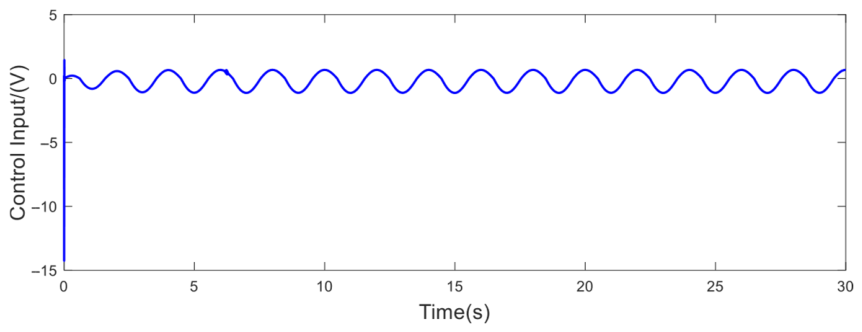
These results validate the superiority of incorporating prescribed performance control into the adaptive robust neural network framework. Furthermore, the control input of C1 is provided in Figure 9.
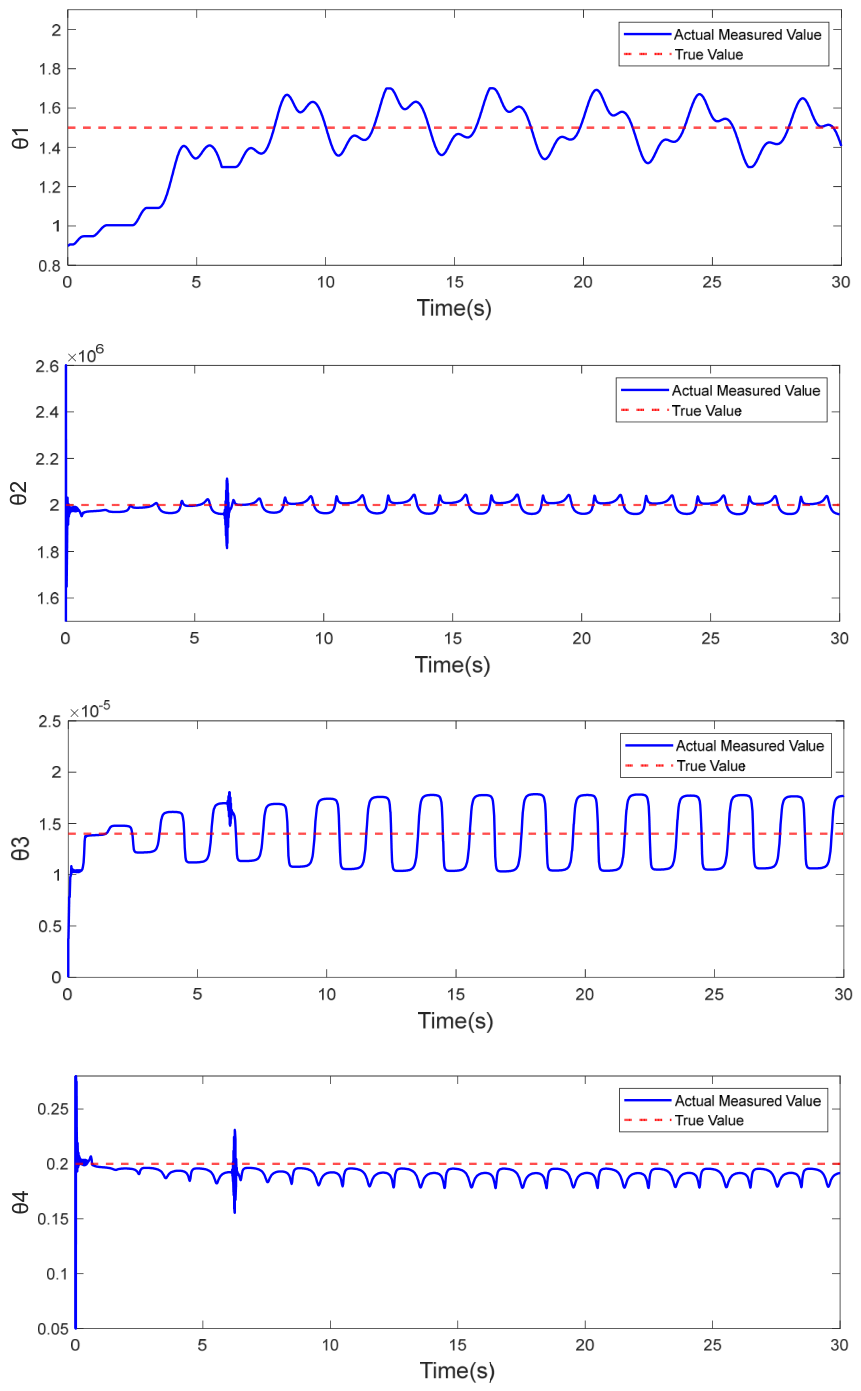
The estimation curves of the unknown parameters in Controller C1 are shown in Figure 10. The red dashed line indicates the true value, and the blue solid line represents the actual measured value.
As illustrated in the figure, all uncertain terms are effectively adapted to a convergent state, verifying the efficacy of the adaptive mechanism.
Case 3: To further evaluate the robustness of the proposed controller under more realistic operating conditions, a third simulation case is conducted. In this case, the model parameters are adjusted to values closer to practical engineering scenarios, as listed in Table 5.
In this case, the controller parameters remain exactly the same as those in Case 2, while the ranges of uncertain parameters are updated according to the adjusted model parameters as listed in Table 6.
The proposed controller is tested under the following additional non-ideal conditions:
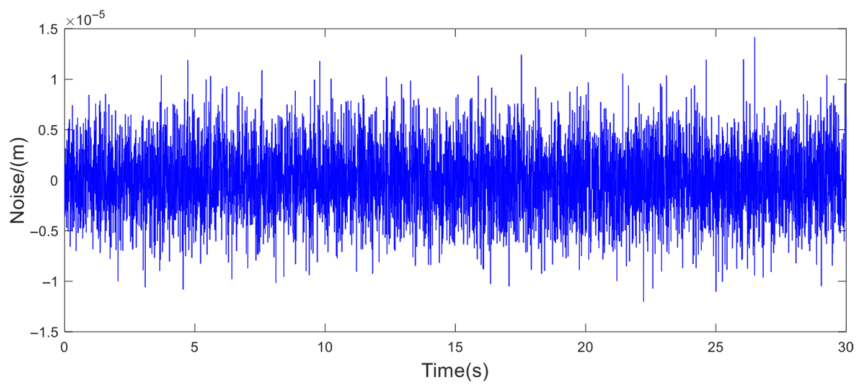
  • A white noise module is added to simulate realistic displacement sensor measurement errors. The power of the position sensor noise is set to 6 × 10 14 and is shown in Figure 11.
  • A saturation module with a limit of ± 10   V is incorporated at the control input to reflect the typical input range of a servo-valve, thereby simulating the saturation nonlinearity commonly encountered in practical hydraulic actuation systems.
The tracking performance and tracking error of the proposed controller are provided in Figure 12 and Figure 13. The desired displacement trajectory x 1 d is set as
x 1 d = 0.02 sin π t 1 e t
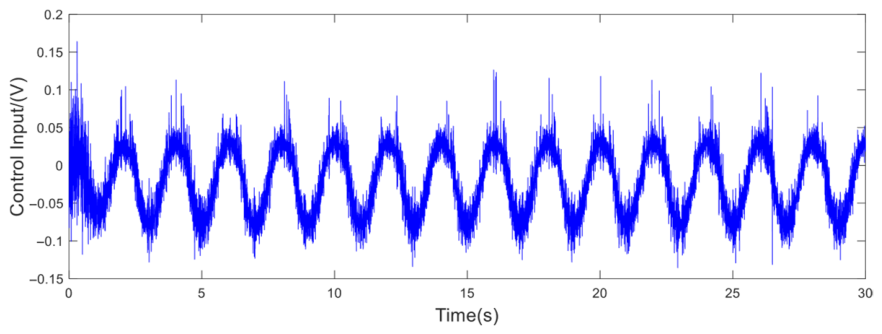
The corresponding control input is provided in Figure 14.
As observed from the results, despite the presence of parameter variations, measurement noise, and actuator saturation, the proposed controller maintains satisfactory tracking performance. The tracking error remains bounded and converges to a small neighborhood of zero, demonstrating the robustness of the proposed method against practical non-idealities. The control input remains within the ± 10   V saturation limits, confirming that the required actuation is practically realizable without unrealistic peaks.


5. Conclusions

This paper investigates the position tracking control problem for valve-controlled asymmetric hydraulic cylinder systems subject to unknown nonlinearities, parametric uncertainties, and external disturbances. A novel adaptive robust control strategy integrating predefined-time prescribed performance and neural network compensation is proposed. A predefined-time prescribed performance function with exponential convergence characteristics is designed to enforce the system tracking error to converge to a predefined steady-state region within a preset predefined time, while guaranteeing satisfactory transient response performance. This overcomes the limitation of traditional asymptotic convergence methods where convergence speed is difficult to control. Dynamic surface control with first-order filters is introduced to circumvent the “explosion of complexity” problem inherent in traditional backstepping, significantly reducing computational burden. Neural networks are employed to online approximate complex unmodeled dynamics and nonlinear uncertainties, reducing dependence on accurate mathematical models. Meanwhile, an adaptive law based on the discontinuous projection method is developed to achieve the bounded estimation and online compensation of unknown parameters. Robust control terms are incorporated to suppress the influence of external load disturbances and uncompensated residuals, enhancing disturbance rejection capability. Lyapunov stability analysis proves that all closed-loop signals remain bounded and the tracking error converges to a prescribed residual set. While the Lyapunov synthesis guarantees boundedness, the derived residual bounds are inherently conservative due to worst-case relaxations. Simulation results demonstrate tracking accuracy significantly superior to these theoretical predictions. Future work may pursue tighter quantitative bounds via refined analytical frameworks. Comprehensive numerical simulations and comparative studies demonstrate that the proposed controller achieves superior tracking accuracy, faster convergence, and better disturbance rejection compared to conventional control strategies. The results validate the effectiveness and superiority of the proposed control framework. Future work will focus on the experimental validation of the control strategy on a physical test bench, as well as extending the method to the high-precision control of heavy-duty machinery electro-hydraulic servo systems.
Author Contributions

Conceptualization, R.Y., J.Y., and X.Y.; methodology, R.Y. and X.Y.; software, R.Y.; validation, R.Y.; formal analysis, R.Y. and X.Y.; investigation, R.Y.; resources, X.Y. and J.Y.; data curation, R.Y.; writing—original draft preparation, R.Y.; writing—review and editing, X.Y. and J.Y.; visualization, R.Y. and X.Y.; supervision, X.Y. and J.Y.; project administration, X.Y. and J.Y. All authors have read and agreed to the published version of the manuscript.

Funding

This work was supported in part by the National Science and Technology Major Project of China (No. 12124778012).

Institutional Review Board Statement

Not applicable.

Informed Consent Statement

Not applicable.

Data Availability Statement

The original contributions presented in this study are included in the article. Further inquiries can be directed to the corresponding author.

Conflicts of Interest

The authors declare no conflicts of interest.

Nomenclature

Terms and Definitions:
RRASMCReduced-rate adaptive sliding mode control
RBFNNRadial basis function neural network
NNDOBNeural network-based disturbance observer
ESOExtended state observer
RANNCRobust adaptive neural network control
NNNeural network
SLNNSingle-hidden-layer neural network
PPNARCPrescribed performance-based neural adaptive robust control
PPARCPrescribed performance-based adaptive robust control
PPRCPrescribed performance-based robust control
ARCAdaptive robust control
PPCPrescribed performance control
RISERobust integral of the sign of the error

References

  1. Qiu, Z.; Liu, X.; Wang, Z.; Chen, X.; Nie, R. Adaptive Robust Motion Control for Hydraulic Load Sensitive Systems Considering Displacement Dynamic Compensation. ISA Trans. 2025, 156, 490–500. [Google Scholar] [CrossRef] [PubMed]
  2. Li, T.; Wu, Y.; Xing, M. Adaptive Output Constraint Control of Electro-Hydraulic Servo System Based on Extended Sliding Mode Observer. In Proceedings of the 2024 China Automation Congress (CAC), Qingdao, China, 1–3 November 2024; IEEE: New York, NY, USA, 2024; pp. 3697–3702. [Google Scholar]
  3. He, J.; Yuan, S.-Y. Fuzzy Control of Hydraulic Servo System Based on DSP; SPIE Digital Library: Cairo, Egypt, 2011; p. 82857V. [Google Scholar]
  4. Li, X.; Yao, J.; Zhou, C. Adaptive Robust Output-feedback Motion Control of Hydraulic Actuators. Int. J. Adapt. Control Signal Process. 2017, 31, 1544–1566. [Google Scholar] [CrossRef]
  5. Bin, Y.; Fanping, B.; Chiu, G.T.-C. Nonlinear Adaptive Robust Control of Electro-Hydraulic Servo Systems with Discontinuous Projections. In Proceedings of the 37th IEEE Conference on Decision and Control (Cat. No.98CH36171), Tampa, FL, USA, 16–18 December 1998; pp. 2265–2270. [Google Scholar]
  6. Chen, X.; Tang, Y.; Huang, X.; Wang, W.; Guo, J.; Lin, F.; Jia, L.; Yang, H.; Zhu, Y. Automation and Synchronisation on Electro-Hydraulic Lifting System of Tunnel Boring Machine Segment Assembly. Int. J. Hosp. Manag. 2025, 8, 94–120. [Google Scholar] [CrossRef]
  7. Zhou, S.; Shen, C.; Xia, Y.; Chen, Z.; Zhu, S. Adaptive Robust Control Design for Underwater Multi-DoF Hydraulic Manipulator. Ocean Eng. 2022, 248, 110822. [Google Scholar] [CrossRef]
  8. Kumar, A.; Hardas, R.S. Reduced Rate Adaptive Sliding Mode Control Based Robust Position Tracking for Rotatory Electro Hydraulic Servo System. In Proceedings of the 2015 International Conference on Power and Advanced Control Engineering (ICPACE), Bengaluru, India, 12–14 August 2015; pp. 122–127. [Google Scholar]
  9. Wang, X.; Chen, W.; Yu, A. Sliding Mode Rotation Speed Control on Secondary Regulation Hydraulic System. In Proceedings of the 2011 International Conference on Electronic & Mechanical Engineering and Information Technology, Harbin, China, 12–14 August 2011; pp. 1058–1061. [Google Scholar]
  10. Li, Y.; Fang, Y.; Li, J.; Shi, S. Adaptive Backstepping Control of Hydraulic Servo System with Input Saturation for Rolling Mill Based on Multi-Model Switching. In Proceedings of the 32nd Chinese Control Conference (CCC), Xi’an, China, 26–28 July 2013; IEEE: New York, NY, USA, 2013; pp. 3068–3072. [Google Scholar]
  11. Gao, T.; Liang, X.; Chang, L.; Han, T.; Deng, W.; Ge, Y. Nonlinear Robust Adaptive Control of Hydraulic Manipulators with Asymptotic Tracking Performance. In Proceedings of the 2023 9th International Conference on Fluid Power and Mechatronics (FPM), Lanzhou, China, 18–21 August 2023; pp. 1–7. [Google Scholar]
  12. Xue, C.; An, B.; Liu, L.; Wang, B.; Fan, H.; Wang, Y. Adaptive Fixed-Time Observer-Based Formation Robust Control of Fixed-Wing UAV with Multiple Leaders. In Proceedings of the 2024 36th Chinese Control and Decision Conference (CCDC), Xi’an, China, 25–27 May 2024; IEEE: New York, NY, USA, 2024; pp. 5507–5512. [Google Scholar]
  13. Ba, K.; Feng, X.; Wang, Y.; She, J.; Song, Y.; Ma, G.; Yu, B.; Kong, X. Fast-Convergence Nonlinear Observer-Based Neural Adaptive Robust Control for Hydraulic Servo Position System. Appl. Math. Model. 2025, 141, 115913. [Google Scholar] [CrossRef]
  14. Xue, Y.; Wen, J.; Du, Y. Robust Adaptive Control for near Space Vehicles Based on Wavelet Neural Network. In Proceedings of the IECON 2013—39th Annual Conference of the IEEE Industrial Electronics Society, Vienna, Austria, 10–13 November 2013; IEEE: New York, NY, USA, 2013; pp. 3735–3739. [Google Scholar]
  15. Nguyen, T.H.; Nguyen, H.Q.; Dao, P.N.; Vu, N.T.-T. On Robust Control of Permanent Magnet Synchronous Generators Using Robust Integral of Error Sign. In Computational Intelligence Methods for Green Technology and Sustainable Development; Huang, Y.-P., Wang, W.-J., Quoc, H.A., Giang, L.H., Hung, N.-L., Eds.; Springer International Publishing: Cham, Switzerland, 2021; Volume 1284. [Google Scholar]
  16. Guo, Q.; Zhang, Y.; Celler, B.G.; Su, S.W. Backstepping Control of Electro-Hydraulic System Based on Extended-State-Observer With Plant Dynamics Largely Unknown. IEEE Trans. Ind. Electron. 2016, 63, 6909–6920. [Google Scholar] [CrossRef]
  17. Nguyen, M.H.; Dao, H.V.; Ahn, K.K. Adaptive Robust Position Control of Electro-Hydraulic Servo Systems with Large Uncertainties and Disturbances. Appl. Sci. 2022, 12, 794. [Google Scholar] [CrossRef]
  18. Gong, J.Q.; Bin, Y. Neural Network Adaptive Robust Control of Nonlinear Systems in Semi-Strict Feedback Form. In Proceedings of the 2001 American Control Conference. (Cat. No.01CH37148), Arlington, VA, USA, 25–27 June 2001; pp. 3533–3538. [Google Scholar]
  19. Liang, X.; Yin, L.; Yao, Z.; Yao, J. Output Feedback Asymptotic Tracking Control for Uncertain DC Motors. Int. J. Control Autom. Syst. 2023, 21, 2748–2759. [Google Scholar] [CrossRef]
  20. Xu, C.; Hu, J. Adaptive Robust Control of a Class of Motor Servo System with Dead Zone Based on Neural Network and Extended State Observer. Proc. Inst. Mech. Eng. Part I J. Syst. Control Eng. 2022, 236, 1724–1737. [Google Scholar] [CrossRef]
  21. Hu, C.; Wang, L. Adaptive Generalized Backstepping Control of Hypersonic Vehicles with Integral Filter. In Proceedings of the 2012 24th Chinese Control and Decision Conference (CCDC), Taiyuan, China, 23–25 May 2012; IEEE: New York, NY, USA, 2012; pp. 2007–2011. [Google Scholar]
  22. Zhu, L.; Wang, Z.; Shao, X.; Liu, Y. Prescribed Performance Control for MDF Continuous Hot Pressing Hydraulic System. Int. J. Model. Identif. Control 2018, 29, 185. [Google Scholar] [CrossRef]
  23. Li, J.; Xiang, X.; Yang, S. Robust Adaptive Neural Network Control for Dynamic Positioning of Marine Vessels with Prescribed Performance under Model Uncertainties and Input Saturation. Neurocomputing 2022, 484, 1–12. [Google Scholar] [CrossRef]
  24. Zeng, X.; Hua, C.; Li, K. Robust Composite Adaptive Predefined-Time Control of n-Link Robotic Systems with Prescribed Performance. Sci. China Inf. Sci. 2026, 69, 132201. [Google Scholar] [CrossRef]
  25. Zhou, X.; Wang, H.; Tian, Y. Robust Adaptive Flexible Prescribed Performance Tracking and Vibration Control for Rigid–Flexible Coupled Robotic Systems with Input Quantization. Nonlinear Dyn. 2024, 112, 1951–1969. [Google Scholar] [CrossRef]
  26. Congyue, Z.; Xiaobo, D.; Jianfeng, Z.; Yongqing, L.; Zaijun, W.; Wei, G. Prescribed Performance Control Based Distributed Secondary Coordination for Islanded AC Microgrids. J. Mod. Power Syst. Clean Energy 2024, 13, 2131–2143. [Google Scholar] [CrossRef]
  27. Lin, G.; Chen, X.; Long, J.; Chen, Y.; Zhang, L.; Lu, R. Adaptive Fixed-Time Prescribed Performance Control for Macro-Micro Composite Positioning Stage with Input Saturation. Sci. China Technol. Sci. 2026, 69, 1120405. [Google Scholar] [CrossRef]
  28. Zhang, J.; Ding, F.; Liu, J.; Wang, N. Adaptive Sliding Mode Hierarchical Control for Nonlinear Hydraulic Suspension System with Prescribed Performance. In Proceedings of the 2023 7th CAA International Conference on Vehicular Control and Intelligence (CVCI), Changsha, China, 27–29 October 2023; pp. 1–6. [Google Scholar]
  29. Miao, Z.-H.; Chu, J.-G.; Wang, X.-Y.; Liu, C.-L. Sliding Mode Control of a Hydraulic Servo System with Large Frictional Torque. In Proceedings of the 2011 Chinese Control and Decision Conference (CCDC), Mianyang, China, 23–25 May 2011; IEEE: New York, NY, USA, 2011; pp. 1294–1299. [Google Scholar]
  30. Chen, Z.; Zhou, S.; Shen, C.; Lyu, L.; Zhang, J.; Yao, B. Observer-Based Adaptive Robust Precision Motion Control of a Multi-Joint Hydraulic Manipulator. IEEE/CAA J. Autom. Sin. 2024, 11, 1213–1226. [Google Scholar] [CrossRef]
  31. Zhang, Z.X.; Xu, X.Y. Research on High Power Direct Drive Differential Volume Control Electro-Hydraulic Servo System. Appl. Mech. Mater. 2013, 423–426, 2865–2868. [Google Scholar] [CrossRef]
  32. Wang, Z.; Bai, N.; Liu, X.; Qi, P. Observer-Based Adaptive Robust Control of Aircraft Antiskid Brakes with Disturbance Compensation. Control Eng. Pract. 2024, 152, 106079. [Google Scholar] [CrossRef]
  33. Chen, Z.; Helian, B.; Zhou, Y.; Geimer, M. An Integrated Trajectory Planning and Motion Control Strategy of a Variable Rotational Speed Pump-Controlled Electro-Hydraulic Actuator. IEEE/ASME Trans. Mechatron. 2023, 28, 588–597. [Google Scholar] [CrossRef]
  34. Dong, Z.; Ma, D.; Wang, X.; Yao, J. Adaptive Robust Control of AC Motors with Fractional-Order Disturbance Observer. In Proceedings of the Proceedings of the 33rd Chinese Control Conference, Nanjing, China, 28–30 July 2014; IEEE: New York, NY, USA, 2014; pp. 4181–4185. [Google Scholar]
  35. Dong, Z.S.; Zhang, X.Y.; Zeng, J.C. A Modified PSO-BP Algorithm in Hydraulic System Fault Diagnosis Application. Appl. Mech. Mater. 2012, 182–183, 1145–1148. [Google Scholar] [CrossRef]
  36. Li, Y.; Feng, X.; Yang, L. Intelligent Fault Diagnosis Methodology of Hydraulic Traveling System for Construction Machinery. In Proceedings of the IEEE 10th International Conference on Industrial Informatics, Beijing, China, 25–27 July 2012; IEEE: New York, NY, USA, 2012; pp. 139–144. [Google Scholar]
  37. Cao, X.; Zhao, Z.; Zhu, W.; Lian, G.; Ye, M.; Alam, M.M. Ride Comfort Analysis of Hydro-Pneumatic Suspension Considering Variable Damping Matched with Dynamitic Load. Int. J. Hosp. Manag. 2025, 8, 317–342. [Google Scholar] [CrossRef]
  38. Wang, F.; Fan, P.; Fan, Y.; Xu, B.; Yan, J. Robust Adaptive Control of Hypersonic Vehicle Considering Inlet Unstart. J. Syst. Eng. Electron. 2022, 33, 188–196. [Google Scholar] [CrossRef]
  39. Yuan, S.S.; Deng, W.X.; Yao, J.Y.; Yang, G.L. Robust Adaptive Precision Motion Control of Tank Horizontal Stabilizer Based on Unknown Actuator Backlash Compensation. Def. Technol. 2023, 20, 72. [Google Scholar] [CrossRef]
  40. Arcos-Legarda, J.; Hoyos, A.; García Arias, H. Robust Control Barrier Functions Based on Active Disturbance Rejection Control for Adaptive Cruise Control. Control Theory Technol. 2025, 23, 454–463. [Google Scholar] [CrossRef]
  41. Tian, D.; Zhou, J.; Han, X.; Lang, P. Robust Platoon Control of Mixed Autonomous and Human-Driven Vehicles for Obstacle Collision Avoidance: A Cooperative Sensing-Based Adaptive Model Predictive Control Approach. Engineering 2024, 42, 244–266. [Google Scholar] [CrossRef]
  42. Yang, X.; Ge, Y.; Zhu, W.; Deng, W.; Zhao, X.; Yao, J. Adaptive Motion Control for Electro-Hydraulic Servo Systems with Appointed-Time Performance. IEEE/ASME Trans. Mechatron. 2025, 30, 7009–7018. [Google Scholar] [CrossRef]
  43. Yang, X.; Deng, W.; Yao, J. Neural Adaptive Dynamic Surface Asymptotic Tracking Control of Hydraulic Manipulators with Guaranteed Transient Performance. IEEE Trans. Neural Netw. Learn. Syst. 2023, 34, 7339–7349. [Google Scholar] [CrossRef] [PubMed]
  44. Yang, X.; Ge, Y.; Deng, W.; Yao, J. Precision Motion Control for Electro-Hydraulic Axis Systems under Unknown Time-Variant Parameters and Disturbances. Chin. J. Aeronaut. 2024, 37, 463–471. [Google Scholar] [CrossRef]
Figure 1. The proportional valve-controlled asymmetric hydraulic cylinder position control system.
Actuators 15 00312 g001
Figure 2. Structure of the proposed control strategy.
Actuators 15 00312 g002
Figure 3. Tracking performance of three controllers.
Actuators 15 00312 g003aActuators 15 00312 g003b
Figure 4. Tracking errors of three controllers.
Actuators 15 00312 g004
Figure 5. Control input of C1.
Actuators 15 00312 g005
Figure 6. Parameter estimation of C1.
Actuators 15 00312 g006aActuators 15 00312 g006b
Figure 7. Tracking performance of four controllers.
Actuators 15 00312 g007aActuators 15 00312 g007b
Figure 8. Tracking errors of four controllers.
Actuators 15 00312 g008
Figure 9. Control input of C1.
Actuators 15 00312 g009
Figure 10. Parameter estimation of C1.
Actuators 15 00312 g010
Figure 11. Noise disturbance signal.
Actuators 15 00312 g011
Figure 12. Tracking performance of the proposed controller.
Actuators 15 00312 g012
Figure 13. Tracking error of the proposed controller.
Actuators 15 00312 g013
Figure 14. Control input of the proposed controller.
Actuators 15 00312 g014
Table 1. Model parameters of Case 1/Case 2.
ParameterNominal Value
m / kg 100
β e / Pa 2 × 10 8
A 1 / m 2 3 × 10 3
A 2 / m 2 1.6 × 10 3
V 01 / m 3 0.8 × 10 3
V 02 / m 3 1.9 × 10 3
C i / m 3 · s · Pa 1 7 × 10 12
b / N · s · m 1 150
k q / m 7 / 2 · kg 1 / 2 1 × 10 7
p s / MPa 8
p r / MPa 0
Table 2. Range of uncertain parameters of Case 1/Case 2.
ParameterValue
θ 1 min 1.3
θ 1 max 1.7
θ 2 min 1.7 × 10 6
θ 2 max 2.5 × 10 6
θ 3 min 1 × 10 5
θ 3 max 1.8 × 10 5
θ 4 min 0.12
θ 4 max 0.28
Table 3. Quantitative comparison of tracking results of Case 1.
ControllerMaximum M e Average μ Mean Square σ
C1 1.47 × 10 4 1.20 × 10 5 7.83 × 10 5
C2 5.50 × 10 4 6.05 × 10 5 3.18 × 10 4
C3 5.58 × 10 4 4.29 × 10 5 3.28 × 10 4
Table 4. Quantitative comparison of tracking results of Case 2.
ControllerMaximum M e Average μ Mean Square σ
C1 1.86 × 10 5 9.31 × 10 7 1.13 × 10 5
C2 4.35 × 10 5 1.42 × 10 6 1.71 × 10 5
C3 1.06 × 10 4 1.46 × 10 5 7.50 × 10 5
C4 1.08 × 10 4 1.53 × 10 5 7.60 × 10 5
Table 5. Model parameters of Case 3.
ParameterNominal Value
m / kg 100
β e / Pa 7 × 10 8
A 1 / m 2 3 × 10 3
A 2 / m 2 1.6 × 10 3
V 01 / m 3 0.9 × 10 3
V 02 / m 3 1.5 × 10 3
C i / m 3 · s · Pa 1 3 × 10 11
b / N · s · m 1 200
k q / m 7 / 2 · kg 1 / 2 2 × 10 6
p s / MPa 8
p r / MPa 0.3
Table 6. Range of uncertain parameters of Case 3.
ParameterValue
θ 1 min 1.7
θ 1 max 2.3
θ 2 min 6.6 × 10 6
θ 2 max 7.4 × 10 6
θ 3 min 1.9 × 10 4
θ 3 max 2.3 × 10 4
θ 4 min 12
θ 4 max 16
Disclaimer/Publisher’s Note: The statements, opinions and data contained in all publications are solely those of the individual author(s) and contributor(s) and not of MDPI and/or the editor(s). MDPI and/or the editor(s) disclaim responsibility for any injury to people or property resulting from any ideas, methods, instructions or products referred to in the content.