Article

A Reconfigurable Dual-Motor Compound-Planetary Electric Drive Axle for an Expanded Torque-Vectoring Envelope


1
College of Urban Transportation and Logistics, Shenzhen Technology University, Shenzhen 518118, China
2
Shenzhen Bay Area Intelligent Connection Technology Services Co., Ltd., Shenzhen 518118, China
3
School of Automotive Studies, Tongji University, Shanghai 201804, China
*
Authors to whom correspondence should be addressed.
Actuators 2026, 15(5), 268; https://doi.org/10.3390/act15050268
Submission received: 20 March 2026 / Revised: 20 April 2026 / Accepted: 6 May 2026 / Published: 8 May 2026
(This article belongs to the Section Actuators for Surface Vehicles)

Abstract

Dual-motor electric drive axles (e-axles) can realize basic torque vectoring through motor-torque allocation. However, without an inter-wheel power-transfer path, they still face structural limitations under motor torque–speed envelopes and severe left–right adhesion asymmetry. To address this issue, this paper proposes a reconfigurable dual-motor e-axle based on fixed-carrier compound planetary gear trains and two cross-axle clutches. By switching between controlled-slip and lock-coupled states, the proposed topology creates a switchable inter-wheel power-transfer path. As a result, it enhances yaw-rate regulation capability under high-adhesion conditions and improves escape capability under severe adhesion asymmetry. A unified kinematic–static analytical framework is established to derive closed-form capability boundaries and compact structural indices for parameter matching. Vehicle-level co-simulation on a representative rear-wheel-drive platform is then carried out for validation. Under severe split- μ conditions, the peak high-adhesion wheel torque increases from 241.72 to 695.57 N·m, and the escape time decreases from 0.43 to 0.19 s. In a representative high-adhesion step-steer case, the mean yaw-rate tracking error is reduced from 6.75 to 0.20 deg/s, while the mean differential wheel torque reaches 1.83 times that of the baseline mode. The other high-adhesion cases show the same trend. These results verify the vehicle-dynamics significance and engineering feasibility of the proposed architecture.

1. Introduction

Battery-electric vehicle (BEV) drivetrains are increasingly shifting from single-source layouts with mechanical differentials to multi-motor configurations, such as dual-motor electric drive axles (e-axles) and distributed-drive systems [1,2]. A key motivation for such architectures is torque vectoring (TV), i.e., the generation of an additional yaw moment through a left–right wheel-torque difference, which can improve handling and stability when sufficient tire–road friction is available [3,4,5]. From a drivetrain-topology perspective, however, the achievable TV authority is fundamentally bounded by the transmission layout and the motor torque–speed envelopes, and therefore it cannot be removed through control allocation alone [4,6].
For a fixed-ratio independent dual-motor axle, the main issue is not the absence of basic software-based torque vectoring, but the structural limitation caused by the lack of a mechanical inter-wheel power-transfer path within the axle. When the two wheel speeds differ, motor-torque–speed constraints can cause one motor to reach its limit earlier than the other. Under this condition, any further increase in the achievable left–right wheel-torque difference generally requires reducing the driving torque on the opposite wheel. As a result, a larger additional yaw moment is often achieved at the expense of part of the available longitudinal traction. Moreover, under severe left–right adhesion asymmetry, because no intra-axle power-transfer path exists, the torque deliverable to a single wheel remains limited by the rating of one motor and the fixed reduction ratio [7,8,9]. These limitations motivate a mechanism-level solution that provides a reconfigurable inter-wheel power-transfer path while retaining only two traction motors.
For the driven axle of a distributed-drive EV, two functional requirements are especially important. First, under high-traction conditions (e.g., medium- to high-speed cornering and emergency maneuvers), the mechanism should provide sufficient differential-torque margin within the motor envelope so that the commanded yaw-moment demand remains feasible. Second, under extreme left–right adhesion asymmetry at low speed, the objective is not to achieve a generally higher acceleration level, but to improve escape capability by concentrating traction on the high-adhesion side. This requires a rigid mechanical inter-wheel power-transfer path rather than purely software-based torque allocation or brake-based traction control [7,8,9]. This study treats the first requirement as the primary motivation and the second as an additional capability enabled by topology reconfiguration.
Existing solutions for left–right torque distribution can be grouped into three categories. First, centralized drivetrains using an open differential augmented by a mechanical limited-slip differential (LSD), an electronic LSD, or a clutch-pack active differential redistribute torque from a single traction source [7,9,10]. Their inter-wheel transfer capacity and their ability to generate differential torque in either direction at low speed are structurally bounded by that single traction source and the final-drive path [11,12]. Second, motor-superposition torque-vectoring differentials introduce a secondary motor and a superposition gear train, sometimes with clutches, to generate a torque difference [5,13,14,15]. However, the superposition branch is typically not designed as a high-capacity inter-wheel transfer channel, which makes substantial torque aggregation onto one wheel difficult. Third, multi-motor independent-drive axles offer flexible control-based TV; however, without mechanical inter-wheel power transfer, they still face the single-wheel torque limit and the trade-off between Δ T w and T Σ once one motor saturates [16,17,18,19,20,21]. Related dual-motor planetary or multimode coupling transmissions for BEVs have also been investigated, but they mainly target efficiency improvement, powertrain coupling, or mode-shift performance rather than the explicit shaping of inter-wheel torque-transfer capability and the corresponding feasible boundary in the ( T Σ , Δ T w ) space [22,23]. What remains lacking is a compact closed-form mapping from key mechanism parameters to the traction-only feasible wheel-torque boundary in independent/slip-coupled operation and to the low-speed unilateral torque aggregation capability in lock-coupled operation.
To address this gap, this paper proposes a reconfigurable dual-motor e-axle based on two fixed-carrier compound planetary units and two cross-axle clutches. The planetary units act simultaneously as power-split and output-reduction elements, while the clutches selectively create cross-axle coupling paths. By engaging or releasing the clutches, the axle switches among four operating modes: Mode 1 (independent left/right drive), Mode 2A (single-side slip coupling for high-traction torque-vectoring enhancement under motor limits), Mode 2B (single-side lock coupling for torque aggregation onto the high-adhesion wheel under severe adhesion asymmetry), and Mode 3 (dual-side lock for parking hold and fail-safe operation).
A unified kinematic–static formulation based on six rotational variables is developed to characterize the principal mechanism-level capability metrics within a common analysis framework. Closed-form feasible boundaries are derived in the ( T Σ , Δ T w ) plane for the independent mode and the slip-coupled traction-only mode. For the lock-coupled mode, a closed-form upper bound on low-speed unilateral torque aggregation is derived. In addition, three dimensionless indices governed by the speed-level ratio λ are introduced: G tv ( λ ) , the slope amplification on the motor-limited boundary segment under slip coupling; A con ( λ ) , the traction-only threshold separating the non-negative-wheel-torque-limited segment from the motor-limited segment; and A uni ( λ ) , the low-speed torque-aggregation upper bound under lock coupling. These indices enable quantitative topology comparison and parameter matching in terms of mechanism design parameters.
A representative rear-wheel-drive EV platform is used for parameter matching and co-simulation. Although the primary design motivation is high-traction torque-vectoring enhancement under motor limits, two representative scenarios are evaluated to demonstrate both the primary and the additional capabilities of the topology: a low-speed severe split- μ escape (Mode 2B) and a high-traction step-steer maneuver (Mode 2A). The results show that the proposed reconfiguration can substantially increase the achievable high-adhesion wheel torque under split- μ conditions and can realize a larger quasi-steady Δ T w in high-traction maneuvers. These observations are consistent with the derived capability metrics and feasible-boundary trends.

Contributions

The main contributions of this study are as follows:
(1)
A novel reconfigurable dual-motor e-axle topology based on fixed-carrier compound planetary units and cross-axle clutches is proposed. By introducing a switchable inter-wheel power-transfer path, the topology enhances yaw-rate regulation capability under high-adhesion conditions and improves escape capability under severe adhesion asymmetry.
(2)
A unified kinematic–static analytical framework of the proposed mechanism is established, which realizes an analytical linkage between mechanism parameters and axle capability boundaries. Based on this framework, the yaw-rate regulation capability and escape capability of the proposed topology can be quantified, and a theoretical basis is provided for structural parameter matching.
(3)
Parameter matching and vehicle-level co-simulation are carried out on a representative rear-wheel-drive EV platform. The results show that the proposed topology improves yaw-rate regulation performance under high-adhesion conditions and enhances escape capability under severe adhesion asymmetry, thereby verifying its vehicle-dynamics significance and engineering feasibility.
The remainder of this paper is organized as follows. Section 2 presents the topology abstraction, the definition and partitioning of the six rotational variables, and the mode-dependent kinematic constraints. Section 3 presents the derivation of the analytical expressions for the structural capability indices and the feasible-boundary relations based on the unified kinematic–static formulation. Section 4 performs the parameter matching process and establishes an axle-level torsional dynamics model. Section 5 explains the evaluation of high-traction torque-vectoring capability and split- μ traction aggregation via co-simulation. Finally, Section 6 concludes this paper and discusses the scope for future work.

2. Electric Drive Axle Topology and Operating Modes

This section describes the proposed reconfigurable dual-motor electric drive axle shown in Figure 1. The structural layout is introduced first, followed by the definition of the variables used in the analysis, remarks on mechanical realization, the operating modes, and a unified formulation of the mode-dependent kinematic constraints. The clutches are modeled as switchable constraints [23,24] so that all operating modes can be represented within a common constraint framework.
The degree-of-freedom (DOF) analysis considers rotational motion only and assumes backlash-free gear meshing, with a rigidly fixed carrier on each side. A locked clutch imposes zero relative angular speed, i.e., a speed-equality constraint, whereas an open or slipping clutch imposes no speed constraint but may transmit a bounded friction torque. Therefore, clutch slip does not change the kinematic DOF; instead, through the bounded torque transmitted by the clutch, it affects the set of statically admissible wheel torques, as discussed in Section 3.

2.1. Structural Layout and Variable Definitions

Figure 1 shows the proposed axle, which consists of two motors, two fixed-carrier compound planetary gear trains, two cross-axle clutches, and two half-shafts with wheels. On each side, the motor rotor is rigidly connected to the sun gear. The sun gear meshes with a compound planet pair mounted on a common planet shaft, and the two planet gears are rigidly connected so that they rotate at the same angular speed. One planet meshes internally with the split ring gear, whereas the other meshes internally with the output ring gear, thereby forming a fixed-carrier compound planetary gear train. The selected tooth numbers make the magnitude of the split-ring speed greater than that of the output-ring speed. In Section 3, the parameter λ is defined as the ratio of the magnitudes of these two speeds.
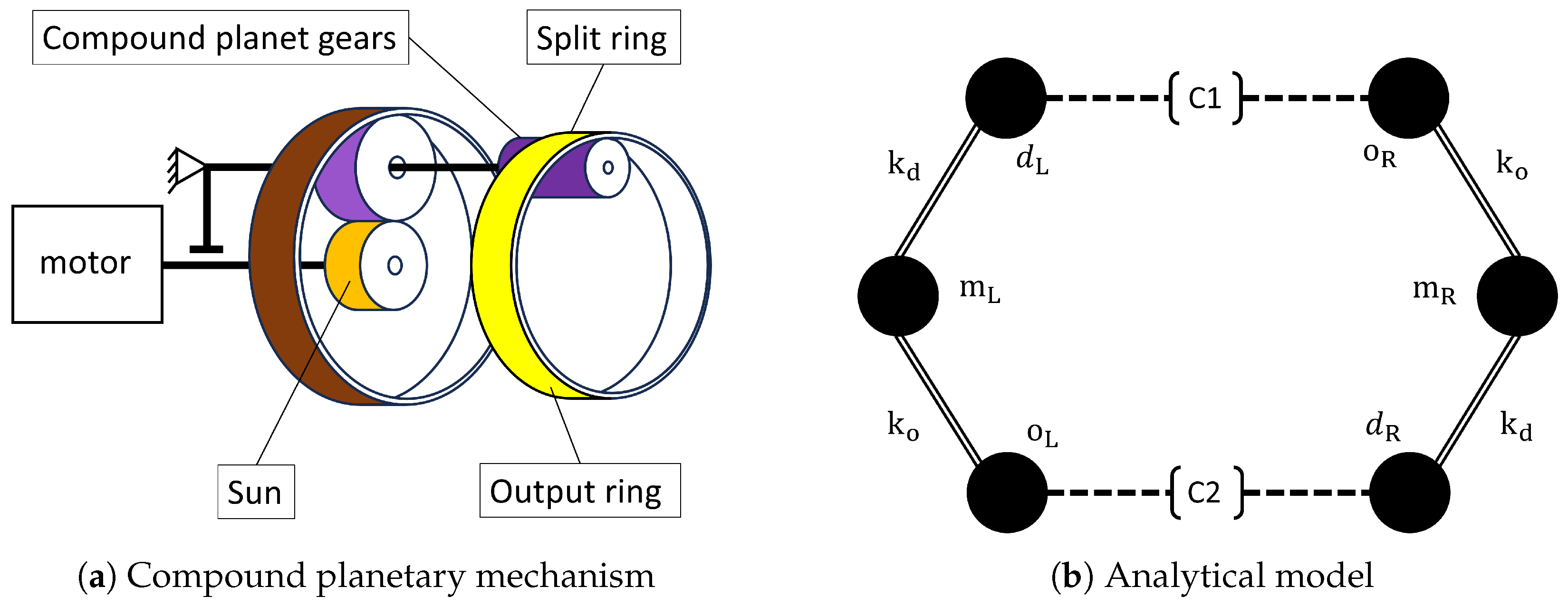
For analysis, the axle is represented in Figure 2b by six rotational variables together with their associated angular speeds and torques. These variables correspond to the left and right motor sides, the left and right split rings, and the left and right output sides. The associated angular speeds and torques are denoted by ω ( · ) and T ( · ) , respectively. A unified reference direction is adopted: when viewed from the vehicle’s left side, positive angular speed is counterclockwise for each variable, and positive torque is the driving torque in the positive speed direction. These variables provide a consistent basis for the unified kinematic–static mapping and the feasible-boundary analysis in Section 3 (cf. virtual-power formulations in [25,26]). The correspondence between the analytical variables and the physical components is summarized in Table 1.

2.2. Mechanical Realization

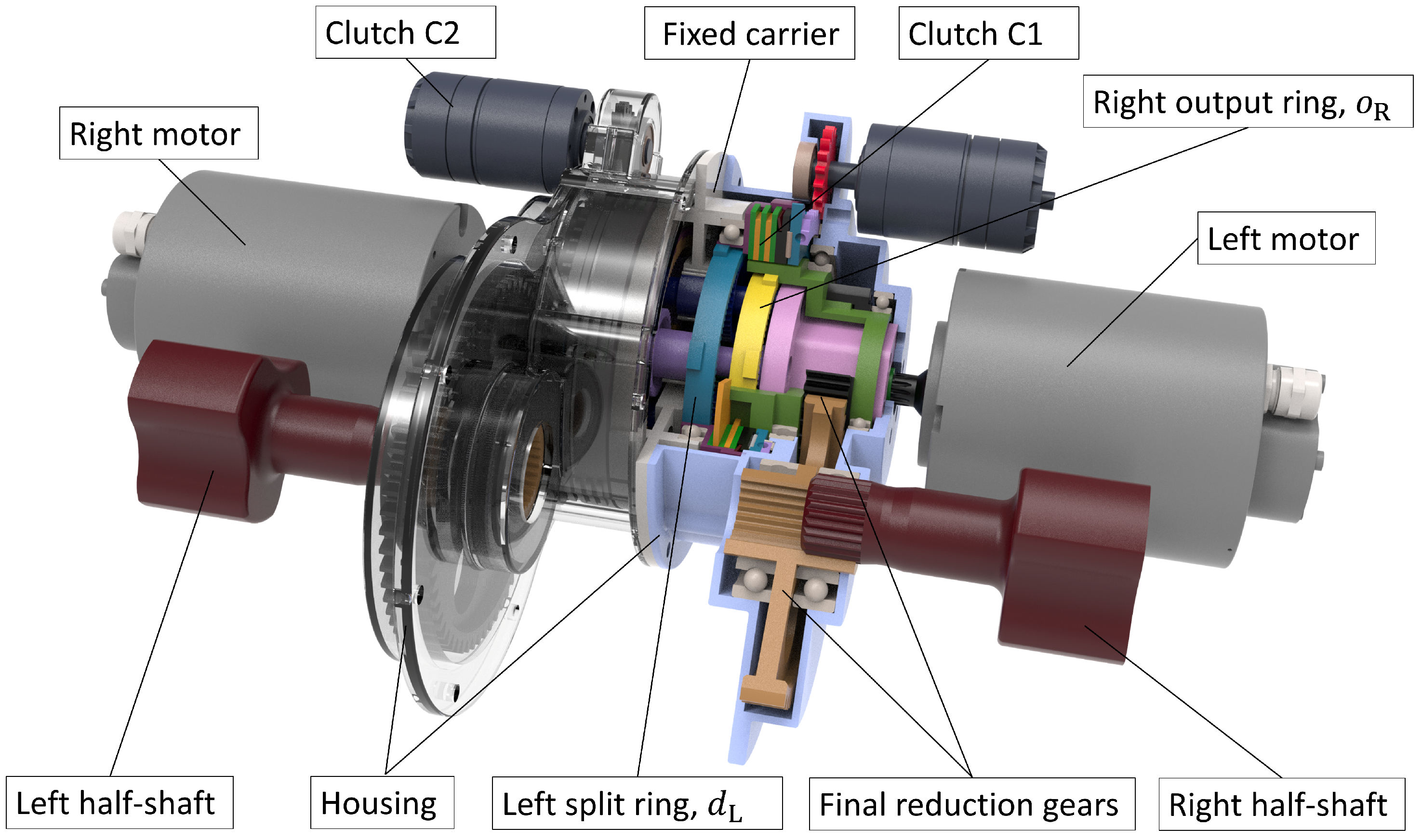
While Figure 1 and Figure 2 describe the layout and analytical abstraction of the proposed e-axle, Figure 3 presents a CAD model of the mechanism. Its overall structure corresponds directly to the layout in Figure 1 and further shows practical components such as the housing, half-shafts, and final reduction gears.
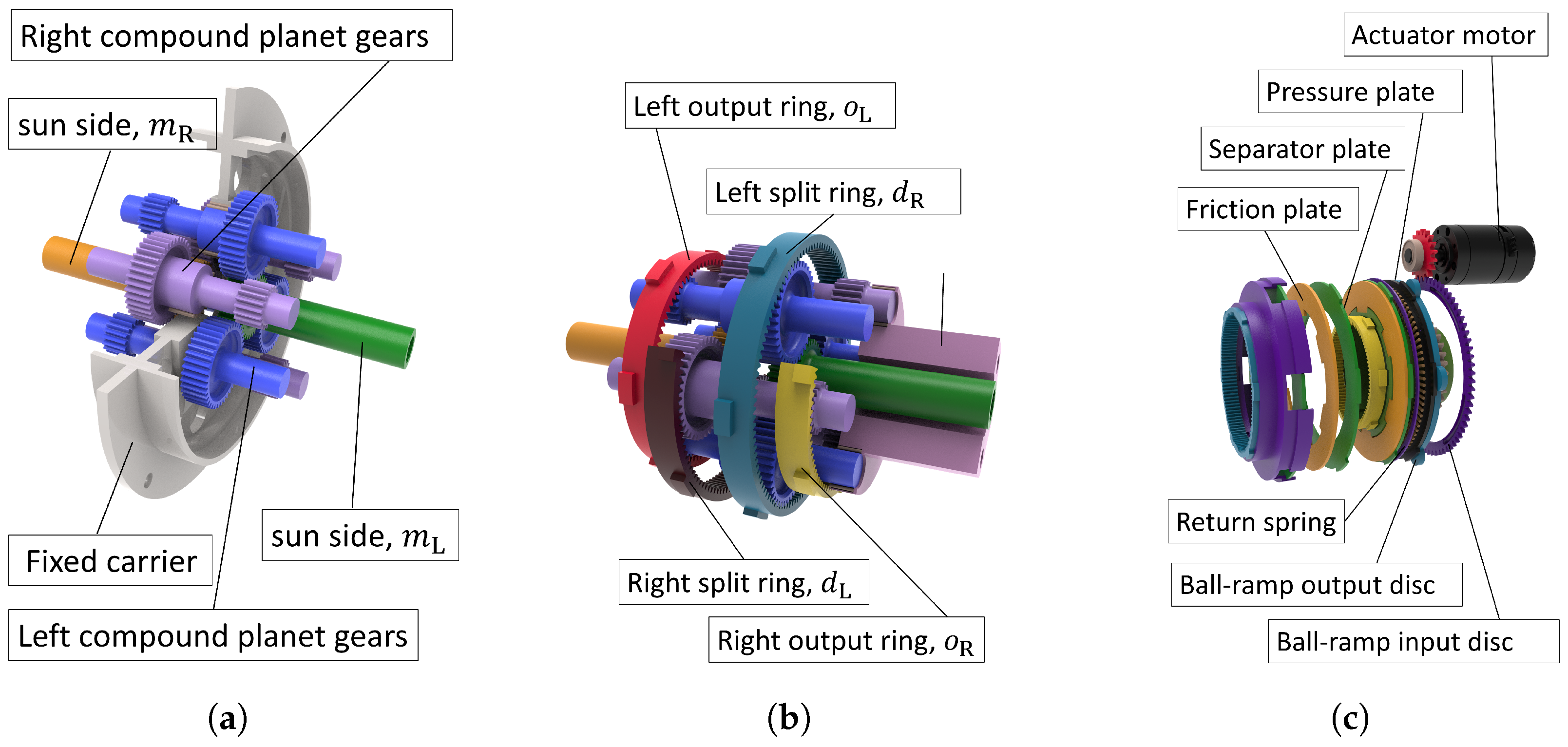
As shown in Figure 4a, the compound planetary gear sets adopt an interleaved arrangement. Each compound planet meshes with the corresponding sun gear, and the planet shaft is supported at its mid-span by a fixed carrier. Figure 4b further shows the arrangement of the ring members and indicates that the planet gears at the two ends of each planet shaft mesh with the corresponding ring members. All carriers are rigidly connected to the housing and therefore jointly form the stationary frame of the transmission.
Figure 4c shows the clutch structure, which mainly consists of an actuator motor, a ball-ramp mechanism, a pressure plate, and a multi-plate friction pack. When the actuator motor drives the ball-ramp input disc, the ball-ramp output disc is constrained by the housing against rotation and allowed only axial motion. It therefore pushes the pressure plate to compress the friction pack, thereby enabling torque transfer between the ring members.

2.3. Operating Modes and DOF Classification

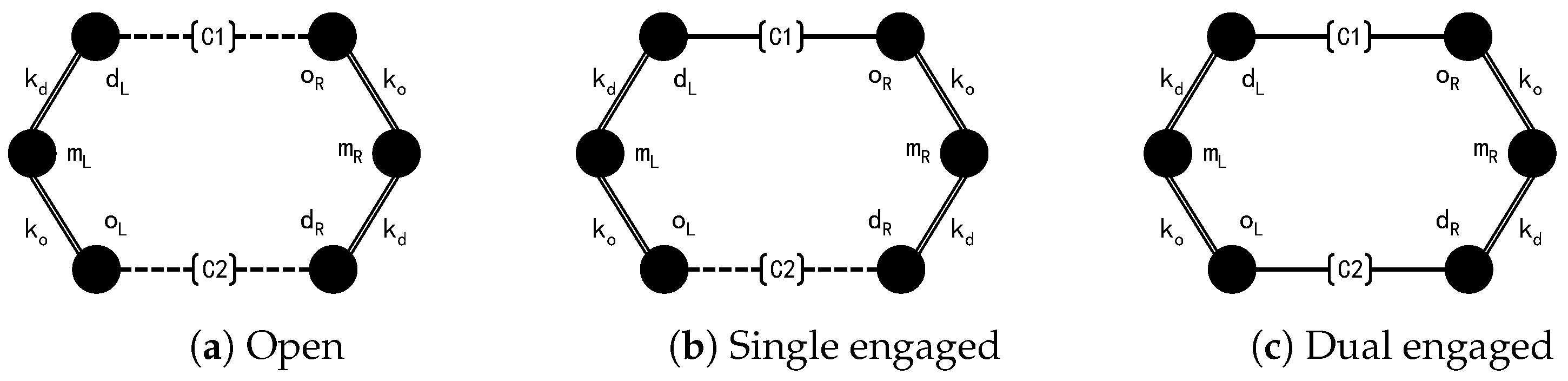
The operating state is determined by the engagement states of the two cross-axle clutches, as shown in Figure 5. For visual simplicity, both slip coupling and lock coupling are drawn as engaged clutch branches in Figure 5; the distinction is made explicitly in the mode definitions below. Four operating modes are considered in this study, and their clutch states, DOFs, and primary use cases are summarized in Table 2.
  • Mode 1 (independent drive, M = 2 ).
Both clutches are open, or transmit only negligible drag torque. The left and right drivetrains are decoupled, and the axle has two independent speed DOFs. Although the hardware allows four-quadrant motor operation, this study focuses on traction-quadrant operation ( T m 0 ) to isolate topology-induced changes in the feasible wheel-torque set.
  • Mode 2A (single-side slip coupling, M = 2 ).
One clutch is engaged in controlled slip. No speed-equality constraint is imposed, and the kinematic DOF therefore remains M = 2 . In this case, the clutch branch acts as a bounded dissipative coupling in the static torque analysis described in Section 3.
  • Mode 2B (single-side lock coupling, M = 1 ).
One clutch is fully locked, which imposes one speed-equality constraint and reduces the axle speed DOF to M = 1 . This establishes a rigid mechanical connection across the axle.
  • Mode 3 (dual-side clutch engagement).
Both clutches are engaged. When both clutches operate in controlled slip, no speed-equality constraint is imposed, and the axle therefore retains M = 2 . This dual-slip state can be used for braking or resistive drag control. When both clutches are fully locked, the axle is in dual-side lock. For λ > 1 , an ideal rigid model with no compliance admits only the trivial zero-speed condition under dual-side lock. Accordingly, this dual-lock state is intended for parking hold and fail-safe operation rather than propulsion. In practice, driveline compliance and micro-slip may accommodate small internal deformations; however, Mode 3 is not considered in the driving-performance analysis.

2.4. Unified Speed-Constraint Matrix and DOF

The generalized angular-speed vector is defined as
ω = ω m L ω m R ω d L ω d R ω o L ω o R T .
With the carrier fixed, each fixed-carrier compound planetary unit is a 1-DOF three-member rotational transmission characterized by
ω d = k d ω m , ω o = k o ω m ,
where k d and k o are determined by the tooth numbers and are identical for the left and right units.
Binary variables δ 1 , δ 2 { 0 , 1 } are introduced to indicate whether each clutch is locked at the kinematic level. For C1, the lock constraint is ω d L ω o R = 0 when δ 1 = 1 ; for C2, the lock constraint is ω d R ω o L = 0 when δ 2 = 1 . Collecting all speed constraints yields
A ( δ 1 , δ 2 ) ω = 0 ,
with
A ( δ 1 , δ 2 ) = k d 0 1 0 0 0 k o 0 0 0 1 0 0 k d 0 1 0 0 0 k o 0 0 0 1 0 0 δ 1 0 0 δ 1 0 0 0 δ 2 δ 2 0 .
In the non-degenerate design domain ( k d 0 , k o 0 , and the split and output variables correspond to distinct physical components), the rank satisfies rank ( A ) = 4 + δ 1 + δ 2 . With six retained rotational variables, the kinematic DOF is
M = n rot rank ( A ) = 6 ( 4 + δ 1 + δ 2 ) = 2 δ 1 δ 2 ,
which is consistent with the mode classification above: M = 2 for Mode 1, Mode 2A, and the dual-slip state of Mode 3; M = 1 for Mode 2B; and M = 0 for the dual-lock state of Mode 3. This unified constraint representation provides the basis for the six-variable static mapping and the capability indices derived in Section 3.

3. Wheel-End Static Torque Mapping and Structural Capability Indices

Building on Section 2, this section develops a parametric transmission-ratio model and a unified static-equilibrium mapping using the same six rotational variables introduced in Section 2. Closed-form boundaries in the ( T Σ , Δ T w ) plane are derived under representative coupling modes, and three dimensionless structural capability indices are defined. Unless otherwise stated, ideal rigid gearing, negligible mechanical losses, traction-quadrant operation ( T m 0 ), and nonnegative wheel-end torques ( T w L , T w R 0 ) are assumed. In Mode 2A, controlled clutch slip introduces a dissipative internal branch: it does not change the kinematic DOF, but it restricts feasibility through the available clutch torque capacity.

3.1. Mapping from Tooth Numbers to Speed Ratios

Consider one fixed-carrier compound planetary unit. With sun-gear teeth z S , split-ring teeth z R d , output-ring teeth z R o , and compound-planet teeth z P d and z P o , the signed speed ratios are
k d = z S z R d , k o = z S z P o z P d z R o .
For the final external gear pair with pinion and gear tooth numbers z p and z f , respectively,
ω w = k g ω o , k g = z p z f .
  • Magnitude Parameters Used in Traction-Quadrant Boundary Analysis.
To avoid sign ambiguity while preserving the reference directions introduced in Section 2, we define the following magnitude ratios:
κ d = | k d | , κ o = | k o | , κ g = | k g | .
The effective total reduction ratio from the motor to the wheel is
i w = ω m ω w = 1 κ g κ o .
The parameter λ is defined as the ratio of the magnitudes of the split-ring and output-ring speeds:
λ = ω d ω o = k d k o = κ d κ o > 1 .
The signed ratios k d , k o , and k g are retained in the torsional dynamics model introduced in Section 4, whereas κ d , κ o , and κ g are used here to derive quasi-static boundary expressions.

3.2. Unified Static Mapping with a Cross-Axle Clutch Branch

  • Virtual-Power Relation of a Fixed-Carrier Compound Planetary Unit.
With the carrier fixed, the unit exchanges power only through the motor side m, the split ring d, and the output ring o. Under ideal rigid gearing, virtual power balance gives
T m ω m + T d ω d + T o ω o = 0 ,
Using ω d = k d ω m and ω o = k o ω m , and expressing the variables in traction-quadrant magnitudes, gives
T m = κ d T d + κ o T o ,
where T d and T o are the torque magnitudes associated with the split-ring side and the output side, respectively.
  • Torque Reflection through the Final Gear Pair.
For the ideal final gear pair between the output side o and the wheel w, where w denotes the wheel side, virtual power balance in magnitude form gives T o ω o = T w ω w , and hence
T w = 1 κ g T o .
Substituting this relation into (12) yields the wheel torque on one side in terms of the motor torque and the split-ring-side torque:
T w = 1 κ g T m κ o κ d κ o T d = i w T m λ κ g T d .
  • Cross-Axle Clutch Mapping (C1 Branch).
Consider C1, which connects d L and o R (Figure 1). We define T c as the signed clutch torque, taken as positive when transmitted from the right output side toward the left split-ring side. Thus, the left unit experiences a torque applied at the split-ring side, T d L = T c , while the right unit receives an additional torque at the output side, which is reflected to the wheel as + T c / κ g . Therefore, the wheel-end torques are
T w L = i w T m L λ κ g T c , T w R = i w T m R + 1 κ g T c .
For compactness, we define
k 2 = 1 / κ g , k 1 = λ / κ g = λ k 2 .
The total axle wheel torque and the differential wheel torque are defined as
T Σ = T w L + T w R , Δ T w = T w L T w R .
Based on the foregoing relations,
T Σ = i w ( T m L + T m R ) + ( k 2 k 1 ) T c ,
Δ T w = i w ( T m L T m R ) ( k 1 + k 2 ) T c .

3.3. Differential-Torque Feasible Boundary and Structural TV Gain

3.3.1. Mode 1: Differential-Torque Boundary Under Independent Drive

In Mode 1, the cross-axle clutch is open, so that T c = 0 , and the wheel-torque expressions reduce to
T w L = i w T m L , T w R = i w T m R .
Let the available motor-torque limit at the operating point be T m , lim . Accordingly, we define
T 0 = i w T m , lim .
Under traction-quadrant operation with nonnegative wheel torques,
0 T w L , T w R T 0 .
For a given T Σ , maximizing | Δ T w | yields the Mode 1 boundary:
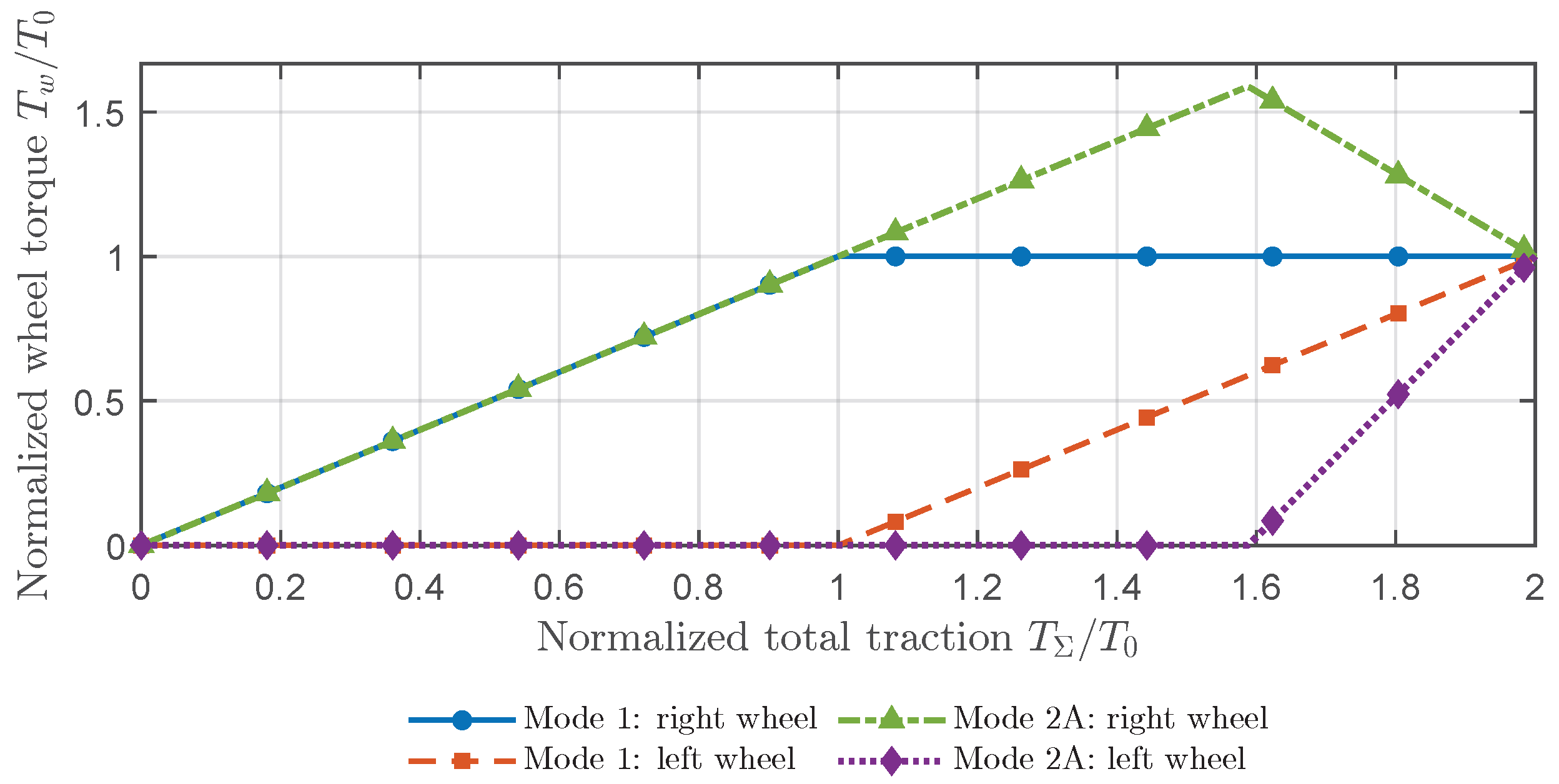
| Δ T w | max ( ind ) ( T Σ ) = T Σ , 0 T Σ T 0 , 2 T 0 T Σ , T 0 T Σ 2 T 0 .

3.3.2. Mode 2A: Traction-Only Differential-Torque Boundary Under Slip Coupling

In Mode 2A, one cross-axle clutch is engaged in controlled slip. The kinematic DOF remains M = 2 , while a bounded internal torque T c is introduced into the static analysis. Two mechanisms bound the maximum attainable | Δ T w | for a given T Σ under traction-only operation ( T w L , T w R 0 ): (i) the nonnegative-wheel-torque constraint itself implies | Δ T w |   T Σ ; and (ii) in the high-traction motor-limited regime, the boundary segment with both motors saturated exhibits a slope amplification governed by λ .
  • Motor-Limited Boundary Segment with Both Motors Saturated.
Consider the motor-limited boundary segment on which both motors reach the operating-point limit:
T m L = T m R = T m , lim , T 0 = i w T m , lim .
From the static mapping,
T Σ = 2 T 0 + ( k 2 k 1 ) T c , Δ T w = ( k 1 + k 2 ) T c .
Eliminating T c yields the boundary relation for this segment:
| Δ T w | = k 1 + k 2 k 1 k 2 ( 2 T 0 T Σ ) .
The corresponding structural TV gain, i.e., the slope-amplification factor, is
G tv ( λ ) = k 1 + k 2 k 1 k 2 = λ + 1 λ 1 .
  • Traction-Only Threshold and Piecewise Boundary.
Under T w L , T w R 0 , the maximum differential torque for a given T Σ cannot exceed T Σ . Therefore, the traction-only maximum boundary in Mode 2A is the lower envelope of the two bounds:
| Δ T w | max ( cpl ) ( T Σ ) = min T Σ , G tv ( λ ) ( 2 T 0 T Σ ) .
The transition point is determined from T Σ = G tv ( λ ) ( 2 T 0 T Σ ) , which yields the threshold imposed by the nonnegative-wheel-torque constraint:
A con ( λ ) = 1 + 1 λ .
Equivalently, the traction-only boundary can be written in a piecewise closed form:
| Δ T w | max ( cpl ) ( T Σ ) = T Σ , 0 T Σ A con ( λ ) T 0 , G tv ( λ ) ( 2 T 0 T Σ ) , A con ( λ ) T 0 T Σ 2 T 0 .
For T Σ [ A con ( λ ) T 0 , 2 T 0 ] , combining the Mode 1 and Mode 2A boundaries produces a constant boundary-amplification ratio:
| Δ T w | max ( cpl ) | Δ T w | max ( ind ) = G tv ( λ ) ,
i.e., G tv is the structural gain on the motor-limited high-traction boundary segment under traction-only operation. These structural boundary trends are further illustrated together with the lock-coupled index in the following subsection.
  • Clutch Capacity Requirement.
Feasibility along the coupled boundary additionally requires sufficient clutch torque capacity:
| T c ( T Σ ) |   T c , max ( slip ) .

3.4. High-Adhesion-Wheel Torque Amplification Under Lock Coupling

In Mode 2B, one cross-axle clutch is fully locked, thereby imposing a speed-equality constraint. Consider the case in which C1 is locked, so that ω d L = ω o R . This yields the motor-speed relation in magnitude form:
| ω m R |   = λ | ω m L | .
In the low-speed constant-torque region ( T m L = T m R = T m , max ) and under an extreme split- μ condition where the low-adhesion wheel torque is negligible, virtual power balance gives the structural upper bound on the high-adhesion wheel torque:
T w , max ( 2 B ) = ( 1 + λ ) i w T m , max .
The high-adhesion-wheel torque amplification factor is defined as
A uni ( λ ) = T w , max ( 2 B ) i w T m , max = 1 + λ .
The subscript “uni” is retained for consistency with the subsequent notation. This index is a structural upper bound valid in the low-speed constant-torque region. Outside this region, the amplification is limited by the motor torque–speed envelope.
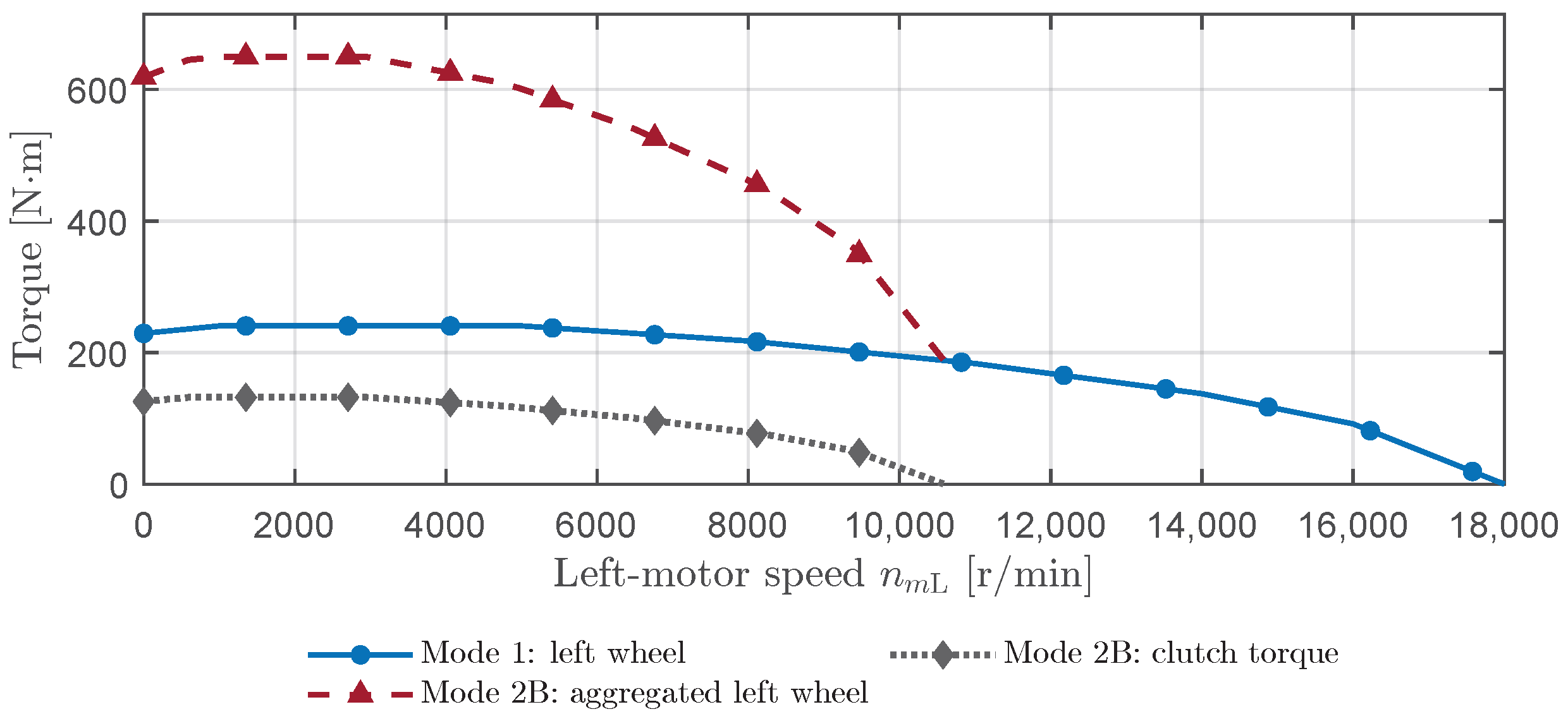
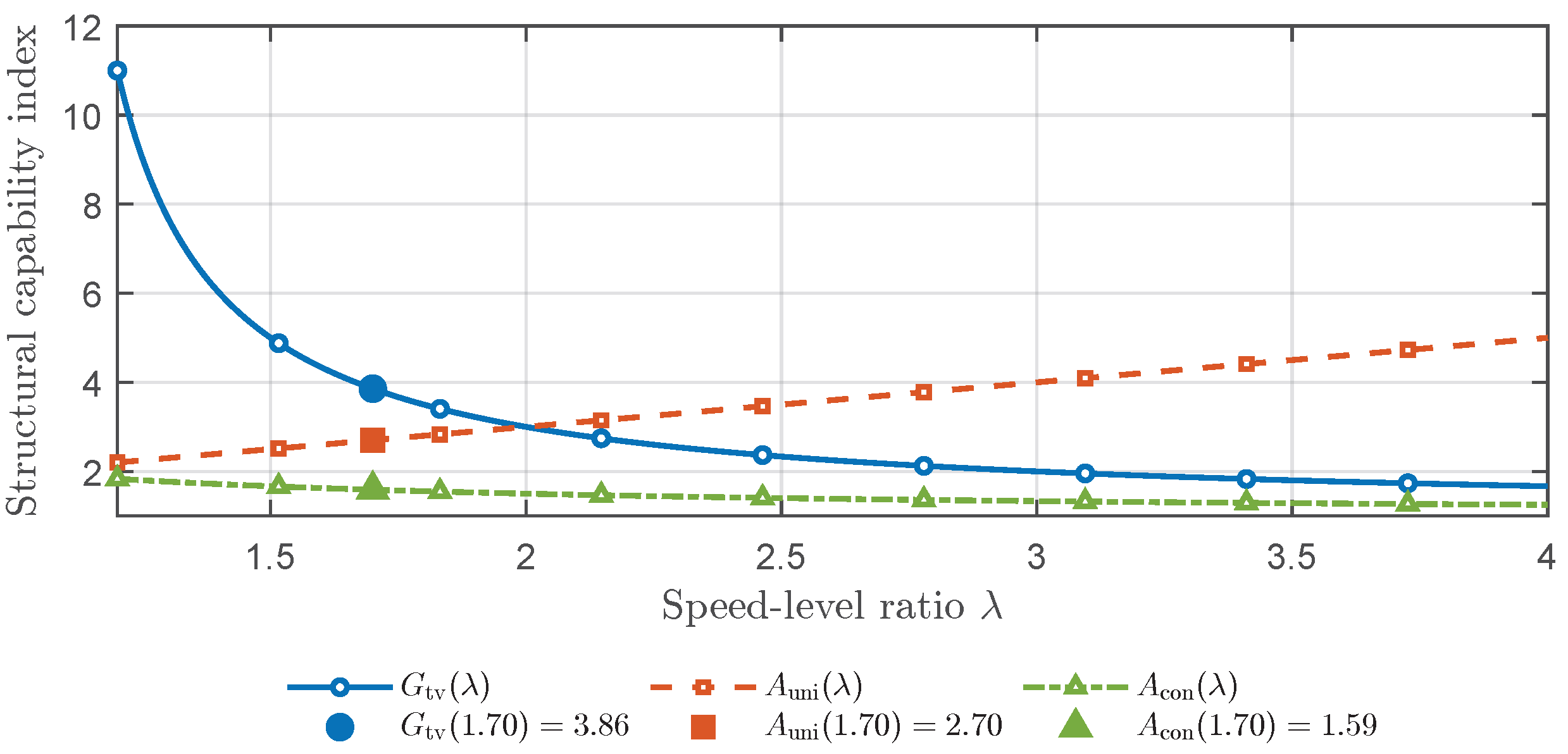
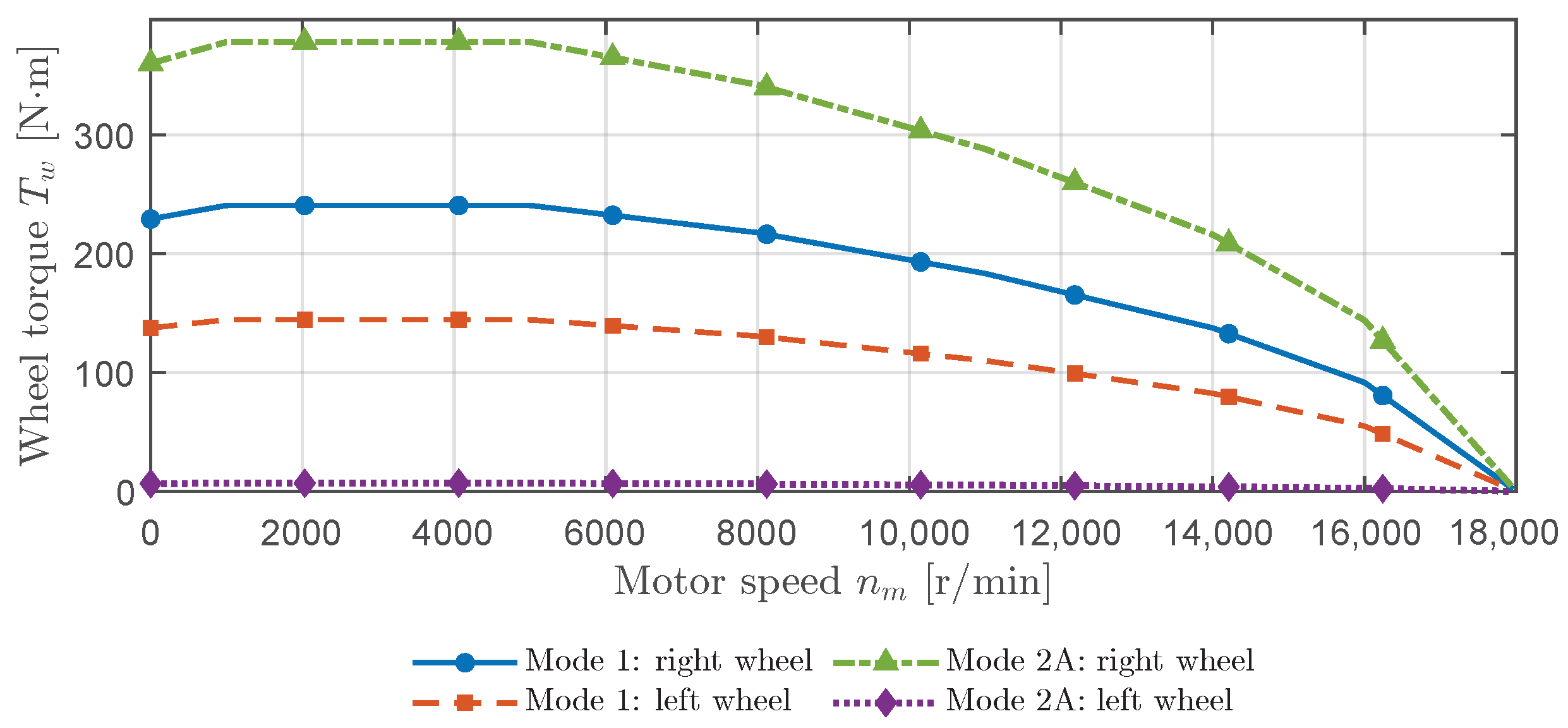
The trends of G tv ( λ ) , A uni ( λ ) , and A con ( λ ) are shown in Figure 6. Figure 7 schematically compares the structural boundaries of Mode 1 and Mode 2A in the ( T Σ , Δ T w ) plane, and Figure 8 illustrates the variation of available TV margin with speed under motor torque–speed limits. Figure 9 compares the baseline unilateral wheel torque in Mode 1 with the high-adhesion-wheel torque under Mode 2B, together with the corresponding clutch-torque magnitude, as functions of the left-motor speed. For the representative design adopted in this paper, λ 1.70 , which corresponds to G tv 3.86 , A uni 2.70 , and A con 1.59 .

4. Parameter Matching and Torsional Dynamics Modeling

Section 2 and Section 3 established the proposed reconfigurable e-axle, the unified kinematic–static formulation based on the six rotational variables defined in Section 2, and three structural capability indices governed by the parameter λ .

4.1. Total Reduction Ratio i w : Constraints and Selection

The total reduction ratio i w is determined by two basic design requirements: maximum vehicle speed and launch wheel-torque requirement.
  • Maximum-Speed Constraint.
With an effective tire radius R w , the vehicle speed satisfies
v = ω m i w R w ,
For a target maximum vehicle speed v max and motor maximum speed ω m , max , this relation gives the upper bound
i w ω m , max R w v max .
  • Launch-Traction Constraint.
For a required launch wheel torque T w , req and motor peak torque T m , max , the reduction ratio must satisfy
i w T w , req T m , max .
Equations (37) and (38) define the feasible interval of i w . For the rear-wheel-drive Formula SAE (FSAE) platform considered in this study, the target value is set to i w , tar 11.5 . After integer tooth-number matching, the realized reduction ratio is i w 11.46 . Since Modes 1, 2A, and 2B share the same i w , the subsequent performance differences can be attributed to topology reconfiguration rather than to different gearing.

4.2. Parameter λ : Trade-Off and Selection

With i w fixed, λ governs the trade-off between the coupled-mode capabilities identified in Section 3. Specifically, increasing λ improves the unilateral torque-aggregation capability in Mode 2B, while reducing the high-traction differential-torque gain in Mode 2A. Accordingly, λ provides a direct mechanism-level trade-off between high-traction torque-vectoring authority and low-speed split- μ escape capability.
To balance these two requirements, the following design criteria are adopted:
G tv ( λ ) G min , A uni ( λ ) A min .
Here, G min and A min denote the minimum acceptable high-traction TV gain and unilateral aggregation capability, respectively. For the target platform, these criteria lead to a practical compromise of λ 1.7 . The representative tooth-number set adopted in this study realizes λ 1.70 , which is used in the subsequent co-simulation study.

4.3. Feasible Tooth-Number Set and Clutch-Capacity Setting

  • Representative Tooth-Number Set.
Using the tooth-number relations defined in Section 3.1, λ and i w can be expressed directly in terms of the gear parameters as
λ = z P d z R o z P o z R d , i w = z f z P d z R o z p z S z P o .
Here, z S is the sun-gear tooth number; z R d and z R o are the split-ring and output-ring tooth numbers, respectively; z P d and z P o are the tooth numbers of the two gears in the compound planet pair; and z p and z f are the final pinion and gear tooth numbers, respectively.
Table 3 gives a feasible integer tooth-number set yielding i w 11.5 and λ 1.7 . This set is used as a representative design for the co-simulation study; it is not intended to be unique, but rather to demonstrate the realizability of the selected ratio pair.
  • Clutch-Capacity Setting.
The clutch torque capacity should be sufficient for both coupled modes. In Mode 2A, the clutch must provide the internal torque required by the coupled feasible boundary discussed in Section 3 and satisfy the capacity condition in (32). In Mode 2B, it must withstand the reaction torque associated with cross-axle power transfer during unilateral torque aggregation. In this study, the representative capacity setting is
T c , max ( slip ) = T c , max ( lock ) = 300 N · m .
In all co-simulations reported in Section 5, the required clutch torque remains within this bound. A detailed clutch thermal and durability design is beyond the scope of the present work.

4.4. Axle-Level Torsional Dynamics Model and Co-Simulation Interface

  • Modeling Scope.
To evaluate transient responses beyond the quasi-static feasible boundaries derived in Section 3, an axle-level torsional dynamics model is constructed for Modes 1, 2A, and 2B. The model includes motor rotor inertia and electromagnetic torque input, the reduction path from motor side to wheel side, compliant half-shafts, and the cross-axle clutch branch under slip or engagement. At each simulation step, the mode-dependent static torque mapping derived in Section 3.2 is used to relate ( T m L , T m R , T c ) to ( T w L , T w R ) .
  • Generalized Coordinates.
Let θ m L and θ m R denote the left and right motor angles, respectively, and let θ w L and θ w R denote the corresponding wheel angles. Using the effective reduction ratio i w , each side is represented as an equivalent two-inertia driveline consisting of a motor-side inertia and a wheel-side inertia connected through the reduction path and the half-shaft compliance. Here, θ o i denotes the transmission output-side angle on side i before the wheel-side compliance element.
  • Half-Shaft Compliance.
For each side i { L , R } , the shaft twist is defined as
ϕ i = θ o i θ w i ,
where θ o i is the output-side angle. The shaft torque is modeled as
T s i = k s ϕ i + c s ϕ ˙ i ,
with torsional stiffness k s and damping c s .
  • Cross-Axle Clutch Branch.
Consider the C1 branch connecting d L and o R . In Mode 2A (controlled slip), the clutch torque is no longer assumed to follow the command instantaneously, but is jointly determined by the actuator-side clamp-force build-up and the clutch-interface friction. The clamp-force generation of the ball-ramp actuator is represented by a first-order dynamic element with delay:
τ a F ˙ N ( t ) + F N ( t ) = u N ( t )
u N ( t ) = sat F N ( t T d ) , 0 , F N , max
where F N is the commanded normal force, F N is the realized normal force, τ a is the equivalent time constant, T d is the actuator delay, and F N , max is the maximum clamp force. Under controlled slip, the clutch torque is jointly determined by the realized normal force and the interfacial slip condition, and its system-level equivalent expression is written as
T c ( t ) = sat K c μ eq ( Δ ω c ) F N ( t ) sgn ( Δ ω c ) , ± T c , max ( slip )
where
Δ ω c = ω d L ω o R
is the relative slip speed across the clutch, μ eq ( · ) is the equivalent friction coefficient, and K c is the equivalent clutch-torque coefficient. In the actual implementation, the realized normal force F N is fed into the AMESim rotary clutch friction submodel. This friction model uses a reset-integrator formulation and includes stiction/sliding transition together with an optional Stribeck effect. Therefore, the above expression can be regarded as a system-level equivalent description, whereas the detailed friction-state transition is handled by the AMESim submodel.
The corresponding slip speed is ω d L ω o R , and the instantaneous dissipated power is
P slip = T c ω d L ω o R ,
which is recorded only for energy accounting; no thermal submodel is included in the present study.
In the present study, Mode 2A is intended to operate in a controlled-slip regime rather than near the static-to-kinetic friction transition. Its purpose is to realize a regulated sliding clutch state for cross-axle torque coupling, so as to expand the feasible differential-torque capability boundary under high-adhesion conditions, rather than to transmit torque through a static-friction-dominated near-lock condition. From the mechanism viewpoint, if the clutch operates repeatedly near the incipient stick condition, the friction-state transition may interact with the compliant driveline modes and potentially induce torsional oscillation. To reflect this issue, the clutch branch in Mode 2A is not modeled as an ideal commanded-torque element. Instead, the ball-ramp actuator is represented by a delayed first-order normal-force build-up process, and the clutch torque is jointly determined by the realized normal force and the interfacial slip condition. Moreover, the adopted friction model explicitly includes stiction/sliding transition and an optional Stribeck effect, so that the co-simulation can capture the interface-state dependence of the clutch response. Therefore, the present model should be understood as a system-level description of controlled-slip operation, with the design objective of avoiding sustained operation in a stick-slip-prone region. In both structural parameter matching and control algorithm design, the clutch operating point should be kept as far as practicable from the high-risk region near the static-to-kinetic friction transition, so as to maintain the controllability and operating stability of the cross-axle coupling torque build-up process. Dedicated stick-slip critical-condition analysis, frequency-domain torsional-vibration analysis, and experimental NVH validation are beyond the scope of the present study and are reserved for future work. In Mode 2B, the clutch is in the engaged state and transmits torque through frictional plate contact. Accordingly, the condition ω d L ω o R is realized numerically in the driveline model through a high-stiffness, high-damping torsional coupling rather than an ideal rigid lock:
T c = k c θ d L θ o R + c c ω d L ω o R , | T c | T c , max ( lock ) ,
where k c and c c are chosen to be sufficiently large so that the relative displacement and relative speed remain small over the simulation time step, thereby approximating the engaged-clutch state in co-simulation. This treatment represents the friction-clutch engagement behavior at the system level and should not be interpreted as a strictly rigid lock.
  • Equations of Motion.
Let the motor electromagnetic torques be T m L and T m R , and let the resisting torques reflected from the vehicle model be T r L and T r R . The wheel torques delivered to the tires are denoted by T w L and T w R . The rotational dynamics are written in compact form as
J m L ω ˙ m L = T m L T g L ,
J m R ω ˙ m R = T m R T g R ,
J w L ω ˙ w L = T w L T r L ,
J w R ω ˙ w R = T w R T r R ,
where J m L , J m R and J w L , J w R denote the equivalent motor-side and wheel-side inertias, respectively, whereas T g L and T g R are the internal torques transmitted through the reduction path and shaft compliance. The parameter set ( J m L , J m R , J w L , J w R , k s , c s , k c , c c ) is matched to the representative platform to reproduce realistic driveline torsional transients.
  • Co-Simulation Interface.
A CarSim–AMESim–Simulink co-simulation platform is used. CarSim provides vehicle states and tire forces, AMESim hosts the driveline plant including the torsional dynamics and clutch branch, and Simulink implements the supervisory mode logic and torque-vectoring allocation. The exchanged variables include the motor torque commands ( T m L , T m R ) , the clutch normal-force command F N in Mode 2A or the clutch engagement command in Mode 2B, the wheel speeds ( ω w L , ω w R ) , and the wheel resisting torques ( T r L , T r R ) . All modes share the same motor torque–speed envelope and the same total reduction ratio i w , which ensures that the observed performance differences originate from topology reconfiguration rather than actuator-rating differences.

5. Vehicle-Level Co-Simulation and Performance Evaluation

Building on the feasible-set boundaries and structural indices derived in Section 3 and the co-simulation model established in Section 4, this section evaluates the proposed e-axle on a CarSim–AMESim–Simulink platform and examines how A uni ( λ ) , G tv ( λ ) , and A con ( λ ) manifest in representative vehicle scenarios.
To isolate topology effects and avoid controller- or actuator-limiting differences, all simulations adhere to the following settings:
  • Identical motors and envelopes: both motors share the same torque–speed limit T m , lim ( ω m ) and protection logic.
  • Identical gearing: Modes 1, 2A, and 2B use the same total reduction ratio i w .
  • No braking yaw moment: hydraulic or regenerative braking is not used for yaw-moment generation.
  • Traction quadrant only: the motors operate only in the driving quadrant ( T m 0 ); reverse motor torque is not used to increase yaw moment.
  • Unified comparison logic: in each scenario, the compared modes share the same upper-level demand and actuator limits. In Scenario I, Mode 1 and Mode 2B use the same driving request, road condition, and motor limits; in Scenario II, Mode 1 and Mode 2A use the same yaw-rate-reference generation, differential-torque demand logic, and limiting strategy. Thus, the observed differences primarily reflect feasible-set changes induced by topology reconfiguration.
Let the rear-left (RL) and rear-right (RR) wheel-end torques be T w , RL and T w , RR , respectively. The total rear-axle wheel torque and the differential wheel torque are
T Σ = T w , RL + T w , RR , Δ T w = T w , RL T w , RR .
The additional rear-axle yaw moment is approximated by
M z , rear ( t ) t r 2 R w Δ T w ( t ) ,
where t r is the rear track width and R w is the effective tire radius.
Although the primary design motivation of the proposed topology is high-traction torque-vectoring enhancement under motor limits, this section first presents the more intuitive extreme-condition split- μ traction-aggregation case and then the primary high-traction torque-vectoring case. Two representative scenarios are considered:
1.
Scenario I: low-speed severe split- μ escape, corresponding to unilateral torque aggregation characterized by A uni ( λ ) (Mode 2B).
2.
Scenario II: high-adhesion step-steer to a constant steering angle, corresponding to the traction-only Mode 2A differential-torque boundary (30) and the motor-limited slope amplification governed by G tv ( λ ) , which becomes relevant under traction-only constraints when T Σ A con ( λ ) T 0 .
Mode 3 is used only as a parking/fail-safe state and is not simulated for dynamic performance.

5.1. Scenario I: Low-Speed Severe Split- μ Escape (Mode 2B)

  • Scenario Setup.
This scenario is intended to represent an extreme escape condition under severe left–right adhesion asymmetry, rather than a generic low-speed acceleration case. It captures situations in which one driven wheel is effectively unable to provide useful traction, while the other side can sustain high adhesion. In this situation, the main issue is not to achieve a generally higher acceleration level, but to determine whether the limited driving effort can be effectively concentrated on the high-adhesion side, so that usable longitudinal propulsion can be re-established and the vehicle can leave the traction-limited state as quickly as possible. Accordingly, the term “escape” in the present study specifically refers to the capability of re-establishing usable tractive effort and reaching a prescribed longitudinal-speed threshold under severe adhesion asymmetry. The vehicle starts from rest on a severe split- μ surface (rear-left high- μ ; rear-right low- μ ), and the driver demand requests full driving torque. Since the motor operating point remains in the low-speed constant-torque region, the structural unilateral amplification factor A uni ( λ ) derived in Section 3.4 is relevant as an upper bound.
  • Control and Mode Logic.
Mode 1 serves as the baseline: T Σ is distributed by motor torque allocation, and the unilateral wheel torque is capped by T 0 = i w T m , max . Mode 2B serves as the engaged-clutch case: one cross-axle clutch is brought into frictional engagement to establish a high-capacity cross-axle power-transfer path. The controller commands both motors near their torque limits while enforcing clutch torque saturation | T c |   T c , max ( lock ) and traction-only operation. In co-simulation, this engaged-clutch state is represented by the high-stiffness, high-damping torsional coupling in (49) (Section 4.4), which approximates the system-level behavior of clutch engagement rather than a strictly rigid lock.
  • Performance Metrics.
The evaluated metrics are (i) the peak high-adhesion wheel torque T w , hi max and (ii) the escape time t e , defined as the time required to reach a prescribed longitudinal-speed threshold v x v e . These metrics are adopted to reflect escape capability under severe traction asymmetry, rather than general low-speed straight-line acceleration performance. Here, the peak high-adhesion wheel torque reflects the capability of concentrating tractive effort onto the usable-adhesion side, whereas the escape time directly indicates how quickly the vehicle can recover effective longitudinal propulsion.
  • Results and Relation to A uni ( λ ) .
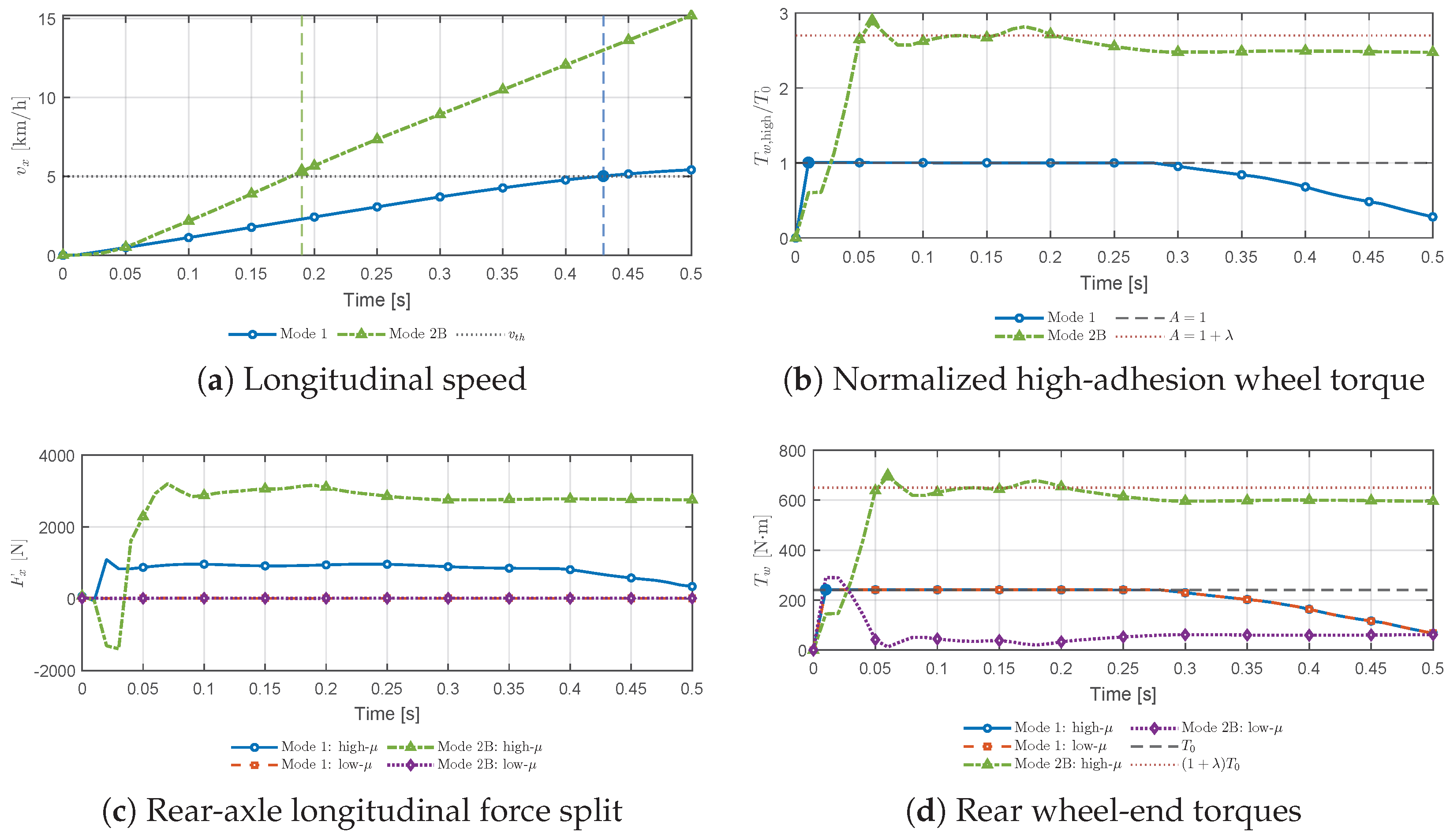
Figure 10 and Figure 11 show the split- μ responses in Modes 1 and 2B. In Figure 10, the dashed horizontal line labeled v th in subfigure (a) denotes the prescribed escape-speed threshold. In subfigure (b), the gray dashed line labeled A = 1 denotes the baseline factor corresponding to the single-side theoretical maximum torque output of the distributed-drive baseline, whereas the magenta dashed line labeled A = 1 + λ denotes the theoretical Mode 2B torque-aggregation factor. In subfigure (d), the gray dashed line labeled T 0 denotes the single-side theoretical maximum wheel-torque output of the distributed-drive baseline, whereas the magenta dashed line labeled ( 1 + λ ) T 0 denotes the theoretical high-adhesion-wheel torque-aggregation upper bound of Mode 2B. Figure 10a shows that the vehicle reaches the prescribed escape-speed threshold earlier in Mode 2B than in Mode 1, with the escape time decreasing from 0.43 s to 0.19 s. The reason for this improvement is clarified by Figure 10b–d. Figure 10b shows that the normalized high-adhesion wheel torque in Mode 1 remains close to the baseline unilateral level A = 1 , whereas in Mode 2B it rapidly rises to a peak of 2.890 T 0 and then settles at a clearly elevated level. This indicates that Mode 2B can aggregate traction onto the high-adhesion wheel far beyond the independent-drive baseline. Consistently, Figure 10d shows that the high- μ wheel torque in Mode 2B increases from 241.72 N·m ( 1.004 T 0 ) in Mode 1 to 695.57 N·m ( 2.890 T 0 ), while the low- μ wheel torque remains small. Figure 10c further shows that the rear-axle longitudinal force is redistributed toward the high-adhesion side in Mode 2B, which explains the faster vehicle response in Figure 10a.
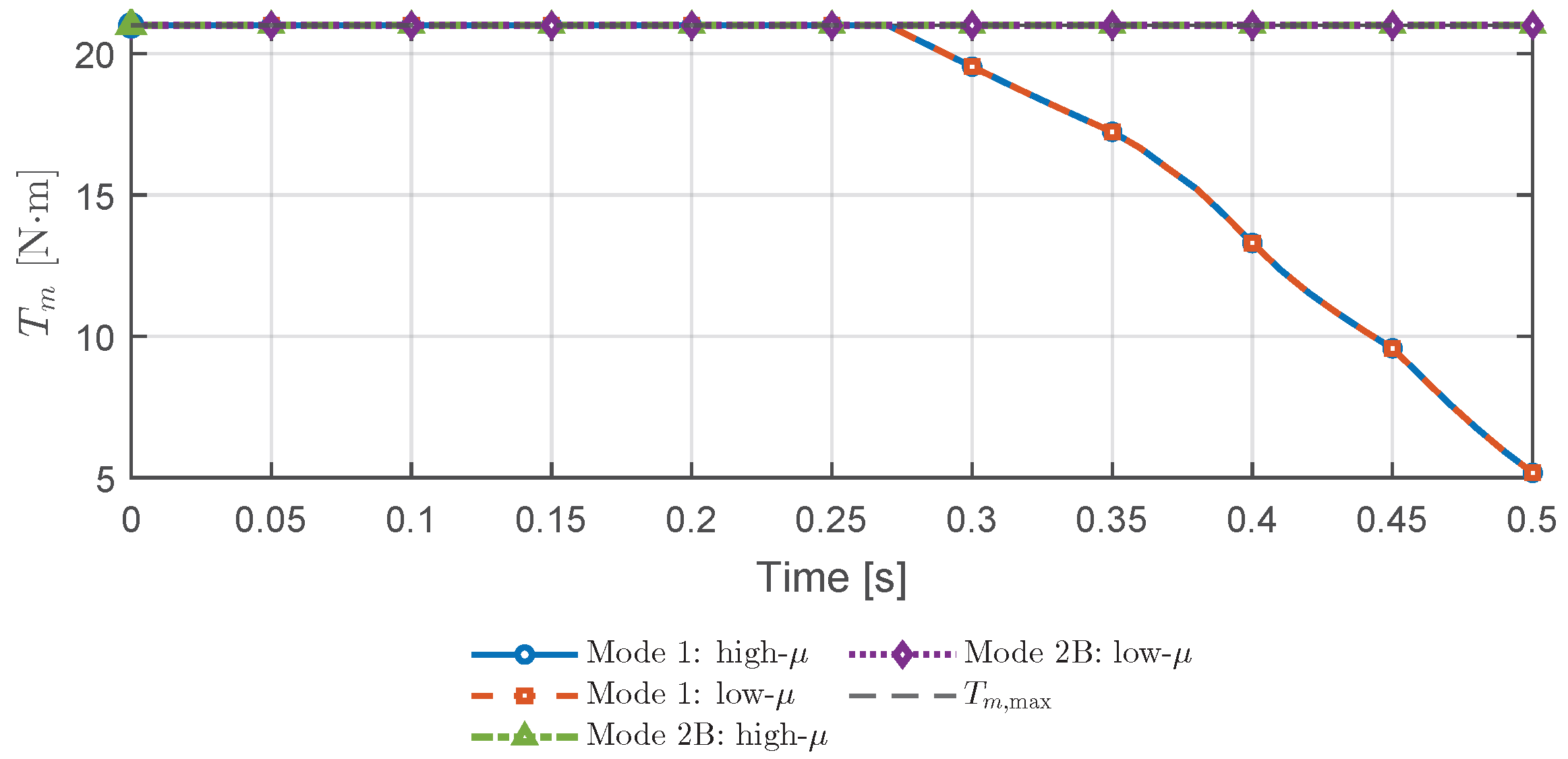
Figure 11 shows that this traction-aggregation effect is not achieved by increasing the motor torque limit itself. Instead, both motors remain constrained by the same torque envelope as in Mode 1, while the engaged clutch provides the additional cross-axle transfer path that enables torque concentration on the high-adhesion wheel. The simulated transient peak moderately exceeds the quasi-static structural bound A uni ( λ ) = 1 + λ , which should be interpreted as a quasi-static limit derived under idealized steady low-speed conditions. In time-domain co-simulation, friction-clutch engagement, driveline inertia, and torsional dynamics can produce a short overshoot above this bound. Therefore, the comparison with A uni ( λ ) should be understood in a quasi-static rather than strictly instantaneous sense.

5.2. Scenario II: High-Adhesion Step-Steer to a Constant Steering Angle (Mode 2A)

  • Scenario Setup and TV Implementation.
This scenario targets high-traction torque-vectoring capability under motor limits. The vehicle travels at v x 80 km / h in straight-line motion. At t = t 0 , the front steering angle steps from 0 to 5 ° and then remains constant (Figure 12a). The road friction is uniform and high ( μ = 1.6 ), and the CarSim tire model is Magic Formula. The steering input is an ideal step. The longitudinal speed is regulated by a PI speed controller such that the post-step interval maintains a high normalized wheel-torque level,
α = T Σ T Σ , max > 0.75 ,
which is consistent with operating in the high-demand regime where the motor-limited amplified boundary segment may become active under traction-only constraints (Section 3).
The yaw-rate reference is generated using a linear 2DOF vehicle model. Modes 1 and 2A use the same TV command generation procedure: a differential-torque request Δ T w ( t ) is generated from the yaw-rate tracking error with identical amplitude and rate limits. The controller structure follows a standard engineering framework and is not the focus here.
  • Mode 1: the axle is fully independent, and Δ T w is realized primarily through motor torque split.
  • Mode 2A: one cross-axle clutch is engaged in controlled slip without imposing an additional speed constraint; the controller computes the clutch command from the static mapping (18) and (19) and applies the corresponding clutch-capacity limits. To enforce traction-only operation, the command is additionally limited such that the realized wheel-end torques satisfy T w , RL , T w , RR 0 .
The quasi-steady evaluation window is selected as τ [ 14 , 18 ] s in the shifted time coordinate τ = t 10 s . The main setup and evaluation settings of Scenario II are summarized in Table 4.
  • Results and Relation to the Traction-Only Boundary and G tv ( λ ) .
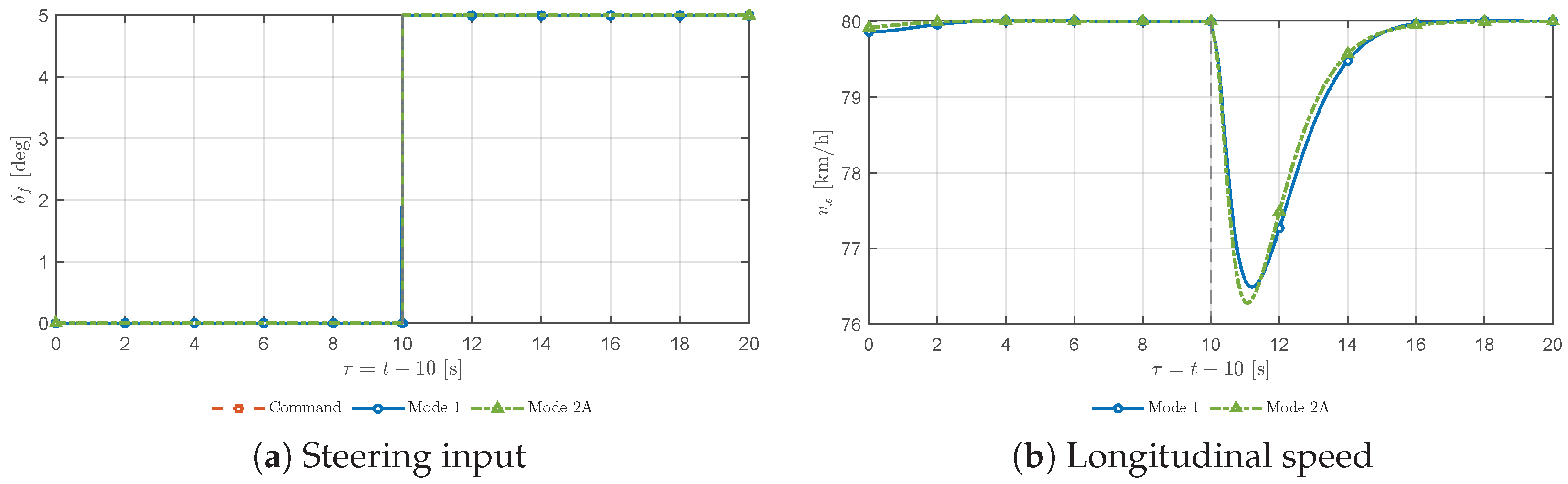
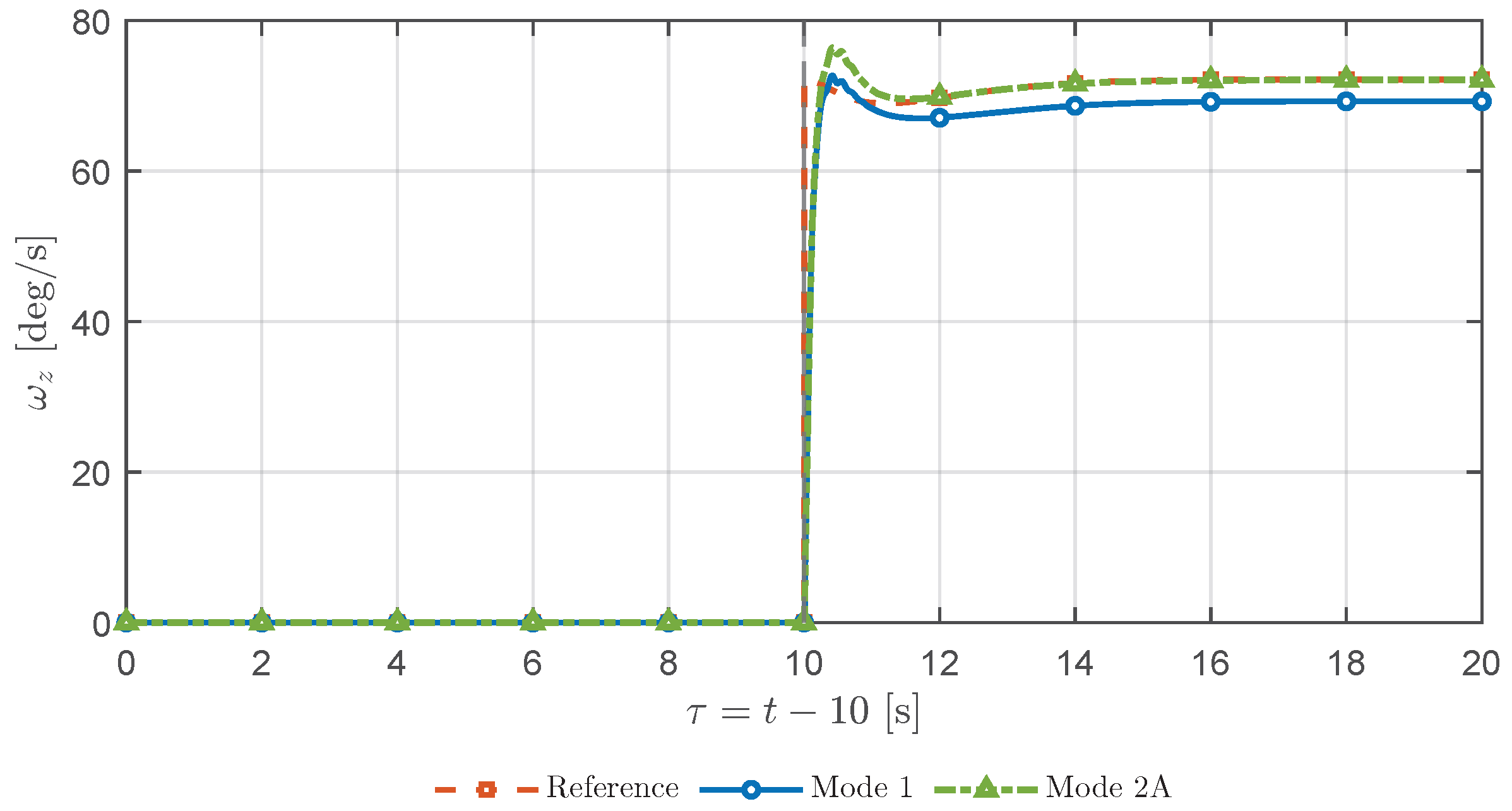
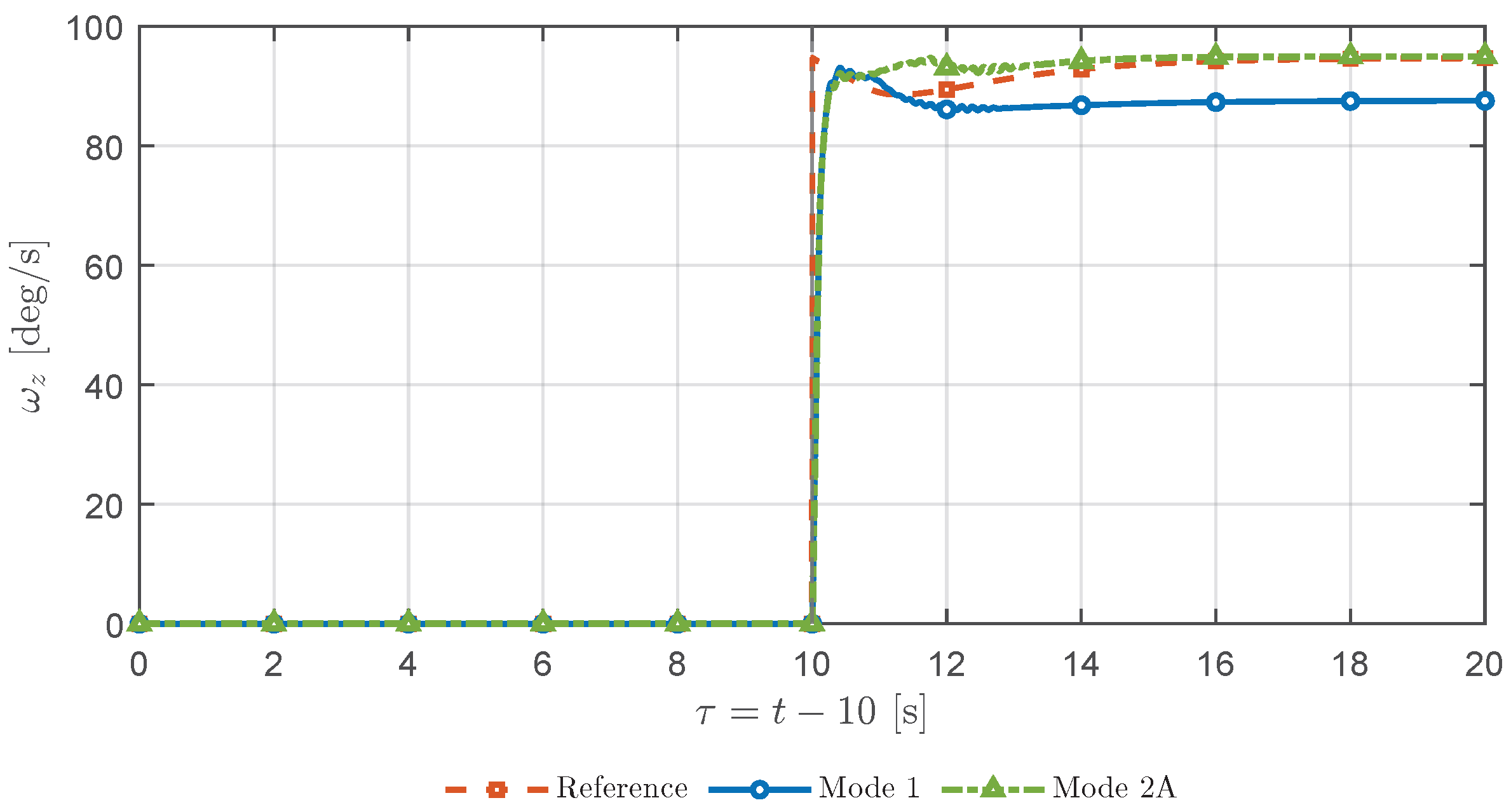
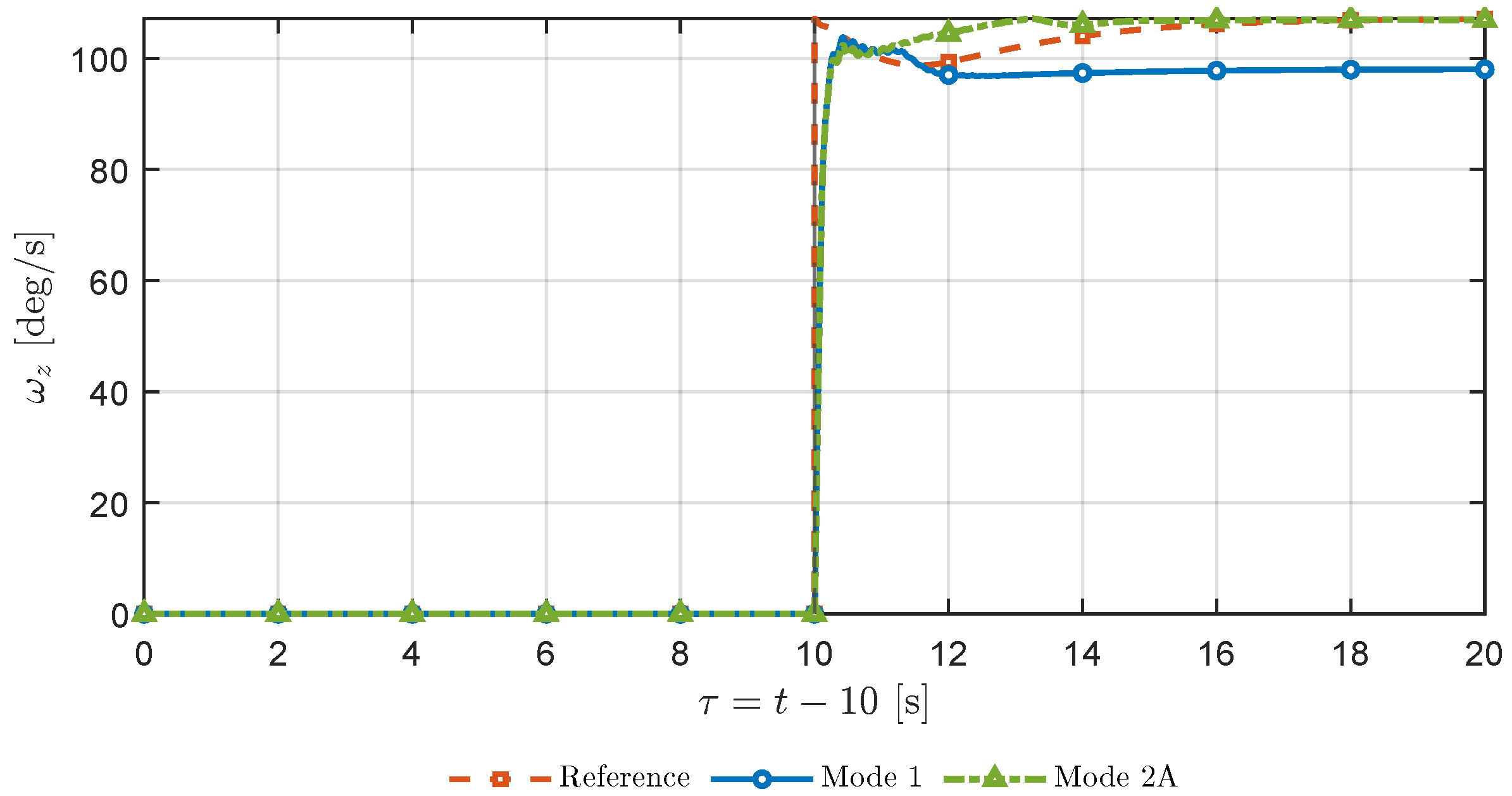
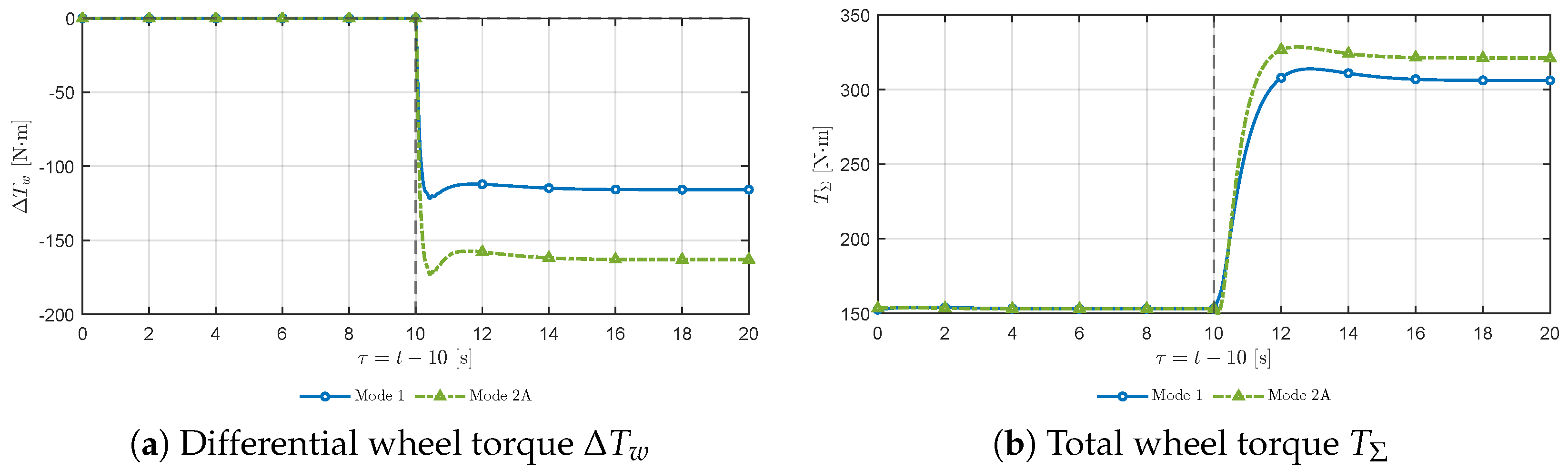
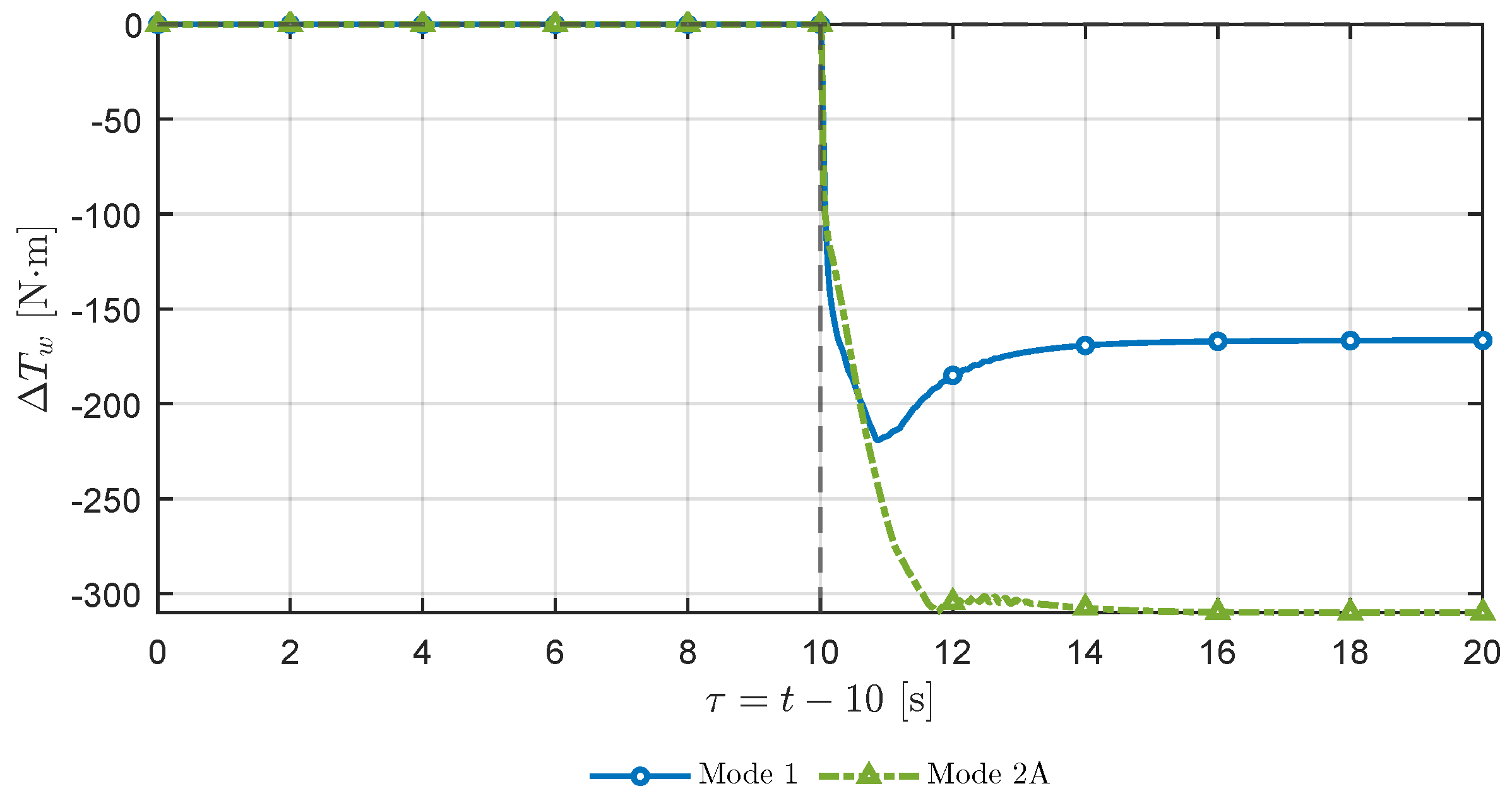
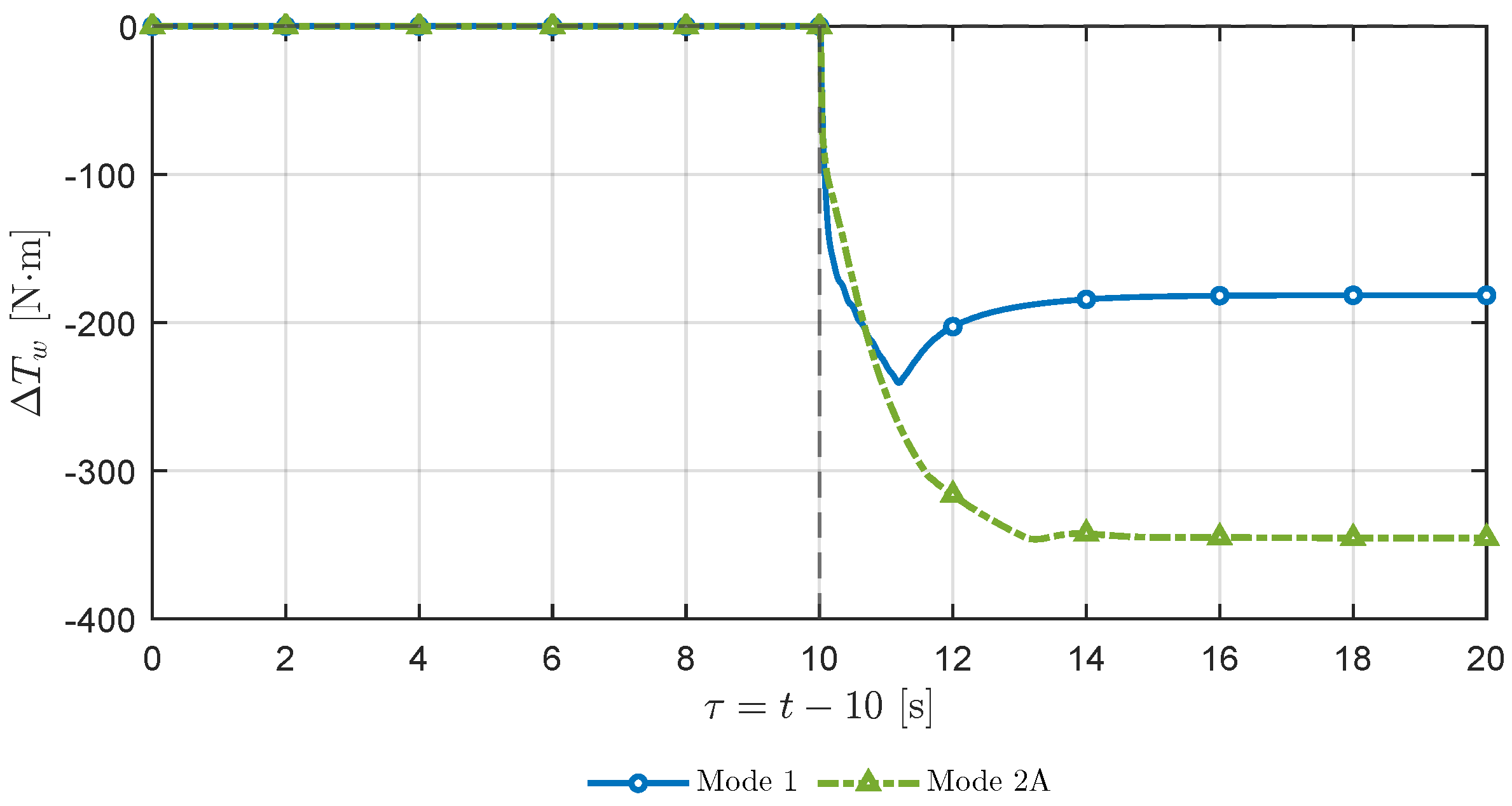
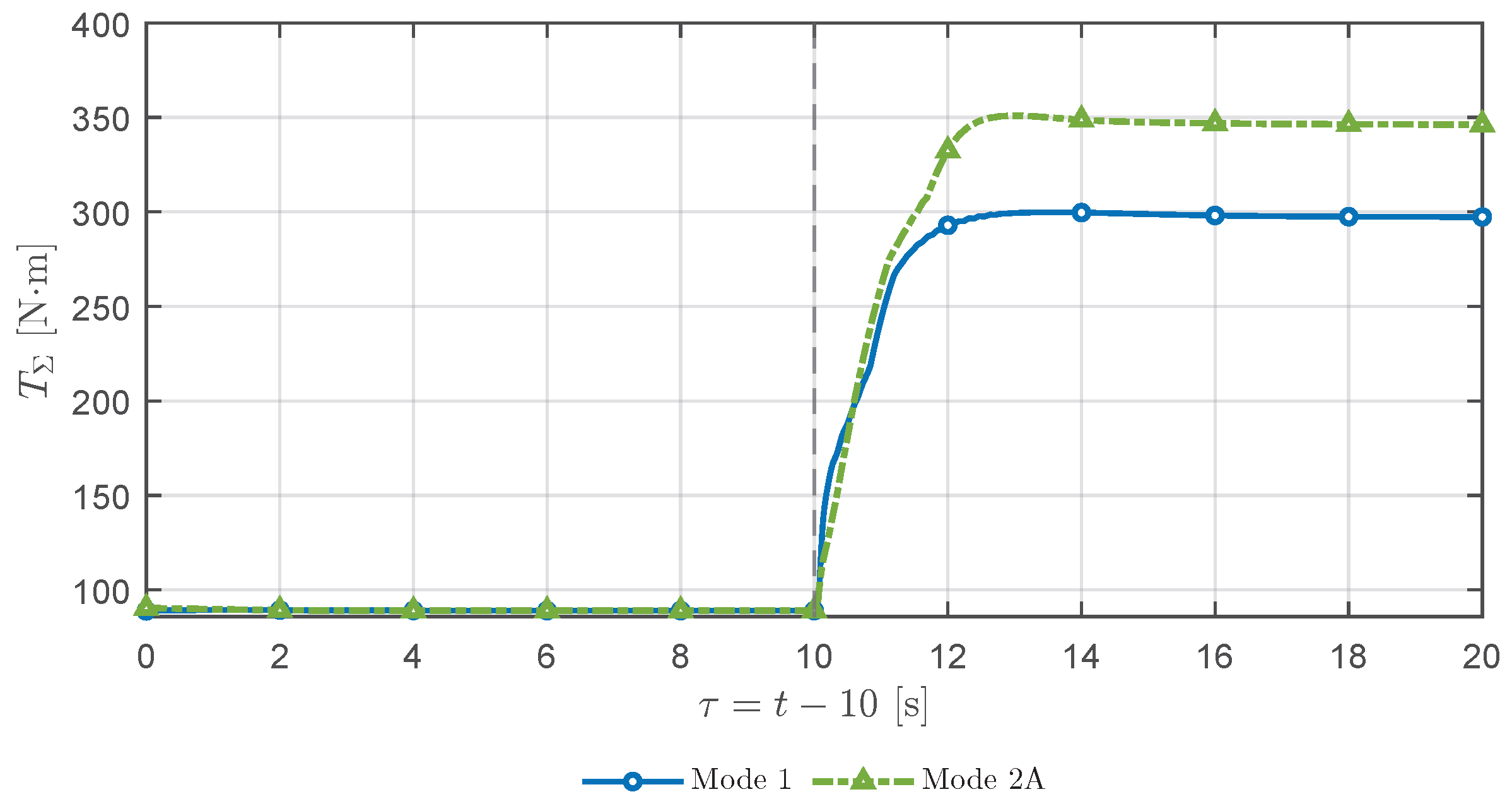
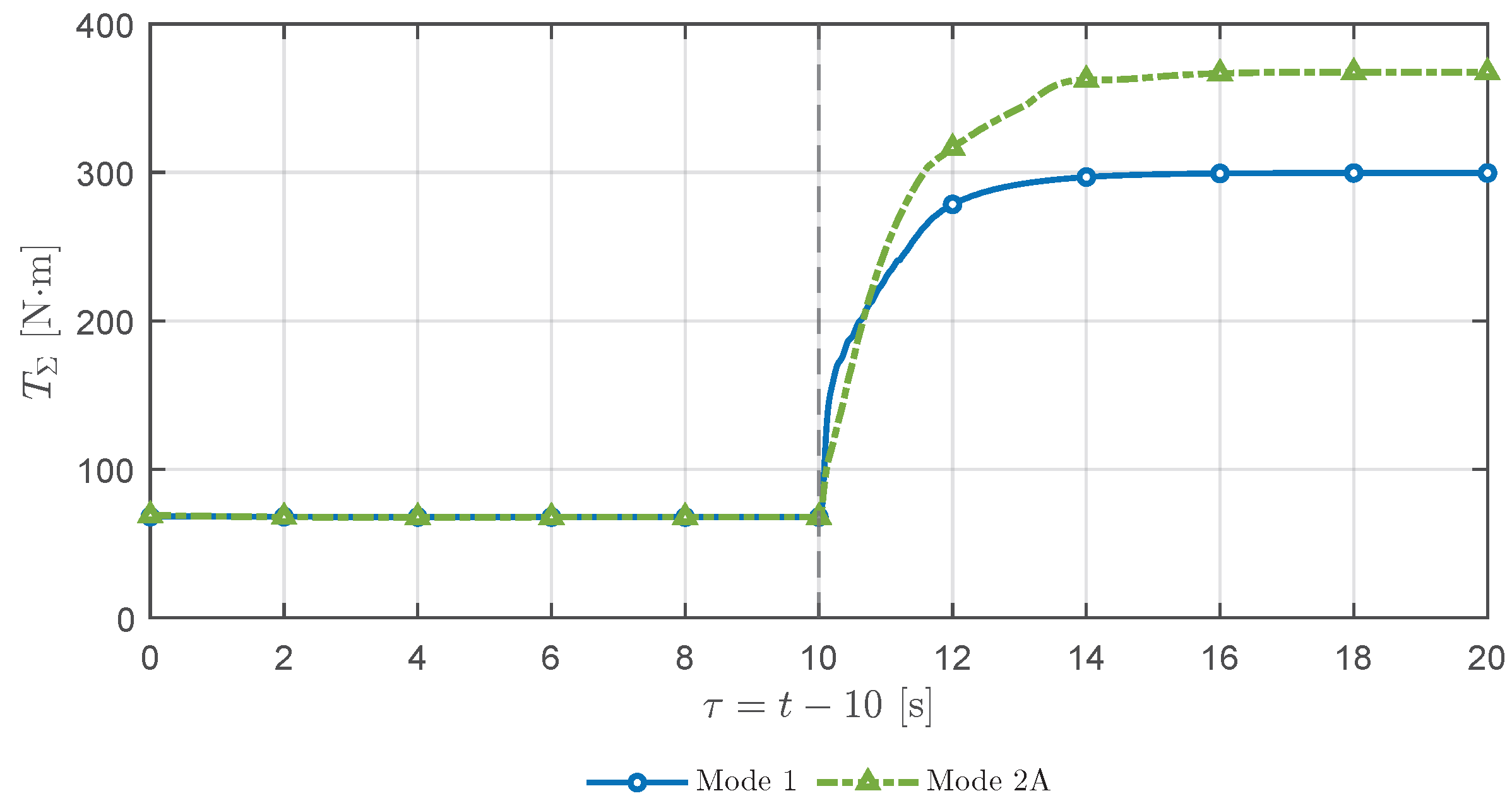
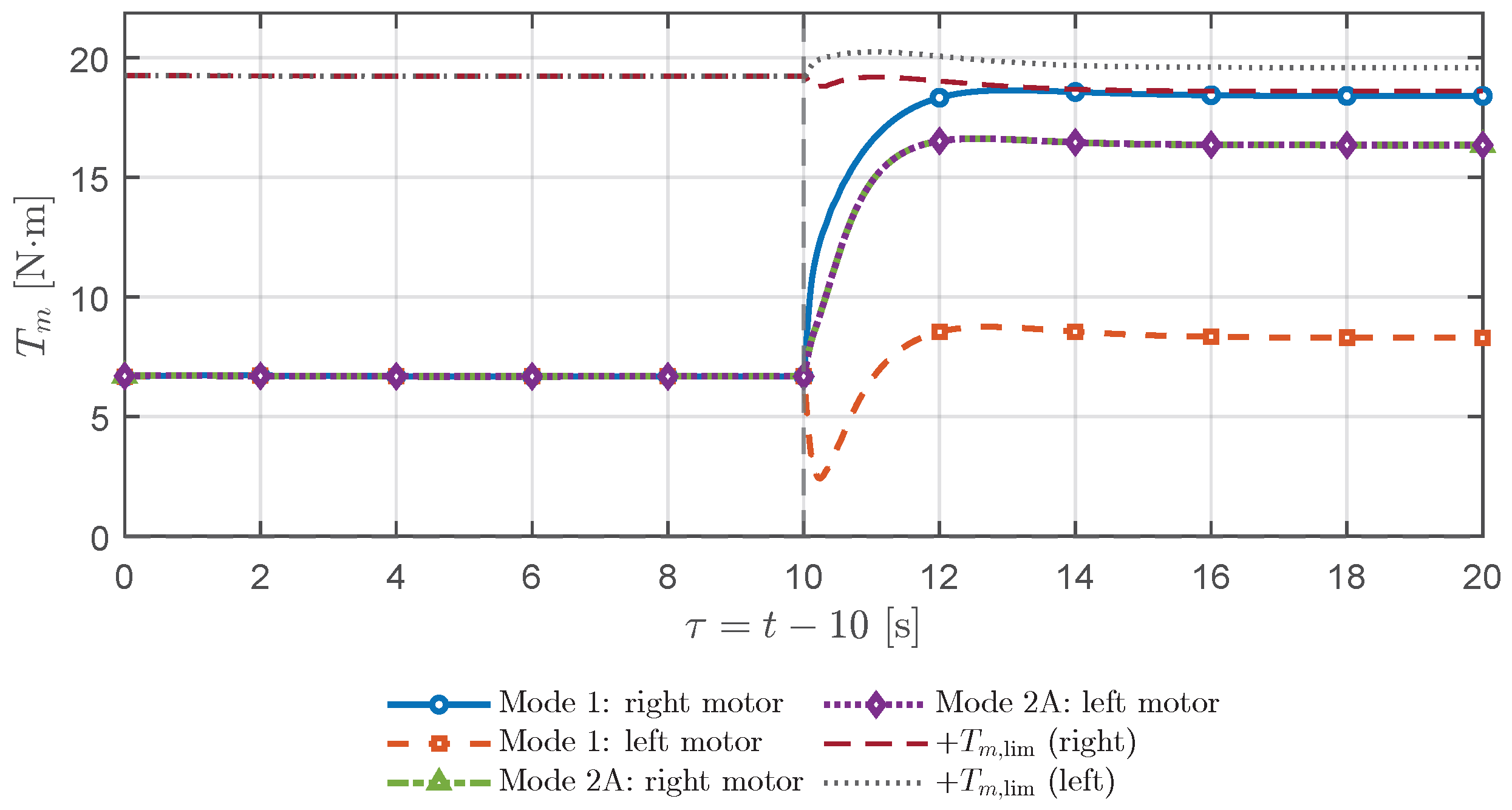
Figure 12 and Figure 13 first present the steering input, longitudinal speed, and yaw-rate tracking for the original high-adhesion step-steer case. Figure 12a confirms that the steering inputs in Modes 1 and 2A are identical, and Figure 12b shows that the longitudinal-speed responses remain very close throughout the maneuver. This indicates that the two modes are compared under essentially the same external input and operating condition. Figure 13 shows that, after the steering step, Mode 1 exhibits a more pronounced yaw-rate deficit relative to the reference, whereas Mode 2A follows the reference more closely. In the selected quasi-steady window, the mean yaw-rate tracking error decreases from 2.93 deg/s in Mode 1 to 0.08 deg/s in Mode 2A. To further clarify the practical significance of the proposed topology under high-adhesion conditions, two additional higher-demand step-steer cases are further evaluated within the same scenario framework, corresponding to ( v x , δ f ) = ( 70 km / h , 7.5 ° ) and ( 60 km / h , 10 ° ) , respectively. Figure 14 and Figure 15 show that, as the yaw demand increases, Mode 2A consistently delivers a realized yaw rate closer to the reference and a substantially smaller yaw-rate error than Mode 1. In the representative intermediate-demand case, the mean yaw-rate tracking error is reduced from 6.75 deg/s to 0.20 deg/s. The additional higher-demand case shows the same consistent trend. Figure 16, Figure 17 and Figure 18 show that the same trend also holds for the wheel-torque responses. In all three high-adhesion cases, the quasi-steady differential wheel-torque capability in Mode 2A is clearly higher than that in Mode 1. The corresponding gain reaches 1.41, 1.83, and a similarly higher level in the additional higher-demand case, respectively. Figure 17 and Figure 18 show that the differential wheel torque in Mode 2A remains clearly larger than that in Mode 1 in the two additional cases. Figure 19 and Figure 20 show that the total rear-axle wheel torque also increases in the additional cases, but the main benefit comes from the expansion of the feasible differential-torque capability boundary enabled by the reconfigurable intra-axle power-transfer path. This is also consistent with the traction-only feasible-boundary analysis and the structural gain G tv ( λ ) derived in Section 3. Figure 21 further shows that the motor torques in both modes remain constrained by the same torque–speed envelopes, confirming that the performance difference originates from topology reconfiguration rather than from different motor limits.

6. Conclusions

This paper proposes a reconfigurable dual-motor electric drive axle based on fixed-carrier compound planetary gear trains and cross-axle clutches, aiming to extend the torque-transfer capability beyond conventional independent dual-motor architectures. A unified kinematic–static analytical framework is established to characterize the structural capability boundaries in the ( T Σ , Δ T w ) plane. Based on this framework, three dimensionless indices governed by the parameter λ are defined, namely the torque-vectoring gain G tv ( λ ) , the traction-only transition threshold A con ( λ ) , and the unilateral torque amplification factor A uni ( λ ) . These indices provide a direct analytical linkage between mechanism parameters and axle-level performance capability. Vehicle-level co-simulation results show that, under severe split- μ conditions, the proposed topology can significantly increase the achievable high-adhesion wheel torque and reduce the escape time, thereby improving the vehicle’s ability to recover effective traction. Under high-adhesion conditions, the slip-coupled mode enables a larger feasible differential wheel torque under motor constraints, resulting in improved yaw-rate tracking performance. These results are consistent with the derived structural capability boundaries and confirm the vehicle-dynamics effectiveness of the proposed architecture. From an engineering perspective, the proposed topology provides a mechanism-level solution for expanding the feasible torque set without increasing the number of traction motors. The results indicate that the performance improvement is primarily attributed to the reconfigurable inter-wheel power-transfer path, rather than to an increase in motor torque capability. The present study focuses on system-level capability analysis and vehicle-level validation under controlled-slip operation. In Mode 2A, the clutch is intended to operate in a regulated sliding regime, and the design objective is to avoid sustained operation near the static-to-kinetic friction transition where stick-slip oscillations may occur. Further investigation is required to analyze the critical conditions for stick-slip, the associated torsional vibration modes, and their potential interaction with the driveline dynamics. Dedicated frequency-domain analysis and experimental NVH validation will be carried out in future work to further evaluate the vibration characteristics of the proposed system.

Author Contributions

Conceptualization, J.L., M.T., J.H. and B.G.; methodology, J.L. and M.T.; software, J.L.; validation, J.L. and H.L.; formal analysis, J.L.; investigation, J.L., D.X. and Z.Z.; resources, M.T., D.L., J.H. and B.G.; data curation, J.L.; writing—original draft preparation, J.L.; writing—review and editing, M.T., J.H. and B.G.; visualization, J.L.; supervision, M.T., J.H. and B.G.; project administration, M.T. All authors have read and agreed to the published version of the manuscript.

Funding

This research was funded by the Special Funds for the Cultivation of Guangdong College Students’ Scientific and Technological Innovation (“Climbing Program” Special Funds), grant number pdjh2025bk193.

Institutional Review Board Statement

Not applicable.

Informed Consent Statement

Not applicable.

Data Availability Statement

The data presented in this study are available from the corresponding authors upon reasonable request.

Conflicts of Interest

Author Dehai Li was employed by the company Shenzhen Bay Area Intelligent Connection Technology Services Co., Ltd. The remaining authors declare that the research was conducted in the absence of any commercial or financial relationships that could be construed as a potential conflict of interest.

References

  1. Wagh, K.; Dhatrak, P. A review on powertrain subsystems and charging technology in battery electric vehicles: Current and future trends. Proc. Inst. Mech. Eng. Part D J. Automob. Eng. 2021, 236, 095440702110259. [Google Scholar] [CrossRef]
  2. Du, W.; Zhao, S.; Jin, L.; Gao, J.; Zheng, Z. Optimization design and performance comparison of different powertrains of electric vehicles. Mech. Mach. Theory 2021, 156, 104143. [Google Scholar] [CrossRef]
  3. de Novellis, L.; Sorniotti, A.; Gruber, P.; Shead, L.; Ivanov, V.; Hoepping, K. Torque vectoring for electric vehicles with individually controlled motors: State-of-the-art and future developments. World Electr. Veh. J. 2012, 5, 617–628. [Google Scholar] [CrossRef]
  4. Mazzilli, V.; De Pinto, S.; Pascali, L.; Contrino, M.; Bottiglione, F.; Mantriota, G.; Gruber, P.; Sorniotti, A. Integrated chassis control: Classification, analysis and future trends. Annu. Rev. Control 2021, 51, 172–205. [Google Scholar] [CrossRef]
  5. Sawase, K.; Inoue, K. Classification and analysis of lateral torque-vectoring differentials using velocity diagrams. Proc. Inst. Mech. Eng. Part D J. Automob. Eng. 2008, 222, 1527–1541. [Google Scholar] [CrossRef]
  6. Zhao, K.; Fan, X.; Huang, Z.; Yu, X.; Wang, L.; Peng, J. A review of drive torque distribution control for distributed drive electric vehicles. Proc. Inst. Mech. Eng. Part D J. Automob. Eng. 2025, 239, 5291–5315. [Google Scholar] [CrossRef]
  7. Gillespie, T. Fundamentals of Vehicle Dynamics; SAE International: Warrendale, PA, USA, 2021. [Google Scholar]
  8. Mashadi, B.; Mostaani, S.; Majidi, M. Vehicle stability enhancement by using an active differential. Proc. Inst. Mech. Eng. Part I J. Syst. Control Eng. 2011, 225, 1098–1114. [Google Scholar] [CrossRef]
  9. Rubin, D.; Arogeti, S.A. Vehicle yaw stability control using active limited-slip differential via model predictive control methods. Veh. Syst. Dyn. 2015, 53, 1315–1330. [Google Scholar] [CrossRef]
  10. Peng, X.; Wu, G. Design and research of face gear central limited slip differential and analysis of its influence on vehicle performance. Veh. Syst. Dyn. 2025, 63, 2117–2139. [Google Scholar] [CrossRef]
  11. Russo, R.; Strano, S.; Terzo, M. Enhancement of vehicle dynamics via an innovative magnetorheological fluid limited slip differential. Mech. Syst. Signal Process. 2016, 70–71, 1193–1208. [Google Scholar] [CrossRef]
  12. Chang, L.K.; Chen, J.; Chen, Y.C.; Tsai, M.C. Limited-slip Differential Modelling and Control. In Proceedings of the 2022 International Automatic Control Conference (CACS); IEEE: Piscataway, NJ, USA, 2022; pp. 1–6. [Google Scholar] [CrossRef]
  13. Kato, T.; Sawase, K. Classification and analysis of electric-powered lateral torque-vectoring differentials. Proc. Inst. Mech. Eng. Part D J. Automob. Eng. 2012, 226, 713–724. [Google Scholar] [CrossRef]
  14. Chen, Y.F.; Chen, I.M.; Chang, J.; Liu, T. Design and Analysis of a New Torque Vectoring System with a Ravigneaux Gearset for Vehicle Applications. Energies 2017, 10, 2157. [Google Scholar] [CrossRef]
  15. Honda, T. Development of Handling Performance Control for SPORT HYBRID SH-AWD; SAE Technical Paper; SAE International: Warrendale, PA, USA, 2015. [Google Scholar]
  16. Wang, J.; Wang, Q.; Jin, L.; Song, C. Independent wheel torque control of 4WD electric vehicle for differential drive assisted steering. Mechatronics 2011, 21, 63–76. [Google Scholar] [CrossRef]
  17. Sforza, A.; Lenzo, B.; Timpone, F. A state-of-the-art review on torque distribution strategies aimed at enhancing energy efficiency for fully electric vehicles with independently actuated drivetrains. Int. J. Mech. Control 2019, 20, 3–13. [Google Scholar]
  18. Chatzikomis, C.; Zanchetta, M.; Gruber, P.; Sorniotti, A.; Modic, B.; Motaln, T.; Blagotinsek, L.; Gotovac, G. An energy-efficient torque-vectoring algorithm for electric vehicles with multiple motors. Mech. Syst. Signal Process. 2019, 128, 655–673. [Google Scholar] [CrossRef]
  19. Gao, S.; Wang, J.; Guan, C.; Zhou, Z.; Liu, Z. Wheel Torque Distribution Control Strategy for Electric Vehicles Dynamic Performance with an Electric Torque Vectoring Drive Axle. IEEE Trans. Transp. Electrif. 2024, 10, 1692–1705. [Google Scholar] [CrossRef]
  20. Wang, J.; Gao, S.; Qiang, Y.; Xu, M.; Guan, C.; Zhou, Z. Structural Topology and Dynamic Response Analysis of an Electric Torque Vectoring Drive-Axle for Electric Vehicles. Automot. Innov. 2022, 5, 164–179. [Google Scholar] [CrossRef]
  21. Guan, C.; Wang, J.; Zheng, T.; Wang, Q.; Sun, W.; Wang, H. Parameter optimization and multi-mode operation of a novel dual-motor coupling torque vectoring drive system for electric vehicles. Appl. Energy 2025, 389, 125744. [Google Scholar] [CrossRef]
  22. Mantriota, G.; Reina, G. Dual-Motor Planetary Transmission to Improve Efficiency in Electric Vehicles. Machines 2021, 9, 58. [Google Scholar] [CrossRef]
  23. Tian, Y.; Wang, Z.; Ji, X.; Ma, L.; Zhang, L.; Hong, X.; Zhang, N. A concept dual-motor powertrain for battery electric vehicles: Principle, modeling and mode-shift. Mech. Mach. Theory 2023, 185, 105330. [Google Scholar] [CrossRef]
  24. Gu, J.; Zhao, Z.; Chen, Y.; He, L.; Zhan, X. Integrated optimal design of configuration and parameter of multimode hybrid powertrain system with two planetary gears. Mech. Mach. Theory 2020, 143, 103630. [Google Scholar] [CrossRef]
  25. Esmail, E.L.; Pennestrì, E.; Cirelli, M. Power-Flow and Mechanical Efficiency Computation in Two-Degrees-of-Freedom Planetary Gear Units: New Compact Formulas. Appl. Sci. 2021, 11, 5991. [Google Scholar] [CrossRef]
  26. Laus, L.P.; Simas, H.; Martins, D. Efficiency of gear trains determined using graph and screw theories. Mech. Mach. Theory 2012, 52, 296–325. [Google Scholar] [CrossRef]
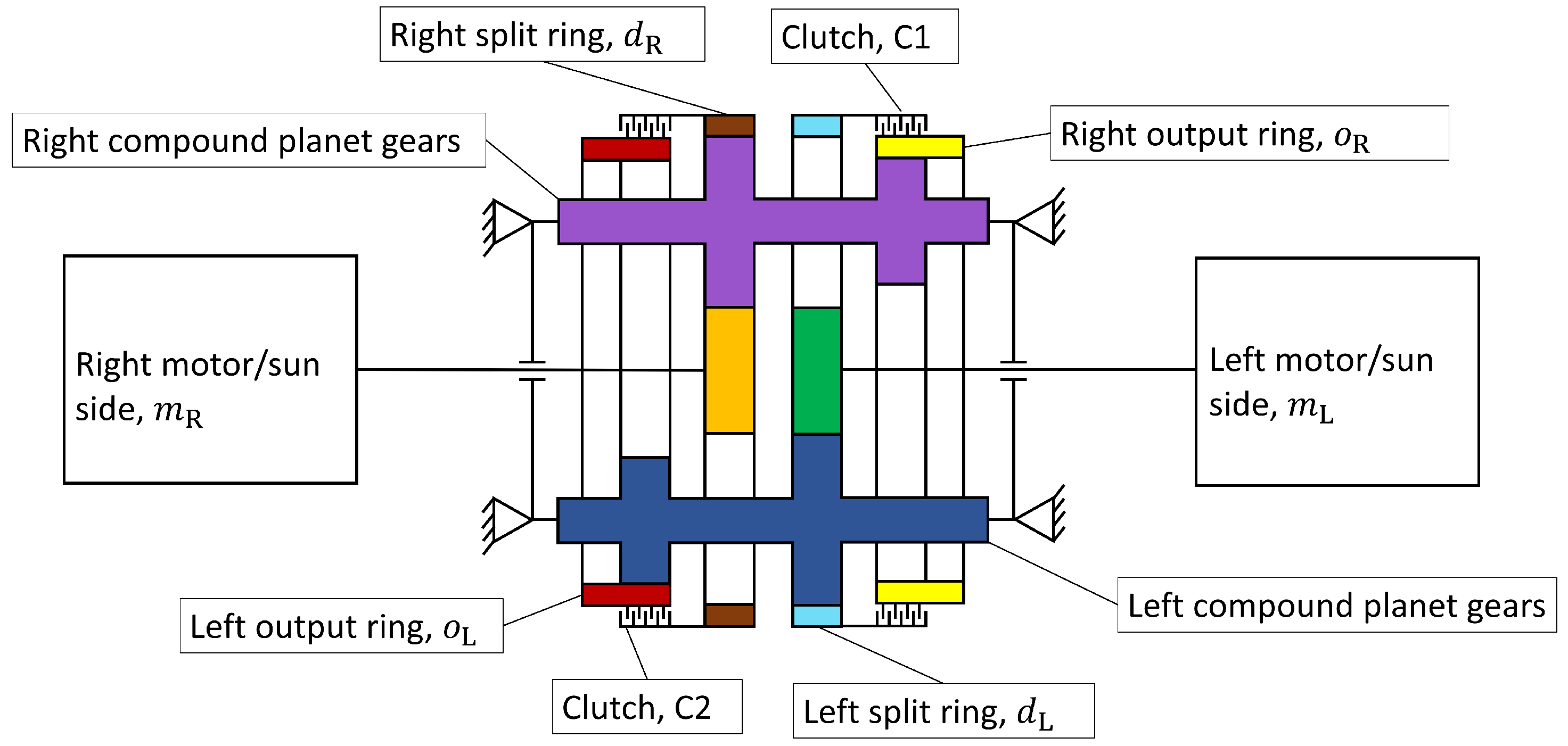
Figure 1. Layout of the proposed reconfigurable dual-motor e-axle.
Actuators 15 00268 g001
Figure 2. Fixed-carrier compound planetary unit and its analytical representation.
Actuators 15 00268 g002
Figure 3. CAD model of the proposed reconfigurable dual-motor electric drive axle.
Actuators 15 00268 g003
Figure 4. Structural details of the transmission and clutch. (a) Compound-planet assembly. (b) Ring-member arrangement. (c) Ball-ramp clutch.
Actuators 15 00268 g004
Figure 5. Typical operating modes of the proposed reconfigurable dual-motor e-axle. Mode 2A (slip) and Mode 2B (lock) share the same coupling topology but differ in clutch state.
Actuators 15 00268 g005
Figure 6. Trends of G tv ( λ ) , A uni ( λ ) , and A con ( λ ) versus λ .
Actuators 15 00268 g006
Figure 7. Comparison of structural boundaries in the ( T Σ , Δ T w ) plane for Modes 1 and 2A.
Actuators 15 00268 g007
Figure 8. Schematic variation of available TV margin with speed under motor torque–speed limits.
Actuators 15 00268 g008
Figure 9. Wheel and clutch torques versus left-motor speed in Modes 1 and 2B.
Actuators 15 00268 g009
Figure 10. Scenario I: vehicle responses in Modes 1 and 2B. Dashed reference lines are explained in the text.
Actuators 15 00268 g010
Figure 11. Scenario I: motor torques and torque limits in Modes 1 and 2B.
Actuators 15 00268 g011
Figure 12. Scenario II: steering input and longitudinal speed in Modes 1 and 2A.
Actuators 15 00268 g012
Figure 13. Scenario II: yaw-rate tracking in Modes 1 and 2A for the original high-adhesion case.
Actuators 15 00268 g013
Figure 14. Scenario II: yaw-rate tracking in Modes 1 and 2A for the additional high-adhesion case with v x = 70 km / h and δ f = 7.5 ° .
Actuators 15 00268 g014
Figure 15. Scenario II: yaw-rate tracking at v x = 60 km / h and δ f = 10 ° in Modes 1 and 2A.
Actuators 15 00268 g015
Figure 16. Scenario II: differential wheel torque and total rear-axle wheel torque in Modes 1 and 2A.
Actuators 15 00268 g016
Figure 17. Scenario II: differential wheel torque at v x = 70 km / h and δ f = 7.5 ° in Modes 1 and 2A. The black dashed line denotes the steering-step instant.
Actuators 15 00268 g017
Figure 18. Scenario II: differential wheel torque at v x = 60 km / h and δ f = 10 ° in Modes 1 and 2A. The black dashed line denotes the steering-step instant.
Actuators 15 00268 g018
Figure 19. Scenario II: total rear-axle wheel torque at v x = 70 km / h and δ f = 7.5 ° in Modes 1 and 2A. The black dashed vertical line denotes the steering-step instant.
Actuators 15 00268 g019
Figure 20. Scenario II: total rear-axle wheel torque at v x = 60 km / h and δ f = 10 ° in Modes 1 and 2A. The black dashed vertical line denotes the steering-step instant.
Actuators 15 00268 g020
Figure 21. Scenario II: motor torques and torque–speed limits in Modes 1 and 2A. The vertical dashed line denotes the steering-step instant.
Actuators 15 00268 g021
Table 1. Correspondence between analytical variables and physical components (including reference direction conventions).
VariablePhysical Component(s)Physical MeaningReference Direction ( ω > 0 )
m L Left motor rotor + left sun gearLeft motor input sideCCW
d L Left split ring gearLeft split-ring sideCCW
o L Left output ring + left half-shaft + left wheelLeft output sideCCW
m R Right motor rotor + right sun gearRight motor input sideCCW
d R Right split ring gearRight split-ring sideCCW
o R Right output ring + right half-shaft + right wheelRight output sideCCW
Table 2. Clutch states, DOF, and primary use cases of the typical operating modes.
ModeClutch StateDOF MPrimary Use
Mode 1C1 and C2 open2Baseline independent drive and baseline torque vectoring
Mode 2AOne clutch slipping2Slip-coupled operation without an additional kinematic constraint
Mode 2BOne clutch locked1Locked-coupling operation with one additional speed constraint
Mode 3Both clutches engaged2/0Braking, parking hold, and fail-safe operation
Table 3. A representative integer tooth-number set yielding i w 11.5 and λ 1.7 .
GroupSymbolValueNote
Sun gear teeth z S 30Both sides identical
Split ring teeth z R d 111Internal gear
Output ring teeth z R o 87Internal gear
Compound planet teeth (split/output) z P d , z P o 39, 18Rigidly coupled on planet shaft
Final gear teeth (pinion/gear) z p , z f 34, 62External gear pair
Derived ratios λ , i w ≈1.70, ≈11.46Computed from the above relations
Table 4. Scenario II setup and evaluation settings.
ItemSettingNotes
Road frictionUniform μ = 1.6 High-adhesion surface
Tire modelMagic FormulaCarSim tire model
Initial speed v x = 80 km / h Regulated around target speed
Steering input δ f : 0 5 ° at t = t 0 Ideal step (no ramp/filter)
Longitudinal regulationPI speed controlSame controller for all modes
Operating-point constraint α = T Σ / T Σ , max > 0.75 High normalized wheel-torque level post step
Yaw-rate referenceLinear 2DOF modelAs described in text
TV command generation Δ T w from yaw-rate errorSame logic/limits for all modes
Performance metricMean yaw-rate tracking error over a quasi-steady windowSame window for Mode 1 and Mode 2A
Disclaimer/Publisher’s Note: The statements, opinions and data contained in all publications are solely those of the individual author(s) and contributor(s) and not of MDPI and/or the editor(s). MDPI and/or the editor(s) disclaim responsibility for any injury to people or property resulting from any ideas, methods, instructions or products referred to in the content.