
A Memristive-System-Based Hysteresis Model for a Compact Pneumatic Artificial Muscle



Abstract
1. Introduction
2. Background
2.1. Established Hysteresis Model Families
2.2. Mechanical-Electrical Analogy Choice
2.3. Generalized Memristive-System Interpretation
3. Materials and Methods
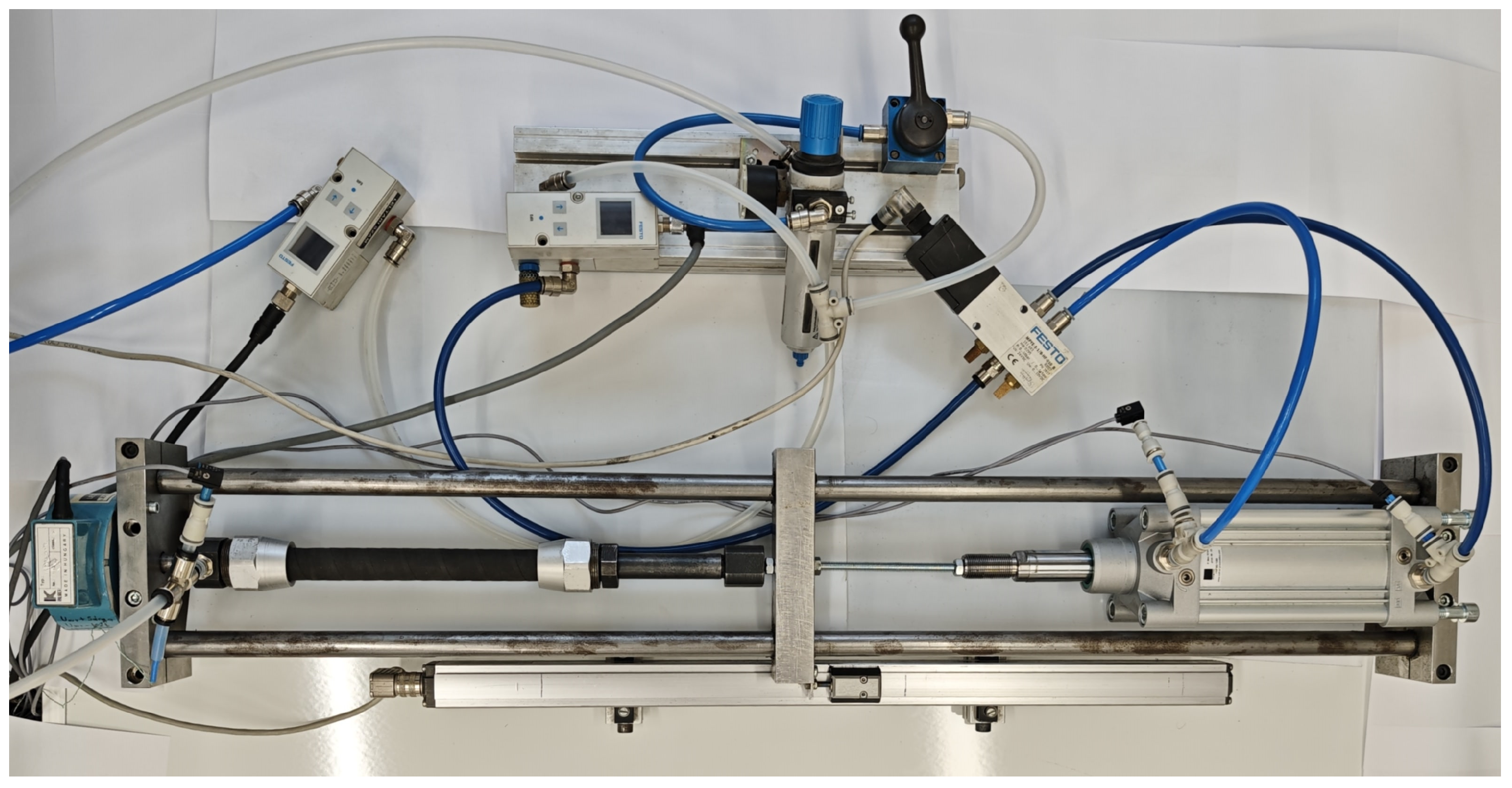
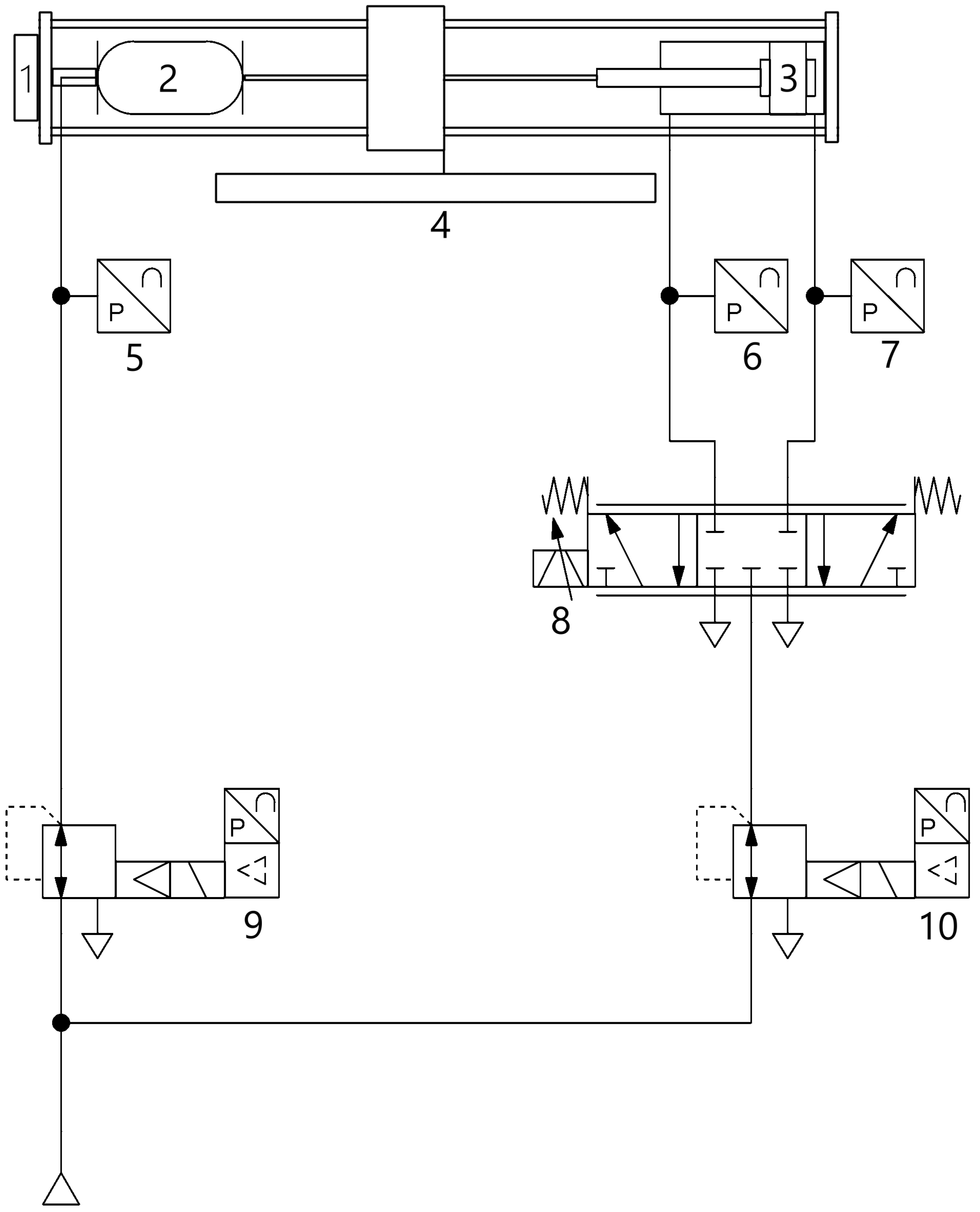
3.1. Actuator and Variables
- (1)
- Uniaxial load cell, type KALIBER 8923-200 kg (Budapest, Hungary); the load-cell signal was processed with a ClipX BM40 unit (Göttingen, Germany).
- (2)
- Tested muscle (CPAM).
- (3)
- Double-acting pneumatic cylinder, type HAFNER HIF80/100 (Halászi, Hungary), used to apply the controlled excitation force.
- (4)
- Linear position sensor, type BALLUF BTL5-S101-M0500-P-S32 (Veszprém, Hungary), used to determine the cart position and thereby the muscle contraction.
- (5)
- Pressure sensor, type FESTO SPTE-571484 B9 (Budapest, Hungary), mounted on one cylinder port.
- (6)
- Pressure sensor, type FESTO SPTE-571484 B9 (Budapest, Hungary), mounted on the other cylinder port.
- (7)
- Pressure sensor, type FESTO SPTE-571484 B9 (Budapest, Hungary), mounted on the tested muscle.
- (8)
- Proportional valve, type FESTO MPYE-5-1/8-HF-010 B (Budapest, Hungary).
- (9)
- Pressure regulator for the tested muscle, type FESTO VPPM-6L-L-1-G18-0L6H-V1N-S1C1 (Budapest, Hungary).
- (10)
- Electro-pneumatic pressure regulator for the cylinder supply, type FESTO VPPM-6L-L1-G18-0l6H-V1N-S1C1 (Budapest, Hungary).
3.2. Measurement Protocol
- 1.
- The muscle pressure was set to the prescribed level.
- 2.
- The excitation force was adjusted so that the muscle returned to the pre-tensioned stretched state and was then held for .
- 3.
- The unloading branch, which corresponds to contraction in the notation of this paper, was recorded by ramping the excitation force approximately linearly at from the stretched state toward the maximum contraction reachable at that pressure; the retained branch contains 32 sampled setpoints.
- 4.
- The loading branch, which corresponds to expansion, was then recorded by reversing the ramp to approximately until the pre-tensioned state was reached again; this retained branch also contains 32 sampled setpoints.
- 5.
- Steps 1–4 were repeated five times.
3.3. Branch-Wise Force Representation
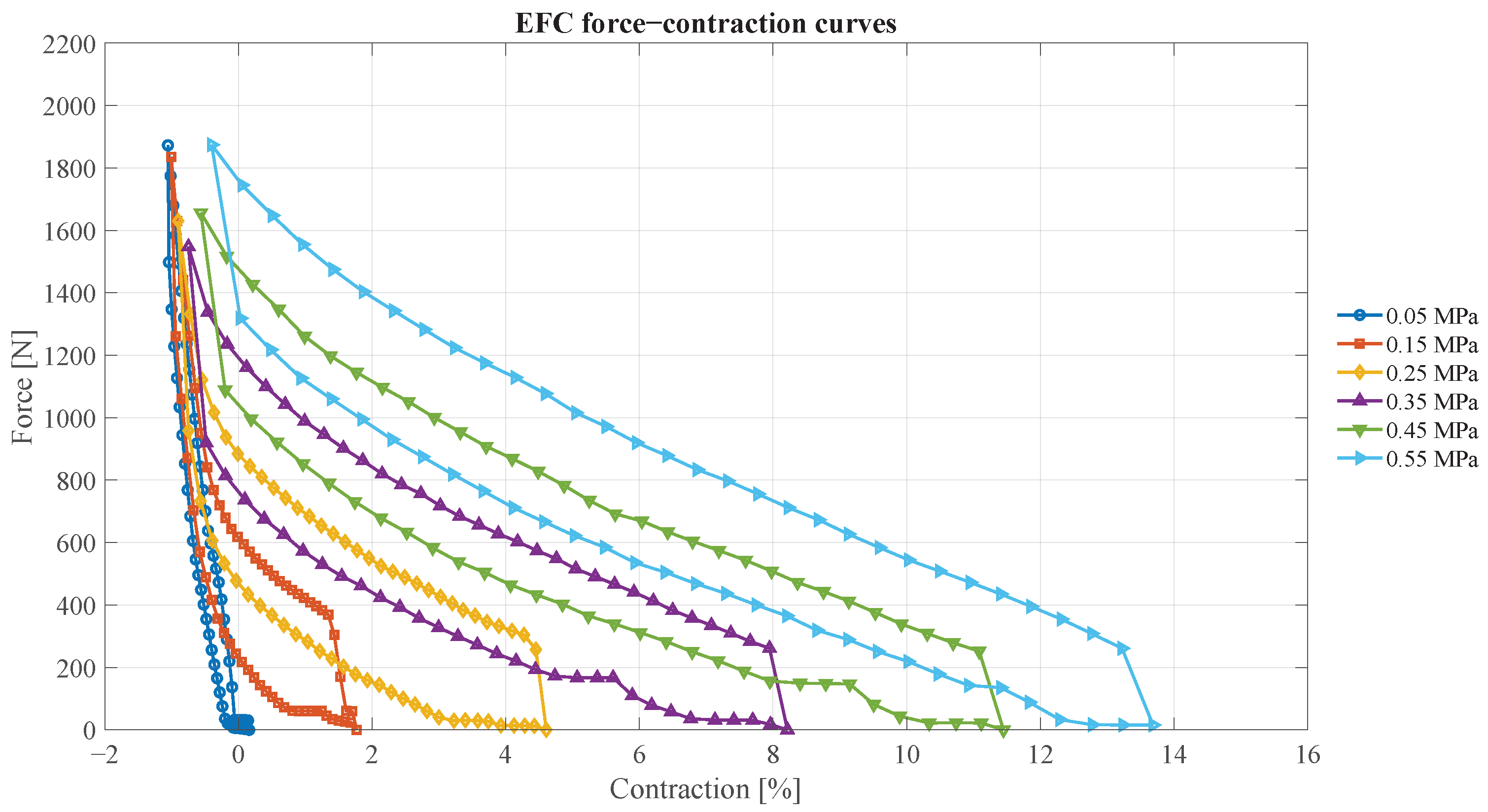
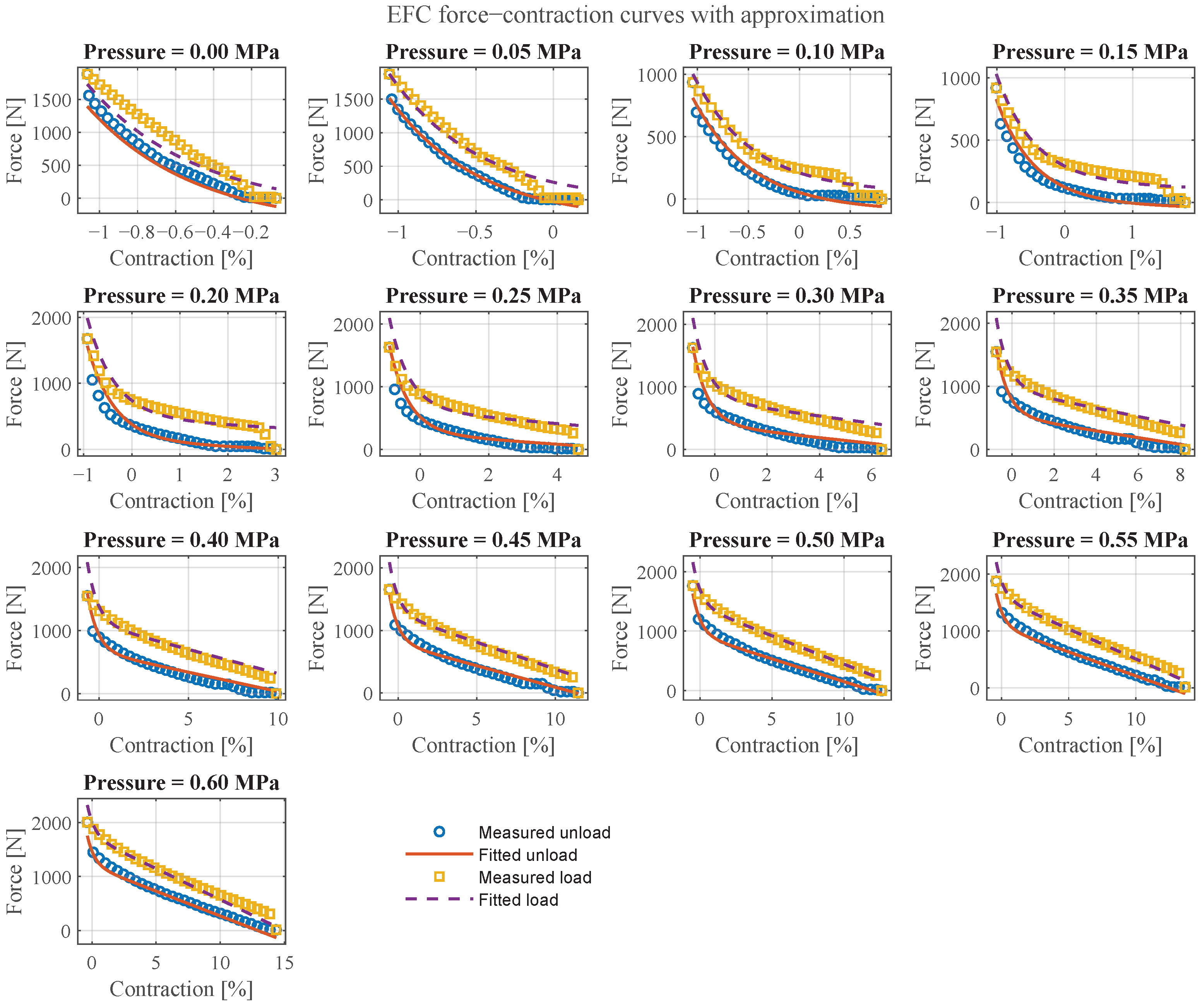
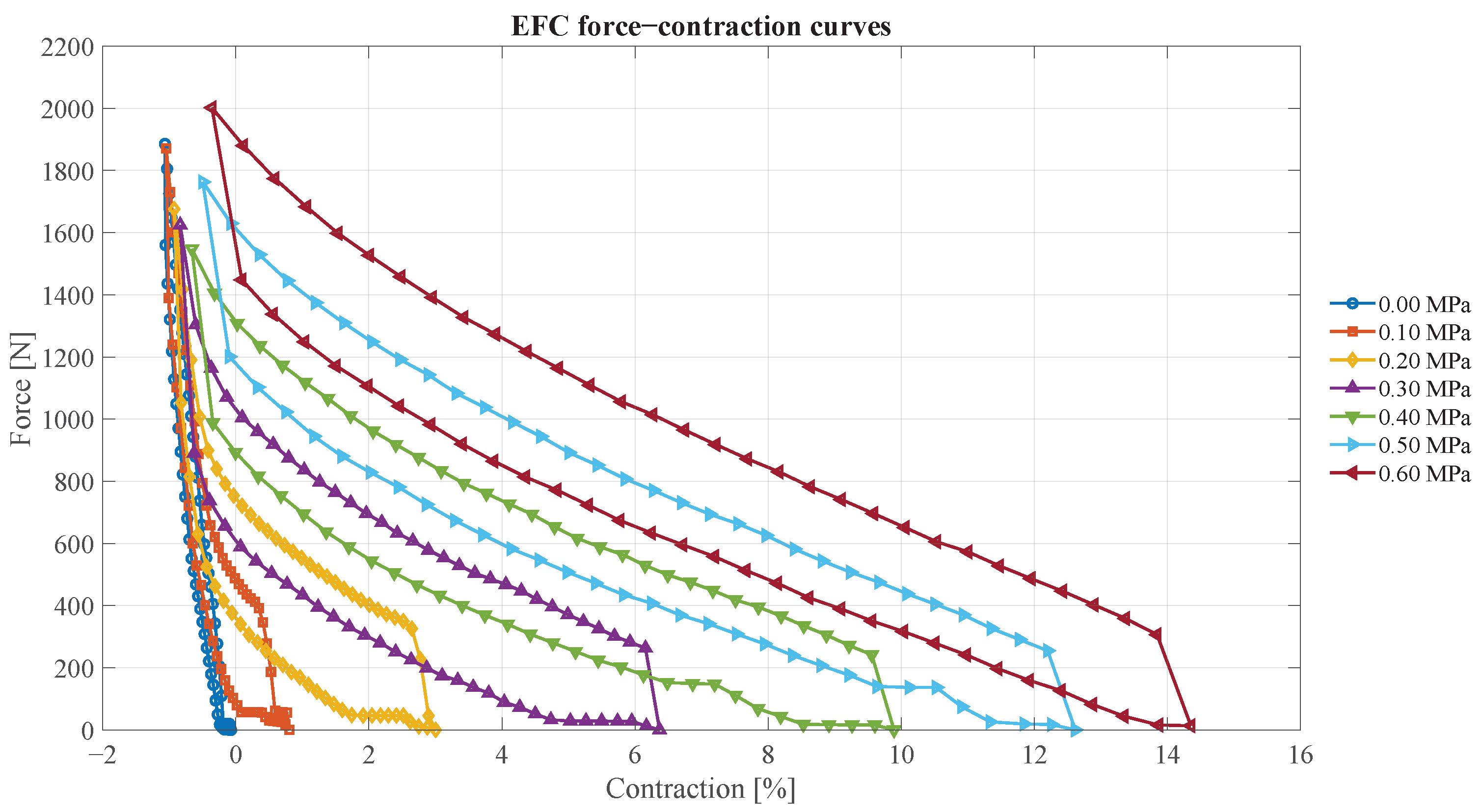
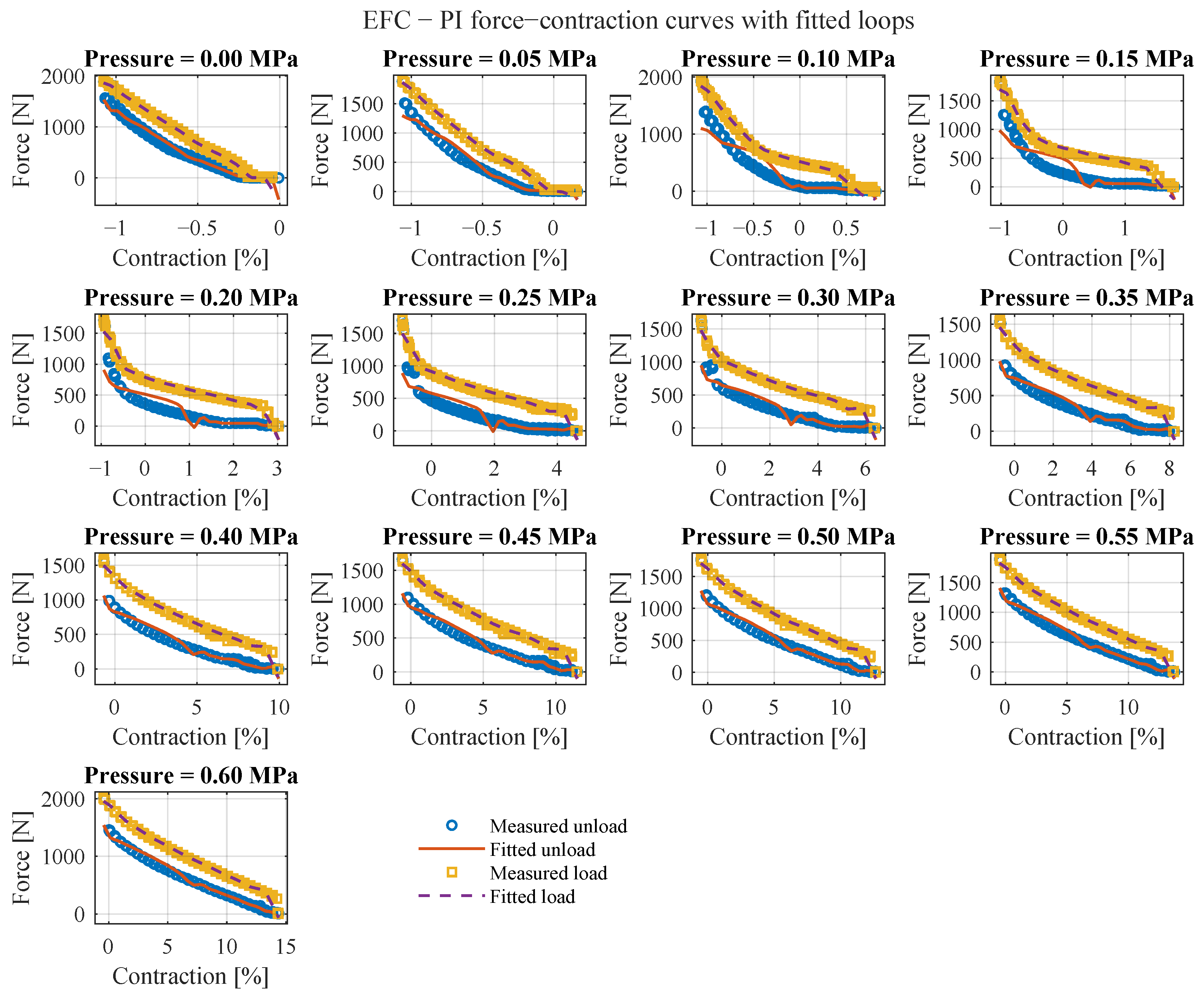
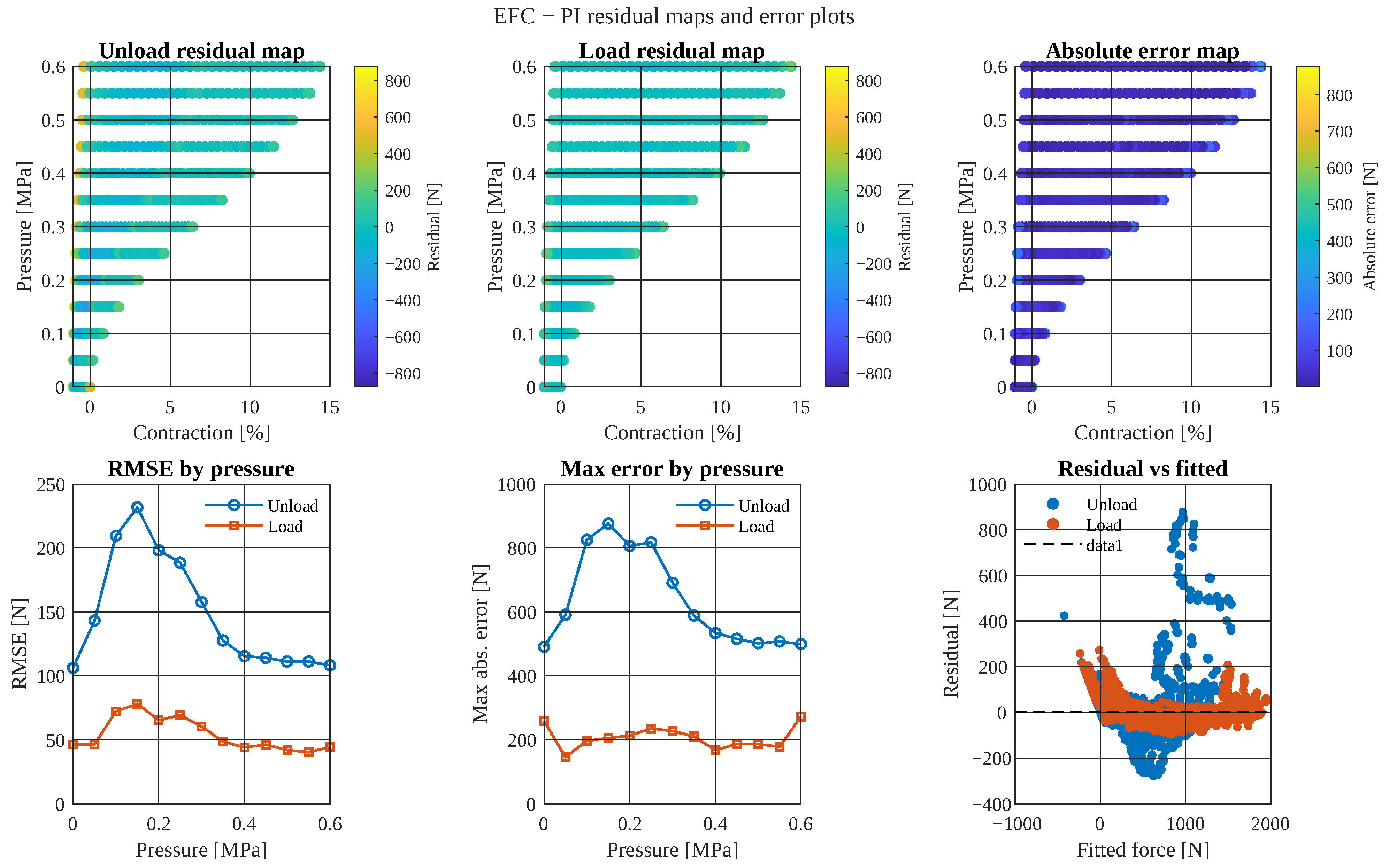
- Excitation force-contraction (EFC).
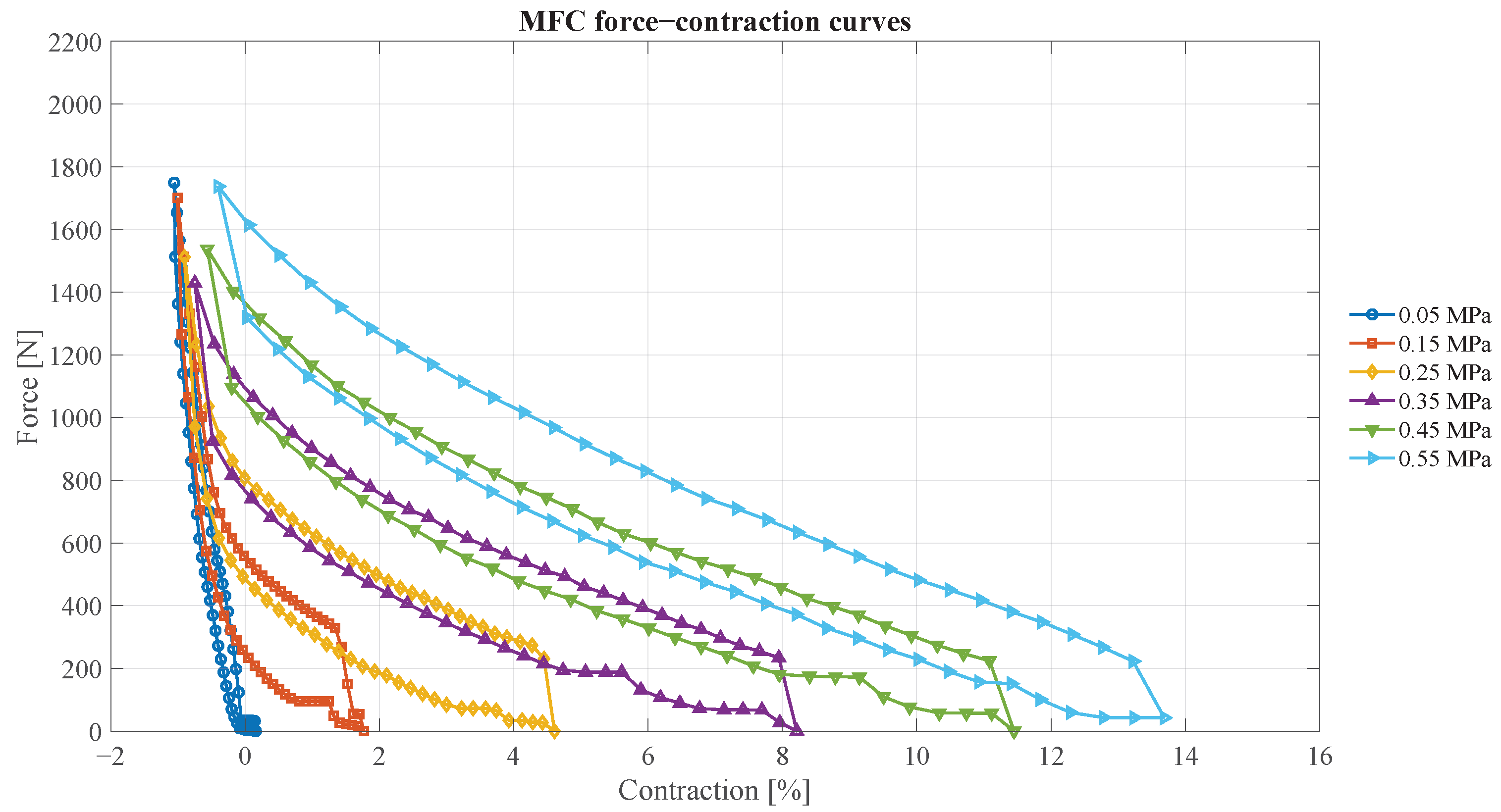
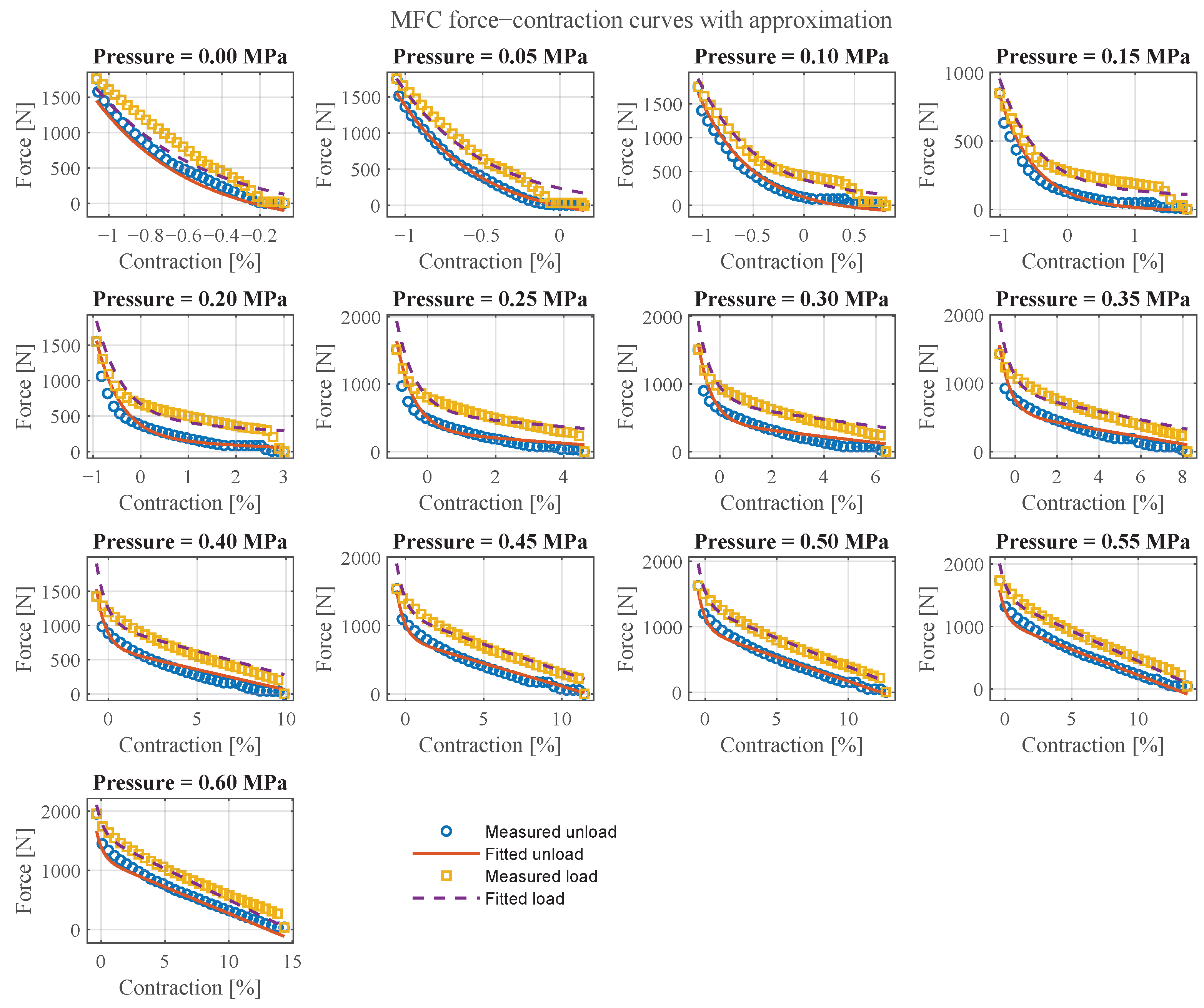
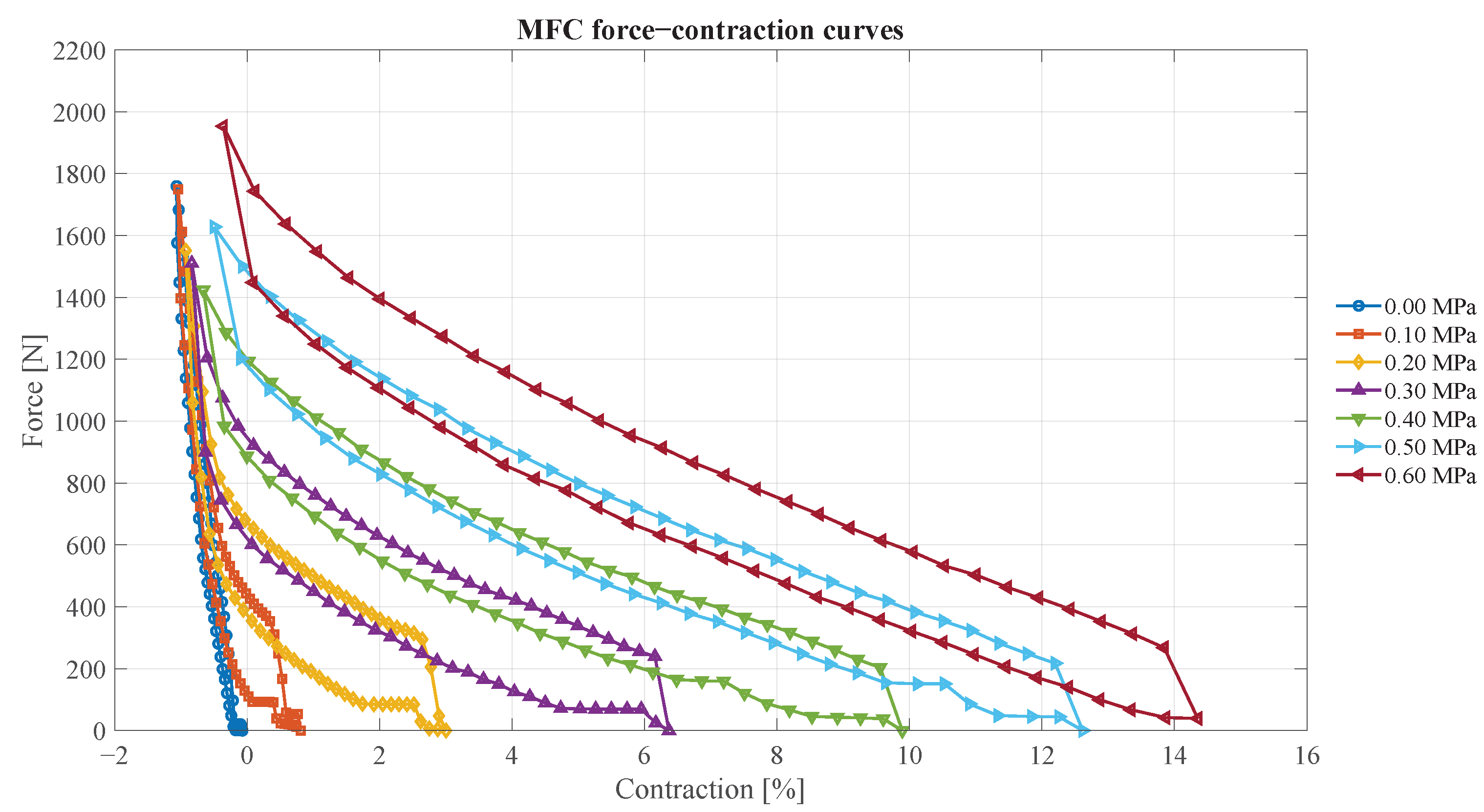
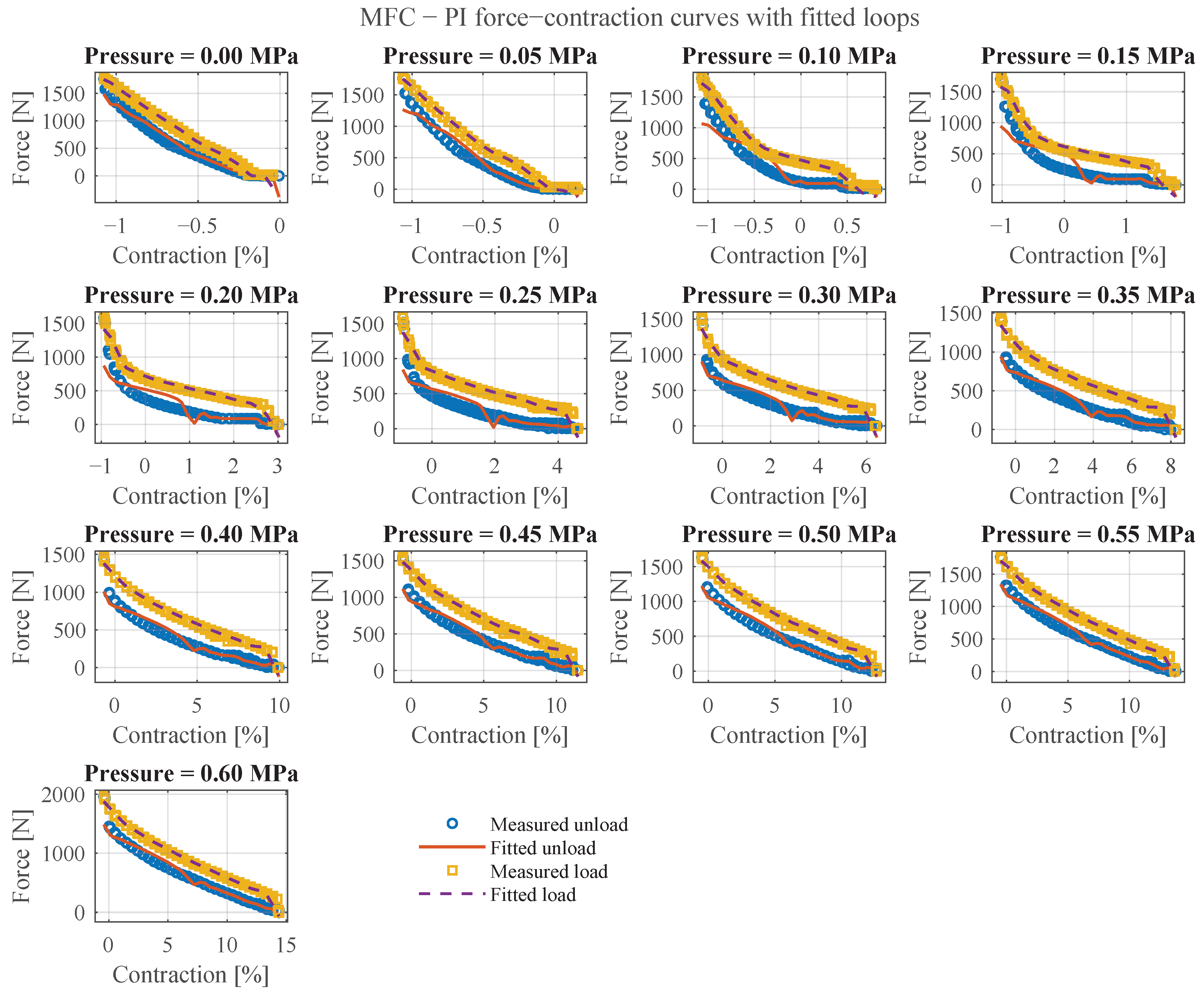
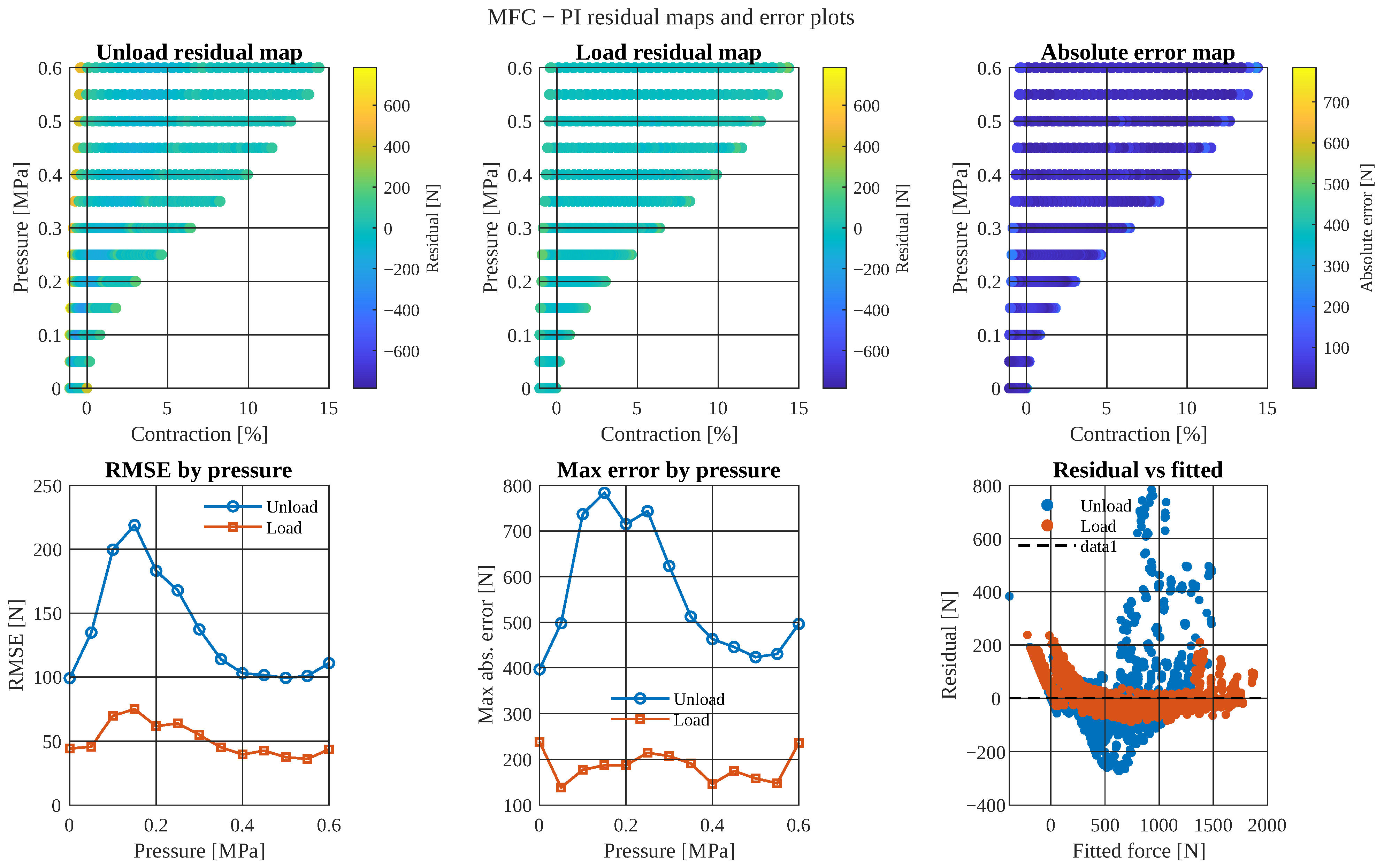
- Measured force-contraction (MFC).
3.4. Identified Branch Equations
4. Memristive-System-Based Hysteresis Model
4.1. Modeling Idea
4.2. State Update Law
4.3. Cycle Construction
- 1.
- The unloading branch is ordered by increasing contraction.
- 2.
- The loading branch is ordered by decreasing contraction.
- 3.
- The turning point is included only once to avoid duplication.
4.4. Model Variants
- Variant A: the EFC model generated by coupling and ;
- Variant B: the MFC model generated by coupling and .
5. Results and Discussion
5.1. Branch-Surface Identification
5.2. Quantified Hysteresis Asymmetry
5.3. Benchmarking Against Established Hysteresis Models
5.4. Memristive Coupling Interpretation
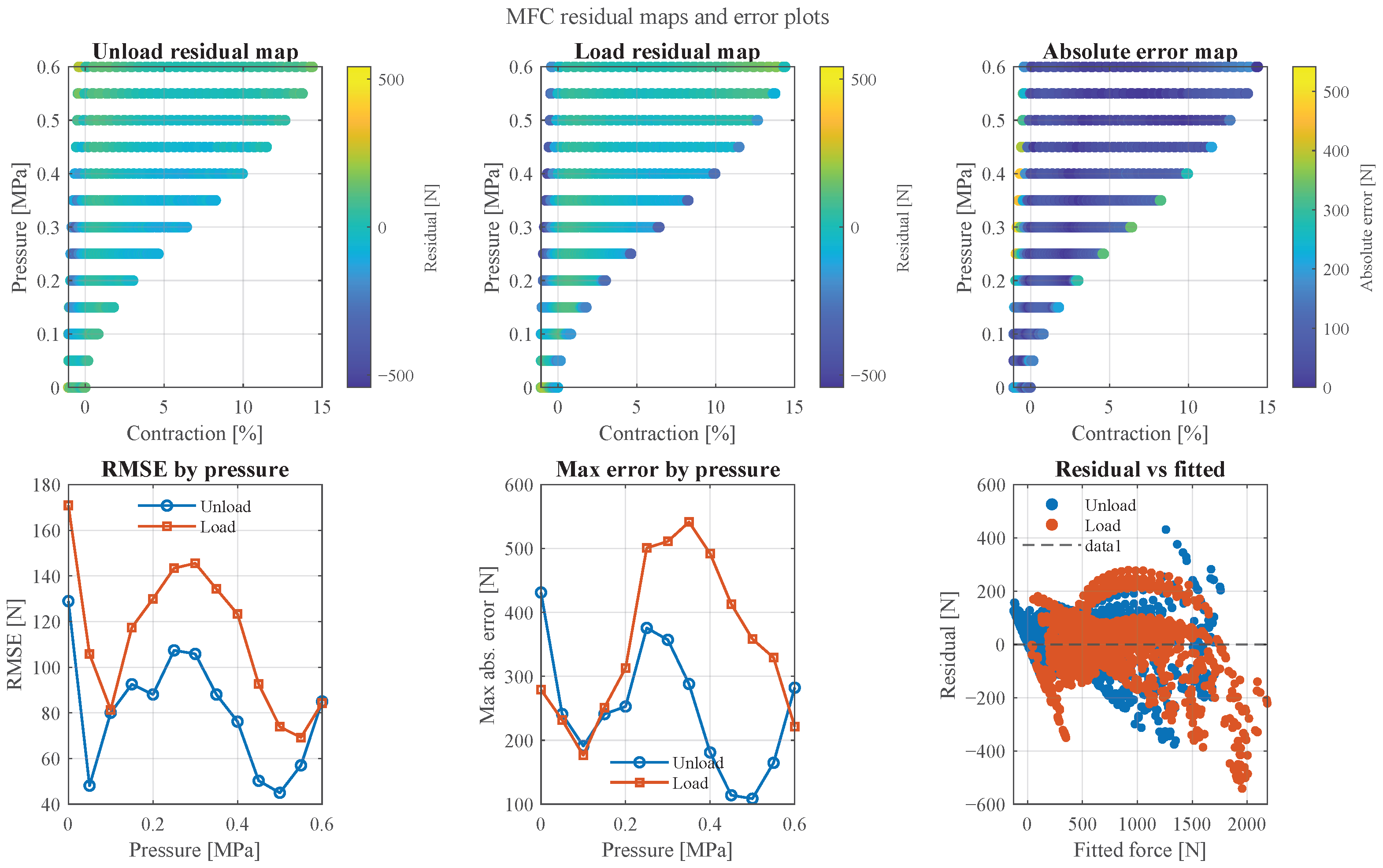
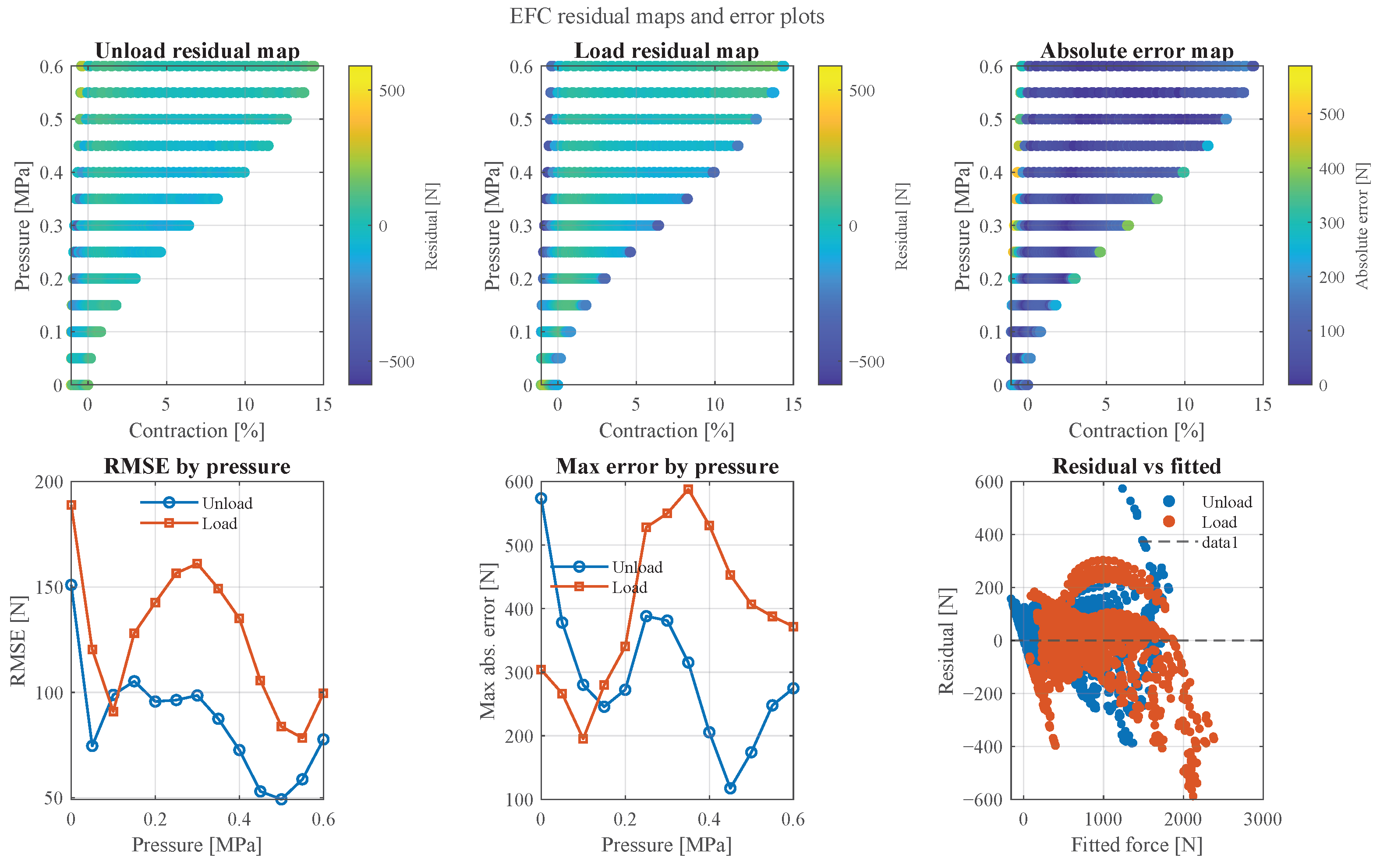
5.5. Transition-Region and Spatial Residual Analysis
5.6. Current Validation Scope
5.7. Strengths and Limitations
6. Conclusions
Author Contributions
Funding
Institutional Review Board Statement
Informed Consent Statement
Data Availability Statement
Conflicts of Interest
Appendix A. Compact Parameter Presentation for the Identified Models
Appendix A.1. EFC Dataset
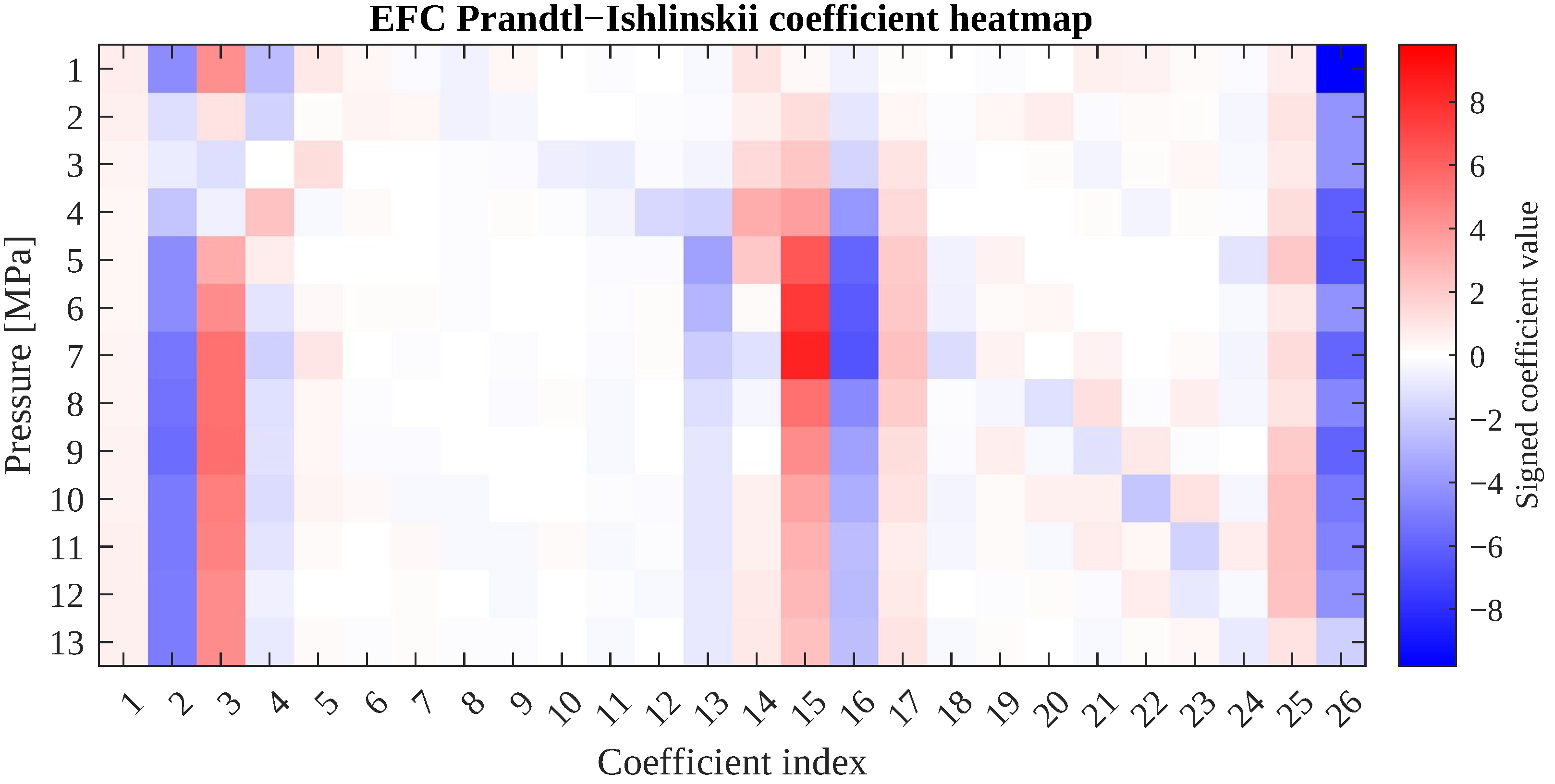
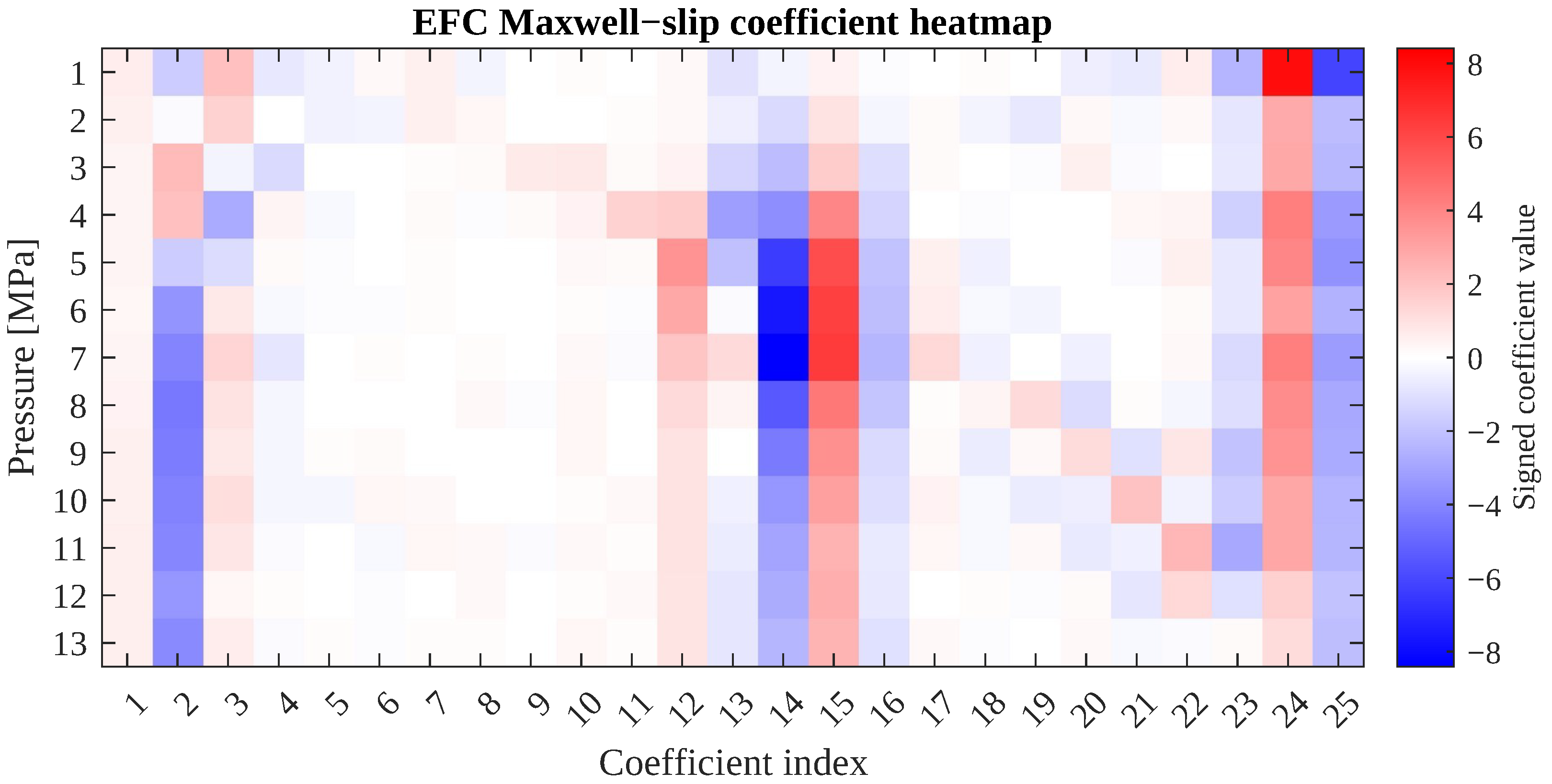
Appendix A.1.1. Prandtl–Ishlinskii and Maxwell-Slip Representations
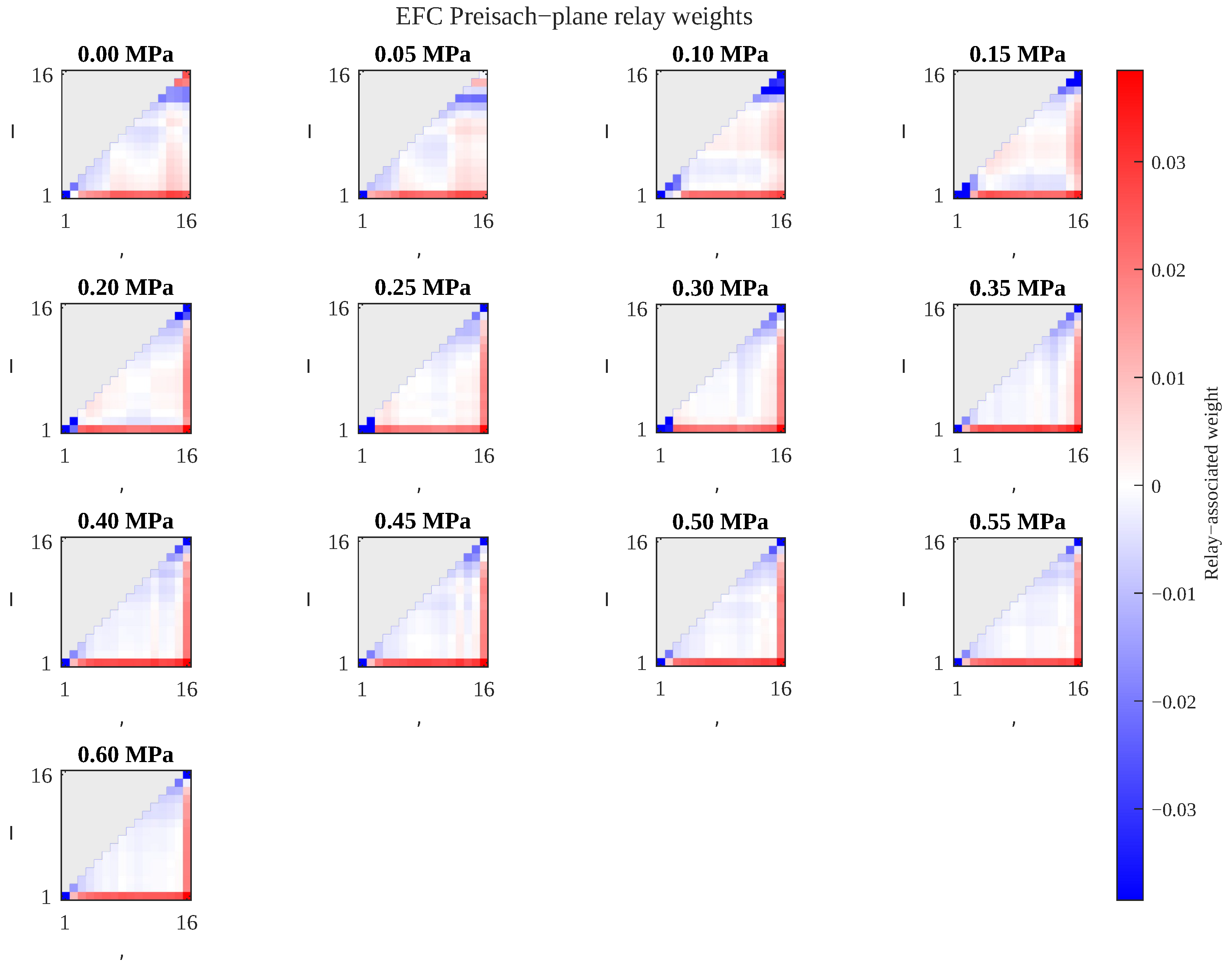
Appendix A.1.2. Preisach Representation
Appendix A.1.3. Bouc–Wen Parameters

| Pressure [MPa] | A | n | ||||||
|---|---|---|---|---|---|---|---|---|
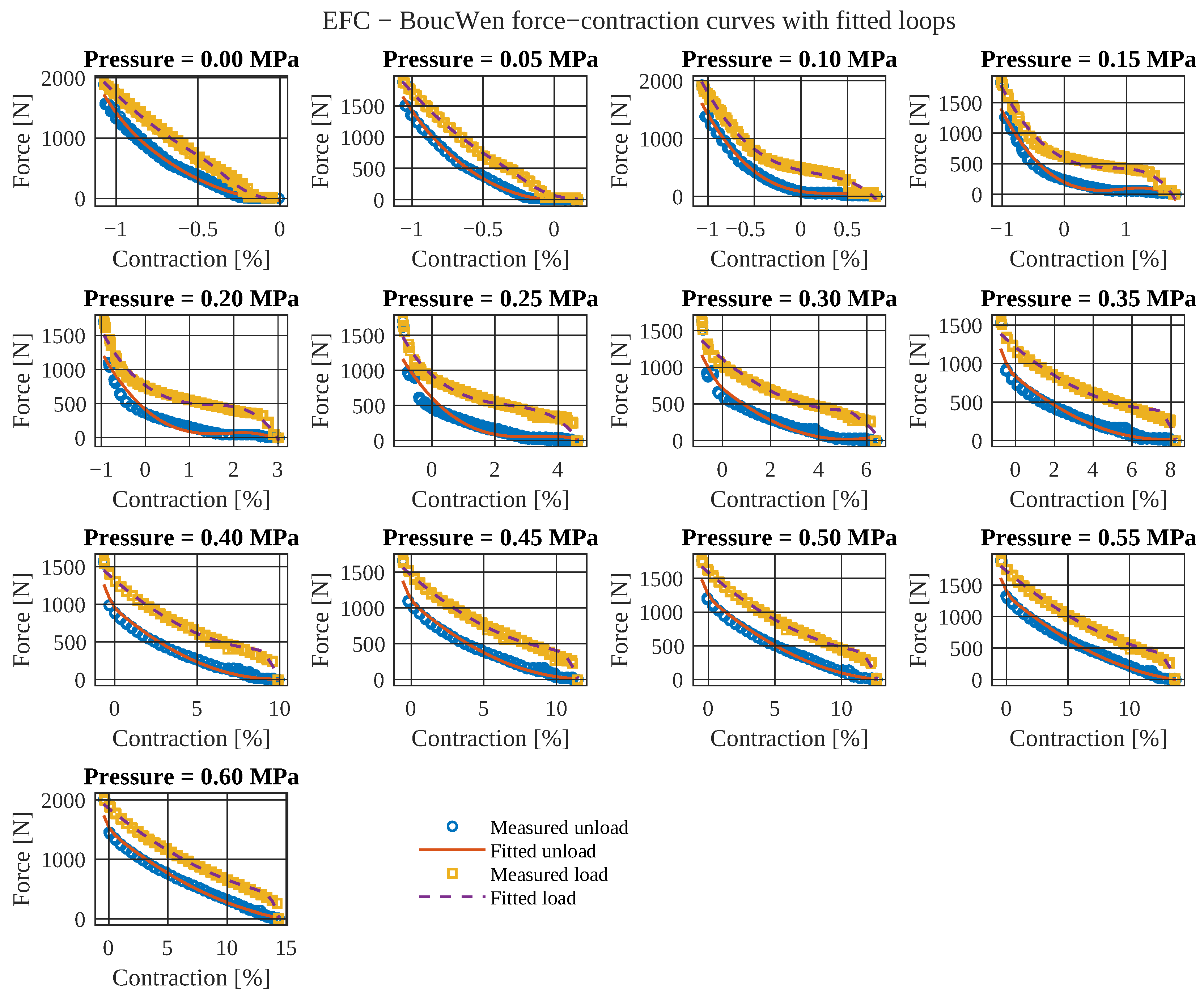
| 0.00 | 8.96636 | 0.29519 | 4.99988 | 1.94201 | 0.851412 | −2.46643 | 1.19629 | −0.133995 |
| 0.05 | 3.92412 | 0.90218 | 4.99191 | 1 | 0.819681 | −2.51477 | 1.4151 | −0.279839 |
| 0.10 | 1.31296 | 0.044909 | −0.593523 | 1.68658 | 0.775625 | 2.48289 | 4.99982 | −4.99999 |
| 0.15 | 1.46421 | 0.0370822 | −0.488172 | 2.04645 | 0.682099 | 2.94424 | 5 | −4.77722 |
| 0.20 | 0.957131 | 0.18291 | −1.74576 | 1.1745 | 0.591575 | −1.64074 | 5 | −1.96542 |
| 0.25 | 0.831107 | 0.242901 | −1.97635 | 1.00011 | 0.565375 | −1.73091 | 4.70215 | −1.78651 |
| 0.30 | 9.75274 | 19.6614 | −3.16106 | 3.62248 | 0.593938 | −1.98672 | 1.19984 | −0.199895 |
| 0.35 | 19.8421 | 15.9983 | 5 | 1.93516 | 0.65179 | −2.02722 | 1.08219 | −0.190875 |
| 0.40 | 20 | 13.5193 | 5 | 1.70242 | 0.685264 | −2.07501 | 1.04664 | −0.175411 |
| 0.45 | 19.9998 | 14.6526 | 5 | 1.40681 | 0.7228 | −2.12792 | 1.01811 | −0.175183 |
| 0.50 | 20 | 16.0315 | 5 | 1.63929 | 0.738296 | −2.10029 | 0.929933 | −0.177954 |
| 0.55 | 19.9547 | 15.6204 | 5 | 1.95924 | 0.752924 | −2.0901 | 0.868341 | −0.167315 |
| 0.60 | 3.02006 | 19.9929 | 5 | 1.00007 | 0.766832 | −2.07194 | 0.795438 | −1.32964 |
Appendix A.2. MFC Dataset
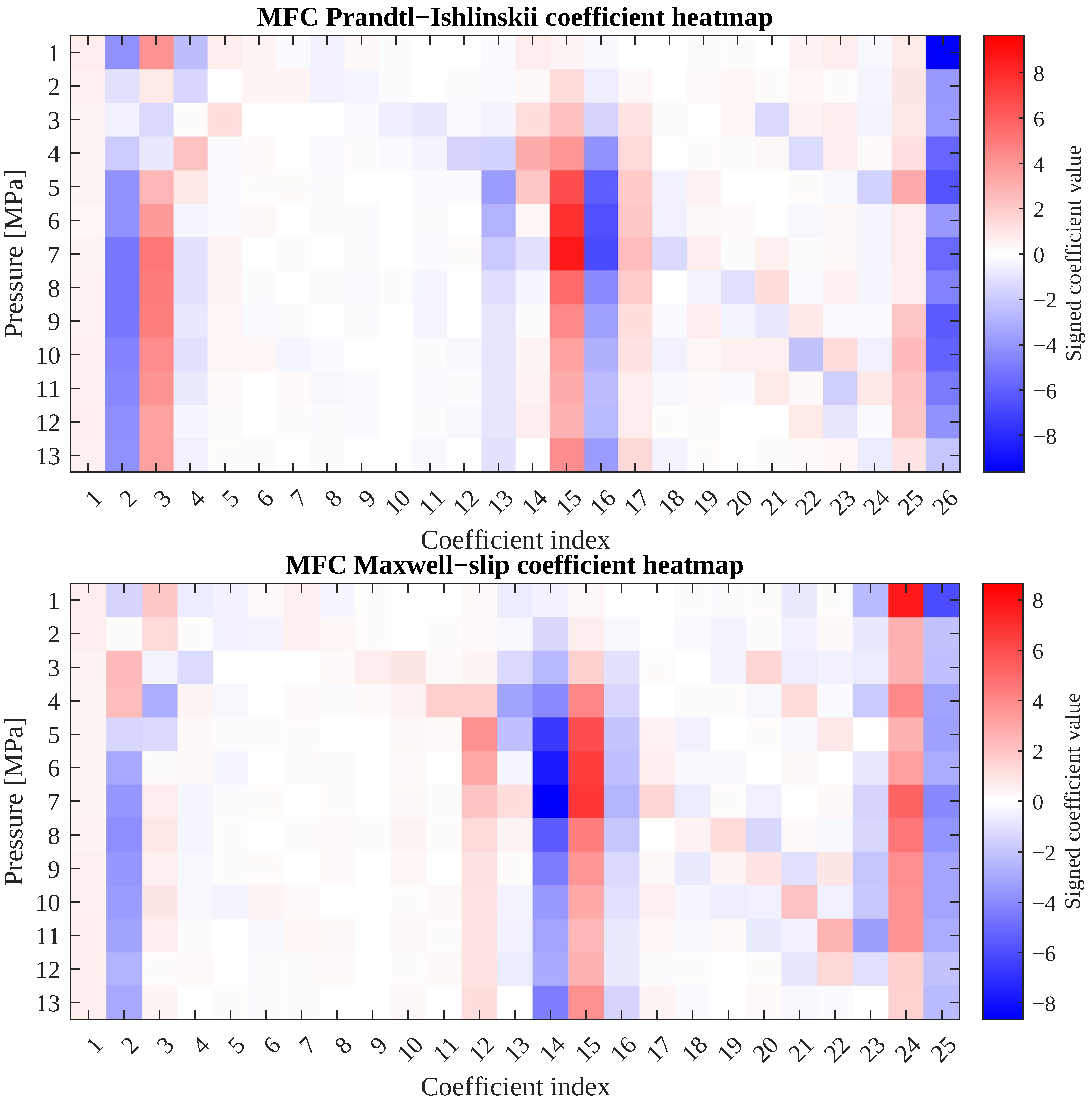
Appendix A.2.1. Prandtl–Ishlinskii and Maxwell-Slip Representations
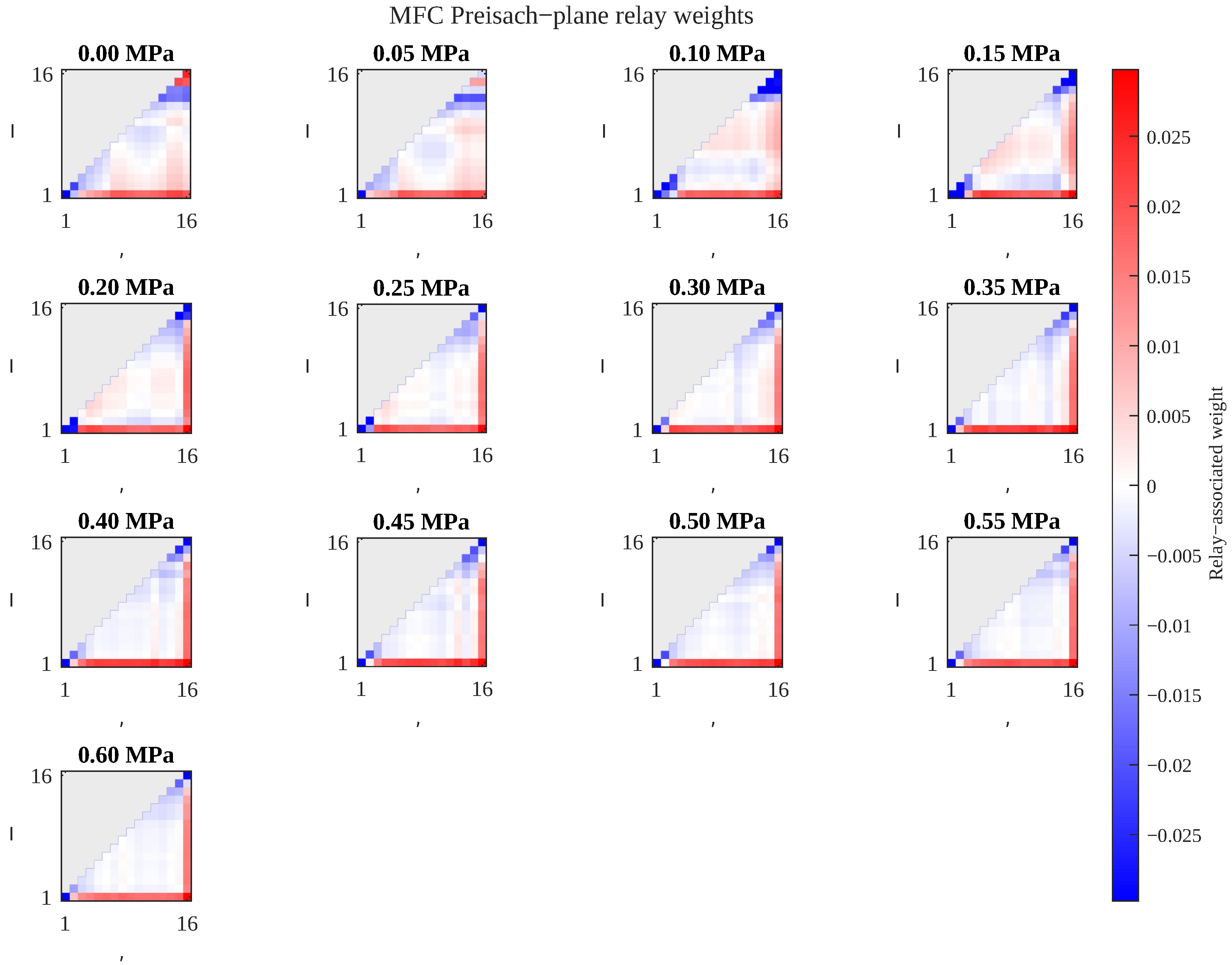
Appendix A.2.2. Preisach Representation
Appendix A.2.3. Bouc–Wen Parameters
| Pressure [MPa] | A | n | ||||||
|---|---|---|---|---|---|---|---|---|
| 0.00 | 7.16646 | 0.253087 | 4.99775 | 2.71683 | 0.900393 | −2.60037 | 1.21952 | −0.126326 |
| 0.05 | 20 | 0.0127437 | 5 | 2.8612 | 0.909773 | −2.83226 | 1.57029 | −0.0773727 |
| 0.10 | 1.4797 | 0.02873 | −0.477114 | 1.80551 | 0.816826 | 3.22627 | 5 | −4.99969 |
| 0.15 | 1.066 | 0.0547901 | −0.816016 | 1.94985 | 0.717997 | 1.25506 | 5 | −4.99999 |
| 0.20 | 0.639447 | 0.18405 | −2.0163 | 1.15731 | 0.627058 | −1.97942 | 5 | −2.48314 |
| 0.25 | 0.594867 | 0.201875 | −2.00472 | 1.00005 | 0.578738 | −1.75013 | 4.76274 | −2.43202 |
| 0.30 | 0.554162 | 0.157467 | −1.80044 | 1.00003 | 0.589907 | −1.3288 | 4.85895 | −3.32496 |
| 0.35 | 13.7078 | 19.9996 | 4.42042 | 2.24066 | 0.667867 | −2.06983 | 1.09667 | −0.204684 |
| 0.40 | 19.999 | 11.06 | 5 | 1.782 | 0.706936 | −2.13953 | 1.07721 | −0.137255 |
| 0.45 | 18.4231 | 13.0698 | 5 | 1.35297 | 0.742918 | −2.18229 | 1.03767 | −0.145723 |
| 0.50 | 10.7808 | 19.9198 | 4.99783 | 1.56119 | 0.769178 | −2.18969 | 0.969008 | −0.245538 |
| 0.55 | 13.2442 | 19.9994 | 3.7934 | 1.97993 | 0.781138 | −2.17982 | 0.915686 | −0.180087 |
| 0.60 | 2.59144 | 19.9501 | 5 | 1.00183 | 0.753523 | −2.07307 | 0.834604 | −1.14468 |
References
- Chou, C.P.; Hannaford, B. Measurement and modeling of McKibben pneumatic artificial muscles. IEEE Trans. Robot. Autom. 1996, 21, 90–102. [Google Scholar] [CrossRef] [Scilit]
- Tondu, B.; Lopez, P. Modeling and control of McKibben artificial muscle robot actuators. IEEE Control Syst. 2000, 20, 15–38. [Google Scholar] [CrossRef] [Scilit]
- Ganguly, S.; Garg, A.; Pasricha, A.; Dwivedy, S. Control of pneumatic artificial muscle system through experimental modelling. Mechatronics 2012, 22, 1135–1147. [Google Scholar] [CrossRef] [Scilit]
- Zhang, Y.; Liu, H.; Ma, T.; Hao, L.; Li, Z. A comprehensive dynamic model for pneumatic artificial muscles considering different input frequencies and mechanical loads. Mech. Syst. Signal Process. 2021, 148, 107133. [Google Scholar] [CrossRef] [Scilit]
- Kalita, B.; Leonessa, A.; Dwivedy, S.K. A Review on the Development of Pneumatic Artificial Muscle Actuators: Force Model and Application. Actuators 2022, 11, 288. [Google Scholar] [CrossRef] [Scilit]
- Tondu, B. Robust and Accurate Closed-Loop Control of McKibben Artificial Muscle Contraction with a Linear Single Integral Action. Actuators 2014, 3, 142–161. [Google Scholar] [CrossRef] [Scilit]
- Nguyen, M.K.; Trinh, V.C.; Vo, N.Y.P.; Le, T.D. Restoring Model of a Pneumatic Artificial Muscle with Structure Parameters: Analysis and Identification. Actuators 2024, 13, 355. [Google Scholar] [CrossRef] [Scilit]
- Trinh, V.C.; Vo, N.Y.P.; Luu, T.T.; Le, T.D. Dynamic model of air spring based McKibben pneumatic artificial muscle. Commun. Nonlinear Sci. Numer. Simul. 2025, 147, 108829. [Google Scholar] [CrossRef] [Scilit]
- Andrikopoulos, G.; Nikolakopoulos, G.; Arvanitakis, I.; Manesis, S. Piecewise Affine Modeling and Constrained Optimal Control for a Pneumatic Artificial Muscle. IEEE Trans. Ind. Electron. 2014, 61, 904–916. [Google Scholar] [CrossRef] [Scilit]
- Andrikopoulos, G.; Nikolakopoulos, G.; Arvanitakis, I.; Manesis, S. Switching model predictive control of a pneumatic artificial muscle. Int. J. Control. Autom. Syst. 2013, 11, 1223–1231. [Google Scholar] [CrossRef] [Scilit]
- Zhao, L.; Cheng, H.; Zhang, J.; Xia, Y. Adaptive control for a motion mechanism with pneumatic artificial muscles subject to dead-zones. Mech. Syst. Signal Process. 2021, 148, 107155. [Google Scholar] [CrossRef] [Scilit]
- Qin, Y.; Xu, Y.; Shen, C.; Han, J. High-Precision Displacement and Force Hybrid Modeling of Pneumatic Artificial Muscle Using 3D PI-NARMAX Model. Actuators 2022, 11, 51. [Google Scholar] [CrossRef] [Scilit]
- Saito, N.; Satoh, T.; Saga, N. Double Air Chambers Pneumatic Artificial Muscle and Non-Hysteresis Position Control. Actuators 2024, 13, 282. [Google Scholar] [CrossRef] [Scilit]
- Lin, C.J.; Lin, C.R.; Yu, S.K.; Chen, C.T. Hysteresis modeling and tracking control for a dual pneumatic artificial muscle system using Prandtl-Ishlinskii model. Mechatronics 2015, 28, 35–45. [Google Scholar] [CrossRef] [Scilit]
- Liu, Y.; Zang, X.; Lin, Z.; Liu, X.; Zhao, J. Modelling Length/Pressure Hysteresis of a Pneumatic Artificial Muscle using a Modified Prandtl-Ishlinskii Model. Stroj. Vestn.-J. Mech. Eng. 2017, 63, 56–64. [Google Scholar] [CrossRef] [Scilit]
- Qin, Y.; Zhang, H.; Wang, X.; Han, J. Active Model-Based Hysteresis Compensation and Tracking Control of Pneumatic Artificial Muscle. Sensors 2022, 22, 364. [Google Scholar] [CrossRef] [Scilit]
- Xie, S.; Zhong, H.; Zhang, J.; Li, Y.; Xu, S. Modeling, identification, and compensation control of pneumatic muscle hysteresis based on an improved generalized Bouc-Wen model. Measurement 2025, 253, 117512. [Google Scholar] [CrossRef] [Scilit]
- Mishra, M.K.; Samantaray, A.K.; Chakraborty, G. Fractional-order Bouc-wen hysteresis model for pneumatically actuated continuum manipulator. Mech. Mach. Theory 2022, 173, 104841. [Google Scholar] [CrossRef] [Scilit]
- Soleymani, R.; Khajehsaeid, H. A mechanical model for McKibben pneumatic artificial muscles based on limiting chain extensibility and 3D application of the network alteration theories. Int. J. Solids Struct. 2020, 202, 620–630. [Google Scholar] [CrossRef] [Scilit]
- Csikós, S.; Mészáros, A.; Sárosi, J. Pressure-Dependent Hysteresis in a Spring–Rod Compact Pneumatic Artificial Muscle Compared with a Commercial McKibben Actuator. Actuators 2026, 15, 80. [Google Scholar] [CrossRef] [Scilit]
- Sárosi, J. Estimated Force-Contraction Curves of Fluidic Muscles by a Five-Parameter Function. In Proceedings of the 7th International Conference for Young Researchers and Ph.D. Students: Education, Research, Innovation (ERIN 2013), Bratislava, Slovakia, 15–17 May 2013; pp. 1–6. [Google Scholar]
- Sárosi, J.; Fabulya, Z. Mathematical Analysis of the Function Approximation for the Force Generated by Pneumatic Artificial Muscle. Sci. Bull. Politeh. Univ. Timis. Trans. Mech. 2012, 57, 59–64. [Google Scholar]
- Chua, L.O. Memristor-The Missing Circuit Element. IEEE Trans. Circuit Theory 1971, 18, 507–519. [Google Scholar] [CrossRef] [Scilit]
- Chua, L.O.; Kang, S.M. Memristive devices and systems. Proc. IEEE 1976, 64, 209–223. [Google Scholar] [CrossRef] [Scilit]
- Pershin, Y.V.; Ventra, M.D. Memory effects in complex materials and nanoscale systems. Adv. Phys. 2011, 60, 145–227. [Google Scholar] [CrossRef] [Scilit]
- Ventra, M.D.; Pershin, Y.V. On the physical properties of memristive memcapacitive and meminductive systems. Nanotechnology 2013, 24, 255201. [Google Scholar] [CrossRef] [Scilit]
- Singh, J.; Raj, B. Comparative analysis of memristor models and memories design. J. Semicond. 2018, 39, 074006. [Google Scholar] [CrossRef] [Scilit]
- Vongehr, S. The Missing Memristor has Not been Found. Sci. Rep. 2015, 5, 11657. [Google Scholar] [CrossRef] [Scilit] [PubMed]
- Chua, L. Resistance switching memories are memristors. Appl. Phys. A 2011, 102, 765–783. [Google Scholar] [CrossRef] [Scilit]
- Paulo, G.; Sun, K.; Di Muccio, G.; Gubbiotti, A.; Morozzo della Rocca, B.; Geng, J.; Maglia, G.; Chinappi, M.; Giacomello, A. Hydrophobically gated memristive nanopores for neuromorphic applications. Nat. Commun. 2023, 14, 8390. [Google Scholar] [CrossRef] [Scilit]
- Wei, X.; Wu, Z.; Gao, H.; Cao, S.; Meng, X.; Lan, Y.; Su, H.; Qin, Z.; Liu, H.; Du, W.; et al. Mechano-gated iontronic piezomemristor. Nat. Commun. 2025, 16, 1060. [Google Scholar] [CrossRef] [Scilit] [PubMed]
- He, Y.; LV, H.; Zhang, Y.; Si, W.; Sha, J.; Chen, Y.; Ma, J. Mechano-Gated Nanofluidic Piezomemristor: Elastic Nanochannel Bridging Dynamic Pressure Modulation and Neuromorphic Plasticity. ACS Appl. Mater. Interfaces 2025, 17, 50292–50301. [Google Scholar] [CrossRef] [Scilit]
- Robin, P.; Kavokine, N.; Bocquet, L. Modeling of emergent memory and voltage spiking in ionic transport through angstrom-scale slits. Science 2021, 373, 687–691. [Google Scholar] [CrossRef] [Scilit]
- Xiong, T.; Li, C.; He, X.; Xie, B.; Zong, J.; Jiang, Y.; Ma, W.; Wu, F.; Fei, J.; Yu, P.; et al. Neuromorphic functions with a polyelectrolyte-confined fluidic memristor. Science 2023, 379, 156–161. [Google Scholar] [CrossRef] [Scilit]
- Robin, P.; Emmerich, T.; Ismail, A.; Niguès, A.; You, Y.; Nam, G.H.; Keerthi, A.; Siria, A.; Geim, A.K.; Radha, B.; et al. Long-term memory and synapse-like dynamics in two-dimensional nanofluidic channels. Science 2023, 379, 156–161. [Google Scholar] [CrossRef] [Scilit]
- Emmerich, T.; Teng, Y.; Ronceray, N.; Lopriore, E.; Chiesa, R.; Chernev, A.; Artemov, V.; Ventra, M.D.; Kis, A.; Radenovic, A. Nanofluidic logic with mechano-ionic memristive switches. Nat. Electron. 2024, 7, 271–278. [Google Scholar] [CrossRef] [Scilit] [PubMed]
- Zhou, X.; Zong, Y.; Wang, Y.; Sun, M.; Shi, D.; Wang, W.; Du, G.; Xie, Y. Nanofluidic memristor based on the elastic deformation of nanopores with nanoparticle adsorption. Natl. Sci. Rev. 2024, 11, nwad216. [Google Scholar] [CrossRef] [Scilit] [PubMed]
- Wang, D.; Kvetny, M.; Liu, J.; Brown, W.; Li, Y.; Wang, G. Transmembrane Potential across Single Conical Nanopores and Resulting Memristive and Memcapacitive Ion Transport. J. Am. Chem. Soc. 2012, 134, 3651–3654. [Google Scholar] [CrossRef] [Scilit] [PubMed]
- Xu, G.; Zhang, M.; Mei, T.; Liu, W.; Wang, L.; Xiao, K. Nanofluidic Ionic Memristors. ACS Nano 2024, 18, 19423–19442. [Google Scholar] [CrossRef] [Scilit]
- Shi, D.; Wang, W.; Liang, Y.; Duan, L.; Du, G.; Xie, Y. Ultralow Energy Consumption Angstrom-Fluidic Memristor. Nano Lett. 2023, 23, 11662–11668. [Google Scholar] [CrossRef] [Scilit]
- Mayergoyz, I.D. The Classical Preisach Model of Hysteresis. In Mathematical Models of Hysteresis; Springer: New York, NY, USA, 1991; pp. 1–63. [Google Scholar] [CrossRef] [Scilit]
- Firestone, F.A. A new analogy between mechanical and electrical systems. J. Acoust. Soc. Am. 1933, 4, 249–267. [Google Scholar] [CrossRef] [Scilit]
- Bertuccio, G. On the physical origin of the electro-mechano-acoustical analogy. J. Acoust. Soc. Am. 2022, 151, 2066–2076. [Google Scholar] [CrossRef] [Scilit] [PubMed]
- Smith, M.C. Synthesis of mechanical networks: The inerter. IEEE Trans. Autom. Control 2002, 47, 1648–1662. [Google Scholar] [CrossRef] [Scilit]
- Chen, M.; Papageorgiou, C.; Scheibe, F.; Wang, F.c.; Smith, M. The missing mechanical circuit element. IEEE Circuits Syst. Mag. 2009, 9, 10–26. [Google Scholar] [CrossRef] [Scilit]
- Oster, G.F.; Auslander, D.M. The Memristor: A New Bond Graph Element. J. Dyn. Syst. Meas. Control 1972, 94, 249–252. [Google Scholar] [CrossRef] [Scilit]
- Pei, J.S.; Wright, J.P.; Todd, M.D.; Masri, S.F.; Gay-Balmaz, F. Understanding memristors and memcapacitors in engineering mechanics applications. Nonlinear Dyn. 2015, 80, 457–489. [Google Scholar] [CrossRef] [Scilit]
- Oster, G. A note on memristors. IEEE Trans. Circuits Syst. 1974, 2, 152. [Google Scholar] [CrossRef] [Scilit]








| Electrical Relation | Adopted Impedance Analogy | Alternative Mobility Analogy |
|---|---|---|
| effort, flow | effort, flow | effort, flow |
| , | , | , |
| or | , so | , so and equivalently |
| , so | with , so | |
| with , so | , so | |
| , | Generalized state-dependent one-port description for the CPAM | |
| Surface | (95% CI) | (95% CI) | (95% CI) | (95% CI) | (95% CI) | Adjusted | RMSE | |
|---|---|---|---|---|---|---|---|---|
| EFC unload | 283.5532 [281.6804; 285.4260] | −1.7535 [−1.7601; −1.7470] | −152.8966 [−153.4096; −152.3837] | 2719.0 [2713.3; 2724.7] | −444.4829 [−446.6841; −442.2817] | 0.9987 | 0.9987 | 15.5383 |
| EFC load | 299.2673 [296.7116; 301.8231] | −1.7530 [−1.7617; −1.7444] | −189.3924 [−190.0839; −188.7009] | 3175.5 [3167.8; 3183.2] | −195.3742 [−198.3438; −192.4046] | 0.9979 | 0.9979 | 20.9446 |
| MFC unload | 253.8404 [250.9353; 256.7456] | −1.8403 [−1.8517; −1.8288] | −149.5208 [−150.3456; −148.6961] | 2591.3 [2582.0; 2600.5] | −383.4218 [−386.9346; −379.9091] | 0.9963 | 0.9963 | 25.1240 |
| MFC load | 277.6454 [275.4956; 279.7953] | −1.7597 [−1.7675; −1.7518] | −175.9270 [−176.5101; −175.3438] | 2910.6 [2904.1; 2917.2] | −188.3115 [−190.8145; −185.8085] | 0.9982 | 0.9982 | 17.6720 |
| Pressure [MPa] | EFC NHI [%] | MFC NHI [%] |
|---|---|---|
| 0.00 | 14.719 | 11.770 |
| 0.05 | 15.155 | 12.471 |
| 0.10 | 16.309 | 13.716 |
| 0.15 | 18.047 | 15.335 |
| 0.20 | 20.233 | 17.163 |
| 0.25 | 21.074 | 18.070 |
| 0.30 | 21.481 | 18.370 |
| 0.35 | 23.297 | 19.507 |
| 0.40 | 22.504 | 18.756 |
| 0.45 | 20.658 | 16.658 |
| 0.50 | 20.136 | 16.341 |
| 0.55 | 18.746 | 14.964 |
| 0.60 | 18.037 | 13.588 |
| EFC | MFC | |||||
|---|---|---|---|---|---|---|
| Model | RMSE [N] | MaxAE [N] | RMSE [N] | MaxAE [N] | ||
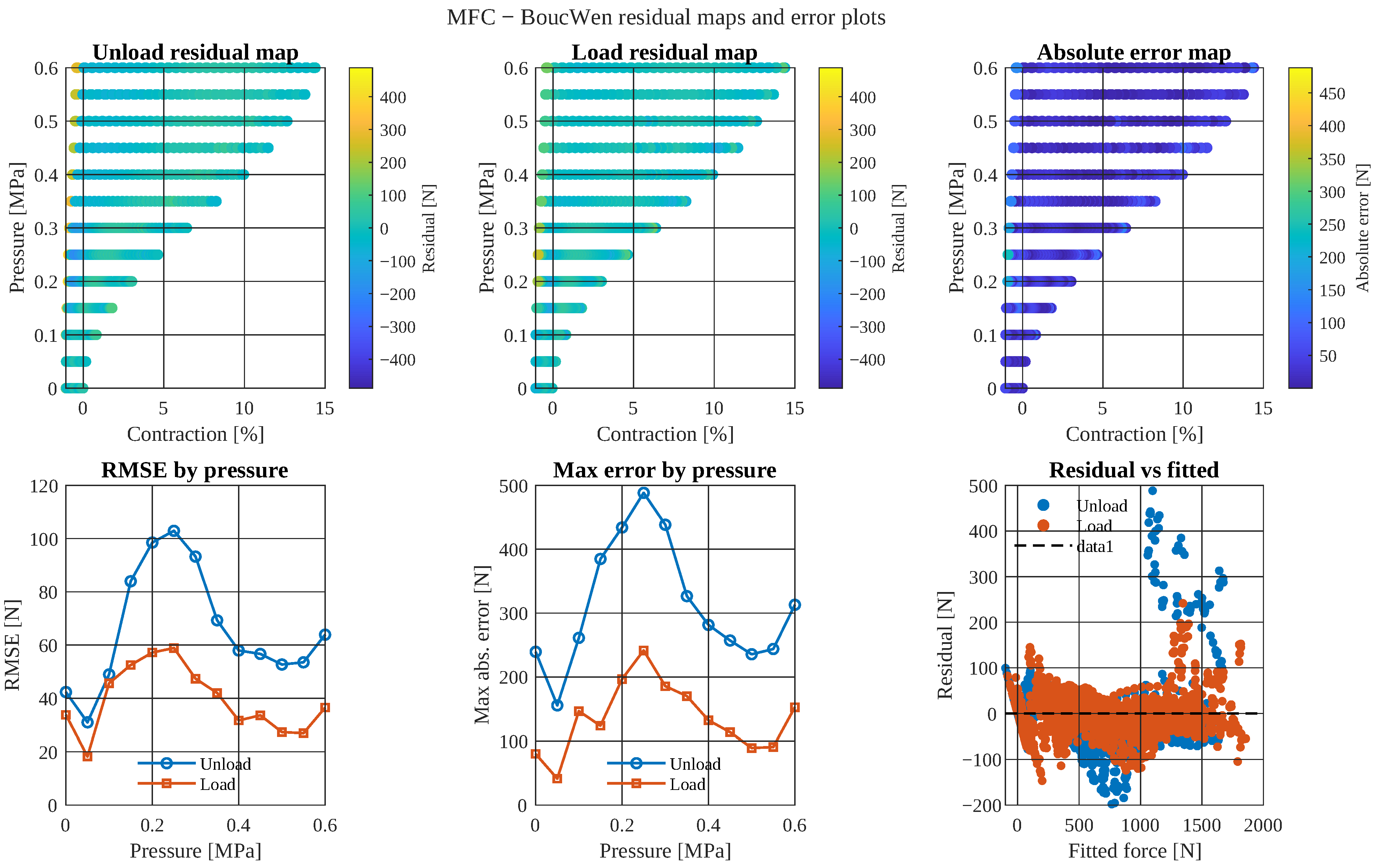
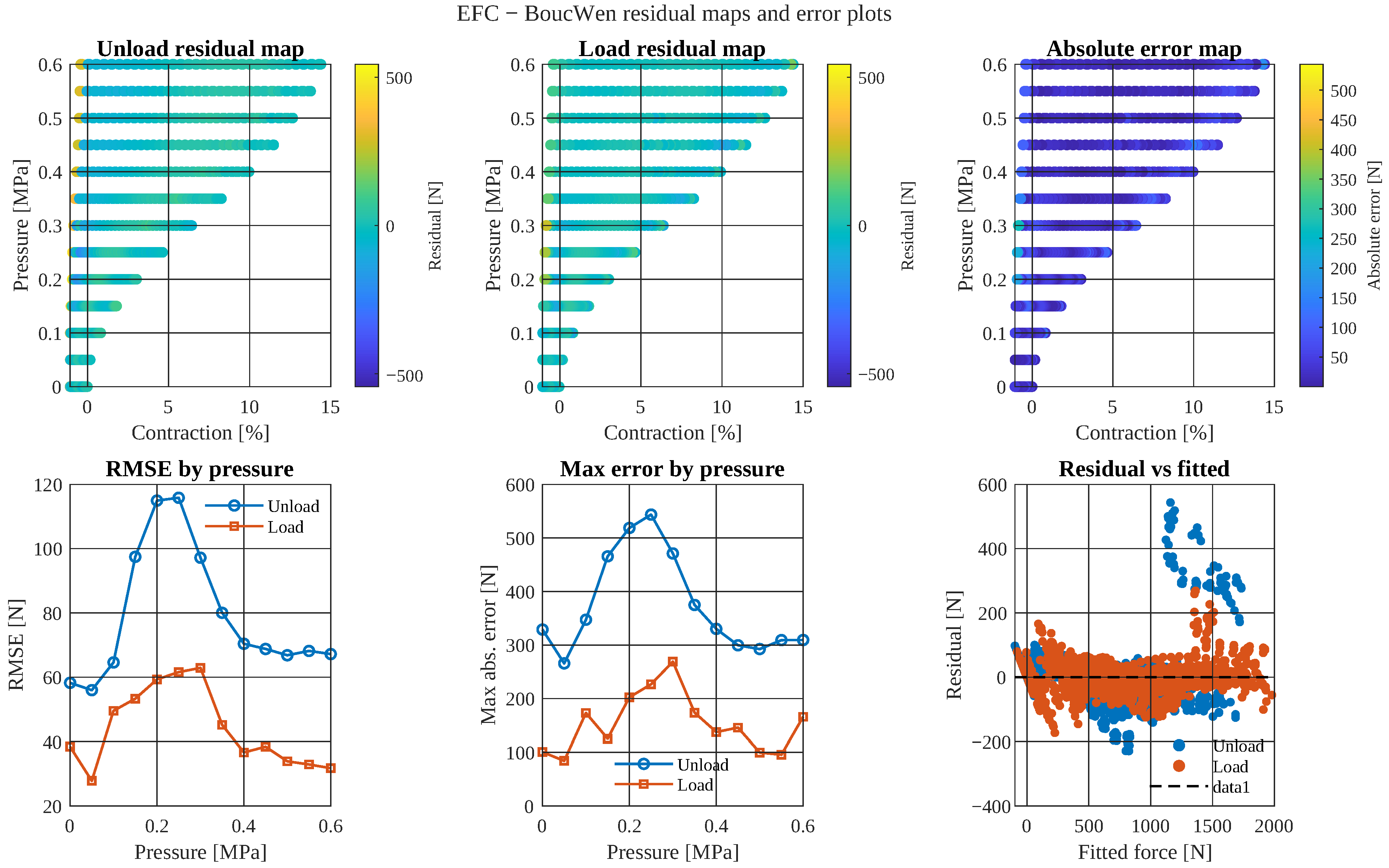
| Bouc–Wen | 64.278 | 543.60 | 0.98123 | 55.541 | 488.35 | 0.98360 |
| Maxwell-slip | 107.510 | 915.27 | 0.94750 | 99.456 | 817.45 | 0.94740 |
| Memristive | 110.160 | 587.81 | 0.94488 | 100.880 | 541.53 | 0.94589 |
| PI | 106.020 | 876.49 | 0.94895 | 98.066 | 783.77 | 0.94886 |
| Preisach | 51.958 | 382.19 | 0.98774 | 43.364 | 360.76 | 0.99000 |
Disclaimer/Publisher’s Note: The statements, opinions and data contained in all publications are solely those of the individual author(s) and contributor(s) and not of MDPI and/or the editor(s). MDPI and/or the editor(s) disclaim responsibility for any injury to people or property resulting from any ideas, methods, instructions or products referred to in the content. |
© 2026 by the authors. Licensee MDPI, Basel, Switzerland. This article is an open access article distributed under the terms and conditions of the Creative Commons Attribution (CC BY) license.
Share and Cite
Csikós, S.; Sárosi, J. A Memristive-System-Based Hysteresis Model for a Compact Pneumatic Artificial Muscle. Actuators 2026, 15, 257. https://doi.org/10.3390/act15050257
Csikós S, Sárosi J. A Memristive-System-Based Hysteresis Model for a Compact Pneumatic Artificial Muscle. Actuators. 2026; 15(5):257. https://doi.org/10.3390/act15050257
Chicago/Turabian StyleCsikós, Sándor, and József Sárosi. 2026. "A Memristive-System-Based Hysteresis Model for a Compact Pneumatic Artificial Muscle" Actuators 15, no. 5: 257. https://doi.org/10.3390/act15050257
APA StyleCsikós, S., & Sárosi, J. (2026). A Memristive-System-Based Hysteresis Model for a Compact Pneumatic Artificial Muscle. Actuators, 15(5), 257. https://doi.org/10.3390/act15050257