1. Introduction
Self-oscillation refers to self-sustained, periodic motions exhibited by active materials or structures, driven by a non-oscillatory but constant energy source [
1,
2,
3,
4]. Such motions arise without relying on alternating external signals or repeated triggers; instead, they are maintained through steady power input and internal feedback loops [
4]. This autonomy offers both inherent robustness and structural simplicity, with the oscillation frequency being predominantly determined by the system’s intrinsic properties rather than the characteristics of the external energy supply [
2,
3]. These advantages make self-oscillations particularly suitable for applications including soft robotics [
5,
6,
7,
8,
9,
10], energy dissipation devices [
11,
12,
13], transport systems [
14], tunable optics [
15], and logic computing [
16,
17,
18].
Significant efforts have been devoted to realizing self-sustained oscillations by using diverse stimulus-responsive materials, such as thermally activated polymers [
5,
19,
20], hydrogels [
21,
22,
23,
24,
25], and liquid crystal elastomers (LCEs) [
26,
27,
28,
29,
30,
31,
32]. By harnessing these materials, a broad spectrum of autonomous oscillatory patterns has been developed, including crawling [
33], swimming [
34], galloping [
35], vibration [
36,
37,
38,
39,
40], rolling [
41,
42,
43,
44], sliding [
45], twisting [
15,
46], swinging [
47,
48,
49,
50], buckling [
51], rocking [
52], rotation [
53,
54,
55], peeling [
56], ejecting [
57], jumping [
58,
59,
60], stirring [
61], propelling [
62], synchronization [
63,
64], and combined multi-mode oscillations [
65,
66,
67,
68,
69,
70,
71]. These engineered nonlinearities effectively convert a constant external energy supply into continuous periodic motion.
Self-sustained motion systems based on stimulus-responsive materials require the establishment of positive and negative feedback loops between the material’s geometric deformation and the constant energy field. A variety of feedback mechanisms have been developed to achieve such self-oscillations. These can be broadly classified based on the interaction motion pattern between the constant energy field and the active material. Key categories include the self-shadowing effect [
15,
72,
73], where the material’s motion periodically modulates its exposure to the stimulus; the non-uniform environmental field mechanism [
74,
75,
76,
77], which uses predefined spatial variations in stimulus intensity to trigger different deformation; and the self-regulating field mechanism [
78,
79], which operates via preprogrammed temporal cycles or adaptive energy release pathways. Each strategy offers a distinct route to maintain continuous motion under constant external conditions. Generally, a key challenge in the design of these systems is developing a feedback loop that sustains the system’s self-oscillatory motion. This is particularly true for light-driven self-oscillation systems based on the self-shadowing effect, which often rely on geometric deformation modes—such as bending and stretching—of the structure to intercept light along its propagation path [
39,
41,
54,
70]. However, the design of such systems is frequently constrained by two main factors: the limited types of deformation modes available to the geometry and the simplicity of rectilinear light propagation paths. Consequently, the light interception effect induced by geometric deformation is often insufficient, posing significant challenges in designing self-oscillating systems.
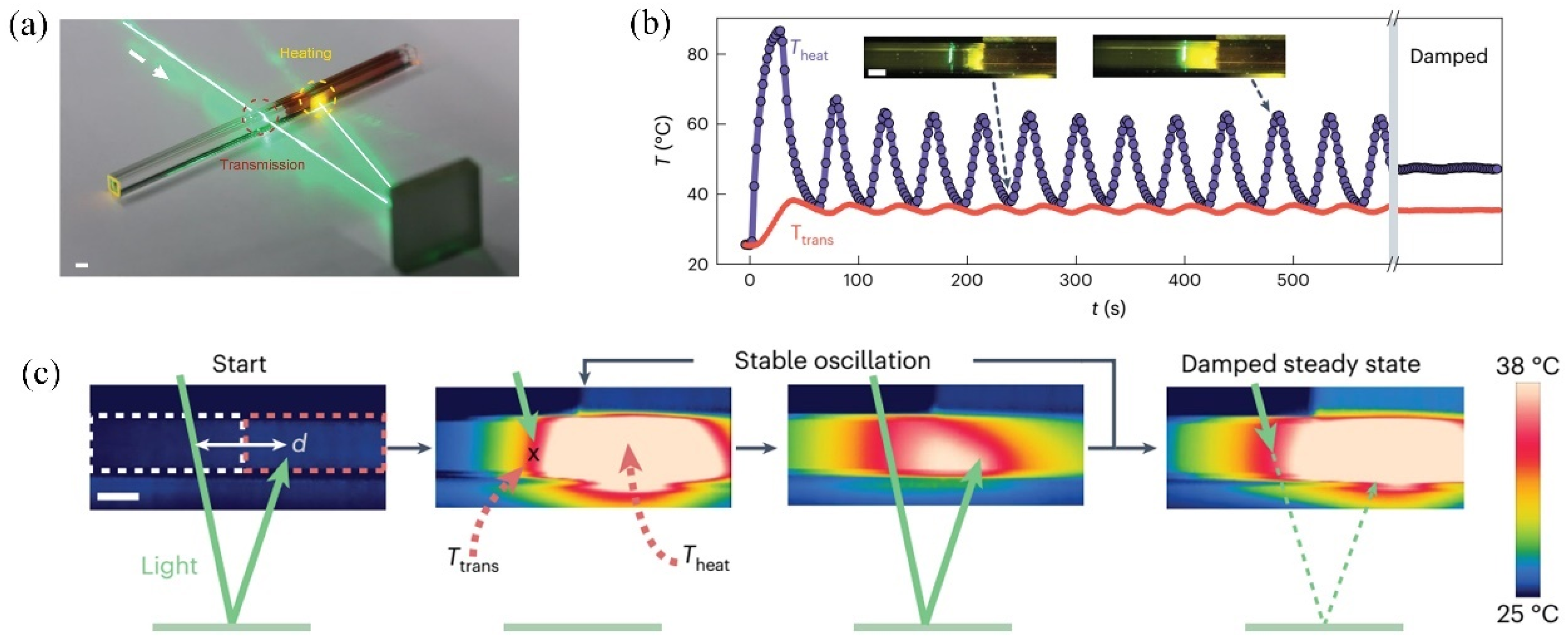
Recently, a self-oscillating system via a mirror-reflected light-driven feedback loop of two coupled hydrogels was reported [
79]. In the experiments, the light-driven nano-functionalized hydrogel system demonstrated temperature oscillations via a negative feedback loop incorporating controlled time delays, as shown in
Figure 1. Crucially, the light feedback loop, facilitated by mirror-reflected light, decouples the feedback mechanism from the geometric constraints imposed by deformation modes. Inspired by this mirror reflection approach, we introduce a geometry-flexible LCE self-oscillator enabled by light feedback routing. The system consists of an optically responsive LCE fiber, a spring, a mirror, and a perforated plate. Using a dynamic LCE model, we introduce a nonlinear model for the self-oscillator under constant light exposure. Simulations reveal two distinct motion patterns: static equilibrium and self-sustained oscillation. Self-oscillation originates from the contraction of the material points of the LCE fibers along the light path, with continuous motion being sustained by the interaction between light energy and damping dissipation. We investigate the conditions necessary to trigger self-oscillation and examine key parameters that influence its frequency and amplitude. Unlike typical self-oscillation systems, the LCE self-oscillator’s light-path configuration is dynamically regulated through mirror reflection, creating an oscillation-linked light routing that is influenced by its geometric structure. This design overcomes the constraints of limited deformation modes, enabling flexible control of the optical feedback loop through simple geometric deformations.
This work is organized as follows: In
Section 2, the nonlinear dynamic model of a geometry-flexible LCE self-oscillator under constant light exposure is formulated based on the dynamic LCE model. In
Section 3, the dynamics of the LCE self-oscillator under constant light are numerically analyzed. Two distinct motion patterns are identified, and the detailed mechanics of the self-oscillation process are elucidated.
Section 4 investigates the conditions required to trigger self-oscillation and examines the effects of various system parameters on the oscillation frequency and amplitude. This paper concludes with a brief summary in
Section 5.
2. Theoretical Model and Formulation
In this section, we develop a theoretical model for the geometry-flexible LCE self-oscillator under constant illumination. This model encompasses the dynamic governing equations of the oscillator, the tension within the LCE fiber, the temporal evolution of cis-isomer concentration, the photon propagation path in light feedback routing, and the corresponding nondimensionalization.
2.1. Dynamic Governing Equations of the Self-Oscillator
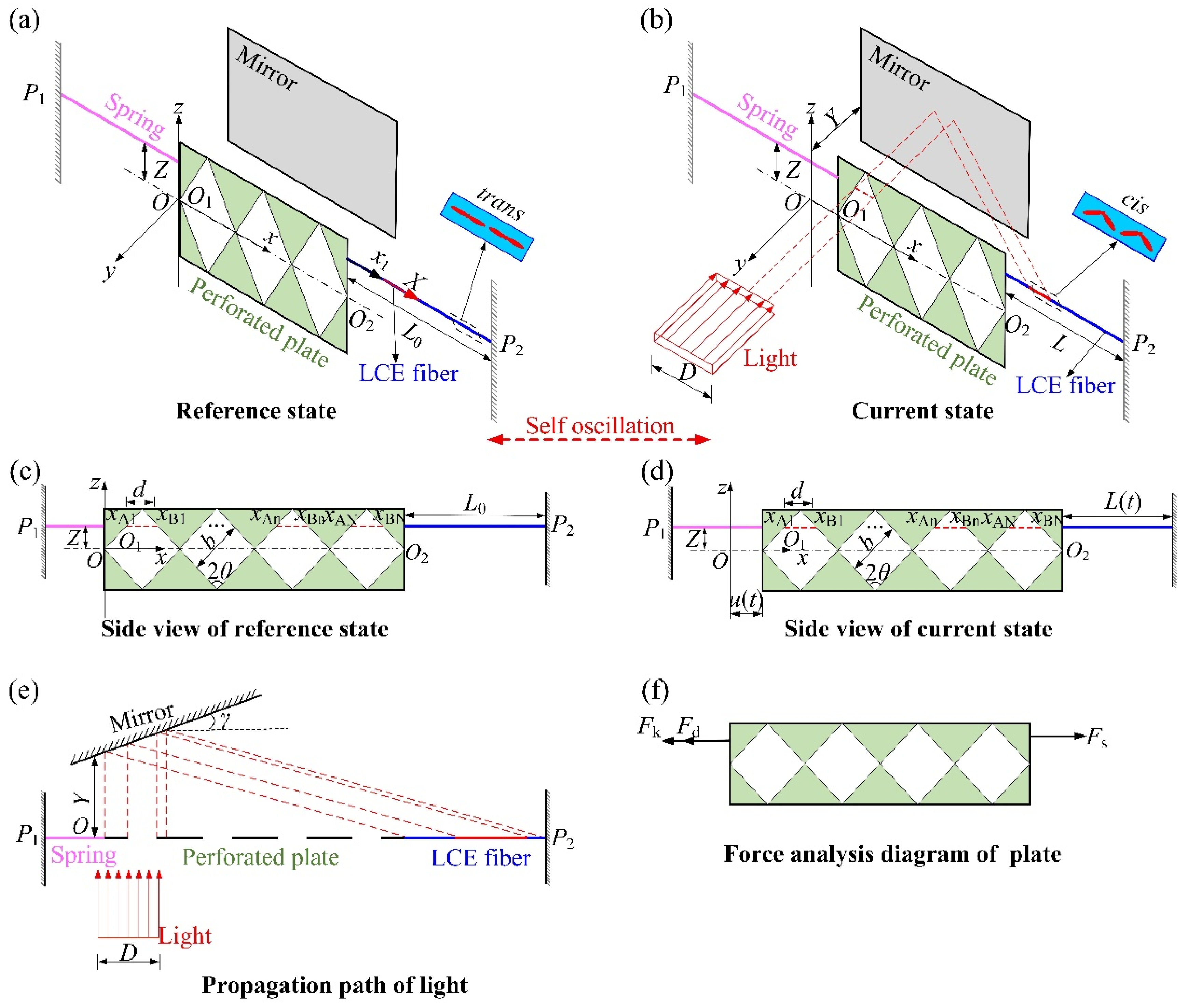
Figure 2 illustrates a geometry-flexible LCE self-oscillator enabled by light feedback routing. The system consists of a light-sensitive LCE fiber, a spring, a mirror, and a perforated plate, where the aperture regions are indicated in white and the non-aperture regions are shown in green. Depicted in
Figure 2a, the spring’s left end is attached to the stationary left endpoint,
, while its right end joins the perforated plate; this plate’s right side is bonded to a light-sensitive LCE fiber, and the fiber’s right extremity is fastened to the fixed right endpoint,
. Under reference conditions, the nematic LCE material is in a stress-free state with an initial length
, and light-responsive molecules like azobenzene are oriented uniformly along the fiber’s axis. It is a recognized characteristic that LCE fibers undergo contraction when exposed to light and revert to their original state in darkness [
80,
81,
82,
83].
A steady slender band-like incident light beam aligned orthogonally to the
axis traverses the aperture regions in the plate and is reflected by a mirror onto the light-sensitive LCE fiber, as illustrated in
Figure 2b. Upon exposure to reflected light, the light-sensitive liquid crystal molecules undergo a conformational shift from an elongated
trans state to a curled
cis configuration, causing the illuminated segments of the LCE fiber to shrink. Consequently, the perforated plate moves rightward along with the LCE fiber, resulting in a progressive increase in the restorative force of the spring. As the plate gradually moves rightward, the location of the illuminated segments changes; simultaneously, the span of the light beam passing through the aperture regions may diminish, leading to a reduction in the length of LCE fiber, and the contraction induced by light in segments that transition from being illuminated by the reflected light to being unilluminated gradually decreases. Under the influence of the growing restorative force, the plate decelerates, passes through the equilibrium position, and continues moving leftward due to its inertia. Accordingly, both the size and placement of the illuminated segment change inversely compared with the rightward motion phase, causing material points on the LCE fiber to alternate between illuminated and non-illuminated states. As a result, the perforated plate exhibits sustained cyclic oscillations around its static equilibrium position under constant light irradiation.
In order to examine the movement of the perforated plate, a coordinate system is established with the origin
fixed at the midpoint
of the plate’s left end in the reference state, and
denotes the instantaneous displacement of the perforated plate at time
. Additionally, let
represent the length of the LCE fiber over time, as shown in
Figure 2f. During oscillation, the plate is subjected to the tension
from the LCE fiber, the restorative force
of the spring, and the damping force
, as illustrated in
Figure 2f. Notably, the damping force
exhibits a complex relationship with the system’s velocity in real-world scenarios. However, the linear damping model can provide a simple yet reasonable description of energy dissipation at low velocities. To focus on the dynamics of the self-oscillator enabled by light feedback routing, we assume that the damping force is proportional to the plate’s velocity
and acts in the opposite direction, i.e.,
. Thus, the dynamic governing equation of the plate can be provided as follows:
where
signifies the mass of the plate,
indicates the damping coefficient, and
corresponds to the acceleration. The system’s initial state is defined by
By employing linear elasticity theory, the force applied by the spring is expressed as
where
represents the stiffness constant of the spring.
2.2. Tension of the LCE Fiber
To determine the tension
of the LCE fiber in Equation (1), the following assumptions are made in this study: (1) The mass of the LCE fiber can be neglected. (2) Both the tension
and the elastic strain
of the LCE fiber are homogeneous. (3) It is assumed that the LCE fiber undergoes small deformations. (4) The tension
is proportional to the elastic strain
. According to the linear relationship between
and
, the tension of the LCE fiber can be given as
where
denotes the elastic constant of the LCE fiber. It is important to highlight that the elastic coefficient
of the LCE fiber varies as a function of the
cis-isomer concentration
. Typically, it tends to decrease gradually as
increases, after which it remains relatively stable over a certain concentration range [
84]. In fact, considering that the variation in elastic coefficient
with
cis-isomer concentration
presents a significant challenge in solving this self-oscillating system, in this study, we focus on the dynamic behavior of the geometry-flexible LCE self-oscillator enabled by light feedback routing. For the sake of simplicity, we assume that the elastic constant remains constant and does not fluctuate with
cis-isomer concentration
. Notably, when considering a bulk LCE without neglecting its mass, both the tension
and the elastic strain
of the LCE fiber are inhomogeneous. This, in turn, introduces inaccuracies in the numerical results of the model. However, these inaccuracies only have a quantitative effect on the LCE self-oscillator, not a qualitative one. To focus on the dynamic behavior of the geometry-flexible LCE self-oscillator enabled by light feedback routing, the LCE fiber in this study is assumed to be thin, allowing its mass to be neglected.
The elastic strain
is presumed to be homogeneous along the LCE fiber, while both the total strain
and the light-induced contraction
exhibit spatial variation. To address this inhomogeneous deformation, the Lagrangian arc-coordinate
defined in the reference configuration and the Eulerian arc-coordinate
in the current state are employed, as shown in
Figure 2a. The instantaneous spatial position of a material point
is described by
. Consequently, the total strain and light-driven contraction are formulated as
and
, respectively. Under the assumption of small deformation, the total strain
is approximated as the linear superposition of the elastic strain
and the light-driven contraction, i.e.,
, leading to a revised expression for tension as
where
is taken to have a proportional relationship with the
cis-isomer concentration
, i.e.,
where
denotes the contraction constant.
For simplicity, the total strain is characterized as
, with the deformation gradient
being defined by
Accordingly,
in Equation (5) is reconfigured to
Subsequently, by performing integration on both sides of Equation (8) across the range from
to
, the result is
It is apparent that
; Equation (9) can be restated as:
2.3. The Evolution of Cis-Isomer Concentration
To determine the
cis-isomer concentration
for the LCE fiber referenced in Equation (10), the widely recognized dynamic model for LCEs introduced by Finkelmann and colleagues is applied [
85,
86]. Research conducted by Yu and others indicated that the transition from
trans to
cis states in LCEs can be triggered by ultraviolet light or laser sources having wavelengths below 400 nm [
87]. The
cis-isomer concentration
is affected by thermal activation from
trans to
cis, thermal relaxation from
cis to
trans, and photoinduced relaxation from
trans to
cis. Thermal activation is typically regarded as insignificant compared with light-induced activation [
85,
88]; thus the
cis-isomer concentration
is generally modeled by the differential equation
where
represents the light absorption coefficient,
denotes the thermal relaxation duration for
cis-to-
trans reversion, and
is the instantaneous light intensity. Notably, the thermal relaxation duration of an LCE fiber is closely related to its cross-sectional size: a thicker fiber exhibits a longer relaxation time, whereas a thinner fiber relaxes faster. To match the dynamic feedback of the LCE self-oscillator, a fiber with a shorter thermal relaxation duration is preferred. Specifically, an LCE fiber with a diameter of 100–500 μm is recommended to ensure that light-induced contraction and elastic recovery can respond rapidly to displacement changes, thereby maintaining stable self-oscillation. Moreover, an excessively thin individual fiber results in insufficient tension in the LCE fiber, which in turn prevents the net work done by
from compensating for the damping dissipation in the system. To address this, the system can employ multiple thin fibers arranged in parallel to simultaneously achieve both rapid thermal relaxation and sufficient fiber tension.
To address Equation (11), the instantaneous spatial coordinate
should be computed to determine whether the material point
is illuminated by the reflected light or non-illuminated. By integrating Equations (8) and (10), the deformation gradient
can be expressed as
From Equations (7) and (12), we can obtain
By performing integration on both sides of Equation (13) from
to
, we arrive at
The value of derived from Equation (14) enables the assessment of light exposure conditions for material points along the LCE fiber, distinguishing between illuminated and dark regions.
2.4. Photon Propagation Path in Light Feedback Routing
Determining whether a material point in the LCE is illuminated requires not only knowledge of its instantaneous position
but also the time-dependent position of the mirror-reflected light. This section will investigate the photon propagation path in the light feedback routing. In this study, the perforated plate contains an array of
rhombus-aperture regions with side length
and an interior angle
, as shown in
Figure 2d. By neglecting the height of the narrow beam, a geometric analysis reveals that the aperture regions width
at the location perpendicular to the light beam on the plate can be expressed as:
represents the distance between the lines
and
, as shown in
Figure 2c. The coordinates
and
of the starting and ending points of the
aperture regions on the plate along the line
can be expressed as
where
.
The width of the band-like light beam is denoted by
(as shown in
Figure 2e), with its left endpoint aligned with the left edge of the plate. Let
represent the coordinates of the photon emitted from the light source; so we have
. Through geometric analysis, the coordinates
of the photon reflected by the mirror from the point
to the line
can be expressed as
where
is the angle between the mirror plane and the plate plane and
represents the distance from the origin
to the mirror, as shown in
Figure 2e.
It is worth mentioning that during the movement of the perforated plate, some photons pass through the aperture regions in the plate, while others are blocked by the plate. The photons that can pass through the aperture regions in the plate should satisfy the following condition:
By solving the system of Equations (18) and (19), the set
of regions on the
line that are irradiated by the reflected photons can be determined. When the coordinates of a material point on the LCE fiber satisfy the condition
, the point is irradiated; otherwise, it is not. It is worth mentioning that according to the geometric relationship, we have:
By substituting into Equation (14), the instantaneous spatial coordinate
of Equation (20) can be rewritten as:
Equation (21) distinguishes whether the material points along the LCE fiber are illuminated by the reflected light. When , the material points of the LCE fiber are illuminated by the reflected light, and they are in the illuminated state; otherwise, they are in the dark state. It is worth noting that during the oscillation process of the perforated plate, there is an alternating appearance of aperture regions and non-aperture regions in the path of the incident light beam. Whether the incident light beam can propagate to the mirror depends on whether it encounters the aperture or non-aperture regions of the plate along its path. Consequently, the perforated plate functions as a binary switch that controls whether the incident light beam can reach the mirror and further regulates whether the light reflecting off the mirror illuminates specific points on the LCE fiber. In practical scenarios, the intensity of the reflected light received at the illuminated spots on the LCE fiber exhibits a non-uniform and complex spatial distribution due to factors such as beam spreading and variations in the propagation path. To focus on the self-oscillating behavior enabled by light feedback routing, this study simplifies the light intensity by assuming that the intensity received by the illuminated points on the LCE fiber is uniform. While this simplification neglects spatial heterogeneity, it is believed to have a quantitative rather than qualitative impact on the system’s self-oscillation. Thus, the instantaneous light intensity in Equation (11) can be defined as for and for those in darkness. Notably, holes of various shapes, such as circular ones, are equally suitable for the self-oscillator design presented in this study. The choice of the shape only results in a quantitative impact on the set , without affecting the qualitative dynamic behavior of self-oscillation. For simplicity, this study employs diamond-shaped holes to illustrate the working mechanism of the geometry-flexible LCE self-oscillator enabled by light feedback routing.
2.5. Nondimensionalization
For convenience, we introduce the following dimensionless quantities:
,
,
,
,
,
,
,
,
,
,
,
,
,
,
,
,
,
,
,
,
,
,
,
and
. The dynamic control equation for the plate in Equation (1) can be rewritten as
with the initial conditions given as:
The restorative force of the spring described by Equation (3) can be expressed as
and the tension of the LCE fiber described by Equation (10) can be expressed as:
The
cis-isomer concentration of Equation (11) can be rewritten as:
The coordinates of the photon reflected by the mirror can be rewritten as:
should satisfy the conditions
with
and
.
The instantaneous spatial coordinate
of Equation (21) can be expressed as:
The dynamics of the geometry-flexible LCE self-oscillator activated by light feedback routing are dictated by Equations (22) and (26), wherein the temporally varying cis-isomer concentration interacts with the instantaneous displacement of the self-oscillating system. To resolve these intricate differential equations with variable coefficients, a fourth-order Runge–Kutta algorithm is implemented within the MATLAB R2024a computational environment. At a specific time instance , using the known cis-isomer concentration and the displacement , the current restorative force and tension are computed via Equations (24) and (25). Then the displacement at the subsequent time step is then derived from Equation (22). Concurrently, the current displacement facilitates the estimation of the light intensity distribution through Equations (27)–(32), thereby enabling the computation of the updated cis-isomer concentration via Equation (26). Through iterative computation across successive time steps, the dynamical behavior of the geometry-flexible LCE self-oscillator is numerically simulated for specified parameters: , , , , , , , , , , , , and . It is worth mentioning that the time cost of the iterative computation is minimal. Using a time step of , running the MATLAB R2024a program on a standard office laptop to obtain a set of the self-oscillator’s temporal evolution takes only approximately 20 s.
3. Two Motion Patterns and Mechanism of Self-Oscillation
Based on solving governing Equations (22) and (26), this section examines the two distinct motion patterns of the geometry-flexible LCE self-oscillator, the static equilibrium pattern and self-sustained oscillation pattern, offering a mechanistic analysis of the self-oscillating behavior.
3.1. Two Motion Patterns
To investigate the dynamics of the geometry-flexible LCE self-oscillator activated by light feedback routing, it is essential to establish the characteristic values of the non-dimensional parameters within the model. Drawing upon prior experimental studies [
89,
90,
91,
92,
93], standard material properties and geometric parameters are provided in
Table A1 of
Appendix A, while the corresponding dimensionless coefficients are summarized in
Table A2 of
Appendix A. These parameter values will subsequently be utilized to analyze the behavior of the geometry-flexible LCE self-oscillator activated by optical feedback routing.
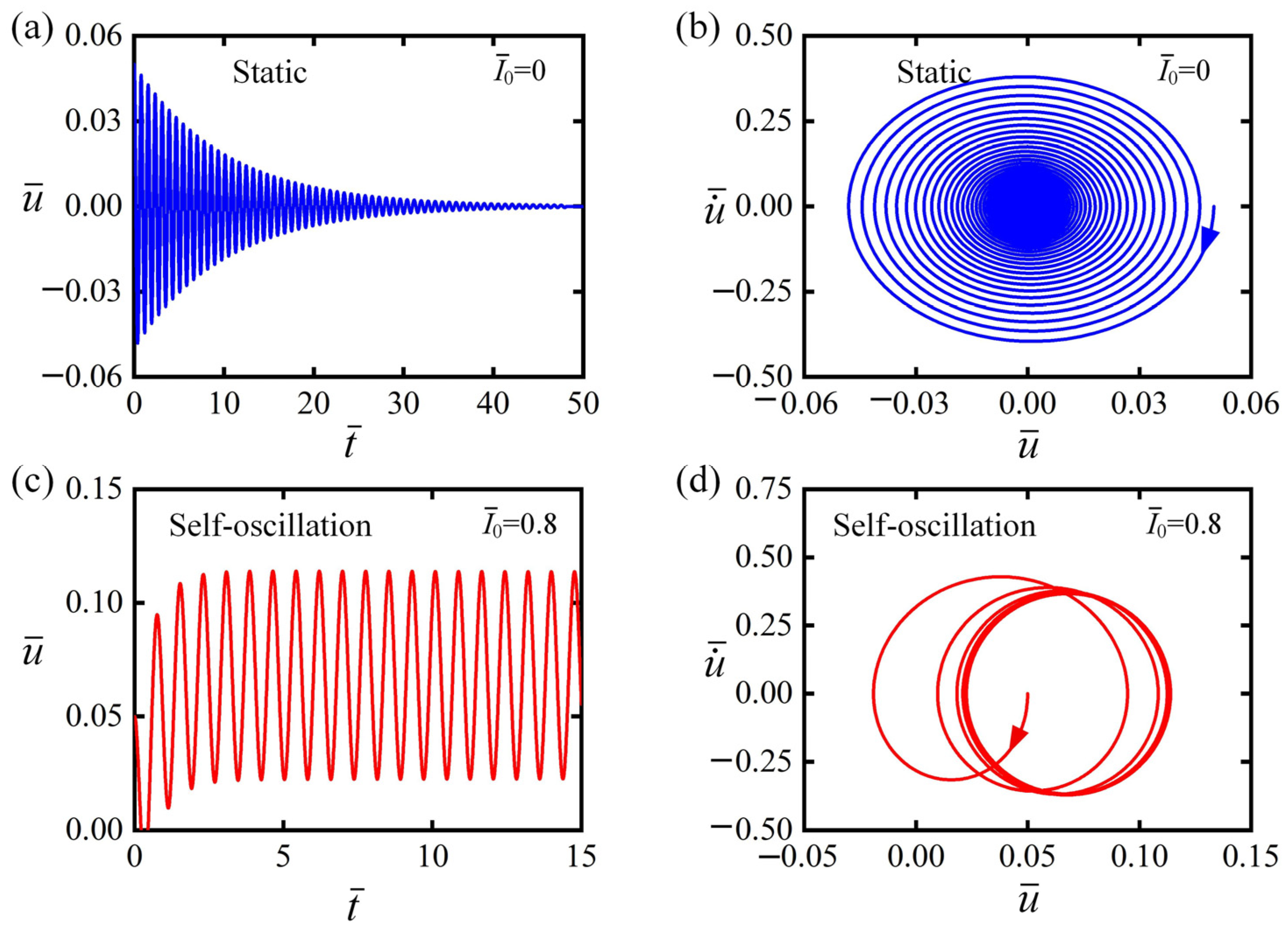
Based on Equations (22) and (26), the temporal evolution and phase portraits of the LCE self-oscillator are derived, with specific cases corresponding to
and
, as depicted in
Figure 3. The remaining parameters are configured as follows:
,
,
,
,
,
,
,
,
,
,
,
and
. For the scenario where
, as illustrated in
Figure 3a,b, the displacement amplitude
demonstrates a progressive reduction over time owing to damping-induced energy dissipation, eventually leading the plate to stabilize at an equilibrium position—a behavior classified as the static equilibrium pattern. Conversely, under the condition
, presented in
Figure 3c,d, the plate initiates motion from an initial position, with its oscillation amplitude gradually amplifying until reaching a steady magnitude. With constant light exposure, the plate—activated via optical feedback mechanisms—sustains continuous periodic oscillation, thereby defining the self-oscillation pattern.
3.2. Mechanism of Self-Oscillation
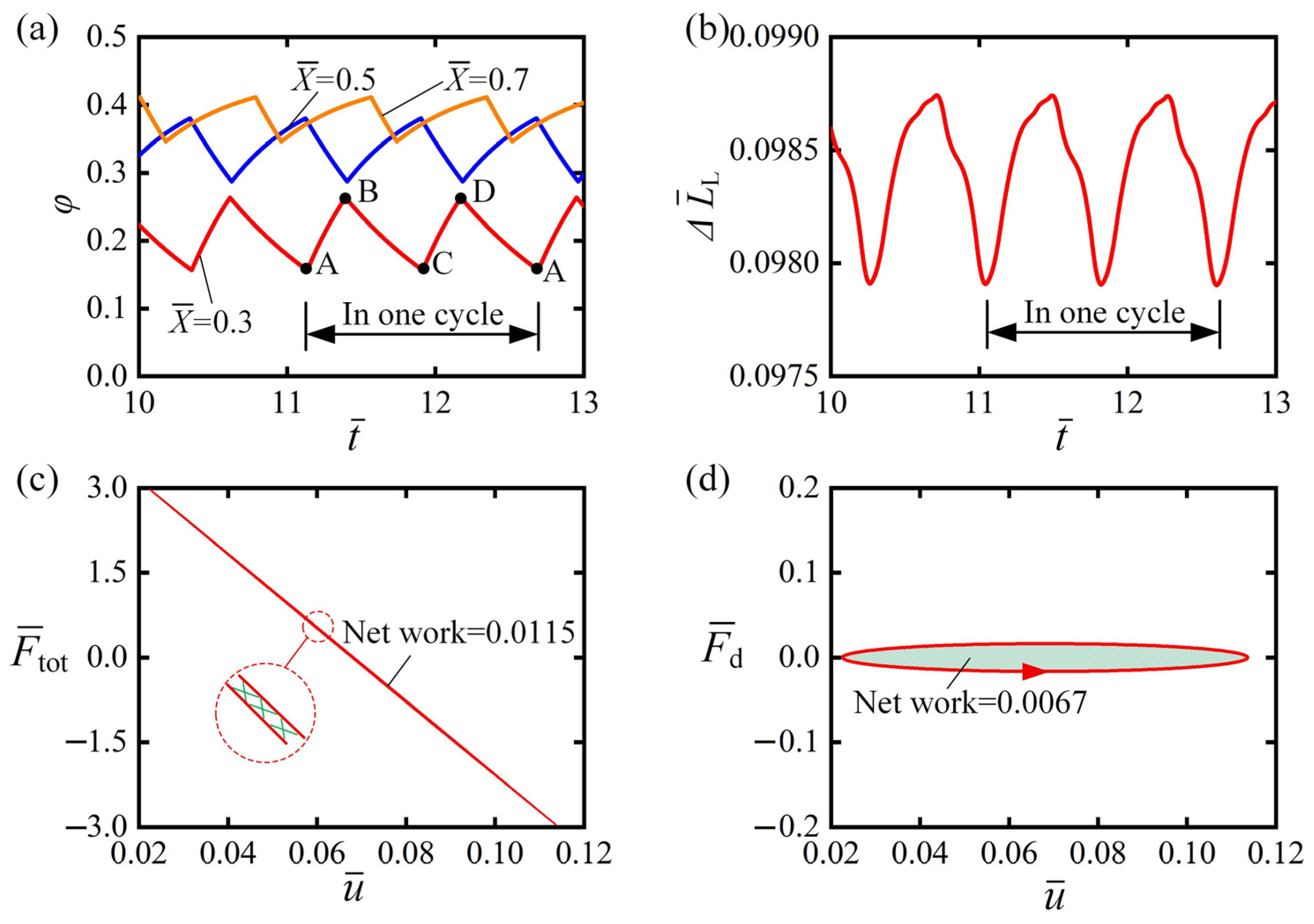
To explore the mechanism behind the self-oscillation behavior triggered by light feedback routing,
Figure 4 displays key physical quantities of the LCE self-oscillating system under the typical conditions presented in
Figure 3c,d.
Figure 4a depicts the variation over time in the
cis-isomer concentration
at representative material points
,
and
on the LCE fiber, demonstrating a clear periodic pattern. When a material point enters the zone illuminated by the reflected light beam (taking
as an example),
progressively rises over time, as indicated by segment A-B (or C-D) in
Figure 4a, whereas it gradually declines in the dark, as represented by segment B-C (or D-A). As shown in
Figure 4b, the variation in the length of the LCE fiber solely due to light exposure, denoted by
, is presented as a function of time. Owing to the periodic fluctuation in
cis-isomer concentration
,
also displays periodic variations, which consequently causes the equivalent driving force
to exhibit periodic behavior as well.
Figure 4c further illustrates the correlation between
and displacement
under the conditions corresponding to
Figure 3c,d. This relationship forms a clockwise closed loop, and the area enclosed by this loop corresponds to the net work done by
. This net work is calculated to be
and serves as the energy source for the system’s self-oscillation. Similarly, the damping force
also varies periodically over the motion cycle.
Figure 3d depicts how
changes with
throughout one complete self-oscillation period, forming a counterclockwise closed circle. The area within this closed loop represents the energy dissipated by
, which is calculated to also be
. The damping dissipation is balanced by the net work done by
, and such an energy balance enables the system to maintain continuous self-oscillation.
4. Parameter Analysis
In the aforementioned mechanical model of the self-oscillator, there are fourteen dimensionless system parameters: , , , , , , , , , , , , and . In this section, the influence of these system parameters on the triggering conditions, frequency, and amplitude of self-oscillation is studied in detail. Herein, the dimensionless oscillation frequency and amplitude are denoted by and , respectively. In general, the initial conditions and have no effect on and . And as the damping coefficient increases, nearly remains constant, whereas exhibits a decreasing trend. In subsequent calculations, these initial conditions are fixed at , and .
4.1. Influence of Elastic Constant and Stiffness Constant
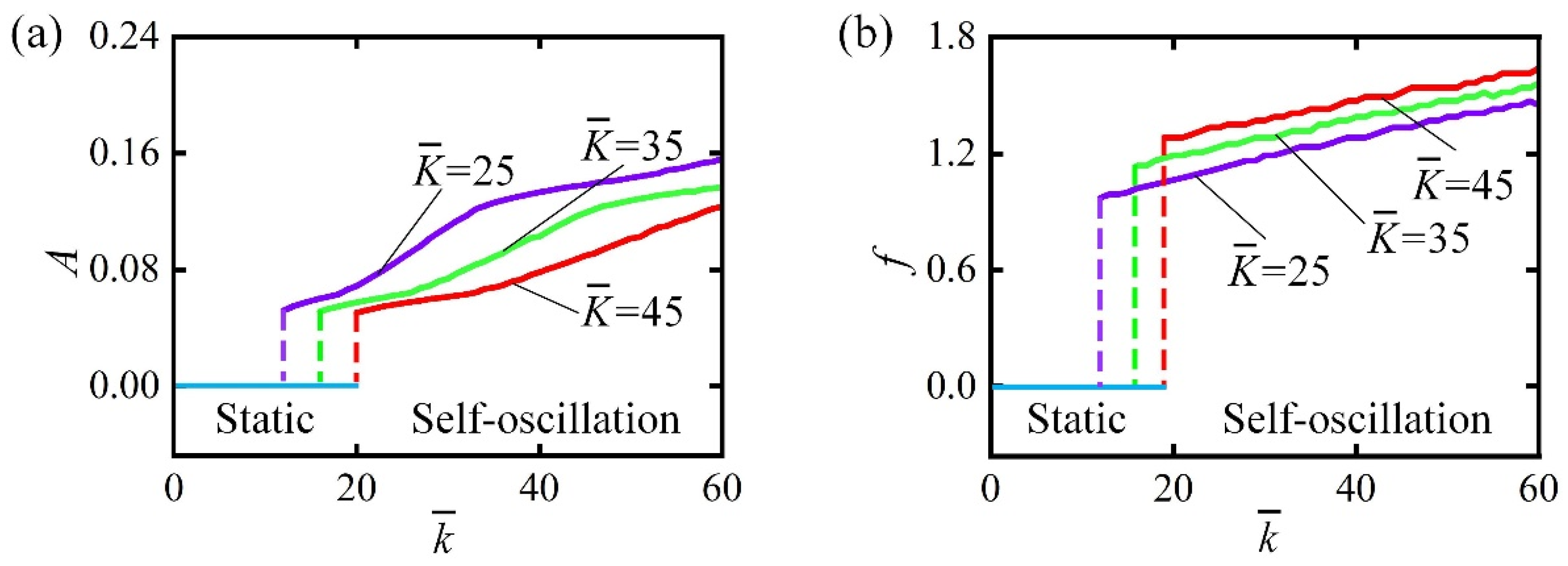
Figure 5 illustrates the influence of the elastic constant
of the LCE fiber and the stiffness constant
of the spring on self-oscillation. The following parameter values are adopted in the calculations:
,
,
,
,
,
,
,
and
.
Figure 5a shows the variation in amplitude
with the elastic constant
for three values of the stiffness constant:
,
and
. For each
, there exists a distinct critical value of
required to trigger self-oscillation. When
is below this critical value, the LCE fiber and perforated plate system reaches a static equilibrium state. In contrast, when
exceeds the critical value, the system can sustain self-oscillation. This occurs because, for a small
, the equivalent driving force
is too weak to provide sufficient net work to overcome damping losses, thereby preventing sustained oscillation. As the elastic constant
increases, the equivalent driving force
grows under the same light-induced contraction. Consequently, more energy is input into the system, and when the elastic constant
exceeds a critical value, the energy compensates for damping losses, allowing the system to sustain self-oscillation. Furthermore,
Figure 5a indicates that as
increases, the critical
required to initiate self-oscillation also increases. This is because a larger spring stiffness
resists the deformation of the LCE material, reducing both the equivalent driving force
and the net work it can supply.
In the self-oscillation pattern, when
is held constant, the amplitude
increases significantly with
, as shown in
Figure 5a. This behavior arises because a larger value of
results in a stronger equivalent driving force
, which performs more net work on the system and thus leads to a larger
. Conversely, for a fixed value of
, the
decreases as
increases. This reduction occurs because the spring resists the deformation of the LCE material.
Figure 5b depicts the frequency
of self-oscillation as a function of
and
. It is observed that
increases steadily with
for a given
, and similarly shows a significant upward trend with the increase in
. This behavior can be attributed to the fact that a higher
enables the LCE fiber to recover its deformation more rapidly, thereby increasing the oscillation frequency. Likewise, a larger
allows the spring to restore its elastic deformation more quickly. Thus, increasing either
or
contributes to a higher oscillation frequency.
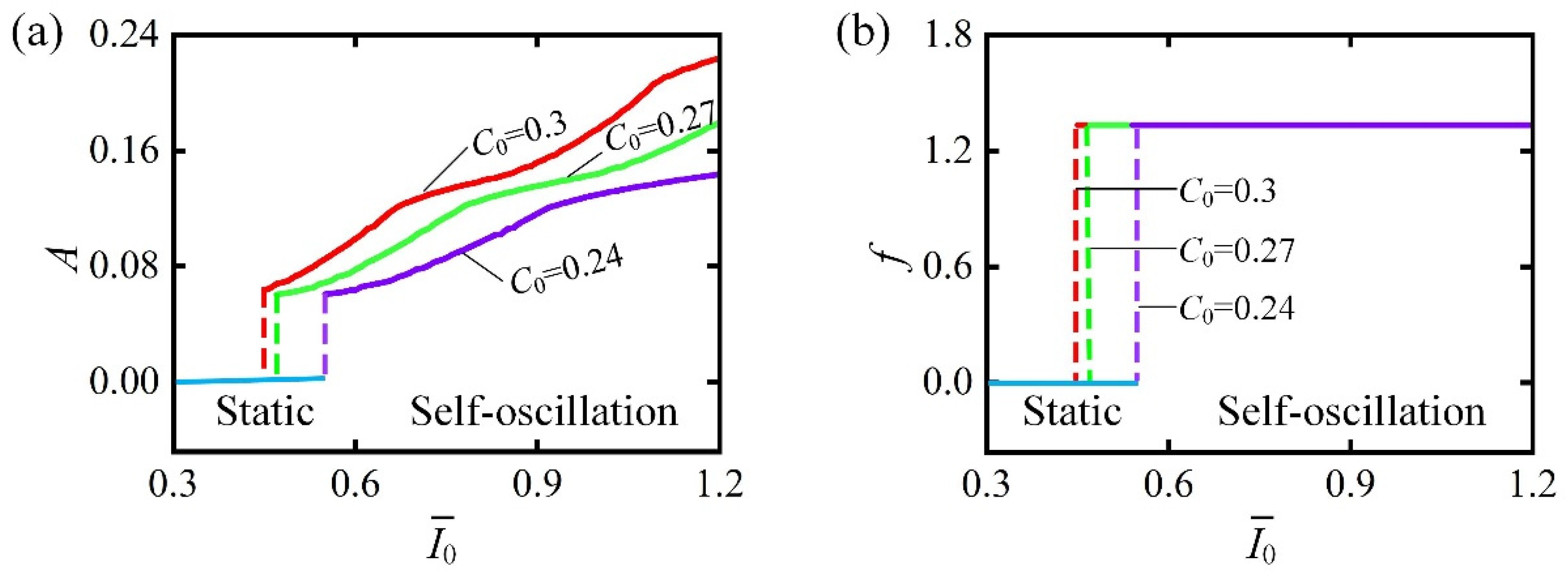
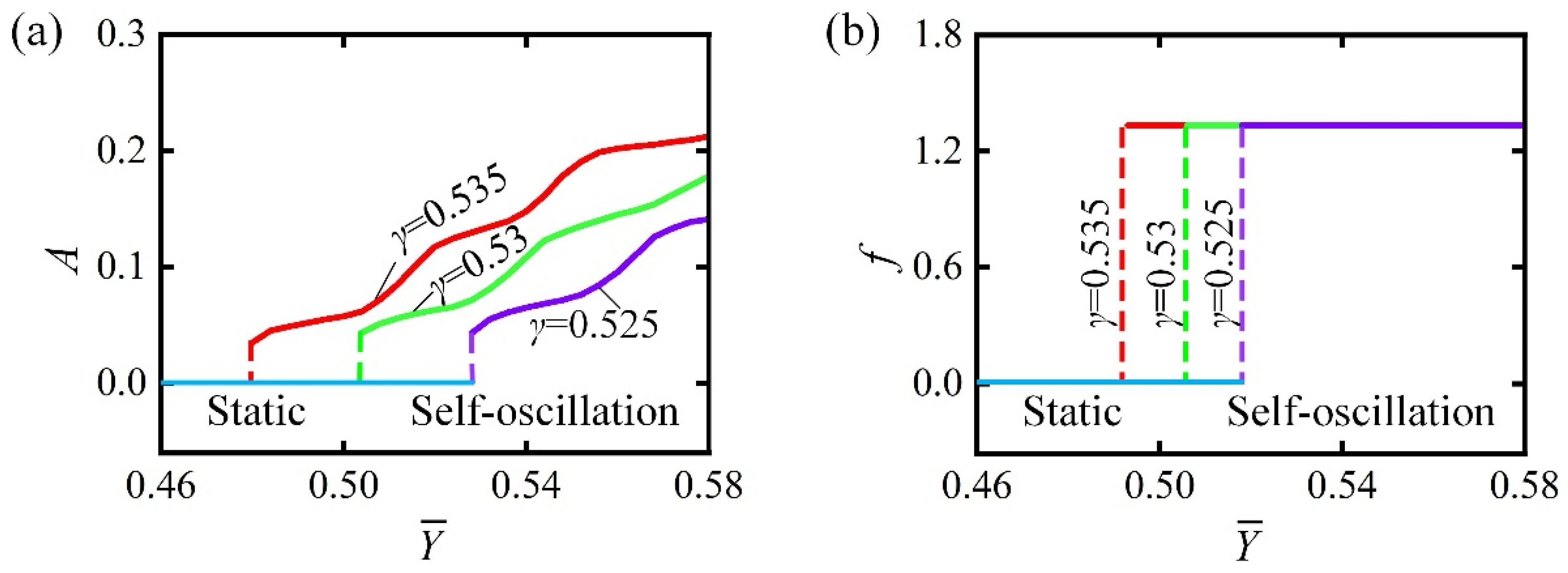
4.2. Influence of Light Intensity and Contraction Coefficient
Figure 6 demonstrates the effects of both light intensity
and contraction coefficient
on self-oscillation. The numerical analysis employs the following fixed parameters:
,
,
,
,
,
,
,
and
. As shown in
Figure 6a, the amplitude
varies with light intensity
for three contraction coefficient values:
,
and
. For each
, a distinct critical light intensity
is necessary to initiate self-oscillation. Below this threshold, the LCE fiber–perforated plate system reaches a static equilibrium. Once
exceeds the critical value, self-oscillation occurs. This is attributed to the fact that at lower
, the light-induced contraction of the LCE fiber is insufficient, resulting in a net work done by the equivalent driving force
that cannot overcome the energy dissipation due to damping. Moreover,
Figure 6a indicates that a higher
reduces the critical
required to trigger self-oscillation. This occurs because a larger
enhances the light-induced contraction under the same
, thereby reducing critical light intensity
.
Figure 6a also illustrates the influence of the parameters
and
on the oscillation amplitude
within the self-oscillation pattern. When
is held constant,
exhibits a pronounced increase with higher values of
. This enhancement can be attributed to the stronger light-induced contraction of the LCE fiber under more intense illumination, which raises the magnitude of the equivalent driving force
and consequently, the net work performed during each oscillation cycle. Moreover,
Figure 6a indicates that at a fixed light intensity
, an increase in
also results in larger
. This behavior occurs because a higher value of
amplifies the system’s response in a manner similar to increasing the illumination intensity
, thereby further promoting the oscillatory motion. Furthermore,
Figure 6b depicts the frequency
of self-oscillation as a function of
and
. It is observed that
remains constant with increases in
and
. This observation can be attributed to the fact that the frequency of self-oscillation is predominantly governed by the system’s intrinsic mechanical parameters.
4.3. Influence of the Angle and Distance
Figure 7 demonstrates how the angle
and the distance
influence the self-oscillation behavior. The simulations were conducted using the parameter values
,
,
,
,
,
,
,
and
. In
Figure 7a, the impact of the distance
—measured from the origin
to the mirror—on the oscillation amplitude is shown for three values of
:
,
and
. For each angle
, there exists a specific critical distance
, beyond which self-oscillation begins. When it is below this threshold, the fiber–plate system settles into a stationary equilibrium. Once it surpasses the critical value, self-oscillation initiates. This behavior arises because at smaller mirror distances
, the length of the LCE fiber illuminated by reflected light decreases, leading to insufficient light-driven contraction. As a result, the net work produced by the equivalent driving force
cannot overcome the energy loss from damping. Additionally,
Figure 7a reveals that a larger
lowers the critical
needed to initiate self-oscillation. This is because increasing
extends the illuminated portion of the LCE fiber under a fixed
, which in turn allows the critical
to be appropriately reduced.
For a fixed value of
, the amplitude
increases markedly with greater
, as shown in
Figure 7a. This growth results from the enhanced light-driven contraction when the mirror is placed farther away, which strengthens the equivalent driving force
and the associated net work, thereby boosting the oscillation amplitude. Moreover,
Figure 7a indicates that a larger
also raises the amplitude
at any given
, as increasing
extends the illuminated portion of the LCE fiber—an effect comparable to increasing the mirror distance
. Furthermore,
Figure 7b illustrates how the self-oscillation frequency
changes with
and
. It is found that it remains unchanged regardless of variations in
and
. This consistency occurs because alterations in these geometric parameters do not affect the intrinsic mechanical properties of the system, which ultimately determine the self-oscillation frequency.
4.4. Influence of Width and Distance
Figure 8 illustrates the influence of the width
of band-like light beam and the distance
between the lines
and
on self-oscillation. In the calculations, we set
,
,
,
,
,
,
,
and
.
Figure 8a shows the influence of the width
on the amplitude
for
,
and
. For each distance
, there exists a specific critical width
. When it is below this threshold, the fiber–plate system settles into a stationary equilibrium. Once it surpasses the critical value, self-oscillation initiates. This is because a narrower width
means that less light is reflected onto the LCE fiber, and consequently it induces less light-induced contraction; as a result, the net work performed by the equivalent driving force
is insufficient to compensate for energy dissipation, leaving the system in a static equilibrium state. It can also be observed that as
increases, the critical width
exhibits an increasing trend. The reason for this behavior is that a larger
reduces the portion of light that can be reflected by the mirror onto the LCE fiber, as more light is blocked by the non-aperture regions of the plate. As a result, a wider critical width
is required to compensate for the reduced illuminated length and maintain sufficient light-induced actuation in the LCE fiber.
In the self-oscillation pattern,
increases as
increases. This trend is due to the fact that the illuminated length of the LCE fiber grows with
. This induces a greater overall light-induced contraction in the LCE fiber and a consequent rise in the net work performed by the equivalent driving force
. In contrast,
gradually decreases as
rises, which can be explained by the reduced proportion of light transmitted through the aperture regions, thereby weakening the light-induced contraction of the fiber. Observing
Figure 8b, the computed results indicate that the frequency
remains nearly constant across different values of
and
. This consistency occurs because the system’s intrinsic mechanical properties—governed by the mass–spring–damper subsystem—are not affected by these geometric or optical parameters.
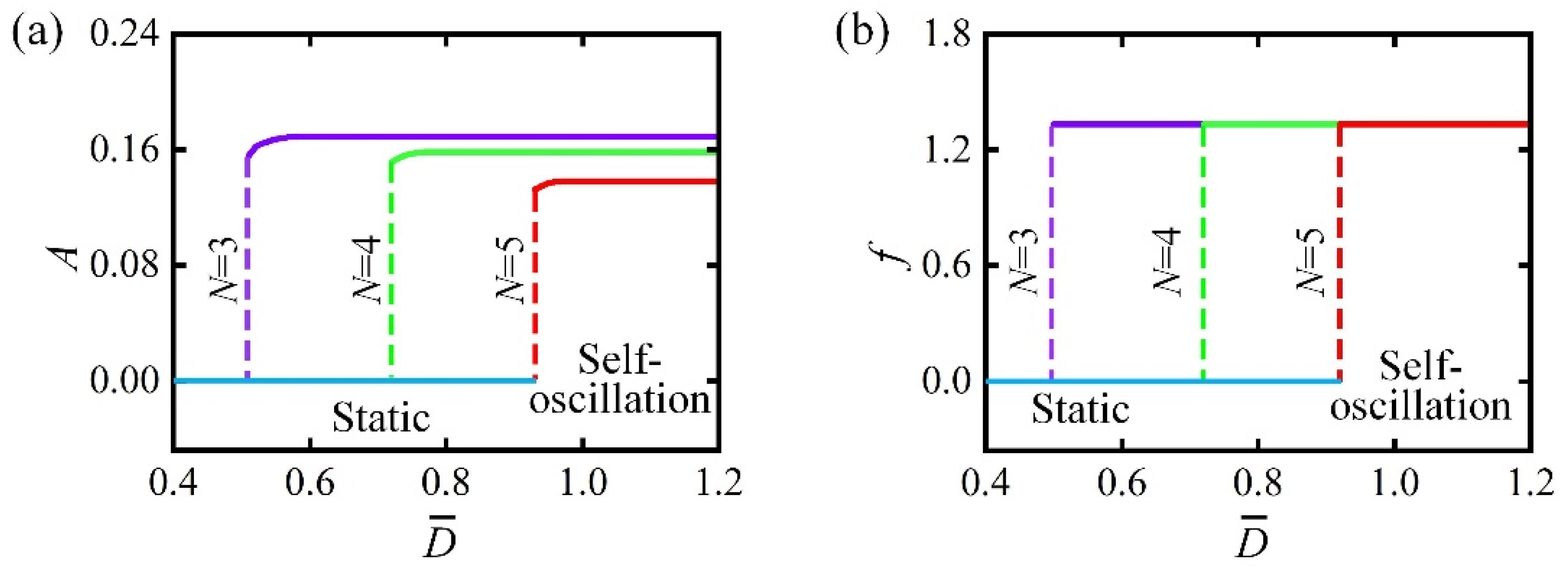
4.5. Influence of Width and Number of Apertures
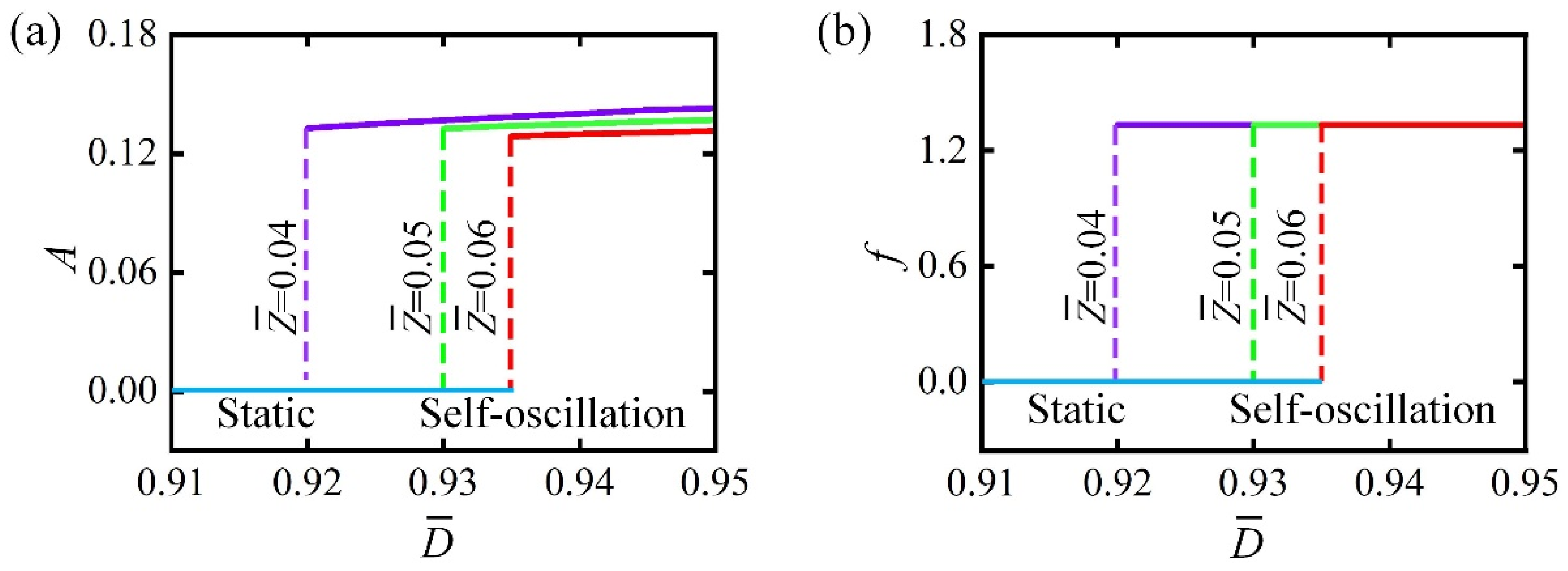
Figure 9 illustrates the influence of the width
of the band-like light beam and the number
of the aperture regions on self-oscillation. In the calculations, we set
,
,
,
,
,
,
,
and
.
Figure 9a shows the influence of the width
on the amplitude
for
,
and
. For each number
, there exists a specific critical width
that must be exceeded for self-oscillation to begin. It can also be observed that as
increases, the critical width
exhibits an increasing trend. The reason for this behavior is that with a larger
, the spatial position of the LCE fiber shifts. When
is kept constant, a portion of the LCE fiber remains unexposed to light. Therefore, increasing
is necessary to expose a longer segment of the LCE fiber. In the self-oscillation pattern,
decreases as
increases. This can be explained by the reduced irradiated length and the light-induced contraction of the LCE fiber. As shown in
Figure 9b, the calculated results indicate that the frequency
remains constant across different values of
and
. This can also be explained by the fact that
and
do not alter the intrinsic mechanical properties of the system.
4.6. Influence of Interior Angle and Side Length
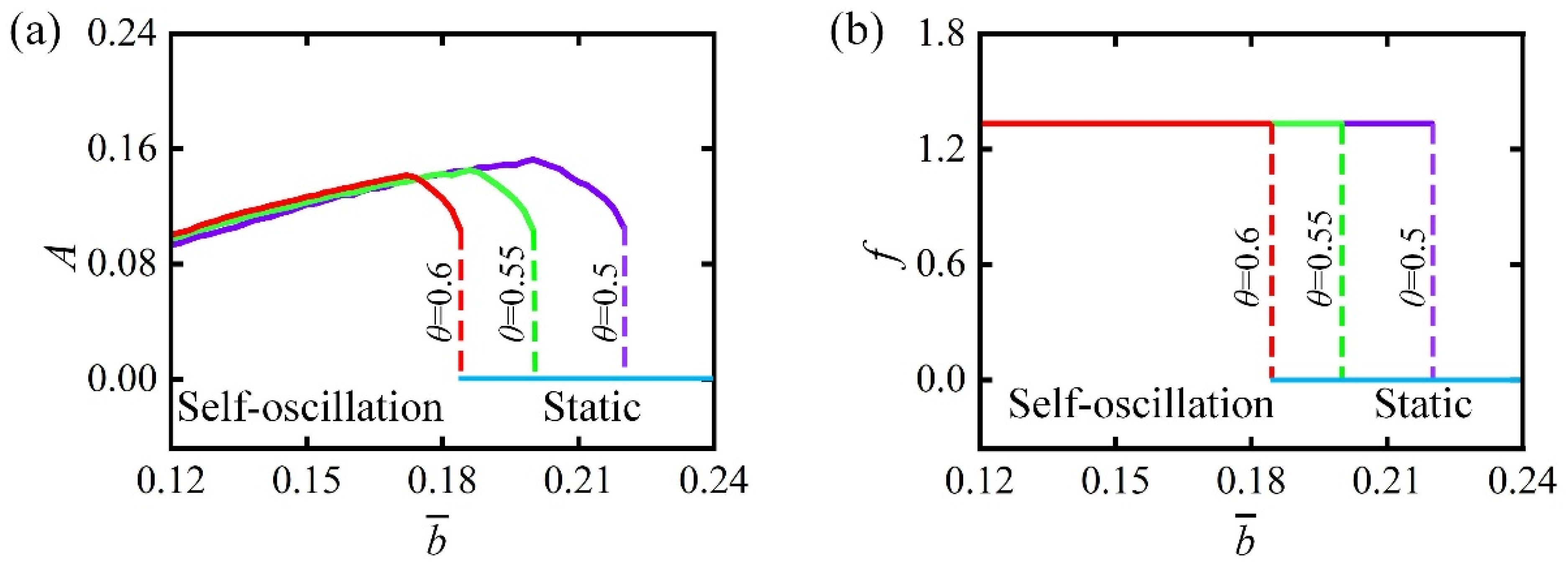
Figure 10 illustrates the influence of the interior angle
and side length
on self-oscillation. In the calculations, the parameters are set to
,
,
,
,
,
,
,
and
.
Figure 10a shows the effect of the side length
on the amplitude
for
,
and
. For the interior angle
, there exists a specific critical value of side length
. When
is below this threshold, self-oscillation initiates. Once
exceeds the threshold, the fiber–plate system reaches a stationary equilibrium. This occurs because when
is too large, the right segment of the LCE fiber gradually moves out of the region illuminated by the reflected light, resulting in less light-induced contraction. As a consequence, the net work performed by the equivalent driving force
is insufficient to compensate for energy dissipation, leaving the system in a static equilibrium state. It can also be observed that as the interior angle
increases, the critical side length
tends to decrease. This behavior arises because an increase in
alters the length of the LCE fiber exposed to the reflected light in a manner similar to an increase in
. To ensure sufficient light-induced contraction in the LCE fiber under a larger
, a smaller
is required.
In the self-oscillation pattern, for a given interior angle
, the amplitude
first increases and then decreases as
increases. This trend is attributed to the fact that for a fixed illuminated region, a larger
allows more light to pass through the aperture regions, thereby increasing the total light-induced contraction of the LCE fiber and the net work done by the equivalent driving force
. However, when
becomes too large, the right segment of the LCE fiber remains outside the illuminated region of reflected light, leading to a reduction in both the total light-induced contraction and the net work performed by
. Similarly, for a fixed side length
,
also first increases and then decreases as
increases, as shown in
Figure 10a. Since variations in angle
and side length
do not affect the intrinsic mechanical properties of the system, the oscillation frequency remains unchanged, as demonstrated in
Figure 10b.
5. Conclusions
Self-oscillation systems typically rely on nonlinear feedback mechanisms, such as self-shadowing, to sustain oscillations. However, designing a feedback loop that is congruent with the motion patterns presents a significant challenge, primarily due to two constraints: the limited deformation modes available in the geometry and the straightforward nature of rectilinear light propagation paths. To overcome this challenge, we propose a geometry-flexible LCE self-oscillator enabled by light feedback routing. The system consists of an optically responsive LCE fiber, a spring, a mirror, and a perforated plate. Using a dynamic LCE model, we present a nonlinear model for the self-oscillator under constant light exposure. Simulations reveal two distinct motion patterns: static equilibrium and self-oscillation. The self-oscillation arises from the contraction of the material points of the LCE fibers within the light path, with continuous motion being maintained by light energy input and damping dissipation.
Furthermore, the frequency and amplitude of self-oscillation primarily depend on several system parameters, i.e., , , , , , , , , , and . Increasing the system parameters , , , , and leads to an increase in the amplitude of self-oscillation. In contrast, increasing , or results in a decrease in amplitude. The amplitude initially rises and then declines as and increase. The frequency of self-oscillation increases with increases in and , while it remains nearly unaffected by variations in , , , , , , and .
It should be noted that the current model has several limitations: the effect of nematic-order parameter variation on the elastic modulus of the LCE is neglected; a linear stress–strain relationship is assumed; and material fatigue effects are not considered. These simplifications may lead to quantitative discrepancies between predictions and practical observations. Although experimental validation remains technically challenging under current infrastructure constraints, the proposed light feedback configuration allows deformation at any material point to contribute to the oscillator’s motion, creating a geometry-flexible feedback loop. This capability overcomes the limitations of constrained geometric deformation modes, allowing for adaptable control of the optical feedback loop through straightforward geometric modifications. This approach offers new avenues for self-sustaining systems and may inspire innovative applications in soft robotics, energy harvesting, and logic gates.
Author Contributions
Conceptualization, C.L.; Methodology, D.G.; Software, Y.W.; Validation, Y.W.; Investigation, C.L.; Writing—original draft, Y.W.; Writing—review and editing, D.G. All authors have read and agreed to the published version of the manuscript.
Funding
The authors acknowledge the financial support from National Natural Science Foundation of China (Grant No. 12172001), University Natural Science Research Project of Anhui Province (Grant No. 2025AHGXZK30256), Anhui Provincial Natural Science Foundation (Grant No. 2208085Y01), and the Natural Science Research Project of the Anhui Educational Committee (Grant No. 2024AH030010).
Institutional Review Board Statement
Not applicable.
Informed Consent Statement
Not applicable.
Data Availability Statement
The original contributions presented in this study are included in the article. Further inquiries can be directed to the corresponding author.
Conflicts of Interest
The authors declare no conflicts of interest.
Appendix A. Parameter of Mechanical Model
Table A1.
Material properties and geometric parameters.
Table A1.
Material properties and geometric parameters.
| Parameter | Definition | Value | Units |
|---|
| Contraction coefficient | 0~0.3 | / |
| trans-to-cis thermal relaxation time | 1~100 | ms |
| Light intensity | 0~20 | kW/m2 |
| Light-absorption constant | 0.0003 | m2/(s∙W) |
| Side length of rhombus-aperture regions | 0~10 | mm |
| Width of band-like light beam | 0~10 | mm |
| Distance between the lines and | 0~10 | mm |
| Distance from origin to mirror | 0~10 | mm |
| Length of LCE fiber | 0~10 | cm |
| Stiffness constant of the spring | 1~10 | N/m |
| Elastic constant of the LCE fiber | 1~10 | N/m |
| Mass of the plate | 0.01~10 | g |
| Damping coefficient | 0~0.001 | mg∙mm2/s |
| Interior angle of rhombus-aperture regions | 0~ | |
| Angle between mirror and plate | 0~ | |
| Dimensionless stiffness constant of the spring | 0~50 | |
| Dimensionless elastic constant of the LCE fiber | 0~100 | |
| Dimensionless light intensity | 0~1 | |
| Dimensionless damping coefficient | 0~0.1 | |
| Dimensionless side length of rhombus-aperture regions | 0~1 | |
| Dimensionless width of band-like light beam | 0~2 | |
| Dimensionless distance between the lines and | 0~2 | |
| Dimensionless distance from origin to mirror | 0~2 | |
Table A2.
Dimensionless parameters.
Table A2.
Dimensionless parameters.
| Parameter | Definition | Value |
|---|
| Dimensionless stiffness constant of the spring | 0~50 |
| Dimensionless elastic constant of the LCE fiber | 0~100 |
| Dimensionless light intensity | 0~1 |
| Dimensionless damping coefficient | 0~0.1 |
| Dimensionless side length of rhombus-aperture regions | 0~1 |
| Dimensionless width of band-like light beam | 0~2 |
| Dimensionless distance between the lines and | 0~2 |
| Dimensionless distance from origin to mirror | 0~2 |
References
- Li, J.J.; Mou, L.L.; Liu, Z.F.; Zhou, X.; Chen, Y.S. Oscillating light engine realized by photothermal solvent evaporation. Nat. Commun. 2022, 13, 5621. [Google Scholar] [CrossRef]
- Wang, J.C.; Song, T.F.; Zhang, Y.H.; Liu, J.G.; Yu, M.M.; Yu, H.F. Light-driven autonomous self-oscillation of a liquid-crystalline polymer bimorph actuator. J. Mater. Chem. C 2021, 9, 12573. [Google Scholar] [CrossRef]
- Alipanah, Z.; Zakerhamidi, M.S.; Ranjkesh, A. Light-fueled self-oscillation of liquid crystal polymer network: Effect of photostabilizers. J. Appl. Polym. Sci. 2024, 141, e54923. [Google Scholar] [CrossRef]
- Zhao, J.; Dai, C.; Dai, Y.; Wu, J.; Li, K. Self-oscillation of cantilevered silicone oil paper sheet system driven by steam. Thin-Walled Struct. 2024, 203, 112270. [Google Scholar] [CrossRef]
- Yan, Z.; Wang, Y.L.; Bian, M.X.; Wang, M.; Zhou, X.; Yin, S.G.; Qin, W.J.; Liu, Z.F. Transformable thin-film robots capable of crawling, rolling, and oscillation. Appl. Mater. Today 2022, 28, 101514. [Google Scholar] [CrossRef]
- Li, Z.W.; Myung, N.V.; Yin, Y.D. Light-powered soft steam engines for self-adaptive oscillation and biomimetic swimming. Sci. Robot. 2021, 6, eabi4523. [Google Scholar] [CrossRef]
- Lv, X.D.; Wang, W.Z.; Clancy, A.J.; Yu, H.F. High-speed, heavy-load, and direction-controllable photothermal pneumatic floating robot. ACS Appl. Mater. Interfaces 2021, 13, 23030. [Google Scholar] [CrossRef] [PubMed]
- Chen, L.; Xia, Y.; Tang, Z.; Zhao, J.; Zhou, K. Self-sustaining chaotic characteristics of double pendulum based on self-shading effect. Chaos Soliton. Fract. 2026, 207, 09776. [Google Scholar] [CrossRef]
- Gao, J.L.; Wang, K.; Yang, Y.Z.; Feng, W. Self-sustained soft robots based on liquid crystal elastomers. J. Mater. Chem. C 2025, 13, 8425. [Google Scholar] [CrossRef]
- Liu, J.Q.; Xu, L.L.; Ji, Q.X.; Chang, L.F.; Hu, Y.; Peng, Q.Y.; He, X.D. A MXene-based light-driven actuator and motor with self-sustained oscillation for versatile applications. Adv. Funct. Mater. 2024, 34, 2310955. [Google Scholar] [CrossRef]
- Wang, Q.; Wu, Z.; Li, J.; Guo, J.B.; Yin, M.Z. Spontaneous and continuous actuators driven by fluctuations in ambient humidity for energy-harvesting applications. ACS Appl. Mater. Interfaces 2022, 14, 38972. [Google Scholar] [CrossRef]
- Chang, L.F.; Wang, D.P.; Huang, Z.S.; Wang, C.F.; Torop, J.; Li, B.; Wang, Y.J.; Hu, Y.; Aabloo, A. A versatile ionomer-based soft actuator with multi-stimulus responses, self-sustainable locomotion, and photoelectric conversion. Adv. Funct. Mater. 2023, 33, 2212341. [Google Scholar] [CrossRef]
- Yang, L.L.; Chang, L.F.; Hu, Y.; Huang, M.J.; Ji, Q.X.; Lu, P.; Liu, J.Q.; Chen, W.; Wu, Y.C. An autonomous soft actuator with light-driven self-sustained wavelike oscillation for phototactic self-locomotion and power generation. Adv. Funct. Mater. 2020, 30, 1908842. [Google Scholar] [CrossRef]
- Zhai, F.; Feng, Y.Y.; Li, Z.Y.; Xie, Y.X.; Ge, J.; Wang, H.; Qiu, W.; Feng, W. 4D-printed untethered self-propelling soft robot with tactile perception: Rolling, racing, and exploring. Matter 2021, 4, 3313. [Google Scholar] [CrossRef]
- Hu, Z.; Li, Y.; Lv, J. Phototunable self-oscillating system driven by a self-winding fiber actuator. J. Nat. Commun. 2021, 12, 3211. [Google Scholar] [CrossRef] [PubMed]
- Preston, D.J.; Rothemund, P.; Jiang, H.J.; Nemitz, M.P.; Rawson, J.; Suo, Z.G.; Whitesides, G.M. Digital logic for soft devices. Proc. Natl. Acad. Sci. USA 2019, 116, 7750. [Google Scholar] [CrossRef] [PubMed]
- Helou, C.E.; Hyatt, L.P.; Buskohl, P.R.; Harne, R.L. Intelligent electroactive material systems with self-adaptive mechanical memory and sequential logic. Proc. Natl. Acad. Sci. USA 2024, 121, e2317340121. [Google Scholar] [CrossRef] [PubMed]
- Li, K.; Xiang, J.; Zhang, Z.; Dai, Y. Logic-inspired bistable liquid crystal elastomer photo-oscillator via magnetic-photothermal coupling. Thin-Walled Struct. 2026, 224, 114759. [Google Scholar] [CrossRef]
- Ge, F.J.; Zhao, Y. A new function for thermal phase transition-based polymer actuators: Autonomous motion on a surface of constant temperature. Chem. Sci. 2017, 8, 6307. [Google Scholar] [CrossRef]
- Yu, Y.; Liu, F.; Huang, C.; Li, K. Self-swing of a thermo-responsive L-shaped rod partially resting on a hot plate. Thin-Walled Struct. 2026, 221, 114464. [Google Scholar] [CrossRef]
- Lin, J.; Zheng, S.Y.; Xiao, R.; Yin, J.; Wu, Z.L.; Zheng, Q.; Qian, J. Constitutive behaviors of tough physical hydrogels with dynamic metal-coordinated bonds. J. Mech. Phys. Solids 2020, 139, 103935. [Google Scholar] [CrossRef]
- Dai, L.; Xu, J.; Xiao, R. Modeling the Stimulus-responsive behaviors of fiber-reinforced soft materials. Int. J. Appl. Mech. 2024, 16, 2450041. [Google Scholar] [CrossRef]
- Zhu, Q.L.; Liu, W.X.; Khoruzhenko, O.; Breu, J.; Bai, H.Y.; Hong, W.; Zheng, Q.; Wu, Z.L. Closed twisted hydrogel ribbons with self-sustained motions under static light irradiation. Adv. Mater. 2024, 36, 2314152. [Google Scholar] [CrossRef]
- Zhu, Q.L.; Liu, W.X.; Khoruzhenko, O.; Breu, J.; Bai, H.Y.; Hong, W.; Zheng, Q.; Wu, Z.L. Animating hydrogel knotbots with topology-invoked self-regulation. Nat. Commun. 2024, 14, 300. [Google Scholar] [CrossRef]
- Zhou, X.; Peng, H.; Qiu, Y.; Li, K. Delayed oscillation of light-responsive hydrogel layers bonded to arigid substrate under periodic illumination. Chaos Soliton. Fract. 2026, 202, 117445. [Google Scholar] [CrossRef]
- Xu, Z.T.; Chen, Y.Z.; Zhu, L.R.; Ge, Q.; Wu, Z.L.; Qu, S.X.; Xiao, R. Tailored helix morphing of 3D-printed liquid crystal elastomer bilayers. Cell Rep. Phys. Sci. 2025, 6, 102835. [Google Scholar] [CrossRef]
- Zhu, L.R.; He, M.Q.; Chen, B.H.; Qian, J.; Xiao, R. Inflation of a polydomain nematic elastomeric membrane. J. Mech. Phys. Solids 2025, 198, 106075. [Google Scholar] [CrossRef]
- Kang, W.D.; Cheng, Q.; Liu, C.Y.; Wang, Z.J.; Li, D.F.; Liang, X.D. A constitutive model of monodomain liquid crystal elastomers with the thermal-mechanical-nematic order coupling. J. Mech. Phys. Solids 2025, 196, 105995. [Google Scholar] [CrossRef]
- Yang, H.X.; Yin, X.F.; Zhang, C.; Chen, B.H.; Sun, P.; Xu, Y. Weaving liquid crystal elastomer fiber actuators for multifunctional soft robotics. Sci. Adv. 2025, 11, eads3058. [Google Scholar] [CrossRef]
- Bai, C.P.; Kang, J.T.; Wang, Y.Q. Kirigami-inspired light-responsive conical spiral actuators with large contraction ratio using liquid crystal elastomer fiber. ACS Appl. Mater. Interfaces 2025, 17, 14488. [Google Scholar] [PubMed]
- Bai, C.P.; Kang, J.T.; Wang, Y.Q. Light-induced wrinkling in annulus anisotropic liquid crystal elastomer films. Phys. Rev. E 2025, 111, 015421. [Google Scholar] [CrossRef]
- Kang, J.T.; Bai, C.P.; Wang, Y.Q. Tunable energy absorption characteristics of 3d-printed anisotropic liquid crystal elastomers. ACS Appl. Polym. Mater. 2025, 7, 14497–14507. [Google Scholar] [CrossRef]
- Ren, L.Q.; He, Y.L.; Wang, B.F.; Xu, J.Y.; Wu, Q.; Wang, Z.G.; Li, W.X.; Ren, L.; Zhou, X.L.; Liu, Q.P.; et al. 4D printed self-sustained soft crawling machines fueled by constant thermal field. Adv. Funct. Mater. 2024, 34, 2400161. [Google Scholar] [CrossRef]
- Li, K.; Chen, Z.; Xu, P. Light-propelled self-sustained swimming of a liquid crystal elastomer torus at low Reynolds number. Int. J. Mech. Sci. 2022, 219, 107128. [Google Scholar] [CrossRef]
- Yu, Y.; Zhou, L.; Du, C.; Zhu, F.; Dai, Y.; Ge, D.; Li, K. Self-galloping of a liquid crystal elastomer catenary cable under a steady temperature field. Thin-Walled Struct. 2024, 220, 112071. [Google Scholar] [CrossRef]
- Zhao, J.; Wang, Y.; Gao, J.; Chen, J.; Li, K. Self-oscillation of a thin-walled cantilever enabled by a minimal liquid crystal elastomer switching actuator. Thin-Walled Struct. 2026, 226, 114970. [Google Scholar] [CrossRef]
- Xiang, F.; Lou, J.; Wang, J.; Chuang, K.C.; Wu, H.M.; Huang, Z.L. A self-excited bistable oscillator with a light-powered liquid crystal elastomer. Int. J. Mech. Sci. 2024, 271, 109124. [Google Scholar]
- Zhou, L.; Chen, H.; Li, Z.; Chen, X.; Gao, T.; Ge, D. Self-oscillation of a photo-actuated dual-beam system under linear optical excitation. Chaos Soliton. Fract. 2026, 204, 117740. [Google Scholar] [CrossRef]
- Korner, K.; Kuenstler, A.S.; Hayward, R.C.; Audoly, B.; Bhattacharya, K. A nonlinear beam model of photomotile structures. Proc. Natl. Acad. Sci. USA 2020, 117, 9762–9770. [Google Scholar] [CrossRef]
- Xu, P.; Zhu, H.; Zhou, K.; Ren, X.; Zhou, L. Self-sustained chaotic warning indicator system based on liquid crystal elastomer. Chaos Soliton. Fract. 2026, 206, 117984. [Google Scholar] [CrossRef]
- Yamada, M.; Kondo, M.; Mamiya, J.; Yu, Y.; Kinoshita, M.; Barrett, C.J.; Ikeda, T. Photomobile polymer materials: Towards light-driven plastic motors. Angew. Chem. Int. Ed. 2008, 47, 4986–4988. [Google Scholar] [CrossRef]
- Wei, L.; Jiang, X.; Hu, X.; Ge, D.; Li, K. Gravity-independent self-rolling of a photothermal liquid crystal elastomer rod for microgravity actuation. Commun. Nonlinear Sci. Numer. Simul. 2026, 157, 109764. [Google Scholar] [CrossRef]
- Wu, H.; Hou, H.; Qiu, Y.; Ge, D.; Li, K. Light-powered self-rolling liquid crystal elastomer rovers between two hollows. Commun. Nonlinear Sci. Numer. Simul. 2026, 156, 109723. [Google Scholar] [CrossRef]
- Wei, L.; Jiang, X.; Li, S.; Ge, D.; Li, K. Gravity-independent self-rolling of liquid crystal elastomer rods via magnetically assisted photothermal actuation. Chaos Soliton. Fract. 2026, 203, 117617. [Google Scholar] [CrossRef]
- Ge, D.; Zhou, X.; Liang, X.; Li, K. Snap-through self-sliding of a liquid crystal elastomer-skateboard photo-oscillator. Thin-Walled Struct. 2026, 226, 114951. [Google Scholar] [CrossRef]
- Zhou, N.Z.; Wang, M.; Huang, S.; Liu, Z.Y.; Yang, H. Multimodal self-sustainable autonomous locomotions of light-driven Seifert ribbon actuators based on liquid crystal elastomers. Angew. Chem. Int. Ed. 2023, 62, e202304081. [Google Scholar]
- Xu, P.; Zhang, J.; Zhou, K.; Wang, M.; Hu, W. Self-sustaining chaotic characteristics of liquid crystal elastomer pendulum under different linear temperature fields. Chaos Soliton. Fract. 2026, 205, 117812. [Google Scholar] [CrossRef]
- Wang, X.; Dai, Y.; Zhao, J. Light-driven self-swing of a liquid crystal elastomer fiber-based composite pendulum in magnetic field. Chaos Soliton. Fract. 2026, 202, 117570. [Google Scholar] [CrossRef]
- Bai, C.P.; Kang, J.T.; Wang, Y.Q. Light-induced motion of three-dimensional pendulum with liquid crystal elastomeric fiber. Int. J. Mech. Sci. 2024, 266, 108911. [Google Scholar] [CrossRef]
- Xu, P.; Zhou, K.; Sun, X.; Li, K. Self-sustainable chaotic dynamics of a liquid crystal elastomer pendulum in radial linear temperature fields. Commun. Nonlinear Sci. Numer. Simul. 2026, 152, 109338. [Google Scholar] [CrossRef]
- Ge, D.; Li, K. Self-oscillating buckling and postbuckling of a liquid crystal elastomer disk under steady illumination. Int. J. Mech. Sci. 2022, 221, 107233. [Google Scholar] [CrossRef]
- Zheng, R.; Ma, L.L.; Feng, W.; Pan, J.T.; Wang, Z.Y.; Chen, Z.X.; Zhang, Y.H.; Li, C.Y.; Chen, P.; Bisoyi, H.K.; et al. Autonomous self-sustained liquid crystal actuators enabling active photonic applications. Adv. Funct. Mater. 2023, 33, 2301142. [Google Scholar] [CrossRef]
- Wang, Y.P.; Sun, J.H.; Liao, W.; Yang, Z.Q. Liquid crystal elastomer twist fibers toward rotating microengines. Adv. Mater. 2022, 34, 2107840. [Google Scholar] [CrossRef]
- Maghsoodi, A.; Bhattacharya, K. Light-induced swirling and locomotion. Proc. A 2022, 478, 20220545. [Google Scholar] [CrossRef]
- Li, C.; Xu, L.; Dai, Y.; Dai, Y. A Light-Driven Self-Spinning and Translation Disc Exploiting Photothermal Liquid Crystal Elastomers. Micromachines 2026, 17, 284. [Google Scholar] [CrossRef]
- Ge, D.; Wei, S.; Liang, Y.; Li, K. Snap-through self-peeling of liquid crystal elastomer bilayers under constant light. Thin-Walled Struct. 2026, 219, 114260. [Google Scholar] [CrossRef]
- Chen, J.; Qiu, Y.; Zhou, X.; Ge, D.; Li, K. Impatiens-inspired self-sustained photo-ejector with liquid crystal elastomer shell. Thin-Walled Struct. 2026, 219, 114312. [Google Scholar] [CrossRef]
- Ge, D.; Yang, Q. Light-powered self-sustained jumper via splay-aligned liquid crystal elastomer. Chaos Soliton. Fract. 2026, 206, 117918. [Google Scholar] [CrossRef]
- Chen, J.; Ye, Q.; Tian, J.; Bao, Y.; Li, K. Cat-inspired self-adaptive liquid crystal elastomer photo-jumper. Thin-Walled Struct. 2026, 224, 114756. [Google Scholar] [CrossRef]
- Chen, J.; Wang, X.; Li, K. Dissipation-mediated liquid crystal elastomer self-jumper under constant illumination. Chaos Soliton. Fract. 2026, 207, 118176. [Google Scholar] [CrossRef]
- Xu, P.; Ren, X.; Zhu, H.; Yu, Y. Development of a self-sustained chaotic stirrer with electrothermal response liquid crystal elastomers. Chaos Soliton. Fract. 2026, 203, 117656. [Google Scholar] [CrossRef]
- Chen, J.; Ye, Q.; Hu, Z.; Wang, X.; Zhou, X. Jellyfish-inspired non-reciprocal light-fueled self-propelling liquid crystal elastomer-based fluidic saucer. Chaos Soliton. Fract. 2026, 206, 117889. [Google Scholar] [CrossRef]
- Vantomme, G.; Elands, L.C.M.; Gelebart, A.H.; Meijer, E.W.; Pogromsky, A.Y.; Nijmeijer, H.; Broer, D.J. Coupled liquid crystalline oscillators in Huygens’ synchrony. Nat. Mater. 2021, 20, 1702. [Google Scholar] [CrossRef]
- Yu, Y.; Quan, Y.; Li, T.; Huang, C.; Ma, H.; Li, K. Self-synchronization of a two-span liquid crystal elastomer continuous beam above a hot platform. Chaos Soliton. Fract. 2026, 202, 117528. [Google Scholar] [CrossRef]
- Qi, F.J.; Li, Y.B.; Hong, Y.Y.; Zhao, Y.; Qing, H.T.; Yin, J. Defected twisted ring topology for autonomous periodic flip-spin-orbit soft robot. Proc. Natl. Acad. Sci. USA 2024, 121, e2312680121. [Google Scholar] [CrossRef]
- Zhao, Y.; Hong, Y.Y.; Qi, F.J.; Chi, Y.D.; Su, H.; Yin, J. Self-sustained snapping drives autonomous dancing and motion in free-standing wavy rings. Adv. Mater. 2023, 35, 2207372. [Google Scholar] [CrossRef] [PubMed]
- Kim, D.S.; Lee, Y.J.; Kim, Y.B.; Wang, Y.C.; Yang, S. Autonomous, untethered gait-like synchronization of lobed loops made from liquid crystal elastomer fibers via spontaneous snap-through. Sci. Adv. 2023, 9, eadh5107. [Google Scholar] [CrossRef]
- da Cunha, M.P.; Peeketi, A.R.; Ramgopal, A.; Annabattula, P.B.K.; Schenning, A.P.H.J. Light-driven continual oscillatory rocking of a polymer film. ChemistryOpen 2020, 9, 1149. [Google Scholar] [CrossRef]
- Guo, H.S.; Li, K.; Priimagi, A.; Zeng, H. Emergent locomotion in self-sustained, mechanically connected soft matter rings. Adv. Mater. 2025, 37, E2503519. [Google Scholar] [CrossRef] [PubMed]
- Gelebart, A.H.; Mulder, D.J.; Varga, M.; Konya, A.; Vantomme, G.; Meijer, E.W.; Selinger, R.L.B.; Broer, D.J. Making waves in a photoactive polymer film. Nature 2017, 546, 632–636. [Google Scholar] [CrossRef]
- Zhou, X.R.; Chen, G.C.; Jin, B.J.; Feng, H.J.; Chen, Z.K.; Fang, M.Q.; Yang, B.; Xiao, R.; Xie, T.; Zheng, N. Multimodal autonomous locomotion of liquid crystal elastomer soft robot. Adv. Sci. 2024, 11, 2402358. [Google Scholar] [CrossRef]
- Sun, X.; Zhao, J. Photomechanical self-oscillation of a bifilar pendulum with liquid crystal elastomeric fiber. Chaos Soliton. Fract. 2026, 205, 117838. [Google Scholar] [CrossRef]
- Wang, X.; Li, L.; Zhao, J.; Dai, Y. Scallop-inspired self-oscillating actuator via liquid crystal elastomer fibers. Chaos Soliton. Fract. 2026, 202, 117620. [Google Scholar] [CrossRef]
- Li, J.J.; Zhang, G.H.; Cui, Z.P.; Bao, L.L.; Xia, Z.G.; Liu, Z.F.; Zhou, X. High performance and multifunction moisture-driven Yin-Yang-interface actuators derived from polyacrylamide hydrogel. Small 2023, 19, 2303228. [Google Scholar] [CrossRef]
- Ge, Y.H.; Cao, R.; Ye, S.J.; Chen, Z.; Zhu, Z.F.; Tu, Y.F.; Ge, D.T.; Yang, X.M. Bio-inspired homogeneous graphene oxide actuator driven by moisture gradients. Chem. Commun. 2018, 54, 3126. [Google Scholar] [CrossRef]
- Zhou, L.; Du, C.; Wang, W.; Li, K. A thermally-responsive fiber engine in a linear temperature field. Int. J. Mech. Sci. 2022, 225, 107391. [Google Scholar] [CrossRef]
- Wei, S.Z.; Ghosh, T.K. Moisture-driven cellulose actuators with directional motion and programmable shapes. Adv. Intell. Syst. 2024, 6, 2300638. [Google Scholar] [CrossRef]
- Deng, Z.X.; Zhang, H.; Priimagi, A.; Zeng, H. Light-fueled nonreciprocal self-oscillators for fluidic transportation and coupling. Adv. Mater. 2024, 36, 2209683. [Google Scholar] [CrossRef]
- Zhang, H.; Zeng, H.; Eklund, A.; Guo, H.S.; Priimagi, A.; Ikkala, O. Feedback-controlled hydrogels with homeostatic oscillations and dissipative signal transduction. Nat. Nanotechnol. 2022, 17, 1303. [Google Scholar] [CrossRef]
- Liao, W.; Yang, Z.Q. The integration of sensing and actuating based on a simple design fiber actuator towards intelligent soft robots. Adv. Mater. Technol. 2022, 7, 2101260. [Google Scholar] [CrossRef]
- Yang, J.X.; Zhang, X.L.; Yin, L.; Jiang, J.; Liu, T.; Liu, J.Y.; Xu, Z.T.; Bai, H.Y.; Ma, H.W.; Zhao, Y.; et al. Dual physically crosslinked azobenzene liquid crystal elastomers programmable for multi-modal information encryption. Chem. Eng. J. 2025, 507, 160312. [Google Scholar] [CrossRef]
- Sun, X.L.; Liu, Z.; Gui, Q.; Yuan, Y.J.; Zhang, H.L. Preparation and properties of azobenzene liquid crystal networks with stable and reversible deformation, self-healing characteristics. Chem. Eng. J. 2024, 492, 152386. [Google Scholar] [CrossRef]
- Pang, X.L.; Lv, J.; Zhu, C.Y.; Qin, L.; Yu, Y.L. Photodeformable azobenzene-containing liquid crystal polymers and soft actuators. Adv. Mater. 2019, 31, 1904224. [Google Scholar] [CrossRef]
- Liu, C.; Li, K.; Yu, X.; Yang, J.; Wang, J. A multimodal self-propelling tensegrity structure. Adv. Mater. 2024, 36, e2314093. [Google Scholar] [CrossRef]
- Herbert, K.M.; Fowler, H.E.; McCracken, J.M.; Schlafmann, K.R.; Koch, J.A.; White, T.J. Synthesis and alignment of liquid crystalline elastomers. Nat. Rev. Mater. 2021, 7, 1. [Google Scholar] [CrossRef]
- Finkelmann, H.; Nishikawa, E.; Pereira, G.G.; Warner, M. A new opto-mechanical effect in solids. Phys. Rev. Lett. 2001, 87, 015501. [Google Scholar] [CrossRef]
- Yu, Y.; Nakano, M.; Ikeda, T. Photomechanics: Directed bending of a polymer film by light. Nature 2003, 425, 145. [Google Scholar] [CrossRef] [PubMed]
- Nagele, T.; Hoche, R.; Zinth, W.; Wachtveitl, J. Femtosecond photoisomerization of cis-azobenzene. Chem. Phys. Lett. 1997, 272, 489. [Google Scholar] [CrossRef]
- Ahn, C.; Liang, X.D.; Cai, S.Q. Bioinspired design of light-powered crawling, squeezing, and jumping untethered soft robot. Adv. Mater. Technol. 2019, 4, 1900185. [Google Scholar] [CrossRef]
- Wang, Y.C.; Dang, A.L.; Zhang, Z.F.; Yin, R.; Gao, Y.C.; Feng, L.; Yang, S. Repeatable and reprogrammable shape morphing from photoresponsive gold nanorod/liquid crystal elastomers. Adv. Mater. 2020, 32, 2004270. [Google Scholar] [CrossRef]
- Wang, Y.C.; Yin, R.; Jin, L.S.; Liu, M.Z.; Gao, Y.C.; Raney, J.; Yang, S. 3D-printed photoresponsive liquid crystal elastomer composites for free-form actuation. Adv. Funct. Mater. 2023, 33, 2210614. [Google Scholar] [CrossRef]
- He, Q.G.; Yin, R.; Hua, Y.C.; Jiao, W.J.; Mo, C.Y.; Shu, H.; Raney, J.R. A modular strategy for distributed, embodied control of electronics-free soft robots. Sci. Adv. 2023, 9, eade9247. [Google Scholar] [CrossRef] [PubMed]
- Sun, J.H.; Wang, Y.P.; Liao, W.; Yang, Z.Q. Ultrafast, high-contractile electrothermal-driven liquid crystal elastomer fibers towards artificial muscles. Small 2021, 17, 2103700. [Google Scholar] [CrossRef] [PubMed]
Figure 1.
Flexible optical feedback path construction in self-oscillating systems via a mirror-reflected light-driven feedback loop of two coupled hydrogels [
79] (
Figure 1 is reprinted from ref. [
79] with permission for unrestricted use). (
a) Illustration of the experimental setup. (
b) Stable oscillation in
Theat (temperature of the heating) and
Ttrans (temperature of the transmission) under constant irradiation. (
c) Schematic of the feedback cycles and corresponding infrared images. Leveraging mirror-reflected light unlocks a new paradigm for flexible optical feedback loop in self-oscillating systems.
Figure 1.
Flexible optical feedback path construction in self-oscillating systems via a mirror-reflected light-driven feedback loop of two coupled hydrogels [
79] (
Figure 1 is reprinted from ref. [
79] with permission for unrestricted use). (
a) Illustration of the experimental setup. (
b) Stable oscillation in
Theat (temperature of the heating) and
Ttrans (temperature of the transmission) under constant irradiation. (
c) Schematic of the feedback cycles and corresponding infrared images. Leveraging mirror-reflected light unlocks a new paradigm for flexible optical feedback loop in self-oscillating systems.
Figure 2.
Schematics of a geometry-flexible LCE self-oscillator: (a) Reference state. (b) Current state. (c) Side view of reference state. (d) Side view of current state. (e) Propagation path of light. (f) The force analysis diagram of plate. Under constant light exposure, the oscillator can maintain continuous periodic self-oscillation.
Figure 2.
Schematics of a geometry-flexible LCE self-oscillator: (a) Reference state. (b) Current state. (c) Side view of reference state. (d) Side view of current state. (e) Propagation path of light. (f) The force analysis diagram of plate. Under constant light exposure, the oscillator can maintain continuous periodic self-oscillation.
Figure 3.
Temporal evolution and phase portraits for two motion patterns of the self-oscillator. (a,b) The static equilibrium pattern with . (c,d) The self-oscillation pattern with . The remaining parameters are configured as , , , , , , , , , , , and . Under constant light exposure, two characteristic motion patterns occur: the static equilibrium pattern and the self-oscillation pattern.
Figure 3.
Temporal evolution and phase portraits for two motion patterns of the self-oscillator. (a,b) The static equilibrium pattern with . (c,d) The self-oscillation pattern with . The remaining parameters are configured as , , , , , , , , , , , and . Under constant light exposure, two characteristic motion patterns occur: the static equilibrium pattern and the self-oscillation pattern.
Figure 4.
Mechanism underlying the self-oscillation behavior. (a) Temporal evolution of . (b) Temporal evolution of . (c) The relationship between and over one full self-oscillation cycle. (d) The relationship between and over one full self-oscillation cycle. The area enclosed within the loop in (c) corresponds to the net work performed by the equivalent driving force, which counterbalances the energy loss due to damping, thereby sustaining the self-oscillation.
Figure 4.
Mechanism underlying the self-oscillation behavior. (a) Temporal evolution of . (b) Temporal evolution of . (c) The relationship between and over one full self-oscillation cycle. (d) The relationship between and over one full self-oscillation cycle. The area enclosed within the loop in (c) corresponds to the net work performed by the equivalent driving force, which counterbalances the energy loss due to damping, thereby sustaining the self-oscillation.
Figure 5.
Influence of elastic constant and stiffness constant on self-oscillation. (a) Amplitude . (b) Frequency . increases significantly with but decreases as increases. rises substantially with growth of both and .
Figure 5.
Influence of elastic constant and stiffness constant on self-oscillation. (a) Amplitude . (b) Frequency . increases significantly with but decreases as increases. rises substantially with growth of both and .
Figure 6.
Effects of light intensity and contraction coefficient on self-oscillating behavior. (a) Oscillation amplitude . (b) Oscillation frequency . As and increase, the amplitude exhibits a pronounced rise, whereas the frequency stays unchanged.
Figure 6.
Effects of light intensity and contraction coefficient on self-oscillating behavior. (a) Oscillation amplitude . (b) Oscillation frequency . As and increase, the amplitude exhibits a pronounced rise, whereas the frequency stays unchanged.
Figure 7.
The influence of angle and distance on self-oscillation. (a) Amplitude . (b) Frequency . shows a significant upward trend as and increase, while stays almost the same for different and .
Figure 7.
The influence of angle and distance on self-oscillation. (a) Amplitude . (b) Frequency . shows a significant upward trend as and increase, while stays almost the same for different and .
Figure 8.
The influence of the width and the distance on self-oscillation. (a) Amplitude . (b) Frequency . rises as increases, while it declines with the growth of . In contrast, remains largely unchanged across different values of and .
Figure 8.
The influence of the width and the distance on self-oscillation. (a) Amplitude . (b) Frequency . rises as increases, while it declines with the growth of . In contrast, remains largely unchanged across different values of and .
Figure 9.
The influence of width and number of apertures on self-oscillation. (a) Amplitude . (b) Frequency . first increases and then reaches a plateau as grows, whereas it steadily decreases with the rise in . In contrast, stays essentially constant over varying values of and .
Figure 9.
The influence of width and number of apertures on self-oscillation. (a) Amplitude . (b) Frequency . first increases and then reaches a plateau as grows, whereas it steadily decreases with the rise in . In contrast, stays essentially constant over varying values of and .
Figure 10.
Effects of the interior angle and the side length on the self-oscillating behavior. (a) Oscillation amplitude . (b) Oscillation frequency . With increases in and , the amplitude first rises and then falls, while the frequency stays nearly unchanged regardless of variations in and .
Figure 10.
Effects of the interior angle and the side length on the self-oscillating behavior. (a) Oscillation amplitude . (b) Oscillation frequency . With increases in and , the amplitude first rises and then falls, while the frequency stays nearly unchanged regardless of variations in and .
| Disclaimer/Publisher’s Note: The statements, opinions and data contained in all publications are solely those of the individual author(s) and contributor(s) and not of MDPI and/or the editor(s). MDPI and/or the editor(s) disclaim responsibility for any injury to people or property resulting from any ideas, methods, instructions or products referred to in the content. |