Article

Anti-Disturbance Gimbal Control via Adaptive Proportional-Integral-Resonant Controller and ESO for Control Moment Gyroscope with Vibration Isolator


School of Instrumentation and Optoelectronic Engineering, Beihang University, Beijing 100191, China
*
Author to whom correspondence should be addressed.
Actuators 2026, 15(4), 215; https://doi.org/10.3390/act15040215
Submission received: 18 March 2026 / Revised: 3 April 2026 / Accepted: 10 April 2026 / Published: 13 April 2026

Abstract

In order to mitigate the effects of micro-vibrations due to control moment gyroscopes (CMGs) on spacecraft attitude control system, they are often mounted on isolation platforms. However, the flexible deformation of isolators may cause certain disturbances in CMG gimbal servo systems. In addition, gimbal servo systems also suffer from intrinsic disturbances due to rotor imbalance and gimbal components. Since these disturbances are distributed over a wide frequency range, they are difficult to suppress and may seriously deteriorate gimbal control performance. To suppress multiple disturbances and improve gimbal speed accuracy, a composite anti-disturbance control method is proposed. The proposed method consists of two components. The first component adopts an adaptive proportional-integral-resonant controller with phase compensation to suppress disturbance due to isolator and rotor imbalance disturbance with improved transient performance. The second component adopts an adaptive extended state observer to estimate and then compensate slowly varying disturbances with improved dynamic performance and steady-state accuracy. By integrating these two components, the proposed method can effectively suppress multiple disturbances in CMG gimbal servo systems. Simulation and experimental results demonstrate the superior performance of the proposed method.

1. Introduction

Although control moment gyroscopes (CMGs) have been widely used in spacecraft attitude control owing to their advantages on large torque and high accuracy [1,2], the problem of micro-vibrations due to rotor imbalance is always the hindrance to achieving higher attitude control performance [3]. To solve this problem, an isolation platform is usually installed between the CMG and the spacecraft [4]. However, the flexible deformation of isolator may change the direction of rotor momentum, and thus will generate periodic disturbance torques along gimbal axis through gyroscopic effects [5]. Additionally, gimbal servo systems also suffer from many other disturbances, including rotor imbalance torque, cogging torque, torque ripples due to flux distortion, and friction torque [6]. All these disturbances are difficult to suppress since they have multiple characteristics and distribute over a wide frequency range in CMGs [7]. Therefore, the problem of disturbance rejection is very important to improve gimbal control performance for CMGs.
The most common method for gimbal servo systems is feedback control. In [8,9], a fractional-order PID controller is developed for servo systems and it can significantly reduce rise time and settling time. In [10], a PID-based position controller in hydraulic systems is investigated through a comparison between swash plate control and motor speed control strategies. In [11,12], an adaptive sliding-mode controller is developed to reduce chattering and reaching time. In [13,14], a robust controller is developed for servo systems to suppress unknown interferences. In [15,16], advanced MPC strategies are proposed to explicitly handle constraints and optimize transient performance. Although these methods can enhance system control performance to a certain extent, they cannot effectively suppress complex disturbances, such as periodic ones.
To suppress complex disturbances, an effective solution is to embed the disturbance model in control loop following the principle of internal model. In [17], a proportional-resonant controller is designed to suppress periodic disturbance in motor drives. In [18], a model-based feedforward compensator with a notch filter is designed to mitigate the disturbances caused by flexible isolator in CMG gimbal servo systems. However, applying internal model control to all disturbances requires embedding all multiple disturbance models, which leads to excessive complexity and potentially disastrous for the gimbal servo systems. These methods also introduce severe phase lag in control loop, and even result in system instability without proper phase compensation. A practical design principle is to suppress disturbances using other effective methods, and introduce internal model control method only when necessary.
An alternative solution to disturbance rejection performance of gimbal servo systems is the disturbance/uncertainty estimation and attenuation (DUEA) frame [19]. The core idea of DUEA is to estimate disturbances and then compensate them through feedforward path. In [20], a time-varying second-order nonlinear DO is proposed to achieve robust disturbance rejection for servo systems. In [21], a dual-sampling-rate reduced-order ESO is designed, which improved the control accuracy of the gimbal servo system. Due to their limited order, low-order observers cannot accurately capture complex disturbance dynamics. To improve estimation accuracy for high-order disturbances, extended disturbance observer (EDO) is proposed by describing the disturbances with a high-order model [22]. However, these methods require the bandwidth of observer much higher than the disturbance frequency. For high-frequency disturbances, increasing the bandwidth inevitably leads to significant noise amplification [23]. To avoid this problem, extended harmonic disturbance observer (EHDO) and extended harmonic state observer (EHSO) are proposed. In [24], an EHDO is designed to accurately estimate lumped polynomial and harmonic disturbances and improve attitude control performance. In [25], a cascade EHSO is designed to suppress both periodic harmonic and slowly varying disturbances in PMSMs. However, these harmonic-embedding observers rely on augmented harmonic models, which increase structural complexity and make stability analysis more difficult. As a result, their practical applicability may be limited.
In addition to linear observer, nonlinear observer-based approaches have been widely studied to improve disturbance estimation under strong nonlinearities [26,27]. In addition, Kalman filtering achieves optimal estimation under accurate models and Gaussian noise assumptions with known statistics [28], but may degrade under uncertainties and noise mismatch. In contrast, ESO-based methods require no prior noise knowledge and provide stronger robustness with lower computational complexity. Therefore, this work focuses on improving performance within the linear ESO framework.
Therefore, a composite structure combining disturbance estimation method and internal model control is required. An observer is used in the feedforward path to compensate for slowly varying disturbances, while an internal model controller is used in the feedback loop to suppress periodic disturbances [29,30,31]. As a result, multiple disturbances can be effectively suppressed in steady-state operation. However, the above studies often overlook the phase lag and transient-performance degradation introduced by resonant controllers, as well as the trade-off between response speed and noise immunity in observers. These limitations highlight the need for adaptive mechanisms that can dynamically adjust controller and observer parameters according to operating conditions. In [32], a fuzzy logic-based algorithm is employed to adaptively adjust the gain of the proportional-resonant controller. In [33], a bandwidth-adaptive ESO is developed by integrating concepts from Kalman filtering. Although these adaptive methods enhance the performance of controllers or observers, they require complicated parameter tuning and impose a considerable computational burden. Therefore, there remains room for improvement in anti-disturbance control methods for gimbal servo systems.
To address these issues, a composite anti-disturbance control method based on an adaptive proportional-integral-resonant (APIR) controller and an adaptive extended state observer (AESO) is proposed. The main contributions are as follows:
(1)
The models of multiple disturbances are established and their frequency characteristics are analyzed. Multiple disturbances are categorized into fixed-period disturbances and slowly varying disturbances.
(2)
To improve the transient performance and mitigate phase lag of PIR, an adaptive proportional-integral-resonant (APIR) with phase compensation is designed. The resonant gain is kept small during the transient stage and large during the steady stage, thereby reducing overshoot and shortening the settling time.
(3)
To improve the overall performance of ESO, an adaptive extended state observer (AESO) is developed. It employs a high bandwidth during transients for fast response and a low bandwidth in steady state for improved steady-state accuracy. Finally, by integrating APIR and AESO, a composite anti-disturbance control method is proposed.
The rest of this paper is organized as follows. In Section 2, the mathematical model of the gimbal servo system is established, and multiple disturbances are analyzed. In Section 3, the composite anti-disturbance control method based on PIR-ESO is proposed. In Section 4, the improved APIR-AESO method is proposed. In Section 5 and Section 6, simulation and experimental results are given to verify the performance of the proposed method. Finally, conclusions are made in Section 7.

2. Mathematical Model and Problem Statement

2.1. Mathematical Model of Gimbal Servo System

As shown in Figure 1, a single gimbal CMG with four vibration isolators is investigated in this paper. For a PMSM-driven gimbal servo system operating under field-oriented control (FOC) with accurate d-q decoupling, the electromagnetic torque is proportional to the q-axis current. The gimbal servo system is subject to multiple disturbances, including the disturbance due to isolator, rotor imbalance disturbance, cogging torque, torque ripples due to flux distortion and friction torque. Considering multiple disturbances and assuming a sufficiently fast current loop, the model of the gimbal servo system can be expressed as follows [34]:
J θ ¨ + B θ ˙ = T e T d T d = T g y + T r + T c o g + T f l u + T f
where J is the gimbal moment of inertia, B is the damping coefficient of the gimbal motor,  T e = K t i q  is electromagnetic torque,  K t  is the torque constant;  i q  is the q-axis current;  T g y T r T c o g T f l u  and  T f  denote the disturbance due to isolator, rotor imbalance disturbance, cogging torque, torque ripples due to flux distortion and friction torque respectively.

2.2. Analysis of Multiple Disturbances

(1)
Disturbance due to Isolator
When an isolation platform composed of four isolators is employed, the deformation of the flexible isolator alters the direction of the CMG angular momentum vector. Due to the gyroscopic effect, this change induces disturbance torque along the gimbal axis. The disturbance torque can be expressed as follows [35]:
T g y = I r ( β ¨ + θ ¨ ) + ( α ˙ cos θ γ ˙ sin θ ) I p I r ( α ˙ sin θ + γ ˙ cos θ ) + I p θ ˙ r
where  α β γ  are the three-axis angular displacement of the isolation platform,  I p I r  are the polar and radial moments of inertia of the rotor, respectively, and  θ  is the gimbal angular displacement.
During transient operation, the isolator free vibration is easily excited, and its natural frequency appears in the gyroscopic disturbance torque acting on the gimbal axis. Therefore, the frequency of the disturbance due to isolator is equal to the natural frequency of the isolator, which can be expressed as follows:
ω n = k b / I b
where  k b  denotes the stiffness coefficient of the isolator,  I b  denotes the moment of inertia of the isolator.
To suppress high-frequency micro-vibrations transmitted from the CMG to the spacecraft, the natural frequency of the vibration isolator is typically designed within the range of 10~50 Hz [5].
Although the disturbance due to the isolator may be excited during transient operation, resulting in variations in amplitude, its dominant frequency components are mainly determined by the mechanical properties of the system and remain relatively stable. Therefore, it can be reasonably approximated as a fixed-period disturbance in the frequency domain.
(2)
Rotor Imbalance Disturbance
Due to inevitable imperfections during manufacturing, the mass distribution of the CMG rotor is often non-uniform, resulting in significant high-frequency disturbance torques along both the axial and transverse directions of the gimbal. The disturbance torque caused by rotor imbalance can be expressed as follows [36]:
T r = U ω r 2 sin ( ω r t + φ r )
where U is the imbalance magnitude,  ω r  is the angular frequency of the rotor, and  φ r  is the initial phase.
The frequency of the rotor imbalance disturbance is equal to the rotor rotational speed and typically exceeds 100 Hz [30], while its amplitude is proportional to the square of the rotor speed. Since the rotor operates at high speed, this disturbance appears as a high-frequency, large-amplitude torque that strongly affects the gimbal and must be effectively suppressed.
(3)
Cogging Torque
In the gimbal motor, cogging torque is generated by the interaction between the rotor permanent magnets and the stator slots, reflecting the tendency of the rotor to align with the direction of minimum magnetic reluctance. The cogging torque can be expressed using a Fourier series as follows [37]:
T c o g = i = 1 T c o g i sin ( i N c o g θ e p )
where  T c o g i  is the amplitude of the i-th harmonic of the cogging torque,  N c o g  is the least common multiple of the number of stator slots and the number of pole pairs,  θ e  is the electrical angle of the motor, and p is the number of pole pairs.
The cogging torque is related to the gimbal angular position. When the gimbal operates at a variable speed, its angular position becomes time-varying in the time domain. Consequently, the cogging torque exhibits a time-varying periodic characteristic. Since the gimbal usually operates at low speed, it is a slowly varying disturbance.
(4)
Torque Ripples due to Flux Distortion
In the gimbal motor, non-ideal flux distribution of the permanent magnet rotor causes the back electromotive force (EMF) waveform to deviate from the ideal sinusoidal or trapezoidal shape, resulting in torque ripples due to flux distortion. This torque ripple can be expressed as follows [38]:
T f l u = 3 2 n p i q i = 1 ψ f i cos ( 6 i θ e )
where  θ e  is the electrical angle of the motor,  n p  is the number of pole pairs,  i q  is the q-axis current, and  ψ f i  is the amplitude of the 6i-th harmonic of the magnetic flux.
The torque ripples due to flux distortion is also related to the gimbal angular position. Similar to cogging torque, it is a time-varying periodic characteristic and slowly varying disturbance.
(5)
Friction Torque
Friction exists between the mechanical components of the gimbal and its servo drive mechanism. The Stribeck friction model is commonly used to describe the friction torque in the gimbal, and is expressed as follows [39]:
T f = F c sign ( ω ) + F v ω + ( F s F c ) e ω 2 ω s 2 sign ( ω )
where  ω  is the gimbal angular velocity,  F c  is the Coulomb friction torque,  F s  is the static friction torque,  F v  is the viscous friction torque, and  ω s  is the Stribeck velocity.
The friction torque exhibits strong nonlinear characteristics during low-speed operation of the gimbal. Since friction torque is mainly determined by mechanical contact conditions and changes gradually with operating conditions, it can be regarded as a slowly varying disturbance.
In summary, the multiple disturbances of the gimbal servo system are distributed over a wide frequency range and can be classified into two categories according to their frequency characteristics:
(1)
Fixed-period disturbances, including rotor imbalance disturbance and disturbance due to isolator, which can be effectively attenuated by resonant controller.
(2)
Slowly varying disturbances, including cogging torque, torque ripples due to flux distortion, and friction torque, which can be effectively suppressed by ESO.

2.3. Problem Statement

In the gimbal servo system, multiple disturbances are distributed over a wide frequency range, making single control strategies insufficient. A composite structure combining a proportional-integral-resonant (PIR) controller and an extended state observer (ESO) is therefore adopted to suppress multiple disturbances.
However, the PIR controller introduces excessive phase lag and high resonant gain, which degrades transient performance. Meanwhile, the ESO is constrained by an inherent trade-off between dynamic performance and noise immunity due to fixed bandwidth limitations. To address these issues, an adaptive PIR controller (APIR) with phase compensation and an adaptive ESO (AESO) are proposed, in which controller and observer parameters are dynamically adjusted according to the system operating conditions, improving transient performance and steady-state accuracy.

3. PIR-ESO Controller

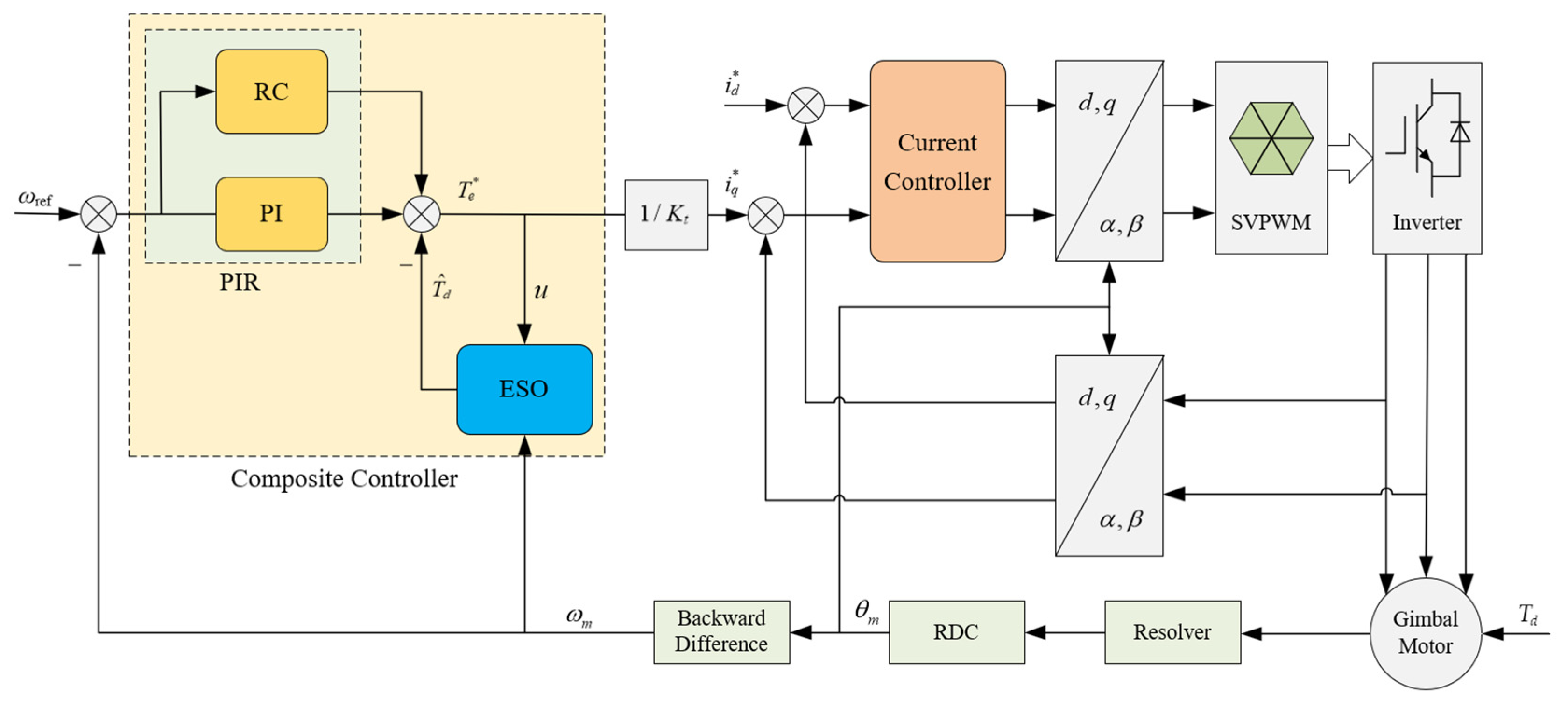
The PIR-ESO controller is first introduced as the baseline control framework. Then, adaptive mechanisms are introduced based on this structure, leading to the proposed APIR-AESO scheme. The overall schematic diagram of the PIR-ESO control scheme is illustrated in Figure 2, where RC represents the resonant controller and different colors indicate different functional modules in the system, including the PIR (yellow), the ESO (blue), current controller (orange) and speed measurement loop (green).
In the proposed method, the PIR controller is used to suppress fixed-period disturbances, while the ESO is used to estimate and compensate for slowly varying disturbances. The PIR-ESO controller output can be designed as
u = u P I R + d ^
where  u P I R  is output of the PIR controller, and  d ^  is the output of the ESO.

3.1. PIR Design

Since the controller output is the desired torque  T e , (1) can be rewritten as
J ω ˙ = T e B ω + d d = T d + ( T e T e )
where  T e = K t i q , d represents the lumped disturbance, including system uncertainties and disturbance torques.
Define  ω ref  denotes the reference angular speed,  θ ref  denotes the reference angular position. Let  x 1 = θ ref θ x 2 = ω ref ω u = T e . The system error model can be obtained from (9) as
x ˙ 1 = x 2 x ˙ 2 = B J x 2 1 J u + 1 J d + f 0
where  f 0 = ω ˙ ref + B ω ref / J  denotes the reference feedforward term, which can be compensated.
Since it is necessary to suppress both the disturbance due to isolator and the rotor imbalance disturbance, which occur at two different frequencies, the PIR controller is composed of a PI controller, and two resonant controllers. The control law of PIR can be designed as
u P I R = K P x 2 + K I x 1 + K R 1 ζ 1 ω 1 x 4 + K R 2 ζ 2 ω 2 x 6
x ˙ 3 = x 4 x ˙ 4 = ω 1 2 x 3 2 ζ 1 ω 1 x 4 + x 2
x ˙ 5 = x 6 x ˙ 6 = ω 2 2 x 5 2 ζ 2 ω 2 x 6 + x 2
where  K P K I K R 1  and  K R 2  denote the proportional gain, integral gain, and the two resonant gains respectively;  ζ 1  and  ζ 2  denote the damping ratios;  ω 1  and  ω 2  denote the resonant frequencies;  x 3 x 4 x 5  and  x 6  denote the internal states of the two resonant controllers.
The PIR controller can also be represented in the transfer function form as
G P I R ( s ) = K P + K I s + K R 1 ζ 1 ω 1 s s 2 + 2 ζ 1 ω 1 s + ω 1 2 + K R 2 ζ 2 ω 2 s s 2 + 2 ζ 2 ω 2 s + ω 2 2
In practical CMG gimbal servo systems, rotor imbalance disturbance and disturbance due to isolator are typically narrowband and have relatively separated frequency components. Therefore, the PIR controller is well-suited for such scenarios. However, for broadband disturbances or closely spaced frequency components, the performance may be degraded due to reduced frequency selectivity.

3.2. ESO Design

Let  z 1 = J ω  denote the state variable of the ESO, and  z 2 = d  denote an extended state variable. Moreover, to achieve faster and more accurate disturbance estimation, the derivative of the lumped disturbance  d ˙  is introduced as the other extended state variable  z 3 . Then the extended state-space model can be derived from (10) as
z ˙ 1 = z 2 B z 1 / J + u z ˙ 2 = z 3 z ˙ 3 = d ¨
Let  z ^ 1 ,   z ^ 2  and  z ^ 3  denote the estimates of  z 1 ,   z 2  and  z 3  respectively, and take  z 1  as the measured output. Based on the extended state-space model (15), the ESO can be designed as
z ^ ˙ 1 = z ^ 2 + β 1 ( z 1 z ^ 1 ) B z ^ 1 / J + u z ^ ˙ 2 = z ^ 3 + β 2 ( z 1 z ^ 1 ) z ^ ˙ 3 = β 3 ( z 1 z ^ 1 )
where  β 1 β 2  and  β 3  are observer gains, and  d ^ = z ^ 2  is the output of ESO.
Let  e i = z i z ^ i , the error dynamics of the ESO can be derived as
e ˙ 1 = ( β 1 B / J ) e 1 + e 2 e ˙ 2 = β 2 e 1 + e 3 e ˙ 3 = β 3 e 1 + d ¨
Furthermore, the ESO error dynamics can be expressed in matrix form as
e ˙ = A e + b d ¨
where
e = e 1 e 2 e 3 ,   A = β 1 B / J 1 0 β 2 0 1 β 3 0 0 ,   b = 0 0 1
Since the system (18) is observable, the observer gain can be properly designed such that the matrix A becomes Hurwitz, which guarantees the convergence of the observation errors. The characteristic polynomial of A can be written as
s 3 + ( β 1 + B / J ) s 2 + β 2 s + β 3 = 0
If all poles are placed at  Ω , the desired characteristic polynomial is chosen as
( s + Ω ) 3 = s 3 + 3 Ω s 2 + 3 Ω 2 s + Ω 3
By comparing the coefficients of (20) and (21), the observer gains can be obtained as
β 1 = 3 Ω B / J β 2 = 3 Ω 2 β 3 = Ω 3
Since matrix A is Hurwitz, there exists a unique positive definite symmetric matrix P satisfying
A T P + P A = I
To prove the stability of the ESO, consider a Lyapunov candidate function as
V 1 = e T P e
Taking the time derivative of (24) along (18) and (23) gives
V ˙ 1 = e ˙ T P e + e T P e ˙ = e T e + 2 e T P b d ¨
Let  δ  denote the upper bound of  d ¨ , then  b d ¨ δ . From (25), the following equation can be derived:
V ˙ 1 e 2 + 2 e P δ = e ( e 2 P δ )
When  e > 2 P δ , it follows that  V ˙ 1 < 0 . Therefore, the estimation error system is uniformly ultimately bounded, and the estimation error converges to a neighborhood of the origin satisfying  e 2 P δ .

3.3. Stability Analysis

To analyze the stability of the overall closed-loop system, choose a Lyapunov candidate function as
V = V 1 + V 2 + V 3
where
V 2 = 1 2 K I x 1 2 + 1 2 J x 2 2 > 0
V 3 = K R 1 ζ 1 ω 1 2 ( ω 1 2 x 3 2 + x 4 2 ) + K R 2 ζ 2 ω 2 2 ( ω 2 2 x 5 2 + x 6 2 ) > 0
Taking the time derivative of (28) along (10) and (11) gives
V ˙ 2 = K I x 1 x 2 + J x 2 x ˙ 2 = K I x 1 x 2 + x 2 ( u B x 2 + d ) = x 2 ( K I x 1 ( K P x 2 + K I x 1 + K R 1 ζ 1 ω 1 x 4 + K R 2 ζ 2 ω 2 x 6 + d ^ ) B x 2 + d ) = ( K P + B ) x 2 2 K R 1 ζ 1 ω 1 x 2 x 4 K R 2 ζ 2 ω 2 x 2 x 6 + x 2 d ˜
where  d ˜  denotes the estimation error of ESO, and  d ˜ = z 2 z ^ 2 = e 2 .
Taking the time derivative of (29) along (12) and (13) gives
V ˙ 3 = K R 1 ζ 1 ω 1 ( ω 1 2 x 3 x 4 + x 4 x ˙ 4 ) + K R 2 ζ 2 ω 2 ( ω 2 2 x 5 x 6 + x 6 x ˙ 6 ) = K R 1 ζ 1 ω 1 ( 2 ζ 1 ω 1 x 4 2 + x 2 x 4 ) + K R 2 ζ 2 ω 2 ( 2 ζ 2 ω 2 x 6 2 + x 2 x 6 ) = 2 K R 1 ζ 1 2 ω 1 2 x 4 2 2 K R 2 ζ 2 2 ω 2 2 x 6 2 + K R 1 ζ 1 ω 1 x 2 x 4 + K R 2 ζ 2 ω 2 x 2 x 6
Taking the time derivative of (27) along (25), (30) and (31) gives
V ˙ = K P x 2 2 2 K R 1 ζ 1 2 ω 1 2 x 4 2 2 K R 2 ζ 2 2 ω 2 2 x 6 2 + x 2 d ˜ e T e + 2 e T P b d ¨
Since the following inequality holds
x 2 d ˜ = x 2 e 2 1 2 x 2 2 + 1 2 e 2 2
e 2 2 e 1 2 + e 2 2 + e 3 2 = e 2
From (32)–(34), it follows that
V ˙ ( K P + B 1 2 ) x 2 2 2 K R 1 ζ 1 2 ω 1 2 x 4 2 2 K R 2 ζ 2 2 ω 2 2 x 6 2 1 2 e 2 + 2 e P δ
When  K P + B > 1 / 2  and  e > 4 P δ , it follows that  V ˙ < 0 . Therefore, the overall closed-loop system is uniformly ultimately bounded, and the estimation error converges to a neighborhood of the origin satisfying  e 4 P δ .

4. APIR-AESO Controller

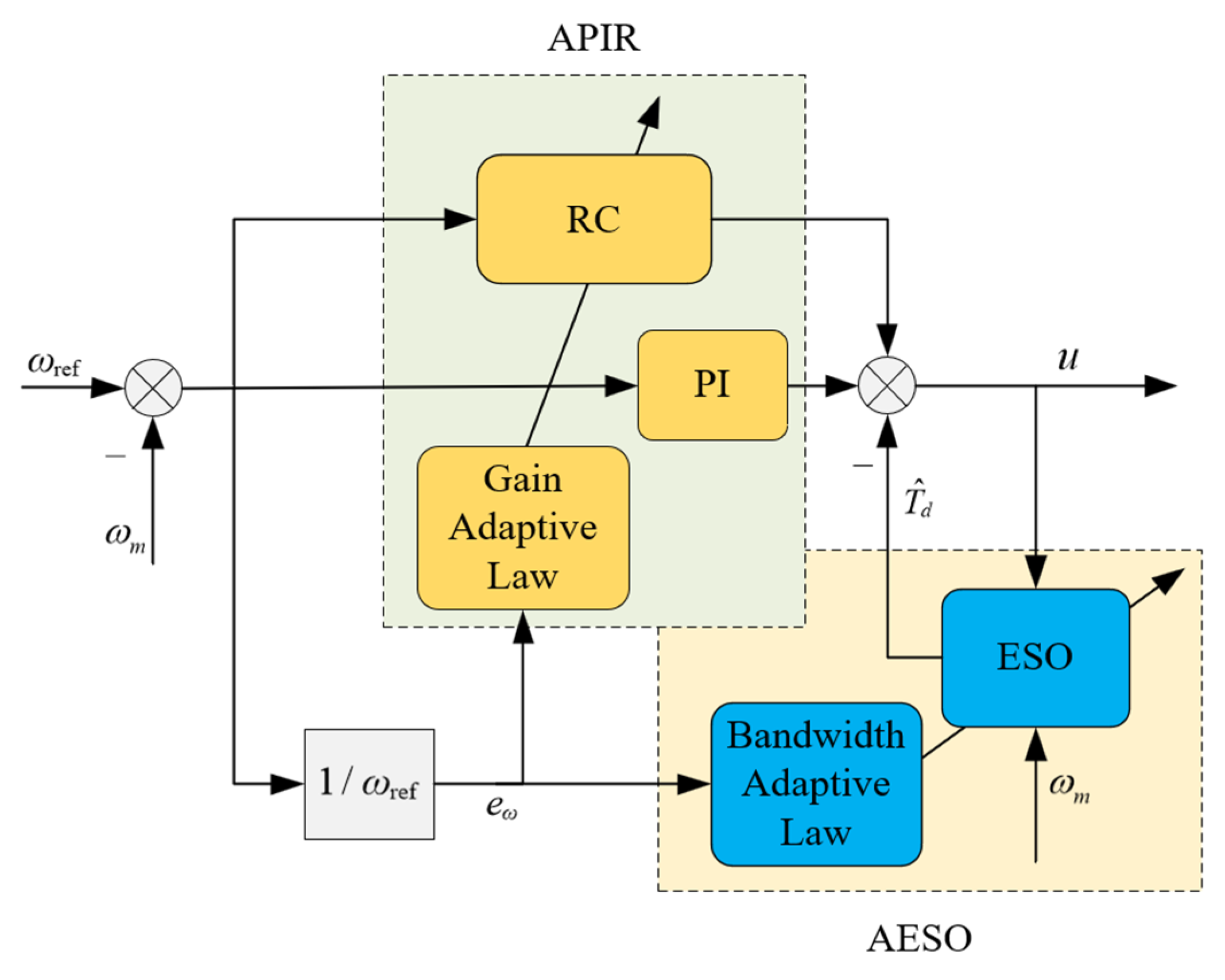
Based on the PIR-ESO controller, phase compensation is first introduced into the PIR to ensure stability in practical applications. Then, the PIR is extended to an APIR by introducing a gain adaptive law, while the ESO is extended to an AESO by introducing a bandwidth adaptive law, resulting in the final APIR-AESO control method. The schematic diagram of the APIR-AESO control method is illustrated in Figure 3.

4.1. APIR Design

In order to effectively suppress fixed-period disturbances, the PIR controller requires a large resonant gain. However, a large resonant gain may lead to the following problems:
(1)
A large resonant gain can introduce significant phase lag, leading to insufficient phase margin. Meanwhile, the speed measurement loop of the CMG gimbal motor, including a resolver, resolver to digital converter (RDC), and backward difference module, introduces additional phase lag and may even lead to system instability.
(2)
During the transient process, a large resonant gain reduces the system damping ratio. The decrease in damping deteriorates the transient performance, which is manifested as large overshoot and prolonged settling time.
To mitigate the adverse effects of phase lag, phase compensation can be introduced. To increase the phase response of the resonant term by  φ  at  ω i , the variable s in the numerator is replaced with  s cos φ ω i sin φ  [40]. Therefore, the phase-compensated PIR controller is designed as follows:
G P I R ( s ) = K P + K I s + K R 1 ζ 1 ω 1 ( s cos φ 1 ω 1 sin φ 1 ) s 2 + 2 ζ 1 ω 1 s + ω 1 2 + K R 2 ζ 2 ω 2 ( s cos φ 2 ω 2 sin φ 2 ) s 2 + 2 ζ 2 ω 2 s + ω 2 2
To improve transient performance of PIR, an adaptive law of resonant gain is designed with the following objectives:
(1)
The gain should be as small as possible during the transient process and as large as possible in steady state.
(2)
An upper limit on the gain should be imposed.
(3)
The gain transitions should be as smooth as possible.
The relative speed error  e ω  is defined as follows:
e ω = ω m ω ref ω ref
where  ω m  denotes the measured speed,  ω ref  denotes the reference speed.
The adaptive law for the resonant controller gain is designed as follows:
K R i = K r i exp ( σ e ω )
where  K r i  denotes the maximum resonant gain, corresponding to the steady-state gain of the resonant controller (i = 1, 2);  σ  is the sensitivity coefficient, which regulates the sensitivity of the adaptive gain with respect to the speed error.
When  σ = 0 , the APIR controller degenerates to a conventional PIR. Therefore,  σ  should be as large as possible during the transient phase and as small as possible in steady state. Accordingly, the adaptive law for  σ  is designed as follows:
σ = σ max tanh ( e ω )
where  σ max  denotes the maximum sensitivity coefficient.
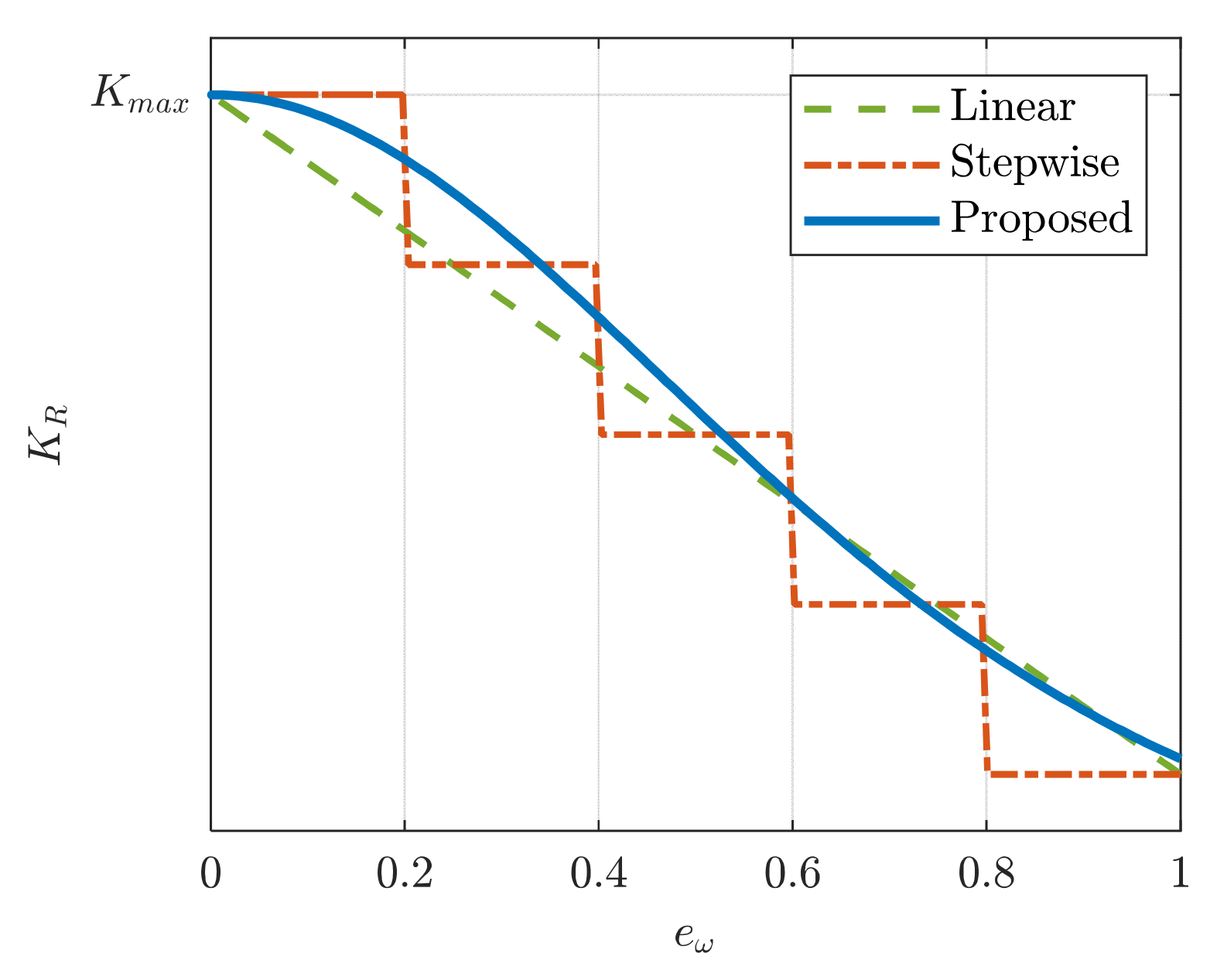
To illustrate the variation in the proposed gain adaptive law, it is compared with several widely used and representative adaptive functions, including the linear adaptive law and the stepwise adaptive law. The curve of these gain adaptive laws is shown in Figure 4.
As can be seen from Figure 4, compared with the stepwise adaptive law, the proposed adaptive law provides a smoother transition, thereby avoiding abrupt changes in the resonant gain. Compared with the linear adaptive law, the proposed adaptive law provides a larger gain for small relative errors (steady-state region), while preserving a smaller gain for large relative errors (transient region).

4.2. AESO Design

A fixed observer bandwidth restricts the dynamic response and steady-state accuracy of the ESO. For example, Increasing the observer bandwidth improves dynamic performance of disturbance estimation but amplifies measurement noise. Conversely, reducing the bandwidth enhances noise attenuation but degrades dynamic performance. In particular, rapid disturbance tracking becomes challenging when abrupt disturbance variations occur.
Therefore, the adaptive law of bandwidth is designed to improve the ESO with the following objectives:
(1)
In the transient state, when the motor speed error is large, the AESO bandwidth is increased to rapidly track disturbances.
(2)
In the steady state, when the motor speed error is small, the AESO bandwidth is reduced to prevent amplification of high-frequency noise, thereby improving the steady-state accuracy of the servo system.
(3)
An upper limit on the gain should be imposed and the bandwidth transitions should be as smooth as possible.
The target bandwidth is designed as follows:
Ω d = Ω min + ( Ω max Ω min ) tanh ( α e ω )
where  Ω max  denotes the maximum bandwidth,  Ω min  denotes the minimum bandwidth,  α  is a tuning coefficient that controls the sensitivity of the bandwidth to the error; the larger the value of  α , the more the bandwidth is affected by the error.
However, direct application of the target bandwidth may induce frequent fluctuations in the ESO bandwidth, which may destabilize the system. To smooth the bandwidth variation and prevent instability caused by abrupt changes, a first-order low-pass filter is designed as follows:
Ω ( s ) = γ s + γ Ω d ( s )
where  γ  denotes the cutoff frequency of the filter.
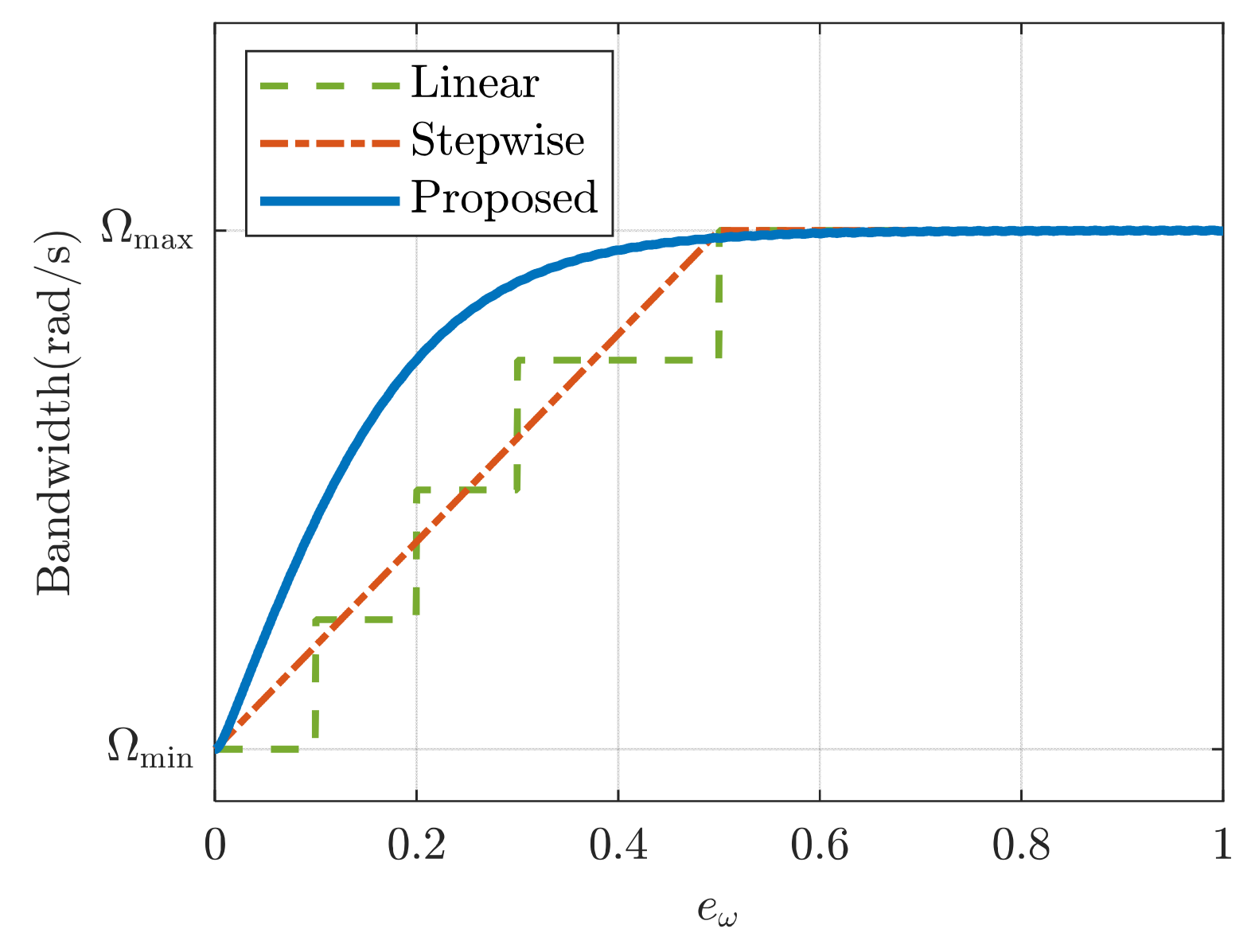
To illustrate the variation in the proposed bandwidth adaptive law, it is compared with several widely used and representative adaptive functions, including the linear adaptive law and the stepwise adaptive law. The curve of these bandwidth adaptive laws is shown in Figure 5.
As can be seen from Figure 5, compared with the linear adaptive law and stepwise adaptive law, the proposed adaptive law provides a smoother transition, thereby avoiding abrupt changes in the resonant gain; moreover, it provides a larger bandwidth for large relative errors (transient region) and decreases rapidly as the relative error diminishes (steady-state region), thereby achieving improved steady-state accuracy while ensuring fast disturbance tracking.
In the APIR-AESO, the adaptive parameters remain bounded within a range that preserves stability, ensuring that both the closed-loop tracking error and the disturbance estimation error are uniformly ultimately bounded.

4.3. Parameter Tuning

To investigate the tuning of the PIR controller with phase compensation, the open-loop transfer function and sensitivity function of the gimbal motor servo system, including the speed measurement loop, are first formulated. The parameters of the gimbal motor and the speed measurement loop are listed in Table 1.
In this work, the AD2S1210 chip is used as the RDC. According to the chip manual, its transfer function in the control system is given as
G R D C ( s ) = k a t 1 s + k a t 2 s 3 + s 2 + k a t 1 s + k a
where  k a ,   t 1 ,   t 2  denotes the parameters of the RDC.
The transfer function of the multi-step backward difference module can be expressed as
G D ( s ) = ω m ( s ) θ m ( s ) = s 1 + m T s s
where m denotes the backward difference step size,  T s  denotes the sampling interval.
The controlled plant is the gimbal motor, whose transfer function can be expressed as
G M ( s ) = 1 J s 2 + B s
By combining Equations (36) and (42)–(44), the open-loop transfer function of system can be obtained as
G o ( s ) = G P I R ( s ) G M ( s ) G D ( s ) G R D C ( s )
The sensitivity function of the CMG gimbal motor control system can be obtained as
S ( s ) = 1 1 + G o ( s )
The ability of the PIR controller to suppress disturbances at the resonant frequency can be quantified by the magnitude of the sensitivity function at that frequency, which can be calculated as
S ( j ω i ) 1 1 + G o ( j ω i ) = 1 1 + G P I R ( j ω i ) G R D C ( j ω i ) G D ( j ω i ) G M ( j ω i )
At the frequency  ω i , due to the mismatch of the central frequencies, the other resonant controller responds minimally, and its magnitude contribution can be neglected. At high frequencies, the magnitude of the integral term is also small and can be ignored. Therefore, when  K R  is much larger than  K p , the magnitude of the PIR controller at  ω i  is given as
G P I R ( j ω i ) = K p 2 + ( K R ζ i ω i ( j ω i ) ( j ω i ) 2 + 2 ζ i ω i ( j ω i ) + ω i 2 ) 2 K R i 2
To reduce the disturbance amplitude to 20% of its original value, i.e.,  | S ( j ω i ) | = 0.2 , and with the resonant frequency  ω 1 = 110 Hz  and  ω 2 = 15 Hz , the corresponding resonant controller gain can be obtained from Equation (48) as  K R 1 4000 K R 2 500 .
Next, the phase-compensation angle is determined as follow. Since the integral term can be neglected at high frequencies, the minimum phase of the PIR controller in the vicinity of the resonant frequency can be estimated as [41]
min G P I R ( j ω ) = π 2 + 2 arctan K P K P + K R i / 2
Since this minimum phase occurs in the vicinity of the resonant frequency, it can be approximated as
G P I R ( j ω i ) = min G P I R ( j ω )
In addition, the phase lag introduced by the current loop latency can be estimated as [40]
G I ( j ω i ) = 1.5 ω i T s
It should be noted that unmodeled dynamics introduce additional phase lag, which can be accommodated by a sufficiently large phase margin (PM). In practice, a PM of 45°~60° is commonly used, and PM = 50° is selected in this work as a compromise between robustness and dynamic performance. The choice of a fixed phase margin is intended to simplify the controller design while ensuring sufficient robustness.
Then, the phase compensation angle  φ  can be calculated from (52)
PM = 180 ° + φ + G P I R ( j ω i ) + G M ( j ω i ) + G R D C ( j ω i ) + G D ( j ω i ) + G I ( j ω i )
For example, when the resonant frequencies are  ω 1 = 110   Hz  and  ω 2 = 15   Hz , and  K P  is set to 10, the phase compensation angle  φ 1 = 150 °  and  φ 2 = 51 °  can be obtained.
To further explain the selection process of the damping ratio, define the resonant controller bandwidth  ω c i = ζ i ω i , which denotes the frequency range of disturbance attenuation. The resonant bandwidth is selected based on the following considerations:
(1)
The resonant bandwidth should be much smaller than the gain crossover frequency to avoid affecting the stability of the main control loop. And excessive bandwidth may amplify measurement noise and introduce additional phase lag.
(2)
The bandwidth should be large enough to cover the expected frequency variation range of the disturbance.
Based on these principles, a frequency-domain tuning procedure is adopted, where the bandwidth is gradually increased from a small initial value until a satisfactory trade-off between disturbance rejection and stability is achieved. Consequently,  ω c i = 1  rad/s is obtained, and thus  ζ 1 = 0.0016  and  ζ 2 = 0.011  are determined.
It should be noted that the introduction of adaptive mechanisms slightly increases the system complexity. However, the additional parameters are limited and can be tuned in a systematic manner. In practice, the baseline PIR-ESO controller can be first designed, and the adaptive mechanism can then be activated to improve performance, with parameters adjusted to balance convergence speed and robustness.
For the APIR, the maximum sensitivity coefficient  σ max  is set within the range of 1~3. For the AESO, the minimum bandwidth  Ω min  should be designed as 10~20 times the upper bound of the low-frequency disturbance to ensure disturbance-tracking capability. The maximum bandwidth  Ω max  is set to  2 Ω min , the tuning coefficient  α  can be chosen in the range of 20~50, and integral gain  γ  is set to 2~5.
Due to the sufficient phase margin designed in the PIR controller, the uncertainty estimation and compensation capability of the ESO, and the adaptive mechanism, the proposed method is not highly sensitive to moderate variations in controller gains and adaptive parameters.

5. Simulation Results

5.1. Simulation Verification of AESO Performance

To evaluate the performance of the APIR controller, a numerical simulation model was established. Fixed-period disturbances with frequencies matching the resonant frequencies of the resonant controller were introduced to emulate disturbance due to isolator and rotor imbalance disturbance. The APIR parameters are listed in Table 2.
It is worth noting that the conventional PIR for comparison is a special case of the APIR when the sensitivity coefficient is set to zero, meaning that the adaptive mechanism is disabled. Therefore, both controllers share an identical structure, parameter configuration and phase compensation design. And the performance improvement of the APIR can be directly attributed to the adaptive mechanism.
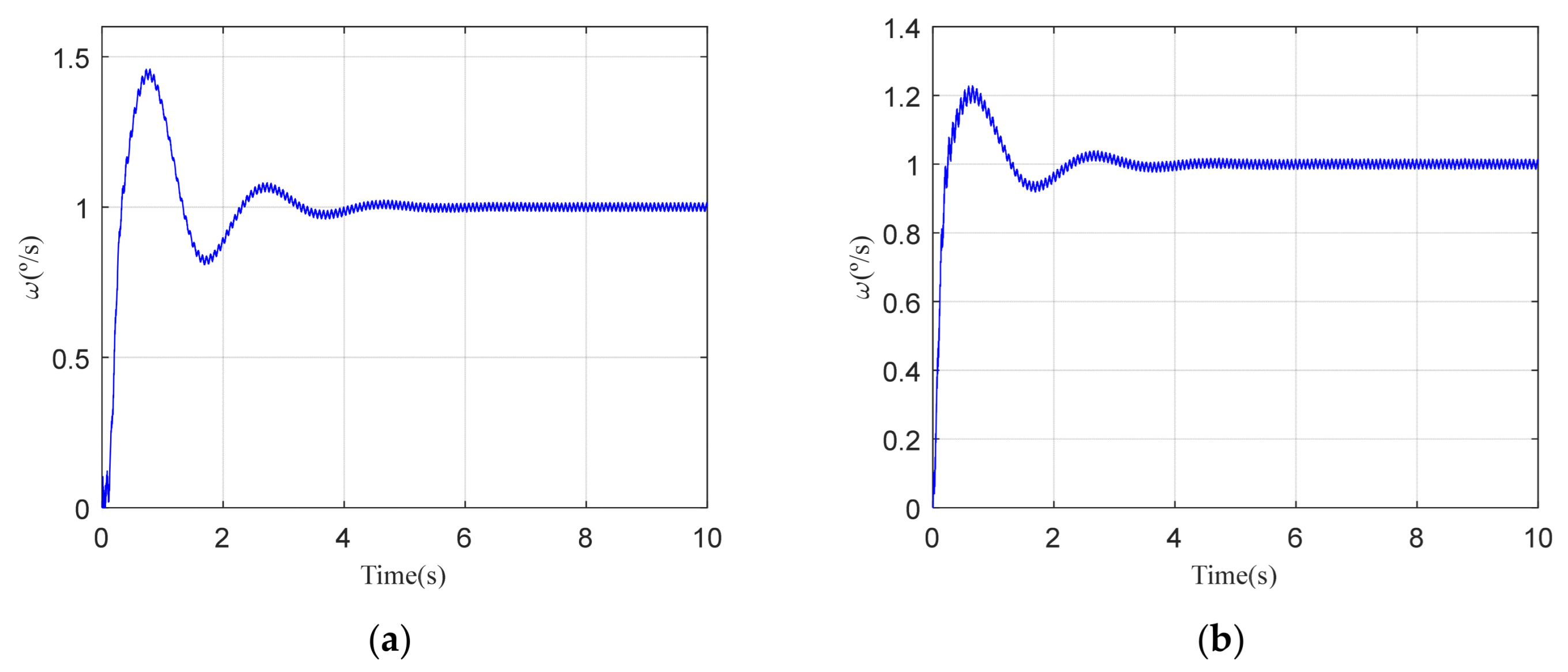
With a reference speed of 1°/s, the comparison between the conventional PIR controller and the APIR controller is shown in Figure 6. It can be seen that the conventional PIR controller exhibits large overshoot and a long settling time during the transient process. In contrast, the proposed APIR controller significantly reduces the overshoot and shortens the settling time through the designed adaptive law, while maintaining the same steady-state performance as the conventional PIR controller.
To further compare the APIR with the conventional PIR, this study introduces the following performance indices: the overshoot and settling time (with a 5% error band) are used to evaluate transient performance. To quantitatively analyze the dynamic tracking error, the root mean square (RMS) of the speed error and the maximum tracking error are adopted. The RMS reflects the overall tracking accuracy, while the maximum error characterizes the worst-case deviation during the transient process. The performance comparison of the two PIR controllers is summarized in Table 3.
It can be seen from Figure 6 and Table 3 that the APIR exhibits superior transient performance compared to the conventional PIR while the steady-state performance remains essentially the same.

5.2. Simulation Verification of AESO Performance

To evaluate the performance of the AESO, a numerical simulation model was established. Friction torque, cogging torque, and torque ripples due to flux distortion are introduced. Gaussian white noise is added before the measured speed output to simulate high-frequency noise. The parameters of the AESO are listed in Table 4.
The AESO is compared successively with the high-bandwidth ESO (20 rad/s), medium-bandwidth ESO (15 rad/s), and low-bandwidth ESO (10 rad/s). The performance is evaluated in terms of disturbance estimation error and estimation rapidity. The performance comparison results are shown in Figure 7 and Figure 8.
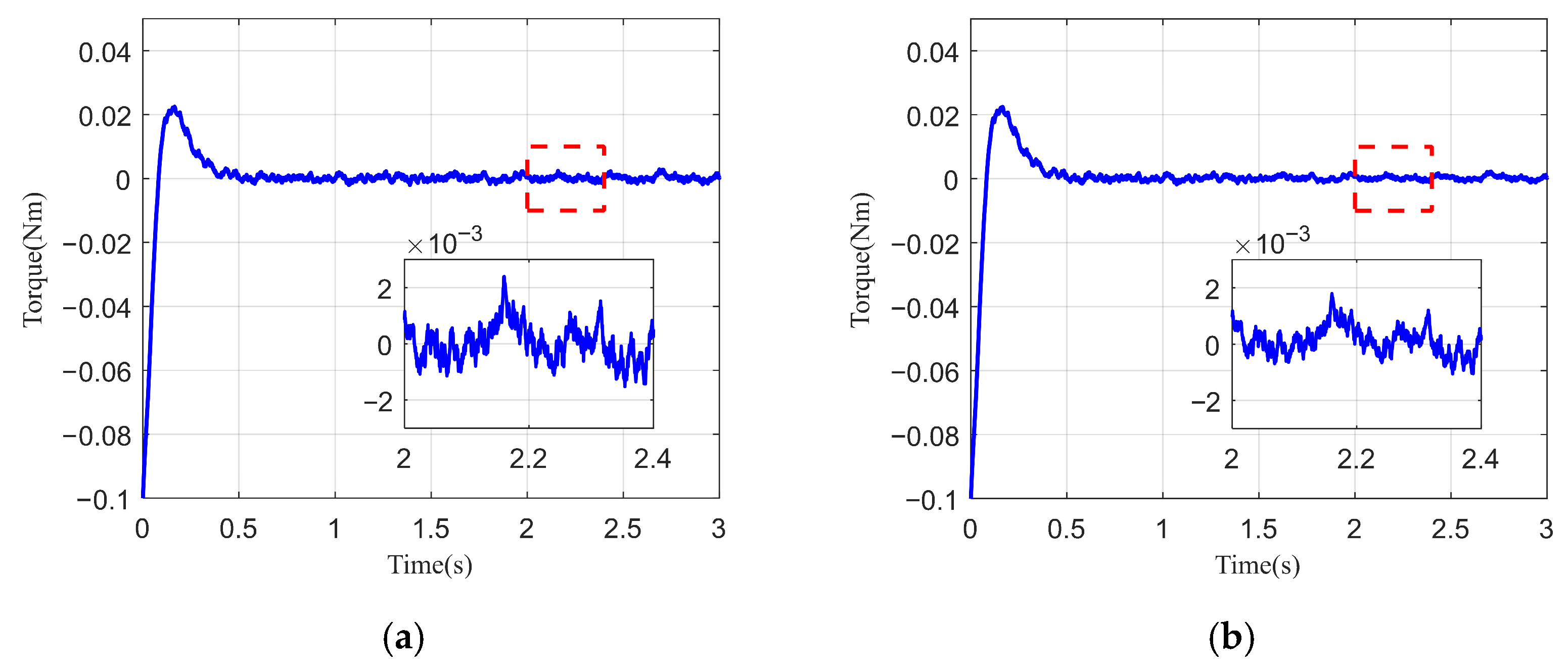
As shown in Figure 7, during the steady-state process, the disturbance estimation of the AESO is smoother compared with the high-bandwidth ESO, indicating better suppression of measurement noise and better steady-state performance.
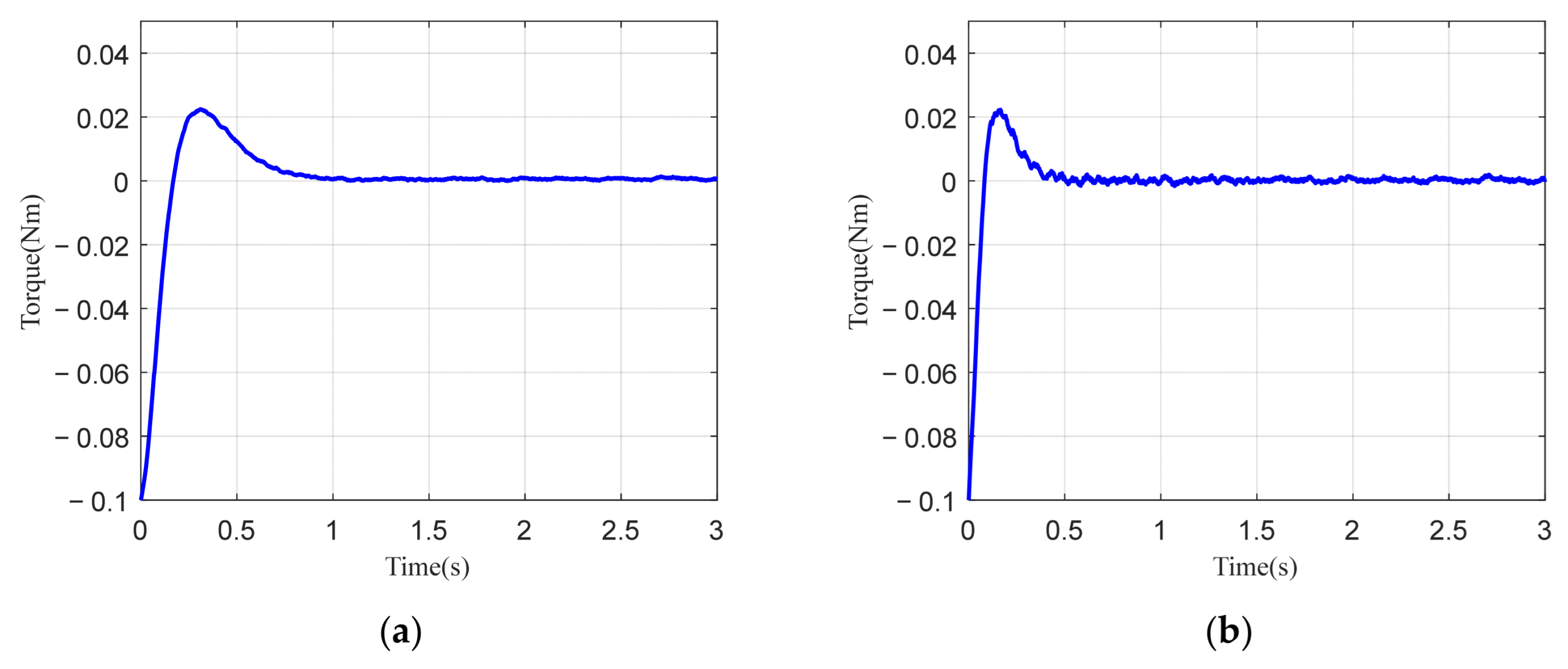
As shown in Figure 8, during the transient process of disturbance mutation, the AESO converges faster than the low-bandwidth ESO, enabling quicker and more accurate disturbance tracking.
To further compare the AESO and the conventional ESO, the following performance indices are introduced. Settling time is defined as the time required for the estimated disturbance to converge for the first time and remain within ±5% of the actual disturbance. Steady-state accuracy is defined as the root mean square (RMS) of the disturbance estimation error.
Moreover, the product of settling time and steady-state accuracy is adopted as the comprehensive index of the ESO. By taking their product, the comprehensive index favors solutions that are both fast and accurate, providing a simple yet effective balance between these two aspects without introducing additional weighting factors. With the inclusion of a medium-bandwidth ESO (15 rad/s) for comparison, the measured results are summarized in Table 5.
From Table 5, it can be concluded that the AESO outperforms the conventional fixed-parameter ESO in terms of both convergence speed and steady-state accuracy.

5.3. Simulation Verification of APIR-AESO Performance

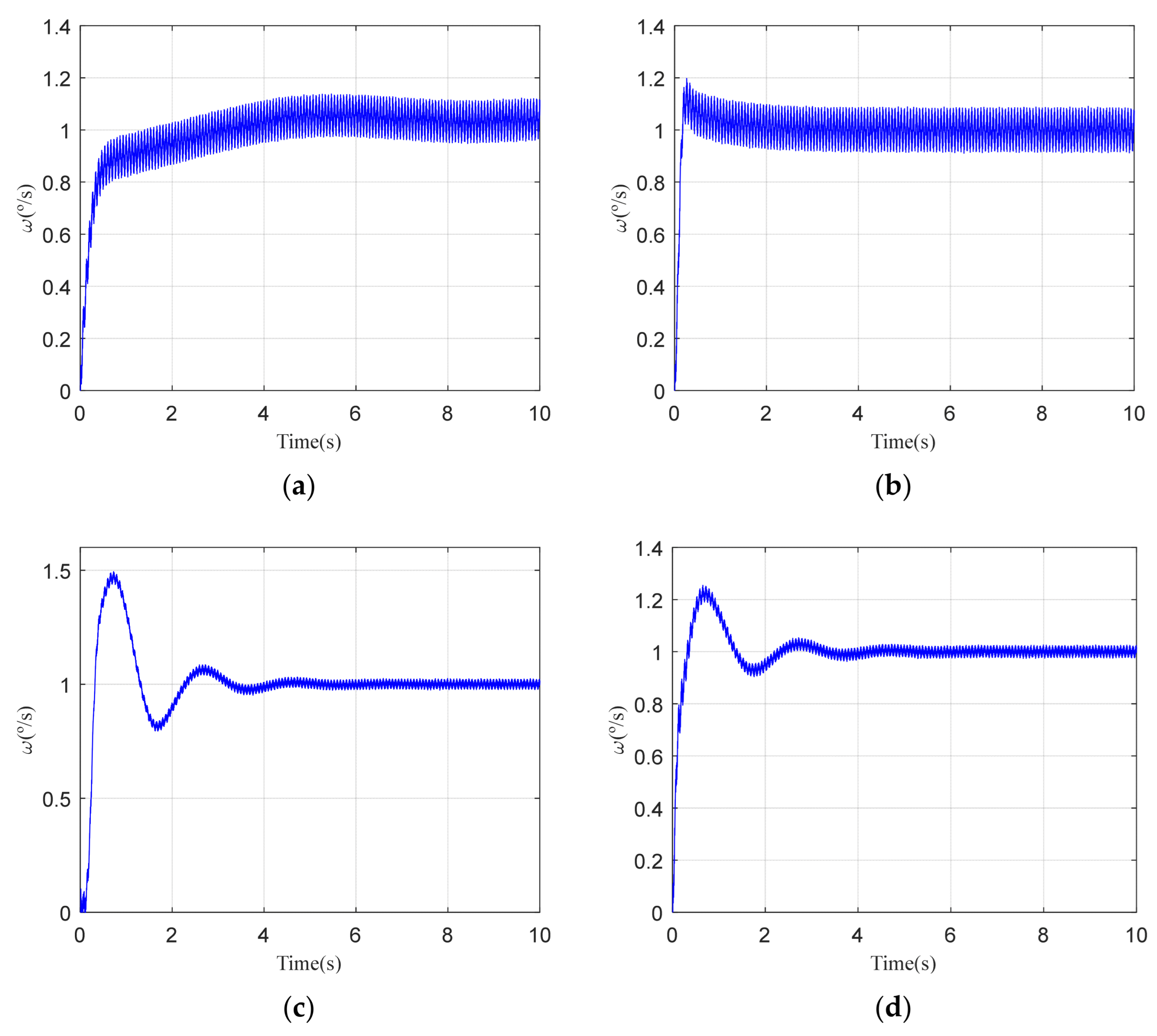
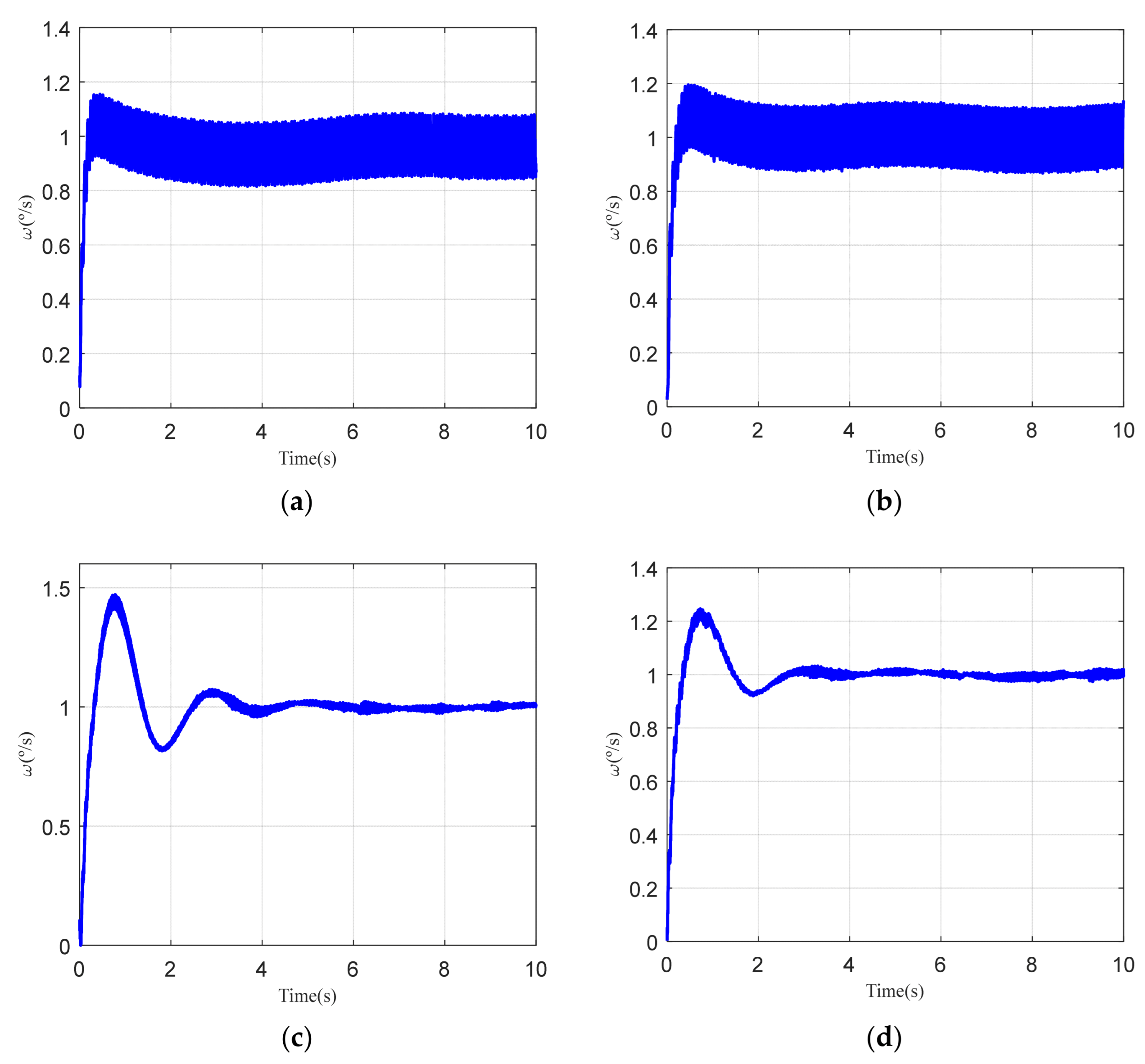
To evaluate the effectiveness of the APIR-AESO composite control strategy, comparative simulations are conducted against several representative methods. Figure 9 presents a comparison between the APIR-AESO scheme and other control methods, including PI, PI-ESO, and PIR-ESO.
As shown in Figure 9, APIR-AESO significantly suppress multiple disturbance in the gimbal compared with PI and PI-ESO. APIR-AESO also significantly improves transient performance, reducing overshoot and shortening settling time compared with PIR-ESO.

6. Experimental Results

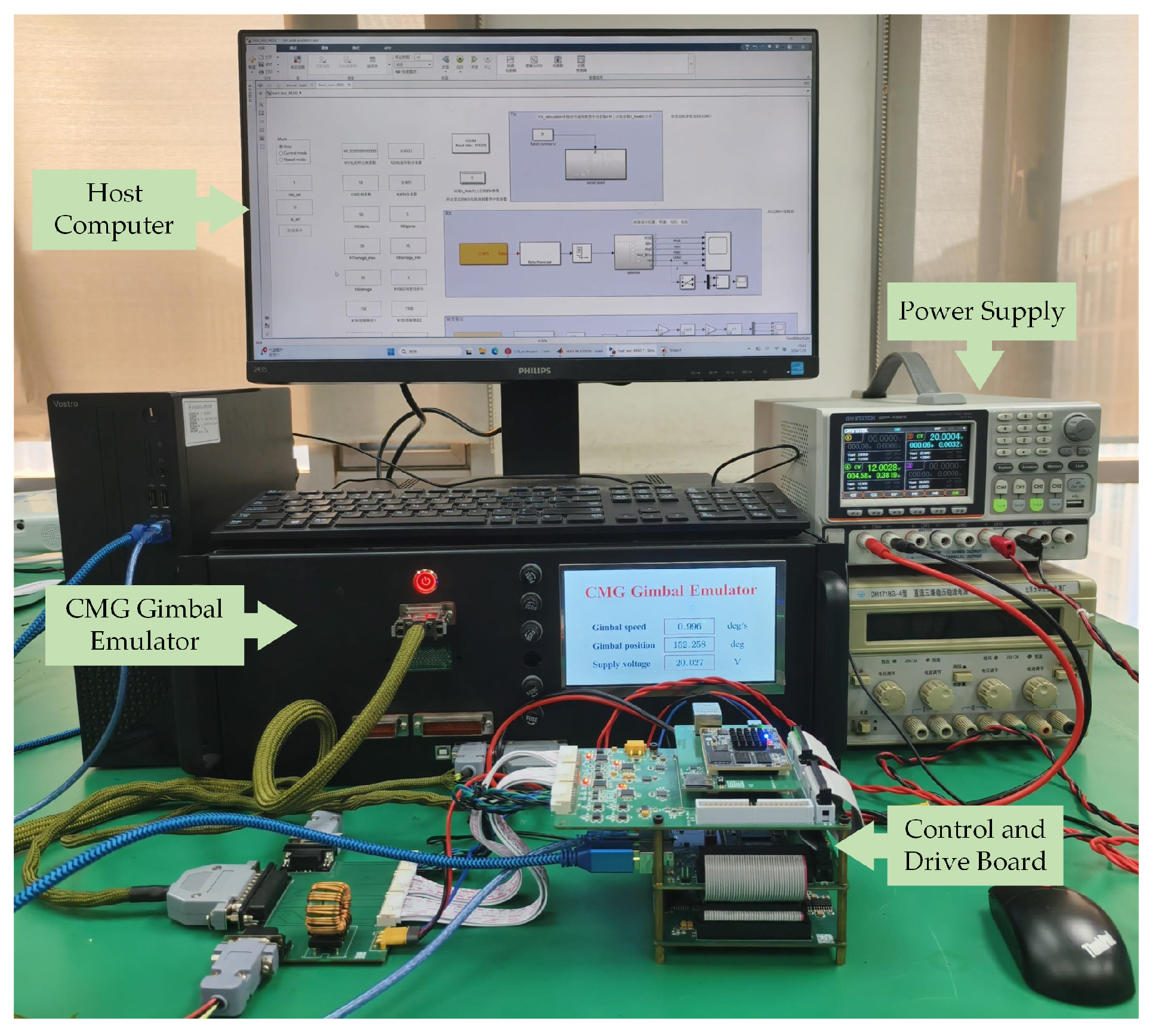
To further verify the performance of the APIR-AESO method, experiments were conducted on a semi-physical experiment platform. The platform consists of a host computer, a CMG gimbal emulator, a motor drive control board, a resolver signal processing board, and a power supply, as shown in Figure 10.
The reasons for using the CMG gimbal emulator are as follows: first, it can emulate the electrical and mechanical characteristics of the actual gimbal motor and resolver, providing more convincing results than numerical simulations; second, it allows for the controlled application of disturbance torques, with known true disturbance values, which is more convenient than using an actual motor and enables better evaluation of the proposed methods. In summary, the CMG gimbal emulator can serve as a substitute for the real CMG gimbal system and has been used for testing CMG drive circuits in spacecraft engineering. The emulator parameters are listed in Table 1, and the parameters of the APIR controller and AESO are listed in Table 2 and Table 4 respectively.

6.1. Experimental Verification of APIR Performance

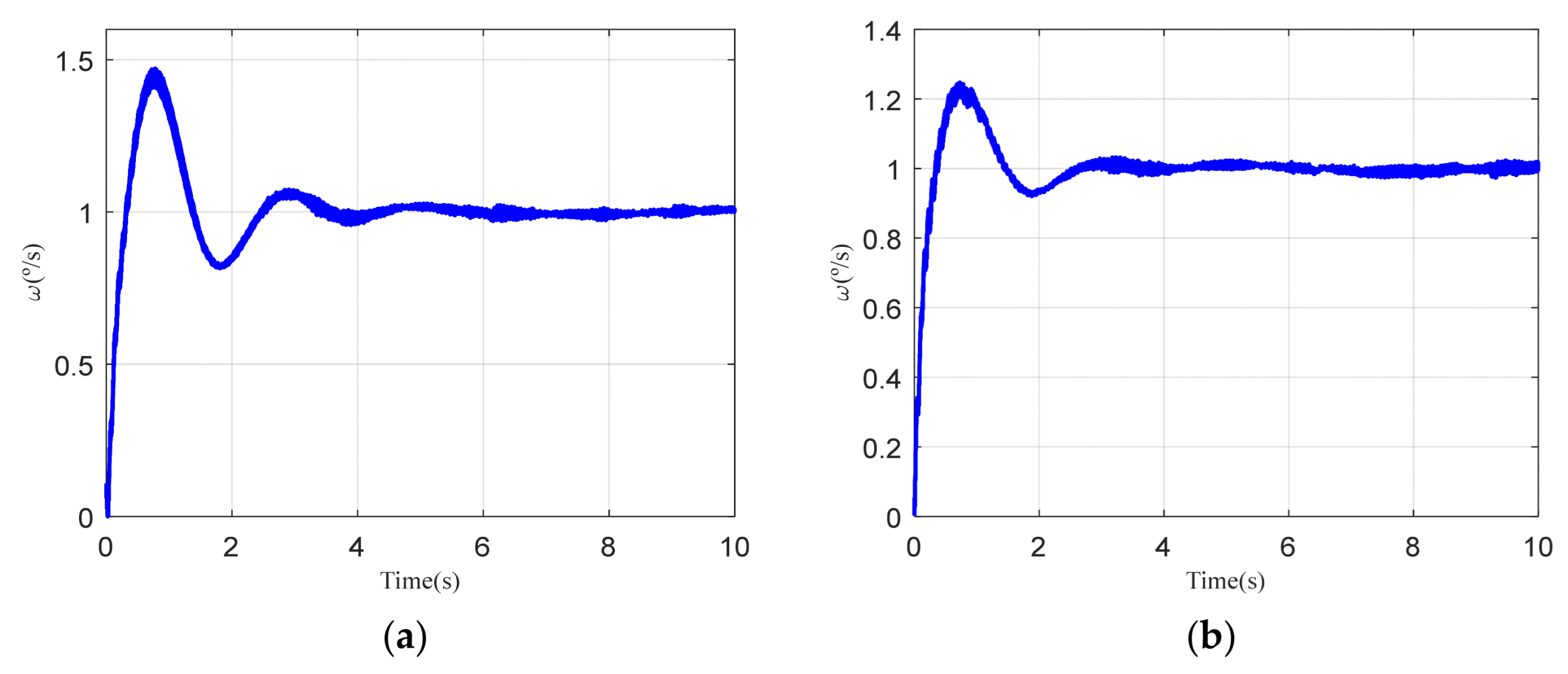
To further assess the effectiveness of the APIR controller, comparative experiments are performed in which only periodic disturbances are introduced, and the performances of the conventional PIR and the APIR are evaluated in Figure 11.
To further compare the APIR with the conventional PIR, the same performance indices as those used in the simulation study are introduced, including overshoot, settling time, maximum error and RMS. The performance comparison of the APIR controller and the conventional PIR controller is summarized in Table 6.
As can be seen from Figure 11 and Table 6, the conventional PIR controller exhibits large speed oscillations and a long settling time during the transient process. In contrast, the APIR controller significantly reduces speed oscillations and shortens the settling time while maintaining the same steady-state performance as the conventional PIR.

6.2. Experimental Verfication of AESO Performance

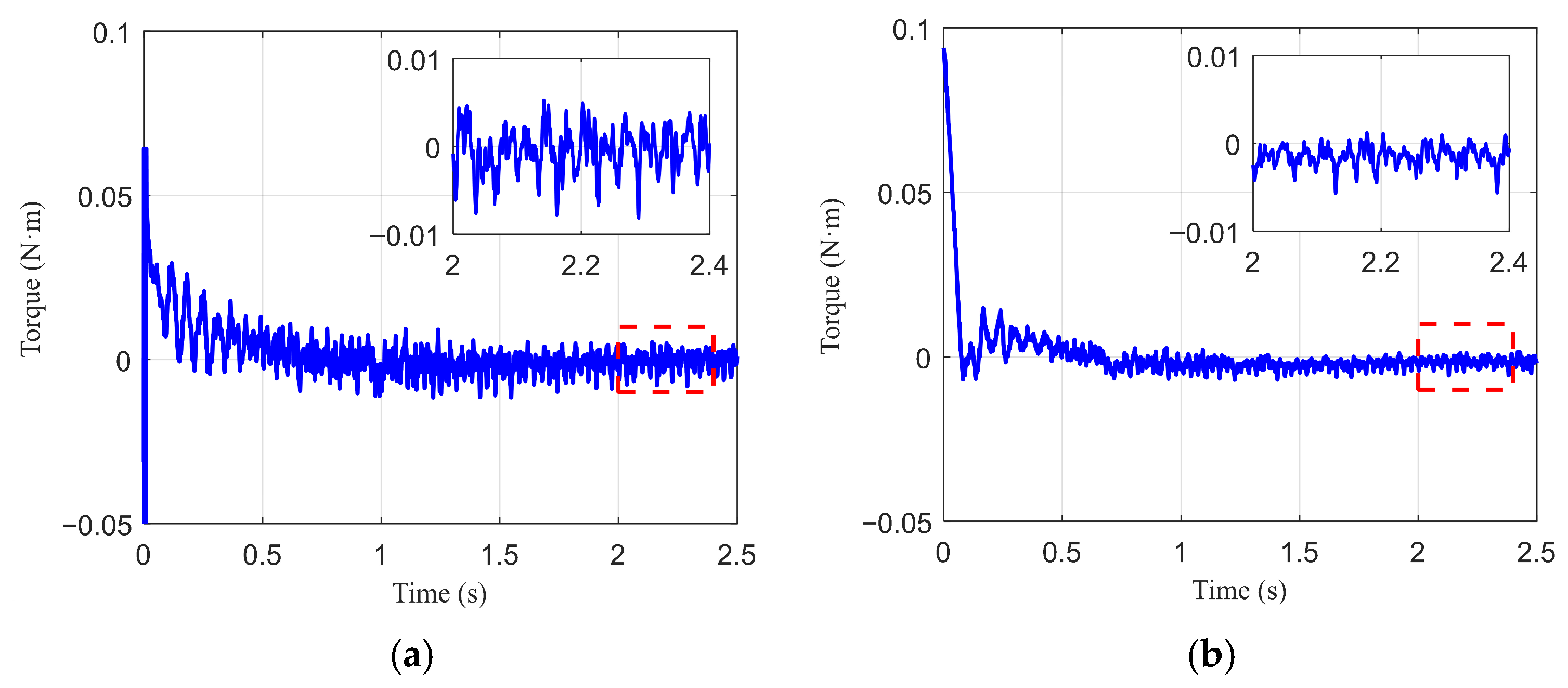
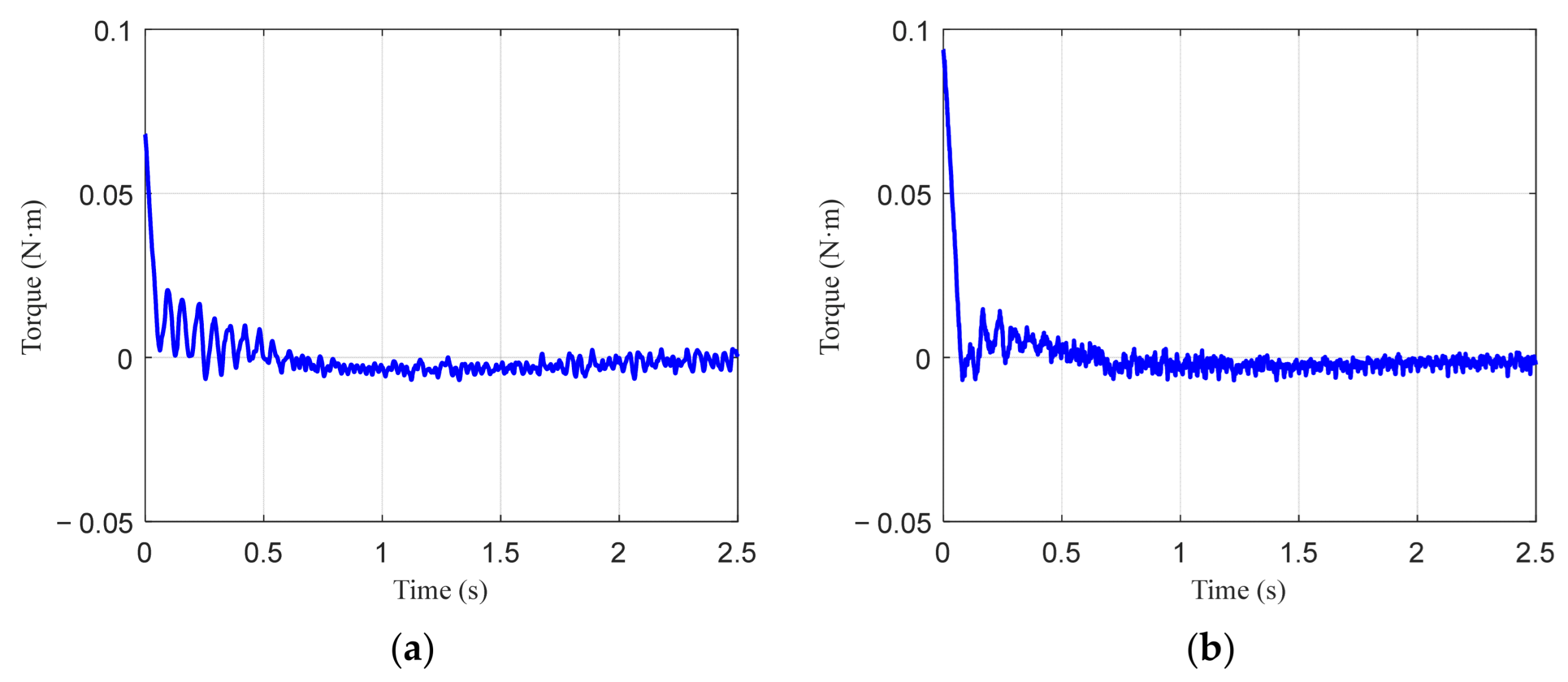
As can be seen from Figure 12 and Figure 13, the AESO achieves a shorter settling time compared with the low-bandwidth ESO in the transient phase, and exhibits stronger noise immunity than the high-bandwidth ESO in the steady-state phase.
To further compare the AESO with the conventional ESO, the same performance indices as in the simulation: settling time, steady-state accuracy, and the comprehensive index. The comparison results of the performance indices between the AESO and the high-, medium-, and low-bandwidth ESOs are presented in Table 7.
From the above analysis and calculation, it can be concluded that the AESO outperforms the conventional fixed-parameter ESO in terms of both dynamic performance and steady-state accuracy.

6.3. Experimental Verfication of APIR-AESO Performance

To evaluate the effectiveness of the APIR-AESO composite control strategy, comparative experiments are conducted against several representative methods. Figure 9 presents a comparison between the APIR-AESO scheme and other control methods, including PI, PI-ESO, and PIR–ESO.
As shown in Figure 14, APIR-AESO significantly suppress multiple disturbance in the gimbal servo system compared with PI and PI-ESO. APIR-AESO also significantly improves transient performance, reducing overshoot and shortening settling time, while maintaining essentially the same steady-state performance compared with conventional PIR-ESO.

7. Conclusions

In this paper, a novel APIR-AESO composite control method is proposed for CMG gimbal servo systems. The proposed method is particularly suitable for applications requiring high-precision control under multiple disturbances, such as precision pointing platform. The main contributions of this work are summarized as follows:
(1)
A dynamic model of the isolated CMG gimbal servo system is established, and multiple disturbances distributed over a wide frequency range are analyzed.
(2)
An APIR controller with phase compensation is proposed to suppress fixed-period disturbances, leading to improved transient performance compared with the conventional PIR controller.
(3)
An AESO is developed to suppress slowly varying disturbances, leading to enhanced dynamic performance and steady-state accuracy compared with the conventional ESO.
Both simulation and experimental results verify that the APIR-AESO effectively suppresses multiple disturbances and improves the overall control performance.
It should be noted that the proposed method may exhibit performance degradation under certain conditions, such as closely spaced disturbance frequencies, broadband disturbances, and high noise levels. Future work will focus on improving robustness under these conditions, extending the proposed method to more complex scenarios, and providing a more comprehensive Lyapunov-based analysis for the adaptive case.

Author Contributions

Conceptualization, S.L. and Z.W.; methodology, S.L.; software, S.L.; validation, S.L.; writing—original draft preparation, S.L. and B.Z.; writing—review and editing, S.L., B.Z. and Z.W. All authors have read and agreed to the published version of the manuscript.

Funding

This research received no external funding.

Data Availability Statement

Numerical simulation and experimental data presented in this paper are available from the corresponding author upon reasonable request.

Conflicts of Interest

The authors declare no conflicts of interest.

References

  1. Bhat, S.P.; Tiwari, P.K. Controllability of Spacecraft Attitude Using Control Moment Gyroscopes. IEEE Trans. Autom. Control 2009, 54, 585–590. [Google Scholar] [CrossRef]
  2. Ren, Y.; Fang, J. High-Stability and Fast-Response Twisting Motion Control for the Magnetically Suspended Rotor System in a Control Moment Gyro. IEEE/ASME Trans. Mechatron. 2013, 18, 1625–1634. [Google Scholar] [CrossRef]
  3. Luo, Q.; Li, D.; Zhou, W.; Jiang, J.; Yang, G.; Wei, X. Dynamic Modelling and Observation of Micro-Vibrations Generated by a Single Gimbal Control Moment Gyro. J. Sound Vib. 2013, 332, 4496–4516. [Google Scholar] [CrossRef]
  4. Luo, Q.; Li, D.; Jiang, J. Coupled Dynamic Analysis of a Single Gimbal Control Moment Gyro Cluster Integrated with an Isolation System. J. Sound Vib. 2014, 333, 345–363. [Google Scholar] [CrossRef]
  5. Pan, S.; Xu, Z.; Lu, M.; Chen, L.; Liang, Z.; Zhang, J. The Coupling Analysis for the Gimbal Servo System of a Control Moment Gyroscope Considering the Influence of a Flexible Vibration Isolator. ISA Trans. 2023, 137, 601–614. [Google Scholar] [CrossRef]
  6. Cui, Y.; Li, W.; Qiao, J.; Guo, L. Finite-Time Refined Antidisturbance Velocity Tracking Control for Gimbal System of Control Moment Gyros with Harmonic Drive. IEEE Trans. Aerosp. Electron. Syst. 2023, 59, 2794–2806. [Google Scholar] [CrossRef]
  7. Zhang, Y.; Zhang, J. Disturbance Characteristics Analysis of CMG Due to Imbalances and Installation Errors. IEEE Trans. Aerosp. Electron. Syst. 2014, 50, 1017–1026. [Google Scholar] [CrossRef]
  8. Hekimoğlu, B. Optimal Tuning of Fractional Order PID Controller for DC Motor Speed Control via Chaotic Atom Search Optimization Algorithm. IEEE Access 2019, 7, 38100–38114. [Google Scholar] [CrossRef]
  9. Mishra, D.D.; Padhi, P.; Tripathy, A.A.; Patnaik, S.; Sahoo, P.K. Optimal Tuning of Fractional Order PID Controller Using Nelder-Mead Algorithm for DC Motor Speed Control. In Proceedings of the 2023 International Conference in Advances in Power, Signal, and Information Technology (APSIT), Bhubaneswar, India, 9–11 June 2023; pp. 373–378. [Google Scholar]
  10. Wrat, G.; Ranjan, P.; Bhola, M.; Mishra, S.K.; Das, J. Position Control and Performance Analysis of Hydraulic System Using Two Pump-Controlling Strategies. Proc. Inst. Mech. Eng. Part I J. Syst. Control Eng. 2019, 233, 1093–1105. [Google Scholar] [CrossRef]
  11. Zhang, X.; Sun, L.; Zhao, K.; Sun, L. Nonlinear Speed Control for PMSM System Using Sliding-Mode Control and Disturbance Compensation Techniques. IEEE Trans. Power Electron. 2013, 28, 1358–1365. [Google Scholar] [CrossRef]
  12. Nguyen, T.H.; Nguyen, T.T.; Nguyen, V.Q.; Le, K.M.; Tran, H.N.; Jeon, J.W. An Adaptive Sliding-Mode Controller with a Modified Reduced-Order Proportional Integral Observer for Speed Regulation of a Permanent Magnet Synchronous Motor. IEEE Trans. Ind. Electron. 2022, 69, 7181–7191. [Google Scholar] [CrossRef]
  13. Chang, H.; Zhang, W.; Liu, Y.; Zhao, J.; Lv, Y. Finite-Time H∞ Control of a Servo System with Adaptive Critic Learning. IEEE Trans. Circuits Syst. II 2025, 73, 173–177. [Google Scholar] [CrossRef]
  14. Ziyue, Z.; Zheng, W. Robust H∞ Position Servo Control for PMSM. In Proceedings of the 2022 IEEE 5th International Electrical and Energy Conference (CIEEC), Nangjing, China, 27–29 May 2022; pp. 3996–4000. [Google Scholar]
  15. Wang, Y.; Liu, X. Model Predictive Position Control of Permanent Magnet Synchronous Motor Servo System with Sliding Mode Observer. Asian J. Control 2023, 25, 443–461. [Google Scholar] [CrossRef]
  16. He, J.; Tang, R.; Wu, Q.; Zhang, C.; Wu, G.; Huang, S. Robust Predictive Current Control of Permanent Magnet Synchronous Motor Using Voltage Coefficient Matrix Update. Int. J. Electr. Power Energy Syst. 2024, 159, 109999. [Google Scholar] [CrossRef]
  17. Magalhães, T.H.M.; Leal, D.F.; Stopa, M.M.; Cupertino, A.F. A Proportional Resonant Controller-Based Mitigation Scheme for Torque Oscillations Caused by Dc Injection Methods in Induction Motor Drives. IEEE Trans. Ind. Appl. 2025, 62, 2478–2489. [Google Scholar] [CrossRef]
  18. Lu, M.; Su, N.; Zhao, W.; Guan, X.; Zhang, J. Research on Dynamics and Control Strategy for Flexible Mounting Control Moment Gyroscope. In Proceedings of the 2019 IEEE/ASME International Conference on Advanced Intelligent Mechatronics (AIM), Hong Kong, China, 8–12 July 2019; pp. 412–417. [Google Scholar]
  19. Yang, J.; Chen, W.-H.; Li, S.; Guo, L.; Yan, Y. Disturbance/Uncertainty Estimation and Attenuation Techniques in PMSM Drives—A Survey. IEEE Trans. Ind. Electron. 2017, 64, 3273–3285. [Google Scholar] [CrossRef]
  20. Wang, Y.; Yu, H.; Liu, Y. Speed-Current Single-Loop Control with Overcurrent Protection for PMSM Based on Time-Varying Nonlinear Disturbance Observer. IEEE Trans. Ind. Electron. 2022, 69, 179–189. [Google Scholar] [CrossRef]
  21. Li, H.; Wang, Y.; Han, B.; Chen, X. High-Precision Composite Control Based on Dual-Sampling-Rate Extended State Observer for Ultra-Low Speed Gimbal Servo System. IEEE J. Emerg. Sel. Top. Power Electron. 2022, 10, 5423–5434. [Google Scholar] [CrossRef]
  22. Yan, R.; Wu, Z. Attitude Stabilization of Flexible Spacecrafts via Extended Disturbance Observer Based Controller. Acta Astronaut. 2017, 133, 73–80. [Google Scholar] [CrossRef]
  23. Liu, Y.; Zhou, G.; Guo, L.; Sun, Z. ESO-Based Direct Model-Free Adaptive Predictive Compensation Control for Permanent Magnet Synchronous Motors. IEEE Access 2025, 13, 7837–7849. [Google Scholar] [CrossRef]
  24. Huang, L.; Wu, Z. Extended Harmonic Disturbance Observer-Based Attitude Control for Flexible Spacecraft with Control Moment Gyroscopes. Proc. Inst. Mech. Eng. Part G J. Aerosp. Eng. 2019, 233, 5331–5346. [Google Scholar] [CrossRef]
  25. Cao, H.; Deng, Y.; Zuo, Y.; Li, H.; Wang, J.; Liu, X.; Lee, C.H.T. Improved ADRC with a Cascade Extended State Observer Based on Quasi-Generalized Integrator for PMSM Current Disturbances Attenuation. IEEE Trans. Transp. Electrif. 2024, 10, 2145–2157. [Google Scholar] [CrossRef]
  26. Liu, Y.-C. Disturbance-Observer-Based Sliding-Mode Speed Control for Synchronous Reluctance Motor Drives via Generalized Super-Twisting Algorithm. Actuators 2024, 13, 233. [Google Scholar] [CrossRef]
  27. Boubaker, S.; Dimassi, H.; Said, S.H.; Kamel, S. Robust Sliding-Mode Control of a Two-DOF Lower-Limb Exoskeleton Using a Cascade-Adaptive Super-Twisting Observer. Actuators 2025, 14, 503. [Google Scholar] [CrossRef]
  28. Yu, K.; Li, S.; Zhu, W.; Wang, Z. Sensorless Control Scheme for PMSM Drive via Generalized Proportional Integral Observers and Kalman Filter. IEEE Trans. Power Electron. 2025, 40, 4021–4033. [Google Scholar] [CrossRef]
  29. Cui, Y.; Yang, Y.; Zhao, L.; Zhu, Y.; Qiao, J.; Guo, L. Composite Control for Gimbal Systems with Multiple Disturbances: Analysis, Design, and Experiment. IEEE Trans. Syst. Man Cybern. Syst. 2023, 53, 4789–4798. [Google Scholar] [CrossRef]
  30. Lu, Z.; Wu, Z. High-Precision Control of Control Moment Gyroscope Gimbal Servo Systems via a Proportional–Integral–Resonant Controller and Noise Reduction Extended Disturbance Observer. Actuators 2025, 14, 196. [Google Scholar] [CrossRef]
  31. Cui, Y.; Yin, Z.; Luo, P.; Yuan, D.; Liu, J. Linear Active Disturbance Rejection Control of IPMSM Based on Quasi-Proportional Resonance and Disturbance Differential Compensation Linear Extended State Observer. IEEE Trans. Ind. Electron. 2024, 71, 11910–11924. [Google Scholar] [CrossRef]
  32. Santiprapan, P.; Areerak, K.; Areerak, K. An Adaptive Gain of Proportional-Resonant Controller for an Active Power Filter. IEEE Trans. Power Electron. 2024, 39, 1433–1446. [Google Scholar] [CrossRef]
  33. Xue, W.; Bai, W.; Yang, S.; Song, K.; Huang, Y.; Xie, H. ADRC with Adaptive Extended State Observer and Its Application to Air–Fuel Ratio Control in Gasoline Engines. IEEE Trans. Ind. Electron. 2015, 62, 5847–5857. [Google Scholar] [CrossRef]
  34. Cui, Y.; Qiao, J.; Zhu, Y.; Yu, X.; Guo, L. Velocity-Tracking Control Based on Refined Disturbance Observer for Gimbal Servo System with Multiple Disturbances. IEEE Trans. Ind. Electron. 2022, 69, 10311–10321. [Google Scholar] [CrossRef]
  35. Xu, Z.; Pan, S.; Chen, L.; Lu, M.; Liang, Z.; Qin, Y. Dynamic Modeling and Open-Loop Analysis of a Control Moment Gyroscope Considering the Influence of a Flexible Vibration Isolator. Mech. Syst. Signal Process. 2022, 169, 108611. [Google Scholar] [CrossRef]
  36. Cui, Y.; Yang, Y.; Qiao, J.; Bao, W. A Refined Anti-Disturbance Control Method for Gimbal Servo Systems Subject to Multiple Disturbances under Constraints. IET Control Theory Appl. 2023, 17, 1430–1442. [Google Scholar] [CrossRef]
  37. Cui, Y.; Zhu, Y.; Liu, J.; Wang, C.; Zhao, L. Analysis, Estimation, and Rejection of Multi-Frequency Unknown Disturbances in CMG Gimbal Servo Systems. IEEE Trans. Circuits Syst. II 2024, 71, 4501–4505. [Google Scholar] [CrossRef]
  38. Xia, C.; Ji, B.; Yan, Y. Smooth Speed Control for Low-Speed High-Torque Permanent-Magnet Synchronous Motor Using Proportional–Integral–Resonant Controller. IEEE Trans. Ind. Electron. 2015, 62, 2123–2134. [Google Scholar] [CrossRef]
  39. Wang, C.; Peng, J.; Pan, J. A Novel Friction Compensation Method Based on Stribeck Model with Fuzzy Filter for PMSM Servo Systems. IEEE Trans. Ind. Electron. 2023, 70, 12124–12133. [Google Scholar] [CrossRef]
  40. Yan, Y.; Lei, J.; Liu, B.; Xiang, X.; Li, C.; Li, C.; Li, W.; He, X. Proportional Resonant Control with Phase Correction for Stability and Dynamics Enhancement under Low Carrier Ratio Conditions. IEEE Trans. Power Electron. 2023, 38, 8597–8611. [Google Scholar] [CrossRef]
  41. Xie, B.; Guo, K.; Mao, M.; Zhou, L.; Liu, T.; Zhang, Q.; Hao, G. Analysis and Improved Design of Phase Compensated Proportional Resonant Controllers for Grid-Connected Inverters in Weak Grid. IEEE Trans. Energy Convers. 2020, 35, 1453–1464. [Google Scholar] [CrossRef]
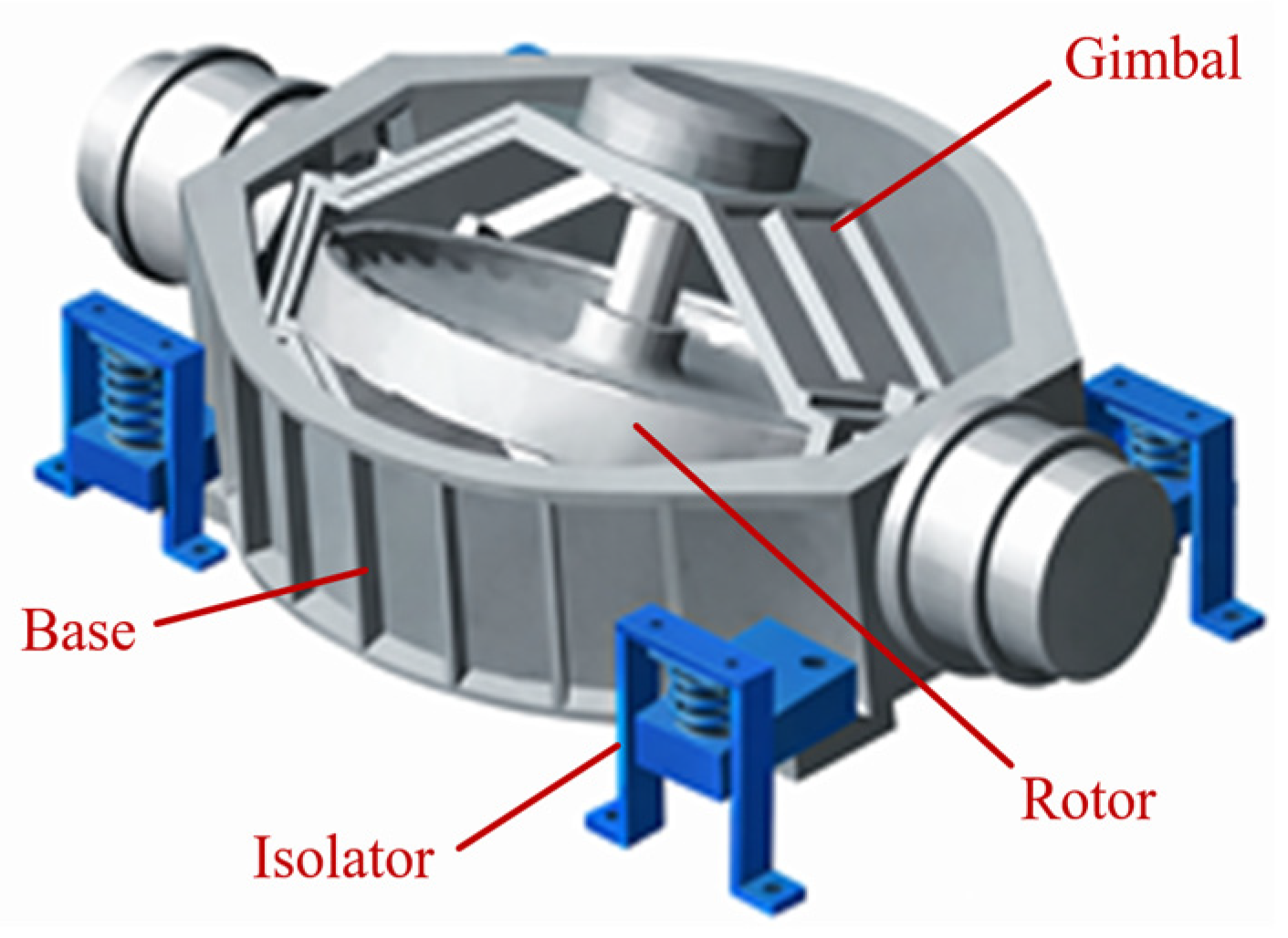
Figure 1. Structural diagram of a single gimbal CMG with four vibration isolators.
Actuators 15 00215 g001
Figure 2. Schematic diagram of the gimbal servo system with PIR-ESO control.
Actuators 15 00215 g002
Figure 3. Schematic diagram of the APIR-AESO composite control method.
Actuators 15 00215 g003
Figure 4. The curve of the gain adaptive laws.
Actuators 15 00215 g004
Figure 5. The curve of the bandwidth adaptive law.
Actuators 15 00215 g005
Figure 6. Gimbal speed under conventional PIR/APIR. (a) PIR, (b) APIR.
Actuators 15 00215 g006
Figure 7. Steady-state performance comparison between high-bandwidth ESO and AESO. (a) High-bandwidth ESO, (b) AESO.
Actuators 15 00215 g007
Figure 8. Transient performance comparison between low-bandwidth ESO and AESO. (a) Low-bandwidth ESO, (b) AESO.
Actuators 15 00215 g008
Figure 9. Velocity-tracking performance in simulation. (a) PI, (b) PI-ESO, (c) PIR-ESO, (d) APIR-AESO.
Actuators 15 00215 g009
Figure 10. Experimental platform.
Actuators 15 00215 g010
Figure 11. Velocity-tracking performance. (a) PIR, (b) APIR.
Actuators 15 00215 g011
Figure 12. Steady-state performance comparison. (a) High-bandwidth ESO, (b) AESO.
Actuators 15 00215 g012
Figure 13. Transient performance comparison. (a) Low-bandwidth ESO, (b) AESO.
Actuators 15 00215 g013
Figure 14. Velocity-tracking performance in experiment. (a) PI, (b) PI-ESO, (c) PIR-ESO, (d) APIR-AESO.
Actuators 15 00215 g014
Table 1. Motor and speed measurement loop parameters.
LoopsParametersValues
MotorJ0.68 kg·m2
B0.004 Nms/rad
K t 3.6 Nm/A
p6
L36 mH
R4.8 Ω
ψ f 0.4 Wb
Speed Measurement Loopm10
Ts1 × 10−4 s
Table 2. APIR controller parameters.
ParametersValuesParametersValues
K P 10 ζ 1 0.01
K I 10 ζ 2 0.07
K r 1 4000 ω 1 110 Hz
K r 2 500 ω 2 15 Hz
σ max 2 φ 1 150°
φ 2 51°
Table 3. Comparison of PIR performance in simulation.
ControllerOvershootSettling TimeMaximum ErrorRMS
PIR45%3.0 s0.45°/s0.14°/s
APIR21%2.1 s0.21°/s0.08°/s
Table 4. AESO parameters.
ParametersValuesParametersValues
Ω max 20 rad/s γ 5
Ω min 10 rad/s α 50
Table 5. Comparison of ESO performance in simulation.
ObserverSettling TimeSteady-State
Accuracy
Comprehensive Index
High-Bandwidth ESO0.36 s6.2 × 10−4°/s2.23 × 10−4°
Low-Bandwidth ESO0.88 s2.2 × 10−4°/s1.96 × 10−4°
Medium-Bandwidth ESO0.52 s3.9 × 10−4°/s2.03 × 10−4°
AESO0.37 s4.0 × 10−4°/s1.48 × 10−4°
Table 6. Comparison of PIR performance in experiment.
ControllerOvershootSettling TimeMaximum ErrorRMS
PIR49%3.1 s0.49°/s0.18°/s
APIR22%2.3 s0.22°/s0.12°/s
Table 7. Comparison of ESO performance in experiment.
ObserverSettling TimeSteady-State
Accuracy
Comprehensive Index
High-Bandwidth ESO0.39 s4.6 × 10−3°/s1.79 × 10−3°
Low-Bandwidth ESO0.55 s2.4 × 10−3°/s1.32 × 10−3°
Medium-Bandwidth ESO0.42 s3.5 × 10−3°/s1.47 × 10−3°
AESO0.35 s3.3 × 10−3°/s1.15 × 10−3°
Disclaimer/Publisher’s Note: The statements, opinions and data contained in all publications are solely those of the individual author(s) and contributor(s) and not of MDPI and/or the editor(s). MDPI and/or the editor(s) disclaim responsibility for any injury to people or property resulting from any ideas, methods, instructions or products referred to in the content.