
Article

Trajectory Tracking Control of Lower Limb Rehabilitation Exoskeleton Robot Based on Adaptive-Weight MPC

1
College of Information Engineering, Zhejiang University of Technology, Hangzhou 310023, China
2
Zhijiang College, Zhejiang University of Technology, Shaoxing 312030, China
*
Author to whom correspondence should be addressed.
Actuators 2026, 15(4), 214; https://doi.org/10.3390/act15040214
Submission received: 3 March 2026 / Revised: 1 April 2026 / Accepted: 9 April 2026 / Published: 11 April 2026
(This article belongs to the Special Issue Advanced Perception and Control of Intelligent Equipment)

Abstract

In this paper, an adaptive-weight model predictive control (AW-MPC) strategy is proposed to address the trajectory tracking problem of a lower-limb rehabilitation exoskeleton robot. First, based on human motion analysis, the dynamics of the lower-limb rehabilitation exoskeleton are established, and the nonlinear dynamic model is transformed into a linear model. Second, a MPC objective function is formulated to minimize the tracking error, yielding the optimal control input. Then, on the basis of conventional MPC, a weight-tuning scheme is developed: a weighting function is constructed according to the evolution of the tracking error to adaptively adjust the MPC weighting coefficients, and the closed-loop stability of the control system is proven via a Lyapunov-based analysis. Finally, the proposed method is validated on a lower-limb rehabilitation exoskeleton experimental platform, with a PID controller designed as a baseline for comparison. The experimental results demonstrate that, compared with the PID controller, the proposed AW-MPC achieves faster convergence of the tracking error, higher tracking accuracy, and enhanced robustness.

1. Introduction

Population aging and the rising incidence of neurological injuries have increased the number of individuals with motor impairments, thereby intensifying the demand for effective and scalable rehabilitation training [1]. Conventional therapist-assisted rehabilitation is typically delivered through repetitive and physically intensive interventions, which are labor-demanding and may exhibit limited consistency across sessions and therapists. Moreover, it is often difficult to achieve long-term, fine-grained recording and quantitative evaluation of training outcomes [2]. Lower-limb rehabilitation exoskeleton robots have therefore attracted considerable attention as an enabling technology in intelligent rehabilitation engineering, owing to their capability to provide repeatable, precise, and quantifiable gait assistance by actively actuating major joints such as the hip and knee. These systems have demonstrated potential to enhance motor coordination, shorten rehabilitation cycles, and alleviate the workload of clinical personnel [3,4,5]. In addition, recent progress in wearable robotics has also been reflected in the design of flexible actuators and the enhancement of human–robot interaction capability. Lu et al. [6] reported a fully flexible wearable pouch pneumatic artificial muscle for soft wearable devices. Cho et al. [7] developed a bidirectional self-sensing pneumatic artificial muscle for wearable robotic applications. These studies further indicate that rehabilitation and wearable robotic systems are evolving not only in control strategies but also in interaction-oriented hardware design.
From the perspective of control, rehabilitation exoskeletons pose distinctive challenges [8]. The system dynamics are inherently nonlinear and time-varying due to variations across patients as well as the interaction between the human and the robot. Consequently, the tracking performance is susceptible to degradation in the presence of external disturbances and modeling uncertainties [9]. Moreover, the operation of the exoskeleton is subject to strict physical constraints, including actuator torque saturation, joint range-of-motion limits, and velocity bounds [10]. These constraints are essential for ensuring patient safety and comfort. Accordingly, the controller must simultaneously achieve high tracking accuracy, smooth actuation, and strict compliance with physical constraints.
Under these considerations, trajectory tracking has become one of the central issues in exoskeleton control research. Considerable efforts have been devoted to addressing this problem. Ahmed et al. [11] designed a model-free PID controller to achieve motion control of a seven-degree-of-freedom exoskeleton robot. Zhu et al. [12] developed a non-singular fast terminal sliding mode control strategy to achieve high tracking accuracy. Li et al. [13] improved the tracking performance of a lower-limb exoskeleton by integrating an optimization algorithm with a fuzzy PID control scheme. Abdallah et al. [14] proposed a terminal sliding mode controller with fixed time convergence, which achieves accurate trajectory tracking while ensuring robustness against uncertainties. However, the aforementioned works do not explicitly address the handling of control constraints, which are essential in practical exoskeleton systems.
Model predictive control (MPC) has attracted increasing attention owing to its capability to explicitly incorporate system constraints into the control design, particularly for constrained trajectory tracking problems. By solving a finite-horizon optimization problem in a receding-horizon framework, MPC generates control actions that satisfy input and state constraints while optimizing a cost function that balances tracking performance and control effort [15].
In the field of exoskeleton control, Jammeli et al. [16] proposed an explicit MPC framework that integrates input-state feedback linearization with a nonlinear disturbance observer, enabling high tracking accuracy of a knee rehabilitation exoskeleton during both assistive and resistive training. This study further substantiated the effectiveness and real-time capability of MPC in rehabilitation robotics. In the context of robotic manipulator tracking, Dai et al. [17] introduced a Tube–MPC structure, where constraint tightening and terminal cost design were employed to guarantee input-to-state stability (ISS) and to enhance robustness against disturbances and modeling errors. Moreover, Wang et al. [18] developed an incremental MPC (IMPC) approach for robot manipulators by exploiting time-delay estimation to construct an incremental prediction model, thereby facilitating constrained control of nonlinear robotic systems. This further demonstrates the effectiveness of MPC-based frameworks in handling complex dynamics and constraints in robotic control.
However, conventional MPC schemes typically employ constant weighting matrices to balance state-tracking performance and control effort. Under abrupt operating condition changes or disturbance fluctuations, fixed weights often fail to simultaneously ensure fast transient response and smooth control actions, leading to an inherent trade-off: excessively large weights may result in aggressive control inputs and degraded comfort, whereas overly small weights can compromise tracking accuracy and safety. To address this limitation, increasing attention has been paid to adaptive and learning-assisted tuning strategies for MPC in robotic systems. In this context, Li et al. [19] proposed a reinforcement-learning-assisted MPC framework for constrained robot manipulator visual servoing, showing that adaptive tuning of MPC design parameters can improve the control performance of robotic systems under changing operating conditions. Although this study was conducted on robot manipulators rather than rehabilitation exoskeletons, it still provides useful methodological support for adaptive weighting and parameter adjustment in MPC-based robotic control. Such adaptive tuning mechanisms provide useful insights for MPC-based trajectory tracking of lower-limb exoskeleton robots with time-varying dynamics and multi-objective performance requirements.
In this work, an AW–MPC strategy is proposed for trajectory tracking of a lower-limb rehabilitation exoskeleton. The main contributions of this paper are summarized as follows: (1) The nonlinear dynamics derived from the Lagrange formulation are linearized and discretized to construct a prediction model for MPC. (2) A dynamic weight adjustment mechanism is designed, in which the stage weighting coefficients are updated online according to the evolution of the tracking error. This mechanism enables a flexible balance between rapid error reduction and smooth control action during different motion phases. (3) The closed-loop stability of the proposed control scheme is analyzed using Lyapunov theory within an ISS framework, ensuring ultimate boundedness of the tracking error in the presence of disturbances and modeling uncertainties. (4) Experimental validation on a lower-limb rehabilitation exoskeleton platform demonstrates that the proposed approach achieves faster error convergence, higher tracking accuracy, and stronger robustness compared with both a conventional model predictive control scheme with constant weights and a baseline PID controller.
The remainder of this paper is organized as follows: Section 2 presents the dynamic model of the lower-limb rehabilitation exoskeleton robot. Section 3 develops an MPC controller with dynamically adjustable tracking-error weights. In Section 4, experimental results are provided to validate the effectiveness of the proposed control strategy on a lower-limb rehabilitation exoskeleton platform, along with a comparative evaluation against a PID-based controller. Finally, conclusions are drawn in Section 5.
Notation: x 2 denotes the Euclidean norm. P 0 indicates that P is symmetric positive definite, λ min ( P ) and λ max ( P ) denote the minimum and maximum eigenvalues of P, respectively. diag ( · ) and blkdiag ( · ) denote the diagonal and block-diagonal matrix operators, respectively. I denotes the identity matrix of appropriate dimension.

2. Modeling and Preparation

To provide a basis for subsequent controller design, this section first establishes the nonlinear dynamic model of the lower-limb rehabilitation exoskeleton and then performs linearization and discretization of the model.

2.1. Dynamic Model of the Exoskeleton

The dynamic modeling of lower-limb rehabilitation exoskeleton robots is inherently challenging due to the strong coupling among system variables and the pronounced nonlinearities in the system dynamics. Various analytical approaches have been proposed for deriving the dynamic equations, among which the Newton–Euler and Lagrange formulations are the most widely used. In this paper, the Lagrange formulation [20] is employed to establish the dynamic model of the lower-limb rehabilitation exoskeleton. Specifically, the Lagrangian of the system is defined as
L E = E k E p ,
where L E , E k , and  E p denote the Lagrangian, the total kinetic energy, and the total potential energy of the system, respectively.
With the above definitions, the Lagrange equation of motion can be formulated as
d d t L E q ˙ L E q = τ ,
where t denotes the sampling time, τ denotes the driving torque of the lower-limb exoskeleton, and  q , q ˙ represent the joint angle vector and the joint angular-velocity vector, respectively.
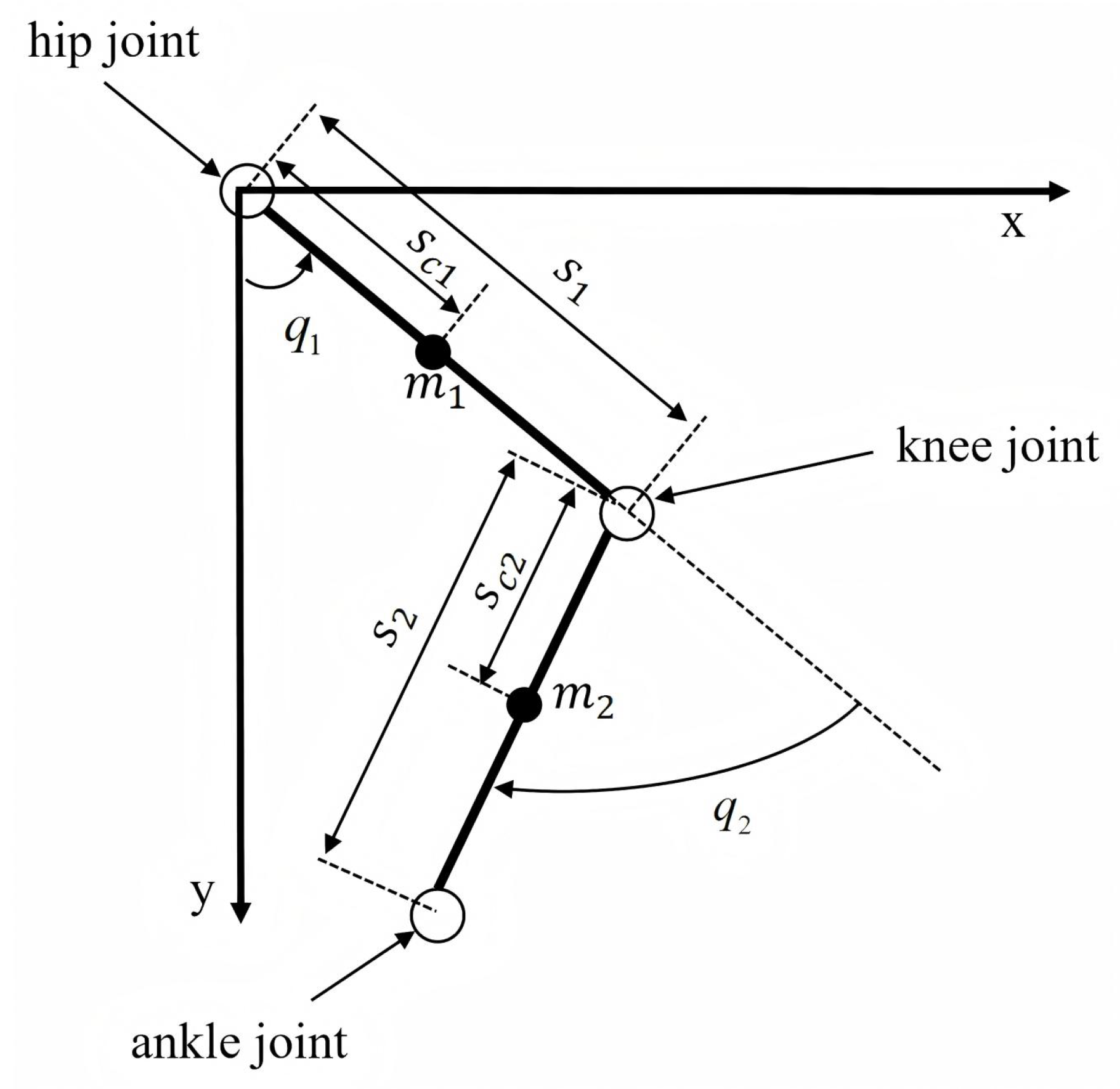
This paper considers the motion of human lower limbs and models it as planar movement in three-dimensional space constrained to the sagittal plane. Owing to the inherent sagittal-plane symmetry of lower-limb movements, a single-leg model can be employed to represent the overall exoskeleton robot for analysis [21]. The resulting two-degree-of-freedom (2-DOF) lower-limb rehabilitation exoskeleton can be modeled as a planar two-link mechanism, as shown in Figure 1.
As illustrated in Figure 1, the hip joint pivot is taken as the origin of the X O Y coordinate frame. Here, m 1 and m 2 denote the masses of the thigh and shank links, respectively; s 1 and s 2 are the corresponding link lengths; s c 1 and s c 2 represent the distances from the hip and knee joints to the centers of mass of the thigh and shank, respectively. Moreover, q 1 is defined as the hip joint angle measured from the x-axis, and  q 2 is the knee joint angle measured relative to the thigh (i.e., relative to the hip joint). For consistency, clockwise rotation is defined as the positive direction, while counterclockwise rotation is defined as the negative direction.
Therefore, we define the center-of-mass coordinates of the thigh link and the shank link are assumed to be ( α 1 , β 1 ) and ( α 2 , β 2 ) , respectively, which can be expressed as
α 1 = s c 1 sin q 1 , β 1 = s c 1 cos q 1 , α 2 = s 1 sin q 1 + s c 2 sin ( q 1 + q 2 ) , β 2 = s 1 cos q 1 + s c 2 cos ( q 1 + q 2 ) .
Then, the total kinetic energy and the total potential energy of the lower-limb exoskeleton system can be expressed as
E k = 1 2 I 1 q ˙ 1 2 + 1 2 m 1 α ˙ 1 2 + β ˙ 1 2 + 1 2 I 2 q ˙ 1 + q ˙ 2 2 + 1 2 m 2 α ˙ 2 2 + β ˙ 2 2 ,
E p = m 1 g s c 1 cos q 1 + m 2 g s 1 cos q 1 + s c 2 cos q 1 + q 2 ,
where I 1 and I 2 denote the moments of inertia of the thigh and shank links, respectively.
By substituting E k and E p into the Lagrangian L E , the Lagrange equations of motion for the hip and knee joints can be derived as
τ 1 = d d t L E q ˙ 1 L E q 1 = I 1 + I 2 + m 1 s c 1 2 + m 2 s 1 2 + m 2 s c 2 2 + 2 m 2 s 1 s c 2 cos q 2 q ¨ 1 + I 2 + m 2 s c 2 2 + m 2 s 1 s c 2 cos q 2 q ¨ 2 m 2 s 1 s c 2 2 q ˙ 1 q ˙ 2 + q ˙ 2 2 sin q 2 m 1 g s c 1 + m 2 g s 1 sin q 1 m 2 g s c 2 sin q 1 + q 2 ,
τ 2 = d d t L E q ˙ 2 L E q 2 = I 2 + m 2 s c 2 2 + m 2 s 1 s c 2 cos q 2 q ¨ 1 + I 2 + m 2 s c 2 2 q ¨ 2 + m 2 s 1 s c 2 sin q 2 q ˙ 1 2 m 2 g s c 2 sin q 1 + q 2 ,
where q ¨ 1 and q ¨ 2 are the angular accelerations of the hip and knee joints, respectively.
Combine with (6) and (7), the dynamics of the lower-limb exoskeleton system can be written in the standard manipulator form as
M ( q ) q ¨ + C ( q , q ˙ ) q ˙ + G ( q ) + D = τ ,
where D represents the combined effect of model uncertainties and external disturbances. The matrices M ( q ) R 2 × 2 , C ( q , q ˙ ) R 2 × 2 , and  G ( q ) R 2 × 1 denote the inertia matrix, the Coriolis and centrifugal matrix, and the gravity vector, whose explicit forms are given by
M = M 11 M 12 M 21 M 22 , C = C 11 C 12 C 21 C 22 , G = G 1 G 2 .
The elements of M ( q ) , C ( q , q ˙ ) , and  G ( q ) are given by
M 11 = I 1 + I 2 + m 1 s c 1 2 + m 2 s 1 2 + m 2 s c 2 2 , M 12 = I 2 + m 2 s c 2 2 + m 2 s 1 s c 2 cos q 2 , M 21 = I 2 + m 2 s c 2 2 + m 2 s 1 s c 2 cos q 2 , M 22 = I 2 + m 2 s c 2 2 ,
C 11 = 2 m 2 s 1 s c 2 sin q 2 · q ˙ 2 , C 12 = m 2 s 1 s c 2 sin q 2 · q ˙ 2 , C 21 = m 2 s 1 s c 2 sin q 2 · q ˙ 1 , C 22 = 0 ,
G 1 = m 1 g s c 1 sin q 1 m 2 g s 1 sin q 1 m 2 g s c 2 sin ( q 1 + q 2 ) , G 2 = m 2 g s c 2 sin ( q 1 + q 2 ) .
  • Assumption: According to the dynamic characteristics of the lower-limb exoskeleton, the lumped uncertainty and external disturbance term D is assumed to be bounded as
    D D ¯ ,
    where D ¯ denotes the upper bound of the uncertainty and external disturbance set.

2.2. Model Linearization and Discretization

The derived dynamics of the lower-limb exoskeleton (8) in the last section is a totally nonlinear and strongly coupled system, which brings an unacceptable computational burden for the online optimization in real-time control. In order to reduce the burden and make sure the tracking performance under the MPC framework, the above nonlinear model is linearized around a nominal equilibrium point and subsequently discretized to obtain a discrete-time prediction model in this section.
Based on the dynamic model (8), the joint angular acceleration can be defined as
q ¨ = M ( q ) 1 τ C ( q , q ˙ ) q ˙ G ( q ) D .
Then, the state vector is defined as x = [ q q ˙ ] T = [ q 1 q 2 q ˙ 1 q ˙ 2 ] T R 4 . By performing a first-order Taylor expansion around an equilibrium point and assuming a static operating condition [22], the nominal equilibrium point is defined as x * = [ q 1 * q 2 * q ˙ 1 * q ˙ 2 * ] T . Accordingly, the nonlinear system is approximated by the following linear state-space model in the neighborhood of x * :
x ˙ = A x + B τ + w ,
where w denotes the equivalent disturbance after linearization, which aggregates the effects of unmodeled dynamics, linearization-induced approximation errors, and external disturbances. Therefore, the linearized model is mainly used as a local prediction model for MPC synthesis, rather than as a globally exact description of the nonlinear dynamics over the whole gait cycle.
The state matrix A and the input matrix B are given by
A = x ˙ x = 0 0 1 0 0 0 0 1 A 31 A 32 A 33 A 34 A 41 A 42 A 43 A 44 ,
B = x ˙ τ = 0 0 0 0 M 11 1 M 12 1 M 21 1 M 22 1 ,
where M i j 1 denotes the ( i , j ) -th element of M ( q ) 1 , and  C i j and G i j ( i = 1 , 2 ; j = 1 , 2 ) represent the corresponding elements associated with C ( q , q ˙ ) and G ( q ) .
To obtain a discrete-time prediction model compatible with the receding-horizon optimization, the linearized continuous-time model in (15) is discretized via the zero-order hold (ZOH) method [23,24], yielding
X ( k + 1 ) = A d X ( k ) + B d τ ( k ) + W ( k ) ,
where X ( k ) is the disc ete-time state and τ ( k ) is the control input at time step k. The discrete-time matrices are computed as
A d = e A T s ,
B d = 0 T s e A σ d σ B ,
where T s denotes the sampling period.

3. Design of Model Predictive Controller

This section presents the design of the proposed model predictive controller. First, a tracking-oriented MPC problem is formulated. Then, an adaptive-weight adjustment mechanism based on the tracking error is developed. Finally, the stability of the closed-loop system is analyzed.

3.1. MPC for Tracking

In accordance with the discrete dynamic model of the lower-limb rehabilitation exoskeleton robot proposed in the former section, we propose a naive MPC scheme to achieve precise trajectory tracking while ensuring constraint satisfaction. At sampling instant k, the current system state is measured as x ( k ) . An N-step finite-horizon optimal control problem is then solved using x ( k ) as the initial condition. The predicted state at future step k + i computed at time k is denoted by x ( k + i | k ) , for  i = 1 , , N . Accordingly, the decision variables are the control sequence { τ ( k | k ) , τ ( k + 1 | k ) , , τ ( k + N 1 | k ) } , which generates the predicted state trajectory { x ( k + 1 | k ) , , x ( k + N | k ) } through the system dynamics. Following the receding-horizon strategy, only the first control action τ ( k | k ) is applied to the plant, and the above optimization is repeated at time k + 1 with updated state information.
The output of the system is defined as y ( k ) = x ( k ) , while the reference state is defined as x r ( k ) . The tracking error is defined as
X e ( k ) = y ( k ) x r ( k ) = x ( k ) x r ( k ) .
The reference trajectory is specified by
x r ( k ) = q r 1 ( k ) q r 2 ( k ) q ˙ r 1 ( k ) q ˙ r 2 ( k ) T ,
where q r 1 ( k ) and q r 2 ( k ) denote the reference hip and knee joint angles, respectively. The corresponding reference angular velocities are q ˙ r 1 ( k ) and q ˙ r 2 ( k ) .
The finite-horizon performance index with a terminal penalty is chosen as
min τ J = i = 0 N 1 [ x ( k + i | k ) x r ( k + i ) T Q x ( k + i | k ) x r ( k + i ) + τ ( k + i | k ) T R τ ( k + i | k ) ] + x ( k + N | k ) x r ( k + N ) T P f x ( k + N | k ) x r ( k + N ) .
where Q R 4 × 4 is a diagonal weighting matrix for the tracking error, and  R R 2 × 2 is a diagonal weighting matrix for the control effort. The matrix P f R 4 × 4 denotes the terminal weighting matrix. In particular, Q and R are parameterized as
Q = η 1 0 0 0 0 η 2 0 0 0 0 η 3 0 0 0 0 η 4 , R = ε 1 0 0 ε 2 .
In this paper, the weights of Q are selected larger than those of R to prioritize tracking accuracy and rapid response. To enhance closed-loop robustness, the terminal matrix P f is chosen as the stabilizing solution of the discrete-time algebraic Riccati equation (DARE) arising from the LQR formulation with A d , B d , Q, and R  [25,26]:
P f = A d T P f A d A d T P f B d R + B d T P f B d 1 B d T P f A d + Q ,
and the corresponding LQR feedback gain is
K = R + B d T P f B d 1 B d T P f A d .
For compact representation, define the stacked predicted-state sequence, reference-state sequence, and control-input sequence over the horizon as
X ( k ) = x ( k + 1 | k ) x ( k + 2 | k ) x ( k + N | k ) R 4 N × 1 , X r ( k ) = x r ( k + 1 ) x r ( k + 2 ) x r ( k + N ) R 4 N × 1 , T ( k ) = τ ( k | k ) τ ( k + 1 | k ) τ ( k + N 1 | k ) R 2 N × 1 .
To incorporate the terminal penalty consistently in the stacked form, define the horizon state-weighting matrix as
Q ¯ = blkdiag Q , , Q N 1 times , P f R 4 N × 4 N .
With the stacked vectors in (27) and the horizon weighting matrix Q ¯ in (28), the finite-horizon cost (23) admits the compact form
min τ J = X ( k ) X r ( k ) T Q ¯ X ( k ) X r ( k ) + T ( k ) T R T ( k ) .
Given the discrete-time prediction model x ( k + 1 ) = A d x ( k ) + B d τ ( k ) , the stacked predicted states satisfy
X ( k ) = M x ( k ) + C T ( k ) ,
where the state-transition and input-transition matrices are given by
M = A d A d 2 A d N R 4 N × 4 , C = B d 0 0 A d B d B d 0 A d N 1 B d A d N 2 B d B d R 4 N × 2 N .
Let E M x ( k ) X r ( k ) . Substituting (30) into (29) yields an explicit quadratic objective with respect to the decision variable T ( k ) :
min T ( k ) J = E T Q ¯ E + 1 2 T ( k ) T 2 C T Q ¯ C + R Q T ( k ) + 2 C T Q ¯ E T H T T ( k ) ,
where constant terms independent of T ( k ) do not affect the optimizer. Therefore, the Hessian and gradient passed to a standard QP solver (e.g., quadprog in MATLAB R2022a) are Q = 2 C T Q ¯ C + R and H = 2 C T Q ¯ E , respectively. Following the receding-horizon principle, only the first control action of the optimal sequence is applied at each sampling instant, and the optimization is repeated at the next step based on updated state measurements.

3.2. Design of Adaptive Weight Coefficients

To accommodate time-varying motion phases and improve transient tracking performance, the stage-penalty coefficients are updated online according to the instantaneous tracking error. Let
e ( k ) = x ( k ) x r ( k ) = e 1 ( k ) e 2 ( k ) e 3 ( k ) e 4 ( k ) T ,
where e 1 ( k ) and e 2 ( k ) denote the hip joint and knee joint angle tracking errors, respectively. The corresponding angular-velocity tracking errors are e 3 ( k ) and e 4 ( k ) . The adaptive stage weights are computed through a continuously differentiable saturation mapping, given by
Q i ( k ) = Q 0 , i + a i tanh γ e i ( k ) , i { 1 , 2 , 3 , 4 } ,
where Q 0 , i > 0 denotes the nominal penalty, a i > 0 denotes the adaptation magnitude, and γ > 0 controls the sensitivity. Here, i = 1 , 2 , 3 , 4 correspond to hip angle, knee angle, hip angular velocity, and knee angular velocity, respectively. When the tracking error remains close to zero, the corresponding weight varies smoothly in a small neighborhood of the nominal value, which helps reduce abrupt switching and alleviates excessive high-frequency fluctuations. When the tracking error becomes large, the adaptive weight gradually approaches its upper bound Q 0 , i + a i , so that the error penalty is strengthened without causing unbounded weight growth.
Since tanh ( · ) ( 1 , 1 ) , each adaptive coefficient is uniformly bounded as
Q 0 , i a i < Q i ( k ) < Q 0 , i + a i , i { 1 , 2 , 3 , 4 } .
Moreover, by selecting Q 0 , i > a i , one has Q i ( k ) > 0 for all k, which guarantees Q s ( k ) 0 .
Accordingly, the stage weighting matrix is chosen as
Q s ( k ) = diag Q 1 ( k ) , Q 2 ( k ) , Q 3 ( k ) , Q 4 ( k ) R 4 × 4 .
The horizon weighting matrix is then constructed in block-diagonal form:
Q ( k ) = blkdiag ( Q s ( k ) , Q s ( k ) , , Q s ( k ) N times ) R 4 N × 4 N .

3.3. Stability Analysis

Since the reference trajectory x r ( k ) is time-varying and modeling mismatch is inevitable in practice, the closed-loop tracking performance is analyzed within an ISS framework, leading to an ultimate boundedness characterization of the tracking error [27,28].
Accordingly, consider the following discrete-time plant with an equivalent disturbance term:
x ( k + 1 ) = A d x ( k ) + B d τ ( k ) + w ( k ) ,
where w ( k ) denotes the equivalent disturbance after linearization, which aggregates unmodeled dynamics, linearization errors, and external perturbations. Define the tracking error e ( k ) x ( k ) x r ( k ) . Then, the error dynamics can be written as
e ( k + 1 ) = A d e ( k ) + B d τ ( k ) τ r ( k ) + δ r ( k ) + w ( k ) ,
where τ r ( k ) is the reference input, and the reference inconsistency term is defined by
δ r ( k ) A d x r ( k ) + B d τ r ( k ) x r ( k + 1 ) .
For convenience, define the aggregated disturbance input as
ζ ( k ) δ r ( k ) + w ( k ) .
Let P f 0 be the stabilizing DARE solution given in (25). Consider the following quadratic function:
V ( k ) = e ( k ) T P f e ( k ) .
Since P f 0 , there exist constants λ ̲ = λ min ( P f ) > 0 and λ ¯ = λ max ( P f ) > 0 such that
λ ̲ e ( k ) 2 2 V ( k ) λ ¯ e ( k ) 2 2 .
Let the auxiliary closed-loop matrix be defined as
A c = A d B d K ,
and denote
W = Q + K T R K .
From the DARE associated with P f , it follows that
A c T P f A c P f = W .
Using (39), the Lyapunov difference can be written as
V ( k + 1 ) V ( k ) = e ( k ) T W e ( k ) + 2 e ( k ) T A c T P f ζ ( k ) + ζ ( k ) T P f ζ ( k ) .
The cross term can be bounded using Young’s inequality as
2 e ( k ) T A c T P f ζ ( k ) ε e ( k ) 2 2 + A c T P f 2 ε ζ ( k ) 2 2 , ε ( 0 , λ min ( W ) ) .
Therefore, the Lyapunov difference satisfies
V ( k + 1 ) V ( k ) c 1 e ( k ) 2 2 + c 2 ζ ( k ) 2 2 ,
where
c 1 = λ min ( W ) ε , c 2 = λ max ( P f ) + A c T P f 2 ε .
Consequently, if ζ ( k ) 2 ζ ¯ for all k, the tracking error is ultimately bounded, and its asymptotic bound satisfies
lim sup k e ( k ) 2 c 2 c 1 ζ ¯ .
In particular, when ζ ( k ) 0 (i.e., w ( k ) 0 and δ r ( k ) 0 ), (49) reduces to a strict Lyapunov decrease condition, implying asymptotic convergence of the tracking error.

4. Experiment

This section provides the experimental validation of the proposed control method. First, the experimental platform and reference trajectory settings are introduced. Then, the controller parameters are given. Finally, the tracking performance of the proposed method is evaluated and compared with conventional MPC and PID controllers.

4.1. Experimental Apparatus and Setup

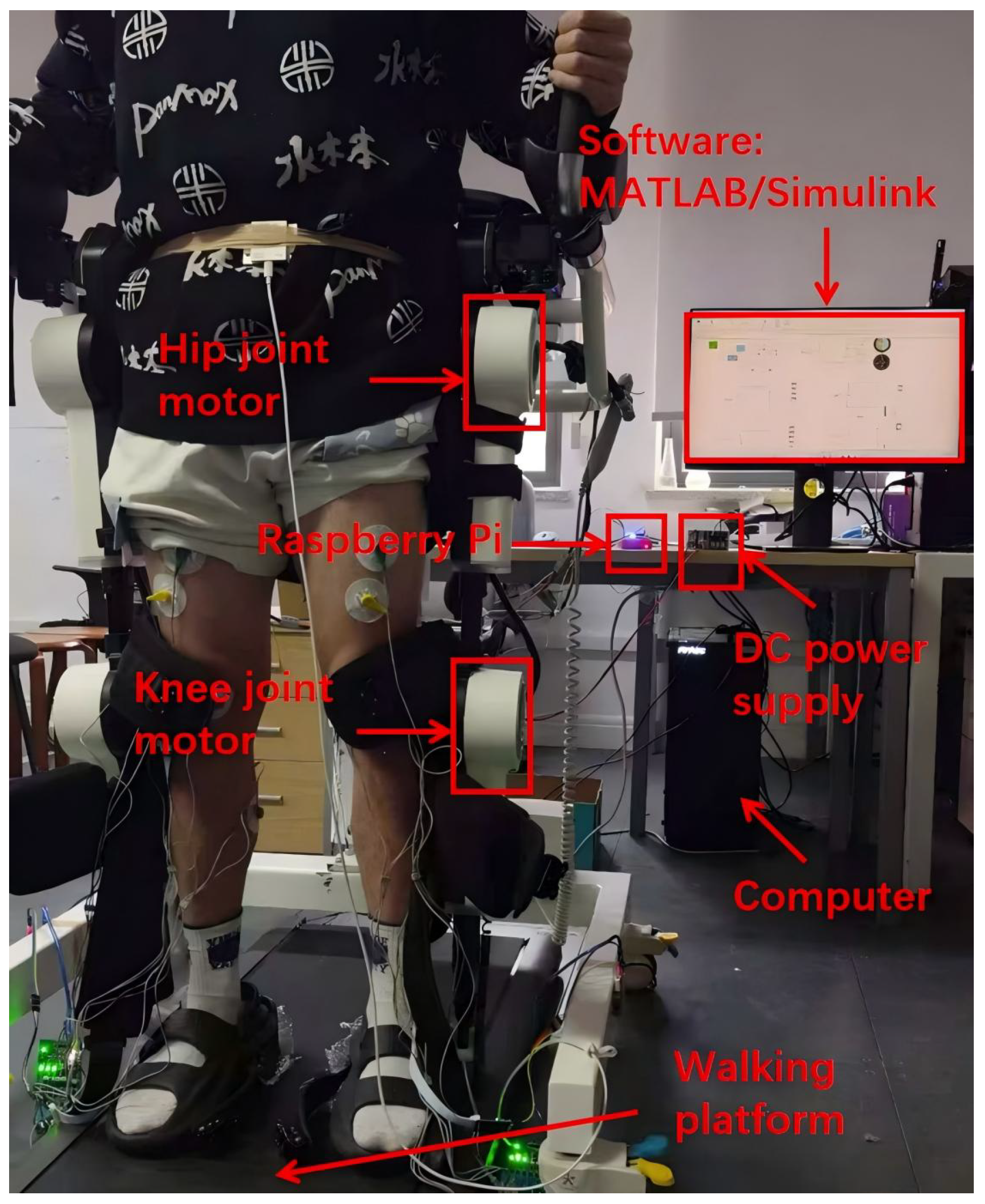
The developed experimental platform for the lower-limb rehabilitation exoskeleton is shown in Figure 2. The platform mainly consists of a wearable lower-limb exoskeleton joint mechanical structure, joint driving motors (RoboCT JA-110, Hangzhou RoboCT Technology Development Co., Ltd., Hangzhou, China), a DC power supply (NSP-1600-36, MEAN WELL Enterprises Co., Ltd., New Taipei City, Taiwan), a Raspberry Pi 4B (Raspberry Pi Foundation, Cambridge, UK) development board, and a host computer running MATLAB R2022a (MathWorks, Natick, MA, USA). The control algorithms are implemented in MATLAB/Simulink, while the actuator units are connected to the host computer through the Raspberry Pi 4B development board. The transmission of control commands and encoder feedback signals is realized through UDP and CAN communication protocols. The dynamic model parameters of the proposed device are listed in Table 1. In the current experimental study, one healthy male subject participated in the validation tests, with a height of 185 cm, a body weight of 87 kg, and an age of 26 years.

4.2. Reference Trajectory Settings

In order to evaluate the tracking performance of the proposed controller under periodic gait motions, the reference trajectories of the hip and knee joints are fitted using Fourier series [29]. Specifically, the hip joint reference trajectory is given by the following expression:
q r 1 ( k ) = 8.006 18.74 cos ( 3.884 k T s ) + 8.906 sin ( 3.884 k T s ) 4.453 cos 2 · 3.884 k T s 0.4712 sin 2 · 3.884 k T s 0.4602 cos 3 · 3.884 k T s 1.373 sin 3 · 3.884 k T s ,
and the knee joint reference is defined as
q r 2 ( k ) = 15.89 + 5.186 cos ( 3.863 k T s ) + 22.96 sin ( 3.863 k T s ) 12.68 cos 2 · 3.863 k T s + 9.482 sin 2 · 3.863 k T s 1.214 cos 3 · 3.863 k T s 3.612 sin 3 · 3.863 k T s .
It should be noted that the hip and knee joint trajectories adopted in this paper are fitted periodic reference trajectories designed for controller performance evaluation on the experimental platform. Their primary purpose is to serve as a unified reference benchmark that enables fair comparison of different control methods under identical periodic motion conditions.

4.3. Controller Parameter Settings

To ensure a fair comparison, all controllers are implemented with the same sampling period T s = 1 ms and evaluated under identical experimental conditions. For the MPC-based controllers, the prediction horizon is set to N = 8 , and the actuator constraints are kept identical in all tests.
For MPC, the diagonal elements of the state-weighting matrix are selected as η 1 = 6000 , η 2 = 4000 , η 3 = 5 , and η 4 = 3 . The input weighting matrix is also chosen as diagonal with ε 1 = ε 2 = 0.0001 .
For AW-MPC, the nominal weights are initialized as Q 0 , 1 = 6000 , Q 0 , 2 = 4000 , Q 0 , 3 = 5 , and Q 0 , 4 = 3 . The corresponding adaptation amplitudes are set to a 1 = 3000 , a 2 = 2000 , a 3 = 2 , and a 4 = 1 , which determine the allowable variation range of the time-varying weights during online adjustment.The sensitivity parameter in the adaptive weighting function is set to γ = 20 to balance adaptation sensitivity and control smoothness in the periodic gait-tracking task.
As a baseline for comparison, a discrete-time incremental PID controller is implemented to generate the motor current command.The incremental control law is given by
Δ τ ( k ) = K p e ( k ) e ( k 1 ) + K i e ( k ) + K d e ( k ) 2 e ( k 1 ) + e ( k 2 ) ,
and the corresponding control input is updated as
τ ( k ) = τ ( k 1 ) + Δ τ ( k ) .
where K p , K i , and K d are the proportional, integral, and derivative gains, respectively.
In the experiments, the PID gains are selected as K p = 500 , K i = 1 , and K d = 10 .

4.4. Experimental Results

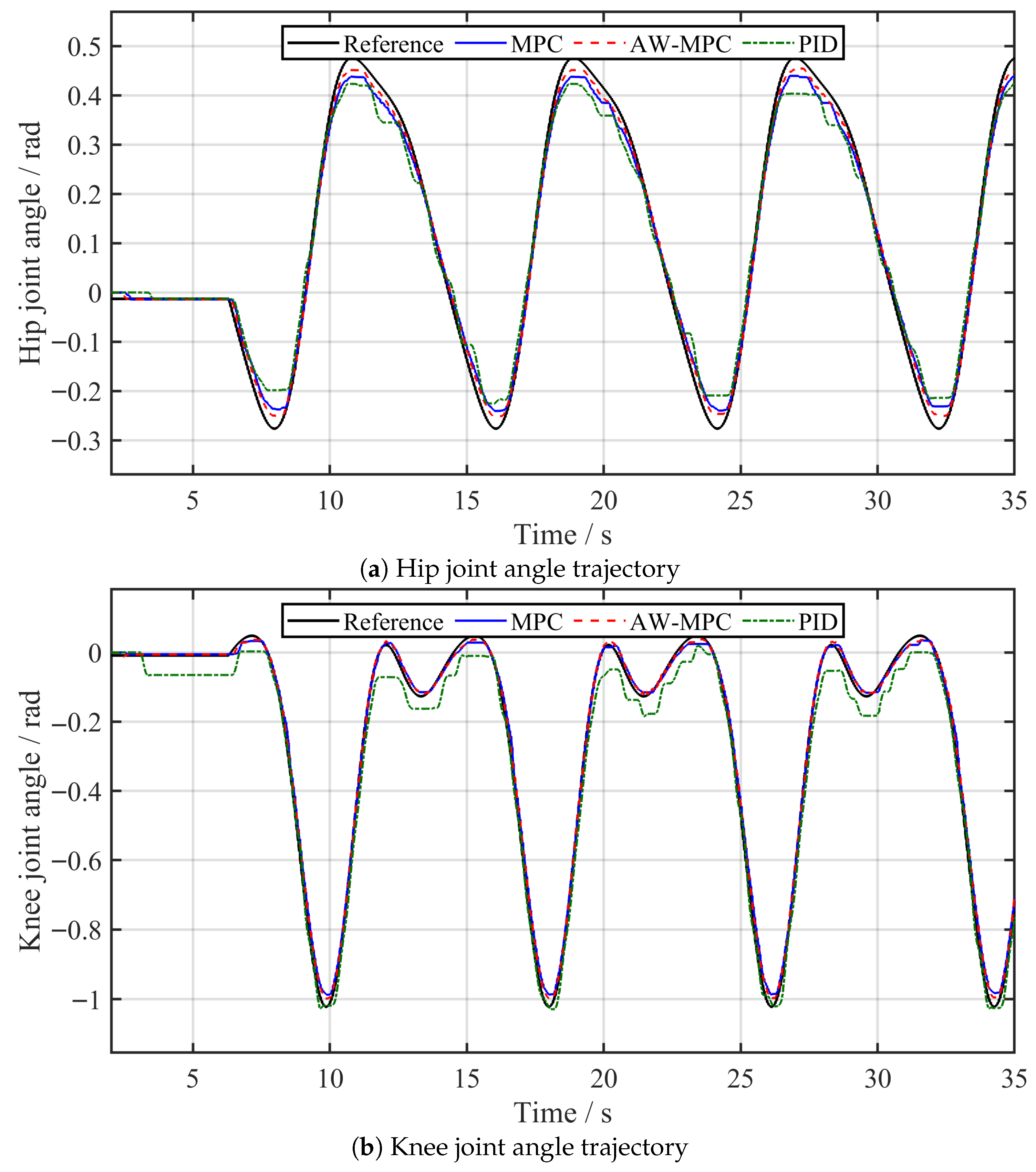
Figure 3 shows the angle trajectories under periodic gait references. The solid black line represents the reference trajectory, the solid blue line corresponds to the conventional MPC, the red dashed line denotes the proposed AW-MPC, and the green dash-dotted line indicates the PID controller. Compared with MPC and PID, the proposed AW-MPC yields a closer match to the reference trajectory for both joints, especially around phase transitions, indicating improved transient tracking capability.
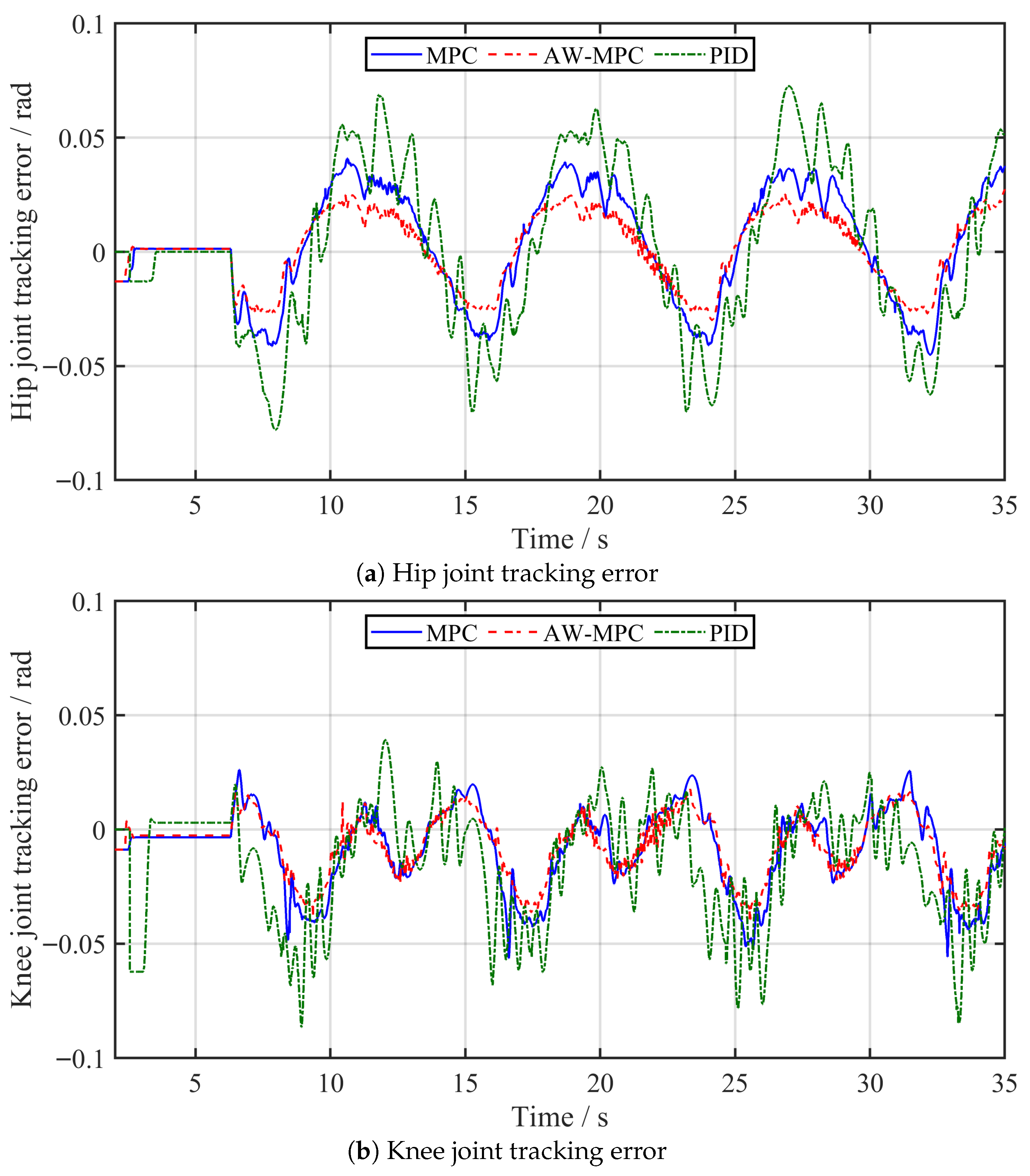
Figure 4 shows the tracking errors of different controllers under periodic gait references. Overall, both MPC and AW-MPC exhibit faster error convergence and smaller tracking errors for the hip and knee joints compared with the PID controller, indicating improved transient performance and steady-state accuracy. Moreover, AW-MPC consistently achieves lower error magnitudes than the conventional MPC, which suggests that the proposed adaptive weight-tuning mechanism can enhance error suppression during phase transitions by adjusting the stage penalties online.
In particular, the improvement is more pronounced for the hip joint. The hip tracking error of AW-MPC is essentially bounded within ± 0.03 rad , whereas the peak error of MPC is around 0.04 rad and that of PID can reach approximately 0.08 rad . By contrast, the knee joint tracking errors are less affected by disturbances in this experiment, leading to a relatively smaller performance gap among the three controllers.
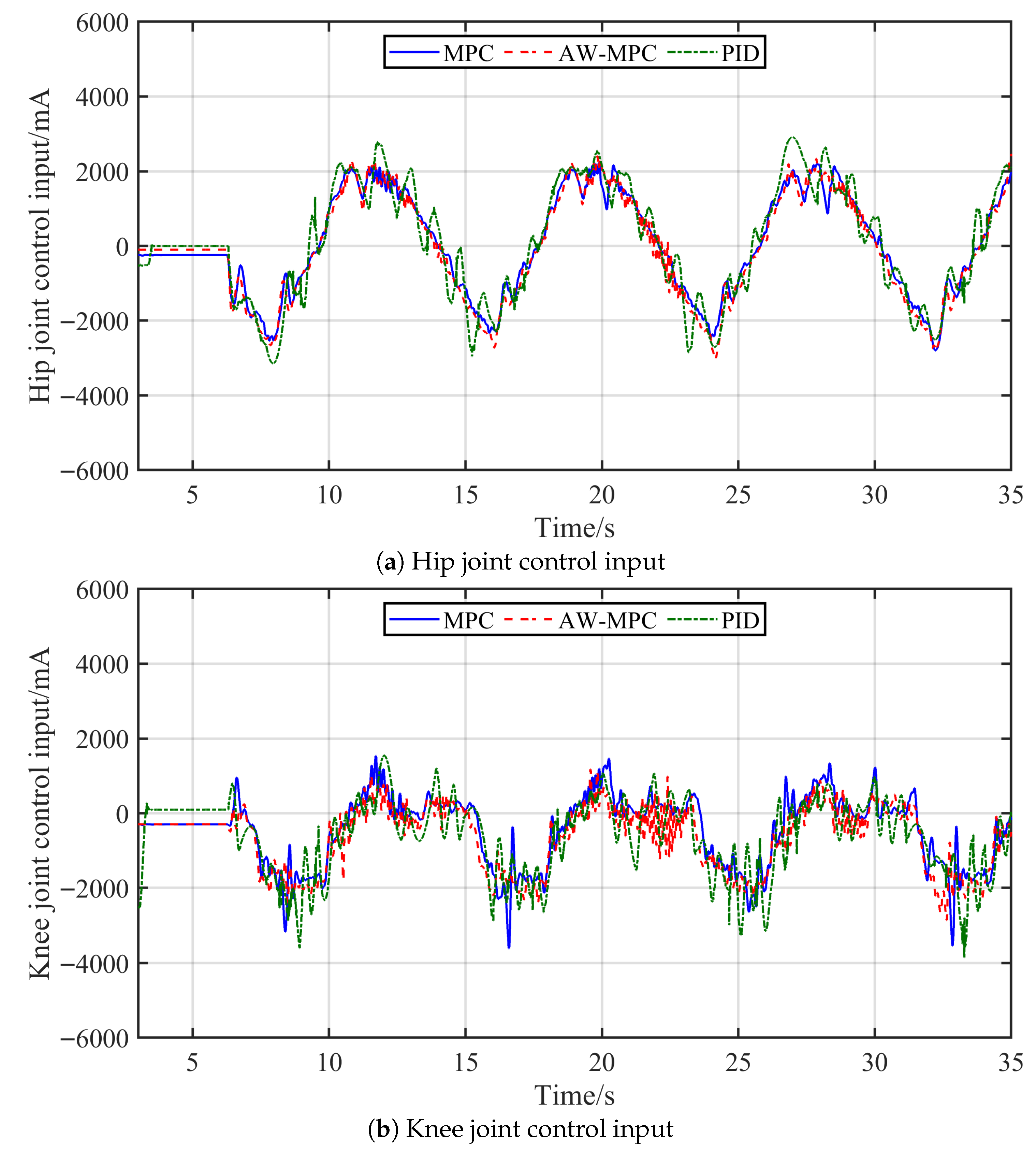
Figure 5 shows the motor input currents of the lower-limb exoskeleton joints, which serve as the control inputs generated by different controllers. It can be observed that both MPC and AW-MPC yield smoother input-current profiles than the PID controller, with fewer abrupt variations. This is mainly because the PID strategy does not explicitly optimize the control input, and is therefore more sensitive to measurement noise and unmodeled dynamics, which may lead to higher-frequency fluctuations in the control signal. Nevertheless, the input currents produced by all three controllers remain within a reasonable range throughout the experiment, suggesting that the actuator commands are feasible and unlikely to cause excessive wear on the drive system.
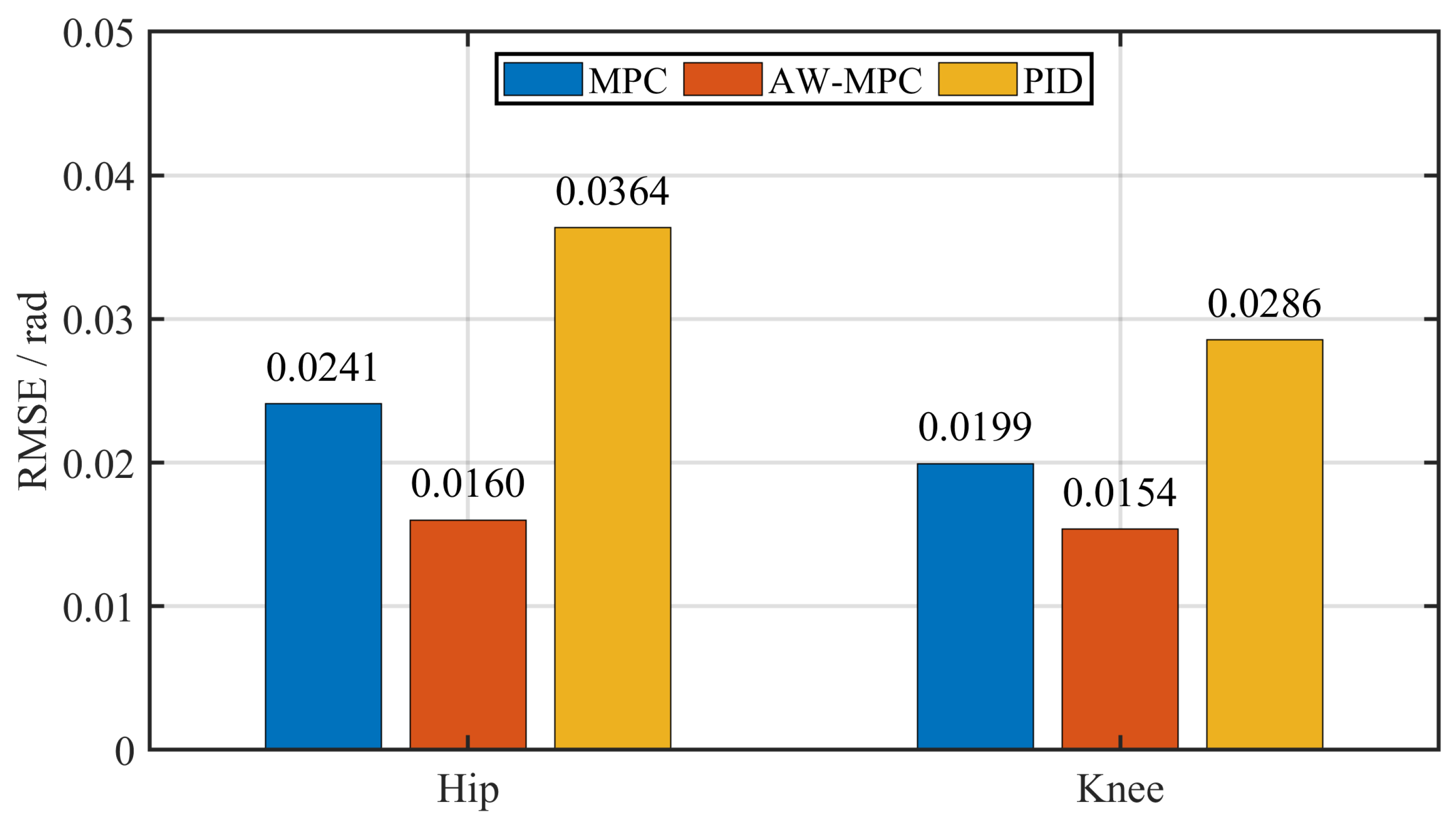
Figure 6 presents the root mean square error (RMSE) values of hip and knee joint tracking under different controllers. It can be observed that the proposed AW-MPC achieves the lowest RMSE values for both joints. For the hip joint, the RMSE is reduced by 33.6% compared with the conventional MPC and by 56.0% compared with the PID controller. Similarly, for the knee joint, the RMSE is decreased by 22.6% and 46.2% relative to MPC and PID, respectively. These results indicate that the adaptive-weight adjustment mechanism significantly enhances overall tracking accuracy over the entire gait cycle, with a more pronounced improvement observed for the hip joint.
From the perspective of control mechanism, the superior performance of AW-MPC mainly arises from its adaptive weighting mechanism, which updates the stage cost online according to the instantaneous tracking error. This enables the controller to better coordinate rapid error suppression and control smoothness during different gait phases, especially near phase transitions. Consequently, compared with conventional MPC and PID, the proposed method achieves better trajectory matching and lower RMSE values. Although the above results indicate that the proposed method provides superior tracking performance from an engineering control perspective, improvements in control performance do not necessarily translate directly into clinical effectiveness. Its clinical significance still requires further evaluation in future studies using rehabilitation-related criteria, such as patient comfort, gait symmetry, joint loading, and therapeutic outcomes.

5. Conclusions

This paper proposes an AW-MPC strategy, which improves the trajectory tracking performance of the lower-limb rehabilitation exoskeleton by adjusting the weighting coefficients online according to the tracking error. A Lagrange-based nonlinear dynamic model was established and further linearized and discretized for predictive control design. Lyapunov-based analysis showed the ultimate boundedness of the closed-loop tracking error under aggregated disturbances. Experimental results demonstrated that, compared with conventional MPC and PID, the proposed method achieved higher tracking accuracy, faster error convergence, and smoother control inputs. It should also be noted that the present experimental validation was conducted on a single healthy participant. Therefore, the experimental results should be interpreted as a preliminary verification of controller effectiveness, and broader validation with repeated trials and more participants will be carried out in future work.

Author Contributions

Conceptualization, L.Z., Y.Z. and A.M.; Methodology, L.Z.; Software, L.Z. and Y.Z.; Validation, L.Z.; Formal analysis, L.Z.; Investigation, L.Z.; Resources, S.D.; Visualization, L.Z.; Writing—original draft preparation, L.Z.; Writing—review and editing, L.Z., Y.Z. and A.M.; Supervision, S.D. All authors have read and agreed to the published version of the manuscript.

Funding

This research received no external funding.

Institutional Review Board Statement

Not applicable.

Informed Consent Statement

Informed consent was obtained from the subject involved in the study.

Data Availability Statement

The data presented in this study are available on request from the authors.

Acknowledgments

We would like to express sincere gratitude to the laboratory of Zhejiang University of Technology for providing an excellent research environment and advanced facilities.

Conflicts of Interest

The authors declare no conflicts of interest.

References

  1. Kim, Y.W. Update on Stroke Rehabilitation in Motor Impairment. Brain Neurorehabilit. 2022, 15, e12. [Google Scholar] [CrossRef]
  2. Massardi, S.; Rodriguez-Cianca, D.; Pinto-Fernandez, D.; Moreno, J.C.; Lancini, M.; Torricelli, D. Characterization and Evaluation of Human–Exoskeleton Interaction Dynamics: A Review. Sensors 2022, 22, 3993. [Google Scholar] [CrossRef] [PubMed]
  3. Chen, B.; Zi, B.; Wang, Z.; Qin, L.; Liao, W.H. Knee exoskeletons for gait rehabilitation and human performance augmentation: A state-of-the-art. Mech. Mach. Theory 2019, 134, 499–511. [Google Scholar] [CrossRef]
  4. Pinto-Fernandez, D.; Torricelli, D.; Sanchez-Villamanan, M.d.C.; Aller, F.; Mombaur, K.; Conti, R.; Vitiello, N.; Moreno, J.C.; Pons, J.L. Performance Evaluation of Lower Limb Exoskeletons: A Systematic Review. IEEE Trans. Neural Syst. Rehabil. Eng. 2020, 28, 1573–1583. [Google Scholar] [CrossRef] [PubMed]
  5. Tucker, M.R.; Olivier, J.; Pagel, A.; Bleuler, H.; Bouri, M.; Lambercy, O.; Millán, J.d.R.; Riener, R.; Vallery, H.; Gassert, R. Control strategies for active lower extremity prosthetics and orthotics: A review. J. Neuroeng. Rehabil. 2015, 12, 1. [Google Scholar] [CrossRef]
  6. Lu, J.; Lv, X.; Liu, J.; Liu, H.; Huang, T. Fully Flexible Wearable Pouch Pneumatic Artificial Muscle Based on Asymmetric Expansion. Chin. J. Mech. Eng. 2026, 39, 100085. [Google Scholar] [CrossRef]
  7. Cho, Y.; Kim, W.; Park, H.; Kim, J.; Na, Y. Bidirectional Double-Spring Pneumatic Artificial Muscle with Inductive Self-Sensing. IEEE Robot. Autom. Lett. 2023, 8, 8160–8167. [Google Scholar] [CrossRef]
  8. de Miguel-Fernández, J.; Lobo-Prat, J.; Prinsen, E.; Font-Llagunes, J.M.; Marchal-Crespo, L. Control strategies used in lower limb exoskeletons for gait rehabilitation after brain injury: A systematic review and analysis of clinical effectiveness. J. Neuroeng. Rehabil. 2023, 20, 23. [Google Scholar] [CrossRef]
  9. Alsaied, A.; Li, K. An Optimized Type 2 Fuzzy Control with Time Delay Estimation for Gait Trajectory Tracking in Lower-Limb Exoskeleton Robot. Int. J. Fuzzy Syst. 2025. [Google Scholar] [CrossRef]
  10. Vantilt, J.; Tanghe, K.; Afschrift, M.; Bruijnes, A.K.B.D.; Junius, K.; Geeroms, J.; Aertbelien, E.; De Groote, F.; Lefeber, D.; Jonkers, I.; et al. Model-based control for exoskeletons with series elastic actuators evaluated on sit-to-stand movements. J. Neuroeng. Rehabil. 2019, 16, 65. [Google Scholar] [CrossRef] [PubMed]
  11. Ahmed, T.; Islam, M.R.; Brahmi, B.; Rahman, M.H. Robustness and Tracking Performance Evaluation of PID Motion Control of 7 DoF Anthropomorphic Exoskeleton Robot Assisted Upper Limb Rehabilitation. Sensors 2022, 22, 3747. [Google Scholar] [CrossRef] [PubMed]
  12. Zhu, X.; Liu, J.; Zhang, F.; Shen, X.; Chen, G.; Wu, X.; Cao, W. Trajectory Tracking Control of a Pediatric Lower Limb Gait Rehabilitation Exoskeleton Based on Nonsingular Fast Terminal Sliding Mode Control. J. Phys. Conf. Ser. 2025, 3101, 012006. [Google Scholar] [CrossRef]
  13. Li, W.; Wei, X.; Sun, D.; Zong, S.; Yue, Z. Investigation of Trajectory Tracking Control in Hip Joints of Lower-Limb Exoskeletons Using SSA-Fuzzy PID Optimization. Sensors 2025, 25, 1335. [Google Scholar] [CrossRef]
  14. Abdallah, M.; Kali, Y.; Saad, M.; Fareh, R.; Bettayeb, M. Wearable exoskeleton robot control using radial basis function-based fixed-time terminal sliding mode with prescribed performance. Asian J. Control 2025. early view. [Google Scholar] [CrossRef]
  15. Nguyen, H.; Kamel, M.; Alexis, K.; Siegwart, R. Model Predictive Control for Micro Aerial Vehicles: A Survey. In Proceedings of the 2021 European Control Conference (ECC), Delft, The Netherlands, 29 June–2 July 2021; pp. 1556–1563. [Google Scholar] [CrossRef]
  16. Jammeli, I.; Chemori, A.; Moon, H.; Elloumi, S.; Mohammed, S. An Assistive Explicit Model Predictive Control Framework for a Knee Rehabilitation Exoskeleton. IEEE/ASME Trans. Mechatron. 2022, 27, 3636–3647. [Google Scholar] [CrossRef]
  17. Dai, L.; Yu, Y.; Zhai, D.H.; Huang, T.; Xia, Y. Robust Model Predictive Tracking Control for Robot Manipulators with Disturbances. IEEE Trans. Ind. Electron. 2021, 68, 4288–4297. [Google Scholar] [CrossRef]
  18. Wang, Y.; Leibold, M.; Lee, J.; Ye, W.; Xie, J.; Buss, M. Incremental Model Predictive Control Exploiting Time-Delay Estimation for a Robot Manipulator. IEEE Trans. Control Syst. Technol. 2022, 30, 2285–2300. [Google Scholar] [CrossRef]
  19. Li, J.; Peng, X.; Li, B.; Sreeram, V.; Wu, J.; Chen, Z.; Li, M. Model predictive control for constrained robot manipulator visual servoing tuned by reinforcement learning. Math. Biosci. Eng. 2023, 20, 10495–10513. [Google Scholar] [CrossRef] [PubMed]
  20. Han, J.; Yang, S.; Xia, L.; Chen, Y.H. Deterministic Adaptive Robust Control with a Novel Optimal Gain Design Approach for a Fuzzy 2-DOF Lower Limb Exoskeleton Robot System. IEEE Trans. Fuzzy Syst. 2021, 29, 2373–2387. [Google Scholar] [CrossRef]
  21. dos Santos, W.M.; Siqueira, A.A.G. Optimal impedance via model predictive control for robot-aided rehabilitation. Control Eng. Pract. 2019, 93, 104177. [Google Scholar] [CrossRef]
  22. Zhakatayev, A.; Rakhim, B.; Adiyatov, O.; Baimyshev, A.; Varol, H.A. Successive linearization based model predictive control of variable stiffness actuated robots. In Proceedings of the 2017 IEEE International Conference on Advanced Intelligent Mechatronics (AIM), Munich, Germany, 3–7 July 2017; pp. 1774–1779. [Google Scholar] [CrossRef]
  23. Pechlivanidou, G.; Karampetakis, N. Zero-order hold discretization of general state space systems with input delay. IMA J. Math. Control Inf. 2022, 39, 708–730. [Google Scholar] [CrossRef]
  24. Schwenzer, M.; Ay, M.; Bergs, T.; Abel, D. Review on model predictive control: An engineering perspective. Int. J. Adv. Manuf. Technol. 2021, 117, 1327–1349. [Google Scholar] [CrossRef]
  25. Benner, P.; Faßbender, H. On the numerical solution of large-scale sparse discrete-time Riccati equations. Adv. Comput. Math. 2011, 35, 119–147. [Google Scholar] [CrossRef]
  26. Mayne, D.; Falugi, P. Generalized Stabilizing Conditions for Model Predictive Control. J. Optim. Theory Appl. 2016, 169, 719–734. [Google Scholar] [CrossRef]
  27. Sontag, E.D.; Wang, Y. On characterizations of the input-to-state stability property. Syst. Control Lett. 1995, 24, 351–359. [Google Scholar] [CrossRef]
  28. Jiang, Z.P.; Wang, Y. Input-to-state stability for discrete-time nonlinear systems. Automatica 2001, 37, 857–869. [Google Scholar] [CrossRef]
  29. Martin, A.E.; Villarreal, D.J.; Gregg, R.D. Characterizing and modeling the joint-level variability in human walking. J. Biomech. 2016, 49, 3298–3305. [Google Scholar] [CrossRef] [PubMed][Green Version]
Figure 1. Two-link lower-limb exoskeleton model in the sagittal plane.
Actuators 15 00214 g001
Figure 2. Experimental platform of lower-limb rehabilitation exoskeleton robot.
Actuators 15 00214 g002
Figure 3. Angle trajectories under periodic gait references.
Actuators 15 00214 g003
Figure 4. Tracking errors under periodic gait references.
Actuators 15 00214 g004
Figure 5. Control inputs under periodic gait references.
Actuators 15 00214 g005
Figure 6. Root mean square error (RMSE) of hip and knee joint tracking under different controllers.
Actuators 15 00214 g006
Table 1. Dynamic model parameters of the lower-limb exoskeleton.
ParameterValue
Thigh mass m 1 6.099 kg
Shank mass m 2 4.257 kg
Thigh length s 1 0.46 m
Shank length s 2 0.48 m
Thigh inertia I 1 0.0837 kg · m 2
Shank inertia I 2 0.5690 kg · m 2
Distance from thigh CM to hip joint s c 1 0.2046 m
Distance from shank CM to knee joint s c 2 0.2276 m
Gravitational acceleration g 9.79 m / s 2
Sampling period T s 1 ms
Disclaimer/Publisher’s Note: The statements, opinions and data contained in all publications are solely those of the individual author(s) and contributor(s) and not of MDPI and/or the editor(s). MDPI and/or the editor(s) disclaim responsibility for any injury to people or property resulting from any ideas, methods, instructions or products referred to in the content.