

Trajectory Tracking Control of Lower Limb Rehabilitation Exoskeleton Robot Based on Adaptive-Weight MPC

Abstract
1. Introduction
2. Modeling and Preparation
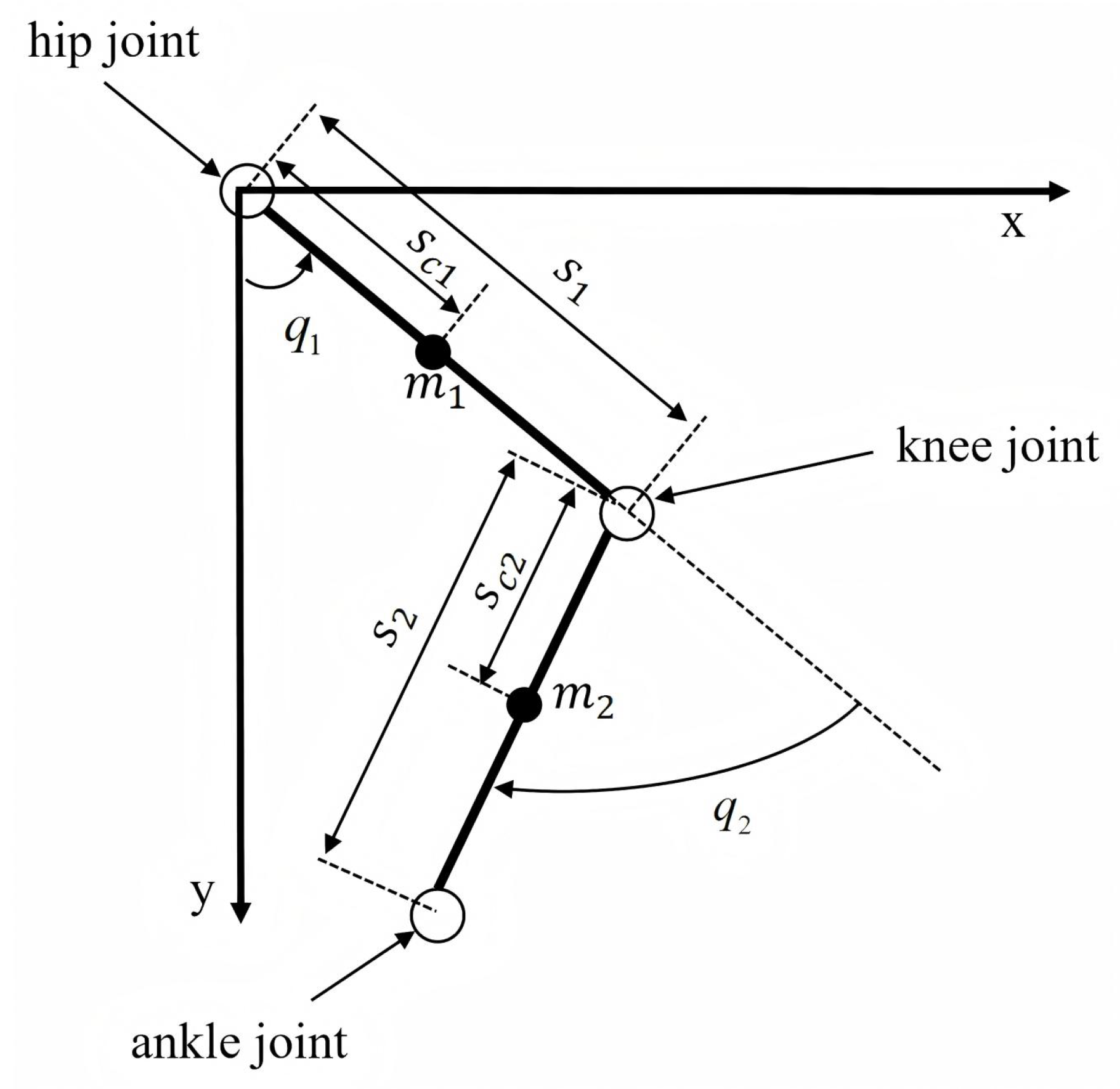
2.1. Dynamic Model of the Exoskeleton
- Assumption: According to the dynamic characteristics of the lower-limb exoskeleton, the lumped uncertainty and external disturbance term D is assumed to be bounded aswhere denotes the upper bound of the uncertainty and external disturbance set.
2.2. Model Linearization and Discretization
3. Design of Model Predictive Controller
3.1. MPC for Tracking
3.2. Design of Adaptive Weight Coefficients
3.3. Stability Analysis
4. Experiment
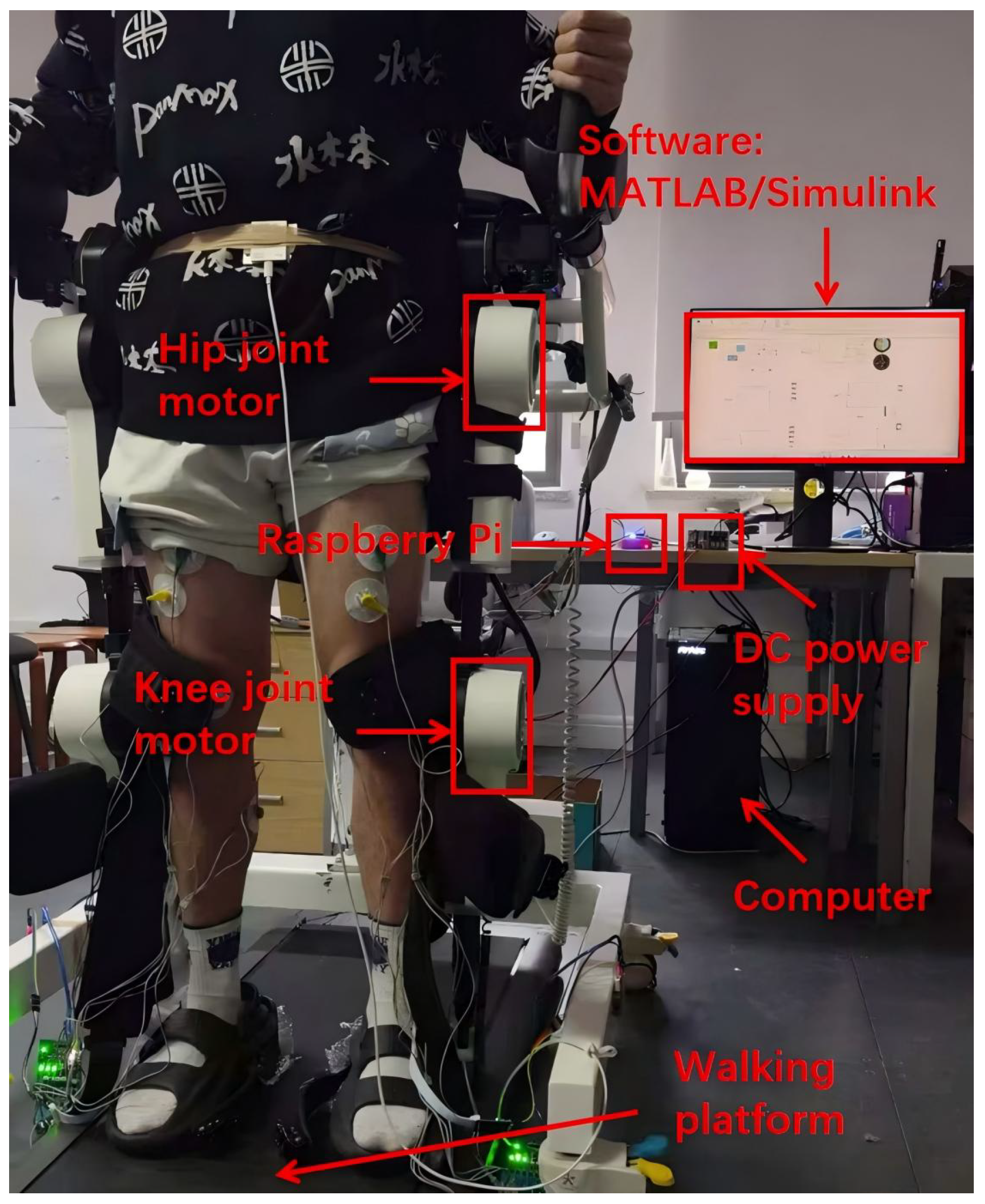
4.1. Experimental Apparatus and Setup
4.2. Reference Trajectory Settings
4.3. Controller Parameter Settings
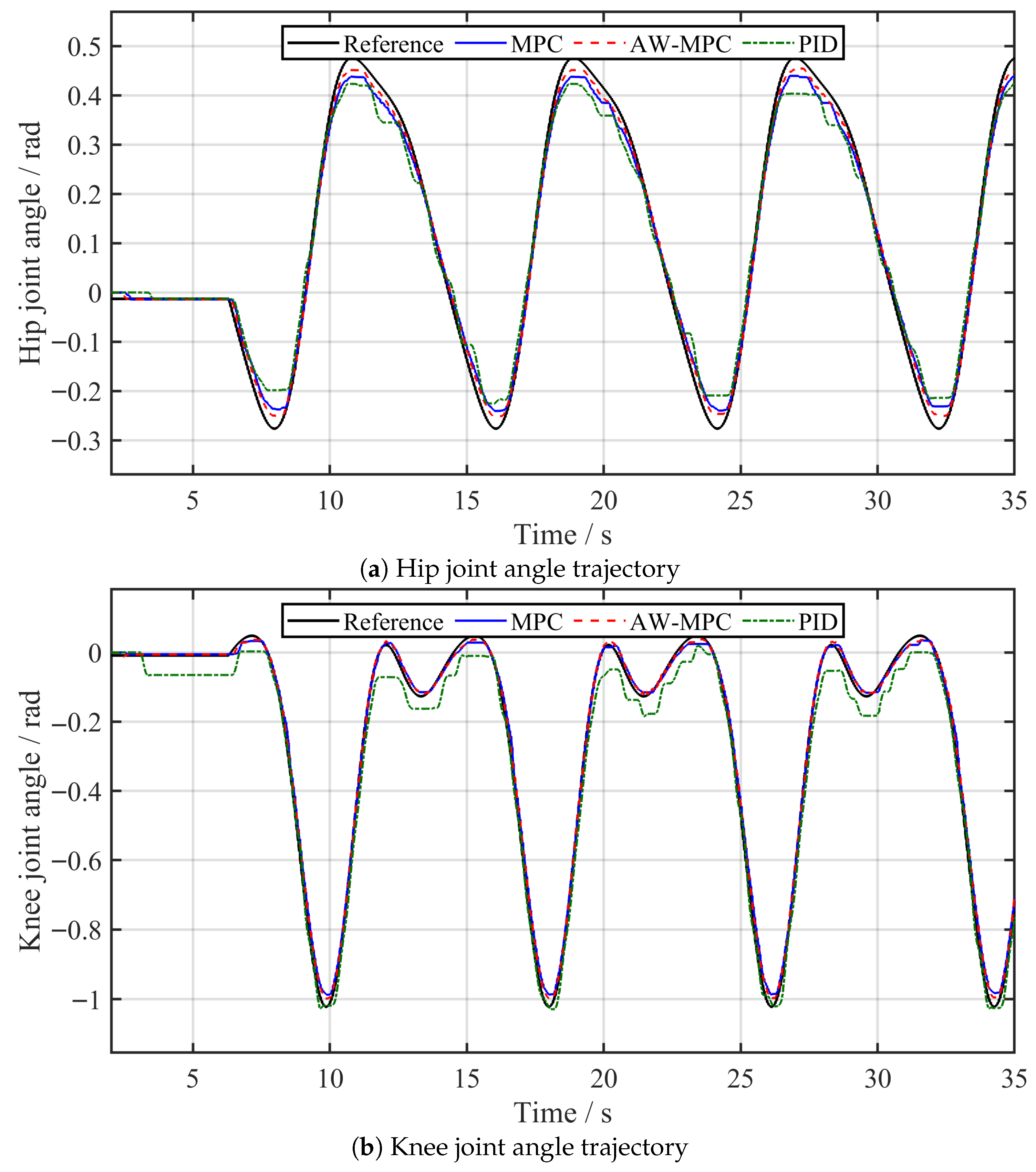
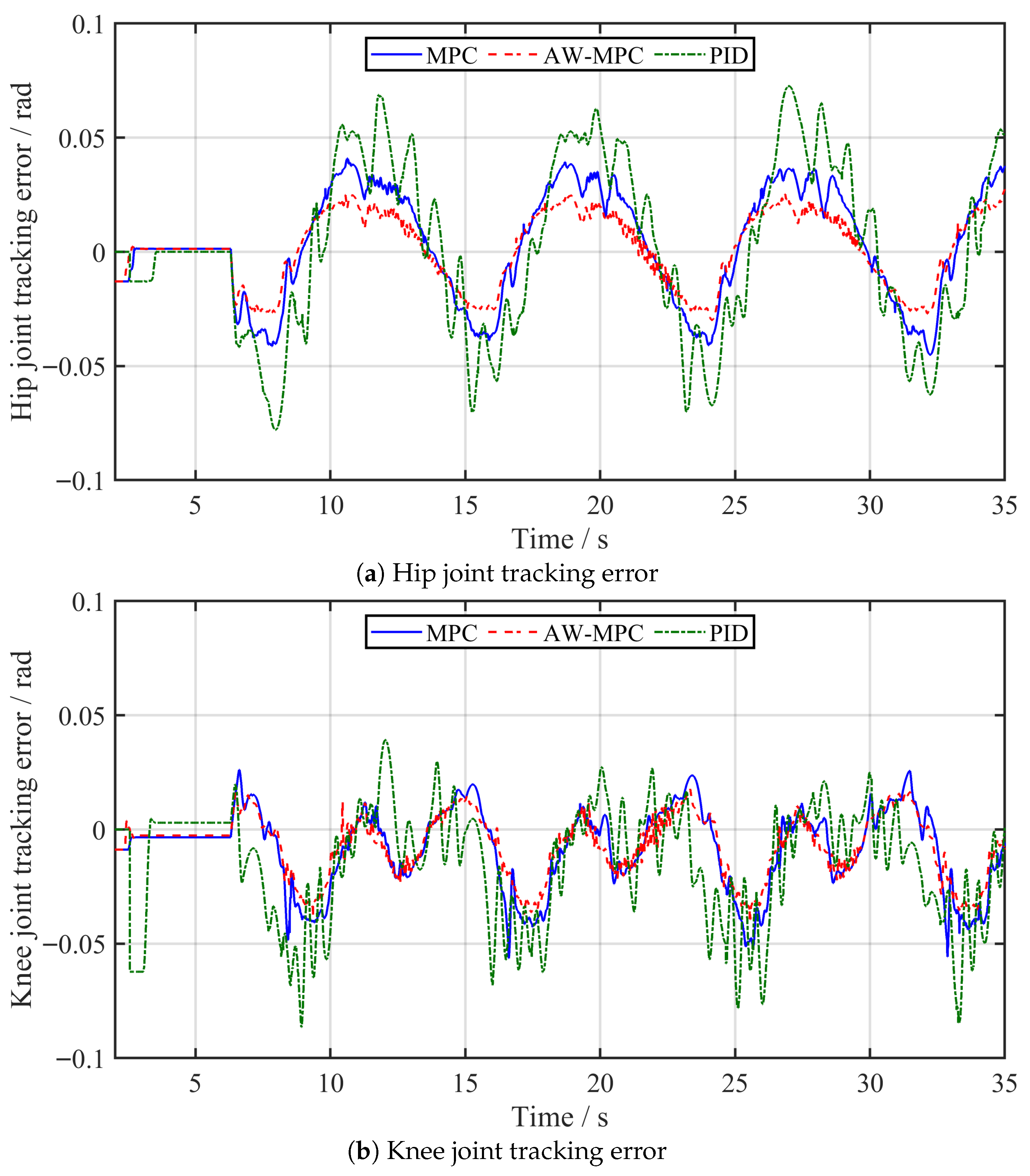
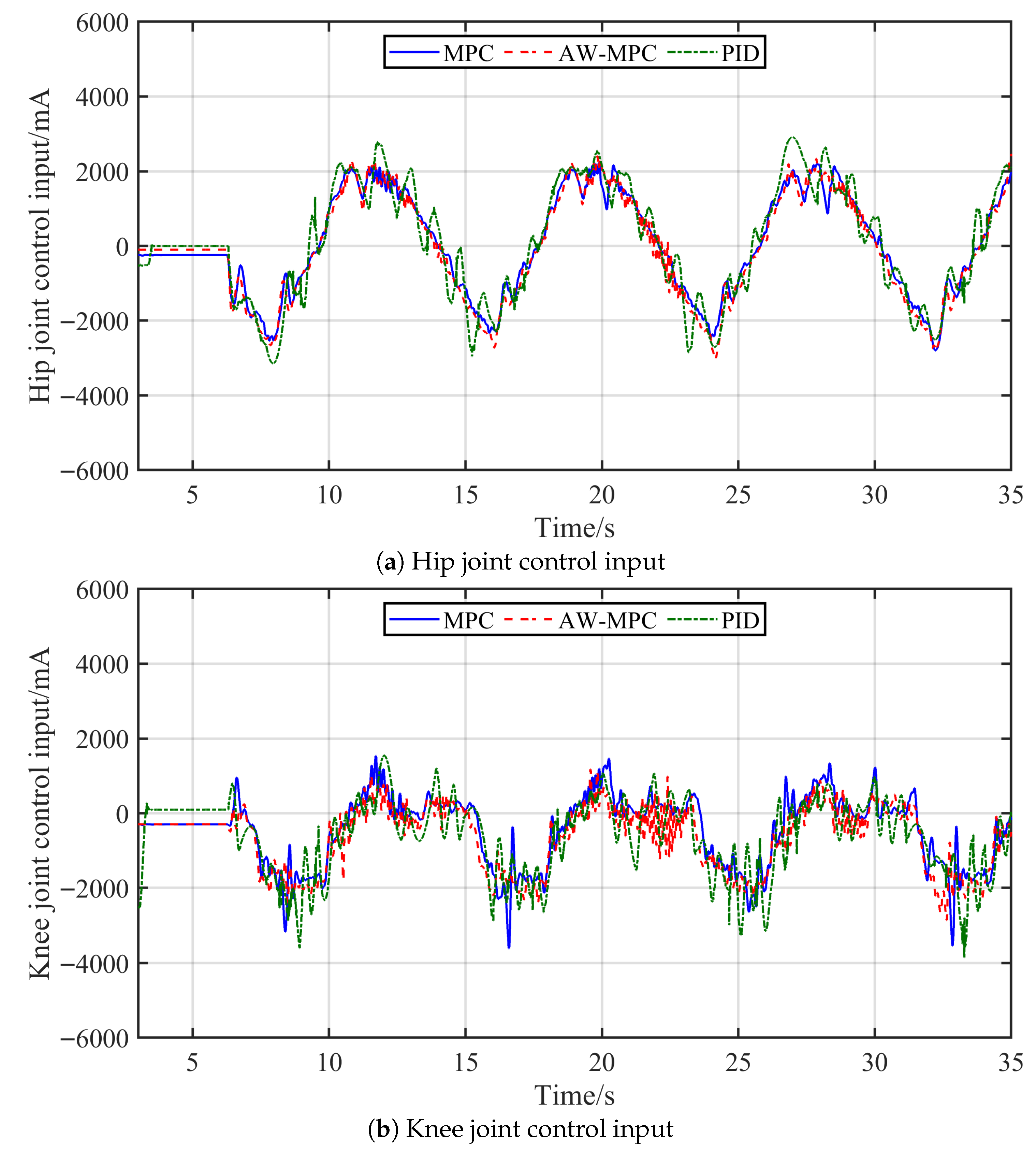
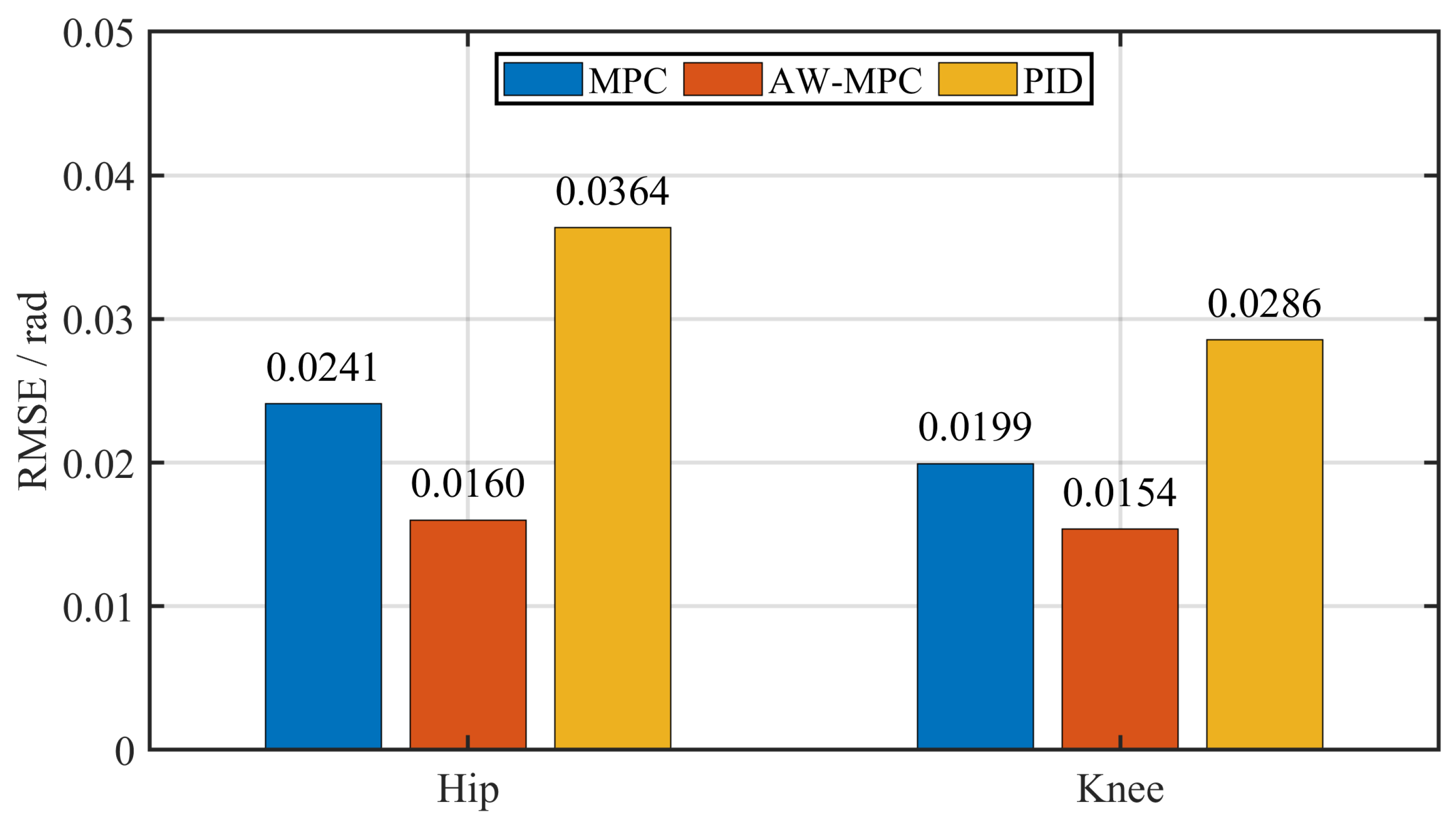
4.4. Experimental Results
5. Conclusions
Author Contributions
Funding
Institutional Review Board Statement
Informed Consent Statement
Data Availability Statement
Acknowledgments
Conflicts of Interest
References
- Kim, Y.W. Update on Stroke Rehabilitation in Motor Impairment. Brain Neurorehabilit. 2022, 15, e12. [Google Scholar] [CrossRef]
- Massardi, S.; Rodriguez-Cianca, D.; Pinto-Fernandez, D.; Moreno, J.C.; Lancini, M.; Torricelli, D. Characterization and Evaluation of Human–Exoskeleton Interaction Dynamics: A Review. Sensors 2022, 22, 3993. [Google Scholar] [CrossRef] [PubMed]
- Chen, B.; Zi, B.; Wang, Z.; Qin, L.; Liao, W.H. Knee exoskeletons for gait rehabilitation and human performance augmentation: A state-of-the-art. Mech. Mach. Theory 2019, 134, 499–511. [Google Scholar] [CrossRef]
- Pinto-Fernandez, D.; Torricelli, D.; Sanchez-Villamanan, M.d.C.; Aller, F.; Mombaur, K.; Conti, R.; Vitiello, N.; Moreno, J.C.; Pons, J.L. Performance Evaluation of Lower Limb Exoskeletons: A Systematic Review. IEEE Trans. Neural Syst. Rehabil. Eng. 2020, 28, 1573–1583. [Google Scholar] [CrossRef] [PubMed]
- Tucker, M.R.; Olivier, J.; Pagel, A.; Bleuler, H.; Bouri, M.; Lambercy, O.; Millán, J.d.R.; Riener, R.; Vallery, H.; Gassert, R. Control strategies for active lower extremity prosthetics and orthotics: A review. J. Neuroeng. Rehabil. 2015, 12, 1. [Google Scholar] [CrossRef]
- Lu, J.; Lv, X.; Liu, J.; Liu, H.; Huang, T. Fully Flexible Wearable Pouch Pneumatic Artificial Muscle Based on Asymmetric Expansion. Chin. J. Mech. Eng. 2026, 39, 100085. [Google Scholar] [CrossRef]
- Cho, Y.; Kim, W.; Park, H.; Kim, J.; Na, Y. Bidirectional Double-Spring Pneumatic Artificial Muscle with Inductive Self-Sensing. IEEE Robot. Autom. Lett. 2023, 8, 8160–8167. [Google Scholar] [CrossRef]
- de Miguel-Fernández, J.; Lobo-Prat, J.; Prinsen, E.; Font-Llagunes, J.M.; Marchal-Crespo, L. Control strategies used in lower limb exoskeletons for gait rehabilitation after brain injury: A systematic review and analysis of clinical effectiveness. J. Neuroeng. Rehabil. 2023, 20, 23. [Google Scholar] [CrossRef]
- Alsaied, A.; Li, K. An Optimized Type 2 Fuzzy Control with Time Delay Estimation for Gait Trajectory Tracking in Lower-Limb Exoskeleton Robot. Int. J. Fuzzy Syst. 2025. [Google Scholar] [CrossRef]
- Vantilt, J.; Tanghe, K.; Afschrift, M.; Bruijnes, A.K.B.D.; Junius, K.; Geeroms, J.; Aertbelien, E.; De Groote, F.; Lefeber, D.; Jonkers, I.; et al. Model-based control for exoskeletons with series elastic actuators evaluated on sit-to-stand movements. J. Neuroeng. Rehabil. 2019, 16, 65. [Google Scholar] [CrossRef] [PubMed]
- Ahmed, T.; Islam, M.R.; Brahmi, B.; Rahman, M.H. Robustness and Tracking Performance Evaluation of PID Motion Control of 7 DoF Anthropomorphic Exoskeleton Robot Assisted Upper Limb Rehabilitation. Sensors 2022, 22, 3747. [Google Scholar] [CrossRef] [PubMed]
- Zhu, X.; Liu, J.; Zhang, F.; Shen, X.; Chen, G.; Wu, X.; Cao, W. Trajectory Tracking Control of a Pediatric Lower Limb Gait Rehabilitation Exoskeleton Based on Nonsingular Fast Terminal Sliding Mode Control. J. Phys. Conf. Ser. 2025, 3101, 012006. [Google Scholar] [CrossRef]
- Li, W.; Wei, X.; Sun, D.; Zong, S.; Yue, Z. Investigation of Trajectory Tracking Control in Hip Joints of Lower-Limb Exoskeletons Using SSA-Fuzzy PID Optimization. Sensors 2025, 25, 1335. [Google Scholar] [CrossRef]
- Abdallah, M.; Kali, Y.; Saad, M.; Fareh, R.; Bettayeb, M. Wearable exoskeleton robot control using radial basis function-based fixed-time terminal sliding mode with prescribed performance. Asian J. Control 2025. early view. [Google Scholar] [CrossRef]
- Nguyen, H.; Kamel, M.; Alexis, K.; Siegwart, R. Model Predictive Control for Micro Aerial Vehicles: A Survey. In Proceedings of the 2021 European Control Conference (ECC), Delft, The Netherlands, 29 June–2 July 2021; pp. 1556–1563. [Google Scholar] [CrossRef]
- Jammeli, I.; Chemori, A.; Moon, H.; Elloumi, S.; Mohammed, S. An Assistive Explicit Model Predictive Control Framework for a Knee Rehabilitation Exoskeleton. IEEE/ASME Trans. Mechatron. 2022, 27, 3636–3647. [Google Scholar] [CrossRef]
- Dai, L.; Yu, Y.; Zhai, D.H.; Huang, T.; Xia, Y. Robust Model Predictive Tracking Control for Robot Manipulators with Disturbances. IEEE Trans. Ind. Electron. 2021, 68, 4288–4297. [Google Scholar] [CrossRef]
- Wang, Y.; Leibold, M.; Lee, J.; Ye, W.; Xie, J.; Buss, M. Incremental Model Predictive Control Exploiting Time-Delay Estimation for a Robot Manipulator. IEEE Trans. Control Syst. Technol. 2022, 30, 2285–2300. [Google Scholar] [CrossRef]
- Li, J.; Peng, X.; Li, B.; Sreeram, V.; Wu, J.; Chen, Z.; Li, M. Model predictive control for constrained robot manipulator visual servoing tuned by reinforcement learning. Math. Biosci. Eng. 2023, 20, 10495–10513. [Google Scholar] [CrossRef] [PubMed]
- Han, J.; Yang, S.; Xia, L.; Chen, Y.H. Deterministic Adaptive Robust Control with a Novel Optimal Gain Design Approach for a Fuzzy 2-DOF Lower Limb Exoskeleton Robot System. IEEE Trans. Fuzzy Syst. 2021, 29, 2373–2387. [Google Scholar] [CrossRef]
- dos Santos, W.M.; Siqueira, A.A.G. Optimal impedance via model predictive control for robot-aided rehabilitation. Control Eng. Pract. 2019, 93, 104177. [Google Scholar] [CrossRef]
- Zhakatayev, A.; Rakhim, B.; Adiyatov, O.; Baimyshev, A.; Varol, H.A. Successive linearization based model predictive control of variable stiffness actuated robots. In Proceedings of the 2017 IEEE International Conference on Advanced Intelligent Mechatronics (AIM), Munich, Germany, 3–7 July 2017; pp. 1774–1779. [Google Scholar] [CrossRef]
- Pechlivanidou, G.; Karampetakis, N. Zero-order hold discretization of general state space systems with input delay. IMA J. Math. Control Inf. 2022, 39, 708–730. [Google Scholar] [CrossRef]
- Schwenzer, M.; Ay, M.; Bergs, T.; Abel, D. Review on model predictive control: An engineering perspective. Int. J. Adv. Manuf. Technol. 2021, 117, 1327–1349. [Google Scholar] [CrossRef]
- Benner, P.; Faßbender, H. On the numerical solution of large-scale sparse discrete-time Riccati equations. Adv. Comput. Math. 2011, 35, 119–147. [Google Scholar] [CrossRef]
- Mayne, D.; Falugi, P. Generalized Stabilizing Conditions for Model Predictive Control. J. Optim. Theory Appl. 2016, 169, 719–734. [Google Scholar] [CrossRef]
- Sontag, E.D.; Wang, Y. On characterizations of the input-to-state stability property. Syst. Control Lett. 1995, 24, 351–359. [Google Scholar] [CrossRef]
- Jiang, Z.P.; Wang, Y. Input-to-state stability for discrete-time nonlinear systems. Automatica 2001, 37, 857–869. [Google Scholar] [CrossRef]
- Martin, A.E.; Villarreal, D.J.; Gregg, R.D. Characterizing and modeling the joint-level variability in human walking. J. Biomech. 2016, 49, 3298–3305. [Google Scholar] [CrossRef] [PubMed][Green Version]



| Parameter | Value |
|---|---|
| Thigh mass | |
| Shank mass | |
| Thigh length | |
| Shank length | |
| Thigh inertia | |
| Shank inertia | |
| Distance from thigh CM to hip joint | |
| Distance from shank CM to knee joint | |
| Gravitational acceleration g | |
| Sampling period |
Disclaimer/Publisher’s Note: The statements, opinions and data contained in all publications are solely those of the individual author(s) and contributor(s) and not of MDPI and/or the editor(s). MDPI and/or the editor(s) disclaim responsibility for any injury to people or property resulting from any ideas, methods, instructions or products referred to in the content. |
© 2026 by the authors. Licensee MDPI, Basel, Switzerland. This article is an open access article distributed under the terms and conditions of the Creative Commons Attribution (CC BY) license.
Share and Cite
Zheng, L.; Zhou, Y.; Mao, A.; Du, S. Trajectory Tracking Control of Lower Limb Rehabilitation Exoskeleton Robot Based on Adaptive-Weight MPC. Actuators 2026, 15, 214. https://doi.org/10.3390/act15040214
Zheng L, Zhou Y, Mao A, Du S. Trajectory Tracking Control of Lower Limb Rehabilitation Exoskeleton Robot Based on Adaptive-Weight MPC. Actuators. 2026; 15(4):214. https://doi.org/10.3390/act15040214
Chicago/Turabian StyleZheng, Linqi, Yuan Zhou, Anjie Mao, and Shuwang Du. 2026. "Trajectory Tracking Control of Lower Limb Rehabilitation Exoskeleton Robot Based on Adaptive-Weight MPC" Actuators 15, no. 4: 214. https://doi.org/10.3390/act15040214
APA StyleZheng, L., Zhou, Y., Mao, A., & Du, S. (2026). Trajectory Tracking Control of Lower Limb Rehabilitation Exoskeleton Robot Based on Adaptive-Weight MPC. Actuators, 15(4), 214. https://doi.org/10.3390/act15040214