
Article

Design and Experiment for a Single-Degree-of-Freedom Four-Bar Planting Manipulator
School of Vehicle and Traffic Engineering, Henan University of Science and Technology, Luoyang 471000, China
*
Author to whom correspondence should be addressed.
Actuators 2026, 15(4), 207; https://doi.org/10.3390/act15040207
Submission received: 25 February 2026 / Revised: 21 March 2026 / Accepted: 29 March 2026 / Published: 4 April 2026

Abstract

At present, commonly used vegetable pot seedling planters can be divided into two categories: one has a complex structure and high manufacturing cost, and the other has a simple structure but poor planting quality. In order to solve this problem, an open-hinge four-bar-mechanism planting manipulator is designed, which has many advantages, such as a simple structure, strong force transfer performance, and the ability to achieve complex trajectory curves. The physical characteristics of pot seedlings are measured; this provides a basis for the structural and dimensional design of the planter and the shape design of the duckbill. According to the analysis of the planting process, the design requirements of the planting mechanism are formulated. The motion path of the mechanism and the motion of each pair are planned and designed; a planetary gear train is used to restrain the rotating pair consisting of connecting rod 1 and connecting rod 2; a cam high pair mechanism is used to restrain the rotating pair consisting of connecting rod 2 and connecting rod 3; and a cam linkage mechanism is used to control the opening and closing action of the duckbill. Finally, a single-degree-of-freedom fully mechanical planting mechanism is designed. The experimental results show that the trajectory of the initial soil entry point of the planting mechanism is consistent with the design requirements and theoretical simulation results. In the transplanting experiment, the rate of qualified planting erectness was 94.79%, among which the rate of excellent planting erectness was 92.45%, and the mechanism has high reliability. The design of this mechanism offers a fully automatic pot seedling planting method, which can provide a reference for research on the full automation of transplanting equipment.

1. Introduction

Dryland transplanting technology plays an important role in improving the disaster resistance and stress resistance of crop growth, guaranteeing stable crop yields, and improving product quality, which is an indisputable fact. It has always been a hotspot and major challenge in transplanting industry research and also a “crown” in the field of scientific research in the transplanting industry. At present, the main target of dryland transplanting is pot seedlings cultivated in hole trays, aiming at crops with higher economic value, such as vegetables, tobacco, sugar beet, and cotton [1,2,3]. There are two key links in the transplanting process: one is to use a seedling-picking and feeding robot to take the grown crop pot seedlings from the pot tray and place them into the planting robot, and the other is to use the planting robot to implant the pot seedlings vertically into the field at a certain depth. The planting mechanism is the key component of the transplanter; it determines the straightness of planting and directly affects the quality of crop planting [4,5,6,7].
At present, the most commonly used planting mechanisms include the clamp type, flexible disc type, seedling guide tube type, suspension cup type, multi-link type, and cam pendulum rod type [8,9,10,11]. According to the different planting structures, the clamp type can be divided into the disc clamp type and chain clamp type, and the working principles of the two types are similar. The difference between the two types is that the root of the seedling is clamped in the disc clamp type, while the stem and leaf of the seedling are clamped in the chain clamp type. This kind of planting mechanism has a simple structure, low production cost, and stable plant spacing and planting depth and is suitable for nude seedling transplanting, but it is prone to injuring seedlings, and the quality of transplantation is poor [12,13,14]. The flexible disc planting mechanism holds the pot seedling to rotate through the flexible discs on both sides, and the pot seedling is released when it reaches the planting point. This kind of planting mechanism has a simple structure and can achieve large-spacing planting, but the straightness of pot seedlings is poor during planting, and the lodging phenomenon can easily occur after planting [15,16,17]. The seedling guide tube planting mechanism places the seedling into the seedling-throwing barrel. When the seedling-throwing barrel with the pot seedling rotates over the seedling guide tube, the seedling-throwing barrel opens and the seedling falls into the seedling hole opened by the trencher along the seedling guide tube. The seedling injury rate of this kind of planting mechanism is low and the transplanting speed is high, but its structure is complex and it is easy to miss planting and replanting [18,19]. A parallelogram mechanism is formed between the two rotating eccentric wheels and the hanging cups in the suspension cup planting mechanism. The hanging cups can maintain the vertical state during operation, and the seedling straightness is better. However, this kind of planting mechanism has a complex structure, a large volume, single plant spacing, and low operation efficiency [20,21,22,23]. The multi-link planting mechanism drops the pot seedlings into the duckbill of the planter, and then the duckbill opens and releases the pot seedlings into the seedling hole when the duckbill hits the lowest point under the action of the multi-link. This kind of transplanting mechanism has a low damage rate for pot seedlings, and the plant spacing and planting depth are relatively stable, but the vibration inertia is large, the quality of transplanting is unstable, and lodging can easily occur, so the planting quality is low [24,25,26,27]. Although the cam pendulum rod planting mechanism can satisfy the need for higher quality in pot seedling planting, and the rate of straightness is over 90%, the overall structure is more complex, which may lead to poor mechanical properties during high-speed operation [28,29].
To improve the reliability of planting mechanisms and reduce costs, the structure should be simplified as much as possible while meeting the requirements of planting movements. Based on the above research and analysis, this paper explores the physical characteristics of pot seedlings and the operation process of the planter, puts forward the design requirements for the planting mechanism, and designs an open-hinge four-rod automatic planting mechanism for vegetable pot seedling. The hinged four-rod mechanism used in this study is a basic type of rod mechanism, with a small number of components and a simple structure. The motion of each pair in the four-bar linkage is planned, and the redundant degrees of freedom are restrained by a planetary gear train and cam mechanism. Finally, a single-degree-of-freedom and fully mechanical planting mechanism is designed; the entire mechanism only needs a prime mover to accurately implement complex motion laws, which can significantly reduce the control cost and improve work reliability. Finally, motion simulation and planting experiments were carried out to verify the rationality and accuracy of the mechanism design.

2. Analysis of Physical Characteristics of Pot Seedlings

The height of the pot seedling determines the length of the duckbill and the displacement between the seedling-picking point and the seedling-planting point, which is the basis for designing the length of the duckbill and the lengths of connecting rods 1 and 2. The width of the spread leaf is the main influencing factor for the hanging and carrying of seedlings in planting equipment and determines the width of the duckbill. The depth and size of the punch holes of the planter depend on the size of the pot [26,30,31], which determines the installation distance of the planter from the ground. Therefore, the physical characteristics of pot seedlings are the basis for designing the planting mechanism. In this study, tomato pot seedlings under the same cultivation conditions were taken as the research object. The physical characteristics of the pot seedlings at a suitable seedling age were measured, and bases for the design of the structure and size of the planter and the shape of the duckbill were provided.
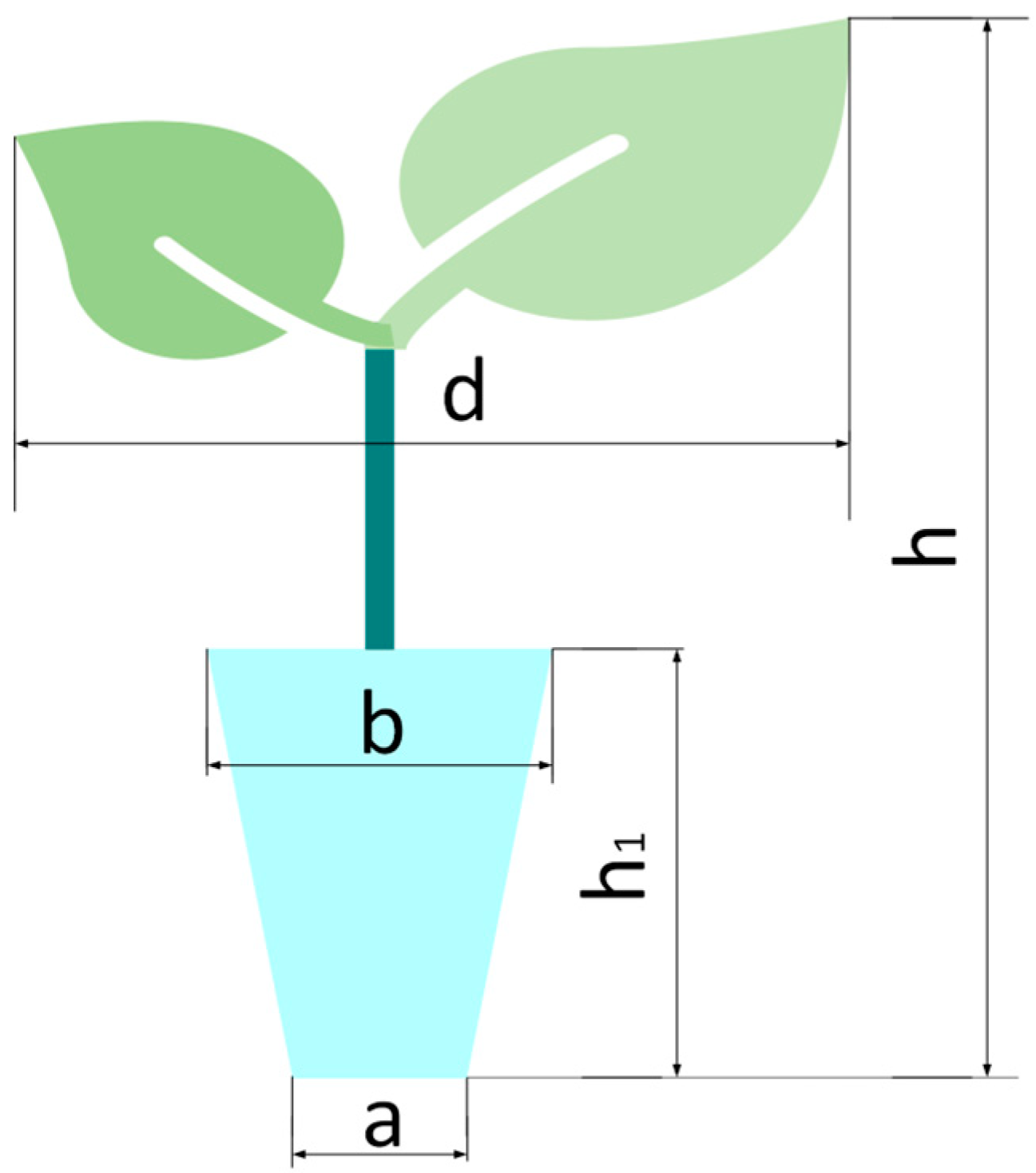
Hezuo 906 pink-fruit tomato seedlings were used in the experiment, with 128-hole standard seedling trays. Peat and perlite were mixed in a 2:1 ratio as the seedling medium, and vermiculite was used to cover the seedlings after sowing. The main measurement parameters of the seedlings are shown in Figure 1. The dimension from the bottom of the substrate to the top of the seedlings is the height h of the seedlings. The longest distance of the seedling leaves in a state of natural extension is the diameter d of the leaf crown. The total weight of the seedling and substrate is the weight of the pot seedling. The bottom size of the pot body is a, the upper size is b, and the height of the pot body is h1. In the experiment, 384 seedlings were randomly selected from three trays of seedlings with a 40-day seedling age, 35% water content in the pot, and good growth. The seedlings were gently pulled out from the trays and placed flat. The above parameters were measured under natural conditions. The physical characteristic parameters of each seedling were measured twice, and the average value was recorded [32].
The measurement parameters for the physical characteristics of the pot seedlings are described in Table 1. These physical characteristics of pot seedlings provide a reference for the design of the structure and size of the planting mechanism and the shape of the duckbill in the following sections.

3. Design of the Planting Mechanism

3.1. Design Requirements

The planting mechanism is mainly used for picking up pot seedlings that are thrown by artificial or seedling-throwing manipulators and then planting them intactly in the field. The movement of the planting mechanism can be divided into four stages: seedling picking, seedling transportation, hole opening, and planting. The duckbill is used to place pot seedlings and open holes. In order to ensure the straightness and survival of pot seedlings in the process of planting, it is required that the designed planting mechanism can move according to the specific movement trajectory. When reaching the planting point, the duckbill can accurately punch holes, open holes, and plant pot seedlings and then proceeds to the next working cycle. The specific design requirements of the planting mechanism are as follows [22,33,34].
(1) Requirements of movement trajectory. The duckbill of the planting mechanism is required to move to the nearest place from the seedling-throwing point to receive seedlings; thus, the interaction force between the soil pot and the duckbill can be reduced, and the damage of the soil pot can be avoided. In order to ensure the straightness of pot seedlings, the relative velocity between the duckbill and ground is close to zero when the duckbill is inserted into the soil and withdrawn from the soil. In addition, the duckbill should be kept as vertical as possible, and the angle between the duckbill and ground should not deviate too much from 90 degrees.
(2) Closed state of the duckbill. Before and after picking up seedlings, and during seedling transportation and hole opening, the duckbill should be kept closed to prevent the pot seedling from falling out. When the duckbill is inserted into the soil at the lowest point, the duckbill opens and the pot seedling is placed. Then, during the period from the duckbill leaving the hole until it is at a distance from the top of the pot seedling, the duckbill is kept open to avoid damaging the seedling. Then, it is closed again and moved to the seedling-receiving position to start the next working cycle.

3.2. Mechanism Design

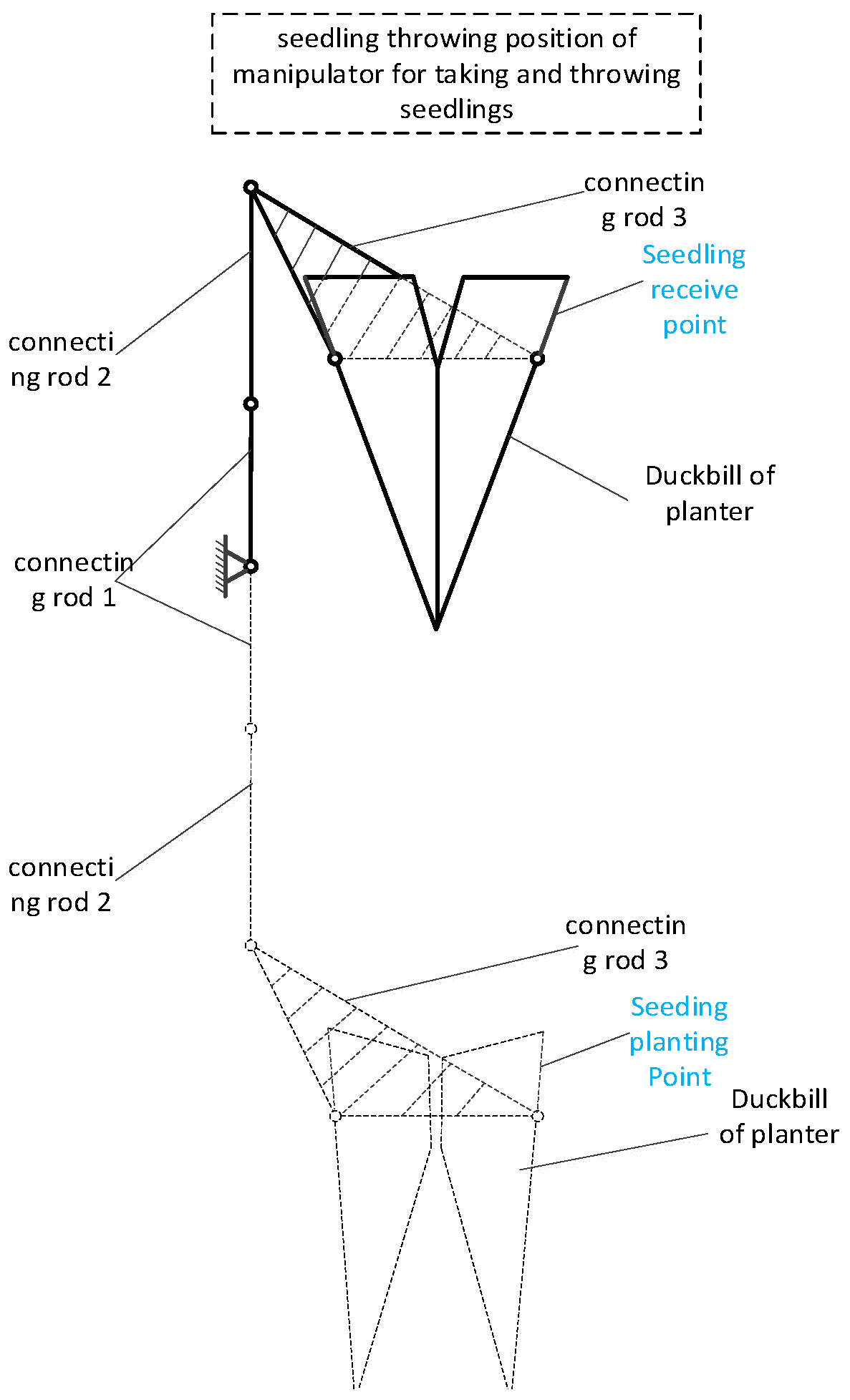
In this study, the open-hinge four-bar mechanism is adopted in the planting mechanism, which has the following advantages: (1) it is suitable for transmitting high power and is often used in power machinery; (2) it can achieve many kinds of trajectory curves and laws of motion, and it is often used in engineering as an executing mechanism to directly fulfill some trajectory requirements; (3) depending on the geometric surface of the moving pair elements, contact between the components can be maintained, and the manufacturing accuracy required can be easily guaranteed; (4) the control mechanism of long-distance transmission can be realized. The planting schematic diagram of the four-bar planting mechanism designed in this work is shown in Figure 2. The frame, connecting rod 1, connecting rod 2, and connecting rod 3 are connected by rotating pairs. The duckbill consists of the left and right parts, which are hinged to connecting rod 3. When they rotate around the center of the hinge, the duckbill can be opened and closed. When the mechanism occupies the solid-line position in Figure 2, the duckbill is at the highest point, which is nearest to the seedling-throwing point, and this position is the seedling-receiving point. After the duckbill receives the seedling, the mechanism drives the duckbill to move toward the planting point; this process is the seedling transportation stage. When reaching the planting site, the duckbill touches the soil and punches a hole. Before and after picking up the seedling, and in the process of seedling transportation and hole punching, the duckbill is always closed in order to avoid seedling dropping.
When the mechanism occupies the dotted-line position in Figure 2, the duckbill is at the lowest point. At this time, the duckbill is inserted deep into the soil and opens, and the seedling falls into the hole. Then, the mechanism drives the duckbill to move toward the seedling-receiving point. When the duckbill is completely separated from the pot seedling, the duckbill closes and starts the next working cycle after reaching the seedling-receiving point.

3.3. Motion Trajectory Planning and Motion Design of Each Pair

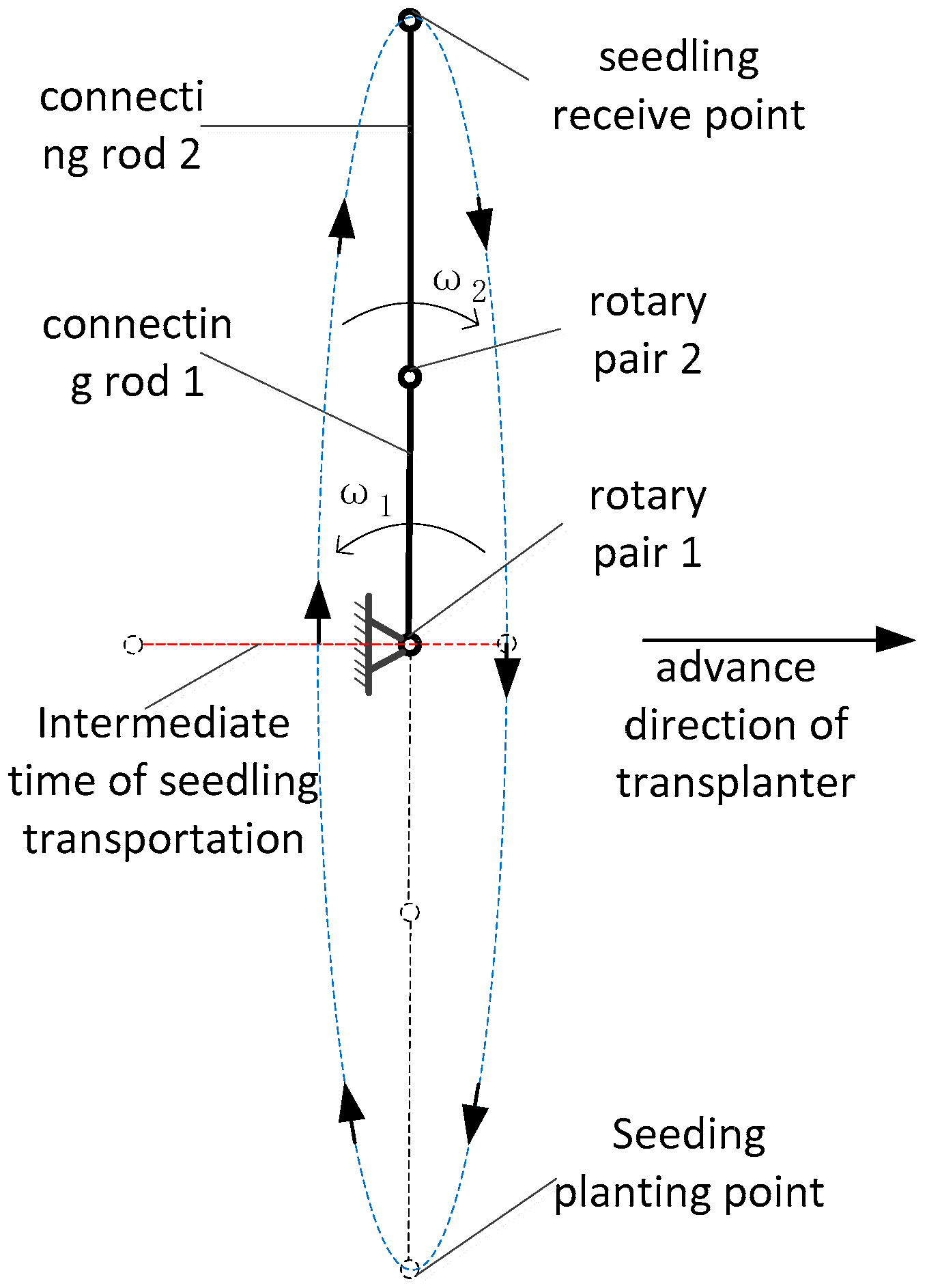
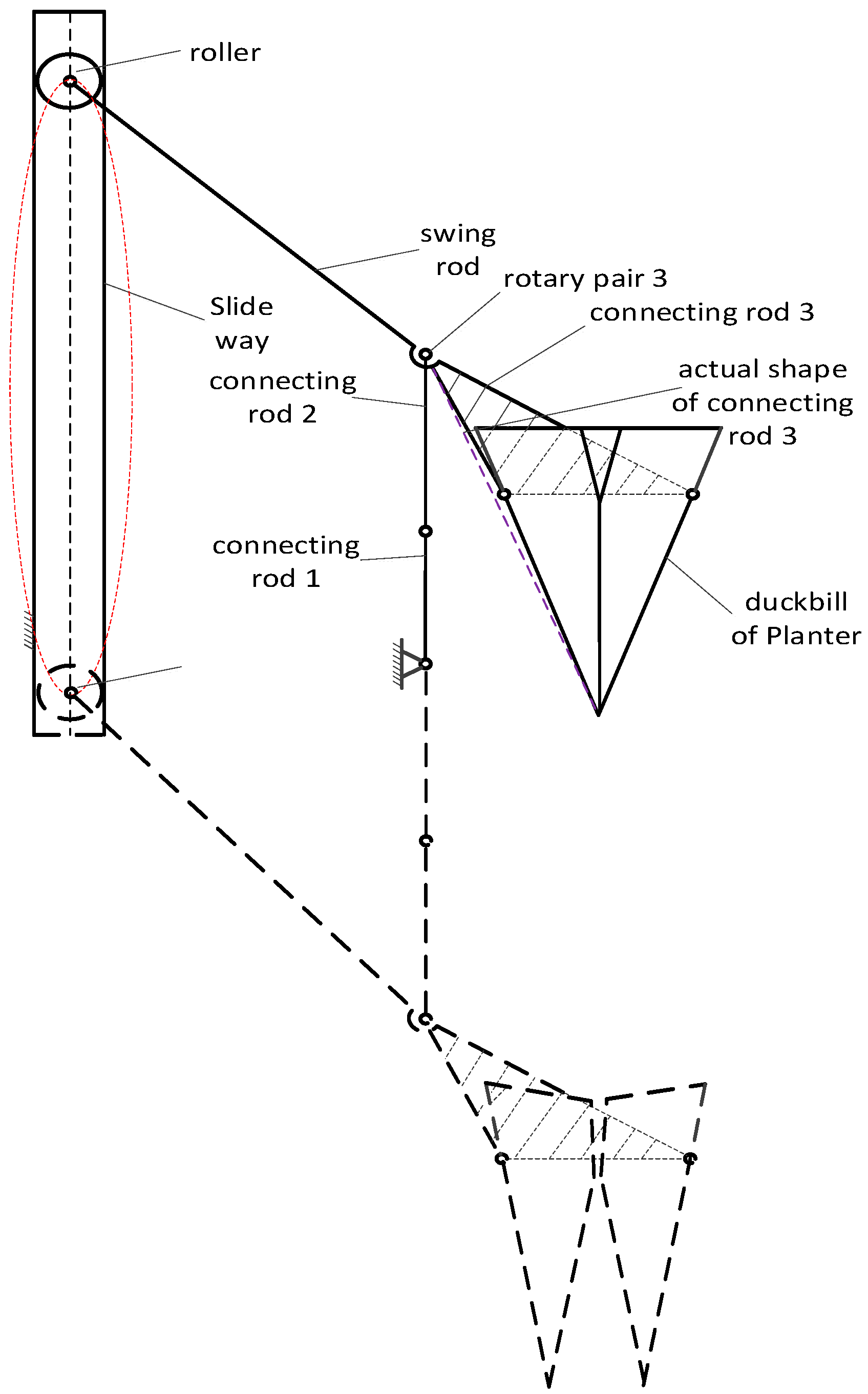
In order to achieve the movement of connecting rods 1 and 2, uniform rotation is applied to both rotating pair 1 and rotating pair 2; rotating pair 1 and rotating pair 2 are shown in Figure 3. According to the above analysis, when connecting rod 1 and connecting rod 2 are upright, the planting mechanism is in the position of seedling acceptance, while, when they are vertically downward, the planting mechanism is in the position of planting. In this process, connecting rods 1 and 2 rotate 180 degrees relative to the frame. Then, when they move from the planting position to the seedling-receiving position, they also rotate 180 degrees relative to the frame and complete a work cycle. In order to reduce the size of the mechanism in the horizontal direction and reduce the space of the whole transplanting equipment, the motion velocity of connecting rod 1 and connecting rod 2 should be equal in size and opposite in direction. In this way, in the process of transporting seedlings to the planting point and returning to the seedling-receiving point, connecting rods 1 and 2 will gradually fold up, which significantly reduces the space occupied by the mechanism in the horizontal direction. The positions of connecting rod 1 and connecting rod 2 at the middle of seedling transportation are shown by the red dotted line in Figure 3. In the process of transplanting, the advance direction of the transplanter is as shown in Figure 3. In order to ensure that the relative speed between the duckbill and the ground is close to zero, the duckbill must move to the left during the process of transplanting. The length of connecting rod 2 is longer than that of connecting rod 1, so that the trajectory of the end of connecting rod 2 is as shown by the blue dotted line in Figure 3, which is an ellipse, and the arrow represents its direction of motion.
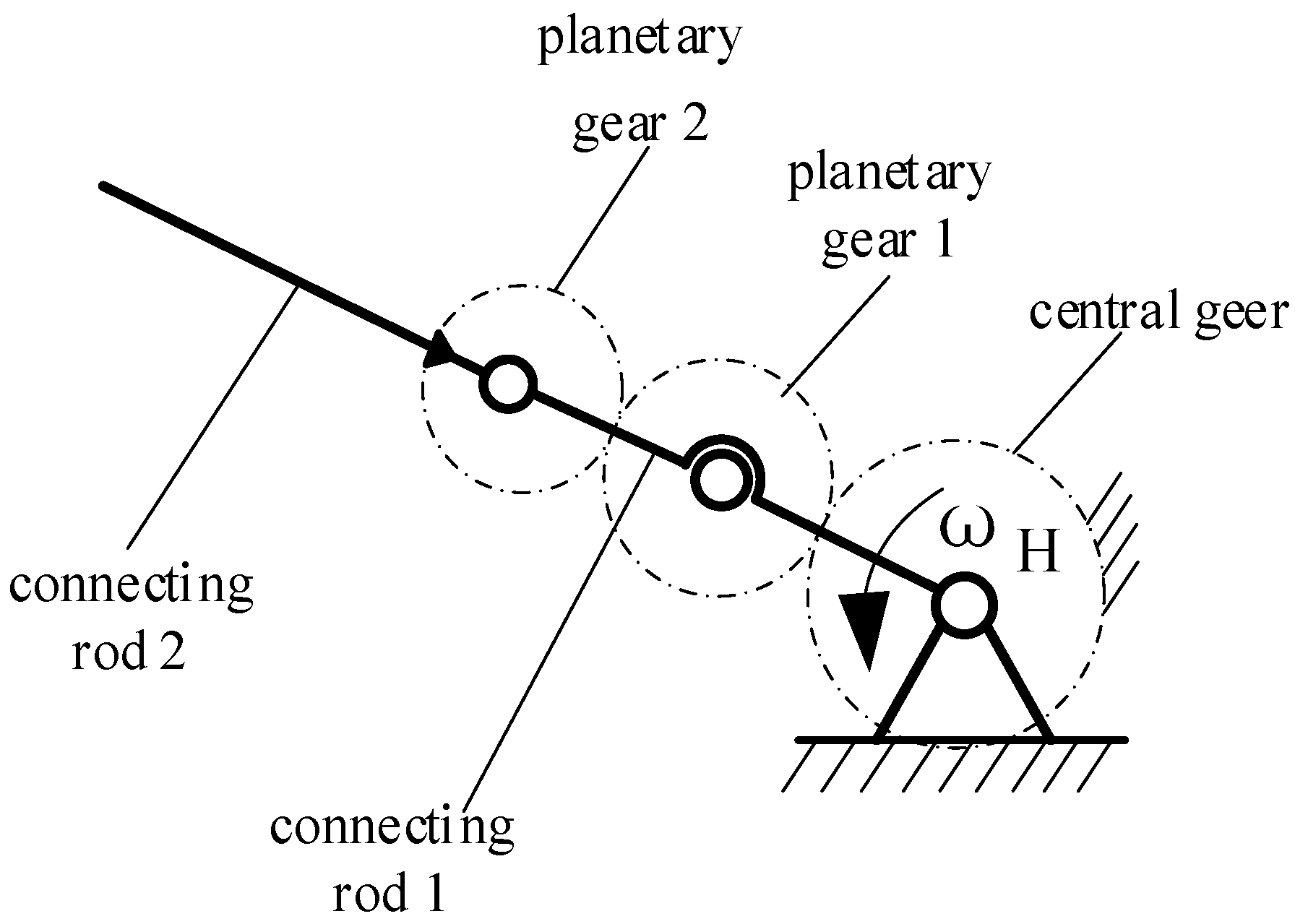
The rotation of connecting rod 2 is driven by a planetary gear train; the driving diagram of the planetary gear train for connecting rod 2 is shown in Figure 4. The tooth number of central gear 1 is 20, the tooth number of planetary gear 2 is 15, and the tooth number of planetary gear 3 is 10. The central gear is fixed, planetary gear 2 is articulated on connecting rod 1, planetary gear 3 and connecting rod 2 are rigidly connected, and planetary gear 3 is articulated on the rotating pairs that connect connecting rod 1 and connecting rod 2, while connecting rod 1 acts as the planetary frame. Connecting rod 1 rotates counterclockwise at speed ωH, and so the speeds of planetary gear 3 and connecting rod 2 are as follows:
ω 13 H = ω 1 ω H ω 3 ω H = z 3 z 2 z 2 z 1 = 10 20 = 1 2
0 ω H ω 3 ω H = z 3 z 2 z 2 z 1 = 10 20 = 1 2
ω 3 = ω H
Through calculation, it is known that the speeds of connecting rod 2 and connecting rod 1 are equal, and their directions are the opposite, which meets the design requirements. During the planting process, the duckbill is required to be basically vertical, i.e., the angle between the duckbill and the ground is about 90 degrees, so the rotation speed of connecting rod 3 relative to the frame should be basically zero. The cam high pair restraint is adopted for the rotating pair between connecting rods 2 and 3, and the schematic diagram of the cam high pair restraint for rotating pair 3 is shown in Figure 5. The swing rod and connecting rod 3 are an object. From the previous analysis, we know that the movement track of the end of connecting rod 2—that is, the rotation center of rotating pair 3—is an ellipse. Therefore, in order to keep the posture of connecting rod 3 and the duckbill unchanged throughout the whole planting process, the path of the roller center at the end of the swing rod should also be an ellipse. In order to simplify the shape of the slide, it is rendered as a straight path. In this way, throughout the whole planting process, connecting rod 3 and the duckbill will swing at a small angle relative to the frame, but the duckbill will always be in a vertical state at the seedling-receiving point and the planting point.
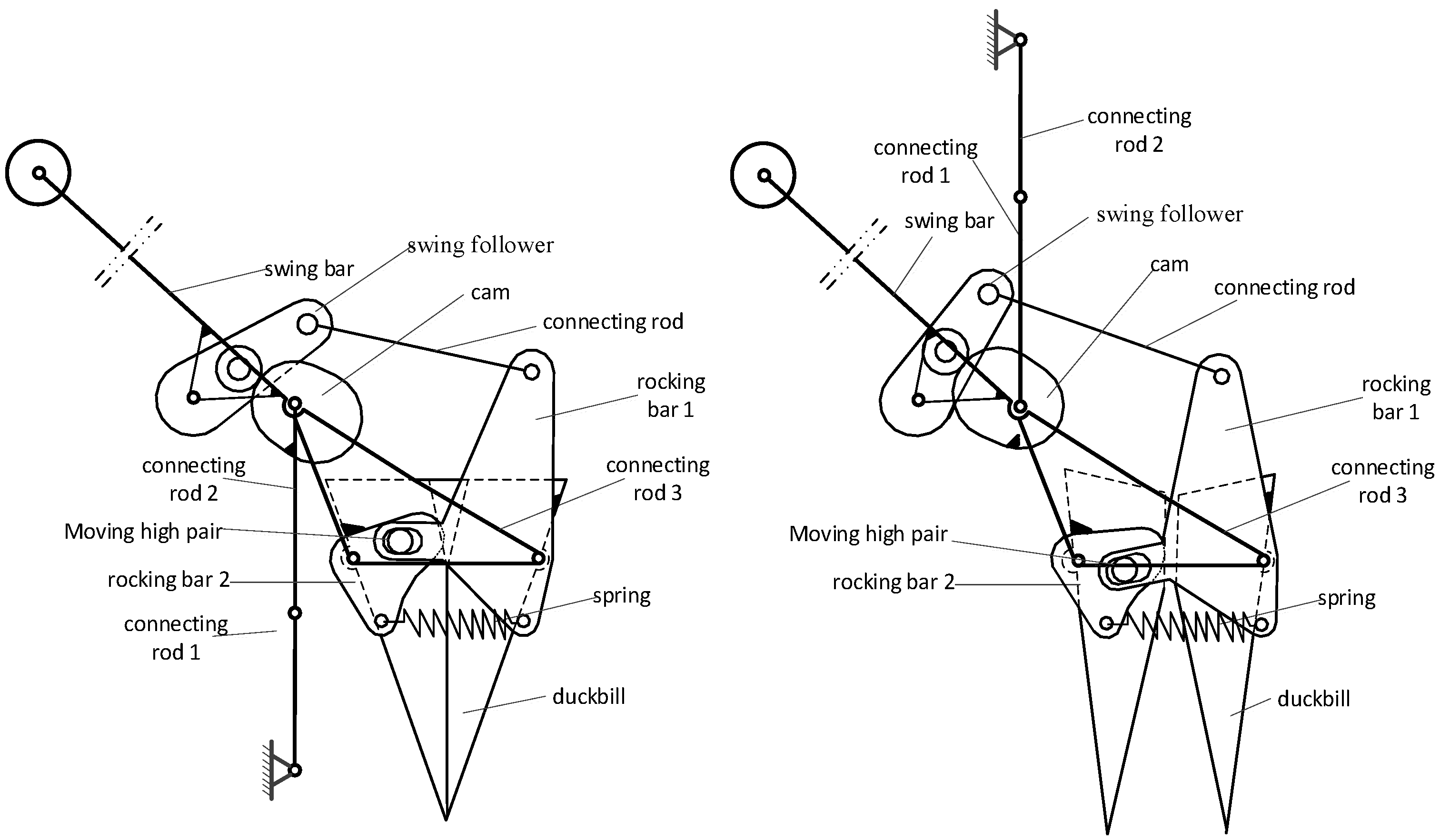
The opening and closing of the duckbill are controlled by a cam linkage mechanism, and the opening and closing control mechanism is shown in Figure 6. The cam is rigidly connected with connecting rod 2, and the rotation center of the cam coincides with the rotary pair center at the end of connecting rod 2. In a working cycle, connecting rod 2 rotates in a circle, the cam also rotates in a circle, and the duckbill is opened and closed once. The swing follower is hinged on the swing rod and is driven by the cam to swing back and forth; rocking bar 1 is rigidly connected with the right half of the duckbill, and the swing follower drives rocking bar 1 to swing anti-clockwise through the connecting rod; rocking bar 2 is rigidly connected with the left half of the duckbill, and rocking bar 1 drives rocking bar 2 to swing clockwise via the moving high pair; the reverse swing of rocking bar 1 and rocking bar 2 realizes the opening and closing of the duckbill, in which opening is driven by the cam and closing is realized by the spring.

4. Motion Simulation of Planting Mechanism

4.1. Establishment of Coordinate System of Planting Mechanism

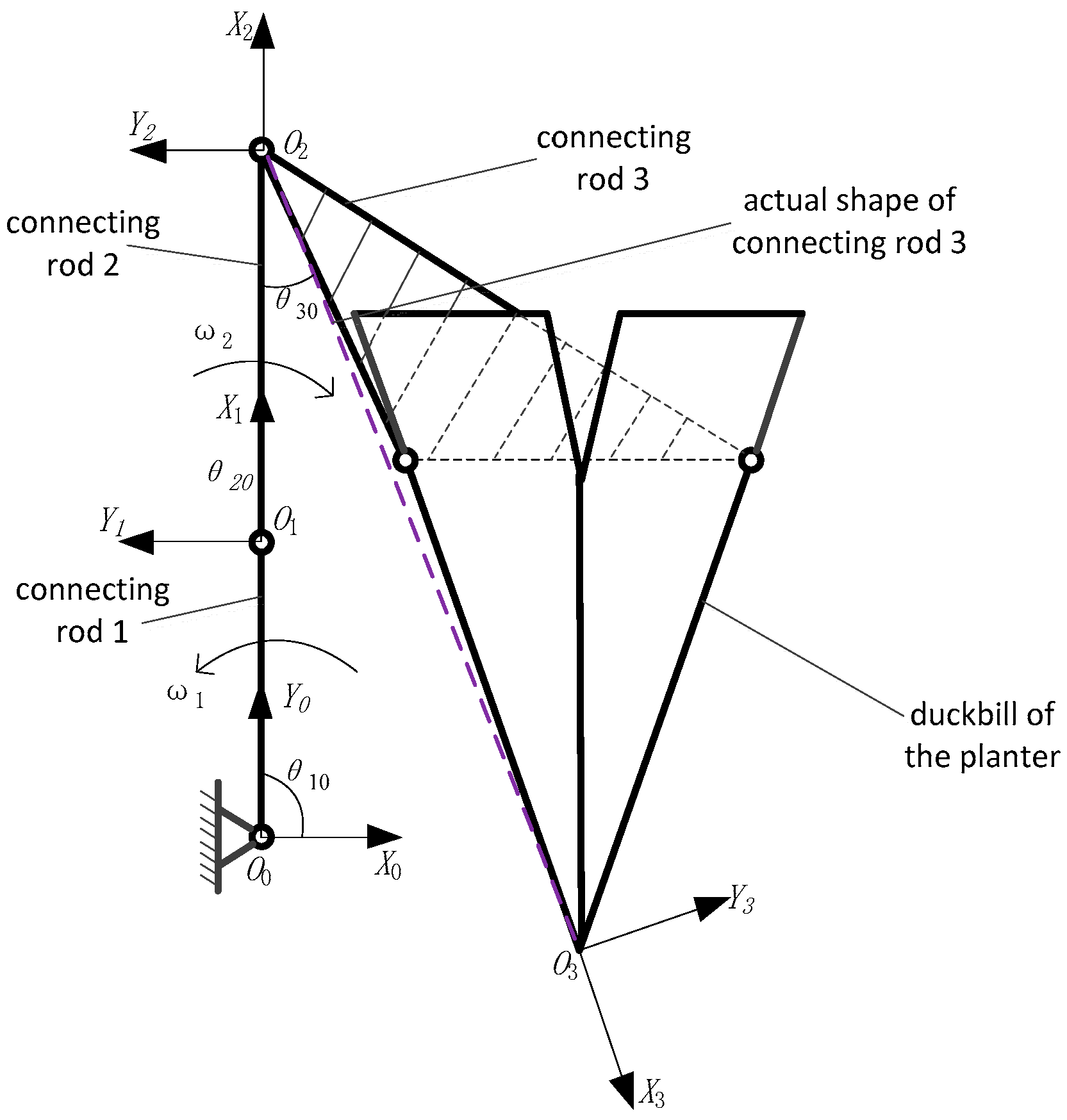
The coordinate system of the four-bar planting manipulator is established as shown in Figure 7. The base coordinate system O0X0Y0Z0 is fixed on the frame, and the original point O0 of the coordinate system is located at the center of the rotating pair that connects connecting rod 1 and the frame, while Z0 is the rotation axis, and the initial angle between connecting rod 1 and the X0 axis is θ10. The coordinate system O1X1Y1Z1 is fixed on the end of connecting rod 1, and the original point O1 of the coordinate system is located at the center of the rotating pair that connects connecting rod 1 and connecting rod 2, while the X1 axis is in the direction of connecting rod 1, Z1 is the rotation axis, and the initial angle between connecting rod 2 and the X1 axis is θ20. The coordinate system O2X2Y2Z2 is fixed on the end of connecting rod 2, and the original point O2 of the coordinate system is located at the center of the rotating pair that connects connecting rod 2 and connecting rod 3, while the X2 axis is in the direction of connecting rod 2, and Z2 is the rotating axis. The duckbill is hinged with connecting rod 3 and moves with connecting rod 3. In order to study the motion trajectory of the tip point of the duckbill (i.e., the initial entry point), connecting rod 3 and the duckbill are regarded as a component here. Regardless of the actual shape of connecting rod 3, the O2O3 line in Figure 7 is used to represent connecting rod 3, and the initial angle between connecting rod 3 and the X2 axis is θ30. The coordinate system O3X3Y3Z3 is fixed on the end of connecting rod 3, and the original point O3 of the coordinate system is located at the tip point of the planting duckbill, while the X3 axis is in the direction of connecting rod 3.

4.2. Calculation of the Coordinates and Motion Trajectory for the End Point of Connecting Rod 2

The length of connecting rod 1 l1 is 60 mm, and it rotates anti-clockwise. The speed ω1 is 6.28 rad/s, and the initial angle θ10 between connecting rod 1 and the X0 axis is 90°. The length of connecting rod 2 l2 is 80 mm, and it rotates clockwise. The speed ω2 is 6.28 rad/s, and the initial angle θ20 between connecting rod 2 and the X1 axis is 0°. It is assumed that anti-clockwise rotation is positive and the clockwise rotation is negative.
The transformation matrix for coordinate system O1X1Y1Z1 to coordinate system O0X0Y0Z0 is
M 01 = x 1 x 0 y 1 x 0 z 1 x 0 l 1 cos θ 1 x 1 y 0 y 1 y 0 z 1 y 0 l 1 sin θ 1 x 1 z 0 y 1 z 0 z 1 z 0 0 0 0 0 1 = cos θ 1 sin θ 1 0 l 1 cos θ 1 sin θ 1 cos θ 1 0 l 1 sin θ 1 0 0 1 0 0 0 0 1
In the formula, θ1 = θ10 + ω10 × t; l1 is the length of connecting rod 1; ω10 is the rotation speed of connecting rod 1 relative to the frame, and its value is 6.28 rad/s; and the rotation direction is anti-clockwise.
The transformation matrix for coordinate system O2XY2Z2 to coordinate system O1X1Y1Z1 is
M 12 = x 2 x 1 y 2 x 1 z 2 x 1 l 2 cos θ 2 x 2 y 1 y 2 y 1 z 2 y 1 l 2 sin θ 2 x 2 z 1 y 2 z 1 z 2 z 1 0 0 0 0 1               = cos θ 2 sin θ 2 0 l 2 cos θ 2 sin θ 2 cos θ 2 0 l 2 sin θ 2 0 0 1 0 0 0 0 1
In the formula, θ2 = θ20ω21 × t; l2 is the length of connecting rod 2; ω21 is the rotation speed of connecting rod 2 relative to connecting rod 1, and its value is 6.28 rad/s; and the rotation direction is clockwise.
The homogeneous coordinate of the end point of connecting rod 2 in coordinate system O2XY2Z2 is
r 2 2 = [ 0 ;   0 ;   0 ;   1 ]
In the formula, the upper corner mark represents the coordinate system, and the lower corner mark represents the connecting rod number.
Then, the coordinate of the end point of connecting rod 2 in the coordinate system O0X0Y0Z0 is
r 2 0 = M 01 M 21 r 2 2
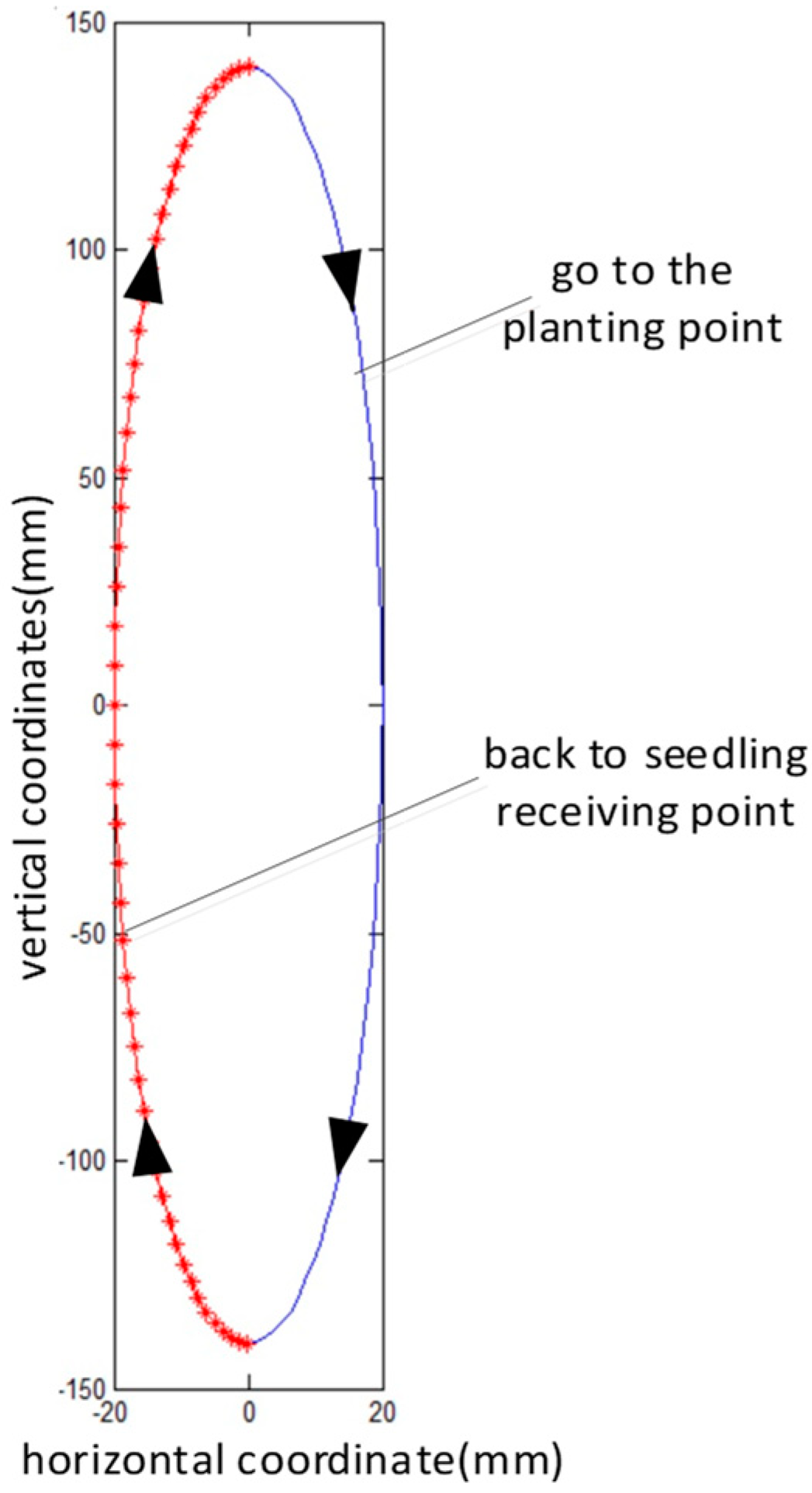
According to the calculation results, the trajectory of the end point of connecting rod 2 is drawn, and the trajectory is an ellipse, as shown in Figure 8, which is consistent with the designed trajectory.

4.3. Calculation of Slideway Outline

The swing rod and connecting rod 3 are combined into a part, the length of the swing rod lBG is 180 mm, and the length of connecting rod 3 l3 is 176 mm. The center of the rotating pair that connects connecting rod 1 and the frame is taken as the original point, and the plane rectangular coordinate system OaXaYa is established. In this coordinate system, the equation of slideway is x H a = 138.592   m m , the coordinates of point a are ( x a a , y a a ), the lower corner mark represents the specified point, and the upper corner mark represents the coordinate system.
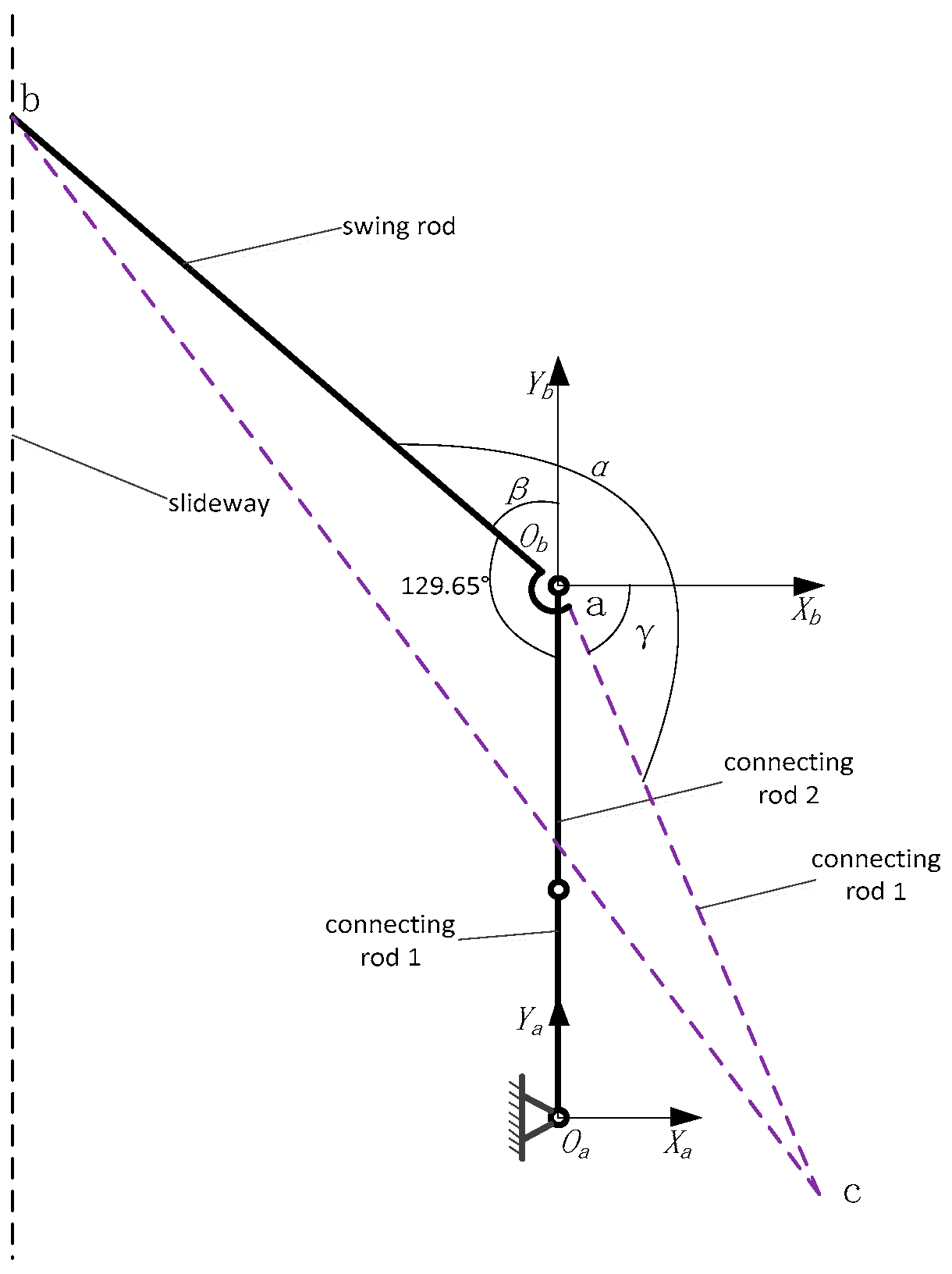
The plane rectangular coordinate system ObXbYb is established with the center of the rotating pair that connects connecting rod 2 and connecting rod 3 in Figure 9 as the original point. The angle α between the swing rod and connecting rod 3 is 208°, the angle between connecting rod 3 and the coordinate axis Xb is γ, and the angle between the swing rod and the coordinate axis Yb is β. In this coordinate system, the coordinates of point a are (0, 0), and the slide equation is x H b = 138.592 X a a .
According to the previous calculations, the coordinates of point a (end point of connecting rod 2) in the coordinate system OaXaYa can be obtained. The distance between point a and point b (the end point of the swing rod, i.e., the center of the slideway roller) is the length of the swing rod, and its value is 180 mm; then, the coordinates of point b in the coordinate system OaXaYa are
x b a = 138.592
( x b a x a a ) 2 + ( y b a y a a ) = 180 2
y b a = 180 2 ( x b a x a a ) 2 + y a a
In Figure 9, β, γ are
β = arcsin x b a x a a l B G
γ = α β 90
Then, in the coordinate system OaXaYa, the coordinates of point c (initial entry point of the duckbill) are
x c a = x a a + l 3 cos γ y c a = y a a l 4 sin γ
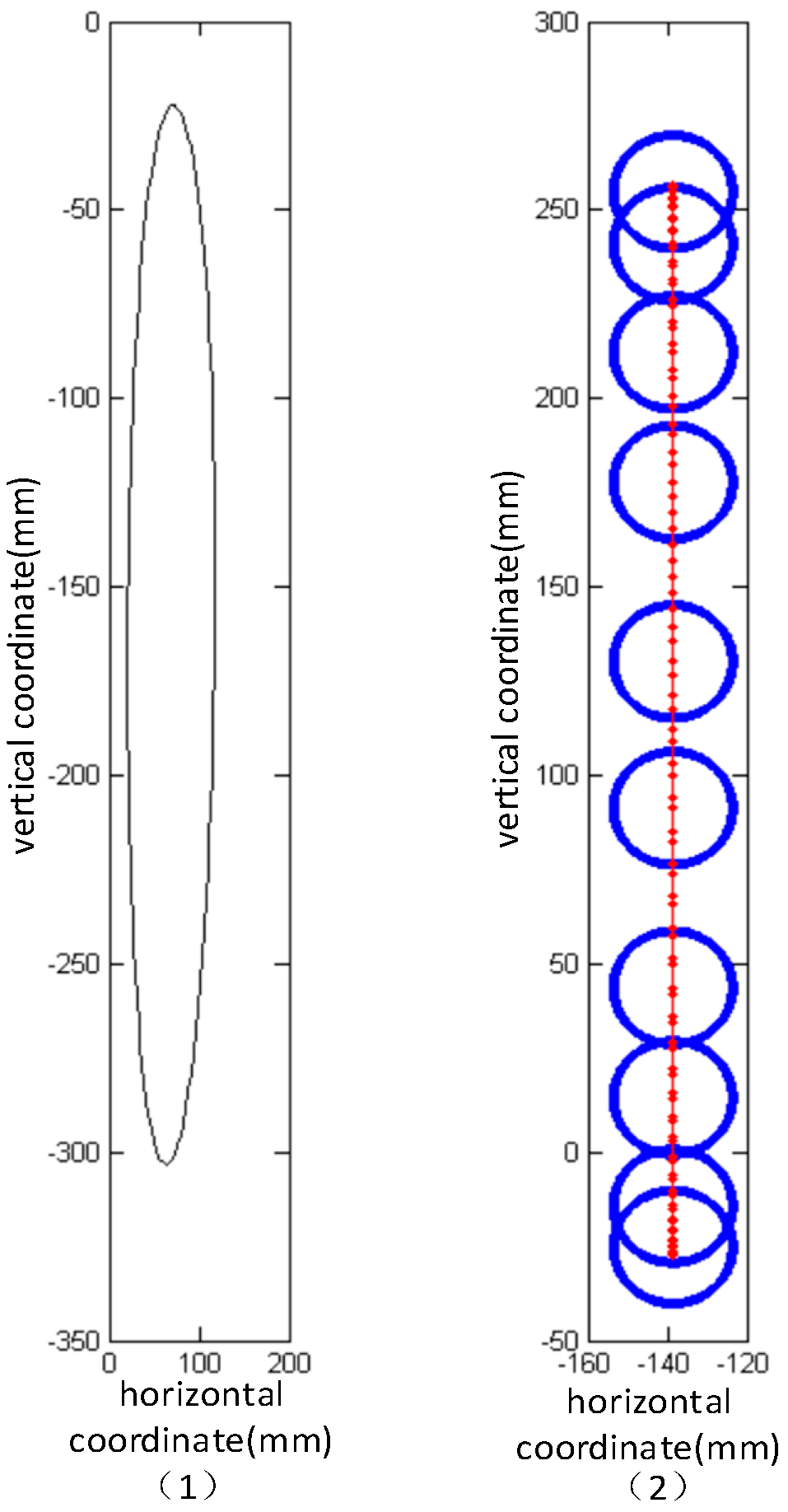
The coordinates of point b and point c can be obtained by calculation, and the trajectories of point c and the slide are shown in Figure 10.
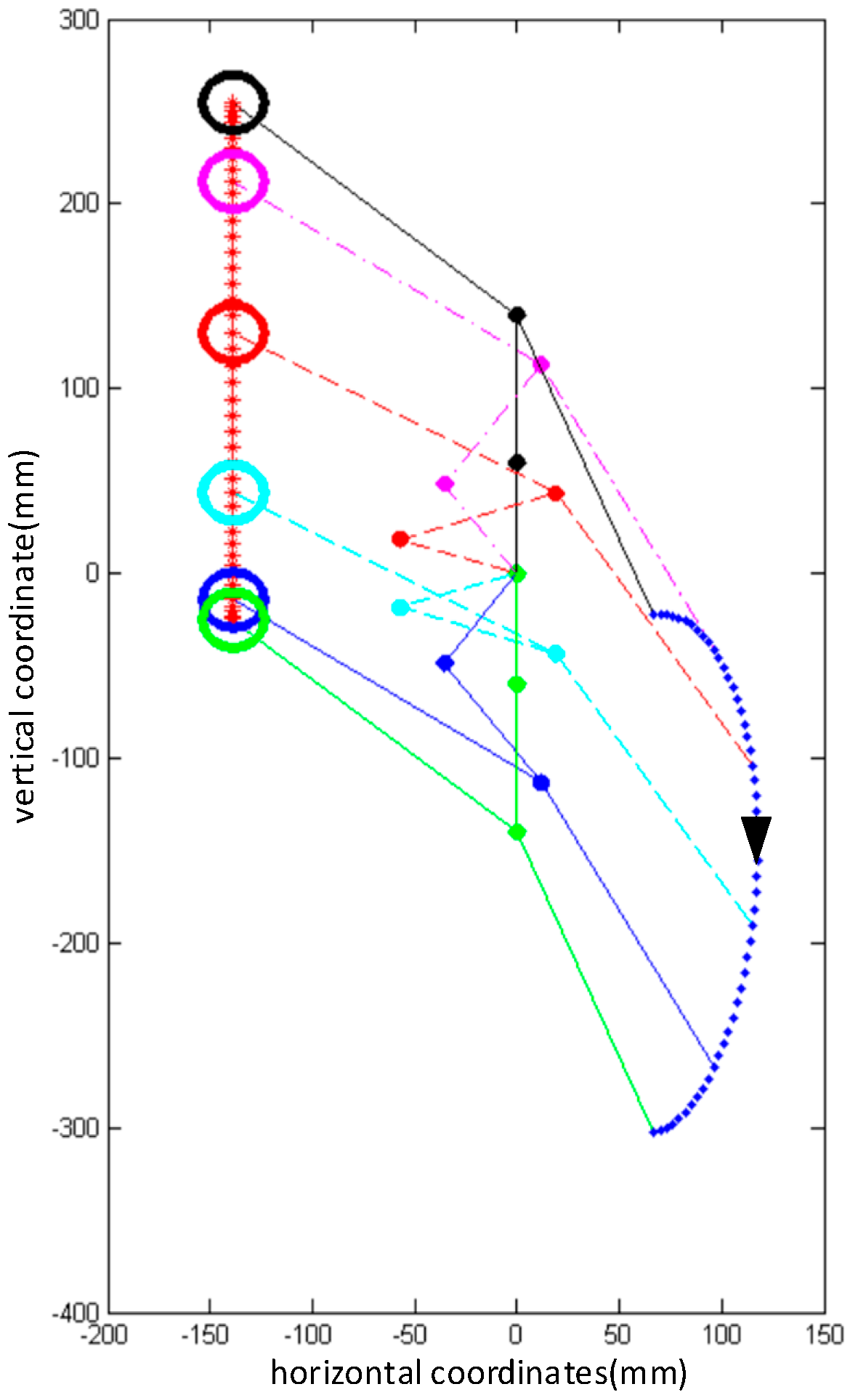
According to the previous analysis, the coordinates of each rotation pair center, the end point of the swing rod, and the initial entry point of the duckbill in the base coordinate system can be calculated. Thus, the positions occupied by the mechanism at each time in the planting process can be drawn, and Figure 11 shows the positions of the planting mechanism at each time from seedling receiving to planting.

5. Velocity Analysis and Dynamic Trajectory of the Initial Entry Point of the Duckbill

5.1. Velocity Analysis of the Initial Entry Point of the Duckbill

In the study of the velocity of the initial entry point of the duckbill, the slight swing of the duckbill caused by the straight slideway is ignored. The length of connecting rod 3 l3 is 176 mm, its posture relative to the frame remains unchanged, the rotation speed is zero, and the initial angle θ32 between connecting rod 3 and the X2 axis is 202°.
The transformation matrix for coordinate system O3X3Y3Z3 to coordinate system O2X2Y2Z2 is
M 23 = x 3 x 2 y 3 x 2 z 3 x 2 l 3 cos θ 3 x 3 y 2 y 3 y 2 z 3 y 2 l 3 sin θ 3 x 3 z 2 y 3 z 2 z 3 z 2 0 0 0 0 1                 = cos θ 3 sin θ 3 0 l 3 cos θ 3 sin θ 3 cos θ 3 0 l 3 sin θ 3 0 0 1 0 0 0 0 1
In the formula, θ3 = θ32 + ω32 × t; l3 is the length of connecting rod 3; ω32 is the rotation speed of connecting rod 3 relative to connecting rod 2, and its value is 6.28 rad/s; and the rotation direction is anti-clockwise.
The transformation matrix for the initial entry point of the duckbill to the base coordinate system O0X0Y0Z0 is
T 03 ( q ) = R 03 ( q ) O 03 ( q ) 0 1 = M 01 M 12 M 23
In the formula, q = [ q 1 , q 2 , q 3 ] T is a vector composed of rotating pair variables, and R 03 ( q ) and O 03 ( q ) are, respectively, the posture and position matrix of the initial entry point of the duckbill, both of which are functions of time t.
By using a Jacobian matrix, it is found that the linear velocity and angular velocity of the initial entry point of the duckbill are associated with the velocity vector q ˙ ( t ) of the rotating pairs. In this paper, the Jacobian matrix of the four-bar linkage planting manipulator is
J ( q ) = z 0 × ( o 3 o 0 )                 z 1 × ( o 3 o 1 ) z 0                 z 1 z 2 × ( o 3 o 2 ) z 2
In the formula, the unit vector z i is relative to the frame coordinate system and can be given by the three elements in the third column of the matrix T 0 i . The original point o i is also relative to the frame coordinate system and can be given by the three elements in the fourth column of the matrix T 0 i .
The Jacobian matrix of Formula (16) is
J ( q ) = l 1 sin θ 1 l 2 sin ( θ 1 + θ 2 ) l 3 sin ( θ 1 + θ 2 + θ 2 ) l 1 cos θ 1 + l 2 cos ( θ 1 + θ 2 ) + l 3 cos ( θ 1 + θ 2 + θ 2 ) 0 0 0 1 l 2 sin ( θ 1 + θ 2 ) l 3 sin ( θ 1 + θ 2 + θ 2 ) l 2 cos ( θ 1 + θ 2 ) + l 3 cos ( θ 1 + θ 2 + θ 2 ) 0 0 0 1 l 3 sin ( θ 1 + θ 2 + θ 2 ) l 3 cos ( θ 1 + θ 2 + θ 2 ) 0 0 0 1
The linear velocity and angular velocity of the initial entry point of the duckbill are
v 3 0 ω 3 0 = J ( q ) q ˙
In the formula, v 3 0 and ω 3 0 are the expressions of the linear velocity and angular velocity vectors of the initial entry point of the duckbill in the frame coordinate system, and q ˙ is the velocity vector of rotating pairs, q ˙ = [ θ ˙ 1 , θ ˙ 2 , θ ˙ 3 ] T = [ ω 10 , ω 21 , ω 32 ] T .
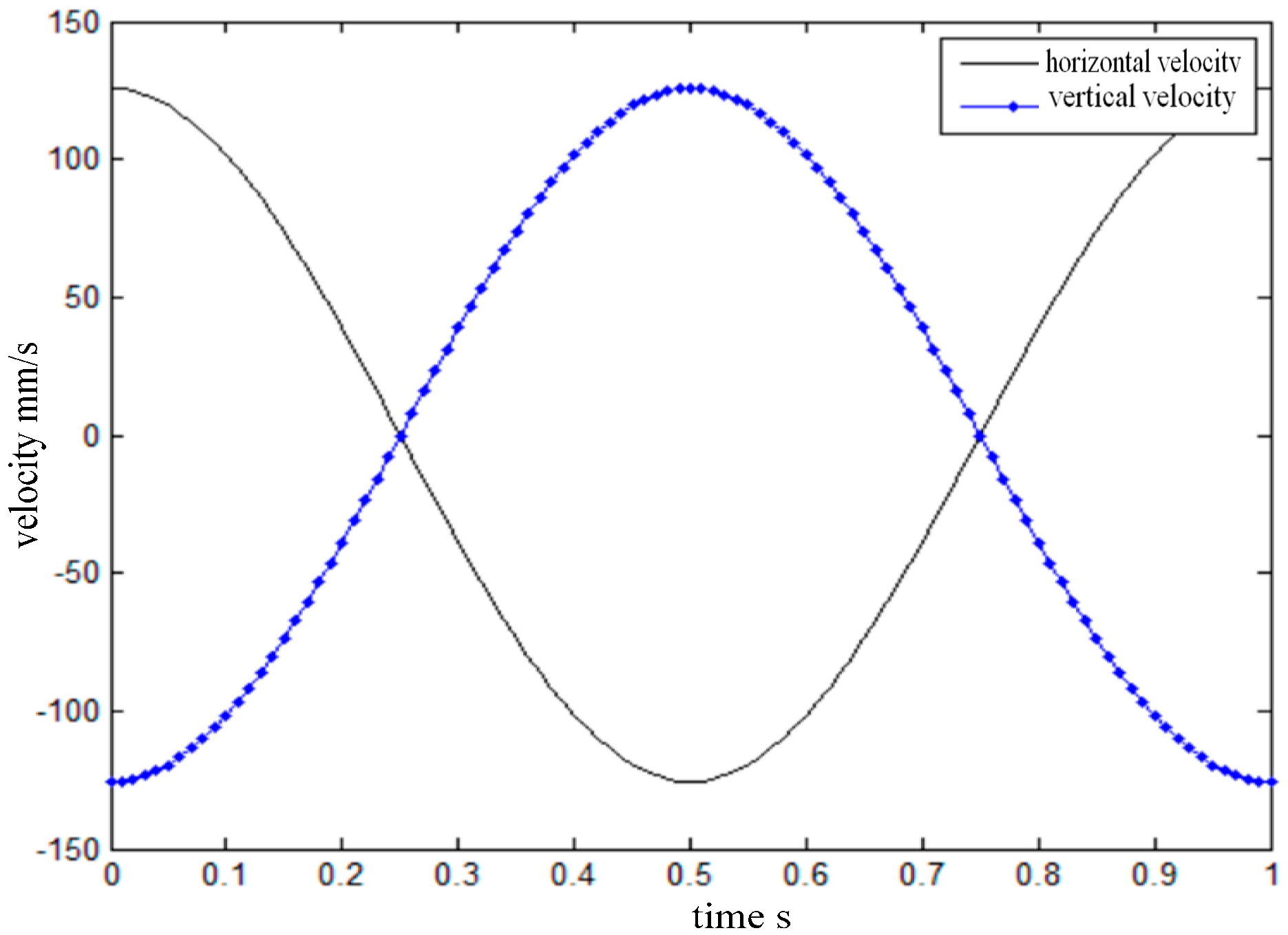
After calculation, the velocity of the initial entry point of the duckbill relative to the vehicle body in a working cycle is as shown in Figure 12, and the velocity of the initial entry point of the duckbill in the lowest position is −125.67 mm/s.

5.2. Dynamic Trajectory of the Duckbill Initial Entry Point

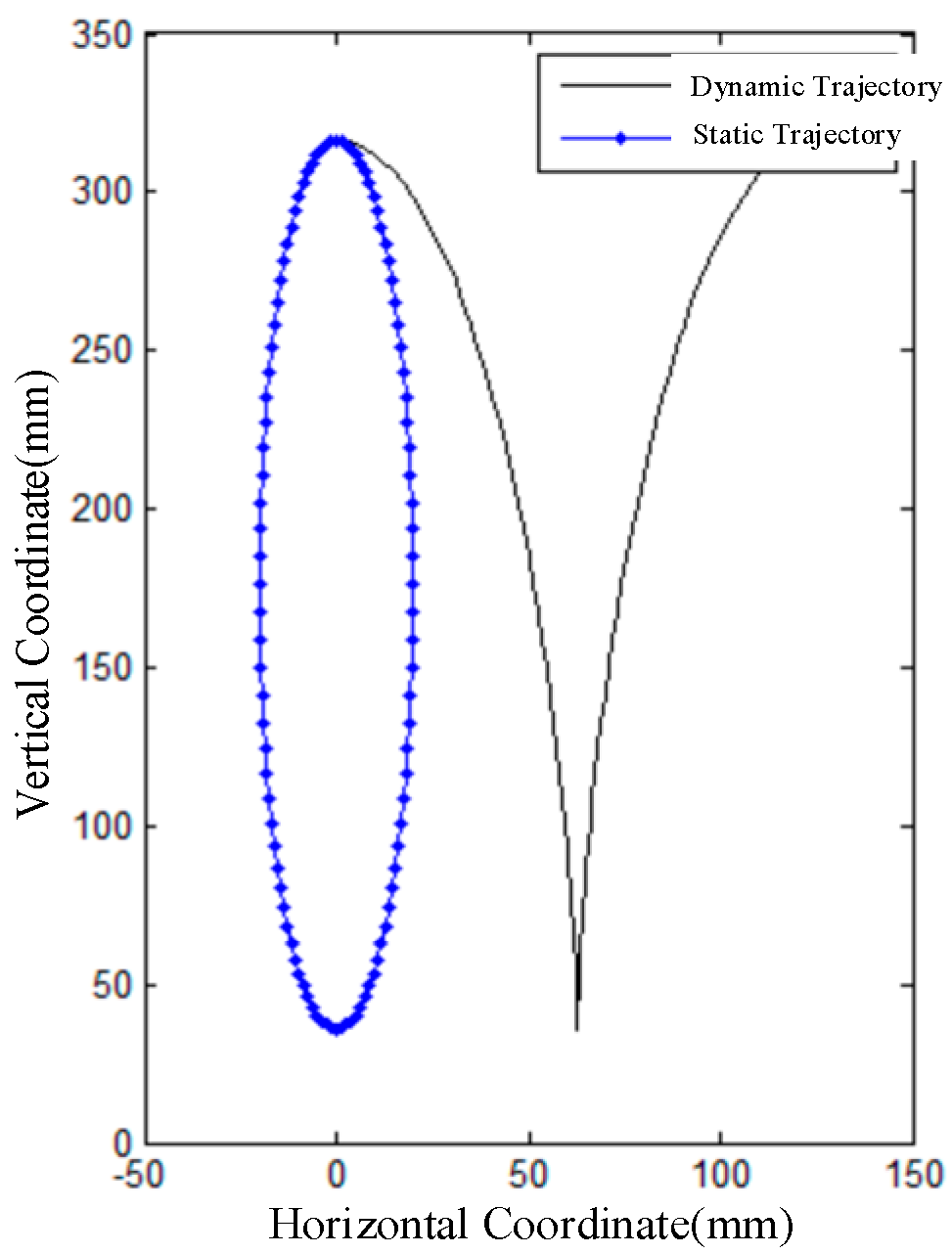
In order to ensure the perpendicularity of pot seedlings, the velocity of the duckbill relative to the ground should be close to zero when the manipulator is planting. It can be seen from the previous analysis that, in the lowest position, the velocity of the initial entry point of the duckbill relative to the vehicle body is −125.67 mm/s; therefore, when the forward velocity of the transplanter is 125.67 mm/s, the velocity of the initial entry point of the duckbill in the lowest position relative to the ground is zero. A coordinate system OgXgYgZg is established, which is fixed to the ground. Before planting, the coordinate original point Og coincides with the original point O0 of the base coordinate system of the planting manipulator. As shown in Figure 3, when transplanting, the base coordinate system O0X0Y0Z0 moves with the transplanter to the right side at a velocity of 125.67 mm/s, and the coordinate system O0X0Y0Z0 moves horizontally to the right side relative to the ground coordinate system OgXgYgZg. The transformation matrix for the coordinate system O0X0Y0Z0 to the coordinate system OgXgYgZg is
M g 0 = 1 0 0 v t 0 1 0 0 0 0 1 0 0 0 0 1
In the formula, v is the forward velocity of the transplanter, and its value is 125.67 mm/s, while t is the time.
The homogeneous coordinate of the end point of connecting rod 3 in the coordinate system O3X3Y3Z3 is
r 3 3 = [ 0 ;   0 ;   0 ;   1 ]
Then, the coordinate of the end point of connecting rod 3—that is, the initial entry point of the duckbill—in the coordinate system OgXgYgZg is
r 3 0 = M g 0 M 01 M 12 M 23 r 3 3
According to the calculation results, the dynamic trajectory of the end point of connecting rod 3 in a working cycle is drawn; it is shown in Figure 13 and is a γ curve.
It can be seen from the above analysis that, when the forward velocity of the transplanter is equal to the velocity of the duckbill, which is relative to the vehicle body at the moment that the initial entry point of the duckbill is at the lowest position—that is, v Q J = v 3 0 ( 1 ) —the velocity of the initial entry point of the duckbill relative to the ground is zero, so the verticality of pot seedlings can be ensured.

6. Structural Design and Experimental Verification of Planting Mechanism

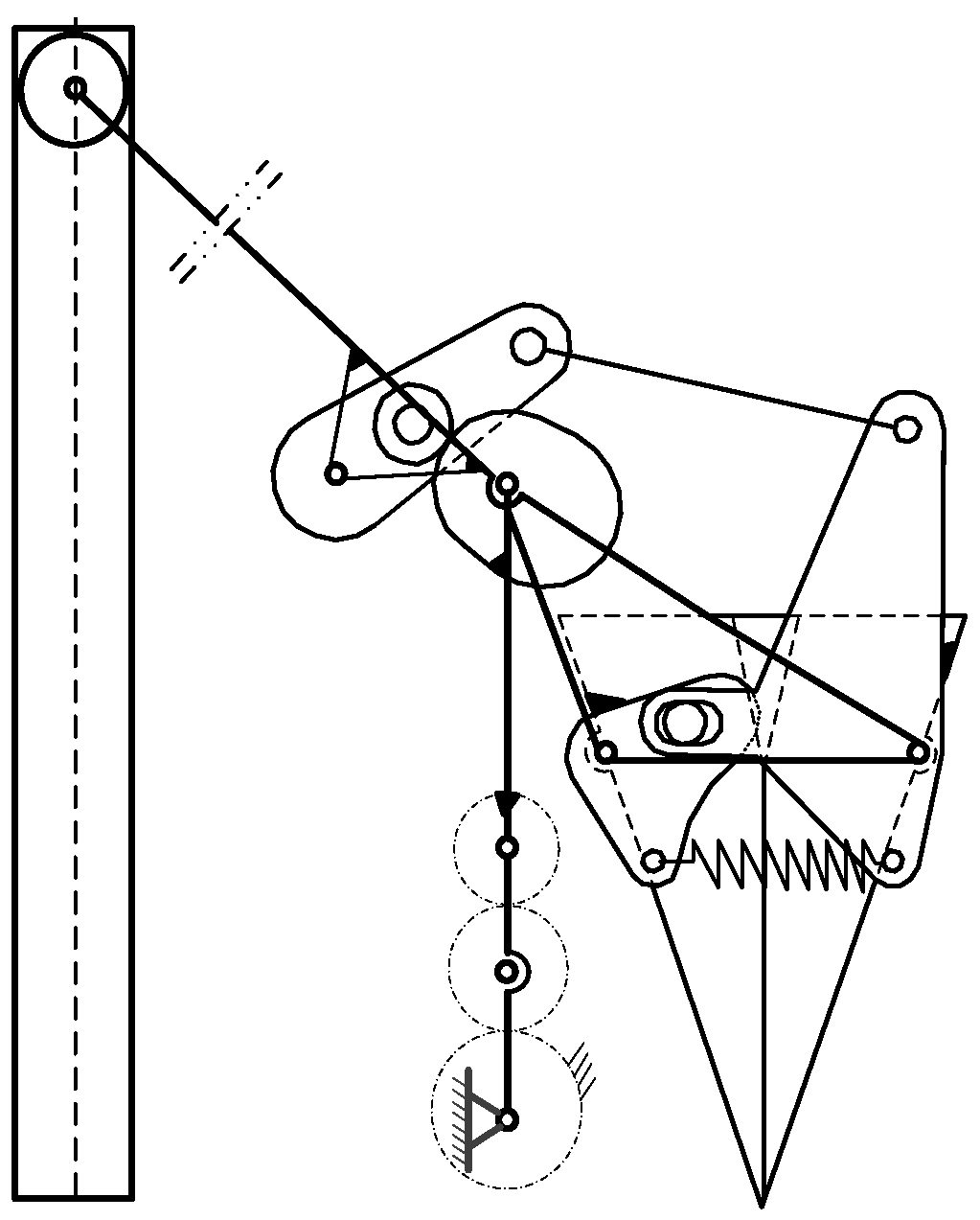
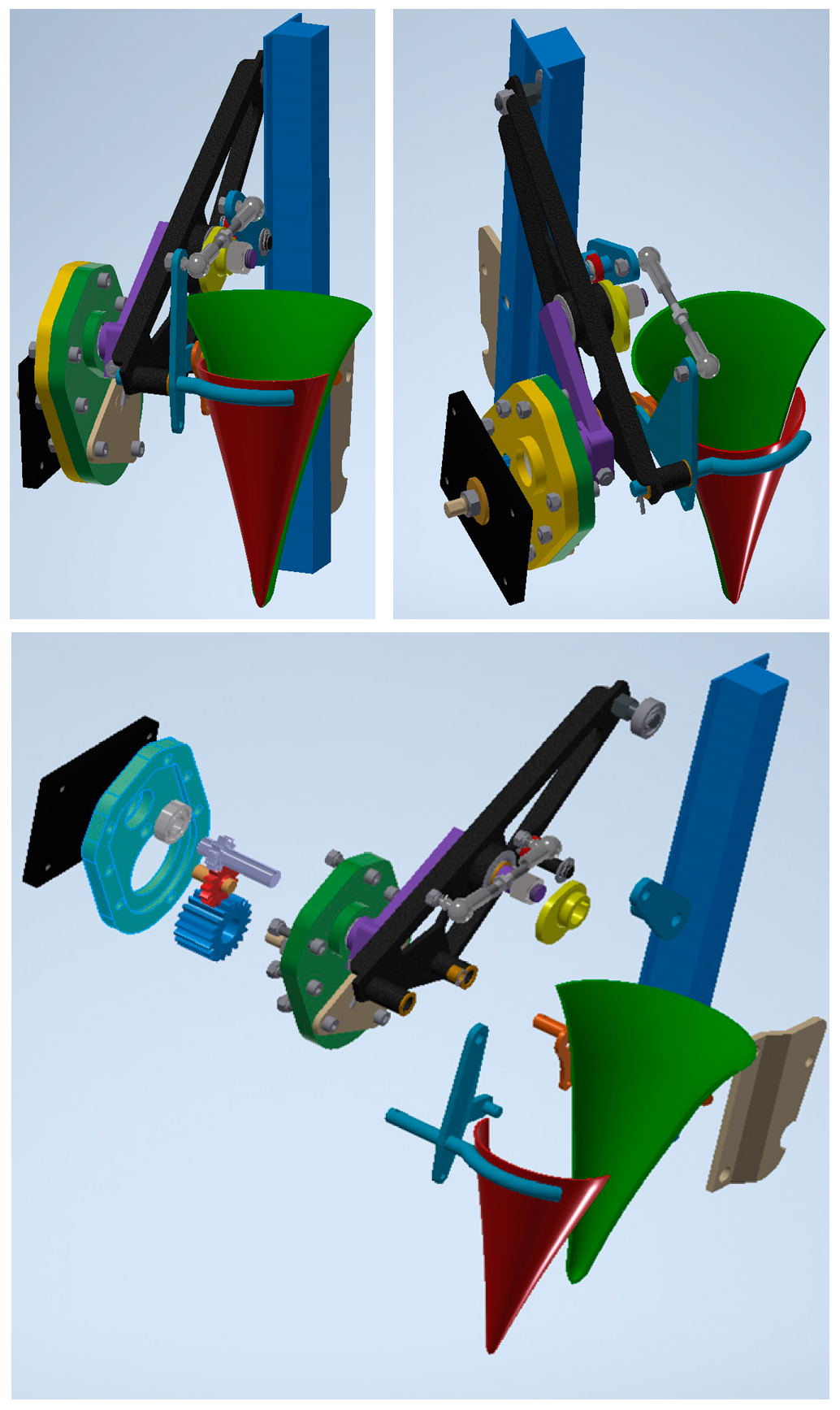
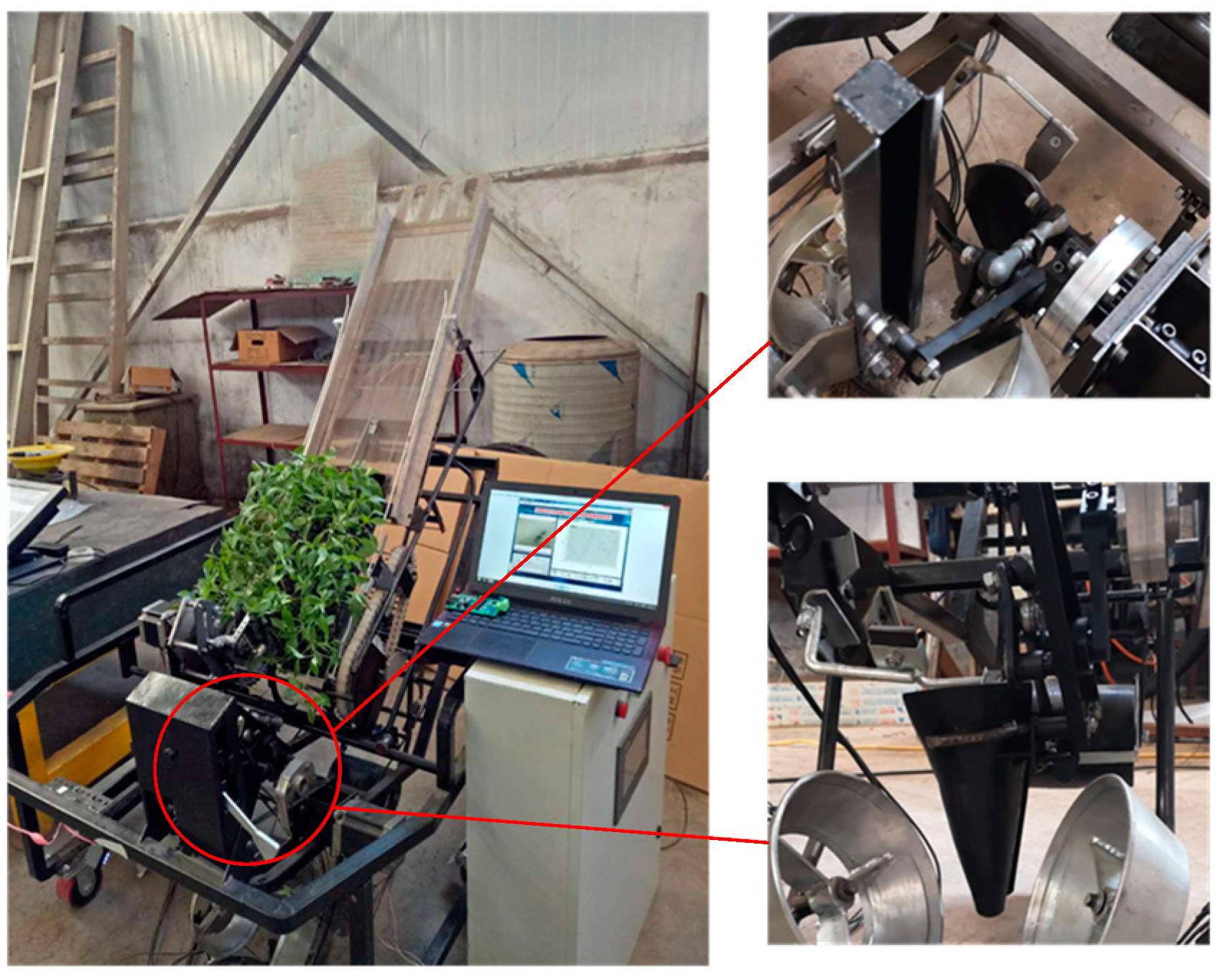
The complete motion diagram of the planting manipulator is shown in Figure 14. Next, the detailed design of each part is carried out according to the geometric structure and strength requirements, and the designed three-dimensional model is shown in Figure 15.
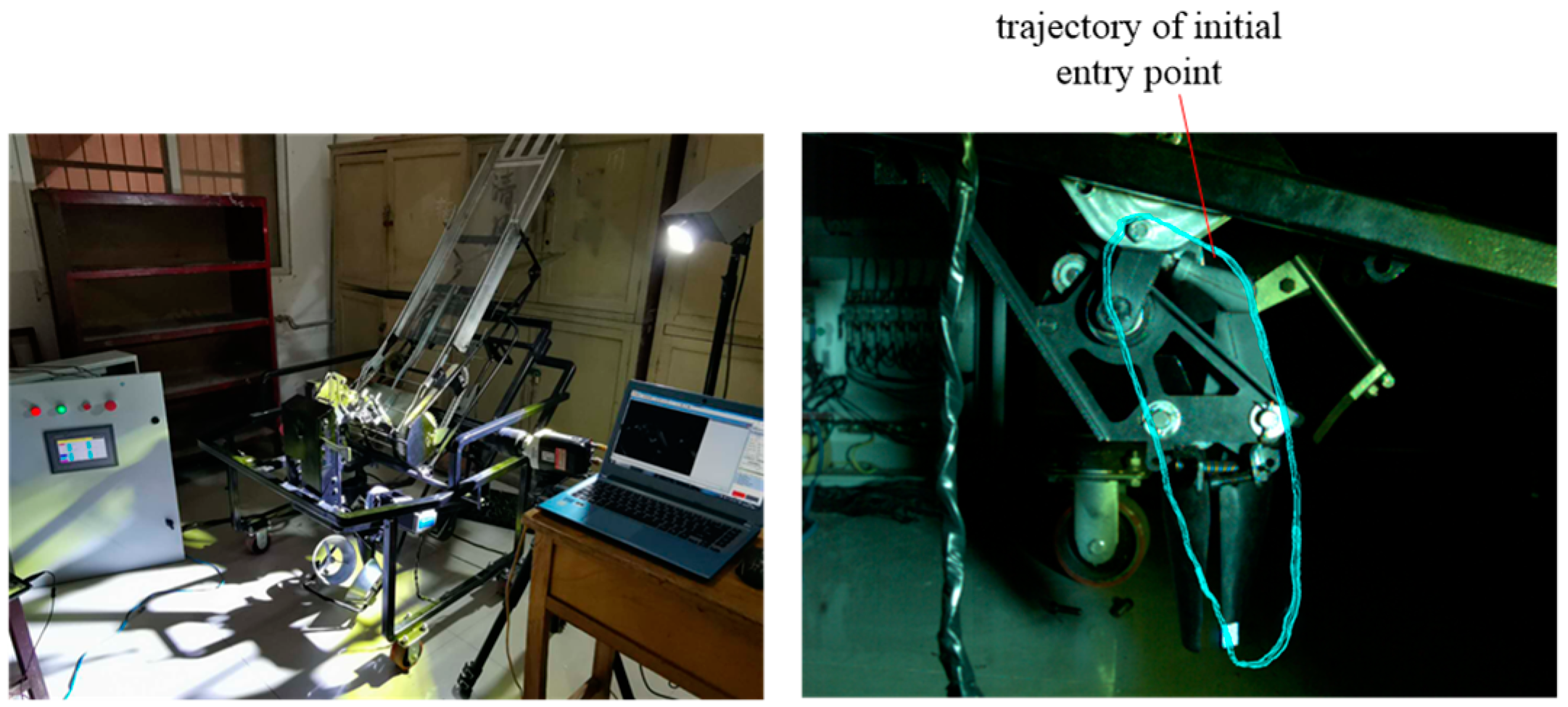
High-speed photographic imaging analysis is carried out for the motion trajectory of the initial entry point of the planting mechanism, as shown in Figure 16. The trajectory of the initial entry point is an approximate ellipse, which is different from that of the initial entry point in Figure 10. The main reasons are as follows: (1) the clearance between the slideway and the roller is large during machining, so the machining accuracy should be improved to avoid such errors; (2) the duckbill has an opening and closing movement in the process of seedling receiving and planting, which leads to a deviation between the actual motion trajectory and the theoretical analysis trajectory; (3) in order to prevent other parts of the transplanting equipment from blocking the planting mechanism, the high-speed photography equipment is inclined slightly.
In order to verify whether the transplanting mechanism for tomato pot seedlings can replace manual operation to achieve high-quality transplanting, the planting perpendicularity is taken as the evaluation index, and an indoor experiment on transplanting tomato pot seedlings is carried out to provide a basis for the further optimization and improvement of the transplanting mechanism for tomato pot seedlings. The transplanting equipment is shown in Figure 17. The perpendicularity of tomato pot seedlings is evaluated by the acute angle between the stem and the ground after the tomato pot seedling is planted into the soil, and it is one of the most important indices used to evaluate the planting quality. According to the requirements of agronomy, an angle between the pot seedling stem and the ground of more than 70° is good, and an angle of less than 45° is considered unqualified, and the rest are considered qualified. Tomato pot seedlings of the same specifications as those in the experiment on physical characteristics were used.
During the experiment, the transplanting mechanism was operated continuously for 30 min, and, in this process, the transplanting frequency was adjusted randomly. It was found that the overall action of the mechanism was smooth, without any shutdown or damage; therefore, preliminary assessment indicates that the planting mechanism operates stably and reliably. The transplanting frequency of the experimental prototype was set to 74 plants per minute, the moving speed of the soil trough was 280 mm/s, and the planting depth was taken as the surface of the seedling mound being 40 mm lower than the ground. Then, the transplanting test was conducted. The statistical results of tomato pot seedling transplanting are shown in Table 2. The rate of qualified seedling perpendicularity was 94.79%, and the rate of excellent seedling perpendicularity was 92.45%. During the experiment, the main reason for the lodging of tomato seedlings after transplanting was that the transplanter slowed down in the process of moving due to the restriction posed by the length of the soil trough, thus resulting in an insufficient translatory velocity.
Among the existing research results on planting devices, the rate of excellent perpendicularity for the planetary rotation arm planting mechanism is more than 80%; the rate of excellent perpendicularity for the rotating planting mechanism of the non-circular planetary gear train developed by Zhejiang University of Science and Technology is 95%; and the rate of qualified perpendicularity for the double five-bar planting mechanism is 88.67%. Through this comparative analysis, the planting mechanism studied in this paper can meet the design requirements for efficient planting.

7. Conclusions

(1) According to the analysis of the operation process of a transplanter’s planting mechanism, design requirements are formulated, and an open-hinge four-bar planting manipulator is proposed. A planetary gear train and cam high pair are used to constrain the rotating pairs. Finally, a single-degree-of-freedom fully mechanical planting mechanism is designed, and only one original moving part is needed to complete the complex actions. Thus, the operation and control of this mechanism is simple, the cost is low, and the reliability is high.
(2) The coordinate system of the planting mechanism was established, the motion trajectory of each connecting rod was calculated, and the simulation analysis of the mechanism was carried out. The results show that the simulation results are consistent with the design requirements.
(3) The detailed structural design of the planting manipulator was carried out and a test prototype was created. High-speed photographic imaging analysis of the initial entry point of the manipulator shows that the motion trajectory and the trajectory obtained from the theoretical simulation results are both approximate ellipses, and they are basically consistent. In the experiment on transplanting, the rate of qualified perpendicularity was 94.79%, and the rate of excellent perpendicularity was 92.45%, thus achieving the expected effect.
(4) The open-hinge four-bar planting manipulator has a simple structure, a low cost, and high operational reliability, and its single-degree-of-freedom drive significantly reduces the control complexity, indicating high application value for the promotion of small and medium-sized agricultural machinery. However, in complex terrain or non-standard operating environments, the flexibility and adjustment capabilities of a single-degree-of-freedom mechanical structure may be limited. Therefore, subsequent research will integrate sensors with simple control systems to conduct the real-time monitoring and appropriate adjustment of key operational parameters, thereby enhancing the level of intelligence while maintaining the simplicity of the mechanical structure.

Author Contributions

Conceptualization, Y.D. and G.J.; methodology, G.J.; software, Y.D.; validation, Y.D. and G.J.; formal analysis, G.J. and Y.Z.; investigation, Y.Z.; resources, Y.D.; data curation, Y.D.; writing—original draft preparation, G.J.; writing—review and editing, Y.D.; visualization, Y.Z.; Supervision, Z.Z.; Project administration, Z.Z.; Funding acquisition, Z.Z. All authors have read and agreed to the published version of the manuscript.

Funding

This research was funded by the National Natural Science Foundation of China (Grant No. 52105183), the Science and Technology Research Project of Henan Province (Grant No. 252102220003) and the Science and Technology Research Project of Henan Province (Grant No. 242102220088). The APC was funded by Henan University of Science and Technology.

Institutional Review Board Statement

Not applicable.

Data Availability Statement

The original contributions presented in this study are included in the article. Further inquiries can be directed to the corresponding author.

Acknowledgments

We would like to express our sincere gratitude to all individuals and institutions that have supported this work. Special thanks are given to our colleagues and reviewers for their valuable comments and suggestions.

Conflicts of Interest

The authors declare no conflict of interest.

References

  1. Huang, H.; Tang, Q.; Song, Z.; Liu, H.; Wu, Y.; Zhu, T. Development status and trends of the development of seedling pick-up mechanism of transplanter in dry land. J. Intell. Agric. Mech. 2023, 4, 57–64. (In English) [Google Scholar]
  2. Xu, T.; Li, X.; He, J.; Han, S.; Wang, G.; Yin, D.; Zhou, M. Research Progress and Future Prospects of Key Technologies for Dryland Transplanters. Appl. Sci. 2025, 15, 8073. [Google Scholar] [CrossRef]
  3. Ren, Z.; Hu, M.; Yan, W.; Li, K. Research status on seedling picking-up mechanism of dryland hole tray seedling transplanting machine. J. Chin. Agric. Mech. 2025, 46, 41–47. [Google Scholar]
  4. Yu, G.; Zhao, J.; Shan, H.; Wang, J.; Wang, L.; Bao, L. Design and Experiment of Longitudinal Feeding Mechanism of Vegetable Pot Seedling Automatic Transplanter. Nongye Jixie Xuebao/Trans. Chin. Soc. Agric. Mach. 2024, 55, 285–293. [Google Scholar]
  5. Hu, S.; Hu, M.; Yan, W.; Zhang, W. Design and Experiment of an Integrated Automatic Transplanting Mechanism for Picking and Planting Pepper Hole Tray Seedlings. Agriculture 2022, 12, 557. [Google Scholar] [CrossRef]
  6. Jiang, Z.; Hu, Y.; Jiang, H.; Tong, J. Design and force analysis of end-effector for plug seedling transplanter. PLoS ONE 2017, 12, e0180229. [Google Scholar] [CrossRef]
  7. Luo, X. Device for Planting Agricultural Product e.g., Lettuce Seedling, has Pit Digging Mechanism that is Set on Green Vegetable Placing Frame, and Rotating Adjusting Mechanism That Are Set on Pit Digging Mechanisms. Chinese Patent CN116195411-A, 2 June 2023. [Google Scholar]
  8. Bhambota, S.; Dixit, A.K.; Manes, G.S.; Dhatt, A.S.; Singh, S.K.; Singh, A. Field evaluation of a semi-automatic vegetable transplanter for major vegetable crops. Indian J. Agric. Sci. 2018, 88, 107–111. [Google Scholar] [CrossRef]
  9. Zhang, R.; Cui, T.; Han, D.D.; Zhang, D.X.; Li, K.H.; Yin, X.W.; Wang, Y.X.; He, X.T.; Yang, L. Design of depth-control planting unit with single-side gauge wheel for no-till maize precision planter. Int. J. Agric. Biol. Eng. 2016, 9, 56–64. [Google Scholar]
  10. Zhou, M.; Shan, Y.; Xue, X.; Yin, D. Theoretical analysis and development of a mechanism with punching device for transplanting potted vegetable seedlings. Int. J. Agric. Biol. Eng. 2020, 13, 85–92. [Google Scholar] [CrossRef]
  11. Zhu, Z.; Cheng, J.; Wu, F.; Hu, Z.; Yu, Z. Optimization of Operation Parameters of the Garlic Plant Divider and Lifter Mechanisms. Agriculture 2023, 13, 189. [Google Scholar] [CrossRef]
  12. Das, B.; Sayor, T.Z.U.H.; Nijhum, R.J.; Tishun, M.T.; Sakib, T.H.; Karim, E.; Uddin, A.J.; Islam, A.; Mohsin, A.S.M. Designing and development of agricultural rovers for vegetable harvesting and soil analysis. PLoS ONE 2024, 19, e0304657. [Google Scholar] [CrossRef] [PubMed]
  13. Ji, J.; Cheng, Q.; Jin, X.; Zhang, Z.; Xie, X.; Li, M. Design and test of 2ZLX-2 transplanting machine for oil peony. J. Int. Agric. Biol. Eng. 2020, 4, 61–69. [Google Scholar] [CrossRef]
  14. Park, Y.; Lee, J.; Kim, J.; Kim, T.; Woo, H.; Woo, S.; Ha, Y. Development of Humidity sensor-attached chili seed transplanter. Proc. Korean Soc. Agric. Mach. 2020, 25, 115. [Google Scholar]
  15. Ishizaki, S.; Hirai, H.; Sakagaito, T.; Takeyama, T.; Oido, N.; Tamura, T.; Mizutani, M.; Watanabe, Y.; Umeda, M. Development of a transplanter-based transplanter for vegetable seedlings cultured in a cuttable nursery mat. J. Agric. Eng. 2024, 55, 1–10. [Google Scholar] [CrossRef]
  16. Liu, C.; Wu, F.; Gu, F.; Cao, M.; Yang, H.; Shi, L.; Wang, B.; Wang, B. Recent Research Progress on Key Technologies and Equipment for Mechanized Potato Harvesting. Agriculture 2025, 15, 675. [Google Scholar] [CrossRef]
  17. Shi, Q.; Liu, J.; Zeng, J.; Yao, S.; Zhao, C.; Liu, Y. Optimization of the clamping trajectory of an automatic fetching and throwing device of a vegetable seedling transplanter. J. Chin. Agric. Mech. 2021, 42, 47–54. [Google Scholar]
  18. Zhao, X.; Yang, Q.; Huang, G.; He, M.; Mao, H. Design and test of picking seedling mechanism of small full-automatic transplanter for plug seedlings. Jiangsu Daxue Xuebao (Ziran Kexue Ban)/J. Jiangsu Univ. (Nat. Sci. Ed.) 2022, 43, 54–61. [Google Scholar]
  19. Zhao, Y.; Zhang, W.; Xin, L.; Xie, J.; Xue, X.; Shan, Y. Design and experiment of extensible potted tomatoes seedling transplanting mechanism. Trans. Chin. Soc. Agric. Mach. 2019, 50, 105–112. [Google Scholar]
  20. Vikas, P.; Hifjur, R.; Rahul, K. Development of a metering mechanism with serial robotic arm for handling paper pot seedlings in a vegetable transplanter. Artif. Intell. Agric. 2021, 5, 52–63. [Google Scholar] [CrossRef]
  21. Jiang, L.; Wu, C.; Tang, Q.; Wu, J.; Guan, Z.; Liu, S. Optimization Design and Experiment on Planting Mechanism of Rapeseed Blanket Seedling Transplanter. Nongye Jixie Xuebao/Trans. Chin. Soc. Agric. Mach. 2025, 56, 241–251. [Google Scholar]
  22. Zhu, X.; Lyu, P.; Gao, Q.; Ma, H.; Chen, Y.; Qi, Y.; Li, J.; Lyu, J. Design and Comparative Experimental Study of Air-Suction Mulai-Arm Potato Planter. Agriculture 2025, 15, 1714. [Google Scholar] [CrossRef]
  23. Song, Q.; Wang, W.; Yu, J.; Shen, T. Design and simulation of transplanting mechanical arm. J. Chin. Agric. Mech. 2020, 41, 12–16. [Google Scholar]
  24. Kim, C.H.; Silwal, A.; Kantor, G. Autonomous Robotic Pepper Harvesting: Imitation Learning in Unstructured Agricultural Environments. IEEE Robot. Autom. Lett. 2025, 10, 3406–3413. [Google Scholar] [CrossRef]
  25. Sridhar Reddy, A.; Kesava Rao, V.V.S.; Deepak, B.B.V.L. Kinematic Simulation of Dual Arm Agricultural Mobile Robot. In Advanced Manufacturing Systems and Innovative Product Design: Select Proceedings of IPDIMS 2020; Springer: Singapore, 2021; pp. 551–560. [Google Scholar]
  26. Pramod, A.S.; Jithinmon, T.V. Development of mobile dual PR arm agricultural robot. J. Phys. Conf. Ser. 2019, 1240, 012034. [Google Scholar] [CrossRef]
  27. Sembiring, A.; Budiman, A.; Lestari, Y.D. Design and Control of Agricultural Robot for Tomato Plants Treatment and Harvesting. J. Phys. Conf. Ser. 2017, 930, 012019. [Google Scholar] [CrossRef]
  28. Foglia, M.M.; Reina, G. Agricultural robot for radicchio harvesting. J. Field Robot. 2006, 23, 363–377. [Google Scholar] [CrossRef]
  29. Marano, D.; Cammarata, A.; Fichera, G.; Sinatra, R.; Prati, D. Modeling of a three-axes MEMS gyroscope with feedforward PI quadrature compensation. In Advances on Mechanics, Design Engineering and Manufacturing. Lecture Notes in Mechanical Engineering; Eynard, B., Nigrelli, V., Oliveri, S., Peris-Fajarnes, G., Rizzuti, S., Eds.; Springer: Cham, Switzerland, 2017. [Google Scholar] [CrossRef]
  30. Sarkar, P.; Raheman, H. Development of a manually drawn single row onion set planter using a 2 DOF robotic arm. Agric. Eng. Int. CIGR J. 2021, 23, 181–194. [Google Scholar]
  31. Quan, L.; Peng, T.; Shen, L.; An, S.; Ji, Z.; Sun, T. Optimization and experiment of manipulator for three-dimensional seedling tray management robot. Trans. Chin. Soc. Agric. Eng. 2017, 33, 10–19. [Google Scholar]
  32. Liu, Z.; Wang, X.; Zheng, W.; Lv, Z.; Zhang, W. Design of a Sweet Potato Transplanter Based on a Robot Arm. Appl. Sci. 2021, 11, 9349. [Google Scholar] [CrossRef]
  33. Kamata, N.; Srisupawong, Y.; Kamata, K.; Chueapram, C.; Rueangphaisan, T.; Srimai, S.; Rueangariyachat, T. The development of a robotic arm and carrier learning kit for farming. AIP Conf. Proc. 2025, 3271, 020002. [Google Scholar]
  34. Yang, M.T.; Liang, X.F. Design and kinematics analysis of a tomato branch and leaf cutting manipulator. J. Chin. Agric. Mech. 2021, 42, 8–14. [Google Scholar]
Figure 1. Main morphological parameters of tomato pot seedlings. a—Bottom size of pot body. b—Upper size of pot body. d—Width of leaf crown. h—Height of pot seedling. h1—Height of pot body.
Actuators 15 00207 g001
Figure 2. Planting schematic diagram of four-bar linkage.
Actuators 15 00207 g002
Figure 3. Motion analysis of connecting rods 1 and 2.
Actuators 15 00207 g003
Figure 4. Driving schematic diagram of connecting rod 2 by planetary gear train.
Actuators 15 00207 g004
Figure 5. Schematic diagram of slideway constraint for rotating pair 3.
Actuators 15 00207 g005
Figure 6. Opening and closing control mechanism of the duckbill.
Actuators 15 00207 g006
Figure 7. Coordinate system of the four-link planting manipulator.
Actuators 15 00207 g007
Figure 8. Trajectory of the end point of connecting rod 2.
Actuators 15 00207 g008
Figure 9. Schematic diagram for calculating the outline of the slideway.
Actuators 15 00207 g009
Figure 10. Trajectories of the initial entry point of the duckbill and the slideway. (1) Trajectory of the initial entry point of the duckbill. (2) Trajectory of the slideway.
Actuators 15 00207 g010
Figure 11. The positions of the planting mechanism at each time during the planting process.
Actuators 15 00207 g011
Figure 12. Velocity of the initial entry point of the duckbill in a working cycle.
Actuators 15 00207 g012
Figure 13. Dynamic and static trajectories of the end point of connecting rod 3.
Actuators 15 00207 g013
Figure 14. Complete kinematic diagram of the planting mechanism.
Actuators 15 00207 g014
Figure 15. Three-dimensional model of the planting mechanism.
Actuators 15 00207 g015
Figure 16. High-speed photography of the motion trajectory of the initial entry point of the planting mechanism.
Actuators 15 00207 g016
Figure 17. Assembled planting mechanism and transplanting equipment.
Actuators 15 00207 g017
Table 1. Statistical measurement results of physical characteristics of pot seedlings.
ParameterHeight of Pot Seedling/mmWidth of Leaf Crown/mmWeight of Pot Seedling/gUpper Size of Pot Body/mmBottom Size of Pot Body/mmHeight of Pot Body/mm
Average value127.388.421.828.813.840.4
Maximum value139.597.224.730.214.242.2
Minimum value121.181.718.928.113.339.3
Standard deviation6.34.21.20.70.60.9
Coefficient of variation
/%
7.65.31.70.80.73.2
Table 2. Statistical measurement results from transplanting test on tomato pot seedlings.
Number of Measurement GroupsExperimental DataExperimental Index
Total Number of SeedlingsNumber of Qualified PlantingsNumber of Excellent PlantingsQualified
Rate/%
Excellent Rate/%
112812211895.3192.19
212812312096.0993.75
312811911792.9791.41
Average value128121.33118.3394.7992.45
Disclaimer/Publisher’s Note: The statements, opinions and data contained in all publications are solely those of the individual author(s) and contributor(s) and not of MDPI and/or the editor(s). MDPI and/or the editor(s) disclaim responsibility for any injury to people or property resulting from any ideas, methods, instructions or products referred to in the content.