
Article

Static Performance Analysis and Optimization of High-Speed Solenoids Integrated with Permanent Magnets and Annular Flanges

College of Mechanical and Vehicle Engineering, Changsha University of Science and Technology, Changsha 410114, China
*
Authors to whom correspondence should be addressed.
Actuators 2026, 15(3), 172; https://doi.org/10.3390/act15030172
Submission received: 26 January 2026 / Revised: 13 March 2026 / Accepted: 14 March 2026 / Published: 19 March 2026
(This article belongs to the Special Issue Advanced Theory and Application of Magnetic Actuators—3rd Edition)

Abstract

To enhance the performance of high-speed solenoids (HSSs) in control systems, two improved structural designs incorporating a permanent magnet (PM) and an annular flange (AF) are proposed based on the parallel magnetic circuit principle. Their static electromagnetism performances were thoroughly investigated by the finite element method. Furthermore, multi-objective optimization combined with the response surface method and NSGA-II was carried out. The results indicate that the electromagnetic energy conversion efficiency and electromagnetic force of HSSs can be promoted by applying a PM and an AF: for the first improvement design just employing a PM, increasing the PM height improves energy conversion efficiency and mitigates magnetic saturation within the main pole, and for the second improvement design employing both a PM and an AF, the electromagnetic energy conversion efficiency and electromagnetic force of HSS can be further promoted. In the end, based on the Pareto optimal solution set, the optimized design increases the net electromagnetic force by 18.8% and reduces the peak current by 18.8%. This is the result of applying the optimization scheme, which is beneficial for increasing the dynamic response speed of the HSS valve and reduce its energy loss.

1. Introduction

The high-speed solenoid valve has the advantages of low cost, antipollution, easy maintenance and a simple device, so it is widely used in modern control systems. Examples include fuel supply systems, automatic transmission, and aircraft surface control systems [1,2,3]. A high-speed solenoid (HSS), as the core component of a high-speed solenoid valve, has a strong effect on the control of the entire system by establishing a direct connection between the input signal and the armature intermittent state. Its static electromagnetic and dynamic response performance exert many effects on the control accuracy and flexible control laws of the entire system [4,5]. Meanwhile, the industrial demands for lower power consumption of HSSs is increasing. Consequently, significant research efforts have been directed towards improving HSS performance.
Various measures have been proposed to improve the static and dynamic characteristics of HSSs. The continuous evolution of control strategies for HSSs reflects a sustained effort to enhance both performance and efficiency. For instance, Zhong et al. [6] developed an optimized pre-excitation control algorithm that significantly reduces switching delay and heat generation, while also improving dynamic response and lowering power losses. Du et al. recently proposed a phase-duty cycle compound modulation method for dual solenoid high-speed on/off valves, which reduces the closing response time and expands the controllable flow rate range [7]. Furthermore, because design parameters substantially influence HSS performance, parameter optimization techniques are frequently employed. For example, Yu [8], Liu [9] and Wu [10] utilized approximate model technology and multi-objective optimization methods to refine the critical design parameters of solenoid valves. Beyond design parameters, the choice of processed materials significantly affects solenoid performance. Wang [11] and Guo [12,13] found, respectively, that it is helpful to enhance the dynamic performance by using Al–Fe soft magnetic materials and Fe-based Nano-crystalline soft magnetic alloy materials to process the solenoid. Another line of development involves the design of novel structures based on the conventional E-type solenoid. In the past few years, many solenoid valves with excellent performance, such as Helenoud [14], Colenoid [15], multipolar solenoid [16], and Disole [17], have been proposed. However, their widespread adoption has been limited due to structural complexity and high manufacturing costs. An alternative strategy for performance enhancement is the integration of high-energy permanent magnets (PMs), as explored by Rens [18], Kim [19], Overboom [20], Lim [21], and Hong [22]. These types of solenoids employing PMs have inherent latching self-locking forces that suppress the opening characteristic to some extent, though with large attractive force and a fast closure process.
Although various strategies, including control methods, structural innovations, material advancements, and the integration of PMs, have been explored to enhance the static and dynamic performances of HSSs, several research gaps persist. Firstly, while the benefits of PMs for boosting electromagnetic force are recognized, their synergistic effects with auxiliary structural components like AFs on comprehensive performance, including energy conversion efficiency and magnetic saturation mitigation, remain insufficiently investigated. Secondly, a systematic analysis of how key parameters influence critical behaviors such as saturation point shift and PM flux dominance at low current is lacking. Moreover, systematic multi-objective optimization frameworks that effectively navigate the trade-offs between these conflicting goals for such integrated designs are not fully established. To bridge these gaps, this study proposes two novel HSS structures integrating PMs and AFs based on the parallel magnetic circuit principle. A dedicated multi-objective optimization methodology combining the response surface method and NSGA-II is employed to determine the optimal design parameters, aiming to significantly improve static electromagnetic performance and energy efficiency. The main contributions of this study are summarized as follows:
(1) The working principles of the novel HSS incorporating a PM and an AF are elucidated. Based on the parallel magnetic circuit, the PM augments the main magnetic flux to improve force conversion efficiency, while the AF expands the effective attraction area. This integration collectively enhances static electromagnetic performance and mitigates local magnetic saturation.
(2) A comprehensive multi-objective optimization framework is established, maximizing the net electromagnetic force while minimizing the peak current. By developing high-fidelity quadratic polynomial surrogate models and employing the NSGA-II algorithm, the Pareto optimal trade-off between these conflicting objectives is identified, enabling the determination of the optimal PM height and AF width.
(3) The optimization results demonstrate a concurrent and significant improvement in both key performance indicators. The net electromagnetic force is increased by 18.8%, and the peak current is reduced by 18.8%. This dual enhancement effectively contributes to a higher dynamic response speed and lower power consumption for the HSS.
The remainder of this paper is structured as follows. Section 2 describes the establishment and validation of the magnetostatic finite element simulation model. Section 3 analyzes the static electromagnetic performance and identifies the issue of local magnetic saturation in the conventional design. Section 4 details the two proposed structural improvement designs incorporating a PM and an AF, along with an analysis of their working principles and parametric effects. Section 5 presents the multi-objective optimization framework, combining the response surface method and NSGA-II algorithm to determine the optimal design parameters. Finally, Section 6 summarizes the main conclusions of this study.

2. Magnetostatic Field Simulation Model

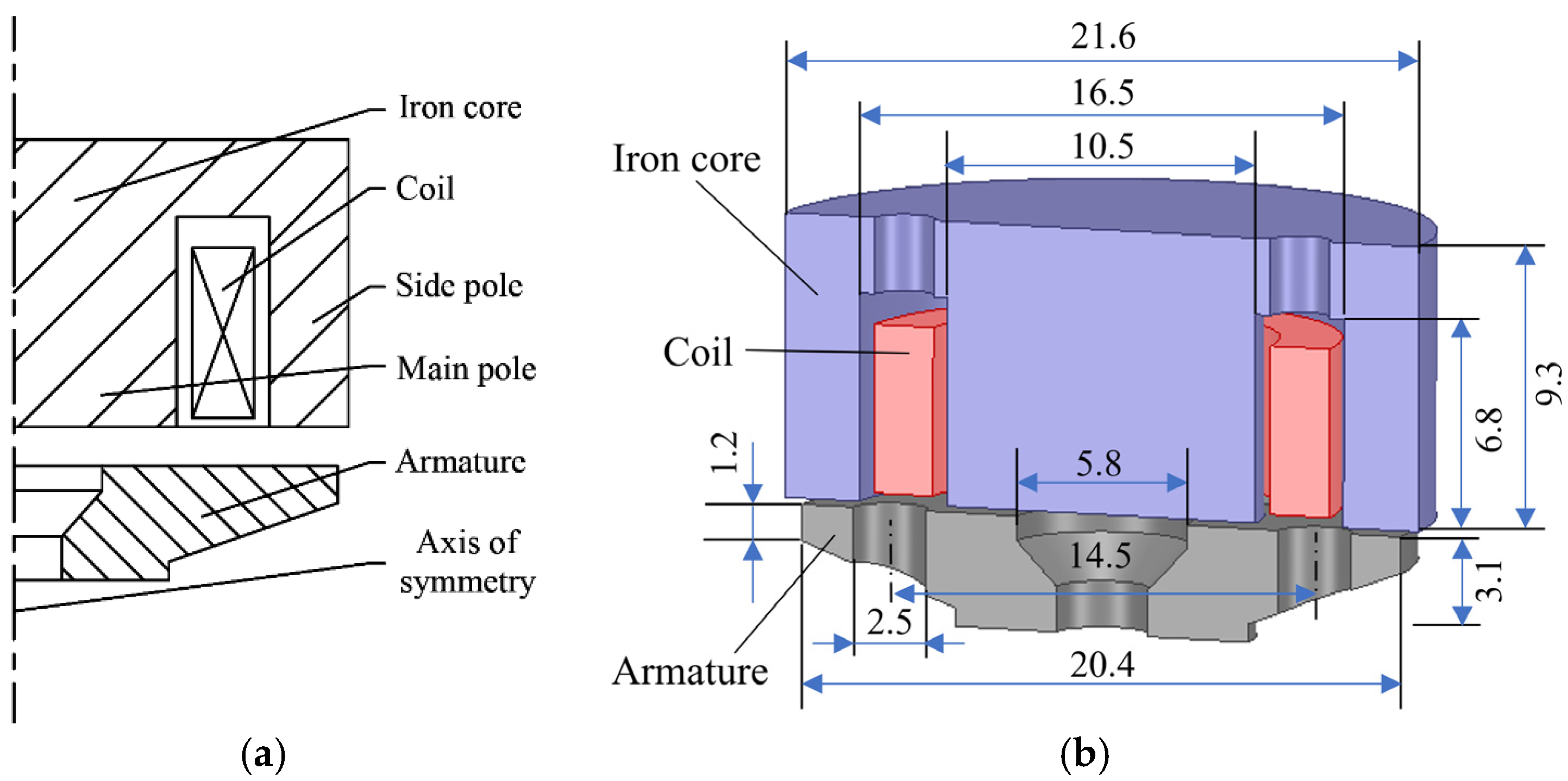
An HSS is an electro-mechanical device converting electrical energy into mechanical energy associated with linear motion. As shown in Figure 1a, it is primarily composed of an armature, an iron core and a coil. The armature is made of DT4 electrical pure iron, and the iron core is made of silicon steel sheets. The coil is composed of multiple turns of copper wire. According to the actual size of the HSS, a three-dimensional finite element model (FEM) was developed using Ansoft Maxwell software 13.0 [9], as illustrated in Figure 1b. The model was discretized using an adaptive meshing method with tetrahedral elements. In each iteration, the mesh was refined by 25% until both the energy and iteration errors were reduced to less than 1%.
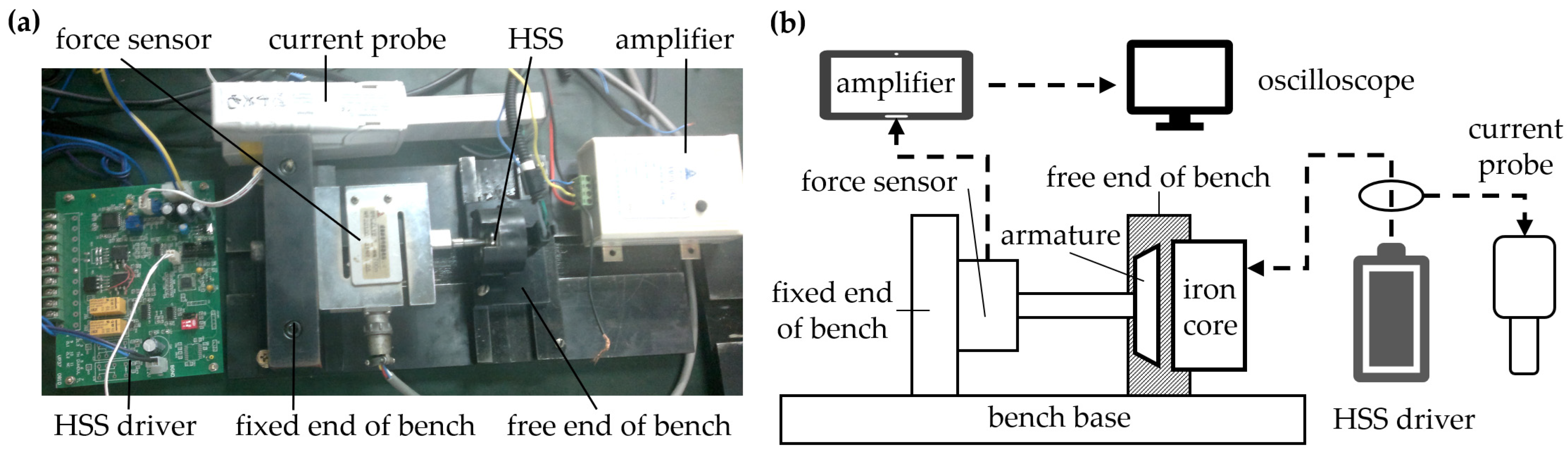
To verify the accuracy of the FEM, a test platform for measuring the electromagnetic force of the HSS was established, as shown in Figure 2. The platform mainly consists of a test bench, a force sensor, an HSS driver, a current probe, and a signal amplifier. During the experiment, the iron core and the force sensor were fixed to the free end and the fixed end of the test bench, respectively. The armature was connected to and secured together with the force sensor. The distance between the iron core and the armature can be adjusted by moving the free end. Once the free end is moved to the position corresponding to the set working air gap (measured by a feeler gauge), it is locked in place. When a constant current is applied to the coil, the iron core attracts the armature. This causes the force sensor to generate a weak voltage signal. The signal is amplified by a high-precision signal amplifier and then sent to an oscilloscope, from which the magnitude of the electromagnetic force can be determined. The current level can be modulated by the HSS driver and measured by the current probe.
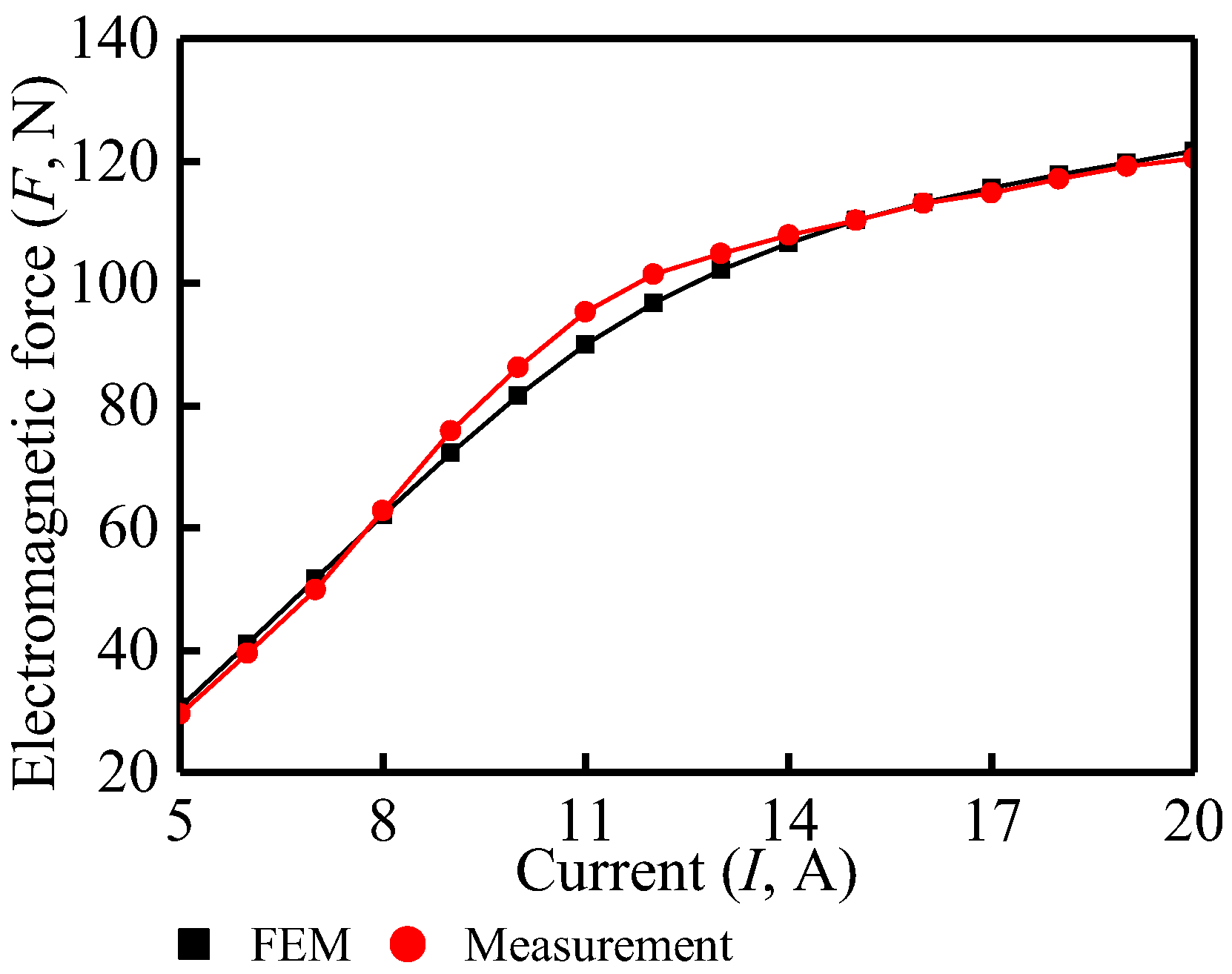
Figure 3 shows the comparison between the electromagnetic force computed by the FEM and the value measured experimentally along the axial direction of the armature under different drive currents. It was calculated that the maximum difference between the result of the finite element method and the measured value was 6% under different driving currents. Hence, it was practical to employ this method for the research on the magnetic performance of HSSs.

3. Static Electromagnetism Performance Analyses

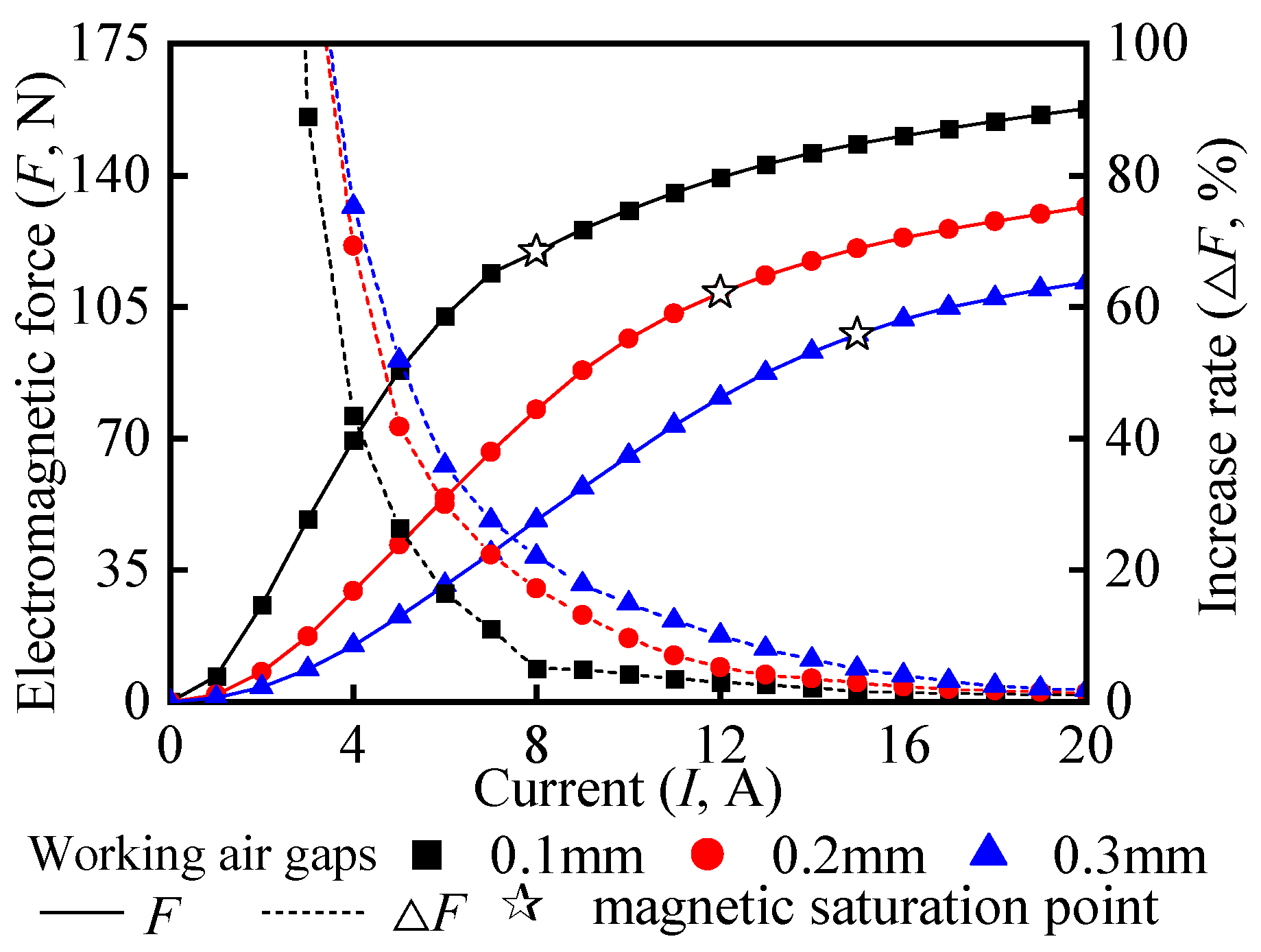
Figure 4 shows the variations in electromagnetic force with currents and working air gaps. As observed, under different working air gaps, the electromagnetic force begins to increase rapidly along with the increase in current; when the current reaches a certain degree, the increasing tendency of the electromagnetic force becomes slower. The main reasons for this phenomenon are as follows. The electromagnetic force depends on the normal component of the magnetic flux density at the armature underside. Increasing drive current means increasing the ampere turns, which increases the magnetic potential. Therefore, the magnetic circuit magnetic flux will increase due to the increase in magnetic potential. Then the magnetic flux density increases with the increase in magnetic potential, and the electromagnetic force also becomes larger. But, as the magnetic flow sectional area of the HSS remains unchanged, the partial or whole magnetic field in the iron core and armature will become saturated after the current increases to a certain degree. Therefore, the magnetic flux and magnetic flux density in the magnetic circuit will not change significantly. Therefore, the increasing tendency of electromagnetic force becomes slow after the current reaches a certain degree.
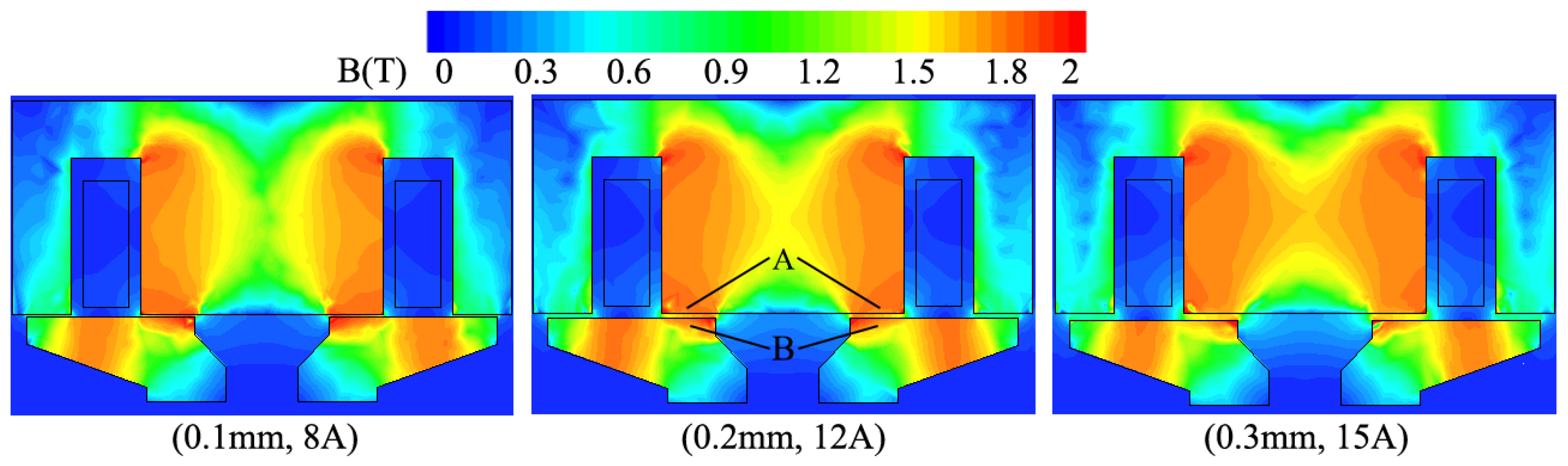
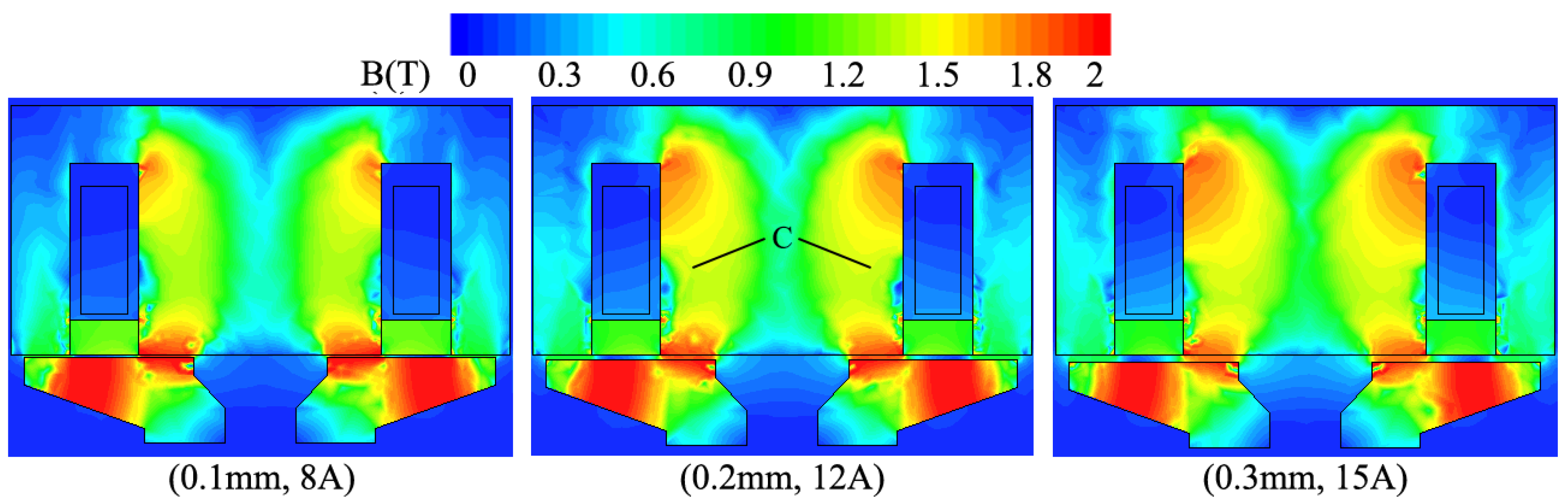
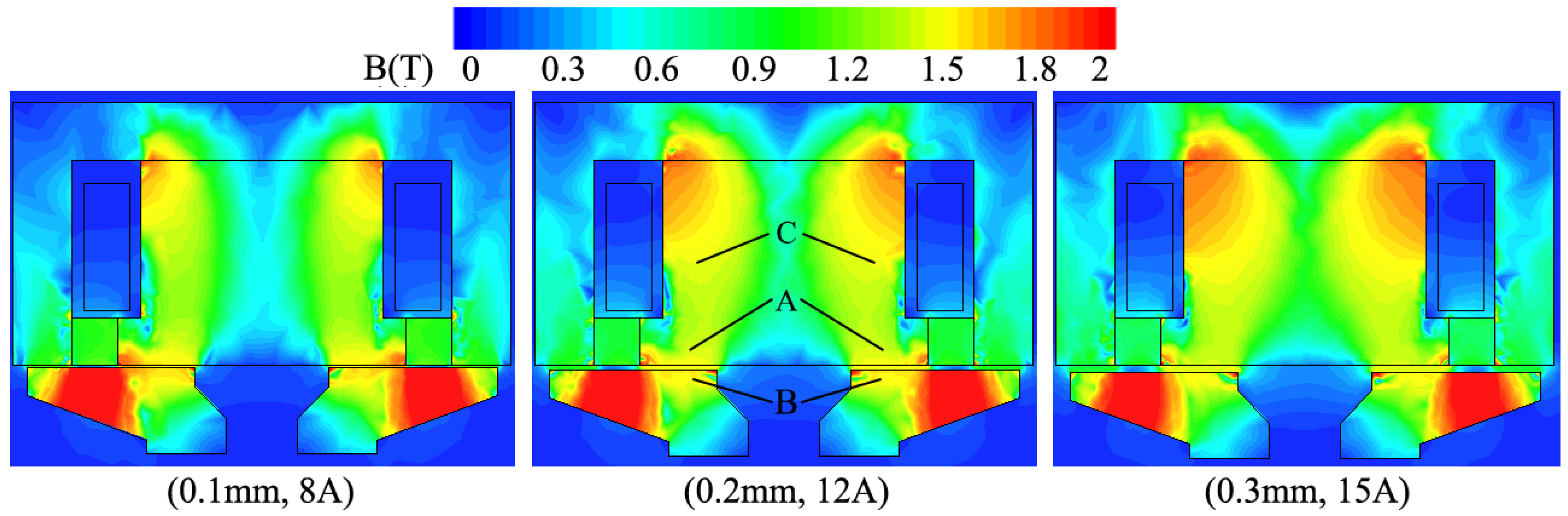
It can be seen in Figure 4 that the working air gaps are 0.1 mm, 0.2 mm and 0.3 mm, corresponding to the current reaching 8 A, 12 A and 15 A, respectively (star points as shown in Figure 4); after that, the electromagnetic force growth slows down and the growth rate drops below 5%. This illustrates that the HSS has taken the local magnetic saturation state near the star points, and these star points are called saturation points. Figure 5 shows the cloud diagram of the magnetic flux density of the cross section of the HSS corresponding to the saturation point. It can be clearly seen that the outside of the main pole (region A) and the inside of the armature (region B) reach the saturation point in advance, while the magnetic flux density of the other pole and outside the armature is weaker. Once the magnetic field becomes the local magnetic saturation state, the efficiency of transforming electromagnetic energy to mechanical energy will decrease significantly, and the magnetic hysteresis loss will significantly increase, which makes the HSS calorific value increase and shortens its lifetime. In addition, the magnetic field fades slowly when the HSS is deenergized, which decreases the dynamic response speed. To enhance the static electromagnetism and dynamic response performances of the HSS, this issue should be minimized as much as possible.

4. Structural Improvement Designs

4.1. Improvement Design with a PM

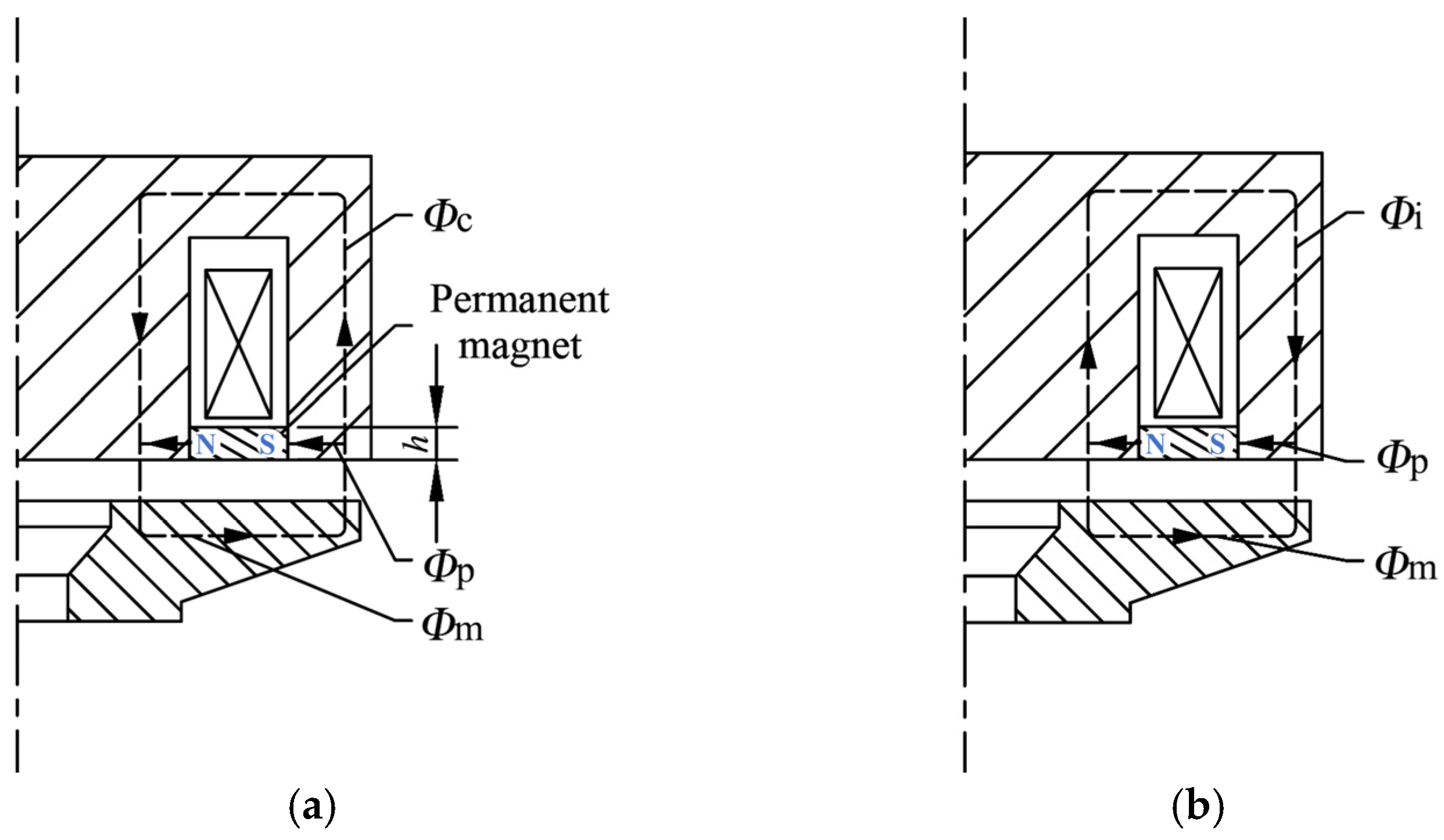
Figure 6 shows the first improvement design. An annular PM with a radial magnetization direction is installed under the coil. Rare-earth PM material is a good choice for an annular PM due to its high magnetic energy products and linearized demagnetization curve. Hence, an NdFeB PM is employed with a residual magnetization of 1.32 T and a coercivity of 990 kA/m.
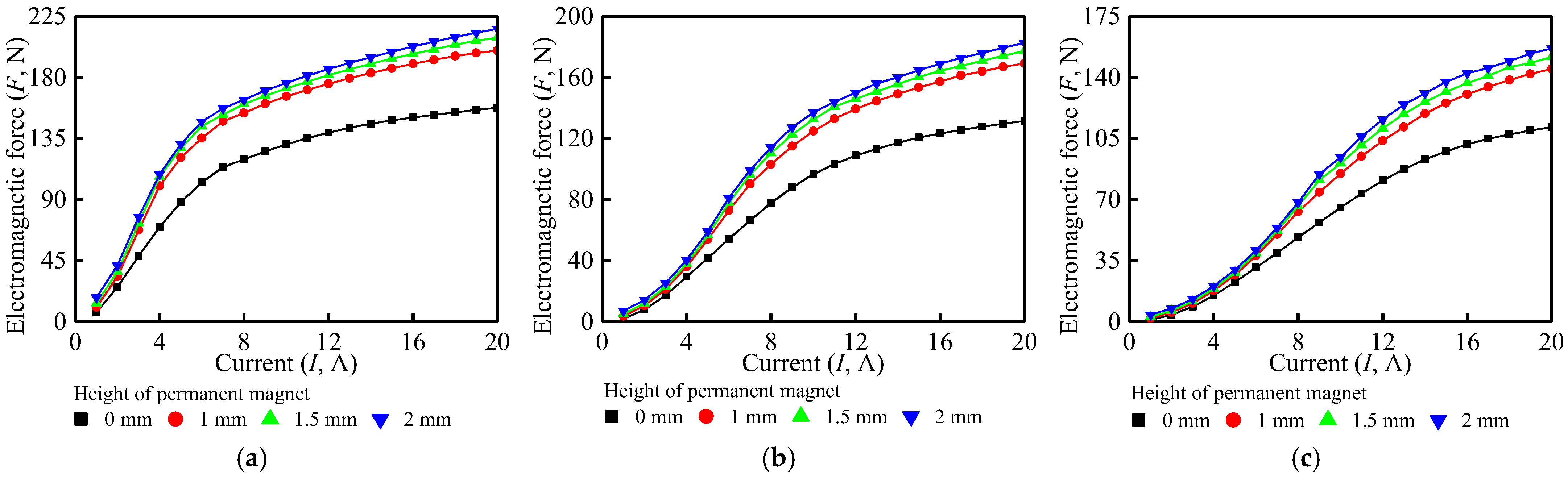
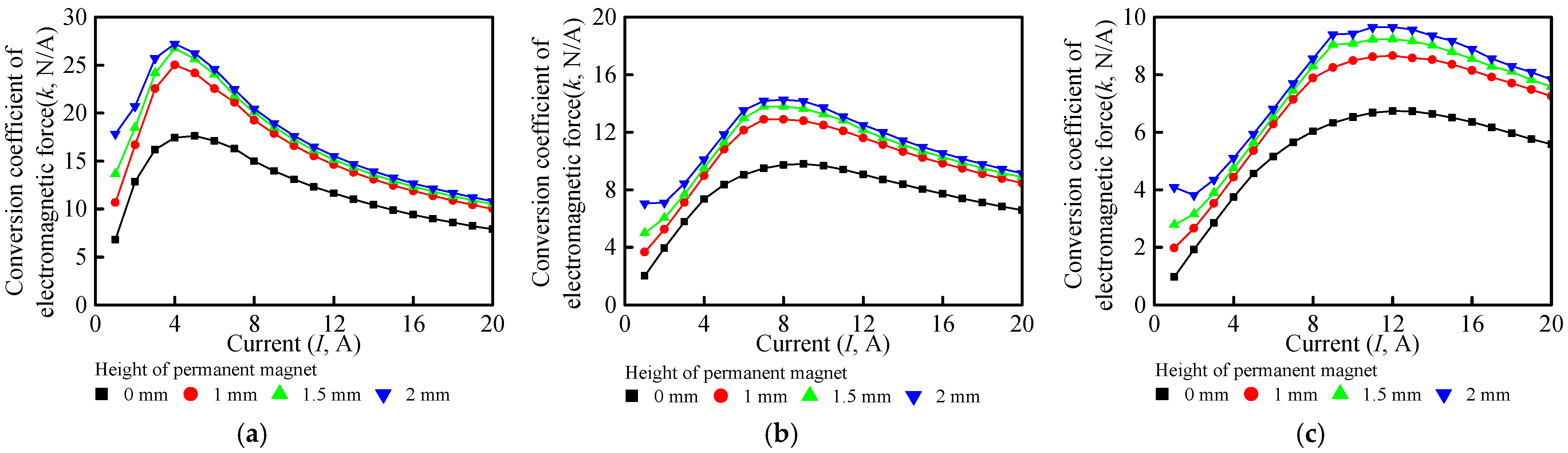
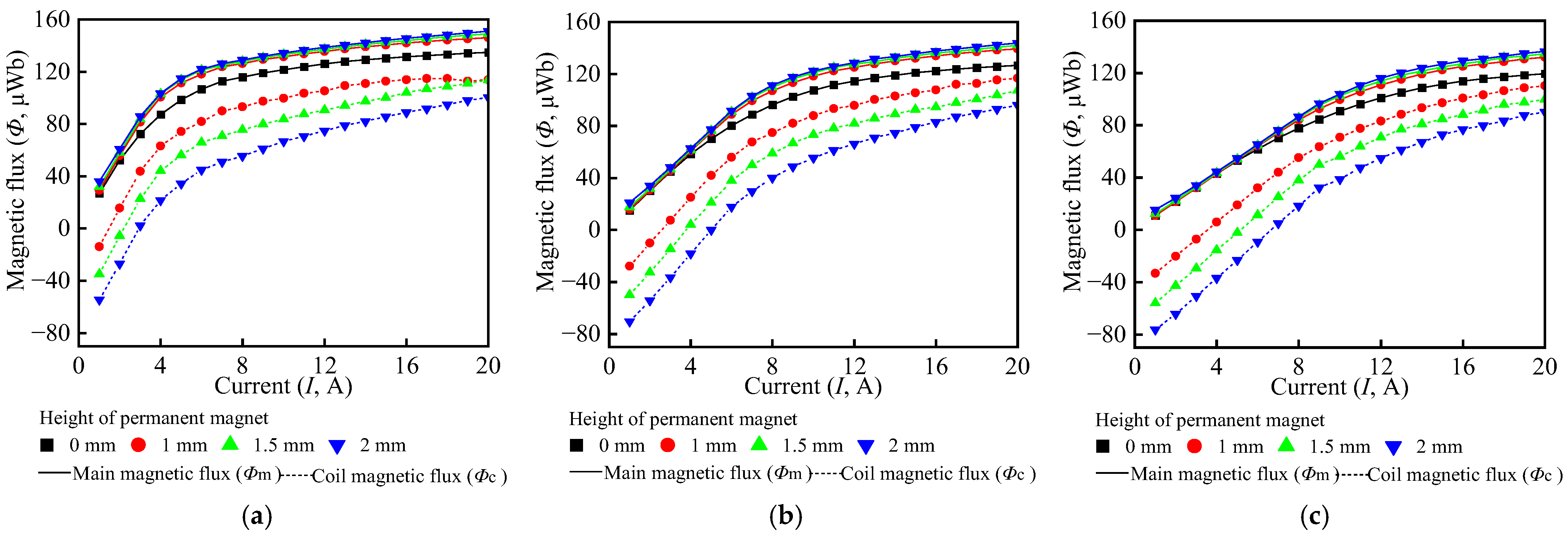
Figure 7 and Figure 8 show the effects of PM height (h) on the electromagnetic force and the conversion coefficient of electromagnetic force (electromagnetic force divided by current) for the improvement design of an HSS with a PM (PM HSS), and 0 mm stands for a conventional HSS without a PM. The figures show that the electromagnetic force and the conversion coefficient of the electromagnetic force increase by a large margin, and the increase in electromagnetic force and the conversion coefficient of the electromagnetic force is more significant with the increase in PM height. In addition, the saturation points shift forward with the increase in PM height and shift forward further with the decrease in the working air gap. The main reasons for this phenomenon are as follows: when the current is given to the coil in a specific direction, the magnetic flux of the coil (Φc) and the magnetic flux of the PM (Φp) will be excited in the same direction, as shown in Figure 6a. As they generate superimposed magnetic fluxes that pass through the armature, the magnetic flux of the main pole (Φm) also increases, as shown in Figure 9. Because the normal magnetic flux density under the armature increases, the electromagnetic force and its conversion efficiency also increase accordingly. This improves the efficiency of transforming electromagnetic energy into mechanical energy and helps reduce electricity consumption and coil heat generation. On the other hand, the permanent magnetic flux is proportional to its area in the direction of magnetization, and the area increases with the increase in PM height. Thus, the permanent magnetic flux increases. This leads to an increase in the main magnetic flux. Therefore, the increase in electromagnetic force and the conversion coefficient of the electromagnetic force is more significant with the increase in PM height. Moreover, magnetic flux saturation is certain at the armature. Therefore, the corresponding coil magnetic flux can be reduced when the PM flux increases and then the saturation points shift forward. The decrease in the working air gap leads to a decrease in working magnetic circuit reluctance, and the coil magnetic flux increases. Therefore, the saturation points shift forward further with the decrease in the working air gap.
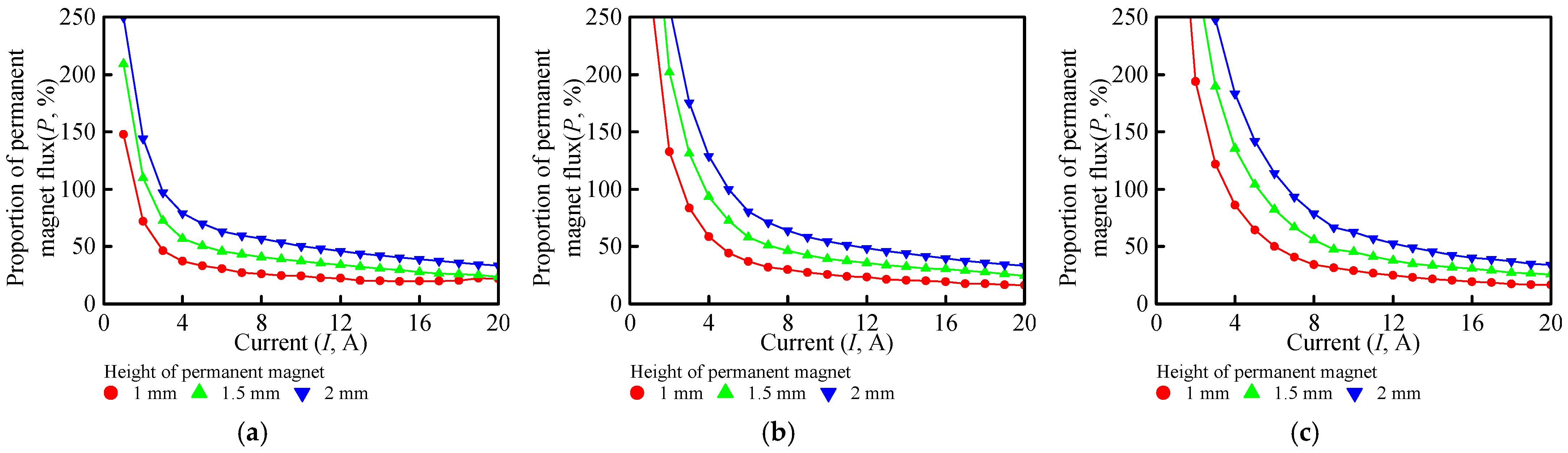
It can be observed from Figure 10 that the proportion of PM flux in the main magnetic flux is relatively big, reaching more than 100% at low current, and it increases in inverse proportion to the change in current but increases in direct proportion to the height of the PM and the working air gap. It is concluded that PM flux acts as a vital part in the electromagnetic force acting on the armature at low current. The magnetic field in the iron core excited by the coil current is weak at low current, or even completely offset by the magnetic field excited by PM. This makes the direction of the magnetic field in the iron core opposite compared to the conventional HSS, and as a result the main magnetic flux is fully provided by the PM. Therefore, the proportion of PM flux in the main magnetic flux is relatively big, reaching more than 100% at low current. However, the magnetic field in the iron core excited by the coil current becomes stronger with the increase in current, so the proportion of PM flux in main magnetic flux decreases with the increase in current, and the effects of the PM on electromagnetic force weaken. The increase in the working air gap not only reduces the strength of the magnetic resistance in the magnetic circuit but also weakens the strength of the magnetic field excited by the coil current. Meanwhile, increasing the PM height makes the magnetic field excited by the PM become stronger. Therefore, the proportion of PM flux in the main magnetic flux increases with the increase in PM height and the working air gap.
Comparing Figure 5 and Figure 11, it is found that the magnetic saturation within the main pole (region C, as shown in Figure 11) weakens for the PM HSS. As part of the coil magnetic flux is offset by PM, it reduces the coil magnetic flux of the PM HSS. The result is that the coil magnetic flux of the PM HSS is less than the coil magnetic flux of a conventional HSS. It can be seen from Figure 8 that the coil magnetic flux equals the main magnetic flux for the conventional HSS. Therefore, the magnetic saturation within the iron core weakens for the PM HSS.
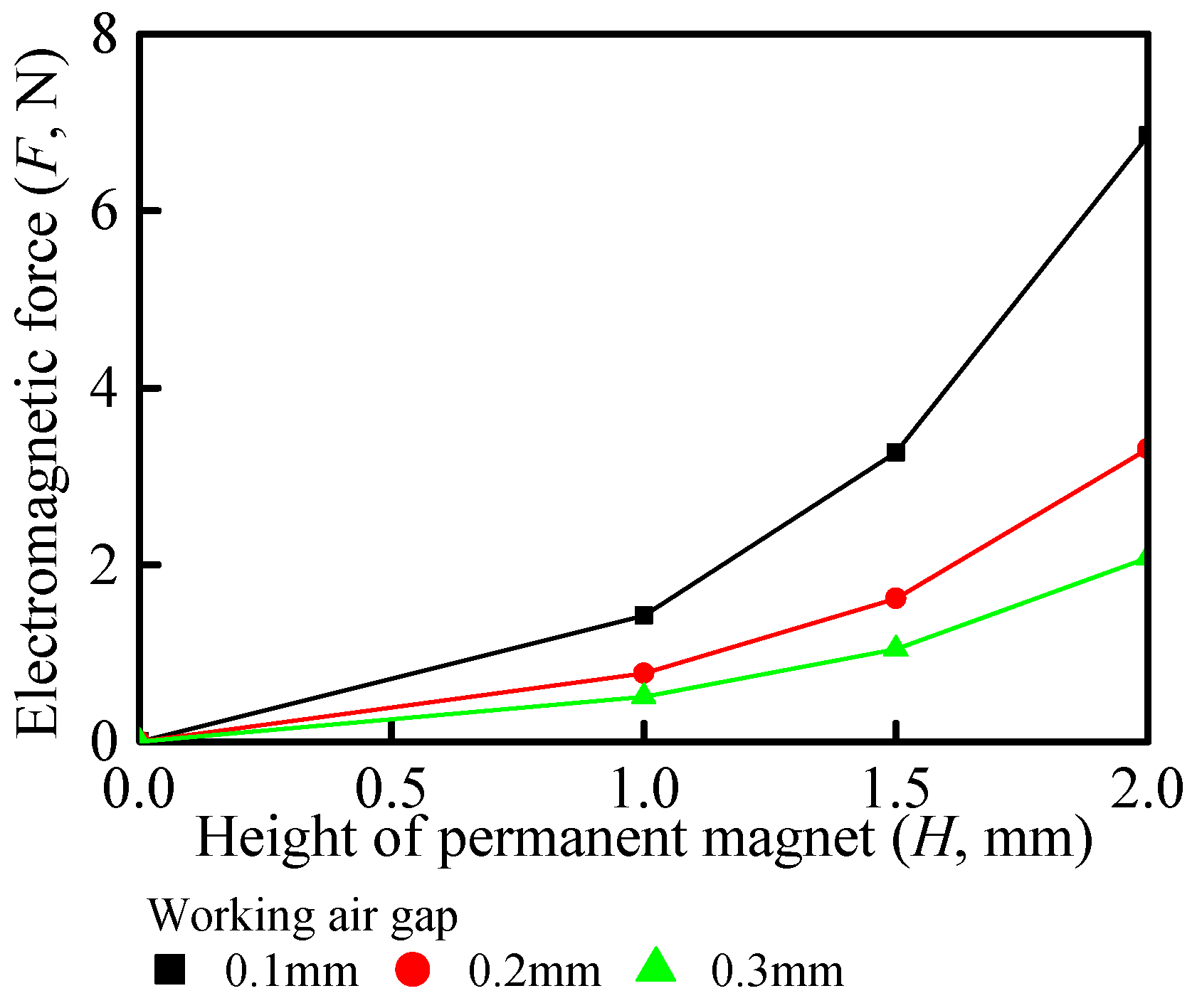
Figure 12 shows the effect of PM height on electromagnetic force without current excitation. The electromagnetic force increases gradually with the increase in PM height, and its increase rate increases gradually along with the decrease in the working air gap. The main reasons for this phenomenon are as follows: the magnetic fluxes Φm and Φi are in parallel and independently excited by the PM without current excitation, as shown in Figure 6b. Increasing the PM height leads to an increase in the permanent magnetic flux Φp, leading to an increase in the main magnetic flux Φm. Therefore, the electromagnetic force increases gradually with the increase in PM height. Meanwhile, the decrease in the working air gap leads to a decrease in reluctance in the magnetic flux loop of Φm. Therefore, the main magnetic flux Φm will increase based on Kirchhoff’s law. Due to the reduction of the working air gap, the growth rate of the electromagnetic force slowly increases accordingly. Finally, the magnetic flux loop of Φi is the soft magnetic material of the iron core, while the magnetic flux loop of Φm includes the working air gap. This makes the magnetic resistance of the magnetic flux loop of Φi much less than the magnetic resistance of the magnetic flux loop of Φm. Hence, Φm is much less than Φi. Thus, the electromagnetic force produced by the PM without current excitation is relatively small, compared with the spring pre-tightening force. As a result, the self-locking phenomenon will not happen.

4.2. Improvement Design with the PM and AF

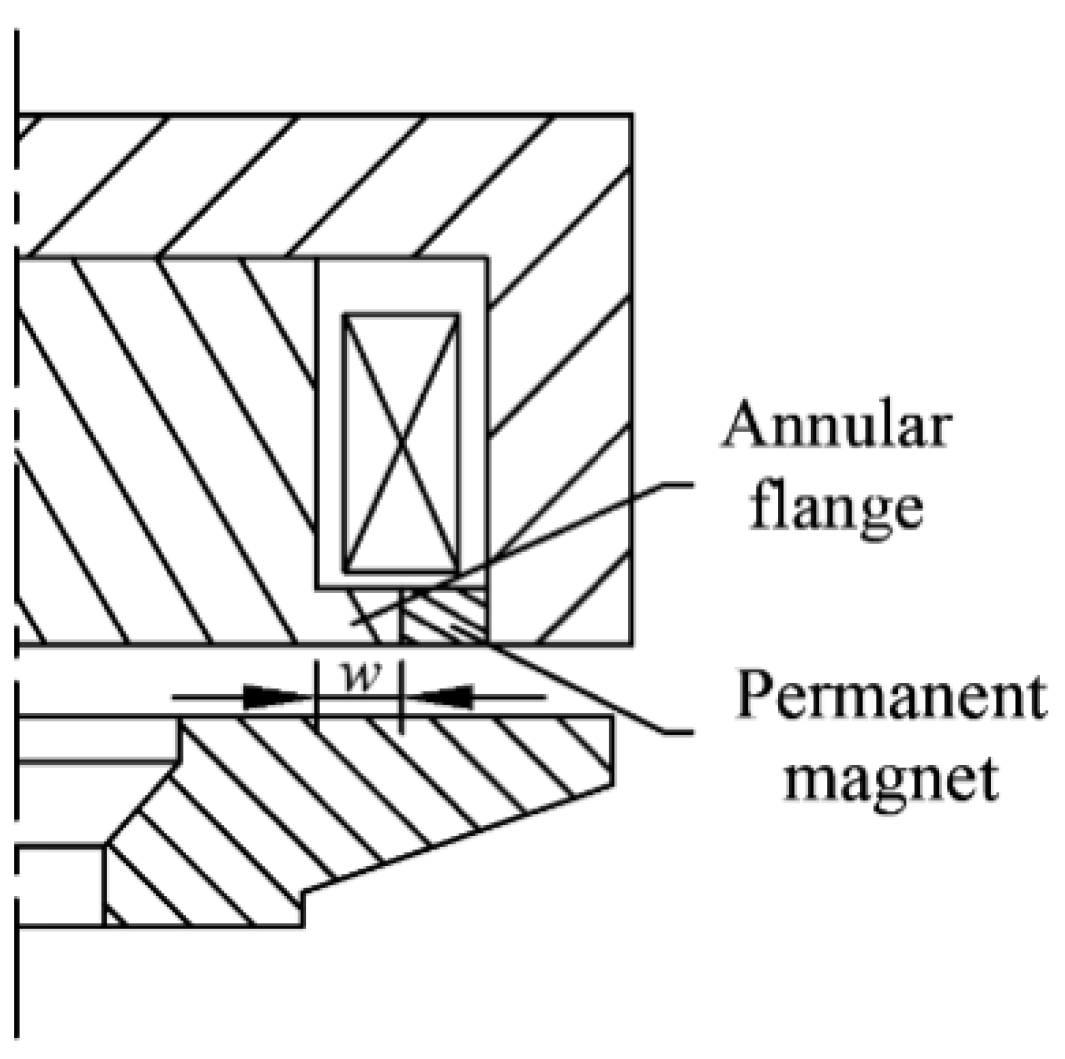
Figure 13 shows the second improvement design. An AF structure is applied on the basis of the first improvement design, and the AF height equals the PM height.
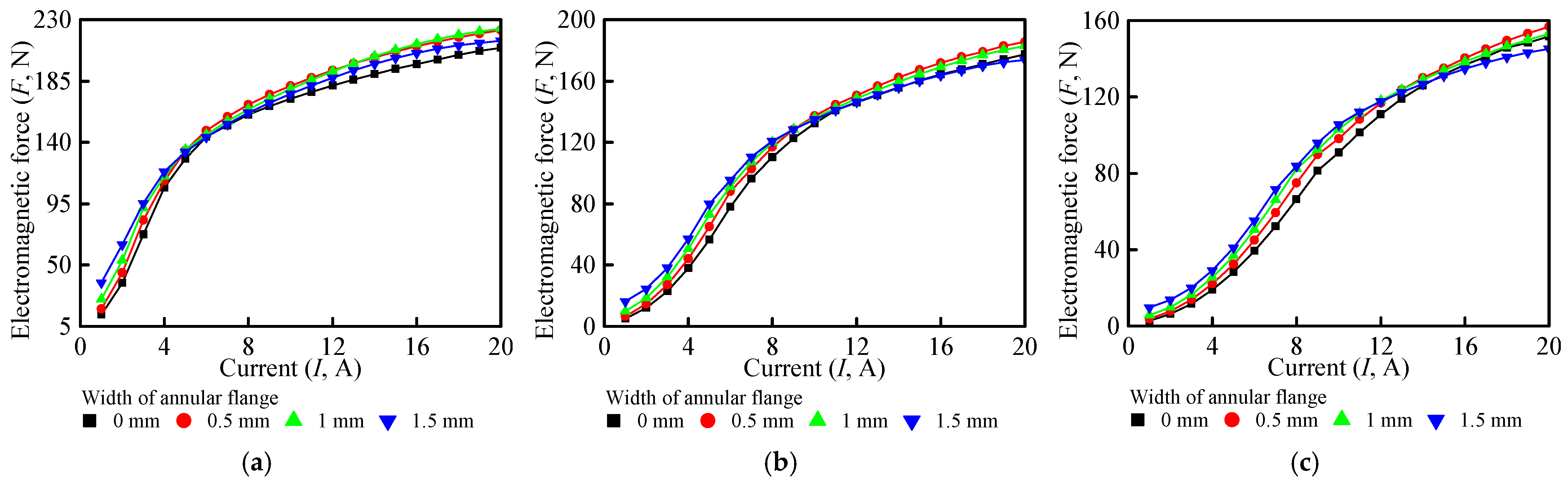
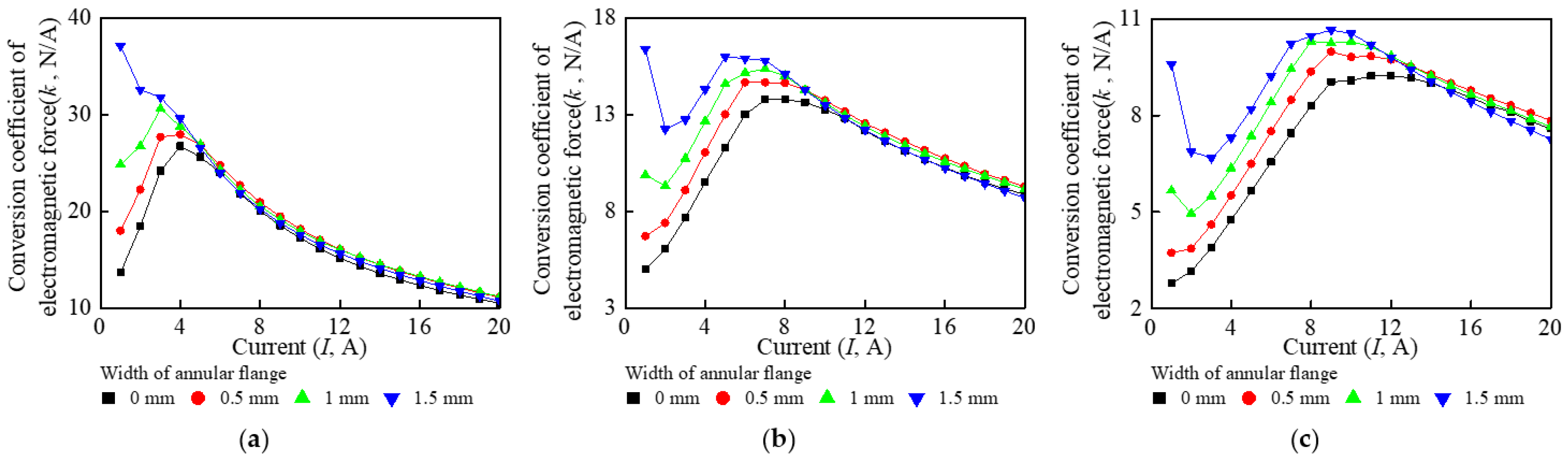
Figure 14 and Figure 15 show the effects of AF width (w) on electromagnetic force and the conversion coefficient of the electromagnetic force for the second improvement design, an HSS with a PM and an AF (PMAF HSS). The AF width of 0 mm represents the PM HSS with a PM height of 1.5 mm, and the volume of the PM remains unchanged in the process of AF width change. As observed, the electromagnetic force and the conversion coefficient of the electromagnetic force increase with the increase in AF width when the current is less than a certain value, but they increase at first and then decrease with the increase in AF width when the current is higher than a certain value. The main reasons for this phenomenon and the calculation formula for electromagnetic force are as follows.
F = Φ 2 2 μ 0 S
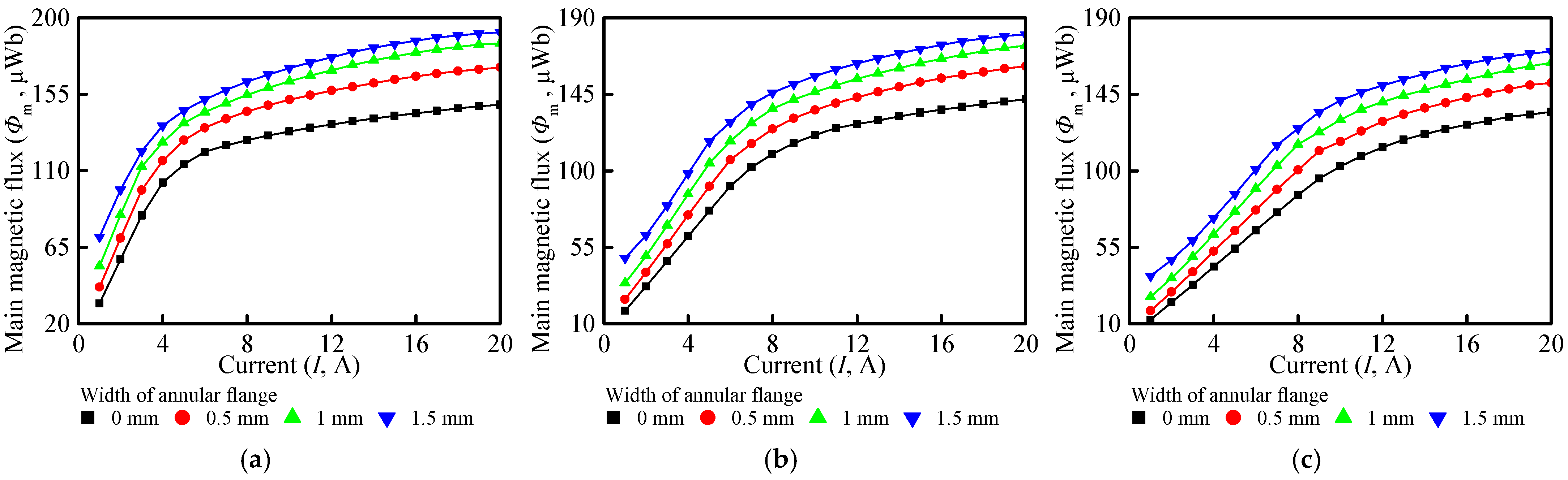
where F is the electromagnetic force, Φ is the effective magnetic flux, S is the effective attracting area, and μ0 is the magnetic permeability of the vacuum. When the current is less than a certain value, the magnetic field in the armature does not become saturated, and the effect of the main magnetic flux growth is higher than that of the attracting area growth, resulting in the gradual increase in electromagnetic force. As the current increases, the magnetic field in the armature tends to be saturated, and the main magnetic flux growth becomes relatively small, as shown in Figure 16. This can lead to the effect of the main magnetic flux growth being less than that of the attracting area growth, resulting in a decrease in electromagnetic force. Therefore, the above phenomenon is observed.
Comparing Figure 5, Figure 11 and Figure 17, it is found that the magnetic saturation in the main pole and armature inside the PMAF HSS is weaker than that of the PM HSS. The AF structure increases the magnetic flux area in region A and region B, and also weakens the magnetic flux density. Therefore, the magnetic saturation becomes relatively weak.

5. Multi-Objective Optimization

To find the optimal parameter combination for the improvement design, a multi-objective optimization approach was applied. First, the multi-objective optimization mathematical model (MOMM) was established as shown in Equation (2), which takes the net electromagnetic force (NEF) on the armature and the peak current as the optimization goals [23]. Because the function relation between the net electromagnetic force and the design variables is unknown or complicated, the quadratic polynomial models (QPMs) can be efficiently used to describe the above relation by the response surface method combined with the FEM. Then, the high-accuracy QPMs were developed as shown in Equations (3)–(5), and their adjusted coefficients of determination were higher than 0.99. Finally, the MOMM was solved by NSGA-II [24]. The population size was set to 50, and the initial population was generated by the Sobol experimental design method. The evolution process was carried out over 100 generations, with a crossover probability of 90% and a mutation probability of 50%.
max   F net = F ( i p , δ 0 ) F ( δ r )   and   ( i p ) s . t .   F net F ( i p , δ 0 ) *   2 A i p 16 A   0.5   mm h 3.5   mm   0   mm w 2   mm
where Fnet stands for the NEF on the armature, ip stands for the peak current, δ0 stands for the initial working air gap, F(ip,δ0) stands for the electromagnetic force with peak current at the initial working air gap, δr stands for the residual working air gap, F(δr) stands for the electromagnetic force without current at the residual working air gap, and F(ip,δ0)* stands for the electromagnetic force with peak current at the initial working air gap for the initial design.
F ( i p , δ 0 ) = 1.0528   h 2 9.7049   w 2 0.5947   i p 2 + 2.3482   hw + 0.3288   hi p 2.0157   wi p + 9.2734   h + 29.525   w + 22.3995   i p 72.5883
F ( δ r ) = 5.2602   h 2 0.9091   w 2 + 1.8007   hw 8.8139   h + 1.8676   w + 3.8507
F net = F ( i p , δ 0 ) F ( δ r ) = 6.313   h 2 8.7958   w 2 0.5947   i p 2 + 0.5475   hw + 0.3288   hi p 2.0157   wi p + 18.0873   h + 27.6574   w + 22.3995   i p 76.439
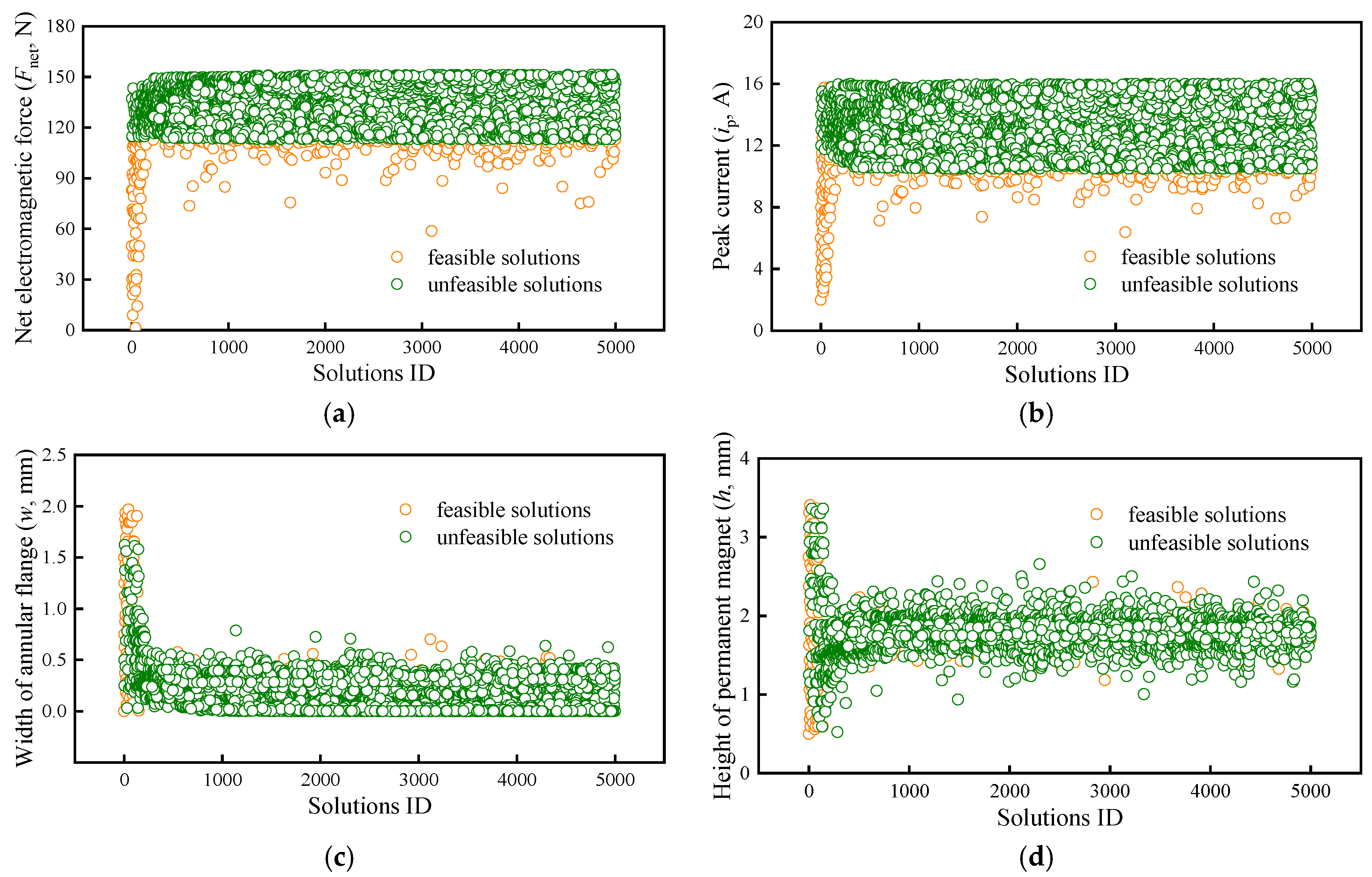
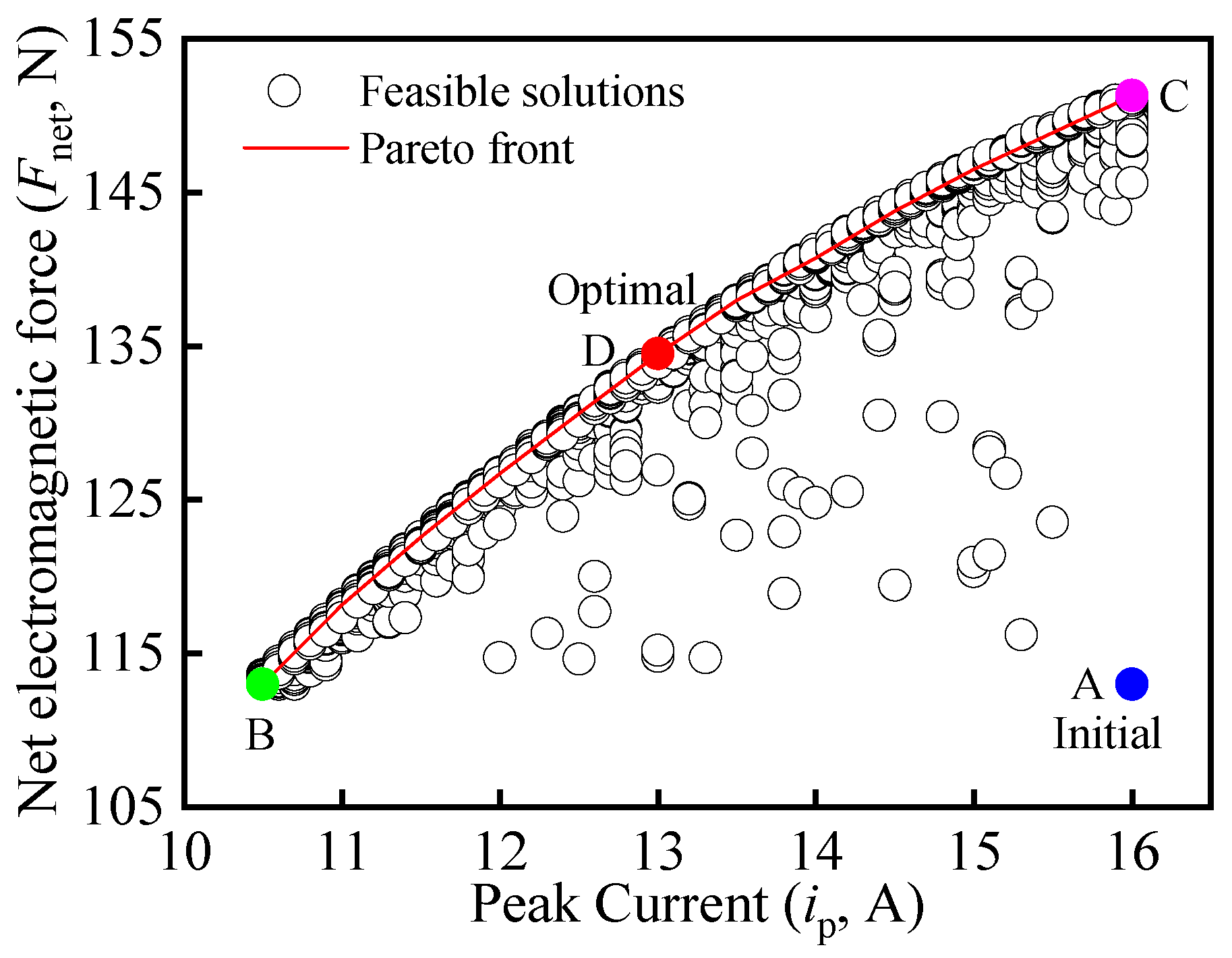
As illustrated in Figure 18, prior to the solution set count reaching 1000, all parameters essentially converged, and the bounds of the sensitive solution domain largely stabilized. Figure 19 shows the Pareto front and feasible solutions. As can be seen from the figure, there is a contradiction between the optimization goals that strengthen the NEF and increase the peak current. Consequently, we could not obtain a solution to make every goal become the optimum. To identify the single best compromise solution from the Pareto optimal set, a scalarization method was employed. This method aims to maximize the overall improvement across all performance metrics. Specifically, as defined by Equation (6), it evaluates each Pareto solution by calculating the sum of the normalized improvements for the two conflicting objectives: maximizing the NEF and minimizing the peak current. Each solution in the Pareto set was assessed using this metric. Among them, Solution D achieved the highest value according to Equation (6), indicating that it provided the most balanced and significant overall performance enhancement. Therefore, it was selected as the final optimal design parameter set.
max   F net F ( i p , δ 0 ) * F ( i p , δ 0 ) * + i p * i p i p *
where i p * is the peak current for the initial design.
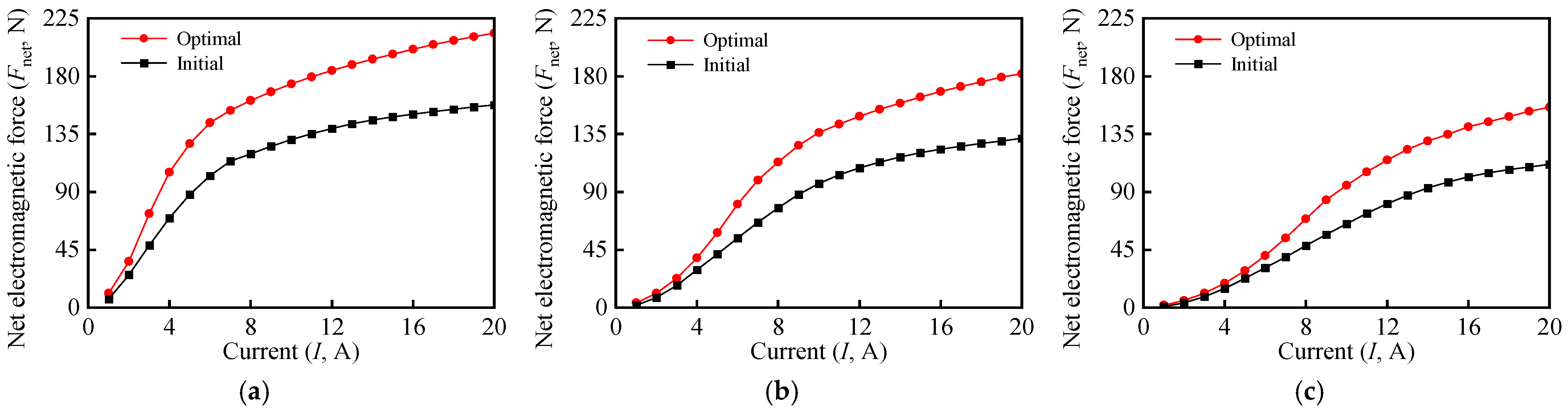
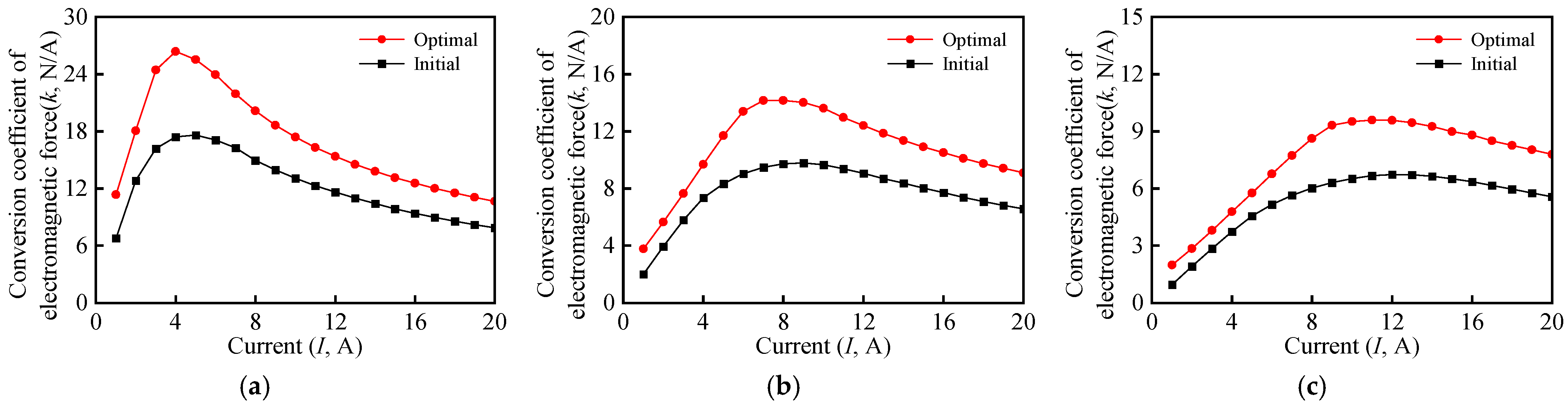
Figure 20 and Figure 21 present comparisons of the net electromagnetic force and the conversion coefficient of electromagnetic force before and after optimization, respectively. As illustrated in Figure 20 and Figure 21, under various working air gaps and driving current conditions, both the optimized net electromagnetic force and the conversion coefficient of electromagnetic force exhibit significant improvements. Table 1 provides a comparison of specific parameters before and after optimization. The error of the optimization results of both the QPM and the FEM does not exceed 0.8%, which further illustrates the established prediction accuracy of the QPM. As is shown in Table 1, the NEF strengthens by 18.8%, while the peak current decreases by 18.8%. In addition, the conversion coefficient of the electromagnetic force improves by 45.1%. This is helpful for enhancing the dynamic response speed of the HSS and lowering power consumption.

6. Conclusions

In this paper, two structural improvement designs of HSSs applying a PM and an AF structure are proposed on the basis of the principle of parallel magnetic circuit, and their static electromagnetism performances are improved significantly. The specific conclusions are summarized as follows:
(1)
The electromagnetic energy conversion efficiency and the electromagnetic force of an HSS can be promoted by applying a PM, and the bigger the PM height is, the higher the energy conversion efficiency is. The PM then plays more important role in the electromagnetic energy conversion and the increase in electromagnetic force at low current. In addition, the magnetic saturation within the main pole can be weakened by applying a PM.
(2)
The electromagnetic energy conversion efficiency and electromagnetic force of an HSS can be further promoted by applying both a PM and an AF structure. They gradually increase with the increase in AF width in a certain range of current, but they will increase at first and then decrease with the increase in AF width when the current exceeds a certain value. In addition, the magnetic saturation in main pole and the armature inside of the HSS can be further weakened by applying both a PM and an AF structure.
(3)
The multi-objective optimization for the improvement design based on the response surface method and NSGA-II is carried out. The Pareto optimal solution set is obtained and the optimal dimensions of PM height and AF width are determined, for which the NEF strengthens by 18.8% and the peak current decreases by 18.8%, helping with heightening the dynamic response speed of the HSS and lowering its power consumption.
While the proposed integration of PMs and AFs significantly enhances static electromagnetic performance, potential limitations warrant further investigation. The addition of rare-earth PMs increases material costs and introduces sensitivity to high-temperature operation due to possible demagnetization. Furthermore, the AF structure may add manufacturing complexity. Future work should include a comprehensive cost–benefit analysis, experimental validation of performance under varying thermal conditions, and an exploration of cost-effective or temperature-resistant magnetic materials to facilitate practical industrial adoption.

Author Contributions

Conceptualization, P.L. and J.W.; methodology, P.L. and W.Q.; validation, P.L. and W.Q.; formal analysis, P.L. and W.Q.; resources, P.L., W.Q., J.W., and Z.G.; data curation, P.L. and W.Q.; writing—original draft preparation, P.L. and W.Q.; writing—review and editing, P.L. and Z.G.; visualization, W.Q.; funding acquisition, P.L. and J.W. All authors have read and agreed to the published version of the manuscript.

Funding

This research was funded by the National Natural Science Foundation of China (grant number 52001032), the Natural Science Foundation of Hunan Province of China (grant number 2026JJ50173), the Innovation and Entrepreneurship Training Program for College Students of Changsha University of Science and Technology (grant number S202410536092), the Innovative Research Group Project of Hunan Province (grant number 2025JJ10006), and the Science and Technology Innovative Research Team in Higher Educational Institutions of Hunan Province (grant number 2023CT02).

Institutional Review Board Statement

Not applicable.

Informed Consent Statement

Not applicable.

Data Availability Statement

The data are included within this article.

Conflicts of Interest

The authors declare no conflicts of interest.

References

  1. Lan, Q.; Li, H.; Bai, Y.; Wang, Z.; Wang, Y.; Xu, Y.; Fan, L. Nonlinear characteristics of fuel injection quantity for a high-pressure common rail fuel injector. Int. J. Engine Res. 2026, 27, 90–102. [Google Scholar] [CrossRef]
  2. Yuan, W.; Qiu, M.; Ding, X.; Wei, H.; Ding, X. Numerical study on the influence of common rail pipe on rail pressure fluctuation characteristics in high pressure common rail injection system (HPCRIS) of diesel engine. Int. J. Mech. Mater. Des. 2026, 22, 1. [Google Scholar] [CrossRef]
  3. Lu, X.; Zhao, J.; Markov, V.; Wu, T. Study on precise fuel injection under multiple injections of high pressure common rail system based on deep learning. Energy 2024, 307, 132784. [Google Scholar] [CrossRef]
  4. Liu, P.; Zhao, Q.; Peng, S.; Quan, W.; Gao, Z. The effects of oil temperature and oil return pressure on oil film damping characteristics of a high-speed solenoid valve. Stroj. Vestn.-J. Mech. Eng. 2025, 71, 83–91. [Google Scholar] [CrossRef]
  5. Fan, Y.; Guo, J.; Wang, H.; Xie, L.; Yang, J. Research on the influence of armature perforation on the comprehensive performance of solenoid valves. Case Stud. Therm. Eng. 2026, 77, 107547. [Google Scholar] [CrossRef]
  6. Zhong, Q.; Mao, Y.; Xu, E.; Wang, X.; Li, Y.; Yang, H. Fast Dynamics and low power losses of high-speed solenoid valve based on optimized pre-excitation control algorithm. Therm. Sci. Eng. Prog. 2024, 47, 102363. [Google Scholar] [CrossRef]
  7. Du, H.; Li, X.; Yan, G.; Zheng, G.; Yang, X.; Wei, L.; Zhou, S. A high dynamic drive method for dual solenoid high-speed on/off valve based on phase-duty cycle compound modulation. IEEE-ASME Trans. Mechatron. 2025; in press. [Google Scholar]
  8. Yu, Z.; Zhao, J.; Wei, R. Multi-objective cooperation optimization research on dynamic response and energy loss of high-speed solenoid valve for diesel engine injector. Int. J. Appl. Electromagn. Mech. 2024, 74, 57–77. [Google Scholar] [CrossRef]
  9. Liu, P.; Fan, L.; Xu, D.; Ma, X.; Song, E. Multi-objective optimization of high-speed solenoid valve based on response surface and genetic algorithm. In SAE 2015 World Congress & Exhibition; SAE Paper 2015-01-1350; SAE Technical Paper: Warrendale, PA, USA, 2015. [Google Scholar]
  10. Wu, S.; Zhao, X.; Li, C.; Jiao, Z.; Qu, F. Multiobjective optimization of a hollow plunger type solenoid for high speed on/off valve. IEEE Trans. Ind. Electron. 2018, 65, 3115–3124. [Google Scholar] [CrossRef]
  11. Wang, Q.; Yang, F.; Yang, Q.; Chen, J.; Guan, H. Experimental Analysis of New High-Speed Powerful Digital Solenoid Valves. Energy Conv. Manag. 2011, 52, 2309–2313. [Google Scholar] [CrossRef]
  12. Guo, H.; Wang, Y.; Wen, Q. Investigation on comprehensive performance of the EFI by MIM technology. Int. J. Appl. Electrom. 2013, 42, 579–588. [Google Scholar] [CrossRef]
  13. Cheng, Q.; Zhang, Z.; Guo, H.; Xie, N. Improved processing and performance of GDI injector based on metal injection molding technology. Int. J. Appl. Electrom. 2014, 44, 99–114. [Google Scholar] [CrossRef]
  14. Seilly, A. Helenoid Actuators—A New Concept in Extremely Fast Acting Solenoids; SAE Paper 790119; SAE Technical Paper: Warrendale, PA, USA, 1979. [Google Scholar]
  15. Seilly, A. Colenoid actuators-further developments in extremely fast acting solenoids. In SAE International Congress and Exposition; SAE Paper 810462; SAE Technical Paper: Warrendale, PA, USA, 1981. [Google Scholar]
  16. Mutai, H.; Yamasawa, K. Fundamental operations of a multipolar disk-solenoid. IEEE. Trans. Magn. 1995, 31, 2445–2449. [Google Scholar] [CrossRef]
  17. Kushida, T. High Speed, Powerful and Simple Solenoid Actuator “DISOLE” and Its Dynamic Analysis Results; SAE Paper 850373; SAE Technical Paper: Warrendale, PA, USA, 1985. [Google Scholar]
  18. Rens, J.; Clark, R.; Jewell, G. Static performance of a polarized permanent-magnet reluctance actuator for internal combustion engine valve actuation. IEEE. Trans. Magn. 2006, 42, 2063–2070. [Google Scholar] [CrossRef]
  19. Kim, J.; Chang, J. A new electromagnetic linear actuator for quick latching. IEEE. Trans. Magn. 2007, 43, 1849–1852. [Google Scholar] [CrossRef]
  20. Overboom, T.; Jansen, J.; Lomonova, E. Application of a permanent magnet biased E-Core reluctance actuator in a magnetically suspended ceiling actuator. IEEE. Trans. Magn. 2010, 46, 2128–2131. [Google Scholar] [CrossRef]
  21. Lim, S.; Min, S. Design optimization of permanent magnet actuator using multi-phase level-set model. IEEE. Trans. Magn. 2012, 48, 1641–1644. [Google Scholar] [CrossRef]
  22. Hong, S.; Ro, J.; Jung, H. Optimal design of a novel permanent magnetic actuator using evolutionary strategy algorithm and kriging meta-model. J. Electr. Eng. Technol. 2014, 9, 471–477. [Google Scholar] [CrossRef]
  23. Liu, P.; Fan, L.; Peng, W.; Ma, X.; Song, E. Design and optimization of novel high-speed electromagnetic actuator for electronic fuel injection system. In WCX™ 17: SAE World Congress Experience; SAE Paper 2017-01-1640; SAE Technical Paper: Warrendale, PA, USA, 2017. [Google Scholar]
  24. Deb, K.; Pratap, A.; Agarwal, S.; Meyarivan, T. A fast and elitist multiobjective genetic algorithm: NSGA-II. IEEE. Trans. Evol. Comput. 2002, 6, 182–197. [Google Scholar] [CrossRef]
Figure 1. Structure and simulation model of the HSS: (a) schematic diagram; (b) simulation model.
Actuators 15 00172 g001
Figure 2. The electromagnetic force test platform for the HSS: (a) device photograph; (b) schematic diagram.
Actuators 15 00172 g002
Figure 3. Comparisons between the FEM and measurement values of electromagnetic force.
Actuators 15 00172 g003
Figure 4. Variations in electromagnetic force with current and working air gap.
Actuators 15 00172 g004
Figure 5. Magnetic flux density nephograms of the HSS section at star points.
Actuators 15 00172 g005
Figure 6. Structure and principle of the first improvement design: (a) schematic diagram of magnetic circuit with current excitation; (b) schematic diagram of magnetic circuit without current excitation.
Actuators 15 00172 g006
Figure 7. Effects of PM height on electromagnetic force at working air gaps of (a) 0.1 mm, (b) 0.2 mm, and (c) 0.3 mm.
Actuators 15 00172 g007
Figure 8. Effects of PM height on conversion coefficient of electromagnetic force at working air gaps of (a) 0.1 mm, (b) 0.2 mm, and (c) 0.3 mm.
Actuators 15 00172 g008
Figure 9. Effects of PM height on magnetic flux at working air gaps of (a) 0.1 mm, (b) 0.2 mm, and (c) 0.3 mm.
Actuators 15 00172 g009
Figure 10. Variations in proportions of PM flux at working air gaps of (a) 0.1 mm, (b) 0.2 mm, and (c) 0.3 mm.
Actuators 15 00172 g010
Figure 11. Magnetic flux density nephograms at a PM height of 1.5 mm.
Actuators 15 00172 g011
Figure 12. Effects of PM height on electromagnetic force without current excitation.
Actuators 15 00172 g012
Figure 13. Structure schematic of the second improvement design.
Actuators 15 00172 g013
Figure 14. Effects of AF width on electromagnetic force at working air gaps of (a) 0.1 mm, (b) 0.2 mm, and (c) 0.3 mm.
Actuators 15 00172 g014
Figure 15. Effects of AF width on conversion coefficient of electromagnetic force at working air gaps of (a) 0.1 mm, (b) 0.2 mm, and (c) 0.3 mm.
Actuators 15 00172 g015
Figure 16. Variations in magnetic flux of PMAF HSS at working air gaps of (a) 0.1 mm, (b) 0.2 mm, and (c) 0.3 mm.
Actuators 15 00172 g016
Figure 17. Magnetic flux density nephograms at an AF width of 1 mm.
Actuators 15 00172 g017
Figure 18. Changes in various parameters during the iterative solution process: (a) net electromagnetic force, (b) peak current, (c) width of annular flange and (d) height of permanent magnet.
Actuators 15 00172 g018
Figure 19. Pareto front and feasible solutions.
Actuators 15 00172 g019
Figure 20. Comparison of the NEF before and after optimization at working air gaps of (a) 0.1 mm, (b) 0.2 mm, and (c) 0.3 mm.
Actuators 15 00172 g020
Figure 21. Comparison of the conversion coefficient of electromagnetic force before and after optimization at working air gaps of (a) 0.1 mm, (b) 0.2 mm, and (c) 0.3 mm.
Actuators 15 00172 g021
Table 1. Comparison of specific parameters before and after optimization.
InitialOptimalChange Rate (%)
h (mm)01.81--
w (mm)00.21--
ip (mm)1613−18.8
Fnet (N)113FEMQPMError (%)18.8
134.3133.20.8
k (N/A)7.110.345.1
Disclaimer/Publisher’s Note: The statements, opinions and data contained in all publications are solely those of the individual author(s) and contributor(s) and not of MDPI and/or the editor(s). MDPI and/or the editor(s) disclaim responsibility for any injury to people or property resulting from any ideas, methods, instructions or products referred to in the content.