
Long-Stroke Reluctance Magnetic Levitation Systems: Characteristic Analysis and Gain Scheduling Positioning Control




Abstract
1. Introduction
2. System Description and Modeling
2.1. System Components
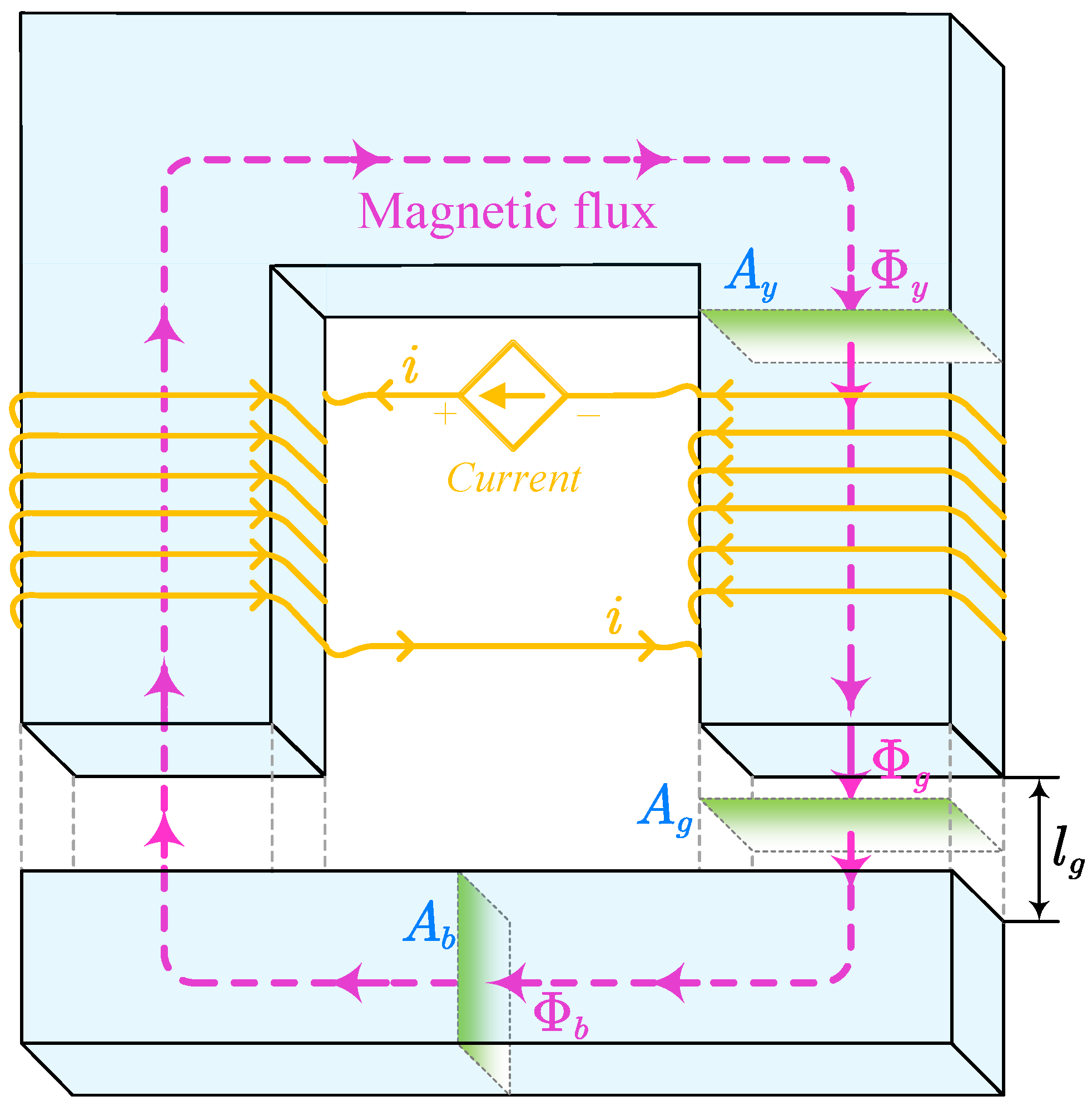
2.2. Magnetic Modeling
2.3. Dynamic Analysis and Modeling
3. Control System Analysis
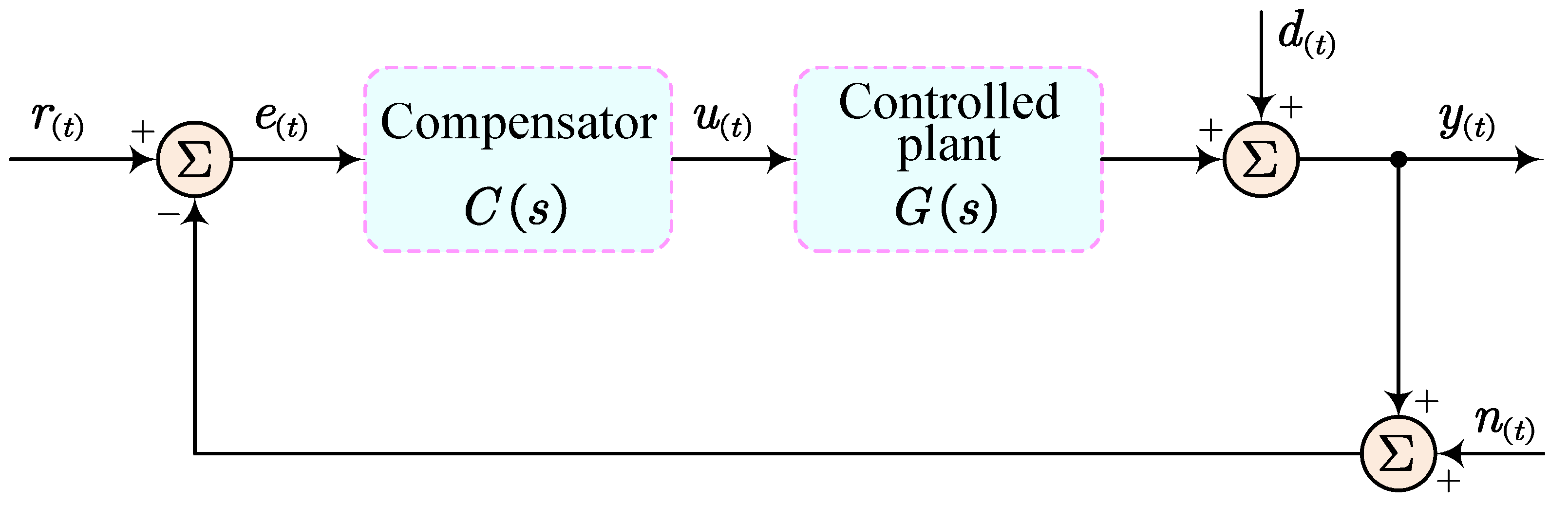
3.1. Basic Feedback Configuration
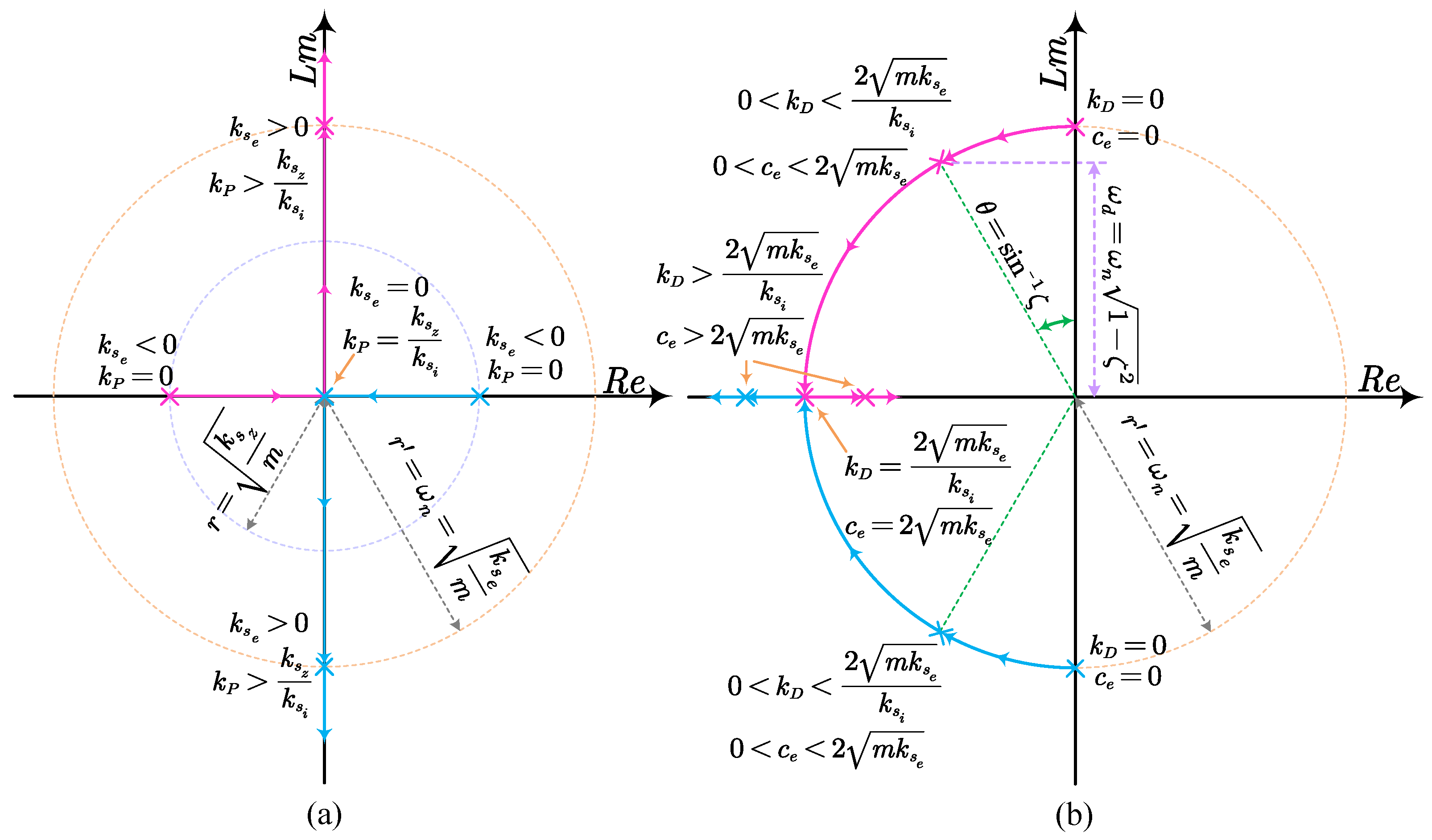
3.2. Dynamic Characteristics Analysis
3.3. Nonlinear Effects with Air Gap Variation
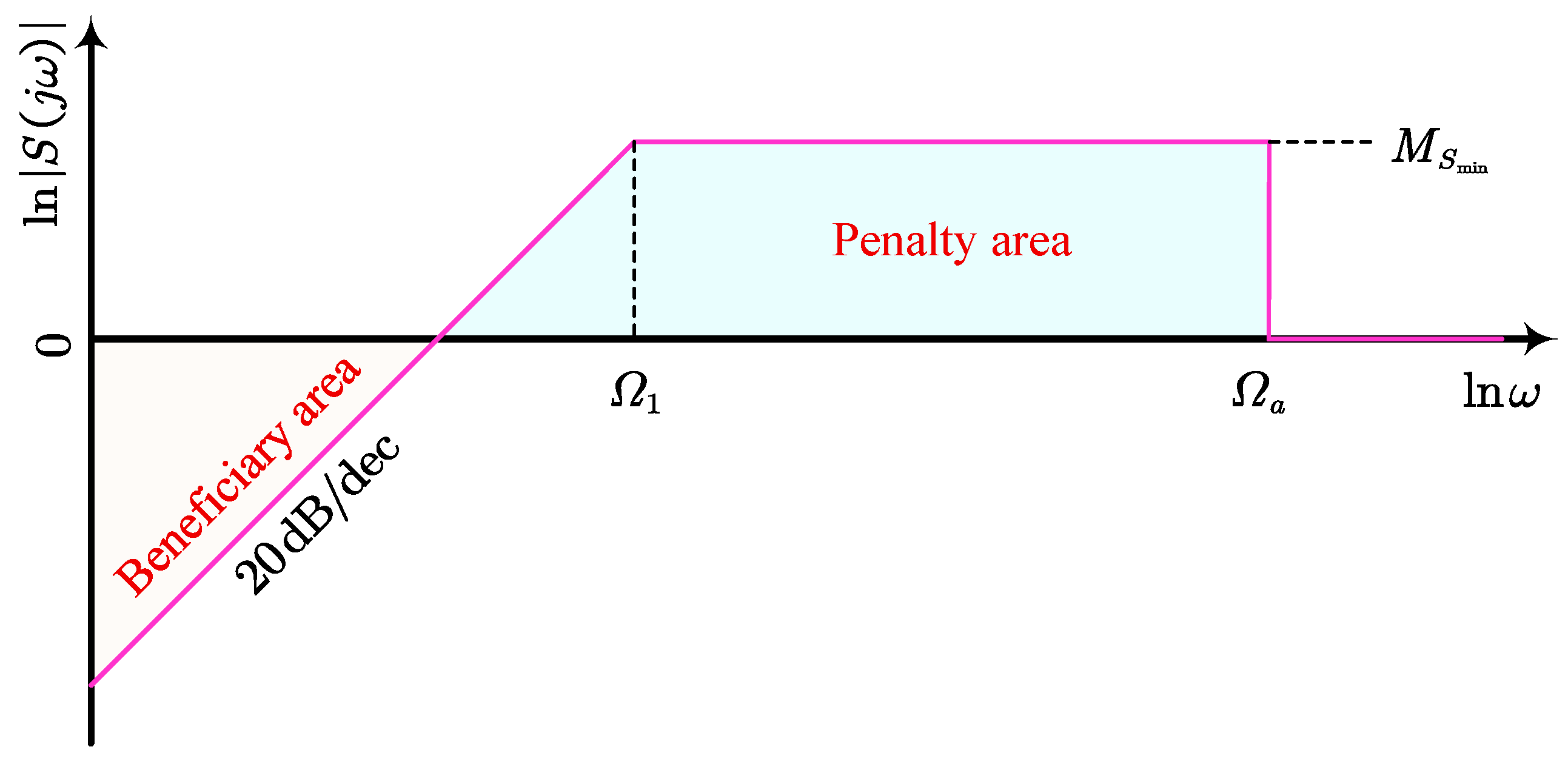
3.4. Robustness Constraints
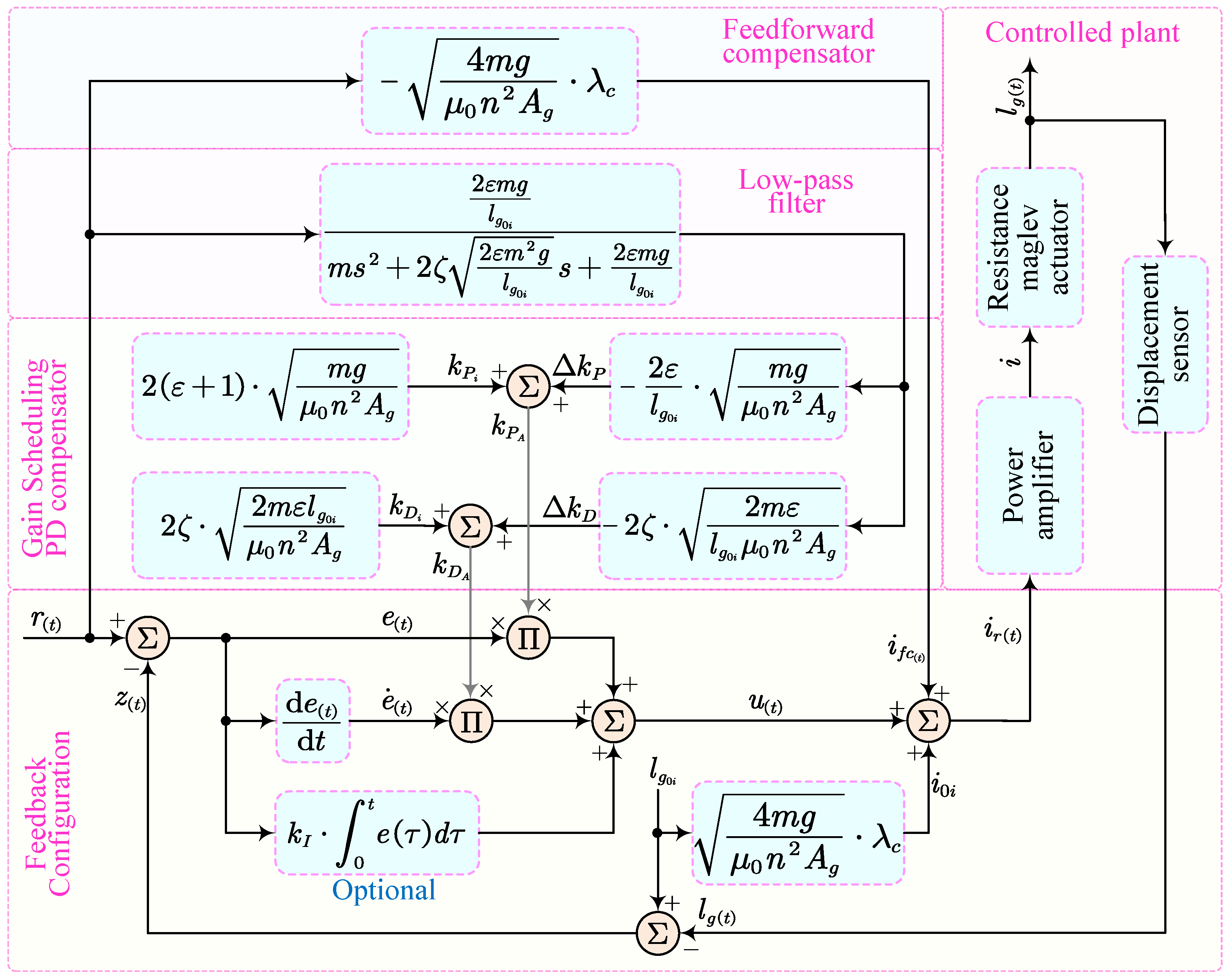
4. Control Strategy Design
4.1. Feedforward Compensation
4.2. Gain Scheduling PD Compensator


| Parameter | Symbol | Value | Unit |
|---|---|---|---|
| Vacuum permeability | |||
| Gravitational acceleration | g | 9.8 | |
| Total coil turns | n | 380 | turns |
| Pole area of yoke | |||
| Levitated body mass | m | 0.581 | |
| Stiffness ratio | 2 | − | |
| Damping ratio | 0.707 | − | |
| Initial air-gap length | 0.01 |
5. Experiments and Analysis
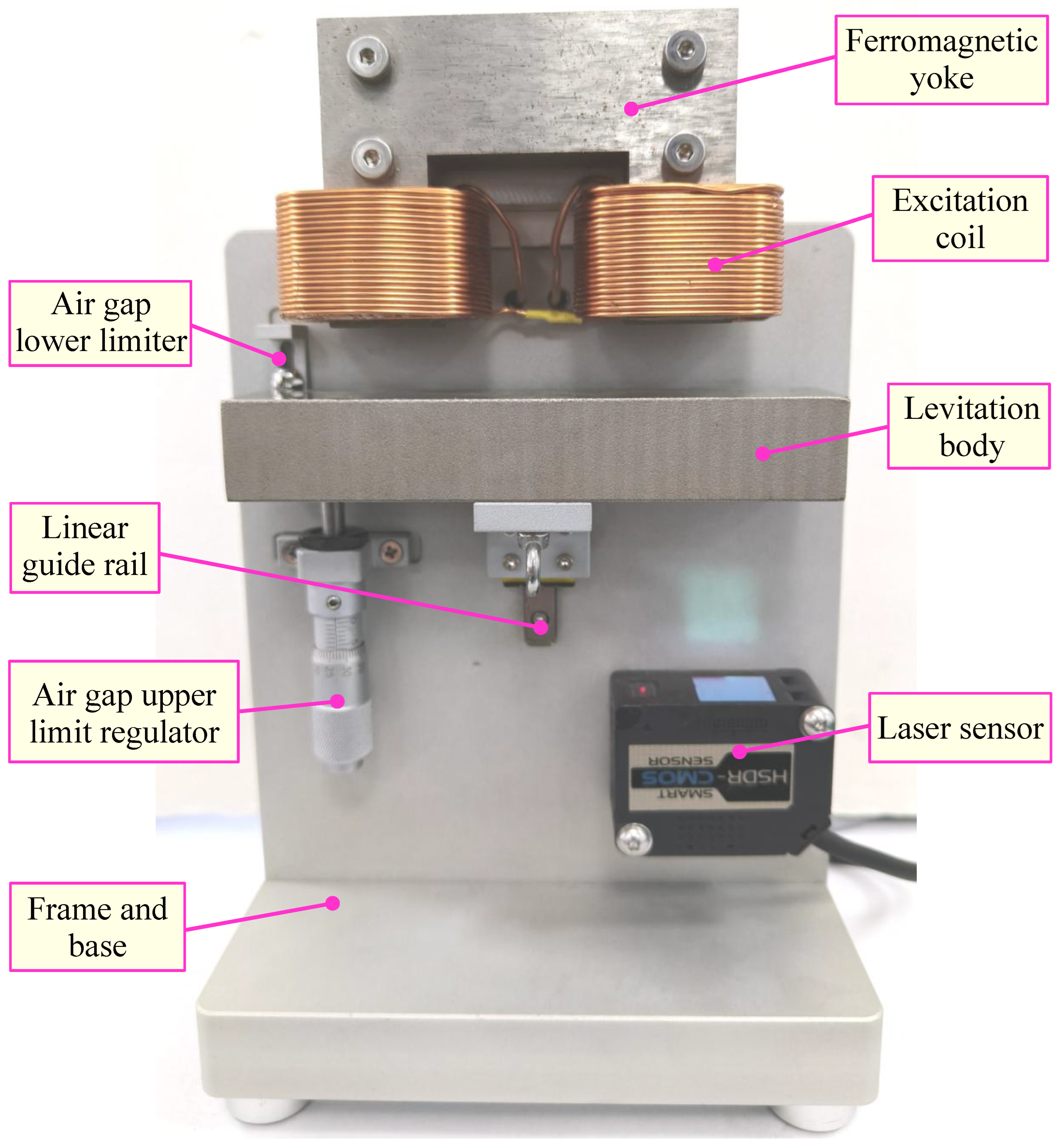
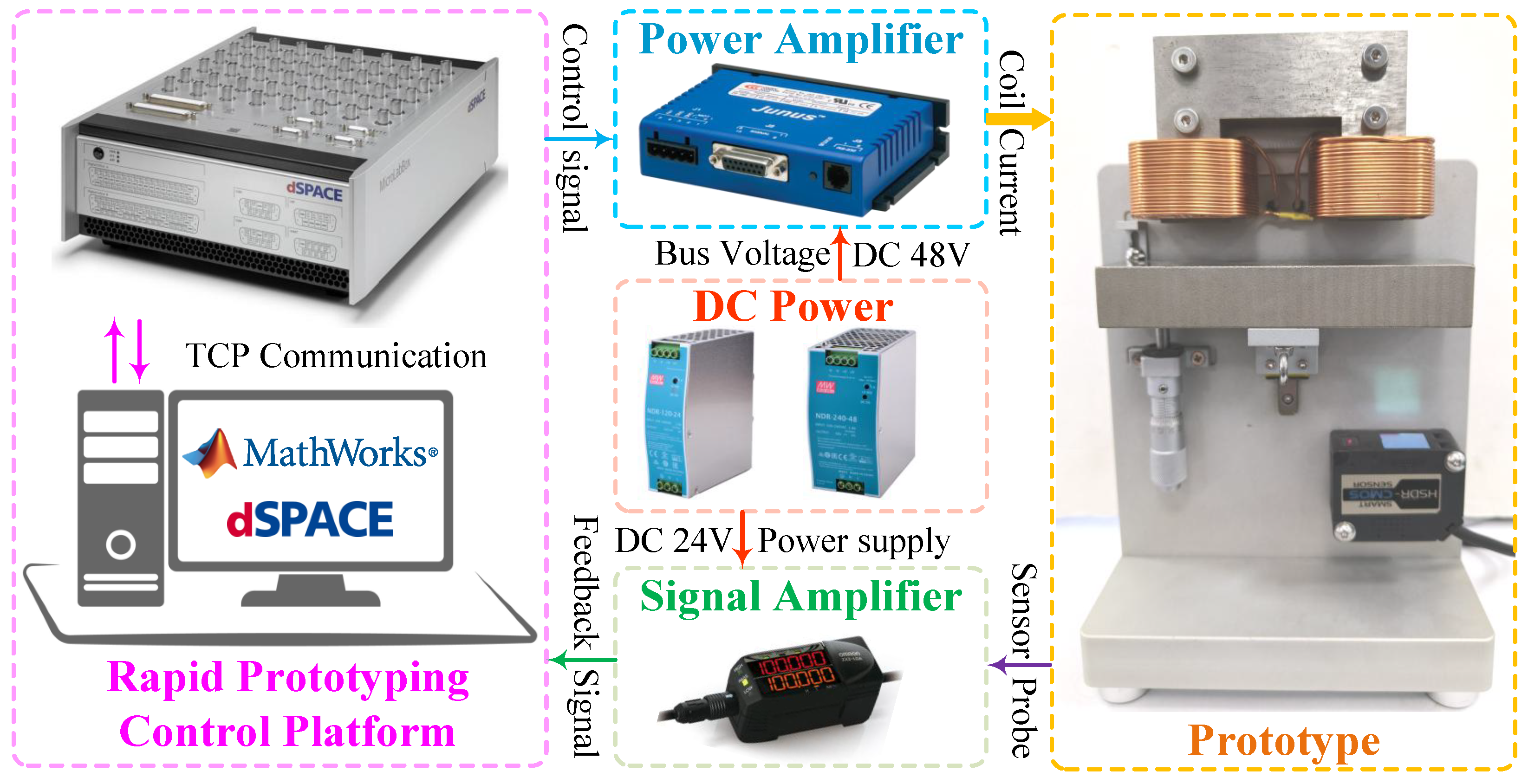
5.1. Prototype and Experimental System
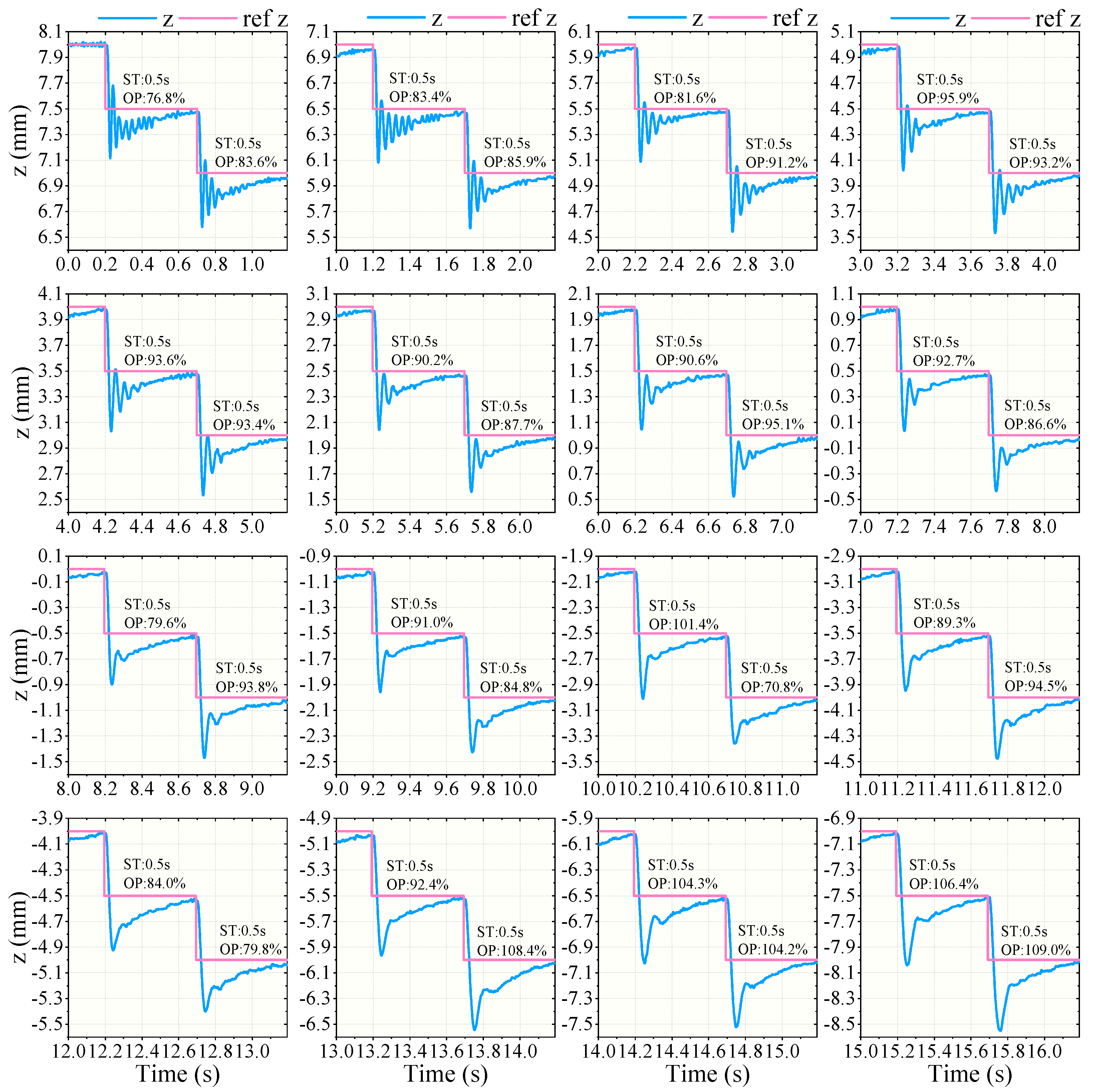
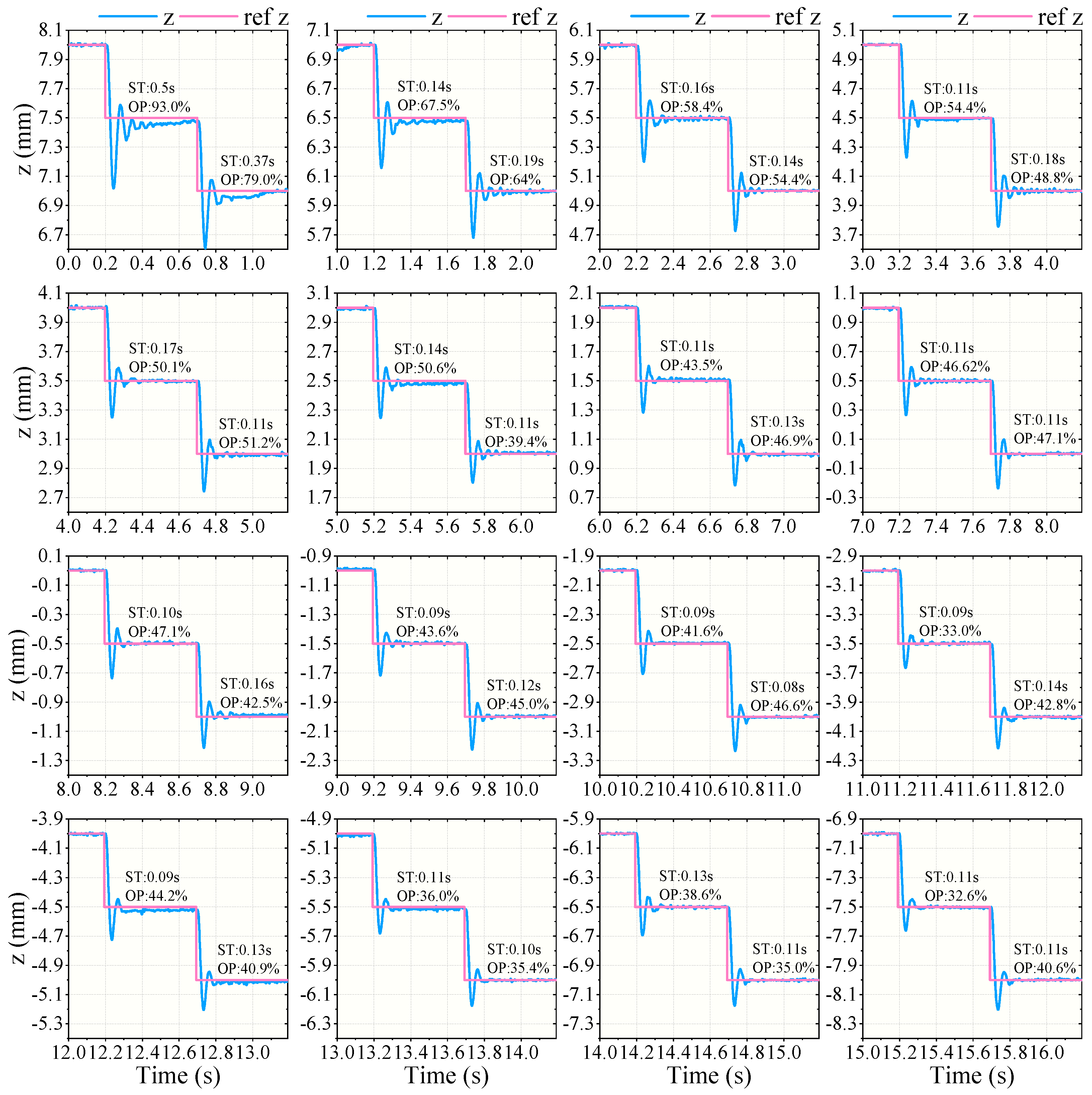
5.2. Long-Stroke Positioning Control Experiments
5.3. Frequency Response Analysis
6. Conclusions and Further Research
- (1)
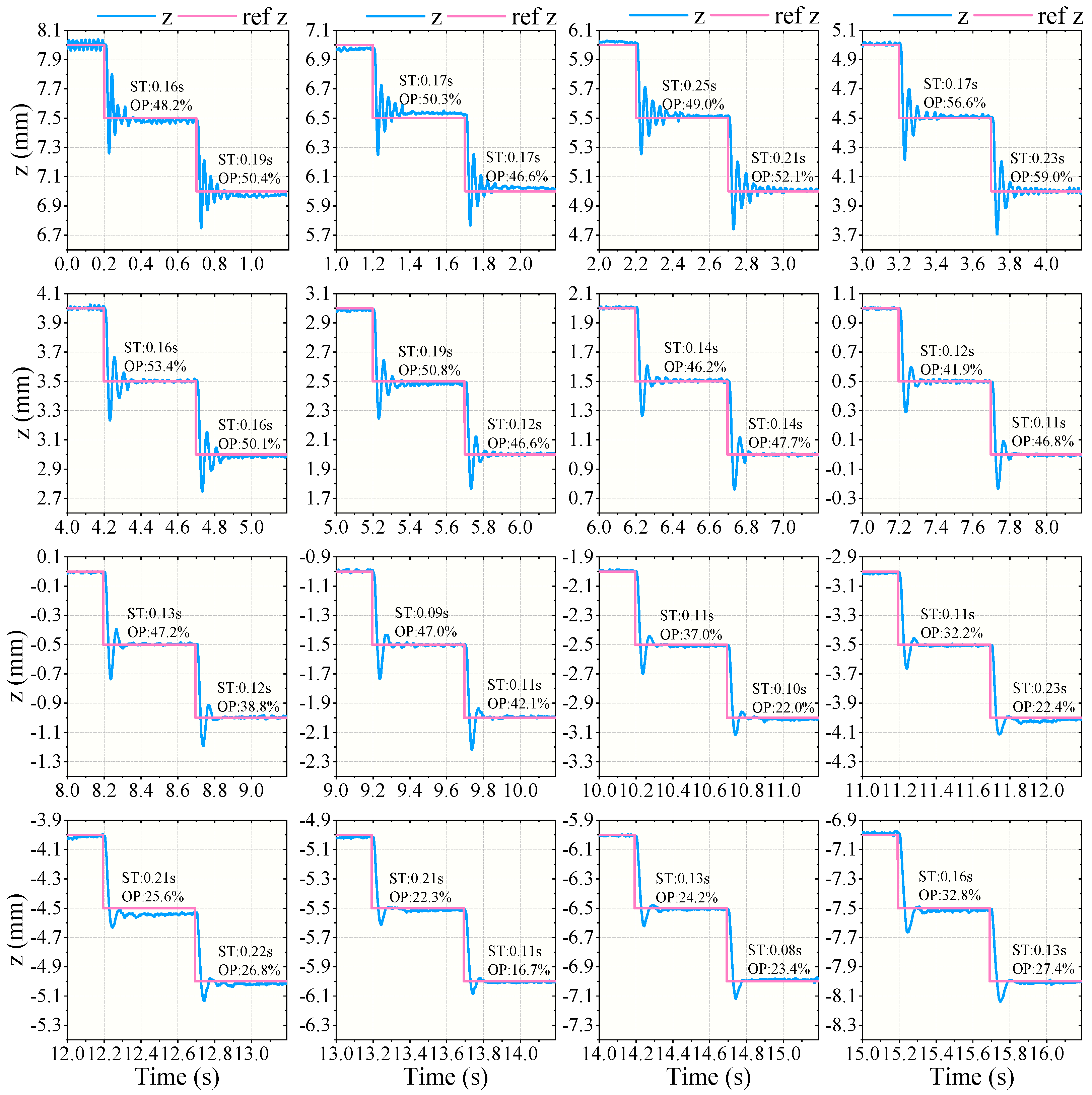
- With basic PD/PID control, the equivalent stiffness and damping of reluctance maglev systems increase as the air gap decreases. As a result, the tracking performance becomes markedly nonuniform over the full stroke: small air gaps produce rapid responses with noticeable oscillations, while large air gaps result in low stiffness and deteriorated tracking.
- (2)
- From the robustness viewpoint, the Bode sensitivity integral theorem places inherent constraints on the relative stability of the reluctance maglev system. With decreasing air gap, the unstable pole acquires a larger real part, so high robustness is naturally harder to attain. Both analysis and experiments show that the basic PD/PID compensator produces a higher corner frequency and bandwidth at small air gaps, further degrading robustness. Conversely, at large air gaps, where high robustness is easier to secure, the corner frequency is reduced and tracking performance deteriorates. This suggests a clear trade-off between robustness and tracking performance over the full stroke.
- (3)
- The control strategy that combines feedforward with pole-placement adaptive PD is proposed and validated in time- and frequency-domain experiments. It does not rely on engineering experience, and the control gains are mapped directly from the actuator parameters. The experiments indicate that this control strategy effectively improves the consistency of control performance over the full stroke. These results further demonstrate that robustness at small air gaps and tracking performance at large air gaps are both enhanced, and the conflict between them over the long stroke is effectively mitigated rather than compromised.
Author Contributions
Funding
Institutional Review Board Statement
Informed Consent Statement
Data Availability Statement
Conflicts of Interest
References
- Lee, H.W.; Kim, K.C.; Lee, J. Review of maglev train technologies. IEEE Trans. Magn. 2006, 42, 1917–1925. [Google Scholar] [CrossRef] [Scilit]
- Wu, T.; Zhang, W. Review on Key Development of Magnetic Bearings. Machines 2025, 13, 113. [Google Scholar] [CrossRef] [Scilit]
- Du, Y.; Zhang, G.; Hua, W. Review on Research and Development of Magnetic Bearings. Energies 2025, 18, 3222. [Google Scholar] [CrossRef] [Scilit]
- Zhou, L.; Wu, J. Magnetic Levitation Technology for Precision Motion Systems: A Review and Future Perspectives. Int. J. Autom. Technol. 2022, 16, 386–402. [Google Scholar] [CrossRef] [Scilit]
- Pechhacker, A.; Wertjanz, D.; Csencsics, E.; Schitter, G. Integrated electromagnetic actuator with adaptable zero power gravity compensation. IEEE Trans. Ind. Electron. 2024, 71, 5055–5062. [Google Scholar] [CrossRef] [Scilit]
- Zhu, H.; Teo, T.J.; Pang, C.K. Magnetically Levitated Parallel Actuated Dual-Stage (Maglev-PAD) System for Six-Axis Precision Positioning. IEEE/ASME Trans. Mechatron. 2019, 24, 1829–1838. [Google Scholar] [CrossRef] [Scilit]
- Li, X.; Zhu, H.; Ma, J.; Teo, T.J.; Teo, C.S.; Tomizuka, M.; Lee, T.H. Data-Driven Multiobjective Controller Optimization for a Magnetically Levitated Nanopositioning System. IEEE/ASME Trans. Mechatron. 2020, 25, 1961–1970. [Google Scholar] [CrossRef] [Scilit]
- Dyck, M.; Lu, X.; Altintas, Y. Magnetically Levitated Rotary Table with Six Degrees of Freedom. IEEE/ASME Trans. Mechatron. 2017, 22, 530–540. [Google Scholar] [CrossRef] [Scilit]
- Kumar, D.; Sisodiya, M.S.; Bajpai, V. A novel servo-stabilized electromagnetic levitation formicro-EDM processing and its feasibility analysis. Proc. Inst. Mech. Eng. Part J Eng. Manuf. 2023, 237, 862–872. [Google Scholar] [CrossRef] [Scilit]
- Luan, B.; Zhang, X.; Xu, F.; Yang, G.; Jin, J.; Xu, C.; Sun, F.; Oka, K. High Precision Magnetic Levitation Actuator for Micro-EDM. Actuators 2022, 11, 361. [Google Scholar] [CrossRef] [Scilit]
- Xu, S.; Sun, J.; Ren, H. Design of an Integrated Five Degrees-of-Freedom Magnetic Suspension System with Long-Stroke Motion. IEEE Trans. Energy Convers. 2025, 40, 3035–3044. [Google Scholar] [CrossRef] [Scilit]
- Ma, W.; Liu, G.; Le, Y.; Zheng, S. Stiffness Compensation Control for Centrifugal Compressors Based on Online Parameter Identification of Magnetic Bearings. IEEE Trans. Ind. Electron. 2023, 70, 9421–9431. [Google Scholar] [CrossRef] [Scilit]
- Ren, M.; Oka, K. Design of a Noncontact Bending Testing Device Using Magnetic Levitation Mechanism. IEEE Trans. Ind. Electron. 2024, 71, 1697–1707. [Google Scholar] [CrossRef] [Scilit]
- Cigarini, F.; Ito, S.; Troppmair, S.; Schitter, G. Comparative Finite Element Analysis of a Voice Coil Actuator and a Hybrid Reluctance Actuator. IEEJ J. Ind. Appl. 2019, 8, 192–199. [Google Scholar] [CrossRef] [Scilit]
- Pumphrey, M.; Alatawneh, N.; Al Janaideh, M. Modeling and analysis of reluctance motion system with asymmetrical air gaps. Rev. Sci. Instrum. 2022, 93, 075001. [Google Scholar] [CrossRef] [Scilit]
- Pumphrey, M.; Al Saaideh, M.; Kuchinkaa, K.; Alatawneh, N.; Al Janaideh, M. Investigating the effect of the mean path length on reluctance actuator output force characterization. Rev. Sci. Instrum. 2022, 93, 115001. [Google Scholar] [CrossRef] [Scilit]
- Anthis, A.F., III. Six-Axis Levitated Stage with a Novel Flux-Steering Magnetic Hub Actuator. Master’s Thesis, Massachusetts Institute of Technology, Cambridge, MA, USA, 2021. [Google Scholar]
- Zhao, C.; Zhang, Q.; Pei, W.; Jin, J.; Sun, F.; Zhang, H.; Zhou, R.; Liu, D.; Xu, F.; Zhang, X.; et al. Design and Analysis of 5-DOF Compact Electromagnetic Levitation Actuator for Lens Control of Laser Cutting Machine. Micromachines 2024, 15, 641. [Google Scholar] [CrossRef] [Scilit]
- Pumphrey, M.; Saaideh, M.A.; Al-Rawashdeh, Y.M.; Alatawneh, N.; Xu, B.; Janaideh, M.A. A Novel 2-DoF Reluctance Electromagnetic Precision Motion System: Design, Modeling, and Control. IEEE Trans. Instrum. Meas. 2025, 74, 3004418. [Google Scholar] [CrossRef] [Scilit]
- MacKenzie, I. Design and Control Methods for High-Accuracy Variable Reluctance Actuators. Ph.D. Thesis, Massachusetts Institute of Technology, Cambridge, MA, USA, 2015. [Google Scholar]
- Al Saaideh, M.; Pumphrey, M.; Alatawneh, N.; Al Janaideh, M. On Electromagnetic Variable Air-Gap Reluctance Actuator Motion System: Characterization, Modeling, and Feedforward Control. IEEE/ASME Trans. Mechatron. 2024, 29, 3981–3992. [Google Scholar] [CrossRef] [Scilit]
- Wang, J.; Zhao, L.; Yu, L. Adaptive Terminal Sliding Mode Control for Magnetic Levitation Systems with Enhanced Disturbance Compensation. IEEE Trans. Ind. Electron. 2021, 68, 756–766. [Google Scholar] [CrossRef] [Scilit]
- Wang, J.; Rong, J.; Yang, J. Adaptive Fixed-Time Position Precision Control for Magnetic Levitation Systems. IEEE Trans. Autom. Sci. Eng. 2023, 20, 458–469. [Google Scholar] [CrossRef] [Scilit]
- Xu, Y.; Shu, F.; Su, X.; Guo, L.; Han, S.; Yang, X. A composite neural network-based adaptive sliding mode control method for reluctance actuator maglev system. Neural Comput. Appl. 2023, 35, 15877–15890. [Google Scholar] [CrossRef] [Scilit]
- Peng, T.; Peng, H.; Li, R. Deep learning based model predictive controller on a magnetic levitation ball system. ISA Trans. 2024, 149, 348–364. [Google Scholar] [CrossRef] [Scilit] [PubMed]
- Liu, G.; Lu, Y.; Liu, Y.; Dong, Z.; Ye, Z. Research on two-dimensional external magnetic drive method of maglev ball based on force imbalance. Rev. Sci. Instrum. 2020, 91, 105003. [Google Scholar] [CrossRef] [Scilit] [PubMed]
- Ghosh, A.; Rakesh Krishnan, T.; Tejaswy, P.; Mandal, A.; Pradhan, J.K.; Ranasingh, S. Design and implementation of a 2-DOF PID compensation for magnetic levitation systems. ISA Trans. 2014, 53, 1216–1222. [Google Scholar] [CrossRef] [Scilit]
- Zhang, C.; Lu, Y.; Liu, G.; Ye, Z. Research on one-dimensional motion control system and method of a magnetic levitation ball. Rev. Sci. Instrum. 2019, 90, 115005. [Google Scholar] [CrossRef] [Scilit]
- Bojan-Dragos, C.A.; Precup, R.E.; Preitl, S.; Hergane, S.; Hughiet, E.G.; Szedlak-Stinean, A.I. Proportional-integral gain-scheduling control of a magnetic levitation system. In Proceedings of the 2016 20th International Conference on System Theory, Control and Computing (ICSTCC), Sinaia, Romania, 13–15 October 2016; pp. 1–6. [Google Scholar] [CrossRef] [Scilit]
- Almobaied, M.; Al-Nahhal, H.S.; Arrieta, O.; Vilanova, R. Design a Robust Proportional-Derivative Gain-Scheduling Control for a Magnetic Levitation System. Mathematics 2023, 11, 4040. [Google Scholar] [CrossRef] [Scilit]
- Gunter, S. Respect the unstable. IEEE Control Syst. Mag. 2003, 23, 12–25. [Google Scholar] [CrossRef] [Scilit]






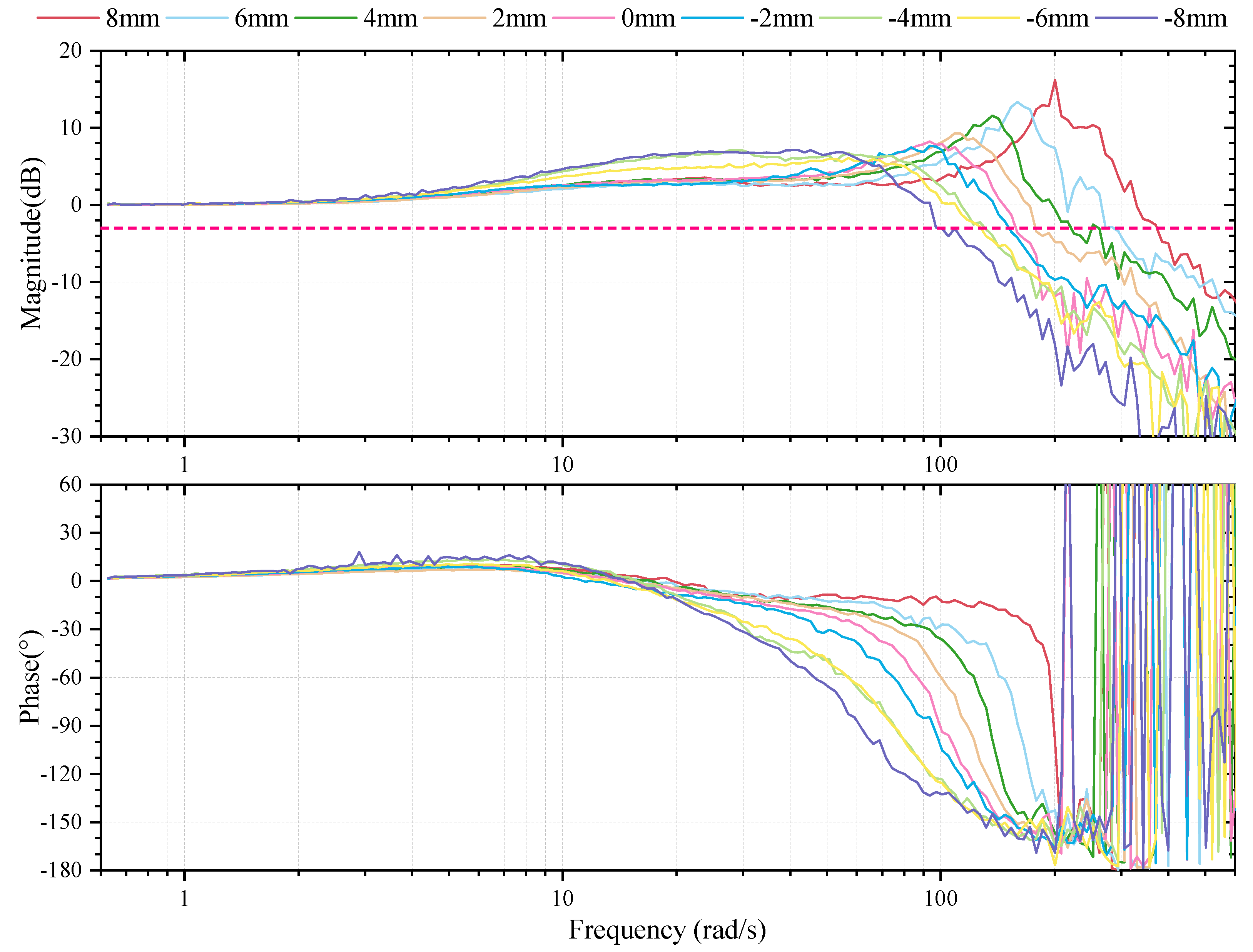
| Measurement Point | Resonant Frequency | Resonance Peak | Bandwidth |
|---|---|---|---|
| 8 mm | 200.898 rad/s | 16.170 dB | 370.161 rad/s |
| 6 mm | 159.756 rad/s | 13.344 dB | 283.315 rad/s |
| 4 mm | 137.117 rad/s | 11.558 dB | 225.289 rad/s |
| 2 mm | 113.279 rad/s | 9.246 dB | 179.152 rad/s |
| 0 mm | 97.232 rad/s | 7.818 dB | 159.756 rad/s |
| −2 mm | 90.082 rad/s | 6.829 dB | 153.768 rad/s |
| −4 mm | 74.418 rad/s | 6.321 dB | 131.978 rad/s |
| −6 mm | 52.771 rad/s | 5.987 dB | 127.033 rad/s |
| −8 mm | 43.597 rad/s | 6.826 dB | 97.232 rad/s |
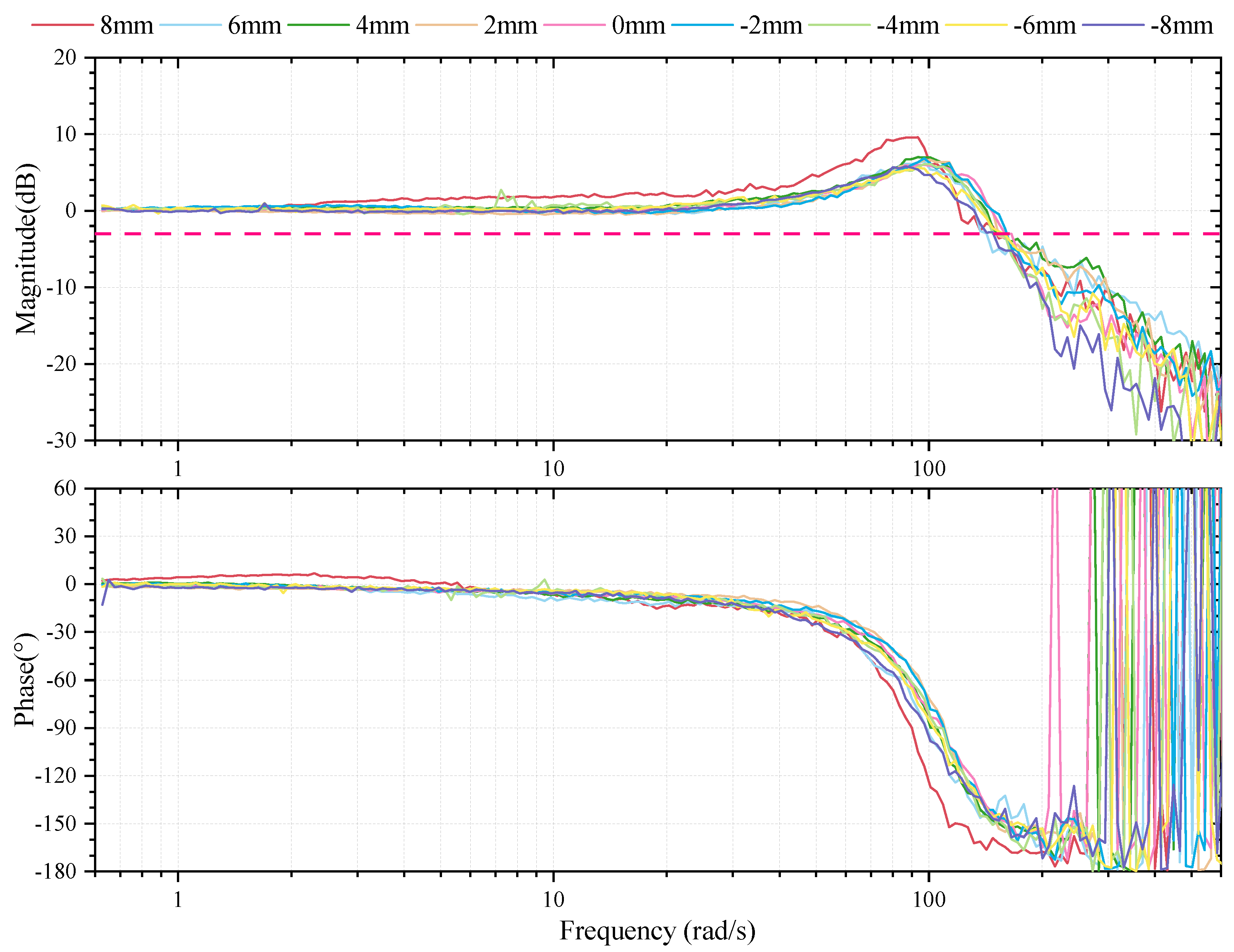
| Measurement Point | Resonant Frequency | Resonance Peak | Bandwidth |
|---|---|---|---|
| 8 mm | 93.598 rad/s | 9.600 dB | 151.887 rad/s |
| 6 mm | 97.232 rad/s | 6.847 dB | 142.458 rad/s |
| 4 mm | 93.588 rad/s | 6.996 dB | 151.887 rad/s |
| 2 mm | 101.014 rad/s | 6.159 dB | 153.768 rad/s |
| 0 mm | 97.232 rad/s | 6.093 dB | 159.756 rad/s |
| −2 mm | 97.232 rad/s | 6.847 dB | 159.756 rad/s |
| −4 mm | 101.014 rad/s | 6.083 dB | 148.007 rad/s |
| −6 mm | 97.232 rad/s | 5.512 dB | 159.756 rad/s |
| −8 mm | 86.708 rad/s | 5.777 dB | 142.459 rad/s |
Disclaimer/Publisher’s Note: The statements, opinions and data contained in all publications are solely those of the individual author(s) and contributor(s) and not of MDPI and/or the editor(s). MDPI and/or the editor(s) disclaim responsibility for any injury to people or property resulting from any ideas, methods, instructions or products referred to in the content. |
© 2026 by the authors. Licensee MDPI, Basel, Switzerland. This article is an open access article distributed under the terms and conditions of the Creative Commons Attribution (CC BY) license.
Share and Cite
Pei, W.; Zhao, C.; Oka, K.; Sun, F.; Jin, J.; Zhang, X. Long-Stroke Reluctance Magnetic Levitation Systems: Characteristic Analysis and Gain Scheduling Positioning Control. Actuators 2026, 15, 151. https://doi.org/10.3390/act15030151
Pei W, Zhao C, Oka K, Sun F, Jin J, Zhang X. Long-Stroke Reluctance Magnetic Levitation Systems: Characteristic Analysis and Gain Scheduling Positioning Control. Actuators. 2026; 15(3):151. https://doi.org/10.3390/act15030151
Chicago/Turabian StylePei, Wenzhe, Chuan Zhao, Koichi Oka, Feng Sun, Junjie Jin, and Xiaoyou Zhang. 2026. "Long-Stroke Reluctance Magnetic Levitation Systems: Characteristic Analysis and Gain Scheduling Positioning Control" Actuators 15, no. 3: 151. https://doi.org/10.3390/act15030151
APA StylePei, W., Zhao, C., Oka, K., Sun, F., Jin, J., & Zhang, X. (2026). Long-Stroke Reluctance Magnetic Levitation Systems: Characteristic Analysis and Gain Scheduling Positioning Control. Actuators, 15(3), 151. https://doi.org/10.3390/act15030151