Article

Robust H Fault-Tolerant Control with Mixed Time-Varying Delays

Department of Intelligent Computing Science, College of Science, Liaoning University of Technology, Jinzhou 121001, China
*
Author to whom correspondence should be addressed.
Actuators 2026, 15(2), 73; https://doi.org/10.3390/act15020073
Submission received: 28 December 2025 / Revised: 17 January 2026 / Accepted: 23 January 2026 / Published: 25 January 2026
(This article belongs to the Section Control Systems)

Abstract

This paper investigates the robust fault-tolerant control (FTC) problem for interval type-2 fuzzy systems (IT2FS) with simultaneous time-varying input and state delays. In order to more comprehensively capture system uncertainties, an Interval Type-2 (IT2) fuzzy model is constructed, which, compared to the conventional Interval Type-1 model, better captures the uncertainty information of the system. A premise-mismatched fault-tolerant controller is designed to ensure system stability in the presence of actuator faults, while providing greater flexibility in the selection of membership functions. In the stability analysis, a novel Lyapunov–Krasovskii functional is formulated, incorporating membership-dependent matrices and delay-product terms, leading to sufficient conditions for closed-loop stability based on linear matrix inequalities (LMIs). A numerical simulation and a practical physical model are used, respectively, to illustrate the effectiveness of the proposed method. Comparative experiments further reveal the impact of input delays and actuator faults on closed-loop performance, verifying the effectiveness and robustness of the designed controller, as well as the superiority of interval type-2 over interval type-1.

1. Introduction

The Takagi–Sugeno (T-S) fuzzy model has been established as an effective tool for modeling and controlling nonlinear systems [1,2,3]. Although the T-S framework is capable of handling system nonlinearities, its robustness in dealing with uncertain systems is generally inferior to that of IT2 fuzzy models. IT2FS can simultaneously capture both internal and external uncertainties, reduce the number of fuzzy rules, and provide smoother control surfaces around steady-state regions. These features enhance system robustness and improve the suppression of disturbances and oscillations. Consequently, research on IT2 fuzzy systems is of significant importance. For instance, ref. [4] investigated observer-based event-triggered control for IT2 fuzzy networked systems under cyber-attacks, while [5] examined robust control for a class of uncertain nonlinear systems.
In numerous practical systems, time delays are pervasive, which introduces additional uncertainties. As a result, the stability analysis and control synthesis of time-varying delay (TVD) systems have emerged as significant research themes. For instance, ref. [6] examined the stabilization of dynamical systems featuring state-dependent TVD by utilizing enhanced free-matrix integral inequalities. Ref. [7] applied a refined free-matrix approach to establish delay-dependent sufficient conditions for the stability of neural networks subject to TVD. The work in [8] implemented the Wirtinger-based integral inequality within the framework of TVD systems. Meanwhile, ref. [9] conducted a stability analysis for uncertain IT2FS in the presence of delays. Additionally, ref. [10] studied T-S fuzzy systems with time-varying delays using a quadratic delay-product methodology. Ref. [11] proposed an effective delay-slope-dependent inequality framework for neural networks with TVD of transmission and stochastic disturbances. Ref. [12] introduced a reciprocal convex decomposition method incorporating delay-derivative-dependent parameters for hierarchical Lyapunov conditions. Refs. [13,14,15] discussed relaxed quadratic function negativity lemmas and their applications in TVD systems. Ref. [16] developed matrix-based polynomial constraint verification criteria and their application to linear time-varying systems affected by delays. Ref. [17] introduced the TVD zero-matrix inequality into stability analysis for uncertain TVD systems, thereby further reducing conservatism.
Although significant progress has been made in TVD system research, existing methods still have certain limitations. For example, ref. [18] studied fault estimation and FTC for discrete-time systems affected by state TVD and actuator faults, but did not address continuous-time systems or consider uncertainties introduced by input delays. While [19] introduced an IT2 fuzzy exponential stabilization method for nonlinear unreliable networked sampled-data systems with input delays, its formulation did not incorporate state delays or actuator faults. The control synthesis for switched IT2 fuzzy systems with time-varying parameters was addressed in [20], albeit without considering delay effects. Ref. [21] focused on robust control for IT2FS under input delays and cyber attacks; however, the common practical challenges of state delays and actuator faults were not considered. Although [22] developed a delay-dependent robust H control strategy for interval TVD uncertain linear systems—utilizing delay lower-bound information to reduce conservatism—it did not account for practical constraints like input delays and actuator faults. Ref. [23] developed a feasible control strategy for nonlinear descriptor systems with TVD, uncertainties, and actuator saturation, and employed an IT2 fuzzy model to describe the delayed nonlinear dynamics, but still neglected the effects of input delays and actuator faults, exhibiting certain limitations. Ref. [24] primarily studied nonlinear networked control with time-varying state delays. Although state delays and system uncertainties were considered, additional uncertainties introduced by input delays and actuator faults were not addressed. Ref. [25] primarily addresses the robust H-infinity control problem for uncertain IT2FS with input delays based on a neural network-based delay compensation mechanism. Although it effectively tackles issues related to system uncertainties, input delays, and external disturbances, it fails to account for the adverse effects introduced by state delays and actuator faults on the system. Ref. [26] proposes a finite-time fault-tolerant control strategy based on the T-S fuzzy model for nonlinear flexible spacecraft systems subject to actuator faults. While the study addresses the finite-time stabilization problem under actuator faults, its design does not explicitly account for time-delay factors. Consequently, the effectiveness of the proposed method cannot be guaranteed when the system is simultaneously affected by both time delays and actuator faults.
Accordingly, this paper focuses on the robust H FTC problem for uncertain IT2FS with simultaneous input and state delays. The main contributions are as follows:
1.
An IT2FS model that simultaneously incorporates both input and state TVD is established. Unlike existing works that consider only a single delay type or neglect delays [22,23,26], the controller designed herein can still ensure closed-loop stability and the required H performance under the influence of mixed TVD.
2.
A robust controller design method with fault-tolerant capability against actuator faults is proposed. Addressing the issue that existing research often inadequately considers the impact of actuator faults, such as in [17,19,25], the controller designed in this paper can maintain system stability even when the system faces actuator faults.
3.
For the uncertain IT2FS with mixed delays and actuator faults, an appropriate Lyapunov functional is selected, and sufficient solvable conditions for closed-loop system stability are derived. Finally, numerical simulations verify that the proposed method can maintain system stability even when facing actuator faults and mixed TVD. Comparative experiments demonstrate that the fault-tolerant controller designed in this paper can effectively mitigate the adverse effects caused by actuator faults.

2. Problem Statement

Rule: If l 1 ( x ( t ) ) is W 1 i , l 2 ( x ( t ) ) is W 2 i and l l ( x ( t ) ) is W l i , then
x ˙ ( t ) = ( A i + Δ A i ) x ( t ) + ( A α i + Δ A α i ) x ( t α ( t ) ) + ( G i + Δ G i ) u f ( t ) + ( G α i + Δ G α i ) u f ( t α ( t ) ) + G w i w ( t ) z ( t ) = O i x ( t ) + O α i x ( t α ( t ) ) + H i u f ( t ) + H α i u f ( t α ( t ) ) x ( t ) = φ ( t ) , t [ h , 0 ]
where x ( t ) R n , u ( t ) R m , and z ( t ) R p denote the state, control input, and performance output, respectively. The system is subject to an exogenous disturbance w ( t ) , with φ ( t ) specifying the initial state. A i , A α i , G i , G α i , G w i , O i , O α i , H i , H α i represent constant matrices with known values. The time-varying delay α ( t ) is a continuously differentiable function satisfying
0 α ( t ) h , α 1 α ˙ ( t ) α 2
Δ A i , Δ A α i ,   Δ G i ,   Δ G α i represents the uncertainty of the system, and satisfies
[ Δ A i , Δ A α i , Δ G i , Δ G α i ] = ϑ i [ a i , b i , c i , d i ]
where δ a i , δ b i , δ c i , δ d i , ϑ i being known matrices, is an unknown matrix and satisfy T I , I is the identity matrix. By applying fuzzy fusion, system (1) is transformed into the following equivalent formulation:
x ˙ ( t ) = i = 1 r Φ ( x ( t ) ) [ ( A i + Δ A i ) x ( t ) + ( A α i + Δ A α i ) x ( t α ( t ) ) + ( G i + Δ G i ) u f ( t ) + ( G α i + Δ G α i ) u f ( t α ( t ) ) + G w i w ( t ) ] , z ( t ) = i = 1 r Φ ( x ( t ) ) O i x ( t ) + O α i x ( t α ( t ) ) + H i u f ( t ) + H α i u f ( t α ( t ) ) , x ( t ) = φ ( t ) , t [ h , 0 ]
The following functions and parameters are defined for the fuzzy system: The normalized weighting function is given by
Φ i ( x ( t ) ) = Φ i L ( x ( t ) ) d ̲ i ( x ( t ) ) + Φ i U ( x ( t ) ) d ¯ i ( x ( t ) ) j = 1 r Φ j L ( x ( t ) ) d ̲ j ( x ( t ) ) + Φ j U ( x ( t ) ) d ¯ j ( x ( t ) ) ,
where d ̲ i ( x ( t ) ) 0 , d ¯ i ( x ( t ) ) 0 and d ̲ i ( x ( t ) ) + d ¯ i ( x ( t ) ) = 1 . The lower and upper firing strengths are defined by
Φ i L ( x ( t ) ) = s = 1 l μ ̲ W s i l s ( x ( t ) ) , Φ i U ( x ( t ) ) = s = 1 l μ ¯ W s i l s ( x ( t ) ) .
Here, the atomic membership functions are mappings
μ ̲ W s i , μ ¯ W s i : R [ 0 , 1 ] ,
so that for all i = 1 , , r and s = 1 , , l ,
0 μ ̲ W s i ( l s ( x ( t ) ) ) μ ¯ W s i ( l s ( x ( t ) ) ) 1 .
Consequently, 0 Φ i L ( x ( t ) ) Φ i U ( x ( t ) ) 1 , and after normalization Φ i ( x ( t ) ) [ 0 , 1 ] with i = 1 r Φ i ( x ( t ) ) = 1 .
For system (1), the design of the fault-tolerant controller is as follows:
Rule: If g 1 ( x ( t ) ) is N 1 j , g 2 ( x ( t ) ) is N 2 j , g m ( x ( t ) ) is N m j , then
u f ( t ) = F j K j x ( t ) , j = 1 , 2 , r
where g β x ( t ) and N β j are the premise variables and the IT2 fuzzy sets, respectively. β = 1 , 2 m , j = 1 , 2 r . F j is the known matrix that characterizes the actuator fault. As indicated in [9], the fault matrix F j = F j 0 + F j 1 Λ j , in which F j 0 = F j L + F j U 2 , F j 1 = F j L F j U 2 , and F j U = d i a g f j 1 U , f j 2 U , , f j n U , F j L = d i a g f j 1 L , f j 2 L , , f j n L , 0 < Λ j < d i a g Λ j 1 , Λ j 2 , , Λ j n I j , I j is the identity matrix of appropriate dimensions. The K j represents the control gain matrix. The fuzzy fusion yields an equivalent representation of (5):
u f ( t ) = j r ( λ j ( x ( t ) ) ( F j 0 + F j 1 Λ j ) K j x ( t )
where λ j ( x ( t ) ) = θ i L ( x ( t ) ) c ̲ i ( x ( t ) ) + θ i U c ¯ i ( x ( t ) ) i r [ θ i L ( x ( t ) ) c ̲ i ( x ( t ) ) + θ i U c ¯ i ( x ( t ) ) ] substitute Formula (6) into Formula (4), we can obtain the Formula (7):
x ˙ ( t ) = i , j , k r Φ i λ j λ k [ ( A i + Δ A i ) x ( t ) + ( A α i + Δ A α i ) x ( t α ( t ) ) + ( G i + Δ G i ) F j K j x ( t ) + ( G α i + Δ G α i ) F k K α k x ( t α ( t ) ) + G w i w ( t ) ] , z ( t ) = i , j , k r Φ i λ j λ k [ O i x ( t ) + O α i x ( t α ( t ) ) + H i F j K j x ( t ) + H α i F k K α k x ( t α ( t ) ) ] , x ( t ) = φ ( t ) , t [ h , 0 ]
For the convenience of narration, Formula (7) is rewritten in the following form
x ˙ ( t ) = i , j , k r Φ i ( x ( t ) ) λ j ( x ( t ) ) λ k ( x ( t α ( t ) ) ) [ ( A i j + Δ A i j ) x ( t ) + ( D i k + Δ D i k ) x ( t α ( t ) ) + G w i w ( t ) ] , z ( t ) = i , j , k r Φ i ( x ( t ) ) λ j ( x ( t ) ) λ k ( x ( t α ( t ) ) ) [ O i x ( t ) + O α i x ( t α ( t ) ) + H i F j K j x ( t ) + H α i F k K α k x ( t α ( t ) ) ] , x ( t ) = φ ( t ) , t [ h , 0 ]
where A i j = A i + G i F j K j , Δ A i j = Δ A i + Δ G i , F j K j , D i k = A α i + G α i F k K α k , Δ D i k = Δ A α i + Δ G α i F k K α k .

3. Main Results

This study addresses the robust FTC problem for uncertain IT2FS with mixed time delays. For simplicity of description, the following notations are defined.
π ˙ ( t ) = 1 α ˙ ( t ) , h α ( t ) = h α ( t ) , δ 0 ( t ) = [ x T ( t ) ,   x T ( t α ( t ) ) ,   x T ( t h ) ]
δ 1 ( t ) = [ δ 0 T ( t ) , ƛ 1 T ( t ) , ƛ 2 T ( t ) ] , δ 2 ( t ) = [ x T ( t ) ,   x ˙ ( t ) ]
ƛ 1 ( t ) = [ t α ( t ) t x T ( ƛ ) d ƛ , 1 α ( t ) s t x T ( ƛ ) d ƛ d s ] T
ƛ 2 ( t ) = [ t h t α ( t ) x T ( ƛ ) d ƛ , 1 h α ( t ) t h t α ( t ) s t α ( t ) x T ( ƛ ) d ƛ d s ] T
Lemma 1 
([6]). Given a matrix R > 0 , if it is positive definite, and vector z : [ c 1 , c 2 ] R n , hence the following inequality is satisfied, where denotes an arbitrary matrix ℘ and vector σ
c 1 c 2 z ˙ T ( v ) R z ˙ ( v ) d ν ( c 2 c 1 ) σ t T T R ˜ 1 σ + 2 σ t T ζ ¯ T ( c 1 , c 2 ) σ
where ζ ¯ T ( c 1 , c 2 ) = v 0 T , v 1 T , v 2 T , with v 0 = z ( c 2 ) z ( c 1 ) , v 1 = z ( c 2 ) + z ( c 1 ) 2 c 2 c 1 c 1 c 2 z v d v v 2 = v 0 + 6 c 2 c 1 c 1 c 2 z ( v ) d v 12 ( c 2 c 1 ) 2 c 1 c 2 s c 2 z v d v d s , R ˜ = d i a g R , 3 R , 5 R
Lemma 2 
([7,8]). For positive definite matrix ς, any matrices Γ 1 , Γ 2 , and vector z : [ c 1 , c 2 ] R n , such that the inequality (10) and (11) holds:
c 1 c 2 z T ( v ) ς z ( v ) d v ϕ { κ 0 T Γ 1 κ 1 + κ 0 T Γ 2 κ 2 } ( c 2 c 1 ) κ 0 T ( 3 Γ 1 ς 1 Γ 1 T + Γ 2 ς 1 Γ 2 T 3 ) κ 0
c 1 c 2 z T ( v ) ς z ( v ) d v 1 c 2 c 1 ( κ 1 T ς κ 1 + 3 κ 2 T ς κ 2 )
Lemma 3 
([5]). For given matrices Z, S, and ℜ with appropriate dimensions, and if T ( t ) ( t ) I , then for any scalar ε > 0 , the following inequality (12) holds:
Z ( t ) S + S T T ( t ) Z T ε Z Z T + ε 1 S T S
Theorem 1. 
Given some matrices K j , K α j and some scalars h , α 1 , α 2 , γ > 0 . The system (8) which satisfies the delay constraint (2) is asymptotically stable, if it is possible to identify certain real symmetric matrices P 0 i , P 1 i , M 11 , M 12 , M 13 , M 21 , M 22 , M 23 and positive definite matrices E 1 , R 1 , T 1 , E 2 , R 2 , any matrices 1 , 2 , Q 1 i , Q 2 i , J 1 , J 2 , J 3 , L 1 , L 2 , L 3 , L 4 , λ > 0 , such that inequalities (13)–(15) satisfied for α ˙ ( t ) { α 1 , α 2 } and
P ˙ 0 + α ( t ) P ˙ 1 0 , P 0 + α ( t ) P 1 > 0
Ω [ 0 , α ˙ ] h 2 T h κ ˜ 0 T L 3 h κ ˜ 0 T L 4 β ϑ i * h R ˜ 2 0 0 0 * * h T 2 [ α ˙ ] 0 0 * * * 3 h T 2 [ α ˙ ] 0 * * * * λ I < 0
Ω [ h , α ˙ ] h 1 T h κ ˜ 0 T L 1 h κ ˜ 0 T L 2 β ϑ i * h R ˜ 1 0 0 0 * * h T 1 [ α ˙ ] 0 0 * * * 3 h T 1 [ α ˙ ] 0 * * * * λ I < 0
where
β = f 1 T J 1 + f 2 T J 2 + f 4 T J 3
Ω 0 [ α , α ˙ ] = Ω 1 [ α , α ˙ ] + Ω 2 [ α ˙ ] + Ω 31 [ α , α ˙ ] + Ω 32 + Ω 41 + Ω 42 [ α , α ˙ ] + Ω 43 + Ω 44 + Ω 45 + φ [ α , α ˙ ] + ϕ { β Ψ 1 } + λ δ T i j k δ i j k
Ω 1 [ α , α ˙ ] = ϕ { Υ 1 T ( p 0 i + α ( t ) p 1 i ) λ 1 } + α ˙ ( t ) Υ 1 T p 1 i Υ 1
Ω 2 [ α ˙ ] = Υ 2 T Q 1 Υ 2 + π ˙ ( t ) Υ 3 T ( Q 2 Q 1 ) Υ 3 Υ 4 T Q 2 Υ 4
Ω 31 [ α , α ˙ ] = h f 4 T R 1 f 4 + π ˙ ( t ) h α ( t ) f 5 T ( R 2 R 1 ) f 5
Ω 32 = ϕ { Θ 1 T 1 + Θ 2 T 2 } , Ω 41 = h Υ 2 T T 1 Υ 2
Ω 42 [ α , α ˙ ] = f 1 T M 1 [ α , α ˙ ] f 1 f 2 T M 1 [ α , α ˙ ] f 2 + f 2 T M 2 [ α , α ˙ ] f 2 f 3 T M 2 [ α , α ˙ ] f 3
Ω 43 = ϕ { κ 0 T L 1 κ 1 + κ 0 T L 1 κ 2 } , Ω 44 = ϕ { κ ˜ 0 T L 3 κ 3 + κ ˜ 0 T L 4 κ 4 }
Ω 45 = κ 1 T M 1 κ 1 3 κ 2 T M 1 κ 2 κ 3 T M 2 κ 3 3 κ 4 T M 2 κ 4
φ [ α , α ˙ ] = ϕ { ( Q 1 i + α ˙ ( t ) Q 2 i ) φ 0 [ α ] }
with
f m = [ 0 n × ( m 1 ) n 0 n × ( 15 m ) n ] , m = 1 , 2 , 3 , 15
Υ 1 = [ f 1 T , f 2 T , f 3 T , f 11 T , f 12 T , f 13 T , f 14 T ] T
Υ 2 = [ f 1 T , f 4 T ] T , Υ 3 = [ f 2 T , f 5 T ] T , Υ 4 = [ f 3 T , f 6 T ] T
Ψ 1 = ( A i + G i K j ) f 1 + ( A α i + G α i K α k ) f 2 + G w i f 15 f 4
Θ l = [ f l T f l + 1 T , f l T + f l + 1 T 2 f 2 l + 5 T , f l T f l + 1 T + 6 f 2 l + 5 T 12 f 2 l + 6 T ] T , l = 1 , 2
φ 0 [ α ] = α ( t ) f 7 T α ( t ) f 8 T f 12 T h α ( t ) f 9 T f 13 T h α ( t ) f 10 T f 14 T
T 1 [ α ˙ ] = T 1 + ϕ { I 1 M 1 [ α ] I 2 } , M 1 [ α ] = M 11 α ˙ ( t ) M 12 , M 1 = ϕ { I 1 M 13 I 2 } T 2 [ α ˙ ] = T 1 + ϕ { I 1 M 2 [ α ] I 2 } , M 2 [ α ] = M 21 α ˙ ( t ) M 22 , M 1 = ϕ { I 1 M 23 I 2 }
I 1 = I 0 , I 2 = 0 I
M 1 [ α , α ˙ ] = M 11 + α ˙ ( t ) M 12 + α ( t ) M 13 M 2 [ α , α ˙ ] = M 21 + α ˙ ( t ) M 22 + h ( t ) M 23
Proof of Theorem 1. 
A Lyapunov function is chosen in the following form:
V ( t ) = c = 1 4 V c ( t )
where
V 1 ( t ) = δ 1 T ( t ) ( P 0 + α ( t ) P 1 ) δ 1 ( t )
V 2 ( t ) = t α ( t ) t δ 2 T ( ϑ ) E 1 δ 2 ( ϑ ) d ϑ + t h t α ( t ) δ 2 T ( ϑ ) E 2 δ 2 ( ϑ ) d ϑ V 3 ( t ) = t α ( t ) t ( h t + ϑ ) x ˙ T ( ϑ ) R 1 x ˙ ( ϑ ) d ϑ + t h t α ( t ) ( h t + ϑ ) x ˙ T ( ϑ ) R 2 x ˙ ( ϑ ) d ϑ V 4 ( t ) = t h t s t δ 2 T ( ϑ ) T 1 δ 2 ( ϑ ) d ϑ d s with P 0 = i = 1 r Φ i ( x ( t ) ) P 0 i and P 1 = i = 1 r Φ i ( x ( t ) ) P 1 i . It follows from Theorem 1 that the matrices E 1 , E 2 , R 1 , R 2 , T 1 and P 0 + α ( t ) P 1 are positive definite.
δ 0 ( t ) = [ x T ( t ) ,   x T ( t α ( t ) ) ,   x T ( t h ) ]
δ 1 ( t ) = [ δ 0 T ( t ) ,   ƛ 1 T ( t ) ,   ƛ 2 T ( t ) ] , δ 2 ( t ) = [ x T ( t ) ,   x ˙ ( t ) ]
ƛ 1 ( t ) = [ t α ( t ) t x T ( ƛ ) d ƛ , 1 α ( t ) s t x T ( ƛ ) d ƛ d s ] T
ƛ 2 ( t ) = [ t h t α ( t ) x T ( ƛ ) d ƛ , 1 h α ( t ) t h t α ( t ) s t α ( t ) x T ( ƛ ) d ƛ d s ] T
Differentiating the Lyapunov function V t with respect to time yields the following derivative:
V 1 . ( t ) = 2 δ 1 T ( t ) ( P 0 + α ( t ) P 1 ) δ ˙ 1 ( t ) + α ˙ ( t ) δ 1 T ( t ) P 1 δ 1 ( t ) + δ 1 T ( t ) ( P ˙ 0 + α ( t ) P ˙ 1 ) δ 1 ( t )
V ˙ 2 ( t ) = δ 2 T ( t ) E 1 δ 2 ( t ) + ( 1 α ( t ) ) δ 2 T ( t α ( t ) ) ( E 2 E 1 ) δ 2 ( t α ( t ) ) δ 2 T ( t h ) E 2 δ 2 ( t h )
V 3 ˙ ( t ) = h x ˙ T ( t ) R 1 x ˙ ( t ) + ( 1 α ˙ ( t ) ) h α ( t ) x ˙ T ( t α ( t ) ) ( R 1 R 2 ) x ˙ ( t α ( t ) ) 1 2
V 4 ˙ ( t ) = h δ 2 T ( t ) T 1 δ 2 ( t ) t h t δ 2 T ( ϑ ) T 1 δ 2 ( ϑ ) d ϑ
where
1 = t α ( t ) t x ˙ T ( s ) R 1 x ˙ ( s ) d s , 2 = t h t α ( t ) x ˙ T ( s ) R 2 x ˙ ( s ) d s
For the sake of clarity, define the following vectors:
χ t = δ T 0 ( t ) δ ˙ 0 T ( t ) 1 α ( t ) ƛ 1 T ( t ) 1 h α ( t ) ƛ 2 T ( t ) ƛ 1 T ( t ) ƛ 2 T ( t ) w T ( t ) T V ˙ 1 ( t ) = i = 1 r Φ ( x ( t ) ) χ t T Ω 1 [ α , α ˙ ] χ t + δ 1 T ( t ) ( p ˙ 0 + α ( t ) p ˙ 1 ) δ 1 ( t ) V ˙ 2 ( t ) = χ t T Ω 2 [ α ˙ ] χ t V ˙ 3 ( t ) = χ t T Ω 31 [ α , α ˙ ] χ t 1 2 V ˙ 4 ( t ) = χ t T Ω 41 χ t t h t δ 2 T ( ϑ ) T 1 δ 2 ( ϑ ) d ϑ
To avoid the delay squared terms in the DPT matrix when representing it using the column vector DPT, a new DPT matrix is introduced as follows:
V 1 ˙ ( t ) = i = 1 r Φ ( x ( t ) ) χ t T Ω 1 [ α , α ˙ ] χ t + δ 1 T ( t ) ( p ˙ 0 + α ( t ) p ˙ 1 ) δ 1 ( t )
V ˙ 2 ( t ) = χ t T Ω 2 [ α ˙ ] χ t
V ˙ 3 ( t ) = χ t T Ω 31 [ α , α ˙ ] χ t 1 2
V ˙ 4 ( t ) = χ t T Ω 41 χ t t h t δ 2 T ( ϑ ) T 1 δ 2 ( ϑ ) d ϑ
Based on Lemma 1, we can obtain:
1 2 = t α ( t ) t x ˙ T ( s ) R 1 x ˙ ( s ) d s t h t α ( t ) x ˙ T ( s ) R 2 x ˙ ( s ) d s χ t T [ α ( t ) 1 T R ¯ 1 1 1 + 2 ζ ¯ T ( t α ( t ) , t ) 1 ] + χ t T [ ( h α ( t ) ) 2 T R ¯ 2 1 2 + 2 ζ ¯ T ( t h , t α ( t ) ) 2 ] = χ t T { ϕ { Θ 1 T 1 + Θ 2 T 2 } + α ( t ) 1 T R ˜ 1 1 1 + H α ( t ) 2 T R ˜ 2 1 2 } χ t = χ t T Ω 32 + Ξ 1 ( α ) χ t
where ζ ¯ T ( t α ( t ) , t ) and ζ ¯ T ( t h , t α ( t ) ) are defined as in Lemma 1; other definitions are provided as follows.
Ω 32 = ϕ { Θ 1 T 1 + Θ 2 T 2 }
Θ l = [ f l T f l + 1 T , f l T + f l + 1 T 2 f 2 l + 5 T , f l T f l + 1 T + 6 f 2 l + 5 T 12 f 2 l + 6 T ] T , l = 1 , 2
Ξ 1 ( α ) = α ( t ) 1 T R ˜ 1 1 1 + H α ( t ) 2 T R ˜ 2 1 2 , H α ( t ) = h α ( t )
R ˜ 1 = d i a g { R l , 3 R l , 5 R l } , l = 1 , 2
By performing integration by parts, one obtains zero-equality conditions that depend explicitly on time-varying matrices.
ϖ 1 : 0 = x T ( t ) M 1 [ α , α ˙ ] x ( t ) x T ( t α ( t ) ) M 1 [ α , α ˙ ] x ( t α ( t ) ) 2 t α ( t ) t x T ( ϑ ) M 1 [ α , α ˙ ] x ˙ ( ϑ ) d ϑ
ϖ 2 : 0 = x T ( t α ( t ) ) M 2 [ α , α ˙ ] x ( t α ( t ) ) x T ( t h ) M 2 [ α , α ˙ ] x ( t h ) 2 t h t α ( t ) x T ( ϑ ) M 2 [ α , α ˙ ] x ˙ ( ϑ ) d ϑ
where
M 1 [ α , α ˙ ] = M 11 + α ˙ ( t ) M 12 + α ( t ) M 13 M 2 [ α , α ˙ ] = M 21 + α ˙ ( t ) M 22 + h ( t ) M 23
By incorporating the aforementioned zero equalities into Equation (25) and applying algebraic manipulation, we derive Equation (29) in the form
V ˙ 4 ( t ) + ϖ 1 + ϖ 2 = χ t T ( Ω 41 + Ω 42 [ α , α ˙ ] ) χ t t α ( t ) t δ 2 T ( ϑ ) T 1 [ α ˙ ] δ 2 ( ϑ ) d ϑ t h t α ( t ) δ 2 T ( ϑ ) T 2 [ α ˙ ] δ 2 ( ϑ ) d ϑ α ( t ) t α ( t ) t δ 2 T ( ϑ ) M 1 δ 2 ( ϑ ) d ϑ h α ( t ) t h t α ( t ) δ 2 T ( ϑ ) S 2 δ 2 ( ϑ ) d ϑ
where
T 1 [ α ˙ ] = T 1 + ϕ { I 1 M 1 [ α ] I 2 } , T 2 [ α ˙ ] = T 1 + ϕ { I 1 M 2 [ α ] I 2 }
M 1 [ α ] = M 11 α ˙ ( t ) M 12 , M 1 = ϕ { I 1 M 13 I 2 }
M 2 [ α ] = M 21 α ˙ ( t ) M 22 , M 2 = ϕ { I 1 M 23 I 2 }
I 1 = I 0 , I 2 = 0 I
Applying Lemma 2, we establish the bounds for the integral expressions in Equation (29) as:
t α ( t ) t δ 2 T ( ϑ ) T 1 [ α ˙ ] δ 2 ( ϑ ) d ϑ χ t T { ϕ { κ 0 T L 1 κ 1 + κ 0 T L 2 κ 2 } + α ( t ) κ 0 T ( 3 L 1 T 1 [ α ˙ ] 1 L 1 T + L 2 T 1 [ α ˙ ] 1 L 2 T 3 κ 0 ) } χ t = χ t T { Ω 43 . + Ξ 2 [ α , α ˙ ] } χ t
t h t α ( t ) δ 2 T ( ϑ ) T 2 [ α ˙ ] δ 2 ( ϑ ) d ϑ χ t T { ϕ { κ ˜ 0 T L 3 κ 3 + κ ˜ 0 T L 4 κ 4 } + h α ( t ) κ ˜ 0 T ( 3 L 3 T 2 [ α ˙ ] 1 L 3 T + L 4 T 2 [ α ˙ ] 1 L 4 T 3 κ ˜ 0 ) } χ t = χ t T { Ω 44 . + Ξ 3 [ α , α ˙ ] } χ t
where κ 0 , κ ˜ 0 is any vector. κ 0 = δ ˜ 0 = [ f 1 T , f 2 T , , f 10 T ] and
κ 1 = [ f 11 T , f 1 T f 2 T ] T , κ 2 = [ 2 f 12 T f 11 T , f 1 T + f 2 T 2 f 7 T ] T κ 3 = [ f 13 T , f 2 T f 3 T ] T , κ 4 = [ 2 f 14 T f 13 T , f 2 T + f 3 T 2 f 9 T ] T Ξ 2 [ α , α ˙ ] = α ( t ) κ 0 T ( L 1 T 1 [ α ˙ ] 1 L 1 T + 1 3 L 2 T 1 [ α ˙ ] 1 L 2 T ) κ 0 Ξ 3 [ α , α ˙ ] = h α ( t ) κ ˜ 0 T ( L 3 T 2 [ α ˙ ] 1 L 3 T + 1 3 L 4 T 2 [ α ˙ ] 1 L 4 T ) κ ˜ 0
By virtue of Lemma 2, one obtains the following bounds for the DPT integrals in Equation (29)
α ( t ) t α ( t ) t δ 2 T ( ϑ ) M 1 δ 2 ( ϑ ) d ϑ h α ( t ) t h t α ( t ) δ 2 T ( ϑ ) M 2 δ 2 ( ϑ ) d ϑ χ t T { κ 1 T M 1 κ 1 3 κ 2 T M 1 κ 2 κ 3 T M 2 κ 3 3 κ 4 T M 2 κ 4 } χ t = χ t T Ω 45 χ t
By incorporating new variables into the column vector, we establish the following algebraic identity:
0 = [ α ( t ) f 7 T f 11 T α ( t ) f 8 T f 12 T h α ( t ) f 10 T f 14 T ] T χ t = φ 0 [ α ] χ t
Leading to the emergence of a supplementary time-dependent zero equality:
0 = i = 1 r Φ i ( x ( t ) ) χ T ( t ) { ϕ { ( Q 1 i + α ˙ ( t ) Q 2 i ) φ 0 [ α ] } } χ t = i = 1 r Φ i ( x ( t ) ) χ T ( t ) φ [ α , α ˙ ] χ t
Considering the expression of system (8), for any matrix, the following formula holds:
0 = 2 [ x T ( t ) J 1 + x T ( t α ( t ) ) J 2 + x ˙ T ( t ) J 3 i = 1 r j = 1 r k = 1 r Φ i ( x ( t ) ) λ j ( x ( t ) ) λ k ( x ( t α ( t ) ) ) × ( A i j + Δ A i j ( t ) ) x ( t ) + ( D i k + Δ D i k ( t ) ) x ( t α ( t ) ) + G w i w ( t ) x ˙ ( t ) ] = i = 1 r j = 1 r k = 1 r Φ i ( x ( t ) ) λ j ( x ( t ) ) λ k ( x ( t α ( t ) ) ) × χ t T ϕ β Ω 1 + β Δ Ω 1 ( t ) χ t
where
β = f 1 T J 1 + f 2 T J 2 + f 4 T J 3
Ψ 1 = ( A i + G i K j ) f 1 + ( A α i + G α i K α k ) f 2 + G w i f 15 f 4
Δ Ψ 1 ( t ) = ( Δ A i ( t ) + Δ G i ( t ) F K j ) f 1 + ( Δ A α i ( t ) + Δ G α i ( t ) F K α k ) f 2 = ϑ i ( t ) ( ( δ a i + δ b i F K j ) f 1 + ( δ c i + δ d i F K α k ) f 2 ) = ϑ i ( t ) δ i j k
Based on Lemma 3, the following formula holds:
ϕ { β ϑ i ( t ) δ i j k } ε β ϑ i ϑ i T β + ε 1 δ i j k T δ i j k
Considering (35) and (36), we can derive that
0 = i r j r k r Φ i ( x ( t ) ) λ j ( x ( t ) ) λ k ( x ( t α ( t ) ) χ t T ϕ { β Ψ 1 + β Δ Ψ 1 } χ t i r j r k r Φ i ( x ( t ) ) λ j ( x ( t ) ) λ k ( x ( t α ( t ) ) χ t T { ϕ { β Ψ 1 } + ε β ϑ i ϑ i T β T + ε 1 δ i j k T δ i j k } χ T
The nonlinear component ε β ϑ i ϑ i T β T is treated through parametric substitution λ in place of ε 1 with subsequent amalgamation of relations (22) through (37) yielding:
V ˙ ( t ) i = 1 r j = 1 r k = 1 r Φ i ( x ( t ) ) λ j ( x ( t ) ) λ k ( x ( t α ( t ) ) ) × χ t T Ω 0 [ α , α ˙ ] + Ξ 1 [ α ] + Ξ 2 [ α , α ˙ ] + Ξ 3 [ α , α ˙ ] + λ 1 β ϑ i ϑ i T β T χ t + δ 1 T ( t ) ( P 0 + α ( t ) P ˙ 1 ) δ 1 ( t ) γ 2 w T ( t ) w ( t ) + z T ( t ) z ( t ) + γ 2 w T ( t ) w ( t ) z T ( t ) z ( t ) = i = 1 r j = 1 r k = 1 r Φ i ( x ( t ) ) λ j ( x ( t ) ) λ k ( x ( t α ( t ) ) ) × χ t T Ω [ α , α ˙ ] + Ξ 1 [ α ] + Ξ 2 [ α , α ˙ ] + Ξ 3 [ α , α ˙ ] + λ 1 β ϑ i ϑ i T β T χ t + δ 1 T ( t ) ( P 0 + α ( t ) P ˙ 1 ) δ 1 ( t ) + γ 2 w T ( t ) w ( t ) z T ( t ) z ( t )
where
Ω [ α , α ˙ ] = Ω 0 [ α , α ˙ ] + ζ T ζ γ 2 f 15 T f 15
ζ = ( O i + H i F K j ) f 1 + ( O α i + H α i F K α k ) f 2
The following inequalities hold
P ˙ 0 + α ( t ) P ˙ 1 0
Ω [ α , α ˙ ] + Ξ 1 [ α ] + Ξ 2 [ α , α ˙ ] + Ξ 3 [ α , α ˙ ] + λ 1 β ϑ i ϑ i T β T < 0
If the feasibility conditions (13)–(15) for LMIs hold, it follows that
V ˙ ( t ) γ 2 w T ( t ) w ( t ) z T ( t ) z ( t )
Performing Lebesgue integration on inequality (41) throughout the leads to
0 t f z T ( s ) z ( s ) d s 0 t f γ 2 w T ( s ) w ( s ) d s V ( 0 ) V ( t f )
If the following conditions hold: V ( 0 ) = 0 , t f > 0 , then
0 t f z T ( s ) z ( s ) d s 0 t f γ 2 w T ( s ) w ( s ) d s V ( t f ) = 0
Which proves that z ( t ) 2 = γ w ( t ) 2 . Furthermore, under the conditions of LMIs (13)–(15) and inequality (41), when w = 0 we can obtain that V ˙ < 0 . □
We now state and prove a theorem on the stability of the robust controller developed in this work.
Theorem 2. 
Given some matrices K j , K α j and some scalars h , α 1 , α 2 , γ > 0 , σ 1 , σ 2 > 0. Robust asymptotic stability with an H performance lever γ is guaranteed for the system in (8) subject to the delay constraint in (2), provided that a scalar ε > 0 exists, and it is possible to identify certain real symmetric matrices P ^ 0 i , P ^ 1 i , M ^ 11 , M ^ 12 , M ^ 13 , M ^ 21 , M ^ 22 , M ^ 23 and positive definite matrices E ^ 1 , R ^ 1 , T ^ 1 , E ^ 2 , R ^ 2 any matrices ^ 1 , ^ 2 , Q ^ 1 i , Q ^ 2 i , J ^ 1 , J ^ 2 , J ^ 3 , L ^ 1 , L ^ 2 , L ^ 3 , L ^ 4 , such that inequalities (43)–(45) satisfied for α ˙ ( t ) { α 1 , α 2 } and α ( t ) { 0 , h }
P ^ ˙ 0 + α ( t ) P ^ ˙ 1 0 , P ^ 0 + α ( t ) P ^ 1 > 0
Ω ^ [ 0 , α ˙ ( t ) ] h ^ 2 T h κ ˜ 0 T L ^ 3 h κ ˜ 0 T L ^ 4 δ ^ i j k ζ ^ * h R ¯ 2 0 0 0 0 * * h T ^ 2 [ α ˙ ] 0 0 0 * * * 3 h T ^ 2 [ α ˙ ] 0 0 * * * * ε I 0 * * * * * I < 0
Ω ^ [ h , α ˙ ( t ) ] h ^ 1 T h κ ˜ 0 T L ^ 1 h κ ˜ 0 T L ^ 2 δ ^ i j k T ζ ^ * h R ¯ 1 0 0 0 0 * * h T ^ 1 [ α ˙ ] 0 0 0 * * * 3 h T ^ 1 [ α ˙ ] 0 0 * * * * ε I 0 * * * * * I < 0
where
Ω ^ [ α , α ˙ ] = Ω ^ 1 [ α , α ˙ ] + Ω ^ 2 [ α ˙ ] + Ω ^ 31 [ α , α ˙ ] + Ω ^ 32 + Ω ^ 41 + Ω ^ 42 [ α , α ˙ ] + Ω ^ 43 + Ω ^ 44 + Ω ^ 45 + φ ^ [ α , α ˙ ] + ϕ { y ^ Ω ^ 1 } + ε β ^ ϑ i ϑ i T β ^ T Υ f 15 T f 15 Ω ^ 1 [ α , α ˙ ] = ϕ { Υ 1 T = ( p ^ 0 i + α ( t ) p ^ 1 i ) λ 1 } + α ˙ ( t ) Υ 1 T p ^ 1 i Υ 1 Ω ^ 2 [ α ˙ ] = Υ 2 T Q ^ 1 Υ 2 + π ˙ ( t ) Υ 3 T ( Q ^ 2 Q ^ 1 ) Υ 3 Υ 4 T Q ^ 2 Υ 4 Ω ^ 31 [ α , α ˙ ] = h f 4 T R ^ 1 f 4 + π ˙ ( t ) h α ( t ) f 5 T ( R ^ 2 R ^ 1 ) f 5 Ω ^ 32 = ϕ { Θ 1 T ^ 1 + Θ 2 T ^ 2 } , Ω ^ 41 = h Υ 2 T T ^ 1 Υ 2 Ω ^ 42 [ α , α ˙ ] = f 1 T M ^ 1 [ α , α ˙ ] f 1 f 2 T M 1 [ α , α ˙ ] f 2 + f 2 T M 2 [ α , α ˙ ] f 2 f 3 T M 2 [ α , α ˙ ] f 3 φ ^ [ α , α ˙ ] = ϕ { Q ^ 1 i + α ˙ ( t ) Q ^ 2 i ϕ 0 [ α ] } M 1 [ α , α ˙ ] = M 11 + α ˙ ( t ) M 12 + α ( t ) M 13 M 2 [ α , α ˙ ] = M 21 + α ˙ ( t ) M 22 + h ( t ) M 23 T ^ 1 [ α ˙ ] = T ^ 1 + ϕ { I 1 M 1 [ α ] I 2 } , M 1 [ α ] = M 11 α ˙ ( t ) M 12 , M 1 = ϕ { I 1 M 13 I 2 } T ^ 2 [ α ˙ ] = T ^ 1 + ϕ { I 1 M 2 [ α ] I 2 } , M 2 [ α ] = M 21 α ˙ ( t ) M 22 , M 1 = ϕ { I 1 M 23 I 2 }
with
R ¯ 1 = d i a g { R ^ l , 3 R ^ l , 5 R ^ l } β ^ = f 1 T + σ 1 f 2 T + σ 2 f 4 T
Ψ 1 = ( A i χ + G i β j ) f 1 + ( A α i χ + G α i β α k ) f 2 + G w i f 15 χ f 4 ζ ^ = ( O i χ + H i β ) f 1 + ( O α i χ + H α i β α K ) f 2 δ ^ i j k = ( δ a i χ + δ c i β j ) f 1 + ( δ b i χ + δ d i β α j ) f 2
So that  K j = F j 1 β j χ 1  and  K α j = F k 1 β α j χ 1  where all undefined symbols follow the conventions of Theorem 1.
Proof of Theorem 2. 
To streamline notation, we define
υ i = d i a g { χ , , χ } , P ^ 0 i = υ 7 T P 0 i υ 7 , P ^ 1 i = υ 7 T P 1 i υ 7 , E ^ 1 = υ 2 T E 2 υ 2 R ^ 1 = υ 1 T R 1 υ 1
R ^ 2 = υ 1 T R 2 υ 1 , T ^ 1 = υ 2 T T 2 υ 2 , ^ 1 = υ 3 T 1 υ 3 , ^ 2 = υ 3 T 2 υ 3
M ^ 11 = υ 1 T M 11 υ 1 , M ^ 12 = υ 1 T M 12 υ 1 , M ^ 13 = υ 1 T M 13 υ 1 , M ^ 21 = υ 1 T M 21 υ 1
M ^ 22 = υ 1 T M 22 υ 1 , M ^ 23 = υ 1 T M 23 υ 1 L ^ 1 = υ 10 T L 1 υ 10 , L ^ 2 = υ 10 T L 2 υ 10 , L ^ 3 = υ 10 T L 3 υ 10
L ^ 4 = υ 10 T L 4 υ 10 , Q ^ 1 i = Q Q 1 i υ 4 , Q ^ 2 i = Q Q 2 i υ 4
Through left- and right-multiplying inequality (40) with Q = d i a g { υ 14 T , I } and Q T , respectively, inequalities (44) and (45) are derived. □

4. Numerical Simulations

Example 1. 
Focusing on IT2FS with mixed TVD of (46), this study presents a solution to the robust H FTC problem.
x ˙ ( t ) = i , j , k 2 Φ i ( x ( t ) ) λ j ( x ( t ) ) λ k ( x ( t ) ) [ ( A i + Δ A i ) x ( t ) + ( A α i + Δ A α i ) x ( t α ( t ) ) + ( G i + Δ G i ) F j K j x ( t ) + ( G α i + Δ G α i ) F k K α k x ( t α ( t ) ) + G w i w ( t ) ] , z ( t ) = i , j , k 2 Φ i λ j λ k [ O i x ( t ) + O α i x ( t α ( t ) ) + H i F j K j x ( t ) + H α i F k K α k x ( t α ( t ) ) ] ,
A 1 = 2 1 0.2 2 , A 2 = 2 1 0.12 0.2 , A α 1 = 0.1 0 0.01 0.2 , A α 2 = 0.1 0.01 0 0.1
G 1 = 12 13 , G 2 = 11 14 , G α 1 = 0.03 0.2 , G α 2 = 0.11 0.1 , G w 1 = 0.01 0.06
G w 2 = 0.01 0.02 O 1 = 0.1 0 , O 2 = 0.1 0 , O α 1 = 0.05 0.05 0.01 0.05
O α 2 = 0.04 0.01 0.01 0.08 , H 1 = 0.2 0.05 , H 2 = 0.2 0.08
H α 1 = 0.04 0.15 , H α 2 = 0.05 0.12 , a 1 = a 2 = 0.1 0 0 0.2
b 1 = b 2 = 0.5 0 0 0.4 , c 1 = c 2 = 0.1 0 0 0.1 , d 1 = d 2 = 0.2 0 0 0.3
Fault matrix is as follows:
F 11 = 0.5 0 0 0.8 , F 12 = 0.3 0 0 0.8
F 21 = 0.5 0 0 0.8 , F 22 = 0.3 0 0 0.8
Λ 1 = 0.8 0 0 0.8 , Λ 2 = 0.8 0 0 0.8
The membership functions for the system are defined as follows:
Φ 1 L = 1 1 + e ( x 1 3.5 ) / 2 , Φ 1 u = 1 1 + e ( x 1 2.5 ) / 2
Φ 2 L = 1 1 + e ( x 1 + 0.4 ) , Φ 2 u = 1 1 + e ( 0.5 x 1 1.75 )
d ̲ 1 = 0.6 sin 2 ( x 1 ) , d ¯ 1 = 1 0.6 sin 2 ( x 1 )
d ̲ 2 = 1 0.6 sin 2 ( x 1 ) , d ¯ 2 = 0.6 sin 2 ( x 1 )
The membership functions for the controller are defined as follows:
λ 1 L = 1 1 + e x 2 ( t α ( t ) ) + 0.4 , λ 1 U = 1 1 + e 0.5 x 2 ( t α ( t ) ) 1.75
λ 2 L = 1 1 1 + e x 2 ( t α ( t ) ) + 0.4 , λ 2 U = 1 1 1 + e 0.5 x 2 ( t α ( t ) ) 1.75
c ̲ 1 = 1 0.6 sin 2 ( x 2 ( t α ( t ) ) ) , c ¯ 1 = 0.6 sin 2 ( x 2 ( t α ( t ) ) )
c ̲ 2 = 1 0.6 sin 2 ( x 2 ( t α ( t ) ) ) , c ¯ 2 = 0.6 sin 2 ( x 2 ( t α ( t ) ) )
Considering α1 = −α2 = −0.5, h = 6, γ = 0.8, and ε = 0.5, with initial condition φ(t) = [0, 0]T, w(t) = −0.1 sin(0.4t), and α(t) = 3 + 3sin t 6 .
K 1 , 1 = 0.0995 0.521 , K 1 , 2 = 0.1814 0.0555 K 2 , 1 = 0.0977 0.582 , K 2 , 2 = 0.1816 0.0695 K α 1 , 1 = 0.0784 0.0954 , K α 1 , 2 = 0.1019 0.0748 K α 2 , 1 = 0.0782 0.0956 , K α 2 , 2 = 0.0986 0.0848
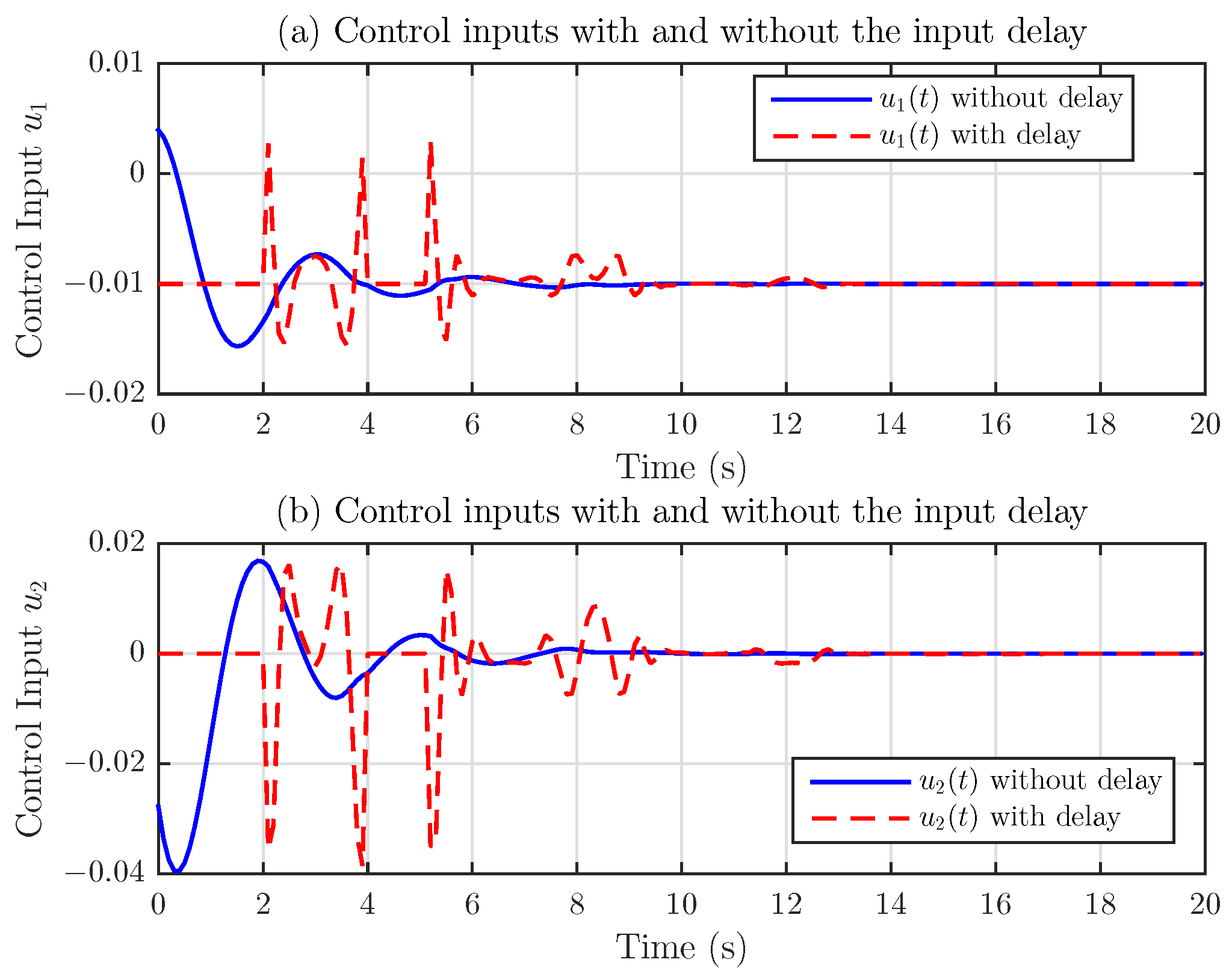
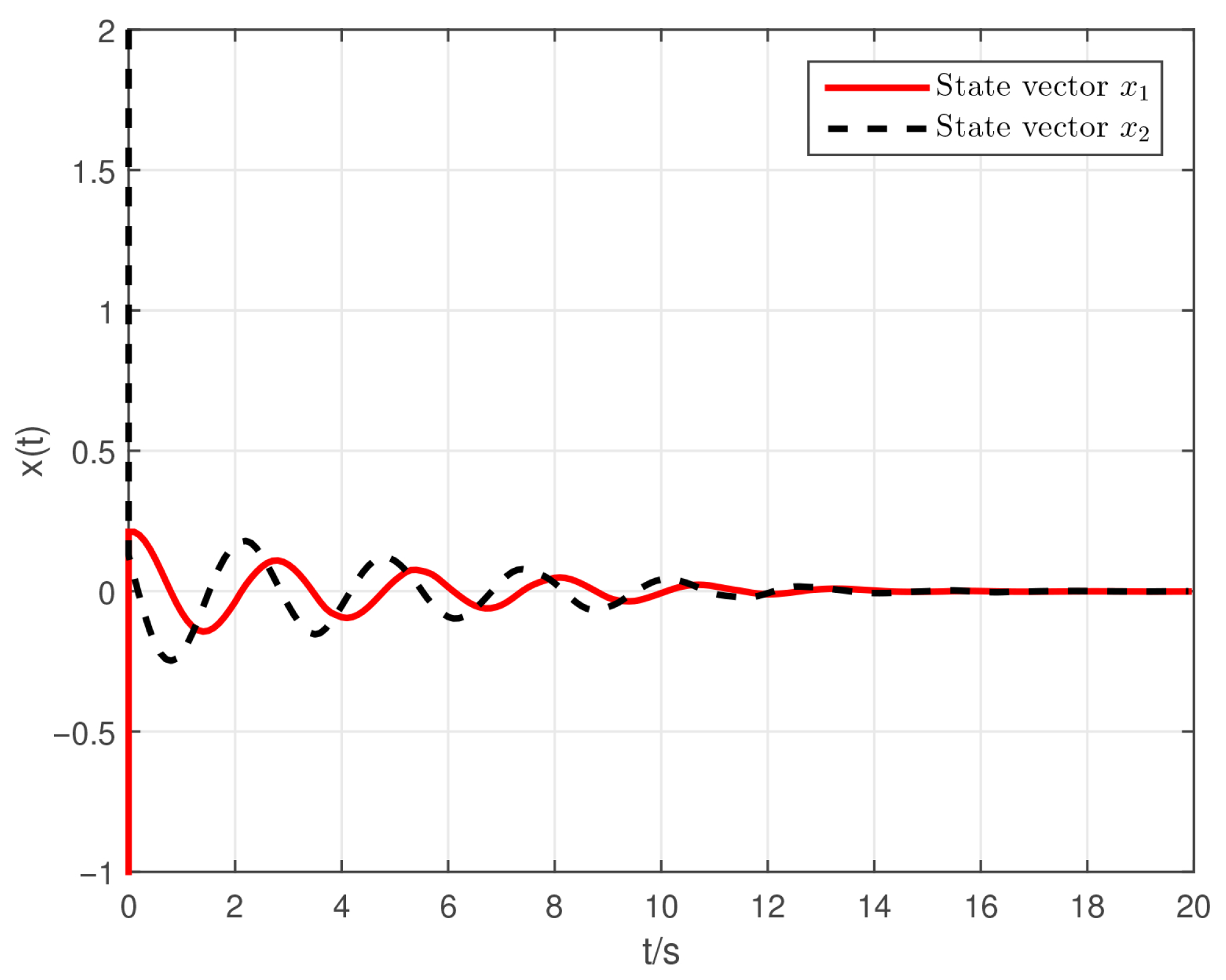
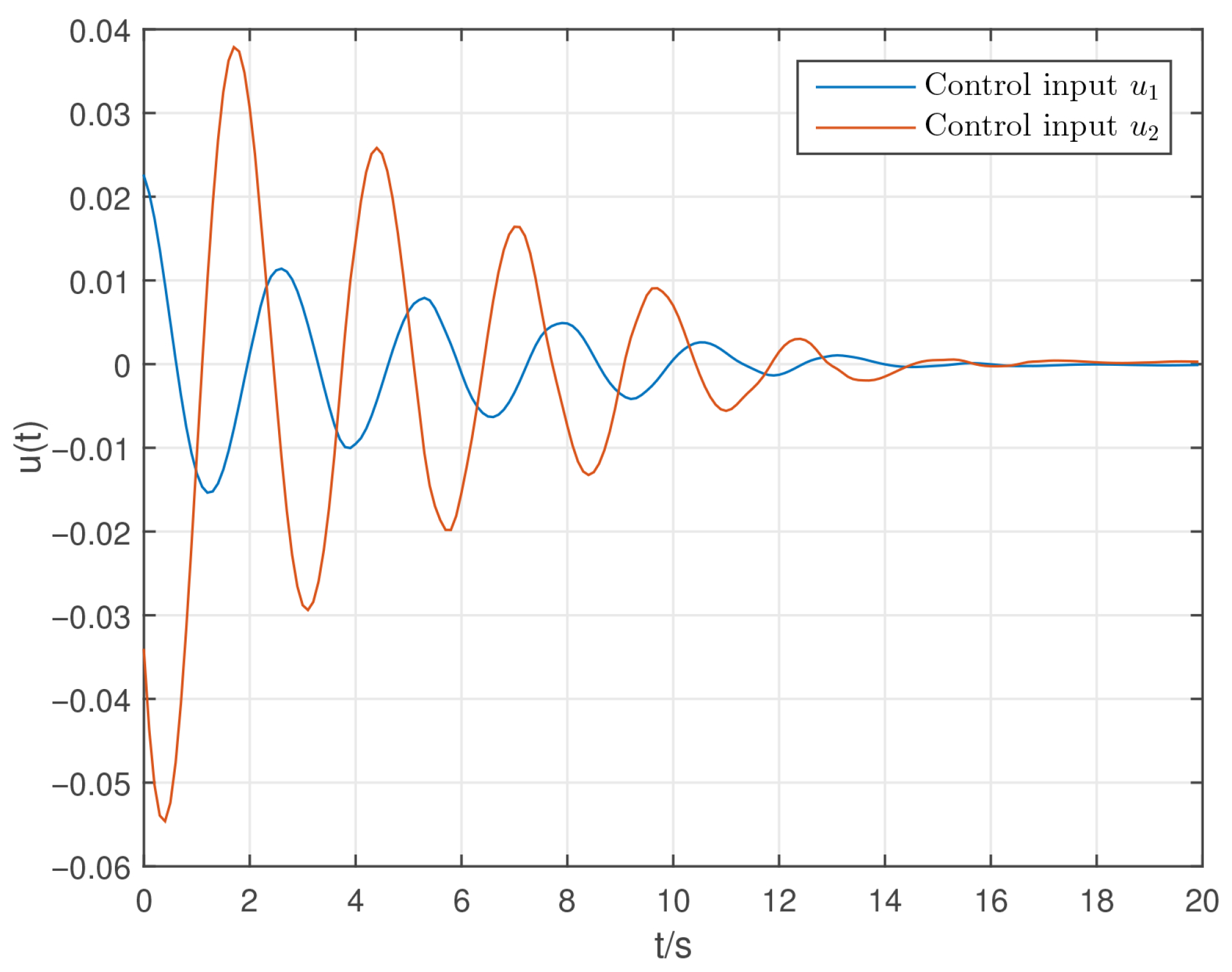
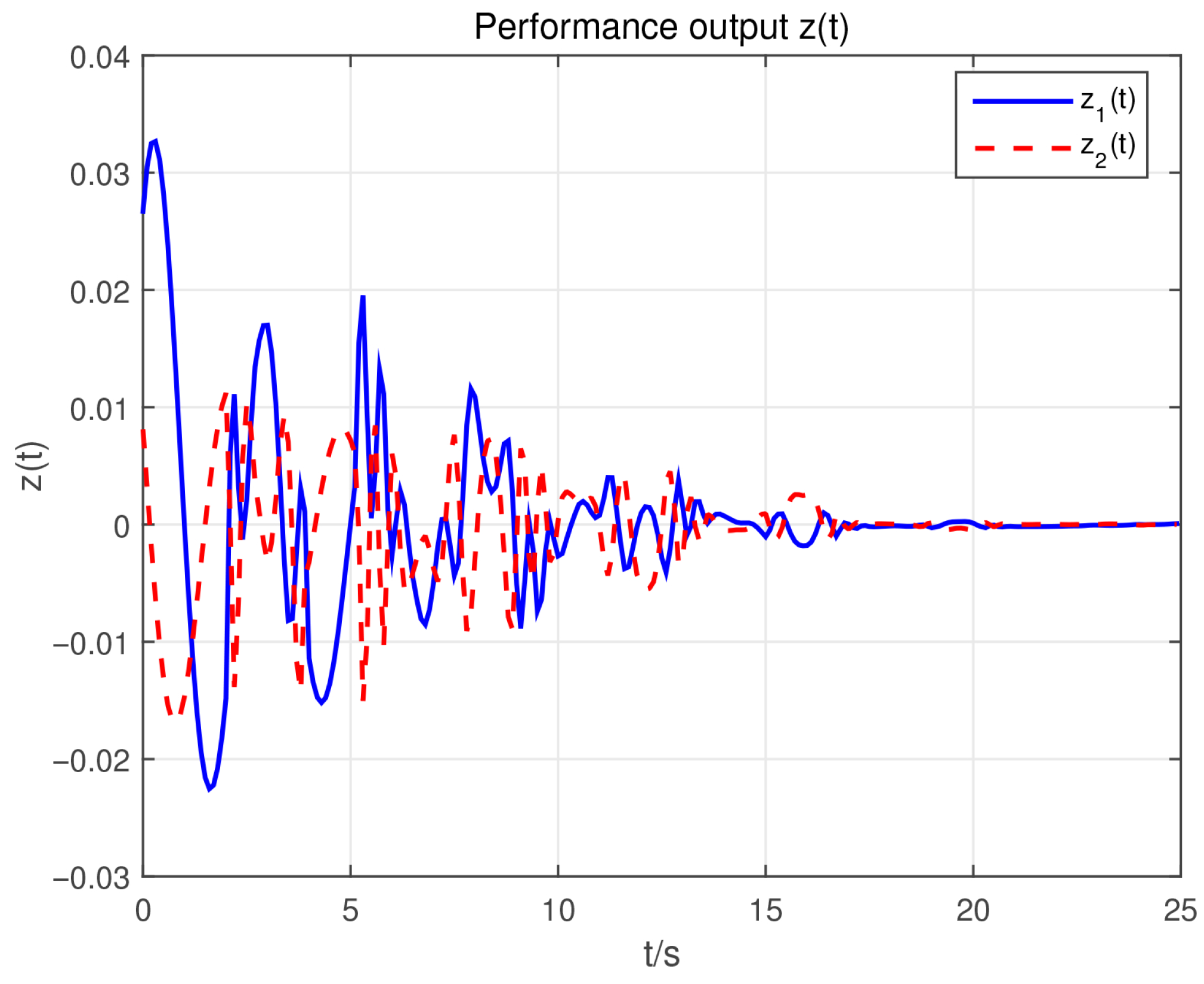
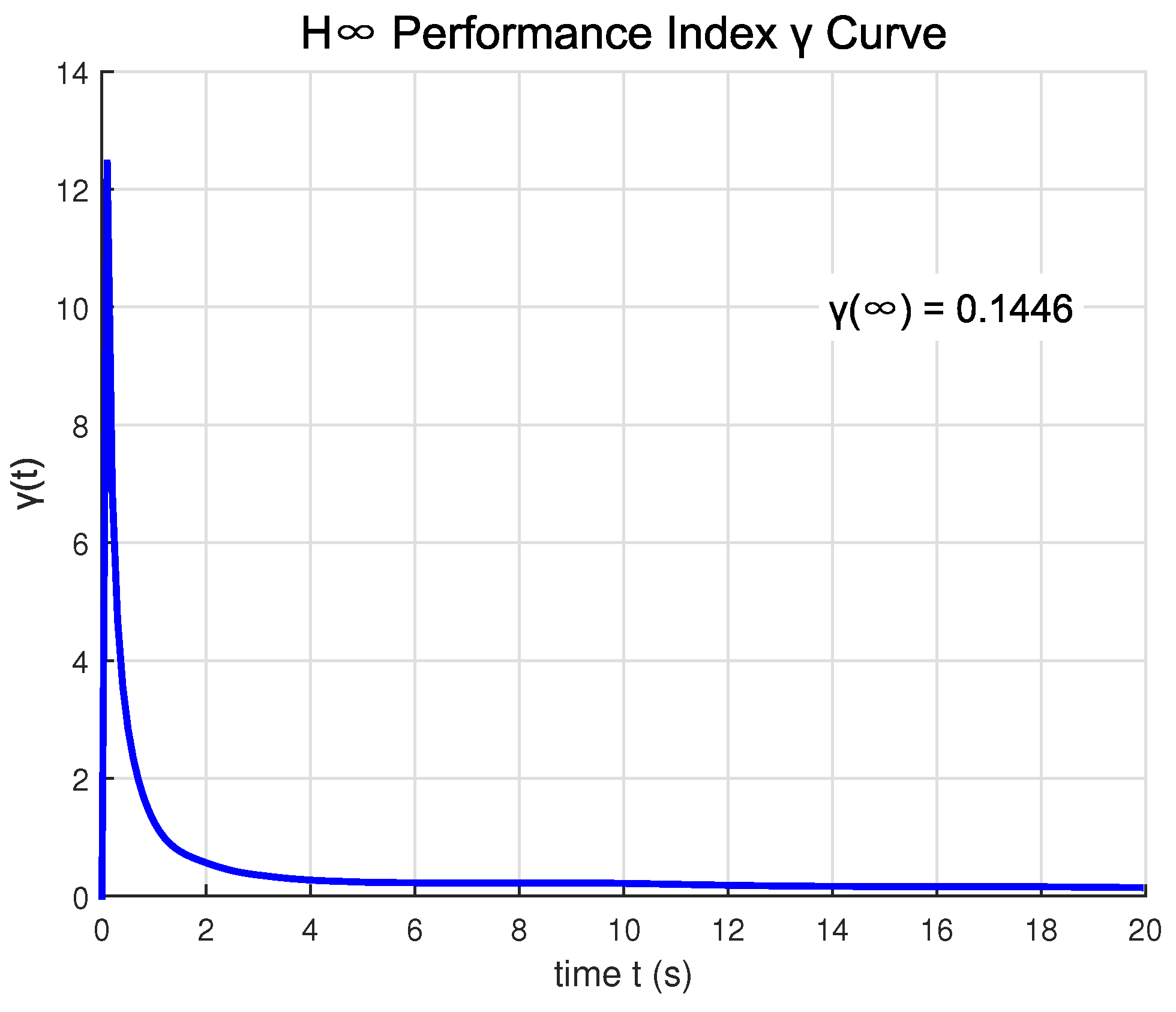
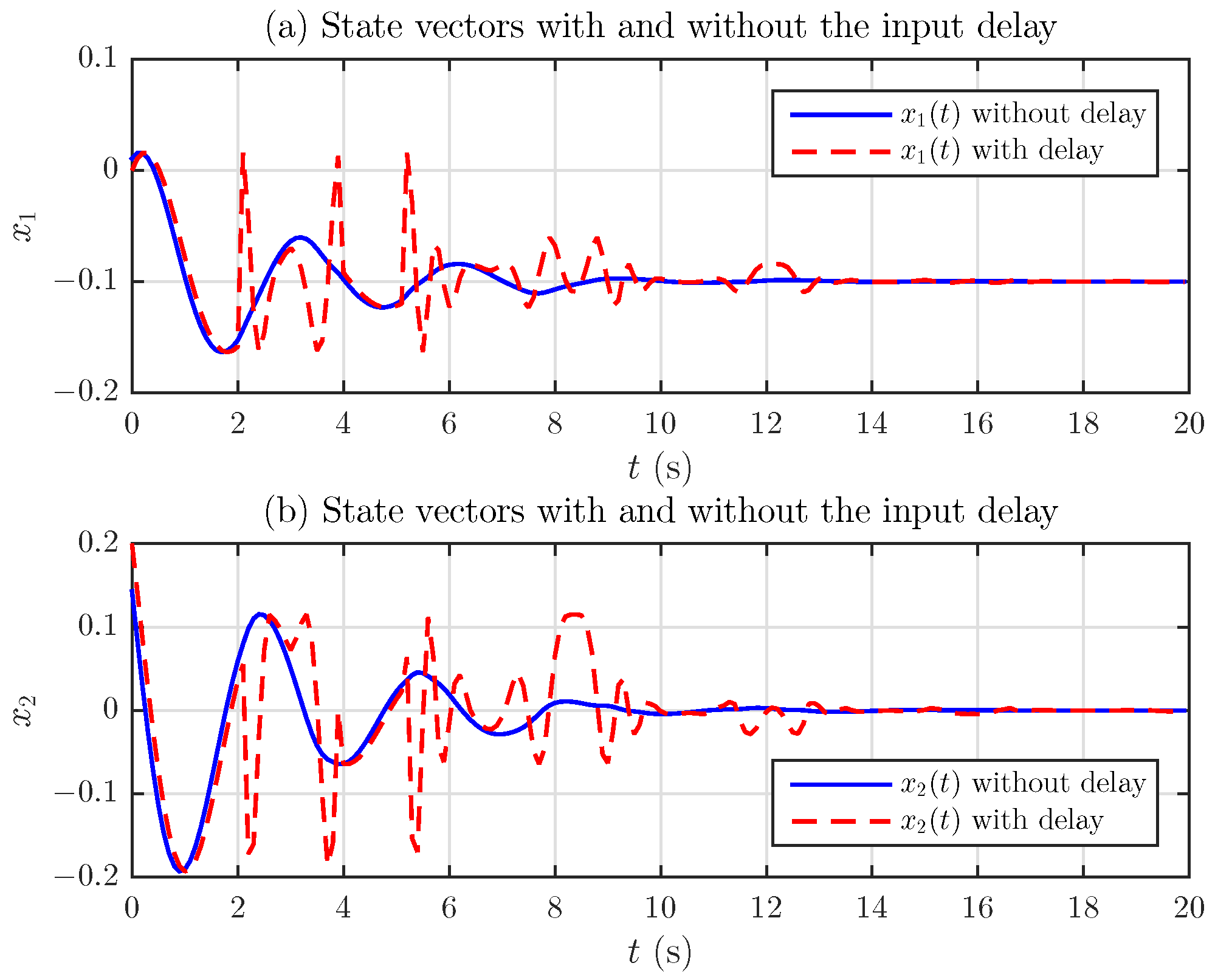
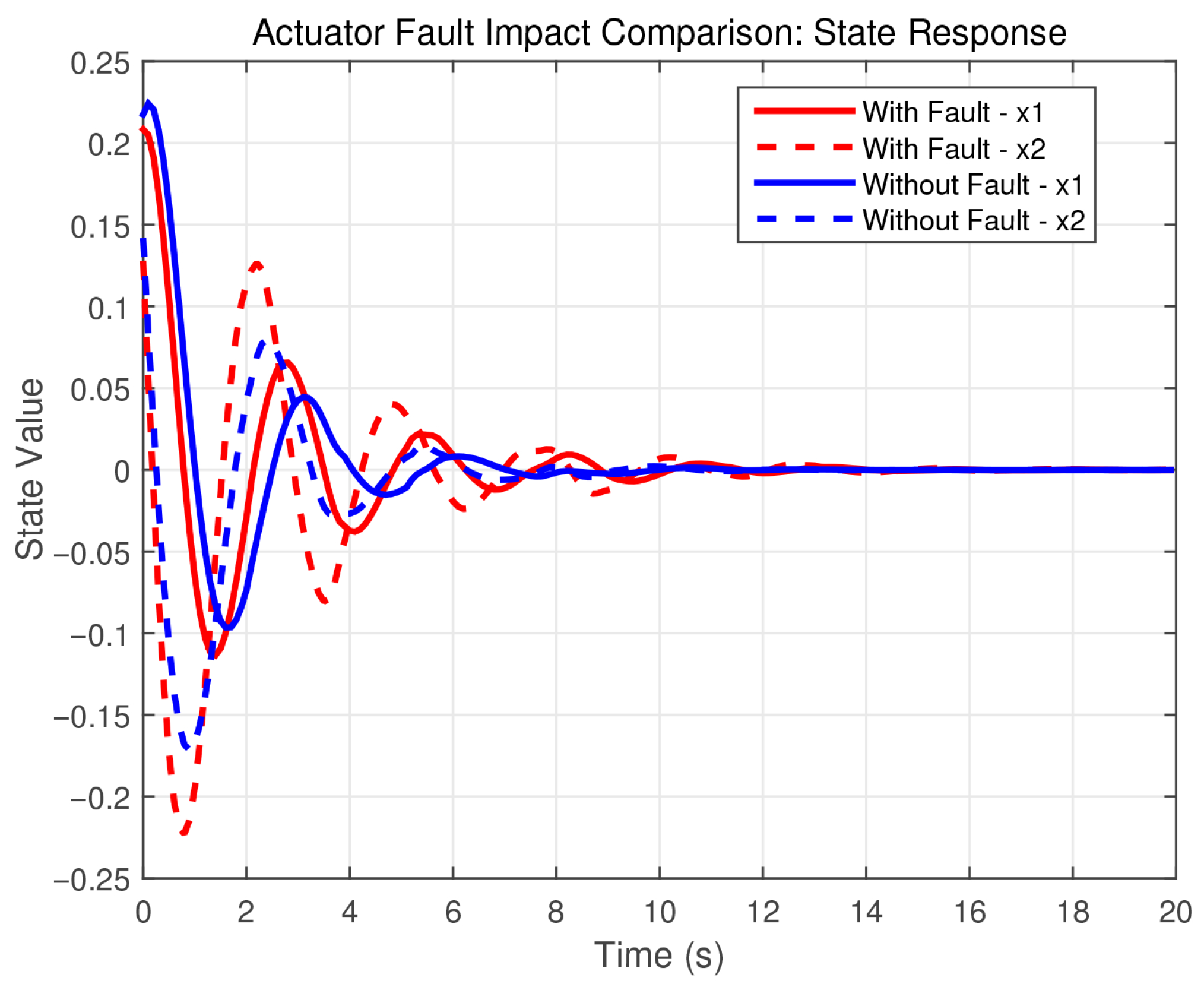
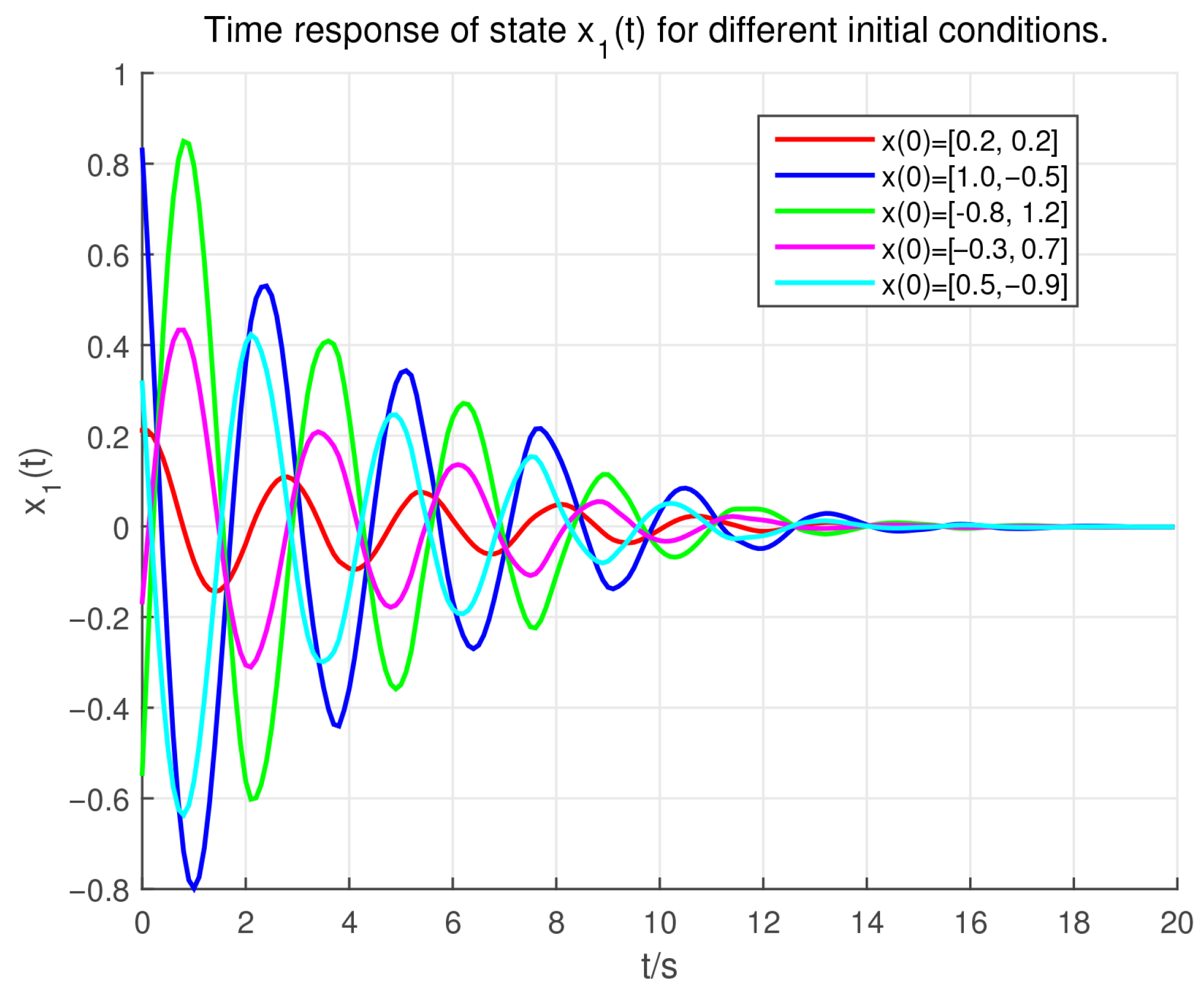
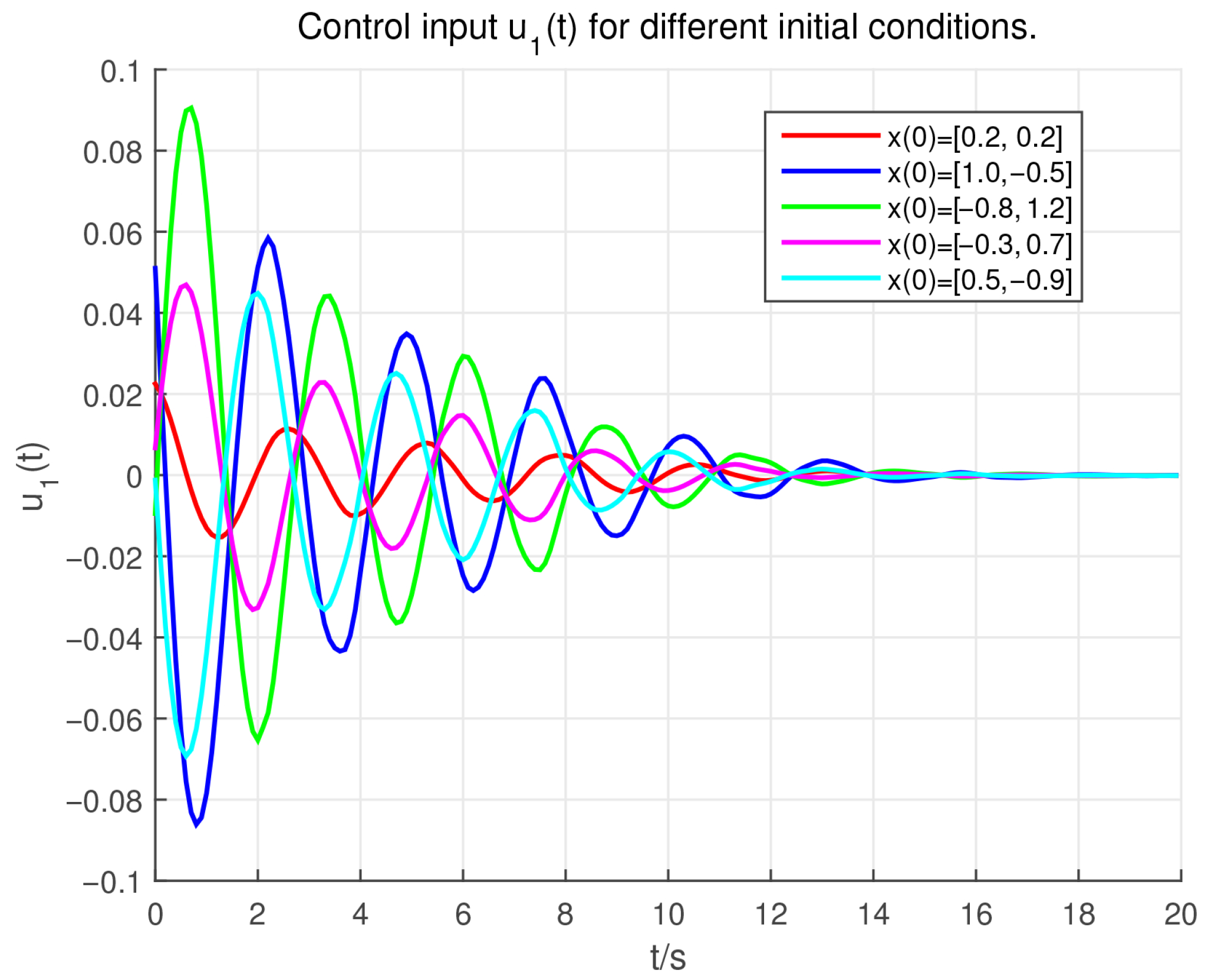
Simulation results for system (46) are given in Figure 1, Figure 2, Figure 3, Figure 4, Figure 5, Figure 6, Figure 7, Figure 8 and Figure 9. Figure 1 and Figure 2 show that the system remains asymptotically stable after the introduction of the input delay. Figure 3 presents the Performance output of Z(t), Figure 4 presents the time response of the robust H performance index γ. Figure 5 and Figure 6 compare the system states and control inputs with and without the input delay; these plots indicate that the inclusion of the input delay increases the settling time but the system still converges, which further validates the feasibility and effectiveness of the controller proposed in this paper. Figure 7 depicts the impact of actuator faults on system states by comparing responses under faulty and fault-free conditions. Figure 8 and Figure 9 show the trajectories of the system state x and the control input u, respectively, under different initial conditions.
As shown in Figure 1, Figure 2 and Figure 3, the proposed control scheme maintains system stability even in the presence of actuator faults and mixed time-varying delays. The results in Figure 4 demonstrates that the design satisfies the prescribed robust H performance index γ. Furthermore, Figure 5 and Figure 6 indicate that, although the introduction of an input delay increases the settling time, the system remains stable, thereby confirming the effectiveness of the designed controller. Figure 7 illustrates that the proposed fault-tolerant controller effectively mitigates the adverse effects caused by actuator faults. As observed in Figure 8, all state trajectories originating from significantly different initial values converge asymptotically to the equilibrium point, confirming the global stability of the controlled system. Meanwhile, Figure 9 shows that the corresponding control inputs remain smooth and bounded throughout the transient period, which verifies the physical realizability and robustness of the controller under large initial deviations.
Example 2. 
Servo Motor System with Delays and Actuator Faults: Consider a servo motor system whose electrical and mechanical dynamics are governed by
J ω ˙ ( t ) = B ω ( t ) + K t i ( t ) τ L ( t ) , L i ˙ ( t ) = R i ( t ) K e ω ( t ) + v ( t ) ,
where ω ( t ) denotes the angular velocity, i ( t ) is the armature current, and v ( t ) is the control voltage. Define the state vector as
x ( t ) = x 1 ( t ) x 2 ( t ) = ω ( t ) i ( t ) .
By linearizing (47) around nominal operating points and applying normalization, the servo motor dynamics can be expressed as
x ˙ ( t ) = A p x ( t ) + B p u ( t ) ,
with
A p = B J K t J K e L R L , B p = 0 1 L .
Due to variations in load conditions and electrical parameters, the physical parameters { J , B , K t , K e , L , R } vary within bounded intervals, leading to different equivalent linearized system matrices. To capture the above variations, the servo motor system is modeled by an interval type-2 Takagi–Sugeno fuzzy system with two rules:
x ˙ ( t ) = i , j , k 2 Φ i ( x ( t ) ) λ j ( x ( t ) ) λ k ( x ( t ) ) [ ( A i + Δ A i ) x ( t ) + ( A α i + Δ A α i ) x ( t α ( t ) ) + ( G i + Δ G i ) F j K j x ( t ) + ( G α i + Δ G α i ) F k K α k x ( t α ( t ) ) + G w i w ( t ) ] , z ( t ) = i , j , k 2 Φ i λ j λ k [ O i x ( t ) + O α i x ( t α ( t ) ) + H i F j K j x ( t ) + H α i F k K α k x ( t α ( t ) ) ] ,
Remark 1. 
The considered servo motor system incorporates several non-ideal factors that naturally arise in practical implementations. The state delay is mainly caused by sensor sampling, signal filtering, and state estimation processes, while the input delay originates from actuator dynamics, signal transmission, and power amplifier response. These delays do not introduce new dynamics but result in delays in the effects of the original states and control inputs. The actuator fault represents partial loss of effectiveness in the motor drive or power amplifier and is modeled by a constant multiplicative matrix, which is consistent with fault characteristics determined by hardware limitations or diagnostic information. The external disturbance accounts for load torque variations and unmodeled environmental effects acting on the motor shaft. In addition, the uncertainty matrices are introduced to capture parameter variations and modeling inaccuracies arising from changes in operating conditions, temperature drift, and electrical characteristics. Such a modeling framework is widely adopted in robust and fault-tolerant control to reflect practical non-idealities while maintaining a tractable mathematical representation.
The nominal system matrices corresponding to different operating conditions are given by
A 1 = 3.42 1.28 1.45 2.85 , A 2 = 4.11 1.54 1.74 3.63 ,
G 1 = 0 0.56 , G 2 = 0 0.67
In practical servo motor systems, time delays are originated from sensor sampling, signal transmission, and actuator dynamics. These delays preserve the structure of the original system while attenuating the influence of delayed signals. Therefore, the delayed-state and delayed-input matrices are constructed as scaled versions of the nominal matrices:
A α i = μ A i , G α i = η G i
where μ and η are known positive constants satisfying 0 < γ < 1 and 0 < η < 1 . In the simulation study, the parameters are selected as μ = 0.07 and η = 0.06 , yielding
A α 1 = 0.07 A 1 , A α 2 = 0.07 A 2 , G α 1 = 0.06 G 1 , G α 2 = 0.06 G 2 .
The rest of the matrices are as follows:
O α 1 = 0.05 0.05 0.01 0.05 , O α 2 = 0.04 0.01 0.01 0.08 ,
H 1 = 0.2 0.05 , H 2 = 0.2 0.08 , H α 1 = 0.04 0.15 , H α 2 = 0.05 0.12
a 1 = a 2 = 0.1 0 0 0.2 , b 1 = b 2 = 0.5 0 0 0.4
c 1 = c 2 = 0.1 0 0 0.1 , d 1 = d 2 = 0.2 0 0 0.3
F 11 = 0.3 0 0 0.5 , F 12 = 0.6 0 0 0.8
F 21 = 0.3 0 0 0.5 , F 22 = 0.6 0 0 0.8
Λ 1 = 0.8 0 0 0.8 Λ 2 = 0.8 0 0 0.8
The membership functions for the system are defined as follows:
Φ 1 L = 1 1 + e ( x 1 3.5 ) / 2 , Φ 1 u = 1 1 + e ( x 1 2.5 ) / 2
Φ 2 L = 1 1 + e ( x 1 + 0.4 ) , Φ 2 u = 1 1 + e ( 0.5 x 1 1.75 )
d ̲ 1 = 0.6 sin 2 ( x 1 ) , d ¯ 1 = 1 0.6 sin 2 ( x 1 )
d ̲ 2 = 1 0.6 sin 2 ( x 1 ) , d ¯ 2 = 0.6 sin 2 ( x 1 )
The membership functions for the controller are defined as follows:
λ 1 L = 1 1 + e x 2 ( t α ( t ) ) + 0.4
λ 1 U = 1 1 + e 0.5 x 2 ( t α ( t ) ) 1.75
λ 2 L = 1 1 1 + e x 2 ( t α ( t ) ) + 0.4
λ 2 U = 1 1 1 + e 0.5 x 2 ( t α ( t ) ) 1.75
c ̲ 1 = 1 0.6 sin 2 ( x 2 ( t α ( t ) ) ) , c ¯ 1 = 0.6 sin 2 ( x 2 ( t α ( t ) ) )
c ̲ 2 = 1 0.6 sin 2 ( x 2 ( t α ( t ) ) ) , c ¯ 2 = 0.6 sin 2 ( x 2 ( t α ( t ) ) )
Considering α1 = −α2 = −0.5, h = 6, and ε = 0.5, initial condition x(t) = [0.5, 0.3]T, w(t) = −0.1 sin(0.4t), and α(t) = 3 + 3sin t 6 .
K 1 , 1 = 0.7692 0.5233 , K 1 , 2 = 0.0568 0.7301 K 2 , 1 = 0.6540 0.5415 , K 2 , 2 = 0.1016 0.6419 K α 1 , 1 = 0.6784 0.1954 , K α 1 , 2 = 0.1019 0.0848 K α 2 , 1 = 0.5782 0.0956 , K α 2 , 2 = 0.1786 0.1548
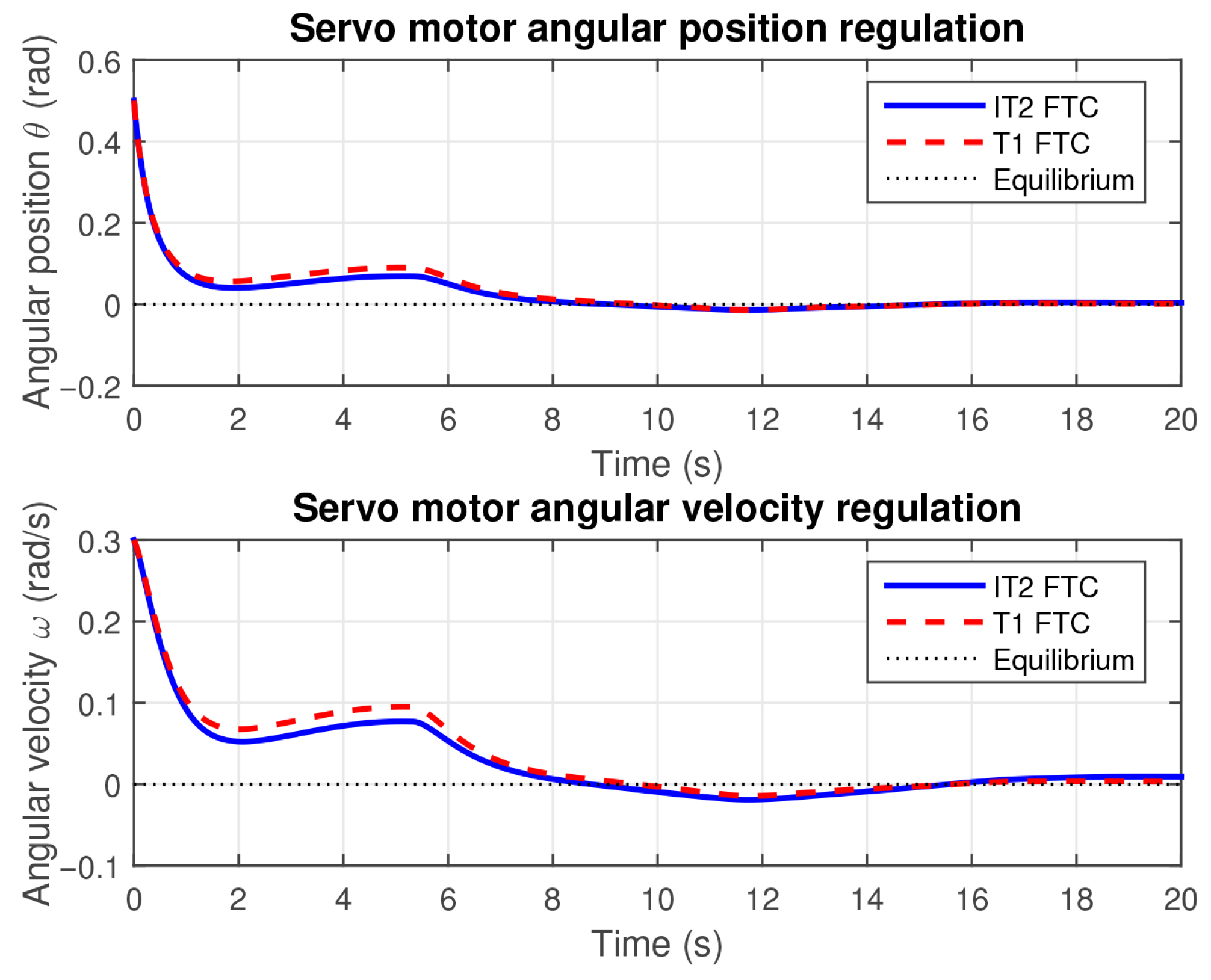
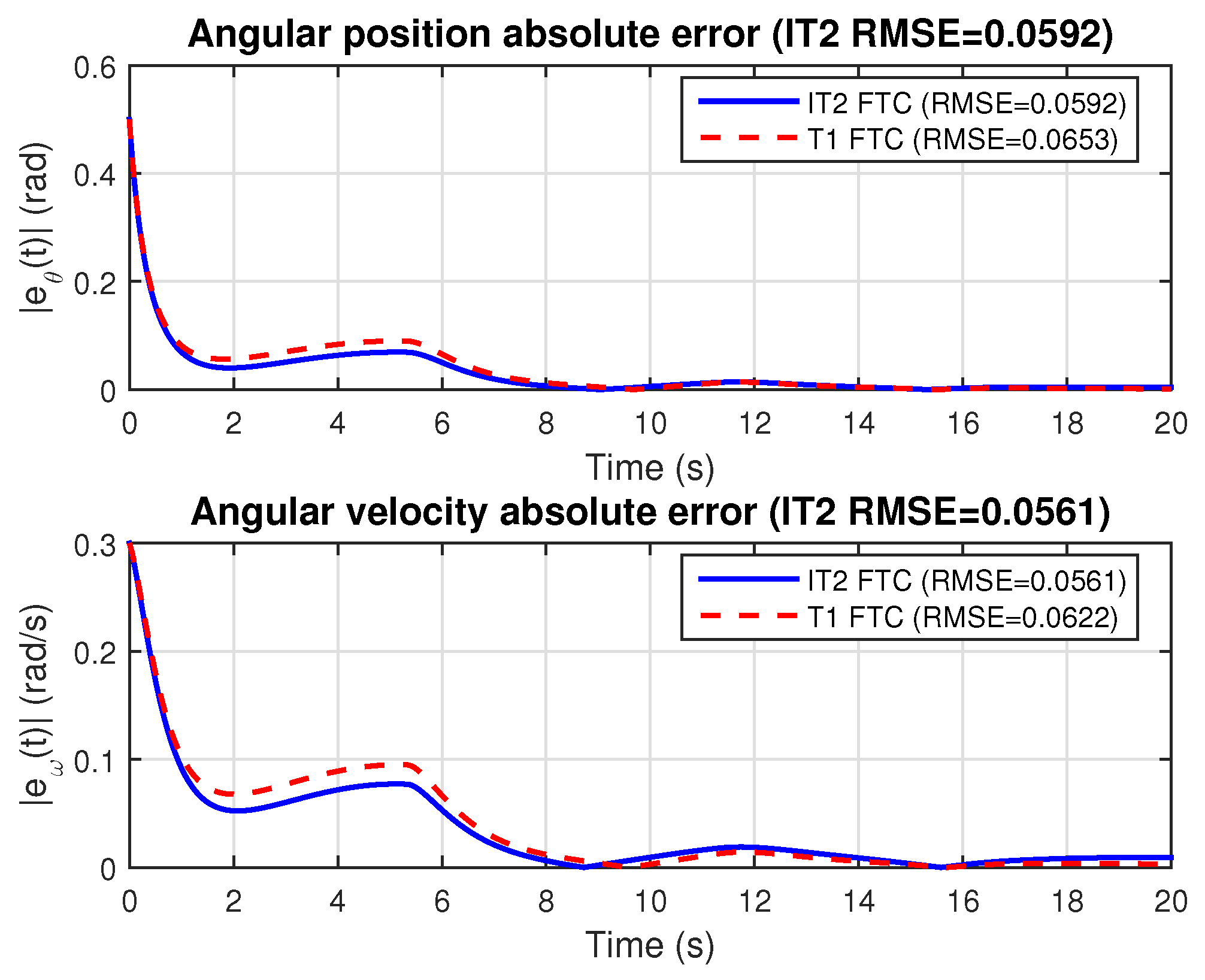
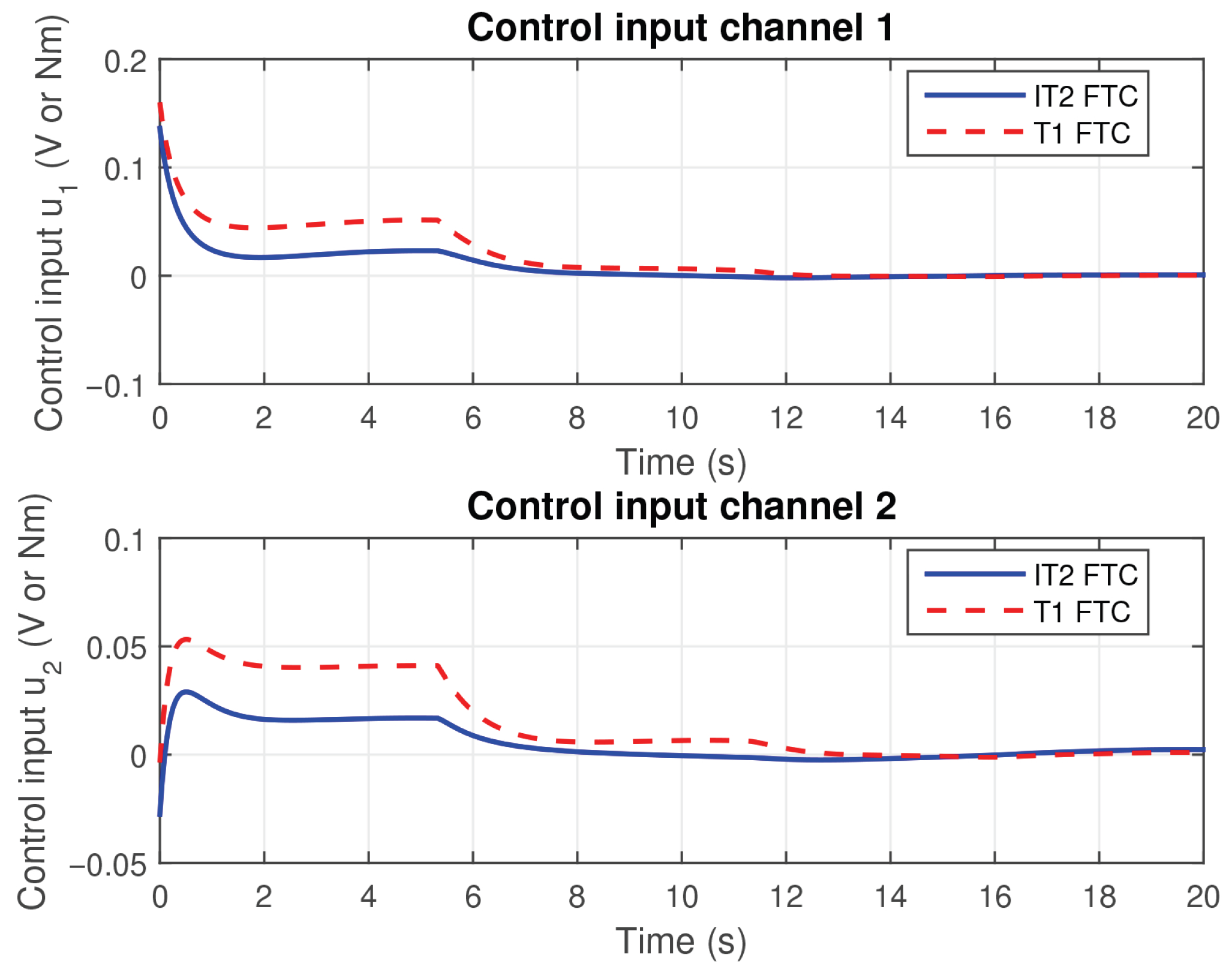
To demonstrate the superiority of the ITFS over its type-1 counterpart, simulation results for system (49) are given in Figure 10, Figure 11 and Figure 12 and Table 1. Figure 10 illustrates the time responses of the system states under the IT2 and IT1 fuzzy fault-tolerant controllers. The trajectories of the two state variables are presented to show the regulation behavior of the servo motor system over the entire simulation interval, together with the equilibrium reference. Figure 11 depicts the absolute regulation errors of the system states for both controllers. The evolution of the absolute errors with respect to time is shown, reflecting the transient and steady-state characteristics of the state regulation process. Figure 12 presents the control input signals generated by the IT2 and IT1 controllers. The time histories of the control inputs corresponding to each channel are displayed to illustrate the control effort applied to the servo motor system during the regulation task. Table 1 summarizes the quantitative performance indices obtained from the simulation results, including the root mean square error (RMSE) and integral of absolute error (IAE) for both the angular position and angular velocity states. The corresponding numerical values for the IT2 and IT1 controllers, as well as the relative improvement percentages, are reported for comparison.
In the servo motor regulation example (Figure 10, Figure 11 and Figure 12 and Table 1), the proposed interval type-2 fuzzy fault-tolerant controller (IT2 FTC) delivers superior tracking and error attenuation performance compared with the IT1 counterpart. Figure 10 indicates that both the angular position and velocity under IT2 FTC converge to the equilibrium with less oscillation and faster settling behavior. The absolute regulation errors depicted in Figure 11 further illustrate that the IT2 FTC achieves lower overshoot and steady-state error. Moreover, the control signals in Figure 12 remain smooth and practically feasible, without excessive actuation effort. The quantitative comparison summarized in Table 1 validates the performance improvement numerically.

5. Conclusions

This paper addresses the robust H fault-tolerant control problem for uncertain ITFS subject to both input delays and state delays. To better capture system uncertainties, an Interval Type-2 (IT2) fuzzy model is employed, offering a richer representation compared to traditional Interval Type-1 models. A premise-mismatched fault-tolerant controller is designed to ensure system stability in the presence of actuator faults, while providing greater flexibility in the selection of membership functions. Stability analysis is carried out using a novel Lyapunov–Krasovskii functional, which incorporates membership-dependent matrices and delay-product terms. The closed-loop stability is guaranteed through sufficient conditions derived from linear matrix inequalities (LMIs). The simulations demonstrate that the proposed approach effectively ensures system stability under mixed time-varying delays and actuator faults. Comparative experiments illustrate the impact of input delays and actuator faults on closed-loop performance, validating the effectiveness and robustness of the designed controller. Moreover, comparative experiments with various initial values further verify the physical realizability and robustness of the controller under large initial deviations. The IT2 FTC reduces the root mean square error (RMSE) by 9.3% for angular position and 9.9% for angular velocity, respectively. In terms of the integral of absolute error (IAE), improvements of 15.6% and 8.9% are attained for the two states. These metrics collectively confirm that the IT2 fuzzy control scheme not only enhances transient and steady-state precision but also offers stronger disturbance and uncertainty handling capability, making it a more effective and reliable solution for servo motor regulation under practical conditions. Future work will focus on developing an input-delay compensator to enhance the closed-loop convergence rate and robustness under delayed inputs, and will further investigate time-varying unknown actuator fault patterns to better align the results with practical applications.

Author Contributions

Conceptualization, J.W. (Jinxia Wu) and Y.G.; methodology, J.W. (Jinxia Wu); software, Y.G.; validation, J.W. (Juan Wang) and Y.G.; formal analysis, Y.G.; investigation, Y.G.; resources, J.W. (Juan Wang) and J.W. (Jinxia Wu); data curation, Y.G.; writing—original draft preparation, Y.G.; writing—review and editing, Y.G.; visualization, J.W. (Juan Wang); supervision, J.W. (Jinxia Wu); project administration, J.W. (Jinxia Wu); funding acquisition, J.W. (Juan Wang) and J.W. (Jinxia Wu). All authors have read and agreed to the published version of the manuscript.

Funding

This work was supported by Natural Science Project of Liaoning Provincial Department of Science and Technology (No. 2024-MS-190) the National Natural Science Foundation of China (No. 61903167).

Institutional Review Board Statement

Not applicable.

Informed Consent Statement

Not applicable.

Data Availability Statement

The data that support the findings of this study are available on request from the corresponding author. The data are not publicly available due to privacy or ethical restrictions.

Conflicts of Interest

The authors declare no conficts of interest.

References

  1. Lu, R.; Cheng, H.; Bai, J. Fuzzy-model-based quantized guaranteed cost control of nonlinear networked systems. IEEE Trans. Fuzzy Syst. 2015, 23, 567–580. [Google Scholar] [CrossRef]
  2. Zuo, Z.; Tie, L. A new class of finite-time nonlinear consensus protocols for multi-agent systems. Int. J. Control 2014, 87, 363–370. [Google Scholar] [CrossRef]
  3. Allerhand, L.I.; Shaked, U. Robust state-dependent switching of linear systems with dwell time. IEEE Trans. Autom. Control 2014, 87, 363–370. [Google Scholar] [CrossRef]
  4. Tan, Y.S.; Yuan, Y.; Xie, X.P. Observer-Based Event-Triggered Control for Interval Type-2 Fuzzy Networked System with Network Attacks. IEEE Trans. Fuzzy Syst. 2023, 31, 2788–2798. [Google Scholar] [CrossRef]
  5. Wang, Y.; Xie, L.; de Souza, C.E. Robust control of a class of uncertain nonlinear systems. Syst. Control Lett. 2020, 22, 380–399. [Google Scholar] [CrossRef]
  6. Zeng, H.B.; Liu, X.G.; Wang, W. A generalized free-matrix-based integral inequality for stability analysis of time-varying delay systems. Assoc. Comput. Mach. 2019, 35, 1–8. [Google Scholar] [CrossRef]
  7. Zhang, C.K.; He, Y.; Jiang, L.; Lin, W.-J.; Wu, M. Delay-dependent stability analysis of neural networks with time-varying delay: A generalized free-weighting-matrix approach. Assoc. Comput. Mach. 2017, 294, 102–120. [Google Scholar] [CrossRef]
  8. Seuret, A.; Gouaisbaut, F. Wirtinger-based integral inequality: Application to time-delay systems. IEEE Trans. Autom. Control 2013, 49, 2860–2866. [Google Scholar] [CrossRef]
  9. Yoneyama, J. Robust stability and stabilization for uncertain Takagi-Sugeno fuzzy time-delay systems. Fuzzy Sets Syst. 2007, 158, 115–134. [Google Scholar] [CrossRef]
  10. Qiu, Y.; Park, J.H.; Hua, C.; Wang, X. Stability analysis of time-varying delay T-S fuzzy systems via quadratic-delay-product method. IEEE Trans. Fuzzy Syst. 2023, 31, 129–137. [Google Scholar] [CrossRef]
  11. Kim, J.H. Further improvement of Jensen inequality and application to stability of time-delayed systems. Automatic 2016, 64, 121–125. [Google Scholar] [CrossRef]
  12. Zeng, H.B.; Lin, H.C.; He, Y.; Teo, K.L.; Wang, W. Hierarchical stability conditions for time varying delay systems via an extended reciprocally convex quadratic inequality. J. Frankl. Inst. 2020, 357, 9930–9941. [Google Scholar] [CrossRef]
  13. Zhang, C.K.; Long, F.; He, Y.; Yao, W.; Jiang, L.; Wu, M. A relaxed quadratic function negative-determination lemma and its application to time-delay systems. Automatic 2020, 113, 108756. [Google Scholar] [CrossRef]
  14. Zhang, X.M.; Han, Q.L.; Ge, X.H. Novel stability criteria for linear time-delay systems using Lyapunov-Krasovskii functionals with a cubic polynomial on time-varying delay. IEEE Trans. Fuzzy Syst. 2021, 8, 77–85. [Google Scholar] [CrossRef]
  15. Long, F.; Zhang, C.K.; He, Y.; Wang, Q.G.; Wu, M. A sufficient negative-definiteness condition for cubic functions and application to time-delay systems. Robust Nonlinear Control 2021, 31, 7361–7371. [Google Scholar] [CrossRef]
  16. Zhang, X.M.; Han, Q.L.; Ge, X.H. Sufficient conditions for a class of matrix-valued polynomial inequalities on closed intervals and application to H filtering for linear systems with time-varying delays. Automatica 2021, 125, 109390. [Google Scholar] [CrossRef]
  17. Lin, H.; Dong, J. Robust H control for uncertain T–S fuzzy systems with state and input time delays: A time-varying matrix-dependent zero-equality method. J. Frankl. Inst. 2024, 361, 106540. [Google Scholar] [CrossRef]
  18. Cheridi, D.E.; Mansouri, N. Robust H Fault-Tolerant Control for Discrete-Time Nonlinear System with Actuator Faults and Time-Varying Delays Using Nonlinear T–S Fuzzy Models. Circuits Syst. Signal Process. 2020, 39, 175–198. [Google Scholar] [CrossRef]
  19. Du, Z.; Kao, Y.; Zhao, X. An Input Delay Approach to Interval Type-2 Fuzzy Exponential Stabilization for Nonlinear Unreliable Networked Sampled-Data Control Systems. IEEE Trans. Fuzzy Syst. 2021, 51, 225–235. [Google Scholar] [CrossRef]
  20. Zhang, S.; Zhao, J. Energy-to-peak combined switching bumpless transfer control for switched interval type-2 fuzzy delayed systems. Inf. Sci. 2022, 611, 364–384. [Google Scholar] [CrossRef]
  21. Liu, C.; Wu, J. Robust Control for Interval Type-2 T-S Fuzzy Discrete Systems with Input Delays and Cyber Attacks. Int. J. Fuzzy Syst. 2023, 36, 1443–1462. [Google Scholar] [CrossRef]
  22. Liu, H.; Qian, W.; Xing, W.; Zhao, Z. Further results on delay-dependent robust H control for uncertain systems with interval time-varying delays. Syst. Sci. Control Eng. 2020, 9, 30–40. [Google Scholar] [CrossRef]
  23. Kchaou, M.; Regaieg, M.A.; Jerbi, H.; Abbassi, R.; Stefanoiu, D.; Popescu, D. Admissible Control for Non-Linear Singular Systems Subject to Time-Varying Delay and Actuator Saturation: An Interval Type-2 Fuzzy Approach. Actuators 2023, 12, 30. [Google Scholar] [CrossRef]
  24. Saif, A.W.; Mudasar, M.; Mysorewala, M.; Elshafei, M. Observer-Based Interval Type-2 Fuzzy Logic Control for Nonlinear Networked Control Systems with Delays. Int. J. Fuzzy Syst. 2020, 30, 380–399. [Google Scholar] [CrossRef]
  25. Lahmadi, K.; Lahmadi, O.; Jounaidi, S.; Boumhidi, I. Robust Control and Energy Management in Wind Energy Systems Using LMI-Based Fuzzy H Design and Neural Network Delay Compensation. Processes 2025, 13, 2097. [Google Scholar] [CrossRef]
  26. Xu, J.; Song, T.; Wang, J. Finite-Time Fuzzy Fault-Tolerant Control for Nonlinear Flexible Spacecraft System with Stochastic Actuator Faults. Mathematics 2024, 12, 503. [Google Scholar] [CrossRef]
Figure 1. The state vector trajectory.
Actuators 15 00073 g001
Figure 2. The Control input.
Actuators 15 00073 g002
Figure 3. Performance output.
Actuators 15 00073 g003
Figure 4. H Performance Index γ Curve.
Actuators 15 00073 g004
Figure 5. Comparison of system states x 1 , x 2 and their delayed versions.
Actuators 15 00073 g005
Figure 6. Comparison of control inputs u 1 , u 2 and their delayed signals.
Actuators 15 00073 g006
Figure 7. FTC vs. NO FTC.
Actuators 15 00073 g007
Figure 8. Time response of state x 1 ( t ) for different initial conditions.
Actuators 15 00073 g008
Figure 9. Control input u 1 ( t ) for different initial conditions.
Actuators 15 00073 g009
Figure 10. Servo motor angular velocity regulation.
Actuators 15 00073 g010
Figure 11. Angular position absolute error.
Actuators 15 00073 g011
Figure 12. Control input channel 1 and 2.
Actuators 15 00073 g012
Table 1. Quantitative comparison between IT2 and T1 controllers for the servo motor system.
MetricIT2IT1Improvement (%)
Angle RMSE (rad)0.05920.06539.3
Velocity RMSE (rad/s)0.05610.06229.9
Angle IAE0.59040.699615.6
Velocity IAE0.66880.73448.9
Disclaimer/Publisher’s Note: The statements, opinions and data contained in all publications are solely those of the individual author(s) and contributor(s) and not of MDPI and/or the editor(s). MDPI and/or the editor(s) disclaim responsibility for any injury to people or property resulting from any ideas, methods, instructions or products referred to in the content.