1. Introduction
Hybrid Hydrogen Electric Vehicles (HHEVs) represent a promising solution for sustainable and high-efficiency transportation. By integrating a proton-exchange membrane fuel cell (FC), a rechargeable battery (Bat), and a supercapacitor (SC), multi-source hybrid energy storage systems (HESSs) combine the high energy density of hydrogen with the fast dynamic response of electrochemical storage devices. Coordinated power sharing enables efficient transient operation, effective regenerative braking, and reduced hydrogen consumption while mitigating battery degradation and extending system lifetime [
1]. In this work, the validation is conducted using real on-road GPS speed measurements collected in Tunisia, which provide route-dependent variability and realistic traffic dynamics. These measured profiles are used to generate traction power demand and assess diagnosis and fault-tolerant energy management under practical operating conditions.
HHEVs can generally be categorized into two main classes depending on the dominant power contribution of the energy sources: (i) fuel-cell-dominant architectures, where the FC supplies most of the average traction energy and the Bat/SC mainly buffer transients and recover braking energy; and (ii) storage-dominant architectures, where the Bat and/or SC deliver most traction power dynamics and the FC operates primarily as a range extender. Unlike conventional hybrid electric vehicles, there is currently no unified standard or widely adopted guideline for defining HHEV hybridization levels, energy-storage sizing, or supervisory control structures. Therefore, this work follows an architecture-based classification commonly adopted in the literature and focuses on a representative FC–Bat–SC multi-source topology for analyzing diagnosis-driven energy management and fault-tolerant operation.
Despite their advantages, the nonlinear interactions among energy sources and DC/DC converters increase vulnerability to actuator and sensor faults, including FC voltage sag, reactant starvation, hydrogen leakage, sensor bias, Bat internal resistance variation, and SC capacitance loss. If undetected, such faults may lead to power imbalance, accelerated degradation, reduced efficiency, and safety risks [
2]. Consequently, significant research has focused on fault detection and isolation (FDI) and fault-tolerant control (FTC) for fuel cell hybrid electric vehicles (FCHEVs). Classical FDI methods rely on analytical redundancy, residual generation, observer-based estimation, and statistical change detection. Techniques such as EKF, UKF, sliding-mode observers, and CUSUM tests have been used to detect abnormal behavior in FC and Bat subsystems [
3], although their performance can degrade under modeling uncertainty and realistic driving variability.
In parallel, energy management strategies (EMSs) for HHEVs have evolved from rule-based approaches toward optimization- and learning-based frameworks. Driving-cycle-adaptive EMSs based on dynamic programming and pattern recognition can reduce hydrogen consumption and battery aging [
4], while reinforcement learning and health-aware strategies aim to jointly optimize fuel economy and component durability [
5]. However, most EMSs assume nominal component behavior and incorporate fault effects only implicitly, which limits their ability to respond effectively to actuator or sensor failures and may compromise propulsion continuity under degraded operating conditions.
To address these limitations, hybrid diagnostic frameworks that combine model-based reasoning with artificial intelligence (AI) are gaining increasing attention. Physics-guided deep learning approaches, such as LSTM-based models informed by simplified FC dynamics, enhance fault sensitivity while improving interpretability [
6]. CNN–LSTM architectures and GAN-enhanced models have also demonstrated high accuracy in anomaly detection and fault classification for energy-storage and electromechanical systems, indicating strong potential for electrified powertrains [
7]. Recent studies have further explored neural-learning-based FTC and intelligent control in FC–Bat–SC architectures, where neural-network-assisted sliding-mode and fractional-order controllers can compensate for uncertainties and certain fault conditions while maintaining power balance and acceptable hydrogen consumption [
8].
Nevertheless, most existing EMS–FDI–FTC approaches are evaluated using standard driving cycles or synthetic profiles, which may not reflect realistic traffic fluctuations and route-dependent power peaks that strongly influence residual behavior, fault observability, and energy redistribution effort [
9]. In addition, many published frameworks treat residual-based diagnosis, statistical change detection, deep learning classification, and FTC as separate components, meaning that diagnosis outcomes are not consistently exploited in closed loop to trigger real-time supervisory reconfiguration. Therefore, a unified route-aware diagnosis-to-control pipeline remains necessary to evaluate fault diagnosis and fault-tolerant energy management under practical route-dependent driving conditions.
The key novelty of this work is the development of a unified, closed-loop framework that couples real-route GPS excitation, hybrid fault diagnosis, and diagnosis-driven energy management and control reconfiguration within a single supervisory architecture. Specifically, the main contributions of this study are:
- ✓
A route-aware traction demand generation module based on real on-road GPS speed measurements collected in Tunisia, enabling realistic excitation beyond standardized driving cycles.
- ✓
A hybrid diagnosis layer combining EKF residual analysis and CUSUM change detection to provide interpretable fault evidence, enhanced by a CNN–LSTM classifier to improve robustness to transient disturbances and temporal dependencies.
- ✓
A fully integrated diagnosis-driven EMS–FDI–FTC framework, enabling automatic mode switching and power redistribution under faults, validated through both software-in-the-loop (SIL) and processor-in-the-loop (PIL) implementation on an embedded target.
Accordingly, the objective of this study is to develop and validate a route-aware, diagnosis-driven EMS–FDI–FTC framework for hybrid Fuel Cell–Battery–Supercapacitor (FC–Bat–SC) vehicles under realistic operating conditions. This integration establishes a diagnosis-to-control pipeline in which fault evidence is not only detected and classified, but also translated into real-time energy management and control adaptation under route-dependent driving profiles. This closed-loop integration strengthens the practical relevance of AI-assisted diagnosis by directly linking fault recognition to supervisory energy management decisions under realistic driving variability.
The remainder of the paper is organized as follows.
Section 2 reviews related work on FDI and FTC strategies for hybrid electric vehicles.
Section 3 presents the HHEV modeling and route-based power-demand formulation.
Section 4 describes the proposed AI-assisted FDI–FTC framework and its integration within the EMS.
Section 5 presents the simulation platform and performance evaluation.
Section 6 discusses and interprets the obtained results, and
Section 7 concludes the paper with perspectives for real-time embedded implementation.
2. Related Work
Research on fault diagnosis and supervisory control of hydrogen hybrid electric vehicles (HHEVs) generally follows three complementary directions: model-based diagnosis, data-driven fault detection/prognosis, and integrated FDI–EMS–FTC frameworks. Model-based approaches exploit analytical redundancy and residual evaluation to detect fuel cell and converter anomalies, with a comprehensive review provided by Sani et al. [
10]. To improve robustness under uncertainty, observer-based schemes such as EKF and UKF have been widely adopted; Wang and Fu [
11] analyzed EKF stability for battery SOC estimation, while Su et al. [
12] demonstrated UKF-based isolation of interacting sensor faults in multi-stack PEMFC subsystems. However, model-based methods remain sensitive to mismatch, aging, and operating variability, which can generate transient residual excursions and complicate decision thresholds. To address these limitations, deep learning-based diagnosis has gained increasing attention. Borré et al. [
13] showed that attention-enhanced CNN–LSTM models capture both local signatures and temporal dependencies for fault detection, while Liu et al. [
14] leveraged GAN-based hybrid learning to mitigate data scarcity in battery fault diagnosis. In PEM fuel cells, Gürsoy [
15] demonstrated transformer-based models for degradation tracking and RUL prediction under variable load profiles. Despite strong performance, purely data-driven methods often lack interpretability and may generalize poorly under out-of-distribution conditions, motivating hybrid model–data solutions.
In parallel, energy management strategies (EMSs) for hybrid vehicles have evolved from optimal-control approximations, such as the Pontryagin-based EMS by Zhang et al. [
16], toward learning-based schemes such as deep transfer reinforcement learning (Wang et al. [
17]) and health-aware optimization (Ji et al. [
18]). Nevertheless, many EMS frameworks remain fault-agnostic or rely on aggregated health indices, with limited closed-loop coupling to real-time FDI and fault-tolerant reconfiguration. Diagnosis-focused works such as Quan et al. [
19] achieve improved classification but typically do not integrate diagnosis outputs into EMS mode switching and FTC actions.
Beyond physical faults, cyber-induced disruptions such as Denial-of-Service (DoS) attacks have been addressed through resilient control frameworks. Meng et al. [
20] proposed sliding-mode control for networked switched systems with bounded DoS frequency/duration and finite-time convergence to mode-dependent sliding surfaces, while Zhou et al. [
21] developed finite-time Lyapunov MPC using FTESO/backstepping and compensation strategies independent of prediction horizon. These studies provide relevant robustness context for cyber-resilient operation.
Unlike prior works that treat diagnosis, EMS optimization, fault tolerance, or DoS resilience separately, this manuscript proposes a unified route-aware EMS–FDI–FTC architecture for FC–Bat–SC powertrains. Our framework combines EKF/CUSUM residual monitoring with CNN–LSTM temporal classification to distinguish transient disturbances from persistent fault signatures, and directly couples probabilistic diagnosis with EMS mode switching and fault-tolerant power reallocation under realistic GPS-based route dynamics, thereby bridging the gap between diagnosis reliability and health-aware energy management.
3. Methodology and System Architecture
The proposed methodology enables robust and adaptive fault detection and energy management for a HHEV operating under real-route driving conditions.
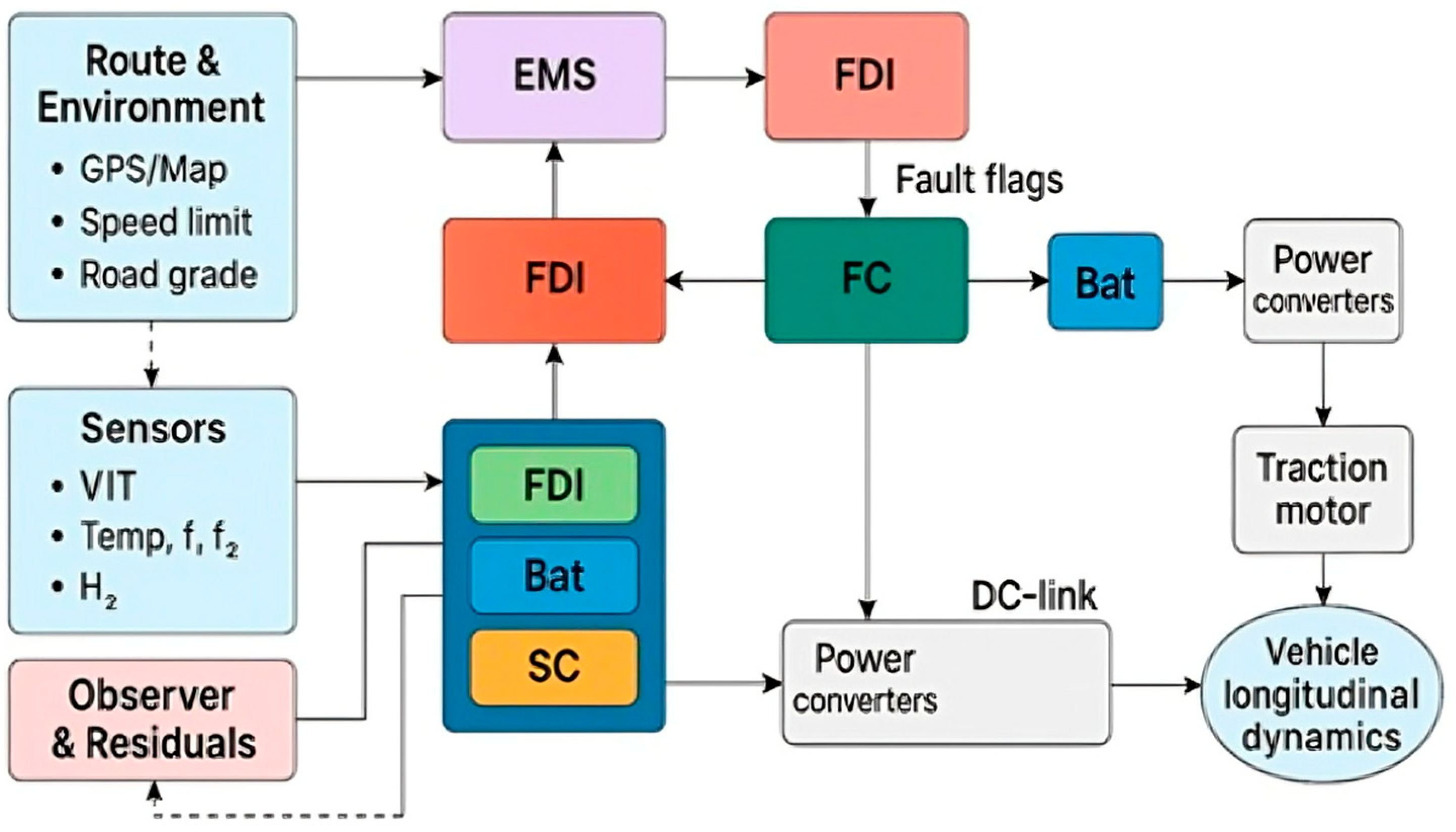
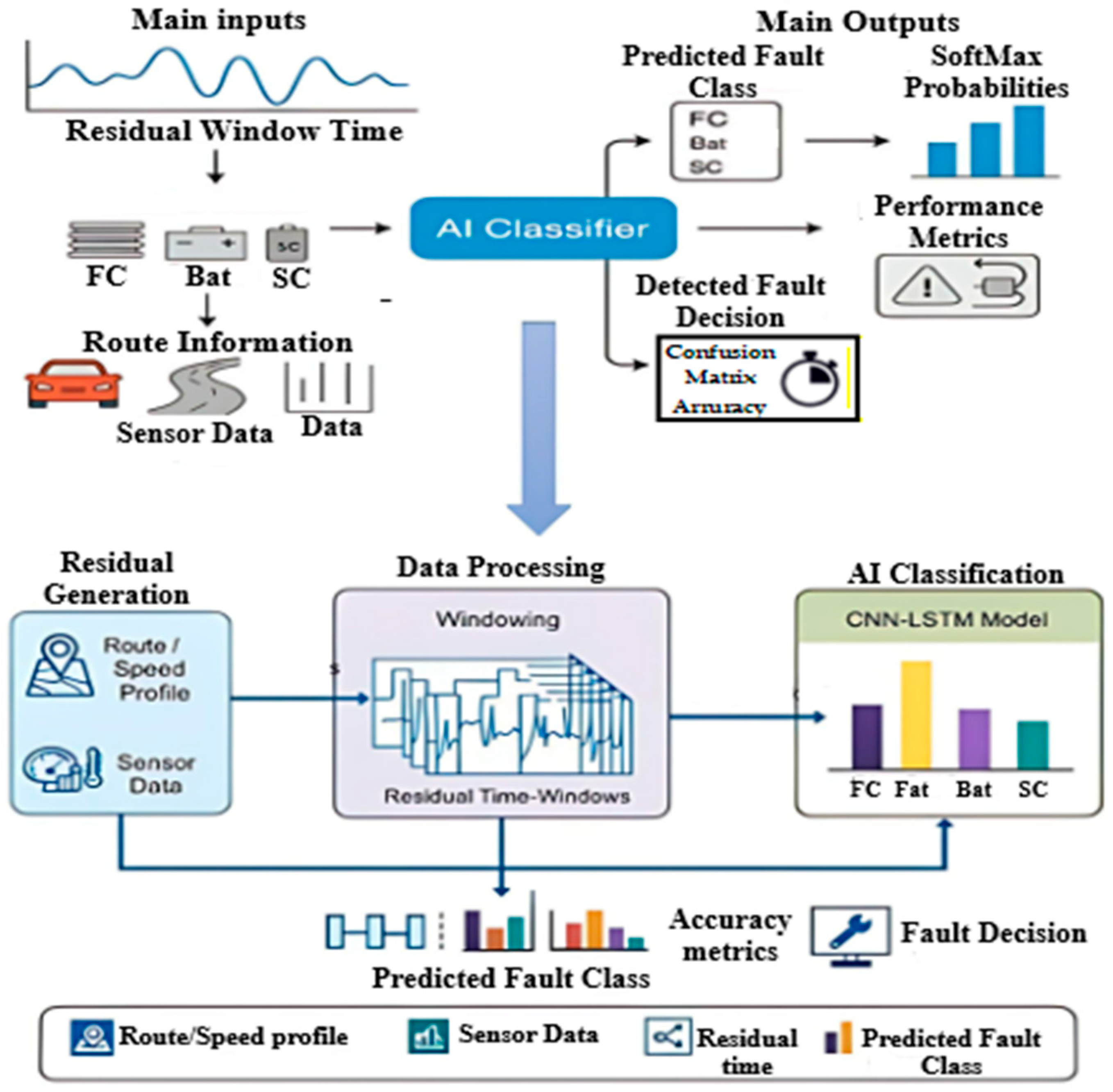
Figure 1 presents the layered architecture of the proposed route-aware EMS–FDI–FTC framework. The architecture is organized into four main layers:
- (i)
Sensing and data acquisition layer.
- (ii)
Route-aware demand estimation layer.
- (iii)
Fault detection and isolation (FDI) layer.
- (iv)
Energy management and fault-tolerant control (EMS–FTC) layer.
Each layer exchanges information through directed data flows, ensuring closed-loop integration between diagnosis and supervisory control.
As seen in
Figure 1, the arrows represent the direction of information flow between layers. Vehicle speed v(t) and road grade α(t) obtained from GPS sensors are transmitted to the route-aware demand estimation block, which computes the traction power demand. Electrical measurements (voltages, currents, SOC) are fed to the observer and residual-generation blocks within the FDI layer. Diagnostic outputs, including residuals, CUSUM indicators, EKF innovations, and AI-based fault probabilities, are transmitted to the EMS–FTC layer, which adapts power allocation commands sent back to the actuators.
3.1. Physical Power Sources and Dynamic Modeling
The propulsion system integrates three complementary energy sources: a proton-exchange membrane fuel cell (PEMFC), a lithium-ion battery (Bat), and a supercapacitor (SC). Their roles are separated according to energetic time constants: the PEMFC supplies steady-state power, the Bat supports medium-duration transients, and the SC handles fast transients and regenerative buffering. Vehicle speed profiles obtained from route datasets are used to provide realistic excitation conditions; however, all energy flows and performance indicators are computed from model-based representations of the power sources.
Since the objective of this work is real-time fault detection and fault-tolerant energy management (FDI–FTC) under software and processor-in-the-loop (SIL/PIL) constraints, each source is modeled using control-oriented lumped electrical equivalents. These models preserve voltage–current consistency and dominant electrical behavior while remaining computationally efficient. Although higher-fidelity electrochemical–thermal models exist, they are not well suited for embedded supervisory control and systematic fault injection. The adopted modeling level enables observer stability, repeatable fault scenarios, and online residual generation, and is widely used in hybrid vehicle energy management and diagnostic studies. The proposed framework is not intended to replicate a specific commercial HHEV platform, but to provide a physically consistent and reproducible benchmark for comparative evaluation across routes and fault conditions.
For clarity, positive power corresponds to propulsion demand, whereas negative power corresponds to regenerative braking. Fixed conversion efficiencies (ηFC, ηdis, ηch, ηSC) are included in the energy management strategy to account for power conversion losses.
It should be emphasized that the adopted component models are intentionally simplified to support real-time implementation and fault-tolerant control validation. Consequently, the resulting power and energy values reflect simulation-based indicators under consistent assumptions, rather than experimentally calibrated efficiencies of a specific electric vehicle platform.
3.1.1. Fuel Cell Modeling
The FC terminal voltage is approximated using a lumped equivalent circuit:
where
EN [
V] is the FC open-circuit voltage and R
FC [Ω] is the equivalent ohmic resistance. The delivered power is:
This model is widely used in PEMFC hybrid vehicle studies for EMS and diagnosis due to its simplicity and real-time suitability [
22].
Hydrogen consumption is evaluated from the FC electrical output power. The incremental hydrogen mass is computed using the lower heating value of hydrogen and the assumed FC efficiency as follows:
This formulation enables direct correspondence between the electrical energy delivered by the FC and the associated chemical energy input.
3.1.2. Battery Modeling
The Bat supplies mid-range transient power within the hybrid powertrain, with its instantaneous power defined as:
The Bat power is defined as:
and the SOC evolves using Coulomb counting:
where C
Bat is the nominal capacity. This formulation is standard in control-oriented lithium-ion Bat modeling and is appropriate for real-time energy management. The initial Bat state of charge is denoted by SOC
Bat(t = 0) [
23].
3.1.3. Supercapacitor Modeling
The SC is modeled through a capacitive dynamic:
where
VSC0 (
V) is the initial SC voltage,
CSC (
F) is the equivalent capacitance, and
ISC(
A) is the SC current. This representation is commonly adopted for fast buffering studies in hybrid energy storage systems. The initial SC voltage is denoted by
VSC(t = 0) [
24].
All initial conditions are specified prior to simulation and kept identical across all routes to ensure a fair comparison.
3.1.4. DC Link
All energy sources (FC, Bat, and SC) are interfaced with a common DC-link through bidirectional DC/DC converters. The DC-link supplies the traction inverter and electric motor and therefore acts as the power coupling bus between energy sources and propulsion load. In supervisory energy management and fault-tolerant control, the DC-link must satisfy instantaneous power continuity to ensure stable voltage regulation and uninterrupted traction.
Accordingly, the following DC-link power balance constraint is enforced:
where
Pdem denotes the demanded traction power (including auxiliary loads), and P
loss aggregates conversion and distribution losses in the DC/DC converters and wiring. In this work, losses are implicitly represented using fixed efficiency coefficients in the EMS dispatch, which is a common approach in real-time HHEV supervisory control. This formulation is widely adopted in multi-source HHEV architectures because it provides a consistent interface for energy management, residual generation, and fault-tolerant reallocation strategies [
18].
3.2. Actuator Categories and Technical Specifications
The FC–Bat–SC powertrain relies on actuators and power electronic interfaces that govern energy flow and support DC-bus stability. For clarity and reproducibility, the actuators are classified into two groups:
- ✓
Energy-source interfacing actuators (DC/DC converters): an FC unidirectional DC/DC converter for fuel cell power regulation and transient limitation; a battery bidirectional DC/DC converter enabling charge/discharge control and regenerative braking; and a supercapacitor bidirectional DC/DC converter providing fast buffering and peak-power support.
- ✓
Traction-side actuation: an inverter–motor subsystem that converts DC-bus power into traction torque through a torque (or current) reference.
In the implemented platform, the actuator power limits are set to PFC,max = 35 kW, PBat,max = 30 kW, and PSC,max = 15 kW. Nominal voltage levels are 60 V for the FC and 48 V for both the Bat and SC, with storage parameters 500 Wh (Bat) and 120 F (SC). The supervisory control actions use converter duty cycles (or current references) and the motor torque/current reference, while respecting these limits to enable reliable energy sharing and fault-tolerant reconfiguration within the EMS–FDI–FTC framework.
3.3. Sensing and Observation Layer
The sensing and observation layer provides the measurement infrastructure required for real-time supervision, residual generation, and fault diagnosis. Voltage and current sensors monitor each energy source (FC, Bat, and SC) as well as the DC-link, enabling estimation of instantaneous power contributions and enforcement of the DC-link balance constraint. Temperature measurements are also considered to prevent overheating and accelerated degradation, particularly for the battery and fuel cell subsystems.
In addition to time-domain monitoring, frequency-domain indicators f1 and f2 are extracted from selected measurement channels to capture spectral features that may reflect oscillatory behavior, converter anomalies, or incipient degradations. These indicators are computed over sliding windows and provide complementary information to residual signals by emphasizing route-dependent oscillation patterns and high-frequency disturbances. Furthermore, hydrogen flow and concentration sensors supervise the FC supply subsystem, facilitating early detection of abnormal conditions such as reactant starvation, leakage, or fuel delivery anomalies.
In the proposed framework, the sensing layer provides synchronized multichannel measurements required for both model-based residual generation and learning-based diagnosis. The voltages and currents of the fuel cell, battery, supercapacitor, and DC-link are sampled at a fixed rate and preprocessed to ensure numerical stability of observer-based computations. The resulting measurement set forms the basis of diagnostic feature extraction and is directly used to generate residuals, statistical indicators (CUSUM and EKF innovation), and structured temporal inputs for the CNN–LSTM classifier.
Measured outputs are processed by model-based observers to compute residual signals, defined as:
where
denotes the measured output vector (e.g., voltages and currents), and
represents the corresponding estimates generated by the nominal model/observer. Residual generation is a fundamental step in model-based fault detection frameworks for electrified powertrains, as persistent deviations typically indicate parameter changes, sensor biases, or actuator faults [
25]. In this study, the residuals form the primary diagnostic features and are subsequently used both for statistical change detection and for CNN–LSTM temporal classification.
3.4. Fault Detection and Isolation (FDI) Layer
The fault detection and isolation (FDI) layer integrates statistical change detection and state-estimation-based monitoring to achieve early fault identification under operating variability. Two complementary mechanisms are employed to improve robustness:
- (i)
CUSUM change detection for persistent mean shifts in residuals;
- (ii)
EKF-based innovation monitoring for consistency checking under modeling uncertainty.
Abrupt and incipient faults are detected using the cumulative sum (CUSUM) algorithm applied to each residual signal:
where k is the drift sensitivity parameter controlling detection responsiveness. A fault is declared when either statistic exceeds a predefined threshold h, which allows detection of small but persistent residual deviations while filtering transient fluctuations. CUSUM is widely used in fault diagnosis because of its effectiveness in detecting parameter drifts and incipient degradation.
In parallel, an extended Kalman filter (EKF) is employed as a lightweight observer to track nominal electrical behavior and generate predictive fault indicators under uncertainty. The EKF is designed to remain computationally efficient and suitable for real-time integration in SIL/PIL conditions, while preserving sensitivity to persistent deviations induced by component degradations. The EKF state vector is defined as:
while the measured output vector includes the corresponding monitored signals:
This formulation focuses on tracking nominal voltage and energy-related states; in this implementation, the EKF does not explicitly estimate physical parameters at each step. Instead, parameter degradations (e.g., increases in RBat, changes in RFC, or capacitance loss CSC) manifest as structured deviations in residuals and innovation signals, which are then exploited for fault detection and isolation.
The EKF produces the innovation-based monitoring statistic:
where
P(
k) denotes the innovation covariance and ϵ is a small regularization term. Under healthy conditions,
ν(
k) remains bounded, whereas persistent faults produce sustained innovation growth.
It should be noted that the parameters
RFC,
RBat, and
CSC represent lumped equivalents influenced by aging, thermal variation, and unmodeled electrochemical dynamics. Consequently, mild model mismatch typically produces short transient residual and innovation excursions during abrupt load changes or strong route-dependent disturbances. In contrast, injected faults generate persistent shifts in residual means and sustained innovation growth (see
Table 1). This persistence property is exploited by the combined CUSUM–EKF monitoring logic and is further captured by the CNN–LSTM temporal classifier, which learns the characteristic time evolution of fault signatures and improves isolation performance across heterogeneous routes.
Finally, the resulting statistical indicators and innovation signals are combined to isolate fault types such as FC voltage sag, Bat degradation (internal resistance increase), and SC capacitance loss. Diagnostic flags are forwarded to the EMS and fault-tolerant control modules to trigger corrective power reallocation. Furthermore, the residual and innovation trajectories serve as structured inputs to the CNN–LSTM classifier, enabling improved fault classification performance under route-dependent operating conditions [
26].
4. Energy Management System (EMS) Based on AI Fault Detection
The energy management system (EMS) is designed to satisfy the traction power demand while minimizing energy interruption and limiting hydrogen consumption under operational constraints and fault conditions. In this framework, energy optimization is achieved through coordinated power sharing among the FC, Bat, and SC, with real-time reconfiguration when a fault is detected. The main sources of energy loss in the considered FC–Bat–SC architecture arise from non-ideal FC conversion efficiency, power electronic conversion losses in the DC/DC stages and traction inverter, and internal dissipation in the Bat and SC during high-current operation. These losses become more pronounced when aggressive driving dynamics impose large transient power peaks, or when fault-tolerant operation requires healthy sources to compensate for a degraded branch. Accordingly, the proposed diagnosis-driven EMS–FDI–FTC strategy improves energy utilization by reallocating power to avoid saturation and reduce not-served energy, while preserving state-of-charge limits and limiting excessive hydrogen usage during fault intervals.
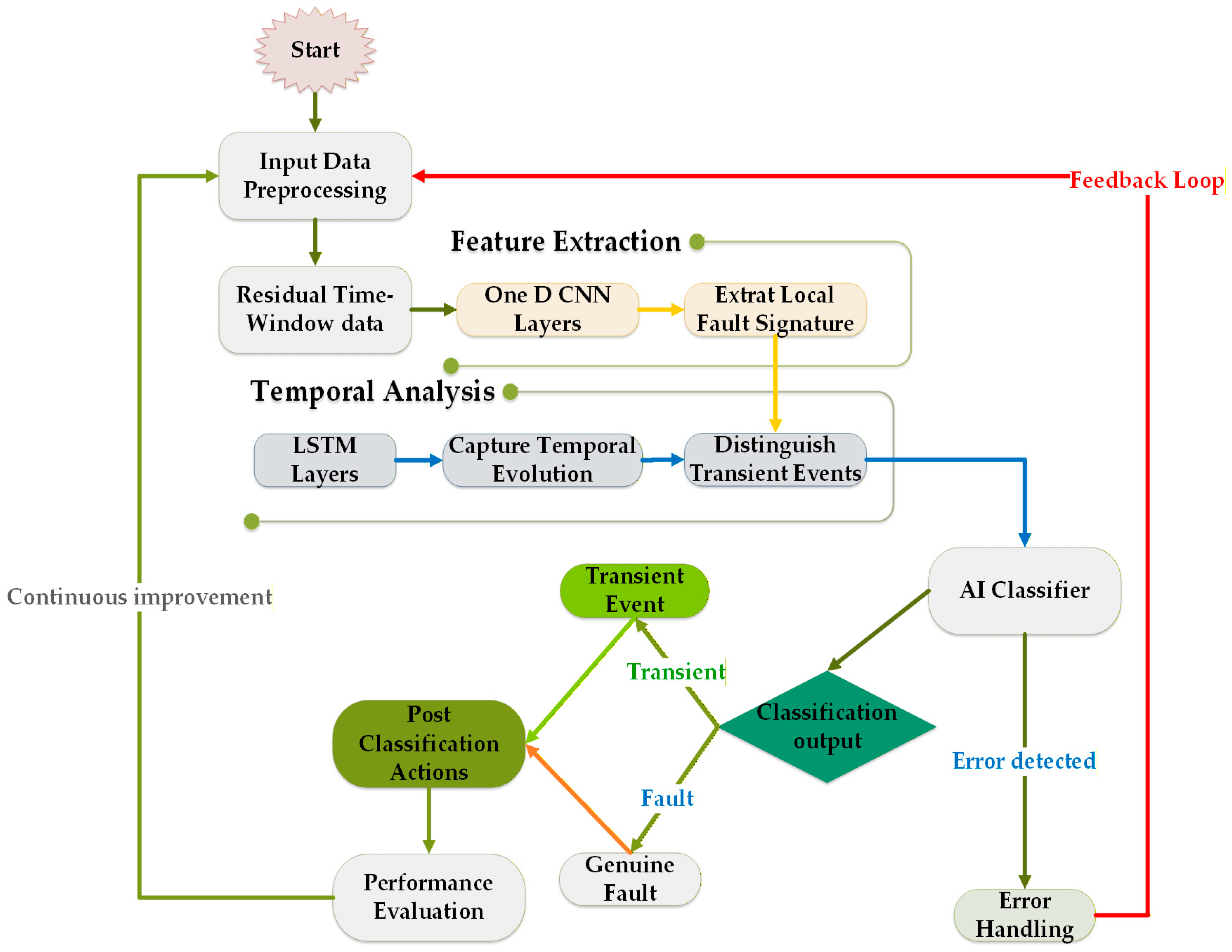
Figure 2 illustrates the workflow of the AI-assisted fault diagnosis module. Measured electrical signals are first processed through model-based observers to generate residuals. These residuals are then analyzed using CUSUM and EKF innovation metrics, segmented into temporal windows, and finally classified by the CNN–LSTM model to estimate fault probabilities. The classifier outputs subsystem fault probabilities that are integrated into the EMS decision loop and used to drive the mode transitions.
4.1. EMS Operational Framework
The EMS operates as a state-based supervisory controller driven by three classes of inputs:
- ✓
Driving demand estimation: vehicle speed v(t), acceleration
, and road grade θ(t) derived from route/GPS information are used to estimate the demanded traction power
PLoad(
t), computed according to vehicle longitudinal dynamics [
27]:
- ✓
Energy source states: electrical and physical measurements are collected from FC, Bat, and SC subsystems (voltages, currents, temperatures, hydrogen flow/concentration, and battery SOC). These signals define energetic constraints (SOC bounds, power limits) and safety constraints (temperature and hydrogen supply conditions).
- ✓
Health and diagnostic information: the FDI layer provides statistical indicators (CUSUM and EKF innovation) and AI-based fault probabilities. These outputs are used to adapt EMS operating modes and reconfigure power-sharing in real time.
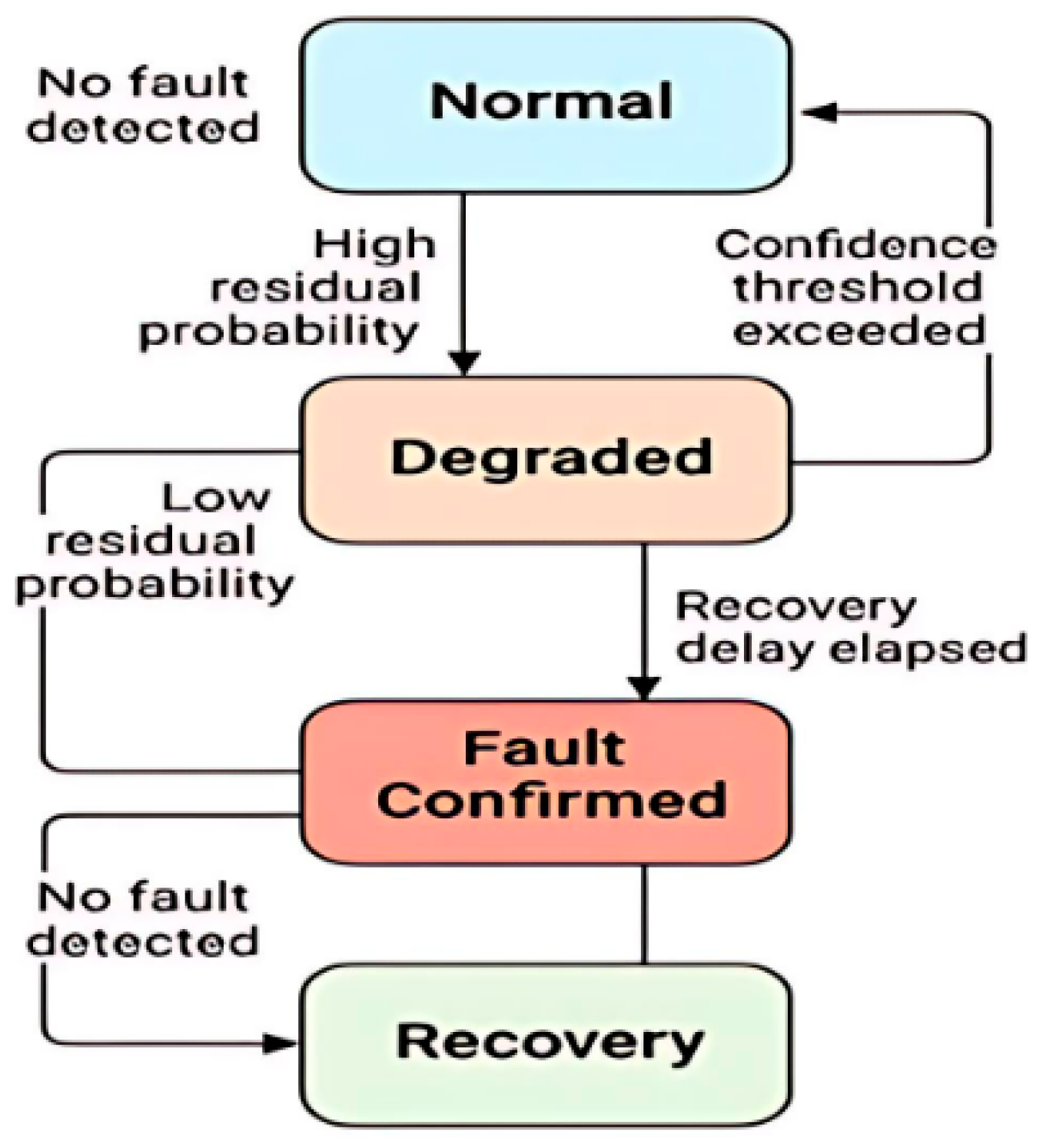
Figure 3 depicts the state-based supervisory logic of the EMS. Based on diagnostic confidence and persistence, the system transitions between Normal, Degraded, Fault Confirmed, and Recovery modes. Each state determines the corresponding power allocation and fault-tolerant reconfiguration strategy.
The proposed EMS formulation explicitly accounts for variable load conditions through the route-dependent traction power PLoad, which is computed from longitudinal dynamics and varies with speed, acceleration, road grade, and vehicle parameters. Power-supply constraints are enforced through the rated limits of the FC, Bat, and SC converters, together with SOC and voltage bounds used by the supervisory controller. In contrast, variables such as alignment and spacing are related to mechanical design and packaging considerations and are not explicitly modeled in the present electrical EMS–FDI–FTC framework.
4.2. Power Allocation in Normal Operating Mode
Under healthy conditions, the EMS distributes the demanded power among the FC, Bat, and SC according to their complementary dynamic characteristics. The fuel cell supplies the slow-varying base power at high efficiency, the battery provides mid-frequency support and voltage regulation, and the supercapacitor compensates fast transients and absorbs regenerative braking peaks. The nominal power allocation is expressed as [
28]:
where the coefficients
kFC and
kBat are adaptively updated based on Bat SOC limits, FC ramp-rate constraints, and efficiency considerations. This hierarchical power-sharing strategy is widely adopted in FC–Bat–SC hybrid vehicles due to its simplicity, robustness, and suitability for real-time implementation.
4.3. Performance Metrics and Energy Analysis
To ensure a transparent and reproducible assessment of energy performance, the energy analysis is conducted in a sequential manner. First, instantaneous power demand (Pdem) and supply (Psup) are evaluated at each sampling instant. Next, the corresponding energy quantities are obtained through numerical integration over the driving cycle. Finally, service efficiency indicators are derived from the ratio between supplied and demanded energy.
In fact, the total supplied power from the FC, Bat, and SC is defined as:
Any deficit between demand and supply is explicitly accounted for as power not served which is expressed as:
The served energy and the energy-not-served (ENS) are then obtained by numerical integration over the driving cycle as:
The total demanded energy, guaranteeing consistency between instantaneous power imbalance and cumulative energy metrics, satisfies:
Based on the above formulation, an energy service efficiency is defined as:
This metric quantifies the capability of the energy management and fault-tolerant control system to satisfy traction energy demand under fault conditions. Unlike component-level or drivetrain efficiency measures, the service efficiency ηservice evaluates demand satisfaction at the system level, which constitutes the primary objective of the proposed fault-tolerant strategy. All power variables are expressed in kilowatts (kW) and energy quantities in kilowatt-hours (kWh). Numerical integration is performed using the supervisory control sampling period, where positive power denotes traction demand and negative power corresponds to regenerative operation.
4.4. Embedded AI-Based Fault Detection in EMS
Fault detection is embedded directly into the EMS decision loop to enable fault-aware supervisory control. The proposed diagnosis mechanism operates through two coordinated levels.
4.4.1. Model-Based Residual Generation
A model-based estimation layer (EKF observer) generates predicted subsystem outputs
ŷ(
t) based on nominal dynamics, from which residual signals are obtained. These residuals capture deviations caused by parametric drift, fuel starvation, or sensor abnormalities, as illustrated in
Figure 4.
4.4.2. CNN–LSTM Classification: Input Channels, Windowing, and Normalization
To enhance robustness under uncertain and route-dependent driving conditions, the residual-based diagnostic signals are processed by a CNN–LSTM classifier trained on multivariate temporal sequences. In the present implementation, the model operates on six feature channels per time step (F = 6), defined as:
Signals are sampled at fs = 10 Hz (Ts = 0.1 s) and segmented into overlapping sliding windows of nominal duration Tw = 2.0 with a hop size of 0.5 s, corresponding to 75% overlap. In practice, a minimum sequence length of 32 samples is enforced to satisfy network input constraints, resulting in an effective window duration of approximately 3.2 s at 10 Hz. This windowing strategy increases sensitivity to persistent faults while enabling the convolutional layers to capture localized fault signatures and the LSTM units to model temporal evolution across operating conditions.
To prevent scale dominance across channels and improve convergence, each window is normalized using channel-wise z-score normalization:
where
μw and
σw denote the mean and standard deviation computed over the window for each channel, and ε is a small constant introduced for numerical stability. This normalization reduces route-dependent amplitude bias and improves generalization across heterogeneous driving patterns.
4.4.3. Network Architecture and Training Hyperparameters
The CNN–LSTM model combines convolutional feature extraction with recurrent temporal modeling to classify fault conditions from multichannel residual windows. The architecture consists of two one-dimensional convolution blocks followed by an LSTM unit and a SoftMax output layer. Each convolution block uses kernel size 3 with filter sizes (16, 32), followed by batch normalization, ReLU activation, and max pooling (stride 2). The extracted feature maps are then fed into an LSTM layer with 64 hidden units (OutputMode = last), followed by dropout (0.3) to reduce overfitting. The final layer is a fully connected SoftMax classifier producing posterior probabilities over the defined operating conditions (healthy, single-subsystem faults, and multi-fault).
Training is performed using the Adam optimizer with an initial learning rate of 10−3, mini-batch size 32, and a maximum of 30 epochs. The loss function is categorical cross-entropy. Validation is conducted using a hold-out split (75% training/25% validation) to monitor convergence and estimate generalization during training. For the proposed leave-one-route-out (LORO) evaluation, the network is trained using sequences from two routes and tested on the remaining unseen route.
4.4.4. Route-Based Validation and Leakage Prevention
To evaluate diagnostic generalization under unseen driving conditions and prevent data leakage, a leave-one-route-out (LORO) protocol is adopted. Under this procedure, the CNN–LSTM is trained on two routes and tested on the remaining unseen route, and the process is repeated for all route splits. All sliding windows extracted from a given route are assigned exclusively to either training or testing, ensuring that temporally correlated segments from the same route cannot appear in both partitions. This route-level separation avoids optimistic bias caused by repeated traffic patterns or correlated residual traces and provides a realistic assessment of robustness under route-dependent variability.
Reproducibility is further ensured by fixing and explicitly reporting all signal-processing settings, network hyperparameters, and decision thresholds across all splits. Residual monitoring thresholds are defined a priori as TFC = 1.2, TBat = 6, and TSC = 6, while the CUSUM detector uses drift parameter k = 0.3 and decision threshold h = 3.5. The EKF gating parameter is set to γEKF = 4.0.
Finally, to guarantee that route-based validation relies on consistent and noise-robust inputs, all GPS-derived speed and elevation profiles are preprocessed using a fixed pipeline before sequence extraction. Signals are synchronized and resampled to fs = 10 Hz; short dropouts are corrected via linear interpolation; and measurement noise is reduced using moving-average smoothing (0.5 s window). Road grade is computed from the filtered elevation profile using finite differences α(s) = Δh/Δs and subsequently low-pass filtered to suppress fluctuations caused by GPS quantization. The resulting speed v(t) and grade α(t) are then used to generate traction demand profiles consistently across routes, ensuring valid cross-route comparison and stable residual excitation for diagnosis.
4.4.5. Fault Decision Logic and Integration into EMS
The CNN–LSTM outputs a probabilistic fault vector:
where each element represents the posterior likelihood of the corresponding operating condition (healthy, single-subsystem fault, or multi-fault). Fault declaration is based on both classification confidence and temporal persistence to enhance robustness under route-dependent transients. Specifically, a fault class is accepted only if the maximum predicted probability satisfies:
where γ is a confidence threshold; additionally, the predicted class argmax(p(t)) must remain unchanged for at least
Ndet consecutive overlapping windows. This persistence mechanism suppresses spurious detections caused by measurement noise or short-lived disturbances and improves discrimination between transient deviations and sustained faults. In this study, γ = 0.80 and
Ndet = 3 were used, corresponding to an effective persistence duration of approximately 1.5 s given the 0.5 s hop size. The resulting diagnostic decision is then forwarded to the energy management system to enable mode transitions and health-aware power reallocation [
29].
Figure 4 presents the structure of the CNN–LSTM classifier used for fault classification. Convolutional layers extract local temporal features from residual signals, while the LSTM layer captures long-term dependencies, enabling robust discrimination between transient disturbances and persistent faults.
4.5. Fault-Tolerant EMS Reconfiguration and Optimization
When a fault is confirmed, the EMS transitions to a degraded operating mode in which power references are reallocated to reduce stress on the affected subsystem while preserving propulsion continuity. The reconfigured power commands are expressed as [
30]:
where
αFC(
t),
αBat(
t), and
αSC(
t) are reconfiguration coefficients adjusted according to fault severity and subsystem availability estimated by the CNN–LSTM classifier. This adaptive redistribution limit’s fault propagation and avoids excessive stress on healthy components.
In parallel, the EMS solves a multi-objective optimization problem subject to operational constraints on fuel cell power, battery SOC, and DC-link voltage:
subject to:
,
, and power limits
.
This fault-aware supervisory strategy is implemented in a rule-based predictive framework suitable for real-time embedded deployment and high-fidelity SIL/PIL simulation.
5. Results
This section evaluates the proposed AI-assisted energy management system (EMS) integrating a hybrid model-based/data-driven fault diagnosis scheme and a fault-tolerant control (FTC) mechanism under three representative driving routes. The key objective is to demonstrate that the EMS can allocate power efficiently under route-dependent driving demand, detect and classify faults robustly despite modeling uncertainty and operating variability, and reconfigure power allocation to maintain service continuity with minimal energy interruption and fuel penalty.
To ensure generalization, the CNN–LSTM classifier is validated using a Leave-One-Route-Out (LORO) strategy, where the model is trained on two routes and tested on the unseen remaining route. This is a particularly rigorous validation protocol, since it exposes the learning model to unseen dynamics, power demand patterns, and residual statistics.
5.1. Real-Route Driving Profiles
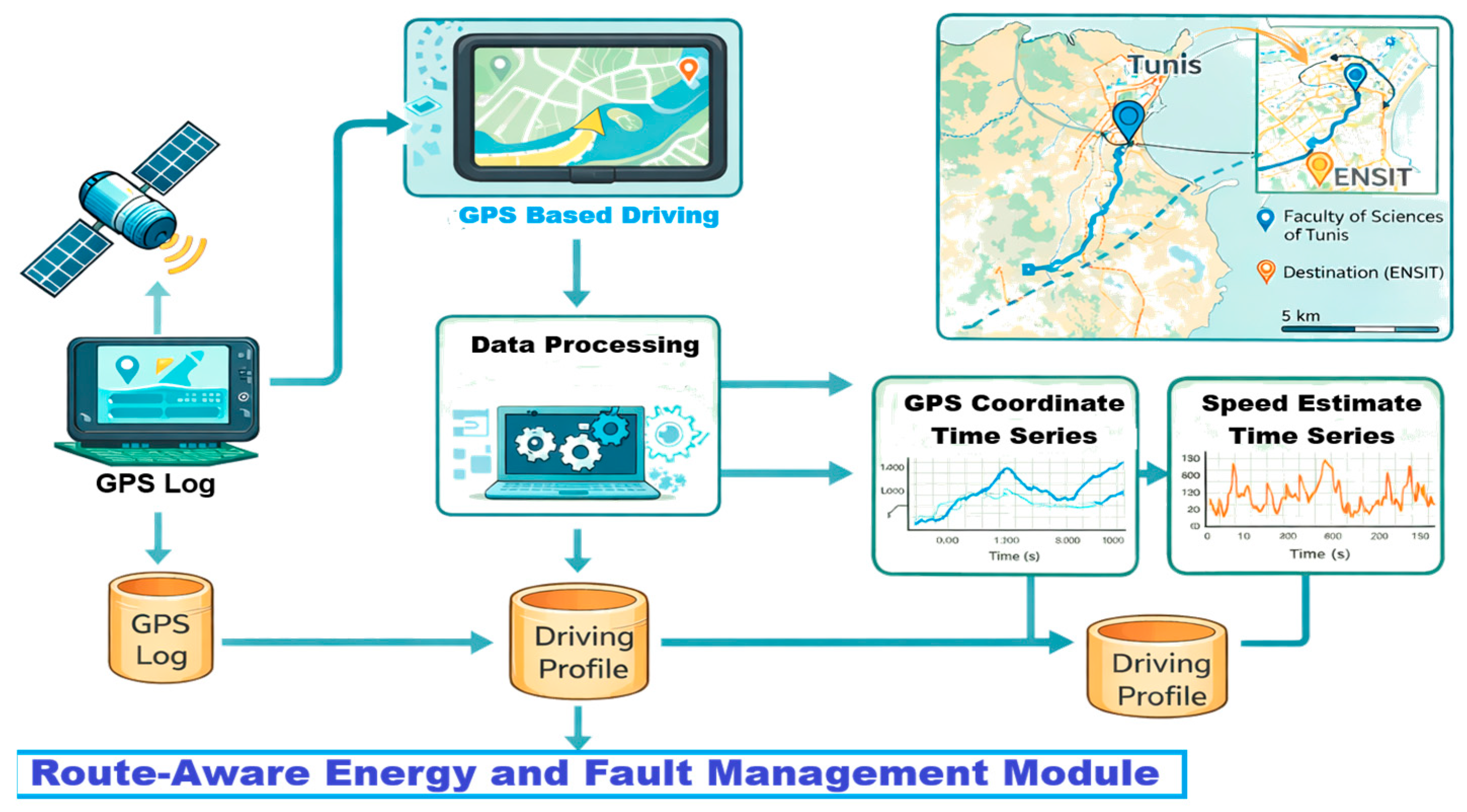
To address the need for validation under real-world operating conditions, this study relies on measured GPS-based driving data rather than synthetic or standardized driving cycles. The vehicle was driven on a real route in Tunis (from Faculty of Sciences of Tunis (FST) to National School of Engineers of Tunis (ENSIT)), and the speed was recorded using GPS throughout the trip (see
Figure 5). These real-route speed traces were then processed and used as inputs for route-aware traction power demand generation.
Three representative driving routes (Routes 1–3) were selected to reflect different levels of speed fluctuations and traction power demand severity.
Table 2 summarizes the key characteristics of the collected dataset.
These real-route profiles are used to generate traction demand, while the corresponding electrical responses of the FC, Bat, and SC are obtained using the SIL/PIL simulation platform. This setup enables repeatable evaluation of fault diagnosis and fault-tolerant energy management under route-dependent driving conditions.
5.2. Fault Injection Scenarios and Profiles
To ensure reproducibility and to evaluate the proposed fault detection, isolation, and fault-tolerant control (FDI–FTC) strategy under comparable conditions, representative faults are injected directly into the component model parameters with explicitly defined magnitudes and onset times. Each fault is applied individually (single-fault assumption) in order to avoid ambiguity arising from overlapping signatures and to enable a clear assessment of isolation performance. Fault activation is defined using a normalized onset time
t0 ∈ [0, 1], such that the fault begins at the absolute time
tf =
t0T, where T denotes the total route duration. In all scenarios, the fault is introduced as an abrupt step change at t = t
f and remains persistent until the end of the driving cycle. The injected fault cases are summarized in
Table 3.
All faults are implemented as abrupt step changes and remain persistent after activation (), where T denotes the total route duration.
5.3. Comparative FDI Performance
The not-served power PNS denotes the instantaneous deficit between the demanded traction power and the delivered power when source limits or faults prevent full supply; its integral over time yields the energy-not-served (ENS).
These plots show that residuals remain bounded during nominal transients but exhibit persistent shifts after fault onset, which triggers the diagnostic flags. This behavior supports reliable fault detection under route-dependent excitation.
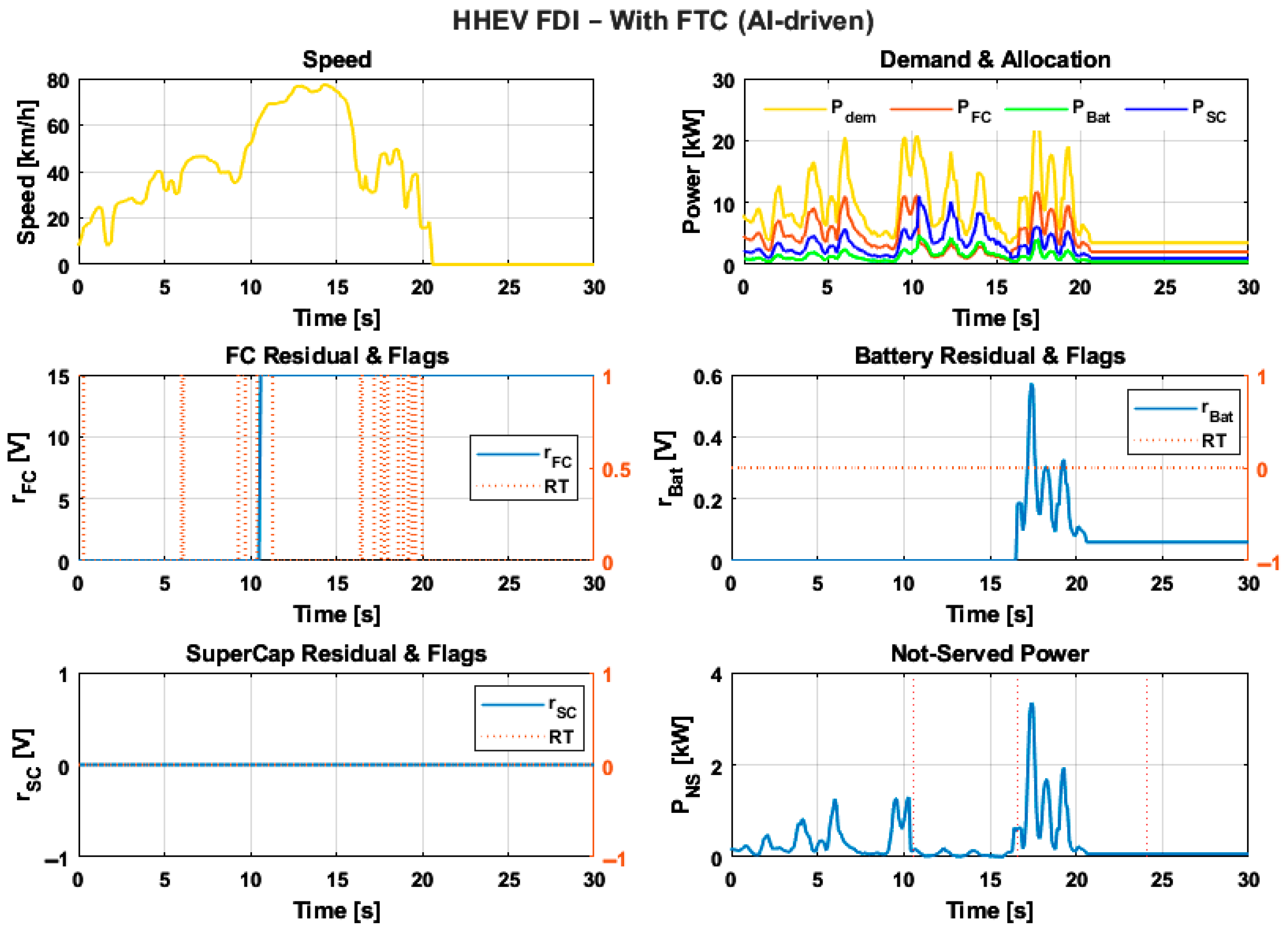
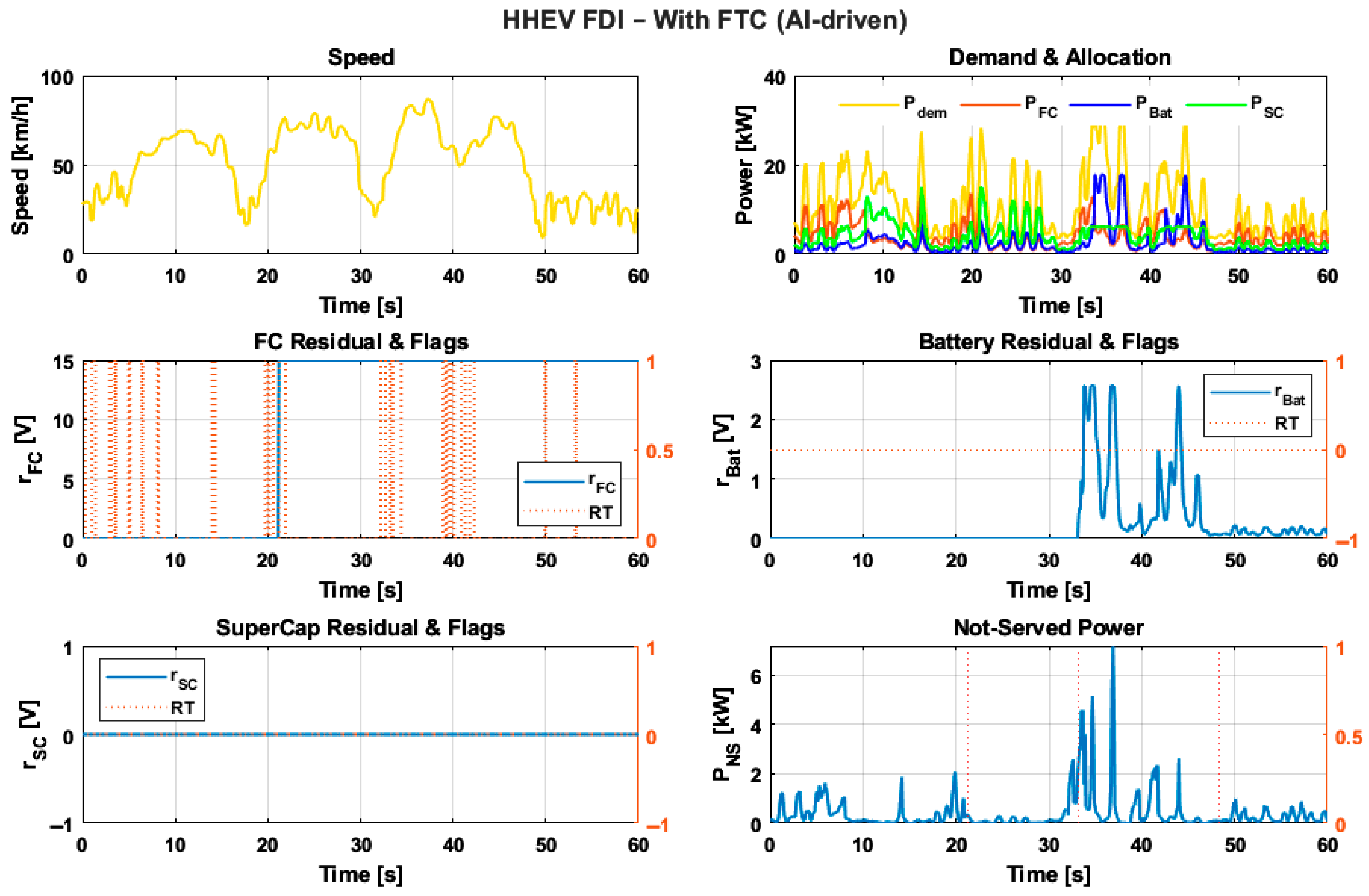
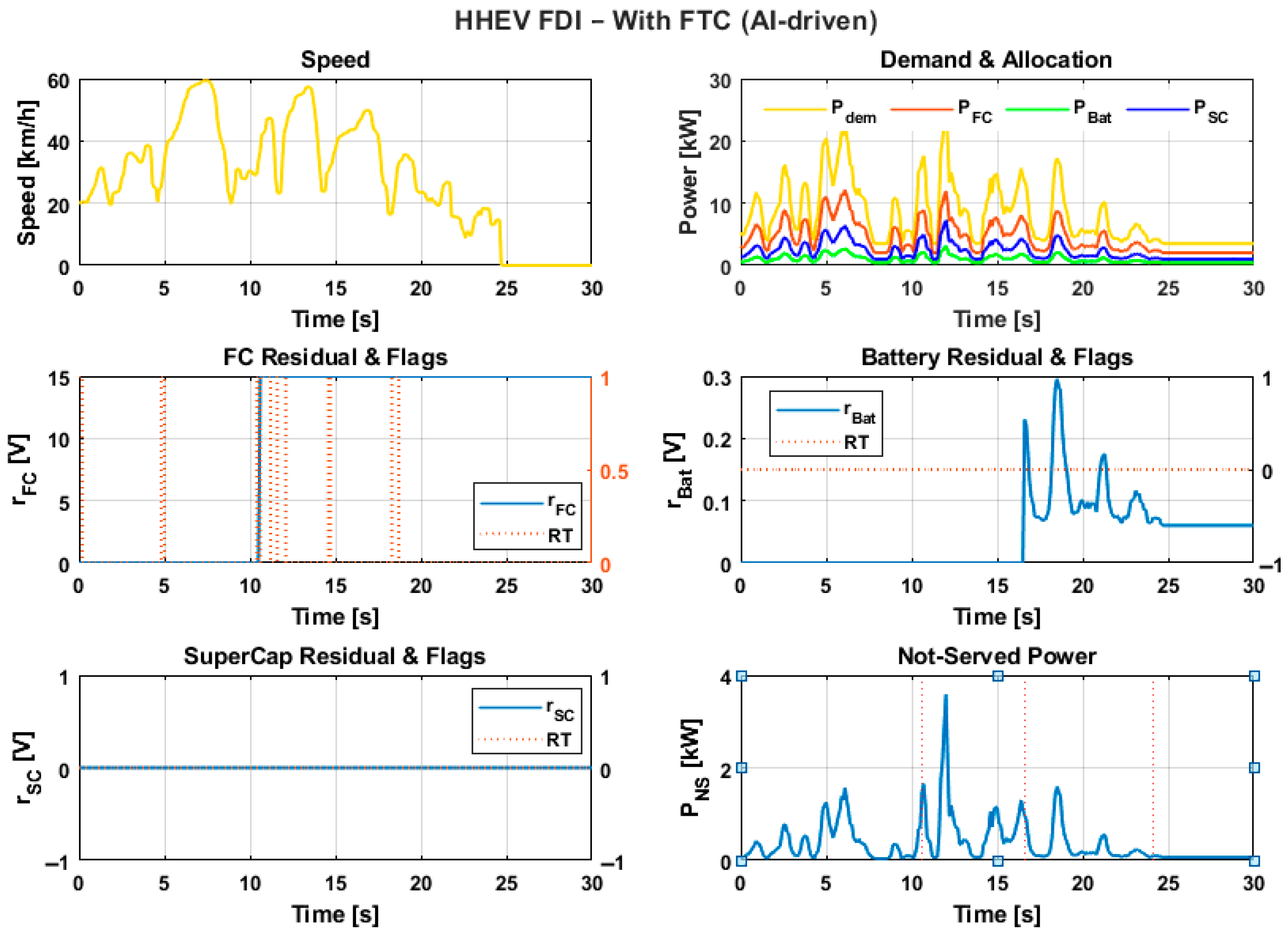
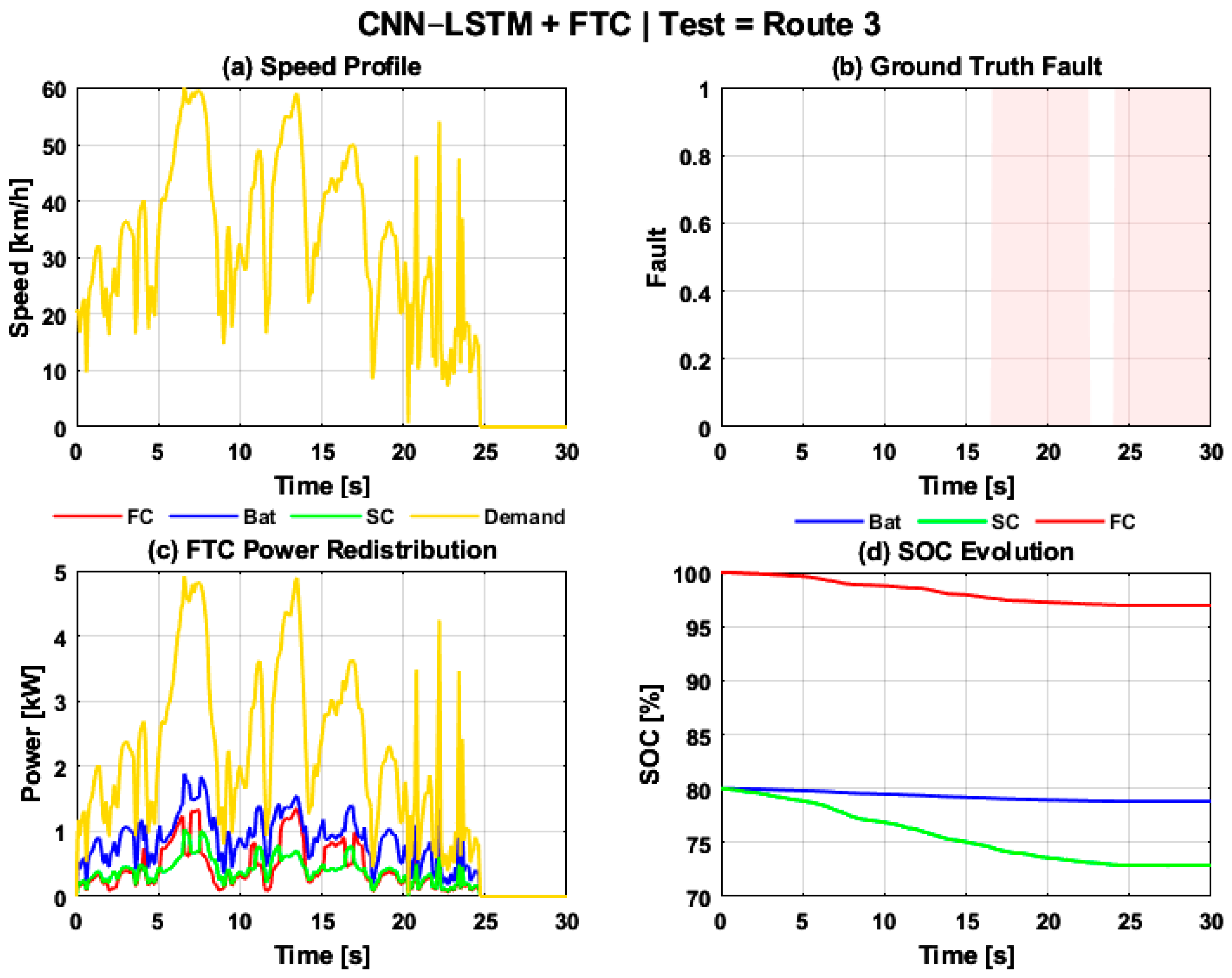
Figure 6,
Figure 7 and
Figure 8 present the speed profiles, route-based traction power demand, source power allocation, residual evolution, diagnostic flags, and not-served power for Routes 1–3. Across all routes, the fuel cell supplies the base-load component, while the battery and supercapacitor provide transient support and absorb regenerative energy.
In these figures, Demand denotes the traction power request
PLoad, and Allocation denotes the dispatched source powers
PFC,
PBat, and
PSC, which satisfy the DC-link power balance under operational constraints. Residuals correspond to the observer-based differences between measured and estimated variables (
Table 1), and Flags indicate the time instants when faults are detected and confirmed by the FDI logic. The not-served power PNS represents the instantaneous deficit between demanded and delivered traction power when source limits or faults prevent full supply; its time integral yields the energy-not-served (ENS).
In the adopted control-oriented models, RFC, RBat, and CSC are represented as lumped equivalent parameters. Under nominal operation, residuals remain close to zero with short transient excursions during rapid load changes. After fault activation, persistent deviations appear in the corresponding residual channels and trigger the diagnostic flags, while residuals of healthy branches remain near zero, indicating limited cross-coupling.
Among the evaluated routes, Route 2 produces the highest speed variability and traction power peaks, which results in larger residual fluctuations and higher not-served power during fault intervals. Route 3 exhibits smoother demand dynamics and lower residual variance, while Route 1 shows intermediate behavior consistent with moderate urban excitation.
5.4. Fault-Tolerant Control (FTC) and AI-Based Fault Classification Analysis
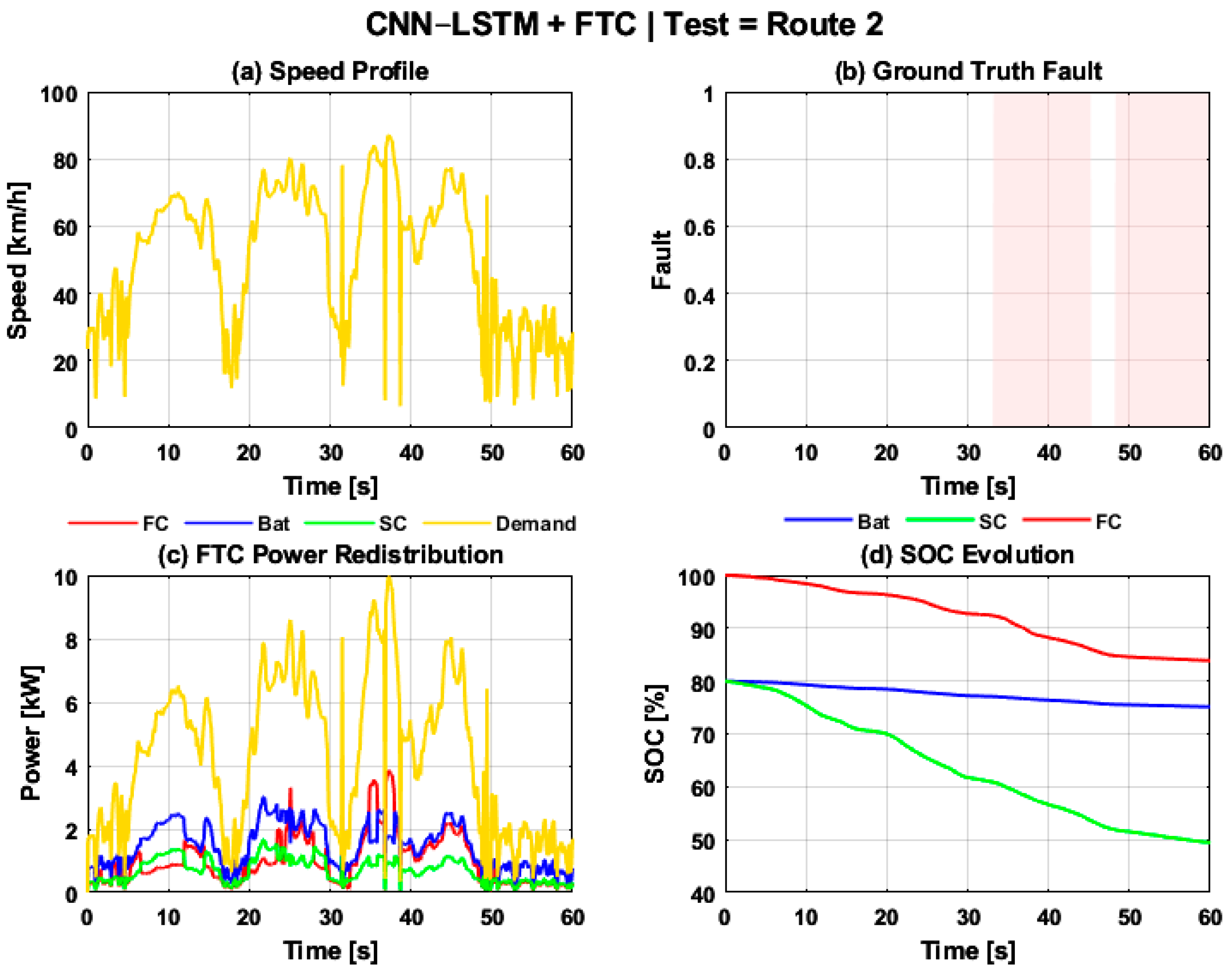
Figure 9,
Figure 10 and
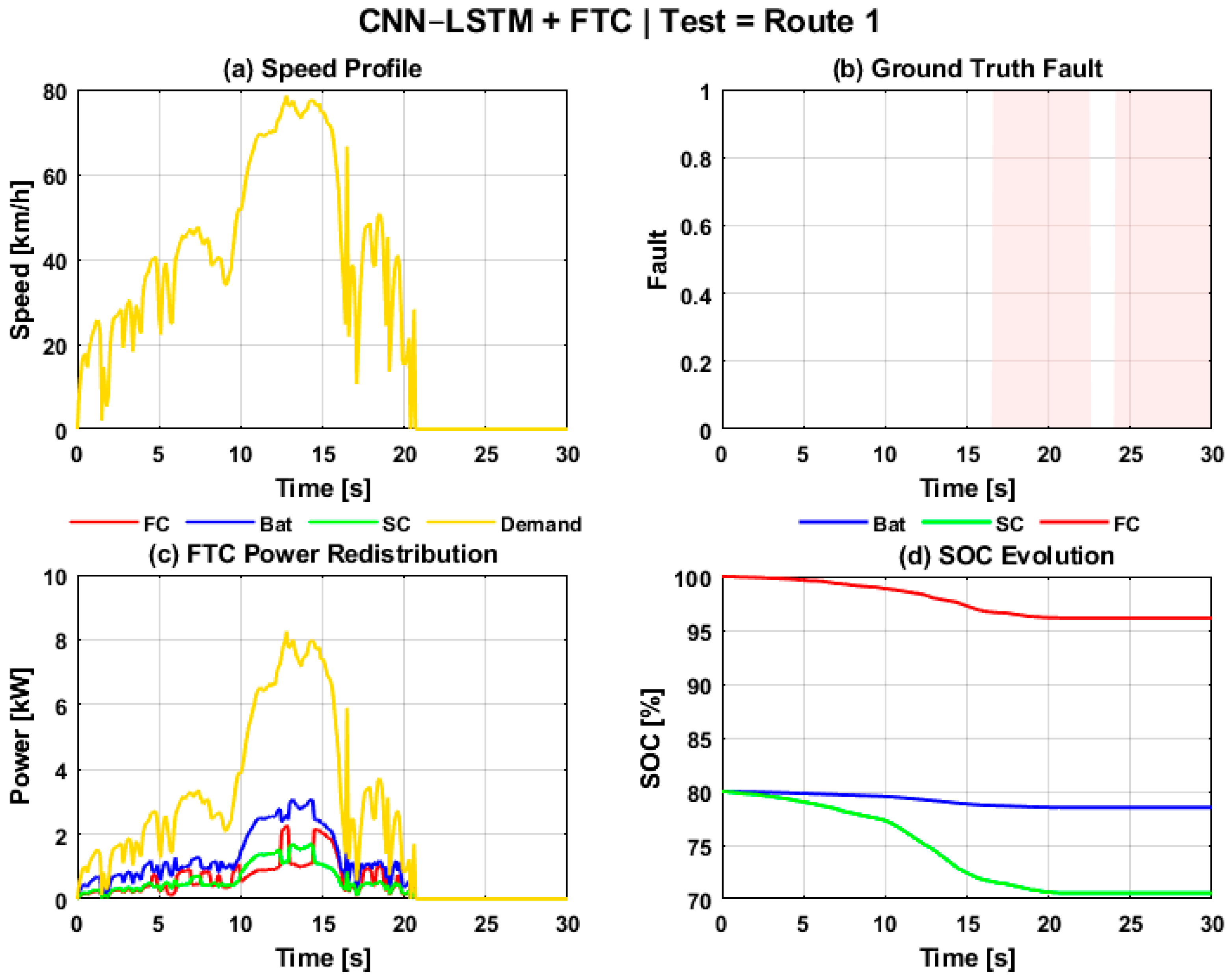
Figure 11 report the fault-tolerant control (FTC) behavior for Routes 1–3. After fault detection, the controller reduces the power contribution of the faulty branch and reallocates the remaining demand among the healthy sources according to the reconfiguration logic. During FC degradation intervals, the Bat and SC increase their power output to compensate for the reduced FC contribution, thereby maintaining traction power delivery close to the reference while respecting power and state-of-charge (SOC) constraints. This reconfiguration is activated after fault confirmation and remains effective until the end of the driving route.
For Route 1, after fault onset, the FC contribution decreases while the Bat and SC outputs increase smoothly. The Bat SOC decreases moderately due to the additional energy support, whereas the SC SOC remains within a narrow operating range with small oscillations associated with transient buffering.
For Route 2, larger acceleration events and higher power peaks increase transient compensation requirements, resulting in more pronounced variations in the redistributed source power profiles, larger SOC excursions, and higher not-served power peaks during fault intervals.
For Route 3, the redistributed power profiles are smoother and SOC variation is reduced compared to the other routes, which is consistent with the lower variability of the underlying traction demand.
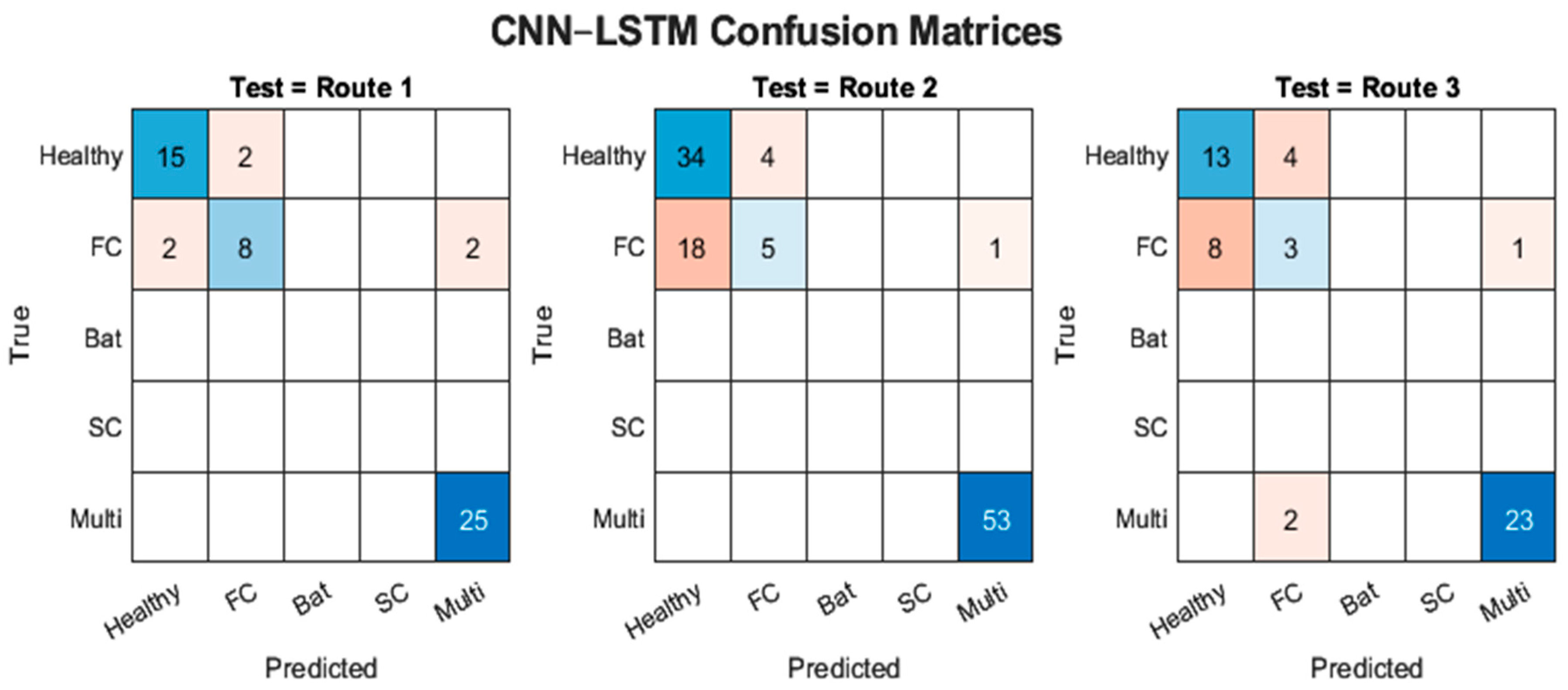
The CNN–LSTM module is evaluated using a leave-one-route-out (LORO) validation strategy, where the network is trained on two routes and tested on the remaining unseen route. The confusion matrices in
Figure 12 summarize the classification results. Route 1 achieves the highest window-level accuracy (87.04%), followed by Route 2 (74.78%) and Route 3 (68.52%).
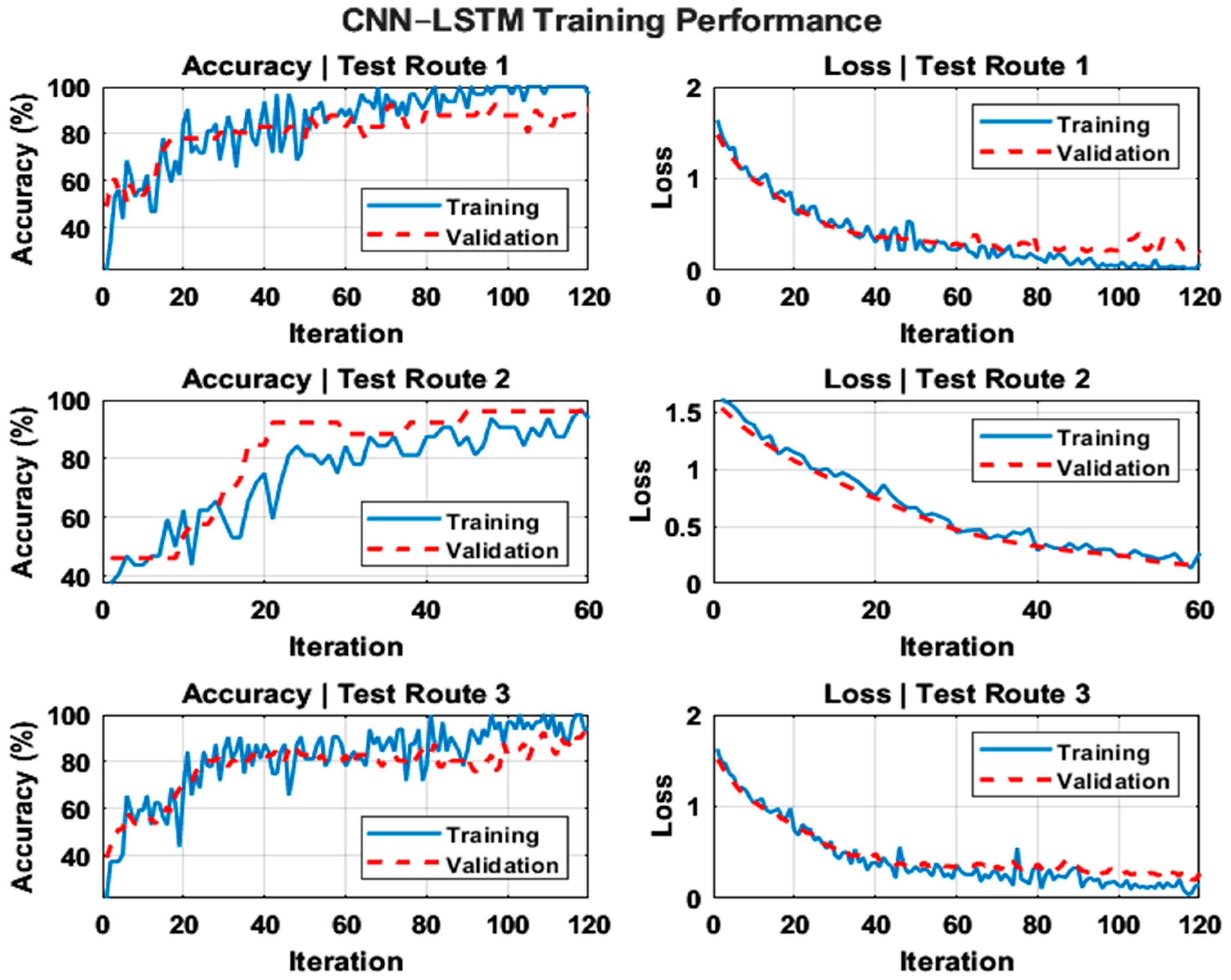
The training curves in
Figure 13 show stable convergence across the three training/testing splits, with validation trends remaining consistent with training behavior.
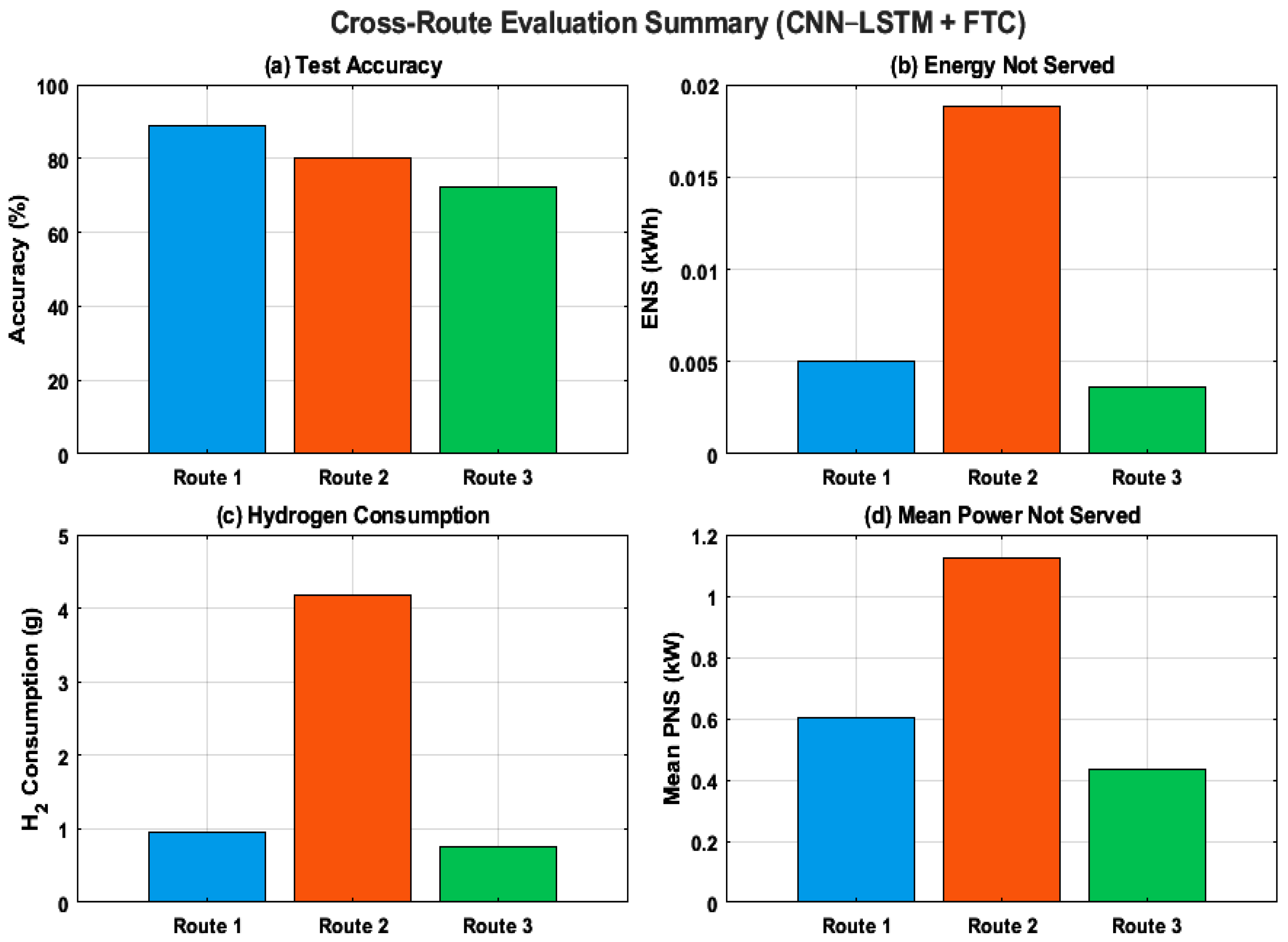
Figure 14 and
Table 4 summarize the quantitative performance across routes, including classification accuracy, energy served (ES), energy not served (ENS), mean not-served power, final battery SOC, hydrogen consumption, and the number of training sequences. Route 2 yields the highest hydrogen consumption (3.2274 g), the highest ENS (0.01883 kWh), and the largest mean not-served power (1.1222 kW). Route 1 achieves the highest classification accuracy (87.04%), while Route 3 produces the lowest ENS (0.00366 kWh), the lowest mean not-served power (0.4364 kW), and the lowest hydrogen consumption (0.6071 g).
All reported accuracy values correspond to the same evaluation metric (window-level accuracy under LORO testing).
5.5. SIL–PIL Validation and Route Selection
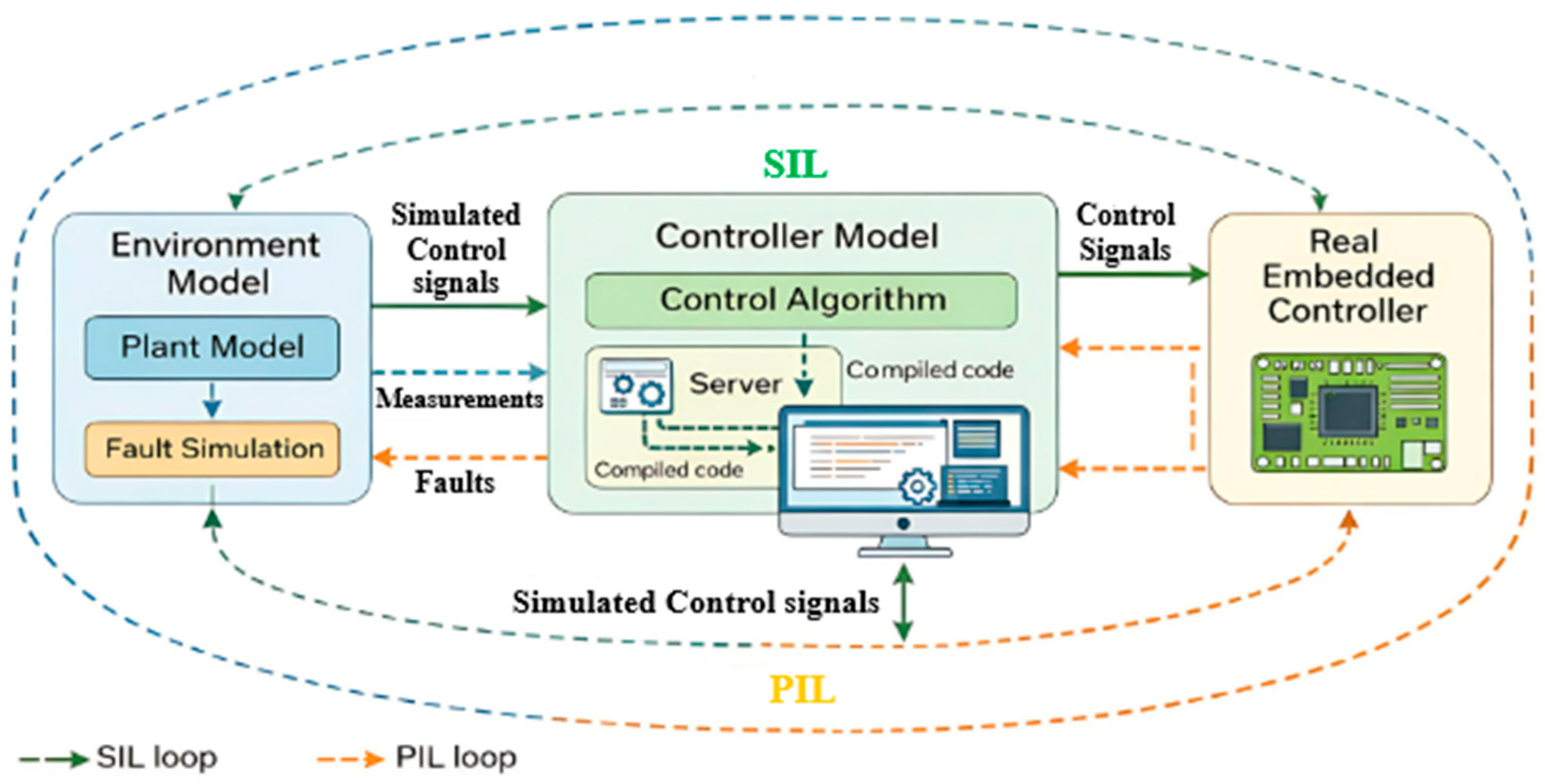
The proposed fault detection and fault-tolerant control (FDI–FTC) framework was validated under both software-in-the-loop (SIL) and processor-in-the-loop (PIL) conditions to assess functional consistency and embedded real-time feasibility (see
Figure 15). In the SIL configuration, the closed-loop system was executed in MATLAB/Simulink 2022b. In the PIL configuration, the supervisory controller including the FDI layer, energy management logic, and FTC reconfiguration strategy was deployed on an STM32F407VG target (ARM Cortex-M4 with FPU, 168 MHz), while the plant model remained in the host simulation environment. The controller was executed with a fixed sampling period of Ts = 0.1 s (10 Hz), consistent with the measurement acquisition and diagnostic update rate used throughout the study.
Table 5 reports the main comparative indicators obtained for three representative driving routes, including served energy, mean power not served (PNS), energy not served (ENS), and average speed. Across all routes, the SIL and PIL results exhibit close agreement, with relative deviations below 5% for the reported energy-based metrics, confirming that the embedded implementation preserves the numerical behavior of the SIL reference. Moreover, timing measurements on the STM32F407VG confirm computational feasibility: the average execution time per control step was 1.6 ms, while the worst-case execution time (WCET) did not exceed 6.2 ms, remaining well below the available sampling interval (100 ms).
With respect to route selection, Route 3 was retained as the benchmark scenario for residual-based performance evaluation due to its smoother dynamics and reduced transient disturbances, which facilitate stable diagnostic assessment. Route 2, however, provides richer excitation and stronger transient variability, making it more demanding for embedded execution and fault-tolerant reconfiguration validation. Therefore, Route 2 is used as the reference scenario for final PIL validation, while Route 3 remains the preferred route for baseline performance benchmarking. This dual selection ensures both consistent performance evaluation and realistic validation of real-time deployment under representative operating conditions.
6. Discussion
The cross-route evaluation indicates that the performance of the proposed AI-assisted EMS–FDI–FTC framework is strongly influenced by driving-profile dynamics, which affect both residual behavior and the effort required for fault-tolerant power redistribution. The main advantage of the proposed closed-loop EMS–FDI–FTC strategy is most evident during fault intervals (
Figure 8,
Figure 9 and
Figure 10), where diagnosis-driven power reallocation maintains traction supply and limits the energy-not-served (ENS) under source constraints. This manuscript primarily focuses on validating the integrated route-aware diagnosis-to-control pipeline; a systematic comparison against alternative EMS/FTC baselines will be considered in future work.
A key strength of the present evaluation is that it is driven by real-world GPS-recorded speed profiles collected from on-road trips in Tunisia. Compared with standardized driving cycles, these measurements capture realistic traffic-induced speed variability and transient operating conditions, which influence both energy-flow dynamics and diagnostic residual signatures. This route-dependent excitation therefore provides a more practical basis for assessing fault detection and fault-tolerant energy management under realistic operating conditions.
It should be noted that the reported energy and efficiency indicators are derived from control-oriented component models and parameterized fault scenarios. While absolute values may differ from those obtained using higher-fidelity electrochemical or full vehicle dynamics models, the adopted energy formulation ensures internal consistency and enables meaningful comparative evaluation across routes, fault types, and control strategies.
Route 3 exhibits smooth speed variations and limited traction power peaks, resulting in low residual variance and stable monitoring conditions. This operating regime facilitates threshold tuning and supports clearer separation between transient excursions due to modeling mismatch or rapid load variations and sustained deviations caused by faults. However, the reduced excitation limits fault-signature richness, which decreases feature diversity and contributes to lower CNN–LSTM discrimination capability under leave-one-route-out evaluation.
In contrast, Route 2 contains stronger acceleration phases and higher traction power peaks, producing a more demanding environment for both diagnosis and propulsion continuity. The higher variability induces larger transient residual fluctuations and higher not-served power peaks during fault intervals, reflecting the increased compensation burden on the healthy sources. At the same time, the stronger excitation improves fault observability and provides a representative stress scenario for evaluating closed-loop reconfiguration, since fault accommodation requires faster and larger redistribution across the FC, Bat, and SC branches. Accordingly, Route 2 yields larger SOC excursions and greater redistribution effort than smoother driving profiles.
These observations highlight a practical trade-off in route-aware diagnosis and control: dynamic routes improve fault observability and provide realistic stress testing for reconfiguration, whereas smoother routes provide stable monitoring conditions and reduce false alarm susceptibility. Therefore, evaluation across heterogeneous routes is necessary to characterize diagnostic reliability and fault-tolerant energy management under realistic deployment conditions and to justify route selection for both baseline benchmarking and embedded validation.
Although full vehicle-level experimental measurements of the complete FC–Bat–SC powertrain are not available in this study, the framework is evaluated using actual GPS-based driving profiles, and its real-time feasibility is supported through SIL and PIL validation. The close agreement between SIL and embedded PIL outcomes provides an implementation benchmark, indicating that supervisory decisions and reconfiguration behavior remain consistent on the target controller. Nevertheless, full vehicle-level experimental benchmarking remains an essential next validation step.
In fact, to further address embedded deployment feasibility in an industry-oriented context, the proposed supervisory EMS–FDI–FTC controller was implemented in processor-in-the-loop (PIL) on an STM32F407VG (ARM Cortex-M4, 168 MHz). The controller was executed at a fixed sampling period of Ts = 0.1 s (10 Hz), and the measured timing results confirm real-time suitability, with an average execution time of 1.6 ms and a worst-case execution time below 6.2 ms, leaving a large safety margin with respect to the available 100 ms control interval. Such timing margins are consistent with typical automotive supervisory energy-management and diagnostic layers, where decision-making and fault monitoring are executed at lower rates than inner-loop current/torque regulation. This computational headroom supports reliable online residual processing, CNN–LSTM inference, and fault-tolerant reconfiguration without violating real-time constraints. In addition, the adopted actuator power limits (35 kW FC, 30 kW Bat, and 15 kW SC) represent realistic sizing for a multi-source hybrid architecture intended to support transient buffering and fault-tolerant operation, thereby reinforcing the applicability of the proposed framework to practical HHEV supervisory control design.
Finally, this study considers representative electrical fault mechanisms modeled through equivalent parameter variations. Future work will extend the framework to broader fault classes and incorporate temperature- and aging-dependent parameter maps to capture long-term degradation effects. In addition, degradation-aware supervision and service-life-constrained optimization are expected to enhance lifetime performance beyond immediate fault tolerance, particularly under repeated high-stress conditions. Further experimental validation through hardware-in-the-loop testing and ultimately vehicle-level experiments remains a priority for practical implementation in HHEV systems.
The real-route driving profiles were acquired from road measurements in Tunisia and contain location-dependent information; therefore, the raw datasets cannot be publicly released due to confidentiality and local data-sharing restrictions. To support reproducibility, all model equations, fault injection scenarios, diagnostic thresholds, CNN–LSTM architecture, training hyperparameters, and SIL/PIL execution settings are fully disclosed in this paper.
7. Conclusions
In this work, an AI-assisted fault detection and isolation (FDI) and fault-tolerant control (FTC) framework for hybrid electric vehicles was developed and validated under route-dependent operating conditions. By integrating EKF-based residual generation and statistical change detection with CNN–LSTM temporal classification, the proposed EMS–FDI–FTC pipeline enables reliable fault identification and adaptive power redistribution while preserving real-time feasibility. Software-in-the-loop (SIL) and processor-in-the-loop (PIL) evaluations confirmed computational stability and embedded compatibility across multiple routes, and the comparative analysis highlighted the influence of route variability on detection accuracy and energy-management outcomes.
Validation in this study relies on real-world GPS-recorded speed profiles, which provide realistic route-dependent excitation, traffic variability, and transient load conditions that are difficult to reproduce using standardized driving cycles. Using GPS-based speed data enables repeatable and physically meaningful generation of traction power demand while maintaining full control over fault injection and supervisory reconfiguration within the SIL/PIL environment. This approach constitutes an intermediate and practical validation step between synthetic driving cycles and full vehicle-level experimental testing.
The component models employed are control-oriented lumped electrical representations and therefore do not explicitly capture electrochemical–thermal dynamics, long-term aging mechanisms, or detailed temperature-dependent behavior. Nevertheless, many aging and temperature effects manifest as structured parameter drift and can be incorporated through scheduled parameters or adaptive estimation in future extensions.
Future work will focus on extending the proposed framework toward real-vehicle validation through hardware-in-the-loop and experimental testing on instrumented hybrid powertrain platforms. Additional developments will include the incorporation of temperature-dependent parameter maps and aging datasets, as well as the coupling of the FDI–FTC mechanism with predictive and degradation-aware energy management to enhance adaptability, fault prevention, and service-life optimization under real driving conditions.
8. Patents
The authors declare that no patents have resulted from the work reported in this manuscript.
Author Contributions
Conceptualization, S.N. and A.C.; methodology, S.N. and A.M.; software, S.N. and N.M.; validation, S.N., A.M. and N.M.; formal analysis, S.N.; investigation, S.N.; resources, A.L. and J.C.V.; data curation, S.N. and N.M.; writing—original draft preparation, S.N.; writing—review and editing, S.N., A.M., A.L., J.C.V. and A.C.; visualization, S.N.; supervision, A.C. and J.C.V.; project administration, A.C.; funding acquisition, not applicable. All authors have read and agreed to the published version of the manuscript.
Funding
This research received no external funding. The APC was not funded by any external organization.
Institutional Review Board Statement
Not applicable.
Informed Consent Statement
Not applicable.
Data Availability Statement
The data presented in this study were generated through MATLAB-based software-in-the-loop (SIL) and processor-in-the-loop (PIL) simulations of a HHEV vehicle under real-route driving conditions. The driving profiles were derived from GPS-based speed and elevation data, and fault scenarios were synthetically injected for validation purposes. The simulation models, processed datasets, and trained AI models supporting the findings of this study are available from the corresponding author upon reasonable request, as they are part of ongoing research and are not currently deposited in a public repository.
Acknowledgments
The authors would like to thank their affiliated research laboratories and institutions for providing the computational resources and technical support necessary to carry out this study.
Conflicts of Interest
The authors declare no conflicts of interest. The funders had no role in the design of the study; in the collection, analyses, or interpretation of data; in the writing of the manuscript; or in the decision to publish the results.
Abbreviations
| Bat | Battery | — |
| CNN | Convolutional Neural Network | — |
| CNN–LSTM | Convolutional Neural Network—Long Short-Term Memory | — |
| CUSUM | Cumulative Sum | — |
| EKF | Extended Kalman Filter | — |
| EMS | Energy Management System | — |
| ENS | Energy Not Served | kWh |
| ES | Energy Served | kWh |
| FC | Fuel Cell | — |
| FDI | Fault Detection and Isolation | — |
| FTC | Fault-Tolerant Control | — |
| GAN | Generative Adversarial Network | — |
| GPS | Global Positioning System | — |
| HHEV | Hybrid Hydrogen Electric Vehicle | — |
| HESS | Hybrid Energy Storage System | — |
| LSTM | Long Short-Term Memory | — |
| PIL | Processor-in-the-Loop | — |
| PNS | Power Not Served | kW |
| RUL | Remaining Useful Life | — |
| SC | Supercapacitor | — |
| SIL | Software-in-the-Loop | — |
| SOC | State of Charge | % |
| WCET | Worst-Case Execution Time | ms |
| v(t) | Vehicle speed | km/h |
| α | Road grade/slope | rad or % |
| PLoad | Route-based traction power demand | kW |
| Pdem | Demanded traction power | kW |
| PFC | Fuel cell output power | kW |
| PBat | Battery output power | kW |
| PSC | Supercapacitor output power | kW |
| Ploss | Total power losses | kW |
| PNS | Not-served power | kW |
| EN | Fuel cell open-circuit voltage | V |
| RFC | Fuel cell equivalent resistance | Ω |
| RBat | Battery internal resistance | Ω |
| CSC | Supercapacitor capacitance | F |
| VFC, IFC | Fuel cell voltage/current | V, A |
| VBat, IBat | Battery voltage/current | V, A |
| VSC, ISC | Supercapacitor voltage/current | V, A |
| Vdc, Idc | DC-link voltage/current | V, A |
| SOCBat | Battery state of charge | % |
| PFC* | Reconfigured fuel cell power under fault | kW |
| PBat* | Reconfigured battery power under fault | kW |
| PSC* | Reconfigured supercapacitor power under fault | kW |
| η | EKF innovation/monitoring statistic | — |
| k, h | CUSUM drift parameter/threshold | — |
| γ | CNN–LSTM confidence threshold | — |
| Ndet | Persistence windows for fault confirmation | — |
| fs | Sampling frequency | Hz |
| Ts | Sampling period | s |
| Tw | Window duration | s |
| mH2 | Hydrogen mass flow rate | g/s |
| CH2 | Hydrogen concentration | % |
References
- Mohammed, A.S.; Atnaw, S.M.; Salau, A.O.; Eneh, J.N. Review of optimal sizing and power management strategies for fuel cell/battery/supercapacitor hybrid electric vehicles. Energy Rep. 2023, 9, 2213–2228. [Google Scholar] [CrossRef]
- Ma, R.; Chai, X.; Geng, R.; Xu, L.; Xie, R.; Zhou, Y.; Wang, Y.; Li, Q.; Jiao, K.; Gao, F. Recent progress and challenges of multi-stack fuel cell systems: Fault detection and reconfiguration, energy management strategies, and applications. Energy Convers. Manag. 2023, 285, 117015. [Google Scholar] [CrossRef]
- Beigi, A.; Romey, W.; Vijayaraghavan, K. Extended Kalman filter for quantifying hydrogen leaks in PEM fuel cells by estimating oxygen concentration. Int. J. Hydrogen Energy 2024, 78, 907–917. [Google Scholar] [CrossRef]
- Lu, Z.; Zhang, T.; Li, R.; Ni, X. Driving-cycle-adaptive energy management strategy for hybrid energy storage electric vehicles. World Electr. Veh. J. 2025, 16, 313. [Google Scholar] [CrossRef]
- Shan, M.; Liu, S.; Wang, Y.; Wang, X.; Zeng, X.; Liu, Y.; Chen, H.; Huang, C.; Yu, L. Intelligent energy management strategy for fuel cell hybrid vehicles utilizing deep reinforcement learning and driving condition recognition. Int. J. Hydrogen Energy 2025, 180, 151769. [Google Scholar] [CrossRef]
- Pettorossi, C.; Morvillier, R.; Heiries, V.; Rosini, S.; Gerard, M. Physics-guided fault diagnosis method for proton exchange membrane fuel cells based on LSTM neural network. J. Power Sources 2025, 626, 235696. [Google Scholar] [CrossRef]
- Huang, T.; Zhang, Q.; Tang, X.; Zhao, S.; Lu, X. A novel fault diagnosis method based on CNN and LSTM and its application in fault diagnosis for complex systems. Artif. Intell. Rev. 2022, 55, 1289–1315. [Google Scholar] [CrossRef]
- Maaruf, M.; El-Ferik, S. Neural learning fault-tolerant control of fuel cell–battery–ultracapacitor-based hybrid electric vehicle. J. Energy Storage 2024, 98, 112892. [Google Scholar] [CrossRef]
- Armenta-Déu, C.; Arenas, A. Performance analysis of electric vehicles with a fuel cell–supercapacitor hybrid system. Eng 2023, 4, 2274–2292. [Google Scholar] [CrossRef]
- Sani, M.; Piffard, M.; Heiries, V. Fault detection for PEM fuel cells via analytical redundancy: A critical review and prospects. Energies 2023, 16, 5446. [Google Scholar] [CrossRef]
- Wang, W.; Fu, R. Stability analysis of EKF-based SOC observer for lithium-ion battery. Energies 2023, 16, 5946. [Google Scholar] [CrossRef]
- Su, Z.; Jiang, Y.; Gao, J. Fault diagnosis of sensors for multi-stack fuel cell thermal management subsystem based on UKF. J. Electrotechnol. Electr. Eng. Manag. 2024, 7, 33–41. [Google Scholar] [CrossRef]
- Borré, A.; Seman, L.O.; Camponogara, E.; Stefenon, S.F.; Mariani, V.C.; Coelho, L.S. Machine fault detection using a hybrid CNN–LSTM attention-based model. Sensors 2023, 23, 4512. [Google Scholar] [CrossRef]
- Liu, S.; Xie, T.; Li, Y.; Liu, S. Fault detection for power batteries using a generative adversarial network with a convolutional long short-term memory (GAN-CNN-LSTM) Hybrid Model. Appl. Sci. 2025, 15, 5795. [Google Scholar] [CrossRef]
- Gürsoy, M.I. Short- and long-term prognostics of the remaining useful life of a proton exchange membrane fuel cell using deep learning and transformer model. Int. J. Hydrogen Energy 2025, 143, 1120–1132. [Google Scholar] [CrossRef]
- Zhang, F.; Wang, L.; Coskun, S.; Cui, Y.; Pang, H. Computationally efficient energy management in hybrid electric vehicles based on approximate Pontryagin’s minimum principle. World Electr. Veh. J. 2020, 11, 65. [Google Scholar] [CrossRef]
- Wang, Z.; He, R.; Hu, D.; Lu, D. Energy management strategy for fuel cell vehicles based on deep transfer reinforcement learning. Energies 2025, 18, 2192. [Google Scholar] [CrossRef]
- Ji, C.; Kamal, E.; Ghorbani, R. Reliable energy optimization strategy for fuel cell hybrid electric vehicles considering fuel cell and battery health. Energies 2024, 17, 4686. [Google Scholar] [CrossRef]
- Quan, R.; Liang, W.; Wang, J.; Li, X.; Chang, Y. An enhanced fault diagnosis method for fuel cell system using a kernel extreme learning machine optimized with improved sparrow search algorithm. Int. J. Hydrogen Energy 2024, 50, 1184–1196. [Google Scholar] [CrossRef]
- Meng, Q.; Kasis, A.; Polycarpou, M.M. Sliding Mode Control for Robustness in Networked Switched Systems Under Denial-of-Service Attacks. IEEE Trans. Autom. Control. 2025, 70, 6021–6035. [Google Scholar] [CrossRef]
- Zhou, Y.; Hao, L.-Y.; Wang, R.-Z.; Shen, C. Finite-Time Lyapunov-Based Model Predictive Control of Unmanned Surface Vehicles Against Denial-of-Service Attacks: An Independent of Prediction Horizon Approach. Int. J. Adapt. Control. Signal Process. 2025, 40, 63–78. [Google Scholar] [CrossRef]
- Belhaj, F.Z.; El Fadil, H.; El Idrissi, Z.; Intidam, A.; Koundi, M.; Giri, F. New equivalent electrical model of a fuel cell and comparative study of several existing models with experimental data from the PEMFC Nexa 1200 W. Micromachines 2021, 12, 1047. [Google Scholar] [CrossRef] [PubMed]
- Kurmi, V.P.; Sharma, D.; Verma, A. Hybrid energy management and motor performance analysis of electric vehicles using battery, supercapacitor, and photovoltaic integration. Int. J. Innov. Technol. Explor. Eng. 2025, 11, 5553–5563. [Google Scholar] [CrossRef]
- Podder, A.K.; Chakraborty, O.; Islam, S.; Kumar, N.M.; Alhelou, H.H. Control strategies of different hybrid energy storage systems for electric vehicle applications. IEEE Access 2021, 9, 51865–51895. [Google Scholar] [CrossRef]
- Kumar, N.B.; Babu, A.R.V.; Babu, V.G.; Kumar, M.B.A.; Kumar, T.S. Hybrid digital twin-based fault diagnosis framework for PMSMs in electric vehicle applications. Frankl. Open 2025, 12, 100328. [Google Scholar] [CrossRef]
- Xu, H.; Xu, Q.; Duanmu, F.; Shen, J.; Jin, L.; Gou, B.; Wu, F.; Zhang, W. State-of-charge estimation of lithium-ion batteries based on EKF integrated with PSO-LSTM for electric vehicles. IEEE Trans. Transp. Electrif. 2025, 11, 2311–2321. [Google Scholar] [CrossRef]
- Kurmi, V.P.; Sharma, D.; Verma, A. Hybrid energy management of a solar–battery–supercapacitor powered electric vehicle: Simulation and performance investigation. Int. J. Latest Trends Eng. Manag. Appl. Sci. 2025, 14, 1323–1333. [Google Scholar] [CrossRef]
- Mounica, V.; Obulesu, Y.P. Hybrid power management strategy with fuel cell, battery, and supercapacitor for fuel economy in hybrid electric vehicle application. Energies 2022, 15, 4185. [Google Scholar] [CrossRef]
- Li, D.; Xu, B.; Tian, J.; Ma, Z. Energy management strategy for fuel cell and battery hybrid vehicle based on fuzzy logic. Processes 2020, 8, 882. [Google Scholar] [CrossRef]
- Machlev, R.; Zargari, N.; Chowdhury, N.R.; Belikov, J.; Levron, Y. A review of optimal control methods for energy storage systems—Energy trading, energy balancing and electric vehicles. J. Energy Storage 2020, 32, 101787. [Google Scholar] [CrossRef]
Figure 1.
System architecture and methodology of the proposed HHEV.
Figure 1.
System architecture and methodology of the proposed HHEV.
Figure 2.
Workflow for AI-Assisted Fault Diagnosis Using Residual Analysis.
Figure 2.
Workflow for AI-Assisted Fault Diagnosis Using Residual Analysis.
Figure 3.
Fault detection states and AI-driven EMS control loop.
Figure 3.
Fault detection states and AI-driven EMS control loop.
Figure 4.
Deep learning classifier (CNN–LSTM).
Figure 4.
Deep learning classifier (CNN–LSTM).
Figure 5.
GPS-based driving profile generation.
Figure 5.
GPS-based driving profile generation.
Figure 6.
AI-assisted fault detection outputs for Route 1 under route-based traction demand.
Figure 6.
AI-assisted fault detection outputs for Route 1 under route-based traction demand.
Figure 7.
AI-assisted fault detection results for Route 2 under high dynamic driving conditions.
Figure 7.
AI-assisted fault detection results for Route 2 under high dynamic driving conditions.
Figure 8.
AI-assisted fault detection results for Route 3 under smooth driving conditions.
Figure 8.
AI-assisted fault detection results for Route 3 under smooth driving conditions.
Figure 9.
Fault-tolerant power reallocation and EMS response for Route 1 after fault detection.
Figure 9.
Fault-tolerant power reallocation and EMS response for Route 1 after fault detection.
Figure 10.
FDI and FTC overview Road 2.
Figure 10.
FDI and FTC overview Road 2.
Figure 11.
FDI and FTC overview Road 3.
Figure 11.
FDI and FTC overview Road 3.
Figure 12.
CNN-LSTM bases classifier confusion matrix for all routes.
Figure 12.
CNN-LSTM bases classifier confusion matrix for all routes.
Figure 13.
CNN-LSTM Training Performance.
Figure 13.
CNN-LSTM Training Performance.
Figure 14.
KPI comparison for different roads.
Figure 14.
KPI comparison for different roads.
Figure 15.
SIL and PIL validation setup of the proposed EMS–FDI–FTC framework.
Figure 15.
SIL and PIL validation setup of the proposed EMS–FDI–FTC framework.
Table 1.
Measured signals and corresponding residuals used for FDI and CNN–LSTM classification.
Table 1.
Measured signals and corresponding residuals used for FDI and CNN–LSTM classification.
| Subsystem | Measured Signals y(t) | Residual Definition r(t) = y(t) − ŷ(t) | Diagnostic Use |
|---|
| FC | VFC(t), IFC(t) | | OCV sag (EN ↓), resistance rise (RFC ↑) |
| Bat | VBat(t), IBat(t), SOCBat(t) | | Resistance rise (RBat ↑), SOC/sensor bias |
| SC | VSC(t), ISC(t) | | Capacitance loss (CSC ↑), converter fault |
| DC-Link | Vdc(t), Idc(t) | | Power imbalance, converter anomalies |
| Hydrogen Supply | ṁH2(t), CH2(t) | | Leak, starvation detection |
| Spectral features | f1(t), f2(t) from measured V(t) | | Oscillations, incipient abnormalities |
Table 2.
Summary of GPS-derived real-route driving profiles used for route-aware excitation.
Table 2.
Summary of GPS-derived real-route driving profiles used for route-aware excitation.
| Road Number | Distance (km) | Departure Hour | Arrival Hour | Route Duration (min) | Average Speed (km/h) |
|---|
| Road 1 | 7.8 | 10:35:52 | 10:47:00 | 10:08 | 30.06 |
| Road 2 | 11 | 10:39:12 | 11:05:13 | 26:01 | 50.27 |
| Road 3 | 8.9 | 10:35:17 | 10:52:15 | 16:58 | 27.41 |
Table 3.
Fault injection scenarios used in the simulation study.
Table 3.
Fault injection scenarios used in the simulation study.
| Fault Scenario | Injected Parameter | Magnitude | Onset |
|---|
| FC voltage sag | (EN) (open-circuit voltage) | = 0.75 × EN (−25%) | t0,FC = 0.35 |
| Battery degradation | (RBat) (internal resistance) | = 2.0 × RBat (+100%) | t0,Bat = 0.55 |
| SC degradation | (CSC) (capacitance) | = 0.50 × CSC (−50%) | t0,SC = 0.80 |
Table 4.
Comparison of AI model performance according to route type.
Table 4.
Comparison of AI model performance according to route type.
| Route | Accuracy (%) | ES (kWh) | ENS (kWh) | Mean PNS (kW) | Final SOCBat | H2 Cons (g) | Training Sequences |
|---|
| 1 | 87.04 | 0.0150 | 0.00505 | 0.6014 | 0.7850 | 0.7695 | 169 |
| 2 | 74.78 | 0.0526 | 0.01883 | 1.1222 | 0.7512 | 3.2274 | 108 |
| 3 | 68.52 | 0.0118 | 0.00366 | 0.4364 | 0.7880 | 0.6071 | 169 |
Table 5.
SIL–PIL comparative evaluation for the three driving routes.
Table 5.
SIL–PIL comparative evaluation for the three driving routes.
| | Served Energy | Mean PNS | Energy Not Served | Average Speed |
|---|
| | SIL | PIL | SIL | PIL | SIL | PIL | |
|---|
| Road 1 | 0.01510 | 0.01488 | 0.60183 | 0.61989 | 0.02410 | 0.00505 | 30.338% |
| Road 2 | 0.05264 | 0.05185 | 1.11920 | 1.15280 | 0.07208 | 0.01878 | 50.699% |
| Road 3 | 0.01179 | 0.01161 | 0.43142 | 0.44436 | 0.02283 | 0.00362 | 27.489% |
| Disclaimer/Publisher’s Note: The statements, opinions and data contained in all publications are solely those of the individual author(s) and contributor(s) and not of MDPI and/or the editor(s). MDPI and/or the editor(s) disclaim responsibility for any injury to people or property resulting from any ideas, methods, instructions or products referred to in the content. |



 ,
,