Article

Adaptive Longitudinal–Lateral Coordinated Control of Distributed Drive Vehicles Under Unknown Road Conditions

1
CCATARC (Tianjin) Automotive Engineering Research Institute Co., Ltd., Tianjin 300300, China
2
State Key Laboratory of Mechanical Behavior and System Safety of Traffic Engineering Structures, Shijiazhuang Tiedao University, Shijiazhuang 050043, China
3
Technical Development Center, Shanghai Automotive Industry Corporation, General Wuling Automobile Co., Ltd., Liuzhou 545007, China
4
The Department of Aeronautical and Aviation Engineering, The Hong Kong Polytechnic University, Hongkong 999077, China
*
Author to whom correspondence should be addressed.
Actuators 2026, 15(2), 117; https://doi.org/10.3390/act15020117
Submission received: 10 January 2026 / Revised: 7 February 2026 / Accepted: 10 February 2026 / Published: 13 February 2026
(This article belongs to the Section Actuators for Surface Vehicles)

Abstract

Distributed drive vehicles provide enhanced actuation flexibility, making longitudinal–lateral coordinated stability control essential for improving vehicle handling and safety under complex driving conditions. Nevertheless, the existing coordinated control strategies commonly employ stability reference models with fixed tire–road friction coefficients, which restrict their adaptability to time-varying adhesion environments. In addition, conventional sliding mode-based lateral stability controllers may exhibit limited performance when confronted with strong nonlinear coupling and external disturbances. To address these issues, this paper proposes an integrated longitudinal–lateral coordinated stability control framework for distributed drive vehicles. A dual unscented Kalman filter-based estimator is developed to identify the tire–road friction coefficients and construct a friction-adaptive reference model for yaw rate and sideslip angle. An adaptive fractional power speed controller with resistance compensation is designed to generate the total longitudinal driving torque, while an adaptive neural sliding mode controller produces the corrective yaw moment for lateral stability enhancement. Furthermore, a pseudoinverse-based torque distribution strategy is employed to allocate the longitudinal torque and yaw moment to individual wheels. Simulation results demonstrate that the proposed framework significantly improves vehicle stability and tracking accuracy compared with conventional control methods under varying road conditions.

1. Introduction

With the rapid progress of intelligent transportation systems and vehicle electrification technologies, distributed drive electric vehicles (DDEVs) have gained increasing attention as a promising approach to mitigating global energy consumption and environmental pollution issues [1,2,3,4,5]. Owing to the independent actuation capability of in-wheel motors, DDEVs enable precise and flexible control of individual wheel torques, thereby providing an advantageous platform for enhancing vehicle active safety, especially under challenging driving scenarios such as low-adhesion surfaces, aggressive obstacle avoidance, and emergency steering conditions [6,7,8,9]. As a result, longitudinal–lateral coordinated stability control has emerged as a central research topic in vehicle dynamics and control, since it directly affects handling stability, motion coordination, and trajectory tracking performance through the joint regulation of longitudinal motions (acceleration and deceleration) and lateral motions (yaw and sideslip) [10,11].
Considerable research efforts have been devoted to improving coordinated stability control performance under complex and time-varying road environments. Among the key influencing factors, the tire–road friction coefficient has been widely acknowledged as a fundamental parameter governing the achievable tire force envelope, and its estimation and utilization have therefore attracted sustained interest [12,13]. Accurate friction information enables the construction of adaptive reference models for yaw rate and sideslip angle, which play an essential role in maintaining vehicle stability across diverse road conditions [14,15]. In parallel, longitudinal speed regulation has been extensively investigated in the presence of varying resistive forces, including aerodynamic drag, rolling resistance, and road gradient effects, with the aim of ensuring smooth and stable driving performance while preserving traction capability [16,17]. On the lateral dynamics side, robust control techniques have been actively explored to cope with the strong nonlinearities and external disturbances inherent in vehicle motion, leading to a variety of control schemes that enhance stability and disturbance rejection performance [18,19]. Furthermore, the over-actuated nature of DDEVs has motivated extensive studies on torque allocation strategies, where the distribution of longitudinal driving force and corrective yaw moment among individual wheels is optimized to improve tire force utilization and overall control effectiveness [20].
Building upon these foundations, a wide range of coordinated longitudinal–lateral control approaches have been reported. For TRFC estimation, Kalman-based techniques such as extended Kalman filtering and unscented Kalman filtering have been widely adopted due to their favorable balance between estimation performance and computational cost [21,22]. In the context of longitudinal control, adaptive PID schemes and model-free adaptive control strategies have been developed to accommodate resistance variations and driving condition uncertainties [23,24], while nonlinear control formulations have been shown to better capture complex speed response characteristics [25]. Furthermore, fractional-order controllers, including fractional power control schemes, have recently attracted attention for their ability to generate smooth and robust control actions [26]. They have also been applied in complex control systems, such as the frequency regulation of power grids with renewable energy sources and electric vehicles [27]. For lateral stability enhancement, sliding mode control (SMC) has been extensively studied for its robustness against modeling uncertainties and disturbances [28]. Furthermore, fault-tolerant control has become an important research direction for ensuring reliable operation under steering system fault conditions, for example, advanced static output-feedback controllers [29]. Meanwhile, torque allocation methods based on pseudoinverse solutions and quadratic programming formulations have been proposed to exploit actuator redundancy and improve control performance [30,31]. Zhou et al. [32] presented a coordinated control strategy using model predictive control, where vehicle stability was effectively addressed under nominal conditions. Liu et al. [33] developed a sliding mode predictive control framework focusing on lateral stability enhancement with satisfactory robustness properties. In addition, various torque allocation strategies have demonstrated effectiveness in either stability improvement or efficiency optimization under specific scenarios [34]. These studies collectively provide a solid foundation for coordinated vehicle control and highlight the importance of further integrating friction adaptation, longitudinal regulation, lateral stability control, and torque allocation within a unified framework.
Despite the significant progress in longitudinal–lateral coordinated control, existing approaches often exhibit limited coupling between longitudinal speed regulation and lateral stability control under time-varying road conditions. In particular, friction estimation results are not always fully exploited to adapt reference models and control actions in a unified manner, and torque allocation strategies rarely incorporate time-varying adhesion constraints within an integrated framework. To address these issues, this paper proposes a tightly coupled longitudinal–lateral coordinated stability control architecture for distributed drive vehicles. A dual UKF-based friction estimator, adaptive fractional power longitudinal control, adaptive neural sliding mode lateral control, and a pseudoinverse-based torque allocation strategy are jointly designed to enhance vehicle stability under varying road conditions. The core innovations are structured as follows:
(1) Conventional longitudinal speed controllers, such as fixed-parameter PID or integer-order methods, often exhibit limited robustness under nonlinear dynamics and varying resistances. To address this issue, an adaptive fractional-order speed controller with resistance compensation is developed, enabling improved speed-tracking performance and robustness.
(2) Existing yaw moment control approaches based on linear models or classical sliding mode control may suffer from modeling inaccuracies and chattering. In this work, an adaptive neural sliding mode controller is proposed to generate the corrective yaw moment, achieving fast convergence and enhanced lateral stability while effectively suppressing chattering.
(3) Traditional torque allocation strategies typically neglect actuator redundancy and time-varying tire–road friction constraints. Therefore, a pseudoinverse-based torque distribution method is adopted to optimally allocate longitudinal torque and corrective yaw moment to individual wheels, ensuring improved coordination and safety under varying friction conditions.
The remainder of this paper is organized as follows: Section 2 details the vehicle dynamics model and estimator design; Section 3 presents the coordinated control strategy; Section 4 validates the effectiveness through simulation tests; and Section 5 concludes the research with future outlooks.

2. Vehicle Model and Reference Model

2.1. Vehicle Model

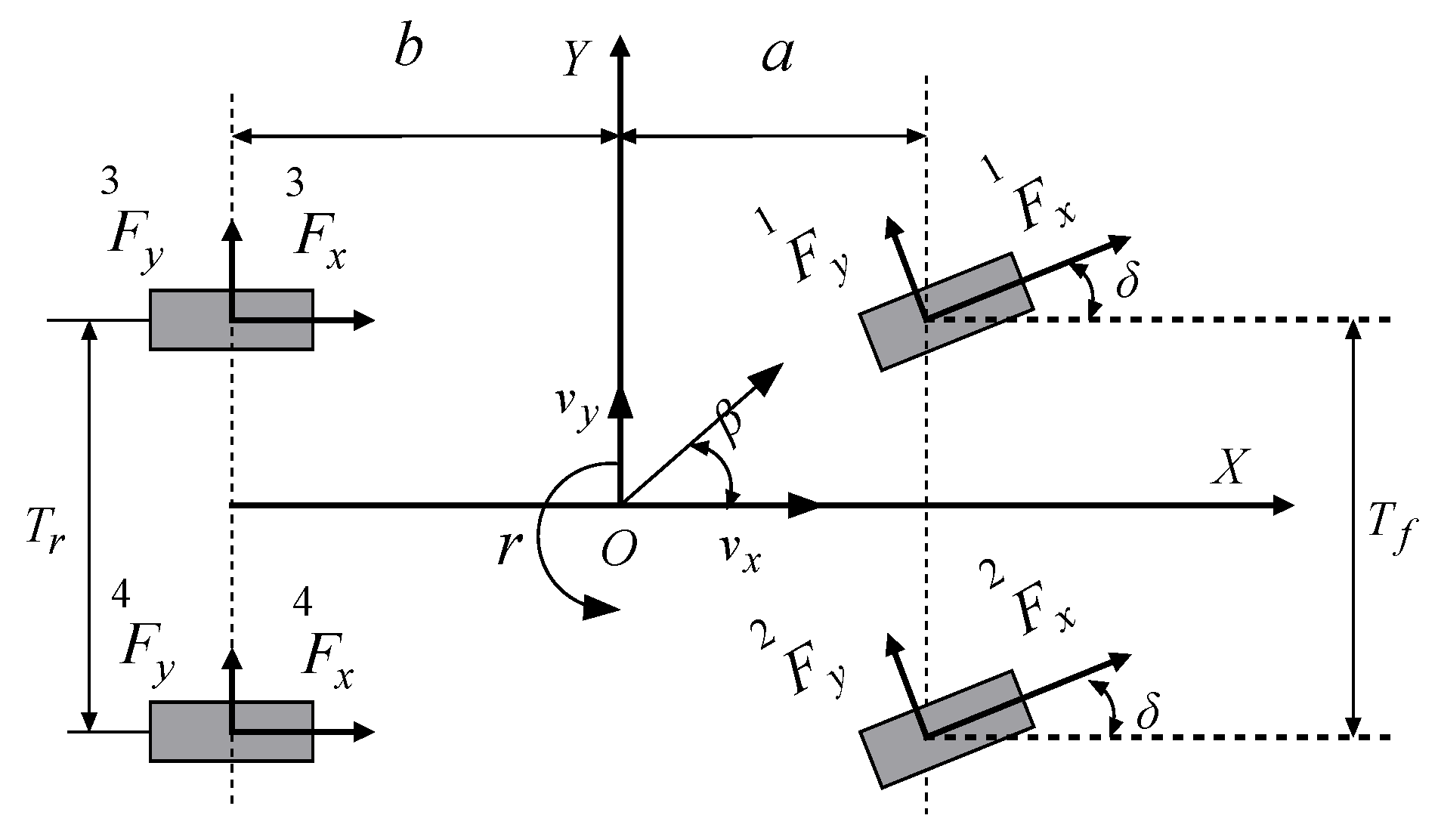
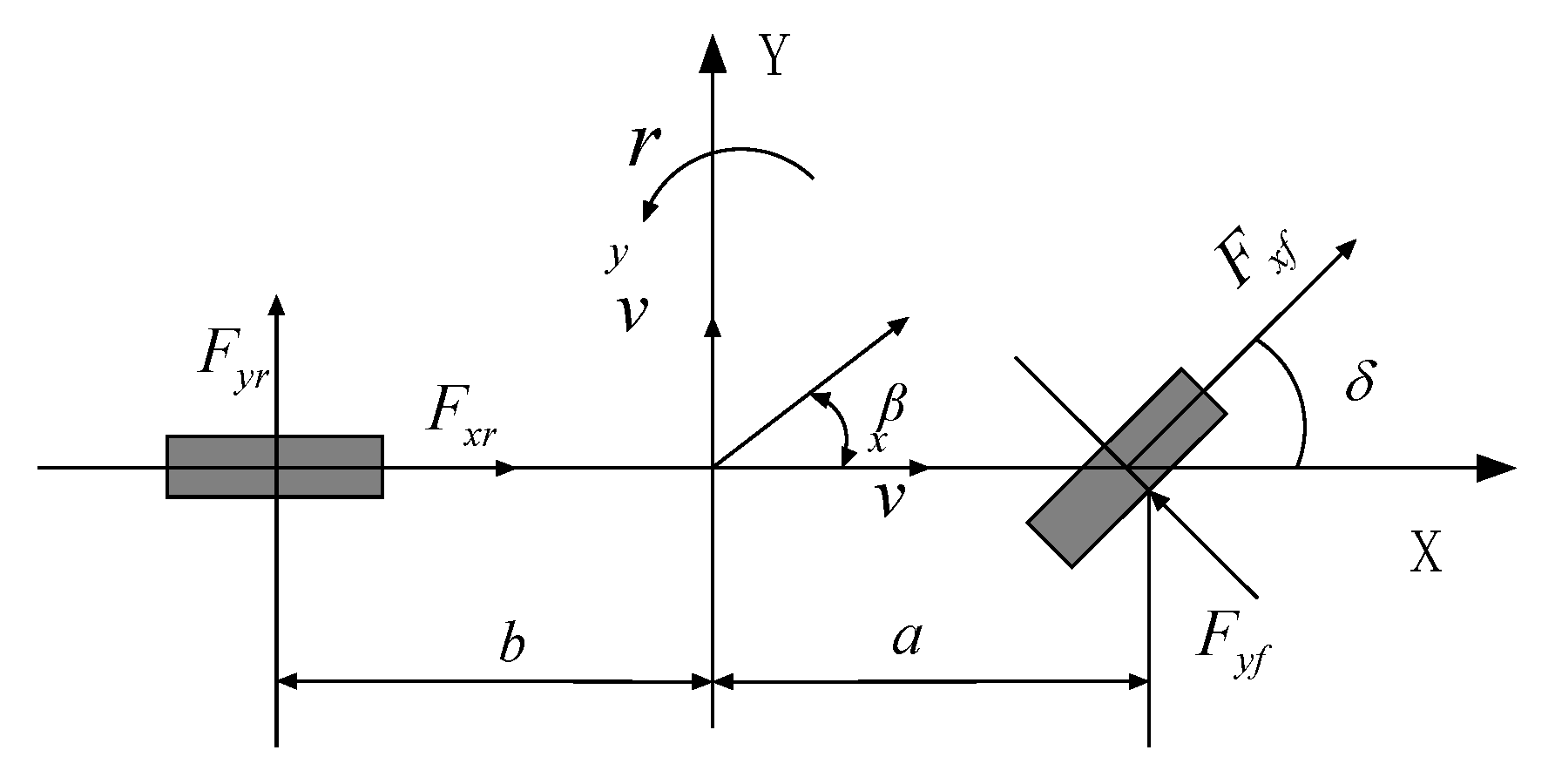
The vehicle dynamics are described using a four-wheel model [35], as shown in Figure 1, which captures the essential dynamic characteristics. The associated mathematical formulations are presented as follows.
v ˙ x = [ ( F x 1 + F x 2 ) cos δ + F x 3 + F x 4 ( F y 1 + F y 2 ) sin δ ] / m
  v ˙ y = [ ( F x 1 + F x 2 ) sin δ + F y 3 + F y 4 + ( F y 1 + F y 2 ) cos δ ] / m
r ˙ = a ( F x 1 + F x 2 ) sin δ + ( F y 1 + F y 2 ) cos δ b ( F y 3 + F y 4 ) / I z
J i ω ˙ t = T d i T b i R i F x i                     i = 1 , 2 , 3 , 4
where F x i   F y i are longitudinal tire forces, and lateral tire forces i = 1 , 2 , 3 , 4 correspond to the left-front, right-front, left-rear, and right-rear wheels, respectively. a and b are distances from the center of gravity to the front axle and rear axle; r , m are the yaw rate and vehicle mass; T f and T r are front track width and rear track width; δ is the front wheel angle; I z is the inertia moment about the vehicle’s vertical axis; v x , v y , β are the longitudinal vehicle velocity, lateral vehicle velocity, and sideslip angle; T b i , T d i , J i are the braking torque, driving torque, and moment of inertia; ω i is the wheel rotational speed; and R i is the wheel radius.
A combined longitudinal and lateral brushed tire model [36] is used to describe the dynamic characteristics of tires. Some specific equations are as follows:
F x , i = C x s i 1 + s i f i F i
F y , i = C y tan α i 1 + s i f i F i
F i = f i 1 3 μ i ϑ F z , i f i 2 + 1 27 μ i ϑ 2 F z , i 2 f i 3 ,                   if     f i 3 μ i ϑ F z , i   μ i ϑ F z , i                                                                                                                             else
f i = C x 2 s i 1 + s i 2 + C y 2 tan α i 1 + s i 2
where μ i ϑ is TRFC, for longitudinal tire forces computation: μ i ϑ = μ i x , for lateral tire forces computation: μ i ϑ = μ i y ; C x , C y , F z , i are the tire longitudinal, lateral stiffness coefficients, and vertical tire forces; s i , α i are the longitudinal slip ratio and wheel sideslip angle; i = 1 , 2 , 3 , 4 has the same physical meaning as the vehicle model; f i is a normalization factor; and F i is the tire normal load.
F z , 1 = m g b 2 ( a + b ) m a x h 2 ( a + b ) m a y h T f b a + b
F z , 2 = m g b 2 ( a + b ) m a x h 2 ( a + b ) + m a y h T f b a + b
F z , 3 = m g a 2 ( a + b ) + m a x h 2 ( a + b ) m a y h T r a a + b
F z , 4 = m g a 2 ( a + b ) + m a x h 2 ( a + b ) + m a y h T r a a + b
Equations (9)–(12) are derived based on the principle of force and moment balance, which linearly superimposes the static weight distribution with the dynamic load transfers caused by longitudinal and lateral accelerations. These equations account for the effects of longitudinal acceleration a x , lateral acceleration a y , and the vehicle center-of-gravity height h on the wheel loads. Here, T f , T r are the front and rear track widths.
s i = sgn ( v x R w i ) v x R w i max ( R w i , v x )        
α 1 = δ arctan ( v y + a r v x T f r / 2 )
α 2 = δ arctan ( v y + a r v x + T f r / 2 )
α 3 = arctan ( v y b r v x T r r / 2 )
α 4 = arctan ( v y b r v x + T r r / 2 )
Equations (13)–(17) describe the tire kinematic states based on velocity vector projection, where the longitudinal slip ratio is calculated by the relative difference between wheel spin and translational velocity, and the sideslip angles are derived by mapping the vehicle’s planar motion—specifically longitudinal speed, lateral speed, and yaw rate—onto each wheel’s coordinate frame.

2.2. Reference Model

Vehicle lateral stability is primarily governed by the sideslip angle and yaw dynamics. To ensure that a vehicle maintains predictable and responsive handling behavior under high lateral acceleration, control strategies are often developed to reproduce motion characteristics comparable to those observed in the linear operating region. Accordingly, an ideal reference motion model is commonly formulated based on the steady-state response of a linear two-degree-of-freedom (2DOF) [37] vehicle dynamics representation (Figure 2).
The steady-state yaw rate is as follows:
r ¯ r e f = v x / ( a + b ) δ 1 + K v x 2
K = m ( a + b ) 2 a C y r b C y f
Furthermore, the reference yaw rate must be constrained by the available TRFC and its inherent coupling with lateral acceleration. In view of these physical limitations, based on Equation (5) in reference [38], the desired yaw rate is required to comply with the following condition:
r ^ r e f 0.85 μ g v x
By jointly considering Equations (18) and (20), the reference yaw rate is obtained as
r r e f = min r ¯ r e f , 0.85 μ g v x sgn δ
In vehicle stability control, the reference sideslip angle is set to zero to ensure neutral handling behavior and prevent excessive lateral motion, thereby maintaining predictable and stable vehicle dynamics.
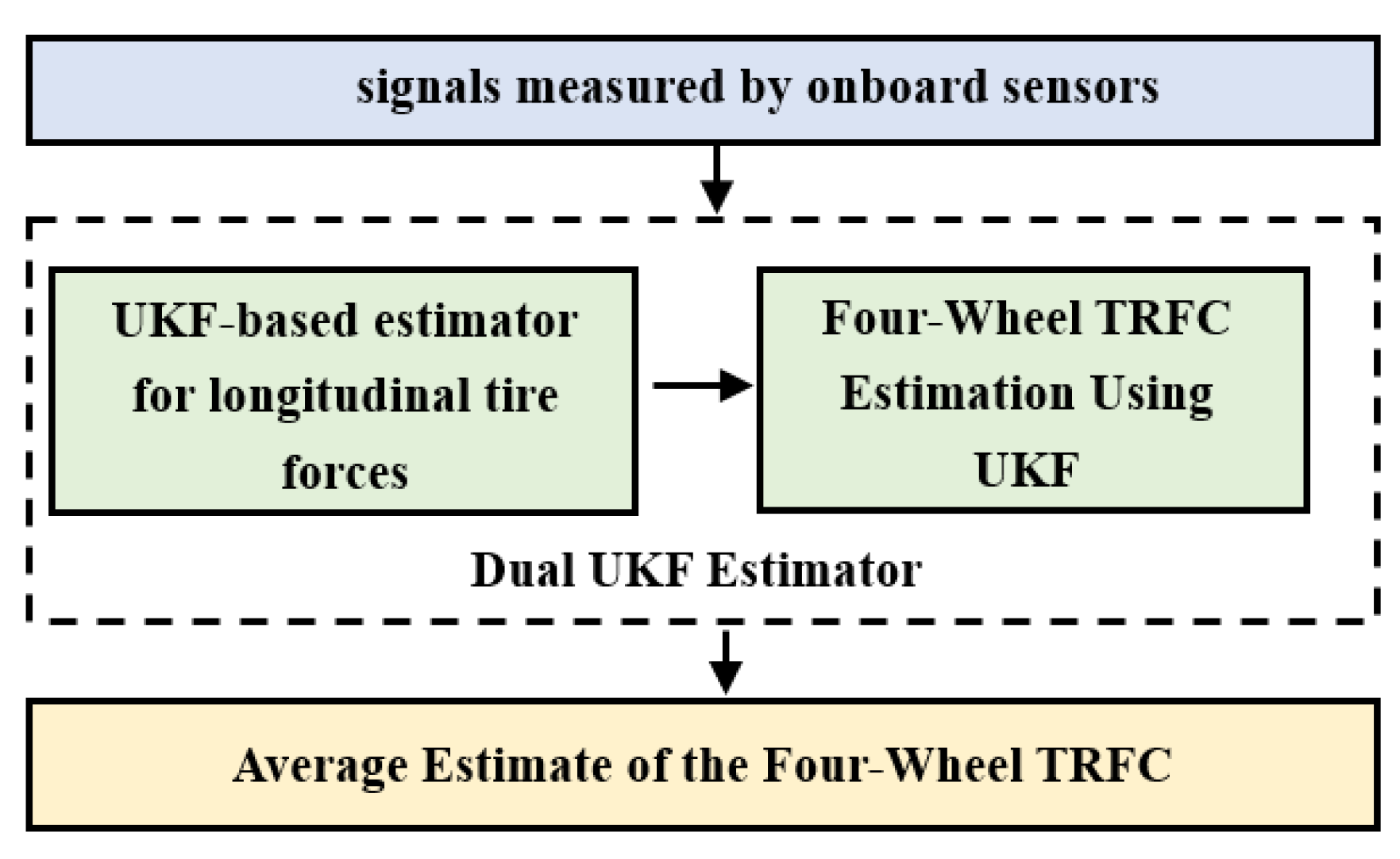
From Equation (21), it is evident that obtaining an accurate reference yaw rate requires precise estimation of the TRFC. A dual unscented Kalman filter (UKF)-based approach is employed to estimate the TRFC. In the first stage, the longitudinal forces of each wheel are estimated by a primary UKF observer. This observer leverages the nonlinear vehicle longitudinal dynamics and wheel rotational dynamics defined in Equation (5) to construct a state-space model. By utilizing the Unscented transformation, the UKF effectively captures the mean and covariance of the vehicle’s states through a set of deterministically selected sigma points, thereby overcoming the linearization errors typically associated with Extended Kalman filters when dealing with highly nonlinear tire models. The measurement vector, which incorporates real-time sensor data such as wheel angular speeds and accelerometer readings, is compared against the predicted states to recursively update and refine the longitudinal force estimates, providing a robust foundation for the subsequent TRFC identification. Subsequently, these estimated longitudinal forces are incorporated into a longitudinal tire model, and a second UKF is applied to identify the TRFC for each wheel. Finally, the average value of the four tire TRFC estimates is adopted as the overall friction coefficient. The overall TRFC estimation scheme is shown in Figure 3.
Longitudinal tire forces estimation: the discrete-time recursive model is given by
x k + 1 = f ( x k , u k ) + ψ k z k = h ( x τ , u τ ) + ς k
x k = [ F x 1 , F x 2 , F x 3 , F x 4 , w 1 , w 2 , w 3 , w 4 ] T           z k = [ w 1 , w 2 , w 3 , w 4 ] T
u k = [ T d 1 , T d 2 , T d 3 , T d 4 , T b 1 , T b 2 , T b 3 , T b 4 ] T  
ψ k denotes the process noise with a covariance matrix Q k , and ς k represents the measurement noise with a covariance matrix Ω k . The function f describes the nonlinear state transition of the system, while h denotes the measurement output function. The variable k is the discrete sampling instant, x k is the system state vector, and u k is the control input vector. The measurement vector z k may suffer from noise. The process noise and the measurement noise are assumed to be independent of each other and are both modeled as zero-mean random variables.
TRFC estimation: From the longitudinal tire dynamics, the following relationship is derived x k = [ μ 1 x , μ 2 x , μ 3 x , μ 4 x , a x ] T   z τ = [ F x 1 , F x 2 , F x 3 , F x 4 , a x ] T .
The iterative process of UKF is as follows.
(1) Initialization:
The initial expectation of x and its covariance matrix P
x ^ 0 = E x 0
P 0 = E x 0 x ^ 0 x 0 x ^ 0 T
(2) Time update:
The sigma sampling points τ k 1 i and the associated weight coefficients ϕ c i   ϕ m i are obtained as
τ k 1 0 = x ^ k 1 τ k 1 i = x ^ k 1 + n + λ P k 1 i           i = 1 , 2 , n τ k 1 i = x ^ k 1 n + λ P k 1 i           i = n + 1 , 2 n
ϕ m 0 = λ / n + λ , ϕ c 0 = λ / n + λ + 1 + β α 2 ϕ m i = ϕ c i = λ / 2 n + λ , i = 1 , 2 , 2 n
where n specifies the dimension of x . The parameter λ = α 2 ( n + l ) n controls the overall scaling, while l provides an additional adjustment to this scaling. α denotes a small positive constant, and β is introduced to incorporate prior information on the distribution of x .
The sigma points after propagation are expressed as
τ k / k 1 ( i ) = f ( τ k 1 ( i ) , u k 1 )
The predicted state x ^ k / k 1 and its associated covariance matrix P k / k 1 are obtained as
x ^ k / k 1 = i = 0 2 n ϕ m i τ k / k 1 ( i )
P k / k 1 = i = 0 2 n ϕ c i τ k / k 1 ( i ) x ^ k / k 1 τ k / k 1 ( i ) x ^ k / k 1 T + Q k 1
where Q denotes the covariance matrix associated with the process noise.
(3) Measurement update:
The updated sigma points τ k i are determined as
τ k 0 = x ^ k / k 1 τ k i = x ^ k / k 1 + n + λ P k / k 1 i           i = 1 , 2 , n τ k i = x ^ k / k 1 n + λ P k / k 1 i           i = n + 1 , 2 n
The sigma points after propagation are computed as
z k / k 1 ( i ) = h ( τ k ( i ) , u k )
The estimated output z ^ k / k 1 and the corresponding covariance matrix P z , k are updated as
z ^ k / k 1 = i = 0 2 n ϕ m i z k / k 1 ( i )
P z , k = i = 0 2 n ϕ c i z k / k 1 ( i ) z ^ k / k 1 z k / k 1 ( i ) z ^ k / k 1 T + R k
where R denotes the covariance matrix associated with the measurement noise.
The cross-covariance matrix P x z , k between x ^ k / k 1 and z ^ k / k 1 is expressed as
P x z , k = i = 0 2 n ϕ c i τ k / k 1 ( i ) x ^ k / k 1 z k / k 1 ( i ) z ^ k / k 1 T
when λ = 1 , the gain matrix w k can be obtained as
w k = P x z , k P z , k 1
The posterior state x ^ k and its covariance matrix P k are derived
x ^ k = x ^ k / k 1 + w k z k z ^ k / k 1
P k = P k / k 1 w k P z , k w k T

3. Methodology

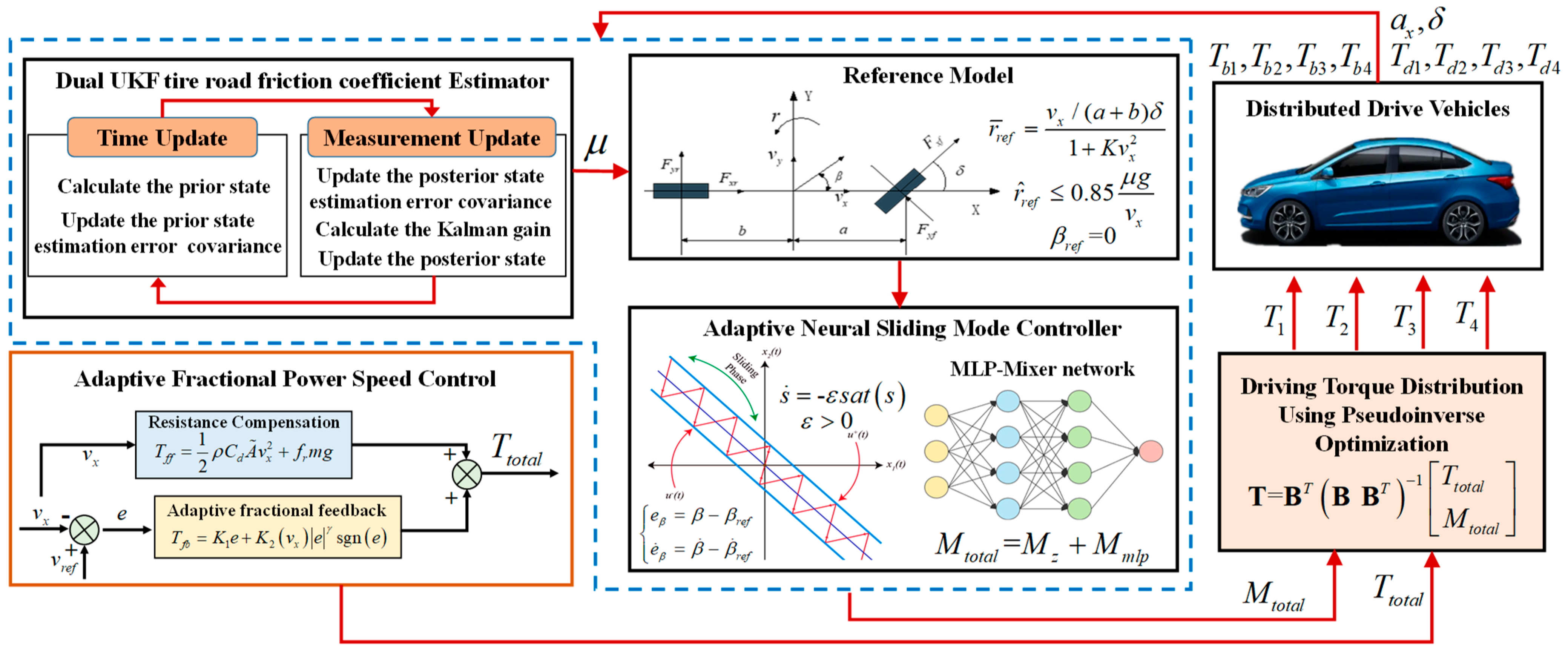
The proposed longitudinal–lateral coordinated stability control framework is shown in Figure 4. A dual UKF-based estimator is employed to identify TRFC, which is used to construct a friction-adaptive reference model for yaw rate and sideslip angle generation. An adaptive fractional power speed controller with resistance compensation is designed to generate the total longitudinal driving torque, while an adaptive neural sliding mode controller produces the required corrective yaw moment to ensure lateral stability. The obtained longitudinal torque and yaw moment are optimally allocated to individual wheel torques via a pseudoinverse-based torque distribution strategy. Through the tight coupling of longitudinal and lateral control loops, the proposed framework effectively enhances vehicle stability and tracking performance under varying road conditions. Several key components in the proposed algorithm play important and complementary roles. Specifically, the incorporated resistance compensation term mitigates the effects of rolling, aerodynamic, and slope-related disturbances, thereby enhancing speed-tracking accuracy under varying operating conditions. Meanwhile, the sliding mode component ensures robustness against model uncertainties and external disturbances, while the neural approximation compensates for unmodeled nonlinearities and significantly reduces chattering.

3.1. Adaptive Fractional Power Speed Control with Resistance Compensation

The longitudinal motion of the vehicle can be described by the following force balance equation:
m v ˙ x = F ¯ x F ¯ r = F ¯ x 1 2 ρ C d A ˜ v x 2 f r m g
where F ¯ x represents the total longitudinal driving force, F ¯ r is the lumped resistive force, C d is the aerodynamic drag coefficient, A ˜ denotes the frontal area, ρ is the air density, f r is the rolling resistance coefficient, and g is the gravitational acceleration.
The control objective is to design a longitudinal controller such that the vehicle speed v x tracks a desired reference speed v r e f despite nonlinear resistive forces and speed-dependent uncertainties. The tracking error is defined as
e = v r e f v x
To compensate for the known resistive forces, a feedforward control term is introduced. The equivalent driving torque required to balance the resistive forces is given by
T f f = F ¯ r R w
where R w denotes the effective wheel radius.
This term enables the controller to offset steady-state speed losses caused by aerodynamic drag and rolling resistance.
To ensure robust tracking performance under nonlinear and uncertain conditions, a fractional power feedback control law is adopted. The fractional power term e γ sgn e increases the convergence speed when the tracking error is small, while avoiding excessive control effort near the equilibrium point, thus improving both transient performance and control smoothness. For convenience in notation and implementation, this term is represented as e γ , which preserves the sign information of e while compactly expressing the fractional power operation.
T f b = K 1 e + K 2 v x e γ sgn e
where K 1 > 0 is a linear feedback gain, γ 0 , 1 is the fractional power exponent, and K 2 v x is a speed-dependent adaptive gain.
To prevent overly aggressive control actions at high vehicle speeds, the nonlinear gain K 2 v x is designed as a decreasing function of speed
K 2 v x = K ˜ 2 1 + η v x
where K ˜ 2 is the nominal gain, and η > 0 is a speed attenuation coefficient.
Combining the feedforward compensation term and the adaptive fractional feedback term, the total driving torque command is obtained as
T t o t a l = F ¯ r R w + K 1 e + K 2 v x e γ sgn e
Assuming that the reference speed is constant or varies slowly, it can be obtained from Equation (39) that
e ˙ = v ˙ x
Under the proposed control law, the closed-loop speed tracking error dynamics are given by
e ˙ = K 1 e m R w K 2 e γ sgn e m R w
Theorem 1.
For any initial speed tracking error   e 0   and   K 1 > 0 ,   K 2 > 0 , the closed-loop system is globally finite-time stable at   e   =   0 .
Proof. 
Consider the Lyapunov function
V e = 1 2 e 2
V ˙ = K 1 e 2 m R w K 2 e γ + 1 m R w
Since K 1 > 0 ,   K 2 > 0 , and e γ + 1 > 0 for all e 0 , it follows that
V ˙ < 0 ,       e 0
thereby guaranteeing asymptotic stability for the overall closed-loop system. □

3.2. Adaptive Neural Sliding Mode Controller

The 2DOF vehicle model is augmented with a control-generated yaw moment M z , and the corresponding lateral–yaw dynamics are given by
r ˙ = a 2 C f + b 2 C r I z v x r + a C f b C r I z β a C f I z δ + M z I z
β ˙ = a C f b C r m v x 2 1 r + C f + C r m v x β C f m v x δ
The desired sideslip angle and yaw rate are regulated by different control inputs to minimize their tracking deviations. Reducing these deviations enables the vehicle to more accurately follow the driver’s intended steering behavior, thereby improving lateral stability and handling performance. Accordingly, the tracking error e β and the corresponding error derivative e ˙ β are defined as
e β = β β r e f e ˙ β = β ˙ β ˙ r e f
Furthermore, C 1 > 0 ,   C 2 > 0 and the sliding surface is obtained as
s β = C 1 e β + C 2 e ˙ β = C 1 β β r e f + C 2 β ˙ β ˙ r e f = C 2 C f + C r m v x + C 1 β + a C f b C r m v x 2 1 C 2 r C 2 C f m v x δ C 1 β r e f C 2 β ˙ r e f
s ˙ β = C 1 β ˙ β ˙ r e f + C 2 β ¨ β ¨ r e f = C 1 + C f + C r m v x β ˙ C 1 β ˙ r e f C 2 β ¨ r e f + C 2 a C f b C r m v x 2 1 M z I z + C 2 a C f b C r m v x 2 1 a 2 C f + b 2 C r I z v x r + a C f b C r I z β a C f I z δ
The sliding-mode controller adopts a constant-rate reaching law, and a saturation function is employed to replace the sign function in order to alleviate chattering, which is expressed as
s ˙ = ε s a t s , ε > 0
Combining Equations (53) and (54), the additional yaw moment is obtained as
M z = I z m v x 2 C 2 a C f b C r m v x 2 C 1 + C f + C r m v x β ˙ C 1 β ˙ r e f C 2 β ¨ r e f + ε s a t s + C 2 a C f b C r m v x 2 1 a 2 C f + b 2 C r I z v x r + a C f b C r I z β a C f I z δ
To analyze the stability of the system, the following Lyapunov candidate function is selected
V s β = 1 2 s β 2
The time derivative of V s β along the system trajectories is given by
V ˙ s β = s β s ˙ β = s β C 1 + C f + C r m v x β ˙ C 1 β ˙ r e f C 2 β ¨ r e f + C 2 a C f b C r m v x 2 1 M z I z + C 2 a C f b C r m v x 2 1 a 2 C f + b 2 C r I z v x r + a C f b C r I z β a C f I z δ
Substituting Equation (55) into Equation (57) yields
V ˙ s β = s β ε s a t s β
For the saturation function, the following property holds:
s β s a t s β 0
which implies
V ˙ s β 0
Therefore, the Lyapunov function V s β is non-increasing, and the sliding surface s β is guaranteed to converge to a bounded neighborhood of zero.
In this study, an MLP-Mixer-based neural network is introduced as a residual yaw moment compensator to enhance the performance of the sliding mode yaw stability controller under nonlinear and uncertain driving conditions. The network does not replace the sliding mode controller. Instead, it learns the modeling residuals and unmodeled nonlinearities arising from road friction variation and longitudinal–lateral coupling effects. Formally, the total yaw moment M t o t a l is given by
M t o t a l = M z + M m l p
where M z is the corrective yaw moment generated by the MLP-Mixer network.
Unlike conventional multilayer perceptrons, the MLP-Mixer employs stacked residual mixing blocks, enabling effective modeling of complex nonlinear couplings among control-relevant variables. The input vector of the MLP-Mixer network is defined as x = [ r , β , r r e f , β r e f , v x , s , δ , M z ] T . A fully connected projection layer with 128 neurons is first employed to map the low-dimensional physical input space into a higher-dimensional latent feature space. This projection enhances the nonlinear representation capability of the network and facilitates subsequent feature mixing. Two identical MLP-Mixer blocks are stacked sequentially. Each block consists of a two-layer fully connected nonlinear transformation with ReLU activation functions and an explicit residual skip connection. Following the MLP-Mixer blocks, a fully connected layer with 64 neurons and ReLU activation is used to further refine the extracted features. A linear-activation neuron is employed in the final layer to output the corrective yaw moment. The configuration of the entire network is provided in Table 1. Training of the residual MLP-Mixer model is carried out using the Adam-based optimization scheme with a step size of 1 × 10⁻³. To suppress the estimation error of the residual yaw moment, the mean-squared error metric is selected as the objective function. Mini-batch gradient descent is employed with a batch size of 64 to balance training stability and computational efficiency.
As shown in Equation (58), the boundedness and convergence of the sliding mode controller have been rigorously established. The adaptive neural network is implemented as a multilayer perceptron whose output is bounded and linearly superimposed on the sliding mode control action. Due to this linear combination and the bounded nature of the MLP output, the overall controller inherits the convergence properties of the underlying sliding mode controller. Consequently, the closed-loop system under an adaptive neural sliding mode controller is guaranteed to remain stable, and its states are bounded, even in the presence of uncertainties and external disturbances.

3.3. Driving Torque Distribution Using Pseudoinverse Optimization

For a distributed drive vehicle, the upper-level controller provides the desired total longitudinal driving torque and the corrective yaw moment. Specifically, the adaptive fractional power speed controller generates the total longitudinal driving torque T t o t a l , while the SMC–MLP controller outputs the additional yaw moment M t o t a l required for lateral stability enhancement. These two control objectives must be simultaneously realized by allocating the driving torques of the four in-wheel motors. In real driving conditions, the maximum longitudinal force that each tire can generate is limited by the available TRFC. To guarantee the physical feasibility of the torque allocation results and prevent excessive wheel slip, TRFC constraints are incorporated into the pseudoinverse-based torque distribution scheme. The friction constraint can be equivalently expressed in terms of wheel torque T i as
T i μ F z i R w         i = 1 , 2 , 3 , 4
The desired total longitudinal driving torque T t o t a l and the corrective yaw moment M t o t a l are distributed to the four wheels using the pseudoinverse method. Let the wheel torque vector be defined as T = T 1 , T 2 , T 3 , T 4 T . The relationship between the wheel torques and the vehicle-level control objectives can be expressed in a linear form as
T t o t a l M t o t a l = B T         B =       1                       1                   1                   1 T f 2 R w T f 2 R w   T r 2 R w T r 2 R w
Since the number of wheel torques exceeds the number of control objectives, the torque allocation problem is underdetermined. To obtain a unique and smooth solution suitable for real-time implementation, a pseudoinverse-based optimization approach is adopted. The wheel torque vector is computed as
T = B T B   B T 1 T t o t a l M t o t a l
The wheel torques obtained from Equation (64) are directly applied as the actuator commands, while satisfying the constraint specified in Equation (62).

4. Results and Discussion

A joint CarSim–Simulink co-simulation environment is constructed to evaluate the performance of the proposed control strategies. For longitudinal speed tracking, the proposed controller is compared with a feedforward compensation (FC) combined with proportional feedback control (PFC). For yaw moment control, the proposed method is benchmarked against a linear quadratic regulator (LQR) approach. Two different road conditions are considered in the tests, and a range of operating scenarios covering multiple vehicle speeds and steering maneuvers are conducted to evaluate the applicability and robustness. It is particularly emphasized that to validate the robustness of the UKF against measurement noise, the four-wheel rotational speed signals are integrated with a stochastic noise module to simulate real-world sensor interference. These noise-corrupted signals are subsequently used as inputs for the UKF; the algorithm’s robustness is then rigorously assessed by analyzing the estimation accuracy of the longitudinal tire forces. The specific parameters of the vehicle model used in this study are provided in Table 2.

4.1. The Test on a Dry Asphalt Road

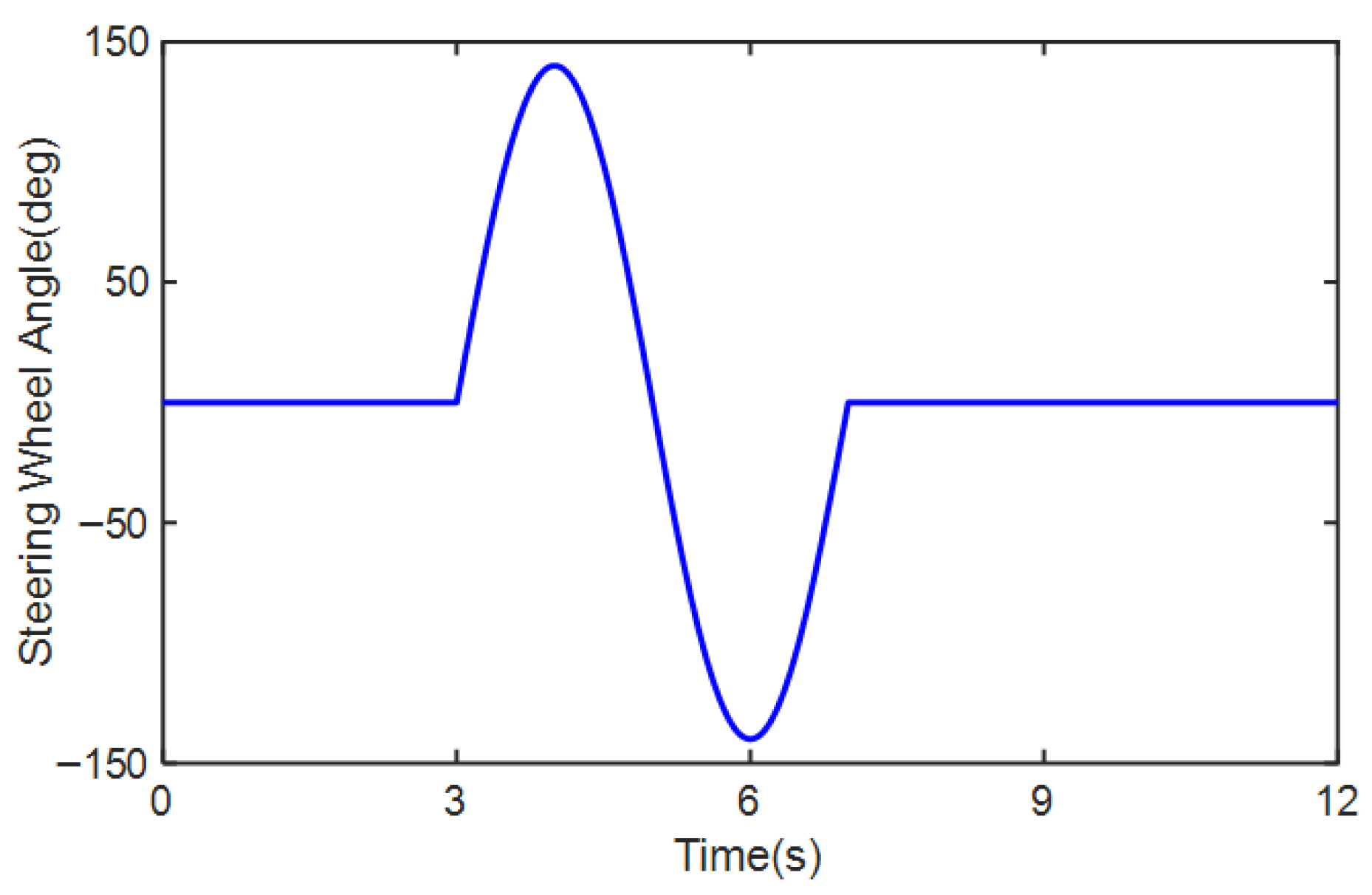
The TRFC is assigned a value of 0.85. The vehicle starts from an initial velocity of 14 m/s and is commanded to reach a desired speed of 16 m/s. Therefore, the vehicle accelerates at the beginning of the maneuver. A lane-change maneuver is performed, and the steering wheel angle is shown in Figure 5. The steering angle is initially zero, increases during the time interval from 3 s to 7 s to execute the lane change, and then returns to straight-line driving.
Figure 6a–d present the UKF-based estimation results of the longitudinal tire forces. The red solid curves correspond to the reference values provided by CarSim and are regarded as the ground truth, whereas the blue dashed curve denotes the estimates obtained using the UKF. The results demonstrate that the UKF achieves satisfactory estimation accuracy, with the estimated forces closely following the reference values. At the beginning of the maneuver, relatively large longitudinal tire forces are produced to compensate for the initial speed tracking error. As the vehicle speed converges to the desired value, the magnitude of the longitudinal tire forces decreases rapidly. Noticeable fluctuations occur during 3–7 s because the vehicle is executing a steering maneuver in this time interval. These fluctuations arise from the coupling effects between the longitudinal and lateral vehicle dynamics.
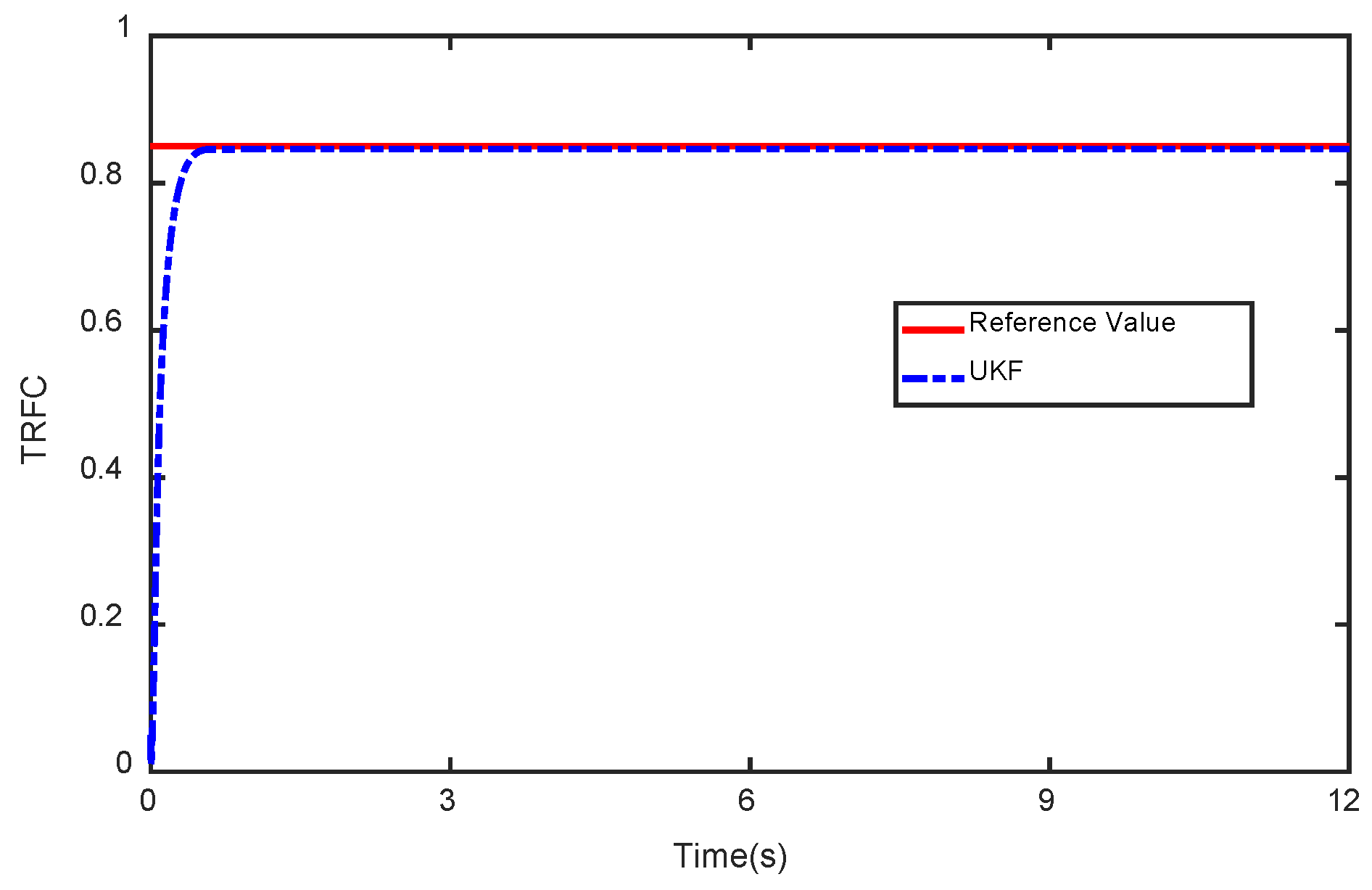
Figure 7 illustrates the estimation results of the TRFC. It can be observed that the UKF estimation curve rapidly converges to the reference value. This behavior is attributed to the initial acceleration phase of the vehicle, during which strong longitudinal excitation enables the estimator to quickly track the true value. Subsequently, the estimated TRFC remains closely aligned with the reference. Therefore, the real-time estimated TRFC can be employed as an input to the reference model, allowing for the desired yaw rate and sideslip angle to be dynamically adjusted.
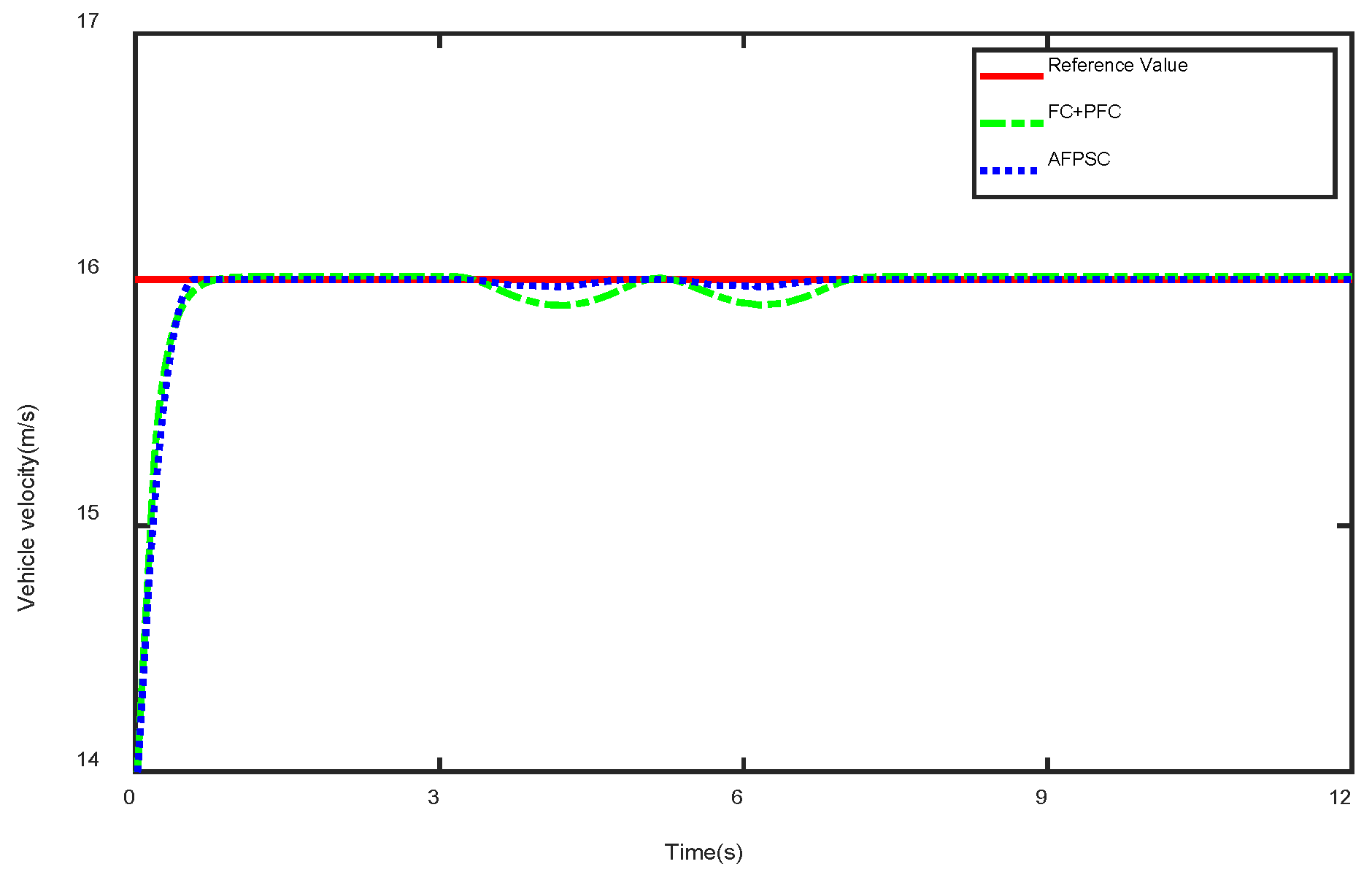
Figure 8 illustrates the vehicle velocity tracking performance. In the adaptive fractional power speed control scheme, parameters K 1 = 30   K ˜ 2 = 920   γ = 0 . 55 are determined through dynamic adjustments derived from empirical data. The red solid line represents the reference speed, the green dash-dotted line denotes the vehicle speed controlled by the FC + PFC algorithm, and the blue dashed line represents the vehicle speed controlled by the AFPSC algorithm. It can be observed that the FC + PFC curve tracks the reference value with a slight delay. Moreover, during the steering maneuver, the vehicle speed under FC + PFC exhibits pronounced oscillations and deviates significantly from the reference speed. This behavior arises because the proportional gain in the FC + PFC scheme is fixed, which limits its applicability to a narrow range of operating conditions. In contrast, the AFPSC strategy dynamically adjusts the control gain according to the speed tracking error, thereby enhancing the speed tracking performance under varying driving conditions.
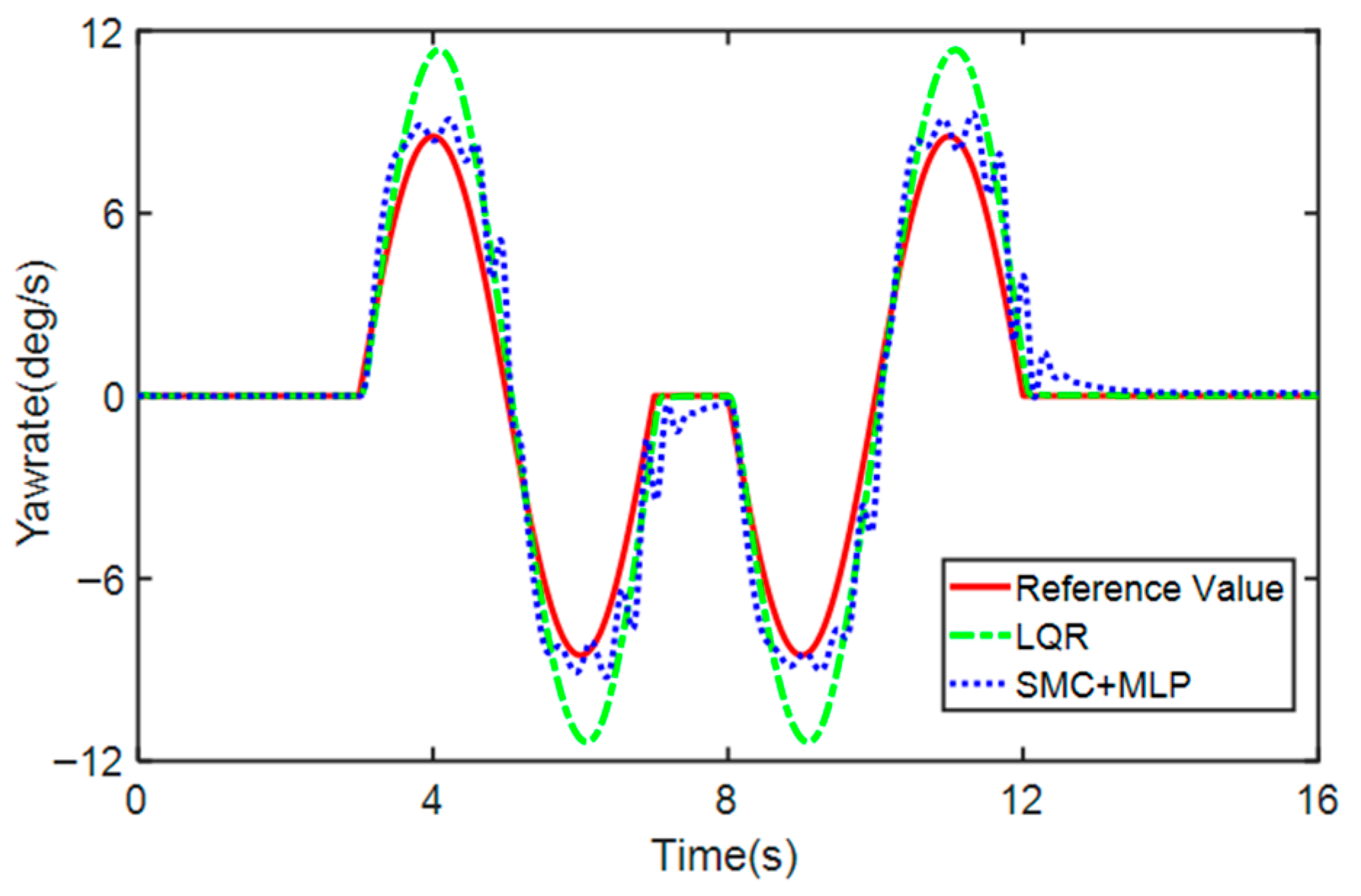
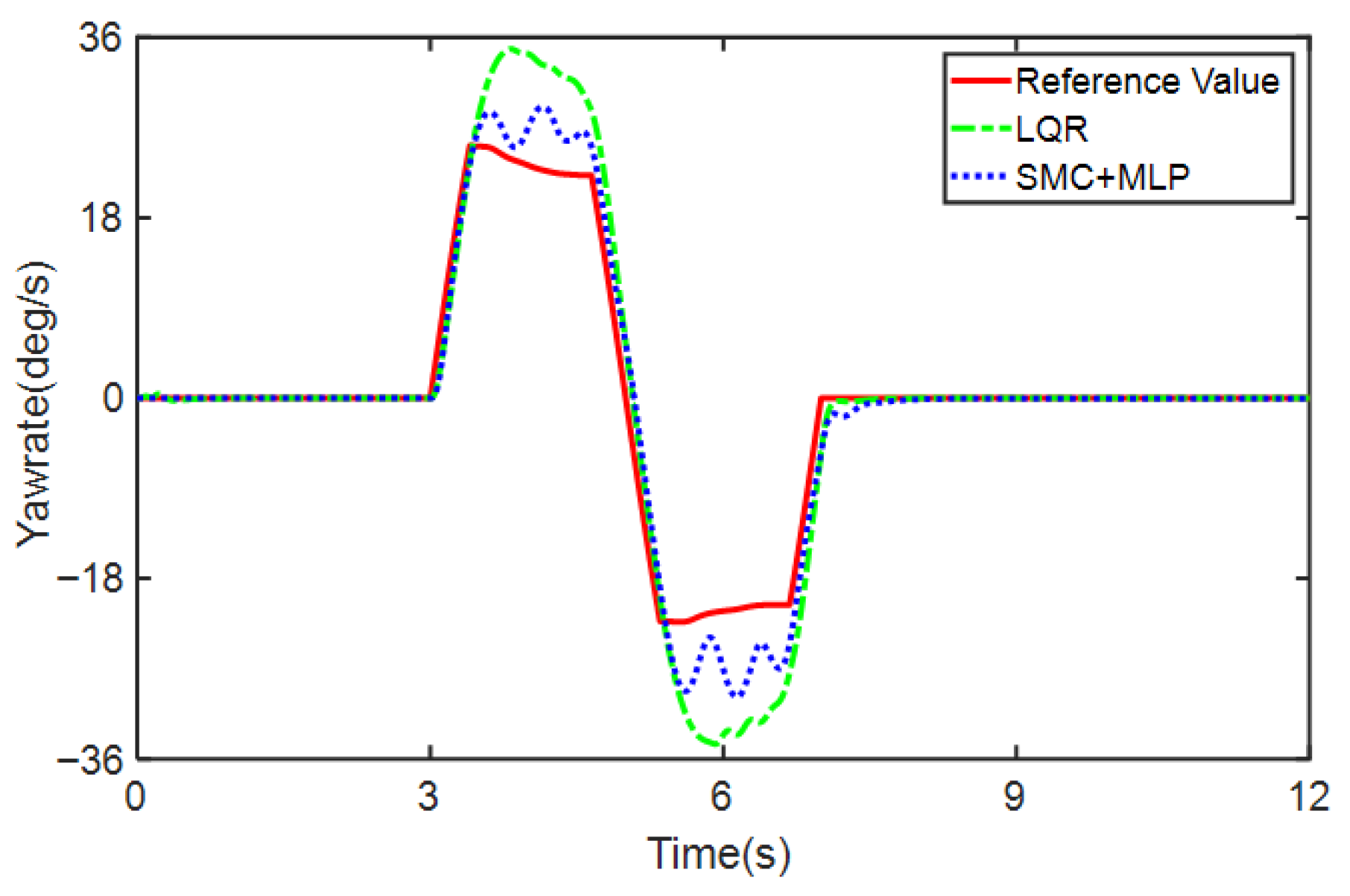
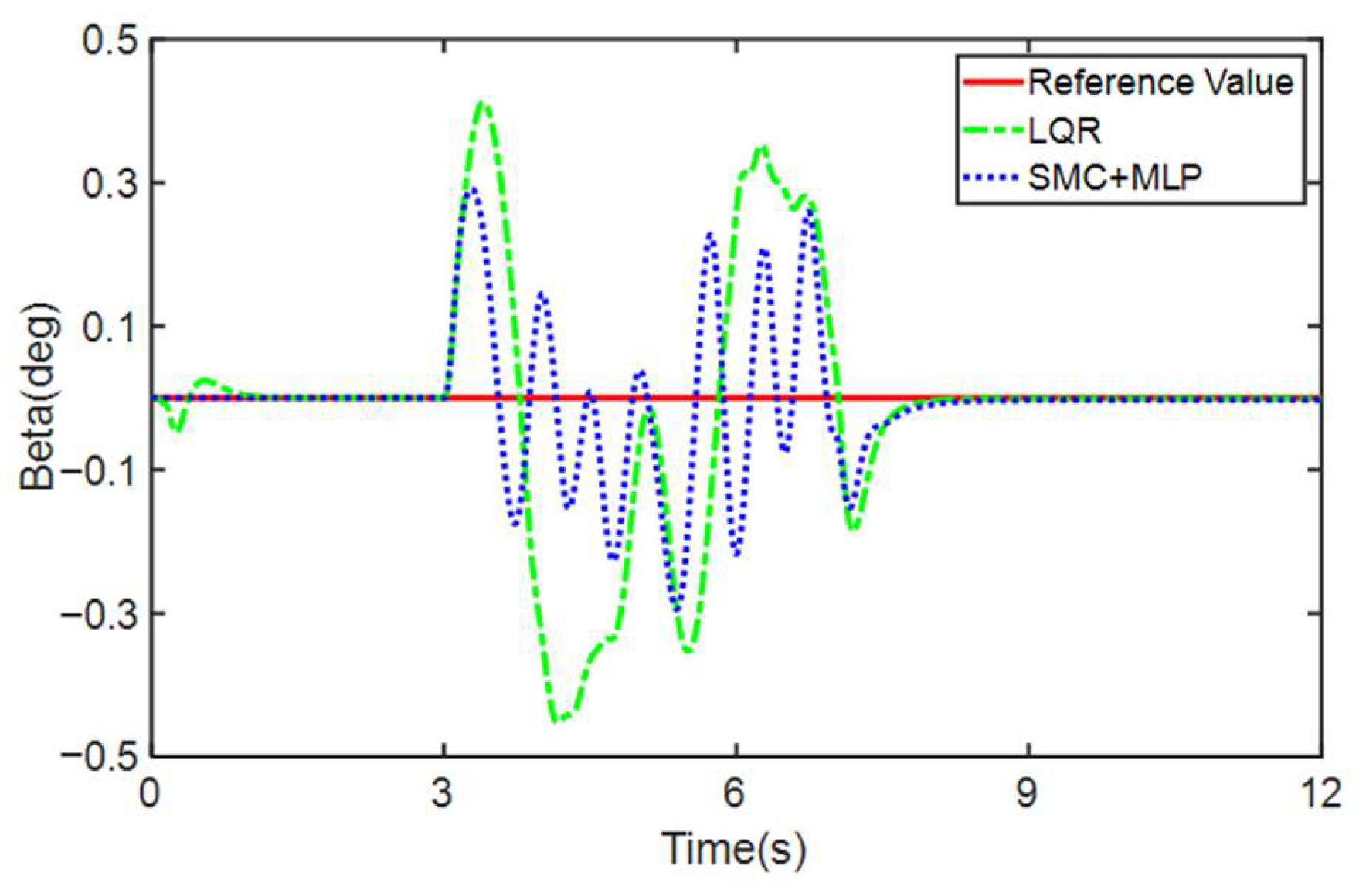
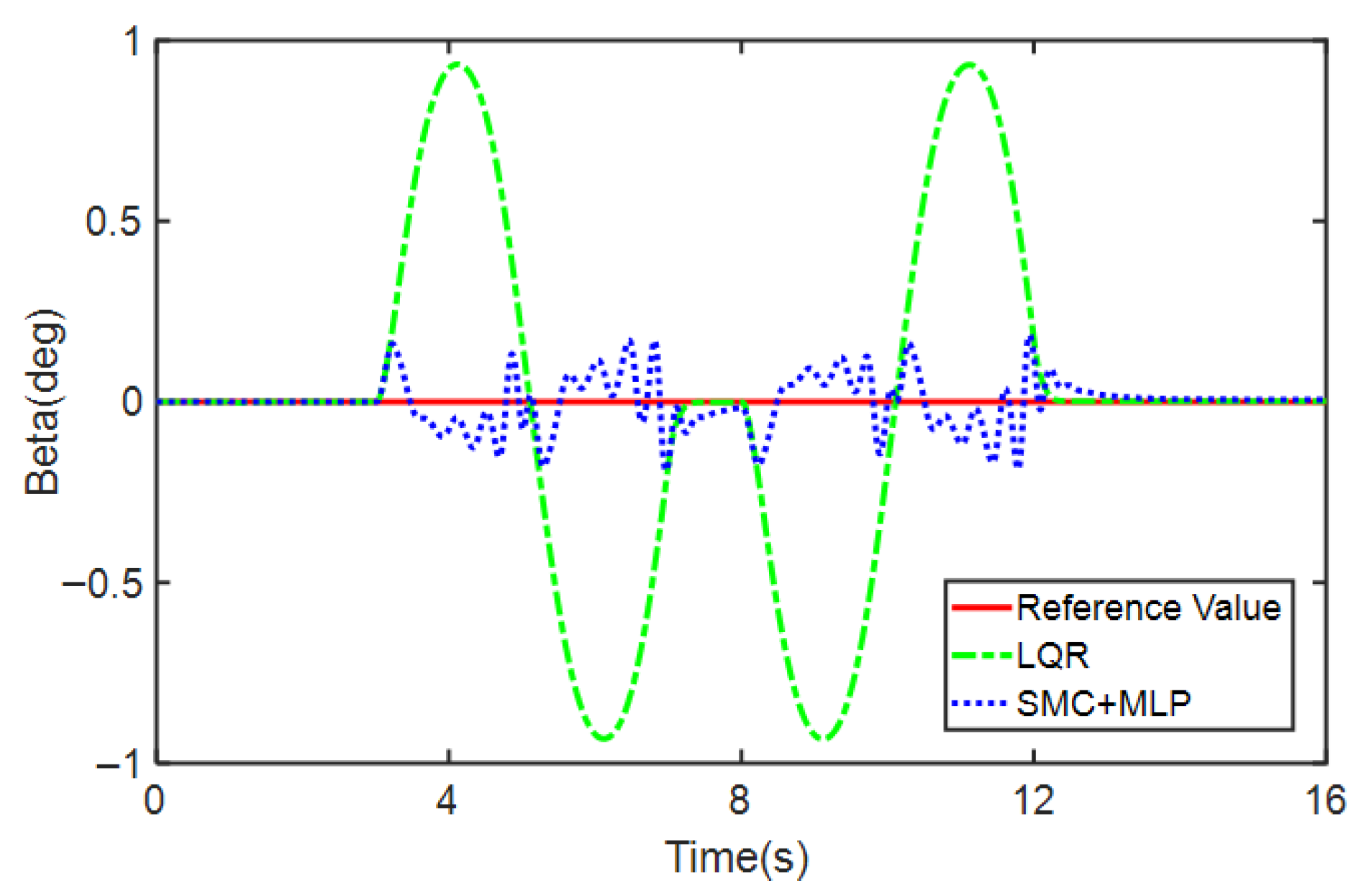
Figure 9 and Figure 10 present the response profiles of the yaw rate and vehicle sideslip angle, respectively, under different control strategies. The red solid curves represent the reference values, the green dash-dotted curves correspond to the LQR-controlled vehicle states, and the blue dashed curves denote the responses under the proposed SMC + MLP control scheme. As illustrated in Figure 9, the yaw rate curve obtained with LQR control deviates significantly from the reference curve, indicating degraded vehicle stability when nonlinearities and uncertainties are present. In contrast, the yaw rate curve under SMC + MLP control remains much closer to the reference, demonstrating superior yaw stability and tracking capability. Figure 10 shows that the sideslip angle curve obtained with SMC + MLP control follows the reference more closely and exhibits no noticeable oscillations at the initial stage, whereas the LQR-controlled curve displays larger deviations. Compared with the LQR approach, the proposed SMC + MLP framework does not rely on linearization around a fixed operating point, which allows for the preservation of robustness under strongly nonlinear driving conditions. The sliding mode controller guarantees baseline stability and robustness against matched uncertainties, while the MLP-Mixer-based residual compensator adaptively learns and cancels modeling errors caused by road friction variations and longitudinal–lateral coupling effects. Consequently, the combined SMC + MLP controller achieves improved yaw stability and tracking accuracy across a wider range of maneuvers and road conditions than the model-dependent LQR controller.
Table 3 summarizes the RMSE of key vehicle states on a dry asphalt road under different control strategies. It can be observed that the proposed SMC + MLP approach consistently outperforms the conventional LQR controller in terms of both sideslip angle and yaw rate tracking accuracy. Specifically, compared with the LQR method, the RMSE of the sideslip angle is reduced from 0.167 to 0.092, corresponding to an improvement of approximately 45%, which indicates a significantly enhanced capability in suppressing lateral motion deviations. Meanwhile, the yaw rate RMSE decreases from 4.977 to 2.775, yielding a reduction of about 44%, demonstrating superior yaw dynamics regulation and reference tracking performance. These quantitative results verify that, under high-adhesion conditions, the SMC + MLP controller can more effectively mitigate the adverse effects of longitudinal–lateral coupling and thus achieve improved vehicle stability compared with the baseline LQR strategy.
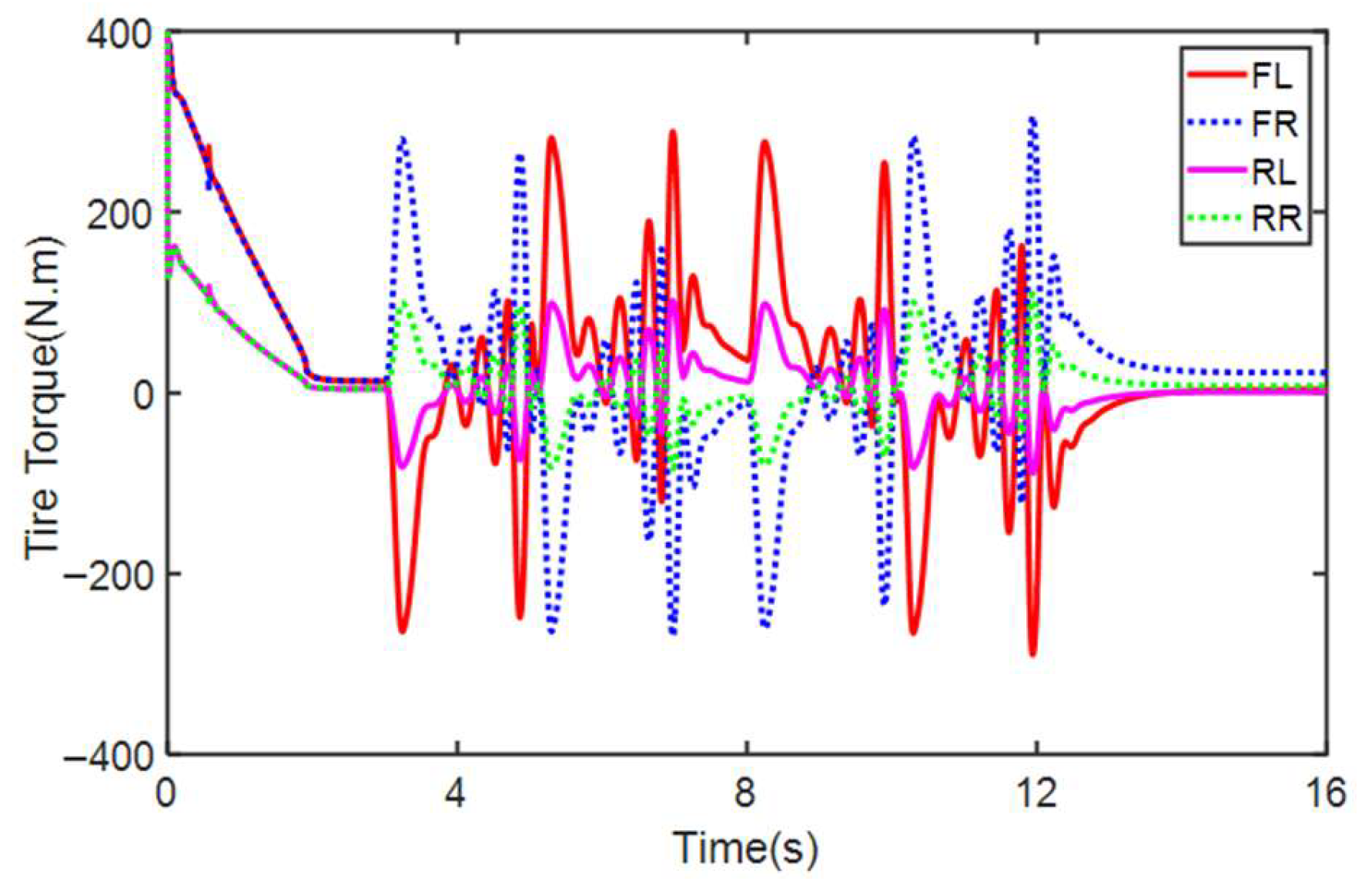
Figure 11 illustrates the torque variation curves of the four wheels, where FL, FR, RL, and RR refer to the front-left, front-right, rear-left, and rear-right wheels, respectively. At the initial stage, relatively large driving torques are required to track the target vehicle speed. As the speed error gradually decreases, the wheel torques are correspondingly reduced. During the steering maneuver, the torques of the four wheels are dynamically redistributed, which contributes to enhancing vehicle stability and maintaining the desired yaw behavior.

4.2. The Test on an Ice Snow Road

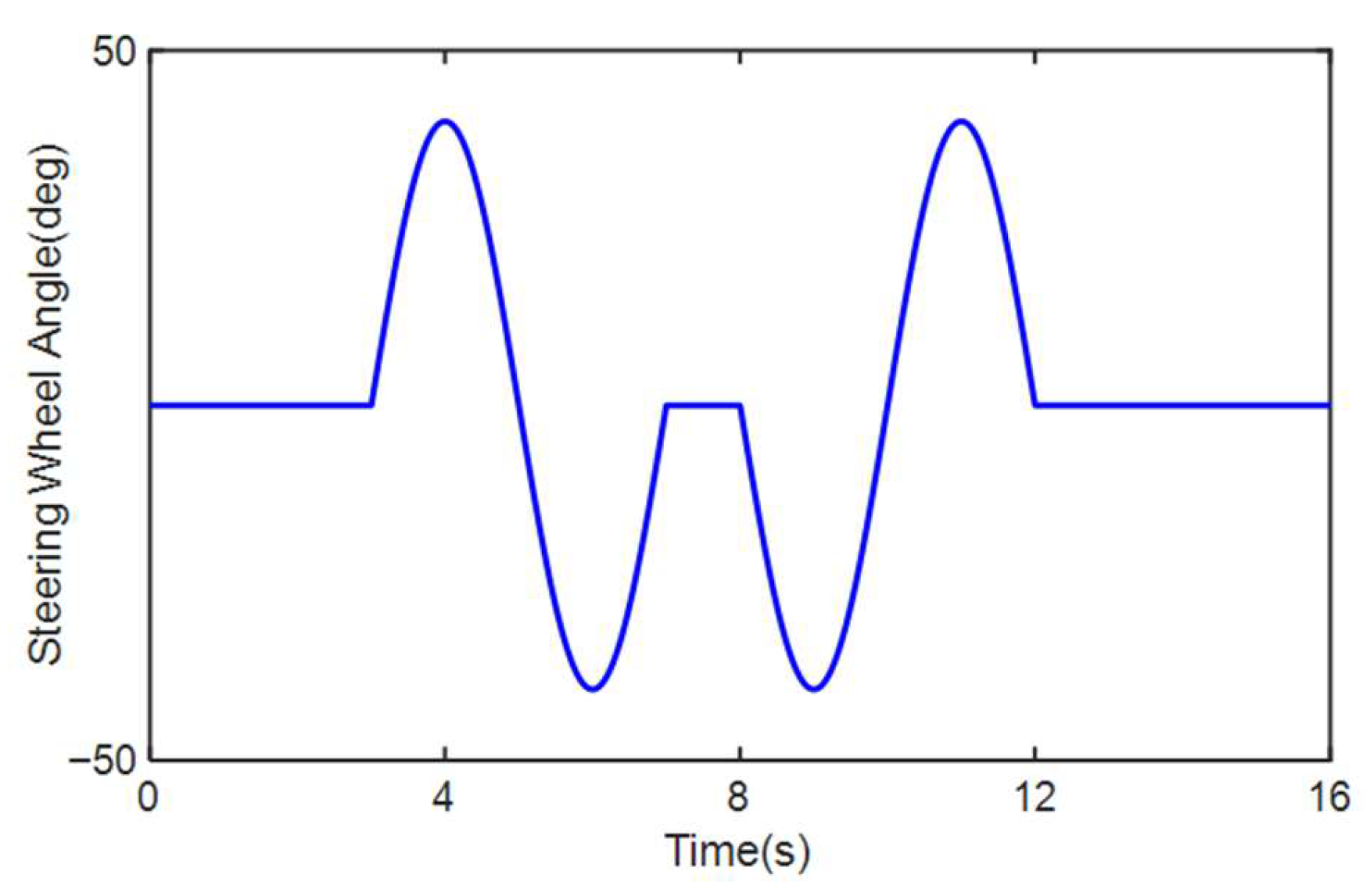
With the TRFC fixed at 0.2, the vehicle operates from an initial speed of 8 m/s and is driven toward a target velocity of 13 m/s, which induces a clear acceleration transient at the start of the scenario. During this process, the vehicle carries out a sequence of lane-change maneuvers. Figure 12 illustrates the corresponding steering wheel input, which remains at zero at first, exhibits sustained variations between 3 s and 12 s to accomplish the continuous lane changes, and subsequently converges back to zero as the vehicle returns to steady straight-line motion.
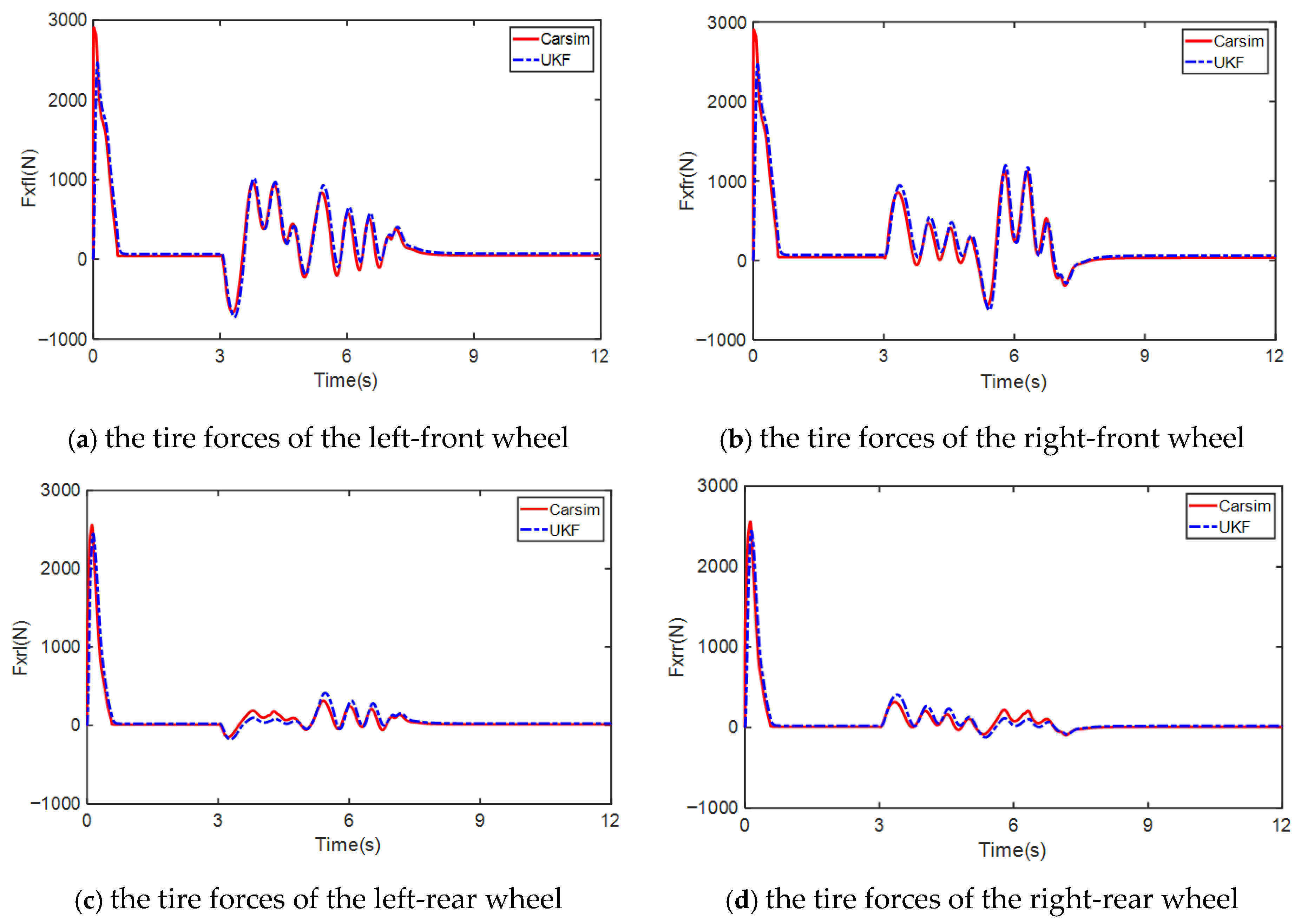
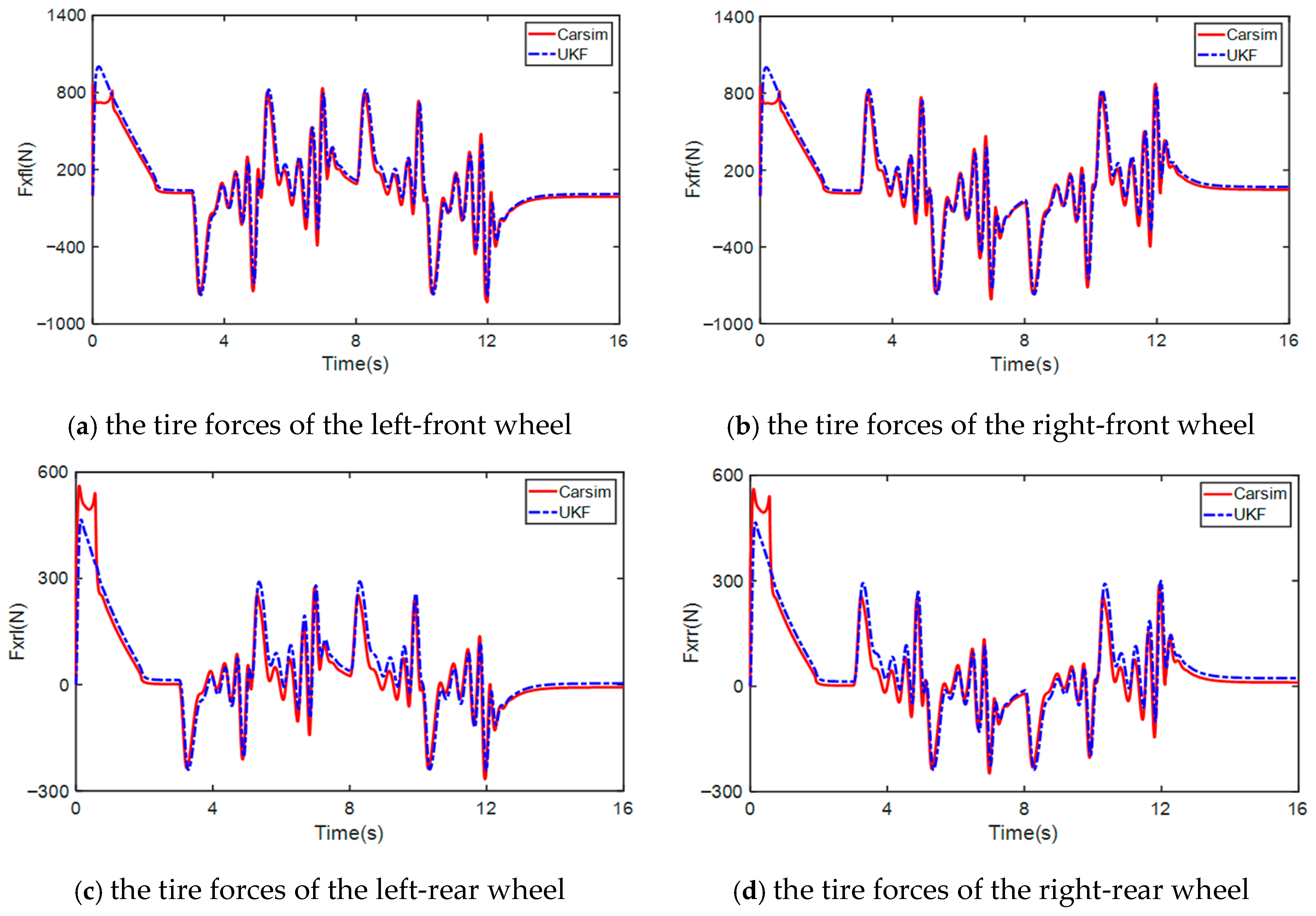
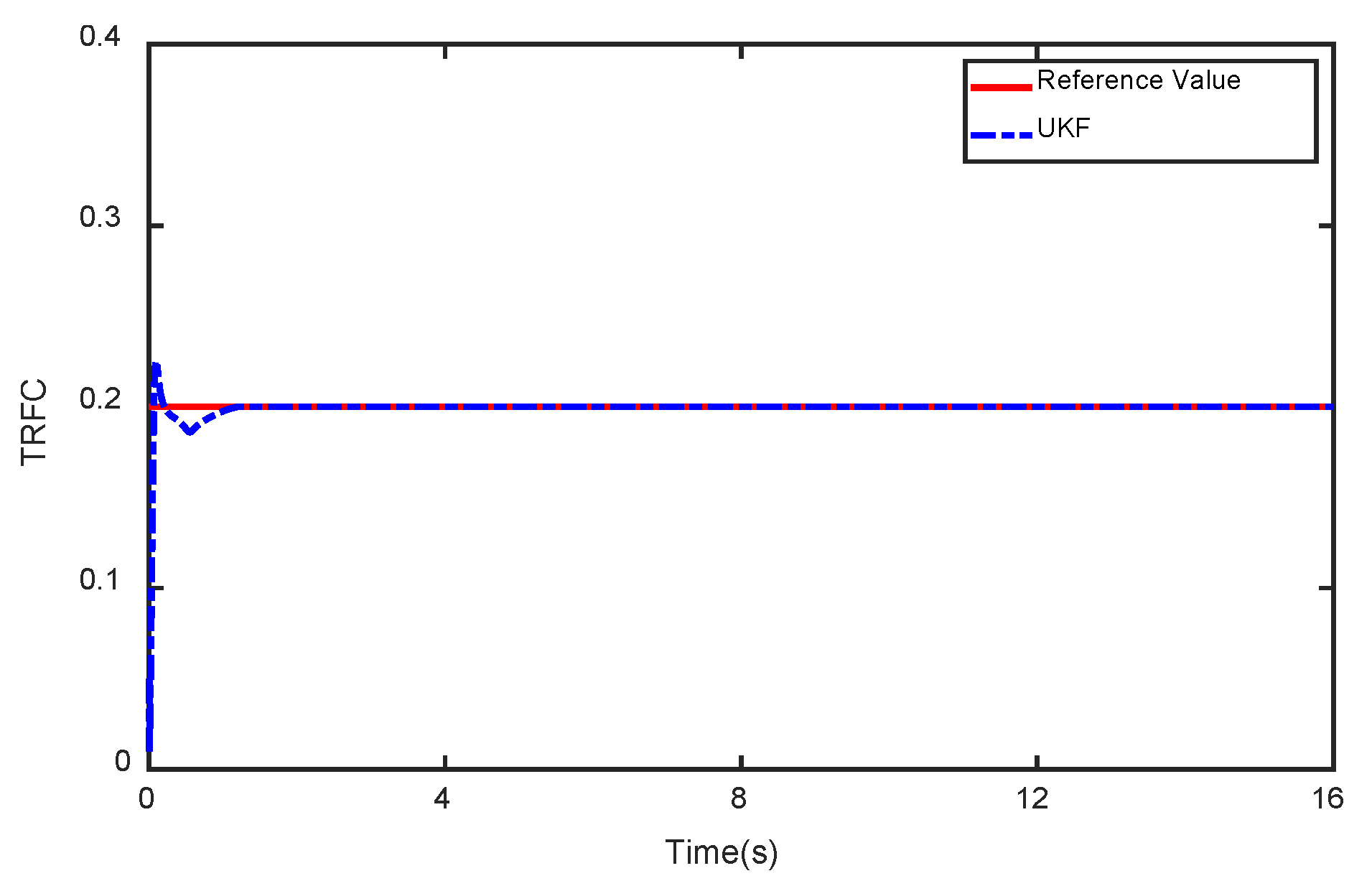
The longitudinal force estimates for each of the four wheels are illustrated in Figure 13a–d. The estimated results show good agreement with the reference values. Compared with asphalt pavement, the maximum achievable tire forces on icy and snowy roads are significantly lower due to the limitation imposed by reduced road adhesion. Moreover, during steering maneuvers, the longitudinal tire forces fluctuate as a result of longitudinal–lateral coupling; however, the UKF estimation still maintains a high level of consistency with the reference values. Figure 14 illustrates the estimation results of the TRFC. It can be observed from the figure that the UKF estimation curve rapidly tracks the reference value with a brief overshoot, then gradually decreases and fully converges to the reference at approximately 1 s, after which it remains stable.
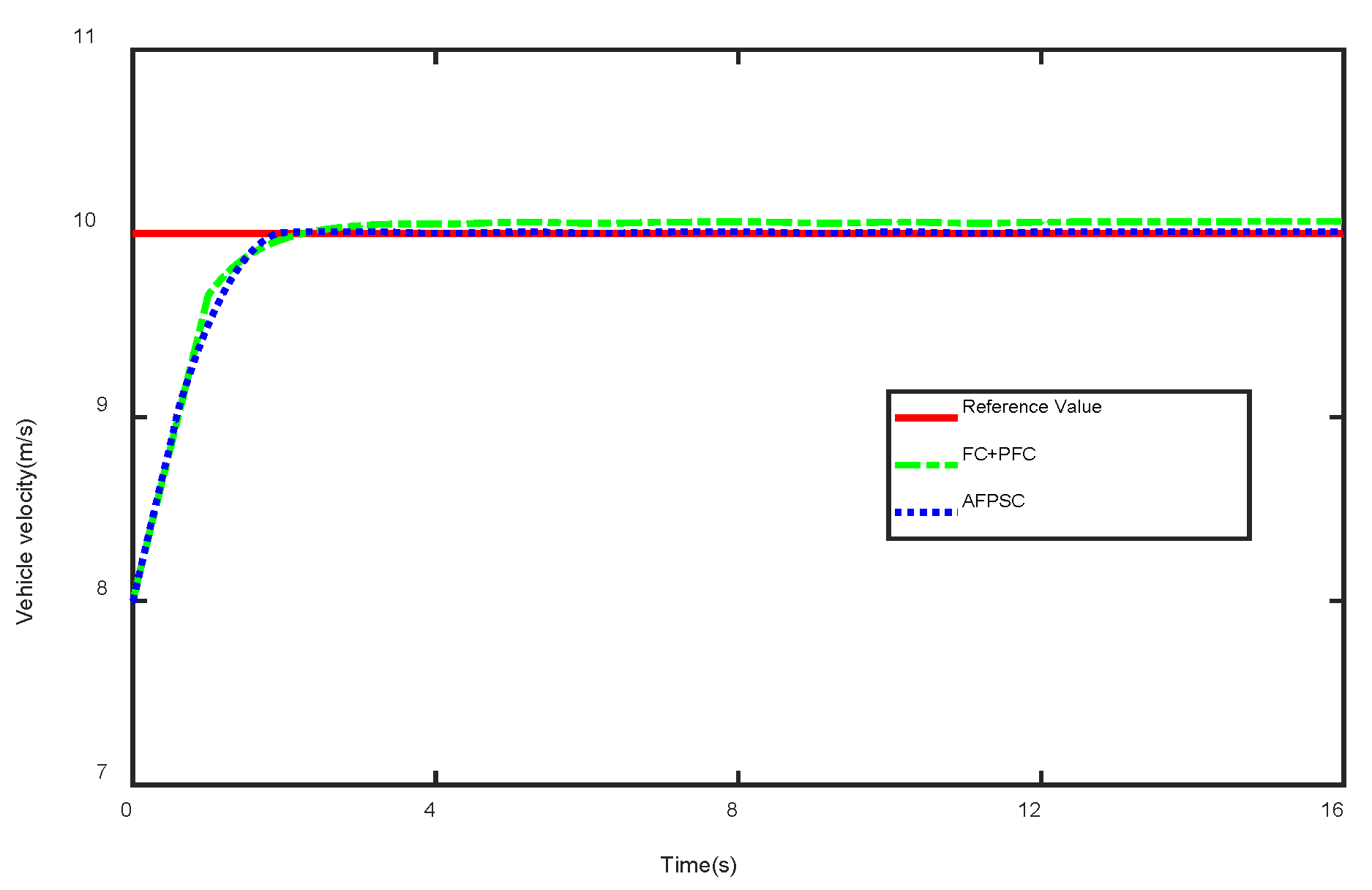
Figure 15 illustrates the vehicle speed tracking responses. The parameters K 1 = 300 , K ˜ 2 = 420 0 , and γ = 0 . 56 for adaptive fractional power speed control are updated dynamically based on empirical heuristics. The speed controlled by the AFPSC approach increases more smoothly and shows a higher degree of agreement with the reference trajectory, whereas the FC + PFC method converges to a steady-state value that is slightly higher than the reference. The AFPSC strategy dynamically adjusts the control gain according to the speed tracking error, thereby improving speed tracking performance under varying driving conditions. Figure 16 and Figure 17 illustrate the yaw rate and vehicle sideslip angle responses, respectively, under different control strategies. It can be observed that the SMC + MLP control strategy enables the vehicle states to track the reference values more closely, resulting in improved vehicle stability.
Table 4 compares the RMSE of vehicle states on an icy, snowy road. The results show that the proposed SMC + MLP method significantly outperforms the conventional LQR controller, especially in terms of sideslip angle regulation. Specifically, the sideslip angle RMSE is reduced from 0.4748 to 0.0669, corresponding to an improvement of approximately 86%, which highlights the strong capability of the proposed method in suppressing excessive lateral slip. In addition, the yaw rate RMSE decreases from 1.4722 to 1.2425, yielding an improvement of about 16%, demonstrating enhanced yaw motion regulation. Overall, the SMC + MLP controller shows superior robustness and stability performance on icy, snowy roads.
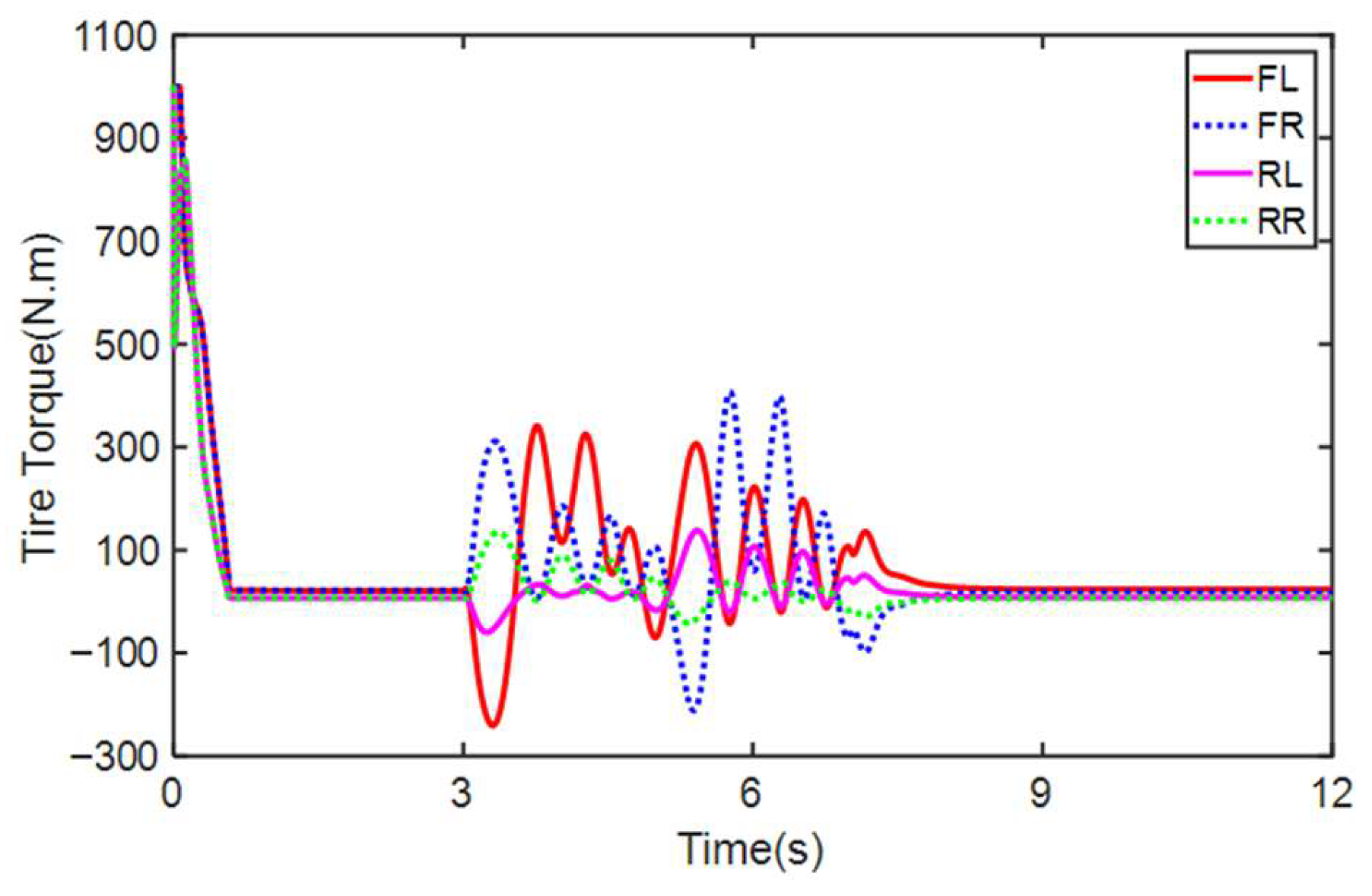
Figure 18 depicts the time histories of the driving torques applied to the four wheels. At the beginning of the maneuver, higher torque levels are demanded to rapidly accelerate the vehicle toward the desired speed. As the speed tracking error diminishes, the required wheel torques progressively decrease. When steering inputs are applied, the torques among the four wheels are adaptively adjusted and redistributed, thereby improving overall vehicle stability and ensuring that the yaw response follows the intended behavior.
To further verify the applicability of the algorithm when TRFC is unknown, a double-lane-change experiment is conducted with TRFC set to 0.4. Due to length constraints, the relevant curves are not included in the manuscript; instead, Table 5 is added to provide a quantitative comparison of control performance. It can be observed that the proposed control strategy achieves superior performance compared to the traditional LQR method.
The test results obtained under different road conditions show that the proposed control method consistently delivers enhanced performance, indicating strong robustness and adaptability. Specifically, the controller effectively accommodates variations in road adhesion and driving scenarios, maintaining accurate tracking performance and stable vehicle dynamics, which confirms its suitability for complex and changing operating environments.

5. Conclusions

This study proposed an integrated longitudinal–lateral vehicle stability control framework that combines adaptive fractional power speed control with resistance compensation and a neural sliding mode yaw stability controller. A dual UKF-based scheme was designed to estimate the TRFC, enabling accurate generation of reference yaw rate and sideslip angle under varying road conditions. Simulation results demonstrate that the proposed approach achieves superior speed tracking performance, improved yaw stability, and reduced sideslip deviations compared with conventional methods. The controller maintains robust performance despite strong nonlinearities, parameter uncertainties, and longitudinal–lateral coupling effects, highlighting its strong adaptability and robustness. Future work will focus on extending the proposed framework to cover a broader spectrum of road conditions, including intermediate friction levels and abrupt changes in tire–road friction coefficients. Additionally, sensitivity analysis and advanced optimization methods will be implemented to refine the parameters of the adaptive fractional power speed controller, ensuring optimal performance across diverse scenarios. This will include real-time experimental validation with actual vehicles, consideration of actuator limitations and communication delays, and further enhancement of adaptability through online learning strategies to cope with highly dynamic and uncertain driving environments.

Author Contributions

Conceptualization, J.Y. and Y.W.; methodology, Y.W. and Z.H.; software, F.B. and Z.Z.; validation, X.W.; writing—original draft preparation, J.Y. and Z.H.; writing—review and editing, F.B. and Z.Z.; funding acquisition, J.Y. and Y.W. All authors have read and agreed to the published version of the manuscript.

Funding

This work was supported by the Key-Area Research and Development Program of Guangdong Province (Grant No. 2023B0909040002) and, in part, by the National Natural Science Foundation of China under Grant 52402482.

Institutional Review Board Statement

Not applicable.

Informed Consent Statement

Not applicable.

Data Availability Statement

The datasets generated and/or analyzed during the current study are not publicly available due to confidentiality agreements with industrial partners, but are available from the corresponding author upon reasonable request.

Conflicts of Interest

Authors Jiansen Yang, Zhongliang Han and Zhiguo Zhang were employed by CATARC (Tianjin) Automotive Engineering Research Institute Co., Ltd., Author Fan Bai was employed by Technical Development Center, Shanghai Automotive Industry Corporation, General Wuling Automobile Co., Ltd., The remaining authors declare that the research was conducted in the absence of any commercial or financial relationships that could be construed as a potential conflict of interest.

References

  1. Alatawneh, A.; Ghunaim, D. Towards vehicle electrification: A mathematical prediction of battery electric vehicle ownership growth—The case of Turkey. Green Energy Intell. Transp. 2024, 3, 100166. [Google Scholar] [CrossRef]
  2. Bai, X.; Wang, Y.; Jia, M.; Tan, X.; Zhou, L.; Chu, L.; Zhao, D. An NMPC-Based Integrated Longitudinal and Lateral Vehicle Stability Control Based on the Double-Layer Torque Distribution. Sensors 2024, 24, 4137. [Google Scholar] [CrossRef] [PubMed]
  3. Zhang, H.; Luo, Y.; Ding, N.; Yamamoto, T.; Fan, C.; Yang, C.; Xu, W.; Wu, C. Evaluation of eco-driving performance of electric vehicles using driving behavior-enabled graph spectrums: A naturalistic driving study in China. Green Energy Intell. Transp. 2025, 4, 100246. [Google Scholar] [CrossRef]
  4. Zhang, Y.; Ma, J.; Zhou, Y. Adaptive Nonsingular Fast Terminal Sliding Mode-Based Direct Yaw Moment Control for Distributed Drive Electric Vehicles under Emergency Conditions. Actuators 2024, 13, 170. [Google Scholar]
  5. Sundararaman, M.; Sambasivam, B. The road to net zero in a renewable energy-dominated electricity system: Impact of EV charging and social cost of emissions on optimal economic dispatch. Green Energy Intell. Transp. 2025, 4, 100280. [Google Scholar] [CrossRef]
  6. Liu, C.; Liu, H.; Han, L.; Wang, W.; Guo, C. Multi-level coordinated yaw stability control based on sliding mode predictive control for distributed drive electric vehicles under extreme conditions. IEEE Trans. Veh. Technol. 2023, 72, 280–296. [Google Scholar] [CrossRef]
  7. Chen, X.; Wu, J.; Hao, J.; Yang, Y. Research on vertical strategy for left turn at signal-free T-shaped intersections based on multi-layer reinforcement learning methods. Green Energy Intell. Transp. 2025, 4, 100261. [Google Scholar] [CrossRef]
  8. Li, Z.; Chen, H.; Liu, H.; Wang, P.; Gong, X. Integrated longitudinal and lateral vehicle stability control for extreme conditions with safety dynamic requirements analysis. IEEE Trans. Intell. Transp. Syst. 2022, 23, 19285–19298. [Google Scholar] [CrossRef]
  9. Li, T.; Ruan, J.; Zhang, K. Investigation of reinforcement learning-based end-to-end decision-making algorithms for autonomous driving on roads with consecutive sharp turns. Green Energy Intell. Transp. 2025, 4, 100288. [Google Scholar] [CrossRef]
  10. Wang, Y.; Wang, Z.; Shi, D.; Chu, F.; Guo, J.; Wang, J. Optimized longitudinal and lateral control strategy of intelligent vehicles based on adaptive sliding mode control. World Electr. Veh. J. 2024, 15, 387. [Google Scholar] [CrossRef]
  11. Liu, Y.; Gao, B.; Lin, P.; Tian, G.; Li, K. A framework for real-time vehicle tracking in large-scale roadside sensor networks. Green Energy Intell. Transp. 2025, 4, 100362. [Google Scholar] [CrossRef]
  12. Guo, N.; Zhang, X.; Zou, Y. A real-time nonlinear model predictive controller for yaw motion optimization of distributed drive electric vehicles. IEEE Trans. Veh. Technol. 2020, 69, 4935–4946. [Google Scholar] [CrossRef]
  13. Ren, B.; Chen, H.; Zhao, H.; Yuan, L. MPC-based yaw stability control in in-wheel-motored electric vehicles via active front steering and motor torque distribution. Mechatronics 2016, 38, 103–114. [Google Scholar] [CrossRef]
  14. Beal, C.E.; Gerdes, J.C. Model predictive control for vehicle stabilization at the limits of handling. IEEE Trans. Control Syst. Technol. 2013, 21, 1258–1269. [Google Scholar] [CrossRef]
  15. Tajdari, F.; Golgouneh, A.; Ghaffari, A.; Khodayari, A.; Kamali, A.; Hosseinkhani, N. Simultaneous intelligent anticipation and control of follower vehicles observing exiting lane changers. IEEE Trans. Veh. Technol. 2021, 70, 8567–8577. [Google Scholar] [CrossRef]
  16. Liang, Y.; Li, Y.; Khajepour, A.; Zheng, L. Holistic adaptive multi-model predictive control for path following of four-wheel independently driven autonomous vehicles. IEEE Trans. Veh. Technol. 2021, 70, 69–81. [Google Scholar] [CrossRef]
  17. Ji, X.; Ding, S.; Wei, X.; Mei, K.; Cui, B.; Sun, J. Path tracking control of unmanned agricultural tractors via modified super-twisting sliding mode and disturbance observer. IEEE/ASME Trans. Mechatron. 2024, 29, 4051–4062. [Google Scholar] [CrossRef]
  18. Ataei, M.; Khajepour, A.; Jeon, S. Model predictive control for integrated lateral stability, traction/braking control, and rollover prevention of electric vehicles. Veh. Syst. Dyn. 2020, 58, 49–73. [Google Scholar] [CrossRef]
  19. Hu, Y.; Xia, X.; Chen, X. Handling stability advancement with four-wheel steering and direct yaw moment coordinated control: A gain-scheduled robust control approach. IEEE Trans. Veh. Technol. 2021, 70, 3164–3174. [Google Scholar]
  20. Cheng, S.; Li, L.; Liu, C.Z.; Wu, X.; Fang, S.N.; Yong, J.W. Robust LMI-based H∞ controller integrating active front steering and direct yaw moment control of autonomous vehicles with parametric uncertainties. IEEE Trans. Syst. Man Cybern. Syst. 2021, 51, 6901–6910. [Google Scholar] [CrossRef]
  21. Wang, Y.; Yin, G.; Hang, P.; Zhao, J.; Lin, Y.; Huang, C. Fundamental estimation for tire–road friction coefficient: A model-based learning framework. IEEE Trans. Veh. Technol. 2025, 74, 481–493. [Google Scholar] [CrossRef]
  22. Wang, Y.; Lv, C.; Yan, Y.; Peng, P.; Wang, F.; Xu, L.; Yin, G. An integrated scheme for coefficient estimation of tire–road friction with mass parameter mismatch under complex driving scenarios. IEEE Trans. Ind. Electron. 2022, 69, 13337–13347. [Google Scholar] [CrossRef]
  23. Nie, L.; Guan, J.; Lu, C.; Zheng, H.; Yin, Z. Longitudinal speed control of autonomous vehicles based on a self-adaptive PID using radial basis function neural networks. IET Intell. Transp. Syst. 2018, 12, 485–494. [Google Scholar] [CrossRef]
  24. He, Y.; Liu, Y.; Yang, L.; Qu, X. Deep adaptive control: Deep reinforcement learning-based adaptive vehicle trajectory control algorithms for different risk levels. IEEE Trans. Intell. Veh. 2023, 9, 1654–1666. [Google Scholar] [CrossRef]
  25. Moosapour, S.S.; Fazeli Asl, S.B.; Azizi, M. Adaptive fractional-order fast terminal dynamic sliding mode controller design for antilock braking systems. Int. J. Dyn. Control 2019, 7, 368–378. [Google Scholar] [CrossRef]
  26. Das, S.; Panda, S. An optimized fractional order cascade controller for frequency regulation of power system with renewable energies and electric vehicles. Energy Syst. 2023, 14, 171–195. [Google Scholar] [CrossRef]
  27. Talebi, S.P.; Werner, S.; Li, S.; Mandic, D.P. Tracking dynamic systems in α-stable environments. In Proceedings of the ICASSP 2019—2019 IEEE International Conference on Acoustics, Speech and Signal Processing (ICASSP), Brighton, UK, 12–17 May 2019; IEEE: Piscataway, NJ, USA, 2019; pp. 4853–4857. [Google Scholar]
  28. Li, X.; Xu, N.; Guo, K.; Huang, Y. An adaptive sliding mode control approach for electric vehicles with four in-wheel motors based on a stability index. Veh. Syst. Dyn. 2021, 59, 1509–1532. [Google Scholar] [CrossRef]
  29. Meléndez-Useros, M.; Viadero-Monasterio, F.; Jiménez-Salas, M.; López-Boada, M.J. Static output-feedback path-tracking controller tolerant to steering actuator faults for distributed driven electric vehicles. World Electr. Veh. J. 2025, 16, 40. [Google Scholar] [CrossRef]
  30. Mirzaei, M.; Vali, A.R.; Allahverdizadeh, F.; Behnamgol, V. Fixed-time dynamic control allocation for the distribution of braking forces in vehicle electronic stability control systems. Nonlinear Dyn. 2024, 112, 22009–22037. [Google Scholar] [CrossRef]
  31. Zhao, L.; Lu, S.; Zhang, B. Game-based hierarchical cooperative control for electric vehicle lateral stability via active four-wheel steering and direct yaw moment control. Energies 2019, 12, 3339. [Google Scholar] [CrossRef]
  32. Zhou, H.; Jia, F.; Jing, H.; Liu, Z.; Guvenc, L. Coordinated longitudinal and lateral motion control for four-wheel independent motor-drive electric vehicles. IEEE Trans. Veh. Technol. 2018, 67, 3782–3790. [Google Scholar] [CrossRef]
  33. Liu, H.; Liu, C.; Han, L. Handling and stability integrated control of active front steering and direct yaw moment for distributed drive electric vehicles based on risk assessment and prediction. IEEE Trans. Intell. Transp. Syst. 2022, 23, 23148–23163. [Google Scholar] [CrossRef]
  34. Guo, N.; Zhang, X.; Zou, Y.; Lenzo, B.; Du, G.; Zhang, T. A supervisory control strategy for distributed drive electric vehicles coordinating handling, lateral stability, and energy efficiency. IEEE Trans. Transp. Electrif. 2021, 7, 2488–2504. [Google Scholar] [CrossRef]
  35. Han, J.; Zhang, J.; Lv, C.; Ma, R.; Wei, H. Estimation of Road Friction Coefficient via the Data Enforced Unscented Kalman Filter. Chin. J. Mech. Eng. 2025, 38, 195. [Google Scholar] [CrossRef]
  36. Zhang, Z.; Yin, G.; Huang, C.; Hu, J.; Xu, X.; Jiang, C.; Wang, Y. Fuzzy Adaptive State Estimation of Distributed Drive Electric Vehicles with Random Missing Measurements and Unknown Process Noise. Chin. J. Mech. Eng. 2024, 37, 118. [Google Scholar] [CrossRef]
  37. Wang, Y.; Tian, F.; Wang, J.; Li, K. A Bayesian expectation maximization algorithm for state estimation of intelligent vehicles considering data loss and noise uncertainty. Sci. China Technol. Sci. 2025, 68, 1220801. [Google Scholar] [CrossRef]
  38. Wang, Y.; Zhou, J.; Zhang, T.; Chen, G.; Cui, Y.; Qiu, R. Fuzzy logic-based 4WS-4WID vehicles longitudinal and lateral coordination control strategy. Int. J. Automot. Technol. 2025, 1–14. [Google Scholar] [CrossRef]
Figure 1. The four-wheel model.
Actuators 15 00117 g001
Figure 2. The 2DOF model.
Actuators 15 00117 g002
Figure 3. The TRFC estimation scheme.
Actuators 15 00117 g003
Figure 4. The integrated longitudinal–lateral coordinated stability control framework.
Actuators 15 00117 g004
Figure 5. The steering wheel angle on a dry asphalt road.
Actuators 15 00117 g005
Figure 6. The longitudinal tire forces of four wheels on a dry asphalt road.
Actuators 15 00117 g006
Figure 7. The TRFC on a dry asphalt road.
Actuators 15 00117 g007
Figure 8. The vehicle velocity on a dry asphalt road.
Actuators 15 00117 g008
Figure 9. The yaw rate on a dry asphalt road.
Actuators 15 00117 g009
Figure 10. The beta on a dry asphalt road.
Actuators 15 00117 g010
Figure 11. The four tire torque on a dry asphalt road.
Actuators 15 00117 g011
Figure 12. The steering wheel angle on an icy, snowy road.
Actuators 15 00117 g012
Figure 13. The longitudinal tire forces of four wheels on an icy, snowy road.
Actuators 15 00117 g013
Figure 14. The TRFC on an icy, snowy road.
Actuators 15 00117 g014
Figure 15. The vehicle velocity on an icy, snowy road.
Actuators 15 00117 g015
Figure 16. The yaw rate on an icy, snowy road.
Actuators 15 00117 g016
Figure 17. The beta on an icy, snowy road.
Actuators 15 00117 g017
Figure 18. The four tire torque on an icy, snowy road.
Actuators 15 00117 g018
Table 1. Topology of the proposed MLP-Mixer network.
Layer TypeNeuronsActivation
Input8-
Fully connected (Projection)128-
Mixer Block 1 (FC–ReLU–FC + Residual)128ReLU
Fully connected64ReLU
Fully connected (Output)1Linear
Table 2. The parameters of the vehicle model.
SymbolValueSymbolValue
m 1410 kgIz1536.7 kg·m2
a 1.015 m b 1.895 m
h 0.54 m T f 1.675 m
T r 1.675 m R w 0.325 m
Table 3. The RMSE of the vehicle state on a dry asphalt road.
MethodsBeta (deg)Yaw Rate (deg/s)
LQR0.1674.977
SMC + MLP0.0922.775
Table 4. The RMSE of the vehicle state on an icy, snowy road.
MethodsBeta (deg)Yaw Rate (deg/s)
LQR0.47481.4722
SMC + MLP0.06691.2425
Table 5. The RMSE of the vehicle state on a road with TRFC = 0.4.
MethodsBeta (deg)Yaw Rate (deg/s)
LQR0.39131.6920
SMC + MLP0.23481.2237
Disclaimer/Publisher’s Note: The statements, opinions and data contained in all publications are solely those of the individual author(s) and contributor(s) and not of MDPI and/or the editor(s). MDPI and/or the editor(s) disclaim responsibility for any injury to people or property resulting from any ideas, methods, instructions or products referred to in the content.