
Article

Integrating Vehicle Slip and Yaw in Overarching Multi-Tiered Vehicle Steering Control to Balance Path Following Accuracy, Gracefulness, and Safety

University of Utah Robotics Center, Salt Lake City, UT 84112, USA
*
Author to whom correspondence should be addressed.
Current address: GE Aerospace, Cincinnati, OH 45215, USA.
Actuators 2026, 15(1), 68; https://doi.org/10.3390/act15010068
Submission received: 1 December 2025 / Revised: 12 January 2026 / Accepted: 14 January 2026 / Published: 22 January 2026
(This article belongs to the Special Issue Feature Papers in Actuators for Surface Vehicles)

Abstract

Balancing path-following accuracy and error convergence with graceful motion in steering control is challenging due to the competing nature of these requirements, especially across a range of operating speeds and conditions. This paper demonstrates that an integrated, multi-tiered steering controller considering slip in kinematic control, dynamic control, and steering actuator rate commands achieves accurate and graceful path following. Kinematic and dynamic models are adapted to include slip. A path-following kinematic controller is then derived using a continuous, time-varying, and speed-based variable-structure controller (VSC) to balance safe and graceful motion with robust error convergence. Yaw rate commands from the kinematic controller are nested in a backstepping slip–yaw dynamic tracking controller to generate steering rate commands. A high-gain observer (HGO) estimates the sideslip and yaw rate, which are used in sensor-based output feedback control. Stability analysis of the output feedback controller is provided, and peaking is resolved. The work focuses on lateral control alone so that the steering controller can be combined with other speed controllers. Field results demonstrate gracefulness and accuracy along complex paths in variable terrain, in different weather conditions, and with perturbations.

1. Introduction

Robotic vehicles offer potential for improving transportation safety and efficiency. While this is a multifaceted field, a major research area is vehicle steering control [1]. A few examples include accident avoidance systems [2], Automated Ground Vehicles (AGVs) [3,4,5,6,7,8,9,10], and Automated Highway Systems (AHSs) [11,12]. All of these require vehicle steering control, which is the subject of this paper. While steering has been considered for decades, achieving accurate, graceful, and safe path following presents challenges. There are major disturbances acting on a vehicle due to wind, varying road shapes (e.g., bumps, cant, and slope), varying speeds, and varying path curvature that apply forces to the vehicle and perturb path following. This is compounded by the fact that the vehicle slips in response to these forces as a result of tire slip [13]. Slip depends on surface conditions, environment, and tire properties, which vary during driving and are difficult to predict [14,15,16]. Slip also varies with steering commands, changes in vehicle mass distribution during operation, and vehicle response to uneven terrain [13,17,18], making steering control a challenging and uncertain process.
Path following depends upon the kinematic and dynamic responses of the vehicle, which are further affected by vehicle slip and steering actuator response. The classic paradigm of tiered controllers, where slip is neglected and kinematics, vehicle dynamics, and actuator dynamics are considered separately, is limited since slip creates coupling between the responses of the kinematics and dynamics [14,15,19]. Decoupled controllers for kinematics and dynamics are easier to derive and are simpler [11,20], but the slip caused by dynamics affects the kinematics and must be considered if accurate path following is desired [15,19,21]. A multi-tiered approach considering the effect of slip on vehicle kinematics and dynamics, as well as how these affect actuator dynamics, promises to effectively consider accurate path following, but it is important to use sensors to estimate slip during operation so it can be compensated for in real-time, which is the approach proposed in this paper.
In our approach, steering systems provide safe and graceful motion. Safe steering commands produce lateral acceleration below physics-based thresholds, whereas gracefulness is a result of lateral motion with minimal oscillations and a smaller magnitude. The challenge is then to provide safe and graceful steering commands that effectively consider the impacts of disturbances and uncertainty using onboard sensing, which is the focus of this paper.

1.1. Proposed Framework

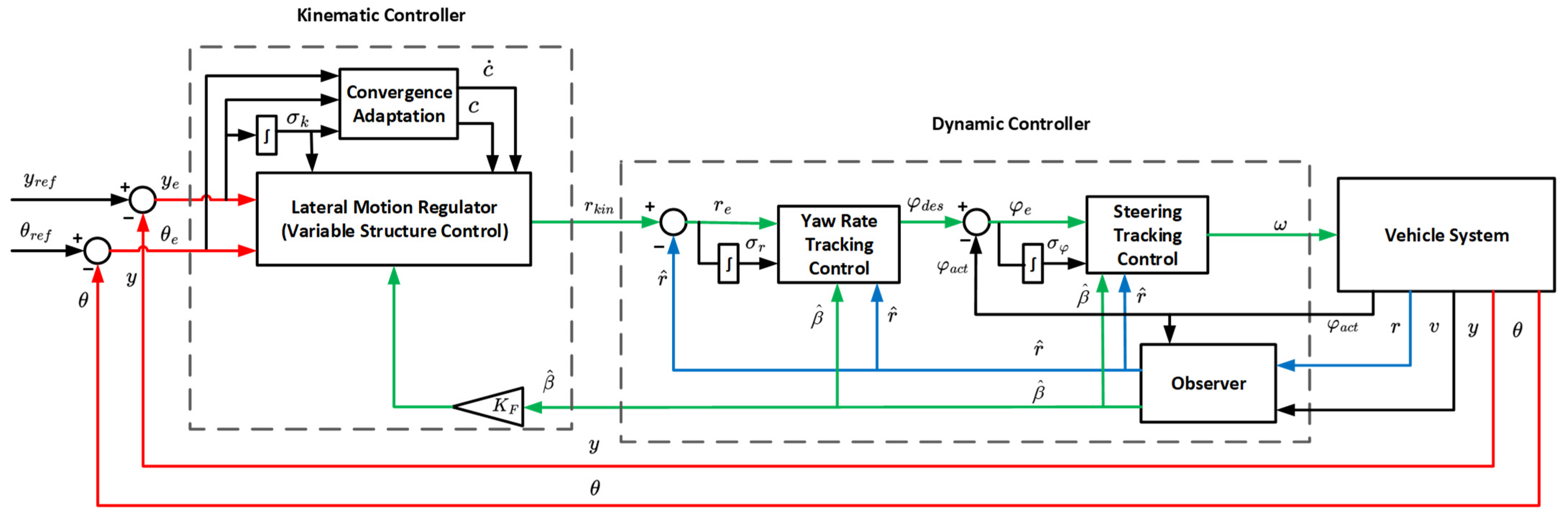
Building upon our prior work [10,22], the proposed steering controller uses a slip-coupled, multi-tiered kinematic–dynamic framework, shown in Figure 1, to consider vehicle slip, defined as the sideslip β , which is shown in Figure 2 and discussed later. This allows the kinematic controller to anticipate sideslip combined with path-following error, y e and θ e . Yaw rate, r k i n , is then the output of the kinematic controller, which acts as the command for the dynamic controller.
The dynamic controller considers the sideslip β , yaw rate r , and actuator response ω , where β ^ and r ^ are the estimates of sideslip and yaw rate. A slip–yaw dynamic model [23] is selected, since yaw rate naturally leads to centripetal forces and sideslip. Yaw rate is sensed by an Inertial Measurement Unit (IMU) such that the dynamic controller can match sensing and command data. This is opposed to the typical robotics approach, where configuration space variables describe desired robot motion and the dynamic controller steers the robot to reduce error [24,25].
Configuration space variables calculate path-following error in kinematics, but since GPS and yaw rate sensing are noisy, that information is filtered and fused with other sensors [26] for use in the kinematic and dynamic controllers. A slip–yaw observer estimates sideslip and yaw rate for output feedback control. Sideslip is difficult to measure, and yaw rate derivatives are required in the controller, but they are noisy. A high-gain observer is applied to reduce noise and compensate for uncertainty, but does require special consideration to avoid peaking [27]. Analytical derivatives using observer state estimates are used instead of numerical derivatives to further reduce the effect of sensor noise. The output of the dynamic controller is the steering rate, ω .

1.2. Proposed Controllers

The kinematic controller is designed to consider sideslip and provide yaw rate commands that lead to accurate and graceful motion. Continuous Variable-Structure Control (VSC) modifies driving behavior as a function of vehicle speed and path-following error. Smooth tanh() functions are used to resolve chatter while providing smooth, robust commands [28]. Hierarchical path manifolds adapt the convergence of heading error and lateral error to provide graceful motion. Sideslip is compensated for by slip terms in the controller. Errors in sideslip and the model are treated as uncertainties and compensated for by continuous robust terms. The integral of lateral error further compensates for uncertainty and disturbances. Saturation is applied to the kinematic controller output since the combination of robust controllers and observers is known to create peaking [27]. The result is graceful and robust kinematic control.
Dynamic control uses backstepping to couple the desired yaw rate, slip–yaw dynamics, and actuator rate for improved response. A yaw rate-tracking controller is designed based upon the slip–yaw model, which results in steering angle commands. Dynamic extension and backstepping allow the steering rate to serve as the input to the steering system, allowing terms from the desired path and kinematic controller to map to the steering rate. Integrators compensate for uncertainty in yaw rate, steering map, and disturbances. Composite Lyapunov analysis of the steering controller proves that it can provide asymptotic stability to the combined kinematic, dynamic, and steering systems.
Lateral steering control is the primary consideration in this work. The vehicle speeds and accelerations are controlled by a human, although other speed controllers could be used.

1.3. Evaluations

Validation is provided by field experiments with a full-size ground vehicle in challenging scenarios at varying speeds. The paths provide varying complexity on different surfaces, with disturbances from slopes and bumps in rainy and dry conditions. The metrics quantify tracking error and graceful motion. Comparisons between the proposed and baseline controllers highlight the benefits of the proposed methodology.

1.4. Structure of Paper

Section 2 reviews related work and describes contributions. Section 3 presents the kinematic and dynamic models. The kinematic controller, path manifold, and dynamic controller are presented in Section 4, Section 5 and Section 6. Observer design and output feedback control are in Section 7. Section 8 provides the experimental procedures. Section 9 presents the results, with discussion in Section 10. The conclusions are in Section 11.

2. Related Work

Self-driving cars and vehicle steering have been of keen interest for decades. Early automated driving emphasized hardware-based localization and comfort-oriented lateral dynamics (e.g., PATH with gain-scheduling [29,30]), but did not meet the needs of open-road transportation or explicitly consider tire–road slip [11,12]. The DARPA Grand Challenge (DGC 2004), such as in [3,4], and DARPA Urban Challenge (DUC 2007) [5,6] eras and the industry systems of that time prioritized perception and planning, typically using bicycle kinematics and low-order actuation models without sideslip estimation or compensation [31].
General solutions for automated vehicle controllers usually adopt nonslip kinematic models for efficiency, pairing them with PID-based controls [20,32,33] or optimization-based control algorithms such as the Linear Quadratic Regulator (LQR) [34,35] or Model Predicative Control (MPC) [35,36,37,38,39] to regulate lateral error while considering constraints across speeds and achievable steering commands. These approaches can usually provide satisfactory performance at moderate speeds in prescribed environments but degrade under dynamic tire–road conditions, aggressive maneuvers, or rapid curvature transitions, because sideslip is unmodeled [17,19].
Several researchers apply robust controls to develop steering controllers to compensate for slip and uncertainty. Taghia et al. [40] apply continuous SMC to a slip-based kinematic model of a tractor where the sliding surface includes an observer-based estimate of the disturbance acting on the system. Taghavifar and Mohammadzadeh [41] apply SMC to an error-based dynamic controller with an integrator in the sliding surface to compensate for slip and uncertainty for an AGV. Sekban and Basci [42] apply SMC to a nonslipdynamic model of a unicycle-type robot using velocity commands from a nonslip kinematic controller developed by [43], examining different methods of adapting controller gains online to deal with uncertainty. Zhou et al. [44] consider linearized slip-based kinematic and dynamic models combined to derive a backstepping controller using a radial basis function neural network to approximate parameter uncertainty. Ryu and Agrawal [45] apply Lyapunov redesign [46] to compensate for slip in a unicycle-type robot using the kinematic controller from [47], providing transformed velocity inputs to a nonslip dynamic controller made robust to slip velocities by also using Lyapunov redesign. Ref. [48] applies continuous SMC in nonslip kinematics to produce yaw rate commands, which are then tracked by a continuous SMC applied to slip–yaw dynamics to produce steering angle commands for driving the vehicle, which deals with error from slip and uncertainty. An integrator is added in subsequent work to reduce steady-state error [49]. While these robust techniques can deal with uncertainty and slip to different degrees, this paper proposes a slip-based VSC for kinematic control where the sliding surfaces are adapted online based upon vehicle operating conditions. The VSC kinematic controller is then integrated with a dynamic controller that uses backstepping to produce steering velocity commands.
As indicated above, to consider physical impacts from the real world, some researchers consider cornering stiffness or steady-state slip in dynamic control to improve stability [15,19,44,50] rather just using kinematic control. Some researchers consider slip in tire–ground interaction, which is more accurate, but each wheel requires burdensome sensors, and the algorithms require intensive computation [18,21,40,51]. Vehicle-level sideslip and yaw rate models (i.e., single-track slip–yaw models like the ones in this paper) enable practical regulation of sideslip and yaw rate [19,22,52,53,54]. Robust yaw stability controllers with bicycle dynamics (sometimes coupled with longitudinal dynamics) improve stability margins but can neglect kinematic path-following structure and often remain simulation-centric [8,44,51,55,56].
Control of slip is also an issue in unmanned surface vehicles (i.e., ships), which are subject to kinematic and dynamic considerations. Similarly to the above, some researchers adapt PID control algorithms online to compensate for vehicle motion in dynamic maneuvers [57] or seek to find optimal PID controllers while also considering control of speed and steering systems [58]. Others apply reinforcement learning with robust control to compensate for slip and perturbations [59].
Hierarchical (tiered) architectures are applied to couple kinematics and dynamics in AGVs. Some researchers consider kinematics and dynamics separately, but do not consider coupling between the tiers of the control architecture and rely on heavy instrumentation and burdensome computations to predict tire–ground interaction [8]. Others use slip–yaw MPC to achieve precise tracking, but this comes at high computational cost and is only demonstrated at low speeds, while also omitting sideslip and actuator dynamics [60]. Linearization-based lookahead with state feedback works near nominal conditions but is brittle to nonlinear slip [12,32,61,62]. Other studies combine slip-based kinematics with observers and adaptation [41,42], or hierarchical MPC/PI with specialized actuation [54], achieving regulation at the expense of complexity and sensor burden.
Because sideslip is difficult to measure, observers are generally applied in controller designs. Leuenberger observers [63], high-gain observers [19,64,65], and Extended Kalman Filters (EKFs) and Unscented Kalman Filters (UKFs) [26,55,62,66,67,68] are used to estimate sideslip and yaw rate as alternatives for state feedback. High-gain observers capture fast dynamics but can exhibit peaking [19,27], although command shaping can mitigate this deficiency [19,27]. Using estimated sideslip in feed-forward control improves stability and lateral accuracy [19,50,64,69,70], although performance depends on model fidelity, observer bandwidth, and command limits.
System performance also depends on the type of the steering actuator commands provided by the controller. Most researchers provide steering angle commands to the steering actuators, and then a local PID controller on the actuator attempts to go to the reference angle. The dynamic response of the actuator impacts the vehicle’s dynamic response. Other researchers provide steering rate commands, which allows the actuator to better respond when paired with dynamic backstepping [16,54,66,71]. Some literature addresses steering actuator dynamics by discretized rate commands, which improves realizability [15,19,50], but can induce jerky behavior if not well tuned [71,72]. Using backstepping to extend kinematic and dynamic controller commands to create steering rate commands allows the steering actuator rate commands to directly include terms from kinematic and dynamic controllers [15,19,24,27,49,62,70,73], which can also limit steering rates to reduce effects such as peaking.

Contributions

This paper uses a slip-based kinematic model and expands the derivation of the continuous VSC to better consider sideslip compensation, providing improved methods of adapting the controller online while considering physical limitations. Compared to prior work [22], this paper examines the relationship between rear-slip and sideslip, demonstrating that sideslip compensation improves stability and gracefulness. The kinematic controller uses the integral of lateral error, but not “sideslip disturbance” like in [22], since this paper compensates for sideslip directly. Thus, slip compensation in the proposed kinematic controller is improved. Likewise, this paper provides an in-depth analysis of the VSC surface to highlight how the surface should be adapted to deal with different driving speeds and surface friction, which was not provided in prior work [22]. This allows researchers to better understand how the controller should adapt to varying driving conditions online.
Like [10,15,19,22,49], this paper uses backstepping in dynamics to improve steering commands. Refs. [10,49] produce steering angle commands, whereas [15,19,22] provided steering rate commands for better tracking, which are used here. This allows the steering controller in this paper to command steering actuator response, which is highlighted relative to the baseline studies provided in Section 8. A high-gain observer is applied as in [10,15,19,22,49], but this work and [15,19] apply saturation [64] to limit yaw rate commands from the kinematic controller, reducing “peaking”. Compared to prior work [15,19,22], this paper provides a more detailed analysis of the high-gain observer and includes new simulations that demonstrate how observer parameters affect state estimation. These simulations highlight the importance of continuous paths for removing discontinuities that can lead to overshoot and peaking. Saturation is applied to the kinematic controller commands to limit peaking if discontinuous paths are applied.
Sideslip feedback to the kinematic controller also reduces demand on the kinematic controller and peaking. This produces more graceful motion results, which are especially notable with rapid path curvature variations. Compared to [22], this paper also provides significantly expanded evaluations on a physical vehicle in a variety of conditions along a complex path, which are compared to results using the algorithm from [22], validating improved tracking and more graceful motion instead of only providing demonstrations as in prior work. This paper further validates the algorithms in challenging terrain and environmental conditions which were not considered in prior work.

3. Modeling

Bicycle models are the basis of this research due to their ability to simply model the relationships between steering commands, trajectory tracking, and vehicle dynamics. A tire-slip based kinematic model is developed first, followed by the slip–yaw dynamic model and model coupling.

3.1. Slip-Based Kinematic Model

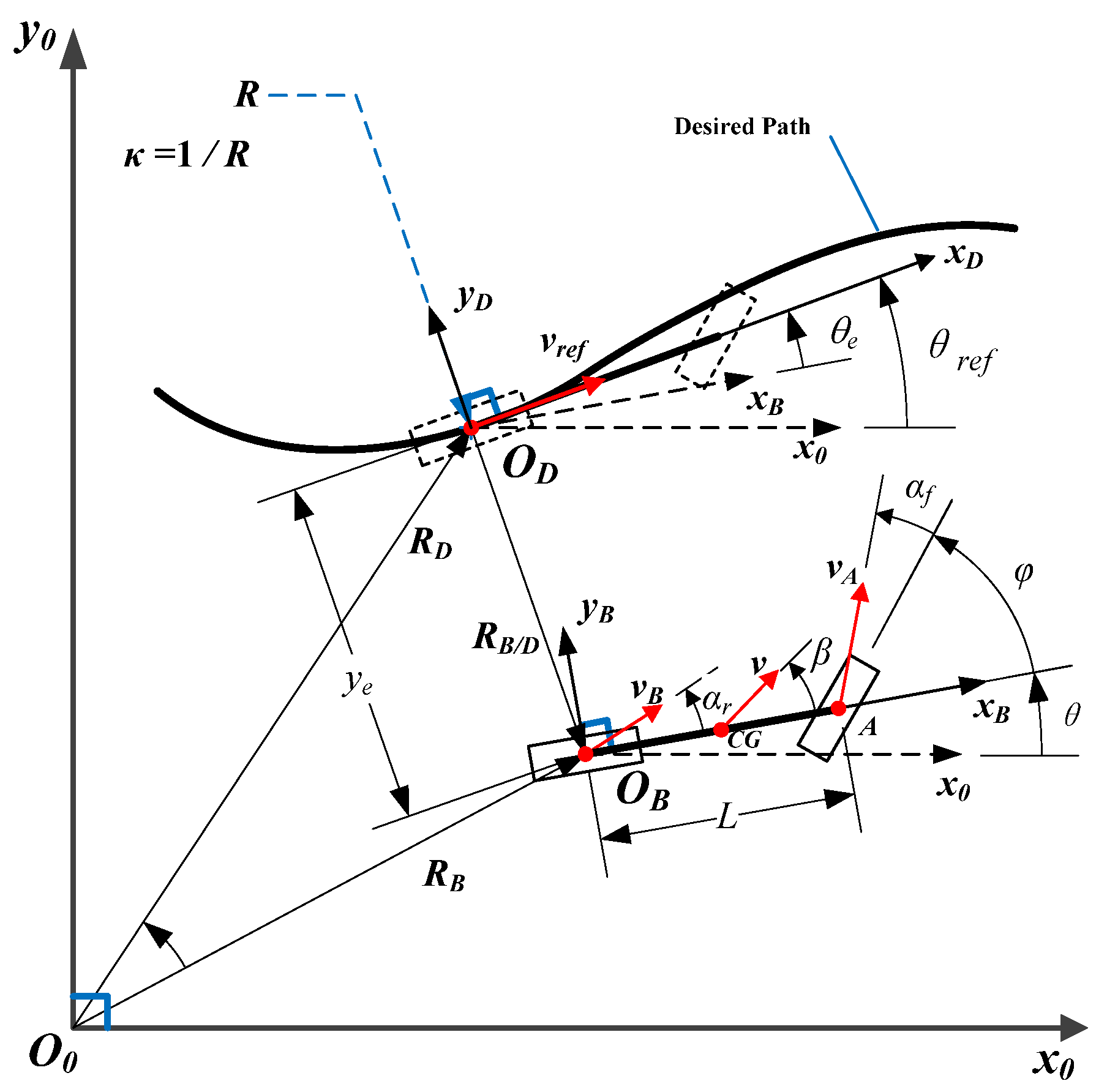
Figure 2 presents a slip-based bicycle model of vehicle kinematics in the global reference frame { O 0 } .
The coordinate frame { O B } at the rear axle represents the actual posture. The frame is rotated by the heading angle θ such that the x B axis is aligned with the “longitudinal direction” of the vehicle and the y B axis is the “lateral direction”. O B is located by R B = x a c t y a c t T in the global frame { O 0 } such that the vehicle actual posture is P a c t = x a c t y a c t θ T . The front- and rear-tire velocities at A and O B are expressed in { O 0 } as v A and v B , respectively. The front-slip angle, α f , and rear-slip angle, α r , are measured relative to the vehicle in { O B } , where sthe teering angle is φ . Slip angles are shown in positive directions, but a positive steering angle φ usually results in negative slip angles. The slip-based kinematic state model is then
x ˙ a c t = v B cos ( θ + α r )
y ˙ a c t = v B sin ( θ + α r )
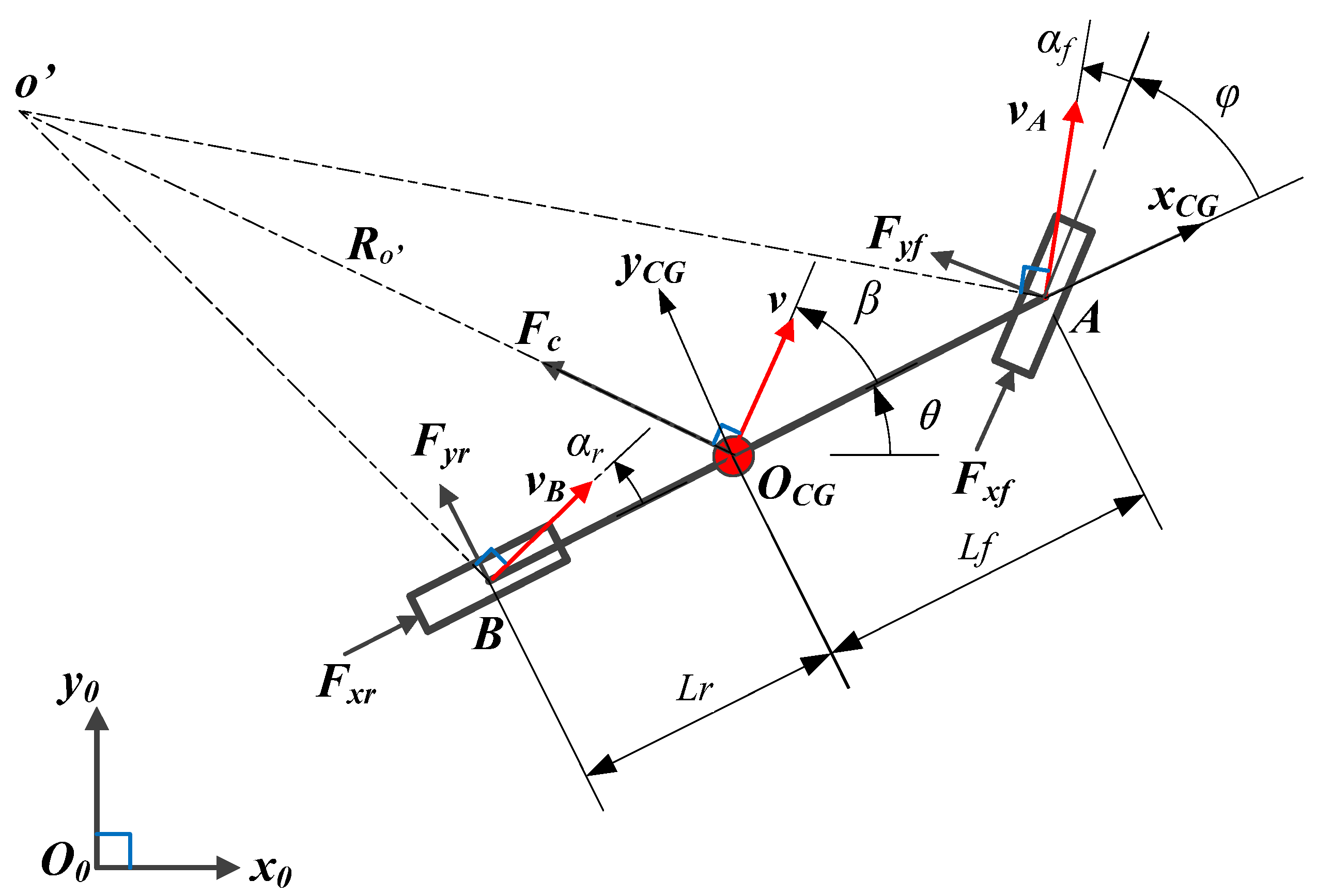
where v B is the magnitude of the velocity vector v B . The θ state equation is derived, noting that the vehicle is rotating about its instantaneous center of rotation (ICR) o at the yaw rate r as shown in Figure 3. Thus, θ ˙ = r = v B / o B ¯ , is expressed in terms of rear-tire slip and steering angles as
θ ˙ = r = v B L cos ( α r ) ( tan ( α r ) + t a n ( φ + α f ) ) ,
where the time derivative of steering angle φ is equivalent to steering rate ω ,
φ ˙ = ω .
The coordinate frame { O D } is the desired posture on the path located by R D = x r e f y r e f T . { O D } is tangential to the path and desired heading θ r e f describes the orientation in { O o } . The reference posture is then P r e f = x r e f y r e f θ r e f T and the nonslip reference model is
x ˙ r e f = v r e f cos θ r e f
y ˙ r e f = v r e f sin θ r e f
θ ˙ r e f = κ r e f v r e f
where v r e f is the magnitude of v r e f and the path curvature at O D is κ r e f = 1 / R r e f . The reference turning radius is R r e f and the yaw rate is θ ˙ r e f = r r e f = v r e f / R r e f such that θ ˙ r e f = κ r e f v r e f .
Path-following error state equations are then formulated in { O D } , where the distance between O D and O B along the x D axis is the longitudinal error, x e , and the distance along the y D axis is the lateral error, y e . The angle between x B and x D is the heading error, θ e . θ ˙ e is the time derivative of θ e = θ r e f θ . Position error states are derived by expressing tracking error in { O 0 } ,
x e 0 y e 0 = x r e f x a c t y r e f y a c t .
Tracking error (8) is represented in { O D } by x e and y e after rotation, as shown in Figure 2. Heading error is defined as θ e = θ r e f θ . Time derivatives are applied, and (1), (2), (5), and (6) are substituted. Trigonometric transformations produce the Slip-based Kinematic Tracking Error Model in the { O D } coordinate frame,
x ˙ e = v r e f v B cos ( θ e α r ) + y e θ ˙ r e f
y ˙ e = v B sin ( θ e α r ) x e θ ˙ r e f
θ ˙ e = θ ˙ r e f θ ˙ = κ r e f v r e f r .
Proposition 1.
The initial posture on the reference path is selected such that   x e 0 = 0 . v r e f  is calculated based upon the actual vehicle speed such that  x ˙ e = 0 ; thus,  x e 0 .  Equation (9) drops out and (10) becomes (12). Equation (11) is restated as (13) for completeness:
y ˙ e = v B s i n ( θ e α r )
θ ˙ e = κ r e f v r e f r .
This is the Slip-based Kinematic Path-Following Error Model, which is the basis of the controller design.
Proposition 1 simplifies the design of the kinematic controller since only lateral error and heading error are compensated for. The effect of sideslip is apparent in (12), where the rea-tire slip angle α r perturbs heading error, θ e .

3.2. Sideslip–Yaw Rate-Based Dynamic Model

Dynamics are characterized by a linear slip–yaw bicycle model [13] that considers the interaction of vehicle inertia, tire–ground interaction, and steering as illustrated in Figure 3. Motion is described by (1)–(4), whereas this section presents dynamic state equations for slip angle and yaw rate. They are presented briefly since they are standard [13,74], but are worthy of mention since they form the basis of the dynamic controller.
The coordinate frame { O C G } is attached to the Center of Gravity (CG), such that the x C G axis is along the longitudinal axis of the vehicle and y C G is along the lateral direction, similar to { O B } , except O C G is at the CG along the x B axis. L f and L r are the distances between the CG and the front and rear axles. L = L f + L r is the vehicle wheelbase. In { O 0 } , the vehicle velocity vector is v (with magnitude v ), which has sideslip, β , measured relative to the x C G axis.
Typical assumptions are made to derive the linear slip–yaw dynamic model [13,74], but we later demonstrate that perturbations resulting from violating the assumptions can be compensated for:
Assumption 1.
Ackerman steering is assumed such that the steering angle  φ  describes the effective instantaneous center of rotation  o  created by the front wheels of the vehicle, shown in Figure 3.
Assumption 2.
Lateral and longitudinal dynamics can be separated, and coupling effects can be ignored.
Assumption 3.
Typical driving scenarios are assumed:  ( a )  moderate to high speeds ranging from 1  m / s  to 40  m / s ;  ( b )  Limited Speed Variations are assumed for deriving the dynamic model, but perturbations due to violating this are compensated for by the high-gain observer;  ( c )  limited steering angle is required to drive—  | φ |   < 11 °  is typical;  ( d )  Limited Road Curvatures are based upon the limited steering angle  φ , where  | κ | tan ( 11 ° ) / L  = 0.0658  m 1  for the vehicle described in Section 8.1;  ( e )  Varying Road Surfaces: concrete, asphalt, and gravel;  ( f )  Varying Road Conditions: dry or rainy/wet;  ( g )  Road Side Slope and Incline are assumed flat and level to simplify derivations, although results show good performance on sloped terrain due to the HGO. Variations in speed and terrain are treated as unmodeled disturbances that are compensated for by the steering controller.
Assumption 4.
Limited Slip Angles,  α f < 11 ° , α r < 11 ° , and  | β | < 11 °  follow operating conditions in Assumption 3.
Assumption 5.
In-plane Rigid Body Motion is assumed, such that body roll due to vehicle suspension is neglected. Wheel forces are lumped into single wheels modeled at the center of the axles.
Proposition 2.
Given the above assumptions, the slip–yaw dynamic model of the vehicle can be approximated as
β ˙ = a 11 β + a 12 r + b 11 φ + δ β ϕ β ( β , r , φ )
r ˙ = a 21 β + a 22 r + b 21 φ + δ r ϕ r ( β , r , φ )
φ ˙ = ω
where  β , r ,  and  φ  are the vehicle slip angle, yaw rate, and steering angle, and
a 11 = C f + C r m v ,   a 12 = 1 + C f L f C r L r m v 2 ,
a 21 = C f L f C r L r J ,   a 22 = C f L f 2 + C r L r 2 J v ,
b 11 = C f m v ,   b 21 = C f L f J ,
C f and C r  are the front and rear cornering stiffnesses;  m  and  J  are the vehicle mass and rotational inertia.  δ β  and  δ r  are the higher-order terms resulting from linearization of the nonlinear model and perturbations due to speed variations and terrain, which are not considered in the literature [13,74].
Proof. 
Per Assumption 4 and Figure 3, planar rigid body dynamics characterize forces acting on the vehicle and its resulting motion in the lateral and yaw directions, respectively, as
F y f cos φ + F y r + F x f sin φ = F c cos β + m v ˙ sin β
F x f sin φ L f + F y f cos φ L f F y r L r = J θ ¨ = J r ˙
where it is noted that yaw acceleration r ˙ = θ ¨ . Tire forces are characterized by longitudinal and lateral components expressed relative to each tire; F x f and F x r are front- and rear-tire longitudinal forces, respectively, whereas F y f and F y r are lateral forces. The centripetal force F c at the CG is directed toward the ICR, o , which can be expressed as F c = m v 2 / R , where R is the turning radius. Noting that the angular rate of the vehicle can be expressed as ( v / R ) = θ ˙ + β ˙ , the result is F c = m v ( r + β ˙ ) , which is substituted into (17) to produce the sideslip state equation, Equation (14).
Per Assumption 3 (b), braking and acceleration forces are small during steering, such that F y f F x f , F y r F x r . Hence, F x f , F x r , and v ˙ are neglected. Perturbations due to acceleration and deceleration are lumped into δ β . Lateral tire forces are approximated by the cornering stiffness model, F y f μ f C f 0 α f = C f α f and F y r μ r C r 0 α r = C r α r . μ f and μ r are front- and rear-tire friction coefficients, C f 0 and C r 0 are tire cornering stiffnesses, C f and C r are cornering stiffnesses, and α f and α r are front- and rear-tire slip angles. These terms are combined with the equations of motion to produce (14) and (15). □
Zero velocity is problematic due to v in the denominators of the coefficients in (14) and (15). Substituting a small positive velocity v ϵ , when v 0 , alleviates numerical issues. Sensor noise affects the magnitude of v ϵ that is selected.

3.3. Resolving Model Reference Frames

One challenge is that O B and O C G are at different locations. Slip angles β and α r and speeds in the different reference frames are resolved here. Analysis of slip angles begins with geometric analysis of the vehicle and velocity headings relative to the instantaneous center of rotation, o , shown in Figure 3. In the triangle o O C G B , the Law of Sines is applied to show sin B o O C G L r = sin o B O C G R , which is equivalent to sin β α r L r = sin 90 o + α r R = cos α r R . Based on small-angle assumptions per Assumption 4, sin β α r β α r , cos α r 1 , which is applied to the previous equations to show
β α r L r = 1 R = κ .
Based on the kinetic analysis, Σ M A = F y r L + F c cos β L f = 0 in steady cornering, where F y r = C r α r and F c = m v 2 R = m v 2 κ = m v 2 β α r L r . Combining equations results in C r α r L + m v 2 L f L r β α r = 0 , which can be reduced to
α r 1 C r L L r m v 2 L f 1 β .
This expression will serve as a baseline for understanding the effect of sideslip compensation proposed in the next section.
Proposition 3.
Speed approximation: The rear axle speed,  v B , and the CG speed,  v , are approximately equal, i.e.,  v B v .
Proposition 3 is appreciated by considering that the longitudinal components of v B and the CG velocity, v , must be equal. As a result, v B cos α r = v cos β . According to Assumption 4, cos α r cos β 1 , such that v B v . Due to Proposition 1, we can also show that v r e f v by examining (9), which shows that v r e f = v B cos ( θ e α r ) + y e θ ˙ r e f to maintain x ˙ e = 0 . Since θ e , α r , y e , and θ ˙ r e f are small, (9) reduces to v r e f v B v .

4. Kinematic Controller

This section derives the kinematic controller. Sideslip compensation is presented first, followed by a continuous VSC law using customized path manifolds to provide graceful error convergence.

4.1. Sideslip Compensation

Sideslip compensation is proposed to compensate for rear-wheel sideslip, α r , in (12). Since an estimate of sideslip, β ^ , is produced by the observer where β = K F β ^ and K F = 1 is the gain, and since the parameters in (20) are uncertain, we correlate α r to β ^ in (12) by defining
θ ¯ e = θ e + β = θ e + K F β ^ .
θ ¯ e is used to design the controller. Proposition 3 and (21) are applied to (12) to produce
y ˙ e = v sin ( θ ¯ e K F β ^ α r ) .
Since α r and β are typically different, the perturbation δ α r = α r + K f β ^ describes the effect of the sideslip compensation:
y ˙ e = v sin ( θ ¯ e δ α r ) .
which serves as the basis of controller design. The effect of δ α r depends on vehicle speed. Since β is required to analyze δ α r , solving (19) for α r results in α r = β L r κ . Substituting this into (20) and solving for β results in
β = κ C r L ( C r L L r m v 2 L f ) .
Substituting (20) for α r and (24) for β , into the above δ α r perturbation equation, results in
δ α r = κ C r L C r L L r 2 m v 2 L f .
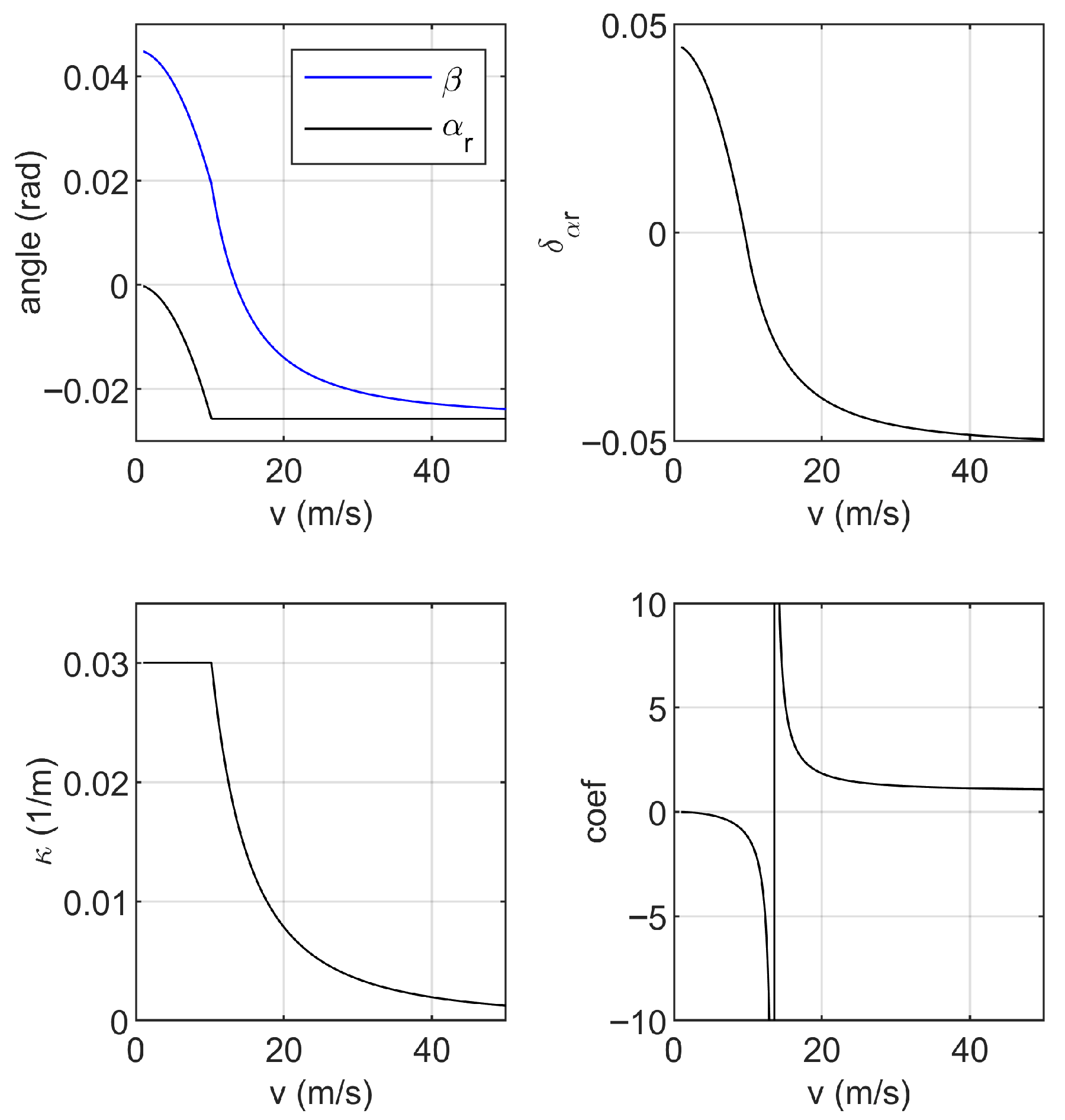
Curvature, κ , is bounded by passenger comfort, which limits lateral acceleration to 0.32 g (i.e., 3.13   m / s 2 ) [75] where centripetal acceleration is a y = v 2 κ . Since the maximum steering angle of the vehicle corresponds to κ = 0.03 m 1 , the maximum curvature is κ m a x = m i n ( 0.03 , 3.13 / v 2 ). As a result, curvature κ decreases with speed, shown in Figure 4. α r saturates with increasing speed and β approaches α r . Perturbation δ α r is initially a small positive number and becomes a small negative number as speed increases. Since the controller is designed based upon (23), δ α r causes the controller to slightly overcompensate for slip at low speeds to help reduce tracking error and slightly undercompensates at high speeds to make the controller more cautious. Using the nominal vehicle parameters indicated in Table 1, slip compensation matches at ~9.5 m/s where δ α r = 0 .

4.2. Kinematic Control Law

The kinematic controller aims to gracefully stabilize tracking error. Integrator state, σ k , reduces tracking error due to disturbances acting on the vehicle:
σ ˙ k = y e .
A path manifold is designed based upon (23) and (26) to stabilize y e and σ k per the VSC design, which is proposed in Proposition 4. A continuous controller is then designed in Theorem 1 to drive the system to the path manifold, eliminate chatter, and improve smoothness in practice.
Proposition 4.
A path manifold function,  S k i n ( t ) ,
S k i n t = θ ¯ e + arcsin s a t c t y e + K i σ k v ¯ , a 1
is proposed to guide error  x 1 = σ k y e T  asymptotically to  x 1 s s = σ k . s s 0 T . c ( t )  is a slowly varying bounded function,  0 < c t c m a x , K i  is the integral gain,  a 1  is the upper limit imposed by the saturation,  s a t ( ) , to satisfy the limited range of the arcsine function, and  c m a x  is the upper limit on  c ( t ) . This defines an unsaturated domain of the path manifold:  D 1 = { x 1 R 2 | c t y e + K i σ k v ¯ a 1 < 1 } . As in Section 3.2,  v ¯ = m a x ( v ϵ , v B ) , where  v ϵ  is an arbitrary positive number to avoid singularity in (27) due to problematic zero velocity. Note that  c m a x    and  c ( t )  have units of s−1,  a 1  is unitless, and  S k i n  has units of radians.
Proof. 
We will now prove that (27) will drive the system (23) and (26) to an equilibrium point x 1 s s = σ k , s s   y e , s s T when the system is on the path manifold S k i n = 0 . First, note that (23) can be transformed using trig identities to show that y ˙ e = v ¯ sin θ ¯ e δ α r = v ¯ sin θ ¯ e cos δ α r v ¯ cos θ ¯ e sin δ α r . Since δ α r and θ ¯ e are small, this can be simplified to y ˙ e = v sin θ ¯ e v δ α r . Applying v ¯ = max ( v , v ϵ ) for y ˙ e results in
y ˙ e = v ¯ sin θ ¯ e v ¯ δ α r .
On the manifold, S k i n t = 0 and the state is inside the unsaturated domain D 1 ; thus, θ ¯ e = arcsin c t y e + K i σ k v ¯ . Applying this to (23) and (26), the result is y ˙ e = c t y e K i σ k v ¯ δ α r . Given (23), the equilibrium point is y e , s s = 0 and σ k , s s = v ¯ δ α r K i . If the vehicle parameters are constant, δ α r will be a constant value. Otherwise, per (25), δ α r will vary with changes in curvature, κ ; velocity, v ; and cornering stiffness, C r .
Dynamics on the path manifold inside D 1 are then described by x ˙ 1 = A ¯ x 1 + 0 v ¯ δ α r , where A ¯ = 0 1 K i c ( t ) determines convergence to the equilibrium point. Since K i , c t > 0 , A ¯ is Hurwitz and the origin is exponentially stable. v ¯ δ α r is presumed to vary slowly. c t varies slowly and is much greater than K i . Thus, the path manifold stabilizes the majority of y e rapidly due to c ( t ) and the integrator compensates for small remaining error as time progresses. While variations in v ¯ δ α r may cause σ k , s s to vary, the lateral error is still driven to zero such that y e , s s 0 . For ideal conditions, if v   9.5   m/s, then σ k , s s 0 .
If θ ¯ e is in a saturated domain, i.e., c t y e + K i σ k v ¯ > a 1 , the result is that θ ¯ e = arcsin ± a 1 , where the sign of a 1 depends on whether the expression c t y e + K i σ k v ¯ is saturated from above or below. When applied to (27), y ˙ e = a 1 v ¯ δ α r , which assures trajectories move toward and enter D 1 in finite time, so long as a 1 is sufficiently large to dominate v δ α r (i.e., v ¯ δ α r < a 1 1 ). Given the range of δ α r , shown in Figure 4, this suggests that vehicle states should not be in the saturated domain above 20   m / s , which is not a practical concern since initial conditions can be selected via path planning. The system enters D 1 in finite time, whereupon exponential error convergence occurs inside D 1 ; the result is asymptotic convergence if the system starts in the saturated region. □
The continuous variable-structure controller is now proposed.
Theorem 1.
Defining  x 2 = θ ¯ e y e σ k T , the kinematic yaw rate command  r k i n  for the VSC kinematic controller is
r k i n = κ r e f v ¯ + ( ρ k i n + ψ k i n ) tanh S k i n ε k i n ,
where  ψ k i n > 0  is a small number to assure robustness,  ε k i n  is a small number to control the boundary layer along the manifold (27), and
ρ k i n = c ˙ t y e + c t v ¯ sin θ ¯ e c t v ¯ δ α r + K i y e v ¯ 1 c t y e + K i σ k v ¯ 2 .
The controller drives  S k i n 0  in finite time and  x 2 [ 0 , 0 , σ k , s s ]  asymptotically, which can further be proven to provide local exponential convergence of  x 2 [ 0 , 0 , σ k , s s ] .
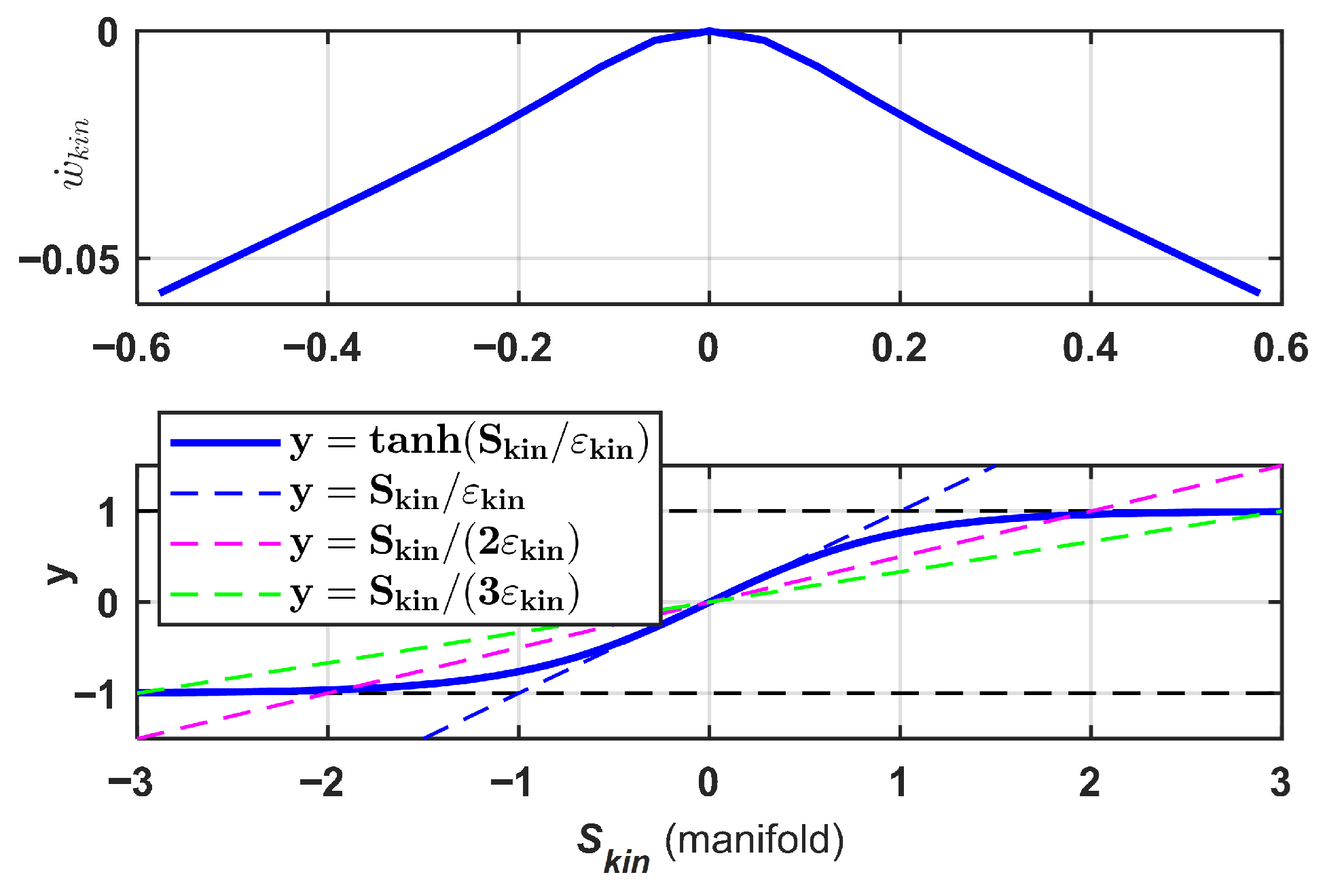
Proof of Theorem 1 is provided in Appendix A for brevity. Note that the transition created by tanh S k i n ε k i n varies with different ε k i n : smaller ε k i n reduces the unsaturated domain such that the shape of tanh S k i n ε k i n approaches s g n S k i n ε k i n , which would lead to more aggressive convergence and chatter if ε k i n is too small. Larger ε k i n enlarges the unsaturated domain such that tanh S k i n ε k i n is like a saturation function. As a result, the vehicle system response slows down to provide more graceful convergence. As highlighted in the proof of Theorem 1, tuning of ψ k i n is related to the magnitude of ε k i n to assure stability and convergence.

5. Time-Varying Path Manifold

The path manifold parameter c ( t ) is defined as the “convergence gain function”, which determines how aggressively the vehicle follows the path. Design of c ( t ) must consider vehicle safety and response. Path manifolds in [76] were geometrically based, whereas this research considers vehicle speed, potential lateral error due to disturbances, and combined heading and lateral error.

5.1. Dynamic Response Characteristics

Response characteristics, such as settling time or distance, are affected by c ( t ) as described in Theorem 2 below.
Theorem 2.
Settling time,  T s , and distance,  S p a t h , can be related to  c ( t )  by  T s 4 c ( t )  and  S p a t h = v ¯ 4 c ( t ) .
Proof. 
Once the “reaching phase” has converged to the path manifold, S k i n t = 0 . Per the state-space form of the system shown in the proof of Proposition 4, the poles of the system are S 1,2 = c t ± c t 2 4 K i   2 . Since c t K i , they can be approximated as S 1,2 = ϵ , c t + ϵ , where ϵ is a small positive number showing the effect of c t K i . Due to the small residual associated with ϵ , the 98% settling time of the system is T s = 4 c ( t ) , where c ( t ) is a slowly varying variable. This can also be used to ensure convergence within a desired distance, S p a t h . If v ¯ varies relatively slowly, S p a t h = v ¯ T s = v ¯ 4 c ( t ) . □
Thus c ( t ) determines convergence time and distance. Smaller c t implies slower error convergence and provides more graceful motion in tracking-error stabilization, which requires greater distances. c ( t ) should decrease at higher speeds to allow more graceful convergence, which is described further in Section 5.4.

5.2. Vehicle Safety Factors

For steering, vehicle safety relates to lateral stability and roll stability [76], and avoids lateral sliding or rollover due to excessive lateral acceleration. Lateral acceleration, A = r k i n v ¯ = y ¨ , must be below a safety threshold, A m a x (i.e., A | A m a x | ). Lateral acceleration is limited by road–tire friction coefficient, μ , such that
0 < | A m a x | k 1 μ g ,
where k 1 is a safety margin describing how much friction is allowed for steering, which can be adjusted to account for roll stability and braking. Given this limit, the upper bound on c ( t ) can be established based upon tracking error, velocity, and system coefficients as described by Theorem 3.
Theorem 3.
To satisfy vehicle safety associated with steering and road friction,  c ( t )  must be selected to satisfy
c ( t ) ( k 1 k 2 μ g v ¯ ψ k i n ) 1 a 1 2 | K i y e | | c ˙ ( t ) y e | | v ¯ | ( | s i n θ ¯ e | + δ α r ) ,
based upon anticipated operating conditions, Proposition 4, and typical tracking error. Coefficient  k 2  balances control authority used for path features and error correction where  0 < k 2 < 1 .
Proof. 
The magnitude of lateral acceleration is
y ¨ = v ¯ r k i n = κ r e f v ¯ 2 + v ¯ ρ k i n + ψ k i n tanh S k i n ε k i n
where (29) is substituted for r k i n . The right-hand side of the above equation is expanded to y ¨ κ r e f v ¯ 2 + | ( ρ k i n + ψ k i n tanh S k i n ε k i n ) v ¯ | A m a x . The κ r e f v ¯ 2 part is based upon the path curvature κ r e f , where a portion of A m a x specified by k 2 is reserved as follows:
κ r e f v ¯ 2 < 1 k 2 A m a x
Subtracting this from (33), lateral error acceleration is then
y ¨ e | ( ρ k i n + ψ k i n tanh S k i n ε k i n ) v ¯ | k 2 A m a x .
Eliminating ρ k i n using (30), given the worst case, tanh S k i n ε k i n = 1 and a r c s i n ( · ) is replaced by a 1 per (27), which provides
ρ k i n c ˙ ( t ) y e + c ( t ) v ¯ s i n ( θ ¯ e ) + | c t v ¯ δ α r | + K i y e v ¯ 1 a 1 2 ,
Substituting (36) into (35), noting that t a n h ( ) 1 and a + b < a + b , the result is that
y ¨ e | c ˙ ( t ) y e + c ( t ) v ¯ s i n θ ¯ e + | c t v ¯ δ α r | + | K i y e 1 a 1 2 + v ¯ ψ k i n < k 2 A m a x ,
must be true. Using the upper limit for A m a x   in (31) and solving for c t , the upper limit of c ( t ) in (32) results. □
Theorem 3 highlights that the upper limit of c ( t ) depends on heading error and lateral error, as well as velocity. While a lateral perturbation due to wind or path discontinuity may cause y e to increase initially, θ ¯ e will vary as the vehicle steers back to the desired path, but the magnitude of θ ¯ e variations depends on the magnitude of c ( t ) . Simulation results in Section 5.4 highlight appropriate c ( t ) for different velocities and lateral perturbations.

5.3. Steering Actuator Dynamic Response

Steering actuator rate saturation is important to consider when determining c t . Convergence within a desired time or distance requires more-aggressive steering at low speeds, whereas higher speeds require less-aggressive steering; both are governed by c ( t ) .
Proposition 5.
Larger ranges of posture error,  y e  and  θ e , can be accommodated using smaller  c t  at low speeds, whereas higher speeds up to 10 m/s allow larger  c t  without steering saturation.
Proof. 
From (16), note that yaw rate can be expressed as r K I N = v B L tan φ if nonslip is assumed. Solving for steering angle, φ , and taking the time derivative results in ω = φ ˙ = r ˙ K I N v ¯ L v ¯ 2 + r K I N 2 L 2 . Thus, ω is dependent upon yaw rate and acceleration, r K I N and r ˙ K I N , commanded by (27), (30), and (29). This results in a complex expression [50] highlighting that steering rate depends on y e , θ ¯ e , v ¯ , c ( t ) , and σ k , which is studied numerically here.
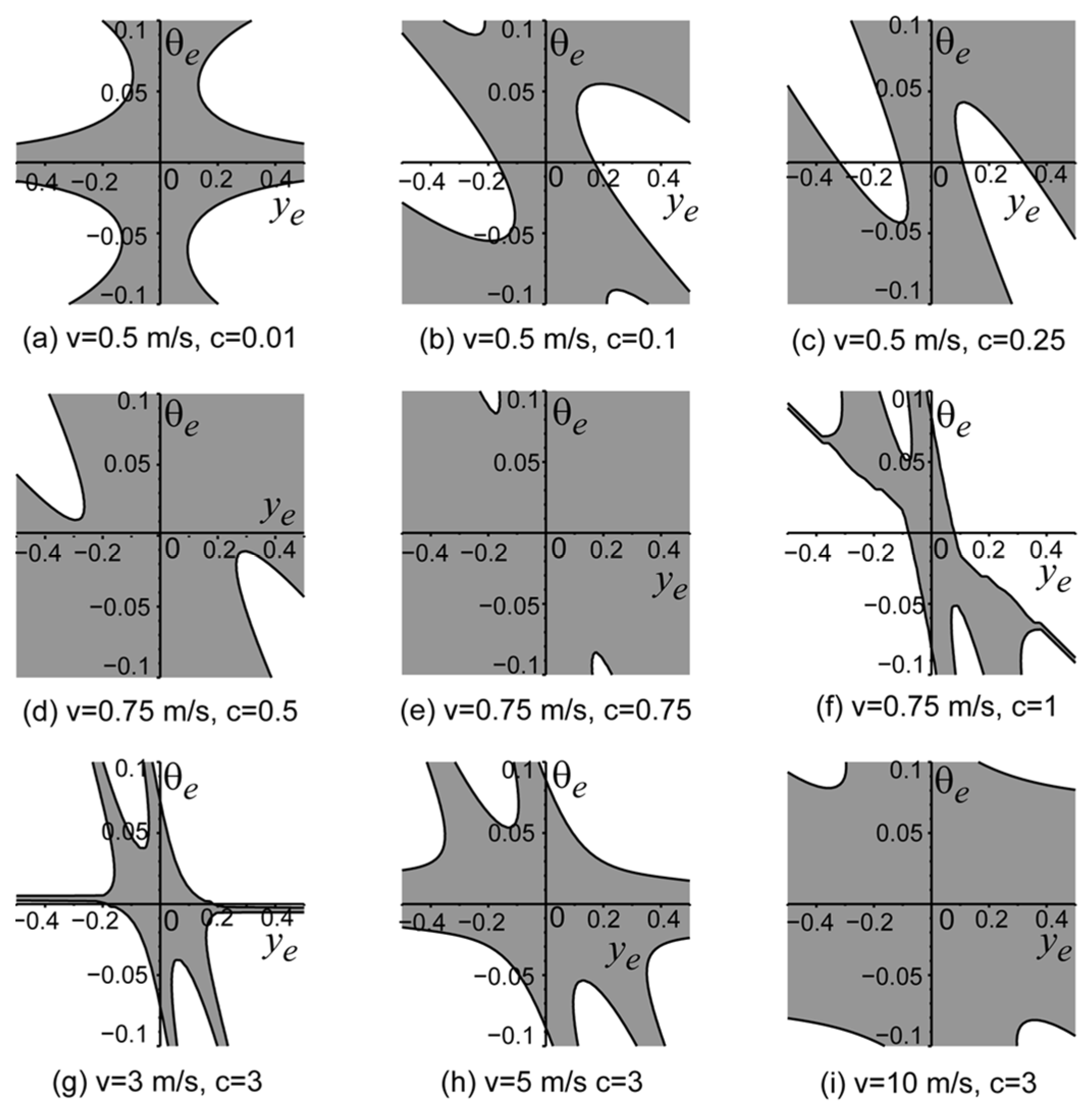
Figure 5 presents contour plots as functions of y e and θ e where regions with unsaturated steering rate are shaded based upon maximum steering rate of ± 0.3   r a d / s e c with ε k i n = 0.1 , ψ k i n = 0.1 , σ k = 0 , and κ r e f = 0 , which is typical for converging to a straight path. At lower velocities, smaller c ( t ) allows for a larger set of initial errors without steering saturation as shown in Figure 5a–f. The unsaturated region increases with higher velocity for a given value of c ( t ) , which is shown in Figure 5g–i. This leads to the general conclusion that lower velocities are better served by smaller c t , while larger velocities up to 10 m/s allow larger c t .

5.4. Selecting and Varying c ( t )

Selecting c ( t ) depends on the speed of the vehicle, potential posture error encountered during operation, and desired gracefulness.
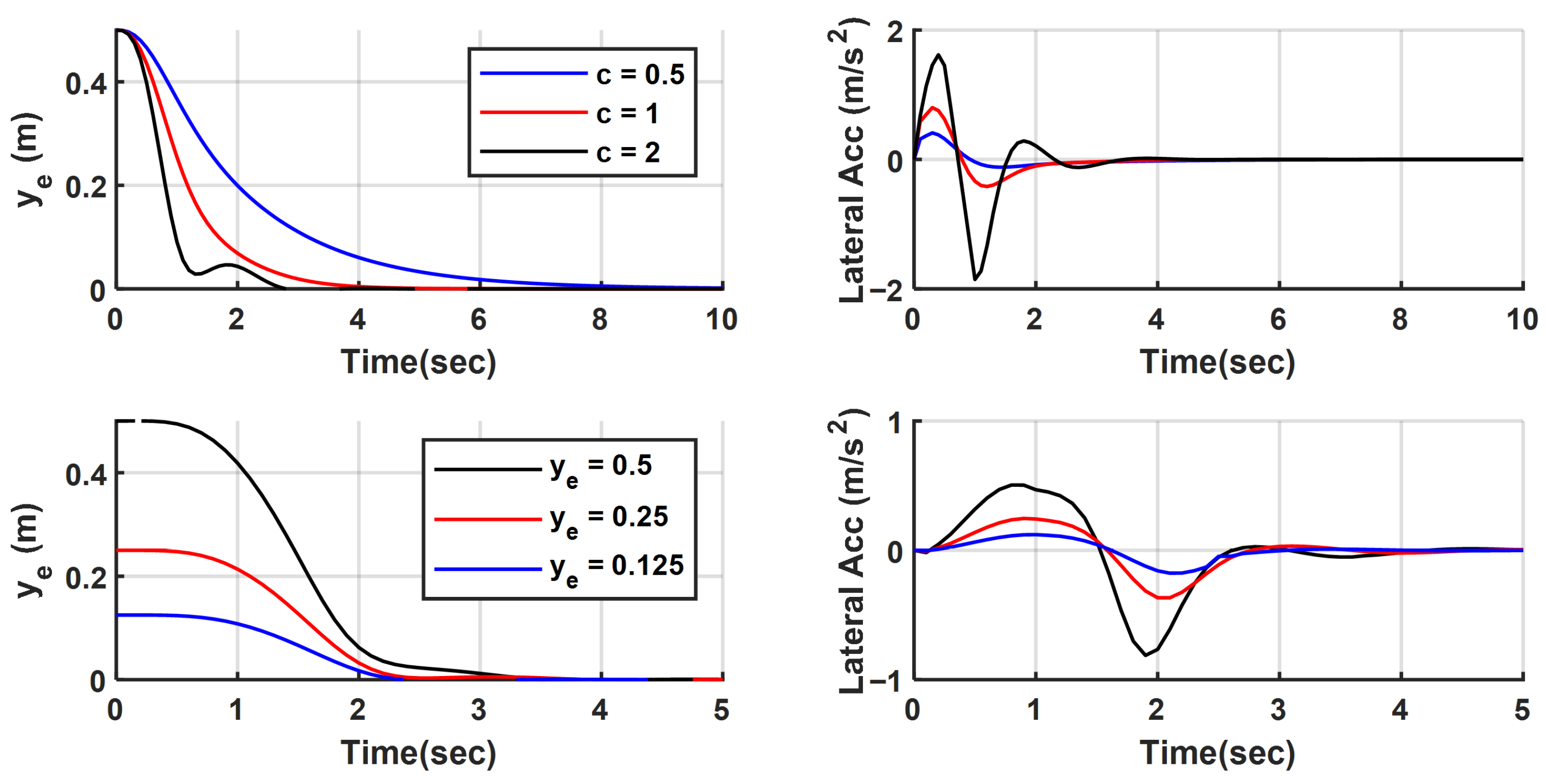
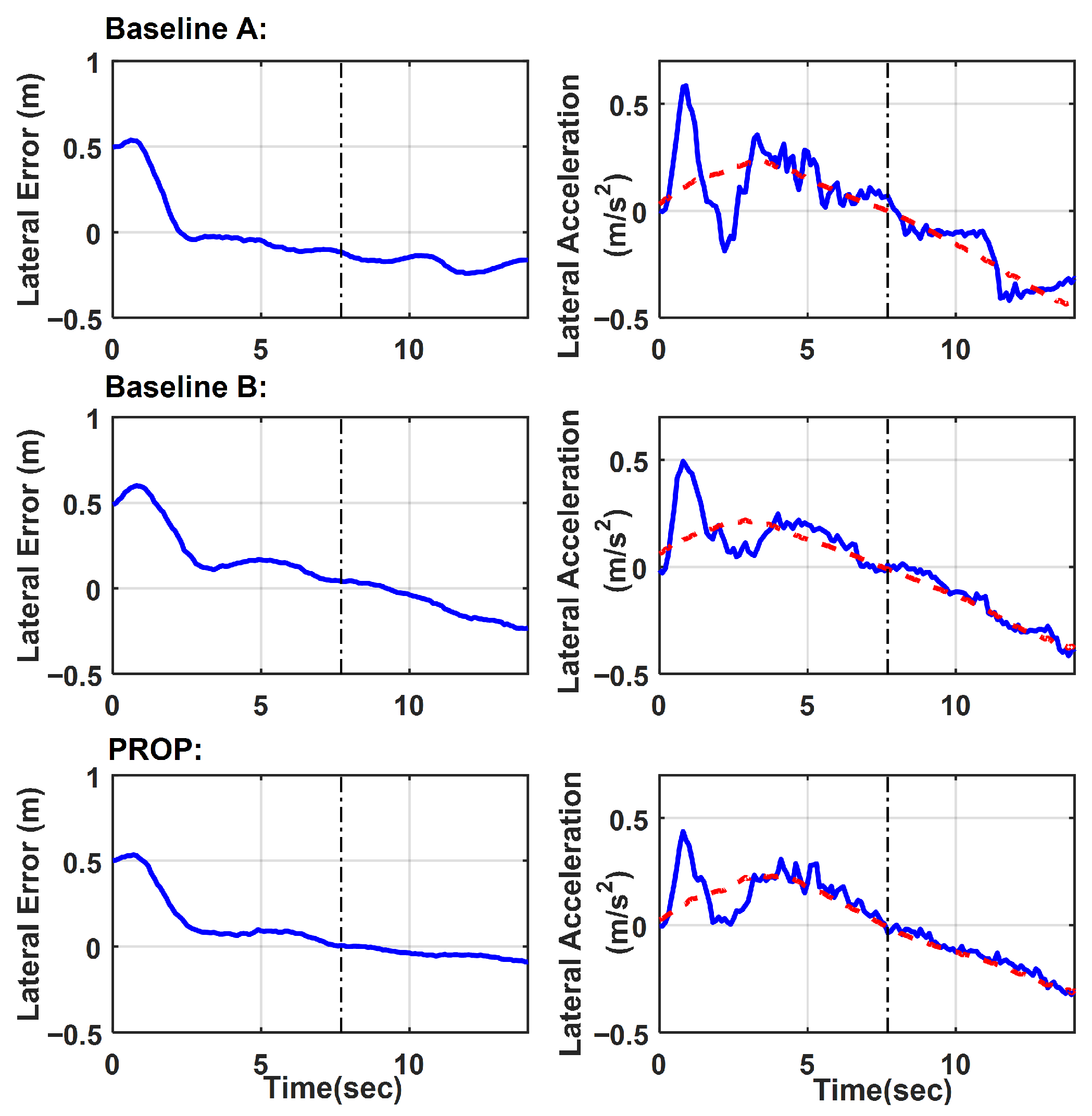
We first simulate the system at a constant speed with different lateral perturbations, y e , to find constant values of c t that allow the vehicle to gracefully stabilize back to a straight path. Figure 6 highlights lateral error convergence and acceleration for a speed of 10 m/s. Figure 6 (row 1) highlights that larger c ( t ) is more aggressive, converging more quickly with larger acceleration, whereas smaller c ( t ) is less aggressive and more graceful. Figure 6 (row 2) simulates the vehicle being perturbed laterally at 10 m/s with constant c ( t ) = 2 s−1, highlighting that larger perturbations result in more aggressive compensation and lateral acceleration.
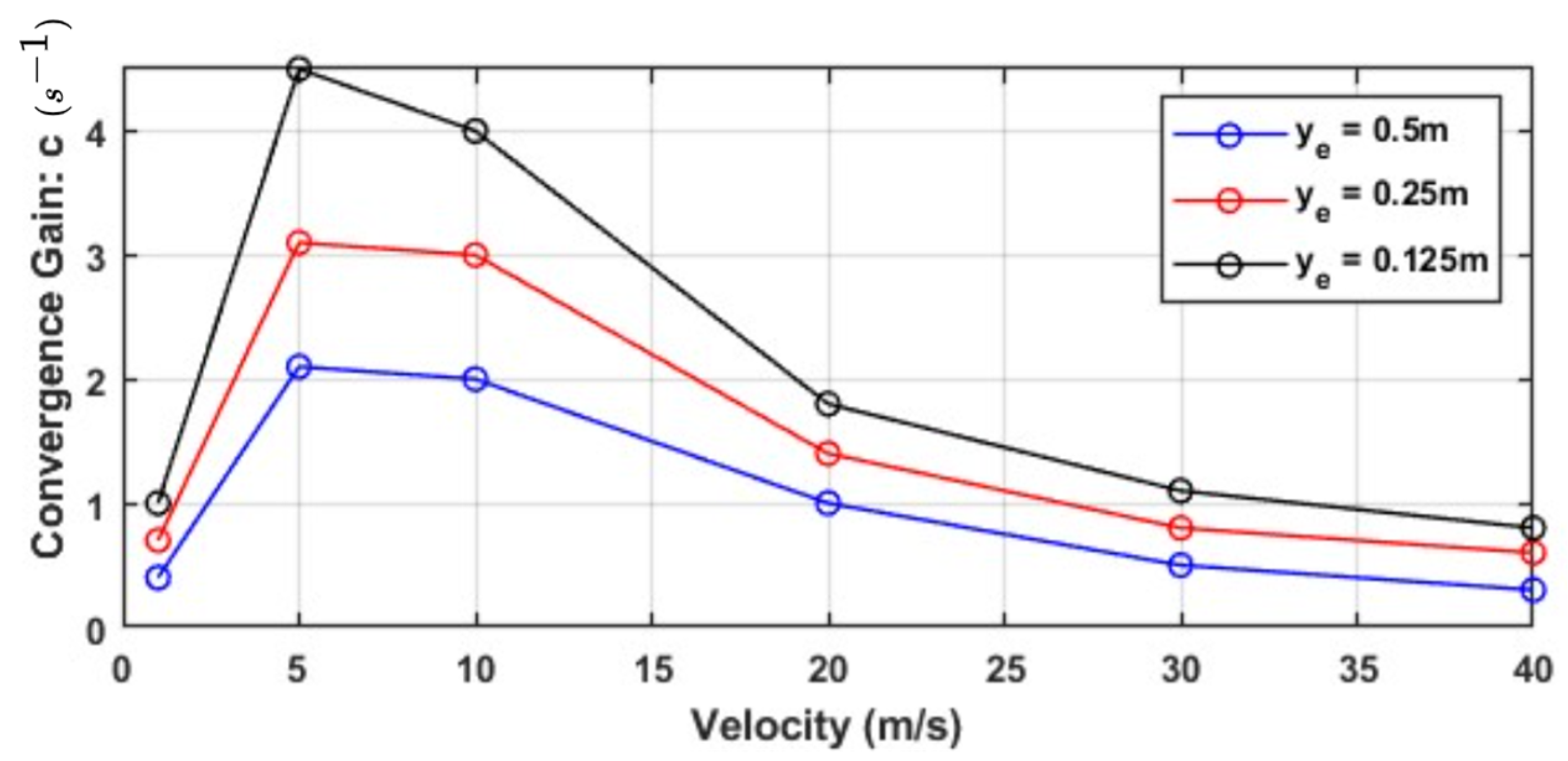
These results are extended in Figure 7 for speeds varying between 1 and 40 m/s to show c ( t ) values producing similar gracefulness as shown in Figure 6 (row 1) for different lateral perturbations. Larger values of c t are appropriate at lower speeds (e.g., 5–10 m/s), and with smaller lateral error perturbations, which supports Theorems 2 and 3. c ( t ) should be smaller with much smaller speeds (e.g., <5 m/s), higher speeds (>10 m/s), or larger perturbations. At 10 m/s, a constant c t = 3 s−1 is appropriate for perturbations of y e 0 = 0.25 m, which is studied extensively in the physical tests. Transitioning between values of c t is now presented in the following proposition.
Proposition 6.
Hierarchical Path Manifolds: It is proposed to vary  c ( t )  linearly with time from an initial value,  c 0 , to a final value,  c s s  :
c t = c s s t t e n d + c 0 1 t t e n d ,
where  c t 0 = c 0  and  c t e n d = c s s , where  t 0 t t e n d , t e n d = t 0 + Δ t . Δ t  is the desired transition time from  c 0  to  c s s . To satisfy safety constraints,  c 0 ,   c s s , and  c ( t )  must be positive and satisfy (32). It is proposed that  c t = min ( E q u a t i o n s   ( 32 )   a n d   ( 38 ) ) .
Simulations illustrate the effect of varying c t , where the vehicle starts with an initial posture error and zero velocity, then accelerates to driving speed while converging to a straight path. The final speed of the vehicle is 10   m / s , so c s s = 3 s−1 is used, per Figure 7. A transition time of t e n d = 4   s is applied. Two techniques were examined for selecting c 0 : (1) a small, fixed c 0 and (2) a computed c 0 based on (27) to make S k i n = 0 rad at the initial posture, where S k i n = 0 rad is a path manifold function designed for the lateral-motion regulator.
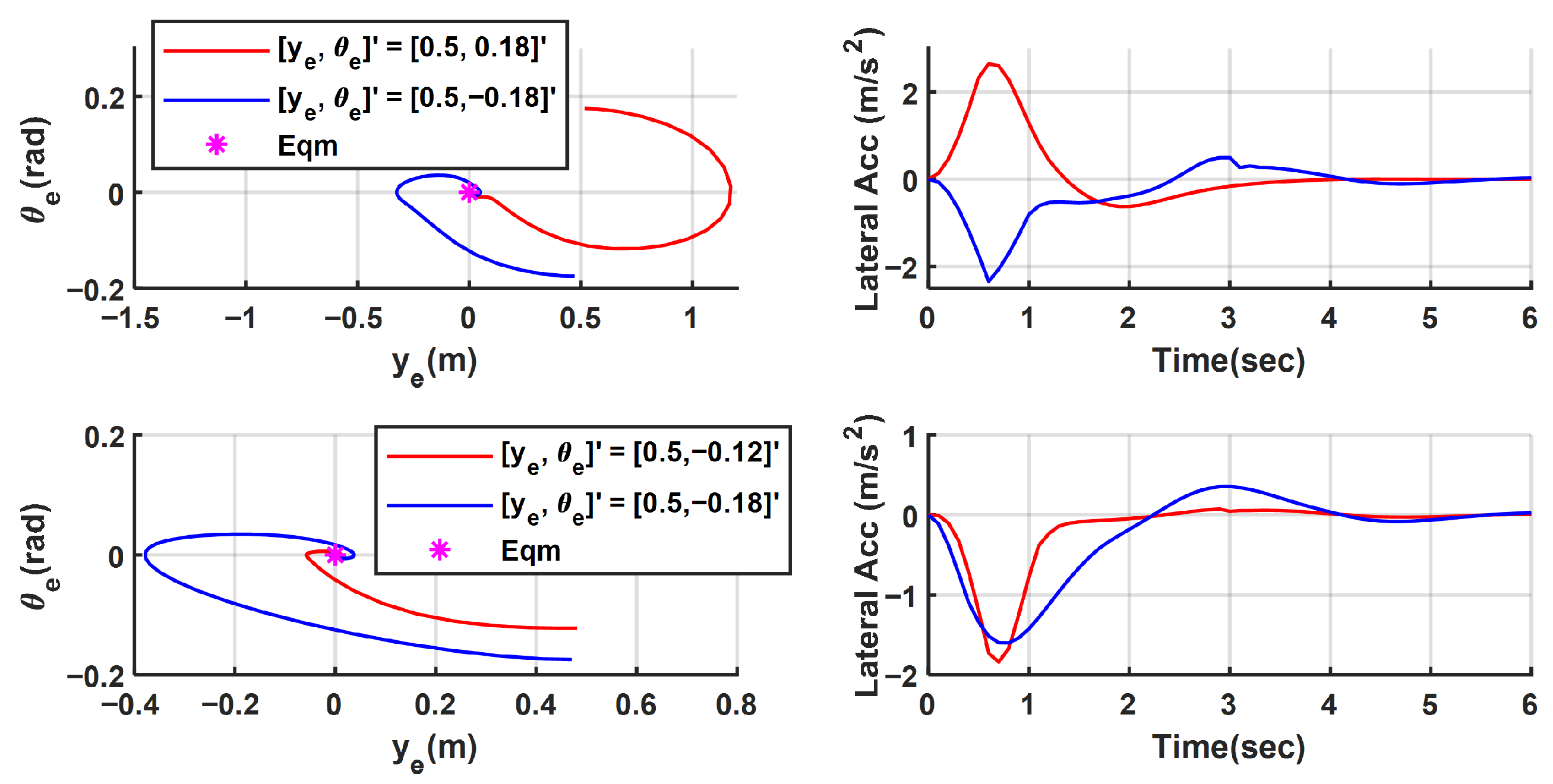
In (1), a small, fixed c 0 is applied, since the velocity starts at zero and the error is large initially. This allows the system to gracefully converge as velocity increases, shown in Figure 8 (row 1), where a phase portrait of lateral error and heading error is shown on the left and of lateral acceleration on the right. Two initial postures are applied. The red curve shows y e and θ ¯ e with the same sign, while the signs are different for the blue curve. The lateral error, y e , increases for the red curve, since the vehicle is initially pointed away from the path. Thus, it has a more aggressive motion than the blue one, since the vehicle is initially pointed towards the path in that case. This occurs if the initial posture error is in Quadrant I and III of the phase portraits. Selecting c 0 to be small initially assures that the path manifold (27) provides smooth and graceful convergence.
In the case of (2), we use (27) to find c 0 to align the path manifold with the initial posture, shown in Figure 8 (row 2). Comparing the blue trajectories in the first and second rows, the trajectory using this technique has c 0 = 0.036 s−1 and results in a smaller acceleration and smoother convergence, since (2) eliminates convergence to the manifold. The heading error is reduced in the red trajectory, which results in c 0 = 0.024 s−1, but results in more rapid convergence. Compared to (1) (first row), c 0 based on (27) in (2) provides more graceful motion than the manually selected one. However, the application of (27) in computing c 0 requires the initial posture in Quadrant II and IV, or on the y e axis. Otherwise, the selection of c 0 per (1) must be used.
It is recommended to use Figure 7 to determine appropriate c ( t ) during operation based on perturbation and operating speeds. Proposition 6 provides a guide for varying c ( t ) during vehicle startup and driving at varying speeds.

6. Dynamic Controller

The dynamic controller steers the vehicle to create the desired yaw rate specified by the kinematic controller. A steering angle controller is first designed to stabilize yaw tracking error, and then backstepping is applied to create steering tracking commands using the steering rate.

6.1. Yaw Tracking Control

The first level of the dynamic controller provides desired steering angle commands such that the slip–yaw dynamic model tracks the desired yaw rate. The desired yaw rate r k i n is provided by (29), while the yaw rate from the vehicle dynamics is r . The yaw tracking error is defined as r e = r k i n r . Taking the time derivative and substituting (15) for r ˙ results in the yaw error dynamics:
r ˙ e = a 21 β a 22 r e + r ˙ k i n a 22 r k i n b 21 φ d e s δ r .
where coefficients a 21 , a 22 , and b 21 are from Proposition 2. A steering controller is now proposed to provide convergence.
Theorem 4.
Exponential convergence of yaw rate error dynamics (39) is provided by the steering angle command,
φ d e s = a 21 β r ˙ k i n + a 22 r k i n K p 1 r e K i 1 σ r b 21
where σr is the integral of yaw rate error,  K p 1 > a 22 , and  K i 1 > 0 .
Proof. 
The integral of the yaw rate error is provided by σ r ˙ = r e . Substituting (40) into (39) results in the yaw error dynamics,
r ˙ e = K p 1 + a 22 r e K i 1 σ r + δ r .
Using the state vector x 3 = σ r r e T combined with the integrator state equation, the system can be expressed in matrix form:
σ ˙ r r ˙ e = 0 1 K i 1 ( K p + a 22 ) σ r r e + 0 δ r .
Given δ r varies slowly, Theorem 4 ensures that the system is Hurwitz and x 3 is exponentially stable at x 3 , s s = σ r , s s 0 T . □

6.2. Steering Tracking Control

The steering actuator controller must be designed with the dynamic controller due to the close coupling between steering actuator response and vehicle dynamics. Steering-tracking control provides yaw-tracking control using steering rate, ω . The difference between the desired and actual steering angle is defined as the “steering angle error”, φ e = φ d e s φ a c t . Backstepping control leverages dynamic extension such that the steering rate, ω , becomes the dynamic controller command for improved tracking instead of the traditional steering angle in [8,48]. The resulting backstepping controller is derived in the following theorem.
Theorem 5.
Backstepping steering tracking control provides asymptotic convergence of yaw rate error  r e ; steering error  φ e , and kinematic error  y e  and  θ ¯ e , using steering rate,
ω = a 21 β ˙ + ( a 22 r ˙ k i n r ¨ k i n ) K p 1 r ˙ e ( K i 1 + b 21 ) r e b 21 + K p 2 φ e + K i 2 σ φ
where  σ φ  is the integral of  φ e , K p 2 > a 22 , and  K i 2 > 0 .
The proof is provided in Appendix A for the interested reader. This proof guarantees the overall stability of the combined kinematic and dynamic systems of the vehicle.

7. Output Feedback

7.1. High-Gain Observer

Since sideslip cannot be measured directly, output feedback control is achieved using an observer and replacing the states in the controllers with observer-based estimates. The dynamic model can be represented in the classical triangular normal form [64,65] and is locally Lipschitz, so a high-gain observer (HGO) is applied to provide robustness. Defining the dynamic state ¯ x = r β T , the dynamic model (15) and (14) is represented by
r ˙ = ϕ r ¯ x , φ = ϕ r 0 ¯ x , φ + β + δ r
β ˙ = ϕ β ¯ x , φ = ϕ β 0 ¯ x , φ + δ β
where δ r = δ r β . ϕ β 0 ¯ x , φ and ϕ r 0 ¯ x , φ are the linear terms from (14) and (15) that form the linearized dynamic model.
The measured output is ¯ y = 1 0 ¯ x = r d y n . The system can be shown to be observable, since a 22 0 . The locally Lipschitz state feedback control law (40) that stabilizes ¯ x is denoted by φ ( ¯ x ) . Applying φ ( ¯ x ) to the linearized dynamic model results in β ˙ = ϕ β 0 ¯ x , φ ¯ x and r ˙ d y n = ϕ r 0 ¯ x , φ ( ¯ x ) . The observer estimates the state ¯ x ^ = r ^ β ^ T as follows:
r ^ ˙ = ϕ r 0 ¯ x ^ , φ ( ¯ x ) + h 1 ( ¯ y r ^ )
β ^ ˙ = ϕ β 0 ¯ x ^ , φ x ¯ + h 2 ( ¯ y r ^ )
where h 1 and h 2 are the observer gains. The estimation error is x ~ - = r ~ β ~ T , where r ~ = r r ^ and β ~ = β β ^ . Substituting (14), (15), (46), and (47) results in the estimation error model:
r ~ ˙ = h 1 r ~ + β ~ + δ r ( ¯ x , ¯ x ~ )
β ~ ˙ = h 2 β ~ + δ β ( ¯ x , ¯ x ~ )
The scaled estimation errors are defined as η 1 = r ~ / ε and η 2 = β ~ , where ε is a small positive number tuned to optimize observer convergence. Substituting these terms into the estimation error model, the resulting scaled estimation model is then,
ε η ˙ 1 = α 1 η 1 + η 2 + δ r ( ¯ x , ¯ x ~ )
ε η ˙ 2 = α 2 η 1 + ε δ β ( ¯ x , ¯ x ~ )
where α 1 and α 2 are positive observer gains such that h 1 = α 1 / ε and h 2 = α 2 / ε 2 . The characteristic equation of the scaled estimation model is, then,
s 2 + α 1 s + α 2 = 0 ,
such that α 1 and α 2 are selected for desired response characteristics. Thus, (50) and (51) suggest that the impact of δ β ( ¯ x , ¯ x ~ ) and δ r ( ¯ x , ¯ x ~ ) are greatly reduced for small positive ε 1 . The convergence of the scaled estimation error η 1 and η 2 is also much faster than the regular error terms β ~ and r ~ for ε 1 .
The HGO has three parameters that can be tuned: α 1 , α 2 , and ε . In our application, we designed α 1 = 2 and α 2 = 1 , such that the characteristic equation, Equation (52), is critically damped with a settling time of 4 s, but the ε term on the left-hand side of (50) and (51) scales the time response of η 1 and η 2 . Likewise, the resulting gains h 1 = 5 and h 2 = 6.25 are applied to the observer in (46) and (47), and further scaling results.
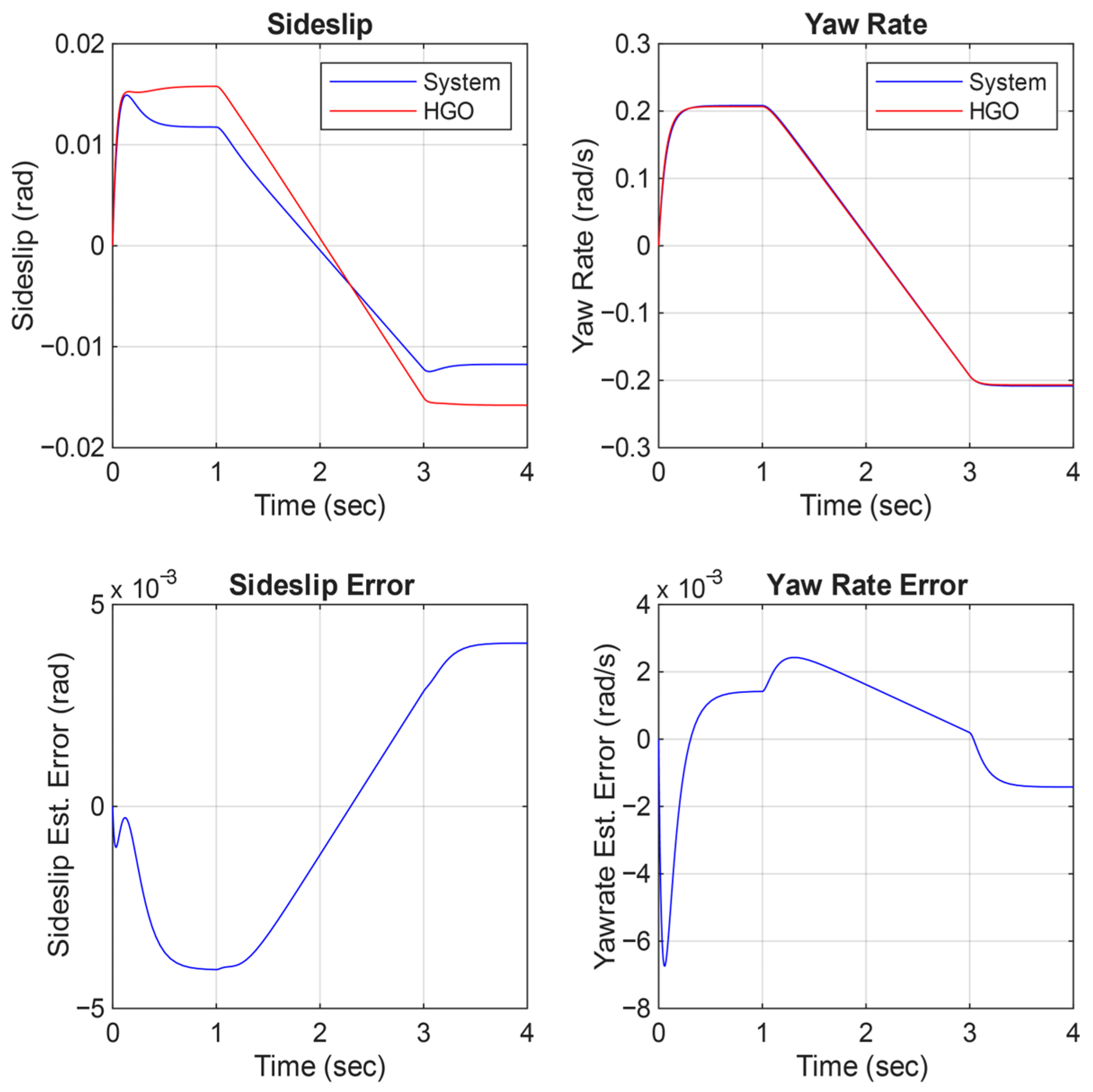
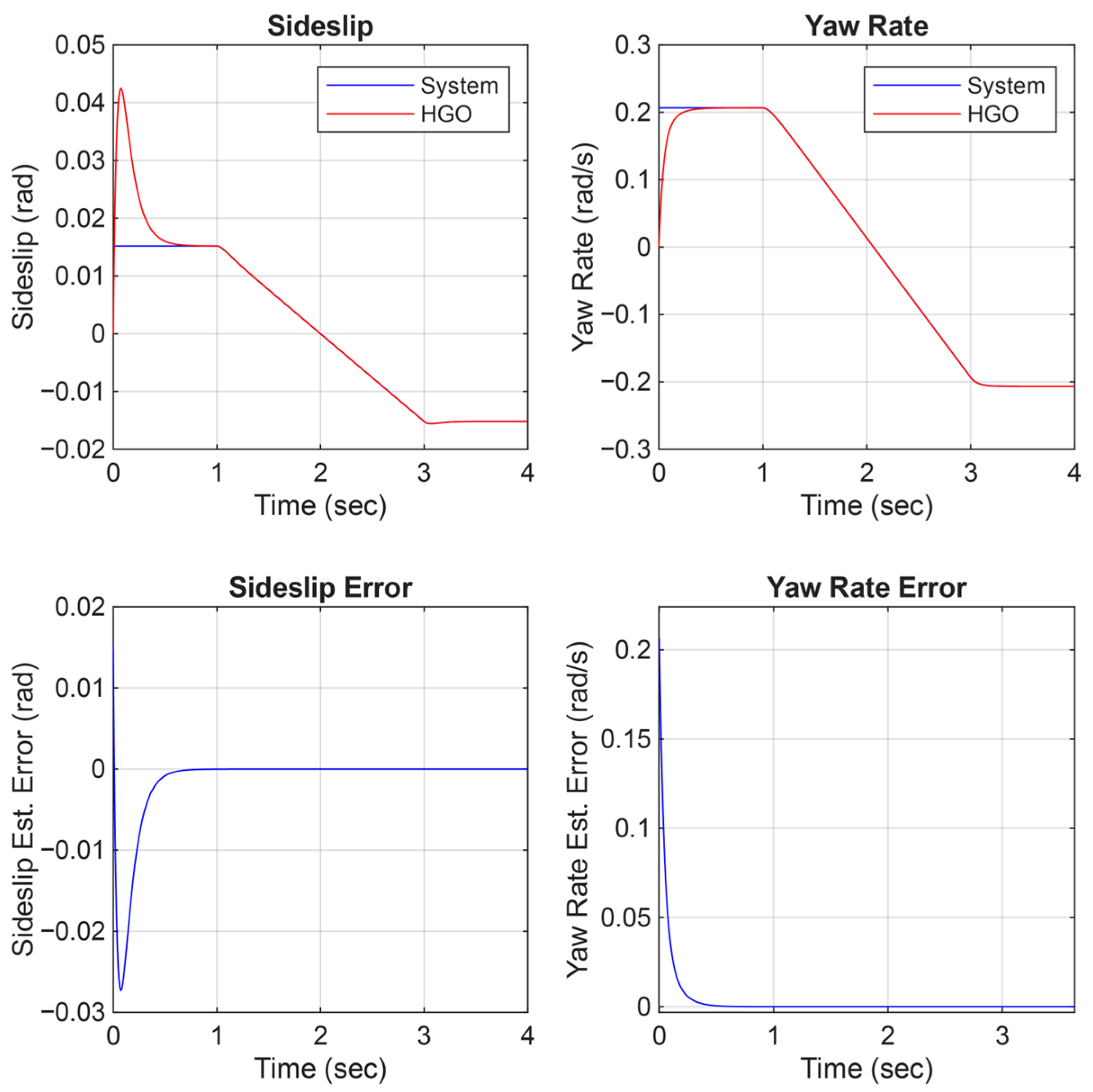
Simulations of the observer using vehicle parameters identified from experimental testing, shown in Table 1, with the above observer parameters provide insight into observer response characteristics. In the simulation shown in Figure 9, the vehicle is driving at a constant speed of v = 10 m/s along a path with κ = 0.02   m 1 for 1 s, whereupon the path ramps to κ = 0.02   m 1 , over a 2 s period, which is a rapid steering change, and then maintains that angle for another second. Starting the observer with zero initial conditions provides a step input and results in a settling time of 0.282 s for yaw rate and 0.609 s for slip angle estimates. Both have zero steady-state error at 1 s. The yaw estimate has 0% overshoot, but the slip estimate has 180% overshoot at t = 0.1   s , which results in the peaking phenomenon characteristic of HGOs with discontinuous inputs. Note that the continuous ramp change in path curvature from t = 1 s to t = 2 s, however, results in perfect tracking and zero steady-state error during the ramp in path curvature, due to the feed-forward model-based terms in the observer. The same is true from t = 3 s to t = 4 s, while that path curvature is maintained.
Simulating the system with perturbed system parameters (−10% C f and C r with +10% mass) and maintaining the estimated parameters in the observer highlights the effect of poor parameter identification. This is shown in Figure 10, but in this case, the observer and system initial conditions are both zero, which removes the observer step input that caused the large overshoot in Figure 9. Note in Figure 10 that there is now a slight overshoot in vehicle sideslip due to the dynamic response of the vehicle, which results in some initial oscillations of sideslip and yaw rate estimation during the first second of operation. Yaw rate overshoot is now ~1%, but sideslip overshoot is removed. There is steady-state error in the sideslip and yaw rate estimates, −0.004 rad and 0.0014 rad/s, respectively, at t = 1.0 s due to the poor parameter estimation. During the curvature ramp period from t = 1.0 s to t = 2.0 s, the sideslip and yaw rate estimation error switch sign due to the opposite steering angle. Note that there is no overshoot in the sideslip or yaw rate estimates during this period, since the system already converged at t = 1 s, and variations in curvature are continuous, which is more typical of HGO performance under normal conditions.
The effect of HGO parameter variations on the observer dynamic-response characteristics is highlighted in Table 2, based upon a step input applied to the observer, as shown in Figure 9 from t = 0   s to t = 1   s . While applying a step input is not desirable with an HGO, this does illustrate the effect of parameter tuning on overshoot, which leads to peaking. The nominal observer parameters are α 1 = 1 , α 2 = 2 , and ε = 0.4 (indicated by bold text), which are varied individually in the table for comparison. When ε is reduced to 0.3, the settling time increases, and the sideslip estimates have increased overshoot and error. The opposite occurs when ε is increased to 0.5. When α 1 is reduced to 1.5, the estimated sideslip settling time and overshoot increase, and the estimated yaw rate settling time increases. Again, the opposite is true when α 1 is increased to 2.5. Finally, when α 2 is reduced to 0.5, the estimated sideslip steady-state error, overshoot, and settling time are reduced, and the estimated yaw rate settling time is reduced. Again, the opposite is true when α 2 is increased to 1.5. Overall, the estimated yaw rate overshoot and steady-state error are not really affected by parameter variations, but sideslip estimates are affected.

7.2. Output Feedback Controller

The output feedback dynamic controller is, then,
r ^ e = r k i n r ^
φ ^ d e s = a 21 β ^ r ˙ k i n + a 22 r k i n K p 1 r ^ e K i 1 σ ^ r b 21
φ ^ e = φ ^ d e s φ a c t
r ^ ˙ e = K p 1 + a 22 r ^ e K i 1 σ ^ r r ^ e + φ ^ e
ω ^ = a 21 β ^ ˙ r ¨ k i n + a 22 r ˙ k i n K p 1 r ^ e ˙ K i 1 + b 21 r ^ e b 21 + K p 2 φ ^ e + K i 2 σ ^ φ
where (57) is the output feedback control law for the dynamic steering controller. Derivatives of r ^ e , r k i n , and β ^ are calculated analytically to avoid numerical differentiation, which introduces noise. Derivatives of r k i n are calculated analytically based upon (29). Derivatives of r ^ e are based upon (39).

7.3. Peaking Mitigation

As indicated in Section 7.1, the observer estimates of the sideslip can overshoot momentarily when there are discontinuous changes in the system inputs, which leads to the “peaking” phenomenon. Ultimately, it is best to provide continuous path curvature to mitigate peaking. Reference paths should start at the current vehicle position when the vehicle is initialized. Likewise, observer states should be initialized based on the current vehicle states. HGO control gains can also be optimized to reduce overshoot, but overshoot may still occur with discontinuous inputs, which can cause momentarily large control inputs. Even though the vehicle is attempting to steer aggressively in response to the discontinuities as desired, saturation should be applied to the kinematic controller output to allow the commanded yaw rate, r k i n , to be large but bounded as follows:
r k i n = s a t κ r e f v r e f + ρ k i n + ψ k i n tanh S k i n ε k i n , r t h r e s h o l d .
where r t h r e s h o l d = 0.3   r a d / s e c is selected based upon the allowable lateral acceleration given the vehicle operating speeds used in the tests described in the next section. Saturation levels can be adapted to further limit acceleration and yaw rate based upon driving conditions. The results shown in the next section indicate where saturation becomes active due to discontinuous path curvatures as a demonstration of this feature.

7.4. Overall Stability

The stability of the overall system is guaranteed by the separation principle [46], which indicates that small positive ε 1 allows the observer and controller to be designed independently, since the observer rejects perturbations from the controller and uncertainty. Observer stability was proven in Section 7.1, and the stability of the combined kinematic and dynamic controllers was proven in Section 6.2. Thus, by the separation principle, the combined system is shown to be stable. This is verified experimentally in the next section.

8. Evaluation Procedures

Field experiments are used to evaluate the proposed control system. The platform, test fields and paths, metrics, and baseline controllers are presented.

8.1. Vehicle Platform

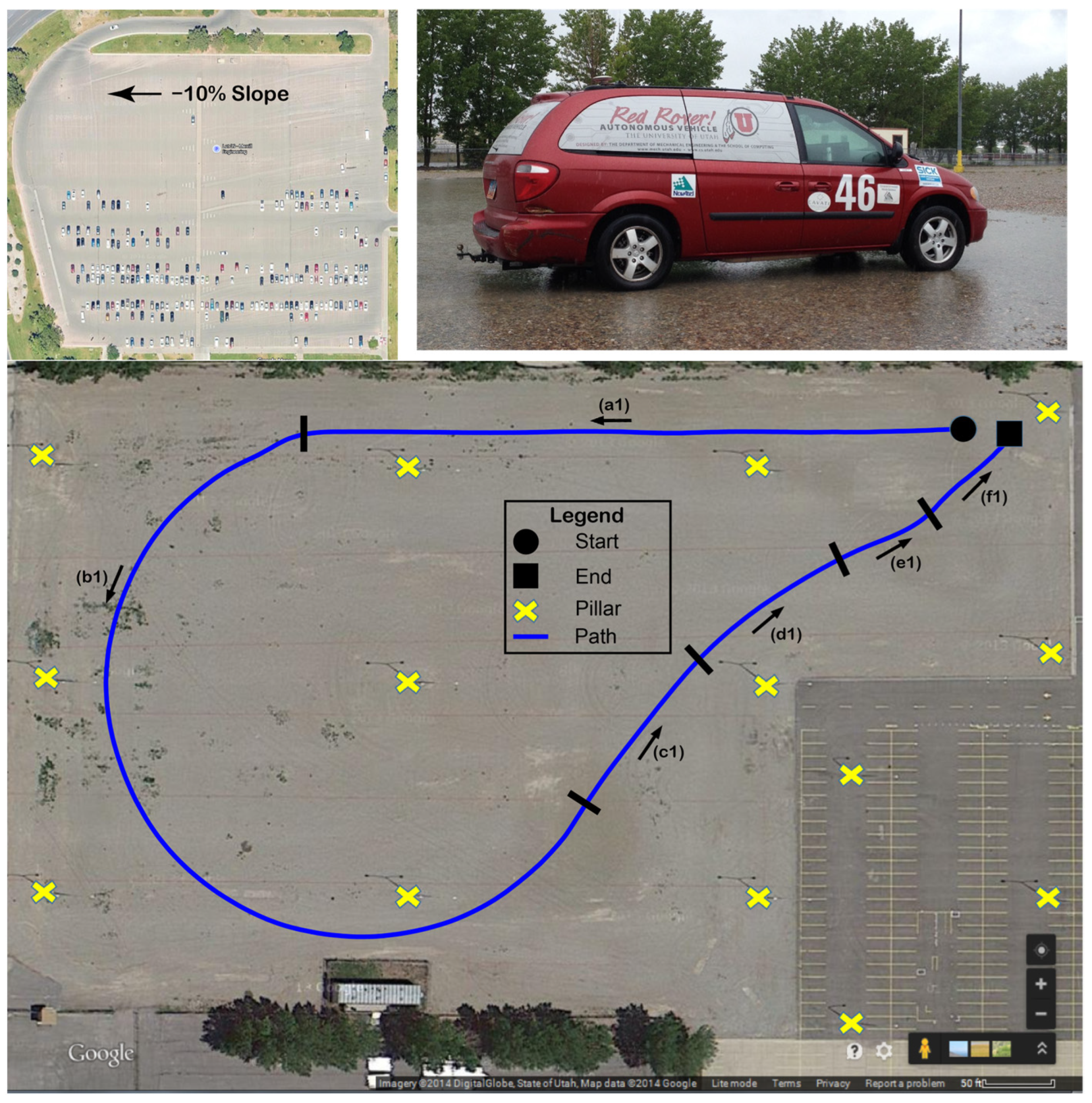
The platform is Red Rover, a 2005 Dodge Caravan (US version), shown in Figure 11, with a modified Kairos ProntoIV autonomy system to accept both steering angles and rates. A NovaTel GPS with Omnistar HP differential service senses posture with ~ 0.1   m and 0.2   d e g accuracy. A digital gyroscope was added to sense yaw rate. The steering wheel angle is measured by a steering servo with a range of + / 550 ° , which correlates to a steering angle of + / 35 ° . The vehicle speed is controlled by a human driver. The nominal vehicle parameters are shown in Table 1.
While an integrated RTK solution has been demonstrated to provide sufficient vehicle state information from sensor data in [19], this paper uses a custom solution to filter and integrate GPS and gyroscope data. It is easily applied to any system with a GPS and gyroscope, allowing for cost-effective solutions. In this technique, GPS data (i.e., position, velocity, and heading) is first processed using a simple averaging filter over the last N data points. A lower N results in a faster response, but more noise. In this case, N = 3 is applied to provide a faster response. The gyroscope yaw rate data is first filtered using a weighted recursive filter with a gain of 0.38.
Heading estimates are updated based upon a weighted average of GPS heading information and gyroscope yaw rate estimates. Gyroscope estimates are weighed more heavily when speeds are low, since GPS estimates are less accurate at low speeds, whereas GPS heading estimates are weighed more heavily at higher speeds, where GPS heading is more reliable. Weighting is limited to a maximum value to ensure that both GPS and gyroscope data are used during faster driving conditions, since gyroscope data is helpful for estimating changes in heading between time steps.
Vehicle position estimates are updated using a weighted average of GPS position estimates and kinematic estimates using the nonslip reference model of the vehicle described by Equations (5)–(7). Kinematic estimates using the heading estimates described in the previous paragraph are combined with velocity data from the GPS to estimate changes in position. Kinematic estimates and filtered GPS estimates are then combined to estimate vehicle position.

8.2. Test Fields and Paths

Two test fields in Salt Lake City, Utah, were used, shown in Figure 11: State Fair Park (SFP) and the Merrell Engineering Building (MEB) parking lot. MEB provides a 10% sloped asphalt surface, providing gravity disturbance, whereas SFP provides a non-sloped, uneven/bumpy gravel surface. MEB allows middle speeds ( ~ 5 7   m / s ) and SFP allows higher speeds ( ~ 10   m / s ).
Reference paths act as the input to the control system in the form of desired path curvatures. When integrated over time and distance, this results in desired vehicle positions along the path, which are used to calculate path-following error. Two basic paths were evaluated in both fields. A Reed–Shepps “L”-shaped path demonstrates response to straight paths, constant curvature paths, and curvature discontinuity. A 40   m line is followed by a 50   m radius arc sweeping out 90°, and is concluded by another 40   m line. A graceful ‘S’-shaped Euler spiral with continuously varying curvature demonstrates realistic path variation. The radius varies from a 100   m radius right to left.
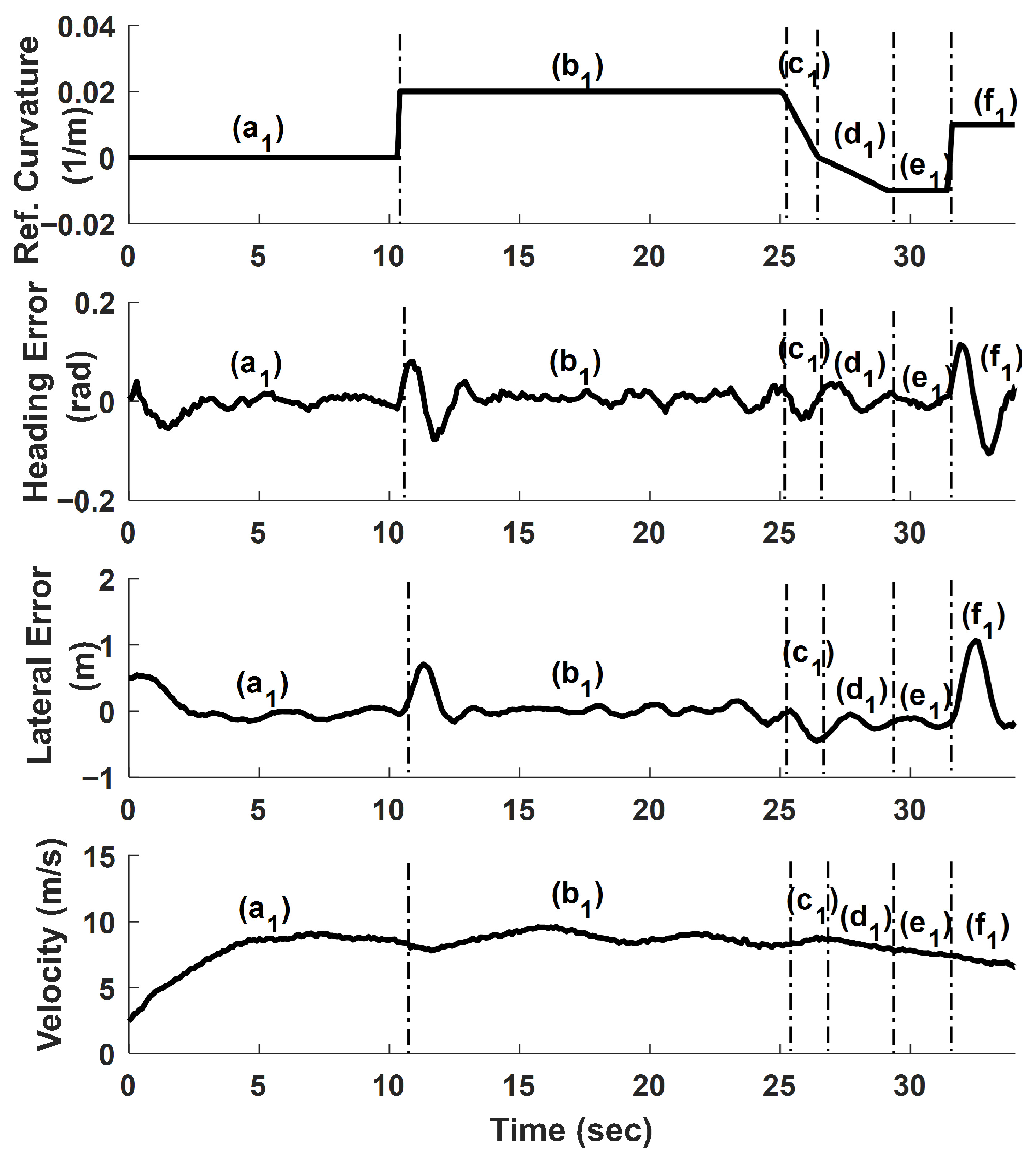
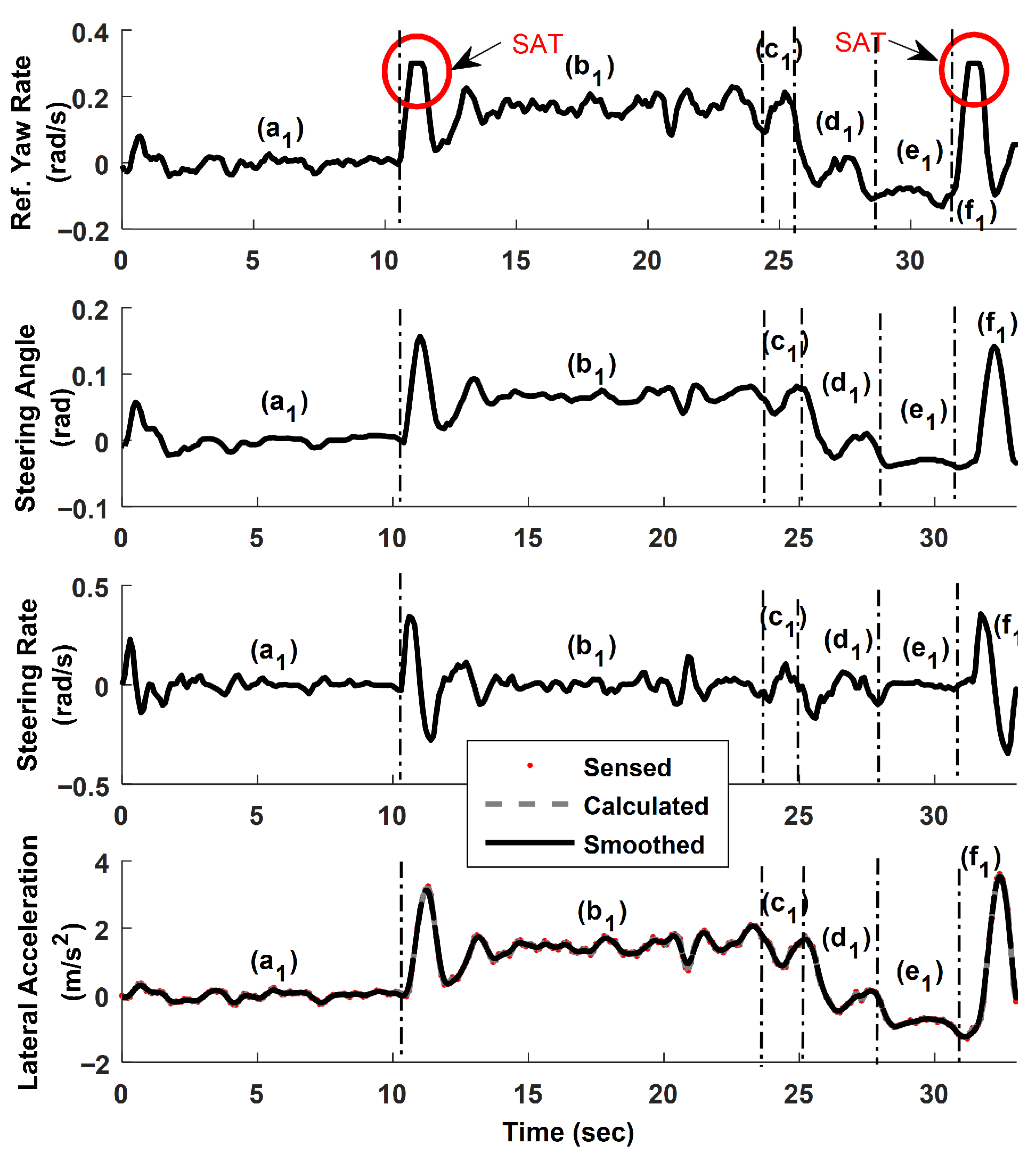
The SFP comprehensive path, shown in Figure 11 and Table 3, examines more complex paths at higher speeds. A bumpy, gravel surface is used. Path segments of sufficient length ensure convergence. Note that the system begins with non-zero initial conditions before Seg a1, which applies a step input to the system, which results in a transient response to a step input. Seg b1 and f1 each provide a curvature discontinuity at the start of the segments, which demonstrates the effect of peaking compensation. The other segments, c1, d1, and e1, vary the path curvature smoothly, which is more characteristic of good path specifications.

8.3. Controllers

Baseline controllers highlight features of the proposed work.

8.3.1. Baseline A: Multi-Tiered PID Steering Controller

Kinematics-based PID control [11,12,30] was explored but performed poorly. Multi-tiered PID control in the kinematic and dynamic tiers is proposed. The PID gains were tuned experimentally to provide similar dynamic-response characteristics as the proposed controller. Traditional empirical tuning [77] was applied to achieve a 4 s settling time, T s , with critical damping. Kinematic gains were tuned first, followed by dynamics designed to be twice as fast. The dynamic controller was tuned using a constant 0.1   r a d / s , yaw rate command at 10   m / s , e.g., 0.01   m 1 path curvature. The resulting PID gains are listed in Table 4.

8.3.2. Baseline B: Robust Steering Controller

Baseline “B” is from [10], which is a predecessor of this work, but without several new features added in this paper, including slip-based kinematics, integrators, and peaking compensation. The controller begins with the sliding surface,
S k i n = arcsin c t y e + K i σ k v ¯ + θ e ,
where the same variable-structure function c(t) is used in both “B” and the proposed controller. This results in the kinematic controller yaw rate command, r k i n ,
r k i n = ρ k i n + ψ k i n tanh S k i n ε k i n
where
ρ k i n = | κ v + c ˙ t y e v ¯ + c t s i n θ e + K i y e v ¯ 1 c ( t ) y e + K i σ k v ¯ 2 | .
The output feedback dynamic control law is then
r ^ e = r ^ r r e f
φ ^ e = φ a c t φ ^ d e s = φ a c t + a 21 β ^ + a 22 r r e f r ˙ r e f + K p r ^ e b 21
ω ^ = a 21 β ^ + a 22 r ˙ r e f r ¨ r e f + K p 1 r ^ ˙ e + b 21 r ^ e b 21 K p 2 φ ^ e .
Tuning is performed to provide similar response characteristics to those used in the proposed controller discussed in the next section. The resulting gains are identical to those used in [10]: ε k i n = 0.2 , ψ k i n = 0.7 ,   K p = 12 , K p 2 = 25 , and K i = 0.5 . The HGO configuration is the same as that used in the proposed controller: ε = 0.4 , α 1 = 2 , and α 2 = 1 .

8.3.3. Proposed Controller

The kinematic controller law is (23), (26), (27), (28), (29), and (30), and the output state feedback dynamic control is provided by the integrators and (53), (55), and (57). Saturation is applied to the kinematic controller output via (58) to limit peaking in the case of discontinuous paths. The dynamic controller was tuned first, followed by the kinematic controller. The steering angle tracking controller was designed to be twice as fast as the desired dynamic controller, which was twice as fast as the kinematic controller. The steering angle gains K p 2 and K i 2 were designed for a 1 s setting time. The yaw rate tracking controller K p 1 and K i 1 were designed to satisfy the desired dynamic controller performance. The nominal parameters, shown in Table 1, were used for design, while the perturbed parameters were used in simulations for evaluating performance.
Kinematic controller tuning requires the selection of c ( t ) , ψ k i n , ε k i n , K i , and a 1 , which are dependent upon the safety factors k 1 and k 2 , vehicle speed v ¯ , and coefficient of friction μ . The worst-case conditions are considered for calculating safety margins (e.g., v ¯ = 10   m / s and μ = 0.5 ) [13]. Assuming k 1 = 0.8 allowing for speed variations, (34) can be used to show k 2 < 0.49 for wet conditions, but k 2 < 0.64 for dry conditions (e.g., μ = 0.7 ).
The selection of c ( t ) is based upon (32) in Theorem 3. An initial estimate for c ( t ) with 0.5 m initial lateral error and the parameters above is c t < 3.4   s 1 for rainy conditions. Using c t = 3   s 1 for tuning, simulations [50] and experiments indicated that ψ k i n = 0.1 and ε k i n = 0.1 balanced convergence and robustness. Larger ψ k i n improves robustness, whereas smaller ε k i n makes the system more aggressive and more prone to oscillation and chatter. K i = 0.1 , which is much less than c t , provides gradual final error convergence. Sliding surface saturation a 1 = 0.9 avoids singularities while allowing more aggressive compensation. Proposition 6 was used to vary c ( t ) to deal with low initial speeds. c ( t ) was based upon a combination of c 0 and c s s = 3.0   s 1 .

8.4. Experimental Procedure

Field experiments evaluate the controllers using the paths, surface materials, and speeds described in Section 8.2. The initial posture error was θ ¯ e y e T = 0 0.5 T with the vehicle starting from rest. Each controller and path was evaluated ten times. The basic paths were evaluated using both dry and wet surfaces (e.g., clear and rainy days) using lower speeds. The higher-speed SFP comprehensive path was used with dry and wet gravel.

8.5. Performance Metrics

Metrics characterize performance along each path segment (SEG). The RMS lateral error, E R M S , evaluates overall accuracy. The range of lateral error, E R N G , and the RMS error from the last 10 data points of a path segment, E L 10 , characterize maximum error variation and final error for each SEG. Convergence success rate, % C , indicates the percent of trials converging lateral error to within 0.1 m along a path segment. A higher % C indicates that a controller can reliably converge, which is challenging on some of the shorter path segments, indicated in Table 3. If % C is zero, the lateral error did not converge sufficiently before the SEG end. The RMS lateral acceleration, A R M S , relative to the reference lateral acceleration, indicates jerkiness and gracefulness, denoted as graceful motion (G.M). The lateral acceleration is calculated from accelerometer data with moving window spline segments [78]. Averages (“ a v g ”) and standard deviation (“ σ ”) are reported.

9. Results

Results from the proposed and baseline controllers are presented, where Baseline A, Baseline B, the proposed controller, and the proposed controller with saturation are referred to as “A”, “B”, “PROP”, and “PROP-S”.

9.1. SFP Comprehensive Path Results

Data is provided for higher ( 8 ~ 10   m / s ) and middle speeds ( 5.5 ~ 7.5   m / s ), shown in Table 5. Higher-speed “A” results are not included due to unstable oscillations.
At higher speeds, the performance of PROP and PROP-S is increased compared to Baseline B. For B, the lateral error failed to converge on SEG a 1 in time, and % C = 0 , but it could proceed on the path. The E L 10 for PROP and PROP-S was 78 % smaller than B for each. PROP-S had a smaller E R N G and ERMS than PROP or B, which indicates that PROP-S provided reduced overshoot and oscillation. PROP and PROP-S had ~ 62 % and ~ 78 % less E L 10 on e 1 and had ~ 29 % and ~ 43 % less E L 10 on f 1 , respectively. For B, the lateral error failed to converge on the continuously varying curvature SEGs, c 1 and d 1 , and B had a larger lateral acceleration, A R M S , than PROP and PROP-S. It is easily appreciated that at high speeds, PROP-S provides the best performance, followed by PROP and, in a distant third place, Baseline B. The results from the middle speeds were improved for all controllers. PROP-S performed best, followed by PROP, B, and A.
The importance of the peaking saturation can be appreciated by comparing PROP’s and PROP-S’ high-speed results, shown in Table 5. The initial error converged to near zero on the straight SEG a 1 for both controllers (e.g., E L 10 0.1   m ), but for PROP it only inconverges 60% of the time ( % C = 60 % ) before the SEG ends. For PROP-S it converges every time ( % C = 100 % ), since the yaw rate saturation in the controller limits peaking. As a result, PROP-S has 33% less E L 10 on a 1 compared to PROP. Discontinuity at the beginning of b 1 causes oscillations in E s s , steering commands, and lateral acceleration, shown in Figure 12 and Figure 13, but PROP-S has better transient response. PROP and PROP-S are perturbed, but both provide high tracking accuracy ( E L 10 0.1   m ) and always converge. Yaw rate saturation becomes active, as shown in Figure 13, where “SAT” is highlighted. As a result, PROP-S has a smaller E R N G (~11% less), E R M S (~ 16 % less), and A R M S (~ 15 % less) compared to PROP. The standard deviation of PROP-S E L 10 is 50 % smaller than PROP. Thus, PROP-S produces more accurate, smoother, and more consistent results, especially with path discontinuities.
Peaking saturation in PROP-S further benefits SEGs following engagement of the curvature saturation. SEG b 1 is followed by continuously varying curvature SEGs c 1 , d 1 , and e 1 . Both PROP and PROP-S demonstrate more graceful steering commands and lateral acceleration on continuous SEGS and do not engage the saturation. However, yaw rate commands saturated in nearly all PROP-S trials at the discontinuities. Performance was further improved using PROP-S on c 1 , d 1 , and e 1 , even though saturation was rarely applied. This is attributed to the fact that motion is smoother with PROP-S during b1, which propagates through c 1 and d 1 until motion is improved in e 1 . While traversing c 1 , E R N G and E R M S were 12% and 18 % smaller. E L 10 was slightly larger, but the standard deviations of E R M S and E L 10 were 43 % and 63 % smaller. Given this more consistent and improved tracking, E R M S and E L 10 were 31 % and 38 % smaller, respectively, on d 1 . This propagated to e 1 , where E R M S , E L 10 , and A R M S were 38 % , 41 % , and 30 % smaller. Saturation was only activated during one trial on c 1 , and the controllers were otherwise identical on these trials. While the peaking saturation of PROP-S may not always engage, its activation during earlier SEGs has a lasting effect.

9.2. Basic Path Studies—MEB Parking Lot

The MEB results demonstrate the effect of perturbations caused by sloped terrain, shown in Table 6. Clear weather conditions and dry surfaces are discussed first, followed by rainy conditions. Results from PROP-S are not included, since speeds were lower and yaw rate saturation did engage, making PROP and PROP-S equivalent.
The “L”-shaped path compares performance on straight (first and third SEGs) and constant radius (second SEG) segments, with a large initial error and challenging curvature discontinuities between SEGs. PROP’s E R N G was reduced by ~ 5 % to ~ 48 % compared to B; the E R N G was comparable on SEG 1, but greatly improved on SEGs 2 and 3. Compared to A, PROP reduced E R N G by ~20% to ~67%. The E R N G was larger due to the initial posture error and curvature discontinuities, but was smaller for PROP due to reduced overshoot and oscillation.
PROP has improved accuracy, which was notable on the curved path (second SEG), where E R M S was ~81% and ~79% less than A and B. PROP’s final error, E L 10 , was improved relative to B, although A was similar to PROP, since the PID controller is suited to long, constant-curvature SEGs. This was not true on the third SEG, which is shorter and straight, where A could not fully converge, but B performed like PROP since the SEG is straight and PROP’s sideslip compensation was less critical.
The “S”-shaped path evaluates performance with an Euler spiral. PROP’s overshoot was the best; the E R N G was reduced by ~ 41 % compared to A and B. The first SEG has a large initial lateral error and ends with zero curvature; hence, all three controllers had similar E R M S , but PROP’s E L 10 was reduced. The second SEG better indicates the advantages of PROP, since curvature progressively increases, which makes path following challenging. PROP performed best; the E R M S was ~ 45 % to ~ 60 % less than A and B. PROP provided better final error,   E L 10 : ~ 60 % and ~ 77 % less than A and B. These improvements along the increasing-curvature path SEG indicate the benefit of PROP following challenging paths.
The convergence success rate % C indicates the ability to drive lateral error to a steady-state value along a limited-length path. PROP performed significantly better on the S-shaped path compared to A and B. PROP provided % C = 40 % on the first SEG, while A and B provided 0 % , which is attributed to the short segment and initial error. The % C was improved for all controllers on the second SEG due to smaller errors at the start of the SEG. PROP ( % C = 90 % ) was better than B ( % C = 70 % ), but comparable to A. Overall, PROP demonstrated notably improved convergence.
PROP and B’s gracefulness was better than A’s. The A R M S for PROP and B was generally ~ 50 % less than that for A. PROP’s A R M S was ~ 86 % less on the “S”-shaped Euler spiral compared to on the “L”-shaped path due to continuous curvature. Improved gracefulness is attributed to the hierarchical path manifolds used in PROP and B, although continuous paths further improve gracefulness, as expected.
Terrain geometry and surfaces impact the convergence rate and tracking accuracy. MEB is difficult due to its slope and the dip in the parking lot. “A” had % C = 50 % on the second SEG of the “L”-shaped path due to the low robustness of PID, while PROP and B provided % C = 100 % on this SEG. The third SEG is a downhill straight path without lateral disturbances, so % C = 100 % .
Rainy conditions were challenging for A and B convergence, % C , but had little impact on PROP. PROP had a slight decrease in % C , but A and B were significantly worse. While other metrics were similar in rainy vs. dry conditions, this indicates that PROP provides improved convergence despite weather conditions.
Lateral acceleration, shown in Figure 14, highlights graceful motion as characterized by A R M S . Initial oscillations are due to initial conditions. “A” had a large overshoot ( > 0.5   m / s 2 ) and the most oscillation. “B” had less overshoot ( ~ 0.5   m / s 2 ) and smoother lateral acceleration. PROP had the least oscillation and best followed the reference path acceleration. A R M S was essentially the same for PROP and B, since they both use similar continuous VSC. PROP has the best overshoot ( < 0.5 m / s 2 ) , and its lateral acceleration fits the reference data well after settling.
To help appreciate error convergence, Figure 14 compares lateral error and acceleration on the Euler spiral on MEB in rainy weather. Per Table 6, the % C along the first SEG was the worst for all, with failed convergence for A and B on this segment. Per Figure 14, A has clearly not converged at the curvature inflection, but B and PROP are less obvious. Both had increasing error just before the inflection and then the error crossed zero at the last moment, so they were judged to not converge. Path length and weather conditions were major factors. The second SEG occurs after the curvature inflection and highlights the error convergence of the controllers. A and B do not converge, but PROP does since it remains near steady state. Lateral error with A oscillates around ~ 0.2   m , highlighting difficulty with varying curvature. B diverges as curvature increases along the path. Again, PROP converges the best.

9.3. Basic Path Studies—SFP Parking Lot

Table 7 presents results from the SFP using basic paths on clear and rainy days. The SFP is a rough, uneven gravel surface. The results demonstrate similar trends as with MEB, so this section highlights the differences. With a few exceptions due to bumpy, uneven terrain, all controllers performed better on the SFP, where sloped terrain disturbances were removed. PROP maintained better convergence, % C , than A or B in most clear-day and rainy-day results. PROP had a lower % C than in MEB (i.e., 70% vs. 100%) on the first SEG of the “L”-shaped path in the rainy-day results. This illustrates that the gravel in the SFP is challenging. “B” suffered a slightly lower % C under the same situations (i.e., 50% vs. 60%) while A improved its convergence (i.e., 70% vs. 60%).
On the second SEG, both PROP and B achieved 100% convergence, but A had 70%. This suggests that PROP and B can better handle curvature discontinuity even though the ground is uneven and slippery. Since the second SEG is a longer arc, A had 90% convergence in SFP, which is better than % C = 50 % in MEB with the slope. On the third SEG, PROP converged in all trials, but A and B had degraded performance compared to for MEB. The SFP is bumpy and the third SEG on MEB is mostly downhill, improving tracking.
A subtle performance degradation resulted from rainy conditions at the SFP. While numerical values are similar, error and steering commands tended to vary more. As a result, successful error convergence, % C , was reduced for all controllers, although PROP was less adversely affected than A and B. One observation is that gracefulness is impacted more by terrain surfaces than slope disturbances, especially on the rainy days on the S-shaped path, where A R M S rose by 37.5~166.7%.

10. Discussion

The performance of the proposed controllers is highlighted by the field experiments in Section 9. The proposed controllers are first compared to the baseline controllers, followed by a discussion of control features exemplified by the results.

10.1. Comparison to Baseline Controllers

The experimental results demonstrate that PROP and PROP-S provide better performance than baseline controllers (i.e., A and B). The E R M S and E L 10 values from the comprehensive path demonstrate that the proposed controllers are superior to the baseline controllers on complex paths. Unlike B, the proposed controllers have smaller E R M S and E L 10 values on the constant- and varying-curvature SEGs, which is attributed to sideslip compensation. While A may achieve a small E L 10 on long, constant-curvature SEGs, it does not on varying-curvature SEGs, due to the nature of PID control. The convergence success rate, % C , demonstrates the improved robustness of the proposed controllers on the comprehensive path. Speed and curvature variations are challenging, leading to varying sideslip. PROP and PROP-S had better % C values because (57) and (58) allow them to consider the steering actuator rate and provide robustness to lateral disturbances and uneven ground.
Tests on “rainy days” increased uncertainty due to slippery surfaces and related friction and cornering stiffness parameter variations. Performance on the “S”-shaped Euler spiral highlights the benefit of PROP; the second SEG is more challenging, since curvature and slip are increasing. PROP has a much smaller tracking error along the entire path. This is attributed to the features of the proposed control system discussed in the next subsection. Only minor performance differences are noted between clear and rainy days using PROP. On the “L”-shaped path, PROP has better convergence success, % C , than the baseline controllers on all SEGs. While PROP shows a slightly degraded % C in rainy conditions, it still achieves better success than baseline controllers.
Similar trends occur with the basic paths, where additional challenges are indicated. The “S”-shaped path is more challenging than the “L”-shaped path on the MEB sloped surfaces. Due to perturbations of varying curvature, gravity disturbance, and initial lateral error, PROP only has a moderate % C along the first SEG, whereas Baseline controllers fail to converge initial error. E R N G and A R M S evaluate gracefulness. E R N G shows overshoot of tracking error and A R M S indicates oscillations and deviation from the ideal lateral acceleration. On the SFP comprehensive path, PROP and PROP-S suffer less overshoot and oscillation than baseline controllers and present lower E R N G and A R M S values at higher speeds.

10.2. Controller Features

The superior performance of PROP and PROP-S compared to A and B is attributed to the novel control structure, slip–yaw kinematic and dynamic models, and related sideslip feedback compensation. PROP and PROP-S apply a closed-loop control structure that feeds back sideslip estimates to compensate for heading error, which is generally missed in A and B.
PROP and PROP-S apply additional features to resolve issues in tracking accuracy, convergence success, and graceful motion. The architecture separates the steering controller into four tracking controllers and distributes them in the closed-loop control structure. Sideslip compensation allows the kinematic controller to continually adapt to increasing sideslip. The robust VSC kinematic controller naturally considers model-based terms and compensates for uncertainty via ψ k i n , while the continuous implementation of the controller eliminates chatter. Varying c ( t ) adapts to increasing speed and reduces oscillation during initial error convergence. Thus, the controllers can reject uncertainty and rapidly stabilize tracking error to achieve convergence before an SEG ends.
In the dynamic controller, backstepping is critical for designing steering actuator rate commands that consider the cumulative requirements of kinematic and dynamic controllers.
Integrators distributed in the control architecture allow remaining perturbations in kinematics, dynamics, and steering actuation to be compensated while avoiding large control gains.
Although PROP and PROP-S are essentially the same design, saturation in PROP-S plays a critical role in reducing “peaking” at curvature discontinuities at high speeds. Thus, E R N G and A R M S are further decreased in PROP-S compared to PROP.

10.3. Future Work

There are a number of topics for future work. First, instead of using fixed-yaw rate saturation and manually tuning it, online saturation adaptation could be examined. Factors such as yaw rate command variation, vehicle speed, path complexity, and environmental constraints should be considered. Coupling between lateral and longitudinal dynamics should be considered further. Although speed variations are currently treated as a disturbance, a fully coupled lateral and longitudinal dynamic model could be considered to reduce their effect on the steering controller and improve response, which is demonstrated to a limited degree in [19], but further analysis is required to provide deeper insight. While the proposed controllers performed well with uncertain parameters, online parameter identification should reduce the dependence on robust terms and improve gracefulness. Future work could also focus on combining the controller with sensor-based navigation, but paths should have continuous curvature variations. This highlights that rates of curvature variation need to be considered, which is related to the saturation levels that are used in PROP-S.

11. Conclusions

A comprehensive approach considering kinematics, dynamics, actuation, and state estimation in steering control is proven to provide good path-following accuracy. Slip is important to consider in kinematic models and controllers. Path manifolds need to adapt to operating conditions. Tracking accuracy could be considered at all levels. Backstepping is valuable for mapping all these factors to steering actuator rate commands. This work relies upon the application of a slip–yaw dynamic model, yaw reference commands from the kinematic controller, and high-gain observer-based estimation of slip and yaw states. Rigorous field experiments demonstrate improved performance of the proposed system compared to baseline studies. Multiple test fields with different surfaces and terrain disturbances demonstrate that the proposed controller provides improved tracking accuracy, robustness, and graceful motion, which is especially noteworthy with difficult real-world time-varying paths, environmental disturbances, and adverse weather conditions. Peaking should be considered at higher speeds. Future work should emphasize online adaptation of controller parameters and identification of vehicle parameters.

Author Contributions

Conceptualization, M.X. and M.A.M.; Methodology, M.X. and M.A.M.; Software, M.X.; Validation, M.X. and M.A.M.; Formal analysis, M.X. and M.A.M.; Investigation, M.X. and M.A.M.; Resources, M.X. and M.A.M.; Data curation, M.X.; Writing—original draft, M.X. and M.A.M.; Writing—review & editing, M.X. and M.A.M.; Visualization, M.X. and M.A.M.; Supervision, M.X. and M.A.M.; Project administration, M.X. and M.A.M.; Funding acquisition, M.A.M. All authors have read and agreed to the published version of the manuscript.

Funding

This research was funded in part by a contract from Kairos Autonomi, Salt Lake City, UT USA and the University of Utah.

Institutional Review Board Statement

Not applicable.

Informed Consent Statement

Not applicable.

Data Availability Statement

Data is available upon request.

Conflicts of Interest

The authors declare that the research was conducted in the absence of any commercial or financial relationships that could be construed as a potential conflict of interest.

Appendix A

Proof of Theorem 1.
Consider (27) in the unsaturated domain D 1 where S k i n = θ ¯ e + a r c s i n c t y e + K i σ k v ¯ , which is continuously differentiable.
The positive definite Lyapunov candidate function W k i n = 1 2 S k i n 2 is applied such that W ˙ k i n = S k i n S ˙ k i n , where S ˙ k i n is
S ˙ k i n = θ ¯ ˙ e + c ˙ ( t ) y e + c ( t ) ( v ¯ sin θ ¯ e v ¯ δ α r ) + K i y e v ¯ 1 c ( t ) y e + K i σ k v ¯ 2 .
The time derivative of (21) is then θ ¯ ˙ e = θ ˙ e + K F β ^ ˙ , which is combined with (13) to form the state equation for θ ¯ e ,
θ ¯ ˙ e = κ r e f v r e f r k i n + K F β ^ ˙ ,
where r in (13) has been replaced by r k i n to denote the kinematic control command. (66) is then combined with (65):
S ˙ k i n = κ r e f v r e f r k i n + K F β ^ ˙ + c ˙ ( t ) y e + c ( t ) ( v ¯ sin θ ¯ e v ¯ δ α r ) + K i y e v ¯ 1 c ( t ) y e + K i σ k v ¯ 2 .
and
W ˙ k i n = S k i n S ˙ k i n = S k i n ( κ r e f v r e f r k i n + K F β ^ ˙ + c ˙ ( t ) y e + c ( t ) ( v ¯ sin θ ¯ e v ¯ δ α r ) + K i y e v ¯ 1 c ( t ) y e + K i σ k v ¯ 2 ) .
Rearranging terms for the VSC proof,
W ˙ k i n = S k i n ( κ r e f v r e f + K F β ^ ˙ + c ˙ ( t ) y e + c ( t ) ( v ¯ sin θ ¯ e v ¯ δ α r + K i y e v ¯ 1 c ( t ) y e + K i σ k v ¯ 2 ) r k i n S k i n
which can be combined with (30) to prove that
W ˙ k i n S k i n ρ k i n + S k i n ( κ r e f v r e f + K F β ^ ˙ ) r k i n S k i n .
Applying the designed yaw rate command, r k i n ,
r k i n = κ r e f v r e f + K F β ^ ˙ + ( ρ k i n + ψ k i n ) tanh S k i n ε k i n
into (70), such that
W ˙ k i n ρ k i n + ψ k i n tanh S k i n ε k i n S k i n + S k i n ρ k i n
The effect of t a n h ( ) [28] is considered by noting that
tanh S k i n ε k i n 1 , i f S k i n ε k i n α 0 ( a ) 0 tanh S k i n ε k i n < 1 , i f S k i n ε k i n < α 0 ( b )
where α 0 is the bound value and ε k i n is tunable.
In condition ( a ) in (A9)—i.e., tanh S k i n ε k i n is saturated— tanh S k i n ε k i n S k i n s i g n S k i n S k i n = S k i n . Thus, (A8) becomes W ˙ k i n ψ k i n S k i n < 0 for all S k i n 0 such that W ˙ k i n is negative definite. Trajectories converge to the boundary S k i n = α ε k i n in finite time [46]. Due to W ˙ k i n ψ k i n S k i n < 0 on the boundary, trajectories are then directed inwards and cannot leave.
Once inside S k i n = α ε k i n , condition b is satisfied and tanh S k i n ε k i n stays in the unsaturated domain. The t a n h ( ) term is represented by tanh S k i n ε k i n = ζ , which is expressed as ζ = ζ s i g n S k i n ε k i n = ζ s i g n S k i n due to ε k i n > 0 , where 0 ζ < 1 . Substituting into (A8), we have W ˙ k i n ρ k i n + ψ k i n ζ s i g n S k i n S k i n + S k i n ρ k i n . Thus,
W ˙ k i n ψ k i n ζ ρ k i n 1 ζ | S k i n |
Since ψ k i n is an arbitrary positive number, it can always be selected to ensure that ψ k i n ζ ρ k i n 1 ζ and results in W ˙ k i n < 0 , where S k i n 0 . Thus, W ˙ k i n is always negative definite. Since the right-hand side is multiplied by | S k i n | , it can be shown that trajectories reach S k i n = 0 in finite time and cannot leave the path manifold [46]. Figure A1 (top) verifies variation of W ˙ k i n vs. S k i n with a practical parameter set, ψ k i n = 0.1 , ε k i n = 0.1 , v ¯ = 10 m / s , K i = 0.04 , c ˙ t = 0 , c t = c f i n a l = 0.65   s 1 . Per the parameters, ψ k i n ζ ρ k i n 1 ζ > 0 for all S k i n 0 , such that (A10) succeeds. Once on the path manifold, Proposition 4 is applied to show that the net result is x 2 0 asypmtotically. Figure A1 (bottom) presents the linearized approximation of tan S k i n ε k i n where the intersections with dashed lines illustrate | S k i n ε k i n | | ζ | | S k i n k ε k i n | , where k = 2   o r   3 show lower bounds on the function based upon 95 % or 99 % of saturated values, respectively, at the transition. As can be seen, the t a n h ( ) function is bounded from above and below by linear approximations.
Local exponential stability can be proven by applying the controller (29) to the model (26), (28), (13), resulting in
σ ˙ k = y e y ˙ e = v ¯ sin θ ¯ e θ ¯ ˙ e = ρ k i n + ψ k i n tanh S k i n ε k i n
The Jacobian matrix at the equilibrium x 2 s s = 0 0 σ s s T is
J x 2 = 0 1 0 0 0 v ψ k i n K i v ε k i n ± ( K i + c ˙ t ) K i σ s s v 2 1 K i 2 σ s s 2 v 2 ε k i n ψ k i n c t v ε k i n ± c t K i σ s s v ε k i n 1 K i 2 σ s s   2 v 2 ψ k i n ε k i n
Figure A1. Variation of the Hyperbolic Tangent Function ( t a n h ( S k i n / ε k i n ) and its linearized approximation at different gains. Solid black dashed lines highlight y = + 1 , which tanh() approaches as S k i n 1 and S k i n 1 , respectively.
Actuators 15 00068 g0a1
Substituting the above parameter configuration into (A12) and using the upper bound on t a n h ( ) , which is more accurate near the origin, the eigenvalues are λ J x 2 = 0.068 , 0.466 ± 0.608 i . Since R e λ J x 2 < 0 , J x 2 is Hurwitz, such that x 2 in the unsaturated domain is exponentially stable. The lower bounds on t a n h ( ) an be applied to show exponential stability as the function enters the saturation region, but with a slower response.
Finally, β ^ ˙ in (A7) is noisy in application and results in noisy r k i n . If β ^ ˙ is included, noise will propagate to the dynamic controller where the problem is worsened by the appearance of its 2nd and 3rd time derivatives, causing poor performance. Hence, K F β ^ ˙ is ignored. Thus, (A7) becomes (29), per the theorem. □
Proof of Theorem 5.
The integral of steering angle error is calculated by σ ˙ φ = φ e . The time derivative of φ e provides φ ˙ e = φ ˙ d e s φ ˙ a c t . The time derivative of (40) replaces φ ˙ d e s , whereas φ ˙ a c t is based upon the vehicle dynamics (16) where φ is denoted as φ a c t , and thus, φ ˙ a c t = ω , the steering rate. The result is
φ e ˙ = φ ˙ d e s φ ˙ a c t = a 21 β ˙ + a 22 r ˙ k i n r ¨ k i n K p 1 r ˙ e K i 1 r e b 21 ω .
Time-invariant backstepping is applied since time-varying terms vary slowly. The composite Lyapunov candidate function is
W c = W k i n + 1 2 r e 2 + K i 1 2 σ r 2 + 1 2 φ e 2 + K i 2 2 σ φ 2
where W k i n = 1 2 S 2 was defined in the proof of Theorem 1 to prove that the kinematic controller is asymptotically stable. W c : D c R is a continuously differentiable positive definite function on a domain, D c , containing an equilibrium point x c x c s s , where x c = S   r e   σ r   φ e   σ φ T . W ˙ c is then
W ˙ c = W ˙ k i n + r e r ˙ e + K i 1 σ r σ r ˙ + φ e φ ˙ e + K i 2 σ φ σ ˙ φ
Substituting the integrals and (A13) and (A10) into (A15), and rearranging,
W c ˙ < ψ k i n ζ ρ k i n 1 ζ | S k i n | K p 1 + a 22 r e 2 + φ e ( φ e ˙ + K i 2 σ φ + r e )
Since K p 1 > a 22 , K p 1 + a 22 r e 2 0 . ω is designed such that φ e φ ˙ e + K i 2 σ φ + r e = K p 2 φ e 2 . Simplifying the W ˙ k i n terms similar to the proof of Theorem 1, (A16) becomes
W ˙ c < ψ k i n S k i n K p 1 + a 22 r e 2 K p 2 φ e 2 < K p 1 + a 22 r e 2 K p 2 φ e 2 .
Since ψ k i n S k i n < 0 , which results in φ ˙ e + K i 2 σ φ + r e = K p 2 φ e , such that
a 21 β ˙ + a 22 r ˙ k i n r ¨ k i n K p 1 r ˙ e K i 1 r e b 21 ω + K i 2 σ φ + r e = K p 2 φ e
Rearranging (A18), the steering actuator rate ω is shown in (43).
Given Kp1 and Kp2 above, W ˙ c 0 per (A17), which is negative semi-definite. Invariance is applied to prove asymptotic stability. A domain, Sc, is set as S c = x c D c W c ˙ x c = 0 , where W c : D c R contains the origin x c x c s s . The domain Dc is defined as D c = { x c R 4 | 0 < r e 2 + K i 1 σ r 2 + φ e 2 + K i 2 σ φ 2 < a c , a c R } . No solution can stay identically in S c , other than the trivial solution x c x c s s . Based on Barbashin’s theorem [46], the equilibrium point x c s s is asymptotically stable. Note that W c ˙ x c = 0 and (A17) guarantees that r e and φ e converge to zero, although integrator states may converge to non-zero values. Per the Theorem 1 proof and Proposition 4, since S k i n 0 , x 1 = σ k y e T x 1 s s = σ k . s s 0 T and θ e 0 . Thus, (43) is the dynamic control law, which guarantees overall stability of the kinematic and dynamic systems. □

References

  1. Pina, M. Intelligent Transportation Systems (ITS) Strategic Plan 2015–2019. Available online: http://www.its.dot.gov/factsheets/pdf/ITS_JPO_StratPlan.pdf (accessed on 31 December 2017).
  2. Monaghan, M. Accident Avoidance 2.0. Automot. Eng. Int. 2008, 116, 28–32. [Google Scholar]
  3. Reinholtz, C.; Hong, D.; Wicks, A.; Bacha, A.; Bauman, C.; Faruque, R.; Fleming, M.; Terwelp, C.; Alberi, T.; Anderson, D.; et al. Odin: Team VictorTango’s entry in the DARPA urban challenge. J. Field Robot. 2008, 25, 467–492. [Google Scholar]
  4. Thrun, S.; Montemerlo, M.; Dahlkamp, H.; Stavens, D.; Aron, A.; Diebel, J.; Fong, P.; Gale, J.; Halpenny, M.; Hoffmann, G.; et al. Stanley: The robot that won the DARPA Grand Challenge. J. Field Robot. 2006, 23, 661–692. [Google Scholar] [CrossRef]
  5. Montemerlo, M.; Becker, J.; Bhat, S.; Dahlkamp, H.; Dolgov, D.; Ettinger, S.; Haehnel, D.; Hilden, T.; Hoffmann, G.; Huhnke, B.; et al. Junior: The Stanford entry in the urban challenge. J. Field Robot. 2008, 25, 569–597. [Google Scholar] [CrossRef]
  6. Kammel, S.; Ziegler, J.; Pitzer, B.; Werling, M.; Gindele, T.; Jagzent, D.; Schroder, J.; Thuy, M.; Goebl, M.; Hundelshausen, F.v. Team AnnieWAY’s autonomous system for the 2007 DARPA Urban Challenge. J. Field Robot. 2008, 25, 615–639. [Google Scholar] [CrossRef]
  7. Werling, M.; Groll, L.; Bretthauer, G. Invariant Trajectory Tracking With A Full-size Autonomous Road Vehicle. IEEE Trans. Rob. 2010, 26, 758–765. [Google Scholar] [CrossRef]
  8. Wang, J.; Steiber, J.; Surampudi, B. Autonomous ground vehicle control system for high-speed and safe operation. In Proceedings of the American Control Conference (ACC), Seattle, WA, USA, 11–13 June 2008. [Google Scholar]
  9. Raffo, G.V.; Gomes, G.K.; Normey-Rico, J.E.; Kelber, C.R.; Becker, L.B. A predictive controller for autonomous vehicle path tracking. IEEE Trans. Intell. Transp. Syst. 2009, 10, 92–102. [Google Scholar] [CrossRef]
  10. Xin, M.; Minor, M. Variable structure backstepping control via hierarchal manifolds set for graceful ground vehicle path following. In Proceedings of the IEEE International Conference on Robotics and Automation (ICRA), Karlsruhe, Germany, 6–10 May 2013; pp. 2826–2832. [Google Scholar] [CrossRef]
  11. Rajamani, R.; Han-Shue, T.; Boon Kait, L.; Wei-Bin, Z. Demonstration of integrated longitudinal and lateral control for the operation of automated vehicles in platoons. IEEE Trans. Control Syst. Technol. 2000, 8, 695–708. [Google Scholar] [CrossRef]
  12. Tan, H.S.; Guldner, J.; Chen, C.; Patwardhan, S.; Bougler, B. Lane changing with look-down reference systems on automated highways. Control Eng. Pract. 2000, 8, 1033–1043. [Google Scholar] [CrossRef]
  13. Gillespie, T.D. Fundamentals of Vehicle Dynamics; Society of Automotive Engineers Inc.: Warrendale, PA, USA, 1992. [Google Scholar]
  14. Lenain, R.; Thuilot, B.; Cariou, C.; Martinet, P. Mixed kinematic and dynamic sideslip angle observer for accurate control of fast off-road mobile robots. J. Field Robot. 2010, 27, 181–196. [Google Scholar] [CrossRef]
  15. Xin, M.; Zhang, K.; Lackner, D.; Minor, M.A. Slip-Based Nonlinear Recursive Backstepping Path Following Controller for Autonomous Ground Vehicles. In Proceedings of the 2020 IEEE International Conference on Robotics and Automation (ICRA), Paris, France, 31 May–31 August 2020; pp. 6169–6175. [Google Scholar] [CrossRef]
  16. Bartolozzi, M.; Massaro, M.; Mottola, M.; Savino, G. An enhanced motorcycle tyre model characterised through experimental riding data. Proc. Inst. Mech. Eng. Part D J. Automob. Eng. 2025, 239, 3540–3556. [Google Scholar] [CrossRef]
  17. Shi, Q.; Zhang, H. Road-Curvature-Range-Dependent Path Following Controller Design for Autonomous Ground Vehicles Subject to Stochastic Delays. IEEE Trans. Intell. Transp. Syst. 2022, 23, 17440–17450. [Google Scholar] [CrossRef]
  18. Vošahlík, D.; Hanis, T. Real-time estimation of the optimal longitudinal slip ratio for attaining the maximum traction force. Control Eng. Pract. 2024, 145, 105876. [Google Scholar] [CrossRef]
  19. Xin, M.; Yin, Y.; Zhang, K.; Lackner, D.; Ren, Z.; Minor, M. Continuous Robust Trajectory Tracking Control for Autonomous Ground Vehicles Considering Lateral and Longitudinal Kinematics and Dynamics via Recursive Backstepping. In Proceedings of the 2021 IEEE/RSJ International Conference on Intelligent Robots and Systems (IROS), Prague, Czech Republic, 27 September–1 October 2021; pp. 8373–8380. [Google Scholar] [CrossRef]
  20. Park, J.J.; Kuipers, B. A Smooth Control Law for Graceful Motion of Differential Wheeled Mobile Robots in 2D Environment. In Proceedings of the IEEE International Conference on Robotics and Automation (ICRA), Shanghai, China, 9–13 May 2011; pp. 4896–4902. [Google Scholar]
  21. Peña Fernández, C.A.; Cerqueira, J.J.F.; Lima, A.M.N. Nonlinear trajectory tracking controller for wheeled mobile robots by using a flexible auxiliary law based on slipping and skidding variations. Robot. Auton. Syst. 2019, 118, 231–250. (In English) [Google Scholar] [CrossRef]
  22. Xin, M.; Minor, M. Backstepping variable structure control of slip-based kinematics and dynamics for improved AGV cornering performance. In Proceedings of the IEEE International Conference on Robotics and Automation (ICRA), Hong Kong, China, 31 May–7 June 2014; pp. 5286–5291. [Google Scholar] [CrossRef]
  23. Rajamani, R. Vehicle Dynamics and Control; Springer: Berlin/Heidelberg, Germany, 2006. [Google Scholar]
  24. Fierro, R.; Lewis, F.L. Control of a Nonholonomic Mobile Robot: Backstepping Kinematics into Dynamics. J. Robot. Syst. 1997, 14, 149–163. [Google Scholar] [CrossRef]
  25. Zhu, X.; Minor, M.A.; Park, S. Distributed robust control of compliant framed wheeled modular mobile robots. J. Dyn. Syst. Meas. Control 2006, 128, 489–498. [Google Scholar] [CrossRef]
  26. Kim, M.S.; Kim, B.J.; Kim, C.I.; So, M.H.; Lee, G.S.; Lim, J.H. Vehicle Dynamics and Road Slope Estimation based on Cascade Extended Kalman Filter. In Proceedings of the 2018 International Conference on Information and Communication Technology Robotics, ICT-ROBOT 2018, Busan, South Korea, 6–8 September 2018; Institute of Electrical and Electronics Engineers Inc.: New York, NY, USA, 2018. [Google Scholar] [CrossRef]
  27. Sussmann, H.J.; Kokotovic, P.V. The Peaking Phenomenon and the Global Stabilization of Nonlinear Systems. IEEE Trans. Autom. Control 1991, 36, 424–440. [Google Scholar] [CrossRef]
  28. Song, G.; Mukherjee, R. A Comparative Study of Conventional Nonsmooth Time-Invariant and Smooth Time-Varying Robust Compensators. IEEE Trans. Control Syst. Technol. 1998, 6, 571–576. [Google Scholar]
  29. Tan, H.-S.; Rajamani, R.; Zhang, W.-B. Demonstration of an automated highway platoon system. In Proceedings of the American Control Conference (ACC), Evanston, IL, USA, 24–26 June 1998; pp. 1823–1827. [Google Scholar] [CrossRef]
  30. Tan, H.-S.; Guldner, J.; Patwardhan, S.; Chen, C.; Bougler, B. Development of an automated steering vehicle based on roadway magnets-a case study of mechatronic system design. IEEE ASME Trans. Mechatron. 1999, 4, 258–272. [Google Scholar] [CrossRef]
  31. Baidu. ApolloAuto/Apollo. Available online: https://github.com/ApolloAuto/apollo (accessed on 31 December 2017).
  32. Guldner, J.; Sienel, W.; Han-Shue, T.; Ackermann, J.; Patwardhan, S.; Bunte, T. Robust automatic steering control for look-down reference systems with front and rear sensors. IEEE Trans. Control Syst. Technol. 1999, 7, 2–11. [Google Scholar] [CrossRef]
  33. Hoffmann, G.M.; Tomlin, C.J.; Montemerlo, M.; Thrun, S. Autonomous automobile trajectory tracking for off-road driving: Controller design, experimental validation and racing. In Proceedings of the American Control Conference (ACC), New York, NY, USA, 9–13 July 2007; pp. 2296–2301. [Google Scholar]
  34. Jung, H.; Jung, D.; Choi, S.B. LQR Control of an All-Wheel Drive Vehicle Considering Variable Input Constraint. IEEE Trans. Control Syst. Technol. 2022, 30, 85–96. [Google Scholar] [CrossRef]
  35. Lee, D.H. Lane-Keeping Control of Autonomous Vehicles Through a Soft-Constrained Iterative LQR. IEEE Trans. Veh. Technol. 2025, 74, 5610–5623. [Google Scholar] [CrossRef]
  36. Tang, L.; Yan, F.; Zou, B.; Wang, K.; Lv, C. An Improved Kinematic Model Predictive Control for High-Speed Path Tracking of Autonomous Vehicles. IEEE Access 2020, 8, 51400–51413. [Google Scholar] [CrossRef]
  37. Qin, Z.; Liang, W.; Zang, Z.; Chen, L.; Hu, M.; Cui, Q.; Bian, Y. A Longitudinal and Lateral Coordinated Control Method of Autonomous Vehicles Considering Time-Varying Delay. IEEE Trans. Intell. Veh. 2024, 9, 7125–7137. [Google Scholar] [CrossRef]
  38. Geurts, M.E.; Katriniok, A.; Silvas, E.; Brouwer, N.J.; Heemels, W.P.M.H. Model Predictive Control for Lane Merging Automation With Recursive Feasibility Guarantees and Its Experimental Validation. IEEE Trans. Control Syst. Technol. 2025, 33, 566–581. [Google Scholar] [CrossRef]
  39. Liu, J.; Zhang, C.; Shi, C.; Lin, B.; Wu, D. Steering control for handling and stability and wear resistance of multi-axle vehicles. Veh. Syst. Dyn. 2025, 63, 825–852. [Google Scholar] [CrossRef]
  40. Taghia, J.; Wang, X.; Lam, S.; Katupitiya, J. A sliding mode controller with a nonlinear disturbance observer for a farm vehicle operating in the presence of wheel slip. Auton. Robot. 2017, 41, 71–88. [Google Scholar] [CrossRef]
  41. Taghavifar, H.; Mohammadzadeh, A. Adaptive Robust Terminal Sliding Mode Control with Integral Backstepping Synthesized Method for Autonomous Ground Vehicle Control. Vehicles 2023, 5, 1013–1029. [Google Scholar] [CrossRef]
  42. Sekban, H.T.; Basci, A. Designing New Model-Based Adaptive Sliding Mode Controllers for Trajectory Tracking Control of an Unmanned Ground Vehicle. IEEE Access 2023, 11, 101387–101397. [Google Scholar] [CrossRef]
  43. Martins, F.N.; Celeste, W.C.; Carelli, R.; Sarcinelli-Filho, M.; Bastos-Filho, T.F. An adaptive dynamic controller for autonomous mobile robot trajectory tracking. Control Eng. Pract. 2008, 16, 1354–1363. [Google Scholar]
  44. Zhou, X.; Wang, H.; Yang, Y.; Li, Q. Adaptive prescribed performance path following control of autonomous ground vehicles with unknown tire cornering stiffness and actuator saturation. ISA Trans. 2025, 167, 218–228. [Google Scholar] [CrossRef]
  45. Ryu, J.C.; Agrawal, S.K. Differential flatness-based robust control of mobile robots in the presence of slip. Int. J. Robot. Res. 2011, 30, 463–475. (In English) [Google Scholar] [CrossRef]
  46. Khalil, H.K. Nonlinear Systems, 3rd ed.; Pearson Education International: Upper Saddle River, NJ, USA, 2000. [Google Scholar]
  47. Spong, M.W.; Vidyasagar, M. Robot Dynamics and Control; John Wiley & Sons: Hoboken, NJ, USA, 2008. [Google Scholar]
  48. Xin, M.; Minor, M. A multi-tiered robust steering controller based on yaw rate and side slip estimation. In Proceedings of the IEEE/RSJ International Conference on Intelligent Robots and Systems (IROS), San Francisco, CA, USA, 25–30 September 2011; pp. 292–297. [Google Scholar] [CrossRef]
  49. Xin, M.; Minor, M. Backstepping vehicle steering controller using integral and robust control based on dynamic state estimation. In Proceedings of the IEEE/RSJ International Conference on Intelligent Robots and Systems (IROS), Algarve, Portugal, 7–12 October 2012; pp. 3132–3137. [Google Scholar] [CrossRef]
  50. Xin, M. Graceful and Robust Proprioceptive Steering and Parameter Estimation Of Automated Ground Vehicles. Doctoral Dissertation, Mechanical Engineering, University of Utah, Salt Lake City, UT, USA, 2018. Available online: https://my.mech.utah.edu/~minor/download/MXDissertationRev8_revised.pdf (accessed on 31 December 2017).
  51. Sun, H.; Wang, H. Research on Electric Vehicle Differential System Based on Vehicle State Parameter Estimation. Vehicles 2025, 7, 80. [Google Scholar] [CrossRef]
  52. Manning, W.J.; Crolla, D.A. A review of yaw rate and sideslip controllers for passenger vehicles. Trans. Inst. Meas. Control 2007, 29, 117–135. [Google Scholar] [CrossRef]
  53. Guvenc, B.A.; Guvenc, L.; Karaman, S. Robust Yaw Stability Controller Design and Hardware-in-the-loop Testing for a Road Vehicle. IEEE Trans. Veh. Technol. 2009, 58, 555–571. [Google Scholar] [CrossRef]
  54. Guo, J.; Luo, Y.; Li, K.; Dai, Y. Coordinated path-following and direct yaw-moment control of autonomous electric vehicles with sideslip angle estimation. Mech. Syst. Signal Process. 2018, 105, 183–199. [Google Scholar] [CrossRef]
  55. Wang, Y.; Hu, C.; Gao, H. Robust Kalman Filter Based Path-Tracking Control with Prescribed Performance for Autonomous Ground Vehicles under FDI Attack. In Proceedings of the 2024 IEEE International Conference on Systems, Man, and Cybernetics (SMC), Kuching, Malaysia, 6–10 October 2024. [Google Scholar]
  56. Zhao, J.; Li, R.; Zheng, X.; Li, W.; Hu, C.; Liang, Z.; Wong, P.K. Constrained Fractional-Order Model Predictive Control for Robust Path Following of FWID-AGVs With Asymptotic Prescribed Performance. IEEE Trans. Veh. Technol. 2025, 74, 2692–2705. [Google Scholar] [CrossRef]
  57. Huang, L.; Chen, J. Ship Motion Control Methods in Confined and Curved Waterways Combining Good Seamanship. J. Mar. Sci. Eng. 2025, 13, 1800. [Google Scholar] [CrossRef]
  58. Liu, J.; Huang, L.; Yu, D.; Xu, L.; He, Y. The control method for ship tracking when navigating through narrow and curved sections. Appl. Ocean Res. 2024, 145, 103943. [Google Scholar] [CrossRef]
  59. Liu, H.; Zhuo, Z.; Tian, X.; Mai, Q. Reinforcement learning-based prescribed-time H∞ optimal fault-tolerant formation control for multiple underactuated unmanned surface vessels with performance constraints. Ocean Eng. 2025, 342, 123086. [Google Scholar] [CrossRef]
  60. Li, S.; Zou, W.; Gao, J.; Yin, Y.; Kim, D.; Yang, S.; Li, S.E. Fast Online Computation of MPC-Based Integrated Decision Control for Autonomous Vehicles. IEEE Trans. Intell. Veh. 2024, 9, 7059–7069. [Google Scholar] [CrossRef]
  61. Kapania, N.R.; Gerdes, J.C. Design of a feedback-feedforward steering controller for accurate path tracking and stability at the limits of handling. Veh. Syst. Dyn. 2015, 53, 1687–1704. [Google Scholar] [CrossRef]
  62. Kang, C.M.; Kim, W.; Chung, C.C. Observer-based backstepping control method using reduced lateral dynamics for autonomous lane-keeping system. ISA Trans. 2018, 83, 214–226. [Google Scholar] [CrossRef]
  63. Cho, K.; Son, H.; Wang, Y.; Nam, K.; Choi, S. Vehicle Side-Slip Angle Estimation of Ground Vehicles Based on a Lateral Acceleration Compensation. IEEE Access 2020, 8, 180433–180443. [Google Scholar] [CrossRef]
  64. Khalil, H.K. High-gain observers in nonlinear feedback control. In New Directions in Nonlinear Observer Design; ch. Lecture Notes in Control and Information Sciences; Nijmeijer, H., Fossen, T.I., Eds.; Springer: London, UK, 1999; Volume 244, pp. 249–268. [Google Scholar]
  65. González-Prieto, J.A.; Villaverde, A.F. Smooth Non Linear High Gain Observers for a Class of Dynamical Systems. IEEE Access 2022, 10, 3693–3704. [Google Scholar] [CrossRef]
  66. Salt Ducaju, J.M.; Salt Llobregat, J.J.; Cuenca, A.; Tomizuka, M. Autonomous Ground Vehicle Lane-Keeping LPV Model-Based Control: Dual-Rate State Estimation and Comparison of Different Real-Time Control Strategies. Sensors 2021, 21, 1531. [Google Scholar] [CrossRef]
  67. Sebsadji, Y.; Glaser, S.; Mammar, S.; Dakhlallah, J. Road slope and vehicle dynamics estimation. In Proceedings of the 2008 American Control Conference, ACC, Seattle, WA, USA, 11–13 June 2008; Institute of Electrical and Electronics Engineers Inc.: New York, NY, USA; pp. 4603–4608. [Google Scholar] [CrossRef]
  68. Zhang, Y.; Wang, W.; Yang, C.; Qie, T.; Sun, R. Vehicle dynamics analysis and adaptive control scheme design under coupled slope for trajectory tracking of four-wheel independent drive autonomous vehicles. Veh. Syst. Dyn. 2025, 63, 1831–1860. [Google Scholar] [CrossRef]
  69. Lenain, R.; Deremetz, M.; Braconnier, J.B.; Thuilot, B.; Rousseau, V. Robust sideslip angles observer for accurate off-road path tracking control. Adv. Robot. 2017, 31, 453–467. [Google Scholar] [CrossRef]
  70. Li, Z.; Huang, C.; Li, X.; Long, Z. Robust observer-based adaptive backstepping levitation control for maglev trains with stochastic time delay and disturbance. Control Eng. Pract. 2025, 164, 106465. [Google Scholar] [CrossRef]
  71. Bae, I.; Kim, J.H.; Kim, S. Steering rate controller based on curvature of trajectory for autonomous driving vehicles. In Proceedings of the IEEE Intelligent Vehicles Symposium, Proceedings, Gold Coast City, Australia, 23–26 June 2013; pp. 1381–1386. [Google Scholar] [CrossRef]
  72. Bae, I.; Moon, J.; Park, H.; Kim, J.H.; Kim, S. Path generation and tracking based on a Bézier curve for a steering rate controller of autonomous vehicles. In Proceedings of the IEEE Conference on Intelligent Transportation Systems, Proceedings, ITSC, The Hague, The Netherlands, 6–9 October 2013; pp. 436–441. [Google Scholar] [CrossRef]
  73. Zhang, S.; Wang, Y.; Li, G. Adaptive backstepping finite-time output feedback control for path tracking of autonomous vehicle with asymmetric dead-zone. Mechatronics 2025, 110, 103362. [Google Scholar] [CrossRef]
  74. Rao, J.P.; Dukkipati, V.; Qatu, M.S.; Chen, G.S.; Shuguang, Z. Road Vehicle Dynamics, 1st ed.; SAE: Warrendale, PA, USA, 2008. [Google Scholar]
  75. McConnell, W.A. Human Sensitivity to Motion as Design Criterion for Highway Curves. Highw. Res. Board Bull. 1957, 149, 34–56. [Google Scholar]
  76. Kim, Y.; Minor, M.A. Path manifold-based kinematic control of wheeled mobile robots considering physical constraints. Int. J. Robot. Res. 2007, 26, 955–975. [Google Scholar] [CrossRef]
  77. Nise, N.S. Control Systems Engineering; John Wiley and Sons, Inc.: Hoboken, NJ, USA, 2008. [Google Scholar]
  78. Wood, G.A. Data smoothing and differentiation procedures in biomechanics. Exerc. Sport Sci. Rev. 1982, 10, 308–362. [Google Scholar] [CrossRef] [PubMed]
Figure 1. Overarching structure of vehicle steering controller. For symbol definitions refer to Section 3 and Section 4.
Actuators 15 00068 g001
Figure 2. Vehicle kinematic model.
Actuators 15 00068 g002
Figure 3. Slip–yaw vehicle dynamics model.
Actuators 15 00068 g003
Figure 4. Maximum slip angles (top left) and perturbation, δ α r , (top right) given vehicle speed for allowable curvature (bottom left) and coefficient relating α r   and β per (20) (bottom right).
Actuators 15 00068 g004
Figure 5. Steering rate saturation. Shaded regions highlight where steering rate will not be saturated.
Actuators 15 00068 g005
Figure 6. The first row uses different constant c ( t ) to highlight its effect on convergence at 10 m/s, whereas the second row highlights the effect of perturbation magnitude y e on convergence at 10 m/s with c = 2 s−1.
Actuators 15 00068 g006
Figure 7. Appropriate values for constant c(t) depending on constant velocity magnitude and potential lateral perturbations, y e .
Actuators 15 00068 g007
Figure 8. Tracking-error phase portraits (left) and lateral acceleration plots (right) using fixed values for c 0 (1st row) and c 0 based upon initial conditions (2nd row) and zero initial velocity. Both rows use t e n d = 4 s.
Actuators 15 00068 g008
Figure 9. A simulation HGO estimation of system states where a step input is applied initially due to the poor initial conditions. Note the large initial overshoot in yaw rate estimates, which is the cause of peaking. The yaw rate converges with no overshoot. The vehicle system is turning in a constant circle ( κ  = 0.02) at 10 m/s. Perfect parameter knowledge results in zero steady-state error.
Actuators 15 00068 g009
Figure 10. Simulation of HGO estimation of system states using perturbed system parameters. The initial conditions of the system and HGO are both zero, resulting in minimal overshoot. Perturbed system parameters cause steady-state error, highlighting the importance of good system identification.
Actuators 15 00068 g010
Figure 11. Experimental Test Fields: The Merrill Engineering Building (MEB) parking lot (Upper Left), Utah State Fair Park (SFP) (Bottom), and Red Rover at SFP on a rainy day (Upper Right).
Actuators 15 00068 g011
Figure 12. Experimental results showing path curvature and tracking error of PROP-S using Comprehensive Path Plan 1 ( 8 ~ 10   m / s ). Dashed lines illustrate the boundaries between path segments, labelled a1 to f1. Oscillations in the heading error and lateral error at the beginning of b 1 and f 1 are due to curvature discontinuities in the reference curvature at the beginning of these segments.
Actuators 15 00068 g012
Figure 13. Experimental results: Steering command and graceful motion index of PROP-S using Comprehensive Path Plan 1 ( 8 ~ 10   m / s ). Dashed lines illustrate the boundaries between path segments, labelled a1 to f1. Yaw rate saturation is active, as indicated by “SAT” at the beginning of segments b 1 and f 1 , due to discontinuous reference path curvature at the start of these sections, as shown in Figure 12.
Actuators 15 00068 g013
Figure 14. Steering controller comparison with the Euler spiral on MEB in rainy days. Lateral acceleration (right column) illustrates gracefulness of motion. The 1st SEG occurs before the curvature inflection (i.e., at the vertical dash-dot line) and has oscillations due to poor initial conditions. The 2nd SEG after the inflection indicates gracefulness. Baseline B and PROP provide similar superior performance compared to Baseline A after the vertical dash–dot line. The dashed line is from the reference path; the solid line is from experiments.
Actuators 15 00068 g014
Table 1. Nominal vehicle parameters.
C f 0 = 230   k N / r a d C r 0 = 200   k N / r a d
m = 2450   k g J = 5000   k g · m 2
L f = 1.5   m L r = 1.5   m
μ = 0.8
Table 2. Variations in the HGO sideslip and yaw rate response characteristics to a step input when observer parameters are varied. Note that the nominal observer parameters are α 1 = 1 , α 2 = 2 , and ε = 0.4, indicated by bold text for comparison. The simulations use the estimated parameter values in the observer as shown in Table 1, but uses perturbed parameters (−10% C f and C r with +10% mass) in the system to illustrate how observer error changes due to observer parameter changes.
Estimated Sideslip Response Characteristics
Observer Parameter Settingsα1 = 2, α2 = 1α1 = 1.5,
α2 = 1
α1 = 2.5,
α2 = 1
α1 = 2
α2 = 0.5
α1 = 2
α2 = 1.5
Observer Gain (ε)0.30.40.50.40.40.40.4
Setting Time (Ts, s)0.7440.6030.5360.6350.5770.4830.727
Overshoot (% o.s.)288%172%114%180%164%85%257%
Steady-state Estimation Error (%)39%34%32%35%34%31%38%
Estimated Yaw Rate Response Characteristics
Observer Parameter Settingsα1 = 2, α2 = 1α1 = 1.5,
α2 = 1
α1 = 2.5,
α2 = 1
α1 = 2
α2 = 0.5
α1 = 2
α2 = 1.5
Observer Gain (ε)0.30.40.50.40.40.40.4
Setting Time (Ts, s)0.3340.2820.2610.3060.2600.2330.339
Overshoot (% o.s.)0%0%0%0%0%0%0%
Steady-state Estimation Error (%)1%1%1%1%1%1%1%
Table 3. Comprehensive path characteristics.
SEGPath TypePath SettingsLengthTransition Type
a1Straight LineL = 120 m120 mStep (position)
b1Arc CurveR = 50 m, Angle = 225°≈196.4 mStep (curvature)
c1Euler’s Spiralκ = 0.02 → 0, Angle = 10°≈17.5 mRamp (curvature)
d1Euler’s Spiralκ = 0 → −0.01, Angle = 10°≈34.9 mRamp (curvature)
e1Arc CurveR = −100 m, Angle = 20°≈17.5 mRamp (curvature)
f1Arc CurveR = 100 m, Angle = 20°≈17.5 mStep (curvature)
Table 4. PID gain selection for Baseline A controller.
GainKinematic LoopDynamic Loop
KP0.42
KI0.080.5
KD0.30.5
Table 5. Experimental results: steering performance comparison for all three steering controllers in SFP—Parking Lot at middle and higher speeds on the comprehensive path.
Seg. (m)Comprehensive PathHigh Speed (8~10 m/s)Middle Speed (5.5~7.5 m/s)
BPROPPROP-SABPROPPROP-S
avg ± σavg ± σavg ± σavg ± σavg ± σavg ± σavg ± σ
a1Lateral Error (m)ERNG0.79 ± 0.110.73 ± 0.090.72 ± 0.080.88 ± 0.080.70 ± 0.210.74 ± 0.080.73 ± 0.07
ERMS0.22 ± 0.060.20 ± 0.050.19 ± 0.020.14 ± 0.020.19 ± 0.040.19 ± 0.080.20 ± 0.06
EL100.09 ± 0.020.10 ± 0.060.07 ± 0.040.08 ± 0.020.06 ± 0.030.06 ± 0.020.03 ± 0.05
%C0%60%100%90%100%100%100%
G.M. (m/s2)ARMS0.24 ± 0.100.21 ± 0.060.21 ± 0.070.21 ± 0.020.17 ± 0.080.11 ± 0.030.11 ± 0.03
b1Lateral Error (m)ERNG1.21 ± 0.381.31 ± 0.391.10 ± 0.30.69 ± 0.080.36 ± 0.060.37 ± 0.050.36 ± 0.07
ERMS0.44 ± 0.040.32 ± 0.060.27 ± 0.070.17 ± 0.010.20 ± 0.020.05 ± 0.010.06 ± 0.02
EL100.46 ± 0.080.1 ± 0.040.10 ± 0.020.09 ± 0.070.17 ± 0.030.06 ± 0.020.05 ± 0.02
%C80%100%100%60%100%100%100%
G.M. (m/s2)ARMS0.77 ± 0.320.75 ± 0.170.64 ± 0.150.33 ± 0.120.29 ± 0.060.19 ± 0.020.19 ± 0.02
c1Lateral Error (m)ERNG0.71 ± 0.110.49 ± 0.070.43 ± 0.150.33 ± 0.120.23 ± 0.060.14 ± 0.050.17 ± 0.05
ERMS0.3 ± 0.060.33 ± 0.070.27 ± 0.040.21 ± 0.030.12 ± 0.020.13 ± 0.030.11 ± 0.02
EL100.34 ± 0.070.26 ± 0.080.28 ± 0.030.25 ± 0.040.14 ± 0.020.16 ± 0.030.13 ± 0.03
%C0%0%0%0%0%0%20%
G.M. (m/s2)ARMS0.55 ± 0.290.39 ± 0.170.40 ± 0.180.27 ± 0.180.16 ± 0.050.08 ± 0.030.08 ± 0.02
d1Lateral Error (m)ERNG0.43 ± 0.090.34 ± 0.110.31 ± 0.090.31 ± 0.030.17 ± 0.040.15 ± 0.090.12 ± 0.03
ERMS0.39 ± 0.040.31 ± 0.060.27 ± 0.040.29 ± 0.020.16 ± 0.030.14 ± 0.030.11 ± 0.03
EL100.43 ± 0.070.27 ± 0.060.18 ± 0.040.23 ± 0.020.22 ± 0.040.13 ± 0.050.12 ± 0.04
%C0%0%20%90%80%90%80%
G.M. (m/s2)ARMS0.30 ± 0.130.31 ± 0.090.30 ± 0.080.13 ± 0.030.10 ± 0.030.08 ± 0.020.08 ± 0.02
e1Lateral Error (m)ERNG0.47 ± 0.090.27 ± 0.070.21 ± 0.10.36 ± 0.060.29 ± 0.020.13 ± 0.050.14 ± 0.04
ERMS0.42 ± 0.060.26 ± 0.040.16 ± 0.030.21 ± 0.030.21 ± 0.020.11 ± 0.030.10 ± 0.07
EL100.45 ± 0.030.17 ± 0.030.10 ± 0.050.1 ± 0.050.21 ± 0.030.09 ± 0.020.11 ± 0.09
%C40%50%60%0%80%90%80%
G.M. (m/s2)ARMS0.32 ± 0.120.27 ± 0.070.19 ± 0.130.23 ± 0.110.18 ± 0.120.08 ± 0.010.06 ± 0.02
f1Lateral Error (m)ERNG1.03 ± 0.151.01 ± 0.110.98 ± 0.340.57 ± 0.090.36 ± 0.240.38 ± 0.110.37 ± 0.12
ERMS0.24 ± 0.030.22 ± 0.10.21 ± 0.030.36 ± 0.020.08 ± 0.030.10 ± 0.040.12 ± 0.06
EL100.07 ± 0.030.05 ± 0.030.04 ± 0.040.30 ± 0.040.06 ± 0.050.06 ± 0.020.02 ± 0.03
%C100%100%100%20%90%90%100%
G.M. (m/s2)ARMS0.78 ± 0.310.85 ± 0.170.88 ± 0.120.47 ± 0.170.43 ± 0.210.41 ± 0.050.42 ± 0.05
Table 6. MEB experimental results using basic paths on clear and rainy days.
Basic PathsMEB Parking Lot (10% Slope Asphalt Ground)
L-shaped PathPerformance IndicesClear DayRainy Day
ABPROPABPROP
avg ± savg ± savg ± savg ± savg ± savg ± s
Lateral Error1st Seg (m)ERNG0.82 ± 0.050.62 ± 0.050.65 ± 0.080.81 ± 0.160.60 ± 0.050.59 ± 0.05
ERMS0.27 ± 0.020.26 ± 0.030.26 ± 0.050.27 ± 0.060.25 ± 0.030.25 ± 0.03
EL100.10 ± 0.020.05 ± 0.030.04 ± 0.010.10 ± 0.030.05 ± 0.010.04 ± 0.01
%C100%100%100%60%60%100%
2nd Seg (m)ERNG0.63 ± 0.040.4 ± 0.040.21 ± 0.040.64 ± 0.050.44 ± 0.030.22 ± 0.05
ERMS0.26 ± 0.010.24 ± 0.030.05 ± 0.010.26 ± 0.010.28 ± 0.030.05 ± 0.02
EL100.05 ± 0.020.26 ± 0.050.03 ± 0.020.04 ± 0.020.34 ± 0.040.04 ± 0.03
%C50%100%100%80%70%90%
3rd Seg (m)ERNG0.59 ± 0.050.33 ± 0.050.24 ± 0.040.68 ± 0.040.37 ± 0.070.32 ± 0.08
ERMS0.35 ± 0.020.07 ± 0.010.09 ± 0.010.39 ± 0.030.12 ± 0.030.08 ± 0.02
EL100.13 ± 0.030.03 ± 0.020.03 ± 0.020.21 ± 0.060.04 ± 0.050.02 ± 0.02
%C100%100%100%100%100%100%
G.M.ARMS (m/s2)1st Seg0.22 ± 0.020.14 ± 0.030.13 ± 0.030.26 ± 0.060.13 ± 0.030.10 ± 0.02
2nd Seg0.22 ± 0.020.20 ± 0.030.18 ± 0.020.25 ± 0.020.21 ± 0.030.17 ± 0.05
3rd Seg0.28 ± 0.040.23 ± 0.030.22 ± 0.030.31 ± 0.050.29 ± 0.030.31 ± 0.06
S-shaped: Euler spiralLateral Error1st Seg (m)ERNG0.75 ± 0.140.61 ± 0.090.63 ± 0.050.70 ± 0.070.62 ± 0.110.64 ± 0.07
ERMS0.26 ± 0.060.26 ± 0.030.24 ± 0.020.25 ± 0.020.28 ± 0.020.26 ± 0.04
EL100.15 ± 0.020.09 ± 0.040.06 ± 0.040.11 ± 0.030.08 ± 0.020.06 ± 0.03
%C0%0%40%0%0%30%
2nd Seg (m)ERNG0.12 ± 0.020.17 ± 0.050.07 ± 0.030.17 ± 0.170.18 ± 0.080.11 ± 0.03
ERMS0.11 ± 0.030.15 ± 0.020.06 ± 0.040.17 ± 0.070.16 ± 0.020.10 ± 0.02
EL100.10 ± 0.040.19 ± 0.010.04 ± 0.030.11 ± 0.060.21 ± 0.030.09 ± 0.03
%C90%70%90%50%50%100%
G.M.ARMS (m/s2)1st Seg0.20 ± 0.080.13 ± 0.030.14 ± 0.010.18 ± 0.030.12 ± 0.030.13 ± 0.01
2nd Seg0.06 ± 0.020.04 ± 0.010.03 ± 0.010.08 ± 0.050.03 ± 0.010.03 ± 0.01
Table 7. SFP experimental results using basic paths on clear and rainy days.
Basic PathsSFP Parking Lot (Gravel Yard, Uneven Ground)
L-shaped PathPerformance IndicesClear DayRainy Day
ABPROPABPROP
avg ± savg ± savg ± savg ± savg ± savg ± s
Lateral Error1st Seg (m)ERNG0.70 ± 0.090.53 ± 0.080.50 ± 0.030.71 ± 0.080.54 ± 0.040.51 ± 0.06
ERMS0.25 ± 0.040.25 ± 0.020.28 ± 0.010.23 ± 0.030.26 ± 0.030.26 ± 0.05
EL100.09 ± 0.030.05 ± 0.020.09 ± 0.030.07 ± 0.030.05 ± 0.020.05 ± 0.03
%C100%100%100%70%50%70%
2nd Seg (m)ERNG0.66 ± 0.140.54 ± 0.120.37 ± 0.060.66 ± 0.080.38 ± 0.080.35 ± 0.06
ERMS0.25 ± 0.020.25 ± 0.040.14 ± 0.030.24 ± 0.010.25 ± 0.030.09 ± 0.02
EL100.06 ± 0.040.24 ± 0.080.05 ± 0.030.05 ± 0.030.25 ± 0.040.03 ± 0.02
%C90%100%100%70%100%100%
3rd Seg (m)ERNG0.55 ± 0.050.36 ± 0.090.37 ± 0.030.68 ± 0.100.32 ± 0.080.34 ± 0.05
ERMS0.37 ± 0.020.10 ± 0.080.11 ± 0.020.36 ± 0.040.13 ± 0.040.12 ± 0.04
EL100.20 ± 0.040.05 ± 0.030.03 ± 0.020.19 ± 0.060.05 ± 0.060.03 ± 0.02
%C60%80%100%80%100%100%
G.M.ARMS (m/s2)1st Seg0.23 ± 0.050.11 ± 0.030.11 ± 0.020.22 ± 0.050.11 ± 0.030.11 ± 0.03
2nd Seg0.35 ± 0.040.27 ± 0.040.21 ± 0.090.28 ± 0.040.25 ± 0.060.27 ± 0.04
3rd Seg0.28 ± 0.050.24 ± 0.030.25 ± 0.050.46 ± 0.190.32 ± 0.030.27 ± 0.08
S-shaped: Euler spiralLateral Error1st Seg (m)ERNG0.78 ± 0.070.65 ± 0.080.66 ± 0.120.70 ± 0.110.66 ± 0.040.57 ± 0.07
ERMS0.27 ± 0.030.28 ± 0.040.27 ± 0.060.23 ± 0.030.24 ± 0.040.26 ± 0.02
EL100.14 ± 0.020.03 ± 0.010.04 ± 0.010.10 ± 0.020.03 ± 0.020.04 ± 0.01
%C40%40%80%0%10%80%
2nd Seg (m)ERNG0.17 ± 0.040.22 ± 0.040.13 ± 0.030.12 ± 0.010.19 ± 0.040.12 ± 0.03
ERMS0.15 ± 0.020.14 ± 0.020.08 ± 0.030.14 ± 0.010.12 ± 0.010.11 ± 0.02
EL100.13 ± 0.020.18 ± 0.040.08 ± 0.050.13 ± 0.020.17 ± 0.020.09 ± 0.02
%C90%90%100%60%70%80%
G.M.ARMS (m/s2)1st Seg0.26 ± 0.050.13 ± 0.040.13 ± 0.010.19 ± 0.030.15 ± 0.040.14 ± 0.03
2nd Seg0.12 ± 0.050.06 ± 0.010.06 ± 0.020.11 ± 0.020.08 ± 0.020.07 ± 0.02
Disclaimer/Publisher’s Note: The statements, opinions and data contained in all publications are solely those of the individual author(s) and contributor(s) and not of MDPI and/or the editor(s). MDPI and/or the editor(s) disclaim responsibility for any injury to people or property resulting from any ideas, methods, instructions or products referred to in the content.