
Article

The Study of Multi-Objective Adaptive Fault-Tolerant Control for In-Wheel Motor Drive Electric Vehicles Under Demagnetization Faults


College of Transportation, Shandong University of Science and Technology, Qingdao 266590, China
*
Author to whom correspondence should be addressed.
Actuators 2026, 15(1), 44; https://doi.org/10.3390/act15010044
Submission received: 2 December 2025 / Revised: 1 January 2026 / Accepted: 6 January 2026 / Published: 8 January 2026

Abstract

Partial demagnetization of multiple in-wheel motors changes torque distribution characteristics and can reduce vehicle stability, which poses a challenge for in-wheel motor drive electric vehicles (IWMDEVs) to maintain a balance between safety and efficiency. To address this issue, a hierarchical multi-objective adaptive fault-tolerant control (FTC) strategy based on wheel terminal torque compensation is developed. In the upper layer, a nonlinear model predictive controller (NMPC) generates the desired total driving force and corrective yaw moment according to vehicle dynamics and driving conditions. The lower layer employs a quadratic programming (QP) scheme to allocate the wheel torques under actuator and tire constraints. Two adaptive coefficients—the stability–efficiency weighting factor and the current compensation factor—are updated through a randomized ensembled double Q-learning (REDQ) algorithm, enabling the controller to adaptively balance yaw stability preservation and energy optimization under different fault scenarios. The proposed method is implemented and verified in a CarSim–Simulink–Python co-simulation environment. The simulation results show that the controller effectively improves yaw and lateral stability while reducing energy consumption, validating the feasibility and effectiveness of the proposed strategy. This approach offers a promising solution to achieve reliable and energy-efficient control of IWMDEVs.

1. Introduction

With the aggravation of environmental pollution and the growing shortage of energy resources, electric vehicles (EVs) are regarded as an effective solution for sustainable transportation. Among various electric vehicle architectures, IWMDEVs represent a typical over-actuated system, where four independently controlled in-wheel motors provide unprecedented opportunities for precise motion control and improved energy efficiency [1,2]. However, the distributed drive structure also poses significant challenges, especially when motors suffer from faults. In harsh operating environments, permanent magnet motors are susceptible to partial demagnetization [3]. As demagnetization progresses, the torque output progressively degrades, directly impairing wheel-terminal torque coordination and causing deterioration of yaw stability or even loss of stability [4]. Therefore, designing effective FTC strategies is of great importance.
In recent years, a variety of FTC methods have been proposed, primarily focusing on the partial or complete failure of a single motor. Traditional methods include Linear Parameter-Varying (LPV) control [5], fuzzy control [6], and Sliding Mode Control (SMC) [7,8,9]. LPV methods provide a rigorous framework for handling non-linearities via gain scheduling, a concept that has been further advanced through integrated design schemes for switched LPV systems [10] to effectively manage parameter-dependent matrices and complex switching dynamics under actuator faults. Although SMC offers strong robustness against model uncertainties, traditional sliding mode controllers are frequently challenged by the high-frequency chattering phenomenon. To mitigate this, advanced variants such as super-twisting sliding mode control [7] and adaptive PI sliding surfaces [11] have been developed to ensure smoother control actions without sacrificing robustness. To address increasingly complex fault patterns, adaptive control [11,12,13] and Model Predictive Control (MPC) [14,15,16,17] have emerged as prominent solutions. In particular, MPC has significant advantages in FTC since it can explicitly handle multivariable constraints while optimizing control performance with the prediction of future states. Existing studies have demonstrated its potential in improving vehicle stability, torque distribution, and integrated chassis control [14,15,16,17]. Nevertheless, most of these works are still limited to single- or dual-motor faults, while systematic investigations on simultaneous multi-motor demagnetization faults remain scarce [18,19,20].
In addition to stability-oriented FTC strategies, increasing attention has been paid to energy efficiency in distributed drive EVs. Several studies have proposed multi-objective control frameworks under healthy motor conditions, aiming to optimize vehicle stability and energy consumption jointly. For instance, motor efficiency or energy loss terms were incorporated into bottom-level quadratic programming formulations to reduce energy consumption [21,22], energy-saving torque vectoring was achieved under extreme driving conditions [23], and adaptive or intelligent algorithms were introduced to dynamically adjust objective weights for balancing handling performance and economy [24]. However, when demagnetization or performance degradation occurs in multiple in-wheel motors, traditional torque redistribution methods exhibit inherent limitations [18]. Even if stability can be maintained, it often comes at the expense of significantly increased energy consumption, which directly reduces the driving range.
To address this issue, deep reinforcement learning (DRL) has recently shown unique advantages. By combining deep neural networks with reinforcement learning (RL), DRL exhibits three key characteristics: (i) function approximation capability for handling nonlinear dynamics, (ii) direct policy optimization in continuous action spaces, and (iii) online adaptability through interaction with the environment. These properties make it suitable for high-dimensional multi-objective optimization problems [25]. DRL has been widely applied to energy management [26], autonomous driving decision making [27,28], and robotic control [29], and has gradually been introduced into torque distribution problems for distributed drive EVs. Wei et al. [30] proposed a torque allocation strategy based on the twin delayed deep deterministic policy gradient (TD3-DDPG) algorithm, optimizing both active safety and energy efficiency. Ning et al. [31] implemented a TD3-based torque distribution strategy on an electric distributed-drive micro-tillage chassis, ensuring straight-line tracking accuracy while reducing energy consumption. However, due to the stringent real-time requirements of vehicle stability control, directly applying DRL to four-wheel torque allocation still faces challenges. The recently proposed randomized ensembled double Q-learning (REDQ) algorithm offers a promising solution. Compared with mainstream algorithms such as TD3 and Soft Actor–Critic (SAC), REDQ effectively mitigates Q-value overestimation and achieves more stable and efficient training through a higher update-to-data (UTD) ratio [28]. REDQ has also been shown to be effective for dynamic weight design in multi-objective settings [32,33], demonstrating strong potential for complex driving conditions. In particular, single-motor faults were considered in [32], where the REDQ algorithm was employed to adaptively obtain weight factors for balancing multiple objectives. In [33], a coordination strategy for yaw and roll stability was developed considering vehicle dynamic safety requirements, and a dynamic-weight MPC method based on the REDQ was designed to achieve more accurate and efficient stability control.
Motivated by these challenges, this paper proposes a hierarchical adaptive FTC framework for simultaneous multi-motor demagnetization faults. At the upper level, a nonlinear MPC (NMPC) is employed to generate the desired yaw moment, while at the lower level, quadratic programming (QP) is adopted to allocate wheel torques under tire force and motor constraints. Between the two layers, two key coefficients are introduced: (i) a stability–efficiency weight coefficient to dynamically balance the two objectives according to vehicle states; and (ii) an innovative current compensation coefficient, which applies a limited compensation to the most severely demagnetized motor to restore partial torque output and enhance stability. Both coefficients are adaptively optimized within the REDQ framework, enabling dynamic adaptability across different fault scenarios and driving conditions. A high-fidelity co-simulation platform combining CarSim and MATLAB/Simulink with Python-based training was established. Validation under double-lane-change (DLC), slalom-lane-change (SLC), and driving cycle conditions demonstrates that the proposed strategy can effectively enhance vehicle stability while significantly reducing additional energy consumption.
The main contributions of this article are summarized as follows:
  • In contrast to prior studies that primarily address single- or dual-motor faults, we systematically investigate multi-objective FTC under single-, dual-, and simultaneous four-motor partial demagnetization, bridging an important gap in extreme multi-motor fault scenarios.
  • A REDQ-based design of dynamic weight and current compensation coefficients, which balances yaw stability with energy efficiency.
  • Development of a high-fidelity co-simulation platform integrating CarSim, MATLAB/Simulink, and Python, with comprehensive validation under DLC, SLC, and driving cycle scenarios.
The remainder of this paper is organized as follows: Section 2 builds the vehicle dynamics model, combining the partial demagnetization fault model of in-wheel motors. In Section 3, a hierarchical adaptive FTC framework and the REDQ-based adaptive coefficients design are proposed. The effectiveness of the proposed control strategy is verified through the contrast simulation experiments in Section 4. Finally, conclusions and prospects are presented in Section 5.

2. System Modeling

This section first describes the overall hierarchical control architecture for IWMDEVs. Then, a vehicle dynamics model is established that considers in-wheel motors’ demagnetization fault, and the dynamic coupling characteristics of the longitudinal and lateral motions are analyzed.

2.1. Overall Hierarchical Control Architecture

Figure 1 illustrates the overall framework of the proposed coordinated adaptive FTC scheme, which aims to enhance vehicle stability and energy efficiency under dynamic safety requirements. The framework adopts a hierarchical coordinated architecture consisting of three interactive layers. In the upper layer, a nonlinear model predictive controller computes the desired yaw moment and total driving force to meet the target vehicle dynamics. The coordination layer acts as a decision-making and regulation module, introducing two adaptive coefficients—the stability–efficiency weighting factor and the current compensation factor. These coefficients are optimized online via the REDQ algorithm, which continuously learns from vehicle–environment interactions to achieve an adaptive balance between stability and energy efficiency. In the lower layer, a QP-based torque distribution module allocates wheel-terminal torques among the four in-wheel motors while accounting for tire slip ratios, actuator constraints, and motor health conditions. Through this hierarchical coordination, the proposed framework dynamically adjusts the control objectives and current compensation intensity in response to demagnetization severity and varying driving conditions, thereby ensuring fault-resilient stability and high energy efficiency in distributed electric vehicles.

2.2. Vehicle Dynamics Model

In lateral stability control, a two-degree-of-freedom (2-DOF) vehicle model is commonly employed as a reference model to calculate ideal yaw rate and sideslip angle, thereby providing target references for vehicle stability control.
β ˙ ω ˙ r = A β ω r + B δ , A = k 1 + k 2 m v x a k 1 b k 2 m v x 2 1 a k 1 b k 2 I z a 2 k 1 + b 2 k 2 I z v x , B = k 1 m v x a k 1 I z
where  β  and  ω r  stand for the sideslip angle of the vehicle center of gravity and vehicle yaw rate, respectively.  δ  is the steering angle of the front wheel. m and  v x  are the total mass and the longitudinal speed of the vehicle, respectively.  k 1  and  k 2  are the front and rear tires’ cornering stiffness, respectively.  I z  means the yaw moment of inertia of the vehicle. L means the distance from the front axle and the rear axle, a and b represent the distance from the mass center to the front axle and the rear axle, respectively.
Considering the constraint of road adhesion coefficient  μ , to ensure the stability of the vehicle under extreme working conditions, referring to the design method in reference [34], the ideal vehicle yaw rate and sideslip angle are as follows:
ω r d = min v x L δ 1 + K v x 2 , 0.85 μ g v x sgn ( δ ) β d = 0
where  L = a + b , K is the stability factor.
Compared with the 2-DoF model, which is mainly used to qualitatively describe the fundamental lateral dynamics of a vehicle, the seven-degree-of-freedom (7-DoF) model provides a more quantitative and precise representation of vehicle dynamics. It more accurately reflects the behavior of the real vehicle and therefore offers a more reliable modeling foundation for MPC method.
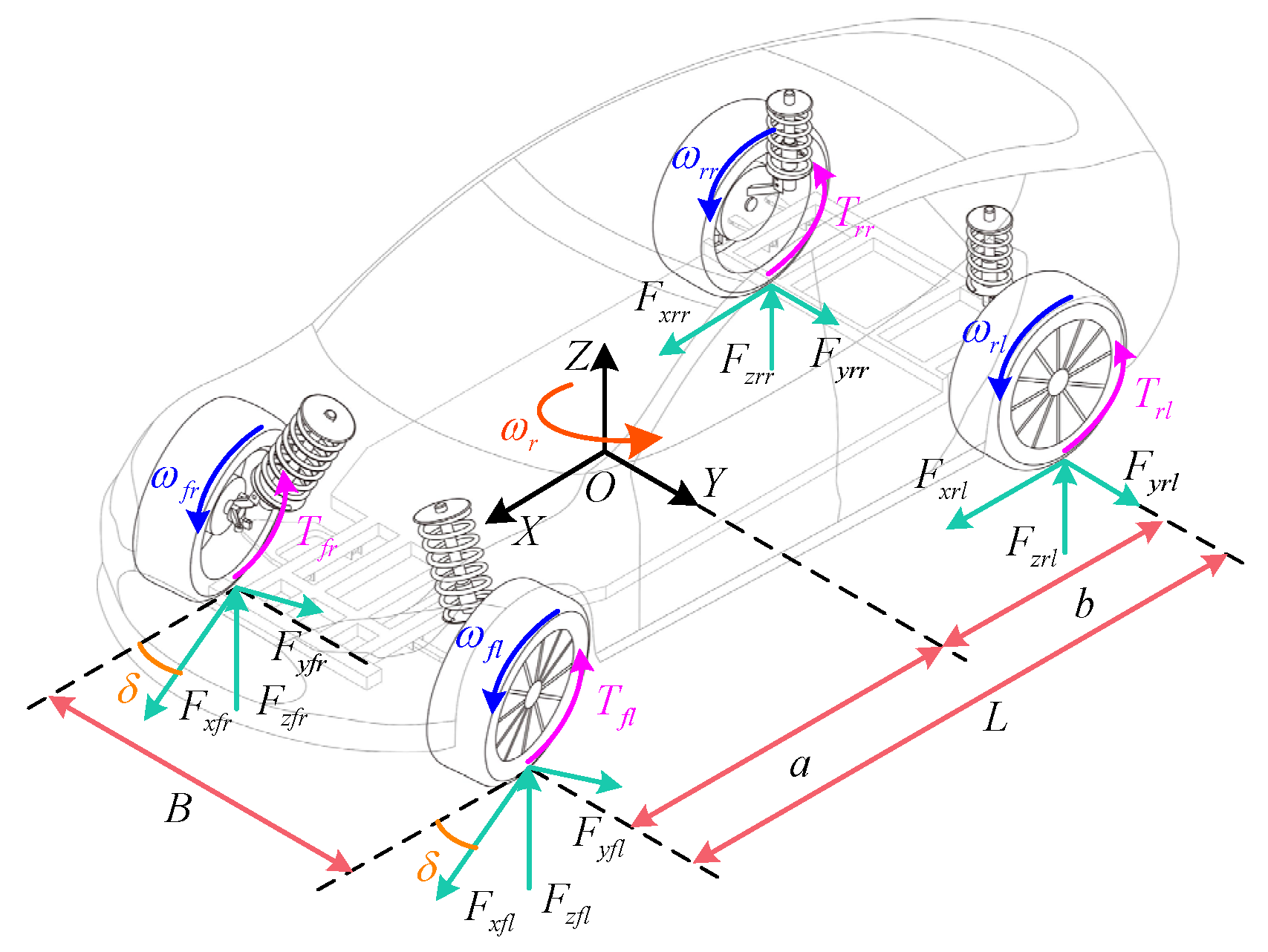
In addition, the 7-DoF model enables a more comprehensive consideration of multi-motor actuator fault scenarios, making it particularly suitable for distributed electric vehicles. The seven degrees of freedom include longitudinal motion, lateral motion, yaw motion, and the rotational motions of the four wheels, under the assumption that the left and right wheels on the front axle share the same steering angle, as illustrated in Figure 2.
m v ˙ x v y ω r = ( F x f l + F x f r ) cos δ ( F y f l + F y f r ) sin δ + F x r l + F x r r m v ˙ y + v x ω r = ( F x f l + F x f r ) sin δ + ( F y f l + F y f r ) cos δ + F y r l + F y r r I z ω ˙ r = ( F x f l + F x f r ) sin δ + ( F y f l + F y f r ) cos δ a + ( F x f r F x f l ) cos δ + ( F y f l F y f r ) sin δ B 2 + ( F x r r F x r l ) B 2 ( F y r l + F y r r ) b I ω ω ˙ i j = T d i j F x i j r ( i j { f l , f r , r l , r r } )
In the equation, m and  I z  indicate the sprung mass and moment of inertia around the Z axis of the mass center of the vehicle, respectively.  δ v x v y , and  ω r  represent the vehicle steering angle of the front wheel, longitudinal velocity, lateral velocity, and yaw rate, respectively.  F x i j  and  F y i j  stand for tire longitudinal and lateral forces (where  f l  means the left front wheel,  f r  means the right front wheel,  r l  means the left rear wheel,  r r  means the right rear wheel), respectively. a, b, and B represent the distance from the center of mass to the front axle, the rear axle, and the tread, respectively.  I ω  represents the total moment of inertia for wheels and in-wheel motors,  ω i j  and  ω ˙ i j  stand for the wheel rotation rate and the wheel rotation angular acceleration, respectively. r means effective radius for wheels, and  T d i j  indicates the output torque of in-wheel motors.
The tire exhibits strong nonlinear and hysteretic characteristics, making it difficult to establish an accurate theoretical tire-force model solely based on its physical properties. Among various empirical approaches, the Magic Formula (MF) model is one of the most widely used experimental models for representing tire behavior [35].
Therefore, the nonlinear characteristics of the tire are described using the Magic Formula, which can be expressed as follows:
F x i j ( λ i j ) = D 1 sin { C 1 arctan [ B 1 ( λ i j + S h 1 ) ( 1 E 1 ) + E 1 arctan B 1 ( λ i j + S h 1 ) ] } + S v 1 F y i j ( α i j ) = D 2 sin { C 2 arctan [ B 2 ( α i j + S h 2 ) ( 1 E 2 ) + E 2 arctan B 2 ( α i j + S h 2 ) ] } + S v 2
where  F x i j  and  F y i j  represent the longitudinal force and the lateral force of the tire, respectively.  λ i j  and  α i j  indicate the longitudinal slip ratios of the tires and the tire sideslip angle, respectively.  B 1 B 2 C 1 C 2 D 1 D 2 E 1 E 2 S h 1 S h 2 S v 1 , and  S v 2  are characteristic parameters.
The tire longitudinal slip ratios are defined as
λ i j = v i j ω i j r v i j × 100 % , i j { f l , f r , r l , r r }
where the reference speeds of four wheels are:
v f l = ( v x ω r ) cos δ + ( v y + ω r + B / 2 ) sin δ v f r = ( v x + ω r ) cos δ + ( v y + ω r + B / 2 ) sin δ v r l = v x ω z B / 2 v r r = v x + ω z B / 2
The tire slip angles are:
α f l = arctan v y + a ω r v x B ω r / 2 δ α f r = arctan v y + a ω r v x + B ω r / 2 δ α r l = arctan v y b ω r v x B ω r / 2 α r r = arctan v y b ω r v x + B ω r / 2
The vertical loads of the four wheels are, respectively,
F z f l = m g b 2 l m v ˙ x h 2 l m v ˙ y h d · b l F z f r = m g b 2 l m v ˙ x h 2 l + m v ˙ y h d · b l F z r l = m g a 2 l + m v ˙ x h 2 l m v ˙ y h d · a l F z r r = m g a 2 l + m v ˙ x h 2 l + m v ˙ y h d · a l
Since the longitudinal and lateral tire forces must satisfy the adhesion ellipse constraint, they need to be corrected accordingly.
F x i j = F x i j ( λ i j ) φ x i j φ i j , F y i j = F y i j ( α i j ) φ y i j φ i j
where  φ i j = φ x i j 2 + φ y i j 2 , φ x i j = λ i j 1 + λ i j , φ y i j = tan α i j 1 + λ i j .
The fault diagnosis and fault estimation for the drive motors of IWMDEVs have been extensively investigated in the literature [36,37,38]. In particular, the methodology for robust fault observation has been significantly advanced by recent research, such as the use of asymptotic partial decoupling disturbances to handle linear systems with invariant zeros [39], which ensures accurate estimation of fault signals even under complex disturbances. Since fault detection is not the main focus of this work, it will not be further discussed. To more clearly observe and investigate the influence of fault severity on vehicle stability and energy efficiency, the corresponding health factors  k i j  are adopted to characterize the degree of motor degradation.
k i j = T i j a c t T i j , i j { f l , f r , r l , r r }
where  T i j a c t  is the actual wheel torque output,  T i j  is the ideal wheel torque.
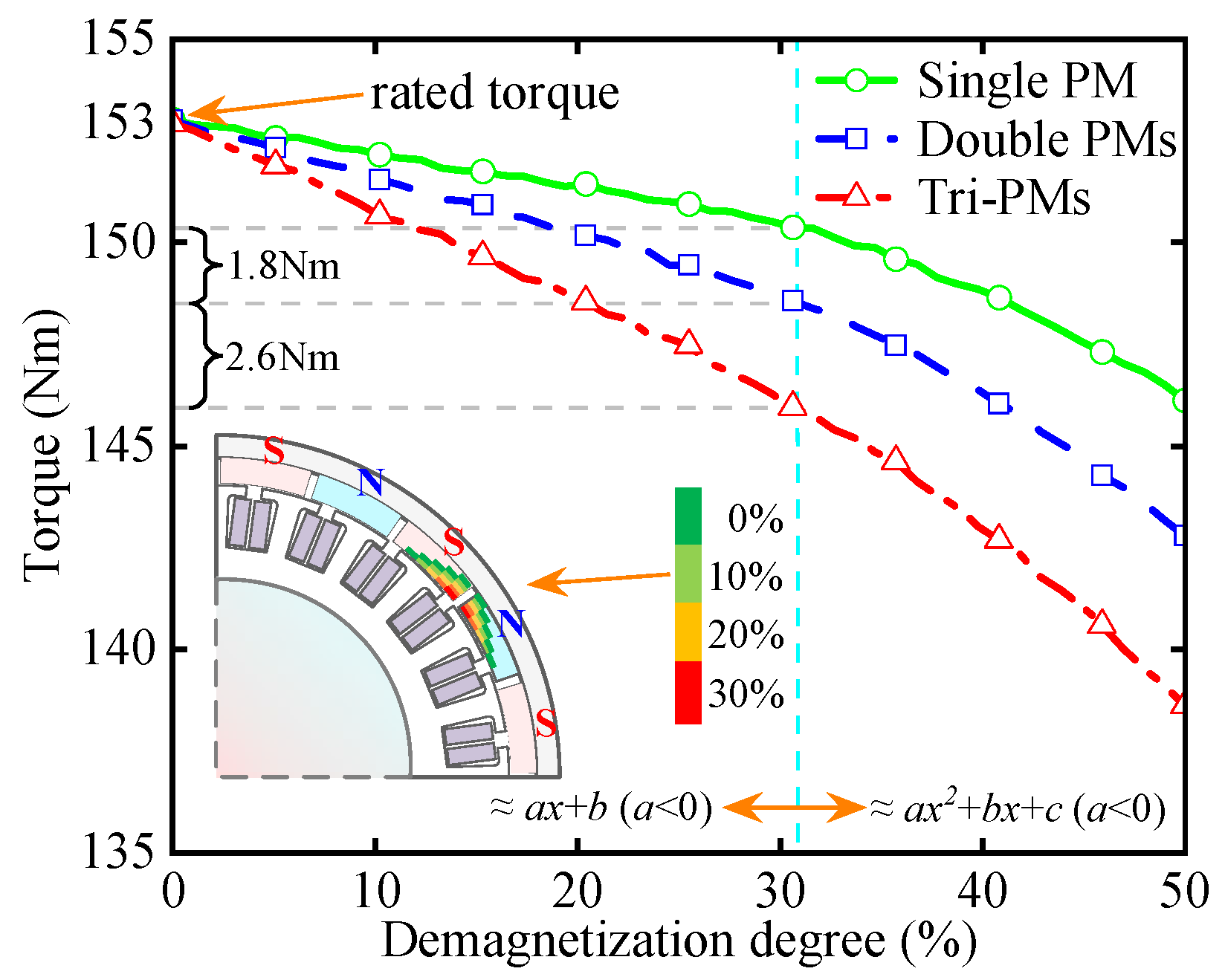
As shown in Figure 3, the degradation pattern of in-wheel motor performance under different numbers of demagnetized permanent magnets is consistent: when the demagnetization level is below ≈31 %, the degradation is approximately linear; beyond this threshold, the performance declines rapidly and nonlinearly. Moreover, when the demagnetization degree is ≤5 %, the degradation is minor. Accordingly, in this study, a motor is regarded as healthy if  0.95 < k i j 1 , and as partially failed if  0.7 < k i j 0.95 . Smaller health factors indicate more severe faults or even complete failure, which are not considered herein.
Incorporating actuator faults into the vehicle model, we define the actuator output vector  u T = [ T f l T f r T r l T r r ] T . The longitudinal tire forces and the additional yaw moment are then expressed as
F x = 1 r k f l cos δ k f r cos δ k r l k r r u T M z = 1 r ζ 1 k f l ζ 2 k f r B 2 k r l B 2 k r r u T
where  ζ 1 = a sin δ B 2 cos δ , ζ 2 = B 2 cos δ + a sin δ .

3. Controller Design

The proposed method follows the hierarchical FTC architecture described previously. The upper-layer NMPC computes the  F x  and  Δ M z , the lower-layer QP optimizes torque allocation under actuator and tire-force constraints, and the DRL coordination layer adaptively regulates the stability–efficiency weighting factor and the current-compensation factor.

3.1. Upper-Layer Controller

The objective of the upper-layer controller is to compute  F x  and  Δ M z  to maintain vehicle stability. To effectively handle the complex control objectives and constraints arising under multiple in-wheel motor fault conditions, and to accurately capture and predict the nonlinear dynamic behavior of the system, an NMPC formulation is adopted. Since the control performance of the predictive approach strongly depends on the accuracy of the model, the vehicle states are predicted based on a 7-DoF vehicle dynamics model combined with a nonlinear tire model. The NMPC framework has been applied to the design of vehicle lateral stability controllers in previous studies [21,32].

3.1.1. Lateral Stability Controller

The state-space equations of the nonlinear 7-DoF vehicle dynamics model are expressed as follows:
x ˙ = Ax + Cu y = Dx A = f ( x , u ) x = f v x f v y f ω r C = f ( x , u ) u = 1 m 0 0 0 0 1 I z , D = 1 0 0 0 1 v x 0 0 0 1
where  x = v x v y ω r T , u = F x Δ M z T , y = v x β ω r T .
The state vector x consists of the longitudinal velocity  v x , the lateral velocity  v y , and the yaw rate  ω r . The control input vector u includes the total longitudinal driving force  F x  and the additional yaw moment  Δ M z . The output vector y is defined as the longitudinal velocity  v x , the sideslip angle of the vehicle  β , and the yaw rate  ω r . In real-world applications,  v x  and  ω r  are measured via on-board GPS or Inertial Measurement Unit (IMU) sensors, while the sideslip angle  β  is typically obtained through state estimation algorithms [40].
The discrete-time model can be expressed as follows:
x k + 1 = f d ( x k , u k , δ k )
where  δ k  denotes the steering angle of the front wheel, which is treated as a known external input.
At each sampling instant, a local linearization of the nonlinear model is performed to obtain an approximate incremental model:
Δ x k + 1 A k Δ x k + C k Δ u k + d k A k = T A + I T C 0 2 × 3 I 2 × 2 , C k = T C I 2 × 2
where  A k  and  C k  denote the state matrix and input matrix, respectively, which are the Jacobian matrices of the nonlinear dynamic model linearized at the current operating point.  d k  is a constant term introduced by the linearization to compensate for the approximation error. T represents the time step selected during the discretization process.
The constraints on system output and control variables are taken as follows:
2 β 2 , 12 / s ω r 12 / s , 71 km / h v x 73 km / h , 1000 Nm Δ M z 1000 Nm .
The upper-layer NMPC problem is essentially a finite-horizon constrained optimal control problem. The optimization objective is to minimize the deviation between the actual vehicle states and the reference trajectory, while suppressing abrupt variations in the control inputs to ensure vehicle stability during driving. Accordingly, the problem can be formulated as follows:
min { u k , , u k + N c 1 } J = i = 0 N p 1 [ ( y k + i | k y k + i | k r e f ) T Q ( y k + i | k y k + i | k r e f ) + Δ u k + i T R Δ u k + i ] + ( y k + N p | k y k + N p | k r e f ) T P ( y k + N p | k | y k + N p | k r e f )
s.t.
x j + 1 = f d ( x j , u j , δ j , f j ) , j = k , , k + N p 1 , y j = h ( x j ) , u j U , x j X , y j Y
where  N p  and  N c  denote the prediction horizon and control horizon, respectively.  y k + i | k  represents the predicted system output at the  ( k + i ) -th step based on information at time step k Q = diag ( q v x , q β , q ω r )  is the output–error weighting matrix.  R = diag ( r F x , r M z )  is the input-increment weighting matrix, used to suppress the variation rate of the longitudinal force and additional yaw moment.  P = diag ( p v x , p β , p ω r )  is the terminal-state weighting matrix.  y k + N p | k r e f  denotes the reference output at the end of the prediction horizon.  U X , and  Y  denote the feasible domains of the input, state, and output variables, respectively.

3.1.2. Vehicle Stability Assessment

The constraints on the yaw-rate error and sideslip-angle error are affected by the vehicle speed and the front-wheel steering angle, making them unsuitable as stability indicators. Although the yaw rate-sideslip angle phase-plane method can be used to evaluate vehicle stability, it becomes invalid under low-friction conditions, where the vehicle exhibits large sideslip angles. In this study, the sideslip angle-sideslip angular velocity phase-plane method is employed to evaluate vehicle stability, while also considering the impact of yaw rate on the stability characteristics. The corresponding stability factor can be obtained from the vehicle phase portrait [41], which is defined as follows:
σ = 1 B 2 β + B 1 B 2 β ˙ 1
where the parameters  B 1  and  B 2  are related to the road surface adhesion coefficient.

3.2. Lower–Layer Controller

The  F x  and  Δ M z  generated by the upper-layer controller need to be distributed among the four in-wheel motors. First, the total driving force of all wheels must satisfy the vehicle longitudinal force demand, that is,
i j { f l , f r , r l , r r } F x i j = F x
To enhance the yaw stability control performance of the NMPC and to generate a more ideal additional yaw moment, the following objective function is designed:
min J 1 = Δ M z M z
The tire stability margin is characterized by the tire adhesion utilization ratio, where a smaller utilization ratio indicates a greater ability of the vehicle to resist instability. Considering the difficulty in accurately controlling the lateral tire forces, only the influence of the longitudinal tire forces on torque distribution is taken into account. Accordingly, the following objective function is established based on this consideration:
min J 2 = i j { f l , f r , r l , r r } F x i j 2 ( μ F z i j ) 2
The motor demagnetization fault inevitably leads to additional energy losses; therefore, the objective function is defined as follows:
min J 3 = i j { f l , f r , r l , r r } T i j ω i j η i j 2
where  η i j  is motor efficiency, and  ω i j  is motor angular velocity.
To facilitate multi-objective control, all the aforementioned objectives are weighted and combined [32]. Vehicle stability is given higher priority, while energy efficiency is considered a secondary objective. After extensive simulation testing, an optimized integrated objective function is obtained, which can be expressed as follows:
J = d 1 J 1 + d 2 J 2 + d 3 J 3
where,
d 1 = 0.3 + 0.7 d R L d 2 = d R L d 3 = 1 d R L
where  d R L [ 0 , 1 ]  is the weighting factor, which plays a key role in the torque allocation of the lower-layer controller. The value of  d R L  is trained and optimized using the DRL algorithm, as detailed in Section 3.3.
To further enhance the lateral stability of the vehicle and relieve the control margin limitation of the fault-tolerant controller, allowing the control strategy to place more emphasis on energy efficiency, a current compensation mechanism is introduced. By compensating for the current of the most severely demagnetized in-wheel motor, part of its driving torque can be restored. The current compensation factor c is trained and optimized using the DRL algorithm.
T i j r a t e d c · k i j · T i j T i j r a t e d , c [ 1 , c max ]
where the upper limit of the current compensation factor  c max  depends on the physical safety limits of the motor and battery system.
Ensuring that the q-axis current  i q , i j  does not exceed the maximum allowable peak current of the inverter  i q , i j m a x .
c c I = i q , i j m a x i q , i j
Based on the motor copper loss  P c u = I 2 R s  and thermal equilibrium conditions, the constraint is derived to ensure that the winding temperature does not exceed its maximum permissible limit:
c c H = ( T max T e n v ) R s R t h 1 i q , i j
where  T e n v  denotes the ambient temperature,  R s  represents the winding resistance, and  R t h  is the thermal resistance of the motor. Meanwhile, the compensated motor power  T i j ω i j  is constrained not to exceed the maximum available power  P b a t m a x  of the battery-inverter system:
c c P = P b a t m a x T i j ω i j
where  T i j  denotes the target torque of the motor before the compensation process, and  ω i j  represents the angular velocity of the faulty wheel.
Therefore, the maximum value of the compensation coefficient  c max  can be determined according to the following expression:
c max = min ( c I , c H , c P ) , c = clip ( c ˜ , 1 , c max )
where  c ˜  denotes the value obtained from the DRL training results. In summary, the current compensation factor is limited to  c max = 1.1 .
To avoid excessive current compensation and the consequent increase in energy consumption, constraints are imposed on the current compensation factor. When the vehicle’s lateral dynamic parameters remain within the stable range, i.e.,  β = 0 3 / s ω r 3 / s , the system is regarded as dynamically stable, and no current compensation is applied.

3.3. DRL for Multi-Objective Adaptive Control

In this study, a stability–efficiency control strategy based on DRL is proposed. This strategy employs the REDQ algorithm to adaptively learn and optimize the dynamic balance between vehicle stability and energy efficiency. Moreover, the DRL framework adaptively compensates for the wheel torque imbalance induced by motor demagnetization, thus enhancing energy efficiency while preserving vehicle stability.
The key hyperparameters used for the REDQ algorithm are specified in Table 1.
The REDQ algorithm is developed within the framework of maximum-entropy RL, whose core idea is to enhance policy exploration and robustness by introducing an entropy regularization term into the reward function. The optimization objective of maximum-entropy RL is defined as follows:
J ( π ) = E π t = 0 γ t r ( s t , a t ) + ξ H ( π ( · | s t ) )
where  π  denotes the policy,  r ( s t , a t )  represents the instantaneous reward, and  γ ( 0 , 1 )  is the discount factor,  γ t  denotes the discounted weighting factor at time step t. The hyperparameter  ξ  controls the trade-off between the reward and the entropy, and the policy entropy is defined as follows:
H ( π ( · | s t ) ) = E a t π [ log π ( a t | s t ) ]
A higher entropy value indicates that the agent maintains greater uncertainty during the decision-making process, thereby enhancing its exploration capability. To avoid overestimation, an entropy regularization term is incorporated into the value function update, enabling the Q-value estimation to account for both the expected reward and the diversity of the policy.
Q ( s , a ) = E r ( s , a ) + γ E s , a ( Q ( s , a ) ξ log π ( a | s ) )
In addition, during policy updates, the objective is not only to maximize the Q-value, but also to encourage diversity in the action distribution:
J ( π ) = E s D , a π Q ( s , a ) ξ log π ( a | s )
In summary, the REDQ algorithm extends the SAC framework by introducing a multi-critic structure and a randomized minimization update mechanism, which not only improves sample efficiency but also enhances the accuracy and stability of the value-function estimation.
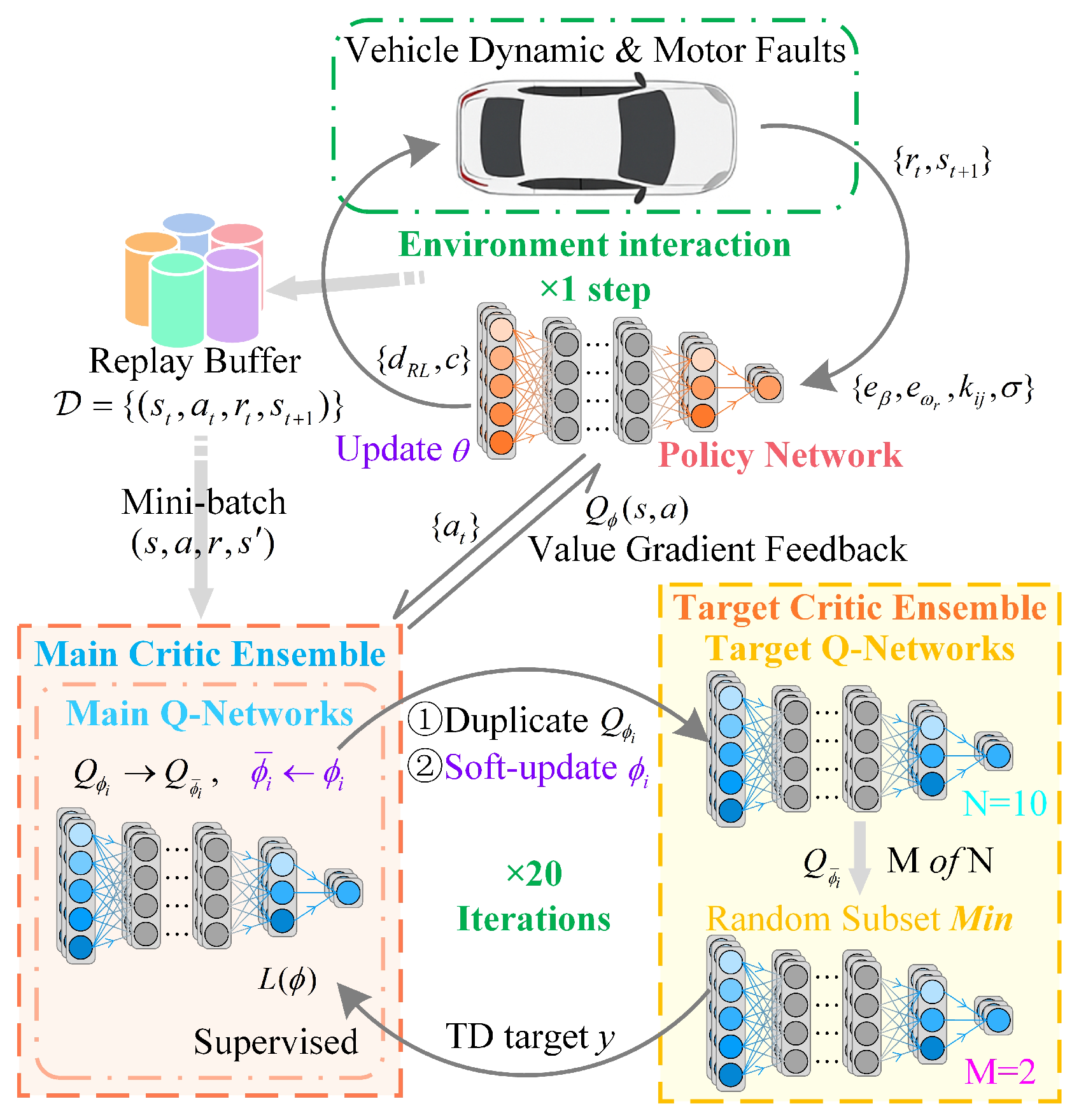
Overall framework of the proposed REDQ-based adaptive learning process, integrating ensemble critics and policy optimization within a unified vehicle-environment interaction loop, as shown in Figure 4.
The state and action spaces of the RL problem are defined as follows:
A = { d R L , c } , S = { e β , e ω r , k i j , σ }
where  e β = β β d  is the sideslip angle deviation, and  e ω r = ω r ω r d  is the yaw rate deviation.  β d  is the ideal sideslip angle,  ω r d  is the ideal yaw rate.
Through DRL training, the agent can adaptively learn to adjust the values of  d R L  and c according to different driving scenarios. Considering that the main objective of this study is to improve the stability and energy efficiency of IWMDEVs, the reward function of the reinforcement learning framework is defined as follows:
R = R stability + R economy
where,
R stability = ω s 0 t e β 2 + e ω r 2 d τ R economy = ω e 0 t T i j ω i j η i j d τ
where  ω s  and  ω e  are penalty factors corresponding to vehicle stability and motor power consumption, respectively. These factors are not tuned for numerical optimality but reflect a safety-oriented design preference commonly adopted in fault-tolerant vehicle control, where stability is prioritized under fault conditions. The energy-related term mainly serves as a regularization to prevent overly aggressive control actions. The designed reward function enables the agent to achieve a dynamic balance between stability and energy efficiency under different driving conditions.
Specifically, REDQ introduces N critic networks, from which M networks are randomly sampled at each update step, and the minimum value among them is used to construct the target value:
y REDQ = r + γ min i M Q ϕ ¯ i ( s , a ) α log π ( a | s )
where  M { 1 , , N } | M | = M , and  Q ϕ ¯ i  denotes the target critic. The loss function of the critic network is defined as:
L ( ϕ ) = E Q ϕ i ( s , a ) y REDQ 2 , i = 1 , , N
This randomized minimization ensemble mechanism effectively mitigates the overestimation problem of the value function. The policy network is updated using the deterministic policy gradient method, expressed as:
θ J = E s D α Q ϕ i ( s , a ) | a = μ θ ( s ) θ π θ ( s )
And the soft update is applied to maintain the smoothness and stability of the target networks:
ϕ ¯ i ρ ϕ ¯ i + ( 1 ρ ) ϕ i
where  ρ  is the soft-update factor.
In the REDQ framework, the policy network does not directly output the action values but instead parameterizes a Gaussian distribution conditioned on the current state. Specifically, given a state  s t , the actor outputs the mean  μ θ ( s t )  and the standard deviation  σ θ ( s t )  of the distribution:
a t N ( μ θ ( s t ) , σ θ ( s t ) )
To enable efficient gradient backpropagation, the reparameterization trick is employed, and the action is sampled as follows:
a t = μ θ ( s t ) + σ θ ( s t ) ϖ , ϖ N ( 0 , I )
Since the outputs must satisfy physical constraints, a nonlinear squashing function is applied to map the raw actions into bounded ranges. In this study, the two control factors are defined as follows:
d R L = 1 2 tanh ( a t ) + 1 2 , c = 0.05 tanh ( a t ) + 1.05
This mapping ensures that the generated actions remain within their admissible physical ranges, while maintaining sufficient exploration capability during training. By adopting this formulation, the proposed framework extends the conventional REDQ algorithm (Algorithm 1) to a two-dimensional action space, thereby enabling the agent to adaptively optimize both vehicle stability and energy efficiency under multi-motor fault conditions.
Algorithm 1 REDQ-based Adaptive Control with Dual Factors
Require:
Number of critics N, number of updates U, replay buffer  D
Ensure:
Trained actor network  π θ  that outputs  [ d R L , c ]
  1:
Initialize critic networks  Q ϕ i ( s , a ) i = 1 , , N
  2:
Set target networks  ϕ ¯ i ϕ i
  3:
Initialize actor network  π θ
  4:
Empty replay buffer  D
  5:
while agent interacts with the vehicle environment do
  6:
      Select action  a t = d R L , c  via Gaussian sampling and mapping (Equations (35)–(37))
  7:
      Apply  d R L , c  to control stack: update weighting  d R L  and compensation c
  8:
      Run NMPC ⇒ QP
  9:
      Execute plant, observe reward  r t  (Equation (30)) and next state  s t + 1
10:
      Store  ( s t , a t , r t , s t + 1 )  in  D
11:
      for G updates do
12:
         Sample a mini-batch  B = { ( s , a , r , s ) }  from  D
13:
         Randomly select a subset  M { 1 , , N }
14:
         Compute  y REDQ  using Equation (31)
15:
         for  i = 1 , , N  do
16:
              Minimize the loss function to update the critic network: Equation (32)
17:
              Soft-update target network  ϕ ¯ i  via Equation (34)
18:
         end for
19:
      end for
20:
      Update actor  θ i  via policy gradient ascent using Equation (33)
21:
end while

4. Simulation Results and Discussion

To verify the effectiveness and engineering applicability of the proposed multi-objective adaptive FTC strategy based on the DRL algorithm, a high-fidelity full-vehicle simulation environment is established on the CarSim–Simulink–Python co-simulation platform. Comparative analyses are conducted under three representative driving conditions–DLC, SLC, and the EPA driving cycle–to comprehensively evaluate control performance in terms of vehicle stability and energy efficiency. First, the impact of demagnetization faults on vehicle dynamics is investigated under the uncontrolled condition, providing a quantitative reference for controller design. Subsequently, the fault-tolerant capability and the adaptive balance between stability and efficiency of the DRL-based control strategy are validated under single- and multi-motor fault scenarios. Finally, the long-term energy-saving performance and stability–maintenance ability are evaluated under the driving-cycle condition, thereby confirming the overall feasibility and practicality of the proposed method.

4.1. Influence of Different Fault Modes on Vehicle Stability

Demagnetization faults alter the output characteristics of in-wheel motors, leading to imbalanced driving torque distribution and consequently affecting the overall vehicle stability. To quantitatively reveal the influence patterns of different demagnetization modes on vehicle stability, simulations are conducted without any control strategy under single-, dual-, and four-wheel fault scenarios. Four key performance indicators–vehicle speed tracking, path tracking, yaw rate, and sideslip angle–are analyzed to evaluate the effects of various fault modes on dynamic stability, thereby providing a baseline reference for the subsequent validation of the proposed adaptive fault-tolerant control strategy. The specific vehicle parameters are listed in Table 2.
Under the same degree of demagnetization, different fault distribution patterns among the in-wheel motors can cause varying levels of driving torque imbalance between the left and right sides of the vehicle. For instance, a single-motor fault introduces a significant torque difference between the two sides, resulting in a rapid change in the yaw moment. In contrast, when multiple motors experience partial demagnetization simultaneously, the total driving torque decreases considerably, but the lateral torque asymmetry may be relatively mitigated. To investigate these differences, several fault distribution patterns were designed under the same demagnetization ratio and evaluated in DLC and SLC conditions.
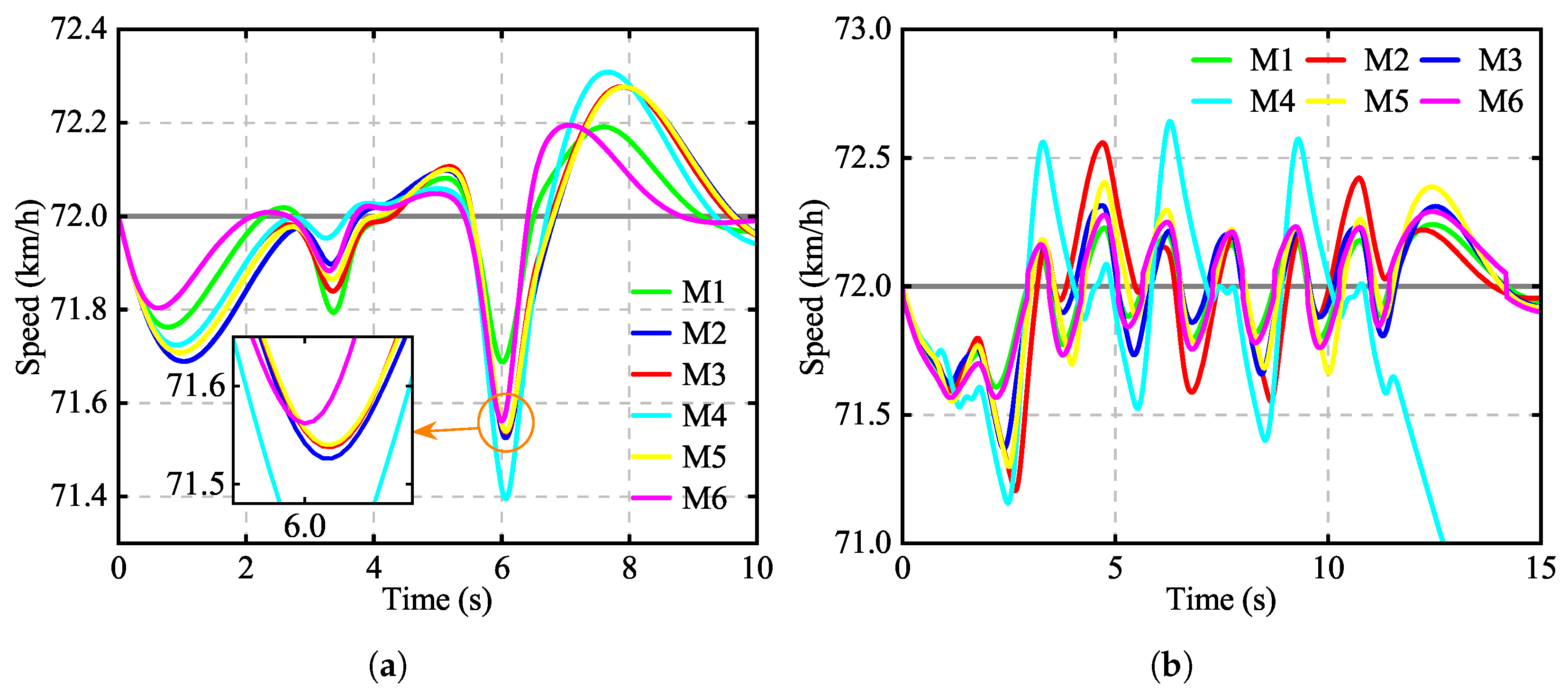
To ensure variable consistency, simulations were conducted under the conditions of road adhesion coefficient  μ  = 0.7 and vehicle speed  v x  = 72 km/h. Six cases with identical fault severity but different fault distributions, along with the healthy mode, were compared:
  • M1: Healthy mode,  k f l = k f r = k r l = k r r = 1 .
  • M2: Single–motor fault,  k f l = 0.7 .
  • M3: Dual–motor fault on the same axle,  k f l = k f r = 0.7 .
  • M4: Dual–motor fault on the same side,  k f l = k r l = 0.7 .
  • M5: Diagonal dual–motor fault,  k f l = k r r = 0.7 .
  • M6: Four–motor partial demagnetization,  k f l = k f r = k r l = k r r = 0.7 .
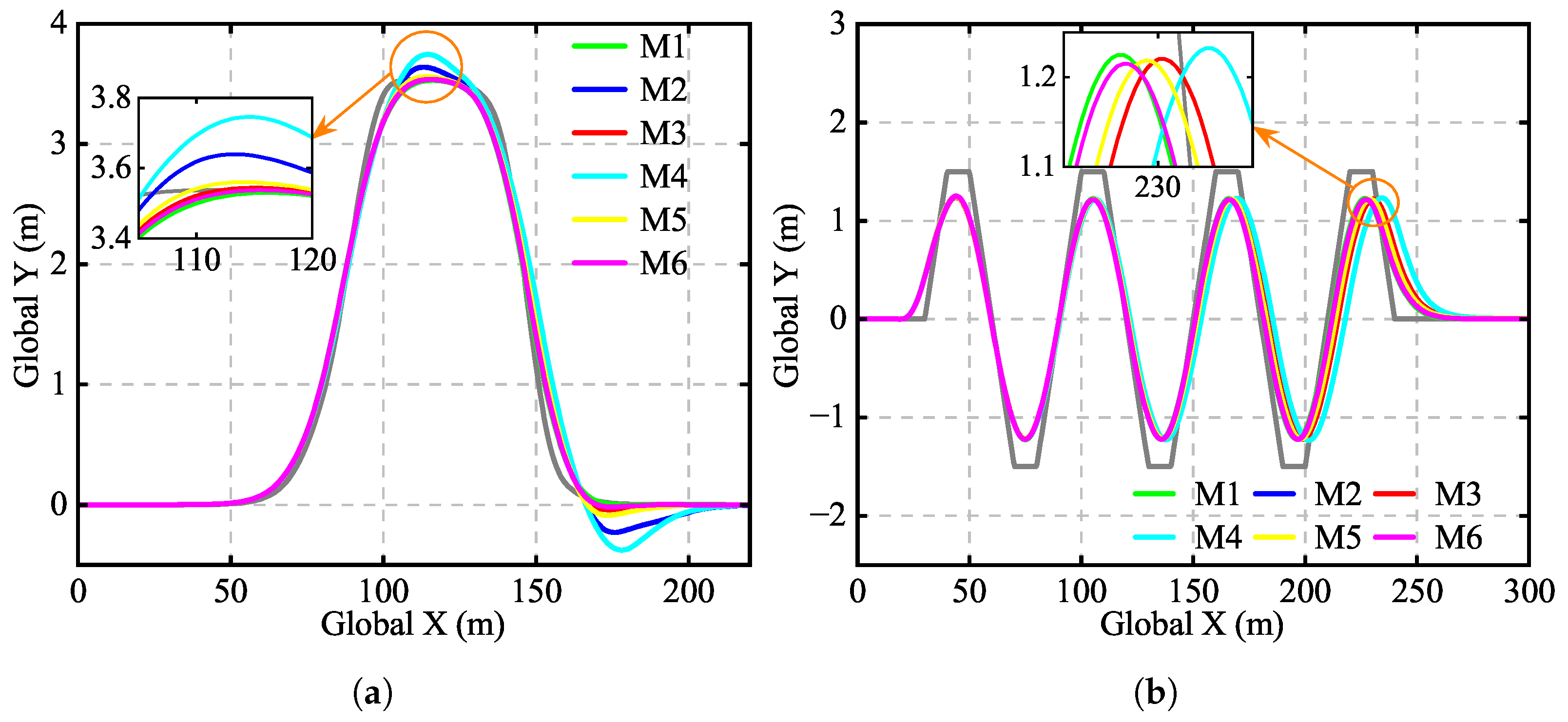
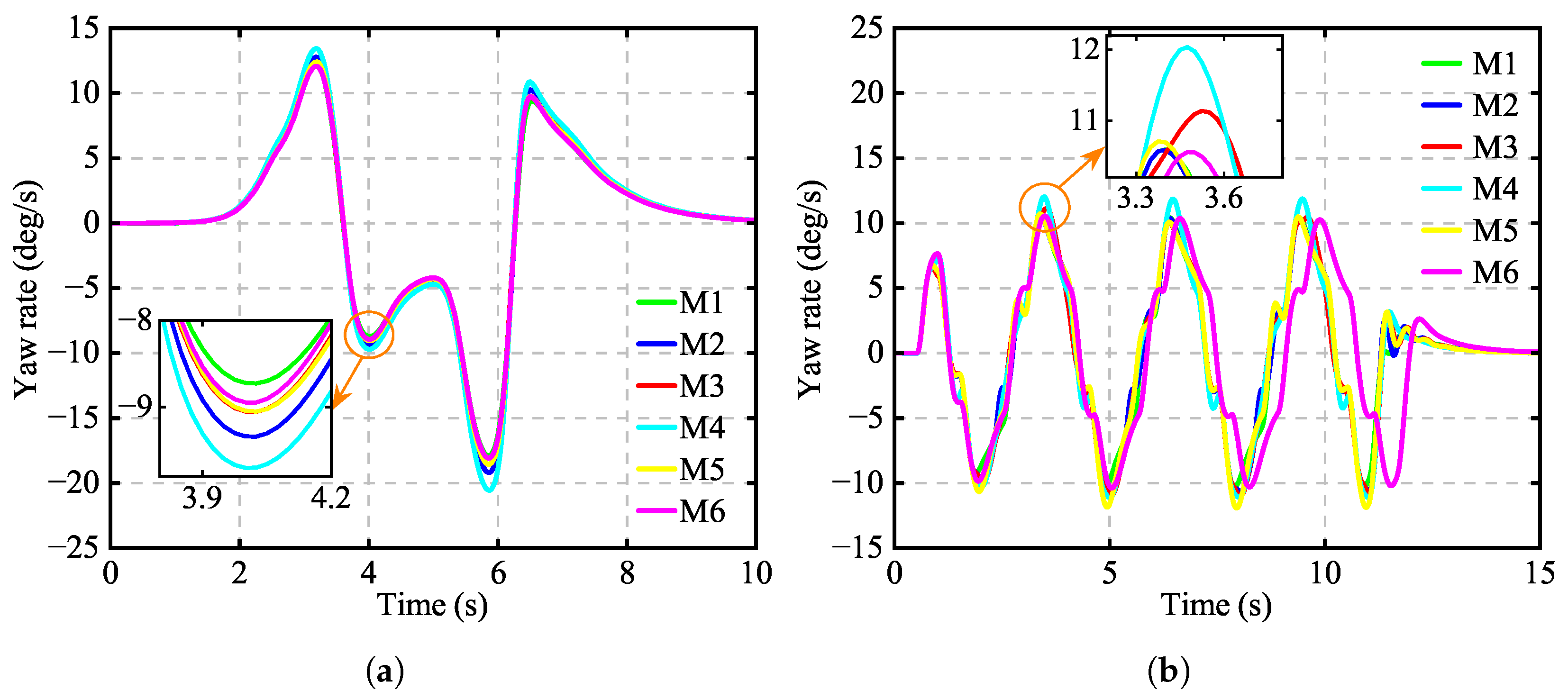
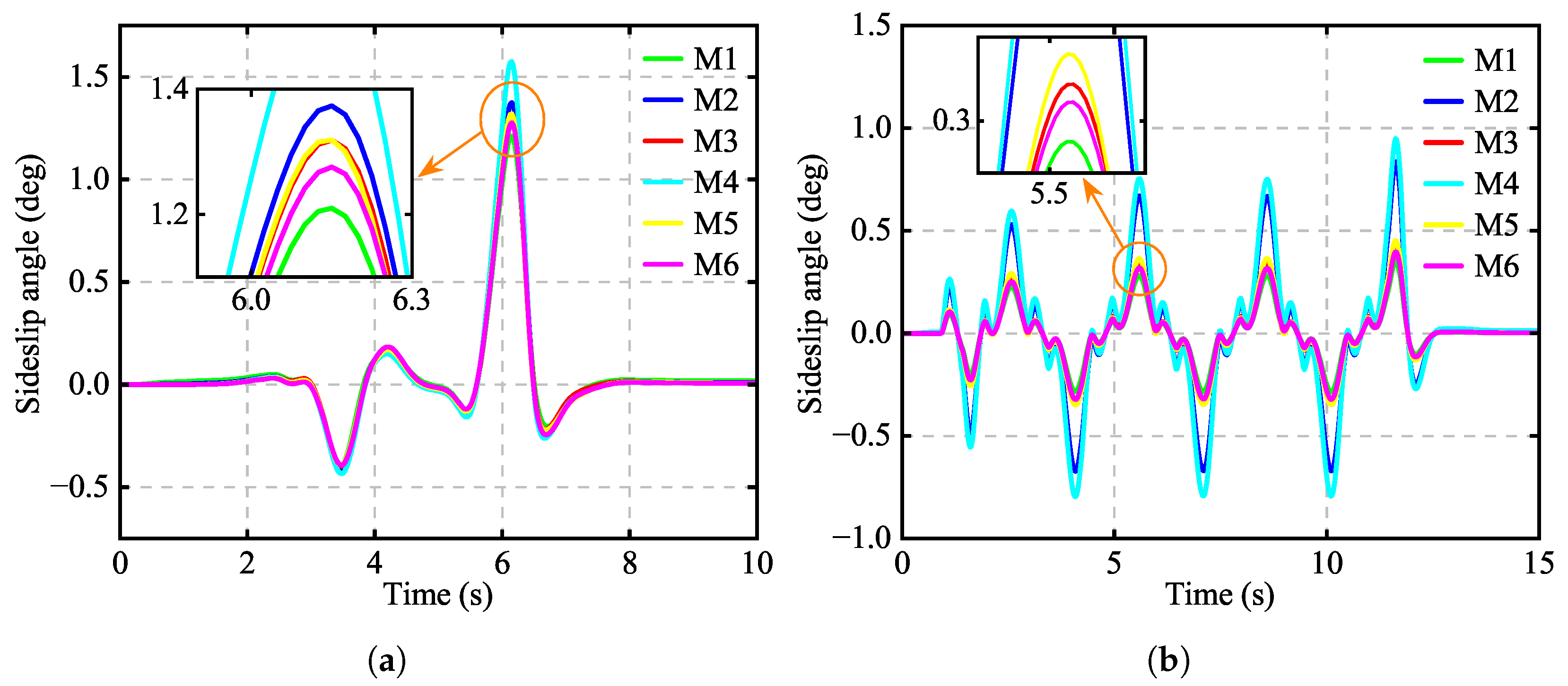
As shown in Figure 5, Figure 6, Figure 7 and Figure 8, all performance indicators exhibit a consistent ranking sequence across different fault modes. The M4 mode shows the worst vehicle stability, while the M1 mode achieves the best overall performance, followed by M6. The remaining modes fall between these two extremes and exhibit slight intersections under certain maneuvers, but their overall order remains stable. Figure 5 compare the vehicle speed tracking results. Under the SLC maneuver, the periodic disturbances in longitudinal speed further amplify the differences among fault modes. In particular, the M4 mode displays significantly larger peak-to-valley fluctuations over multiple cycles and shows severe deviation in the 11–13 s interval, whereas other modes gradually converge to the reference speed. This indicates that the same-side dual-motor fault (M4) produces the most unstable dynamic behavior and tends to cause loss of stability under this condition.
Figure 6 illustrate the trajectory tracking performance. Under the DLC maneuver, the M4 mode deviates most significantly from the target path, whereas M6 nearly coincides with the reference trajectory. In the SLC test, the largest deviation occurs near the second-to-last corner (at approximately x ≈ 230 m), where M4 shows both the maximum peak offset and the broadest peak width. The M6 mode performs slightly worse than M1 but still maintains a stable tracking response.
The lateral stability results are consistent with the previous conclusions. Figure 7 present the yaw-rate comparisons. Under DLC maneuver, a clear separation can be observed near the negative peaks of yaw rate (3.9–4.2 s): the M4 mode exhibits the deepest negative peak, whereas M6 shows the shallowest. Around 6 s, the maximum negative peaks display a similar hierarchical relationship. Under SLC maneuver, during each steering cycle (e.g., the positive peak at 3.3–3.6 s), the same trend appears – M4 reaches the highest peak, M6 reaches the lowest except M1 – forming a step-like pattern across the modes. The peak timing among different modes remains well aligned, indicating that the main difference lies in peak magnitude.
Figure 8 show the sideslip angle comparisons. Under DLC maneuver, the largest positive deviation occurs around 6.0–6.3 s, where M4 again reaches the maximum amplitude with the widest peak width, and M6 shows the second-smallest deviation, next only to M1. The SLC maneuver reveals this contrast even more clearly, with M4 and M2 exhibiting larger oscillation amplitudes in both positive and negative peaks than the other modes. At the final right turn (around 11.7 s), M4 reaches its largest overall peak, indicating the accumulation of instability. This phenomenon arises from the asymmetric longitudinal driving forces between the left and right sides caused by different fault distributions. The resulting additional yaw moment, denoted as  Δ M z  can be approximated as  Δ M Z Δ F x · B / 2 . During cornering, the required drive torque on the outer wheels increases significantly, and when the torque imbalance is not compensated, lateral instability becomes more pronounced.
The results demonstrate that M4 has the most severe impact on vehicle stability, while under the same fault severity, the M6 maintains a high level of stability, second only to the healthy mode M1. This confirms that the imbalance of left- and right-side driving torque is the fundamental cause of vehicle instability in IWMDEVs under demagnetization faults.

4.2. Validation of the Proposed Control Strategy Under Multiple Motor Faults

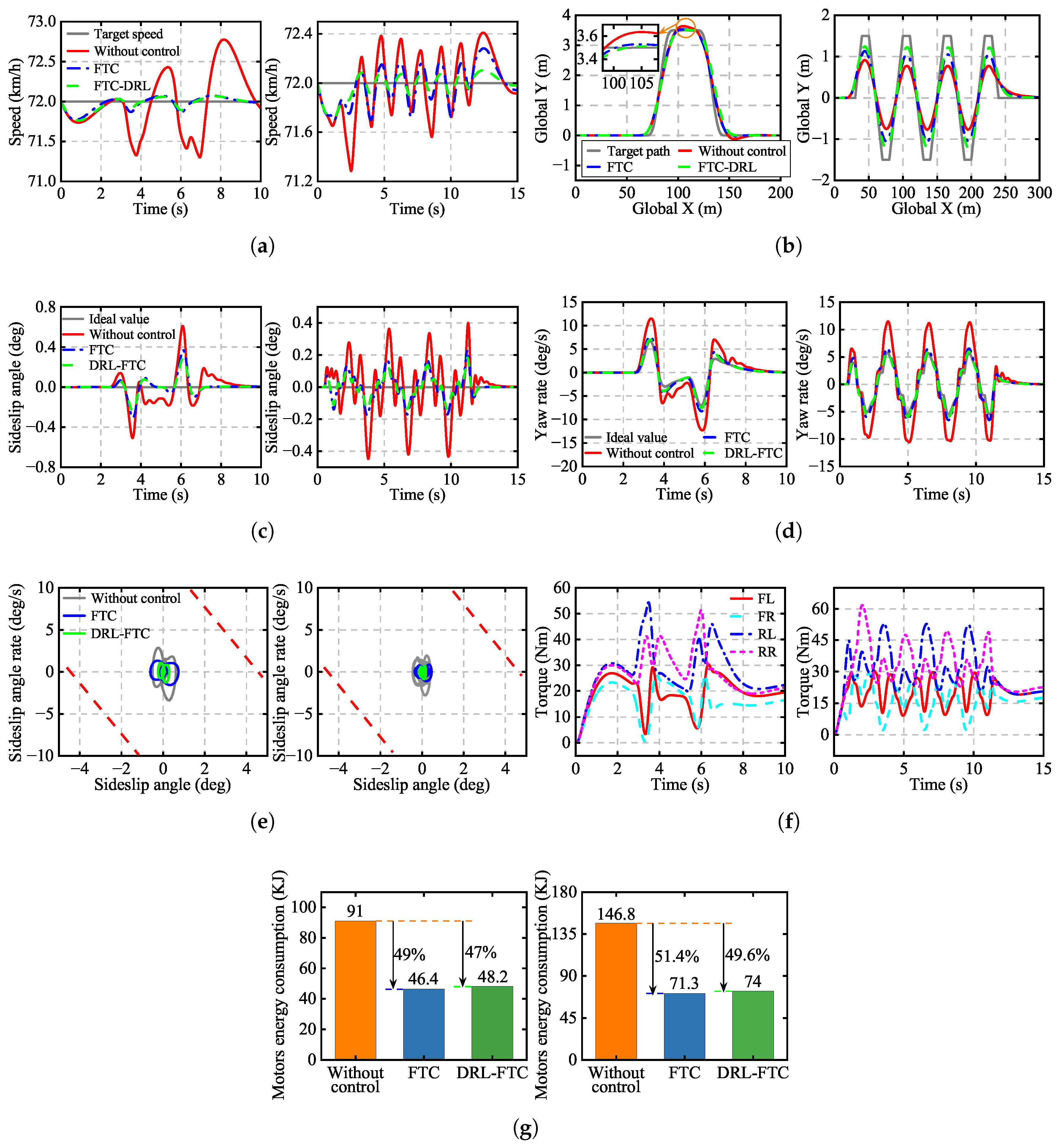
Under the conditions of a road adhesion coefficient of  μ  = 0.5 and a vehicle speed of  v x  = 72 km/h with motor health factors set to  k f l  = 0.7,  k f r  = 0.7,  k r l  = 0.8,  k r r  = 0.9, simulations are performed under both DLC and SLC conditions. The performances of three control strategies, without control, model predictive FTC, and the proposed DRL-FTC are compared, and the results are illustrated in Figure 9a–g. In the DRL-FTC scheme, the algorithm automatically identifies the in–wheel motor with the most severe demagnetization fault and applies current compensation to restore part of its torque output capability. This compensation process mitigates torque asymmetry between the left and right sides of the vehicle, thereby improving overall stability and fault tolerance.
As shown in Figure 9a, under uncontrolled conditions, the vehicle exhibits noticeable speed overshoot in both DLC and SLC maneuvers, with maximum deviations of 0.77 km/h and 0.73 km/h, respectively. In contrast, with the implementation of FTC and DRL-FTC strategies, the speed fluctuations during the entry and exit phases of the DLC maneuver are significantly reduced, while under the SLC condition, the vehicle speed remains closer to the target value despite periodic disturbances. Among the three cases, the DRL-FTC strategy achieves the most effective suppression of speed oscillations.
As illustrated in Figure 9b, under the uncontrolled condition, the vehicle deviates noticeably from the target trajectory in both maneuvers, with pronounced overshoot and delay observed in the exit phase of the DLC maneuver. Both FTC and DRL-FTC strategies substantially improve path-tracking accuracy, with the DRL-FTC trajectory nearly overlapping with the reference path. Compared with the conventional FTC approach, the DRL-FTC strategy further reduces lateral deviation, demonstrating its superior capability in coordinated longitudinal-lateral control.
As shown in Figure 9c, under uncontrolled conditions, the vehicle exhibits large fluctuations in the sideslip angle when subjected to fault excitation, with peak values exceeding ±0.4°. After introducing the DRL-FTC strategy, the peak sideslip angle is significantly reduced to within ±0.25° and ±0.2° for the DLC and SLC maneuvers, respectively, and the oscillation frequency is also suppressed. Compared with the FTC strategy, DRL-FTC achieves a smoother sideslip response in both maneuvers, effectively mitigating vehicle sideslip and ensuring higher driving stability.
As shown in Figure 9d, the uncontrolled vehicle exhibits severe oscillations in yaw rate, with peak amplitudes reaching ±12 deg/s, which may easily trigger dynamic instability. Both FTC and DRL–FTC effectively suppress the yaw rate peaks, while DRL-FTC keeps the yaw rate closely aligned with the reference value, indicating stronger robustness and disturbance rejection capability in yaw dynamic control.
Figure 9e illustrates the phase-plane trajectory formed by the sideslip angle and sideslip angular velocity. Under uncontrolled conditions, the trajectory covers a wide range, with several state points approaching the boundary line, implying that the vehicle operates near the stability limit. It is worth mentioning that the boundary line represented by the red dashed line is defined according to Equation (15). Both FTC and DRL-FTC significantly contract the stability envelope, while the DRL-FTC trajectory becomes more compact and elliptical, indicating a larger stability margin and a notable improvement in overall system stability.
As shown in Figure 9f, the torque distribution among the four drive motors indicates that the DRL-FTC controller effectively maintains balanced torque allocation during cornering. The torques of the outer wheels are slightly increased, while those of the inner wheels are correspondingly decreased, and a larger torque is assigned to the side with a higher fault severity, resulting in a smoother and more coordinated output.
Figure 9g compares the energy consumption under different control strategies for both DLC and SLC maneuvers. Due to the influence of current compensation, the energy consumption of DRL-FTC increases slightly. In the DLC condition, the FTC and DRL-FTC strategies reduce energy consumption by 49% and 47%, respectively, while in the SLC condition, the reductions are 51.4% and 49.6%, respectively. Notably, although DRL-FTC exhibits slightly higher energy consumption than FTC, it achieves superior stability performance, demonstrating a dynamic balance between stability and energy efficiency within the proposed adaptive FTC framework.
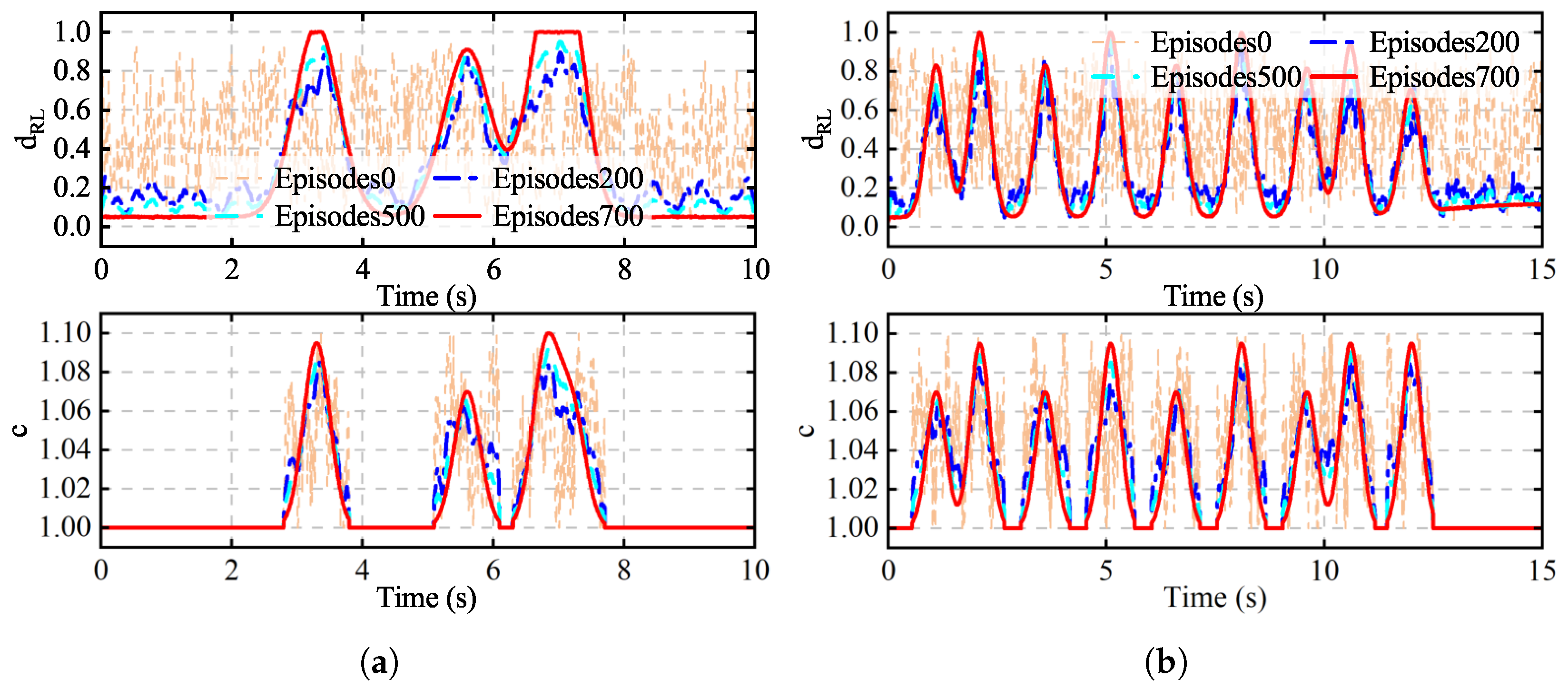
As shown in the upper part of Figure 10, during the early stage of training (Episode 0), the  d R L  curve fluctuates strongly, oscillating almost randomly within the range of [0, 1], which reflects the exploration behavior before the policy converges. As the training proceeds to Episode 200 and Episode 500, the curve gradually exhibits a consistent fluctuation pattern synchronized with the driving task. In the DLC maneuver, the weighting factor rises sharply during the cornering entry and exit phases while decreasing notably during straight-line driving. After convergence at Episode 700, the  d R L  curve approaches 1 within steering intervals and drops below 0.1 during stable cruising, indicating that the model can autonomously recognize vehicle stability risks and reinforce stability control at critical moments. Similarly, under the SLC maneuver, the continuous periodic steering inputs make  d R L  a distinct multi-peak pattern to be exhibited, closely aligned with each steering event. After training, the Episode 700 curve presents a clearly recognizable fluctuation pattern-rapidly increasing at each steering peak and returning to around 0.1 in steady phases-demonstrating that the RL agent successfully learns the temporal correlation between vehicle stability and steering behavior.
The lower part of Figure 10a,b illustrates the variation of the current compensation factor c, which remains within the range of approximately [1, 1.1], representing a minor correction to the baseline current distribution. At the beginning of training (Episode 0), c exhibits irregular jitter without any apparent control logic. As the training iterations progress, the Episode 700 curve becomes much smoother, with pulse-like increases occurring only during cornering disturbances or high-fault-severity intervals, while remaining at the baseline value c = 1 during steady driving. Particularly in the SLC maneuver, the periodic rises of c are almost synchronized with the peaks of  d R L , indicating the emergence of a coordinated adjustment mechanism between the two adaptive coefficients: when the agent identifies an elevated stability risk,  d R L  and c simultaneously increase to counteract lateral stability degradation, thereby mitigating torque asymmetry caused by motor faults.
The quantitative results summarized in Table 3 and Table 4 clearly demonstrate the superiority of the proposed DRL-FTC strategy over the conventional model predictive FTC. Under both DLC and SLC conditions, the DRL-FTC controller consistently achieves lower peak, mean, and RMSE in yaw rate and sideslip angle. Overall, the proposed method reduces the dynamic tracking errors, indicating significant improvements in vehicle stability and robustness under multi-motor fault conditions.

4.3. Comparative Energy Consumption Analysis Under Cyclic Driving Conditions

To further validate the adaptability and energy efficiency of the proposed control strategy under complex and long-duration operating conditions, this section compares the energy consumption of different control methods in the EPA driving cycle. By evaluating the cumulative energy consumption of the vehicle under combined urban and highway conditions, the energy-saving potential of the DRL-FTC strategy is analyzed across various motor demagnetization fault scenarios. In addition, multiple four-wheel demagnetization fault combinations are investigated in detail to reveal the influence of fault location and demagnetization severity on the overall energy distribution characteristics.
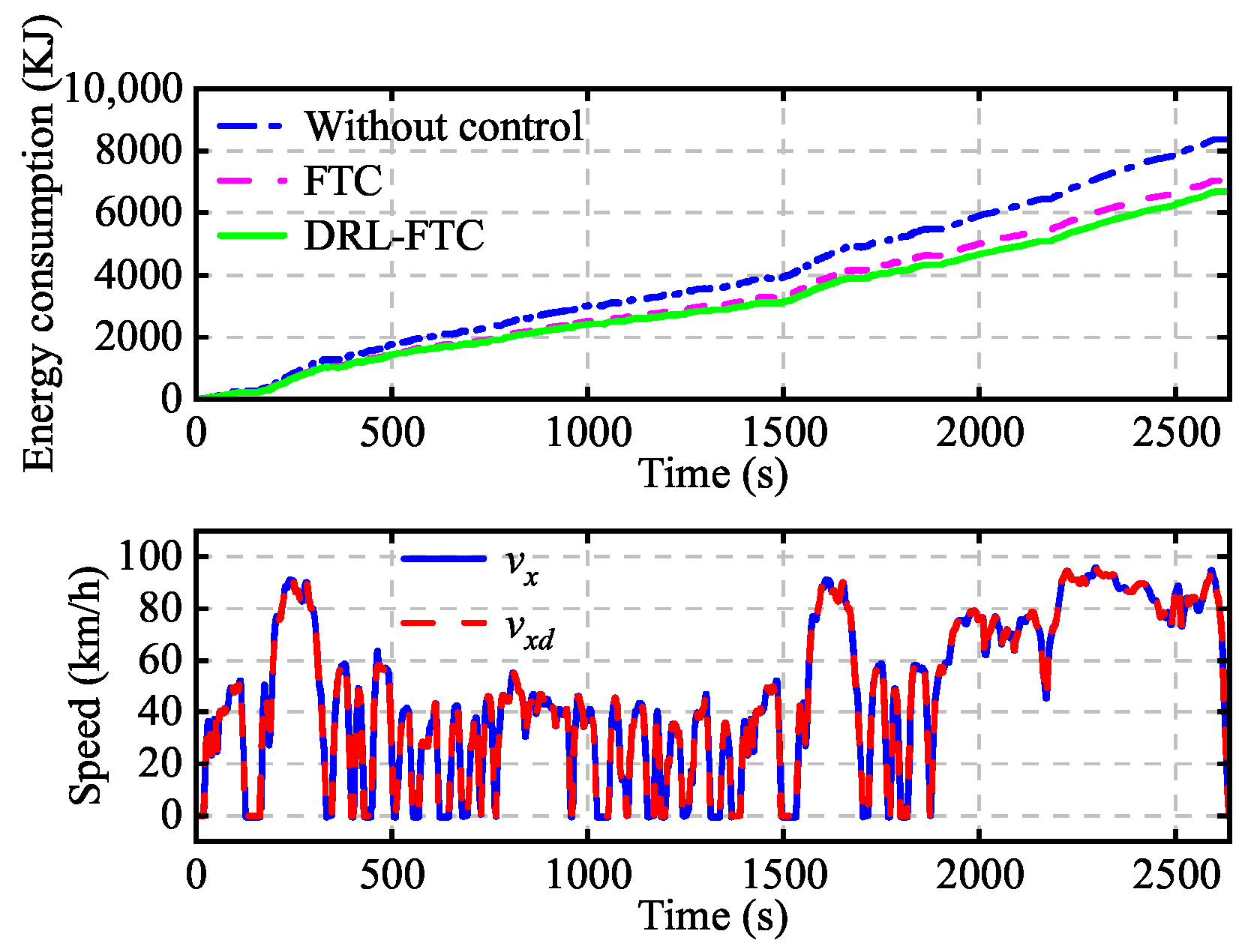
Simulations are conducted with a road adhesion coefficient of  μ  = 0.7 and motor health factors of  k f l  = 0.7,  k f r  = 0.7,  k r l  = 0.8,  k r r  = 0.9. The corresponding energy consumption and speed-tracking curves are shown in Figure 11. As driving time increases, the energy consumption of all three methods exhibits a roughly linear growth trend. However, the DRL-based strategy consistently maintains the lowest energy consumption, achieving a significant reduction compared with the uncontrolled case, and further improving efficiency relative to the FTC method. These results demonstrate that the proposed control method can effectively enhance vehicle energy efficiency while maintaining fault-tolerant capability, thereby extending the driving range. This indicates that the strategy can simultaneously ensure fault tolerance and energy optimization even under complex and dynamic driving environments, achieving a balanced control objective of stability and efficiency.
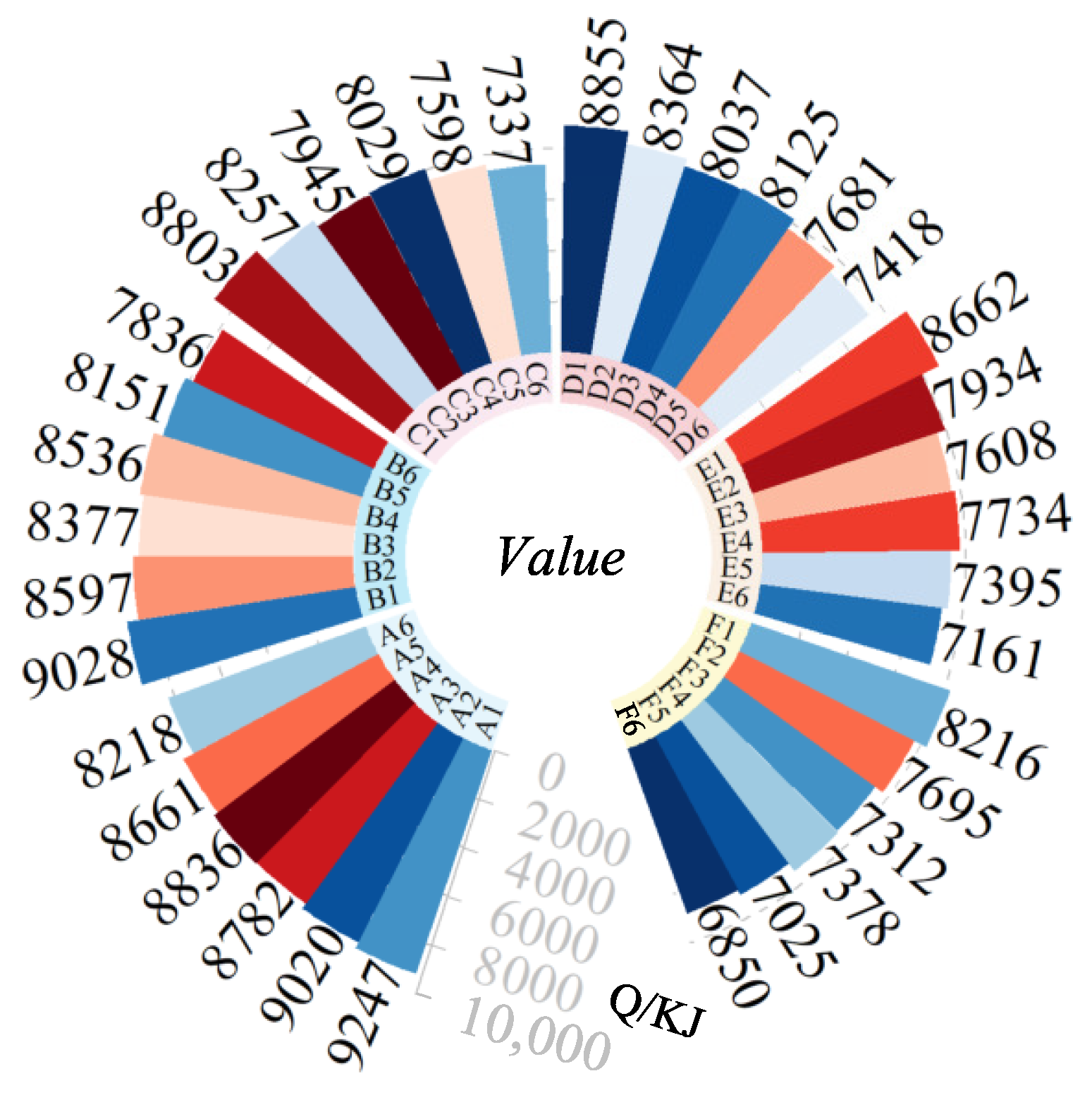
To further explore the influence of different fault combinations on system energy efficiency, 36 demagnetization fault modes of the four in-wheel motors are classified, as summarized in Table 5, and analyzed under the EPA driving cycle. The results, shown in Figure 12, reveal that energy consumption increases significantly with the severity of demagnetization, exhibiting a clear monotonic trend. When the health factors of all four motors are set to 0.7, the total energy consumption reaches its maximum, while the minimum occurs at a health factor of 0.9. This indicates that a higher degree of multi-motor demagnetization leads to greater energy loss. Moreover, the differences in energy consumption across fault combinations highlight the sensitivity of system efficiency to the fault distribution pattern: when the health conditions of the left and right motors are asymmetric, the energy consumption is generally higher than that under front-rear asymmetric configurations. This finding suggests that lateral driving imbalance induces additional energy losses, representing a key mechanism through which demagnetization faults affect overall system efficiency.

4.4. HIL Experimental Result

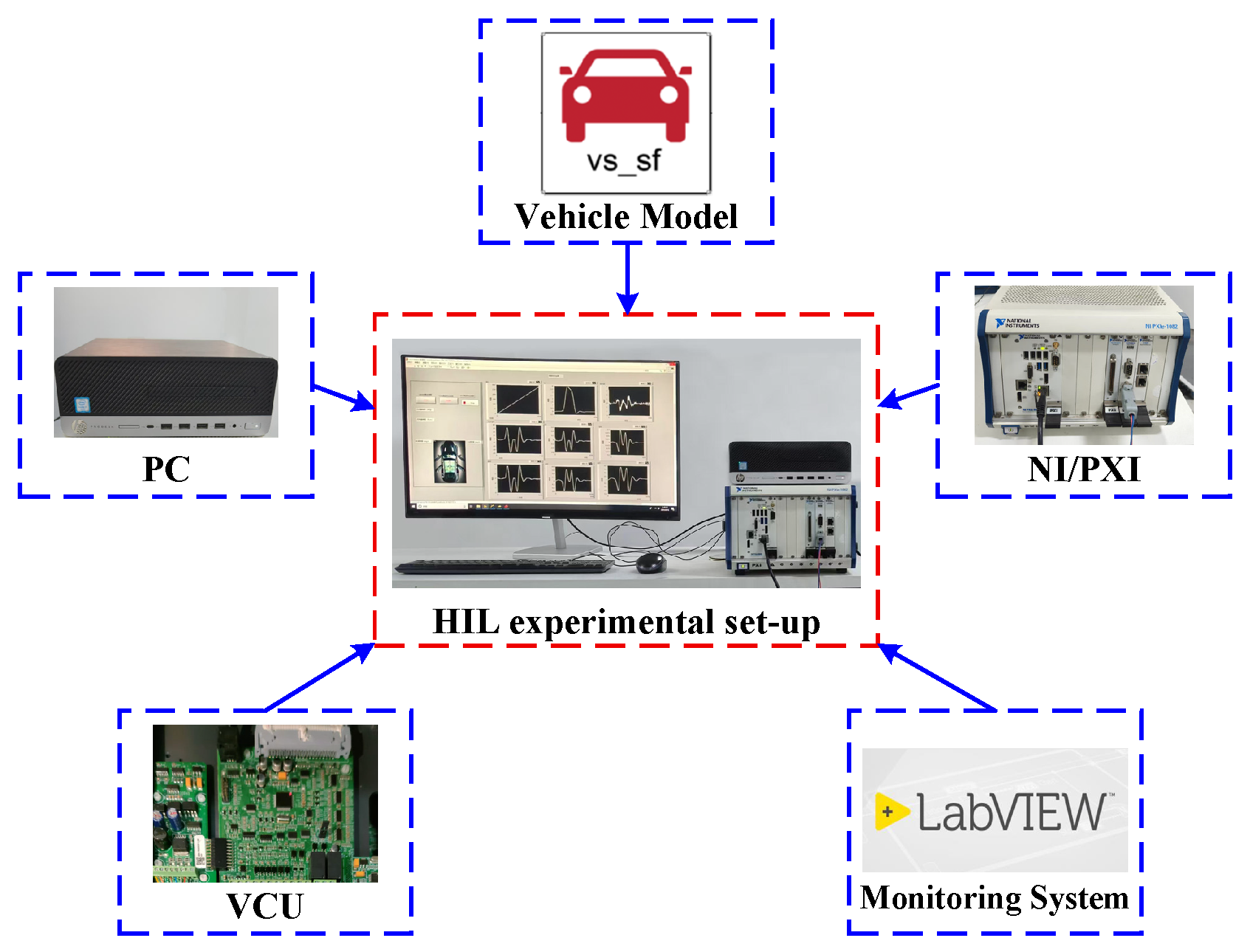
To better verify the effectiveness and control performance of the proposed adaptive fault-tolerant strategy in an engineering context, a hardware-in-the-loop (HIL) test platform is established. The platform mainly consists of an NI/PXI-based real-time simulator, a steering control system, a host computer, a display unit, a bottom-level controller, and communication and monitoring modules, as shown in Figure 13. The vehicle dynamics model and in-wheel motor partial demagnetization fault model run on the real-time simulation unit, while the controller receives the measured vehicle states in real time and outputs the corresponding drive commands. Signal exchange between the real-time simulator and the controller is carried out via a CAN bus, and all relevant data are recorded and visualized on the host computer.
In the HIL tests, a DLC maneuver is selected for validation. The initial vehicle speed is set to 72 km/h, the road friction coefficient  μ  = 0.5, and the motor health factors set to  k f l  = 0.7,  k f r  = 0.7,  k r l  = 0.8,  k r r  = 0.9, respectively.
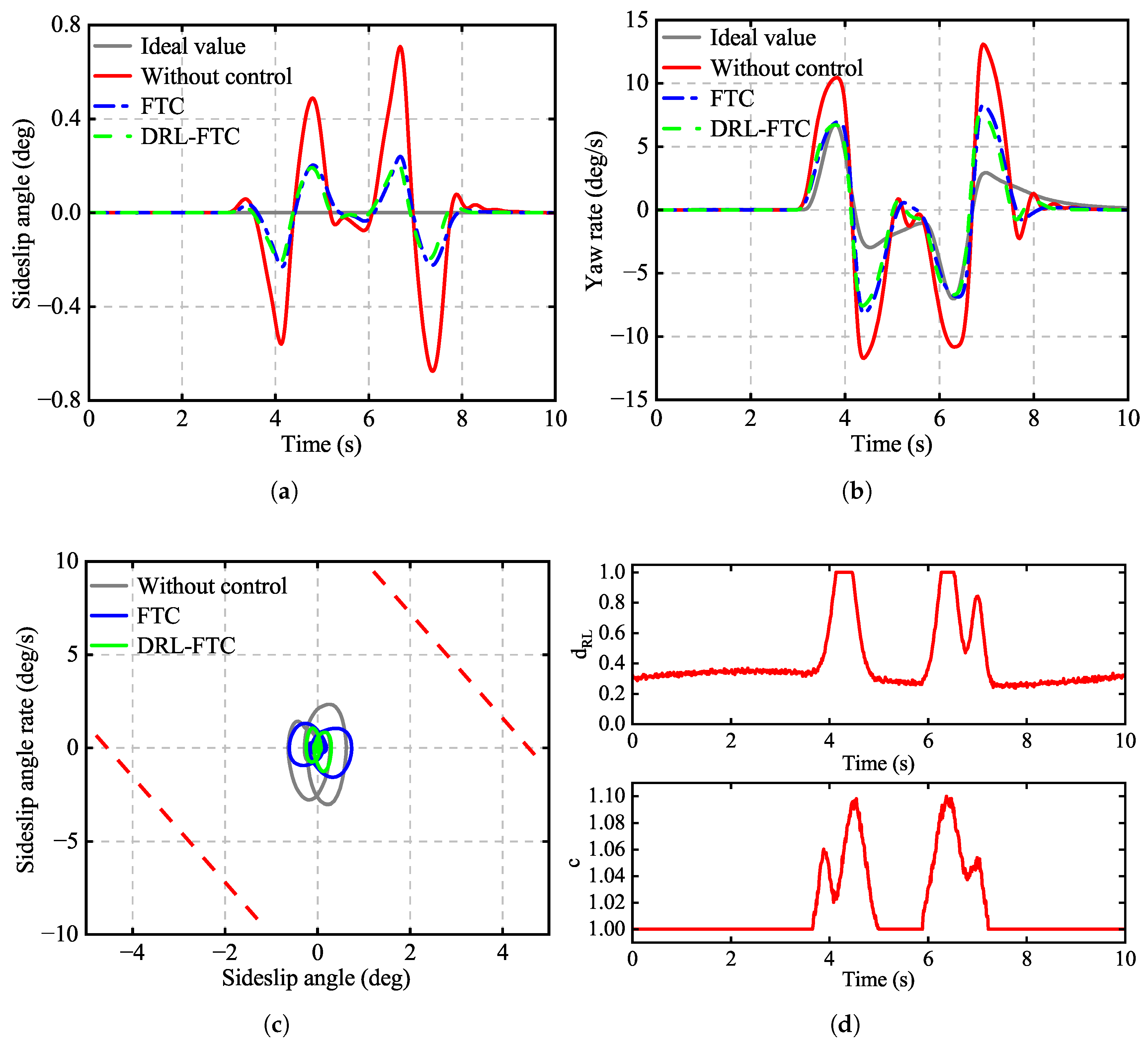
Under the DLC HIL test, the lateral stability responses with different control strategies are summarized in Figure 14. As shown in Figure 14a, the sideslip angle without control experiences pronounced oscillations, with peak values close to ±0.7°, indicating a clear tendency toward lateral instability. Once the FTC and DRL-FTC strategies are applied, the sideslip response is markedly attenuated and remains in a narrow band around zero. The DRL-FTC curve is slightly closer to the ideal value than that of FTC, suggesting a further improvement in sideslip angle suppression. A similar trend can be observed in the yaw rate response in Figure 14b: the uncontrolled vehicle exhibits large overshoots exceeding ±10 deg/s, whereas both FTC and DRL-FTC significantly reduce the peak magnitudes and improve the tracking of the ideal yaw rate throughout the maneuver. Figure 14c illustrates the phase plane during vehicle driving. It is worth mentioning that the boundary line represented by the red dashed line is defined according to Equation (15). The uncontrolled case forms a relatively large loop and approaches the stability boundaries, implying a limited stability margin. By contrast, the trajectories under FTC and DRL-FTC are significantly contracted toward the origin, with the DRL-FTC curve exhibiting the most compact distribution. It is the proposed strategy that provides an increased lateral stability margin in the HIL environment. In addition, the key evaluation parameters of stability are shown in Table 6.
Figure 14d presents the stability–efficiency weighting factor  d R L  and current compensation factor c. During straight-line driving,  d R L  stays at a relatively low level and c is fixed at 1, indicating that the controller places more emphasis on energy efficiency and no additional current compensation is activated. When the vehicle enters the lane-change phases,  d R L  rapidly rises toward 1 and c increases slightly above 1, reflecting that the DRL coordination layer automatically shifts the control priority toward stability and temporarily enhances current compensation to counteract the effect of motor demagnetization.
Overall, the HIL results confirm that the proposed DRL-FTC strategy can enhance lateral stability under realistic implementation conditions and exhibits clear scene-dependent adaptive regulation of the two key coefficients.

4.5. Discussion and Limitations

This study aimed to address the challenging trade-off between vehicle stability and energy efficiency in IWMDEVs under multi–motor demagnetization faults. The simulation and HIL experimental results collectively demonstrate that the proposed hierarchical DRL–FTC strategy significantly enhances fault tolerance compared to the NMPC–FTC baseline. The quantitative results indicate that the proposed DRL–FTC achieves marked improvements in vehicle stability indices. Under the DLC condition (Table 3), the yaw rate peak error and root mean square error (RMSE) are reduced by 34.0% and 16.7%, respectively, while the sideslip angle peak and RMSE reduce by 34.9% and 20.9%, respectively. Under the SLC condition (Table 4), even more pronounced improvements are observed, with the yaw rate peak error and RMSE reduced by 64.9% and 27.8%, respectively, and the sideslip peak and RMSE reduced by 34.5% and 32.9%, respectively. Even under the HIL experiment (Table 6), For the yaw rate, the peak error and RMSE are reduced by 5.0% and 92.3%, respectively. For the sideslip angle, the peak error and RMSE are reduced by 10.7% and 91.9%, respectively. The energy consumption comparison is illustrated in Figure 9g. Compared with the NMPC–FTC approach, the total energy consumption under the proposed DRL–FTC strategy increases by 3.88% and 3.79% under the DLC and SLC conditions, respectively, mainly due to the introduction of the current compensation strategy. However, considering the substantial improvements achieved in vehicle stability, the overall performance trade-off remains favorable. From a comprehensive stability–energy efficiency perspective, the proposed DRL–FTC method therefore provides an effective and well-balanced FTC solution.
These findings highlight the novelty of the proposed approach: by integrating the REDQ algorithm into the coordination layer, the controller enables a learning-driven adaptation of control weights, which is inherently difficult to achieve with conventional static strategies.
Despite the promising results, several limitations should be noted. First, the proposed DRL–FTC framework is predicated on the assumption of reliable motor health information from the fault diagnosis module; consequently, the potential impacts of diagnosis errors or estimation delays on control performance are not explicitly addressed. Second, the current investigation is confined to partial demagnetization faults; the applicability to other severe failure modes or complex combinatorial faults remains to be explored. Finally, while hardware-in-the-loop experiments confirm real-time feasibility, comprehensive verification under full-scale vehicle and real-world driving conditions is still required.

5. Conclusions

In this study, a hierarchical FTC strategy is developed to coordinate vehicle stability and energy efficiency in IWMDEVs under multi-motor partial demagnetization faults. Two adaptive coefficients—a stability–efficiency weighting factor and a current compensation factor—are introduced and optimized through the REDQ algorithm, enabling adaptive torque coordination under fault conditions.
Simulation results under multiple driving scenarios indicate that the proposed DRL-based control strategy achieves a coordinated improvement in lateral stability and energy efficiency. The results also confirm that the proposed strategy exhibits strong adaptability and robustness under different fault combinations and asymmetric degradation conditions.
Future work will focus on three directions: (1) Incorporating a robust fault diagnosis and state estimation module into the control loop to explicitly mitigate the adverse effects of sensor noise, estimation errors, and signal transmission delays, thereby achieving a fully output-feedback fault-tolerant system. (2) Integrating the active steering system to achieve cooperative fault tolerance. By coordinating differential drive torque with active steering corrections, the vehicle’s stability margin can be further expanded under severe fault conditions. (3) Conducting comparative experiments with other state-of-the-art control strategies using a full-scale vehicle platform. This will serve to rigorously verify the proposed strategy’s robustness and adaptability in complex real-world driving environments.

Author Contributions

Conceptualization, Q.W. and Z.R.; methodology, Z.R.; software, Z.R.; validation, Q.W. and Z.R.; formal analysis, Q.W.; investigation, Z.R.; resources, Q.W., Z.R. and C.C.; data curation, Z.R. and G.J.; writing—original draft preparation, Z.R.; writing—review and editing, Q.W., Z.R. and G.J.; visualization, Z.R. and C.C.; supervision, Q.W.; project administration, Z.R.; funding acquisition, Q.W. All authors have read and agreed to the published version of the manuscript.

Funding

This research was funded by Shandong Provincial Natural Science Foundation, grant number ZR2024ME203, in part by National Natural Science Foundation of China, grant number 52002229, and in part by a Project funded by China Postdoctoral Science Foundation, grant number 2022M713655.

Institutional Review Board Statement

Not applicable.

Data Availability Statement

Data are contained within the article.

Acknowledgments

The authors would like to thank the handling editor and the anonymous reviewers for their valuable comments and suggestions.

Conflicts of Interest

The authors declare no conflicts of interest.

References

  1. Zhou, Y.; Chen, X.; Li, Z.; Wang, X.; Yu, Y. Adaptive distributed explicit model predictive controller with road surface identification for HM-AS. Nonlinear Dyn. 2025, 113, 8655–8678. [Google Scholar] [CrossRef]
  2. Wang, Y.; Yin, G.; Hang, P.; Zhao, J.; Lin, Y.; Huang, C. Fundamental estimation for tire road friction coefficient: A model-based learning framework. IEEE Trans. Veh. Technol. 2025, 74, 481–493. [Google Scholar] [CrossRef]
  3. Chen, R.; Ou, J. A hybrid fault-tolerant control strategy for four-wheel independent drive vehicles. Adv. Mech. Eng. 2021, 13, 16878140211045486. [Google Scholar] [CrossRef]
  4. Tian, M.; Gao, B. Dynamics analysis of a novel in-wheel powertrain system combined with dynamic vibration absorber. Mech. Mach. Theory. 2021, 156, 1041482021. [Google Scholar] [CrossRef]
  5. Guo, M.; Bao, C.; Cao, Q.; Xu, F.; Miao, X.; Wu, J. Fault-Tolerant control study of four-Wheel independent drive electric vehicles based on drive actuator faults. Machines 2024, 12, 450. [Google Scholar] [CrossRef]
  6. Zhu, S.; Li, H.; Wang, G.; Kuang, C.; Chen, H.; Gao, J.; Xie, W. Research on fault-tolerant control of distributed-drive electric vehicles based on fuzzy fault diagnosis. Actuators 2023, 12, 246. [Google Scholar] [CrossRef]
  7. Li, J.; Yang, C.; Fang, J.; Zhang, Y. A fault-tolerant trajectory tracking strategy of four-wheel independent drive electric vehicles using super-twisting sliding model control. IEEE Trans. Transp. Electrif. 2025, 11, 3907–3917. [Google Scholar] [CrossRef]
  8. Zhang, B.; Lu, S.; Wu, W.; Li, C.; Lu, J. Robust fault-tolerant control for four-wheel individually actuated electric vehicle considering driver steering characteristics. J. Franklin Inst. 2021, 358, 5883–5908. [Google Scholar] [CrossRef]
  9. Wang, Q.; Wang, Z.; Wang, H.; Shang, Z.; Xu, W. Coordinated control of ARS and DYC for full X-by-Wire distributed drive electric vehicles based on stability domain division in extension phase plane. Control Eng. Pract. 2025, 162, 106344. [Google Scholar] [CrossRef]
  10. Zhu, Y.; Zheng, W. An integrated design approach for fault-tolerant control of switched LPV systems with actuator faults. IEEE Trans. Syst. Man Cybern. Syst. 2022, 53, 908–921. [Google Scholar] [CrossRef]
  11. Subroto, R.; Wang, C.; Lian, K. Four-wheel independent drive electric vehicle stability control using novel adaptive sliding mode control. IEEE Trans. Ind. Appl. 2020, 56, 5995–6006. [Google Scholar] [CrossRef]
  12. Wang, D.; Gu, T.; Zhang, K. Fault tolerant control of 4-wheel independent drive vehicle subject to actuator faults based on feasible region. IEEE Trans. Veh. Technol. 2024, 73, 1652–1666. [Google Scholar] [CrossRef]
  13. Li, F.; Chen, Y.; Tang, H.; Xia, F.; Luo, J.; Du, C. Event-triggered adaptive fault tolerant sliding mode control for FWID-EV. IEEE Trans. Transp. Electrif. 2024, 10, 9192–9208. [Google Scholar] [CrossRef]
  14. Zhang, B.; Lu, S.; Xie, F.; Xie, W. Stochastic cooperative game-based assistant fault-tolerant control considering driver behavior uncertainty. IEEE Trans. Transp. Electrif. 2022, 8, 2595–2607. [Google Scholar] [CrossRef]
  15. Lu, Y.; Liang, J.; Zhuang, W.; Yin, G.; Feng, J.; Zhou, C. Four-wheel independent drive vehicle fault tolerant strategy using stochastic model predictive control with model parameter uncertainties. IEEE Trans. Veh. Technol. 2023, 73, 3287–3299. [Google Scholar] [CrossRef]
  16. Chen, X.; Jiang, R.; Zhao, W.; Wang, C. Tube-based cooperative robust control for distributed drive electric vehicles suffering actuator faults. IEEE Trans. Transp. Electrif. 2025, 11, 3502–3513. [Google Scholar] [CrossRef]
  17. Huang, X.; Zha, Y.; Lv, X.; Quan, X. Torque fault-tolerant hierarchical control of 4wid electric vehicles based on improved MPC and SMC. IEEE Access 2023, 11, 132718–132734. [Google Scholar] [CrossRef]
  18. Feng, H.; Tao, Y.; Feng, J.; Zhang, Y.; Xue, H.; Wang, T.; Xu, X.; Chen, P. Fault-tolerant collaborative control of four-wheel-drive electric vehicle for one or more in-wheel motors’ faults. Sensors 2025, 25, 1540. [Google Scholar] [CrossRef] [PubMed]
  19. Ji, Y.; Liu, Y. Force allocation control for distributed drive electric vehicles under split-friction regions and actuator faults. ISA Trans. 2022, 129, 398–412. [Google Scholar] [CrossRef]
  20. Zhou, Z.; Zhang, G.; Chen, M. A fault-tolerant control strategy for distributed drive electric vehicles based on model reference adaptive control. Actuators 2024, 13, 486. [Google Scholar] [CrossRef]
  21. Peng, H.; Wang, W.; Xiang, C.; Li, L.; Wang, X. Torque coordinated control of four in-wheel motor independent-drive vehicles with consideration of the safety and economy. IEEE Trans. Veh. Technol. 2019, 68, 9604–9618. [Google Scholar] [CrossRef]
  22. Liu, S.; Zhang, H.; Wang, S.; Zhao, X. Hierarchical torque vectoring control strategy of distributed driving electric vehicles considering stability and economy. Sensors 2025, 25, 3933. [Google Scholar] [CrossRef]
  23. Hu, X.; Chen, H.; Li, Z.; Wang, P. An energy-saving torque vectoring control strategy for electric vehicles considering handling stability under extreme conditions. IEEE Trans. Veh. Technol. 2020, 69, 10787–10796. [Google Scholar] [CrossRef]
  24. Guo, N.; Zhang, X.; Zou, Y.; Lenzo, B.; Du, G.; Zhang, T. A supervisory control strategy of distributed drive electric vehicles for coordinating handling, lateral stability, and energy efficiency. IEEE Trans. Transp. Electrif. 2021, 7, 2488–2504. [Google Scholar] [CrossRef]
  25. Ming, F.; Gong, W.; Wang, L.; Jin, Y. Constrained multi-objective optimization with deep reinforcement learning assisted operator selection. IEEE-CAA J. Automatica Sin. 2024, 11, 919–931. [Google Scholar] [CrossRef]
  26. He, X.; Yu, Q.; Jiang, Z.; Tan, Y.; Chen, Y.; Xie, B.; Wen, C. Dual-layer adaptive power management strategy for E-tractor incorporating operating information and deep reinforcement learning. Energy 2025, 319, 134942. [Google Scholar] [CrossRef]
  27. Al-Sharman, M.; Dempster, R.; Daoud, M.A.; Nasr, M.; Rayside, D.; Melek, W. Self-learned autonomous driving at unsignalized intersections: A hierarchical reinforced learning approach for feasible decision-making. IEEE Trans. Intell. Transp. Syst. 2023, 24, 12345–12356. [Google Scholar] [CrossRef]
  28. Fan, J.; Zhang, X.; Zou, Y.; Li, Y.; Liu, Y.; Sun, W. Improving policy training for autonomous driving through randomized ensembled double Q-learning with Transformer encoder feature evaluation. Appl. Soft. Comput. 2024, 167, 112386. [Google Scholar] [CrossRef]
  29. Haarnoja, T.; Moran, B.; Lever, G.; Huang, S.H.; Tirumala, D.; Humplik, J.; Wulfmeier, M.; Tunyasuvunakool, S.; Siegel, N.Y.; Hafner, R.; et al. Learning agile soccer skills for a bipedal robot with deep reinforcement learning. Sci. Robot. 2024, 9, eadi8022. [Google Scholar] [CrossRef]
  30. Wei, H.; Zhang, N.; Liang, J.; Ai, Q.; Zhao, W.; Huang, T.; Zhang, Y. Deep reinforcement learning based direct torque control strategy for distributed drive electric vehicles considering active safety and energy saving performance. Energy 2022, 238, 121725. [Google Scholar] [CrossRef]
  31. Ning, G.; Su, L.; Zhang, Y.; Wang, J.; Gong, C.; Zhou, Y. Research on TD3-based distributed micro-tillage traction bottom control strategy. Agriculture 2023, 13, 1263. [Google Scholar] [CrossRef]
  32. Deng, H.; Zhao, Y.; Nguyen, A.T.; Huang, C. Fault-tolerant predictive control with deep-reinforcement-learning-based torque distribution for four in-wheel motor drive electric vehicles. IEEE-ASME Trans. Mechatron. 2023, 28, 668–680. [Google Scholar] [CrossRef]
  33. Liang, Y.; Zhang, S.; Zhao, W.; Wang, C.; Xu, K.; Liang, W. Coordinated control of yaw and roll stability in heavy vehicles considering dynamic safety requirements. Control Eng. Pract. 2024, 148, 105963. [Google Scholar] [CrossRef]
  34. Ji, X.; He, X.; Lv, C.; Liu, Y.; Wu, J. A vehicle stability control strategy with adaptive neural network sliding mode theory based on system uncertainty approximation. Veh. Syst. Dyn. 2018, 56, 923–946. [Google Scholar] [CrossRef]
  35. Cabrera, J.; Castillo, J.; Pérez, J.; Velasco, J.; Guerra, A.; Hernández, P. A procedure for determining tire-road friction characteristics using a modification of the magic formula based on experimental results. Sensors 2018, 18, 896. [Google Scholar] [CrossRef]
  36. Xue, H.; Liu, B.; Ding, D.; Zhou, J.; Cui, X. Diagnosis method based on hidden Markov model and Weibull mixture model for mechanical faults of in-wheel motors. Meas. Sci. Technol. 2022, 33, 114002. [Google Scholar] [CrossRef]
  37. Xue, H.; Ding, D.; Zhang, Z.; Wu, M.; Wang, H. A fuzzy system of operation safety assessment using multimodel linkage and multistage collaboration for in-wheel motor. IEEE Trans. Fuzzy Syst. 2021, 30, 999–1013. [Google Scholar] [CrossRef]
  38. Dai, Y.; Zhang, L.; Xu, D.; Chen, Q.; Li, J. Development of deep learning-based cooperative fault diagnosis method for multi-PMSM drive system in 4WID-EVs. IEEE Trans. Instrum. Meas. 2024, 73, 3506513. [Google Scholar] [CrossRef]
  39. Li, Y.; Wang, J.; Dong, J. Robust fault estimation based on asymptotic partial decoupling disturbances for linear systems with invariant zeros. J. Franklin Inst. 2025, 362, 107859. [Google Scholar] [CrossRef]
  40. Chen, T.; Cai, Y.; Chen, L.; Xu, X. Sideslip angle fusion estimation method of three-axis autonomous vehicle based on composite model and adaptive cubature kalman filter. IEEE Trans. Transp. Electrif. 2024, 10, 316–330. [Google Scholar] [CrossRef]
  41. Zhai, L.; Sun, T.; Wang, J. Electronic stability control based on motor driving and braking torque distribution for a four in-wheel motor drive electric vehicle. IEEE Trans. Veh. Technol. 2016, 65, 4726–4739. [Google Scholar] [CrossRef]
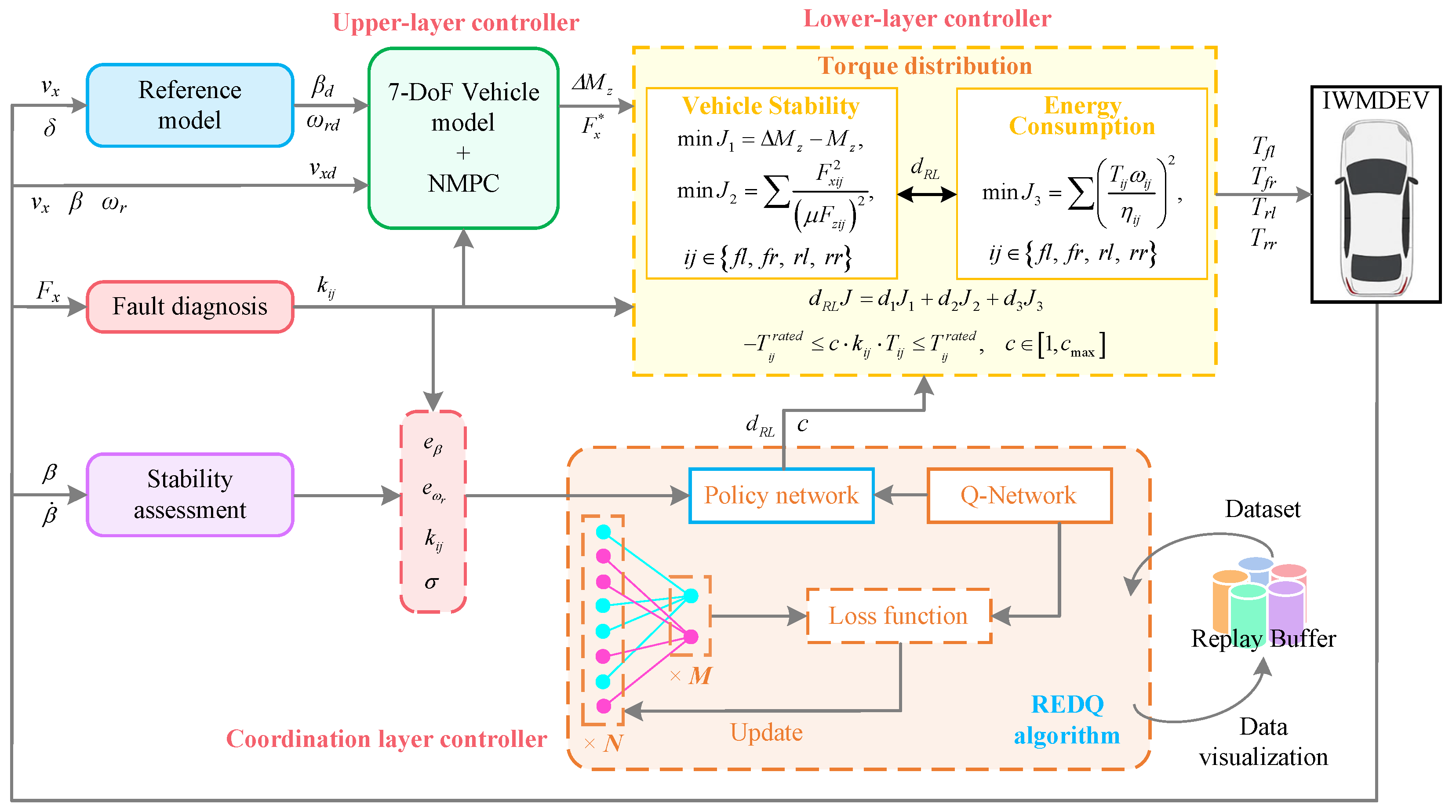
Figure 1. Overall hierarchical control architecture for IWMDEV.
Actuators 15 00044 g001
Figure 2. 7-DoF vehicle dynamic model diagram.
Actuators 15 00044 g002
Figure 3. Performance attenuation characteristic curve of permanent magnet in-wheel motor.
Actuators 15 00044 g003
Figure 4. Framework of the REDQ-based adaptive learning mechanism.
Actuators 15 00044 g004
Figure 5. Vehicle speed tracking performance: (a) DLC condition. (b) SLC condition.
Actuators 15 00044 g005
Figure 6. Trajectory tracking performance: (a) DLC condition. (b) SLC condition.
Actuators 15 00044 g006
Figure 7. Yaw rate: (a) DLC condition. (b) SLC condition.
Actuators 15 00044 g007
Figure 8. Sideslip angle: (a) DLC condition. (b) SLC condition.
Actuators 15 00044 g008
Figure 9. Simulation results for four in-wheel motor FTC: (a) Speed tracking responses. (b) Path tracking responses. (c) Sideslip angle responses. (d) Yaw rate responses. (e β β ˙  phase plane responses. (f) Torque distribution. (g) Energy consumption comparison.
Actuators 15 00044 g009
Figure 10. Simulation results of REDQ algorithm: (a) DLC condition. (b) SLC condition.
Actuators 15 00044 g010
Figure 11. Simulation results under EPA driving cycle.
Actuators 15 00044 g011
Figure 12. Energy consumption comparison under different fault modes.
Actuators 15 00044 g012
Figure 13. HIL experimental bench.
Actuators 15 00044 g013
Figure 14. Experiment results under four-motor faults: (a) Sideslip angle responses. (b) Yaw rate responses. (c β β ˙  phase plane responses. (d) Training result of REDQ algorithm.
Actuators 15 00044 g014
Table 1. REDQ hyperparameters.
ParameterValue
ensemble size N10
in-target minimization parameter M2
update-to-data ratio G20
sampling time/s0.01
learning rate 10 4
discount ( γ )0.99
soft update rate ( ρ )0.995
replay buffer size 10 6
mini-batch size256
number of hidden layers for all networks2
number of hidden units per layer256
Table 2. Parameters of the vehicle.
NameSymbolValue
Vehicle massm1410 kg
Length from the center of gravity(CG) to front wheel axisa1.015 m
Length from CG to rear wheel axisb1.895 m
Tread widthB1.675 m
Tire radiusr0.325 m
Height of center of mass h g 0.54 m
Moment of inertia about yaw axis I z 2031.4 kg·m2
Rated power P e 12 kW
Maximum power P m 24 kW
Rated speed n e 750 rpm
Maximum speed n m 1600 rpm
Rated torque T r a t e d 153 N·m
Maximum torque T m 300 N·m
Table 3. Comparison of key performance indexes under the DLC condition with four-motor faults.
StateError TypeFTCDRL–FTCError Reduction
Yaw rate (°/s)Peak error2.1391.41134.0%
Mean error−0.051−0.0501.0%
Root mean square error0.9720.81016.7%
Sideslip angle (°)Peak error0.3670.23934.9%
Mean error0.00470.003819.1%
Root mean square error0.0910.07220.9%
Table 4. Comparison of key performance indexes under the SLC condition with four-wheel motor faults.
StateError TypeFTCDRL–FTCError Reduction
Yaw rate (°/s)Peak error0.8140.28664.9%
Mean error−0.038−0.01561.2%
Root mean square error0.9320.67327.8%
Sideslip angle (°)Peak error0.1770.11634.5%
Mean error−0.0024−0.002016.7%
Root mean square error0.0760.05132.9%
Table 5. Specific demagnetization fault modes of four in-wheel motors.
Modes k f l / k r l / / k f r / k r r Modes k f l / k r l / / k f r / k r r
A10.7/0.7//0.7/0.7D10.8/0.8//0.7/0.7
A20.7/0.7//0.7/0.8D20.8/0.8//0.7/0.8
A30.7/0.7//0.7/0.9D30.8/0.8//0.7/0.9
A40.7/0.7//0.8/0.8D40.8/0.8//0.8/0.8
A50.7/0.7//0.8/0.9D50.8/0.8//0.8/0.9
A60.7/0.7//0.9/0.9D60.8/0.8//0.9/0.9
B10.7/0.8//0.7/0.7E10.8/0.9//0.7/0.7
B20.7/0.8//0.7/0.8E20.8/0.9//0.7/0.8
B30.7/0.8//0.7/0.9E30.8/0.9//0.7/0.9
B40.7/0.8//0.8/0.8E40.8/0.9//0.8/0.8
B50.7/0.8//0.8/0.9E50.8/0.9//0.8/0.9
B60.7/0.8//0.9/0.9E60.8/0.9//0.9/0.9
C10.7/0.9//0.7/0.7F10.9/0.9//0.7/0.7
C20.7/0.9//0.7/0.8F20.9/0.9//0.7/0.8
C30.7/0.9//0.7/0.9F30.9/0.9//0.7/0.9
C40.7/0.9//0.8/0.8F40.9/0.9//0.8/0.8
C50.7/0.9//0.8/0.9F50.9/0.9//0.8/0.9
C60.7/0.9//0.9/0.9F60.9/0.9//0.9/0.9
Table 6. Comparison of key performance indexes under the HIL test with four-motor faults.
StateError TypeFTCDRL–FTCError Reduction
Yaw rate (°/s)Peak error5.4655.1905.0%
Mean error−0.039−0.0381.8%
Root mean square error 7.1 × 10 4 5.5 × 10 5 92.3%
Sideslip angle (°)Peak error0.2400.21410.7%
Mean error 3.5 × 10 4 1.9 × 10 4 45.7%
Root mean square error 4.2 × 10 6 3.3 × 10 7 91.9%
Disclaimer/Publisher’s Note: The statements, opinions and data contained in all publications are solely those of the individual author(s) and contributor(s) and not of MDPI and/or the editor(s). MDPI and/or the editor(s) disclaim responsibility for any injury to people or property resulting from any ideas, methods, instructions or products referred to in the content.