


Abstract
In complex mechanical systems involving multiple parts and contact interfaces, failure modes are not only statistically correlated but may also interact through underlying physical mechanisms. These interactions, often neglected in current reliability analysis, can lead to significant deviations in failure predictions, especially in rotor systems and actuators. Taking aeroengine turbine rotor assemblies as an example, multiple failure modes, such as wear, fatigue and slip at contact interfaces, affect key mechanical property parameters including assembly preload, cylindrical interference fit and cooling performance. These variations lead to evolving stress/strain and temperature fields with increasing load cycles, thereby inducing physical interactions among different failure modes. This study systematically analyzes the interaction mechanisms among multiple failure modes within a turbine rotor assembly. A mechanics model is established to quantify these interactions and their effects on failure evolution. Furthermore, a time-dependent reliability evaluation method is proposed based on Monte Carlo simulation and the Probability Network Evaluation Technique. A case study illustrates that both continuous-type and trigger-type interactions significantly affect the failure probabilities of wear and low-cycle fatigue. The results emphasize the necessity of accounting for interaction of multi-failure modes to improve the accuracy of failure prediction and enhance the design reliability of turbine rotor assemblies.
1. Introduction
Reliability analysis plays a vital role in ensuring the safe operation of aeroengines and actuators. Given the diversity of failure modes in such systems, it is common to assume statistical independence among them in order to improve the efficiency of reliability evaluation. However, since different failure modes may share common influencing factors and thus exhibit statistical correlations, the independence assumption can lead to inaccurate results. Due to the high computational cost, it is often infeasible to perform reliability analysis directly on full-system finite element model (FEM). To balance computational accuracy and efficiency, especially in the presence of high-dimensional input variables, strongly nonlinear input–output relationships and coupled multiple responses, researchers have widely adopted surrogate modeling techniques [1,2]. Nevertheless, in complex mechanical systems such as aeroengines, which contain multiple parts and contact interfaces, failure modes not only exhibit statistical correlations but also physical interactions. From the perspective of scale, these interactions of multiple failure modes can be broadly classified into two categories. One category occurs at the microscale (the crystal level); multiple failure modes may occur at the same location of a part under complex loading, and these failure modes are not simply linearly superimposed but exhibit complex interactions, such as fatigue-creep failures, high-low cycle failures and wear-fatigue failures [3,4,5,6,7]. Another type occurs at the macroscale, where the accumulation of multiple failure modes leads to changes in key mechanical property parameters of the system, which in turn alter the global or local stress/strain and temperature fields, thereby inducing interactions among the failure modes themselves [8,9,10]. This study primarily focuses on the latter type of “macroscale interaction,” hereafter referred to simply as “interaction.” Such interactions are closely related to the structural configuration of the assembly and become increasingly significant with advancements in the structural design of aircraft engines.
To achieve high structural efficiency, modern advanced aeroengines increasingly adopt a “multi-stage series structure tightened by a nut” configuration, thereby minimizing the use of bolt [11]. This structural form reduces weight and avoids stress concentrations caused by drilling. In turbine rotor assemblies, this is referred to as a “ boltless baffle design,” where parts such as the blade, turbine disk, sealing disk–baffle, sealing ring and nut are clamped and constrained together through their own elastic pre-deformation, forming the turbine rotor structural system [12]. Since multiple parts are clamped in series by a nut, this configuration significantly enhances the interaction among multiple failure modes, as discussed in Section 2. However, despite the new challenges posed by such structural innovations, most existing studies still focus only on the failure analysis of individual parts or contact interfaces. The Archard equation is the most widely used for analyzing wear failure of metal interfaces [13]. For low-cycle fatigue (LCF) life prediction of metals, the Smith-Watson-Topper (SWT) model, originally proposed by Smith and later extended to multiaxial fatigue by Socie, Szolwinski and Farris, is commonly adopted [14,15,16]. For fatigue life analysis under variable loading, Miner’s linear damage rule remains widely applied [17]. For combined failure modes, stress/strain distributions can also be obtained through finite element analysis (FEA) and suitable empirical failure formulas can then be used to estimate failure life. Tomevenya et al. established a finite element model (FEM) of a turbine disk in aeroengines to obtain stress/strain and then obtained fatigue-creep life using the Manson–Coffin fatigue model and Larson–Miller creep model, assuming linear superposition of fatigue and creep damage [3]. Guo et al. established a FEM of a turbine disk to obtain stress/strain distributions, introduced a dimensionless friction parameter from frictional work and combined it with a multiaxial fatigue model to accurately analyze the fretting fatigue life of the fan dovetail attachments [18]. Huo et al. proposed a fretting fatigue life prediction model based on plastic effects and standard surface-to-surface contact theory and estimated the fretting fatigue life at the dovetail attachments between the turbine disk and blade of an aero-engine through FEA, with an error below 12%, compared to experimental values [19]. These studies have laid the foundation for research on the interaction of multiple failure modes.
In addition to the failure analysis of individual parts or single contact interfaces, the evolution of mechanical properties during operation and the resulting effects are also crucial for investigating the interactions among multiple failure modes in turbine rotor assemblies. Under vibrational loading, self-loosening of bolts, micro-slip wear and plastic deformation in threaded connections can significantly reduce preload [20,21,22]. Additionally, degradation of cooling performance can result in catastrophic failures of turbine rotor assemblies [23,24]. These failure modes and performance degradations commonly occur during the operation of turbine rotor assemblies. However, current research has yet to fully account for the interaction of multiple failure modes within turbine rotor assemblies and their impact on reliability, despite their growing significance in engineering applications. In recent years, such interactions have been explored in various fields, including hydraulic servo actuators, wind turbines and flood control systems [8,25,26,27]. Moreover, Han et al. studied the mechanical mechanisms of system failure caused by multi-failure mode interactions in the bevel gear, shaft and bearing structural system of aeroengines [28]. While these studies provide useful references, due to differences in failure mechanisms, a detailed analysis of the failure process in turbine rotor assemblies under multi-failure mode interactions is still necessary.
For the reliability analysis of complex structures, existing studies can be mainly categorized into two types: one involves constructing surrogate models to approximate the mechanical behavior of the actual system, thereby improving computational efficiency; the other assumes that the life follows a certain probability distribution and estimates the corresponding parameters using a limited amount of experimental data to evaluate failure probability [29,30,31,32]. Zhang et al. considered the statistical correlation among multiple failure modes, such as the deformation, stress and strain of the turbine blade-disk, and proposed an advanced multiple response surface method integrating particle swarm optimization and artificial neural networks, achieving high accuracy and computational efficiency [33]. Han et al. assumed that the turbine blade fatigue life follows a log-normal distribution, using test data to determine probabilistic parameters and their correlation between laboratory remaining life and service safety life, enabling accurate life prediction with a small sample size [34]. Additionally, recent advances in machine learning have further enhanced the efficiency and accuracy of reliability analysis [35,36,37].
When the computational cost becomes prohibitive, the Probabilistic Network Evaluation Technique (PNET) can be employed to estimate the system failure probability under multiple failure modes based on the failure probabilities of individual modes [38]. It is evident that data processing technologies, including surrogate modeling, have become increasingly mature. However, it must be emphasized that without a deep understanding of the underlying failure mechanisms, surrogate models, often treated as “black boxes”, may fail to deliver true engineering value [31]. Overall, the study of failure mechanics and the development of surrogate models are complementary and both play essential roles in reliability analysis. Through an in-depth analysis of the turbine rotor assembly’s failure mechanics, we establish a comprehensive mechanical failure model for the assembly that accounts for interaction of multiple failure modes. Building on this model, we further develop a Monte Carlo and PNET-based approach to evaluate the time-varying failure probability under multiple failure modes.
In what follows, Section 2 introduces the structural characteristics and failure modes of a typical aeroengine turbine rotor assembly. Section 3 describes the mechanical model of multi-failure mode interaction in the turbine rotor assembly. Section 4 presents the failure process analysis method and failure probability evaluation method. Section 5 illustrates the failure process under multi-failure mode interaction through a case study. Section 6 concludes the study with a summary of findings and future outlook.
2. Materials and Methods
2.1. Structural Composition
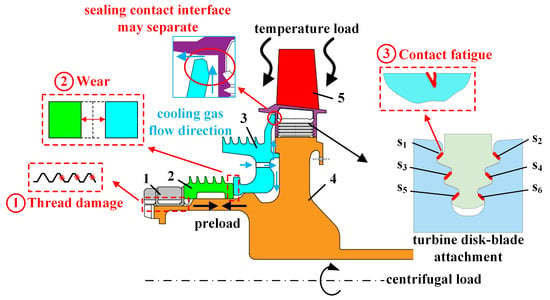
To achieve a “boltless baffle design”, the sealing disk and baffle are integrated and multiple parts, including the sealing disk-baffle, must be axially clamped using a large nut to ensure the sealing of the cooling gas [12]. The turbine rotor assembly in a typical small-sized turbo-shaft aeroengine gas generator, as shown in Figure 1, consists of a large tightening nut (No. 1), a labyrinth seal ring (No. 2), an integrated sealing disk-baffle (No. 3), a turbine disk (No. 4), blades (No. 5). The contact interfaces perpendicular to the axial direction are referred to as “end faces”, while those perpendicular to the radial direction are referred to as “cylindrical surfaces”. It can be seen that the turbine rotor assembly consists of multiple parts and multiple contact interfaces, operating under severe and variable loading conditions. During operation, the contact interfaces may experience damage or failure such as wear, fatigue and slip (Figure 1). These failure modes are both competitive and interactive, and this study focuses primarily on investigating the interaction of multiple failure modes.
Figure 1.
Structure, load and failure modes of turbine rotor assemblies in a typical small-sized turbo-shaft aeroengine gas generator.
2.2. Multi-Failure Mode Interaction
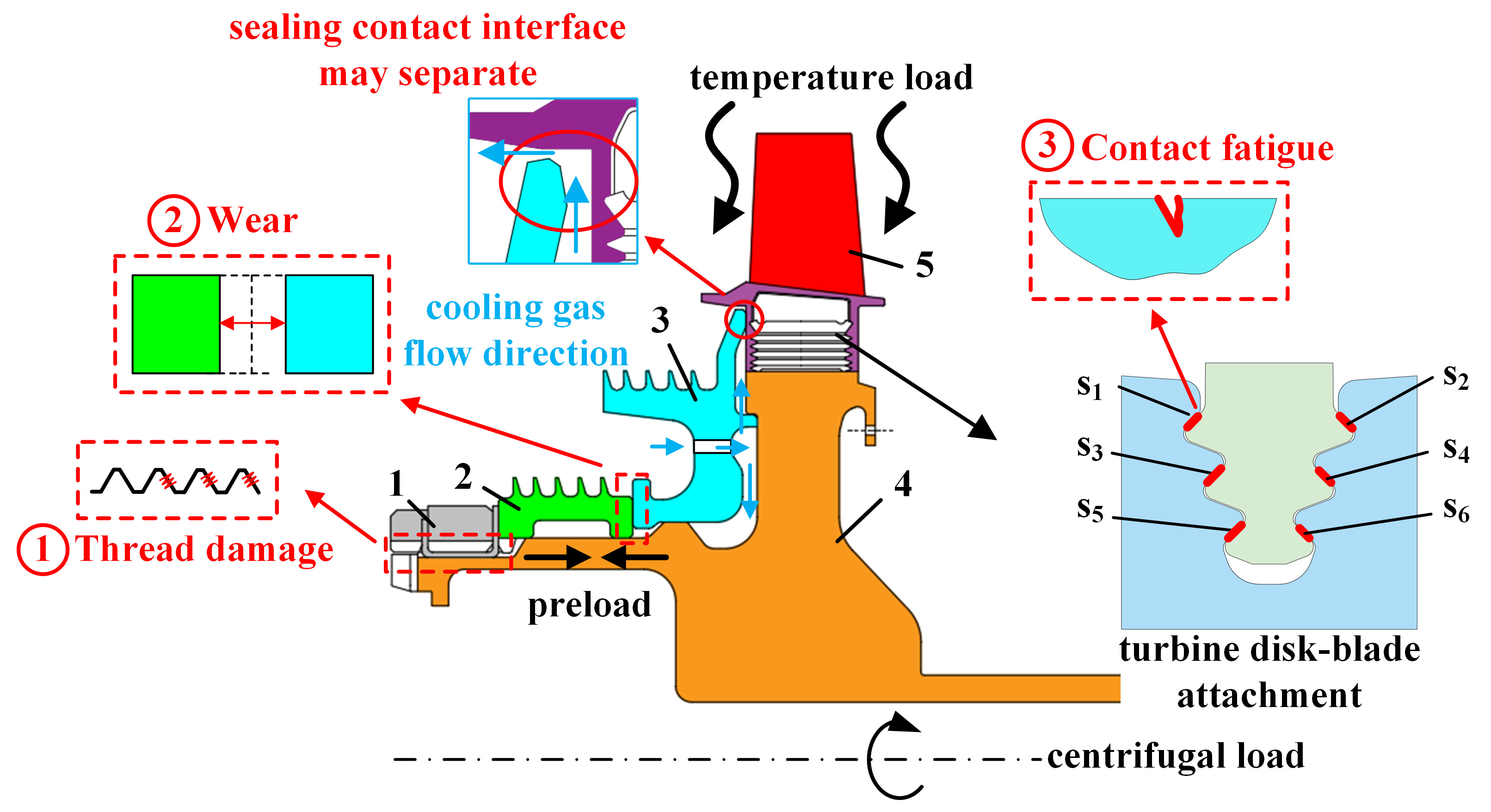
The accumulation of the aforementioned interfacial damage may lead to changes in key mechanical property parameters of the assembly, such as preload, cylindrical interference fit, cooling performance and local constraints, thereby inducing multi-failure mode interaction. These interactions can be further categorized into “continuous-type” interactions and “trigger-type” interactions based on their underlying mechanisms, as illustrated in Figure 2. Since the labyrinth seal ring, sealing disk-baffle and turbine disk are sequentially tightened by a large nut, these parts are referred to as “parts tightened by nut”.
Figure 2.
Multi-failure mode interaction in turbine rotor assemblies.
Since the preload originates from the elastic recovery force generated by the pre-deformation of parts, failure modes such as wear of end face, thread fatigue and irrecoverable slip at the fitted cylindrical surface can lead to a reduction in preload. Simultaneously, the wear of interference cylindrical surfaces can reduce the interference fit. As these parameters evolve, even under identical external loads in each cycle, the stress/strain distribution of the assembly differs from the previous cycle, thereby inducing multi-failure mode interaction. Because preload and interference fit vary with each cycle, the resulting interaction mechanisms are referred to as continuous-type interactions.
Moreover, as the preload decreases, the sealing interface between the sealing disk-baffle and turbine disk may separate during operation (Figure 1), compromising cooling performance and causing an overall rise in assembly’s temperature. Excessive temperature can lead to premature failure of the blade or the attachments. In addition, such separation removes local constraints on sealing disk-baffle and may cause leakage of cooling gas, potentially inducing flow-induced vibrations and thus leading to high-cycle fatigue failure. Since these failure mechanisms are all initiated by separation, and such separation only occurs when a certain threshold is exceeded, this type of interaction is referred to as a trigger-type interaction. It should be noted that there are multiple damage forms during the operation of the turbine rotor assemblies, such as creep, fretting, spalling, vibrations, wear and low-cycle fatigue. Given that this study primarily focuses on interactions among multiple failure modes at the macroscopic scale and disregards microscopic-scale interactions, three representative failure modes have been selected for discussion: wear, low-cycle fatigue and thread damage. Wear and thread damage can directly affect assembly parameters, including preload and cylindrical interference fit. Although thread damage encompasses multiple failure mechanisms, this study primarily considers its impact on preload. Meanwhile, low-cycle fatigue damage has a certain representativeness and can reflect the impact that changes in the stress/strain distribution and in the temperature field have on the damage accumulation caused by changes in the key parameters of turbine rotor assemblies.
3. Mechanical Model of Multi-Failure Mode Interaction
As the above analysis indicates, continuous-type interaction arises from the gradual variation in assembly parameters due to accumulated interface damage, whereas trigger-type interaction occurs when a specific parameter exceeds a certain threshold, hereafter referred to as the “trigger parameter”. This section establishes a mechanical model to quantitatively characterize the influence of interface damage on key assembly parameters and trigger parameters of the turbine rotor assembly, as well as the feedback effect of these parameter variations on further interface damage. The trigger-type interaction primarily focuses on the impact of degraded cooling performance.
3.1. Characterization of Damage Accumulation
This paper primarily considers wear and LCF damage at the contact interfaces. For wear, the Archard wear model based on frictional work is adopted for quantitative characterization. The Archard friction work criterion states that the amount of interface wear is proportional to the friction work at the interface [13,28,39].
where is the wear depth rate; is the friction power; is the wear coefficient, which depends on the material properties and can be determined experimentally. The friction power can be expressed as the ratio of the friction work during a single load cycle to the cycle duration .
Assuming the wear depth threshold is , and the wear depth after cycles is , then the wear damage after cycles can be expressed as,
Wear failure occurs when .
For predicting the LCF life of contact interfaces, the study adopts the SWT model based on the critical plane theory [14,15,16],
where is the maximum normal stress on the critical plane; is the normal strain range on the critical plane; is number of cycles to failure; is Young’s modulus; is fatigue ductility coefficient; is fatigue strength coefficient; is fatigue strength exponent; is fatigue ductility exponent.
For a plane with an angle , the normal stress and normal strain are given by the following equations [5],
where and are Young’s modulus and shear modulus, respectively.
The LCF damage of contact interface after cycles can be expressed as,
LCF failure occurs when .
3.2. The Influence of Interface Damage Accumulation on Critical Property Mechanical Parameters
This study primarily focuses on the effects of interface damage accumulation on assembly parameters (including preload and cylindrical interference) and cooling performance (temperature distribution). Specifically, wear of the end face, axial irrecoverable slip on the cylindrical mating surface and thread damage can all lead to variations in the preload. The impact of thread damage can be characterized by the preload retention factor [20,21,22]. The preload after considering contact interface damage is referred to as the equivalent preload , and it can be expressed as [28],
where is the initial preload, is the wear depth at the th contact interface (end face) during the cycle, is the sum of irreversible sliding vectors on the cylindrical mating surface (with positive values indicating directions that lead to a decrease in preload), and is the axial stiffness of the pressed components. is the preload retention factor at the cycle; is the equivalent preload at the cycle.
The cylindrical interference magnitude is affected by wear on the cylindrical mating surfaces. The equivalent interference of the cylindrical surface after cycles, accounting for contact interface damage, denoted as , can be expressed as,
where is the initial interference magnitude of the cylindrical surface, and is the wear depth of the cylindrical mating surface in the th cycle.
When separation occurs between the sealing disk-baffle and the turbine disk (Figure 1), coolant leakage is assumed to occur, leading to a degradation in cooling performance. Therefore, the clamping force at the sealing interface can be defined as the trigger parameter for cooling performance degradation. Cooling performance is considered to degrade when the following condition is met,
where is the operating time within a single cycle, is the threshold for clamping force, which can be obtained through engineering experience or experimentation. It should be noted that, unless otherwise specified, the threshold value assumed in the paper is 0.
Affected by assembly parameters and external loads, can be expressed as,
where is the assembly parameters during the th load cycle, including the preload and the cylindrical interference magnitude, is the external load.
The extent of cooling performance degradation can be represented by the increase in the temperature distribution of the turbine rotor assembly,
where and are the temperature distribution of the turbine rotor assembly under actual operating conditions and design conditions, respectively. When the temperature distribution of the assembly increases, its stress/strain distribution and material parameters will undergo changes, thereby affecting the assembly’s failure behavior.
3.3. The Time-Varying Mechanical Process of Damage Accumulation and Failure in Assembly
As can be seen from the above analysis, the multi-failure mode interaction alters the damage rate at the contact interface. Here, the damage rate refers to the amount of damage per cycle at the contact interface, which can also be represented using normalized parameters. In this study, failure modes primarily refer to failures caused by contact interface damage. The damage rate for the th failure mode during the th cycle can be expressed as,
where is the accumulated damage of the th failure mode after cycles. In this study, Equations (2) and (5) can be used to characterize the accumulation of wear damage and LCF damage at the contact interface, respectively.
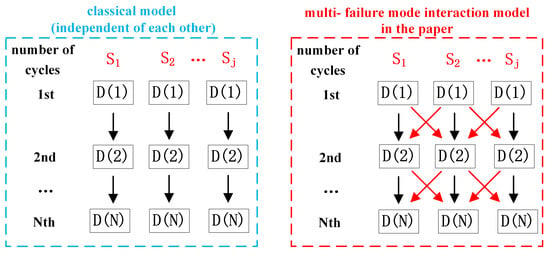
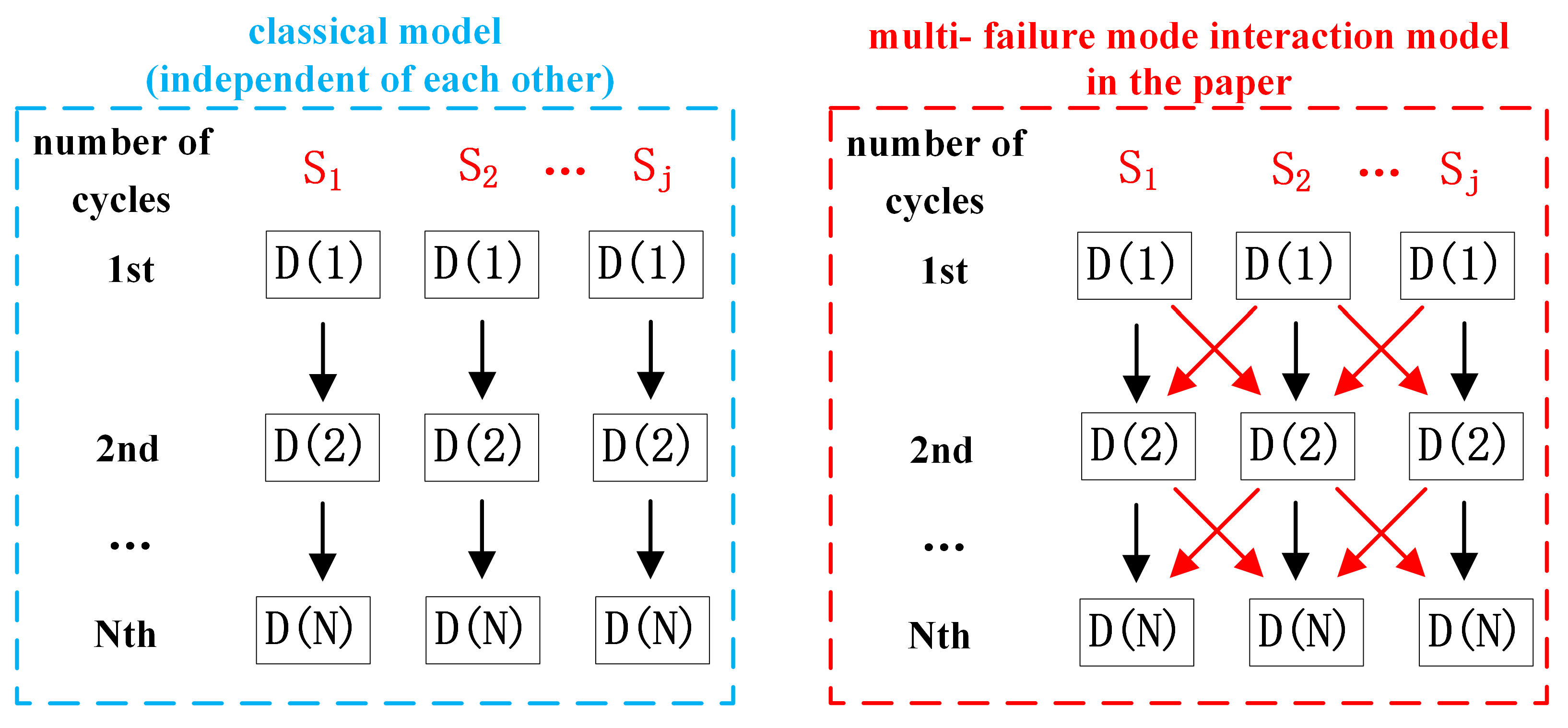
Under classical models, it is generally assumed that the damage rate at the contact interface remains constant when the external load cycles are invariant,
However, due to the accumulation of interface damage leading to changes in critical mechanical parameters of the component such as assembly parameters and cooling performance, even under invariant external load cycles, the damage rate at the contact interface will evolve with increasing load cycles. This evolution is influenced by both assembly parameters and temperature distribution,
As shown in the analysis, classical models fail to account for the multi-failure mode interaction, assuming that damage accumulation at different contact interfaces occurs independently [3,5,18,40]. In contrast, the interaction model proposed in this study aligns more closely with engineering reality, as illustrated in Figure 3. In the figure, is the th contact interface.
Figure 3.
Schematic diagram of the multi-failure mode interaction model.
In classical models, when the external load cycles remain constant, the damage rate at the contact interface is uniform. Therefore, Equation (2) can be modified to characterize wear as follows,
where is the wear depth at the first cycle, which is closely related to the initial assembly parameters and the temperature distribution .
In the interaction model,
where is the wear depth at the th cycle, which is closely related to the assembly parameters and the temperature distribution at the corresponding cycle.
For LCF failure at contact interfaces, similar to wear, the damage parameter can be obtained using Equation (5) in classical models. Considering the interaction and applying Miner’s linear superposition principle,
where is the LCF life of the contact interface under the corresponding parameters.
4. Failure Mechanical Process Analysis and Failure Probability Evaluation Method
4.1. Failure Analysis Process of the Classical Model
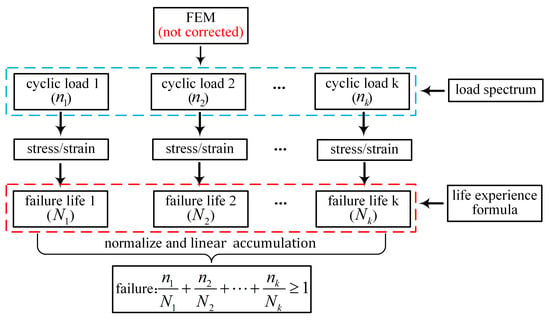
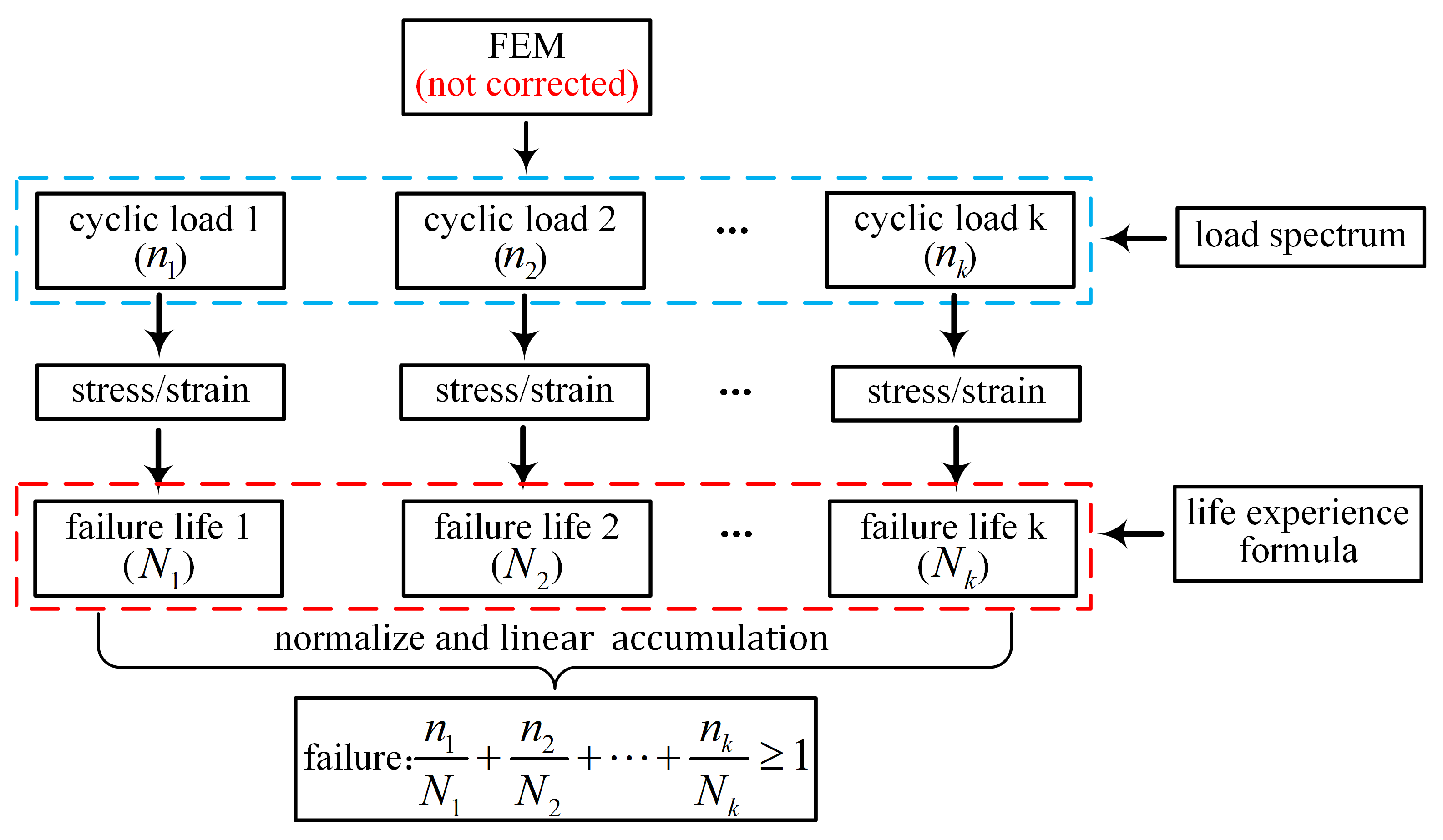
Classical models assume that damage accumulation between different contact interfaces is mutually independent. The failure analysis process is illustrated in Figure 4, where is the number of cycles for the th type of load, and is the fatigue life under the th type of load.
Figure 4.
Failure analysis process of the classical model.
In addition to the most commonly used linear superposition principle, there are numerous other superposition principles that can account for the influence of load sequence [41,42,43]. However, these methods still fail to consider the effects of damage accumulation from other interfaces.
4.2. Failure Analysis Process Considering Interaction
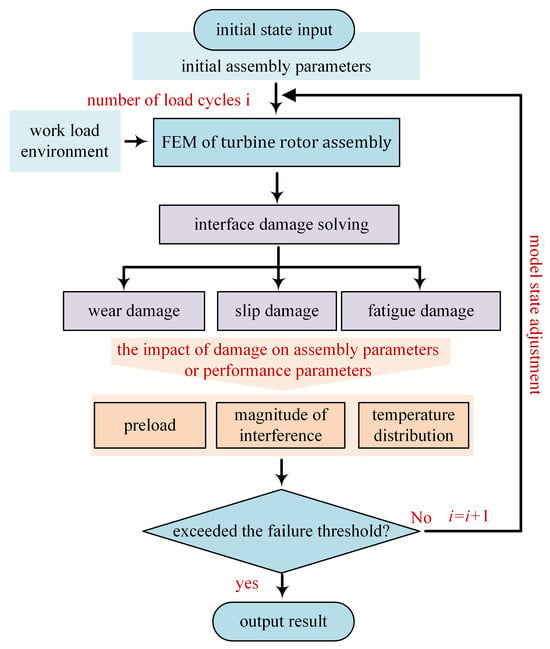
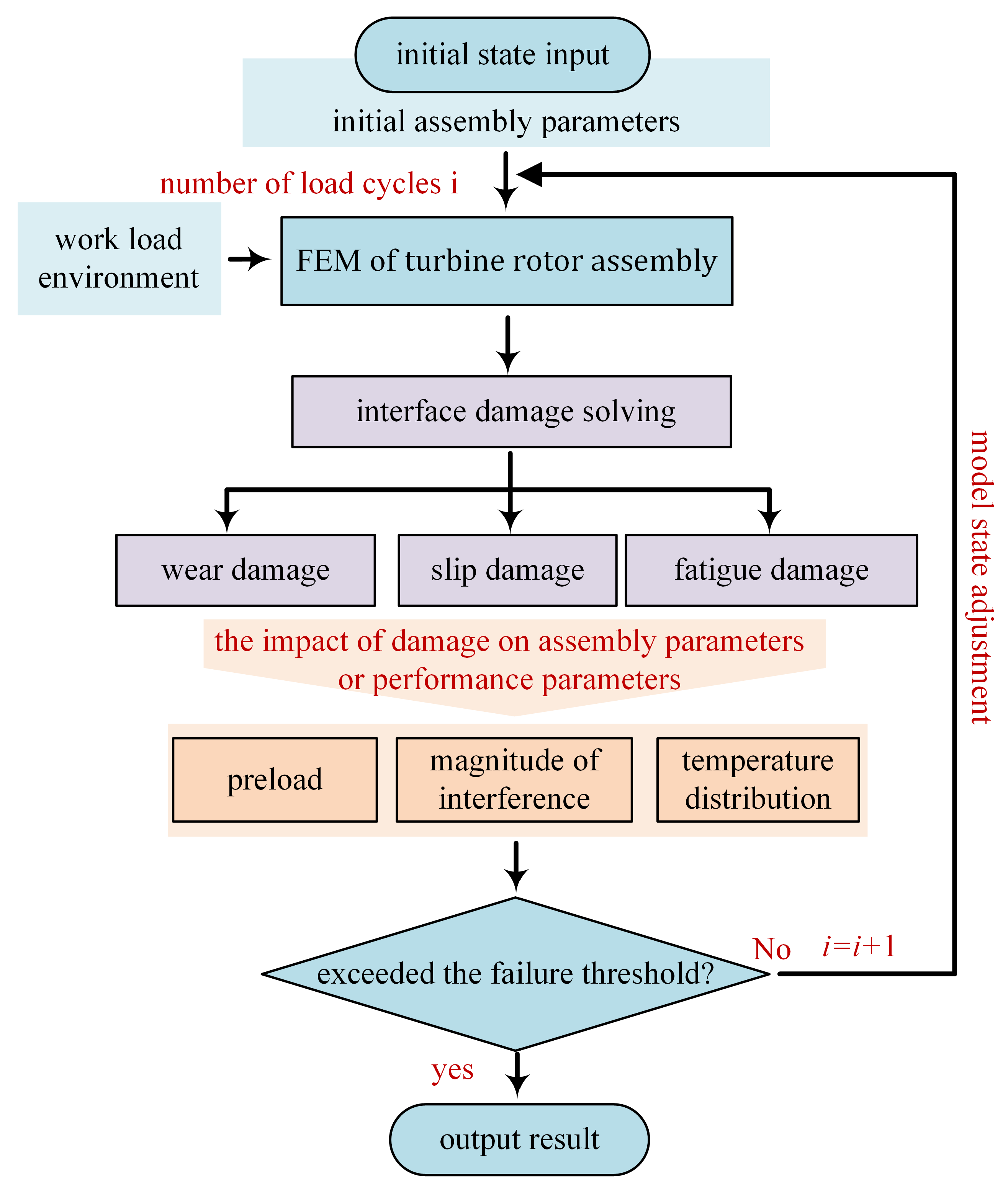
Based on the mechanical model of multi-failure mode interaction, the failure process analysis procedure for turbine rotor assemblies under multi-failure modes can be established, as shown in Figure 5. The steps include the following:
Figure 5.
Failure analysis process considering interaction.
- (1)
- Establish a FEM of the turbine rotor assembly and clarify the operating load environment, initial assembly parameters and contact interface parameters such as the friction coefficient required to calculate the interface contact state.
- (2)
- Based on FEM, solve for the contact state parameters, such as interface contact stress , tangential friction stress and relative slip distance , and analyze the interface damage based on the contact characteristic parameters, as shown in Equations (1)–(5).
- (3)
- Analyze the changes in assembly parameters and cooling performance of the assembly under multi-failure modes, as shown in Equations (6)–(10).
- (4)
- Based on the quantitative analysis results from step 3, modify the equivalent preload and the equivalent interference magnitude of the cylindrical surface in FEM. The temperature distribution of the assembly is then updated based on the impact on cooling performance. Steps 2–4 are repeated until any one of the failure modes reaches its failure threshold, at which point that mode is identified as the final failure mode of the assembly.
Due to the continuous-type interaction, the FEM would theoretically need to be updated after each load cycle. However, in practice, the impact of a single cycle on assembly and performance parameters may be minimal. Therefore, a cumulative correction approach can be adopted. It is assumed that several cycles form a group, within which the FEM remains unchanged. The changes are accumulated and used to update the model in groups. Suppose each group contains load cycles,
where is the FEM correction caused by the th load cycle, and is the accumulated correction after one group of cycles.
Since the FEM is assumed to remain unchanged within a group, the model correction per cycle is constant for identical load cycles. Assuming there are types of load within total cycles in a group and the number of cycles for each type is , Equation (17) can be further expressed as,
And,
where is the FEM correction per cycle for the th type of load.
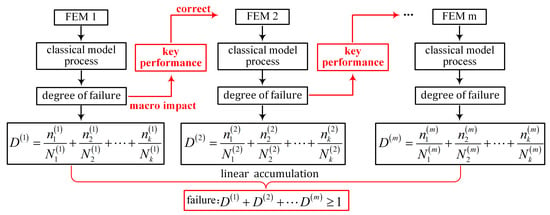
By applying the cumulative correction principle and integrating it with the classical failure analysis process, as shown in Figure 6, the proposed procedure accounts for multi-failure mode interactions while retaining the computational efficiency of the classical model. By appropriately selecting the number of load cycles per group, a balance between computational accuracy and efficiency can be achieved. is the number of FEM, which is equal to the number of load cycle groups.
Figure 6.
Simplified failure analysis process considering interactions.
It can be seen that failure occurs when the following condition is satisfied,
where is the damage amount corresponding to the failure mode under the group of load cycles.
4.3. Failure Probability Analysis Method
The analysis process shown in Figure 6 can determine the failure life of any failure mode under the interaction of multiple failure modes. The first mode to reach the failure threshold becomes the final failure mode of the assembly and its failure life is the failure life of the turbine rotor assembly. Due to the inherent randomness of parameters, both the final failure mode and its corresponding life exhibit stochastic characteristics. In this study, the Monte Carlo method is employed to calculate the failure probability of individual modes. However, given the structural complexity, performing Monte Carlo simulations for all failure modes simultaneously would incur prohibitive computational costs. Therefore, the PNET method is adopted to estimate the assembly’s failure probability under multiple failure modes based on single-mode failure probabilities.
4.3.1. Single Failure Mode
Based on the Monte Carlo approach, by counting the number of samples that fall within the failure domain , the failure probability can be expressed as,
where is the total number of random samples, is the indicator function, and indicates failure.
Assuming the failure threshold for the th failure mode is , the limit state equation for each failure mode can be expressed as,
where is the damage accumulation function for the th failure mode.
While model modification enables the consideration of multi-failure mode interactions, even with the cumulative correction principle and the simplified failure analysis process (Figure 6), Monte Carlo probabilistic calculations still face the curse of dimensionality. Initially, for a single model, the total number of random samples is and the number of calculations is . After a group of load cycles, since the damage accumulation of failure modes varies across each computational model, the adjustment values for assembly parameters and performance parameters will also differ, resulting in modified models. For the next group of load cycles, sampling is performed again. Assuming the total number of samples for each modified model is , the computational count for this iteration becomes . This exponential growth in computational effort renders the approach impractical. To address this, a deterministic assumption for model correction is proposed: the median or expected value of random variables is used to calculate the model correction terms, which are then applied to adjust the model. Additionally, correction coefficients can be introduced to modify the distributions of random variables in the updated model. These coefficients can be determined experimentally.
In addition, it should be pointed out that for the accumulation of damage under different cyclic loads, the Miner’s principled linear summation of damage is adopted in the paper.
Based on the above assumptions, the total number of computational models can be reduced to , significantly lowering computational costs for practical applications, where is the number of load cycle groups. Let the damage amount of the th failure mode under the th load cycle group be represented by the random variable . Its failure probability can be expressed as,
4.3.2. Multiple Failure Modes
In the PNET method, when the linear correlation coefficient between two failure modes satisfies (where is a threshold), the two failure modes are considered fully positively correlated. For turbine rotor assemblies with multi-failure modes, the failure probability can be expressed as [35],
When , the two failure modes are considered independent and the failure probability can be expressed as,
It should be noted that linear correlation coefficients are only capable of describing linear dependencies and cannot capture nonlinear dependencies. Although copula functions can be used to model nonlinear dependencies, linear correlation coefficients tend to be more conservative. Furthermore, in engineering practice, for failures of different parts or contact interfaces, due to the difficulty in obtaining either linear correlation coefficients or copula functions, a series reliability model is often adopted by directly assuming independence among failure modes.
5. Case Study
This section investigates a typical small-scale turboshaft engine gas generator rotor turbine assembly to analyze the effects of multi-failure mode interactions on the assembly reliability. The numerical framework comprises two FEMs: the turbine FEM of sealing disk-baffle assembly evaluates continuous-type interaction and determines whether trigger-type interaction is activated, while FEM of the turbine disk-blade assembly evaluates trigger-type interaction. Specifically, the study focuses on the influence of continuous-type interactions on wear failure, while examining how triggered interactions (cooling performance variations in this paper) affect LCF at the turbine disk-blade attachment.
5.1. Finite Element Model
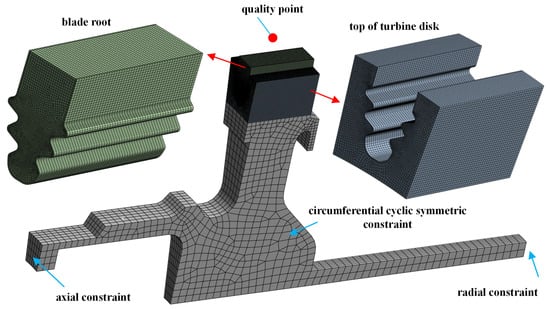
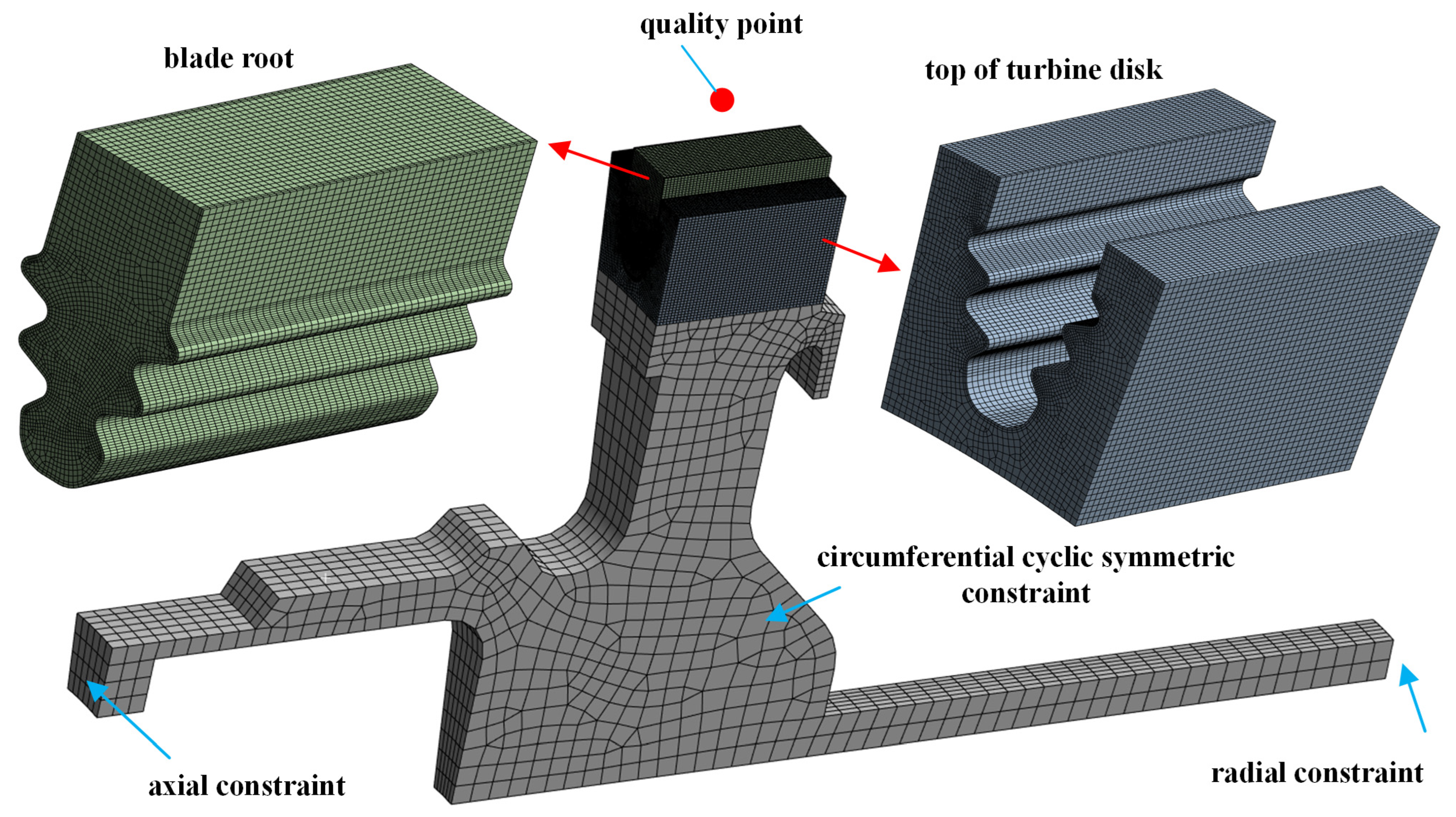
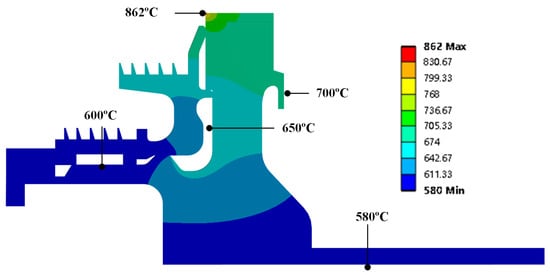
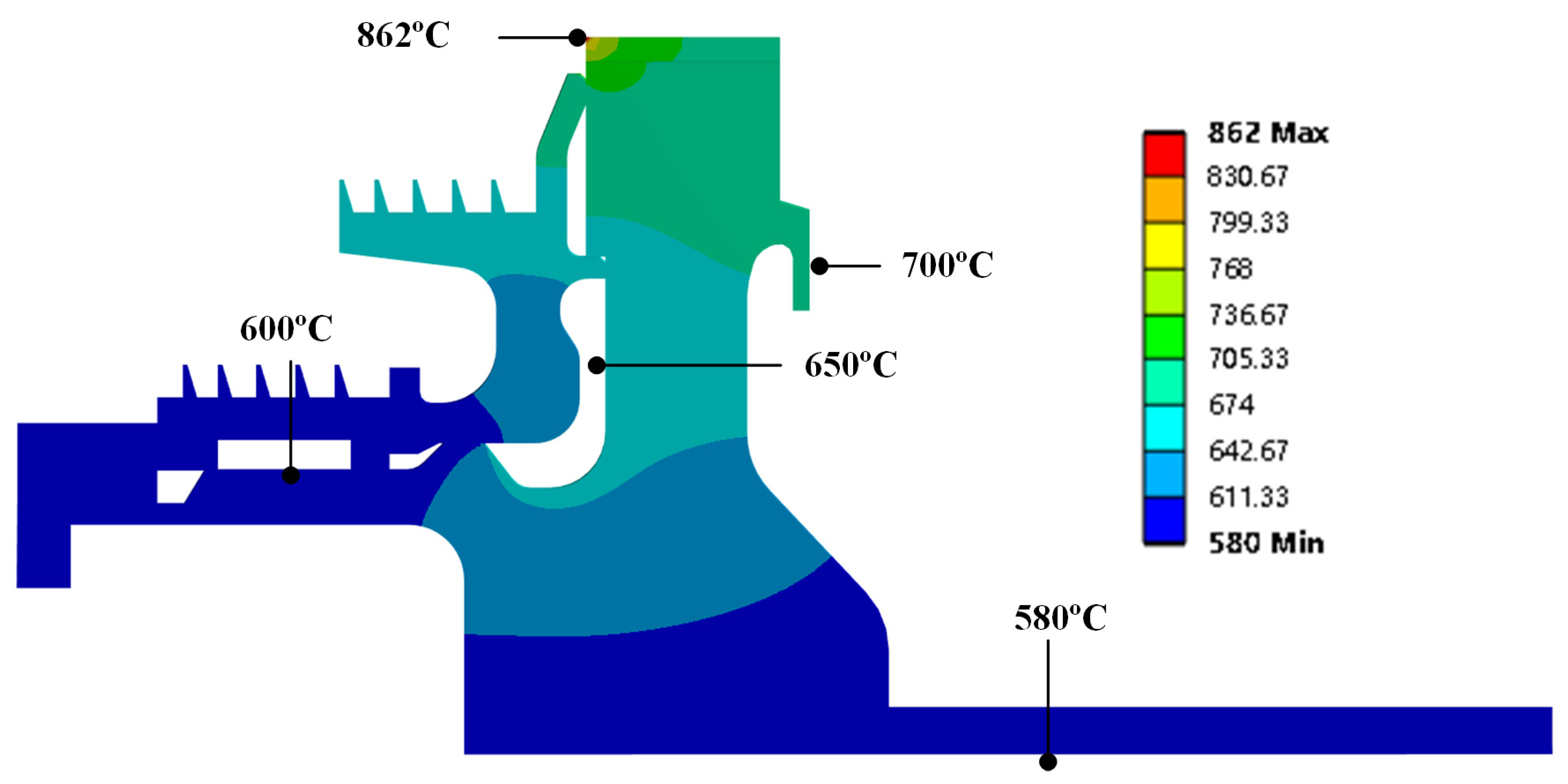
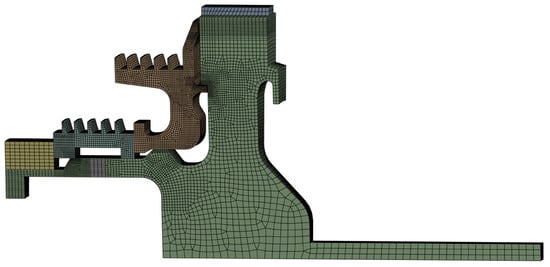
The gas turbine consists of 41 blades, and the model and loads used in the example have strong circumferential symmetry. Therefore, a 1/41 model is used with circumferential cyclic symmetry boundary conditions applied. For the FEM of the turbine disk-blade assembly, to simplify the calculation, the part above the blade root is removed. Mass points are added to ensure that the blade’s mass and radial center of gravity position are equivalent. The FEM is established using SOLID185 solid elements, as shown in Figure 7, with local mesh refinement applied to the contact interface. The FEM consists of 244,674 SOLID185 elements and 256,933 nodes, with the blade root including 113,950 elements and the turbine disk top including 127,400 elements. The temperature load distribution is shown in Figure 8. In addition, six contact pairs are defined at the contact surfaces between the blade root and the top of turbine disk, as shown in Figure 1. All six contact pairs are modeled as frictional contacts, with the coefficient of friction set to 0.15.
Figure 7.
FEM of the turbine disk-blade assembly (1/41 sector).
Figure 8.
Temperature load boundary conditions.
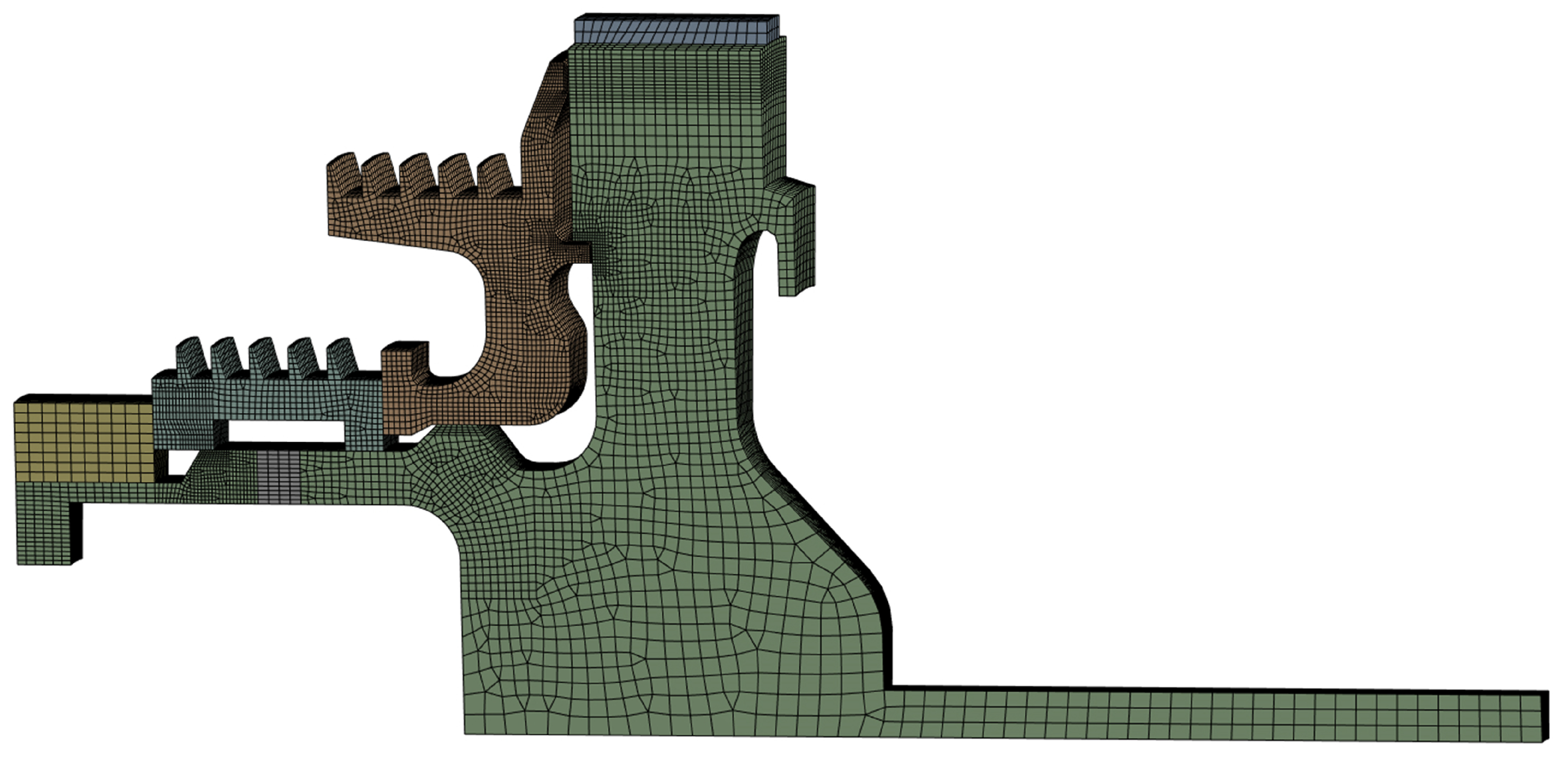
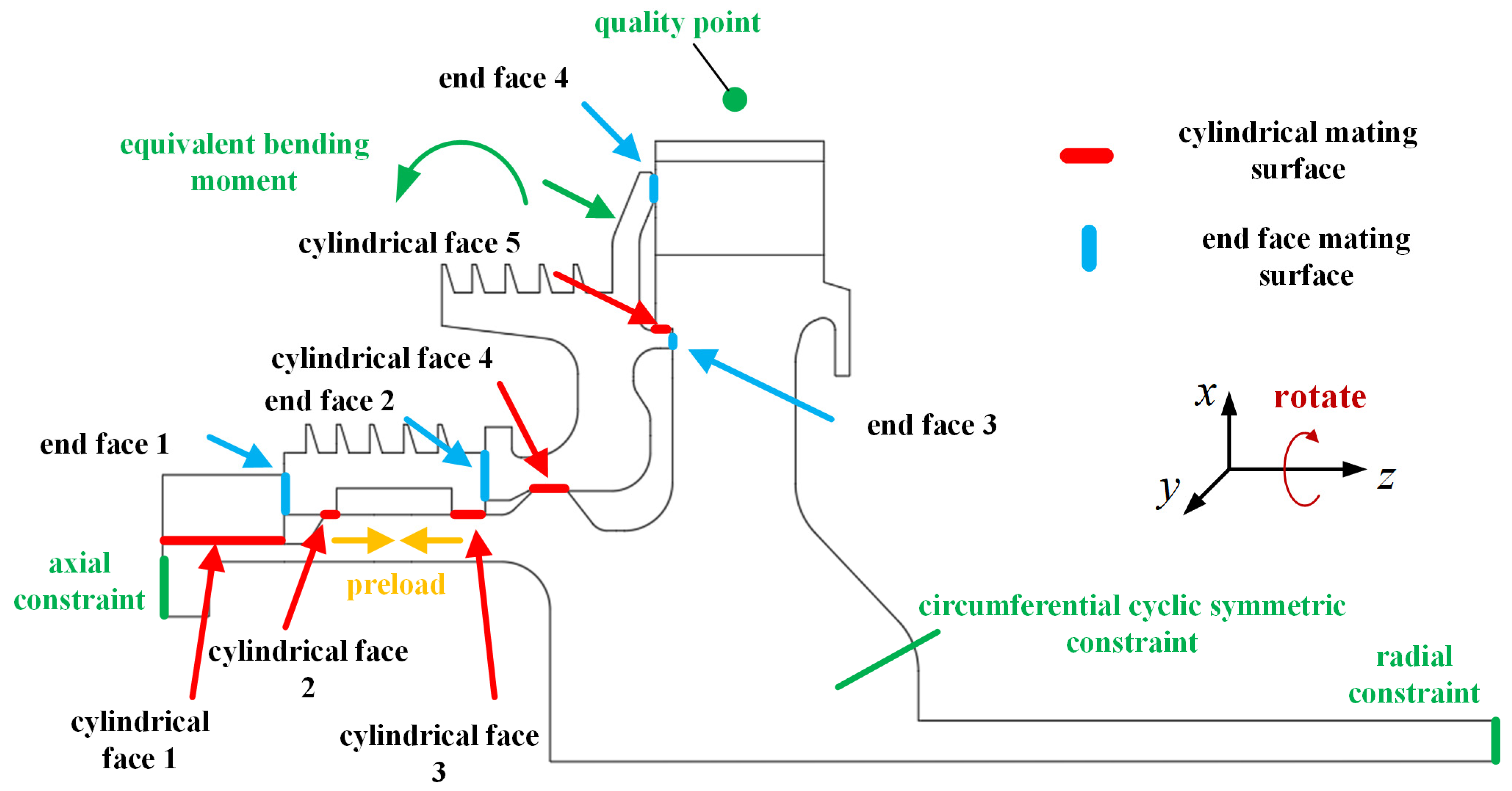
For the FEM of the turbine sealing disk-baffle assembly, the threaded connection structure of the nut and the turbine disk-blade attachment are neglected. Retain other contact interfaces and perform local mesh refinement at the contact interfaces. The model uses SOLID185 solid elements, with a total of 77,215 nodes and 66,036 elements, as shown in Figure 9.
Figure 9.
FEM of the turbine sealing disk-baffle assembly (1/41 sector).
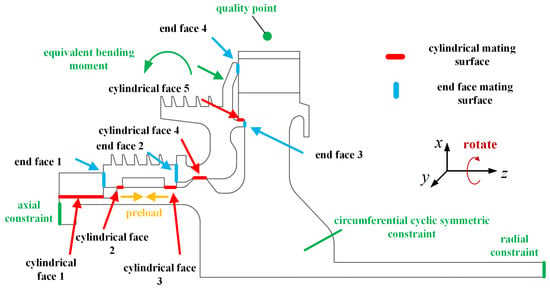
The FEM of the turbine sealing disk-baffle assembly contains multiple contact interfaces, necessitating detailed specification of computational boundary conditions as illustrated in Figure 10. Cylindrical Surface 1, derived from equivalent threaded connections, is defined as a fixed contact, while cylindrical surfaces 2–5 and end faces 1–4 are configured as frictional contacts with a coefficient of 0.15. Notably, a pre-assembly clearance of 0.1 mm is introduced at end face 3 to ensure proper compression at end face 4. Equivalent bending moments are applied to simulate separation tendencies caused by rotor deflection and pressure differentials across the sealing disk-baffle assembly. The temperature distribution is shown in Figure 8.
Figure 10.
Boundary conditions for the turbine sealing disk-baffle assembly.
5.2. Failure Analysis
5.2.1. Material Parameters and Assembly Parameters
The materials of the turbine rotor assembly are shown in Table 1. The material properties of FGH95 and DD6 along the [001] direction can be obtained from the material handbook [44,45].
Table 1.
The turbine rotor assembly materials.
Considering the high temperature and the large centrifugal load, which may cause plastic deformation, a bilinear elastoplastic material model is used in the FEM [46,47]. The LCF parameters for FGH95 and DD6 materials are shown in Table 2 [48,49,50]. It should be noted that, for convenience, the same LCF parameters are used at different temperatures in the study.
Table 2.
LCF properties of FGH95 and DD6 materials.
The interference magnitude of the turbine sealing disk–baffle assembly are shown in Table 3. In addition, other computational parameters and the temperature distribution are provided in Table 4 and Figure 8, respectively.
Table 3.
Interference magnitude of the turbine sealing disk-baffle assembly.
Table 4.
Calculation parameters for the turbine sealing disk-baffle assembly.
For FEM of the turbine disk-blade assembly, the computational parameters including maximum rotational speed and temperature distribution are consistent with those of the turbine sealing disk-baffle assembly. It should be noted that the “single cycle” in this case refers to “assembly state-maximum working state-assembly state”.
5.2.2. Damage Accumulation and Model Updating
For interface wear damage analysis, computational simplification is achieved by assuming uniform wear proportionality coefficients across all parts. Using cylindrical surface 2 wear depth as the reference, the wear depth ratios of contact interfaces are determined based on their average frictional work density (frictional work per unit area) during initial cycles in Table 5. Given an assumed average wear depth of mm at cylindrical surface 2 during initial cycles, wear depths at other interfaces are proportionally scaled. Wear depths at unlisted contact interfaces in Table 5 are considered negligible compared to cylindrical surface 2 and thus omitted from calculation.
Table 5.
Friction work and wear depth at each interface under initial cycles.
The effects of multi-failure mode interactions on assembly parameters and cooling performance can be determined through Equations (6)–(10). Assuming 200 cycles as a group for iteration, and given identical cyclic loading conditions, the interface damage per cycle within each group remains constant. After every 200 cycles, the interference fit at the cylindrical surface can be obtained using Equation (7), as shown in Table 6. Equation (6) can be modified to derive the assembly preload after each 200-cycle interval,
where is the initial assembly preload. This study exclusively considers the effects of interface wear and thread damage, neglecting irreversible slip between interfaces (i.e., assuming ). is the cumulative wear amount at end faces 1, 2, and 4. Furthermore, this study assumes after every 200 cycles [20,21,22].
Table 6.
Correction parameters of FEM after multiple cycles.
can be approximated using the following equation,
where is the initial assembly preload, and is the axial deformation of the end face th when the assembly has no interference on the cylindrical surface. The axial stiffness is assumed to be constant.
The equivalent assembly parameters (including preload and interference fit) obtained through the aforementioned calculations are used to update the FEM. The corrected model parameters after multiple cycles are shown in Table 6.
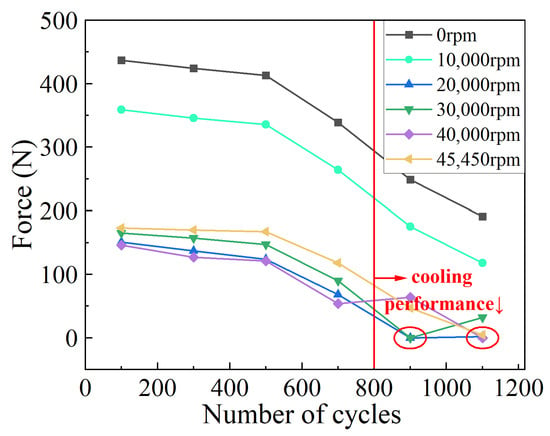
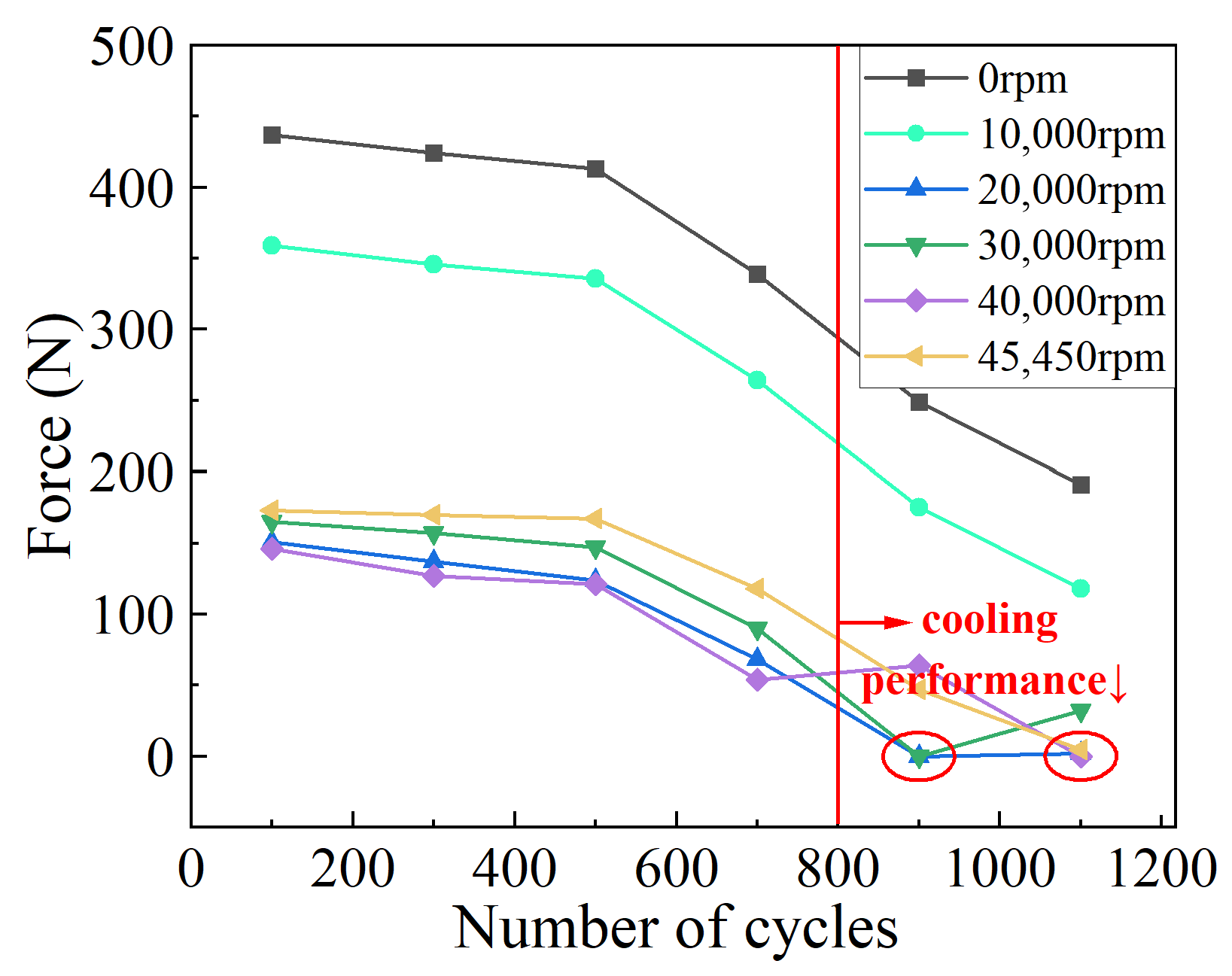
The modified FEM enables the determination of the contact force at the sealing interface , which is used to evaluate its impact on cooling performance, as illustrated in Figure 11. In the figure, 0 rpm corresponds to the assembly state. Loads other than rotational speed are scaled proportionally relative to the maximum operating speed (45,450 rpm). For instance, at 10,000 rpm (approximately 0.22 times the maximum speed), the equivalent bending moment in the 1/41 scale model is . Notably, since model parameters are updated every 200 cycles, assembly parameters remain constant within each 200-cycle interval. Thus, the 100th cycle data point represents the number of cycles [1, 200], and so on. The results indicate that prior to 800 cycles, the contact force remains positive throughout the loading cycles, ensuring normal cooling performance. Beyond 800 cycles, instances of zero contact force occur during cyclic loading, leading to cooling performance degradation. Furthermore, does not exhibit monotonic reduction with increasing rotational speed. This is attributed to competing mechanisms: while Poisson-effect-induced axial deformation tends to monotonically decrease contact force with speed, radial deformation from centrifugal loading causes separation of the interference-fit cylindrical surfaces, thereby reducing frictional resistance to preload transfer. Consequently, the minimum contact pressure does not necessarily occur at maximum operating conditions.
Figure 11.
The variation pattern of clamping force with increasing cyclic loads under different rotational speeds.
5.2.3. Failure of the Assembly
This section focuses on wear failure at the turbine sealing disk-baffle assembly (Figure 10) and LCF failure at the turbine disk-blade assembly (Figure 1 and Figure 7). As demonstrated in previous analysis, after 800 cycles, separation occurs at the sealing contact interface during operation, resulting in cooling performance degradation. This subsection primarily investigates the impact of cooling performance degradation (trigger-type interaction) on LCF at the turbine disk-blade attachment. For the wear failure at the turbine sealing disk-baffle assembly (Figure 10), the analysis focuses exclusively on the effects induced by assembly parameter variations (continuous-type interaction). Given the wear depth at end face 4 being significantly greater than other contact interfaces (Table 7), the analysis prioritizes wear failure at this location. The wear rate, defined as depth increment per cycle, demonstrates notable acceleration with increasing cycle count due to multi-failure mode interactions.
Table 7.
Variation in wear rate at end face 4 with the number of cycles.
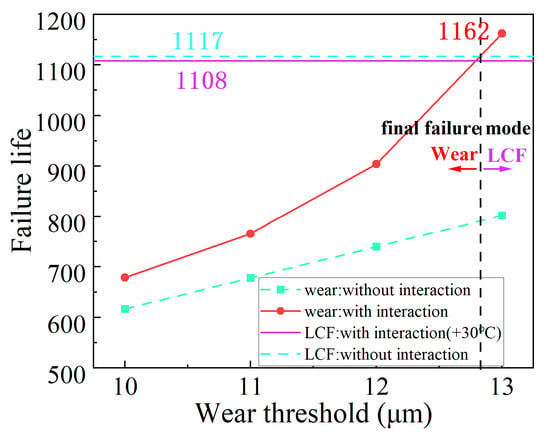
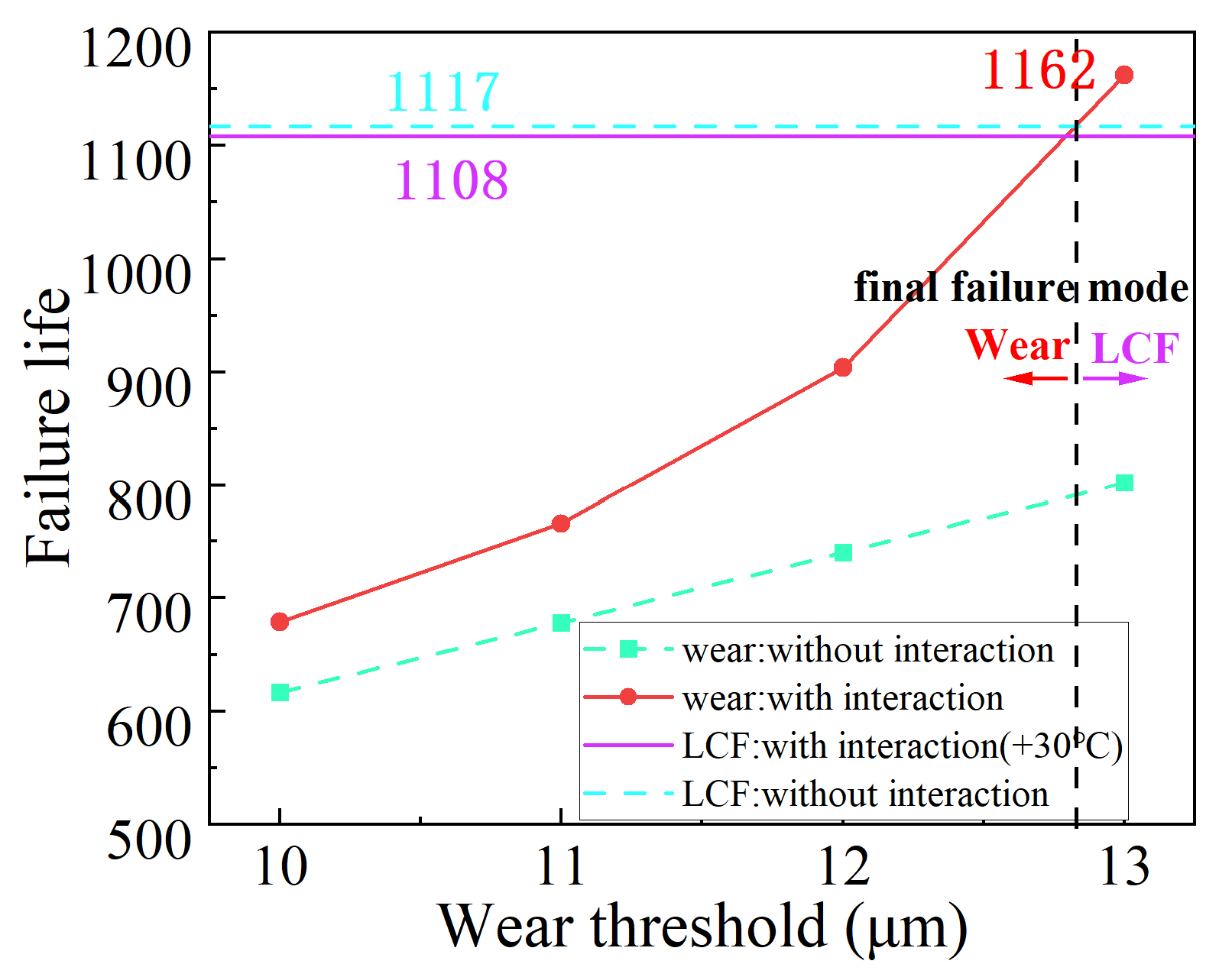
As shown in Figure 12, for wear failure, when the wear threshold is 10 μm, 11 μm and 12 μm, the failure life of end face 4 is 679, 766 and 904 cycles, respectively. If the multi-failure mode interaction is not considered, that is, assuming a constant wear rate for end face 4 equal to mm, then when the wear threshold is 10 μm, 11 μm and 12 μm, the failure life of end face 4 is 617, 678 and 740 cycles, respectively. The results clearly demonstrate that the continuous-type interaction exerts significant influence on the wear failure life at end face 4.
Figure 12.
Wear failure life of end face 4 and LCF life of the turbine disk-blade attachment.
For LCF failure of the turbine disk-blade attachment, since the cooling performance remains normal within the first 800 cycles but deteriorates after 800 cycles due to sealing interface separation, trigger-type interaction is considered to initiate post−800 cycles. This study assumes that after sealing interface separation, the turbine assembly temperature increases uniformly under design conditions with a constant temperature increment per cycle. Specifically, a 30 °C temperature rise is imposed on the assembly after 800 cycles due to cooling performance degradation. The LCF life of the turbine disk-blade attachment can be determined by Equation (3) and (16), where failure occurs when the following condition is met,
where and are the LCF life of the turbine disk-blade attachment obtained through Equation (3) under design temperature conditions and elevated temperature conditions (exceeding the design temperature by ), respectively.
Calculation results show that and are 1117 and 1088 cycles, respectively. Using Equation (28), . When assuming a 50 °C temperature rise after 800 cycles, . As shown in Table 8, the consideration of trigger-type interaction leads to a significant reduction in the LCF life of the attachment. The safety factor is defined as the ratio of actual fatigue life to the predicted life without considering interactions. It should be noted that this study assumes a uniformly increased temperature distribution. In actual engineering practice, while such a temperature difference may not be fully achievable, non-uniform temperature increases can still exert significant effects. Therefore, the assumption of a uniform temperature rise of 30 °C and 50 °C also carries certain conservative implications.
Table 8.
LCF life of the turbine disk-blade attachment.
As shown in the analysis, when assuming a 30 °C temperature rise due to sealing interface separation and setting the wear threshold of end face 4 within 10~12 μm, the wear life of end face 4 becomes shorter than the LCF life of the turbine disk-blade attachment. Therefore, the dominant failure mode of the assembly is wear failure, as illustrated in Figure 12. However, when the wear threshold is increased to 13 μm, the fatigue life of end face 4 rises to 1162 cycles. Theoretically, the dominant failure mode transitions back to interface fatigue failure of the attachment, with the assembly’s overall fatigue life increasing to 1108 cycles. In practical applications, additional failure modes must be considered. This demonstrates that accounting for multi-mode failure interactions enables more precise design guidance.
5.3. Reliability Analysis
5.3.1. Random Variable
For the FEM of the turbine sealing disk-baffle assembly, to simplify computational complexity, only the stochasticity of initial assembly preload and equivalent bending moment is considered (as shown in Table 9), while other parameters remain constant.
Table 9.
Initial random parameters of the turbine sealing disk-baffle assembly (1/41 model).
The turbine disk-blade attachment adopts a fir-tree design where the load distribution on the contact surfaces is highly sensitive to variations in the spacing between contact surfaces. This geometric variability caused by machining tolerances can be simulated by defining initial interference values between contact elements. The selected stochastic variables for this analysis are listed in Table 10 and Figure 1, while other parameters remain constant.
Table 10.
Initial random parameters of the turbine disk-blade assembly.
5.3.2. Uncertainty Analysis of Failure
The iterative model parameters for the turbine sealing disk-baffle assembly are specified in Table 6. During the iteration process, the stochastic distribution of equivalent assembly preload undergoes significant variations. Under data scarcity conditions, the bounds of equivalent assembly preload can be utilized to estimate its probabilistic distribution. These bounds can be derived by extending Equations (6) and (26),
where and are the upper and lower bounds of equivalent assembly preload after cycles, respectively; and are the correction coefficients for dispersion upper and lower limits, respectively [51,52]. And it is assumed that these coefficients are updated to 1.05 and 0.95 every 200 cycles. Furthermore, it is also assumed that every 200 cycles. and retain the same numerical values as in the aforementioned model iterations.
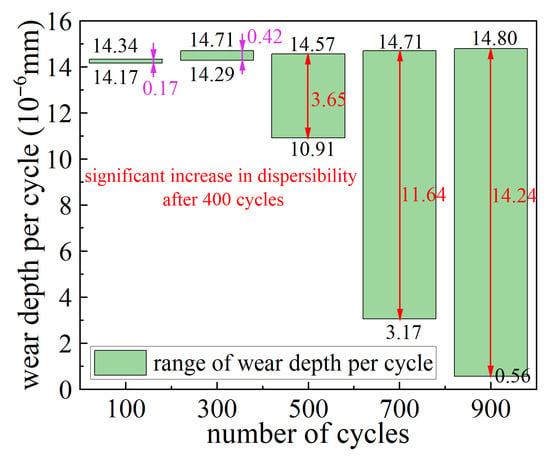
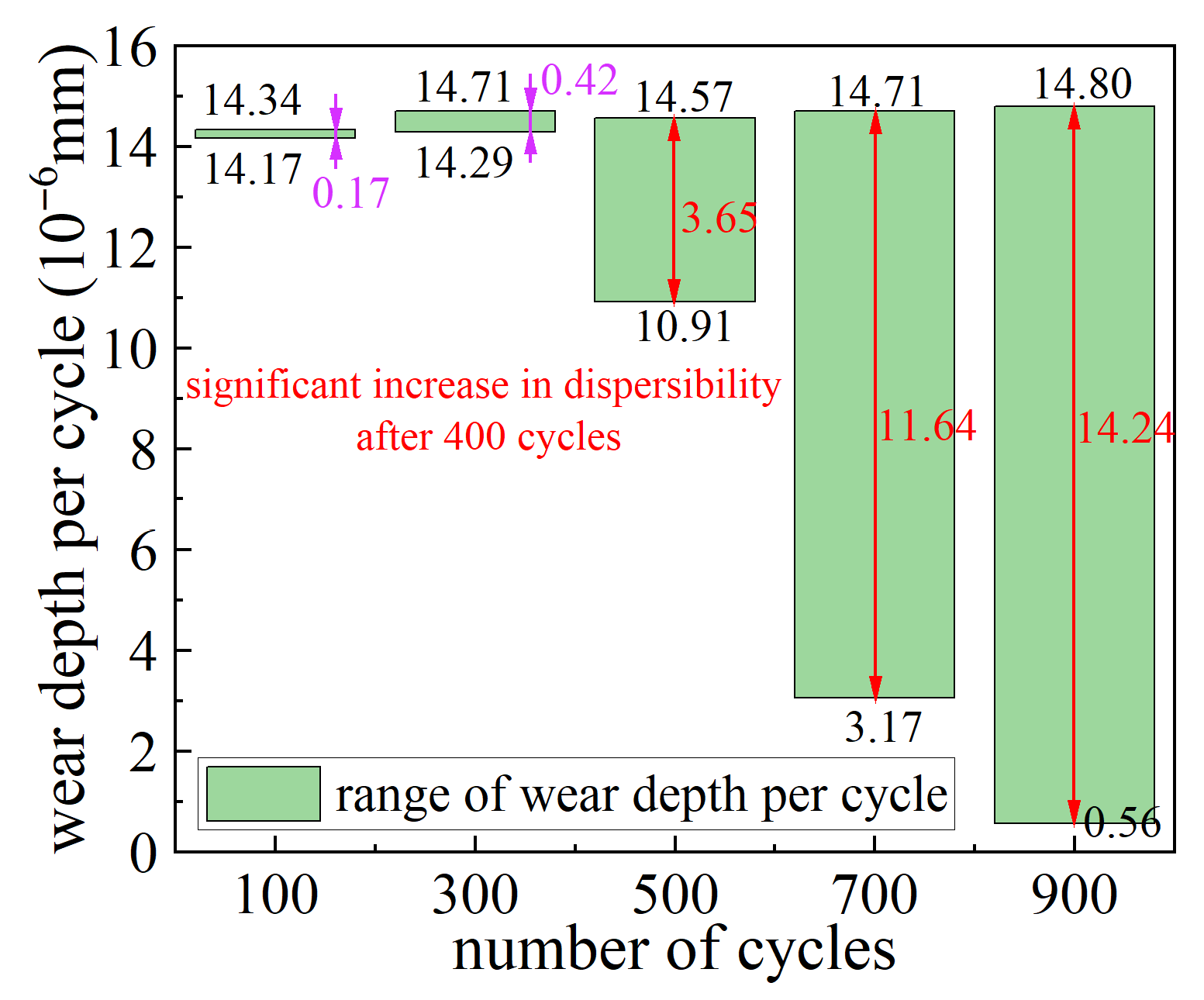
It is assumed that the equivalent assembly preload is uniformly distributed within the interval, as shown in Table 11. By selecting the upper and lower limits of equivalent preload force separately for calculation, the wear depth range of each contact interface can be approximately obtained. Specifically, the wear depth of end face 4 is illustrated in Figure 13. As can be observed, within 1000 cycles, the upper limit of the single-cycle wear depth for end face 4 remains relatively constant, while the lower limit begins to decrease significantly after 400 cycles, exhibiting a distinct nonlinear trend, as depicted in Figure 13. The reason for the abrupt increase in wear depth variability will be analyzed in detail in the following subsection.
Table 11.
Probability distribution of equivalent preload after multiple cycles (1/41 model).
Figure 13.
Wear depth range of end face 4 per cycle.
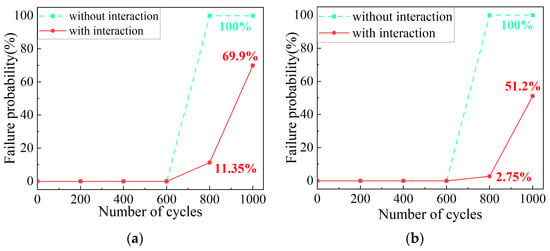
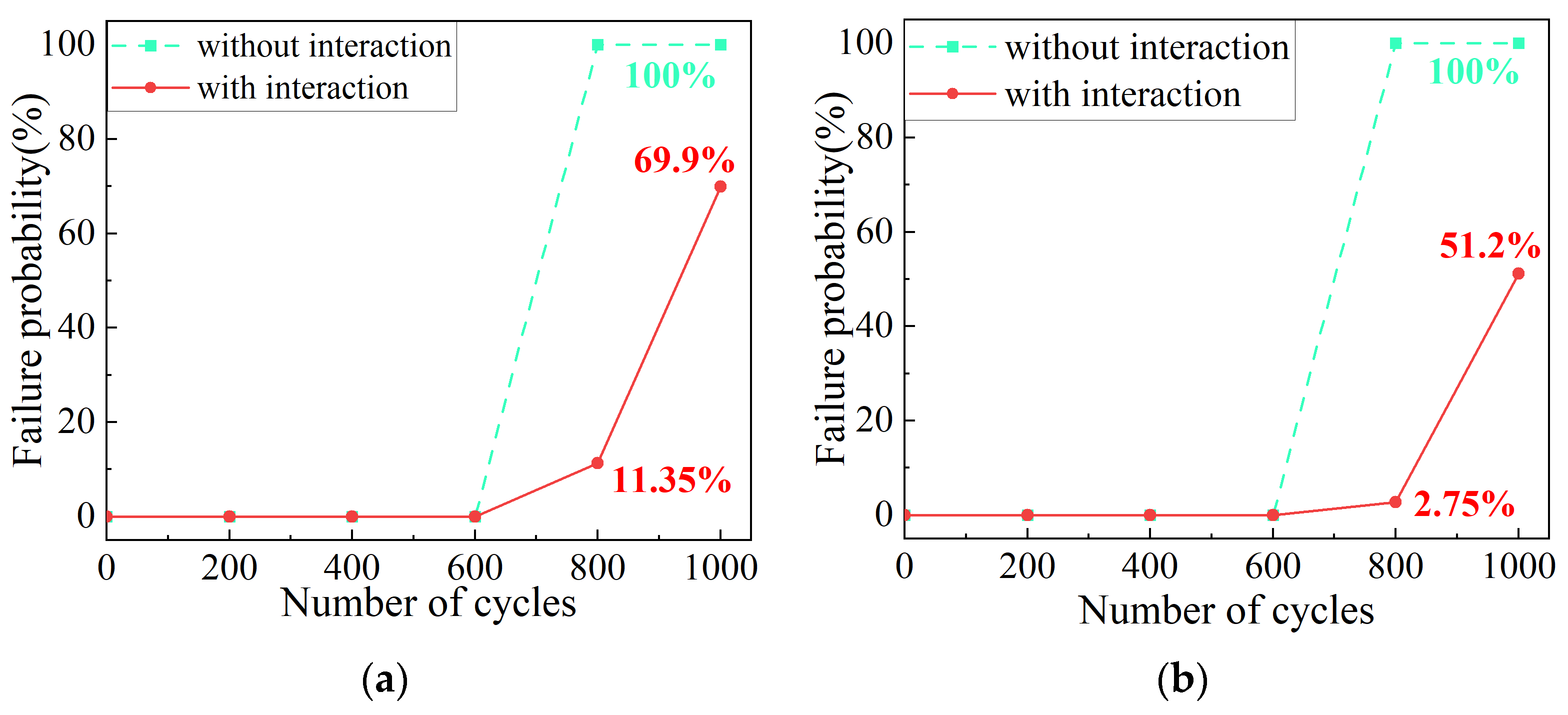
Based on the wear range per cycle for end face 4 shown in Figure 13, the probability distribution of the wear depth per cycle is assumed as shown in Table 12. When the wear failure threshold is set at 11 μm, the failure probability of end face 4 is illustrated in Figure 14a. Notably, without considering interaction effects, the wear depth per cycle of end face 4 remains consistent with the first 200 cycles. The results demonstrate that when interaction effects are considered, the increase in failure probability slows down compared to analyses neglecting such interactions. This is attributed to the observed trend where the upper limit of single-cycle wear depth remains stable while the lower limit decreases with increasing cycles.
Table 12.
Probability distribution of wear depth per cycle at end face 4.
Figure 14.
Wear failure probability at end face 4: (a) Failure threshold is 11 μm; (b) Failure threshold is 11.3 μm.
When the wear failure threshold is raised to 11.3 μm, the failure probability without considering interactions remains 100% at 800 cycles shown in Figure 14b. In contrast, with interaction effects accounted for, the failure probability at 800 cycles decreases from 11.35% (at 11 μm threshold) to 2.75% (at 11.3 μm threshold). This highlights that reliability assessments incorporating multi-failure mode interactions provide more precise guidance for engineering design optimization.
For LCF failure of the turbine disk-blade attachment, it is essential to consider the impact of temperature rise in the turbine assembly after separation of the sealing contact interface. When the separation threshold in Equation (8) is assumed to be 0 N, the separation probability of the sealing contact interface (end Face 4) after multiple cycles can be calculated, as presented in Table 13.
Table 13.
The separation probability of the sealing contact interface under different cycle times (The separation threshold is 0 N).
Based on the aforementioned data and applying the linear averaging principle, the average separation probability of the sealing contact interface across different cycle intervals can be derived. For cycle intervals of [1, 400], [401, 600], [601, 800] and [801, 1000], the average separation probabilities are 0%, 13.3%, 38.8% and 63.38%, respectively. This study assumes that during each cycle, the turbine assembly temperature remains at the design condition when the sealing contact interface remains intact. However, if separation occurs, the turbine assembly temperature is presumed to increase uniformly from the design state, with an identical temperature increment per cycle. Utilizing the law of total probability, the LCF failure probability of the turbine disk-blade attachment can be calculated,
where and is the LCF failure probability of the turbine disk-blade attachment under the design temperature condition and the elevated temperature condition, respectively; is the probability of sealing contact interface separation within load cycles.
When temperature increases of 30 °C and 50 °C are assumed, Equation (31) can be used to calculate that the LCF failure probability of the turbine disk-blade attachment is 0% after 600 cycles. After 800 cycles, the failure probabilities are 15.22% and 15.90%, respectively, and after 1000 cycles, they rise to 44.49% and 49.03%. In contrast, when the trigger-type interactions due to sealing contact interface separation are neglected, the failure probabilities after 800 and 1000 cycles are 13.88% and 41.19%, respectively, as shown in Table 14. This demonstrates that the trigger-type interaction significantly increases the LCF failure probability and becomes more pronounced with the increase in cyclic loading times. The results indicate that disregarding the trigger-type interaction could lead to overly optimistic assessments, thereby posing serious safety risks. Additionally, this case assumes a uniform temperature rise, while in practice temperature distribution is non-uniform, which may result in an even higher failure probability.
Table 14.
LCF failure probability of the turbine disk-blade attachment (the separation threshold is 0 N).
When the separation threshold in Equation (8) is assumed to be 5 N, the separation probability of the sealing contact interface (end Face 4) after multiple cycles can be calculated, as presented in Table 15. For cycle intervals of [1, 400], [401, 600], [601, 800] and [801, 1000], the average separation probabilities are 0%, 13.7%, 41.5% and 66.5%, respectively.
Table 15.
The separation probability of the sealing contact interface under different cycle times (the separation threshold is 5 N).
When temperature increases of 30 °C and 50 °C are assumed, Equation (31) can be used to calculate that the LCF failure probability of the turbine disk-blade attachment is 0% after 600 cycles. After 800 cycles, the failure probabilities are 15.30% and 16.03%, respectively, and after 1000 cycles, they rise to 44.67% and 49.45%, as shown in Table 16. It can be observed that assuming a separation threshold of 5 N yields more conservative results compared to the assumption of 0 N, leading to increased probabilities of both sealing contact interface separation and low-cycle fatigue failure of the turbine disk-blade attachment. However, after adjusting the threshold, the increase was relatively small, as demonstrated in Table 13, Table 14, Table 15 and Table 16. It should be noted that, unless otherwise specified, the threshold value assumed in the paper is 0.
Table 16.
LCF failure probability of the turbine disk-blade attachment (the separation threshold is 5 N).
5.3.3. Analysis of the Sudden Increase in Wear Rate Dispersion on End Face 4
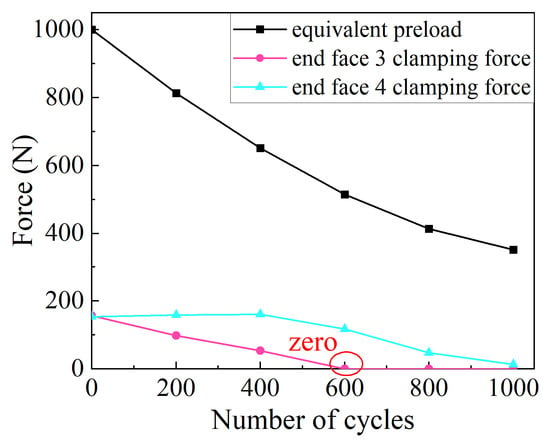
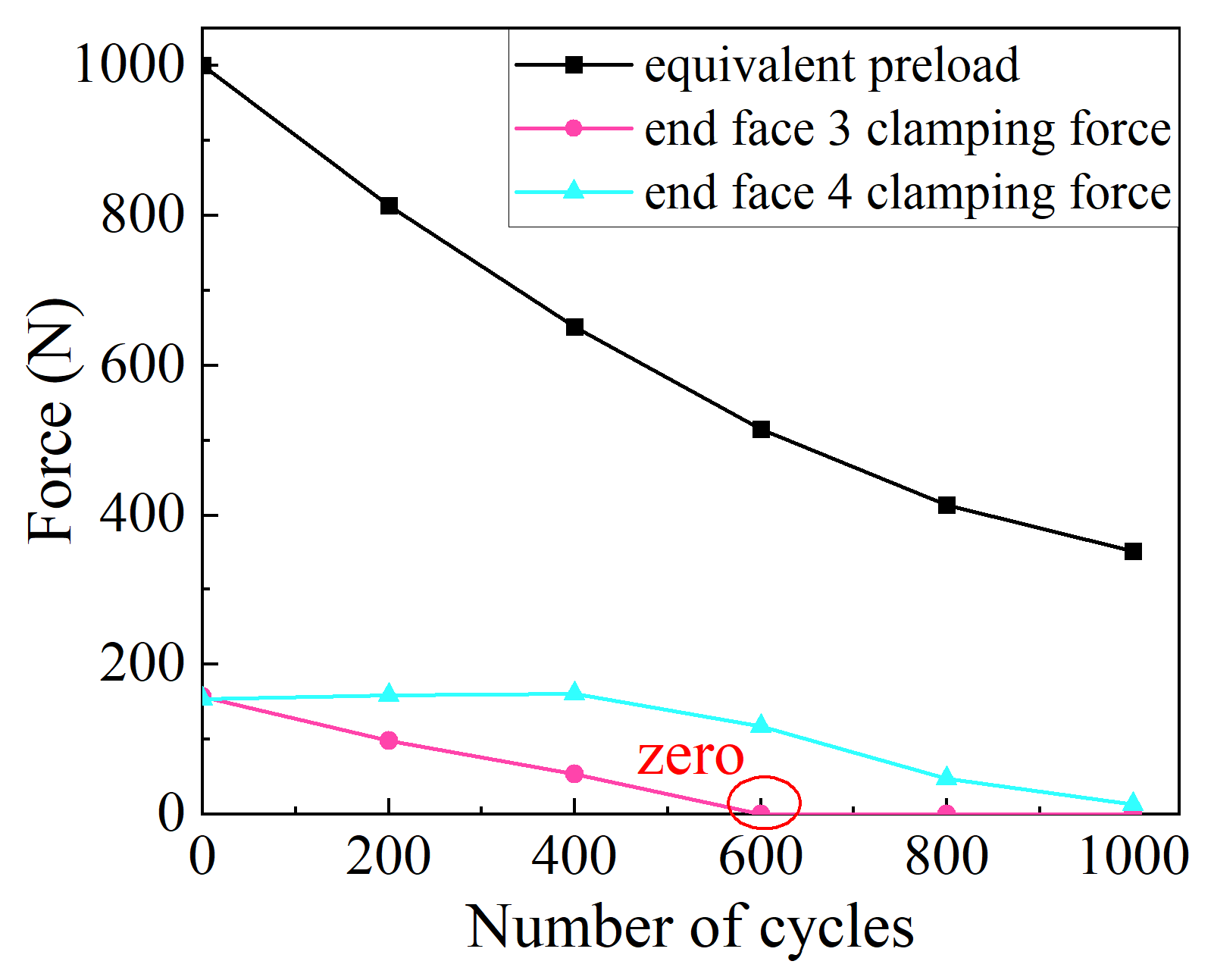
The dispersion in wear rate at end face 4 increases significantly after 400 cycles, as shown in Figure 13, which is closely related to the variation in clamping force at end face 4 (Figure 15). End faces 3 and 4 jointly bear the clamping force induced by assembly preload between the sealing disk-baffle and the turbine disk. Due to a 0.1 mm gap between end face 3 and the turbine disk in the unassembled state, the clamping force at end face 3 decreases first as the equivalent assembly preload diminishes, while the clamping force at end face 4 remains relatively stable. This results in minimal dispersion in both frictional work and wear rate at end face 4 when the equivalent assembly preload fluctuates within this range. However, when the number of cycles exceeds 400, the equivalent assembly preload continues to decrease. After the clamping force at end face 3 drops to zero, the clamping force at end face 4 begins to decline markedly, accompanied by a reduction in frictional work at end face 4. Within this range of equivalent assembly preload fluctuations, both the dispersion in frictional work and wear rate at end face 4 become significantly more pronounced.
Figure 15.
Variation in equivalent preload and the compression forces at end face 3 and 4 with the number of cycles at 45,450 rpm.
5.3.4. Uncertainty of Final Failure Mode
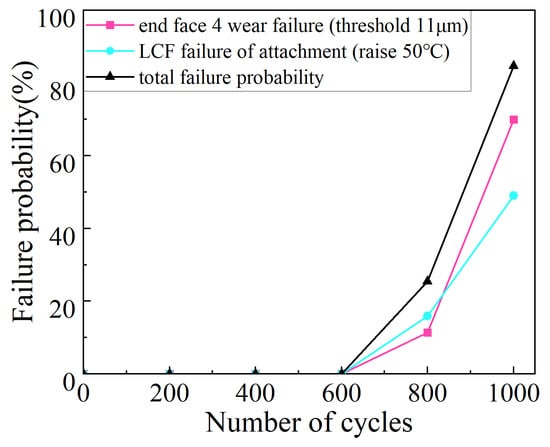
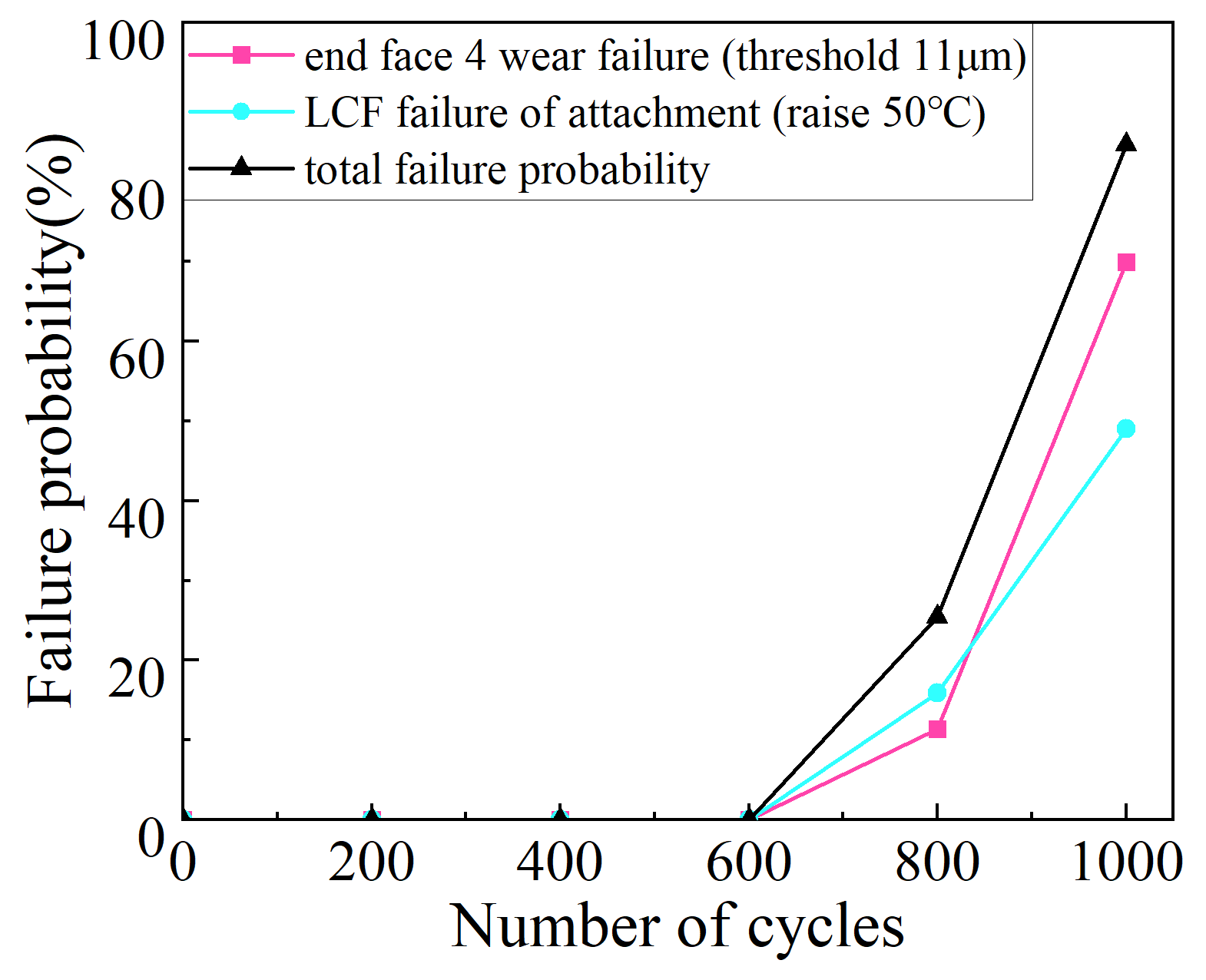
When considering wear failure at end face 4 and LCF failure of the turbine disk-blade attachment, the assembly’s final failure mode and failure probability can be determined. By employing a series reliability model, the assembly’s failure probability under multi-failure modes can be obtained through Equation (25), as illustrated in Figure 16. The failure mode with higher probability dominates the assembly’s overall failure behavior. After 800 cycles, the LCF failure probability of the turbine disk-blade attachment significantly exceeds that of wear failure at end face 4, contributing more substantially to the assembly’s total failure probability. Conversely, after 1000 cycles, the wear failure probability at end face 4 becomes markedly higher than the LCF failure probability of the turbine disk-blade attachment, dominating the assembly’s failure. This demonstrates that the primary failure mode of the assembly evolves with increasing load cycles, and the ultimate failure mode exhibits significant uncertainty.
Figure 16.
Total failure probability of the turbine rotor assembly under multi-mode failure.
6. Conclusions
This study focuses on turbine rotor assemblies, conducting detailed analyses of continuous-type interaction and trigger-type interaction among multiple failure modes at the macroscopic scale. Unlike statistical correlations among failure modes, these interactions involve physical changes. In this research, continuous-type interaction arises from continuous variations in assembly preload and cylindrical surface interference due to contact interface damage, while trigger-type interaction originates from cooling performance degradation caused by the sealing interface clamping force dropping to zero. Based on the identified failure mechanisms, mechanical models were established to quantitatively characterize the interactions among multi-failure modes during failure process and their impact on system reliability. Subsequently, an analytical method for the mechanical process of assembly’ s failure under multi-failure mode interaction was proposed, along with a time-dependent failure probability evaluation approach combining Monte Carlo and PNET (Probability Network Evaluation Technique) methods. Finally, a case study demonstrated the influence of multi-failure mode interaction on assembly’ s failure probability and final failure modes. To our knowledge, this represents the first attempt to quantitatively analyze the effects of multi-failure mode interaction in turbine rotor assemblies. The results indicate that:
- (1)
- The interaction among multi-failure modes in turbine rotor assemblies significantly influence the damage rates of each failure mode, necessitating focused consideration in failure analysis.
- (2)
- Under the influence of continuous-type interaction and trigger-type interaction, the wear failure probability at end face 4 decreases compared to analyses neglecting such interactions. With a wear depth threshold of 11 μm at 800 cycles, the failure probabilities are 100% (without interactions) and 11.35% (with interactions). When the wear threshold is increased to 11.3 μm at 800 cycles, the failure probability remains 100% without interactions but drops to 2.75% when interactions are considered. Conversely, LCF failure probability of the turbine disk-blade attachment shows significant increases: at 800 and 1000 cycles, failure probabilities rise from 13.88% and 41.19% (without interactions) to 15.90% and 49.03% (with interactions, assuming a 50 °C temperature increase). These results demonstrate that multi-failure mode interaction exerts substantial impacts on assembly’s reliability, necessitating prioritized consideration in both reliability analysis and engineering design.
- (3)
- The final failure modes of the assembly exhibit significant uncertainty, with multi-failure modes demonstrating both interactive and competitive relationships. As the number of cycles increases, the contribution ratios of different failure modes to the assembly’s failure probability evolve, and the dominant failure modes may also shift.
In conclusion, the results of this study provide a foundation for developing advanced design guidelines for turbine rotor assembly.
The following issues need to be addressed in future work:
To improve evaluation accuracy, more in-service engine data are required to refine the model. To enhance computational efficiency, advanced surrogate modeling techniques should be employed. Additionally, the interaction mechanisms among additional failure modes require further detailed analysis. It is also essential to investigate under which conditions specific interactions should be considered, thereby providing more effective guidance for practical engineering applications. It should be noted that due to the complexity of the system, certain parameters were appropriately assumed. In future studies, we will refine these assumed parameters using more extensive in-service engine data.
Author Contributions
Conceptualization, data curation, formal analysis, investigation, methodology, software, validation, writing—original draft, writing—review and editing, X.H.; writing—review and editing, Z.Y.; validation, project administration, W.Z.; investigation, writing—review and editing, X.C.; funding acquisition, writing—review and editing, Y.M.; conceptualization, funding acquisition, resources, J.H. All authors have read and agreed to the published version of the manuscript.
Funding
The authors gratefully acknowledge the financial support provided by the National Science and Technology Major Project (J2022-IV-0004-0021 and J2022-VII-0001-0043).
Institutional Review Board Statement
Not applicable.
Informed Consent Statement
Not applicable.
Data Availability Statement
The data presented in this study are available on request from the corresponding author. The data are not publicly available due to privacy concerns.
Conflicts of Interest
Author Mr. Weifeng Zhang was employed by Aero Engine Corporation of China (AECC) Hunan Aviation Powerplant Research Institute. The remaining authors declare that the research was conducted in the absence of any commercial or financial relationships that could be construed as a potential conflict of interest.
References
- Song, L.; Fei, C.; Wen, J.; Bai, G. Multi-objective reliability-based design optimization approach of complex structure with multi-failure modes. Aerosp. Sci. Technol. 2017, 64, 52–62. [Google Scholar] [CrossRef] [Scilit]
- Li, X.; Song, L.; Bai, G. Vectorial surrogate modeling approach for multi-failure correlated probabilistic evaluation of turbine rotor. Eng. Comput. 2023, 39, 1885–1904. [Google Scholar] [CrossRef] [Scilit]
- Tomevenya, K.M.; Liu, S. Probabilistic fatigue-creep life reliability assessment of aircraft turbine disk. J. Mech. Sci. Technol. 2018, 32, 5127–5132. [Google Scholar] [CrossRef] [Scilit]
- Qi, H.; Lu, Y.; Song, S.; Xu, Q. Fatigue Reliability Analysis System for Key Components of Aero-Engine. Int. J. Aerosp. Eng. 2022, 2022, 1143901–1143914. [Google Scholar] [CrossRef] [Scilit]
- Mangardich, D.; Abrari, F.; Fawaz, Z. A fracture mechanics based approach for the fretting fatigue of aircraft engine fan dovetail attachments. Int. J. Fatigue 2019, 129, 105213. [Google Scholar] [CrossRef] [Scilit]
- Sosnovskiy, L.A. Tribo-Fatigue. In Proceedings of the Asme International Mechanical Engineering Congress and Exposition, Orlando, FL, USA, 5–11 November 2005; Volume 42339, pp. 141–148. [Google Scholar]
- Sherbakov, S.S.; Zhuravkov, M.A.; Sosnovskiy, L.A. Contact interaction, volume damageability and multicriterial limiting states of multielement tribo-fatigue systems. In Selected Problems on Experimental Mathematics; Wydawnictwo Politechniki Slaskiej: Gliwice, Poland, 2017; Volume 2017, pp. 17–38. [Google Scholar]
- Meango, T.J.; Ouali, M. Failure interaction models for multicomponent systems: A comparative study. SN Appl. Sci. 2019, 1, 66. [Google Scholar] [CrossRef] [Scilit]
- Jia, G.; Gardoni, P. State-dependent stochastic models: A general stochastic framework for modeling deteriorating engineering systems considering multiple deterioration processes and their interactions. Struct. Saf. 2018, 72, 99–110. [Google Scholar] [CrossRef] [Scilit]
- Li, A.; Wang, W.; Fan, Y.; Berruti, T.M.; Wu, Y. Mistuning identification of blisk based on antiresonance. Mech. Syst. Signal Process. 2025, 239, 113307. [Google Scholar] [CrossRef] [Scilit]
- Hong, J.; Li, T.; Zheng, H.; Ma, Y. Applications of structural efficiency assessment method on structural-mechanical characteristics integrated design in aero-engines. Chin. J. Aeronaut. 2020, 33, 1260–1271. [Google Scholar] [CrossRef] [Scilit]
- Jin, T.; Luo, G.; Wang, Q.; Feng, Z. Research on the technology of sealing disk-baffle integrated structure design. Vibroengineering Procedia 2015, 5, 101. [Google Scholar]
- Archard, J.F. Contact and Rubbing of Flat Surfaces. J. Appl. Phys. 1953, 24, 981–988. [Google Scholar] [CrossRef] [Scilit]
- Smith, K.N.; Watson, P.; Topper, T.H. Stress-strain function for the fatigue of metals. J. Mater. 1970, 5, 767–778. [Google Scholar]
- Socie, D. Multiaxial Fatigue Damage Models. J. Eng. Mater. Technol. 1987, 109, 293–298. [Google Scholar] [CrossRef] [Scilit]
- Szolwinski, M.P.; Farris, T.N. Mechanics of fretting fatigue crack formation. Wear 1996, 198, 93–107. [Google Scholar] [CrossRef] [Scilit]
- Miner, M.A. Cumulative damage in fatigue. J Appl. Mech. 1945, 12, A159–A164. [Google Scholar] [CrossRef] [Scilit]
- Guo, K.; Yuan, H. Nonlocal fretting fatigue assessment for dovetail joints. Int. J. Fatigue 2024, 185, 108337. [Google Scholar] [CrossRef] [Scilit]
- Huo, J.; Yang, B.; Ren, R.; Dong, J. Research on fretting fatigue life estimation model considering plastic effect. J. Braz. Soc. Mech. Sci. Eng. 2022, 44, 112. [Google Scholar] [CrossRef] [Scilit]
- Liu, J.; Ouyang, H.; Feng, Z.; Cai, Z.; Liu, X.; Zhu, M. Study on self-loosening of bolted joints excited by dynamic axial load. Tribol. Int. 2017, 115, 432–451. [Google Scholar] [CrossRef] [Scilit]
- Zhou, J.; Liu, J.; Ouyang, H.; Cai, Z.; Peng, J.; Zhu, M. Anti-loosening performance of coatings on fasteners subjected to dynamic shear load. Friction 2018, 6, 32–46. [Google Scholar] [CrossRef] [Scilit]
- Jiang, Y.; Zhang, M.; Lee, C. A study of early stage self-loosening of bolted joints. J. Mech. Des. 2003, 125, 518–526. [Google Scholar] [CrossRef] [Scilit]
- Mishra, R.K.; Thomas, J.; Srinivasan, K.; Nandi, V.; Bhatt, R.R. Failure analysis of an un-cooled turbine blade in an aero gas turbine engine. Eng. Fail. Anal. 2017, 79, 836–844. [Google Scholar] [CrossRef] [Scilit]
- Chowdhury, T.S.; Mohsin, F.T.; Tonni, M.M.; Mita, M.N.H.; Ehsan, M.M. A critical review on gas turbine cooling performance and failure analysis of turbine blades. Int. J. Thermofluids 2023, 18, 100329. [Google Scholar] [CrossRef] [Scilit]
- Zeng, Z.; Kang, R.; Chen, Y. Using PoF models to predict system reliability considering failure collaboration. Chin. J. Aeronaut. 2016, 29, 1294–1301. [Google Scholar] [CrossRef] [Scilit]
- Tazi, N.; Châtelet, E.; Bouzidi, Y. How combined performance and propagation of failure dependencies affect the reliability of a MSS. Reliab. Eng. Syst. Saf. 2018, 169, 531–541. [Google Scholar] [CrossRef] [Scilit]
- Pol, J.C.; Kindermann, P.; Van Der Krogt, M.G.; Van Bergeijk, V.M.; Remmerswaal, G.; Kanning, W.; Jonkman, S.N.; Kok, M. The effect of interactions between failure mechanisms on the reliability of flood defenses. Reliab. Eng. Syst. Saf. 2023, 231, 108987. [Google Scholar] [CrossRef] [Scilit]
- Han, X.; Hong, J.; Chen, C.; Chen, X. Analysis of Failure Forms of Bevel Gear, Shaft, and Bearing Structure System Considering Multi-Mode Damage Accumulation. J. Eng. Gas Turbines Power 2024, 146, 21020. [Google Scholar] [CrossRef] [Scilit]
- Li, X.; Song, L.; Bai, G. Recent advances in reliability analysis of aeroengine rotor system: A review. Int. J. Struct. Integr. 2022, 13, 1–29. [Google Scholar] [CrossRef] [Scilit]
- Teng, D.; Feng, Y.; Chen, J.; Lu, C. Structural dynamic reliability analysis: Review and prospects. Int. J. Struct. Integr. 2022, 13, 753–783. [Google Scholar] [CrossRef] [Scilit]
- Fu, C.; Sinou, J.; Zhu, W.; Lu, K.; Yang, Y. A state-of-the-art review on uncertainty analysis of rotor systems. Mech. Syst. Signal Process. 2023, 183, 109619. [Google Scholar] [CrossRef] [Scilit]
- Lu, Z.; Li, B.; Fu, C.; Wu, J.; Xu, L.; Jia, S.; Zhang, H. Remaining Useful Life Prediction Method Based on Dual-Path Interaction Network with Multiscale Feature Fusion and Dynamic Weight Adaptation. Actuators 2024, 13, 413. [Google Scholar] [CrossRef] [Scilit]
- Zhang, C.; Song, L.; Fei, C.; Lu, C.; Xie, Y. Advanced multiple response surface method of sensitivity analysis for turbine blisk reliability with multi-physics coupling. Chin. J. Aeronaut. 2016, 29, 962–971. [Google Scholar] [CrossRef] [Scilit]
- Han, L.; Chen, C.; Guo, T.; Lu, C.; Fei, C.; Zhao, Y.; Hu, Y. Probability-based service safety life prediction approach of raw and treated turbine blades regarding combined cycle fatigue. Aerosp. Sci. Technol. 2021, 110, 106513. [Google Scholar] [CrossRef] [Scilit]
- Luo, C.; Keshtegar, B.; Zhu, S.P.; Taylan, O.; Niu, X. Hybrid enhanced Monte Carlo simulation coupled with advanced machine learning approach for accurate and efficient structural reliability analysis. Comput. Methods Appl. Mech. Eng. 2022, 388, 114218. [Google Scholar] [CrossRef] [Scilit]
- Capiez-Lernout, E.; Soize, C. Nonlinear stochastic dynamics of detuned bladed-disks with uncertain mistuning and detuning optimization using a probabilistic machine learning tool. Int. J. Non-Linear Mech. 2022, 143, 104023. [Google Scholar] [CrossRef] [Scilit]
- Fei, C.; Han, Y.; Wen, J.; Li, C.; Han, L.; Choy, Y. Deep learning-based modeling method for probabilistic LCF life prediction of turbine blisk. Propuls. Power Res. 2024, 13, 12–25. [Google Scholar] [CrossRef] [Scilit]
- Ang, A.H.; Chaker, A.A.; Abdelnour, J. Analysis of activity networks under uncertainty. J. Eng. Mech. Div. 1975, 101, 373–387. [Google Scholar] [CrossRef] [Scilit]
- Rabinowicz, E. Influence of Surface Energy on Friction and Wear Phenomena. J. Appl. Phys. 1961, 32, 1440–1444. [Google Scholar] [CrossRef] [Scilit]
- Yan, H.; Ding, X.; Huang, D.; Yan, X.; Yang, X.; Liu, H. Strain distribution of a fir-tree tenon/mortise structure under combined high and low cycle fatigue loads. Fatigue Fract. Eng. Mater. Struct. 2024, 47, 3474–3485. [Google Scholar] [CrossRef] [Scilit]
- Fatemi, A.; Yang, L. Cumulative fatigue damage and life prediction theories: A survey of the state of the art for homogeneous materials. Int. J. Fatigue 1998, 20, 9–34. [Google Scholar] [CrossRef] [Scilit]
- Hectors, K.; De Waele, W. Cumulative damage and life prediction models for high-cycle fatigue of metals: A review. Metals 2021, 11, 204. [Google Scholar] [CrossRef] [Scilit]
- Liu, X.; Ma, M. Cumulative fatigue damage theories for metals: Review and prospects. Int. J. Struct. Integr. 2023, 14, 629–662. [Google Scholar] [CrossRef] [Scilit]
- China Aeronautical Materials Handbook Editorial Committee. China Aeronautical Materials Handbook (Volume V): Powder Metallurgy Materials, Precision Alloys and Functional Materials, 2nd ed.; China Standard Press: Beijing, China, 2001. [Google Scholar]
- China Aeronautical Materials Handbook Editorial Committee. China Aeronautical Materials Handbook (Volume II): Deformable High-Temperature Alloy and Cast High-Temperature Alloy, 2nd ed.; China Standard Press: Beijing, China, 2001. [Google Scholar]
- Cui, W.; Wan, J.; Yue, Z.; Yang, Z. Tensile and low cycle fatigue properties of nickel-base powder metallurgy superalloy FGH95. Rare Metal Mat. Eng. 2007, 36, 2119. [Google Scholar]
- Shi, Z.; Liu, S.; Yu, J.; Li, J. Tensile Behavior of Second Generation Single Crystal Superalloy DD6. J. Iron Steel Res. Int. 2015, 22, 738–742. [Google Scholar] [CrossRef] [Scilit]
- Xu, C.; Yang, Z.; Wang, W.; Su, B. Research on Low Cycle Fatigue Properties of P/M superalloy FGH95. Gas Turbine Exp. Res. 2003, 16, 16–18. [Google Scholar]
- Liu, W.; Tang, D.; Li, J.; Liu, S.; Han, M. Low cycle fatigue behavior of second generation single crystal superalloy DD406 (DD6). In Proceedings of the 11th China High Temperature Alloy Annual Conference: High Temperature Structural Materials for Power and Energy, Shanghai, China, 24–25 May 2007; Volume 2007, pp. 450–453. [Google Scholar]
- Zhang, Z.; Yu, H.; Li, Y.; Dong, C. Low cycle fatigue behaviors of single crystal nickel-based superalloy at temperatures of 600~760 °C. J. Aeronaut. Mater. 2018, 38, 58–64. [Google Scholar]
- Hong, J.; Yang, Z.; Wang, Y.; Cheng, R.; Ma, Y. Combination resonances of rotor systems with asymmetric residual preloads in bolted joints. Mech. Syst. Signal Process. 2023, 183, 109626. [Google Scholar] [CrossRef] [Scilit]
- Chu, H.; Zhang, Z.; Li, Y.; Zhao, Y.; Chen, W.; Yan, X.; Li, N. Analysis of the time-varying law of preload force dispersion of guide rail bolt group under different factors. In Proceedings of the Tenth International Conference on Energy Materials and Electrical Engineering, Lhasa, China, 16–18 August 2024; SPIE: Bellingham, DC, USA, 2024; Volume 13419, pp. 869–875. [Google Scholar]

Disclaimer/Publisher’s Note: The statements, opinions and data contained in all publications are solely those of the individual author(s) and contributor(s) and not of MDPI and/or the editor(s). MDPI and/or the editor(s) disclaim responsibility for any injury to people or property resulting from any ideas, methods, instructions or products referred to in the content. |
© 2026 by the authors. Licensee MDPI, Basel, Switzerland. This article is an open access article distributed under the terms and conditions of the Creative Commons Attribution (CC BY) license.