1. Introduction
Automated insulin delivery (AID) systems have advanced rapidly over the past decade, driven by improvements in continuous glucose monitoring (CGM), physiological modeling, and the implementation of embedded control [
1,
2]. Modern hybrid and fully closed-loop platforms now demonstrate enhanced clinical safety. Yet their performance remains fundamentally shaped by the physical behavior of the insulin and glucagon actuators responsible for implementing control decisions. Practical infusion hardware is subject to magnitude limits, rate-of-change constraints, pump inertia, cartridge-pressure dynamics, and cannula degradation, each of which influences the timeliness and fidelity of delivered insulin [
3,
4,
5]. Under physiologically stressful conditions or periods of high glycemic volatility, these actuator limitations may dominate system behavior and constrain even sophisticated control algorithms.
Most existing AID studies focus primarily on clinical outcomes such as time in range (TIR), hypoglycemia burden, mean glucose, and glycemic variability [
6,
7]. Although these metrics remain essential for evaluating safety and efficacy, they do not fully characterize actuator workload, saturation events, or vulnerability to fault-induced degradation. Nonlinear model predictive control (NMPC) has demonstrated consistent advantages over proportional–integral–derivative (PID) controllers [
8] and linear quadratic regulator (LQR) in both simulation and clinical environments [
9,
10]. However, comparatively little attention has been given to how these algorithms behave when the actuator itself becomes the dominant bottleneck. As AID devices continue to shrink and operate under stricter power and safety constraints, understanding controller–actuator interactions becomes increasingly important [
11].
This work addresses this gap by performing an actuator-centric analysis of five representative closed-loop designs: NMPC, linear MPC, adaptive MPC, PID, and LQR. Three complementary scenarios are considered. The first combines meal disturbances, exercise-driven glucose uptake, and stochastic sensor noise to generate physiologically realistic variability. The second investigates actuator saturation by exposing controllers to aggressive disturbances capable of driving infusion toward magnitude and rate limits [
12]. The third induces partial degradation of the insulin actuator to reflect clinically relevant issues such as cannula aging, partial occlusion, or reduced infusion efficiency [
13,
14]. Together, these scenarios reveal differences in mechanical load, saturation mechanisms, and failure tolerance across controllers.
All the simulations were carried out in the two disturbance-gain configurations, namely DG3.2 and DG4.0, that modulate the rigor of glucose excursions, and, consequently, the needed actuation effort to provide a consistent comparison across the actuation regimes. A fixed, physiologically diverse cohort of virtual subjects is used throughout the scenarios so that controller-actuator interactions can be isolated from uncontrolled inter-patient variability. Along with clinical indices, this analysis places a high emphasis on actuator-centric metrics that include insulin and glucagon efforts, rate saturation occupancy, and the fraction of time spent at magnitude limits to expose mechanical and algorithmic stresses not visible in traditional glycemic metrics alone.
The work presented here aims to rigorously, transparently, and in a scenario-rich context capture how evolved MPC-based and classical control techniques cope with realistic and degraded actuator conditions. This work presents a systematic, actuator-aware evaluation of widely used closed-loop control architectures for AID. The novelty lies in demonstrating that controllers achieving comparable glycemic outcomes can differ fundamentally in actuator stress, saturation behavior, and robustness under realistic hardware constraints, revealing performance dimensions that are not captured by conventional clinical metrics alone. These results allow for fundamental differences to be disclosed related to robustness, efficiency, and resilience throughout controller families, thus providing practical indications on control design and tuning, actuator calibration, and next-generation AID system development where actuator constraints and degradation are intrinsic to the hardware environment.
2. Related Work
The research on AID systems has gained interest as several solutions of glucose sensing, pharmacokinetic modeling, and robust closed-loop algorithm design are proposed in the literature. Early systems relied predominantly on PID controllers because they are easy to design, computationally efficient, and clinically successful in historical applications [
8]. These inherent limitations make PID controllers poorly adaptable to nonlinear glucose–insulin dynamics and sensitive to delays, noise, and actuator saturation. Clinical trials have shown that the performance of PID-driven systems may degrade in the presence of rapid disturbances or during periods of high glycemic variability, when infusion prerequisites surpass actuator capacity [
7].
LQR presented an explicitly model-based alternative to provide an optimum state-feedback structure under the assumptions of linearized physiology [
3]. Although LQR improves upon PID in a number of domains, its dependence upon linear approximations limits robustness under nonlinear dynamics associated with meals, exercise, and shifts in insulin sensitivity. The inherently nonlinear nature of insulin absorption, hepatic glucose output, and exercise-induced glucose uptake further diminishes its efficacy in fully closed-loop conditions.
MPC has become one of the major paradigms in AID because it allows the incorporation of predictive models, constraints to ensure safety, and anticipation of disturbances. Indeed, strong glycemic benefits have been reported from several studies of MPC-based systems, including NMPC, both in simulation environments and controlled clinical trials [
9,
10]. LMPC variants provide improved computational efficiency while AMPC extensions adjust to inter- and intra-patient parameter variability for increased robustness [
2]. Despite this wealth of work, the overwhelming majority of MPC evaluations emphasize clinical metrics over those quantifying actuator workflow, saturation dynamics, or mechanical degradation.
Actuator modeling remains comparatively unexplored in the AID literature. Previous research has addressed pumping variability, infusion delays, and catheter degradation [
13], but the mechanical limitations of rate-of-change limits, minimum dwell times, and magnitude saturation are rarely investigated as primary drivers of controller performance. Exercise-induced glycemic perturbations and stress scenarios have naturally resulted in increased actuator burden and duration of control saturation [
4,
12]; however, these aspects are often framed as peripheral by-products instead of central performance bounding dynamics. Even less direct attention has been paid to hardware degradation. While physiological degradations, for example, reduced insulin sensitivity or delayed tissue absorption, are relatively well studied [
5], mechanical ones, partial occlusion, for example, or reduced dynamic range, or wear of the motor driving the pump, or irregular microdosing, are insufficiently explored. Real-world AID devices operate with actuators that have aged and must also account for environmental and mechanical variability; understanding robustness to actuator degradation is essential for long-term safety and reliability.
Comparative studies have consistently demonstrated that MPC-based controllers outperform classical techniques under nominal operating conditions [
6]. Under these conditions, standard glycemic metrics may not fully reflect differences in how controllers utilize actuator capacity, manage rate limits, or respond to saturation effects. However, many of these investigations consider scenarios in which the actuators operate comfortably within their physical limits. Under such conditions, clinically relevant metrics may mask important differences in actuator solicitation, rate-limit utilization, or delays induced by saturation. When the actuator becomes the dominant constraint, controller rankings can shift, and more subtle behavior related to actuation efficiency, smoothness, and robustness emerges.
This study advances the existing literature by placing the actuator at the center of controller evaluation. By exposing NMPC, LMPC, AMPC, PID, and LQR to noisy, saturating, and mechanically degraded conditions across DG3.2 and DG4.0 configurations, it illustrates how control strategies with comparable glycemic performance can interact very differently with realistic infusion constraints. This actuator-aware perspective complements traditional clinical analyses and provides a foundation for the design of next-generation AID systems that explicitly account for mechanical limitations, degradation patterns, and device-level reliability.
3. System Model
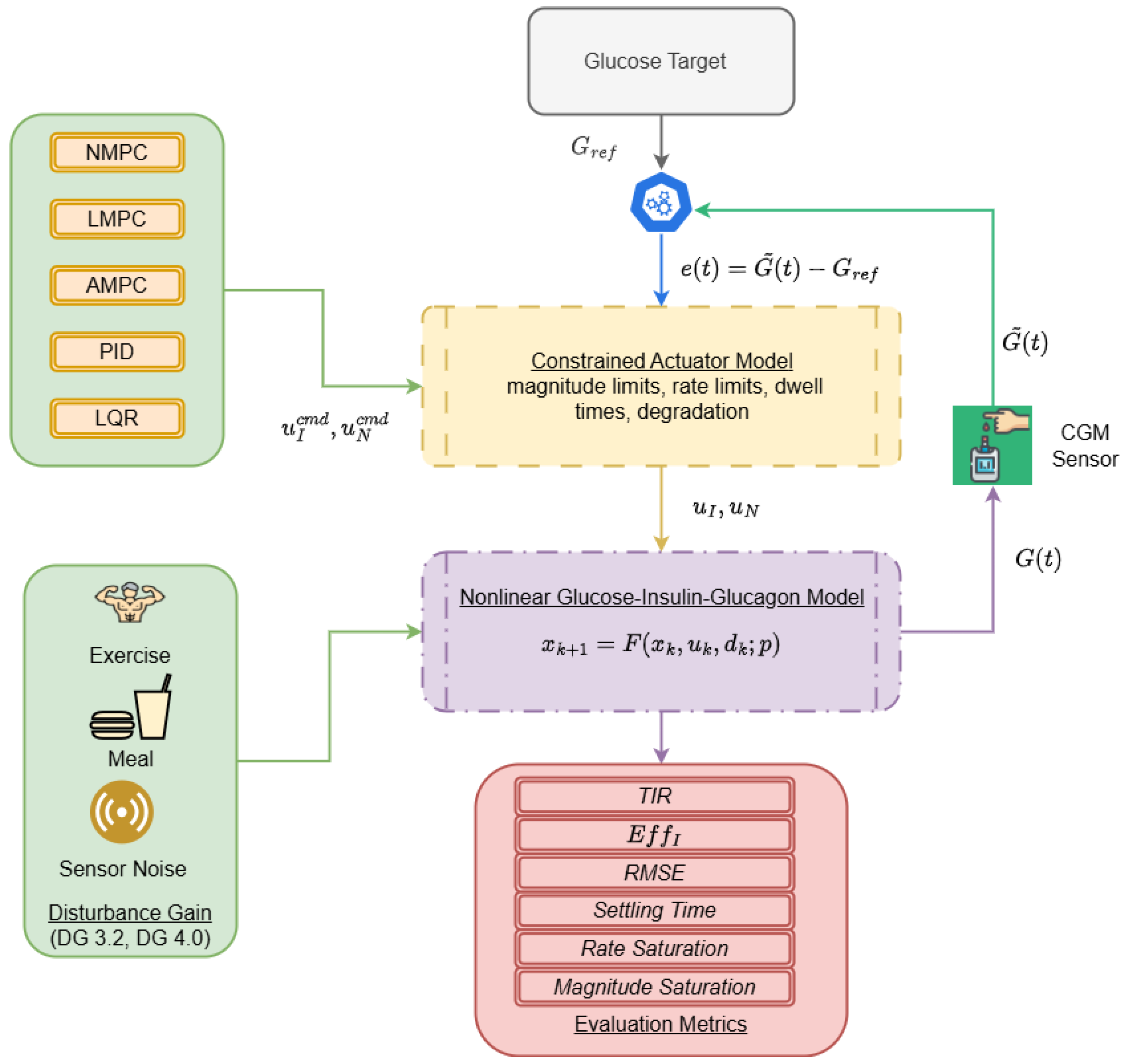
The components of the closed-loop system and their interconnections are summarized schematically in
Figure 1 that couples a nonlinear glucose–insulin–glucagon model with constrained insulin and glucagon actuators and a family of controllers operating at a fixed sampling period
. The physiological core follows the structure of established compartmental models for type 1 diabetes, in which subcutaneous insulin kinetics, plasma insulin, glucagon dynamics, and glucose distribution are represented by coupled nonlinear differential equations [
15,
16,
17]. The continuous-time dynamics are written as
where
collects the dominant states for insulin absorption, insulin action, glucagon effect, and glucose turnover,
denotes insulin and glucagon infusion rates,
represents exogenous disturbances such as meals and exercise, and
p is the vector of subject-specific physiological parameters sampled from a clinically motivated variability distribution.
The measurable glucose concentration is obtained through an output map
which is consistent with standard decompositions into basal glycemia and delayed glucose compartments [
3,
16]. A representative structure is
with
the basal glucose level and
,
associated with delayed glucose dynamics. In practice, sensor-reported CGM values also include lag and noise that are handled in the controller design and scenario construction [
18].
For numerical simulation and controller implementation, the continuous-time model is discretized with sampling period
. Denoting
,
, and
, the discrete-time dynamics are
where
is obtained by numerically integrating the continuous-time model over a single sampling interval. The same discrete-time representation is used inside the predictive controllers (possibly in a linearized form) and in the high-fidelity plant simulation. This choice ensures that differences in performance are attributable to the controller structure and actuator interaction rather than to artificial model mismatch between prediction and plant.
The insulin and glucagon actuators are modeled explicitly with magnitude and rate constraints that reflect practical infusion-pump limits [
19,
20]. At each time step, the commanded input
is mapped to the delivered input
by enforcing
where
implements the insulin capacity
and
is typically nonnegative in the dual-hormone setting. The hardware also limits the rate of change of the infusion,
with
and
determined by the maximum actuation speed of the pump mechanisms. These limits are implemented through projection operators that clip and rate-limit the requested commands, so that
where
and
encapsulate magnitude bounds, rate-of-change limits, and dwell-time logic consistent with advanced pump algorithms [
20].
To capture temporal characteristics of the actuators, minimum on and off durations are enforced. For insulin, denoting the last switch-on time as
and the last switch-off time as
, the delivered input satisfies
and
with analogous conditions for glucagon. These dwell constraints prevent unrealistically rapid chattering that would be infeasible and potentially unsafe in physical pumps [
19]. Several actuator-centric diagnostics used in the analysis follow directly from this structure. The rate-limit occupancy for insulin is defined as
and the fraction of time spent near the rate boundary is
where
denotes the indicator function. Magnitude saturation is quantified by the fraction of steps during which the actuator remains stuck near its bounds for a nontrivial dwell window. In particular,
with an analogous definition for
. In the implementation, these quantities are computed using tolerances and moving-window criteria that match the numerical simulation code and provide the basis for the actuator-centric metrics reported later.
External disturbances
represent the combined effects of meals, exercise, and unmodeled variability. For each scenario, a nominal disturbance template
is scaled by a disturbance-gain parameter
,
where DG3.2 and DG4.0 correspond to two severity levels. The stress scenario combines multiple meals, exercise-induced glucose uptake, and sensor-like noise, consistent with prior work on exercise and closed-loop performance [
21]. The saturation scenario emphasizes large, rapid perturbations designed to engage the actuator limits.
Mechanical degradation of the insulin actuator is modeled through an effective scaling of the delivered insulin by a degradation factor
,
while the controller continues to compute commands based on the nominal actuator model. Values
represent loss of dynamic range or under-delivery that may arise from mechanical wear, partial occlusion, or reduced pump efficiency [
13,
19]. In the
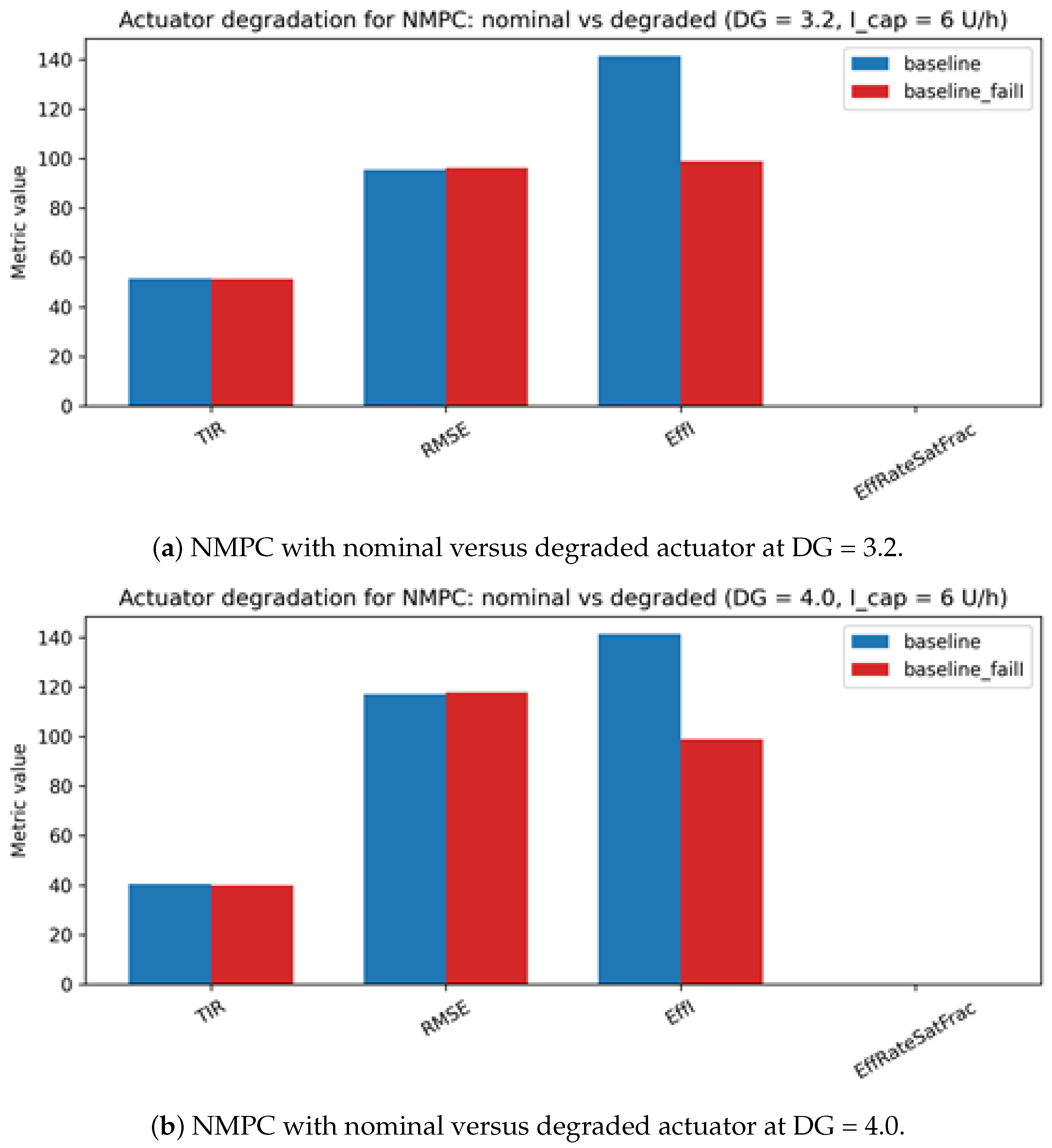
baseline_failI simulations, more severe failure patterns are considered, where the available insulin actuation is intermittently or persistently reduced, mimicking stuck or under-delivering actuators. Comparing DG3.2 and DG4.0 with and without such degradation yields the nominal-versus-degraded profiles used in the actuator-failure analysis.
Five controllers are evaluated within this unified framework: NMPC, LMPC, AMPC, PID, and LQR. All operate at the same sampling period, share a common reference glucose level
, and interact with the same actuator model described above. The NMPC controller uses the predictive model
to optimize a sequence of future control moves over a prediction horizon
and a control horizon
. At each time step
k, it solves
subject to the discrete-time dynamics and actuator constraints, with cost
where
denotes the predicted glucose at step
conditioned on information up to time
k, and
,
,
,
, and
are tuning weights [
16,
17]. The incremental terms
penalize aggressive changes and implicitly reduce pressure on rate limits. The optimization is constrained by
with bounds and rate limits on
and
that mirror the physical actuator.
The LMPC controller is obtained by linearizing the dynamics around a nominal operating point
,
where
and
. A quadratic cost analogous to
is solved over the same prediction and control horizons, with the same actuator bounds, yielding a computationally lighter yet anticipatory design [
17]. The AMPC introduces modeled parameter mismatch and periodically updates its internal model or weighting matrices based on observed tracking performance, thereby improving robustness to inter- and intra-patient variability while retaining the same actuator interface.
The PID and LQR controllers provide classical non-predictive baselines. The PID controller operates on the measured glucose deviation
according to
with gains tuned using standard procedures and additional logic to allocate glucagon delivery [
8]. The LQR controller uses a linearized state-space model and applies state feedback
with
obtained from the discrete-time Riccati equation for chosen state and input weights [
22]. In both cases, the commanded inputs are passed through the same projection operators
and
, ensuring that any saturation or rate-limit events arise from an identical actuator model across all controllers.
This model unifies the nonlinear physiology, constrained actuators, disturbance, and degradation modeling with a consistent set of controllers; it forms the basis of the multi-scenario evaluation developed in the following sections. Implementation-level details of the evaluated controllers, including solver structure, constraint handling, and tuning logic, are summarized in
Appendix A.
4. Experimental Design and Evaluation Metrics
The experimental design is a structured, cohort-based approach comparing each controller in terms of performance on multiple virtual subjects and in varied disturbance conditions. The objective of this comparison is to summarize the robustness of glycemic performance, actuator feasibility, and sensitivity to degradation under diverse physiological and constrained mechanical operating regimes. In all,
virtual subjects are created by sampling physiological parameters from a distribution
generated from validated variability models, such that the
i-th subject is described by
capturing heterogeneity in insulin sensitivity, glucose turnover, endogenous production, compartmental delays, and subcutaneous kinetics. A unified sampling period
is used for all controllers, and each simulation spans a horizon of
hours. For each controller
c, scenario
s, and subject
i, the simulation produces a closed-loop trajectory
where
denotes the number of discrete time points determined by
and
. All controllers share identical actuator constraints, disturbance realizations, and initial conditions, so that differences in performance arise from controller structure and actuator interaction rather than from unequal experimental conditions.
Disturbance and degradation modeling follow the structure introduced in the system model. Each scenario is constructed by injecting a disturbance profile
that is scaled by a disturbance-gain parameter
:
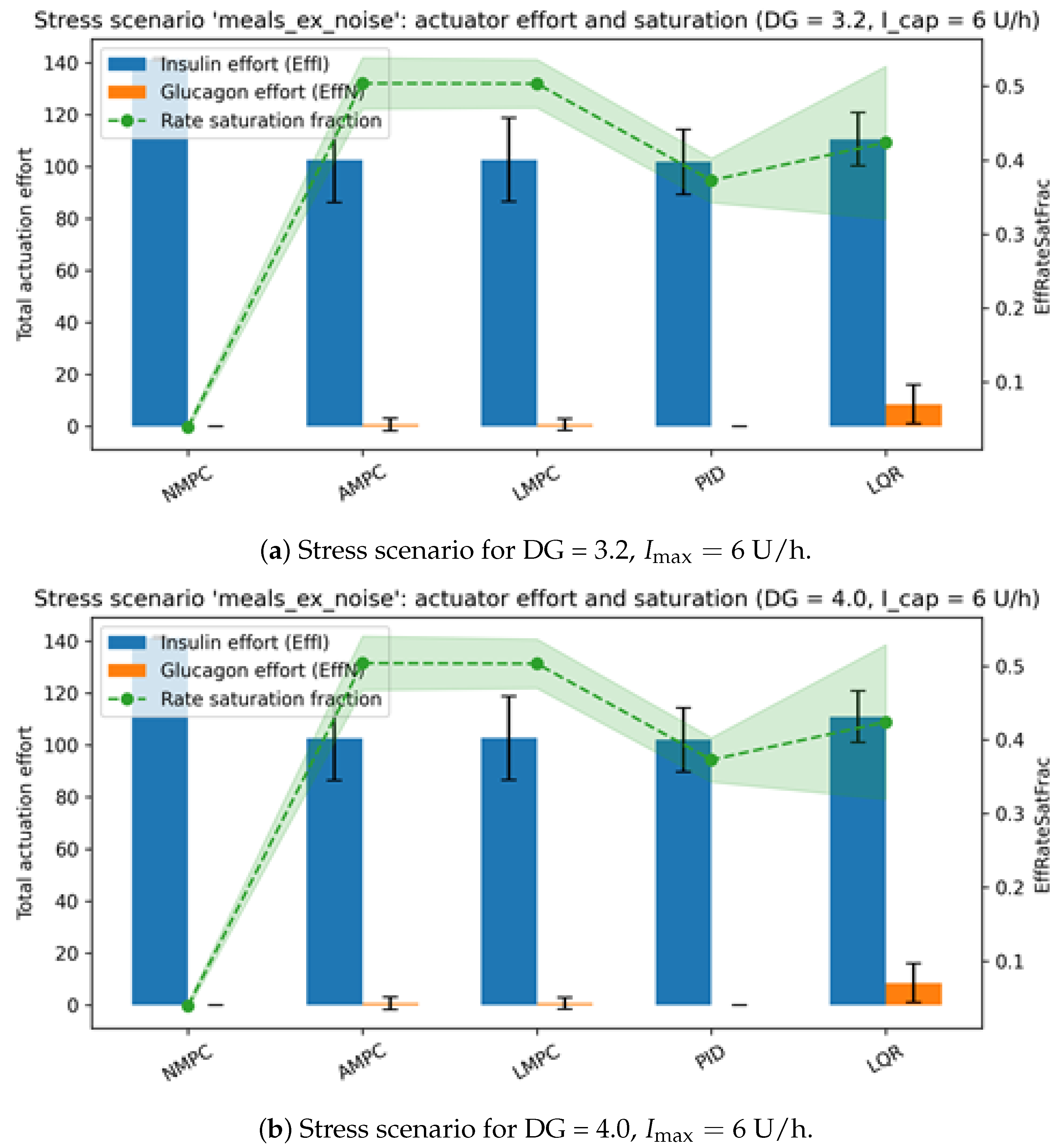
with DG3.2 and DG4.0 representing two disturbance-severity levels. The stress scenario (
meals_ex_noise) combines multiple meal events, exercise-induced glucose uptake, and sensor-like noise, where the measurement is corrupted according to
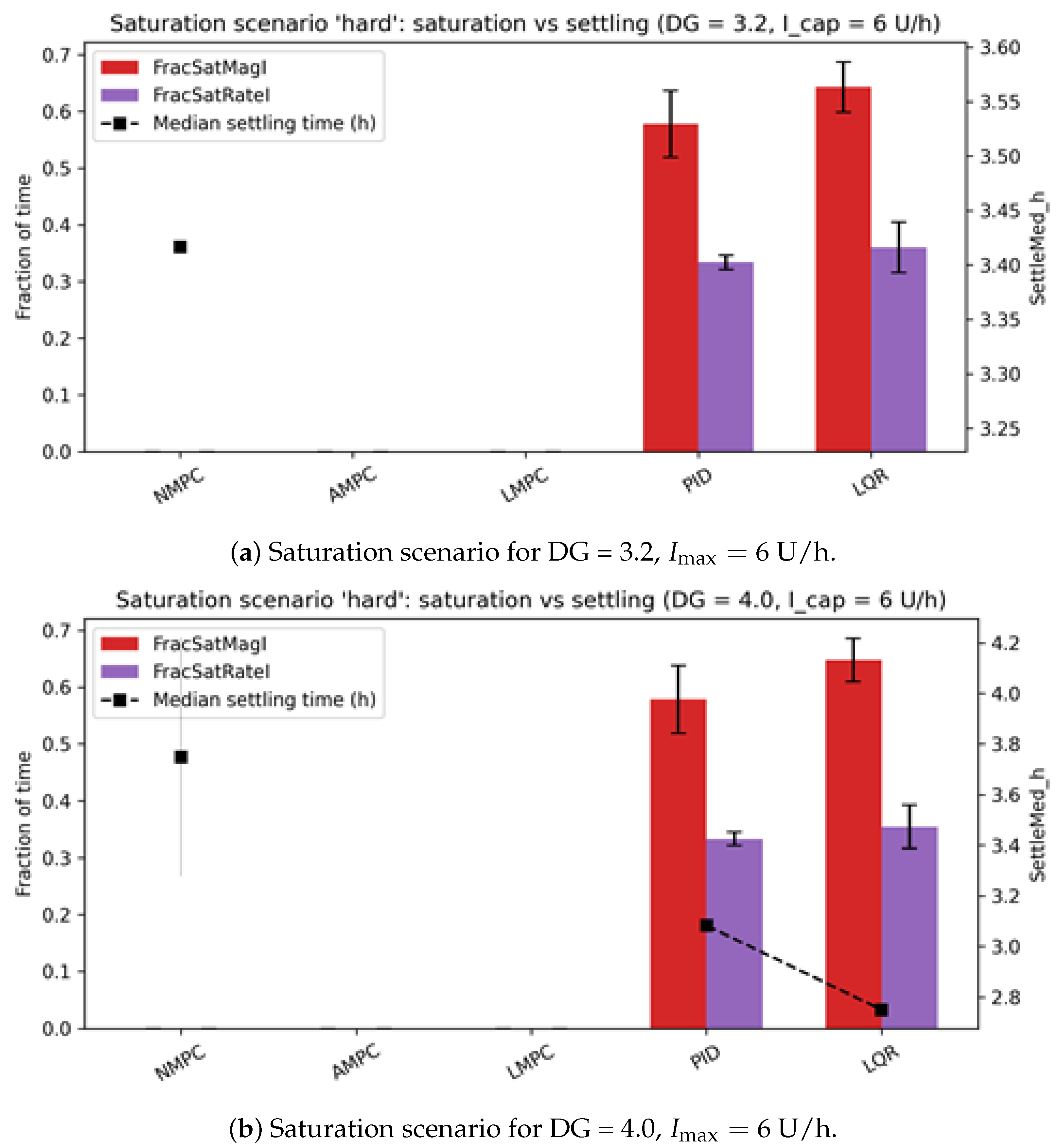
The saturation scenario (
hard) emphasizes large, rapid perturbations that more frequently drive the actuators into magnitude and rate limits. Mechanical actuator degradation is modeled by scaling insulin delivery with a degradation coefficient
,
while the controller continues to compute commands using the nominal actuator model. In the
baseline_failI variant, more severe failures are considered by intermittently forcing
over selected intervals, mimicking stuck or severely under-delivering actuators. Comparing DG3.2 and DG4.0, with and without such degradation, yields the nominal-versus-degraded curves used in the failure analysis.
For each scalar metric
m computed from a trajectory
, the cohort mean for controller
c and scenario
s is defined as
with associated sample standard deviation
Assuming approximate normality of cohort summaries, a two-sided
confidence interval is reported as
where
is the appropriate Student-
t quantile. Pairwise comparisons between two controllers A and B make use of paired Wilcoxon signed-rank tests on subject-wise differences
,
with effect sizes quantified via the rank-biserial correlation
where
and
denote the sums of positive and negative signed ranks, respectively. Rank stability across scenarios is assessed using Spearman correlation,
which measures how consistently each controller’s position in the performance hierarchy is preserved when the disturbance regime changes.
Glycemic performance is characterized by TIR and excursion metrics computed from the glucose trajectory
. For a band
, the TIR is defined as
with particular interest in
,
, and a tight band
mg/dL. Time above range (TAR) and time below range (TBR) are defined analogously by replacing the indicator condition with
or
. Cumulative deviation from normoglycemia is measured through an area-under-the-curve functional,
where
denotes the time increment between samples. Tracking accuracy is quantified by the root-mean-square error
with
typically chosen near 110 mg/dL. Settling time is defined as the earliest time
such that
where
corresponds to a 30-min window at the chosen sampling period, providing a robustness margin against transient re-excursions.
Actuator-effort and mechanical interaction metrics complement these glycemic indices. Total insulin effort over a simulation is
with an analogous definition for glucagon effort
. A basal-adjusted insulin effort is computed as
where
is an estimate of the subject’s basal rate. This quantity highlights oscillatory or bursty actuation that deviates from baseline delivery. Rate-limit utilization is quantified through
and near-rate occupancy is defined as
Magnitude saturation is detected when the actuator output remains close to its limits over a dwell window
, for example
with an analogous definition for
. In the implementation, the approximate equality and constancy conditions are enforced using numerical tolerances and moving-window statistics that align with the actuator model described in
Section 3.
The overall evaluation pipeline can be summarized as follows. First, a cohort of subjects is sampled from . For each disturbance scenario (stress, saturation, and actuator degradation), a disturbance profile and noise realization are generated and held fixed across controllers. Each controller is then simulated for every subject and scenario, yielding trajectories from which glycemic and actuator-centric metrics are computed. Cohort means and confidence intervals are assembled into summary tables, and nonparametric statistical tests with corresponding effect sizes are used to compare controllers on key metrics such as , , , and . Finally, rank-stability analysis across DG3.2 and DG4.0 conditions reveals whether the ordering of controllers is preserved when disturbance intensity and actuation workload change.
Table 1 summarizes the principal simulation parameters used uniformly across all experiments.
6. Conclusions and Future Directions
The present work demonstrates how the performance of AID systems is defined not only by the quality of physiological modeling or the sophistication of control algorithms, but also by physical constraints and the dynamic behavior of the actuation hardware. From a unified assessment of the performance of five representative controllers in stress, saturation, and actuator degradation scenarios, it emerges that NMPC can maintain a stable glycemic regulation under conditions wherein the actuators represent the dominant limitation. Predictive structure decreases reliance on sharp control modifications, distributing insulin effort more smoothly, which keeps promising clinical metrics under strong perturbation and partial capacity loss of the actuator. By comparison, PID, LQR, AMPC, and LMPC show far greater deterioration for either aggressive disturbances or mechanically constrained operating conditions.
These controllers more frequently, and for longer periods of time, engage rate and magnitude limits, with longer settling times and higher subject-to-subject variability. Where the classical and linear predictive controllers perhaps appear competitive in milder or nominal conditions, this analysis shows that glucose metrics alone can mask more fundamental mechanical instabilities that arise only upon perturbation or partial degradation of the hardware. The results reinforce that actuator behavior is not an implementation detail, but rather a central component in the performance of closed-loop systems. Moreover, the results underpin the value of embedding realistic actuator models into controller design and performance analysis. Explicit inclusion of rate limits, magnitude ceilings, and degradation effects enabled simulations to disclose subtle yet clinically significant interactions between controller logic and actuator capability. This perspective naturally supports the development of actuator-aware evaluation protocols, extending traditional clinical metrics with measures of mechanical efficiency, rate-limit occupancy, and saturation dwell. An analogous approach, too, is naturally complemented by an increasing emphasis on device safety, longevity, and resilience in next-generation AID architectures. Several natural directions for further research emerge from this work.
Controllers that adapt to actuator degradation through updating internal constraints, prediction models, or optimization penalties as the actuator ages or the effective range is lost present one clear avenue, particularly when degradation manifests as time-varying efficiency, intermittent delivery limitations, or gradual loss of dynamic range observed in practical infusion hardware. Such adaptation mechanisms would allow controllers to redistribute control effort smoothly as actuator capability evolves. Co-design of hardware together with control algorithms offers another direction in which actuator specifications and controller dynamics can be optimized jointly rather than being considered separate subsystems. The further development of disturbance modeling to account for variable exercise intensity, sensor dropout, ketotic excursions, and stochastic absorption delays would widen the applicability of the insights developed from an actuator-centric perspective. Translation of the proposed actuator-aware metrics and evaluation framework to hardware-in-the-loop experiments or early clinical studies would enable direct comparison between simulated and physical actuator responses, helping to validate practical feasibility and refine regulatory relevance.