

Article

HASEL Actuators Activated with a Multi-Channel Low-Cost High Voltage Power Supply
1
School of Engineering, Design and Built Environment, Western Sydney University, 56 Second Avenue, Kingswood, NSW 2757, Australia
2
Department of Information and Electrical Engineering and Applied Mathematics, University of Salerno, Via Giovanni Paolo II, 132, 84084 Fisciano, Italy
3
Department of Electrical Engineering and Information Technologies, University of Naples Federico II, Via Claudio, 21, 80125 Naples, Italy
4
Department of Engineering and Sciences, Faculty of Technological and Innovation Sciences, Universitas Mercatorum, Piazza Mattei 10, 00186 Rome, Italy
5
Department of Engineering, Università degli Studi della Campania “Luigi Vanvitelli”, Via Roma 29, 81031 Aversa, Italy
*
Author to whom correspondence should be addressed.
Actuators 2025, 14(12), 601; https://doi.org/10.3390/act14120601
Submission received: 24 October 2025 / Revised: 2 December 2025 / Accepted: 3 December 2025 / Published: 8 December 2025
(This article belongs to the Special Issue Multifunctional Actuators: Design, Control and Integration)

Abstract

Hydraulically Amplified Self-Healing Electrostatic (HASEL) actuators promise a future of adaptive robotics in a world where robotics is becoming increasingly integrated into our daily lives. Adaptive robotics needs to control multiple outputs with precision and speed. Unfortunately, expensive High Voltage control restricts the development of the HASEL actuator for commercial applications. This paper demonstrates a low-cost multi-channel High Voltage Power Supply (HVPS). The HVPS takes a 6 V input and controls multiple HASEL actuators from 0 to 10 kV, with a slew rate of up to 117.7 kV/s. In addition to controlling multiple channels, the low-cost HVPS can control two outputs with a single control module in an alternating pattern, similar to the way muscles control movement in alternating sequences—e.g., biceps and triceps. Previous work has shown that this low-cost HVPS is 95% cheaper than other power supplies used in the field of HASEL actuators. This work builds on the work reducing the cost of the HVPS by an additional 40%. This low-cost HVPS also reduces the amount of input required for control from four PWMs to one PWM with enable pins, drastically improving the performance of the device for multi-channel operation.

1. Introduction

HASEL (Hydraulically Amplified Self-Healing Electrostatic) actuators are an emerging technology in soft robotics that have grown in interest to researchers over the years [1,2]. They are made with a plastic pouch of liquid that has an electrode on either side. Applying a HV (High Voltage) to the electrodes, between 2 and 10 kV, generates an electrostatic force that can displace a load, producing a unique muscle-like force [3], as shown in Figure 1. HASEL actuators have shown promise in many applications including prosthetics and gripping mechanisms [1,2,4,5,6], wearable devices and active braille display [6,7,8,9,10,11,12], peristaltic pumps [7,13,14,15] and many more unique applications [16,17,18]. Apart from the HASEL actuators’ speed and versatility, one of the other major benefits is that they are made with very low-cost materials [4].
Unfortunately, controlling HV in a reliable manner is quite expensive [20]. HASEL actuators operate at high speeds, up to 120 Hz. To reach these speeds, the High Voltage Power Supply (HVPS) requires fast HV switching to charge and discharge the actuator quickly. HV benchtop power supplies provide this rapid switching with a wide range of HV. Of the higher-end HV benchtop power supplies, the most commonly used is the UltraVolt Amplifier [15,21] and the Trek HV Amplifier [7,10,16,22,23,24,25,26] from Advanced Energy; however, they are expensive and are often quite bulky.
A lightweight, lower-cost, open-source HV benchtop supply, called the Peta-Pico [6,25,27], was developed. Building on this open-source design, Artimus Robotics has its own HV benchtop supplies, including pocket-sized power supplies [28,29]. Despite the reduced cost, the supply was still quite expensive due to their reliance on commercial low-power DC-HVDC converters from EMCO HV supplies [15,25,30] to generate HV from 5 V.
Generating HV with passive components is quite low-cost. HV Capacitors, HV diodes and high-frequency transformers with large turn ratios make HV easy to generate [20]. Unfortunately, controlling HV often requires expensive components like HV optocouplers, the most commonly used one being the Voltage Multiplier Inc. Optocouplers [6,25,27,29,31]. Attempts have been made to create a HASEL actuator that operates at 1 kV, reducing the cost of components, but the design of the HASEL actuator has become much more complicated [23]. Other researchers use a resistive load to discharge the HASEL actuator passively [32]. However, this solution is limited because a large resistor discharges too slowly for HASEL actuators, and small resistors draw a larger current, resulting in significant power loss.
Recent work has developed a low-cost HVPS that controls the HV from the Low Voltage (LV) side of the transformer [20]. To achieve this, a secondary HV was used to produce a negative HV, which discharges the HASEL actuator. Thus, high frequency can be controlled with low-cost LV switching components. The main drawback is that a resistive load is still required to link the ground potential of charging and discharging circuitry, called a Ground Link Resistor (GLR).
This paper improves the design of the low-cost HVPS and presents a multi-channel design. With a 6 V input, this HVPS demonstrated an 8 kV output; however, larger voltages can be achieved with a higher GLR. As in the previous paper, driving the HASEL actuator with negative HV and secondary circuitry was found to increase its operating speed to an average of 16.057 Hz compared to the passive discharging speed of only 5.262 Hz. With this, a multi-channel HVPS design was demonstrated, where two HASEL actuators were controlled individually using low-cost HVPS. Additionally, it was shown that while the negative HV is discharging the HASEL actuator, it can simultaneously charge a secondary HASEL actuator, thus controlling two outputs with a single low-cost HVPS. This was achieved by connecting the second HASEL actuator to the negative charge side of the low-cost HVPS. So, while one is charging, the other is discharging. These HASEL actuators can be linked to enhance control over both extension and contraction simultaneously, which is particularly beneficial for prosthetic applications.
There are many key differences between the HVPS in this paper and the previous paper. The first difference is that the number of voltage step-up stages has been reduced: instead of having a boost converter and H-bridge on the low-voltage side, all that is required here is a flyback converter and an increased transformer turn ratio. The removal of these circuits also means that this circuit only requires one PWM compared to the previous four PWMs. This reduction in complexity makes this HVPS specifically suitable for multi-channel operation compared to the previous design.

2. Materials and Methods

The design of this HVPS consists of LV circuitry and HV circuitry. The HVPS is designed to be as low-cost as possible while maintaining fast discharge times. To achieve this, all the active switching components are on the LV circuitry, whereas the HV circuitry only uses passive components. The transition from LV to HV is achieved with a high-frequency high-turn-ratio transformer used in the previous design. This can be visualised in the block diagram in Figure 2.

2.1. LV Design

Unlike the previous low-cost HVPS, no initial LV boost converter and H-bridge circuitry were required. The H-bridge was the main switching circuitry of the previous design; in this design, a simple flyback converter was sufficient to generate the output. In place of the H-bridge IC, a low-side MOSFET, the IPD60R145CFD7ATMA, was used, along with a gate drive, the 1EDN8511BXUSA1. There were two flyback circuits for the positive HV and the other for the negative HV. The boost converter was required in the previous design to give an initial voltage boost up to 25 V. Instead, this design reduces the number of turns on the primary coil from 24 to 6; thus, only 6 V is required to power the HV. To do this, the wire gauge was increased from 24 AWG to 18 AWG to handle the higher current. As the flyback converter has no reverse voltage on the primary coil, a flyback diode should be placed on the primary coil to de-energise the magnetic field and avoid voltage spikes that can damage the circuitry. Adding a 6.8 V zener diode in series with the flyback diode means only voltage spikes will be suppressed. A snubber circuit should also be added to the MOSFET for fast switching protection. The reduction in required circuitry and components further simplifies and reduces the cost of the HVPS.
The switching for the HVPS was controlled externally with an external microcontroller, the ESP32. The gate drivers used two inputs to drive their output. One of the inputs was connected to a 20 kHz Pulse Width Modulation (PWM) signal. The other inputs were used as enable signals to control the positive HV and negative HV separately, massively reducing the complexity of the previous HVPS, which required four independent PWMs to control one output. Multiple outputs can be controlled with this single PWM signal, allowing all other ports to be used for controlling a separate HV output. Controlling the amplitude of the HV output can be achieved by varying the duty cycle of the PWM output. As we are using PWM, this will decrease the versatility of the HVPS.

2.2. HV Design

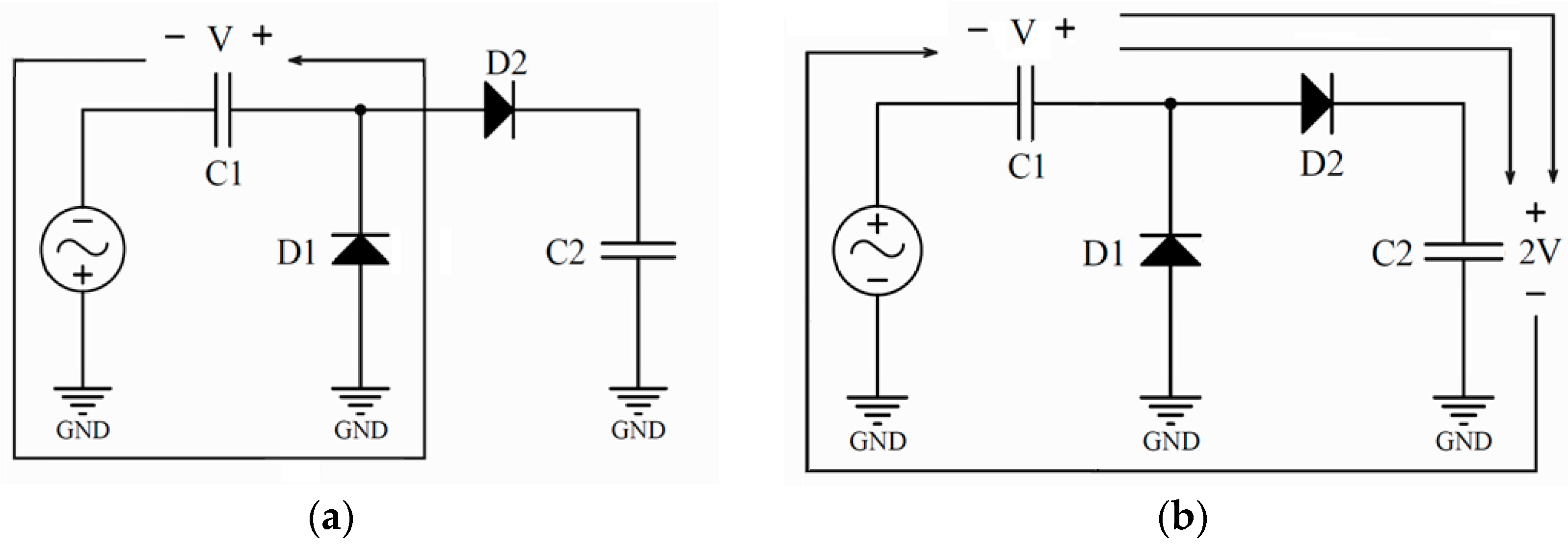
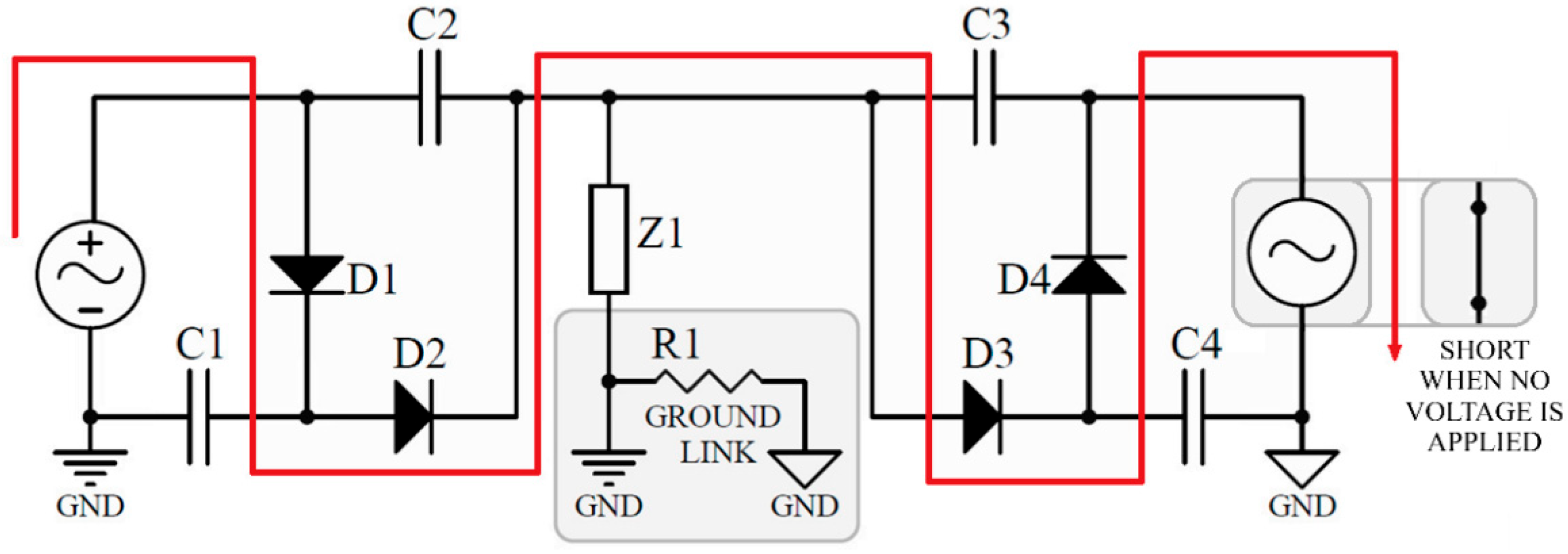
The High Voltage Alternating Current (HVAC) output from the secondary coil of the transformer is fed into a voltage multiplier circuit, which doubles the voltage at each stage, as shown in Figure 3. Depending on the location from which the output is probed, either a High Voltage Direct Current (HVDC) or an HVAC with a DC offset is generated. The output in Figure 3 demonstrates a positive HV output. Reversing the polarity of the diodes will generate a negative HV. For the HVPS, only two multiplier stages were used.
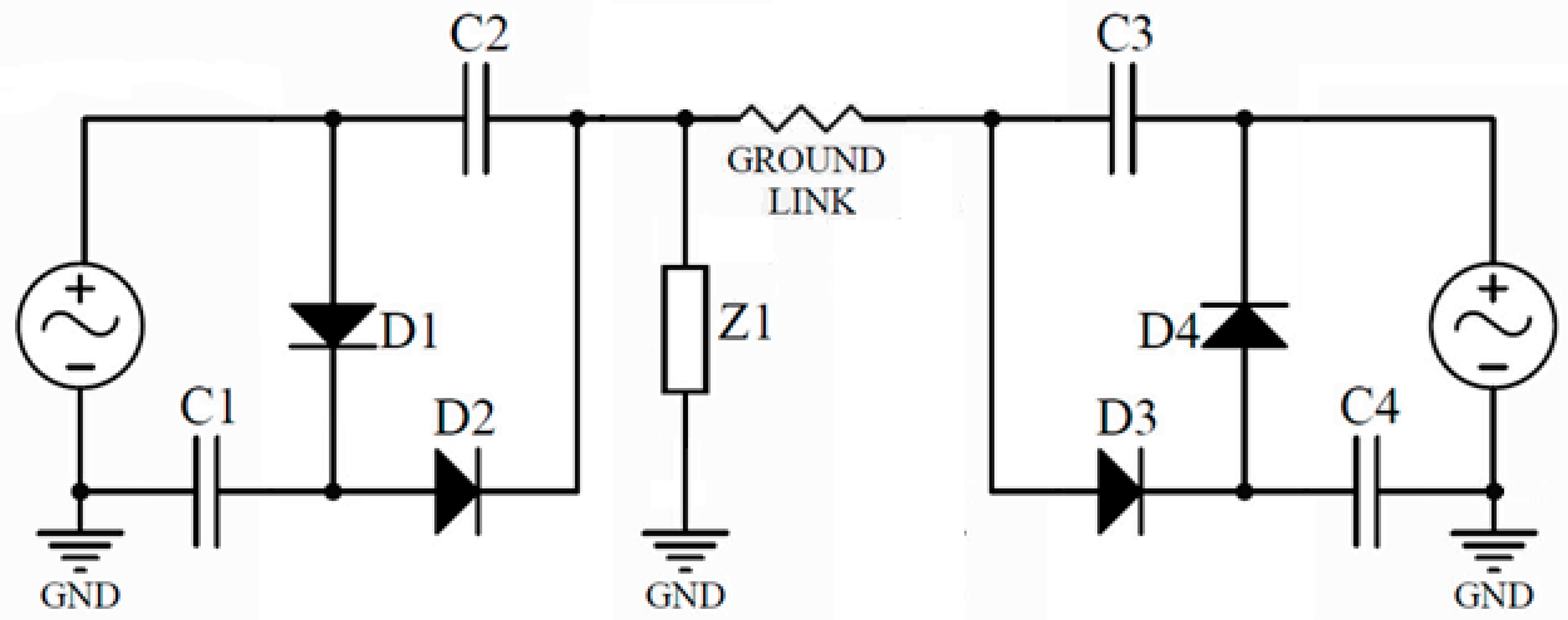
The purpose of the GLR is to link the ground potential of the positive and negative HV. Much like the previous HVPS, linking the outputs of a positive and negative HVDC creates a short return path for the HV to discharge instantly, so there needs to be a significant resistance to stop this, as shown in Figure 4. Placing a GLR between the positive and negative HVDC grounds links the ground while slowing the discharge. The negative HV provides active discharging of the positive HV through the GLR.
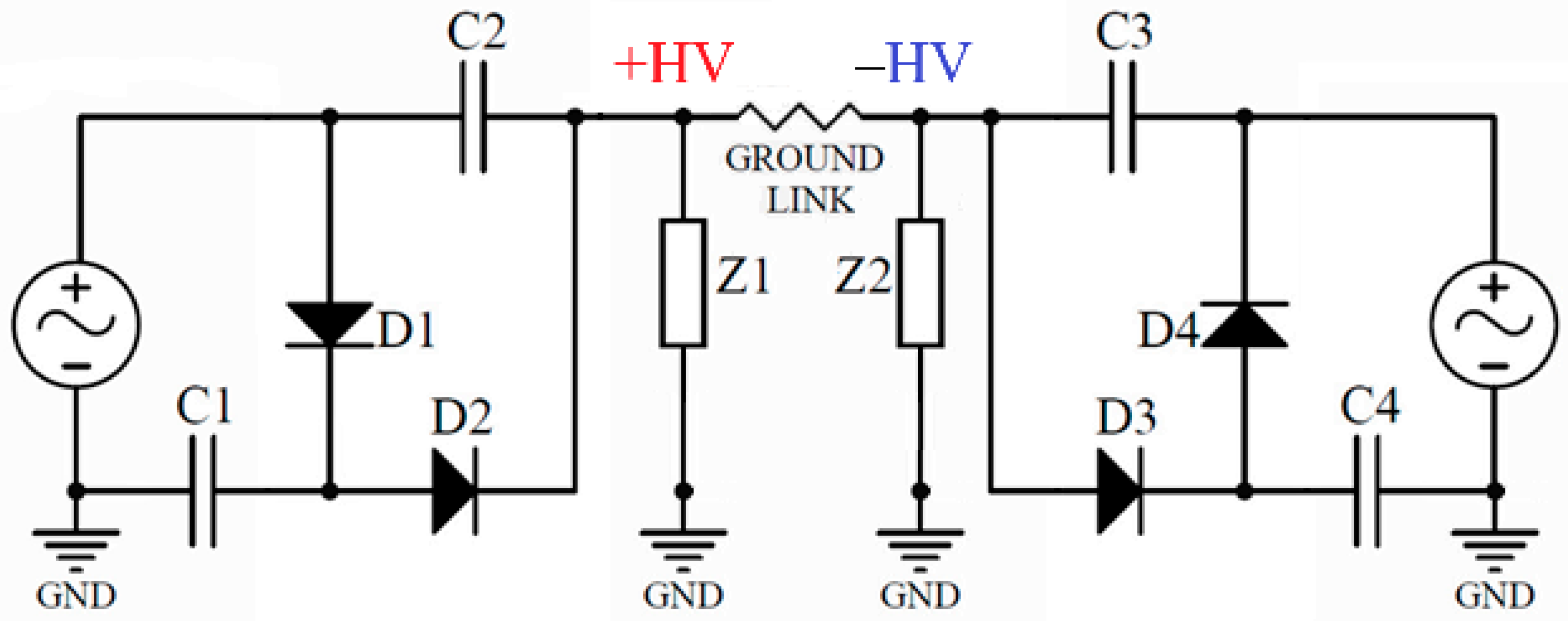
Simplifying the HVPS design, the GLR was moved in front of the voltage multipliers as shown in Figure 5. Now, the grounds can also be linked together. The GLR used for this HVPS was 60 MΩ based on the results from the previous HVPS design. Having such a high impedance means that not only can the negative HV discharge positive HV but it can also drive a secondary load (Figure 6). Thus, two HASEL actuators can be driven with a single HVPS module.

2.3. PCB Design and Assembly

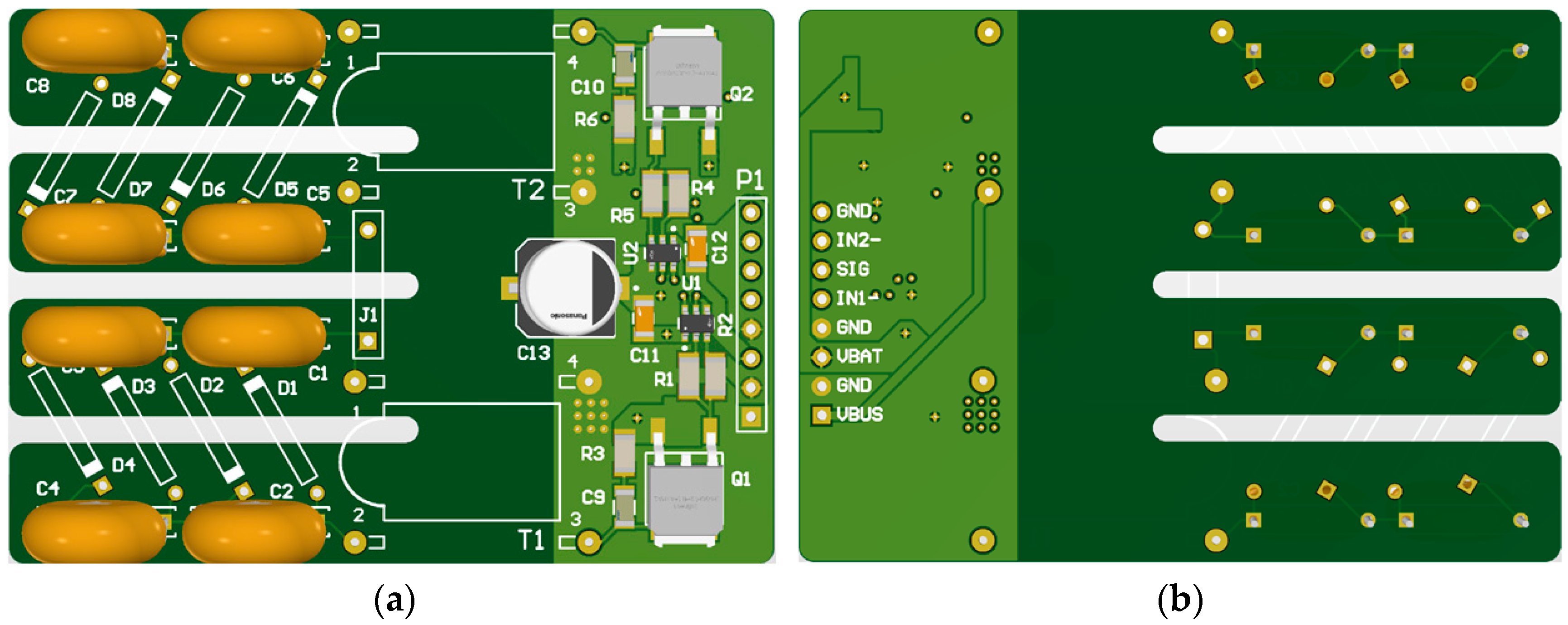
The PCB for the HVPS included many design considerations (Figure 7). Thicker tracks were used on the LV side, as higher currents were expected due to the transformer’s lower turn ratio. No polygon pour was applied to the HV side of the PCB to increase impedance further. Cuts were also designed into the board shape on the High Voltage side to increase impedance between the HV circuits.
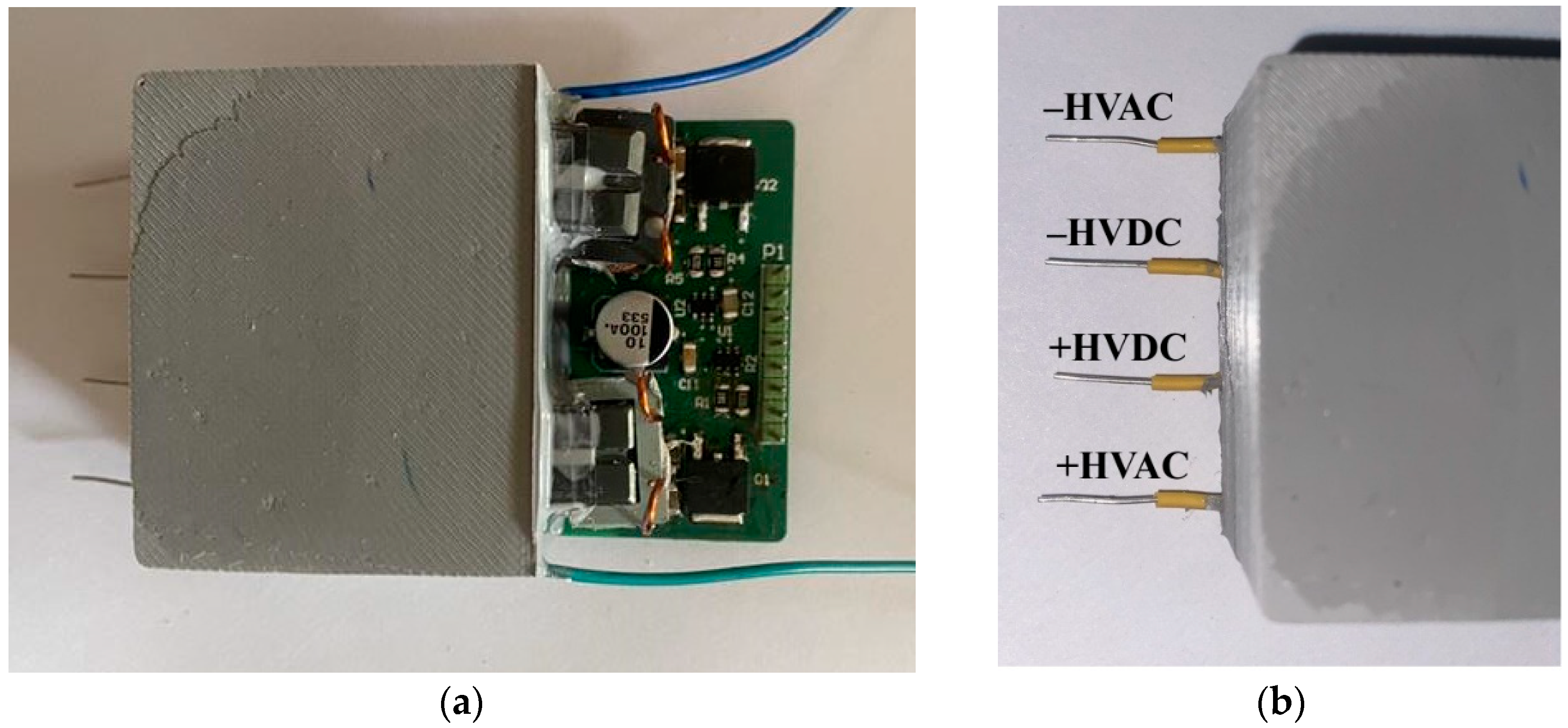
When assembling the HVPS, considerations were made to test as many aspects of the supply as possible. Once all the HV components were assembled, the HVPS was potted with a silicone potting mix to avoid shorting. Two grounds were configured outside the potting mix so they could be attached to the HASEL actuator; see the blue and green wires in Figure 8a. The positive and negative HVDC and HVAC were configured outside the potting mix, as shown in Figure 8b, where the HVAC is the input from the transformer with a DC offset equal to the HVDC. The HVAC was not required for testing. A 60 MΩ GLR was placed between the positive HVDC and the negative; however, a larger value could have been used if higher voltages are required.
This new HVPS design halves the cost of the HVPS compared to the previous design. Removing the boost converter and the H-bridge from the HVPS design reduced the LV component cost from USD 21.27, shown in Table 1, to USD 16.20, shown in Table 2. The newer HVPS design also reduced the potting volume, reducing the mix required from 176 g to 61 g, and reduced the PCB area from 66 × 111.8 mm2 to 66 × 48.1 mm2. This reduced the additional costs from USD 33.17 to USD 11.55. The cost of the HV components was unchanged from USD 4.12. The overall cost of the HVPS was reduced from USD 54.45 to USD 31.86.

2.4. Simulation Setup

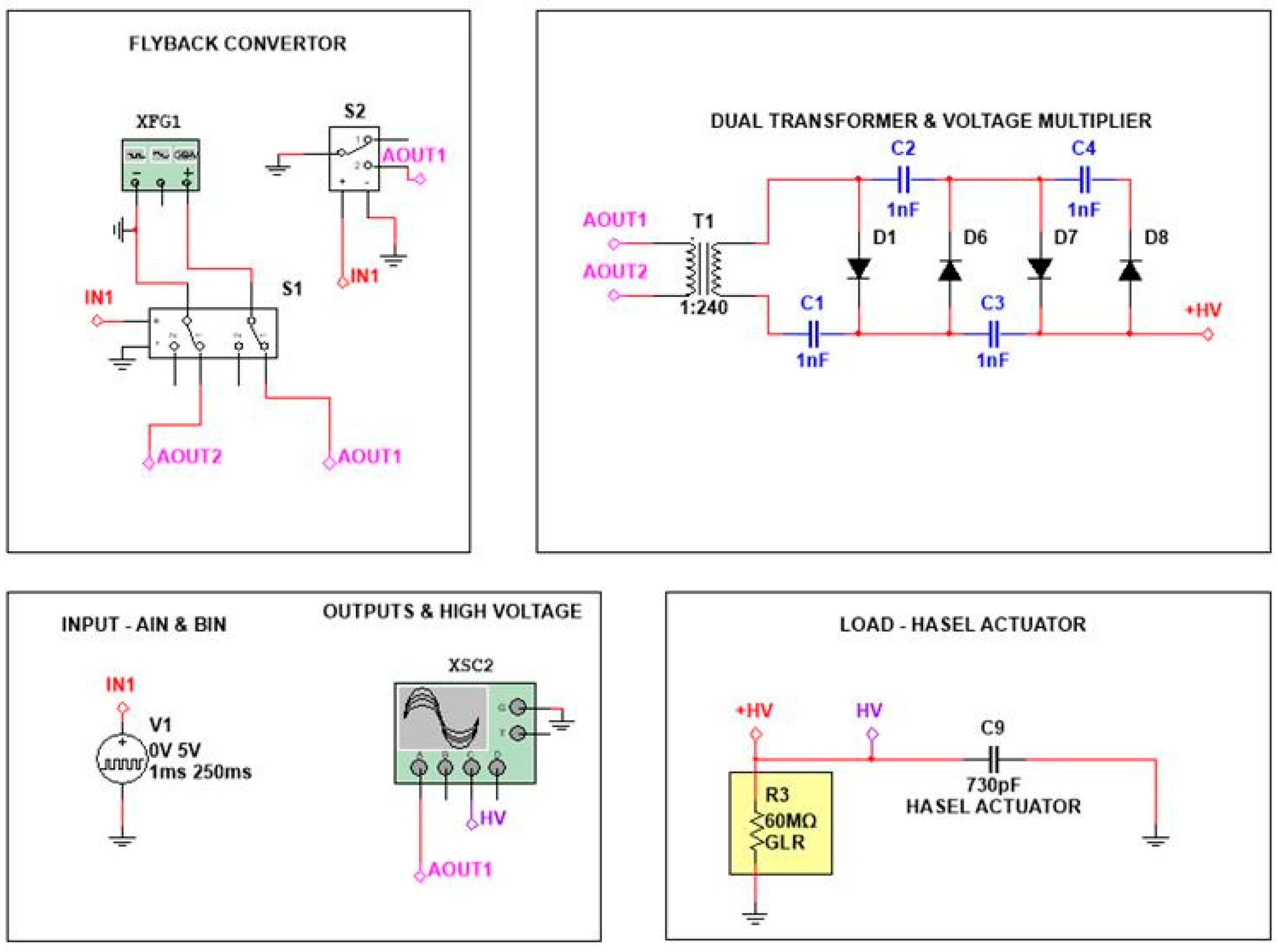
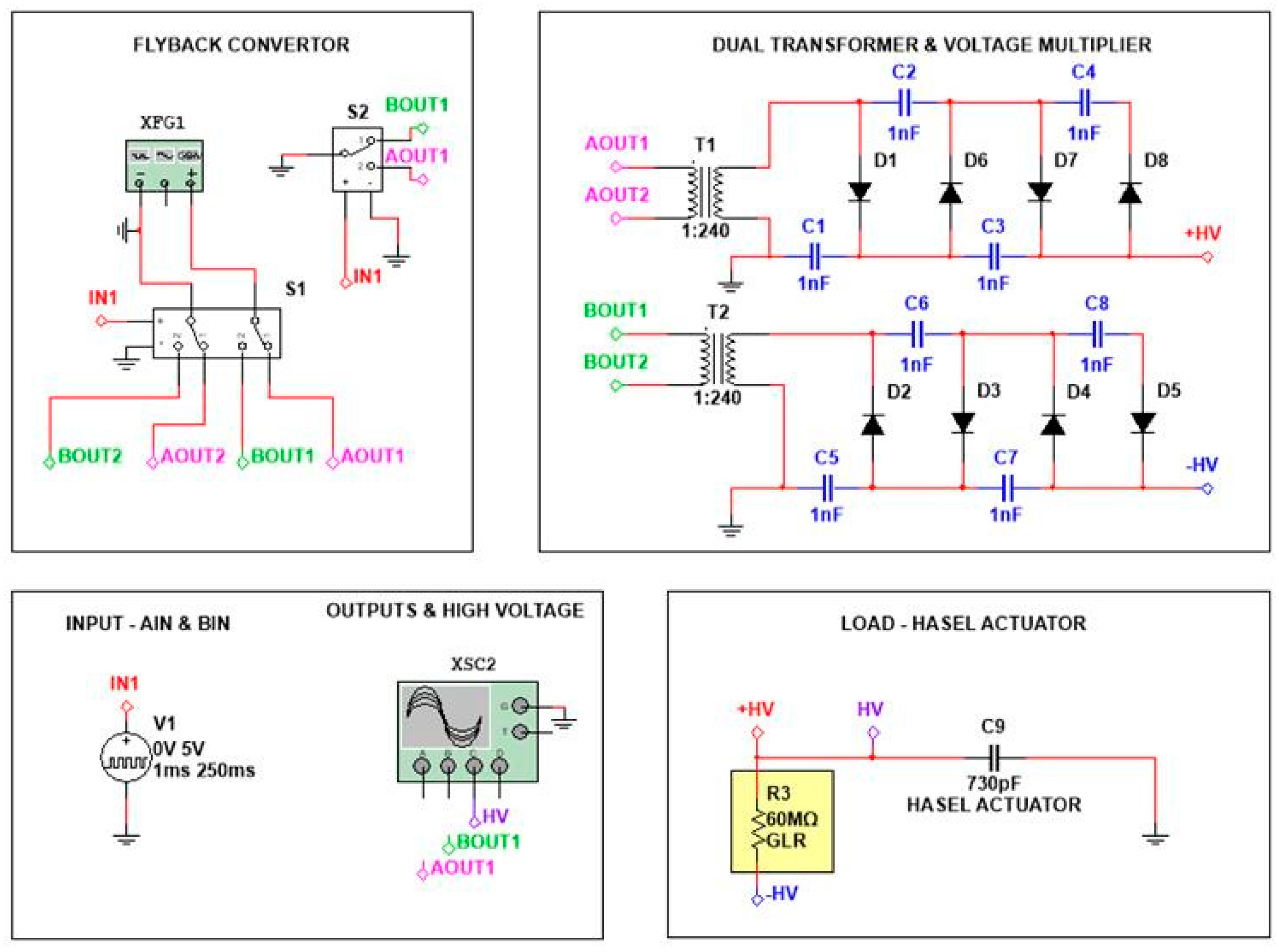
To demonstrate the improvements of the new design discussed above, a simulation was made with Multisim (Figure 9 and Figure 10). For the 6 V flyback converter, the PWM was simulated using the function generator, and the secondary input was simulated with a dual contactor S1 in Figure 9 and Figure 10 [20], where AOUT1 and AOUT2 drive the positive HV and BOUT1 and BOUT2 drive the negative HV. The PWM is driven at 20 kHz with a 50% duty cycle, demonstrating ideal conditions (the maximum in experimental results is 40%). S2 ensures circuits are off when not being used. In the previous paper, the transformer demonstrated a turn ratio of 60 to 1. With the 24 turns on the primary coil reduced to 6, this increased the turn ratio by a factor of 4, making the turn ratio 240 to 1. The output of the HASEL actuator was measured from the actuator used in the experimental results below, with the GLR connected between it and the ground. The results were measured with the oscilloscope feature. Figure 9 uses BOUT1 and BOUT2 to discharge the positive HV, demonstrating active discharge, while in Figure 10, BOUT1 and BOUT2 are removed, demonstrating the passive discharge circuit. The negative HV circuitry is also removed as it is essentially shorted in passive discharge mode.

3. Results

3.1. Simulated Results

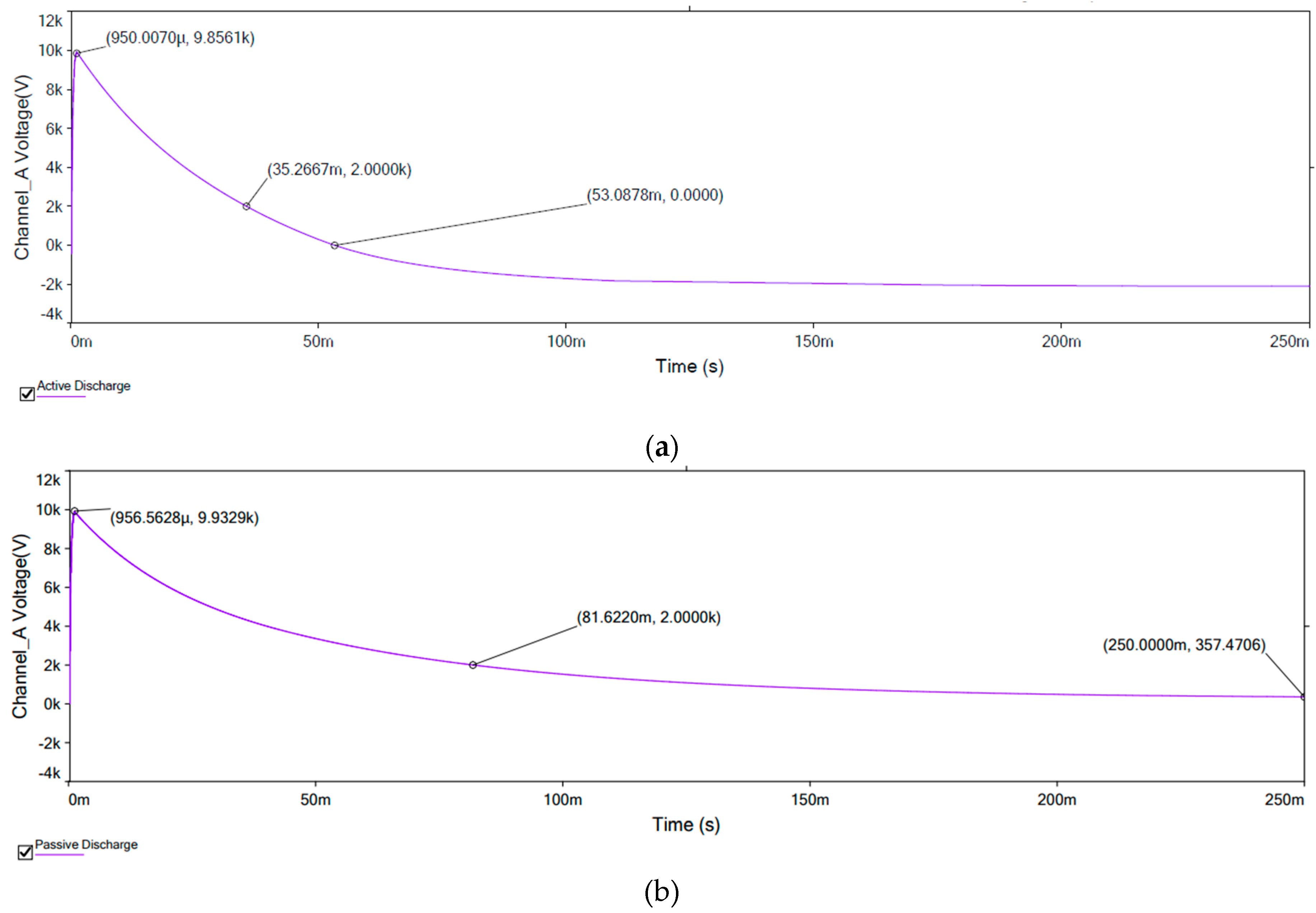
Simulated results demonstrated that the active discharge is much faster than passive discharge. The passive discharge to 2 kV took 81 ms, and after 250 ms, only discharged to 357.47 V (Figure 11a). On the other hand, the active discharge reached 2 kV in 35 ms and discharged to 0 V in 53.878 ms (Figure 11b), demonstrating that the passive discharge is 2.35 times slower than the active discharge. This simulation also demonstrated that the HVPS should reach around the 10 kV maximum driving voltage for the HASEL actuator. The simulated positive HV generated 9.856 kV and the negative HV generated 9.932 kV.

3.2. Tested Results

Testing the HVPS was performed using a B&K Precision PR 28A HV probe connected to a Rohde & Schwarz RTB2004 oscilloscope. To achieve steady results, a 6 VDC input voltage was supplied by the Rohde & Schwarz NGE100 programmable power supply. The gate driver required a 12 VDC supply to drive the MOSFET. The duty cycle was controlled using the ESP32 microcontroller.

3.2.1. Positive HVDC Output

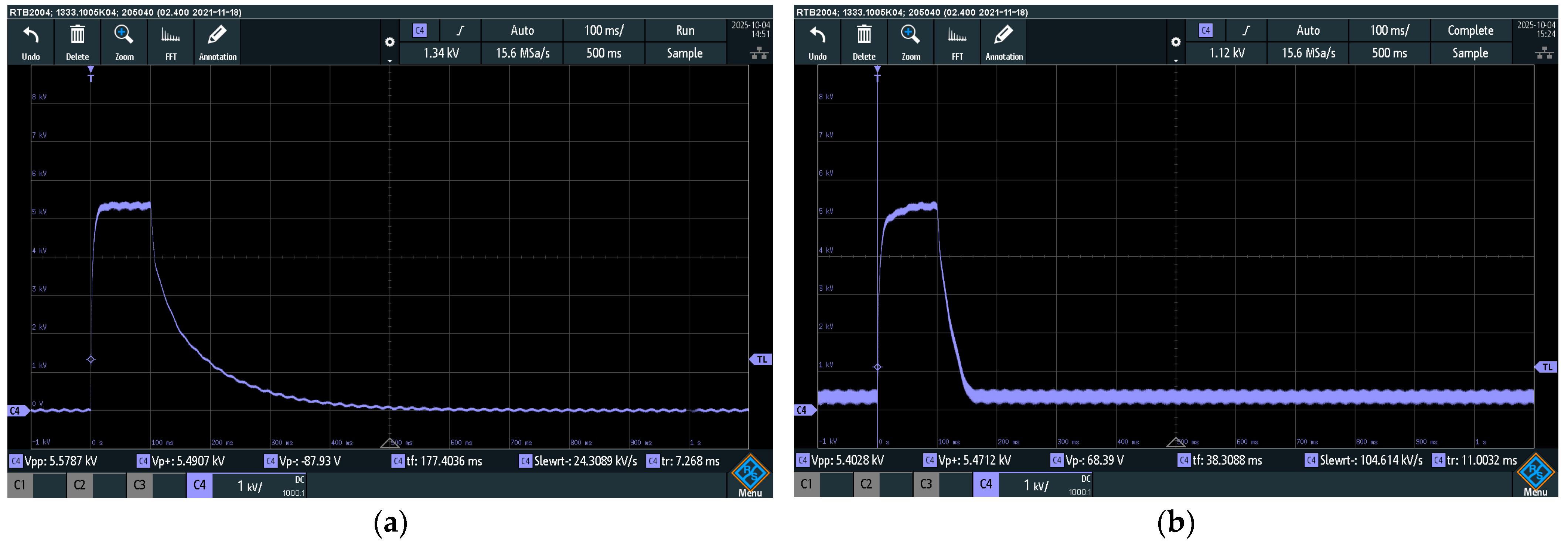
When charging and discharging the circuit, measurements were taken with a duty cycle between 2% and 40% in 2% increments. The HVPS was tested in two modes of operation. The first mode tested the positive HV charged for 100 ms, then passively discharged for 1000 ms. Therefore, the only discharge is through the 60 MΩ GLR. Figure 12a shows a screenshot of the HVPS in the first condition, with a 40% duty cycle. The long discharge time allows the circuit to fully discharge before the next charge cycle. The second mode tested the positive HV charged for 100 ms, then actively discharged with a negative HV for 1000 ms, allowing the positive HV to discharge again. Figure 12b shows a screenshot of the HVPS in the second condition, with a 36% duty cycle. At higher duty cycles, the circuit experienced thermal runaway.
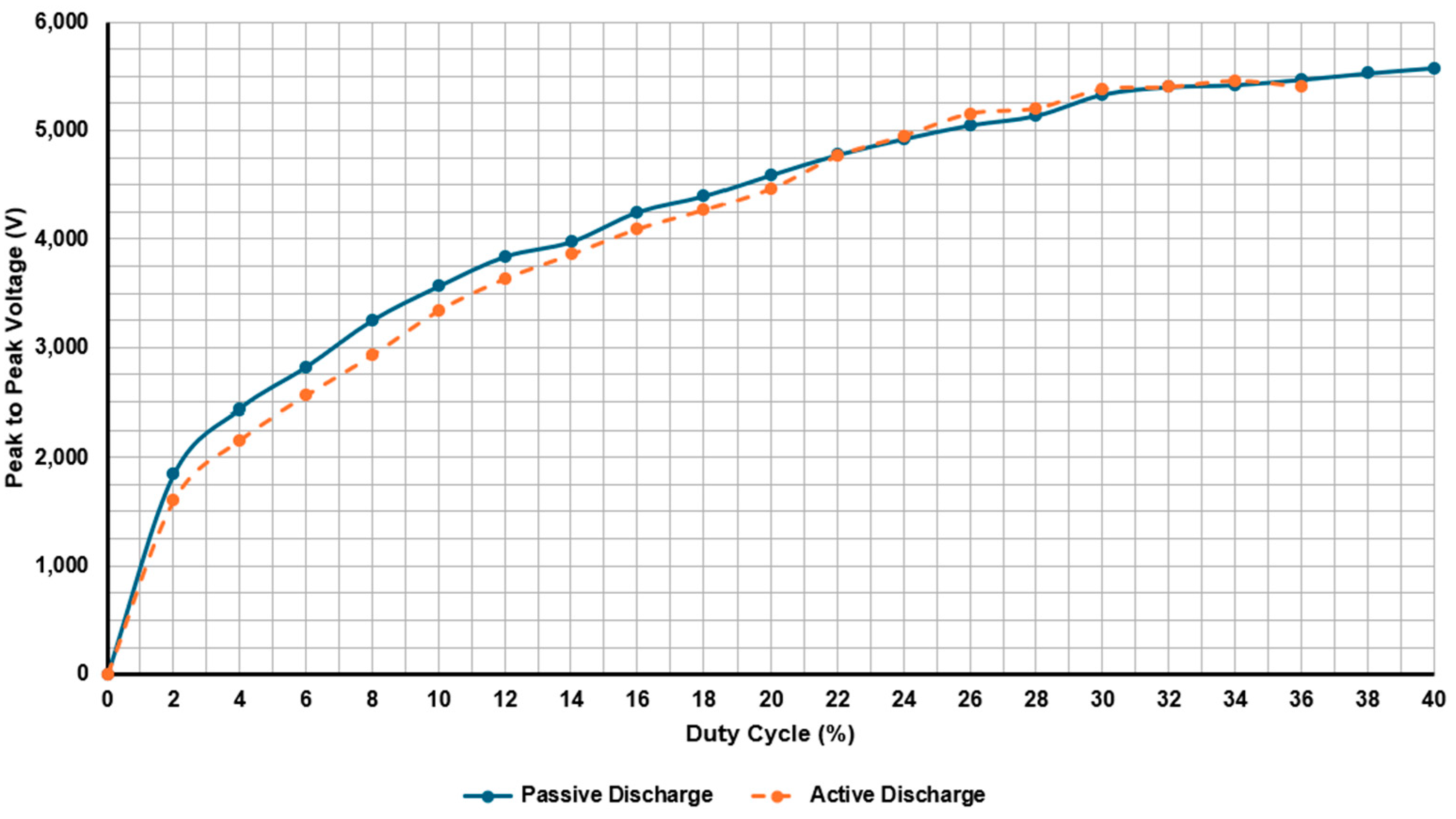
The positive HVPS generated similar maximum HV and peak-to-peak HV outputs for both active and passive discharge. The maximum voltage generated by the passive discharge was 5578.7 V, while the active discharge produced a maximum voltage of 5490.7 V, as shown in Figure 12a. Peak-to-peak voltage is also an important metric as it demonstrates whether the output can fully charge and discharge before each period. Figure 13 shows the range of peak-to-peak voltages for both active discharge and passive discharge as the duty cycle increases from 0% to 30%. The active discharge mode has a similar output compared to the passive mode with a peak-to-peak voltage of 5402.8 V and a maximum voltage of 5402.8 V (Figure 12b).
The most notable difference between the passive and active discharge modes is the rise and fall times. On the Rohde & Schwarz RTB2004 oscilloscope, the rise and fall times are measured based on how long it takes for the signal to rise from 10% to 90% of the signal amplitude and fall from 90% to 10% of the signal amplitude. For high-speed operations, these values need to be as low as possible. The rise time is the time it takes for the HV to charge, and the fall time is the time it takes to discharge. The results are displayed in Table 3. When in the passive discharge mode, the average rise time is 14.39 ms and the average fall time is 175.77 ms. When in active discharge mode, the average rise time is 27.79 ms and the average fall time is 38.55 ms. The charge time in the passive discharge mode is slightly faster than the active discharge, potentially due to the need to discharge the negative HV. Despite this, both charge times are relatively fast. The discharge time in the passive discharge mode is 4.6 times slower than the active discharge mode.
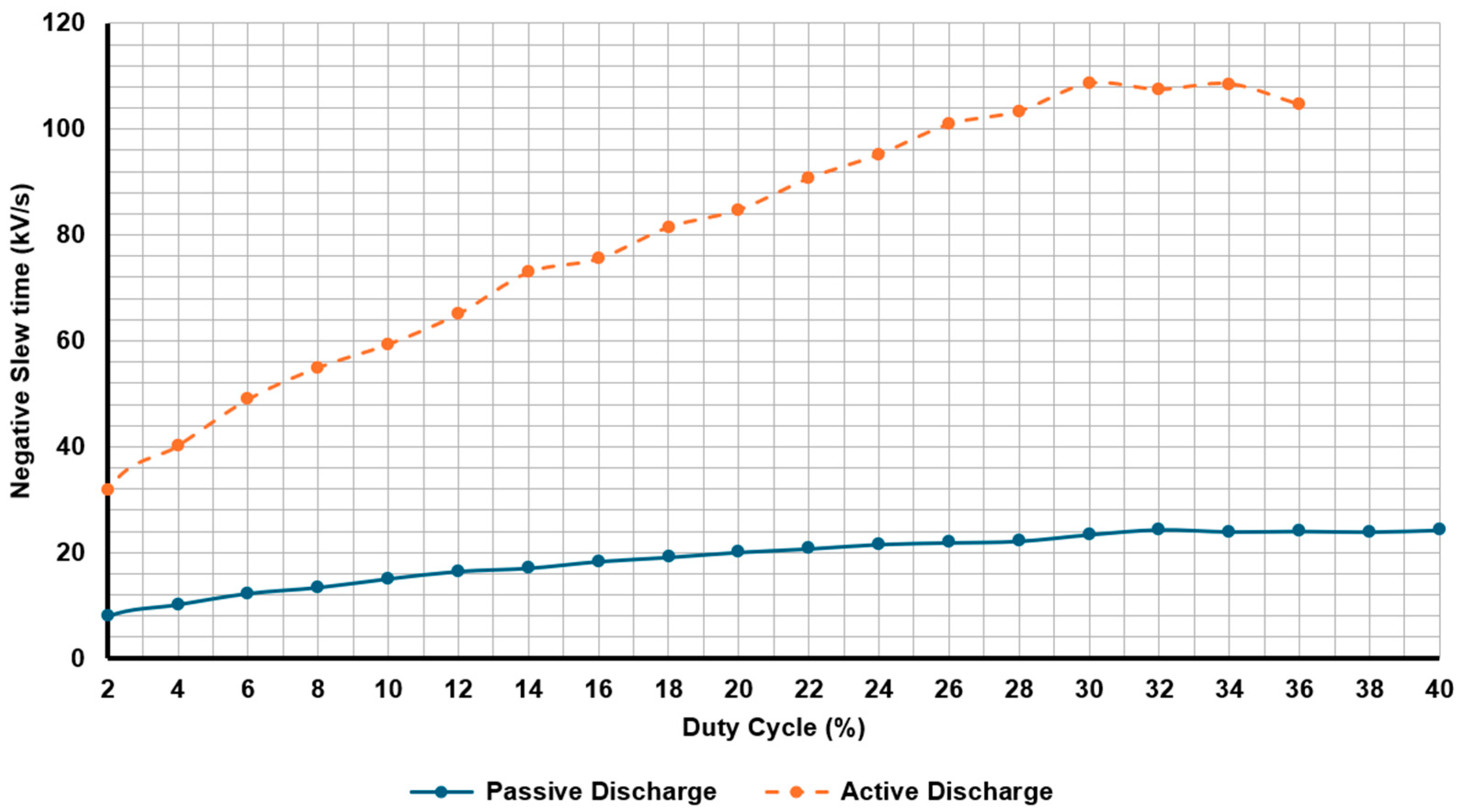
Another key indicator of the speed of signal is the slew rate. This measures the voltage change over the rise and fall time. The negative slew rate is the voltage change on the falling edge of the signal. Figure 14 graphs the negative slew rate of passive and active discharge mode as the duty cycle increases. The slew rate in the passive discharge mode increases gradually, where the gradient of the linear section is 0.512, with a maximum slew rate of 24.395 kV/s. The slew rate in the active discharge mode increases at a much steeper rate, with a linear gradient of 2.641 and a maximum slew rate of 108.626 kV/s. The linear gradient of the active discharge is 5.16 times that of the passive discharge, and the maximum negative slew rate of the active discharge is 4.16 times that of the passive discharge.

3.2.2. Negative HVDC Output

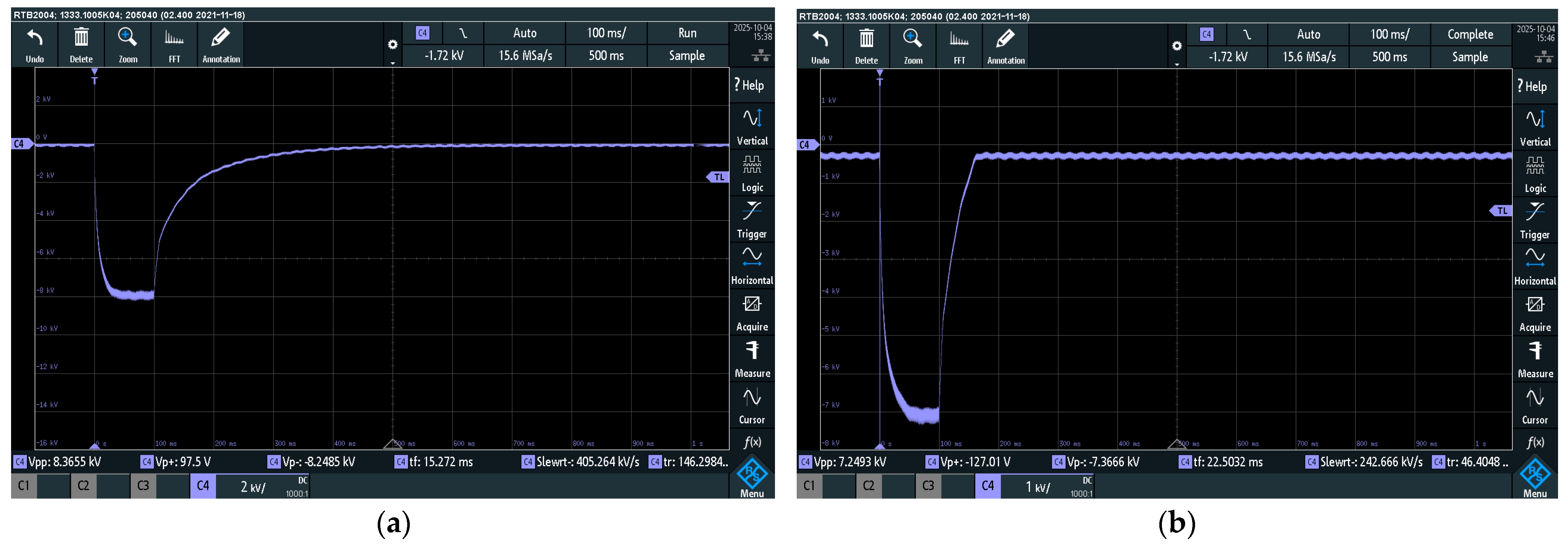
Measuring the negative HV is also important, as it can not only discharge the positive HV but it can also drive a second load. When charging and discharging the circuit, measurements were taken with a duty cycle between 2% and 30% in 2% increments. The circuit was not tested to 40%, as the negative HV was shorting above 30%. The HVPS was tested in two modes of operation as the positive HV. Figure 15a shows a screenshot of the HVPS in the first condition, with a 30% duty cycle. Figure 15b shows a screenshot of the HVPS in the second condition, with a 30% duty cycle. At higher duty cycles, the circuit experienced hermal runaway.
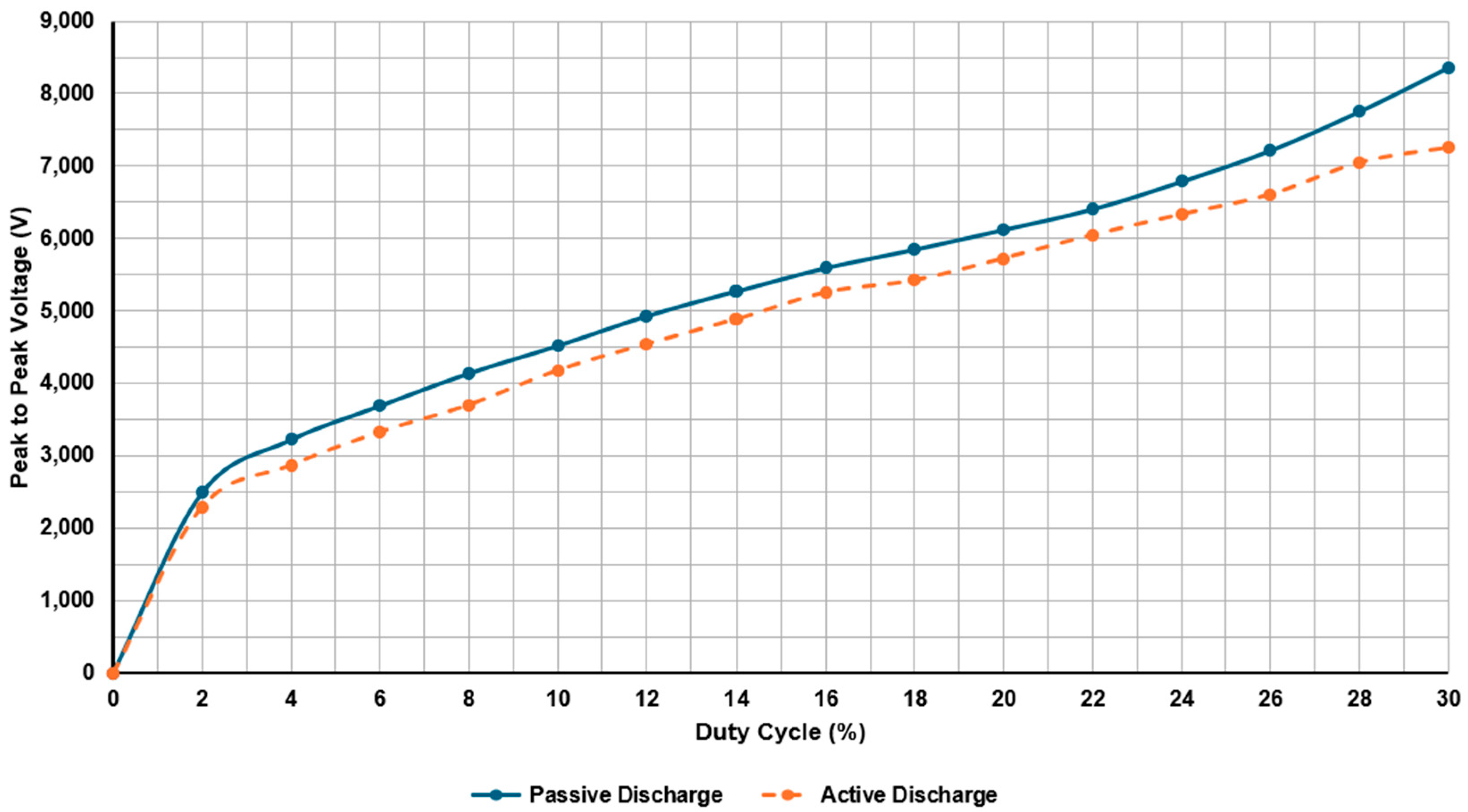
The negative HV generated similar maximum HV and peak-to-peak HV outputs for both active and passive discharge. The maximum voltage generated by the passive discharge was 8365.5 V, while the active discharge produced a maximum voltage of −8248.5 V, as shown in Figure 15a. Figure 16 shows the range of peak-to-peak voltages for both active discharge and passive discharge as the duty cycle increases from 0% to 30%. The active discharge mode has a slightly lower output compared to the passive mode with a peak-to-peak of 7249.3 V and the maximum voltage of −7366.6 V (Figure 15b).
Again, the key difference between the passive and active discharge modes is the rise and fall times. Here, the fall time is the time it takes for the HV to charge, and the rise time is the time it takes to discharge. The results are displayed in Table 4. When in the passive discharge mode, the average fall time is 17.69 ms and the average fall time is 166.69 ms. When in active discharge mode, the average fall time is 23.68 ms and the average fall time is 50.394 ms. Again, the charge time in the passive discharge mode is slightly faster than the active discharge, though it is much closer than the positive HV charge time. This is potentially because the positive HV that needs to be discharged is much smaller and takes less time. The discharge time in the passive discharge mode is 3.3 times slower than in the active discharge mode. The discharge time is slower than 4.6 of the positive HV. This could be due to the positive HV used to discharge; the negative HV is smaller, increasing the discharge time.
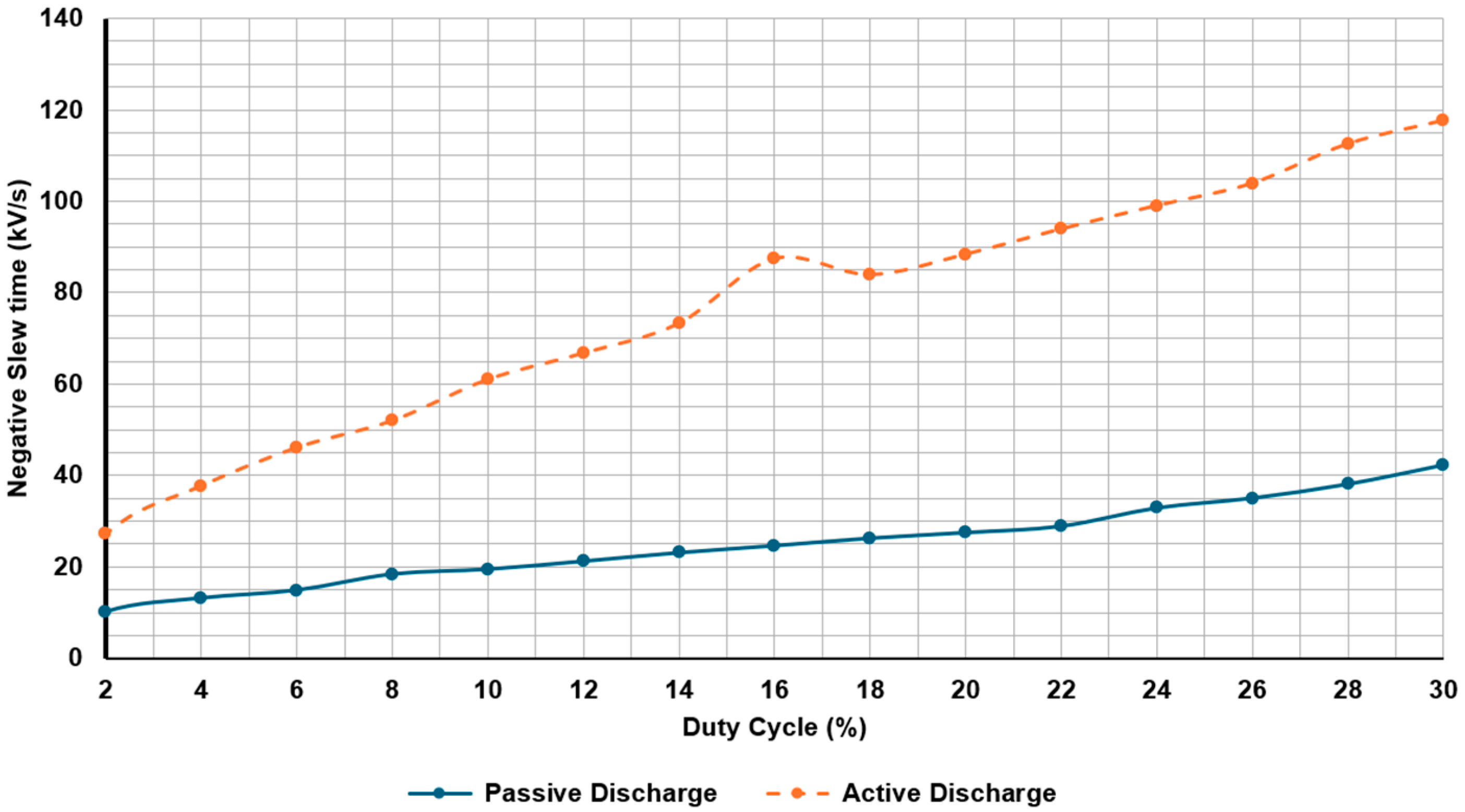
The positive slew rate is the voltage change on the rising edge of the signal as the HV is discharged. Figure 17 graphs the positive slew rate of passive and active discharge modes as the duty cycle increases. Again, the slew rate in the passive discharge mode increases gradually, where the gradient of the linear section is 1.03, with a maximum slew rate of 42.305 kV/s. The slew rate in the active discharge mode increases at a much steeper rate, with a linear gradient of 3.057 and a maximum slew rate of 117.660 kV/s. The linear gradient of the active discharge is 2.97 times that of the passive discharge, and the maximum negative slew rate of the active discharge is 2.78 times that of the passive discharge. This further demonstrates the reduced speed of the negative HV over positive HV results. However, in both cases the active discharge is much faster than the passive discharge.

3.2.3. Discharge Recovery Time

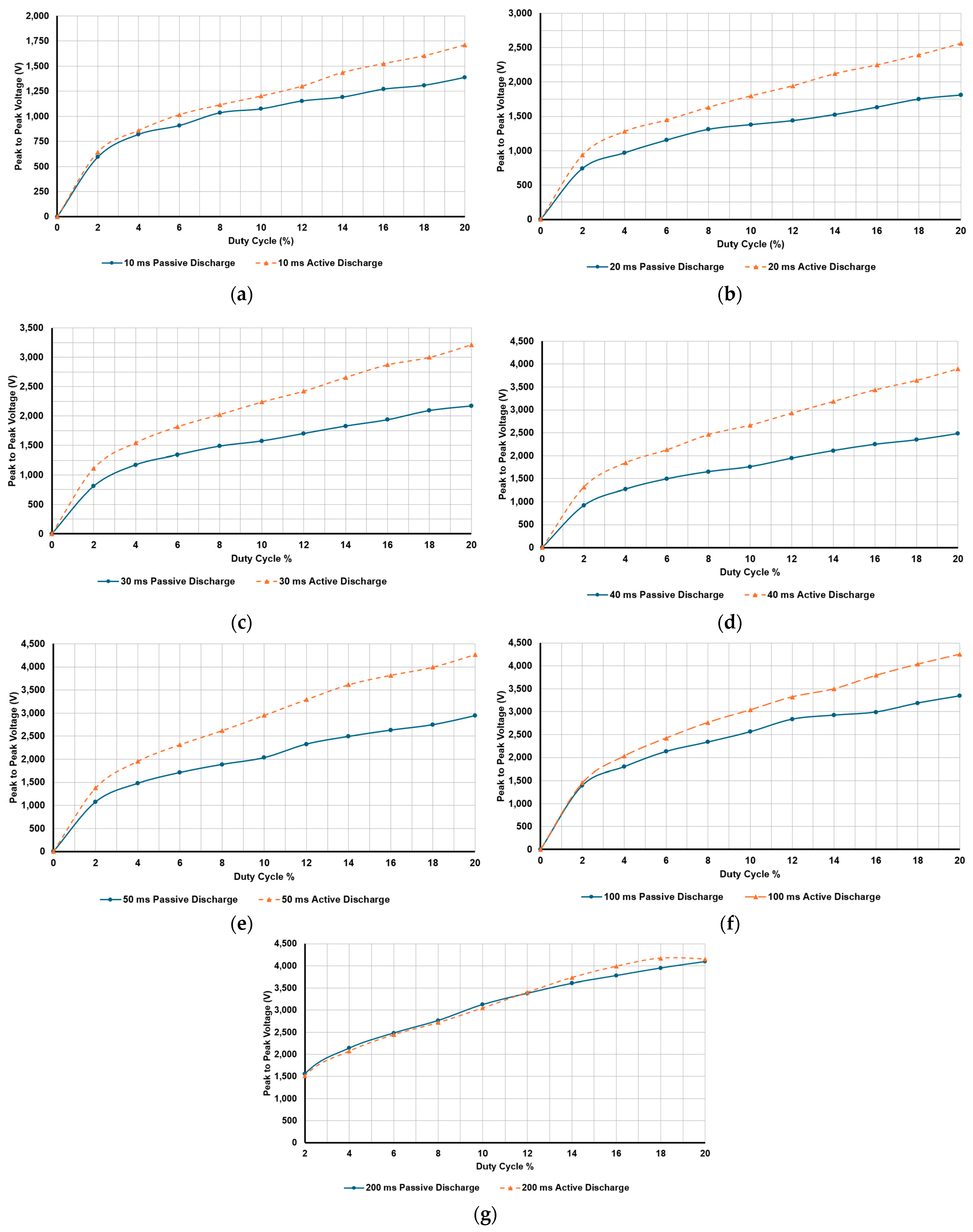
The recovery time of a circuit determines the operating speed for the HV. To test how much of the voltage is recovered with a short discharge time, the positive HV is discharged in progressively longer. To achieve this, the ESP32 produces a loop of 100 ms to charge the HV, a period of discharge time (either passive or active discharge), before charging again. The recovery voltage was determined by the peak-to-peak value that could be recovered for a given discharge time. Recovery times were tested for both passive discharge mode and active discharge, with results shown in Figure 18. Output was only tested up to 20% duty cycle to remain in the linear region operation. The test was conducted under the same conditions as the ‘positive HV Output’ tests.
The passive discharge mode of the HVPS is significantly slower than the recovery time of the active discharge mode. At 10 ms, the difference in recovery reached 322.5 V, seen in Figure 18a, which is a relatively small amount to start with. At 20 ms, 30 ms, 40 ms, 50 ms, 100 ms, and 200 ms, the differences reached are 752.2 V, 1045.4 V, 1416.6 V, 1328.7 V, 908.7 V, and 58.7 V, respectively (Figure 18b–f). Thus, the largest difference was at 40 ms, reaching 1045.4 V. The voltage difference diminishes after this as the active discharge is already within 87% of the fully discharged peak-to-peak voltage of 4464.9 V from Figure 18g. Beyond 40 ms, the peak-to-peak voltages begin to level out, and the passive discharge results catch up to the active discharge results. By 200 ms, the HV has mostly been recovered with a difference of 58.7 V.

3.2.4. HASEL Performance with the Low-Cost HVPS

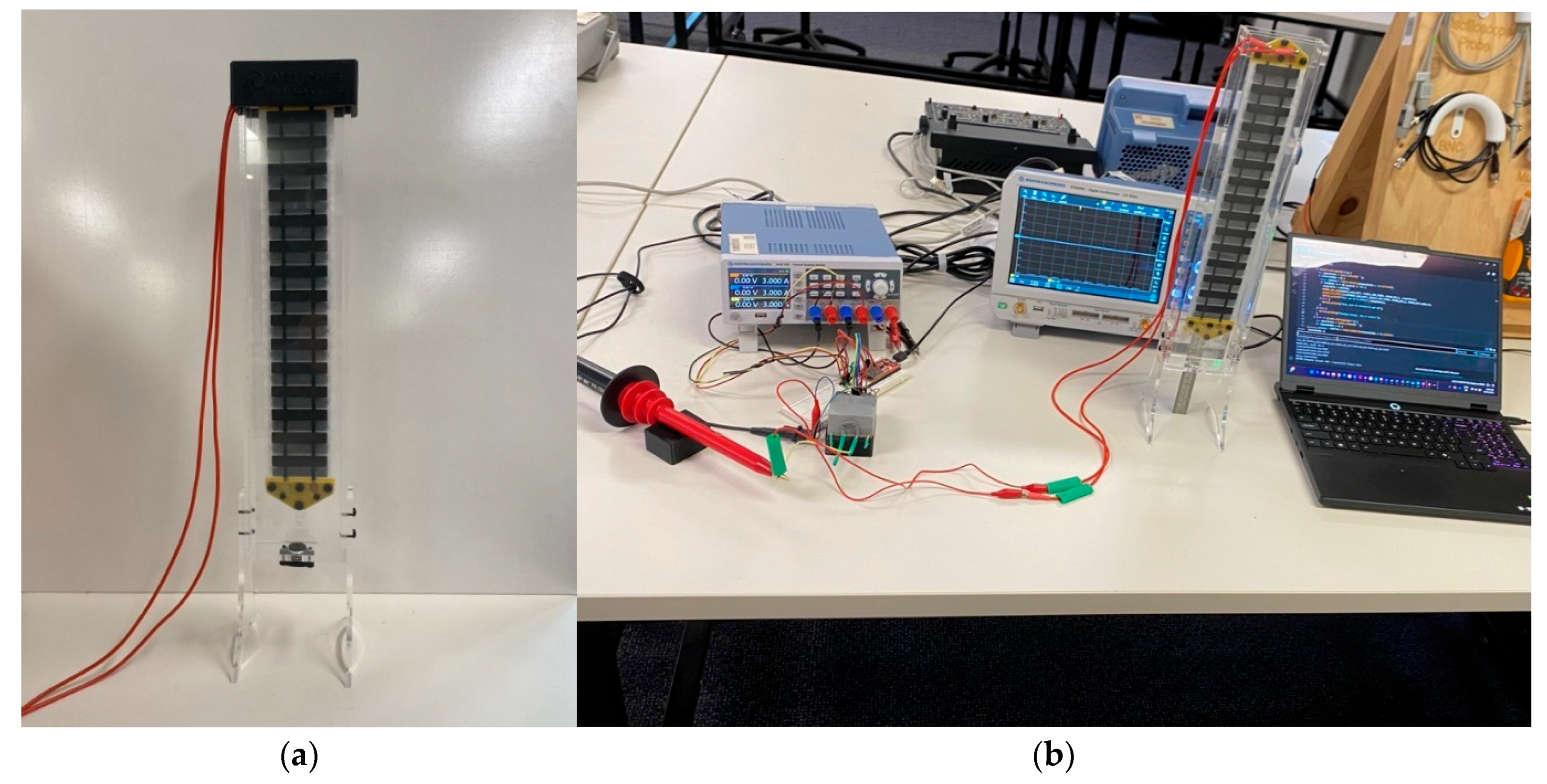
The key benefit of this low-cost HVPS is its recovery speed over other cheap HVPS. The previous test on the HVPS was under no load conditions. In this section, C-5020-15-01 HASEL actuator (Figure 19a) from Artimus Robotics [33], the characteristics of C-5020-15-01 are in Table 5. The HASEL actuator is specified to output a blocking force of 30 N, the force at which displacement cannot exceed 0 mm, and a free strain displacement of 18 mm, the maximum displacement when no force is applied. This HASEL actuator was measured to have a capacity of 730 pF.
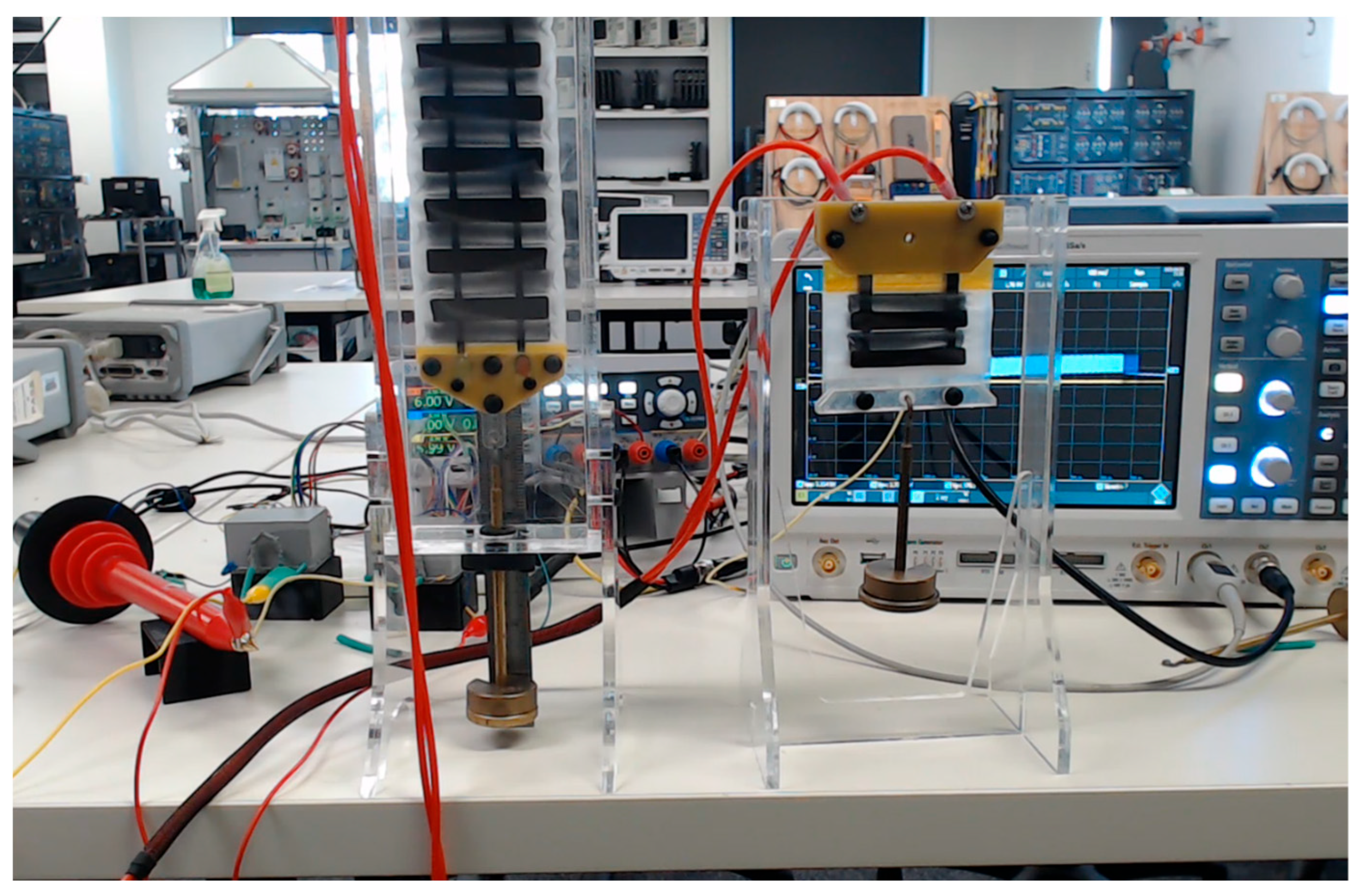
Figure 19b demonstrates the setup for testing the HASEL actuators’ output when being controlled by the low-cost HVPS. In the setup, the ESP32 was connected between the laptop and the HVPS for the PWM and control input discussed below in Section 3.2.5. Operation modes—Multi-Channel Operation’. The Rohde & Schwarz NGE100 programmable power supply generated a 6 VDC input to power the Low Voltage circuitry of the HVPS and a second 12 VDC input to power the MOSFET gate driver. The positive HV output was connected to one terminal of the HASEL actuator and the B&K Precision PR 28A HV probe. The negative HV connections were made through the ground terminal of the HVPS. the negative HV was connected to the second terminal of the HASEL actuator and the ground lead of the HV probe. The HV probe was connected to the Rohde & Schwarz RTB2004 oscilloscope for voltage measurements.
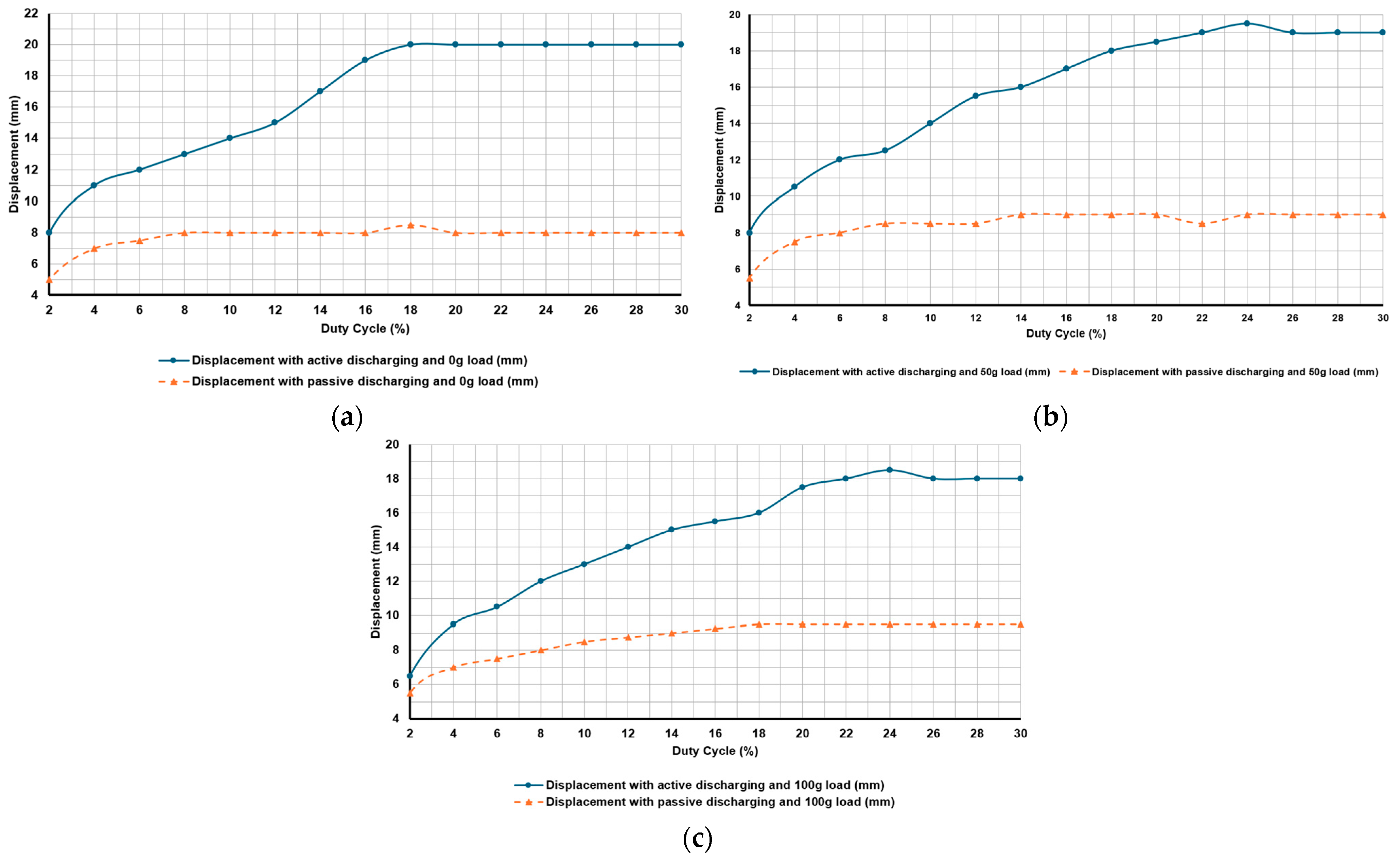
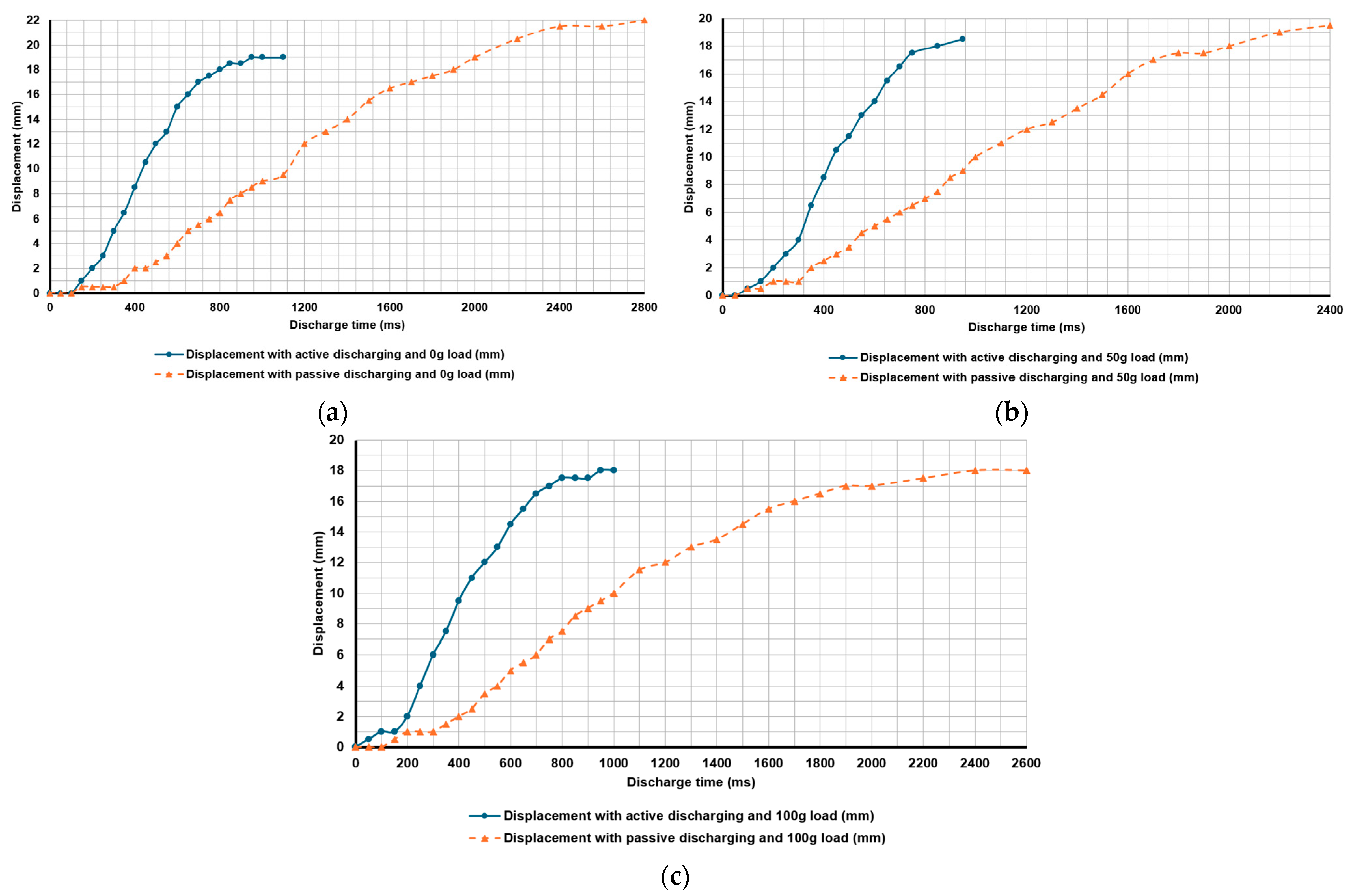
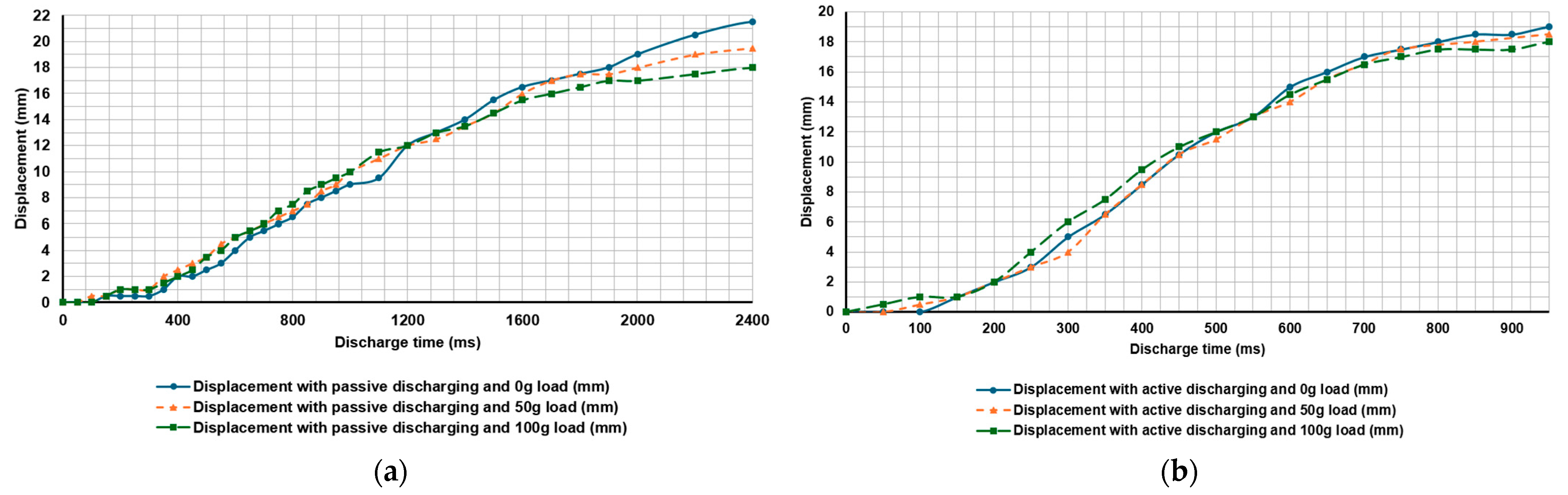
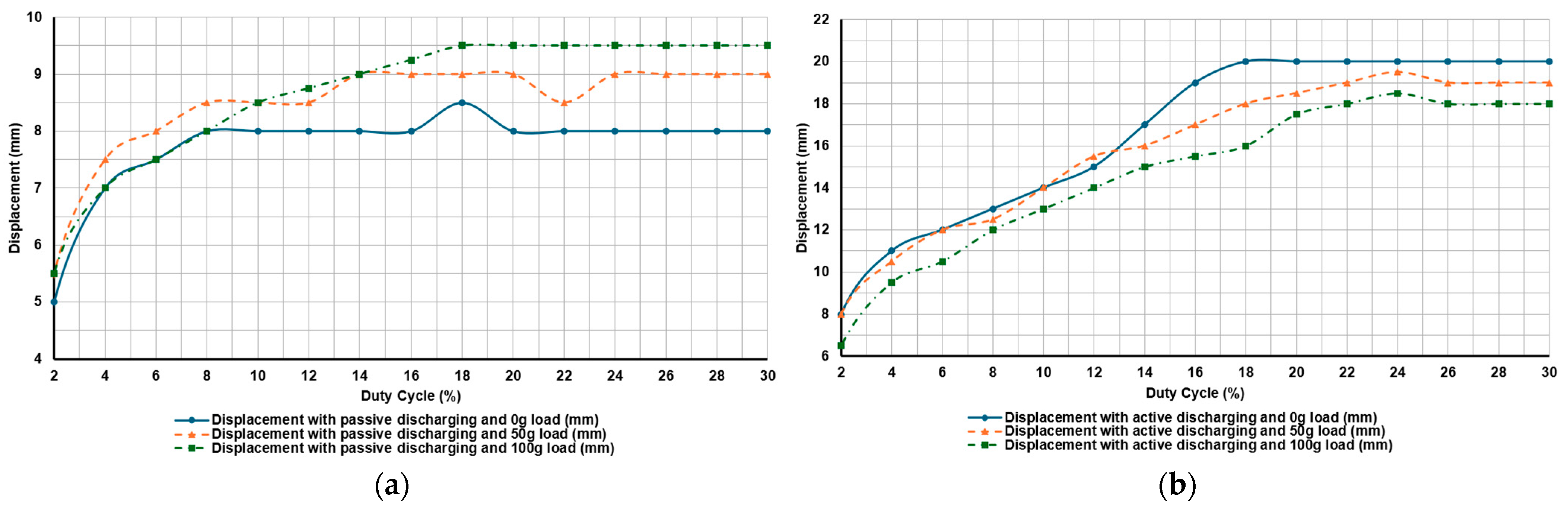
The HASEL actuator was tested with no load, 50 g, and 100 g loads. Two tests were performed with the load. The displacement data was captured with a camera facing the HASEL actuator. For the first test, measurements were taken with a duty cycle between 2% and 30% in 2% increments; see the results in Figure 20. For the second test, the duty cycle was set at 30% and the discharge time was increased in increments of 50 ms to test the recovery time of the HVPS HASEL actuator attached; see the results in Figure 21. Much like before, the tests were run in loops of charge time, discharge time (either passive or active), and before charging again, producing a cyclical displacement.
HASEL Displacement Results
Passive discharge substantially reduces displacement over active discharge. The operating parameters in Figure 20 leave 1 s to discharge before the HASEL actuator before the next contraction. Despite this, the passive discharge produced cyclical displacements of 8 mm, 9 mm, and 10 mm under loads of 0 g, 50 g, and 100 g, respectively, while the active discharge was able to produce displacements of 20 mm, 19 mm, and 18 mm, under loads of 0 g, 50 g, and 100 g, respectively. Thus, the displacements produced by the active discharge were nearly double that of the passive discharge.
HASEL Recovery Time
Passive discharge greatly increases the time it takes for the HASEL actuator to recover over active discharge. Figure 21 shows that the passive discharge displaces a few extra millimetres overall. This is because when actively discharging, the circuit is held at a low DC level. As discharge time is increased, the goal is to get as close to the maximum cyclical displacement as possible. To discharge in passive discharge mode to the same level as the active discharge took 2400 ms, 2400 ms, and 2600 ms, under loads of 0 g, 50 g, and 100 g, respectively. On the other hand, the active discharge was able to fully discharge in 950 ms across all the loads: 0 g, 50 g, and 100 g. This significantly reduces the discharge compared to if it were performed passively.

3.2.5. Operation Modes—Multi-Channel Operation

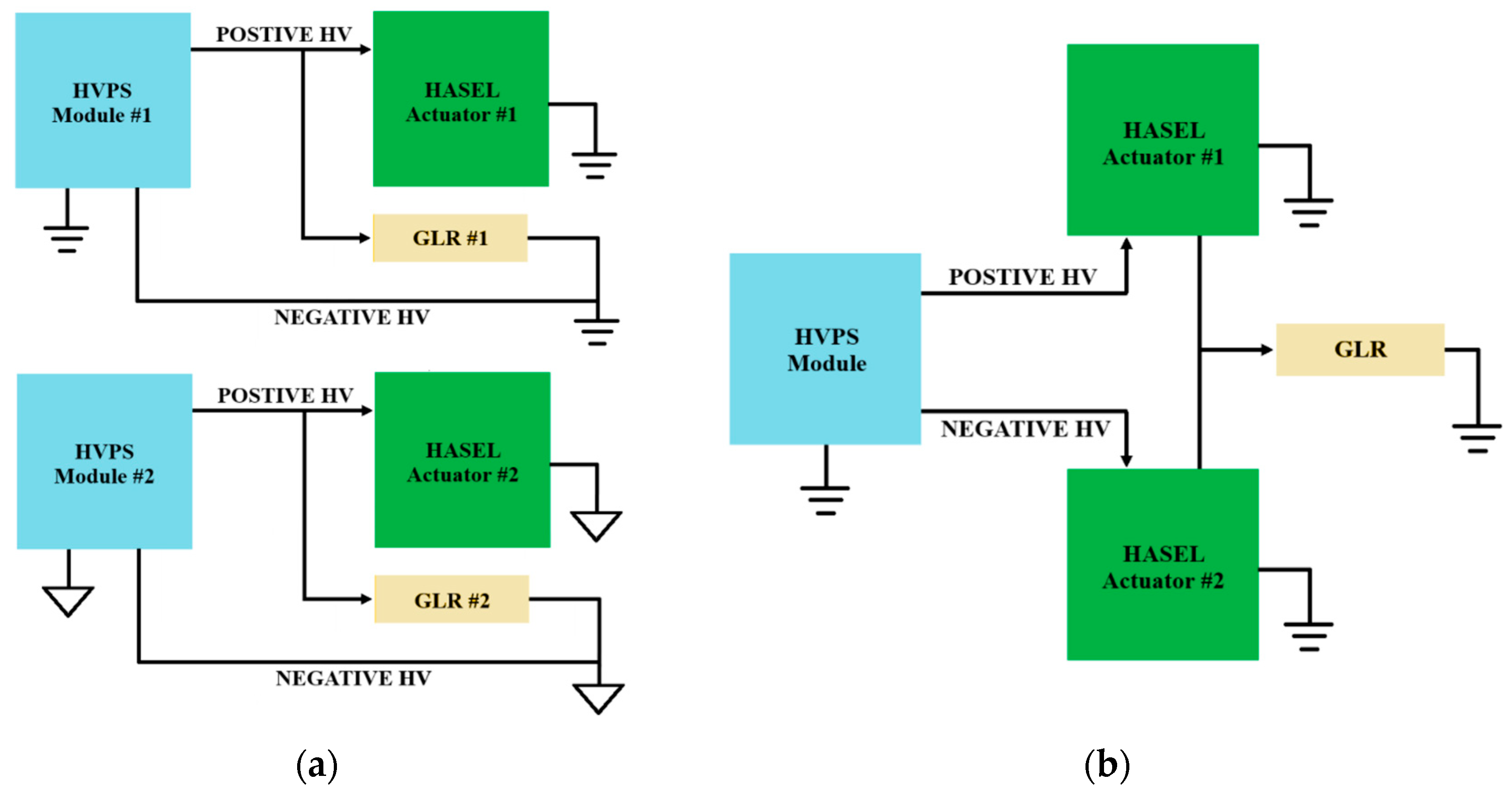
Other than speed, the main purpose of this design is to demonstrate multi-channel operations. The first configuration shows two HVPS modules controlling two HASEL actuators with one microcontroller. One PWM signal is required for each module, and two charge and discharge pins are also required for each module. So, for two outputs to be controlled, six ports are required. For three outputs to be controlled, nine ports are required on the Microcontroller. So, for every output added, three outputs are required. Supplementary Video S1 shows the two power supplies operating over different periods. This can also be seen in Figure 22, where the input configuration is the same as discussed above in Section 3.2.4. ‘HASEL performance with the low-cost HVPS’, and the output configuration of the multi-channel control is shown in Figure 23a. This is an improvement on the previous design which required 4 PWMs to control a single output. However, the number of outputs required could be reduced further, from three per HASEL actuator to two, by using a single output that toggles between charging and discharging. In this case, the charging and discharging would have to be turned off by turning off the PWM.
The second configuration shows a single HVPS module, allowing double the number of outputs to be controlled with the same number of ports, shown in Figure 23b. By having one HASEL actuator configured on the positive side and another configured on the negative side, two HASEL actuators can be controlled in alternating movement. So, when one HASEL actuator is extending, the other is contracting, and vice versa. As in the previous configuration, one PWM is required for each pair of HASEL actuators, and two ports are required for controlling charging and discharging. This means that for every two HASEL actuators, three outputs are required on the microcontroller. This can be reduced even further by again toggling the charging and discharging, meaning only two outputs are required for every pair of HASEL actuators. Supplementary Video S2 shows the two power supplies operating with an alternating pattern. The main drawback in this configuration is that they cannot operate at the same time.

4. Discussion

4.1. Passive and Active Discharge Comparison—No Load

The low-cost HVPS provides significant improvements over passive discharging of HV; however, it does not quite match. By combining the charge time and discharge time of the HV, we can determine the maximum operating frequency for both the passive and active discharge modes for both the positive and negative HV. These frequencies can be found in Table 6. For the positive HV, on average, the passive discharge operates 3.044 times slower than the active discharge. For the negative HV, on average, the passive discharge operated 2.50 times slower than the active discharge. This is potentially because the negative HV is larger than the positive HV in this module, providing a large discharge potential, driving a faster discharge time. However, as discussed previously, HASEL actuators can operate up to 120 Hz. While this is a great low-cost solution, it may still limit the operating speed of the HASEL actuator. Ideally, once HV switching components come down in costs, they can make faster switching more readily available.
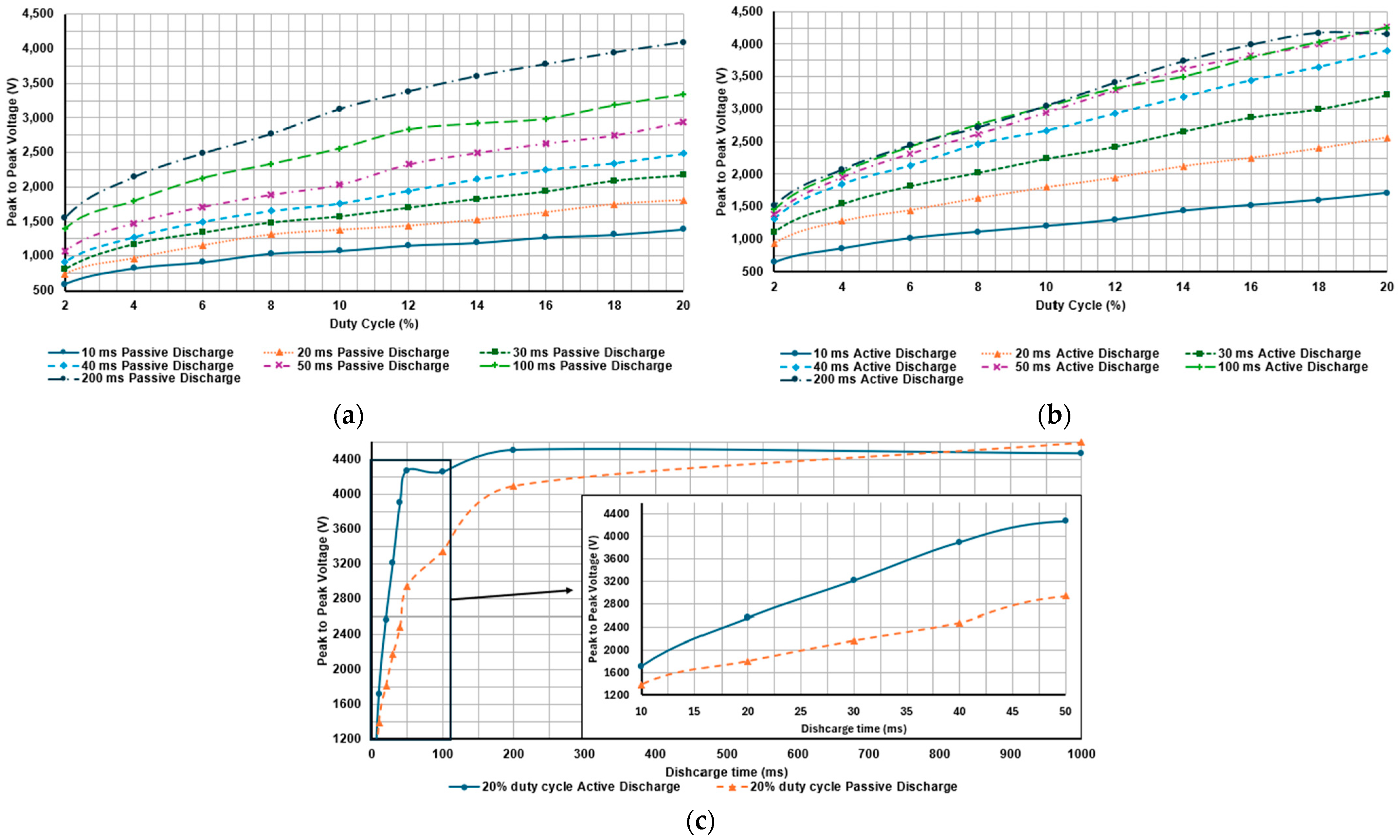
Fall time only shows the discharge time of the circuit from the top 90% of the peak HV and 10% of the peak. To measure the full range of operation, the peak-to-peak voltage was measured for different conditions. Examining all the passive and active discharge results from Figure 18 highlights the full operating range of the HV under different discharge times. The graph in Figure 24a shows that from 10 ms to 200 ms of passive discharge time, there is a large gain in voltage with each stage, whereas the graph in Figure 24b shows that from 10 ms to 40 ms of active discharging there are significant voltage gains, and by this time the voltage has mostly reached maximum peak to peak HV, so there are very little gains beyond this. Figure 24c confirms this as the passive discharge is only 54% of the maximum peak-to-peak at 40 ms and only 89% charged at 200 ms, while the active discharge is at 87% of the maximum peak-to-peak voltage at 40 ms and is at 100% of the maximum peak-to-peak voltage by 200 ms.

4.2. Passive and Active Discharge Comparison with the HASEL Actuator

Adding a load significantly affects the recovery time of both the passive and active discharge modes. Because the HASEL actuator is a capacitive load, it tends to slow changes in voltages. As a result, both operation modes are slowed, but the passive discharge mode is significantly more so. Interestingly, increasing the load largely did not change the discharge time; it only decreased the maximum cyclical displacement. Combining the passive discharge data from Figure 21, we can see that the HASEL actuator mostly reached peak cyclic displacement at 2400 ms and stayed the same as the load increased to 0 g, 50 g, and 100 g. The maximum cyclical displacement decreases as follows: 21.5 mm, 19.5 mm, and 18 mm, respectively (Figure 25a). The only inconsistency is in the case of the no load, where there was a slight increase in displacement at 2600 ms to 22 mm. For the active discharge, the discharge time was 950 ms in each case, with the maximum cyclical displacement decreasing as the load increased to 19 mm, 18.5 mm, and 18 mm (Figure 25b). In Figure 25, we can also observe a significantly lower drop in cyclical displacement where the passives discharge mode decreased by 4 mm and the active discharge only decreased by 1 mm.
Comparing and analysing the results from Figure 20 of the cyclical displacement as the duty cycle increases yielded some counterintuitive results. Figure 26a suggests that, in passive mode, the no-load measurement yields the smallest cyclical displacements. It is unclear if this is a phenomenon, but it seems to correlate with the loads stretching the HASEL actuator to increase the cyclical displacement. The fact that the 100 g load produces the largest cyclical displacement could be a further indicator of this. The active discharge does not seem to have the same issue, as the no-load case of 0 g yields the largest result. In any case, the passive discharge reaches half the maximum discharge of the active discharge, further demonstrating the benefits of the low-cost HVPS.

4.3. Low-Cost Multi-Channel HVPS Specifications

The final specifications for the low-cost multi-Channel HVPS can be found in Table 7. This includes both positive and negative characteristics of operation. Though the HVPS can operate with an input voltage of 3–6 VDC, the gate drive needs a voltage of 12 VDC to drive the MOSFET. Future designs can incorporate a boost converter to drive the MOSFET with the input voltage; replacing the MOSFET with a logic level MOSFET would also resolve this. The maximum current of 3 A can only be sustained for a short period of time before entering thermal runaway. The HVPS can sustain a 2 A continuous operation.
There are a few key differences when compared to the previous HVPS design characteristics, shown in Table 8. The 6 V input voltage of this design is much lower than the 25 V required in the previous design. This makes it much easier for new designs to include batteries. The output HV of the previous HVPS reaches 10 kV with the 60 MΩ GLR, which is important for the HASEL actuator with larger zipping gaps [2]. However, the most important operating region is from 2 to 8 kV, where zipping mostly occurs. Additionally, the previous power supply required 4 PWM channels to drive the output, compared to the 1 PWM channel required here, drastically reducing complexity for multi-channel operation and reducing the computational load on the microcontroller. Overall, the new multi-channel HVPS solves many of the design issues with the previous HVPS, with almost none of the drawbacks.

4.4. Disadvantages of the Low-Cost HVPS

Though there are many benefits to the low-cost HVPS, there are some downfalls. Because the GLR is constantly discharging the load, the low-cost HVPS needs to stay constantly charged during operation, which is one of the interesting attributes of the HASEL actuator. The lower voltage operation increases the current draw on the circuit, reducing the amount of time that the HVPS can operate at HV. Longer off times preserve the life of the HVPS. Due to the low cost of the HV components, the positive and negative HV can produce drastically different voltages; however, in this case, the larger negative HV seemed to help when discharging the HV. This current design requires three outputs to control the charging and discharge of the HVPS.
As is always the case with HVPS, safety is also an issue. Though the HVPS is very low-power, it can very easily shock the operator. Special care is required to ensure no one comes in contact with the HV. The safety features to avoid HV contact include potting all HV components in insulating silicone; the HV outputs need to have a female connector so no part of the contactor can be touched. The best long-term solution for HASEL actuators is to be able to design actuators that do not require such an HV in the first place.

4.5. Future Research

Improving the design of the low-cost HVPS could further enhance the performance of both the HV and LV circuitry. On the LV side, this includes improving the thermal design to avoid thermal runaway so HV can be driven for long periods. This could include having a second MOSFET in parallel to increase thermal dissipation, as well as adding a heatsink to the MOSFET, reducing the number of inputs required so that one input can be used to charge and the other to discharge increase the expandability of HV outputs.
Regarding HV control, further work can be performed to optimise the GLR to achieve optimal discharge time and HV output and to characterise the use of the higher discharge voltage to speed up discharge and optimise future designs. Research should also be performed on alternative solutions for low-cost HV switching that does not require the negative HV and GLR for active discharge, exploring the benefits and drawbacks of the dual operation mode and how it could be used in HASEL actuator applications.
Future work should also extend the low-cost HVPS beyond two HASEL channels to evaluate channel-to-channel crosstalk, power limits, and thermal performance. Miniaturising the board further would also help to expand the number of outputs the HVPS can sustain. Finally implementing these multi-actuator demonstrations into applications such as prosthetics, grippers, haptics, and more would greatly help to advance the field.

5. Conclusions

HASEL actuators bring adaptive, human-like movement to robotics. Adaptive robotics needs to control multiple outputs with precision and speed. Unfortunately, the cost of powering these actuators effectively has made it difficult to develop this adaptive technology. The low-cost HVPS provides significant improvements over passive discharging of HV; however, it does not match the HASEL actuators’ reported operating speeds of up to 120 Hz. The low-cost HVPS produced up to 8 kV to drive a commercial HASEL actuator at 20 Hz, achieving a maximum displacement of 22 mm. The low-cost HVPS was able to use active discharging to discharge the HASEL actuator three times faster than passive discharging with a resistor. The low-cost HVPS modules can also control multiple outputs with minimal input control. The low-cost HVPS can be configured in an alternating mode to control two outputs with one HVPS module. This low-cost HVPS is a great option for researchers trying to make HASEL actuators affordable and commercially viable to control.

Supplementary Materials

The following supporting information can be downloaded at: https://www.mdpi.com/article/10.3390/act14120601/s1, Video S1: Multi Channel Operation, Video S2: Dual Mode Operation.

Author Contributions

Conceptualisation, L.T.; methodology, L.T.; validation, L.T.; supervision G.G., U.G., D.E., J.C., S.M. and A.G.C.; writing—original draft preparation, L.T. All authors have read and agreed to the published version of the manuscript.

Funding

This work was funded by the School of Engineering, Design and Built Environment, Western Sydney University (project code 20870.75898).

Institutional Review Board Statement

Not applicable.

Informed Consent Statement

Not applicable.

Data Availability Statement

All relevant data are included in this paper.

Conflicts of Interest

The authors declare no conflict of interest.

References

  1. Acome, E.; Mitchell, S.K.; Morrissey, T.G.; Emmett, M.B.; Benjamin, C.; King, M.; Radakovitz, M.; Keplinger, C. Hydraulically amplified self-healing electrostatic actuators with muscle-like performance. Science 2018, 359, 61–65. [Google Scholar] [CrossRef] [PubMed]
  2. Kellaris, N.; Gopaluni Venkata, V.; Smith, G.M.; Mitchell, S.K.; Keplinger, C. Peano-HASEL actuators: Muscle-mimetic, electrohydraulic transducers that linearly contract on activation. Sci. Robot. 2018, 3, eaar3276. [Google Scholar] [CrossRef] [PubMed]
  3. Rothemund, P.; Kellaris, N.; Mitchell, S.K.; Acome, E.; Keplinger, C. Hasel Actuators: HASEL Artificial Muscles for a New Generation of Lifelike Robots—Recent Progress and Future Opportunities. Adv. Mater. 2021, 33, 2170149. [Google Scholar] [CrossRef]
  4. Mitchell, S.K.; Wang, X.; Acome, E.; Martin, T.; Ly, K.; Kellaris, N.; Venkata, V.G.; Keplinger, C. An Easy-to-Implement Toolkit to Create Versatile and High-Performance HASEL Actuators for Untethered Soft Robots. Adv. Sci. 2019, 6, 1900178. [Google Scholar] [CrossRef]
  5. Kellaris, N.; Rothemund, P.; Zeng, Y.; Mitchell, S.K.; Smith, G.M.; Jayaram, K.; Keplinger, C. Spider-Inspired Electrohydraulic Actuators for Fast, Soft-Actuated Joints. Adv. Sci. 2021, 8, 2100916. [Google Scholar] [CrossRef]
  6. Ion-Dan, S.; Giacomo, M.; Sandra, D.; Luca, F.; Rocco, V.; Devid, M.; Marco, F. Electrostatic actuator for tactile display based on hydraulically coupled dielectric fluids and soft structures. In Proceedings of the SPIE, Denver, CO, USA, 19 March 2019; p. 109662D. [Google Scholar] [CrossRef]
  7. Sîrbu, I.D.; Moretti, G.; Bortolotti, G.; Bolignari, M.; Diré, S.; Fambri, L.; Vertechy, R.; Fontana, M. Electrostatic bellow muscle actuators and energy harvesters that stack up. Sci. Robot. 2021, 6, eaaz5796. [Google Scholar] [CrossRef]
  8. Frediani, G.; Busfield, J.; Carpi, F. Enabling portable multiple-line refreshable Braille displays with electroactive elastomers. Med. Eng. Phys. 2018, 60, 86–93. [Google Scholar] [CrossRef]
  9. Leroy, E.; Shea, H. Hydraulically Amplified Electrostatic Taxels (HAXELs) for Full Body Haptics. Adv. Mater. Technol. 2023, 8, 2300242. [Google Scholar] [CrossRef]
  10. Leroy, E.; Hinchet, R.; Shea, H. Multimode Hydraulically Amplified Electrostatic Actuators for Wearable Haptics. Adv. Mater. 2020, 32, 2002564. [Google Scholar] [CrossRef]
  11. Leroy, E.; Shea, H.; Gao, M. Hydraulically Amplified Dielectric Actuator Taxels. 2022. Available online: https://patents.google.com/patent/US11372481B2/en (accessed on 23 October 2025).
  12. Sanchez-Tamayo, N.; Yoder, Z.; Rothemund, P.; Ballardini, G.; Keplinger, C.; Kuchenbecker, K.J. Cutaneous Electrohydraulic (CUTE) Wearable Devices for Pleasant Broad-Bandwidth Haptic Cues. Adv. Sci. 2024, 11, 2402461. [Google Scholar] [CrossRef] [PubMed]
  13. Wang, X.; Mitchell, S.K.; Rumley, E.H.; Rothemund, P.; Keplinger, C. High-Strain Peano-HASEL Actuators. Adv. Funct. Mater. 2020, 30, 1908821. [Google Scholar] [CrossRef]
  14. Schlatter, S.; Grasso, G.; Rosset, S.; Shea, H. Inkjet Printing of Complex Soft Machines with Densely Integrated Electrostatic Actuators. Adv. Intell. Syst. 2020, 2, 2000136. [Google Scholar] [CrossRef]
  15. Diteesawat, R.S.; Helps, T.; Taghavi, M.; Rossiter, J. Electro-pneumatic pumps for soft robotics. Sci. Robot. 2021, 6, eabc3721. [Google Scholar] [CrossRef]
  16. Buchner, T.J.K.; Fukushima, T.; Kazemipour, A.; Gravert, S.-D.; Prairie, M.; Romanescu, P.; Arm, P.; Zhang, Y.; Wang, X.; Zhang, S.L.; et al. Electrohydraulic musculoskeletal robotic leg for agile, adaptive, yet energy-efficient locomotion. Nat. Commun. 2024, 15, 7634. [Google Scholar] [CrossRef]
  17. Chen, R.; Yuan, Z.; Guo, J.; Bai, L.; Zhu, X.; Liu, F.; Pu, H.; Xin, L.; Peng, Y.; Luo, J.; et al. Legless soft robots capable of rapid, continuous, and steered jumping. Nat. Commun. 2021, 12, 7028. [Google Scholar] [CrossRef]
  18. Kang, J.; Kim, S.; Cha, Y. Soft origami tripod based on electrohydraulic actuator for multimodal motions. Sens. Actuators A Phys. 2024, 372, 115334. [Google Scholar] [CrossRef]
  19. Tynan, L.; Gunawardana, U.; Liyanapathirana, R.; Perera, O.; Esposito, D.; Centracchio, J.; Gargiulo, G. Review of Electrohydraulic Actuators Inspired by the HASEL Actuator. Biomimetics 2025, 10, 152. [Google Scholar] [CrossRef]
  20. Tynan, L.; Gunawardana, U.; Liyanapathirana, R.; Perera, O.; Esposito, D.; Centracchio, J.; Gargiulo, G. Low-Cost High-Voltage Power Supply for Hydraulically Amplified Self-Healing Electrostatic Applications. Machines 2024, 12, 758. [Google Scholar] [CrossRef]
  21. Taghavi, M.; Helps, T.; Rossiter, J. Characterisation of Self-locking High-contraction Electro-ribbon Actuators. In Proceedings of the 2020 IEEE International Conference on Robotics and Automation (ICRA), Paris, France, 31 May–31 August 2020; pp. 5856–5861. [Google Scholar]
  22. Yoder, Z.; Rumley, E.H.; Schmidt, I.; Rothemund, P.; Keplinger, C. Hexagonal electrohydraulic modules for rapidly reconfigurable high-speed robots. Sci. Robot. 2024, 9, eadl3546. [Google Scholar] [CrossRef]
  23. Gravert, S.-D.; Varini, E.; Kazemipour, A.; Michelis, M.Y.; Buchner, T.; Hinchet, R.; Katzschmann, R.K. Low-voltage electrohydraulic actuators for untethered robotics. Sci. Adv. 2024, 10, eadi9319. [Google Scholar] [CrossRef] [PubMed]
  24. Yang, R.; Yang, M.; Fan, P.; Lu, T.; Wang, T. A new flexible electrostatic generator using dielectric fluid. J. Appl. Phys. 2023, 134, 105001. [Google Scholar] [CrossRef]
  25. Yoder, Z.; Kellaris, N.; Chase-Markopoulou, C.; Ricken, D.; Mitchell, S.K.; Emmett, M.B.; Weir, R.F.F.; Segil, J.; Keplinger, C. Design of a High-Speed Prosthetic Finger Driven by Peano-HASEL Actuators. Front. Robot. AI 2020, 7, 586216. [Google Scholar] [CrossRef]
  26. Duranti, M.; Righi, M.; Vertechy, R.; Fontana, M. A new class of variable capacitance generators based on the dielectric fluid transducer. Smart Mater. Struct. 2017, 26, 115014. [Google Scholar] [CrossRef]
  27. Schlatter, S.; Illenberger, P.; Rosset, S. Peta-pico-Voltron: An open-source high voltage power supply. HardwareX 2018, 4, e00039. [Google Scholar] [CrossRef]
  28. Brei, Z.; Lim, C.W.; Ferguson, A.; Pradhan, A.A.; Sangeetha, V.V.; Bu, X.; Usui, B.; Johnson, D.B.; Vasudevan, R.; Moore, T.Y. HASEL Actuator Design for Out-of-Plane Bending: A Parametric Study of Planar Geometry. In Proceedings of the 2024 IEEE 7th International Conference on Soft Robotics (RoboSoft), San Diego, CA, USA, 14–17 April 2024; pp. 657–662. [Google Scholar]
  29. Mitchell, S.K.; Martin, T.; Keplinger, C. A Pocket-Sized Ten-Channel High Voltage Power Supply for Soft Electrostatic Actuators. Adv. Mater. Technol. 2022, 7, 2101469. [Google Scholar] [CrossRef]
  30. Manion, C.; Patel, D.; Fuge, M.; Bergbreiter, S. Modeling and Evaluation of Additive Manufactured HASEL Actuators. International Conference on Intelligent Robots and Systems. In Proceedings of the International Conference on Intelligent Robots and Systems (IEEE/RSJ), Madrid, Spain, 1–5 October 2018; IEEE: New York, NY, USA. [Google Scholar]
  31. Johnson, B.K.; Naris, M.; Sundaram, V.; Volchko, A.; Ly, K.; Mitchell, S.K.; Acome, E.; Kellaris, N.; Keplinger, C.; Correll, N.; et al. A multifunctional soft robotic shape display with high-speed actuation, sensing, and control. Nat. Commun. 2023, 14, 4516. [Google Scholar] [CrossRef] [PubMed]
  32. Ly, K.; Mayekar, J.V.; Aguasvivas, S.; Keplinger, C.; Rentschler, M.E.; Correll, N. Electro-Hydraulic Rolling Soft Wheel: Design, Hybrid Dynamic Modeling, and Model Predictive Control. IEEE Trans. Robot. 2022, 38, 3044–3063. [Google Scholar] [CrossRef]
  33. Robotics, A. Artimus Robotics. Available online: https://www.artimusrobotics.com/contracting-actuators (accessed on 15 August 2025).
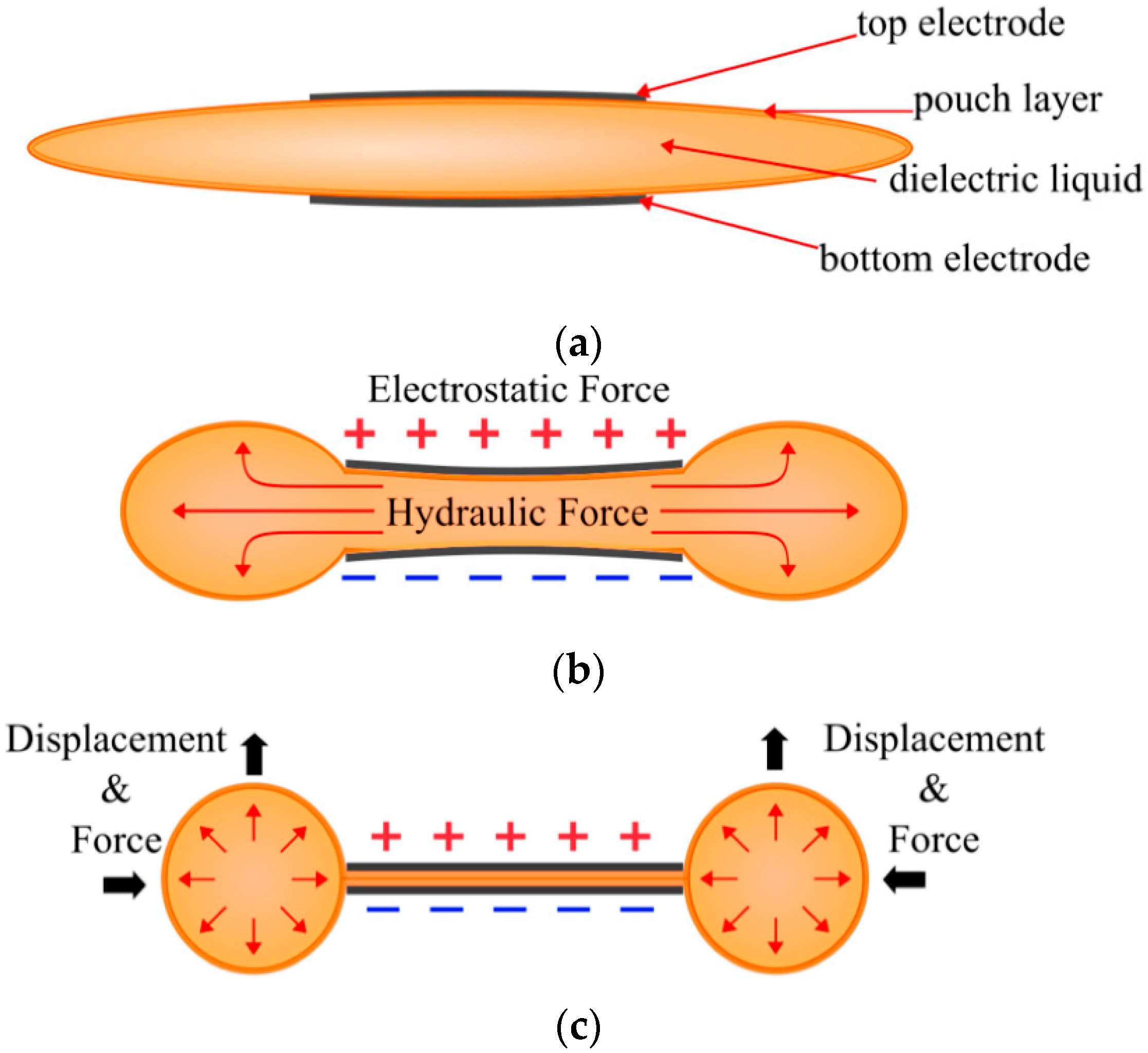
Figure 1. A depiction of the HASEL actuator operating (a) at rest, (b) when a voltage is applied and (c) when the HASEL actuator has fully zipped. This figure was adapted from [19] with permission.
Actuators 14 00601 g001
Figure 2. A block diagram of the HVPS circuitry and where it connects to the microcontroller and the HASEL actuator.
Actuators 14 00601 g002
Figure 3. Demonstration of the operation of the voltage multiplier when it is on the (a) negative cycle of the HVAC input and (b) the positive cycle of the HVAC input, where C2 is the load. This figure was adapted from [20] with permission.
Actuators 14 00601 g003
Figure 4. Demonstration of the short circuit from the positive HV ground to the negative HV and the isolation created with the GLR. This figure was adapted from [20] with permission.
Actuators 14 00601 g004
Figure 5. The circuit diagram shows the GLR moved to the output of the voltage multipliers, with the positive and negative grounds directly connected. This figure was adapted from [20] with permission.
Actuators 14 00601 g005
Figure 6. The HVPS has two loads connected, where Z1 receives a positive HV and Z2 receives a negative HV. This figure was adapted from [20] with permission.
Actuators 14 00601 g006
Figure 7. The configuration of the PCB design: (a) top view of the PCB; (b) bottom view of the PCB.
Actuators 14 00601 g007
Figure 8. (a) A top view of the low-cost HVPS after being assembled and potted, where the green wire is the positive ground and the blue wire is the negative ground. Both grounds were linked during testing. (b) A top view of the outputs of the low-cost HVPS, including the positive HVDC, positive HVAC, negative HVDC and negative HVAC, where the 60 MΩ GLR was placed between the negative HVDC and positive HVDC.
Actuators 14 00601 g008
Figure 9. The updated schematic of the simulation of the low-cost multi-HVPS in Multisim. Where the dual transformers and multiple are the positive HV and the negative HV, AOUT1 and AOUT2 drive the positive HV and BOUT1 and BOUT2 drive the negative HV. This figure was adapted from [20] with permission.
Actuators 14 00601 g009
Figure 10. The HVSP simulated in passive discharge mode, with all negative discharge components removed. This figure was adapted from [20] with permission.
Actuators 14 00601 g010
Figure 11. The simulated results of the low cost HVPS (a) when being passively discharged through the 60 MΩ resistor and (b) when being actively discharged with the negative HV.
Actuators 14 00601 g011
Figure 12. Screenshots of the output for the positive HV in two different operating modes (a) when being passively discharged through the 60 MΩ resistor and (b) when being actively discharged with the negative HV.
Actuators 14 00601 g012
Figure 13. Graphs the peak-to-peak voltage of the passive and active discharge as the duty increases.
Actuators 14 00601 g013
Figure 14. The negative slew rate of the passive and active discharge as the duty increases.
Actuators 14 00601 g014
Figure 15. Screenshots of the output for the negative HV in two different operating modes (a) when being passively discharged through the 60 MΩ resistor and (b) when being actively discharged with the negative HV.
Actuators 14 00601 g015
Figure 16. Graph of the peak-to-peak voltage of the negative HV with the passive and active discharge as the duty cycle increases.
Actuators 14 00601 g016
Figure 17. The negative slew rate of the passive and active discharge as the duty cycle increases.
Actuators 14 00601 g017
Figure 18. Recovery voltage, measured with peak-to-peak voltage, of the positive HV when in passive discharge mode. Various discharge times were tested including (a) 10 ms, (b) 20 ms, (c) 30 ms, (d) 40 ms, (e) 50 ms, (f) 100 ms, (g) 200 ms.
Actuators 14 00601 g018
Figure 19. (a) A photo of the C-5020-15-01 HASEL actuator. (b) The low-cost HVPS being tested with the C-5020-15-01 HASEL actuator connected, using the ESP32 and Arduino IDE.
Actuators 14 00601 g019
Figure 20. Cyclical displacement results for the HASEL actuator connected to the low-cost HVPS, in both passive and active mode, with (a) 0 g, (b) 50 g, and (c) 100 g.
Actuators 14 00601 g020
Figure 21. Cyclical displacement results for the HASEL actuator connected to the low-cost HVPS, in both passive and active mode, over time with loads of (a) 0 g, (b) 50 g, and (c) 100 g.
Actuators 14 00601 g021
Figure 22. Multi-channel operation of HASEL actuators with the low-cost HVPS.
Actuators 14 00601 g022
Figure 23. A Block diagram of the multi-channel configurations for the HASEL actuators (a) when using multiple HVPS modules to drive the HASEL actuators separately and (b) when using one HVPS to drive a pair of HASEL actuators in alternating modes.
Actuators 14 00601 g023
Figure 24. Recovery voltage, measured with peak-to-peak voltage, of the (a) positive HV when in passive discharge mode and (b) positive HV when in active discharge mode. Various discharge times were tested, including 10 ms, 20 ms, 30 ms, 40 ms, 50 ms, 100 ms, and 200 ms. (c) Comparison of the peak-to-peak voltages of the passive and active discharge as discharge time increases. The 1000 ms discharge time represents the maximum peak-to-peak voltage.
Actuators 14 00601 g024
Figure 25. Comparison of the cyclical displacement with load 0 g, 50 g, and 100 g, where (a) is passive discharge mode and (b) is active discharge mode.
Actuators 14 00601 g025
Figure 26. Comparison of the cyclical displacement results for the HASEL actuator under loads of 0 g, 50 g, and 100 g, as the duty cycle increases, where (a) is passive discharge mode and (b) is active discharge mode.
Actuators 14 00601 g026
Table 1. The cost breakdown for the previous HVPS design, including HV component costs, LV component costs and an additional cost [20]. This table was reported in [20].
HV ComponentsSupplierUnit CostQuantity
Required
Total Cost
AUD
Total Cost
USD
1 NF 10 KV HV CapacitorsAliExpressAUD 0.2368AUD 1.88USD 1.23
5 mA 20 kV HV DiodeAliExpressAUD 0.398AUD 3.12USD 2.05
Coil Arc Generator Step-up Boost Converter Power TransformerAliExpressAUD 0.642AUD 1.28USD 0.84
SubtotalAUD 6.28USD 4.12
LVComponentsSupplierPart No.Unit CostQuantity
Required
Total Cost
AUD
Total Cost
USD
DRV8841 Dual H-Bridge
Driver IC
Texas InstrumentsDRV8841PAUD 2.7051AUD 2.71USD 1.78
LM555 TimerTexas InstrumentsLM555CMAUD 1.0181AUD 1.02USD 0.67
Electrolytic Capacitor 470 UF 25 VMouserEEE-FK1E471PAUD 0.7991AUD 0.80USD 0.52
Electrolytic Capacitor 220 UF 25 VMouserEEE-1EA221UPAUD 0.5841AUD 0.54USD 0.35
Power InductorsMouser7447709221AUD 3.0901AUD 3.09USD 2.03
Diodes 400 mW 100 VrrmMouser1N4148W-13-FAUD 0.1261AUD 0.13USD 0.09
Schottky Diodes 2.0 Amp 40 VMouserSSA24-E3/61TAUD 0.4361AUD 0.44USD 0.29
N-Ch MOSFET 60 Volt 35
Amp
MouserSTD30NF06LT4AUD 1.9601AUD 1.96USD 1.28
Trimmer ResistorsMouser3361P-1-103GLFAUD 1.4801AUD 1.48USD 0.97
Ceramic Capacitor 100 V 100 pFMouserC1206C101F1GAC TUAUD 0.7114AUD 2.84USD 1.86
10 k Resistors 1/4 WMouserCRCW120610K0JN EBAUD 0.0422AUD 0.08USD 0.05
FireBeetle ESP32 IOT Mi- crocontroller (Supports Wi-Fi and Bluetooth)Core Electronics AUD 17.801AUD 17.80USD 11.67
SubtotalAUD 32.45USD 21.27
AdditionalSupplierPurchase
Cost
QuantityQty Re-
quired
Qty Re-
quired Cost
Total Cost
AUD
Total Cost
USD
4-layer 66 × 111.8
FR-4 PCB
PCBWayUSD 100.14 *101USD 10.01AUD 15.26USD 10.01
Potting Compound Silicone 1 kg PCT-
7000Y
AltronicsAUD 203.41 kg176 gAUD 35.34AUD 35.34USD 23.17
SubtotalAUD 50.60USD 33.17
TotalAUD 83.05 *USD 54.45 *
* Includes shipping.
Table 2. The cost breakdown of the new HVPS, including the LV components and additional costs. The HV components are not included as they are the same as the previous HVPS.
LV ComponentsSupplierPart No.Unit CostQuantity
Required
Total Cost
AUD
Total Cost
USD
Electrolytic Capacitor 470 UF 25 VMouserEEE-FK1E471PAUD 0.7991AUD 0.80USD 0.52
N-Ch MOSFET 60 Volt 35
Amp
MouserSTD30NF06LT4AUD 1.9601AUD 1.96USD 1.28
Ceramic Capacitor 100 V 100 pFMouserC1206C101F1GAC TUAUD 0.7114AUD 2.84USD 1.86
10 k Resistors 1/4 WMouserCRCW120610K0JN EBAUD 0.0422AUD 0.08USD 0.05
Gate Drivers DRIVER ICMouser1EDN8511BXUSA1AUD 0.6152AUD 1.23USD 0.81
FireBeetle ESP32 IOT Mi- crocontroller (Supports Wi-Fi and Bluetooth)Core Electronics AUD 17.801AUD 17.80USD 11.67
SubtotalAUD 24.71USD 16.20
AdditionalSupplierPurchase
Cost
QuantityQty Re-
quired
Qty Re-
quired Cost
Total Cost
AUD
Total Cost
USD
4-layer 66 × 48.1 mm
FR-4 PCB
PCBWayUSD 68.39 *201USD 3.42AUD 5.21USD 3.42
Potting Compound Silicone 1 kg PCT-
7000Y
AltronicsAUD 203.41 kg61 gAUD 12.4AUD 12.4USD 8.13
SubtotalAUD 17.61USD 11.55
TotalAUD 48.6 *USD 31.86 *
* Includes shipping and HV components.
Table 3. The rise and fall time of the postive HV outputs as the duty cycle increases for both passive discharge mode and active discharge mode.
Passive Discharge ModeActive Discharge Mode
Duty Cycle (%)Rise Time (ms)Fall Time (ms)Rise Time (ms)Fall Time (ms)
00000
217.995166.30829.73434.160
418.934175.40723.37737.113
620.709172.75834.42637.959
818.934182.08633.36839.652
1018.354179.30831.02241.464
1217.811176.4127.72041.409
1415.493176.6429.81740.066
1616.045175.56426.33040.25
1816.201175.63727.51739.505
2016.247174.72626.08238.907
2216.146175.98731.90638.760
2415.64175.70230.65438.162
2613.598178.08427.12238.327
2812.604178.97724.21438.014
3010.957176.17120.57137.113
3210.01170.68820.50736.708
349.255176.143 38.005
368.151175.36111.00338.309
387.452176.392
407.268177.404
Average14.390175.76726.78738.549
Table 4. The rise and fall time of the negative HV outputs as the duty cycle increases for both passive discharge mode and active discharge mode.
Passive Discharge ModeActive Discharge Mode
Duty Cycle (%)Fall Time (ms)Rise Time (ms)Fall Time (ms)Rise Time (ms)
00000
221.960182.31627.21462.376
419.053178.3724.97056.221
618.501178.7126.8053.038
820.663166.68626.51451.695
1020.516170.91828.65850.664
1219.964171.4727.15849.974
1419.154170.11725.75149.459
1617.158168.73724.30648.53
1815.907166.8722.55848.778
2015.41166.74119.9048.254
2215.309166.75918.96147.914
2415.548157.64219.05347.812
2615.060155.37920.40647.730
2815.852153.29020.45247.058
3015.272146.29822.546.405
Average17.689166.68723.68050.394
Table 5. The characteristics for the C-5020-15-01 HASEL actuator.
Blocking Force
(N)
Free Stroke (mm)Length (mm)Width (mm)Height (mm)Weight (g)
18.56150601.511
Table 6. The maximum operating frequency and fall time of the HV outputs a duty cycle increase for both passive discharge mode and active discharge mode, for both positive and negative HV.
Passive Discharge ModeActive Discharge Mode
Duty Cycle (%)Maximum Positive Frequency (Hz)Maximum Negative Frequency (Hz)Maximum Positive Frequency (Hz)Maximum Negative Frequency (Hz)
0000
25.4264.89515.65111.162
45.1465.06516.53212.317
65.1695.07113.81512.525
84.9755.33813.69512.786
105.0595.22413.79612.607
125.1495.22414.46612.965
145.2055.28314.31013.296
165.2195.37915.01913.729
185.2135.47114.92014.018
205.2365.49015.38714.673
225.2055.49214.15114.953
245.2265.77414.53214.955
265.2175.86715.27914.677
285.2205.91216.07014.813
305.3446.18917.33614.513
325.534 17.478
345.394
365.449 20.279
385.439
405.415
Average5.2625.44516.05713.599
Table 7. The specifications of the low-cost multi-channel HVPS including input characteristics, positive output characteristics and negative output characteristics.
Input CharacteristicsPositive Output CharacteristicsNegative Output Characteristics
Voltage
(VDC)
Maximum Current
(A)
Continuous Current
(A)
Voltage
(VDC)
Maximum Current
(mA)
Voltage
(VDC)
Maximum Current
(mA)
3–6 *320–5578.7 **3.230–8365.5 **2.15
* A 12 VDC supply is required to power the gate driver. ** Peak voltage in passive mode.
Table 8. The specifications of the previous low-cost HVPS design, including input characteristics and output characteristics. These are the results from tests using the 60 MΩ GLR. This data was sourced from [20].
Input CharacteristicsOutput Characteristics
Voltage
(VDC)
Maximum Current
(A)
Continuous Current
(A)
Voltage
(VDC)
Maximum Current
(mA)
3–25320–10,056 **796
** Voltage in output characteristics.
Disclaimer/Publisher’s Note: The statements, opinions and data contained in all publications are solely those of the individual author(s) and contributor(s) and not of MDPI and/or the editor(s). MDPI and/or the editor(s) disclaim responsibility for any injury to people or property resulting from any ideas, methods, instructions or products referred to in the content.