Article

Bearing-Based Formation Control of Multi-UAV Systems with Conditional Wind Disturbance Utilization


College of Information Engineering, Yangzhou University, Yangzhou 225127, China
*
Author to whom correspondence should be addressed.
Actuators 2025, 14(12), 586; https://doi.org/10.3390/act14120586
Submission received: 28 October 2025 / Revised: 25 November 2025 / Accepted: 1 December 2025 / Published: 2 December 2025
(This article belongs to the Section Aerospace Actuators)

Abstract

This paper investigates bearing-based formation control of multiple unmanned aerial vehicles (UAVs) flying in low-altitude wind fields. In such environments, time-varying wind disturbances can distort the formation geometry, enlarge bearing errors, and even induce potential collisions among neighboring UAVs, yet they also contain components that can be beneficial for the formation motion. Conventional disturbance compensation methods treat wind as a purely harmful factor and aim to reject it completely, which may sacrifice responsiveness and energy efficiency. To address this issue, we propose a pure bearing-based formation control framework with Conditional Disturbance Utilization (CDU). First, a real-time disturbance observer is designed to estimate the wind-induced disturbances in both translational and rotational channels. Then, based on the estimated disturbances and the bearing-dependent potential function, CDU indicators are constructed to judge whether the current disturbance component is beneficial or detrimental with respect to the formation control objective. These indicators are embedded into the bearing-based formation controller so that favorable wind components are exploited to accelerate formation convergence, whereas adverse components are compensated. Using an angle-rigid formation topology and a Lyapunov-based analysis, we prove that the proposed CDU-based controller guarantees global asymptotic stability of the desired formation. Simulation results on triangular and hexagonal formations under complex wind disturbances show that the proposed method achieves faster convergence and improved responsiveness compared with traditional disturbance observer-based control, while preserving formation stability and safety.

1. Introduction

In recent years, under the backdrop of interdisciplinary integration, research on collaborative control of unmanned aerial vehicles (UAVs) has emerged as a key direction in the field of intelligent systems, drawing sustained attention from researchers worldwide for both theoretical exploration and engineering validation [1,2,3,4,5]. Yuan et al. [6] developed a flight formation control framework based on a six-degree-of-freedom dynamics model, proposing a distributed model predictive control architecture with a leader–follower topology. Pan et al. [7] established a theoretical framework for collaborative control in three-dimensional space for multi-UAV systems under non-holonomic constraints. Compared to other multi-rotor UAVs, quadrotor UAVs are widely utilized in flight control research due to their compact size and agile maneuverability. In UAV swarms, each UAV can acquire pose information from neighboring units, enabling highly consistent swarm behavior through control theory. Liu et al. [8] proposed a distributed fault-tolerant control method that integrates topology-switching mechanisms with adaptive compensation algorithms.
In the evolution of formation control theory, the research focus has shifted from traditional position and velocity control to angle-constrained control [9,10]. Unlike conventional formation control methods that rely on distance and relative position information [11], angle-based rigid formation control requires only easily obtainable neighboring angle measurements [12]. This approach simplifies controller design while meeting complex control requirements and precision demands. Moreover, pure bearing-based formation control avoids target ambiguity, effectively maintaining geometric identifiability of relative poses in three-dimensional space. Zhang et al. [13] introduced an information association algorithm based solely on minimal angular distance, while Bao et al. [14] developed a simple mathematical model to adjust UAV positions using pure bearing-based passive localization. However, these studies assume ideal environments and overlook the impact of multi-source time-varying disturbances on system robustness. A critical factor in achieving UAV formation tasks lies in handling environmental disturbances. Disturbances affecting UAVs are closely tied to their operating environment, including electromagnetic disturbance [15], persistent wind disturbances, and time-varying turbulent wind fields [16]. The coupled effects of these disturbances lead to nonlinear accumulation [17] of formation pose errors, significantly increasing the technical complexity of formation control. Wind disturbances, characterized by time-varying directions and random intensities (e.g., frequent gusts and spatially non-uniform turbulence) [18], are particularly prone to causing angular deviations in formations, making them a complex and critical challenge in UAV formation control. Zhang et al. [19] designed a disturbance observer to achieve online estimation and compensation of wind disturbances, with experiments demonstrating a significant reduction in heading angle errors. Meng et al. [20] modeled stochastic wind fields to derive the minimum energy consumption boundary for UAV wind-resistant control, providing a theoretical basis for optimizing control strategies.
However, most of the aforementioned studies treat disturbances as purely harmful factors that must be fully suppressed, addressing disturbance compensation independently from other control objectives [21,22]. This overlooks the potential utility of disturbances under specific conditions. Emerging research has begun to challenge the conventional view that disturbances are solely detrimental [23,24,25]. In certain scenarios, particularly when disturbance directions align with control objectives, these signals can be transformed into auxiliary control inputs. Inspired by this, in wind field environments, favorable winds can enhance system propulsion and efficiency, enabling UAVs to exhibit behaviors that surpass traditional compensation methods. This insight is one of the primary motivations for this study. Despite significant progress in UAV formation control, challenges remain when it comes to interacting with the environment and achieving robust flight control under wind disturbances. The main contributions of this study are as follows:
(1) This paper proposes a novel pure bearing-based formation control scheme for multiple UAVs that leverages CDU to address the challenge of maintaining formation in complex wind disturbance environments, enabling the system to exploit favorable disturbances to improve convergence performance.
(2) A bearing-dependent potential energy function is introduced into the CDU-based formation control strategy to ensure safety during disturbance utilization, including collision risk reduction and safe formation maintenance under wind disturbances.
The remainder of this paper is organized as follows. Section 2 formulates the wind disturbance model, the multi-UAV dynamics, and the bearing-based formation control objective. Section 3 presents the proposed CDU-based bearing formation control scheme. Section 4 provides the stability analysis and Section 5 reports the simulation results. Section 6 concludes the paper.

2. Problem Statement

2.1. Wind Disturbance Modeling

In low-altitude environments, UAVs face mean wind, gusts, and wind shear. The wind field is modeled as follows:
v w ( h , q ) = v a ( h ) + v b ( q ) + v c ( h ) ,
decomposed into the body coordinate axes:
v w i ( t ) = v w x i ( t ) v w y i ( t ) v w z i ( t ) .
The wind speed components are
v a ( h ) = v 6.096 ln ( h / z 0 ) ln ( 6.096 / z 0 ) ,
v b ( q ) = 0 , q < 0 , v b max 2 1 cos π q d , 0 q d , v b max , q > d ,
v c ( h ) = v f k ln h H c .
Here, h is the flight altitude, z 0 is the surface roughness length, v 6.096 is the mean wind speed at 6.096 m; q is the distance to the gust center, d is the gust scale, v b max is the peak gust speed; H c is thw zero-wind height, k is the Kármán constant, and v f is the friction velocity. These wind disturbances affect UAV position and attitude.

2.2. Mathematical Model

Fixed-wing UAV motion includes translation (position change, constant attitude) and rotation (Euler angle changes) [26]. In wind-disturbed environments, assuming zero roll and pitch, the UAV system decouples into position and angle subsystems. The model for UAV i is
r ˙ i = R i ( v i + d v i ( t ) ) , θ ˙ i = ω i + d ω i ( t ) ,
where r i = x i y i z i T is the position, r ˙ i is the velocity, i = 1 , , n ; R i = cos θ i sin θ i 0 sin θ i cos θ i 0 0 0 1 is the rotation matrix, θ i is the yaw angle, d v i ( t ) is the wind disturbance with regard to velocity, d ω i ( t ) is the wind disturbance on yaw, ω i is the yaw angular velocity, and v i = V i x V i y V i z T is the heading velocity. The actual velocity is u i = v i + d v i , with d v i = d v i x d v i y d v i z T , d ω i = d ω i x d ω i y d ω i z T .

2.3. Bearing Rigidity and Control Goal

The distance and bearing vectors are written as follows:
r i j = r i r j , g i j = r i j r i j ,
where r i j is the Euclidean distance and g i j is the relative bearing. For undirected topology, r i j = r j i , g i j = g j i . The position vector is r = r 1 T , , r n T T . The desired bearing is g i j * . The topology graph G = ( V , E ) has n nodes ( V = { 1 , , n } ) and the edge set E = { ( i , j ) V × V j N i } , where N i is the neighbor set of node i.
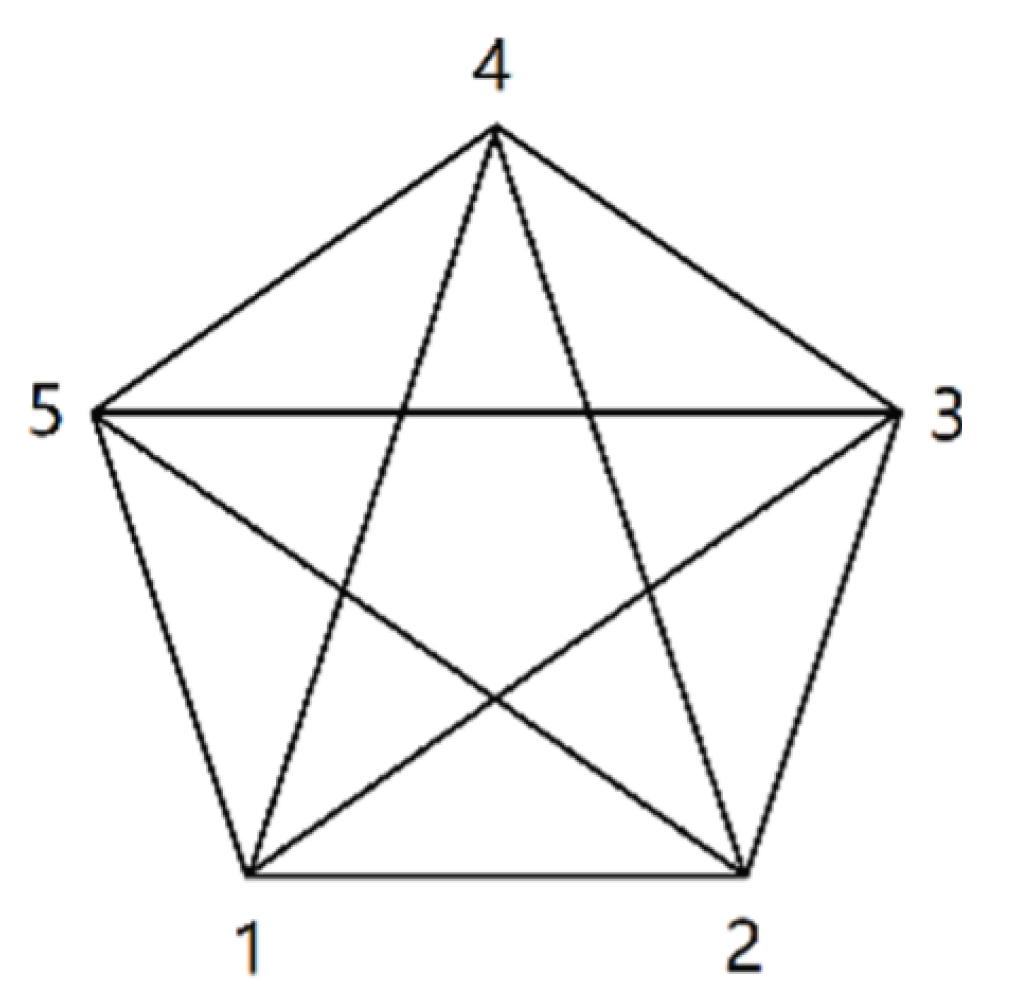
Figure 1 shows a five-UAV planar topology, with edges as bidirectional communication links. This supports an algebraic graph model for adaptive bearing formation control.
For formation structure, the position set is { r i } i = 1 n and the position vector is r = r 1 T , , r n T T R 3 n . Graph G has m edges, numbered 1 to m. Edge ( i , j ) corresponds to edge k, with edge vector e k = r i j = r i r j and bearing vector g k = e k e k . Define e = e 1 T , , e m T T , g = g 1 T , , g m T T . The incidence matrix gives e = H I d r = H ¯ r . The desired bearing is g k * = g i j * , with g * = g 1 * T , , g m * T T . The topology is infinitesimally bearing-rigid, ensuring unique formation from relative bearing measurements, scaling, and translation coefficients.

2.4. Formation Control Objective

Design a bearing-only control strategy to achieve desired bearing-rigid formation from any initial state:
lim t ( g i j ( t ) g i j * ( t ) ) = 0 , lim t ( θ i ( t ) θ i * ) = 0 ,
where r i ( 0 ) R 3 , θ i * is a positive constant.

3. Bearing Formation Control Scheme

3.1. Disturbance Observer

External disturbances, such as wind, can impair system performance. A disturbance observer is proposed to estimate and compensate for these disturbances in real time, ensuring robust control [27,28,29,30]. The observer includes two decoupled components for linear and angular velocity channels:
z ˙ v i = L v i R i ( z v i + L v i R i ) L v i R i v i , d ^ v i = z v i + L v i R i ,
z ˙ ω i = l ω i ( z ω i + l ω i θ i ) l ω i ω i , d ^ ω i = z ω i + l ω i θ i ,
where z v i and z ω i are auxiliary variables, L v i and l ω i are observer gain vectors with L v i 1 4 R i T , l ω i 1 4 , and d ^ v i , d ^ ω i are estimated disturbances for linear and angular velocity channels, respectively.
Assumption 1. 
Disturbances d v i and d ω i in system (5) are bounded, with lim t d ˙ v i ( t ) = 0 and lim t d ˙ ω i ( t ) = 0 .
Remark 1. 
Assumption 1 is in line with typical low-altitude wind conditions and is a standard hypothesis in the design of disturbance observers. In many UAV applications, the main wind components (mean wind, slowly varying gusts and shear) evolve on a time scale slower than the outer-loop formation dynamics and can be regarded as bounded signals with slowly changing derivatives. This boundedness requirement also facilitates stable numerical implementation of the observer. In addition, the inertia and attitude control bandwidth of fixed-wing UAVs attenuate very fast disturbance variations, so Assumption 1 is appropriate for the multi-UAV formation scenario considered in this work.

3.2. Bearing-Rigid Formation Controller

Safety is also essential in formation control [31]. The potential energy function between UAV i and its neighboring UAV j is defined as follows:
P i j = g i j g i j * 2 r i j .
Define
β i j = P i j r i j = 2 ( g i j g i j * ) I g i j g i j r i j r i j + ( g i j g i j * ) ( g i j g i j * ) r i j r i j = 2 ( g i j g i j * ) .
The total potential field for UAV i is
P i = j N i P i j ( r i j ) .
A formation control law based on bearing measurements is designed to ensure that the UAV system, starting from any initial position r i ( 0 ) R 3 , i = 1 , 2 , , n , forms and maintains the desired globally stable formation. The potential function P i j is smooth and equals zero when the relative bearing between UAVs i and j reaches the desired value g i j * .

3.3. Conditional Disturbance Utilization

A criterion for CDU is designed, considering desired angular error and external disturbances:
η i = R i T r i P i d ^ v i T | R i T r i P i d ^ v i T | + ε i ,
ρ i = ( θ i θ i * ) d ^ ω i T | ( θ i θ i * ) d ^ ω i T | + ς i ,
where R i is the rotation matrix, θ i * is the desired angle, ε i and ς i are small positive constants, and r i P i = p i P x i , p i P y i , p i P z i T .
Equations (10) and (11) define the CDU strategy, assessing whether disturbances are beneficial or detrimental. If η i 0 and ρ i 0 , the disturbance is beneficial; otherwise, if η i > 0 or ρ i > 0 , it is detrimental [32].
Remark 2. 
Whether an external signal should be exploited or rejected depends on its direction relative to the formation error. If the signal acts against the error (i.e., η i 0 in (10) or ρ i 0 in (11)), it plays a damping-like role: the Lyapunov function derivative W ˙ decreases faster, convergence is accelerated, and control effort can be reduced. On the other hand, when it points in the same direction as the error (i.e., η i > 0 or ρ i > 0 ), it enlarges formation deviation and needs to be actively compensated using the observer-based estimates in (7) and (8). In this way, the CDU mechanism keeps and utilizes favorable components while suppressing those that undermine formation stability.

3.4. Control Law Design

To achieve the control objectives, the bearing formation control law is designed as follows:
v i = k i R i T ( r i P i ) η i d ^ v i ,
w i = l i ( θ i θ i * ) ρ i d ^ ω i ,
where k i 1 , l i 1 , η i is given by (10), and ρ i is given by (11).
Remark 3. 
The proposed controller employs a disturbance characterization indicator built upon the estimates provided by the disturbance observer, so that disturbance components that hinder formation regulation are compensated, whereas those aligned with the control objective are actively utilized. At the same time, a bearing-dependent potential function is included to enforce collision avoidance among neighboring UAVs, thereby improving the overall safety of the formation during disturbance utilization.

4. Stability Analysis

4.1. Stability of the Disturbance Observer

Theorem 1. 
Consider the disturbance observer (7)–(8) and define the estimation errors
e v i = d v i d ^ v i , e ω i = d ω i d ^ ω i .
Under Assumption 1 and for L v i 1 4 R i T , l ω i 1 4 , the disturbance estimation error system is asymptotically stable, i.e.,
lim t e v i ( t ) = 0 , lim t e ω i ( t ) = 0 .
Proof. 
From the disturbance observer (7)–(8), the estimation error dynamics can be written as
e ˙ v i = d ˙ v i d ^ ˙ v i = d ˙ v i z ˙ v i = d ˙ v i + L v i R i z v i + L v i R i + L v i R i v i L v i R i ( v i + d v i ) = d ˙ v i + L v i R i d ^ v i L v i R i d v i = d ˙ v i L v i R i e v i ,
e ˙ ω i = d ˙ ω i d ^ ˙ ω i = d ˙ ω i z ˙ ω i = d ˙ ω i + l ω i z ω i + l ω i θ i + l ω i ω i l ω i ( ω i + d ω i ) = d ˙ ω i + l ω i d ^ ω i l ω i d ω i = d ˙ ω i l ω i e ω i .
Choose the Lyapunov functions
V v i = 1 2 e v i 2 , V ω i = 1 2 e ω i 2 .
Taking their time derivatives along (15)–(16) yields
V ˙ v i = e v i e ˙ v i = e v i d ˙ v i L v i R i e v i = L v i R i e v i 2 + e v i d ˙ v i ,
V ˙ ω i = e ω i e ˙ ω i = e ω i d ˙ ω i l ω i e ω i = l ω i e ω i 2 + e ω i d ˙ ω i .
Under Assumption 1, d v i and d ω i are bounded and satisfy lim t d ˙ v i ( t ) = 0 and lim t d ˙ ω i ( t ) = 0 . Since L v i 1 4 R i T , l ω i 1 4 and R i is a rotation matrix, there exist positive constants L ̲ i , l ̲ i > 0 such that
V ˙ v i L ̲ i e v i 2 ,
V ˙ ω i l ̲ i e ω i 2 .
Therefore, e v i and e ω i converge to zero asymptotically. □

4.2. Formation System Stability Analysis

Theorem 2. 
Consider the closed-loop multi-UAV system (5) under the bearing-based control laws (12)–(13) with the CDU strategy (10)–(11). Under Assumption 1, for sufficiently large gains k i 1 , l i 1 , L v i 1 4 R i T , and l ω i 1 4 , the desired bearing-rigid formation is asymptotically achieved, i.e.,
lim t g i j ( t ) g i j * ( t ) = 0 , lim t θ i ( t ) θ i * = 0 .
Proof. 
The stability of the translational formation subsystem is analyzed by integrating the control laws with the potential energy functions. Define the Lyapunov function
W i = i = 1 n P i + i = 1 n e v i 2 .
For undirected communication topology, P i j r i j = P i j r i = P i j r j , j N i , yielding
d d t i = 1 n P i = i = 1 n j N i P ˙ i j T r i j P i j = 2 i = 1 n P ˙ i T r i P i .
The derivative of W i is
W ˙ i = 2 i = 1 n P ˙ i T r i P i + 2 i = 1 n e v i T e ˙ v i .
Considering the CDU, two cases are analyzed:
Case 1: When η i > 0 ,
W ˙ i = 2 i = 1 n ( r i P i ) T R i k i R i T ( r i P i ) 1 ε i | R i T r i P i d ^ v i | d ^ v i + d v i 2 i = 1 n L v i R i e v i 2 2 k i i = 1 n | r i P i | 2 + 2 i = 1 n R i T r i P i ( d v i d ^ v i ) 2 i = 1 n L v i R i e v i 2 2 k i i = 1 n | r i P i | 2 + 2 i = 1 n r i P i 2 + 1 2 i = 1 n R i e v i 2 2 i = 1 n L v i R i e v i 2 .
Case 2: When η i 0 ,
W ˙ i = 2 i = 1 n ( r i P i ) T R i k i R i T ( r i P i ) η i d ^ v i + d v i 2 i = 1 n L v i R i e v i 2 2 k i i = 1 n | r i P i | 2 + 2 i = 1 n R i T r i P i ( d v i d ^ v i ) 2 i = 1 n L v i R i e v i 2 2 k i i = 1 n | r i P i | 2 + 2 i = 1 n r i P i 2 + 1 2 i = 1 n R i e v i 2 2 i = 1 n L v i R i e v i 2 .
When L v i 1 4 , both cases yield
W ˙ i k ¯ i i = 1 n r i P i 2 λ ¯ i i = 1 n R i e v i 2 0 ,
where k ¯ i > 0 , λ ¯ i > 0 . Since W ˙ i 0 and W i is bounded below by zero, lim t W i ( t ) exists. Define T ( g i j ( t ) ) = 2 k ¯ i i = 1 n r i P i 2 . Integrating gives
lim t 0 t T ( g i j ( τ ) ) d τ W i ( r i j ( 0 ) ) W i ( r i j ( ) ) .
Since 0 t T ( g i j ( τ ) ) d τ is bounded, T ( g i j ( t ) ) is continuous for all g i j ( t ) W , t [ 0 , + ) . By uniform continuity and Barbalat’s lemma, lim t T ( g i j ( t ) ) = 0 , implying i = 1 n j N i ( g i j g i j * ) = 0 . In matrix form,
r T H ¯ T ( g g * ) = e T ( g g * ) = 1 2 k = 1 m e k g k g k * 2 = 0 .
For the rotational angle system, choose the Lyapunov function
W θ i = i = 1 n ( θ i θ i * ) 2 + i = 1 n e ω i 2 .
Its derivative is
W ˙ θ i = 2 i = 1 n ( θ i θ i * ) θ ˙ i + 2 i = 1 n e ω i T e ˙ ω i .
Considering (13), two cases are analyzed:
Case 1: When ρ i > 0 ,
W ˙ θ i = 2 i = 1 n l i ( θ i θ i * ) 2 + 2 i = 1 n ( θ i θ i * ) e ω i 2 i = 1 n l ω i e ω i 2 2 i = 1 n l i ( θ i θ i * ) 2 + 2 i = 1 n θ i θ i * 2 + 1 2 i = 1 n e ω i 2 2 i = 1 n l ω i e ω i 2 .
Case 2: When ρ i 0 ,
W ˙ θ i = 2 i = 1 n l i ( θ i θ i * ) 2 2 i = 1 n ( θ i θ i * ) ρ i d ^ ω i + 2 i = 1 n ( θ i θ i * ) e ω i 2 i = 1 n l ω i e ω i 2 2 i = 1 n l i ( θ i θ i * ) 2 + 2 i = 1 n θ i θ i * 2 + 1 2 i = 1 n e ω i 2 2 i = 1 n l ω i e ω i 2 .
When l ω i 1 4 , both cases yield
W ˙ θ i τ ¯ i i = 1 n θ i θ i * 2 γ ¯ i i = 1 n e ω i 2 0 ,
where τ ¯ i > 0 , γ ¯ i > 0 . Thus, θ i ( t ) converges to θ i * , i.e., lim t ( θ i ( t ) θ i * ) = 0 .
By uniform continuity, lim t ( g i j ( t ) g i j * ( t ) ) = 0 and lim t ( θ i ( t ) θ i * ) = 0 , ensuring all angle errors converge to zero. This confirms the global asymptotic stability of the bearing-rigid formation, achieving the desired formation shape. □

5. Simulation

5.1. Wind Disturbance Simulation

Wind disturbances are modeled as the sum of mean wind, gusts, and wind shear, as defined in the wind field model:
v w ( h , q ) = v a ( h ) + v b ( q ) + v c ( h ) ,
The components are given by
v a ( h ) = v 6.096 ln ( h / z 0 ) ln ( 6.096 / z 0 ) ,
v b ( q ) = 0 , q < 0 , v b max 2 1 cos π q d , 0 q d , v b max , q > d ,
v c ( h ) = v f k ln h H c ,
where h is the UAV altitude, z 0 = 0.1 m is the surface roughness length, v 6.096 = 5 m/s is the mean wind speed at 6.096 m; q is the distance to the gust center, d = 10 m is the gust scale, v b max = 2 m/s is the peak gust speed; H c = 0.01 m is the zero-wind height, k = 0.4 is the Kármán constant, and v f = 0.5 m/s is the friction velocity. For simulation, the wind disturbance is incorporated into the UAV dynamics as d v i ( t ) = v w i ( t ) , with d ω i ( t ) = 0.1 cos θ i .
MATLAB (2023b) simulations validate the proposed algorithm’s effectiveness. The UAV system dynamics are modeled as
r ˙ i = R i ( v i + 1.2 cos v i ) , θ ˙ i = ω i + 0.1 cos θ i ,
with the initial positions, velocity constraints, and communication radius configured based on real UAV performance and mission scenarios.

5.2. Case 1

Six UAVs have initial coordinates: r 1 = [ 1 , 0.2 , 0 ] , r 2 = [ 1 , 0.4 , 0 ] , r 3 = [ 1 , 0.6 , 0 ] , r 4 = [ 1 , 0.8 , 0 ] , r 5 = [ 1 , 1 , 0 ] , r 6 = [ 1 , 1.2 , 0 ] .
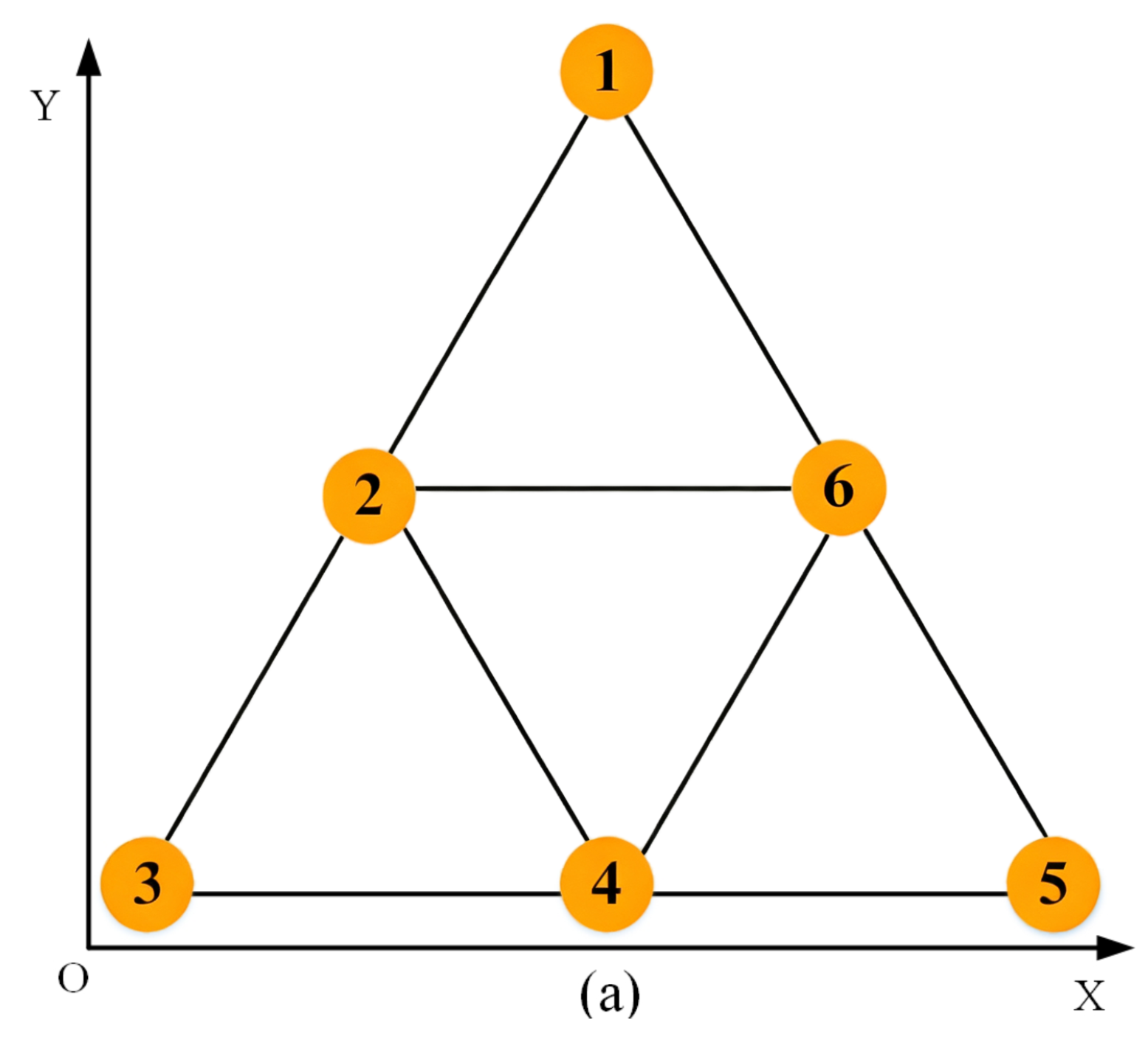
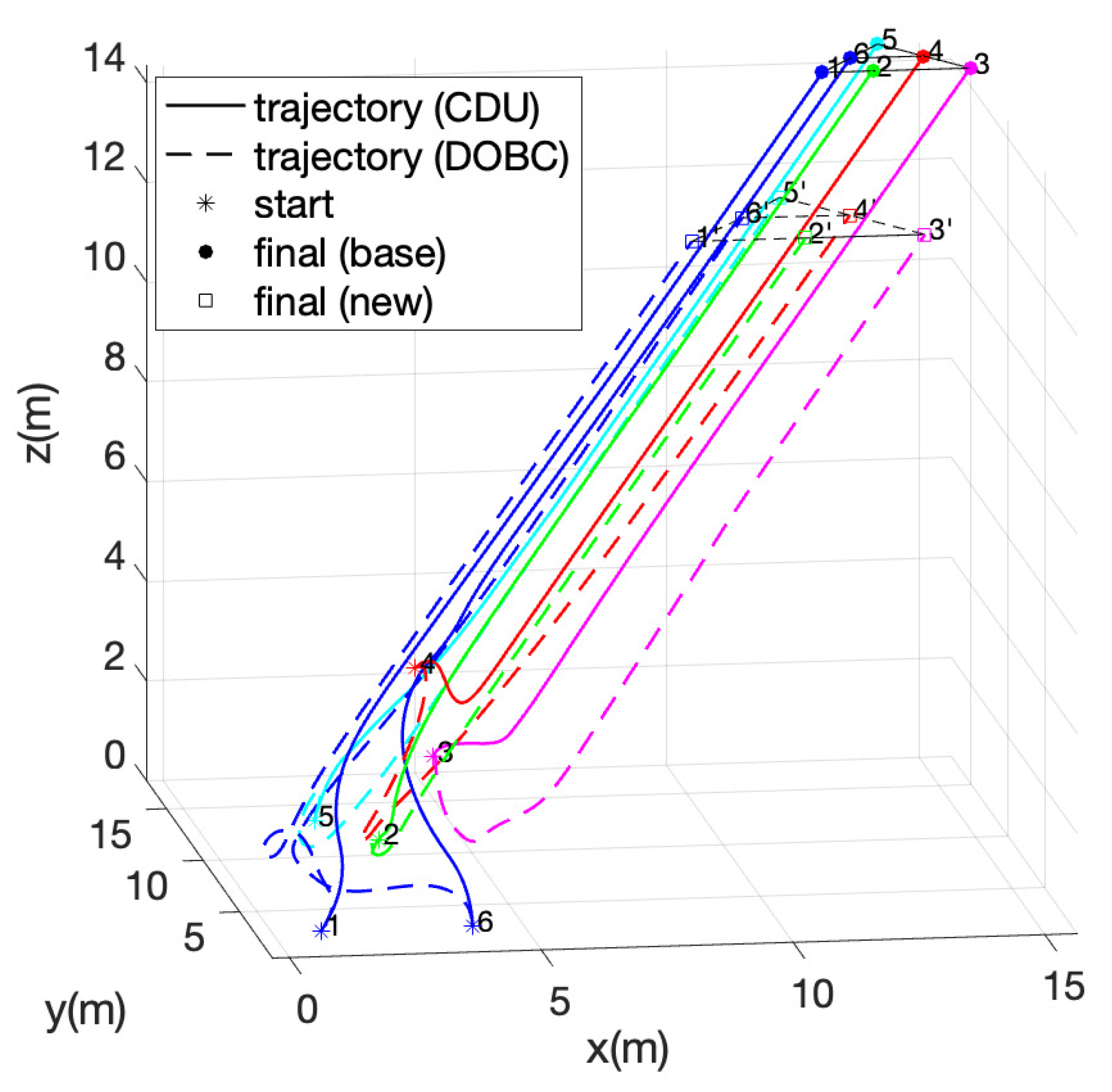
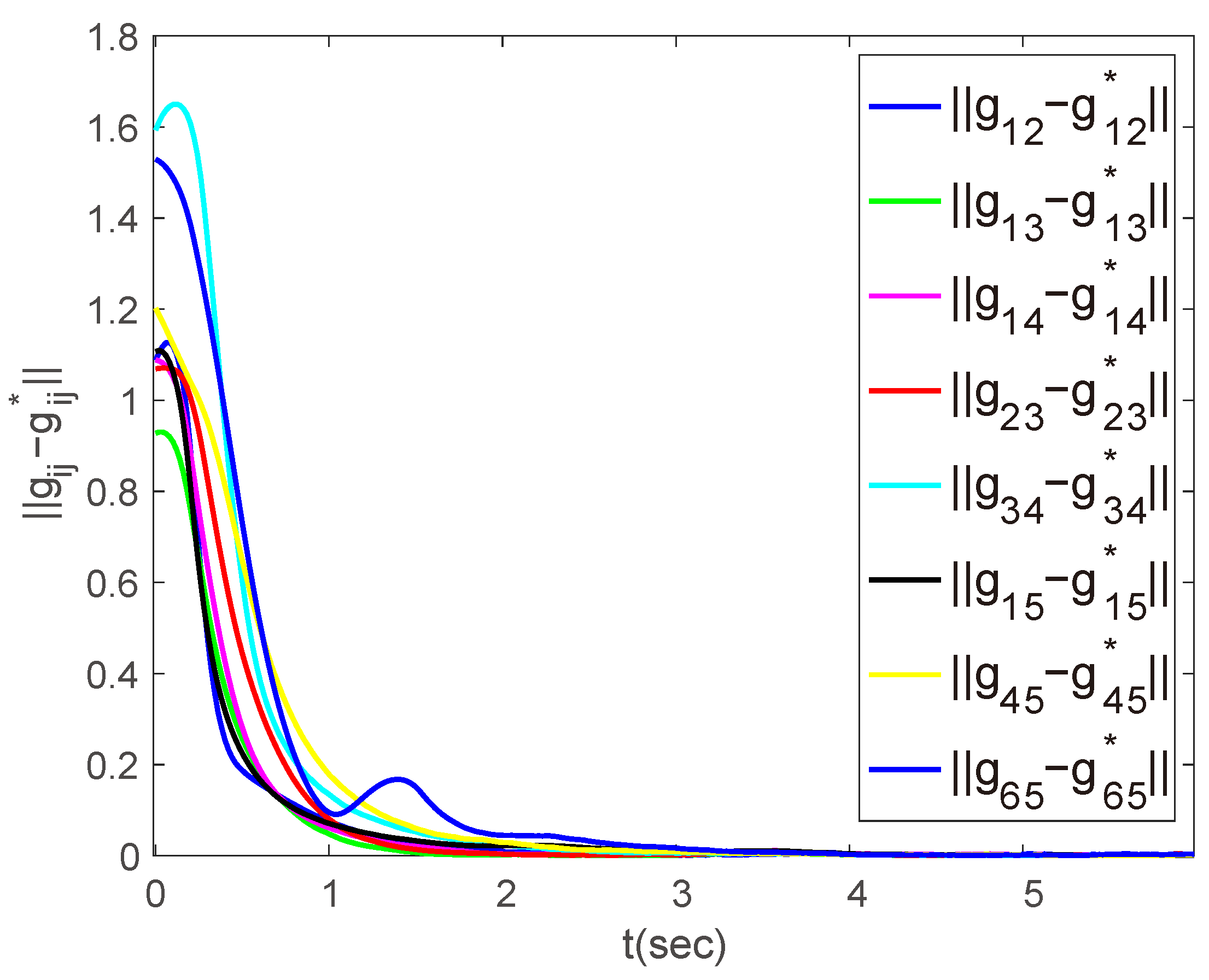
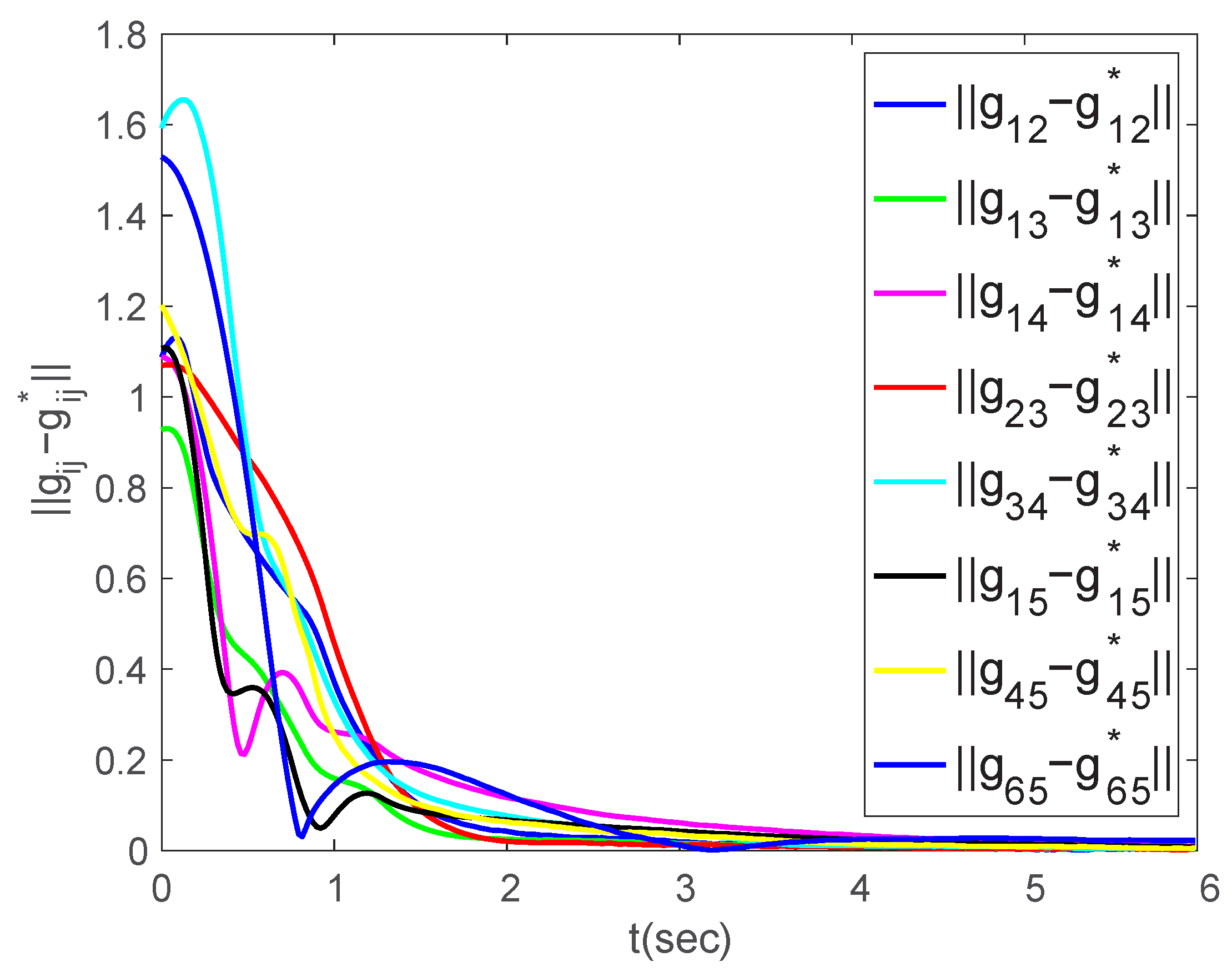
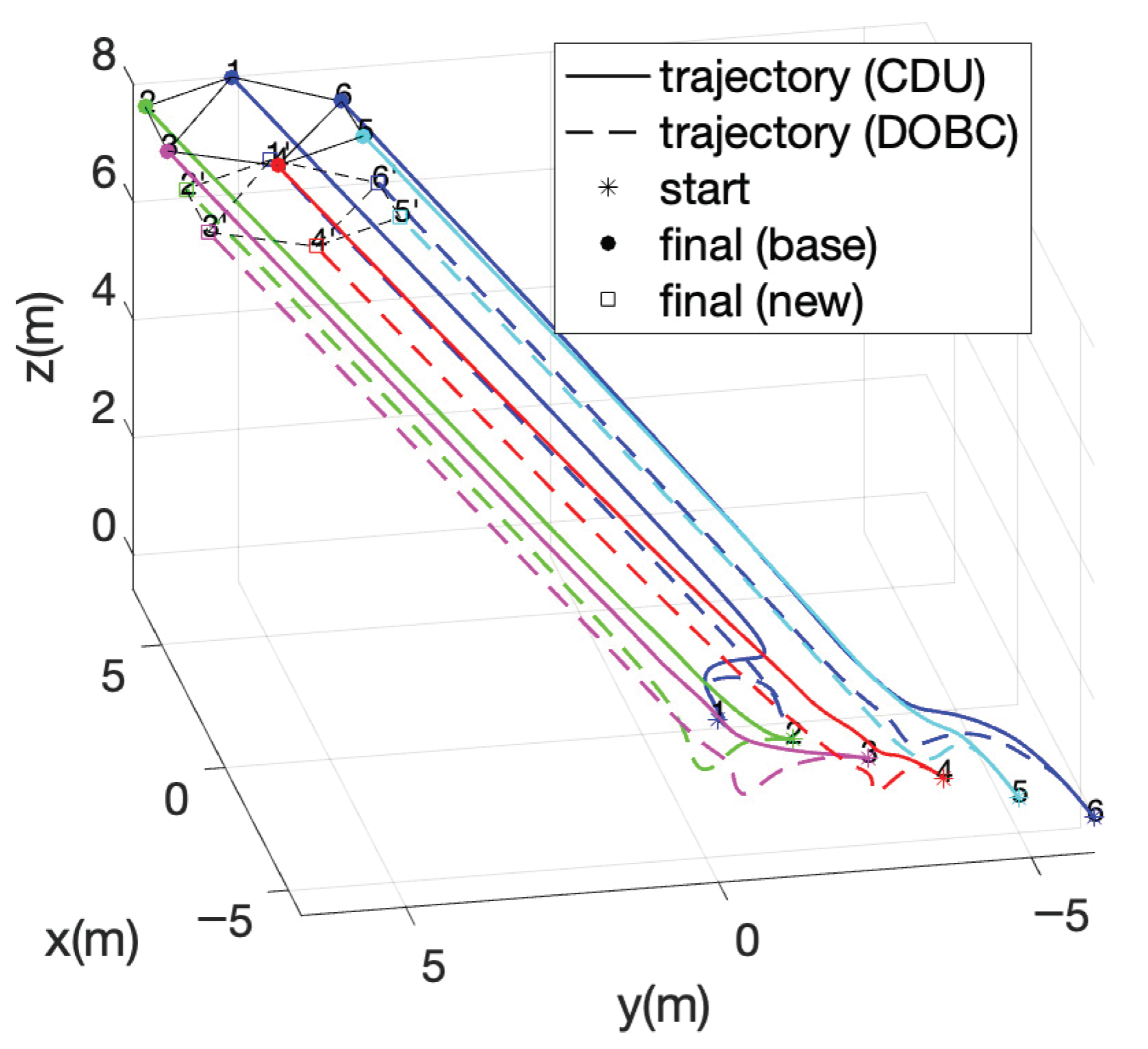
In 3D space, six UAVs start from initial positions and form a regular triangular formation after 6 s of attitude adjustment, as illustrated in Figure 2. The simulation results in Figure 3 and Table 1 show that the CDU method achieves zero tracking error within 4 s with high formation precision, demonstrating its superiority in rapid convergence and accuracy. In contrast, the traditional Disturbance Observer-Based Control (DOBC) method converges more slowly, highlighting CDU’s advantage; this is also reflected in the bearing error convergence curves in Figure 4 and Figure 5. Moreover, under favorable wind conditions, the CDU strategy enables the formation to travel further along the desired direction within the same time horizon, as seen from the trajectories in Figure 3.

5.3. Case 2

Six UAVs have initial coordinates: r 1 = [ 1 , 1 , 0 ] , r 2 = [ 2 , 2 , 0 ] , r 3 = [ 3 , 3 , 0 ] , r 4 = [ 4 , 4 , 0 ] , r 5 = [ 5 , 5 , 0 ] , r 6 = [ 6 , 6 , 0 ] .
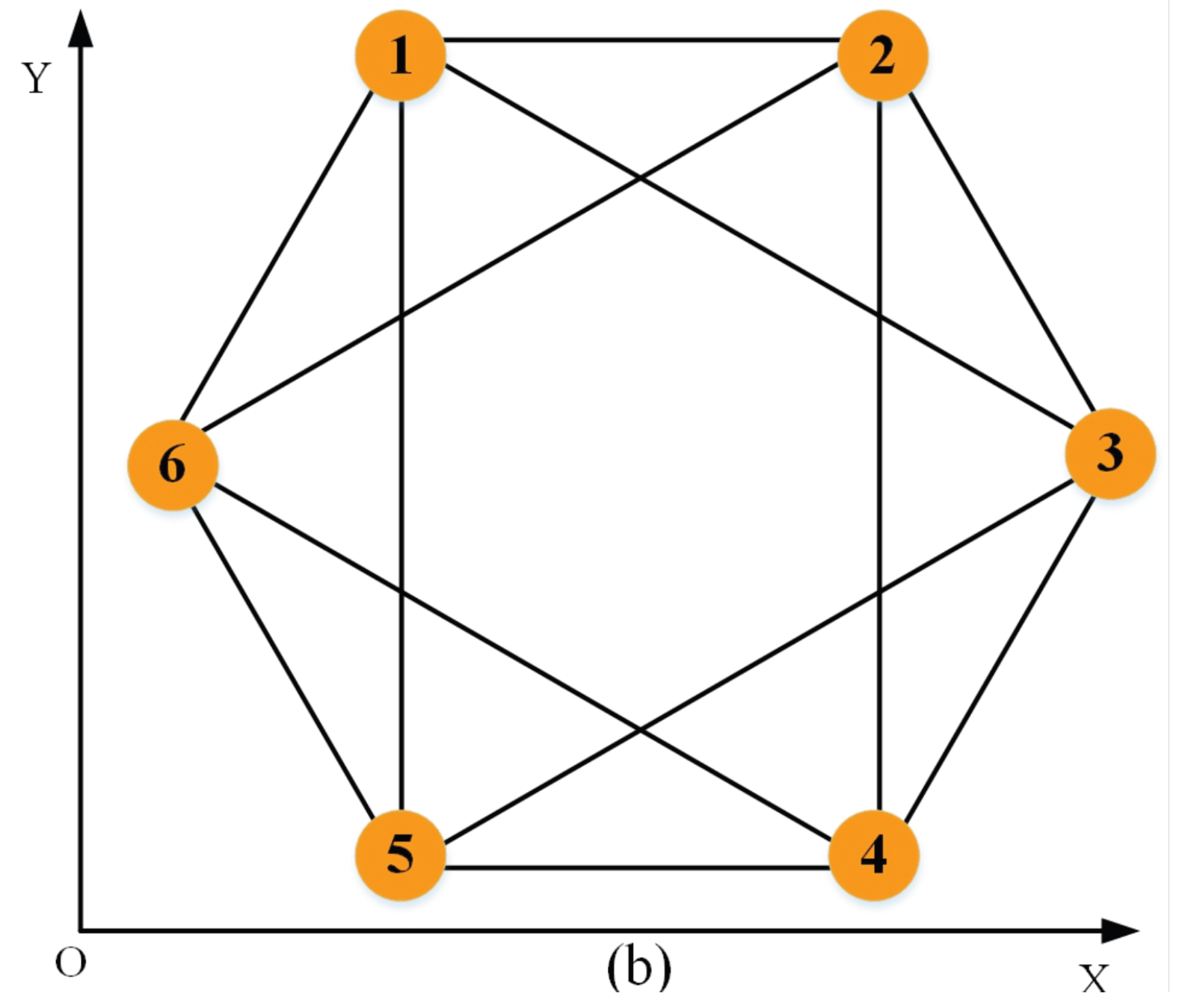
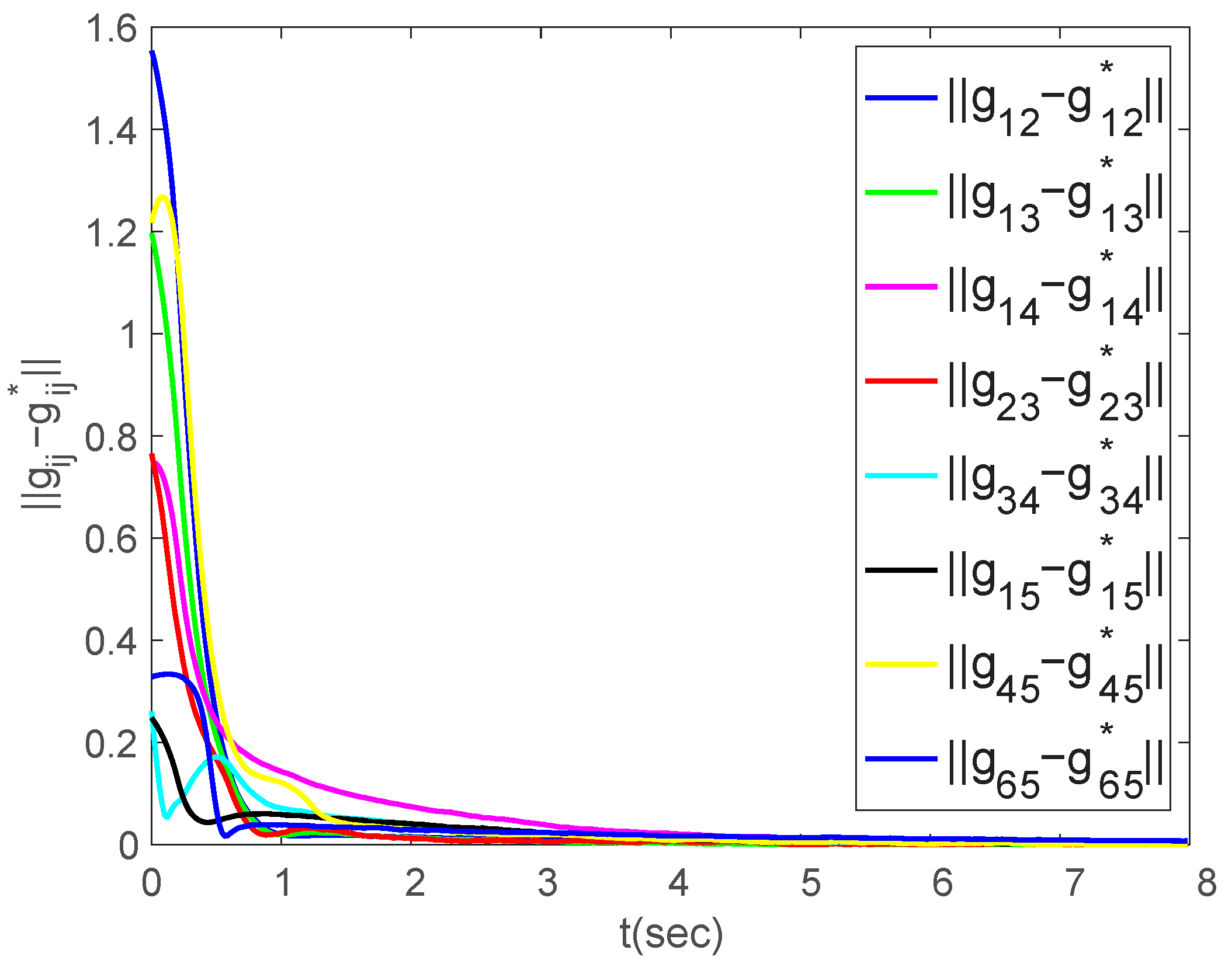
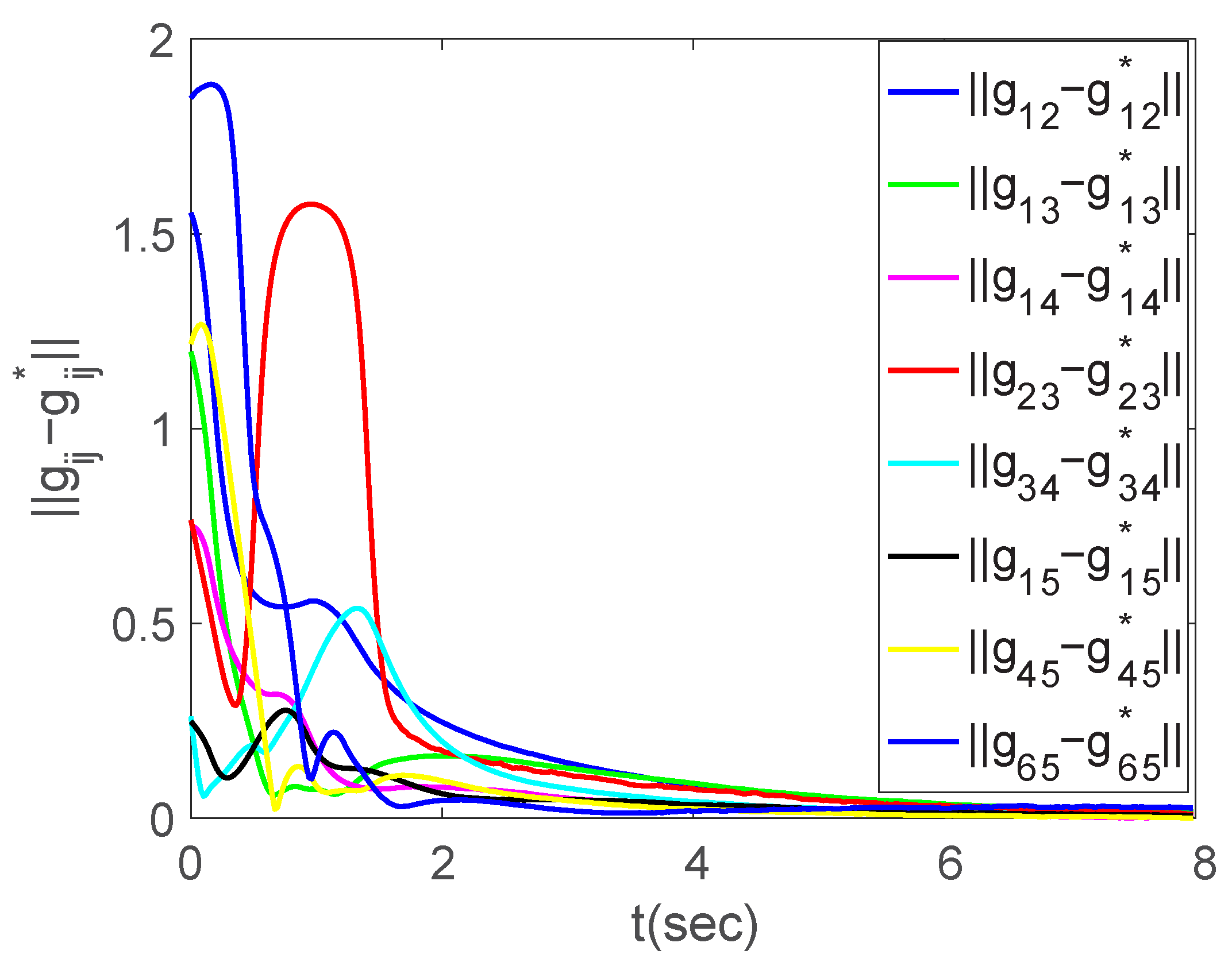
In 3D space, six UAVs take off from initial positions and form a regular hexagonal formation after 8 s of adjustment, as illustrated in Figure 6. Simulation results in Figure 7 and Table 2 indicate that the CDU algorithm reduces tracking error to zero within 6 s while maintaining high formation accuracy, confirming its effectiveness in fast convergence and precise control. Conversely, the DOBC method exhibits slower convergence, underscoring CDU’s superior performance; this trend is also reflected in the bearing error convergence shown in Figure 8 and Figure 9. Moreover, under the same simulation duration, the CDU-based formation moves farther than the DOBC-based one while still preserving the prescribed hexagonal geometry.

6. Conclusions

In this paper, a method based on CDU is proposed to solve the formation control problem of UAVs in complex wind disturbance environments. Differing from the traditional disturbance compensation methods, the CDU framework actively identifies and exploits the beneficial components in the external disturbance to improve the performance and stability of the system. By estimating the disturbance dynamics with a real-time disturbance observer, the CDU mechanism is able to dynamically decide whether to exploit these disturbances according to the control objectives. Combined with the angle-rigid formation topology, the proposed method ensures global stability and fast convergence, and the angle-based potential energy function is used to reduce the collision risk caused by disturbance. Simulation and experimental results verify the significant advantages of the proposed method in improving UAV formation stability, response speed, and accuracy. Compared with the traditional methods, the CDU framework can deal with the disturbance problem in the dynamic environment more effectively, which provides a new idea for UAV formation control. In future work, we will explore proportional–integral disturbance observers and barrier Lyapunov-based constraint handling to further enhance the robustness and safety of the proposed CDU formation control framework under wind disturbances.

Author Contributions

Q.W.: Conceptualization, Formal Analysis, Supervision, Validation, Writing—review and editing. Y.S.: Conceptualization, Data curation, Formal Analysis, Methodology, Software, Visualization, Writing—original draft. Y.Z.: Data curation, Investigation, Visualization. Z.P.: Methodology, Validation, Writing—review and editing. All authors have read and agreed to the published version of the manuscript.

Funding

The authors declare that financial support was received for the research, authorship, and/or publication of this article. This work is supported by the National Natural Science Foundation of China under Grants 92371116 and 62433005, and by the Postgraduate Research & Practice Innovation Program of Jiangsu Province (KYCX25_3971 and KYCX25_3973).

Institutional Review Board Statement

Not applicable.

Informed Consent Statement

Not applicable.

Data Availability Statement

The original contributions presented in the study are included in the article. Further inquiries can be directed to the corresponding author.

Conflicts of Interest

The authors declare that this research was conducted in the absence of any commercial or financial relationships that could be construed as a potential conflict of interest.

References

  1. Zhu, X.; Gao, Y.; Li, Y.; Li, B. Fast Dynamic P-RRT*-Based UAV Path Planning and Trajectory Tracking Control Under Dense Obstacles. Actuators 2025, 14, 211. [Google Scholar] [CrossRef]
  2. Wang, H.; Li, W.; Ning, J. Collision Avoidance and Formation Tracking Control for Heterogeneous UAV/USV Systems with Input Quantization. Actuators 2025, 14, 309. [Google Scholar] [CrossRef]
  3. Satoh, Y.; Ohno, K. Robust Attitude Stabilization of Rigid Bodies Based on Control Lyapunov Function: Experimental Verification on a Quadrotor Testbed. Actuators 2025, 14, 509. [Google Scholar] [CrossRef]
  4. Zheng, Z.; Tong, S.; Wang, E.; Zhu, Y.; Shao, J. Robust Consensus Tracking Control for Multi-Unmanned-Aerial-Vehicle (UAV) System Subjected to Measurement Noise and External Disturbance. Drones 2025, 9, 61. [Google Scholar] [CrossRef]
  5. Di Ferdinando, M.; Bianchi, D.; Di Gennaro, S.; Pepe, P. On the Robust Quantized Sampled–Data Leaderless Consensus Tracking of Nonlinear Multi–Agent Systems. In Proceedings of the 2021 60th IEEE Conference on Decision and Control (CDC), Austin, TX, USA, 13–17 December 2021; pp. 3263–3268. [Google Scholar]
  6. Yuan, Q.; Li, X. Distributed Model Predictive Formation Control for a Group of UAVs With Spatial Kinematics and Unidirectional Data Transmissions. IEEE Trans. Netw. Sci. Eng. 2023, 10, 3209–3222. [Google Scholar] [CrossRef]
  7. Pan, Z.; Zhang, C.; Xia, Y.; Xiong, H.; Shao, X. An Improved Artificial Potential Field Method for Path Planning and Formation Control of the Multi-UAV Systems. IEEE Trans. Circuits Syst. II Express Briefs 2022, 69, 1129–1133. [Google Scholar] [CrossRef]
  8. Liu, R.; Qu, B.; Wei, T.; Zhang, L.; Yan, L.; Chai, X. Research on UAV Formation Obstacle Avoidance Based on Consistency Control. In Proceedings of the 2023 IEEE 12th Data Driven Control and Learning Systems Conference (DDCLS), Xiangtan, China, 12–14 May 2023; pp. 155–160. [Google Scholar]
  9. Wang, P.; Duan, G.; Li, P.; Wang, L. Adaptive Formation Control of Nonlinear High-Order Fully Actuated Multiagent Systems With Full-State Constraints and Its Application. IEEE Trans. Cybern. 2025, 55, 5002–5013. [Google Scholar] [CrossRef] [PubMed]
  10. Bouskela, A.; Kling, A.; Schuler, T.; Shkarayev, S.; Kalita, H.; Thangavelautham, J. Mars Exploration Using Sailplanes. Aerospace 2022, 9, 306. [Google Scholar] [CrossRef]
  11. Aranda, M.; López-Nicolás, G.; Sagüés, C.; Zavlanos, M.M. Distributed Formation Stabilization Using Relative Position Measurements in Local Coordinates. IEEE Trans. Autom. Control 2016, 61, 3925–3935. [Google Scholar] [CrossRef]
  12. Jing, G.; Wang, L. Multiagent Flocking With Angle-Based Formation Shape Control. IEEE Trans. Autom. Control 2020, 65, 817–823. [Google Scholar] [CrossRef]
  13. Zhang, H.; Gong, B. Multi-target bearing-only measurement association and IOD method for pseudo-coplanar orbits in dual-satellite systems. Acta Astronaut. 2025, 236, 1236–1248. [Google Scholar] [CrossRef]
  14. Bao, B.; Luo, C.; Hong, Y.; Chen, Z.; Fan, X. High-Precision UAV Positioning Method Based on MLP Integrating UWB and IMU. Tsinghua Sci. Technol. 2025, 30, 1315–1328. [Google Scholar] [CrossRef]
  15. Gaynutdinov, R.; Chermoshentsev, S. Electromagnetic Disturbance Study in On-board Equipment Coupling Paths of UAVs at Electromagnetic Influences from Radio Transmitters Antennas. In Proceedings of the 2019 International Russian Automation Conference (RusAutoCon), Sochi, Russia, 8–14 September 2019; pp. 1–5. [Google Scholar]
  16. Wei, L.; Tan, M.K.; Lim, K.G.; Teo, K.T.K. Adaptive Disturbance Stability Control for Uncrewed Aerial Vehicles Based on Radial Basis Function Neural Networks and Backstepping Sliding-Mode Control. IEEE Trans. Aerosp. Electron. Syst. 2025, 61, 11208–11219. [Google Scholar] [CrossRef]
  17. Zhang, D.; Wang, Y.; Meng, L.; Yan, J.; Qin, C. Adaptive critic design for safety-optimal FTC of unknown nonlinear systems with asymmetric constrained-input. ISA Trans. 2024, 155, 309–318. [Google Scholar] [CrossRef] [PubMed]
  18. Tong, L.; Gan, X.; Wu, Y.; Yang, N.; Lv, M. An ADS-B Information-Based Collision Avoidance Methodology to UAV. Actuators 2023, 12, 165. [Google Scholar] [CrossRef]
  19. Zhan, Q.; Shen, R.; Zhou, Y.; Zhang, J.; Sun, C.; Guo, F.; He, B. Multimodal adaptive anti-disturbance control for UAV trajectory tracking in hydropower penstock inspections. Control Eng. Pract. 2025, 165, 106615. [Google Scholar] [CrossRef]
  20. Meng, W.; Zhang, X.; Zhou, L.; Guo, H.; Hu, X. Advances in UAV Path Planning: A Comprehensive Review of Methods, Challenges, and Future Directions. Drones 2025, 9, 376. [Google Scholar] [CrossRef]
  21. Zhang, D.; Yu, C.; Li, Z.; Qin, C.; Xia, R. A lightweight network enhanced by attention-guided cross-scale interaction for underwater object detection. Appl. Soft Comput. 2025, 184, 113811. [Google Scholar] [CrossRef]
  22. Tan, G.; Wang, T. A New Result on H Filtering Criterion Based on Improved Techniques. Circuits Syst. Signal Process. 2025. [Google Scholar] [CrossRef]
  23. Huang, Z.; Chen, M.; Shi, P. Disturbance Utilization-Based Tracking Control for the Fixed-Wing UAV With Disturbance Estimation. IEEE Trans. Circuits Syst. I Regul. Pap. 2023, 70, 1337–1349. [Google Scholar] [CrossRef]
  24. Guo, Z.; Guo, J.; Zhou, J.; Chang, J. Robust Tracking for Hypersonic Reentry Vehicles via Disturbance Estimation-Triggered Control. IEEE Trans. Aerosp. Electron. Syst. 2020, 56, 1279–1289. [Google Scholar] [CrossRef]
  25. Kong, S.; Sun, J.; Wang, J.; Zhou, Z.; Shao, J.; Yu, J. Piecewise Compensation Model Predictive Governor Combined With Conditional Disturbance Negation for Underactuated AUV Tracking Control. IEEE Trans. Ind. Electron. 2023, 70, 6191–6200. [Google Scholar] [CrossRef]
  26. Chen, P.; Zhang, G.; Guan, T.; Yuan, M.; Shen, J. The Motion Controller Based on Neural Network S-Plane Model for Fixed-Wing UAVs. IEEE Access 2021, 9, 93927–93936. [Google Scholar] [CrossRef]
  27. Akhtar, Z.; Naqvi, S.A.Z.; Hamayun, M.T.; Ahsan, M.; Nadeem, A.; Muyeen, S.M.; Oshnoei, A. Incorporation of Robust Sliding Mode Control and Adaptive Multi-Layer Neural Network-Based Observer for Unmanned Aerial Vehicles. IEEE Access 2024, 12, 98107–98120. [Google Scholar] [CrossRef]
  28. Li, J.; Bai, J.; Wang, J. High-Precision Trajectory-Tracking Control of Quadrotor UAVs Based on an Improved Crested Porcupine Optimiser Algorithm and Preset Performance Self-Disturbance Control. Drones 2025, 9, 420. [Google Scholar] [CrossRef]
  29. Qin, C.; Ran, X.; Zhang, D. Unsupervised image stitching based on Generative Adversarial Networks and feature frequency awareness algorithm. Appl. Soft Comput. 2025, 183, 113466. [Google Scholar] [CrossRef]
  30. Qin, C.; Pang, M.; Wang, Z.; Hou, S.; Zhang, D. Observer based fault tolerant control design for saturated nonlinear systems with full state constraints via a novel event-triggered mechanism. Eng. Appl. Artif. Intell. 2025, 161, 112221. [Google Scholar] [CrossRef]
  31. Qin, C.; Hou, S.; Pang, M.; Wang, Z.; Zhang, D. Reinforcement learning-based secure tracking control for nonlinear interconnected systems: An event-triggered solution approach. Eng. Appl. Artif. Intell. 2025, 161, 112243. [Google Scholar] [CrossRef]
  32. Wang, W.; Yi, Y.; Qiao, J.; Cao, S.; Yang, J.; Yu, J. Flexible Antidisturbance Control for a Class of Discrete-Time Systems With Packet Loss Based on Conditional Disturbance Utilization. IEEE Trans. Ind. Inform. 2025, 21, 9365–9376. [Google Scholar] [CrossRef]
Figure 1. Agent communication topology.
Actuators 14 00586 g001
Figure 2. Triangular formation of six UAVs.
Actuators 14 00586 g002
Figure 3. Trajectory comparison: CDU vs. DOBC.
Actuators 14 00586 g003
Figure 4. Bearing error convergence with CDU.
Actuators 14 00586 g004
Figure 5. Bearing error convergence with DOBC.
Actuators 14 00586 g005
Figure 6. Hexagonal formation of six UAVs.
Actuators 14 00586 g006
Figure 7. Trajectory comparison in hexagonal formation.
Actuators 14 00586 g007
Figure 8. Bearing error convergence with CDU.
Actuators 14 00586 g008
Figure 9. Bearing error convergence with DOBC.
Actuators 14 00586 g009
Table 1. Comparison of CDU and DOBC in convergence speed and formation distance.
MetricCDUDOBCImprovement
Convergence time T settle (s)3.86.036.7% faster
Formation distance (m)19.817.115.8% farther
Table 2. Comparison of CDU and DOBC in convergence speed and formation distance.
MetricCDUDOBCImprovement
Convergence time T settle (s)6.98.013.8% faster
Formation distance (m)12.810.626.4% farther
Disclaimer/Publisher’s Note: The statements, opinions and data contained in all publications are solely those of the individual author(s) and contributor(s) and not of MDPI and/or the editor(s). MDPI and/or the editor(s) disclaim responsibility for any injury to people or property resulting from any ideas, methods, instructions or products referred to in the content.