
Article

Sarcocystis spp. Investigations in Iberian Wild Caprinae Reveal a Remarkable Degree of Interconnection with Parasites’ Domestic Epidemiological Life Cycles


by
Guillermo E. Delgado-De las Cuevas
1,
Eglė Rudaitytė-Lukošienė
2,
Petras Prakas
2,*,
Josep Estruch
3,
Roser Velarde
3,
Antonio I. Plasencia-Gutiérrez
4,
María L. García-Gil
5,
Miguel Á. Habela
1 and
Rafael Calero-Bernal
6,*
1
Animal Health Department, University of Extremadura, Avda. Universidad s/n, 10071 Cáceres, Spain
2
State Scientific Research Institute Nature Research Centre, Akademijos 2, 08412 Vilnius, Lithuania
3
Wildlife Ecology & Health Group (WE&H) and Servei d’Ecopatologia de Fauna Salvatge (SEFaS), Departament de Medicina i Cirurgia Animals, Facultat de Veterinària, Universitat Autònoma de Barcelona (UAB), 08193 Bellaterra, Spain
4
Conselleria d’Agricultura, Pesca i Alimentació, Gobierno de las Islas Baleares, Calle Eusebi Estada 145, 07009 Palma, Spain
5
Spanish National Electron Microscopy Centre, Avenida Complutense s/n, 28040 Madrid, Spain
6
SALUVET Group, Animal Health Department, Complutense University of Madrid, Ciudad Universitaria s/n, 28040 Madrid, Spain
*
Authors to whom correspondence should be addressed.
Pathogens 2026, 15(8), 816; https://doi.org/10.3390/pathogens15080816
Submission received: 26 June 2026 / Revised: 28 July 2026 / Accepted: 31 July 2026 / Published: 1 August 2026
(This article belongs to the Section Parasitic Pathogens)

Abstract

Many uncertainties exist on the epidemiology of the Sarcocystis species infecting wild ruminants. In this study, tongue and/or diaphragm tissues of free-ranging wild Caprinae species (54 Pyrenean chamois, 52 mouflons, 146 Iberian ibexes, and 19 Balearean wild goats) residing in the mountain areas of Spain were selected for Sarcocystis spp. detection and species identification. By light microscopy, Sarcocystis sarcocyst frequency rates were considerably high (85.7% in chamois, 82.7% in mouflon, 52.7% in Iberian ibexes), except for the Balearean wild goat (5.3%), which was investigated for the very first time. One excised sarcocyst of Iberian ibex was subjected to transmission electron microscopy, revealing a sibling S. capracanis ultrastructure. Genomic DNA isolated from 57 sarcocysts excised from the hosts’ tissues was investigated through PCR amplicon sequencing of the 18S rRNA and cox1 genes. As a result, sequences of S. capracanis, S. cornagliai, S. rossii and S. tenella were detected, sharing high identity with conspecific sequences. Phylogenetic analyses confirmed a remarkable clustering of all Sarcocystis species in clades encompassing species transmitted via canids, except S. cornagliai, which is allocated in a clade with species using corvid birds as their definitive hosts. Therefore, a significant degree of interconnection between sylvatic and domestic Sarcocystis epidemiological cycles can be drawn in the study area.

1. Introduction

Cyst-forming coccidians of the genus Sarcocystis (Apicomplexa) constitute a large group of more than 240 species with an obligate two-host life cycle whose principal intermediate hosts (IHs) are herbivores, whilst carnivores act as their definitive hosts (DHs). Sarcocystis species develop their sexual reproduction in the intestine of DHs; consequently, oocysts/sporocysts are shed in their feces, serving as sources of infection for IHs. Once ingested, asexual multiplication of the parasites occurs primarily in the endothelial layers of blood vessels and finally merozoites convert to bradyzoites within tissue cysts; mature tissue cysts located mostly in striated musculature constitute the chronic stage of infection and stay latent until a specific DH preys on such host tissues to complete the life cycle [1].
It is mostly accepted that Sarcocystis species have a high specificity for their IH hosts, but recent findings have demonstrated a looser degree of specificity [1,2]. Although wild ruminants have been frequently investigated as IHs of Sarcocystis spp. (reviewed in [1]), the high prevalence of sarcocysts and the remarkable species diversity stand out as two factors that hinder efforts to unravel the species’ epidemiology. The available literature on Sarcocystis spp. infections in wild mountain ruminants (Caprinae) in Europe is summarized in Table S1 [3,4,5,6,7,8,9,10,11,12,13,14,15,16,17,18,19,20,21,22]; most studies only reported their presence at the genus level, and very few performed ultrastructural examination combined with molecular analyses. Although no report on zoonotic Sarcocystis spp. presence in wild ruminants has been published to date, food poisoning associated with Sarcocystis presence in big game meat has been communicated worldwide (reviewed in [1]); additionally, a One Health approach to the investigation and control of Sarcocystis has limited impact given the fact that species cycling does not comprise all three compartments of the principle.
Few studies dealing with Sarcocystis spp. presence in mountain ungulates in Spain have been carried out; only two of them attempted species identification by using molecular and/or electron microscopy methods (Table S1). Although distribution areas and ranging altitudes above 1000 m may differ from those of domestic animals [23,24,25], hosts that have also been scarcely investigated in the study area [1], potential interaction with extensively raised livestock and potential pathogenicity of some Sarcocystis spp. justify the present investigation. This study aimed at estimating the frequency of Sarcocystis infections in Balearean wild goat (Capra hircus var. majorcan/Capra hircus aegagrus); Pyrenean chamois (Rupicapra pyrenaica pyrenaica and R. pyrenaica parva), Iberian ibex (Capra pyrenaica) and mouflon (Ovis orientalis musimon), along with the identification of the species present, and ultimately to infer their phylogenetic relationship with previous genetic variants detected in other hosts in the same epidemiological scenario.

2. Materials and Methods

2.1. Sample Collection

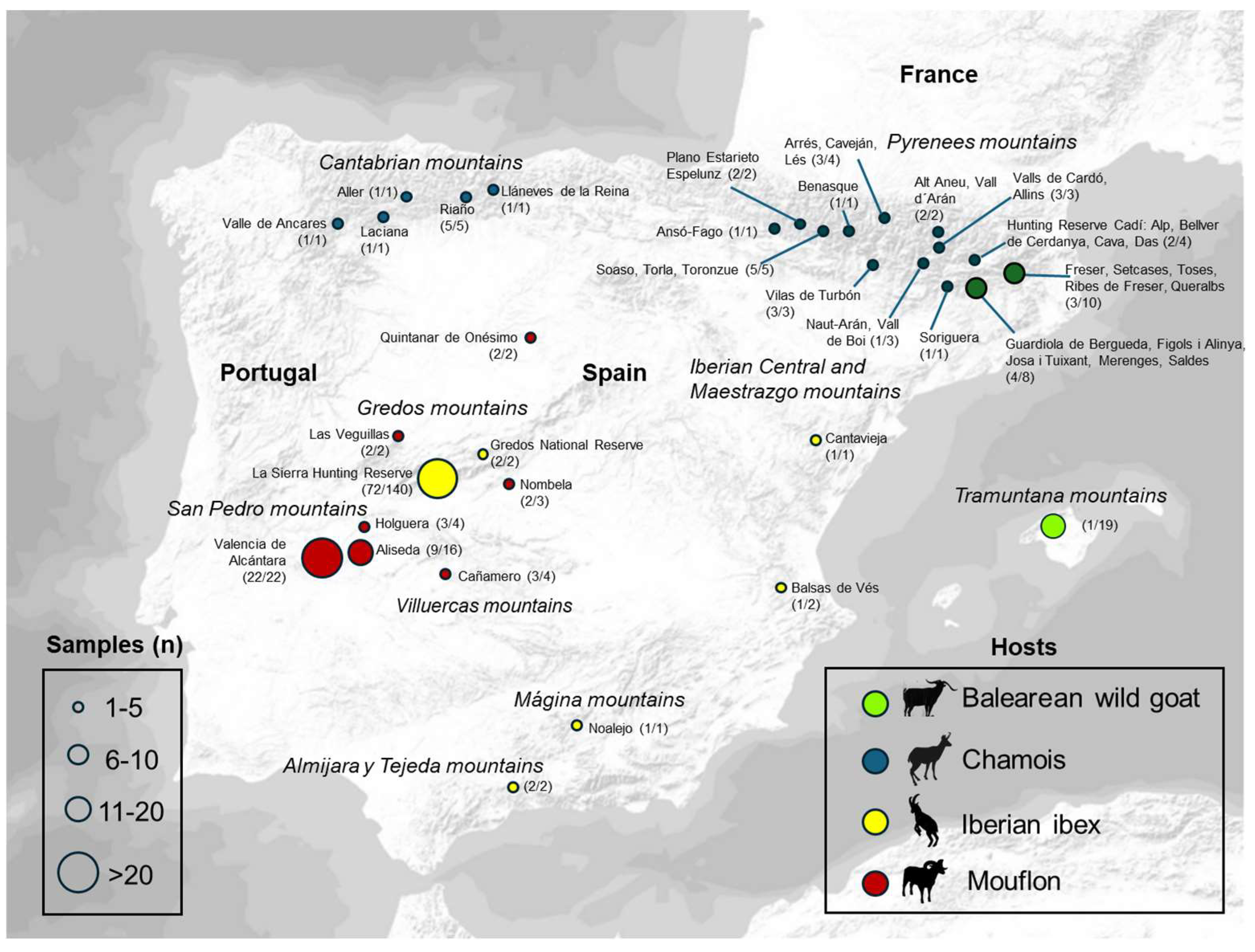
Tongue and/or diaphragm muscles were obtained from 19 Balearean wild goats during the years 2019 to 2021, 54 Pyrenean chamois between 2006 and 2019, 146 Iberian ibexes from 2015 to 2020, and 52 mouflons from 2015 to 2018. Animals were legally hunted in different areas of Spain or found dead within the passive surveillance program for wild game species with causes unrelated to protozoan infection. Tissues were collected immediately after the hunt during veterinary inspection of carcasses or necropsy (Table 1; Figure 1) and shipped (refrigerated with ice packs) to the Animal Health Department at the Veterinary Faculty of the University of Extremadura (Cáceres, Spain), where they were stored frozen at −20 °C until further analyses. A set of direct detection methods was selectively used aiming to maximize sarcocyst (and zoite) detection for further molecular analyses. Prevalence estimates were not among the initial aims given the opportunistic sampling and the lack of sample size calculations.

2.2. Light Microscopy (LM) Examinations

Muscle samples were gently thawed at 4º C and processed as follows. Pieces of muscles were squashed between glass slides with 1 to 2 drops of saline solution to observe the presence of Sarcocystis by optical microscope (×10, ×40 magnifications) [26]. Eclipse Ci-L optical microscope equipped with a DS-Fi2 digital camera and the NIS-Elements software suite v.5.11 (Nikon, Tokyo, Japan) was used. Sarcocysts were excised from the muscle fibers using hypodermic needles and kept in 1.5 mL plastic vials containing 90% ethanol or 2.5% glutaraldehyde solution for DNA characterization or ultrastructure examinations, respectively. Moreover, for histological examination, 1 cm3 tissue portions were fixed in 4% buffered formalin and embedded in paraffin. Five-micrometer-thick sections were stained with hematoxylin and eosin (H & E) and observed under LM. Intensity of infection was evaluated as the number of Sarcocystis-like sarcocysts per cm2 of tissue section.

2.3. Transmission Electron Microscopy (TEM) Examinations

One excised sarcocyst belonging to Iberian ibex (code 19CM10) was processed as described in [27]. Briefly, samples were post-fixed, sectioned, and finally contrasted with 4% uranyl acetate and 3% lead citrate. Ultra-thin sections were examined at the Spanish National Centre for Electron Microscopy (Madrid, Spain), using a JEOL JEM 1400 Plus (JEOL Ltd., Tokyo, Japan) device at 80 kV.

2.4. Enzymatic Digestion of Samples

Initially, the digestion method was used only in one individual Iberian ibex (19CM10) and 19 Balearean wild goats, in order to improve sarcocyst detection and further DNA availability. Briefly, trypsin digestion of 5 gr of tongue muscular tissue, gently minced, in 50 mL of digestion solution (porcine trypsin 1% (Merck KGaA, Darmstadt-Germany), 0.5 gr, 40 U/mg), in sterile phosphate-buffered saline (PBS), in a stirring incubator, at 37 °C for 1 h, was followed by filtering the solution twice and centrifuging at 2400 rpm, 10 min, 4 °C; the supernatant was discarded and resuspended in saline solution and finally centrifuged in the same conditions, following the protocol described in [26]. Then, the pellet was conserved refrigerated in 90% ethanol until DNA extraction. The same procedure was followed for the muscle specimens of the chamois provided by the team of the UAB; in this case, only 2 gr of each specimen was available (Table 1).

2.5. Statistical Analyses

The Clopper–Pearson method was used to calculate the prevalence 95% confidence intervals due to the relatively small sample size. Contingency tables, utilizing Chi-squared tests, were performed to evaluate parasite burdens. Results were considered significant at p < 0.05. The SPSS software (version 29.0.1.0, IBM Corp., Armonk, NY, USA) was employed.

2.6. Molecular Analyses

Genomic DNA was extracted from excised sarcocysts, specifically 3 from 1 Balearean wild goat, 17 from 7 Pyrenean chamois, 24 from 19 Iberian ibexes, and 23 from 16 mouflons (Table 1), using the QIAamp® DNA micro kit (Qiagen, Hilden, Germany), according to the manufacturer’s instructions. Partial 18S rRNA sequences (1823–1831 bp long portion) were amplified using overlapping primer pairs SarAF/SarBR (1075 bp) and SarCF/SarDR (950 bp) for most of the samples, while the SUNIF3/SUNIR2 (940 bp) primer pair was additionally used with samples from feral goat [28,29,30]. Mitochondrial cytochrome C oxidase subunit I gene (cox1) sequences were amplified with the SF1 forward primer in combination with one of the following reverse primers: SR8D (1029 bp) [16,31], SR11 (1077 bp) [32], or SR12H (907 bp) [33]. Two primers (StecagrliF: 5′-GAATACGGAGGCCGTTGACT-3′; StecaR: 5′-CCAAATCCGGGCAATATTAAA-3′) were developed and used for sequencing selected samples that initially yielded incomplete or poor-quality sequences, in order to obtain full-length sequences. PCR reactions were performed using the DreamTaq PCR Master Mix (Thermo Fisher Scientific Baltics, Vilnius, Lithuania). The cycling conditions started for 5 min at 95 °C, followed by 35 cycles of 45 s at 94 °C, 60 s at 54–60 °C, depending on the primer pair and 80 s at 72 °C, followed by a final extension step at 72 °C for 5 min. PCR products were evaluated using 1.5% agarose gel electrophoresis and purified with exonuclease EXOI and alkaline phosphatase Fast AP (Thermo Fisher Scientific Baltics, Vilnius, Lithuania). All sequences generated in this study have been deposited in GenBank (NCBI) under accession numbers PZ406984–PZ407047 (18S rRNA gene) and PZ436359–PZ436426 (cox1 gene). The sequences obtained were then compared with those of Sarcocystis spp. using the online Nucleotide BLAST program (BLASTn algorithm) (http://blast.ncbi.nlm.nih.gov/, accessed on 22 April 2026).

2.7. Phylogenetic Analyses

The resulting sequences were imported into MEGA12 software [34], where they were inspected and manually edited if necessary. Multiple sequence alignments were generated using the MUSCLE algorithm [35]. Appropriate nucleotide substitution models were selected using TOPALi v2.5 software [36], which was also used for Bayesian phylogenetic inference. The final 18S rRNA dataset consisted of 187 sequences with 2054 aligned nucleotide positions. The best-fitting model was HKY+I+G. The cox1 dataset included 201 sequences and 889 aligned nucleotide positions, with SYM+I+G selected as the optimal model. To avoid excessive dataset size, up to five representative sequences per selected species were included in the analysis, together with ten sequences each of S. tenella and S. capracanis. The outgroup taxa included Cystoisospora belli (AB268326), Toxoplasma gondii (PZ112984), and Eumonospora henryae (LC595644) for the 18S rRNA dataset, and Hammondia heydorni (JX473250), Neospora caninum (JX473252), T. gondii (KT363924), and Eimeria iyoensis (LC806970) for the cox1 dataset. Among the sequences obtained in this study (Table 2), only distinct haplotypes were retained for phylogenetic analysis, yielding 25 unique 18S rRNA sequences and 64 unique cox1 sequences.

3. Results

3.1. Occurrence of Sarcocysts in Muscle Tissues of Iberian Wild Caprinae

By using compression smear, different degrees of infection frequency were observed: 85.7% (18/21) in Pyrenean chamois, 82.7% (43/52) in mouflon, 52.7% (77/146) in Iberian ibex, and 5.3% (1/19) in Balearean wild goat (Table 1). The frequency of Sarcocystis spp. infections varied significantly among the four investigated Caprinae hosts (Χ2 = 43.09, df = 3, p < 0.001). Post hoc analyses using adjusted standardized residuals reveal different infection patterns, with mouflon being the most susceptible to infection by Sarcocystis (residual = 4.02), followed by chamois (residual = 2.66); however, Spanish Ibex showed lower parasitic infection (residual = −2.23), and the boc the minimal (residual = −4.90).
In addition, different cyst burdens were observed among the investigated hosts (Table 1); notably, in descending order, 3.93, 2.34, 1.29, and 0.67 sarcocysts/cm2 were recorded in mouflon, chamois, Iberian ibex, and Balearean wild goat, respectively. A Kruskal–Wallis test showed significant differences in parasite burden among the four host species (χ2 = 10.12, df = 3, p = 0.02, ε2 = 0.092).

3.2. Morphological Characterization of Specimens

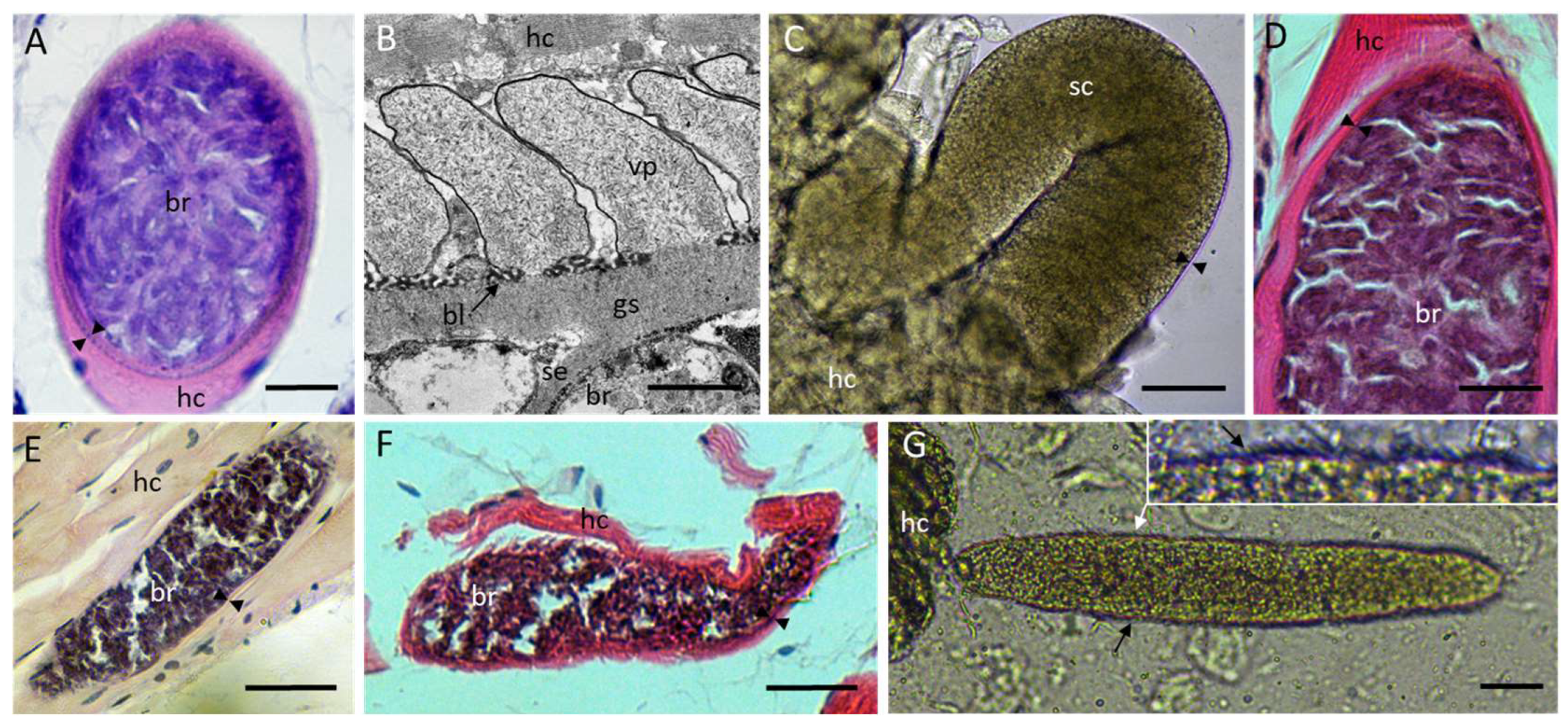
Unlike in specific cases (Figure 2A), mostly thin-walled sarcocysts were observed by histopathological examination (Figure 2); nevertheless, fresh examination of the tissues in search of specimens for further individual analyses revealed up to 1100 μm long sarcocysts with clear 4 to 6 μm long finger-like or palisade-like villar protrusions (vp) resembling those of S. cornagliai in the 19BOC1 specimen of Balearean wild goat.
Additional effort was made for the Iberian ibex 19CM10, for which a cyst could be examined ultrastructurally (Figure 2B). A thick-walled S. capracanis-like sarcocyst presenting typical 3 μm long, tightly packed, and cylindrical-shaped vp of the TEM Type 14 [1] was observed.

3.3. Species Identification and Molecular Characterization

Molecular identification based on 18S rRNA and cox1 genes revealed the presence of different Sarcocystis species across the examined hosts. In chamois, S. tenella was identified based on 15 18S rRNA sequences (1828–1829 bp) and 17 cox1 sequences (1005–1029 bp). In mouflon, S. tenella was detected based on 23 sequences for both 18S rRNA (1828–1829 bp) and cox1 (907–1029 bp). In Iberian ibex, S. capracanis was the predominant species, represented by 22 18S rRNA sequences (1823–1827 bp) and 24 cox1 sequences (1029 bp). In addition, a single 18S rRNA and cox1 sequence of S. rossii (1831 bp and 1029 bp, respectively) was obtained from this host. In Balearean wild goat, S. cornagliai was identified based on three sequences for each locus, with 18S rRNA sequences of 1874 bp and cox1 sequences of 1077 bp. All sequence similarity values, including intraspecific variation, similarity to GenBank sequences of the same species, and the closest related species, are summarized in Table 2. Overall, the results demonstrated host-associated distribution of Sarcocystis species, with consistent identification supported by both genetic markers.

3.4. Phylogenetic Analyses

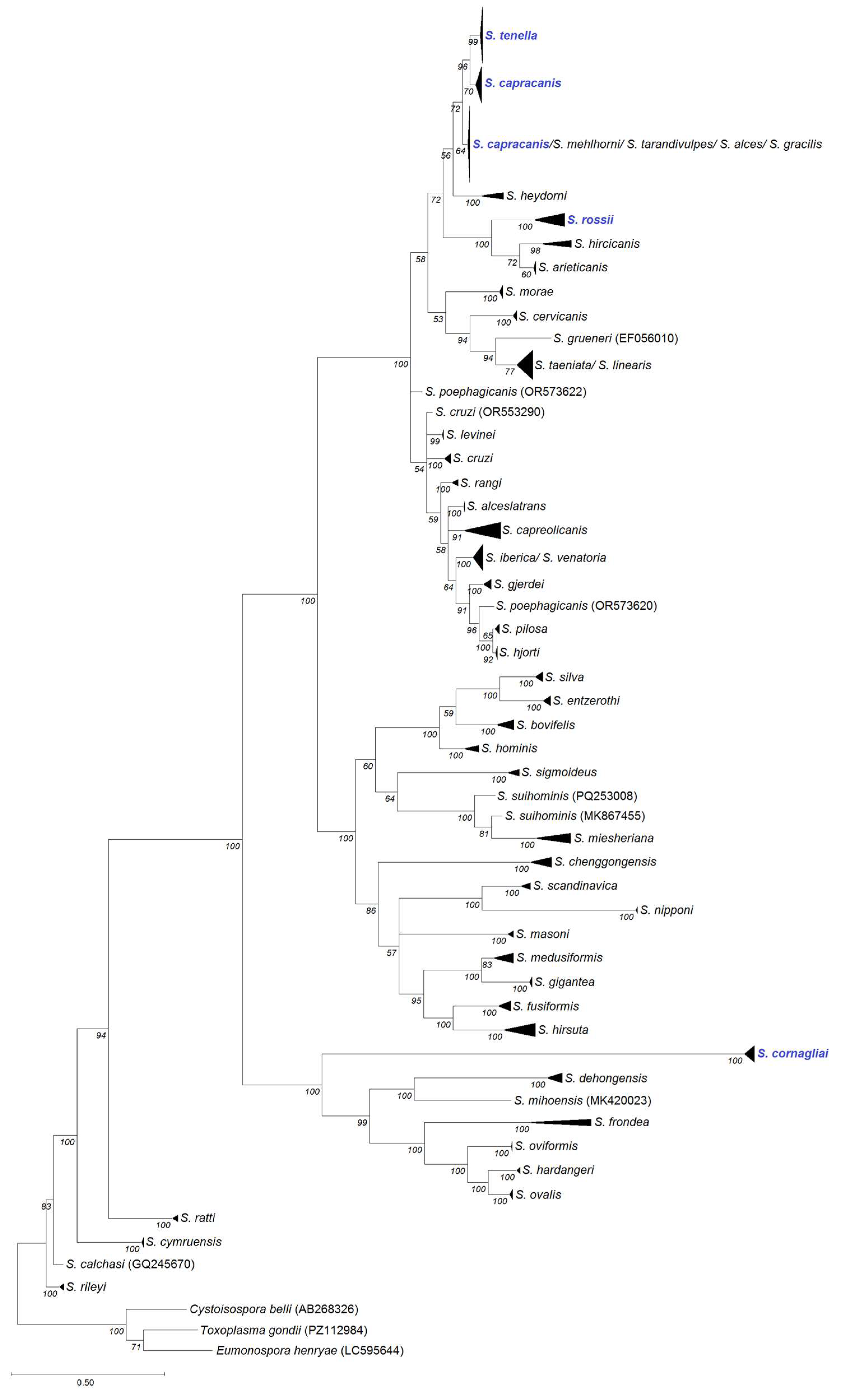
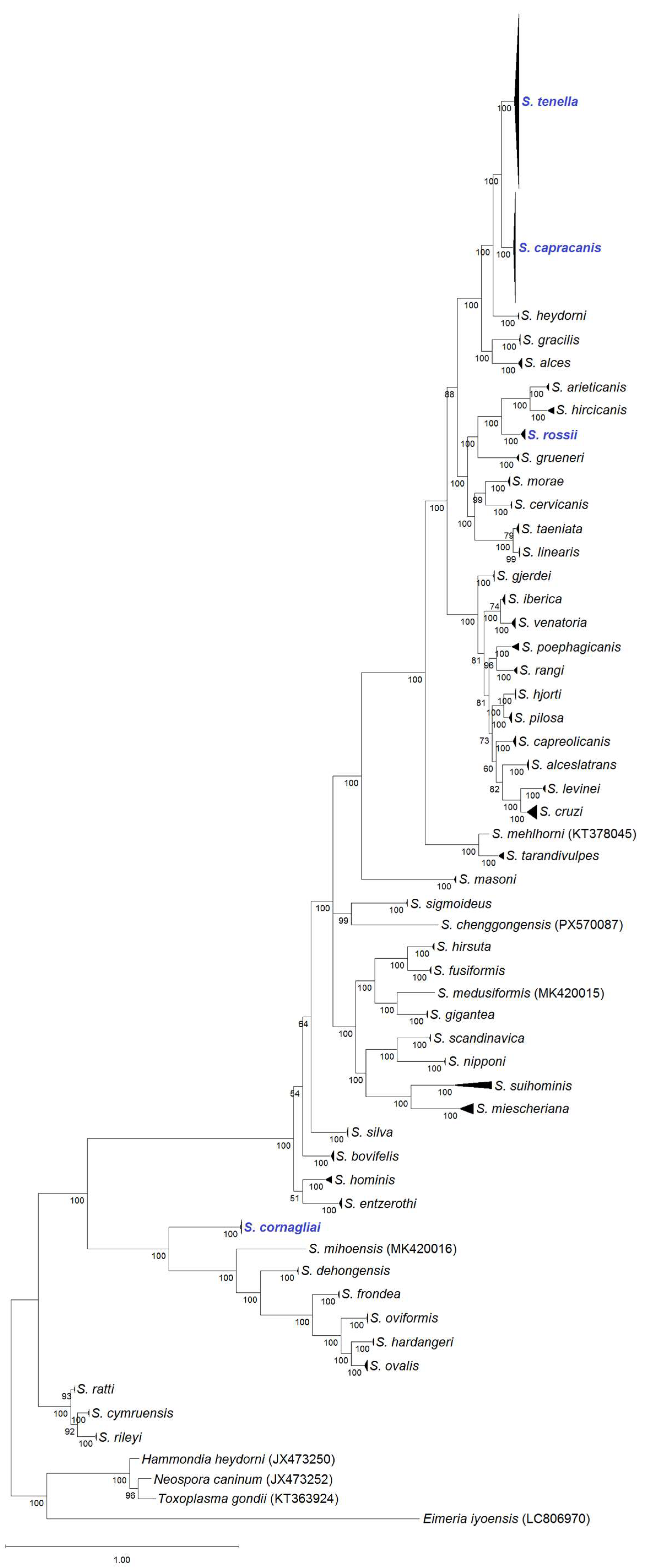
Phylogenetic trees were constructed using both molecular loci, the 18S rRNA gene and cox1 (Figure 3 and Figure 4). The 18S rRNA gene sequences were not sufficiently variable to discriminate some S. capracanis sequences from those of S. mehlhorni, S. tarandivulpes, S. alces, and S. gracilis. In addition, in the phylogenetic tree composed of 18S rRNA sequences, some other species, including S. taeniata, S. linearis, S. poephagicanis, S. cruzi, S. iberica and S. venatoria, could not be clearly distinguished from their closely related species. In the 18S rRNA phylogeny, S. tenella sequences grouped together with sequences of the same species. Based on cox1 phylogeny, S. tenella and S. capracanis each formed distinct monophyletic clusters and were placed as sister taxa (Figure S2). Across both phylogenies, S. rossii clustered with sequences of the same species and formed a sister group to the clade comprising S. arieticanis and S. hircicanis. In both trees, S. cornagliai formed a monophyletic clade and was closely related to several wild ruminant-related Sarcocystis species, including S. dehongensis, S. mihoensis, S. frondea, S. hardangeri, S. ovalis, and S. oviformis.

4. Discussion

Two common Sarcocystis spp. for the Caprinae subfamily hosts (S. capracanis and S. tenella) and two rare ones (S. cornagliai and S. rossii) were detected by means of molecular analyses in the Iberian wild mountain ungulates. Specifically, S. tenella was identified in Pyrenean chamois and mouflon, S. capracanis and S. rossii in Iberian ibex, and S. cornagliai in Balearean wild goat.
This is the first report of Sarcocystis spp. infection in the Balearean wild goat, a Caprinae introduced in the Majorca Island by during the Neolithic period (2050–2300 years BC) at a very initial domestication stage. Shortly after, individuals became free and occupied the ecological niche of the extinct Caprinae Myotragus balearicus [37]. Low Sarcocystis occurrence and cyst burden identified might be related to the low exposure to the parasite.
Findings of S. cornagliai were unexpected and add a new host record for the species that, to the authors’ knowledge, had until date only been reported in Alpine ibex (Capra ibex) and Alpine chamois (Rupicapra rupicapra) and never outside the Alpine territories of Austria, Italy and Germany [5,17,22]. The detection of S. cornagliai also suggests a corvid-related life cycle since it is placed in a well-supported group (Figure 4) encompassing S. dehongensis, S. frondea, S. ovalis, and S. oviformis having corvids as DHs [38,39,40]. Sarcocystis ovalis from moose (Alces alces) is transmitted via the omnivorous Corvidae magpie (Pica pica) [40], and this might be the case for the S. cornagliai identified herein where an isolated environment and rugged terrain in the Tramuntana mountains of the Majorca Island may explain the limited circulation of Sarcocystis species. As other Sarcocystis species are expected to parasitize Balearean wild goats, additional efforts are warranted.
In Pyrenean chamois, a Sarcocystis species (S. tenella) has been identified for the first time, and the frequency of detection was relatively high (93.8%, n = 48), in accord with figures reported in the Alpine chamois in Germany (78.5%, n = 181) [10], Italy (79.8%, n = 198) [3], and Slovakia and Poland (100%) where few animals were tested (n = 6 and n = 3, respectively) [8,11] (Table S1). Herein, only the domestic sheep-related species S. tenella was detected infecting chamois from the Northern Spanish territories; such a finding is in accord with the pioneer study [3] that reported two ultrastructurally different types of sarcocysts, one resembling S. tenella/S. capracanis and the other showing mushroom-like vp; the second species was tentatively described and named as S. cornagliai [5]. Therefore, under the view of the available literature, other Sarcocystis species might be circulating in the investigated animals, and additional samplings will add valuable information in this regard. Low genetic diversity is observed between the S. tenella isolates detected in Pyrenean chamois for 18S rRNA gene (Table 2). However, this diversity increased at the cox1 gene when it was compared intraspecifically with other ruminant-derived isolates. One study on Sarcocystis in domestic sheep in Spain reported high haplotype intraspecific diversity, with variations up to 20 nucleotide positions, but the majority were silent mutations [29]. In Pyrenean chamois, nucleotide variation was similarly high, up to 15 positions. Equally, there was a relatively high number of haplotypes (17), and the intraspecific diversity was elevated up to 4.5%, even surpassing the figures reported in sheep [29]. Conversely, low genetic diversity for the species S. tenella was also confirmed for isolates infecting Tatra chamois (Rupicapra rupicapra tatra) in Poland, showing 99.23% identity with domestic sheep isolates S. tenella at the cox1 gene [11].
The occurrence of Sarcocystis spp. in the Iberian ibexes studied herein reached remarkable figures (52.7%); nevertheless, higher frequencies of detections have been previously detected in the same host in Spain (84%) [21], and in other close ibex species like the Alpine ibex (Capra ibex) (86%) in Italy [17].
In a previous study carried out in Iberian ibex from Southwestern Spain, S. hircicanis was suggested because of observation of thin and smooth cyst wall by light microscopy; however, molecular and ultrastructural analyses were not performed [21].
With the aid of molecular analyses, in most positive samples, S. capracanis was detected, and in one animal (19CM10), the uncommon species S. rossii [22] was found. This prompted us to make an additional effort to try to characterize the organism by TEM given the fact that at that moment, the species S. rossii was still undescribed. Details observed (Figure 2A) agreed with the morphology described for S. capracanis in Alpine ibex [17,22]. Low cyst burden detected in such specimen (1.2 sarcocysts/cm2) hampered the examination of additional sarcocysts by TEM. The recently identified S. rossii exhibited minimal variability at the cox1 gene, with the same species observed in Alpine ibex (1.6%). However, this variability significantly increased in interspecific comparisons, with the closest relative, S. hircicanis, displaying diversity up to 13.8%. The intraspecific variability of S. capracanis was 2.7%, paralleling the diversity observed in the sister species S. tenella. The closest interspecific comparison was with S. tenella, where the diversity ranged between 2.6 and 8.6%, but this was comparatively minor when juxtaposed with the diversity of S. rossii. Another cryptic species, S. capricornis-like, was described only ultrastructurally as by Cornaglia et al. [17] in one specimen of Iberian ibex. It exhibited characteristic indented edges of finger vp (< 2.8 μm long and <0.75 μm wide), with an axial fibrillar core running through the middle of vp (CW type 41 [1]). No other research has noticed this peculiar Sarcocystis spp., and therefore additional investigations on the Iberian wild goat are justified, aiming at potential involvement of other Sarcocystis spp.
A very high infection frequency was observed in mouflon (82.7%), as in other studies from additional European countries like Austria, Slovak Republic or Germany (86.5–100%) [13,14,16]. Molecular analyses confirmed S. tenella as the unique species present. A S. tenella-like organism was ultrastructurally examined and reported in mouflon in Italy [12], and its presence was also confirmed in Germany [13], and in several other hosts like argali (Ovis ammon) in China [41], Tatra chamois (Rupicapra rupicapra tatrica) in Poland [11], and Barbary sheep (Ammotragus lervia) in Spain [2]. Differences in S. tenella isolates from mouflon and chamois were negligible (< 1.5%) and might be explained by their habitat overlap, especially during winter periods. As monospecific infections by S. tenella seem to be common in mouflon, a potential close contact with domestic sheep is suggested; the pathogenic potential of S. tenella in mouflon still remains to be elucidated.
Similarly, in the wild Caprinae Barbary sheep (Ammotragus lervia) from Spain, only S. tenella and S. capracanis species were found [2]; there is an apparent limited diversity of Sarcocystis spp. infecting wild mountain ungulates/Caprinae of Spain, in contrast with what is commonly observed in other Cervidae hosts like red deer (Cervus elaphus) [31], roe deer (Capreolus capreolus) [33,42,43,44,45,46], and fallow deer (Dama dama) [47,48,49], ranging free in Spain. The variability in S. capracanis and S. tenella, should be further studied to unravel the potential influence of geographical factors rather than dependency on the Sarcocystis species, as was previously suggested in domestic sheep [29,50].
While S. tenella and S. capracanis were especially pathogenic to domestic sheep and goats respectively, with remarkable clinical signs (e.g., abortions) observed [1], additional effort is needed to unravel the potential pathogenic role of the genus for the wild ruminant species studied.
Some limitations have been identified in the present study, namely the following: (a) given the opportunistic sampling, the small sampling size for some of the hosts hampered the precise estimation of prevalence figures; (b) diagnostic methods have not been systematically used for all collected samples, making host-to-host comparisons difficult; and (c) only one sarcocyst was examined by TEM and two molecular markers used to characterize the organisms, so additional efforts would have been provided a more accurate characterization of the Sarcocystis species detected.
Despite the limitations reported above, the present paper adds complementary data to the complex epidemiology of the Sarcocystis genus and provides additional evidence of the lack of specificity of some Sarcocystis species for their Caprinae intermediate hosts.

5. Conclusions

A low diversity of Sarcocystis species infecting wild Caprinae observed in Spain might be linked to the fact that the sheep-related S. tenella and goat-related S. capracanis, both with Canidae as DHs, predominate, and repetitive infections may result in higher cyst loads than other species, possibly hampering the detection of minority (or more host-restricted) Sarcocystis spp. Indeed, there is a clear interconnection of domestic–sylvatic epidemiological cycles of the species, which might interfere with health programs. Identification of rare species like S. cornagliai and S. rossii has allowed us to expand the host range of both species and also justifies additional surveys for potential undescribed species detection in such hosts. Finally, further research based on the analysis of complementary genetic markers in these Sarcocystis spp. is warranted to determine their true host-specificity and, in absence of animal experimentation, to achieve the inference of their most plausible DHs in the study area.

Supplementary Materials

The following supporting information can be downloaded at https://www.mdpi.com/article/10.3390/pathogens15080816/s1, Figure S1: Phylogenetic subtrees derived from cox1 sequence analysis showing clustering of S. tenella (A) and S. capracanis (B) detected in wild Caprinae host species from Spain; Table S1: Reports of Sarcocystis spp. infecting mountain ungulates in Europe.

Author Contributions

Conceptualization, M.Á.H. and R.C.-B.; methodology, G.E.D.-D.l.C., P.P. and E.R.-L.; investigation, G.E.D.-D.l.C., P.P., E.R.-L., M.L.G.-G., J.E. and R.C.-B.; resources, M.Á.H., J.E., R.V. and A.I.P.-G.; data curation, E.R.-L. and P.P.; writing—original draft preparation, G.E.D.-D.l.C., E.R.-L. and R.C.-B.; writing—review and editing, G.E.D.-D.l.C., P.P., E.R.-L., J.E., R.V., A.I.P.-G., M.Á.H. and R.C.-B. All authors have read and agreed to the published version of the manuscript.

Funding

This research received no external funding.

Institutional Review Board Statement

Not applicable since no experimentation with animals was carried out and the tissue samples were collected from found-dead individuals or legally hunter-killed animals.

Informed Consent Statement

Not applicable.

Data Availability Statement

The sequences of Sarcocystis spp. were submitted to the NCBI GenBank database under accession numbers PZ406984–PZ407047, PZ436359–PZ436426.

Acknowledgments

The authors thank Manuel Martínez-González (Consulta Veterinaria Paterna S.L., Paterna de Rivera, Cádiz, Spain) for his excellent technical assistance, as well as José Carlos Manzano Prieto (Manzano Taxidermy Workshop, Plasencia, Cáceres, Spain), José Luis Alarcón Serrano (Environment Department, Regional Government of Aragón, Huesca, Spain), and the Environmental Protection Officers of the Regional Government of Extremadura (Spain) for field assistance and support during sample collection.

Conflicts of Interest

The authors declare no conflicts of interest.

Abbreviations

The following abbreviations are used in this manuscript:
TEMTransmission electron microscopy
DHDefinitive host
IHIntermediate host
18S rRNARibosomal RNA small unit
Cox1Mitochondrial c oxidase 1 unit
vpVillar protrusion

References

  1. Dubey, J.P.; Calero-Bernal, R.; Rosenthal, B.M.; Speer, C.A.; Fayer, R. Sarcocystosis of Animals and Humans, 2nd ed.; CRC Press: Boca Raton, FL, USA, 2016; pp. 1–481. [Google Scholar] [CrossRef]
  2. Delgado-de Las Cuevas, G.E.; Prakas, P.; Rudaitytė-Lukošienė, E.; García-Gil, M.L.; Martínez-González, M.; Butkauskas, D.; Mowery, J.D.; Dubey, J.P.; A. Habela, M.; Calero-Bernal, R. First description of Sarcocystis species infecting Barbary sheep (Ammotragus lervia). Parasitol. Res. 2021, 120, 2881–2886. [Google Scholar] [CrossRef] [PubMed]
  3. Cornaglia, E.; Guarda, F.; Guarda, F.; Misciattelli, M.E. Research, frequency, diagnosis, morphology, histopathology and ultrastructure of cardiac sarcosporidiosis in chamois and steinbock. Ann. Della Fac. Med. Vet. Torino 1980, 27, 279–296. [Google Scholar]
  4. Guarda, F.; Bollo, E.; Bassano, B.; Peracino, V.; Giraldo, A. Cardiac pathology of chamois (Rupicapra rupicapra) and ibex (Capra ibex) in Gran Paradisco National Park. Large Anim. Rev. 2001, 7, 47–52. Available online: https://vetjournal.it/images/archive/pdf_riviste/2632.pdf (accessed on 13 May 2026). [CrossRef]
  5. Odening, K.; Stolte, M.; Bockhardt, I. On the diagnostics of Sarcocystis in chamois (Rupicapra rupicapra). Appl. Parasitol. 1996, 37, 153–160. Available online: http://pascal-francis.inist.fr/vibad/index.php?action=getRecordDetail&idt=3224008 (accessed on 13 May 2026).
  6. Fernández-Morán, J.; Gómez, S.; Ballesteros, F.; Quirós, P.; Benito, J.; Feliu, C.; Nieto, J. Epizootiology of sarcoptic mange in a population of Cantabrian chamois (Rupicapra pyrenaica parava) in Northwestern Spain. Vet. Parasitol. 1997, 73, 163–171. [Google Scholar] [CrossRef] [PubMed]
  7. Marco, I.; Lopez-Olvera, J.R.; Rosell, R.; Vidal, E.; Hurtado, A.; Juste, R.; Pumarola, M.; Lavin, S. Severe outbreak of disease in the southern chamois (Rupicapra pyrenaica) associated with border disease virus infection. Vet. Microbiol. 2007, 120, 33–41. [Google Scholar] [CrossRef] [PubMed]
  8. Goldova, M.; Toth, S.; Mojzisova, J.; Ciberej, J.; Konjevic, D.; Kocisova, A.; Slavica, A. Sarcocystosis in cloven-hoofed game in Slovak Republic. Nat. Croat. 2008, 17, 303–309. Available online: https://hrcak.srce.hr/34031 (accessed on 13 May 2026).
  9. Bregoli, M.E.; Lucchini, R.; Debora, D.; Enrico, F.; Citterio, C.V.; Capelli, G.; Vascellari, M.; Farina, G. Survey on Sarcocystis spp. in game ungulates of central-eastern Italian Alps and report of a systemic sarcosporidiosis in a roe deer (Capreolus capreolus). In Trends in Game Meat Hygiene: From Forest to Fork; Paulsen, P., Bauer, A., Smulders, F.J.M., Eds.; Wageningen Academic Publishers: Wageningen, The Netherlands, 2014; pp. 183–187. [Google Scholar] [CrossRef] [PubMed]
  10. Rehbein, S.; Visser, M. Prevalence and Intensity of Sarcocystis spp. Infections in Alpine Chamois (Rupicapra r. rupicapra) in Germany. Parasitol. 2024, 4, 61–70. [Google Scholar] [CrossRef]
  11. Kolenda, R.; Schierack, P.; Zieba, F.; Zwijacz-Kozica, T.; Bednarski, M. First molecular characterization of Sarcocystis tenella in Tatra chamois (Rupicapra rupicapra tatrica) in Poland. Parasitol. Res. 2015, 114, 3885–3892. [Google Scholar] [CrossRef] [PubMed]
  12. Nigro, M.; Mancianti, F.; Rossetti, P.; Poli, A. Ultrastructure of the cyst and life cycle of Sarcocystis sp. from wild sheep (Ovis musimon). J. Wildl. Dis. 1991, 27, 217–224. [Google Scholar] [CrossRef] [PubMed]
  13. Odening, K.; Stolte, M.; Walter, G.; Bockhardt, I. Cyst wall ultrastructure of two Sarcocystis spp. from European mouflon (Ovis ammon musimon) in Germany compared with domestic sheep. J. Wildl. Dis. 1995, 31, 550–554. [Google Scholar] [CrossRef] [PubMed]
  14. Spickschen, C.; Pohlmeyer, K. Investigation on the occurrence of Sarcosporidia in roe deer, red deer, and mouflon from two different natural habitats in Lower Saxony. Z. Jagdwiss. 2002, 48, 35–48. [Google Scholar] [CrossRef]
  15. Poglayen, G.; Urbani, L.; Modugno, F.; Scala, A.; Giannetto, S. The Italian Mouflon (Ovis musimon): A brief history of its parasites in the last 45 years. Res. J. Zool. 2018, 1, 1000108. Available online: https://cris.unibo.it/retrieve/handle/11585/666059/423517/the-italian-mouflon-ovis-musimon-a-brief-history-of-its-parasites-in-the-last-45-years-AyqQ.pdf (accessed on 13 May 2026).
  16. Prakas, P.; Rehbein, S.; Rudaitytė-Lukošienė, E.; Butkauskas, D. Molecular identification of Sarcocystis species in diaphragm muscle tissue of European mouflon (Ovis gmelini musimon) from Austria. Parasitol. Res. 2021, 120, 2695–2702. [Google Scholar] [CrossRef] [PubMed]
  17. Cornaglia, E.; Giaccherino, A.R.; Peracino, V. Ultrastructural morphology of sarcosporidiosis in alpine ibex (Capra ibex). Vet. Parasitol. 1998, 75, 21–32. [Google Scholar] [CrossRef] [PubMed]
  18. Granados, J.; Pérez, E.; Márquez, J.M.; Serrano, F.J.; Soriguer, E.; Fandos, R.C. La cabra montés (Capra pyrenaica, Schinz 1838). Galemys 2001, 13, 3–37. [Google Scholar]
  19. Luzón, M.; Moreno, J.S.; Meana, A.; Díaz, A.T.; Pastor, A.P.; Brunet, A.G.; Sebastián, A.L. Parasitism and horn quality in male Spanish ibex (Capra pyrenaica hispanica) from Andalucía based on coprological analysis and muscle biopsy. Span. J. Agric. Res. 2008, 6, 353–361. [Google Scholar] [CrossRef]
  20. Santiago-Moreno, J.; Luzón, M.; Coloma, M.A.; Pulido-Pastor, A.; Gómez-Guillamón, F.; Salas de la Vega, R.; Toledano-Díaz, A.; López-Sebastián, A. Relationship between Iberian ibex (Capra pyrenaica) sperm quality and level of parasitism. Eur. J. Wildl. Res. 2010, 56, 605–611. [Google Scholar] [CrossRef][Green Version]
  21. Calero-Bernal, R.; García-Moreno, A.; González-Barrio, D.; Nieto-Rodríguez, J.M.; Fernández-Llario, P.; de Mendoza, J.H.; Habela, M.Á. Infectious diseases surveillance of the Iberian ibex (Capra pyrenaica victoriae) in Western Spain: Health and conservation implication. Galemys 2020, 32, 13–20. [Google Scholar] [CrossRef]
  22. Rudaitytė-Lukošienė, E.; Rehbein, S.; Calero-Bernal, R.; Butkauskas, D.; Prakas, P. Morphological and molecular characterisation of Sarcocystis capracanis, Sarcocystis cornagliai and Sarcocystis rossii n. sp. infecting the Alpine ibex (Capra ibex). Parasites Vectors 2025, 18, 96. [Google Scholar] [CrossRef] [PubMed]
  23. Alados, C.L.; Escós, J.; Salvador Milla, A.; Cassinello, J. Cabra montés–Capra pyrenaica Schinz, 1838. In Enciclopedia Virtual de los Vertebrados Españoles; Museo Nacional de Ciencias Naturales: Madrid, Spain, 2017; Available online: http://www.vertebradosibericos.org/mamiferos/cappyr.html (accessed on 13 May 2026).
  24. Cassinello, J.; & Salvador Milla, A. Muflón–Ovis orientalis Gmelin, 1774. In Enciclopedia Virtual de los Vertebrados Españoles; Museo Nacional de Ciencias Naturales: Madrid, Spain, 2017; Available online: http://www.vertebradosibericos.org/mamiferos/oviori.html (accessed on 13 May 2026).
  25. García-González, R.; Herrero-Cortés, J. Rupicapra pyrenaica. Ficha Libro Rojo. In Atlas y Libro Rojo de los mamíferos terrestres en España; Dirección General para la Biodiversidad-SECEM-SECEMU: Madrid, Spain, 2007; pp. 362–365. [Google Scholar]
  26. Verma, S.K.; Lindsay, D.S.; Grigg, M.E.; Dubey, J.P. Isolation, culture and cryopreservation of Sarcocystis species. Curr. Protoc. Microbiol. 2017, 45, 20D.1.1–20D.1.27. [Google Scholar] [CrossRef] [PubMed]
  27. Kirillova, V.; Prakas, P.; Calero-Bernal, R.; Gavarāne, I.; Fernández-García, J.L.; Martínez-González, M.; Rudaitytė-Lukošienė, E.; Martínez-Estéllez, M.Á.H.; Butkauskas, D.; Kirjušina, M. Identification and genetic characterization of Sarcocystis arctica and Sarcocystis lutrae in red foxes (Vulpes vulpes) from Baltic States and Spain. Parasit. Vectors 2018, 11, 173. [Google Scholar] [CrossRef] [PubMed]
  28. Kutkienė, L.; Prakas, P.; Sruoga, A.; Butkauskas, D. The mallard duck (Anas platyrhynchos) as intermediate host for Sarcocystis wobeseri sp. nov. from the barnacle goose (Branta leucopsis). Parasitol. Res. 2010, 107, 879–888. [Google Scholar] [CrossRef] [PubMed]
  29. Gjerde, B.; De la Fuente, C.; Alunda, J.M.; Luzón, M. Molecular characterisation of five Sarcocystis species in domestic sheep (Ovis aries) from Spain. Parasitol. Res. 2020, 119, 215–231. [Google Scholar] [CrossRef] [PubMed]
  30. Aryan, F.A.; El-Azazy, O.M.; Juozaitytė-Ngugu, E.; Šneideris, D.; Tahrani, L.M.; Butkauskas, D.; Prakas, P. Morphological and molecular description of Sarcocystis meriones n. sp. from the libyan jird (Meriones libycus) in Kuwait. Animals 2025, 15, 2575. [Google Scholar] [CrossRef] [PubMed]
  31. Gjerde, B. Phylogenetic relationships among Sarcocystis species in cervids, cattle and sheep inferred from the mitochondrial cytochrome c oxidase subunit I gene. Int. J. Parasitol. 2013, 43, 579–591. [Google Scholar] [CrossRef] [PubMed]
  32. Gazzonis, A.L.; Gjerde, B.; Villa, L.; Minazzi, S.; Zanzani, S.A.; Riccaboni, P.; Sironi, G.; Manfredi, M.T. Prevalence and molecular characterisation of Sarcocystis miescheriana and Sarcocystis suihominis in wild boars (Sus scrofa) in Italy. Parasitol. Res. 2019, 118, 1271–1287. [Google Scholar] [CrossRef] [PubMed]
  33. Prakas, P.; Rudaitytė, E.; Butkauskas, D.; Kutkienė, L. Sarcocystis entzerothi n. sp. from the European roe deer (Capreolus capreolus). Parasitol. Res. 2017, 116, 271–279. [Google Scholar] [CrossRef] [PubMed]
  34. Kumar, S.; Stecher, G.; Suleski, M.; Sanderford, M.; Sharma, S.; Tamura, K. MEGA12: Molecular evolutionary genetic analysis version 12 for adaptive and green computing. Mol. Biol. Evol. 2024, 41, msae263. [Google Scholar] [CrossRef] [PubMed]
  35. Edgar, R.C. MUSCLE: Multiple sequence alignment with high accuracy and high throughput. Nucleic Acids Res. 2004, 32, 1792–1797. [Google Scholar] [CrossRef] [PubMed]
  36. Milne, I.; Wright, F.; Rowe, G.; Marshall, D.F.; Husmeier, D.; McGuire, G. TOPALi: Software for automatic identification of recombinant sequences within DNA multiple alignments. Bioinformatics 2004, 20, 1806–1807. [Google Scholar] [CrossRef] [PubMed]
  37. Seguí, B.; Payeras, L.; Ramis, D.; Martnez, A.; Delgado, J.V.; Quiroz, J. La cabra salvaje mallorquina: Origen, genética, morfología, notas ecológicas e implicaciones taxonómicas. Bull. Soco Bist. Nat. Balear. 2005, 48, 121–151. Available online: https://www.raco.cat/index.php/BolletiSHNBalears/article/download/170014/245496 (accessed on 13 May 2026).
  38. Chen, X.; Wen, T.; Hu, J.; Liu, T.; Esch, G.W.; Liang, Y.; Li, H.; Huang, S. Sarcocystis dehongensis n. sp. (Apicomplexa: Sarcocystidae) from water buffalo (Bubalus bubalis) in China. Parasitol. Res. 2017, 116, 2145–2150. [Google Scholar] [CrossRef] [PubMed]
  39. Juozaitytė-Ngugu, E.; Švažas, S.; Šneideris, D.; Rudaitytė-Lukošienė, E.; Butkauskas, D.; Prakas, P. The Role of Birds of the Family Corvidae in Transmitting Sarcocystis Protozoan Parasites. Animals 2021, 11, 3258. [Google Scholar] [CrossRef] [PubMed]
  40. Gjerde, B.; Dahlgren, S.S. Corvid birds (Corvidae) act as definitive hosts for Sarcocystis ovalis in moose (Alces alces). Parasitol. Res. 2010, 107, 1445–1453. [Google Scholar] [CrossRef] [PubMed]
  41. Dong, H.; Su, R.; Wang, Y.; Tong, Z.; Zhang, L.; Yang, Y.; Hu, J. Sarcocystis species in wild and domestic sheep (Ovis ammon and Ovis aries) from China. BMC Vet. Res. 2018, 14, 377. [Google Scholar] [CrossRef] [PubMed]
  42. Rudaitytė-Lukošienė, E.; Prakas, P.; Butkauskas, D. Molecular identification of seven Sarcocystis species in red deer (Cervus elaphus) from Lithuania. Parasitol. Int. 2021, 85, 102419. [Google Scholar] [CrossRef] [PubMed]
  43. Gjerde, B.; Giacomelli, S.; Bianchi, A.; Bertoletti, I.; Mondani, H.; Gibelli, L.R. Morphological and molecular characterization of four Sarcocystis spp., including Sarcocystis linearis n. sp., from roe deer (Capreolus capreolus) in Italy. Parasitol. Res. 2017, 116, 1317–1338. [Google Scholar] [CrossRef] [PubMed]
  44. Dahlgren, S.S.; Gjerde, B. Sarcocystis in Norwegian roe deer (Capreolus capreolus): Molecular and morphological identification of Sarcocystis oviformis n. sp. and Sarcocystis gracilis and their phylogenetic relationship with other Sarcocystis species. Parasitol. Res. 2009, 104, 993–1003. [Google Scholar] [CrossRef] [PubMed]
  45. Gjerde, B. Morphological and molecular characterization and phylogenetic placement of Sarcocystis capreolicanis and Sarcocystis silva n. sp. from roe deer (Capreolus capreolus) in Norway. Parasitol. Res. 2012, 110, 1225–1237. [Google Scholar] [CrossRef] [PubMed]
  46. Rudaitytė-Lukošienė, E.; Delgado de Las Cuevas, G.E.; Prakas, P.; Calero-Bernal, R.; Martínez-González, M.; Strazdaitė-Žielienė, Ž.; Servienė, E.; Habela, M.A.; Butkauskas, D. Sarcocystis spp. diversity in the roe deer (Capreolus capreolus) from Lithuania and Spain. Parasitol. Res. 2020, 119, 1363–1370. [Google Scholar] [CrossRef] [PubMed]
  47. Delgado de Las Cuevas, G.E.; Prakas, P.; Strazdaitė-Žielienė, Ž.; Martínez-González, M.; Rudaitytė-Lukošienė, E.; Butkauskas, D.; Servienė, E.; Habela, M.A.; Calero-Bernal, R. Sarcocystis morae (Apicomplexa) in fallow deer (Dama dama) from Spain: Ultrastructure and new host record. J. Parasitol. 2019, 105, 813–815. [Google Scholar] [CrossRef] [PubMed]
  48. Hernández-Rodríguez, S.; Acosta, I.; Navarrete, I. Sarcocystis jorrini sp. nov. from the fallow deer Cervus Dama Parasitol. Res. 1992, 78, 557–562. [Google Scholar] [CrossRef] [PubMed]
  49. Rudaitytė-Lukošienė, E.; Prakas, P.; Strazdaitė-Žielienė, Ž.; Servienė, E.; Januškevičius, V.; Butkauskas, D. Molecular identification of two Sarcocystis species in fallow deer (Dama dama) from Lithuania. Parasitol. Int. 2020, 75, 102044. [Google Scholar] [CrossRef] [PubMed]
  50. Marandykina-Prakienė, A.; Butkauskas, D.; Gudiškis, N.; Juozaitytė-Ngugu, E.; Januškevičius, V.; Rudaitytė-Lukošienė, E.; Prakas, P. Molecular Identification of Sarcocystis Species in Sheep from Lithuania. Animals 2022, 12, 2048. [Google Scholar] [CrossRef] [PubMed]
Figure 1. Wild Caprinae host species under study and sampling areas in Spain. Circle areas indicate the number of individuals sampled in each site. Data between parentheses indicate Sarcocystis-positive animals detected by light microscopy methods (compression smears and histology) among the total animals sampled in each sampling area.
Pathogens 15 00816 g001
Figure 2. Micrographs of Sarcocystis sarcocysts detected in the Iberian wild mountain ungulates. (A) Thick-walled sarcocyst of Iberian ibex 19CM10. H&E staining. (B) Ultrastructure of the Sarcocystis capracanis sarcocyst in Iberian ibex 19CM10. TEM. (C) Apparently, thin-walled sarcocyst of Pyrenean chamois 17SA1. Unstained. (D) Thin-walled sarcocyst of Pyrenean chamois 19SA1. H&E staining. (E) Thin-walled sarcocyst of mouflon 17MU6. H&E staining. (F) Apparently thin-walled sarcocyst of a degraded sarcocyst of Balearean wild goat 19BOC1. H&E staining. (G) Finger-like villar protrusions (arrows) resembling those of S. cornagliai are visible at the surface of a sarcocyst of Balearean wild goat 19BOC1 excised from the muscle tissue. Unstained. Br: bradyzoites; hc: host-cell; bl: blebs; gs: ground substance; se: septae; vp: villar protrusion; sc: sarcocyst. Note: opposing arrowheads point at the cyst walls. Scale bars (A,D): 20 µm; B: 1 µm; (C,F,G): 50 µm; E: 25 µm.
Pathogens 15 00816 g002
Figure 3. Phylogenetic analysis based on the 18S rRNA gene of the Sarcocystis spp. (S. capracanis, S. cornagliai, S. rossii, and S. tenella) detected in the wild Caprinae hosts investigated in Spain. Triangles represent collapsed groups of taxa used to simplify tree visualization.
Pathogens 15 00816 g003
Figure 4. Phylogenetic analysis based on the cox1 gene of the Sarcocystis spp. (S. capracanis, S. cornagliai, S. rossii, and S. tenella) detected in the wild Caprinae hosts investigated in Spain. Triangles represent collapsed groups of taxa used to simplify tree visualization.
Pathogens 15 00816 g004
Table 1. Muscle tissues collection, frequency of tissue-cyst detection and morphological features of Sarcocystis spp. sarcocysts in wild Caprinae in Spain.
Intermediate Hosts
HostsBalearean wild Goat
(Capra hircus var. majorcan)
Pyrenean Chamois
(Rupicapra pyrenaica)
Iberian Ibex
(Capra pyrenaica)
Mouflon
(Ovis orientalis musimon)
Direct detection
Compression smear (%, 95% CI, n positive/n examined)5.3% (0.13–26.03%) (1/19)85.7% (63.66–96.95%) (18/21)52.7% (44.32–61.05%) (77/146)82.7% (69.67–91.77%) (43/52)
H&E staining
(%, n positive slides/n tested slides)
66.7% (2/3)93.8% (45/48) b28.2% (42/149)46.7% (14/30)
Sarcocyst burden (n cysts/cm2, 95% CI)0.67
(−0.16–1.50; n = 5)
2.34
(1.30–3.39; n = 45)
1.29
(0.94–1.65; n = 38)
3.93
(1.84–6.02; n = 23)
Trypsin digestion
(cysts or bradyzoites observed)
10.5% (2/19)ND cOnly done for 19CM10, with positive results.ND
Morphological evaluation by light microscopy examinationThick-walled, with sloped finger vp by impression smearPalisade thin-walled, 0.8 μm or minorPalisade thin-walled, up to 2.1 μmPalisade thin-walled, minor 1.5 μm or imperceptible
Sarcocysts length & width means (μm)63.2 ± 43.63 × 28.4 ± 6.25 (n = 5)
(range: 144 × 36–26 × 22)
116.83 ± 18.04 × 49.69 ± 4.35 (n = 101)
(range: 408 × 128.1–23.1 × 18.9)
82.94 ± 14.16 × 38.06 ± 2.73 (n = 114)
(range: 562.1 × 76–23.1 × 10.5)
79.32 ± 9.17 × 31.47 ± 1.71 (n = 228)
(range: 462 × 100–10.5 × 10.5)
Sarcocysts isolated for molecular analyses (n)3 d17 e24 f23 g
Note: Sampling areas are shown in Supplementary Figure S1. b Thirty-three individuals were solely investigated by H&E staining at the Autonomous University of Barcelona by one of us (J.E.). c Skeletal muscle tissues of 66 Pyrenean chamois (each piece was 2 gr) were analyzed by trypsin digestion; 22 pools of 6 g were digested and observed under light microscopy; bradyzoites but no cysts were observed only in one pool; 30 µL of each digest was subjected to DNA extraction and cox1 amplification using SF1-SR5 primers as indicated in the present paper. Sanger sequencing of amplicons (n = 3) resulted in unreadable lectures. 95% CI: confidence interval at 95%. ND: not done. d Balearean wild goat specimens: 19BOC1.1, 19BOC1.2, 19BOC1.3. e Pyrenean chamois specimens: 16SA2.1, 16SA3.1, 16SA4.1, 16SA5.1, 16SA7.1, 16SA8.1, 17SA1.1, 17SA1.2, 17SA1.3, 18SA1.2, 18SA3.1, 18SA3.9, 18SA4.1, 18SA4.2, 19SA1.1, 19SA2.1, 19SA4.1. f Iberian ibex specimens: 17CM2.1, 17CM2.4, 18CM1.1, 18CM3.1,18CM4.1, 18CM5.2, 18CM6.1, 18CM7.1, 18CM11.1, 19CM3.2, 19CM3.5, 19CM4.2, 19CM5.4, 19CM7.8, 19CM9.1, 19CM10.2, 19CM11.4, 19CM12.2, 19CM14.1, 19CM15.1, 19CM15.6, 20CM1.5, 20CM2.5, 20CM2.8. g Mouflon specimens: 16MU1.1, 16MU2.1, 16MU3.1, 16MU4.1, 17MU2.1, 17MU3.1, 18MU1.1, 18MU2.1, 18MU3.1, 18MU5.1, 18MU6.1, 18MU7.1, 18MU8.1, 18MU24.1, 18MU24.2, 18MU25.1, 18MU26.1, 18MU27.1, 18MU27.2, 18MU28.1, 18MU29.1, 18MU30.1, 18MU30.2. ND: not done. Vp: villar protrusions of the cyst wall.
Table 2. Genetic characterization of Sarcocystis spp. detected in wild mountain Caprinae hosts from Spain.
HostSpeciesGeneHaplotypes/nLength (bp)Values of the Genetic Similarity
Compared Between Each OtherCompared to Sequences of the Same Species from GenBankWith Other Related Species Giving Highest Values
Balearean wild goatS. cornagliai18S rRNA3/3187499.9%99.9–100%88.8–89.7% with S. silva
cox13/3107799.8–99.9%99.9–100%75.3–75.4% with S. dehongensis
Pyrenean
chamois
S. tenella18S rRNA5/151828–182999.8–100%96.8–100%98.3–99.4% with S. capracanis
cox117/171005–102998.6–99.9%95.5–100%91.7–93.9% with S. capracanis
MouflonS. tenella18S rRNA5/231828–182999.8–100%96.8–100%98.3–99.4% with S. capracanis
cox123/23907–102998.7–99.9%95.6–100%90.0–94.5% with S. capracanis
Iberian ibexS. capracanis18S rRNA14/221823–182798.7–100%97.9–100%96.3–99.5% with S. tenella
cox121/24102997.9–100%97.3–100%91.4–93.6% with S. tenella
S. rossii18S rRNA1/11831-100%96.4–97.4% with S. arieticanis
cox11/11029-98.4–98.9%86.2–86.7% with S. hircicanis
81.4–86.7% with S. arieticanis
n—total number of sequences.
Disclaimer/Publisher’s Note: The statements, opinions and data contained in all publications are solely those of the individual author(s) and contributor(s) and not of MDPI and/or the editor(s). MDPI and/or the editor(s) disclaim responsibility for any injury to people or property resulting from any ideas, methods, instructions or products referred to in the content.