Clinical Guidelines for Hepatitis E Vaccination in India: An Expert Panel Consensus Report on the Recombinant Hepatitis E Vaccine, HEV 239


Abstract
1. Introduction
2. Methodology
3. Result

| Vaccine | Manufacturer | Antigen | Express System | Structure | Dose | Efficacy | Development Status | References |
|---|---|---|---|---|---|---|---|---|
| HEV 239 (Hecolin) | Xiamen Innovax Biotech Co., Ltd., Xiamen, Fujian, China | HEV-1 ORF2 (aa 368–606) | Escherichia coli | VLP T = 1 Icosahedral 230 Å Empty | 0, 1, 6 m | 100% (95% CI 72.1–100.0) | Licensed * (China, Pakistan, India #) Phase IV | [106] |
| rHEV 56 kDa | GlaxoSmithKline (Brentford, UK) NIH Bethesda, MD, USA | HEV-1 ORF2 (aa 112–607) | Baculovirus | VLP T = 1 Icosahedral 270 Å 60 capsids Empty | 0, 1, 6 m | 95.5% (95% CI 85.6–98.6) | Phase III No further progress | [100] |
| Lipo-NE-P ** (ZyVacHEV) | Zydus Lifesciences Ltd. (Ahmedabad, India) | HEV-1 ORF2 (aa 458–607) | Escherichia coli | NE Protein encapsulated within liposomes *** | 0, 1, 6 m | Phase 1 results revealed vaccine safety and tolerance | Phase II (Under progress) | [103] |
| HEV P179 | Changchun Institute of Biological Products Co., Ltd. Changchun, China | HEV-4 ORF2 (aa 439–617) | Escherichia coli | VLP T = 1 Icosahedral 120 Å Empty | 0, 1, 6 m | Phase 1 results revealed vaccine safety and tolerance | Phase Ib | [102] |
| Phase | Region | Trial Objectives | Design | Dosage Schedule | No of Subjects | ADRs | Immune Response | Results | Conclusion | Reference |
|---|---|---|---|---|---|---|---|---|---|---|
| III | China (2019) | Accelerated schedule | Random allocation (1:1); serial antibody response | Accelerated (Day 0, 7 & 21) vs. routine (0, 1 & 6 months) | 126 (63 vs. 63) | 32.26% vs. 30.18% (NS); most moderate AEs, no SAEs. | Both groups 100%; GMC ratio, 0.88 | - | An accelerated schedule is safe and provides protective antibodies more quickly than the routine schedule | [129] |
| III | China (2024) | Different dose schedules | Phase 3 trial (extended) | Single dose: 49 of 50 with negative baseline seroconverted, and 9 of 18 maintained antibodies at 91 months. | Two doses: 200 of 202 with negative baseline seroconverted and 71 of 121 maintained antibodies at 91 months | Seropositive individuals had prolonged and higher antibody responses | Both single and two-dose regimens demonstrated notable immunogenicity and persistence | [127] | ||
| III | Bangladesh (2023) | Two-dose schedule | Random allocation to HEV vaccine & HBV Vaccine; test at 0, 60 days, and 2 years | 1 & 2 months | 100 healthy subjects (16–39 years) | Mild, comparable | All subjects who received the HEV vaccine seroconverted, with robust and long-lasting seroconversion | - | The two-dose regimen is safe and produces a long-lasting functional immune response | [126] |
| IV | Bentiu, South Sudan (2025) | Two-dose efficacy | Primary: case–control study (1:6); Secondary: test-negative design; protracted outbreaks | Two-dose regimen (0 & 1 month) | Refugee camp residents 16–40 years | - | - | 21 HEV infections; 10 unvaccinated compared with 33 of the 121 matched controls (effectiveness CC 84%%; test negative: 89.4%) | A two-dose regimen is effective against the hepatitis epidemic | [130] |
| References | |
|---|---|
| Epidemic HEV-AVH and pregnancy | [54] |
| During epidemics, pregnant women acquire HEV infection 8 times more than non-pregnant women and men (15–45 years): 8.8%, 19.4%, and 18.6% in the three trimesters. | |
| Around one-fourth (22.2%) of HEV-infected pregnant women develop ALF compared with 1.6% in HEV-infected non-pregnant women and men (15–45 years), with rates of 0%, 0%, and 44.4% in the three trimesters, respectively. | |
| CFR among pregnant women is 16.6% compared with 1.67% in non-pregnant women and men (15–45 years) and is 0%, 0%, and 33.3% in the three trimesters, respectively. | |
| Sporadic HEV-AVH and pregnancy | [51,53] |
| HEV infection is the cause of sporadic AVH in around 85.5% of pregnant women as against 41.5% in non-pregnant women and men (15–45 years). | |
| ALF develops in around 69.2% of pregnant women with HEV infection as against 10.0% in non-pregnant women and men (15–45 years). | |
| HEV-ALF and pregnancy | [49] |
| Around 95.8% of ALFs in pregnant women are caused by HEV as against 41.1% in non-pregnant women (15–45 years). | |
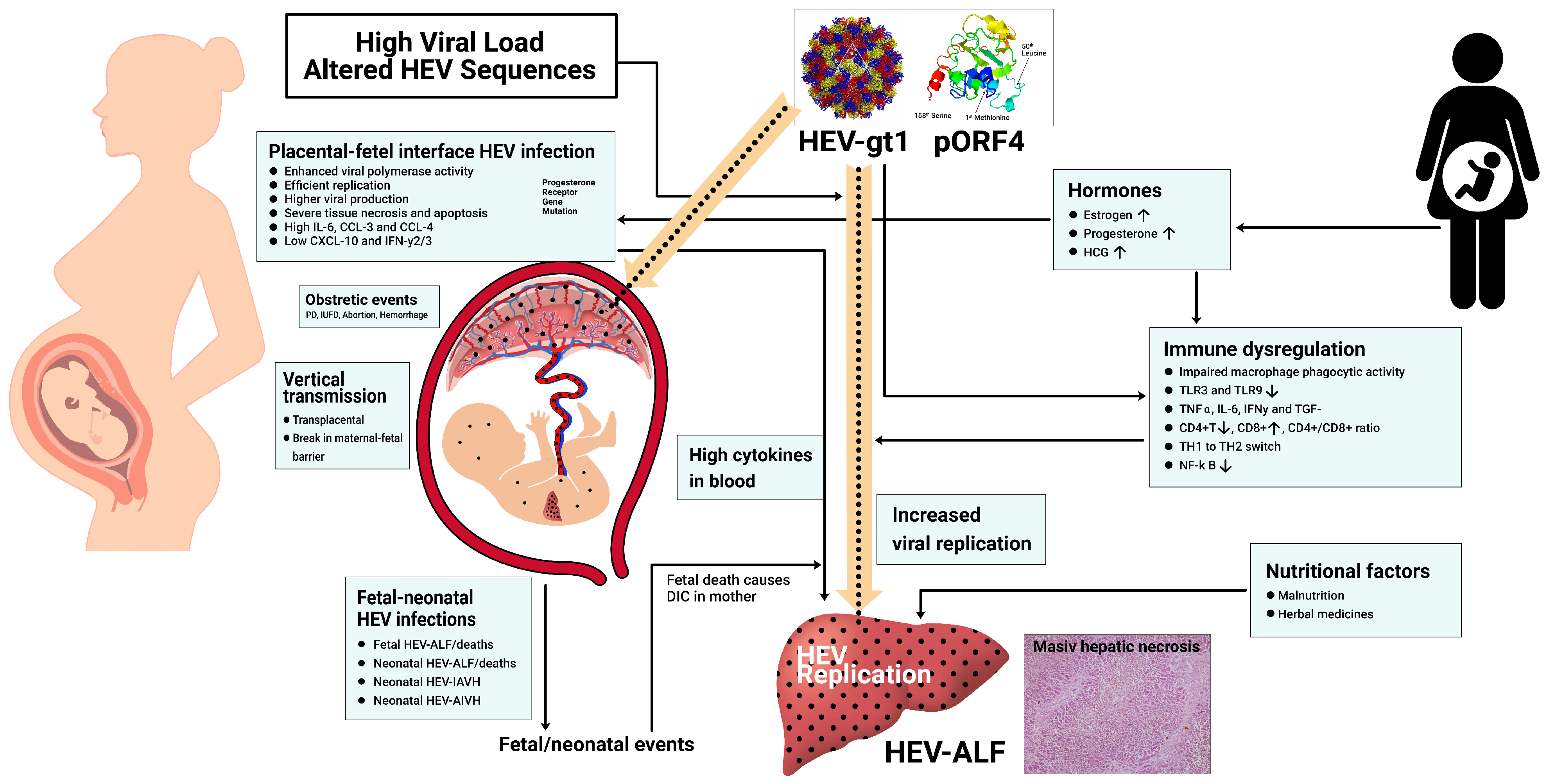
| HEV-ALF in pregnant women is an explosive disease with short PEP, high occurrence of cerebral edema, and DIC. | |
| CFR in HEV-ALF is 51.9% and is significantly less than CFR in non-HEV-ALF (84.2%). Pregnancy per se or duration of pregnancy did not adversely affect prognosis | |
| Obstetric complications in pregnancy with HEV infection | [54,158,159] |
| Pregnant women with HEV infection had a higher occurrence of obstetric complications than those with non-HEV infection. | |
| Obstetric complications in HEV-infected pregnant women include preterm labor, antepartum hemorrhage, intrauterine fetal deaths, abortions, and neonatal deaths | |
| Vertical transmission of HEV and its implications | [153,155,160] |
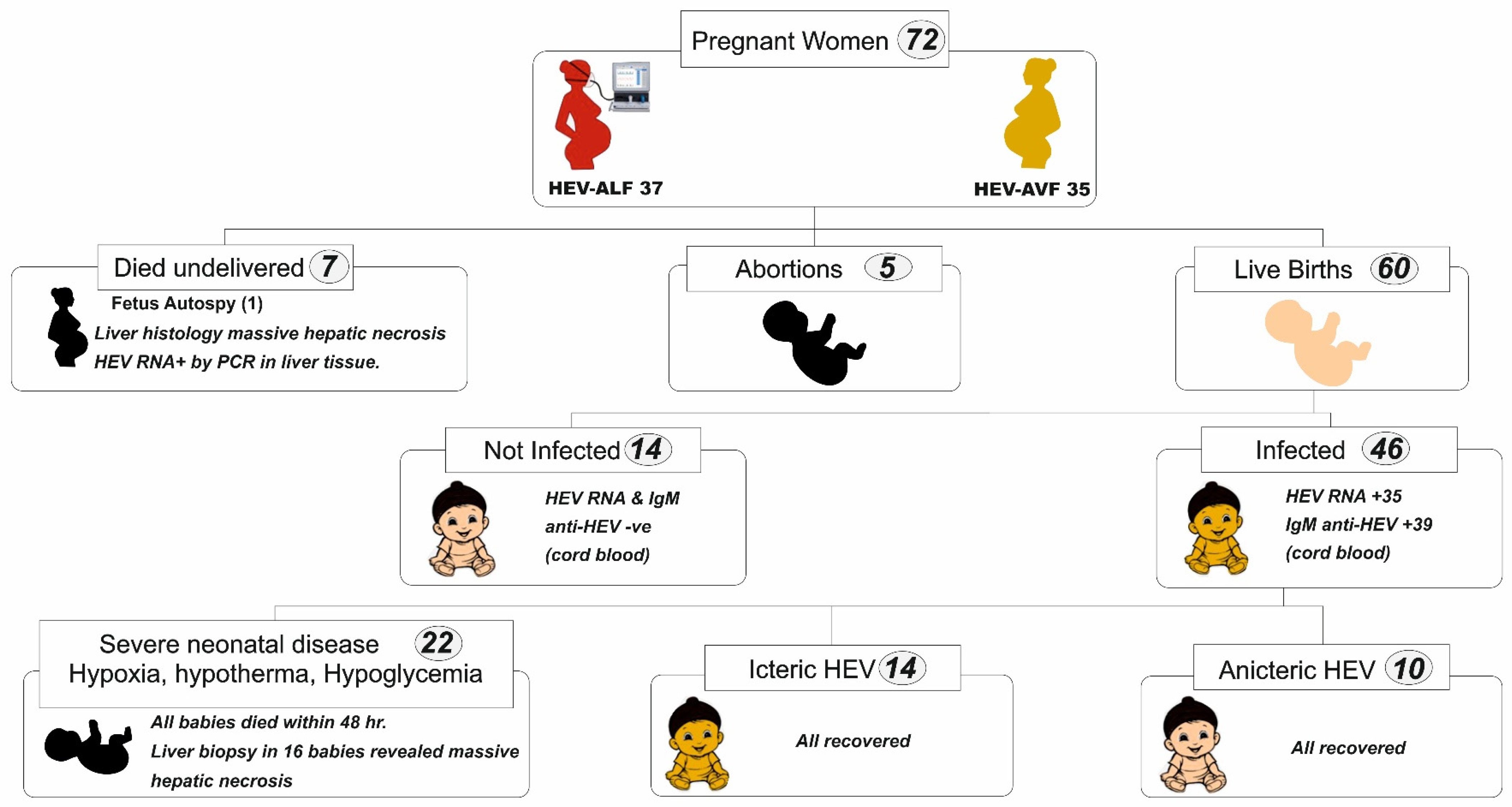
| Vertical (transplacental) fetal/neonatal HEV infection is reported to occur in 33–100% of pregnant women with HEV infection. | |
| About 15% of HEV-infected fetuses either die in utero or abort. Liver histology shows massive hepatic necrosis. | |
| Around half of the HEV-infected neonates develop ALF and present with hypoglycemia, hypothermia, and death. Of the remaining, around one-fourth develop self-limiting acute hepatitis (30.4%) or anicteric hepatitis (22%) without chronic viremia, hepatitis, or chronic liver disease. | |
| Mothers who deliver HEV-infected babies early (within 4 days of disease) survive more than those who deliver late. DIC in mothers with HEV-ALF occurred exclusively when the fetus/neonate had an HEV infection with massive hepatic necrosis. |
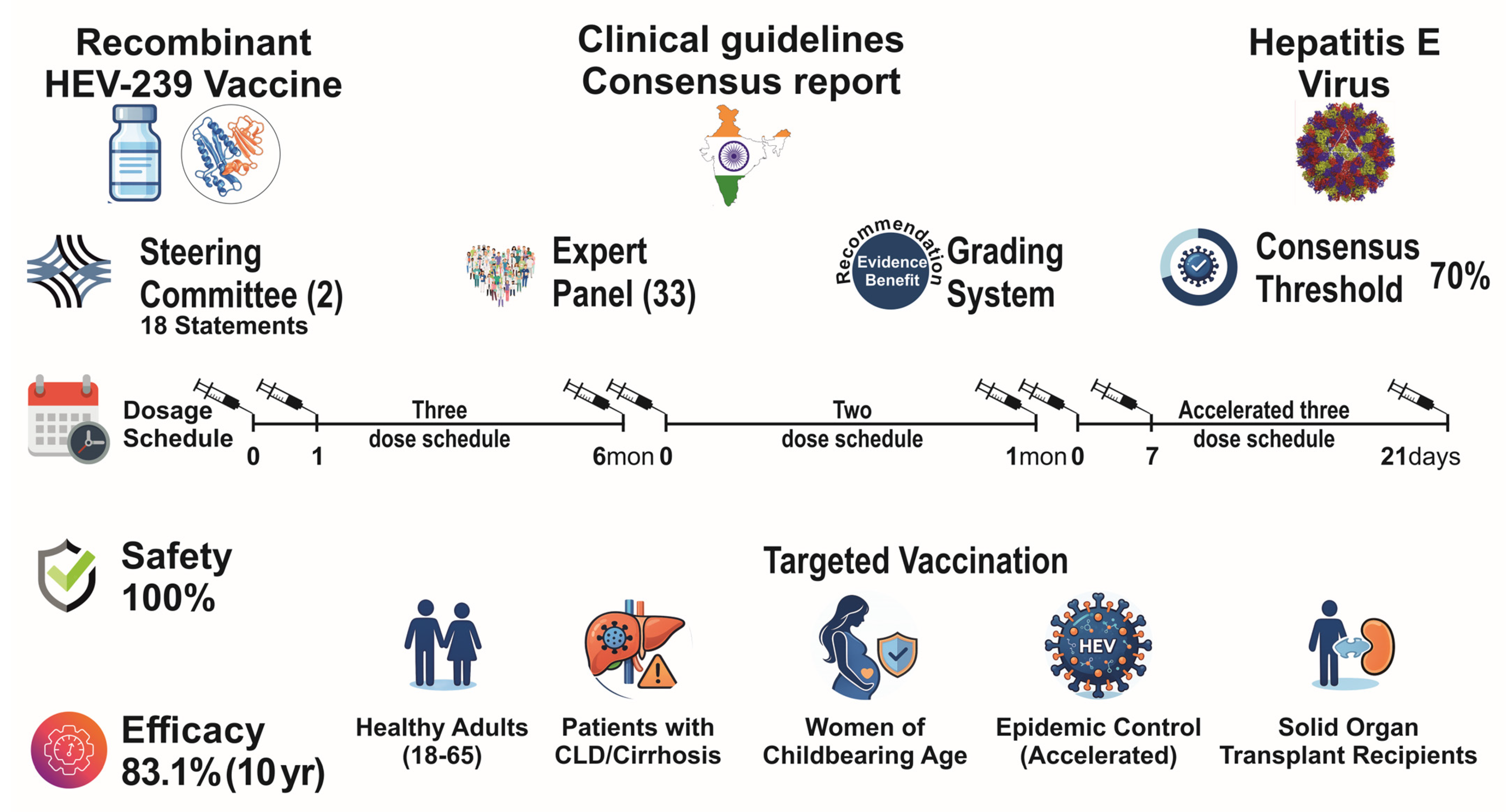
- Vaccinate high-risk groups with a two-dose or accelerated three-dose schedule during outbreaks or epidemics of hepatitis E.
- Vaccinate high-risk groups in highly endemic pockets of hepatitis E in India.
- Vaccinate women of childbearing age in endemic areas to target the occurrence of hepatitis E during pregnancy.
- Vaccinate patients with CLD of any etiology to prevent the occurrence of HEV-ACLF.
- Vaccinate SOT recipients prior to transplantation and immunosuppression.
4. Discussion
Author Contributions
Funding
Institutional Review Board Statement
Informed Consent Statement
Data Availability Statement
Acknowledgments
Conflicts of Interest
Abbreviations
References
- Khuroo, M.S.; Khuroo, M.S. Hepatitis E: An emerging global disease—From discovery towards control and cure. J. Viral Hepat. 2016, 23, 68–79. [Google Scholar] [CrossRef] [PubMed]
- Smith, D.B.; Simmonds, P. Classification and Genomic Diversity of Enterically Transmitted Hepatitis Viruses. Cold Spring Harb. Perspect. Med. 2018, 8, a031880. [Google Scholar] [CrossRef] [PubMed]
- Aggarwal, R. Hepatitis E: Historical, contemporary and future perspectives. J. Gastroenterol. Hepatol. 2011, 26, 72–82. [Google Scholar] [CrossRef] [PubMed]
- Dalton, H.R.; Izopet, J. Transmission and Epidemiology of Hepatitis E Virus Genotype 3 and 4 Infections. Cold Spring Harb. Perspect. Med. 2018, 8, a032144. [Google Scholar] [CrossRef] [PubMed]
- Lee, G.-H.; Tan, B.-H.; Teo, E.C.; Lim, S.-G.; Dan, Y.-Y.; Wee, A.; Aw, P.P.K.; Zhu, Y.; Hibberd, M.L.; Tan, C.-K.; et al. Chronic Infection with Camelid Hepatitis E Virus in a Liver Transplant Recipient Who Regularly Consumes Camel Meat and Milk. Gastroenterology 2016, 150, 355–357.e3. [Google Scholar] [CrossRef] [PubMed]
- Sridhar, S.; Yip, C.C.; Wu, S.; Chew, N.F.; Leung, K.H.; Chan, J.F.; Zhao, P.S.; Chan, W.M.; Poon, R.W.; Tsoi, H.W.; et al. Transmission of Rat Hepatitis E Virus Infection to Humans in Hong Kong: A Clinical and Epidemiological Analysis. Hepatology 2021, 73, 10–22. [Google Scholar] [CrossRef] [PubMed]
- Woo, P.C.; Lau, S.K.; Teng, J.L.; Tsang, A.K.; Joseph, M.; Wong, E.Y.; Tang, Y.; Sivakumar, S.; Xie, J.; Bai, R.; et al. New hepatitis E virus genotype in camels, the Middle East. Emerg. Infect. Dis. 2014, 20, 1044–1048. [Google Scholar] [CrossRef] [PubMed]
- Khuroo, M.S. Study of an epidemic of non-A, non-B hepatitis. Possibility of another human hepatitis virus distinct from post-transfusion non-A, non-B type. Am. J. Med. 1980, 68, 818–824. [Google Scholar] [CrossRef] [PubMed]
- Balayan, M.S.; Andjaparidze, A.G.; Savinskaya, S.S.; Ketiladze, E.S.; Braginsky, D.M.; Savinov, A.P.; Poleschuk, V.F. Evidence for a virus in non-A, non-B hepatitis transmitted via the fecal-oral route. Intervirology 1983, 20, 23–31. [Google Scholar] [CrossRef] [PubMed]
- Reyes, G.R.; Purdy, M.A.; Kim, J.P.; Luk, K.C.; Young, L.M.; Fry, K.E.; Bradley, D.W. Isolation of a cDNA from the virus responsible for enterically transmitted non-A, non-B hepatitis. Science 1990, 247, 1335–1339. [Google Scholar] [CrossRef] [PubMed]
- Tam, A.W.; Smith, M.M.; Guerra, M.E.; Huang, C.C.; Bradley, D.W.; Fry, K.E.; Reyes, G.R. Hepatitis E virus (HEV): Molecular cloning and sequencing of the full-length viral genome. Virology 1991, 185, 120–131. [Google Scholar] [CrossRef] [PubMed]
- Yarbough, P.O.; Tam, A.W.; Gabor, K.; Garza, E.; Moeckli, R.A.; Palings, I.; Simonsen, C.; Reyes, G.R. (Eds.) Assay Development of Diagnostic Tests for Hepatitis E. In Proceedings of the Viral Hepatitis and Liver Disease; Springer: Tokyo, Japan, 1994; pp. 367–370. [Google Scholar]
- Khuroo, M.S. Discovery of Hepatitis E and Its Impact on Global Health: A Journey of 44 Years about an Incredible Human-Interest Story. Viruses 2023, 15, 1745. [Google Scholar] [CrossRef] [PubMed]
- Li, P.; Liu, J.; Li, Y.; Su, J.; Ma, Z.; Bramer, W.M.; Cao, W.; de Man, R.A.; Peppelenbosch, M.P.; Pan, Q. The global epidemiology of hepatitis E virus infection: A systematic review and meta-analysis. Liver Int. 2020, 40, 1516–1528. [Google Scholar] [CrossRef] [PubMed]
- Aggarwal, R. Hepatitis E: Epidemiology and natural history. J. Clin. Exp. Hepatol. 2013, 3, 125–133. [Google Scholar] [CrossRef] [PubMed]
- Rein, D.B.; Stevens, G.A.; Theaker, J.; Wittenborn, J.S.; Wiersma, S.T. The global burden of hepatitis E virus genotypes 1 and 2 in 2005. Hepatology 2012, 55, 988–997. [Google Scholar] [CrossRef] [PubMed]
- Kenney, S.P.; Meng, X.J. Hepatitis E Virus Genome Structure and Replication Strategy. Cold Spring Harb. Perspect. Med. 2019, 9, a031724. [Google Scholar] [CrossRef] [PubMed]
- Li, B.; Wagner, A.L.; Song, Y.; Chen, X.; Lu, Y. Distribution and phylogenetics of hepatitis E virus genotype 4 in humans and animals. Zoonoses Public Health 2022, 69, 458–467. [Google Scholar] [CrossRef] [PubMed]
- Renou, C.; Roque-Afonso, A.M.; Pavio, N. Foodborne transmission of hepatitis E virus from raw pork liver sausage, France. Emerg. Infect. Dis. 2014, 20, 1945–1947. [Google Scholar] [CrossRef] [PubMed]
- Clemente-Casares, P.; Pina, S.; Buti, M.; Jardi, R.; MartIn, M.; Bofill-Mas, S.; Girones, R. Hepatitis E virus epidemiology in industrialized countries. Emerg. Infect. Dis. 2003, 9, 448–454. [Google Scholar] [CrossRef] [PubMed]
- Echevarria, J.M. Autochthonous Hepatitis E Virus Infection in Europe: A Matter of Concern for Public Health? J. Clin. Transl. Hepatol. 2014, 2, 7–14. [Google Scholar] [CrossRef] [PubMed][Green Version]
- Kamar, N.; Izopet, J.; Tripon, S.; Bismuth, M.; Hillaire, S.; Dumortier, J.; Radenne, S.; Coilly, A.; Garrigue, V.; D’Alteroche, L.; et al. Ribavirin for chronic hepatitis E virus infection in transplant recipients. N. Engl. J. Med. 2014, 370, 1111–1120. [Google Scholar] [CrossRef] [PubMed]
- Kamar, N.; Selves, J.; Mansuy, J.M.; Ouezzani, L.; Peron, J.M.; Guitard, J.; Cointault, O.; Esposito, L.; Abravanel, F.; Danjoux, M.; et al. Hepatitis E virus and chronic hepatitis in organ-transplant recipients. N. Engl. J. Med. 2008, 358, 811–817. [Google Scholar] [CrossRef] [PubMed]
- Alexandrova, R.; Tsachev, I.; Kirov, P.; Abudalleh, A.; Hristov, H.; Zhivkova, T.; Dyakova, L.; Baymakova, M. Hepatitis E Virus (HEV) Infection Among Immunocompromised Individuals: A Brief Narrative Review. Infect. Drug Resist. 2024, 17, 1021–1040. [Google Scholar] [CrossRef] [PubMed]
- Dudman, S.; Zerja, A.; Hasanoglu, I.; Ruta, S.; van Welzen, B.; Nicolini, L.A.; Yonga, P.; Overbo, J.; Rawat, S.; Habibovic, S.; et al. Global vaccination against hepatitis E virus: Position paper from the European Society of Clinical Microbiology and Infectious Diseases Viral Hepatitis Study Group. Clin. Microbiol. Infect. 2025, 31, 201–210. [Google Scholar] [CrossRef] [PubMed]
- The Lancet. Hepatitis E vaccine: Why wait? Lancet 2010, 376, 845. [Google Scholar] [CrossRef] [PubMed]
- URIHK. Hevrevac®—Recombinant Hepatitis E Vaccine. India’s First Hepatitis E Vaccine, Approved for Individuals Aged 18 to 65 Years. August 2025. Available online: https://www.urihkpharma.com/hevrevac (accessed on 6 June 2026).
- Chen, J.H.; Qin, L.X. Expert consensus-promoting clinical excellence and ultimately benefitting patients. Hepatobiliary Surg. Nutr. 2023, 12, 743–745. [Google Scholar] [CrossRef] [PubMed]
- Görgec, B.; Benedetti Cacciaguerra, A.; Pawlik, T.M.; Aldrighetti, L.A.; Alseidi, A.A.; Cillo, U.; Kokudo, N.; Geller, D.A.; Wakabayashi, G.; Asbun, H.J.; et al. An International Expert Delphi Consensus on Defining Textbook Outcome in Liver Surgery (TOLS). Ann. Surg. 2023, 277, 821–828. [Google Scholar] [CrossRef] [PubMed]
- Brauer, P.; Desroches, S.; Dhaliwal, R.; Li, A.; Wang, Y.; Conklin, A.I.; Klein, D.; Drouin-Chartier, J.-P.; Robitaille, J.; Keathley, J.R.; et al. Modified Delphi Process to Identify Research Priorities and Measures for Adult Lifestyle Programs to Address Type 2 Diabetes and Other Cardiometabolic Risk Conditions. Can. J. Diabetes 2022, 46, 411–418. [Google Scholar] [CrossRef] [PubMed]
- Gattrell, W.T.; Hungin, A.P.; Price, A.; Winchester, C.C.; Tovey, D.; Hughes, E.L.; van Zuuren, E.J.; Goldman, K.; Logullo, P.; Matheis, R.; et al. ACCORD guideline for reporting consensus-based methods in biomedical research and clinical practice: A study protocol. Res. Integr. Peer Rev. 2022, 7, 3. [Google Scholar] [CrossRef] [PubMed]
- ACCORD. EQUATOR (Enhancing the QUAlity and Transparency of Health Research) Network. ACCORD (Accurate Consensus Reporting Document): A Reporting Guideline for Consensus Methods in Biomedicine Developed via a Modified Delphi. 2024. Available online: https://www.ismpp.org/accord (accessed on 6 June 2026). [PubMed]
- Rossi, M.J.; Hohmann, E.; Matzkin, E. Expert Consensus and Delphi Studies Require Listing of Consensus Groups for Contributing Authors Designated by Their Steering Committee. Arthroscopy 2025, 41, 3837–3839. [Google Scholar] [CrossRef] [PubMed]
- Guyatt, G.H.; Oxman, A.D.; Vist, G.E.; Kunz, R.; Falck-Ytter, Y.; Alonso-Coello, P.; Schunemann, H.J.; GRADE Working Group. GRADE: An emerging consensus on rating quality of evidence and strength of recommendations. BMJ 2008, 336, 924–926. [Google Scholar] [CrossRef] [PubMed]
- Gattrell, W.T.; Logullo, P.; van Zuuren, E.J.; Price, A.; Hughes, E.L.; Blazey, P.; Winchester, C.C.; Tovey, D.; Goldman, K.; Hungin, A.P.; et al. ACCORD (ACcurate COnsensus Reporting Document): A reporting guideline for consensus methods in biomedicine developed via a modified Delphi. PLoS Med. 2024, 21, e1004326. [Google Scholar] [CrossRef] [PubMed]
- Aggarwal, R.; Goel, A. Hepatitis E: Current Status in India. Clin. Liver Dis. 2021, 18, 168–172. [Google Scholar] [CrossRef] [PubMed]
- Maity, S.; Chowdhary, S.; Swaminathan, A.; Ashtaputre, N.; Mudgal, P.P.; Mukhopadhyay, C. The silent spread of Hepatitis E in India—From epidemiological insight to public health action: A comprehensive review. Infection 2026, 54, 41–55. [Google Scholar] [CrossRef] [PubMed]
- Khuroo, M.S.; Khuroo, M.S.; Khuroo, N.S. Hepatitis E: Discovery, global impact, control and cure. World J. Gastroenterol. 2016, 22, 7030–7045. [Google Scholar] [CrossRef] [PubMed]
- Satapathy, P.; Gaidhane, S.; Bishoyi, A.K.; Ganesan, S.; Kavitha, V.; Mishra, S.; Kaur, M.; Bushi, G.; Shabil, M.; Syed, R.; et al. Burden of acute hepatitis E virus in South Asia: Insights from Global Burden of Disease study 2021. Diagn. Microbiol. Infect. Dis. 2025, 112, 116767. [Google Scholar] [CrossRef] [PubMed]
- Kamani, L.; Padhani, Z.A.; Das, J.K. Hepatitis E: Genotypes, strategies to prevent and manage, and the existing knowledge gaps. JGH Open 2021, 5, 1127–1134. [Google Scholar] [CrossRef] [PubMed]
- Zhang, L.; Wang, T.; Zhou, S.; Li, S.; Mo, T.; Wu, S. Update on the global burden of acute viral hepatitis in 2021: Addressing health inequalities. Front. Public Health 2025, 13, 1580863. [Google Scholar] [CrossRef] [PubMed]
- Myint, K.S.; Gibbons, R.V. Hepatitis E: A neglected threat. Trans. R. Soc. Trop. Med. Hyg. 2008, 102, 211–212. [Google Scholar] [CrossRef] [PubMed]
- The Lancet Gastroenterology & Hepatology. Hepatitis E: A neglected virus. Lancet Gastroenterol. Hepatol. 2016, 1, 261. [Google Scholar] [CrossRef] [PubMed]
- Khuroo, M.S. Hepatitis E: The enterically transmitted non-A, non-B hepatitis. Indian J. Gastroenterol. 1991, 10, 96–100. [Google Scholar] [PubMed]
- Kadri, S.M.; Rehman, S.U.; Rehana, K.; Benetou, D.R.; Ahmad, D.F.; Abdullah, A.; Chattu, V.K. Hepatitis A and E Outbreak Surveillance during 2015–2017 in Kashmir, India: Is the Water to Blame? J. Epidemiol. Glob. Health 2018, 8, 203–207. [Google Scholar] [CrossRef] [PubMed]
- IDSP. Weekly Outbreaks. 2018. Available online: https://ghdx.healthdata.org/record/india-integrated-disease-surveillance-programme-idsp-weekly-outbreak-reports-2018 (accessed on 2 June 2026).
- Gupta, S.K. Hepatitis E in India: Outbreaks, Risks, and Vaccines; Blog; Continental Hospital: Hyderabad, India, 2025. [Google Scholar]
- Aggarwal, R. Hepatitis E: The endemic perspective. Clin. Liver Dis. 2013, 2, 240–244. [Google Scholar] [CrossRef] [PubMed]
- Khuroo, M.S.; Kamili, S. Aetiology and prognostic factors in acute liver failure in India. J. Viral Hepat. 2003, 10, 224–231. [Google Scholar] [CrossRef] [PubMed]
- Acharya, S.K.; Dasarathy, S.; Kumer, T.L.; Sushma, S.; Prasanna, K.S.; Tandon, A.; Sreenivas, V.; Nijhawan, S.; Panda, S.K.; Nanda, S.K.; et al. Fulminant hepatitis in a tropical population: Clinical course, cause, and early predictors of outcome. Hepatology 1996, 23, 1448–1455. [Google Scholar] [CrossRef] [PubMed]
- Khuroo, M.S.; Duermeyer, W.; Zargar, S.A.; Ahanger, M.A.; Shah, M.A. Acute sporadic non-A, non-B hepatitis in India. Am. J. Epidemiol. 1983, 118, 360–364. [Google Scholar] [CrossRef] [PubMed]
- Khuroo, M.S. Hepatitis E and Pregnancy: An Unholy Alliance Unmasked from Kashmir, India. Viruses 2021, 13, 1329. [Google Scholar] [CrossRef] [PubMed]
- Khuroo, M.S.; Kamili, S. Aetiology, clinical course and outcome of sporadic acute viral hepatitis in pregnancy. J. Viral Hepat. 2003, 10, 61–69. [Google Scholar] [CrossRef] [PubMed]
- Khuroo, M.S.; Teli, M.R.; Skidmore, S.; Sofi, M.A.; Khuroo, M.I. Incidence and severity of viral hepatitis in pregnancy. Am. J. Med. 1981, 70, 252–255. [Google Scholar] [CrossRef] [PubMed]
- Sahni, A. Finally, a Vaccine for Hepatitis E: What Every Patient in North India Needs to Know; Fortis Hospital Mohali (Blog): Mohali, India, 2026. [Google Scholar]
- Shalimar; Saraswat, V.; Singh, S.P.; Duseja, A.; Shukla, A.; Eapen, C.E.; Kumar, D.; Pandey, G.; Venkataraman, J.; Puri, P.; et al. Acute-on-chronic liver failure in India: The Indian National Association for Study of the Liver consortium experience. J. Gastroenterol. Hepatol. 2016, 31, 1742–1749. [Google Scholar] [CrossRef] [PubMed]
- Acharya, S.K.; Bhatia, V.; Sreenivas, V.; Khanal, S.; Panda, S.K. Efficacy of L-ornithine L-aspartate in acute liver failure: A double-blind, randomized, placebo-controlled study. Gastroenterology 2009, 136, 2159–2168. [Google Scholar] [CrossRef] [PubMed]
- Kumar Acharya, S.; Kumar Sharma, P.; Singh, R.; Kumar Mohanty, S.; Madan, K.; Kumar Jha, J.; Kumar Panda, S. Hepatitis E virus (HEV) infection in patients with cirrhosis is associated with rapid decompensation and death. J. Hepatol. 2007, 46, 387–394. [Google Scholar] [CrossRef] [PubMed]
- Shalimar; Sharma, S.; Gamanagatti, S.R.; Chauhan, A.; Vuyyuru, S.K.; Elhence, A.; Rout, G.; Saraya, A.; Gunjan, D.; Nayak, B.; et al. Acute-on-Chronic Liver Failure in Budd-Chiari Syndrome: Profile and Predictors of Outcome. Dig. Dis. Sci. 2020, 65, 2719–2729. [Google Scholar] [CrossRef] [PubMed]
- Buti, M.; Ruiz-Cobo, J.C.; Esteban, R.; Riveiro-Barciela, M. Hepatitis E as a trigger for acute-on-chronic liver failure. Clin. Mol. Hepatol. 2025, 31, S196–S204. [Google Scholar] [CrossRef] [PubMed]
- Choudhury, A.; Kulkarni, A.V.; Arora, V.; Soin, A.S.; Dokmeci, A.K.; Chowdhury, A.; Koshy, A.; Duseja, A.; Kumar, A.; Mishra, A.K.; et al. Acute-on-chronic liver failure (ACLF): The ‘Kyoto Consensus’-steps from Asia. Hepatol. Int. 2025, 19, 1–69. [Google Scholar] [CrossRef] [PubMed]
- Jasrotia, A.; Revanuru, H.; Kar, P.; Chadha, A. Changing Epidemiology of Viral Hepatitis in India: Regional Trends and Public Health Implications. Trop. Gastroenterol. 2025, 46, 141–146. [Google Scholar] [CrossRef]
- Parameswari, K.; Vanisree, D.; Monica, K. Prevalence of Hepatitis A and Hepatitis E in Patients Presenting with Acute Viral Hepatitis at a Tertiary Care Hospital, Guntur, Andhra Pradesh. Eur. J. Cardiovasc. Med. 2025, 15, 917–920. [Google Scholar] [CrossRef]
- Anand, A.C.; Roy, A. Hepatitis A: A wake-up call! Indian J. Gastroenterol. 2025, 44, 581–584. [Google Scholar] [CrossRef] [PubMed]
- Lalwani, S.; Palkar, S.; Balasubramanian, S.; Kaur, G.; Mitra, M.; Deshmukh, R.; Kulkarni, R.; Arankalle, V. Age-stratified prevalence of anti-hepatitis A virus antibodies in four metropolitan Indian cities and recent changes in Pune city. Indian J. Gastroenterol. 2025, 45, 735–744. [Google Scholar] [CrossRef] [PubMed]
- Colasanti, O.; Yu, H.; Lohmann, V.; Shin, E.-C. Redefining the immune landscape of hepatitis A virus infection. Exp. Mol. Med. 2025, 57, 714–723. [Google Scholar] [CrossRef] [PubMed]
- Biswas, S.; Shalimar. Hepatitis A Virus-related Acute Liver Failure-A Cause for Concern? J. Clin. Exp. Hepatol. 2026, 16, 103551. [Google Scholar] [CrossRef] [PubMed]
- Gandhi, T.N.; Patel, S.S.; Chaudhary, A.; Nakrani, K. A declining trend of hepatitis A and hepatitis E at tertiary care hospital in South Gujarat. Indian J. Med. Sci. 2024, 76, 105–109. [Google Scholar] [CrossRef]
- Kumar, S.; Kataria, R.; Iqbal, M. Swachh Bharat Mission Successfully Transforms India’s Sanitation Landscape. 2024. Available online: https://static.pib.gov.in/WriteReadData/specificdocs/documents/2024/sep/doc202496389901.pdf (accessed on 6 June 2026).
- Khuroo, M.S. Hand Hygiene and Swachh Bharat Abhiyaan. Researchgate. November 2014. Available online: https://www.researchgate.net/publication/268871843 (accessed on 6 June 2026).
- Kapoor, A.; Anand, M. Available online: https://eacpm.gov.in/wp-content/uploads/2024/05/Addressing_Groundwater_Depletion_in_India.pdf (accessed on 6 June 2026).
- Khuroo, M.S. Discovery of hepatitis E: The epidemic non-A, non-B hepatitis 30 years down the memory lane. Virus Res. 2011, 161, 3–14. [Google Scholar] [CrossRef] [PubMed]
- Khuroo, M.S.; Khuroo, M.S. Seroepidemiology of a second epidemic of hepatitis E in a population that had recorded first epidemic 30 years before and has been under surveillance since then. Hepatol. Int. 2010, 4, 494–499. [Google Scholar] [CrossRef] [PubMed]
- Gupta, N.; Sarangi, A.N.; Dadhich, S.; Dixit, V.K.; Chetri, K.; Goel, A.; Aggarwal, R. Acute hepatitis E in India appears to be caused exclusively by genotype 1 hepatitis E virus. Indian J. Gastroenterol. 2018, 37, 44–49. [Google Scholar] [CrossRef] [PubMed]
- Shukla, P.; Chauhan, U.K.; Naik, S.; Anderson, D.; Aggarwal, R. Hepatitis E virus infection among animals in northern India: An unlikely source of human disease. J. Viral Hepat. 2007, 14, 310–317. [Google Scholar] [CrossRef] [PubMed]
- Tian, H.; Fu, X.; Li, W.; Huang, Y.; Sun, J.; Zhou, G.; Zhou, C.; Shen, Q.; Yang, S.; Zhang, W. Genotype 4 Hepatitis E Virus Prevalent in Eastern China Shows Diverse Subtypes. Hepat. Mon. 2015, 15, e25367. [Google Scholar] [CrossRef] [PubMed]
- Nan, Y.; Wu, C.; Zhao, Q.; Zhou, E.M. Zoonotic Hepatitis E Virus: An Ignored Risk for Public Health. Front. Microbiol. 2017, 8, 2396. [Google Scholar] [CrossRef] [PubMed]
- Grange, Z.L.; Goldstein, T.; Johnson, C.K.; Anthony, S.; Gilardi, K.; Daszak, P.; Olival, K.J.; O’Rourke, T.; Murray, S.; Olson, S.H.; et al. Ranking the risk of animal-to-human spillover for newly discovered viruses. Proc. Natl. Acad. Sci. USA 2021, 118, e2002324118. [Google Scholar] [CrossRef] [PubMed]
- Treagus, S.; Wright, C.; Baker-Austin, C.; Longdon, B.; Lowther, J. The Foodborne Transmission of Hepatitis E Virus to Humans. Food Environ. Virol. 2021, 13, 127–145. [Google Scholar] [CrossRef] [PubMed]
- Rajkhowa, S.; Sonowal, J.; Pegu, S.R.; Deb, R.; Gupta, V.K. Epidemiology and Emerging Trends of Zoonotic Viral Diseases of Pigs in India. Viruses 2025, 17, 381. [Google Scholar] [CrossRef] [PubMed]
- Mrzljak, A.; Balen, I.; Barbic, L.; Ilic, M.; Vilibic-Cavlek, T. Hepatitis E virus in professionally exposed: A reason for concern? World J. Hepatol. 2021, 13, 723–730. [Google Scholar] [CrossRef] [PubMed]
- Labrique, A.B.; Sikder, S.S.; Krain, L.J.; West, K.P., Jr.; Christian, P.; Rashid, M.; Nelson, K.E. Hepatitis E, a vaccine-preventable cause of maternal deaths. Emerg. Infect. Dis. 2012, 18, 1401–1404. [Google Scholar] [CrossRef] [PubMed]
- Peron, J.M.; Larrue, H.; Izopet, J.; Buti, M. The pressing need for a global HEV vaccine. J. Hepatol. 2023, 79, 876–880. [Google Scholar] [CrossRef] [PubMed]
- Fu, R.M.; Decker, C.C.; Dao Thi, V.L. Cell Culture Models for Hepatitis E Virus. Viruses 2019, 11, 608. [Google Scholar] [CrossRef] [PubMed]
- Pollet, J.; Chen, W.H.; Strych, U. Recombinant protein vaccines, a proven approach against coronavirus pandemics. Adv. Drug Deliv. Rev. 2021, 170, 71–82. [Google Scholar] [CrossRef] [PubMed]
- Xing, L.; Li, T.-C.; Mayazaki, N.; Simon, M.N.; Wall, J.S.; Moore, M.; Wang, C.-Y.; Takeda, N.; Wakita, T.; Miyamura, T.; et al. Structure of Hepatitis E Virion-sized Particle Reveals an RNA-dependent Viral Assembly Pathway. J. Biol. Chem. 2010, 285, 33175–33183. [Google Scholar] [CrossRef] [PubMed]
- Xing, L.; Kato, K.; Li, T.; Takeda, N.; Miyamura, T.; Hammar, L.; Cheng, R.H. Recombinant Hepatitis E Capsid Protein Self-Assembles into a Dual-Domain T = 1 Particle Presenting Native Virus Epitopes. Virology 1999, 265, 35–45. [Google Scholar] [CrossRef] [PubMed]
- Yin, X.; Li, X.; Feng, Z. Role of Envelopment in the HEV Life Cycle. Viruses 2016, 8, 229. [Google Scholar] [CrossRef] [PubMed]
- Nagashima, S.; Takahashi, M.; Kobayashi, T.; Tanggis; Nishizawa, T.; Nishiyama, T.; Primadharsini, P.P.; Okamoto, H. Characterization of the Quasi-Enveloped Hepatitis E Virus Particles Released by the Cellular Exosomal Pathway. J. Virol. 2017, 91, e00817. [Google Scholar] [CrossRef] [PubMed]
- Rivera-Serrano, E.E.; Gonzalez-Lopez, O.; Das, A.; Lemon, S.M. Cellular entry and uncoating of naked and quasi-enveloped human hepatoviruses. eLife 2019, 8, e43983. [Google Scholar] [CrossRef] [PubMed]
- Wang, B.; Meng, X.J. Structural and molecular biology of hepatitis E virus. Comput. Struct. Biotechnol. J. 2021, 19, 1907–1916. [Google Scholar] [CrossRef] [PubMed]
- Cao, D.; Meng, X.J. Molecular biology and replication of hepatitis E virus. Emerg. Microbes Infect. 2012, 1, e17. [Google Scholar] [CrossRef] [PubMed]
- Guu, T.S.; Liu, Z.; Ye, Q.; Mata, D.A.; Li, K.; Yin, C.; Zhang, J.; Tao, Y.J. Structure of the hepatitis E virus-like particle suggests mechanisms for virus assembly and receptor binding. Proc. Natl. Acad. Sci. USA 2009, 106, 12992–12997. [Google Scholar] [CrossRef] [PubMed]
- Louten, J. Virus Structure and Classification. In Essential Human Virology; Elsevier Inc.: Amsterdam, The Netherlands, 2016; Volume 19, pp. 19–29. [Google Scholar]
- Cancela, F.; Noceti, O.; Arbiza, J.; Mirazo, S. Structural aspects of hepatitis E virus. Arch. Virol. 2022, 167, 2457–2481. [Google Scholar] [CrossRef] [PubMed]
- Xing, L.; Wang, J.C.; Li, T.-C.; Yasutomi, Y.; Lara, J.; Khudyakov, Y.; Schofield, D.; Emerson, S.U.; Purcell, R.H.; Takeda, N.; et al. Spatial Configuration of Hepatitis E Virus Antigenic Domain. J. Virol. 2011, 85, 1117–1124. [Google Scholar] [CrossRef] [PubMed]
- Zhou, Z.; Xie, Y.; Wu, C.; Nan, Y. The Hepatitis E Virus Open Reading Frame 2 Protein: Beyond Viral Capsid. Front. Microbiol. 2021, 12, 739124. [Google Scholar] [CrossRef] [PubMed]
- Hervouet, K.; Ferrie, M.; Ankavay, M.; Montpellier, C.; Camuzet, C.; Alexandre, V.; Dembele, A.; Lecoeur, C.; Foe, A.T.; Bouquet, P.; et al. An Arginine-Rich Motif in the ORF2 capsid protein regulates the hepatitis E virus lifecycle and interactions with the host cell. PLoS Pathog. 2022, 18, e1010798. [Google Scholar] [CrossRef] [PubMed]
- Ju, X.; Ding, Q. Hepatitis E Virus Assembly and Release. Viruses 2019, 11, 539. [Google Scholar] [CrossRef] [PubMed]
- Shrestha, M.P.; Scott, R.M.; Joshi, D.M.; Mammen, M.P., Jr.; Thapa, G.B.; Thapa, N.; Myint, K.S.; Fourneau, M.; Kuschner, R.A.; Shrestha, S.K.; et al. Safety and efficacy of a recombinant hepatitis E vaccine. N. Engl. J. Med. 2007, 356, 895–903. [Google Scholar] [CrossRef] [PubMed]
- Huang, X.; Lu, J.; Liao, M.; Huang, Y.; Wu, T.; Xia, N. Progress and Challenges to Hepatitis E Vaccine Development and Deployment. Vaccines 2024, 12, 719. [Google Scholar] [CrossRef] [PubMed]
- Cao, Y.F.; Tao, H.; Hu, Y.M.; Shi, C.B.; Wu, X.; Liang, Q.; Chi, C.P.; Li, L.; Liang, Z.L.; Meng, J.H.; et al. A phase 1 randomized open-label clinical study to evaluate the safety and tolerability of a novel recombinant hepatitis E vaccine. Vaccine 2017, 35, 5073–5080. [Google Scholar] [CrossRef] [PubMed]
- Zydus. Clinical Trials Registry—India (CTRI) 2007. Available online: https://www.ctri.nic.in/Clinicaltrials/pmaindet2.php?EncHid=ODAwMjg=&Enc=&userName=Adsorbed (accessed on 14 August 2023).
- Li, S.W.; Zhao, Q.; Wu, T.; Chen, S.; Zhang, J.; Xia, N.S. The development of a recombinant hepatitis E vaccine HEV 239. Hum. Vaccin Immunother. 2015, 11, 908–914. [Google Scholar] [CrossRef] [PubMed]
- Azman, A.S.; Paul, K.K.; Bhuiyan, T.R.; Koyuncu, A.; Salje, H.; Qadri, F.; Gurley, E.S. Hepatitis E in Bangladesh: Insights from a National Serosurvey. J. Infect. Dis. 2021, 224, S805–S812. [Google Scholar] [CrossRef] [PubMed]
- URIHK. Summary of Product Characteristics (SmPC). Recombinant Hepatitis E Vaccine (E. coli). Manufacturer: Xiamen Innovax Biotech Co. Ltd. Marketer/Importer: Urihk Pharmaceutical Private Limited. 2018. Available online: https://www.cdsco.gov.in/opencms/resources/UploadCDSCOWeb/2018/UploadSmPC/115.%20Hepatitis%20E%20Urhik.pdf (accessed on 6 June 2026).
- Zhang, J.; Liu, C.B.; Li, R.C.; Li, Y.M.; Zheng, Y.J.; Li, Y.P.; Luo, D.; Pan, B.B.; Nong, Y.; Ge, S.X.; et al. Randomized-controlled phase II clinical trial of a bacterially expressed recombinant hepatitis E vaccine. Vaccine 2009, 27, 1869–1874. [Google Scholar] [CrossRef] [PubMed]
- Kao, C.M.; Rostad, C.A.; Nolan, L.E.; Peters, E.; Kleinhenz, J.; Sherman, J.D.; Tippett, A.; Shih, J.W.K.; Yildirim, I.; Agbakoba, V.; et al. A Phase 1, Double-Blinded, Placebo-Controlled Clinical Trial to Evaluate the Safety and Immunogenicity of HEV-239 (Hecolin) Vaccine in Healthy US Adults. J. Infect. Dis. 2024, 230, 1093–1101. [Google Scholar] [CrossRef] [PubMed]
- Wu, T.; Huang, S.J.; Zhu, F.C.; Zhang, X.F.; Ai, X.; Yan, Q.; Wang, Z.Z.; Yang, C.L.; Jiang, H.M.; Liu, X.H.; et al. Immunogenicity and safety of hepatitis E vaccine in healthy hepatitis B surface antigen positive adults. Hum. Vaccin Immunother. 2013, 9, 2474–2479. [Google Scholar] [CrossRef] [PubMed]
- Kar, P.; Jasrotia, A.; Nagre, N.; Kumar, J.S. OS-027 A prospective, randomized, double-blind, placebo-controlled, phase III, multicenter study to evaluate the immunogenicity and safety of recombinant hepatitis E vaccine in healthy adults & adolescents. J. Hepatol. 2026, 84, S24. [Google Scholar] [CrossRef]
- Zhang, J.; Zhang, X.F.; Huang, S.J.; Wu, T.; Hu, Y.M.; Wang, Z.Z.; Wang, H.; Jiang, H.M.; Wang, Y.J.; Yan, Q.; et al. Long-term efficacy of a hepatitis E vaccine. N. Engl. J. Med. 2015, 372, 914–922. [Google Scholar] [CrossRef] [PubMed]
- Huang, S.; Zhang, X.; Su, Y.; Zhuang, C.; Tang, Z.; Huang, X.; Chen, Q.; Zhu, K.; Hu, X.; Ying, D.; et al. Long-term efficacy of a recombinant hepatitis E vaccine in adults: 10-year results from a randomised, double-blind, placebo-controlled, phase 3 trial. Lancet 2024, 403, 813–823. [Google Scholar] [CrossRef] [PubMed]
- Zhu, F.C.; Zhang, J.; Zhang, X.F.; Zhou, C.; Wang, Z.Z.; Huang, S.J.; Wang, H.; Yang, C.L.; Jiang, H.M.; Cai, J.P.; et al. Efficacy and safety of a recombinant hepatitis E vaccine in healthy adults: A large-scale, randomised, double-blind placebo-controlled, phase 3 trial. Lancet 2010, 376, 895–902. [Google Scholar] [CrossRef] [PubMed]
- Zaman, K.; Dudman, S.; Stene-Johansen, K.; Qadri, F.; Yunus, M.; Sandbu, S.; Gurley, E.S.; Overbo, J.; Julin, C.H.; Dembinski, J.L.; et al. HEV study protocol: Design of a cluster-randomised, blinded trial to assess the safety, immunogenicity and effectiveness of the hepatitis E vaccine HEV 239 (Hecolin) in women of childbearing age in rural Bangladesh. BMJ Open 2020, 10, e033702. [Google Scholar] [CrossRef] [PubMed]
- Zaman, K.; Julin, C.H.; Aziz, A.B.; Stene-Johansen, K.; Yunus, M.; Qadri, F.; Gurley, E.S.; Sandbu, S.; Overbo, J.; Dembinski, J.L.; et al. Safety and effectiveness of a recombinant hepatitis E vaccine in women of childbearing age in rural Bangladesh: A phase 4, double-blind, cluster-randomised, controlled trial. Lancet Glob. Health 2024, 12, e1288–e1299. [Google Scholar] [CrossRef] [PubMed]
- Nesbitt, R.C.; Azman, A.S.; Asilaza, V.K.; Edwards, J.K.; Gitahi, P.; Nkemenang, P.; Duncker, J.; Haile, M.; Gakima, P.; Wamala, J.F.; et al. Safety of hepatitis E vaccine in pregnancy: An emulated target trial following a mass reactive vaccination campaign in Bentiu internally displaced persons camp, South Sudan. Lancet Glob. Health 2024, 12, e1881–e1890. [Google Scholar] [CrossRef] [PubMed]
- Jotautis, V.; Sarantaki, A. Evaluating the Efficacy and Safety of Hepatitis E Vaccination in Reproductive-Age Women: A Systematic Review and Meta-Analysis. Vaccines 2025, 13, 53. [Google Scholar] [CrossRef] [PubMed]
- Wu, T.; Zhu, F.C.; Huang, S.J.; Zhang, X.F.; Wang, Z.Z.; Zhang, J.; Xia, N.S. Safety of the hepatitis E vaccine for pregnant women: A preliminary analysis. Hepatology 2012, 55, 2038. [Google Scholar] [CrossRef] [PubMed]
- Zhong, G.; Zhuang, C.; Hu, X.; Chen, Q.; Bi, Z.; Jia, X.; Peng, S.; Li, Y.; Huang, Y.; Zhang, Q.; et al. Safety of hepatitis E vaccination for pregnancy: A post-hoc analysis of a randomized, double-blind, controlled phase 3 clinical trial. Emerg. Microbes Infect. 2023, 12, 2185456. [Google Scholar] [CrossRef] [PubMed]
- Aziz, A.B.; Dudman, S.; Julin, C.H.; Ahmmed, F.; Stene-Johansen, K.; Sandbu, S.; Overbo, J.; Dembinski, J.L.; Wisloff, T.; Rana, S.; et al. Receipt of hepatitis E vaccine and fetal loss in rural Bangladesh: Further analysis of a double-blind, cluster-randomised, controlled trial. Lancet Glob. Health 2024, 12, e1300–e1311. [Google Scholar] [CrossRef] [PubMed]
- WHO. Safety of Hepatitis E Vaccines. Extract from Report of GACVS Meeting of 15–17 May 2024, Published in the WHO Weekly Epidemiological Record on 9 August 2024. 2024. Available online: https://www.who.int/groups/global-advisory-committee-on-vaccine-safety/topics/hepatitis-e-vaccines (accessed on 6 June 2026).
- Liao, X.; Li, D.; Su, Y.; Wang, X.; Wu, S.; Chen, Y.; Li, Z.; Tang, Q.; Ma, Z.; Wan, X.; et al. Safety and immunogenicity of hepatitis E vaccine in compensated liver cirrhosis with chronic hepatitis B. Clin. Microbiol. Infect. 2025, 31, 1210–1215. [Google Scholar] [CrossRef] [PubMed]
- Zhuang, C.; Liu, X.; Huang, X.; Lu, J.; Zhu, K.; Liao, M.; Chen, L.; Jiang, H.; Zang, X.; Wang, Y.; et al. Effectiveness of a hepatitis E vaccine against medically attended symptomatic infection in HBsAg-positive adults from a test-negative design study. Nat. Commun. 2025, 16, 1699. [Google Scholar] [CrossRef] [PubMed]
- Zurowska, A. Breakthrough Study Confirms Hepatitis E Vaccine Works in High-Risk Groups. EMJ Eur. Med. J. 2025. Available online: https://www.emjreviews.com/hepatology/news/breakthrough-study-confirms-hepatitis-e-vaccine-works-in-high-risk-groups/ (accessed on 6 June 2026).
- Azam, B.; Marti, M.; Goel, A.; Aggarwal, R. Immunogenicity, Efficacy, and Effectiveness of Two-Dose and Shorter Schedules of Hepatitis E Vaccine: A Systematic Review. Vaccines 2025, 13, 28. [Google Scholar]
- Overbo, J.; Aziz, A.; Zaman, K.; Clemens, J.; Halle Julin, C.; Qadri, F.; Stene-Johansen, K.; Biswas, R.; Islam, S.; Rahman Bhuiyan, T.; et al. Immunogenicity and safety of a two-dose regimen with hepatitis E virus vaccine in healthy adults in rural Bangladesh: A randomized, double-blind, controlled, phase 2/pilot trial. Vaccine 2023, 41, 1059–1066. [Google Scholar] [CrossRef] [PubMed]
- Zhu, K.; Liao, M.; Chen, L.; Lu, J.; Huang, X.; Zhuang, C.; Su, Y.; Huang, S.; Wu, T.; Zhang, J.; et al. Persistence of hepatitis E vaccine-induced antibody response across different dosage schedules and baseline serostatus. npj Vaccines 2024, 9, 245. [Google Scholar] [CrossRef] [PubMed]
- Nesbitt, R.C.; Asilaza, V.K.; Gignoux, E.; Koyuncu, A.; Gitahi, P.; Nkemenang, P.; Duncker, J.; Antier, Z.; Haile, M.; Gakima, P.; et al. Vaccination coverage and adverse events following a reactive vaccination campaign against hepatitis E in Bentiu displaced persons camp, South Sudan. PLoS Negl. Trop. Dis. 2024, 18, e0011661. [Google Scholar] [CrossRef] [PubMed]
- Chen, Z.; Lin, S.; Duan, J.; Luo, Y.; Wang, S.; Gan, Z.; Yi, H.; Wu, T.; Huang, S.; Zhang, Q.; et al. Immunogenicity and safety of an accelerated hepatitis E vaccination schedule in healthy adults: A randomized, controlled, open-label, phase IV trial. Clin. Microbiol. Infect. 2019, 25, 1133–1139. [Google Scholar] [CrossRef] [PubMed]
- Nesbitt, R.C.; Kinya Asilaza, V.; Alvarez, C.; Gitahi, P.; Nkemenang, P.; Duncker, J.; Haile, M.; Gakima, P.; Wamala, J.F.; Loro, F.B.; et al. The effectiveness of two doses of recombinant hepatitis E vaccine in response to an outbreak in Bentiu, South Sudan: A case-control and bias indicator study. Lancet Infect. Dis. 2025, 25, 537–547. [Google Scholar] [CrossRef] [PubMed]
- Cao, Y.; Bing, Z.; Guan, S.; Zhang, Z.; Wang, X. Development of new hepatitis E vaccines. Hum. Vaccines Immunother. 2018, 14, 2254–2262. [Google Scholar] [CrossRef] [PubMed]
- Chen, Z.; Liu, L.; Situ, J.; Li, G.; Guo, S.; Lai, Q.; Wu, S.; Jiang, Y.; Fan, J.; Tang, Z.; et al. Antibodies elicited by hepatitis E vaccination in humans confer cross-genus protection against rat hepatitis E virus. J. Hepatol. 2025, 83, 1046–1056. [Google Scholar] [CrossRef] [PubMed]
- Gu, Y.; Tang, X.; Zhang, X.; Song, C.; Zheng, M.; Wang, K.; Zhang, J.; Ng, M.H.; Hew, C.L.; Li, S.; et al. Structural basis for the neutralization of hepatitis E virus by a cross-genotype antibody. Cell Res. 2015, 25, 604–620. [Google Scholar] [CrossRef] [PubMed]
- Huang, W.; Zhang, H.; Harrison, T.J.; Lang, S.; Huang, G.; Wang, Y. Cross-protection of hepatitis E virus genotypes 1 and 4 in rhesus macaques. J. Med. Virol. 2008, 80, 824–832. [Google Scholar] [CrossRef] [PubMed]
- Sarin, S.K.; Kumar, M. A vaccine for hepatitis e: Has it finally arrived? Gastroenterology 2011, 140, 1349–1352; discussion 1352–1353. [Google Scholar] [CrossRef] [PubMed]
- Wang, S.; Cheng, X.; Dai, X.; Dong, C. Rabbit and human hepatitis E virus strains belong to a single serotype. Virus Res. 2013, 176, 101–106. [Google Scholar] [CrossRef] [PubMed]
- Perez-Gracia, M.T.; Garcia, M.; Suay, B.; Mateos-Lindemann, M.L. Current Knowledge on Hepatitis E. J. Clin. Transl. Hepatol. 2015, 3, 117–126. [Google Scholar] [CrossRef] [PubMed]
- Tripathy, A.S.; Puranik, S.; Sharma, M.; Chakraborty, S.; Devakate, U.R. Hepatitis E virus seroprevalence among blood donors in Pune, India. J. Med. Virol. 2019, 91, 813–819. [Google Scholar] [CrossRef] [PubMed]
- Mirzaev, U.K.; Ouoba, S.; Ko, K.; Phyo, Z.; Chhoung, C.; Ataa, A.G.; Sugiyama, A.; Akita, T.; Tanaka, J. Systematic review and meta-analysis of hepatitis E seroprevalence in Southeast Asia: A comprehensive assessment of epidemiological patterns. BMC Infect. Dis. 2024, 24, 525. [Google Scholar] [CrossRef] [PubMed]
- Innis, B.L.; Lynch, J.A. Immunization against Hepatitis E. Cold Spring Harb. Perspect. Med. 2018, 8, a032573. [Google Scholar] [CrossRef] [PubMed]
- Zhang, J.; Zhang, X.F.; Zhou, C.; Wang, Z.Z.; Huang, S.J.; Yao, X.; Liang, Z.L.; Wu, T.; Li, J.X.; Yan, Q.; et al. Protection against hepatitis E virus infection by naturally acquired and vaccine-induced immunity. Clin. Microbiol. Infect. 2014, 20, O397–O405. [Google Scholar] [CrossRef] [PubMed]
- Su, Y.Y.; Huang, S.J.; Guo, M.; Zhao, J.; Yu, H.; He, W.G.; Jiang, H.M.; Wang, Y.J.; Zhang, X.F.; Cai, J.P.; et al. Persistence of antibodies acquired by natural hepatitis E virus infection and effects of vaccination. Clin. Microbiol. Infect. 2017, 23, 336.e1–336.e4. [Google Scholar] [CrossRef] [PubMed][Green Version]
- Khuroo, M.S.; Kamili, S.; Dar, M.Y.; Moecklii, R.; Jameel, S. Hepatitis E and long-term antibody status. Lancet 1993, 341, 1355. [Google Scholar] [CrossRef] [PubMed]
- Liu, X.; Zang, X.; Zhu, K.; Huang, X.; Hu, X.; Bi, Z.; Chen, Q.; Jiang, H.; Wang, Y.; Yang, C.; et al. Long-term protection from naturally acquired immunity against hepatitis E virus reinfection. Nat. Commun. 2025, 16, 11187. [Google Scholar] [CrossRef] [PubMed]
- Kmush, B.L.; Yu, H.; Huang, S.; Zhang, X.; Wu, T.; Nelson, K.E.; Labrique, A.B. Long-term Antibody Persistence After Hepatitis E Virus Infection and Vaccination in Dongtai, China. Open Forum Infect. Dis. 2019, 6, ofz144. [Google Scholar] [CrossRef] [PubMed]
- Naik, S.R.; Aggarwal, R.; Salunke, P.N.; Mehrotra, N.N. A large waterborne viral hepatitis E epidemic in Kanpur, India. Bull. World Health Organ. 1992, 70, 597–604. [Google Scholar] [PubMed]
- Viswanathan, R. Infectious hepatitis in Delhi (1955–1956): A critical study: Epidemiology. Indian J. Med. Res. 1957, 45, 49–58. [Google Scholar] [PubMed]
- Khuroo, M.S.; Khuroo, M.S.; Khuroo, N.S. Transmission of Hepatitis E Virus in Developing Countries. Viruses 2016, 8, 253. [Google Scholar] [CrossRef] [PubMed]
- Khuroo, M.S.; Dar, M.Y. Hepatitis E: Evidence for person-to-person transmission and inability of low dose immune serum globulin from an Indian source to prevent it. Indian J. Gastroenterol. 1992, 11, 113–116. [Google Scholar] [PubMed]
- Koyuncu, A.; Asilaza, K.V.; Rumunu, J.; Wamala, J.; Gitahi, P.; Antier, Z.; Duncker, J.; Nkemenang, P.; Gakima, P.; Haile, M.; et al. High confidence and demand for hepatitis E vaccine during an outbreak in Bentiu, South Sudan: A qualitative study. PLoS Glob. Public Health 2025, 5, e0003482. [Google Scholar] [CrossRef] [PubMed]
- Koyuncu, A.; Nesbitt, R.C.; Alvarez, C.; Asilaza, K.V.; Wamala, J.; Haile, M.; Gignoux, E.; Albela, M.; Gurley, E.S.; Loro, F.B.; et al. Diagnostic Performance and Kinetics of Hepatitis E Viral RNA and IgM Antibody Test Positivity in a Genotype 1 Outbreak in South Sudan. J. Infect. Dis. 2026, 233, e250–e258. [Google Scholar] [CrossRef] [PubMed]
- Khuroo, M.S.; Kamili, S.; Jameel, S. Vertical transmission of hepatitis E virus. Lancet 1995, 345, 1025–1026. [Google Scholar] [CrossRef] [PubMed]
- Khuroo, M.S.; Kamili, S.; Khuroo, M.S. Clinical course and duration of viremia in vertically transmitted hepatitis E virus (HEV) infection in babies born to HEV-infected mothers. J. Viral Hepat. 2009, 16, 519–523. [Google Scholar] [CrossRef] [PubMed]
- Patra, S.; Kumar, A.; Trivedi, S.S.; Puri, M.; Sarin, S.K. Maternal and fetal outcomes in pregnant women with acute hepatitis E virus infection. Ann. Intern. Med. 2007, 147, 28–33. [Google Scholar] [CrossRef] [PubMed]
- Khuroo, M.S.; Kamili, S. Association of severity of hepatitis E virus infection in mother and vertically transmitted infection in feuts. JK-Pract. 2006, 13, 70–74. [Google Scholar]
- Marti, M.; Macartney, K.; Grais, R.F.; Aggarwal, R. Hepatitis E vaccination: Continued benefit for pregnant women in vulnerable settings. Lancet Glob. Health 2024, 12, e1758. [Google Scholar] [CrossRef] [PubMed]
- Zhang, F.; Yang, G.; Chen, Y.; Chen, D.; Shi, Z.; Xia, J.; Wang, L. Safety of hepatitis E vaccine in pregnancy. Virol. J. 2026, 23, 130. [Google Scholar] [CrossRef] [PubMed]
- Khan, M.A.; Khuroo, M.S. Obstetric Outcome and Vertical Transmission in Pregnant Patients with Viral Hepatitis E (A Prospective Study). Ph.D. Thesis, Sher-I-Kashmir Institute of Medical Sciences, Srinagar, India, 1996. [Google Scholar]
- Kamili, S.; Khuroo, M.; Jameel, S. Hepatitis E: Studies on Transmission, Etiological Agent and Sero-Epidemiology; Universidad de Cachemira: Srinagar, India, 1994. [Google Scholar]
- Khuroo, M.S.; Khuroo, M.S. Association of severity of HEV infection in the mother and vertically transmitted infection in fetus. Ann. Intern. Med. 2007, 147, 33. [Google Scholar]
- Monga, R.; Garg, S.; Tyagi, P.; Kumar, N. Superimposed acute hepatitis E infection in patients with chronic liver disease. Indian J. Gastroenterol. 2004, 23, 50–52. [Google Scholar] [PubMed]
- Kamar, N.; Abravanel, F.; Marion, O.; Couat, C.; Esposito, L.; Hebral, A.L.; Lavayssière, L.; Ribes, D.; Guy, P.; Lhomme, S.; et al. Two decades of hepatitis E in solid organ transplantation: A retrospective monocentric analysis. Hepatology 2026. Publish ahead of print. [Google Scholar] [CrossRef] [PubMed]
- Li, Z.; Situ, J.; Wu, S.; Wong, T.C.; Ma, W.; Ho, S.S.F.; Chew, N.F.S.; Tsoi, J.Y.H.; Shun, E.H.K.; Liang, Y.; et al. The high burden of HEV infection in solid organ transplant recipients. Hepatol. Commun. 2025, 9, e0740. [Google Scholar] [CrossRef] [PubMed]
- Hansrivijit, P.; Trongtorsak, A.; Puthenpura, M.M.; Boonpheng, B.; Thongprayoon, C.; Wijarnpreecha, K.; Choudhury, A.; Kaewput, W.; Mao, S.A.; Mao, M.A.; et al. Hepatitis E in solid organ transplant recipients: A systematic review and meta-analysis. World J. Gastroenterol. 2021, 27, 1240–1254. [Google Scholar] [CrossRef] [PubMed]
- He, Q.; Zhang, F.; Shu, J.; Li, S.; Liang, Z.; Du, M.; Liu, X.; Liu, T.; Li, M.; Yin, X.; et al. Immunocompromised rabbit model of chronic HEV reveals liver fibrosis and distinct efficacy of different vaccination strategies. Hepatology 2022, 76, 788–802. [Google Scholar] [CrossRef] [PubMed]
- Aggarwal, R.; Gupta, N.; Munjal, S.; Dadhich, S.; Dixit, V.K.; Chetri, K. Acute Hepatitis E in India appears to be caused Exclusively by Genotype 1 Hepatitis E Virus. J. Clin. Exp. Hepatol. 2014, 4, S25–S26. [Google Scholar] [CrossRef]
- Naik, A.; Gupta, N.; Goel, D.; Ippagunta, S.K.; Sharma, R.K.; Aggarwal, R. Lack of evidence of hepatitis E virus infection among renal transplant recipients in a disease-endemic area. J. Viral Hepat. 2013, 20, e138–e140. [Google Scholar] [CrossRef] [PubMed]
- Hewitt, P.E.; Ijaz, S.; Brailsford, S.R.; Brett, R.; Dicks, S.; Haywood, B.; Kennedy, I.T.; Kitchen, A.; Patel, P.; Poh, J.; et al. Hepatitis E virus in blood components: A prevalence and transmission study in southeast England. Lancet 2014, 384, 1766–1773. [Google Scholar] [CrossRef] [PubMed]
- Huzly, D.; Umhau, M.; Bettinger, D.; Cathomen, T.; Emmerich, F.; Hasselblatt, P.; Hengel, H.; Herzog, R.; Kappert, O.; Maassen, S.; et al. Transfusion-transmitted hepatitis E in Germany, 2013. Eurosurveillance 2014, 19, 20812. [Google Scholar] [CrossRef] [PubMed]
- Damiris, K.; Aghaie Meybodi, M.; Niazi, M.; Pyrsopoulos, N. Hepatitis E in immunocompromised individuals. World J. Hepatol. 2022, 14, 482–494. [Google Scholar] [CrossRef] [PubMed]
- Wang, M.; Fu, P.; Yin, Y.; He, M.; Liu, Y. Acute, Recent and Past HEV Infection among Voluntary Blood Donors in China: A Systematic Review and Meta-Analysis. PLoS ONE 2016, 11, e0161089. [Google Scholar] [CrossRef] [PubMed]
- Denner, J.; Pischke, S.; Steinmann, E.; Blumel, J.; Glebe, D. Why all blood donations should be tested for hepatitis E virus (HEV). BMC Infect. Dis. 2019, 19, 541. [Google Scholar] [CrossRef] [PubMed]
- GOV.UK; HEV Working Group. Hepatitis E Virus Transmission by Blood Transfusion—Review of Current Screening Effectiveness. 2025. Available online: https://assets.publishing.service.gov.uk/media/6936a0e17b258b4b5257433d/sabto-hepatitis-e-virus-transmission-by-blood-transfusion-review-of-current-screening-effectiveness.pdf (accessed on 6 June 2026).
- Kimura, Y.; Gotoh, A.; Katagiri, S.; Hoshi, Y.; Uchida, S.; Yamasaki, A.; Takahashi, Y.; Fukutake, K.; Kiguchi, T.; Ohyashiki, K. Transfusion-transmitted hepatitis E in a patient with myelodysplastic syndromes. Blood Transfus. 2014, 12, 103–106. [Google Scholar] [CrossRef] [PubMed]
- Tanaka, A.; Matsubayashi, K.; Odajima, T.; Sakata, H.; Iida, J.; Kai, K.; Goto, N.; Satake, M. Universal nucleic acid donor screening revealed epidemiological features of hepatitis E and prevented transfusion-transmitted infection in Japan. Transfusion 2024, 64, 335–347. [Google Scholar] [PubMed]
- Khuroo, M.S.; Kamili, S.; Yattoo, G.N. Hepatitis E virus infection may be transmitted through blood transfusions in an endemic area. J. Gastroenterol. Hepatol. 2004, 19, 778–784. [Google Scholar] [CrossRef] [PubMed]
- Mishra, K.K.; Patel, K.; Trivedi, A.; Patel, P.; Ghosh, K.; Bharadva, S. Risk of hepatitis-E virus infections among blood donors in a regional blood transfusion centre in western India. Transfus. Med. 2021, 31, 193–199. [Google Scholar] [CrossRef] [PubMed]
- Aggarwal, R. Hepatitis E: Is it a blood-borne pathogen? J. Gastroenterol. Hepatol. 2004, 19, 729–731. [Google Scholar] [CrossRef] [PubMed]
- Anand, A.C.; Singh, K.J.; Sharma, P.; Kumar, S.; Gupta, R.M. Incidence of Hepatitis E Virus Infection in Recipients of Blood or Blood Products Transfusion. Med. J. Armed Forces India 2010, 66, 204–207. [Google Scholar] [CrossRef] [PubMed][Green Version]
- Rivero-Juarez, A.; Lopez-Lopez, P.; Frias, M.; Rivero, A. Hepatitis E Infection in HIV-Infected Patients. Front. Microbiol. 2019, 10, 1425. [Google Scholar] [CrossRef] [PubMed]
- Kogias, D.; Skeva, A.; Smyrlis, A.; Mourvati, E.; Kantartzi, K.; Romanidou, G.; Kalientzidou, M.; Rekari, V.; Konstantinidou, E.; Kiorteve, P.; et al. Hepatitis E Virus (HEV) Infection in Hemodialysis Patients: A Multicenter Epidemiological Cohort Study in North-Eastern Greece. Pathogens 2023, 12, 667. [Google Scholar] [CrossRef] [PubMed]
- Alavian, S.M.; Ataei, B.; Ebrahimi, A.; Pirhaji, O.; Azad, R.; Olya, B.; Ataei, A.M. Anti-Hepatitis E Antibody in Hemodialysis Patients in Isfahan, Iran: Prevalence and Risk Factors. Hepat. Mon. 2015, 15, e23633. [Google Scholar] [CrossRef] [PubMed]
- Wang, X.L.; Li, Y.T.; Ma, X.J.; Ling, Y.S.; Wu, T.; Niu, J.J. Evaluation of safety and immunogenicity of hepatitis E vaccine in maintenance hemodialysis patients. Zhonghua Yu Fang Yi Xue Za Zhi 2022, 56, 464–467. [Google Scholar] [CrossRef] [PubMed]
- Wang, M.; Duan, B.; Liu, M.; Zhang, Y.; Wu, F.; Li, G.; Ouyang, Y. Vaccination Strategies and Research Gaps in Hepatitis E Virus for Special Populations. Vaccines 2025, 13, 621. [Google Scholar] [CrossRef] [PubMed]
- Kamar, N.; Bendall, R.; Legrand-Abravanel, F.; Xia, N.-S.; Ijaz, S.; Izopet, J.; Dalton, H.R. Hepatitis E. Lancet 2012, 379, 2477–2488. [Google Scholar] [CrossRef] [PubMed]
- Myint, K.S.; Duripunt, P.; Mammen, M.P., Jr.; Sirisopana, N.; Rodkvamtook, W.; Gibbons, R.V. Hepatitis E virus infection in Thai troops deployed with U.N. peacekeeping forces. Mil. Med. 2007, 172, 1217–1219. [Google Scholar] [CrossRef] [PubMed][Green Version]
- Khuroo, M.S. Viral hepatitis in international travellers: Risks and prevention. Int. J. Antimicrob. Agents 2003, 21, 143–152. [Google Scholar] [CrossRef] [PubMed]
- Nicolini, L.A.P.; Stoney, R.J.; Della Vecchia, A.; Grobusch, M.; Gautret, P.; Angelo, K.M.; van Genderen, P.J.J.; Bottieau, E.; Leder, K.; Asgeirsson, H.; et al. Travel-related hepatitis E: A two-decade GeoSentinel analysis. J. Travel Med. 2020, 27, taaa132. [Google Scholar] [CrossRef] [PubMed]
- Shlim, D.R.; Innis, B.L. Hepatitis E vaccine for travelers? J. Travel Med. 2000, 7, 167–169. [Google Scholar] [CrossRef] [PubMed]
- Gibson, M. Search WikiDoc [Internet]. 24 April 2017. Available online: https://www.wikidoc.org/index.php/Traveller_vaccination_hepatitis_E (accessed on 6 June 2026).
- Khuroo, M.S.; Rustgi, V.K.; Dawson, G.J.; Mushahwar, I.K.; Yattoo, G.N.; Kamili, S.; Khan, B.A. Spectrum of hepatitis E virus infection in India. J. Med. Virol. 1994, 43, 281–286. [Google Scholar] [CrossRef] [PubMed]
- Darwish, M.A.; Faris, R.; Clemens, J.D.; Rao, M.R.; Edelman, R. High seroprevalence of hepatitis A, B, C, and E viruses in residents in an Egyptian village in the Nile Delta: A pilot study. Am. J. Trop. Med. Hyg. 1996, 54, 554–558. [Google Scholar] [CrossRef] [PubMed]
- MacFarlane, I.M.; Zierhut, H. An introduction to Delphi studies and consensus methods for genetic counselors. J. Genet. Couns. 2025, 34, e70136. [Google Scholar] [CrossRef] [PubMed]
- Nasa, P.; Jain, R.; Juneja, D. Delphi methodology in healthcare research: How to decide its appropriateness. World J. Methodol. 2021, 11, 116–129. [Google Scholar] [CrossRef] [PubMed]
- Dror, I.; Kukucka, J.; Kassin, S.; Zapf, P. When Expert Decision Making Goes Wrong: Consensus, Bias, the Role of Experts, and Accuracy. J. Appl. Res. Mem. Cogn. 2018, 7, 162–163. [Google Scholar] [CrossRef]
- Kea, B.; Sun, B.C. Consensus development for healthcare professionals. Intern. Emerg. Med. 2015, 10, 373–383. [Google Scholar] [CrossRef] [PubMed]
- Lynch, J.A.; Lim, J.K.; Asaga, P.E.P.; Wartel, T.A.; Marti, M.; Yakubu, B.; Rees, H.; Talaat, K.; Kmush, B.; Aggarwal, R.; et al. Hepatitis E vaccine-Illuminating the barriers to use. PLoS Negl. Trop. Dis. 2023, 17, e0010969. [Google Scholar] [CrossRef] [PubMed]
- SAGE. Recommendations of the HEV Working Group on the Use of Hepatitis E Vaccine. A Document Prepared for the Strategic Advisory Group of Experts on Immunization (SAGE) by the Hepatitis E Vaccine Working Group. 2014. Available online: https://terrance.who.int/mediacentre/data/sage/SAGE_Docs_Ppt_Oct2014/8_session_hepE/Oct2014_Session8_HEV_recommendations.pdf (accessed on 6 June 2026).
- SAGE. Hepatitis E Vaccines Background Paper Strategic Advisory Group of Experts (SAGE) on Immunization Meeting 12 March 2024. Available online: https://cdn.who.int/media/docs/default-source/immunization/sage/2024/march/hepatitis_e_background_paper_sage_mar24.pdf?sfvrsn=e14438c4_1 (accessed on 6 June 2026).
- Kim, S.B.; Agampodi, S.; Saluja, T.; Sahastrabuddhe, S.; Kim, H.S.; Kim, J.H.; Lynch, J.A. Hepatitis E vaccine landscape update 2025. Expert Rev. Vaccines 2025, 24, 818–833. [Google Scholar] [CrossRef] [PubMed]
- SAGE. Report of the SAGE Working Group on Vaccine Hesitancy. 2014. Available online: https://www.asset-scienceinsociety.eu/sites/default/files/sage_working_group_revised_report_vaccine_hesitancy.pdf (accessed on 6 June 2026).
- Izopet, J.; Xia, X. Chapter 29: Hepatitis E Vaccines. In Plotkin’s Vaccines, 8th ed.; Orenstein, P.O.W., Ed.; Elsvier: Amsterdam, The Netherlands, 2023; pp. 443–450.e4. [Google Scholar]
- Hartley, C.; Wasuwanich, P.; Van, T.; Karnsakul, W. Hepatitis E Vaccines Updates. Vaccines 2024, 12, 722. [Google Scholar] [CrossRef] [PubMed]
- Mirmiran, P.; Bahadoran, Z.; Gaeini, Z. Common Limitations and Challenges of Dietary Clinical Trials for Translation into Clinical Practices. Int. J. Endocrinol. Metab. 2021, 19, e108170. [Google Scholar] [CrossRef] [PubMed]
- Teo, C.G. Fatal outbreaks of jaundice in pregnancy and the epidemic history of hepatitis E. Epidemiol. Infect. 2012, 140, 767–787. [Google Scholar] [CrossRef] [PubMed]
- Lama, M.P. Internal displacement in India: Causes, protection and dilemmas. In Foreced Migration Review; University of Oxford: Oxford, UK, 2024; Available online: https://www.fmreview.org/lama/ (accessed on 6 June 2026).
- Gupta, B.P.; Sah, A.K.; Sah, A.K.; Gupta, V.P.; Ghimire, D.P.; Acharya, N.; Wagle, C. Seroprevalence of hepatitis E in general, hepatic, and pregnant populations in Nepal, Bangladesh, and Pakistan: A systematic review and meta-analysis. Virol. J. 2025, 23, 6. [Google Scholar] [CrossRef] [PubMed]
- Bouscaillou, J.; Komas, N.; Tricou, V.; Nakouné, E.; Sélékon, B.; Fontanet, A. Imported Hepatitis E Virus, Central African Republic. Emerg. Infect. Dis. 2013, 19, 336–337. [Google Scholar] [CrossRef] [PubMed]
- Goumba, A.I.; Konamna, X.; Komas, N.P. Clinical and epidemiological aspects of a hepatitis E outbreak in Bangui, Central African Republic. BMC Infect. Dis. 2011, 11, 93. [Google Scholar] [CrossRef] [PubMed]
- Kim, J.H.; Nelson, K.E.; Panzner, U.; Kasture, Y.; Labrique, A.B.; Wierzba, T.F. A systematic review of the epidemiology of hepatitis E virus in Africa. BMC Infect. Dis. 2014, 14, 308. [Google Scholar] [CrossRef] [PubMed]
- de Marguerite Nombot-Yazenguet, M.P.; Dote, J.W.; Koyaweda, G.W.; Zemingui-Bembete, P.A.; Selekon, B.; Vickos, U.; Manirakiza, A.; Nakoune, E.; Gouandjika-Vasilache, I.; Komas, N.P.J. Hepatitis E outbreak in the health district of Bocaranga-Koui, Central African Republic, 2018–2019. BMC Infect. Dis. 2024, 24, 215. [Google Scholar] [CrossRef] [PubMed]
- Saade, M.C.; Haddad, G.; Hayek, M.E.; Shaib, Y. The burden of Hepatitis E virus in the Middle East and North Africa region: A systematic review. J. Infect. Dev. Ctries. 2022, 16, 737–744. [Google Scholar] [CrossRef] [PubMed]
- Dubé, E.; Laberge, C.; Guay, M.; Bramadat, P.; Roy, R.; Bettinger, J. Vaccine hesitancy: An overview. Hum. Vaccin Immunother. 2013, 9, 1763–1773. [Google Scholar] [CrossRef] [PubMed]
- Holt, D.; Finnegan, G.; Rath, B.; Gimenez-Sanchez, F.; Signorelli, C.; Usonis, V.; Weil-Olivier, C.; Evans, S. Vaccine Hesitancy Deconstructing the Challenge and Finding Solutions; Coilation for Life Course Immunization (LCI): Forest, Belgium, 2020; pp. 1–11. Available online: https://www.cl-ci.org/reports/vaccine-hesitancy-deconstructing-the-challenge-and-finding-solutions/ (accessed on 6 June 2026).
- Gianfredi, V.; Moretti, M.; Lopalco, P.L. Countering vaccine hesitancy through immunization information systems, a narrative review. Hum. Vaccin Immunother. 2019, 15, 2508–2526. [Google Scholar] [CrossRef] [PubMed]
- Blasioli, E.; Hassini, E. Vaccine Hesitancy: How Social and Technological Issues Converged to Spawn Mistrust. A Complex Blend of Personal, Social, and Environmental Factors Fuels Vaccine Skepticism. GAVI The Vaccine Alliance. 6 August 2025. Available online: https://www.gavi.org/vaccineswork/vaccine-hesitancy-how-social-and-technological-issues-converged-spawn-mistrust (accessed on 6 June 2026).
- Liu, H.; Chen, G.; Jie, Y.; Jiang, Y.; Huang, Y.; Wang, X.; Hao, C.; Gu, J.; Zhang, L.; Li, J. Cost-effectiveness analysis of hepatitis E screening and vaccination: Targeting vulnerable populations in outbreak and sporadic settings in China. Emerg. Microbes Infect. 2026, 15, 2623707. [Google Scholar] [CrossRef] [PubMed]


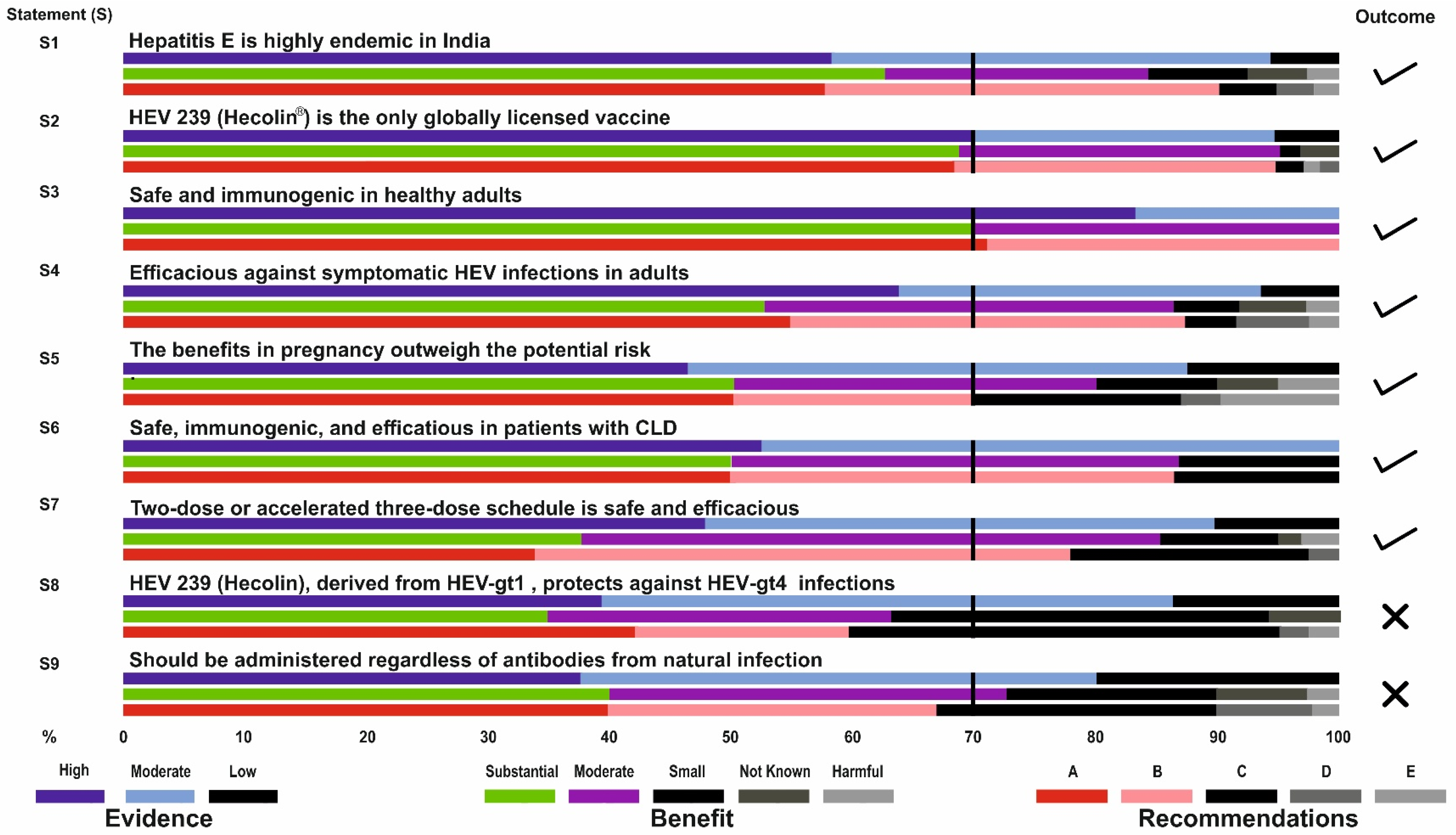
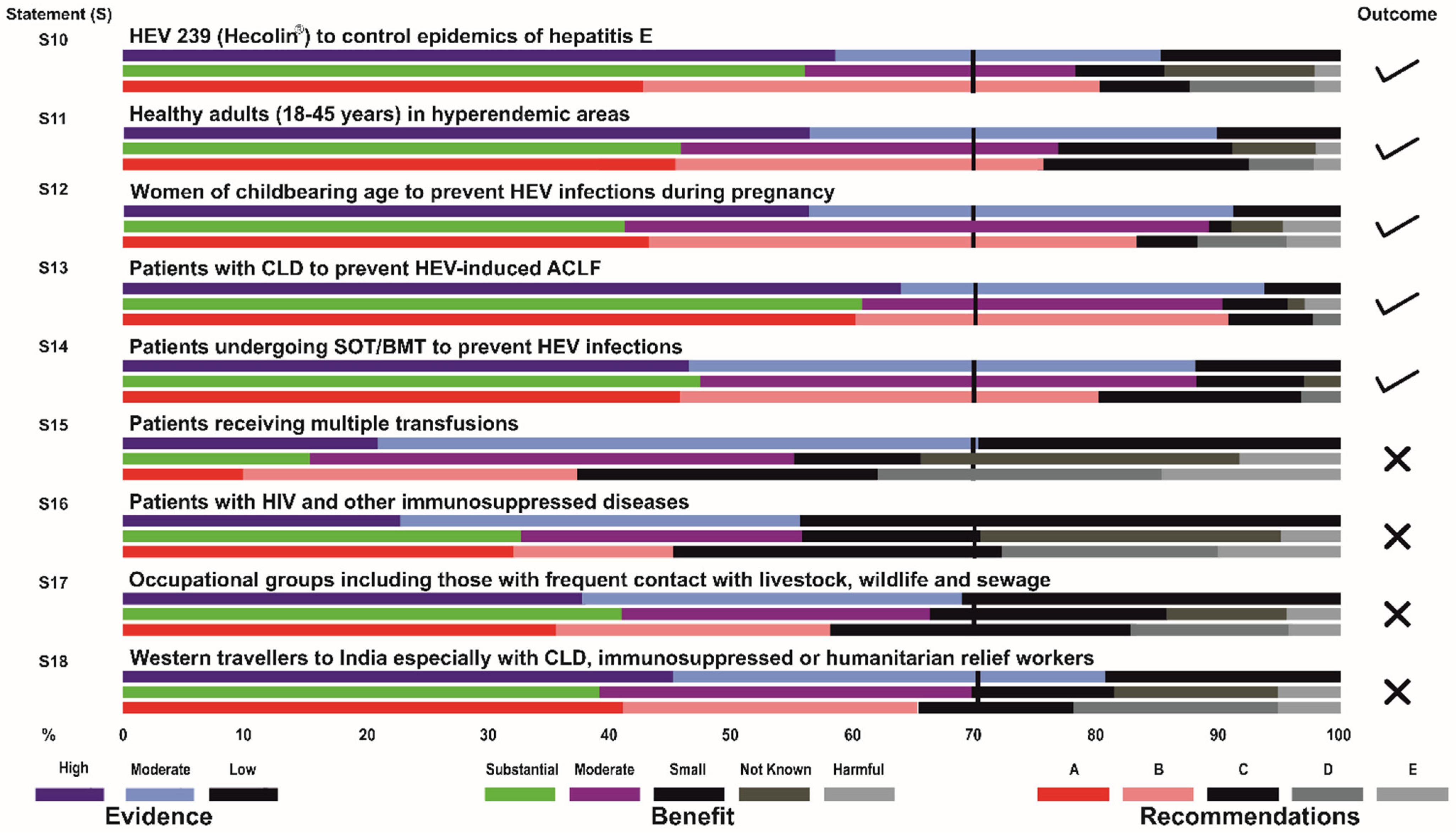
| LEVEL OF EVIDENCE | |
| Synthesized from published data by the expert panel members. | |
| High | Consistent results from well-designed, well-conducted studies. The voidance is unlikely to be affected by future studies. |
| Moderate | Sufficient to determine the effects, but constrained by the number, size, or quality of individual studies; inconsistency of findings across individual studies; limited generalizability of findings to routine primary care practice; and lack of coherence in the chain of evidence. The magnitude or direction of the decisions could change, and such a change may be significant enough to alter the conclusions in future studies. |
| Low | The available evidence is insufficient to assess effects due to limited size, significant flaws, inconsistencies, gaps, or a lack of information. Further studies are needed to define the level of evidence. |
| POTENTIAL BENEFITS | |
| Evaluated by analyzing the balance between desirable (benefits) and undesirable (harms/burden) effects to determine the net health benefit. This involves evaluating the certainty of evidence for both beneficial and harmful outcomes separately. | |
| Substantial | There is a high chance that the net benefit is substantial. |
| Moderate | There is moderate certainty that the net benefit is moderate to substantial. |
| Small | There is likely to be only a small benefit from this therapy. |
| Not known | The evidence is lacking, of poor quality, or conflicting results, and the balance of benefits and harms cannot be determined. |
| Harmful | There is moderate or high certainty that the therapy has no benefit or that the harms outweigh the benefits. |
| GRADE OF RECOMMENDATION | |
| Based on several factors, including the balance of desirable versus undesirable effects (benefits versus harms), the quality of published evidence, cost-effectiveness, feasibility, societal acceptance, and the wisdom of experts. | |
| A | The committee recommends that clinicians routinely provide this therapy. |
| B | The committee recommends that clinicians consider providing this therapy to selected subjects depending on individual circumstances. |
| C | The committee concludes that the current evidence is insufficient to assess the therapy’s benefits and harms. |
| D | The committee does not recommend therapy. |
| E | Clinicians should discourage the use of this therapy. |
| Phase | Region | Trial Objectives | Design | Dosage Schedule | No. of Subjects | ADRs | Immune Response | Conclusion | Reference |
|---|---|---|---|---|---|---|---|---|---|
| I | China | Safety Immunogenicity | Random open-label, parallel | 0, 1 & 6 mon Dose: different (30 μg) | 120 healthy adults 16–65 years | Local, mild, no SAEs | Immunogenic | Safe and immunogenic | [102] |
| II | China | Safety Immunogenicity | Randomized, controlled | Dose scheduling, dose escalation | 457 adults and 155 students. | Local, mild, No SAEs | Recommended 0, 1 & 6 mon, Dose 0.5 (30 μg) | Three doses: 0, 1 & 6 mon; 0.5 m (30 μg) | [107] |
| II | China (2013) | Safety Immunogenicity (HBsAg +/−) | Randomized (1:1) (HEV vs. HBV vaccine) | 0, 1 & 6 mon Dose: 30 μg | 14,065 HBsAg + 803. | Local, 10.2%; systemic, 20%; no sig. diff. in either group; no SAEs. | Robust, +89.3 (HBsAg+) vs. 89.69 (HBsAg−) | Safety and immunogenicity for HBsAg (+) adults are very similar to those for the general population up to 2 years. | [109] |
| I | USA (2019) | Safety Immunogenicity | Randomized (4:1), double-blinded, placebo-controlled | Days 1, 29 & 180 Dose: 30 μg | 25 healthy adults 18–45 years | Local; mild & temporary; no SAEs. | Immune response: 100%, robust | Safe and elicits a durable immune response | [108] |
| II/III | India | Safety Immunogenicity | Randomized double-blind | 0, 1 & 6 mon | Vaccine 97; placebo 93 | Mild; no SAEs | 88.9 versus 22.4% | The vaccine is safe and immunogenic | [106,110] |
| Phase | Region | Trial Objectives | Design | Dosage Schedule | No. of Subjects | ADRs | Immune Response | Results | Conclusion | Reference |
|---|---|---|---|---|---|---|---|---|---|---|
| III | Jiangsu, China (2011) | Safety Efficacy | Randomized (1:1), double-blind, placebo-controlled (HEV vs. HBV Vaccine) | 0, 1 & 6 mon 30 μg Follow-up 19 months | 110,165 healthy adults | Few & mild; no SAEs | - | None in the vaccine group vs. 15 in the placebo group had HEV infection | Safe & effective in the prevention of hepatitis E in the general population | [113] |
| III [Extended] | Jiangsu, China (2015) | Long-term efficacy | Randomized (1:1), double-blind, placebo-controlled (HEV vs. HBV Vaccine) | 0, 1 & 6 mon 30 μg Follow-up 4.5 years (extended) | 110,165 healthy adults | Similar between the two groups | 87% maintained HEV antibodies vs. 9% in the control group at 4.5 years | Seven in the vaccine group vs. 53 in the placebo group had HEV infection | Vaccine-induced immunity lasted & protected against hepatitis E for up to 4.5 years | [111] |
| III [Extended] | Jiangsu, China (2024) | Long-term efficacy | Randomized (1:1), double-blind, placebo-controlled (HEV vs. HBV Vaccine) | 0, 1 & 6 mon 30 μg Follow-up 10 years (extended) | 110,165 healthy adults | Similarly to the two groups | 87.3% maintained HEV antibodies at 8.5 years | Thirteen in the vaccine group vs. 77 in the placebo group had HEV infection (86.6%) | Vaccine-induced immunity lasted & protected against hepatitis E for up to 10 years | [112] |
| Phase | Region | Trial Objectives | Design | Dosage Schedule | No. of Subjects | ADRs | Immune Response | Results | Conclusion | Reference |
|---|---|---|---|---|---|---|---|---|---|---|
| IV | Matlab, Bangladesh 2024 | Safety Efficacy | Double-blind, cluster-randomized (HEV vs. HBV vaccine); 2-year follow-up | 0, 1 & 6 mon | 19,460 non-pregnant women (16–39), (9478 vs. 9982) | Comparable in both groups; no SARs | Miscarriage is higher in the HEV vaccine group (5.5% vs. 3.9%) | No pregnant women developed HEV infection in either group | Efficacy uncertain; higher risk of miscarriage is a matter of concern; safe with no SARs | [115] |
| IV | Matlab, Bangladesh (2024) | Safety in pregnancy | Double-blind cluster-randomized (HEV vs. HBV vaccine), follow-up at 2 years (further analysis of data) | 0, 1 & 6 mon | 5011 pregnant women (2407 vaccinated vs. 2604 control) | - | Miscarriage Proximal vaccination: 8.9% vs. 4.5 ** During pregnancy: 10.5% vs. 5.3% **; Distal vaccination: 5.6% vs. 4.5% (NS) | Vaccination shortly before or during pregnancy is associated with miscarriage | [120] | |
| IV | Bentiu, South Sudan (2024) | Safety in pregnancy | Emulated target trial (vaccinated vs. unvaccinated pregnant women) | Vaccination before or during pregnancy; interview 2 weeks after delivery | 2036 vaccinated & 638 not vaccinated | - | - | Fetal loss 7.2% vs. 6.1% (NS, risk ratio 1.2% (95% CI 0.7–1.9) | No increased risk of fetal loss in women vaccinated before or during pregnancy | [116] |
| Phase | Region | Trial Objectives | Design | Dosage Schedule | No of Subjects | ADRs | Immune Response | Results | Conclusion | References |
|---|---|---|---|---|---|---|---|---|---|---|
| IV | Shenzhen, China (2025) | Safety Immunogenicity Compensated CHB Cirrhotic | Stratified (4 groups) | 0, 1 & 6 months | 162 (43 CHB Cirrhosis, 50 Treated CHB, 50 untreated CHB, 19 controls) | Local, 5.26% to 24%; systemic, 0 to 12.0%. No SAEs | 95% Cirrhotic seroconverted; 82.8% had optimum titers 1 month after last dose | - | Safe and immunogenic in compensated CHB cirrhosis | [122] |
| IV | China (2025) | Efficacy in HBV-related CLD | Test negative design | 0, 1 & 6 mon 30 μg Follow-up 10 years (extended) | HEV vaccination status in 96 HEV cases vs. 2830 test-negative controls | - | - | HEV vaccination had an efficacy of 81.5% among participants in the phase III trial | The vaccine is highly effective at preventing HEV infection in patients with CHB | [123] |
| Feature | Natural Immunity (Post-Infection) | Vaccine Immunity (Post-Vaccination) | Hybrid Immunity (Infection + Vaccination) |
|---|---|---|---|
| Source | Prior exposure and recovery from HEV infection (often asymptomatic). | Vaccination, primarily with the Hecolin® (HEV 239) recombinant vaccine available in China. | A combination of prior natural infection and subsequent vaccination. |
| Efficacy against Disease | Provides protection, estimated at around 70%, against clinically apparent hepatitis. | Highly effective, with a three-dose regimen showing over 90% efficacy in trials. | Both vaccine-induced and naturally acquired immunity significantly lower the risk of infection, suggesting strong protection when combined. |
| Efficacy against Infection | Protection is durable but can be incomplete; antibody loss is possible over time. | High levels of protection against infection were observed in clinical trials. | Expected to provide robust and potentially superior protection compared to either method alone. |
| Antibody Levels | Varies widely; often associated with modest antibody responses, especially in asymptomatic cases. | Induces a strong and measurable anti-HEV IgG antibody response, with specific target levels associated with protection. | Vaccination after natural infection significantly increases and boosts antibody levels. |
| Duration of Protection | Antibodies can persist for several years, offering durable protection. | Long-term follow-up studies suggest protection can last for at least 8.5 to 10 years. | Single-dose vaccination in individuals with pre-existing immunity achieves high and sustained antibody levels for over 103 months (approx. 8.5 years). |
| Immune Mechanism | Involves both humoral (antibodies) and cellular (T-cell) immune responses. | Primarily focuses on stimulating humoral immunity via the recombinant ORF2 capsid protein and induces T-cell responses. | Combines and enhances both arms of the immune response, leading to a potentially more comprehensive and durable immune memory. |
| Limitation | Recommendations |
|---|---|
| Lack of WHO prequalification for routine use, though it is recommended for outbreak response. | Prioritize Prequalification (PQ) or WHO Emergency Use Listing (EUL), and licensing in other countries in Asia & Africa. |
| Lack of efficacy data outside China. | Efficacy trials need to be done in other countries, especially in Asia and Africa |
| Concerns about safety among pregnant women, as reported in a 2024 Bangladesh study. | Need more data about safe use in pregnant women; for example, a South Sudan study, |
| Uncertainty about HEV cross-genotype protection. | There is a need for a universal vaccine effective against all HEV genotypes and applicable across all regions. |
| Insufficient data on the safety and efficacy in individuals under 16 years of age | Safety and efficacy studies need to be done in children below 16 years of age. |
| Insufficient data on the safety and efficacy in immunosuppressed patients. | Safety and efficacy studies need to be done in immunosuppressed patients |
| Logistic and financial challenges for widespread implementation in resource-limited settings. | Vaccine availability at source should be prioritized by countries/global bodies through advance purchase agreements and stockpiling for emergency need, especially in outbreak settings. |
| Issue of knowledge gap and hesitancy among medical practitioners. | In-service programs, Hepatitis E updates, and drills to respond to outbreaks. |
| No cost-effectiveness studies have been conducted specifically in India. | While targeted vaccination for high-risk groups may be viable, universal coverage for 1.4 billion people is currently unfeasible given the high cost and three-dose schedule. |
Disclaimer/Publisher’s Note: The statements, opinions and data contained in all publications are solely those of the individual author(s) and contributor(s) and not of MDPI and/or the editor(s). MDPI and/or the editor(s) disclaim responsibility for any injury to people or property resulting from any ideas, methods, instructions or products referred to in the content. |
© 2026 by the authors. Licensee MDPI, Basel, Switzerland. This article is an open access article distributed under the terms and conditions of the Creative Commons Attribution (CC BY) license.
Share and Cite
Khuroo, M.S.; Khuroo, N.S. Clinical Guidelines for Hepatitis E Vaccination in India: An Expert Panel Consensus Report on the Recombinant Hepatitis E Vaccine, HEV 239. Pathogens 2026, 15, 783. https://doi.org/10.3390/pathogens15080783
Khuroo MS, Khuroo NS. Clinical Guidelines for Hepatitis E Vaccination in India: An Expert Panel Consensus Report on the Recombinant Hepatitis E Vaccine, HEV 239. Pathogens. 2026; 15(8):783. https://doi.org/10.3390/pathogens15080783
Chicago/Turabian StyleKhuroo, Mohammad Sultan, and Naira S. Khuroo. 2026. "Clinical Guidelines for Hepatitis E Vaccination in India: An Expert Panel Consensus Report on the Recombinant Hepatitis E Vaccine, HEV 239" Pathogens 15, no. 8: 783. https://doi.org/10.3390/pathogens15080783
APA StyleKhuroo, M. S., & Khuroo, N. S. (2026). Clinical Guidelines for Hepatitis E Vaccination in India: An Expert Panel Consensus Report on the Recombinant Hepatitis E Vaccine, HEV 239. Pathogens, 15(8), 783. https://doi.org/10.3390/pathogens15080783