


Sequence Types of Cryptococcus neoformans and Their Associations with Clinical Characteristics and Outcomes of AIDS Patients with Cryptococcal Meningitis in Southern China
 ,
,
Abstract
1. Introduction
2. Materials and Methods
2.1. Study Design and Patient Population
2.2. Clinical Data Collection
2.3. Fungal Isolation and Identification
2.4. Multilocus Sequence Typing
2.5. Antifungal Susceptibility Testing
2.6. Statistical Analysis
3. Results
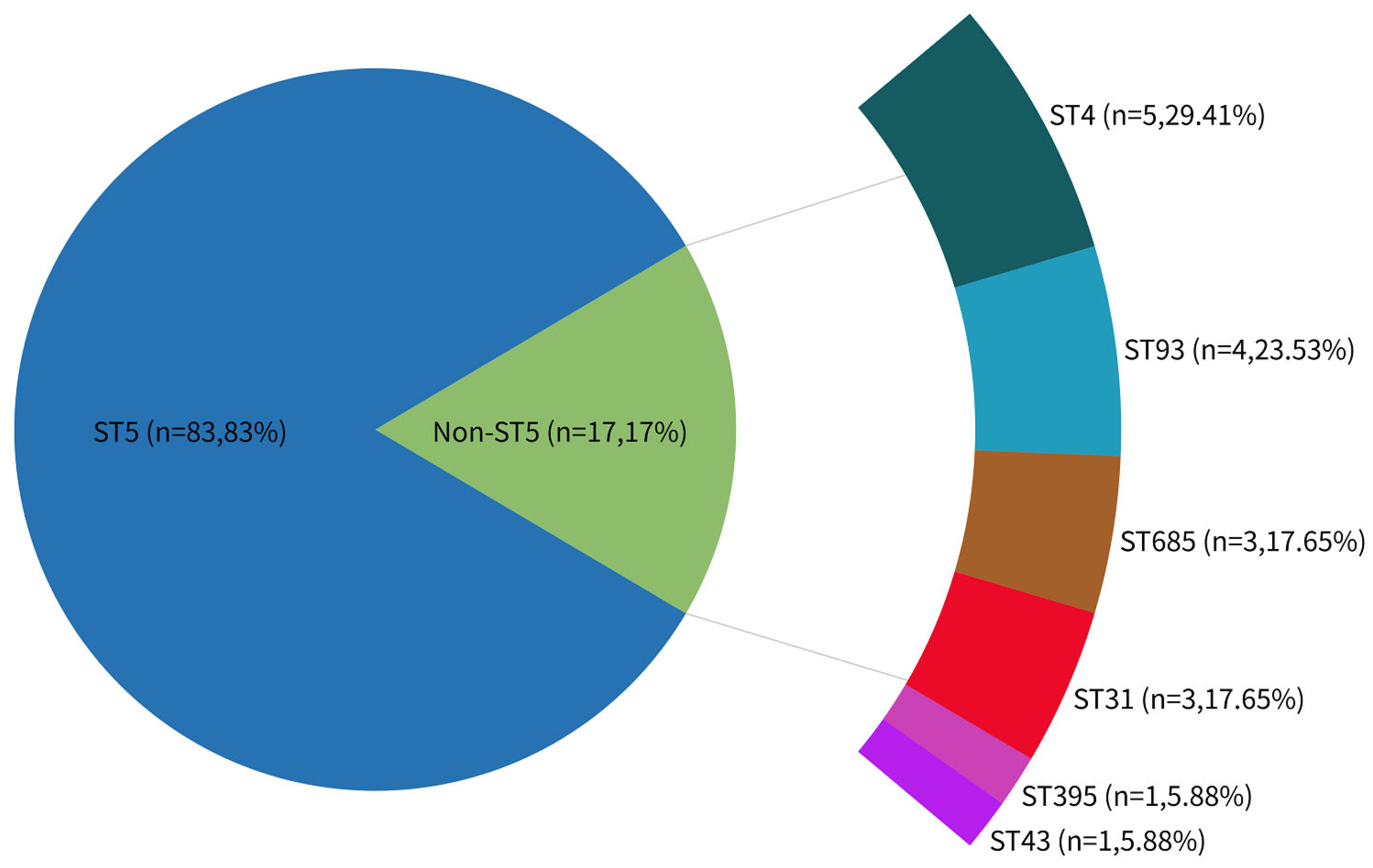
3.1. MLST of 100 Cryptococcus Isolates
3.2. Comparison of Clinical Characteristics of AIDS Patients with CM Infected by ST5 or Non-ST5 C. neoformans Strains
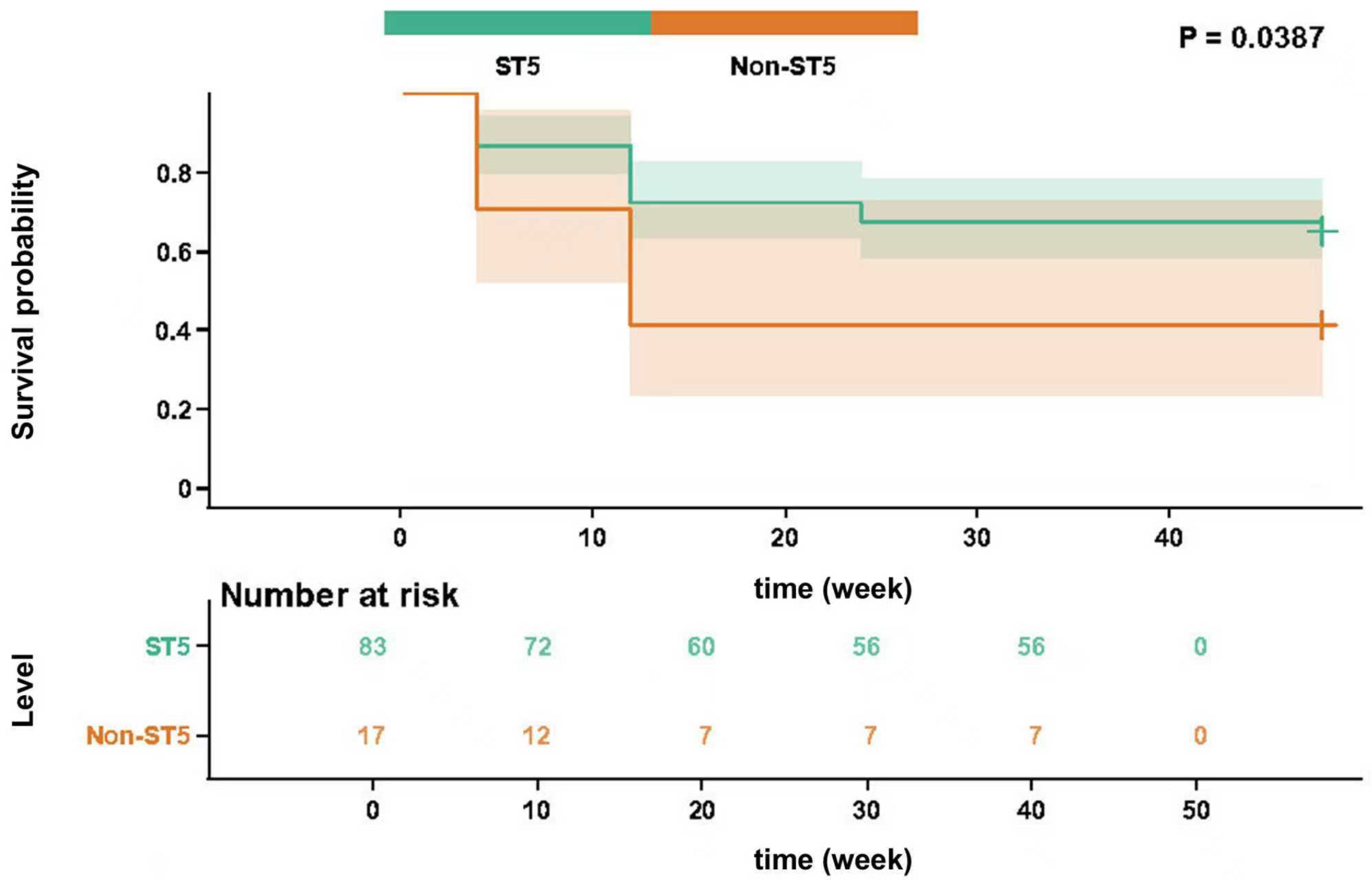
3.3. Survival Analysis of AIDS Patients with CM Infected by ST5 or Non-ST5 C. neoformans Strains
3.4. Discovery of the Novel ST685 Sequence Type Associated with Fluconazole Resistance and Variable Prognosis
4. Discussion
Supplementary Materials
Author Contributions
Funding
Institutional Review Board Statement
Informed Consent Statement
Data Availability Statement
Acknowledgments
Conflicts of Interest
References
- May, R.C.; Stone, N.R.H.; Wiesner, D.L. Cryptococcus: From environmental saprophyte to global pathogen. Nat. Rev. Microbiol. 2016, 14, 106–117. [Google Scholar] [CrossRef]
- Montoya, M.C.; Magwene, P.M.; Perfect, J.R. Associations between Cryptococcus genotypes, phenotypes, and clinical parameters of human disease: A review. J. Fungi 2021, 7, 260. [Google Scholar] [CrossRef] [PubMed]
- Pfaller, M.A.; Diekema, D.J.; Gibbs, D.L.; Newell, V.A.; Ellis, D.; Tullio, V.; Rodloff, A.; Fu, W.; Ling, T.A.; Bengtsson, A.; et al. Results from the ARTEMIS DISK global antifungal surveillance study, 1997 to 2007: A 10.5-year analysis of susceptibilities of Candida species to fluconazole and voriconazole as determined by CLSI standardized disk diffusion. J. Clin. Microbiol. 2010, 48, 1366–1377. [Google Scholar] [CrossRef]
- Lawrence, D.S.; Boyer-Chammard, T.; Jarvis, J.N. Emerging concepts in HIV-associated cryptococcal meningitis. Curr. Opin. Infect. Dis. 2019, 32, 16–23. [Google Scholar] [CrossRef]
- Cogliati, M. Global molecular epidemiology of Cryptococcus neoformans and Cryptococcus gattii: An atlas of the molecular types. Scientifica 2013, 2013, 675213. [Google Scholar] [CrossRef]
- Liaw, S.-J.; Wu, H.-C.; Hsueh, P.-R. Microbiological characteristics of clinical isolates of Cryptococcus neoformans in Taiwan: Serotypes, mating types, molecular types, virulence factors, and antifungal susceptibility. Clin. Microbiol. Infect. 2010, 16, 696–703. [Google Scholar] [CrossRef]
- Zhang, J.; Wang, Z.; Chen, Y.; Li, M.; Zheng, B.; Chen, M.; Zhu, X. Antifungal susceptibility and molecular characteristics of Cryptococcus spp. based on whole-genome sequencing in Zhejiang Province, China. Front. Microbiol. 2022, 13, 991703. [Google Scholar] [CrossRef]
- Chen, Y.-C.; Kuo, S.-F.; Lin, S.-Y.; Lin, Y.-S.; Lee, C.-H. Epidemiological and clinical characteristics, antifungal susceptibility, and MLST-based genetic analysis of Cryptococcus isolates in southern Taiwan in 2013–2020. J. Fungi 2022, 8, 287. [Google Scholar] [CrossRef]
- Fang, L.F.; Zhang, P.P.; Wang, J.; Yang, Q.; Qu, T.T. Clinical and microbiological characteristics of cryptococcosis at a university hospital in China from 2013 to 2017. Braz. J. Infect. Dis. 2020, 24, 7–12. [Google Scholar] [CrossRef] [PubMed]
- Khayhan, K.; Hagen, F.; Pan, W.; Simwami, S.; Fisher, M.C.; Wahyuningsih, R.; Chakrabarti, A.; Chowdhary, A.; Ikeda, R.; Taj-Aldeen, S.J.; et al. Geographically structured populations of Cryptococcus neoformans var. grubii in Asia correlate with HIV status and show a clonal population structure. PLoS ONE 2013, 8, e72222. [Google Scholar] [CrossRef] [PubMed]
- Tay, S.T.; Rohani, M.Y.; Soo Hoo, T.S.; Hamimah, H. Epidemiology of cryptococcosis in Malaysia. Mycoses 2010, 53, 509–514. [Google Scholar] [CrossRef]
- Prakash, A.; Sharma, B.; Chakrabarti, A.; Sundar, G.; Wankhede, S.; Chowdhary, A.; Hagen, F.; Meis, J.F. Genotypic diversity in clinical and environmental isolates of Cryptococcus neoformans from India using multilocus microsatellite and multilocus sequence typing. Mycoses 2020, 63, 284–293. [Google Scholar] [CrossRef]
- Bive, B.Z.; Sacheli, R.; Mazi, P.B.; Kinsiama, C.; Guelly, L.; Boreux, R.; Longo-Mbenza, B.; Mampunza, S.; Delhaes, L.; Hallin, M.; et al. Clinical epidemiology and high genetic diversity amongst Cryptococcus spp. isolates infecting people living with HIV in Kinshasa, Democratic Republic of Congo. PLoS ONE 2022, 17, e0267842. [Google Scholar] [CrossRef]
- Trilles, L.; Meyer, W.; Wanke, B.; Guarro, J.; Lazéra, M.; Carreira, A.C.O.; Barbosa, G.G.; Nascimento, J.L.M.; Monteiro, P.C.F.; Wanke, N.C.F.; et al. Correlation of antifungal susceptibility and molecular type within the Cryptococcus neoformans/C. gattii species complex. Med. Mycol. 2012, 50, 328–332. [Google Scholar] [CrossRef]
- Tian, Y.; Wang, J.; Shen, Y.; Zhao, J.; Hu, J.; Zhu, X.; Zhu, M.; Guan, M. Characteristics and prognostic risk factors of patients with sequence type 5 lineage-associated cryptococcosis in China. Int. J. Infect. Dis. 2023, 128, 244–253. [Google Scholar] [CrossRef]
- Dai, F.F.; Zhao, F.J.; Ye, L.X.; Liu, B.; Hao, R.; Chen, T.; Yang, N.; Jiang, S.Y.; Wang, H.; Lu, X.X.; et al. Multi-locus sequence typing-based genetic analysis, antifungal resistance, and clinical prognosis of Cryptococcus neoformans infections in HIV-infected patients in northern China. Am. J. Trop. Med. Hyg. 2024, 111, 1184–1191. [Google Scholar] [CrossRef] [PubMed]
- World Health Organization. Consolidated Guidelines on Differentiated HIV Testing Services; World Health Organization: Geneva, Switzerland, 2024. [Google Scholar]
- Chang, C.C.; Harrison, T.S.; Bicanic, T.A.; Chayakulkeeree, M.; Sorrell, T.C.; Warris, A.; Hagen, F.; Spec, A.; Oladele, R.; Govender, N.P.; et al. Global guideline for the diagnosis and management of cryptococcosis: An initiative of the ECMM and ISHAM in cooperation with the ASM. Lancet Infect. Dis. 2024, 24, e495–e512. [Google Scholar] [CrossRef]
- Casadevall, A.; Coelho, C.; Alanio, A. Mechanisms of Cryptococcus neoformans-mediated host damage. Front. Immunol. 2018, 9, 855. [Google Scholar] [CrossRef] [PubMed]
- Litvintseva, A.P.; Thakur, R.; Vilgalys, R.; Mitchell, T.G. Multilocus sequence typing reveals three genetic subpopulations of Cryptococcus neoformans var. grubii (serotype A), including a unique population in Botswana. Genetics 2006, 172, 2223–2238. [Google Scholar] [CrossRef] [PubMed]
- Hong, N.; Chen, M.; Xu, J. Molecular markers reveal epidemiological patterns and evolutionary histories of the human pathogenic Cryptococcus. Front. Cell. Infect. Microbiol. 2021, 11, 683670. [Google Scholar] [CrossRef]
- Cogliati, M. Genotypes and population genetics of Cryptococcus neoformans and Cryptococcus gattii species complexes in Europe and the Mediterranean area. Fungal Genet. Biol. 2019, 129, 16–29. [Google Scholar] [CrossRef]
- Mihara, T.; Izumikawa, K.; Kakeya, H.; Ngamskulrungroj, P.; Umeyama, T.; Takazono, T.; Kosai, K.; Takahashi, Y.; Nakamura, S.; Imamura, Y.; et al. Multilocus sequence typing of Cryptococcus neoformans in non-HIV-associated cryptococcosis in Nagasaki, Japan. Med. Mycol. 2013, 51, 252–260. [Google Scholar] [CrossRef] [PubMed]
- Naicker, S.D.; Magobo, R.E.; Maphanga, T.G.; Firacative, C.; van Schalkwyk, E.; Monroy-Nieto, J.; Bowers, J.; Engelthaler, D.M.; Shuping, L.; Meyer, W.; et al. Genotype, antifungal susceptibility, and virulence of clinical South African Cryptococcus neoformans strains from National Surveillance, 2005–2009. J. Fungi 2021, 7, 338. [Google Scholar] [CrossRef]
- Xess, I.; Pandey, M.; Dabas, Y.; Chawla, B.; Kapoor, S.; Sood, R.; Sharma, S.; Kindo, A.J.; Joshi, A.; Ghoshal, U.; et al. Multilocus sequence typing of clinical isolates of Cryptococcus from India. Mycopathologia 2021, 186, 199–211. [Google Scholar] [CrossRef] [PubMed]
- Fan, X.; Xiao, M.; Chen, S.C.; Kong, F.; Dou, H.T.; Wang, H.; Xiao, Y.L.; Kang, M.; Sun, Z.Y.; Hu, Z.D.; et al. Predominance of Cryptococcus neoformans var. grubii multilocus sequence type 5 and emergence of isolates with non-wild-type minimum inhibitory concentrations to fluconazole: A multi-centre study in China. Clin. Microbiol. Infect. 2016, 22, 887.e1–887.e9. [Google Scholar] [CrossRef][Green Version]
- Herkert, P.F.; Meis, J.F.; de Oliveira Salvador, G.L.; Rodrigues Gomes, R.; Aparecida Vicente, V.; Dominguez Muro, M.; Lameira Pinheiro, R.; Lopes Colombo, A.; Vargas Schwarzbold, A.; de Oliveira, C.S.; et al. Molecular characterization and antifungal susceptibility testing of Cryptococcus neoformans sensu stricto from southern Brazil. J. Med. Microbiol. 2018, 67, 560–569. [Google Scholar] [CrossRef] [PubMed]

| Primer Name | Primer Sequence | |
|---|---|---|
| CAP59 | CAP59F 5′ | CTCTACGTCGAGCAAGTCAAG 3′ |
| CAP59R 5′ | TCCGCTGCACAAGTGATACCC 3′ | |
| GPD1 | GPD1F 5′ | CCACCGAACCCTTCTAGGATA 3′ |
| GPD1R 5′ | CTTCTTGGCACCTCCCTTGAG 3′ | |
| IGS1 | IGSF 5′ | ATCCTTTGCAGACGACTTGA 3′ |
| IGSR 5′ | GTGATCAGTGCATTGCATGA 3′ | |
| LAC1 | LAC1F 5′ | AACATGTTCCCTGGGCCTGTG 3′ |
| LAC1R 5′ | ATGAGAATTGAATCGCCTTGT 3′ | |
| PLB1 | PLB1F 5′ | CTTCAGGCGGAGAGAGGTTT 3′ |
| PLB1R 5′ | GATTTGGCGTTGGTTTCAGT 3′ | |
| SOD1 | SOD1F 5′ | AAGCCTCTCATCCATATCTT 3′ |
| SOD1R 5′ | TTCAACCACGAATATGTA 3′ | |
| URA5 | URA5F 5′ | ATGTCCTCCCAAGCCCTCGAC 3′ |
| URA5R 5′ | TTAAGACCTCTGAACACCGTACTC 3′ |
| ST | CAP59 | GPD1 | LAC1 | PLB1 | SOD1 | URA5 | IGS1 |
|---|---|---|---|---|---|---|---|
| 4 | 1 | 1 | 4 | 2 | 1 | 5 | 1 |
| 5 | 1 | 3 | 5 | 2 | 1 | 1 | 1 |
| 31 | 1 | 1 | 3 | 2 | 1 | 1 | 10 |
| 93 | 1 | 23 | 3 | 4 | 1 | 1 | 10 |
| 395 | 1 | 25 | 5 | 2 | 1 | 1 | 1 |
| 685 | 25 | 1 | 3 | 2 | 1 | 1 | 60 |
| 43 | 2 | 9 | 8 | 11 | 11 | 4 | 14 |
| Manifestations | Total (n = 100) | ST5 (n = 83) | Non-ST5 (n = 17) | Statistical Value | p |
|---|---|---|---|---|---|
| Gender, male (%) | 80 (80.0%) | 66 (79.5%) | 14 (82.4%) | 0 | 1.000 |
| Age, year, median (IQR) | 40 (30~47) | 39.6 ± 11.4 | 37.8 ± 10.0 | −0.675 | 0.542 |
| Clinical symptoms | |||||
| Fever (%) | 58 (58.0%) | 46 (55.4%) | 12 (70.6%) | 1.332 | 0.248 |
| Headache (%) | 85 (85.0%) | 71 (85.5%) | 14 (82.4%) | 0 | 1.000 |
| Nausea/vomiting (%) | 56 (56.0%) | 47 (56.6%) | 8 (47.1%) | 1.356 | 0.470 |
| Convulsion (%) | 9 (9.0%) | 5 (6.0%) | 4 (23.5%) | 3.358 | 0.067 |
| Disturbance of consciousness (%) | 23 (23.0%) | 18 (21.7%) | 5 (29.4%) | 0.139 | 0.709 |
| Cranial nerve damage (%) | 21 (21.0%) | 17 (20.5%) | 4 (23.5%) | 0 | 1.000 |
| Hearing loss (%) | 4 (4.0%) | 3 (3.6%) | 1 (5.9%) | - | 0.531 |
| Meningeal irritation (%) | 60 (60.0%) | 47 (56.6%) | 13 (76.5%) | 2.315 | 0.128 |
| Time to diagnosis from symptom onset, (day), median (IQR) | 18 (10~30) | 18 (10~30) | 16 (9~30) | −0.954 | 0.340 |
| Cryptococcal encephalitis (%) | 11 (11.0%) | 7 (8.4%) | 4 (23.5%) | 1.923 | 0.165 |
| Laboratory data | |||||
| CD4 count(cells/μL), median (IQR) | 12 (5~34) | 12 (5~34) | 13 (5~35) | −0.106 | 0.916 |
| CD4+/CD8+, median (IQR) | 0.0 (0.02~0.07) | 0.0 (0.02~0.08) | 0.03 (0.02~0.07) | −0.731 | 0.465 |
| CSF ICP (mmH2O) | 165 (105~300) | 165 (105~270) | 243 (165~523) | −1.774 | 0.076 |
| Brain CT/MRI | 0.723 | 0.810 | |||
| Normal (%) | 56 (56.0%) | 47 (74.6%) | 9 (69.2%) | ||
| Hydrocephalus (%) | 2 (2.0%) | 2 (3.2%) | 0 (0.0%) | ||
| Mass lesion (%) | 18 (18.0%) | 14 (22.2%) | 4 (30.8%) | ||
| Antifungal agent MIC | |||||
| 5-FC S (%) | 94 (98.9%) | 80 (98.8%) | 14 (100%) | - | 1.000 |
| I/R (%) | 1 (1.1%) | 1 (1.2%) | 0 (0.0%) | ||
| AMB S (%) | 69 (71.9%) | 56 (69.1%) | 13 (86.7%) | 1.155 | 0.283 |
| I/R (%) | 27 (28.1%) | 25 (30.9%) | 2 (13.3%) | ||
| FCA S (%) | 79 (82.3%) | 68 (84.0%) | 11 (73.3%) | 0.386 | 0.534 |
| I/R (%) | 17 (17.7%) | 13 (16.0%) | 4 (26.7%) | ||
| ITR S (%) | 41 (59.4%) | 34 (59.6%) | 7 (58.3%) | 1.193 | 0.275 |
| I/R (%) | 28 (40.6%) | 23 (40.4%) | 5 (41.7%) | ||
| VRC S (%) | 59 (86.8%) | 50 (87.7%) | 9 (81.8%) | 0.002 | 0.966 |
| I/R (%) | 9 (13.2%) | 7 (12.3%) | 2 (18.2%) |
Disclaimer/Publisher’s Note: The statements, opinions and data contained in all publications are solely those of the individual author(s) and contributor(s) and not of MDPI and/or the editor(s). MDPI and/or the editor(s) disclaim responsibility for any injury to people or property resulting from any ideas, methods, instructions or products referred to in the content. |
© 2026 by the authors. Licensee MDPI, Basel, Switzerland. This article is an open access article distributed under the terms and conditions of the Creative Commons Attribution (CC BY) license.
Share and Cite
Li, C.; Zhang, Y.; Ke, Y.; Zhang, Y.; Chen, M.; Tao, X.; Guo, P.; Chen, J.; Tang, X.; Lin, W.; et al. Sequence Types of Cryptococcus neoformans and Their Associations with Clinical Characteristics and Outcomes of AIDS Patients with Cryptococcal Meningitis in Southern China. Pathogens 2026, 15, 605. https://doi.org/10.3390/pathogens15060605
Li C, Zhang Y, Ke Y, Zhang Y, Chen M, Tao X, Guo P, Chen J, Tang X, Lin W, et al. Sequence Types of Cryptococcus neoformans and Their Associations with Clinical Characteristics and Outcomes of AIDS Patients with Cryptococcal Meningitis in Southern China. Pathogens. 2026; 15(6):605. https://doi.org/10.3390/pathogens15060605
Chicago/Turabian StyleLi, Chenfeng, Yurong Zhang, Yingchun Ke, Yeyang Zhang, Meijun Chen, Xingru Tao, Pengle Guo, Jingliang Chen, Xiaoping Tang, Weiyin Lin, and et al. 2026. "Sequence Types of Cryptococcus neoformans and Their Associations with Clinical Characteristics and Outcomes of AIDS Patients with Cryptococcal Meningitis in Southern China" Pathogens 15, no. 6: 605. https://doi.org/10.3390/pathogens15060605
APA StyleLi, C., Zhang, Y., Ke, Y., Zhang, Y., Chen, M., Tao, X., Guo, P., Chen, J., Tang, X., Lin, W., & Li, L. (2026). Sequence Types of Cryptococcus neoformans and Their Associations with Clinical Characteristics and Outcomes of AIDS Patients with Cryptococcal Meningitis in Southern China. Pathogens, 15(6), 605. https://doi.org/10.3390/pathogens15060605

