Current Insights into the Epidemiology and Transmission Dynamics of African Swine Fever Virus and Future Control Perspectives

 , , , , , ,
  , , and
Abstract
1. Introduction
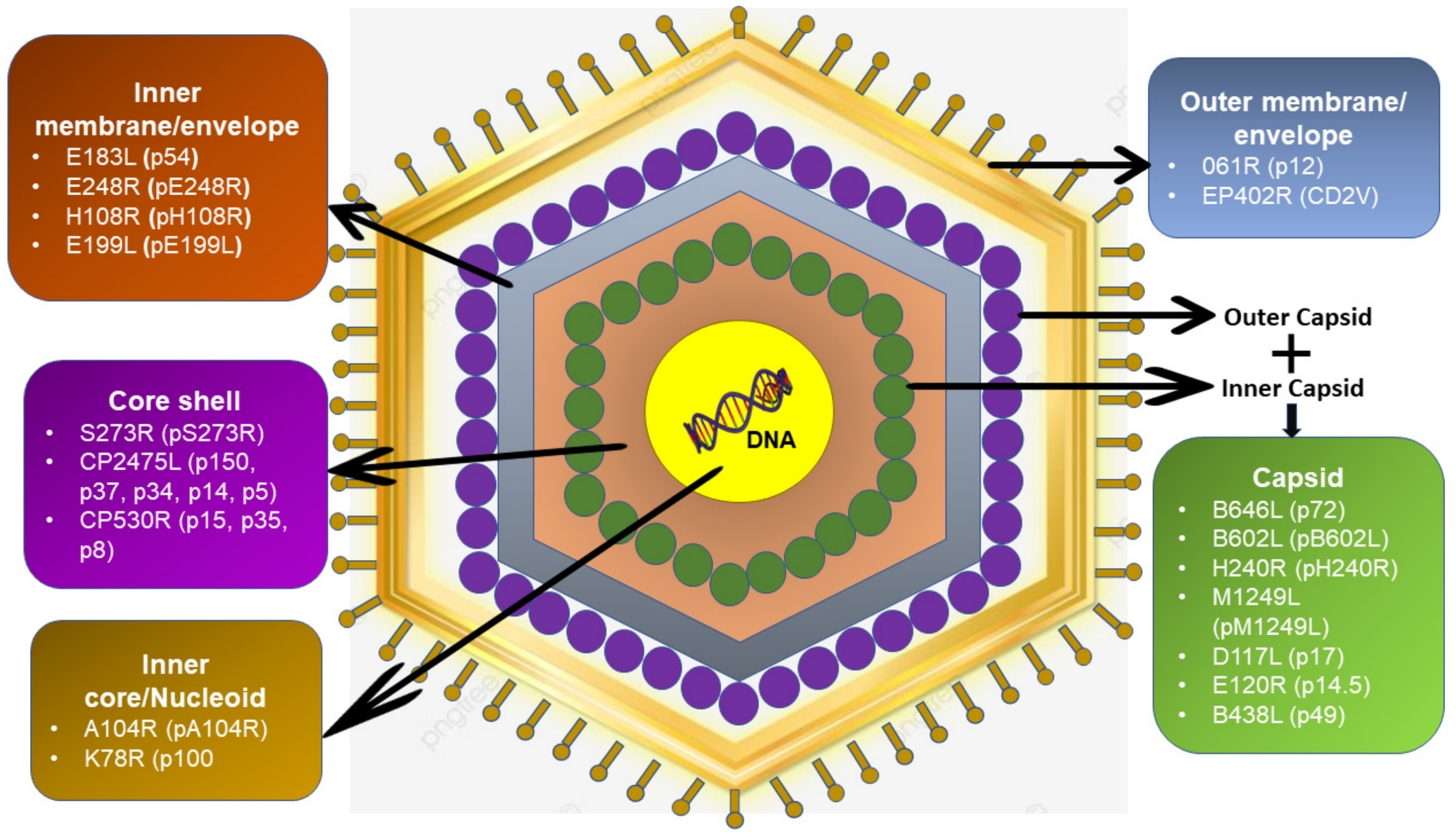
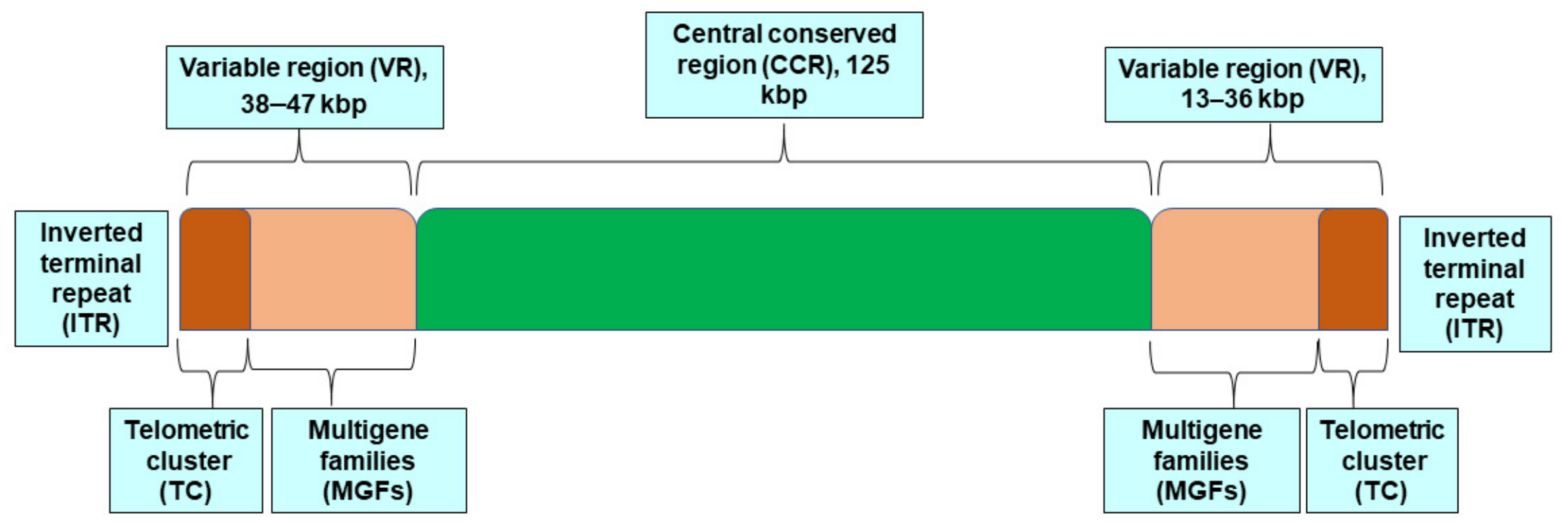
2. Virus Structure, Genome and Strains
3. Pathobiology, Transmission, and the Global Situation
3.1. Pathobiology of ASFV
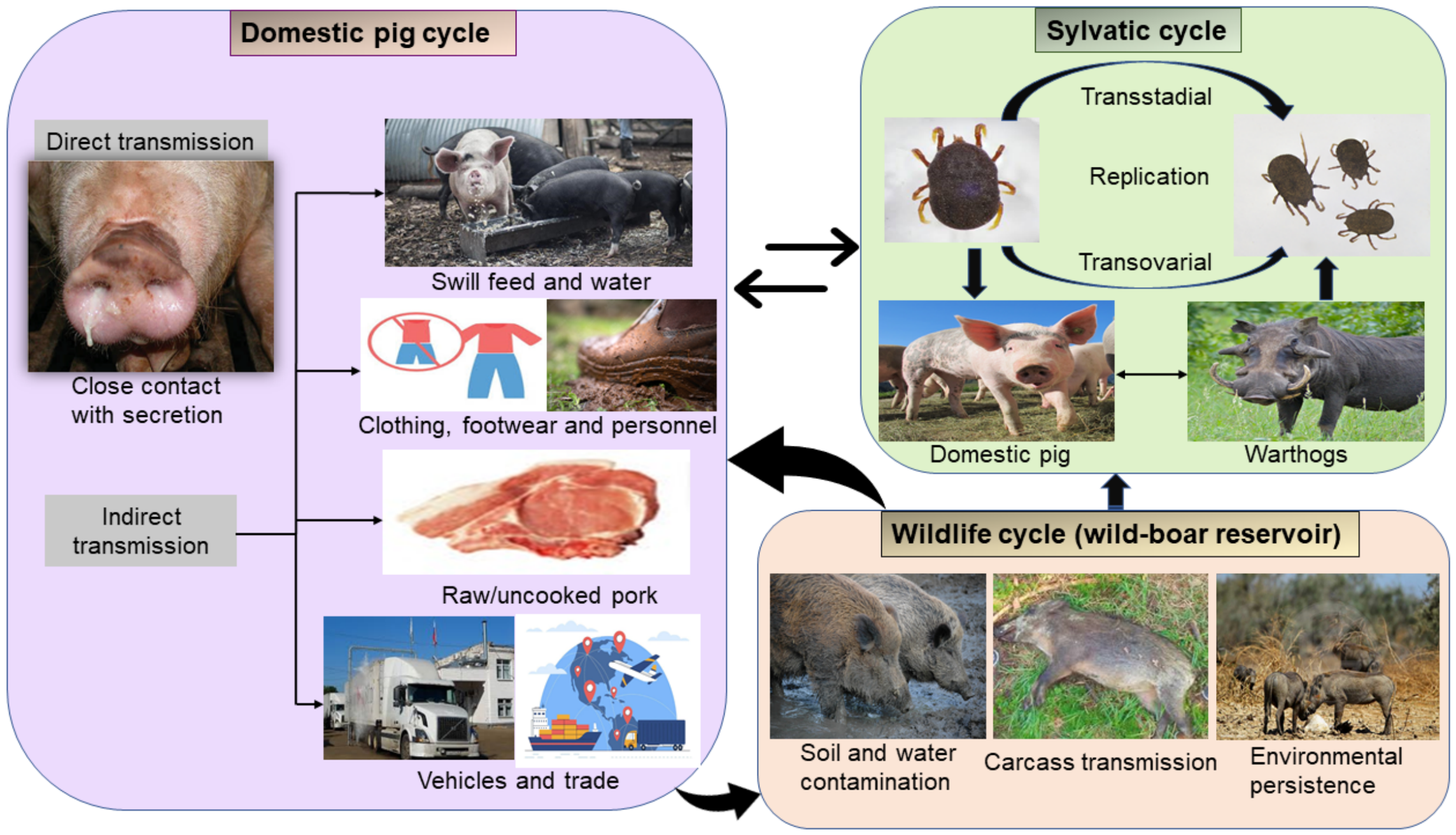
3.2. Transmission Mechanisms
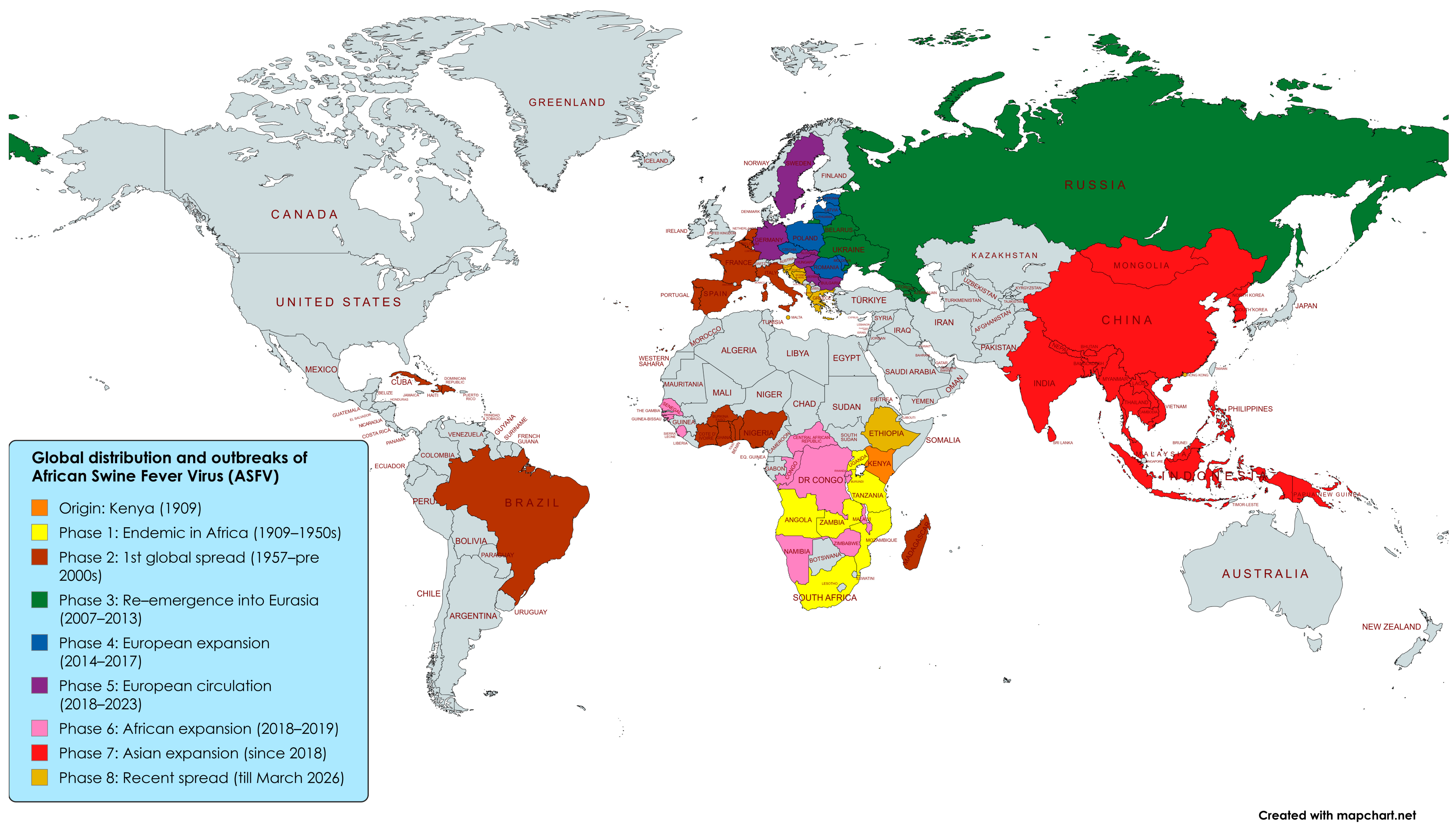
3.3. History and Global Distribution
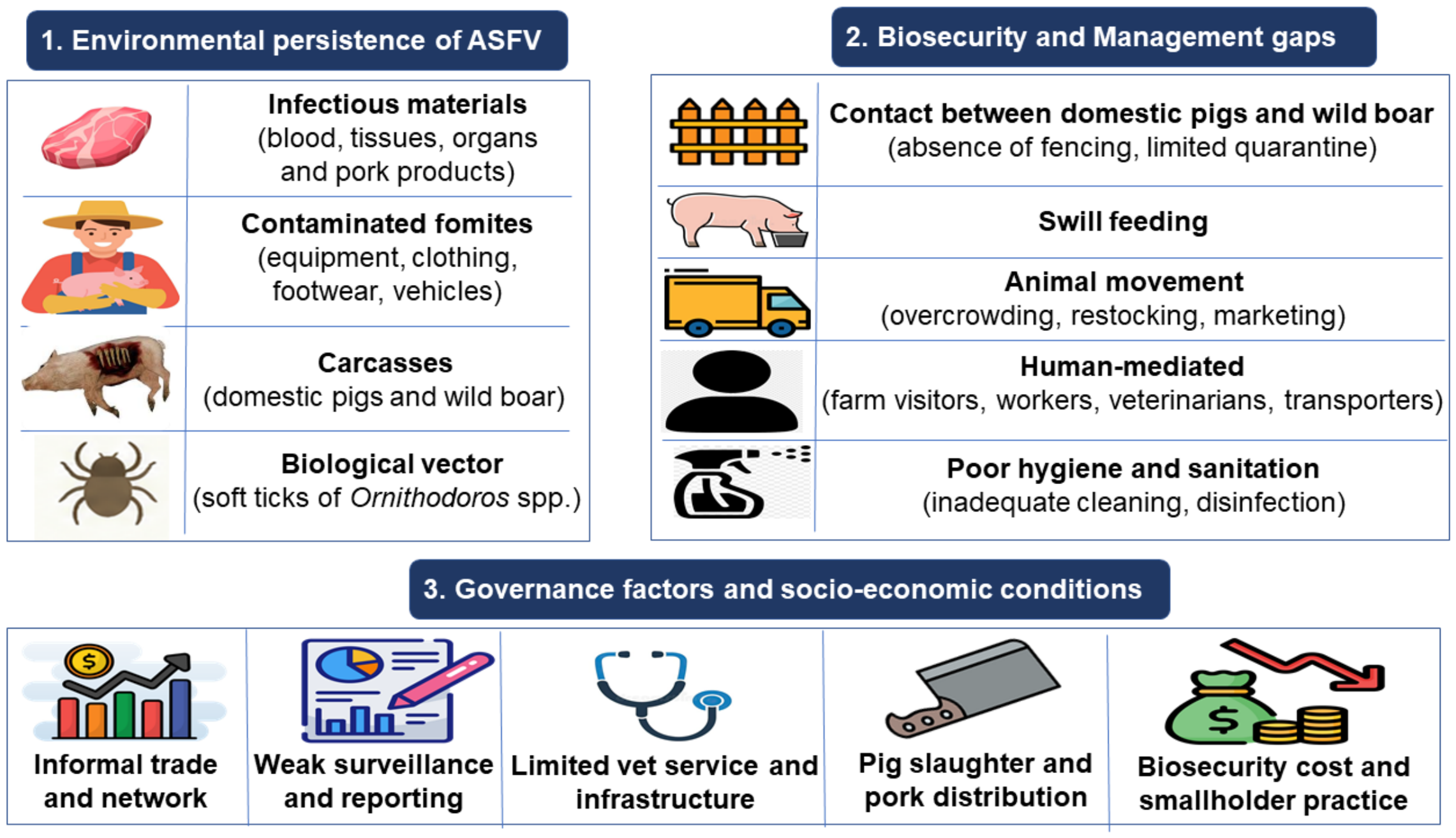
4. Key Determinants of ASFV Epidemiology
5. ASFV Control and Management Strategies
5.1. Infection Management and Containment
5.2. Culling and Depopulation
5.3. Vaccination
5.4. Biosecurity Measures
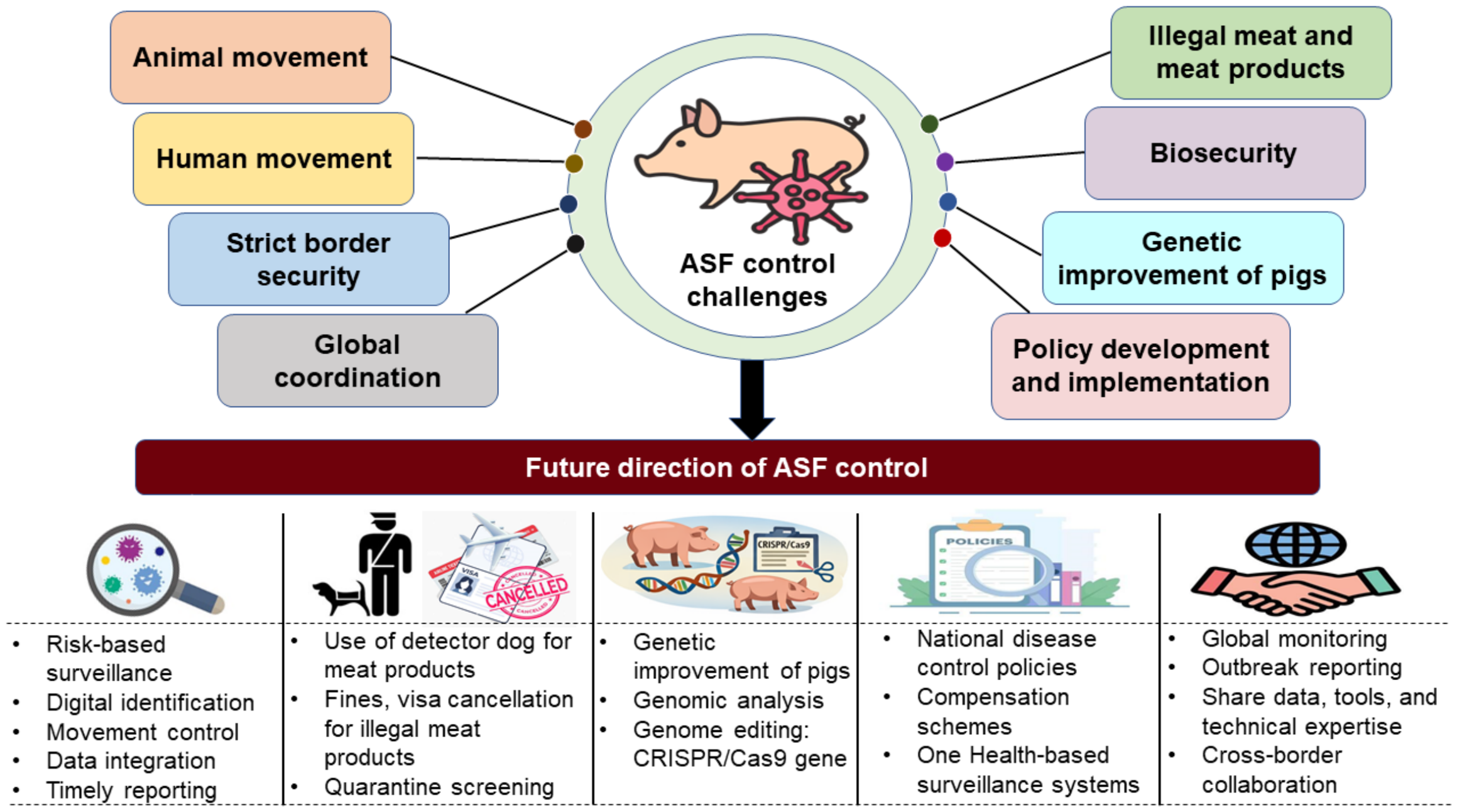
6. Major Challenges and Future Directions
6.1. Animal Movement
6.2. Illegal Meat and Meat Products
6.3. Human Movement
6.4. Biosecurity Standards
6.5. Strict Border Security
6.6. Genetic Improvement of Pigs
6.7. Policy Development and Implementation
6.8. Global Coordination
7. Conclusions
Supplementary Materials
Author Contributions
Funding
Institutional Review Board Statement
Informed Consent Statement
Data Availability Statement
Acknowledgments
Conflicts of Interest
References
- Bergmann, H.; Dups-Bergmann, J.; Schulz, K.; Probst, C.; Zani, L.; Fischer, M.; Gethmann, J.; Denzin, N.; Blome, S.; Conraths, F.J. Identification of risk factors for African swine fever: A systematic review. Viruses 2022, 14, 2107. [Google Scholar] [CrossRef] [PubMed]
- Ceruti, A.; Kobialka, R.M.; Abd El Wahed, A.; Truyen, U. African swine fever: A one health perspective and global challenges. Animals 2025, 15, 928. [Google Scholar] [CrossRef]
- Ranganatha, S.; Rathnamma, D.; Isloor, S.; Hiremath, J.; Chandranaik, B. African swine fever: Analysing its epidemiology, pathogenesis and control strategies: A review. Indian J. Anim. Res. 2020, 1, 567–576. [Google Scholar] [CrossRef]
- Li, Z.; Chen, W.; Qiu, Z.; Li, Y.; Fan, J.; Wu, K.; Li, X.; Zhao, M.; Ding, H.; Fan, S. African swine fever virus: A review. Life 2022, 12, 1255. [Google Scholar] [CrossRef] [PubMed]
- Ruedas-Torres, I.; Thi to Nga, B.; Salguero, F.J. Pathogenicity and virulence of African swine fever virus. Virulence 2024, 15, 2375550. [Google Scholar] [CrossRef]
- Wang, Y.; Kang, W.; Yang, W.; Zhang, J.; Li, D.; Zheng, H. Structure of African swine fever virus and associated molecular mechanisms underlying infection and immunosuppression: A review. Front. Immunol. 2021, 12, 715582. [Google Scholar] [CrossRef] [PubMed]
- Mazloum, A.; van Schalkwyk, A.; Chernyshev, R.; Igolkin, A.; Heath, L.; Sprygin, A. A guide to molecular characterization of genotype II African swine fever virus: Essential and alternative genome markers. Microorganisms 2023, 11, 642. [Google Scholar] [CrossRef]
- Dixon, L.K.; Sun, H.; Roberts, H. African swine fever. Antivir. Res. 2019, 165, 34–41. [Google Scholar] [CrossRef]
- Penrith, M.L.; Kivaria, F.M. One hundred years of African swine fever in Africa: Where have we been, where are we now, where are we going? Transbound. Emerg. Dis. 2022, 69, e1179–e1200. [Google Scholar] [CrossRef]
- Sánchez-Vizcaíno, J.; Mur, L.; Gomez-Villamandos, J.; Carrasco, L. An update on the epidemiology and pathology of African swine fever. J. Comp. Pathol. 2015, 152, 9–21. [Google Scholar] [CrossRef]
- Blome, S.; Franzke, K.; Beer, M. African swine fever–A review of current knowledge. Virus Res. 2020, 287, 198099. [Google Scholar] [CrossRef]
- Juszkiewicz, M.; Walczak, M.; Woźniakowski, G.; Podgórska, K. African swine fever: Transmission, spread, and control through biosecurity and disinfection, including polish trends. Viruses 2023, 15, 2275. [Google Scholar] [CrossRef] [PubMed]
- Rowlands, R.J.; Michaud, V.; Heath, L.; Hutchings, G.; Oura, C.; Vosloo, W.; Dwarka, R.; Onashvili, T.; Albina, E.; Dixon, L.K. African swine fever virus isolate, Georgia, 2007. Emerg. Infect. Dis. 2008, 14, 1870. [Google Scholar] [CrossRef]
- Zhou, X.; Li, N.; Luo, Y.; Liu, Y.; Miao, F.; Chen, T.; Zhang, S.; Cao, P.; Li, X.; Tian, K. Emergence of African swine fever in China, 2018. Transbound. Emerg. Dis. 2018, 65, 1482–1484. [Google Scholar] [CrossRef]
- Urbano, A.C.; Ferreira, F. African swine fever control and prevention: An update on vaccine development. Emerg. Microbes Infect. 2022, 11, 2021–2033. [Google Scholar] [CrossRef]
- O’Dwyer, J.; Van, H.V.; Phuong, N.T.; Mileto, P.; Mercado, O.; Conceição, F.d.; Jong, J.B.d.C.; Puana, I.; Neave, M.J.; Williams, D.T. Emergence of Microvariants of African Swine Fever Virus Genotype II in the Asia–Pacific. Transbound. Emerg. Dis. 2025, 2025, 9990044. [Google Scholar] [CrossRef] [PubMed]
- Costard, S.; Wieland, B.; De Glanville, W.; Jori, F.; Rowlands, R.; Vosloo, W.; Roger, F.; Pfeiffer, D.U.; Dixon, L.K. African swine fever: How can global spread be prevented? Philos. Trans. R. Soc. B Biol. Sci. 2009, 364, 2683–2696. [Google Scholar] [CrossRef]
- Bernard, J.; Vial, L.; Madeira, S.; Otte, J.; Boinas, F.; Le Potier, M.-F.; Jourdan-Pineau, H. Experimental design impacts the vector competence of Ornithodoros ticks for African swine fever virus: A meta-analysis of published evaluations. Peer Community J. 2025, 5, e58. [Google Scholar] [CrossRef]
- Galindo, I.; Alonso, C. African swine fever virus: A review. Viruses 2017, 9, 103. [Google Scholar] [CrossRef]
- Venkateswaran, D.; Prakash, A.; Nguyen, Q.A.; Salman, M.; Suntisukwattana, R.; Atthaapa, W.; Tantituvanont, A.; Lin, H.; Songkasupa, T.; Nilubol, D. Comprehensive characterization of the genetic landscape of African swine fever virus: Insights into infection dynamics, immunomodulation, virulence and genes with unknown function. Animals 2024, 14, 2187. [Google Scholar] [CrossRef] [PubMed]
- Yang, S.; Miao, C.; Liu, W.; Zhang, G.; Shao, J.; Chang, H. Structure and function of African swine fever virus proteins: Current understanding. Front. Microbiol. 2023, 14, 1043129. [Google Scholar] [CrossRef]
- Jia, N.; Ou, Y.; Pejsak, Z.; Zhang, Y.; Zhang, J. Roles of African swine fever virus structural proteins in viral infection. J. Vet. Res. 2017, 61, 135. [Google Scholar] [CrossRef]
- Pérez-Núñez, D.; García-Belmonte, R.; Riera, E.; Fernández-Sesma, M.H.; Vigara-Astillero, G.; Revilla, Y. Signal peptide and N-glycosylation of N-terminal-CD2v determine the hemadsorption of African swine fever virus. J. Virol. 2023, 97, e01030-23. [Google Scholar] [CrossRef]
- Vuono, E.A.; Ramirez-Medina, E.; Pruitt, S.; Rai, A.; Espinoza, N.; Velazquez-Salinas, L.; Gladue, D.P.; Borca, M.V. Evaluation of the function of the ASFV KP177R gene, encoding for structural protein p22, in the process of virus replication and in swine virulence. Viruses 2021, 13, 986. [Google Scholar] [CrossRef]
- Muñoz, A.; Tabarés, E. Characteristics of the major structural proteins of African swine fever virus: Role as antigens in the induction of neutralizing antibodies. A review. Virology 2022, 571, 46–51. [Google Scholar] [CrossRef]
- Liu, Q.; Ma, B.; Qian, N.; Zhang, F.; Tan, X.; Lei, J.; Xiang, Y. Structure of the African swine fever virus major capsid protein p72. Cell Res. 2019, 29, 953–955. [Google Scholar] [CrossRef]
- Wei, S.; Lu, P.; Miyata, T.; Makino, F.; Namba, K.; Liu, C.; Niu, Y.; Saito, S.; Okuda, S.; Tsutsumi, K. African swine fever virus protein pB602L is a unique molecular chaperone promoting the folding of the major capsid protein p72 and the polyprotein processing protease pS273R. Int. J. Biol. Macromol. 2026, 347, 150685. [Google Scholar] [CrossRef] [PubMed]
- Zhou, P.; Li, L.-F.; Zhang, K.; Wang, B.; Tang, L.; Li, M.; Wang, T.; Sun, Y.; Li, S.; Qiu, H.-J. Deletion of the H240R gene of African swine fever virus decreases infectious progeny virus production due to aberrant virion morphogenesis and enhances inflammatory cytokine expression in porcine macrophages. J. Virol. 2022, 96, e01667-21. [Google Scholar] [PubMed]
- Huang, L.; Liu, H.; Ye, G.; Liu, X.; Chen, W.; Wang, Z.; Zhao, D.; Zhang, Z.; Feng, C.; Hu, L. Deletion of African swine fever virus (ASFV) H240R gene attenuates the virulence of ASFV by enhancing NLRP3-mediated inflammatory responses. J. Virol. 2023, 97, e01227-22. [Google Scholar] [CrossRef] [PubMed]
- Cui, S.; Wang, Y.; Gao, X.; Xin, T.; Wang, X.; Yu, H.; Chen, S.; Jiang, Y.; Chen, Q.; Jiang, F. African swine fever virus M1249L protein antagonizes type I interferon production via suppressing phosphorylation of TBK1 and degrading IRF3. Virus Res. 2022, 319, 198872. [Google Scholar] [CrossRef]
- Zheng, W.; Xia, N.; Zhang, J.; Cao, Q.; Jiang, S.; Luo, J.; Wang, H.; Chen, N.; Zhang, Q.; Meurens, F. African swine fever virus structural protein p17 inhibits cGAS-STING signaling pathway through interacting with STING. Front. Immunol. 2022, 13, 941579. [Google Scholar] [CrossRef] [PubMed]
- Suárez, C.; Gutiérrez-Berzal, J.; Andrés, G.; Salas, M.L.; Rodríguez, J.M. African swine fever virus protein p17 is essential for the progression of viral membrane precursors toward icosahedral intermediates. J. Virol. 2010, 84, 7484–7499. [Google Scholar] [CrossRef]
- Aicher, S.-M.; Monaghan, P.; Netherton, C.L.; Hawes, P.C. Unpicking the secrets of African swine fever viral replication sites. Viruses 2021, 13, 77. [Google Scholar] [CrossRef]
- Galindo, I.; Viñuela, E.; Carrascosa, A.L. Characterization of the African swine fever virus protein p49: A new late structural polypeptide. J. Gen. Virol. 2000, 81, 59–65. [Google Scholar] [CrossRef]
- Alonso, C.; Miskin, J.; Hernáez, B.; Fernandez-Zapatero, P.; Soto, L.; Cantó, C.; Rodríguez-Crespo, I.; Dixon, L.; Escribano, J.M. African swine fever virus protein p54 interacts with the microtubular motor complex through direct binding to light-chain dynein. J. Virol. 2001, 75, 9819–9827. [Google Scholar] [CrossRef]
- Anggy, F.P.; Nugroho, W.S.; Irianingsih, S.H.; Enny, S.; Srihanto, E.A. Genetic analysis of African swine fever viruses based on E183L (p54) gene, circulating in South Sumatra and Lampung province, Indonesia. Vet. World 2023, 16, 1985. [Google Scholar] [CrossRef] [PubMed]
- Rodríguez, J.M.; Salas, M.L. African swine fever virus transcription. Virus Res. 2013, 173, 15–28. [Google Scholar] [CrossRef]
- Vuono, E.; Ramirez-Medina, E.; Silva, E.; Rai, A.; Pruitt, S.; Espinoza, N.; Valladares, A.; Velazquez-Salinas, L.; Gladue, D.P.; Borca, M.V. Deletion of the H108R gene reduces virulence of the pandemic Eurasia strain of African swine fever virus with surviving animals being protected against virulent challenge. J. Virol. 2022, 96, e00545-22. [Google Scholar] [CrossRef]
- Matamoros, T.; Alejo, A.; Rodríguez, J.M.; Hernáez, B.; Guerra, M.; Fraile-Ramos, A.; Andrés, G. African swine fever virus protein pE199L mediates virus entry by enabling membrane fusion and core penetration. mBio 2020, 11, 10–1128. [Google Scholar] [CrossRef]
- Luo, J.; Zhang, J.; Ni, J.; Jiang, S.; Xia, N.; Guo, Y.; Shao, Q.; Cao, Q.; Zheng, W.; Chen, N. The African swine fever virus protease pS273R inhibits DNA sensing cGAS-STING pathway by targeting IKKε. Virulence 2022, 13, 740–756. [Google Scholar] [CrossRef]
- Tian, C.; Liu, Y.; Di, D.; Xie, Z.; Li, Y.; Wang, R.; Li, J.; Liu, J.; Chen, H. Immunogenicity and efficacy of an LNP-mRNA prepared from African swine fever virus K205R1. J. Integr. Agric. 2024, 24, 4026–4033. [Google Scholar] [CrossRef]
- Alejo, A.; Matamoros, T.; Guerra, M.; Andrés, G. A proteomic atlas of the African swine fever virus particle. J. Virol. 2018, 92, 10–1128. [Google Scholar] [CrossRef]
- Fu, D.; Zhao, D.; Zhang, W.; Zhang, G.; Li, M.; Zhang, Z.; Wang, Y.; Sun, D.; Jiao, P.; Chen, C. Structure of African swine fever virus p15 reveals its dual role for membrane-association and DNA binding. Protein Cell 2020, 11, 606–612. [Google Scholar] [CrossRef]
- Freitas, F.B.; Frouco, G.; Martins, C.; Ferreira, F. The QP509L and Q706L superfamily II RNA helicases of African swine fever virus are required for viral replication, having non-redundant activities. Emerg. Microbes Infect. 2019, 8, 291–302. [Google Scholar] [CrossRef]
- Duan, X.; Ru, Y.; Yang, W.; Ren, J.; Hao, R.; Qin, X.; Li, D.; Zheng, H. Research progress on the proteins involved in African swine fever virus infection and replication. Front. Immunol. 2022, 13, 947180. [Google Scholar] [CrossRef]
- Chen, S.; Wang, T.; Luo, R.; Lu, Z.; Lan, J.; Sun, Y.; Fu, Q.; Qiu, H.-J. Genetic variations of African swine fever virus: Major challenges and prospects. Viruses 2024, 16, 913. [Google Scholar] [CrossRef]
- Istrate, C.; Marques, J.; Bule, P.; Correia, S.; Aires-da-Silva, F.; Duarte, M.; Reis, A.L.; Machuqueiro, M.; Leitão, A.; Victor, B.L. In Silico characterization of African swine fever virus nucleoprotein p10 interaction with DNA. Viruses 2022, 14, 2348. [Google Scholar] [CrossRef]
- Nunes-Correia, I.; Rodríguez, J.M.; Eulálio, A.; Carvalho, A.L.; Citovsky, V.; Simões, S.; Faro, C.; Salas, M.L.; de Lima, M.C.P. African swine fever virus p10 protein exhibits nuclear import capacity and accumulates in the nucleus during viral infection. Vet. Microbiol. 2008, 130, 47–59. [Google Scholar] [CrossRef] [PubMed]
- Torma, G.; Tombácz, D.; Csabai, Z.; Moldován, N.; Mészáros, I.; Zádori, Z.; Boldogkői, Z. Combined short and long-read sequencing reveals a complex transcriptomic architecture of African swine fever virus. Viruses 2021, 13, 579. [Google Scholar] [CrossRef] [PubMed]
- Zhang, D.; Zhang, S.; Yang, F.; Zhu, Z.; Zheng, H. Host-pathogen interactions in African swine fever: From viral entry to systemic disease progression. Cell Insight 2025, 5, 100297. [Google Scholar] [CrossRef]
- Huang, T.; Li, F.; Xia, Y.; Zhao, J.; Zhu, Y.; Liu, Y.; Qian, Y.; Zou, X. African swine fever virus immunosuppression and virulence-related gene. Curr. Issues Mol. Biol. 2024, 46, 8268–8281. [Google Scholar] [CrossRef]
- Zhu, Z.; Li, N.; Sun, Q.; Long, X.; Wang, T.; Qiu, H.-J. Host-similar fragments in the African swine fever virus genome: Distribution, functions, and evolution. Vet. Res. 2025, 56, 108. [Google Scholar] [CrossRef]
- Dixon, L.K.; Abrams, C.C.; Bowick, G.; Goatley, L.C.; Kay-Jackson, P.C.; Chapman, D.; Liverani, E.; Nix, R.; Silk, R.; Zhang, F. African swine fever virus proteins involved in evading host defence systems. Vet. Immunol. Immunopathol. 2004, 100, 117–134. [Google Scholar] [CrossRef]
- Tamás, V.; Righi, C.; Mészáros, I.; D’Errico, F.; Olasz, F.; Casciari, C.; Zádori, Z.; Magyar, T.; Petrini, S.; Feliziani, F. Involvement of the MGF 110-11L gene in the African swine fever replication and virulence. Vaccines 2023, 11, 846. [Google Scholar] [CrossRef]
- Bao, J.; Zhang, Y.; Shi, C.; Wang, Q.; Wang, S.; Wu, X.; Cao, S.; Xu, F.; Wang, Z. Genome-wide diversity analysis of African swine fever virus based on a curated dataset. Animals 2022, 12, 2446. [Google Scholar] [CrossRef]
- Sanna, G.; Dei Giudici, S.; Bacciu, D.; Angioi, P.; Giammarioli, M.; De Mia, G.; Oggiano, A. Improved strategy for molecular characterization of African swine fever viruses from Sardinia, based on analysis of p30, CD2V and I73R/I329L variable regions. Transbound. Emerg. Dis. 2017, 64, 1280–1286. [Google Scholar] [CrossRef] [PubMed]
- Cho, K.-H.; Kim, D.-Y.; Hong, S.-K.; Yoo, D.-S.; Kang, H.-E.; Kim, Y.-H. Detection of the intergenic region III and multigene family 505 9R and 10R-V variant of African swine fever virus genotype II on pig farms in South Korea. Arch. Virol. 2025, 170, 232. [Google Scholar] [CrossRef] [PubMed]
- Joel, G.S.; Jambol, A.R.; Jahota, N.D.; Li, F.; Njuki, R.N.; Odongo, L.A.; Ruth, M.O.; Ayuba, G.G.; ThankGod, D.G.; Jagab, S.H. Genome sequencing reveals variation of African swine fever virus in Nigerian outbreaks and identification of two major West African viral lineages. Microb. Genom. 2026, 12, 001636. [Google Scholar] [CrossRef]
- Qu, H.; Ge, S.; Zhang, Y.; Wu, X.; Wang, Z. A systematic review of genotypes and serogroups of African swine fever virus. Virus Genes 2022, 58, 77–87. [Google Scholar] [CrossRef] [PubMed]
- Spinard, E.; Dinhobl, M.; Tesler, N.; Birtley, H.; Signore, A.V.; Ambagala, A.; Masembe, C.; Borca, M.V.; Gladue, D.P. A re-evaluation of African swine fever genotypes based on p72 sequences reveals the existence of only six distinct p72 groups. Viruses 2023, 15, 2246. [Google Scholar] [CrossRef]
- Xin, G.; Kuang, Q.; Le, S.; Wu, W.; Gao, Q.; Gao, H.; Xu, Z.; Zheng, Z.; Lu, G.; Gong, L. Origin, genomic diversity and evolution of African swine fever virus in East Asia. Virus Evol. 2023, 9, vead060. [Google Scholar] [CrossRef]
- Mazur-Panasiuk, N.; Woźniakowski, G. The unique genetic variation within the O174L gene of Polish strains of African swine fever virus facilitates tracking virus origin: N. Mazur-Panasiuk, G. Woźniakowski. Arch. Virol. 2019, 164, 1667–1672. [Google Scholar]
- Gallardo, C.; Casado, N.; Soler, A.; Djadjovski, I.; Krivko, L.; Madueño, E.; Nieto, R.; Perez, C.; Simon, A.; Ivanova, E. A multi gene-approach genotyping method identifies 24 genetic clusters within the genotype II-European African swine fever viruses circulating from 2007 to 2022. Front. Vet. Sci. 2023, 10, 1112850. [Google Scholar] [CrossRef]
- Giammarioli, M.; Torresi, C.; Biccheri, R.; Cammà, C.; Marcacci, M.; Dondo, A.; Razzuoli, E.; Fusco, G.; Casalinuovo, F.; Scicluna, M.T. Genetic characterization of african swine fever italian clusters in the 2022–2023 epidemic wave by a multi-gene approach. Viruses 2024, 16, 1185. [Google Scholar] [CrossRef]
- Forth, J.H.; Calvelage, S.; Fischer, M.; Hellert, J.; Sehl-Ewert, J.; Roszyk, H.; Deutschmann, P.; Reichold, A.; Lange, M.; Thulke, H.-H. African swine fever virus–variants on the rise. Emerg. Microbes Infect. 2023, 12, 2146537. [Google Scholar]
- Zhenzhong, W.; Chuanxiang, Q.; Shengqiang, G.; Jinming, L.; Yongxin, H.; Xiaoyue, Z.; Yan, L.; Naijun, H.; Xiaodong, W.; Zhiliang, W. Genetic variation and evolution of attenuated African swine fever virus strain isolated in the field. Virus Res. 2022, 319, 198874. [Google Scholar] [CrossRef] [PubMed]
- Weng, C. Current research progress on the viral immune evasion mechanisms of African swine fever virus. Anim. Dis. 2024, 4, 18. [Google Scholar] [CrossRef]
- Li, M.; Zheng, H. Insights and progress on epidemic characteristics, pathogenesis, and preventive measures of African swine fever virus: A review. Virulence 2025, 16, 2457949. [Google Scholar] [CrossRef] [PubMed]
- Arutkumaran, S.; Deb, R.; Chakravarti, S.; Das, P.J.; Sengar, G.S.; Pegu, S.R.; Singh, I.; Kumar, S.; Rajkhowa, S.; Kumar, P. Investigating the RelA Gene’s role in African Swine fever tolerance: A study of Indian pigs. Microb. Pathog. 2025, 206, 107744. [Google Scholar] [CrossRef]
- Solikhah, T.I.; Rostiani, F.; Nanra, A.F.P.; Dewi, A.D.P.P.; Nurbadri, P.H.; Agustin, Q.A.D.; Solikhah, G.P. African swine fever virus: Virology, pathogenesis, clinical impact, and global control strategies. Vet. World 2025, 18, 1599. [Google Scholar] [CrossRef]
- Hooper, G.L.; Netherton, C.L.; Wright, E. Cell entry mechanisms of African swine fever virus. Virology 2024, 600, 110277. [Google Scholar] [CrossRef]
- Zheng, X.; Nie, S.; Feng, W.-H. Regulation of antiviral immune response by African swine fever virus (ASFV). Virol. Sin. 2022, 37, 157–167. [Google Scholar] [CrossRef]
- Ranathunga, L.; Abesinghe, S.; Cha, J.-W.; Dodantenna, N.; Chathuranga, K.; Weerawardhana, A.; Haluwana, D.; Gamage, N.; Lee, J.-S. Inhibition of STING-mediated type I IFN signaling by African swine fever virus DP71L. Vet. Res. 2025, 56, 27. [Google Scholar] [CrossRef]
- Lin, X. Mechanisms of immune evasion by african swine fever virus: An integrated review. Mol. Pathog. 2024, 15, 209–218. [Google Scholar] [CrossRef]
- Chen, Y.; Guo, Y.; Song, Z.; Chang, H.; Kuang, Q.; Zheng, Z.; Wang, H.; Zhang, G. Luteolin restricts ASFV replication by regulating the NF-κB/STAT3/ATF6 signaling pathway. Vet. Microbiol. 2022, 273, 109527. [Google Scholar] [CrossRef]
- Su, G.; Yang, X.; Lin, Q.; Su, G.; Liu, J.; Huang, L.; Chen, W.; Wei, W.; Chen, J. Fangchinoline inhibits African swine fever virus replication by suppressing the AKT/mTOR/NF-κB signaling pathway in porcine alveolar macrophages. Int. J. Mol. Sci. 2024, 25, 7178. [Google Scholar] [CrossRef]
- Wang, S.; Zhang, J.; Zhang, Y.; Yang, J.; Wang, L.; Qi, Y.; Han, X.; Zhou, X.; Miao, F.; Chen, T. Cytokine storm in domestic pigs induced by infection of virulent African swine fever virus. Front. Vet. Sci. 2020, 7, 601641. [Google Scholar] [CrossRef]
- Cochran, H.J.; Bosco-Lauth, A.M.; Garry, F.B.; Roman-Muniz, I.N.; Martin, J.N. African swine fever: A review of current disease management strategies and risks associated with exhibition swine in the United States. Animals 2023, 13, 3713. [Google Scholar] [CrossRef]
- Alotaibi, B.S.; Wu, C.-H.; Khan, M.; Nawaz, M.; Chen, C.-C.; Ali, A. African swine fever; insights into genomic aspects, reservoirs and transmission patterns of virus. Front. Vet. Sci. 2024, 11, 1413237. [Google Scholar] [CrossRef]
- Guinat, C.; Gogin, A.; Blome, S.; Keil, G.; Pollin, R.; Pfeiffer, D.U.; Dixon, L. Transmission routes of African swine fever virus to domestic pigs: Current knowledge and future research directions. Vet. Rec. 2016, 178, 262–267. [Google Scholar] [CrossRef]
- EFSA Panel on Animal Health and Welfare (EFSA AHAW Panel); Nielsen, S.S.; Alvarez, J.; Bicout, D.J.; Calistri, P.; Depner, K.; Drewe, J.A.; Garin-Bastuji, B.; Gonzales Rojas, J.L.; Gortázar Schmidt, C.; et al. Scientific Opinion on the assessment of the control measures of the category A diseases of Animal Health Law: African Swine Fever. EFSA J. 2021, 19, e06402. [Google Scholar] [CrossRef]
- Songkasupa, T.; Boonpornprasert, P.; Suwankitwat, N.; Lohlamoh, W.; Nuengjamnong, C.; Nuanualsuwan, S. Thermal inactivation of African swine fever virus in feed ingredients. Sci. Rep. 2022, 12, 15998. [Google Scholar] [CrossRef] [PubMed]
- Tu, Z.; Sun, H.; Wang, T.; Liu, Y.; Xu, Y.; Peng, P.; Qin, S.; Tu, C.; He, B. Node role of wild boars in virus circulation among wildlife and domestic animals. Nat. Commun. 2025, 16, 8938. [Google Scholar] [CrossRef] [PubMed]
- Brown, V.R.; Miller, R.S.; Pepin, K.M.; Carlisle, K.M.; Cook, M.A.; Vanicek, C.F.; Holmstrom, L.K.; Rochette, L.T.; Smyser, T.J. African swine fever at the wildlife-livestock interface: Challenges for management and outbreak response within invasive wild pigs in the United States. Front. Vet. Sci. 2024, 11, 1348123. [Google Scholar] [CrossRef] [PubMed]
- Authority, E.F.S.; Boklund, A.E.; Ståhl, K.; Miranda Chueca, M.Á.; Podgórski, T.; Vergne, T.; Cortiñas Abrahantes, J.; Cattaneo, E.; Dhollander, S.; Papanikolaou, A. Risk and protective factors for ASF in domestic pigs and wild boar in the EU, and mitigation measures for managing the disease in wild boar. EFSA J. 2024, 22, e9095. [Google Scholar] [CrossRef]
- Tummeleht, L.; Häkkä, S.S.S.; Jürison, M.; Vilem, A.; Nurmoja, I.; Viltrop, A. Wild boar (Sus scrofa) carcasses as an attraction for scavengers and a potential source for soil contamination with the African swine fever virus. Front. Vet. Sci. 2024, 11, 1305643. [Google Scholar] [CrossRef]
- Jori, F.; Bastos, A.; Boinas, F.; Van Heerden, J.; Heath, L.; Jourdan-Pineau, H.; Martinez-Lopez, B.; Pereira de Oliveira, R.; Pollet, T.; Quembo, C. An Updated Review of Ornithodoros Ticks as Reservoirs of African Swine Fever in Sub-Saharan Africa and Madagascar. Pathogens 2023, 12, 469. [Google Scholar] [CrossRef]
- Kayaga, E.B.; Wampande, E.M.; Ekakoro, J.E.; Okwasiimire, R.; Nassali, A.; Ochoa, K.; Hauser, C.; Ndoboli, D.; Havas, K.A. Detection of antibodies against Ornithodoros moubata salivary antigens and their association with detection of African swine fever virus in pigs slaughtered in central Uganda. Front. Vet. Sci. 2024, 11, 1328040. [Google Scholar] [CrossRef]
- Rock, D.L. Thoughts on African swine fever vaccines. Viruses 2021, 13, 943. [Google Scholar] [CrossRef]
- Sánchez-Vizcaíno, J.M.; Martínez-López, B.; Martínez-Avilés, M.; Martins, C.; Boinas, F.; Vialc, L.; Michaud, V.; Jori, F.; Etter, E.; Albina, E. Scientific review on African swine fever. EFSA Suppl. Publ. 2009, 6, 5E. [Google Scholar] [CrossRef]
- Gaudreault, N.N.; Madden, D.W.; Wilson, W.C.; Trujillo, J.D.; Richt, J.A. African swine fever virus: An emerging DNA arbovirus. Front. Vet. Sci. 2020, 7, 215. [Google Scholar] [CrossRef] [PubMed]
- Vergne, T.; Andraud, M.; Bonnet, S.; De Regge, N.; Desquesnes, M.; Fite, J.; Etore, F.; Garigliany, M.M.; Jori, F.; Lempereur, L. Mechanical transmission of African swine fever virus by Stomoxys calcitrans: Insights from a mechanistic model. Transbound. Emerg. Dis. 2021, 68, 1541–1549. [Google Scholar] [CrossRef] [PubMed]
- Montgomery, R.E. On a form of swine fever occurring in British East Africa (Kenya Colony). J. Comp. Pathol. Ther. 1921, 34, 159–191. [Google Scholar] [CrossRef]
- Mulumba-Mfumu, L.K.; Saegerman, C.; Dixon, L.K.; Madimba, K.C.; Kazadi, E.; Mukalakata, N.T.; Oura, C.A.; Chenais, E.; Masembe, C.; Ståhl, K. African swine fever: Update on Eastern, Central and Southern Africa. Transbound. Emerg. Dis. 2019, 66, 1462–1480. [Google Scholar] [CrossRef]
- Sukmanadi, M.; Khairullah, A.R.; Mustofa, I.; Wiyono, A.; Wardhani, B.W.K.; Saepulloh, M.; Proboningrat, A.; Wasito, W.; Putri, A.K.; Ahmad, R.Z. African swine fever: A highly fatal disease that is spreading globally. Open Vet. J. 2025, 15, 3399. [Google Scholar] [CrossRef]
- Wilkinson, N. The pathogenicity of two groups of African swine fever virus isolates from Cameroon in domestic pigs. Pathol. Infect. 1999, 52, 202–208. [Google Scholar]
- Penrith, M.-L. History of ‘swine fever’ in Southern Africa: Historical article. J. S. Afr. Vet. Assoc. 2013, 84, 1–6. [Google Scholar] [CrossRef]
- Sánchez-Vizcaíno, J.; Mur, L.; Martínez-López, B. African swine fever: An epidemiological update. Transbound. Emerg. Dis. 2012, 59, 27–35. [Google Scholar] [CrossRef]
- Plowright, W.; Thomson, G.; Neser, J.; Coetzer, J.; Tustin, R. Infectious Diseases of Livestock with Special Reference to Southern Africa; Oxford University Press Southern Africa: Cape Town, South Africa, 1994; Volume 112, pp. 567–599. [Google Scholar]
- Gallardo, M.C.; Reoyo, A.d.l.T.; Fernández-Pinero, J.; Iglesias, I.; Muñoz, M.J.; Arias, M.L. African swine fever: A global view of the current challenge. Porc. Health Manag. 2015, 1, 21. [Google Scholar] [CrossRef]
- Bosch, J.; Rodríguez, A.; Iglesias, I.; Muñoz, M.; Jurado, C.; Sánchez-Vizcaíno, J.; De la Torre, A. Update on the risk of introduction of African swine fever by wild boar into disease-free European Union countries. Transbound. Emerg. Dis. 2017, 64, 1424–1432. [Google Scholar] [PubMed]
- Danzetta, M.L.; Marenzoni, M.L.; Iannetti, S.; Tizzani, P.; Calistri, P.; Feliziani, F. African swine fever: Lessons to learn from past eradication experiences. A systematic review. Front. Vet. Sci. 2020, 7, 296. [Google Scholar] [CrossRef]
- Cwynar, P.; Stojkov, J.; Wlazlak, K. African swine fever status in Europe. Viruses 2019, 11, 310. [Google Scholar] [CrossRef]
- Korennoy, F.; Gulenkin, V.; Gogin, A.; Vergne, T.; Karaulov, A. Estimating the basic reproductive number for African swine fever using the Ukrainian historical epidemic of 1977. Transbound. Emerg. Dis. 2017, 64, 1858–1866. [Google Scholar] [CrossRef] [PubMed]
- Costard, S.; Mur, L.; Lubroth, J.; Sanchez-Vizcaino, J.M.; Pfeiffer, D.U. Epidemiology of African swine fever virus. Virus Res. 2013, 173, 191–197. [Google Scholar] [CrossRef]
- Laddomada, A.; Rolesu, S.; Loi, F.; Cappai, S.; Oggiano, A.; Madrau, M.P.; Sanna, M.L.; Pilo, G.; Bandino, E.; Brundu, D. Surveillance and control of African Swine Fever in free-ranging pigs in Sardinia. Transbound. Emerg. Dis. 2019, 66, 1114–1119. [Google Scholar] [CrossRef] [PubMed]
- Franzoni, G.; Dei Giudici, S.; Loi, F.; Sanna, D.; Floris, M.; Fiori, M.; Sanna, M.L.; Madrau, P.; Scarpa, F.; Zinellu, S. African swine fever circulation among free-ranging pigs in Sardinia: Data from the eradication program. Vaccines 2020, 8, 549. [Google Scholar] [CrossRef]
- Hayes, B.; Lim, J.; Andraud, M.; Vergne, T. Elucidating the influence of wild boar density on African swine fever spread in wild boar populations, Italy, 2022–2023. EFSA Suppl. Publ. 2024, 21, 9049E. [Google Scholar] [CrossRef]
- Schulz, K.; Calvelage, S.; Rogoll, L.; Conraths, F.J.; Staubach, C.; Albrecht, K.; Marquart, R.; Kühn, J.; Rudovsky, A.; Brunklaus, D. African swine fever outbreaks in German pig holdings–experiences, epidemiological considerations and genome sequences. Sci. Rep. 2026, 16, 4350. [Google Scholar] [CrossRef]
- Gámbaro, F.; Goatley, L.C.; Foster, T.J.; Tennakoon, C.; Freimanis, G.L.; Van Borm, S.; Masiulis, M.; Bušauskas, P.; Netherton, C.L.; Dellicour, S. Exploiting viral DNA genomes to explore the dispersal history of African swine fever genotype II lineages in Europe. Genome Biol. Evol. 2025, 17, evaf102. [Google Scholar] [CrossRef]
- Chenais, E.; Depner, K.; Guberti, V.; Dietze, K.; Viltrop, A.; Ståhl, K. Epidemiological considerations on African swine fever in Europe 2014–2018. Porc. Health Manag. 2019, 5, 6. [Google Scholar] [CrossRef]
- Rossi, G.; Leitch, E.C.M.; Graham, J.; Biccheri, R.; Iscaro, C.; Torresi, C.; Lycett, S.J.; Feliziani, F.; Giammarioli, M. A phylogenetic contribution to understanding the panzootic spread of African swine fever: From the global to the local scale. Virus Evol. 2026, 12, veaf103. [Google Scholar] [CrossRef] [PubMed]
- Ito, S.; Bosch, J.; Martínez-Avilés, M.; Sánchez-Vizcaíno, J.M. The evolution of African swine fever in China: A global threat? Front. Vet. Sci. 2022, 9, 828498. [Google Scholar] [CrossRef]
- Liu, J.; Liu, B.; Shan, B.; Wei, S.; An, T.; Shen, G.; Chen, Z. Prevalence of African swine fever in China, 2018–2019. J. Med. Virol. 2020, 92, 1023–1034. [Google Scholar] [CrossRef] [PubMed]
- Woonwong, Y.; Do Tien, D.; Thanawongnuwech, R. The future of the pig industry after the introduction of African swine fever into Asia. Anim. Front. 2020, 10, 30–37. [Google Scholar] [CrossRef]
- Chuong, V.D.; Schambow, R.A.; Diep, N.T.; Minh, P.Q.; Long, N.V.; To Nga, B.T.; Perez, A.M. Epidemiology and control of African swine fever in Vietnam: A scoping review. Pathogens 2025, 14, 329. [Google Scholar] [CrossRef]
- Pandarangga, P.; Gelolodo, M.; Toha, L.; Tearle, R.; Hemmatzadeh, F. Whole-genome sequence of African swine fever virus isolated in West Timor, Indonesia. Microbiol. Resour. Announc. 2025, 14, e00205–e00225. [Google Scholar] [CrossRef] [PubMed]
- Ito, S.; Kawaguchi, N.; Bosch, J.; Aguilar-Vega, C.; Sánchez-Vizcaíno, J.M. What can we learn from the five-year African swine fever epidemic in Asia? Front. Vet. Sci. 2023, 10, 1273417. [Google Scholar]
- Thakur, S.; Rana, C.; Joshi, N.P.; Neupane, L.; Pokhrel, T.R.; Shrestha, A.; Subedi, D. First Outbreak of African Swine Fever in Wild Boar in Nepal. Vet. Med. Sci. 2024, 10, e70067. [Google Scholar] [CrossRef]
- Ambagala, A.; Puvanendiran, S.; Jayathilake, B.; Goonewardene, K.; Hochman, O.; Benaragama, I.; Onyilagha, C.; Brawerman, G.; Maydaniuk, D.; Embury-Hyatt, C. Emergence of African Swine Fever in Sri Lanka, 2024. Viruses 2026, 18, 157. [Google Scholar] [CrossRef]
- Hakizimana, J.N.; Yona, C.; Kamana, O.; Nauwynck, H.; Misinzo, G. African swine fever virus circulation between Tanzania and neighboring countries: A systematic review and meta-analysis. Viruses 2021, 13, 306. [Google Scholar] [CrossRef]
- Schambow, R.A.; Carrasquillo, N.; Kreindel, S.; Perez, A.M. An update on active and passive surveillance for African swine fever in the Dominican Republic. Sci. Rep. 2025, 15, 2244. [Google Scholar] [CrossRef]
- de Menezes, T.C.; Countryman, A.M.; Pendell, D.L.; Rushton, J.; Tickel, J.; Simmons, H. Potential economy-wide impacts of an African swine fever outbreak in the United States. Front. Vet. Sci. 2026, 13, 1752899. [Google Scholar]
- Smith, D.; Cooper, T.; Pereira, A.; da Costa Jong, J.B. Counting the cost: The potential impact of African swine fever on smallholders in Timor-Leste. One Health 2019, 8, 100109. [Google Scholar] [CrossRef] [PubMed]
- Tenaya, W.M.; Swacita, I.B.N.; Wirata, K.; Damriyasa, M.; Besung, N.K.; Suarsana, N.; Sari, T.K.; Agustina, K.K. A study of African swine fever virus in Regional VI of the Disease Investigation Center of Denpasar Bali in Indonesia. Vet. World 2023, 16, 844. [Google Scholar] [CrossRef]
- Slatyer, R.; Hafi, A.; Richards, K.; Cozens, M.; Addai, D.; Cao, L.; Mornement, C.; Keighley, M.; Arthur, T. Potential Economic Consequences of African Swine Fever in Australia; Australian Bureau of Agricultural and Resource Economics and Sciences: Canberra, Australia, 2023.
- Liu, H.; Ren, Y.; Chu, H.; Shan, H.; Wong, K.W. A fuzzy risk assessment model used for assessing the introduction of African swine fever into Australia from overseas. Artif. Intell. Agric. 2023, 7, 27–34. [Google Scholar] [CrossRef]
- Bradhurst, R.; Garner, G.; Roche, S.; Iglesias, R.; Kung, N.; Robinson, B.; Willis, S.; Cozens, M.; Richards, K.; Cowled, B. Modelling the Spread and Control of African Swine Fever in Domestic and Feral Pigs; Australian Government, Department of Agriculture, Water and the Environment: Canberra, Australia, 2021.
- Shaw, C.; McLure, A.; Glass, K. Modelling African swine fever introduction in diverse Australian feral pig populations. Prev. Vet. Med. 2024, 228, 106212. [Google Scholar] [CrossRef]
- Liu, H.; Li, S.; Ren, Y.; Wong, K.W. Modelling the Influence of Temperature and Rainfall on the Spread of African Swine Fever in Australia. In Proceedings of the International Conference on Neural Information Processing, Auckland, New Zealand, 2–6 December 2024; pp. 102–117. [Google Scholar]
- Neumann, E.; Hall, W.; Dahl, J.; Hamilton, D.; Kurian, A. Is transportation a risk factor for African swine fever transmission in Australia: A review. Aust. Vet. J. 2021, 99, 459–468. [Google Scholar] [CrossRef]
- Coelho, I.M.P.; Paiva, M.T.; da Costa, A.J.A.; Nicolino, R.R. African Swine Fever: Spread and seasonal patterns worldwide. Prev. Vet. Med. 2025, 235, 106401. [Google Scholar] [CrossRef]
- APHA Report Highlights Widespread Presence of ASF in Europe. Available online: https://nationalpigassociation.co.uk/apha-report-highlights-widespread-presence-of-asf-in-europe/ (accessed on 4 March 2026).
- Dundon, W.G.; Franzo, G.; Settypalli, T.B.; Dharmayanti, N.I.; Ankhanbaatar, U.; Sendow, I.; Ratnawati, A.; Sainnokhoi, T.; Molini, U.; Cattoli, G. Evidence of coinfection of pigs with African swine fever virus and porcine circovirus 2. Arch. Virol. 2022, 167, 207–211. [Google Scholar] [CrossRef]
- Luka, P.D.; Adedeji, A.J.; Jambol, A.R.; Ifende, I.V.; Luka, H.G.; Choji, N.D.; Weka, R.; Settypalli, T.B.; Achenbach, J.E.; Cattoli, G. Coinfections of African swine fever virus, porcine circovirus 2 and 3, and porcine parvovirus 1 in swine in Nigeria. Arch. Virol. 2022, 167, 2715–2722. [Google Scholar] [CrossRef] [PubMed]
- Coronado, L.; Muñoz-Aguilera, A.; Wang, M.; Muñoz, I.; Riquelme, C.; Heredia, S.; Stępniewska, K.; Gallardo, C.; Ganges, L. Simultaneous detection of classical and African swine fever viruses by Duplex Taqman real-time PCR assay in pigs infected with both diseases. Pathogens 2025, 14, 473. [Google Scholar] [CrossRef] [PubMed]
- Venturina, V.M.; Gundran, R.S.; Rafael, R.B.; Salvador, R.T.; Salinas, M.B.S.; Balagan, E.J.Y.; Valdez, P.M.; Soriano, A.P.; Medina, N.P.; Garcia, G.G. Surveillance and Management Strategies for African Swine Fever (ASF) in Central Luzon, Philippines. Pathogens 2025, 14, 995. [Google Scholar] [CrossRef] [PubMed]
- Authority, E.F.S.; Ståhl, K.; Boklund, A.E.; Podgórski, T.; Vergne, T.; Abrahantes, J.C.; Cattaneo, E.; Papanikolaou, A.; Mur, L. Epidemiological analysis of African swine fever in the European Union during 2023. EFSA J. 2024, 22, e8809. [Google Scholar] [CrossRef]
- Dhollander, S.; Cattaneo, E.; Cortinas Abrahantes, J.; Boklund, A.; Szczotka-Bochniarz, A.; Mihalca, A.; Papanikolaou, A.; Mur, L.; Balmoș, O.; Frant, M. Prospective Case–Control Study of Determinants for African Swine Fever Introduction in Commercial Pig Farms in Poland, Romania, and Lithuania. Transbound. Emerg. Dis. 2025, 2025, 5419764. [Google Scholar] [CrossRef]
- Barnes, T.S.; Morais, O.; Cargill, C.; Parke, C.R.; Urlings, A. First steps in managing the challenge of African swine fever in Timor-Leste. One Health 2020, 10, 100151. [Google Scholar] [CrossRef]
- Mutua, F.; Dione, M. The context of application of biosecurity for control of African swine fever in smallholder pig systems: Current gaps and recommendations. Front. Vet. Sci. 2021, 8, 689811. [Google Scholar]
- Bisimwa, P.N.; Dione, M.; Basengere, B.; Mushagalusa, C.A.; Steinaa, L.; Ongus, J. Risk factors of African swine fever virus in suspected infected pigs in smallholder farming systems in South-Kivu province, Democratic Republic of Congo. J. Vet. Sci. 2021, 22, e35. [Google Scholar]
- Lichoti, J.K.; Davies, J.; Maru, Y.; Kitala, P.M.; Githigia, S.M.; Okoth, E.; Bukachi, S.A.; Okuthe, S.; Bishop, R.P. Pig traders’ networks on the Kenya-Uganda border highlight potential for mitigation of African swine fever virus transmission and improved ASF disease risk management. Prev. Vet. Med. 2017, 140, 87–96. [Google Scholar] [CrossRef]
- Kim, Y.-J.; Park, B.; Kang, H.-E. Control measures to African swine fever outbreak: Active response in South Korea, preparation for the future, and cooperation. J. Vet. Sci. 2021, 22, e13. [Google Scholar]
- African Swine Fever (ASF). Available online: https://www.fao.org/animal-health/animal-diseases/african-swine-fever/en (accessed on 25 May 2026).
- Arruda, A.G.; Beyene, T.J.; Kieffer, J.; Lorbach, J.N.; Moeller, S.; Bowman, A.S. A systematic literature review on depopulation methods for swine. Animals 2020, 10, 2161. [Google Scholar] [CrossRef] [PubMed]
- Nga, B.T.T.; Padungtod, P.; Depner, K.; Chuong, V.D.; Duy, D.T.; Anh, N.D.; Dietze, K. Implications of partial culling on African swine fever control effectiveness in Vietnam. Front. Vet. Sci. 2022, 9, 957918. [Google Scholar] [CrossRef]
- Nga, B.T.T.; Auer, A.; Padungtod, P.; Dietze, K.; Globig, A.; Rozstalnyy, A.; Hai, T.M.; Depner, K. Evaluation of selective culling as a containment strategy for African swine fever at a Vietnamese sow farm. Pathogens 2024, 13, 567. [Google Scholar] [CrossRef]
- Du, X.; Liu, Y.; Duan, L.; Tsai, S.-Y.; Yaros, J.P.; Wu, F. Elimination of ASFV via Precise Culling in a Large-Scale Breeding Herd in China: A Field Experience. Animals 2025, 15, 2521. [Google Scholar] [CrossRef]
- Gervasi, V.; Marcon, A.; Guberti, V. Estimating the risk of environmental contamination by forest users in African Swine Fever endemic areas. Acta Vet. Scand. 2022, 64, 16. [Google Scholar] [CrossRef]
- Cowled, B.D.; Garner, M.G.; Negus, K.; Ward, M.P. Controlling disease outbreaks in wildlife using limited culling: Modelling classical swine fever incursions in wild pigs in Australia. Vet. Res. 2012, 43, 3. [Google Scholar] [CrossRef] [PubMed]
- EADRA Compensation and Valuation. Available online: https://animalhealthaustralia.com.au/eadra/eadra-compensation-and-valuation/ (accessed on 25 May 2026).
- Emergency Animal Disease Bulletin No. 120: African Swine Fever. Available online: https://www.agriculture.gov.au/biosecurity-trade/pests-diseases-weeds/animal/ead-bulletin/ead-bulletin-no-120 (accessed on 12 August 2021).
- Costard, S.; Zagmutt, F.J.; Porphyre, T.; Pfeiffer, D.U. Small-scale pig farmers’ behavior, silent release of African swine fever virus and consequences for disease spread. Sci. Rep. 2015, 5, 17074. [Google Scholar] [CrossRef] [PubMed]
- Regional Strategy for the Control of African Swine Fever in Africa. Available online: https://rr-africa.woah.org/app/uploads/2025/07/ASF-Control-Strategy-AU-IBAR-2023.pdf (accessed on 21 July 2025).
- Thakur, S.; Shrestha, K.; Acharya, R.C.; Gurung, P.; Karki, S. African swine fever in Nepal: Risk factors, impacts and strategies for control. Sci. One Health 2026, 5, 100150. [Google Scholar] [CrossRef]
- Chen, W.; Zhao, D.; He, X.; Liu, R.; Wang, Z.; Zhang, X.; Li, F.; Shan, D.; Chen, H.; Zhang, J. A seven-gene-deleted African swine fever virus is safe and effective as a live attenuated vaccine in pigs. Sci. China Life Sci. 2020, 63, 623–634. [Google Scholar] [CrossRef] [PubMed]
- Liu, J.; Ding, L.; Chen, W.; Zhao, D.; Liu, W.; Liu, Y.; Li, F.; Liu, R.; Huo, H.; Zhu, Y. Live-attenuated African swine fever vaccine HLJ/18-7GD is safe in pregnant sows with no impact on reproductive performance or offspring health at a field farm. Emerg. Microbes Infect. 2026, 15, 2614713. [Google Scholar] [CrossRef]
- Van den Born, E.; Olasz, F.; Mészáros, I.; Göltl, E.; Oláh, B.; Joshi, J.; van Kilsdonk, E.; Segers, R.; Zádori, Z. African swine fever virus vaccine strain Asfv-G-∆ I177l reverts to virulence and negatively affects reproductive performance. npj Vaccines 2025, 10, 46. [Google Scholar] [CrossRef]
- Nguyen, T.C.; Bui, N.T.T.; Nguyen, L.T.; Ngo, T.N.T.; Van Nguyen, C.; Nguyen, L.M.; Nouhin, J.; Karlsson, E.; Padungtod, P.; Pamornchainavakul, N. An African swine fever vaccine-like variant with multiple gene deletions caused reproductive failure in a Vietnamese breeding herd. Sci. Rep. 2025, 15, 14919. [Google Scholar] [CrossRef]
- Liu, W.; Li, H.; Liu, B.; Lv, T.; Yang, C.; Chen, S.; Feng, L.; Lai, L.; Duan, Z.; Chen, X. A new vaccination regimen using adenovirus-vectored vaccine confers effective protection against African swine fever virus in swine. Emerg. Microbes Infect. 2023, 12, 2233643. [Google Scholar] [CrossRef]
- Goatley, L.C.; Reis, A.L.; Portugal, R.; Goldswain, H.; Shimmon, G.L.; Hargreaves, Z.; Ho, C.-S.; Montoya, M.; Sánchez-Cordón, P.J.; Taylor, G. A pool of eight virally vectored African swine fever antigens protect pigs against fatal disease. Vaccines 2020, 8, 234. [Google Scholar] [CrossRef]
- Tng, P.Y.; Al-Adwani, L.; Goatley, L.C.; Loundras, E.-A.; Powers, C.; Netherton, C.L. African swine fever virus genes vectored by simian adenoviruses do not protect against virulent genotype II virus challenge. Microbiol. Spectr. 2026, 14, e02328-25. [Google Scholar] [CrossRef] [PubMed]
- Kumar, R.; Kim, T.; Zajac, M.D.; Libanori-Artiaga, B.; Sang, H.; Sangewar, N.; Heitmann, E.; Deepak, K.; McCall, J.; Burton, L. Live-vectored antigen cocktail confers protection against African swine fever virus (ASFV) Georgia 2007/1 challenge. npj Vaccines 2026, 11, 66. [Google Scholar] [CrossRef] [PubMed]
- Venkateswaran, D.; Prakash, A.; Nguyen, Q.A.; Suntisukwattana, R.; Atthaapa, W.; Tantituvanont, A.; Nilubol, D. Designing a multi-epitope vaccine against African swine fever virus using immunoinformatics approach. Sci. Rep. 2025, 15, 16044. [Google Scholar] [CrossRef]
- Abkallo, H.M.; Svitek, N.; Oduor, B.; Awino, E.; Henson, S.P.; Oyola, S.O.; Mwalimu, S.; Assad-Garcia, N.; Fuchs, W.; Vashee, S. Rapid CRISPR/Cas9 editing of genotype IX African swine fever virus circulating in eastern and central Africa. Front. Genet. 2021, 12, 733674. [Google Scholar] [CrossRef]
- Gladue, D.P. CRISPR-Cas9, a tool to efficiently increase the development of recombinant African swine fever viruses OPEN. Sci. Rep. 2018, 8, 3154. [Google Scholar]
- Yang, Y.; Yuan, H.; Zhang, Y.; Luan, J.; Wang, H. Progress in African swine fever vector vaccine development. Int. J. Mol. Sci. 2025, 26, 921. [Google Scholar] [CrossRef]
- Gaudreault, N.N.; Richt, J.A. Subunit vaccine approaches for African swine fever virus. Vaccines 2019, 7, 56. [Google Scholar] [CrossRef] [PubMed]
- Zhang, H.; Zhao, S.; Zhang, H.; Qin, Z.; Shan, H.; Cai, X. Vaccines for African swine fever: An update. Front. Microbiol. 2023, 14, 1139494. [Google Scholar] [CrossRef]
- Ntakiyisumba, E.; Tanveer, M.; Hirwa, F.; Won, G. Quantitative evaluation of the efficacy of non-replicating vaccines for controlling African swine fever in domestic pigs: A systematic review and meta-analysis. Front. Vet. Sci. 2025, 12, 1614479. [Google Scholar] [CrossRef]
- Vu, H.L.; McVey, D.S. Recent progress on gene-deleted live-attenuated African swine fever virus vaccines. npj Vaccines 2024, 9, 60. [Google Scholar] [CrossRef]
- Beckmann, J.; Blome, S.; Bujan, N.; Gortázar, C.; Holzum, T.; Ortmann, S.; Relimpio, D.; Schäfer, A.; Viaplana, E.; Vos, A. Oral Bait Immunization of Eurasian Wild Boar (Sus scrofa) Against African Swine Fever with “ASFV-G-ΔI177L”: Bait Performance, Immunogenicity, and Environmental Monitoring. Vaccines 2026, 14, 193. [Google Scholar] [CrossRef]
- Kosowska, A.; Sánchez-Segovia, M.; Fernández-Pinero, J.; Porras, N.; Barroso-Arévalo, S.; Sánchez-Morales, L.; Díaz-Frutos, M.; Barasona, J.A. Ineffective oral immunization of wild boar with the attenuated African swine fever virus NH/P68 grown in MA104 cell line. Vet. J. 2026, 315, 106554. [Google Scholar] [CrossRef]
- Auer, A.; Cattoli, G.; Padungtod, P.; Lamien, C.E.; Oh, Y.; Jayme, S.; Rozstalnyy, A. Challenges in the application of African swine fever vaccines in Asia. Animals 2024, 14, 2473. [Google Scholar] [CrossRef]
- Chandana, M.; Nair, S.S.; Chaturvedi, V.; Abhishek; Pal, S.; Charan, M.S.S.; Balaji, S.; Saini, S.; Vasavi, K.; Deepa, P. Recent progress and major gaps in the vaccine development for African swine fever. Braz. J. Microbiol. 2024, 55, 997–1010. [Google Scholar] [CrossRef]
- African swine fever: WOAH Vaccine Standard Adopted. Available online: https://www.woah.org/en/article/african-swine-fever-woah-vaccine-standard-adopted/ (accessed on 29 May 2025).
- Klein, L.; Gerdes, U.; Blome, S.; Campe, A.; Große Beilage, E. Biosecurity measures for the prevention of African swine fever on German pig farms: Comparison of farmers’ own appraisals and external veterinary experts’ evaluations. Porc. Health Manag. 2024, 10, 14. [Google Scholar] [CrossRef]
- Wang, J.; Shi, Z.; Hu, X. Status, evaluation, and influencing factors of biosecurity levels in pig farms in China. BMC Vet. Res. 2023, 19, 272. [Google Scholar] [CrossRef]
- Fleming, C.; Mills, K.; Cardenas, N.C.; Galvis, J.A.; Corzo, C.; Machado, G. Enhancing US swine farm preparedness for infectious foreign animal diseases with rapid access to biosecurity information. Prev. Vet. Med. 2025, 248, 106765. [Google Scholar] [CrossRef]
- Pig Biosecurity Management Plan: Information Guide. Available online: https://www.farmbiosecurity.com.au/wp-content/uploads/2021/08/Pig-BMP_Information-guide.pdf (accessed on 25 May 2026).
- Scollo, A.; Valentini, F.; Franceschini, G.; Rusinà, A.; Calò, S.; Cappa, V.; Bellato, A.; Mannelli, A.; Alborali, G.L.; Bellini, S. Semi-quantitative risk assessment of African swine fever virus introduction in pig farms. Front. Vet. Sci. 2023, 10, 1017001. [Google Scholar] [CrossRef]
- Laanen, M.; Persoons, D.; Ribbens, S.; de Jong, E.; Callens, B.; Strubbe, M.; Maes, D.; Dewulf, J. Relationship between biosecurity and production/antimicrobial treatment characteristics in pig herds. Vet. J. 2013, 198, 508–512. [Google Scholar] [CrossRef]
- Postma, M.; Backhans, A.; Collineau, L.; Loesken, S.; Sjölund, M.; Belloc, C.; Emanuelson, U.; Grosse Beilage, E.; Nielsen, E.O.; Stärk, K.D. Evaluation of the relationship between the biosecurity status, production parameters, herd characteristics and antimicrobial usage in farrow-to-finish pig production in four EU countries. Porc. Health Manag. 2016, 2, 9. [Google Scholar] [CrossRef]
- Brown, V.R.; Miller, R.S.; McKee, S.C.; Ernst, K.H.; Didero, N.M.; Maison, R.M.; Grady, M.J.; Shwiff, S.A. Risks of introduction and economic consequences associated with African swine fever, classical swine fever and foot-and-mouth disease: A review of the literature. Transbound. Emerg. Dis. 2021, 68, 1910–1965. [Google Scholar] [CrossRef]
- Taylor, R.A.; Condoleo, R.; Simons, R.R.; Gale, P.; Kelly, L.A.; Snary, E.L. The risk of infection by African swine fever virus in European swine through boar movement and legal trade of pigs and pig meat. Front. Vet. Sci. 2020, 6, 486. [Google Scholar] [CrossRef]
- Pavone, S.; Biccheri, R.; Beato, M.S.; Iscaro, C.; Montagnin, C.; Casciari, C.; Costantino, G.; Righi, C.; Torresi, C.; Petrini, S. Targeted Monitoring on Illegal Suid Meat and Meat Products Trade in Italy: African Swine Fever Detection and Implications for Transboundary Spread. Transbound. Emerg. Dis. 2025, 2025, 4119953. [Google Scholar] [CrossRef]
- Kim, H.-J.; Lee, M.-J.; Lee, S.-K.; Kim, D.-y.; Seo, S.-J.; Kang, H.-E.; Nam, H.-M. African swine fever virus in pork brought into South Korea by travelers from China, August 2018. Emerg. Infect. Dis. 2019, 25, 1231. [Google Scholar] [CrossRef]
- Arcega Castillo, G.; Schultze, M.L.; Schulte, R.; Schambow, R.A.; Hervé-Claude, L.P.; León, E.A.; Perez, A.M. African swine fever incursion risks in Latin America and the Caribbean: Informal and legal import pathways. Front. Vet. Sci. 2025, 12, 1587131. [Google Scholar] [CrossRef]
- Ruiz-Saenz, J.; Diaz, A.; Bonilla-Aldana, D.K.; Rodríguez-Morales, A.J.; Martinez-Gutierrez, M.; Aguilar, P.V. African swine fever virus: A re-emerging threat to the swine industry and food security in the Americas. Front. Microbiol. 2022, 13, 1011891. [Google Scholar] [CrossRef]
- Australia’s Biosecurity and Border Controls. Available online: https://www.smartraveller.gov.au/while-youre-away/biosecurity-border (accessed on 23 January 2026).
- Compliance and Enforcement. Available online: https://www.agriculture.gov.au/biosecurity-trade/policy/legislation/compliance (accessed on 25 October 2022).
- Chenais, E.; Sternberg-Lewerin, S.; Aliro, T.; Ståhl, K.; Fischer, K. Co-created community contracts support biosecurity changes in a region where African swine fever is endemic–Part I: The methodology. Prev. Vet. Med. 2023, 212, 105840. [Google Scholar] [CrossRef]
- FAO Regional Office for Europe and Central Asia. Available online: https://www.fao.org/europe/en (accessed on 25 May 2026).
- Biosecurity Queensland—African Swine Fever Prevention and Preparedness Project. Available online: https://www.agriculture.gov.au/about/news/aba-biosecurity-qld (accessed on 25 November 2024).
- Dione, M.M.; Akol, J.; Roesel, K.; Kungu, J.; Ouma, E.A.; Wieland, B.; Pezo, D. Risk factors for African swine fever in smallholder pig production systems in Uganda. Transbound. Emerg. Dis. 2017, 64, 872–882. [Google Scholar] [CrossRef]
- The National Feral Pig Action Plan. Available online: https://feralpigs.com.au/ (accessed on 6 October 2021).
- Good Practices for Biosecurity in the Pig Sector—Issues and Options in Developing and Transition Countries. Available online: https://www.fao.org/4/i1435e/i1435e00.htm (accessed on 25 May 2026).
- Jean-Pierre, R.P.; Hagerman, A.D.; Rich, K.M. An analysis of African swine fever consequences on rural economies and smallholder swine producers in Haiti. Front. Vet. Sci. 2022, 9, 960344. [Google Scholar] [CrossRef]
- Aliro, T.; Chenais, E.; Odongo, W.; Okello, D.; Masembe, C.; Ståhl, K. Prevention and control of African swine fever in the smallholder pig value chain in Northern Uganda: Thematic analysis of stakeholders’ perceptions. Front. Vet. Sci. 2022, 8, 707819. [Google Scholar]
- Mishra, A.; Sharma, A.; Kaur, I.; Barman, N.N.; Buragohain, L.; Deka, A.; Malik, Y.S. African Swine Fever Virus: Insights into a Global Epidemic. In Global Virology V: 21st Century Vaccines and Viruses; Springer: Berlin/Heidelberg, Germany, 2025; pp. 1–28. [Google Scholar]
- Islam, M.A.; Rony, S.A.; Rahman, M.B.; Cinar, M.U.; Villena, J.; Uddin, M.J.; Kitazawa, H. Improvement of disease resistance in livestock: Application of immunogenomics and CRISPR/Cas9 technology. Animals 2020, 10, 2236. [Google Scholar] [CrossRef]
- Wu, C.; Wang, H.; Zhang, W.; Cheng, M.; Wang, Y.; Chen, L.; Tang, C.; Dai, Y.; Zhang, L. Pigs with CD163 Mutation Conferred PRRSV Resistance. Animals 2026, 16, 850. [Google Scholar] [CrossRef] [PubMed]
- Liu, Y.; Yang, L.; Xiang, H.-Y.; Niu, M.; Deng, J.-C.; Li, X.-Y.; Hao, W.-J.; Ou-Yang, H.-S.; Liu, T.-Y.; Tang, X.-C. Genetically modified pigs with CD163 point mutation are resistant to HP-PRRSV infection. Zool. Res. 2024, 45, 833. [Google Scholar] [CrossRef] [PubMed]
- Chen, J.; Wang, H.; Bai, J.; Liu, W.; Liu, X.; Yu, D.; Feng, T.; Sun, Z.; Zhang, L.; Ma, L. Generation of pigs resistant to highly pathogenic-porcine reproductive and respiratory syndrome virus through gene editing of CD163. Int. J. Biol. Sci. 2019, 15, 481. [Google Scholar] [CrossRef]
- Burkard, C.; Lillico, S.G.; Reid, E.; Jackson, B.; Mileham, A.J.; Ait-Ali, T.; Whitelaw, C.B.A.; Archibald, A.L. Precision engineering for PRRSV resistance in pigs: Macrophages from genome edited pigs lacking CD163 SRCR5 domain are fully resistant to both PRRSV genotypes while maintaining biological function. PLoS Pathog. 2017, 13, e1006206. [Google Scholar] [CrossRef]
- Sánchez-Torres, C.; Gómez-Puertas, P.; Gomez-del-Moral, M.; Alonso, F.; Escribano, J.; Ezquerra, A.; Domínguez, J. Expression of porcine CD163 on monocytes/macrophages correlates with permissiveness to African swine fever infection. Arch. Virol. 2003, 148, 2307–2323. [Google Scholar] [CrossRef]
- Popescu, L.; Gaudreault, N.N.; Whitworth, K.M.; Murgia, M.V.; Nietfeld, J.C.; Mileham, A.; Samuel, M.; Wells, K.D.; Prather, R.S.; Rowland, R.R. Genetically edited pigs lacking CD163 show no resistance following infection with the African swine fever virus isolate, Georgia 2007/1. Virology 2017, 501, 102–106. [Google Scholar] [CrossRef] [PubMed]
- Pannhorst, K.; Carlson, J.; Hölper, J.E.; Grey, F.; Baillie, J.K.; Höper, D.; Wöhnke, E.; Franzke, K.; Karger, A.; Fuchs, W. The non-classical major histocompatibility complex II protein SLA-DM is crucial for African swine fever virus replication. Sci. Rep. 2023, 13, 10342. [Google Scholar] [CrossRef]
- Zheng, Z.; Xu, L.; Gao, Y.; Dou, H.; Zhou, Y.; Feng, X.; He, X.; Tian, Z.; Song, L.; Mo, G. Testing multiplexed anti-ASFV CRISPR-Cas9 in reducing African swine fever virus. Microbiol. Spectr. 2024, 12, e02164-23. [Google Scholar] [CrossRef]
- Shen, D.; Zhang, G.; Weng, X.; Liu, R.; Liu, Z.; Sheng, X.; Zhang, Y.; Liu, Y.; Mu, Y.; Zhu, Y. A genome-wide CRISPR/Cas9 knockout screen identifies TMEM239 as an important host factor in facilitating African swine fever virus entry into early endosomes. PLoS Pathog. 2024, 20, e1012256. [Google Scholar] [CrossRef]
- Arutkumaran, S.; Deb, R.; Shanmathi, S.; Das, P.J.; Sengar, G.S.; Pegu, S.R.; Singh, I.; Kumar, S.; Meera, K.; Rajkhowa, S. Exploring ASFV tolerance in Indian pigs: A genetic and relative expression study of the STING1 gene. Arch. Virol. 2026, 171, 146. [Google Scholar] [CrossRef] [PubMed]
- Qi, F.; Chen, X.; Wang, J.; Niu, X.; Li, S.; Huang, S.; Ran, X. Genome-wide characterization of structure variations in the Xiang pig for genetic resistance to African swine fever. Virulence 2024, 15, 2382762. [Google Scholar] [CrossRef]
- Feng, W.; Zhou, L.; Zhao, P.; Du, H.; Diao, C.; Zhang, Y.; Liu, Z.; Jin, W.; Yu, J.; Han, J. Comparative genomic analysis of warthog and Sus scrofa identifies adaptive genes associated with African swine fever. Biology 2023, 12, 1001. [Google Scholar] [CrossRef] [PubMed]
- Li, J.; Xing, H.; Liu, K.; Fan, N.; Xu, K.; Zhao, H.; Jiao, D.; Wei, T.; Cheng, W.; Guo, J. Dysfunction of Complementarity Determining Region 1 Encoded by T Cell Receptor Beta Variable Gene Is Potentially Associated with African Swine Fever Virus Infection in Pigs. Microorganisms 2024, 12, 1113. [Google Scholar] [CrossRef]
- Tu, C.-F.; Chuang, C.-k.; Yang, T.-S. The application of new breeding technology based on gene editing in pig industry—A review. Anim. Biosci. 2022, 35, 791. [Google Scholar] [CrossRef]
- Penrith, M.-L.; Van Emmenes, J.; Hakizimana, J.N.; Heath, L.; Kabuuka, T.; Misinzo, G.; Odoom, T.; Wade, A.; Zerbo, H.L.; Luka, P.D. African swine fever diagnosis in Africa: Challenges and opportunities. Pathogens 2024, 13, 296. [Google Scholar] [CrossRef]
- Reviriego-Gordejo, F.; Minne, D.; Claassen, I.; Cavitte, J.-C.; Bouma, A.; Debaere, O.; Bastian, M.; Sammin, D.; Bénéré, E.; Bergevoet, R. Preparedness and response to emerging veterinary disease outbreaks–A. Biologicals 2026, 93, 3. [Google Scholar] [CrossRef] [PubMed]
- Global Control of African Swine Fever: A GF-TADs Initiative (2020–2025). Available online: https://www.woah.org/app/uploads/2021/06/global-control-of-african-swine-fever-a-gf-tads-initiative-2020-2025.pdf (accessed on 25 May 2026).
- El Hicheri, K.; Gomez-Tejedor, C.; Penrith, M.; Davies, G.; Douati, A.; Edoukou, G.; Wojciechowski, K. 1996 en Cote d’Ivoire. Rev. Sci. Tech. Off. Int. Epiz. 1998, 17, 660–673. [Google Scholar] [CrossRef]
- Brown, A.A.; Penrith, M.L.; Fasina, F.O.; Beltran-Alcrudo, D. The African swine fever epidemic in West Africa, 1996–2002. Transbound. Emerg. Dis. 2018, 65, 64–76. [Google Scholar] [CrossRef]
- Randriamparany, T.; Ravaomanana, F.; de Borgia, N. 2.4 Use of filter paper to rapidly diagnose African swine fever in Madagascar. In Case Studies of the Use of Agricultural Biotechnologies to Meet the Needs of Smallholders in Developing Countries; FAO: Rome, Italy, 2023; p. 31. [Google Scholar]
- Ravaomanana, J.; Jori, F.; Vial, L.; Pérez-Sánchez, R.; Blanco, E.; Michaud, V.; Roger, F. Assessment of interactions between African swine fever virus, bushpigs (Potamochoerus larvatus), Ornithodoros ticks and domestic pigs in north-western Madagascar. Transbound. Emerg. Dis. 2011, 58, 247–254. [Google Scholar] [CrossRef] [PubMed]
- Gonzague, M.; Roger, F.; Bastos, A.; Burger, C.; Randriamparany, T.; Smondack, S.; Crucière, C. Isolation of a non-haemadsorbing, non-cytopathic strain of African swine fever virus in Madagascar. Epidemiol. Infect. 2001, 126, 453–459. [Google Scholar] [CrossRef][Green Version]
- Kouakou, K.V.; Michaud, V.; Biego, H.G.; Gnabro, H.; Kouakou, A.; Mossoun, A.; Awuni, J.A.; Minoungou, G.L.; Aplogan, G.; Awoumé, F. African and classical swine fever situation in Ivory-Coast and neighboring countries, 2008–2013. Acta Trop. 2017, 166, 241–248. [Google Scholar] [CrossRef] [PubMed]
- Minoungou, G.L.; Diop, M.; Dakouo, M.; Ouattara, A.K.; Settypalli, T.B.K.; Lo, M.M.; Sidibe, S.; Kanyala, E.; Kone, Y.S.; Diallo, M.S. Molecular characterization of African swine fever viruses in Burkina Faso, Mali, and Senegal 1989–2016: Genetic diversity of ASFV in West Africa. Transbound. Emerg. Dis. 2021, 68, 2842–2852. [Google Scholar] [CrossRef]
- Boinas, F.S.; Wilson, A.J.; Hutchings, G.H.; Martins, C.; Dixon, L.J. The persistence of African swine fever virus in field-infected Ornithodoros erraticus during the ASF endemic period in Portugal. PLoS ONE 2011, 6, e20383. [Google Scholar] [CrossRef]
- Gogin, A.; Gerasimov, V.; Malogolovkin, A.; Kolbasov, D. African swine fever in the North Caucasus region and the Russian Federation in years 2007–2012. Virus Res. 2013, 173, 198–203. [Google Scholar] [CrossRef]
- Authority, E.F.S.; Abrahantes, J.C.; Gogin, A.; Richardson, J.; Gervelmeyer, A. Epidemiological analyses on African swine fever in the Baltic countries and Poland. EFSA J. 2017, 15, e04732. [Google Scholar] [CrossRef]
- Mačiulskis, P.; Masiulis, M.; Pridotkas, G.; Buitkuvienė, J.; Jurgelevičius, V.; Jacevičienė, I.; Zagrabskaitė, R.; Zani, L.; Pilevičienė, S. The African swine fever epidemic in wild boar (Sus scrofa) in Lithuania (2014–2018). Vet. Sci. 2020, 7, 15. [Google Scholar] [CrossRef]
- Wang, T.; Sun, Y.; Qiu, H.-J. African swine fever: An unprecedented disaster and challenge to China. Infect. Dis. Poverty 2018, 7, 66–70. [Google Scholar] [CrossRef] [PubMed]
- Mighell, E.; Ward, M.P. African swine fever spread across Asia, 2018–2019. Transbound. Emerg. Dis. 2021, 68, 2722–2732. [Google Scholar] [CrossRef]
- Subedi, D.; Subedi, S.; Karki, S. First outbreak of African swine fever in Nepal. Transbound. Emerg. Dis. 2022, 69, e3334–e3335. [Google Scholar] [CrossRef]
- ASF Situation in Asia & the Pacific. Available online: https://www.fao.org/animal-health/situation-updates/asf-in-asia-pacific/en (accessed on 19 March 2026).
- African Swine Fever in Europe—Updated Outbreak Assessment #39. Available online: https://assets.publishing.service.gov.uk/media/69a579f3bc86a487b52c7161/African_swine_fever_in_Europe_-_updated_outbreak_assessment_24_Feb_2026.pdf (accessed on 24 February 2026).
- African Swine Fever (ASF) Situation Report 74: Period Covered: February 2026. Available online: https://www.woah.org/app/uploads/2026/03/asf-report-74.pdf (accessed on 25 May 2026).
- Animal Health—March Update. Available online: https://www.face.eu/2026/04/animal-health-march-updates/ (accessed on 2 April 2026).
- Tran, X.H.; Phuong, L.T.T.; Huy, N.Q.; Thuy, D.T.; Nguyen, V.D.; Quang, P.H.; Ngôn, Q.V.; Rai, A.; Gay, C.G.; Gladue, D.P. Evaluation of the safety profile of the ASFV vaccine candidate ASFV-G-ΔI177L. Viruses 2022, 14, 896. [Google Scholar] [CrossRef]
- Borca, M.V.; Ramirez-Medina, E.; Mutisya, C.; Ojuok, R.; Odaba, J.; Dihbol, M.; Lacasta, A.; Gladue, D.P. Evaluation of cross-protection of African swine fever vaccine ASFV-G-ΔI177L between ASFV biotypes. Vaccines 2025, 13, 858. [Google Scholar]
- Monteagudo, P.L.; Lacasta, A.; López, E.; Bosch, L.; Collado, J.; Pina-Pedrero, S.; Correa-Fiz, F.; Accensi, F.; Navas, M.J.; Vidal, E. BA71ΔCD2: A new recombinant live attenuated African swine fever virus with cross-protective capabilities. J. Virol. 2017, 91. [Google Scholar] [CrossRef]
- Chu, X.; Ge, S.; Zuo, Y.; Cui, J.; Sha, Z.; Han, N.; Wu, B.; Ni, B.; Zhang, H.; Lv, Y. Thoughts on the research of African swine fever live-attenuated vaccines. Vaccine 2024, 42, 126052. [Google Scholar] [CrossRef]
- Gladue, D.P.; Borca, M.V. Recombinant ASF live attenuated virus strains as experimental vaccine candidates. Viruses 2022, 14, 878. [Google Scholar] [CrossRef]
- Zhang, Y.; Ke, J.; Zhang, J.; Yang, J.; Yue, H.; Zhou, X.; Qi, Y.; Zhu, R.; Miao, F.; Li, Q. African swine fever virus bearing an I226R gene deletion elicits robust immunity in pigs to African swine fever. J. Virol. 2021, 95, e0119921. [Google Scholar] [CrossRef] [PubMed]
- Yang, J.; Zhu, R.; Li, N.; Zhang, Y.; Zhou, X.; Yue, H.; Li, Q.; Wang, Y.; Miao, F.; Chen, T. Protection evaluation of a new attenuated ASFV by deletion of the L60L and CD2v genes against homologous challenge. Viruses 2024, 16, 1464. [Google Scholar] [PubMed]
- Jia, X.; Li, N.; Sun, X.; Ke, J.; Zheng, M.; Wang, F.; Yue, H.; Hao, Z.; Jiang, Y.; Li, Q. Hybrid genotype I and II ASFV D250R deletions confer protection against parental and genotype II strains and elicit potent immune response. Emerg. Microbes Infect. 2026, 15, 2640697. [Google Scholar] [CrossRef] [PubMed]
- Masa Tenaya, I.W.; Agustina, K.K.; Suada, I.K.; Pasti Apsari, I.A.; Sari, T.K.; Handayani, N.M.; Ayu Sauca Sunia Widayantari, A.A.; Komang Suardana, A.A.; Sumarya, I.; Arsana, I.N. Adaptation of African Swine Virus in Non-Swine Cell Lines: A Preliminary Study for Vaccine Candidate. J. Med. Vet. 2025, 8, 114–123. [Google Scholar] [CrossRef]
- Tenaya, I.; Agustina, K.K.; Suada, K.; Sukada, M.; Mufa, R.M.D.; Apsari, I.A.P.; Dwinata, I.M.; Ardana, I.B.K.; Damriyasa, M.; Sari, T.K.; et al. Pathogenesis studies of African swine fever virus isolates from Bali and East Nusa Tenggara as a basis for inactivated vaccine development. J. Med. Vet. 2026, 9, 150–160. [Google Scholar] [CrossRef]
- Cadenas-Fernández, E.; Sánchez-Vizcaíno, J.M.; Van den Born, E.; Kosowska, A.; van Kilsdonk, E.; Fernández-Pacheco, P.; Gallardo, C.; Arias, M.; Barasona, J.A. High doses of inactivated African swine fever virus are safe, but do not confer protection against a virulent challenge. Vaccines 2021, 9, 242. [Google Scholar] [CrossRef] [PubMed]
- Pikalo, J.; Porfiri, L.; Akimkin, V.; Roszyk, H.; Pannhorst, K.; Kangethe, R.T.; Wijewardana, V.; Sehl-Ewert, J.; Beer, M.; Cattoli, G. Vaccination with a gamma irradiation-inactivated African swine fever virus is safe but does not protect against a challenge. Front. Immunol. 2022, 13, 832264. [Google Scholar] [CrossRef]
- Neilan, J.G.; Zsak, L.; Lu, Z.; Burrage, T.G.; Kutish, G.F.; Rock, D.L. Neutralizing antibodies to African swine fever virus proteins p30, p54, and p72 are not sufficient for antibody-mediated protection. Virology 2004, 319, 337–342. [Google Scholar] [CrossRef]
- Wang, L.; Shi, J. African Swine Fever: Vaccine Advancement and Major Gaps. Microorganisms 2026, 14, 706. [Google Scholar] [CrossRef]
- Lai, D.C.; Nguyen, T.N.; Poonsuk, K.; McVey, D.S.; Vu, H.L. Lipid nanoparticle-encapsulated DNA vaccine encoding African swine fever virus p54 antigen elicits robust immune responses in pigs. Vet. Microbiol. 2025, 305, 110508. [Google Scholar] [CrossRef]
- Yuan, F.; Cui, J.; Wang, T.; Qin, J.; Jeon, J.H.; Ding, H.; Whittaker, C.A.; Xu, R.; Cao, H.; Chen, J. Selection, Design, and Immunogenicity Studies of ASFV Antigens for Subunit mRNA Cocktail Vaccines with Specific Immune Response Profiles. ACS Infect. Dis. 2025, 11, 1907–1921. [Google Scholar] [CrossRef]
- Hu, X.; Liu, C.; Rcheulishvili, N.; Wang, Y.; Xiong, T.; Xie, F.; Wang, X.; Chen, R.; Wang, P.G.; He, Y. Development and efficacy of a novel mRNA cocktail for the delivery of African swine fever virus antigens and induction of immune responses. Microbiol. Spectr. 2025, 13, e02909–e02924. [Google Scholar] [CrossRef]
- Kitamura, T.; Masujin, K.; Ikezawa, M.; Ambagala, A.; Kokuho, T. Generation of chimeric African swine fever viruses through in vitro and in vivo intergenotypic gene complementation. Vaccines 2025, 13, 462. [Google Scholar] [CrossRef]
- Abrams, C.C.; Goatley, L.; Fishbourne, E.; Chapman, D.; Cooke, L.; Oura, C.A.; Netherton, C.L.; Takamatsu, H.-H.; Dixon, L.K. Deletion of virulence associated genes from attenuated African swine fever virus isolate OUR T88/3 decreases its ability to protect against challenge with virulent virus. Virology 2013, 443, 99–105. [Google Scholar] [CrossRef]
- Sánchez-Cordón, P.J.; Chapman, D.; Jabbar, T.; Reis, A.L.; Goatley, L.; Netherton, C.L.; Taylor, G.; Montoya, M.; Dixon, L. Different routes and doses influence protection in pigs immunised with the naturally attenuated African swine fever virus isolate OURT88/3. Antivir. Res. 2017, 138, 1–8. [Google Scholar] [CrossRef]





| Viral Components | Genomic Coding Region | Proteins Involved in Assembly | Functions and Features of the Proteins | References |
|---|---|---|---|---|
| Outer membrane/envelope | 061R | p12 | Aids in viral adsorption by facilitating the recognition of host cellular receptors through specific polypeptide binding and ensures virus entry into the host cell | [22] |
| EP402R | CD2v | Interacts with sialic acid receptors on RBC surfaces, enabling infected cells to bind to them and accelerates hemadsorption | [23] | |
| KP177R | p22 | Unknown | [24] | |
| Capsid | B646L | p72 (major capsid protein) | Key antigen for serological diagnosis due to its antigenic stability and strong immunogenicity. It also plays role in morphogenesis, replication, and cellular transport | [25,26] |
| B602L | pB602L (chaperone of p72) | This molecular chaperone assists correct folding and trimerization of p72 during capsid assembly | [27] | |
| H240R | pH240R | Essential for virulence and pathogenicity, triggering infection-induced inflammatory responses | [28,29] | |
| M1249L | pM1249L | Functions in immunomodulation | [30] | |
| D117L | p17 | Binds strongly to the p72 base domain, surrounding each p72 capsomer within the inner capsid shell. This strong binding anchors the virus to the inner membrane, which is crucial for its stability and viability. p17 is vital in capsid assembly and maturation | [31,32] | |
| E120R | p14.5 | Interacts with p72 and plays a crucial role in transporting mature virus virions from the viral factory to the host cell membrane, helping in virion release and subsequent host infection | [33] | |
| B438L | p49 | Plays an important role in morphogenesis, particularly in the formation of the icosahedral capsid vertices | [34] | |
| Inner membrane/ envelope | E183L | p54 | Enables viral entry into the perinuclear region by interacting and forming microtubule-based motor complexes. It also acts as a diagnostic antigen to detect antibodies of ASFV | [35,36] |
| E248R | pE248R | Required for virus–cell fusion, early infectivity, and viral core transfer to the cytoplasm | [37] | |
| H108R | pH108R | Interacts with capsid proteins p49 and p72 and helps in capsid assembly. It also has a regulatory role in ASFV morphogenesis. Deletion of pH108R reduces virus replication and attenuates ASFV virulence | [38] | |
| E199L | pE199L | Necessary for membrane fusion, viral uncoating, and viral core entry | [39] | |
| Core shell | S273R | pS273R | Essential for virion maturation and infectivity of the ASFV particle | [40] |
| CP2475L (pp220 polyprotein) | p150 | Highly immunogenic | [22] | |
| p37 | Aids viral entry and accumulation in the cytoplasm by facilitating transport between the nucleus and cytoplasm | [6] | ||
| p34 | Highly conserved and immunogenic. It contains a T-cell epitope, indicating its potential to trigger a cell-mediated immune response. Mutations in the p34 are linked to replication and assembly of the ASFV virion | [41] | ||
| p14 | Promotes nuclear transport activity by aiding virus replication | [6] | ||
| p5 | Encodes a unique tryptic peptide covering 43% of its amino acid sequence | [42] | ||
| CP530R (pp62 polyprotein) | p15 | Interacts with other components during viral assembly and aids in the stabilization of the mature virus particles. It may also be involved in viral transcription and genome packaging by binding with dsDNA | [43] | |
| p35 | Serves as a docking scaffold, helping to recruit the host membrane and other components to the core shell, thus stabilizing the mature virion during assembly | [4] | ||
| p8 | Low immunogenicity and rapid degradation | [42] | ||
| Inner core/Nucleoid | A104R | pA104R (histone-like protein) | Induces DNA supercoiling and plays a role in genome packaging during virus assembly and virus evasion of host immunity | [15,44,45] |
| K78R | p10 | It has a similar affinity for both dsDNA and ssDNA and supports viral replication, entry, and DNA packing | [25,46,47] |
Disclaimer/Publisher’s Note: The statements, opinions and data contained in all publications are solely those of the individual author(s) and contributor(s) and not of MDPI and/or the editor(s). MDPI and/or the editor(s) disclaim responsibility for any injury to people or property resulting from any ideas, methods, instructions or products referred to in the content. |
© 2026 by the authors. Licensee MDPI, Basel, Switzerland. This article is an open access article distributed under the terms and conditions of the Creative Commons Attribution (CC BY) license.
Share and Cite
Barua, S.; Gunawan, A.; Kayan, A.; Tenaya, M.; Cinar, M.U.; Kardena, M.; Akter, S.H.; Mat Isa, N.; Annandale, H.; Sarker, S.; et al. Current Insights into the Epidemiology and Transmission Dynamics of African Swine Fever Virus and Future Control Perspectives. Pathogens 2026, 15, 586. https://doi.org/10.3390/pathogens15060586
Barua S, Gunawan A, Kayan A, Tenaya M, Cinar MU, Kardena M, Akter SH, Mat Isa N, Annandale H, Sarker S, et al. Current Insights into the Epidemiology and Transmission Dynamics of African Swine Fever Virus and Future Control Perspectives. Pathogens. 2026; 15(6):586. https://doi.org/10.3390/pathogens15060586
Chicago/Turabian StyleBarua, Shanta, Asep Gunawan, Autchara Kayan, Masa Tenaya, Mehmet Ulas Cinar, Made Kardena, Syeda Hasina Akter, Nurulfiza Mat Isa, Henry Annandale, Subir Sarker, and et al. 2026. "Current Insights into the Epidemiology and Transmission Dynamics of African Swine Fever Virus and Future Control Perspectives" Pathogens 15, no. 6: 586. https://doi.org/10.3390/pathogens15060586
APA StyleBarua, S., Gunawan, A., Kayan, A., Tenaya, M., Cinar, M. U., Kardena, M., Akter, S. H., Mat Isa, N., Annandale, H., Sarker, S., Williams, D. T., Abraham, S., & Uddin, J. M. (2026). Current Insights into the Epidemiology and Transmission Dynamics of African Swine Fever Virus and Future Control Perspectives. Pathogens, 15(6), 586. https://doi.org/10.3390/pathogens15060586