First Detection of Human- and Dog-Associated Demodex Mites (Acari, Arachnida) in Southern European Wolves (Canis lupus)
 , , ,
, , ,  and
and
Abstract
1. Introduction
2. Materials and Methods
2.1. Ethics Statement
2.2. Sampling
2.3. DNA Extraction and Real-Time PCR (qPCR) Amplification
2.4. Genetic Variability and Phylogenetic Analysis
3. Results
3.1. Mite Prevalence in Wolves
3.2. Identification of Demodex spp.
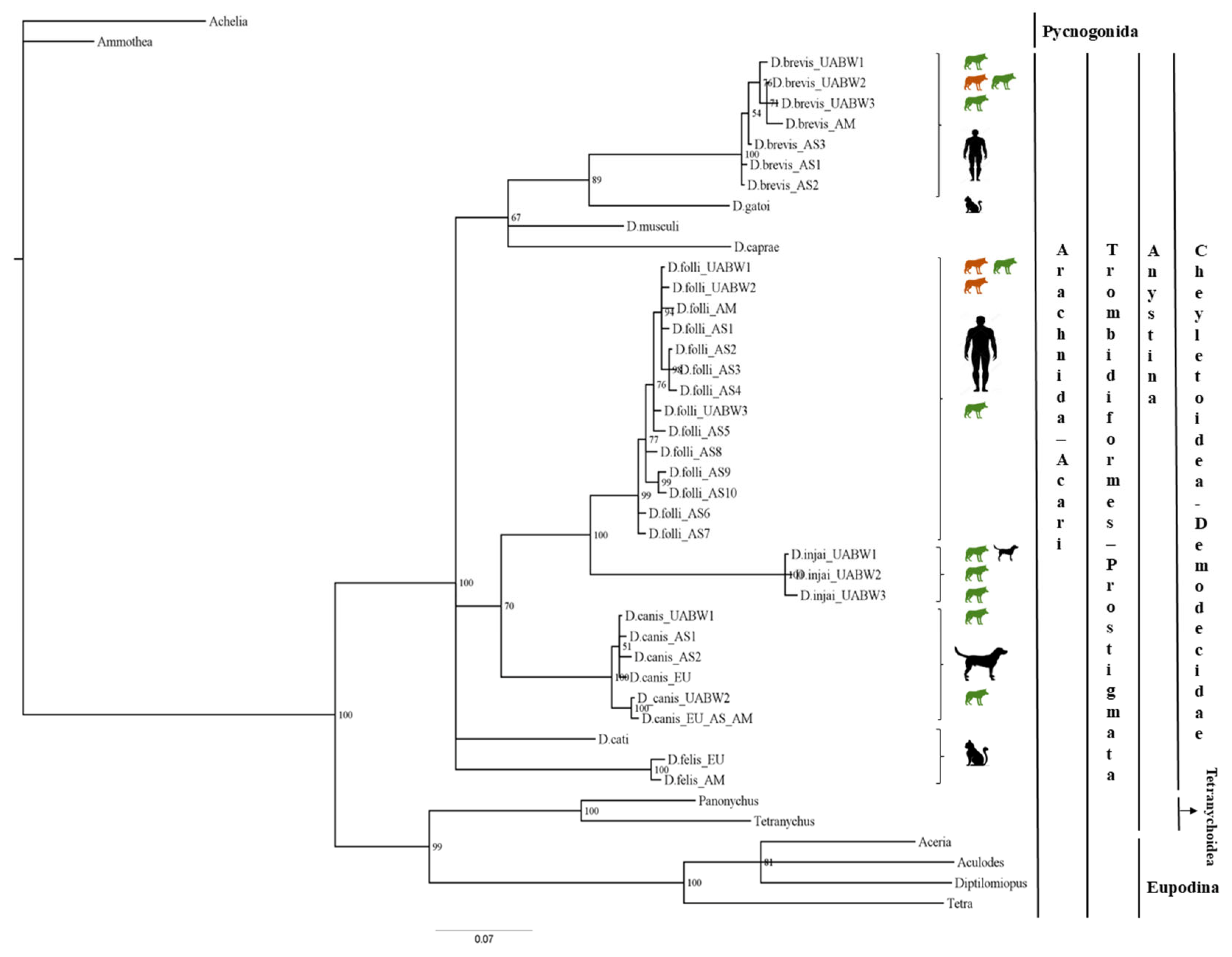
3.3. 16S rDNA Sequence Variability and Phylogenetic Relationships
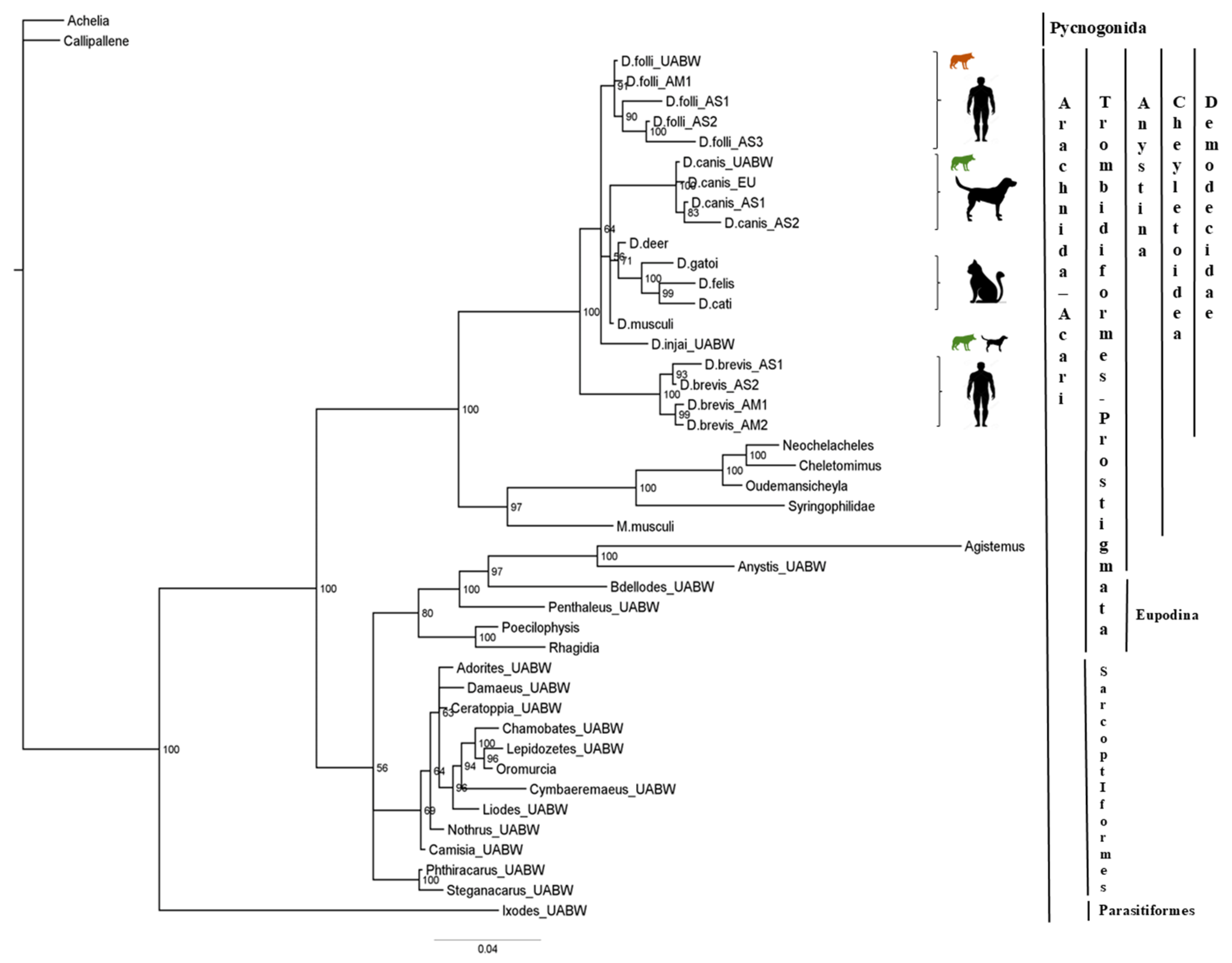
3.4. 18S rDNA Sequence Variability and Phylogenetic Relationship


4. Discussion
4.1. Detection, Prevalence, and Identification of Demodex spp.
4.2. Co-Infestations and Host Specificity Concerns
4.3. Inference on the Process of Dog Domestication
Supplementary Materials
Author Contributions
Funding
Institutional Review Board Statement
Informed Consent Statement
Data Availability Statement
Acknowledgments
Conflicts of Interest
Abbreviations
| qPCR | Quantitative Polymerase Chain Reaction |
| Tm | Melting curve |
| Cp | Amplification cycle |
| SNP | Single Nucleotide Polymorphism |
| UAB | Universitat Autònoma de Barcelona |
| IUCN | International Union for Conservation of Nature |
| CITES | Convention on International Trade in Endangered Species of Wild Fauna and Flora |
References
- Ferrer, L.; Ravera, I.; Silbermayr, K. Immunology and Pathogenesis of Canine Demodicosis. Vet. Dermatol. 2014, 25, 427-e65. [Google Scholar] [CrossRef]
- Thoemmes, M.S.; Fergus, D.J.; Urban, J.; Trautwein, M.; Dunn, R.R. Ubiquity and Diversity of Human-Associated Demodex Mites. PLoS ONE 2014, 9, e106265. [Google Scholar] [CrossRef]
- El-Moamly, A.; El-Swify, O. Raising Awareness of Demodex Mites: A Neglected Cause of Skin Disease. Infection 2025, 53, 1273–1298. [Google Scholar] [CrossRef] [PubMed]
- Zhao, Y.-E.; Wu, L.-P. Phylogenetic Relationships in Demodex Mites (Acari: Demodicidae) Based on Mitochondrial 16S rDNA Partial Sequences. Parasitol. Res. 2012, 111, 1113–1121. [Google Scholar] [CrossRef] [PubMed]
- Izdebska, J.N.; Rolbiecki, L. Demodex lutrae n. sp. (Acari) in European Otter Lutra lutra (Carnivora: Mustelidae) with Data from Other Demodecid Mites in Carnivores. J. Parasitol. 2014, 100, 784–789. [Google Scholar] [CrossRef]
- Silbermayr, K.; Horvath-Ungerboeck, C.; Eigner, B.; Joachim, A.; Ferrer, L. Phylogenetic Relationships and New Genetic Tools for the Detection and Discrimination of the Three Feline Demodex Mites. Parasitol. Res. 2014, 114, 747–752. [Google Scholar] [CrossRef]
- Ferreira, D.; Sastre, N.; Ravera, I.; Altet, L.; Francino, O.; Bardagí, M.; Ferrer, L. Identification of a Third Feline Demodex Species through Partial Sequencing of the 16S rDNA and Frequency of Demodex Species in 74 Cats Using a PCR Assay. Vet. Dermatol. 2015, 26, 239-e53. [Google Scholar] [CrossRef] [PubMed]
- Palopoli, M.F.; Fergus, D.J.; Minot, S.; Pei, D.T.; Simison, W.B.; Fernandez-Silva, I.; Thoemmes, M.S.; Dunn, R.R.; Trautwein, M. Global Divergence of the Human Follicle Mite Demodex folliculorum: Persistent Associations between Host Ancestry and Mite Lineages. Proc. Natl. Acad. Sci. USA 2015, 112, 15958–15963. [Google Scholar] [CrossRef]
- Sastre, N.; Francino, O.; Curti, J.N.; Armenta, T.C.; Fraser, D.L.; Kelly, R.M.; Hunt, E.; Silbermayr, K.; Zewe, C.; Sánchez, A.; et al. Detection, Prevalence and Phylogenetic Relationships of Demodex spp and Further Skin Prostigmata Mites (Acari, Arachnida) in Wild and Domestic Mammals. PLoS ONE 2016, 11, e0165765. [Google Scholar] [CrossRef] [PubMed]
- Nashat, M.A.; Luchins, K.R.; Lepherd, M.L.; Riedel, E.R.; Izdebska, J.N.; Lipman, N.S. Characterization of Demodex musculi Infestation, Associated Comorbidities, and Topographic Distribution in a Mouse Strain with Defective Adaptive Immunity. Comp. Med. 2017, 67, 315–329. [Google Scholar]
- Esenkaya Taşbent, F.; Dik, B. A dog related Demodex spp. infestation in a student: A rare Demodex case. Mikrobiyoloji Bülteni 2018, 52, 214–220. [Google Scholar] [CrossRef]
- Ilie, M.S.; Imre, M.; Giubega, S.; Luca, I.; Florea, T.; Morariu, S. Feline Demodicosis Case Report—First Molecular Characterization of Demodex Mites in Romania. Pathogens 2021, 10, 1474. [Google Scholar] [CrossRef] [PubMed]
- Ravera, I.; Altet, L.; Francino, O.; Sánchez, A.; Roldán, W.; Villanueva, S.; Bardagí, M.; Ferrer, L. Small Demodex Populations Colonize Most Parts of the Skin of Healthy Dogs. Vet. Dermatol. 2013, 24, 168-e37. [Google Scholar] [CrossRef]
- Ricardo-Gonzalez, R.R.; Kotas, M.E.; O’Leary, C.E.; Singh, K.; Damsky, W.; Liao, C.; Arouge, E.; Tenvooren, I.; Marquez, D.M.; Schroeder, A.W.; et al. Innate Type 2 Immunity Controls Hair Follicle Commensalism by Demodex Mites. Immunity 2022, 55, 1891–1908.e12. [Google Scholar] [CrossRef] [PubMed]
- Crawford, G.H.; Pelle, M.T.; James, W.D. Rosacea: I. Etiology, Pathogenesis, and Subtype Classification. J. Am. Acad. Dermatol. 2004, 51, 327–341. [Google Scholar] [CrossRef] [PubMed]
- Chen, W.; Plewig, G. Human Demodicosis: Revisit and a Proposed Classification. Br. J. Dermatol. 2014, 170, 1219–1225. [Google Scholar] [CrossRef]
- Mueller, R.S.; Rosenkrantz, W.; Bensignor, E.; Karaś-Tęcza, J.; Paterson, T.; Shipstone, M.A. Diagnosis and Treatment of Demodicosis in Dogs and Cats: Clinical Consensus Guidelines of the World Association for Veterinary Dermatology. Vet. Dermatol. 2020, 31, 5–27. [Google Scholar] [CrossRef]
- Hill, L.R.; Kille, P.S.; Weiss, D.A.; Craig, T.M.; Coghlan, L.G. Demodex Musculi in the Skin of Transgenic Mice. Contemp. Top. Lab. Anim. Sci. 1999, 38, 13–18. [Google Scholar]
- Gazi, U.; Taylan-Ozkan, A.; Mumcuoglu, K.Y. Immune Mechanisms in Human and Canine Demodicosis: A Review. Parasite Immunol. 2019, 41, e12673. [Google Scholar] [CrossRef]
- Marquardt-Feszler, A.; Cekała, K.; Dębska-Ślizień, A.; Imko-Walczuk, B. Demodicosis among Immunocompromised Patients: A Review. Postępy Dermatologii i Alergologii 2022, 39, 829–837. [Google Scholar] [CrossRef]
- Fondati, A.; De Lucia, M.; Furiani, N.; Monaco, M.; Ordeix, L.; Scarampella, F. Prevalence of Demodex Canis-Positive Healthy Dogs at Trichoscopic Examination. Vet. Dermatol. 2010, 21, 146–151. [Google Scholar] [CrossRef]
- Izdebska, J.N.; Fryderyk, S. Diversity of Three Species of the Genus Demodex (Acari, Demodecidae) Parasitizing Dogs in Poland. Pol. J. Environ. Stud. 2011, 20, 565–569. [Google Scholar]
- Zhao, Y.-E.; Wu, L.-P.; Hu, L.; Xu, Y.; Wang, Z.-H.; Liu, W.-Y. Sequencing for Complete rDNA Sequences (18S, ITS1, 5.8S, ITS2, and 28S rDNA) of Demodex and Phylogenetic Analysis of Acari Based on 18S and 28S rDNA. Parasitol. Res. 2012, 111, 2109–2114. [Google Scholar] [CrossRef]
- Yabsley, M.J.; Clay, S.E.; Gibbs, S.E.J.; Cunningham, M.W.; Austel, M.G. Morphologic and Molecular Characterization of a Demodex (Acari: Demodicidae) Species from White-Tailed Deer (Odocoileus virginianus). Int. Sch. Res. Not. 2013, 2013, 1–7. [Google Scholar] [CrossRef][Green Version]
- Sallows, T.A. Diet Preferences and Parasites of Grey Wolves in Riding Mountain National Park of Canada. Master of Environment Thesis, University of Manitoba, Winnipeg, Manitoba, 2007. [Google Scholar]
- Stronen, A.V.; Sallows, T.A.; Forbes, G.J.; Wagner, B.; Paquet, P.C. Diseases and Parasites in Wolves of the Riding Mountain National Park Region, Manitoba, Canada. J. Wildl. Dis. 2011, 47, 222–227. [Google Scholar] [CrossRef] [PubMed]
- Cafiero, S.A.; Petroni, L.; Natucci, L.; Casale, L.; Raffaelli, M.; Baldacci, D.; Di Rosso, A.; Rossi, C.; Casulli, A.; Massolo, A.; et al. Parasite Diversity in Grey Wolves (Canis lupus) from Tuscany, Central Italy: A Copromicroscopical Investigation. Int. J. Parasitol. Parasites Wildl. 2025, 27, 101092. [Google Scholar] [CrossRef]
- Zhou, C.-F.; Wu, S.; Martin, T.; Luo, Z.-X. A Jurassic Mammaliaform and the Earliest Mammalian Evolutionary Adaptations. Nature 2013, 500, 163–167. [Google Scholar] [CrossRef] [PubMed]
- Murphy, W.J.; Eizirik, E.; O’Brien, S.J.; Madsen, O.; Scally, M.; Douady, C.J.; Teeling, E.; Ryder, O.A.; Stanhope, M.J.; de Jong, W.W.; et al. Resolution of the Early Placental Mammal Radiation Using Bayesian Phylogenetics. Science 2001, 294, 2348–2351. [Google Scholar] [CrossRef]
- Frank, L.A.; Kania, S.A.; Chung, K.; Brahmbhatt, R. A Molecular Technique for the Detection and Differentiation of Demodex Mites on Cats. Vet. Dermatol. 2013, 24, 367-e83. [Google Scholar] [CrossRef]
- Lankton, J.S.; Chapman, A.; Ramsay, E.C.; Kania, S.A.; Newkirk, K.M. Preputial Demodex Species in Big Brown Bats (Eptesicus fuscus) in Eastern Tennessee. J. Zoo Wildl. Med. 2013, 44, 124–129. [Google Scholar] [CrossRef]
- Palopoli, M.F.; Minot, S.; Pei, D.; Satterly, A.; Endrizzi, J. Complete Mitochondrial Genomes of the Human Follicle Mites Demodex brevis and D. folliculorum: Novel Gene Arrangement, Truncated tRNA Genes, and Ancient Divergence between Species. BMC Genom. 2014, 15, 1124. [Google Scholar] [CrossRef] [PubMed]
- Brown, S.K.; Pedersen, N.C.; Jafarishorijeh, S.; Bannasch, D.L.; Ahrens, K.D.; Wu, J.-T.; Okon, M.; Sacks, B.N. Phylogenetic Distinctiveness of Middle Eastern and Southeast Asian Village Dog Y Chromosomes Illuminates Dog Origins. PLoS ONE 2011, 6, e28496. [Google Scholar] [CrossRef] [PubMed]
- Leonard, J.A.; Wayne, R.K.; Wheeler, J.; Valadez, R.; Guillén, S.; Vilà, C. Ancient DNA Evidence for Old World Origin of New World Dogs. Science 2002, 298, 1613–1616. [Google Scholar] [CrossRef]
- Savolainen, P.; Zhang, Y.; Luo, J.; Lundeberg, J.; Leitner, T. Genetic Evidence for an East Asian Origin of Domestic Dogs. Science 2002, 298, 1610–1613. [Google Scholar] [CrossRef] [PubMed]
- Axelsson, E.; Ratnakumar, A.; Arendt, M.-L.; Maqbool, K.; Webster, M.T.; Perloski, M.; Liberg, O.; Arnemo, J.M.; Hedhammar, Å.; Lindblad-Toh, K. The Genomic Signature of Dog Domestication Reveals Adaptation to a Starch-Rich Diet. Nature 2012, 495, 360–364. [Google Scholar] [CrossRef]
- Germonpré, M.; Sablin, M.V.; Stevens, R.E.; Hedges, R.E.M.; Hofreiter, M.; Stiller, M.; Després, V.R. Fossil Dogs and Wolves from Palaeolithic Sites in Belgium, the Ukraine and Russia: Osteometry, Ancient DNA and Stable Isotopes. J. Archaeol. Sci. 2009, 36, 473–490. [Google Scholar] [CrossRef]
- Ovodov, N.D.; Crockford, S.J.; Kuzmin, Y.V.; Higham, T.F.G.; Hodgins, G.W.L.; van der Plicht, J. A 33,000-Year-Old Incipient Dog from the Altai Mountains of Siberia: Evidence of the Earliest Domestication Disrupted by the Last Glacial Maximum. PLoS ONE 2011, 6, e22821. [Google Scholar] [CrossRef]
- Davis, S.J.M.; Valla, F.R. Evidence for Domestication of the Dog 12,000 Years Ago in the Natufian of Israel. Nature 1978, 276, 608–610. [Google Scholar] [CrossRef]
- vonHoldt, B.M.; Pollinger, J.P.; Lohmueller, K.E.; Han, E.; Parker, H.G.; Quignon, P.; Degenhardt, J.D.; Boyko, A.R.; Earl, D.A.; Auton, A.; et al. Genome-Wide SNP and Haplotype Analyses Reveal a Rich History Underlying Dog Domestication. Nature 2010, 464, 898–902. [Google Scholar] [CrossRef]
- Skoglund, P.; Götherström, A.; Jakobsson, M. Estimation of Population Divergence Times from Non-Overlapping Genomic Sequences: Examples from Dogs and Wolves. Mol. Biol. Evol. 2011, 28, 1505–1517. [Google Scholar] [CrossRef]
- Wang, G.-D.; Zhai, W.; Yang, H.-C.; Wang, L.; Zhong, L.; Liu, Y.-H.; Fan, R.-X.; Yin, T.-T.; Zhu, C.-L.; Poyarkov, A.D.; et al. Out of Southern East Asia: The Natural History of Domestic Dogs across the World. Cell Res. 2015, 26, 21–33. [Google Scholar] [CrossRef]
- Bergström, A.; Stanton, D.W.G.; Taron, U.H.; Frantz, L.; Sinding, M.-H.S.; Ersmark, E.; Pfrengle, S.; Cassatt-Johnstone, M.; Lebrasseur, O.; Girdland-Flink, L.; et al. Grey Wolf Genomic History Reveals a Dual Ancestry of Dogs. Nature 2022, 607, 313–320. [Google Scholar] [CrossRef]
- Freedman, A.H.; Gronau, I.; Schweizer, R.M.; Ortega-Del Vecchyo, D.; Han, E.; Silva, P.M.; Galaverni, M.; Fan, Z.; Marx, P.; Lorente-Galdos, B.; et al. Genome Sequencing Highlights the Dynamic Early History of Dogs. PLoS Genet. 2014, 10, e1004016. [Google Scholar] [CrossRef]
- Crandall, K.A.; Bininda-Emonds, O.R.; Mace, G.M.; Wayne, R.K. Considering Evolutionary Processes in Conservation Biology. Trends Ecol. Evol. 2000, 15, 290–295. [Google Scholar] [CrossRef] [PubMed]
- Carmichael, L.E.; Nagy, J.A.; Larter, N.C.; Strobeck, C. Prey Specialization May Influence Patterns of Gene Flow in Wolves of the Canadian Northwest. Mol. Ecol. 2001, 10, 2787–2798. [Google Scholar] [CrossRef] [PubMed]
- Geffen, E.; Anderson, M.J.; Wayne, R.K. Climate and Habitat Barriers to Dispersal in the Highly Mobile Grey Wolf. Mol. Ecol. 2004, 13, 2481–2490. [Google Scholar] [CrossRef] [PubMed]
- Musiani, M.; Leonard, J.A.; Cluff, H.D.; Gates, C.C.; Mariani, S.; Paquet, P.C.; Vilà, C.; Wayne, R.K. Differentiation of Tundra/Taiga and Boreal Coniferous Forest Wolves: Genetics, Coat Colour and Association with Migratory Caribou. Mol. Ecol. 2007, 16, 4149–4170. [Google Scholar] [CrossRef]
- Lucchini, V.; Galov, A.; Randi, E. Evidence of Genetic Distinction and Long-Term Population Decline in Wolves (Canis lupus) in the Italian Apennines. Mol. Ecol. 2004, 13, 523–536. [Google Scholar] [CrossRef]
- Pilot, M.; Branicki, W.; Jędrzejewski, W.; Goszczyński, J.; Jędrzejewska, B.; Dykyy, I.; Shkvyrya, M.; Tsingarska, E. Phylogeographic History of Grey Wolves in Europe. BMC Evol. Biol. 2010, 10, 104. [Google Scholar] [CrossRef]
- Sastre, N.; Vilà, C.; Salinas, M.; Bologov, V.V.; Urios, V.; Sánchez, A.; Francino, O.; Ramírez, O. Signatures of Demographic Bottlenecks in European Wolf Populations. Conserv. Genet. 2011, 12, 701–712. [Google Scholar] [CrossRef]
- Valiere, N.; Fumagalli, L.; Gielly, L.; Miquel, C.; Lequette, B.; Poulle, M.L.; Weber, J.M.; Arlettaz, R.; Taberlet, P. Long-Distance Wolf Recolonization of France and Switzerland Inferred from Non-Invasive Genetic Sampling over a Period of 10 Years. Anim. Conserv. 2003, 6, 83–92. [Google Scholar] [CrossRef]
- Librado, P.; Rozas, J. DnaSP v5: A Software for Comprehensive Analysis of DNA Polymorphism Data. Bioinformatics 2009, 25, 1451–1452. [Google Scholar] [CrossRef] [PubMed]
- Posada, D.; Crandall, K.A. MODELTEST: Testing the Model of DNA Substitution. Bioinformatics 1998, 14, 817–818. [Google Scholar] [CrossRef]
- Ronquist, F.; Teslenko, M.; van der Mark, P.; Ayres, D.L.; Darling, A.; Höhna, S.; Larget, B.; Liu, L.; Suchard, M.A.; Huelsenbeck, J.P. MrBayes 3.2: Efficient Bayesian Phylogenetic Inference and Model Choice across a Large Model Space. Syst. Biol. 2012, 61, 539–542. [Google Scholar] [CrossRef]
- Hillis, D.M.; Bull, J.J. An Empirical Test of Bootstrapping as a Method for Assessing Confidence in Phylogenetic Analysis. Syst. Biol. 1993, 42, 182–192. [Google Scholar] [CrossRef]
- Lorenzini, R.; Pizzarelli, A.; Attili, L.; Biagetti, M.; Sebastiani, C.; Ciucci, P. Genetic Evidence Reveals Extensive Wolf-Dog Hybridisation in Peninsular Italy: Warnings against Ineffective Management. Biol. Conserv. 2026, 313, 111615. [Google Scholar] [CrossRef]
- Saridomichelakis, M.; Koutinas, A.; Papadogiannakis, E.; Papazachariadou, M.; Liapi, M.; Trakas, D. Adult-Onset Demodicosis in Two Dogs Due to Demodex Canis and a Short-Tailed Demodectic Mite. J. Small Anim. Pract. 1999, 40, 529–532. [Google Scholar] [CrossRef]
- Fryderyk, S.; Izdebska, J.N. Demodex Phylloides (Acari, Demodecidae) as a Specific Parasite of Sus scrofa (Mammalia, Artiodactyla). Wiadomości Parazytologiczne 2001, 47, 797–800. [Google Scholar] [PubMed]
- Biernat, M.M.; Rusiecka-Ziółkowska, J.; Piątkowska, E.; Helemejko, I.; Biernat, P.; Gościniak, G. Occurrence of Demodex Species in Patients with Blepharitis and in Healthy Individuals: A 10-Year Observational Study. Jpn. J. Ophthalmol. 2018, 62, 628–633. [Google Scholar] [CrossRef]
- Pyzia, J.; Mańkowska, K.; Czepita, M.; Kot, K.; Łanocha-Arendarczyk, N.; Czepita, D.; Kosik-Bogacka, D.I. Demodex Species and Culturable Microorganism Co-Infestations in Patients with Blepharitis. Life 2023, 13, 1827. [Google Scholar] [CrossRef] [PubMed]
- Kosik-Bogacka, D.; Łanocha-Arendarczyk, N.; Pilarczyk, R.; Schneider-Matyka, D.; Kot, K.; Grzeszczak, K.; Pyzia, J.; Grochans, E. Ocular Symptoms in Pre- and Perimenopausal Woman Infected with Demodex spp. Pathogens 2025, 14, 297. [Google Scholar] [CrossRef]
- Fromstein, S.R.; Harthan, J.S.; Patel, J.; Opitz, D.L. Demodex Blepharitis: Clinical Perspectives. Clin. Optom. 2018, 10, 57–63. [Google Scholar] [CrossRef]
- Zeytun, E.; Yazici, M. Human Demodex Mites (Acari: Demodicidae) as a Possible Etiological Factor in Rosacea: A Cross-Sectional Study from Turkey. Syst. Appl. Acarol. 2024, 29, 527–538. [Google Scholar] [CrossRef]
- Oleaga, Á.; Fayos, M.; Balseiro, A.; Borragán, S.; de Pedro, G.; Armenteros, J.Á.; Balsera, R.; Moreiro, M.; Sastre, N.; Ferrer, L. Demodicosis in a Free-Ranging Eurasian Brown Bear (Ursus arctos arctos) Cub in the Endangered Cantabrian Population, Spain. J. Wildl. Dis. 2024, 60, 786–791. [Google Scholar] [CrossRef] [PubMed]
- Valverde, J. El Lobo Español. Montes 1971, 159, 228–241. [Google Scholar]
- Zimen, E.; Boitani, L. Number and Distribution of Wolves in Italy. Zeitschrift für Säugetierkunde 1974, 40, 102–112. [Google Scholar]

| Region and Host | Female | Male | Total | ||
|---|---|---|---|---|---|
| − | + | − | + | ||
| Cantabria (ES) | 40 | 20 | 40 | 26 | 126 |
| Castilla y León (ES) | 1 | 1 | |||
| Total Canis lupus signatus | 41 | 20 | 40 | 26 | 127 |
| Alessandria (IT) | 1 | 1 | |||
| Aragón (ES) | 1 | 1 | |||
| Catalunya (ES) | 1 | 1 | |||
| Cuneo (IT) | 2 | 1 | 1 | 1 | 5 |
| Torino (IT) | 2 | 1 | 1 | 4 | |
| Vercelli (IT) | 1 | 1 | |||
| Total Canis lupus italicus | 4 | 2 | 3 | 4 | 13 |
| Demodex sp. | N + Sites—18S | GenBanK—18S | N + Sites—16S | Variants—16S | GenBanK—16S | N + Sites—16S | N + Iberian Wolf—16S | N + Italian Wolf—16S |
|---|---|---|---|---|---|---|---|---|
| D. brevis | 0 | - | 5 | D.brevis_UABW1 | PX232547 | 2 | 2 | |
| D.brevis_UABW2 | PX232548 | 2 | 1 | 1 (5) | ||||
| D.brevis_UABW3 | PX232549 | 1 | 1 (3) | |||||
| D. folliculorum | 5 | PX421031 | 12 | D.folliculorum_UABW1 | PX232550 | 7 | 1 | 4 |
| D.folliculorum_UABW2 | PX232551 | 3 | 2 (5) | |||||
| D.folliculorum_UABW3 | PX232552 | 2 | 1 | |||||
| D. canis | 26 | PX421029 | 30 | D.canis_UABW1 | PX232553 | 27 | 11 (1–4) | |
| D.canis_UABW2 | PX232554 | 3 | 1 | |||||
| D. injai | 52 | PX421030 | 54 | D.injai_UABW1 | PX232555 | 19 | 12 (1,4) | |
| D.injai_UABW2 | PX232556 | 29 | 16 (2) | |||||
| D.injai_UABW3 | PX232557 | 6 | 4 | |||||
| Total | 83 | 101 | 101 | 50 | 7 |
Disclaimer/Publisher’s Note: The statements, opinions and data contained in all publications are solely those of the individual author(s) and contributor(s) and not of MDPI and/or the editor(s). MDPI and/or the editor(s) disclaim responsibility for any injury to people or property resulting from any ideas, methods, instructions or products referred to in the content. |
© 2026 by the authors. Licensee MDPI, Basel, Switzerland. This article is an open access article distributed under the terms and conditions of the Creative Commons Attribution (CC BY) license.
Share and Cite
Sastre, N.; Fayos, M.; Rossi, L.; Francino, O.; Velarde, R.; Ramos-Onsins, S.E.; Ferrer, L. First Detection of Human- and Dog-Associated Demodex Mites (Acari, Arachnida) in Southern European Wolves (Canis lupus). Pathogens 2026, 15, 336. https://doi.org/10.3390/pathogens15030336
Sastre N, Fayos M, Rossi L, Francino O, Velarde R, Ramos-Onsins SE, Ferrer L. First Detection of Human- and Dog-Associated Demodex Mites (Acari, Arachnida) in Southern European Wolves (Canis lupus). Pathogens. 2026; 15(3):336. https://doi.org/10.3390/pathogens15030336
Chicago/Turabian StyleSastre, Natalia, Manena Fayos, Luca Rossi, Olga Francino, Roser Velarde, Sebastian E. Ramos-Onsins, and Lluís Ferrer. 2026. "First Detection of Human- and Dog-Associated Demodex Mites (Acari, Arachnida) in Southern European Wolves (Canis lupus)" Pathogens 15, no. 3: 336. https://doi.org/10.3390/pathogens15030336
APA StyleSastre, N., Fayos, M., Rossi, L., Francino, O., Velarde, R., Ramos-Onsins, S. E., & Ferrer, L. (2026). First Detection of Human- and Dog-Associated Demodex Mites (Acari, Arachnida) in Southern European Wolves (Canis lupus). Pathogens, 15(3), 336. https://doi.org/10.3390/pathogens15030336