Occurrence and Multi-Locus Genotyping of Enterocytozoon bieneusi in Black Goats from Fujian Province, China
Abstract
1. Introduction
2. Materials and Methods
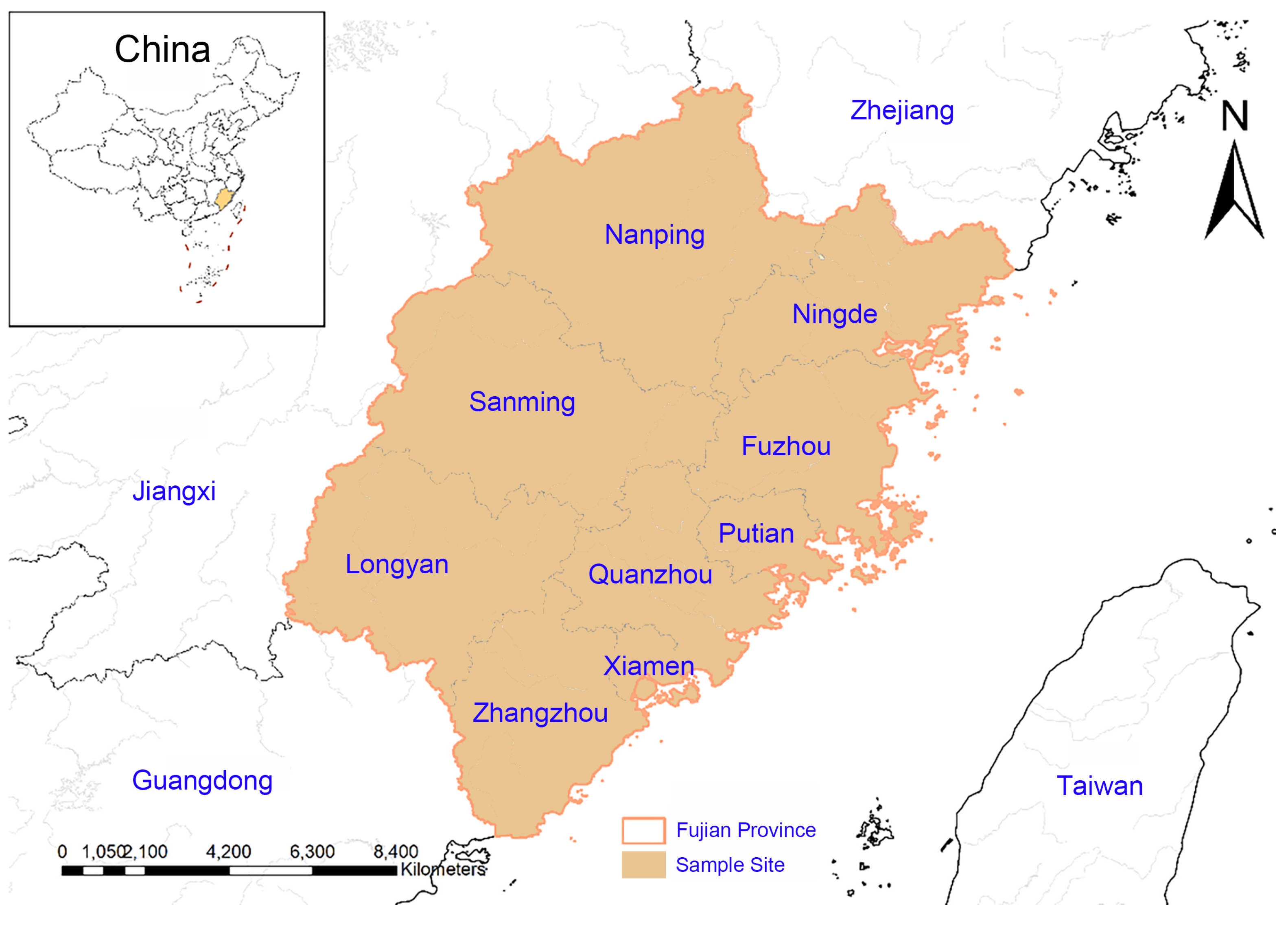
2.1. Study Areas and Sample Collection
2.2. Genomic DNA Extraction
2.3. PCR Amplification and Electrophoresis
2.4. Sequencing and Phylogenetic Analysis
2.5. Statistical Analysis
3. Results
3.1. Detection of the Infection Rate of E. bieneusi
3.2. Infection Rates and Genotype Prevalence of E. bieneusi in Black Goats from Different Regions of Fujian Province
3.3. Infection Rates and Genotype Prevalence of E. bieneusi in Black Goats of Different Ages in Fujian Province
3.4. Infection Rates and Genotype Prevalence of E. bieneusi in Black Goats of Different Genders in Fujian Province
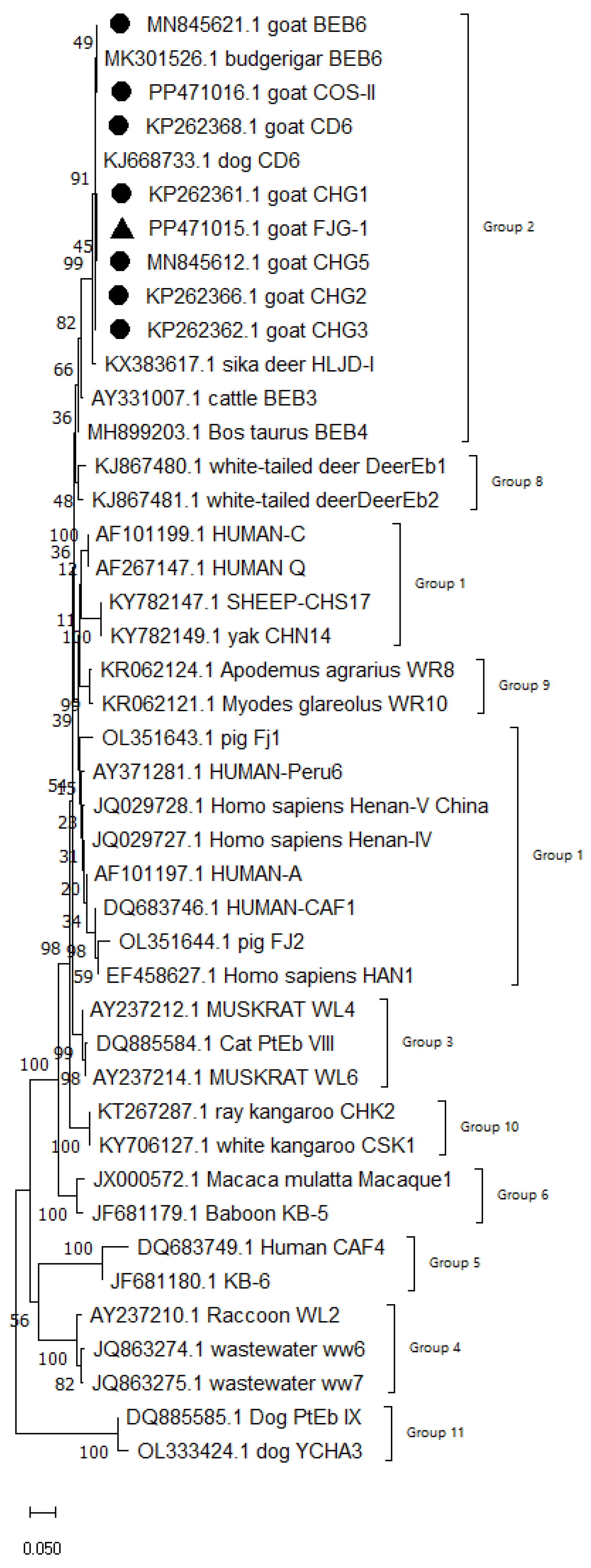
3.5. Genotype Identification of E. bieneusi
3.6. MLST of E. bieneusi
4. Discussion
5. Conclusions
Supplementary Materials
Author Contributions
Funding
Institutional Review Board Statement
Informed Consent Statement
Data Availability Statement
Conflicts of Interest
References
- Deng, L.; Li, W.; Zhong, Z.; Gong, C.; Cao, X.; Song, Y.; Wang, W.; Huang, X.; Liu, X.; Hu, Y.; et al. Multi-locus genotypes of Enterocytozoon bieneusi in captive Asiatic black bears in southwestern China: High genetic diversity, broad host range, and zoonotic potential. PLoS ONE 2017, 12, e0171772. [Google Scholar] [CrossRef]
- Prasertbun, R.; Mori, H.; Pintong, A.R.; Sanyanusin, S.; Popruk, S.; Komalamisra, C.; Changbunjong, T.; Buddhirongawatr, R.; Sukthana, Y.; Mahittikorn, A. Zoonotic potential of Enterocytozoon genotypes in humans and pigs in Thailand. Vet. Parasitol. 2017, 233, 73–79. [Google Scholar] [CrossRef] [PubMed]
- Yue, D.M.; Ma, J.G.; Li, F.C.; Hou, J.L.; Zheng, W.B.; Zhao, Q.; Zhang, X.X.; Zhu, X.Q. Occurrence of Enterocytozoon bieneusi in Donkeys (Equus asinus) in China: A Public Health Concern. Front. Microbiol. 2017, 8, 565. [Google Scholar] [CrossRef] [PubMed]
- Troemel, E.R. New models of microsporidiosis: Infections in Zebrafish, C. elegans, and honey bee. PLoS Pathog. 2011, 7, e1001243. [Google Scholar] [CrossRef] [PubMed]
- El-Garhy, M.; Cali, A.; Morsy, K.; Bashtar, A.R.; Al Quraishy, S. Ultrastructural characterization of Pleistophora macrozoarcidis Nigerelli 1946 (Microsporidia) infecting the ocean pout Macrozoarces americanus (Perciformes, Zoarcidae) from the gulf of Maine, MA, USA. Parasitol. Res. 2017, 116, 61–71. [Google Scholar] [CrossRef]
- Jones, S.R.; Ahonen, H.S.; Granlund, L.; Arsiola, T.; Taskinen, J. Two Novel Microsporidia in Skeletal Muscle of Pike-Perch Sander lucioperca and Burbot Lota lota in Finland. J. Parasitol. 2017, 103, 95–102. [Google Scholar] [CrossRef]
- Santín, M.; Fayer, R. Microsporidiosis: Enterocytozoon bieneusi in domesticated and wild animals. Res. Vet. Sci. 2011, 90, 363–371. [Google Scholar] [CrossRef]
- Ding, S.; Huang, W.; Qin, Q.; Tang, J.; Liu, H. Genotype Identification and Phylogenetic Analysis of Enterocytozoon bieneusi Isolates from Stool Samples of Diarrheic Children. J. Parasitol. 2018, 104, 297–301. [Google Scholar] [CrossRef]
- Thellier, M.; Breton, J. Enterocytozoon bieneusi in human and animals, focus on laboratory identification and molecular epidemiology. Parasite 2008, 15, 349–358. [Google Scholar] [CrossRef]
- Gong, B.; Yang, Y.; Liu, X.; Cao, J.; Xu, M.; Xu, N.; Yang, F.; Wu, F.; Li, B.; Liu, A.; et al. First survey of Enterocytozoon bieneusi and dominant genotype Peru6 among ethnic minority groups in southwestern China’s Yunnan Province and assessment of risk factors. PLoS Negl. Trop. Dis. 2019, 13, e0007356. [Google Scholar] [CrossRef]
- Imre, M.; Ilie, M.S.; Florea, T.; Badea, C.; Pocinoc, A.; Imre, K. Enterocytozoon bieneusi in European Domestic Ungulates and Pets: Occurrence, Genetic Diversity, and Public Health Perspectives from a Narrative Review. Pathogens 2025, 14, 1158. [Google Scholar] [CrossRef] [PubMed]
- Keeling, P.J.; Fast, N.M. Microsporidia: Biology and evolution of highly reduced intracellular parasites. Annu. Rev. Microbiol. 2002, 56, 93–116. [Google Scholar] [CrossRef] [PubMed]
- Katinka, M.D.; Duprat, S.; Cornillot, E.; Méténier, G.; Thomarat, F.; Prensier, G.; Barbe, V.; Peyretaillade, E.; Brottier, P.; Wincker, P.; et al. Genome sequence and gene compaction of the eukaryote parasite Encephalitozoon cuniculi. Nature 2001, 414, 450–453. [Google Scholar] [CrossRef] [PubMed]
- Vivarès, C.P.; Gouy, M.; Thomarat, F.; Méténier, G. Functional and evolutionary analysis of a eukaryotic parasitic genome. Curr. Opin. Microbiol. 2002, 5, 499–505. [Google Scholar] [CrossRef]
- Koehler, A.V.; Zhang, Y.; Gasser, R.B. Perspective on the molecular identification, classification, and epidemiology of Enterocytozoon bieneusi of animals. Exp. Suppl. 2022, 114, 389–415. [Google Scholar] [CrossRef]
- Li, W.; Feng, Y.; Santin, M. Host Specificity of Enterocytozoon bieneusi and Public Health Implications. Trends Parasitol. 2019, 35, 436–451. [Google Scholar] [CrossRef]
- Zhao, W.; Zhou, H.; Yang, L.; Ma, T.; Zhou, J.; Liu, H.; Lu, G.; Huang, H. Prevalence, genetic diversity and implications for public health of Enterocytozoon bieneusi in various rodents from Hainan Province, China. Parasit. Vectors 2020, 13, 438. [Google Scholar] [CrossRef]
- Zhang, T.; Ren, G.; Zhou, H.; Qiang, Y.; Li, J.; Zhang, Y.; Li, T.; Zhou, Y.; Wang, Y.; Lai, X.; et al. Molecular prevalence and genetic diversity analysis of Enterocytozoon bieneusi in humans in Hainan Province, China: High diversity and unique endemic genetic characteristics. Front. Public Health 2022, 10, 1007130. [Google Scholar] [CrossRef]
- Xin, X.; Sun, L.; Liu, W.; Zhang, J.; Ma, S.; Fu, X.; Zhao, W.; Yan, B. Molecular prevalence and genotype identification of Enterocytozoon bieneusi in cattle and goats from Zhejiang Province, China. Front. Vet. Sci. 2024, 11, 1415813. [Google Scholar] [CrossRef]
- Li, X.M.; Wang, X.Y.; Wei, Y.J.; Jiang, J.; Cai, Y.; Zhang, X.X.; Yang, X.; Cao, H. Meta-analysis of the global prevalence and risk factors of Enterocytozoon bieneusi infection in pigs from 1999 to 2021. Prev. Vet. Med. 2024, 225, 106159. [Google Scholar] [CrossRef]
- Taghipour, A.; Bahadory, S.; Javanmard, E. The global molecular epidemiology of microsporidia infection in sheep and goats with focus on Enterocytozoon bieneusi: A systematic review and meta-analysis. Trop. Med. Health 2021, 49, 66. [Google Scholar] [CrossRef] [PubMed]
- Taghipour, A.; Bahadory, S.; Abdoli, A. A systematic review and meta-analysis on the global prevalence of cattle microsporidiosis with focus on Enterocytozoon bieneusi: An emerging zoonotic pathogen. Prev. Vet. Med. 2022, 200, 105581. [Google Scholar] [CrossRef] [PubMed]
- Nagpal, A.; Pritt, B.S.; Lorenz, E.C.; Amer, H.; Nasr, S.H.; Cornell, L.D.; Iqbal, S.; Wilhelm, M.P. Disseminated microsporidiosis in a renal transplant recipient: Case report and review of the literature. Transpl. Infect. Dis. 2013, 15, 526–532. [Google Scholar] [CrossRef] [PubMed]
- Feng, Y.; Li, N.; Dearen, T.; Lobo, M.L.; Matos, O.; Cama, V.; Xiao, L. Development of a multilocus sequence typing tool for high-resolution genotyping of Enterocytozoon bieneusi. Appl. Environ. Microbiol. 2011, 77, 4822–4828. [Google Scholar] [CrossRef]
- Peng, J. Investigation of Molecular Epidemiology and Genotypic Identification of Four Enteric Protozoa in Tan Sheep in the Ningxia Hui Autonomous Region. Master’s Thesis, Chinese Academy of Agricultural Sciences, Beijing, China, 2020. [Google Scholar] [CrossRef]
- Xie, S.-C.; Zou, Y.; Li, Z.; Yang, J.-F.; Zhu, X.-Q.; Zou, F.-C. Molecular Detection and Genotyping of Enterocytozoon bieneusi in Black Goats (Capra hircus) in Yunnan Province, Southwestern China. Animals 2021, 11, 3387. [Google Scholar] [CrossRef]
- Li, W.; Feng, Y.; Xiao, L. Diagnosis and molecular typing of Enterocytozoon bieneusi: The significant role of domestic animals in transmission of human microsporidiosis. Res. Vet. Sci. 2020, 133, 251–261. [Google Scholar] [CrossRef]
- Zheng, X.L.; Zhou, H.H.; Ren, G.; Ma, T.M.; Cao, Z.X.; Wei, L.M.; Liu, Q.W.; Wang, F.; Zhang, Y.; Liu, H.L.; et al. Genotyping and zoonotic potential of Enterocytozoon bieneusi in cattle farmed in Hainan Province, the southernmost region of China. Parasite 2020, 27, 65. [Google Scholar] [CrossRef]
- Zhao, W.; Zhou, H.H.; Ma, T.M.; Cao, J.; Lu, G.; Shen, Y.J. PCR-based detection of Cryptosporidium spp. And Enterocytozoon bieneusi in farm-raised and free-ranging geese (Anser anser f. domestica) from Hainan Province of China: Natural infection rate and the species or genotype distribution. Front. Cell Infect. Microbiol. 2019, 9, 416. [Google Scholar] [CrossRef]
- Zhou, H.H.; Zheng, X.L.; Ma, T.M.; Qi, M.; Cao, Z.X.; Chao, Z.; Wei, L.M.; Liu, Q.W.; Sun, R.P.; Wang, F.; et al. Genotype identification and phylogenetic analysis of Enterocytozoon bieneusi in farmed black goats (Capra hircus) from China’s Hainan Province. Parasite 2019, 26, 62. [Google Scholar] [CrossRef]
- Wang, L.; Xiao, L.; Duan, L.; Ye, J.; Guo, Y.; Guo, M.; Liu, L.; Feng, Y. Concurrent infections of Giardia duodenalis, Enterocytozoon bieneusi, and Clostridium difficile in children during a cryptosporidiosis outbreak in a pediatric hospital in China. PLoS Negl. Trop. Dis. 2013, 7, e2437. [Google Scholar] [CrossRef]
- Karim, M.R.; Wang, R.; Dong, H.; Zhang, L.; Li, J.; Zhang, S.; Rume, F.I.; Qi, M.; Jian, F.; Sun, M.; et al. Genetic polymorphism and zoonotic potential of Enterocytozoon bieneusi from nonhuman primates in China. Appl. Environ. Microbiol. 2014, 80, 1893–1898. [Google Scholar] [CrossRef]
- Fayer, R.; Santín, M.; Trout, J.M. Enterocytozoon bieneusi in mature dairy cattle on farms in the eastern United States. Parasitol. Res. 2007, 102, 15–20. [Google Scholar] [CrossRef] [PubMed]
- Zhao, W.; Zhang, W.; Wang, R.; Liu, W.; Liu, A.; Yang, D.; Yang, F.; Karim, M.R.; Zhang, L. Enterocytozoon bieneusi in sika deer (Cervus nippon) and red deer (Cervus elaphus): Deer specificity and zoonotic potential of ITS genotypes. Parasitol. Res. 2014, 113, 4243–4250. [Google Scholar] [CrossRef] [PubMed]
- Zhao, G.H.; Du, S.Z.; Wang, H.B.; Hu, X.F.; Deng, M.J.; Yu, S.K.; Zhang, L.X.; Zhu, X.Q. First report of zoonotic Cryptosporidium spp., Giardia intestinalis and Enterocytozoon bieneusi in golden takins (Budorcas taxicolor bedfordi). Infect. Genet. Evol. 2015, 34, 394–401. [Google Scholar] [CrossRef] [PubMed]
- Li, W.; Deng, L.; Yu, X.; Zhong, Z.; Wang, Q.; Liu, X.; Niu, L.; Xie, N.; Deng, J.; Lei, S.; et al. Multilocus genotypes and broad host-range of Enterocytozoon bieneusi in captive wildlife at zoological gardens in China. Parasit. Vectors 2016, 9, 395. [Google Scholar] [CrossRef]
- Karim, M.R.; Dong, H.; Yu, F.; Jian, F.; Zhang, L.; Wang, R.; Zhang, S.; Rume, F.I.; Ning, C.; Xiao, L. Genetic diversity in Enterocytozoon bieneusi isolates from dogs and cats in China: Host specificity and public health implications. J. Clin. Microbiol. 2014, 52, 3297–3302. [Google Scholar] [CrossRef]
- Zhao, W.; Yu, S.; Yang, Z.; Zhang, Y.; Zhang, L.; Wang, R.; Zhang, W.; Yang, F.; Liu, A. Genotyping of Enterocytozoon bieneusi (Microsporidia) isolated from various birds in China. Infect. Genet. Evol. 2016, 40, 151–154. [Google Scholar] [CrossRef]
- Liu, T.L.; Peng, X.Q.; Song, J.K.; Hu, R.S.; Wang, S.S.; Pan, G.L.; Zhao, G.H. Multi-locus Sequence Genotyping Study of Enterocytozoon bieneusi in Goats from Partial Areas of Shaanxi Province. Acta Vet. Zootech. Sin. 2017, 48, 1730–1736. [Google Scholar] [CrossRef]



| Region | Gender | Age | Summation | Total | ||||
|---|---|---|---|---|---|---|---|---|
| 0–1 Year | 1–2 Years | 2–3 Years | 3–4 Years | 4–5 Years | ||||
| Putian | Male | 10 | 0 | 7 | 2 | 62 | 539 | |
| Female | 10 | 7 | 8 | 16 | 2 | |||
| Sanming | Male | 6 | 10 | 2 | 70 | |||
| Female | 17 | 30 | 4 | 1 | ||||
| Quanzhou | Male | 5 | 1 | 1 | 39 | |||
| Female | 10 | 6 | 11 | 5 | ||||
| Zhangzhou | Male | 14 | 10 | 1 | 82 | |||
| Female | 11 | 32 | 13 | 1 | ||||
| Longyan | Male | 21 | 7 | 2 | 76 | |||
| Female | 21 | 14 | 11 | |||||
| Xiamen | Male | 6 | 3 | 16 | ||||
| Female | 1 | 6 | ||||||
| Nanping | Male | 12 | 11 | 1 | 70 | |||
| Female | 18 | 18 | 9 | 1 | ||||
| Ningde | Male | 17 | 2 | 57 | ||||
| Female | 27 | 9 | 1 | 1 | ||||
| Fuzhou | Male | 10 | 67 | |||||
| Female | 12 | 15 | 26 | 3 | 1 | |||
| District | Sample Number | Infection Rate (95% CI) | Assemblages |
|---|---|---|---|
| Putian | 62 | 3 (4.84%, 1.01–13.50%) | CD6(3) |
| Sanming | 73 | 1 (1.36%, 0.03–0.74%) | CHG2(1) |
| Quanzhou | 39 | 0 (0%, 0.00–9.03%) | |
| Zhangzhou | 82 | 15 (18.29%, 10.62–28.37%) | CHG2(2), CHG3(6), CHG5(1), BEB6(3), CD6(2), FJG-1(1) |
| Longyan | 76 | 4 (5.26%, 1.45–12.93%) | CHG1(1), CHG5(2), FJG-1(1) |
| Xiamen | 16 | 1 (6.25%, 0.16–30.20%) | BEB6(1) |
| Nanping | 70 | 16 (22.85%, 13.67–34.45%) | CD6(15), COS-II(1) |
| Ningde | 57 | 0 (0%, 0.00–6.27%) | |
| Fuzhou | 64 | 2 (3.13%, 0.38–10.84%) | CHG3(2) |
| Total | 539 | 42 (7.79%, 5.67–10.39%) | CHG1(1), CHG2(3), CHG3(8), CHG5(3), BEB6(4), CD6(20), COS-II(1), FJG-1(2) |
| Age | Sample Number | Infection Rate (95% CI) | Assemblages |
|---|---|---|---|
| ≤1 year | 228 | 20 (7.09%, 5.44–13.22%) | CHG1(1), CHG3(3), CHG5(3), BEB6(4), CD6(8), FJG-1(1) |
| 1–2 years | 181 | 16 (8.84%, 5.14–13.06%) | CHG2(2), CHG3(4), CD6(9), COS-II(1) |
| 2–3 years | 97 | 6 (6.19%, 2.30–12.98%) | CHG2(1), CHG3(1), CD6(3), FJG-1(1) |
| ≥3 years | 33 | 0 (0%, 0.00–10.58%) | |
| Total | 539 | 42 (7.79%, 5.67–10.39%) | CHG1(1), CHG2(3), CHG3(8), CHG5(3), BEB6(4), CD6(20), COS-II(1), FJG-1(2) |
| Gender | Sample Number | Infection Rate (95% CI) | Assemblages |
|---|---|---|---|
| Male | 161 | 15 (9.32%, 5.31–14.90%) | CHG1(1), CHG2(1), CHG3(1), CHG5(3), BEB6(1), CD6(7), COS-II(1) |
| Female | 378 | 27 (7.14%, 4.76–10.22%) | CHG2(2), CHG3(7), BEB6(3), CD6(13), FJG-1(2) |
| Total | 539 | 42 (7.79%, 5.67–10.39%) | CHG1(1), CHG2(3), CHG3(8), CHG5(3), BEB6(4), CD6(20), COS-II(1), FJG-1(2) |
| Sample Number | ITS Genotyping | Genotype | MLGS | ||
|---|---|---|---|---|---|
| MS1 | MS4 | MS7 | |||
| Ly1 | CHG5 | TypeI | TypeI | TypeI | MLGI (1) |
| Ly71 | CHG1 | TypeII | TypeII | TypeII | MLGII (1) |
| pt42 | CD6 | TypeI | TypeIII | TypeII | MLGIII (1) |
| Pt44 | CD6 | TypeI | TypeIV | TypeII | MLGIV (1) |
| Pt51 | CD6 | TypeI | TypeV | TypeI | MLGV (1) |
| Zz47 | BEB6 | TypeI | TypeVI | TypeI | MLGVI (1) |
| Zz59 | CHG2 | TypeIII | TypeIII | TypeI | MLGVII (1) |
| Zz76 | CHG2 | TypeIV | TypeIII | TypeI | MLGVIII (1) |
| Fz15 | CHG3 | TypeI | TypeVII | TypeII | MLGIX (1) |
| Sm7 | CHG2 | TypeV | TypeIII | TypeII | MLGX (1) |
Disclaimer/Publisher’s Note: The statements, opinions and data contained in all publications are solely those of the individual author(s) and contributor(s) and not of MDPI and/or the editor(s). MDPI and/or the editor(s) disclaim responsibility for any injury to people or property resulting from any ideas, methods, instructions or products referred to in the content. |
© 2026 by the authors. Licensee MDPI, Basel, Switzerland. This article is an open access article distributed under the terms and conditions of the Creative Commons Attribution (CC BY) license.
Share and Cite
Hu, K.; Chen, Z.-Y.; Gu, Y.; Tang, S.-J.; Fu, P.-F.; Zhou, D.-H. Occurrence and Multi-Locus Genotyping of Enterocytozoon bieneusi in Black Goats from Fujian Province, China. Pathogens 2026, 15, 299. https://doi.org/10.3390/pathogens15030299
Hu K, Chen Z-Y, Gu Y, Tang S-J, Fu P-F, Zhou D-H. Occurrence and Multi-Locus Genotyping of Enterocytozoon bieneusi in Black Goats from Fujian Province, China. Pathogens. 2026; 15(3):299. https://doi.org/10.3390/pathogens15030299
Chicago/Turabian StyleHu, Kai, Zhong-Yang Chen, Yanlong Gu, Sheng-Jie Tang, Peng-Fei Fu, and Dong-Hui Zhou. 2026. "Occurrence and Multi-Locus Genotyping of Enterocytozoon bieneusi in Black Goats from Fujian Province, China" Pathogens 15, no. 3: 299. https://doi.org/10.3390/pathogens15030299
APA StyleHu, K., Chen, Z.-Y., Gu, Y., Tang, S.-J., Fu, P.-F., & Zhou, D.-H. (2026). Occurrence and Multi-Locus Genotyping of Enterocytozoon bieneusi in Black Goats from Fujian Province, China. Pathogens, 15(3), 299. https://doi.org/10.3390/pathogens15030299