The Role of Positive Klebsiella Culture in Revision Hip and Knee Arthroplasty

 , , and
Abstract
1. Introduction
2. Materials and Methods
2.1. Microbiological Analysis
2.2. Follow-Up and Clinical Outcome
2.3. Statistical Analysis
3. Results
3.1. Microbial Analysis
3.2. Surgical Procedures and Outcome
4. Discussion
Limitations
5. Conclusions
Supplementary Materials
Author Contributions
Funding
Institutional Review Board Statement
Informed Consent Statement
Data Availability Statement
Conflicts of Interest
References
- Benito, N.; Franco, M.; Ribera, A.; Soriano, A.; Rodriguez-Pardo, D.; Sorlí, L.; Fresco, G.; Fernández-Sampedro, M.; Dolores del Toro, M.; Guío, L.; et al. Time trends in the aetiology of prosthetic joint infections: A multicentre cohort study. Clin. Microbiol. Infect. 2016, 22, 732.e1–732.e8. [Google Scholar] [CrossRef]
- Hsieh, P.; Lee, M.S.; Hsu, K.; Chang, Y.; Shih, H.; Ueng, S.W. Gram-Negative Prosthetic Joint Infections: Risk Factors and Outcome of Treatment. Clin. Infect. Dis. 2009, 49, 1036–1043. [Google Scholar] [CrossRef]
- Kalbian, I.L.; Goswami, K.; Tan, T.L.; John, N.; Foltz, C.; Parvizi, J.; Arnold, W.V. Treatment Outcomes and Attrition in Gram-Negative Periprosthetic Joint Infection. J. Arthroplast. 2020, 35, 849–854. [Google Scholar] [CrossRef] [PubMed]
- Aboltins, C.A.; Dowsey, M.M.; Buising, K.L.; Peel, T.N.; Daffy, J.R.; Choong, P.F.M.; Stanley, P.A. Gram-negative prosthetic joint infection treated with debridement, prosthesis retention and antibiotic regimens including a fluoroquinolone. Clin. Microbiol. Infect. 2011, 17, 862–867. [Google Scholar] [CrossRef]
- Gonzalez, M.R.; Gonzalez, J.; Patel, R.V.; Werenski, J.O.; Lizcano, J.D.; Lozano-Calderon, S.A. Gram-negative PJI Collaborative Group. Microbiology, Treatment, and Postoperative Outcomes of Gram-Negative Prosthetic Joint Infections—A Systematic Review of the Literature. J. Am. Acad. Orthop. Surg. 2025, 33, e327–e339. [Google Scholar] [CrossRef] [PubMed]
- Tande, A.J.; Patel, R. Prosthetic Joint Infection. Clin. Microbiol. Rev. 2014, 27, 302–345. [Google Scholar] [CrossRef] [PubMed]
- Uaekay, I.; Bernard, L. Gram-Negative versus Gram-Positive Prosthetic Joint Infections. Clin. Infect. Dis. 2010, 50, 795. [Google Scholar] [CrossRef]
- Rodríguez-Pardo, D.; Pigrau, C.; Lora-Tamayo, J.; Soriano, A.; del Toro, M.D.; Cobo, J.; Palomino, J.; Euba, G.; Riera, M.; Sánchez-Somolinos, M.; et al. Gram-negative prosthetic joint infection: Outcome of a debridement, antibiotics and implant retention approach. A large multicentre study. Clin. Microbiol. Infect. 2014, 20, O911–O919. [Google Scholar] [CrossRef]
- Zmistowski, B.; Fedorka, C.J.; Sheehan, E.; Deirmengian, G.; Austin, M.S.; Parvizi, J. Prosthetic Joint Infection Caused by Gram-Negative Organisms. J. Arthroplast. 2011, 26, 104–108. [Google Scholar] [CrossRef]
- Ashurst, J.V.; Dawson, A. Klebsiella Pneumonia. In StatPearls; StatPearls Publishing: Treasure Island, FL, USA, 2025. [Google Scholar]
- Omichi, Y.; Hamada, D.; Okada, R.; Wada, K.; Tamaki, Y.; Yamada, S.; Goto, T.; Sairyo, K. Hematogenous prosthetic knee joint infection with Klebsiella pneumoniae caused by asymptomatic gallbladder abscess: A case report and literature review. J. Surg. Case Rep. 2023, 2023, rjad355. [Google Scholar] [CrossRef]
- Barjaktarović, R.; Radoičić, D.; Mitković, M. Antibiotic-loaded cement spacer for treatment of Klebsiella infected total hip and knee arthroplasty. Vojnosanit. Pregl. 2014, 71, 957–962. [Google Scholar] [CrossRef][Green Version]
- Cano, E.J.; Caflisch, K.M.; Bollyky, P.L.; Van Belleghem, J.D.; Patel, R.; Fackler, J.; Brownstein, M.J.; Horne, B.; Biswas, B.; Henry, M.; et al. Phage Therapy for Limb-threatening Prosthetic Knee Klebsiella pneumoniae Infection: Case Report and In Vitro Characterization of Anti-biofilm Activity. Clin. Infect. Dis. 2021, 73, e144–e151. [Google Scholar] [CrossRef]
- Fischer, M.; Nonnenmacher, L.; Reichert, J.C.; Bohnert, J.A.; Idelevich, E.A.; Doğan, E.; Becker, K.; Wassilew, G.I. Case Report: Hip arthroplasty after fracture-related joint infection caused by extensively drug-resistant Klebsiella pneumoniae. Front. Surg. 2024, 11, 1363298. [Google Scholar] [CrossRef]
- Pepke, W.; Lehner, B.; Bekeredjian-Ding, I.; Egermann, M. Haematogenous infection of a total knee arthroplasty with Klebsiella pneumoniae. BMJ Case Rep. 2013, 2013, bcr2013008588. [Google Scholar] [CrossRef] [PubMed]
- de Sanctis, J.; Teixeira, L.; van Duin, D.; Odio, C.; Hall, G.; Tomford, J.W.; Perez, F.; Rudin, S.D.; Bonomo, R.A.; Barsoum, W.K.; et al. Complex prosthetic joint infections due to carbapenemase-producing Klebsiella pneumoniae: A unique challenge in the era of untreatable infections. Int. J. Infect. Dis. 2014, 25, 73–78. [Google Scholar] [CrossRef]
- Schimmenti, A.; Brunetti, E.; Seminari, E.; Mariani, B.; Cambieri, P.; Orsolini, P. Prosthetic Joint Infection from Carbapenemase-Resistant Klebsiella pneumoniae Successfully Treated with Ceftazidime-Avibactam. Case Rep. Infect. Dis. 2018, 2018, 1854805. [Google Scholar] [CrossRef] [PubMed]
- Parvizi, J.; Tan, T.L.; Goswami, K.; Higuera, C.; Della Valle, C.; Chen, A.F.; Shohat, N. The 2018 Definition of Periprosthetic Hip and Knee Infection: An Evidence-Based and Validated Criteria. J. Arthroplast. 2018, 33, 1309–1314.e2. [Google Scholar] [CrossRef]
- Coughlan, A.; Taylor, F. Classifications in Brief: The McPherson Classification of Periprosthetic Infection. Clin. Orthop. Relat. Res. 2020, 478, 903–908. [Google Scholar] [CrossRef] [PubMed]
- Charlson, M.E.; Pompei, P.; Ales, K.L.; MacKenzie, C.R. A new method of classifying prognostic comorbidity in longitudinal studies: Development and validation. J. Chronic Dis. 1987, 40, 373–383. [Google Scholar] [CrossRef]
- von Elm, E.; Altman, D.G.; Egger, M.; Pocock, S.J.; Gøtzsche, P.C.; Vandenbroucke, J.P.; STROBE Initiative. The Strengthening the Reporting of Observational Studies in Epidemiology (STROBE) statement: Guidelines for reporting observational studies. J. Clin. Epidemiol. 2008, 61, 344–349. [Google Scholar] [CrossRef]
- Trampuz, A.; Piper, K.E.; Jacobson, M.J.; Hanssen, A.D.; Unni, K.K.; Osmon, D.R.; Mandrekar, J.N.; Cockerill, F.R.; Steckelberg, J.M.; Greenleaf, J.F.; et al. Sonication of Removed Hip and Knee Prostheses for Diagnosis of Infection. N. Engl. J. Med. 2007, 357, 654–663. [Google Scholar] [CrossRef]
- Frank, B.J.H.; Aichmair, A.; Simon, S.; Schwarz, G.M.; Dominkus, M.; Hofstaetter, J.G. Analysis of Culture Positive First and Second Stage Procedures in Periprosthetic Knee and Hip Joint Infections. J Arthroplast. 2021, 36, 2158–2164. [Google Scholar] [CrossRef]
- Fillingham, Y.A.; Della Valle, C.J.; Suleiman, L.I.; Springer, B.D.; Gehrke, T.; Bini, S.A.; Segreti, J.; Chen, A.F.; Goswami, K.; Tan, T.L.; et al. Definition of Successful Infection Management and Guidelines for Reporting of Outcomes After Surgical Treatment of Periprosthetic Joint Infection. J. Bone Jt. Surg. 2019, 101, e69. [Google Scholar] [CrossRef] [PubMed]
- van Veghel, M.H.W.; van Steenbergen, L.N.; Wertheim, H.F.L.; van der Kooi, T.I.I.; Schreurs, B.W.; Hannink, G. Early Periprosthetic Joint Infections in Total Hip and Knee Arthroplasty: Microorganisms, Mortality, and Implant Survival Using a Combined Dataset from the Dutch Arthroplasty Register and the Dutch National Nosocomial Surveillance Network. J. Arthroplast. 2025, 40, 208–213.e1. [Google Scholar] [CrossRef] [PubMed]
- Ramadanov, N.; Ostojic, M.; Lazaru, P.; Liu, K.; Hable, R.; Marinova-Kichikova, P.; Dimitrov, D.; Becker, R. Risk Factors and Predictors for Functional Outcome and Complication Rate in Total Hip Arthroplasty through Minimally Invasive and Conventional Approaches: A Systematic Review and Meta-Regression Analysis of 41 Randomized Controlled Trials. J. Clin. Med. 2023, 12, 5895. [Google Scholar] [CrossRef]
- Karczewski, D.; Scholz, J.; Hipfl, C.; Akgün, D.; Gonzalez, M.R.; Hardt, S. Gram negative periprosthetic hip infection: Nearly 25% same pathogen infection persistence at a mean of 2 years. Arch. Orthop. Trauma Surg. 2023, 144, 5053–5059. [Google Scholar] [CrossRef] [PubMed]
- Achatz, V.; Mitterer, J.A.; Huber, S.; Akcicek, E.; Tobudic, S.; Sebastian, S.; Hofstaetter, J.G. Proteus-species-associated periprosthetic hip and knee joint infections—A 15-year cohort analysis. J. Bone Jt. Infect. 2025, 10, 265–275. [Google Scholar] [CrossRef]
- Cunningham, D.J.; Kavolus, J.J.; Bolognesi, M.P.; Wellman, S.S.; Seyler, T.M. Specific Infectious Organisms Associated with Poor Outcomes in Treatment for Hip Periprosthetic Infection. J. Arthroplast. 2017, 32, 1984–1990.e5. [Google Scholar] [CrossRef]
- McCulloch, R.A.; Martin, A.; Young, B.C.; Kendrick, B.J.; Alvand, A.; Jeys, L.; Stevenson, J.; Palmer, A.J. Frequent microbiological profile changes are seen in subseqent-revision hip and knee arthroplasty for prosthetic joint infection. J. Bone Jt. Infect. 2023, 8, 229–234. [Google Scholar] [CrossRef]
- Kildow, B.J.; Springer, B.D.; Brown, T.S.; Lyden, E.; Fehring, T.K.; Garvin, K.L. Long Term Results of Two-Stage Revision for Chronic Periprosthetic Hip Infection: A Multicenter Study. J. Clin. Med. 2022, 11, 1657. [Google Scholar] [CrossRef]



| Culture Positive Revision-TJA (2008–2025) Cases n: 1925 Hip/Knee: 1125 (58%)/800 (42%) | |||
|---|---|---|---|
| Gram-Negative Positive Revision-TJA (2008–2025) Cases n: 201 (10.4% of 1925) Hip/Knee: 144/57 Klebsiella-Positive Revision-TJA 20 (1.0% of 1925) Hip/Knee: 11/9 | |||
| Total | Hip | Knee | |
| Male/Female | 7/13 | 4/7 | 3/6 |
| Age (Average/SD) | 66.9/17.9 | 64.5/22.7 | 69.3/10.0 |
| BMI (Average/SD) | 29.4/4.9 | 28.9/5.4 | 29.9/4.5 |
| ICM 2018 | |||
| Infected | 11 (55%) | 8 | 3 |
| Inconclusive | 7 (35%) | 3 | 4 |
| Not infected | 2 (10%) | 0 | 2 |
| Characteristics | |||
| UPIC | 2 (10%) | 0 | 2 |
| Acute | 8 (40%) | 6 | 2 |
| Chronic | 10 (50%) | 5 | 5 |
| Monomicrobial | 4 (20%) | 1 | 3 |
| Polymicrobial | 16 (80%) | 10 | 6 |
| Treatment | |||
| DAIR | 4 (22%) | 1 | 3 |
| Single-Stage | 1 (5%) | 1 | 0 |
| Two-Stage | 13 (65%) | 7 | 6 |
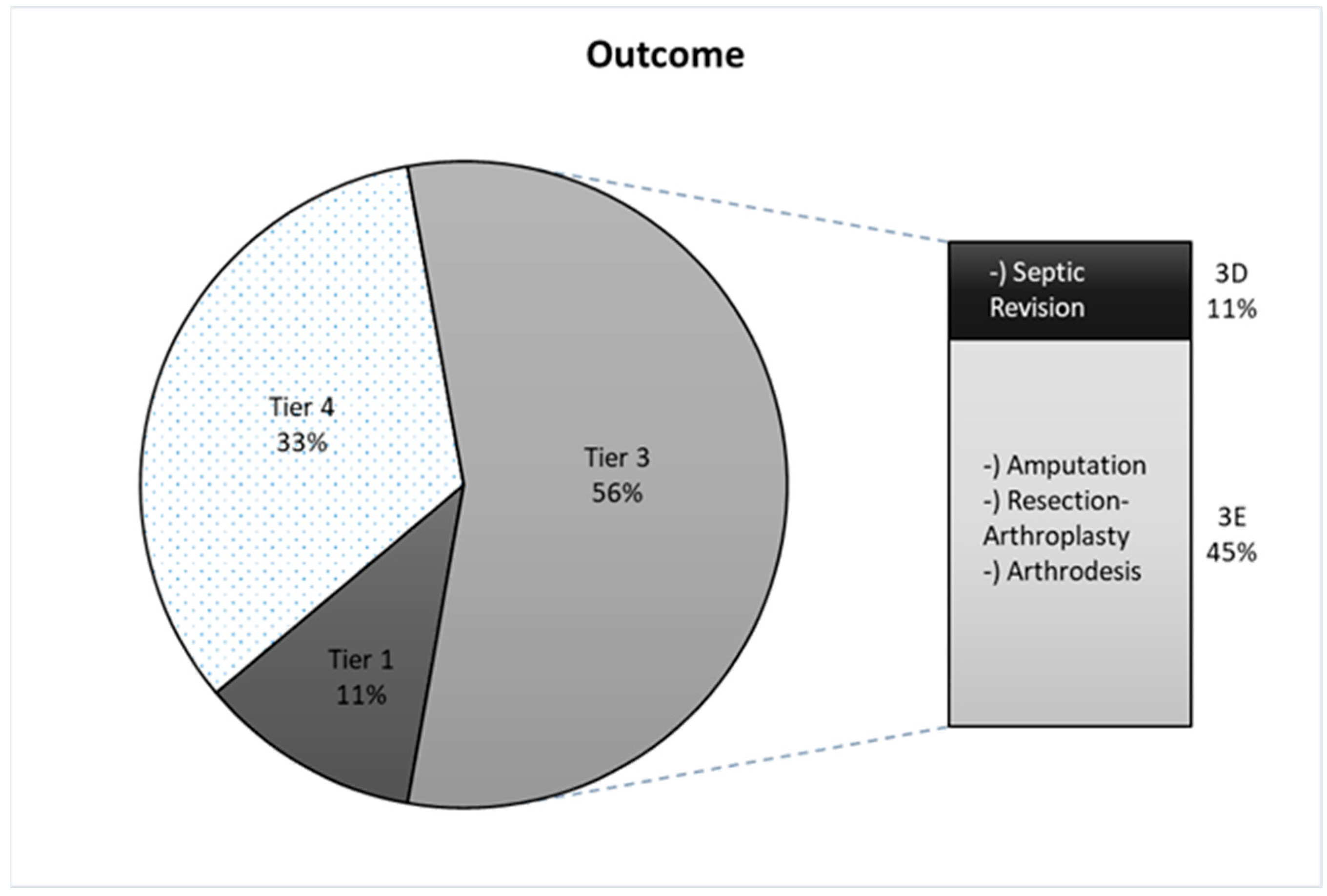
| Tier classification | |||
| I | 2 (11%) | 1 | 1 |
| II | 0 (0%) | 0 | 0 |
| III | 10 (55%) | 3 | 7 |
| IV | 6 (33%) | 5 | 1 |
| CCI (Average/SD) | 4.4/2.4 | ||
| McPherson Score | |||
| Infection Grade | I | II | III |
| 7 | 1 | 10 | |
| Systemic host grade | A | B | C |
| 3 | 12 | 5 | |
| Local extremity grade | I | II | III |
| 10 | 8 | 2 | |
| Total | Hip | Knee | ||||
|---|---|---|---|---|---|---|
| Total | Positive | Total | Positive | Total | Positive | |
| Preoperative Klebsiella positive samples (n) | 6 | 3 | 3 | |||
| Perioperative tissue total amount (average per surgery) | ||||||
| Tissue and Swabs | 415 (3.4) | 185 (1.8) | 164 (2.9) | 102 (2.1) | 251 (3.7) | 83 (1.6) |
| Sonication fluid | 58 (0.5) | 30 (0.3) | 27 (0.5) | 18 (0.3) | 31 (0.6) | 16 (0.3) |
| Samples in Monomicrobial Cases | 39 (3.9) | 13 (1.3) | ||||
| Samples in Polymicrobial Cases | 434 (4.8) | 172 (1.9) | ||||
| Total | Hip | Knee | ||||
|---|---|---|---|---|---|---|
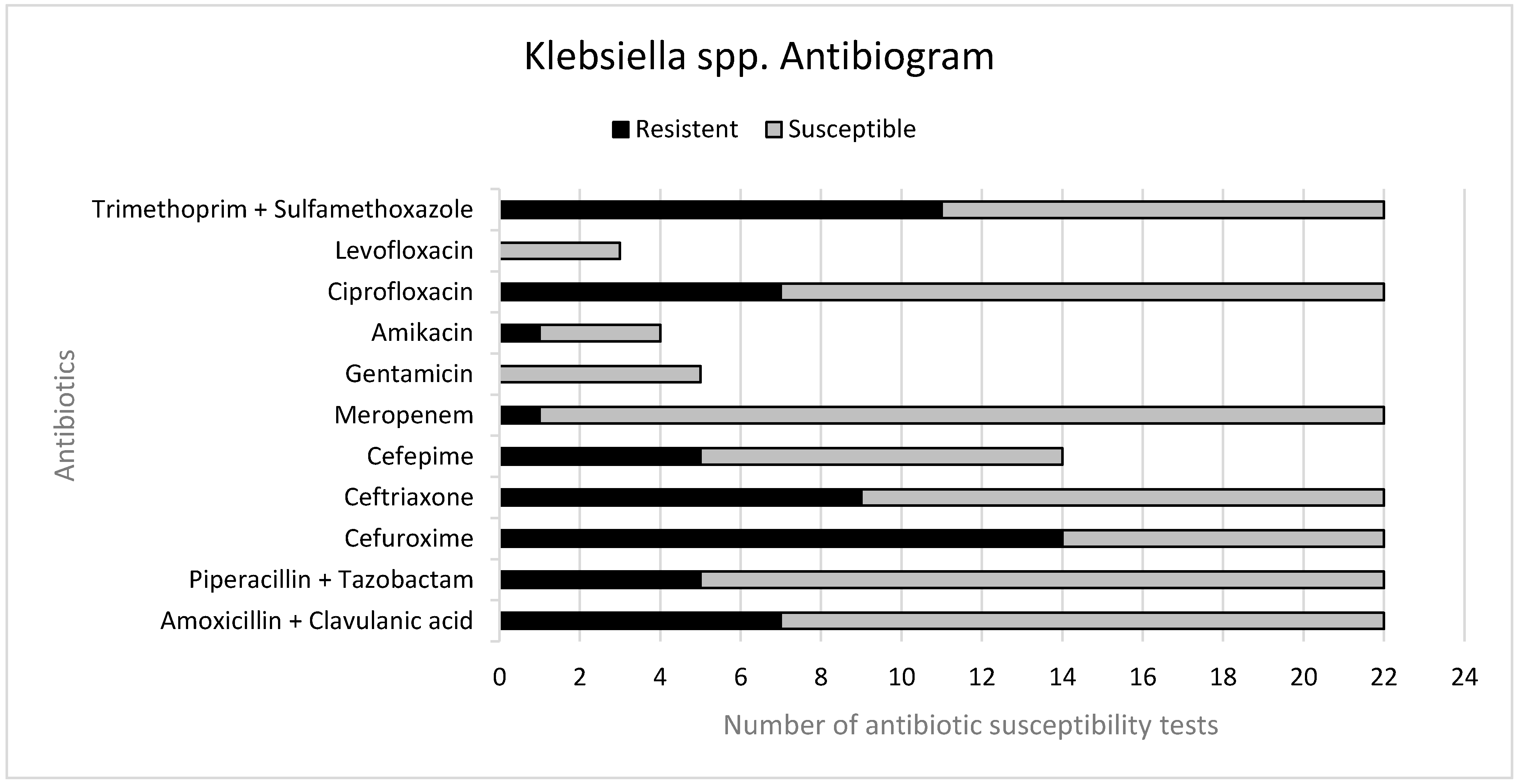
| Klebsiella spp. | ||||||
| Klebsiella pneumoniae | 18 | 11 | 7 | |||
| ESBL | 8 | 4 | 4 | |||
| 3 MRGN | 4 | 2 | 2 | |||
| 4 MRGN | 1 | 1 | 0 | |||
| Klebsiella oxytoca | 4 | 2 | 2 | |||
| 3 MRGN | 1 | 1 | 0 | |||
| Co-Pathogens (Polymicrobial Cases) | ||||||
| Gram-positive | 32 | 17 | 15 | |||
| Staphylococcus epidermidis | 8 | 4 | 4 | |||
| Enterococcus faecalis | 4 | 3 | 1 | |||
| Cutibacterium acnes | 4 | 2 | 2 | |||
| Corynebacterium | 4 | 2 | 2 | |||
| Staphylococcus aureus [MRSA] | 3 [2] | 1 [1] | 2 [1] | |||
| Staphylococcus lugdunensis | 2 | 1 | 1 | |||
| Staphylococcus hominis | 2 | 2 | 0 | |||
| Staphylococcus haemolyticus | 1 | 1 | 0 | |||
| Micrococcus luteus | 1 | 1 | 0 | |||
| Staphylococcus caprae | 1 | 0 | 1 | |||
| Staphylococcus haemolyticus | 1 | 0 | 1 | |||
| Enterococcus faecium | 1 | 0 | 1 | |||
| Gram-negative | 13 | 6 | 7 | |||
| Citrobacter koseri | 3 | 2 | 1 | |||
| Proteus mirabilis | 3 | 1 | 2 | |||
| Pseud. aeruginosa | 3 | 1 | 2 | |||
| Escherichia coli | 2 | 1 | 1 | |||
| Morganella morganii | 1 | 1 | 0 | |||
| Moraxella osloensis | 1 | 0 | 1 | |||
| Fungi | 4 | 3 | 1 | |||
| Candida albicans | 3 | 3 | 0 | |||
| Candida parapsilosis | 1 | 0 | 1 | |||
Disclaimer/Publisher’s Note: The statements, opinions and data contained in all publications are solely those of the individual author(s) and contributor(s) and not of MDPI and/or the editor(s). MDPI and/or the editor(s) disclaim responsibility for any injury to people or property resulting from any ideas, methods, instructions or products referred to in the content. |
© 2026 by the authors. Licensee MDPI, Basel, Switzerland. This article is an open access article distributed under the terms and conditions of the Creative Commons Attribution (CC BY) license.
Share and Cite
Bussek, V.; Tödtling, M.T.; Mitterer, J.A.; Achatz, V.; Tobudic, S.; Hofstaetter, J.G. The Role of Positive Klebsiella Culture in Revision Hip and Knee Arthroplasty. Pathogens 2026, 15, 164. https://doi.org/10.3390/pathogens15020164
Bussek V, Tödtling MT, Mitterer JA, Achatz V, Tobudic S, Hofstaetter JG. The Role of Positive Klebsiella Culture in Revision Hip and Knee Arthroplasty. Pathogens. 2026; 15(2):164. https://doi.org/10.3390/pathogens15020164
Chicago/Turabian StyleBussek, Vinzenz, Marion T. Tödtling, Jennyfer A. Mitterer, Veronika Achatz, Selma Tobudic, and Jochen G. Hofstaetter. 2026. "The Role of Positive Klebsiella Culture in Revision Hip and Knee Arthroplasty" Pathogens 15, no. 2: 164. https://doi.org/10.3390/pathogens15020164
APA StyleBussek, V., Tödtling, M. T., Mitterer, J. A., Achatz, V., Tobudic, S., & Hofstaetter, J. G. (2026). The Role of Positive Klebsiella Culture in Revision Hip and Knee Arthroplasty. Pathogens, 15(2), 164. https://doi.org/10.3390/pathogens15020164