
High Occurrence of Pathogenic Free-Living Amoebae in Arid Environments

 ,
,  , , , ,
  and
and 
Abstract
1. Introduction
2. Materials and Methods
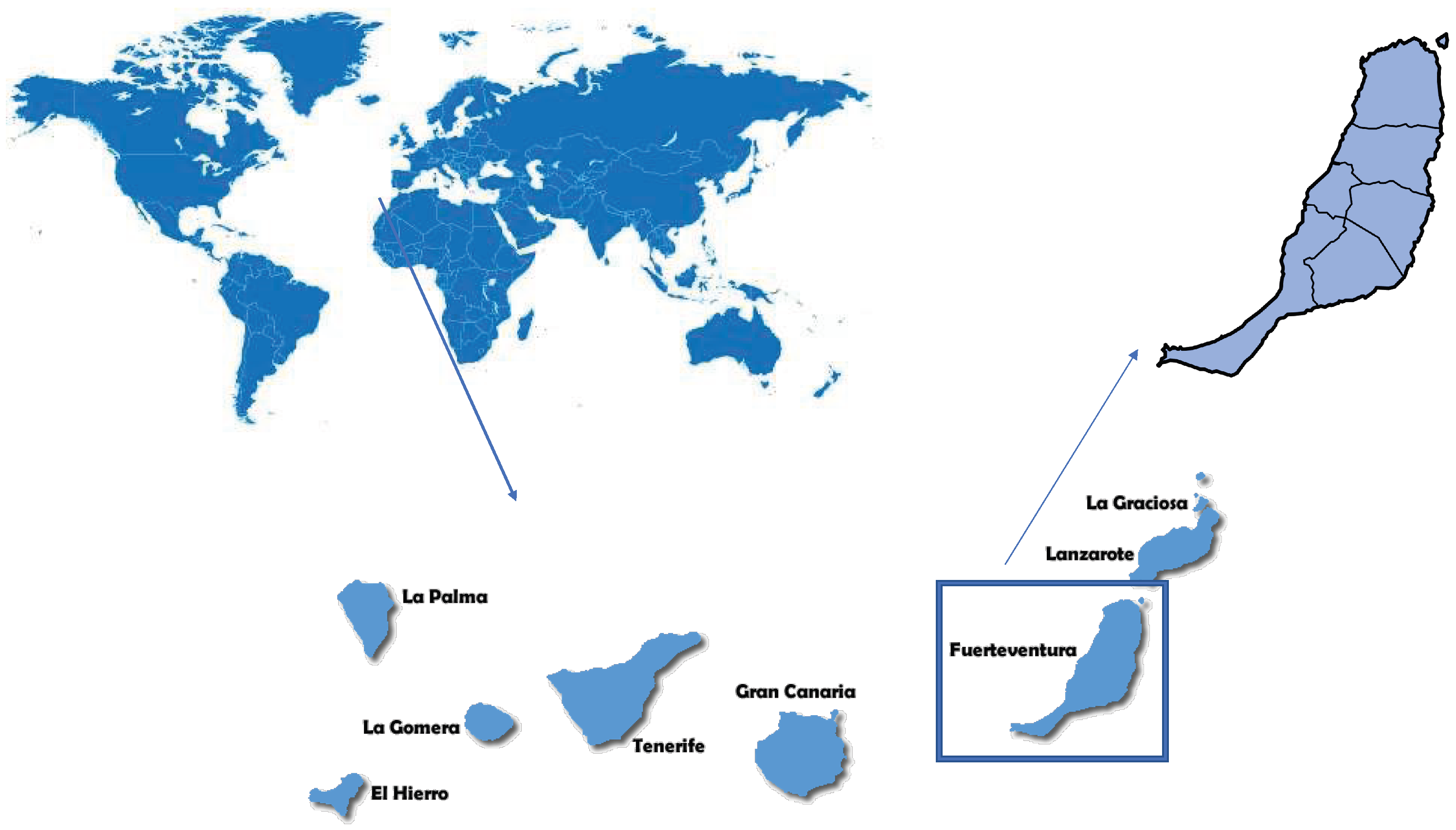
2.1. Sampling Site
2.2. Soil and Water Sampling
2.3. Characterization of Bacterial Load of Water
2.4. DNA Extraction from Soil and Water Samples
2.5. Multiplex Quantitative Real-Time PCR Assay (q-PCR)

| Parasite Species | Primers Sequences | DNA Fragment (bp) |
|---|---|---|
| Acanthamoeba spp. * | AcantF900 (5′-CCC AGA TCG TTT ACC GTG AA-3′) AcantR1100 (5′-TAA ATA TTA ATG CCC CCA ACT ATC C-3′) AcantProb (5′-JUN-CT GCC ACC GAA TAC ATT AGC ATG G-QSY-3′) | 180 |
| Naegleria fowleri * | NaeglF192 (3′-GTG CTG AAA CCT AGC TAT TGT AAC TCA GT-5′) NaeglR344 (5′-CAC TAG AAA AAG CAA ACC TGA AAG G-3′) NeglProb (5′-VIC-AT AGC AAT ATA TTC AGG GGA GCT GGG C-QSY-3′) | 153 |
| Balamuthia mandrillaris * | BalaF1451 (5′-TAA CCT GCT AAA TAG TCA TGC CAA T-3′) BalaR1621 (5′-CAA ACT TCC CTC GGC TAA TCA-3′) BalaProb (5′-6FAM-AG TAC TTC TAC CAA TCC AAC CGC CA-QSY-3′) | 171 |
| Vermamoeba vermiformis | Hv1227F (5′-TTA CGA GGT CAG GAC ACT GT- 3′) ** VermRv (5′ TGCCTCAAACTTCCATTCGC 3′) *** VermProb (5′-ABI-TTG ATT CAG TGG GTG GTG GT-QSY-3′) *** | 235 |
2.6. Free-Living Amoebae Isolation, PCR and Molecular Characterization of Isolates
- −
- Water samples: water was centrifuged at 2500 rpm, and the pellet was placed directly on NNA plates with a layer of heat-killed E. coli. After that, the plates were incubated at room temperature and observed daily.
- −
- Soil samples: The soil was placed directly into 2% of Non-Nutrient Agar (NNA) plates with a layer of heat-killed E. coli and incubated at room temperature, then monitored each day to check the presence of FLA.
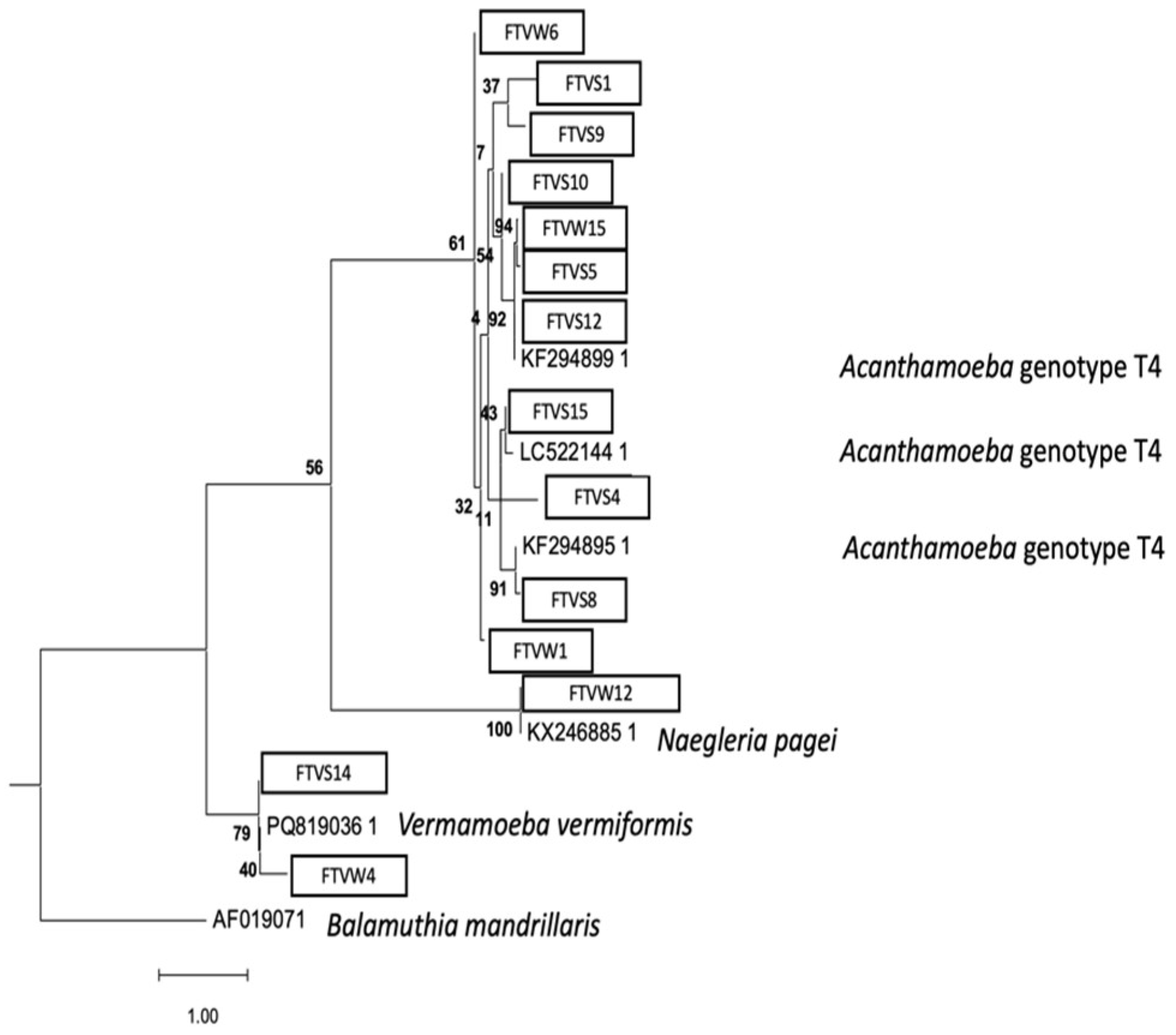
2.7. Phylogenetic Analysis
3. Results
3.1. Characterization of the Microbiological Load of Water
3.2. FLA Presence Detection by Multiplex q-PCR
3.3. FLA Presence Detection by Culture
4. Discussion
Supplementary Materials
Author Contributions
Funding
Institutional Review Board Statement
Informed Consent Statement
Data Availability Statement
Conflicts of Interest
References
- Rodríguez-Zaragoza, S. Ecology of free-living amoebae. Crit. Rev. Microbiol. 1994, 20, 225–241. [Google Scholar] [CrossRef] [PubMed]
- Visvesvara, G.S.; Moura, H.; Schuster, F.L. Pathogenic and opportunistic free-living amoebae: Acanthamoeba spp., Balamuthia mandrillaris, Naegleria fowleri, and Sappinia diploidea. FEMS Immunol. Med. Microbiol. 2007, 50, 1–26. [Google Scholar] [CrossRef] [PubMed]
- Schuster, F.L.; Visvesvara, G.S. Free-living amoebae as opportunistic and non-opportunistic pathogens of humans and animals. Int. J. Parasitol. 2004, 34, 1001–1027. [Google Scholar] [CrossRef] [PubMed]
- Król-Turmińska, K.; Olender, A. Human infections caused by free-living amoebae. Ann. Agric. Environ. Med. 2017, 24, 254–260. [Google Scholar] [CrossRef]
- Hara, T.; Yagita, K.; Sugita, Y. Pathogenic free-living amoebic encephalitis in Japan. Neuropathology 2019, 39, 251–258. [Google Scholar] [CrossRef]
- Pana, A.; Vijayan, V.; Anilkumar, A.C. Amebic Meningoencephalitis. In StatPearls [Internet]; StatPearls Publishing: Treasure Island, FL, USA, 2023. [Google Scholar]
- Siddiqui, R.; Makhlouf, Z.; Khan, N.A. The increasing importance of Vermamoeba vermiformis. J. Eukaryot. Microbiol. 2021, 68, e12857. [Google Scholar] [CrossRef]
- Pinna, A.; Porcu, T.; Boscia, F.; Cano, A.; Erre, G.; Mattana, A. Free-Living Amoebae Keratitis. Cornea 2017, 36, 785–790. [Google Scholar] [CrossRef]
- Arnalich-Montiel, F.; Lorenzo-Morales, J.; Irigoyen, C.; Morcillo-Laiz, R.; López-Vélez, R.; Muñoz-Negrete, F.; Piñero, J.E.; Valladares, B. Co-isolation of Vahlkampfia and Acanthamoeba in acanthamoeba-like keratitis in a Spanish population. Cornea 2013, 32, 608–614. [Google Scholar] [CrossRef]
- Alexandra, G.; Miller, D.; Huang, A.J. Amebic keratitis due to Vahlkampfia infection following corneal trauma. Arch. Ophthalmol. 1998, 116, 950–951. [Google Scholar] [CrossRef]
- Scheid, P.L.; Lâm, T.T.; Sinsch, U.; Balczun, C. Vermamoeba vermiformis as etiological agent of a painful ulcer close to the eye. Parasitol. Res. 2019, 118, 1999–2004. [Google Scholar] [CrossRef]
- Samba-Louaka, A.; Delafont, V.; Rodier, M.H.; Cateau, E.; Héchard, Y. Free-living amoebae and squatters in the wild: Ecological and molecular features. FEMS Microbiol. Rev. 2019, 43, 415–434. [Google Scholar] [CrossRef] [PubMed]
- Khan, N.A. Acanthamoeba: Biology and increasing importance in human health. FEMS Microbiol. Rev. 2006, 30, 564–595. [Google Scholar] [CrossRef]
- Álvarez-Hernández, C.; Cairós, C.; López-Darias, J.; Mazzetti, E.; Hernández-Sánchez, C.; González-Sálamo, J.; Hernández-Borges, J. Microplastic debris in beaches of Tenerife (Canary Islands, Spain). Mar. Pollut. Bull. 2019, 146, 26–32. [Google Scholar] [CrossRef] [PubMed]
- Carracedo, J.C. The Canary Islands: An example of structural control on the growth of large oceanic-island volcanoes. J. Volcanol. Geoth. Res. 1994, 60, 225–241. [Google Scholar] [CrossRef]
- Reyes-Batlle, M.; Wagner, C.; Zamora-Herrera, J.; Vargas-Mesa, A.; Sifaoui, I.; González, A.C.; López-Arencibia, A.; Valladares, B.; Martínez-Carretero, E.; Piñero, J.E.; et al. Isolation of thermotolerant Vermamoeba vermiformis strains from water sources in Lanzarote Island, Canary Islands, Spain. Acta Parasitol. 2016, 61, 650–653. [Google Scholar] [CrossRef]
- Reyes-Batlle, M.; Todd, C.D.; Martín-Navarro, C.M.; López-Arencibia, A.; Cabello-Vilchez, A.M.; González, A.C.; Córdoba-Lanús, E.; Lindo, J.F.; Valladares, B.; Piñero, J.E.; et al. Isolation and characterization of Acanthamoeba strains from soil samples in Gran Canaria, Canary Islands, Spain. Parasitol. Res. 2014, 113, 1383–1388. [Google Scholar] [CrossRef]
- Reyes-Batlle, M.; Wagner, C.; Zamora-Herrera, J.; Vargas-Mesa, A.; Sifaoui, I.; González, A.C.; López-Arencibia, A.; Valladares, B.; Martínez-Carretero, E.; Piñero, J.E.; et al. Isolation and Molecular Identification of Vermamoeba vermiformis Strains from Soil Sources in El Hierro Island, Canary Islands, Spain. Curr. Microbiol. 2016, 73, 104–107. [Google Scholar] [CrossRef]
- Lorenzo-Morales, J.; Monteverde-Miranda, C.A.; Jiménez, C.; Tejedor, M.L.; Valladares, B.; Ortega-Rivas, A. Evaluation of Acanthamoeba isolates from environmental sources in Tenerife, Canary Islands, Spain. Ann. Agric. Environ. Med. 2005, 12, 233–236. [Google Scholar]
- Díaz, F.J.; Tejedor, M.; Jiménez, C.; Dahlgren, R.A. Soil fertility dynamics in runoff-capture agriculture, Canary Islands, Spain. Agric. Ecosyst. Environ. 2011, 144, 253–261. [Google Scholar] [CrossRef]
- Helmreich, B.; Horn, H. Opportunities in rainwater harvesting. Desalination 2008, 248, 118–124. [Google Scholar] [CrossRef]
- Schallenberg-Rodríguez, J.C.; Veza, J.M.; Blanco-Marigorta, A. Energy efficiency and desalination in the Canary Islands. Renew. Sustain. Energy Rev. 2014, 40, 741–748. [Google Scholar] [CrossRef]
- Agencia Estatal de Meteorología (AEMET). Avance climatológico de Canarias. Mayo 2024 [Internet]. Las Palmas de Gran Canaria/Santa Cruz de Tenerife: Ministerio para la Transición Ecológica y el Reto Demográfico, AEMET. 6 June 2024. Available online: https://www.aemet.es/documentos/es/serviciosclimaticos/vigilancia_clima/resumenes_climat/ccaa/canarias/avance_climat_coo_may_2024.pdf (accessed on 17 June 2025).
- Maxwell® RSC Cell DNA Purification Kit Manufacturer’s Instructions. Available online: https://www.promega.es/products/nucleic-acid-extraction/genomic-dna/maxwell-rsc-cell-dna-purification-kit/?catNum=AS1370 (accessed on 25 June 2025).
- Qvarnstrom, Y.; Visvesvara, G.S.; Sriram, R.; da Silva, A.J. Multiplex Real-Time PCR Assay for Simultaneous Detection of Acanthamoeba spp., Balamuthia mandrillaris, and Naegleria fowleri. J. Clin. Microbiol. 2006, 44, 3589–3595. [Google Scholar] [CrossRef] [PubMed]
- Córdoba-Lanús, E.; Reyes-Batlle, M.; Domínguez-de-Barros, A.; Pérez-Pérez, P.; Rodríguez-Expósito, R.L.; García-Ramos, A.; Sifaoui, I.; García-Pérez, O.; Aneiros-Giraldez, G.; Piñero, J.E.; et al. Multiplex Real-Time Polymerase Chain Reaction Assay To Detect Acanthamoeba spp., Vermamoeba vermiformis, Naegleria fowleri, and Balamuthia mandrillaris in Different Water Sources. Am. J. Trop. Med. Hyg. 2024, 111, 785–790. [Google Scholar] [CrossRef] [PubMed]
- Cabello-Vílchez, A.M.; Reyes-Batlle, M.; Montalbán-Sandoval, E.; Martín-Navarro, C.M.; López-Arencibia, A.; Elias-Letts, R.; Guerra, H.; Gotuzzo, E.; Martínez-Carretero, E.; Piñero, J.E.; et al. The isolation of Balamuthia mandrillaris from environmental sources from Peru. Parasitol. Res. 2014, 113, 2509–2513. [Google Scholar] [CrossRef] [PubMed]
- Reyes-Batlle, M.; Díaz, F.J.; Sifaoui, I.; Rodríguez-Expósito, R.; Rizo-Liendo, A.; Piñero, J.E.; Lorenzo-Morales, J. Free living amoebae isolation in irrigation waters and soils of an insular arid agroecosystem. Sci. Total Environ. 2021, 753, 141833. [Google Scholar] [CrossRef]
- Diehl, M.L.N.; Paes, J.; Rott, M.B. Genotype distribution of Acanthamoeba in keratitis: A systematic review. Parasitol. Res. 2010, 120, 3051–3063. [Google Scholar] [CrossRef]
- Kuiper, M.W.; Valster, R.M.; Wullings, B.A.; Boonstra, H.; Smidt, H.; van der Kooij, D. Quantitative detection of the free-living amoeba Hartmannella vermiformis in surface water by using real-time PCR. Appl. Environ. Microbiol. 2006, 72, 5750–5756. [Google Scholar] [CrossRef]
- Schroeder, J.M.; Booton, G.C.; Hay, J. Use of subgenic 18S ribosomal DNA PCR and sequencing for genus and genotype identification of Acanthamoebae from humans with keratitis and from sewage sludge. J. Clin. Microbiol. 2001, 39, 1903–1911. [Google Scholar] [CrossRef]
- De Jonckheere, J.F.; Brown, S. The identification of vahlkampfiid amoebae by ITS sequencing. Protist 2005, 156, 89–96. [Google Scholar] [CrossRef]
- Kazutaka, K.; Standley, D.M. MAFFT Multiple Sequence Alignment Software Version 7: Improvements in Performance and Usability. Mol. Biol. Evol. 2013, 30, 772–780. [Google Scholar] [CrossRef]
- Capella-Gutiérrez, S.; Silla-Martínez, J.M.; Gabaldón, T. trimAl: A tool for automated alignment trimming in large-scale phylogenetic analyses. Bioinformatics 2009, 25, 1972–1973. [Google Scholar] [CrossRef] [PubMed]
- Stamatakis, A. RAxML version 8: A tool for phylogenetic analysis and post-analysis of large phylogenies. Bioinformatics 2014, 30, 1312–1313. [Google Scholar] [CrossRef] [PubMed]
- ISO 19250:2010; Water Quality—Detection of Salmonella spp. International Organization for Standardization: Geneva, Switzerland, 2010.
- ISO 9308-1:2014; Water Quality—Enumeration of Escherichia coli and Coliform bacteria—Part 1: Membrane Filtration Method for Waters with Low Bacterial Background Flora. International Organization for Standardization (ISO): Ginebra, Suiza, 2014.
- Pérez-Pérez, P.; Reyes-Batlle, M.; Morchón, R.; Piñero, J.E.; Lorenzo-Morales, J. Isolation and molecular identification of pathogenic free-living amoebae from environmental samples in Tenerife, Canary Islands, Spain. ACS ES&T Water 2025, 5, 2861–2889. [Google Scholar] [CrossRef] [PubMed]
- Meyer, K.J.; Appletoft, C.M.; Schwemm, A.K.; Uzoigwe, J.C.; Brown, E.J. Determining the source of fecal contamination in recreational waters. J. Environ. Health 2005, 68, 25–30. [Google Scholar]
- Majowicz, S.E.; Musto, J.; Scallan, E.; Angulo, F.J.; Kirk, M.; O’Brien, S.J.; Jones, T.F.; Fazil, A.; Hoekstra, R.M. International Collaboration on Enteric Disease ‘Burden of Illness’ Studies. The global burden of nontyphoidal Salmonella gastroenteritis. Clin. Infect. Dis. 2010, 50, 882–889. [Google Scholar] [CrossRef]
- Liu, H.; Whitehouse, C.A.; Li, B. Presence and Persistence of Salmonella in Water: The Impact on Microbial Quality of Water and Food Safety. Front. Public Health 2018, 6, 159. [Google Scholar] [CrossRef]
- Sorvillo, F.J.; Waterman, S.H.; Vogt, J.K.; England, B. Shigellosis associated with recreational water contact in Los Angeles County. Am. J. Trop. Med. Hyg. 1988, 38, 613–617. [Google Scholar] [CrossRef]
- Maciver, S.K.; Asif, M.; Simmen, M.W.; Lorenzo-Morales, J. A systematic analysis of Acanthamoeba genotype frequency correlated with source and pathogenicity: T4 is confirmed as a pathogen-rich genotype. Eur. J. Protistol. 2013, 49, 217–221. [Google Scholar] [CrossRef]
- Bhosale, N.K.; Parija, S.C. Balamuthia mandrillaris: An opportunistic, free-living ameba—An updated review. Trop. Parasitol. 2021, 11, 78–88. [Google Scholar] [CrossRef]
- Maciver, S.K. The threat from Balamuthia mandrillaris. J. Med. Microbiol. 2007, 56, 1–3. [Google Scholar] [CrossRef]
- Marciano-Cabral, F.; Cabral, G. Acanthamoeba spp. as Agents of Disease in Humans. Clin. Microbiol. Rev. 2003, 16, 273–307. [Google Scholar] [CrossRef] [PubMed]
- De Jonckheere, J.F. Origin and evolution of the worldwide distributed pathogenic amoeboflagellate Naegleria fowleri. Infect. Genet. Evol. 2011, 11, 1520–1528. [Google Scholar] [CrossRef] [PubMed]
- Salazar-Ardiles, C.; Pérez-Arancibia, A.; Asserella-Rebollo, L.; Gómez-Silva, B. Presence of Free-living Acanthamoeba in Loa and Salado Rivers, Atacama Desert, Northern Chile. Microorganisms 2022, 10, 2315. [Google Scholar] [CrossRef] [PubMed]
- Rivière, D.; Szczebara, F.M.; Berjeaud, J.M.; Frère, J.; Héchard, Y. Development of a real-time PCR assay for quantification of Acanthamoeba trophozoites and cysts. J. Microbiol. Methods 2006, 64, 78–83. [Google Scholar] [CrossRef]
- Aykur, M.; Dagci, H. Evaluation of molecular characterization and phylogeny for quantification of Acanthamoeba and Naegleria fowleri in various water sources, Turkey. PLoS ONE 2021, 16, e0256659. [Google Scholar] [CrossRef]
- Bass, D.; Chao, E.E.; Nikolaev, S.; Yabuki, A.; Ishida, K.; Berney, C.; Pakzad, U.; Wylezich, C.; Cavalier-Smith, T. Phylogeny of novel naked Filose and Reticulose Cercozoa:Granofilosea cl. n. and Proteomyxidea revised. Protist 2009, 160, 75–109. [Google Scholar] [CrossRef]
- Solbach, M.D.; Bonkowski, M.; Dumack, K. Novel Endosymbionts in Rhizarian Amoebae Imply Universal Infection of Unrelated Free-Living Amoebae by Legionellales. Front. Cell Infect. Microbiol. 2021, 11, 642216. [Google Scholar] [CrossRef]


| Sample Code | Locality | Coordinates | Samples Type | |
|---|---|---|---|---|
| W A T E R S A M P L E S | FTVW1 | Betancuria | 28.402567, −14.132785 | Creek |
| FTVW2 | Betancuria | 28.403492, −14.131744 | Creek | |
| FTVW3 | Betancuria | 28.388636, −14.098953 | Dam | |
| FTVW4 | Betancuria | 28.542434, −14.061964 | Ravine | |
| FTVW5 | Puerto del Rosario | 28.484910, −13.922606 | Ravine | |
| FTVW6 | Pájara | 28.260050, −14.162467 | Creek | |
| FTVW7 | Pájara | 28.254811, −14.176075 | Water raft | |
| FTVW8 | Antigua | 28.388114, −13.873759 | Regenerated water | |
| FTVW9 | Antigua | 28.387500, −13.873330 | Regenerated water | |
| FTVW10 | Pájara | 28.185210, −14.160825 | Pond | |
| FTVW11 | Pájara | 28.185210, −14.160825 | Pond | |
| FTVW12 | Pájara | 28.185210, −14.160825 | Pond | |
| FTVW13 | Pájara | 28.185210, −14.160825 | Pond | |
| FTVW14 | Pájara | 28.185210, −14.160825 | Pond | |
| FTVW15 | Pájara | 28.185210, −14.160825 | Pond | |
| FTVW16 | Pájara | 28.185210, −14.160825 | Pond | |
| FTVS1 | Betancuria | 28.403492, −14.131744 | Ravine | |
| FTVS2 | Betancuria | 28.423503, −14.057736 | Shore of a creek | |
| S O I L S A M P L E S | FTVS3 | Betancuria | 28.387584, −14.095719 | Dam |
| FTVS4 | Betancuria | 28.509744, −14.030560 | Dam | |
| FTVS5 | Betancuria | 28.542506, −14.061995 | Ravine | |
| FTVS6 | Betancuria | 28.543128, −14.061298 | Ravine | |
| FTVS7 | Puerto del Rosario | 28.484872, −13.922648 | Ravine | |
| FTVS8 | Pájara | 28.260050, −14.162467 | Ravine | |
| FTVS9 | Antigua | 28.388114, −13.873759 | Regenerated water | |
| FTVS10 | Antigua | 28.381031, −13.876235 | Regenerated water | |
| FTVS11 | Pájara | 28.185027, −14.160198 | Edge of Pond | |
| FTVS12 | Pájara | 28.185027, −14.160198 | Edge of Pond | |
| FTVS13 | Pájara | 28.185027, −14.160198 | Edge of Pond | |
| FTVS14 | Pájara | 28.185027, −14.160198 | Edge of Pond | |
| FTVS15 | Pájara | 28.185027, −14.160198 | Edge of Pond |
Disclaimer/Publisher’s Note: The statements, opinions and data contained in all publications are solely those of the individual author(s) and contributor(s) and not of MDPI and/or the editor(s). MDPI and/or the editor(s) disclaim responsibility for any injury to people or property resulting from any ideas, methods, instructions or products referred to in the content. |
© 2025 by the authors. Licensee MDPI, Basel, Switzerland. This article is an open access article distributed under the terms and conditions of the Creative Commons Attribution (CC BY) license.
Share and Cite
Pérez-Pérez, P.; Chao-Pellicer, J.; Rodríguez-Expósito, R.L.; Peña-Prunell, M.; Domínguez-de-Barros, A.; García-Pérez, O.; Córdoba-Lanús, E.; Reyes-Batlle, M.; Piñero, J.E.; Lorenzo-Morales, J. High Occurrence of Pathogenic Free-Living Amoebae in Arid Environments. Pathogens 2026, 15, 41. https://doi.org/10.3390/pathogens15010041
Pérez-Pérez P, Chao-Pellicer J, Rodríguez-Expósito RL, Peña-Prunell M, Domínguez-de-Barros A, García-Pérez O, Córdoba-Lanús E, Reyes-Batlle M, Piñero JE, Lorenzo-Morales J. High Occurrence of Pathogenic Free-Living Amoebae in Arid Environments. Pathogens. 2026; 15(1):41. https://doi.org/10.3390/pathogens15010041
Chicago/Turabian StylePérez-Pérez, Patricia, Javier Chao-Pellicer, Rubén L. Rodríguez-Expósito, Marco Peña-Prunell, Angélica Domínguez-de-Barros, Omar García-Pérez, Elizabeth Córdoba-Lanús, María Reyes-Batlle, José E. Piñero, and Jacob Lorenzo-Morales. 2026. "High Occurrence of Pathogenic Free-Living Amoebae in Arid Environments" Pathogens 15, no. 1: 41. https://doi.org/10.3390/pathogens15010041
APA StylePérez-Pérez, P., Chao-Pellicer, J., Rodríguez-Expósito, R. L., Peña-Prunell, M., Domínguez-de-Barros, A., García-Pérez, O., Córdoba-Lanús, E., Reyes-Batlle, M., Piñero, J. E., & Lorenzo-Morales, J. (2026). High Occurrence of Pathogenic Free-Living Amoebae in Arid Environments. Pathogens, 15(1), 41. https://doi.org/10.3390/pathogens15010041