1. Introduction
Huddled around a campfire, night market patrons spoon mouthfuls of chocolate ice cream and raspberry shortcake into their mouths. A teen and their father, wearing bike helmets, sit among strangers enjoying a sweet treat from The Shortcake Bar. Reginald “Doc” Wilson, the event organizer, adds another log to the fire. “Grab a beer and check out the band!” he coaxes market-goers, tending the fire with his bare hands. Live music resembling the sounds of 1990s Chicano funk band Ozomatli, food truck vendors calling out orders, patrons chatting with creatives about their wares coalesce to produce Columbia City Night Market’s polyphonic soundscape. Never without a soundtrack that is at once intentional and improvised, the market closes off to traffic two city blocks in one of Seattle’s busiest neighborhoods and reopens the space for Black vendors to tender their goods to the greater community.
Taking place in an historically Black, now gentrified neighborhood, the Columbia City Night Market is not Doc’s only project, however. In fact, the market is only part of a broader venture that started as a community bike ride protesting the ongoing systemic antiblack violence following the 2020 murder of George Floyd by Minneapolis Police. Determined to effect real, equitable, and sustainable change, Doc ditched the boardroom for the bike, harnessing the energy from Seattle’s grassroots Black Lives Matter protests to gather “bicycle riding demonstrators” for rides to and from Black-owned businesses (“City Stream” 00:10:07–00:10:08). Aptly named Peace Peloton (
Peace Peloton n.d.), the protest-ride-turned-nonprofit-organization blends Doc’s love for bicycling with his passion for cultivating enduring community and Black entrepreneurship.
A literal embodiment of a social justice movement, Peace Peloton applies language familiar to cycling to its mission, vision, and action. A “group of cyclists who, through the mutual energy benefits of drafting, work together to aid each other’s success” (
Peace Peloton), the “peloton” in Peace Peloton manifests as praxis in community projects, such as the Night Market, and in practice as the assemblage of cyclists who amass for one of Peace Peloton’s many group rides. Coined “the dopest party on two wheels” (
Peace Peloton), Peace Peloton’s group rides range from (critical) massive,
1 leisurely spins through the streets of Seattle to smaller, seventy-mile descents from Snoqualmie Summit to Puget Sound. All rides, regardless of the distance and effort, are supported, no-drop, and start and end in celebration. Not only, then, does Peace Peloton re-establish Black community in once predominantly Black areas, but its peloton counters the long-standing dominant culture of road cycling that has catered to and subsequently portrayed an overwhelmingly white, middle- to upper-class, cisgendered male demographic. The pelotons are, according to Doc, a direct response to the lack of melanated people in a city and cycling scene that touts itself as “open and inclusive” (
Facebook 2025 00:12:37–00:12:39). A rupture to antiblack, gentrified spaces of commerce and leisure, Peace Peloton, to invoke Christina Sharpe, imagines “new ways to live in the wake of slavery,” its peloton interjecting other ways, or the “other thans” ripe with Black aliveness and being (
Sharpe 2016, p. 18).
Here, I want to mine this rupture, reading Peace Peloton’s gatherings and the draft of turbulent air produced by their pelotons as radical Black performances and what Sharpe calls “wake work” (p. 17).
2 Acts of resistance and resilience enacted in the aftermath—the Wake—of the Transatlantic slave trade, “in the wake of George Floyd’s murder,” (Baumgarten and Jamerson-Flowers), Peace Peloton’s rides and gatherings as Wake work reject the ontological othering of Black bodies and being and dynamize what it means to be in a wake. Enacting Kevin Quashie’s sense of “worldmaking” (
Quashie 2021, p. 8), Peace Peloton’s Wake work challenges presumptions of the outdoors and road cycling as white spaces, for white people, and reclaims for Black worldmaking once majority Black, now gentrified spaces of commerce and leisure.
Yet, while engaging in a facet of their Wake work, Peace Peloton creates a wake of their own, their cycling pelotons generating a slipstream of turbulent air. Following a synopsis of Sharpe’s Wake, Quashie’s theoretical enjoinder Black aliveness, and their applications to Peace Peloton’s Wake work, I will turn from the Wake and cut to the break. Or, rather, ride a wake that is a break within the Wake. I find in Fred Moten’s lyrical register, Alexis Pauline Gumbs’ Afrofuturist project “Bluebellow,” and N. Fadeke Castor’s induction into the Yoruba ritual of Aswele the language for attending to Peace Peloton’s wake. Thus understood, Peace Peloton’s Wake work resists and rejects commonly held notions of cycling as an activity for white people, its stagings of Black cyclists and commerce rituals in Black world-making that reverse the course of antiblack ontologies and geographies and situate them within the broader corpus of the Afrodiasporic literature and cultural expressions.
2. Black (Non)Being
In
In the Wake: On Blackness and Being, Christina Sharpe theorizes the Wake as a precarious, liminal space imbued with Black death that shares a corporeal other with the wake trailing the slave ships as they made their perilous transatlantic crossing. This wake produced the Wake and an ontology of blackness and Black being that, according to Shannon Winnubst, resulted in “a difference in kind, not merely a matter of degree” (
Winnubst 2020, p. 182). Published in 2020 as a chapter in the book
Philosophy for Girls: An Invitation to a Life of Thought, Winnubst’s essay “The Ontological Crisis of the Human” inadvertently contributes to Sharpe’s theory of the Wake despite any explicit reference to it. In staying with Winnubst for a moment, we arrive perhaps less abstractly at the ontological implications of slavery for blackness and the Black body than through Sharpe’s metaphors, if only incrementally. Where Sharpe starts with theorizing and turns to examples, Winnubst begins with an imagined girl, Venus, who becomes, theoretically, at once no one and every person of African descent victimized—transformed—by the transatlantic slave trade. Abducted by slave traders, thrown “with strangers into this pestilent holding cell covered in urine and feces and vomit,” left to wait, to rot, to witness and endure Black death, until her abductors force her aboard a ship to a destination unknown. “She loses everything: her mother, her family, her friendship, her security, her dignity, her sense of the world and everything that matters. She loses herself” (
Winnubst 2020, p. 181). Reduced to a mark in a ledger, Venus experiences the ontological undoing Sharpe, citing Katherine McKittrick, terms the “mathematics of black life” (p. 35). In becoming cargo, she endures an un-naming, and un-gendering, a stripping not only of her personhood but of her humanity: “The girl is no longer human” (
Winnubst 2020, p. 182). Awash, adrift, submerged in antiblackness as total climate, the ontological undoing of Venus is also the ontological unraveling followed by a remaking of the meaning of human, for Black being has been rendered incompatible with human and thus assigned the status of nonbeing.
To be in the Wake, then, is to be in contention with an ontological legacy of slavery that has remade the definition of human to exclude Black being and tether it to presumptions of nonbeing and death. As a critical theory, the Wake offers a “means of understanding how slavery’s violence emerges within the contemporary conditions of spatial, legal, physic, material, and other dimensions of Black non/being
as well as in Black modes of resistance” (emphasis added,
Sharpe 2016, p. 14). The abduction of Venus, the girl marked “boat”—these symbolic deaths signal an ontological shift, a reordering of humanity, a violent erasure of personhood, but they do not—cannot—eradicate Black aliveness. Similarly, “while the [Wake] produces Black death and trauma—‘violence…precedes and exceeds Blacks’—we, Black people everywhere and anywhere we are, still produce in, into, and through the wake an insistence on existing: we insist Black being into the wake” (
Sharpe 2016, p. 11). For Black bodies and Black being to persist in the Wake—in spite of the Wake—constitutes the active resistance to those ontological (re)constructions of human that would insist otherwise.
Sharpe’s Wake and its contingency of Black death and inherited nonbeing do not, therefore, stand in contention with Quashie’s theory of Black aliveness. As Quashie himself notes, “The thinking on black being always has to countenance death, as the field of black pessimism makes clear. And perhaps no one has taken up this figuring of being and death more extensively than literary scholar Christina Sharpe” (p. 8). Quashie positions Black aliveness as an enjoinder to Black pessimism theories that start from a premise of nonbeing. He is not arguing that previous Black pessimism scholarship, such as Sharpe’s, forgoes or denies Black aliveness. He envisions his theory of Black aliveness as joining a discourse whose critical explorations acknowledge the paradoxical existence of Black “life in the midst and aftermath” of “the interminable conditions of coloniality and captivity” (
Quashie 2021, p. 8). Like Winnubst and Sharpe, Quashie believes that the transatlantic slave trade altered the ontology of the human to exclude Black bodies and being.
Yet, he is reticent to concede to an antiblack world as the singular, necessary starting point for perceiving Black being, especially when other worlds, namely a Black world, are seen as possibilities. Starting from a place of
aliveness, Quashie proposes “thinking through a
black world,” thereby decentering antiblackness and a singular worldview that is, he acknowledges, antiblack. Quashie’s proposed “aesthetic imaginary founded on black worldness” sets him and his theory of Black aliveness apart from other Black pessimists, whose theories constitute what he calls “conditions of black being” but do not adequately capture aliveness (
Quashie 2021, p. 9). Black aliveness theorizes, imagines, speculates, acts from a stance of blackness as aliveness and from an episteme in which the ontological remaking of human gives way to the “efficient and beautiful truth-claim ‘Black Lives Matter’” (
Quashie 2021, p. 13). From the position of Black aliveness, life matters urgently; Black lives entail an aliveness that contemplates other ways of being, an exercise in what Quashie terms “worldmaking” (p. 8).
Quashie’s departure from Sharpe and other Black pessimists reorients rather than replaces the project Sharpe commits to in
In the Wake. He introduces, or to draw from Sharpe, insists “Black being into the [Wake]” (
Sharpe 2016, p. 11) as a Black world imaginary “where the condition of being alive is of us” (
Quashie 2021, p. 12). Sharpe would likely consider exercises of worldmaking as examples of Wake work, for both Sharpe’s analytic of Wake work and Quashie’s exercise of worldmaking “seek to imagine otherwise from what we know
now in the wake of slavery” (
Sharpe 2016, p. 18). It is my position that Peace Peloton engages in the joint practices of Wake work and worldmaking as complementary modes for resisting, reclaiming, and reimaging antiblack climates, their peloton and its wake brimming with ontological possibilities as a praxis and practice towards Black aliveness.
3. Antiblackness as Total Climate
From manifestations of environmental racism to the policies and practices undergirding systemic racism, the transatlantic slave trade’s ontological impact on who counts as human left in its wake—the Wake—spaces, places, and activities hostile towards Black bodies, Black being, and Black worldmaking. This includes conceptions of the outdoors and the who and what participate in outdoor spaces and places and the activities therein. For Doc, childhood interactions with outdoorsy people doing outdoorsy things were limited to televised skiers, hikers, kayakers, white people “delighting in life” who did not look like him. Growing up in Gary, Indiana, far removed from these sites of leisure only added to the alienation Doc felt from the outdoors. Consequently, outdoors and outside held two very different meanings to a little Black boy growing up in an area devoid of white people and distanced by popular culture from the former. Outdoors constituted the untouchables and their activities he saw on TV, whereas outside was familiar, freer.
3 Later in life, while Doc found unexpected solace in Washington, D.C.’s flurry of “black excellence,” he continued to witness contradiction in the predominantly white corporate types who, like televised outdoor adventurers from his childhood, flaunted their expeditions scaling peaks and traversing rivers as if quotidian activities (
Facebook 2025 00:17:52).
Hardly a phenomenon exclusive to Doc, the words outdoors and outdoorsy as exclusive signifiers for recreational activities and those who participate in them have also undergone ontological makeovers that move to exclude Black bodies. The wilderness, for example, has, according to Jennifer C. James, become synonymous with “a white man’s space” and “camping […] a racially loaded signifier which points to the reification of spatial imaginaries in discussion of blacks and nature” (p. 178). James attributes this, in part, to what she terms “ecomelancholia,” or a psychological condition caused by slavery’s “legacies of trauma and injustice” that has “attenuated African Americans’ connection to nature” (p. 164). Racial “terror,” argues James, “symbolized most readily in the lynching in the woods, has deferred blacks from activities removed from urban or exurban spaces” (p. 165). Embodied in a collective conscious, or “natural memory,” the racialized trauma enacted in natural landscapes coupled with the mourning of “ecological loss and losses associated with ‘the land’ in a present where loss continues” is present in Black people as ecomelancholia (
James 2011, p. 167). On James’ account, ecomelancholia contributes to the adversarial encounters Black bodies have with the outdoors and being outdoorsy because they are subconsciously rehashing slavery’s legacy through these encounters. They are, in other words, submerged in the flora and fauna of the Wake.
Certainly, the outdoors has spelled doom for Black bodies, ocean bottoms and tree branches foretelling promises of Black death. To ignore this and its impact on a Black collective psyche would be to sidestep the premise I committed to retain, that of slavery’s ontological redefining of human, and I would add, outdoors and outdoorsy. Yet, ecomelancholia alone does not—cannot—explain in totality this ontology and the existential crisis it poses for Black bodies in general and for those, like Peace Peloton, seeking entry into the categories of outdoors and outdoorsy and the spaces, places, and activities associated with them. Moreover, to stop at ecomelancholia as the reason (re)victimizes Black bodies insofar as it assigns blame to them: nature traumatizes Black people, and therefore Black people avoid nature. This line of reasoning completely ignores the afterlife of slavery—life in the Wake—and the systemic means by which white supremacy has asserted itself on and into nature, thereby foreclosing outdoors and outdoorsy to Black bodies and being. Of course, James does not posit ecomelancholia as a stand-alone theory for contending with the exclusion of Black people from outdoor activities, such as road cycling. James’ theory, therefore, marks a critical turn into an ontology of outdoors and outdoorsy that excludes Black bodies and stymies attempts at Wake work and Black worldmaking.
The Wake deals Peace Peloton a particularly bad hand in virtue of their practices of staging, forming, and riding in a peloton. A peloton is, by definition, a group. More specifically, a peloton is a group of cyclists—outdoorsy people—who assemble outdoors for the purposes of group riding. The backward logic in a claim like “Black people aren’t outdoorsy, so they don’t assemble in groups to form pelotons” relies on the stereotype perpetuated by mass media that outdoor activities—camping, rock climbing, running, cycling—are lifestyles of leisure enjoyed by middle- to upper-class white folks. First, as Peace Peloton, Black Girls Do Bike, Ovarian Psychos, Major Taylor Association, North Star Cycling Club, Outside While Melanated, and countless other BIPOC outdoor recreation organizations demonstrate, this statement is false. Their existence, however, does more than emphasize a preponderance of evidence to the contrary; these organizations visibly take up outdoor spaces with Black bodies, as assemblages, as groups, as those instances white supremacy and antiblackness have long declared threatening, dangerous, and criminal.
Detailing the extensive history of policing and criminalizing Black gatherings well exceeds the scope of my project here and would border on restating the obvious. However, Sarah Jane Cervanak’s brief summation in her book
Black Gathering: Art, Ecology, Ungiven Life emphasizes a facet of this history complicit in an antiblack—and, therefore, anti-Peace Peloton—ontology of outdoors and outdoorsy (
Cervnak 2021). Building on Saidiya Hartman’s critical assessment of emancipation’s alleged gift of Black freedom, Cervanak emphasizes the right to (not)gather (p. 26). That is, just as Black freedom was a chimera, so too were Black people’s rights to assemble. As (non)gatherings, these assemblages “outside of anti-Black and anti-earth spatio-temporalities of capitalist regimes figured as a civic threat,” the conceptualization of Black gatherings as Black sedition (p. 6). Structurally imbricated in an ontology of outdoors and outdoorsy, Black gatherings as Black sedition undergirds what Cervanak, citing previous eco-critical theorists, terms “white ecology,” or the “fictionalized imposition of anti-earth and anti-Black narratives of the earth and Black people as given over to propertied regulation and inscription” (p. 7). White ecology’s enactment of “to gather” assumes an extractionist position, conceiving of both land and Black bodies as property to be gathered, their unregulated gatherings—assemblages rather than modes of extraction—as contamination, threatening, criminal, unruly and wild, numbers in a ledger, invasive species to be tamed and conquered. Cervanak’s (re)reveal of “the tenacious whiteness at the heart of mainstream environmentalism” (p. 7) accounts for the afterlife of slavery—the Wake—in the discursive production of outdoors and outdoorsy as signifiers of white ecology’s recreational enthusiasts who were and generally are not Black and decidedly not Black cyclists.
Black outdoor gatherings, in Cervanak’s view, have thus become synonymous with Black sedition and, more recently, with disruption and destruction. From calling the cops on Black folks enjoying a barbeque in a public park
4 to falsified news footage of Seattle’s Black Lives Matter protests and Capitol Hill Autonomous Zone (CHAZ),
5 the ill-fated rhetoric of white supremacy and antiblack climate produced by the Wake manifests as actions intended to stifle Black aliveness, squash Black worldmaking, and prevent Peace Peloton’s Wake work. Yet, as Christina Torres (
Torres 2022), editor of
Cyclista Zine, attests, “racialized and ableist constructs have always shaped the way the outdoor industry, recreationists, planning, and environmentalists approach natural and urban spaces” (
Outsider). In other words, antiblack ontologies have produced more than white ecology’s limitations on Black gatherings and on who counts as outdoorsy and to whom the outdoors belong. Antiblackness is sewn into society’s red-white-and-blue fabric, woven into the lycra of road cycling kits, and poured into every brick that lies beneath generations of the racialized roads upon which Peace Peloton rides.
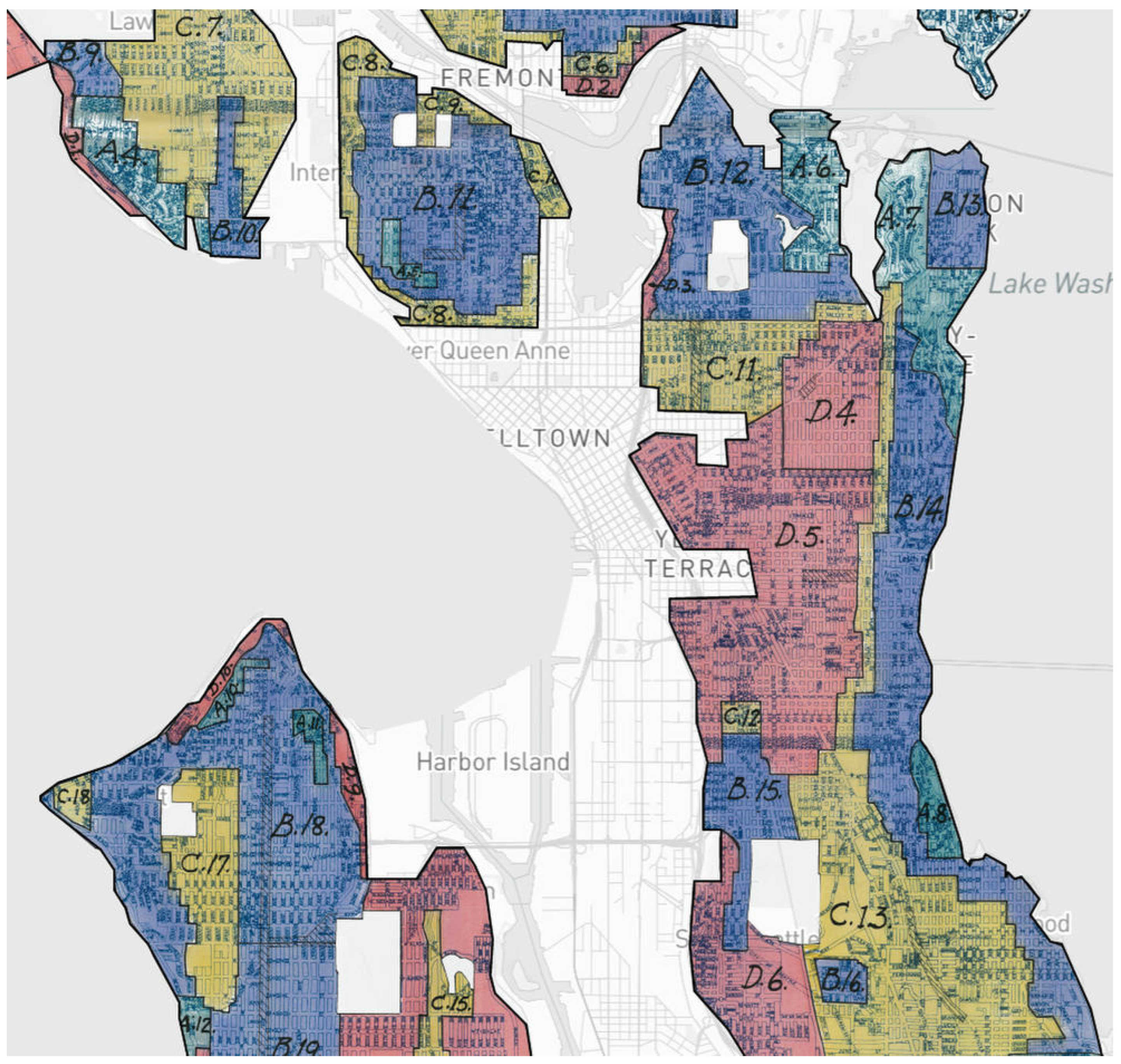
In the 1930s, Seattle city planners assigned a geography to the Wake, gave it a color, constructed borders through redlining and discriminatory lending practices.
6 Peace Peloton’s stomping grounds—or should we say pedaling pavement—D4 and D5 were deemed undesirable, dump sites for Seattle’s Black non-Aryan residents. While not without systemic oppressions produced by the Wake (poverty, food deserts, environmental racism, poorly funded schools, and derelict infrastructure, for example), Black worldmaking persevered, because, in these Black worlds, Black aliveness is an “aliveness that is everywhere and everything. Aliveness is inevitable because it is
totality” (
Quashie 2021, p. 23). From this aliveness sprang vibrantly rich communities and kinship bonds that ruptured the Wake’s epistemes, engaged in Wake work, and laid the figurative and literal pavement for Peace Peloton. Alongside these surges of Black aliveness, lines were drawn, maps created, streets and parks built towards an infrastructure and urban plan that assumed Black (non)being and antiblack notions of outdoors and outdoorsy (
Figure 1).
Over the course of the last two decades, Seattle’s Central District (D4) and Columbia City (D5), the latter home to the Night Market, have endured dramatic reconfigurations to their once densely Black communities. The once historically Black neighborhoods no longer reflect the majority Black demographic Seattle’s overtly racist and, for a time, legal segregation policies corralled into these “undesirable” pockets of the city. Thinly veiled endeavors to gentrify the areas creep not so discreetly into the neighborhoods as gains in urban planning projects aimed at cleaning up crime-ridden, derelict, and impoverished communities. “The violence of gentrification,” exposit Samudzi and Anderson, “mimics other violent displacements of capitalism” (
Samudzi and Anderson 2018, p. 42). They continue:
There are distinct relationships between gentrification and social cleansing: clear correlations between the entry of new residents into urban spaces and corresponding politics of the pricing out and displacement of long-existing residents and communities and the removal of undesirable aesthetics and behaviors (through, for example, imposed restrictions of loitering and noise).
(p. 43)
Ironically, an increase in sites for outdoor leisure activities and outdoorsy people operate as monikers for gentrification’s “social cleansing” and subsequent displacement in Seattle and elsewhere. In particular, the bicyclist, according to J. Stehlin, “functions as what Melody Hoffman calls a ‘rolling signifier,’ refracting in daily practice broader relationships of social power” (
Stehlin 2019, p. 6). Bike lanes become synonymous with “white lanes” as communities of color resist infrastructure projects they view as amenities “that encourage gentrification” (86). “Though bike lanes do not cause gentrification in isolation,” continues Stehlin, “support for bicycle infrastructure comes from the same social bloc that gentrification empowers and makes visible in urban: young, mostly white, upwardly mobile professionals” (86).
(Con)structurally antiblack, notions of outdoors and outdoorsy, gentrification, and corollary urban planning efforts, such as bike lanes, coalesce to form a unique interlocking system of oppressions that directly impacts how melanated cyclists navigate cityscapes such as Seattle. Their rides—their gatherings—including those staged by Peace Peloton, resist and revolt against “the violence of gentrification,” ontological exclusion from outdoor recreational activities, and a “history of exclusion within the sport [of cycling]” that screams “DO NOT ENTER” (
Lopez 2022, p. 24).
4. A Break, a Wake, in the Wake
Black gatherings are always already political expressions that happen “in spite of the state’s incessant prohibitions against such gathering” (Cervanak 10). Contributions to the Black radical tradition, these physical assemblages of Black bodies constitute, to recall Cervanak, aesthetic enactment. Peace Peloton’s radical amass(ing) of Black cyclists is an aesthetic performance of sorts, their coming-together known in cycling as staging. Staged in the Wake, Peace Peloton’s performance—their Wake work—ruptures those epistemes that seek to prohibit and eliminate Black gatherings, Black outdoor gatherings, Black cyclists, and Black cyclists gathering outdoors in peloton formation. Yet “Black gatherings happen; some livingness, with neither sanction nor extraction, manages to get through” (Cervanak 10), “to still produce in, into, and through the [Wake] an insistence on existing:“ (
Sharpe 2016, p. 11). Peace Peloton’s stagings insist Black aliveness into the Wake.
While Sharpe envisions the Wake as a generative space, she does not view its nexus—the wake created by slave ships making their multiple, perilous transatlantic crossings—as a positive, life-giving rupture in the sea and in space and time. On the other hand, the wake created by the Peace Peloton follows the physics of drafting in road bicycle group riding or racing. In “The Physics of Drafting in the Tour de France,” Rhett Allain does a brilliant job of breaking down the physics in layperson’s terms:
Just imagine that you could see the air as a cyclist rides by. The bike and human push this air in very complicated ways, but they don’t leave air undisturbed. Instead, there is a trail of turbulent air behind the rider. This turbulent air is easier to move through than plain air, thus decreasing the drag force of the trailing rider. Drafting decreases the overall power needed to ride at a constant speed or allows a rider to go slightly faster with the same power.
Situated within the group—otherwise known as the peloton—and behind at least one rider, the cyclist experiences an advantage from the wake—the trail of turbulent air—created by the rider(s) ahead of them. The trailing cyclist, riding in the wake, can produce less power yet maintain a consistent speed, work less, coast, fuel, hydrate, even rest and recover from a harder effort. Markedly different from the slave ships’ wakes, the wake produced by a peloton functions as a site of respite rather than a harbinger of perpetual death.
Perhaps Fred Moten’s notion of “the break” can help to unpack Peace Peloton’s wake as a break, as a fissure in the Wake, that starts from a premise of Black aliveness and moves towards an ontology of Black worldmaking (
Moten 2021, p. 85). To conceive of Peace Peloton’s wake as a break in the Wake provides, I think, a means of discussing the fissures in terms of their multiplicity and expanding on their potentiality as Black radical “performances” that are, to borrow from Moten, “liberatory, improvisatory[…]freedom drive” (p. 26). Simply put, “‘break’ is the place, cut, or interval in which the soloist departs from the jazz ensemble to take an instrumental solo that repeats the basic melody of a tune with variations” (
Lindberg 2005, p. 848). As Candice Jenkins aptly summarizes in her review of
In the Break, “Moten’s assessment of Black performance
as Black radicalism is shaped, in part, by his conviction that Black performance equals improvisation” (emphasis added,
Jenkins 2004, p. 344). These breaks, as improvised ruptures in Black performances, expose a liminal space brimming with generative and ontological potential, sites of Black radicalism “not to be mourned but opened and multiplied” (
Lindberg 2005, p. 850).
As a wake that is a break from the Wake, Peace Peloton’s stagings of radical Black performances rupture the ontology of slavery’s Wake to make room not only for other ways of Black being and aliveness but for manifestations of a wake that imagines otherwise. Peace Peloton’s peloton cuts away from the traditional and historically white compositions of the peloton, outdoors, and outdoorsy, cultivating within and without this break radicalized manifestations of the peloton as a space of mutual aid and Black survivance (survival and resistance). The improvised nature of Peace Peloton’s “dopest party on two wheels” (Peace Peloton)—unscripted conversations, unplanned soundtrack, undetermined amount and make-up of participants—further situates the peloton within the discourse of Black radical performance. The trail of turbulent air—the wake caused by a break—forms a wake that is a break from the Wake opened and multiplied. In the draft, in the wake, in the break, cyclists partake in a sharing of power, equitable rather than equal distribution of actual and perceived effort. In the draft, in the wake, in the break, Peace Peloton’s riders reciprocate mutual aid by producing a draft of their own while simultaneously drafting.
5. Reclaiming the Wake
Far from happenstance, Peace Peloton’s pelotons and gatherings—their Wake work and worldmaking—“occur,” to borrow from Marquis Bey, “at the scene of the crime itself” (
Bey 2020, p. 36). In, on, around, between, and within Seattle’s historically Black neighborhoods, Peace Peloton stages radical Black gatherings, traverses Seattle’s inner-city streets in peloton formation, and holds space for Black creatives, cyclists, communities, and accomplices to amass. Within their pelotons, drifting and drafting in their wake, Black people have connected with employers, partners, friends, and in other ways channeled their aliveness to make worlds. Speaking to the recuperative and generative potential of Peace Peloton’s wake, Charles Anselm, a Black cyclist, queries “can a united peaceful group reduce the societal drag of systemic racism on those who are impacted the most (
CityStream 2020 00:12:40–00:12:55). One of Peace Peloton’s regular riders, Anselm believes in the group’s potential to shift people’s perspectives about race, cultivating an awareness of the impacts of systemic racism by sharing stories. Likewise, Alison Marielle Desir, champions Peace Peloton’s reclamation of spaces that she describes as fear-inducing and restrictive to move through freely as a Black woman, “particularly since the 2020 reckoning,” or the wake of George Floyd’s murder (Baumgarten and Jamerson-Flowers 00:04:36–00:05:01). From within and behind the wake created by their peloton trails an ontology of Black aliveness that is thus recuperative and generative in ways similar to the reverse transatlantic crossings and ocean-front rituals carried out in Alexis Pauline Gumbs’ short story “Bluebellow” and N. Fadeke Castor’s book
Spiritual Citizenship: Transnational Pathways from Black Power to Ifa in Trinidad. By reversing course, the Black gatherings and their Black bodies in motion remake the Wake as a break in it, to it, and through it, thereby reclaiming the spaces and places it grimly possessed.
“Bluebellow,” Gumbs’ Afrofuturist haunting and haunted dive into the African diaspora, maps a contemporary transatlantic crossing that, for the protagonist, Serena, triggers urgent calls from ancestors, now mermaids, who beckon from mirrors to her and other “black people. Only black people who were descendants of the Middle Passage. Only black people who were descendants of the Middle Passage who had touched the Caribbean and had come back across the Atlantic in the other direction were getting the message” (
Gumbs 2017). Those who first heed the “mirror mermaids’” call gather in London, committed to responding, reticent to “cross the Atlantic again” lest it sever contact with their aquatic ancestral spirits. In the same vein as Black pessimism, Gumbs’ perceives of the Wake’s ontology in terms of totality. When “some enslaved people jumped because they couldn’t take it,” all “of us jumped, if not in body then in spirit. All of us stayed, if not in bone then in memory. Middle passage is the name for how we split from ourselves” (Gumbs). The reverse crossing thus constitutes a reunification with an “underwater twin” and “the part of us that drowned,” the reimagining of “so much separation” as “wholeness” (Gumbs). The story concludes from Serena’s sister’s perspective as she witnesses the ontology of the reverse crossing unfold and culminate in a ritual of return: “[Serena] seemed completely relaxed, slightly ahead of the other brown bodies, holding hands, gently pulling them as they walked into the water” (Gumbs). “Bluebellow’s” final line—“Meet me in the middle.”—should be read as an invitation rather than a foreboding induction into the Wake. The space and place of the wake produced by the slave ships has been reclaimed by a Black gathering and its bodies in motion, the ontology of the Wake ruptured by Black worldmaking and remade to center Black aliveness.
A similar ritual with parallel ontological outcomes is enacted by the Trinidadian Ifa community. Asewele invokes, like the calls from “Bluebellow’s” mirror mermaids, the power of travelers of African descent living in and lost to the diaspora. The purpose of Asewele, notes Castor, citing Oloye Solagbade Popola, is threefold: “one, to appease the souls of those who had died in transit; two, to use their souls to pray for protection and progress and three, to use it to ward of all curses of the enemy” (
Castor 2017, p. 152). Castor recounts her experience participating in the ritual and “the installment of Trinidad’s first Asewele shrine (p. 152). Her testimony evokes the profoundly intense emotions participants encounter as they gather then move, en mass, to the ocean’s shoreline “to honor and appease those lost souls who perished during the Atlantic slave trade, both on land and at sea, but especially those who lost their lives at sea” (p. 154). Castor attributes her ability to persevere through physical discomfort brought on by the journey to the ritual’s purpose. Like Serena, Castor places the importance of the practice above her own pain, heeding the ancestral call from the blue below to meet in the middle.
Unlike Gumbs’ Afrofuturist fictionalized account, Castor’s experience does not culminate in an underwater reunion. This is not to say, however, that Asewele’s Black gathering fails to imagine otherwise, foreclosing opportunities to heal the split represented in “Bluebellow” by the landlocked characters’ underwater twin. Asewele, Castor concludes of the ritual, embodies “movement that recognizes, reclaims, and reconnects the lost souls of the diaspora. For at one point were we not all travelers? To be clear, the ‘we’ I invoke here is a diasporic ‘we’: the descendants of those not meant to survive, those Africans who crossed the Atlantic” (p. 156), the “all” who jumped, “if not in body than in spirit” (Gumbs). The ritual’s ontological implications for Black being thus mirror those of the ritual in “Bluebellow.” That is, by reversing course, by meeting in the middle, these instances of Black aliveness reclaim a sense of wholeness robbed and held captive by the Wake. They reimagine through ritual and thus determine an ontology of Black worldmaking in which “Aliveness is inherence[…]Aliveness is of every being in a black world” (
Quashie 2021, p. 16) “where the matter of mattering matters indisputably” (
Quashie 2021, p. 13).
In an unintended nod to a subversive formation of a road cycling peloton, one of Gumbs’ characters quips, “Do the mermaids believe in critical mass?” (Gumbs). Peace Peloton embodies none other than an answer in the affirmative. Their ritual—the staging of a Black gathering and mobilization of Black radicalism in the form of a peloton—reverses course and generates an ontology of Black aliveness in ways similar to the rituals performed in Gumbs and Castor’s respective texts. Their ritual—a manifestation of Sharpe’s Wake work and Quashie’s worldmaking—promises, with each pedal stroke, ontological potentialities previously foreclosed by systemic antiblackness.
6. Conclusions: Black Worldmaking
The truth is, for all our declarations of Black and Brown lives mattering, the Pacific Northwest is hardly an antiracist haven, despite what lawn signs professing otherwise might say. “putting a yard sign out that represents Black Lives Matter,” quips Doc, “that is the absolute least you could do” (Baumgarten and Jamerson-Flowers 00:00:35–00:00:40). Like these houses and their effusive signage, the sport of road cycling in Seattle projects an image of exclusion, major brands and clubhouses, like Rapha, a reflection of a gentrified city wherein bike lanes have indeed functioned as white lanes, shuttling an overwhelmingly white population of “tech bros” to and from South Lake Union and the Central District. And yet, in their wake—in the Wake—“Black modes of resistance,” to recall Sharpe, persevere (p. 14). In the wake of George Floyd’s murder and in response to an absence of melanated people in the cycling scene, Doc mobilized his mode of resistance and “the bike became a tool to reclaim space and fight for social justice” (
Baumgarten and Jamerson-Flowers 2024, 00:01:24–00:01:30). Revolutions, he came to realize, must be accessible and come, like the innovations he witnessed abroad, from the community they aim to liberate, from the people living the struggle. So, too, he reasoned, should shifts in who controlled narratives about and access to outdoor leisure activities. Of Doc’s rolling revolution, reporter Brian Callahan concludes, “It’s a peloton not only meant to help other riders along but to help them break free” (
CityStream 2020 00:14:36–00:14:40).
In their respective writing, Gumbs and Castor narrate movement practices that, like Peace Peloton’s gatherings and rides, uplift and free Black people from the Wake’s hold. For the human and more-than-human Black characters in Gumbs’ short story, the reverse transatlantic crossing and transcendent return to the ocean provides a cathartic healing for the descendants of enslaved Africans that Castor attributes to the Asewele ritual. Likewise, for Doc, the ritual of road cycling “is [his] therapy,” his bike an extension of his body (Baumgarten 00:03:45–00:03:46). He finds the hypnotic whirring of a peloton and rhythm of his cadence cathartic. Riding, he is able to “release all of the heavy of the day,” a heavy that is undoubtedly weighted by the Wake (Baumgarten 00:04:37–00:04:41). As enduring sites of recuperative and generative Black worldmaking, Peace Peloton’s wake breaks the shackles of the Wake, leaving its riders feeling “free[…]and good in [their] body” (Desmir qtd in Baumgarten and Jamerson-Flowers 00:02:09–00:02:10, 00:02:12–00:02:13), empowered, and alive. To catalogue in the mutually constitutive corpuses of Black cultural productions and Black radical performances, Peace Peloton’s pelotons imbue them with sustaining power Doc envisioned for the movement.