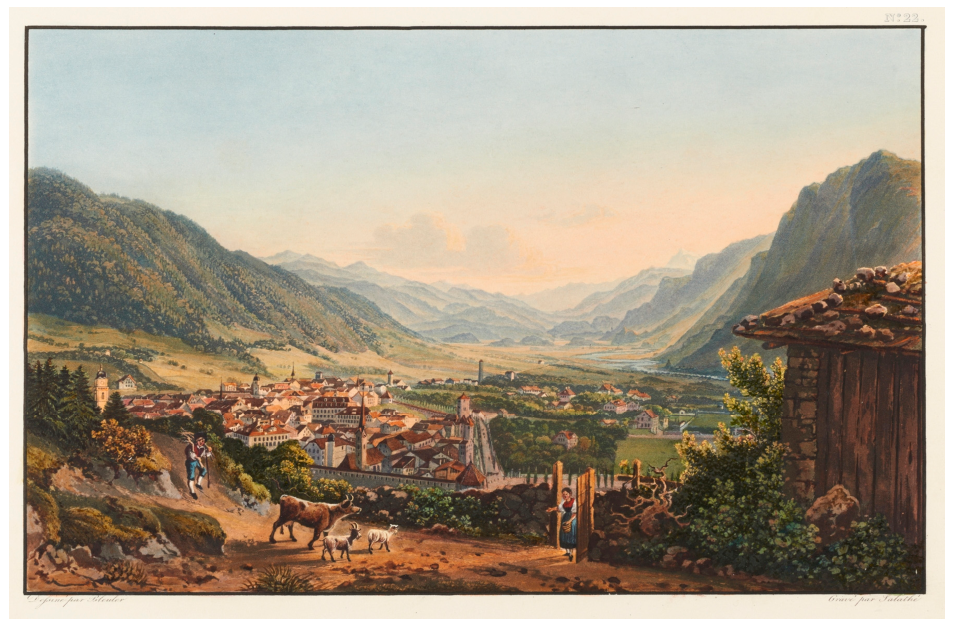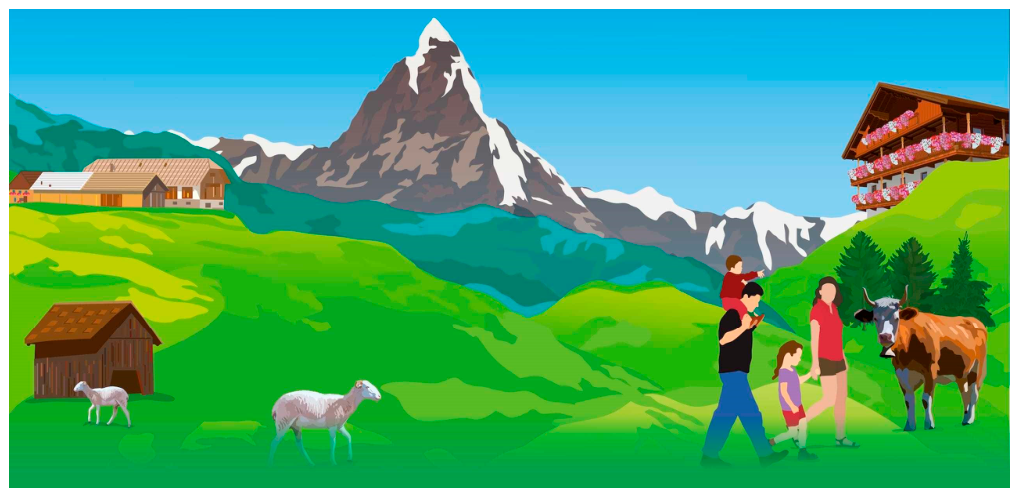
“The Denied Revolution”: Between Modernity and Tradition in Switzerland—On the Figure of the Peasant in the Swiss Identity Discourse


Abstract
1. Introduction
“By social imaginary, I mean something much broader and deeper than the intellectual schemes people may entertain when they think about social reality in a disengaged mode. I am thinking, rather, of the ways people imagine their social existence, how they fit together with others, how things go on between them and their fellows, the expectations that are normally met, and the deeper normative notions and images that underlie these expectations […] my focus is on the way people ‘imagine’ their social surroundings, and this is often not expressed in theoretical terms, but is carried in images, stories, and legends […] what is interesting in the social imaginary is that it is shared by large groups of people, if not the whole society […] the social imaginary is that common understanding that makes possible common practices and a widely shared sense of legitimacy.”(Taylor 2004, p. 23)
2. Foundational Figures in the Swiss National Imaginary: The Peasant, the Cow, and the Alps
“Wohl mir, daß ich dich endlich fand,Du stiller Ort am alten Rhein,Wo ungestört und ungekanntIch Schweizer darf und Deutscher sein!…Da raschelt’s drüben, und der Scherg,Zweifärbig, reckt das Ohr herein—Ich fliehe rasch hinan den Berg,Ade, du stiller Ort am Rhein!”
“Hier herrscht kein Unterscheid [sic!], den schlauer Stolz erfunden,der Tugend unterthan und Laster edel macht; […]Die Freiheit teilt dem Volk, aus unpartei’schen Händen,mit immer gleichem Maß Vergnügen, Ruh und Müh.Kein unzufriedner Sinn zankt sich mit seinem Glücke,man ißt, man schläft, man liebt und danket dem Geschicke.”(von Haller [1729] 1768, p. 6)
“Wann der entfernte Strahl die Schatten nun verlängert,und Phöbus müdes Licht sich senkt in kühle Ruh,so eilt die satte Schar, von Überfluß geschwängert,mit schwärmenden Geblöck gewohnten Ställen zu.”(von Haller [1729] 1768, p. 11)
“Reich genug ohne einen Heller,Glücklich auch im groben Zwilch,Tragen wir in kühle KellerMutten voll von Nidelmilch;Führen wir in ErntetagenUnsre hochgehäufte Wagen,Bey der Abendröthe Schein,Mit Gesang ins Tenn hinein.Aller Pracht und Hoffart spottenSchweizerbauern an dem Pflug;Quellenwasser, frische Schotten,Käs und Brod ist uns genug!Tragen wir auf braunen NackenBürden frisch gemähtes Heu;Trieft der Schweiß von Stirn und Baken,O wie herrlich schmeckt der Brey!”(Lavater [1767] 1788, pp. 102–3)
Wir nun pflanzen für uns selber;Unser nur ist Feld und Weid;Unsre Schaaf und unsre KälberMästen wir zu unsrer Freud;Jedes eigne Sichel mähet,Was er, nur für sich, gesäet;Und für Fürsten triefet, nichtUnser Schweiß vom Angesicht!(Lavater [1767] 1788, p. 104)
Gott im Himmel sey gepriesen!Er ists, der uns glücklich macht,Macht, daß uns Feld und WiesenAlles blüht, alles lacht!Er vermehret unsre Wiesen!Er, er ließ uns Schweizer werden!Er, er macht von TyrannereyUns und unsre Kinder frey!(Lavater [1767] 1788, p. 104)
Among other sources, Friedrich Schiller drew on Johannes Müller’s work on the history of Switzerland while preparing his play Wilhelm Tell, which consolidated the Swiss national myth.17 It was Schiller who took the most important step in equating the Old Confederates with peasants. Even before the curtain rises, one hears the Kuhreihen and the ringing of cowbells. The first three characters to appear are Kuoni, Ruodi, and Werni—a fisherman, a herdsman, and a hunter—who converse about rural life. The oath that is mythologized as the beginning of the Confederation is sworn, in Schiller’s version, on a meadow called the Rütli by the ordinary people. As Weishaupt explains, the main characters of the drama are, in a completely natural manner, transformed into “noble” peasants and herdsmen—generalized as equal members of “freedom-loving peasant democracies.” In accordance with the Enlightenment emphasis on the role of history, the interest of the bourgeois elites in folk life and folk culture had its deep roots in the desire for originality, which emerged simultaneously with the development of virtue philosophy. The figure of the peasant, with his unchanging customs, rituals, and traditions, was ideally suited to refresh a high culture that had grown somewhat weary. The source of spiritual renewal was sought in the birth of the nation. In this context, the peasant and rural folk culture were regarded as guarantors of tradition and continuity. They were functionalized in the name of bourgeois ideals.“The customs of the Old Swiss are explained by human nature and by their Alps […] In general, these old Confederates, especially the Alpine herdsmen, were natural men: in their features, when no passion made them fearsome, there was plain honesty, and strength in their entire bearing.”(Weishaupt 1992, pp. 63–64)16
“Die Männer, die erklären,Die Lüge muss zu Grund,Auf VaterlandsaltärenDer Freiheit Feuer nähren,sie sind der Schweizerbund.Den Donner hört man schreitenHoch ob der Berge Rund;Die Freien sieht man streiten,kühn wie vor alten Zeiten—Das ist der Schweizerbund.”
“If ‘everything we are and everything we have created on both sides [in Baden and in German-speaking Switzerland—D.K.] is the same,’ then what meaning does our democracy still have? It becomes nothing more than a form; it imparts no distinctiveness to our character; it no longer belongs to the substance of our soul?”(Bovet 1910, p. 566)20
3. Persistence of the Symbolic Representation
“All the peoples of the continent hiss through the stony night. Here, where we stand, time seems to rest; yet inside the mountain its acceleration—the headlong rush of civilization toward ever new triumphs and ever uglier catastrophes—becomes a numbing event. Is that back there not the truth of our world, and is this here before us not, after all, merely an illusion?”(von Matt 2012, p. 94)21
“The symbolic force of the mountains was something the cities had never been able to match, even though it was in the cities that all historical breakthroughs occurred, and from them that all the energies of change—of progress, that is—and of the connection to the ‘accelerated processes’ of world civilization emanated.”(von Matt 2012, p. 64)
“The historical dignity and greatness of our nation, and its rightful self-confidence, rest upon the realization of the democratic principle of popular sovereignty. Whoever lays hands on democracy deprives our people of its self-confidence and breaks its backbone.”
“The city that is to be founded must be a model city in the sense that it sets a development in motion which will naturally outpace it as well—thus not a terminus, not a dictate to which the standardization of all Swiss cities would have to conform.”(Burckhardt et al. [1954] 1990, p. 151)22
“The architect, after wandering alone through his dark and deserted Swiss city for an entire night, cast the end of a rope over a steel streetlamp of his own design early in the morning and hanged himself before the African sun grew too hot.”(Kracht 2008, p. 149)23
4. Conclusions
Funding
Data Availability Statement
Conflicts of Interest
| 1 | Guy P. Marchal, in his analysis of the Swiss imaginary, draws on Claude Lévi-Strauss’s concept of bricolage. In this concept, disparate elements are assembled by a subject according to its own identificatory criteria. The result is a simplified yet intelligible construct. Guy P. Marchal: Das ‘Schweizeralpenland’: eine imagologische Bastelei. In orig. “den unterschiedlichsten Überresten der Vergangenheit”. |
| 2 | In orig. “sittliche Verbesserung”. |
| 3 | The founding myth is understood here, following Jürgen Barkhoff, who draws on Herfried Münkler, as one of the “grand narratives” from which national identity is derived, since such narratives promise sense by “linking the past with the present.” (Barkhoff and Heffernan 2010, p. 9). |
| 4 | The field is understood here, following Pierre Bourdieu, as “ein Raum der Kräftebeziehungen zwischen Akteuren oder Institutionen, deren gemeinsame Eigenschaft darin besteht, über das Kapital zu verfügen, das dazu erforderlich ist, dominierende Positionen […] zu besetzen.” (Bourdieu 1999, p. 342). |
| 5 | In orig. “mit nationalen Institutionen und einer Revisionsklausel vor allem die Instrumente [geschaffen], um die inneren politischen Rahmenbedingungen kontinuierlich und doch auf friedlichem Weg dem beschleunigten wirtschaftlichen Wandel im Industriezeitalter anzupassen. Dieser Schritt war staatsrechtlich eine Revolution.” |
| 6 | Quotations from literary works will not be translated in the following text. |
| 7 | The French-speaking part of Switzerland is commonly referred to as Suisse romande. As Georges Andrey notes, this designation has a long-standing tradition. (Cf. Andrey 2015, p. 18). |
| 8 | The term “Welsch” derives from the Germanic word welsch, originally denoting Celtic and later Romance-speaking populations. Since the nineteenth century, the term “Welsche Schweiz” has been used primarily to designate the French-speaking part of Switzerland (Suisse romande). (Cf. Bigler 2026). |
| 9 | Alongside Gottfried Keller’s ambivalent stance, a decidedly affirmative position emphasizing cultural unity with the Germans enjoyed great popularity. Among the advocates of this notion of ethnic kinship was, among others, Conrad Ferdinand Meyer. (Cf. Charbon 1997, pp. 112–15). |
| 10 | The Helvetic Society, founded in 1761/1762 in Bad Schinznach by Isaak Iselin, Hans Caspar Hirzel, Joseph Anton Felix von Balthasar, and Daniel von Fellenberg as an association bringing together distinguished Enlightenment thinkers, set itself above all the goal of promoting concord within the Confederation. (Cf. Erne 2007). |
| 11 | The initiative was rejected in the vote, with 54.79 percent “No” votes against 45.21 percent “Yes” votes. Cf. URL https://www.admin.ch/de/nachhaltigkeitsinitiative (accessed on 7 August 2026). |
| 12 | The initiators did not conceal the fact that the initiative was fundamentally aimed at restricting the number of immigrants. On the contrary, they explicitly pointed to the looming “population explosion.” Cf. URL https://nachhaltigkeitsinitiative.ch/argumente/bevoelkerungs-explosion/ (accessed on 7 August 2026). |
| 13 | For example, this was how the victory of Christian Stucki in wrestling (Schwingen) competition at the Unspunnenfest in 2017 was celebrated. |
| 14 | That day, other newspapers such as Luzerner Zeitung, Tagesanzeiger or Neue Zürcher Zeitung also placed the same photograph of Christian Stucki on their front pages or on the front pages of their sports sections. |
| 15 | In orig.: “Die Geschichtskunde wird billig als eines der vornehmsten Mittel angesehen, die Tugend der Bürger und die Glückseligkeit der Staaten zu befördern.” |
| 16 | In orig.: “Die Sitten der Alten Schweizer werden durch die Natur der Menschen und ihre Alpen erläutert […] Überhaupt waren diese alten Eidgenossen, zumal die Alphirten, Naturmenschen: in ihren Gesichtszügen, wenn keine Leidenschaft sie furchtbar machte, war biedere Redlichkeit, Kraft in ihrer ganzen Gestalt.” |
| 17 | Written during the period of the Helvetic Republic (1798–1803), the drama was appropriated by various political forces, most often through its reference to the powerful figure of the freedom fighter, into which Wilhelm Tell had been transformed. The importance of the play for Switzerland is reflected in the initiative to erect a monument to Schiller on the occasion of the centenary of his birth. For this purpose, a rock formation in Lake Uri was transformed into a Schiller memorial. (Cf. Zeller 2010; Hentschel 2002, pp. 249–60). |
| 18 | In orig.: “die Idealgemeinschaft mit den Ahnen, den Stiftern des alten Bundes”. |
| 19 | In orig.: “Nicht umsonst o Heldenväter, kämpftet Ihr fürs höchste Gut, Seht es, Vaterlandesretter, Nicht umsonst floss Euer Blut, Heilig ist die Stunde.” |
| 20 | In orig.: “Wenn ‘alles, was wir sind und was wir geschaffen haben hüben und drüben [im Badischen und in der deutschen Schweiz—D.K.] dasselbe ist’, was hat denn unsere Demokratie für eine Bedeutung? Sie ist nur noch eine Form; sie gibt unserem Charakter keine Eigenart; sie gehört nicht zum Inhalt unserer Seele.” |
| 21 | In orig.: “Alle Völker des Kontinents zischen durch die steinerne Nacht. Hier, wo wir stehen, scheint die Zeit zu ruhen, im Berg drin aber wird ihre Beschleunigung, wird das Voranstürzen der Zivilisation zu immer neuen Triumphen, zu immer hässlicheren Katastrophen, ein betäubendes Ereignis. Ist das da hinten nicht die Wahrheit unserer Welt und das hier vorn eben doch nur eine Illusion?” |
| 22 | In orig.: “Die Stadt, die es zu gründen gilt, soll eine Musterstadt sein in dem Sinne, daß sie eine Entwicklung einleitet, die natürlicherweise auch sie überholen wird, also nicht eine Endstation, nicht ein Diktat, dem die Standardisierung aller Schweizer Städte folgt.” |
| 23 | In orig.: “der Architekt, nachdem er eine ganze Nacht alleine durch seine dunkle und menschenleere Schweizer Stadt gelaufen war, warf frühmorgens das Ende eines Seiles über eine von ihm selbst entworfene, stählerne Strassenlaterne und erhängte sich, bevor die afrikanische Sonne zu heiss wurde.” |
| 24 | In Orig. “Die Vorstellung, man könne ohne mythische Erzählungen, Bilder und Zeichen leben, ist eine Täuschung, sowohl für den Einzelnen wie für die Gesellschaft.” |
| 25 | In Orig. “Das Rütli und der Tunnel, das sind zwei zeichenhafte Wirklichkeiten der Schweiz. Beide wollen mitbedacht sein, wenn es gilt, den Standort unseres Landes in der modernen Zivilisation zu bestimmen.” |
References
- Anderson, Benedict. 1983. Imagined Communities: Reflections on the Origin and Spread of Nationalism. London and New York: Verso. [Google Scholar]
- Andrey, Georges. 2015. Introduction. De la Burgondie à la Romandie ou la recherche d’un nom. In La Suisse Romande. Quatre Regards. Edited by Georges Andrey, Jean-Pierre Villard, Alexandre Papaux and François Cherix. Genève: Éditions Slatkine, pp. 17–25. [Google Scholar]
- Barkhoff, Jürgen, and Valerie Heffernan. 2010. Einleitung: >Mythos Schweiz<. Zur Konstruktion und Dekonstruktion des Schweizerischen in der Literatur. In Schweiz Schreiben. Zu Konstruktion und Dekonstruktion des Mythos Schweiz in der Gegenwartsliteratur. Edited by Jürgen Barkhoff and Valerie Heffernan. Berlin and New York: De Gruyter. [Google Scholar]
- Bigler, Niklaus. 2026. Welsche. In Historisches Lexikon der Schweiz (HLS). Available online: https://hls-dhs-dss.ch/de/articles/027282/2013-10-10/ (accessed on 9 August 2026).
- Bleuler, Johann Ludwig. 1830. Ansicht der Stadt Chur und ihrer Umgebung. © Public domain: Vue de la ville de Coire et de ses environs—Artvee. Available online: https://artvee.com/dl/vue-de-la-ville-de-diessenhofen-et-du-couvent-de-catherinenthal/ (accessed on 7 August 2026).
- Blocher, Eduard. 1910. Die schweizerische Nation. In Wissen und Leben. Edited by Verein Wissen und Leben. Zürich: Rascher, vol. 5, p. 451. [Google Scholar]
- Bourdieu, Pierre. 1999. Die Regeln der Kunst. Frankfurt am Main: Suhrkamp. [Google Scholar]
- Bovet, Ernest. 1910. Die schweizerische Nation. In Wissen und Leben. Edited by Verein Wissen und Leben. Zürich: Rascher, vol. 5, p. 566. [Google Scholar]
- Burckhardt, Lucius, Max Frisch, and Kutter Markus. 1990. achtung: Die Schweiz. In Schweiz als Heimat? Edited by Max Frisch. Frankfurt am Main: Suhrkamp, pp. 133–79. First published 1954. [Google Scholar]
- Charbon, Rémy. 1997. Zweieiige Zwillinge?—Schweizer Schriftsteller und Deutsches Reich 1871–1914. In Figuren des Fremden in der Schweizer Literatur. Edited by Corina Caduff. Zürich: Limmat, pp. 109–29. [Google Scholar]
- Erne, Emil. 2007. Helvetische Gesellschaft. In Historisches Lexikon der Schweiz, Version von 2004 (Artikel aus der HLS-Druckversion, bearbeitet am 05.12.2007). Available online: https://hls-dhs-dss.ch/de/articles/016429/2007-12-05/ (accessed on 11 May 2026).
- Gessner, Salomon. 1756. Idyllen. Zürich: Gessner. [Google Scholar]
- Hentschel, Uwe. 2002. Mythos Schweiz. Tübingen: Niemeyer. [Google Scholar]
- Herder, Johann Gottfried. 1989. Werke in zehn Bänden. Edited by Martin Bollacher and Günter Arnold. Frankfurt am Main: Deutscher Klassiker Verlag, B. 6. [Google Scholar]
- Hirzel, Johann Caspar. 1989. Die Wirthschaft eines philosophischen Bauers. In Das geistige Zürich im 18. Jahrhundert. Texte und Dokumente von Gotthard Heidegger bis Heinrich Pestalozzi. Edited by Max Wehrli. Basel: Birkhäuser. First published 1761. [Google Scholar]
- Hobsbawm, Eric. 1990. Nations and Nationalism Since 1780. Programme, Myth, Reality. Cambridge: Cambridge University Press. [Google Scholar]
- Keller, Gottfried. 2026. Gedichte. Heidelberg: Historisch-Kritische Gottfried Keller-Ausgabe (HKKA), p. 140. First published 1846. Available online: https://www.gottfriedkeller.ch/GG/EG/EG_06.htm (accessed on 24 March 2026).
- Kracht, Christian. 2008. Ich Werde hier sein im Sonnenschein und im Schatten. Köln: Kiepenheuer & Witsch. [Google Scholar]
- Lavater, Johann Caspar. 1788. Lied für Schweizerbauern. In Schweizerlieder. Edited by Johann Caspar Lavater. Zürich: VI Lied, pp. 102–3. First published 1767. [Google Scholar] [CrossRef]
- Leuthy, Jakob. 1998. Nationalgruss. In ‘O Schweizerland, du schöne Braut’. Politische Schweizer Literatur 1798–1848. Edited by Rémy Charbon. Zürich: Limmat, p. 561. First published 1848. [Google Scholar]
- Loetscher, Hugo. 2003. Die urbanen Platters—die andere helvetische Tradition. In Lesen statt klettern. Edited by Hugo Loetscher. Zürich: Diogenes, pp. 11–21. [Google Scholar]
- Maggetti, Daniel. 1995. L’invention de la Littérature Romande (1830–1910). Lausanne: Payot. [Google Scholar]
- Maissen, Thomas. 2010. Geschichte der Schweiz. Baden: Hier und Jetzt. [Google Scholar]
- Maissen, Thomas. 2015. Schweizer Heldengeschichten und was Dahintersteckt. Baden: Hier und Jetzt. [Google Scholar]
- Marchal, Guy P. 1992. Das ‘Schweizeralpenland’: Eine imagologische Bastelei. In Erfundene Schweiz. Konstruktionen nationaler Identität. Edited by Guy P. Marchal and Aram Mattioli. Zürich: Chronos, pp. 37–49. [Google Scholar]
- Marchal, Guy P. 2007. Schweizer Gebrauchsgeschichte. Basel: Schwabe. [Google Scholar]
- Müller, Dominik. 1997. “Wo ungestört und ungekannt Ich Schweizer darf und Deutscher sein!”. Gottfried Keller im Spannungsraum zwischen der Schweiz und Deutschland. Jahrbuch für internationale Germanistik XXIX: 85–104. [Google Scholar]
- Oprecht, Hans. 1937. Rede gehalten vor der Delegiertenversammlung der Neuen Helvetischen Gesellschaft. Mitteilungen der Neuen Helvetischen Gesellschaft XXIII: 42–43. [Google Scholar]
- Rousseau, Jean-Jacques. 1761. Julie ou la Nouvelle Héloïse. Amsterdam: Marc-Michel Rey. [Google Scholar]
- Tanner, Albert. 1996. Direkte Demokratie und soziopolitische Integration des Mittelstandes, der Arbeiterschaft und Bauern in der Schweiz 1830–1914. In Wirtschaftliche und soziale Integration in Historischer Sicht. Edited by Eckart Schremmer. VSWG Beihefte 128. Stuttgart: Franz Steiner, pp. 184–212. [Google Scholar]
- Tanner, Albert. 2002. Willensnation versus Kulturnation. In Nation und Nationalismus in Europa. Kulturelle Konstruktion von Identitäten. Edited by Catherine Bosshart-Pflüger, Joseph Jung and Franziska Metzger. Frauenfeld, Stuttgart and Wien: Huber, pp. 179–203. [Google Scholar]
- Taylor, Charles. 2004. Modern Social Imaginaries. Durham and London: Duke University Press. [Google Scholar]
- Töpffer, Rodolphe. 1852. La partie pittoresque des voyages de De Saussure. In Mélanges. Edited by Rodolphe Töpffer. Genf: Mème Maison, pp. 95–119. [Google Scholar]
- von Haller, Albrecht. 1768. Die Alpen. In D. Albrechts von Haller Versuch Schweizerischer Gedichte. Zentralbibliothek Zürich, AWA 431. Zürich: Bey Füesslin und Compagne, pp. 3–23. First published 1729. [Google Scholar] [CrossRef]
- von Matt, Peter. 2012. Das Kalb vor der Gotthardpost. Zur Literatur und Politik der Schweiz. München: Hanser. [Google Scholar]
- Wälti, Christian. 1998. Der neue Schweizerbund. In ‘O Schweizerland, du schöne Braut’. Politische Schweizer Literatur 1798–1848. Edited by Rémy Charbon. Zürich: Limmat, pp. 558–59. First published 1848. [Google Scholar]
- Website of the People’s Initiative. n.d. Keine 10 Millionen Schweiz! Nachhaltigkeitsinitiative. Available online: https://nachhaltigkeitsinitiative.ch/initiative/ (accessed on 7 August 2026).
- Weishaupt, Matthias. 1992. Bauern, Hirten und “frume edle puren”: Bauern- und Bauernstaatsideologie in der spätmittelalterlichen Eidgenossenschaft und der nationalen Geschichtsschreibung der Schweiz. Basel and Frankfurt am Main: Helbing & Lichtenhahn. [Google Scholar]
- Zeller, Rosmarie. 2010. Schiller, Friedrich. In Historisches Lexikon der Schweiz (HLS). Available online: https://hls-dhs-dss.ch/de/articles/012255/2012-10-18/ (accessed on 9 August 2026).


Disclaimer/Publisher’s Note: The statements, opinions and data contained in all publications are solely those of the individual author(s) and contributor(s) and not of MDPI and/or the editor(s). MDPI and/or the editor(s) disclaim responsibility for any injury to people or property resulting from any ideas, methods, instructions or products referred to in the content. |
© 2026 by the author. Licensee MDPI, Basel, Switzerland. This article is an open access article distributed under the terms and conditions of the Creative Commons Attribution (CC BY) license.
Share and Cite
Komorowski, D. “The Denied Revolution”: Between Modernity and Tradition in Switzerland—On the Figure of the Peasant in the Swiss Identity Discourse. Humanities 2026, 15, 123. https://doi.org/10.3390/h15090123
Komorowski D. “The Denied Revolution”: Between Modernity and Tradition in Switzerland—On the Figure of the Peasant in the Swiss Identity Discourse. Humanities. 2026; 15(9):123. https://doi.org/10.3390/h15090123
Chicago/Turabian StyleKomorowski, Dariusz. 2026. "“The Denied Revolution”: Between Modernity and Tradition in Switzerland—On the Figure of the Peasant in the Swiss Identity Discourse" Humanities 15, no. 9: 123. https://doi.org/10.3390/h15090123
APA StyleKomorowski, D. (2026). “The Denied Revolution”: Between Modernity and Tradition in Switzerland—On the Figure of the Peasant in the Swiss Identity Discourse. Humanities, 15(9), 123. https://doi.org/10.3390/h15090123