1. Introduction
In his ‘Ten O’Clock’ lecture delivered on 20 February 1885, James McNeill Whistler (1834–1903) declared that ‘the story of the beautiful is already complete’ (
Whistler 1888, p. 29).
1 Yet research on the art of Whistler, the American-born painter who became one of the most influential figures in late nineteenth-century Japonisme and the Aesthetic Movement, remains ongoing. In particular, his work
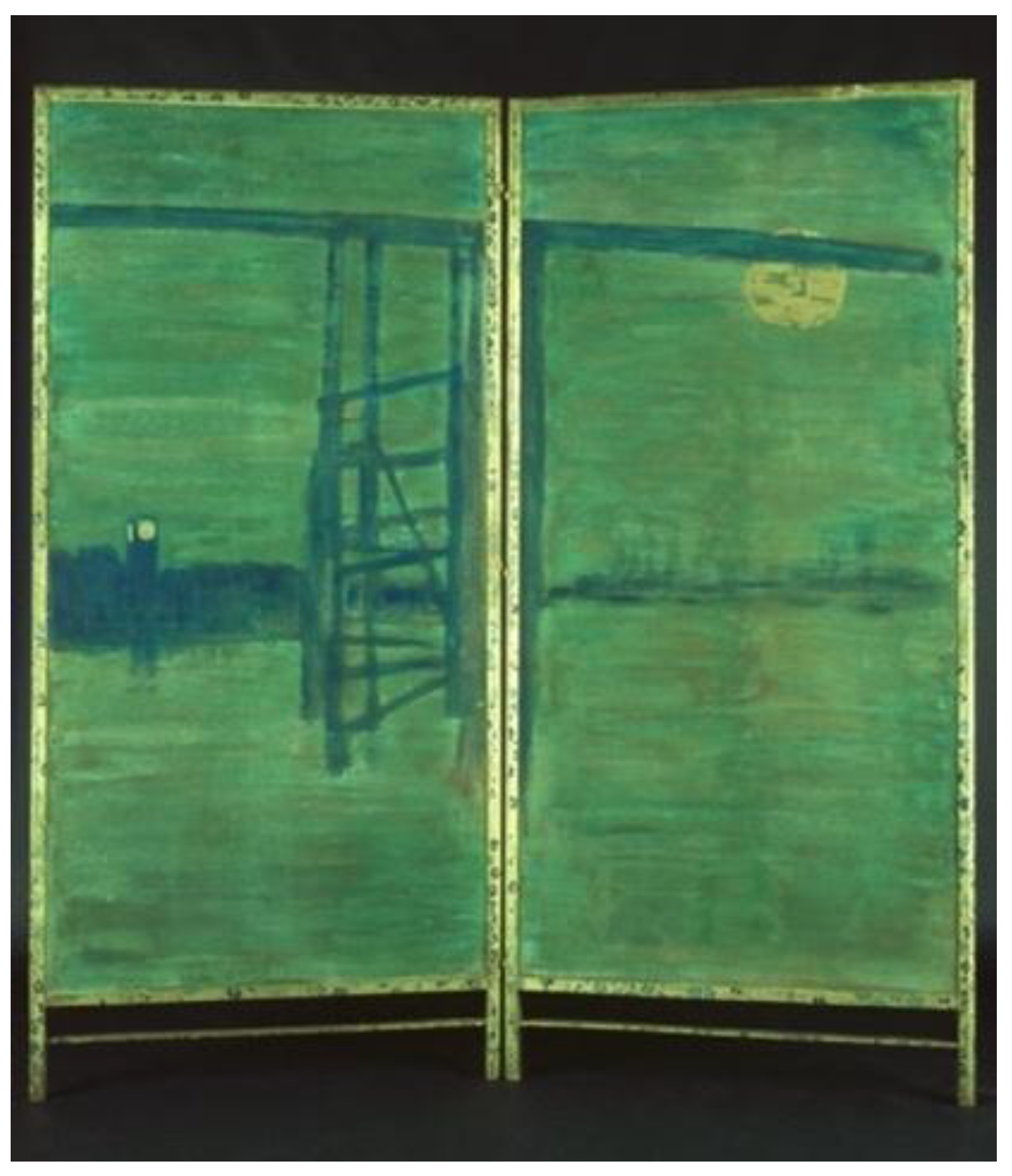
Blue and Silver: Old Battersea Bridge (1871/1873, The Hunterian, University of Glasgow) (
Figure 1) harbours undisclosed elements regarding its production process and the Japanese
kachō-ga—a traditional genre of bird-and-flower painting—affixed to the reverse of this nocturnal scene of the River Thames. The faded and damaged surface of
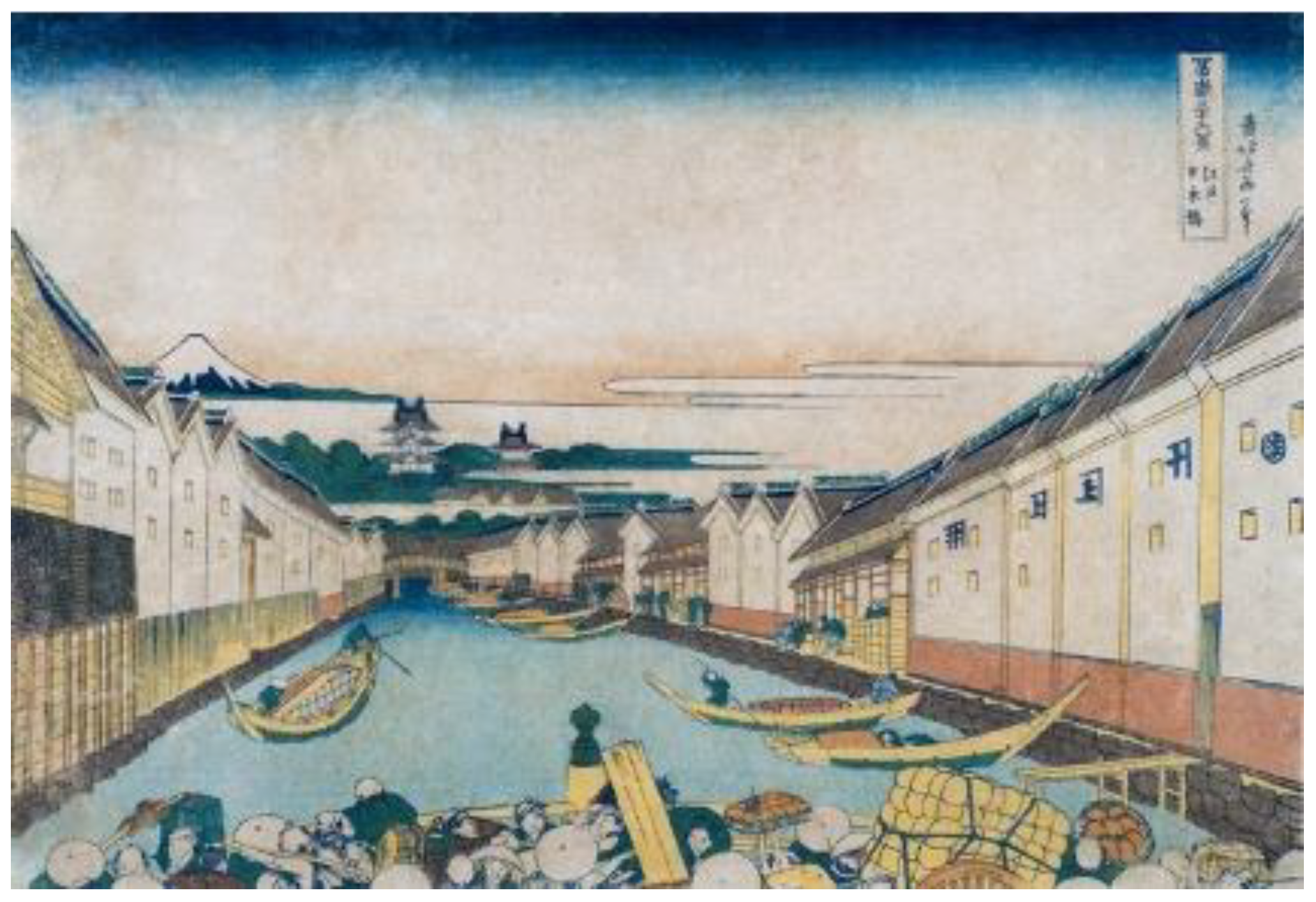
Birds and Blossoms, Autumn (1867), the
kachō-ga by Nampo Joshi, complicates ascertaining its original appearance, seemingly offering few clues as to why Whistler decided to pair this piece with his own composition (
Figure 2).
2Whistler’s profound engagement with Japanese art has long been recognised in art-historical scholarship, and his collection of Japanese objects has received considerable attention (
T. Watanabe 1991;
Ono 2003). His interests were neither static nor merely decorative; over the course of his career, it evolved from the citation of exotic objects towards a deeper pictorial assimilation of East and West (
Ono 2003). In early works such as
La Princesse du Pays de la Porcelaine (1863–1865), Japanese
kimonos, fans, and the blue-and-white porcelain that then fascinated him function as exotic attributes lending the canvas a fashionable rarity. By the late 1860s, however, Whistler had begun to fuse rather than merely display his sources: in
Sketch of a Figure with Flowers and Japanese Fans (1867–1870), a model in classical Greek drapery holds a Japanese fan. In the later
Four Ladies in Japanese Costume (1880s, Fitzwilliam Museum), his delicate line renders Greek and Japanese garments all but indistinguishable. This impulse to reconcile disparate traditions—Greek and Japanese, past and present—was, as Whistler himself implied in his ‘Ten O’Clock’ lecture, central to his conviction that ‘Art feeds not upon Nations’ (
Whistler 1888, p. 29).
Blue and Silver: Screen, with Old Battersea Bridge represents perhaps the fullest material expression of this synthesis. On its front, Whistler transposed a nocturnal view of the Thames into a close-up, vertically attenuated composition indebted to Japanese
ukiyo-e—and in particular to Utagawa Hiroshige’s (1797–1858) treatment of bridges in the
One Hundred Famous Views of Edo (1856–1858) series, which is clear from
Caprice in Purple and Gold: The Golden Screen (1864) and
Symphony in White, No. 2: The Little White Girl (1864). To the reverse he affixed a Japanese
kachō-ga. Far from incidental, this pairing of a Western nocturne with an Eastern bird-and-flower painting gathered within a single object the very elements—flower, bird, wind (landscape), and moon—that the phrase
kachō fūgetsu (花鳥風月) enshrines as the essence of natural beauty. Whistler is said to have admired such depictions of nature in conversation with the Japanese statesman Kaneko Kentarō (1853–1942) (
Ono 2008). The screen is therefore best understood not as a chance juxtaposition but as a considered act of cross-cultural composition.
What has not been explored in depth, however, are the specifics of the works incorporated into Whistler’s artistic practice—their provenance, makers, and the networks through which they reached him. The
kachō-ga on the reverse of
Blue and Silver: Old Battersea Bridge is a case in point. While Nakayama’s pioneering work first drew attention to its presence and laid the essential groundwork for its study (
Nakayama 1982, pp. 1–10;
Nakayama 1995, pp. 315–30;
Ono 2003, pp. 74–75), the identity of the work’s creator and the circumstances by which it may have travelled from Japan to Whistler’s studio remain open questions that the present study seeks to address.
These questions are significant not only for Whistler studies but also for the broader understanding of cross-cultural artistic exchange between Japan and the West during a pivotal moment of transition.
3 This study aims to elucidate them by undertaking a systematic investigation of currently verifiable historical materials concerning Nampo Joshi (
Ono 2026), contributing to a broader understanding of Japanese sources and the possibility of their influence on Whistler’s creative output.
4 2. Nampo and Nankoku
The
kachō-ga affixed to Whistler’s screen provides some information about the artist. The right-hand painting was completed at the end of August 1867, whilst the left-hand painting was completed in early September of the same year, at a location known as Meirindō. Beneath the kanji characters, two seals are affixed; the upper seal reads ‘Takei Tsuru’ and the lower seal can be deciphered as ‘Nampo’.
5 This indicates that Takei Tsuru was her given name, whilst Nampo was her art name. The honorific ‘Joshi’ (madam/lady) denotes that the artist was female. However, an artist named Takei Tsuru, operating under the art name Nampo, does not appear in historical records. Such an absence is characteristic of female painters of the period rather than exceptional. In the late Edo era, a woman’s path to artistic training differed fundamentally from the formal, guild-like apprenticeships of schools such as the Kano; professional formation could ordinarily be achieved only through a painter within her own family or through entry into the comparatively open social sphere of the
bunjin (literati), in which female participation was tolerated to a degree unusual for the period (
Fister 1988). Even the most accomplished women of the Nanga tradition bear this out—Ike (Tokuyama) Gyokuran (1727/8–1784), schooled within the literati circle that gathered at her family’s teahouse and matured as a painter alongside her husband Ike Taiga, and Ema Saikō (1787–1861), launched by a Rangaku-scholar father who arranged her instruction (
Fister 1991, pp. 108–30). Women of Nampo’s standing were thus formed through informal immersion in a workshop and its circle rather than through documented institutional enrolment, and the silence of the official record is itself a symptom of this mode of training. Furthermore, the precise location of the Meirindō has yet to be identified.
A primary lead for investigating Nampo is a concise biography recorded in the
Naikoku Kaiga Kyōshinkai Shuppin Ryakufu [Brief Biographies of Exhibitors at the National Painting Competitive Exhibition], compiled by the Exhibition Department of the Ministry of Agriculture and Commerce. It states: ‘Ōzawa Nampo resides at 1-chōme, Hamachō, Nihonbashi Ward, Tokyo Prefecture. She is the daughter of Takei Jūrō and was born in August of the second year of the Kōka era (1845). She became the wife of Ōzawa Nankoku
6 and studied painting under Aoki Nanka’ (
Nōshōmushō Hakurankai-gakari 1884, p. 65). This description effectively demonstrates that ‘Takei’ was Nampo’s maiden name and Tsuru was her given name. The mention of her birth in the second year of Kōka, which corresponds to 1845 in the Gregorian calendar, shows that she was twenty-two years old when she painted the piece affixed to the reverse of Whistler’s work. Ōzawa Nankoku, recorded as her husband, was born in July 1844 and was one year older than her (
S. Watanabe 1883, p. 78).
7 Since the Takei family is not known to have produced painters, and since the screens were executed while she was still unmarried, it was almost certainly the second of the two avenues outlined above—the open Nanga network surrounding her master Nanka—that gave the young Takei Tsuru her access to instruction.
While primary sources concerning Nampo are scarce, her husband Nankoku is comparatively better documented. This is partly due to his work as an illustrator for the
Tōkyō Meishō Zue [Views of Famous Places in Tokyo], published in 1877 (
Okabe 1877), and his illustrations for the publications of William Elliot Griffis (1843–1928), a government-funded foreign employee.
8 Records indicate that Nankoku maintained a residence in Nihonbashi—the pre-eminent heart of Tokyo—and was actively involved in local civic affairs, suggesting a significant degree of his socio-economic success.
9 Therefore, by cross-referencing materials pertaining to Nankoku, this study intends to highlight the life led by Nankoku and Nampo.
The earliest surviving records regarding the couple are found in Griffis’ diaries. His entries reveal that Nankoku visited him on Sunday, 26 April 1874. The entry for the following day, the 27th, contains the notation: ‘Afternoon, Ōishi, Artist’s Nankoku’s wife’. A subsequent entry on 1 May reads, ‘I went to the house of Ōzawa Nankoku, seeing him at his work of painting etc.’, indicating that Griffis called upon the Ōzawa residence (
Yamashita 1995, pp. 318–34 &
Fukui Daigaku Toshokan n.d., No. J-23, Call No. MF30-123.
https://www.flib.u-fukui.ac.jp/document/griffis/ accessed on 18 March 2026).
10 This confirms that Nankoku and Nampo had been married by 1874. Born in Philadelphia, Pennsylvania, Griffis studied at Rutgers University in New Jersey. He arrived in Japan in 1870, invited by the Fukui Domain to serve as a foreign advisor and to teach science at the domain school, Meishinkan, from 1872. However, he taught at the Daigaku Nankō (erstwhile University of Tokyo). In July 1874, Griffis returned to the United States accompanied by Imadate Tosui (1855–1831), his student since his tenure in Fukui.
11 Following his return, he attended the Union Theological Seminary in New York and became a minister. In 1876, he published
The Mikado’s Empire: I. History of Japan, from 660 B. C. to 1872 A. D. II. Personal experiences, observations, and studies in Japan, 1870–1874, to which Nankoku contributed illustrations (
Griffis 1876). Nankoku maintained a prolonged professional relationship with Griffis, subsequently providing illustrations for his works, such as
Japanese Fairy World, Japanese Art Symbols, and Corea: The Hermit Nation (
Griffis 1882).
The final confirmation of Nankoku’s residence is found in a cadastral register published in 1925, which records his address not as Nihonbashi, but as 658 Tabata, Takinogawa-chō (
Kano 1925, p. 7). The precise reason for their relocation from Nihonbashi, their long-time residence, in their later years remains unclear. It is plausible to infer that Nankoku departed from his long-accustomed home in Nihonbashi and sought a final sanctuary in a locale that offered greater safety and a refined cultural atmosphere. Nihonbashi Ward suffered the most severe devastation inflicted by the earthquake on 1 September 1923 among Tokyo’s fifteen wards; the district was effectively decimated by fires that razed almost every structure. Following the Great Kantō Earthquake in 1923, Tabata became a favoured destination for the cultural elite. Owing to its elevated topography, the district remained comparatively unscathed, leading many writers and artists to relocate there by 1925, forming the ‘Tabata Bunshi-mura’ [Tabata Writers’ Village]. This area served as the residence for prominent figures such as Akutagawa Ryūnosuke (1892–1927), Murō Saisei (1889–1962), Hagiwara Sakutarō (1886–1942), and Hori Tatsuo (1904–1953). Although the exact years of the death of Nankoku and Nampo remain unidentified, it is evident that the former remained active until at least the late Taishō era (1912–1926).
3. Nihonbashi
What was the nature of the Nihonbashi district where the couple resided? It served as the official geographical centre of Edo, the capital of the Tokugawa shogunate. Designated as the starting point of Gokaidō (the Five Routes: the Tōkaidō, Nakasendō, Kōshū Kaidō, Ōshū Kaidō, and Nikkō Kaidō), Nihonbashi held symbolic significance as the centre of the Tokugawa regime (
Tōkyō-shi Nihonbashi Kuyakusho 1983). Distances across the country were measured from Nihonbashi; thus, it functioned both as the origin for spatial awareness and as Edo’s most prominent commercial and distribution hub. The riverside fish market—the erstwhile modern Tsukiji Market—was situated along the Nihonbashi River, facilitating the distribution of fresh provisions. Furthermore, the area housed domain storehouses and wholesale districts where tax rice and regional specialities were aggregated, precipitating the exchange of rice, finance, and currency. Prominent merchant houses, such as Mitsui and Kōnoike, established their bases here, forming the prototype of modern Japanese commercial capitalism (
Shiraishi 2003).
This concentration of economic activities helped culture flourish. Booksellers and publishers proliferated, producing
ukiyo-e woodblock prints. It was a hybrid cultural space where intellectuals, artists, and artisans crossed paths and where
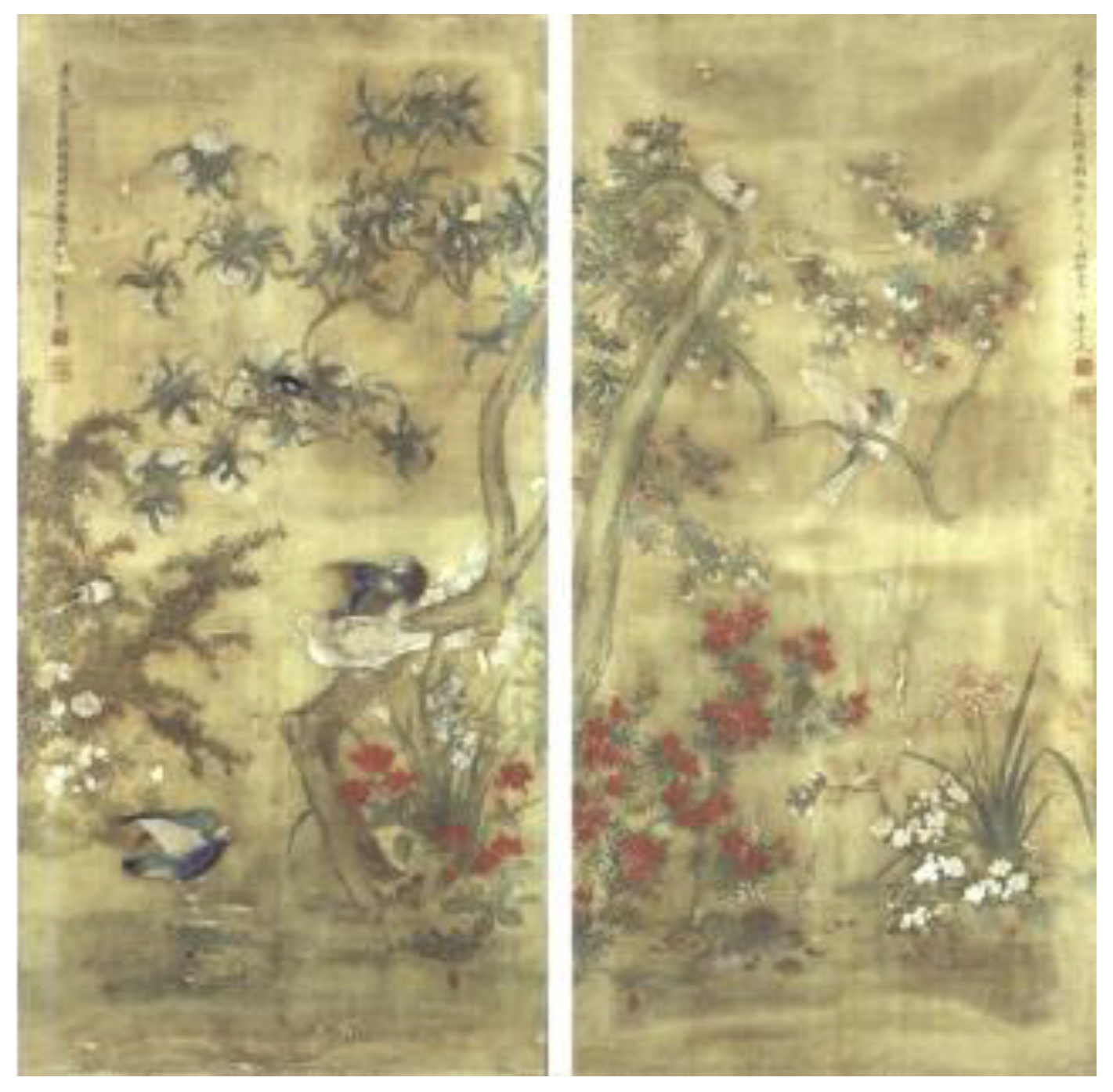
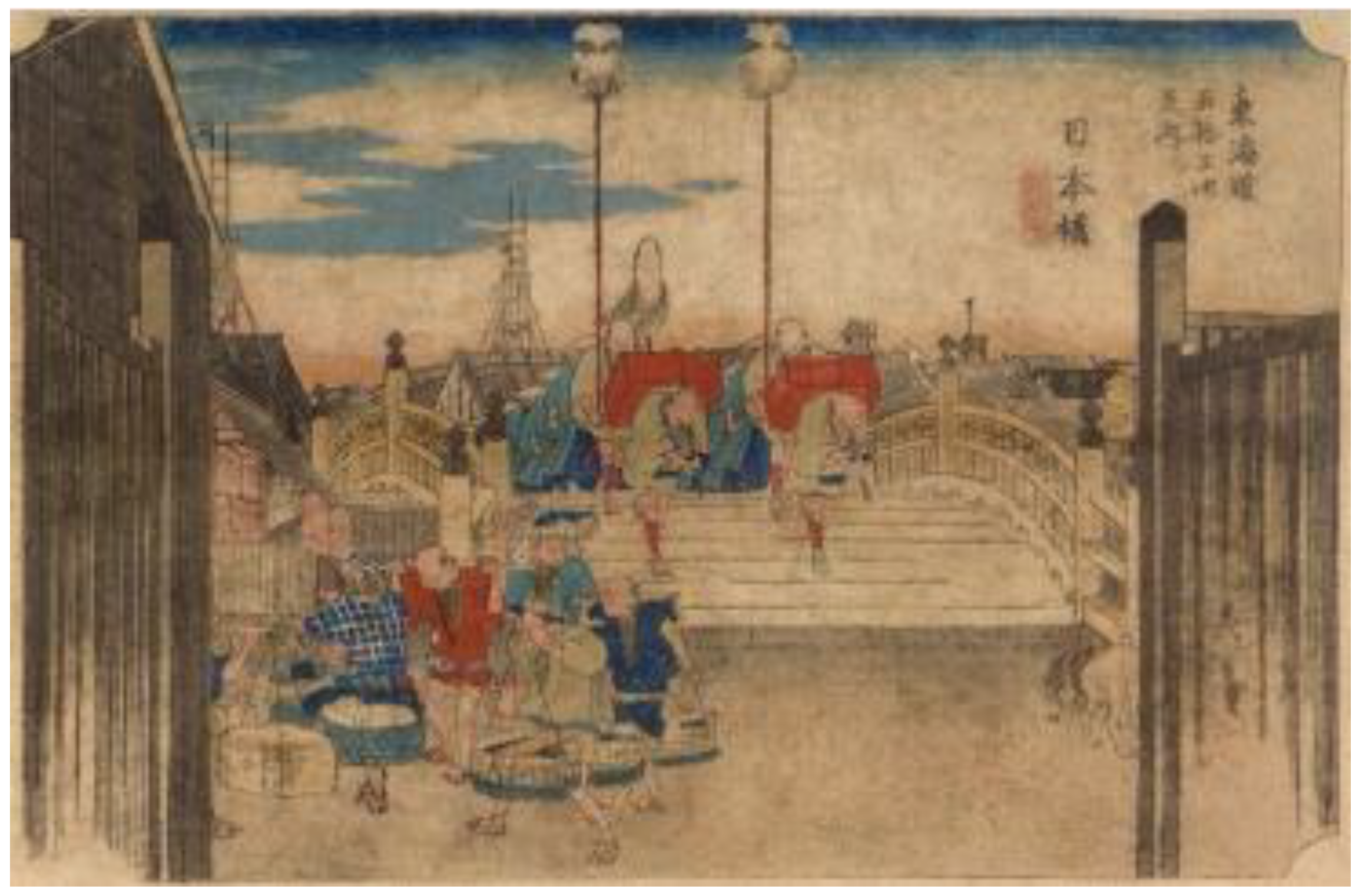
samurai and townspeople intermingled. This vibrant atmosphere was visually captured in works such as Utagawa Hiroshige’s ‘Ryōgoku Ekōin Moto-Yanagibashi’ from the series
One Hundred Famous Views of Edo (
Figure 3) and Katsushika Hokusai’s (1760–1849) ‘Edo Nihonbashi’ from
Thirty-Six Views of Mount Fuji (
Figure 4).
The Hamachō region in Nihonbashi, where Nampo and Nankoku resided, was originally an expanse of
samurai residences during the Edo era. However, Hamachō was dismantled and reorganised into Nihonbashi Hamachō in 1869, following the collapse of samurai society after the Meiji Restoration (
Kubota 1989, p. 20). As prominent merchants took up residence, the 1-chōme and 2-chōme districts developed primarily as residential areas and industrial promotion centres. According to the
Hamachō-shi [History of Hamachō], ‘the direct motivation for its development into a residential area was its scenic locale, set against the backdrop of the Sumida River’ (
Kubota 1989, p. 20). This atmospheric area remained close to the former Edo Castle, which had become the Imperial Palace. As the population increased, these large former domain estates were subdivided, resulting in a proliferation of branch-lot numbers that account for discrepancies in Nankoku’s recorded addresses. The Meiji government’s lifting of the ‘Prohibition on the Permanent Sale of Farmland’ in 1872 prompted the recognition of individual and land ownership. Subsequently, in 1873, the ‘Land Tax Reform Act’ was promulgated, and a system for issuing ‘land certificates’ and certifying land-ownership rights was established. Therefore, Nankoku acquired land and established his art practices in the very heart of Tokyo at an exceptionally early stage (
Asai 1881, pp. 101, 104).
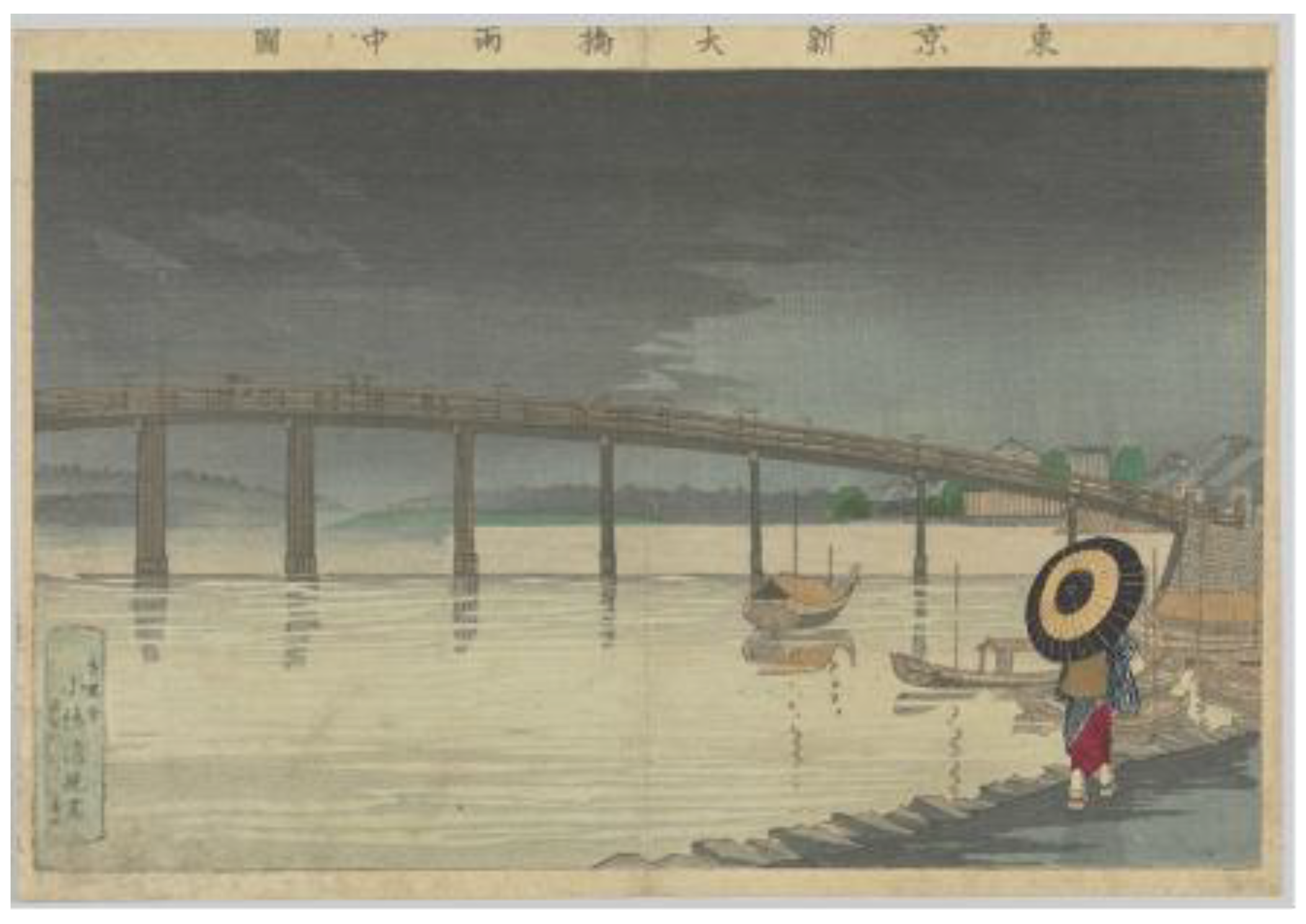
Nampo and Nankoku lived in this locale during the nostalgic, transitional epoch from Edo to Tokyo—a milieu beautifully evoked by Kobayashi Kiyochika (1847–1915). This renowned
ukiyo-e artist introduced Western techniques of chiaroscuro to create
kōsen-ga [light-ray pictures] capturing the transient play of light and shadow, famously producing ‘Tōkyō Shin-Ōhashi Uchū-zu’ [Shin-Ōhashi Bridge in Tokyo in the Rain] (
Figure 5) in 1876 to depict pedestrians walking with umbrellas in the rainy dusk across the bridge connecting Hamachō with Fukagawa Ward.
According to the
Nihonbashi-ku-sei Yōran [Overview of Nihonbashi Ward Conditions] published in 1927, a Hall crabapple (
kaidō) tree standing over about 3.6 metres in height stood directly opposite the entrance to the front garden of the Ōzawa residence (
Nihonbashi-ku 1927, p. 326). With its luxuriant foliage, the tree presented a magnificent spectacle in full bloom in early spring and was purportedly lauded as the finest of the ‘Three Crabapples of Tokyo’. The tree has a notable history connected to Saigō Takamori (1828–1877), a
samurai from the Satsuma Domain who became a central figure in overthrowing the shogunate and establishing the new government. In 1868, acting as the representative of the new imperial army, Saigō negotiated with Katsu Kaishū to achieve the ‘bloodless surrender’ of Edo Castle, averting warfare within city bounds. Saigō resided in Nihonbashi from 1871 to 1874 and purchased the Hall crabapple tree at a festival in Yagenbori (
Kubota 1989, p. 89). It would be possible that he had made Saigō’s acquaintance. In any case, residing in Nihonbashi, the Ōzawa couple was positioned at the heart of a rapidly changing nation.
4. Nankoku’s Economic Success and Social Activities
Having acquired the land and established his primary residence in the centre of Tokyo at Nihonbashi, Nankoku achieved considerable economic and social success. His name can be found in the
Nihon Shinshiroku [Directory of Japanese Gentlemen] in many years. First published by the Kōjunsha in 1889, this directory served as the premier reference work documenting the ‘gentlemen’ of Japan’s business, political, financial, and cultural spheres, recording the names of modern Japan’s elites from the Meiji to the Shōwa periods (1926–1989) (
Kōjunsha 1920, p. 219). Furthermore, Nankoku was a founding member and executive secretary of the Nihonbashi Club, a members-only social club established in 1890 and based in Nihonbashi. Founded by Nihonbashi industrialists in the Meiji period, the salon was modelled after Western-style clubs and exists today as a gathering place for corporate executives and local business figures (
Kubota 1989, p. 102).
Additionally, according to the
Nihonbashi Sōran [Comprehensive Guide to Nihonbashi], published in 1939, Nankoku served as a member of the Nihonbashi Ward Assembly for the years 1882, 1885, 1889, 1895, and 1901 (
Nihon Sakigake Shimbunsha 1939, pp. 138–40). The
Kanpō [Official Gazette] also confirmed Ōzawa as a member of ‘Hygiene Societies’ (Eiseikai/Eisei Kyōkai) until 1915. In Meiji-era Tokyo, with the recurrence of cholera epidemics, alongside the development of public health administration by national and municipal authorities, local communities formed hygiene societies to conduct public education, patrols, distribution of materials, disinfection, and health inspections.
Nampo and Nankoku possessed strong philanthropic tendencies. Nankoku donated 5 yen to the Tokyo City Asylum [Tōkyō-shi Yōikuin] in 1910 (
Tōkyō-shi Yōikuin 1910, p. 35), while Nampo contributed 20 yen towards the founding of Chiyoda Jogakuen, an educational institution affiliated with the Honganji branch of the Jōdo Shinshū sect. This sum was commensurate with donations made by viscountesses and baronesses (
Editorial Board for the History of Chiyoda Jogakuen 1995, p. 112). Their names can also be identified in
Fujin Zasshi [Women’s Magazine], a prominent Shinshū Buddhist women’s periodical published by the Honganji branch of the Jōdo Shinshū sect (Nishi Honganji) from the Meiji to the pre-war periods.
The youth section of
Fujin Zasshi published in 1896 reveals that the couple contributed hand-painted folding fans to be awarded as prizes to boys and girls (
Fujin Zasshi-sha 1896, no. 7 (97), p. 9). The Tachibanachō Youth Society distributed these rewards in accordance with attendance rates. The first prize was a specially detailed fan for boys, painted and donated by Nankoku, and the second prize was a bird-and-flower fan. Girls were awarded with fans designed for women, painted and donated by Nampo.
12 Nampo’s commitment to education is further evidenced by the fact that she began teaching painting to boys and girls on the second Sunday of every month at the Tachibanachō Youth Church, starting from 9 February 1896 (
Fujin Zasshi-sha 1896, no. 8 (98), p. 36).
Interestingly, when Prince Sanmi (b. ?, d. ?) of the Truk Islands in the South Seas visited the Tsukiji Betsuin temple during his 1893 trip to Japan, ‘the famous female painter Nampo (a female member) painted and presented him with a picture of Mount Fuji’ (
Fujin Zasshi-sha 1893, pp. 32–33). The Truk Islands (present-day Chuuk Lagoon) later became a Japanese mandated territory following the First World War and were governed by Japan for approximately 30 years (1914–1945). This episode suggests that the Truk Islands had ties with Japan prior to this administration. Further, these ties are also reflected in the active effort to propagate Japanese Buddhism in the region.
5. Nampo as Mother and Educator
It is presumed that the couple had no biological children. However, documents attest to the fact that they adopted a son named Ōzawa Masayoshi.
Fujin Zasshi reported in March 1896 that the third-year memorial service for Ōzawa Masayoshi—who reportedly passed away at the age of 19 in March 1894—was held at the Tachibana preaching hall (
Fujin Zasshi-sha 1896, no. 8 (98), pp. 33–34).
Masayoshi progressed from Hisamatsu Primary School to Kyoritsu School in Kanda and entered Seijo School at the age of 15, aiming to become a military officer. Although he attended a Christian school to study English and had exposure to Christianity, he firmly believed that no religion surpassed Buddhism; his frequent attendance at the Tachibana preaching hall indicates he was a devout Buddhist. It is recorded that Nampo, witnessing her son’s agony upon his deathbed, said, ‘You are still a boy; I only wish I could take your place’. This anecdote vividly illustrates Nampo’s profound devotion as a mother (
Fujin Zasshi-sha 1896, no. 8 (98), pp. 33–34).
Following loss of Masayoshi, the Ōzawa couple formally adopted a second son to continue the family line, as revealed by an article in the
Yomiuri Fujin Furoku (Yomiuri Women’s Supplement). The article stated that Ōzawa Shōji (正次)—the couple’s adoptive son and a painter then enrolled in the School of Commerce at Waseda University—married the daughter of a general merchandise wholesaler from Hamacho, Nihonbashi. The ceremony occurred at the Hibiya Daijingū on 11 March 1917. Since the Ōzawas did not have biological offspring, they may have secured their succession through these adoptions. Significantly, ‘Shōji’ (正次) likely follows a specific naming convention: having named their first adoptive son Masayoshi (正義), the couple retained the character
sho (正) and appended
ji (次), a character frequently used to denote a second son. Despite his formal entry into the family record, Shōji’s subsequent activities and whereabouts have yet to be identified (
Satsuki Shobō Henshūbu 1994).
13Beyond her family life, Nampo enjoyed the distinguished career of an educator. According to the
Rikkyo Jogakuin Hyakunen Shōshi [A Brief 100-Year History of Rikkyo Jogakuin], on 11 July 1890, in the fourteenth year since its establishment, Rikkyo Jogakuin sent forth its first two graduates: Miura (later Tanaka) Ren and Taguchi (later Yamabe) Kisa. Their diplomas were written in English and bore the signatures of three Americans—J.T. Cole, Mary M. Shaw, and R. Ford Heath—alongside seven Japanese signatories, including Ōzawa Nampo (
Rikkyo Jogakuin 1977, pp. 72–73). Rikkyo Jogakuin, an all-girls school, was founded in Yushima in 1877 by Channing Moore Williams (1829–1910), a missionary dispatched by the American Episcopal Church.
14 In 1882, the school was relocated to the Tsukiji foreign settlement, where Rikkyo Jogakuin was situated, and a new building was constructed for it. Whilst the first school building in the Tsukiji settlement was designed by James McDonald Gardiner (1857–1925) according to a Western-style structure, Japanese architectural elements under the design of Josiah Conder (1852–1920) were incorporated into the second building (completed in 1899).
15 As it originated as a private academy, a formal graduation certification system may not have been previously established, making 1890 the first year of students’ formal graduation.
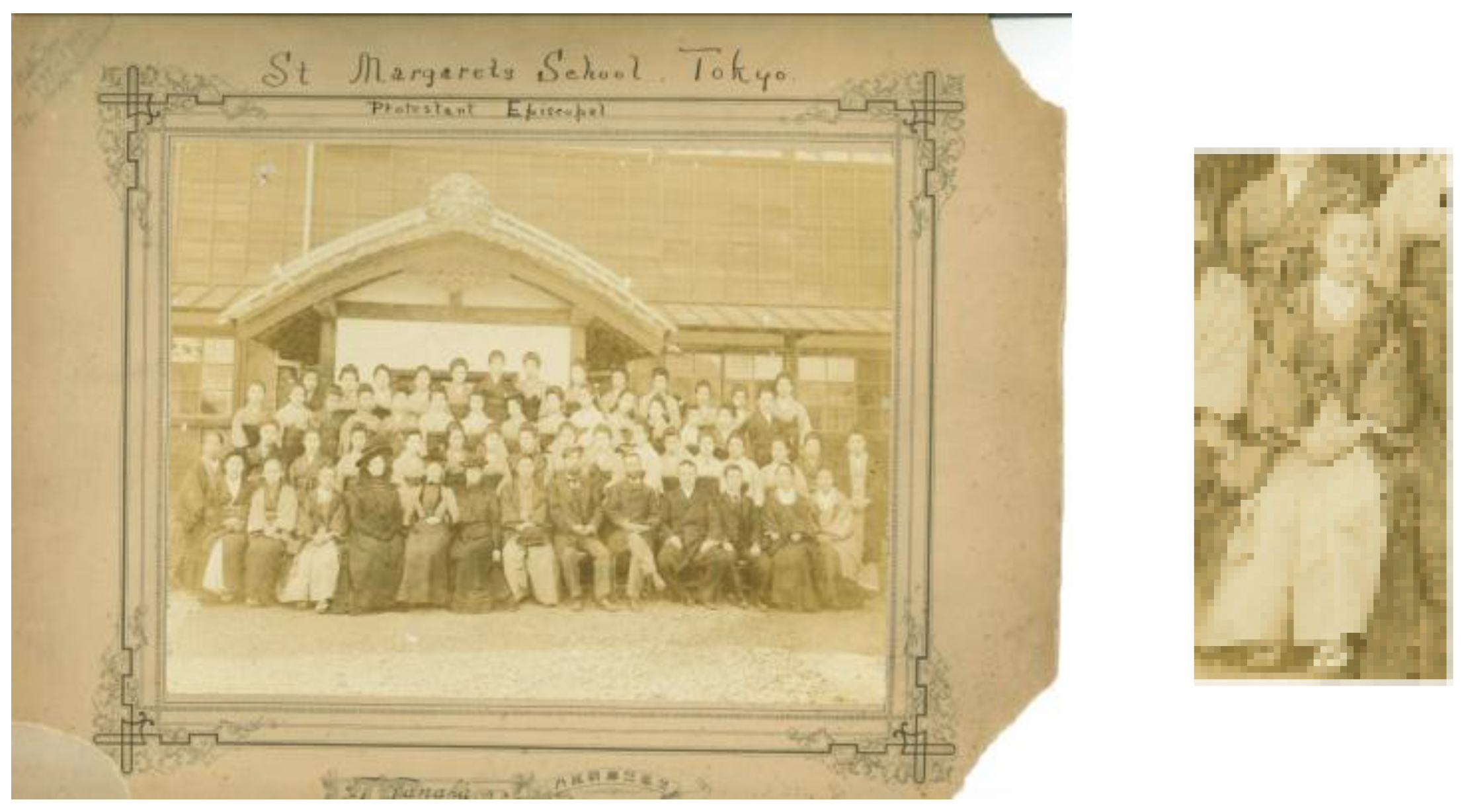
Nampo’s likeness is preserved in Rikkyo Jogakuin graduation photographs dating from around 1901 (
Figure 6). The alumni magazine,
Hanatachibana (March 1926), contains fascinating anecdotes recounted by former students about Nampo’s teaching at the school until approximately 1903 or 1904 (
Rikkyo Jogakuin 1926, pp. 54–55). She was described as a slender, elegant elderly woman and an unpretentious and jovial figure who frequently made others laugh. A
kachō-ga she had painted was reportedly displayed in the school dormitory, although it cannot currently be confirmed and may have been lost. Nampo could not speak English; however, to memorise English vocabulary, she would apply Japanese phonetic equivalents. In preparation for delivering New Year’s greetings to the foreign principal, she attempted to memorise the word ‘Happy’ in ‘Happy New Year’ by associating it with the Japanese word
happi [a traditional festival coat]. Yet, while delivering the greeting, she tried to remember the garment typically worn as a jacket and mistakenly uttered, ‘
Hanten New Year!’ [
hanten being another, similar type of traditional coat]. The
happi had accidentally transformed into a
hanten. The principal was surprised at this, whilst the accompanying teachers covered their mouths, suppressing chuckles. Such comical anecdotes survive to this day (
Rikkyo Jogakuin 1927, n.p.).
In another alumna’s reminiscence, it is recorded: ‘Nampo, the wife of the painter Ōzawa Nankoku, used to come to teach painting. When I sat beside my older sister as she took her lessons and stared intently, Nampo would often stroke my bobbed hair’ (
Rikkyo Jogakuin 1926, p. 55). Alongside the account of the loss of her son and her dedication to teaching art to children at the Tachibanachō Youth Society, this touching episode further underscores Nampo’s gentle and affectionate demeanour towards children.
6. Exhibiting at National Industrial Exhibitions
One of the principal difficulties in studying Nampo is the scarcity of surviving works attributable to her. Apart from
kachō-ga preserved in the collection of The Hunterian, the only work securely identified in a public collection is
Bamboo, a collaborative piece by the Ōzawa couple in the Philadelphia Museum of Art (
Association of Scientific Research on Historic and Artistic Works of Japan 1993, p. 38). Nampo is considered to have completed the ink painting, while Nankoku provided the calligraphic inscription. An
Oshi-e, a padded picture, also attributed to Nampo, has recently appeared at auction in Austria.
16 The craft technique used for
Oshi-e is that of creating a raised, three-dimensional surface in cloth and cotton. The work bears Ōzawa Nampo’s signature [大澤南芳女]. Contemporary documents lend some support to the signature.
Kōkoku meiyo jinmeiroku [Register of Distinguished Persons of the Imperial Nation], edited by Miyata Ubei and published in 1877, records an 大澤南芳女 residing with Nankoku at 27 Hamacho 1-chōme in Tōkyō (
Miyata 1877, p. 17). Therefore, Nampo herself signed works in this manner. Moreover, she received a prize for a padded picture at a national exposition, suggesting that her activities extended beyond painting to the production of craft objects (
Naikoku Kangyō Hakurankai Jimukyoku 1890, p. 16).
Given the paucity of surviving works, exhibition records of the period provide an essential source for reconstructing Nampo’s career. During the Meiji period, a system of government-sponsored exhibitions and expositions was established, offering artists and craftsmen a public platform to display their work. While they contain few illustrations, catalogues and reports of these events trace the activities of artists whose works have not survived. Among the most significant of these were the Naikoku Kangyō Hakurankai [National Industrial Exhibitions], organised by the Meiji government and modelled on the international world’s fairs of Europe and the USA. Naikoku Kangyō Hakurankai aimed to promote industrial development and modernisation in Japan and stimulate export industries. Five such expositions were held between 1877 and 1903.
17At the First National Industrial Exhibition (1877), Nampo, together with her husband Nankoku, exhibited a pair of coloured landscape paintings mounted in frames. In the official catalogue, her name appears not as 南芳 but as 南房 (
Naikoku Kangyō Hakurankai Jimukyoku n.d., Higashi 3-no-6). Judges’ reports of the exposition also refer to works by Nankoku. A framed composition executed in the cut-work technique received a commendation and was described as depicting ‘toads gathered together, each differing in form, beautifully coloured and conveying a sense of lively movement (
Naikoku Kangyō Hakurankai Jimukyoku 1877, p. 358). Another remark notes ‘Ōzawa Nankoku’s cranes among rice plants …are worthy of viewing’ (
Meiji Bunken Shiryō Kankōkai 1965, p. 267). Nampo later exhibited a framed padded picture at the Third Domestic Industrial Exposition, for which she received a third-class merit award (
Naikoku Kangyō Hakurankai Jimukyoku 1890, p. 16).
Alongside these industrial expositions, the Meiji government also organised exhibitions to encourage Japanese painting. The most notable of these was the
Naikoku Kaiga Kyōshinkai [Domestic Painting Exhibition], organised by the Ministry of Agriculture and Commerce twice, in 1882 and 1884. In 1882, Nampo and Nankoku exhibited two works each and were identified as painters of the Shimpitsu (真逼) school (
Nōshōmushō 1882, p. 283).
18 They also contributed works to the second National Painting Exhibition in 1884 (
Nōshōmushō 1884, p. 17). As already mentioned, the publication
Naikoku Kaiga Kyōshinkai Shuppin Ryakufu [Biographical sketches of exhibitors at the national painting competition] briefly narrates Nampo’s background, describing her as the daughter of Takei Jūrō, the wife of Ōzawa Nankoku and a pupil of Aoki Nanka (
Nōshōmushō Hakurankai-gakari 1884, p. 65). The latter attribution is almost certainly erroneous, and she is generally understood to have studied under Haruki Nanka.
19The Ōzawa couple’s activities were not confined to painting exhibitions but were extended to exhibitions promoting craft and industry. Tōkyō-fu Kōgeihin Kyōshinkai [Tokyo Prefectural Craft Competitive Exhibition], held in 1887 in Ueno Park, aimed to encourage the development of craft techniques within Tokyo Prefecture. According to the catalogue, both artists exhibited works in the exhibition (
Tōkyōfu Kōgei Kyōshinkai 1887, p. 35). Nankoku also participated in international exhibitions abroad; at the Barcelona Universal Exposition of 1888 he exhibited paintings and received a bronze medal (
Ōkurashō Insatsukyoku 1890, p. 40), and at the Paris Universal Exposition of 1890 he received a silver medal (
Ōkurashō Insatsukyoku 1891, p. 119;
Nōshōmushō 1890, p. 57). Although only a very small number of works of Nampo can be identified today, the examination of exhibition records facilitates the reconstruction of some aspects of her artistic activity. These records show that the couple actively participated in exhibitions in the Meiji period and presented their works in various venues, such as industrial, painting, and craft exhibitions and international fairs.
7. Nampo’s Formative Years and Master-Disciple Learning Network
Section 3 has illustrated how the artist couple lived in Nihonbashi, the heart of Tokyo, actively engaging in the Meiji government’s policies of industrial promotion and Westernisation. However, the two works by Nampo affixed to Whistler’s screen were painted in 1867, the final year of the Edo era. At the age of twenty-two, she was presumably doing an apprenticeship as a painter. Consequently, identifying masters under whom she studied and the environment where she inhabited provides clues about why her works were transported overseas relatively soon after their completion. This section discusses Nampo’s master Haruki Nanka (1818–1866) and reveals the intellectual and interpersonal milieu that surrounded her at the time.
Haruki Nanka was a Nanga painter.
20 In a brief biography published on the occasion of the National Industrial Exhibition, Nampo is recorded as having studied under ‘Aoki Nanka’ instead of ‘Haruki Nanka’; however, as already mentioned, this is a typographical error (
Nakayama 1982). Haruki Nanka appears in the
Nihon Gaka Taisei [Compendium of Japanese Painters], and the
Nihon Shoga Jinmei Jisho [Dictionary of Japanese Painters and Calligraphers] notes that Aoki Nanka shared the same pseudonym, ‘Dokugasai’, as Haruki Nanka (
Sugihara and Katō 1910–1912, p. 72). Nanka belonged to a lineage of Nanga artists, being the son of Haruki Nanmei (1795–1878) and the grandson of Haruki Nanko (1759–1839). Since Nanmei’s surname is also occasionally misrepresented as ‘Aoki’ in writing, Aoki Nanka undoubtedly refers to Haruki Nanka.
Nanka studied painting under his grandfather and father, and at the age of eighteen, his name was included in the
Edo Genzai Kōeki Shoka Jinmeiroku [Directory of Notable Persons Currently in Edo, First Volume] (
Kinkadō 1836, pp. 42, 44). He established a household in the same Kobiki-chō 3-chōme district as his father and earned considerable acclaim as an artist; the
Genzon Raimei Edo Bunjin Jumyō-zuke, Shohen (rankings of renowned literary figures currently living in Edo, first volume) described him as ‘the leader of the younger generation of painters with an excellent reputation in Great Edo’ (
Mori and Riju 1976, p. 346). Although he excelled in
sansuiga [landscape painting], he died young at forty-eight, leaving behind few extant works. According to the memoirs of his eldest son, the painter Haruki Nankei (1846–1929), Nanka was ‘relatively indifferent to the family business of painting’ and was, instead, interested in
Rangaku. He maintained close ties with Otsuki Bankei, a Confucian scholar of the Sendai Domain and a scholar of Western Learning, with the shogunal vassal Kimura Kaishū (1830–1901)—who later contributed to the founding of the Navy, and with Ōtori Keisuke (1833–1911). Nanka’s father, Nanmei, possessed a more moderate temperament and secretly frowned upon political activities (
Haruki 1917, pp. 15–17).
Nanka’s interest in the West and state affairs manifested as concrete action during crises of the era. When the fleets of Commodore Perry (1794–1858) and later Vice-Admiral Putyatin (1803–1883) arrived in 1853 to demand the opening of the country, Abe Masahiro (1819–1857), the chief senior councillor, solicited opinions on coastal defence. In response, Nanka submitted a memorandum to the Shogunate, advocating the opening of the country and motivating individuals to study abroad regardless of their social rank (
Kimura 1892, pp. 122–33;
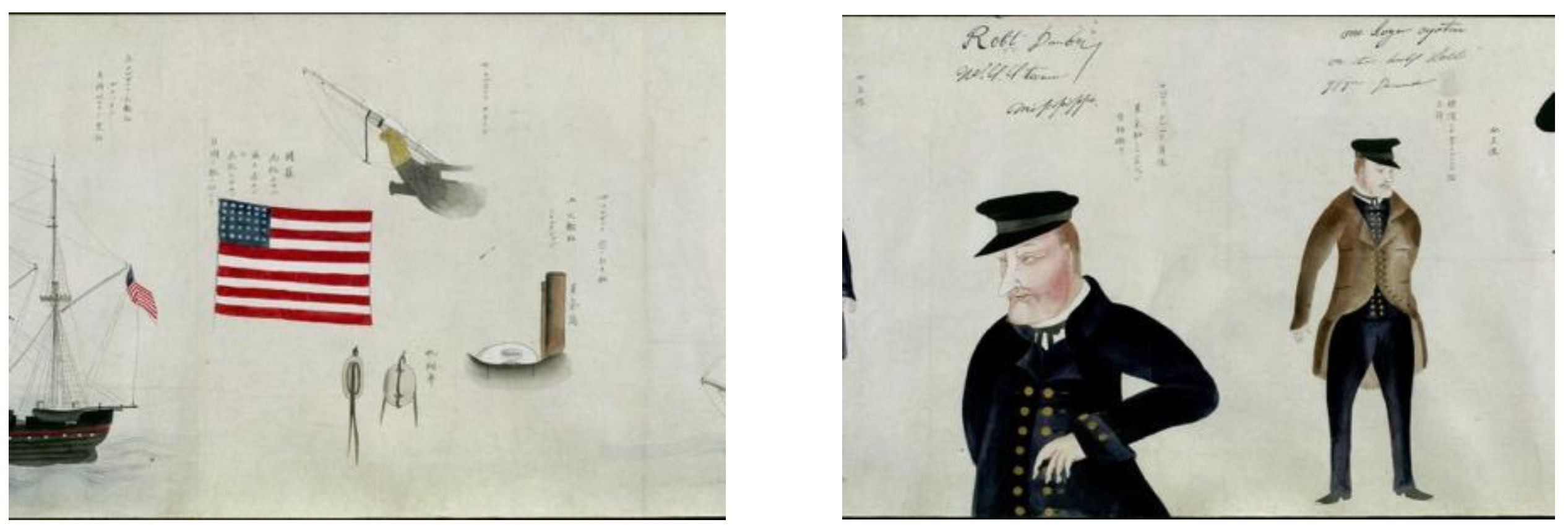
Kudō 1989, pp. 257–60). Furthermore, he expressed a fervent desire to go abroad to study Western disciplines and technology to serve the state. In 1854, when Perry returned to Yokohama, Nanka travelled to the site and sketched the scene as
Kinka Kishō (Kanagawa Prefectural Archives) (
Figure 7) (
Kubo 2012, pp. 168–71). According to
Shinsen Yōgaku Nenpyō [New Chronological Table of Western Learning] by Otsuki Nyoden, Nanka even applied, albeit unsuccessfully, for the position of Western-style painting instructor at the Bansho Shirabesho [Institute for the Study of Barbarian Books] (
Ōtsuki 1927, p. 147). His later years were marked by increased alcohol consumption and physical decline; he passed away on 16 June 1866. Nampo’s works on the Whistler screen were thus painted in the year following the death of her master, who had yearned to contribute to Japan’s modernisation through Western knowledge.
Nampo produced these works before her marriage to Nankoku. Nankoku’s master, Okamoto Shūki (1807–1862), was also connected to the enlightened social circles. Born the second son of the Chiseki engraver Ishiguro Masayoshi (1774–?), Shūki was adopted into the Okamoto family of town physicians before serving the Ōkubo clan Domain, lords of the Odawara Domain. He studied under Ōnishi Keisai (1773–1829) and Watanabe Kazan (1793–1841), gaining fame for his meticulous kachō-ga paintings—particularly his depictions of peacocks—incorporating styles from the Nagasaki School. Kazan had studied Rangaku and was imprisoned in Tahara in 1839 for advocating coastal defence and the introduction of Western knowledge. During Kazan’s confinement, Shūki and other disciples maintained contact with him.
Crucially, records indicate that both Haruki Nanka and Okamoto Shūki attended a poetry gathering at the residence of Ohara Tesshin (1817–1872), a senior retainer of the Ōgaki Domain in Tameike, Tokyo, on the winter solstice of 1858 (
Suzuki 1998, p. 57). This confirms that the masters of Nampo and Nankoku were acquaintances, suggesting that their disciples belonged to the same social and intellectual orbit. Both individuals studied in a progressive environment characterised by Western Learning, the questioning of the long-standing policy of national isolation, and a broad orientation to the outside world. Nampo and Nankoku’s immersion in such an enlightened network is key to understanding their early interest in the West and the subsequent trajectory of Nampo’s work across the seas.
Nampo’s precise course of study under Nanka cannot be reconstructed, for he died in 1866, when she was twenty-one years old, and left few extant works and no register of pupils. However, the Haruki workshop offered a continuous Nanga environment that did not depend on him alone. There, Nanka had himself trained under his grandfather Nanko and his father Nanmei—the latter still active until 1878. There his son Nankei would also paint. Embedded in this lineage and its wider circle—the same enlightened milieu that also encompassed Nankoku’s master Okamoto Shūki—Nampo could have absorbed her craft through repeated exposure and guided practice rather than through personal tutelage under the short-lived Nanka alone. It is this collective, immersive formation that best accounts for her ability to execute the two paintings of the Whistler screen in August and September 1867, a year after Nanka’s death.
8. Conclusions
Through a careful examination of historical materials, this paper elucidated the identity of the woman artist Nampo Joshi, who painted the kachō-ga affixed to the reverse of James McNeill Whistler’s screen in 1867. It uncovered clues that help explain how this work travelled to Europe with such relative haste. In doing so, this study has deliberately treated Whistler’s screen not as an object to be subjected to renewed stylistic analysis but as a thread to be followed back, through the surviving documents, to the environment of its maker. Its principal contribution lies less in the interpretation of a single work and more in the reconstruction of the social, intellectual, and artistic milieu in which a hitherto obscure female painter was formed.
During the turbulent transition from Edo to Tokyo, Nampo and her husband, Ōzawa Nankoku, established their base in Nihonbashi, the pre-eminent centre of Tokyo, where they achieved considerable socio-economic success. As accomplished individuals who contributed actively to a modernising society, they extended their endeavours well beyond the traditional boundaries of their craft, participating energetically in the civic life of the new capital and in the exhibition culture of the Meiji period.
Perhaps most crucially, they maintained a profound connection with enlightened intellectual networks. The late Edo period was a historical crossroads, marked by the inevitable collapse of a centuries-old isolationist policy and a surging interest in Western science and technology. Significantly, both Nampo’s master, Haruki Nanka, and Nankoku’s master, Okamoto Shūki, were deeply immersed in Rangaku and associated with progressive scholars who advocated the opening of Japan. Living in the centre of Edo and having apprenticed with enlightened thinkers who looked broadly at Western civilisation, Nampo was fundamentally embedded in this progressive milieu. Therefore, the swift movement of her artwork, produced at the dawn of a new era, to foreign lands and Europe is plausible and a natural historical progression.
Nevertheless, this study has certain limitations that should be acknowledged. While the investigation has established the intellectual and social milieu in which Nampo operated, it has not been possible to trace the complete chain of transmission from Nampo to Whistler. The question of which specific individuals or institutions served as intermediaries—whether foreign residents in the treaty ports, Japanese merchants engaged in export, or diplomatic figures—remains open. Further research is needed to investigate from broader commercial and diplomatic perspectives who acquired works from artists such as Nampo and how these were brought overseas during the period from the late Edo era—when Japan was moving towards the opening of the country—through the early Meiji years, when points of contact with the outside world were still relatively limited. Equally, a comparative approach examining the trajectories of other Japanese artworks that entered European collections during the same period would help determine whether the speed of transmission observed in Nampo’s case was exceptional or part of a broader pattern facilitated by the Rangaku-associated networks identified in this study.