

Kafka’s Literary Style: A Mixed-Method Approach


Abstract
1. Introduction
2. Kafka, Hermeneutics, and Quantification
3. Stylistic Comparison of Kafka vs. Brod
4. Linguistic Comparison of Kafka vs. Brod
5. Conclusions
Author Contributions
Funding
Data Availability Statement
Conflicts of Interest
Appendix A. Technical Details on the Classification Experiment
Appendix B. Technical Details on the Identification of Subjunctive I
| 1 | In 1984, the centennial of Kafka’s birthday, the Paris Centre Georges Pompidou curated a big exhibition (Le Siècle de Kafka 1984), and 40 years later, in commemoration of the centennial of Kafka’s death in 2024, the front page of the Times Literary Supplement once again proclaimed “Kafka’s Century.” (Kafka’s Century 2024). |
| 2 | See Strathausen (2024a) for a more detailed critique of this tendency. |
| 3 | In a sweeping deconstructive gesture, Stanley Corngold has ungited these divergent views arguing that Kafka employs metaphors and other rhetorical figures precisely for the purpose of taking them apart, literally, on the page in both semantic and syntactic terms. What thus comes to the fore in Kafka’s writing, Corngold argues, is the materiality and affective power of language that is otherwise covered up by its meaning-making potential (Corngold 2004). This tension creates the semantic ambiguity for which his texts are known. |
| 4 | Already in the 1970s, Karlheinz Fingerhut pointed out scholars’ discombobulation about Kafka’s style evident in oxymoronic formulations like “non-metaphorical metaphors” or “symbolic reality” (Fingerhut 1979, p. 139). |
| 5 | Whether this dilemma is intentional on Kafka’s part—“Kafka has taken all conceivable precautions to undermine an exegesis of his texts” (Benjamin 1972, p. 435)—or an unintended consequence of his probing literary style—“Kafka’s dense linguistic structures cannot but produce an uncontrollable amount of meaning” (Kobs 1970, p.14)—seems less important than its overall effect that the secondary literature on Kafka threatens to overwrite the literary texts it tries to elucidate. |
| 6 | To be sure, it is neither the function nor the purview of a Kafka Konkordanz to provide comparative analyses of this kind, and it would have been impossible to do given the limited computational resources two or three decades ago. |
| 7 | She created an overall corpus “of altogether 74 text samples (about 5.9 million words)” that included “27 texts of different length written by Kafka,” three by Robert Walser, and 64 texts written by other authors (Herrmann 2017, paragraph 42). |
| 8 | We recognize that the self-reflexivity of Kafka’s writings remains controversial (Jahraus 2008; Engel 2010, 415f.) and that Engel mentions six main characteristics of Kafka’s style (Engel 2010, 411ff.). We could easily add more. |
| 9 | Thieberger, for example, defines “the peculiar character of Kafka’s narrative style” as “the enormous tension between the (ungraspable) meaning of what is being said and the (easily graspable) form of linguistic expression” (Thieberger 1979a, p. 183; our translation). Similarly, Oschmann wrote the following in 2010: “Even more than the early texts, Kafka’s later texts are characterized by the elemental tension that the narrating language almost always refers to sensual concrete phenomena (sinnlich Konkretes), whereas the process of narration radically undermines this immediately sensually given by means of constant self-correction” (Oschmann 2010, p. 446; our translation). Kafka tricks us “into expecting something straightforwardly realist, before then giving us something altogether more complicated” (Troscianko 2018, p. 284). |
| 10 | An example is Brod’s inserted fiat “Hier beginnt das Schloß” in the first Schlossheft, an arbitrary decision that ignored several pages of preceding text and condemned them to obscurity in the Apparatus section for more than half a century. Another example is Brod’s equally questionable decision to distinguish “complete” from “incomplete” chapters in Kafka’s manuscript of The Trial or his pasting together of literary texts culled from different contexts or parts of the notebooks. Like many other Kafka scholars, Richard Thieberger speaks of Brod’s “arbitrary editing” that yields “confusing” consequences for Kafka’s readers (Thieberger 1979b, p. 54). In Brod’s first edition of the Gesammelte Schriften from 1936, for example, some texts that are seemingly complete and had been given a title by Kafka himself (“Eine teilweise Erzählung”) were not included at all, while others (“Eisenbahnreise,” “Bei den Toten zu Gast,” and “Neue Lampen”) were included in the Tagebücher und Briefe volume. In the second edition of the Gesammelte Schriften from 1946, these same texts, however, were relegated to the volume Hochzeitsvorbereitungen rather than Betrachtung, where they would actually belong. The third edition also printed some of these texts twice as part of different volumes. |
| 11 | After completing “The Judgment” in a single night of writing, Kafka noted in his diary on 23 September 1912: “…nur so kann geschrieben werden, nur in einem solchen Zusammenhang, mit solcher vollständigen Öffnung des Leibes und der Seele” [“…only in this way can writing be done, only with such coherence, with such a complete opening out of the body and the soul”] (Kafka 1999, p. 101). |
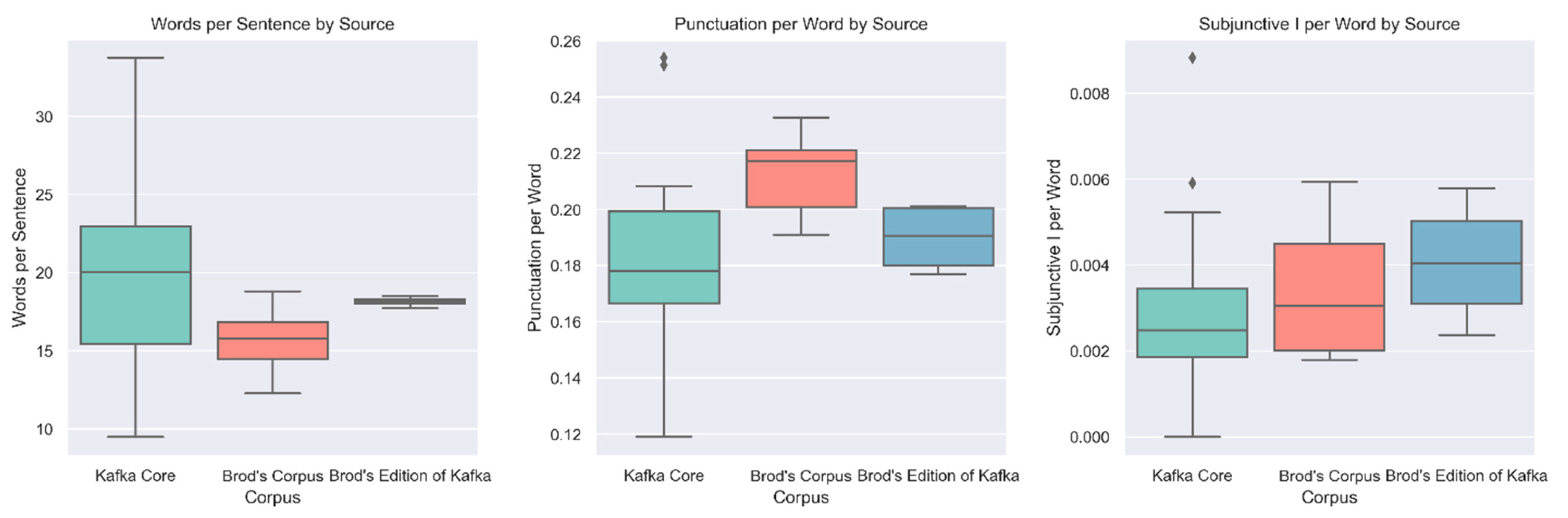
| 12 | Table 1 presents linguistic trait values computed on the entire corpora, providing a single numeric value per trait for each corpus. In contrast, the boxplots in Figure 2 below are based on values computed for individual works within the corpora, providing multiple numeric values per trait, each corresponding to a specific work. However, independent t-tests (Student 1908) reveal no statistically significant differences (p > 0.05) between any pair of corpora for all three traits. This outcome is likely due to the limited number of data points—only 17 works in Kafka Core, five in Brod’s corpus, and four in Brod’s edition of Kafka. Although the statistical tests did not indicate significant differences, the observed variations among the corpora remain notable, suggesting that further research with datasets with more data points may uncover statistically significant distinctions. |
| 13 | Kafka’s later publications, like the four stories published together under the title of Ein Hungerkünstler in 1924, feature longer sentences averaging 23–27 words, as literary critics have suspected since the 1960s. But there are also very early texts, like “Gerspäch mit dem Betrunkenen” from 1909, that feature a relatively high average of 20 words per sentence, and other early texts, like those in Betrachtung from 1912, that only have 13 words per sentence. In the middle period, Kafka published a text like Der Heizer (1913) and Die Verwandlung (1915) with an average sentence length of 21 words, but he also published “Der Kübelreiter” and “Ein Bericht an eine Akademie” (from the collection Ein Landarzt (Kafka 1919)) with only a nine-word average per sentence. |
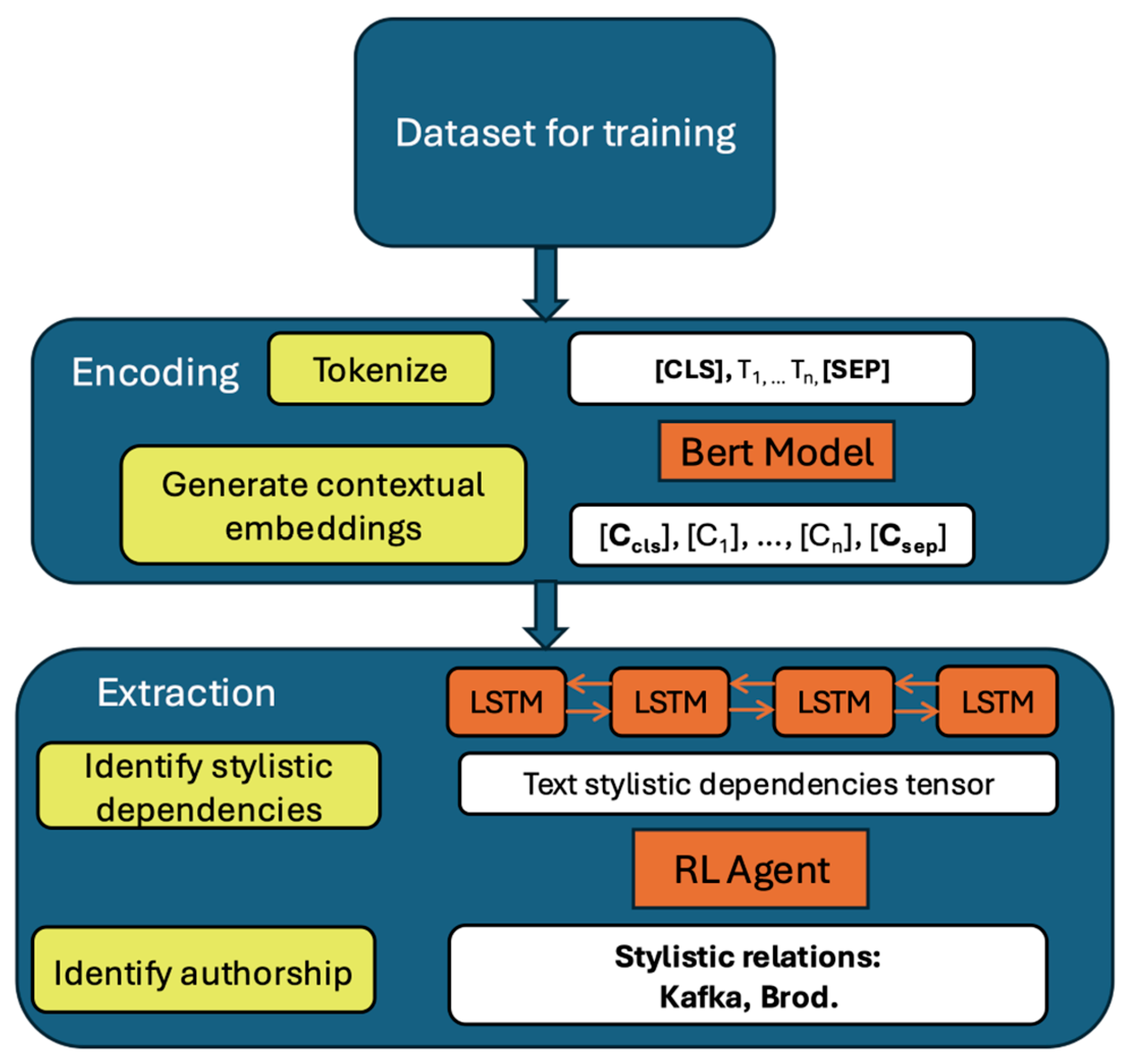
| 14 | In the figure, the large blue blocks represent the major stages of the pipeline, and the vertical blue lines mark key steps. Yellow blocks depict the primary processes within the pipeline. White blocks indicate the outputs, while orange blocks show the components of the model architecture. |
References
- Adorno, Theodor W. 1997. Aufzeichnungen zu Kafka. In Gesammelte Schriften. Edited by Rolf Tiedemann. Frankfurt: Suhrkamp, vol. 10/1, pp. 254–87. [Google Scholar]
- Arendt, Hannah. 2019. Franz Kafka. A Revaluation. In Hannah Arendt. Sechs Essays. Edited by Barbara Hahn. Göttingen: Wallstein, pp. 174–83. First published 1944. [Google Scholar]
- Beißner, Friedrich. 1952. Der Erzähler Franz Kafka. Stuttgart: Kohlhammer. [Google Scholar]
- Benjamin, Walter. 1972. Franz Kafka. In Gesammelte Schriften. Edited by Rolf Tiedemann and Herrmann Schweppenhäuser. Frankfurt: Suhrkamp, Vol. II/2, pp. 409–38. [Google Scholar]
- Binder, Hartmut. 1966. Motiv und Gestaltung bei Franz Kafka. Bonn: Bouvier. [Google Scholar]
- Brod, Max. 1926. Nachwort. In Franz Kafka. Das Schloß. Leipzig: Kurt Wolff, pp. 500–4. [Google Scholar]
- Buchholz, Paul. 2018. Private Anarchy. Impossible Community and the Outsider’s Monologue in. Chicago: Northwestern University Press. [Google Scholar]
- Camus, Albert. 1942. Le Mythe de Sisyphus. Paris: Gallimard. [Google Scholar]
- Corngold, Stanley. 2004. Lambent Traces: Franz Kafka. Princeton: Princeton University Press. [Google Scholar]
- Danto, Arthur. 1996. Art After the End of Art. Contemporary Art and the Pale of History. Princeton: Princeton University Press. [Google Scholar]
- Deleuze, Gilles, and Félix Guattari. 1986. Kafka: Towards a Minor Literature. Translated by Dana Polan. Minneapolis: University of Minnesota Press. [Google Scholar]
- Drucker, Johanna. 2012. Humanistic Theory and Digital Scholarship. In Debates in the Digital Humanities. Edited by Matthew K. Gold. Minneapolis: University of Minnesota Press, pp. 85–95. [Google Scholar]
- Engel, Manfred. 2010. Kafka lesen. In Kafka Handbuch: Leben, Werk, Wirkung. Edited by Manfred Engel and Bernd Auerochs. Stuttgart: Metzler, pp. 411–27. [Google Scholar]
- Engel, Manfred. 2018. Writing. In Franz Kafka in Context. Edited by Carolin Duttlinger. Cambridge: Cambridge University Press, pp. 54–61. [Google Scholar]
- Emrich, Wilhelm. 1965. Franz Kafka. Bonn: Athenäum. [Google Scholar]
- Erlin, Matt. 2017. Topic Modeling, Epistemology, and the English and German Novel. Cultural Analytics 2. [Google Scholar] [CrossRef] [Scilit] [PubMed]
- Erlin, Matt, Douglas Knox, and Stephen Pentecost. 2023. Multi-retranslation and cultural variation. The case of Franz Kafka. Target 35: 215–41. [Google Scholar] [CrossRef] [Scilit]
- Fabien, Maël, Esau Villatoro-Tello, Petr Motlicek, and Shantipriya Parida. 2020. BertAA: BERT Fine-Tuning for Authorship Attribution. Paper presented at 17th International Conference on Natural Language Processing (ICON), Patna, India, 18–21 December 2020; Edited by Pushpak Bhattacharyya, Dipti Misra Sharma and Rajeev Sangal. 2020, Patna: Indian Institute of Technology Patna, Patna: NLP Association of India (NLPAI), pp. 127–37. Available online: https://aclanthology.org/2020.icon-main.16 (accessed on 18 April 2024).
- Fingerhut, Karlheinz. 1979. Bildlichkeit. In Kafka Handbuch. Edited by Hartmut Binder. Berlin: Kröner, vol. 1, pp. 138–177. [Google Scholar]
- Fromm, Waldemar. 2010. Schaffensprozess. In Kafka Handbuch: Leben, Werk, Wirkung. Edited by Manfred Engel and Bernd Auerochs. Stuttgart: Metzler, pp. 427–37. [Google Scholar]
- Gandelman, Claude. 1974. Kafka as an Expressionist Draftsman. Neohelicon 2: 237–77. [Google Scholar] [CrossRef] [Scilit]
- Gerhardt, Marlis. 1969. Die Sprache Kafka’s: Eine Semiotische Untersuchung. Dissertation, University Stuttgart, Stuttgart, Germany. [Google Scholar]
- Harman, Mark. 1996. The Latest from the Kafka Factory. The German Quarterly 69: 63–67. [Google Scholar] [CrossRef] [Scilit]
- Hermsdorf, Klaus, ed. 1984. Franz Kafka. Amtliche Schriften. Mit einem Essay von Klaus Hermsdorf. Berlin: Aufbau Verlag. [Google Scholar]
- Herrmann, J. Berenike. 2017. In a test bed with Kafka. Introducing a mixed-method approach to digital stylistics. DHQ: Digital Humanities Quarterly 11. Available online: https://www.digitalhumanities.org/dhq/vol/11/4/000341/000341.html (accessed on 27 February 2025).
- Jahraus, Oliver. 2008. Kafka und die Literaturtheorie. In Kafka Handbuch: Leben-Werk-Wirkung. Edited by Bettina von Jagow and Oliver Jahraus. Göttingen: Vandenhoeck & Ruprecht, pp. 304–16. [Google Scholar]
- Kafka’s Century. 2024. Times Literary Supplement. No. 6322. Available online: https://reader.exacteditions.com/issues/116453/page/1 (accessed on 27 February 2025).
- Kafka, Franz. 1912. Betrachtung. Leipzig: Rowohlt. [Google Scholar]
- Kafka, Franz. 1919. Ein Landarzt. Leipzig: Kurt Wolff. [Google Scholar]
- Kafka, Franz. 1925. Der Process. Edited by Max Brod. Berlin: Die Schmiede. [Google Scholar]
- Kafka, Franz. 1926. Das Schloss. Edited by Max Brod. Berlin: Die Schmiede. [Google Scholar]
- Kafka, Franz. 1927. DDer Verschollene. Edited by Max Brod. Berlin: Die Schmiede. [Google Scholar]
- Kafka, Franz. 1946. Gesammelte Schriften, 2nd ed. Edited by Max Brod. New York: Schocken, 5 vols. [Google Scholar]
- Kafka, Franz. 1999. Tagebücher 1912–1914. Vol. 2, Edited by Hans-Gerd Koch. Frankfurt: Fischer. [Google Scholar]
- Kissinger, Henry A., Eric Schmidt, and Daniel Huttenlocher. 2022. The Age of AI. And Our Human Future. New York: Back Bay Books. [Google Scholar]
- Kobs, Jörgen. 1970. Kafka: Untersuchungen zu Bewußtsein und Sprache Seiner Gestalten. Bad Homburg: Athenäum. [Google Scholar]
- Koelb, Clayton. 2006. Will the Real Franz Kafka Please Stand Up? In A Companion to the Works of Franz Kafka. Edited by James Rolleston. Rochester: Camden, pp. 27–33. [Google Scholar]
- Kundera, Milan. 1991. Rescuing Kafka from the Kafkologists, Trans. Barbara Wright. Times Literary Supplement 24: 3–5. [Google Scholar]
- Le Siècle de Kafka. 1984. Paris: Centre Georges Pompidou.
- Mann, Thomas. 1949. Dem Dichter zu Ehren: Franz Kafka und ‘Das Schloss’. Der Monat 2: 66–70. [Google Scholar]
- Moretti, Franco. 2005. Graphs, Maps, Trees. Abstract Models for Literary History. London and New York: Verso. [Google Scholar]
- Neumann, Gerhard. 1968. Umkehrung und Ablenkung. Franz Kafkas ‘Gleitendes Paradox. Deutsche Vierteljahrsschrift für Literaturwissenschaft und Geistesgeschichte 42: 702–44. [Google Scholar] [CrossRef] [Scilit]
- Neumann, Gerhard. 2011. Verfehlte Anfänge und Offenes Ende: Franz Kafkas Poetische Anthropologie. Frankfurt: Siemens Stiftung. [Google Scholar]
- Oschmann, Dirk. 2010. Kafka als Erzähler. In Kafka Handbuch: Leben, Werk, Wirkung. Edited by Manfred Engel and Bernd Auerochs. Stuttgart: Metzler, pp. 438–49. [Google Scholar]
- Politzer, Heinz. 1962. Franz Kafka. Parable and Paradox. Ithaca: Cornell University Press. [Google Scholar]
- Qian, Chen, Tianchang He, and Rao Zhang. 2017. Deep Learning Based Authorship Identification. Stanford University. Available online: https://web.stanford.edu/class/archive/cs/cs224n/cs224n.1174/reports/2760185.pdf (accessed on 17 April 2024).
- Reuß, Roland. 1995. Lesen, was gestrichen wurde: Für eine historisch-kritische Kafka-Ausgabe. In Franz Kafka: Historisch-Kritische Ausgabe Sämtlicher Handschriften, Drucke und Typoskripte. Edited by Roland Reuß and Peter Staengle. Frankfurt: Stroemfeld, vol. 1, pp. 9–24. [Google Scholar]
- Robertson, Ritchie. 2018. Style. In Franz Kafka in Context. Edited by Carolin Duttlinger. Cambridge: Cambridge University Press, pp. 62–69. [Google Scholar]
- Salgaro, Massimo. 2023. Statistics, Stylometry, and Sentiment Analysis in German Studies. Göttingen: Vandenhoeck & Ruprecht. [Google Scholar]
- Sartre, Jean-Paul. 1999. Anti-Semite and Jew. October 87: 24–26. [Google Scholar]
- Savoy, Jacques. 2020. Machine Learning Methods for Stylometry: Authorship Attribution and Author Profiling. Cham: Springer. [Google Scholar]
- Strathausen, Carsten. 2024a. Introduction. In Kafka’s Drawings. Special issue. The Germanic Review 99: 135–43. [Google Scholar] [CrossRef] [Scilit]
- Strathausen, Carsten. 2024b. Adapting Kafka. Word & Image 40: 15–24. [Google Scholar]
- Student. 1908. The Probable Error of a Mean. Biometrika 6: 1–25. [Google Scholar] [CrossRef]
- Thieberger, Richard. 1979a. Sprache. In Kafka Handbuch. Edited by Hartumut Binder. Berlin: Kröner, vol. 2, pp. 177–203. [Google Scholar]
- Thieberger, Richard. 1979b. Das Schaffen in den ersten Jahren der Krankheit. In Kafka Handbuch. Edited by Hartmut Binder. Berlin: Kröner, vol. 2, pp. 350–78. [Google Scholar]
- Thompson, Mark Christian. 2016. Kafka’s Blues: Figurations of Racial Blackness in the Construction of an Aesthetics. New York and London: Routledge. [Google Scholar]
- Troscianko, Emily T. 2018. Reading Kafka. In Franz Kafka in Context. Edited by Carolin Duttlinger. Cambridge: Cambridge University Press, pp. 282–91. [Google Scholar]
- Wagner, Benno. 2011. Lightning No Longer Flashes: Kafka’s Chinese Voice and the Thunder of the Great War. In Franz Kafka: Narration, Rhetoric, and Reading. Edited by Jakob Lothe, Beatrice Sandberg and Ronald Speirs. Columbus: Ohio State University Press, pp. 58–80. [Google Scholar]
- Walser, Martin. 1968. Beschreibung Einer Form. München: Hanser. [Google Scholar]
- Woods, Michelle. 2013. Kafka Translated: How Translators Have Shaped Our Reading of Kafka. New York: Bloomsbury. [Google Scholar]

| Kafka Core | Brod’s Corpus | Brod’s Edition of Kafka | |
|---|---|---|---|
| Words per sentence | 18.4 | 14.67 | 18.17 |
| Punctuation per word | 0.183 | 0.215 | 0.191 |
| Subjunctive I per word | 0.00328 | 0.00342 | 0.00424 |
Disclaimer/Publisher’s Note: The statements, opinions and data contained in all publications are solely those of the individual author(s) and contributor(s) and not of MDPI and/or the editor(s). MDPI and/or the editor(s) disclaim responsibility for any injury to people or property resulting from any ideas, methods, instructions or products referred to in the content. |
© 2025 by the authors. Licensee MDPI, Basel, Switzerland. This article is an open access article distributed under the terms and conditions of the Creative Commons Attribution (CC BY) license (https://creativecommons.org/licenses/by/4.0/).
Share and Cite
Strathausen, C.; Shang, W.; Kazakov, A. Kafka’s Literary Style: A Mixed-Method Approach. Humanities 2025, 14, 61. https://doi.org/10.3390/h14030061
Strathausen C, Shang W, Kazakov A. Kafka’s Literary Style: A Mixed-Method Approach. Humanities. 2025; 14(3):61. https://doi.org/10.3390/h14030061
Chicago/Turabian StyleStrathausen, Carsten, Wenyi Shang, and Andrei Kazakov. 2025. "Kafka’s Literary Style: A Mixed-Method Approach" Humanities 14, no. 3: 61. https://doi.org/10.3390/h14030061
APA StyleStrathausen, C., Shang, W., & Kazakov, A. (2025). Kafka’s Literary Style: A Mixed-Method Approach. Humanities, 14(3), 61. https://doi.org/10.3390/h14030061

