Skip to Content

Humanities, Volume 14, Issue 1

2025 January - 18 articles

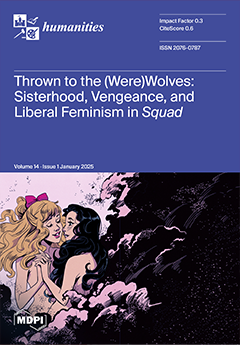
Cover Story: In Maggie Tokuda-Hall and Lisa Sterle’s 2021 graphic novel Squad, protagonist Becca and her new friends at Piedmont High are not human adolescents but a pack of werewolves who must kill to stay alive and select teenage boys—“the WORST ones” (70)—as their meal of choice. In representing Becca’s journey from prey to predator, Squad uses the subversive figure of the female werewolf to critique liberal feminist ideologies that encourage women and girls to gain power for themselves and then to use that power to perpetuate hierarchies of domination. This article suggests that Squad’s narrative and its comic images guide readers toward an understanding of how liberal feminist ideology impedes collective empowerment, ultimately arguing for Squad’s potential as a feminist consciousness-raising tool. View this paper
  • Issues are regarded as officially published after their release is announced to the table of contents alert mailing list .
  • You may sign up for email alerts to receive table of contents of newly released issues.
  • PDF is the official format for papers published in both, html and pdf forms. To view the papers in pdf format, click on the "PDF Full-text" link, and use the free Adobe Reader to open them.

Articles (18)

  • Article
  • Open Access
1,388 Views
14 Pages

Tales of Their Times

  • Rósa Þorsteinsdóttir

20 January 2025

The aim of the article is to examine how the fairytales of storytellers from different times agree with the idea that their attitudes towards life appear in the fairytales that they tell and to consider whether they construct their fairytales so that...

  • Article
  • Open Access
1 Citations
2,607 Views
14 Pages

17 January 2025

Breast cancer patients’ experiences of epistemic injustice in healthcare is a well-established fact. However, the significant role that gender plays in deciding the nature of epistemic injustice encountered by male and female breast cancer pati...

  • Article
  • Open Access
2,058 Views
17 Pages

16 January 2025

Jack the Ripper fictions tend to be realist in mode, making frequent use of the Victorian press and archives to depict the 1888 murders. At the same time, they marginalise and exploit the victims, defining them as silent testimonies to the power of t...

  • Article
  • Open Access
1 Citations
3,065 Views
19 Pages

15 January 2025

This article uses the surge of recent AI-generated simulations of Kafka’s writing as an opportunity to reflect upon both what AI can teach us about Kafka’s writing and what Kafka’s writing can teach us about the age of artificial in...

  • Article
  • Open Access
2,074 Views
18 Pages

15 January 2025

This article uses the English Gothic’s eighteenth-century dismantling of male lineage and Enlightenment certainty in Horace Walpole’s The Castle Otranto as a lens for understanding the twenty-first-century commercial popularity of directo...

  • Article
  • Open Access
5,397 Views
25 Pages

14 January 2025

Rudolf Fuchs (1890–1942) was an influential figure in Prague’s early 20th-century literary scene as well as an intermediary between German and Czech literature at a time of intense social and political transformation. This study places Fu...

  • Article
  • Open Access
3,147 Views
24 Pages

14 January 2025

This article reads Karl Marx’s Capital (volume 1, 1867) as the Bildungsroman of a congenital criminal: its eponymous character, Capital. Following Friedrich Engels’s The Condition of the Working Class in England (1845), Marx detects and d...

  • Article
  • Open Access
2,388 Views
8 Pages

13 January 2025

In this contribution, through literary content analysis, I examine the novel The Boy From Block 66: A WW2 Jewish Holocaust Survival True Story (2023). I am convinced that it should be included in literature classes dealing with modern historical issu...

  • Article
  • Open Access
5 Citations
3,446 Views
21 Pages

9 January 2025

This article engages in a philosophical dialogue with Nietzsche’s views on the discourse of power, examining the rising concerns surrounding the digitization and algorithmization of society in the context of advancements in robotics and AI. It...

  • Article
  • Open Access
3,689 Views
24 Pages

8 January 2025

Humanity has always aspired beyond the human. The technological development in recent decades has been extraordinary, leading to new attempts to overcome the all-too-human condition. We dream of conquering death, upgrading our bodies into perfect per...

  • Article
  • Open Access
1,883 Views
19 Pages

8 January 2025

Prevailing political and popular narratives often treat the issue of trans death as an inevitability and reduce complex stories of trans life to their endings. This paper investigates the transformative potential of creative forms of resistance&mdash...

  • Article
  • Open Access
3,445 Views
22 Pages

8 January 2025

In Maggie Tokuda-Hall and Lisa Sterle’s graphic novel Squad, protagonist Becca and her new friends at Piedmont High are not human adolescents but a pack of werewolves who must kill to stay alive and select teenage boys—“the WORST on...

  • Article
  • Open Access
2,725 Views
13 Pages

30 December 2024

The approach taken by Marvel and Hanna-Barbera to adapting Godzilla for a young American audience is a form of cultural appropriation. Cultural appropriation involves removing the subject from its cultural context. In this case, Marvel and Hanna-Barb...

  • Article
  • Open Access
1 Citations
2,695 Views
16 Pages

26 December 2024

Spanish film director Pedro Almodóvar has been detected early on by film critics as a Baroque filmmaker, a qualification to which he has agreed in interviews. This promotion of his style is certainly questionable as the word ‘Baroque&rsq...

Get Alerted

Add your email address to receive forthcoming issues of this journal.

XFacebookLinkedIn
Humanities - ISSN 2076-0787