1. Introduction
Geographical spaces are not neutral realities that maps and names merely represent. Every territory is also a historical and cultural construction: it is delimited, ordered, named, and incorporated into collective narratives that attribute meaning to space. From this perspective, a toponym is not merely a functional label for locating a geographical feature, but a form of semantization. Naming involves selecting a particular designation, fixing historical associations, activating memories, defining forms of belonging, and legitimizing certain interpretations of territory. Because geographical names become familiar through repeated use, they may appear self-evident; that familiarity, however, can obscure the power relations and historical processes through which they became established.
This issue is especially relevant to social science education. School geography has frequently presented boundaries, maps, and geographical names as objective, stable data detached from the historical conflicts that shaped them. However, school knowledge does not constitute a neutral selection of content, but rather a way of organizing and legitimizing specific interpretations of the world. As
Au (
2023) points out, every curriculum stems from a position regarding which knowledge is considered valid, which perspectives acquire centrality, and which ones are displaced. In the geographical field, this issue calls for a revision of the apparent objectivity with which maps and toponyms are usually presented. Critical cartography has shown that maps do not transparently reproduce a previously given reality, but rather participate in its cultural and political production.
Harley (
1989) argued that cartography should be analyzed as a discourse traversed by power relations: every map selects, hierarchizes, centers, marginalizes, and silences. Consequently, the reading of a toponym or a cartographic representation can become a particularly fertile pathway to question the assumed neutrality of space and to analyze how certain territorial interpretations come to be socially naturalized.
Geographical names also intervene in the construction of collective identities.
Anderson (
2006) showed that national communities are imagined through cultural devices capable of producing belonging and continuity. Among these devices, the map occupies a fundamental place, as it allows a territory to be visually represented as one’s own, recognizable, and shared. Toponyms participate in this same process: they link spaces with communities, sediment certain narratives of the past, and contribute to establishing who can identify with a territory or speak on its behalf. In this way, a geographical designation can function as a condensed historical narrative, seemingly descriptive, but heavily laden with identity and political implications.
This narrative dimension of space is closely related to memory. Places do not simply harbor past events, but can become symbolic supports from which a community remembers, interprets, or disputes its history. The conceptualization of lieux de mémoire formulated by
Nora (
1989) makes it possible to understand how certain spaces, symbols, or designations acquire a particular memorial density when their meaning ceases to be self-evident and becomes an object of public discussion. In this sense, it is not a matter of claiming that any geographical feature automatically constitutes a site of memory, but rather of considering that a controversy over its naming can activate historical memories, forms of belonging, and conflicts of interpretation that were previously naturalized.
The case of the Gulf of Mexico offers a particularly significant opportunity to work on these questions. The name “Gulf of Mexico” possesses its own historicity and should not be presented as a transparent name or one detached from processes of territorial construction. Like any toponym sedimented over centuries, it refers to historical, cartographic, and identity layers that can be critically interrogated. However, recognizing this historicity does not imply considering any subsequent substitution as equivalent. The proposal to replace it with “Gulf of America” can be understood as introducing a new operation of semantization promoted from a specific political position and within a contemporary context of strong power asymmetry.
On 20 January 2025, Executive Order 14172, signed by Donald Trump under the title
Restoring Names That Honor American Greatness, directed the Secretary of the Interior to take the necessary measures to rename, at the U.S. federal level, the area of the United States outer continental shelf previously identified as part of the “Gulf of Mexico” as the “Gulf of America” (
Executive Order No. 14172 2025). The very formulation of the order is significant: the decision is justified on the basis of the economic, energy, commercial, and strategic importance of the Gulf to the United States, and it is expressly inscribed within a narrative of national greatness. Given this explicit framing, the modification is not merely a terminological variation but also a political intervention into the public meaning of a shared space.
From a critical perspective, this operation can be interpreted in light of contemporary neo-imperial or neo-colonial logics. Unlike classical forms of colonization, dominance over space does not necessarily require physical occupation or direct administration; it can also be exercised through language, cartographic representation, institutional decisions, and the capacity to impose or disseminate a specific designation. Unilaterally renaming a shared maritime space may be read as projecting a narrative of national centrality onto it and displacing the framework through which it had been historically recognized. The controversy does not, therefore, pit a completely neutral name against an ideologized one, but rather two historically situated processes of territorial semantization, one of which may be interpreted, within this critical framework, as an operation of symbolic appropriation linked to U.S. political power. The measure may also be read, for instance, as domestic symbolic politics or as media-oriented political communication; the present study adopts a critical perspective specifically to examine the relationships among territorial naming, identity, representation, and power.
This territorial dispute is also related to the way in which national narratives organize the understanding of the past.
Carretero and van Alphen (
2018) have pointed out that national master narratives not only offer interpretations of the past but also legitimize positions in the present and orient specific representations of the future. Although their work focuses on history teaching and national memories, their approach is productive for analyzing the territorial dimension of those narratives. A toponym can equally contribute to establishing a collective subject, producing an identification between space and nation, and excluding other memories or perspectives. In the analyzed case, the controversy allows us to question who possesses the authority to name the Gulf, which community appears reinforced by the new denomination, what historical narratives are mobilized, and what power relations are presented as legitimate.
The educational potential of the case is expanded by its immediate media circulation. The controversy over the naming of the Gulf did not remain circumscribed to an institutional decision but was disseminated, commented on, debated, and reworked through digital news, videos, social media posts, memes, cartographic representations, and responses generated by artificial intelligence. These discourses do not act as mere transmission channels for previously finalized information. Each format selects elements, constructs positions, incorporates or silences voices, guides interpretations, and generates different effects on its audiences. A journalistic news report, a short video, a meme, or an automated response may stem from the same event but turn it into profoundly different narratives about identity, sovereignty, power, or conflict.
Within this framework, critical literacy allows for the transformation of a current controversy into a formative problem for future teachers.
Cassany (
2005) understands critical comprehension as a practice that requires situating discourses within their sociocultural context, recognizing their purposes and interests, identifying what they include and exclude, analyzing the position from which they have been produced, and assessing the effects they generate in the community. Applied to the case of the Gulf, this perspective shifts the question from the superficial choice between two denominations toward deeper issues: who uses each name, for what purpose, from what position of authority, through which mediums is it disseminated, and what representations of territory and identity does it contribute to consolidating.
This approach is especially necessary in initial teacher training. Future teachers will have to work with students who access social, historical, and geographical discourses daily through digital environments where information, opinion, humor, polarization, and automated content appear closely intertwined. For this reason, teaching Social Sciences cannot be reduced to transmitting locations, dates, or denominations as if they were uncontestable elements. It also involves training students to interrogate the images, maps, news, and narratives that organize their understanding of the world. In this sense,
Romero Walker (
2021) has highlighted the relevance of critical media literacy to construct teaching practices capable of questioning naturalized representations and addressing the hierarchies that traverse public discourses.
This concern has been specifically examined in research on Critical Media Literacy within teacher education.
Robertson and Hughes (
2011), in a study of preservice teachers designing critical media literacy lessons, found that although participants were willing to address social justice issues and used digital literacies in engaging ways, some experienced difficulties in articulating and focusing critical media literacy concepts. More recently,
Trust et al. (
2022) argue that, in contexts marked by misinformation and disinformation, critical media literacy should become an essential component of teacher education, enabling future teachers to critically examine the media they consume and use pedagogically. Related research in historical and social education has similarly identified difficulties in distinguishing facts from opinions and recognizing the intentionality of content creators when students work with digital historical narratives (
Rojas and González-Monfort 2023). These contributions are particularly relevant to the present study because they situate the critical analysis of media not only as a literacy issue, but also as a specific challenge for the education of future teachers.
Teacher education must, therefore, move beyond an approach limited to diagnosing the absence or insufficiency of critical thinking in university students. It is necessary to design interventions that allow for the observation of how future teachers interpret real controversies, what difficulties they encounter in identifying their ideological components, and what tools they mobilize to question apparently neutral discourses. In this sense, the controversy over the Gulf of Mexico presents a dual potential: it allows for the critical reading of digital sources while simultaneously introducing a dimension frequently neglected in the social science education, namely the interpretation of space as a historical, cultural, and political construction.
Based on these premises, the present research takes place within the course “Didactics of Social Sciences I” of the Bachelor’s Degree in Primary Education at the University of Zaragoza, with the participation of 110 preservice teachers. The intervention, entitled “The Gulf of Mexico or the Gulf of America?”, proposes the comparative analysis of various digital sources related to the controversy over the name change: press news, videos, social media posts, memes, and responses generated by artificial intelligence. Guided by the framework of critical literacy, students were required to situate the discourses within their context of production, recognize their purposes, analyze the voices incorporated and silenced, assess their criteria of credibility, and examine the social and identity-related effects derived from their dissemination.
The general objective of this study is to analyze how future Primary Education teachers interpret the political and ideological components present in mediatized discourses regarding the naming of territory, and to what extent they recognize the relationship between toponyms, cartography, memory, identity, and power. Specifically, it aims to examine which sources the students select, what criteria they use to analyze their credibility and intentionality, how they interpret the role of media and digital resources in the representation of space, and what possibilities this experience offers for developing critical literacy linked to the teaching of Social Sciences.
The question guiding this research can be formulated as follows: how do preservice teachers interpret the political and media discourses generated around the substitution of the name “Gulf of Mexico” with “Gulf of America,” and what possibilities does its analysis offer to develop critical literacy regarding the relationships between territory, identity, memory, and power? Grounded in this question, the study aims to move beyond research that merely confirms students’ difficulties in critically reading information, and instead analyze the potential of a formative intervention that converts a contemporary territorial controversy into an opportunity to educate the historical, geographical, and civic gaze.
2. Materials and Methods
2.1. Research Design
The research was conducted at the University of Zaragoza, specifically within the Faculty of Human Sciences and Education at the Huesca Campus (Spain). It focused on the analysis of the narrative productions of 110 preservice teachers enrolled in the Bachelor’s Degree in Primary Education who were taking the course “Didactics of Social Sciences I.” The sample comprised 64 women (58.18%) and 46 men (41.82%). Throughout the academic year, the total of 110 participants were organized into two main cohorts, each divided into two classes. Within each class, 11 workgroups were formed, ranging in size from three to six members. Across the 22 resulting groups, the composition of members exhibited considerable heterogeneity.
Based on the literature review and previous experiences linked to the development of Critical Literacy in teacher training (
González Milea et al. 2025;
García Ruíz and González Milea 2022), a formative itinerary was designed to address the critical analysis of social discourses with wide media circulation. The proposal stemmed from a socially relevant issue (
problema social relevante): the controversy generated by Donald Trump’s proposal to replace the name “Gulf of Mexico” with “Gulf of America.” The educational value of this case lies in its ability to address, in an integrated manner, the relationship between territory, identity, memory, political power, media discourses, and digital culture.
The study adopts a qualitative, interpretive, and critical design based on the content analysis of students’ individual and group narrative productions (
Mendizábal 2006). The research design, which is flexible and progressive, draws on previous studies conducted within the line of research on the development of Critical Literacy in initial teacher training and is situated within the critical paradigm of qualitative research. It does not aim to quantitatively measure the acquisition of a competence or establish statistical generalizations, but rather to understand how future teachers interpret political and media discourses linked to a contemporary territorial controversy, what tools they mobilize to analyze them, and what difficulties arise in the development of critical literacy.
The question guiding this research is: how do preservice teachers interpret the political and media discourses generated around the substitution of the name “Gulf of Mexico” with “Gulf of America,” and what possibilities does its analysis offer to develop critical literacy regarding the processes of territorial semantization and their relationships with identity, memory, and power?
Consequently, the general objective is to analyze how future Primary Education teachers interpret the political and ideological components present in mediatized discourses regarding the naming of territory, based on the controversy over the substitution of “Gulf of Mexico” with “Gulf of America,” and to assess the possibilities that this analysis offers for the development of critical literacy in initial teacher training.
Specifically, it aims to:
Analyze the interpretations made by students regarding the instrumentalization of political and media discourses from diverse information sources, as well as examine the credibility criteria they apply to each of them.
Identify how students recognize—or fail to recognize—geographical naming as an operation of territorial semantization linked to the production of meanings about space.
Characterize the relationships among territory, identity, memory, and power established by students when interpreting the controversy.
Access to Informants and Negotiation.
Access to the research field and its subsequent negotiation were carried out through theoretical sampling, in which participants had to meet a series of criteria, including:
Being enrolled in the course “Didactics of Social Sciences I.”
Taking the course under the face-to-face, continuous assessment modality.
Participating as a member of one of the small working groups.
Initially, students were informed about the purpose of the research and told that the study aimed to understand in depth how future teachers develop Critical Literacy through their participation in the course’s formative proposal.
Rather than seeking pre-established answers or confirming or refuting prior theories, the analysis remained open to emergent elements as they arose. Furthermore, rather than making value judgments, the study sought to understand how students learn and what proposals they put forward.
Likewise, in compliance with the principles of ethical rigor and credibility proper to qualitative research, the design was submitted for evaluation to the Research Ethics Com-mittee of the University of Zaragoza (CEIN), which approved it under code GM_CEIN_2026_137. The data protection procedure obtained approval from CUSTOS (RAT 2026-79), a platform belonging to the same university. All of this has guaranteed the anonymity of the participants, respect for voluntary participation in this research, and the freedom to withdraw from it at any time.
In accordance with the nature and focus of the research, narrative productions created by the students throughout the guided formative process were selected for analysis, as detailed below.
On the one hand, individual reflective learning narratives were consulted, which capture the process of knowledge construction around practical experiences and the theoretical construction of the course, wherein students must establish a profound relationship between what they have learned and their experience as citizens in a specific context. These documents amount to a total of 110. Likewise, reflections and assignments developed in groups throughout the course were used, totaling 22 documents. A total of 132 documents were analyzed, comprising both individual and group submissions.
2.2. Data Analysis and Research Development Phases
The data analysis procedure began with the anonymization of the documents (a total of 132), which were assigned a code following a notation system that can be consulted in
Table 1. This allowed for the identification of the source from which the information originates while maintaining the anonymity of the informants.
A categorical analysis was carried out using ATLAS.ti (
Friese 2019), through which interpretive thematic blocks were constructed and developed into categories for discourse interpretation (
Strauss and Corbin 2002;
Pérez-Ripossio 2023). The categorization process was carried out across several distinct phases. First, a deductive codification and thematization was established based on the conceptual framework of Critical Literacy. Subsequently, the text was segmented into units of meaning by assigning open codes, which allowed for the identification of the various nuances within the discourse. Finally, axial coding was performed by constantly comparing quotations and codes, enabling the grouping of emerging codes by thematic affinity until informational saturation was reached. To meet the criteria of rigor and credibility required by this type of research, the researchers triangulated moments, sources, and informants and conducted an internal peer review.
The development of the research was carried out in three stages over the course of an academic semester, between January and May. It began with the implementation of a theoretical training proposal in Critical Literacy addressing social content, drawing on the analysis of works such as those by
Lankshear and McLaren (
1993),
Lewison et al. (
2002), and
James and McVay (
2009).
In the second stage, and over the course of three weeks of group work, students organized into groups of three to six students carried out a practical and reflective activity regarding the impact of mediatized discourse on digital platforms in relation to Donald Trump’s proposed name change from the “Gulf of Mexico” to the “Gulf of America.”
In the third stage, as a result of close tutoring and guidance, and upon completing the course, the students individually constructed learning narratives of a reflective-critical nature. In these narratives, they reviewed the construction of their own learning, addressing different milestones within their training process, including this specific activity. This phase was accompanied by data analysis and the elaboration of research reports.
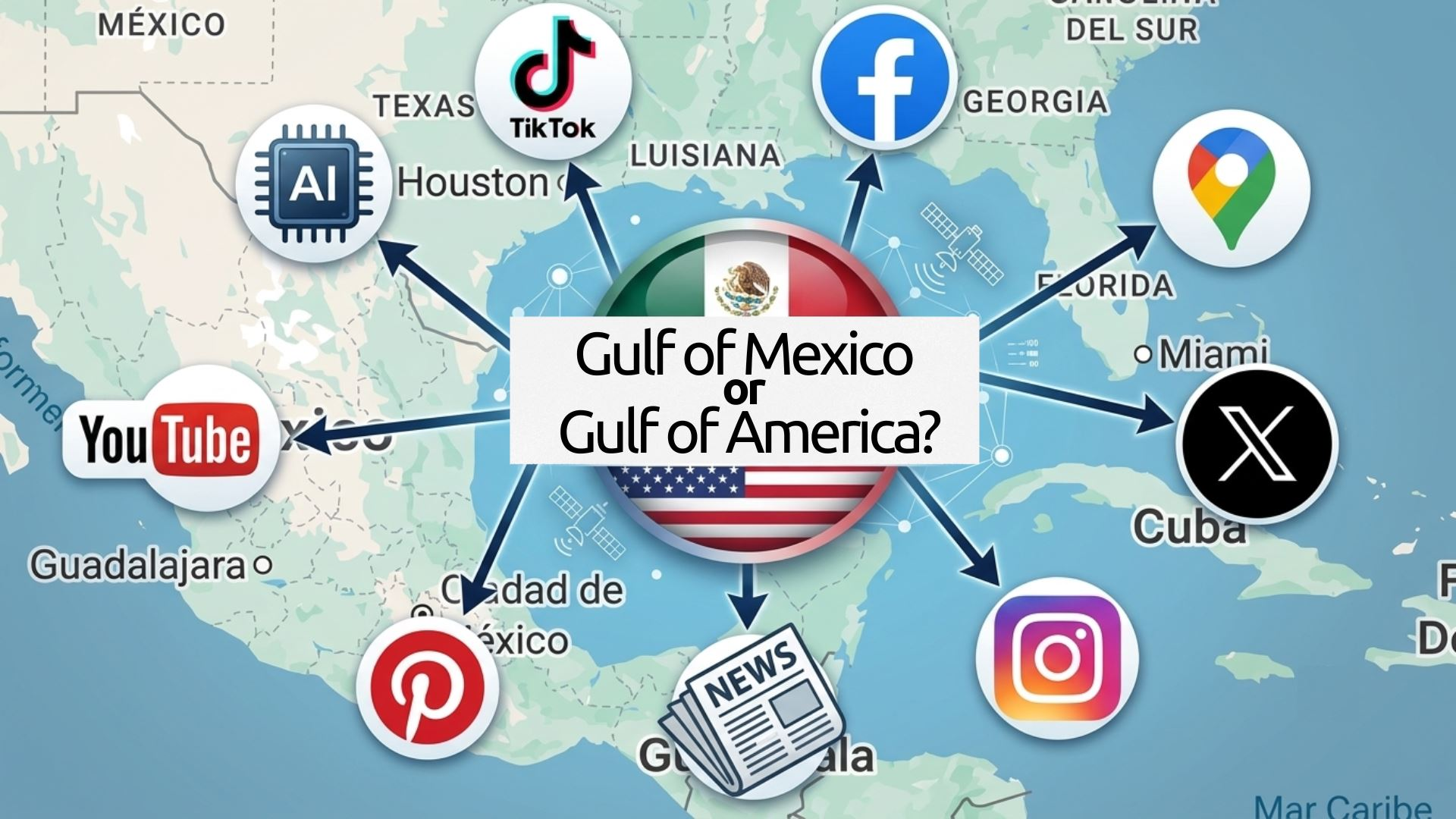
During the preparation of this manuscript, the authors used Gemini 1.5 Pro (Google) for the purposes of academic translation from Spanish and Generative AI was used during the refinement of the Graphical Abstract (Gemini version Gemini 3.6 Flash/powered by Nano Banana 2 for image processing). The original design and conceptual graphics were entirely created by the authors. The AI tool was used exclusively for image refinement (prompt: improving clarity/labeling) based on our original artwork.
2.3. Classroom Experience
The activity is titled “The Gulf of Mexico or the Gulf of America?” and involves an analysis, within the framework of critical literacy, of the underlying ideology in the main news stories and counterarguments prompted by Donald Trump’s proposed name change for the Gulf.
When presenting the activity to the students, the proposal is situated within the text analysis framework proposed by
Cassany (
2005), which establishes a series of guidelines to analyze the background of texts, the positioning of the author, intentionality, and underlying ideology. This allows not only for the identification of the discursive practices that feed into specific dynamics of power and domination but also for assessing the impact of mediatized discourse on the community.
The development of the activity is divided into a total of 3 sessions (see
Table 2) in which students progressively analyze diverse digital sources addressing the same event from multiple perspectives.
2.4. Activity Introduction and Source Selection
At the beginning of the activity, the guidelines and steps for carrying out the proposal are established. The first of these consists of each working group selecting four different sources from the digital resources, or from others, that discuss the name change from the “Gulf of Mexico” to the “Gulf of America.” The options include YouTube, Instagram, Facebook, X (Twitter), digital newspaper articles, AI responses, and memes. AI-generated responses were included as digital resources because students use them to access information, while their credibility and perceived neutrality were themselves objects of analysis in the activity. Along with selecting the four sources, each group must identify the search engines or prompts used to locate them.
2.4.1. Session 1
During the first session, students perform a group analysis of each of the four selected sources. In the first part, they are responsible for situating the text within its starting sociocultural context. To do this, they identify as a group the purposes served by the analyzed news story or content, the social fabric within which it is created, the interests of the content creator, the information it includes and, consequently, the information it leaves out, the voices that are incorporated and those that are omitted or silenced, and finally, the author’s positioning in relation to what is narrated.
In the second part of the session, an analysis of the discursive practice is carried out, through which they identify the types of sources they are working with—whether digital newspapers, digital media outlets, social media, or artificial intelligence—understanding that each of these formats offers specific content for a concrete purpose. Furthermore, they identify what type of information is presented—a fact, an opinion, or an opinion about the facts—and finally, they must explain what guidelines they follow to determine the veracity of the sources and what criteria they use to distinguish truth from falsehood.
2.4.2. Session 2
The second work session is aimed at assessing the effects of these discourses on the community. To do this, based on the selected source and the type of population that predominantly consumes content from these sources, the students think about and deduce what the reader’s situation and individuality might be. A search is conducted for counterarguments and interpretations by authorities and the impact these interpretations have, assuming that the more amplified the voice, the greater the impact will be.
Likewise, in this session, an analysis is made of the social impact and the level of reach of this generated content (local, state, or international) and its potential internationalization. At the same time, the type of responses received in each of the selected sources is identified: comments in favor, comments against, tendency to debunk or argue, etc. Finally, the type of counterarguments and rebroadcasting are identified.
2.4.3. Session 3
During the third and final session, an open debate is held with the whole class, in which each group shares its main findings and conclusions from the comparison of different sources. In this space, a debate takes place on what information is repeated, what information is omitted, whether contradictions and paradoxes are evident, and above all, what the underlying intentionality of the analyzed discourse is and its impact on the community.
The debate is moderated by encouraging students to think about the social use and validation that geographical nomenclature can have, the positions adopted by authorities in the territories involved and, lastly, the use of official maps and Google Maps, analyzing the role played by territorial representation techniques in relation to the configuration of identities and how deliberate decisions can guide social debate in favor of or against an event.
3. Results
The construction of the results was carried out based on the exhaustive analysis of a total of 132 documents, including 22 group assignments and 110 individual narratives in which the participating students selected and analyzed a total of 88 diverse sources, including social media content, digital newspaper articles, and artificial intelligence responses, addressing the proposed name change from the “Gulf of Mexico” to the “Gulf of America.” To provide a more concrete view of this media corpus,
Table S1 presents an illustrative selection of the digital artifacts examined by the students, including a brief characterization of each artifact, the main discursive features identified in the corresponding student analyses, and the group code.
TikTok was the most frequently selected digital resource, followed by YouTube (see
Table 3). Together with artificial intelligence, these were the three sources most frequently chosen for the activity.
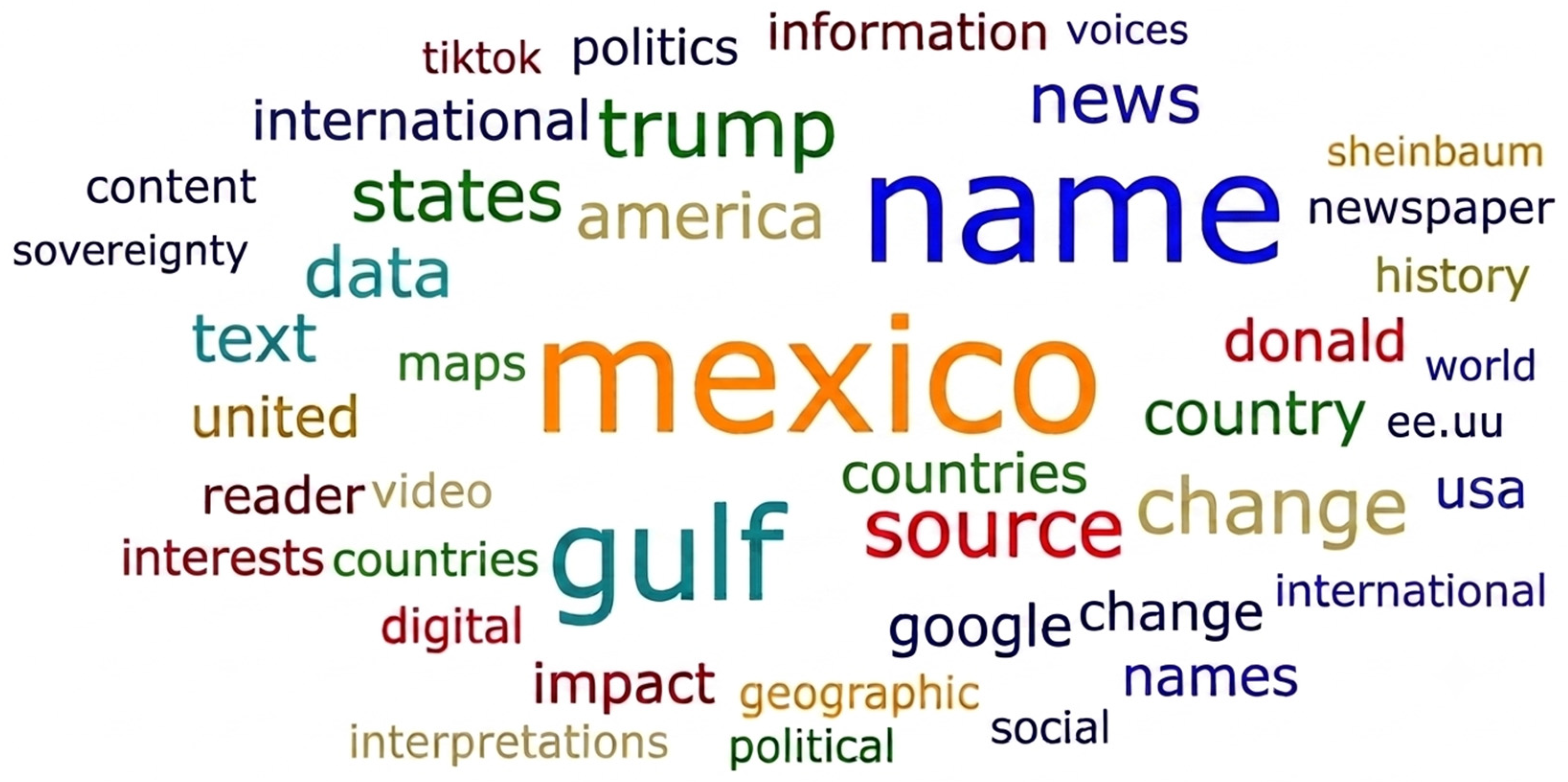
As previously mentioned, the data analysis phase was conducted using the specialized qualitative data analysis software ATLAS.ti, which allowed us to generate the word cloud of term co-occurrences shown in
Figure 1.
Direct work with the sources and the thematic analysis yielded a total of four emerging categories, which served to organize all 430 coding units.
The organizational categories are:
Territory and Identity (102 coding units)
Controversies and Intentionality (99 coding units)
Power and Ideology (142 coding units)
Credibility and Discourse Impact (87 coding units)
It is important to reiterate that these results are presented with the purpose of overcoming dynamics of epistemic hierarchy between the researcher and the research subject. We do not intend to point out what students do right or wrong, nor do we seek to establish levels of competence acquisition; rather, we aim to understand how they learn and how they construct knowledge by analyzing how they mobilize their thinking within a virtual and symbolic space that constitutes a major part of their access to information.
3.1. Territory and Identity
Among the categories constructed from the analysis of the texts generated by the students, a prominent category emerges from the relationship between the construction of identities and territory. This category comprises 102 coding units and shows that, for the students, changing the name of the Gulf appeals to the sense of belonging among the inhabitants of the affected spaces.
Their main impact lies in how people interpret and feel about the issue. At a cognitive level, it introduces confusion and reframes the space with an identity-driven burden.
[G.1.3.]
Likewise, it is interesting to note the prominent role attributed to the symbolic dimension of this change. They maintain that, when analyzing the various news stories and search results on social media and artificial intelligence, the change is framed not as a decision that might have repercussions on concrete physical space, but rather on how it is thought of and how power is exercised through it.
Related to geographical nomenclature, the name “Gulf of Mexico” remains, historically recognized and used on official maps and in highly used and well-known applications such as Google Maps. It holds a symbolic and ideological dimension rather than a legal one.
[G.1.7.]
A simple name change reveals power dynamics between countries, symbolic appropriation, and the construction of people’s identities.
[G.1.A.29]
Undoubtedly, the perception that the name change has a direct impact on the relationship between territory and the identities constructed within it becomes clear given the variety of ways of exercising power that are identified. They speak of appropriation and the creation of borders that feed into a narrative of confrontation.
There is also a symbolic-nationalistic interest, since changing the name to “Gulf of America” requires a symbolic appropriation, and lastly, a media interest, aiming to generate general interest and popularity.
[G.1.1.]
On the other hand, the expression “Gulf of America” has an ideological and political purpose that seeks to strengthen a predominant national identity in order to maintain social unity within a very diverse whole and carry out a symbolic appropriation of space.
[G.1.6.]
Socially, it reinforces symbolic borders between national communities and feeds into narratives of confrontation. This occurs because the names of places are not neutral, but are instead linked to history and collective identity.
[G.1.3.]
Furthermore, they point out that the conflict can be perceived as a way to weaken the preservation of national sovereignty or its international perception. They argue that the stance opposing the name change in the Gulf is linked to the recognition of its historical and cultural value.
There are also diplomatic interests on behalf of Mexico, which present a defense of symbolic sovereignty, protection of the shared history of its territory, and international recognition of the historical name, recalling that it is a designation that has existed for centuries.
[G.2.4.]
The impact is mainly at an international level since it affects globally and causes people to talk about nationalism, geopolitics, and symbolic manipulation. Although it also affects Cuba and Mexico at a regional level, as they worry about their historical and geographical identity.
[G.1.10.]
This name change is not presented merely as a geographical issue, but as a matter related to national identity, symbolic power, and political rivalry between countries, especially the United States and Mexico.
[G.2.2.]
The dynamic nature of identity construction is also perceived when “otherness” (alterity) crosses the students’ discourse, leading them to interpret that confrontation between two countries has the potential to create greater distances between one another through the self-perception of an “us” versus “them” dynamic.
This topic is situated in a context of geopolitical tensions between the United States and Latin America, where a possible name change would not be just a cartographic issue, but also a symbolic matter related to national identity, sovereignty, and power relations between territories by the country governed by Donald Trump […]. As a consequence, the logic of “us versus them” is strengthened, increasing tension in public debate, even if no real material conflict exists.
[G.1.3.]
This first spatial category seems, in some examples, to shift from meanings linked to the concrete and absolute toward more virtual and mobile territorialities. The space for encounter and debate is thus thought of as a place of tension and negotiation, capable even of feeding a sense of belonging.
Generally, memes emerge from social networks and as digital culture, where on several occasions, in the face of major conflicts and big controversies, they are used as a collective and common space for opinions and as a way to take refuge in humor and irony […]. An informative tweet about the name change of the Gulf of Mexico contains a series of ideas and facts generating a social impact. At a local level, it sparks conversation in communities close to the gulf and strengthens the sense of regional belonging.
[G.1.1.]
The reader is immersed in TikTok, a context characterized by immediacy […] which influences the way the message is received, potentially creating reactions based on feelings of national identity or cultural belonging.
[G.2.6.]
3.2. Controversies and Intentionality
A total of 99 coding units were identified within this second category. As part of the arguments presented both in favor of and against the name change of the Gulf, this proposal is categorized as a controversy—occasionally identified as the result of a deliberate decision with the sole purpose of creating conflict and polarization among the population.
From a more detached stance in the debate, the students point out that a consequence of such a unilateral proposed change could be the generation of confusion and destabilization.
The use of unrecognized nomenclature can cause geographical confusion, as maps are created based on criteria that must guarantee coherence and stability.
[G.1.2.]
If public figures or media outlets promote an alternative version, it can end up generating debates, polarization, or even confusion in public opinion.
[G.2.6.]
However, it is clear that students perceive the instrumentalization of the conflict to satisfy a diverse range of interests.
We find an informative interest in explaining the conflict, a social interest in informing the population, and a political interest in showing the consequences of political power.
[G.2.1.]
The conflict stops being just about “who owns the ball” and becomes about who gets to make decisions regarding it. Similarly, the Gulf of Mexico was not just a place on the map, but a space where different countries compete for control and legitimacy based on their own interests, frequently leaving history and its consequences in the background.
[G.1.A.17]
The very format of the consulted social networks (e.g., TikTok videos or Instagram reels) makes it easy for shared information to follow simplified patterns. These patterns reduce the complexity of the discourse to polarized stances, aiming above all to trigger an emotional reaction in the content consumer.
On an emotional level, it causes rapid polarization, which is specially amplified by social networks, where short and catchy messages spread more easily and generate a higher number of intense reactions, whether of support or rejection.
[G.1.3.]
On networks like TikTok, positioning is usually reinforced through an emotional tone, dramatic music, or fast-paced editing […]. The content included in this video consists of several factors, such as catchy statements or direct assertions, strong or emotional opinions, and striking visual elements like edited maps, headlines, and flags.
[G.1.1.]
The pursued emotional reaction can take the form of empathy or rejection. The latter is widely extended across social media platforms (rage bait), which leads to questioning the intentionality of independent content creators or media profiles when they present themselves as mere neutral intermediaries between events and their dissemination.
The author’s purpose with the reel is not only to inform but also to generate an emotional reaction, making the people who watch the video feel the same emotions as the person telling it, in order to make the viewers aware of the power conflict or injustice.
[G.1.3.]
Because the video was so short and sought emotional responses using conjectures, it could end up confusing the viewer into thinking that the name change was official.
[G.2.2.]
It does not seek to keep its audience informed; rather, it seeks to surprise them or provoke them into commenting if they disagree. Ultimately, what it seeks is to generate an emotional reaction in the receiver.
[G.2.3.]
The video is situated within the framework of social networks—in this case, TikTok. This platform is characterized by rapid consumption and fleeting news, meaning that for a video to go viral, it needs catchy headlines and videos that are not too long so that the audience does not get tired and swipes to view another video or type of content. To avoid this, there is a tendency toward the simplification of complex topics such as this one.
[G.2.3.]
When intentionality intersects with interest, the purpose of sharing a news story ceases to be merely informative and turns into a striking audiovisual production that attracts and binds the consumer, thereby guaranteeing their watch time—which translates directly into economic profit. The priority, therefore, shifts to entertaining and securing the highest possible number of interactions.
It can be seen that the final goal is nothing more than reaching a specific number of views or interactions with the video, beyond providing an actual explanation with real data or delving into the subject.
[G.2.3]
Instagram is situated within a technological context that responds to economic interests, such as the brand’s market value, and technological interests, such as updating its systems to adjust to the geographical and political decisions regarding the name change of the Gulf of Mexico.
[G.2.1.]
There are interests in making Trump look bad, mocking his “measure to protect American history.” It also seeks to generate interaction to obtain some economic benefit.
[G.1.9.]
In parallel, the student body also analyzes the underlying intentionality behind the presumed neutrality of the Google Maps application. They note that, depending on the country from which the platform is accessed, the name of the Gulf could appear as either the Gulf of Mexico or the Gulf of America.
It is clear that this nomenclature change on Google Maps serves to ensure that this platform avoids local conflicts and looks good, appearing to comply with the legislation of each country, leaving aside official cartography and letting the algorithm name the Gulf.
[G.1.5.]
The reason for this is because this platform is known worldwide; since it does not look for problems or confrontations between any of the countries, it shows each country what interests them to see or hear.
[G.1.8.]
The author, far from focusing on taking a side regarding the topic they are speaking about, focuses on drawing attention and provoking debate among their audience, encouraging them to comment and thus helping them gain more views.
[G.2.3.]
Mention is made of Google Maps and how it shifts to satisfy the interests of each country, applying it to the case of the gulf: for the inhabitants of Mexico, it will continue to appear as the Gulf of Mexico, while for Americans, it will indeed appear as the Gulf of America. In this way, Google Maps would comply with the demands and interests of each country, with the possible goal of avoiding any conflict.
[G.1.7.]
3.3. Power and Ideology
This third category, which establishes a direct relationship between a highly ideologically charged decision and visible structural power dynamics and domination among the involved territories, incorporates the analysis of 142 citations. In these, the students identify such dynamics within the self-selected social media posts and artificial intelligence outputs.
In this regard, the political dimension gains considerable strength when students interpret the invisible motivations driving these actions. Consequently, they understand the proposed change as the result of a display of power aimed at supporting a narrative of hierarchy between nations.
Trump’s intentions were not to reach an agreement, but rather to impose his ideas, show off, and imply that the power he holds in his hands is superior to any other.
[G.1.1.]
Regarding the interest behind this change, we believe it is due to political objectives of the United States government, possibly to establish itself as a stronger power. It may also have the interest of conveying that he is a leader with certain power and influence, not only over his own territory but at a higher level.
[G.1.2.]
Some students believed that calling it the “Gulf of America” could be a way to reinforce the symbolic power of the United States and the ego of its president.
[G.1.3]
The students emphasize that geographical space is not altered by the name change itself, but rather by its symbolic meaning. Topography thus shifts from a neutral connotation toward an interpretation that identifies it as a tool for constructing critical narratives.
It points out that there is no physical change, only a symbolic conflict. This means that the place has not changed, it has not moved, the borders remain in place just like its size and surroundings; what does change is the name. This change carries a heavy political burden, summarized as an act of absolute power and centrality.
[G.1.4.]
We have realized that the names used to designate a geographic space are not just simple labels, but tools used by power.
[G.1.5.]
What seemed like a distant matter to us has demonstrated the amount of global implications that affect us, such as geographic names being tools of power, and the power that politics exerts on digital and technological tools like Google Maps—capable of modifying or showing one name or another depending on the location.
[G.1.5.]
Examples of this shift toward more critical positions become evident as students realize that there is no neutrality in these types of decisions and that they respond to an underlying intentionality. In this sense, ideology lies not only in what is said, but also in what is omitted.
It is equally revealing to note what the corpus does not contain: no individual or group narrative connects this symbolic appropriation of space and power asymmetry with broader comparative frameworks, such as other territorial propaganda processes, authoritarian uses of geographic nomenclature, or contemporary forms of information control. This absence helps qualify the scope of the observed critical literacy: while the interpretations successfully recognize the ideological dimension of the case, they remain bound to the specific episode without projecting onto deeper historical or political genealogies.
The act of renaming a territory is never neutral; it is a manifestation of power, a blow to historical memory […] It reinforces the idea that cartography has historically been a tool of power. Looking at it this way implies a more complex reading of maps and their language, which helps foster a more critical mindset in students regarding international issues.
[G.1.11.]
Geographic names represent power, identity, and relationships between countries.
[G.2.1.]
The discussion on how to name the gulf is not a simple technical detail; it is a point of tension between politics, culture, history, and international diplomacy.
[G.2.2.]
I understood that the United States’ purpose in renaming the Gulf as “of America” was clearly political, as it leveraged its power to impose its vision on its platforms and silence Mexico’s stance.
[G.1.A.9]
They perceive that the exercise of power and the perpetuation of dominance operate as two sides of the same coin, even when naming territory. The deliberate framing of a discourse that validates expansionist practices—even symbolic ones—shapes perception and thought.
The practical activity made me reflect on the power and dominance that some countries possess in the world of geography.
[G.1.A.34]
The language is not formal; instead, it is presented speculatively through comments such as “obsession” or “imperial control”.
[G.1.3.]
Geographic data has become a new battlefield for the control of global perception and narrative.
[G.1.5.]
In a context where data and digital maps are the new strategic territory, controlling what people see is equivalent to molding and adapting us to their ideas and thoughts. It is a contemporary example of how power is increasingly exercised through the digital layer superimposed on physical geography, and how it affects us.
[G.1.5.]
It shows the world that a person, by virtue of leading one of the world’s main superpowers, can decide over the territory and cultural identity of other countries, even if that country is Mexico, which is also a power.
[G.1.9.]
The Gulf of Mexico becomes a stage for political tensions and unequal power relations.
[G.1.A.20]
Another issue derived from the analysis of the students’ narrative productions is questioning the relations of authority and hierarchies among nations, prompting them to think about who makes decisions over territories, who names them, and who benefits from it.
It is clear that Donald Trump is attempting to prove once again that he can reshape geography and the world we know at his pleasure, with virtually no resistance.
[G.1.6.]
In any case, it is understood that the proposed change stems neither from consensus nor negotiation among the three affected nations (USA, Mexico, and Cuba). These asymmetries lead students to question national sovereignty, the true degree of autonomy of these countries, and the international repercussions regarding how Mexico might be perceived as a country not allowed to make decisions over its own territory.
Finally, at an international level, if the video goes viral, it can amplify the global discussion on diplomacy, sovereignty, and the reactions of other countries to the change.
[G.1.1.]
This makes us reflect on freedom of expression and sovereignty, and we ask ourselves: to what extent are we willing to surrender control of how we name and perceive the world to opaque algorithms and the decisions of dominant powers?.
[G.1.5]
Mexican authorities reaffirm the historic name, interpret the change as a unilateral gesture, and reinforce the discourse of sovereign defense.
[G.2.4.]
Aiming to modify it would imply ignoring Geography and violates elementary principles of international law, such as those established by the UN and the United Nations Convention on the Law of the Sea, where the naming of geographical features must reflect the sovereignty and historical legitimacy of the coastal sections.
[G.2.6.]
The name change would not only affect the nomenclature as such, but it has a greater significance because it would modify its history, symbology, and even the perception of Mexico’s own sovereignty over its territory in the eyes of other countries.
[G.1.2.]
Despite this conflict appearing distant to them, they also perceive the international impact that certain political decisions can have, reflecting on the potential repercussions of this precedent within their own territory.
Although this case focuses on the Gulf of Mexico, the power Trump has to change the name of a gulf could trigger future changes in other territories, such as the Strait of Gibraltar.
[G.1.7.]
It may seem that this issue does not affect us as citizens of Spain, but it hints that the representation of our world depends on a decision influenced by hidden government pressures.
[G.1.5.]
Decisions made by political leaders, as Donald Trump has done in this case, can influence other places and generate international tensions that indirectly affect countries like Spain.
[G.2.7.]
It affects us in Spain because we host US military bases, and recently, Trump has publicly stated that if we do not support him, there will be consequences.
[G.2.8.]
Regarding how this measure influences us, we believe that it does not affect us directly because we are in Spain. However, it does affect us indirectly, as perhaps in the future Donald Trump or another authority might want to change the name of the Gulf of Cádiz, for example. Therefore, we think that if this happened in a nearby environment, our concern would be greater since we would take it more personally, as something belonging to us.
[G.2.5.]
Ultimately, the motivations driving the population’s stance both for and against this change are framed dichotomously: defending a symbolic Mexican sovereignty by advocating for the current name, versus identifying with American patriotic and nationalist values that legitimize imposing the nomenclature “Gulf of America.”
Regarding the type of responses, there are comments both in favor (defense of the historical name) and against (nationalist or revisionist stances).
[G.2.6.]
Some of his followers thought the change was a sign of patriotism, while to others it seemed like an unrealistic absurdity […] The impact is mainly at an international level since it affects globally and causes people to talk about nationalism, geopolitics, and symbolic manipulation.
[G.1.10.]
If the reader is international, it can be understood as a diplomatic conflict or as an example of contemporary nationalism, in addition to relating to broader geopolitical tensions […] The responses found can be in favor, using patriotic arguments, defending the sovereign right to rename, and appealing to national pride; they can also be against, defending the historical name, criticizing symbolic nationalism, and accusing him of diplomatic provocation.
[G.2.4.]
Some explanations may seem closer to nationalist or right-wing ideas, especially when speaking of national pride, sovereignty, or the power of countries to name territories.
[G.1.3.]
Its social structure is connected to political and media discourses of a nationalist nature, which focus on strengthening the power and centrality of a single country […] The reader witnesses a discourse filled with ideology that seeks to consolidate a nationalist identity based on power, rather than generating a specific change in daily life.
[G.1.6.]
3.4. Credibility and Discourse Impact
When source credibility and the resulting impact of the discourse are analyzed as a category, a total of 87 coding units are identified. Initially, these coding units focus on the individuality of the reader or content consumer when interpreting the information they receive. Despite the multiplicity of forms that responses can take, there is a tendency toward generalization and reductionism when considering the public’s potential stances. For instance, based on nationality, it is often assumed that a Mexican consumer will oppose the name change in the Gulf, while an American consumer will favor it.
All the opinions of the people appearing in the news are based on their ideologies, their ways of thinking, and their nationalities.
[G.2.3.]
Interpretation in Spain can be seen as an analysis of United States politics, whereas in Mexico it can be viewed as a more sensitive issue (identity), and in the US it will be seen as a debate according to each reader’s ideology.
[G.2.4.]
In parallel, the situationality of the text plays a role in how the message is received and interpreted. The individual’s ideological positioning, prior knowledge, and, once again according to the students, national identity act as a preliminary filter. This prior positioning further functions as a confirmation bias; according to the analyzed responses, previous stances are validated to the extent that the received information confirms what was already thought, whereas it is interpreted as an offense and met with rejection if it contradicts those views.
Each reader interprets it differently and can approach it from many perspectives, such as political ideology […]. Those who do not share his ideology will view the video as political humor, while those who are in favor may consider it unfair mockery or misinformation. Then there are those who simply see the video as a meme and do not perform a political analysis of the situation because, for them, it is not a highly important topic.
[G.1.2.]
Each reader can interpret this text differently depending on their age, country, ideology, or prior knowledge of the topic.
[G.1.10.]
The explanation in the video will 100% have effects on the community depending on the individual situation of each person who watches it, as each person interprets the information according to their cultural context and political ideas.
[G.1.11.]
Each reader can interpret it differently according to their ideology, even if the medium tries to be objective.
[G.2.1.]
Interpretation depends heavily on the experience, ideology, and cultural context of each user, which means the video can generate pride in some and anger or rejection in others.
[G.2.2.]
It is interesting to highlight that students attribute different purposes to each of the investigated information search tools and social networks. It appears that the credibility of the provided information is perceived as predetermined by the nature and affordances of each type of digital resource, clustering specific practices and attitudes among users that lean toward generating debates (and conflicts), providing information, or simply offering entertainment. According to the students, the features of YouTube’s format foster its perception as a source endowed with greater legitimacy due to longer videos, the possibility for contextualization, and cross-checking.
YouTube offers a deeper and more contextualized approach, especially when supported by historical references.
[G.1.7.]
For example, the TikTok platform leads to an impact and viralization of what occurred rather than contextualization, which is what we find on platforms like YouTube.
[G.2.4.]
However, the majority of participants selected TikTok videos for analysis and, paradoxically, proved highly critical when pointing out the platform’s limitations in offering quality informative content. Capturing attention, increasing view counts, generating reactions, and even persuading are some of the characteristics they attribute to the social network they use most frequently.
Being a video from the TikTok platform, it excludes a lot of information; that is, it only comments on the current situation without deep and detailed explanations or the opinions of people […] The veracity of the source can be limited because the format is brief—it is a short video—and it does not explain what happened in a complete, detailed manner along with the potential consequences, which prevents a full analysis of the event.
[G.2.1.]
The use of social networks like TikTok, through videos like this, attempts to viralize quick information, sometimes without verification.
[G.1.1.]
The reader is immersed in TikTok, a context characterized by immediacy, which influences how the message is received, given that users are exposed to brief and direct videos that have a clear and persuasive intention.
[G.2.6.]
Furthermore, TikTok is characterized by everyone’s individual algorithm, making it a powerful social network for boosting striking or controversial content that can foster new beliefs in viewers.
[G.2.9.]
On TikTok, it is also common for many comments to be shorter or more emotional, such as jokes, memes, or quick responses that lack deep argumentation.
[G.2.10.]
In contrast, on Twitter (X), despite its limited character space for expanding on ideas, the opportunity to counterargue and debate increases due to the option of following conversational threads. However, according to the students, users typically utilize this platform to take a stance and defend highly polarized ideological positions.
Moreover, on Twitter, it is frequent to see people responding with links or data to show that the tweet’s information is incorrect or incomplete, which in this case was not true because it is a simple informative tweet free of positioning.
[G.1.1.]
Twitter displays a highly polarized space where ideological opinions and discursive confrontation predominate.
[G.1.7.]
Rebroadcasting can generate, as previously mentioned, polarizations, in addition to reinforcing national identities and turning the issue into a symbol within political discourse.
[G.2.6.]
While the existence of potential neutrality when interpreting information in media and social networks was discarded, the presumed neutrality and aseptic nature of informative text re-emerges when analyzing student responses regarding AI. A portion of the student body asserts that Artificial Intelligence organizes, summarizes, and classifies information to facilitate access to knowledge in a simple and objective manner.
The social fabric is situated within the current context of the digitalization of knowledge and the use of artificial intelligence as an educational tool. It forms part of a social practice where students and users turn to technological platforms to resolve doubts,
supplement information, or initiate research.
[G.1.7.]
ChatGPT[no version specified] gave me this information because it is a tool that responds to what the user searches for and adapts the answer to their question. The algorithm displays information to help me understand the topic. ChatGPT does not hold controversial stances or its own opinions; it only displays data that exists on the internet and is officially recognized.
[G.2.2.]
ChatGPT does not provide information that does not already appear in the media; it merely organizes the information.
[G.2.4.]
Another group emphasizes the impossibility of neutrality even within AI responses, owing to the fact that results are configured and fed by information created by individuals with specific political-ideological positionings in the world.
The discourse provided to us by ChatGPT is constructed from pre-existing information and, therefore, can be information conditioned by whoever provided it.
[G.1.4.]
The typology of users interacting with ChatGPT is highly varied; we can find students, teachers, or educational staff, as well as people who may have low prior knowledge on the subject, and we can also observe users influenced by political/media discourses.
[G.1.6.]
We do not know to what extent it is truthful or not, since the downside of AI is that it uses all kinds of information, among which false or manipulated information can slip through.
[G.1.6.]
According to some students, the underlying motivations when modeling discourse from traditional media outlets—such as digital newspapers or news broadcasts—may be driven by economic interests rather than political ones. This is because some networks are managed and funded by private hands, which can guide their ideology.
This information medium, being one of the most common and well-known in Mexico, is understood to be not only biased by its ideologies, but also not everyone has the access to publish things in it—only its owners. This can be dangerous because the informative medium might be bought so that only what is desired to be heard is heard.
[G.1.3.]
Regarding the voices that appear, the main one highlighting in the video is that of a presenter from the network Telecinco, who acts as a mediator from the media outlet’s own editorial perspective. We must take into account that this media network is private.
[G.1.7.]
Finally, and no less importantly, the impact of the discourse is conditioned by the public intervention and positioning of local authorities from the involved territories and other international figures, whose amplified voices reach the masses and condition thought.
Lastly, we can mention the impact that authorities’ interpretations can have. These can reinforce readers’ beliefs; that is, if authorities support what one thinks, the reader may firmly revalidate their opinion. Conversely, if experts think otherwise, it could cause the reader to question themselves.
[G.1.3.]
When the main academic or institutional authorities endorse a designation, they reinforce its legitimacy and credibility.
[G.2.6.]
When these public figures express their stance on the issue, they provide the public with more data to stay informed, thereby contributing to public opinion and reinforcing certain interpretations of the conflict, whether by supporting the proposal or criticizing it.
[G.2.8.]
4. Discussion
Based on the presented results, it can be argued that the formative intervention fosters a shift in a portion of the student body from a naturalized conception of space and media information toward a recognition of its political dimension. In continuity with prior research on the development of critical literacy in initial teacher training (
García Ruíz and González Milea 2022;
González Milea et al. 2025), this study does not limit itself to confirming the presence or absence of this competence. Instead, it shifts the focus toward analyzing the processes through which students construct it, the categories they mobilize, and the tensions that emerge when they must interpret mediatized discourses about territory. This perspective allows critical literacy to be understood not as a closed skill, but as a situated practice intersected by power relations, forms of access to knowledge, diversity of discourses, and possibilities for resignification, in line with the model proposed by
Janks (
2010). The contribution of this study therefore lies in observing how this practice is activated by an apparently minor object—a geographical name change—which, when analyzed through the lens of social science education, reveals conflicts over memory, sovereignty, identity, and discursive authority.
The first core area of discussion centers on territorial semantization. The results show that the controversy surrounding the renaming of the Gulf challenges a deeply embedded idea in school culture: viewing maps, toponyms, and territory as objective, stable, and politically neutral realities. In contrast to this naturalized reading, the activity encourages students to begin interpreting geographical names as acts of meaning production. A toponym does not merely locate a space; it organizes a specific way of understanding it, establishes belonging, activates memories, and legitimizes positions of power. This reading is particularly relevant for the teaching of Social Sciences because it shifts geographical learning from the mere identification of places to the analysis of the social, historical, and political relationships that make it possible to name them one way and not another.
At this point, the students’ interpretations engage in dialogue with critical cartography and critical toponymy.
Harley (
1989) demonstrated that maps are not transparent mirrors of reality, but rather discourses that select, order, and hierarchize space. Similarly,
Monmonier (
1991) insisted that every map involves simplification, selection, and distortion—not necessarily as errors, but as the very condition of cartographic representation. The intervention allows this discussion to be brought into teacher training: it is not just about teaching that maps can be partial, but about training future teachers to question what kind of world they help naturalize when they teach a specific spatial representation.
Critical toponymy allows for deeper exploration in this same direction. Geographical names are not limited to designating places; they participate in constructing and legitimizing political identities, territorial hierarchies, and power relations (
Rose-Redwood et al. 2010). As
Berg and Vuolteenaho (
2009) point out that place-naming practices must be understood as contested processes intersected by hegemonies, resistances, and forms of cultural silencing. Furthermore,
Azaryahu (
1996) clarifies that names inscribed in space possess a commemorative and political dimension, embedding specific historical narratives into the everyday experience of a territory. From this framework, the case of the Gulf of Mexico cannot be reduced to a terminological dispute: it constitutes an example of how power also operates through the capacity to produce familiarity, circulate a designation, and transform it into common sense.
This reading can be enriched by the relational conception of space proposed by
Massey (
2005). From this perspective, space is not a fixed surface upon which events are inscribed, but rather an open configuration of social, historical, and political relations. Applied to the case of the Gulf, this implies that the dispute does not simply occur over a pre-existing geographical feature, but over the relationships, memories, sovereignties, and imaginaries articulated around it. The controversy thus demonstrates that space taught in school is never just a physical medium: it is also a contested field of meanings. This idea proves highly productive for initial teacher training because it forces a rethinking of school geography—not as an inventory of names and locations, but as a critical education of how we look at territory.
The second core area of discussion concerns critical digital literacy and the new conditions surrounding the production of public truth. The activity confirms the utility of
Cassany’s (
2005) framework for situating discourses within their production contexts, recognizing intentionality, identifying included and silenced voices, and assessing the social effects of information. This ability to interrogate the intentionality of discourses connects with
Luke (
2012), for whom critical literacy involves analyzing how texts, discourses, and communicative practices participate in the social production of power, identity, and difference.
However, the analyzed case forces an update of the classic framework for source analysis. The controversy does not circulate solely through print media or institutional documents, but through short videos, memes, social media networks, search engines, digital maps, and responses generated by artificial intelligence. Consequently, credibility no longer depends exclusively on authorship, evidence, or institutional reliability, but also on platform logic, virality, the attention economy, and algorithmic methods of content prioritization. This issue is central to initial teacher training, as future teachers will have to teach Social Sciences in an ecosystem where public information is frequently consumed in fragmented, emotionalized, and technologically mediated formats.
All of this brings us back to the tradition of critical media education.
Buckingham (
2003) argued that media education must take students’ everyday digital culture—their pleasures, practices, and formats—seriously rather than dismissing it outright, turning that very familiarity into the starting point for critical analysis.
Kellner and Share (
2007) have noted, for their part, that media education cannot be limited to technical literacy regarding media tools, but must analyze the relationships between communication, ideology, power, and democracy. Similarly,
Lewison et al. (
2002) propose understanding critical literacy as a practice that allows for the interrogation of viewpoints, the questioning of power dynamics, and the promotion of forms of social action.
Hobbs (
2011) adds that digital and media literacy implies not only decoding messages, but also understanding the processes of production, circulation, and consumption in which they are embedded—a decisive dimension given the algorithmic logic of platforms like TikTok. From this perspective, short, emotional, and algorithmic formats are not mere information delivery systems; they are spaces where authority, visibility, affect, and political positions are produced.
These results converge with those obtained by
Rojas and González-Monfort (
2023) in a study on critical digital literacy with secondary school students utilizing historical narratives, where the difficulty in distinguishing facts from opinions and identifying the intentionality of content creators similarly emerged as one of the primary obstacles. This overlap suggests that the tensions detected in this intervention are not unique to the case of the Gulf or the university level, but rather reflect a broader challenge in contemporary historical and social education: training individuals capable of navigating multiple sources without falling into either credulity or relativism.
The third core area of discussion is linked to the relationship between power, ideology, and the authority to name. The controversy over the Gulf is not merely a nominal dispute, but a struggle to impose a specific reading of space. In this sense, a comparison made by one student to two children arguing over a ball—“both have arguments, but not everyone has the same power to impose their version” (G.1.A.17)—is particularly fruitful because it distinguishes between a plurality of perspectives and an asymmetry of power. Critical literacy appears here as the ability to understand that not all voices circulate with the same force (and not all platforms amplify them in the same way), that not all interpretations possess the same conditions of legitimization, and that the authority to name forms part of broader political relationships.
Consequently, it is impossible not to reference the notion of coloniality of power proposed by
Quijano (
2000). If coloniality does not disappear with political independence but instead reorganizes itself into cultural, racial, epistemic, and territorial hierarchies, the dispute over the name of the Gulf can be read as a contemporary manifestation of that logic: the ability to rename a shared space from a position of political centrality reproduces a form of symbolic hierarchy, in which the authority to name becomes a form of power over memory and the representation of territory.
In this same vein, the reference to
Andreotti (
2021) allows the controversy to be situated within a broader critique of the structures of modernity that naturalize specific centers of enunciation and turn their categories into universals.
Mignolo (
2003) reinforces this argument by positioning the geopolitics of knowledge as a constitutive dimension of coloniality: who names, from what place of enunciation they do so, and with what capacity to institutionalize that designation is not a neutral operation, but a way of reproducing epistemic hierarchies inherited from the modern colonial project. From this perspective, the toponymic dispute affects not only the name of a space, but also the legitimacy of the knowledge, memories, and positions from which that space can be interpreted.
This interpretation can be connected to the reading by
Charney (
2025), who considers that replacing “Gulf of Mexico” with “Gulf of America” is not a mere terminological shift, but a symbolic erasure of a designation linked to indigenous roots, replacing it with another formulated from US political centrality. From this perspective, the controversy reveals how contemporary power relations can also manifest through the capacity to name and normalize specific representations of space. The dispute over the name of the Gulf is thus embedded within a broader problem: who possesses the authority to name the world, which memories are incorporated into that designation, and which ones are displaced, neutralized, or turned into remnants.
In the educational sphere, this symbolic appropriation of space also directly evokes
Au’s (
2023) warning regarding the impossibility of neutral school knowledge.
Apple (
2014) has demonstrated that school knowledge legitimized by the curriculum always responds to cultural, political, and institutional selections. Just as every curriculum stems from a stance on what knowledge deserves to be legitimized, the cartography and toponymy transmitted by schools also stem from a stance on which version of the territory is considered valid. The analyzed case allows us to bring a series of fundamental curricular questions into the classroom to guide our interventions with a view toward developing Critical Literacy in our students: what representations of the world are taught as natural, which ones are problematized, and what power relations are reproduced when certain names, maps, or narratives are presented as simple school facts?
The fourth core area of discussion refers to the teacher identity that the intervention helps shape. One of the most relevant findings is not just that students critically analyze the case, but that they project this critical gaze onto their future professional practice. The metaphor of “giving them the magnifying glass” and “not sounding like a loudspeaker” [G.1.A.43] synthesizes a highly interesting formative transformation: the future teacher stops imagining themselves as a transmitter of closed content and begins to conceive themselves as a mediator of analytical tools. Furthermore, this metaphor condenses a central tension in social science education: teaching does not mean replacing an uncritical version of the world with another equally closed one, but rather creating the conditions for students to learn to question the representations through which they understand reality.
This progression can be read in terms of the typology proposed by
Ortega Sánchez and Pagès Blanch (
2024) to analyze the positioning of pre-service primary school teachers facing social problems, which distinguishes between a techno-exclusionary, a socio-assimilationist, and a critical-transformative perspective. The magnifying glass metaphor can be situated within this final level, insofar as it does not limit itself to noting the problem, but instead translates it into an explicit commitment to a mediating and non-imitative teaching practice. This interpretation can be linked to
Giroux’s (
1988) conception of teachers as transformative intellectuals rather than mere technical executors of the curriculum. It also resonates with
Biesta (
2010), insofar as the activity shifts the focus from the mere acquisition of content toward the educational purpose of teaching students to interpret the world critically. From this perspective, the intervention not only develops analytical competence but also contributes to shaping a critical teacher identity capable of problematizing public discourses, mediating between conflicting sources, and opening up spaces for deliberation in the classroom.
This orientation also aligns with
Cochran-Smith’s (
2004) proposal for teacher training explicitly committed to social justice, capable of questioning the inequalities that permeate both classrooms and school content. It also connects with a tradition that links critical literacy with citizenship education. Since
Lankshear and McLaren (
1993) used the concept to refer to a reading capable of questioning the privileges and exclusions inscribed in social discourses, this perspective has been associated with the formation of what
Westheimer and Kahne (
2004) term the social-justice-oriented citizen—one capable of questioning the structures of their community rather than merely complying with its rules or providing occasional aid to those harmed by them. Thus, the intervention is not limited to training critical readers of digital media, but rather future teachers capable of understanding citizenship education as a practice of interrogating the frameworks that organize social life.
It is necessary, however, to qualify the scope of these findings. The described shift should not be interpreted as a consolidated or homogeneous acquisition, but rather as a process still under construction. This uneven development is consistent with
Robertson and Hughes (
2011), who similarly identified difficulties among preservice teachers in articulating and focusing Critical Media Literacy concepts when designing educational activities. A large portion of the analyzed narratives shows a transition from a doxastic conception of space and information—one that perceives them as evident, neutral, or common-sense data—toward an epistemic understanding that recognizes them as constructions subject to interpretation, interest, and dispute. However, this transition is not without risks. Thus, one student concludes that “current technology and digitalization cause traditional topographies to be modified, changing physical geography” [G.1.A.53], a formulation illustrating how a portion of the narratives combines this emerging critical gaze with formulations that tend toward causal simplification, an informational relativism that equates a plurality of perspectives with the loss of all criteria for truth, or a confusion between the legitimate recognition of multiperspectivity and the idea that if every source is ideologically driven, no version is more sustainable than another.
This tension is central to initial teacher training and perhaps constitutes one of the most productive findings of the study. Recognizing that every source is situated should not lead to the idea that all interpretations are equally valid. Similarly, accepting that maps, names, and news stories are intersected by power does not imply giving up criteria for analysis, cross-checking, and justification. Critical literacy, therefore, cannot be confused with a generalized suspicion toward all forms of knowledge; instead, it must be oriented toward constructing better questions, contrasting evidence, identifying positions of enunciation, and justifying interpretations. This difficulty is not foreign to the very nature of the subject matter: school geography tends to be presented as a neutral and aseptic space, meaning that questioning this neutrality requires pre-service teachers to simultaneously sustain two operations that are uncommon in their prior schooling history: accepting that geographical knowledge is situated and, at the same time, preventing this recognition from translating into a generalized skepticism toward all sources of information.
Herein lies one of the study’s main contributions. The intervention does not simply demonstrate whether or not students possess critical literacy; it allows us to observe the conditions under which it begins to be built: when analytical categories are offered, when heterogeneous sources are compared, when the apparent neutrality of space is problematized, and when media discourses are linked to power relations. From this perspective, the controversy surrounding the Gulf of Mexico constitutes a particularly rich formative tool because it articulates three dimensions that are usually worked on separately: the critical reading of digital sources, the political interpretation of territory, and the construction of a reflective teaching identity. This articulation constitutes the main contribution of this work: showing that critical literacy in Social Sciences cannot be limited to the analysis of texts or media, but must also incorporate a critical reading of space, its names, and its representations.
5. Conclusions
Taken together, these results support the claim that the controversy over the naming of the Gulf of Mexico constitutes a productive formative tool for developing critical literacy in initial teacher training. It achieves this by linking the critical reading of digital sources with a reflection on territory as a historical, identity-driven, and political construct, projecting both issues onto the shaping of a critical teaching identity. Furthermore, the case demonstrates that critical literacy in the Social Sciences must explicitly incorporate the reading of territories as semantic, historical, and political constructs. Naming a space, representing it on a map, disseminating it on a digital platform, or reproducing it in an automated response are not innocent operations—they are ways of organizing the social perception of the world.
The study’s primary contribution therefore lies in showing how an apparently nominal controversy can be transformed into a didactic tool to analyze power, identity, memory, digital media, and teacher training. In contrast to geography teaching focused exclusively on location or nomenclature, the activity makes it possible to problematize space as a social construct and open up questions about who names, who represents, who legitimizes, and who is silenced. In this sense, the proposal helps shift social science education away from a transmissive logic toward a practice oriented around critical inquiry.
The limited sample size and the short timeframe of the activity should be acknowledged as limitations. However, in line with the aims of naturalistic inquiry, the study does not seek to produce statistical generalizations but rather to offer an operational framework whose potential transferability may contribute to the development of critical thinking.
The study’s specific temporal and spatial context does not invalidate its findings but is consistent with the situated nature of the research. The lived experiences captured in the narratives offer insight into how preservice teachers construct knowledge through the analysis of socially relevant issues in university classrooms.
Personal narratives are testimonies situated within a shared culture and community, at a specific time and place. These are, in turn, intersected by social phenomena and events that mediate the configuration of situated social representations, which shape, feed, and reproduce a shared social narrative. The analyzed texts are not just isolated pieces of evidence, but individual examples of common, collective issues. This study is grounded in these logics, aiming not to speak about a community, but from within it.
Equally, the results highlight the limits of the intervention. The observed critical literacy does not appear as a homogeneous or fully consolidated acquisition, but rather as an uneven process intersected by tensions between analysis and simplification, multiperspectivity and relativism, distrust of neutrality, and the risk of generalized skepticism. Precisely for this reason, initial teacher training must offer conceptual and methodological tools that make it possible to maintain a critical gaze without dissolving criteria for veracity, cross-checking, and argumentation.
This raises a question for future research: whether the symbolic appropriation of space—consistently identified by the students themselves—can be situated within broader genealogies of the political instrumentalization of territory through propaganda, particularly in contemporary authoritarian regimes and discourses. Although this line of analysis lies beyond the scope of the present study, the formative process points to its relevance and warrants further investigation.
Ultimately, preparing teachers to equip students with tools for inquiry rather than closed narratives contributes to the formation of citizens capable of critically questioning even those names and representations of territory that appear most self-evident—including those of the places they inhabit.