1. Introduction
For over four decades, the military state of Burma has oppressed the Rohingya people, an ethnic Muslim minority group of the western Arakan (Rakhine) state of Burma, where almost one million Rohingya reside (
Milton et al. 2017). The Rohingya displacement began in the 1970s when they were stripped of their rights to vote and, later, their Burmese citizenship. Persecuted by the Burmese military and ostracized because of their Islamic faith, years of conflict resulted in waves of stateless Rohingya refugees fleeing to Bangladesh, Malaysia, and Thailand in desperate attempts to escape the violence committed by military forces in Burma (
Milton et al. 2017). Oppression and brutality against the Rohingya people have heightened since 2012 due to attempts by high-ranking officials and a movement of Buddhist monks to diminish the legitimacy of the Rohingya’s claim to their ancestral home in Burma (
Mahmood et al. 2017;
Howe 2018), accusing them of entering the country illegally during British colonial rule (
Minar and Halim 2019). From 2016 to 2019, more than 4000 Rohingya were resettled in the United States (
Files 2019). Because most Rohingya refugees processed for U.S. resettlement have been living in refugee camps in Bangladesh since fleeing Burma, resettlement to the U.S. depends on Bangladesh’s cooperation in permitting refugees to be processed and depart from its camps. Since Bangladesh resumed allowing this processing in late 2022, at least 2800 Rohingya had been resettled to the United States before the program was halted by the January 2025 suspension of the U.S. Refugee Admissions Program (
Refugees International 2025). The Rohingya people now account for approximately two in five stateless individuals globally, the largest stateless population in the world (
UNHCR 2025).
The displacement of the Rohingya is inextricably linked to an understanding of place—not only as a physical location, but as a site of identity and power (
Ratliff et al. 2022;
Devine-Wright et al. 2020). The denial of citizenship and rights of the Rohingya people forced a choice between remaining in Burma as stateless residents under military control or being displaced as refugees to lands far from their ancestral home. These displaced Rohingya, resettled in the United States, are the focus of this study.
Although prior research has documented health disparities and health care access barriers among resettled refugee populations broadly, less is known about how Rohingya people themselves interpret and describe the relationship between forced displacement, statelessness, resettlement, and health. This distinction is important because the Rohingya experience is shaped not only by migration and resettlement, but also by decades of exclusion from citizenship, forced alienation from ancestral place, limited access to formal education and health systems, and reliance on an oral language that does not always map easily onto English-language medical terminology. By centering an emic perspective, this study examines how Rohingya participants narrate chronic pain, somatic complaints, stress, family responsibility, and barriers to care within this specific historical and cultural context.
The guiding research question is: How do resettled Rohingya people with refugee backgrounds describe the relationship between displacement, statelessness, resettlement stressors, physical health, and access to health care in the United States?
2. Resettlement Experience
Refugees face challenges long before resettlement. Studies demonstrate that displaced individuals who have fled their home country due to war, violence, and persecution are considerably more vulnerable to physical and mental health problems than other migrant populations and are at a higher risk than the general population (
Hoffman and Robertson 2016;
Kumar et al. 2021). Like other refugee populations, the Rohingya often experience social isolation, discrimination, violence, privacy violations, and chronic stress once resettled (
Shaw et al. 2019). However, due to camp conditions and limited access to routine and preventative medical services, little is known about the specific physical and mental health needs of the Rohingya post-resettlement (
Kumar et al. 2021).
As part of the resettlement process, all refugees undergo a comprehensive health assessment and vaccination schedule before entering the United States and, upon arrival, receive free access to health care and case management services for three to eight months (
Kumar et al. 2021;
Trieu and Vang 2015). After the initial coverage period, refugees must secure traditional health insurance or risk losing access to routine physical and mental health care services. As a result, half of the resettled refugees living in the U.S. become uninsured and lack access to primary health care after their initial resettlement period (
Yun et al. 2012).
Agrawal and Venkatesh (
2016) reported that 40% of refugees have resettled in states that did not expand Medicaid, making it considerably more difficult to obtain health insurance.
Along with these financial barriers, language barriers between Rohingya refugees and health care providers result in a lack of understanding related to treatment costs and insurance coverage. As such, these barriers stand as an additional obstacle to care, as Rohingya refugees, who do not know if they can afford the cost of services, often choose to go without treatment (
Asaduzzaman 2019). Language barriers and a lack of cultural and societal knowledge further intensify these experiences by hindering the ability of refugees to access services (
Mitschke et al. 2011;
Trieu and Vang 2015). Additionally, studies focused on a transport and social exclusion framework indicate that transportation barriers impact health care access for refugee populations and significantly impact multiple dimensions of health and well-being (
Farber et al. 2018).
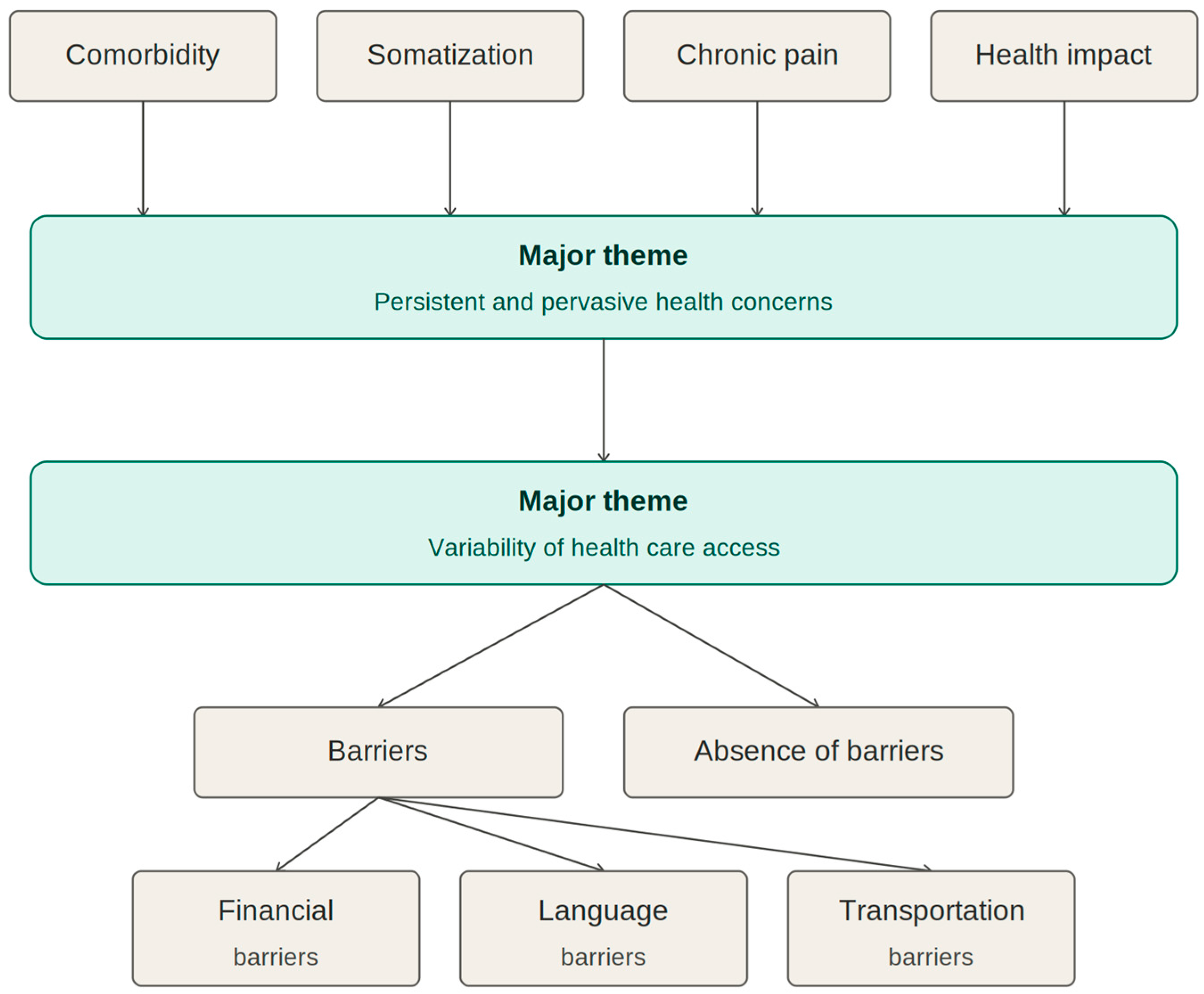
12. Major Theme: Persistent and Pervasive Health Concerns
Despite the study’s timing coinciding with the COVID-19 pandemic, participants experienced unrelated physical health conditions that significantly impacted their overall quality of life. Participants discussed physical health conditions that were chronic, somatic, and had high degrees of comorbidity, which required various forms of management.
12.1. Subtheme: Chronic Pain
Chronic joint, neck, and back pain were typical among participants, and several, like Aisha, a 38-year-old mother of three, described general body pain. She shared, “I have pain in my neck, as well as my body, knees, hands, joints in fingers, wrists, and elbows.” Others described persistent pain despite using medications for pain management and, in some cases, undergoing surgeries. Akbar, a 58-year-old father of three, expressed frustration with his unresolved back pain, explaining, “I am taking medicine for my back pain. I had surgery a year ago for my back, but until this day, I still feel pain sometimes.”
Similarly, Mariam, a 50-year-old female, shared, “I have joint pains, and I am currently taking medications for those. I also have back pain.” Many participants live with persistent pain, the severity of which has increased with time. Feroz, a 58-year-old father, explained, “As I am getting older, my physical health condition is getting worse, and I am constantly having pain in my body and joints.”
For many participants, pain was not an isolated complaint but one that accumulated alongside other stressors over time, consistent with the Double ABCX Model’s conception of stress pile-up (
McCubbin and Patterson 1983).
12.2. Subtheme: Somatization
The somatization of mental health issues—the expression of psychological distress through physical symptoms (
Nesterko et al. 2020)—was evident when study participants discussed their chronic pain and related physical health conditions. Participants tended to omit any discernible physical or mental health-related cause. Participants commonly reported somatic complaints, such as fatigue, memory loss and forgetfulness, and headaches. For example, Zubaidah, a 35-year-old female, shared, “I do not have mental health issues, but when I think a lot about something, I start to get headaches.” Similarly, 48-year-old Hasan demonstrated that he did not associate his headaches to his mental health, despite connecting his headaches to stress: “I do not have mental disorders. When I am stressed, I get headaches.”
Other participants dismissed the connection between mental health and somaticized complaints such as forgetfulness. Khadija, a 43-year-old female, explained,
I do not have mental health problems, but I do forget things quickly. I would get up to do something but instead, talk to a person for a minute or two and then forget what I got up for. So, I have problems always remembering stuff.
Instead, several participants viewed memory issues as indicative of the aging process. For example, Yasin, a 48-year-old man, shared,
I don’t have any major mental health problems. But as I am growing older, I am constantly forgetting things. I can’t keep up with remembering, even things I have done yesterday or so.
12.3. Subtheme: Comorbidity
Participants frequently identified comorbid conditions when describing their physical health. Khadija, a 43-year-old mother of two, shared,
I have a lot of health problems. I have jaundice. I have gastric. I also have had surgery for my back pain. Surgery happened for me two times, and both were done in America. I also have Hepatitis C.
Some participants described the development of comorbidities resulting from treating chronic conditions. In treating his back pain with prescribed medications, Akbar subsequently learned that his medication had caused kidney damage.
I have a lot of problems, and I have a lot of records since I came here about problems I am having. I have back pain. This January, I had to get an MRI at an MRI place. When I did the MRI, they said that I have kidney problems.
Other participants described the development of comorbidities resulting from chronic conditions. Fatima, a 32-year-old woman with diabetes, described complications associated with diabetes, including chronic pain and the development of vision loss:
I have pain in my joints and have had diabetes for six years, and the diabetes has caused some problems with my eye, and I am having problems with my eye. I am taking medication for it.
12.4. Subtheme: Impact of Health Issues
Many participants who reported physical health concerns stated feelings of stress and anxiety surrounding their diagnoses. Some discussed the impact of physical health conditions on their ability to maintain employment. For example, Khadija (43) shared, “I am willing to work, but I can’t work because I have trouble moving around due to back pain.” Yasin, a 48-year-old male, shared the impact of pain on his ability to work, despite treatment:
I have heart problem. I have two springs in my heart from the surgery. I have back pain. I am constantly going to the hospital. Because of the back pain, I can’t work; and I am on medication for all of this.
Participants also shared stories about the impact of pain and the increased need to seek health care treatment. For example, Yasin shared, “I have back pain, and I am constantly going to the hospital.” Similarly, Aisha, who underwent a surgical procedure to address persistent neck pain, shared, “I am constantly having to visit the doctor about my neck.”
Sajid, a 43-year-old male, echoed the sentiments of several individuals who worried about the impact of illness on their families. He shared,
One thing that makes me really scared is about my Hepatitis B disease. I don’t want to pass away very soon when my kids are still young because I don’t want them to go through a lot of tough situations and suffer. I want to be able to live long enough where my kids are grown up, and they are on their own.
Akbar, a 58-year-old man, voiced similar concerns about the impact of his poor health on his family and the financial implications of unemployment, sharing,
I am scared about what will happen to my family if my condition gets worse and I cannot provide for them because I am not sure who will take care of them. I am scared that my children will suffer in the future if my problem gets worse. I don’t know how they will get financial support.
These accounts illustrate how a single health condition did not exist in isolation for participants; it accumulated alongside financial insecurity, caregiving responsibility, and uncertainty about the future, consistent with the Double ABCX Model’s conception of stress pile-up (
McCubbin and Patterson 1983).
13. Major Theme: Variability of Health Care Access
Rohingya described their difficulties and frustration when trying to access health care services to address physical health conditions. Several participants explained that the various barriers they encountered prevented them from receiving adequate health care services or delayed receiving necessary treatment. Affordability of care, lack of reliable transportation, and language barriers presented significant challenges for many of the Rohingya in this study.
13.1. Subtheme: Financial Barriers
Several participants expressed frustration regarding the lack of affordable health care services, emphasizing the costs associated with treatment and medication. For some, this meant delaying treatments or foregoing treatment altogether. Akbar, age 58, explained, “Because of insurance not fully covering the payments of my health expenses, I am not able to go to the big [county] hospital to check my lower back problems.” While most participants asserted that they had some form of medical insurance, coverage varied widely and often did not cover medical expenses fully. Even participants with employer-provided health insurance mentioned the high costs of medications and in-patient hospital treatment. Akbar explained his predicament, which was a common sentiment expressed by others in the study:
I do not have government Medicaid, but I do have health insurance. My insurance does not cover all the medicine I would buy. For some of the medication, I would have to pay out-of-pocket. Since I have to take medication, the cost of the medication has been too much for me.
Mariam, age 50, shared Akbar’s frustration, explaining, “I have [name of insurance provider withheld] health care insurance. I use that when I go to the hospital. Sometimes it covers everything, and sometimes it does not.”
For participants without health insurance, accessing medical care was limited to services provided by a free clinic in the area. While several participants described accessing the clinic’s free medical care, they noted its limitations. Zubair, a 45-year-old father, shared,
We don’t have Medicaid. So, we try to go to the free clinic, and sometimes it is difficult because they do not have all the things that you are looking for. We can only get help with what they have.
13.2. Subtheme: Transportation Barriers
The lack of reliable transportation was a significant barrier to accessing care. This inaccessibility was the case for both acute and chronic health care needs. Ruksana, a 54-year-old female, explained,
It is kind of difficult to get access to health care. We do not have a car. So, whenever something happened, we will have to call somebody to see if they are available and try to take us to hospital, and when we do get to hospital, it is hard to explain what’s the matter.
Several participants relied on someone outside their family for transportation, often resulting in treatment delays or missed appointments. Feroz, age 58, explained, “I don’t have a car, and so when I need to go to the hospital, I have to call someone who can pick me up and drop me off.” Fatima, age 32, also shared that relying on others for transportation presented challenges. She shared, “I do not have my own transportation. I rely on my neighbors. I tell them ahead of time when I need to go somewhere, and they will take me whenever they get a chance.” This reliance on others resulted in frustration for some participants. Hasan, age 48, shared, “It is hard for me to go to hospital because I do not know how to drive, and my son is not always available.”
13.3. Subtheme: Language Barriers
Many participants identified the inability to communicate in English as a significant barrier to accessing appropriate medical treatment. Wahid, a 38-year-old male, explained, “It is easy to get to hospital, but we are not fully able to tell the doctor our problems. We don’t speak English that well, and sometimes we end up getting an interpreter.” Participants expressed frustration regarding the challenges they experienced in finding providers who thoroughly understood their health concerns. Health literacy concerns were also relevant for the Rohingyas in this study, as several described instances in which they could not understand their providers’ instructions regarding treatment and follow-up care. Hasan, age 48, shared,
When I go to the hospital, it’s hard for me to tell the doctor what is going on because I do not speak English. It is also hard for me to fill out forms at the hospital because I do not know how to read.
Some participants discussed challenges in finding Rohingya-speaking interpreters to assist them at their medical appointments. Junaid, a 43-year-old male, explained, “I can’t really speak English, so I often have trouble explaining my problems to the doctors. They have translators, but most of the time, they are unavailable.” Junaid also spoke about the sporadic availability of phone-based interpretation services provided at the county hospital. Some participants, like 45-year-old Zubair, explained that the lack of reliable interpreters in medical settings often forced reliance on friends and family members for interpreting at medical appointments. He explained,
It is difficult for us to tell them what our problem is because we don’t speak English that well. Most of the time, I take one of my kids or someone else who speaks English to try to tell them my problem.
Rather than operating as separate obstacles, financial, transportation, and language barriers frequently compounded one another for participants, adding to the cumulative burden of navigating the health care system captured by the Double ABCX Model (
McCubbin and Patterson 1983).
13.4. Subtheme: Absence of Barriers
While financial, transportation, and language barriers posed formidable challenges to many study participants, a minority did not experience these difficulties and viewed health care access as barrier-free. These participants discussed feeling respected and heard by medical staff and remarked on the high quality of care. Ali, a 32-year-old male, asserted,
I don’t have any difficulties accessing health care. In the hospital, the doctors are really nice over here. They take the time to understand your concerns and what you are going through and try to help you the best way possible. There are also health translators on phone call who understand us better.
Two participants talked about their appreciation for receiving medical treatment at the county hospital despite their lack of health insurance coverage. An essential aspect of their satisfaction with the U.S. medical establishment was that necessary treatment was not conditional based on one’s ability to pay for services. Yasin, a 48-year-old male, explained,
When we go to hospital, we have to call for an interpreter through phone, and a person would help translate our problem, and then we moved on to get treatments. Doctors are really nice over here. They are always there to listen to your problem and make you feel better. The one thing I really like is that whether you have money or not, insurance or not, they would do treatment for you and then worry about those later.
14. Discussion
The contribution of this study lies in showing how health concerns and health care barriers among Rohingya participants are shaped by the interaction of embodied distress, language access, and the long arc of displacement and statelessness. Rather than simply confirming that resettled refugee populations face financial, transportation, and language barriers, these findings demonstrate how Rohingya participants described chronic pain, headaches, forgetfulness, anxiety, family worry, and barriers to care as overlapping experiences. Participants often did not identify these concerns through Western mental health categories, yet their narratives linked physical symptoms to stress, trauma histories, family responsibility, and ongoing uncertainty. This pattern suggests that providers may miss significant health needs if they rely only on formal psychiatric diagnoses or assume that pain, somatic symptoms, and health care access barriers are separate clinical issues.
Experiences of direct, indirect, and compounded trauma are common among Rohingya refugees (
Khan and Haque 2021). Studies demonstrate that individuals who experience severe trauma have physical health problems, often due to unresolved trauma (
Levine 2008;
Van Der Kolk 2014). This study’s findings, which included reports of somatic symptoms such as headaches, migraines, and neck and back problems, are consistent with previous studies that link somatic symptoms and trauma (
Levine 2008). However, clinical research suggests that once an individual’s trauma is processed, its bodily manifestation, including psychosomatic symptoms, should diminish (
Levine 2008;
Van Der Kolk 2014). The presentation of somatic symptoms indicates the possibility of unresolved trauma in the lives of the Rohingya who participated in this study. This finding calls into question the lack of mental health diagnoses among participants and points to a need for more nuanced mental health screens for refugee populations. Considering that several study participants believed that they did not have mental health issues despite reporting somaticized complaints, the need for culturally competent mental health assessment tools in the Rohingya language and interventions aimed at increasing mental health literacy are critical to improving the mental and physical health of the Rohingya.
However, despite an absence of mental health diagnoses among participants, many reported that physical health conditions caused them to feel stressed or experience anxiety. For some, these conditions impacted their ability to work and led to unemployment. Some participants voiced concern about their health conditions’ impact on their families and shared experiences of daily stress related to their financial state. Others identified anxiety about family members living in Burma, their education, their children’s education, and the citizenship process as sources of daily stress. As demonstrated in previous research linking daily stressors and mental health issues (
Riley et al. 2017), it is critical to consider the chronic, post-resettlement stress of resettled Rohingya, which is driven by these daily stressors, comorbid conditions, and structural barriers to care. This experience of stress pile-up is one of compounded nonnormative stressors (
McCubbin and Patterson 1983;
Hutchison 2019), which increases the risk of adverse health outcomes, drives the prolonged physical manifestations of trauma, and acts as a formidable barrier to recovery (
Riley et al. 2017).
While many of this study’s participants had some form of health insurance, that insurance was primarily public, which does not always provide adequate coverage for medication and treatment. The Rohingya who participated in this study reported issues with accessing health care or filling prescription medication, often because they lacked the financial resources to pay for these uncovered costs. Further, transportation barriers proved to be an additional layer that restricted health care access, placing an undue burden on the Rohingya to identify family and community members with access to transportation, as it required them to time appointments according to family and community member availability rather than scheduling appointments according to their health needs.
Miscommunication, confusion, treatment delays, and role confusion resulted from language barriers, which presented a significant challenge to accessible health care. This study’s findings align with numerous studies that have identified that inadequate language supports predominate the health care landscape, creating additional barriers to care for resettled refugees in the United States and other host countries (
Mirza et al. 2013). The significance of language as a barrier to quality health care deserves special attention when considering the Rohingya. Lower health literacy can impact health care service use, interactions with providers, and the ability to engage in self-care (
Murphy et al. 2019). Because the Rohingya do not have a written language, access to trained bilingual interpreters is critical to ensure patient understanding of health conditions and treatment plans. Further, access to interpreters provides the opportunity to ask clarifying questions and address concerns. However, due to a lack of adequately trained interpreters, informal or ad hoc interpreters from the family or community may be used to facilitate communication—a practice that should be limited due to privacy and confidentiality issues and concerns about the accuracy of the information conveyed (
Tay et al. 2019). Such problems are compounded in the case of the Rohingya, whose language does not include equivalent terms for all health conditions (
Tay et al. 2019).
Language barriers also increase the likelihood that refugees will opt for emergency departments over primary care providers (
Guess et al. 2019). This preference for emergency care may be due to issues with the U.S. health care system, which is challenging to navigate and rationed by the ability to pay. Because emergency departments are required to treat patients who are not obligated to pay medical bills once incurred, this scenario is a costly alternative to taxpayers compared to the primary and preventative care providers can offer. Since some participants in this study indicated the development of secondary health conditions due to a chronic disease, it is vital that Rohingya refugees receive preventative care to reduce the occurrence of preventable comorbid conditions and health care costs.
Finally, it is essential to note that some Rohingyas who participated in this study reported positive interactions with the medical establishment, particularly citing perceived respect from providers who took the time to listen to their concerns. This positive experience is consistent with literature documenting the importance of building rapport and developing trust with refugee patients, which has been found to be particularly effective in addressing health and mental health concerns among refugees who present with histories of psychological trauma (
Shannon et al. 2016). Interestingly, those Rohingya in our study who did not report challenges in navigating the U.S. health care system understood which hospital provides culturally competent doctors who can build rapport quickly. These experiences underscore the critical need for culturally competent care and providers who understand the unique needs of diverse refugee populations.
Implications include training health care providers to recognize somatic presentations, such as unexplained pain, headaches, and fatigue, as potential indicators of unaddressed trauma rather than treating them as purely physical complaints requiring only medical workup. Because standardized mental health screening instruments are rarely validated for Rohingya populations, providers should incorporate open-ended, narrative-based questions about stress, family responsibility, and daily hardship into routine visits, rather than relying solely on symptom checklists developed for other populations. There is a need for further research focused on Rohingya’s trauma-related physical health conditions and interventions aimed at addressing chronic conditions and pain in ways that align with the cultural beliefs of the Rohingya, acknowledging the trauma of displacement and resettlement among this population. Because trauma-related symptoms, including psychosomatic ones, should diminish once an individual’s trauma is processed (
Levine 2008;
Van Der Kolk 2014), therapeutic interventions may benefit Rohingya refugees (
Khan and Haque 2021). Clinics serving Rohingya patients should prioritize consistent access to trained, in-person Rohingya-language interpreters rather than ad hoc phone-based services, and should build interpreter time into appointment scheduling given the added time language-discordant visits require. Given the frequency of comorbid chronic conditions among participants, primary care settings should coordinate case management across specialties to reduce the burden of navigating multiple providers, which several participants described as a source of both financial and logistical strain; access to primary care in settings familiar with the unique needs of Rohingya refugees, including case management, care coordination, and culturally competent supports, is vital to a more accessible health care system for those who are resettled (
Guess et al. 2019). Finally, because participants frequently identified the difficulty of transportation as a barrier independent of financial or language barriers, clinics and case managers should treat transportation support as a distinct area of need warranting its own attention rather than assuming it will resolve alongside financial or language-access improvements.
16. Conclusions
This study offers valuable insight into the physical and mental health needs of resettled Rohingya refugees displaced from their ancestral home in Burma due to civil war and genocide. As survivors of trauma, this population is at an increased risk for developing post-resettlement health problems (
Hoffman and Robertson 2016), and the study’s findings reveal the complexity of this population’s physical health conditions. This complexity is especially relevant when the health conditions of the Rohingya are considered in the context of the somatization of trauma. While the Rohingya who participated in this study experienced various physical health conditions, the most prominent were related to chronic pain and somaticized complaints. Comorbid conditions required treatment for many participants, with varying degrees of success. For some Rohingya, health conditions prevented them from maintaining employment or accomplishing daily tasks, which created situations of stress pile-up. Yet, when considering this study’s findings, it is vital to keep in mind the resiliency of the Rohingya people and their reliance on family and community members to overcome structural barriers to health care access.
This study contributes to the knowledge base by identifying barriers to health care faced by Rohingya people when attempting to access health care in a new place. While refugees are provided initial assistance upon resettlement, refugees encounter barriers to health care long after this brief assistance period ends. Financial barriers, including uninsurance or lack of adequate health insurance, left many of this study’s participants unable or unwilling to receive needed treatment, while transportation barriers often resulted in treatment delays. Language barriers most often prevented the participants from clearly communicating health issues to providers for those who could access care. As native speakers of a language without written form, the Rohingya face unique language barriers that other refugees may not encounter when seeking care.
Such findings point to the tension between displacement and resettlement and underscore the experience of compounded stressors related to resettlement (
McCubbin and Patterson 1983). Participants’ accounts reflected not only physical relocation but a deeper severing of ties to their ancestral home, layered atop the ongoing stressors of establishing a new life in the United States. These compounding stressors carry significant health and well-being consequences, including trauma’s long-term impact. The unique experiences, needs, and many strengths of the Rohingya people must be considered when developing interventions related to improving health and designing policies aimed at increasing access to care and narrowing the disparities inherent in the resettlement experience.